SELF-SERVICE IN
EPAM PRIVATE
CLOUD


                  1
ABOUT PRESENTER AND PRESENTATION


Olena Matokhina
Consulting & Development Team Lead


                                     2
MAIN GOALS

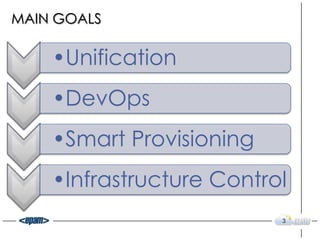
    •Unification
    •DevOps
    •Smart Provisioning
    •Infrastructure Control
                          3
CURRENT PROCESS


                                 Help Desk/HWU
Engineer


   Done! Finally…
                                    Your time…

                    Questions…
                                                 4
PRIVATE CLOUD STRUCTURE
          P   V
          r   i
          o   r
    API       t
          v                   • Hardware;
              u
          i                   • Storage;
              a
    API   s                   • Networking;
              l
          i
              i
          o   z
    API   n   a
          i   t
          n   i
    API   g   o
              n   Different
          L       Locations
    API   a   L
          y   a
          e   y
          r   e
              r
                                          5
CURRENT MODEL DISADVANTAGES

                Time-consuming
                Resource-consuming


       Code limitations


                                     6
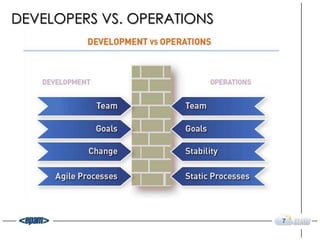
DEVELOPERS VS. OPERATIONS


                            7
DevOps


         8
ORCHESTRATOR 2


     A
     P
     I


                 9
TEMPLATES & COMMUNITY


   Template List


   Community       Moderation & Certification


                                                10
RESOURCES EXHAUSTED


                      11
QUOTAS SYSTEM - ROLES
                     Approximate VMs Quotations


 Manager


              Developer


                                 Quality Assurance


                                                  12
QUOTAS SYSTEM - PROJECTS
                          Approximate VMs Quotations


 Project 1


              Project 2


                                          Project 3


                                                       13
SELF-SERVICE MODEL BENEFITS


Global Infrastructure Savings   Smart Resource Provisioning


Better Delivery Time               Transparent Workflow


                                                              14
TWO WAYS


                   Long Way


       Short Way


                         15
OLD WAY IS UNAVAILABLE


                         16
TROUBLES AND CONCERNS


                         Non-typical
    Stability?
                             Task?


                 Concerns…


  Learning Time?       Complicated API?


                                          17
DEMO


       18
WHOLE PICTURE
                        24x7 Support
                        & Monitoring


                                        Continuous
       Case Studies
                                         Delivery


                      Competence
                        Center

                                        Log Search
       White Papers
                                          Service


                            Auto
                        configuration


                                                     19
OUR SITE
           http://cloud.epam.com


                                   20
QUESTIONS


            21
THANK YOU


            22

Self-Service in EPAM Private Cloud

Editor's Notes

  • #4 Here is the list of main goals of actions and points, described in this presentation.
  • #5 We are starting here from looking through a standard process of requesting a VM for personal or project needs. Developer gathers the requirements for future environment at the first step. Second is to write a request to HWU or Help Desk with comprehensive description of that environment and setup configuration. An interaction is created for developer and here he starts to wait. We all understand that setting up all these machines manually is really time-consuming. Not to mention additional questions, that in most cases do arise and have to be answered via email, which also spoils the time lapse. So, at the end we should receive a configured VM, but do we still need it? In an agile process of rapid development, there are situations which require resources immediately and for a short period of time. In addition there is no ability to create an application that allows HW resource configuration from code itself.
  • #6 I don’t want to be too specific here, but the current look of hardware pooling and provisioning is somewhere around this: There are multiple datacenters all over EPAM locations, they are all packed with some portion of hardware resources available for provisioning to projects. Above them are all different and available kinds of Hypervisors which control hardware and allocate resources. Communication to them is established via next so called Provisioning Layer, which is basically an API, allowing resources to be configured and requested programmatically. These APIs are all different and each and every one of them has its own set of commands for actions.
  • #7 If you ever thought about saving on something, you definitely came up with a thought that resources are limited. Our current company-wise model keeps lots of resources unused and unmanaged, requires constant provisioning and planning for hardware and employees. But even this is not the main concern. In today’s realities web applications require scaling to be enabled, and practical use of auto-scalability is impossible, when hardware is configured manually.
  • #8 By putting in front of each other and not lowering out any of usefulness for them, developers and operators are not always on the same page. When it comes to Team and achieving Goals, they are. But practical side shows, that Operators are used to static process and valuable for their stability, whether developers are valuable for constant self-education, will to improve technology and share programming languages. They are also into Agile processes as it gives business ability to adjust costs on the fly.
  • #9 We have to understand here, that DevOps is not limited by personality of single or multiple people, it is a wider meaning of set of skills. It combines automation for Operators (Ruby, Chef, etc.), Infrastructure Control for Developers wide range of other crossroads between people. This is currently considered the most cutting edge way of thinking for Software Development not only in Cloud Computing but elsewhere.
  • #10 What can be improved? - SurveyNew Model – DiagramHere is what we came up with. To unify and combine all those APIs, Calls, CLI commands in one place, we came up with a set of API, that practically introduces an additional level of control unification. This is introduced by orange and blue rectangles on this slide. Also, in opposite to slide #4, people here are not Maintenance Engineers any more, but actual Engineers to utilize resources.
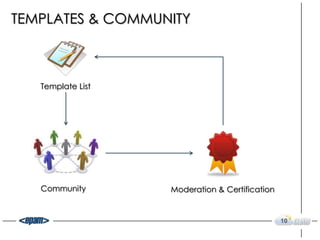
  • #11 Here is the introduction to the workflow on how a special set of software will be available to install on future Environment. We will have a set of predefined and most popularly used software stacks and technologies in form of templates. These are available to anyone, who want to launch an environment. In addition, all custom configurations from community of users are available to be committed into this Template Library. They will pass operations’ moderation and certification and later be uploaded to the same library for fore re-usage.
  • #12 What happens when there are no more resources? It is completely understandable that in a case when someone creates, for example, 500 VMs for his project no other project can use the same resources and there are no resources left basically. How this problem can be handled? The solution is quite simple…
  • #13 By introducing the quotas system. The whole idea about it is that depending on one’s employment status, he will have an available limit of VMs for him. Not only this is taken into consideration but also actual project dependencies, whether it is a billable project or an internal one, billable will get more numbers on quotas. And for sure, if there is a practical need in 500 VMs for one project or one user and he wills to pay for it, it will be allowed.
  • #14 By introducing the quotas system. The whole idea about it is that depending on one’s employment status, he will have an available limit of VMs for him. Not only this is taken into consideration but also actual project dependencies, whether it is a billable project or an internal one, billable will get more numbers on quotas. And for sure, if there is a practical need in 500 VMs for one project or one user and he wills to pay for it, it will be allowed.
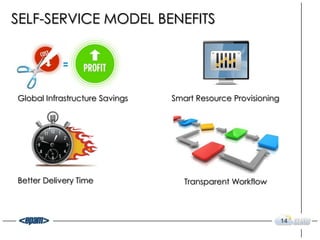
  • #15 Now let’s look at company-wise benefits if this model is implemented and used. By enabling and using all available resources, we are cutting on costs and focusing on profit from such action. Smart resource provisioning is achieved by utilizing all unused hardware all around locations. Better delivery time is one of key points here, like it has been said, no mail, no additional questions, no people interaction, resources are available when needed. Also, a transparent workflow is introduced.
  • #16 Where are my cookies? - Developer benefitsWe completely understand that there will be additional concerns about the way it is all handled, and some of you might still want to use the good old and known way with HWU or Help Desk. It is completely reasonable, but unfortunately it cannot be afforded for company. So…
  • #17 The old way of requesting resources will not be available any more.  Sorry. We all need to understand the profit of this decision, described above. It is completely obvious to anyone that if switched to a new model, resources are available faster, smarter and used only at the point when needed.
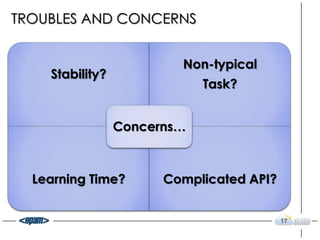
  • #18 And here the problem arises. So that the old way will not be available any more, we understand that you will and already have your concerns. Will the system be stable? What about API of this system? Will it be too complicated? How about the time that you would spend to learn all new commands and read Reference guides? And will it be a typical task to handle? You must understand that there are no right answers to these questions, it’s what has to be done in order to move forward and become a more valuable company on the market, a smarter choice.OK, let’s move on to the actual demonstration of how it all works…
  • #19 Showing the demo on the fly with comments
  • #20 To mention the important part – all that you have just seen is only a small dot of the whole picture. We are not just providing API so you can create resources, it is a whole new system. All valuable parts are combined in our Competency Center and we are always ready to answer questions. Those parts are Auto-Configuration Scripts for instances, storage and networking. We have a dedicated team of 24x7 Support and Monitoring for environments. There are models for Continuous Integration process and a unified Log Search Service currently based on Graylog. Different Case Studies and White Papers are available for you to examine.
  • #21 You can always come to us and ask questions, but we recommend you to use our Informational Portal first, it has answers to all Frequently Asked questions, integration with Management Console, Comprehensive help materials, Glossary and other valuable additions that will help you on your way to Self-Service model utilization.