





CYBER WORLD   Conquers Adolescents
SOCIAL NETWORKING
Generation Divide 9th grader: “My parents don’t understand that I’ve been online since I was in 2nd grade.  I know what to watch out for.” Parent: “I feel like I’m always on the outside looking in.  Technology is making it hard to relate to my child.” Teacher: “I need to find way to entertain my students.  We have to cut through the cloud of information and media surrounding them to capture their attention
A 2011 survey found that 47% of adults used a social network In 2011, HCL Technologies conducted research which showed that 50% of employers had banned the use of social networking sites/services during office hours In May 2010, a  child pornography  social networking site with hundreds of members was dismantled by law enforcement. It was deemed "the largest crimes against children case brought anywhere by anyone. Social networking is the internet's biggest growth area, particular among young children, 7% of teenagers aged 13 to 17 described themselves as "becoming addicted" to the net and other 26 per cent said they used it every day and considered it "an important part of their lives". Survey of social networking
 
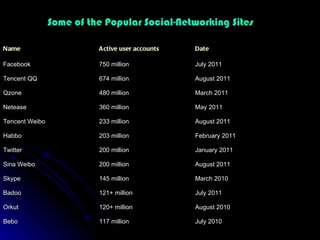
Some of the Popular Social-Networking Sites Name Active user accounts Date Facebook 750 million July 2011 Tencent QQ 674 million August 2011 Qzone 480 million March 2011 Netease 360 million May 2011 Tencent Weibo 233 million August 2011 Habbo 203 million February 2011 Twitter 200 million January 2011 Sina Weibo 200 million August 2011 Skype 145 million March 2010 Badoo 121+ million July 2011 Orkut 120+ million  August 2010 Bebo 117 million July 2010
ADULT SITES
ADULT SITES   30% of teen girls who used the Internet frequently had been sexually harassed while they were in a chat room. 37% of teens (male and female) received links to sexually explicit content online. 30% of teens have talked about meeting someone they met online  The largest consumer of Internet pornography is the 12-17 age group. A total of 90 percent of children ages 8-16 have viewed pornograpghy online.  9 in 10 kids 8-16 yrs. have viewed porn online, mostly accidentally while doing homework  Median age for the first use of Adult sites : boys: 11-13 girls: 12-14
Adult sites are the great evil   Sex is the number 1 topic searched on the Internet 70% of 18 to 24 year old men visit pornographic sites in a typical month  report being regular users of pornography. One in 17 children ages 10-17 were threatened or harassed over the Internet in 2000. A survey of 600 households conducted by the National Center for Missing & Exploited Children found that 20% of parents do not know any of their children’s Internet passwords, instant messaging nicknames or email addresses
ADULT SITES 21% of  teens say they have looked at something on the internet that they wouldn’t want their parents to know  Incidents of child sexual exploitation have risen from 4,573 in 1998 to 112,083 in 2004  Online sexual solicitation can be a traumatic experience for victims. About 25% of youth who were sexually solicited felt "extremely afraid or upset" in response to the incident. Those most affected by sexual solicitation included teens that were: aged 10–13, solicited more aggressively online, sexually solicited on a computer in another person's home, currently struggling with major symptoms of depression
Effects of ADULT sites   Addiction Self-destructive behavior Deviant behavior The dehumanization of  human dignity and the exploitation of the individual person. Crime
CYBER BULLYING
Physical or psychological intimidation that occurs repeatedly over time Bullying can be overt (i.e., teasing, hitting, or stealing); boys are most often overt bullies Bullying can covert (i.e., spreading rumors or exclusion); girls are most often covert bullies   WHAT IS BULLYING ?
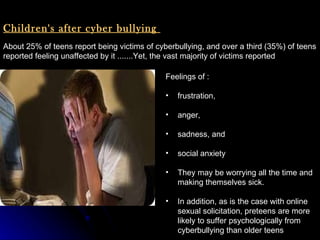
About 25% of teens report being victims of cyberbullying, and over a third (35%) of teens reported feeling unaffected by it .......Yet, the vast majority of victims reported  Feelings of : frustration, anger, sadness, and social anxiety  They may be worrying all the time and making themselves sick. In addition, as is the case with online sexual solicitation, preteens are more likely to suffer psychologically from cyberbullying than older teens  Children's after cyber bullying
 
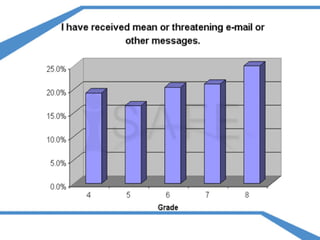
Cyber bullying typically starts at about 9 years of age and usually ends after 14 years of age; after 14, it becomes cyber or sexual harassment due to nature of acts and age of actors  Affects 65-85% of kids in the core group directly or indirectly through close friends  Problems in studies: not assessing the ‘real thing’ i.e. Only 15% of parent polled knew what cyber bullying was 65% of their students between 8-14 have been involved directly or indirectly in a cyber bullying incident as the cyber bully, victim or friend 21% of kids have received mean or threatening e-mail or other messages 58% have not told their parents or an adult about something mean or hurtful that happened to them online. Report of bullying
Criminal Law Limits  The following kinds of speech can lead to arrest & prosecution: Making threats of violence to people or their  property Engaging in coercion Making obscene or harassing phone calls Harassment or stalking Creating or sending sexually explicit images of teens Sexual exploitation Taking a photo of someone in place where privacy expected
Do not allow a child to have a computer in their bedroom Talk with your child Show an interest- have them show you what they are working on. Best Advise for Parents
The End  By Gocool  BCA 1 st  year

cyberworld

  • 1.
    CYBER WORLD Conquers Adolescents
  • 2.
  • 3.
    Generation Divide 9thgrader: “My parents don’t understand that I’ve been online since I was in 2nd grade. I know what to watch out for.” Parent: “I feel like I’m always on the outside looking in. Technology is making it hard to relate to my child.” Teacher: “I need to find way to entertain my students. We have to cut through the cloud of information and media surrounding them to capture their attention
  • 4.
    A 2011 surveyfound that 47% of adults used a social network In 2011, HCL Technologies conducted research which showed that 50% of employers had banned the use of social networking sites/services during office hours In May 2010, a  child pornography  social networking site with hundreds of members was dismantled by law enforcement. It was deemed "the largest crimes against children case brought anywhere by anyone. Social networking is the internet's biggest growth area, particular among young children, 7% of teenagers aged 13 to 17 described themselves as "becoming addicted" to the net and other 26 per cent said they used it every day and considered it "an important part of their lives". Survey of social networking
  • 5.
  • 6.
    Some of thePopular Social-Networking Sites Name Active user accounts Date Facebook 750 million July 2011 Tencent QQ 674 million August 2011 Qzone 480 million March 2011 Netease 360 million May 2011 Tencent Weibo 233 million August 2011 Habbo 203 million February 2011 Twitter 200 million January 2011 Sina Weibo 200 million August 2011 Skype 145 million March 2010 Badoo 121+ million July 2011 Orkut 120+ million August 2010 Bebo 117 million July 2010
  • 7.
  • 8.
    ADULT SITES 30% of teen girls who used the Internet frequently had been sexually harassed while they were in a chat room. 37% of teens (male and female) received links to sexually explicit content online. 30% of teens have talked about meeting someone they met online The largest consumer of Internet pornography is the 12-17 age group. A total of 90 percent of children ages 8-16 have viewed pornograpghy online. 9 in 10 kids 8-16 yrs. have viewed porn online, mostly accidentally while doing homework Median age for the first use of Adult sites : boys: 11-13 girls: 12-14
  • 9.
    Adult sites arethe great evil Sex is the number 1 topic searched on the Internet 70% of 18 to 24 year old men visit pornographic sites in a typical month report being regular users of pornography. One in 17 children ages 10-17 were threatened or harassed over the Internet in 2000. A survey of 600 households conducted by the National Center for Missing & Exploited Children found that 20% of parents do not know any of their children’s Internet passwords, instant messaging nicknames or email addresses
  • 10.
    ADULT SITES 21%of teens say they have looked at something on the internet that they wouldn’t want their parents to know Incidents of child sexual exploitation have risen from 4,573 in 1998 to 112,083 in 2004 Online sexual solicitation can be a traumatic experience for victims. About 25% of youth who were sexually solicited felt "extremely afraid or upset" in response to the incident. Those most affected by sexual solicitation included teens that were: aged 10–13, solicited more aggressively online, sexually solicited on a computer in another person's home, currently struggling with major symptoms of depression
  • 11.
    Effects of ADULTsites Addiction Self-destructive behavior Deviant behavior The dehumanization of human dignity and the exploitation of the individual person. Crime
  • 12.
  • 13.
    Physical or psychologicalintimidation that occurs repeatedly over time Bullying can be overt (i.e., teasing, hitting, or stealing); boys are most often overt bullies Bullying can covert (i.e., spreading rumors or exclusion); girls are most often covert bullies WHAT IS BULLYING ?
  • 14.
    About 25% ofteens report being victims of cyberbullying, and over a third (35%) of teens reported feeling unaffected by it .......Yet, the vast majority of victims reported Feelings of : frustration, anger, sadness, and social anxiety They may be worrying all the time and making themselves sick. In addition, as is the case with online sexual solicitation, preteens are more likely to suffer psychologically from cyberbullying than older teens Children's after cyber bullying
  • 15.
  • 16.
    Cyber bullying typicallystarts at about 9 years of age and usually ends after 14 years of age; after 14, it becomes cyber or sexual harassment due to nature of acts and age of actors Affects 65-85% of kids in the core group directly or indirectly through close friends Problems in studies: not assessing the ‘real thing’ i.e. Only 15% of parent polled knew what cyber bullying was 65% of their students between 8-14 have been involved directly or indirectly in a cyber bullying incident as the cyber bully, victim or friend 21% of kids have received mean or threatening e-mail or other messages 58% have not told their parents or an adult about something mean or hurtful that happened to them online. Report of bullying
  • 17.
    Criminal Law Limits The following kinds of speech can lead to arrest & prosecution: Making threats of violence to people or their property Engaging in coercion Making obscene or harassing phone calls Harassment or stalking Creating or sending sexually explicit images of teens Sexual exploitation Taking a photo of someone in place where privacy expected
  • 18.
    Do not allowa child to have a computer in their bedroom Talk with your child Show an interest- have them show you what they are working on. Best Advise for Parents
  • 19.
    The End By Gocool BCA 1 st year