Bullying In The Digital AgeSession ILita-Marie Townsend, MPHLaurie Heikkila
ObjectivesBy the end of this module participants will:Understand how young people use technology and the internetHave a clear understanding of bullying and cyber bullyingIdentify characteristics of bullies, and victimsIdentify potential risk factors and impact for youth, schools and communities, including health risksExplore theories, stereotypes, trends and correlations between gender and cyber bullying
Teens and TechnologyAccording to a recent study by the Pew Internet and American Life Project:93% of teens 12-17 go online63% of online teens go online daily89% of online teens go online from home, and most of them go online from home most often77% of teen go online at school71% go online from friends or relatives house60% go online from a library27% go online on their mobile phone76% of households with teens go online via broadband, 10% via dial up, and 12% do not have access at home.
Teens and Technology94% go online to do research for school assignments; 48% do so on a typical day.81% go to websites about movies, TV shows, music groups, or sports stars64% of online teens have created some kind of content online	62% go online to get news57% have watched a video on a video-sharing site like YouTube or GoogleVideo55% go online to get information about a college, university or other school that they are thinking about attending. 48% have bought something online like books, clothes or music31% have looked online for health, dieting or physical fitness information17% have looked online for sensitive health information
Teens and TechnologyTeens connect in a variety of ways besides computers:75% of teens have a cell phoneNo gender or race/ethnic differences in ownership50% of teens with phones talk to friends daily54% of teens send text messages daily27% use their phone to go online73% of teens use an online social network site37% of SNS users send messages through social networks daily80% of teens have a game console51% of teens have a portable gaming deviceTeens connect and interact with others online through games
Teens and TechnologyA recent report from the Kaiser Family Foundation includes these key findings:Youth 8-18 spend and average of 7 hrs 38 mins using entertainment media, and increase of 1hr 17 mins from 5 years agoThis is fueled by an increase in ownership of cell phones and other devices; from 39% to 66%, and 18% to 76%, respectively3 in 10 young people report parents setting rules for technology use, those with rules in place reported nearly 3 hours less of media consumption64% of youth say the T.V. is on during meals at home71% have a T.V. in their bedroom, 50% have a gaming console in their bedroomSocial Networking accounts for some increases, 74% of all 7-12th graders report having an online profile
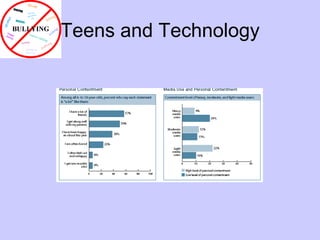
Teens and Technology
Important DefinitionsFrom Olweus Bullying Prevention Program:"A person is bullied when he or she is exposed, repeatedly and over time, to negative actions on the part of one or more other persons, and he or she has difficulty defending himself or herself."Further:Bullying is aggressive behavior that involves unwanted, negative actions.Bullying involves a pattern of behavior repeated over time.Bullying involves an imbalance of power or strength.
Important DefinitionsCyber bullying: when a child is tormented, threatened, harassed, humiliated, embarrassed or targeted by another child using the Internet, mobile phone, or other type of digital technology. If and adult is the cause, the terms cyber harassment, or cyber stalking applies.Cyber stalking: is a crime in which the attacker harasses a victim using electronic communication, such as e-mail or instant messaging (IM), or messages posted to a Web site or a discussion group. (adults)Cyber sex: Erotic or sexual communications held via internet chat or instant messaging, similar to phone sexTexting: refers to the exchange of brief written messages between fixed-line phone or mobile phone and fixed or portable devices over a network
Important DefinitionsSexting: is a practice in which people exchange sexually explicit material with each other via cell phone. This material can include racy text messages and images which may vary from simple boudoir shots to depictions of sex acts. Gaming: is a container term for 'the act of playing electronic games'. It is mostly used to designate an above average interest. Social Networking:Social networking is defined as the bringing individuals together into to specific groups, often like a small community or a neighborhood. When it comes to social networking on the internet, websites are used. These websites are known as social networking websites.Social networking websites are just like an online community of internet users.
Important DefinitionsHarassment:  To irritate or torment persistently.To wear out; exhaust.Repeated attacks, verbal or physical, any physical or verbal abuse of a person because of her race, religion, age, gender, disability or any other legally protected status. Sexual Harassment: is intimidation, bullying or coercion of a sexual nature, or the unwelcome or inappropriate promise of rewards in exchange for sexual favors. In some contexts or circumstances, sexual harassment may be illegal. It includes a range of behavior from seemingly mild transgressions and annoyances to actual sexual abuse or sexual assault
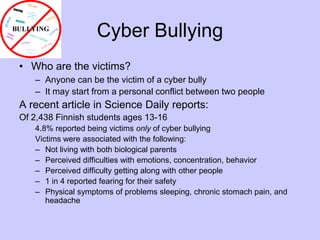
Cyber BullyingWho are the victims?Anyone can be the victim of a cyber bullyIt may start from a personal conflict between two peopleA recent article in Science Daily reports:Of 2,438 Finnish students ages 13-164.8% reported being victims only of cyber bullyingVictims were associated with the following:Not living with both biological parentsPerceived difficulties with emotions, concentration, behaviorPerceived difficulty getting along with other people1 in 4 reported fearing for their safetyPhysical symptoms of problems sleeping, chronic stomach pain, and headache
Cyber BullyingWho are the bullies? Anyone can be the victim of a cyber bullyIt may start from a personal conflict between two peopleThe same study reports:7.4 % of those students reported being cyber bullies only5.4% reported being both bullies and victims of this behaviorperceived difficulties in emotions, concentration, behavior, or getting along with other peoplehyperactivityconduct problemsinfrequent helping behaviorsfrequently smoking or getting drunk; headache and not feeling safe at school.
When is it Bullying?Harassment, intimidation or bullying can take many forms including: slurs, rumors, jokes, innuendo’s, demeaning comments, drawingcartoons, pranks, gestures, physical attacks, threats, or other written, oral or physical actions.  “Intentional acts” refers to the individual’schoice to engage in the act rather than the ultimate impact of the action(s).
When is it Bullying?Schools and other authorities may step if thebehavior:Physically harms a student or damages the student’s property; or Has the effect of substantially interfering with a student’s education; or Is severe, persistent, or pervasive that it creates an intimidating or threatening educational environment; or Has the effect of substantially disrupting the orderly operation of the school.
Gender and Cyber BullyingParents and other adults alike may have difficulty decidingIf a situation is true bullying, or ‘play’.Mean Girls:Girls are less likely to engage in traditional face to face bullying, or physical intimidation than boys.Girls are more likely to engage in nonphysical bullying, shunning, gossiping, rumors.Girls reported being cyber bullies 13% more than boysGirls also reported being victimized by cyber bullies 25% more than boys(Robin Kowalski, PhD)
       Gender and Cyber BullyingBoys Will Be BoysBoys were more likely to engage in traditional bullying, name calling, intimidation, as well as in physical bullying including physical harm, than girlsBoys were less likely than girls to report being bullied onlineBoys were more likely to post rude or hurtful pictures online as a form of bullyingBoys were less likely to spread rumors online
Reflection QuestionsWhat are your perceptions of traditional bullying?How does traditional bullying differ from cyber bullying?How much of bullying is just part of adolescence that everyone has to deal with?Do you consider cyber bullying a serious problem? Why or why not?

Cyber bullying

  • 1.
    Bullying In TheDigital AgeSession ILita-Marie Townsend, MPHLaurie Heikkila
  • 2.
    ObjectivesBy the endof this module participants will:Understand how young people use technology and the internetHave a clear understanding of bullying and cyber bullyingIdentify characteristics of bullies, and victimsIdentify potential risk factors and impact for youth, schools and communities, including health risksExplore theories, stereotypes, trends and correlations between gender and cyber bullying
  • 3.
    Teens and TechnologyAccordingto a recent study by the Pew Internet and American Life Project:93% of teens 12-17 go online63% of online teens go online daily89% of online teens go online from home, and most of them go online from home most often77% of teen go online at school71% go online from friends or relatives house60% go online from a library27% go online on their mobile phone76% of households with teens go online via broadband, 10% via dial up, and 12% do not have access at home.
  • 4.
    Teens and Technology94%go online to do research for school assignments; 48% do so on a typical day.81% go to websites about movies, TV shows, music groups, or sports stars64% of online teens have created some kind of content online 62% go online to get news57% have watched a video on a video-sharing site like YouTube or GoogleVideo55% go online to get information about a college, university or other school that they are thinking about attending. 48% have bought something online like books, clothes or music31% have looked online for health, dieting or physical fitness information17% have looked online for sensitive health information
  • 5.
    Teens and TechnologyTeensconnect in a variety of ways besides computers:75% of teens have a cell phoneNo gender or race/ethnic differences in ownership50% of teens with phones talk to friends daily54% of teens send text messages daily27% use their phone to go online73% of teens use an online social network site37% of SNS users send messages through social networks daily80% of teens have a game console51% of teens have a portable gaming deviceTeens connect and interact with others online through games
  • 6.
    Teens and TechnologyArecent report from the Kaiser Family Foundation includes these key findings:Youth 8-18 spend and average of 7 hrs 38 mins using entertainment media, and increase of 1hr 17 mins from 5 years agoThis is fueled by an increase in ownership of cell phones and other devices; from 39% to 66%, and 18% to 76%, respectively3 in 10 young people report parents setting rules for technology use, those with rules in place reported nearly 3 hours less of media consumption64% of youth say the T.V. is on during meals at home71% have a T.V. in their bedroom, 50% have a gaming console in their bedroomSocial Networking accounts for some increases, 74% of all 7-12th graders report having an online profile
  • 7.
  • 8.
    Important DefinitionsFrom OlweusBullying Prevention Program:"A person is bullied when he or she is exposed, repeatedly and over time, to negative actions on the part of one or more other persons, and he or she has difficulty defending himself or herself."Further:Bullying is aggressive behavior that involves unwanted, negative actions.Bullying involves a pattern of behavior repeated over time.Bullying involves an imbalance of power or strength.
  • 9.
    Important DefinitionsCyber bullying:when a child is tormented, threatened, harassed, humiliated, embarrassed or targeted by another child using the Internet, mobile phone, or other type of digital technology. If and adult is the cause, the terms cyber harassment, or cyber stalking applies.Cyber stalking: is a crime in which the attacker harasses a victim using electronic communication, such as e-mail or instant messaging (IM), or messages posted to a Web site or a discussion group. (adults)Cyber sex: Erotic or sexual communications held via internet chat or instant messaging, similar to phone sexTexting: refers to the exchange of brief written messages between fixed-line phone or mobile phone and fixed or portable devices over a network
  • 10.
    Important DefinitionsSexting: isa practice in which people exchange sexually explicit material with each other via cell phone. This material can include racy text messages and images which may vary from simple boudoir shots to depictions of sex acts. Gaming: is a container term for 'the act of playing electronic games'. It is mostly used to designate an above average interest. Social Networking:Social networking is defined as the bringing individuals together into to specific groups, often like a small community or a neighborhood. When it comes to social networking on the internet, websites are used. These websites are known as social networking websites.Social networking websites are just like an online community of internet users.
  • 11.
    Important DefinitionsHarassment: To irritate or torment persistently.To wear out; exhaust.Repeated attacks, verbal or physical, any physical or verbal abuse of a person because of her race, religion, age, gender, disability or any other legally protected status. Sexual Harassment: is intimidation, bullying or coercion of a sexual nature, or the unwelcome or inappropriate promise of rewards in exchange for sexual favors. In some contexts or circumstances, sexual harassment may be illegal. It includes a range of behavior from seemingly mild transgressions and annoyances to actual sexual abuse or sexual assault
  • 12.
    Cyber BullyingWho arethe victims?Anyone can be the victim of a cyber bullyIt may start from a personal conflict between two peopleA recent article in Science Daily reports:Of 2,438 Finnish students ages 13-164.8% reported being victims only of cyber bullyingVictims were associated with the following:Not living with both biological parentsPerceived difficulties with emotions, concentration, behaviorPerceived difficulty getting along with other people1 in 4 reported fearing for their safetyPhysical symptoms of problems sleeping, chronic stomach pain, and headache
  • 13.
    Cyber BullyingWho arethe bullies? Anyone can be the victim of a cyber bullyIt may start from a personal conflict between two peopleThe same study reports:7.4 % of those students reported being cyber bullies only5.4% reported being both bullies and victims of this behaviorperceived difficulties in emotions, concentration, behavior, or getting along with other peoplehyperactivityconduct problemsinfrequent helping behaviorsfrequently smoking or getting drunk; headache and not feeling safe at school.
  • 14.
    When is itBullying?Harassment, intimidation or bullying can take many forms including: slurs, rumors, jokes, innuendo’s, demeaning comments, drawingcartoons, pranks, gestures, physical attacks, threats, or other written, oral or physical actions.  “Intentional acts” refers to the individual’schoice to engage in the act rather than the ultimate impact of the action(s).
  • 15.
    When is itBullying?Schools and other authorities may step if thebehavior:Physically harms a student or damages the student’s property; or Has the effect of substantially interfering with a student’s education; or Is severe, persistent, or pervasive that it creates an intimidating or threatening educational environment; or Has the effect of substantially disrupting the orderly operation of the school.
  • 16.
    Gender and CyberBullyingParents and other adults alike may have difficulty decidingIf a situation is true bullying, or ‘play’.Mean Girls:Girls are less likely to engage in traditional face to face bullying, or physical intimidation than boys.Girls are more likely to engage in nonphysical bullying, shunning, gossiping, rumors.Girls reported being cyber bullies 13% more than boysGirls also reported being victimized by cyber bullies 25% more than boys(Robin Kowalski, PhD)
  • 17.
    Gender and Cyber BullyingBoys Will Be BoysBoys were more likely to engage in traditional bullying, name calling, intimidation, as well as in physical bullying including physical harm, than girlsBoys were less likely than girls to report being bullied onlineBoys were more likely to post rude or hurtful pictures online as a form of bullyingBoys were less likely to spread rumors online
  • 18.
    Reflection QuestionsWhat areyour perceptions of traditional bullying?How does traditional bullying differ from cyber bullying?How much of bullying is just part of adolescence that everyone has to deal with?Do you consider cyber bullying a serious problem? Why or why not?