Cyber-bullyingBy: Michael Sturgeon
What is Cyber-bullying?“A situation when a child, tween or teen is repeatedly 'tormented, threatened, harassed, humiliated, embarrassed or otherwise targeted' by another child or teenager using text messaging, email, instant messaging or any other type of digital technology.”
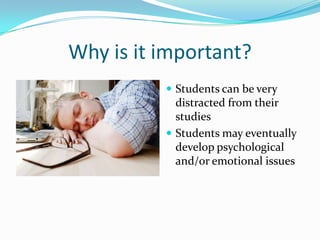
Why is it important?Students can be very distracted from their studiesStudents may eventually develop psychological and/or emotional issues
What constitutes as cyber-bulling?The intentional use of information and communication technologies to support intentional, repeated, and hostile behavior directed at an individual or a group.
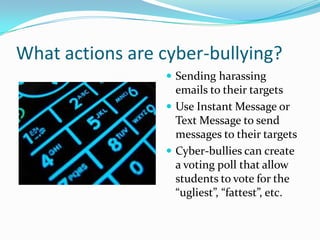
What actions are cyber-bullying?Sending harassing emails to their targetsUse Instant Message or Text Message to send messages to their targetsCyber-bullies can create a voting poll that allow students to vote for the “ugliest”, “fattest”, etc.
How is it impacting K-12 education?Victims of cyber-bullying have lower self-esteems, increased suicidal tendencies, and a variety of emotional responsesThere has even been a couple cases of suicide brought on by cyber-bullying.
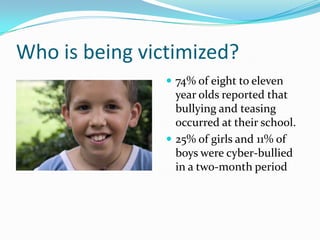
Who is being victimized?74% of eight to eleven year olds reported that bullying and teasing occurred at their school.25% of girls and 11% of boys were cyber-bullied in a two-month period
What can you do?School administrators can access their situation and then make it clear the seriousness of cyber-bullying and consequences of violating school rules of harassment.Parents can educate their children about the signs of cyber-bullying and encourage them to tell an adult if they are being cyber-bullied.
What is the government doing?California has passed a law that gives the school administrator the authority to discipline students for bullying offline or online.
ConclusionCyber-bullying is a continuation of regular bullying but has adapted to the 21st century.Cyber-bullying is more hurtful to their victim because the bullies don’t have to be face-to-face to let the hurt outCyber-bullying laws have been made effective in certain states but there has been nothing in other states. The US government needs to implement a federal rule against cyber-bullying.
Sourceshttp://www.flickr.com/photos/sveinhal/2533808944/http://www.flickr.com/photos/scelera/2215069210/http://www.flickr.com/photos/thomaspetermueller/4402282914/http://www.flickr.com/photos/bike/316540202/Beale, Andrew V.; Hall, Kimberly R. “Cyberbullying: What School Administrators (and Parents) Can Do.” The Clearing House v. 81 no1 (September/October 2007) p. 8-12.www.cyberbullying.org

Cyber Bullying

  • 1.
  • 2.
    What is Cyber-bullying?“Asituation when a child, tween or teen is repeatedly 'tormented, threatened, harassed, humiliated, embarrassed or otherwise targeted' by another child or teenager using text messaging, email, instant messaging or any other type of digital technology.”
  • 3.
    Why is itimportant?Students can be very distracted from their studiesStudents may eventually develop psychological and/or emotional issues
  • 4.
    What constitutes ascyber-bulling?The intentional use of information and communication technologies to support intentional, repeated, and hostile behavior directed at an individual or a group.
  • 5.
    What actions arecyber-bullying?Sending harassing emails to their targetsUse Instant Message or Text Message to send messages to their targetsCyber-bullies can create a voting poll that allow students to vote for the “ugliest”, “fattest”, etc.
  • 6.
    How is itimpacting K-12 education?Victims of cyber-bullying have lower self-esteems, increased suicidal tendencies, and a variety of emotional responsesThere has even been a couple cases of suicide brought on by cyber-bullying.
  • 7.
    Who is beingvictimized?74% of eight to eleven year olds reported that bullying and teasing occurred at their school.25% of girls and 11% of boys were cyber-bullied in a two-month period
  • 8.
    What can youdo?School administrators can access their situation and then make it clear the seriousness of cyber-bullying and consequences of violating school rules of harassment.Parents can educate their children about the signs of cyber-bullying and encourage them to tell an adult if they are being cyber-bullied.
  • 9.
    What is thegovernment doing?California has passed a law that gives the school administrator the authority to discipline students for bullying offline or online.
  • 10.
    ConclusionCyber-bullying is acontinuation of regular bullying but has adapted to the 21st century.Cyber-bullying is more hurtful to their victim because the bullies don’t have to be face-to-face to let the hurt outCyber-bullying laws have been made effective in certain states but there has been nothing in other states. The US government needs to implement a federal rule against cyber-bullying.
  • 11.
    Sourceshttp://www.flickr.com/photos/sveinhal/2533808944/http://www.flickr.com/photos/scelera/2215069210/http://www.flickr.com/photos/thomaspetermueller/4402282914/http://www.flickr.com/photos/bike/316540202/Beale, Andrew V.;Hall, Kimberly R. “Cyberbullying: What School Administrators (and Parents) Can Do.” The Clearing House v. 81 no1 (September/October 2007) p. 8-12.www.cyberbullying.org

Editor's Notes

  • #2 Cyber-bullying by Michael Sturgeon
  • #3 As stated by cyberbullying.org, a situation when a child, tween or teen is repeatedly tormented, threatened, harassed, humiliated, embarrassed or otherwise targeted by another child or teenager using text messaging, email, instant messaging or any other type of digital technology is cyber-bullying.
  • #4 Cyber-bullying is important because students can suffer in their school work and it could lead to psychological or emotional issues.
  • #5 The intentional use of information and communication to support hostile behavior directed at an individual or a group constitutes as Cyber-bullying.
  • #6 The actions that the cyber-bullies use are: sending harassing emails, Instant messages, text messages to their targets. Also Cyber-bullies create voting poll that allow other students to vote for the “ugliest”, “fattest”, etc. person.
  • #7 Victims of cyber-bullying have lower self-esteems, increased suicidal tendencies, and a variety of emotional responses.
  • #8 74% of eight to eleven year olds reported that bullying and teasing occurred at their school. A study of a two month period showed that 25% of girls and 11% of boys were cyber-bullied.
  • #9 What can you do? School administrators can access their situation and voice their schools rules on harassment and the seriousness of cyber-bullying. Parents can educate their children on the signs of cyber-bullying and encourage them to tell them if there is cyber-bullying happening.
  • #10 In California, they have passed a law that gives the school administrator the authority to discipline students for bullying offline or online.
  • #11 Cyber-bullying is a continuation of regular bullying but has adapted to the 21st century. Cyber-bullying is more hurtful to their victim because the bullies don’t have to be face-to-face to let the hurt out.