










Children & Internet
Safety
Approximately 93 percent of all
Americans between 12 and 17
years old are internet users.

Join Our Group:
http://bit.ly/websafetygroup
Should technology ever
permit humans to download
our brains' mental images to
a hard drive, every last
teenager in America will
wind up prohibited from
living within 10,000 feet of
themselves.
Join Our Group:
http://bit.ly/websafetygroup
Internet
Artifacts
are an
issue
for
everyone.
Snow White has a
rough night.
Join Our Group:
http://bit.ly/websafetygroup
Principal Sharron Smalls of Jane
Addams High School in the Bronx
has sexy Facebook picture

Join Our Group:
http://bit.ly/websafetygroup
Child Predators Facts:
One in five U.S. teenagers who regularly log
on to the Internet says they have received
an unwanted sexual solicitation via the
Web.
Solicitations were defined as requests to
engage in sexual activities or sexual talk, or
to give out personal sexual information. (only
25% of those told a parent).
Join Our Group:
http://bit.ly/websafetygroup
Child Predators Facts

About 30% of the victims of
Internet sexual
exploitation are boys.
Join Our Group:
http://bit.ly/websafetygroup
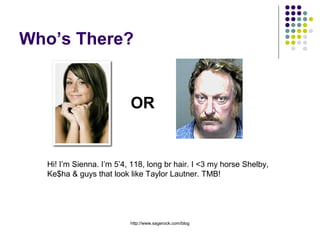
Who’s There?

OR

Hi! I’m Sienna. I’m 5’4, 118, long br hair. I <3 my horse Shelby,
Ke$ha & guys that look like Taylor Lautner. TMB!

Join Our Group:
http://bit.ly/websafetygroup
Child Predators Facts
Internet sexual predators tend to fall between
the ages of 18 and 55, although some are
older or younger.
Their targets tend to be between the ages of
11 and 15
Join Our Group:
http://bit.ly/websafetygroup
Child Predators Facts

In 100% of the cases, teens
that are the victims of sexual
predators have gone
willingly to meet with them.
Join Our Group:
http://bit.ly/websafetygroup
Child Predators Facts

Teens are willing to meet with
strangers:
16 percent of teens considered meeting
someone they've only talked to online and
8 percent have actually met someone they
only knew online.
Join Our Group:
http://bit.ly/websafetygroup
Child Predators Facts

75% of children are willing
to share personal
information online about
themselves and their family
in exchange for goods and
services.
Join Our Group:
http://bit.ly/websafetygroup
•72 percent of Americans age 18
to 29 would hand over their
personal information in return for
a discount on movie tickets
•only 56 percent of those age 45 to 59
would do the same.

•Two thirds of the young hipsters
would surrender their data for free
popcorn
•versus 52 percent of the aging crones.
Join Our Group: PwC Survey 2012
http://bit.ly/websafetygroup
Internet Artifacts
When a child says or does something inappropriate on the Internet,
it is nearly impossible to take it back and prevent unanticipated
future consequences.
What are they? Internet artifacts are the conversations, messages, thoughts,
opinions, photographs, and identifying information that children are storing on
Internet sites such as Facebook, Myspace, Gmail, Hotmail, Yahoo, Twitter, etc.
Why are they Dangerous? Internet artifacts may demonstrate a lack of maturity,
lack of judgment, or an opinion regarding a controversial or unpopular topic that
children do not fully understand. Expressing a controversial opinion can result in
unanticipated consequences and potentially may be available on the Internet for
a very long time and retrieved years later, by potential employers and
admissions officers for schools, colleges and universities.
How is this possible? All of the information that is stored on server computers on
the Internet belongs to the service provider -- not the user.

Join Our Group:
http://bit.ly/websafetygroup
Sexting
Not only can sexting ruin reputations, but it can also get
your teenager arrested for distributing child pornography.
The percent of teenagers who have sent or posted nude or semi-nude
pictures or video of themselves:





20% of teenagers overall
22% of teen girls
18% of teen boys
11% of young teen girls ages 13-16

The percent of teenagers sending or posting sexually suggestive
messages:




39% of all teenagers
37% of teen girls
40% of teen boys

Join Our Group:
http://bit.ly/websafetygroup
Sexting Continued


15% of teens sent or posted nude / seminude pics of themselves to someone they only knew
online.



71% of teen girls and 67% of teen guys who have sent or posted sexually suggestive content say
they have sent or posted this content to a boyfriend or girlfriend.



21% of teen girls and 39% of teen boys sent such content to someone they wanted to date.



44% of both teen girls and teen boys say it is common for sexually suggestive text messages to get
shared with people other than the intended recipient.



36% of teen girls and 39% of teen boys say it is common for nude or semi-nude photos to get
shared with people other than the intended recipient.



51% of teen girls say pressure from a guy is a reason girls send sexy messages or images.



66% of teen girls and 60% of teen boys say they did so to be “fun or flirtatious.



52% of teenage girls used sexting as a “sexy present” for their boyfriend.



44% of both teen girls and teen boys say they sent sexually suggestive messages or images in
response to similar content.



40% of teen girls sent sexually suggestive messages or images as “a joke;” 34% to “feel sexy,” &
12% felt “pressured.”
Join Our Group:
http://bit.ly/websafetygroup
Snapchat
 Snapchat

users were
sending 350 million
messages per day, up
from 200 million in
June 2013. (from Pew)

Join Our Group:
http://bit.ly/websafetygroup
A recent review on
the iTunes page:
“This app is quick
easy and fun, but
too many
pedophiles asking
me for nude
pictures which
almost forced me
to delete this app.
But it is safe as
long as you don’t
talk to strangers.”
Join Our Group:
http://bit.ly/websafetygroup
Join Our Group:
http://bit.ly/websafetygroup
Cyber Bullying

More than 1 in 3 young
people have experienced
cyberthreats online.

Join Our Group:
http://bit.ly/websafetygroup
Cyber Bullying
What is it? Cyber bullying can take many forms:
 Sending mean messages or threats to a person's email account
or cell phone
 Spreading rumors online or through texts
 Posting hurtful or threatening messages on social networking
sites or web pages
 Stealing a person's account information to break into their
account and send damaging messages
 Pretending to be someone else online to hurt another person
 Taking unflattering pictures of a person and spreading them
through cell phones or the Internet
 Sexting, or circulating sexually suggestive pictures or messages
about a person
Join Our Group:
http://bit.ly/websafetygroup
Join Our Group:
http://bit.ly/websafetygroup
Cyber Bullying Continued
Who Is Involved?
 Over half of adolescents and teens have been bullied online, and about the
same number have engaged in cyber bullying.
 More than 1 in 3 young people have experienced cyberthreats online.
 Over 25 percent of adolescents and teens have been bullied repeatedly through
their cell phones or the Internet.
 Well over half of young people do not tell their parents when cyber bullying
occurs.
 Around half of teens have been the victims of cyber bullying
 Fewer than 1 in 5 cyber bullying incidents are reported to law enforcement
 1 in 10 adolescents or teens have had embarrassing or damaging pictures taken
of themselves without their permission, often using cell phone cameras
 About half of young people have experienced some form of cyber bullying, and
10 to 20 percent experience it regularly
 Girls are at least as likely as boys to be cyber bullies or their victims
 Cyber bullying victims are more likely to have low self esteem and to consider
suicide

Join Our Group:
http://bit.ly/websafetygroup
Cyber Bullying Continued
What Can You Do?













Talks to teens about cyber bullying, explaining that it is wrong and can have serious consequences.
Make a rule that teens may not send mean or damaging messages, even if someone else started it,
or suggestive pictures or messages or they will lose their cell phone and computer privileges for a
time.
Encourage teens to tell an adult if cyber bullying is occurring. Tell them if they are the victims they will
not be punished, and reassure them that being bullied is not their fault.
Teens should keep cyber bullying messages as proof that the cyber bullying is occurring. The teens'
parents may want to talk to the parents of the cyber bully, to the bully's Internet or cell phone
provider, and/or to the police about the messages, especially if they are threatening or sexual in
nature.
Try blocking the person sending the messages. It may be necessary to get a new phone number or
email address and to be more cautious about giving out the new number or address.
Teens should never tell their password to anyone except a parent, and should not write it down in a
place where it could be found by others.
Teens should not share anything through text or instant messaging on their cell phone or the Internet
that they would not want to be made public - remind teens that the person they are talking to in
messages or online may not be who they think they are, and that things posted electronically may not
be secure.
Encourage teens never to share personal information online or to meet someone they only know
online.
Keep the computer in a shared space like the family room, and do not allow teens to have Internet
access in their own rooms.
Join allow their teens
Parents may want to wait until high school toOur Group: to have their own email and cell phone
accounts, and even then parents should still have access to the accounts.
http://bit.ly/websafetygroup
More Stats and Tools
 Kids'

Pledge for Online Safety

 Teen

Pledge for Online Safety

 Parents'

Pledge for Online Safety

 https://delicious.com/sagerock/internet-safety
Join Our Group:
http://bit.ly/websafetygroup

Family Internet Safety

  • 1.
    Children & Internet Safety Approximately93 percent of all Americans between 12 and 17 years old are internet users. Join Our Group: http://bit.ly/websafetygroup
  • 2.
    Should technology ever permithumans to download our brains' mental images to a hard drive, every last teenager in America will wind up prohibited from living within 10,000 feet of themselves. Join Our Group: http://bit.ly/websafetygroup
  • 4.
  • 5.
    Snow White hasa rough night. Join Our Group: http://bit.ly/websafetygroup
  • 6.
    Principal Sharron Smallsof Jane Addams High School in the Bronx has sexy Facebook picture Join Our Group: http://bit.ly/websafetygroup
  • 7.
    Child Predators Facts: Onein five U.S. teenagers who regularly log on to the Internet says they have received an unwanted sexual solicitation via the Web. Solicitations were defined as requests to engage in sexual activities or sexual talk, or to give out personal sexual information. (only 25% of those told a parent). Join Our Group: http://bit.ly/websafetygroup
  • 8.
    Child Predators Facts About30% of the victims of Internet sexual exploitation are boys. Join Our Group: http://bit.ly/websafetygroup
  • 9.
    Who’s There? OR Hi! I’mSienna. I’m 5’4, 118, long br hair. I <3 my horse Shelby, Ke$ha & guys that look like Taylor Lautner. TMB! Join Our Group: http://bit.ly/websafetygroup
  • 10.
    Child Predators Facts Internetsexual predators tend to fall between the ages of 18 and 55, although some are older or younger. Their targets tend to be between the ages of 11 and 15 Join Our Group: http://bit.ly/websafetygroup
  • 11.
    Child Predators Facts In100% of the cases, teens that are the victims of sexual predators have gone willingly to meet with them. Join Our Group: http://bit.ly/websafetygroup
  • 12.
    Child Predators Facts Teensare willing to meet with strangers: 16 percent of teens considered meeting someone they've only talked to online and 8 percent have actually met someone they only knew online. Join Our Group: http://bit.ly/websafetygroup
  • 13.
    Child Predators Facts 75%of children are willing to share personal information online about themselves and their family in exchange for goods and services. Join Our Group: http://bit.ly/websafetygroup
  • 14.
    •72 percent ofAmericans age 18 to 29 would hand over their personal information in return for a discount on movie tickets •only 56 percent of those age 45 to 59 would do the same. •Two thirds of the young hipsters would surrender their data for free popcorn •versus 52 percent of the aging crones. Join Our Group: PwC Survey 2012 http://bit.ly/websafetygroup
  • 15.
    Internet Artifacts When achild says or does something inappropriate on the Internet, it is nearly impossible to take it back and prevent unanticipated future consequences. What are they? Internet artifacts are the conversations, messages, thoughts, opinions, photographs, and identifying information that children are storing on Internet sites such as Facebook, Myspace, Gmail, Hotmail, Yahoo, Twitter, etc. Why are they Dangerous? Internet artifacts may demonstrate a lack of maturity, lack of judgment, or an opinion regarding a controversial or unpopular topic that children do not fully understand. Expressing a controversial opinion can result in unanticipated consequences and potentially may be available on the Internet for a very long time and retrieved years later, by potential employers and admissions officers for schools, colleges and universities. How is this possible? All of the information that is stored on server computers on the Internet belongs to the service provider -- not the user. Join Our Group: http://bit.ly/websafetygroup
  • 16.
    Sexting Not only cansexting ruin reputations, but it can also get your teenager arrested for distributing child pornography. The percent of teenagers who have sent or posted nude or semi-nude pictures or video of themselves:     20% of teenagers overall 22% of teen girls 18% of teen boys 11% of young teen girls ages 13-16 The percent of teenagers sending or posting sexually suggestive messages:    39% of all teenagers 37% of teen girls 40% of teen boys Join Our Group: http://bit.ly/websafetygroup
  • 17.
    Sexting Continued  15% ofteens sent or posted nude / seminude pics of themselves to someone they only knew online.  71% of teen girls and 67% of teen guys who have sent or posted sexually suggestive content say they have sent or posted this content to a boyfriend or girlfriend.  21% of teen girls and 39% of teen boys sent such content to someone they wanted to date.  44% of both teen girls and teen boys say it is common for sexually suggestive text messages to get shared with people other than the intended recipient.  36% of teen girls and 39% of teen boys say it is common for nude or semi-nude photos to get shared with people other than the intended recipient.  51% of teen girls say pressure from a guy is a reason girls send sexy messages or images.  66% of teen girls and 60% of teen boys say they did so to be “fun or flirtatious.  52% of teenage girls used sexting as a “sexy present” for their boyfriend.  44% of both teen girls and teen boys say they sent sexually suggestive messages or images in response to similar content.  40% of teen girls sent sexually suggestive messages or images as “a joke;” 34% to “feel sexy,” & 12% felt “pressured.”
  • 18.
  • 19.
    Snapchat  Snapchat users were sending350 million messages per day, up from 200 million in June 2013. (from Pew) Join Our Group: http://bit.ly/websafetygroup
  • 20.
    A recent reviewon the iTunes page: “This app is quick easy and fun, but too many pedophiles asking me for nude pictures which almost forced me to delete this app. But it is safe as long as you don’t talk to strangers.” Join Our Group: http://bit.ly/websafetygroup
  • 22.
  • 24.
    Cyber Bullying More than1 in 3 young people have experienced cyberthreats online. Join Our Group: http://bit.ly/websafetygroup
  • 25.
    Cyber Bullying What isit? Cyber bullying can take many forms:  Sending mean messages or threats to a person's email account or cell phone  Spreading rumors online or through texts  Posting hurtful or threatening messages on social networking sites or web pages  Stealing a person's account information to break into their account and send damaging messages  Pretending to be someone else online to hurt another person  Taking unflattering pictures of a person and spreading them through cell phones or the Internet  Sexting, or circulating sexually suggestive pictures or messages about a person Join Our Group: http://bit.ly/websafetygroup
  • 26.
  • 27.
    Cyber Bullying Continued WhoIs Involved?  Over half of adolescents and teens have been bullied online, and about the same number have engaged in cyber bullying.  More than 1 in 3 young people have experienced cyberthreats online.  Over 25 percent of adolescents and teens have been bullied repeatedly through their cell phones or the Internet.  Well over half of young people do not tell their parents when cyber bullying occurs.  Around half of teens have been the victims of cyber bullying  Fewer than 1 in 5 cyber bullying incidents are reported to law enforcement  1 in 10 adolescents or teens have had embarrassing or damaging pictures taken of themselves without their permission, often using cell phone cameras  About half of young people have experienced some form of cyber bullying, and 10 to 20 percent experience it regularly  Girls are at least as likely as boys to be cyber bullies or their victims  Cyber bullying victims are more likely to have low self esteem and to consider suicide Join Our Group: http://bit.ly/websafetygroup
  • 28.
    Cyber Bullying Continued WhatCan You Do?          Talks to teens about cyber bullying, explaining that it is wrong and can have serious consequences. Make a rule that teens may not send mean or damaging messages, even if someone else started it, or suggestive pictures or messages or they will lose their cell phone and computer privileges for a time. Encourage teens to tell an adult if cyber bullying is occurring. Tell them if they are the victims they will not be punished, and reassure them that being bullied is not their fault. Teens should keep cyber bullying messages as proof that the cyber bullying is occurring. The teens' parents may want to talk to the parents of the cyber bully, to the bully's Internet or cell phone provider, and/or to the police about the messages, especially if they are threatening or sexual in nature. Try blocking the person sending the messages. It may be necessary to get a new phone number or email address and to be more cautious about giving out the new number or address. Teens should never tell their password to anyone except a parent, and should not write it down in a place where it could be found by others. Teens should not share anything through text or instant messaging on their cell phone or the Internet that they would not want to be made public - remind teens that the person they are talking to in messages or online may not be who they think they are, and that things posted electronically may not be secure. Encourage teens never to share personal information online or to meet someone they only know online. Keep the computer in a shared space like the family room, and do not allow teens to have Internet access in their own rooms. Join allow their teens Parents may want to wait until high school toOur Group: to have their own email and cell phone accounts, and even then parents should still have access to the accounts. http://bit.ly/websafetygroup
  • 29.
    More Stats andTools  Kids' Pledge for Online Safety  Teen Pledge for Online Safety  Parents' Pledge for Online Safety  https://delicious.com/sagerock/internet-safety Join Our Group: http://bit.ly/websafetygroup