From Cyber-Societies to
Cyber-Nations
How the technology will shape the world in the future
KHANDAN, Farzad
Futures Studies Research Center
IKIU, Iran
fkhandan@simiagaran.net
21st WFSF World Conference – Bucharest, Romania - 2013June 27, 2013
What is changing?
Some Trends
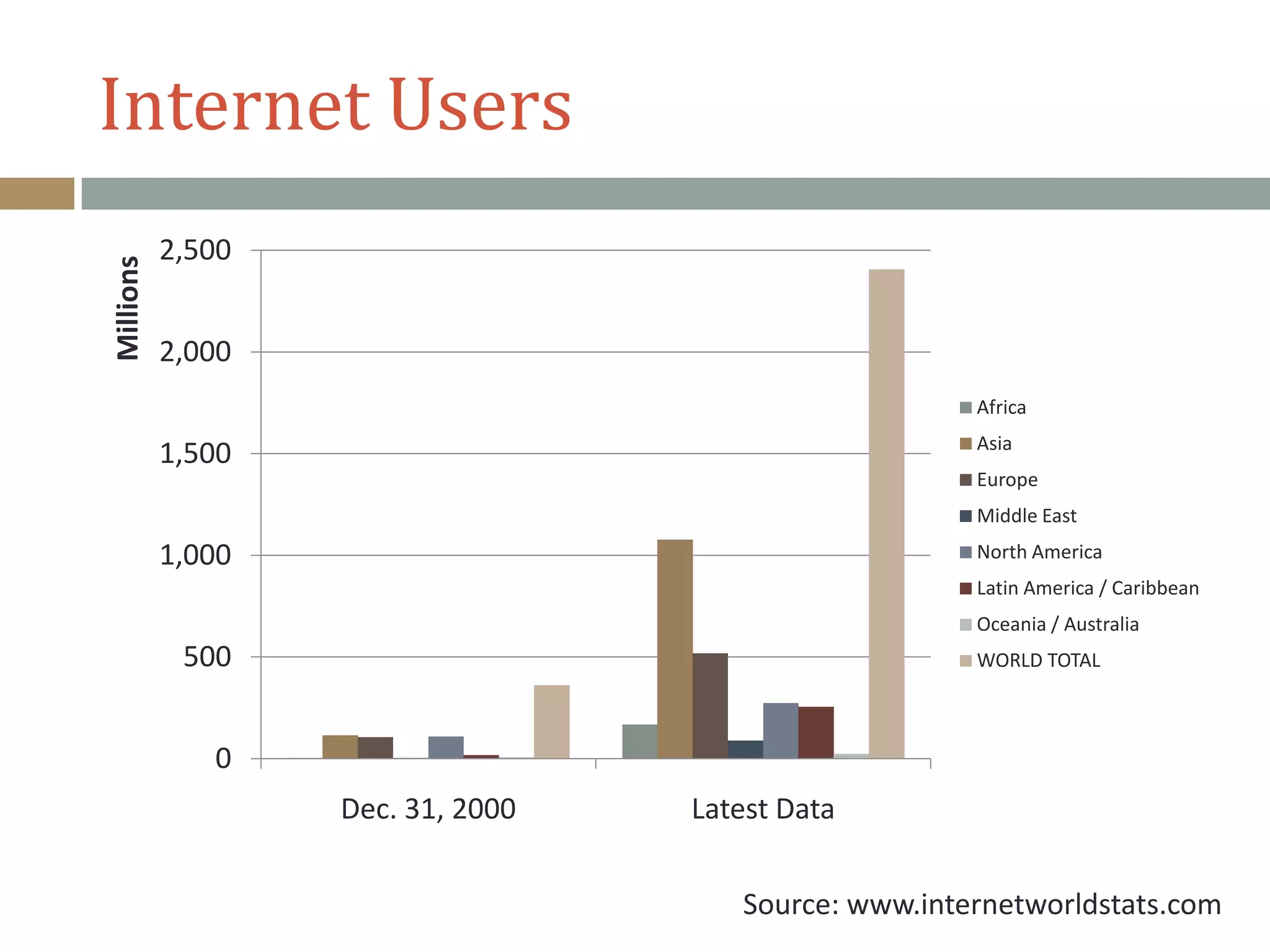
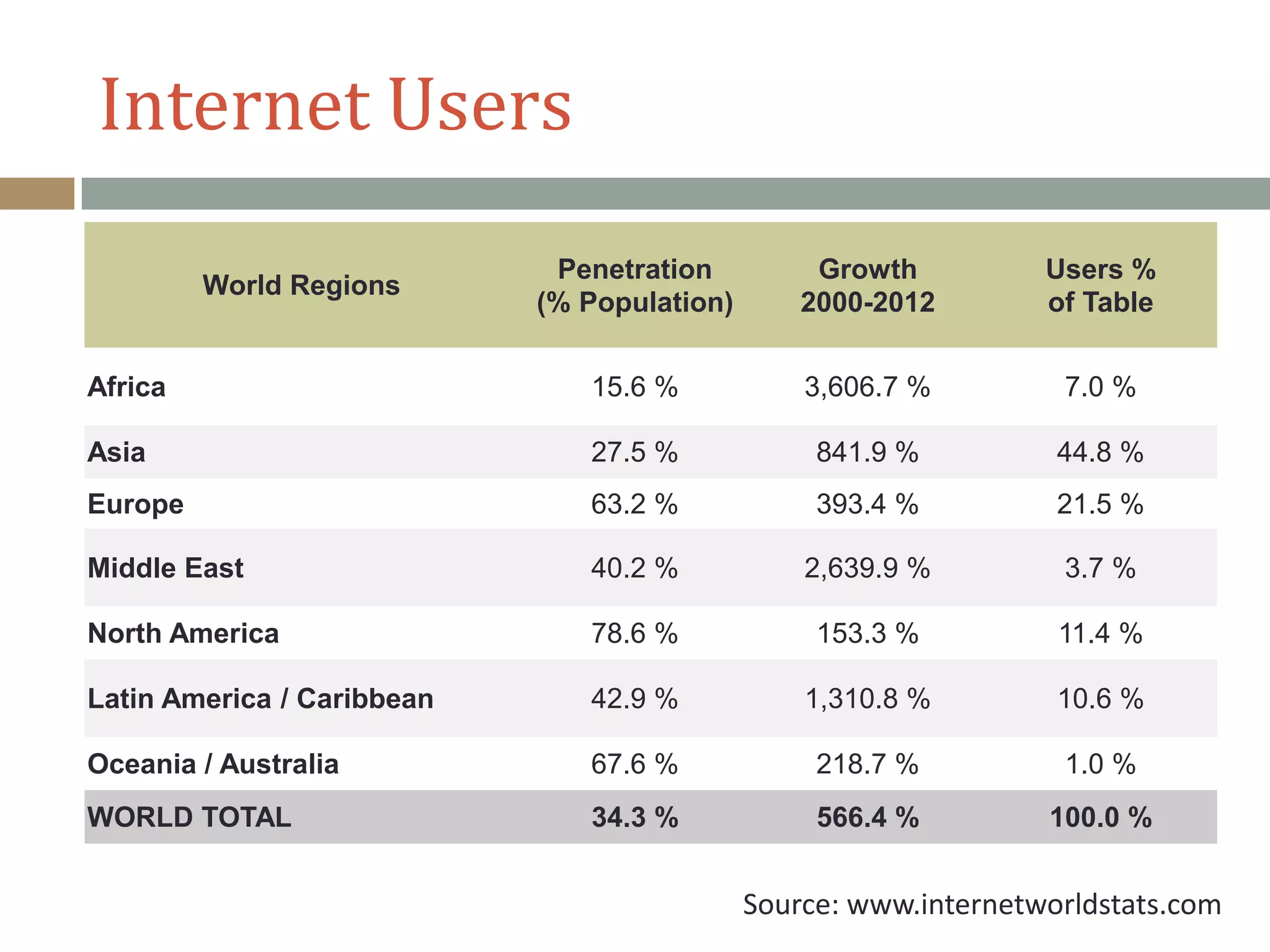
Internet Users
0
500
1,000
1,500
2,000
2,500
Dec. 31, 2000 Latest Data
Millions
Africa
Asia
Europe
Middle East
North America
Latin America / Caribbean
Oceania / Australia
WORLD TOTAL
Source: www.internetworldstats.com
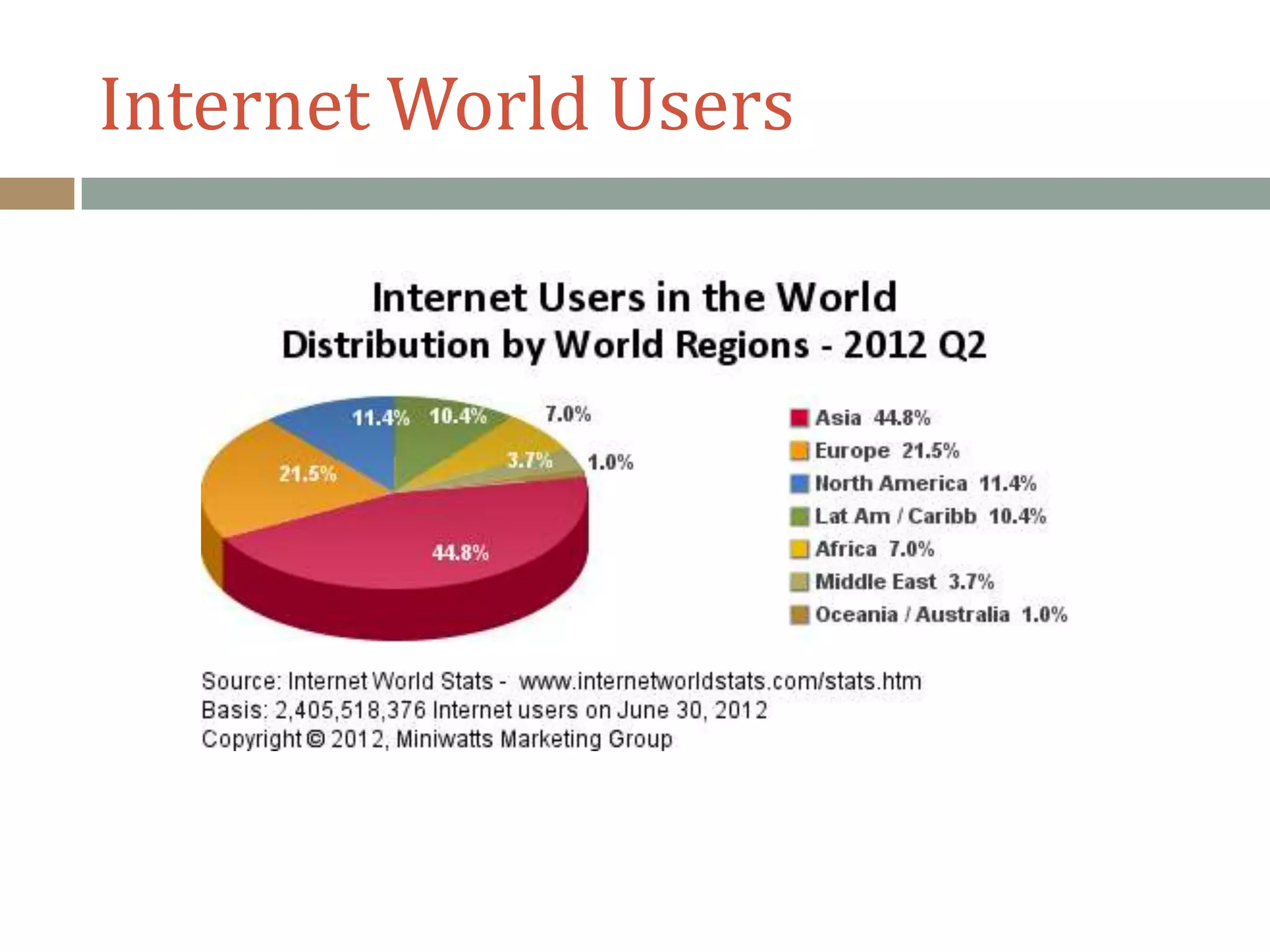
Internet World Users
Internet Users
World Regions
Penetration
(% Population)
Growth
2000-2012
Users %
of Table
Africa 15.6 % 3,606.7 % 7.0 %
Asia 27.5 % 841.9 % 44.8 %
Europe 63.2 % 393.4 % 21.5 %
Middle East 40.2 % 2,639.9 % 3.7 %
North America 78.6 % 153.3 % 11.4 %
Latin America / Caribbean 42.9 % 1,310.8 % 10.6 %
Oceania / Australia 67.6 % 218.7 % 1.0 %
WORLD TOTAL 34.3 % 566.4 % 100.0 %
Source: www.internetworldstats.com
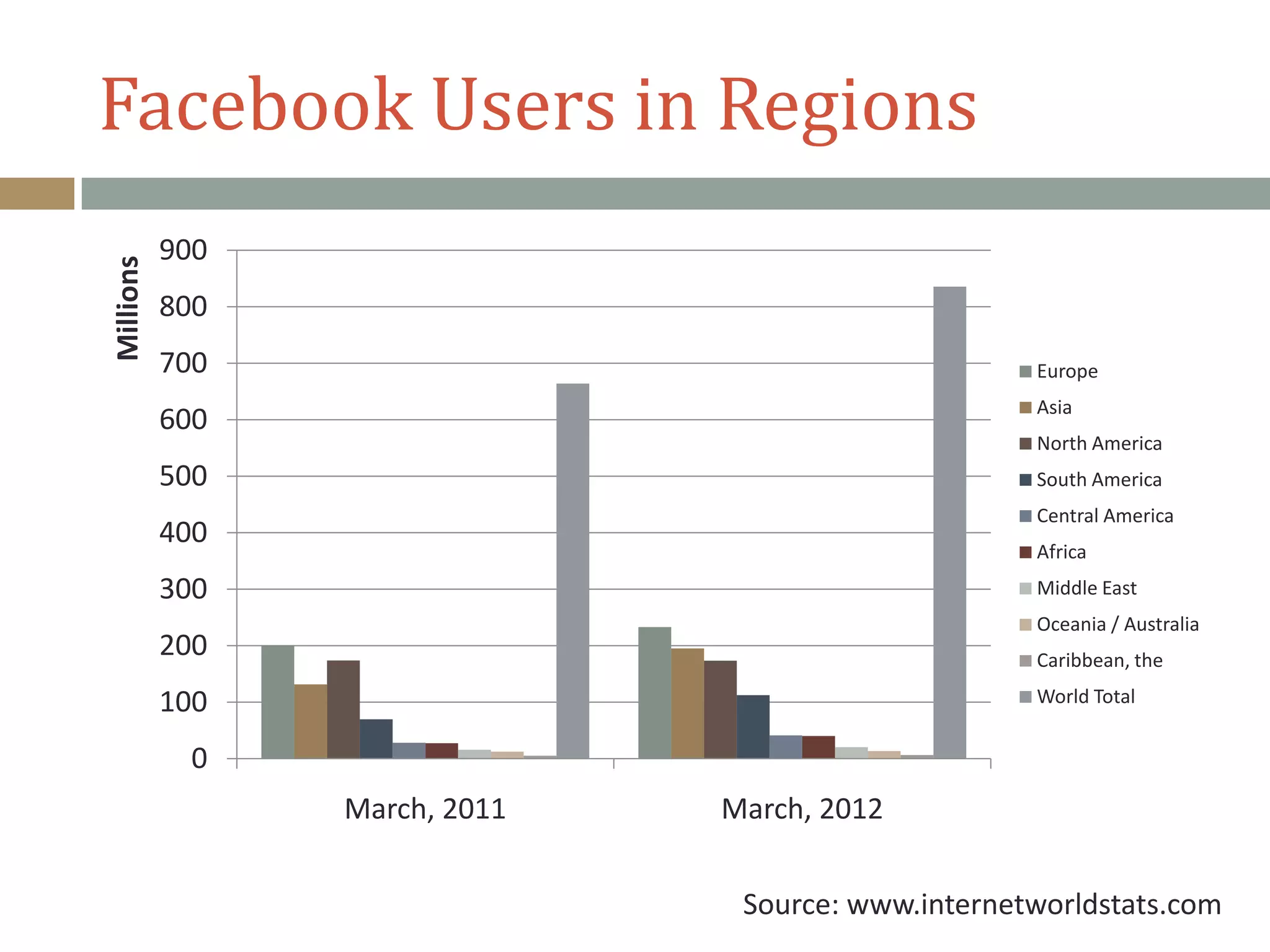
Facebook Users in Regions
0
100
200
300
400
500
600
700
800
900
March, 2011 March, 2012
Millions
Europe
Asia
North America
South America
Central America
Africa
Middle East
Oceania / Australia
Caribbean, the
World Total
Source: www.internetworldstats.com
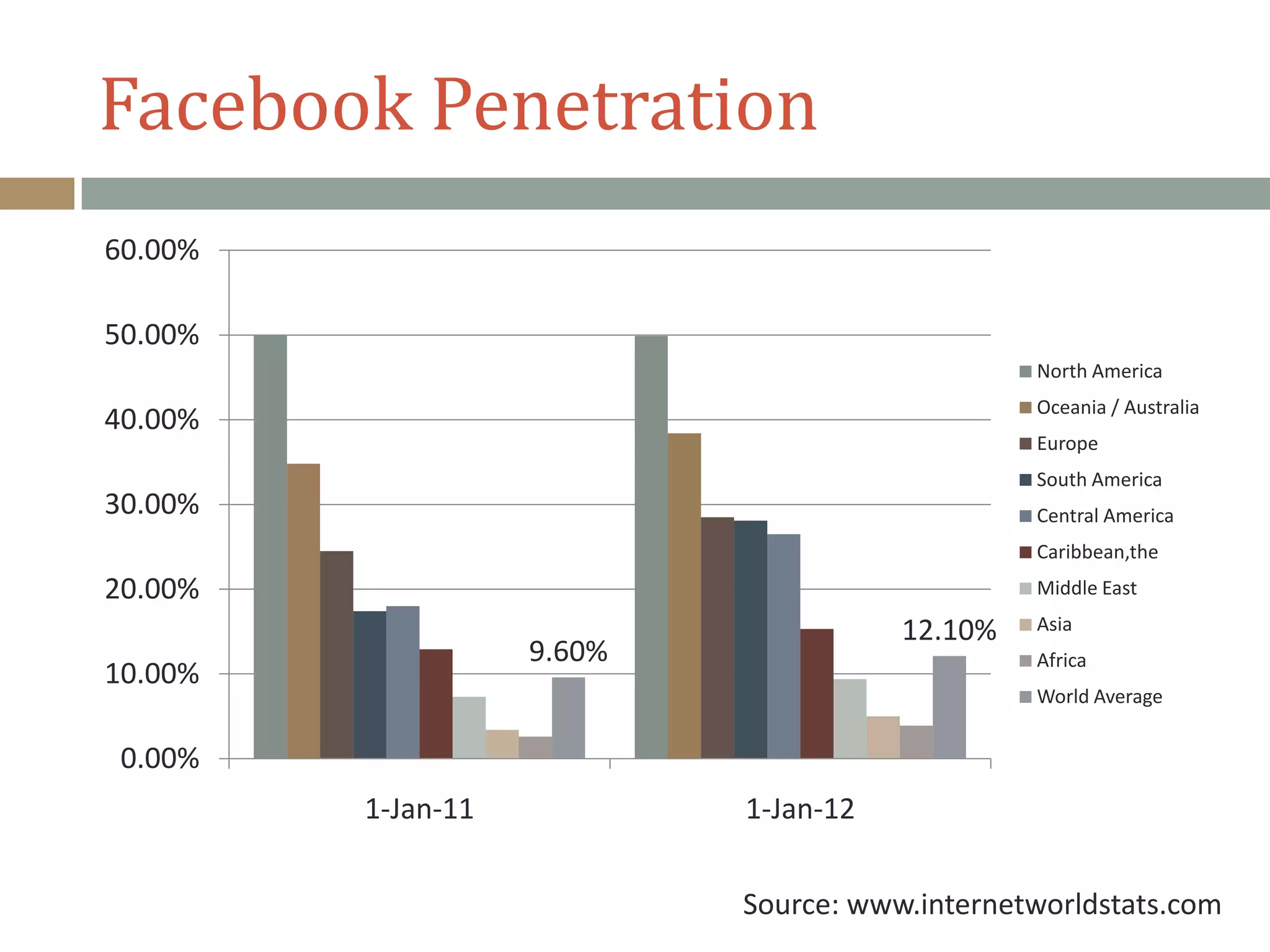
Facebook Penetration
9.60%
12.10%
0.00%
10.00%
20.00%
30.00%
40.00%
50.00%
60.00%
1-Jan-11 1-Jan-12
North America
Oceania / Australia
Europe
South America
Central America
Caribbean,the
Middle East
Asia
Africa
World Average
Source: www.internetworldstats.com
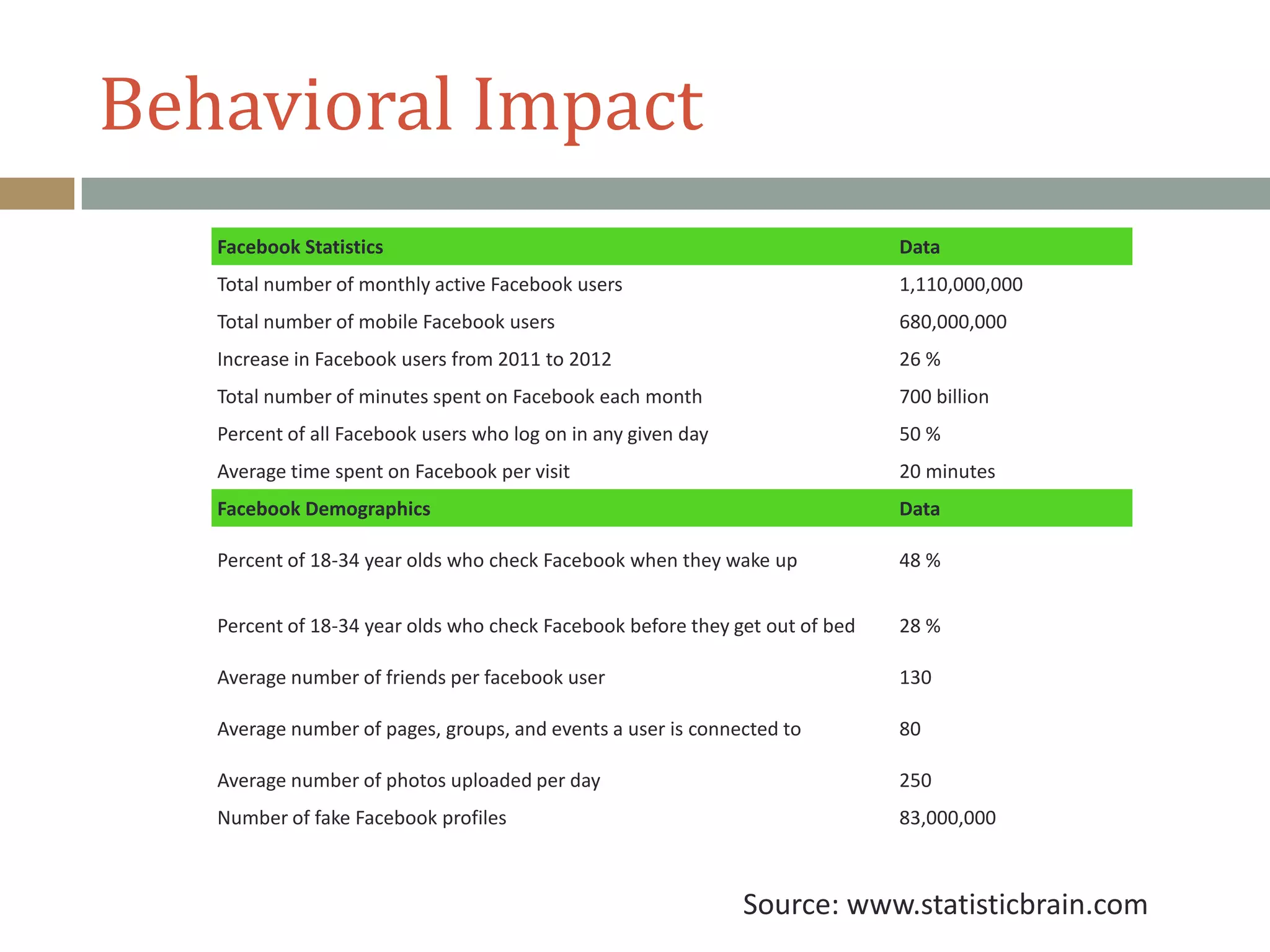
Behavioral Impact
Facebook Statistics Data
Total number of monthly active Facebook users 1,110,000,000
Total number of mobile Facebook users 680,000,000
Increase in Facebook users from 2011 to 2012 26 %
Total number of minutes spent on Facebook each month 700 billion
Percent of all Facebook users who log on in any given day 50 %
Average time spent on Facebook per visit 20 minutes
Facebook Demographics Data
Percent of 18-34 year olds who check Facebook when they wake up 48 %
Percent of 18-34 year olds who check Facebook before they get out of bed 28 %
Average number of friends per facebook user 130
Average number of pages, groups, and events a user is connected to 80
Average number of photos uploaded per day 250
Number of fake Facebook profiles 83,000,000
Source: www.statisticbrain.com
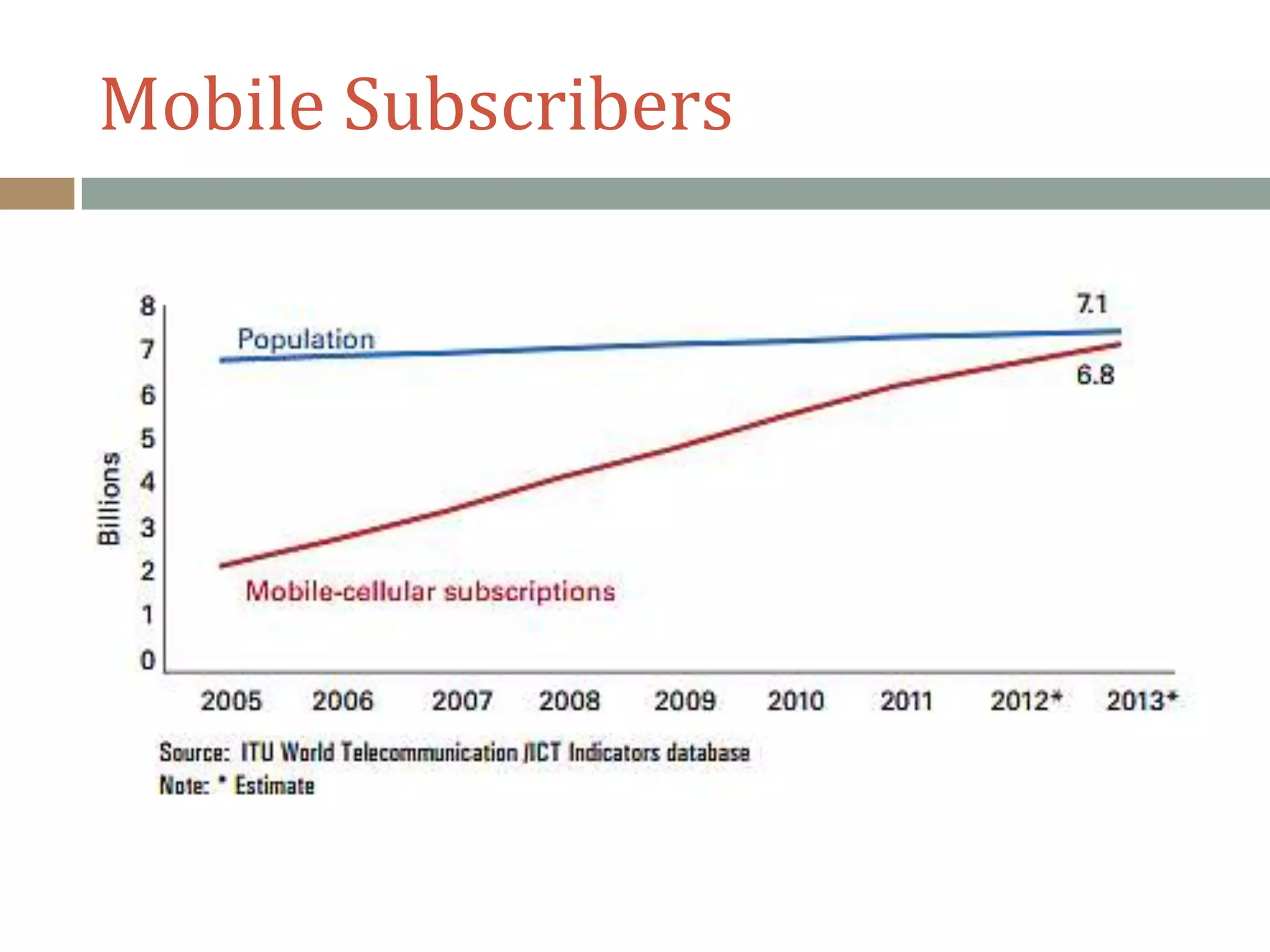
Mobile Subscribers
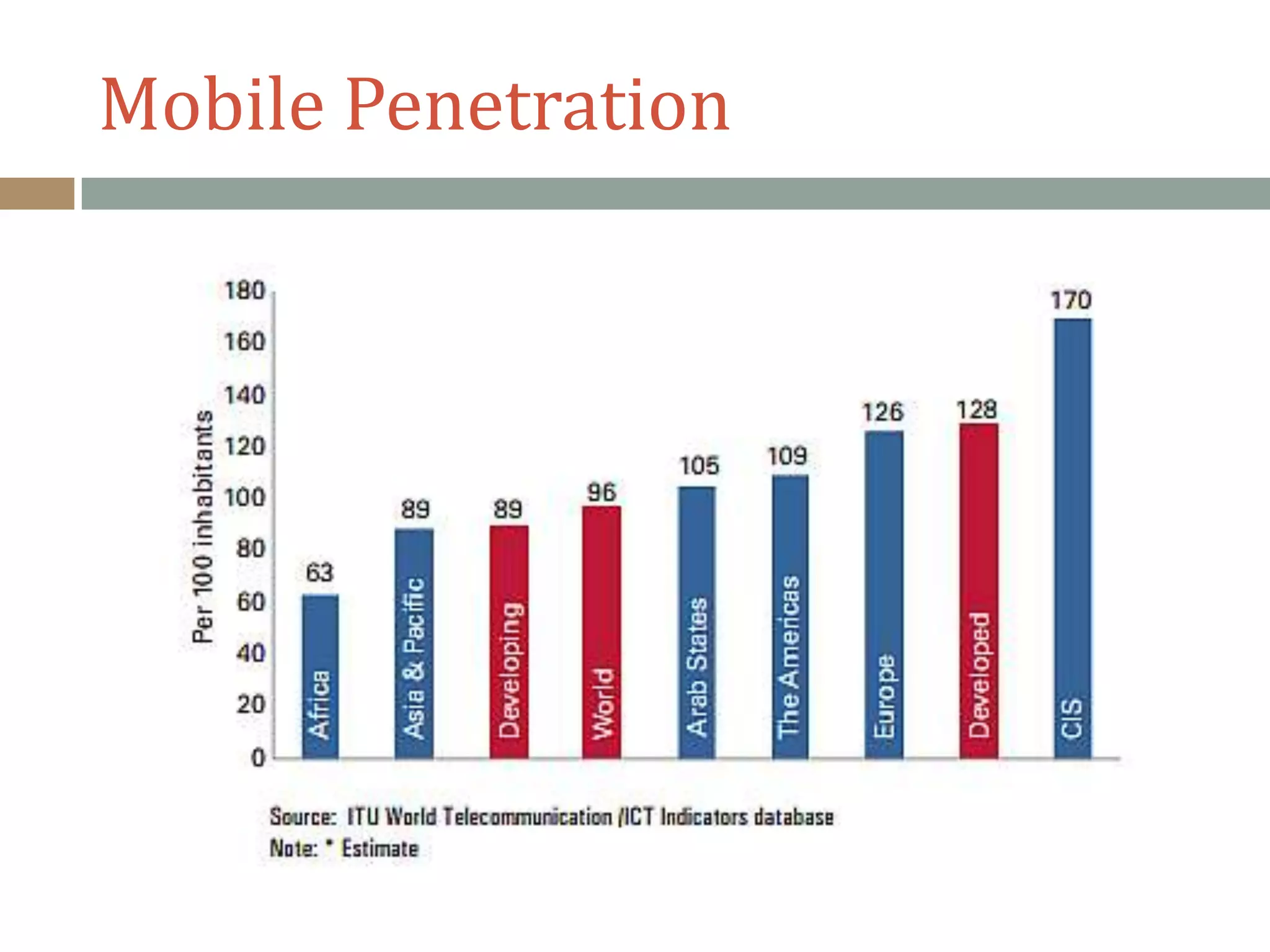
Mobile Penetration
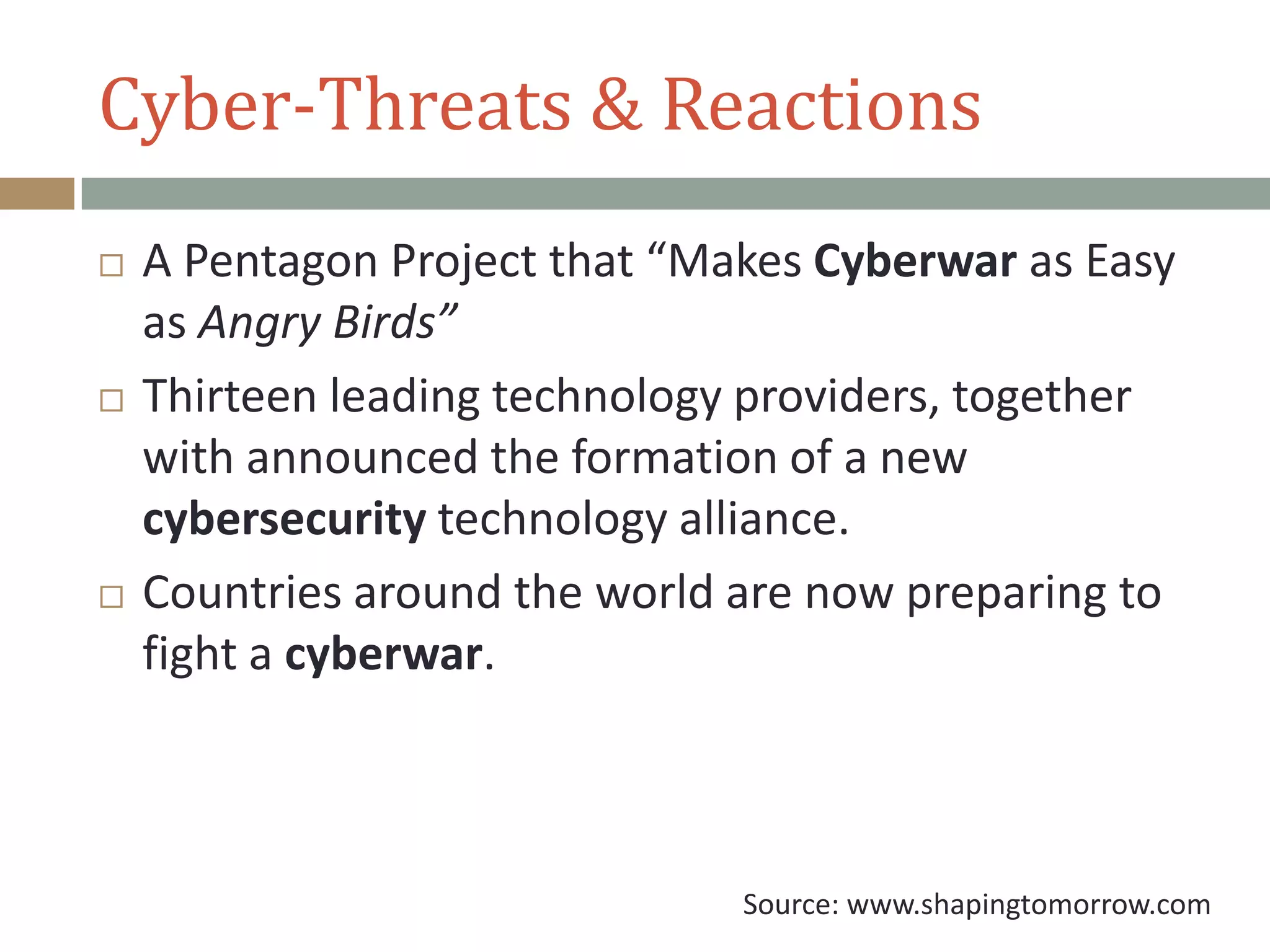
Cyber-Threats & Reactions
 A Pentagon Project that “Makes Cyberwar as Easy
as Angry Birds”
 Thirteen leading technology providers, together
with announced the formation of a new
cybersecurity technology alliance.
 Countries around the world are now preparing to
fight a cyberwar.
Source: www.shapingtomorrow.com
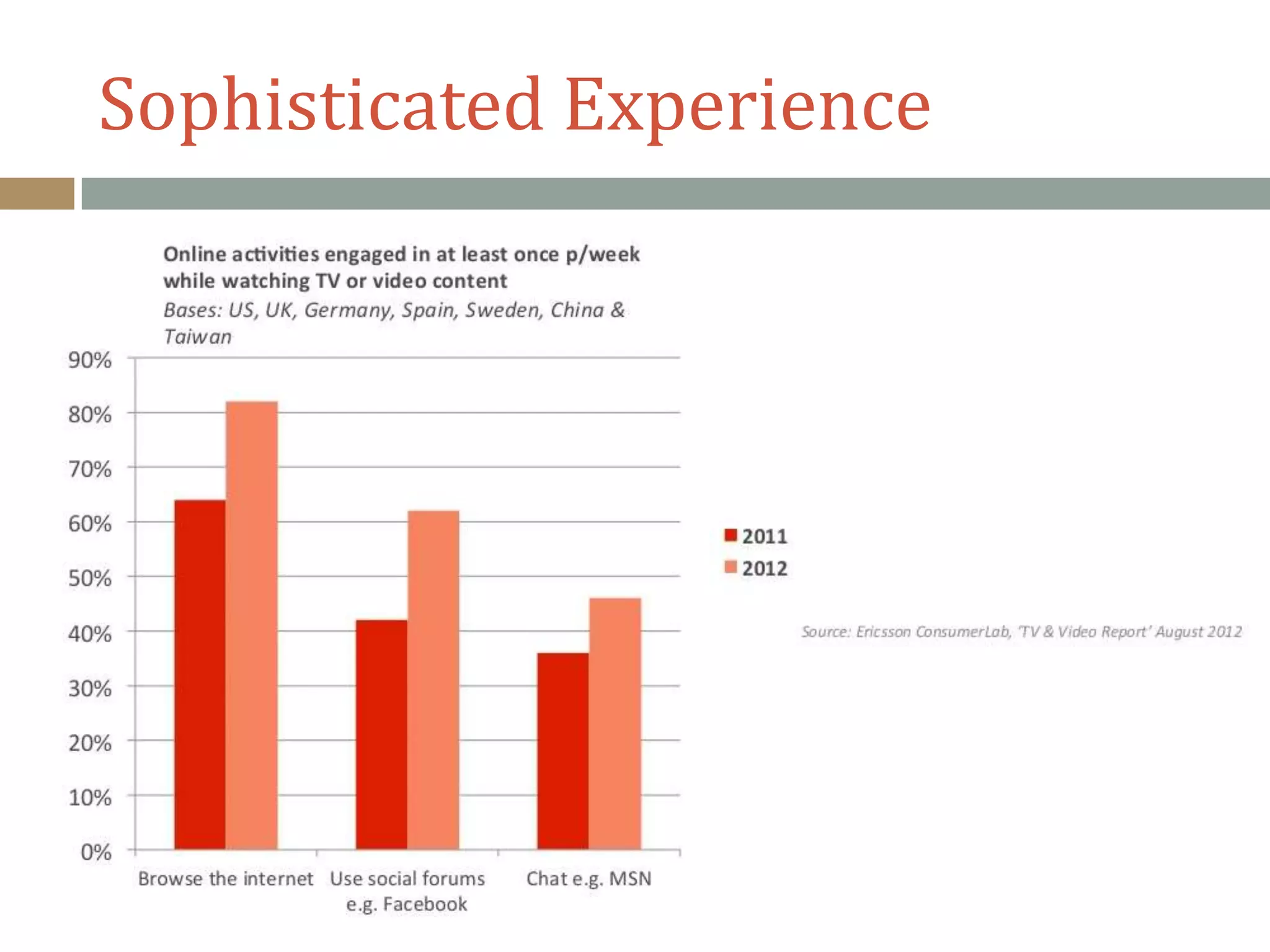
Sophisticated Experience
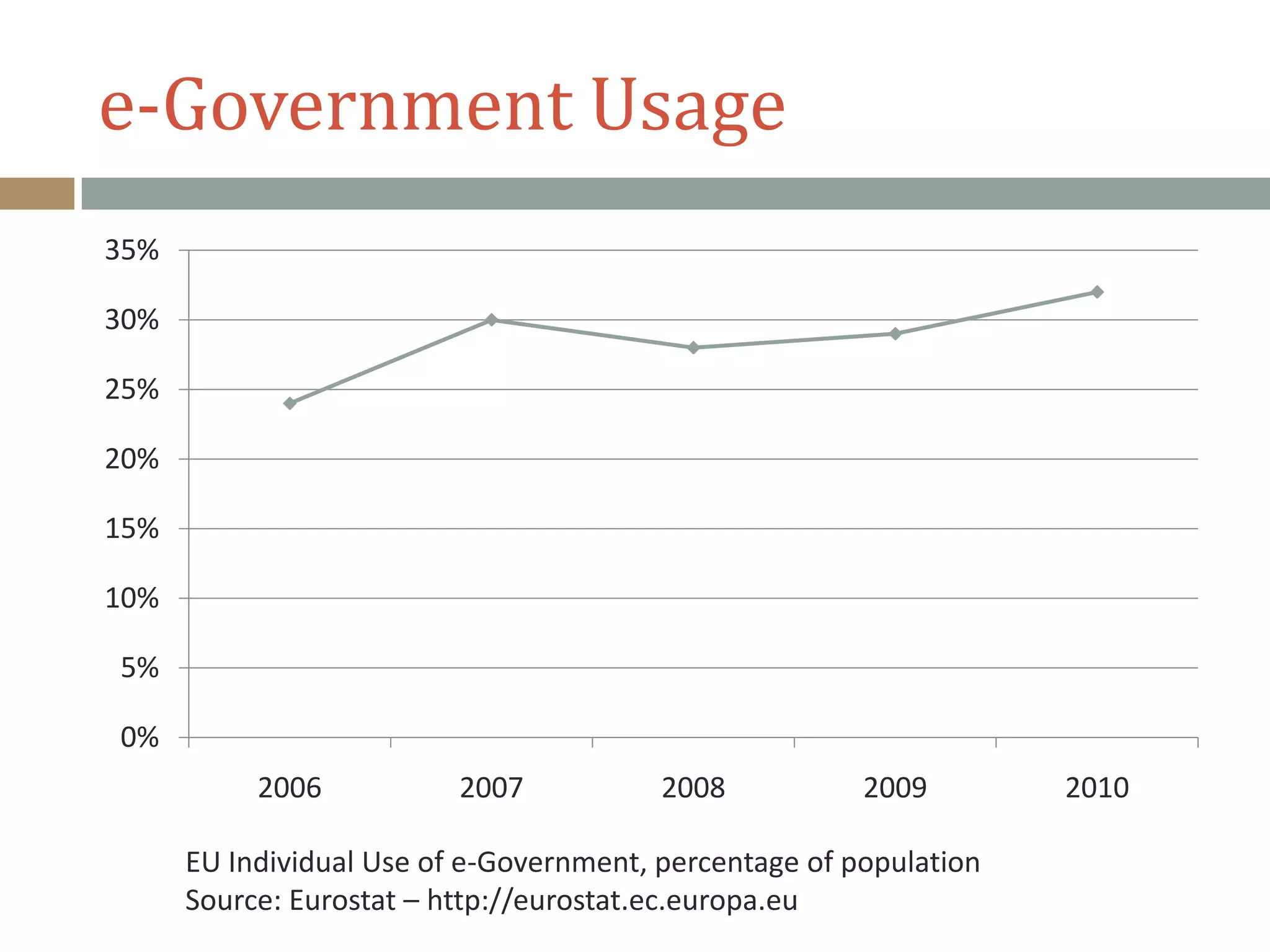
e-Government Usage
0%
5%
10%
15%
20%
25%
30%
35%
2006 2007 2008 2009 2010
EU Individual Use of e-Government, percentage of population
Source: Eurostat – http://eurostat.ec.europa.eu
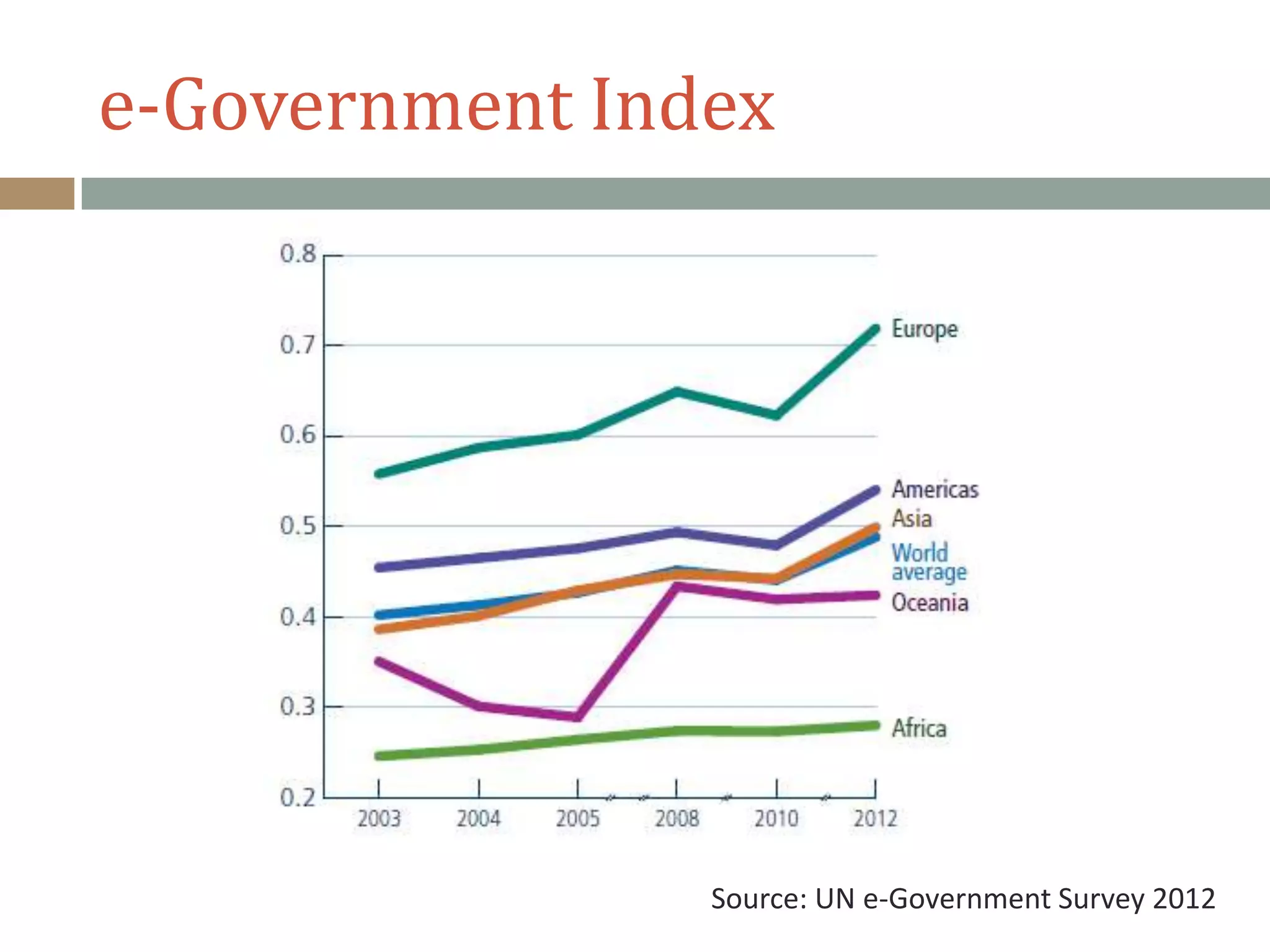
e-Government Index
Source: UN e-Government Survey 2012
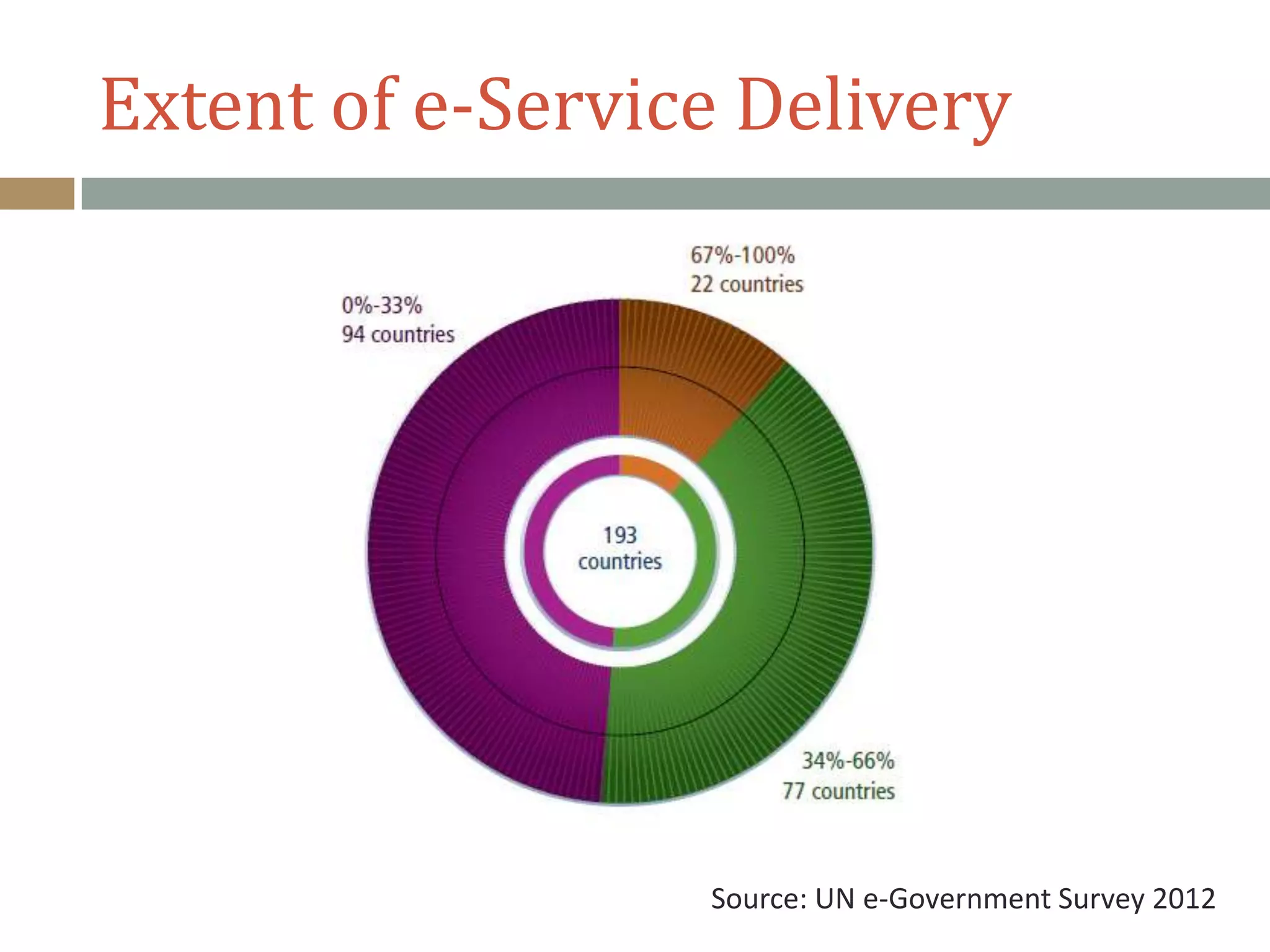
Extent of e-Service Delivery
Source: UN e-Government Survey 2012
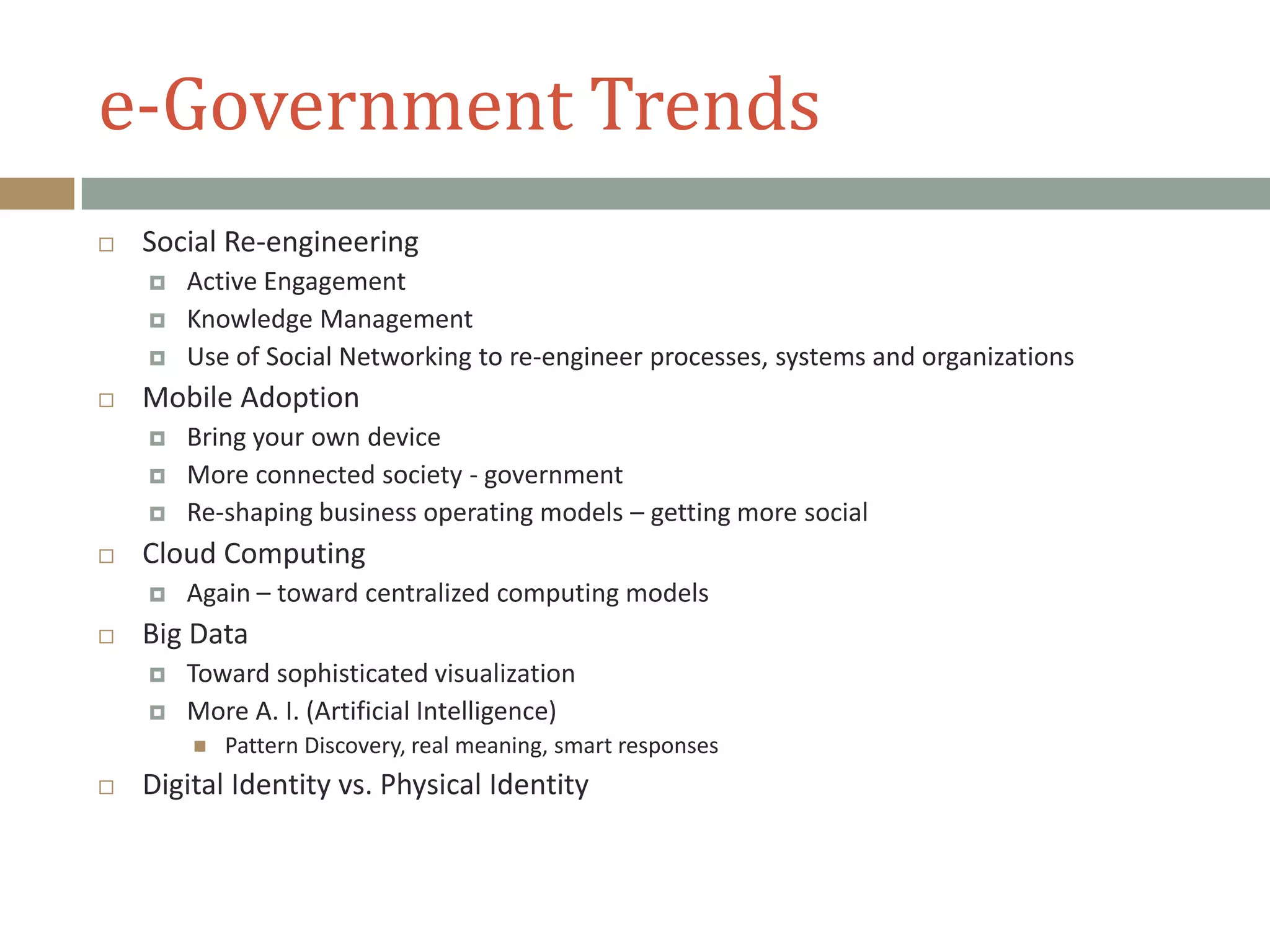
e-Government Trends
 Social Re-engineering
 Active Engagement
 Knowledge Management
 Use of Social Networking to re-engineer processes, systems and organizations
 Mobile Adoption
 Bring your own device
 More connected society - government
 Re-shaping business operating models – getting more social
 Cloud Computing
 Again – toward centralized computing models
 Big Data
 Toward sophisticated visualization
 More A. I. (Artificial Intelligence)
 Pattern Discovery, real meaning, smart responses
 Digital Identity vs. Physical Identity
Summary
 The world is going more ON-LINE
 People enjoy more being NETWORKED and living a
VIRTUALLY CONNECTED life
 Being ON-LINE is not bound to TIME and PLACE
 Cyber-Alliances SHAPE by external forces (like threats)
 Social Activities increasingly tend to have Web
Presence
 The relationship between People and Government is
changing
 There are threats as well as opportunities in cyber-
space
Concepts, Drivers, Alternative Futures
Toward Cyber-Nations
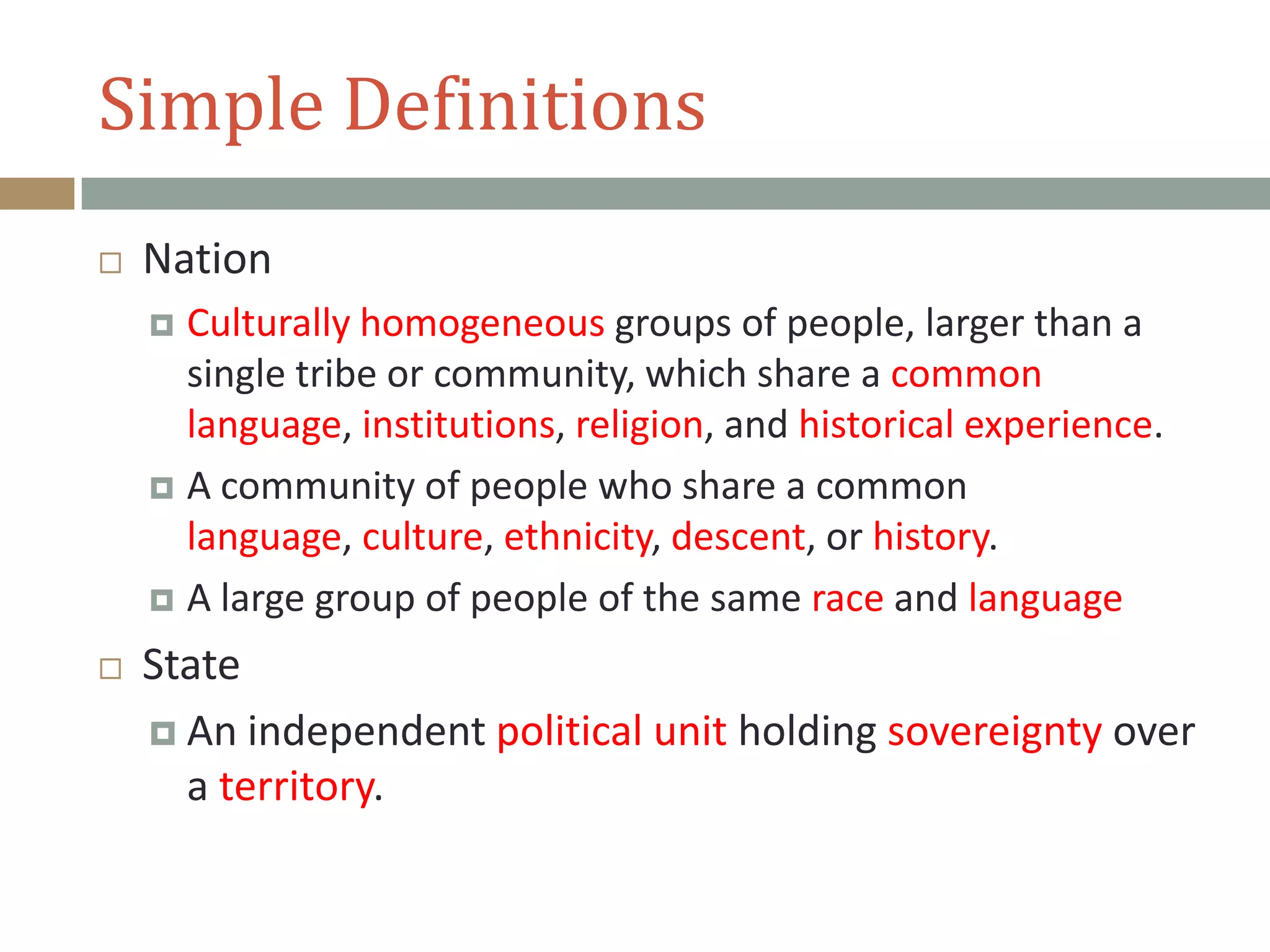
Simple Definitions
 Nation
 Culturally homogeneous groups of people, larger than a
single tribe or community, which share a common
language, institutions, religion, and historical experience.
 A community of people who share a common
language, culture, ethnicity, descent, or history.
 A large group of people of the same race and language
 State
 An independent political unit holding sovereignty over
a territory.
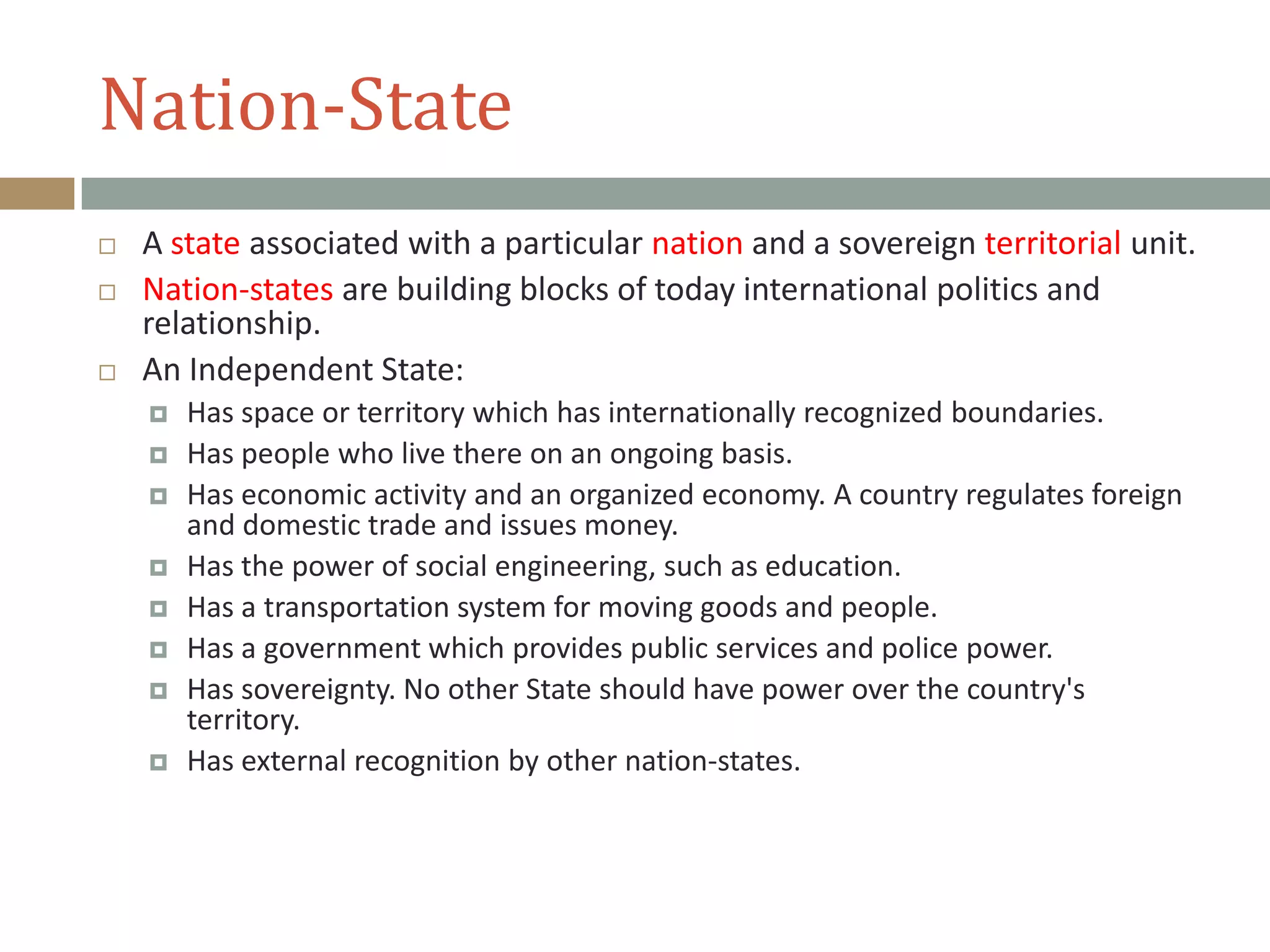
Nation-State
 A state associated with a particular nation and a sovereign territorial unit.
 Nation-states are building blocks of today international politics and
relationship.
 An Independent State:
 Has space or territory which has internationally recognized boundaries.
 Has people who live there on an ongoing basis.
 Has economic activity and an organized economy. A country regulates foreign
and domestic trade and issues money.
 Has the power of social engineering, such as education.
 Has a transportation system for moving goods and people.
 Has a government which provides public services and police power.
 Has sovereignty. No other State should have power over the country's
territory.
 Has external recognition by other nation-states.
Nation-State History
 Westphalian sovereignty: Treaty of Westphalia
 a series of peace treaties signed in 1648 in Europe
and ended the Thirty Years' War (1618–1648) in the
Holy Roman Empire, and the Eighty Years' War (1568–
1648) between Spain and the Dutch Republic.
 Modern Nation-States: Legitimate states that
govern effectively are widely regarded today as the
defining characteristics of a modern nation-state.
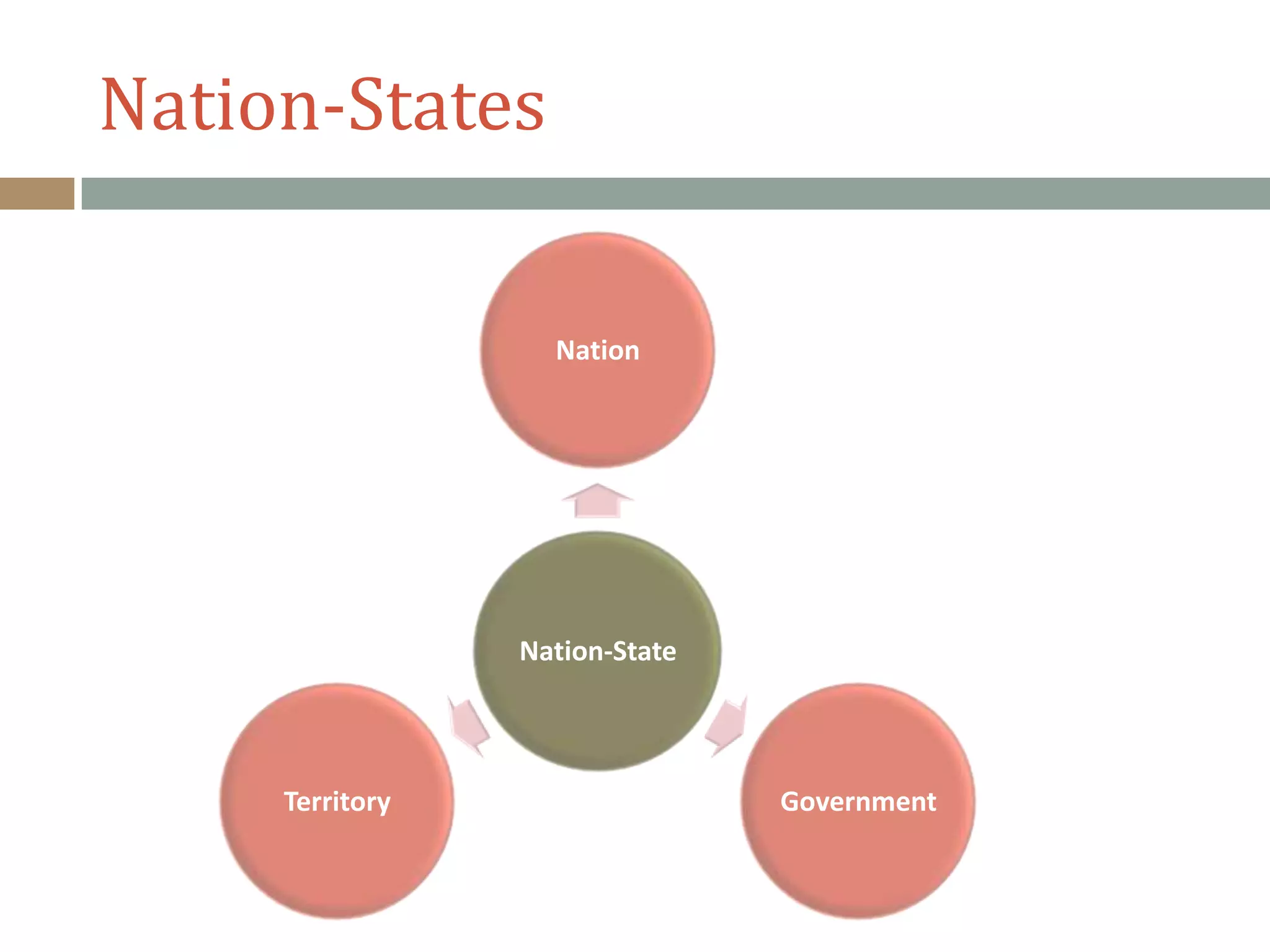
Nation-States
Nation-State
Nation
GovernmentTerritory
Imaging the Futures of Nation-State
 Approach: Nuts-Bolts
 Focus: Simple structural model of Nation-State
 What can be changed?
 Relationships
 The entities (Nation, State, Territory)
 Cyber-nation: All imaginable futures of Nation-State that
Cyberspace and IT play a magnificent role and replaces
some of the entities and functions in the legacy model
 The questions:
 What changes are more Probable?
 What changes are more Plausible?
 What changes are more Preferred?
Relationships
 Nation to Nation
 Virtual Contact vs. Physical Contacts
 E-Relationship
 Social Medias – Social Networks
 E-Culture
 Nation to State
 E-Government
 E-Participation
 Nation to Territory
 Virtual Reality vs. Physical Presence
 What about Immigrants?
 E-Culture
 State to Territory
 What are the imaginable sort of connecting a State to Territory?
 E- Sovereignty?
Territory
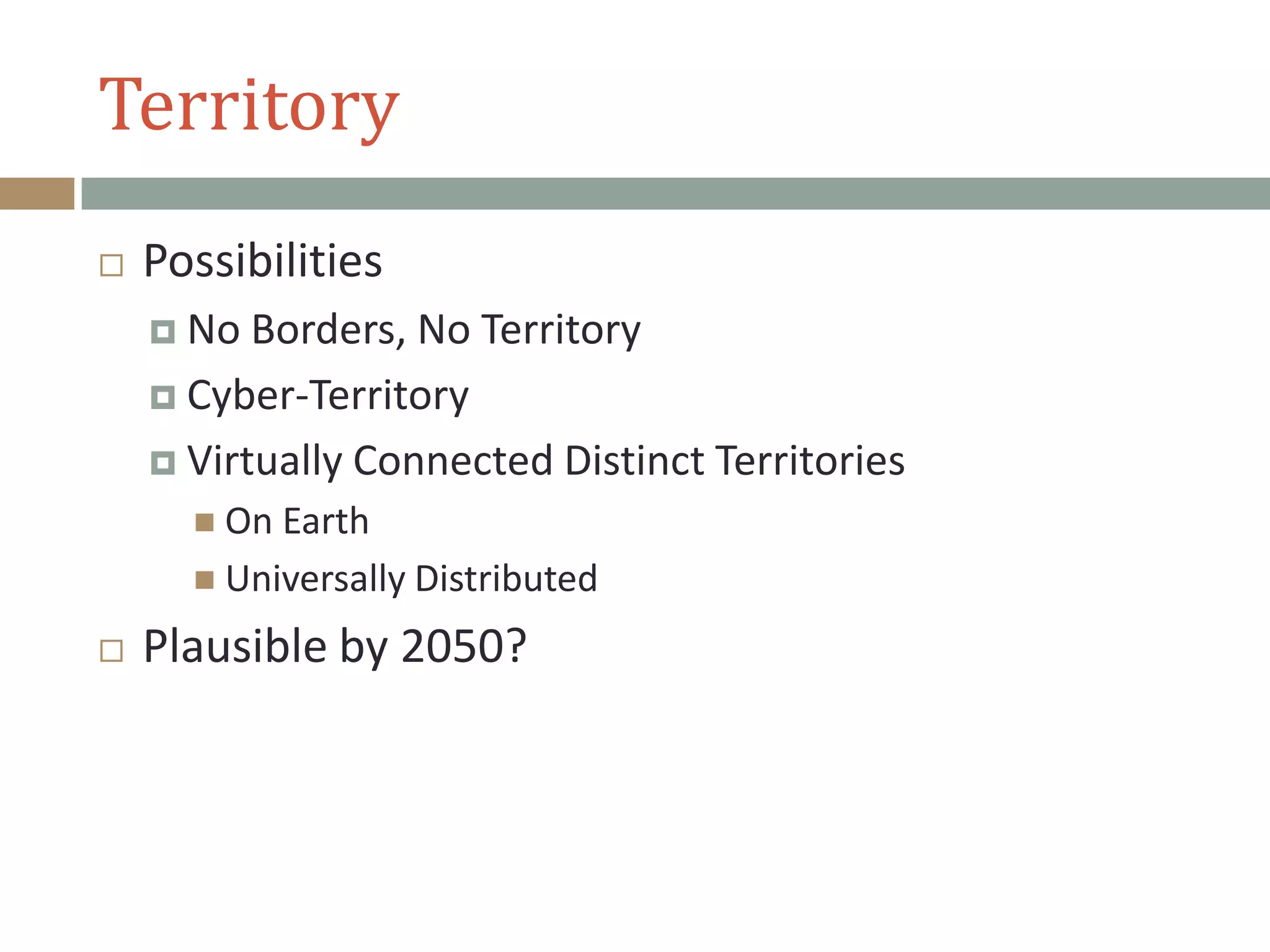
 Possibilities
 No Borders, No Territory
 Cyber-Territory
 Virtually Connected Distinct Territories
 On Earth
 Universally Distributed
 Plausible by 2050?
State
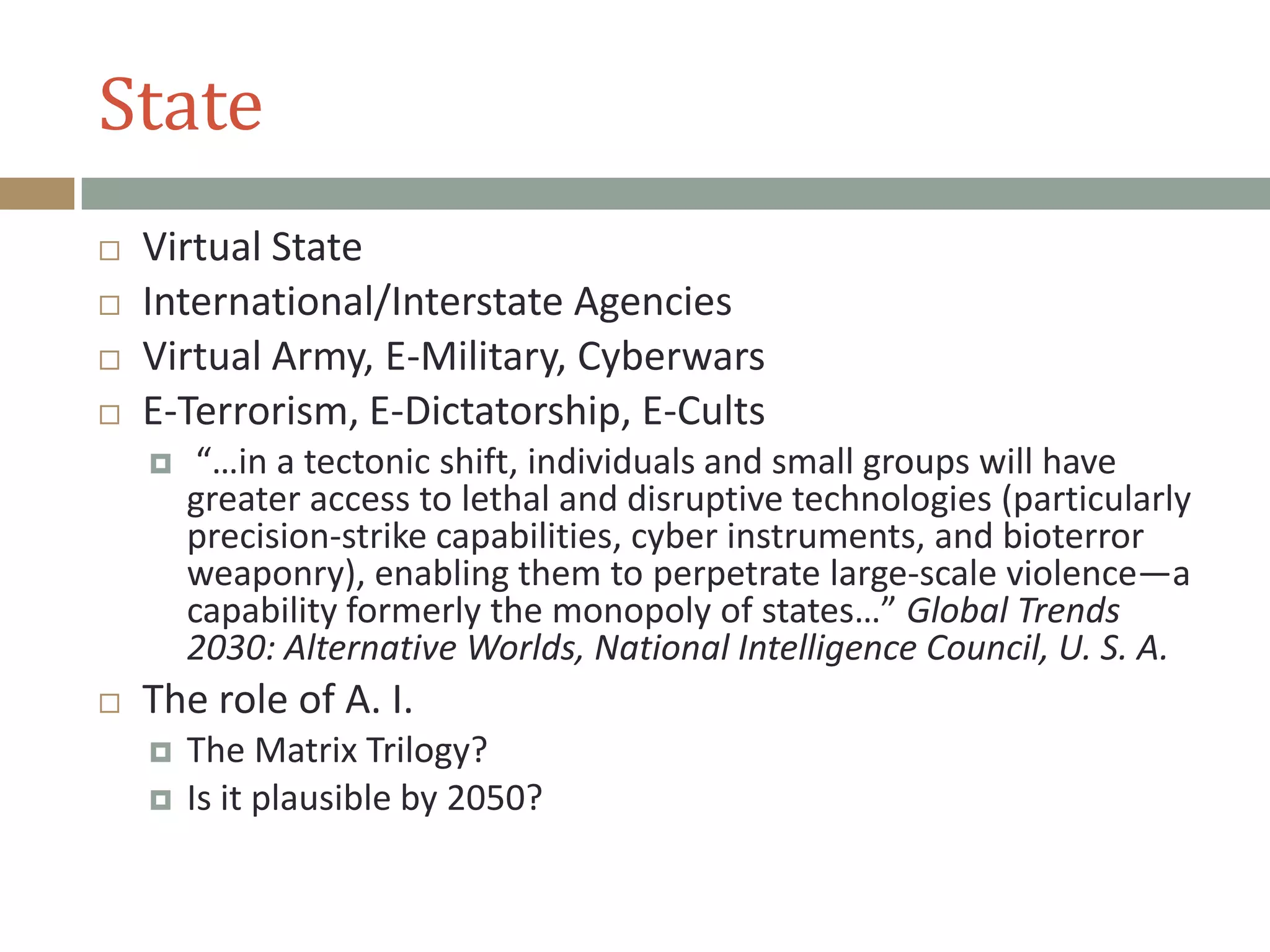
 Virtual State
 International/Interstate Agencies
 Virtual Army, E-Military, Cyberwars
 E-Terrorism, E-Dictatorship, E-Cults
 “…in a tectonic shift, individuals and small groups will have
greater access to lethal and disruptive technologies (particularly
precision-strike capabilities, cyber instruments, and bioterror
weaponry), enabling them to perpetrate large-scale violence—a
capability formerly the monopoly of states…” Global Trends
2030: Alternative Worlds, National Intelligence Council, U. S. A.
 The role of A. I.
 The Matrix Trilogy?
 Is it plausible by 2050?
Nation
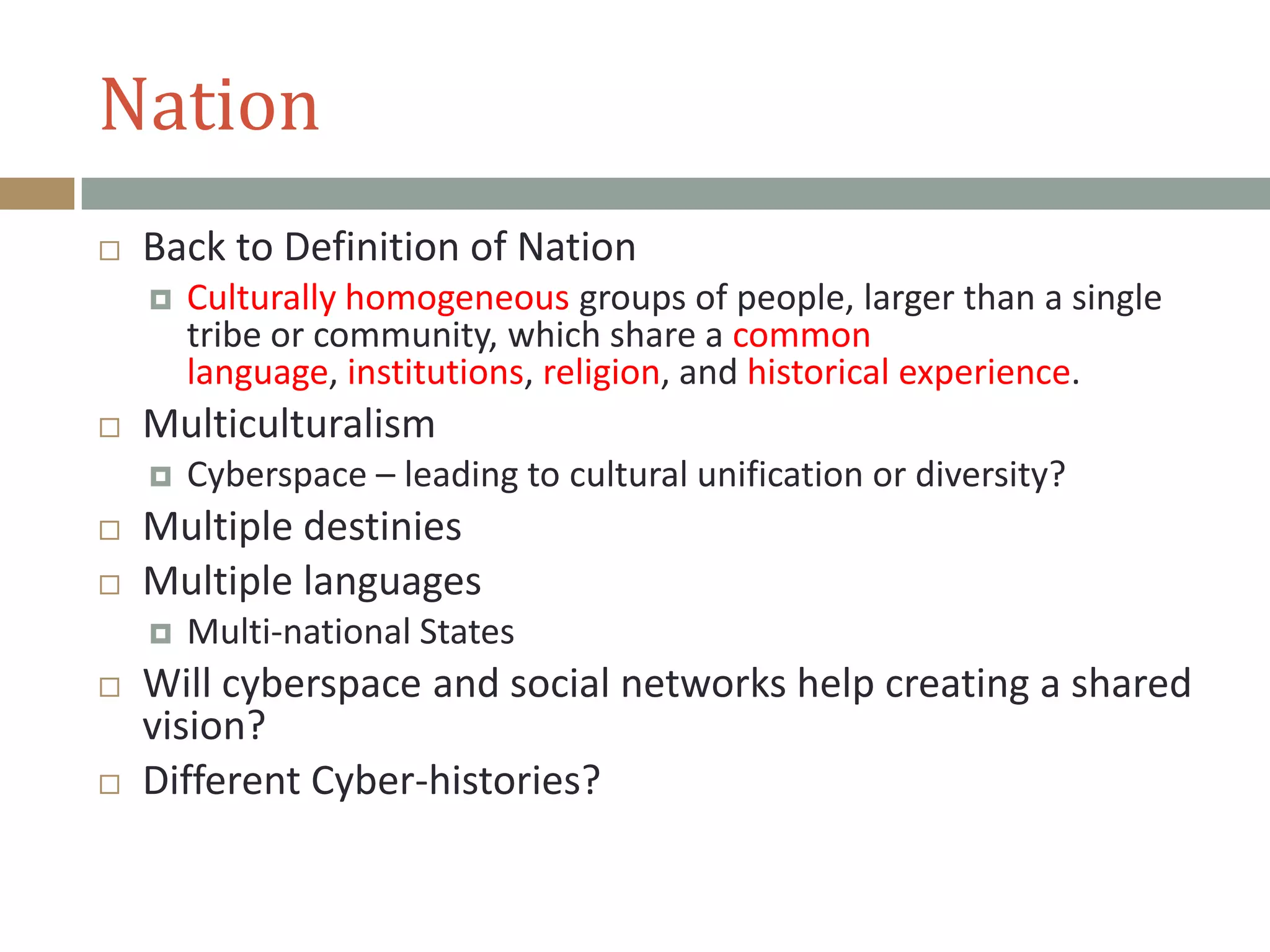
 Back to Definition of Nation
 Culturally homogeneous groups of people, larger than a single
tribe or community, which share a common
language, institutions, religion, and historical experience.
 Multiculturalism
 Cyberspace – leading to cultural unification or diversity?
 Multiple destinies
 Multiple languages
 Multi-national States
 Will cyberspace and social networks help creating a shared
vision?
 Different Cyber-histories?
Forming a Cyber-nation
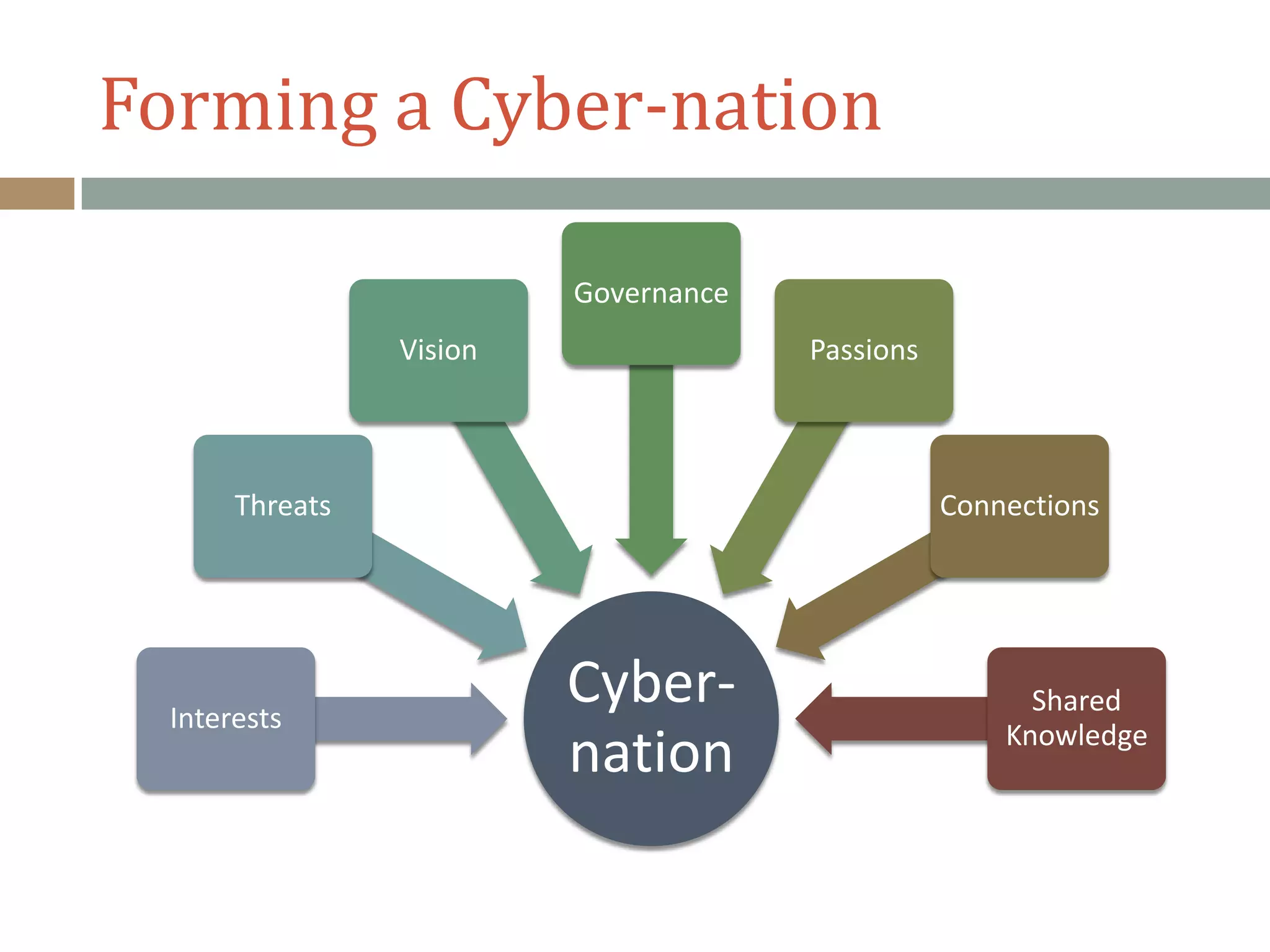
Cyber-
nation
Interests
Threats
Vision
Governance
Passions
Connections
Shared
Knowledge
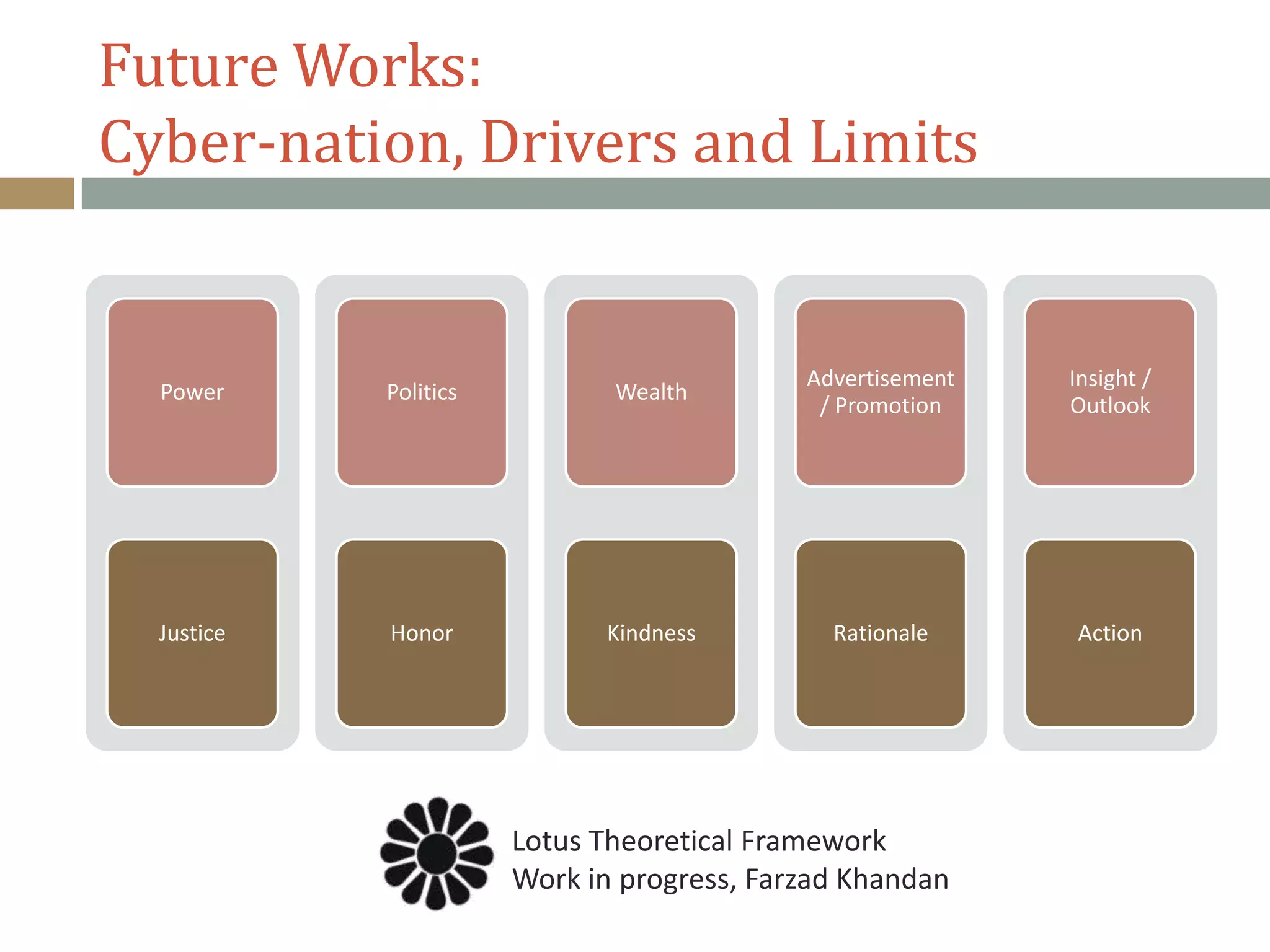
Future Works:
Cyber-nation, Drivers and Limits
Power
Justice
Politics
Honor
Wealth
Kindness
Advertisement
/ Promotion
Rationale
Insight /
Outlook
Action
Lotus Theoretical Framework
Work in progress, Farzad Khandan
Conclusions
 There are multiple alternatives thinking about the
future of Nation-State in the context of Cyberspace
 Each alternative future can be derived by starting
from the legacy model and replacing some of the
entities and functions by their cyber counter parts
 Among the alternatives, some are plausible in
2050
 We need a holistic and flexible framework to
analyze the future of cyber-nations. Such a
framework has to be designed.

From Cyber-Societies to Cyber-Nations

  • 1.
    From Cyber-Societies to Cyber-Nations Howthe technology will shape the world in the future KHANDAN, Farzad Futures Studies Research Center IKIU, Iran fkhandan@simiagaran.net 21st WFSF World Conference – Bucharest, Romania - 2013June 27, 2013
  • 2.
  • 3.
    Internet Users 0 500 1,000 1,500 2,000 2,500 Dec. 31,2000 Latest Data Millions Africa Asia Europe Middle East North America Latin America / Caribbean Oceania / Australia WORLD TOTAL Source: www.internetworldstats.com
  • 4.
  • 5.
    Internet Users World Regions Penetration (%Population) Growth 2000-2012 Users % of Table Africa 15.6 % 3,606.7 % 7.0 % Asia 27.5 % 841.9 % 44.8 % Europe 63.2 % 393.4 % 21.5 % Middle East 40.2 % 2,639.9 % 3.7 % North America 78.6 % 153.3 % 11.4 % Latin America / Caribbean 42.9 % 1,310.8 % 10.6 % Oceania / Australia 67.6 % 218.7 % 1.0 % WORLD TOTAL 34.3 % 566.4 % 100.0 % Source: www.internetworldstats.com
  • 6.
    Facebook Users inRegions 0 100 200 300 400 500 600 700 800 900 March, 2011 March, 2012 Millions Europe Asia North America South America Central America Africa Middle East Oceania / Australia Caribbean, the World Total Source: www.internetworldstats.com
  • 7.
    Facebook Penetration 9.60% 12.10% 0.00% 10.00% 20.00% 30.00% 40.00% 50.00% 60.00% 1-Jan-11 1-Jan-12 NorthAmerica Oceania / Australia Europe South America Central America Caribbean,the Middle East Asia Africa World Average Source: www.internetworldstats.com
  • 8.
    Behavioral Impact Facebook StatisticsData Total number of monthly active Facebook users 1,110,000,000 Total number of mobile Facebook users 680,000,000 Increase in Facebook users from 2011 to 2012 26 % Total number of minutes spent on Facebook each month 700 billion Percent of all Facebook users who log on in any given day 50 % Average time spent on Facebook per visit 20 minutes Facebook Demographics Data Percent of 18-34 year olds who check Facebook when they wake up 48 % Percent of 18-34 year olds who check Facebook before they get out of bed 28 % Average number of friends per facebook user 130 Average number of pages, groups, and events a user is connected to 80 Average number of photos uploaded per day 250 Number of fake Facebook profiles 83,000,000 Source: www.statisticbrain.com
  • 9.
  • 10.
  • 11.
    Cyber-Threats & Reactions A Pentagon Project that “Makes Cyberwar as Easy as Angry Birds”  Thirteen leading technology providers, together with announced the formation of a new cybersecurity technology alliance.  Countries around the world are now preparing to fight a cyberwar. Source: www.shapingtomorrow.com
  • 12.
  • 13.
    e-Government Usage 0% 5% 10% 15% 20% 25% 30% 35% 2006 20072008 2009 2010 EU Individual Use of e-Government, percentage of population Source: Eurostat – http://eurostat.ec.europa.eu
  • 14.
    e-Government Index Source: UNe-Government Survey 2012
  • 15.
    Extent of e-ServiceDelivery Source: UN e-Government Survey 2012
  • 16.
    e-Government Trends  SocialRe-engineering  Active Engagement  Knowledge Management  Use of Social Networking to re-engineer processes, systems and organizations  Mobile Adoption  Bring your own device  More connected society - government  Re-shaping business operating models – getting more social  Cloud Computing  Again – toward centralized computing models  Big Data  Toward sophisticated visualization  More A. I. (Artificial Intelligence)  Pattern Discovery, real meaning, smart responses  Digital Identity vs. Physical Identity
  • 17.
    Summary  The worldis going more ON-LINE  People enjoy more being NETWORKED and living a VIRTUALLY CONNECTED life  Being ON-LINE is not bound to TIME and PLACE  Cyber-Alliances SHAPE by external forces (like threats)  Social Activities increasingly tend to have Web Presence  The relationship between People and Government is changing  There are threats as well as opportunities in cyber- space
  • 18.
    Concepts, Drivers, AlternativeFutures Toward Cyber-Nations
  • 19.
    Simple Definitions  Nation Culturally homogeneous groups of people, larger than a single tribe or community, which share a common language, institutions, religion, and historical experience.  A community of people who share a common language, culture, ethnicity, descent, or history.  A large group of people of the same race and language  State  An independent political unit holding sovereignty over a territory.
  • 20.
    Nation-State  A stateassociated with a particular nation and a sovereign territorial unit.  Nation-states are building blocks of today international politics and relationship.  An Independent State:  Has space or territory which has internationally recognized boundaries.  Has people who live there on an ongoing basis.  Has economic activity and an organized economy. A country regulates foreign and domestic trade and issues money.  Has the power of social engineering, such as education.  Has a transportation system for moving goods and people.  Has a government which provides public services and police power.  Has sovereignty. No other State should have power over the country's territory.  Has external recognition by other nation-states.
  • 21.
    Nation-State History  Westphaliansovereignty: Treaty of Westphalia  a series of peace treaties signed in 1648 in Europe and ended the Thirty Years' War (1618–1648) in the Holy Roman Empire, and the Eighty Years' War (1568– 1648) between Spain and the Dutch Republic.  Modern Nation-States: Legitimate states that govern effectively are widely regarded today as the defining characteristics of a modern nation-state.
  • 22.
  • 23.
    Imaging the Futuresof Nation-State  Approach: Nuts-Bolts  Focus: Simple structural model of Nation-State  What can be changed?  Relationships  The entities (Nation, State, Territory)  Cyber-nation: All imaginable futures of Nation-State that Cyberspace and IT play a magnificent role and replaces some of the entities and functions in the legacy model  The questions:  What changes are more Probable?  What changes are more Plausible?  What changes are more Preferred?
  • 24.
    Relationships  Nation toNation  Virtual Contact vs. Physical Contacts  E-Relationship  Social Medias – Social Networks  E-Culture  Nation to State  E-Government  E-Participation  Nation to Territory  Virtual Reality vs. Physical Presence  What about Immigrants?  E-Culture  State to Territory  What are the imaginable sort of connecting a State to Territory?  E- Sovereignty?
  • 25.
    Territory  Possibilities  NoBorders, No Territory  Cyber-Territory  Virtually Connected Distinct Territories  On Earth  Universally Distributed  Plausible by 2050?
  • 26.
    State  Virtual State International/Interstate Agencies  Virtual Army, E-Military, Cyberwars  E-Terrorism, E-Dictatorship, E-Cults  “…in a tectonic shift, individuals and small groups will have greater access to lethal and disruptive technologies (particularly precision-strike capabilities, cyber instruments, and bioterror weaponry), enabling them to perpetrate large-scale violence—a capability formerly the monopoly of states…” Global Trends 2030: Alternative Worlds, National Intelligence Council, U. S. A.  The role of A. I.  The Matrix Trilogy?  Is it plausible by 2050?
  • 27.
    Nation  Back toDefinition of Nation  Culturally homogeneous groups of people, larger than a single tribe or community, which share a common language, institutions, religion, and historical experience.  Multiculturalism  Cyberspace – leading to cultural unification or diversity?  Multiple destinies  Multiple languages  Multi-national States  Will cyberspace and social networks help creating a shared vision?  Different Cyber-histories?
  • 28.
  • 29.
    Future Works: Cyber-nation, Driversand Limits Power Justice Politics Honor Wealth Kindness Advertisement / Promotion Rationale Insight / Outlook Action Lotus Theoretical Framework Work in progress, Farzad Khandan
  • 30.
    Conclusions  There aremultiple alternatives thinking about the future of Nation-State in the context of Cyberspace  Each alternative future can be derived by starting from the legacy model and replacing some of the entities and functions by their cyber counter parts  Among the alternatives, some are plausible in 2050  We need a holistic and flexible framework to analyze the future of cyber-nations. Such a framework has to be designed.