Cybercrime
and the
Developer
How to defend against
the darker side
@spoole167
Steve Poole
• Developer Adocate
• Sonatype
@spoole167
Take away one thing
As a developer, security
is your problem
@spoole167
Who uses
wifi?
Every thought about how it
works?
@spoole167
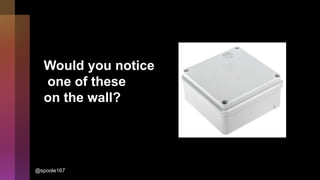
Would you notice
one of these
on the wall?
@spoole167
With some simple
h/w its’ easy to
spoof the wifi
@spoole167
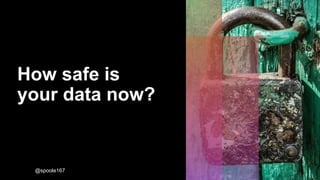
How safe is
your data now?
@spoole167
Of course, most
of us don’t
know
@spoole167
The world runs on software
@spoole167
And software is under attack
@spoole167
5 years a go I said things like this
@spoole167
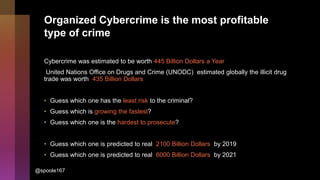
Organized Cybercrime is the most profitable
type of crime
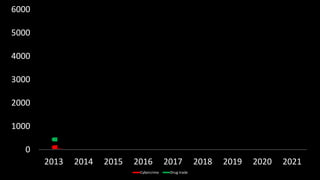
Cybercrime was estimated to be worth 445 Billion Dollars a Year
United Nations Office on Drugs and Crime (UNODC) estimated globally the illicit drug
trade was worth 435 Billion Dollars
• Guess which one has the least risk to the criminal?
• Guess which is growing the fastest?
• Guess which one is the hardest to prosecute?
• Guess which one is predicted to real 2100 Billion Dollars by 2019
• Guess which one is predicted to real 6000 Billion Dollars by 2021
@spoole167
0
1000
2000
3000
4000
5000
6000
2013 2014 2015 2016 2017 2018 2019 2020 2021
Cybercrime Drug trade
What’s the status today?
@spoole167
It’s much worse than predicted …
As a developer your world is going to
change rapidly
@spoole167
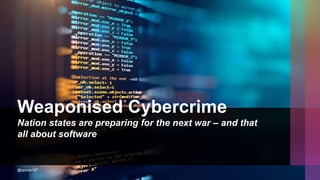
Weaponised Cybercrime
Nation states are preparing for the next war – and that
all about software
@spoole167
Cyber Attacks are
rising in number
and sophistication
The aim is to infiltrate infrastructure
and essential services…
@spoole167
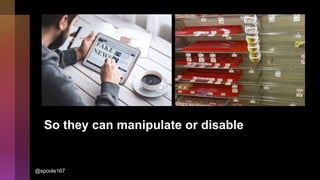
So they can manipulate or disable
@spoole167
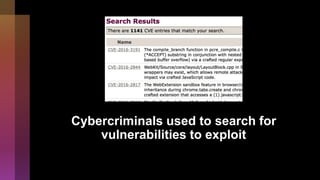
Cybercriminals used to search for
vulnerabilities to exploit
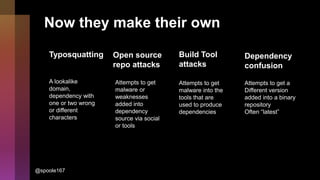
Now they make their own
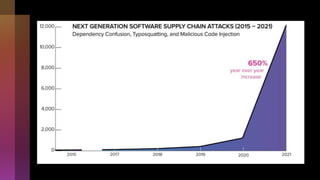
Typosquatting
A lookalike
domain,
dependency with
one or two wrong
or different
characters
Open source
repo attacks
Build Tool
attacks
Attempts to get
malware or
weaknesses
added into
dependency
source via social
or tools
Attempts to get
malware into the
tools that are
used to produce
dependencies
Dependency
confusion
Attempts to get a
Different version
added into a binary
repository
Often “latest”
@spoole167
Put differently Payroll App V1
Payroll App V1
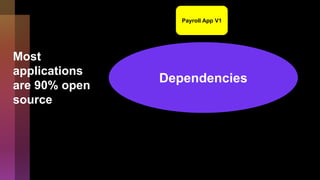
Most
applications
are 90% open
source
Dependencies
Payroll App V1
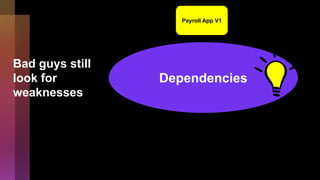
Bad guys still
look for
weaknesses
Dependencies
Payroll App V1
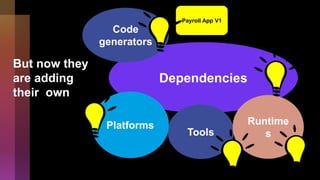
But now they
are adding
their own
Dependencies
Tools
Runtime
s
Platforms
Code
generators
Payroll App V1
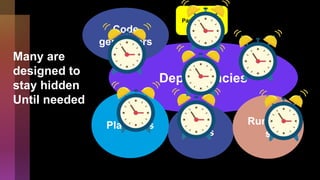
Many are
designed to
stay hidden
Until needed
Dependencies
Tools
Runtime
s
Platforms
Code
generators
Let me tell you a story
Got one of these?
@spoole167
Got one of
these in it?
• $2 from china
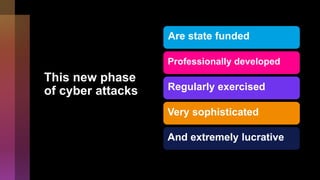
This new phase
of cyber attacks
Are state funded
Professionally developed
Regularly exercised
Very sophisticated
And extremely lucrative
2021 – 6 trillion dollars
2022 ?
@spoole167
2021 – 6 trillion dollars
2022 - 35 Trillion dollars?
@spoole167
2021 – 6 trillion dollars
2022 - 35 Trillion dollars?
@spoole167
That’s
$4300 per
person
@spoole167
What can you do?
@spoole167
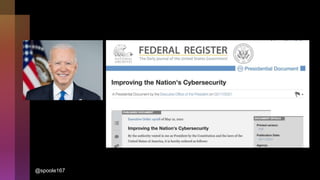
1: Think about the supply chain
@spoole167
@spoole167
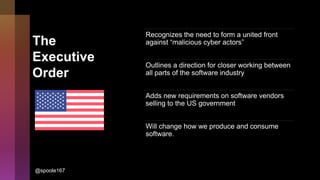
The
Executive
Order
Recognizes the need to form a united front
against “malicious cyber actors”
Outlines a direction for closer working between
all parts of the software industry
Adds new requirements on software vendors
selling to the US government
Will change how we produce and consume
software.
@spoole167
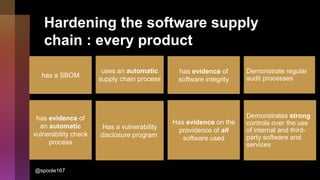
Hardening the software supply
chain : every product
has a SBOM
uses an automatic
supply chain process
has evidence of
software integrity
has evidence of
an automatic
vulnerability check
process
Has a vulnerability
disclosure program
Has evidence on the
providence of all
software used
Demonstrates strong
controls over the use
of internal and third-
party software and
services
Demonstrate regular
audit processes
@spoole167
SBOM – the new important term
on the horizon
cyclonedx.org spdx.dev
@spoole167
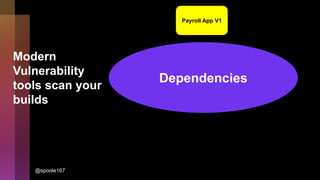
Modern
Vulnerability
tools scan your
builds
Dependencies
Payroll App V1
@spoole167
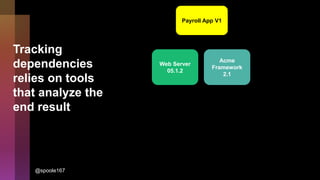
Tracking
dependencies
relies on tools
that analyze the
end result
Payroll App V1
Web Server
05.1.2
Acme
Framework
2.1
@spoole167
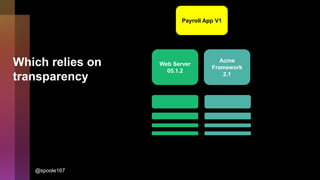
Which relies on
transparency
Payroll App V1
Web Server
05.1.2
Acme
Framework
2.1
@spoole167
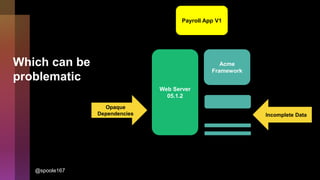
Which can be
problematic
Payroll App V1
Web Server
05.1.2
Acme
Framework
Incomplete Data
Opaque
Dependencies
@spoole167
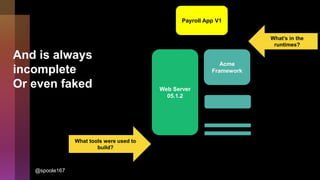
And is always
incomplete
Or even faked
Payroll App V1
Web Server
05.1.2
Acme
Framework
What’s in the
runtimes?
What tools were used to
build?
@spoole167
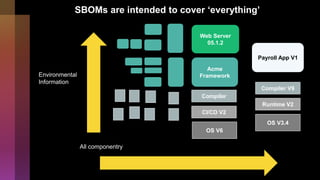
Web Server
05.1.2
Acme
Framework
Payroll App V1
Runtime V2
OS V3.4
Compiler V9
CI/CD V2
OS V6
Compiler
Environmental
Information
All componentry
SBOMs are intended to cover ‘everything’
2: Automate everything
@spoole167
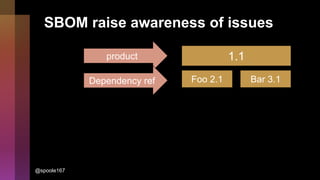
SBOM raise awareness of issues
1.1
Foo 2.1 Bar 3.1
product
Dependency ref
@spoole167
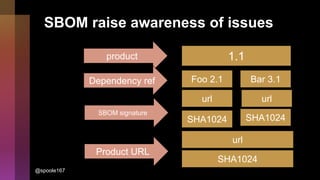
SBOM raise awareness of issues
1.1
Foo 2.1 Bar 3.1
product
Dependency ref
url url
SBOM signature
SHA1024 SHA1024
Product URL
url
SHA1024
@spoole167
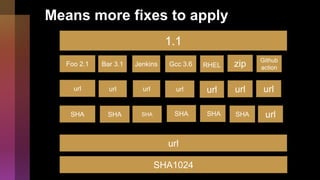
Means more fixes to apply
1.1
Foo 2.1 Bar 3.1
url url
SHA SHA
url
SHA1024
Gcc 3.6 RHEL
url url
SHA SHA
zip
url
SHA
Jenkins
url
SHA
Github
action
url
url
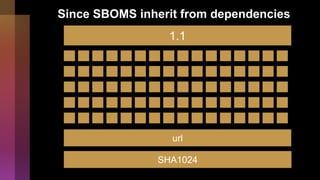
Since SBOMS inherit from dependencies
1.1
url
SHA1024
More info is available
1.1
url
SHA1024
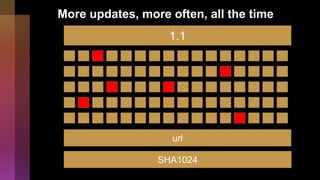
More updates, more often, all the time
1.1
url
SHA1024
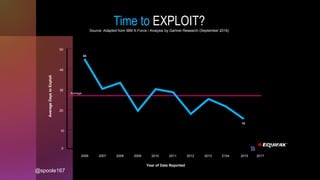
Time to EXPLOIT?
Source: Adapted from IBM X-Force / Analysis by Gartner Research (September 2016)
Year of Date Reported
2006 2007 2008 2009 2010 2011 2012 2013 2104 2015
10
20
30
40
50
0
Average
Days
to
Exploit
Average
45
15
2017
@spoole167
2 days
@spoole167
2 days
Oh wait that was 2016 – what’s the
number now?
2 days
@spoole167
2 seconds
@spoole167
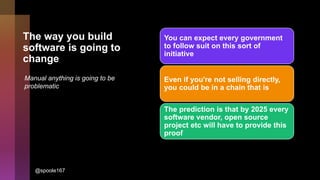
The way you build
software is going to
change
You can expect every government
to follow suit on this sort of
initiative
Even if you're not selling directly,
you could be in a chain that is
The prediction is that by 2025 every
software vendor, open source
project etc will have to provide this
proof
Manual anything is going to be
problematic
@spoole167
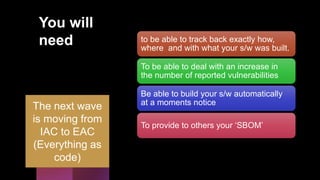
You will
need to be able to track back exactly how,
where and with what your s/w was built.
To be able to deal with an increase in
the number of reported vulnerabilities
Be able to build your s/w automatically
at a moments notice
To provide to others your ‘SBOM’
The next wave
is moving from
IAC to EAC
(Everything as
code)
3: Lower your trust levels
@spoole167
The way you
choose open
source
software is
going to
change
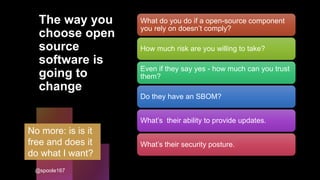
What do you do if a open-source component
you rely on doesn’t comply?
How much risk are you willing to take?
Even if they say yes - how much can you trust
them?
Do they have an SBOM?
What’s their ability to provide updates.
What’s their security posture.
No more: is is it
free and does it
do what I want?
@spoole167
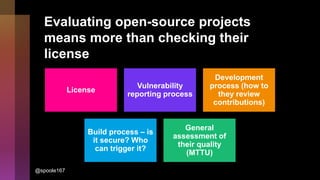
Evaluating open-source projects
means more than checking their
license
License
Vulnerability
reporting process
Development
process (how to
they review
contributions)
Build process – is
it secure? Who
can trigger it?
General
assessment of
their quality
(MTTU)
@spoole167
4: Code defensively
@spoole167
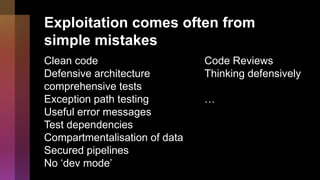
Exploitation comes often from
simple mistakes
Clean code
Defensive architecture
comprehensive tests
Exception path testing
Useful error messages
Test dependencies
Compartmentalisation of data
Secured pipelines
No ‘dev mode’
Code Reviews
Thinking defensively
…
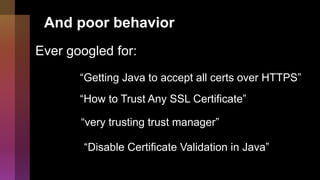
And poor behavior
Ever googled for:
“very trusting trust manager”
“Getting Java to accept all certs over HTTPS”
“How to Trust Any SSL Certificate”
“Disable Certificate Validation in Java”
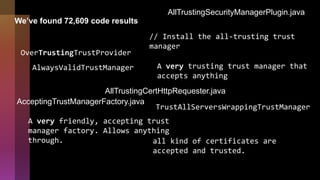
We’ve found 72,609 code results
AlwaysValidTrustManager
TrustAllServersWrappingTrustManager
A very friendly, accepting trust
manager factory. Allows anything
through. all kind of certificates are
accepted and trusted.
A very trusting trust manager that
accepts anything
// Install the all-trusting trust
manager
OverTrustingTrustProvider
AllTrustingSecurityManagerPlugin.java
AcceptingTrustManagerFactory.java
AllTrustingCertHttpRequester.java
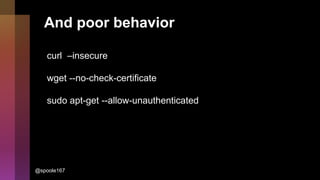
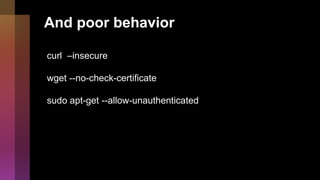
And poor behavior
curl –insecure
wget --no-check-certificate
sudo apt-get --allow-unauthenticated
@spoole167
And poor behavior
curl –insecure
wget --no-check-certificate
sudo apt-get --allow-unauthenticated
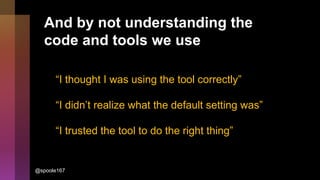
And by not understanding the
code and tools we use
“I thought I was using the tool correctly”
“I didn’t realize what the default setting was”
“I trusted the tool to do the right thing”
@spoole167
IF you contribute to open source
• Take these behaviors with you
• Think about software safety
• Think defensively.
@spoole167
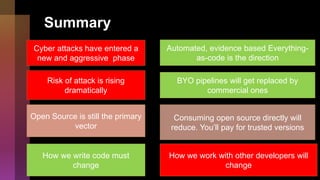
Summary
Cyber attacks have entered a
new and aggressive phase
Automated, evidence based Everything-
as-code is the direction
Open Source is still the primary
vector
Risk of attack is rising
dramatically
BYO pipelines will get replaced by
commercial ones
Consuming open source directly will
reduce. You’ll pay for trusted versions
How we write code must
change
How we work with other developers will
change
Takeaways
• The days of just taking software off the shelf are numbered :
choose software based on how it’s produced not just what it does
• Evidence based trust will become essential : Your own supply chain
– the software you use, how you develop, how you deploy will become
a certified step in someone else's evidence chain.
• A complex and challenging new world lies ahead. GDPR changed
how we thought and deal with user information – supply chains are
going to get the same sort of scrutiny.
• Software is critical to every facet of our lives – the world has woken
up to that .
@spoole167
As developers,
we’re on the front
line

@spoole167
Thank
you
Any questions?
@spoole167

Cybercrime and the developer 2021 style

  • 1.
    Cybercrime and the Developer How todefend against the darker side @spoole167
  • 2.
    Steve Poole • DeveloperAdocate • Sonatype @spoole167
  • 3.
    Take away onething As a developer, security is your problem @spoole167
  • 4.
    Who uses wifi? Every thoughtabout how it works? @spoole167
  • 5.
    Would you notice oneof these on the wall? @spoole167
  • 6.
    With some simple h/wits’ easy to spoof the wifi @spoole167
  • 7.
    How safe is yourdata now? @spoole167
  • 8.
    Of course, most ofus don’t know @spoole167
  • 9.
    The world runson software @spoole167
  • 10.
    And software isunder attack @spoole167
  • 11.
    5 years ago I said things like this @spoole167
  • 12.
    Organized Cybercrime isthe most profitable type of crime Cybercrime was estimated to be worth 445 Billion Dollars a Year United Nations Office on Drugs and Crime (UNODC) estimated globally the illicit drug trade was worth 435 Billion Dollars • Guess which one has the least risk to the criminal? • Guess which is growing the fastest? • Guess which one is the hardest to prosecute? • Guess which one is predicted to real 2100 Billion Dollars by 2019 • Guess which one is predicted to real 6000 Billion Dollars by 2021 @spoole167
  • 13.
    0 1000 2000 3000 4000 5000 6000 2013 2014 20152016 2017 2018 2019 2020 2021 Cybercrime Drug trade
  • 14.
    What’s the statustoday? @spoole167
  • 15.
    It’s much worsethan predicted … As a developer your world is going to change rapidly @spoole167
  • 16.
    Weaponised Cybercrime Nation statesare preparing for the next war – and that all about software @spoole167
  • 17.
    Cyber Attacks are risingin number and sophistication The aim is to infiltrate infrastructure and essential services… @spoole167
  • 18.
    So they canmanipulate or disable @spoole167
  • 19.
    Cybercriminals used tosearch for vulnerabilities to exploit
  • 20.
    Now they maketheir own Typosquatting A lookalike domain, dependency with one or two wrong or different characters Open source repo attacks Build Tool attacks Attempts to get malware or weaknesses added into dependency source via social or tools Attempts to get malware into the tools that are used to produce dependencies Dependency confusion Attempts to get a Different version added into a binary repository Often “latest” @spoole167
  • 21.
  • 22.
    Payroll App V1 Most applications are90% open source Dependencies
  • 23.
    Payroll App V1 Badguys still look for weaknesses Dependencies
  • 24.
    Payroll App V1 Butnow they are adding their own Dependencies Tools Runtime s Platforms Code generators
  • 25.
    Payroll App V1 Manyare designed to stay hidden Until needed Dependencies Tools Runtime s Platforms Code generators
  • 27.
    Let me tellyou a story
  • 28.
    Got one ofthese? @spoole167
  • 29.
    Got one of thesein it? • $2 from china
  • 30.
    This new phase ofcyber attacks Are state funded Professionally developed Regularly exercised Very sophisticated And extremely lucrative
  • 31.
    2021 – 6trillion dollars 2022 ? @spoole167
  • 32.
    2021 – 6trillion dollars 2022 - 35 Trillion dollars? @spoole167
  • 33.
    2021 – 6trillion dollars 2022 - 35 Trillion dollars? @spoole167
  • 34.
  • 35.
    What can youdo? @spoole167
  • 36.
    1: Think aboutthe supply chain @spoole167
  • 37.
  • 38.
    The Executive Order Recognizes the needto form a united front against “malicious cyber actors” Outlines a direction for closer working between all parts of the software industry Adds new requirements on software vendors selling to the US government Will change how we produce and consume software. @spoole167
  • 39.
    Hardening the softwaresupply chain : every product has a SBOM uses an automatic supply chain process has evidence of software integrity has evidence of an automatic vulnerability check process Has a vulnerability disclosure program Has evidence on the providence of all software used Demonstrates strong controls over the use of internal and third- party software and services Demonstrate regular audit processes @spoole167
  • 40.
    SBOM – thenew important term on the horizon cyclonedx.org spdx.dev @spoole167
  • 41.
  • 42.
    Tracking dependencies relies on tools thatanalyze the end result Payroll App V1 Web Server 05.1.2 Acme Framework 2.1 @spoole167
  • 43.
    Which relies on transparency PayrollApp V1 Web Server 05.1.2 Acme Framework 2.1 @spoole167
  • 44.
    Which can be problematic PayrollApp V1 Web Server 05.1.2 Acme Framework Incomplete Data Opaque Dependencies @spoole167
  • 45.
    And is always incomplete Oreven faked Payroll App V1 Web Server 05.1.2 Acme Framework What’s in the runtimes? What tools were used to build? @spoole167
  • 46.
    Web Server 05.1.2 Acme Framework Payroll AppV1 Runtime V2 OS V3.4 Compiler V9 CI/CD V2 OS V6 Compiler Environmental Information All componentry SBOMs are intended to cover ‘everything’
  • 47.
  • 48.
    SBOM raise awarenessof issues 1.1 Foo 2.1 Bar 3.1 product Dependency ref @spoole167
  • 49.
    SBOM raise awarenessof issues 1.1 Foo 2.1 Bar 3.1 product Dependency ref url url SBOM signature SHA1024 SHA1024 Product URL url SHA1024 @spoole167
  • 50.
    Means more fixesto apply 1.1 Foo 2.1 Bar 3.1 url url SHA SHA url SHA1024 Gcc 3.6 RHEL url url SHA SHA zip url SHA Jenkins url SHA Github action url url
  • 51.
    Since SBOMS inheritfrom dependencies 1.1 url SHA1024
  • 52.
    More info isavailable 1.1 url SHA1024
  • 53.
    More updates, moreoften, all the time 1.1 url SHA1024
  • 54.
    Time to EXPLOIT? Source:Adapted from IBM X-Force / Analysis by Gartner Research (September 2016) Year of Date Reported 2006 2007 2008 2009 2010 2011 2012 2013 2104 2015 10 20 30 40 50 0 Average Days to Exploit Average 45 15 2017 @spoole167
  • 55.
  • 56.
    2 days Oh waitthat was 2016 – what’s the number now?
  • 57.
  • 58.
  • 59.
    The way youbuild software is going to change You can expect every government to follow suit on this sort of initiative Even if you're not selling directly, you could be in a chain that is The prediction is that by 2025 every software vendor, open source project etc will have to provide this proof Manual anything is going to be problematic @spoole167
  • 60.
    You will need tobe able to track back exactly how, where and with what your s/w was built. To be able to deal with an increase in the number of reported vulnerabilities Be able to build your s/w automatically at a moments notice To provide to others your ‘SBOM’ The next wave is moving from IAC to EAC (Everything as code)
  • 61.
    3: Lower yourtrust levels @spoole167
  • 62.
    The way you chooseopen source software is going to change What do you do if a open-source component you rely on doesn’t comply? How much risk are you willing to take? Even if they say yes - how much can you trust them? Do they have an SBOM? What’s their ability to provide updates. What’s their security posture. No more: is is it free and does it do what I want? @spoole167
  • 63.
    Evaluating open-source projects meansmore than checking their license License Vulnerability reporting process Development process (how to they review contributions) Build process – is it secure? Who can trigger it? General assessment of their quality (MTTU) @spoole167
  • 64.
  • 65.
    Exploitation comes oftenfrom simple mistakes Clean code Defensive architecture comprehensive tests Exception path testing Useful error messages Test dependencies Compartmentalisation of data Secured pipelines No ‘dev mode’ Code Reviews Thinking defensively …
  • 66.
    And poor behavior Evergoogled for: “very trusting trust manager” “Getting Java to accept all certs over HTTPS” “How to Trust Any SSL Certificate” “Disable Certificate Validation in Java”
  • 67.
    We’ve found 72,609code results AlwaysValidTrustManager TrustAllServersWrappingTrustManager A very friendly, accepting trust manager factory. Allows anything through. all kind of certificates are accepted and trusted. A very trusting trust manager that accepts anything // Install the all-trusting trust manager OverTrustingTrustProvider AllTrustingSecurityManagerPlugin.java AcceptingTrustManagerFactory.java AllTrustingCertHttpRequester.java
  • 68.
    And poor behavior curl–insecure wget --no-check-certificate sudo apt-get --allow-unauthenticated @spoole167
  • 69.
    And poor behavior curl–insecure wget --no-check-certificate sudo apt-get --allow-unauthenticated
  • 70.
    And by notunderstanding the code and tools we use “I thought I was using the tool correctly” “I didn’t realize what the default setting was” “I trusted the tool to do the right thing” @spoole167
  • 71.
    IF you contributeto open source • Take these behaviors with you • Think about software safety • Think defensively. @spoole167
  • 72.
    Summary Cyber attacks haveentered a new and aggressive phase Automated, evidence based Everything- as-code is the direction Open Source is still the primary vector Risk of attack is rising dramatically BYO pipelines will get replaced by commercial ones Consuming open source directly will reduce. You’ll pay for trusted versions How we write code must change How we work with other developers will change
  • 73.
    Takeaways • The daysof just taking software off the shelf are numbered : choose software based on how it’s produced not just what it does • Evidence based trust will become essential : Your own supply chain – the software you use, how you develop, how you deploy will become a certified step in someone else's evidence chain. • A complex and challenging new world lies ahead. GDPR changed how we thought and deal with user information – supply chains are going to get the same sort of scrutiny. • Software is critical to every facet of our lives – the world has woken up to that . @spoole167
  • 74.
    As developers, we’re onthe front line @spoole167
  • 75.