@spoole167
www.developersummit.com
@spoole167
A new hope for 2023?
What developers must learn
next
@spoole167
what do we think
when we think
about cybercrime?”
@spoole167
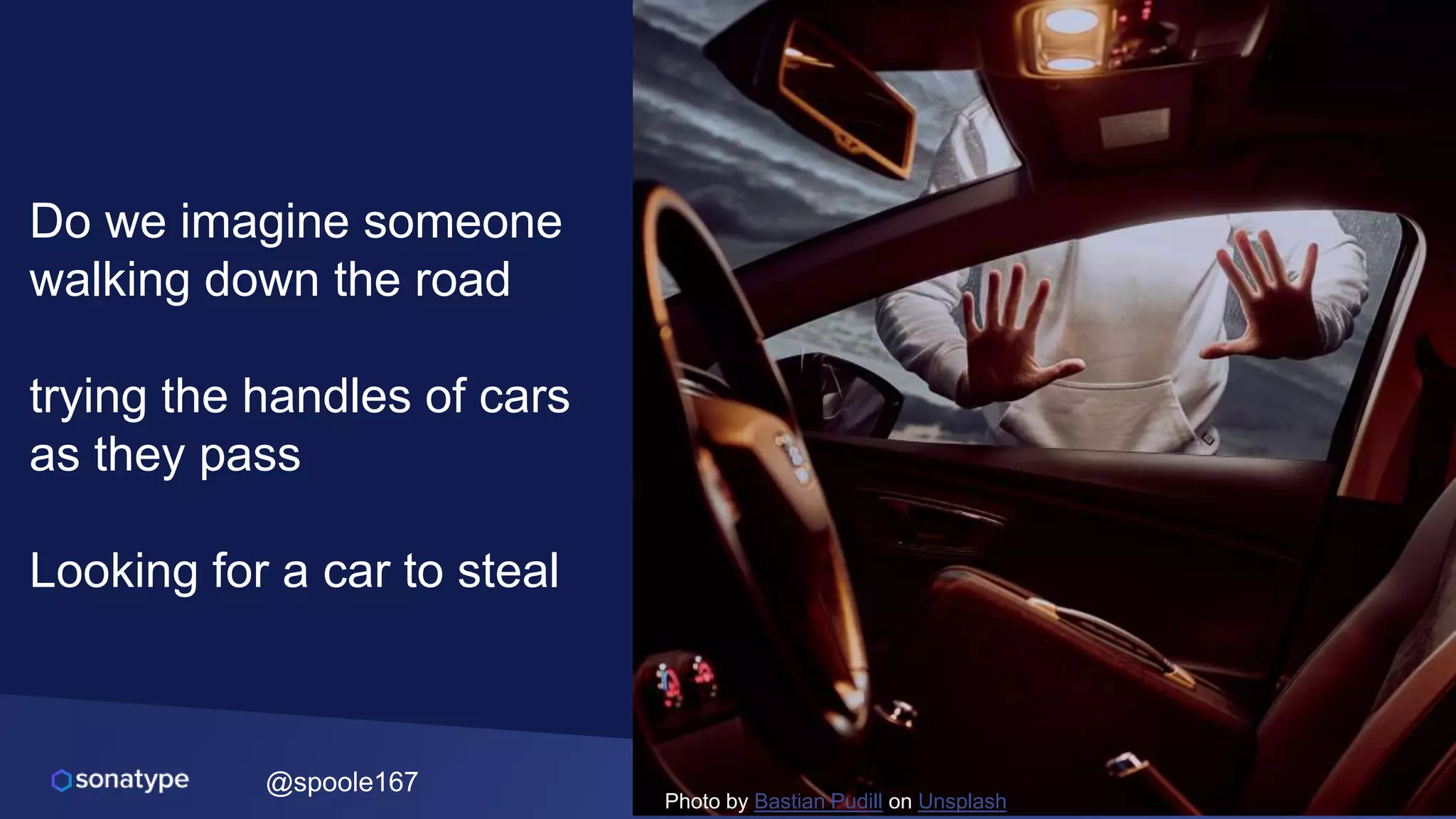
Photo by Bastian Pudill on Unsplash
Do we imagine someone
walking down the road
trying the handles of cars
as they pass
Looking for a car to steal
@spoole167
Do we remember that
movie we watched
about a daring and
sophisticated robbery ?
@spoole167
these are the two styles
we often think about.
The super complicated
attack
or the simple opportunist
@spoole167
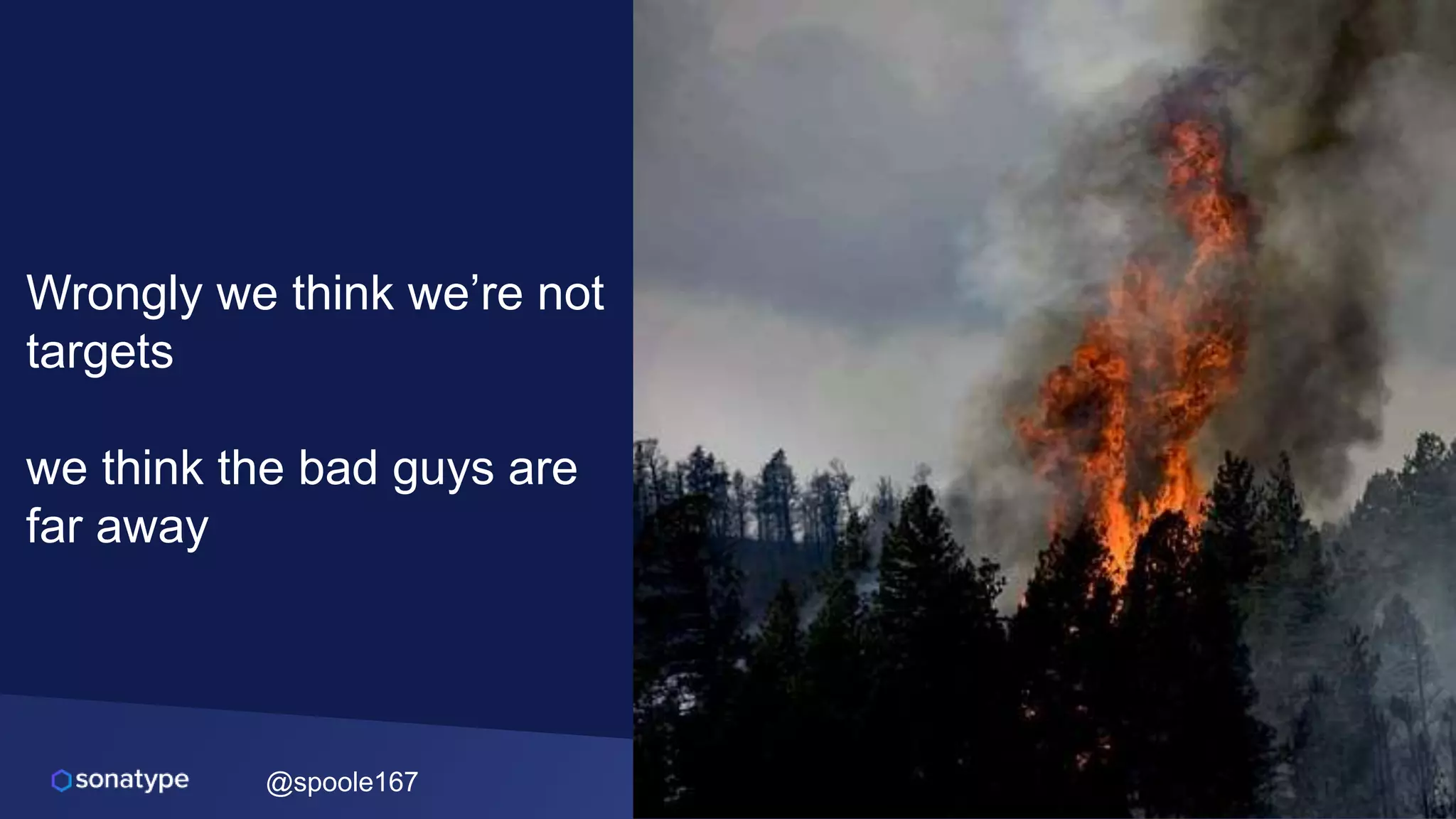
Wrongly we think we’re not
targets
we think the bad guys are
far away
@spoole167
The most common
thoughts as a developer are
”why is it my problem?”
or
“I don’t really know what to do”
@spoole167
this talk
• Is a reality check about what the bad guys are really doing and why
• What’s happening to help address these attacks
• What should you be doing next
@spoole167
Steve Poole
Director, Dev Advocacy
Sonatype
@spoole167
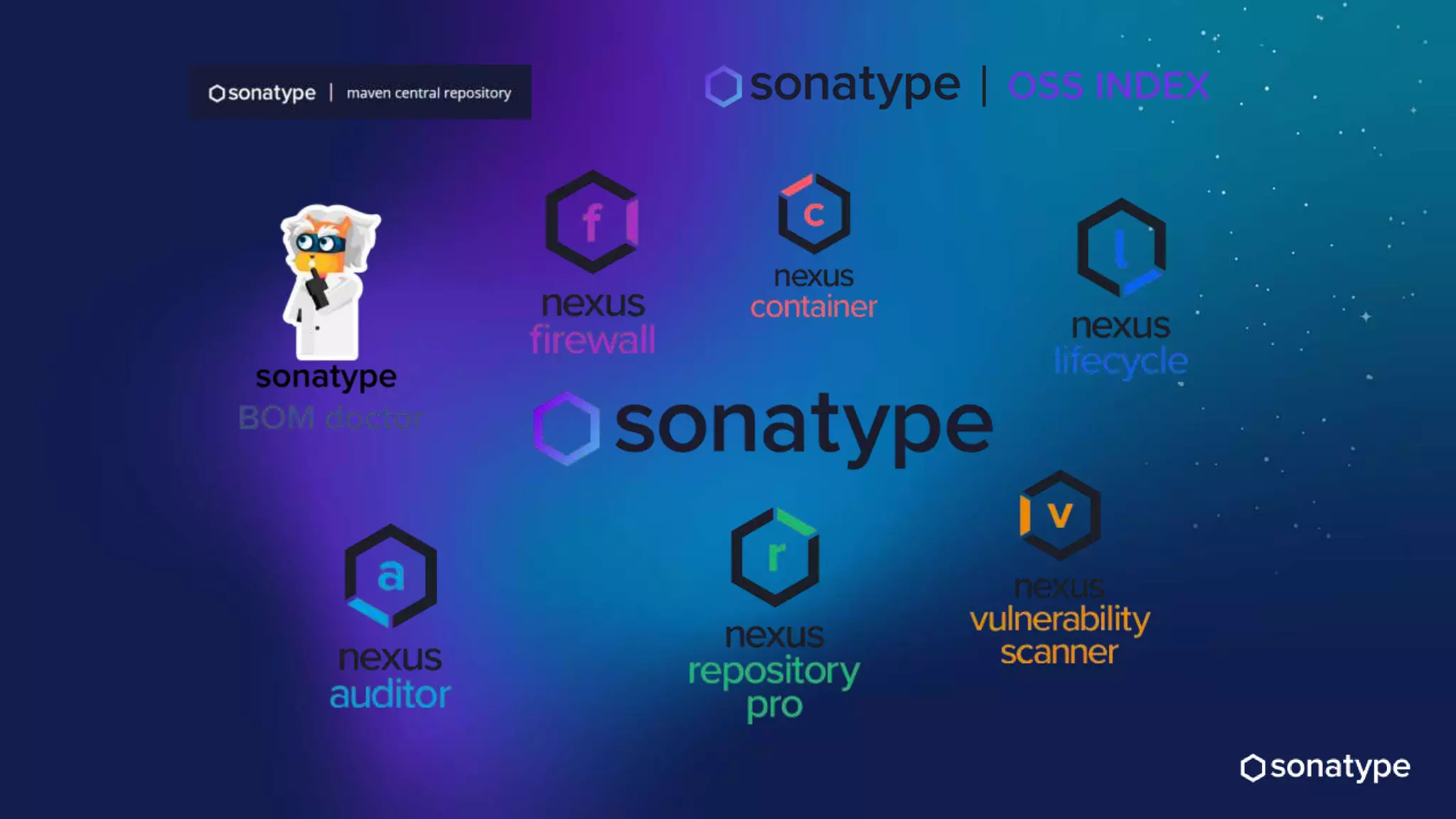
Sonatype
Invented Maven
Started Maven Central in 2003
Created Nexus repo and other technologies
The quiet leader in secure software supply
chain technology
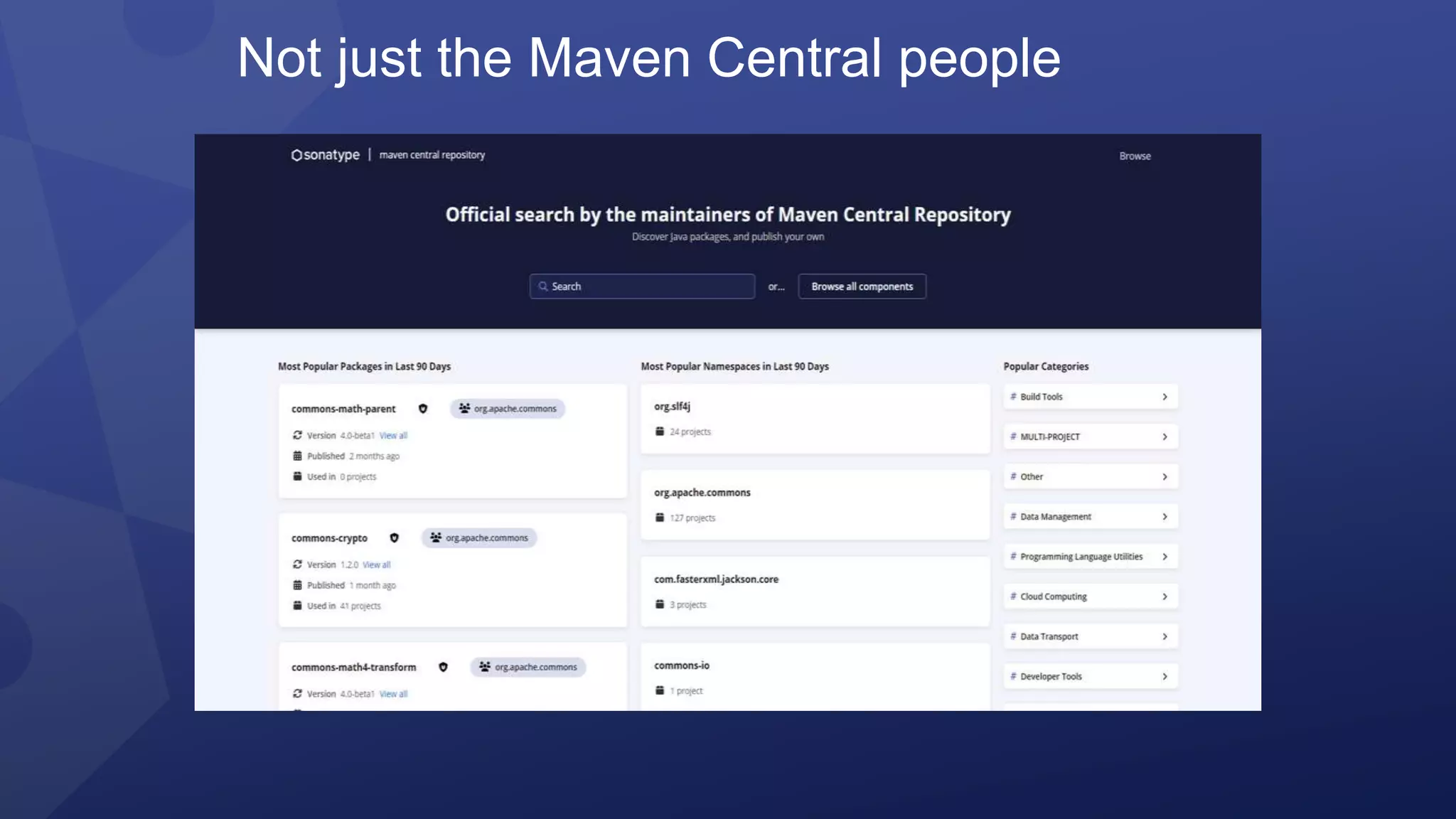
Not just the Maven Central people
@spoole167
Latest trends in Cyber attacks
@spoole167
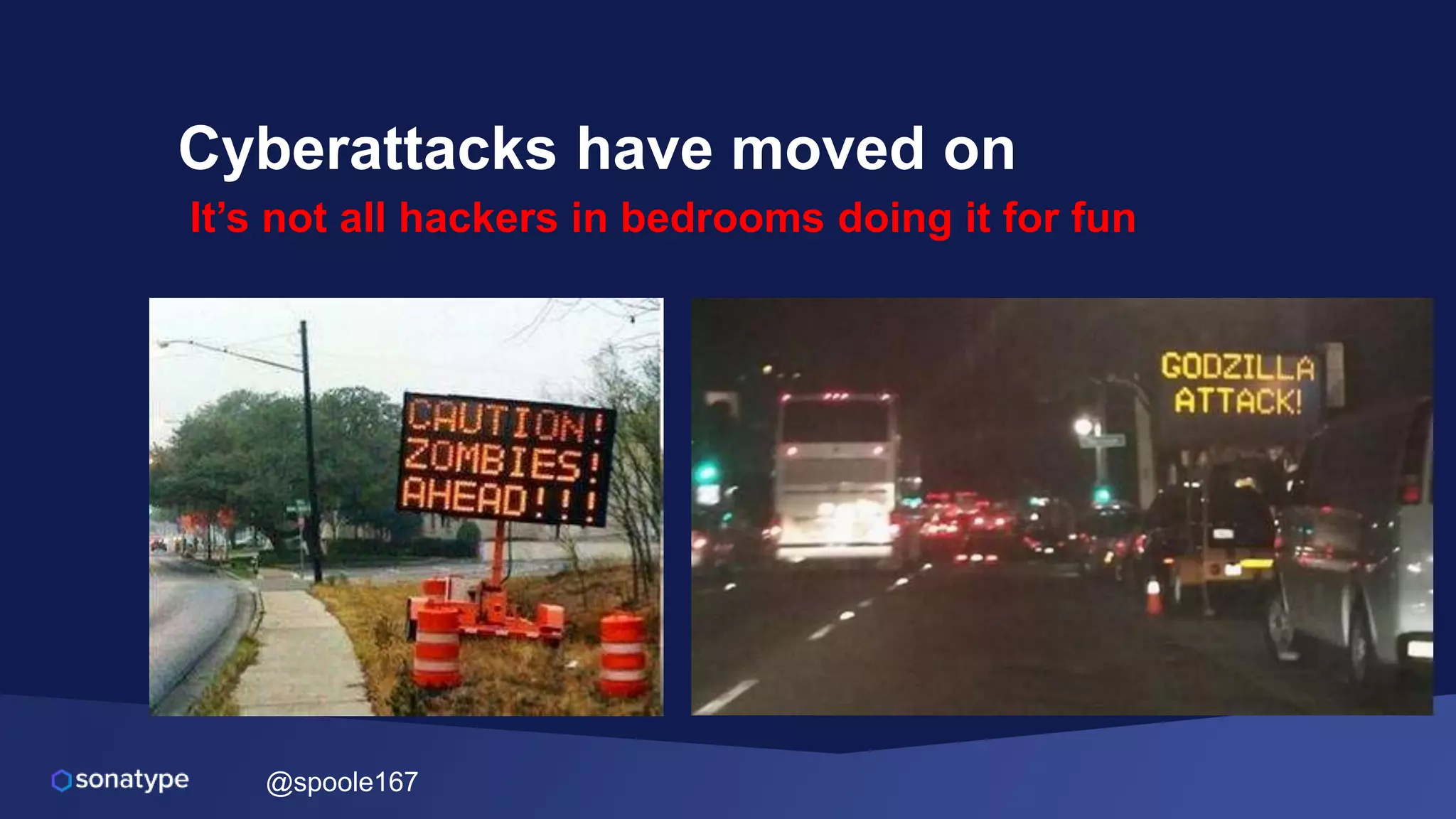
Cyberattacks have moved on
It’s not all hackers in bedrooms doing it for fun
@spoole167
in 2016 Cybercrime cost ~415 Billion Dollars
So did the illicit drug trade
@spoole167
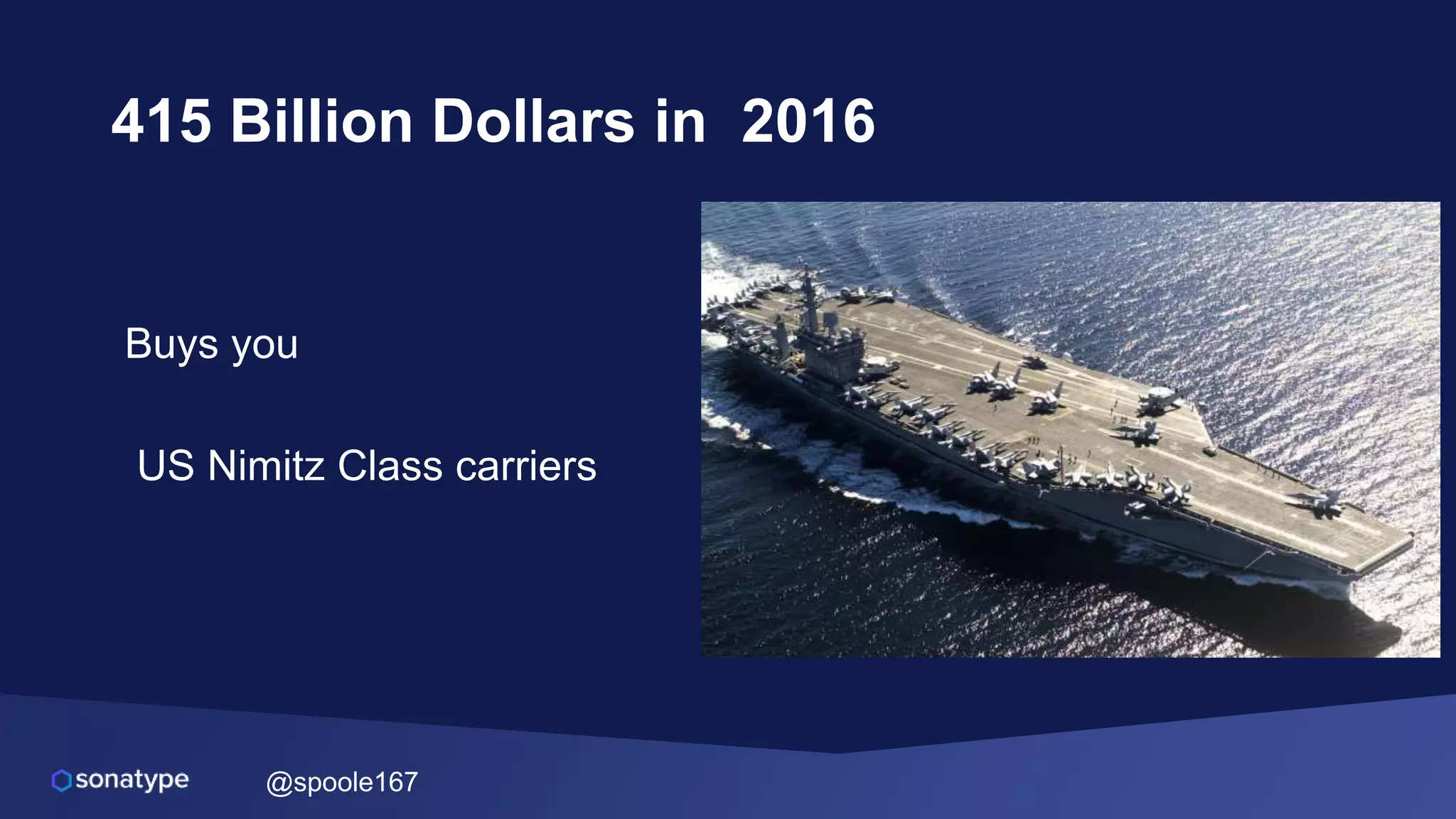
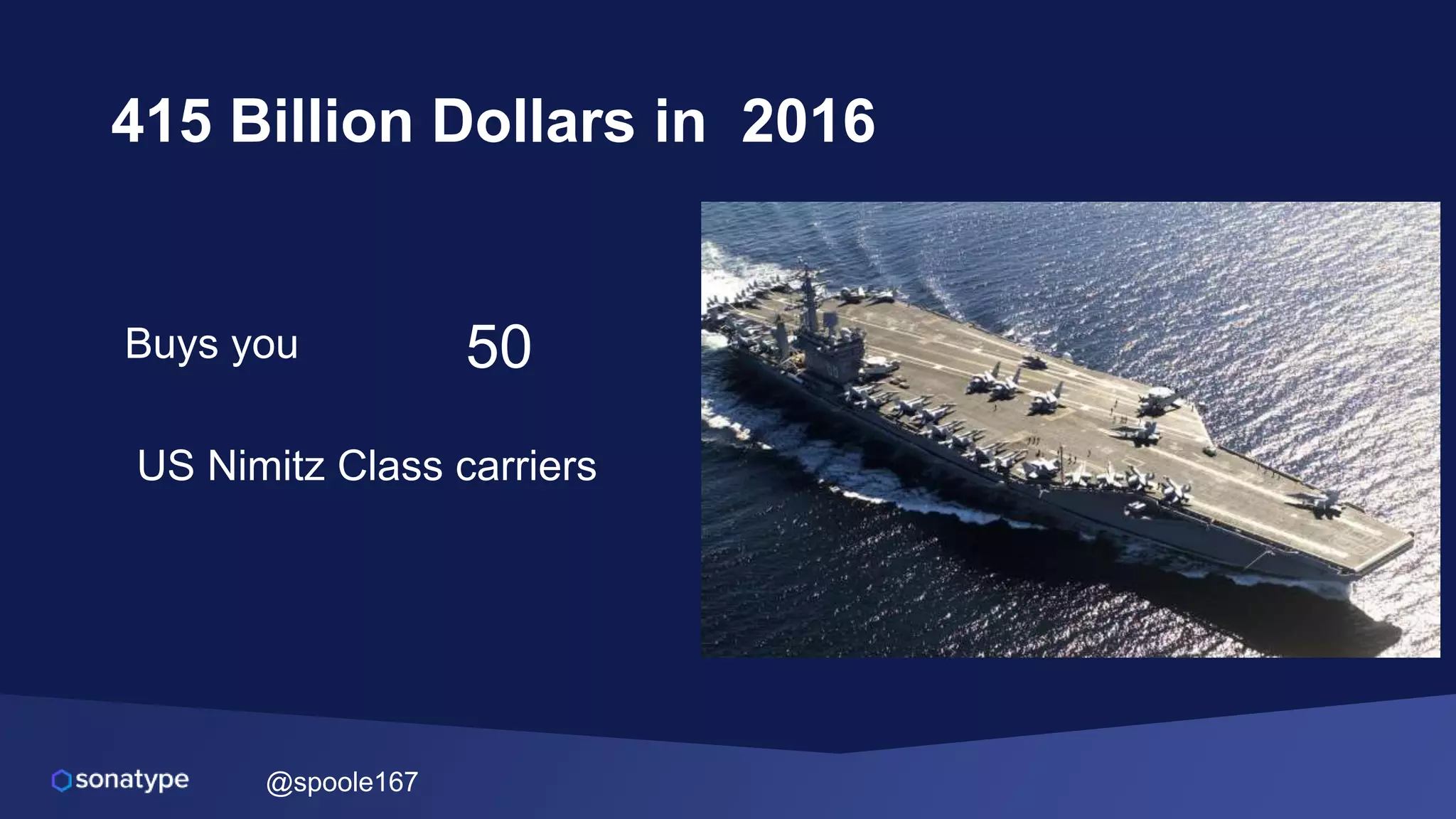
Buys you
US Nimitz Class carriers
415 Billion Dollars in 2016
@spoole167
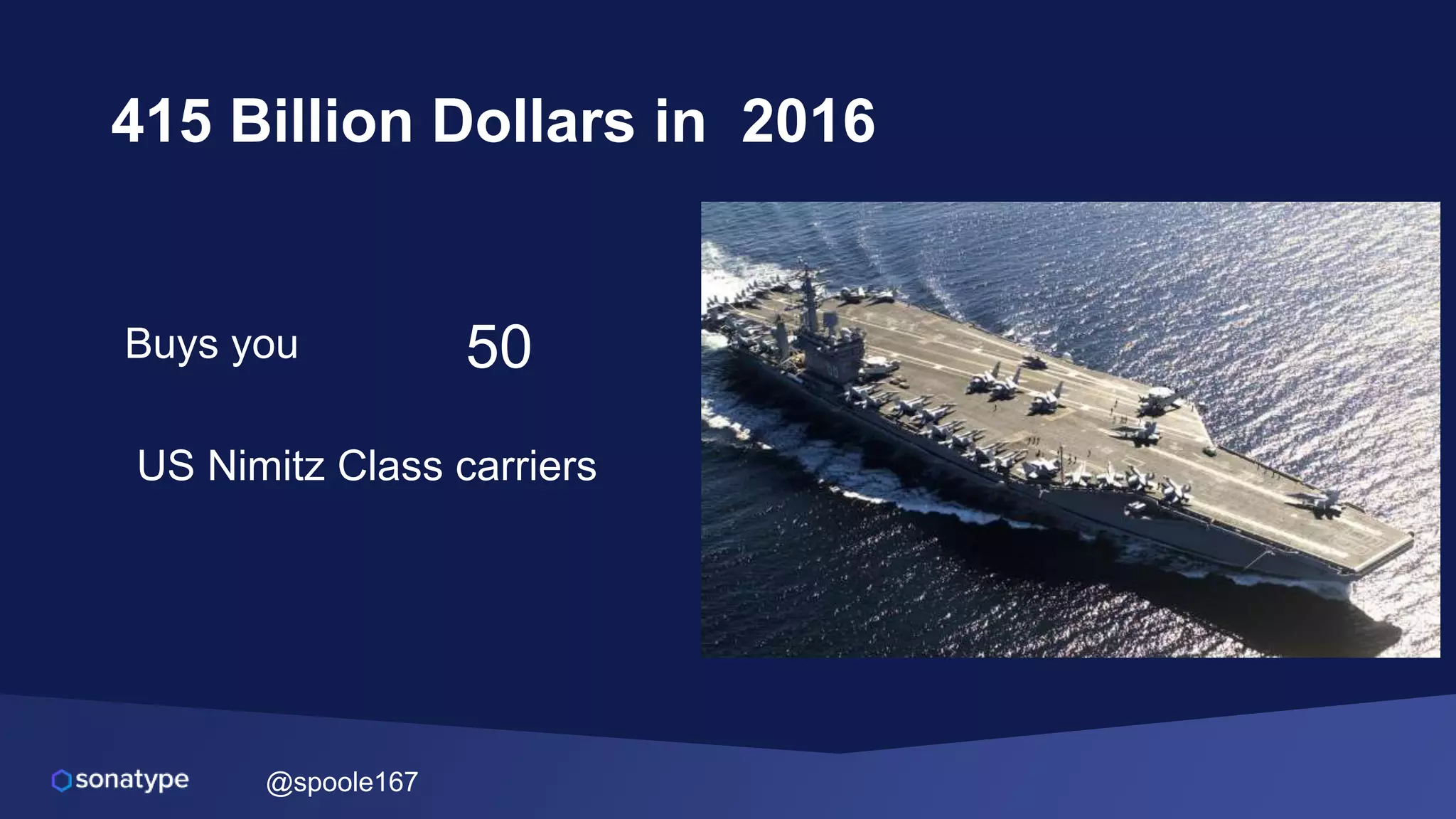
Buys you
US Nimitz Class carriers
415 Billion Dollars in 2016
50
@spoole167
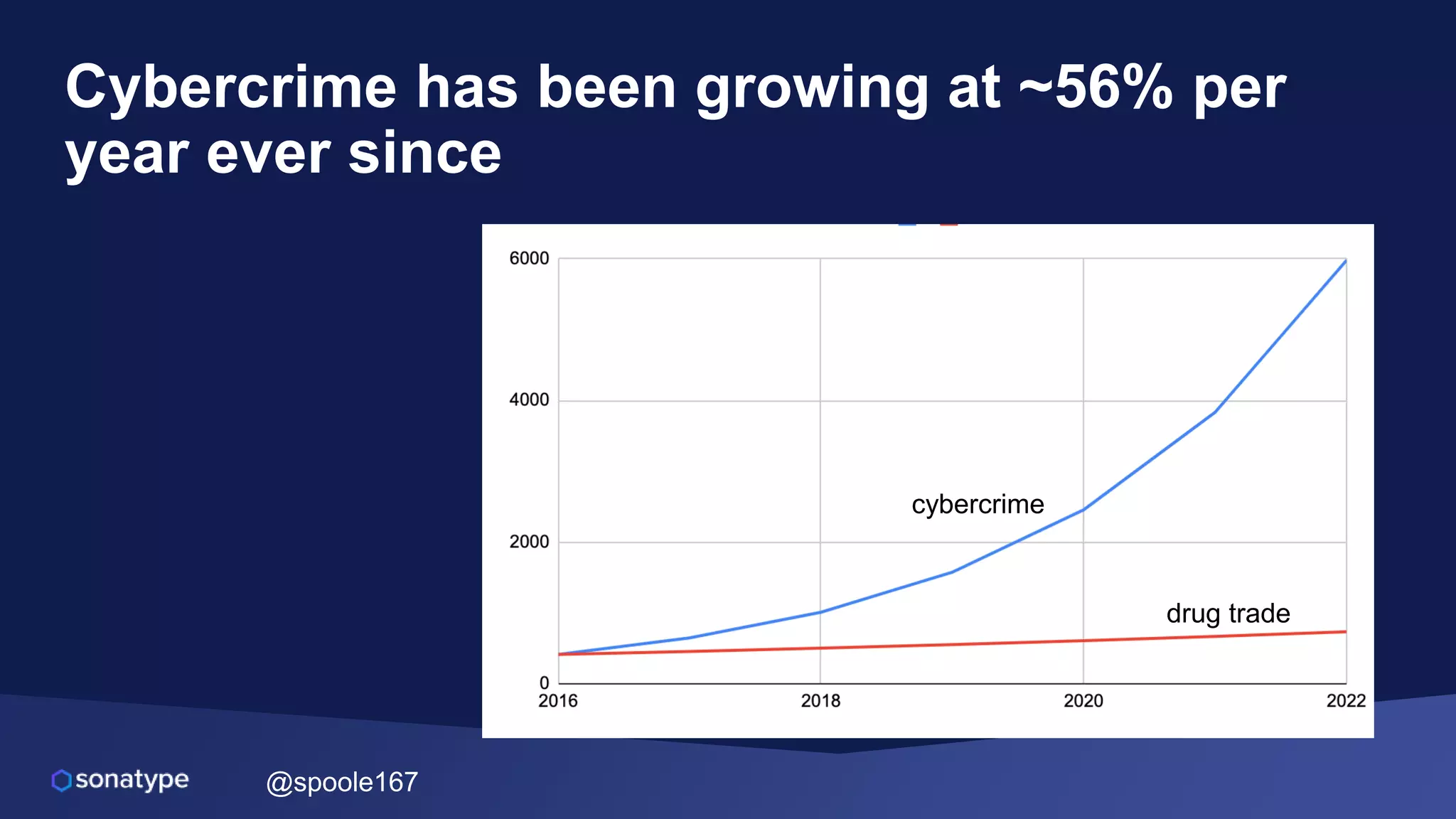
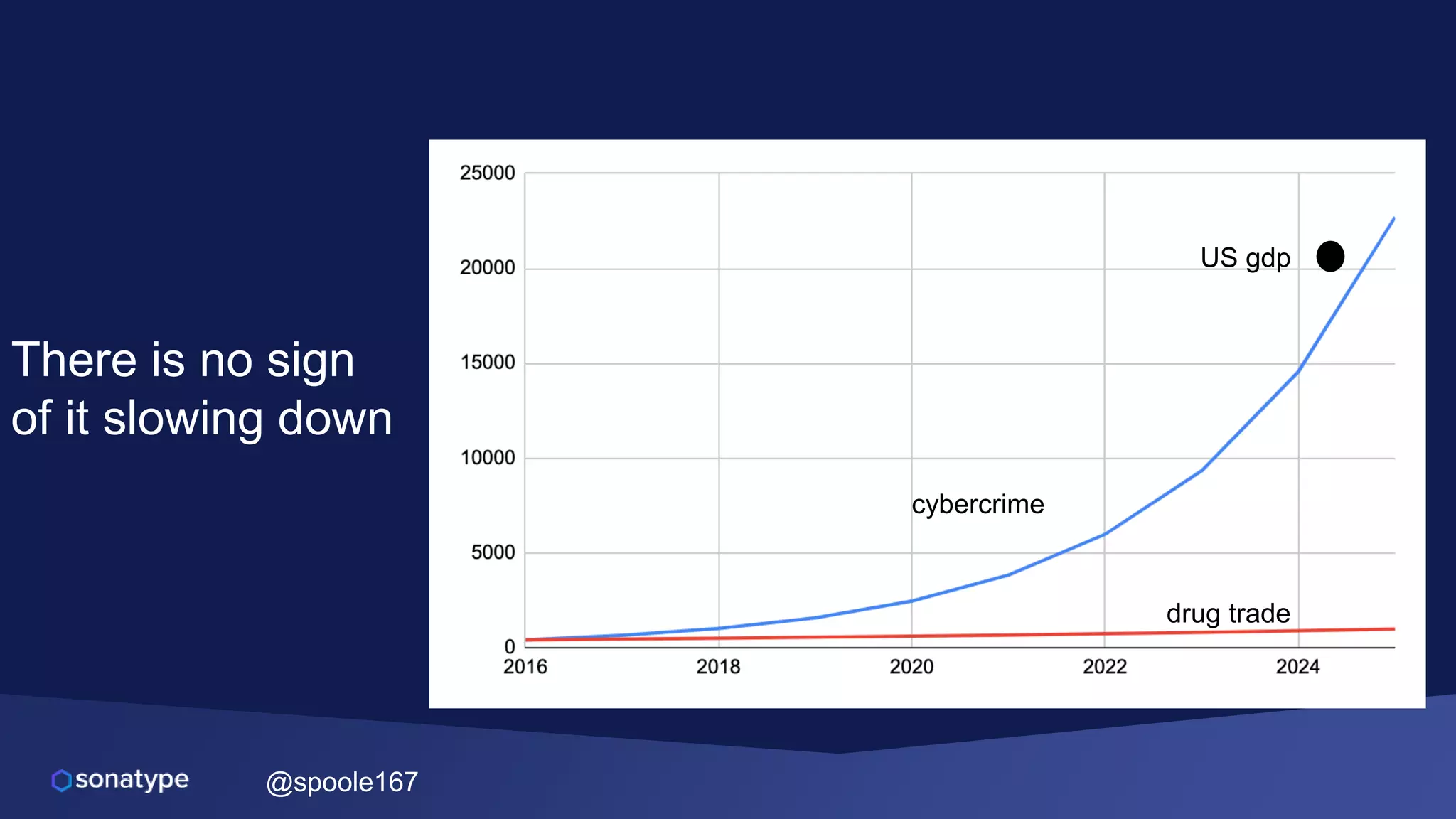
Cybercrime has been growing at ~56% per
year ever since
drug trade
cybercrime
@spoole167
Buys you
US Nimitz Class carriers
415 Billion Dollars in 2016
50
@spoole167
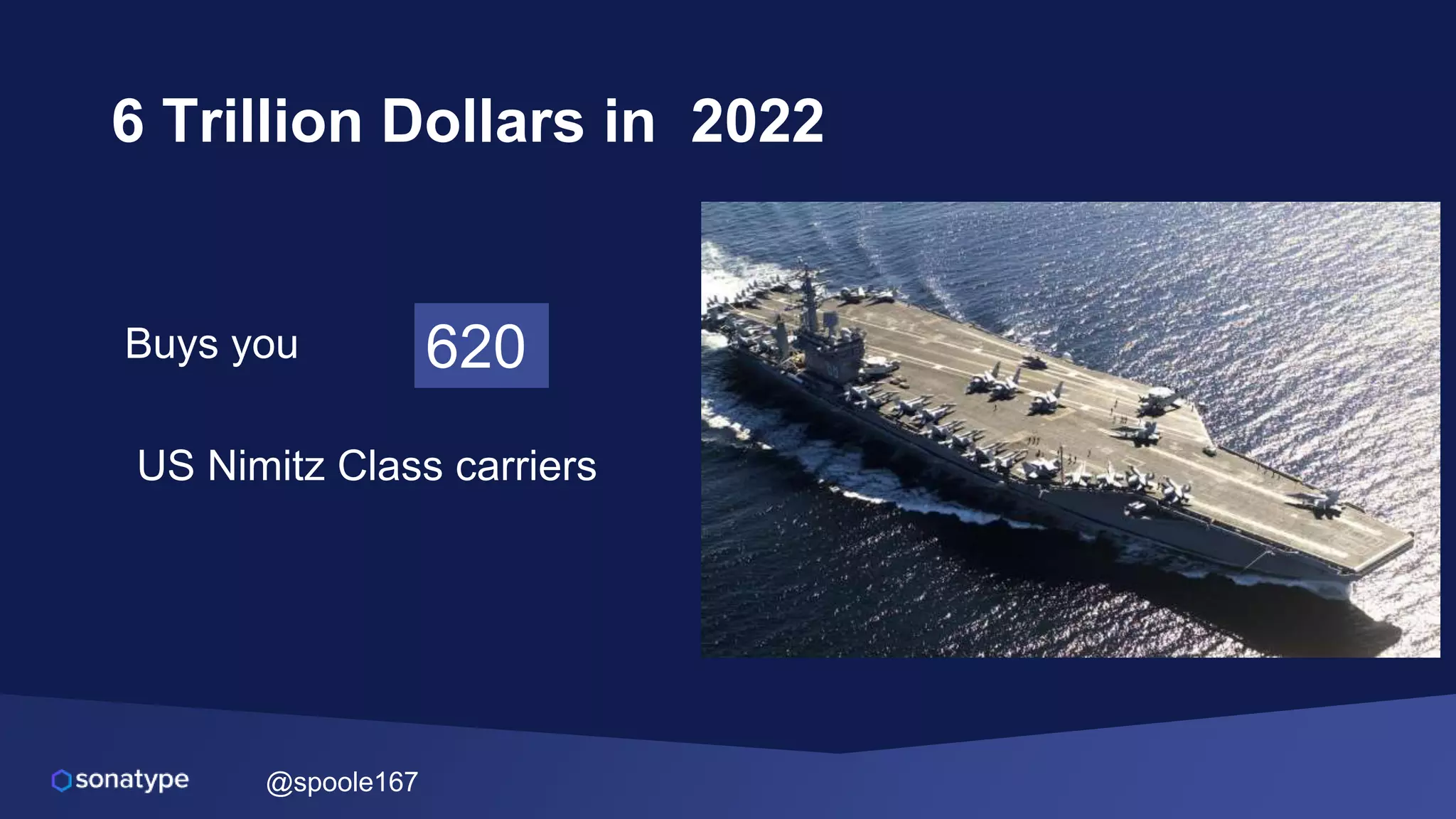
Buys you
US Nimitz Class carriers
6 Trillion Dollars in 2022
50
620
@spoole167
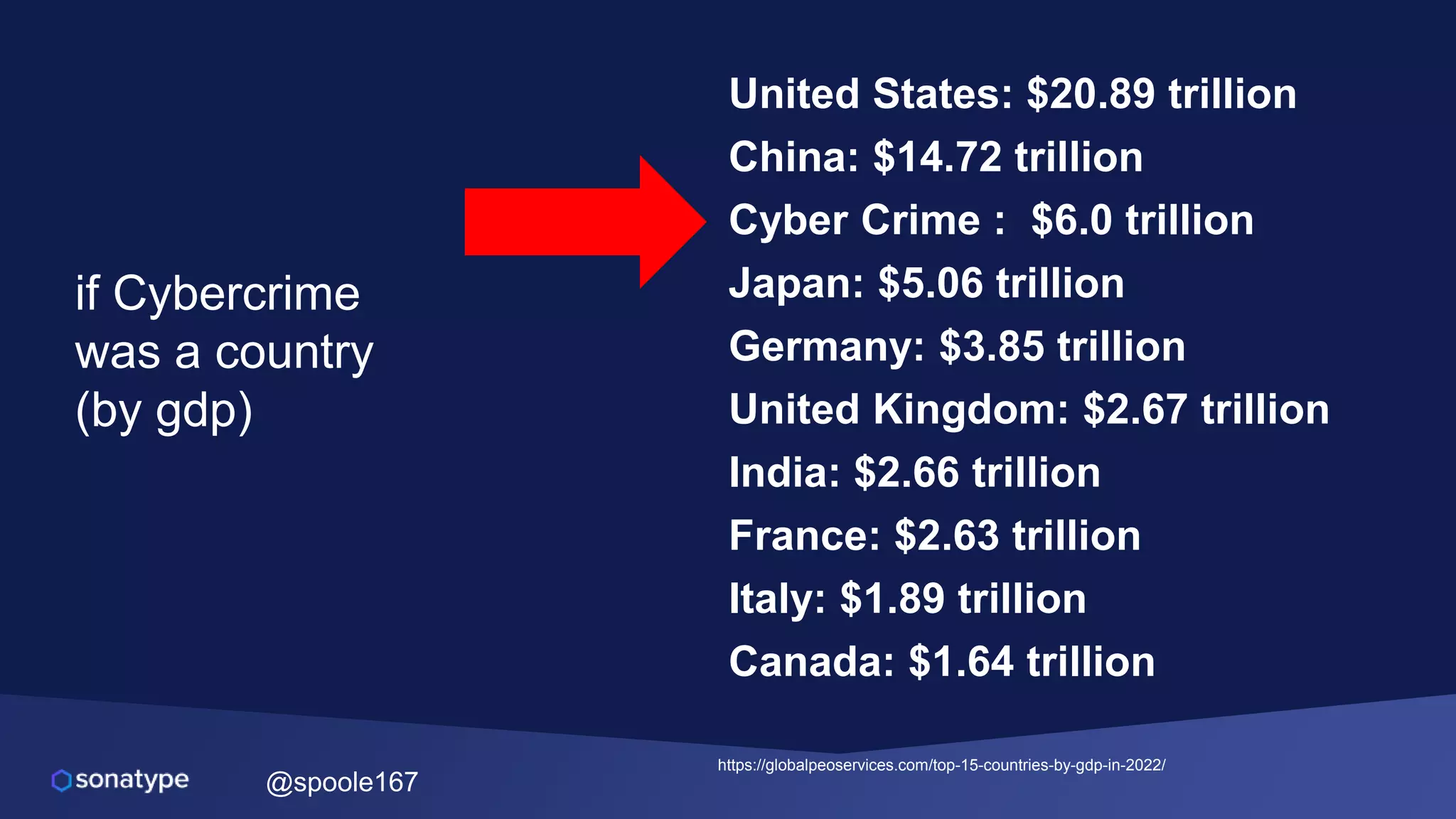
United States: $20.89 trillion
China: $14.72 trillion
Cyber Crime : $6.0 trillion
Japan: $5.06 trillion
Germany: $3.85 trillion
United Kingdom: $2.67 trillion
India: $2.66 trillion
France: $2.63 trillion
Italy: $1.89 trillion
Canada: $1.64 trillion
https://globalpeoservices.com/top-15-countries-by-gdp-in-2022/
if Cybercrime
was a country
(by gdp)
@spoole167
There is no sign
of it slowing down
drug trade
cybercrime
US gdp
@spoole167
It’s even more scary …
@spoole167
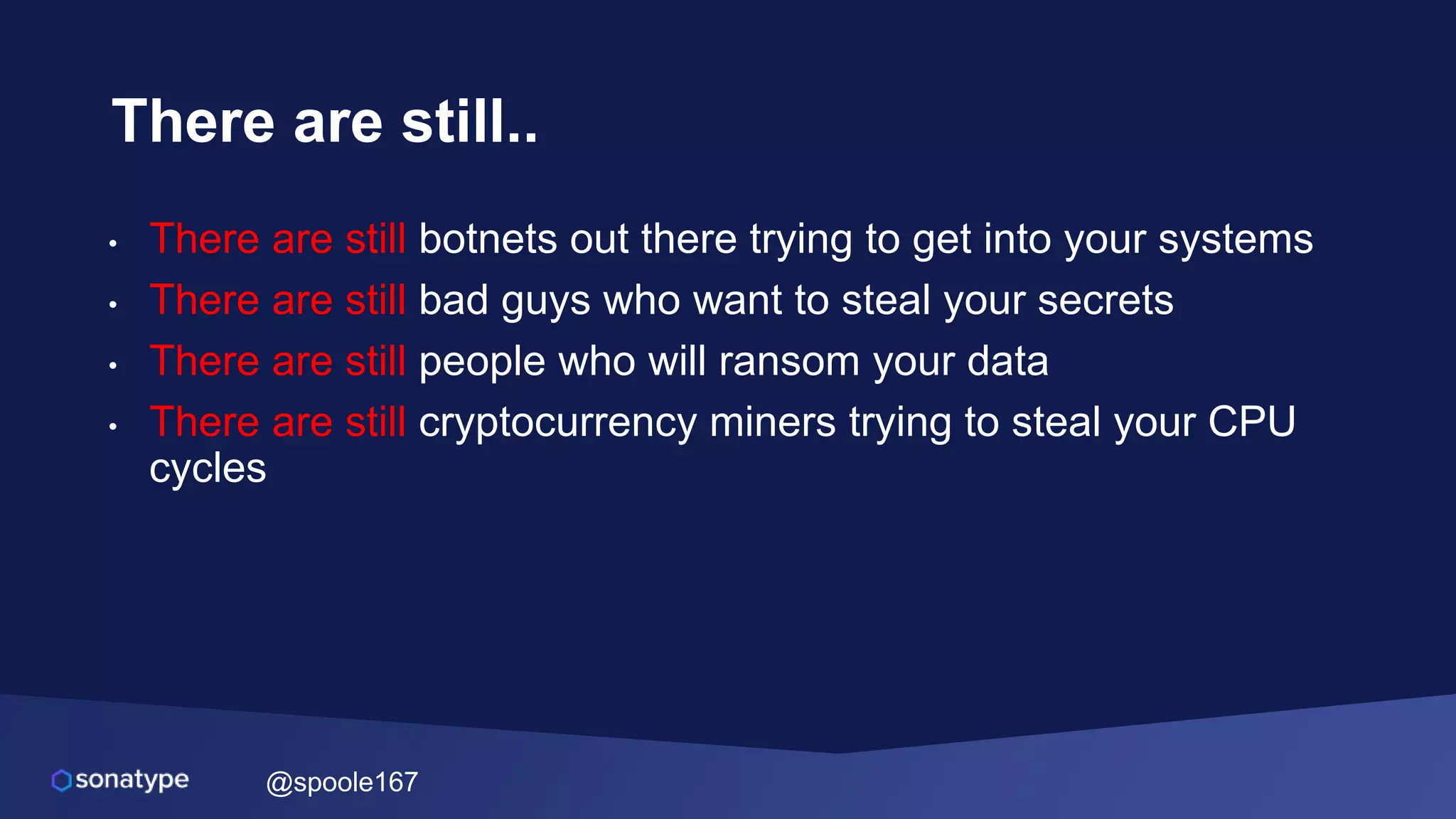
There are still..
• There are still botnets out there trying to get into your systems
• There are still bad guys who want to steal your secrets
• There are still people who will ransom your data
• There are still cryptocurrency miners trying to steal your CPU
cycles
@spoole167
Plus ..
• There are still botnets out there trying to get into your systems
• There are still bad guys who want to steal your secrets
• There are still people who will ransom your data
• There are still cryptocurrency miners trying to steal your CPU
cycles
• Now there are open source project hijacks
• Now there are fake packages in repos
• Now there is malware in the build process
• Now the aim is long term control and stealth
@spoole167
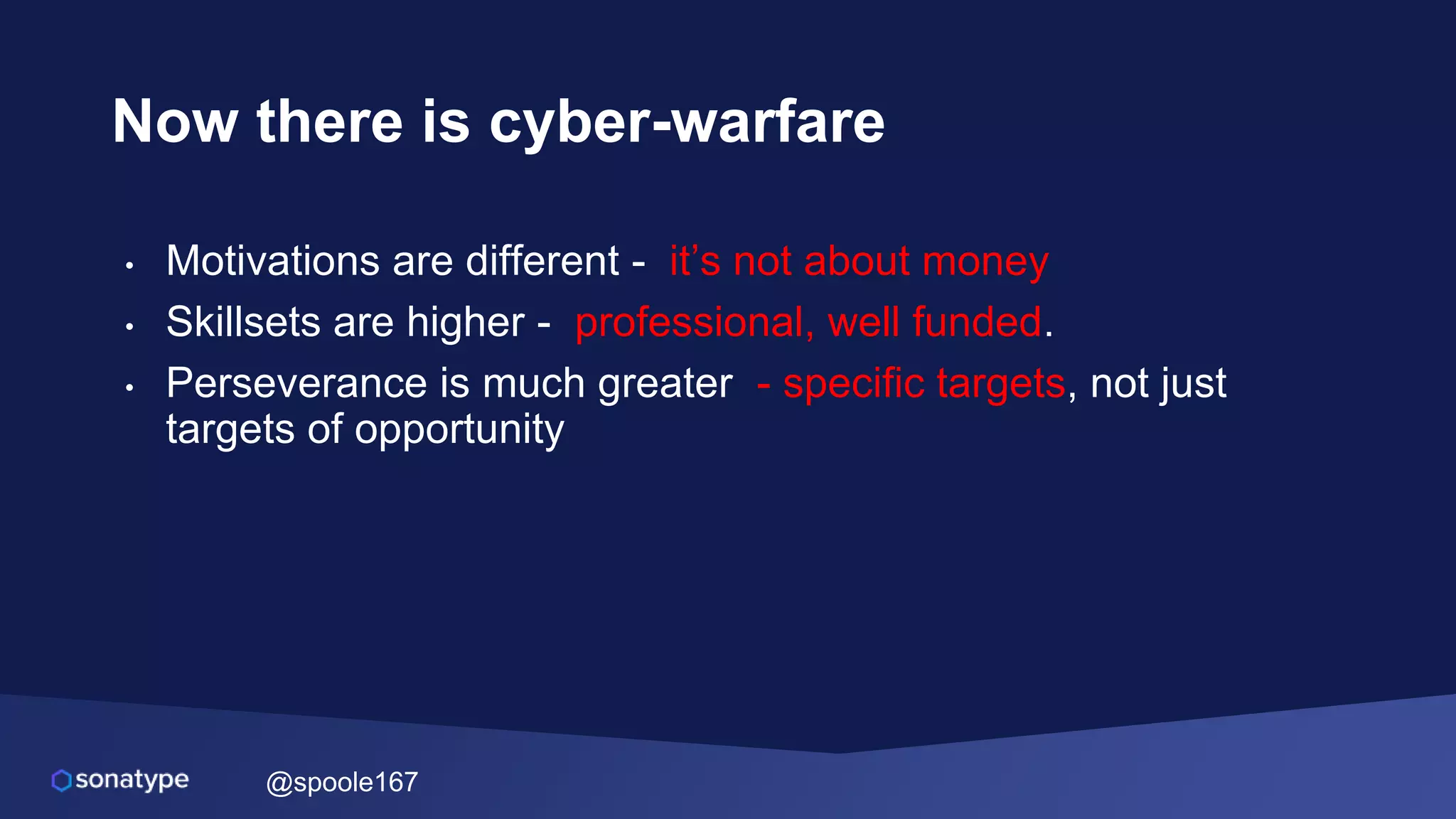
Now there is cyber-warfare
• Motivations are different - it’s not about money
• Skillsets are higher - professional, well funded.
• Perseverance is much greater - specific targets, not just
targets of opportunity
@spoole167
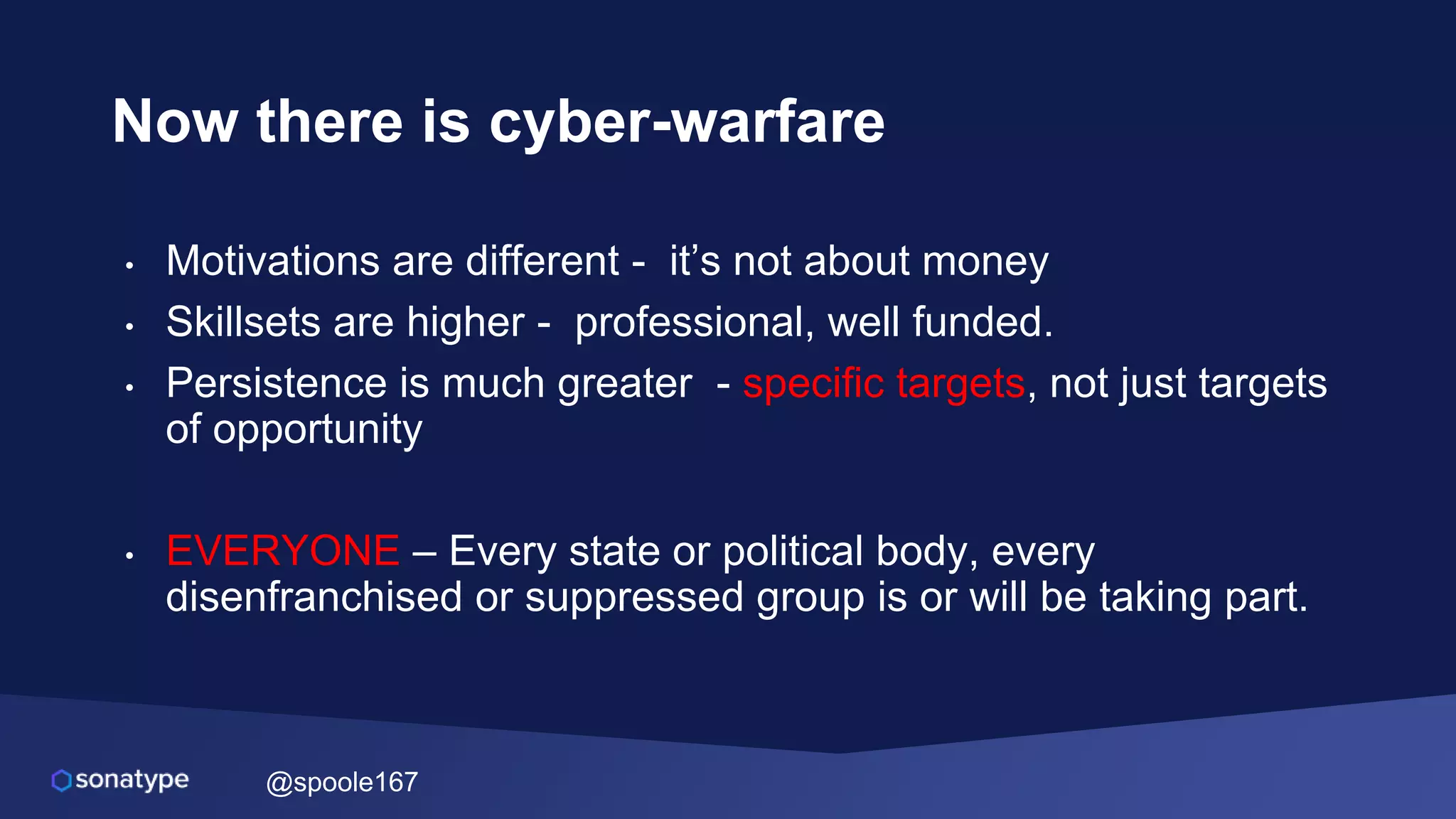
Now there is cyber-warfare
• Motivations are different - it’s not about money
• Skillsets are higher - professional, well funded.
• Persistence is much greater - specific targets, not just targets
of opportunity
• EVERYONE – Every state or political body, every
disenfranchised or suppressed group is or will be taking part.
@spoole167
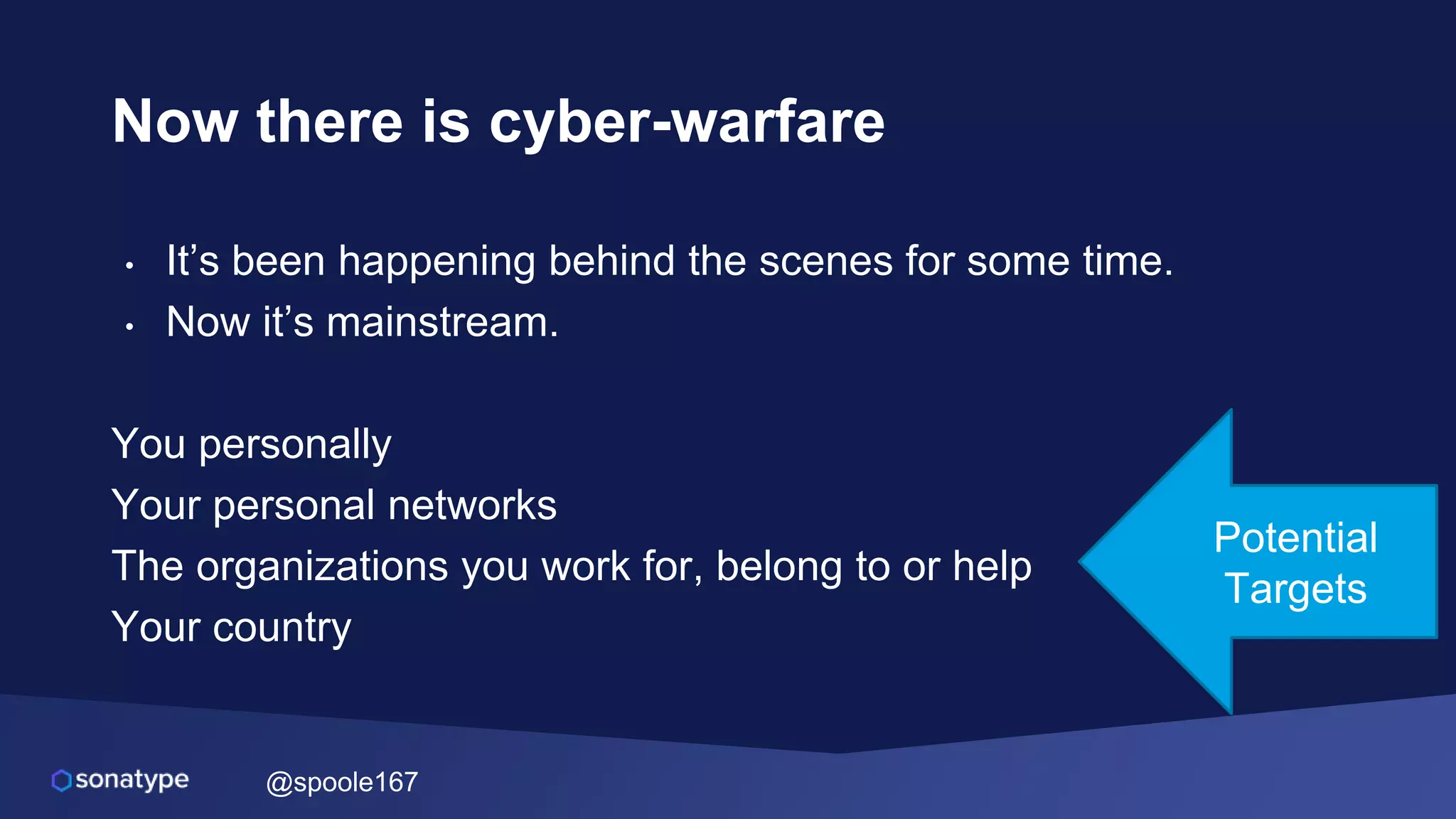
Now there is cyber-warfare
• It’s been happening behind the scenes for some time.
• Now it’s mainstream.
You personally
Your personal networks
The organizations you work for, belong to or help
Your country
Potential
Targets
@spoole167
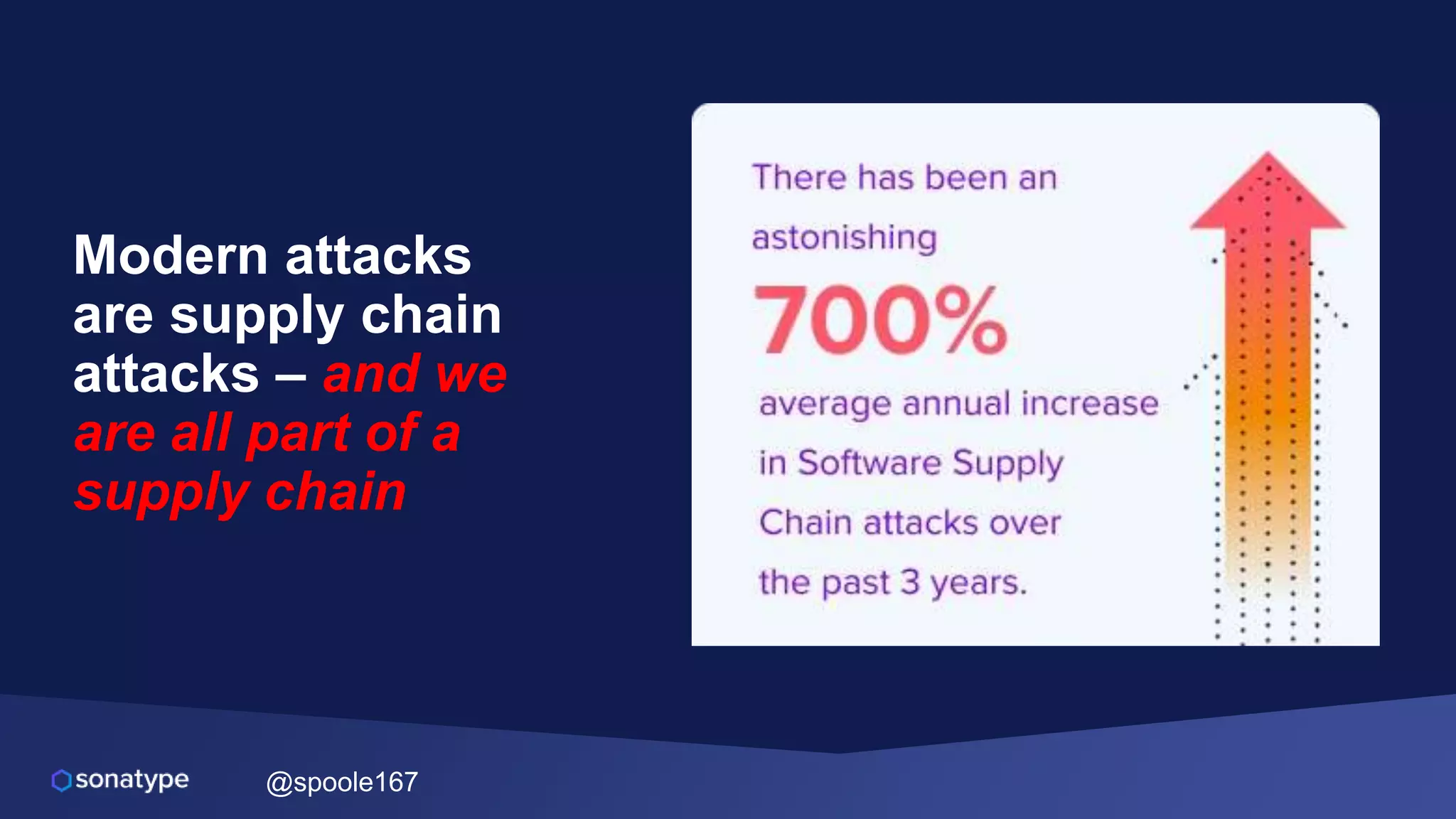
Modern attacks
are supply chain
attacks – and we
are all part of a
supply chain
@spoole167
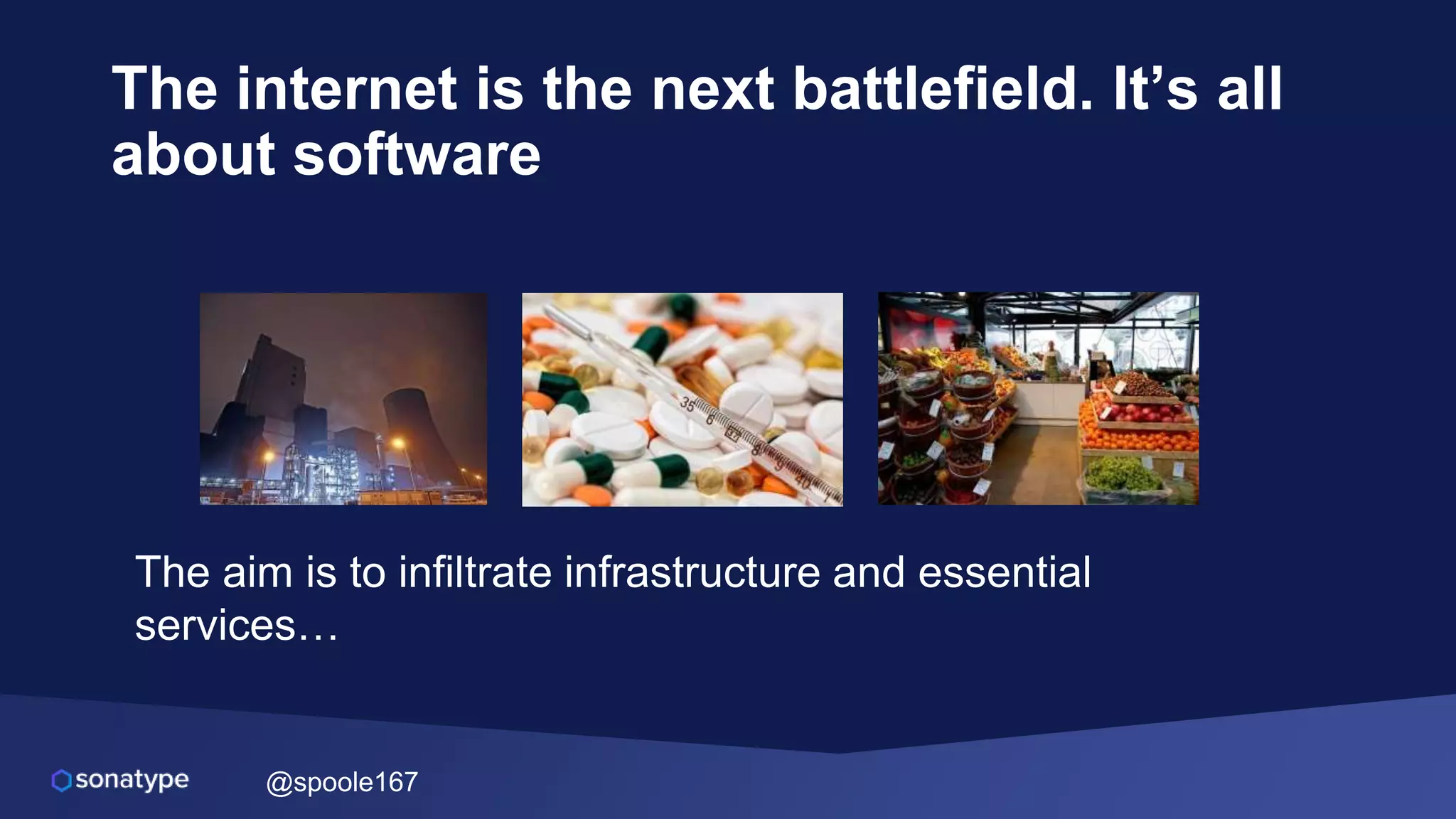
The aim is to infiltrate infrastructure and essential
services…
The internet is the next battlefield. It’s all
about software
@spoole167
And manipulate or terminate
@spoole167
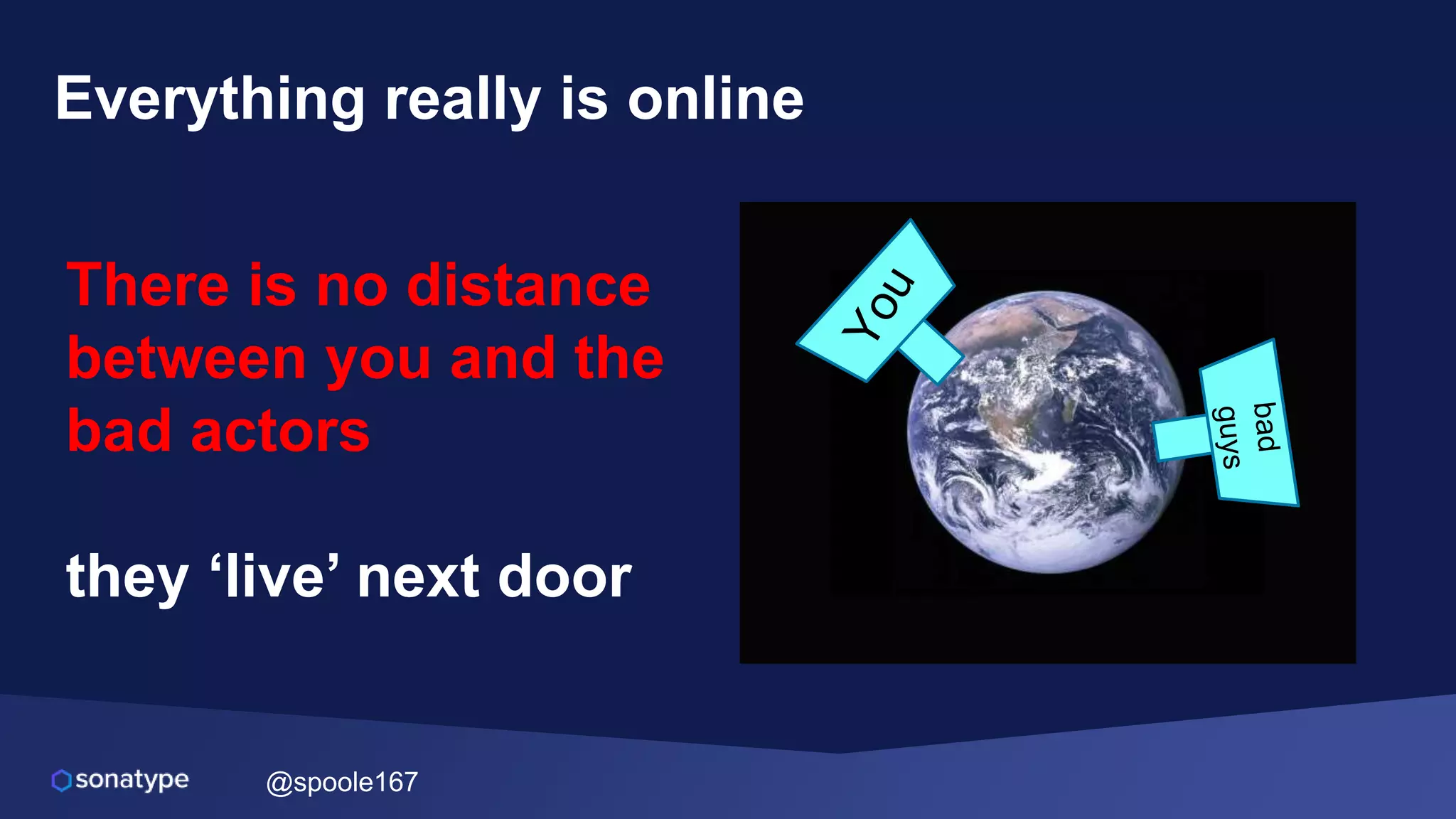
Everything really is online
There is no distance
between you and the
bad actors
they ‘live’ next door
@spoole167
Cyber warfare is real and will drive massive
changes in how we develop and deliver
software
@spoole167
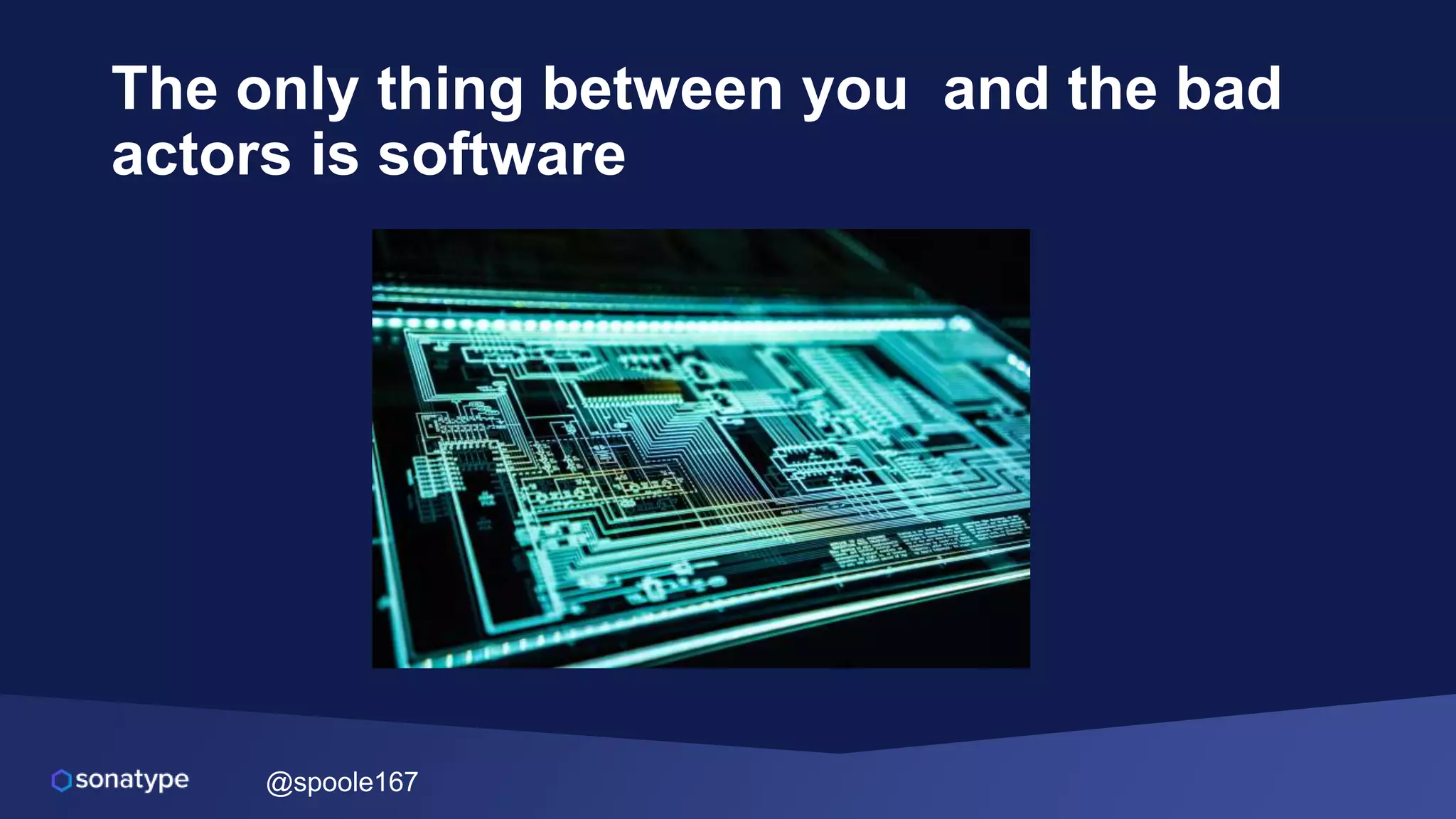
The only thing between you and the bad
actors is software
@spoole167
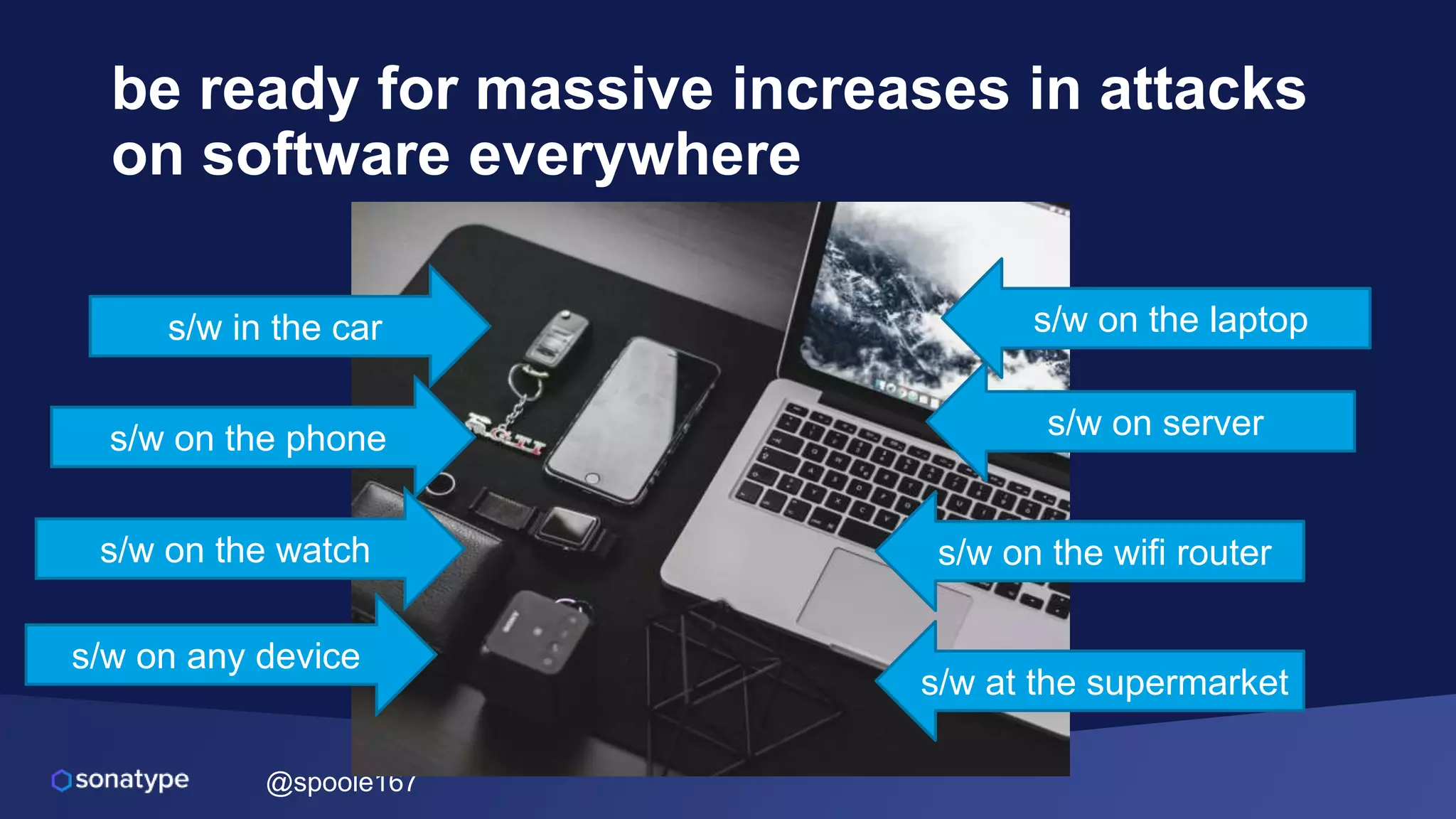
be ready for massive increases in attacks
on software everywhere
s/w in the car
s/w on the phone
s/w on the watch
s/w on any device
s/w on the laptop
s/w on server
s/w on the wifi router
s/w at the supermarket
@spoole167
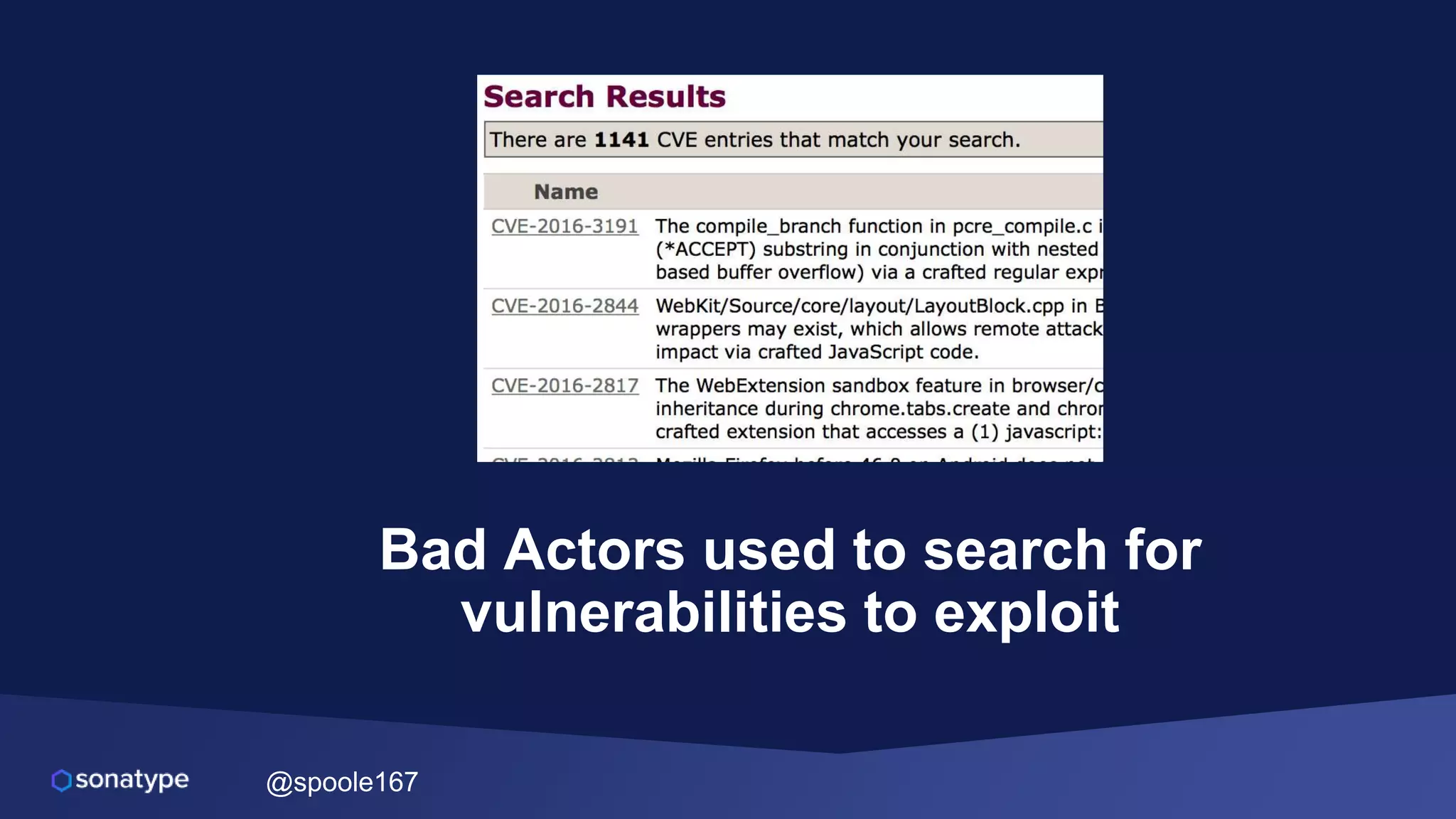
Bad Actors used to search for
vulnerabilities to exploit
@spoole167
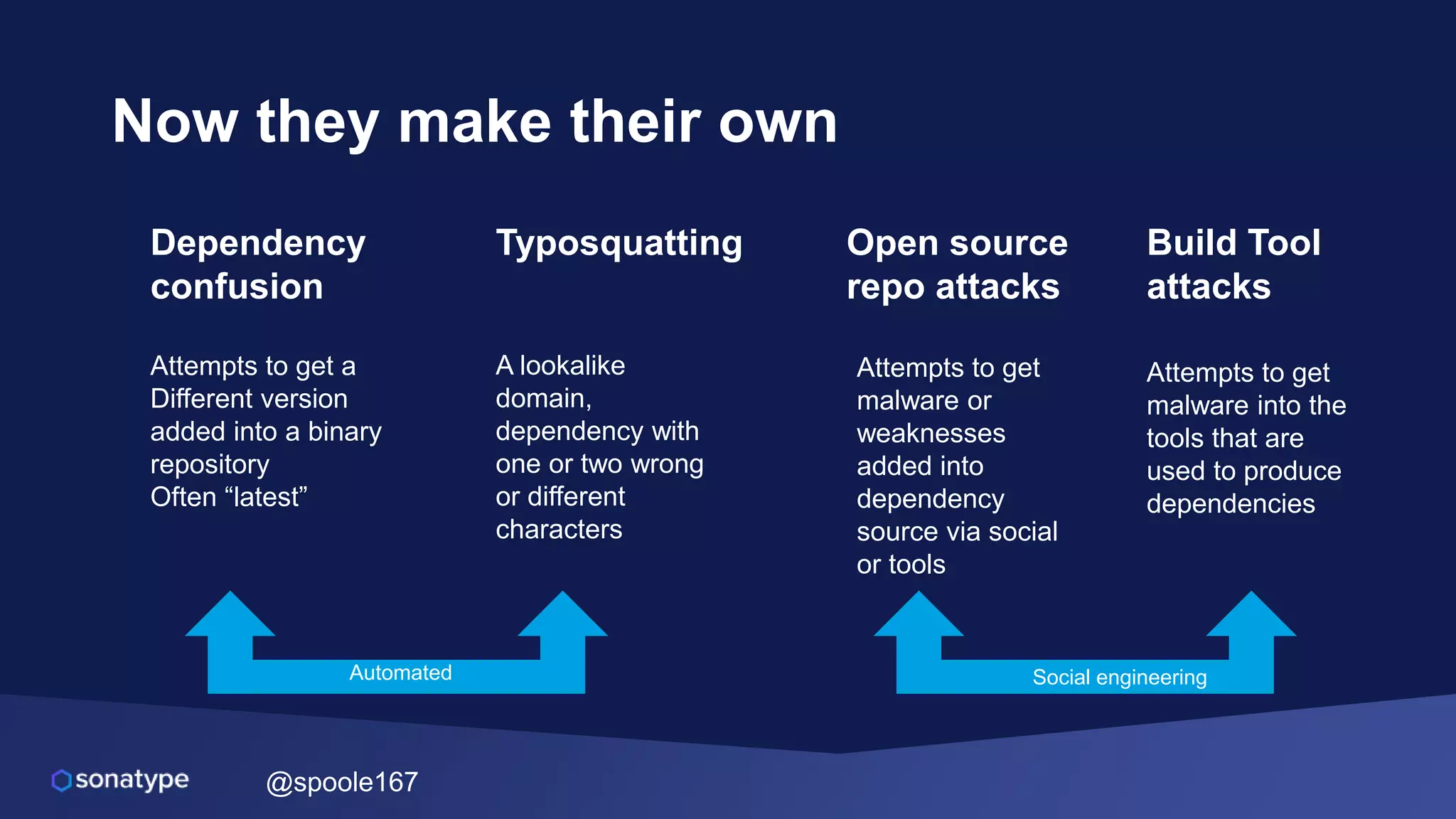
Now they make their own
Typosquatting
A lookalike
domain,
dependency with
one or two wrong
or different
characters
Open source
repo attacks
Attempts to get
malware or
weaknesses
added into
dependency
source via social
or tools
Build Tool
attacks
Attempts to get
malware into the
tools that are
used to produce
dependencies
Dependency
confusion
Attempts to get a
Different version
added into a binary
repository
Often “latest”
Automated Social engineering
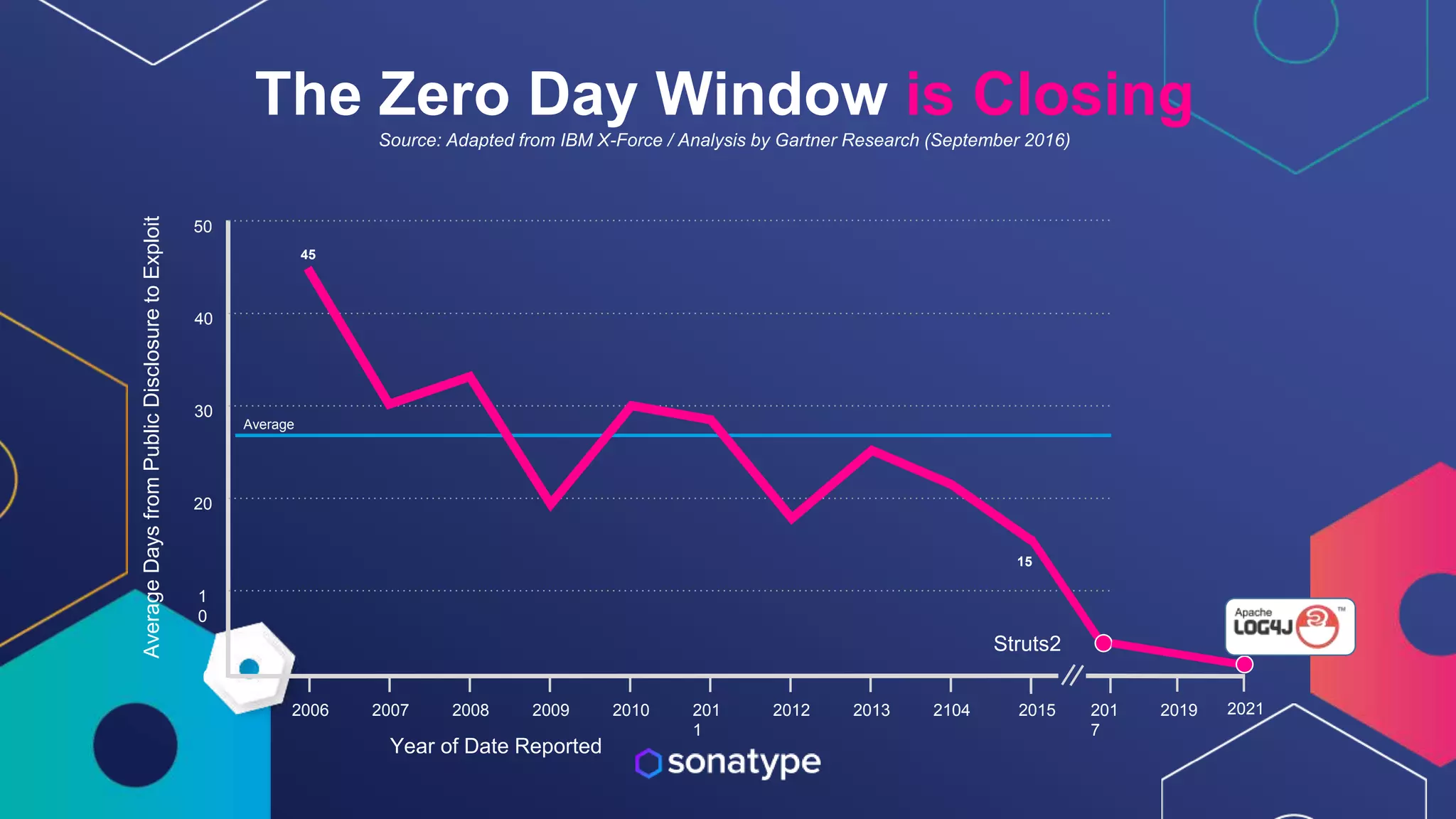
The Zero Day Window is Closing
Source: Adapted from IBM X-Force / Analysis by Gartner Research (September 2016)
Year of Date Reported
2006 2007 2008 2009 2010 201
1
2012 2013 2104 2015
1
0
20
30
40
50
0
Average
Days
from
Public
Disclosure
to
Exploit
Average
45
15
201
7
2019 2021
Struts2
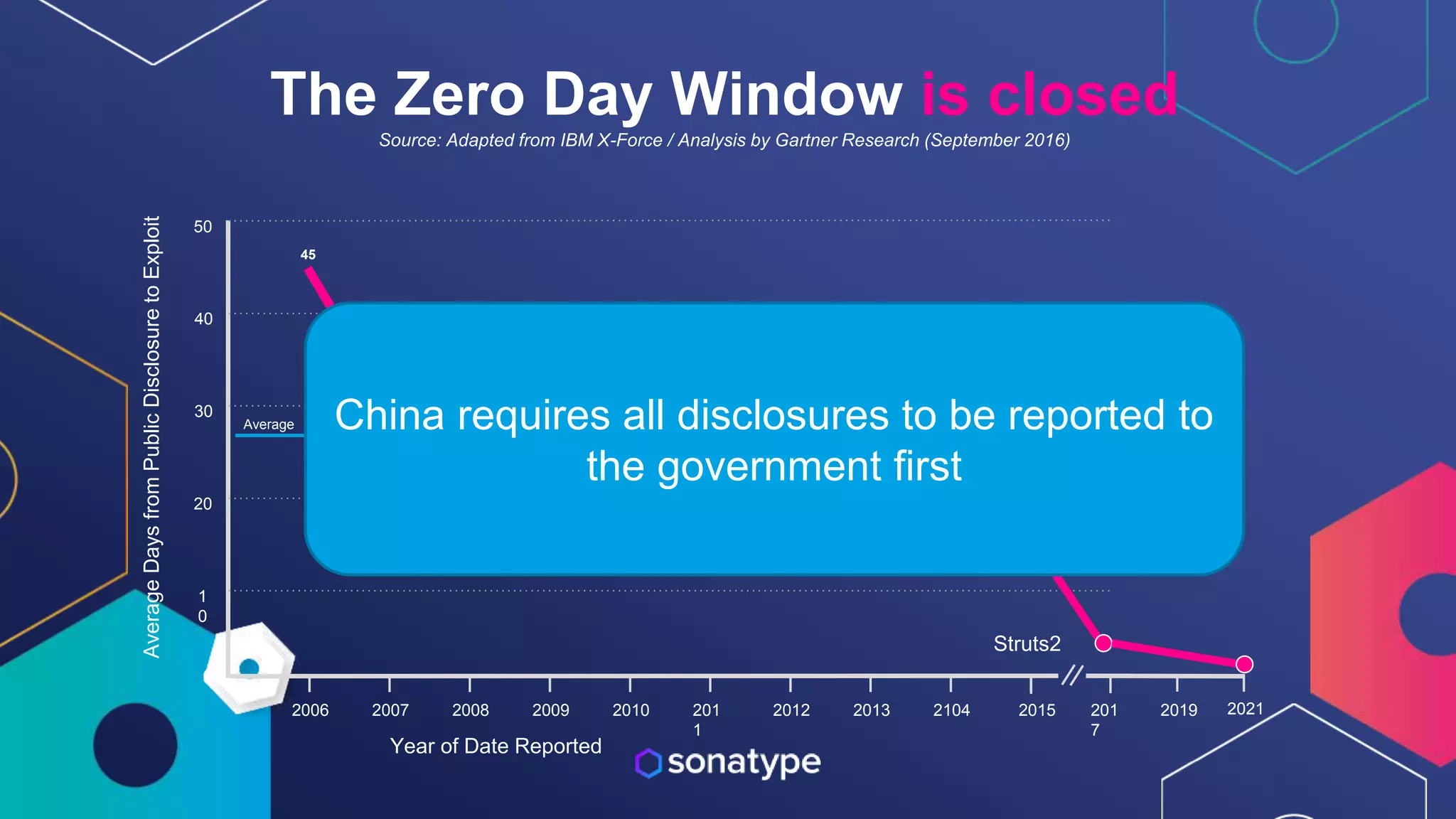
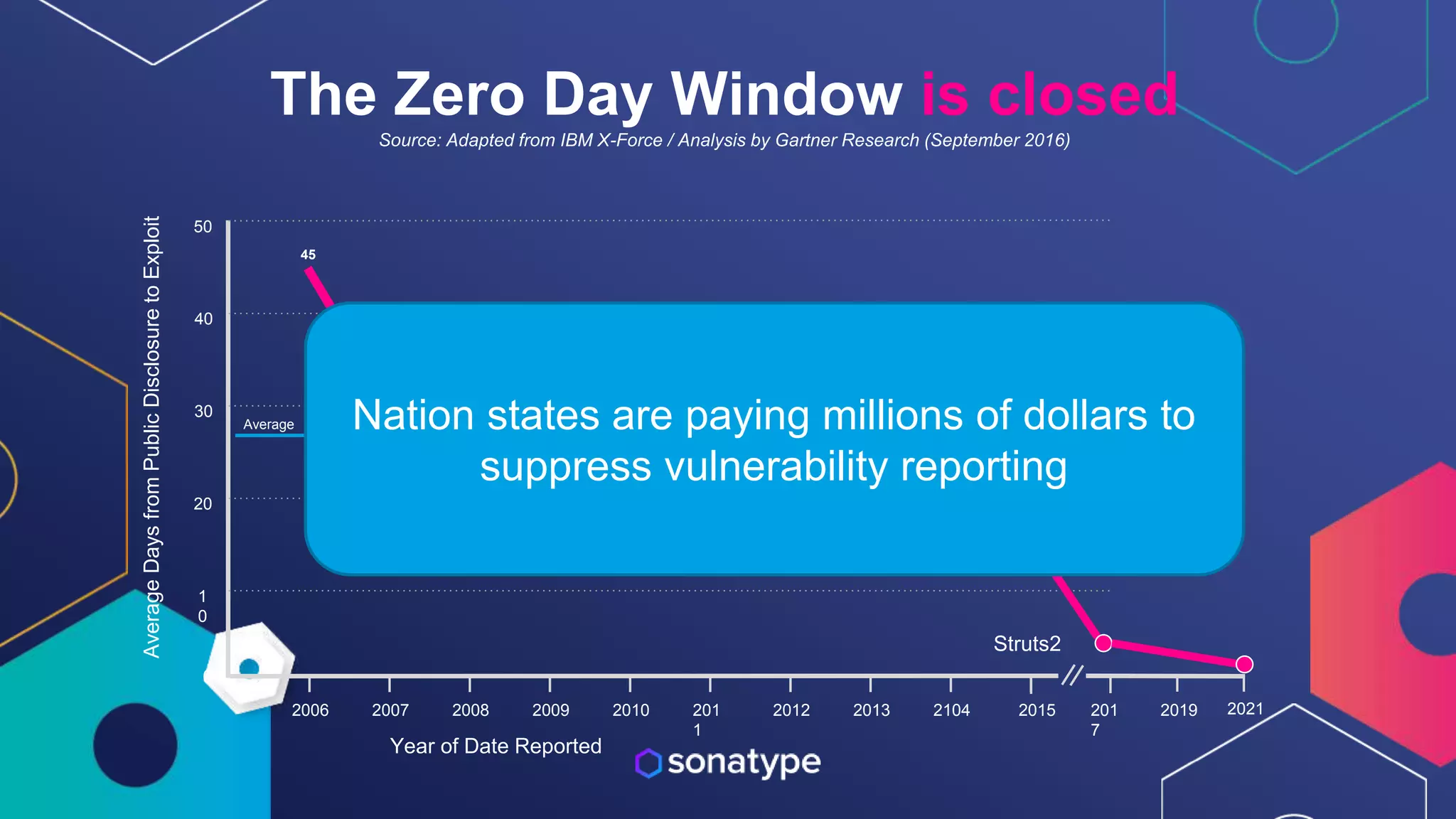
The Zero Day Window is closed
Source: Adapted from IBM X-Force / Analysis by Gartner Research (September 2016)
Year of Date Reported
2006 2007 2008 2009 2010 201
1
2012 2013 2104 2015
1
0
20
30
40
50
0
Average
Days
from
Public
Disclosure
to
Exploit
Average
45
15
201
7
2019 2021
Struts2
Nation states are paying millions of dollars to
suppress vulnerability reporting
The Zero Day Window is closed
Source: Adapted from IBM X-Force / Analysis by Gartner Research (September 2016)
Year of Date Reported
2006 2007 2008 2009 2010 201
1
2012 2013 2104 2015
1
0
20
30
40
50
0
Average
Days
from
Public
Disclosure
to
Exploit
Average
45
15
201
7
2019 2021
Struts2
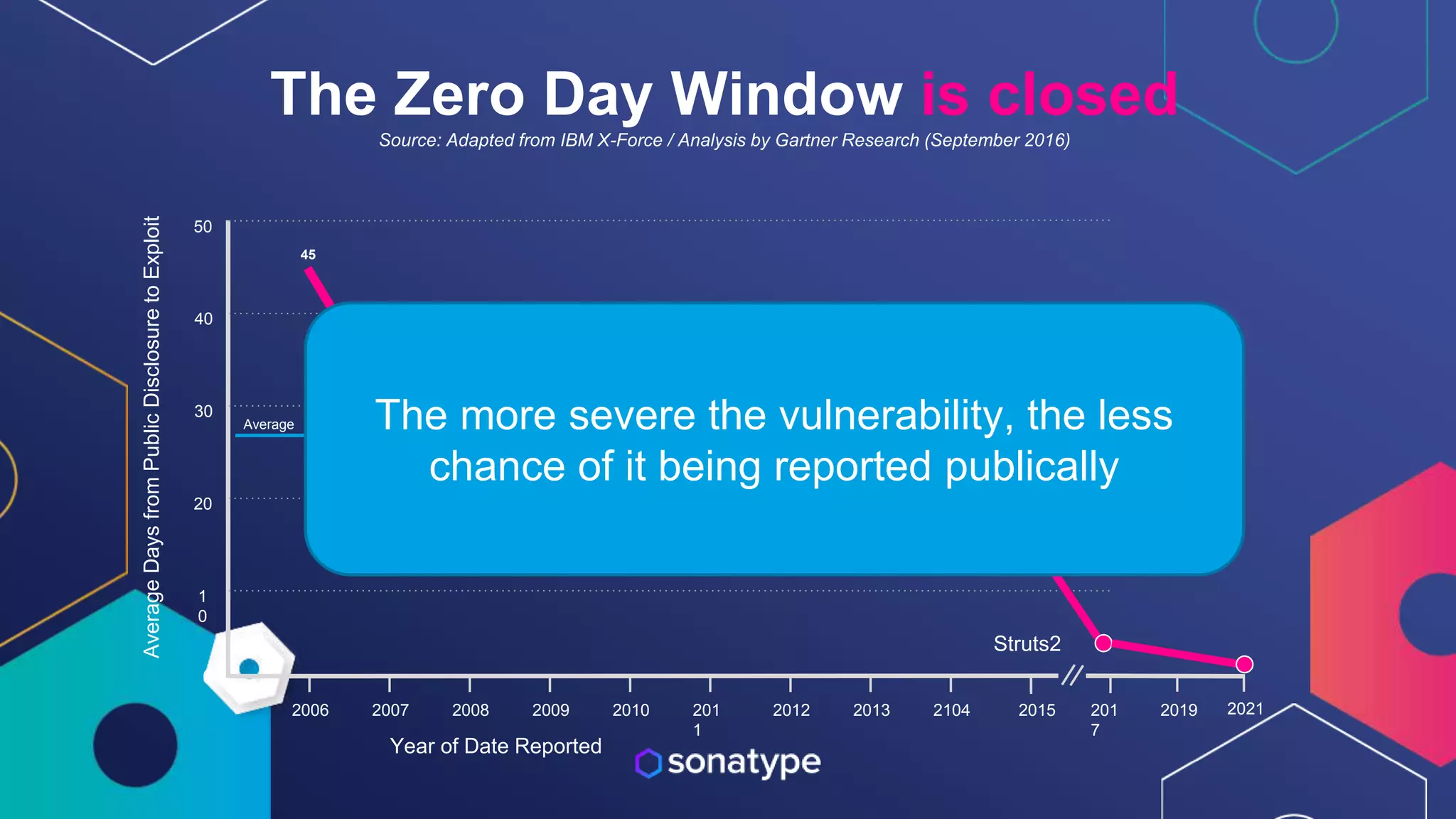
China requires all disclosures to be reported to
the government first
The Zero Day Window is closed
Source: Adapted from IBM X-Force / Analysis by Gartner Research (September 2016)
Year of Date Reported
2006 2007 2008 2009 2010 201
1
2012 2013 2104 2015
1
0
20
30
40
50
0
Average
Days
from
Public
Disclosure
to
Exploit
Average
45
15
201
7
2019 2021
Struts2
The more severe the vulnerability, the less
chance of it being reported publically
@spoole167
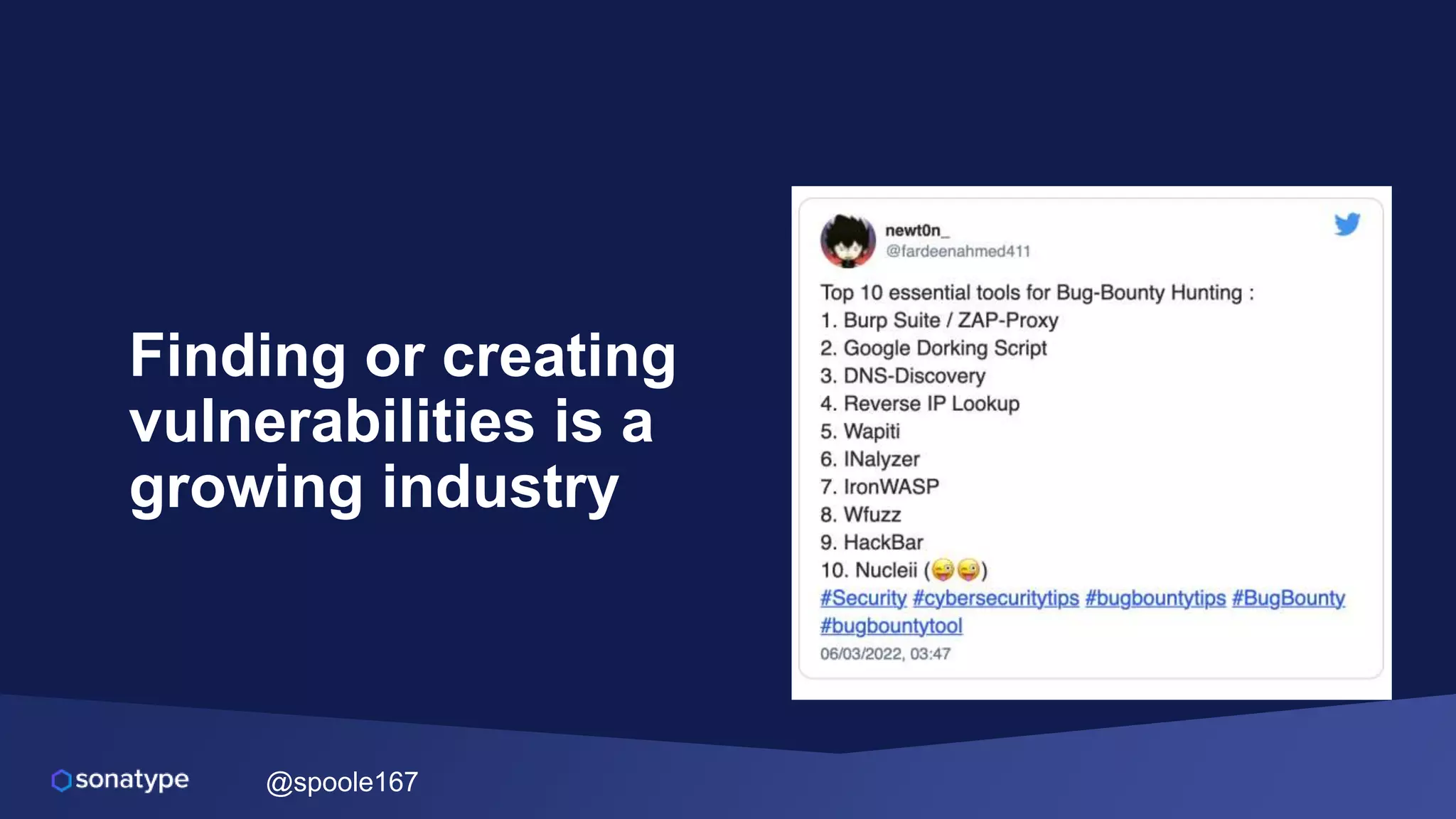
Finding or creating
vulnerabilities is a
growing industry
@spoole167
The new world of cyber security is “exploit first”
@spoole167
And one more thing …
@spoole167
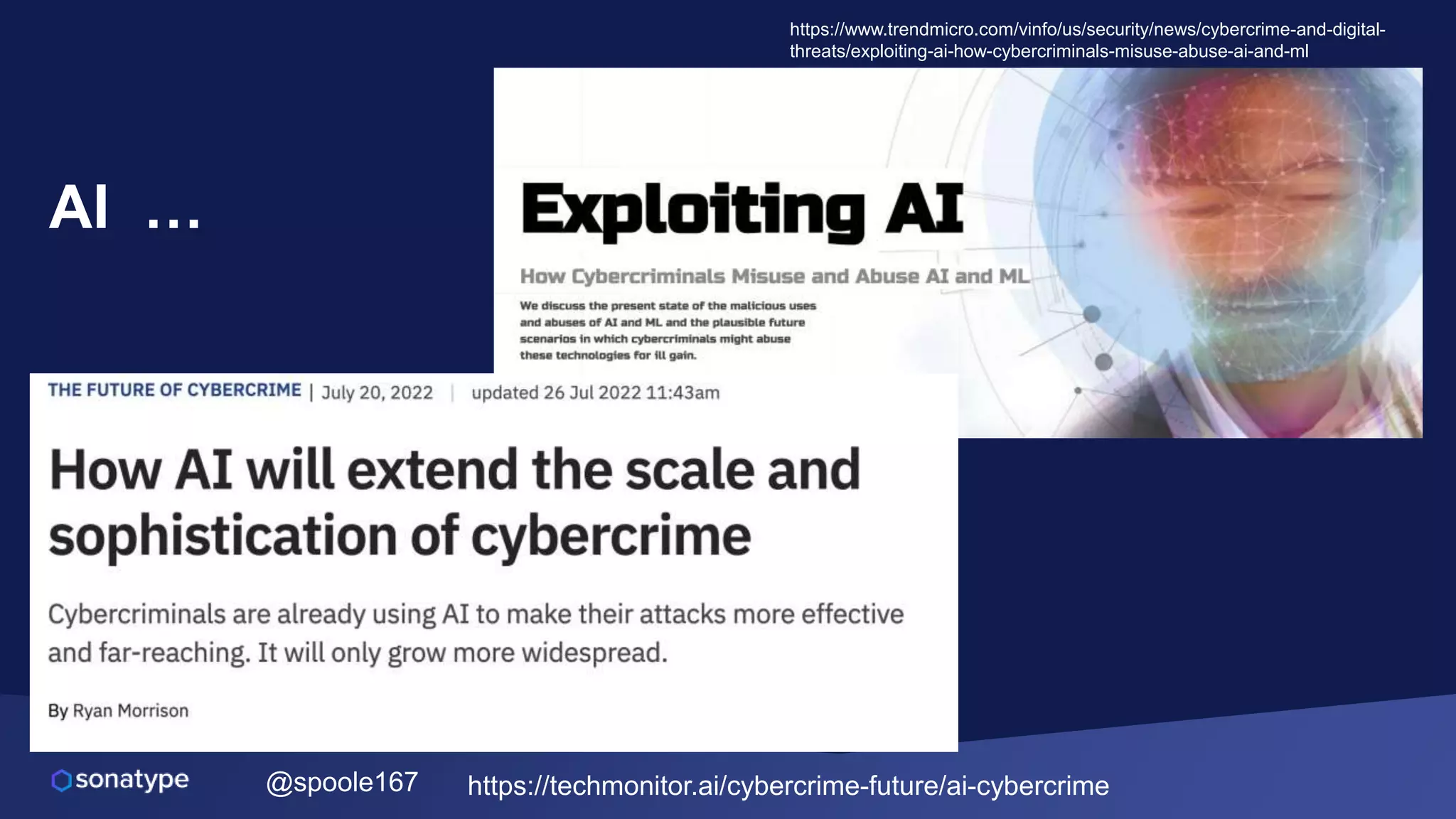
https://www.trendmicro.com/vinfo/us/security/news/cybercrime-and-digital-
threats/exploiting-ai-how-cybercriminals-misuse-abuse-ai-and-ml
https://techmonitor.ai/cybercrime-future/ai-cybercrime
AI …
What are we doing about all of
this?
@spoole167
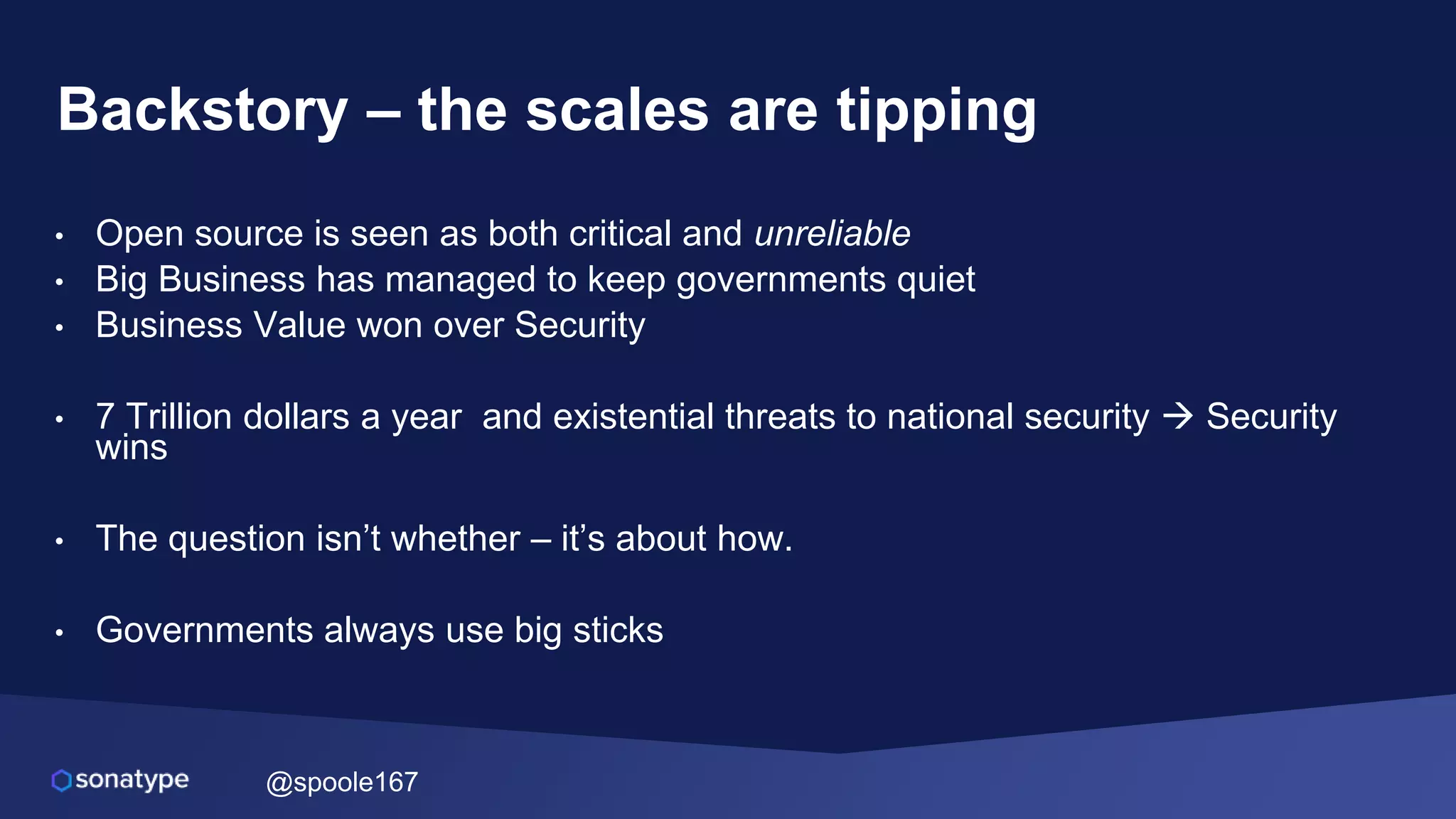
Backstory – the scales are tipping
• Open source is seen as both critical and unreliable
• Big Business has managed to keep governments quiet
• Business Value won over Security
• 7 Trillion dollars a year and existential threats to national security  Security
wins
• The question isn’t whether – it’s about how.
• Governments always use big sticks
@spoole167
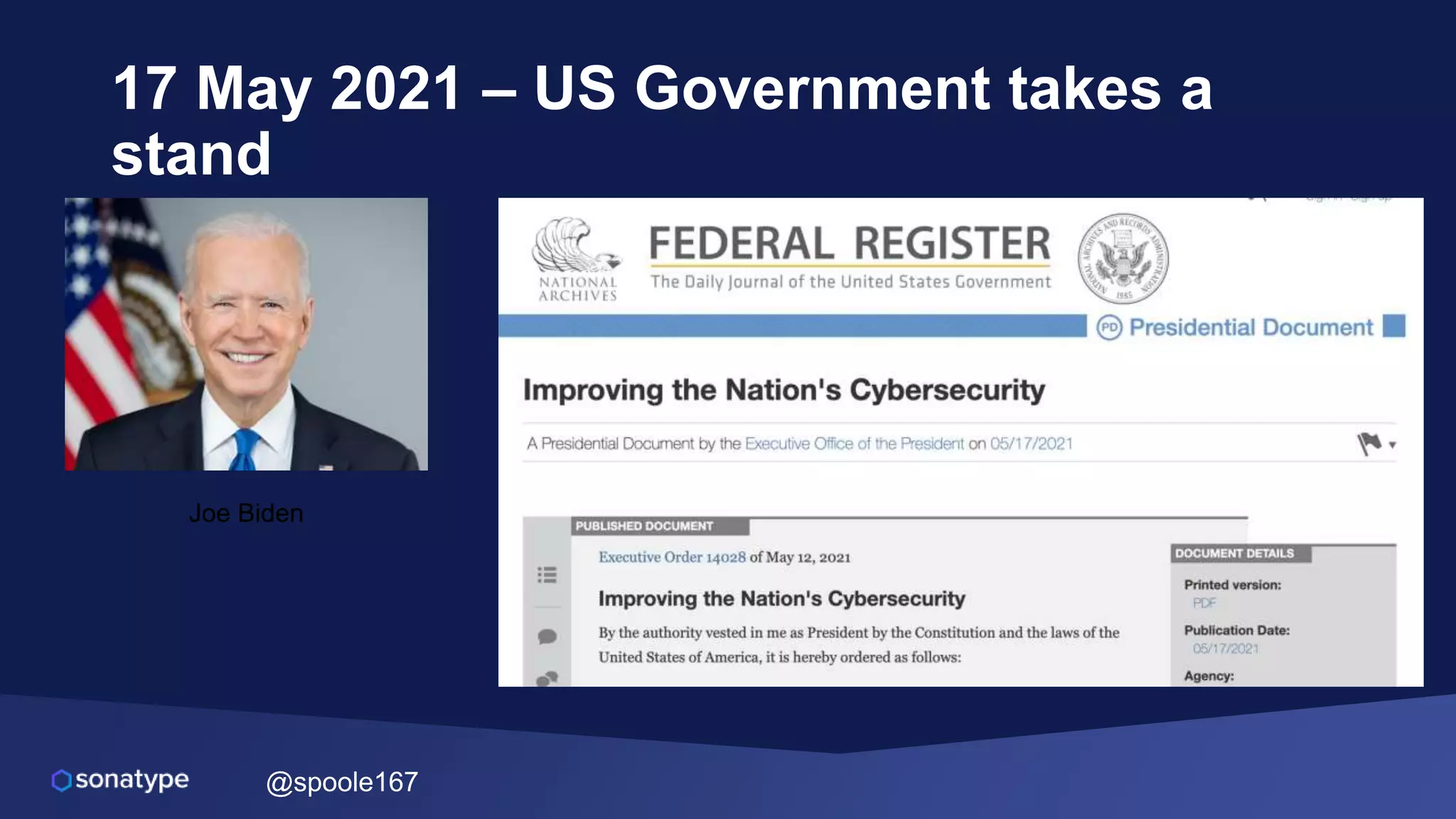
17 May 2021 – US Government takes a
stand
Joe Biden
@spoole167
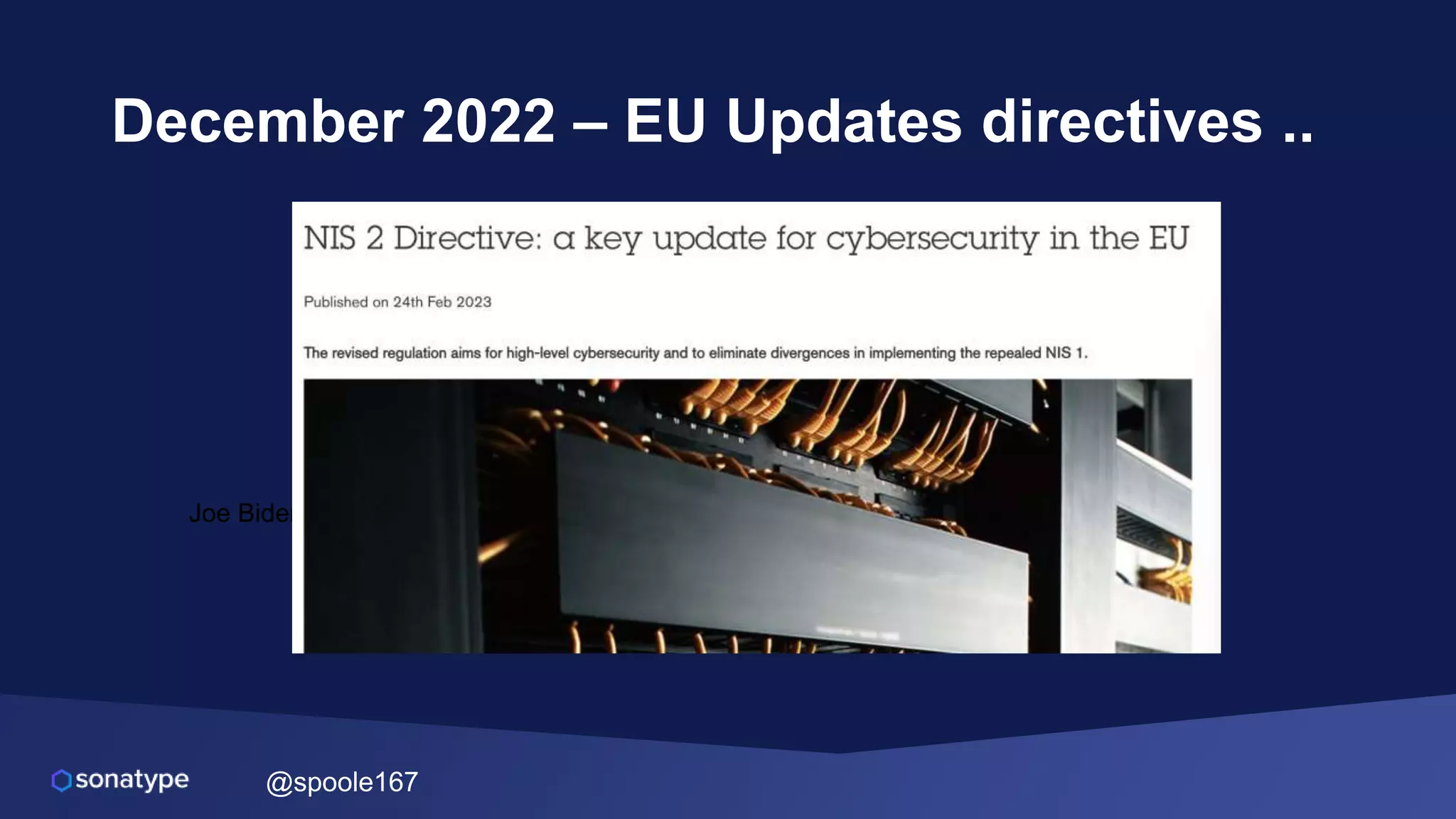
December 2022 – EU Updates directives ..
Joe Biden
@spoole167
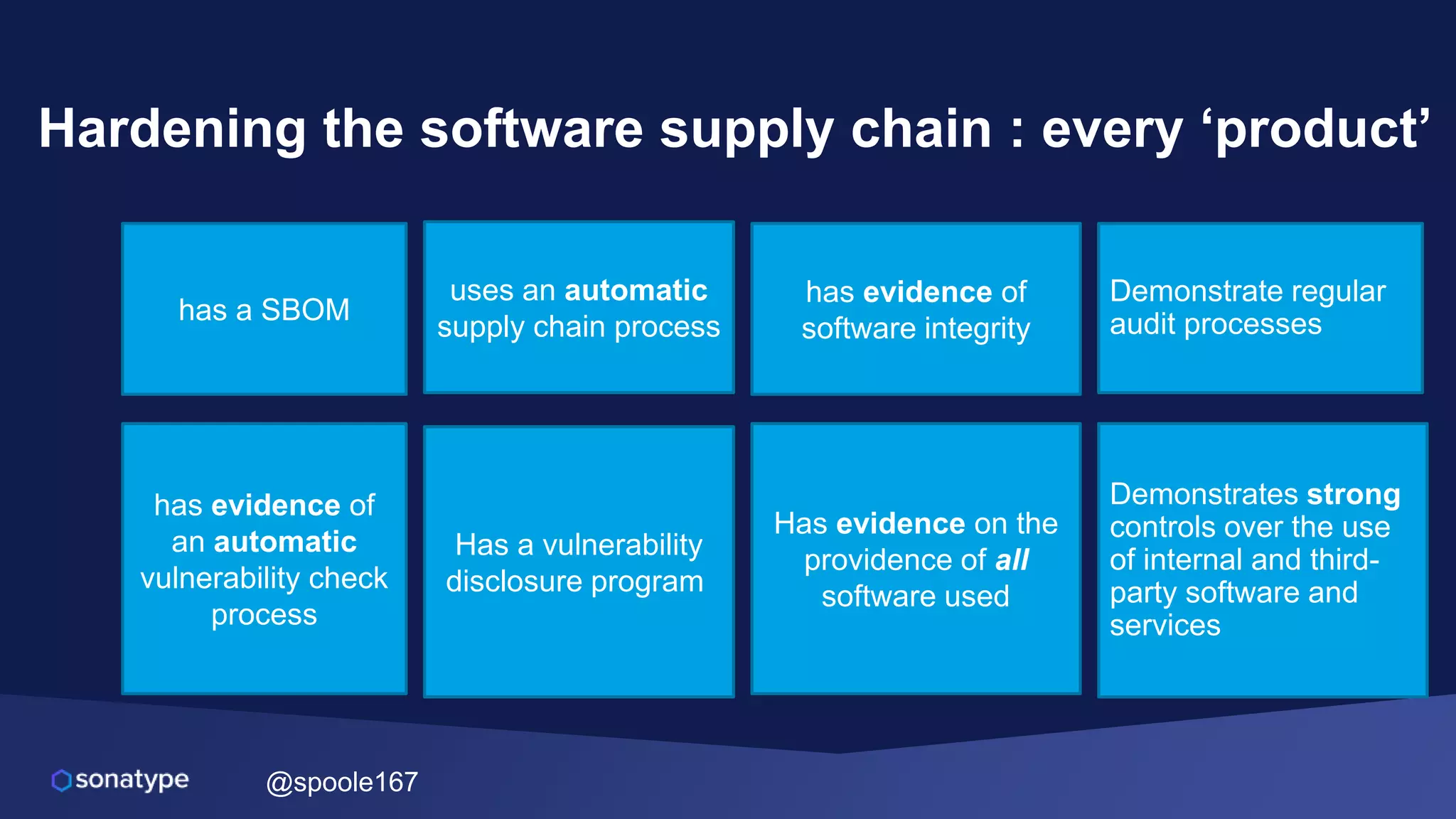
Hardening the software supply chain : every ‘product’
has a SBOM
uses an automatic
supply chain process
has evidence of
software integrity
has evidence of
an automatic
vulnerability check
process
Has a vulnerability
disclosure program
Has evidence on the
providence of all
software used
Demonstrates strong
controls over the use
of internal and third-
party software and
services
Demonstrate regular
audit processes
@spoole167
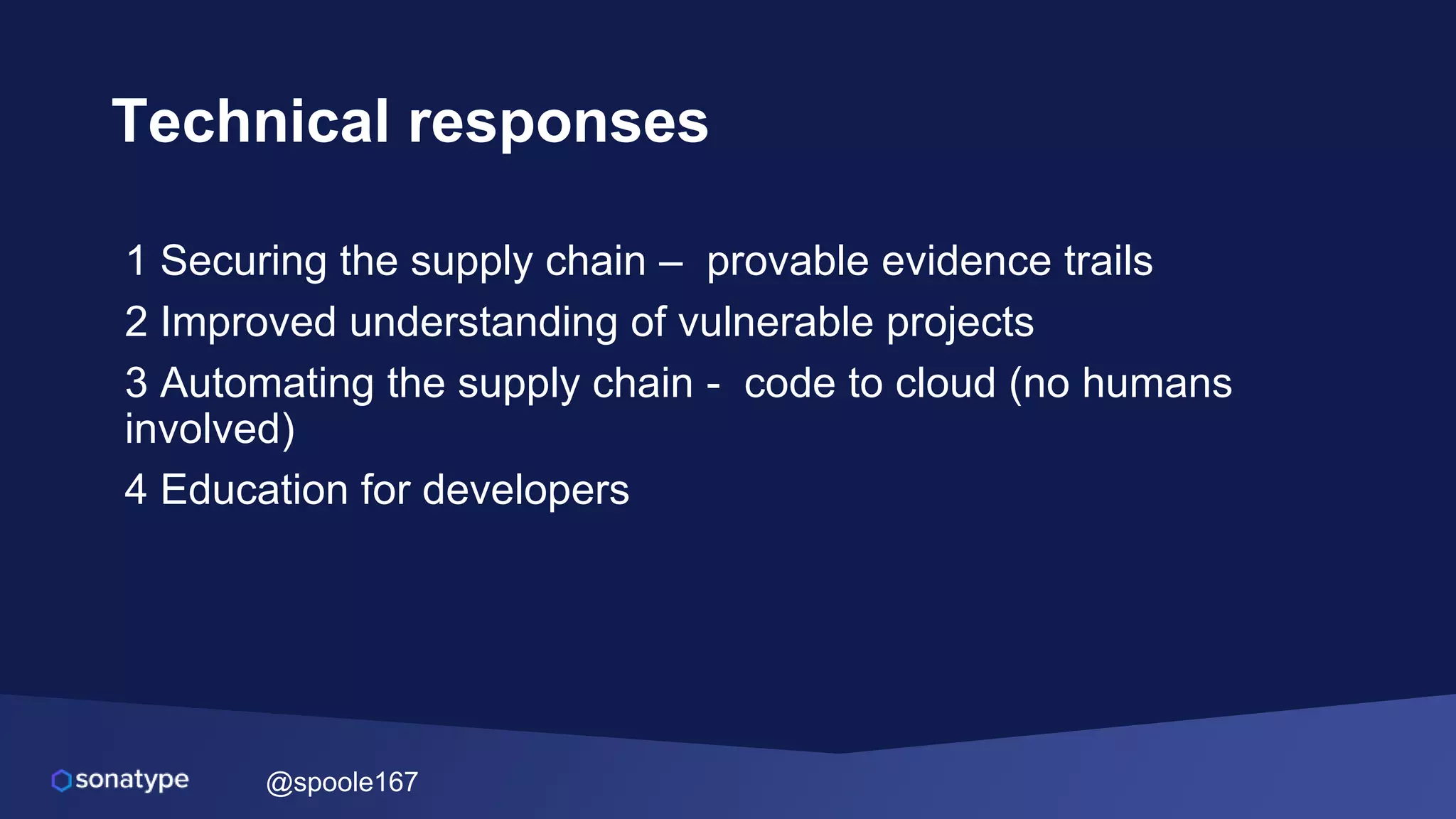
Technical responses
1 Securing the supply chain – provable evidence trails
2 Improved understanding of vulnerable projects
3 Automating the supply chain - code to cloud (no humans
involved)
4 Education for developers
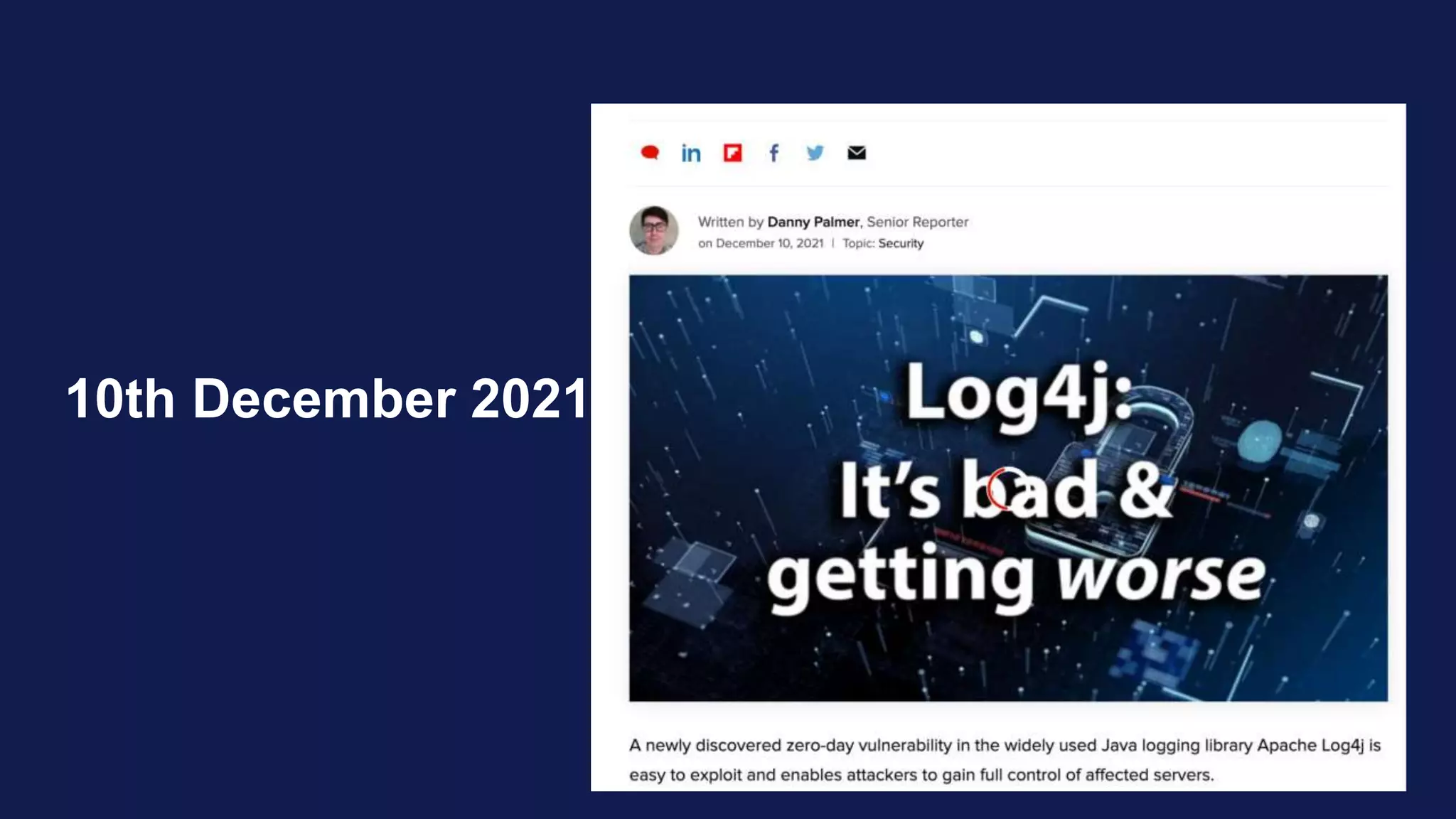
10th December 2021
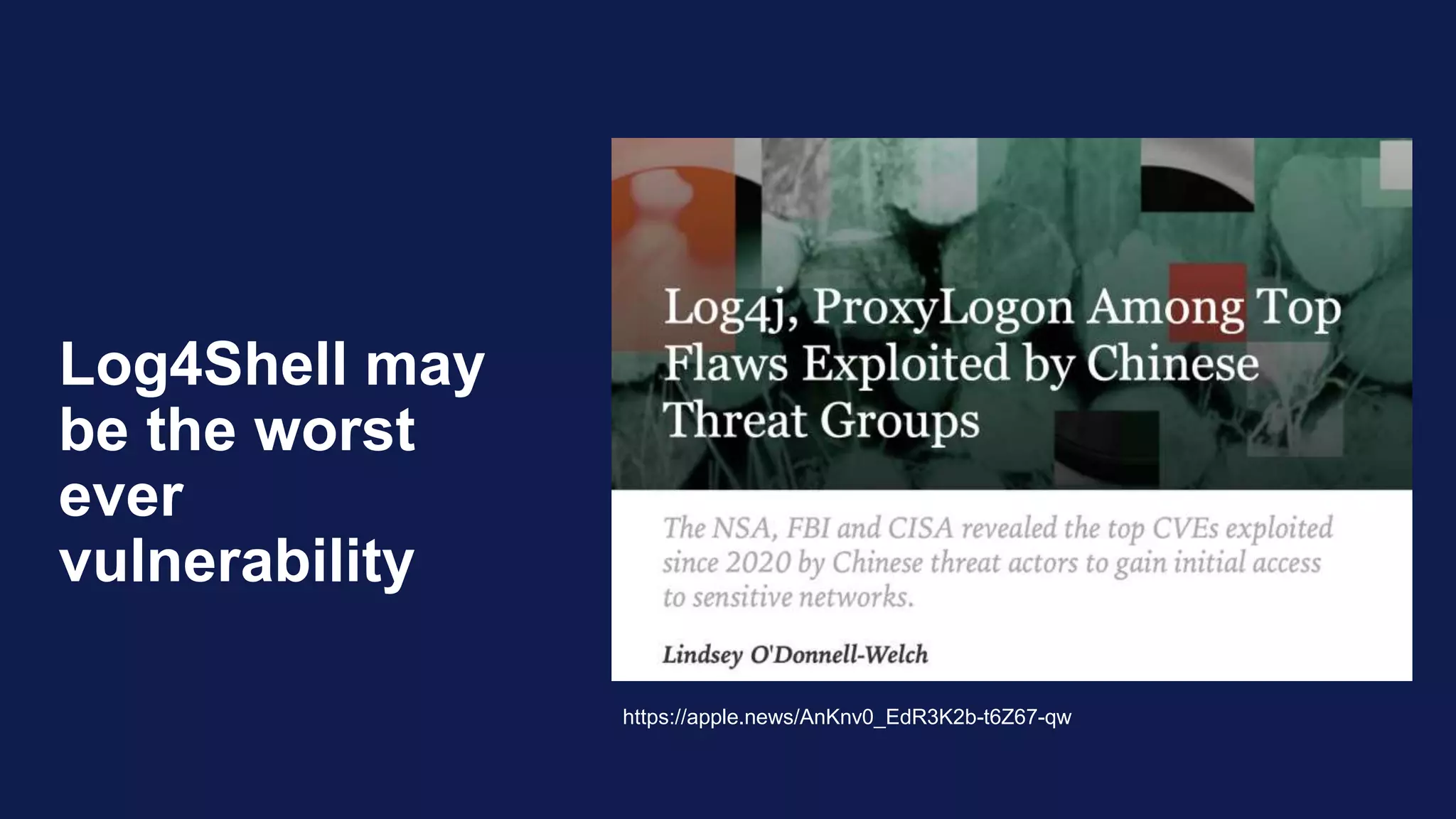
Log4Shell may
be the worst
ever
vulnerability
https://apple.news/AnKnv0_EdR3K2b-t6Z67-qw
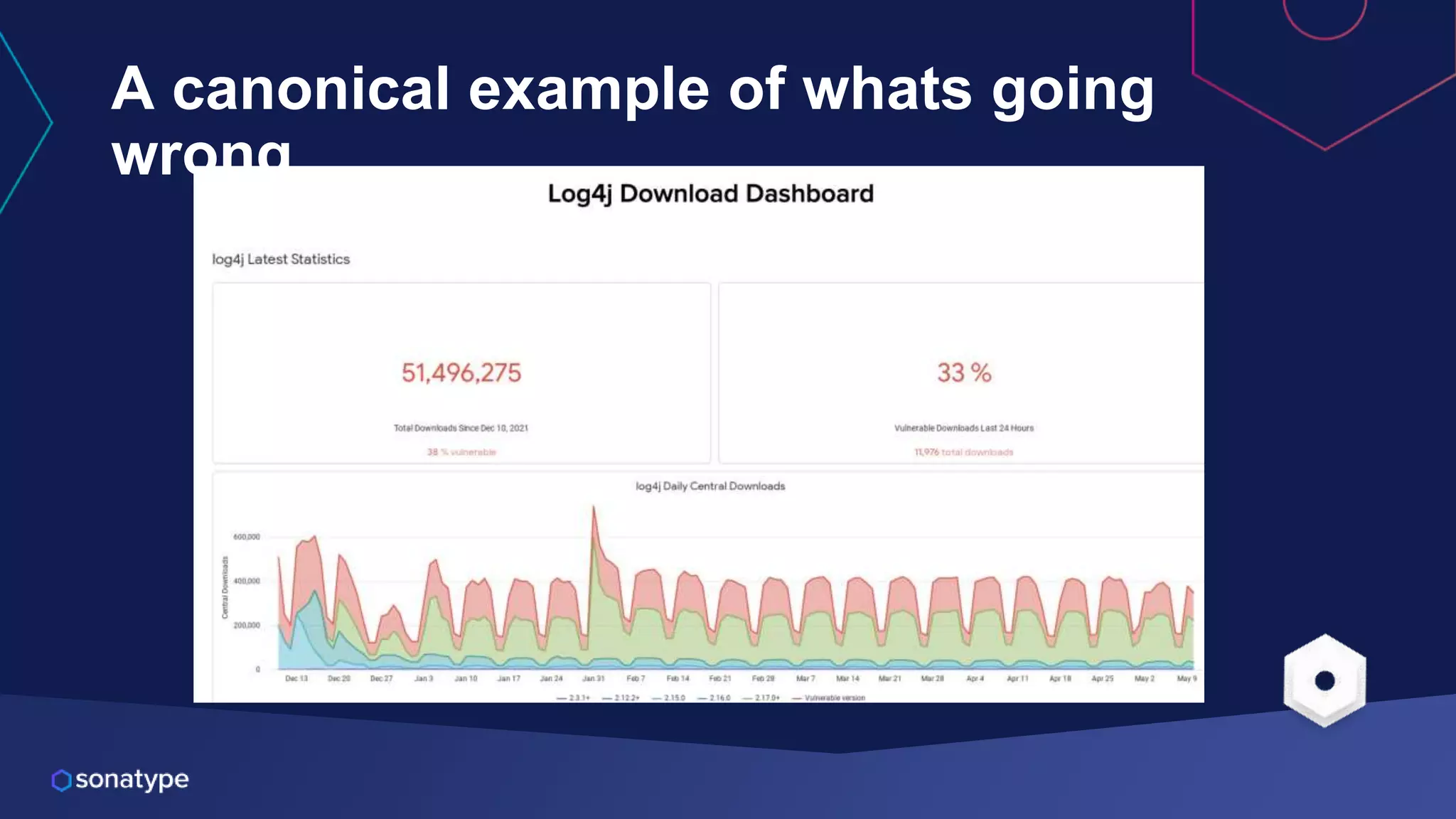
A canonical example of whats going
wrong
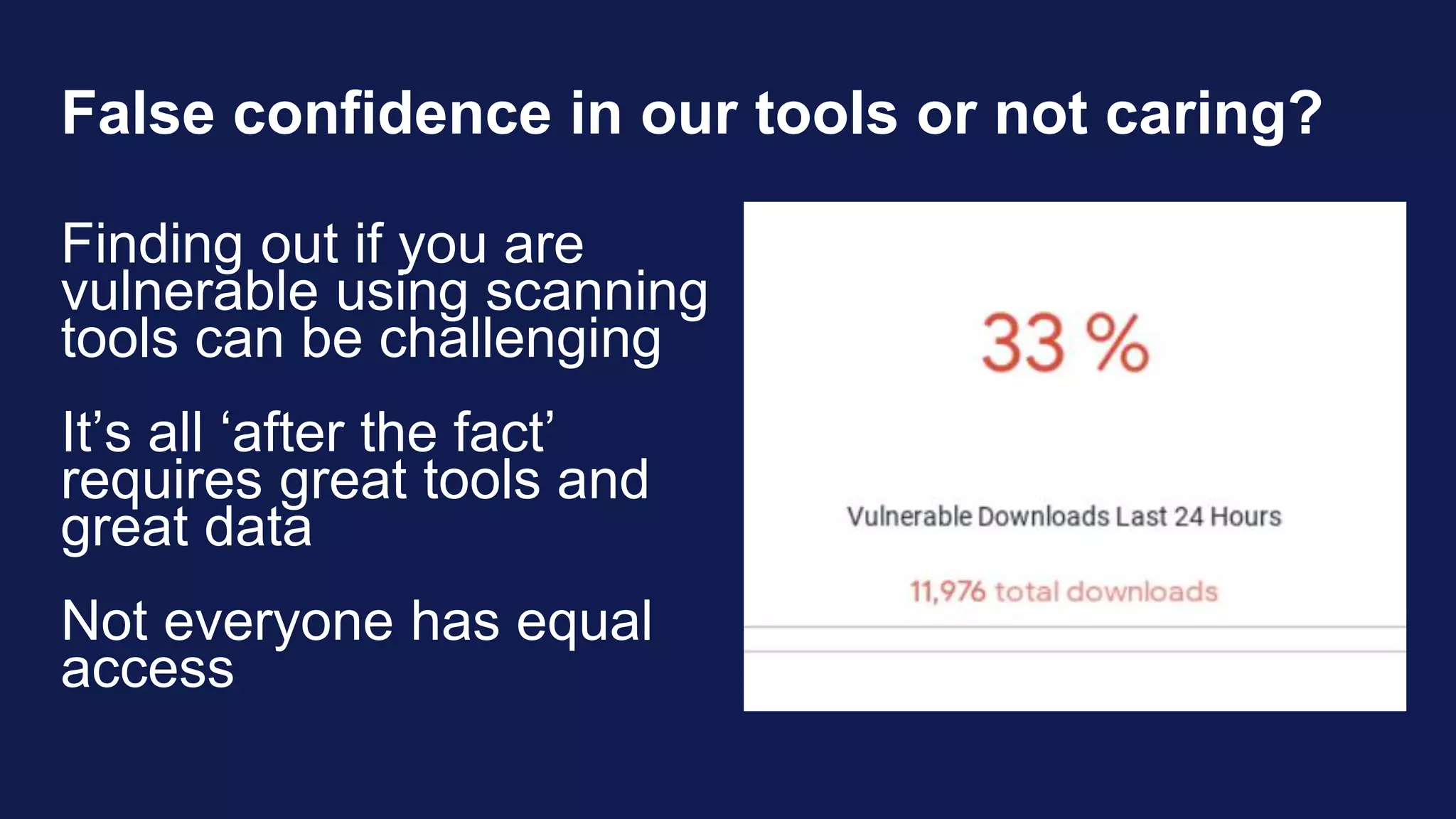
False confidence in our tools or not caring?
Finding out if you are
vulnerable using scanning
tools can be challenging
It’s all ‘after the fact’
requires great tools and
great data
Not everyone has equal
access
@spoole167
On the horizon
Switch from scanning
tools that try to work
out what you have
installed
To signed, provable,
reproduceable
“Software Bill of Materials”
Centralised signatures
Centralised analysis tools
@spoole167
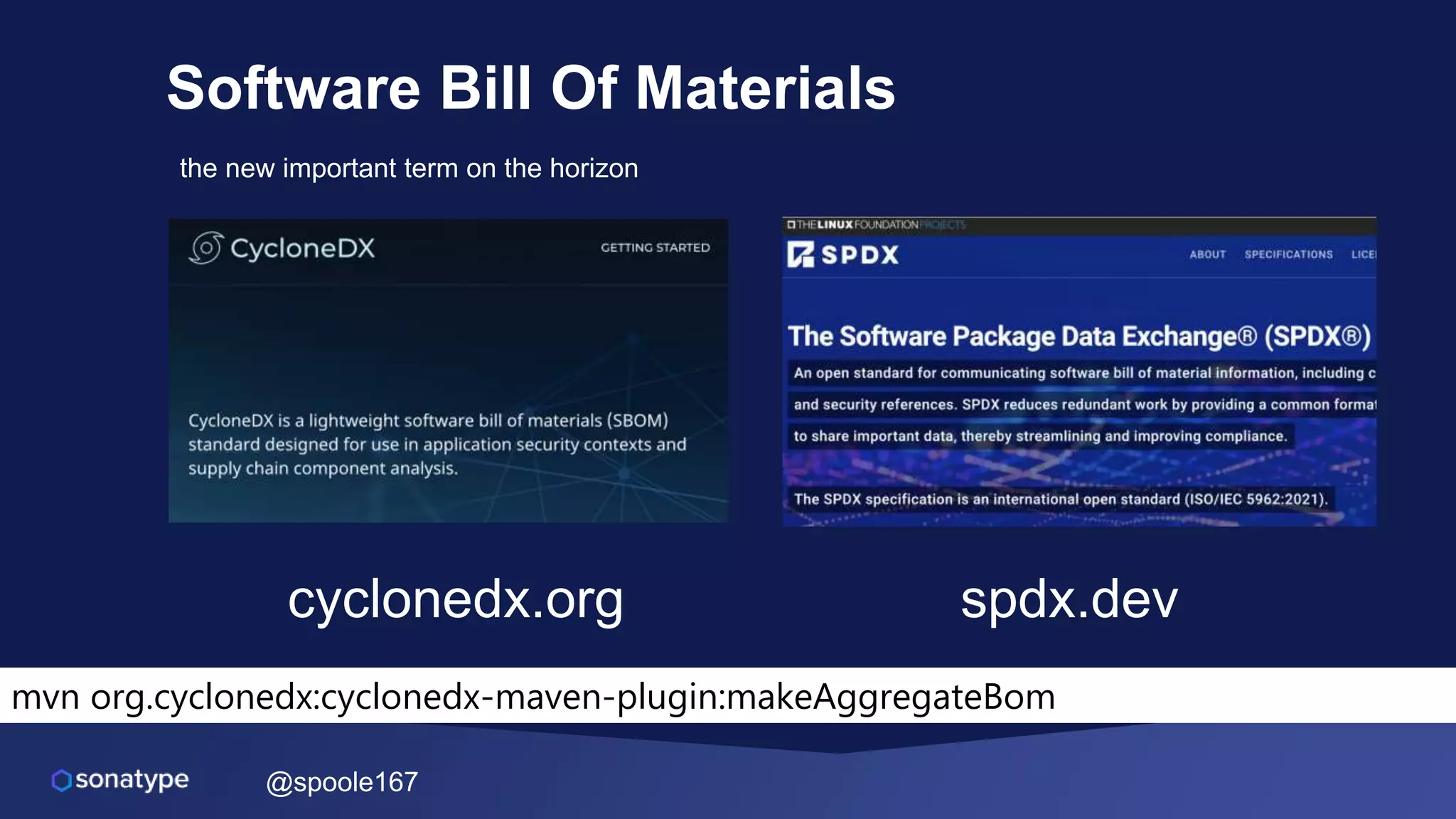
Software Bill Of Materials
cyclonedx.org spdx.dev
the new important term on the horizon
mvn org.cyclonedx:cyclonedx-maven-plugin:makeAggregateBom
@spoole167
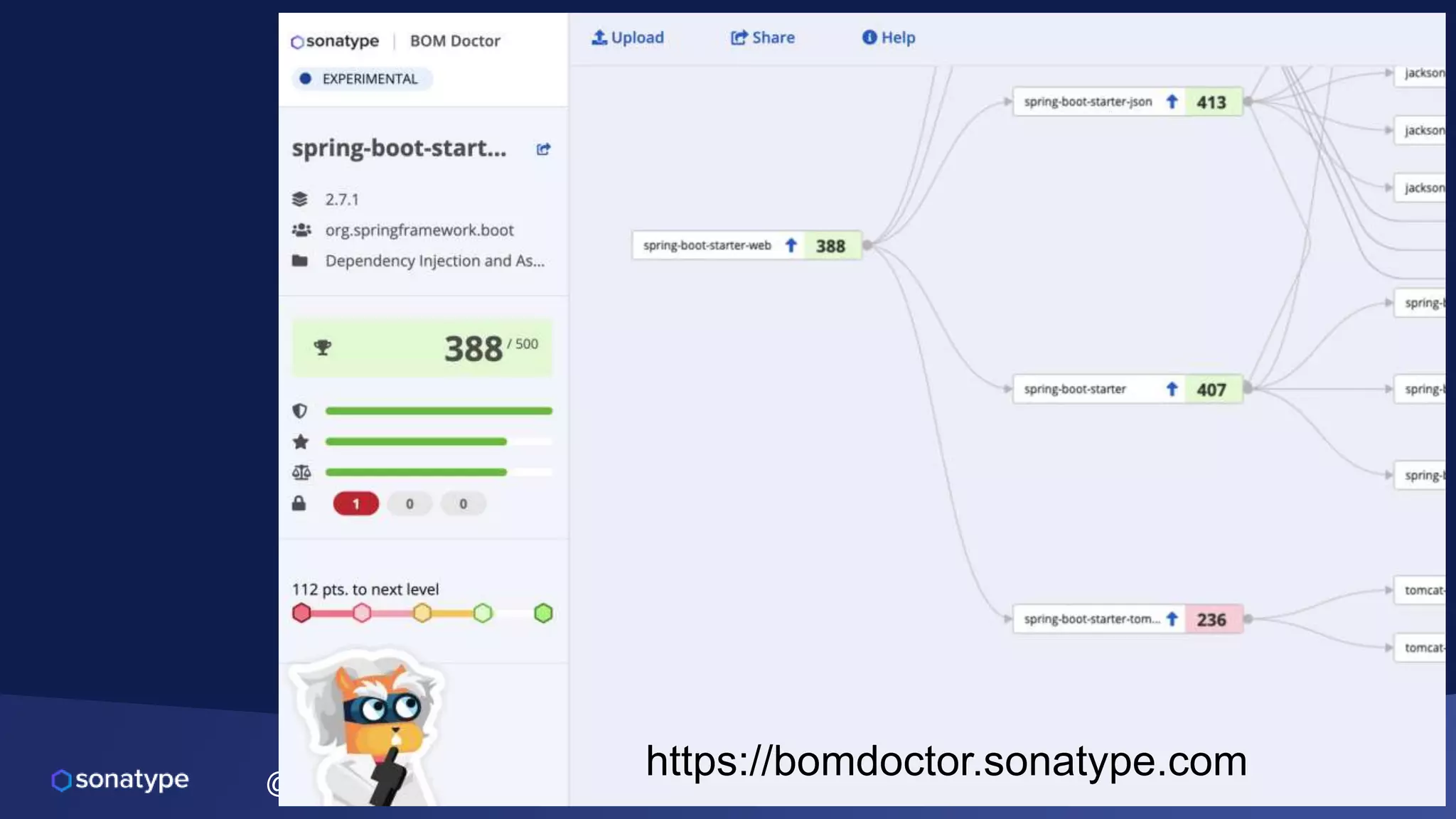
https://bomdoctor.sonatype.com
@spoole167
Tackling the next level
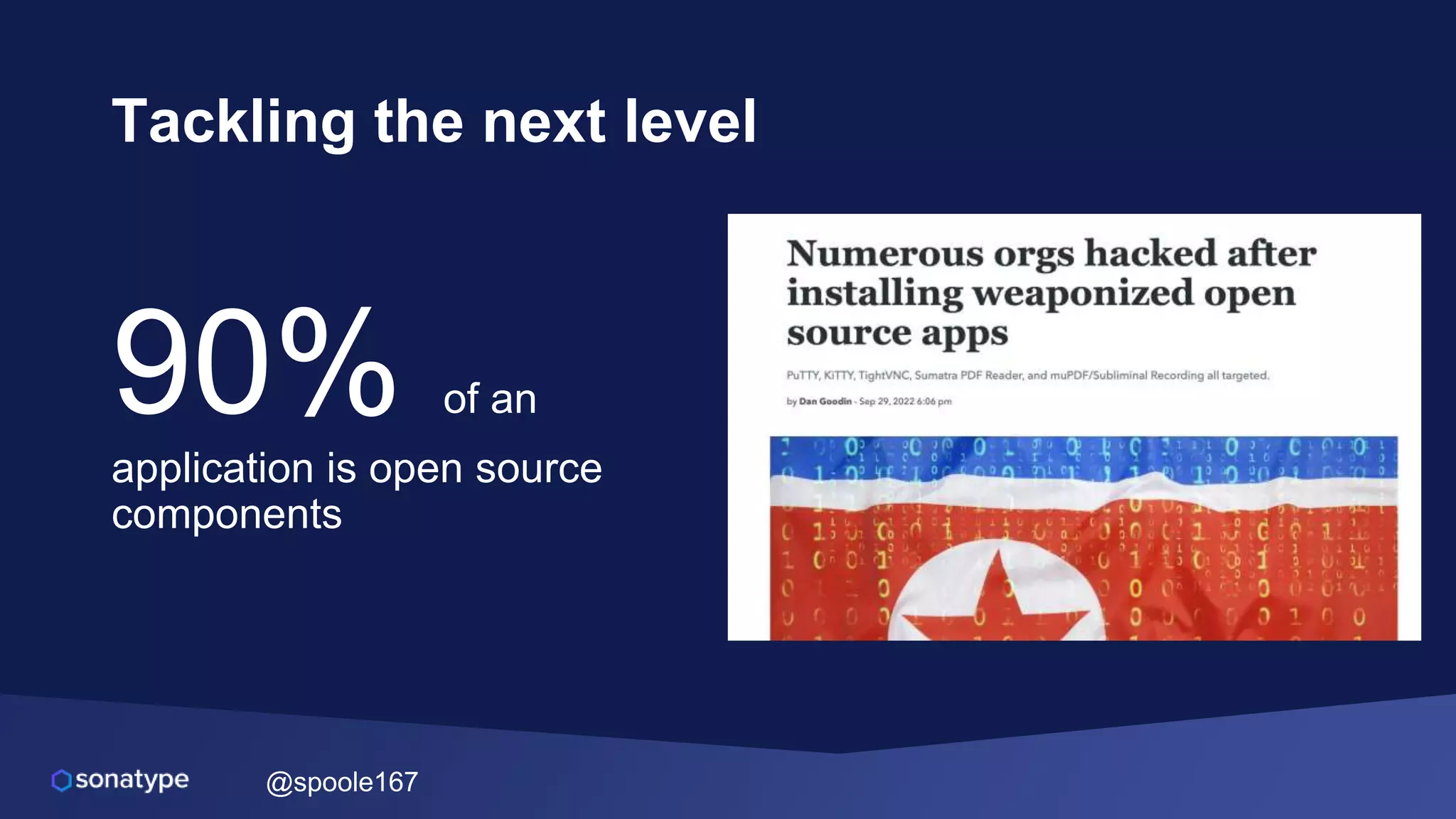
90% of an
application is open source
components
@spoole167
Tackling the next level
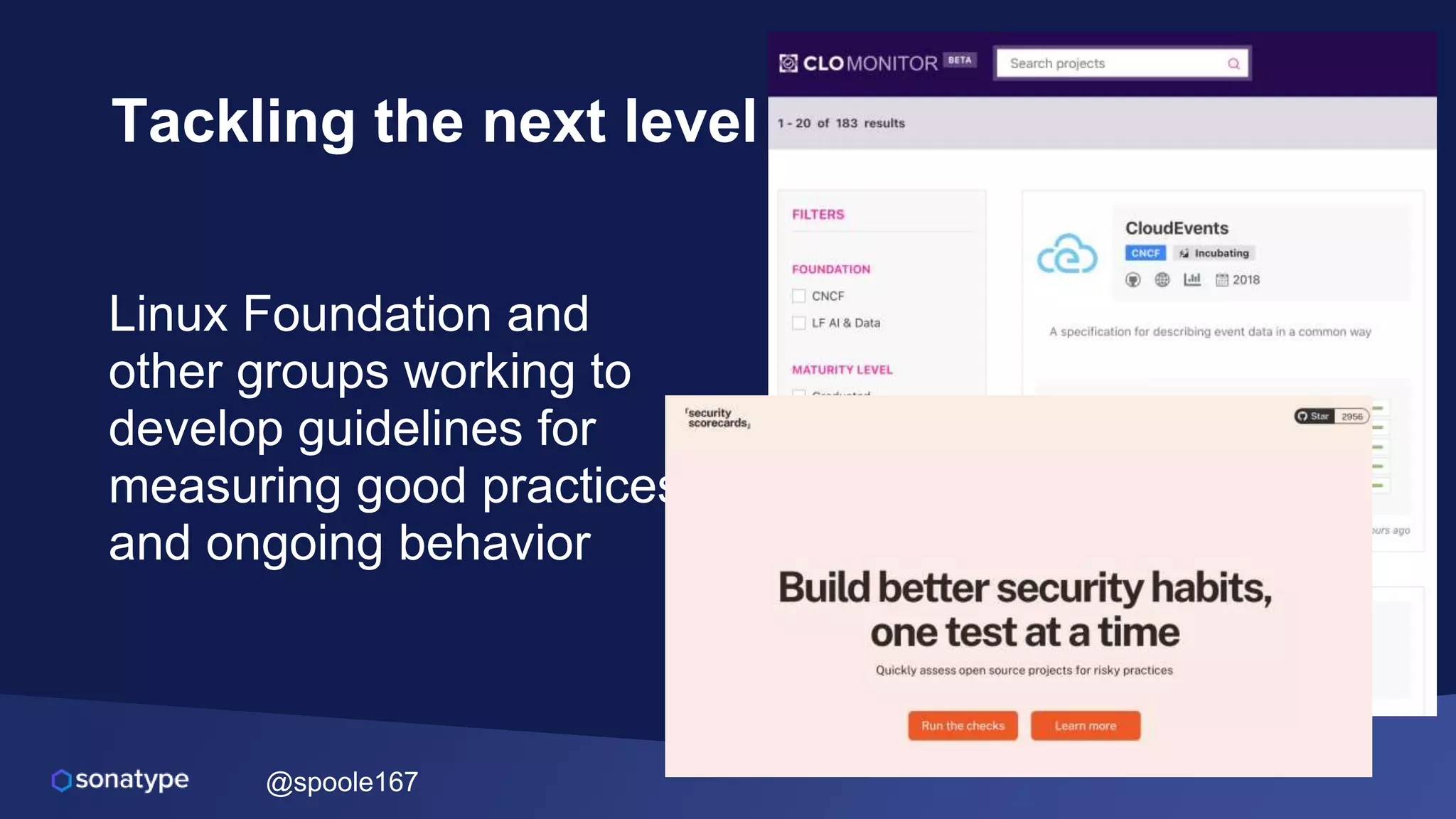
Linux Foundation and
other groups working to
develop guidelines for
measuring good practices
and ongoing behavior
@spoole167
@spoole167
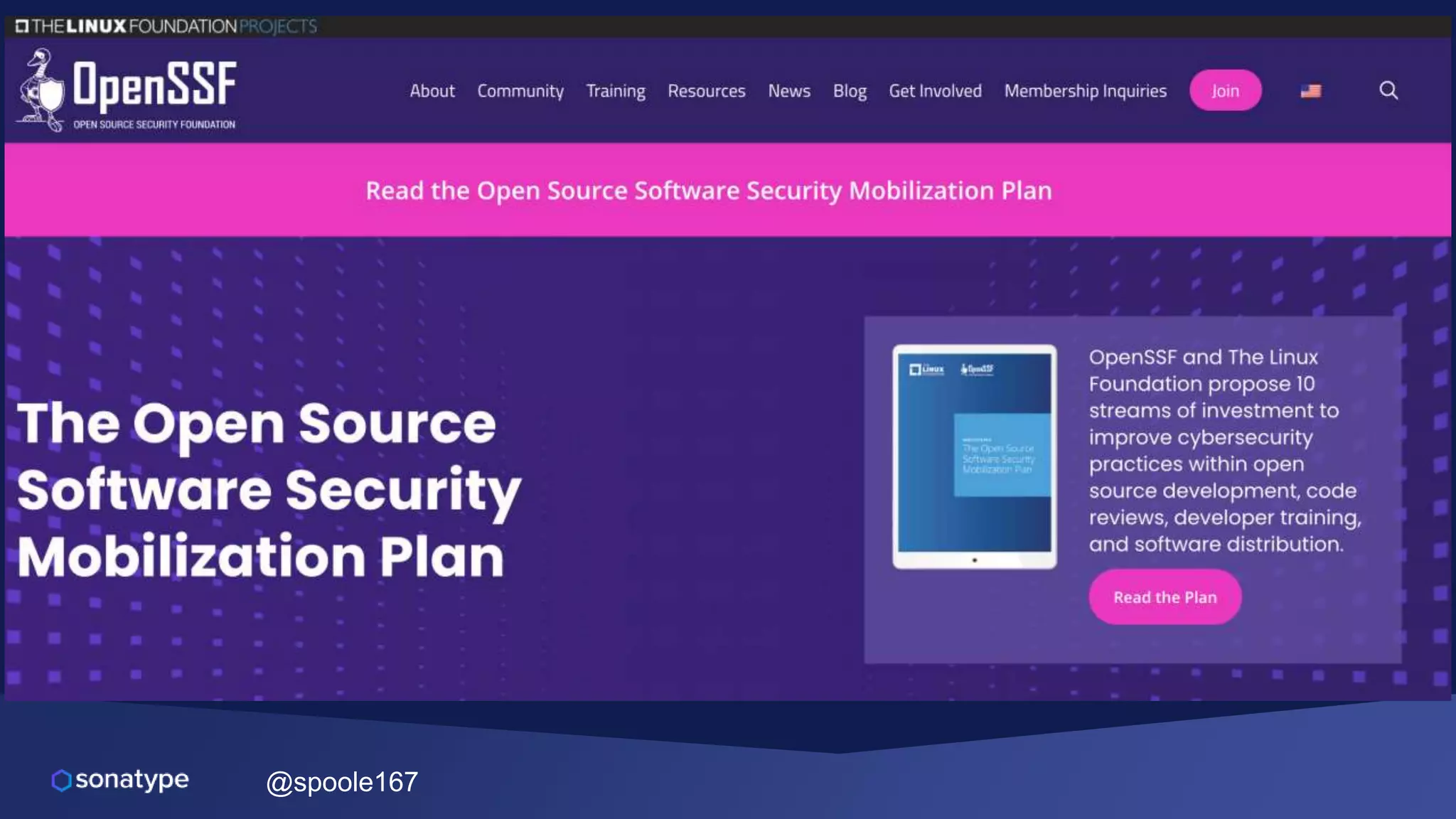
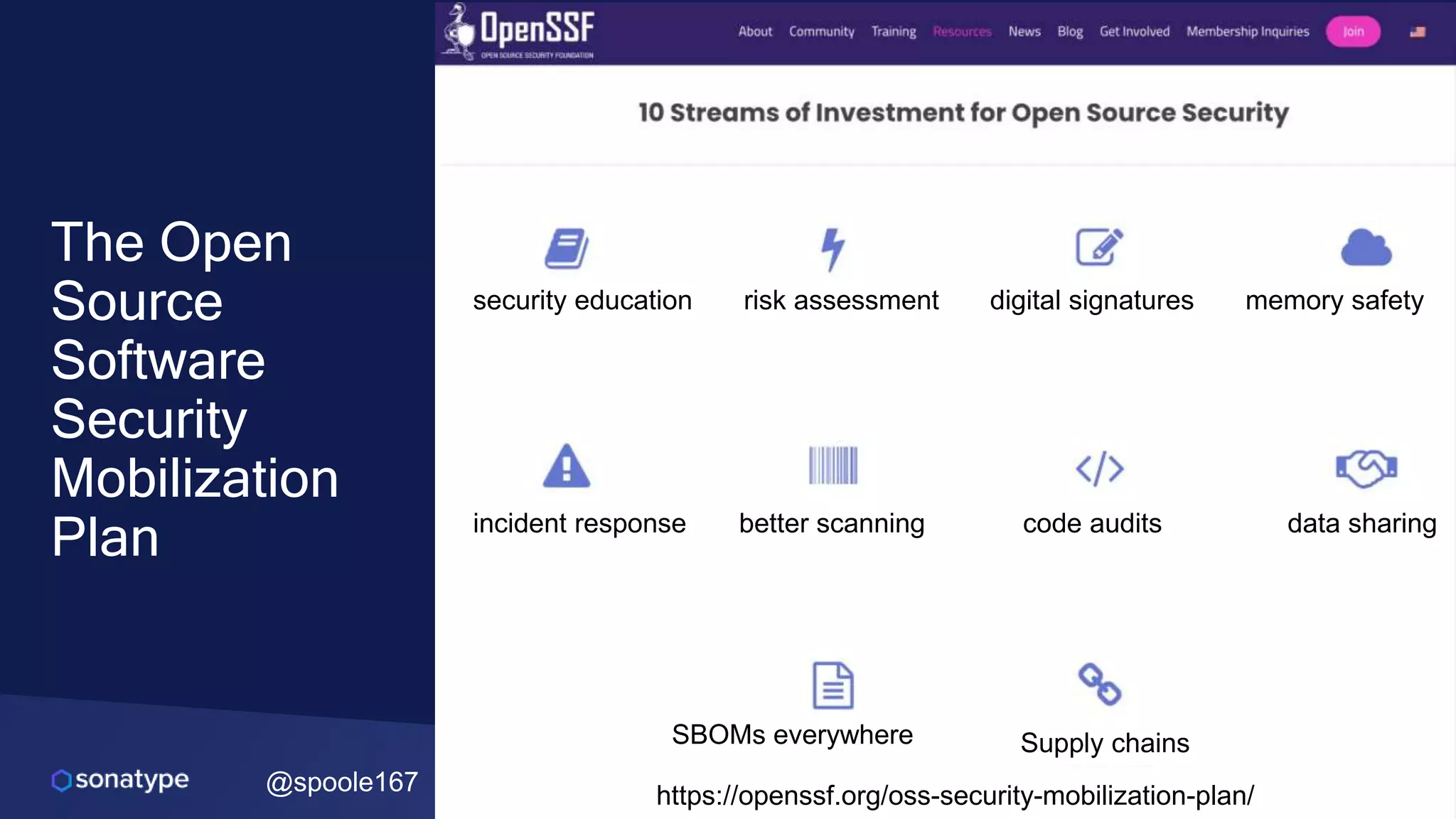
The Open
Source
Software
Security
Mobilization
Plan
https://openssf.org/oss-security-mobilization-plan/
security education risk assessment digital signatures memory safety
incident response better scanning code audits data sharing
SBOMs everywhere Supply chains
@spoole167
What can you do right now?
@spoole167
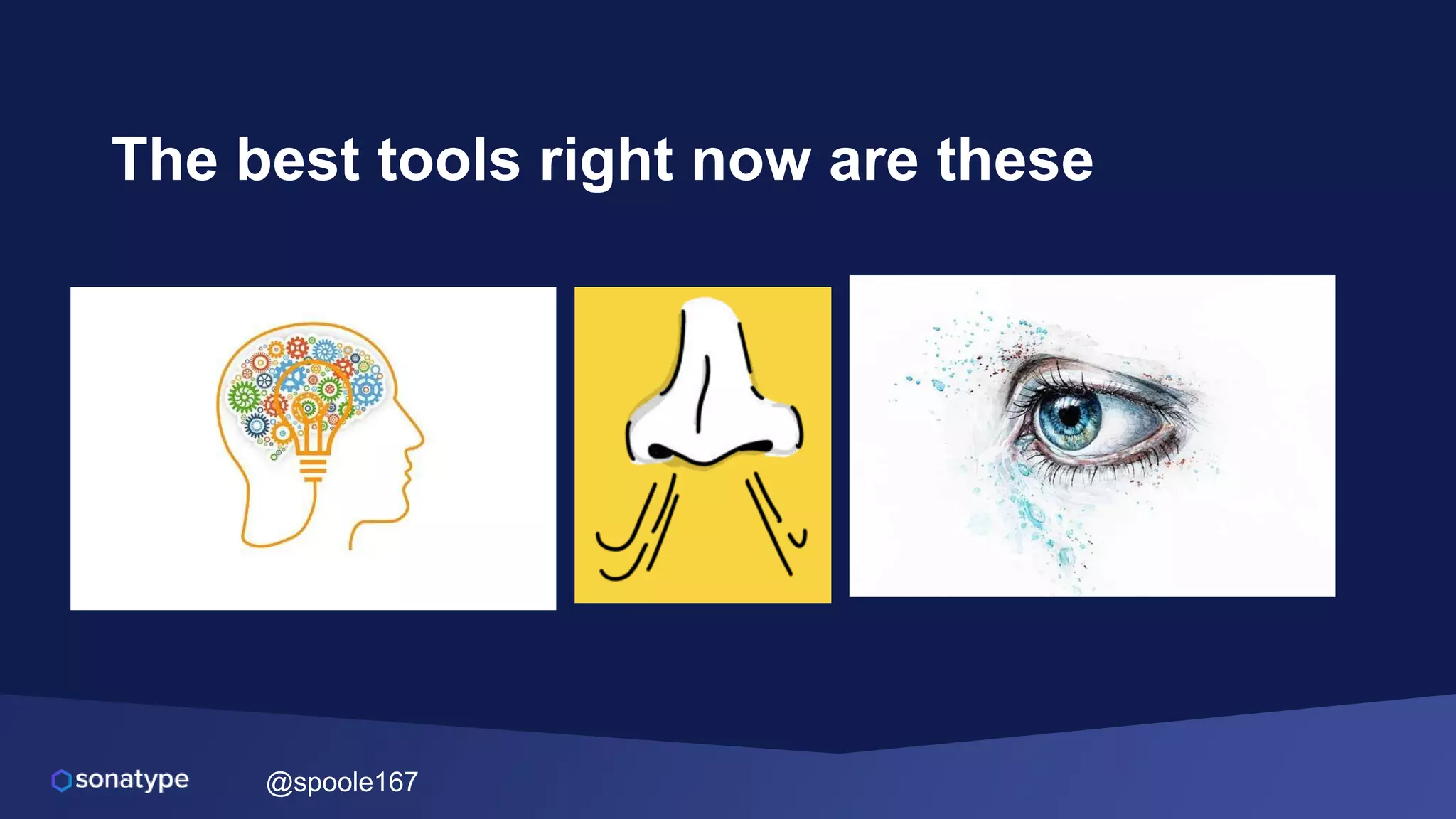
The best tools right now are these
@spoole167
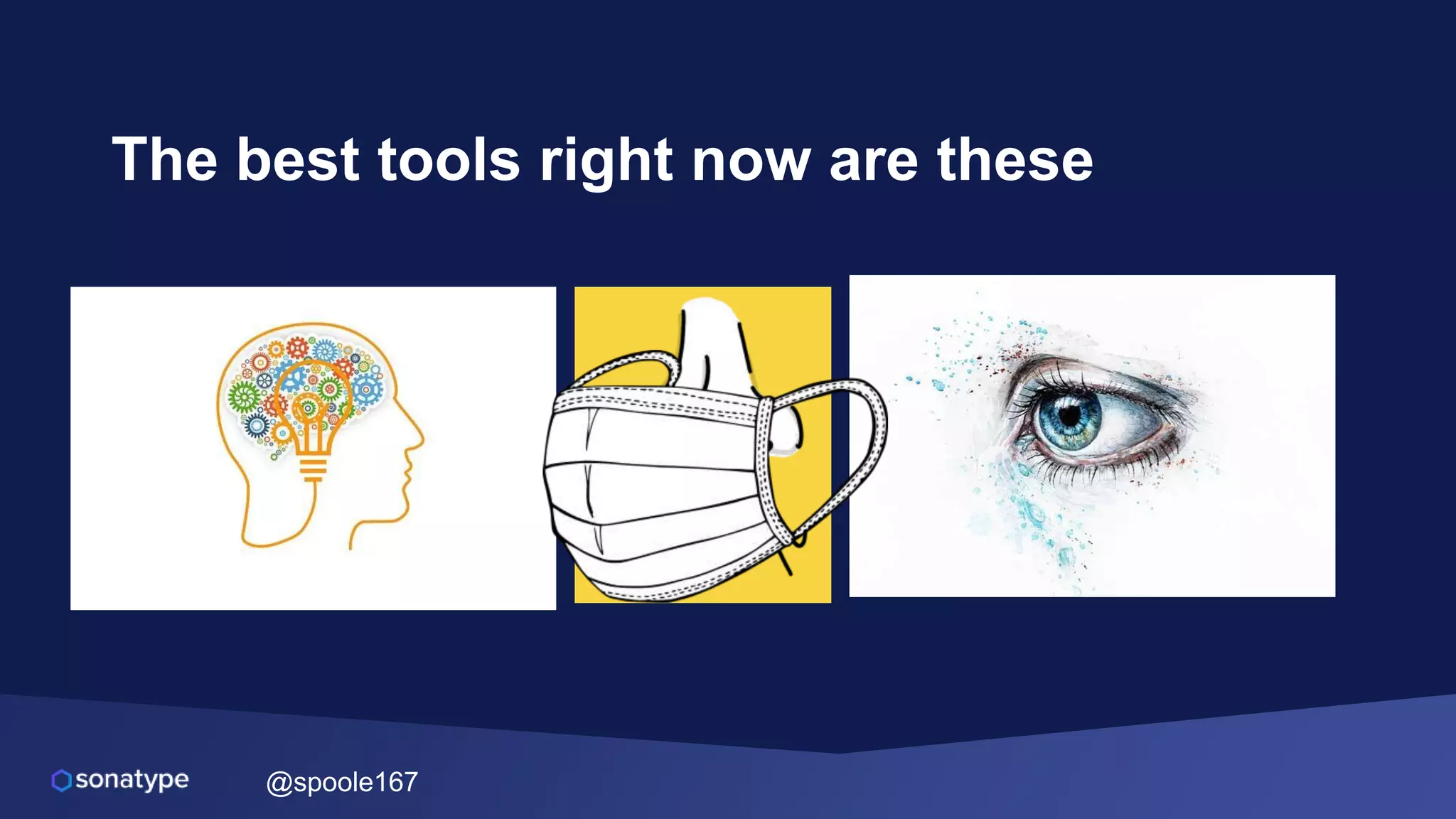
The best tools right now are these
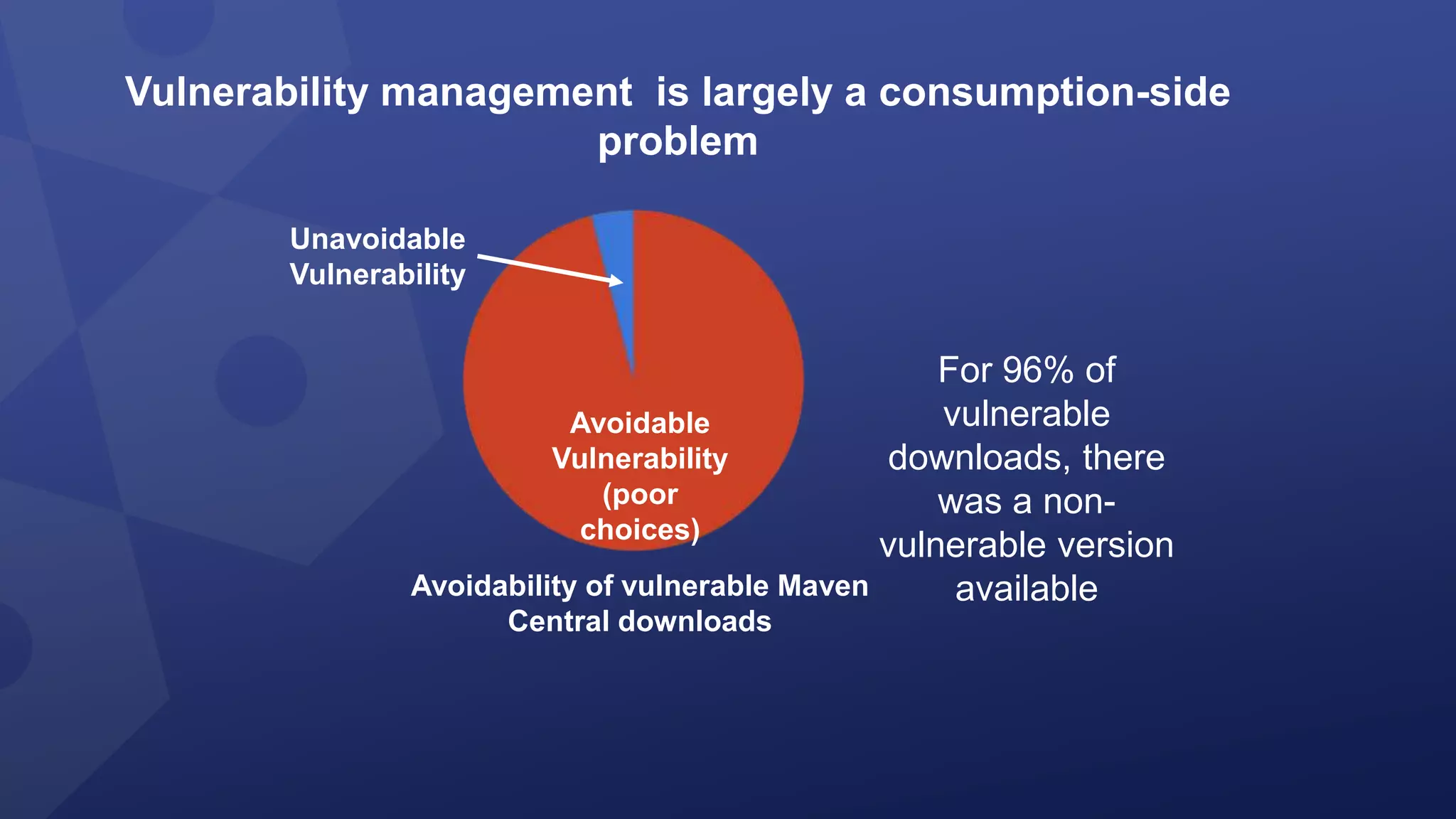
Avoidable
Vulnerability
(poor
choices)
Vulnerability management is largely a consumption-side
problem
For 96% of
vulnerable
downloads, there
was a non-
vulnerable version
available
Avoidability of vulnerable Maven
Central downloads
Unavoidable
Vulnerability
@spoole167
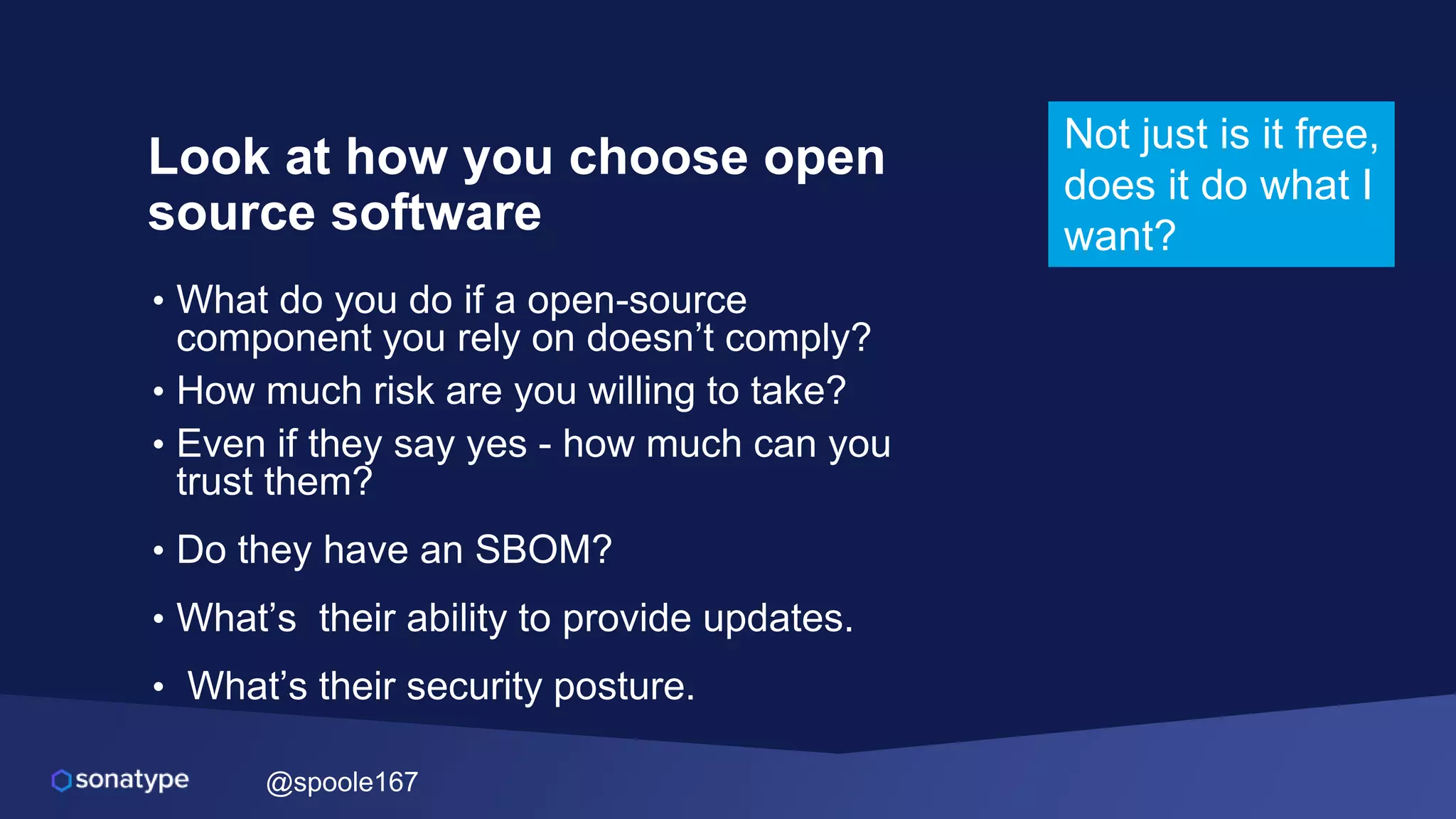
Look at how you choose open
source software
• What do you do if a open-source
component you rely on doesn’t comply?
• How much risk are you willing to take?
• Even if they say yes - how much can you
trust them?
• Do they have an SBOM?
• What’s their ability to provide updates.
• What’s their security posture.
Not just is it free,
does it do what I
want?
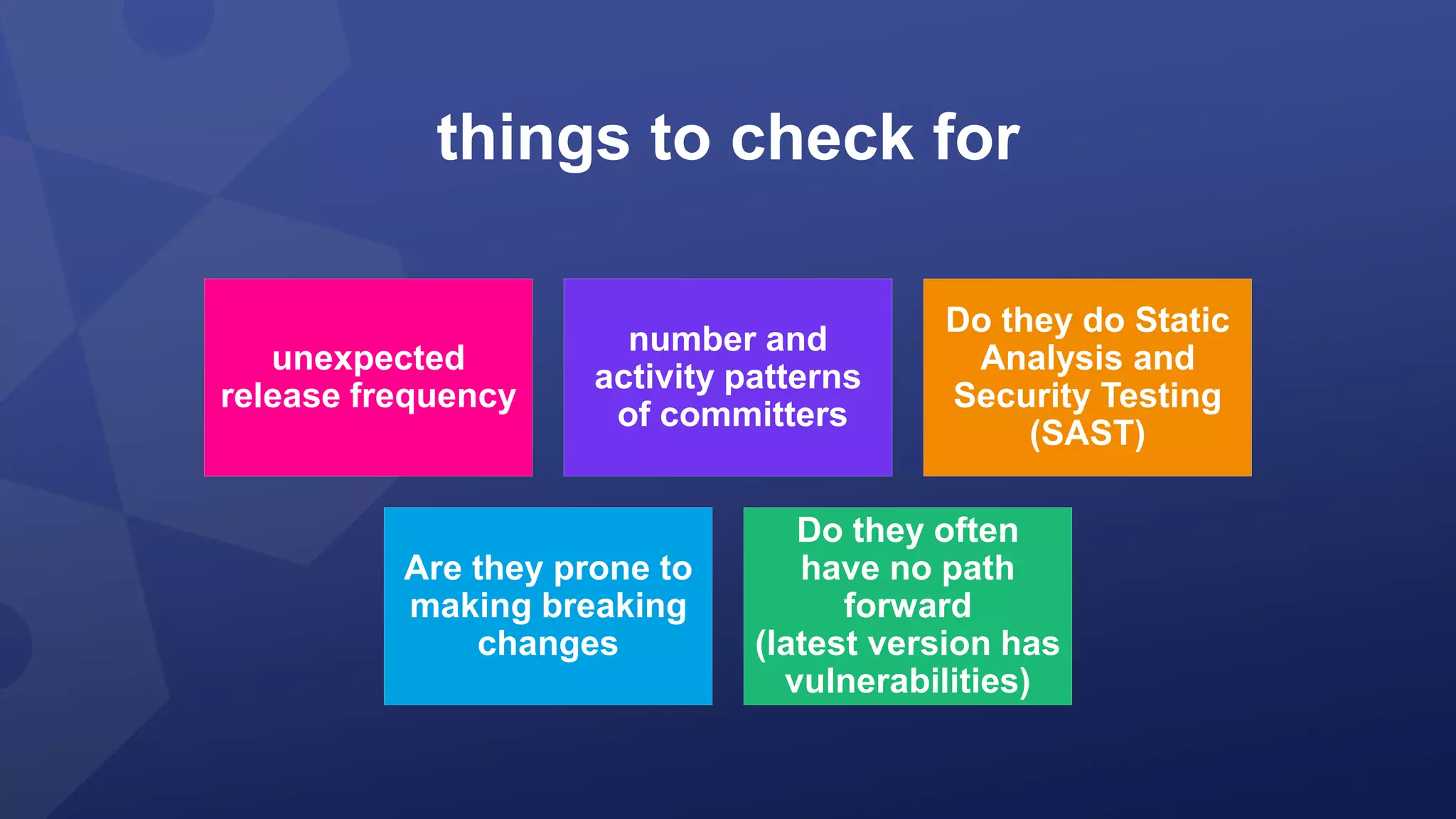
things to check for
unexpected
release frequency
number and
activity patterns
of committers
Do they do Static
Analysis and
Security Testing
(SAST)
Are they prone to
making breaking
changes
Do they often
have no path
forward
(latest version has
vulnerabilities)
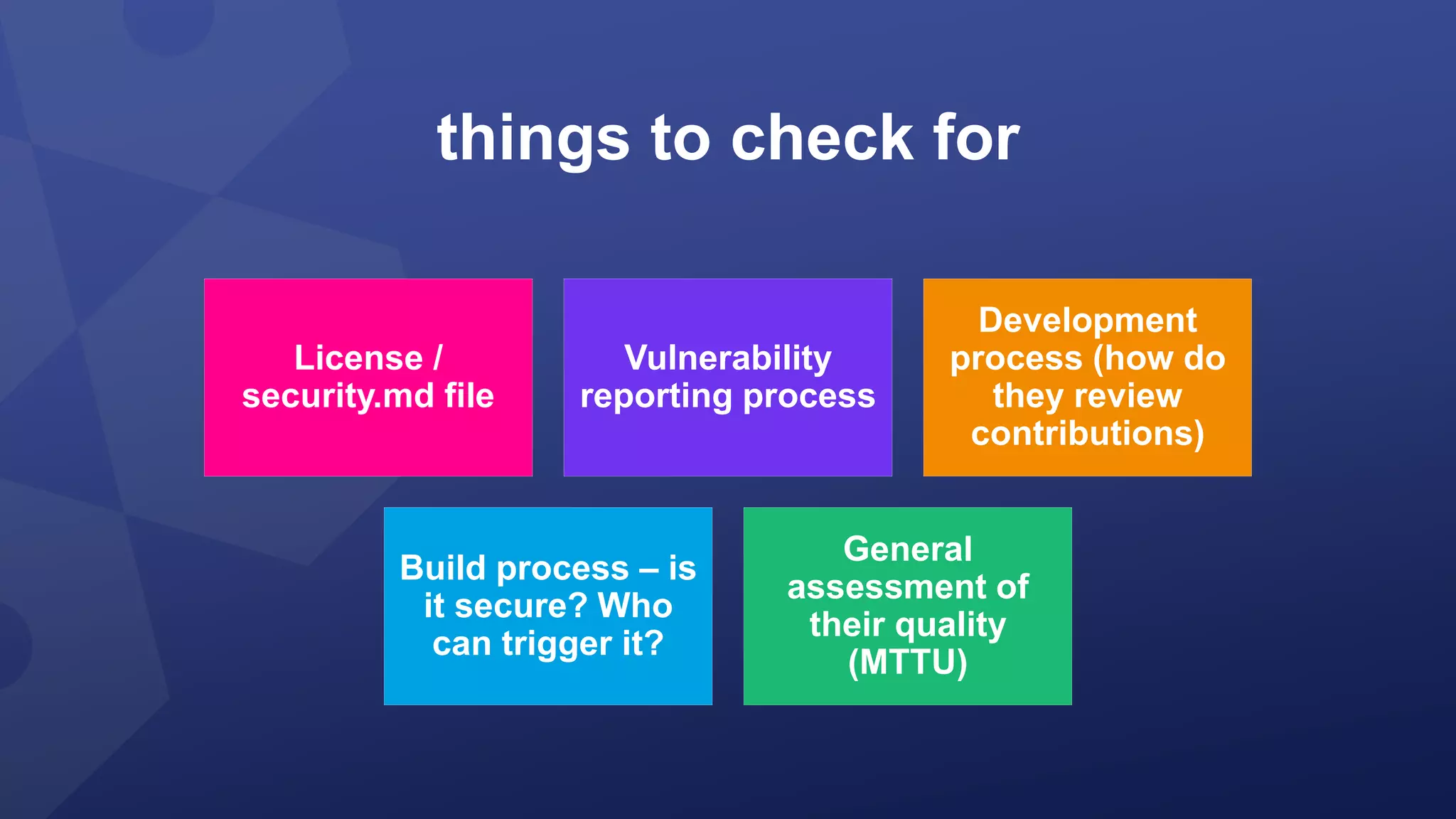
things to check for
License /
security.md file
Vulnerability
reporting process
Development
process (how do
they review
contributions)
Build process – is
it secure? Who
can trigger it?
General
assessment of
their quality
(MTTU)
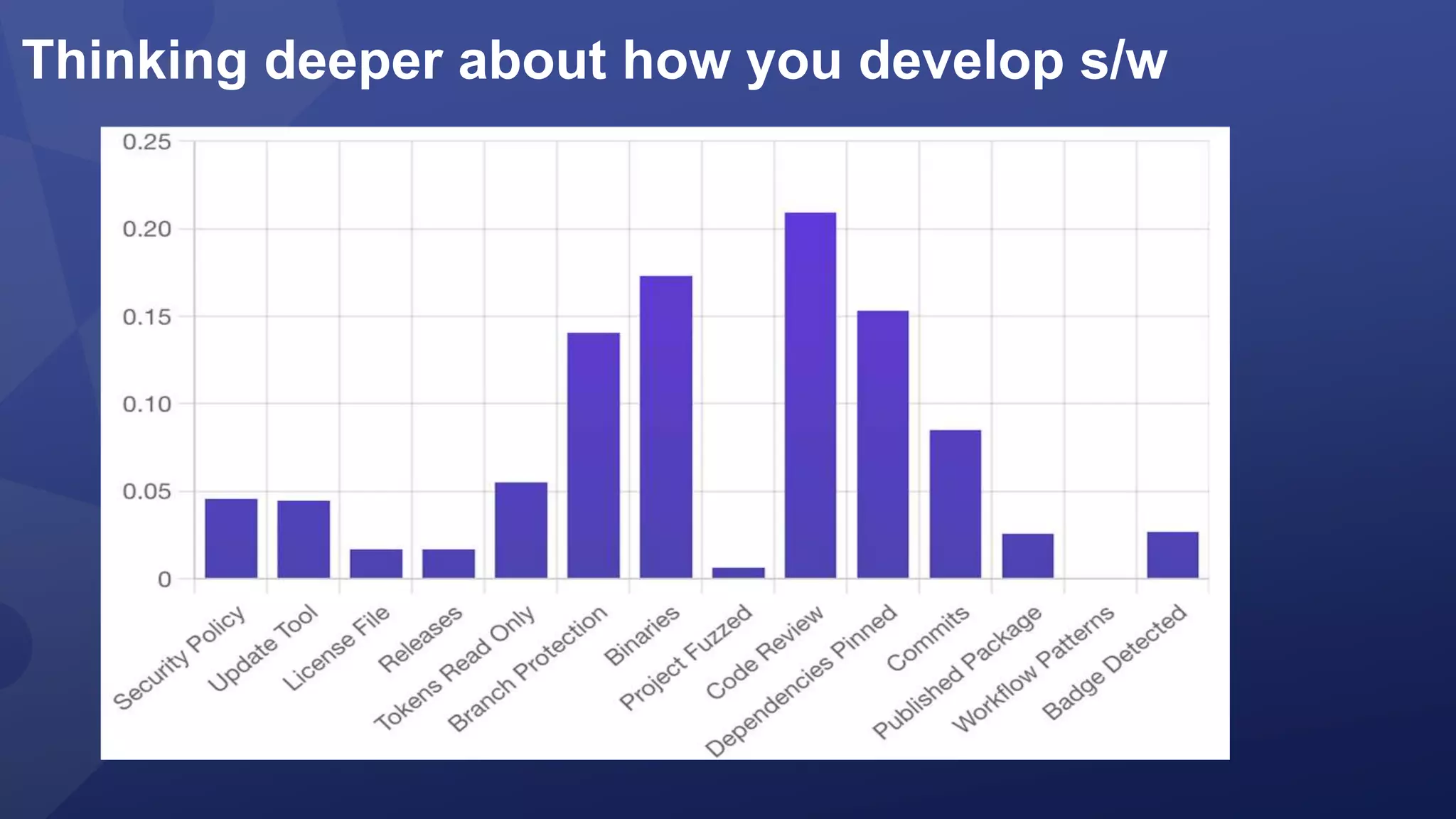
Thinking deeper about how you develop s/w
@spoole167
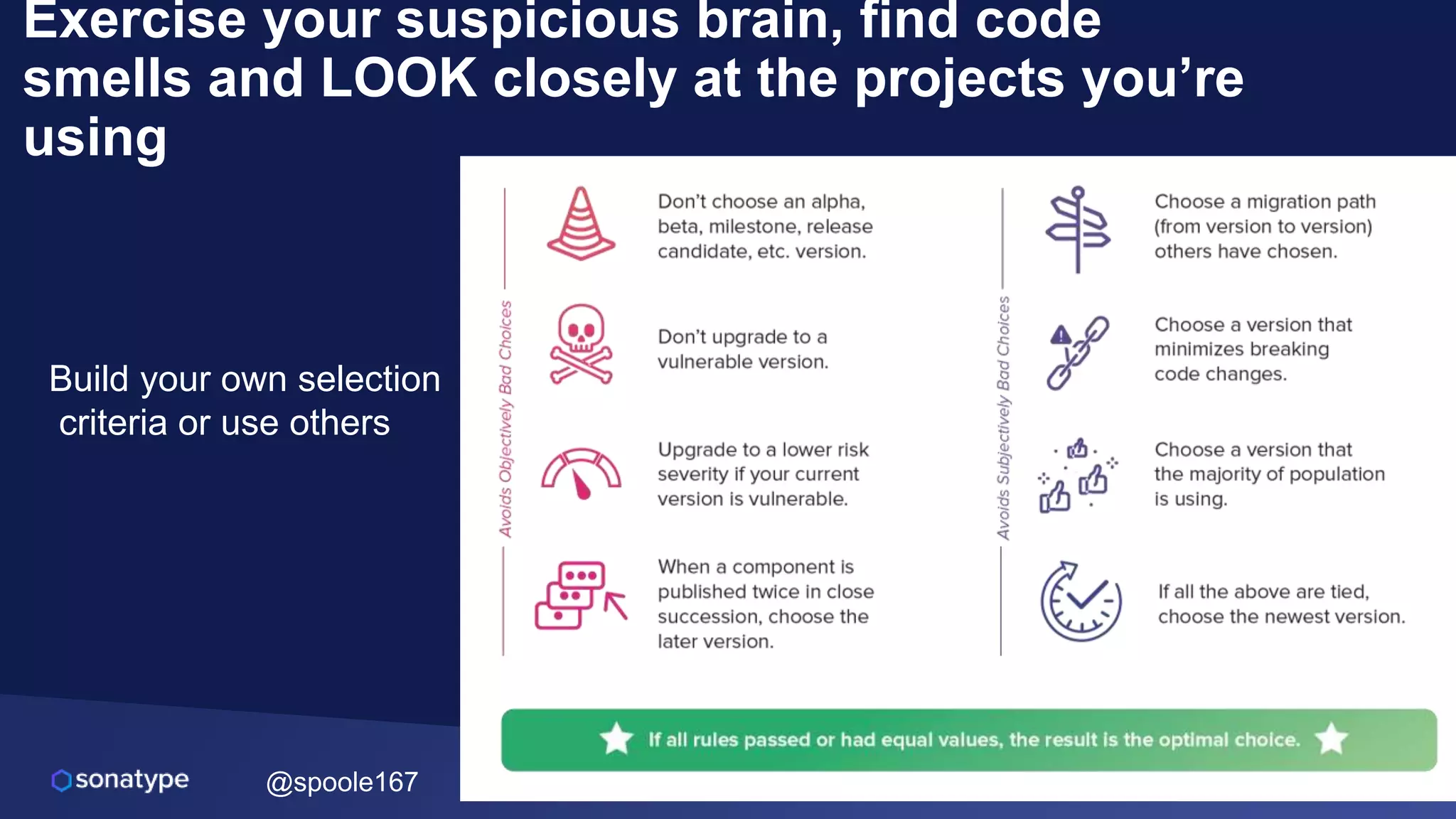
Exercise your suspicious brain, find code
smells and LOOK closely at the projects you’re
using
Build your own selection
criteria or use others
@spoole167
What else should you do?
@spoole167
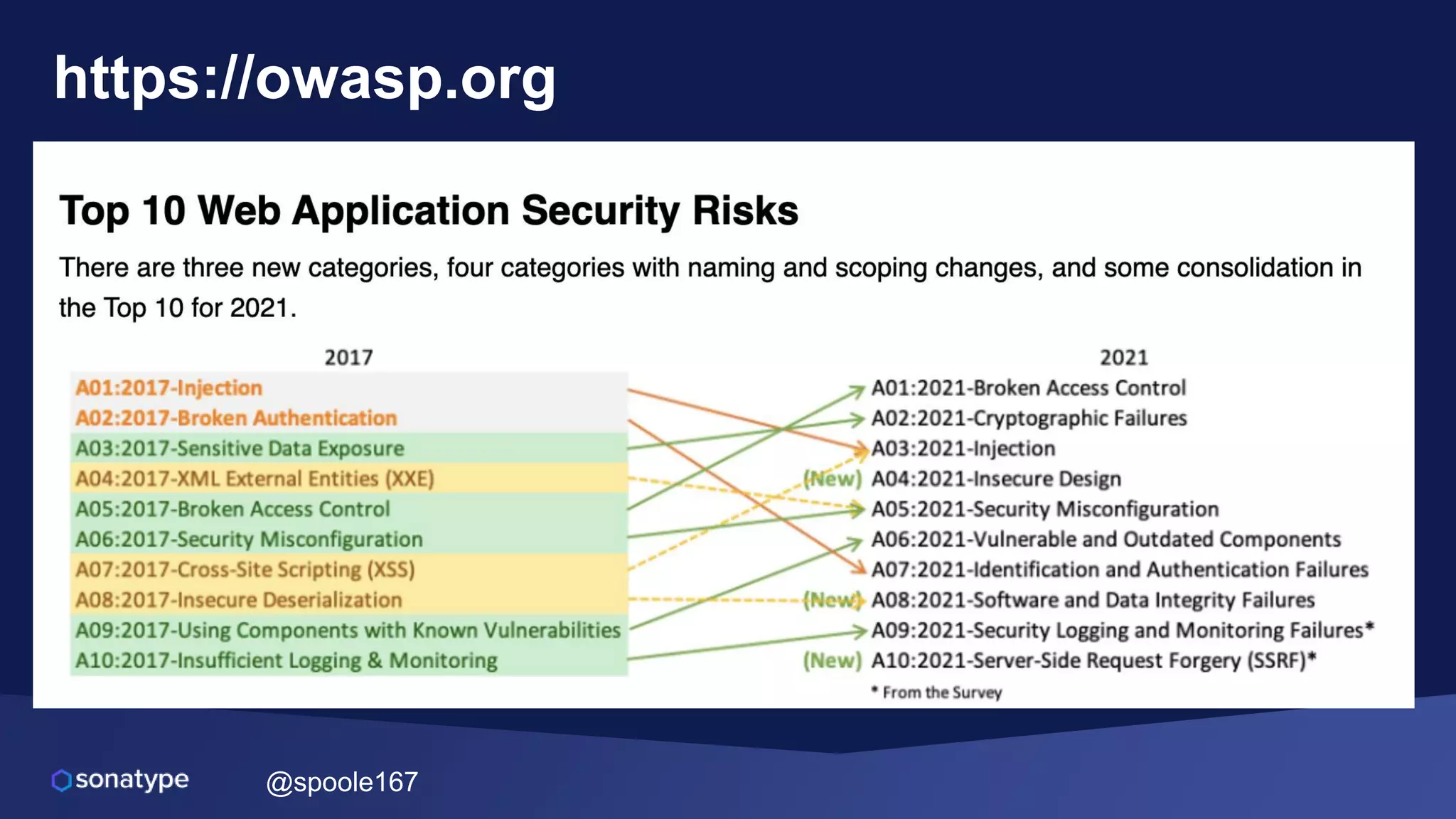
Visit owasp
@spoole167
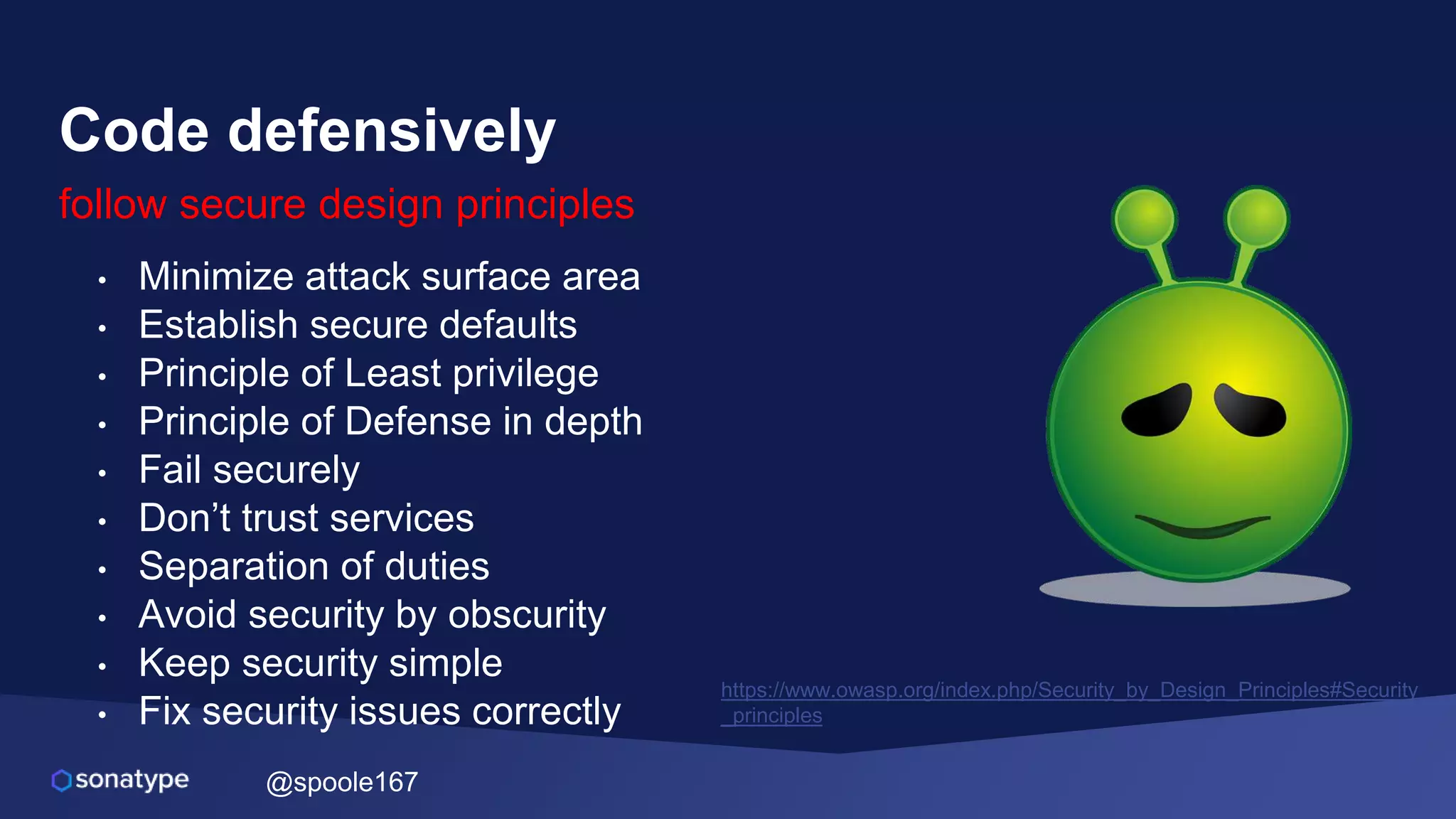
Code defensively
follow secure design principles
• Minimize attack surface area
• Establish secure defaults
• Principle of Least privilege
• Principle of Defense in depth
• Fail securely
• Don’t trust services
• Separation of duties
• Avoid security by obscurity
• Keep security simple
• Fix security issues correctly
https://www.owasp.org/index.php/Security_by_Design_Principles#Security
_principles
@spoole167
https://owasp.org
@spoole167
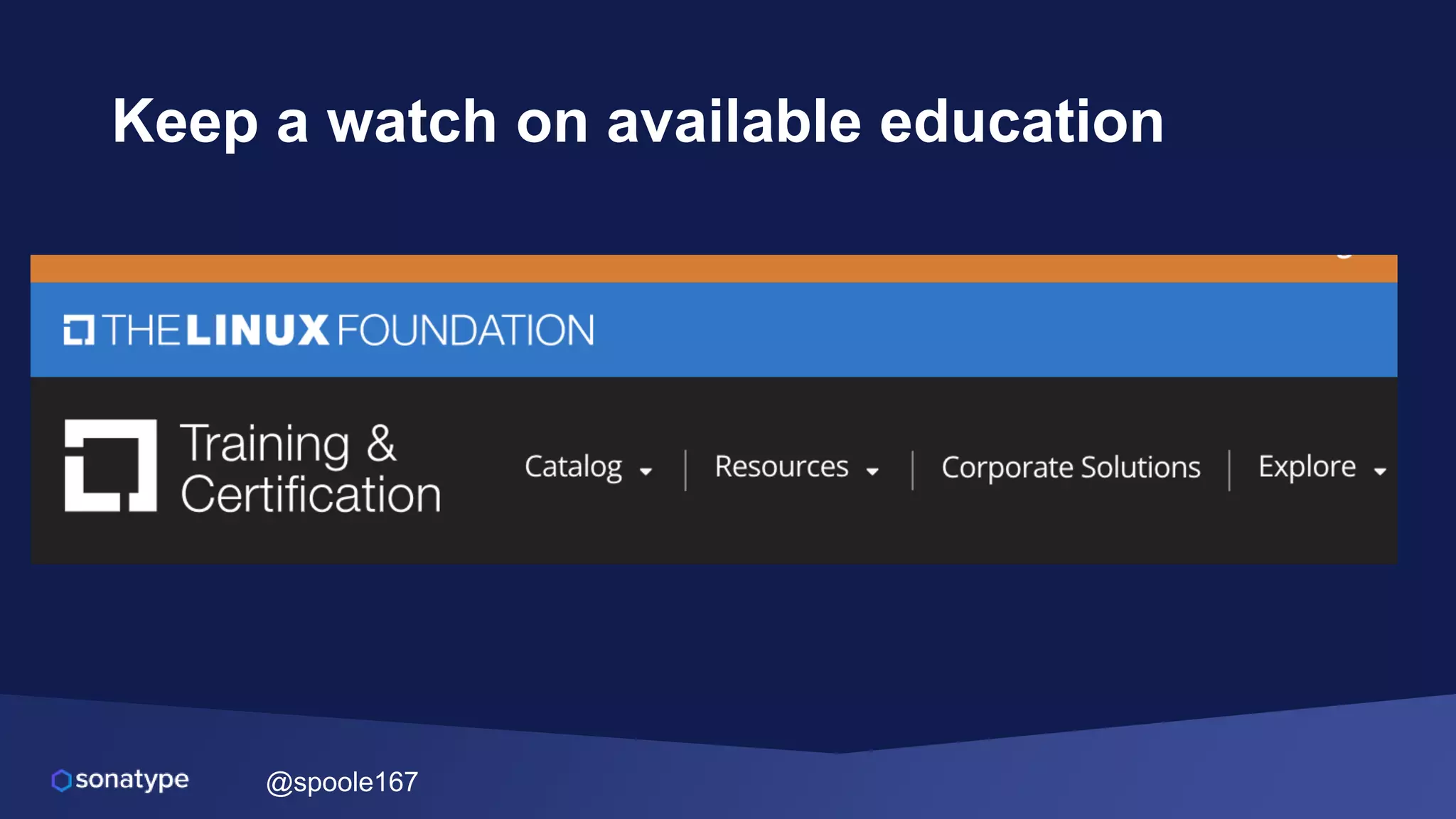
Keep a watch on available education
@spoole167
Summary
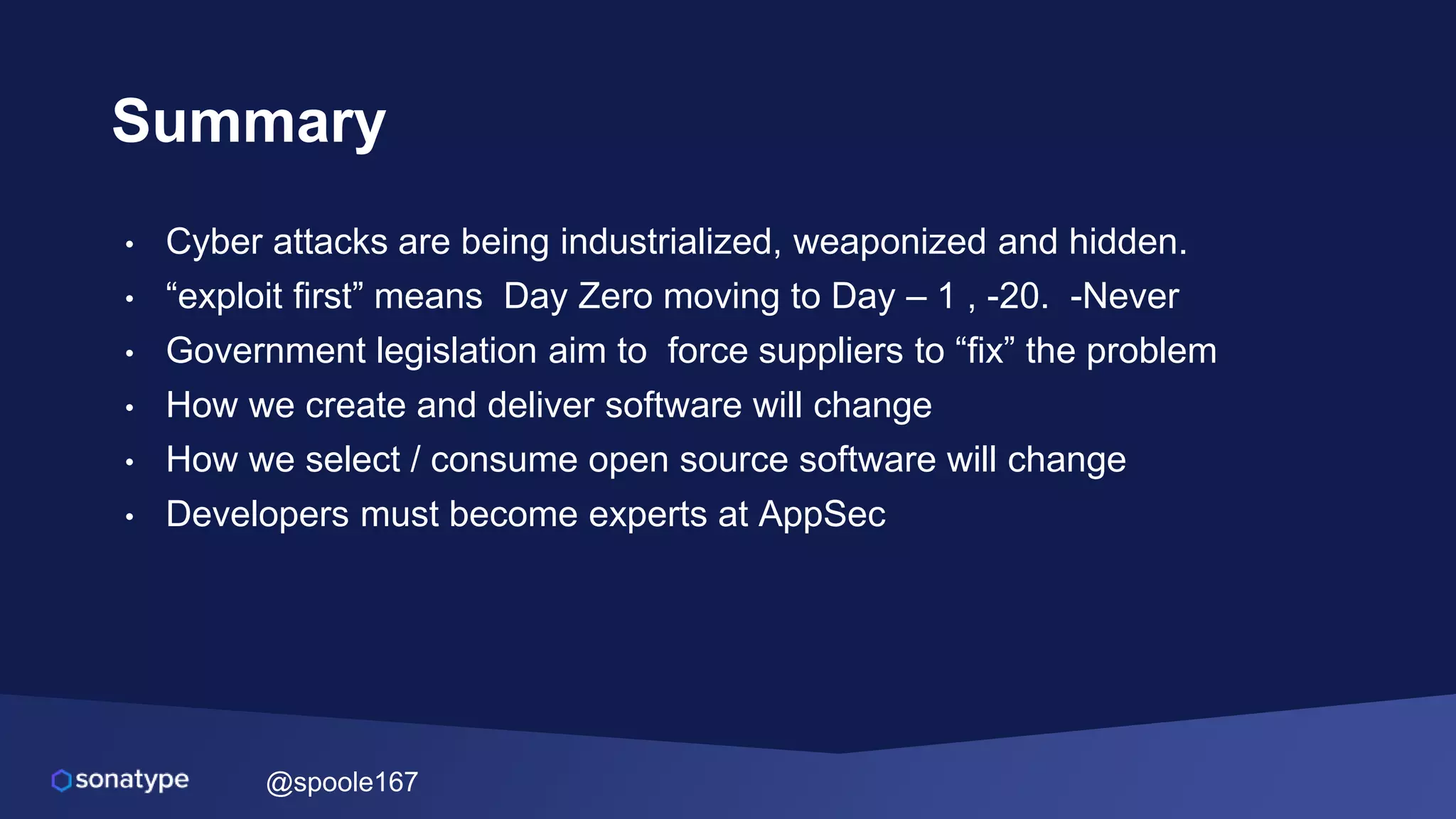
• Cyber attacks are being industrialized, weaponized and hidden.
• “exploit first” means Day Zero moving to Day – 1 , -20. -Never
• Government legislation aim to force suppliers to “fix” the problem
• How we create and deliver software will change
• How we select / consume open source software will change
• Developers must become experts at AppSec
@spoole167
Takeaways
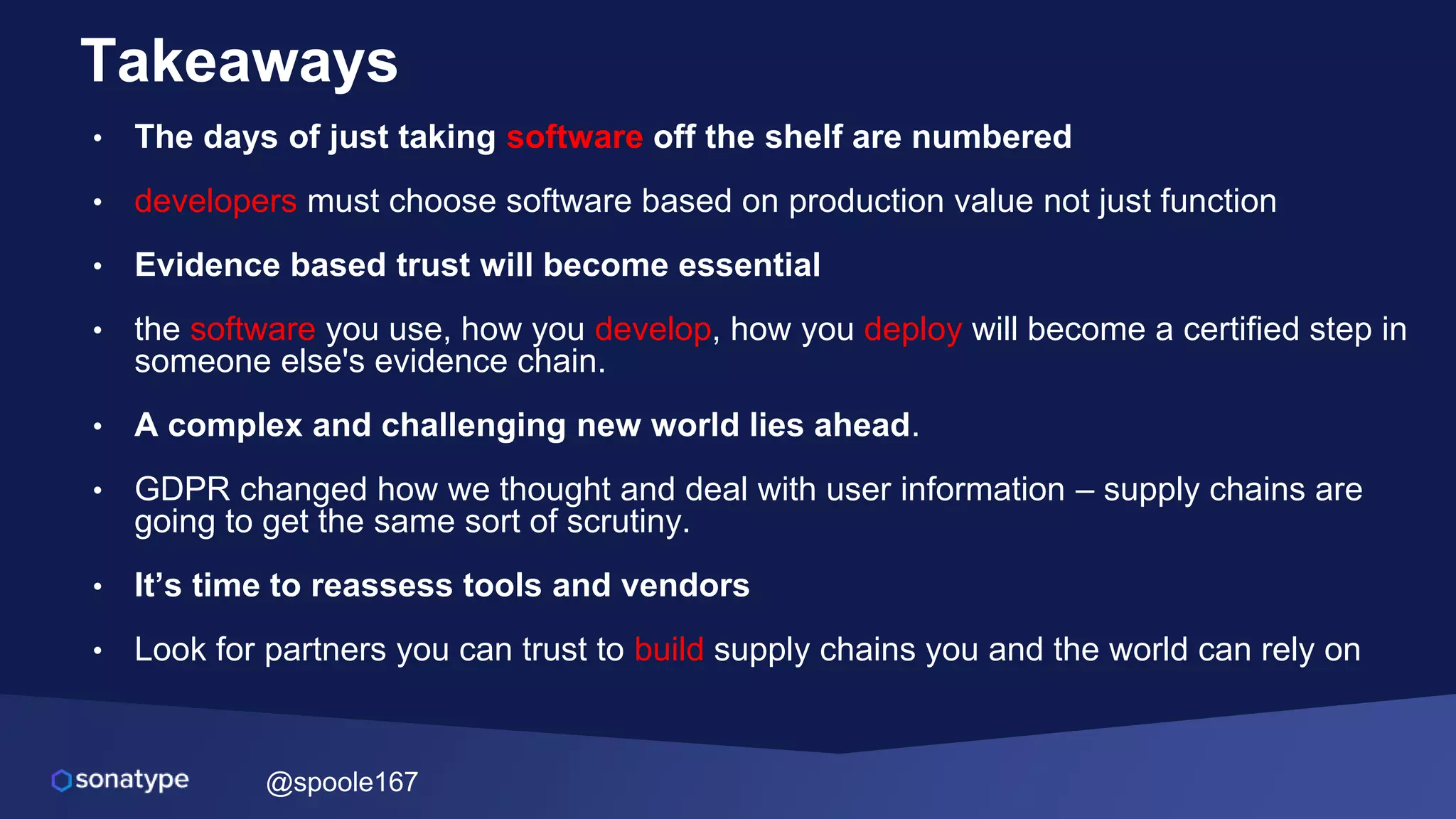
• The days of just taking software off the shelf are numbered
• developers must choose software based on production value not just function
• Evidence based trust will become essential
• the software you use, how you develop, how you deploy will become a certified step in
someone else's evidence chain.
• A complex and challenging new world lies ahead.
• GDPR changed how we thought and deal with user information – supply chains are
going to get the same sort of scrutiny.
• It’s time to reassess tools and vendors
• Look for partners you can trust to build supply chains you and the world can rely on
@spoole167
Thank you
bit.ly/41FGVXt
google: “Brian Fox RSAC 2023”
bomdoctor.sonatype.com

GIDS-2023 A New Hope for 2023? What Developers Must Learn Next

  • 1.
    @spoole167 www.developersummit.com @spoole167 A new hopefor 2023? What developers must learn next
  • 2.
    @spoole167 what do wethink when we think about cybercrime?”
  • 3.
    @spoole167 Photo by BastianPudill on Unsplash Do we imagine someone walking down the road trying the handles of cars as they pass Looking for a car to steal
  • 4.
    @spoole167 Do we rememberthat movie we watched about a daring and sophisticated robbery ?
  • 5.
    @spoole167 these are thetwo styles we often think about. The super complicated attack or the simple opportunist
  • 6.
    @spoole167 Wrongly we thinkwe’re not targets we think the bad guys are far away
  • 7.
    @spoole167 The most common thoughtsas a developer are ”why is it my problem?” or “I don’t really know what to do”
  • 8.
    @spoole167 this talk • Isa reality check about what the bad guys are really doing and why • What’s happening to help address these attacks • What should you be doing next
  • 9.
  • 10.
    @spoole167 Sonatype Invented Maven Started MavenCentral in 2003 Created Nexus repo and other technologies The quiet leader in secure software supply chain technology
  • 11.
    Not just theMaven Central people
  • 13.
  • 14.
    @spoole167 Cyberattacks have movedon It’s not all hackers in bedrooms doing it for fun
  • 15.
    @spoole167 in 2016 Cybercrimecost ~415 Billion Dollars So did the illicit drug trade
  • 16.
    @spoole167 Buys you US NimitzClass carriers 415 Billion Dollars in 2016
  • 17.
    @spoole167 Buys you US NimitzClass carriers 415 Billion Dollars in 2016 50
  • 18.
    @spoole167 Cybercrime has beengrowing at ~56% per year ever since drug trade cybercrime
  • 19.
    @spoole167 Buys you US NimitzClass carriers 415 Billion Dollars in 2016 50
  • 20.
    @spoole167 Buys you US NimitzClass carriers 6 Trillion Dollars in 2022 50 620
  • 21.
    @spoole167 United States: $20.89trillion China: $14.72 trillion Cyber Crime : $6.0 trillion Japan: $5.06 trillion Germany: $3.85 trillion United Kingdom: $2.67 trillion India: $2.66 trillion France: $2.63 trillion Italy: $1.89 trillion Canada: $1.64 trillion https://globalpeoservices.com/top-15-countries-by-gdp-in-2022/ if Cybercrime was a country (by gdp)
  • 22.
    @spoole167 There is nosign of it slowing down drug trade cybercrime US gdp
  • 23.
  • 24.
    @spoole167 There are still.. •There are still botnets out there trying to get into your systems • There are still bad guys who want to steal your secrets • There are still people who will ransom your data • There are still cryptocurrency miners trying to steal your CPU cycles
  • 25.
    @spoole167 Plus .. • Thereare still botnets out there trying to get into your systems • There are still bad guys who want to steal your secrets • There are still people who will ransom your data • There are still cryptocurrency miners trying to steal your CPU cycles • Now there are open source project hijacks • Now there are fake packages in repos • Now there is malware in the build process • Now the aim is long term control and stealth
  • 26.
    @spoole167 Now there iscyber-warfare • Motivations are different - it’s not about money • Skillsets are higher - professional, well funded. • Perseverance is much greater - specific targets, not just targets of opportunity
  • 27.
    @spoole167 Now there iscyber-warfare • Motivations are different - it’s not about money • Skillsets are higher - professional, well funded. • Persistence is much greater - specific targets, not just targets of opportunity • EVERYONE – Every state or political body, every disenfranchised or suppressed group is or will be taking part.
  • 28.
    @spoole167 Now there iscyber-warfare • It’s been happening behind the scenes for some time. • Now it’s mainstream. You personally Your personal networks The organizations you work for, belong to or help Your country Potential Targets
  • 29.
    @spoole167 Modern attacks are supplychain attacks – and we are all part of a supply chain
  • 30.
    @spoole167 The aim isto infiltrate infrastructure and essential services… The internet is the next battlefield. It’s all about software
  • 31.
  • 32.
    @spoole167 Everything really isonline There is no distance between you and the bad actors they ‘live’ next door
  • 33.
    @spoole167 Cyber warfare isreal and will drive massive changes in how we develop and deliver software
  • 34.
    @spoole167 The only thingbetween you and the bad actors is software
  • 35.
    @spoole167 be ready formassive increases in attacks on software everywhere s/w in the car s/w on the phone s/w on the watch s/w on any device s/w on the laptop s/w on server s/w on the wifi router s/w at the supermarket
  • 36.
    @spoole167 Bad Actors usedto search for vulnerabilities to exploit
  • 37.
    @spoole167 Now they maketheir own Typosquatting A lookalike domain, dependency with one or two wrong or different characters Open source repo attacks Attempts to get malware or weaknesses added into dependency source via social or tools Build Tool attacks Attempts to get malware into the tools that are used to produce dependencies Dependency confusion Attempts to get a Different version added into a binary repository Often “latest” Automated Social engineering
  • 38.
    The Zero DayWindow is Closing Source: Adapted from IBM X-Force / Analysis by Gartner Research (September 2016) Year of Date Reported 2006 2007 2008 2009 2010 201 1 2012 2013 2104 2015 1 0 20 30 40 50 0 Average Days from Public Disclosure to Exploit Average 45 15 201 7 2019 2021 Struts2
  • 39.
    The Zero DayWindow is closed Source: Adapted from IBM X-Force / Analysis by Gartner Research (September 2016) Year of Date Reported 2006 2007 2008 2009 2010 201 1 2012 2013 2104 2015 1 0 20 30 40 50 0 Average Days from Public Disclosure to Exploit Average 45 15 201 7 2019 2021 Struts2 Nation states are paying millions of dollars to suppress vulnerability reporting
  • 40.
    The Zero DayWindow is closed Source: Adapted from IBM X-Force / Analysis by Gartner Research (September 2016) Year of Date Reported 2006 2007 2008 2009 2010 201 1 2012 2013 2104 2015 1 0 20 30 40 50 0 Average Days from Public Disclosure to Exploit Average 45 15 201 7 2019 2021 Struts2 China requires all disclosures to be reported to the government first
  • 41.
    The Zero DayWindow is closed Source: Adapted from IBM X-Force / Analysis by Gartner Research (September 2016) Year of Date Reported 2006 2007 2008 2009 2010 201 1 2012 2013 2104 2015 1 0 20 30 40 50 0 Average Days from Public Disclosure to Exploit Average 45 15 201 7 2019 2021 Struts2 The more severe the vulnerability, the less chance of it being reported publically
  • 42.
  • 43.
    @spoole167 The new worldof cyber security is “exploit first”
  • 44.
  • 45.
  • 46.
    What are wedoing about all of this?
  • 47.
    @spoole167 Backstory – thescales are tipping • Open source is seen as both critical and unreliable • Big Business has managed to keep governments quiet • Business Value won over Security • 7 Trillion dollars a year and existential threats to national security  Security wins • The question isn’t whether – it’s about how. • Governments always use big sticks
  • 48.
    @spoole167 17 May 2021– US Government takes a stand Joe Biden
  • 49.
    @spoole167 December 2022 –EU Updates directives .. Joe Biden
  • 50.
    @spoole167 Hardening the softwaresupply chain : every ‘product’ has a SBOM uses an automatic supply chain process has evidence of software integrity has evidence of an automatic vulnerability check process Has a vulnerability disclosure program Has evidence on the providence of all software used Demonstrates strong controls over the use of internal and third- party software and services Demonstrate regular audit processes
  • 51.
    @spoole167 Technical responses 1 Securingthe supply chain – provable evidence trails 2 Improved understanding of vulnerable projects 3 Automating the supply chain - code to cloud (no humans involved) 4 Education for developers
  • 52.
  • 53.
    Log4Shell may be theworst ever vulnerability https://apple.news/AnKnv0_EdR3K2b-t6Z67-qw
  • 54.
    A canonical exampleof whats going wrong
  • 55.
    False confidence inour tools or not caring? Finding out if you are vulnerable using scanning tools can be challenging It’s all ‘after the fact’ requires great tools and great data Not everyone has equal access
  • 56.
    @spoole167 On the horizon Switchfrom scanning tools that try to work out what you have installed To signed, provable, reproduceable “Software Bill of Materials” Centralised signatures Centralised analysis tools
  • 57.
    @spoole167 Software Bill OfMaterials cyclonedx.org spdx.dev the new important term on the horizon mvn org.cyclonedx:cyclonedx-maven-plugin:makeAggregateBom
  • 58.
  • 59.
    @spoole167 Tackling the nextlevel 90% of an application is open source components
  • 60.
    @spoole167 Tackling the nextlevel Linux Foundation and other groups working to develop guidelines for measuring good practices and ongoing behavior
  • 61.
  • 62.
    @spoole167 The Open Source Software Security Mobilization Plan https://openssf.org/oss-security-mobilization-plan/ security educationrisk assessment digital signatures memory safety incident response better scanning code audits data sharing SBOMs everywhere Supply chains
  • 63.
  • 64.
    @spoole167 The best toolsright now are these
  • 65.
    @spoole167 The best toolsright now are these
  • 66.
    Avoidable Vulnerability (poor choices) Vulnerability management islargely a consumption-side problem For 96% of vulnerable downloads, there was a non- vulnerable version available Avoidability of vulnerable Maven Central downloads Unavoidable Vulnerability
  • 67.
    @spoole167 Look at howyou choose open source software • What do you do if a open-source component you rely on doesn’t comply? • How much risk are you willing to take? • Even if they say yes - how much can you trust them? • Do they have an SBOM? • What’s their ability to provide updates. • What’s their security posture. Not just is it free, does it do what I want?
  • 68.
    things to checkfor unexpected release frequency number and activity patterns of committers Do they do Static Analysis and Security Testing (SAST) Are they prone to making breaking changes Do they often have no path forward (latest version has vulnerabilities)
  • 69.
    things to checkfor License / security.md file Vulnerability reporting process Development process (how do they review contributions) Build process – is it secure? Who can trigger it? General assessment of their quality (MTTU)
  • 70.
    Thinking deeper abouthow you develop s/w
  • 71.
    @spoole167 Exercise your suspiciousbrain, find code smells and LOOK closely at the projects you’re using Build your own selection criteria or use others
  • 72.
  • 73.
  • 74.
    @spoole167 Code defensively follow securedesign principles • Minimize attack surface area • Establish secure defaults • Principle of Least privilege • Principle of Defense in depth • Fail securely • Don’t trust services • Separation of duties • Avoid security by obscurity • Keep security simple • Fix security issues correctly https://www.owasp.org/index.php/Security_by_Design_Principles#Security _principles
  • 75.
  • 76.
    @spoole167 Keep a watchon available education
  • 77.
    @spoole167 Summary • Cyber attacksare being industrialized, weaponized and hidden. • “exploit first” means Day Zero moving to Day – 1 , -20. -Never • Government legislation aim to force suppliers to “fix” the problem • How we create and deliver software will change • How we select / consume open source software will change • Developers must become experts at AppSec
  • 78.
    @spoole167 Takeaways • The daysof just taking software off the shelf are numbered • developers must choose software based on production value not just function • Evidence based trust will become essential • the software you use, how you develop, how you deploy will become a certified step in someone else's evidence chain. • A complex and challenging new world lies ahead. • GDPR changed how we thought and deal with user information – supply chains are going to get the same sort of scrutiny. • It’s time to reassess tools and vendors • Look for partners you can trust to build supply chains you and the world can rely on
  • 79.
    @spoole167 Thank you bit.ly/41FGVXt google: “BrianFox RSAC 2023” bomdoctor.sonatype.com