SOCIAL INNOVATION
GROUP 10
1
GROUP MEMBERS-
H0- Siddarth
G4- Medha
J2- Samaikya
J8- Ram Murthy
K0- Sai Pramod
Information Security Awareness
Cybersecurity Primer
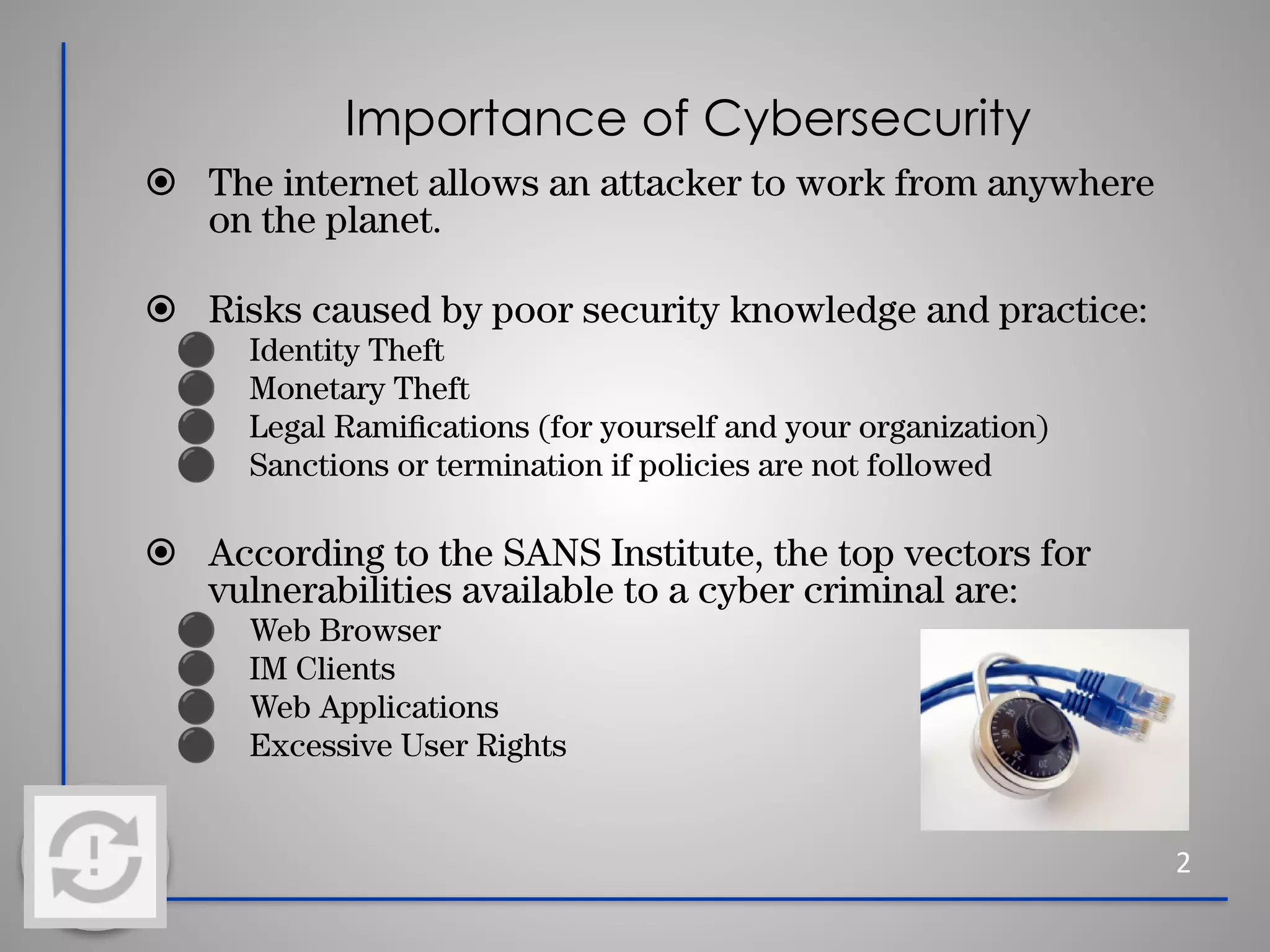
Importance of Cybersecurity
⦿ The internet allows an attacker to work from anywhere
on the planet.
⦿ Risks caused by poor security knowledge and practice:
⚫ Identity Theft
⚫ Monetary Theft
⚫ Legal Ramifications (for yourself and your organization)
⚫ Sanctions or termination if policies are not followed
⦿ According to the SANS Institute, the top vectors for
vulnerabilities available to a cyber criminal are:
⚫ Web Browser
⚫ IM Clients
⚫ Web Applications
⚫ Excessive User Rights
2
Cybersecurity is Safety
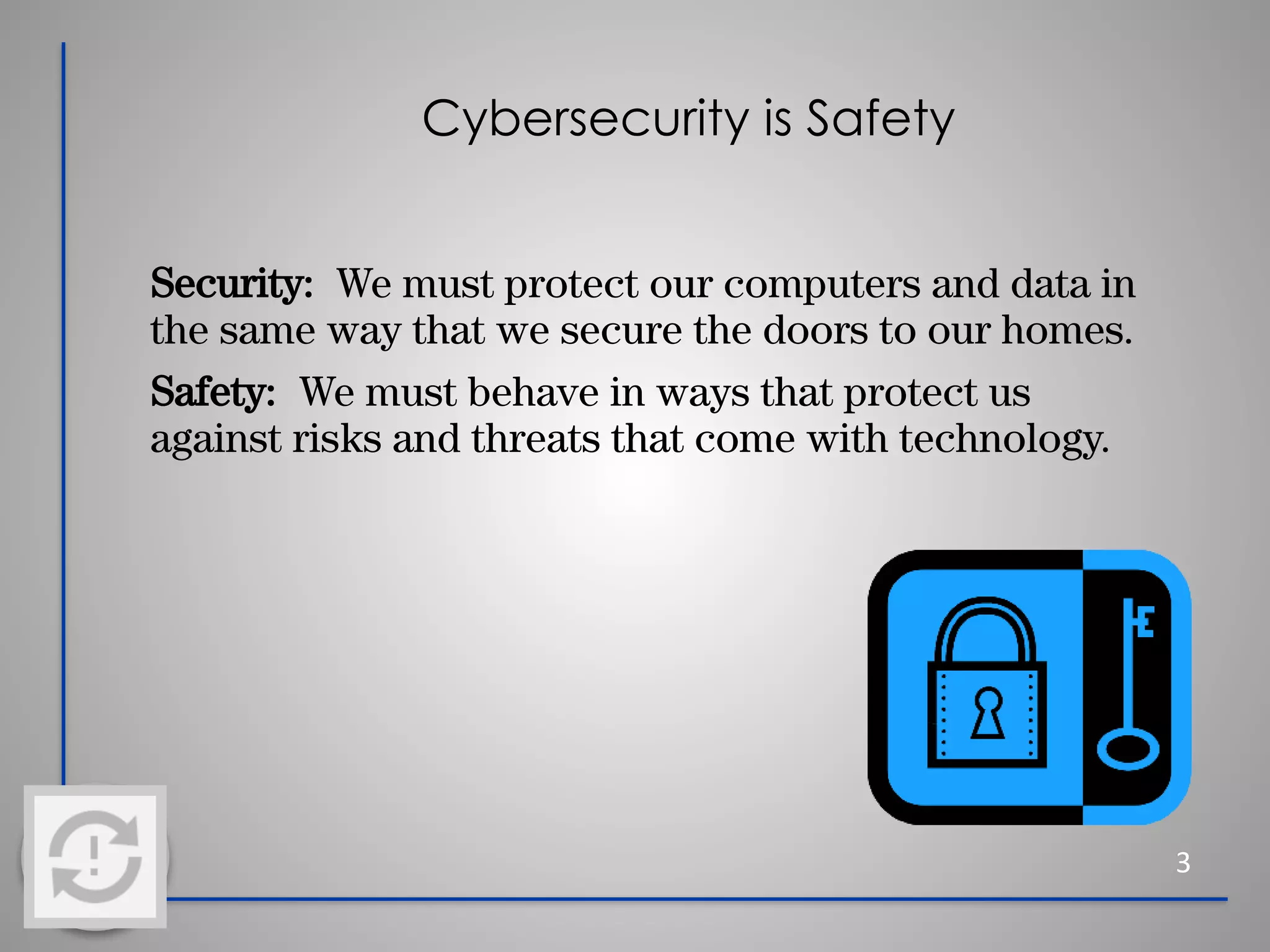
Security: We must protect our computers and data in
the same way that we secure the doors to our homes.
Safety: We must behave in ways that protect us
against risks and threats that come with technology.
3
User Awareness
4
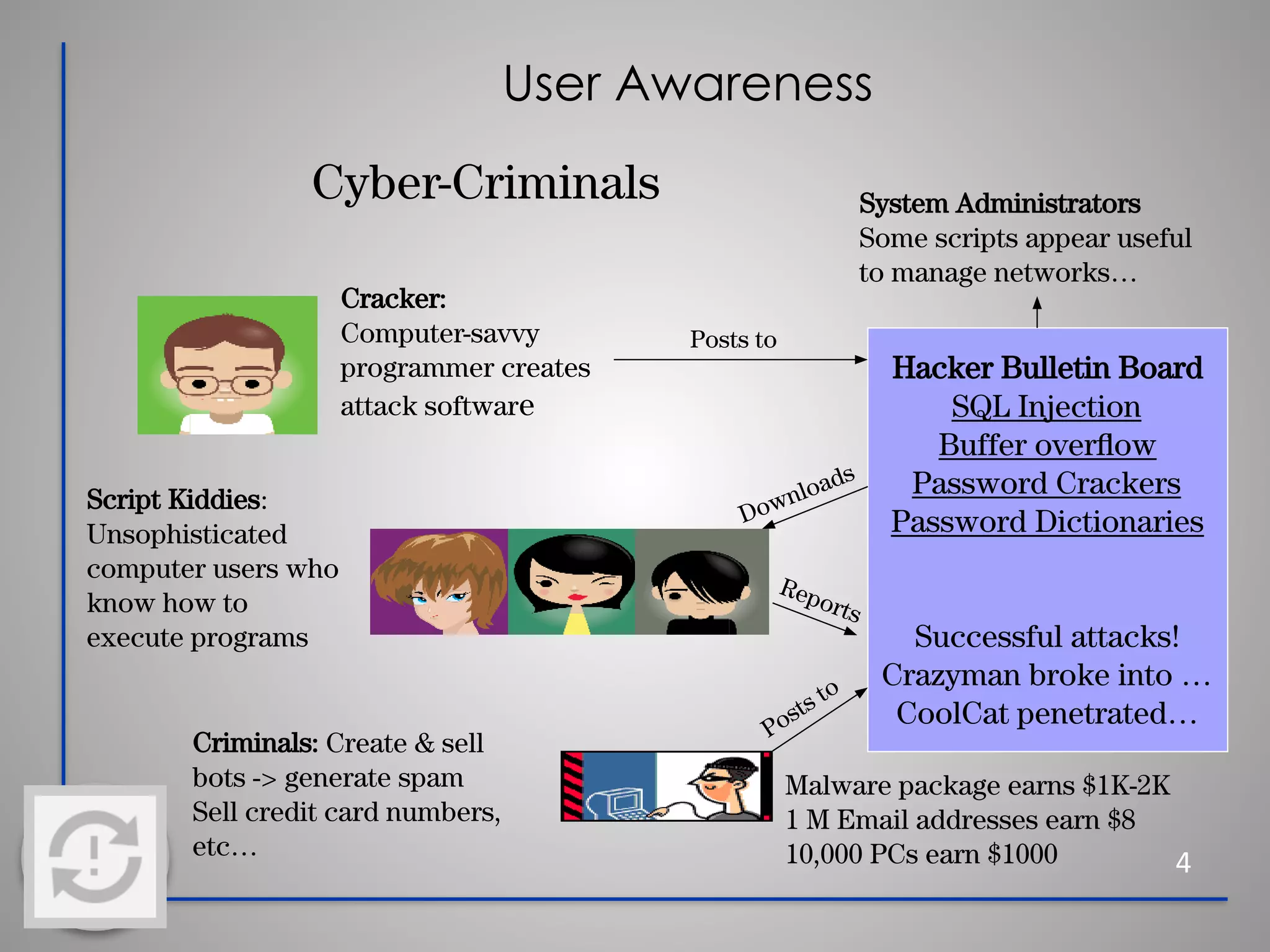
Cyber-Criminals
Cracker:
Computer-savvy
programmer creates
attack software
Script Kiddies:
Unsophisticated
computer users who
know how to
execute programs
Hacker Bulletin Board
SQL Injection
Buffer overflow
Password Crackers
Password Dictionaries
Successful attacks!
Crazyman broke into …
CoolCat penetrated…
Criminals: Create & sell
bots -> generate spam
Sell credit card numbers,
etc…
System Administrators
Some scripts appear useful
to manage networks…
Malware package earns $1K-2K
1 M Email addresses earn $8
10,000 PCs earn $1000
Posts to
Downloads
Posts to
Reports
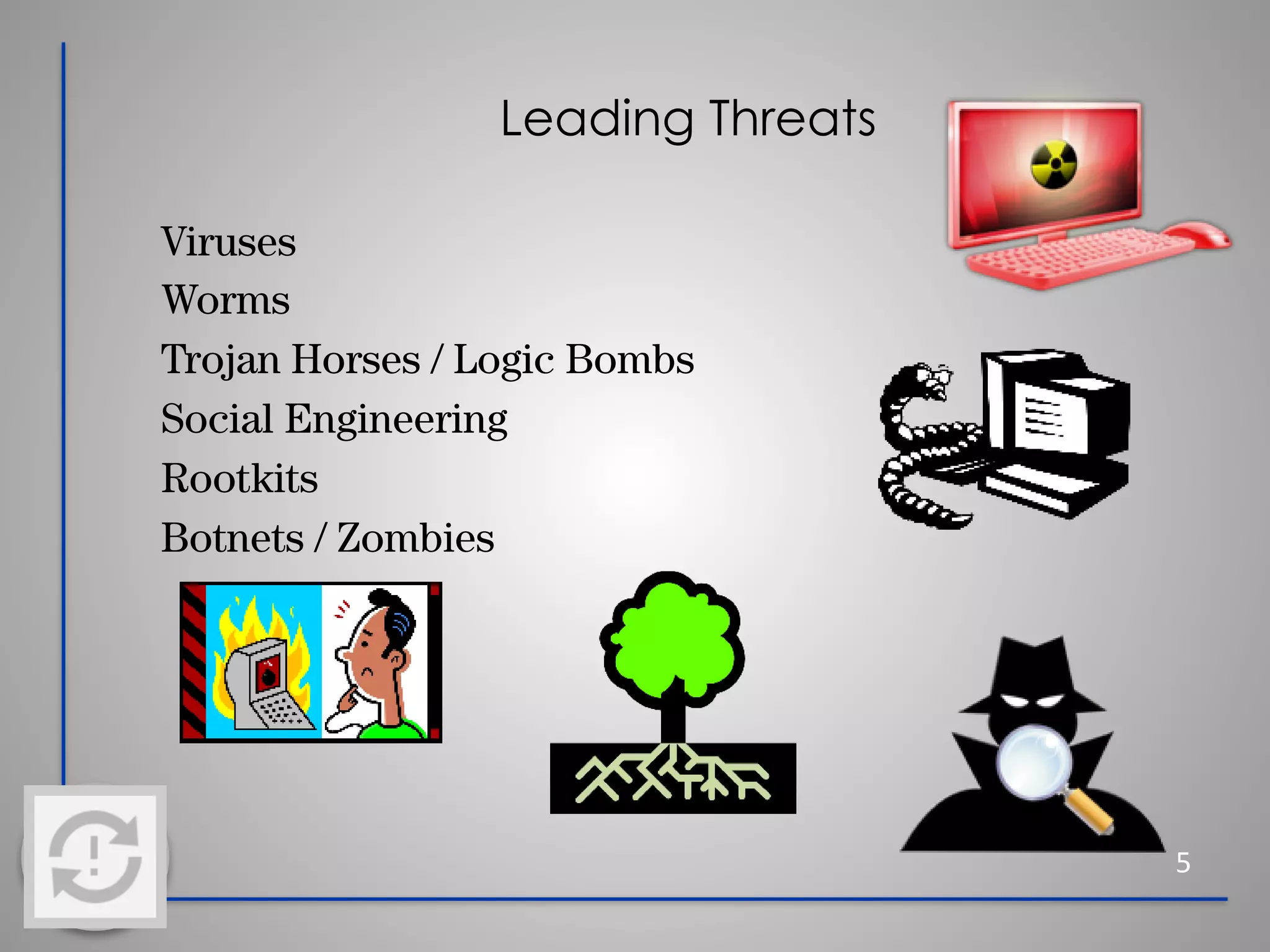
Leading Threats
5
Viruses
Worms
Trojan Horses / Logic Bombs
Social Engineering
Rootkits
Botnets / Zombies
Viruses
6
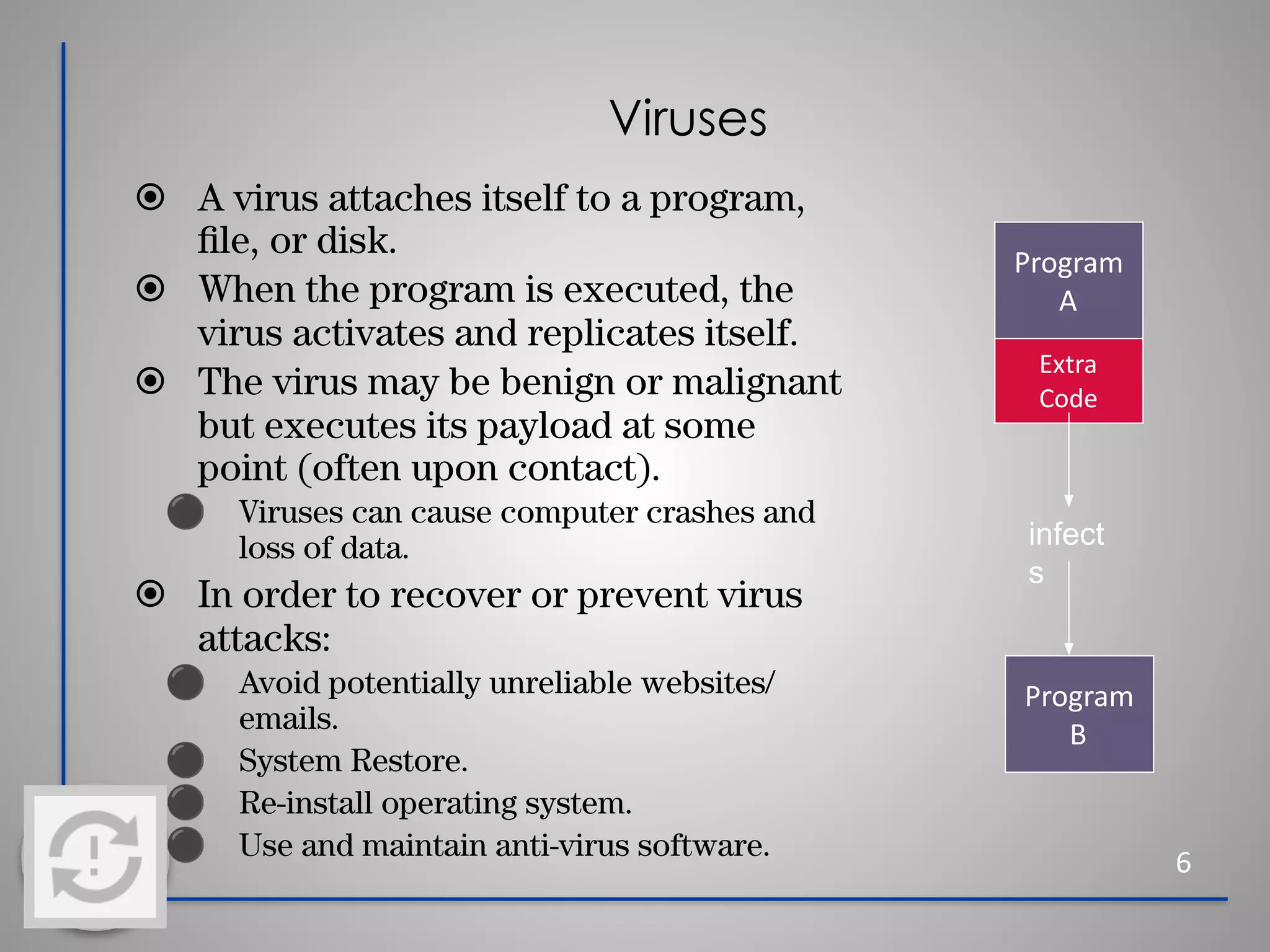
⦿ A virus attaches itself to a program,
file, or disk.
⦿ When the program is executed, the
virus activates and replicates itself.
⦿ The virus may be benign or malignant
but executes its payload at some
point (often upon contact).
⚫ Viruses can cause computer crashes and
loss of data.
⦿ In order to recover or prevent virus
attacks:
⚫ Avoid potentially unreliable websites/
emails.
⚫ System Restore.
⚫ Re-install operating system.
⚫ Use and maintain anti-virus software.
Program
A
Extra
Code
Program
B
infect
s
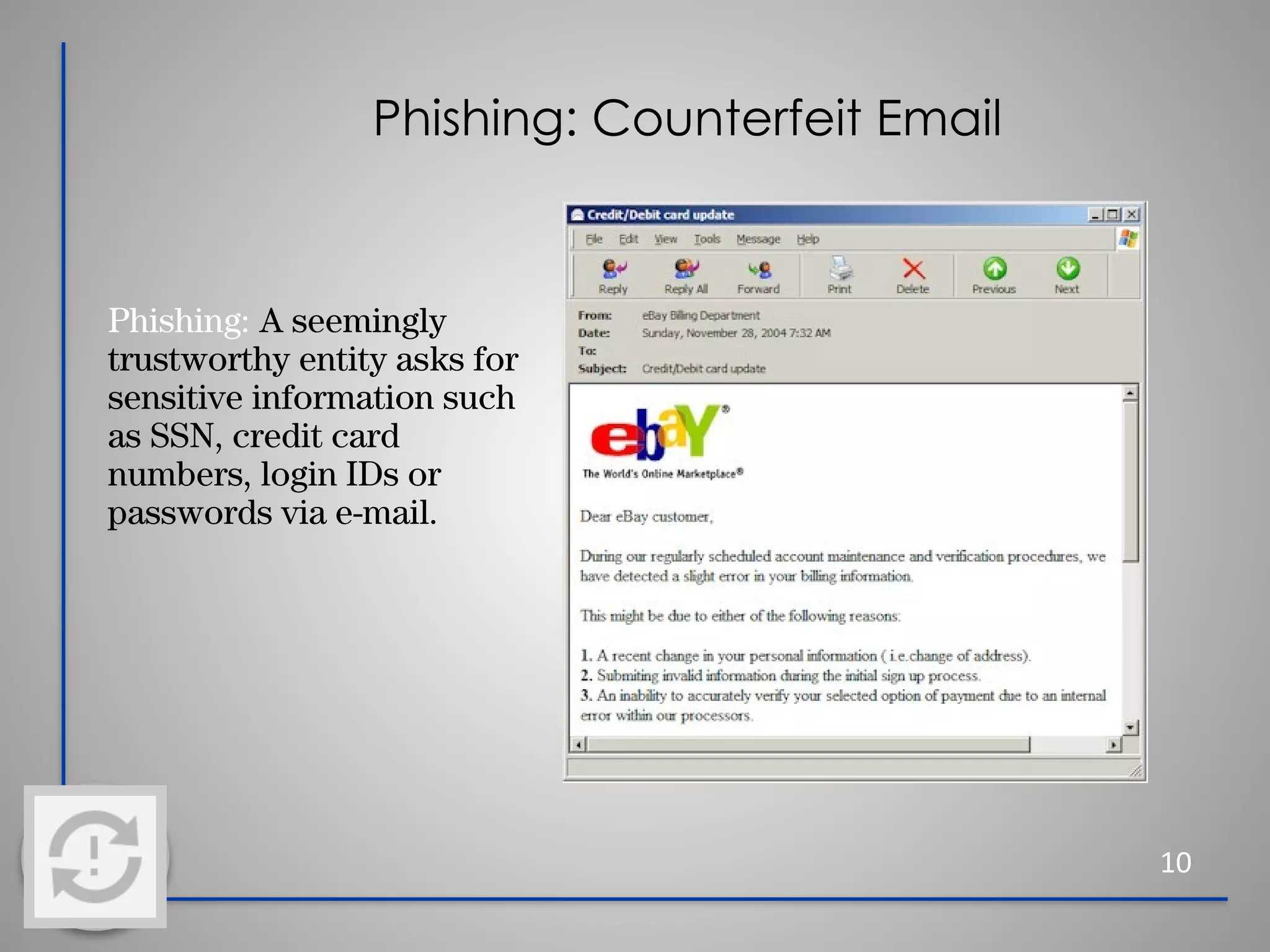
Phishing: Counterfeit Email
10
Phishing: A seemingly
trustworthy entity asks for
sensitive information such
as SSN, credit card
numbers, login IDs or
passwords via e-mail.
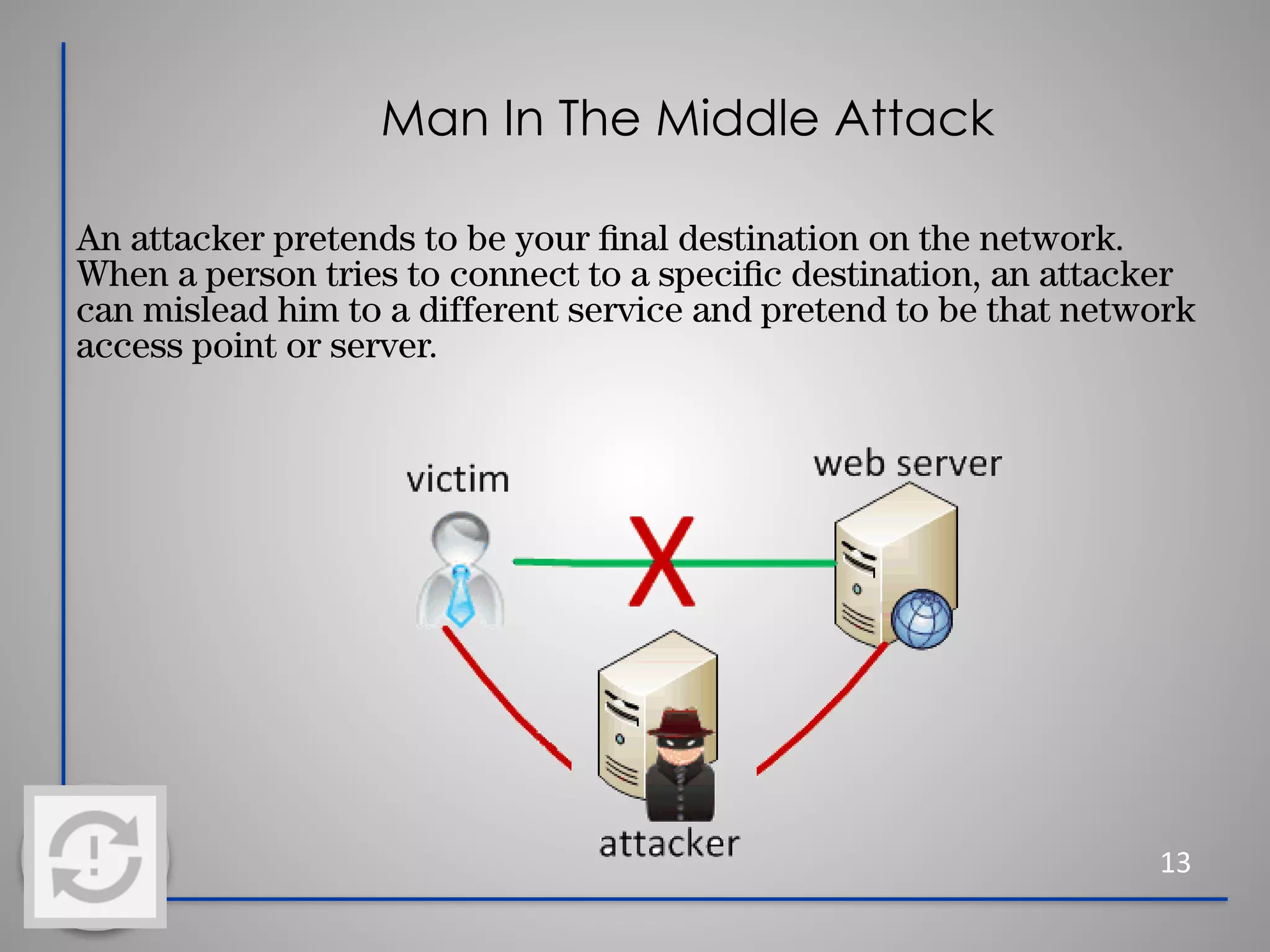
Man In The Middle Attack
13
An attacker pretends to be your final destination on the network.
When a person tries to connect to a specific destination, an attacker
can mislead him to a different service and pretend to be that network
access point or server.
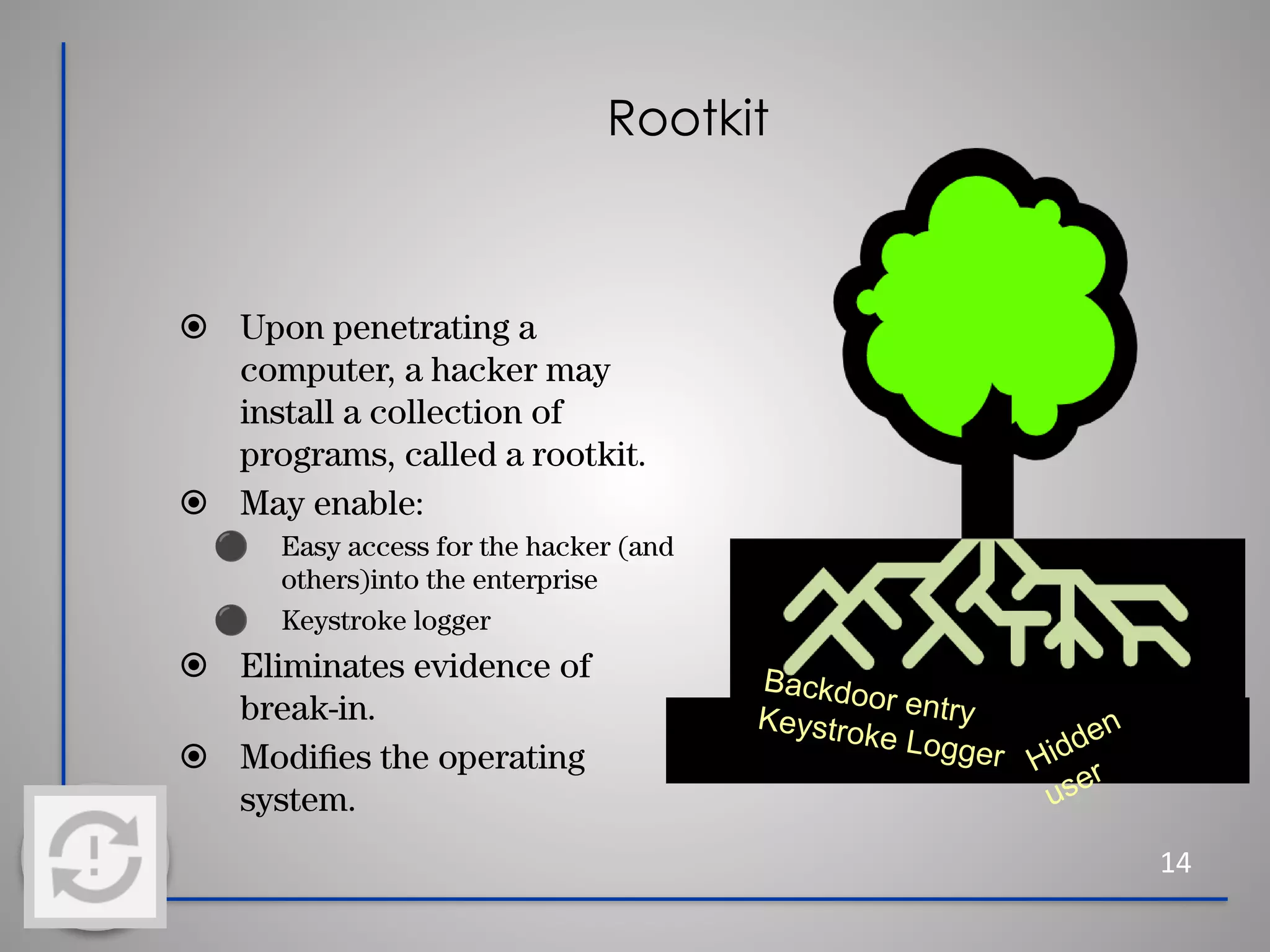
Rootkit
14
⦿ Upon penetrating a
computer, a hacker may
install a collection of
programs, called a rootkit.
⦿ May enable:
⚫ Easy access for the hacker (and
others)into the enterprise
⚫ Keystroke logger
⦿ Eliminates evidence of
break-in.
⦿ Modifies the operating
system.
Backdoor entry
Keystroke Logger Hidden
user
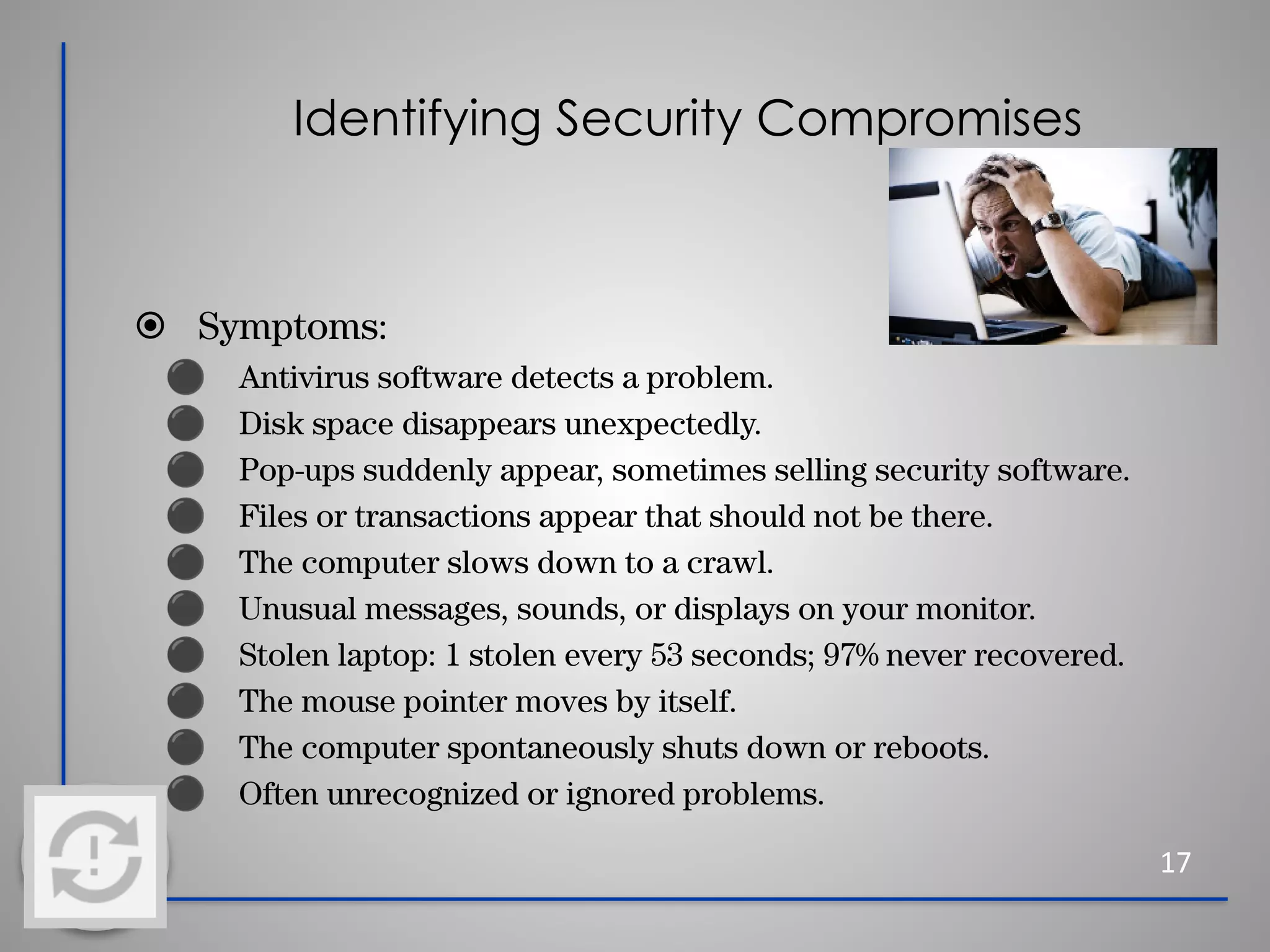
Identifying Security Compromises
17
⦿ Symptoms:
⚫ Antivirus software detects a problem.
⚫ Disk space disappears unexpectedly.
⚫ Pop-ups suddenly appear, sometimes selling security software.
⚫ Files or transactions appear that should not be there.
⚫ The computer slows down to a crawl.
⚫ Unusual messages, sounds, or displays on your monitor.
⚫ Stolen laptop: 1 stolen every 53 seconds; 97% never recovered.
⚫ The mouse pointer moves by itself.
⚫ The computer spontaneously shuts down or reboots.
⚫ Often unrecognized or ignored problems.
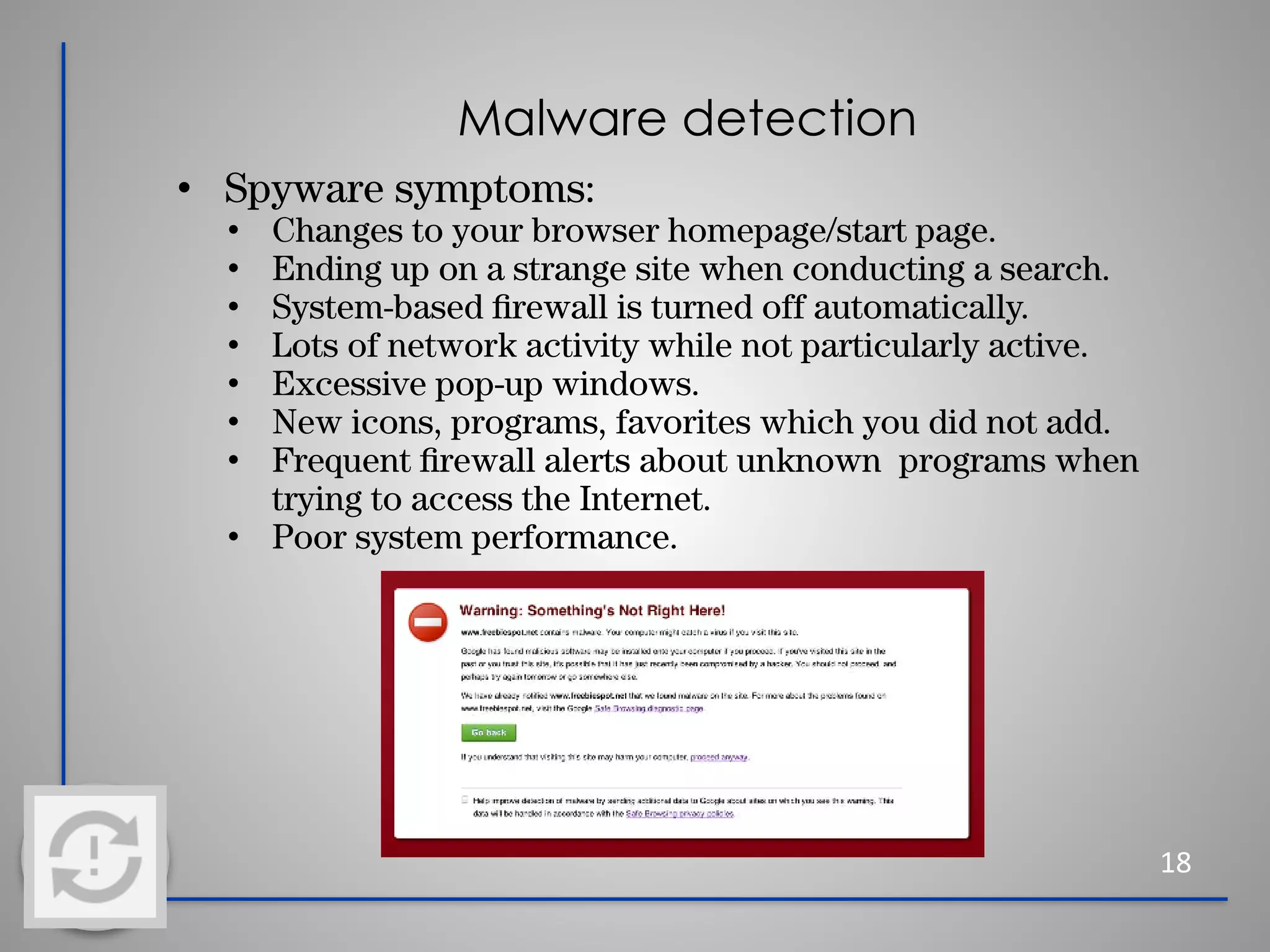
Malware detection
18
• Spyware symptoms:
• Changes to your browser homepage/start page.
• Ending up on a strange site when conducting a search.
• System-based firewall is turned off automatically.
• Lots of network activity while not particularly active.
• Excessive pop-up windows.
• New icons, programs, favorites which you did not add.
• Frequent firewall alerts about unknown programs when
trying to access the Internet.
• Poor system performance.
Anti-virus and Anti-spyware Software
20
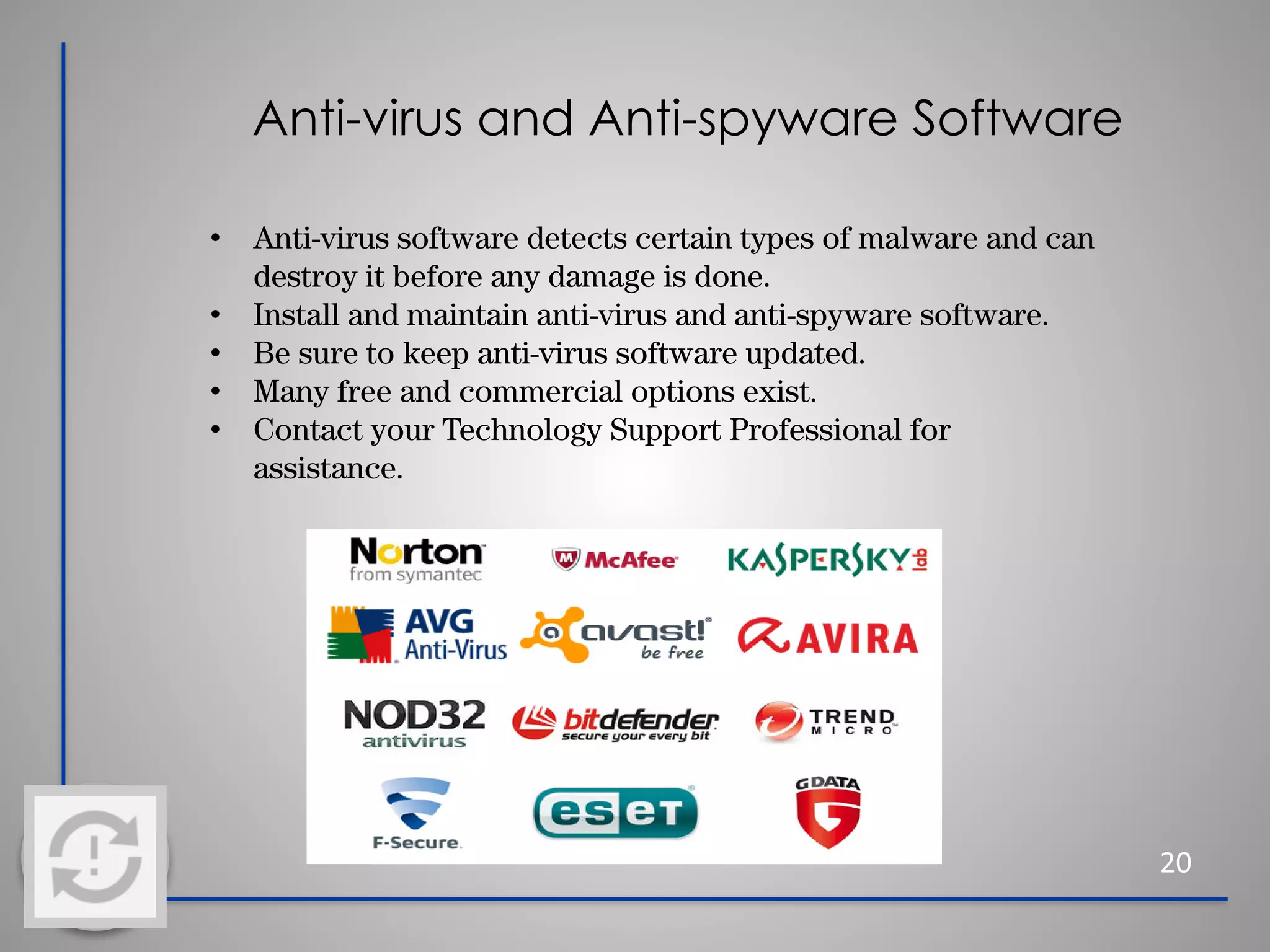
• Anti-virus software detects certain types of malware and can
destroy it before any damage is done.
• Install and maintain anti-virus and anti-spyware software.
• Be sure to keep anti-virus software updated.
• Many free and commercial options exist.
• Contact your Technology Support Professional for
assistance.
Protect your Operating System
22
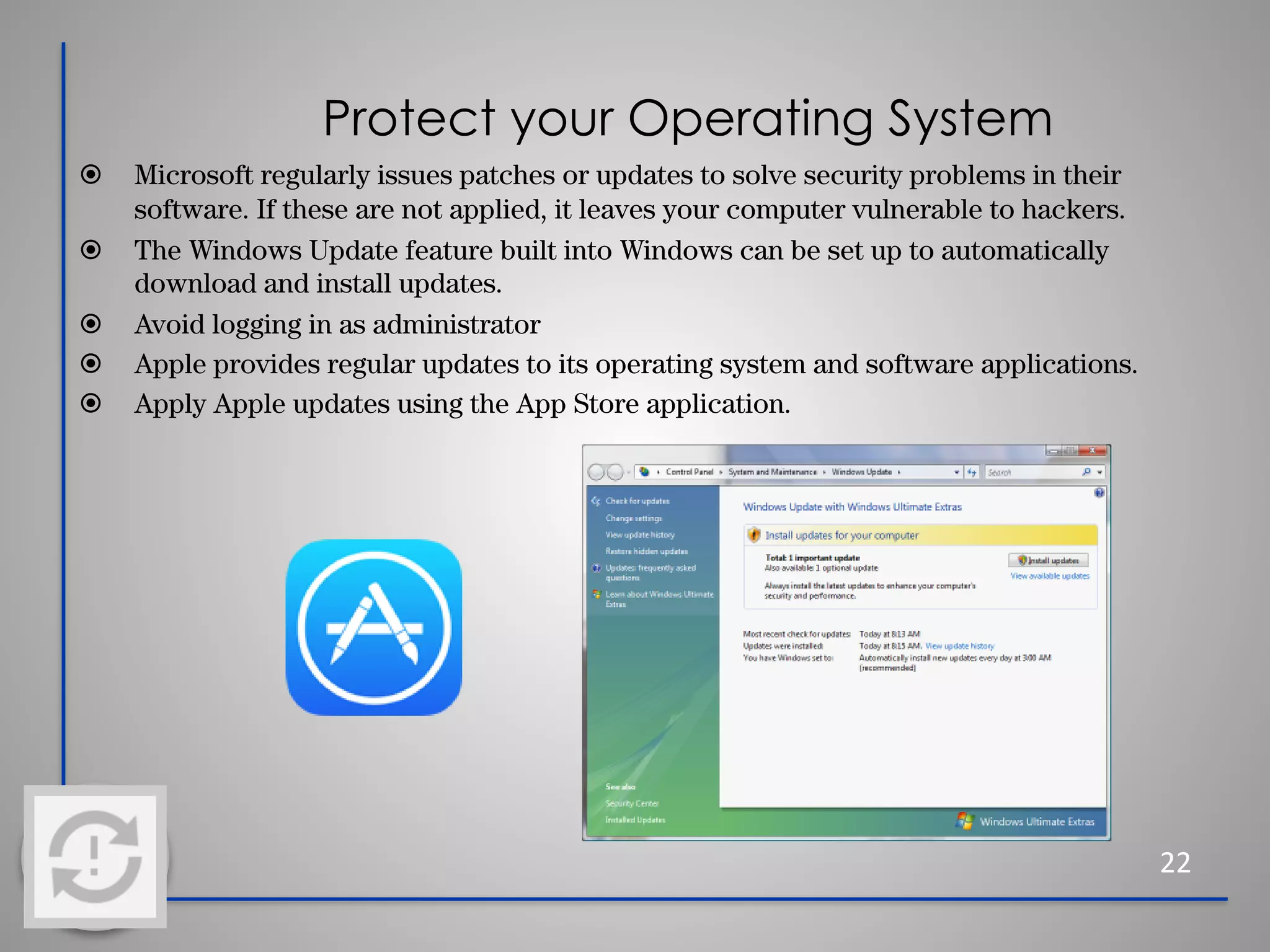
⦿ Microsoft regularly issues patches or updates to solve security problems in their
software. If these are not applied, it leaves your computer vulnerable to hackers.
⦿ The Windows Update feature built into Windows can be set up to automatically
download and install updates.
⦿ Avoid logging in as administrator
⦿ Apple provides regular updates to its operating system and software applications.
⦿ Apply Apple updates using the App Store application.
Use Strong Passwords
Make passwords easy to remember but hard to guess
• USG standards:
• Be at least ten characters in length
• Must contain characters from at least two of the following
four types of characters:
– English upper case (A-Z)
– English lower case (a-z)
– Numbers (0-9)
– Non-alphanumeric special characters ($, !, %, ^, …)
• Must not contain the user’s name or part of the user’s name
• Must not contain easily accessible or guessable personal
information about the user or user’s family, such as birthdays,
children’s names, addresses, etc.
23
Creating Strong Passwords
• A familiar quote can be a good start:
• Using the organization standard as a guide, choose
the first character of each word:
• LIASMWTFOS
• Now add complexity the standard requires:
• L1A$mwTF0S (10 characters, 2 numerals, 1 symbol, mixed
English case: password satisfies all 4 types).
• Or be more creative!
24
“LOVE IS A SMOKE MADE WITH THE FUME OF SIGHS”
William Shakespeare
Avoid Stupid Hacker Tricks
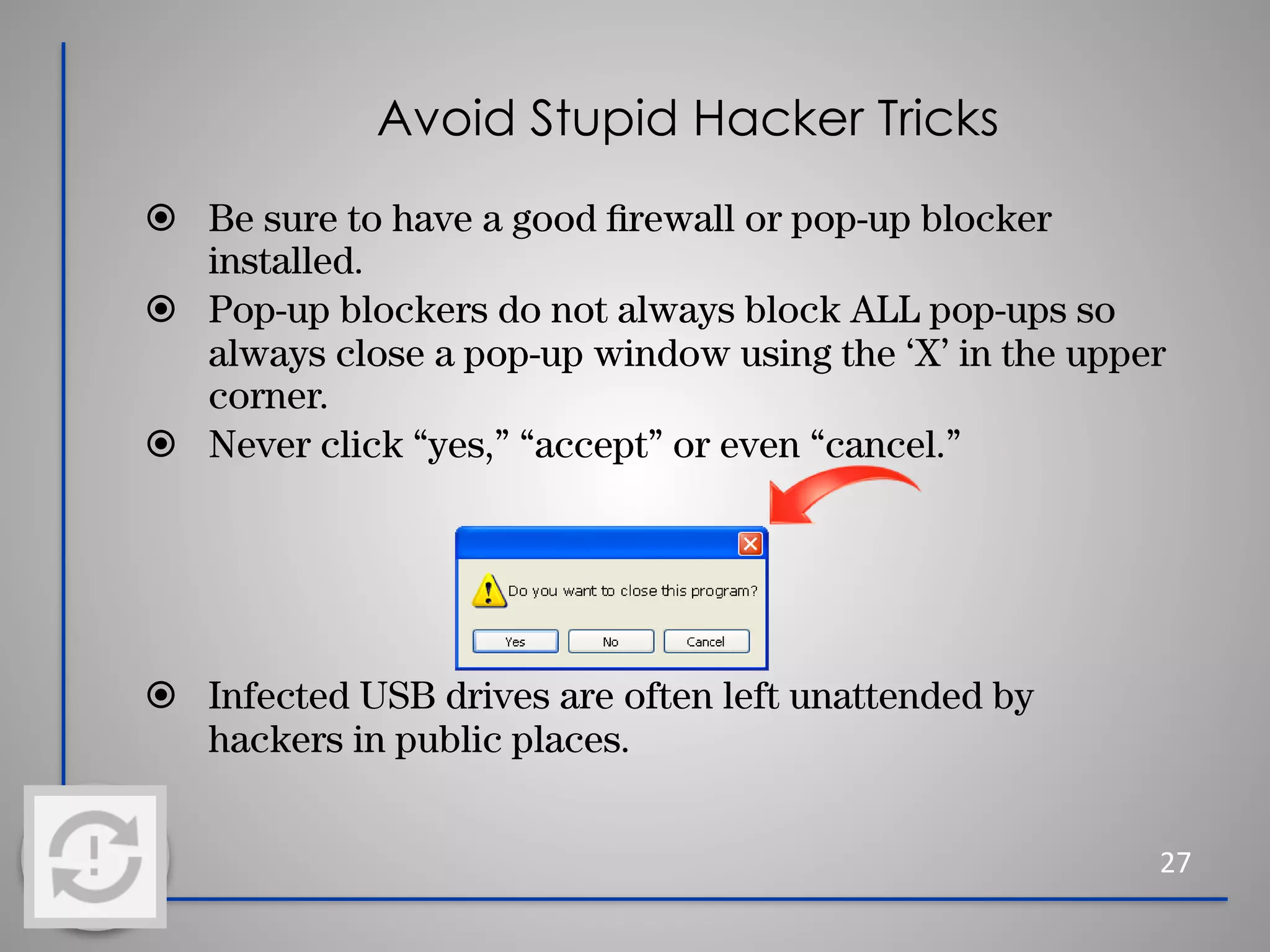
⦿ Be sure to have a good firewall or pop-up blocker
installed.
⦿ Pop-up blockers do not always block ALL pop-ups so
always close a pop-up window using the ‘X’ in the upper
corner.
⦿ Never click “yes,” “accept” or even “cancel.”
⦿ Infected USB drives are often left unattended by
hackers in public places.
27
Secure Business Transactions
28
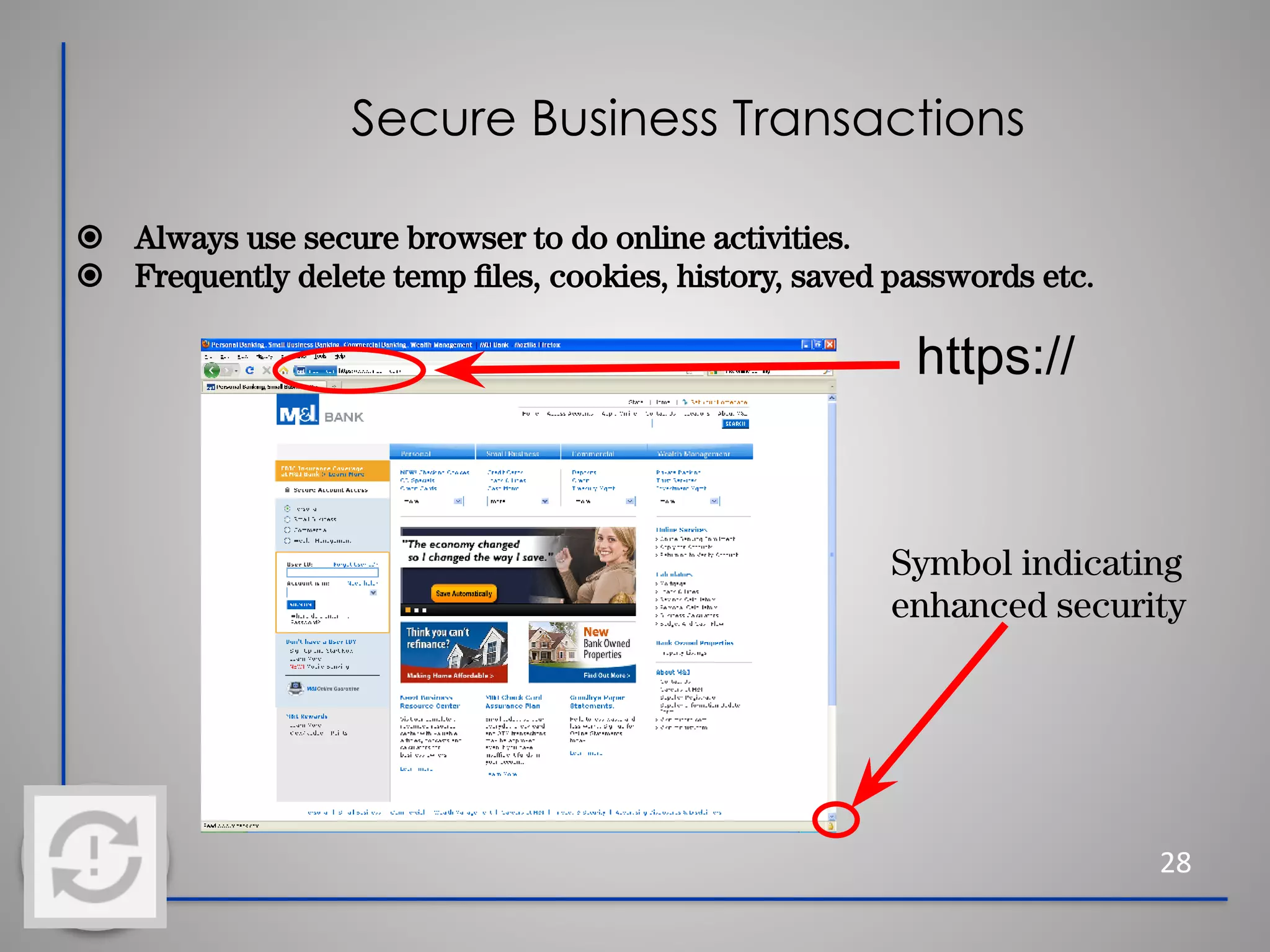
⦿ Always use secure browser to do online activities.
⦿ Frequently delete temp files, cookies, history, saved passwords etc.
https://
Symbol indicating
enhanced security
Backup Important Information
29
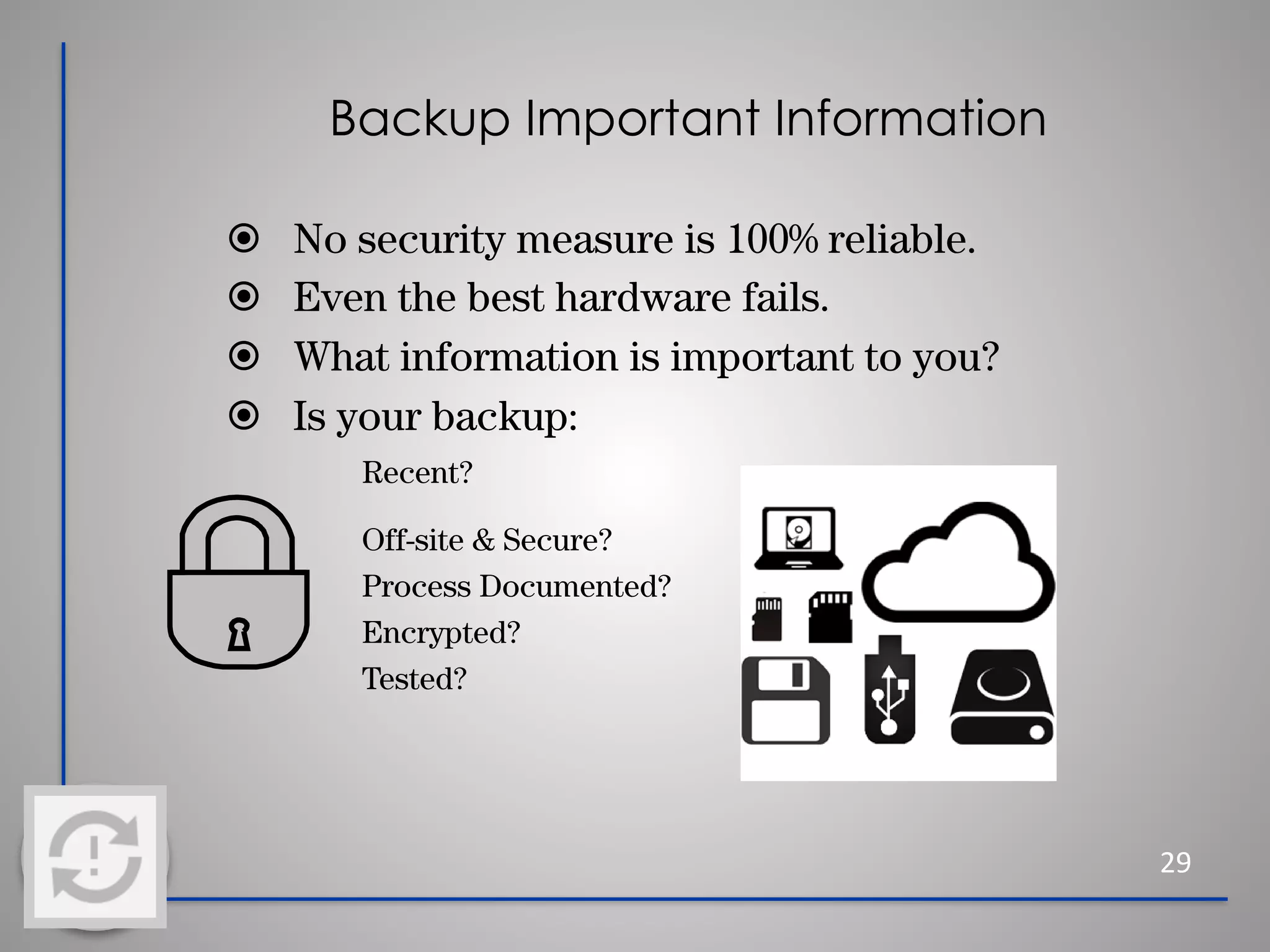
⦿ No security measure is 100% reliable.
⦿ Even the best hardware fails.
⦿ What information is important to you?
⦿ Is your backup:
Recent?
Off-site & Secure?
Process Documented?
Encrypted?
Tested?
Cyber Incident Reporting
30
If you suspect a cybersecurity incident, notify your organization’s
help desk or the USG ITS help desk immediately. Be prepared to
supply the details you know and contact information.
1. Do not attempt to investigate or remediate the incident on your
own.
2. Inform other users of the system and instruct them to stop work
immediately.
3. Unless instructed, do not power down the machine.
4. Unless instructed, do not remove the system from the network.
The cybersecurity incident response team will contact you as soon
as possible to gather additional information.
Each USG organization is required to have a specific plan to handle
cybersecurity incidents. Refer to local policies, standards and
guidelines for specific information.
13
Thank you

cyber security presentation (1).pdf

  • 1.
    SOCIAL INNOVATION GROUP 10 1 GROUPMEMBERS- H0- Siddarth G4- Medha J2- Samaikya J8- Ram Murthy K0- Sai Pramod
  • 2.
  • 3.
    Importance of Cybersecurity ⦿The internet allows an attacker to work from anywhere on the planet. ⦿ Risks caused by poor security knowledge and practice: ⚫ Identity Theft ⚫ Monetary Theft ⚫ Legal Ramifications (for yourself and your organization) ⚫ Sanctions or termination if policies are not followed ⦿ According to the SANS Institute, the top vectors for vulnerabilities available to a cyber criminal are: ⚫ Web Browser ⚫ IM Clients ⚫ Web Applications ⚫ Excessive User Rights 2
  • 4.
    Cybersecurity is Safety Security:We must protect our computers and data in the same way that we secure the doors to our homes. Safety: We must behave in ways that protect us against risks and threats that come with technology. 3
  • 5.
    User Awareness 4 Cyber-Criminals Cracker: Computer-savvy programmer creates attacksoftware Script Kiddies: Unsophisticated computer users who know how to execute programs Hacker Bulletin Board SQL Injection Buffer overflow Password Crackers Password Dictionaries Successful attacks! Crazyman broke into … CoolCat penetrated… Criminals: Create & sell bots -> generate spam Sell credit card numbers, etc… System Administrators Some scripts appear useful to manage networks… Malware package earns $1K-2K 1 M Email addresses earn $8 10,000 PCs earn $1000 Posts to Downloads Posts to Reports
  • 6.
    Leading Threats 5 Viruses Worms Trojan Horses/ Logic Bombs Social Engineering Rootkits Botnets / Zombies
  • 7.
    Viruses 6 ⦿ A virusattaches itself to a program, file, or disk. ⦿ When the program is executed, the virus activates and replicates itself. ⦿ The virus may be benign or malignant but executes its payload at some point (often upon contact). ⚫ Viruses can cause computer crashes and loss of data. ⦿ In order to recover or prevent virus attacks: ⚫ Avoid potentially unreliable websites/ emails. ⚫ System Restore. ⚫ Re-install operating system. ⚫ Use and maintain anti-virus software. Program A Extra Code Program B infect s
  • 8.
    Phishing: Counterfeit Email 10 Phishing:A seemingly trustworthy entity asks for sensitive information such as SSN, credit card numbers, login IDs or passwords via e-mail.
  • 9.
    Man In TheMiddle Attack 13 An attacker pretends to be your final destination on the network. When a person tries to connect to a specific destination, an attacker can mislead him to a different service and pretend to be that network access point or server.
  • 10.
    Rootkit 14 ⦿ Upon penetratinga computer, a hacker may install a collection of programs, called a rootkit. ⦿ May enable: ⚫ Easy access for the hacker (and others)into the enterprise ⚫ Keystroke logger ⦿ Eliminates evidence of break-in. ⦿ Modifies the operating system. Backdoor entry Keystroke Logger Hidden user
  • 11.
    Identifying Security Compromises 17 ⦿Symptoms: ⚫ Antivirus software detects a problem. ⚫ Disk space disappears unexpectedly. ⚫ Pop-ups suddenly appear, sometimes selling security software. ⚫ Files or transactions appear that should not be there. ⚫ The computer slows down to a crawl. ⚫ Unusual messages, sounds, or displays on your monitor. ⚫ Stolen laptop: 1 stolen every 53 seconds; 97% never recovered. ⚫ The mouse pointer moves by itself. ⚫ The computer spontaneously shuts down or reboots. ⚫ Often unrecognized or ignored problems.
  • 12.
    Malware detection 18 • Spywaresymptoms: • Changes to your browser homepage/start page. • Ending up on a strange site when conducting a search. • System-based firewall is turned off automatically. • Lots of network activity while not particularly active. • Excessive pop-up windows. • New icons, programs, favorites which you did not add. • Frequent firewall alerts about unknown programs when trying to access the Internet. • Poor system performance.
  • 13.
    Anti-virus and Anti-spywareSoftware 20 • Anti-virus software detects certain types of malware and can destroy it before any damage is done. • Install and maintain anti-virus and anti-spyware software. • Be sure to keep anti-virus software updated. • Many free and commercial options exist. • Contact your Technology Support Professional for assistance.
  • 14.
    Protect your OperatingSystem 22 ⦿ Microsoft regularly issues patches or updates to solve security problems in their software. If these are not applied, it leaves your computer vulnerable to hackers. ⦿ The Windows Update feature built into Windows can be set up to automatically download and install updates. ⦿ Avoid logging in as administrator ⦿ Apple provides regular updates to its operating system and software applications. ⦿ Apply Apple updates using the App Store application.
  • 15.
    Use Strong Passwords Makepasswords easy to remember but hard to guess • USG standards: • Be at least ten characters in length • Must contain characters from at least two of the following four types of characters: – English upper case (A-Z) – English lower case (a-z) – Numbers (0-9) – Non-alphanumeric special characters ($, !, %, ^, …) • Must not contain the user’s name or part of the user’s name • Must not contain easily accessible or guessable personal information about the user or user’s family, such as birthdays, children’s names, addresses, etc. 23
  • 16.
    Creating Strong Passwords •A familiar quote can be a good start: • Using the organization standard as a guide, choose the first character of each word: • LIASMWTFOS • Now add complexity the standard requires: • L1A$mwTF0S (10 characters, 2 numerals, 1 symbol, mixed English case: password satisfies all 4 types). • Or be more creative! 24 “LOVE IS A SMOKE MADE WITH THE FUME OF SIGHS” William Shakespeare
  • 17.
    Avoid Stupid HackerTricks ⦿ Be sure to have a good firewall or pop-up blocker installed. ⦿ Pop-up blockers do not always block ALL pop-ups so always close a pop-up window using the ‘X’ in the upper corner. ⦿ Never click “yes,” “accept” or even “cancel.” ⦿ Infected USB drives are often left unattended by hackers in public places. 27
  • 18.
    Secure Business Transactions 28 ⦿Always use secure browser to do online activities. ⦿ Frequently delete temp files, cookies, history, saved passwords etc. https:// Symbol indicating enhanced security
  • 19.
    Backup Important Information 29 ⦿No security measure is 100% reliable. ⦿ Even the best hardware fails. ⦿ What information is important to you? ⦿ Is your backup: Recent? Off-site & Secure? Process Documented? Encrypted? Tested?
  • 20.
    Cyber Incident Reporting 30 Ifyou suspect a cybersecurity incident, notify your organization’s help desk or the USG ITS help desk immediately. Be prepared to supply the details you know and contact information. 1. Do not attempt to investigate or remediate the incident on your own. 2. Inform other users of the system and instruct them to stop work immediately. 3. Unless instructed, do not power down the machine. 4. Unless instructed, do not remove the system from the network. The cybersecurity incident response team will contact you as soon as possible to gather additional information. Each USG organization is required to have a specific plan to handle cybersecurity incidents. Refer to local policies, standards and guidelines for specific information.
  • 21.