In today’s world , Challenges in the Cyber
space has been the national security,
organizations ranging from small to large
enterprises, government and private
universities, hospitals, all prone to cyber-
attacks from across the globe.
Cybercrime violates individuals' privacy
and the security of their data, particularly
hacking, malware, identity theft, financial fraud,
medical fraud, and certain offences against persons that involve
the revealing of personal information, messages, images, and
video and audio recordings without individuals' consent.
As we know there are numbers of challenges in the Cyber Space and
also increasing day-by-day. From that one of the main challenge is
Hacking.
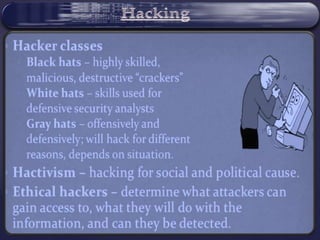
Hacking is the catch-all term for any
type of misuse of a computer to break
the security of another computing
system to steal data, corrupt systems or
files, commandeer the environment or
disrupt data-related activities in any
way.
It is an attempt to exploit a
computer system or a private network
inside a computer. Simply put, it is the
unauthorise access to or control over
computer network security systems for
some illicit purpose.
To counter the Hacking Challenge of the Cyber Space. A Recent
development in method took place whose article published on 27/Feb/2020
by Kim Horner.
Instead of blocking hackers, a new cyber
security actually welcomes them.The
method, called
DEEP-Dig (DEcEPtion DIGging),
Ushers (assist) intruders into
a decoy site so the computer can learn
from hackers’ tactics. The information is
then used to train the computer to recognize
and stop future attacks.
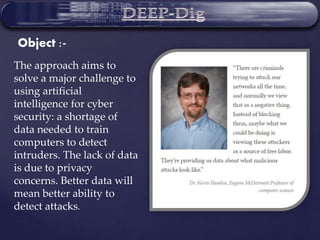
The approach aims to
solve a major challenge to
using artificial
intelligence for cyber
security: a shortage of
data needed to train
computers to detect
intruders. The lack of data
is due to privacy
concerns. Better data will
mean better ability to
detect attacks.
Object :-
Hackers typically begin with their simplest
tricks and then use increasingly
sophisticated tactics , But most cyber
defense programs try to disrupt intruders
before anyone can monitor the intruders’
techniques.
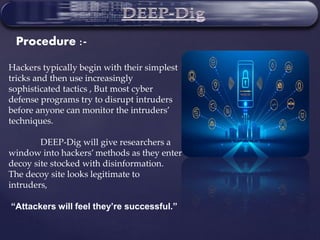
DEEP-Dig will give researchers a
window into hackers’ methods as they enter a
decoy site stocked with disinformation.
The decoy site looks legitimate to
intruders,
“Attackers will feel they’re successful.”
Procedure :-
 DEEP-Dig advances a rapidly growing
cyber security field known as deception
technology, which involves setting traps for
hackers. Researchers hope that the
approach can be especially useful for
defense organizations.
 As hackers’ tactics change, DEEP-Dig could
help cyber security defense
systems keep up with their new tricks.
 While DEEP-Dig aims to outsmart hackers,
is it possible that hackers could have the last
laugh if they realize they have entered a
decoy site and try to deceive the program ,
they only destroy the decoy one.
Application:-
Ref.:-https://www.utdallas.edu/news/science-technology/crook-sourcing-hackers-
cybersecurity-2020/
for your patience till end

Cyber Security Method (Deep - Dig) & challenge's ppt by G S Shaktawat

  • 2.
    In today’s world, Challenges in the Cyber space has been the national security, organizations ranging from small to large enterprises, government and private universities, hospitals, all prone to cyber- attacks from across the globe. Cybercrime violates individuals' privacy and the security of their data, particularly hacking, malware, identity theft, financial fraud, medical fraud, and certain offences against persons that involve the revealing of personal information, messages, images, and video and audio recordings without individuals' consent.
  • 3.
    As we knowthere are numbers of challenges in the Cyber Space and also increasing day-by-day. From that one of the main challenge is Hacking. Hacking is the catch-all term for any type of misuse of a computer to break the security of another computing system to steal data, corrupt systems or files, commandeer the environment or disrupt data-related activities in any way. It is an attempt to exploit a computer system or a private network inside a computer. Simply put, it is the unauthorise access to or control over computer network security systems for some illicit purpose.
  • 5.
    To counter theHacking Challenge of the Cyber Space. A Recent development in method took place whose article published on 27/Feb/2020 by Kim Horner. Instead of blocking hackers, a new cyber security actually welcomes them.The method, called DEEP-Dig (DEcEPtion DIGging), Ushers (assist) intruders into a decoy site so the computer can learn from hackers’ tactics. The information is then used to train the computer to recognize and stop future attacks.
  • 6.
    The approach aimsto solve a major challenge to using artificial intelligence for cyber security: a shortage of data needed to train computers to detect intruders. The lack of data is due to privacy concerns. Better data will mean better ability to detect attacks. Object :-
  • 7.
    Hackers typically beginwith their simplest tricks and then use increasingly sophisticated tactics , But most cyber defense programs try to disrupt intruders before anyone can monitor the intruders’ techniques. DEEP-Dig will give researchers a window into hackers’ methods as they enter a decoy site stocked with disinformation. The decoy site looks legitimate to intruders, “Attackers will feel they’re successful.” Procedure :-
  • 8.
     DEEP-Dig advancesa rapidly growing cyber security field known as deception technology, which involves setting traps for hackers. Researchers hope that the approach can be especially useful for defense organizations.  As hackers’ tactics change, DEEP-Dig could help cyber security defense systems keep up with their new tricks.  While DEEP-Dig aims to outsmart hackers, is it possible that hackers could have the last laugh if they realize they have entered a decoy site and try to deceive the program , they only destroy the decoy one. Application:-
  • 9.