Cyber Security
Introduction
Definitions and Principles
Cyber Crime
• Cyber crimes are, as the name implies, crimes
committed using computers, phones or the internet.
• Some types of cyber crime include:
• Illegal interception of data.
• System interferences.
• Copyrights infringements.
• Sale of illegal items.
3
Cyber Security
• Cyber security is the body of technologies, processes
and practices involved in protecting individuals and
organizations from cyber crime.
• It is designed to protect integrity of networks,
computers, programs and data from attack, damage
or unauthorized access.
4
Kill Chain, Zero-
day attack,
ransomware,
alert fatigue and
Man-in the
middle attack
are just a few
examples of
common cyber
attacks.
Cyber Security Principles
There are five key principles in cyber security:
• Confidentiality
• Integrity
• Availability
• Accountability
• Auditability
5
Cyber Security Principle Definitions
• Confidentiality:
• A set of rules that limits access or place
restrictions on certain type of information.
• Integrity:
• Assurance that the information is trustworthy
and accurate.
• Availability:
• The guarantee of reliable access to the
information by authorized people.
6
Cyber Security Principle Definitions
• Accountability:
• Is an assurance that an individual or an
organization will be evaluated on their
performance or behaviour related to something
for which they are responsible.
• Auditability:
• A security audit is a systematic evaluation of
the security of a company’s information system
by measuring how well it conforms to a set of
established criteria.
7
Cyber Threats
Cyber Threat
• A Cyber threat is any malicious act that attempts to
gain access to a computer network without
authorization or permission from the owners.
• It refers to the wide range of malicious activities that
can damage or disrupt a computer system, a network
or the information it contain.
• Most common cyber threats: Social Engineered
Trojans, Unpatched Software, Phishing, Network
worms, etc.
9
Sources of Cyber Threats
• Cyber threats can come from a wide variety of
sources, some notable examples include:
• National governments.
• Terrorists.
• Industrial secret agents.
• Rogue employees.
• Hackers.
• Business competitors.
• Organization insiders.
10
Anyone with a
motive and the
needed
technology can
create cyber
threats.
Cyber Threat Classifications
• Threats can be classified by multiple criteria:
• Attacker's Resources
• Attacker's Organization
• Attacker's Funding
• On basis of these criteria, threats are of 3 types:
• Unstructured Threats
• Structured Threats
• Highly Structured threats
11
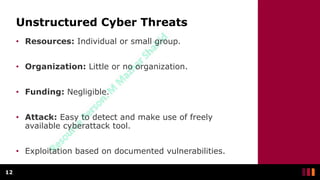
Unstructured Cyber Threats
• Resources: Individual or small group.
• Organization: Little or no organization.
• Funding: Negligible.
• Attack: Easy to detect and make use of freely
available cyberattack tool.
• Exploitation based on documented vulnerabilities.
12
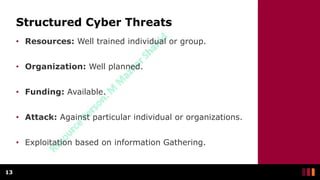
Structured Cyber Threats
• Resources: Well trained individual or group.
• Organization: Well planned.
• Funding: Available.
• Attack: Against particular individual or organizations.
• Exploitation based on information Gathering.
13
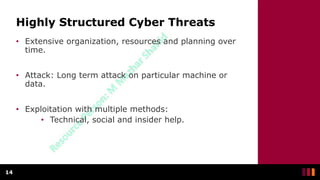
Highly Structured Cyber Threats
• Extensive organization, resources and planning over
time.
• Attack: Long term attack on particular machine or
data.
• Exploitation with multiple methods:
• Technical, social and insider help.
14
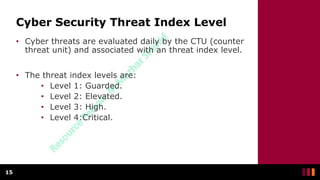
Cyber Security Threat Index Level
• Cyber threats are evaluated daily by the CTU (counter
threat unit) and associated with an threat index level.
• The threat index levels are:
• Level 1: Guarded.
• Level 2: Elevated.
• Level 3: High.
• Level 4:Critical.
15
Cyber Attacks
Types of Cyber Attacks
• Advanced Persistent Threat (APT):
• A network attack in which an unauthorized
person gains access to network and stays there
undetected for a long period of time.
• Backdoor:
• Method of bypassing normal authentication and
gaining access in OS or application.
17
Types of Cyber Attacks Continued
• Buffer Overflow:
• An exploit that takes advantage of the program
that is waiting for a user’s input.
• Man-in-the-middle Attack
• This attack intercepts and relays messages
between two parties who are communicating
directly with each other.
18
Types of Cyber Attacks Continued
• Cross-Site Scripting (XSS):
• A code injection attack that allows an attacker
to execute malicious JavaScript in another
user’s browser.
• Denial of Service Attack:
• Any attack where the attackers attempt to
prevent the authorized users from accessing
the service.
19
Types of Cyber Attacks Continued
• SQL injection:
• A very common exploited web application
vulnerability that allows malicious hacker to
steal and alter data in website’s database.
• Zero-day exploit:
• A vulnerability in a system or device that has
been disclosed but is not yet patched.
20
Impacts of Cyber Attacks
• A successful cyber attack can cause major damage to
organizations or systems, as well as to business
reputation and consumer trust.
• Some potential results include:
• Financial loss.
• Reputational damage.
• Legal consequences.
21
Malicious Code
Types of Malicious Code
• Virus:
• Malicious software program, when it is
executed, it replicates itself by modifying other
computer programs and inserting its own code.
• Network Worm:
• Standalone malware which replicates itself in
order to spread to other computers.
23
Types of Malicious Code Continued
• Trojan Horse:
• A program that claims to free your computer
from viruses but instead introduces viruses
onto your system.
• Botnet:
• Used to perform distributed denial-of-service
attack (DDoS attack), steal data, send spam,
and allow the attacker access to the device and
its connection.
24
Types of Malicious Code Continued
• Keylogger:
• A type of surveillance technology used to
monitor and record each keystroke typed on
specific computer’s keyboard.
• Rootkit:
• Collection of tools or programs that enable
administrator-level access to computer or
computer network.
25
Types of Malicious Code Continued
• Spyware:
• Software that is hidden from the user in order
to gather information about internet interaction,
keystrokes, passwords, and other valuable
data.
• Adware:
• Designed to display advertisements on your
computer and redirect your search requests to
advertising websites to collect marketing data
about you.
26
Types of Malicious Code Continued
• Ransomware:
• Malware that prevents or limits users from
accessing their system, either by locking the
system’s screen or by locking the user’s files
unless a ransom is paid.
27
Vulnerabilities
What is a Vulnerability?
• A cyber-security term that refers to a flaw in a system
that can leave it open to attack.
• Vulnerability is the composition of three elements:
1. A flaw in system.
2. Access of attacker to that flaw.
3. Capability of attacker to exploit the flaw.
29
Classification of Vulnerabilities
• Vulnerabilities are classified according to the asset:
• Hardware.
• Software.
• Network.
• Personal.
• Physical site.
• Organizational.
30
Causes
• Some of the vulnerability in the system occur due to:
• Missing patches.
• Cleartext credentials.
• Using unencrypted channels.
• RF Emanation.
31

Cyber Security Introduction project comprehensive

  • 1.
  • 2.
  • 3.
    Cyber Crime • Cybercrimes are, as the name implies, crimes committed using computers, phones or the internet. • Some types of cyber crime include: • Illegal interception of data. • System interferences. • Copyrights infringements. • Sale of illegal items. 3
  • 4.
    Cyber Security • Cybersecurity is the body of technologies, processes and practices involved in protecting individuals and organizations from cyber crime. • It is designed to protect integrity of networks, computers, programs and data from attack, damage or unauthorized access. 4 Kill Chain, Zero- day attack, ransomware, alert fatigue and Man-in the middle attack are just a few examples of common cyber attacks.
  • 5.
    Cyber Security Principles Thereare five key principles in cyber security: • Confidentiality • Integrity • Availability • Accountability • Auditability 5
  • 6.
    Cyber Security PrincipleDefinitions • Confidentiality: • A set of rules that limits access or place restrictions on certain type of information. • Integrity: • Assurance that the information is trustworthy and accurate. • Availability: • The guarantee of reliable access to the information by authorized people. 6
  • 7.
    Cyber Security PrincipleDefinitions • Accountability: • Is an assurance that an individual or an organization will be evaluated on their performance or behaviour related to something for which they are responsible. • Auditability: • A security audit is a systematic evaluation of the security of a company’s information system by measuring how well it conforms to a set of established criteria. 7
  • 8.
  • 9.
    Cyber Threat • ACyber threat is any malicious act that attempts to gain access to a computer network without authorization or permission from the owners. • It refers to the wide range of malicious activities that can damage or disrupt a computer system, a network or the information it contain. • Most common cyber threats: Social Engineered Trojans, Unpatched Software, Phishing, Network worms, etc. 9
  • 10.
    Sources of CyberThreats • Cyber threats can come from a wide variety of sources, some notable examples include: • National governments. • Terrorists. • Industrial secret agents. • Rogue employees. • Hackers. • Business competitors. • Organization insiders. 10 Anyone with a motive and the needed technology can create cyber threats.
  • 11.
    Cyber Threat Classifications •Threats can be classified by multiple criteria: • Attacker's Resources • Attacker's Organization • Attacker's Funding • On basis of these criteria, threats are of 3 types: • Unstructured Threats • Structured Threats • Highly Structured threats 11
  • 12.
    Unstructured Cyber Threats •Resources: Individual or small group. • Organization: Little or no organization. • Funding: Negligible. • Attack: Easy to detect and make use of freely available cyberattack tool. • Exploitation based on documented vulnerabilities. 12
  • 13.
    Structured Cyber Threats •Resources: Well trained individual or group. • Organization: Well planned. • Funding: Available. • Attack: Against particular individual or organizations. • Exploitation based on information Gathering. 13
  • 14.
    Highly Structured CyberThreats • Extensive organization, resources and planning over time. • Attack: Long term attack on particular machine or data. • Exploitation with multiple methods: • Technical, social and insider help. 14
  • 15.
    Cyber Security ThreatIndex Level • Cyber threats are evaluated daily by the CTU (counter threat unit) and associated with an threat index level. • The threat index levels are: • Level 1: Guarded. • Level 2: Elevated. • Level 3: High. • Level 4:Critical. 15
  • 16.
  • 17.
    Types of CyberAttacks • Advanced Persistent Threat (APT): • A network attack in which an unauthorized person gains access to network and stays there undetected for a long period of time. • Backdoor: • Method of bypassing normal authentication and gaining access in OS or application. 17
  • 18.
    Types of CyberAttacks Continued • Buffer Overflow: • An exploit that takes advantage of the program that is waiting for a user’s input. • Man-in-the-middle Attack • This attack intercepts and relays messages between two parties who are communicating directly with each other. 18
  • 19.
    Types of CyberAttacks Continued • Cross-Site Scripting (XSS): • A code injection attack that allows an attacker to execute malicious JavaScript in another user’s browser. • Denial of Service Attack: • Any attack where the attackers attempt to prevent the authorized users from accessing the service. 19
  • 20.
    Types of CyberAttacks Continued • SQL injection: • A very common exploited web application vulnerability that allows malicious hacker to steal and alter data in website’s database. • Zero-day exploit: • A vulnerability in a system or device that has been disclosed but is not yet patched. 20
  • 21.
    Impacts of CyberAttacks • A successful cyber attack can cause major damage to organizations or systems, as well as to business reputation and consumer trust. • Some potential results include: • Financial loss. • Reputational damage. • Legal consequences. 21
  • 22.
  • 23.
    Types of MaliciousCode • Virus: • Malicious software program, when it is executed, it replicates itself by modifying other computer programs and inserting its own code. • Network Worm: • Standalone malware which replicates itself in order to spread to other computers. 23
  • 24.
    Types of MaliciousCode Continued • Trojan Horse: • A program that claims to free your computer from viruses but instead introduces viruses onto your system. • Botnet: • Used to perform distributed denial-of-service attack (DDoS attack), steal data, send spam, and allow the attacker access to the device and its connection. 24
  • 25.
    Types of MaliciousCode Continued • Keylogger: • A type of surveillance technology used to monitor and record each keystroke typed on specific computer’s keyboard. • Rootkit: • Collection of tools or programs that enable administrator-level access to computer or computer network. 25
  • 26.
    Types of MaliciousCode Continued • Spyware: • Software that is hidden from the user in order to gather information about internet interaction, keystrokes, passwords, and other valuable data. • Adware: • Designed to display advertisements on your computer and redirect your search requests to advertising websites to collect marketing data about you. 26
  • 27.
    Types of MaliciousCode Continued • Ransomware: • Malware that prevents or limits users from accessing their system, either by locking the system’s screen or by locking the user’s files unless a ransom is paid. 27
  • 28.
  • 29.
    What is aVulnerability? • A cyber-security term that refers to a flaw in a system that can leave it open to attack. • Vulnerability is the composition of three elements: 1. A flaw in system. 2. Access of attacker to that flaw. 3. Capability of attacker to exploit the flaw. 29
  • 30.
    Classification of Vulnerabilities •Vulnerabilities are classified according to the asset: • Hardware. • Software. • Network. • Personal. • Physical site. • Organizational. 30
  • 31.
    Causes • Some ofthe vulnerability in the system occur due to: • Missing patches. • Cleartext credentials. • Using unencrypted channels. • RF Emanation. 31