CYBER LAWS IN US
The Computer Fraud and Abuse Act of
1986 (CFAA)
• It comes under 18 U.S.C. Sec. 1030.
• CFAA was originally designed to protect computer systems operated
by the U.S. government and some financial institutions.
• The 2008 amendments made the following changes to section 1030:
 Expanded 18 U.S.C. § 1030(a)(7) to criminalize not only explicit threats
to cause damage to a computer, but also threats to
 (1) steal data on a victim's computer,
 (2) publicly disclose stolen data
 Created a criminal offense for conspiring to commit a computer
hacking offense under section 1030.
• It covers the case of Tampering with any computer source code
used for a computer, computer programme, computer system or
computer network (sec 65 in India).
• Hacking with computer system (sec 66 in India).
• Sending offensive or false information through computer or a
communicative device (sec 66A in India).
• Receiving or retaining stolen computer resource or communication
device.(sec 66B).
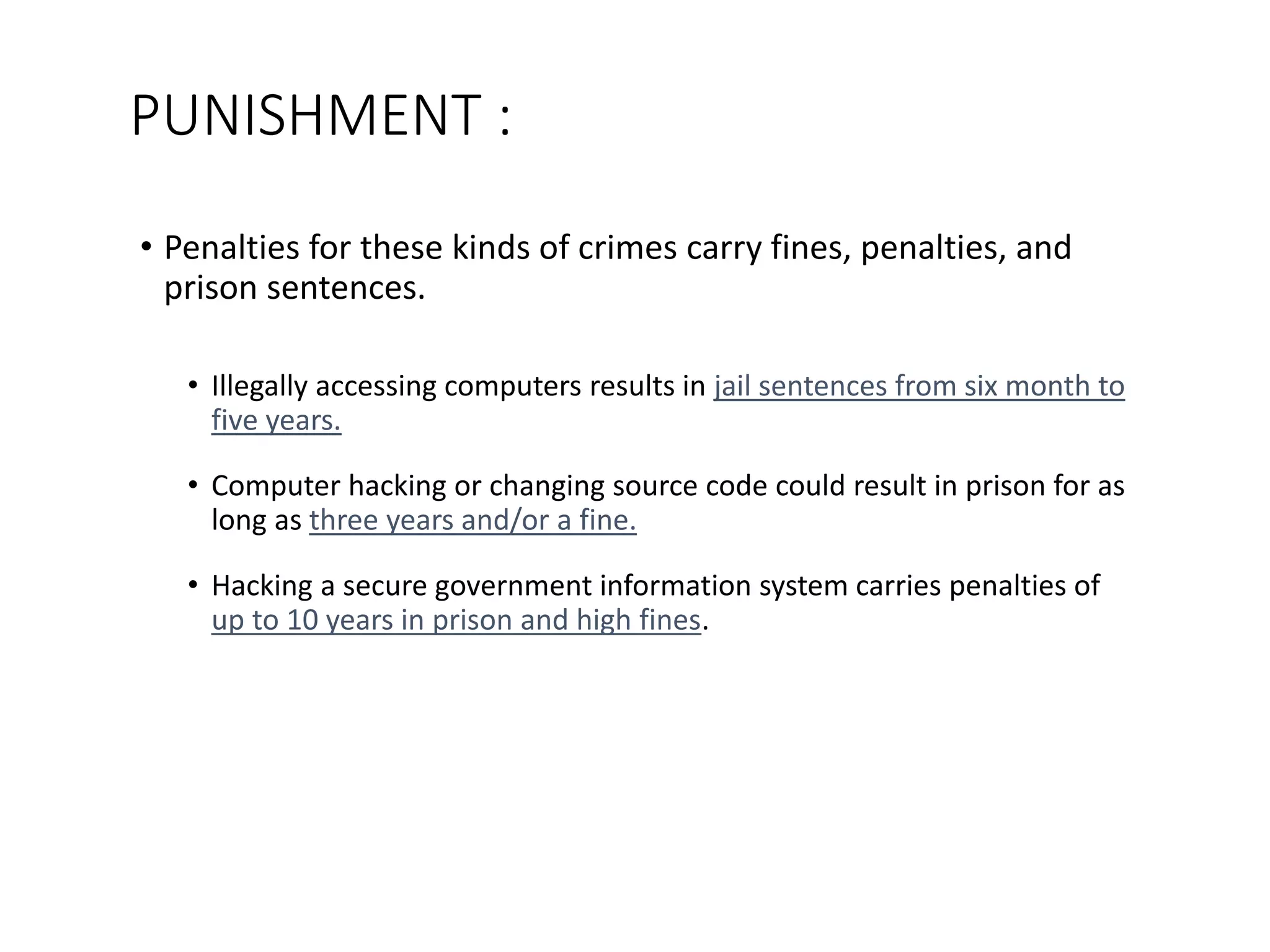
PUNISHMENT :
• Penalties for these kinds of crimes carry fines, penalties, and
prison sentences.
• Illegally accessing computers results in jail sentences from six month to
five years.
• Computer hacking or changing source code could result in prison for as
long as three years and/or a fine.
• Hacking a secure government information system carries penalties of
up to 10 years in prison and high fines.
Certain activities relating to
material constituting or containing child pornography
• It comes under 18 USC 2252 which makes it a federal offence to
knowingly receive child pornography. Child pornography is defined
as: "any visual depiction of "sexually explicit conduct" involving
children”.
• Criminal to be punished more than 25 years of imprisonment.
This is same as Publication and transmission of
containing sexually explicit act or conduct and child
pornography. (sec 67A and 67B in India )
Wiretap Act
• It comes under 18 U.S.C. Sec. 2511.
• This Act prohibits “any person,”
including a law enforcement officer,
from making an illegal interception or
disclosing or using illegally
intercepted material.
• This Act covers three different
offenses :
• Intercepting Communications
• Disclosing an Intercepted
Communication
• Using an Intercepted
Communication
PUNISHMENT :
Imprisonment of atmost five years.
Authorized fines are typically not
more than $250,000 for individuals
and $500,000 for an organization,
unless there is a substantial loss.
This can be considered as Penalty for Breach
of Confidentiality and Privacy defined in sec
72 in India.
Penalty For Misrepresentation
• It comes under 33 U.S. Code § 931.
Any claimant or representative of a claimant who knowingly and
willfully makes a false statement or representation for the purpose of
obtaining a benefit or payment shall be punished.
• Criminal shall be punished by a fine not to exceed $10,000, by
imprisonment not to exceed five years, or by both.
This is same as Penalty for Misrepresentation as defined
in sec 71 in India.
Network Crime Statutes
• These statutes all have their own penalties and fines depending
upon the circumstances under which the offense is committed.
• Unlawful Access to Stored Communications: 18 U.S.C. Sec. 2701
• Identity Theft: 18 U.S.C. Sec. 1028
• Access Device Fraud: 18 U.S.C. Sec. 1029
• CAN-SPAM Act
Unlawful Access to Stored
Communications
• It comes under 18 U.S.C. Sec. 2701 .
• According to this Act whoever –
(A) Intentionally accesses without authorization a facility
through which an electronic communication service is
provided; or
(B) Intentionally exceeds an authorization to access that
facility; and thereby obtains, alters, or prevents
authorized access to a wire or electronic
communication while it is in electronic storage shall be
punished as provided in subsection (b) of this
section.
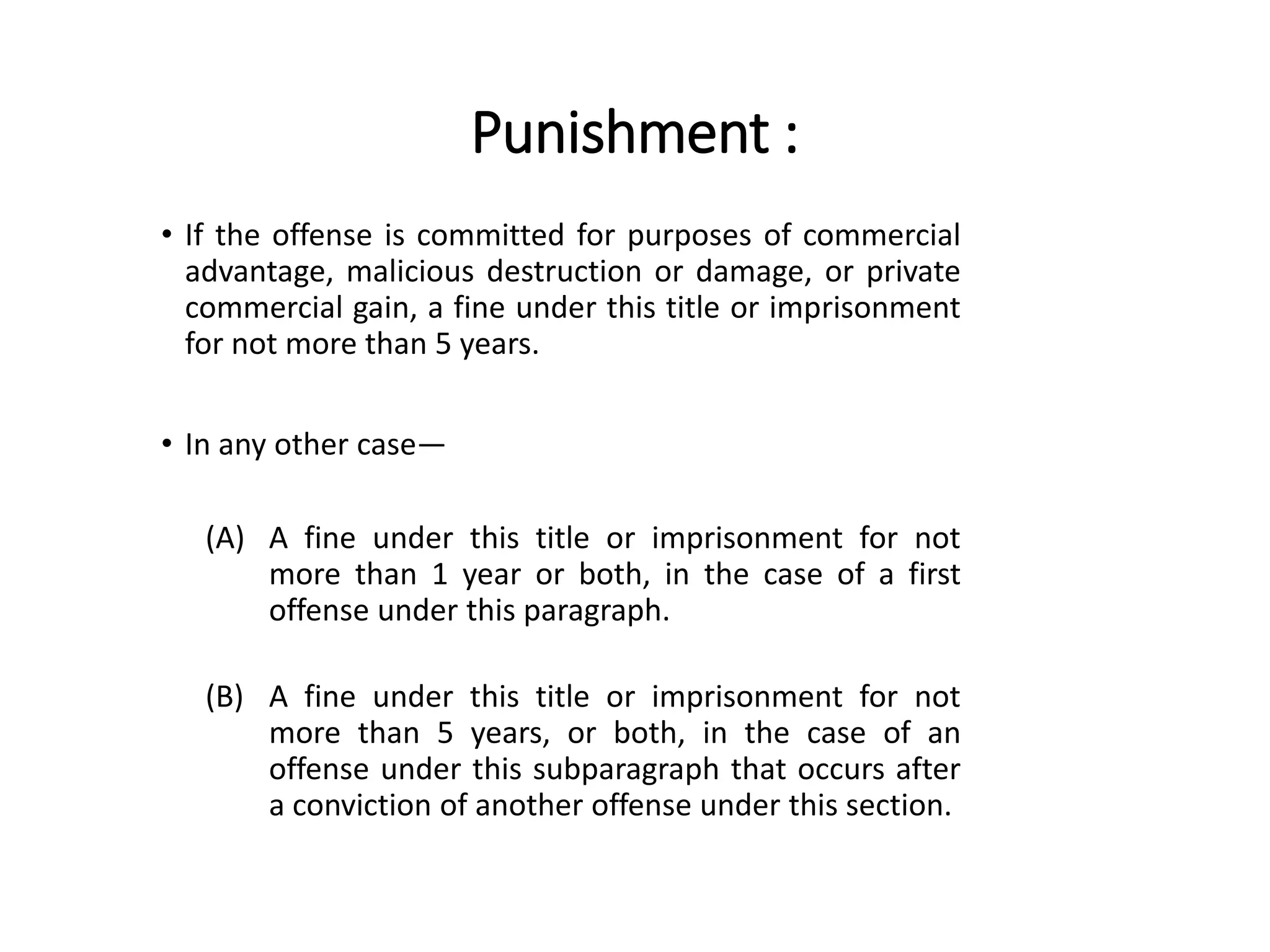
Punishment :
• If the offense is committed for purposes of commercial
advantage, malicious destruction or damage, or private
commercial gain, a fine under this title or imprisonment
for not more than 5 years.
• In any other case—
(A) A fine under this title or imprisonment for not
more than 1 year or both, in the case of a first
offense under this paragraph.
(B) A fine under this title or imprisonment for not
more than 5 years, or both, in the case of an
offense under this subparagraph that occurs after
a conviction of another offense under this section.
Identity Theft:
• It comes under 18 U.S.C. Sec. 1028.
• According to this, Whoever,
(1) knowingly and without lawful authority
produces an identification document,
authentication feature, or a false
identification document.
(2) knowingly transfers or possesses an
authentication feature, or a false
identification document knowing that
such document or feature was stolen
or produced without lawful authority
or feature be used to defraud the
United States, shall be punished as
provided in subsection (b) of this
section.
PUNISHMENT:
Criminal could be imprisoned upto
15 years!!
This is same as Identity theft
defined in sec 66C in India.
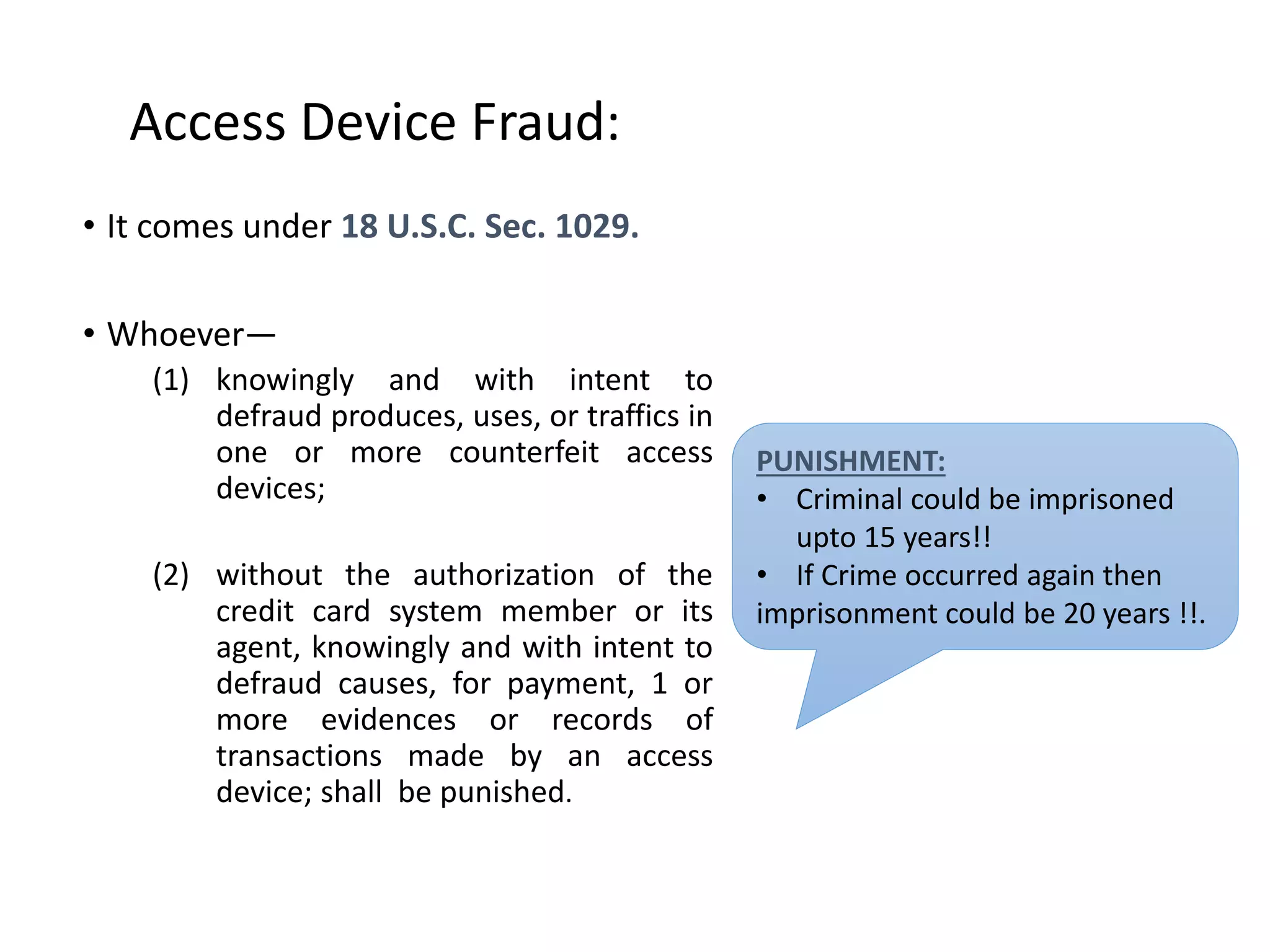
Access Device Fraud:
• It comes under 18 U.S.C. Sec. 1029.
• Whoever—
(1) knowingly and with intent to
defraud produces, uses, or traffics in
one or more counterfeit access
devices;
(2) without the authorization of the
credit card system member or its
agent, knowingly and with intent to
defraud causes, for payment, 1 or
more evidences or records of
transactions made by an access
device; shall be punished.
PUNISHMENT:
• Criminal could be imprisoned
upto 15 years!!
• If Crime occurred again then
imprisonment could be 20 years !!.
CAN-SPAM Act
• It comes under : 18 U.S.C. Sec. 1037.
• Whoever knowingly—
(1) accesses a protected computer without
authorization, and intentionally initiates the
transmission of multiple commercial
electronic mail messages from or through
such computer,
(2) materially falsifies header information in
multiple commercial electronic mail messages
and intentionally initiates the transmission of
such messages, should be punished.
PUNISHMENT:
• Criminal could be
imprisoned between 3-5
years.
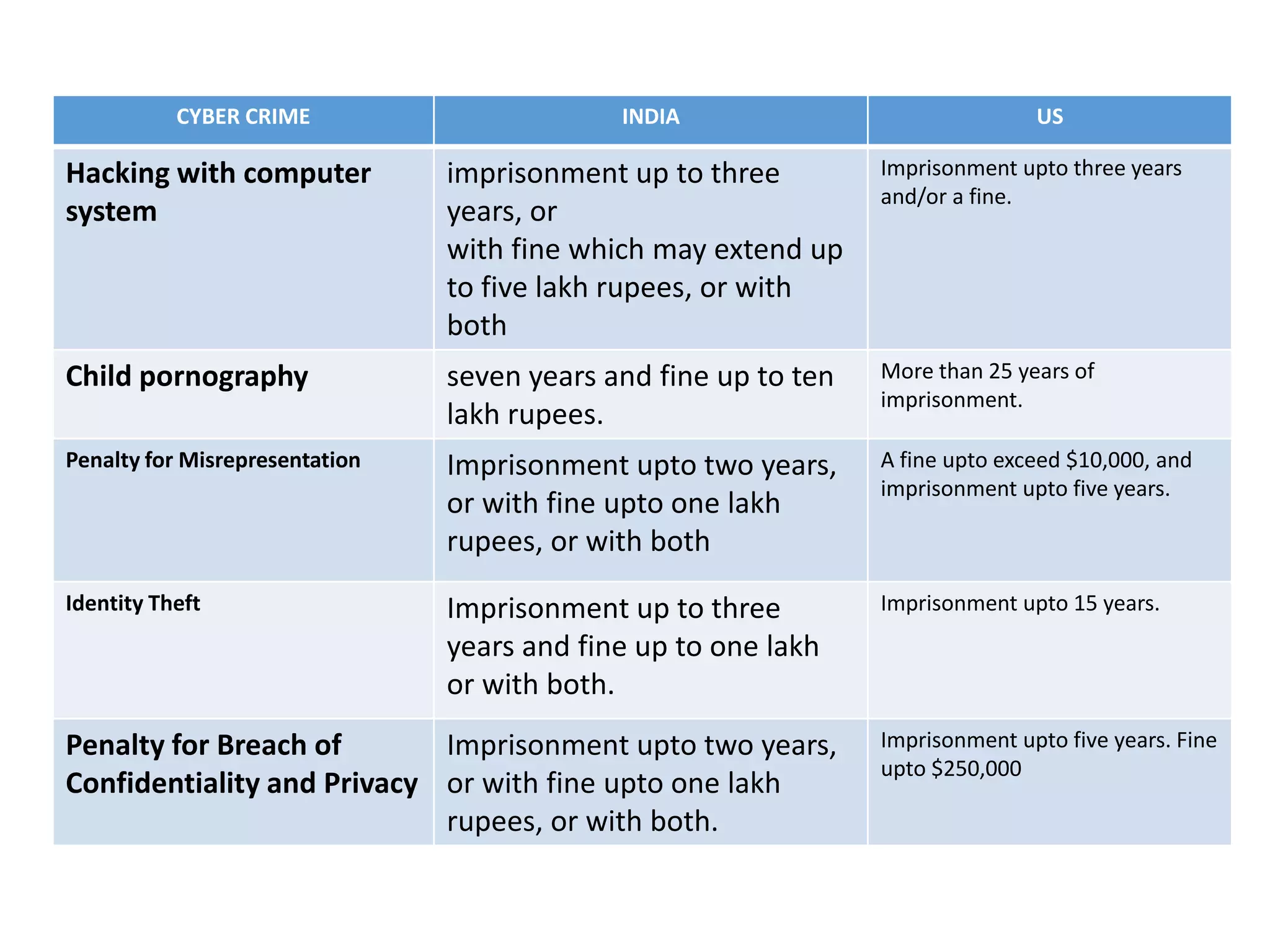
CYBER CRIME INDIA US
Hacking with computer
system
imprisonment up to three
years, or
with fine which may extend up
to five lakh rupees, or with
both
Imprisonment upto three years
and/or a fine.
Child pornography seven years and fine up to ten
lakh rupees.
More than 25 years of
imprisonment.
Penalty for Misrepresentation Imprisonment upto two years,
or with fine upto one lakh
rupees, or with both
A fine upto exceed $10,000, and
imprisonment upto five years.
Identity Theft Imprisonment up to three
years and fine up to one lakh
or with both.
Imprisonment upto 15 years.
Penalty for Breach of
Confidentiality and Privacy
Imprisonment upto two years,
or with fine upto one lakh
rupees, or with both.
Imprisonment upto five years. Fine
upto $250,000
References :
• https://www.johntfloyd.com/guide-cyber-crime-laws/
• http://searchcompliance.techtarget.com/definition/The-
Computer-Fraud-and-Abuse-Act-CFAA
• https://www.law.cornell.edu/uscode/text/18/2701
• https://www.law.cornell.edu/uscode/text/18/1028
• https://www.law.cornell.edu/uscode/text/18/1037

Cyber laws of US

  • 1.
  • 2.
    The Computer Fraudand Abuse Act of 1986 (CFAA) • It comes under 18 U.S.C. Sec. 1030. • CFAA was originally designed to protect computer systems operated by the U.S. government and some financial institutions. • The 2008 amendments made the following changes to section 1030:  Expanded 18 U.S.C. § 1030(a)(7) to criminalize not only explicit threats to cause damage to a computer, but also threats to  (1) steal data on a victim's computer,  (2) publicly disclose stolen data  Created a criminal offense for conspiring to commit a computer hacking offense under section 1030. • It covers the case of Tampering with any computer source code used for a computer, computer programme, computer system or computer network (sec 65 in India). • Hacking with computer system (sec 66 in India). • Sending offensive or false information through computer or a communicative device (sec 66A in India). • Receiving or retaining stolen computer resource or communication device.(sec 66B).
  • 3.
    PUNISHMENT : • Penaltiesfor these kinds of crimes carry fines, penalties, and prison sentences. • Illegally accessing computers results in jail sentences from six month to five years. • Computer hacking or changing source code could result in prison for as long as three years and/or a fine. • Hacking a secure government information system carries penalties of up to 10 years in prison and high fines.
  • 4.
    Certain activities relatingto material constituting or containing child pornography • It comes under 18 USC 2252 which makes it a federal offence to knowingly receive child pornography. Child pornography is defined as: "any visual depiction of "sexually explicit conduct" involving children”. • Criminal to be punished more than 25 years of imprisonment. This is same as Publication and transmission of containing sexually explicit act or conduct and child pornography. (sec 67A and 67B in India )
  • 5.
    Wiretap Act • Itcomes under 18 U.S.C. Sec. 2511. • This Act prohibits “any person,” including a law enforcement officer, from making an illegal interception or disclosing or using illegally intercepted material. • This Act covers three different offenses : • Intercepting Communications • Disclosing an Intercepted Communication • Using an Intercepted Communication PUNISHMENT : Imprisonment of atmost five years. Authorized fines are typically not more than $250,000 for individuals and $500,000 for an organization, unless there is a substantial loss. This can be considered as Penalty for Breach of Confidentiality and Privacy defined in sec 72 in India.
  • 6.
    Penalty For Misrepresentation •It comes under 33 U.S. Code § 931. Any claimant or representative of a claimant who knowingly and willfully makes a false statement or representation for the purpose of obtaining a benefit or payment shall be punished. • Criminal shall be punished by a fine not to exceed $10,000, by imprisonment not to exceed five years, or by both. This is same as Penalty for Misrepresentation as defined in sec 71 in India.
  • 7.
    Network Crime Statutes •These statutes all have their own penalties and fines depending upon the circumstances under which the offense is committed. • Unlawful Access to Stored Communications: 18 U.S.C. Sec. 2701 • Identity Theft: 18 U.S.C. Sec. 1028 • Access Device Fraud: 18 U.S.C. Sec. 1029 • CAN-SPAM Act
  • 8.
    Unlawful Access toStored Communications • It comes under 18 U.S.C. Sec. 2701 . • According to this Act whoever – (A) Intentionally accesses without authorization a facility through which an electronic communication service is provided; or (B) Intentionally exceeds an authorization to access that facility; and thereby obtains, alters, or prevents authorized access to a wire or electronic communication while it is in electronic storage shall be punished as provided in subsection (b) of this section.
  • 9.
    Punishment : • Ifthe offense is committed for purposes of commercial advantage, malicious destruction or damage, or private commercial gain, a fine under this title or imprisonment for not more than 5 years. • In any other case— (A) A fine under this title or imprisonment for not more than 1 year or both, in the case of a first offense under this paragraph. (B) A fine under this title or imprisonment for not more than 5 years, or both, in the case of an offense under this subparagraph that occurs after a conviction of another offense under this section.
  • 10.
    Identity Theft: • Itcomes under 18 U.S.C. Sec. 1028. • According to this, Whoever, (1) knowingly and without lawful authority produces an identification document, authentication feature, or a false identification document. (2) knowingly transfers or possesses an authentication feature, or a false identification document knowing that such document or feature was stolen or produced without lawful authority or feature be used to defraud the United States, shall be punished as provided in subsection (b) of this section. PUNISHMENT: Criminal could be imprisoned upto 15 years!! This is same as Identity theft defined in sec 66C in India.
  • 11.
    Access Device Fraud: •It comes under 18 U.S.C. Sec. 1029. • Whoever— (1) knowingly and with intent to defraud produces, uses, or traffics in one or more counterfeit access devices; (2) without the authorization of the credit card system member or its agent, knowingly and with intent to defraud causes, for payment, 1 or more evidences or records of transactions made by an access device; shall be punished. PUNISHMENT: • Criminal could be imprisoned upto 15 years!! • If Crime occurred again then imprisonment could be 20 years !!.
  • 12.
    CAN-SPAM Act • Itcomes under : 18 U.S.C. Sec. 1037. • Whoever knowingly— (1) accesses a protected computer without authorization, and intentionally initiates the transmission of multiple commercial electronic mail messages from or through such computer, (2) materially falsifies header information in multiple commercial electronic mail messages and intentionally initiates the transmission of such messages, should be punished. PUNISHMENT: • Criminal could be imprisoned between 3-5 years.
  • 13.
    CYBER CRIME INDIAUS Hacking with computer system imprisonment up to three years, or with fine which may extend up to five lakh rupees, or with both Imprisonment upto three years and/or a fine. Child pornography seven years and fine up to ten lakh rupees. More than 25 years of imprisonment. Penalty for Misrepresentation Imprisonment upto two years, or with fine upto one lakh rupees, or with both A fine upto exceed $10,000, and imprisonment upto five years. Identity Theft Imprisonment up to three years and fine up to one lakh or with both. Imprisonment upto 15 years. Penalty for Breach of Confidentiality and Privacy Imprisonment upto two years, or with fine upto one lakh rupees, or with both. Imprisonment upto five years. Fine upto $250,000
  • 14.
    References : • https://www.johntfloyd.com/guide-cyber-crime-laws/ •http://searchcompliance.techtarget.com/definition/The- Computer-Fraud-and-Abuse-Act-CFAA • https://www.law.cornell.edu/uscode/text/18/2701 • https://www.law.cornell.edu/uscode/text/18/1028 • https://www.law.cornell.edu/uscode/text/18/1037