Presented by:
Lerma O. Furio
ED.D. - IEM Student
Republic Act 10175:
Cybercrime
Prevention Act of 2012
Introduction
REPUBLIC ACT NO. 10175
AN ACT DEFINING CYBERCRIME,
PROVIDING FOR THE PREVENTION,
INVESTIGATION, SUPPRESSION
AND THE IMPOSITION OF PENALTIES
AND FOR OTHER PURPOSES
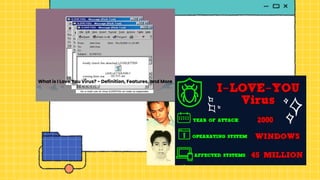
Any discussion of cybercrime in the Philippines starts
with reference to the "I LOVE YOU" virus unleased
globally in May 4, 2000 and an attachment "LOVE-
LETTER-FOR-YOU.TXT.vbs". The malware was created
by Onel de Guzman at the AMA University in Manila.
The virus erases or blurs the graphics and data in the
computer and gets the contact addresses in the
computer directory, and sends email to all contacts
listed in the directory.
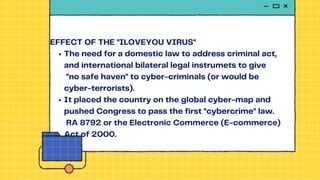
The need for a domestic law to address criminal act,
and international bilateral legal instrumets to give
"no safe haven" to cyber-criminals (or would be
cyber-terrorists).
It placed the country on the global cyber-map and
pushed Congress to pass the first "cybercrime" law.
RA 8792 or the Electronic Commerce (E-commerce)
Act of 2000.
EFFECT OF THE "ILOVEYOU VIRUS"
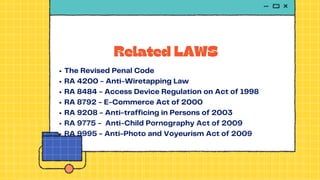
Related LAWS
The Revised Penal Code
RA 4200 - Anti-Wiretapping Law
RA 8484 - Access Device Regulation on Act of 1998
RA 8792 - E-Commerce Act of 2000
RA 9208 - Anti-trafficing in Persons of 2003
RA 9775 - Anti-Child Pornography Act of 2009
RA 9995 - Anti-Photo and Voyeurism Act of 2009
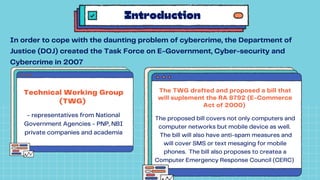
Technical Working Group
(TWG)
- representatives from National
Government Agencies - PNP, NBI
private companies and academia
Introduction
In order to cope with the daunting problem of cybercrime, the Department of
Justice (DOJ) created the Task Force on E-Government, Cyber-security and
Cybercrime in 2007
The TWG drafted and proposed a bill that
will suplement the RA 8792 (E-Commerce
Act of 2000)
The proposed bill covers not only computers and
computer networks but mobile device as well.
The bill will also have anti-spam measures and
will cover SMS or text mesaging for mobile
phones. The bill also proposes to createa a
Computer Emergency Response Council (CERC)
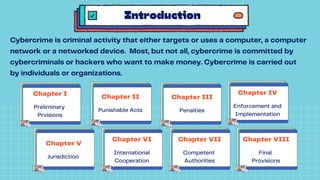
Chapter I
Preliminary
Prvisions
Introduction
Cybercrime is criminal activity that either targets or uses a computer, a computer
network or a networked device. Most, but not all, cybercrime is committed by
cybercriminals or hackers who want to make money. Cybercrime is carried out
by individuals or organizations.
Chapter II
Punishable Acts
Chapter III
Penalties
Chapter VI
International
Cooperation
Chapter VII
Competent
Authorities
Chapter IV
Enforcement and
Implementation
Chapter V
Jurisdiction
Chapter VIII
Final
Provisions
Chapter I - Preliminary Provisions
Sec 2. The State also recognizes the importance of providing
an environment conducive to the development, acceleration,
and rational application and exploitation of (ICT) to attain
free, easy, and intelligible access to exchange and/or delivery
of information; and the need to protect and safeguard the
integrity of computer, computer and communications
systems, networks, and databases, and the confidentiality,
integrity, and availability of information and data stored
therein, from all forms of misuse, abuse, and illegal access by
making punishable under the law such conduct or conducts.
Access – refers to the instruction, communication with, storing data in,
retrieving data from, or otherwise making use of any resources of a
computer system or communication network.•
Cyber – refers to a computer or a computer network, the electronic
medium in which online communication takes place.
Interception – refers to listening to, recording, monitoring or
surveillance of the content of communications, including procurement
of the content of data, either directly, through access and use of a
computer system or indirectly, through the use of electronic
eavesdropping or tapping devices, at the same time that the
communication is occurring.
Some terms to be familiarized
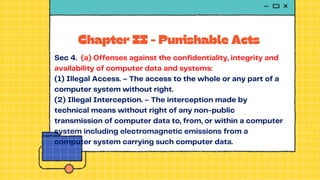
Chapter II - Punishable Acts
Sec 4. (a) Offenses against the confidentiality, integrity and
availability of computer data and systems:
(1) Illegal Access. – The access to the whole or any part of a
computer system without right.
(2) Illegal Interception. – The interception made by
technical means without right of any non-public
transmission of computer data to, from, or within a computer
system including electromagnetic emissions from a
computer system carrying such computer data.
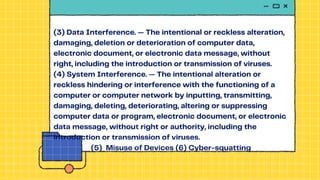
(3) Data Interference. — The intentional or reckless alteration,
damaging, deletion or deterioration of computer data,
electronic document, or electronic data message, without
right, including the introduction or transmission of viruses.
(4) System Interference. — The intentional alteration or
reckless hindering or interference with the functioning of a
computer or computer network by inputting, transmitting,
damaging, deleting, deteriorating, altering or suppressing
computer data or program, electronic document, or electronic
data message, without right or authority, including the
introduction or transmission of viruses.
(5) Misuse of Devices (6) Cyber-squatting
(b) Computer Related Offenses:
(1) Computer-related Forgery
(2) Computer-related Fraud
(3) Computer-related Identity Theft
(C) Computer Related Offenses:
(1) Cybersex
(2) Child Pornography
(3) Unsolicited Commercial Communications
(4) Libel
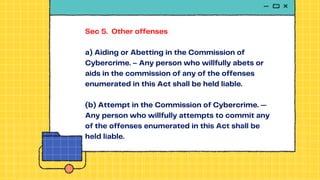
Sec 5. Other offenses
a) Aiding or Abetting in the Commission of
Cybercrime. – Any person who willfully abets or
aids in the commission of any of the offenses
enumerated in this Act shall be held liable.
(b) Attempt in the Commission of Cybercrime. —
Any person who willfully attempts to commit any
of the offenses enumerated in this Act shall be
held liable.
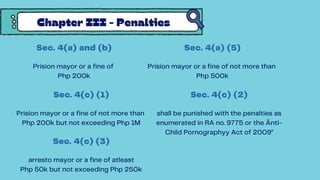
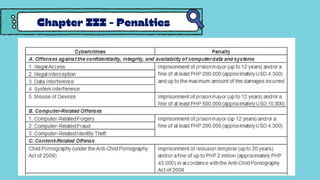
Sec. 4(a) and (b)
Prision mayor or a fine of
Php 200k
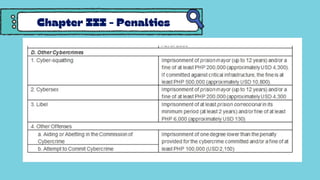
Chapter III - Penalties
Sec. 4(a) (5)
Prision mayor or a fine of not more than
Php 500k
Sec. 4(c) (1)
Prision mayor or a fine of not more than
Php 200k but not exceeding Php 1M
Sec. 4(c) (2)
shall be punished with the penalties as
enumerated in RA no. 9775 or the Änti-
Child Pornographyy Act of 2009"
Sec. 4(c) (3)
arresto mayor or a fine of atleast
Php 50k but not exceeding Php 250k
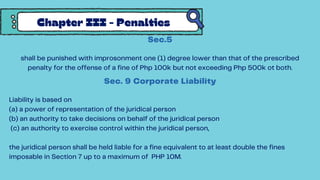
Chapter III - Penalties
Sec.5
shall be punished with improsonment one (1) degree lower than that of the prescribed
penalty for the offense of a fine of Php 100k but not exceeding Php 500k ot both.
Sec. 9 Corporate Liability
Liability is based on
(a) a power of representation of the juridical person
(b) an authority to take decisions on behalf of the juridical person
(c) an authority to exercise control within the juridical person,
the juridical person shall be held liable for a fine equivalent to at least double the fines
imposable in Section 7 up to a maximum of PHP 10M.
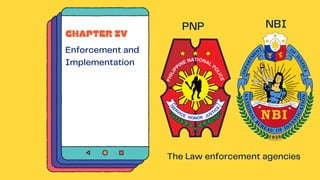
CHAPTER IV
Enforcement and
Implementation
NBI
PNP
The Law enforcement agencies
CHAPTER IV
Enforcement and Implementaiton
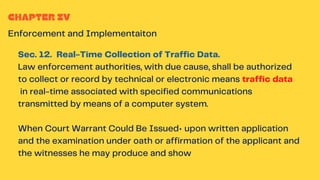
Sec. 12. Real-Time Collection of Traffic Data.
Law enforcement authorities, with due cause, shall be authorized
to collect or record by technical or electronic means traffic data
in real-time associated with specified communications
transmitted by means of a computer system.
When Court Warrant Could Be Issued• upon written application
and the examination under oath or affirmation of the applicant and
the witnesses he may produce and show
CHAPTER IV
Enforcement and Implementaiton
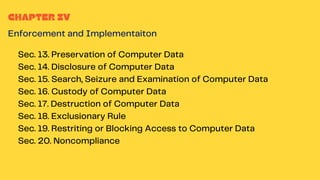
Sec. 13. Preservation of Computer Data
Sec. 14. Disclosure of Computer Data
Sec. 15. Search, Seizure and Examination of Computer Data
Sec. 16. Custody of Computer Data
Sec. 17. Destruction of Computer Data
Sec. 18. Exclusionary Rule
Sec. 19. Restriting or Blocking Access to Computer Data
Sec. 20. Noncompliance
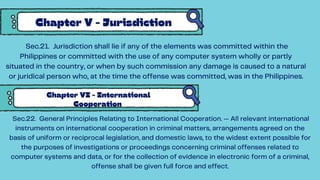
Chapter V - Jurisdiction
Sec.21. Jurisdiction shall lie if any of the elements was committed within the
Philippines or committed with the use of any computer system wholly or partly
situated in the country, or when by such commission any damage is caused to a natural
or juridical person who, at the time the offense was committed, was in the Philippines.
Chapter VI - International
Cooperation
Sec.22. General Principles Relating to International Cooperation. — All relevant international
instruments on international cooperation in criminal matters, arrangements agreed on the
basis of uniform or reciprocal legislation, and domestic laws, to the widest extent possible for
the purposes of investigations or proceedings concerning criminal offenses related to
computer systems and data, or for the collection of evidence in electronic form of a criminal,
offense shall be given full force and effect.
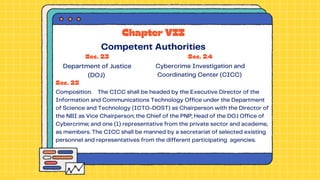
Sec. 23
Department of Justice
(DOJ)
Sec. 24
Cybercrime Investigation and
Coordinating Center (CICC)
Sec. 25
Composition. The CICC shall be headed by the Executive Director of the
Information and Communications Technology Office under the Department
of Science and Technology (ICTO-DOST) as Chairperson with the Director of
the NBI as Vice Chairperson; the Chief of the PNP; Head of the DOJ Office of
Cybercrime; and one (1) representative from the private sector and academe,
as members. The CICC shall be manned by a secretariat of selected existing
personnel and representatives from the different participating agencies.
Chapter VII
Competent Authorities
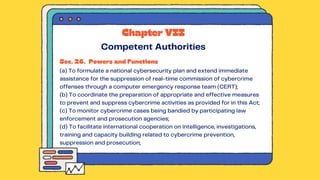
Sec. 26. Powers and Functions
(a) To formulate a national cybersecurity plan and extend immediate
assistance for the suppression of real-time commission of cybercrime
offenses through a computer emergency response team (CERT);
(b) To coordinate the preparation of appropriate and effective measures
to prevent and suppress cybercrime activities as provided for in this Act;
(c) To monitor cybercrime cases being bandied by participating law
enforcement and prosecution agencies;
(d) To facilitate international cooperation on intelligence, investigations,
training and capacity building related to cybercrime prevention,
suppression and prosecution;
Chapter VII
Competent Authorities
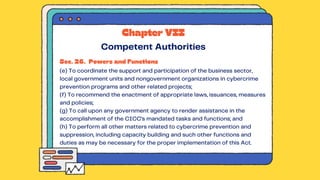
Sec. 26. Powers and Functions
(e) To coordinate the support and participation of the business sector,
local government units and nongovernment organizations in cybercrime
prevention programs and other related projects;
(f) To recommend the enactment of appropriate laws, issuances, measures
and policies;
(g) To call upon any government agency to render assistance in the
accomplishment of the CICC’s mandated tasks and functions; and
(h) To perform all other matters related to cybercrime prevention and
suppression, including capacity building and such other functions and
duties as may be necessary for the proper implementation of this Act.
Chapter VII
Competent Authorities
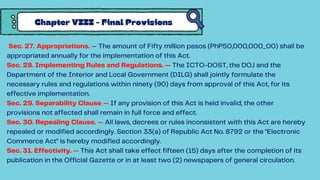
Chapter VIII - Final Provisions
Sec. 27. Appropriations. — The amount of Fifty million pesos (PhP50,000,000_00) shall be
appropriated annually for the implementation of this Act.
Sec. 28. Implementing Rules and Regulations. — The ICTO-DOST, the DOJ and the
Department of the Interior and Local Government (DILG) shall jointly formulate the
necessary rules and regulations within ninety (90) days from approval of this Act, for its
effective implementation.
Sec. 29. Separability Clause — If any provision of this Act is held invalid, the other
provisions not affected shall remain in full force and effect.
Sec. 30. Repealing Clause. — All laws, decrees or rules inconsistent with this Act are hereby
repealed or modified accordingly. Section 33(a) of Republic Act No. 8792 or the "Electronic
Commerce Act" is hereby modified accordingly.
Sec. 31. Effectivity. — This Act shall take effect fifteen (15) days after the completion of its
publication in the Official Gazette or in at least two (2) newspapers of general circulation.
https://www.doj.gov.ph/reporting_cybercrime.html
Reporting of Cybercrime Incidents
1. Walk-in
Office of the Cybercrime (OOC) 3rd floor, De Las Alas Bldg.,
Department of Justice P. Faura St., Ermita Manila
2. DOJ Website : www.doj.gov.ph
3. e-mail: cybercrime@doj.gov.ph
4. Telephone number : 526-2747 / 521-8345
5. Letter Report
6. Referral
PNP - Anti Cybercrime Group
Cooperation with Private Sector
Memorandum of Understanding between AntiCybercrime Group and Microsoft
Philippines was signed and is purposely designed to enhance the capabilities of the
PNP-ACG in terms of trainings and other related programs.
Angelnet Summit 2016. As part of the annual celebration of PNP-ACG Anniversary various
groups of professionals, IT Security practitioners and other stakeholders were gathered
together to share their respective expertise and learn on the current trends, share
experiences and other cyber related information.
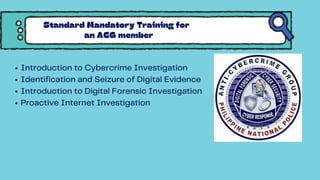
Introduction to Cybercrime Investigation
Identification and Seizure of Digital Evidence
Introduction to Digital Forensic Investigation
Proactive Internet Investigation
Standard Mandatory Training for
an ACG member
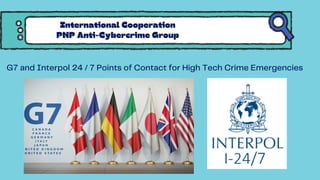
G7 and Interpol 24 / 7 Points of Contact for High Tech Crime Emergencies
International Cooperation
PNP Anti-Cybercrime Group
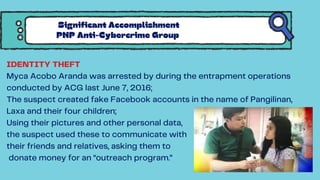
IDENTITY THEFT
Myca Acobo Aranda was arrested by during the entrapment operations
conducted by ACG last June 7, 2016;
The suspect created fake Facebook accounts in the name of Pangilinan,
Laxa and their four children;
Using their pictures and other personal data,
the suspect used these to communicate with
their friends and relatives, asking them to
donate money for an “outreach program.”
Significant Accomplishment
PNP Anti-Cybercrime Group
The term “cyberbullying” or “any bullying done through the use of
technology or any electronic means” refers to any conduct resulting in
harassment, intimidation, or humiliation, through the use of electronic
means or other forms of technology, such as, but not limited to texting,
email, instant messaging, chatting, Internet, social media, social
networking websites, online games, or other platforms or formats.
DEPED ORDER NO. 40, 2012
By Ma. Teresa Montemayor January 4, 2021, 9:35 pm
MANILA – The Department of Education (DepEd) on Monday said it supports the
protection of children from all forms of physical or mental violence, neglect or
negligent treatment, maltreatment, and exploitation, including sexual abuse.
"As an institution dedicated to safeguarding the welfare of its school children and
youth, we are deeply alarmed by the rise of cases of online sexual abuse and
exploitation of children during the pandemic, including a reported students’online
sex “Christmas sale” activity cited by Senator Sherwin Gatchalian," the DepEd said
in a statement.
DepEd ‘deeply alarmed’ by online sexual
exploitation reports
Over the weekend, Gatchalian urged the DOJ Office of Cybercrime and the PNP
Anti-Cybercrime Group to intensify their probe and crackdown on the sale of
sensual photos and videos of students to raise funds for distance learning-related
expenses. It noted that such abuse and exploitation are prohibited under
Republic Act (RA) No. 9775 or the Anti-Child Pornography Act of 2009, and RA No.
10175 or the “Cybercrime Prevention Act of 2012”.
Citing its implementation of flexible distance learning and academic ease
measures to ensure that education will not be costly for our parents and
learners, the DepEd reminded its direct stakeholders that gadgets or
internet connections are not requirements for distance learning.
DepEd ‘deeply alarmed’ by online sexual
exploitation reports
RTC Branch 12 Presiding Judge Gregorio dela Pena 3rd found the
accused, Aurora municipal councilor Archie “Ching” Te Yongco “guilty
beyond reasonable doubt for violation of Section 4 of Republic Act (RA)
10175 or the “Cybercrime Prevention Act of 2012.”
Former Aurora town mayor Emmanuel “Jojo”Palma 2nd filed the case
through his lawyer Quirino Esguerra Jr. against Yongco for “a malicious
post on the latter’s Facebook page on May 10, 2019
Zamboanga del Sur councilor gets 8 years over Facebook post
attacking mayoral candidate
Sample Related Case # 1
8-year jail term
ordered Yongco to pay the complainant P500,000 in moral
damages and P100,000 lawyer’s fees plus
P3,000 to the private prosecutor in court.
Yongco vehemently denied owning the account “Archie Yongco,” also
claiming that his Facebook account is “Ching Yongco, but the court
construed that mere denial by the accused “was a very poor attempt to
avoid the charges against him.”
Esguerra said the court was convinced that Yongco “is indeed the
author of the post, which the court finds to be unquestionably
defamatory and libelous under RA 10175.
Verdict:
Sample Related Case # 1
Court: Manila Regional Trial Court
Branch: 46
Full case name
People of the Philippines v. Reynaldo Santos, Jr.,
Maria Angelita Ressa and Rappler, Inc.
Decidedd: June 15, 2020
Citation: R-MNL-19-01141-CR
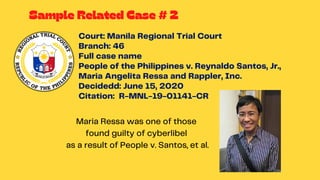
Maria Ressa was one of those
found guilty of cyberlibel
as a result of People v. Santos, et al.
Sample Related Case # 2
a high-profile criminal case in the Philippines, lodged against Maria Ressa,
co-owner and CEO of Rappler, Inc. Accused of cyberlibel, Ressa was found
guilty by Manila Regional Trial Court Branch 46 judge Rainelda Estacio-
Montesa on June 15, 2020.
The case centered on an article published on Rappler by Reynaldo Santos, Jr.
which accused the former Chief Justice of the Supreme Court of the
Philippines of accepting favors from Filipino-Chinese businessman Wilfredo
Keng.
People of the Philippines v. Santos, Ressa and Rappler
(R-MNL-19-01141-CR), also known as the Maria Ressa cyberlibel case,
Verdict: Ressa and Santos, Jr. were both were both sentenced to between six
months and six years in prison, but are entitled to bail while they have appeals
pending in higher courts. They were also both assessed fines of Php 400,000
for combined "moral damages" and "exemplary damages".
Insights gained from the LAW
Everything that happens in an online world actually happens in the real
world because it is not right to defame or extort someone
Cyber law is important because, as technology is developing the attacks
are also increasing. Data is one of the important aspects for businesses.
Everyday tons of data is generated and it is important to keep the data safe
from different cyber attacks. Attacks like DDoS can shut down whole
website which is a serious issue.
The proliferation of the internet, social media, and unscrupulous people
who take advantage of the two mentioned, is why the Philippine needs a
cybercrime law. Criminals use social media, to dupe people into paying up
or abused.
Conclusions
Cybercrime law provides rules of conduct and standards of behaviour for
the use of the Internet, computers, and related digital technologies, and the
actions of the public, government, and private organizations; rules of
evidence and criminal procedure, and other criminal justice matters in
cyberspace
Prosecutors and judges must possess technical know-how in litigating
cybercrime cases
Recommendations
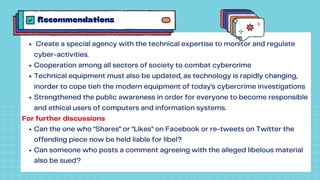
Create a special agency with the technical expertise to monitor and regulate
cyber-activities.
Cooperation among all sectors of society to combat cybercrime
Technical equipment must also be updated, as technology is rapidly changing,
inorder to cope tieh the modern equipment of today's cybercrime investigations
Strengthened the public awareness in order for everyone to become responsible
and ethical users of computers and information systems.
Can the one who “Shares” or “Likes” on Facebook or re-tweets on Twitter the
offending piece now be held liable for libel?
Can someone who posts a comment agreeing with the alleged libelous material
also be sued?
For further discussions
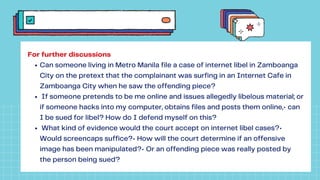
Can someone living in Metro Manila file a case of internet libel in Zamboanga
City on the pretext that the complainant was surfing in an Internet Cafe in
Zamboanga City when he saw the offending piece?
If someone pretends to be me online and issues allegedly libelous material; or
if someone hacks into my computer, obtains files and posts them online,• can
I be sued for libel? How do I defend myself on this?
What kind of evidence would the court accept on internet libel cases?•
Would screencaps suffice?• How will the court determine if an offensive
image has been manipulated?• Or an offending piece was really posted by
the person being sued?
For further discussions
Tips
Tips
Tips
https://www.slideshare.net/tearsome/cybercrime-law
https://www.slideshare.net/microblue7/republic-act-10175-cybercrime-
prevention-act-of-2012
https://www.officialgazette.gov.ph/2012/09/12/republic-act-no-10175/
https://www.officialgazette.gov.ph/2015/08/12/implementing-rules-and-
regulations-of-republic-act-no-10175/
https://www.unodc.org/e4j/en/cybercrime/module-3/key-issues/conclusion.html
https://unafei.or.jp/publications/pdf/RS_No79/No79_12PA_Sosa.pdf
https://rm.coe.int/1680703aa3
References
Thank you for
listening!

Furio lerma cybercrime-final

  • 1.
    Presented by: Lerma O.Furio ED.D. - IEM Student Republic Act 10175: Cybercrime Prevention Act of 2012
  • 2.
    Introduction REPUBLIC ACT NO.10175 AN ACT DEFINING CYBERCRIME, PROVIDING FOR THE PREVENTION, INVESTIGATION, SUPPRESSION AND THE IMPOSITION OF PENALTIES AND FOR OTHER PURPOSES
  • 3.
    Any discussion ofcybercrime in the Philippines starts with reference to the "I LOVE YOU" virus unleased globally in May 4, 2000 and an attachment "LOVE- LETTER-FOR-YOU.TXT.vbs". The malware was created by Onel de Guzman at the AMA University in Manila. The virus erases or blurs the graphics and data in the computer and gets the contact addresses in the computer directory, and sends email to all contacts listed in the directory.
  • 5.
    The need fora domestic law to address criminal act, and international bilateral legal instrumets to give "no safe haven" to cyber-criminals (or would be cyber-terrorists). It placed the country on the global cyber-map and pushed Congress to pass the first "cybercrime" law. RA 8792 or the Electronic Commerce (E-commerce) Act of 2000. EFFECT OF THE "ILOVEYOU VIRUS"
  • 6.
    Related LAWS The RevisedPenal Code RA 4200 - Anti-Wiretapping Law RA 8484 - Access Device Regulation on Act of 1998 RA 8792 - E-Commerce Act of 2000 RA 9208 - Anti-trafficing in Persons of 2003 RA 9775 - Anti-Child Pornography Act of 2009 RA 9995 - Anti-Photo and Voyeurism Act of 2009
  • 9.
    Technical Working Group (TWG) -representatives from National Government Agencies - PNP, NBI private companies and academia Introduction In order to cope with the daunting problem of cybercrime, the Department of Justice (DOJ) created the Task Force on E-Government, Cyber-security and Cybercrime in 2007 The TWG drafted and proposed a bill that will suplement the RA 8792 (E-Commerce Act of 2000) The proposed bill covers not only computers and computer networks but mobile device as well. The bill will also have anti-spam measures and will cover SMS or text mesaging for mobile phones. The bill also proposes to createa a Computer Emergency Response Council (CERC)
  • 10.
    Chapter I Preliminary Prvisions Introduction Cybercrime iscriminal activity that either targets or uses a computer, a computer network or a networked device. Most, but not all, cybercrime is committed by cybercriminals or hackers who want to make money. Cybercrime is carried out by individuals or organizations. Chapter II Punishable Acts Chapter III Penalties Chapter VI International Cooperation Chapter VII Competent Authorities Chapter IV Enforcement and Implementation Chapter V Jurisdiction Chapter VIII Final Provisions
  • 11.
    Chapter I -Preliminary Provisions Sec 2. The State also recognizes the importance of providing an environment conducive to the development, acceleration, and rational application and exploitation of (ICT) to attain free, easy, and intelligible access to exchange and/or delivery of information; and the need to protect and safeguard the integrity of computer, computer and communications systems, networks, and databases, and the confidentiality, integrity, and availability of information and data stored therein, from all forms of misuse, abuse, and illegal access by making punishable under the law such conduct or conducts.
  • 12.
    Access – refersto the instruction, communication with, storing data in, retrieving data from, or otherwise making use of any resources of a computer system or communication network.• Cyber – refers to a computer or a computer network, the electronic medium in which online communication takes place. Interception – refers to listening to, recording, monitoring or surveillance of the content of communications, including procurement of the content of data, either directly, through access and use of a computer system or indirectly, through the use of electronic eavesdropping or tapping devices, at the same time that the communication is occurring. Some terms to be familiarized
  • 13.
    Chapter II -Punishable Acts Sec 4. (a) Offenses against the confidentiality, integrity and availability of computer data and systems: (1) Illegal Access. – The access to the whole or any part of a computer system without right. (2) Illegal Interception. – The interception made by technical means without right of any non-public transmission of computer data to, from, or within a computer system including electromagnetic emissions from a computer system carrying such computer data.
  • 14.
    (3) Data Interference.— The intentional or reckless alteration, damaging, deletion or deterioration of computer data, electronic document, or electronic data message, without right, including the introduction or transmission of viruses. (4) System Interference. — The intentional alteration or reckless hindering or interference with the functioning of a computer or computer network by inputting, transmitting, damaging, deleting, deteriorating, altering or suppressing computer data or program, electronic document, or electronic data message, without right or authority, including the introduction or transmission of viruses. (5) Misuse of Devices (6) Cyber-squatting
  • 15.
    (b) Computer RelatedOffenses: (1) Computer-related Forgery (2) Computer-related Fraud (3) Computer-related Identity Theft (C) Computer Related Offenses: (1) Cybersex (2) Child Pornography (3) Unsolicited Commercial Communications (4) Libel
  • 16.
    Sec 5. Otheroffenses a) Aiding or Abetting in the Commission of Cybercrime. – Any person who willfully abets or aids in the commission of any of the offenses enumerated in this Act shall be held liable. (b) Attempt in the Commission of Cybercrime. — Any person who willfully attempts to commit any of the offenses enumerated in this Act shall be held liable.
  • 17.
    Sec. 4(a) and(b) Prision mayor or a fine of Php 200k Chapter III - Penalties Sec. 4(a) (5) Prision mayor or a fine of not more than Php 500k Sec. 4(c) (1) Prision mayor or a fine of not more than Php 200k but not exceeding Php 1M Sec. 4(c) (2) shall be punished with the penalties as enumerated in RA no. 9775 or the Änti- Child Pornographyy Act of 2009" Sec. 4(c) (3) arresto mayor or a fine of atleast Php 50k but not exceeding Php 250k
  • 18.
    Chapter III -Penalties
  • 19.
    Chapter III -Penalties
  • 20.
    Chapter III -Penalties Sec.5 shall be punished with improsonment one (1) degree lower than that of the prescribed penalty for the offense of a fine of Php 100k but not exceeding Php 500k ot both. Sec. 9 Corporate Liability Liability is based on (a) a power of representation of the juridical person (b) an authority to take decisions on behalf of the juridical person (c) an authority to exercise control within the juridical person, the juridical person shall be held liable for a fine equivalent to at least double the fines imposable in Section 7 up to a maximum of PHP 10M.
  • 21.
  • 22.
    CHAPTER IV Enforcement andImplementaiton Sec. 12. Real-Time Collection of Traffic Data. Law enforcement authorities, with due cause, shall be authorized to collect or record by technical or electronic means traffic data in real-time associated with specified communications transmitted by means of a computer system. When Court Warrant Could Be Issued• upon written application and the examination under oath or affirmation of the applicant and the witnesses he may produce and show
  • 23.
    CHAPTER IV Enforcement andImplementaiton Sec. 13. Preservation of Computer Data Sec. 14. Disclosure of Computer Data Sec. 15. Search, Seizure and Examination of Computer Data Sec. 16. Custody of Computer Data Sec. 17. Destruction of Computer Data Sec. 18. Exclusionary Rule Sec. 19. Restriting or Blocking Access to Computer Data Sec. 20. Noncompliance
  • 24.
    Chapter V -Jurisdiction Sec.21. Jurisdiction shall lie if any of the elements was committed within the Philippines or committed with the use of any computer system wholly or partly situated in the country, or when by such commission any damage is caused to a natural or juridical person who, at the time the offense was committed, was in the Philippines. Chapter VI - International Cooperation Sec.22. General Principles Relating to International Cooperation. — All relevant international instruments on international cooperation in criminal matters, arrangements agreed on the basis of uniform or reciprocal legislation, and domestic laws, to the widest extent possible for the purposes of investigations or proceedings concerning criminal offenses related to computer systems and data, or for the collection of evidence in electronic form of a criminal, offense shall be given full force and effect.
  • 25.
    Sec. 23 Department ofJustice (DOJ) Sec. 24 Cybercrime Investigation and Coordinating Center (CICC) Sec. 25 Composition. The CICC shall be headed by the Executive Director of the Information and Communications Technology Office under the Department of Science and Technology (ICTO-DOST) as Chairperson with the Director of the NBI as Vice Chairperson; the Chief of the PNP; Head of the DOJ Office of Cybercrime; and one (1) representative from the private sector and academe, as members. The CICC shall be manned by a secretariat of selected existing personnel and representatives from the different participating agencies. Chapter VII Competent Authorities

  • 26.
    Sec. 26. Powersand Functions (a) To formulate a national cybersecurity plan and extend immediate assistance for the suppression of real-time commission of cybercrime offenses through a computer emergency response team (CERT); (b) To coordinate the preparation of appropriate and effective measures to prevent and suppress cybercrime activities as provided for in this Act; (c) To monitor cybercrime cases being bandied by participating law enforcement and prosecution agencies; (d) To facilitate international cooperation on intelligence, investigations, training and capacity building related to cybercrime prevention, suppression and prosecution; Chapter VII Competent Authorities
  • 27.
    Sec. 26. Powersand Functions (e) To coordinate the support and participation of the business sector, local government units and nongovernment organizations in cybercrime prevention programs and other related projects; (f) To recommend the enactment of appropriate laws, issuances, measures and policies; (g) To call upon any government agency to render assistance in the accomplishment of the CICC’s mandated tasks and functions; and (h) To perform all other matters related to cybercrime prevention and suppression, including capacity building and such other functions and duties as may be necessary for the proper implementation of this Act. Chapter VII Competent Authorities
  • 28.
    Chapter VIII -Final Provisions Sec. 27. Appropriations. — The amount of Fifty million pesos (PhP50,000,000_00) shall be appropriated annually for the implementation of this Act. Sec. 28. Implementing Rules and Regulations. — The ICTO-DOST, the DOJ and the Department of the Interior and Local Government (DILG) shall jointly formulate the necessary rules and regulations within ninety (90) days from approval of this Act, for its effective implementation. Sec. 29. Separability Clause — If any provision of this Act is held invalid, the other provisions not affected shall remain in full force and effect. Sec. 30. Repealing Clause. — All laws, decrees or rules inconsistent with this Act are hereby repealed or modified accordingly. Section 33(a) of Republic Act No. 8792 or the "Electronic Commerce Act" is hereby modified accordingly. Sec. 31. Effectivity. — This Act shall take effect fifteen (15) days after the completion of its publication in the Official Gazette or in at least two (2) newspapers of general circulation.
  • 29.
    https://www.doj.gov.ph/reporting_cybercrime.html Reporting of CybercrimeIncidents 1. Walk-in Office of the Cybercrime (OOC) 3rd floor, De Las Alas Bldg., Department of Justice P. Faura St., Ermita Manila 2. DOJ Website : www.doj.gov.ph 3. e-mail: cybercrime@doj.gov.ph 4. Telephone number : 526-2747 / 521-8345 5. Letter Report 6. Referral
  • 30.
    PNP - AntiCybercrime Group Cooperation with Private Sector Memorandum of Understanding between AntiCybercrime Group and Microsoft Philippines was signed and is purposely designed to enhance the capabilities of the PNP-ACG in terms of trainings and other related programs. Angelnet Summit 2016. As part of the annual celebration of PNP-ACG Anniversary various groups of professionals, IT Security practitioners and other stakeholders were gathered together to share their respective expertise and learn on the current trends, share experiences and other cyber related information.
  • 31.
    Introduction to CybercrimeInvestigation Identification and Seizure of Digital Evidence Introduction to Digital Forensic Investigation Proactive Internet Investigation Standard Mandatory Training for an ACG member
  • 32.
    G7 and Interpol24 / 7 Points of Contact for High Tech Crime Emergencies International Cooperation PNP Anti-Cybercrime Group
  • 33.
    IDENTITY THEFT Myca AcoboAranda was arrested by during the entrapment operations conducted by ACG last June 7, 2016; The suspect created fake Facebook accounts in the name of Pangilinan, Laxa and their four children; Using their pictures and other personal data, the suspect used these to communicate with their friends and relatives, asking them to donate money for an “outreach program.” Significant Accomplishment PNP Anti-Cybercrime Group
  • 34.
    The term “cyberbullying”or “any bullying done through the use of technology or any electronic means” refers to any conduct resulting in harassment, intimidation, or humiliation, through the use of electronic means or other forms of technology, such as, but not limited to texting, email, instant messaging, chatting, Internet, social media, social networking websites, online games, or other platforms or formats. DEPED ORDER NO. 40, 2012
  • 35.
    By Ma. TeresaMontemayor January 4, 2021, 9:35 pm MANILA – The Department of Education (DepEd) on Monday said it supports the protection of children from all forms of physical or mental violence, neglect or negligent treatment, maltreatment, and exploitation, including sexual abuse. "As an institution dedicated to safeguarding the welfare of its school children and youth, we are deeply alarmed by the rise of cases of online sexual abuse and exploitation of children during the pandemic, including a reported students’online sex “Christmas sale” activity cited by Senator Sherwin Gatchalian," the DepEd said in a statement. DepEd ‘deeply alarmed’ by online sexual exploitation reports
  • 36.
    Over the weekend,Gatchalian urged the DOJ Office of Cybercrime and the PNP Anti-Cybercrime Group to intensify their probe and crackdown on the sale of sensual photos and videos of students to raise funds for distance learning-related expenses. It noted that such abuse and exploitation are prohibited under Republic Act (RA) No. 9775 or the Anti-Child Pornography Act of 2009, and RA No. 10175 or the “Cybercrime Prevention Act of 2012”. Citing its implementation of flexible distance learning and academic ease measures to ensure that education will not be costly for our parents and learners, the DepEd reminded its direct stakeholders that gadgets or internet connections are not requirements for distance learning. DepEd ‘deeply alarmed’ by online sexual exploitation reports
  • 37.
    RTC Branch 12Presiding Judge Gregorio dela Pena 3rd found the accused, Aurora municipal councilor Archie “Ching” Te Yongco “guilty beyond reasonable doubt for violation of Section 4 of Republic Act (RA) 10175 or the “Cybercrime Prevention Act of 2012.” Former Aurora town mayor Emmanuel “Jojo”Palma 2nd filed the case through his lawyer Quirino Esguerra Jr. against Yongco for “a malicious post on the latter’s Facebook page on May 10, 2019 Zamboanga del Sur councilor gets 8 years over Facebook post attacking mayoral candidate Sample Related Case # 1
  • 38.
    8-year jail term orderedYongco to pay the complainant P500,000 in moral damages and P100,000 lawyer’s fees plus P3,000 to the private prosecutor in court. Yongco vehemently denied owning the account “Archie Yongco,” also claiming that his Facebook account is “Ching Yongco, but the court construed that mere denial by the accused “was a very poor attempt to avoid the charges against him.” Esguerra said the court was convinced that Yongco “is indeed the author of the post, which the court finds to be unquestionably defamatory and libelous under RA 10175. Verdict: Sample Related Case # 1
  • 39.
    Court: Manila RegionalTrial Court Branch: 46 Full case name People of the Philippines v. Reynaldo Santos, Jr., Maria Angelita Ressa and Rappler, Inc. Decidedd: June 15, 2020 Citation: R-MNL-19-01141-CR Maria Ressa was one of those found guilty of cyberlibel as a result of People v. Santos, et al. Sample Related Case # 2
  • 40.
    a high-profile criminalcase in the Philippines, lodged against Maria Ressa, co-owner and CEO of Rappler, Inc. Accused of cyberlibel, Ressa was found guilty by Manila Regional Trial Court Branch 46 judge Rainelda Estacio- Montesa on June 15, 2020. The case centered on an article published on Rappler by Reynaldo Santos, Jr. which accused the former Chief Justice of the Supreme Court of the Philippines of accepting favors from Filipino-Chinese businessman Wilfredo Keng. People of the Philippines v. Santos, Ressa and Rappler (R-MNL-19-01141-CR), also known as the Maria Ressa cyberlibel case, Verdict: Ressa and Santos, Jr. were both were both sentenced to between six months and six years in prison, but are entitled to bail while they have appeals pending in higher courts. They were also both assessed fines of Php 400,000 for combined "moral damages" and "exemplary damages".
  • 41.
    Insights gained fromthe LAW Everything that happens in an online world actually happens in the real world because it is not right to defame or extort someone Cyber law is important because, as technology is developing the attacks are also increasing. Data is one of the important aspects for businesses. Everyday tons of data is generated and it is important to keep the data safe from different cyber attacks. Attacks like DDoS can shut down whole website which is a serious issue. The proliferation of the internet, social media, and unscrupulous people who take advantage of the two mentioned, is why the Philippine needs a cybercrime law. Criminals use social media, to dupe people into paying up or abused.
  • 42.
    Conclusions Cybercrime law providesrules of conduct and standards of behaviour for the use of the Internet, computers, and related digital technologies, and the actions of the public, government, and private organizations; rules of evidence and criminal procedure, and other criminal justice matters in cyberspace Prosecutors and judges must possess technical know-how in litigating cybercrime cases
  • 43.
    Recommendations Create a specialagency with the technical expertise to monitor and regulate cyber-activities. Cooperation among all sectors of society to combat cybercrime Technical equipment must also be updated, as technology is rapidly changing, inorder to cope tieh the modern equipment of today's cybercrime investigations Strengthened the public awareness in order for everyone to become responsible and ethical users of computers and information systems. Can the one who “Shares” or “Likes” on Facebook or re-tweets on Twitter the offending piece now be held liable for libel? Can someone who posts a comment agreeing with the alleged libelous material also be sued? For further discussions
  • 44.
    Can someone livingin Metro Manila file a case of internet libel in Zamboanga City on the pretext that the complainant was surfing in an Internet Cafe in Zamboanga City when he saw the offending piece? If someone pretends to be me online and issues allegedly libelous material; or if someone hacks into my computer, obtains files and posts them online,• can I be sued for libel? How do I defend myself on this? What kind of evidence would the court accept on internet libel cases?• Would screencaps suffice?• How will the court determine if an offensive image has been manipulated?• Or an offending piece was really posted by the person being sued? For further discussions
  • 45.
  • 46.
  • 47.
  • 48.
  • 49.