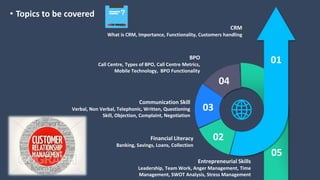
Call Centre, Types of BPO, Call Centre Metrics,
Mobile Technology, BPO Functionality
BPO
Verbal, Non Verbal, Telephonic, Written, Questioning
Skill, Objection, Complaint, Negotiation
Communication Skill
Banking, Savings, Loans, Collection
Financial Literacy
05
02
03
04
01
Leadership, Team Work, Anger Management, Time
Management, SWOT Analysis, Stress Management
Entrepreneurial Skills
What is CRM, Importance, Functionality, Customers handling
CRM
• Topics to be covered
CRM “is a business strategy that aims to understand, anticipate and
manage the needs of an organisation’s current and potential customers”
What is CRM?
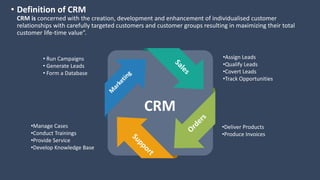
• Definition of CRM
CRM is concerned with the creation, development and enhancement of individualised customer
relationships with carefully targeted customers and customer groups resulting in maximizing their total
customer life-time value”.
•Assign Leads
•Qualify Leads
•Covert Leads
•Track Opportunities
•Deliver Products
•Produce Invoices
• Run Campaigns
• Generate Leads
• Form a Database
•Manage Cases
•Conduct Trainings
•Provide Service
•Develop Knowledge Base
CRM
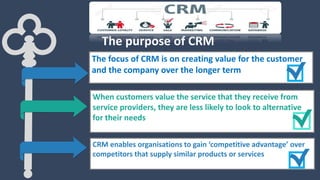
The focus of CRM is on creating value for the customer
and the company over the longer term
When customers value the service that they receive from
service providers, they are less likely to look to alternative
for their needs
CRM enables organisations to gain ‘competitive advantage’ over
competitors that supply similar products or services
The purpose of CRM
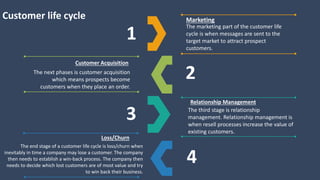
Customer life cycle
1
2
4
3
The marketing part of the customer life
cycle is when messages are sent to the
target market to attract prospect
customers.
Marketing
The third stage is relationship
management. Relationship management is
when resell processes increase the value of
existing customers.
Relationship Management
The next phases is customer acquisition
which means prospects become
customers when they place an order.
Customer Acquisition
The end stage of a customer life cycle is loss/churn when
inevitably in time a company may lose a customer. The company
then needs to establish a win-back process. The company then
needs to decide which lost customers are of most value and try
to win back their business.
Loss/Churn
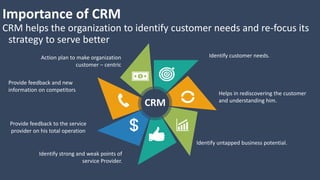
Importance of CRM
CRM helps the organization to identify customer needs and re-focus its
strategy to serve better
Action plan to make organization
customer – centric
Provide feedback and new
information on competitors
Provide feedback to the service
provider on his total operation
Identify customer needs.
Helps in rediscovering the customer
and understanding him.
Identify untapped business potential.
Identify strong and weak points of
service Provider.
CRM
IT – ITes Sector
Information technology (IT) is the use of any, storage, networking and other physical devices, infrastructure
and processes to create computers, process, store, secure and exchange all forms of electronic data.
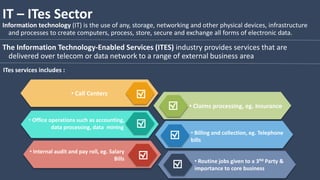
The Information Technology-Enabled Services (ITES) industry provides services that are
delivered over telecom or data network to a range of external business area
• Claims processing, eg. Insurance
• Billing and collection, eg. Telephone
bills
R
• Call Centers
• Office operations such as accounting,
data processing, data mining
• Internal audit and pay roll, eg. Salary
Bills • Routine jobs given to a 3Rd Party &
importance to core business
ITes services includes :
Outsourcing
Benefits of Outsourcing :
Outsourcing is a process in which company sub – contracts some tasks to experts
12
Staffing Flexibility
24 X 7 availability Improve service and delight the
customer.
Improving company focus
Access to skilled expertise
34
56
Cost Savings
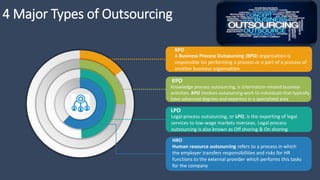
4 Major Types of Outsourcing
BPO
A Business Process Outsourcing (BPO) organisation is
responsible for performing a process or a part of a process of
another business organisation
KPO
Knowledge process outsourcing, is information-related business
activities. KPO involves outsourcing work to individuals that typically
have advanced degrees and expertise in a specialized area
LPO
Legal process outsourcing, or LPO, is the exporting of legal
services to low-wage markets overseas. Legal process
outsourcing is also known as Off shoring & On shoring
HRO
Human resource outsourcing refers to a process in which
the employer transfers responsibilities and risks for HR
functions to the external provider which performs this tasks
for the company
Data confidentiality :
• Data is the primary asset of any organization and its security is essential.
Do not reveal customer’s personal and
financial information to anybody other
then the account holder
Do not share information about a customer
with other customers
Unauthorized information, written or
verbal, cannot be divulged to any
customer/competitor/any other person e.g.
photocopy of customer information sheet
etc
Client Confidentiality:
The client places a lot of trust in the organizational and in the Customer Care Executive before sharing his
information. It is crucial for the Executive to maintain that trust and faith by maintaining the confidentiality of the
client’s information.
• A written Non-Disclosure
Agreement(NDA) is obtained at the time
of joining from each employee
• Limited access to the network is given
through login IDs and password
protection
• Passwords and access controls are well
defined for authorized internal persons
• The data received from the client during
the time of processing in any form such
as hard copies or soft copies should not
be misused
• None of the employees are allowed to
bring any storage devices like memory
cards, CD/DVD/Floppy disk, pen drive etc
• At entry and the exit points, the security
guards frisk the employees to cheek that
none of the storage devices are carried in
or out by any of the employees
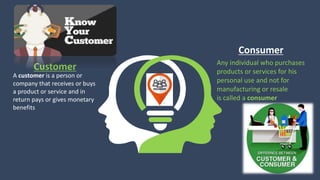
Customer
A customer is a person or
company that receives or buys
a product or service and in
return pays or gives monetary
benefits
Consumer
Any individual who purchases
products or services for his
personal use and not for
manufacturing or resale
is called a consumer
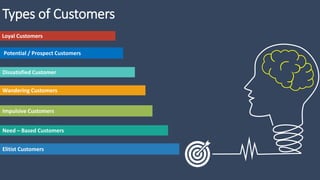
Types of Customers
Elitist Customers
Need – Based Customers
Impulsive Customers
Wandering Customers
Loyal Customers
Potential / Prospect Customers
Dissatisfied Customer
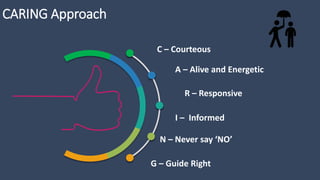
CARING Approach
C – Courteous
A – Alive and Energetic
R – Responsive
N – Never say ‘NO’
I – Informed
G – Guide Right
Roles & Responsibilities of CRM Domestic Voice
Executive
• An Executive is the voice of the of the company. He is first point
of contact with the customers
• An Executive receives & makes phone calls that are scripted.
They inform customers about products & services offered by the
company
• An Executive needs to answer queries, resolve problems, record
complaints and / or receive feedback
• An Executive is expected to communicate with the customers to
market & sell the products and services by the organization.
• An Executive is required to talk to the customers politely &
professionally
• An Executive should be target oriented
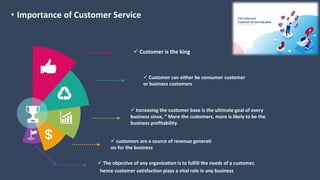
• Importance of Customer Service
 Customer is the king
 Customer can either be consumer customer
or business customers
 Increasing the customer base is the ultimate goal of every
business since, “ More the customers, more is likely to be the
business profitability.
 The objective of any organization is to fulfill the needs of a customer,
hence customer satisfaction plays a vital role in any business
 customers are a source of revenue generati
on for the business
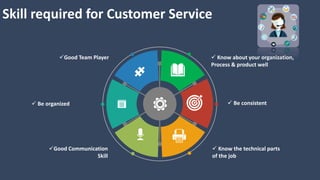
Skill required for Customer Service
Good Team Player  Know about your organization,
Process & product well
 Be organized  Be consistent
Good Communication
Skill
 Know the technical parts
of the job
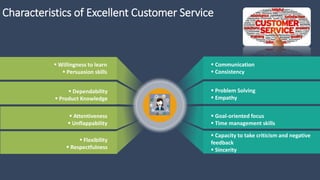
Characteristics of Excellent Customer Service
 Communication
 Consistency
 Problem Solving
 Empathy
 Goal-oriented focus
 Time management skills
 Capacity to take criticism and negative
feedback
 Sincerity
 Willingness to learn
 Persuasion skills
 Dependability
 Product Knowledge
 Attentiveness
 Unflappability
 Flexibility
 Respectfulness
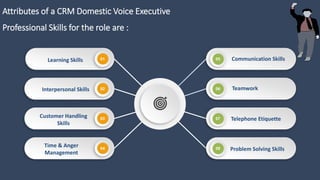
Attributes of a CRM Domestic Voice Executive
Communication Skills
Problem Solving Skills
Learning Skills
Time & Anger
Management
01
04
05
TeamworkInterpersonal Skills 02 06
Telephone EtiquetteCustomer Handling
Skills
03 07
08
Professional Skills for the role are :
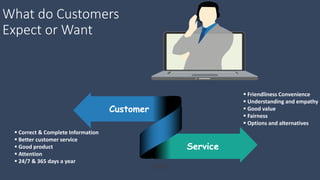
What do Customers
Expect or Want
Customer
Service
 Correct & Complete Information
 Better customer service
 Good product
 Attention
 24/7 & 365 days a year
 Friendliness Convenience
 Understanding and empathy
 Good value
 Fairness
 Options and alternatives
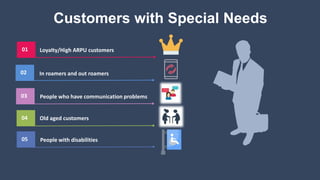
Customers with Special Needs
01 Loyalty/High ARPU customers
02 In roamers and out roamers
03 People who have communication problems
04
05
Old aged customers
People with disabilities
Reliability1
Confidence2
Responsiveness3
Efficiency4
Factors Affecting the
Quality of Service
Organization5
Acceptance of and adherence to policies and
procedures
6
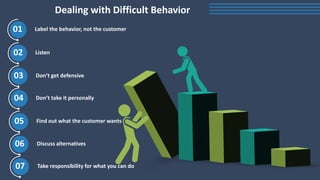
Dealing with Difficult Behavior
01 Label the behavior, not the customer
02 Listen
03 Don’t get defensive
04 Don’t take it personally
05 Find out what the customer wants
06 Discuss alternatives
07 Take responsibility for what you can do
 The Angry Customer
 Listen carefully without interrupting so you understand the problem
 Empathies in a broad way
 Stay calm and remain polite
 Propose an action plan and follow it
 Don’t take it personally, be defensive or blame others
 Don’t escalate the problem in front of the customer
 Seek support if you are scared, if you can’t agree on a solution or if the customer asks to see
“whoever’s in charge”
 Angry Customer. A dissatisfied customer is one who feels a business did not provide a
product or service as expected. ... These customers feel betrayed by the company,
believing the company violated the norms or ethics of a customer-company relationship.
 The Talkative Customer
 Ask closed questions
 Limit the time available for them to interrupt (don’t have long pauses)
 Provide minimal response
 Smile and be pleasant, but don’t encourage them
 Give timeline for reverting
 These customers tend to drone on about topics unrelated to the issue they're discussing
with agents. Because conversations with them take too long, you may have to put other
queued customers on hold. This means you'll be losing the opportunity to help
other customers
 The Indecisive Customer
 Find out what they really want
 Ask them for the options
 Reflect back to them what they’ve said
 Assume control gently and point out the best course of action from what
they’ve told you they need
 Be logical
 Confirm a plan of action with them
 Ensure written requests
 Customers are indecisive about taking a service or a product you are offering.
Though they look around, ask questions, show interest, or simply can't decide for
numerous reasons,
 The Suspicious Customer
Establish your credibility
Ensure you know your product or service
They will try and catch you out so don’t guess or tell them something you’re
not sure of
Be careful what you say
Be polite
Don’t take it personally, they don’t trust anyone!
 The ‘know it all’ Customer
 Acknowledge what they say
 Compliment them on their knowledge
 Be generous with praise
 Don’t “put them in their place” no matter how tempting
 Don’t try to be smart – you can’t win!
 Ask specific questions and use them to improve the situation
 Don’t bypass procedures (they may quote it next time)
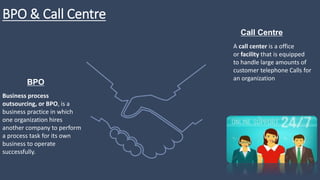
BPO & Call Centre
Business process
outsourcing, or BPO, is a
business practice in which
one organization hires
another company to perform
a process task for its own
business to operate
successfully.
BPO
A call center is a office
or facility that is equipped
to handle large amounts of
customer telephone Calls for
an organization
Call Centre
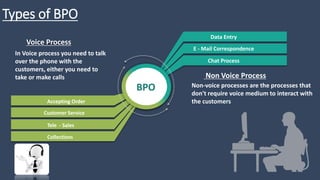
Types of BPO
Data Entry
E - Mail Correspondence
Chat Process
Voice Process
Accepting Order
Customer Service
Tele - Sales
Collections
BPO Non-voice processes are the processes that
don't require voice medium to interact with
the customers
In Voice process you need to talk
over the phone with the
customers, either you need to
take or make calls Non Voice Process
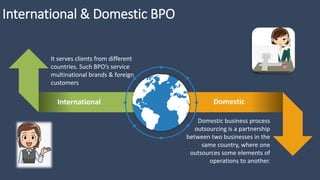
International & Domestic BPO
Domestic business process
outsourcing is a partnership
between two businesses in the
same country, where one
outsources some elements of
operations to another.
It serves clients from different
countries. Such BPO’s service
multinational brands & foreign
customers
International Domestic
Departments in BPO
AdminIT
HR MIS
QualityTraining
Operations
"Coming together is a beginning, staying
together is progress, and working together
is success."
Henry Ford
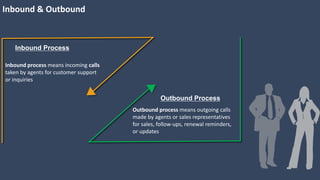
Inbound & Outbound
Inbound process means incoming calls
taken by agents for customer support
or inquiries
Inbound Process
Outbound process means outgoing calls
made by agents or sales representatives
for sales, follow-ups, renewal reminders,
or updates
Outbound Process
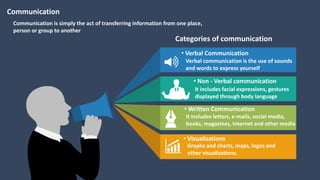
Communication is simply the act of transferring information from one place,
person or group to another
Communication
Verbal communication is the use of sounds
and words to express yourself
• Verbal Communication
It includes facial expressions, gestures
displayed through body language
• Non - Verbal communication
It includes letters, e-mails, social media,
books, magazines, Internet and other media
• Written Communication
Graphs and charts, maps, logos and
other visualizations.
• Visualizations
Categories of communication
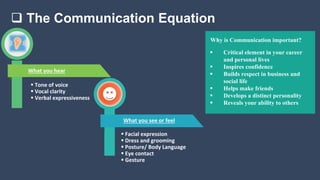
 The Communication Equation
What you hear
 Tone of voice
 Vocal clarity
 Verbal expressiveness
What you see or feel
 Facial expression
 Dress and grooming
 Posture/ Body Language
 Eye contact
 Gesture
Why is Communication important?
 Critical element in your career
and personal lives
 Inspires confidence
 Builds respect in business and
social life
 Helps make friends
 Develops a distinct personality
 Reveals your ability to others
Body language
Smiling face
Silence
Checking for understanding
Eye contact & visibility
Asking questions
Summarization
Encouragement to continue
Effective Communication Skills
 Barriers to
Effective
Communication
Time
Discomfort with the topic
Too many Questions
Noise
Distractions
Lack of interest
Body language
Language
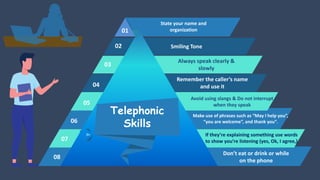
State your name and
organization
Smiling Tone
Always speak clearly &
slowly
Remember the caller’s name
and use it
Avoid using slangs & Do not interrupt
when they speak
Make use of phrases such as “May I help you”,
“you are welcome”, and thank you”.
If they’re explaining something use words
to show you’re listening (yes, Ok, I agree,)
Don’t eat or drink or while
on the phone
01
02
03
04
05
06
07
08
Telephonic
Skills
Listening Skills
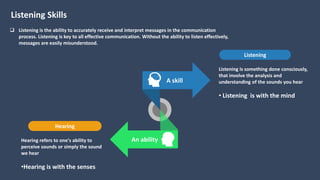
 Listening is the ability to accurately receive and interpret messages in the communication
process. Listening is key to all effective communication. Without the ability to listen effectively,
messages are easily misunderstood.
Listening is something done consciously,
that involve the analysis and
understanding of the sounds you hear
• Listening is with the mind
Listening
Hearing refers to one's ability to
perceive sounds or simply the sound
we hear
•Hearing is with the senses
Hearing
A skill
An ability
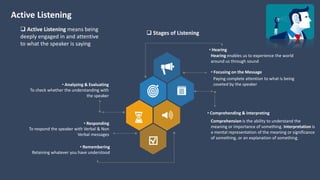
Active Listening
Hearing enables us to experience the world
around us through sound
• Hearing
Paying complete attention to what is being
coveted by the speaker
• Focusing on the Message
Comprehension is the ability to understand the
meaning or importance of something. Interpretation is
a mental representation of the meaning or significance
of something, or an explanation of something.
• Comprehending & Interpreting
To check whether the understanding with
the speaker
• Analyzing & Evaluating
To respond the speaker with Verbal & Non
Verbal messages
• Responding
Retaining whatever you have understood
• Remembering
 Active Listening means being
deeply engaged in and attentive
to what the speaker is saying
 Stages of Listening
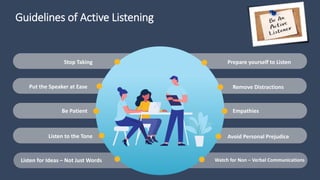
Guidelines of Active Listening
Prepare yourself to Listen
Remove Distractions
Empathies
Avoid Personal Prejudice
Stop Taking
Put the Speaker at Ease
Be Patient
Listen to the Tone
Listen for Ideas – Not Just Words Watch for Non – Verbal Communications
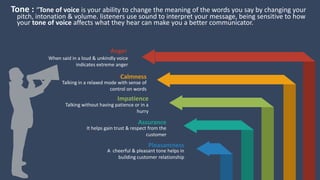
Tone : “Tone of voice is your ability to change the meaning of the words you say by changing your
pitch, intonation & volume. listeners use sound to interpret your message, being sensitive to how
your tone of voice affects what they hear can make you a better communicator.
When said in a loud & unkindly voice
indicates extreme anger
Anger
Talking in a relaxed mode with sense of
control on words
Calmness
Talking without having patience or in a
hurry
Impatience
It helps gain trust & respect from the
customer
Assurance
A cheerful & pleasant tone helps in
building customer relationship
Pleasantness
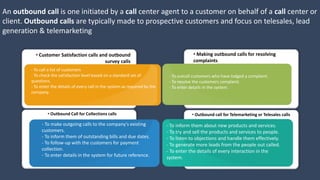
An outbound call is one initiated by a call center agent to a customer on behalf of a call center or
client. Outbound calls are typically made to prospective customers and focus on telesales, lead
generation & telemarketing
• Customer Satisfaction calls and outbound
survey calls
• Outbound Call for Collections calls
• Making outbound calls for resolving
complaints
• Outbound call for Telemarketing or Telesales calls
- To make outgoing calls to the company's existing
customers.
- To inform them of outstanding bills and due dates.
- To follow-up with the customers for payment
collection.
- To enter details in the system for future reference.
- To inform them about new products and services.
- To try and sell the products and services to people.
- To listen to objections and handle them effectively.
- To generate more leads from the people out called.
- To enter the details of every interaction in the
system.
- To call a list of customers
- To check the satisfaction level based on a standard set of
questions.
- To enter the details of every call in the system as required by the
company.
- To outcall customers who have lodged a complaint.
- To resolve the customers complaint.
- To enter details in the system.
5
Content Here
Content Here
Content Here
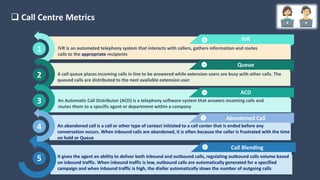
It gives the agent an ability to deliver both inbound and outbound calls, regulating outbound calls volume based
on inbound traffic. When inbound traffic is low, outbound calls are automatically generated for a specified
campaign and when inbound traffic is high, the dialler automatically slows the number of outgoing calls
Content here
Content here
Modern PowerPoint Presentation
Call Blending
1
2
3
4
IVR is an automated telephony system that interacts with callers, gathers information and routes
calls to the appropriate recipients
A call queue places incoming calls in line to be answered while extension users are busy with other calls. The
queued calls are distributed to the next available extension user
An Automatic Call Distributor (ACD) is a telephony software system that answers incoming calls and
routes them to a specific agent or department within a company
An abandoned call is a call or other type of contact initiated to a call center that is ended before any
conversation occurs. When inbound calls are abandoned, it is often because the caller is frustrated with the time
on hold or Queue
IVR
Queue
ACD
Abandoned Call
 Call Centre Metrics
10
Content Here
Content Here
Content Here
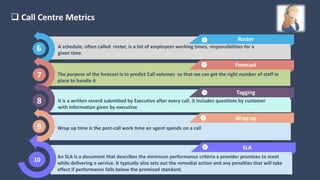
An SLA is a document that describes the minimum performance criteria a provider promises to meet
while delivering a service. It typically also sets out the remedial action and any penalties that will take
effect if performance falls below the promised standard.
Content here
Content here
Modern PowerPoint Presentation
SLA
6
7
8
9
A schedule, often called roster, is a list of employees working times, responsibilities for a
given time
The purpose of the forecast is to predict Call volumes so that we can get the right number of staff in
place to handle it
It is a written record submitted by Executive after every call, it includes questions by customer
with information given by executive
Wrap up time is the post-call work time an agent spends on a call
Roster
Forecast
Tagging
Wrap up
 Call Centre Metrics
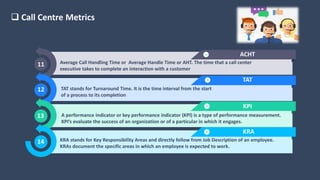
11
12
13
14
Average Call Handling Time or Average Handle Time or AHT. The time that a call center
executive takes to complete an interaction with a customer
TAT stands for Turnaround Time. It is the time interval from the start
of a process to its completion
A performance indicator or key performance indicator (KPI) is a type of performance measurement.
KPI’s evaluate the success of an organization or of a particular in which it engages.
KRA stands for Key Responsibility Areas and directly follow from Job Description of an employee.
KRAs document the specific areas in which an employee is expected to work.
ACHT
TAT
KPI
KRA
 Call Centre Metrics
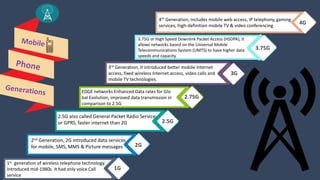
3rd Generation, It introduced better mobile Internet
access, fixed wireless Internet access, video calls and
mobile TV technologies.
2nd Generation, 2G introduced data services
for mobile, SMS, MMS & Picture messages
3.75G or High Speed Downlink Packet Access (HSDPA), It
allows networks based on the Universal Mobile
Telecommunications System (UMTS) to have higher data
speeds and capacity.
1st generation of wireless telephone technology.
Introduced mid-1980s. It had only voice Call
service
1G
2G
2.5G
2.75G
3G
4th Generation, Includes mobile web access, IP telephony, gaming
services, high-definition mobile TV & video conferencing
3.75G
4G
2.5G also called General Packet Radio Service
or GPRS, faster internet than 2G
EDGE networks Enhanced Data rates for Glo
bal Evolution, improved data transmission in
comparison to 2.5G
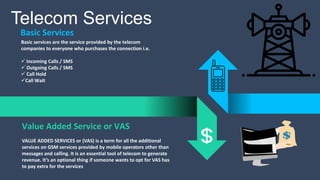
Telecom Services
Basic services are the service provided by the telecom
companies to everyone who purchases the connection i.e.
 Incoming Calls / SMS
 Outgoing Calls / SMS
 Call Hold
Call Wait
Basic Services
VALUE ADDED SERVICES or (VAS) is a term for all the additional
services on GSM services provided by mobile operators other than
messages and calling. It is an essential tool of telecom to generate
revenue. It’s an optional thing if someone wants to opt for VAS has
to pay extra for the services
Value Added Service or VAS
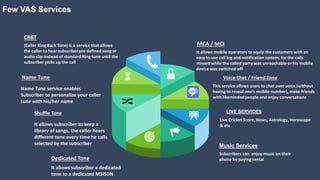
Few VAS Services
It allows mobile operators to equip the customers with an
easy to use call log and notification system, for the calls
missed while the called party was unreachable or his mobile
device was switched-off
MCA / MCI
This service allows users to chat over voice (without
having to reveal one's mobile number), make friends
with likeminded people and enjoy conversations
Voice Chat / Friend Zone
Subscribers can enjoy music on their
phone by paying rental
Music Services
(Caller Ring Back Tone) is a service that allows
the caller to hear subscriber pre defined song or
audio clip instead of standard Ring tone until the
subscriber picks up the call
CRBT
Name Tune service enables
Subscriber to personalize your caller
tune with his/her name
Name Tune
Live Cricket Score, News, Astrology, Horoscope
& etc
LIVE SERVICES
It allows subscriber to keep a
library of songs, the caller hears
different tone every time he calls
selected by the subscriber
Shuffle Tone
It allows subscriber a dedicated
tone to a dedicated MSISDN
Dedicated Tone
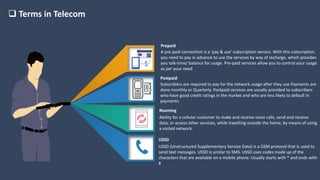
 Terms in Telecom
A pre-paid connection is a ‘pay & use’ subscription service. With this subscription,
you need to pay in advance to use the services by way of recharge, which provides
you talk-time/ balance for usage. Pre-paid services allow you to control your usage
as per your need
Prepaid
Subscribers are required to pay for the network usage after they use Payments are
done monthly or Quarterly. Postpaid services are usually provided to subscribers
who have good credit ratings in the market and who are less likely to default in
payments
Postpaid
Ability for a cellular customer to make and receive voice calls, send and receive
data, or access other services, while travelling outside the home, by means of using
a visited network.
Roaming
USSD (Unstructured Supplementary Service Data) is a GSM protocol that is used to
send text messages. USSD is similar to SMS. USSD uses codes made up of the
characters that are available on a mobile phone. Usually starts with * and ends with
#
USSD
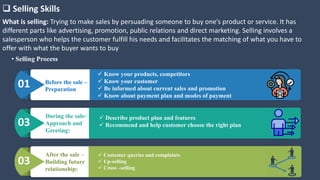
Before the sale –
Preparation
 Know your products, competitors
 Know your customer
 Be informed about current sales and promotion
 Know about payment plan and modes of payment
01
During the sale-
Approach and
Greeting:
 Describe product plan and features
 Recommend and help customer choose the right plan03
After the sale –
Building future
relationship:
 Customer queries and complaints
 Up-selling
 Cross –selling
03
 Selling Skills
What is selling: Trying to make sales by persuading someone to buy one’s product or service. It has
different parts like advertising, promotion, public relations and direct marketing. Selling involves a
salesperson who helps the customer fulfill his needs and facilitates the matching of what you have to
offer with what the buyer wants to buy
• Selling Process
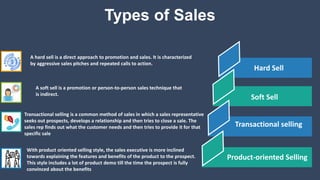
Types of Sales
A hard sell is a direct approach to promotion and sales. It is characterized
by aggressive sales pitches and repeated calls to action.
A soft sell is a promotion or person-to-person sales technique that
is indirect.
Transactional selling is a common method of sales in which a sales representative
seeks out prospects, develops a relationship and then tries to close a sale. The
sales rep finds out what the customer needs and then tries to provide it for that
specific sale
With product oriented selling style, the sales executive is more inclined
towards explaining the features and benefits of the product to the prospect.
This style includes a lot of product demo till the time the prospect is fully
convinced about the benefits
Hard Sell
Soft Sell
Transactional selling
Product-oriented Selling
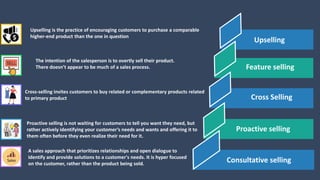
Upselling is the practice of encouraging customers to purchase a comparable
higher-end product than the one in question
The intention of the salesperson is to overtly sell their product.
There doesn’t appear to be much of a sales process.
Cross-selling invites customers to buy related or complementary products related
to primary product
Proactive selling is not waiting for customers to tell you want they need, but
rather actively identifying your customer’s needs and wants and offering it to
them often before they even realize their need for it.
Feature selling
Cross Selling
Proactive selling
Upselling
Consultative selling
A sales approach that prioritizes relationships and open dialogue to
identify and provide solutions to a customer's needs. It is hyper focused
on the customer, rather than the product being sold.
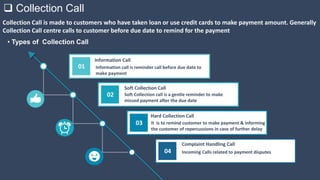
 Collection Call
Information call is reminder call before due date to
make payment
Information Call
01
Soft Collection call is a gentle reminder to make
missed payment after the due date
Soft Collection Call
02
Incoming Calls related to payment disputes
Complaint Handling Call
04
It is to remind customer to make payment & informing
the customer of repercussions in case of further delay
Hard Collection Call
03
Collection Call is made to customers who have taken loan or use credit cards to make payment amount. Generally
Collection Call centre calls to customer before due date to remind for the payment
• Types of Collection Call
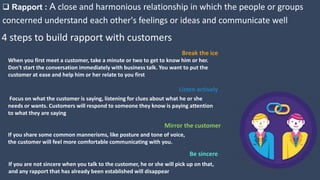
4 steps to build rapport with customers
 Rapport : A close and harmonious relationship in which the people or groups
concerned understand each other's feelings or ideas and communicate well
Listen actively
Focus on what the customer is saying, listening for clues about what he or she
needs or wants. Customers will respond to someone they know is paying attention
to what they are saying
Mirror the customer
If you share some common mannerisms, like posture and tone of voice,
the customer will feel more comfortable communicating with you.
Be sincere
If you are not sincere when you talk to the customer, he or she will pick up on that,
and any rapport that has already been established will disappear
Break the ice
When you first meet a customer, take a minute or two to get to know him or her.
Don't start the conversation immediately with business talk. You want to put the
customer at ease and help him or her relate to you first
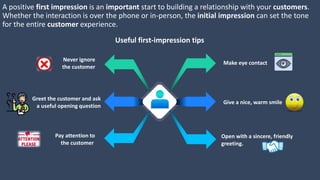
Useful first-impression tips
Make eye contact
Give a nice, warm smile
Open with a sincere, friendly
greeting.
Never ignore
the customer
Greet the customer and ask
a useful opening question
Pay attention to
the customer
A positive first impression is an important start to building a relationship with your customers.
Whether the interaction is over the phone or in-person, the initial impression can set the tone
for the entire customer experience.
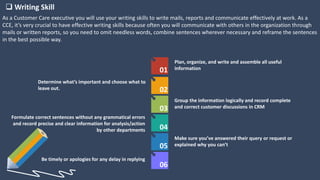
 Writing Skill
Plan, organize, and write and assemble all useful
information
Determine what’s important and choose what to
leave out.
Formulate correct sentences without any grammatical errors
and record precise and clear information for analysis/action
by other departments
Be timely or apologies for any delay in replying
Group the information logically and record complete
and correct customer discussions in CRM
Make sure you’ve answered their query or request or
explained why you can’t
01
02
03
04
05
06
As a Customer Care executive you will use your writing skills to write mails, reports and communicate effectively at work. As a
CCE, it’s very crucial to have effective writing skills because often you will communicate with others in the organization through
mails or written reports, so you need to omit needless words, combine sentences wherever necessary and reframe the sentences
in the best possible way.
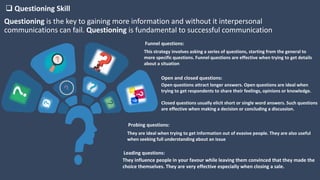
Questioning is the key to gaining more information and without it interpersonal
communications can fail. Questioning is fundamental to successful communication
Funnel questions:
This strategy involves asking a series of questions, starting from the general to
more specific questions. Funnel questions are effective when trying to get details
about a situation
Open and closed questions:
Open questions attract longer answers. Open questions are ideal when
trying to get respondents to share their feelings, opinions or knowledge.
Closed questions usually elicit short or single word answers. Such questions
are effective when making a decision or concluding a discussion.
Probing questions:
They are ideal when trying to get information out of evasive people. They are also useful
when seeking full understanding about an issue
Leading questions:
They influence people in your favour while leaving them convinced that they made the
choice themselves. They are very effective especially when closing a sale.
 Questioning Skill
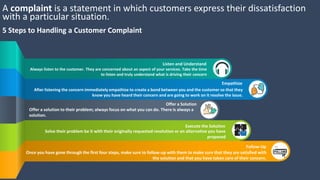
A complaint is a statement in which customers express their dissatisfaction
with a particular situation.
5 Steps to Handling a Customer Complaint
Always listen to the customer. They are concerned about an aspect of your services. Take the time
to listen and truly understand what is driving their concern
Listen and Understand
After listening the concern immediately empathize to create a bond between you and the customer so that they
know you have heard their concern and are going to work on it resolve the issue.
Empathize
Offer a solution to their problem; always focus on what you can do. There is always a
solution.
Offer a Solution
Solve their problem be it with their originally requested resolution or an alternative you have
proposed
Execute the Solution
Once you have gone through the first four steps, make sure to follow-up with them to make sure that they are satisfied with
the solution and that you have taken care of their concern.
Follow-Up
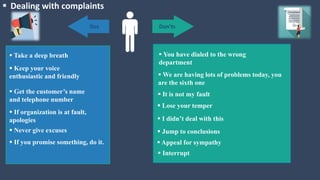
 Dealing with complaints
Dos Don'ts
 You have dialed to the wrong
department
 It is not my fault
 I didn’t deal with this
 We are having lots of problems today, you
are the sixth one
 Lose your temper
 Appeal for sympathy
 Jump to conclusions
 Interrupt
 Take a deep breath
 Keep your voice
enthusiastic and friendly
 Get the customer’s name
and telephone number
 If organization is at fault,
apologies
 Never give excuses
 If you promise something, do it.
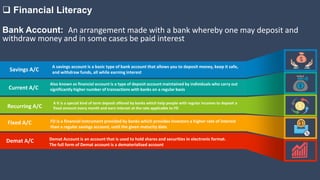
Bank Account: An arrangement made with a bank whereby one may deposit and
withdraw money and in some cases be paid interest
Demat A/C Demat Account is an account that is used to hold shares and securities in electronic format.
The full form of Demat account is a dematerialised account
Fixed A/C FD is a financial instrument provided by banks which provides investors a higher rate of interest
than a regular savings account, until the given maturity date
Recurring A/C
A It is a special kind of term deposit offered by banks which help people with regular incomes to deposit a
fixed amount every month and earn interest at the rate applicable to FD
Current A/C
Also known as financial account is a type of deposit account maintained by individuals who carry out
significantly higher number of transactions with banks on a regular basis
Savings A/C
A savings account is a basic type of bank account that allows you to deposit money, keep it safe,
and withdraw funds, all while earning interest
 Financial Literacy
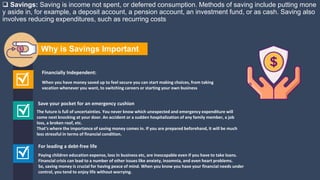
 Savings: Saving is income not spent, or deferred consumption. Methods of saving include putting mone
y aside in, for example, a deposit account, a pension account, an investment fund, or as cash. Saving also
involves reducing expenditures, such as recurring costs
Paying children education expense, loss in business etc, are inescapable even if you have to take loans.
Financial crisis can lead to a number of other issues like anxiety, insomnia, and even heart problems.
So, saving money is crucial for having peace of mind. When you know you have your financial needs under
control, you tend to enjoy life without worrying.
For leading a debt-free life
When you have money saved up to feel secure you can start making choices, from taking
vacation whenever you want, to switching careers or starting your own business
Financially Independent:
The future is full of uncertainties. You never know which unexpected and emergency expenditure will
come next knocking at your door. An accident or a sudden hospitalization of any family member, a job
loss, a broken roof, etc.
That’s where the importance of saving money comes in. If you are prepared beforehand, it will be much
less stressful in terms of financial condition.
Save your pocket for an emergency cushion
Why is Savings Important
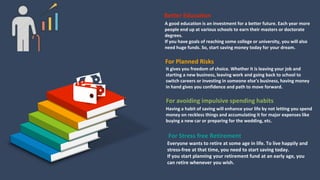
A good education is an investment for a better future. Each year more
people end up at various schools to earn their masters or doctorate
degrees.
If you have goals of reaching some college or university, you will also
need huge funds. So, start saving money today for your dream.
Better Education
It gives you freedom of choice. Whether it is leaving your job and
starting a new business, leaving work and going back to school to
switch careers or investing in someone else’s business, having money
in hand gives you confidence and path to move forward.
For Planned Risks
Having a habit of saving will enhance your life by not letting you spend
money on reckless things and accumulating it for major expenses like
buying a new car or preparing for the wedding, etc.
For avoiding impulsive spending habits
Everyone wants to retire at some age in life. To live happily and
stress-free at that time, you need to start saving today.
If you start planning your retirement fund at an early age, you
can retire whenever you wish.
For Stress free Retirement
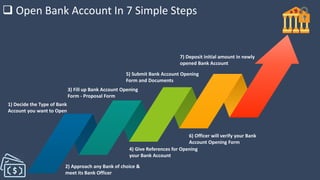
 Open Bank Account In 7 Simple Steps
6) Officer will verify your Bank
Account Opening Form
4) Give References for Opening
your Bank Account
5) Submit Bank Account Opening
Form and Documents
1) Decide the Type of Bank
Account you want to Open
3) Fill up Bank Account Opening
Form - Proposal Form
2) Approach any Bank of choice &
meet its Bank Officer
7) Deposit initial amount in newly
opened Bank Account
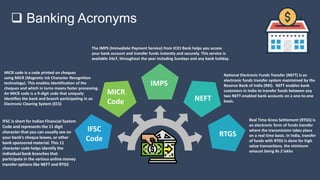
 Banking Acronyms
MICR code is a code printed on cheques
using MICR (Magnetic Ink Character Recognition
technology). This enables identification of the
cheques and which in turns means faster processing.
An MICR code is a 9-digit code that uniquely
identifies the bank and branch participating in an
Electronic Clearing System (ECS)
IFSC is short for Indian Financial System
Code and represents the 11 digit
character that you can usually see on
your bank’s cheque leaves, or other
bank sponsored material. This 11
character code helps identify the
individual bank branches that
participate in the various online money
transfer options like NEFT and RTGS
National Electronic Funds Transfer (NEFT) is an
electronic funds transfer system maintained by the
Reserve Bank of India (RBI). NEFT enables bank
customers in India to transfer funds between any
two NEFT-enabled bank accounts on a one-to-one
basis.
Real Time Gross Settlement (RTGS) is
an electronic form of funds transfer
where the transmission takes place
on a real time basis. In India, transfer
of funds with RTGS is done for high
value transactions, the minimum
amount being Rs 2 lakhs
The IMPS (Immediate Payment Service) from ICICI Bank helps you access
your bank account and transfer funds instantly and securely. This service is
available 24x7, throughout the year including Sundays and any bank holiday.
IMPS
MICR
Code
IFSC
Code
NEFT
RTGS
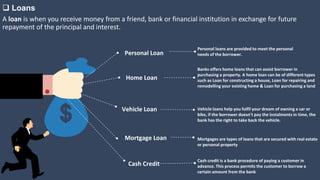
Personal Loan
Personal loans are provided to meet the personal
needs of the borrower.
Home Loan
Banks offers home loans that can assist borrower in
purchasing a property. A home loan can be of different types
such as Loan for constructing a house, Loan for repairing and
remodelling your existing home & Loan for purchasing a land
Mortgage Loan Mortgages are types of loans that are secured with real estate
or personal property
Vehicle Loan Vehicle loans help you fulfil your dream of owning a car or
bike, if the borrower doesn’t pay the instalments in time, the
bank has the right to take back the vehicle.
Cash Credit
Cash credit is a bank procedure of paying a customer in
advance. This process permits the customer to borrow a
certain amount from the bank
A loan is when you receive money from a friend, bank or financial institution in exchange for future
repayment of the principal and interest.
 Loans
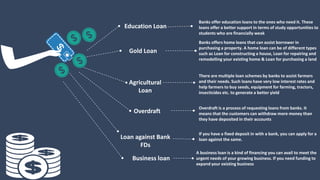
Education Loan
Banks offer education loans to the ones who need it. These
loans offer a better support in terms of study opportunities to
students who are financially weak
Gold Loan
Banks offers home loans that can assist borrower in
purchasing a property. A home loan can be of different types
such as Loan for constructing a house, Loan for repairing and
remodelling your existing home & Loan for purchasing a land
Overdraft
Overdraft is a process of requesting loans from banks. It
means that the customers can withdraw more money than
they have deposited in their accounts
Agricultural
Loan
There are multiple loan schemes by banks to assist farmers
and their needs. Such loans have very low interest rates and
help farmers to buy seeds, equipment for farming, tractors,
insecticides etc. to generate a better yield
Loan against Bank
FDs
If you have a fixed deposit in with a bank, you can apply for a
loan against the same.
Business loan
A business loan is a kind of financing you can avail to meet the
urgent needs of your growing business. If you need funding to
expand your existing business
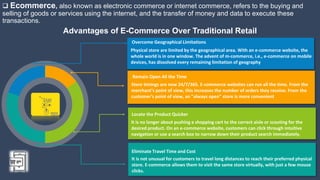
 Ecommerce, also known as electronic commerce or internet commerce, refers to the buying and
selling of goods or services using the internet, and the transfer of money and data to execute these
transactions.
Advantages of E-Commerce Over Traditional Retail
It is no longer about pushing a shopping cart to the correct aisle or scouting for the
desired product. On an e-commerce website, customers can click through intuitive
navigation or use a search box to narrow down their product search immediately.
Locate the Product Quicker
Store timings are now 24/7/365. E-commerce websites can run all the time. From the
merchant's point of view, this increases the number of orders they receive. From the
customer's point of view, an "always open" store is more convenient
Remain Open All the Time
It is not unusual for customers to travel long distances to reach their preferred physical
store. E-commerce allows them to visit the same store virtually, with just a few mouse
clicks.
Eliminate Travel Time and Cost
Physical store are limited by the geographical area. With an e-commerce website, the
whole world is in one window. The advent of m-commerce, i.e., e-commerce on mobile
devices, has dissolved every remaining limitation of geography
Overcome Geographical Limitations
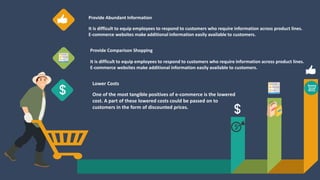
Provide Comparison Shopping
It is difficult to equip employees to respond to customers who require information across product lines.
E-commerce websites make additional information easily available to customers.
Provide Abundant Information
It is difficult to equip employees to respond to customers who require information across product lines.
E-commerce websites make additional information easily available to customers.
Lower Costs
One of the most tangible positives of e-commerce is the lowered
cost. A part of these lowered costs could be passed on to
customers in the form of discounted prices.
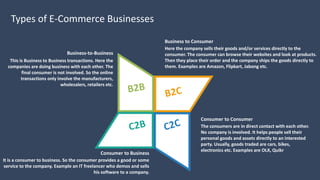
Types of E-Commerce Businesses
Here the company sells their goods and/or services directly to the
consumer. The consumer can browse their websites and look at products.
Then they place their order and the company ships the goods directly to
them. Examples are Amazon, Flipkart, Jabong etc.
Business to Consumer
The consumers are in direct contact with each other.
No company is involved. It helps people sell their
personal goods and assets directly to an interested
party. Usually, goods traded are cars, bikes,
electronics etc. Examples are OLX, Quikr
Consumer to Consumer
This is Business to Business transactions. Here the
companies are doing business with each other. The
final consumer is not involved. So the online
transactions only involve the manufacturers,
wholesalers, retailers etc.
Business-to-Business
It is a consumer to business. So the consumer provides a good or some
service to the company. Example an IT freelancer who demos and sells
his software to a company.
Consumer to Business
02
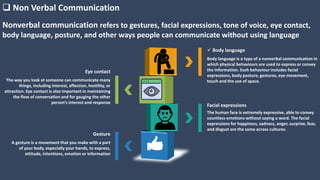
Nonverbal communication refers to gestures, facial expressions, tone of voice, eye contact,
body language, posture, and other ways people can communicate without using language
 Non Verbal Communication
 Body language
Body language is a type of a nonverbal communication in
which physical behaviours are used to express or convey
the information. Such behaviour includes facial
expressions, body posture, gestures, eye movement,
touch and the use of space.
Facial expressions
The human face is extremely expressive, able to convey
countless emotions without saying a word. The facial
expressions for happiness, sadness, anger, surprise, fear,
and disgust are the same across cultures.
Eye contact
The way you look at someone can communicate many
things, including interest, affection, hostility, or
attraction. Eye contact is also important in maintaining
the flow of conversation and for gauging the other
person’s interest and response
Gesture
A gesture is a movement that you make with a part
of your body, especially your hands, to express,
attitude, intentions, emotion or information
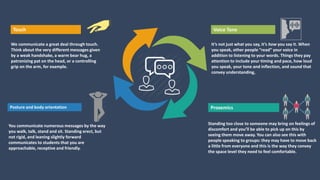
Voice Tone
It’s not just what you say, it’s how you say it. When
you speak, other people “read” your voice in
addition to listening to your words. Things they pay
attention to include your timing and pace, how loud
you speak, your tone and inflection, and sound that
convey understanding,
Proxemics
Standing too close to someone may bring on feelings of
discomfort and you’ll be able to pick up on this by
seeing them move away. You can also see this with
people speaking to groups: they may have to move back
a little from everyone and this is the way they convey
the space level they need to feel comfortable.
Touch
We communicate a great deal through touch.
Think about the very different messages given
by a weak handshake, a warm bear hug, a
patronizing pat on the head, or a controlling
grip on the arm, for example.
Posture and body orientation
You communicate numerous messages by the way
you walk, talk, stand and sit. Standing erect, but
not rigid, and leaning slightly forward
communicates to students that you are
approachable, receptive and friendly.
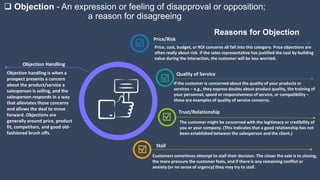
 Objection - An expression or feeling of disapproval or opposition;
a reason for disagreeing
Objection handling is when a
prospect presents a concern
about the product/service a
salesperson is selling, and the
salesperson responds in a way
that alleviates those concerns
and allows the deal to move
forward. Objections are
generally around price, product
fit, competitors, and good old-
fashioned brush offs.
Objection Handling
The customer might be concerned with the legitimacy or credibility of
you or your company. (This indicates that a good relationship has not
been established between the salesperson and the client.)
Trust/Relationship
Price, cost, budget, or ROI concerns all fall into this category. Price objections are
often really about risk. If the sales representative has justified the cost by building
value during the interaction, the customer will be less worried.
Price/Risk
Customers sometimes attempt to stall their decision. The closer the sale is to closing,
the more pressure the customer feels, and if there is any remaining conflict or
anxiety (or no sense of urgency) they may try to stall.
Stall
If the customer is concerned about the quality of your products or
services – e.g., they express doubts about product quality, the training of
your personnel, speed or responsiveness of service, or compatibility –
these are examples of quality of service concerns.
Quality of Service
Reasons for Objection
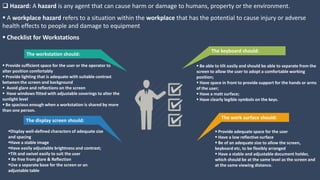
 Hazard: A hazard is any agent that can cause harm or damage to humans, property or the environment.
The workstation should:
 Provide sufficient space for the user or the operator to
alter position comfortably
 Provide lighting that is adequate with suitable contrast
between the screen and background
 Avoid glare and reflections on the screen
 Have windows fitted with adjustable coverings to alter the
sunlight level
 Be spacious enough when a workstation is shared by more
than one person.
The display screen should:
Display well-defined characters of adequate size
and spacing
Have a stable image
Have easily adjustable brightness and contrast;
Tilt and swivel easily to suit the user
 Be free from glare & Reflection
Use a separate base for the screen or an
adjustable table
The keyboard should:
 Be able to tilt easily and should be able to separate from the
screen to allow the user to adopt a comfortable working
position;
 Have space in front to provide support for the hands or arms
of the user;
 Have a matt surface;
 Have clearly legible symbols on the keys.
The work surface should:
 Provide adequate space for the user
 Have a low reflective surface
 Be of an adequate size to allow the screen,
keyboard etc, to be flexibly arranged
 Have a stable and adjustable document holder,
which should be at the same level as the screen and
at the same viewing distance.
 A workplace hazard refers to a situation within the workplace that has the potential to cause injury or adverse
health effects to people and damage to equipment
 Checklist for Workstations
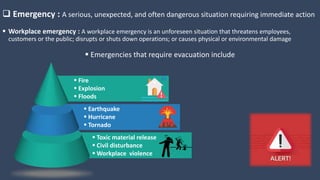
 Emergency : A serious, unexpected, and often dangerous situation requiring immediate action
 Workplace emergency : A workplace emergency is an unforeseen situation that threatens employees,
customers or the public; disrupts or shuts down operations; or causes physical or environmental damage
 Fire
 Explosion
 Floods
 Earthquake
 Hurricane
 Tornado
 Toxic material release
 Civil disturbance
 Workplace violence
 Emergencies that require evacuation include
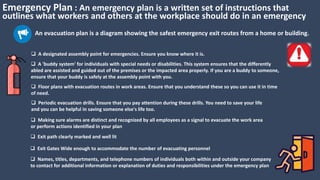
Emergency Plan : An emergency plan is a written set of instructions that
outlines what workers and others at the workplace should do in an emergency
An evacuation plan is a diagram showing the safest emergency exit routes from a home or building.
 Periodic evacuation drills. Ensure that you pay attention during these drills. You need to save your life
and you can be helpful in saving someone else's life too.
 Making sure alarms are distinct and recognized by all employees as a signal to evacuate the work area
or perform actions identified in your plan
 A 'buddy system' for individuals with special needs or disabilities. This system ensures that the differently
abled are assisted and guided out of the premises or the impacted area properly. If you are a buddy to someone,
ensure that your buddy is safely at the assembly point with you.
 Floor plans with evacuation routes in work areas. Ensure that you understand these so you can use it in time
of need.
 Exit path clearly marked and well lit
 Exit Gates Wide enough to accommodate the number of evacuating personnel
 Names, titles, departments, and telephone numbers of individuals both within and outside your company
to contact for additional information or explanation of duties and responsibilities under the emergency plan
 A designated assembly point for emergencies. Ensure you know where it is.
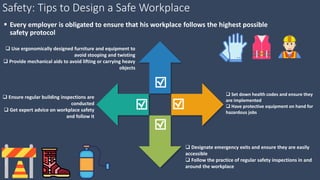
Safety: Tips to Design a Safe Workplace
 Every employer is obligated to ensure that his workplace follows the highest possible
safety protocol
 Use ergonomically designed furniture and equipment to
avoid stooping and twisting
 Provide mechanical aids to avoid lifting or carrying heavy
objects
 Ensure regular building inspections are
conducted
 Get expert advice on workplace safety
and follow it
 Set down health codes and ensure they
are implemented
 Have protective equipment on hand for
hazardous jobs
 Designate emergency exits and ensure they are easily
accessible
 Follow the practice of regular safety inspections in and
around the workplace
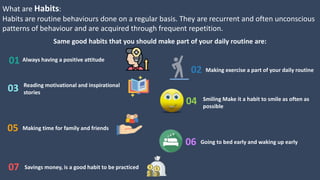
What are Habits:
Habits are routine behaviours done on a regular basis. They are recurrent and often unconscious
patterns of behaviour and are acquired through frequent repetition.
Same good habits that you should make part of your daily routine are:
Always having a positive attitude01
02 Making exercise a part of your daily routine
03 Reading motivational and inspirational
stories
04 Smiling Make it a habit to smile as often as
possible
05 Making time for family and friends
06 Going to bed early and waking up early
07 Savings money, is a good habit to be practiced
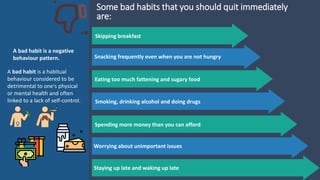
Skipping breakfast
Snacking frequently even when you are not hungry
Eating too much fattening and sugary food
Smoking, drinking alcohol and doing drugs
Spending more money than you can afford
Some bad habits that you should quit immediately
are:
Worrying about unimportant issues
Staying up late and waking up late
A bad habit is a negative
behaviour pattern.
A bad habit is a habitual
behaviour considered to be
detrimental to one's physical
or mental health and often
linked to a lack of self-control.
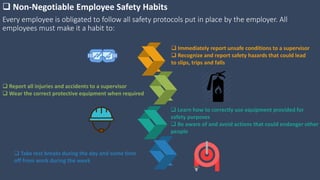
Every employee is obligated to follow all safety protocols put in place by the employer. All
employees must make it a habit to:
 Non-Negotiable Employee Safety Habits
 Immediately report unsafe conditions to a supervisor
 Recognize and report safety hazards that could lead
to slips, trips and falls
 Learn how to correctly use equipment provided for
safety purposes
 Be aware of and avoid actions that could endanger other
people
 Report all injuries and accidents to a supervisor
 Wear the correct protective equipment when required
 Take rest breaks during the day and some time
off from work during the week
Being healthy should be part of your overall lifestyle. Living a healthy lifestyle can help
prevent chronic diseases and long-term illnesses. Feeling good about yourself and taking
care of your health are important for your self-esteem and self-image.
 Better health is central to human happiness and well-being
 Allergies
 Asthma
 Some common health issues are:
 Skin Disorders
 Depression and Anxiety
 Diabetes
 Cough, Cold, Sore Throat
 Difficulty Sleeping
 Obesity
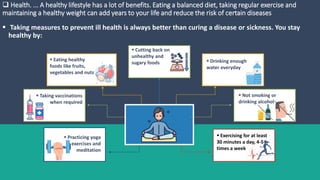
 Health. ... A healthy lifestyle has a lot of benefits. Eating a balanced diet, taking regular exercise and
maintaining a healthy weight can add years to your life and reduce the risk of certain diseases
 Taking measures to prevent ill health is always better than curing a disease or sickness. You stay
healthy by:
 Taking vaccinations
when required
 Eating healthy
foods like fruits,
vegetables and nuts
 Practicing yoga
exercises and
meditation
 Not smoking or
drinking alcohol
 Drinking enough
water everyday
 Exercising for at least
30 minutes a day, 4-5
times a week
 Cutting back on
unhealthy and
sugary foods
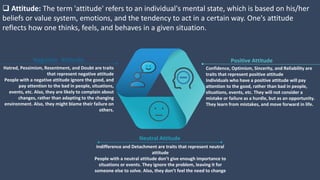
 Attitude: The term 'attitude' refers to an individual's mental state, which is based on his/her
beliefs or value system, emotions, and the tendency to act in a certain way. One's attitude
reflects how one thinks, feels, and behaves in a given situation.
Confidence, Optimism, Sincerity, and Reliability are
traits that represent positive attitude
Individuals who have a positive attitude will pay
attention to the good, rather than bad in people,
situations, events, etc. They will not consider a
mistake or failure as a hurdle, but as an opportunity.
They learn from mistakes, and move forward in life.
Positive Attitude
Hatred, Pessimism, Resentment, and Doubt are traits
that represent negative attitude
People with a negative attitude ignore the good, and
pay attention to the bad in people, situations,
events, etc. Also, they are likely to complain about
changes, rather than adapting to the changing
environment. Also, they might blame their failure on
others.
Negative Attitude
Indifference and Detachment are traits that represent neutral
attitude
People with a neutral attitude don’t give enough importance to
situations or events. They ignore the problem, leaving it for
someone else to solve. Also, they don’t feel the need to change
Neutral Attitude
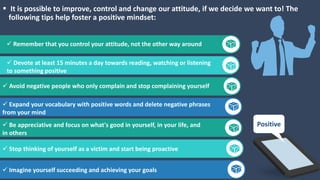
 It is possible to improve, control and change our attitude, if we decide we want to! The
following tips help foster a positive mindset:
Get a modern PowerPoint Presentation
that is beautifully designed. Remember that you control your attitude, not the other way around
 Devote at least 15 minutes a day towards reading, watching or listening
to something positive
 Avoid negative people who only complain and stop complaining yourself
 Expand your vocabulary with positive words and delete negative phrases
from your mind
 Be appreciative and focus on what's good in yourself, in your life, and
in others
 Stop thinking of yourself as a victim and start being proactive
 Imagine yourself succeeding and achieving your goals
Positive
 Honesty is a facet of moral character that connotes positive and virtuous attributes
such as integrity, truthfulness, straightforwardness, including straightforwardness of
conduct, along with the absence of lying, cheating, theft, etc. Honesty also involves
being trustworthy, loyal, fair, and sincere.
 They're Not Concerned About Popularity Contests
Honest people don't obsess over what peers think
of them. They simply are who they are, and other
people can take it or leave it.
 They Stand Up for Their Beliefs.
Honest individuals don't go looking for fights, but
they also aren't afraid to speak their mind. Honest
people will state their opinions even when their
beliefs are against the majority.
 They Are Trusted by Peers
Peers will seek the aid of honest individuals, knowing they can
count on them for true, objective advice. Many others will lie
and tell you the story you want to hear. They do this to avoid
any injured feelings, but there are many times with the difficult
truth is what individuals really need to hear
 They Have Close Friendships
Individuals who are honest often have rich, meaningful
friendships. Others know that their honest friend won't
complain about them behind their back, and will instead face
any issues head on. This level of trust allows for deeper,
healthier relationships
 They Are Thick Skinned
Honesty requires thick skin. Not all people love hearing the truth, and when you dish out a fresh dose
of reality, some might be inclined to toss it right back in your face (plus a little venom). Honest
individuals may fall victim to the insecure defensiveness of others, requiring them to be thick skinned
One of the most important characteristics of entrepreneurs is honesty. When entrepreneurs are honest with their
customers, employees and investors, it shows that they respect those that they work with. It is also important that
entrepreneurs remain honest with themselves.
When entrepreneurs build honest relationships
with their employees, it leads to more
transparency in the workplace, which results in
higher work performance and better results.
 Honesty and employees:
The consequences of being dishonest with oneself
can lead to dire results, especially in the case of
entrepreneurs. For entrepreneurs to Succeed, it iS
critical that they remain realistic about their
situation at all times, and accurately judge every
aspect of their enterprise for what it truly is.
 Honesty with oneself:
When entrepreneurs are honest with their
customers it leads to stronger relationships,
which in turn results in business growth and a
stronger customer network.
 Honesty and customers:
For entrepreneurs, being honest with investor’s means not only
sharing strengths but also candidly disclosing current and
potential weaknesses, problem areas and solution strategies.
Keep in mind that investors have a lot of experience with start-ups
and are aware that all new companies have problems. Claiming
that everything is perfectly fine and running smoothly is a red flag
for most investors.
 Honesty and investors:
 Importance of Honesty in Entrepreneurs
 A strong work ethic is an important part of being successful in your career. Work ethic is a set
of values based on the ideals of discipline and hard work. ... Forming good habits such as
focusing, staying motivated, finishing tasks immediately, and more helps to create a good work
ethic that will impress employers.
2
3
4
1
This means refusing to quit until the designated work is done, and completing the
work at the highest possible level of excellence.
This means always keeping your word, whether it's arriving on time for a meeting or
delivering work on time.
This means remaining poised and diplomatic regardless of how stressful or volatile a
situation is.
This involves everything from how you present yourself in a corporate setting to the
manner in which you treat others in the workplace.
Professionalism
Respectfulness
Dependability
Dedication
 Elements of a Strong Work Ethic:
An entrepreneur must display strong work ethics, as well as hire only those individuals who believe in and
display the same level of ethical behaviour in the workplace. Some elements of a strong work ethic are:
7
8
9
10
6
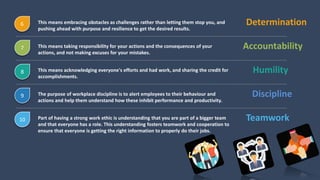
Part of having a strong work ethic is understanding that you are part of a bigger team
and that everyone has a role. This understanding fosters teamwork and cooperation to
ensure that everyone is getting the right information to properly do their jobs.
The purpose of workplace discipline is to alert employees to their behaviour and
actions and help them understand how these inhibit performance and productivity.
This means acknowledging everyone's efforts and had work, and sharing the credit for
accomplishments.
This means taking responsibility for your actions and the consequences of your
actions, and not making excuses for your mistakes.
This means embracing obstacles as challenges rather than letting them stop you, and
pushing ahead with purpose and resilience to get the desired results.
Determination
Accountability
Humility
Discipline
Teamwork
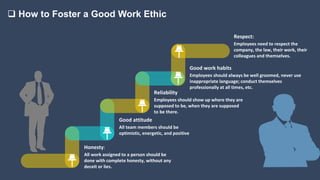
 How to Foster a Good Work Ethic
Honesty:
All work assigned to a person should be
done with complete honesty, without any
deceit or lies.
Good work habits
Employees should always be well groomed, never use
inappropriate language; conduct themselves
professionally at all times, etc.
Reliability
Employees should show up where they are
supposed to be, when they are supposed
to be there.
Good attitude
All team members should be
optimistic, energetic, and positive
Respect:
Employees need to respect the
company, the law, their work, their
colleagues and themselves.
 How to Foster a Good Work Ethic
 Initiative
Doing the bare minimum is not
enough. Every team member
needs to be proactive and show
initiative.
 Efficiency
Efficient employees help a
company grow while inefficient
employees result in a waste of
time and resources.
 Trustworthiness
Trust is non-negotiable. If an
employee cannot be trusted, it's
time to let that employee go.
 Integrity
Each and every team member
should be completely ethical and
must display above board
behaviour at all times.
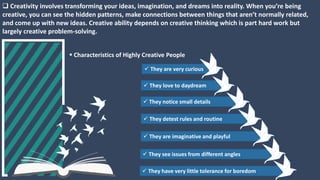
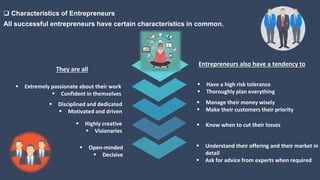
 Creativity involves transforming your ideas, imagination, and dreams into reality. When you’re being
creative, you can see the hidden patterns, make connections between things that aren’t normally related,
and come up with new ideas. Creative ability depends on creative thinking which is part hard work but
largely creative problem-solving.
 Characteristics of Highly Creative People
 They are imaginative and playful
 They see issues from different angles
 They notice small details
 They have very little tolerance for boredom
 They detest rules and routine
 They love to daydream
 They are very curious
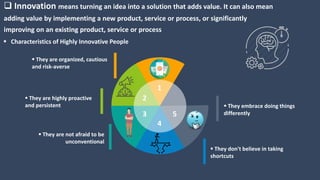
 Innovation means turning an idea into a solution that adds value. It can also mean
adding value by implementing a new product, service or process, or significantly
improving on an existing product, service or process
 Characteristics of Highly Innovative People
 They embrace doing things
differently
 They don't believe in taking
shortcuts
 They are not afraid to be
unconventional
 They are highly proactive
and persistent
 They are organized, cautious
and risk-averse
1
2
3
4
5
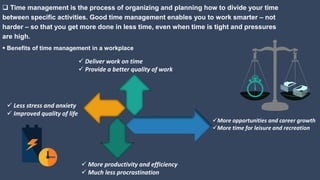
 Time management is the process of organizing and planning how to divide your time
between specific activities. Good time management enables you to work smarter – not
harder – so that you get more done in less time, even when time is tight and pressures
are high.
 Benefits of time management in a workplace
 Less stress and anxiety
 Improved quality of life
 Deliver work on time
 Provide a better quality of work
 More productivity and efficiency
 Much less procrastination
More opportunities and career growth
More time for leisure and recreation
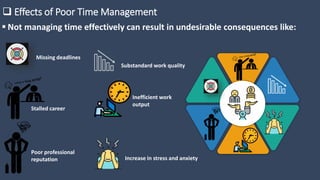
 Effects of Poor Time Management
 Not managing time effectively can result in undesirable consequences like:
Missing deadlines
Substandard work quality
Stalled career
Inefficient work
output
Poor professional
reputation Increase in stress and anxiety
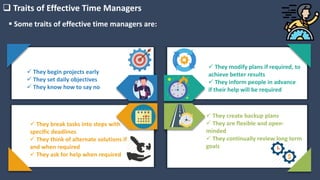
 Traits of Effective Time Managers
 They begin projects early
 They set daily objectives
 They know how to say no
 They break tasks into steps with
specific deadlines
 They think of alternate solutions if
and when required
 They ask for help when required
 They modify plans if required, to
achieve better results
 They inform people in advance
if their help will be required
 They create backup plans
 They are flexible and open-
minded
 They continually review long term
goals
 Some traits of effective time managers are:
1
Plan out your day as well as plan for interruptions. Give yourself at least 30 minutes to figure out
your time plan. In your plan, schedule some time for interruptions.
 Effective Time Management Techniques
 You can manage your time better by putting into practice certain time management techniques
Some helpful tips are:
2 Put up a "Do Not Disturb" sign when you absolutely have to complete a certain amount of work.
3 Create time management goals to reduce time wastage.
4 Prioritize. List each task to be completed in order of its urgency or importance level. Then focus
on completing each task, one by one.
5
Maintain a log of your work activities. Analyze the log to help you understand how efficient you
are, and how much time is wasted every day.
 Effective Time Management Techniques
6
Stop procrastinating. Remind yourself that procrastination typically arises due to the fear of
failure or the belief that you cannot do things as perfectly as you wish to do them.
7
Delegate your work. This will not only help your work get done faster, but will also show you the
unique skills and abilities of those around you.
8
Close your mind to all distractions. Train yourself to ignore ringing phones, don't reply to chat
messages and disconnect from social media sites.
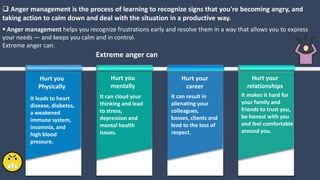
 Anger management is the process of learning to recognize signs that you're becoming angry, and
taking action to calm down and deal with the situation in a productive way.
 Anger management helps you recognize frustrations early and resolve them in a way that allows you to express
your needs — and keeps you calm and in control.
Extreme anger can:
It leads to heart
disease, diabetes,
a weakened
immune system,
insomnia, and
high blood
pressure.
Hurt you
Physically
It can cloud your
thinking and lead
to stress,
depression and
mental health
issues.
Hurt you
mentally
It can result in
alienating your
colleagues,
bosses, clients and
lead to the loss of
respect.
Hurt your
career
It makes it hard for
your family and
friends to trust you,
be honest with you
and feel comfortable
around you.
Hurt your
relationships
Extreme anger can
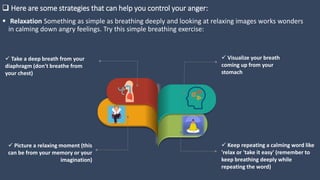
 Here are some strategies that can help you control your anger:
 Relaxation Something as simple as breathing deeply and looking at relaxing images works wonders
in calming down angry feelings. Try this simple breathing exercise:
 Visualize your breath
coming up from your
stomach
 Take a deep breath from your
diaphragm (don't breathe from
your chest)
 Keep repeating a calming word like
'relax or 'take it easy' (remember to
keep breathing deeply while
repeating the word)
 Picture a relaxing moment (this
can be from your memory or your
imagination)
Cognitive Restructuring
 Cognitive Restructuring means changing the manner
in which you think. Anger can make you curse, swear,
exaggerate and act very dramatically. When this
happens, force yourself to replace your angry thoughts
with more logical ones. For instance, instead of thinking
‘Everything is ruined’ change your mindset and tell
yourself `It's not the end of the world and getting won’t
solve this'.
 Problem Solving
Getting angry about a problem that you
cannot control is a perfectly natural response.
Sometimes, try as you may, there may not be
a solution to the difficulty you are faced with.
In such cases, stop focusing on solving the
problem, and instead focus on handling and
facing the problem. Remind yourself that you
will do your best to deal with the situation,
but that you will not blame yourself if you
don't get the solution you desire.
 Better Communication
When you're angry, it is very easy to jump
to inaccurate conclusions. In this case, you
need to force yourself to stop reacting, and
think carefully about what you want to say,
before saying it.
Avoid saying the first thing that enters your
head. Force yourself to listen carefully to
what the other person is saying. Then think
about the conversation before responding.
 Changing Your Environment
If you find that your environment is the cause or
your anger, try and give yourself a break from your
surroundings. Make an active decision to schedule
some personal time for yourself, especially on days
that are very hectic and stressful. Having even a
brief amount of quiet or alone time is sure to help
calm you down.
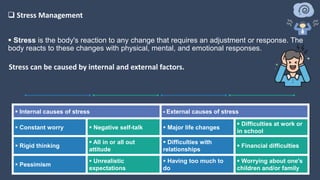
 Stress is the body's reaction to any change that requires an adjustment or response. The
body reacts to these changes with physical, mental, and emotional responses.
 Internal causes of stress  External causes of stress
 Constant worry  Negative self-talk  Major life changes
 Difficulties at work or
in school
 Rigid thinking
 All in or all out
attitude
 Difficulties with
relationships
 Financial difficulties
 Pessimism
 Unrealistic
expectations
 Having too much to
do
 Worrying about one's
children and/or family
Stress can be caused by internal and external factors.
 Stress Management
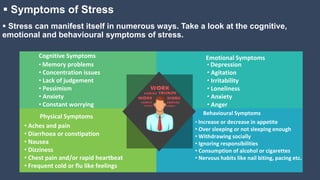
 Stress can manifest itself in numerous ways. Take a look at the cognitive,
emotional and behavioural symptoms of stress.
Cognitive Symptoms
• Memory problems
• Concentration issues
• Lack of judgement
• Pessimism
• Anxiety
• Constant worrying
Physical Symptoms
• Aches and pain
• Diarrhoea or constipation
• Nausea
• Dizziness
• Chest pain and/or rapid heartbeat
• Frequent cold or flu like feelings
Emotional Symptoms
• Depression
• Agitation
• Irritability
• Loneliness
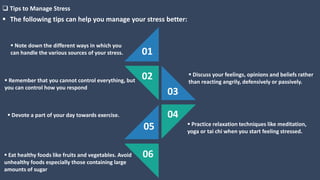
• Anxiety
• Anger
Behavioural Symptoms
• Increase or decrease in appetite
• Over sleeping or not sleeping enough
• Withdrawing socially
• Ignoring responsibilities
• Consumption of alcohol or cigarettes
• Nervous habits like nail biting, pacing etc.
 Symptoms of Stress
 The following tips can help you manage your stress better:
 Tips to Manage Stress
 Note down the different ways in which you
can handle the various sources of your stress.
 Remember that you cannot control everything, but
you can control how you respond
01
02
03
04
05
06
 Discuss your feelings, opinions and beliefs rather
than reacting angrily, defensively or passively.
 Practice relaxation techniques like meditation,
yoga or tai chi when you start feeling stressed.
 Devote a part of your day towards exercise.
 Eat healthy foods like fruits and vegetables. Avoid
unhealthy foods especially those containing large
amounts of sugar
 Tips to Manage Stress
 Plan your day so that you can manage your
time better, with less stress
 Schedule time to pursue your hobbies and interests.
07
08
09
10
11
12
 Say no to people and things when required.
 Reduce your caffeine intake.
 Ensure you get at least 7-8 hours of sleep.
 Increase the time spent with family and friends.
It results in the creation of new organization1
It brings Creativity into the marketplace2
It leads to improved standards of living3
It helps develop the economy of a country4
 Entrepreneurship
Importance of Entrepreneurship
An entrepreneur is an entity which has the ability to find and act upon opportunities to translate
inventions or technologies into products and services
Types of Entrepreneurs
01
02
03
04
Growth Potential Entrepreneur:
They start an enterprise that grows, win
many customers and make lots of money.
Then they sell their enterprise for a nice
profit. Usually they have a science or
technical background.
Project-Oriented Entrepreneur:
This type of entrepreneur generally has a
background in the Arts or psychology. Their
enterprises tend to be focus on something
that they are very passionate about.
Traditional Entrepreneur:
They have a set of Skills like Carpeting,
Mechanic, cooking & etc; they work for
many years as a worker before starting
their own business in the similar field
Lifestyle Entrepreneur:
They have usually worked as a teacher or a
secretary. They are more interested in Selling
Something that people will enjoy, rather
than making lots of money.
 Characteristics of Entrepreneurs
All successful entrepreneurs have certain characteristics in common.
 Extremely passionate about their work
 Confident in themselves
They are all
Entrepreneurs also have a tendency to
 Disciplined and dedicated
 Motivated and driven
 Highly creative
 Visionaries
 Open-minded
 Decisive
 Have a high risk tolerance
 Thoroughly plan everything
 Manage their money wisely
 Make their customers their priority
 Understand their offering and their market in
detail
 Ask for advice from experts when required
 Know when to cut their losses
 Types of Enterprises
 As an entrepreneur in India, you can own and run any of the following types of
enterprises:
A single individual owns, manages and controls the enterprise. This type of
business is the easiest to form with respect to legal formalities. The business
and the owner have no separate legal existence. All profit belongs to the
proprietor, as do all the losses the liability of the entrepreneur is unlimited.
Sole Proprietorship
A partnership firm is formed by two or more people. The owners of the
enterprise are called partners. A partnership deed must be signed by all
the partners.. The profits are shared by the partners. With respect to
losses, the liability of the partners is unlimited.
Partnership
The partners of the firm enjoy perpetual existence as well as the advantage of
limited liability. Each partner's liability is limited to their agreed contribution to
the LLP. The partnership and its partners have a separate legal existence.
Limited Liability Partnership (LLP)
 Leadership is the art of motivating a group of people to act toward achieving a
common goal. In a business setting, this can mean directing workers and
colleagues with a strategy to meet the company's needs.
01
02
03
A leader must lead himself, only then he can lead others. He must be committed on
personal and professional front, and must be responsible. He must be a role model
for others and set an example for them.
A leader must boost up the morale of the employees. He should motivate them well so that
they are committed to the organization. He should be well acquainted with them, have
concern for them and encourage them to take initiatives. This will result in more efficient and
effective employees and ensure organizational success.
A leader must work as a team. He should always support his team and respect them. He
should not hurt any employee. A true leader should not be too bossy and should not consider
him as the supreme authority. He should realize that he is part of the organization as a whole.
 The Difference Between a Boss and a Leader. A boss manages their employees, while
a leader inspires them to innovate, think creatively, and strive for perfection.
 Tips for Effective Organizational Leadership
 Building a successful enterprise is only possible if the entrepreneur in charge possesses excellent
leadership qualities. Some critical leadership skills that every entrepreneur must have are:
 Leadership Qualities That All Entrepreneurs Need
2
3 4
5
61
This means taking the time to recognize
how others view you. It means
understanding how your presence affects
those around you.
Awareness
This means refreshing or changing your
leadership style when necessary. To do this,
it's important to learn where your
leadership gaps lie and find out what
resources are required to close them.
Reinvention
This means having the ability to highlight all
obstacles and challenges, in order to resolve
issues and reduce risks.
Pragmatism
This means showing both, your strengths and your
weaknesses. It means being human and showing
others that you are human.
Authenticity
This means admitting to mistakes often
and early, and being quick to take
responsibility for your actions. Mistakes
should be viewed as challenges to
overcome, not opportunities to point
blame.
Humility
It is critical for a good leader to be very flexible
and quickly adapt to change. It is equally critical
to know when to adapt and when not to.
Flexibility
 Benefits of Effective Leadership for Organisations
 Skilled Leadership Leads to a
Good Business Culture
 Amazing Leaders Train Other
Amazing Leaders!
 Productivity Increases
 Staff Retention, Loyalty and
Happiness Increase
 Effective Leaders = Effective Teams
 Team: A team is a group of individuals working together to achieve their goal.
 Team Work: when a group of people work together cohesively, towards a common
goal, creating a positive working atmosphere, and supporting each other to combine
individual strengths to enhance team performance.
All the team members should clearly understand and be
equally committed to the purpose, vision and goals of the
team..
Unity of purpose:
Every member should feel entitled to provide
regular feedback on new ideas.
The ability to collaborate
The team should have the ability to anticipate problems
and act on these potential problems before they turn into
real problems.
Visionary members:
Team members should have the ability to express their
concerns, ask questions to convey complex
information.
Great communication skills
The team should consist of proactive individuals. The members
should have the enthusiasm to come up with new ideas,
improve existing ideas, and conduct their own research.
Initiative
The team must believe that change is a positive force. Change
should be seen as the chance to improve and try new things.
Great adaptability skills:
The team should have the ability to develop standard work
processes, balance responsibilities, properly plan projects, and set
in place methods to measure progress and ROI.
Excellent organizational skills:
 Problem Solving
 All Problems have 2 elements.
Goals & Obstacles
 The aim of problem solving is to recognize the obstacles and remove them in order to achieve the goals
2
 Study the problem in detail
 Implement the chosen solution
Step
 Select the best solution
 Identify the problem
 List all possible solutions
 Check that the problem has
really been solved
Solving a problem requires a level of rational thinking. Here are some logical steps to follow
When faced with an issue follow these steps:
01
02
03
04
Ask for proof of the candidate's problem solving skills
in the application form.
Give potential candidates logical reasoning and critical
thinking tests and see how they fare.
Create hypothetical problematic situations or raise
ethical questions and see how the candidates respond.
Give candidates examples of real life problems and
evaluate their thought process.
Application forms:
Psychometric tests:
Interviews:
Technical questions:
 Problem Solving Traits
 Being Open minded
 Being proactive
 Having a positive attitude
 Asking the right questions
 Not panicking
 Focusing on the right problem
 How to Assess for Problem
Solving Skills
 A negotiation is a formal discussion to reach agreement about an issue. It is an
important method to reduce conflict, and to get things done.
Take a look at some steps to help you negotiate
Agree on a course of action to set the
solution in motion
Implement the Agreed upon Solution:
Try your best to be open minded when
negotiating. Compromise and offer alternate
solutions to reach an outcome where both
parties win.
Aim for a Win-Win Outcome
This involves asking questions, listening to the
other side, putting your views forward and
clarifying doubts.
Discuss the Problem:
Agree on where to meet to discuss the
problem, decide who all will be present
and set a time limit for the discussion.
Pre-Negotiation Preparation:
Ensure that both parties want to solve
the same problem and reach the same
goal.
Clarify the Objective:
When an agreement has been reached, the
details of the agreement should be crystal
clear to both sides, with no scope for
misunderstandings.
Clearly Define the Agreement:
1
2
3
4
5
6
 Negotiation skills help build relationships because the aim is to foster goodwill despite difference in interests.
Good negotiation skills also help in avoiding future conflicts and problem by leaving both parties equally satisfied with no
barriers to communication for the future.
SWOT Analysis
SWOT
What are your strengths?
What unique capabilities do you posses?
What do your competitors do better than
you?
What do others perceive as your strengths?
STRENGTH
What Trends may positively impact you?
What opportunities are available to you?
OPPORTUNITIES
What are your weaknesses?
What do your competitors do
better than you?
WEAKNESSES
Do you have solid financial
support?
What trends may negatively
impact you?
THREATS
Thank you
Created by: Md. Arif
CRM Domestic Voice Trainer
9073015745

Customer Relationship Management

  • 2.
    Call Centre, Typesof BPO, Call Centre Metrics, Mobile Technology, BPO Functionality BPO Verbal, Non Verbal, Telephonic, Written, Questioning Skill, Objection, Complaint, Negotiation Communication Skill Banking, Savings, Loans, Collection Financial Literacy 05 02 03 04 01 Leadership, Team Work, Anger Management, Time Management, SWOT Analysis, Stress Management Entrepreneurial Skills What is CRM, Importance, Functionality, Customers handling CRM • Topics to be covered
  • 3.
    CRM “is abusiness strategy that aims to understand, anticipate and manage the needs of an organisation’s current and potential customers” What is CRM?
  • 4.
    • Definition ofCRM CRM is concerned with the creation, development and enhancement of individualised customer relationships with carefully targeted customers and customer groups resulting in maximizing their total customer life-time value”. •Assign Leads •Qualify Leads •Covert Leads •Track Opportunities •Deliver Products •Produce Invoices • Run Campaigns • Generate Leads • Form a Database •Manage Cases •Conduct Trainings •Provide Service •Develop Knowledge Base CRM
  • 5.
    The focus ofCRM is on creating value for the customer and the company over the longer term When customers value the service that they receive from service providers, they are less likely to look to alternative for their needs CRM enables organisations to gain ‘competitive advantage’ over competitors that supply similar products or services The purpose of CRM
  • 6.
    Customer life cycle 1 2 4 3 Themarketing part of the customer life cycle is when messages are sent to the target market to attract prospect customers. Marketing The third stage is relationship management. Relationship management is when resell processes increase the value of existing customers. Relationship Management The next phases is customer acquisition which means prospects become customers when they place an order. Customer Acquisition The end stage of a customer life cycle is loss/churn when inevitably in time a company may lose a customer. The company then needs to establish a win-back process. The company then needs to decide which lost customers are of most value and try to win back their business. Loss/Churn
  • 7.
    Importance of CRM CRMhelps the organization to identify customer needs and re-focus its strategy to serve better Action plan to make organization customer – centric Provide feedback and new information on competitors Provide feedback to the service provider on his total operation Identify customer needs. Helps in rediscovering the customer and understanding him. Identify untapped business potential. Identify strong and weak points of service Provider. CRM
  • 8.
    IT – ITesSector Information technology (IT) is the use of any, storage, networking and other physical devices, infrastructure and processes to create computers, process, store, secure and exchange all forms of electronic data. The Information Technology-Enabled Services (ITES) industry provides services that are delivered over telecom or data network to a range of external business area • Claims processing, eg. Insurance • Billing and collection, eg. Telephone bills R • Call Centers • Office operations such as accounting, data processing, data mining • Internal audit and pay roll, eg. Salary Bills • Routine jobs given to a 3Rd Party & importance to core business ITes services includes :
  • 9.
    Outsourcing Benefits of Outsourcing: Outsourcing is a process in which company sub – contracts some tasks to experts 12 Staffing Flexibility 24 X 7 availability Improve service and delight the customer. Improving company focus Access to skilled expertise 34 56 Cost Savings
  • 10.
    4 Major Typesof Outsourcing BPO A Business Process Outsourcing (BPO) organisation is responsible for performing a process or a part of a process of another business organisation KPO Knowledge process outsourcing, is information-related business activities. KPO involves outsourcing work to individuals that typically have advanced degrees and expertise in a specialized area LPO Legal process outsourcing, or LPO, is the exporting of legal services to low-wage markets overseas. Legal process outsourcing is also known as Off shoring & On shoring HRO Human resource outsourcing refers to a process in which the employer transfers responsibilities and risks for HR functions to the external provider which performs this tasks for the company
  • 11.
    Data confidentiality : •Data is the primary asset of any organization and its security is essential. Do not reveal customer’s personal and financial information to anybody other then the account holder Do not share information about a customer with other customers Unauthorized information, written or verbal, cannot be divulged to any customer/competitor/any other person e.g. photocopy of customer information sheet etc
  • 12.
    Client Confidentiality: The clientplaces a lot of trust in the organizational and in the Customer Care Executive before sharing his information. It is crucial for the Executive to maintain that trust and faith by maintaining the confidentiality of the client’s information. • A written Non-Disclosure Agreement(NDA) is obtained at the time of joining from each employee • Limited access to the network is given through login IDs and password protection • Passwords and access controls are well defined for authorized internal persons • The data received from the client during the time of processing in any form such as hard copies or soft copies should not be misused • None of the employees are allowed to bring any storage devices like memory cards, CD/DVD/Floppy disk, pen drive etc • At entry and the exit points, the security guards frisk the employees to cheek that none of the storage devices are carried in or out by any of the employees
  • 13.
    Customer A customer isa person or company that receives or buys a product or service and in return pays or gives monetary benefits Consumer Any individual who purchases products or services for his personal use and not for manufacturing or resale is called a consumer
  • 14.
    Types of Customers ElitistCustomers Need – Based Customers Impulsive Customers Wandering Customers Loyal Customers Potential / Prospect Customers Dissatisfied Customer
  • 15.
    CARING Approach C –Courteous A – Alive and Energetic R – Responsive N – Never say ‘NO’ I – Informed G – Guide Right
  • 16.
    Roles & Responsibilitiesof CRM Domestic Voice Executive • An Executive is the voice of the of the company. He is first point of contact with the customers • An Executive receives & makes phone calls that are scripted. They inform customers about products & services offered by the company • An Executive needs to answer queries, resolve problems, record complaints and / or receive feedback • An Executive is expected to communicate with the customers to market & sell the products and services by the organization. • An Executive is required to talk to the customers politely & professionally • An Executive should be target oriented
  • 17.
    • Importance ofCustomer Service  Customer is the king  Customer can either be consumer customer or business customers  Increasing the customer base is the ultimate goal of every business since, “ More the customers, more is likely to be the business profitability.  The objective of any organization is to fulfill the needs of a customer, hence customer satisfaction plays a vital role in any business  customers are a source of revenue generati on for the business
  • 18.
    Skill required forCustomer Service Good Team Player  Know about your organization, Process & product well  Be organized  Be consistent Good Communication Skill  Know the technical parts of the job
  • 19.
    Characteristics of ExcellentCustomer Service  Communication  Consistency  Problem Solving  Empathy  Goal-oriented focus  Time management skills  Capacity to take criticism and negative feedback  Sincerity  Willingness to learn  Persuasion skills  Dependability  Product Knowledge  Attentiveness  Unflappability  Flexibility  Respectfulness
  • 20.
    Attributes of aCRM Domestic Voice Executive Communication Skills Problem Solving Skills Learning Skills Time & Anger Management 01 04 05 TeamworkInterpersonal Skills 02 06 Telephone EtiquetteCustomer Handling Skills 03 07 08 Professional Skills for the role are :
  • 21.
    What do Customers Expector Want Customer Service  Correct & Complete Information  Better customer service  Good product  Attention  24/7 & 365 days a year  Friendliness Convenience  Understanding and empathy  Good value  Fairness  Options and alternatives
  • 22.
    Customers with SpecialNeeds 01 Loyalty/High ARPU customers 02 In roamers and out roamers 03 People who have communication problems 04 05 Old aged customers People with disabilities
  • 23.
    Reliability1 Confidence2 Responsiveness3 Efficiency4 Factors Affecting the Qualityof Service Organization5 Acceptance of and adherence to policies and procedures 6
  • 24.
    Dealing with DifficultBehavior 01 Label the behavior, not the customer 02 Listen 03 Don’t get defensive 04 Don’t take it personally 05 Find out what the customer wants 06 Discuss alternatives 07 Take responsibility for what you can do
  • 25.
     The AngryCustomer  Listen carefully without interrupting so you understand the problem  Empathies in a broad way  Stay calm and remain polite  Propose an action plan and follow it  Don’t take it personally, be defensive or blame others  Don’t escalate the problem in front of the customer  Seek support if you are scared, if you can’t agree on a solution or if the customer asks to see “whoever’s in charge”  Angry Customer. A dissatisfied customer is one who feels a business did not provide a product or service as expected. ... These customers feel betrayed by the company, believing the company violated the norms or ethics of a customer-company relationship.
  • 26.
     The TalkativeCustomer  Ask closed questions  Limit the time available for them to interrupt (don’t have long pauses)  Provide minimal response  Smile and be pleasant, but don’t encourage them  Give timeline for reverting  These customers tend to drone on about topics unrelated to the issue they're discussing with agents. Because conversations with them take too long, you may have to put other queued customers on hold. This means you'll be losing the opportunity to help other customers
  • 27.
     The IndecisiveCustomer  Find out what they really want  Ask them for the options  Reflect back to them what they’ve said  Assume control gently and point out the best course of action from what they’ve told you they need  Be logical  Confirm a plan of action with them  Ensure written requests  Customers are indecisive about taking a service or a product you are offering. Though they look around, ask questions, show interest, or simply can't decide for numerous reasons,
  • 28.
     The SuspiciousCustomer Establish your credibility Ensure you know your product or service They will try and catch you out so don’t guess or tell them something you’re not sure of Be careful what you say Be polite Don’t take it personally, they don’t trust anyone!
  • 29.
     The ‘knowit all’ Customer  Acknowledge what they say  Compliment them on their knowledge  Be generous with praise  Don’t “put them in their place” no matter how tempting  Don’t try to be smart – you can’t win!  Ask specific questions and use them to improve the situation  Don’t bypass procedures (they may quote it next time)
  • 30.
    BPO & CallCentre Business process outsourcing, or BPO, is a business practice in which one organization hires another company to perform a process task for its own business to operate successfully. BPO A call center is a office or facility that is equipped to handle large amounts of customer telephone Calls for an organization Call Centre
  • 31.
    Types of BPO DataEntry E - Mail Correspondence Chat Process Voice Process Accepting Order Customer Service Tele - Sales Collections BPO Non-voice processes are the processes that don't require voice medium to interact with the customers In Voice process you need to talk over the phone with the customers, either you need to take or make calls Non Voice Process
  • 32.
    International & DomesticBPO Domestic business process outsourcing is a partnership between two businesses in the same country, where one outsources some elements of operations to another. It serves clients from different countries. Such BPO’s service multinational brands & foreign customers International Domestic
  • 33.
    Departments in BPO AdminIT HRMIS QualityTraining Operations "Coming together is a beginning, staying together is progress, and working together is success." Henry Ford
  • 34.
    Inbound & Outbound Inboundprocess means incoming calls taken by agents for customer support or inquiries Inbound Process Outbound process means outgoing calls made by agents or sales representatives for sales, follow-ups, renewal reminders, or updates Outbound Process
  • 35.
    Communication is simplythe act of transferring information from one place, person or group to another Communication Verbal communication is the use of sounds and words to express yourself • Verbal Communication It includes facial expressions, gestures displayed through body language • Non - Verbal communication It includes letters, e-mails, social media, books, magazines, Internet and other media • Written Communication Graphs and charts, maps, logos and other visualizations. • Visualizations Categories of communication
  • 36.
     The CommunicationEquation What you hear  Tone of voice  Vocal clarity  Verbal expressiveness What you see or feel  Facial expression  Dress and grooming  Posture/ Body Language  Eye contact  Gesture Why is Communication important?  Critical element in your career and personal lives  Inspires confidence  Builds respect in business and social life  Helps make friends  Develops a distinct personality  Reveals your ability to others
  • 37.
    Body language Smiling face Silence Checkingfor understanding Eye contact & visibility Asking questions Summarization Encouragement to continue Effective Communication Skills
  • 38.
     Barriers to Effective Communication Time Discomfortwith the topic Too many Questions Noise Distractions Lack of interest Body language Language
  • 39.
    State your nameand organization Smiling Tone Always speak clearly & slowly Remember the caller’s name and use it Avoid using slangs & Do not interrupt when they speak Make use of phrases such as “May I help you”, “you are welcome”, and thank you”. If they’re explaining something use words to show you’re listening (yes, Ok, I agree,) Don’t eat or drink or while on the phone 01 02 03 04 05 06 07 08 Telephonic Skills
  • 40.
    Listening Skills  Listeningis the ability to accurately receive and interpret messages in the communication process. Listening is key to all effective communication. Without the ability to listen effectively, messages are easily misunderstood. Listening is something done consciously, that involve the analysis and understanding of the sounds you hear • Listening is with the mind Listening Hearing refers to one's ability to perceive sounds or simply the sound we hear •Hearing is with the senses Hearing A skill An ability
  • 41.
    Active Listening Hearing enablesus to experience the world around us through sound • Hearing Paying complete attention to what is being coveted by the speaker • Focusing on the Message Comprehension is the ability to understand the meaning or importance of something. Interpretation is a mental representation of the meaning or significance of something, or an explanation of something. • Comprehending & Interpreting To check whether the understanding with the speaker • Analyzing & Evaluating To respond the speaker with Verbal & Non Verbal messages • Responding Retaining whatever you have understood • Remembering  Active Listening means being deeply engaged in and attentive to what the speaker is saying  Stages of Listening
  • 42.
    Guidelines of ActiveListening Prepare yourself to Listen Remove Distractions Empathies Avoid Personal Prejudice Stop Taking Put the Speaker at Ease Be Patient Listen to the Tone Listen for Ideas – Not Just Words Watch for Non – Verbal Communications
  • 43.
    Tone : “Toneof voice is your ability to change the meaning of the words you say by changing your pitch, intonation & volume. listeners use sound to interpret your message, being sensitive to how your tone of voice affects what they hear can make you a better communicator. When said in a loud & unkindly voice indicates extreme anger Anger Talking in a relaxed mode with sense of control on words Calmness Talking without having patience or in a hurry Impatience It helps gain trust & respect from the customer Assurance A cheerful & pleasant tone helps in building customer relationship Pleasantness
  • 44.
    An outbound callis one initiated by a call center agent to a customer on behalf of a call center or client. Outbound calls are typically made to prospective customers and focus on telesales, lead generation & telemarketing • Customer Satisfaction calls and outbound survey calls • Outbound Call for Collections calls • Making outbound calls for resolving complaints • Outbound call for Telemarketing or Telesales calls - To make outgoing calls to the company's existing customers. - To inform them of outstanding bills and due dates. - To follow-up with the customers for payment collection. - To enter details in the system for future reference. - To inform them about new products and services. - To try and sell the products and services to people. - To listen to objections and handle them effectively. - To generate more leads from the people out called. - To enter the details of every interaction in the system. - To call a list of customers - To check the satisfaction level based on a standard set of questions. - To enter the details of every call in the system as required by the company. - To outcall customers who have lodged a complaint. - To resolve the customers complaint. - To enter details in the system.
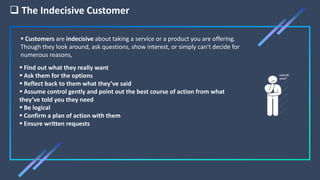
  • 45.
    5 Content Here Content Here ContentHere It gives the agent an ability to deliver both inbound and outbound calls, regulating outbound calls volume based on inbound traffic. When inbound traffic is low, outbound calls are automatically generated for a specified campaign and when inbound traffic is high, the dialler automatically slows the number of outgoing calls Content here Content here Modern PowerPoint Presentation Call Blending 1 2 3 4 IVR is an automated telephony system that interacts with callers, gathers information and routes calls to the appropriate recipients A call queue places incoming calls in line to be answered while extension users are busy with other calls. The queued calls are distributed to the next available extension user An Automatic Call Distributor (ACD) is a telephony software system that answers incoming calls and routes them to a specific agent or department within a company An abandoned call is a call or other type of contact initiated to a call center that is ended before any conversation occurs. When inbound calls are abandoned, it is often because the caller is frustrated with the time on hold or Queue IVR Queue ACD Abandoned Call  Call Centre Metrics
  • 46.
    10 Content Here Content Here ContentHere An SLA is a document that describes the minimum performance criteria a provider promises to meet while delivering a service. It typically also sets out the remedial action and any penalties that will take effect if performance falls below the promised standard. Content here Content here Modern PowerPoint Presentation SLA 6 7 8 9 A schedule, often called roster, is a list of employees working times, responsibilities for a given time The purpose of the forecast is to predict Call volumes so that we can get the right number of staff in place to handle it It is a written record submitted by Executive after every call, it includes questions by customer with information given by executive Wrap up time is the post-call work time an agent spends on a call Roster Forecast Tagging Wrap up  Call Centre Metrics
  • 47.
    11 12 13 14 Average Call HandlingTime or Average Handle Time or AHT. The time that a call center executive takes to complete an interaction with a customer TAT stands for Turnaround Time. It is the time interval from the start of a process to its completion A performance indicator or key performance indicator (KPI) is a type of performance measurement. KPI’s evaluate the success of an organization or of a particular in which it engages. KRA stands for Key Responsibility Areas and directly follow from Job Description of an employee. KRAs document the specific areas in which an employee is expected to work. ACHT TAT KPI KRA  Call Centre Metrics
  • 48.
    3rd Generation, Itintroduced better mobile Internet access, fixed wireless Internet access, video calls and mobile TV technologies. 2nd Generation, 2G introduced data services for mobile, SMS, MMS & Picture messages 3.75G or High Speed Downlink Packet Access (HSDPA), It allows networks based on the Universal Mobile Telecommunications System (UMTS) to have higher data speeds and capacity. 1st generation of wireless telephone technology. Introduced mid-1980s. It had only voice Call service 1G 2G 2.5G 2.75G 3G 4th Generation, Includes mobile web access, IP telephony, gaming services, high-definition mobile TV & video conferencing 3.75G 4G 2.5G also called General Packet Radio Service or GPRS, faster internet than 2G EDGE networks Enhanced Data rates for Glo bal Evolution, improved data transmission in comparison to 2.5G
  • 49.
    Telecom Services Basic servicesare the service provided by the telecom companies to everyone who purchases the connection i.e.  Incoming Calls / SMS  Outgoing Calls / SMS  Call Hold Call Wait Basic Services VALUE ADDED SERVICES or (VAS) is a term for all the additional services on GSM services provided by mobile operators other than messages and calling. It is an essential tool of telecom to generate revenue. It’s an optional thing if someone wants to opt for VAS has to pay extra for the services Value Added Service or VAS
  • 50.
    Few VAS Services Itallows mobile operators to equip the customers with an easy to use call log and notification system, for the calls missed while the called party was unreachable or his mobile device was switched-off MCA / MCI This service allows users to chat over voice (without having to reveal one's mobile number), make friends with likeminded people and enjoy conversations Voice Chat / Friend Zone Subscribers can enjoy music on their phone by paying rental Music Services (Caller Ring Back Tone) is a service that allows the caller to hear subscriber pre defined song or audio clip instead of standard Ring tone until the subscriber picks up the call CRBT Name Tune service enables Subscriber to personalize your caller tune with his/her name Name Tune Live Cricket Score, News, Astrology, Horoscope & etc LIVE SERVICES It allows subscriber to keep a library of songs, the caller hears different tone every time he calls selected by the subscriber Shuffle Tone It allows subscriber a dedicated tone to a dedicated MSISDN Dedicated Tone
  • 51.
     Terms inTelecom A pre-paid connection is a ‘pay & use’ subscription service. With this subscription, you need to pay in advance to use the services by way of recharge, which provides you talk-time/ balance for usage. Pre-paid services allow you to control your usage as per your need Prepaid Subscribers are required to pay for the network usage after they use Payments are done monthly or Quarterly. Postpaid services are usually provided to subscribers who have good credit ratings in the market and who are less likely to default in payments Postpaid Ability for a cellular customer to make and receive voice calls, send and receive data, or access other services, while travelling outside the home, by means of using a visited network. Roaming USSD (Unstructured Supplementary Service Data) is a GSM protocol that is used to send text messages. USSD is similar to SMS. USSD uses codes made up of the characters that are available on a mobile phone. Usually starts with * and ends with # USSD
  • 52.
    Before the sale– Preparation  Know your products, competitors  Know your customer  Be informed about current sales and promotion  Know about payment plan and modes of payment 01 During the sale- Approach and Greeting:  Describe product plan and features  Recommend and help customer choose the right plan03 After the sale – Building future relationship:  Customer queries and complaints  Up-selling  Cross –selling 03  Selling Skills What is selling: Trying to make sales by persuading someone to buy one’s product or service. It has different parts like advertising, promotion, public relations and direct marketing. Selling involves a salesperson who helps the customer fulfill his needs and facilitates the matching of what you have to offer with what the buyer wants to buy • Selling Process
  • 53.
    Types of Sales Ahard sell is a direct approach to promotion and sales. It is characterized by aggressive sales pitches and repeated calls to action. A soft sell is a promotion or person-to-person sales technique that is indirect. Transactional selling is a common method of sales in which a sales representative seeks out prospects, develops a relationship and then tries to close a sale. The sales rep finds out what the customer needs and then tries to provide it for that specific sale With product oriented selling style, the sales executive is more inclined towards explaining the features and benefits of the product to the prospect. This style includes a lot of product demo till the time the prospect is fully convinced about the benefits Hard Sell Soft Sell Transactional selling Product-oriented Selling
  • 54.
    Upselling is thepractice of encouraging customers to purchase a comparable higher-end product than the one in question The intention of the salesperson is to overtly sell their product. There doesn’t appear to be much of a sales process. Cross-selling invites customers to buy related or complementary products related to primary product Proactive selling is not waiting for customers to tell you want they need, but rather actively identifying your customer’s needs and wants and offering it to them often before they even realize their need for it. Feature selling Cross Selling Proactive selling Upselling Consultative selling A sales approach that prioritizes relationships and open dialogue to identify and provide solutions to a customer's needs. It is hyper focused on the customer, rather than the product being sold.
  • 55.
     Collection Call Informationcall is reminder call before due date to make payment Information Call 01 Soft Collection call is a gentle reminder to make missed payment after the due date Soft Collection Call 02 Incoming Calls related to payment disputes Complaint Handling Call 04 It is to remind customer to make payment & informing the customer of repercussions in case of further delay Hard Collection Call 03 Collection Call is made to customers who have taken loan or use credit cards to make payment amount. Generally Collection Call centre calls to customer before due date to remind for the payment • Types of Collection Call
  • 56.
    4 steps tobuild rapport with customers  Rapport : A close and harmonious relationship in which the people or groups concerned understand each other's feelings or ideas and communicate well Listen actively Focus on what the customer is saying, listening for clues about what he or she needs or wants. Customers will respond to someone they know is paying attention to what they are saying Mirror the customer If you share some common mannerisms, like posture and tone of voice, the customer will feel more comfortable communicating with you. Be sincere If you are not sincere when you talk to the customer, he or she will pick up on that, and any rapport that has already been established will disappear Break the ice When you first meet a customer, take a minute or two to get to know him or her. Don't start the conversation immediately with business talk. You want to put the customer at ease and help him or her relate to you first
  • 57.
    Useful first-impression tips Makeeye contact Give a nice, warm smile Open with a sincere, friendly greeting. Never ignore the customer Greet the customer and ask a useful opening question Pay attention to the customer A positive first impression is an important start to building a relationship with your customers. Whether the interaction is over the phone or in-person, the initial impression can set the tone for the entire customer experience.
  • 58.
     Writing Skill Plan,organize, and write and assemble all useful information Determine what’s important and choose what to leave out. Formulate correct sentences without any grammatical errors and record precise and clear information for analysis/action by other departments Be timely or apologies for any delay in replying Group the information logically and record complete and correct customer discussions in CRM Make sure you’ve answered their query or request or explained why you can’t 01 02 03 04 05 06 As a Customer Care executive you will use your writing skills to write mails, reports and communicate effectively at work. As a CCE, it’s very crucial to have effective writing skills because often you will communicate with others in the organization through mails or written reports, so you need to omit needless words, combine sentences wherever necessary and reframe the sentences in the best possible way.
  • 59.
    Questioning is thekey to gaining more information and without it interpersonal communications can fail. Questioning is fundamental to successful communication Funnel questions: This strategy involves asking a series of questions, starting from the general to more specific questions. Funnel questions are effective when trying to get details about a situation Open and closed questions: Open questions attract longer answers. Open questions are ideal when trying to get respondents to share their feelings, opinions or knowledge. Closed questions usually elicit short or single word answers. Such questions are effective when making a decision or concluding a discussion. Probing questions: They are ideal when trying to get information out of evasive people. They are also useful when seeking full understanding about an issue Leading questions: They influence people in your favour while leaving them convinced that they made the choice themselves. They are very effective especially when closing a sale.  Questioning Skill
  • 60.
    A complaint isa statement in which customers express their dissatisfaction with a particular situation. 5 Steps to Handling a Customer Complaint Always listen to the customer. They are concerned about an aspect of your services. Take the time to listen and truly understand what is driving their concern Listen and Understand After listening the concern immediately empathize to create a bond between you and the customer so that they know you have heard their concern and are going to work on it resolve the issue. Empathize Offer a solution to their problem; always focus on what you can do. There is always a solution. Offer a Solution Solve their problem be it with their originally requested resolution or an alternative you have proposed Execute the Solution Once you have gone through the first four steps, make sure to follow-up with them to make sure that they are satisfied with the solution and that you have taken care of their concern. Follow-Up
  • 61.
     Dealing withcomplaints Dos Don'ts  You have dialed to the wrong department  It is not my fault  I didn’t deal with this  We are having lots of problems today, you are the sixth one  Lose your temper  Appeal for sympathy  Jump to conclusions  Interrupt  Take a deep breath  Keep your voice enthusiastic and friendly  Get the customer’s name and telephone number  If organization is at fault, apologies  Never give excuses  If you promise something, do it.
  • 62.
    Bank Account: Anarrangement made with a bank whereby one may deposit and withdraw money and in some cases be paid interest Demat A/C Demat Account is an account that is used to hold shares and securities in electronic format. The full form of Demat account is a dematerialised account Fixed A/C FD is a financial instrument provided by banks which provides investors a higher rate of interest than a regular savings account, until the given maturity date Recurring A/C A It is a special kind of term deposit offered by banks which help people with regular incomes to deposit a fixed amount every month and earn interest at the rate applicable to FD Current A/C Also known as financial account is a type of deposit account maintained by individuals who carry out significantly higher number of transactions with banks on a regular basis Savings A/C A savings account is a basic type of bank account that allows you to deposit money, keep it safe, and withdraw funds, all while earning interest  Financial Literacy
  • 63.
     Savings: Savingis income not spent, or deferred consumption. Methods of saving include putting mone y aside in, for example, a deposit account, a pension account, an investment fund, or as cash. Saving also involves reducing expenditures, such as recurring costs Paying children education expense, loss in business etc, are inescapable even if you have to take loans. Financial crisis can lead to a number of other issues like anxiety, insomnia, and even heart problems. So, saving money is crucial for having peace of mind. When you know you have your financial needs under control, you tend to enjoy life without worrying. For leading a debt-free life When you have money saved up to feel secure you can start making choices, from taking vacation whenever you want, to switching careers or starting your own business Financially Independent: The future is full of uncertainties. You never know which unexpected and emergency expenditure will come next knocking at your door. An accident or a sudden hospitalization of any family member, a job loss, a broken roof, etc. That’s where the importance of saving money comes in. If you are prepared beforehand, it will be much less stressful in terms of financial condition. Save your pocket for an emergency cushion Why is Savings Important
  • 64.
    A good educationis an investment for a better future. Each year more people end up at various schools to earn their masters or doctorate degrees. If you have goals of reaching some college or university, you will also need huge funds. So, start saving money today for your dream. Better Education It gives you freedom of choice. Whether it is leaving your job and starting a new business, leaving work and going back to school to switch careers or investing in someone else’s business, having money in hand gives you confidence and path to move forward. For Planned Risks Having a habit of saving will enhance your life by not letting you spend money on reckless things and accumulating it for major expenses like buying a new car or preparing for the wedding, etc. For avoiding impulsive spending habits Everyone wants to retire at some age in life. To live happily and stress-free at that time, you need to start saving today. If you start planning your retirement fund at an early age, you can retire whenever you wish. For Stress free Retirement
  • 65.
     Open BankAccount In 7 Simple Steps 6) Officer will verify your Bank Account Opening Form 4) Give References for Opening your Bank Account 5) Submit Bank Account Opening Form and Documents 1) Decide the Type of Bank Account you want to Open 3) Fill up Bank Account Opening Form - Proposal Form 2) Approach any Bank of choice & meet its Bank Officer 7) Deposit initial amount in newly opened Bank Account
  • 66.
     Banking Acronyms MICRcode is a code printed on cheques using MICR (Magnetic Ink Character Recognition technology). This enables identification of the cheques and which in turns means faster processing. An MICR code is a 9-digit code that uniquely identifies the bank and branch participating in an Electronic Clearing System (ECS) IFSC is short for Indian Financial System Code and represents the 11 digit character that you can usually see on your bank’s cheque leaves, or other bank sponsored material. This 11 character code helps identify the individual bank branches that participate in the various online money transfer options like NEFT and RTGS National Electronic Funds Transfer (NEFT) is an electronic funds transfer system maintained by the Reserve Bank of India (RBI). NEFT enables bank customers in India to transfer funds between any two NEFT-enabled bank accounts on a one-to-one basis. Real Time Gross Settlement (RTGS) is an electronic form of funds transfer where the transmission takes place on a real time basis. In India, transfer of funds with RTGS is done for high value transactions, the minimum amount being Rs 2 lakhs The IMPS (Immediate Payment Service) from ICICI Bank helps you access your bank account and transfer funds instantly and securely. This service is available 24x7, throughout the year including Sundays and any bank holiday. IMPS MICR Code IFSC Code NEFT RTGS
  • 67.
    Personal Loan Personal loansare provided to meet the personal needs of the borrower. Home Loan Banks offers home loans that can assist borrower in purchasing a property. A home loan can be of different types such as Loan for constructing a house, Loan for repairing and remodelling your existing home & Loan for purchasing a land Mortgage Loan Mortgages are types of loans that are secured with real estate or personal property Vehicle Loan Vehicle loans help you fulfil your dream of owning a car or bike, if the borrower doesn’t pay the instalments in time, the bank has the right to take back the vehicle. Cash Credit Cash credit is a bank procedure of paying a customer in advance. This process permits the customer to borrow a certain amount from the bank A loan is when you receive money from a friend, bank or financial institution in exchange for future repayment of the principal and interest.  Loans
  • 68.
    Education Loan Banks offereducation loans to the ones who need it. These loans offer a better support in terms of study opportunities to students who are financially weak Gold Loan Banks offers home loans that can assist borrower in purchasing a property. A home loan can be of different types such as Loan for constructing a house, Loan for repairing and remodelling your existing home & Loan for purchasing a land Overdraft Overdraft is a process of requesting loans from banks. It means that the customers can withdraw more money than they have deposited in their accounts Agricultural Loan There are multiple loan schemes by banks to assist farmers and their needs. Such loans have very low interest rates and help farmers to buy seeds, equipment for farming, tractors, insecticides etc. to generate a better yield Loan against Bank FDs If you have a fixed deposit in with a bank, you can apply for a loan against the same. Business loan A business loan is a kind of financing you can avail to meet the urgent needs of your growing business. If you need funding to expand your existing business
  • 69.
     Ecommerce, alsoknown as electronic commerce or internet commerce, refers to the buying and selling of goods or services using the internet, and the transfer of money and data to execute these transactions. Advantages of E-Commerce Over Traditional Retail It is no longer about pushing a shopping cart to the correct aisle or scouting for the desired product. On an e-commerce website, customers can click through intuitive navigation or use a search box to narrow down their product search immediately. Locate the Product Quicker Store timings are now 24/7/365. E-commerce websites can run all the time. From the merchant's point of view, this increases the number of orders they receive. From the customer's point of view, an "always open" store is more convenient Remain Open All the Time It is not unusual for customers to travel long distances to reach their preferred physical store. E-commerce allows them to visit the same store virtually, with just a few mouse clicks. Eliminate Travel Time and Cost Physical store are limited by the geographical area. With an e-commerce website, the whole world is in one window. The advent of m-commerce, i.e., e-commerce on mobile devices, has dissolved every remaining limitation of geography Overcome Geographical Limitations
  • 70.
    Provide Comparison Shopping Itis difficult to equip employees to respond to customers who require information across product lines. E-commerce websites make additional information easily available to customers. Provide Abundant Information It is difficult to equip employees to respond to customers who require information across product lines. E-commerce websites make additional information easily available to customers. Lower Costs One of the most tangible positives of e-commerce is the lowered cost. A part of these lowered costs could be passed on to customers in the form of discounted prices.
  • 71.
    Types of E-CommerceBusinesses Here the company sells their goods and/or services directly to the consumer. The consumer can browse their websites and look at products. Then they place their order and the company ships the goods directly to them. Examples are Amazon, Flipkart, Jabong etc. Business to Consumer The consumers are in direct contact with each other. No company is involved. It helps people sell their personal goods and assets directly to an interested party. Usually, goods traded are cars, bikes, electronics etc. Examples are OLX, Quikr Consumer to Consumer This is Business to Business transactions. Here the companies are doing business with each other. The final consumer is not involved. So the online transactions only involve the manufacturers, wholesalers, retailers etc. Business-to-Business It is a consumer to business. So the consumer provides a good or some service to the company. Example an IT freelancer who demos and sells his software to a company. Consumer to Business 02
  • 72.
    Nonverbal communication refersto gestures, facial expressions, tone of voice, eye contact, body language, posture, and other ways people can communicate without using language  Non Verbal Communication  Body language Body language is a type of a nonverbal communication in which physical behaviours are used to express or convey the information. Such behaviour includes facial expressions, body posture, gestures, eye movement, touch and the use of space. Facial expressions The human face is extremely expressive, able to convey countless emotions without saying a word. The facial expressions for happiness, sadness, anger, surprise, fear, and disgust are the same across cultures. Eye contact The way you look at someone can communicate many things, including interest, affection, hostility, or attraction. Eye contact is also important in maintaining the flow of conversation and for gauging the other person’s interest and response Gesture A gesture is a movement that you make with a part of your body, especially your hands, to express, attitude, intentions, emotion or information
  • 73.
    Voice Tone It’s notjust what you say, it’s how you say it. When you speak, other people “read” your voice in addition to listening to your words. Things they pay attention to include your timing and pace, how loud you speak, your tone and inflection, and sound that convey understanding, Proxemics Standing too close to someone may bring on feelings of discomfort and you’ll be able to pick up on this by seeing them move away. You can also see this with people speaking to groups: they may have to move back a little from everyone and this is the way they convey the space level they need to feel comfortable. Touch We communicate a great deal through touch. Think about the very different messages given by a weak handshake, a warm bear hug, a patronizing pat on the head, or a controlling grip on the arm, for example. Posture and body orientation You communicate numerous messages by the way you walk, talk, stand and sit. Standing erect, but not rigid, and leaning slightly forward communicates to students that you are approachable, receptive and friendly.
  • 74.
     Objection -An expression or feeling of disapproval or opposition; a reason for disagreeing Objection handling is when a prospect presents a concern about the product/service a salesperson is selling, and the salesperson responds in a way that alleviates those concerns and allows the deal to move forward. Objections are generally around price, product fit, competitors, and good old- fashioned brush offs. Objection Handling The customer might be concerned with the legitimacy or credibility of you or your company. (This indicates that a good relationship has not been established between the salesperson and the client.) Trust/Relationship Price, cost, budget, or ROI concerns all fall into this category. Price objections are often really about risk. If the sales representative has justified the cost by building value during the interaction, the customer will be less worried. Price/Risk Customers sometimes attempt to stall their decision. The closer the sale is to closing, the more pressure the customer feels, and if there is any remaining conflict or anxiety (or no sense of urgency) they may try to stall. Stall If the customer is concerned about the quality of your products or services – e.g., they express doubts about product quality, the training of your personnel, speed or responsiveness of service, or compatibility – these are examples of quality of service concerns. Quality of Service Reasons for Objection
  • 75.
     Hazard: Ahazard is any agent that can cause harm or damage to humans, property or the environment. The workstation should:  Provide sufficient space for the user or the operator to alter position comfortably  Provide lighting that is adequate with suitable contrast between the screen and background  Avoid glare and reflections on the screen  Have windows fitted with adjustable coverings to alter the sunlight level  Be spacious enough when a workstation is shared by more than one person. The display screen should: Display well-defined characters of adequate size and spacing Have a stable image Have easily adjustable brightness and contrast; Tilt and swivel easily to suit the user  Be free from glare & Reflection Use a separate base for the screen or an adjustable table The keyboard should:  Be able to tilt easily and should be able to separate from the screen to allow the user to adopt a comfortable working position;  Have space in front to provide support for the hands or arms of the user;  Have a matt surface;  Have clearly legible symbols on the keys. The work surface should:  Provide adequate space for the user  Have a low reflective surface  Be of an adequate size to allow the screen, keyboard etc, to be flexibly arranged  Have a stable and adjustable document holder, which should be at the same level as the screen and at the same viewing distance.  A workplace hazard refers to a situation within the workplace that has the potential to cause injury or adverse health effects to people and damage to equipment  Checklist for Workstations
  • 76.
     Emergency :A serious, unexpected, and often dangerous situation requiring immediate action  Workplace emergency : A workplace emergency is an unforeseen situation that threatens employees, customers or the public; disrupts or shuts down operations; or causes physical or environmental damage  Fire  Explosion  Floods  Earthquake  Hurricane  Tornado  Toxic material release  Civil disturbance  Workplace violence  Emergencies that require evacuation include
  • 77.
    Emergency Plan :An emergency plan is a written set of instructions that outlines what workers and others at the workplace should do in an emergency An evacuation plan is a diagram showing the safest emergency exit routes from a home or building.  Periodic evacuation drills. Ensure that you pay attention during these drills. You need to save your life and you can be helpful in saving someone else's life too.  Making sure alarms are distinct and recognized by all employees as a signal to evacuate the work area or perform actions identified in your plan  A 'buddy system' for individuals with special needs or disabilities. This system ensures that the differently abled are assisted and guided out of the premises or the impacted area properly. If you are a buddy to someone, ensure that your buddy is safely at the assembly point with you.  Floor plans with evacuation routes in work areas. Ensure that you understand these so you can use it in time of need.  Exit path clearly marked and well lit  Exit Gates Wide enough to accommodate the number of evacuating personnel  Names, titles, departments, and telephone numbers of individuals both within and outside your company to contact for additional information or explanation of duties and responsibilities under the emergency plan  A designated assembly point for emergencies. Ensure you know where it is.
  • 78.
    Safety: Tips toDesign a Safe Workplace  Every employer is obligated to ensure that his workplace follows the highest possible safety protocol  Use ergonomically designed furniture and equipment to avoid stooping and twisting  Provide mechanical aids to avoid lifting or carrying heavy objects  Ensure regular building inspections are conducted  Get expert advice on workplace safety and follow it  Set down health codes and ensure they are implemented  Have protective equipment on hand for hazardous jobs  Designate emergency exits and ensure they are easily accessible  Follow the practice of regular safety inspections in and around the workplace
  • 79.
    What are Habits: Habitsare routine behaviours done on a regular basis. They are recurrent and often unconscious patterns of behaviour and are acquired through frequent repetition. Same good habits that you should make part of your daily routine are: Always having a positive attitude01 02 Making exercise a part of your daily routine 03 Reading motivational and inspirational stories 04 Smiling Make it a habit to smile as often as possible 05 Making time for family and friends 06 Going to bed early and waking up early 07 Savings money, is a good habit to be practiced
  • 80.
    Skipping breakfast Snacking frequentlyeven when you are not hungry Eating too much fattening and sugary food Smoking, drinking alcohol and doing drugs Spending more money than you can afford Some bad habits that you should quit immediately are: Worrying about unimportant issues Staying up late and waking up late A bad habit is a negative behaviour pattern. A bad habit is a habitual behaviour considered to be detrimental to one's physical or mental health and often linked to a lack of self-control.
  • 81.
    Every employee isobligated to follow all safety protocols put in place by the employer. All employees must make it a habit to:  Non-Negotiable Employee Safety Habits  Immediately report unsafe conditions to a supervisor  Recognize and report safety hazards that could lead to slips, trips and falls  Learn how to correctly use equipment provided for safety purposes  Be aware of and avoid actions that could endanger other people  Report all injuries and accidents to a supervisor  Wear the correct protective equipment when required  Take rest breaks during the day and some time off from work during the week
  • 82.
    Being healthy shouldbe part of your overall lifestyle. Living a healthy lifestyle can help prevent chronic diseases and long-term illnesses. Feeling good about yourself and taking care of your health are important for your self-esteem and self-image.  Better health is central to human happiness and well-being  Allergies  Asthma  Some common health issues are:  Skin Disorders  Depression and Anxiety  Diabetes  Cough, Cold, Sore Throat  Difficulty Sleeping  Obesity
  • 83.
     Health. ...A healthy lifestyle has a lot of benefits. Eating a balanced diet, taking regular exercise and maintaining a healthy weight can add years to your life and reduce the risk of certain diseases  Taking measures to prevent ill health is always better than curing a disease or sickness. You stay healthy by:  Taking vaccinations when required  Eating healthy foods like fruits, vegetables and nuts  Practicing yoga exercises and meditation  Not smoking or drinking alcohol  Drinking enough water everyday  Exercising for at least 30 minutes a day, 4-5 times a week  Cutting back on unhealthy and sugary foods
  • 84.
     Attitude: Theterm 'attitude' refers to an individual's mental state, which is based on his/her beliefs or value system, emotions, and the tendency to act in a certain way. One's attitude reflects how one thinks, feels, and behaves in a given situation. Confidence, Optimism, Sincerity, and Reliability are traits that represent positive attitude Individuals who have a positive attitude will pay attention to the good, rather than bad in people, situations, events, etc. They will not consider a mistake or failure as a hurdle, but as an opportunity. They learn from mistakes, and move forward in life. Positive Attitude Hatred, Pessimism, Resentment, and Doubt are traits that represent negative attitude People with a negative attitude ignore the good, and pay attention to the bad in people, situations, events, etc. Also, they are likely to complain about changes, rather than adapting to the changing environment. Also, they might blame their failure on others. Negative Attitude Indifference and Detachment are traits that represent neutral attitude People with a neutral attitude don’t give enough importance to situations or events. They ignore the problem, leaving it for someone else to solve. Also, they don’t feel the need to change Neutral Attitude
  • 85.
     It ispossible to improve, control and change our attitude, if we decide we want to! The following tips help foster a positive mindset: Get a modern PowerPoint Presentation that is beautifully designed. Remember that you control your attitude, not the other way around  Devote at least 15 minutes a day towards reading, watching or listening to something positive  Avoid negative people who only complain and stop complaining yourself  Expand your vocabulary with positive words and delete negative phrases from your mind  Be appreciative and focus on what's good in yourself, in your life, and in others  Stop thinking of yourself as a victim and start being proactive  Imagine yourself succeeding and achieving your goals Positive
  • 86.
     Honesty isa facet of moral character that connotes positive and virtuous attributes such as integrity, truthfulness, straightforwardness, including straightforwardness of conduct, along with the absence of lying, cheating, theft, etc. Honesty also involves being trustworthy, loyal, fair, and sincere.  They're Not Concerned About Popularity Contests Honest people don't obsess over what peers think of them. They simply are who they are, and other people can take it or leave it.  They Stand Up for Their Beliefs. Honest individuals don't go looking for fights, but they also aren't afraid to speak their mind. Honest people will state their opinions even when their beliefs are against the majority.  They Are Trusted by Peers Peers will seek the aid of honest individuals, knowing they can count on them for true, objective advice. Many others will lie and tell you the story you want to hear. They do this to avoid any injured feelings, but there are many times with the difficult truth is what individuals really need to hear  They Have Close Friendships Individuals who are honest often have rich, meaningful friendships. Others know that their honest friend won't complain about them behind their back, and will instead face any issues head on. This level of trust allows for deeper, healthier relationships  They Are Thick Skinned Honesty requires thick skin. Not all people love hearing the truth, and when you dish out a fresh dose of reality, some might be inclined to toss it right back in your face (plus a little venom). Honest individuals may fall victim to the insecure defensiveness of others, requiring them to be thick skinned
  • 87.
    One of themost important characteristics of entrepreneurs is honesty. When entrepreneurs are honest with their customers, employees and investors, it shows that they respect those that they work with. It is also important that entrepreneurs remain honest with themselves. When entrepreneurs build honest relationships with their employees, it leads to more transparency in the workplace, which results in higher work performance and better results.  Honesty and employees: The consequences of being dishonest with oneself can lead to dire results, especially in the case of entrepreneurs. For entrepreneurs to Succeed, it iS critical that they remain realistic about their situation at all times, and accurately judge every aspect of their enterprise for what it truly is.  Honesty with oneself: When entrepreneurs are honest with their customers it leads to stronger relationships, which in turn results in business growth and a stronger customer network.  Honesty and customers: For entrepreneurs, being honest with investor’s means not only sharing strengths but also candidly disclosing current and potential weaknesses, problem areas and solution strategies. Keep in mind that investors have a lot of experience with start-ups and are aware that all new companies have problems. Claiming that everything is perfectly fine and running smoothly is a red flag for most investors.  Honesty and investors:  Importance of Honesty in Entrepreneurs
  • 88.
     A strongwork ethic is an important part of being successful in your career. Work ethic is a set of values based on the ideals of discipline and hard work. ... Forming good habits such as focusing, staying motivated, finishing tasks immediately, and more helps to create a good work ethic that will impress employers. 2 3 4 1 This means refusing to quit until the designated work is done, and completing the work at the highest possible level of excellence. This means always keeping your word, whether it's arriving on time for a meeting or delivering work on time. This means remaining poised and diplomatic regardless of how stressful or volatile a situation is. This involves everything from how you present yourself in a corporate setting to the manner in which you treat others in the workplace. Professionalism Respectfulness Dependability Dedication  Elements of a Strong Work Ethic: An entrepreneur must display strong work ethics, as well as hire only those individuals who believe in and display the same level of ethical behaviour in the workplace. Some elements of a strong work ethic are:
  • 89.
    7 8 9 10 6 Part of havinga strong work ethic is understanding that you are part of a bigger team and that everyone has a role. This understanding fosters teamwork and cooperation to ensure that everyone is getting the right information to properly do their jobs. The purpose of workplace discipline is to alert employees to their behaviour and actions and help them understand how these inhibit performance and productivity. This means acknowledging everyone's efforts and had work, and sharing the credit for accomplishments. This means taking responsibility for your actions and the consequences of your actions, and not making excuses for your mistakes. This means embracing obstacles as challenges rather than letting them stop you, and pushing ahead with purpose and resilience to get the desired results. Determination Accountability Humility Discipline Teamwork
  • 90.
     How toFoster a Good Work Ethic Honesty: All work assigned to a person should be done with complete honesty, without any deceit or lies. Good work habits Employees should always be well groomed, never use inappropriate language; conduct themselves professionally at all times, etc. Reliability Employees should show up where they are supposed to be, when they are supposed to be there. Good attitude All team members should be optimistic, energetic, and positive Respect: Employees need to respect the company, the law, their work, their colleagues and themselves.
  • 91.
     How toFoster a Good Work Ethic  Initiative Doing the bare minimum is not enough. Every team member needs to be proactive and show initiative.  Efficiency Efficient employees help a company grow while inefficient employees result in a waste of time and resources.  Trustworthiness Trust is non-negotiable. If an employee cannot be trusted, it's time to let that employee go.  Integrity Each and every team member should be completely ethical and must display above board behaviour at all times.
  • 92.
     Creativity involvestransforming your ideas, imagination, and dreams into reality. When you’re being creative, you can see the hidden patterns, make connections between things that aren’t normally related, and come up with new ideas. Creative ability depends on creative thinking which is part hard work but largely creative problem-solving.  Characteristics of Highly Creative People  They are imaginative and playful  They see issues from different angles  They notice small details  They have very little tolerance for boredom  They detest rules and routine  They love to daydream  They are very curious
  • 93.
     Innovation meansturning an idea into a solution that adds value. It can also mean adding value by implementing a new product, service or process, or significantly improving on an existing product, service or process  Characteristics of Highly Innovative People  They embrace doing things differently  They don't believe in taking shortcuts  They are not afraid to be unconventional  They are highly proactive and persistent  They are organized, cautious and risk-averse 1 2 3 4 5
  • 94.
     Time managementis the process of organizing and planning how to divide your time between specific activities. Good time management enables you to work smarter – not harder – so that you get more done in less time, even when time is tight and pressures are high.  Benefits of time management in a workplace  Less stress and anxiety  Improved quality of life  Deliver work on time  Provide a better quality of work  More productivity and efficiency  Much less procrastination More opportunities and career growth More time for leisure and recreation
  • 95.
     Effects ofPoor Time Management  Not managing time effectively can result in undesirable consequences like: Missing deadlines Substandard work quality Stalled career Inefficient work output Poor professional reputation Increase in stress and anxiety
  • 96.
     Traits ofEffective Time Managers  They begin projects early  They set daily objectives  They know how to say no  They break tasks into steps with specific deadlines  They think of alternate solutions if and when required  They ask for help when required  They modify plans if required, to achieve better results  They inform people in advance if their help will be required  They create backup plans  They are flexible and open- minded  They continually review long term goals  Some traits of effective time managers are:
  • 97.
    1 Plan out yourday as well as plan for interruptions. Give yourself at least 30 minutes to figure out your time plan. In your plan, schedule some time for interruptions.  Effective Time Management Techniques  You can manage your time better by putting into practice certain time management techniques Some helpful tips are: 2 Put up a "Do Not Disturb" sign when you absolutely have to complete a certain amount of work. 3 Create time management goals to reduce time wastage. 4 Prioritize. List each task to be completed in order of its urgency or importance level. Then focus on completing each task, one by one.
  • 98.
    5 Maintain a logof your work activities. Analyze the log to help you understand how efficient you are, and how much time is wasted every day.  Effective Time Management Techniques 6 Stop procrastinating. Remind yourself that procrastination typically arises due to the fear of failure or the belief that you cannot do things as perfectly as you wish to do them. 7 Delegate your work. This will not only help your work get done faster, but will also show you the unique skills and abilities of those around you. 8 Close your mind to all distractions. Train yourself to ignore ringing phones, don't reply to chat messages and disconnect from social media sites.
  • 99.
     Anger managementis the process of learning to recognize signs that you're becoming angry, and taking action to calm down and deal with the situation in a productive way.  Anger management helps you recognize frustrations early and resolve them in a way that allows you to express your needs — and keeps you calm and in control. Extreme anger can: It leads to heart disease, diabetes, a weakened immune system, insomnia, and high blood pressure. Hurt you Physically It can cloud your thinking and lead to stress, depression and mental health issues. Hurt you mentally It can result in alienating your colleagues, bosses, clients and lead to the loss of respect. Hurt your career It makes it hard for your family and friends to trust you, be honest with you and feel comfortable around you. Hurt your relationships Extreme anger can
  • 100.
     Here aresome strategies that can help you control your anger:  Relaxation Something as simple as breathing deeply and looking at relaxing images works wonders in calming down angry feelings. Try this simple breathing exercise:  Visualize your breath coming up from your stomach  Take a deep breath from your diaphragm (don't breathe from your chest)  Keep repeating a calming word like 'relax or 'take it easy' (remember to keep breathing deeply while repeating the word)  Picture a relaxing moment (this can be from your memory or your imagination)
  • 101.
    Cognitive Restructuring  CognitiveRestructuring means changing the manner in which you think. Anger can make you curse, swear, exaggerate and act very dramatically. When this happens, force yourself to replace your angry thoughts with more logical ones. For instance, instead of thinking ‘Everything is ruined’ change your mindset and tell yourself `It's not the end of the world and getting won’t solve this'.  Problem Solving Getting angry about a problem that you cannot control is a perfectly natural response. Sometimes, try as you may, there may not be a solution to the difficulty you are faced with. In such cases, stop focusing on solving the problem, and instead focus on handling and facing the problem. Remind yourself that you will do your best to deal with the situation, but that you will not blame yourself if you don't get the solution you desire.  Better Communication When you're angry, it is very easy to jump to inaccurate conclusions. In this case, you need to force yourself to stop reacting, and think carefully about what you want to say, before saying it. Avoid saying the first thing that enters your head. Force yourself to listen carefully to what the other person is saying. Then think about the conversation before responding.  Changing Your Environment If you find that your environment is the cause or your anger, try and give yourself a break from your surroundings. Make an active decision to schedule some personal time for yourself, especially on days that are very hectic and stressful. Having even a brief amount of quiet or alone time is sure to help calm you down.
  • 102.
     Stress isthe body's reaction to any change that requires an adjustment or response. The body reacts to these changes with physical, mental, and emotional responses.  Internal causes of stress  External causes of stress  Constant worry  Negative self-talk  Major life changes  Difficulties at work or in school  Rigid thinking  All in or all out attitude  Difficulties with relationships  Financial difficulties  Pessimism  Unrealistic expectations  Having too much to do  Worrying about one's children and/or family Stress can be caused by internal and external factors.  Stress Management
  • 103.
     Stress canmanifest itself in numerous ways. Take a look at the cognitive, emotional and behavioural symptoms of stress. Cognitive Symptoms • Memory problems • Concentration issues • Lack of judgement • Pessimism • Anxiety • Constant worrying Physical Symptoms • Aches and pain • Diarrhoea or constipation • Nausea • Dizziness • Chest pain and/or rapid heartbeat • Frequent cold or flu like feelings Emotional Symptoms • Depression • Agitation • Irritability • Loneliness • Anxiety • Anger Behavioural Symptoms • Increase or decrease in appetite • Over sleeping or not sleeping enough • Withdrawing socially • Ignoring responsibilities • Consumption of alcohol or cigarettes • Nervous habits like nail biting, pacing etc.  Symptoms of Stress
  • 104.
     The followingtips can help you manage your stress better:  Tips to Manage Stress  Note down the different ways in which you can handle the various sources of your stress.  Remember that you cannot control everything, but you can control how you respond 01 02 03 04 05 06  Discuss your feelings, opinions and beliefs rather than reacting angrily, defensively or passively.  Practice relaxation techniques like meditation, yoga or tai chi when you start feeling stressed.  Devote a part of your day towards exercise.  Eat healthy foods like fruits and vegetables. Avoid unhealthy foods especially those containing large amounts of sugar
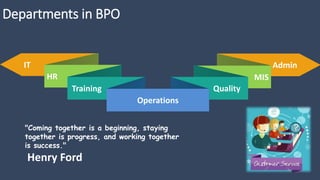
  • 105.
     Tips toManage Stress  Plan your day so that you can manage your time better, with less stress  Schedule time to pursue your hobbies and interests. 07 08 09 10 11 12  Say no to people and things when required.  Reduce your caffeine intake.  Ensure you get at least 7-8 hours of sleep.  Increase the time spent with family and friends.
  • 106.
    It results inthe creation of new organization1 It brings Creativity into the marketplace2 It leads to improved standards of living3 It helps develop the economy of a country4  Entrepreneurship Importance of Entrepreneurship An entrepreneur is an entity which has the ability to find and act upon opportunities to translate inventions or technologies into products and services
  • 107.
    Types of Entrepreneurs 01 02 03 04 GrowthPotential Entrepreneur: They start an enterprise that grows, win many customers and make lots of money. Then they sell their enterprise for a nice profit. Usually they have a science or technical background. Project-Oriented Entrepreneur: This type of entrepreneur generally has a background in the Arts or psychology. Their enterprises tend to be focus on something that they are very passionate about. Traditional Entrepreneur: They have a set of Skills like Carpeting, Mechanic, cooking & etc; they work for many years as a worker before starting their own business in the similar field Lifestyle Entrepreneur: They have usually worked as a teacher or a secretary. They are more interested in Selling Something that people will enjoy, rather than making lots of money.
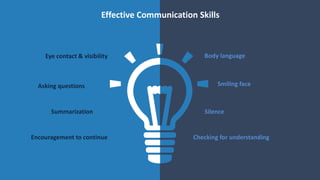
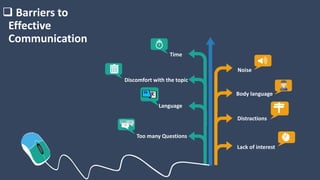
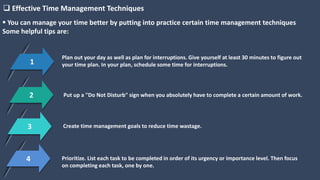
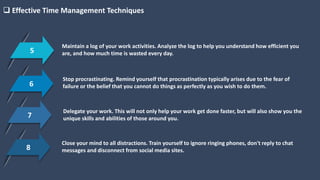
  • 108.
     Characteristics ofEntrepreneurs All successful entrepreneurs have certain characteristics in common.  Extremely passionate about their work  Confident in themselves They are all Entrepreneurs also have a tendency to  Disciplined and dedicated  Motivated and driven  Highly creative  Visionaries  Open-minded  Decisive  Have a high risk tolerance  Thoroughly plan everything  Manage their money wisely  Make their customers their priority  Understand their offering and their market in detail  Ask for advice from experts when required  Know when to cut their losses
  • 109.
     Types ofEnterprises  As an entrepreneur in India, you can own and run any of the following types of enterprises: A single individual owns, manages and controls the enterprise. This type of business is the easiest to form with respect to legal formalities. The business and the owner have no separate legal existence. All profit belongs to the proprietor, as do all the losses the liability of the entrepreneur is unlimited. Sole Proprietorship A partnership firm is formed by two or more people. The owners of the enterprise are called partners. A partnership deed must be signed by all the partners.. The profits are shared by the partners. With respect to losses, the liability of the partners is unlimited. Partnership The partners of the firm enjoy perpetual existence as well as the advantage of limited liability. Each partner's liability is limited to their agreed contribution to the LLP. The partnership and its partners have a separate legal existence. Limited Liability Partnership (LLP)
  • 110.
     Leadership isthe art of motivating a group of people to act toward achieving a common goal. In a business setting, this can mean directing workers and colleagues with a strategy to meet the company's needs. 01 02 03 A leader must lead himself, only then he can lead others. He must be committed on personal and professional front, and must be responsible. He must be a role model for others and set an example for them. A leader must boost up the morale of the employees. He should motivate them well so that they are committed to the organization. He should be well acquainted with them, have concern for them and encourage them to take initiatives. This will result in more efficient and effective employees and ensure organizational success. A leader must work as a team. He should always support his team and respect them. He should not hurt any employee. A true leader should not be too bossy and should not consider him as the supreme authority. He should realize that he is part of the organization as a whole.  The Difference Between a Boss and a Leader. A boss manages their employees, while a leader inspires them to innovate, think creatively, and strive for perfection.  Tips for Effective Organizational Leadership
  • 111.
     Building asuccessful enterprise is only possible if the entrepreneur in charge possesses excellent leadership qualities. Some critical leadership skills that every entrepreneur must have are:  Leadership Qualities That All Entrepreneurs Need 2 3 4 5 61 This means taking the time to recognize how others view you. It means understanding how your presence affects those around you. Awareness This means refreshing or changing your leadership style when necessary. To do this, it's important to learn where your leadership gaps lie and find out what resources are required to close them. Reinvention This means having the ability to highlight all obstacles and challenges, in order to resolve issues and reduce risks. Pragmatism This means showing both, your strengths and your weaknesses. It means being human and showing others that you are human. Authenticity This means admitting to mistakes often and early, and being quick to take responsibility for your actions. Mistakes should be viewed as challenges to overcome, not opportunities to point blame. Humility It is critical for a good leader to be very flexible and quickly adapt to change. It is equally critical to know when to adapt and when not to. Flexibility
  • 112.
     Benefits ofEffective Leadership for Organisations  Skilled Leadership Leads to a Good Business Culture  Amazing Leaders Train Other Amazing Leaders!  Productivity Increases  Staff Retention, Loyalty and Happiness Increase  Effective Leaders = Effective Teams
  • 113.
     Team: Ateam is a group of individuals working together to achieve their goal.  Team Work: when a group of people work together cohesively, towards a common goal, creating a positive working atmosphere, and supporting each other to combine individual strengths to enhance team performance. All the team members should clearly understand and be equally committed to the purpose, vision and goals of the team.. Unity of purpose: Every member should feel entitled to provide regular feedback on new ideas. The ability to collaborate The team should have the ability to anticipate problems and act on these potential problems before they turn into real problems. Visionary members: Team members should have the ability to express their concerns, ask questions to convey complex information. Great communication skills The team should consist of proactive individuals. The members should have the enthusiasm to come up with new ideas, improve existing ideas, and conduct their own research. Initiative The team must believe that change is a positive force. Change should be seen as the chance to improve and try new things. Great adaptability skills: The team should have the ability to develop standard work processes, balance responsibilities, properly plan projects, and set in place methods to measure progress and ROI. Excellent organizational skills:
  • 114.
     Problem Solving All Problems have 2 elements. Goals & Obstacles  The aim of problem solving is to recognize the obstacles and remove them in order to achieve the goals 2  Study the problem in detail  Implement the chosen solution Step  Select the best solution  Identify the problem  List all possible solutions  Check that the problem has really been solved Solving a problem requires a level of rational thinking. Here are some logical steps to follow When faced with an issue follow these steps:
  • 115.
    01 02 03 04 Ask for proofof the candidate's problem solving skills in the application form. Give potential candidates logical reasoning and critical thinking tests and see how they fare. Create hypothetical problematic situations or raise ethical questions and see how the candidates respond. Give candidates examples of real life problems and evaluate their thought process. Application forms: Psychometric tests: Interviews: Technical questions:  Problem Solving Traits  Being Open minded  Being proactive  Having a positive attitude  Asking the right questions  Not panicking  Focusing on the right problem  How to Assess for Problem Solving Skills
  • 116.
     A negotiationis a formal discussion to reach agreement about an issue. It is an important method to reduce conflict, and to get things done. Take a look at some steps to help you negotiate Agree on a course of action to set the solution in motion Implement the Agreed upon Solution: Try your best to be open minded when negotiating. Compromise and offer alternate solutions to reach an outcome where both parties win. Aim for a Win-Win Outcome This involves asking questions, listening to the other side, putting your views forward and clarifying doubts. Discuss the Problem: Agree on where to meet to discuss the problem, decide who all will be present and set a time limit for the discussion. Pre-Negotiation Preparation: Ensure that both parties want to solve the same problem and reach the same goal. Clarify the Objective: When an agreement has been reached, the details of the agreement should be crystal clear to both sides, with no scope for misunderstandings. Clearly Define the Agreement: 1 2 3 4 5 6  Negotiation skills help build relationships because the aim is to foster goodwill despite difference in interests. Good negotiation skills also help in avoiding future conflicts and problem by leaving both parties equally satisfied with no barriers to communication for the future.
  • 117.
    SWOT Analysis SWOT What areyour strengths? What unique capabilities do you posses? What do your competitors do better than you? What do others perceive as your strengths? STRENGTH What Trends may positively impact you? What opportunities are available to you? OPPORTUNITIES What are your weaknesses? What do your competitors do better than you? WEAKNESSES Do you have solid financial support? What trends may negatively impact you? THREATS
  • 118.
    Thank you Created by:Md. Arif CRM Domestic Voice Trainer 9073015745