An Assignment Presentation
On
“Custard apple”
Submitted to:- Submitted by:-
Dr. H. N. Leua Joshi Nikunj K.
Assi. Professor M.Sc. Horticulture
College of Horticulture
SDAU, Jagudan
Custard Apple
Custard apple
 Botanical name :- Annona squamosa
 Family :- Annonaceae
 Origin :- Tropical America
 Ch. No :- 2n=14
 Synonyms :- Sitaphal, sugar apple, sweet sop.
INTRODUCTION
 Custard apple are delicious fruits and are used when they
are full ripe.
 Pleasant flavor, mild aroma and sweet taste have a
universal acceptance.
 Cultivation of custard apple is prevalent in Australia,
Brazil, Chile, Egypt, India.
 In India custard apple is under cultivation throughout the
southern part and in Assam, Bihar, AP, MP, UP, MH.
AREAAND PRODUCTION
 In India, cultivation of custurd apple is done in 44,000 ha
area with 3,67,000 MT production.
 Gujarat produce 61000 tonnes custurd apple and provide
20.53% total share of national production.
 Andhra Pradesh is the major fruit growing state in India
and following by MH, UP, Bihar, Assam.
 In Gujarat, Bhavanagar is largest producer of custard
apple.
COMPOSITION
 The large aggregate fruits are composed of peel, pulp,
seeds.
 Fruits contain 45% edible portion, 100gm of which
composition 70.5gm moisture, 23.5gm carbohydrates,
1.6gm protein, 0.4gm fat
 Which is also rich in minerals those are calcium 17mg,
45mg of phosphorous, vitamin-a 37mg and gives 104 k
cal of energy.
USES
 Custard apple is the “fruit of poor people”. Pulp is used in ice
creams and puddings.
 Products such as jam, jelly, squash, syrup, nectar, canned
product and a fermented alcoholic beverage.
 Fruits, seeds, leaves and roots of custard apple are valued for
their medicinal properties. As well as used both in ayurvedic
and yunani systems.
 Seeds containing 30% oil which is extracted and used in soap
and paint industries.
 Leaves are used for preparation of blue or black dyes.
 Seeds are used for abortifacient and roots are drastic purgative
agent. Seeds , leaves ,young raw fruits are used for making
insecticides and lice killers.
BOTANY
 Growth of the plants are shrubs or small trees growing
up to 5 to 6m.
 The leaves are alternate simple and entire.
 Flowers are born either singly or in small groups,
yellowish green, hermaphrodite. protogynous and
having auxillary bearing habit.
 Fruits are heart shaped, fleshy syncarp formed by the
fusion of the pistils and receptacle, pericarp is the
edible part.
 Pollination is mainly by insects i.e. cross pollination.
SPECIES
 Custard apple belongs to family annonaceae, this
family includes 40 genera and genus annona has got 120
species out of which 6 have commercial significance.
A) Annona squamosa : (custard apple, sugar apple,
sweetsop)
 Good quality
 Widely Cultivated in India
B) Annona cherimola : (Hanumanphal,
cherimoya)
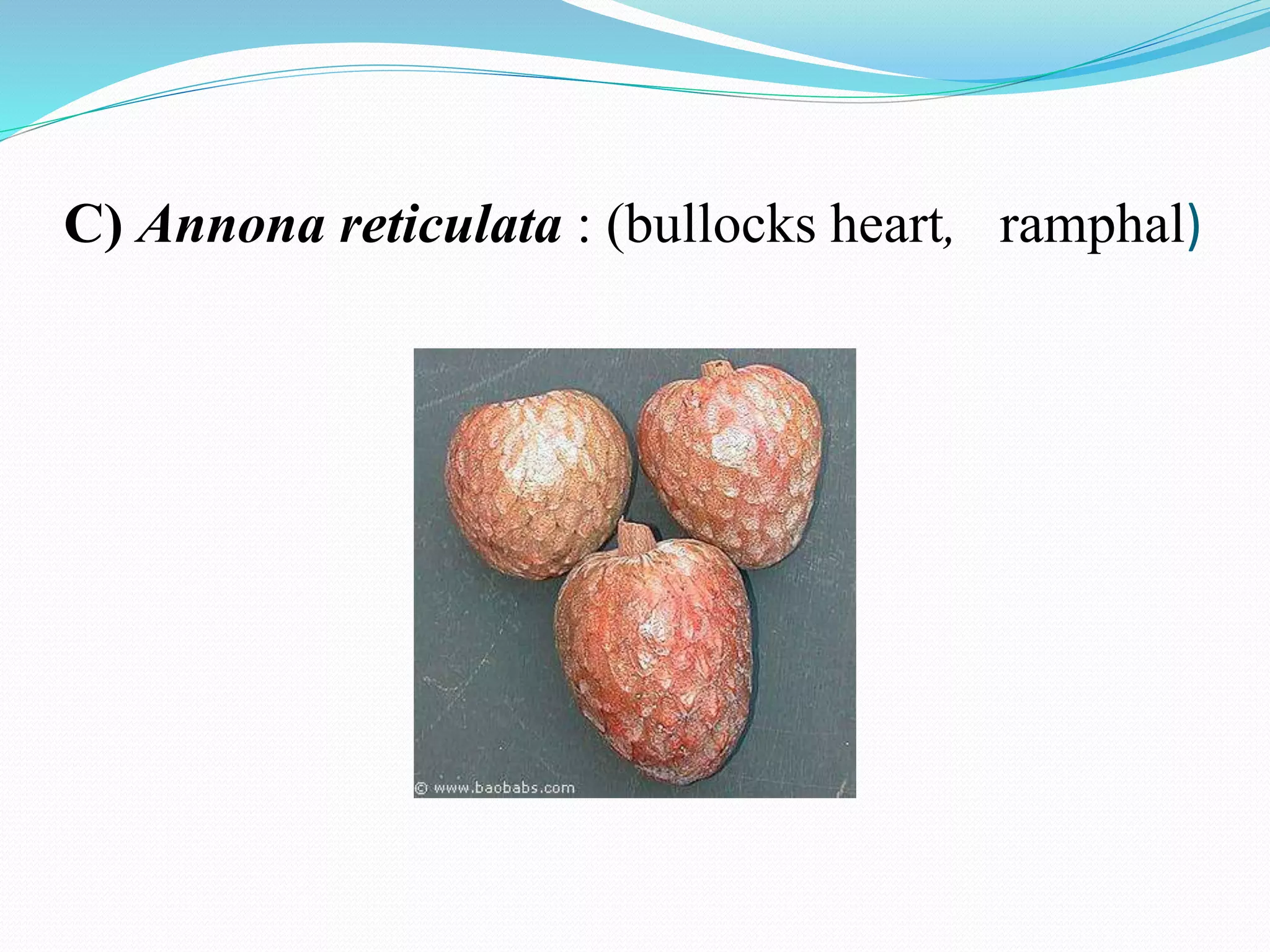
C) Annona reticulata : (bullocks heart, ramphal)
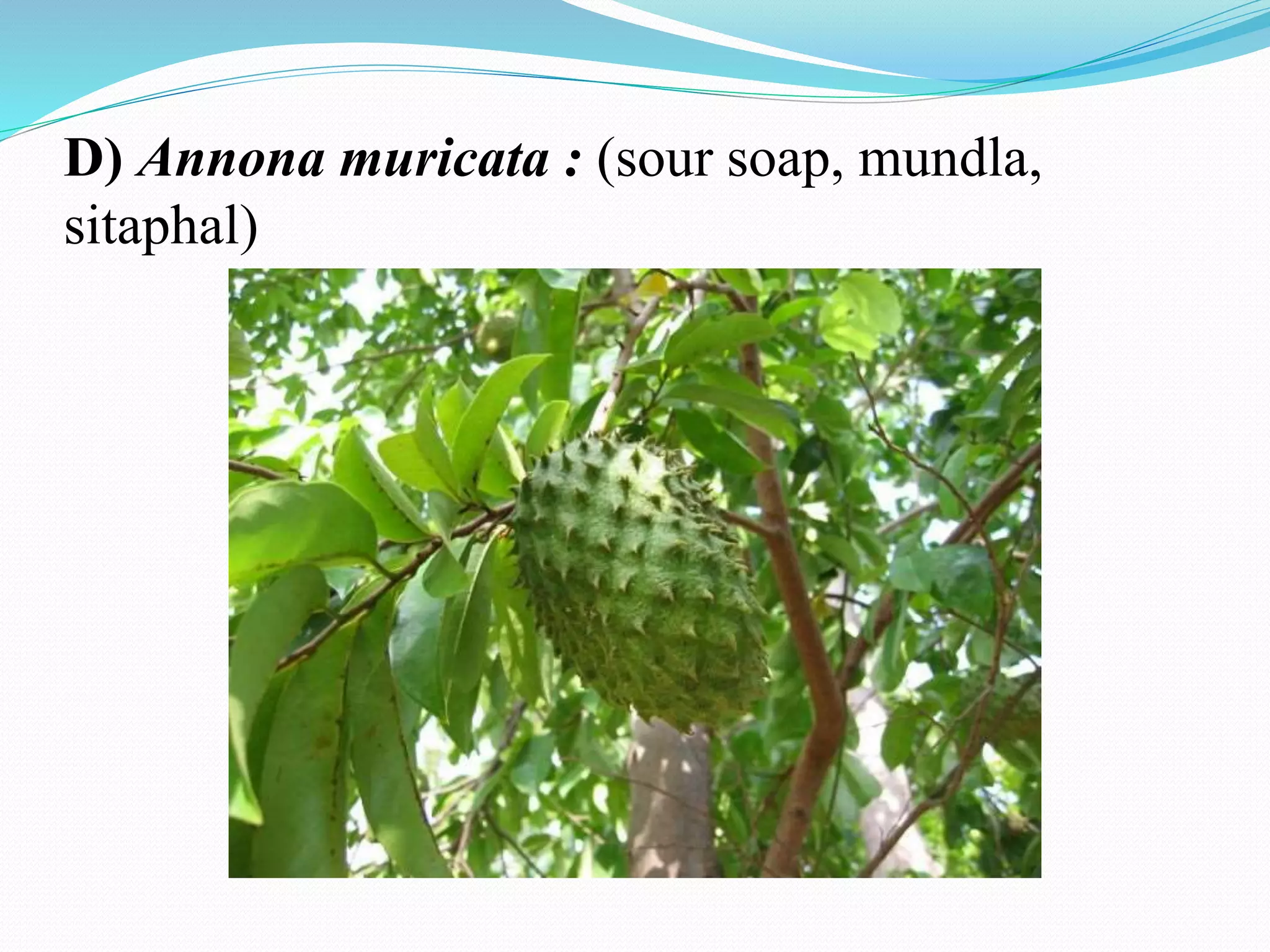
D) Annona muricata : (sour soap, mundla,
sitaphal)
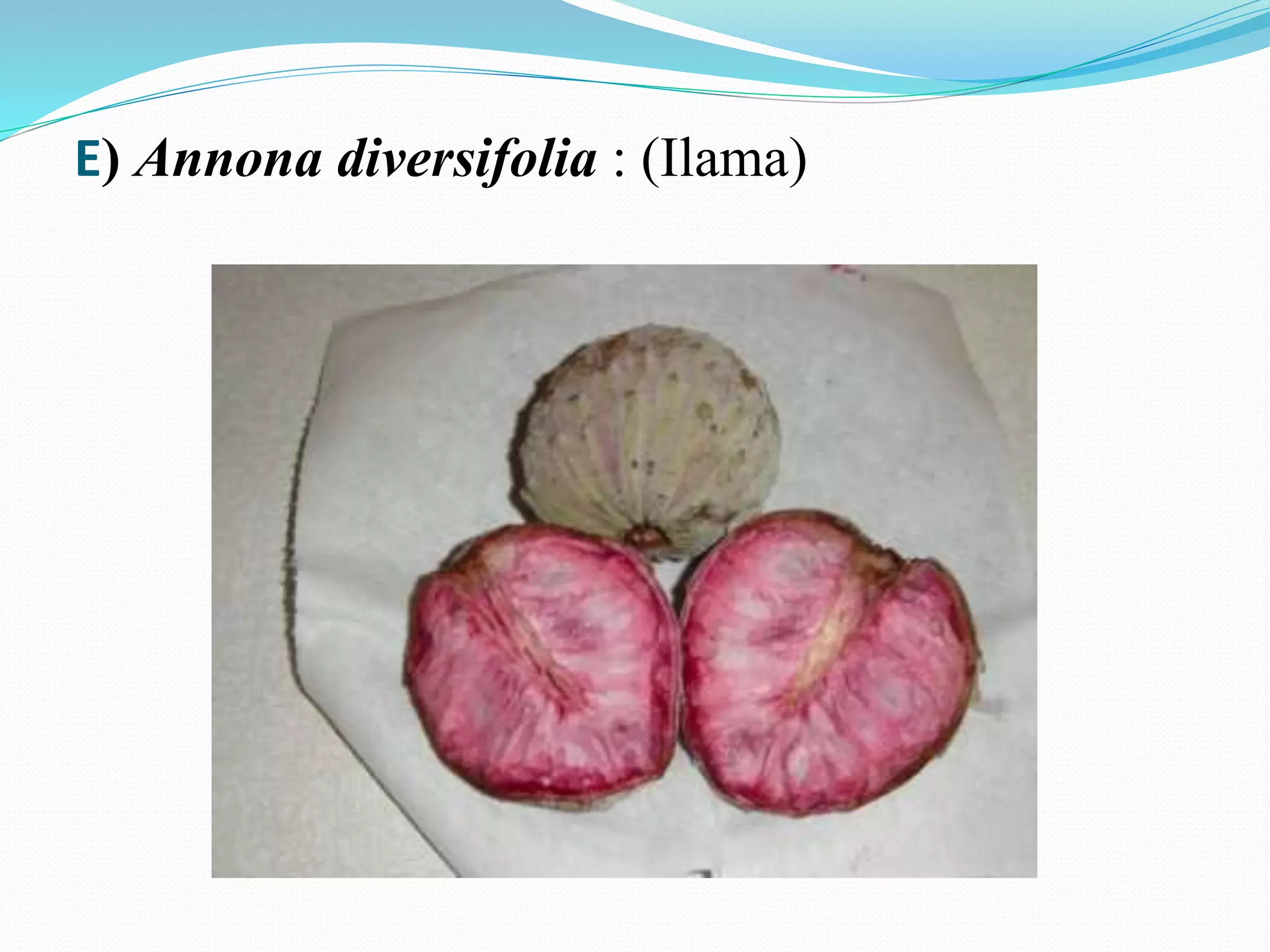
E) Annona diversifolia : (Ilama)
F) Annona glabra : (pond apple , monkey
apple)
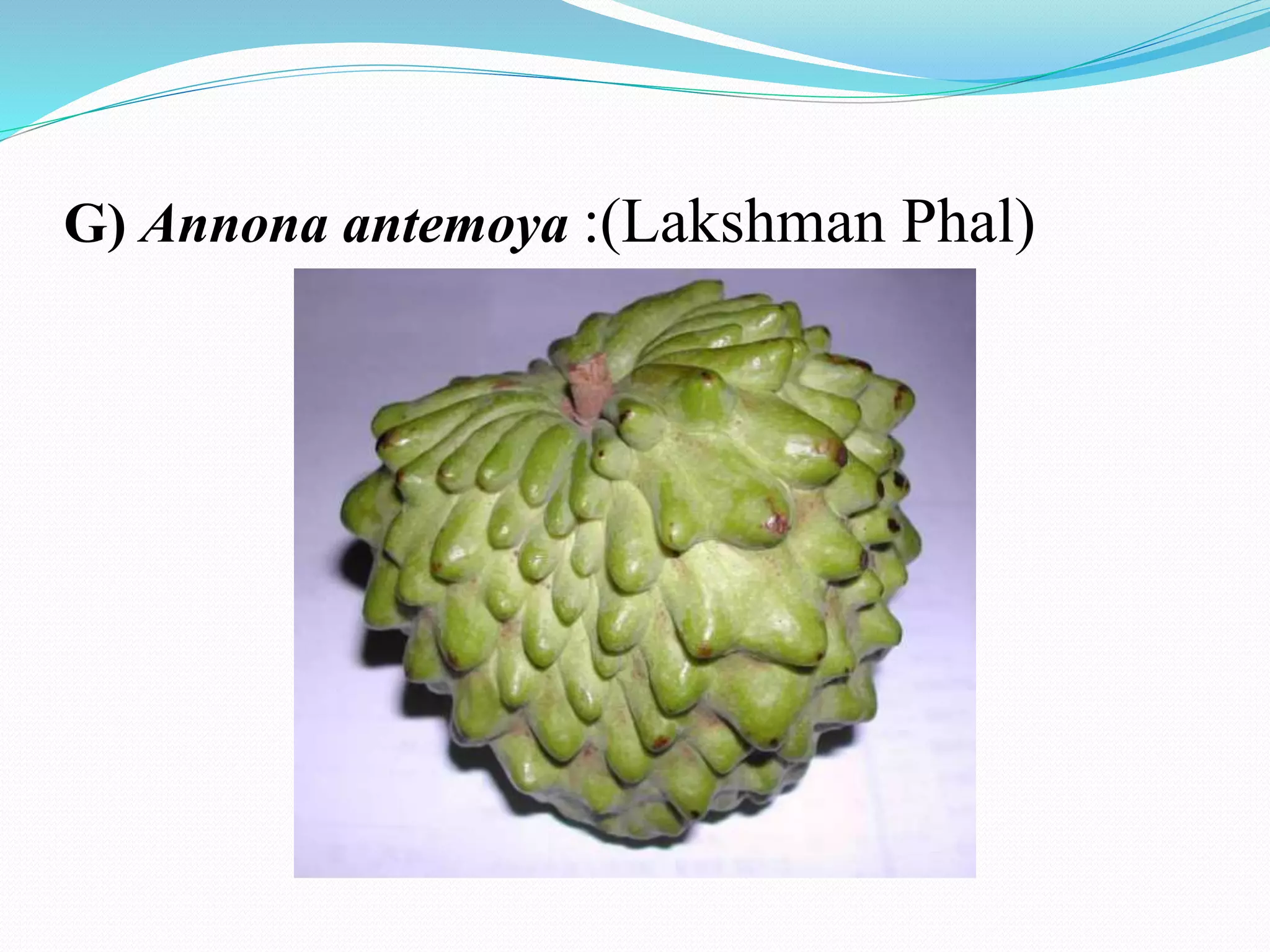
G) Annona antemoya :(Lakshman Phal)
VARIETIES
 Cultivars are grouped based on the external fruit colour.
A. Red type : having red color, smaller
leaves and fruits.
B. Green type : having more popularity
in India.
1) BALANAGAR
 Green skinned fruits with medium size
 High yielding type
2) BRITISH GUINEA
 Fruit weight is about 151gm and 37.9% pulp ,17.9% total
sugar.
3) MAMMOTH
 Fruit weight about 183g/ fruit.
 TSS content: 23%, acidity 0.19%.
 Good quality fruit
4) BARBADOS SEEDLING
 Fruits having high sugar content.
 Fruits having green rind, orange yellow margins.
 Late season variety.
5) RED SITAPHAL
 This variety originated as a chance seedling.
 Fruits are dark pinkish.
 Having average quality and more number of seeds.
6) KAKARLAPAHAD
 Very high yielding variety.
 It is very sweet and crispy in nature.
7) APK (Ca) 1
 Released from RRS, Aruppukottai, TN during 2003.
 Yield- 14.9kg/tree.
 Fruits are medium in size, heart shaped and TSS
24.5*Brix.
IMPORTANT HYBRID VARIETIES
1) ARKA SAHAN
 It is crossed between Annona atemoya X Annona
squamosa.
 Released from IIHR, Bangalore.
 Suitable for drought prone areas.
 Fruits having long shelf life and slow ripening
character.
2) AFRICAN PRIDE
 It is crossed between Annona cherimola X
Annona squamosa.
 Having good quality fruits.
Recently released variety
TROPICAL SUN:
 Released from Australian Custard apple growers
association (ACAGA).
 Suitable for home gardens.
 Ripening at room temperature.
CLIMATE
 Custard apple is adapted widely to tropical climate
and prefers moderate winter and high humidity during
flowering time.
 Trees cannot withstand frost and prolonged cold
weather. Continuous rains during flowering and fruit
set results in poor yields optimum rainfall is 60-80cm.
 Strong wind causes limb damage , heavy flower drop
and fruit damage.
SOIL
 Trees grown in wide variety of soils including sandy,
marginal and wasteland types.
 Fertile, well drained sandy loam soils with neutral to
slight acidic PH give better performance.
 Heavy soils and water logged conditions not suitable.
 Water stagnation leads to shriveling of branches and
sudden death of plants. because stagnation should be
avoided.
PROPAGATION
 Propagated by both seeds and vegetative propagation
Seed propagation :
 Seeds extracted from ripe fruits are used for sowing.
 Viability of seeds lasts for 3-4 years through best
seeds give best germination.
 Before seed sowing seeds are treated, such as seeds
soaking in cold water for 40-70hours are treatment with
GA3(500ppm), improve the germination rate.
Vegetative propagation :
 Grafting : In-situ cleft grafting is used, using the best root
stock are Annona cherimola and Annona squamosa.
 Budding : patch, shield and clip budding.
CULTIVATION
Planting :
 The custard apple fruits are planting in the square or
triangular systems.
 Pits are made of 50-60 cubic cm, filled with top soil
and 25-30kg FYM.
 Spacing : 6 X 6m
 Time of planting : During June-July. After 1 or 2
rains the saplings are planted in the centre of the pit.
 Shading, staking and watering should be done to
protect grafts after planting in the main field.
Manuring :
 Application of nutrients to custard apple depends upon the
soil and climatic conditions.
 Custard apple trees are well response to fertilizer
application in terms of increased vigour, production and
quality
Recommended By UAS, Dharwad
 1-2 year - 75:50:50 NPK (kg/ha)
 3-5 year - 150:100:100 NPK (kg/ha)
 >5 year - 250:125:125 NPK (kg/ha)
TRAINING AND PRUNING
 Strong tree frame work in custard apple is obtained by
training young plants during the initial stages of
growth.
 Keeping single stem up to 50 – 70 cm height and then
inducing scaffold branches in all directions makes
good frame work of tree.
 To avoid crowding, proper space among the branches
is maintained by removing criss - cross and over
lapping branches.
 Custard apple generally bears on the new growth but
some times fruiting also comes on old branches.
 Therefore, suitable combination of young and old
branches should be maintained by judicious pruning
and which balancing the vegetative and reproductive
growth.
FLOWERING AND FRUITSET
 Plants starts bearing after 3-4 years.
 Flowering period commences from March-April and
continuous to July – August, the peak timing April
and May.
 Very low fruit set in custard apple is a problem under
natural conditions, 1 – 8% fruit set is reported.
 The main reason being poor pollination due to various
external and internal factors like dichogamy,
hypogyny.
 The external factors like high and low humidity
prevailing at the time of flowering , soil moisture
stress.
 Hand pollination can be practiced to increase fruit set to
get better sized fruit and ensure better market price.
 Fruits can be improved by application of growth
regulators, GA (50ppm) at blooming stage, Biocil
(1ml/litre) just prior to flowering.
HARVESTING
 Custard apple is a climacteric fruit, which ripens after
harvesting hence should be harvested at matured
stage.
 Fruits mature in about 100 -120 days from anthesis.
Maturity indices:-
 Changing fruit colour in to light green.
 Fruits has attained full size.
 Yellowish white colour has been developed between
the segments.
 Initial cracking in carpels.
Post harvest management:
 Fruit has very poor shelf life therefore for distant markets.
 Harvesting comparatively harder fruits is advised.
 Fruits harvested before proper maturity do not ripe well
and remain less sweet.
 Arka sahana has better shelf life.
YIELD
 A well managed grown up custard apple plant can produce
80- 100 fruits/ tree.
 Arka sahana hybrid produces 25 tonnes fruits/ ha.
 Older trees rarely exceed 100 fruits/ tree unless hand
pollination.
PLANT PROTECTION
PESTS
1) Mealy bugs
DISEASES;-
1) Anthracnose – Colletotrichum gloeosporiodes.
2) Alternaria leaf spot- Alternaria alternata.
Sources
- National Horticulture Board (NHB) (2015-2016)
- Horticultural Statistics at a Glance 2017
- Handbook of Horticulture by K.L. Chadhdha
- Textbook of pomology by T.K.Boss
Custard apple crop ppt

Custard apple crop ppt

  • 2.
    An Assignment Presentation On “Custardapple” Submitted to:- Submitted by:- Dr. H. N. Leua Joshi Nikunj K. Assi. Professor M.Sc. Horticulture College of Horticulture SDAU, Jagudan
  • 3.
  • 4.
    Custard apple  Botanicalname :- Annona squamosa  Family :- Annonaceae  Origin :- Tropical America  Ch. No :- 2n=14  Synonyms :- Sitaphal, sugar apple, sweet sop.
  • 5.
    INTRODUCTION  Custard appleare delicious fruits and are used when they are full ripe.  Pleasant flavor, mild aroma and sweet taste have a universal acceptance.  Cultivation of custard apple is prevalent in Australia, Brazil, Chile, Egypt, India.  In India custard apple is under cultivation throughout the southern part and in Assam, Bihar, AP, MP, UP, MH.
  • 6.
    AREAAND PRODUCTION  InIndia, cultivation of custurd apple is done in 44,000 ha area with 3,67,000 MT production.  Gujarat produce 61000 tonnes custurd apple and provide 20.53% total share of national production.  Andhra Pradesh is the major fruit growing state in India and following by MH, UP, Bihar, Assam.  In Gujarat, Bhavanagar is largest producer of custard apple.
  • 7.
    COMPOSITION  The largeaggregate fruits are composed of peel, pulp, seeds.  Fruits contain 45% edible portion, 100gm of which composition 70.5gm moisture, 23.5gm carbohydrates, 1.6gm protein, 0.4gm fat  Which is also rich in minerals those are calcium 17mg, 45mg of phosphorous, vitamin-a 37mg and gives 104 k cal of energy.
  • 8.
    USES  Custard appleis the “fruit of poor people”. Pulp is used in ice creams and puddings.  Products such as jam, jelly, squash, syrup, nectar, canned product and a fermented alcoholic beverage.  Fruits, seeds, leaves and roots of custard apple are valued for their medicinal properties. As well as used both in ayurvedic and yunani systems.  Seeds containing 30% oil which is extracted and used in soap and paint industries.  Leaves are used for preparation of blue or black dyes.  Seeds are used for abortifacient and roots are drastic purgative agent. Seeds , leaves ,young raw fruits are used for making insecticides and lice killers.
  • 9.
    BOTANY  Growth ofthe plants are shrubs or small trees growing up to 5 to 6m.  The leaves are alternate simple and entire.  Flowers are born either singly or in small groups, yellowish green, hermaphrodite. protogynous and having auxillary bearing habit.  Fruits are heart shaped, fleshy syncarp formed by the fusion of the pistils and receptacle, pericarp is the edible part.  Pollination is mainly by insects i.e. cross pollination.
  • 11.
    SPECIES  Custard applebelongs to family annonaceae, this family includes 40 genera and genus annona has got 120 species out of which 6 have commercial significance. A) Annona squamosa : (custard apple, sugar apple, sweetsop)  Good quality  Widely Cultivated in India
  • 13.
    B) Annona cherimola: (Hanumanphal, cherimoya)
  • 14.
    C) Annona reticulata: (bullocks heart, ramphal)
  • 15.
    D) Annona muricata: (sour soap, mundla, sitaphal)
  • 16.
  • 17.
    F) Annona glabra: (pond apple , monkey apple)
  • 18.
    G) Annona antemoya:(Lakshman Phal)
  • 19.
    VARIETIES  Cultivars aregrouped based on the external fruit colour. A. Red type : having red color, smaller leaves and fruits. B. Green type : having more popularity in India.
  • 20.
    1) BALANAGAR  Greenskinned fruits with medium size  High yielding type 2) BRITISH GUINEA  Fruit weight is about 151gm and 37.9% pulp ,17.9% total sugar. 3) MAMMOTH  Fruit weight about 183g/ fruit.  TSS content: 23%, acidity 0.19%.  Good quality fruit
  • 21.
    4) BARBADOS SEEDLING Fruits having high sugar content.  Fruits having green rind, orange yellow margins.  Late season variety. 5) RED SITAPHAL  This variety originated as a chance seedling.  Fruits are dark pinkish.  Having average quality and more number of seeds.
  • 22.
    6) KAKARLAPAHAD  Veryhigh yielding variety.  It is very sweet and crispy in nature. 7) APK (Ca) 1  Released from RRS, Aruppukottai, TN during 2003.  Yield- 14.9kg/tree.  Fruits are medium in size, heart shaped and TSS 24.5*Brix.
  • 23.
    IMPORTANT HYBRID VARIETIES 1)ARKA SAHAN  It is crossed between Annona atemoya X Annona squamosa.  Released from IIHR, Bangalore.  Suitable for drought prone areas.  Fruits having long shelf life and slow ripening character. 2) AFRICAN PRIDE  It is crossed between Annona cherimola X Annona squamosa.  Having good quality fruits.
  • 24.
    Recently released variety TROPICALSUN:  Released from Australian Custard apple growers association (ACAGA).  Suitable for home gardens.  Ripening at room temperature.
  • 25.
    CLIMATE  Custard appleis adapted widely to tropical climate and prefers moderate winter and high humidity during flowering time.  Trees cannot withstand frost and prolonged cold weather. Continuous rains during flowering and fruit set results in poor yields optimum rainfall is 60-80cm.  Strong wind causes limb damage , heavy flower drop and fruit damage. SOIL  Trees grown in wide variety of soils including sandy, marginal and wasteland types.
  • 26.
     Fertile, welldrained sandy loam soils with neutral to slight acidic PH give better performance.  Heavy soils and water logged conditions not suitable.  Water stagnation leads to shriveling of branches and sudden death of plants. because stagnation should be avoided.
  • 27.
    PROPAGATION  Propagated byboth seeds and vegetative propagation Seed propagation :  Seeds extracted from ripe fruits are used for sowing.  Viability of seeds lasts for 3-4 years through best seeds give best germination.
  • 28.
     Before seedsowing seeds are treated, such as seeds soaking in cold water for 40-70hours are treatment with GA3(500ppm), improve the germination rate. Vegetative propagation :  Grafting : In-situ cleft grafting is used, using the best root stock are Annona cherimola and Annona squamosa.  Budding : patch, shield and clip budding.
  • 29.
    CULTIVATION Planting :  Thecustard apple fruits are planting in the square or triangular systems.  Pits are made of 50-60 cubic cm, filled with top soil and 25-30kg FYM.  Spacing : 6 X 6m  Time of planting : During June-July. After 1 or 2 rains the saplings are planted in the centre of the pit.  Shading, staking and watering should be done to protect grafts after planting in the main field.
  • 30.
    Manuring :  Applicationof nutrients to custard apple depends upon the soil and climatic conditions.  Custard apple trees are well response to fertilizer application in terms of increased vigour, production and quality Recommended By UAS, Dharwad  1-2 year - 75:50:50 NPK (kg/ha)  3-5 year - 150:100:100 NPK (kg/ha)  >5 year - 250:125:125 NPK (kg/ha)
  • 31.
    TRAINING AND PRUNING Strong tree frame work in custard apple is obtained by training young plants during the initial stages of growth.  Keeping single stem up to 50 – 70 cm height and then inducing scaffold branches in all directions makes good frame work of tree.  To avoid crowding, proper space among the branches is maintained by removing criss - cross and over lapping branches.  Custard apple generally bears on the new growth but some times fruiting also comes on old branches.  Therefore, suitable combination of young and old branches should be maintained by judicious pruning and which balancing the vegetative and reproductive growth.
  • 32.
    FLOWERING AND FRUITSET Plants starts bearing after 3-4 years.  Flowering period commences from March-April and continuous to July – August, the peak timing April and May.  Very low fruit set in custard apple is a problem under natural conditions, 1 – 8% fruit set is reported.  The main reason being poor pollination due to various external and internal factors like dichogamy, hypogyny.  The external factors like high and low humidity prevailing at the time of flowering , soil moisture stress.
  • 33.
     Hand pollinationcan be practiced to increase fruit set to get better sized fruit and ensure better market price.  Fruits can be improved by application of growth regulators, GA (50ppm) at blooming stage, Biocil (1ml/litre) just prior to flowering.
  • 34.
    HARVESTING  Custard appleis a climacteric fruit, which ripens after harvesting hence should be harvested at matured stage.  Fruits mature in about 100 -120 days from anthesis. Maturity indices:-  Changing fruit colour in to light green.  Fruits has attained full size.  Yellowish white colour has been developed between the segments.  Initial cracking in carpels.
  • 35.
    Post harvest management: Fruit has very poor shelf life therefore for distant markets.  Harvesting comparatively harder fruits is advised.  Fruits harvested before proper maturity do not ripe well and remain less sweet.  Arka sahana has better shelf life.
  • 36.
    YIELD  A wellmanaged grown up custard apple plant can produce 80- 100 fruits/ tree.  Arka sahana hybrid produces 25 tonnes fruits/ ha.  Older trees rarely exceed 100 fruits/ tree unless hand pollination.
  • 37.
    PLANT PROTECTION PESTS 1) Mealybugs DISEASES;- 1) Anthracnose – Colletotrichum gloeosporiodes. 2) Alternaria leaf spot- Alternaria alternata.
  • 38.
    Sources - National HorticultureBoard (NHB) (2015-2016) - Horticultural Statistics at a Glance 2017 - Handbook of Horticulture by K.L. Chadhdha - Textbook of pomology by T.K.Boss