KONG HUA SCHOOL
KAUSWAGAN, CAGAYAN DE ORO CITY
High School Department
GRADE – 7 ARALING PANLIPUNAN CURRICULUM MAP (ASIAN STUDIES)
Quarter: First quarter Time Allocation:
Chapter: Dates:
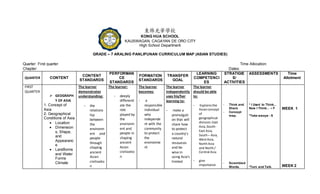
QUARTER CONTENT
CONTENT
STANDARDS
PERFORMAN
CE
STANDARDS
FORMATION
STANDARDS
TRANSFER
GOAL
LEARNING
COMPETENCI
ES
STRATIGIE
S/
ACTIVITIES
ASSESSMENTS Time
Allotment
FIRST
QUARTER
 GEOGRAPH
Y OF ASIA
1. Concept of
Asia
2. Geographical
Conditions of Asia
 Location
 Dimension
s, Shape,
and
Appearanc
e
 Landforms
and Water
Forms
Climate
The learner
demonstrates
understanding:
- the
relations
hip
between
the
environm
ent and
people
through
shaping
ancient
Asian
civilizatio
n
The learner:
- deeply
differenti
ate the
role
played by
the
environm
ent and
people in
shaping
ancient
Asian
civilizatio
n
The learner
becomes:
- a
responsible
individual
who
independe
nt with the
community
to protect
the
environme
nt
The learner
independently
uses his/her
learning to:
- make a
promulgati
on that will
share how
to protect
a country’s
natural
resources
and be
wise in
using Asia’s
limited
The learner
should be able
to:
- Explainsthe
Asianconcept
of
geographical
division:East
Asia,South-
East Asia,
South– Asia,
WestAsia,
NorthAsia
and North/
Central Asia
- give
importance
- Think and
Share
- Concept
map.
- Scrambled
Words.
* I Used to Think...
Now I Think... – F
*Take-aways - S
*Turn and Talk.
WEEK 1
WEEK 2
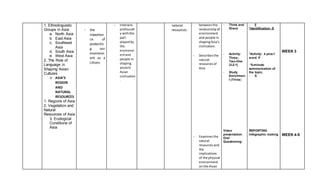
1. Ethnolinguistic
Groups in Asia
a. North Asia
b. East Asia
c. Southeast
Asia
d. South Asia
e. West Asia
2. The Role of
Language in
Shaping Asian
Cultures
 ASIA’S
REGION
AND
NATURAL
RESOURCES
1. Regions of Asia
2. Vegetation and
Natural
Resources of Asia
3. Ecological
Conditions of
Asia
- the
importan
ce of
protectin
g our
environm
ent as a
citizen.
- Interacts
profoundl
y withthe
part
playedby
the
environm
entand
people in
shaping
ancient
Asian
civilization
.
natural
resources.
betweenthe
relationshipof
environment
and people in
shapingAsia’s
civilization.
- Describesthe
natural
resourcesof
Asia
- Examinesthe
natural
resourcesand
the
implications
of the physical
environment
on the Asian
- Think and
Share
- Activity:
Three-
Two-One
(3-2-1)
- Study
Enrichmen
t (Trivia)
Video
presentation
Oral
Questioning:
- F
*Identification- S
*Activity: 4 pics-1
word -F
*5-minute
summarization of
the topic.
- S
REPORTING
Infographic making
WEEK 3
WEEK 4-5
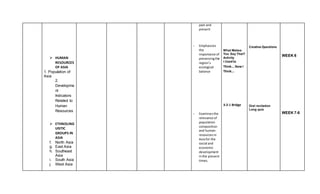
 HUMAN
RESOURCES
OF ASIA
1. Population of
Asia
2.
Developme
nt
Indicators
Related to
Human
Resources
 ETHNOLING
UISTIC
GROUPS IN
ASIA
f. North Asia
g. East Asia
h. Southeast
Asia
i. South Asia
j. West Asia
past and
present
- Emphasizes
the
importance of
preservingthe
region’s
ecological
balance
- Examinesthe
relevance of
population
composition
and human
resourcesin
Asiafor the
social and
economic
development
inthe present
times.
What Makes
You Say That?
Activity
I Usedto
Think... Now I
Think...
3-2-1 Bridge
Creative Questions
Oral recitation
Long quiz
WEEK 6
WEEK 7-8
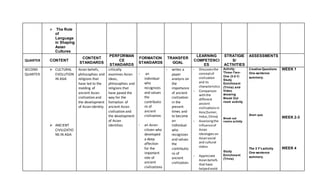
 The Role
of
Language
in Shaping
Asian
Cultures
QUARTER CONTENT
CONTENT
STANDARDS
PERFORMAN
CE
STANDARDS
FORMATION
STANDARDS
TRANSFER
GOAL
LEARNING
COMPETENCI
ES
STRATIGIE
S/
ACTIVITIES
ASSESSMENTS
SECOND
QUARTER
 CULTURAL
EVOLUTION
IN ASIA
 ANCIENT
CIVILIZATIO
NS IN ASIA
Asian beliefs,
philosophies and
religions that
have led to the
molding of
ancient Asian
civilization and
the development
of Asian identity.
critically
examines Asian
ideas,
philosophies and
religions that
have paved the
way for the
formation of
ancient Asian
civilization and
the development
of Asian
identities
- an
individual
who
recognizes
and values
the
contributio
ns of
ancient
civilization.
- an Asian
citizen who
developed
a deep
affection
for the
important
role of
ancient
civilizations
- writes a
paper
analysis on
the
importance
of ancient
civilization
in the
present
times and
to become
an
individual
who
recognizes
and values
the
contributio
ns of
ancient
civilization.
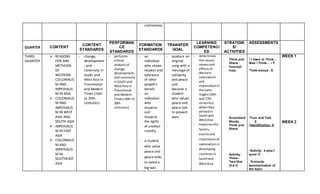
- Discussesthe
conceptof
civilization
and its
characteristics
- Comparison
withthe
different
ancient
civilizationsin
Asia(Sumer,
Indus,China)
- Assessingthe
influenceof
Asian
ideologies on
Asiansocial
and cultural
status
- Appreciate
Asianbeliefs
that have
helpedmold
Activity:
Three-Two-
One (3-2-1)
Study
Enrichment
(Trivia) and
Video
showing
Break Out
room activity
Break out
rooms activity
Study
Enrichment
(Trivia)
Creative Questions
One-sentence
summary.
Short quiz
The 3 Y’sactivity
One-sentence
summary.
WEEK 1
WEEK 2-3
WEEK 4
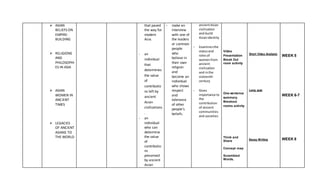
 ASIAN
BELIEFS ON
EMPIRE-
BUILDING
 RELIGIONS
AND
PHILOSOPHI
ES IN ASIA
 ASIAN
WOMEN IN
ANCIENT
TIMES
 LEGACIES
OF ANCIENT
ASIANS TO
THE WORLD
that paved
the way for
modern
Asia.
- an
individual
that
determines
the value
of
contributio
ns left by
ancient
Asian
civilizations
.
- an
individual
who can
determine
the value
of
contributio
ns
preserved
by ancient
Asian
- make an
interview
with one of
the leaders
or common
people
who
believe in
their own
religion
and
become an
individual
who shows
respect
and
tolerance
of other
people's
beliefs.
ancientAsian
civilization
and build
Asianidentity
- Examinesthe
statusand
rolesof
womenfrom
ancient
civilization
and inthe
sixteenth
century
- Gives
importance to
the
contribution
of ancient
communities
and societies
Video
Presentation
Break Out
room activity
One-sentence
summary.
Breakout
rooms activity
Think and
Share
Concept map
Scrambled
Words.
Short Video Analysis
Long quiz
Essay Writing
WEEK 5
WEEK 6-7
WEEK 8
civilizations
.
QUARTER CONTENT
CONTENT
STANDARDS
PERFORMAN
CE
STANDARDS
FORMATION
STANDARDS
TRANSFER
GOAL
LEARNING
COMPETENCI
ES
STRATIGIE
S/
ACTIVITIES
ASSESSMENTS
THIRD
QUARTER
 REASONS
FOR AND
METHODS
OF
WESTERN
COLONIALIS
M AND
IMPERIALIS
M IN ASIA
 COLONIALIS
M AND
IMPERIALIS
M IN WEST
ASIA AND
SOUTH ASIA
 IMPERIALIS
M IN EAST
ASIA
 COLONIALIS
M AND
IMPERIALIS
M IN
SOUTHEAST
ASIA
- change,
development
, and
continuity in
South and
West Asia in
Transitional
and Modern
Times (16th
to 20th
centuries)
- performs
critical
analysisof
change,
development,
and continuity
inSouth and
WestAsiain
Transitional
and Modern
Times(16th to
20th
centuries)
- an
individual
who shows
respect and
tolerance
of other
people's
beliefs.
- an
individual
who
respects
and
respects
the rights
of another
country.
- a student
who value
peace and
peace talks
to avoid a
big war.
- produce an
original
song with a
message of
solidarity
and peace
and
become a
student
who values
peace and
peace talk
to prevent
wars
-
- determines
the causes,
meansand
effectsof
Western
colonialism
and
imperialismin
the early
stages(16th
and 17th
centuries)
whenthey
arrivedin
Southand
WestAsia
- Examinesthe
factors,
eventsand
importance of
nationalismin
developing
countriesin
Southand
WestAsia
- Think and
Share
- Concept
map.
Scrambled
Words.
Think and
Share
Activity:
Three-
Two-One
(3-2-1)
* I Used to Think...
Now I Think... – F
*Take-aways - S
*Turn and Talk.
- F
*Identification- S
*Activity: 4 pics-1
word -F
*5-minute
summarization of
the topic.
WEEK 1
WEEK 2
- a citizen
who has
received
the
changes
brought
about by
the rise of
nationalism
- an
individual
who has
come to
appreciate
the brilliant
endeavors
of southern
and
western
Asia
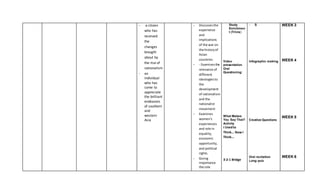
- Discussesthe
experience
and
implications
of the war on
the historyof
Asian
countries
- - Examinesthe
relevance of
different
ideologiesto
the
development
of nationalism
and the
nationalist
movement
- Examines
women's
experiences
and role in
equality,
economic
opportunity,
and political
rights.
- Giving
importance
the role
Study
Enrichmen
t (Trivia)
Video
presentation
Oral
Questioning:
What Makes
You Say That?
Activity
I Usedto
Think... Now I
Think...
3-2-1 Bridge
- S
Infographic making
Creative Questions
Oral recitation
Long quiz
WEEK 3
WEEK 4
WEEK 5
WEEK 6
playedby
nationalismin
ending
imperialismin
Southand
WestAsia
- Giving
importance to
the
contributions
of Southand
WestAsiato
Asianculture
Think and
Share
Concept map
Video making WEEK 7
QUARTER CONTENT
CONTENT
STANDARDS
PERFORMAN
CE
STANDARDS
FORMATION
STANDARDS
TRANSFER
GOAL
LEARNING
COMPETENCI
ES
STRATIGIE
S/
ACTIVITIES
ASSESSMENTS
FOURTH
QUARTER
 NATIONALIS
M IN SOUTH
ASIA AND
WEST ASIA
 NATIONALIS
M IN EAST
ASIA AND
SOUTHEAST
ASIA
 ASIA IN THE
TIME OF
FREEDOM
 ASIAN
CULTURE
TODAY
- The
importance
of Asian
challenges
through
change,
development
, and
continuity of
East and
Southeast
Asia in the
Transitional
and Modern
Age (16th to
- performs
critical
analysisof the
transformatio
n,
development,
and
cohesiveness
of East and
SoutheastAsia
inTransitional
and Modern
Times(16th to
20th
centuries)
- an
individual
who
respects
and
respects
the rights
of another
country.
- an
individual
who sees
the beauty
of how
western
- be able to
do an
article
analysis of
the events
that took
place
during
colonialism
in east and
south-east
Asia and
become a
respected
individual
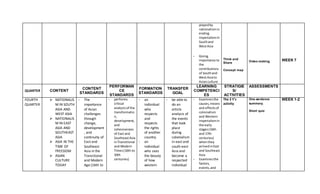
- Examinesthe
causes,means
and effectsof
colonialism
and Western
imperialismin
the early
stages(16th
and 17th
centuries)
whenthey
arrivedinEast
and Southeast
Asia
- Examinesthe
factors,
events,and
The 3 Y’s
activity
One-sentence
summary.
Short quiz
WEEK 1-2
20th
Century)
style
evolve and
the
courage
Asian has
shown in
defending
their
citizenship.
and
respect
each
other’s
rights.
- create a
photo
mural that
shows the
sacrifices
of the
people of
Asia to
achieve
their
country's
independe
nce and
become a
student
who values
peace and
peace talks
to prevent
the war.
importance of
nationalismin
developing
countriesin
East and
Southeast
Asia
- Discussesthe
experience
and
implications
of the war on
the historyof
Asian
countries
- Examinesthe
relevance of
different
ideologiesto
the
emergence of
nationalism
and the
nationalist
movement
- - Examines
women's
experience
and role in
equality,
economic
opportunity,
and political
rights
Break out
rooms’ activity
Video
showing
Guess the
photo
The 3 Y’s
activity
KOKOLOGY
GAME
Quescussion
Oral recitation
Photo analysis
Infographic
WEEK 3
WEEK 4
WEEK 4
WEEK 5
- Evaluationof
the role of
religionin
various
aspectsof life
- Examinesthe
forms,
responses,
and effectsof
neo-
colonialismin
East and
Southeast
Asia
- The
importance of
the
contributions
of East and
Southeast
Asiato Asian
culture
Circle of
Viewpoint
(perspectives)
activity
Study
Enrichment
(Trivia)
The 4 C’s
activity
Infographic
Essay writing
One sentence
summary
WEEK 6
WEEK 6
WEEK 7

CURRICULUM MAP GRADE 7 2021-2022.docx

  • 1.
    KONG HUA SCHOOL KAUSWAGAN,CAGAYAN DE ORO CITY High School Department GRADE – 7 ARALING PANLIPUNAN CURRICULUM MAP (ASIAN STUDIES) Quarter: First quarter Time Allocation: Chapter: Dates: QUARTER CONTENT CONTENT STANDARDS PERFORMAN CE STANDARDS FORMATION STANDARDS TRANSFER GOAL LEARNING COMPETENCI ES STRATIGIE S/ ACTIVITIES ASSESSMENTS Time Allotment FIRST QUARTER  GEOGRAPH Y OF ASIA 1. Concept of Asia 2. Geographical Conditions of Asia  Location  Dimension s, Shape, and Appearanc e  Landforms and Water Forms Climate The learner demonstrates understanding: - the relations hip between the environm ent and people through shaping ancient Asian civilizatio n The learner: - deeply differenti ate the role played by the environm ent and people in shaping ancient Asian civilizatio n The learner becomes: - a responsible individual who independe nt with the community to protect the environme nt The learner independently uses his/her learning to: - make a promulgati on that will share how to protect a country’s natural resources and be wise in using Asia’s limited The learner should be able to: - Explainsthe Asianconcept of geographical division:East Asia,South- East Asia, South– Asia, WestAsia, NorthAsia and North/ Central Asia - give importance - Think and Share - Concept map. - Scrambled Words. * I Used to Think... Now I Think... – F *Take-aways - S *Turn and Talk. WEEK 1 WEEK 2
  • 2.
    1. Ethnolinguistic Groups inAsia a. North Asia b. East Asia c. Southeast Asia d. South Asia e. West Asia 2. The Role of Language in Shaping Asian Cultures  ASIA’S REGION AND NATURAL RESOURCES 1. Regions of Asia 2. Vegetation and Natural Resources of Asia 3. Ecological Conditions of Asia - the importan ce of protectin g our environm ent as a citizen. - Interacts profoundl y withthe part playedby the environm entand people in shaping ancient Asian civilization . natural resources. betweenthe relationshipof environment and people in shapingAsia’s civilization. - Describesthe natural resourcesof Asia - Examinesthe natural resourcesand the implications of the physical environment on the Asian - Think and Share - Activity: Three- Two-One (3-2-1) - Study Enrichmen t (Trivia) Video presentation Oral Questioning: - F *Identification- S *Activity: 4 pics-1 word -F *5-minute summarization of the topic. - S REPORTING Infographic making WEEK 3 WEEK 4-5
  • 3.
     HUMAN RESOURCES OF ASIA 1.Population of Asia 2. Developme nt Indicators Related to Human Resources  ETHNOLING UISTIC GROUPS IN ASIA f. North Asia g. East Asia h. Southeast Asia i. South Asia j. West Asia past and present - Emphasizes the importance of preservingthe region’s ecological balance - Examinesthe relevance of population composition and human resourcesin Asiafor the social and economic development inthe present times. What Makes You Say That? Activity I Usedto Think... Now I Think... 3-2-1 Bridge Creative Questions Oral recitation Long quiz WEEK 6 WEEK 7-8
  • 4.
     The Role of Language inShaping Asian Cultures QUARTER CONTENT CONTENT STANDARDS PERFORMAN CE STANDARDS FORMATION STANDARDS TRANSFER GOAL LEARNING COMPETENCI ES STRATIGIE S/ ACTIVITIES ASSESSMENTS SECOND QUARTER  CULTURAL EVOLUTION IN ASIA  ANCIENT CIVILIZATIO NS IN ASIA Asian beliefs, philosophies and religions that have led to the molding of ancient Asian civilization and the development of Asian identity. critically examines Asian ideas, philosophies and religions that have paved the way for the formation of ancient Asian civilization and the development of Asian identities - an individual who recognizes and values the contributio ns of ancient civilization. - an Asian citizen who developed a deep affection for the important role of ancient civilizations - writes a paper analysis on the importance of ancient civilization in the present times and to become an individual who recognizes and values the contributio ns of ancient civilization. - Discussesthe conceptof civilization and its characteristics - Comparison withthe different ancient civilizationsin Asia(Sumer, Indus,China) - Assessingthe influenceof Asian ideologies on Asiansocial and cultural status - Appreciate Asianbeliefs that have helpedmold Activity: Three-Two- One (3-2-1) Study Enrichment (Trivia) and Video showing Break Out room activity Break out rooms activity Study Enrichment (Trivia) Creative Questions One-sentence summary. Short quiz The 3 Y’sactivity One-sentence summary. WEEK 1 WEEK 2-3 WEEK 4
  • 5.
     ASIAN BELIEFS ON EMPIRE- BUILDING RELIGIONS AND PHILOSOPHI ES IN ASIA  ASIAN WOMEN IN ANCIENT TIMES  LEGACIES OF ANCIENT ASIANS TO THE WORLD that paved the way for modern Asia. - an individual that determines the value of contributio ns left by ancient Asian civilizations . - an individual who can determine the value of contributio ns preserved by ancient Asian - make an interview with one of the leaders or common people who believe in their own religion and become an individual who shows respect and tolerance of other people's beliefs. ancientAsian civilization and build Asianidentity - Examinesthe statusand rolesof womenfrom ancient civilization and inthe sixteenth century - Gives importance to the contribution of ancient communities and societies Video Presentation Break Out room activity One-sentence summary. Breakout rooms activity Think and Share Concept map Scrambled Words. Short Video Analysis Long quiz Essay Writing WEEK 5 WEEK 6-7 WEEK 8
  • 6.
    civilizations . QUARTER CONTENT CONTENT STANDARDS PERFORMAN CE STANDARDS FORMATION STANDARDS TRANSFER GOAL LEARNING COMPETENCI ES STRATIGIE S/ ACTIVITIES ASSESSMENTS THIRD QUARTER  REASONS FORAND METHODS OF WESTERN COLONIALIS M AND IMPERIALIS M IN ASIA  COLONIALIS M AND IMPERIALIS M IN WEST ASIA AND SOUTH ASIA  IMPERIALIS M IN EAST ASIA  COLONIALIS M AND IMPERIALIS M IN SOUTHEAST ASIA - change, development , and continuity in South and West Asia in Transitional and Modern Times (16th to 20th centuries) - performs critical analysisof change, development, and continuity inSouth and WestAsiain Transitional and Modern Times(16th to 20th centuries) - an individual who shows respect and tolerance of other people's beliefs. - an individual who respects and respects the rights of another country. - a student who value peace and peace talks to avoid a big war. - produce an original song with a message of solidarity and peace and become a student who values peace and peace talk to prevent wars - - determines the causes, meansand effectsof Western colonialism and imperialismin the early stages(16th and 17th centuries) whenthey arrivedin Southand WestAsia - Examinesthe factors, eventsand importance of nationalismin developing countriesin Southand WestAsia - Think and Share - Concept map. Scrambled Words. Think and Share Activity: Three- Two-One (3-2-1) * I Used to Think... Now I Think... – F *Take-aways - S *Turn and Talk. - F *Identification- S *Activity: 4 pics-1 word -F *5-minute summarization of the topic. WEEK 1 WEEK 2
  • 7.
    - a citizen whohas received the changes brought about by the rise of nationalism - an individual who has come to appreciate the brilliant endeavors of southern and western Asia - Discussesthe experience and implications of the war on the historyof Asian countries - - Examinesthe relevance of different ideologiesto the development of nationalism and the nationalist movement - Examines women's experiences and role in equality, economic opportunity, and political rights. - Giving importance the role Study Enrichmen t (Trivia) Video presentation Oral Questioning: What Makes You Say That? Activity I Usedto Think... Now I Think... 3-2-1 Bridge - S Infographic making Creative Questions Oral recitation Long quiz WEEK 3 WEEK 4 WEEK 5 WEEK 6
  • 8.
    playedby nationalismin ending imperialismin Southand WestAsia - Giving importance to the contributions ofSouthand WestAsiato Asianculture Think and Share Concept map Video making WEEK 7 QUARTER CONTENT CONTENT STANDARDS PERFORMAN CE STANDARDS FORMATION STANDARDS TRANSFER GOAL LEARNING COMPETENCI ES STRATIGIE S/ ACTIVITIES ASSESSMENTS FOURTH QUARTER  NATIONALIS M IN SOUTH ASIA AND WEST ASIA  NATIONALIS M IN EAST ASIA AND SOUTHEAST ASIA  ASIA IN THE TIME OF FREEDOM  ASIAN CULTURE TODAY - The importance of Asian challenges through change, development , and continuity of East and Southeast Asia in the Transitional and Modern Age (16th to - performs critical analysisof the transformatio n, development, and cohesiveness of East and SoutheastAsia inTransitional and Modern Times(16th to 20th centuries) - an individual who respects and respects the rights of another country. - an individual who sees the beauty of how western - be able to do an article analysis of the events that took place during colonialism in east and south-east Asia and become a respected individual - Examinesthe causes,means and effectsof colonialism and Western imperialismin the early stages(16th and 17th centuries) whenthey arrivedinEast and Southeast Asia - Examinesthe factors, events,and The 3 Y’s activity One-sentence summary. Short quiz WEEK 1-2
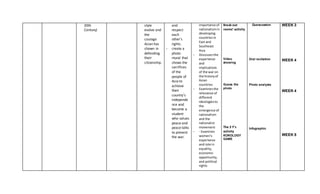
  • 9.
    20th Century) style evolve and the courage Asian has shownin defending their citizenship. and respect each other’s rights. - create a photo mural that shows the sacrifices of the people of Asia to achieve their country's independe nce and become a student who values peace and peace talks to prevent the war. importance of nationalismin developing countriesin East and Southeast Asia - Discussesthe experience and implications of the war on the historyof Asian countries - Examinesthe relevance of different ideologiesto the emergence of nationalism and the nationalist movement - - Examines women's experience and role in equality, economic opportunity, and political rights Break out rooms’ activity Video showing Guess the photo The 3 Y’s activity KOKOLOGY GAME Quescussion Oral recitation Photo analysis Infographic WEEK 3 WEEK 4 WEEK 4 WEEK 5
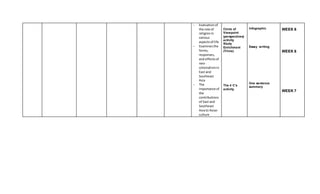
  • 10.
    - Evaluationof the roleof religionin various aspectsof life - Examinesthe forms, responses, and effectsof neo- colonialismin East and Southeast Asia - The importance of the contributions of East and Southeast Asiato Asian culture Circle of Viewpoint (perspectives) activity Study Enrichment (Trivia) The 4 C’s activity Infographic Essay writing One sentence summary WEEK 6 WEEK 6 WEEK 7