Understanding the Curriculum as a
            whole.
Understanding the Curriculum a whole
• Curriculum for excellence aims to achieve a transformation in
  education in Scotland by providing a coherent, more flexible and
  enriched curriculum from 3 to 18.
• The 3-18 curriculum aims to ensure that all children and young
  people in Scotland develop the attributes, knowledge and skills
  they will need to flourish in life, learning and work.
• These attributes will allow them to demonstrate four keys
  capacities in order to be: successful learners, confident individuals,
  responsible citizens and effective contributors.
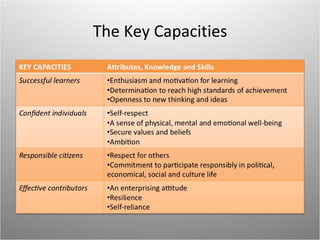
The Key Capacities
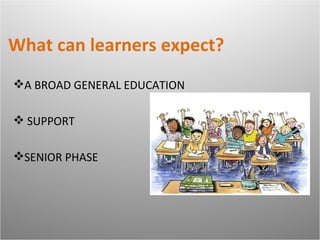
What can learners expect?
A BROAD GENERAL EDUCATION

 SUPPORT

SENIOR PHASE
Learners   A curriculum that includes a range
need and   of features at the different stages
entitled              of learning.
A BROAD GENERAL EDUCATION
The purpose of education in Scotland                     a broad general education

A broad general education means a curriculum that help learners to:

       - Achieve the highest levels of literacy, numeracy and cognitive skills
       - Develop skills for learning, skills for life and skills for work
       - Develop knowledge and understanding of society
       - Experience challenge and success
 SUPPORT
- The support involves a range of people: parents, teachers, nurses,
   psychological services, college staff…


- The most important thing is to work in partnership.


- Every child should have a personalization and choice within their
   curriculum.
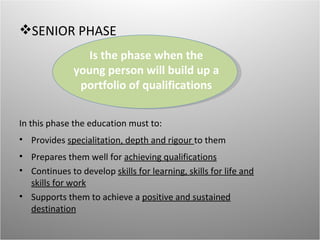
SENIOR PHASE
                 Is the phase when the
              young person will build up a
               portfolio of qualifications


In this phase the education must to:
• Provides specialitation, depth and rigour to them
• Prepares them well for achieving qualifications
• Continues to develop skills for learning, skills for life and
  skills for work
• Supports them to achieve a positive and sustained
  destination
Principles for Curriculum design.
 Curriculum areas and subjetcs.
     Indisciplinary learning.
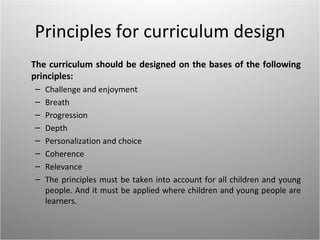
Principles for curriculum design
The curriculum should be designed on the bases of the following
principles:
–   Challenge and enjoyment
–   Breath
–   Progression
–   Depth
–   Personalization and choice
–   Coherence
–   Relevance
–   The principles must be taken into account for all children and young
    people. And it must be applied where children and young people are
    learners.
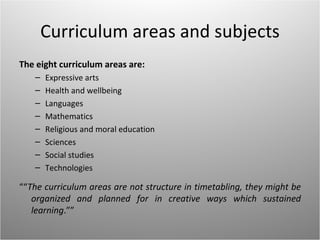
Curriculum areas and subjects
The eight curriculum areas are:
   –   Expressive arts
   –   Health and wellbeing
   –   Languages
   –   Mathematics
   –   Religious and moral education
   –   Sciences
   –   Social studies
   –   Technologies

““The curriculum areas are not structure in timetabling, they might be
   organized and planned for in creative ways which sustained
   learning.””
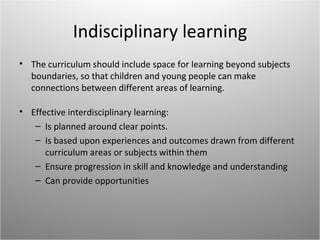
Indisciplinary learning
• The curriculum should include space for learning beyond subjects
  boundaries, so that children and young people can make
  connections between different areas of learning.

• Effective interdisciplinary learning:
   – Is planned around clear points.
   – Is based upon experiences and outcomes drawn from different
      curriculum areas or subjects within them
   – Ensure progression in skill and knowledge and understanding
   – Can provide opportunities
Curriculum levels and qualifications.
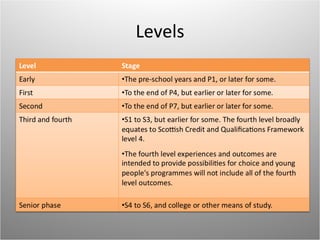
Levels
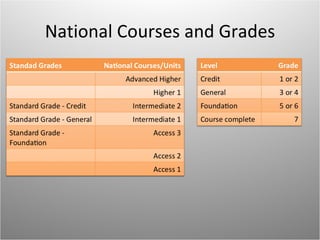
National Courses and Grades

Curriculum for excellence

  • 2.
  • 3.
    Understanding the Curriculuma whole • Curriculum for excellence aims to achieve a transformation in education in Scotland by providing a coherent, more flexible and enriched curriculum from 3 to 18. • The 3-18 curriculum aims to ensure that all children and young people in Scotland develop the attributes, knowledge and skills they will need to flourish in life, learning and work. • These attributes will allow them to demonstrate four keys capacities in order to be: successful learners, confident individuals, responsible citizens and effective contributors.
  • 4.
  • 5.
    What can learnersexpect? A BROAD GENERAL EDUCATION  SUPPORT SENIOR PHASE
  • 6.
    Learners A curriculum that includes a range need and of features at the different stages entitled of learning.
  • 7.
    A BROAD GENERALEDUCATION The purpose of education in Scotland a broad general education A broad general education means a curriculum that help learners to: - Achieve the highest levels of literacy, numeracy and cognitive skills - Develop skills for learning, skills for life and skills for work - Develop knowledge and understanding of society - Experience challenge and success
  • 8.
     SUPPORT - Thesupport involves a range of people: parents, teachers, nurses, psychological services, college staff… - The most important thing is to work in partnership. - Every child should have a personalization and choice within their curriculum.
  • 9.
    SENIOR PHASE Is the phase when the young person will build up a portfolio of qualifications In this phase the education must to: • Provides specialitation, depth and rigour to them • Prepares them well for achieving qualifications • Continues to develop skills for learning, skills for life and skills for work • Supports them to achieve a positive and sustained destination
  • 10.
    Principles for Curriculumdesign. Curriculum areas and subjetcs. Indisciplinary learning.
  • 11.
    Principles for curriculumdesign The curriculum should be designed on the bases of the following principles: – Challenge and enjoyment – Breath – Progression – Depth – Personalization and choice – Coherence – Relevance – The principles must be taken into account for all children and young people. And it must be applied where children and young people are learners.
  • 12.
    Curriculum areas andsubjects The eight curriculum areas are: – Expressive arts – Health and wellbeing – Languages – Mathematics – Religious and moral education – Sciences – Social studies – Technologies ““The curriculum areas are not structure in timetabling, they might be organized and planned for in creative ways which sustained learning.””
  • 13.
    Indisciplinary learning • Thecurriculum should include space for learning beyond subjects boundaries, so that children and young people can make connections between different areas of learning. • Effective interdisciplinary learning: – Is planned around clear points. – Is based upon experiences and outcomes drawn from different curriculum areas or subjects within them – Ensure progression in skill and knowledge and understanding – Can provide opportunities
  • 14.
    Curriculum levels andqualifications.
  • 15.
  • 16.