Welcome to
Liberton Primary School’s
Curriculum Evening
Primary 1
The Primary 1 team
P1a
• Mrs Hutchison (M-W), Mrs Osborne (Th-F)
• Pupil Support Assistant – Mrs Karagjaur
P1b
• Ms Brown (M-F)
• Pupil Support Assistant – Mrs Williams
P1c
• Miss Mason
• Pupil Support Assistant – Mrs Brodie
There may be various students or volunteers working with us throughout the year.
Our suggested plans for this year - Topics
•Our Local Environment
•Fairytales
•Sun, Moon & Stars
•Toys in the Past
•Keeping Myself Safe & Electricity
•Living Things
• More information will provided about these on a termly
basis
• Edinburgh ‘Literacy Rich’ programme
• Teaches children to read and write using phonics
• Block 1
• Alphabet letters and their sounds
• Combining these to create 3 letter words (CVC words)
• Sounding out CVC words
• Reading and writing some common words (‘tricky words’)
Our plans for this year - Literacy
• Reading
• Weekly reading books – some children will begin from October
• Main resource - Oxford Reading Tree
• Follow a 4 day structure - focusing on comprehension and
discussion about the text, as well as reading the words
• Instructions and guidance will be provided in your child’s Reading
Record
• Handwriting
• Cursive handwriting
• Formation of each letter introduced during block 1
• Continued throughout the year
• Encourage correct formation at all times (of known letters)
Our plans for this year – Literacy cont.
• A typical literacy lesson
• Whole class start – learn new sound/tricky word, songs, games,
flashcards, word building.
• Children will have group teaching time and opportunities for play
related activities during literacy time.
• Activities may focus on handwriting, initial sounds, CVC words (word
building, reading or writing) or tricky words (reading or writing).
Our plans for this year – Literacy cont.
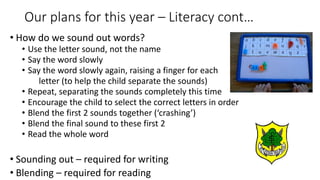
• How do we sound out words?
• Use the letter sound, not the name
• Say the word slowly
• Say the word slowly again, raising a finger for each
letter (to help the child separate the sounds)
• Repeat, separating the sounds completely this time
• Encourage the child to select the correct letters in order
• Blend the first 2 sounds together (‘crashing’)
• Blend the final sound to these first 2
• Read the whole word
• Sounding out – required for writing
• Blending – required for reading
Our plans for this year – Literacy cont…
• Encourage your child to spot letters in their environment
• Play games (e.g. How many ‘m’s can you see?)
• Encourage correct pencil grip and letter formation at all
times so no bad habits are formed
• Practise writing their name using the correct letter formation
(of known letters), letter case and pencil grip
• Little and often – maximum 10 minutes a night
• practise the sounds learned - recognising them and saying them
• use sounds in word building activities - with your laminated cards
• write them (once built)
• Please keep laminated cards at home!
How you can help – Literacy
Book Exchange
• Run by a volunteer
• Beginning next week
• Children choose a book each week to take home
• To be shared with the child
• Adult to read, children to be involved in discussion (e.g. what might
happen next, discuss pictures, favourite parts, look for sounds in text)
• Returned each Wednesday for new selection
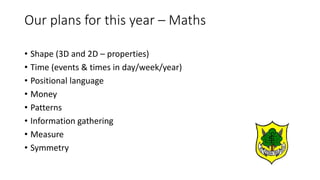
• Shape (3D and 2D – properties)
• Time (events & times in day/week/year)
• Positional language
• Money
• Patterns
• Information gathering
• Measure
• Symmetry
Our plans for this year – Maths
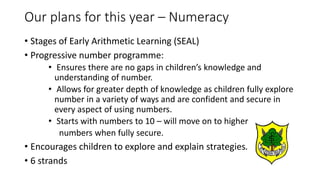
• Stages of Early Arithmetic Learning (SEAL)
• Progressive number programme:
• Ensures there are no gaps in children’s knowledge and
understanding of number.
• Allows for greater depth of knowledge as children fully explore
number in a variety of ways and are confident and secure in
every aspect of using numbers.
• Starts with numbers to 10 – will move on to higher
numbers when fully secure.
• Encourages children to explore and explain strategies.
• 6 strands
Our plans for this year – Numeracy
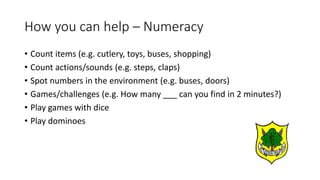
• Count items (e.g. cutlery, toys, buses, shopping)
• Count actions/sounds (e.g. steps, claps)
• Spot numbers in the environment (e.g. buses, doors)
• Games/challenges (e.g. How many ___ can you find in 2 minutes?)
• Play games with dice
• Play dominoes
How you can help – Numeracy
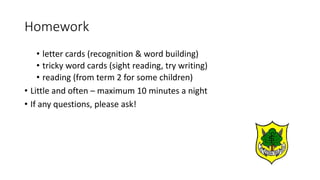
Homework
• letter cards (recognition & word building)
• tricky word cards (sight reading, try writing)
• reading (from term 2 for some children)
• Little and often – maximum 10 minutes a night
• If any questions, please ask!
Timetables and routines
• Please name everything! (e.g. clothing, snack boxes, lunch boxes, water bottles)
• PE kit
• All named!
• Ideally to stay in school on peg
• Gym shoes can be used as indoor shoes
• Lunch forms to be returned to office by required time to ensure
your child receives their choices
• Water bottles – water only in class (juice only for packed lunch)
• Snack – please provide only one snack that can be eaten outside
Communication between home and school
•Plastic folders in green book bags
• Return every day – main tool for communication
• Any money, forms or letters for the teacher will be collected
from here
• Please ensure all money comes in a sealed envelope with the
child's name and what it is for
• Homework, letters and sounds cards will be put in here
• Please do not use the book bags for snacks or water
bottles – these are for school books and
communication only
Communication between home and school
• If you need to speak to a teacher please approach us at the end
of the day.
• In the mornings, our job is to be with the children helping them
and settling them in the classroom. If you have an important
message, please write a note and put it in your child’s folder or
contact the school office who will pass on a message or arrange
an appointment.
• If you have a query or concern, please speak to us as
soon as you can, so we can resolve it and prevent any
worry.

Curriculum evening p1 powerpoint 2017 18 (3)

  • 1.
    Welcome to Liberton PrimarySchool’s Curriculum Evening Primary 1
  • 2.
    The Primary 1team P1a • Mrs Hutchison (M-W), Mrs Osborne (Th-F) • Pupil Support Assistant – Mrs Karagjaur P1b • Ms Brown (M-F) • Pupil Support Assistant – Mrs Williams P1c • Miss Mason • Pupil Support Assistant – Mrs Brodie There may be various students or volunteers working with us throughout the year.
  • 3.
    Our suggested plansfor this year - Topics •Our Local Environment •Fairytales •Sun, Moon & Stars •Toys in the Past •Keeping Myself Safe & Electricity •Living Things • More information will provided about these on a termly basis
  • 4.
    • Edinburgh ‘LiteracyRich’ programme • Teaches children to read and write using phonics • Block 1 • Alphabet letters and their sounds • Combining these to create 3 letter words (CVC words) • Sounding out CVC words • Reading and writing some common words (‘tricky words’) Our plans for this year - Literacy
  • 5.
    • Reading • Weeklyreading books – some children will begin from October • Main resource - Oxford Reading Tree • Follow a 4 day structure - focusing on comprehension and discussion about the text, as well as reading the words • Instructions and guidance will be provided in your child’s Reading Record • Handwriting • Cursive handwriting • Formation of each letter introduced during block 1 • Continued throughout the year • Encourage correct formation at all times (of known letters) Our plans for this year – Literacy cont.
  • 6.
    • A typicalliteracy lesson • Whole class start – learn new sound/tricky word, songs, games, flashcards, word building. • Children will have group teaching time and opportunities for play related activities during literacy time. • Activities may focus on handwriting, initial sounds, CVC words (word building, reading or writing) or tricky words (reading or writing). Our plans for this year – Literacy cont.
  • 7.
    • How dowe sound out words? • Use the letter sound, not the name • Say the word slowly • Say the word slowly again, raising a finger for each letter (to help the child separate the sounds) • Repeat, separating the sounds completely this time • Encourage the child to select the correct letters in order • Blend the first 2 sounds together (‘crashing’) • Blend the final sound to these first 2 • Read the whole word • Sounding out – required for writing • Blending – required for reading Our plans for this year – Literacy cont…
  • 8.
    • Encourage yourchild to spot letters in their environment • Play games (e.g. How many ‘m’s can you see?) • Encourage correct pencil grip and letter formation at all times so no bad habits are formed • Practise writing their name using the correct letter formation (of known letters), letter case and pencil grip • Little and often – maximum 10 minutes a night • practise the sounds learned - recognising them and saying them • use sounds in word building activities - with your laminated cards • write them (once built) • Please keep laminated cards at home! How you can help – Literacy
  • 9.
    Book Exchange • Runby a volunteer • Beginning next week • Children choose a book each week to take home • To be shared with the child • Adult to read, children to be involved in discussion (e.g. what might happen next, discuss pictures, favourite parts, look for sounds in text) • Returned each Wednesday for new selection
  • 10.
    • Shape (3Dand 2D – properties) • Time (events & times in day/week/year) • Positional language • Money • Patterns • Information gathering • Measure • Symmetry Our plans for this year – Maths
  • 11.
    • Stages ofEarly Arithmetic Learning (SEAL) • Progressive number programme: • Ensures there are no gaps in children’s knowledge and understanding of number. • Allows for greater depth of knowledge as children fully explore number in a variety of ways and are confident and secure in every aspect of using numbers. • Starts with numbers to 10 – will move on to higher numbers when fully secure. • Encourages children to explore and explain strategies. • 6 strands Our plans for this year – Numeracy
  • 12.
    • Count items(e.g. cutlery, toys, buses, shopping) • Count actions/sounds (e.g. steps, claps) • Spot numbers in the environment (e.g. buses, doors) • Games/challenges (e.g. How many ___ can you find in 2 minutes?) • Play games with dice • Play dominoes How you can help – Numeracy
  • 13.
    Homework • letter cards(recognition & word building) • tricky word cards (sight reading, try writing) • reading (from term 2 for some children) • Little and often – maximum 10 minutes a night • If any questions, please ask!
  • 14.
    Timetables and routines •Please name everything! (e.g. clothing, snack boxes, lunch boxes, water bottles) • PE kit • All named! • Ideally to stay in school on peg • Gym shoes can be used as indoor shoes • Lunch forms to be returned to office by required time to ensure your child receives their choices • Water bottles – water only in class (juice only for packed lunch) • Snack – please provide only one snack that can be eaten outside
  • 15.
    Communication between homeand school •Plastic folders in green book bags • Return every day – main tool for communication • Any money, forms or letters for the teacher will be collected from here • Please ensure all money comes in a sealed envelope with the child's name and what it is for • Homework, letters and sounds cards will be put in here • Please do not use the book bags for snacks or water bottles – these are for school books and communication only
  • 16.
    Communication between homeand school • If you need to speak to a teacher please approach us at the end of the day. • In the mornings, our job is to be with the children helping them and settling them in the classroom. If you have an important message, please write a note and put it in your child’s folder or contact the school office who will pass on a message or arrange an appointment. • If you have a query or concern, please speak to us as soon as you can, so we can resolve it and prevent any worry.