 Mrs Robins infanthead@wroughtonfederation.co.uk
 Mrs Smith EY Team Leader SmithC@wroughtonfederation.co.uk
 Miss Azzopardi AzzopardiL@wroughtonfederation.co.uk
 Miss Davies DaviesN@wroughtonfederation.co.uk
Phonics (letter sounds)
 Learn sounds
 Need to know letter sounds (correct
pronunciation of pure sounds) rather than letter
names in order to read
 Teach 4 new sounds each week then final day to
recap
 Send home sounds in green sound books as they
are taught so you can reinforce and draw pictures
of things beginning with that sound
 Please practise sounds every day and record in
their white Reading Record book
Blending
 Green words – the children will come across lots of words
which they will be able to sound out
 To build words (for spelling)
c - a - t = cat b - u - g = bug
 To decode words (for reading)
tap = t - a - p hen = h - e - n
Parents can:
Play “I spy” with initial, final and then short vowel sounds
Have magnetic letters in kitchen to practise spelling and
writing words
Help children blend sounds when they are reading
Key words
 Taught by character sheets e.g. Paw
Patrol. These are sight words (red words)!
 Important to practise and look for these
words ALL the time – they are ‘key’ words!
 We will teach several key words each
week and constantly re-inforce
Parents can PLAY GAMES with them:
Snap, pairs and matching games
Kim’s Game (guess the missing word)
Magnetic letters on the fridge
Make up your own!
Reading Story Books
Parents can
Read to your children! Read with them!
Ask questions about stories and the pictures
Ask the child to retell the story
Decide on their favourite part
Predict what will come next
Important to continue to read to your children
even when they start reading books themselves
Reading Scheme Books
 We start with books with no words
 First do a “walk through the book”
 Read the book, initially using the pictures as cues
 Ensure they point to the words
 Search for words in the book
 Reading scheme books will be changed when you
have read them at home
 Please write in the children’s reading records
when they have read at home
Guided Reading
 This will take place in a small group each week
from January
 Each child has a copy of the same book that will
be at an appropriate level for the group
 The children learn many reading skills through
this activity:
 Book talk (front cover, title, blurb)
 Predicting
 Discussing the story (characters, events, favourite
parts)
 Retelling the story
Pre writing skills…
 Funky fingers
 FMS challenges
Handwriting
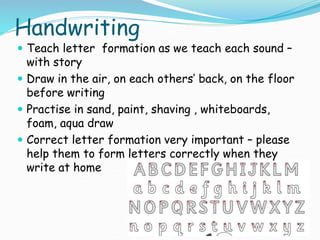
 Teach letter formation as we teach each sound –
with story
 Draw in the air, on each others’ back, on the floor
before writing
 Practise in sand, paint, shaving , whiteboards,
foam, aqua draw
 Correct letter formation very important – please
help them to form letters correctly when they
write at home
Writing at home –Be seen to write!
Give it a purpose!
 Shopping lists
 Label models
 Invitations
 Cards
 Post cards
 Dad’s to do list
 Games – hangman
 Diary/scrap book
 E-mail
 Record a score in a game
 Story scrap book
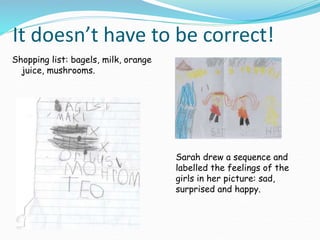
It doesn’t have to be correct!
Shopping list: bagels, milk, orange
juice, mushrooms.
Sarah drew a sequence and
labelled the feelings of the
girls in her picture: sad,
surprised and happy.
Numeracy in the Early Years.
 Mathematics is one of the specific areas that we
teach in the foundation stage.
 Mathematics is split into 2 areas of learning:
Numbers
Shape, Space and Measures.
 Mathematics is taught every day through play as well
as through directed tasks and activities.
Mathematical session.
 Every day the class teacher will teach a Mathematical
objective.
 In the classroom there will be Mathematical provision
for the children to explore.
 The class teacher and TA will work with groups of
children on a directed task.
 At the end of the session the teacher will bring the
class back together to assess whether the objective
of the session has been met.
Mathematical ideas.
 Number games – snakes and ladders,
 Number songs and stories and action rhymes.
 Number hunts in the sand, water, den area, outside classroom.
 Making numbers out of play dough.
 Magic air writing, whiteboards, tracings, paintings, chalks, sand,
shaving foam.
 Flashcards, bean bags with numbers on, dice,
 Welly walks looking for numbers and shapes.
 Cutting, sticking, ordering numbers.
 Interactive mathematical games on whiteboard.
 Computer programmes.
Mathematical language
 We need to develop children’s use of
mathematical language in their play relating to…
 Time: day, week, year, month, hour, seconds
 Shapes: 2D and 3D shape names, curved, straight,
corners
 Comparing different measures: longer, shorter,
taller, heavier, lighter, bigger, smaller
 Position and direction: under, over, behind, in
front, forwards, backwards, above
.
Homework Packs
 Please use the pack as a guide to help your child on
their learning journey.
But most of all just have Fun.
And finally...
 Encourage and praise all efforts! Children easily
lose confidence in their reading and writing if
they feel it is only judged for accuracy
 Learning should always be a positive experience 
Workshops…
 Please make your way down to your child’s class where
activities have been set up for you and your children
to have a go at…
 Teachers will be available to answer any of your
questions…

ELLN.ppt

  • 2.
     Mrs Robinsinfanthead@wroughtonfederation.co.uk  Mrs Smith EY Team Leader SmithC@wroughtonfederation.co.uk  Miss Azzopardi AzzopardiL@wroughtonfederation.co.uk  Miss Davies DaviesN@wroughtonfederation.co.uk
  • 3.
    Phonics (letter sounds) Learn sounds  Need to know letter sounds (correct pronunciation of pure sounds) rather than letter names in order to read  Teach 4 new sounds each week then final day to recap  Send home sounds in green sound books as they are taught so you can reinforce and draw pictures of things beginning with that sound  Please practise sounds every day and record in their white Reading Record book
  • 4.
    Blending  Green words– the children will come across lots of words which they will be able to sound out  To build words (for spelling) c - a - t = cat b - u - g = bug  To decode words (for reading) tap = t - a - p hen = h - e - n Parents can: Play “I spy” with initial, final and then short vowel sounds Have magnetic letters in kitchen to practise spelling and writing words Help children blend sounds when they are reading
  • 5.
    Key words  Taughtby character sheets e.g. Paw Patrol. These are sight words (red words)!  Important to practise and look for these words ALL the time – they are ‘key’ words!  We will teach several key words each week and constantly re-inforce Parents can PLAY GAMES with them: Snap, pairs and matching games Kim’s Game (guess the missing word) Magnetic letters on the fridge Make up your own!
  • 6.
    Reading Story Books Parentscan Read to your children! Read with them! Ask questions about stories and the pictures Ask the child to retell the story Decide on their favourite part Predict what will come next Important to continue to read to your children even when they start reading books themselves
  • 7.
    Reading Scheme Books We start with books with no words  First do a “walk through the book”  Read the book, initially using the pictures as cues  Ensure they point to the words  Search for words in the book  Reading scheme books will be changed when you have read them at home  Please write in the children’s reading records when they have read at home
  • 8.
    Guided Reading  Thiswill take place in a small group each week from January  Each child has a copy of the same book that will be at an appropriate level for the group  The children learn many reading skills through this activity:  Book talk (front cover, title, blurb)  Predicting  Discussing the story (characters, events, favourite parts)  Retelling the story
  • 9.
    Pre writing skills… Funky fingers  FMS challenges
  • 10.
    Handwriting  Teach letterformation as we teach each sound – with story  Draw in the air, on each others’ back, on the floor before writing  Practise in sand, paint, shaving , whiteboards, foam, aqua draw  Correct letter formation very important – please help them to form letters correctly when they write at home
  • 11.
    Writing at home–Be seen to write! Give it a purpose!  Shopping lists  Label models  Invitations  Cards  Post cards  Dad’s to do list  Games – hangman  Diary/scrap book  E-mail  Record a score in a game  Story scrap book
  • 12.
    It doesn’t haveto be correct! Shopping list: bagels, milk, orange juice, mushrooms. Sarah drew a sequence and labelled the feelings of the girls in her picture: sad, surprised and happy.
  • 13.
    Numeracy in theEarly Years.  Mathematics is one of the specific areas that we teach in the foundation stage.  Mathematics is split into 2 areas of learning: Numbers Shape, Space and Measures.  Mathematics is taught every day through play as well as through directed tasks and activities.
  • 14.
    Mathematical session.  Everyday the class teacher will teach a Mathematical objective.  In the classroom there will be Mathematical provision for the children to explore.  The class teacher and TA will work with groups of children on a directed task.  At the end of the session the teacher will bring the class back together to assess whether the objective of the session has been met.
  • 15.
    Mathematical ideas.  Numbergames – snakes and ladders,  Number songs and stories and action rhymes.  Number hunts in the sand, water, den area, outside classroom.  Making numbers out of play dough.  Magic air writing, whiteboards, tracings, paintings, chalks, sand, shaving foam.  Flashcards, bean bags with numbers on, dice,  Welly walks looking for numbers and shapes.  Cutting, sticking, ordering numbers.  Interactive mathematical games on whiteboard.  Computer programmes.
  • 16.
    Mathematical language  Weneed to develop children’s use of mathematical language in their play relating to…  Time: day, week, year, month, hour, seconds  Shapes: 2D and 3D shape names, curved, straight, corners  Comparing different measures: longer, shorter, taller, heavier, lighter, bigger, smaller  Position and direction: under, over, behind, in front, forwards, backwards, above .
  • 17.
    Homework Packs  Pleaseuse the pack as a guide to help your child on their learning journey. But most of all just have Fun.
  • 18.
    And finally...  Encourageand praise all efforts! Children easily lose confidence in their reading and writing if they feel it is only judged for accuracy  Learning should always be a positive experience 
  • 19.
    Workshops…  Please makeyour way down to your child’s class where activities have been set up for you and your children to have a go at…  Teachers will be available to answer any of your questions…