1
Current Liabilities and Payroll AccountingCurrent Liabilities and Payroll AccountingCurrent Liabilities and Payroll AccountingCurrent Liabilities and Payroll Accounting
Accounting forAccounting for
CurrentCurrent
LiabilitiesLiabilities
Accounting forAccounting for
CurrentCurrent
LiabilitiesLiabilities
ContingentContingent
LiabilitiesLiabilities
ContingentContingent
LiabilitiesLiabilities
PayrollPayroll
AccountingAccounting
PayrollPayroll
AccountingAccounting
Notes payableNotes payable
Sales taxesSales taxes
payablepayable
UnearnedUnearned
revenuesrevenues
Current maturitiesCurrent maturities
of long-term debtof long-term debt
StatementStatement
presentation andpresentation and
analysisanalysis
RecordingRecording
DisclosureDisclosure
DeterminingDetermining
payrollpayroll
Recording payrollRecording payroll
Employer payrollEmployer payroll
taxestaxes
Filing andFiling and
remitting payrollremitting payroll
taxestaxes
Internal control forInternal control for
payrollpayroll
3
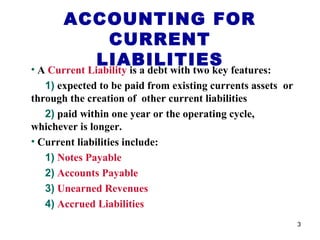
• A Current Liability is a debt with two key features:
1) expected to be paid from existing currents assets or
through the creation of other current liabilities
2) paid within one year or the operating cycle,
whichever is longer.
• Current liabilities include:
1) Notes Payable
2) Accounts Payable
3) Unearned Revenues
4) Accrued Liabilities
ACCOUNTING FOR
CURRENT
LIABILITIES
4
The time period for classifying a
liability as current is one year or the
operating cycle, whichever is:
a. longer.
b. shorter.
c. probable.
d. possible.
5
The time period for classifying a
liability as current is one year or the
operating cycle, whichever is:
a. longer.
b. shorter.
c. probable.
d. possible.
6
• Obligations in the form of written
promissory notes are recorded as
notes payable.
• Those notes due for payment within
one year of the balance sheet date are
usually classified as current liabilities.
NOTES
PAYABLE
7
When an interest-bearing note is issued, the assets
received generally equal the face value of the note.
Assume First National Bank agrees to lend $100,000 on
March 1, 2005, if Cole Williams Co. signs a $100,000, 12%,
4-month note. Cash is debited and Notes Payable is
credited.
When an interest-bearing note is issued, the assets
received generally equal the face value of the note.
Assume First National Bank agrees to lend $100,000 on
March 1, 2005, if Cole Williams Co. signs a $100,000, 12%,
4-month note. Cash is debited and Notes Payable is
credited.
NOTES
PAYABLE
Date Account Titles Debit Credit
General Journal
March 1 Cash 100,000
Notes Payable 100,000
8
Formula for computing interest
$100,000 x 12% x 4/12 = $4,000
Face Value
of Note
Annual
Interest
Rate
Time in
Terms
of One Year
Interest
The formula for computing interest
and its application to Cole Williams Co.
are shown below:
9
NOTES PAYABLE
Interest accrues over the life of the note and must be
recorded periodically. If Cole Williams Co. prepares
financial statements semiannually, an adjusting entry is
required to recognize interest expense and interest payable
of $4,000 at June 30.
Interest accrues over the life of the note and must be
recorded periodically. If Cole Williams Co. prepares
financial statements semiannually, an adjusting entry is
required to recognize interest expense and interest payable
of $4,000 at June 30.
Date Account Titles Debit Credit
General Journal
June 30 Interest Expense 4,000
Interest Payable 4,000
10
NOTES PAYABLE
At maturity, Notes Payable is debited for
the face value of the note, Interest Payable is
debited for the amount of accrued interest,
and Cash is credited for the maturity value
of the note.
At maturity, Notes Payable is debited for
the face value of the note, Interest Payable is
debited for the amount of accrued interest,
and Cash is credited for the maturity value
of the note.
Date Account Titles Debit Credit
General Journal
July 1 Notes Payable 100,000
Interest Payable 4,000
Cash 104,000
11
SALES TAXES PAYABLE
Sales tax is a stated percentage of the sales
price on goods sold to customers by a retailer
• The retailer collects the tax from the
customer when the sale occurs.
• The retailer serves only as a collection
agent for the taxing authority.
12
Cash register readings are used to credit Sales and Sales Taxes
Payable. If on March 25th cash register readings for Cooley
Grocery show sales of $10,000 and sales taxes of $600 (sales tax
rate is 6%), the entry is a debit to Cash for the total, and a
credit to Sales for the actual sales and Sales Taxes Payable for
the amount of the sales tax.
Cash register readings are used to credit Sales and Sales Taxes
Payable. If on March 25th cash register readings for Cooley
Grocery show sales of $10,000 and sales taxes of $600 (sales tax
rate is 6%), the entry is a debit to Cash for the total, and a
credit to Sales for the actual sales and Sales Taxes Payable for
the amount of the sales tax.
SALES TAXES PAYABLE
Date Account Titles Debit Credit
General Journal
Mar. 25 Cash 10,600
Sales 10,000
Sales Tax Payable
600
13
 When sales taxes are not rung up separately on the
cash register they must be extracted from the total
receipts
 If Cooley Grocery “rings up” total receipts, which are
$10,600, and the sales tax percentage is 6%, we can
figure sales as follows:
$10,600 ÷ 1.06 = $10,000
SALES TAXES PAYABLE
14
• Unearned Revenues (advances from customers)
– a company receives cash before a service is rendered
• Examples:
– airline sells a ticket for future flights
– attorney receives legal fees before work is done
UNEARNED REVENUES
Illustration
Unearned and earned revenue
accounts
Shown below are specific unearned and earned
revenue accounts used in selected types of
businesses.
Type of Business Unearned Revenue Earned Revenue
Airline
Unearned passenger
Ticket Revenue
Passenger
Revenue
Magazine
Publisher
Unearned
Subscription
Revenue
Subscription
Revenue
Hotel
Unearned Rental
Revenue Rental Revenue
Insurance
Company
Unearned Premium
Revenue Premium Revenue
Account Title
16
If Superior University sells 10,000 season football tickets
at $50 each for its five-game home schedule, the entry for
the sale of the tickets is a debit to Cash for the advance
received, and a credit to Unearned Football Ticket
Revenue, a current liability.
If Superior University sells 10,000 season football tickets
at $50 each for its five-game home schedule, the entry for
the sale of the tickets is a debit to Cash for the advance
received, and a credit to Unearned Football Ticket
Revenue, a current liability.
UNEARNED
REVENUES
Date Account Titles Debit Credit
General Journal
Aug. 6 Cash 500,000
Unearned Football Ticket
Revenue 500,000
17
As each game is completed, the Unearned Football Ticket
Revenue account is debited for 1/5 of the unearned revenue,
and the earned revenue, Football Ticket Revenue, is
credited.
As each game is completed, the Unearned Football Ticket
Revenue account is debited for 1/5 of the unearned revenue,
and the earned revenue, Football Ticket Revenue, is
credited.
UNEARNED REVENUES
Date Account Titles Debit Credit
General Journal
Sept. 7 Unearned Football Ticket Revenue 100,000
Football Ticket Revenue
100,000
18
Unearned and earned revenue
accounts
Shown below are specific unearned and earned
revenue accounts used in selected types of
businesses.
Type of Business Unearned Revenue Earned Revenue
Airline
Unearned passenger
Ticket Revenue
Passenger
Revenue
Magazine
Publisher
Unearned
Subscription
Revenue
Subscription
Revenue
Hotel
Unearned Rental
Revenue Rental Revenue
Insurance
Company
Unearned Premium
Revenue Premium Revenue
Account Title
19
CURRENT MATURITIES OF
LONG-TERM DEBT
Current maturities of long-term debt
• classified as a current liability
• long-term debt due within one year
20
FINANCIAL STATEMENT
PRESENTATION
• Current liabilities
– first category under liabilities on the balance sheet
– each of the principal types of current liabilities is listed
separately
– seldom listed in the order of maturity
• Common methods of presenting current liabilities:
– to list them by order of magnitude, with the largest
ones first
– many companies, as a matter of custom, show notes
payable and accounts payable first regardless of
amount.
21
22
WORKING CAPITAL
FORMULA AND
COMPUTATION
$14,628 - $11, 344 = $3,284
The excess of current assets over
current liabilities is working capital. The
formula for the computation of
Caterpillar, Inc. working capital is shown
below.
Current
Assets
Current
Liabilities
Working
Capital- =
23
CURRENT RATIO AND
COMPUTATION
$14,628 / = $11, 344 = 1.29:1
Current
Assets
Current
Liabilities
Current
Ratio/ =
The current ratio permits us to compare
the liquidity of different sized companies
and of a single company at different
times. The current ratio for Caterpillar,
Inc. is shown below.
24
CONTINGENT LIABILITIES
Contingent liability
A potential liability that may
become an actual liability in the
future
25
PRODUCT WARRANTIES
 Product warranties
 example of a contingent liability that should be record
in the accounts
 The estimated cost of honoring product warranty
contracts should be recognized as an expense in the
period in which the sale occurs.
 Warranty Expense is reported under selling
expenses in the income statement, and estimating
warranty liability is classified as a current liability
on the balance sheet.
26
COMPUTATION OF
ESTIMATED PRODUCT
WARRANTY LIABILITY
In 2005 Denson Manufacturing Company sells 10,000
washers and dryers at an average price of $600 each. The
selling price includes a one-year warranty on parts. It is
expected that 500 units (5%) will be defective and that
warranty repair costs will average $80 per unit. The
calculation of of estimated product costs on 2002 sales is as
follows:
In 2005 Denson Manufacturing Company sells 10,000
washers and dryers at an average price of $600 each. The
selling price includes a one-year warranty on parts. It is
expected that 500 units (5%) will be defective and that
warranty repair costs will average $80 per unit. The
calculation of of estimated product costs on 2002 sales is as
follows:
27
ENTRIES TO RECORD
WARRANTY COSTS
Denson Manufacturing Company makes the
adjusting entry above to accrue the estimated
warranty costs on 2005 sales. Warranty Expense is
debited while Estimated Warranty Liability is
credited for $40,000 at December 31.
Denson Manufacturing Company makes the
adjusting entry above to accrue the estimated
warranty costs on 2005 sales. Warranty Expense is
debited while Estimated Warranty Liability is
credited for $40,000 at December 31.
Date Account Titles Debit Credit
General Journal
Dec 31. Warranty Expense 40,000
Estimated Warranty Expense
40,000
28
ENTRIES TO RECORD
WARRANTY COSTS
Denson Manufacturing Company makes the
$24,000 (300 X $80) summary entry above to
record repair costs incurred in 2002 to honor
warranty contracts on 2002 sales. Estimated
Warranty Liability is debited while Repair Parts
and Wages Payable are credited by December 31.
Denson Manufacturing Company makes the
$24,000 (300 X $80) summary entry above to
record repair costs incurred in 2002 to honor
warranty contracts on 2002 sales. Estimated
Warranty Liability is debited while Repair Parts
and Wages Payable are credited by December 31.
Date Account Titles Debit Credit
General Journal
Jan. 1- Estimated Warranty Liability 24,000
Dec. 31 Repair Part 24,000
29
ENTRIES TO RECORD
WARRANTY COSTS
Denson Manufacturing Company replaced
defective units in January 2006 for $1,600 (20 X
$80) and made the summary entry above.
Estimated Warranty Liability is debited while
Repair Parts and Wages Payable are credited.
Denson Manufacturing Company replaced
defective units in January 2006 for $1,600 (20 X
$80) and made the summary entry above.
Estimated Warranty Liability is debited while
Repair Parts and Wages Payable are credited.
Date Account Titles Debit Credit
General Journal
Jan. 31 Estimated Warranty Liability 1,600
Repair Parts 1,600
30
• Payroll pertains to both salaries and wages.
• Managerial, administrative, and sales personnel
are generally paid salaries. Salaries are often
expressed in terms of a specified amount per month or
year.
• Store clerks, factory employees and manual laborers are
normally paid wages-based on a rate per hour.
• Payments made to professional individuals who are
independent contractors are called fees.
• Government regulations relating to the payment and
reporting of payroll taxes apply only to employees.
PAYROLL ACCOUNTING
31
INTERNAL CONTROLS
FOR PAYROLL
• The objectives of internal accounting control
concerning payroll are:
1 to safeguard company assets from
unauthorized payments of payrolls and
2 to ensure the accuracy and reliability of the
accounting records pertaining to payrolls.
• Payroll activities involve four functions:
1 hiring employees,
2 timekeeping,
3 preparing the payroll, and
4 paying the payroll.
32
HIRING EMPLOYEES
• The human resources department is responsible for
ensuring the accuracy of the personnel authorization
form.
• The human resources department is also responsible for
authorizing changes in employment status:
1 changes in pay rates
2 termination of employment.
33
TIMEKEEPING
• Hourly employees are usually required to record time
worked by “punching” a time clock. Times of arrival
and departure are automatically recorded by the
employee by inserting a time card into the clock.
• In large companies time clock procedures are often
monitored by a supervisor or security guard to make
sure an employee punches only one card.
• The employee’s supervisor:
1 approves the hours shown by signing the time card
at the end of the pay period and
2 authorizes any overtime hours for an employee.
34
PREPARING THE PAYROLL
The payroll is prepared in the payroll
department on the basis of two inputs:
1 human resources department authorizations
2 approved time cards.
35
DETERMINING AND PAYING
THE PAYROLL
• Determining the payroll involves computing three
amounts:
1 gross earnings
2 payroll deductions
3 net pay
• The payroll is paid by the treasurer’s department.
1 Payment by check minimizes the risk of loss from
theft and
2 the endorsed check provides proof of payment.
36
• Gross earnings is the total compensation earned by an
employee.
• It consists of wages or salaries, plus any bonuses and
commissions.
• Total wages are determined by multiplying the hours
worked by the hourly rate of pay.
• Most companies are required to pay a minimum of 1
1/2 the regular hourly rate for overtime work.
COMPUTATION OF TOTAL
WAGES
37
PAYROLL DEDUCTIONS
• The difference between gross pay and
the amount actually received is
attributable to payroll deductions.
• Mandatory deductions consist of
FICA taxes and income taxes.
• The employer is merely a collection
agent and subsequently transfers the
amounts deducted to the government
and designated recipients.
38
PAYROLL DEDUCTIONS
39
FICA TAXES
• FICA taxes (or social security taxes) are designed to
provide workers with supplemental retirement,
employment disability, and medical benefits.
• The benefits are financed by a tax levied on
employees’ earnings.
• The tax rate and tax base for FICA taxes
are set by Congress.
40
• Income Taxes are required to be withheld from
employees each pay period
• Amount is determined by 3 variables:
1 the employee’s gross earnings
2 the number of allowances claimed by
the employee
3 the length of the pay period
• To indicate to the Internal Revenue Service the
number of allowances claimed, the employee must
complete an Employee’s Withholding Certificate
(Form W-4).
INCOME TAXES
41
VOLUNTARY DEDUCTIONS
• Voluntary Deductions
– pertain to withholdings for charitable,
retirement, and other purposes
– authorized in writing by the employee.
42
Net Pay (or take-home pay) is determined by subtracting payroll
deductions from gross earnings. Assuming an employee’s wages
are $552 each week, the employee will earn $28,704 for the year
(52 weeks X $552). Thus, all earnings are subject to FICA taxes.
Net Pay (or take-home pay) is determined by subtracting payroll
deductions from gross earnings. Assuming an employee’s wages
are $552 each week, the employee will earn $28,704 for the year
(52 weeks X $552). Thus, all earnings are subject to FICA taxes.
COMPUTATION OF NET PAY
43
• Employee earnings record
1 determines when an employee has earned
the maximum earnings subject to FICA
taxes
2 file state and federal payroll tax returns
3 provides each employee with a statement of
gross earnings and tax withholdings for the year
• Many companies use a payroll register to
accumulate the gross earnings, deductions, and
net pay by employee for each period.
RECORDING THE
PAYROLL
44
RECOGNIZING PAYROLL
EXPENSES AND LIABILITIES
Academy Company records its payroll for the week ending January 14,
2005 with the journal entry above. Office Salaries Expense ($5,200) and
Wages Payable ($12,010) are debited in total for $17,210 in gross earnings.
Specific liability accounts are credited for the deductions made during the
pay period. Salaries and Wages Payable is credited for $11,462.50 in net
earnings.
Academy Company records its payroll for the week ending January 14,
2005 with the journal entry above. Office Salaries Expense ($5,200) and
Wages Payable ($12,010) are debited in total for $17,210 in gross earnings.
Specific liability accounts are credited for the deductions made during the
pay period. Salaries and Wages Payable is credited for $11,462.50 in net
earnings.
Date Account Titles Debit Credit
General Journal
Jan 14 Office Salaries Expense 5,200.00
Wages Expense 12,010.00
FICA 1,376.80
Federal Income Taxes Pay. 3,490.00
State Income Taxes Pay. 344.20
United Fund Pay. 421.50
Union Dues Pay. 115.00
Salaries and Wages Pay. 11,462.50
45
The entry to record payment of the Academy
Company payroll is a debit to Salaries and
Wages Payable and a credit to Cash. When
currency is used in payment, one check is
prepared for the amount of net earnings
($11,462.50).
The entry to record payment of the Academy
Company payroll is a debit to Salaries and
Wages Payable and a credit to Cash. When
currency is used in payment, one check is
prepared for the amount of net earnings
($11,462.50).
RECORDING
PAYMENT OF THE
PAYROLL
Date Account Titles Debit Credit
General Journal
Jan. 14 Salaries and Wages Pay. 11,462.50
Cash 11,462.50
46
Payroll Tax Expense- three taxes levied on
employers by governmental agencies.
1 Employer must match each employee’s
FICA contribution
2 Federal unemployment taxes (FUTA)
3 State unemployment taxes (SUTA)
EMPLOYER PAYROLL
TAXES
47
RECORDING
EMPLOYER PAYROLL
TAXES
The entry to record the payroll tax expense associated
with the Academy Company payroll results in a debit to
Payroll Tax Expense for $2,443.82, a credit to FICA Taxes
Payable for $1,376.80 ($17,210 X 8%), a credit to FUTA
Payable for $137.68 ($17,210 X 0.8%), and a credit to
SUTA Payable for $929.34 ($17,210 X 5.4%).
The entry to record the payroll tax expense associated
with the Academy Company payroll results in a debit to
Payroll Tax Expense for $2,443.82, a credit to FICA Taxes
Payable for $1,376.80 ($17,210 X 8%), a credit to FUTA
Payable for $137.68 ($17,210 X 0.8%), and a credit to
SUTA Payable for $929.34 ($17,210 X 5.4%).
Date Account Titles Debit Credit
General Journal
Jan 14. Payroll Tax Expense 2,443.82
FICA Taxes Pay. 1,376.80
Federal Unemployment Taxes Pay. 137.68
State Unemployment Taxes Pay. 929.34
48
EMPLOYER PAYROLL
TAXES
49
FILING AND
REMITTING PAYROLL
TAXES
• Preparation of payroll tax returns is the responsibility of
the payroll department. Payment of the taxes is made by
the treasurer’s department.
• FICA taxes and Federal income taxes (FIT) withheld are
combined for reporting and remitting purposes.
• The taxes are reported quarterly – no later than one
month after the close of each quarter.
• FUTA taxes are generally filed and remitted annually on
or prior to January 31 of the subsequent year.
• SUTA taxes must be filed and paid by the end of the
month following each quarter.
• The employer is required to provide each employee with
a Wage and Tax Statement (Form W-2) by January 31
following the end of the calendar year.
50
................................
Appendix
Additional Fringe
Benefits
51
ADDITIONAL FRINGE
BENEFITS
PAID ABSENCES
Employees often are given rights to receive compensation for absences
when certain conditions of employment are met. Such compensation
may relate to 1) paid vacations, 2) sick pay benefits, and 3) paid
holidays. A liability should be accrued for paid future absences if 1) its
payment is probable and 2) the amount can be reasonably estimated.
Academy Company employees are entitled to one day’s vacation for
each month worked. If 30 employees earn an average of $110 per day
in a given month, the accrual for vacation benefits for January is
$3,300 ($110 X 30). The liability is recognized at January 31 by the
following adjusting entry:
Employees often are given rights to receive compensation for absences
when certain conditions of employment are met. Such compensation
may relate to 1) paid vacations, 2) sick pay benefits, and 3) paid
holidays. A liability should be accrued for paid future absences if 1) its
payment is probable and 2) the amount can be reasonably estimated.
Academy Company employees are entitled to one day’s vacation for
each month worked. If 30 employees earn an average of $110 per day
in a given month, the accrual for vacation benefits for January is
$3,300 ($110 X 30). The liability is recognized at January 31 by the
following adjusting entry:
Date Account Titles Debit Credit
General Journal
Jan. 31 Vacation Benefits Exp. 3,300
Vacation Benefits Pay. 3,300
52
ADDITIONAL FRINGE BENEFITS
PAID ABSENCES
When vacation benefits are paid, Vacation
Benefits Payable is debited and Cash is
credited. If Academy Company pays such
benefits for 10 employees in July, the journal
entry to record the payment is for $1,100
($110 X 10).
Date Account Titles Debit Credit
General Journal
July 31 Vacation Benefits Pay. 1,100
Cash
1,100
53
POSTRETIREMENT
BENEFITS
• Postretirement benefits are benefits
provided by employers to retired
employees for:
1 health care and life insurance
2 pensions
• Both types of postretirement
benefits are accounted for on
the accrual basis.
54
PENSION PLANS
• A pension plan is an agreement whereby an employer
provides benefits to employees after they retire.
• Three parties are generally involved in a pension plan.
1) The employer sponsors the pension plan.
2) The plan administrator receives the contributions
from the employer, invests the pension assets, and
makes the benefit payments.
3) The retired employees receive
the pension payments.
55
PARTIES IN A PENSION
PLAN
Employer
Plan
Administrator
Pension Recipients
Contributions
Benefits
56
The department that should pay the
payroll is the:
a. timekeeping department.
b. human resources department.
c. payroll department.
d. treasurer’s department.
57
The department that should pay the
payroll is the:
a. timekeeping department.
b. human resources department.
c. payroll department.
d. treasurer’s department.
Preview Of This Chapter
CURRENT LIABILITIES AND
PAYROLL ACCOUNTING
Accounting for
Current Liabilities

Recording
Disclosure
Contingent
Liabilities

Payroll
Accountin
g
 Internal control
Determining payroll
Recording payroll
Employer payroll taxes
Filing and remitting
payroll taxes
Additional fringe
benefits





 Notes payable
Sales taxes payable
Unearned revenues
Current maturities of
long-term debt
Financial statement
presentation and
analysis




59
COPYRIGHT
Copyright © 2005 John Wiley & Sons, Inc. All rights reserved. Reproduction
or translation of this work beyond that permitted in Section 117 of the 1976
United States Copyright Act without the express written consent of the
copyright owner is unlawful. Request for further information should be
addressed to the Permissions Department, John Wiley & Sons, Inc. The
purchaser may make back-up copies for his/her own use only and not for
distribution or resale. The Publisher assumes no responsibility for errors,
omissions, or damages, caused by the use of these programs or from the use
of the information contained herein.
THANKS
60

Current Liabilities and Payroll

  • 1.
  • 2.
    Current Liabilities andPayroll AccountingCurrent Liabilities and Payroll AccountingCurrent Liabilities and Payroll AccountingCurrent Liabilities and Payroll Accounting Accounting forAccounting for CurrentCurrent LiabilitiesLiabilities Accounting forAccounting for CurrentCurrent LiabilitiesLiabilities ContingentContingent LiabilitiesLiabilities ContingentContingent LiabilitiesLiabilities PayrollPayroll AccountingAccounting PayrollPayroll AccountingAccounting Notes payableNotes payable Sales taxesSales taxes payablepayable UnearnedUnearned revenuesrevenues Current maturitiesCurrent maturities of long-term debtof long-term debt StatementStatement presentation andpresentation and analysisanalysis RecordingRecording DisclosureDisclosure DeterminingDetermining payrollpayroll Recording payrollRecording payroll Employer payrollEmployer payroll taxestaxes Filing andFiling and remitting payrollremitting payroll taxestaxes Internal control forInternal control for payrollpayroll
  • 3.
    3 • A CurrentLiability is a debt with two key features: 1) expected to be paid from existing currents assets or through the creation of other current liabilities 2) paid within one year or the operating cycle, whichever is longer. • Current liabilities include: 1) Notes Payable 2) Accounts Payable 3) Unearned Revenues 4) Accrued Liabilities ACCOUNTING FOR CURRENT LIABILITIES
  • 4.
    4 The time periodfor classifying a liability as current is one year or the operating cycle, whichever is: a. longer. b. shorter. c. probable. d. possible.
  • 5.
    5 The time periodfor classifying a liability as current is one year or the operating cycle, whichever is: a. longer. b. shorter. c. probable. d. possible.
  • 6.
    6 • Obligations inthe form of written promissory notes are recorded as notes payable. • Those notes due for payment within one year of the balance sheet date are usually classified as current liabilities. NOTES PAYABLE
  • 7.
    7 When an interest-bearingnote is issued, the assets received generally equal the face value of the note. Assume First National Bank agrees to lend $100,000 on March 1, 2005, if Cole Williams Co. signs a $100,000, 12%, 4-month note. Cash is debited and Notes Payable is credited. When an interest-bearing note is issued, the assets received generally equal the face value of the note. Assume First National Bank agrees to lend $100,000 on March 1, 2005, if Cole Williams Co. signs a $100,000, 12%, 4-month note. Cash is debited and Notes Payable is credited. NOTES PAYABLE Date Account Titles Debit Credit General Journal March 1 Cash 100,000 Notes Payable 100,000
  • 8.
    8 Formula for computinginterest $100,000 x 12% x 4/12 = $4,000 Face Value of Note Annual Interest Rate Time in Terms of One Year Interest The formula for computing interest and its application to Cole Williams Co. are shown below:
  • 9.
    9 NOTES PAYABLE Interest accruesover the life of the note and must be recorded periodically. If Cole Williams Co. prepares financial statements semiannually, an adjusting entry is required to recognize interest expense and interest payable of $4,000 at June 30. Interest accrues over the life of the note and must be recorded periodically. If Cole Williams Co. prepares financial statements semiannually, an adjusting entry is required to recognize interest expense and interest payable of $4,000 at June 30. Date Account Titles Debit Credit General Journal June 30 Interest Expense 4,000 Interest Payable 4,000
  • 10.
    10 NOTES PAYABLE At maturity,Notes Payable is debited for the face value of the note, Interest Payable is debited for the amount of accrued interest, and Cash is credited for the maturity value of the note. At maturity, Notes Payable is debited for the face value of the note, Interest Payable is debited for the amount of accrued interest, and Cash is credited for the maturity value of the note. Date Account Titles Debit Credit General Journal July 1 Notes Payable 100,000 Interest Payable 4,000 Cash 104,000
  • 11.
    11 SALES TAXES PAYABLE Salestax is a stated percentage of the sales price on goods sold to customers by a retailer • The retailer collects the tax from the customer when the sale occurs. • The retailer serves only as a collection agent for the taxing authority.
  • 12.
    12 Cash register readingsare used to credit Sales and Sales Taxes Payable. If on March 25th cash register readings for Cooley Grocery show sales of $10,000 and sales taxes of $600 (sales tax rate is 6%), the entry is a debit to Cash for the total, and a credit to Sales for the actual sales and Sales Taxes Payable for the amount of the sales tax. Cash register readings are used to credit Sales and Sales Taxes Payable. If on March 25th cash register readings for Cooley Grocery show sales of $10,000 and sales taxes of $600 (sales tax rate is 6%), the entry is a debit to Cash for the total, and a credit to Sales for the actual sales and Sales Taxes Payable for the amount of the sales tax. SALES TAXES PAYABLE Date Account Titles Debit Credit General Journal Mar. 25 Cash 10,600 Sales 10,000 Sales Tax Payable 600
  • 13.
    13  When salestaxes are not rung up separately on the cash register they must be extracted from the total receipts  If Cooley Grocery “rings up” total receipts, which are $10,600, and the sales tax percentage is 6%, we can figure sales as follows: $10,600 ÷ 1.06 = $10,000 SALES TAXES PAYABLE
  • 14.
    14 • Unearned Revenues(advances from customers) – a company receives cash before a service is rendered • Examples: – airline sells a ticket for future flights – attorney receives legal fees before work is done UNEARNED REVENUES
  • 15.
    Illustration Unearned and earnedrevenue accounts Shown below are specific unearned and earned revenue accounts used in selected types of businesses. Type of Business Unearned Revenue Earned Revenue Airline Unearned passenger Ticket Revenue Passenger Revenue Magazine Publisher Unearned Subscription Revenue Subscription Revenue Hotel Unearned Rental Revenue Rental Revenue Insurance Company Unearned Premium Revenue Premium Revenue Account Title
  • 16.
    16 If Superior Universitysells 10,000 season football tickets at $50 each for its five-game home schedule, the entry for the sale of the tickets is a debit to Cash for the advance received, and a credit to Unearned Football Ticket Revenue, a current liability. If Superior University sells 10,000 season football tickets at $50 each for its five-game home schedule, the entry for the sale of the tickets is a debit to Cash for the advance received, and a credit to Unearned Football Ticket Revenue, a current liability. UNEARNED REVENUES Date Account Titles Debit Credit General Journal Aug. 6 Cash 500,000 Unearned Football Ticket Revenue 500,000
  • 17.
    17 As each gameis completed, the Unearned Football Ticket Revenue account is debited for 1/5 of the unearned revenue, and the earned revenue, Football Ticket Revenue, is credited. As each game is completed, the Unearned Football Ticket Revenue account is debited for 1/5 of the unearned revenue, and the earned revenue, Football Ticket Revenue, is credited. UNEARNED REVENUES Date Account Titles Debit Credit General Journal Sept. 7 Unearned Football Ticket Revenue 100,000 Football Ticket Revenue 100,000
  • 18.
    18 Unearned and earnedrevenue accounts Shown below are specific unearned and earned revenue accounts used in selected types of businesses. Type of Business Unearned Revenue Earned Revenue Airline Unearned passenger Ticket Revenue Passenger Revenue Magazine Publisher Unearned Subscription Revenue Subscription Revenue Hotel Unearned Rental Revenue Rental Revenue Insurance Company Unearned Premium Revenue Premium Revenue Account Title
  • 19.
    19 CURRENT MATURITIES OF LONG-TERMDEBT Current maturities of long-term debt • classified as a current liability • long-term debt due within one year
  • 20.
    20 FINANCIAL STATEMENT PRESENTATION • Currentliabilities – first category under liabilities on the balance sheet – each of the principal types of current liabilities is listed separately – seldom listed in the order of maturity • Common methods of presenting current liabilities: – to list them by order of magnitude, with the largest ones first – many companies, as a matter of custom, show notes payable and accounts payable first regardless of amount.
  • 21.
  • 22.
    22 WORKING CAPITAL FORMULA AND COMPUTATION $14,628- $11, 344 = $3,284 The excess of current assets over current liabilities is working capital. The formula for the computation of Caterpillar, Inc. working capital is shown below. Current Assets Current Liabilities Working Capital- =
  • 23.
    23 CURRENT RATIO AND COMPUTATION $14,628/ = $11, 344 = 1.29:1 Current Assets Current Liabilities Current Ratio/ = The current ratio permits us to compare the liquidity of different sized companies and of a single company at different times. The current ratio for Caterpillar, Inc. is shown below.
  • 24.
    24 CONTINGENT LIABILITIES Contingent liability Apotential liability that may become an actual liability in the future
  • 25.
    25 PRODUCT WARRANTIES  Productwarranties  example of a contingent liability that should be record in the accounts  The estimated cost of honoring product warranty contracts should be recognized as an expense in the period in which the sale occurs.  Warranty Expense is reported under selling expenses in the income statement, and estimating warranty liability is classified as a current liability on the balance sheet.
  • 26.
    26 COMPUTATION OF ESTIMATED PRODUCT WARRANTYLIABILITY In 2005 Denson Manufacturing Company sells 10,000 washers and dryers at an average price of $600 each. The selling price includes a one-year warranty on parts. It is expected that 500 units (5%) will be defective and that warranty repair costs will average $80 per unit. The calculation of of estimated product costs on 2002 sales is as follows: In 2005 Denson Manufacturing Company sells 10,000 washers and dryers at an average price of $600 each. The selling price includes a one-year warranty on parts. It is expected that 500 units (5%) will be defective and that warranty repair costs will average $80 per unit. The calculation of of estimated product costs on 2002 sales is as follows:
  • 27.
    27 ENTRIES TO RECORD WARRANTYCOSTS Denson Manufacturing Company makes the adjusting entry above to accrue the estimated warranty costs on 2005 sales. Warranty Expense is debited while Estimated Warranty Liability is credited for $40,000 at December 31. Denson Manufacturing Company makes the adjusting entry above to accrue the estimated warranty costs on 2005 sales. Warranty Expense is debited while Estimated Warranty Liability is credited for $40,000 at December 31. Date Account Titles Debit Credit General Journal Dec 31. Warranty Expense 40,000 Estimated Warranty Expense 40,000
  • 28.
    28 ENTRIES TO RECORD WARRANTYCOSTS Denson Manufacturing Company makes the $24,000 (300 X $80) summary entry above to record repair costs incurred in 2002 to honor warranty contracts on 2002 sales. Estimated Warranty Liability is debited while Repair Parts and Wages Payable are credited by December 31. Denson Manufacturing Company makes the $24,000 (300 X $80) summary entry above to record repair costs incurred in 2002 to honor warranty contracts on 2002 sales. Estimated Warranty Liability is debited while Repair Parts and Wages Payable are credited by December 31. Date Account Titles Debit Credit General Journal Jan. 1- Estimated Warranty Liability 24,000 Dec. 31 Repair Part 24,000
  • 29.
    29 ENTRIES TO RECORD WARRANTYCOSTS Denson Manufacturing Company replaced defective units in January 2006 for $1,600 (20 X $80) and made the summary entry above. Estimated Warranty Liability is debited while Repair Parts and Wages Payable are credited. Denson Manufacturing Company replaced defective units in January 2006 for $1,600 (20 X $80) and made the summary entry above. Estimated Warranty Liability is debited while Repair Parts and Wages Payable are credited. Date Account Titles Debit Credit General Journal Jan. 31 Estimated Warranty Liability 1,600 Repair Parts 1,600
  • 30.
    30 • Payroll pertainsto both salaries and wages. • Managerial, administrative, and sales personnel are generally paid salaries. Salaries are often expressed in terms of a specified amount per month or year. • Store clerks, factory employees and manual laborers are normally paid wages-based on a rate per hour. • Payments made to professional individuals who are independent contractors are called fees. • Government regulations relating to the payment and reporting of payroll taxes apply only to employees. PAYROLL ACCOUNTING
  • 31.
    31 INTERNAL CONTROLS FOR PAYROLL •The objectives of internal accounting control concerning payroll are: 1 to safeguard company assets from unauthorized payments of payrolls and 2 to ensure the accuracy and reliability of the accounting records pertaining to payrolls. • Payroll activities involve four functions: 1 hiring employees, 2 timekeeping, 3 preparing the payroll, and 4 paying the payroll.
  • 32.
    32 HIRING EMPLOYEES • Thehuman resources department is responsible for ensuring the accuracy of the personnel authorization form. • The human resources department is also responsible for authorizing changes in employment status: 1 changes in pay rates 2 termination of employment.
  • 33.
    33 TIMEKEEPING • Hourly employeesare usually required to record time worked by “punching” a time clock. Times of arrival and departure are automatically recorded by the employee by inserting a time card into the clock. • In large companies time clock procedures are often monitored by a supervisor or security guard to make sure an employee punches only one card. • The employee’s supervisor: 1 approves the hours shown by signing the time card at the end of the pay period and 2 authorizes any overtime hours for an employee.
  • 34.
    34 PREPARING THE PAYROLL Thepayroll is prepared in the payroll department on the basis of two inputs: 1 human resources department authorizations 2 approved time cards.
  • 35.
    35 DETERMINING AND PAYING THEPAYROLL • Determining the payroll involves computing three amounts: 1 gross earnings 2 payroll deductions 3 net pay • The payroll is paid by the treasurer’s department. 1 Payment by check minimizes the risk of loss from theft and 2 the endorsed check provides proof of payment.
  • 36.
    36 • Gross earningsis the total compensation earned by an employee. • It consists of wages or salaries, plus any bonuses and commissions. • Total wages are determined by multiplying the hours worked by the hourly rate of pay. • Most companies are required to pay a minimum of 1 1/2 the regular hourly rate for overtime work. COMPUTATION OF TOTAL WAGES
  • 37.
    37 PAYROLL DEDUCTIONS • Thedifference between gross pay and the amount actually received is attributable to payroll deductions. • Mandatory deductions consist of FICA taxes and income taxes. • The employer is merely a collection agent and subsequently transfers the amounts deducted to the government and designated recipients.
  • 38.
  • 39.
    39 FICA TAXES • FICAtaxes (or social security taxes) are designed to provide workers with supplemental retirement, employment disability, and medical benefits. • The benefits are financed by a tax levied on employees’ earnings. • The tax rate and tax base for FICA taxes are set by Congress.
  • 40.
    40 • Income Taxesare required to be withheld from employees each pay period • Amount is determined by 3 variables: 1 the employee’s gross earnings 2 the number of allowances claimed by the employee 3 the length of the pay period • To indicate to the Internal Revenue Service the number of allowances claimed, the employee must complete an Employee’s Withholding Certificate (Form W-4). INCOME TAXES
  • 41.
    41 VOLUNTARY DEDUCTIONS • VoluntaryDeductions – pertain to withholdings for charitable, retirement, and other purposes – authorized in writing by the employee.
  • 42.
    42 Net Pay (ortake-home pay) is determined by subtracting payroll deductions from gross earnings. Assuming an employee’s wages are $552 each week, the employee will earn $28,704 for the year (52 weeks X $552). Thus, all earnings are subject to FICA taxes. Net Pay (or take-home pay) is determined by subtracting payroll deductions from gross earnings. Assuming an employee’s wages are $552 each week, the employee will earn $28,704 for the year (52 weeks X $552). Thus, all earnings are subject to FICA taxes. COMPUTATION OF NET PAY
  • 43.
    43 • Employee earningsrecord 1 determines when an employee has earned the maximum earnings subject to FICA taxes 2 file state and federal payroll tax returns 3 provides each employee with a statement of gross earnings and tax withholdings for the year • Many companies use a payroll register to accumulate the gross earnings, deductions, and net pay by employee for each period. RECORDING THE PAYROLL
  • 44.
    44 RECOGNIZING PAYROLL EXPENSES ANDLIABILITIES Academy Company records its payroll for the week ending January 14, 2005 with the journal entry above. Office Salaries Expense ($5,200) and Wages Payable ($12,010) are debited in total for $17,210 in gross earnings. Specific liability accounts are credited for the deductions made during the pay period. Salaries and Wages Payable is credited for $11,462.50 in net earnings. Academy Company records its payroll for the week ending January 14, 2005 with the journal entry above. Office Salaries Expense ($5,200) and Wages Payable ($12,010) are debited in total for $17,210 in gross earnings. Specific liability accounts are credited for the deductions made during the pay period. Salaries and Wages Payable is credited for $11,462.50 in net earnings. Date Account Titles Debit Credit General Journal Jan 14 Office Salaries Expense 5,200.00 Wages Expense 12,010.00 FICA 1,376.80 Federal Income Taxes Pay. 3,490.00 State Income Taxes Pay. 344.20 United Fund Pay. 421.50 Union Dues Pay. 115.00 Salaries and Wages Pay. 11,462.50
  • 45.
    45 The entry torecord payment of the Academy Company payroll is a debit to Salaries and Wages Payable and a credit to Cash. When currency is used in payment, one check is prepared for the amount of net earnings ($11,462.50). The entry to record payment of the Academy Company payroll is a debit to Salaries and Wages Payable and a credit to Cash. When currency is used in payment, one check is prepared for the amount of net earnings ($11,462.50). RECORDING PAYMENT OF THE PAYROLL Date Account Titles Debit Credit General Journal Jan. 14 Salaries and Wages Pay. 11,462.50 Cash 11,462.50
  • 46.
    46 Payroll Tax Expense-three taxes levied on employers by governmental agencies. 1 Employer must match each employee’s FICA contribution 2 Federal unemployment taxes (FUTA) 3 State unemployment taxes (SUTA) EMPLOYER PAYROLL TAXES
  • 47.
    47 RECORDING EMPLOYER PAYROLL TAXES The entryto record the payroll tax expense associated with the Academy Company payroll results in a debit to Payroll Tax Expense for $2,443.82, a credit to FICA Taxes Payable for $1,376.80 ($17,210 X 8%), a credit to FUTA Payable for $137.68 ($17,210 X 0.8%), and a credit to SUTA Payable for $929.34 ($17,210 X 5.4%). The entry to record the payroll tax expense associated with the Academy Company payroll results in a debit to Payroll Tax Expense for $2,443.82, a credit to FICA Taxes Payable for $1,376.80 ($17,210 X 8%), a credit to FUTA Payable for $137.68 ($17,210 X 0.8%), and a credit to SUTA Payable for $929.34 ($17,210 X 5.4%). Date Account Titles Debit Credit General Journal Jan 14. Payroll Tax Expense 2,443.82 FICA Taxes Pay. 1,376.80 Federal Unemployment Taxes Pay. 137.68 State Unemployment Taxes Pay. 929.34
  • 48.
  • 49.
    49 FILING AND REMITTING PAYROLL TAXES •Preparation of payroll tax returns is the responsibility of the payroll department. Payment of the taxes is made by the treasurer’s department. • FICA taxes and Federal income taxes (FIT) withheld are combined for reporting and remitting purposes. • The taxes are reported quarterly – no later than one month after the close of each quarter. • FUTA taxes are generally filed and remitted annually on or prior to January 31 of the subsequent year. • SUTA taxes must be filed and paid by the end of the month following each quarter. • The employer is required to provide each employee with a Wage and Tax Statement (Form W-2) by January 31 following the end of the calendar year.
  • 50.
  • 51.
    51 ADDITIONAL FRINGE BENEFITS PAID ABSENCES Employeesoften are given rights to receive compensation for absences when certain conditions of employment are met. Such compensation may relate to 1) paid vacations, 2) sick pay benefits, and 3) paid holidays. A liability should be accrued for paid future absences if 1) its payment is probable and 2) the amount can be reasonably estimated. Academy Company employees are entitled to one day’s vacation for each month worked. If 30 employees earn an average of $110 per day in a given month, the accrual for vacation benefits for January is $3,300 ($110 X 30). The liability is recognized at January 31 by the following adjusting entry: Employees often are given rights to receive compensation for absences when certain conditions of employment are met. Such compensation may relate to 1) paid vacations, 2) sick pay benefits, and 3) paid holidays. A liability should be accrued for paid future absences if 1) its payment is probable and 2) the amount can be reasonably estimated. Academy Company employees are entitled to one day’s vacation for each month worked. If 30 employees earn an average of $110 per day in a given month, the accrual for vacation benefits for January is $3,300 ($110 X 30). The liability is recognized at January 31 by the following adjusting entry: Date Account Titles Debit Credit General Journal Jan. 31 Vacation Benefits Exp. 3,300 Vacation Benefits Pay. 3,300
  • 52.
    52 ADDITIONAL FRINGE BENEFITS PAIDABSENCES When vacation benefits are paid, Vacation Benefits Payable is debited and Cash is credited. If Academy Company pays such benefits for 10 employees in July, the journal entry to record the payment is for $1,100 ($110 X 10). Date Account Titles Debit Credit General Journal July 31 Vacation Benefits Pay. 1,100 Cash 1,100
  • 53.
    53 POSTRETIREMENT BENEFITS • Postretirement benefitsare benefits provided by employers to retired employees for: 1 health care and life insurance 2 pensions • Both types of postretirement benefits are accounted for on the accrual basis.
  • 54.
    54 PENSION PLANS • Apension plan is an agreement whereby an employer provides benefits to employees after they retire. • Three parties are generally involved in a pension plan. 1) The employer sponsors the pension plan. 2) The plan administrator receives the contributions from the employer, invests the pension assets, and makes the benefit payments. 3) The retired employees receive the pension payments.
  • 55.
    55 PARTIES IN APENSION PLAN Employer Plan Administrator Pension Recipients Contributions Benefits
  • 56.
    56 The department thatshould pay the payroll is the: a. timekeeping department. b. human resources department. c. payroll department. d. treasurer’s department.
  • 57.
    57 The department thatshould pay the payroll is the: a. timekeeping department. b. human resources department. c. payroll department. d. treasurer’s department.
  • 58.
    Preview Of ThisChapter CURRENT LIABILITIES AND PAYROLL ACCOUNTING Accounting for Current Liabilities  Recording Disclosure Contingent Liabilities  Payroll Accountin g  Internal control Determining payroll Recording payroll Employer payroll taxes Filing and remitting payroll taxes Additional fringe benefits       Notes payable Sales taxes payable Unearned revenues Current maturities of long-term debt Financial statement presentation and analysis    
  • 59.
    59 COPYRIGHT Copyright © 2005John Wiley & Sons, Inc. All rights reserved. Reproduction or translation of this work beyond that permitted in Section 117 of the 1976 United States Copyright Act without the express written consent of the copyright owner is unlawful. Request for further information should be addressed to the Permissions Department, John Wiley & Sons, Inc. The purchaser may make back-up copies for his/her own use only and not for distribution or resale. The Publisher assumes no responsibility for errors, omissions, or damages, caused by the use of these programs or from the use of the information contained herein.
  • 60.

Editor's Notes

  • #3 Service Cost - Actuaries compute service cost as the present value of the new benefits earned by employees during the year. Future salary levels considered in calculation. Interest on Liability - Interest accrues each year on the PBO just as it does on any discounted debt. Actual Return on Plan Assets - Increase in pension funds from interest, dividends, and realized and unrealized changes in the fair market value of the plan assets. Amortization of Unrecognized Prior Service Cost - The cost of providing retroactive benefits is allocated to pension expense in the future, specifically to the remaining service-years of the affected employees. Gain or Loss - Volatility in pension expense can be caused by sudden and large changes in the market value of plan assets and by changes in the projected benefit obligation. Two items comprise the gain or loss: difference between the actual return and the expected return on plan assets and, amortization of the unrecognized net gain or loss from previous periods
  • #4 2
  • #7 3 Help with animation.
  • #8 4
  • #10 5
  • #11 6
  • #12 7
  • #14 9
  • #15 10
  • #18 12
  • #19 help
  • #20 13
  • #21 14 Fix animaiton
  • #22 Fit to screen.
  • #25 15
  • #26 16
  • #31 17
  • #32 18
  • #37 19
  • #38 20
  • #40 21
  • #41 22
  • #42 23
  • #43 24
  • #44 25
  • #46 27
  • #54 31
  • #55 32
  • #60 33