Current Healthcare
Challenges In India
Nitesh Gunjan
Pharm MBA
DPSRU, Delhi
Contents
• Executive Summary
• Indian Healthcare Overview
• Growth Trend
• Challenges of Indian Healthcare
• Conclusion
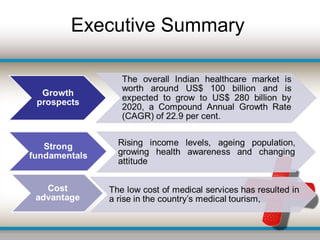
Executive Summary
Executive Summary
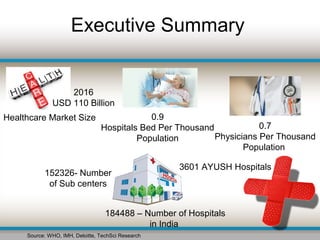
Healthcare Market Size
2016
USD 110 Billion
0.9
Hospitals Bed Per Thousand
Population
0.7
Physicians Per Thousand
Population
152326- Number
of Sub centers
184488 – Number of Hospitals
in India
3601 AYUSH Hospitals
Source: WHO, IMH, Deloitte, TechSci Research
Indian Healthcare Overview
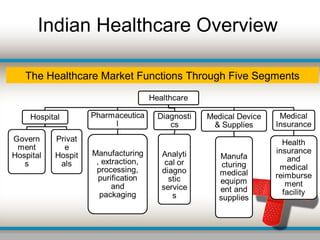
The Healthcare Market Functions Through Five Segments
Healthcare Overview
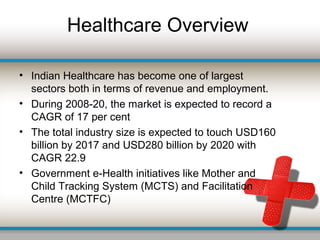
• Indian Healthcare has become one of largest
sectors both in terms of revenue and employment.
• During 2008-20, the market is expected to record a
CAGR of 17 per cent
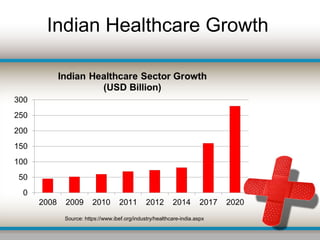
• The total industry size is expected to touch USD160
billion by 2017 and USD280 billion by 2020 with
CAGR 22.9
• Government e-Health initiatives like Mother and
Child Tracking System (MCTS) and Facilitation
Centre (MCTFC)
Indian Healthcare Growth
Source: https://www.ibef.org/industry/healthcare-india.aspx
Indian Healthcare Challenges
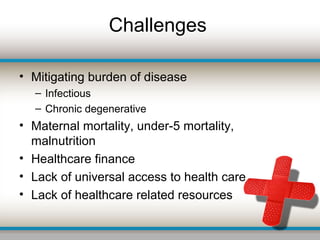
Challenges
• Mitigating burden of disease
– Infectious
– Chronic degenerative
• Maternal mortality, under-5 mortality,
malnutrition
• Healthcare finance
• Lack of universal access to health care
• Lack of healthcare related resources
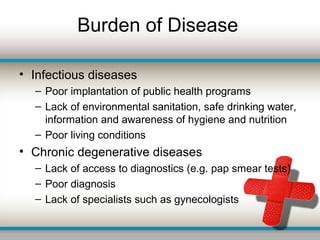
Burden of Disease
• Infectious diseases
– Poor implantation of public health programs
– Lack of environmental sanitation, safe drinking water,
information and awareness of hygiene and nutrition
– Poor living conditions
• Chronic degenerative diseases
– Lack of access to diagnostics (e.g. pap smear tests)
– Poor diagnosis
– Lack of specialists such as gynecologists
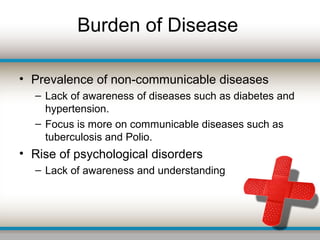
Burden of Disease
• Prevalence of non-communicable diseases
– Lack of awareness of diseases such as diabetes and
hypertension.
– Focus is more on communicable diseases such as
tuberculosis and Polio.
• Rise of psychological disorders
– Lack of awareness and understanding
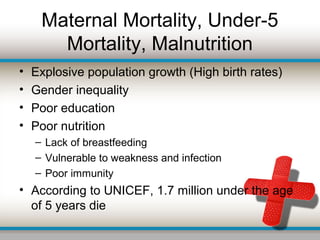
Maternal Mortality, Under-5
Mortality, Malnutrition
• Explosive population growth (High birth rates)
• Gender inequality
• Poor education
• Poor nutrition
– Lack of breastfeeding
– Vulnerable to weakness and infection
– Poor immunity
• According to UNICEF, 1.7 million under the age
of 5 years die
Healthcare Finance
• High cost of curative medical
services
• Expensive health insurance
• Poor vaccination coverage
• Inappropriate and irrational use of
high tech diagnostics
• Economically poor patient not able
to afford the treatment expense
Lack Of Healthcare Related
Resources
• Migration of qualified professionals
• Workforce concentrated in urban areas
• Underinvestment in health care related
infrastructure in certain areas
– Limited opening hours
– Limited availability of drugs
– Poor physical environments
– Poor provider training and knowledge
Lack Of Healthcare Related
Resources
• Poor governance of health care sector
– Adequate regulation of public and private sector has
been difficult to achieve
– Implementation of laws and codes is problematic
Lack Of Universal Access
• Health services not easily accessible to
rural populations
– Economics of scale achievable only in urban
areas
– Physical distance to facilities is an issue
• Health insurance only covers about one
fifth of the entire population
– Unorganized private sector accounts for
almost 80% of outpatient healthcare
Lack Of Universal Access
• Dearth of qualified medical professionals in rural
areas
– Inappropriate drug use
Conclusion
• India lags behind in in key healthcare indicators,
Growing Burden of Disease and Disease Mix
• Inadequate and Poor Healthcare Planning (Top
Down)
• Inequitable distribution of resources between
different States as well as Urban Rural settings
• Shortfall of Physical Infrastructure & shortfall of
Trained Manpower (Doctors, Nurses,
Paramedics)
Conclusion
• Miniscule Healthcare Budget by Governments
• High Cost of Advanced Treatments
• Low Insurance Penetration
• Unregulated Private Sector (Only 244 hospitals
in India are accredited by NABH)
Current Healthcare Challenges In India

Current Healthcare Challenges In India

  • 1.
    Current Healthcare Challenges InIndia Nitesh Gunjan Pharm MBA DPSRU, Delhi
  • 2.
    Contents • Executive Summary •Indian Healthcare Overview • Growth Trend • Challenges of Indian Healthcare • Conclusion
  • 3.
  • 4.
    Executive Summary Healthcare MarketSize 2016 USD 110 Billion 0.9 Hospitals Bed Per Thousand Population 0.7 Physicians Per Thousand Population 152326- Number of Sub centers 184488 – Number of Hospitals in India 3601 AYUSH Hospitals Source: WHO, IMH, Deloitte, TechSci Research
  • 5.
    Indian Healthcare Overview TheHealthcare Market Functions Through Five Segments
  • 6.
    Healthcare Overview • IndianHealthcare has become one of largest sectors both in terms of revenue and employment. • During 2008-20, the market is expected to record a CAGR of 17 per cent • The total industry size is expected to touch USD160 billion by 2017 and USD280 billion by 2020 with CAGR 22.9 • Government e-Health initiatives like Mother and Child Tracking System (MCTS) and Facilitation Centre (MCTFC)
  • 7.
    Indian Healthcare Growth Source:https://www.ibef.org/industry/healthcare-india.aspx
  • 8.
  • 9.
    Challenges • Mitigating burdenof disease – Infectious – Chronic degenerative • Maternal mortality, under-5 mortality, malnutrition • Healthcare finance • Lack of universal access to health care • Lack of healthcare related resources
  • 10.
    Burden of Disease •Infectious diseases – Poor implantation of public health programs – Lack of environmental sanitation, safe drinking water, information and awareness of hygiene and nutrition – Poor living conditions • Chronic degenerative diseases – Lack of access to diagnostics (e.g. pap smear tests) – Poor diagnosis – Lack of specialists such as gynecologists
  • 11.
    Burden of Disease •Prevalence of non-communicable diseases – Lack of awareness of diseases such as diabetes and hypertension. – Focus is more on communicable diseases such as tuberculosis and Polio. • Rise of psychological disorders – Lack of awareness and understanding
  • 12.
    Maternal Mortality, Under-5 Mortality,Malnutrition • Explosive population growth (High birth rates) • Gender inequality • Poor education • Poor nutrition – Lack of breastfeeding – Vulnerable to weakness and infection – Poor immunity • According to UNICEF, 1.7 million under the age of 5 years die
  • 13.
    Healthcare Finance • Highcost of curative medical services • Expensive health insurance • Poor vaccination coverage • Inappropriate and irrational use of high tech diagnostics • Economically poor patient not able to afford the treatment expense
  • 14.
    Lack Of HealthcareRelated Resources • Migration of qualified professionals • Workforce concentrated in urban areas • Underinvestment in health care related infrastructure in certain areas – Limited opening hours – Limited availability of drugs – Poor physical environments – Poor provider training and knowledge
  • 15.
    Lack Of HealthcareRelated Resources • Poor governance of health care sector – Adequate regulation of public and private sector has been difficult to achieve – Implementation of laws and codes is problematic
  • 16.
    Lack Of UniversalAccess • Health services not easily accessible to rural populations – Economics of scale achievable only in urban areas – Physical distance to facilities is an issue • Health insurance only covers about one fifth of the entire population – Unorganized private sector accounts for almost 80% of outpatient healthcare
  • 17.
    Lack Of UniversalAccess • Dearth of qualified medical professionals in rural areas – Inappropriate drug use
  • 18.
    Conclusion • India lagsbehind in in key healthcare indicators, Growing Burden of Disease and Disease Mix • Inadequate and Poor Healthcare Planning (Top Down) • Inequitable distribution of resources between different States as well as Urban Rural settings • Shortfall of Physical Infrastructure & shortfall of Trained Manpower (Doctors, Nurses, Paramedics)
  • 19.
    Conclusion • Miniscule HealthcareBudget by Governments • High Cost of Advanced Treatments • Low Insurance Penetration • Unregulated Private Sector (Only 244 hospitals in India are accredited by NABH)