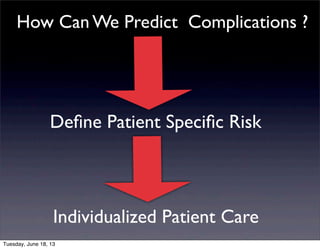
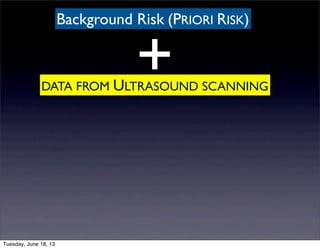
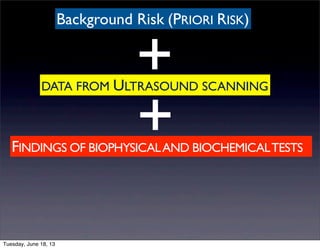
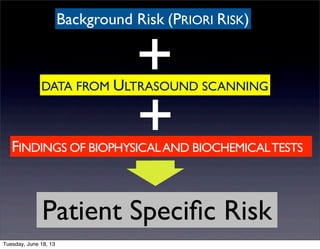
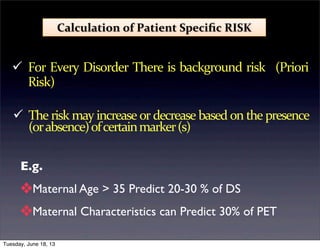
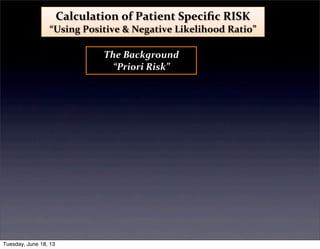
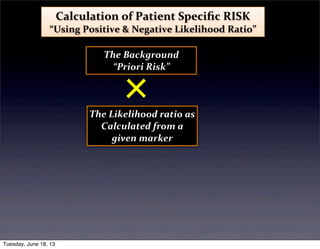
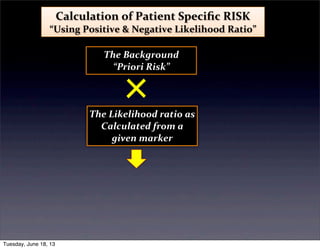
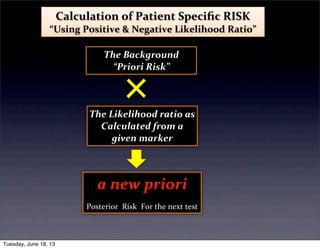
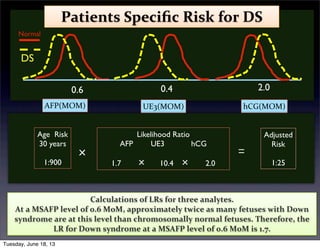
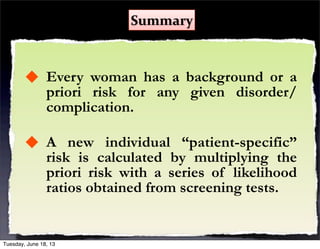
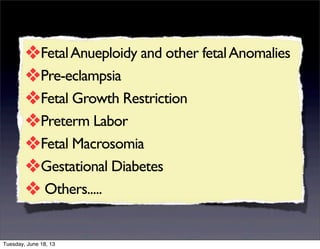
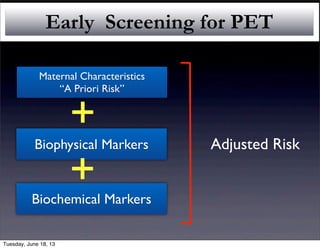
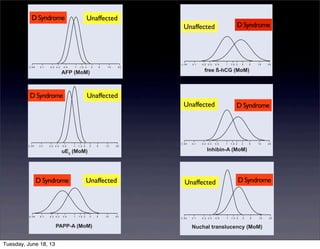
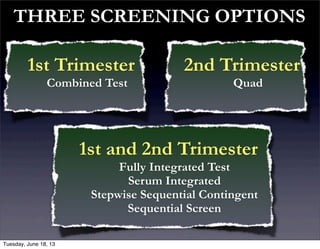
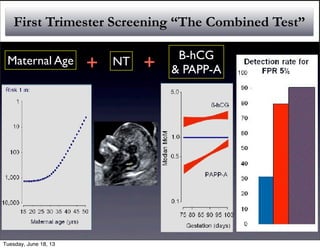
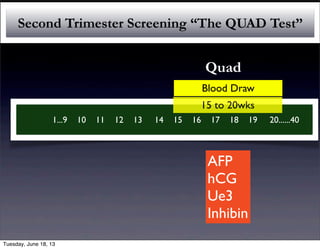
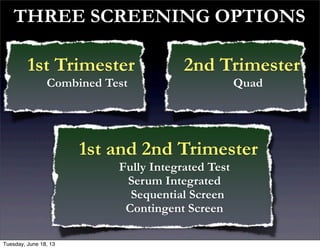
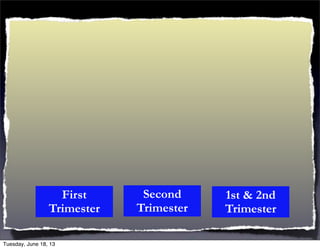
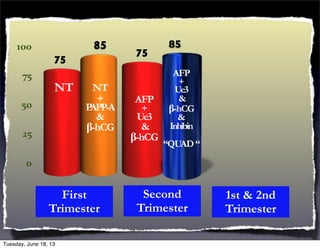
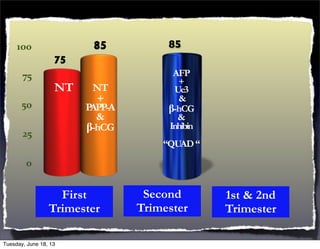
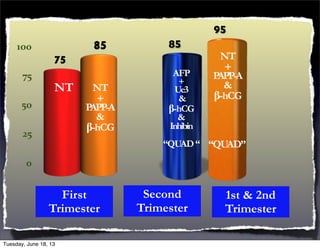
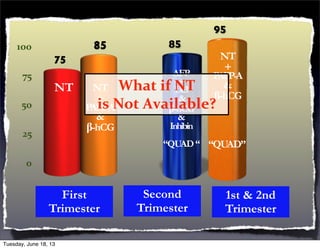
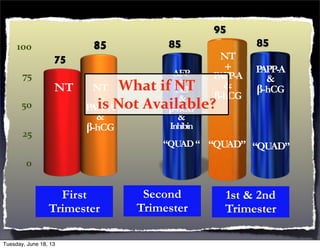
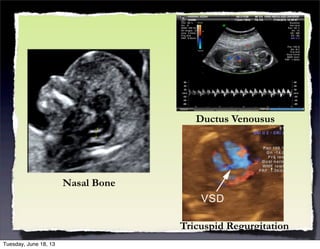
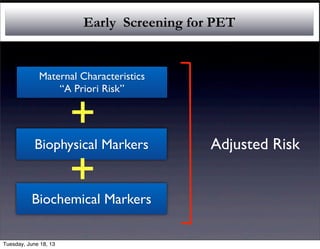
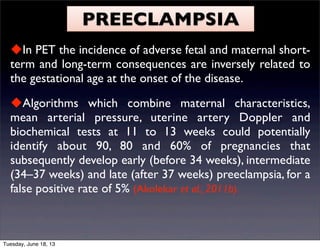
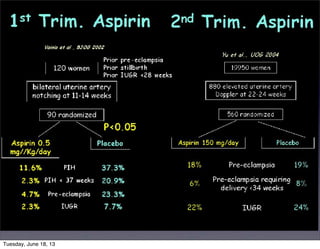
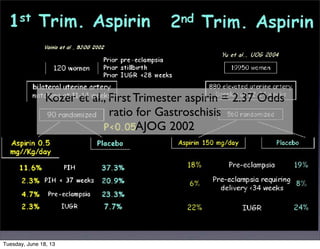
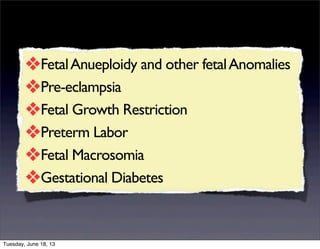
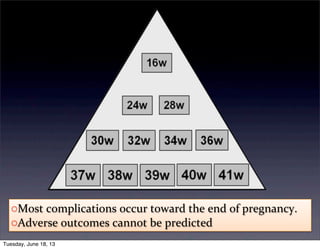
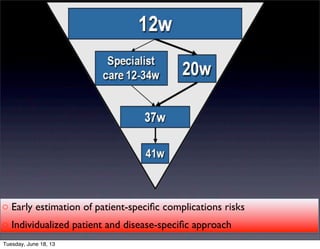
The document discusses developments in predicting complications during pregnancy through individualized prenatal care. It explains that every woman has a background or priori risk for complications based on factors like age, medical history, etc. A patient-specific risk can then be calculated by multiplying the priori risk with likelihood ratios obtained from various screening tests, including ultrasound findings, biophysical and biochemical markers. Screening options are discussed, including first trimester combined tests, second trimester quad screens, and integrated first and second trimester screens, which can detect anomalies and conditions like Down syndrome, preeclampsia, fetal growth restriction, and more. The role of fetal-maternal medicine services in providing customized, multi-stage screening is also covered.













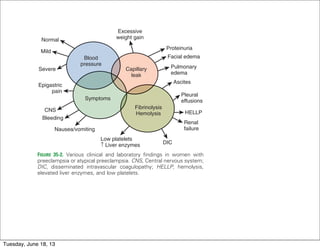
![Pathophysiology of PET
Impaired Trophoblastic Invasion of
Maternal Spiral Arteries
Placental hypoxia
Release of Inflammatory cytokines
Platelets and endothelial cell
activation and damage
Clinical symptoms of preeclampsia
Figure 1. Trophoblasts are the first cells to differentiate from the fe
becoming the outer layer of a blastocyst. They further differentiate
phoblast and the outer syncytiotrophoblast. Trophoblast cells prot
immune system.
clear sugar from the blood and is often a precursor to
demonstrated in active PE, and women with insulin re
of developing PE during pregnancy.[66] It is also sugg
ments of insulin resistance based on a single determin
glucose could predict pre-eclampsia at least as well as
for prediction of pre-eclampsia, uterine artery Dopple
Sibai have proposed that pregnancies complicated wit
metabolic syndrome (e.g. adiposity, increased insulin r
excess thrombin generation) and inflammatory signals
developing pre-eclampsia.[99]
Tuesday, June 18, 13](https://image.slidesharecdn.com/currentdevelopmentinprenatalcare23-jan-130618054900-phpapp02/85/Current-development-in-prenatal-care-Hassan-Nasrat-51-320.jpg)
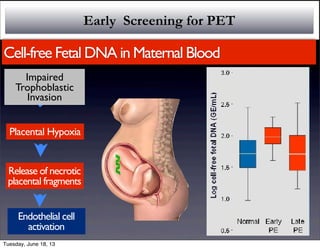
![Figure 1. Trophoblasts are the first cells to differentiate from the fertilized egg in early pregnancy,
becoming the outer layer of a blastocyst. They further differentiate into two layers, the inner cytotro-
phoblast and the outer syncytiotrophoblast. Trophoblast cells protect the fetus against the maternal
immune system.
Syncytiotrophoblast
Cytotrophoblast
Uterine epithelium
of developing PE during pregnancy.[66] It is also suggested that simple assess-
ments of insulin resistance based on a single determination of fasting insulin and
glucose could predict pre-eclampsia at least as well as the current gold standard
for prediction of pre-eclampsia, uterine artery Doppler velocimetry.[103] Ness and
Sibai have proposed that pregnancies complicated with IUGR lack the maternal
metabolic syndrome (e.g. adiposity, increased insulin resistance, hyperlipidemia,
excess thrombin generation) and inflammatory signals which prevent patients from
developing pre-eclampsia.[99]
Syncytrop
hoblast
Cytotrop
hoblast
Uterine
epithelium
•Maternal syndrome:
BP with or without
system dysfunction
•Fetal syndrome:
(FGR, reduced amniotic
fluid, and abnormal
oxygenation).
Clinically can manifest as either a:
The pathophysiology of early- onset PE may be
different than that of PE developing at term
Tuesday, June 18, 13](https://image.slidesharecdn.com/currentdevelopmentinprenatalcare23-jan-130618054900-phpapp02/85/Current-development-in-prenatal-care-Hassan-Nasrat-53-320.jpg)
![32
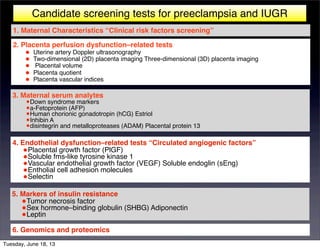
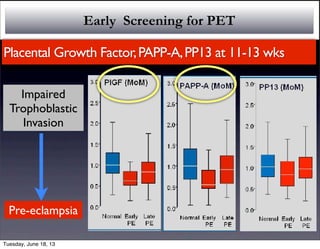
history, uterine artery pulsatility index (UAPI), maternal mean arterial pressure
(MAP), maternal serum pregnancy-associated plasma protein-A levels (PAPP-A),
and maternal serum placental growth factor levels (PlGF) in screening for pre-ec-
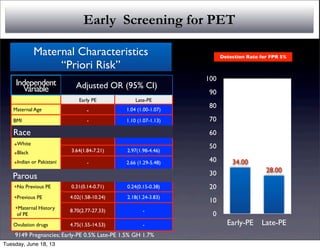
lampsia in the first trimester.[39, 107, 108, 110] The specific maternal factors that
appear to play the most significant role in adjusting the risk of pre-eclampsia are
maternal BMI, age, ethnicity, smoking and parity. In a study, which included 7,797
patients, the combination of these parameters predicted early severe pre-eclamp-
sia in 93% cases, late pre-eclampsia in 36% of the cases, and 18% of the cases
of gestational hypertension with a 5% false positive rate.
In comparison, using maternal history alone predicts only 30% of early severe pre-
eclampsia and 20% of late pre-eclampsia for a 5% false positive rate.
Measuring uterine artery PI using Doppler at 11-13+6 weeks’ gestation
Identification of the uterine arteries begins by obtaining a sagittal view of the lower
uterine segment and the cervix. The cervical canal is visualized and the endocervix
is identified at the
junction of the canal
and the lower uterine
segment. The uterine
artery is generally found
in the paracervical tissue
at the level of the endo-
cervix. Therefore, the
transducer is directed to
this region and the uter-
ine artery may be found
there with the aid of
color Doppler.
Figure 4. Color Doppler of
uterine arteries (upper) and
uterine artery waveform
(lower) obtained using the
conditions described in the
text. Images courtesy of
Cathy Downing, Fetal Medi-
cine Foundation, USA.
32
centation is less advanced, the chance of any future preventative steps succeeding
is increased.
The Fetal Medicine Foundation has evaluated the utility of combining maternal
history, uterine artery pulsatility index (UAPI), maternal mean arterial pressure
(MAP), maternal serum pregnancy-associated plasma protein-A levels (PAPP-A),
and maternal serum placental growth factor levels (PlGF) in screening for pre-ec-
lampsia in the first trimester.[39, 107, 108, 110] The specific maternal factors that
appear to play the most significant role in adjusting the risk of pre-eclampsia are
maternal BMI, age, ethnicity, smoking and parity. In a study, which included 7,797
patients, the combination of these parameters predicted early severe pre-eclamp-
sia in 93% cases, late pre-eclampsia in 36% of the cases, and 18% of the cases
of gestational hypertension with a 5% false positive rate.
In comparison, using maternal history alone predicts only 30% of early severe pre-
eclampsia and 20% of late pre-eclampsia for a 5% false positive rate.
Measuring uterine artery PI using Doppler at 11-13+6 weeks’ gestation
Identification of the uterine arteries begins by obtaining a sagittal view of the lower
uterine segment and the cervix. The cervical canal is visualized and the endocervix
is identified at the
junction of the canal
and the lower uterine
segment. The uterine
artery is generally found
in the paracervical tissue
at the level of the endo-
cervix. Therefore, the
transducer is directed to
this region and the uter-
ine artery may be found
there with the aid of
color Doppler.
Figure 4. Color Doppler of
uterine arteries (upper) and
uterine artery waveform
(lower) obtained using the
conditions described in the
text. Images courtesy of
Cathy Downing, Fetal Medi-
cine Foundation, USA.
Early Screening for PET
Uterine Artery 11-13 weeks
9149 Pregnancies; Early-PE 0.5% Late-PE 1.5% GH 1.7%
Tuesday, June 18, 13](https://image.slidesharecdn.com/currentdevelopmentinprenatalcare23-jan-130618054900-phpapp02/85/Current-development-in-prenatal-care-Hassan-Nasrat-58-320.jpg)
![Early Screening for PET
Blood Pressure at 11-13 weeks
9149 Pregnancies; Early-PE 0.5% Late-PE 1.5% GH 1.7%
Mean Arterial Blood Pressure =
Diastolic BP+ (Systolic BP- Diastolic BP)/3
34
In clinical practice MAP measurement in the first trimester may not make a clinical
impact in isolation but could be suitable for use with other markers, including ma-
ternal serum markers, to improve the accuracy for estimating risk of pre-eclampsia.
Already it has been shown following a large prospective study that maternal vari-
ables such as ethnic origin, body mass index, and personal history of PE, combined
with MAP at 11+0 to 13+6 weeks is able to identify a group at high risk for pre-
eclampsia.[105]
How MAP is measured
The Fetal Medicine Foundation recommends the following protocol for the
measurement of blood pressure (see also the FMF’s automatic calculator on
https://courses.fetalmedicine.com/calculator/map?locale=en). The measurement
should be made when the gestational age is between 11 and 13+6 weeks and
when the crown rump length is between 45 and 84 mm.
Figure 5. Measurement of
mean arterial pressure (MAP).
Tuesday, June 18, 13](https://image.slidesharecdn.com/currentdevelopmentinprenatalcare23-jan-130618054900-phpapp02/85/Current-development-in-prenatal-care-Hassan-Nasrat-59-320.jpg)
![Early Screening for PET
History
Maternal Age
BMI (Kg/m2)
Racial Origin
•White
•Black
•Indian or Pakistani
Parous
•No Previous PE
•Previous PE
•Maternal History of PE
History of BP
Ovulation drugs
32
Moving screening for pre-eclampsia to the first trimester appears to improve the
detection rate. Furthermore, since this is done at a time when the process of pla-
centation is less advanced, the chance of any future preventative steps succeeding
is increased.
The Fetal Medicine Foundation has evaluated the utility of combining maternal
history, uterine artery pulsatility index (UAPI), maternal mean arterial pressure
(MAP), maternal serum pregnancy-associated plasma protein-A levels (PAPP-A),
and maternal serum placental growth factor levels (PlGF) in screening for pre-ec-
lampsia in the first trimester.[39, 107, 108, 110] The specific maternal factors that
appear to play the most significant role in adjusting the risk of pre-eclampsia are
maternal BMI, age, ethnicity, smoking and parity. In a study, which included 7,797
patients, the combination of these parameters predicted early severe pre-eclamp-
sia in 93% cases, late pre-eclampsia in 36% of the cases, and 18% of the cases
of gestational hypertension with a 5% false positive rate.
In comparison, using maternal history alone predicts only 30% of early severe pre-
eclampsia and 20% of late pre-eclampsia for a 5% false positive rate.
Measuring uterine artery PI using Doppler at 11-13+6 weeks’ gestation
Identification of the uterine arteries begins by obtaining a sagittal view of the lower
uterine segment and the cervix. The cervical canal is visualized and the endocervix
is identified at the
junction of the canal
and the lower uterine
segment. The uterine
artery is generally found
in the paracervical tissue
at the level of the endo-
cervix. Therefore, the
transducer is directed to
this region and the uter-
ine artery may be found
there with the aid of
color Doppler.
Figure 4. Color Doppler of
uterine arteries (upper) and
uterine artery waveform
(lower) obtained using the
conditions described in the
text. Images courtesy of
Cathy Downing, Fetal Medi-
cine Foundation, USA.
Maternal
Priori Risk + UaD mBP+
Tuesday, June 18, 13](https://image.slidesharecdn.com/currentdevelopmentinprenatalcare23-jan-130618054900-phpapp02/85/Current-development-in-prenatal-care-Hassan-Nasrat-60-320.jpg)
![Early Screening for PET
UaD mBP
32
centation is less advanced, the chance of any future preventative steps succeeding
is increased.
The Fetal Medicine Foundation has evaluated the utility of combining maternal
history, uterine artery pulsatility index (UAPI), maternal mean arterial pressure
(MAP), maternal serum pregnancy-associated plasma protein-A levels (PAPP-A),
and maternal serum placental growth factor levels (PlGF) in screening for pre-ec-
lampsia in the first trimester.[39, 107, 108, 110] The specific maternal factors that
appear to play the most significant role in adjusting the risk of pre-eclampsia are
maternal BMI, age, ethnicity, smoking and parity. In a study, which included 7,797
patients, the combination of these parameters predicted early severe pre-eclamp-
sia in 93% cases, late pre-eclampsia in 36% of the cases, and 18% of the cases
of gestational hypertension with a 5% false positive rate.
In comparison, using maternal history alone predicts only 30 % of early severe pre-
eclampsia and 20 % of late pre-eclampsia for a 5% false positive rate.
Measuring uterine artery PI using Doppler at 11-13+6 weeks’ gestation
Identification of the uterine arteries begins by obtaining a sagittal view of the lower
uterine segment and the cervix. The cervical canal is visualized and the endocervix
is identified at the
junction of the canal
and the lower uterine
segment. The uterine
artery is generally found
in the paracervical tissue
at the level of the endo-
cervix. Therefore, the
transducer is directed to
this region and the uter-
ine artery may be found
there with the aid of
color Doppler.
Figure 4. Color Doppler of
uterine arteries (upper) and
uterine artery waveform
(lower) obtained using the
conditions described in the
text. Images courtesy of
Cathy Downing, Fetal Medi-
cine Foundation, USA.
+ PLGP
+
Tuesday, June 18, 13](https://image.slidesharecdn.com/currentdevelopmentinprenatalcare23-jan-130618054900-phpapp02/85/Current-development-in-prenatal-care-Hassan-Nasrat-63-320.jpg)
![History
Maternal Age
BMI (Kg/m2)
Racial Origin
•White
•Black
•Indian or Pakistani
Parous
•No Previous PE
•Previous PE
•Maternal History of
PE
History of BP
Ovulation drugs
Early Screening for PET
10,000 pregnancies
600 pregnancies
Late-PE
75/150
Early-PE
45/50
20%
Screen +ve
6%
32
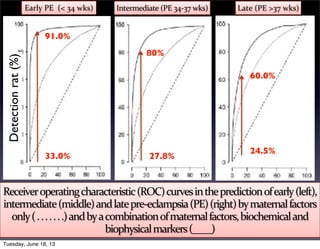
lampsia in the first trimester.[39, 107, 108, 110] The specific maternal factors that
appear to play the most significant role in adjusting the risk of pre-eclampsia are
maternal BMI, age, ethnicity, smoking and parity. In a study, which included 7,797
patients, the combination of these parameters predicted early severe pre-eclamp-
sia in 93% cases, late pre-eclampsia in 36% of the cases, and 18% of the cases
of gestational hypertension with a 5% false positive rate.
In comparison, using maternal history alone predicts only 30 % of early severe pre-
eclampsia and 20 % of late pre-eclampsia for a 5% false positive rate.
Measuring uterine artery PI using Doppler at 11-13+6 weeks’ gestation
Identification of the uterine arteries begins by obtaining a sagittal view of the lower
uterine segment and the cervix. The cervical canal is visualized and the endocervix
is identified at the
junction of the canal
and the lower uterine
segment. The uterine
artery is generally found
in the paracervical tissue
at the level of the endo-
cervix. Therefore, the
transducer is directed to
this region and the uter-
ine artery may be found
there with the aid of
color Doppler.
Figure 4. Color Doppler of
uterine arteries (upper) and
uterine artery waveform
(lower) obtained using the
conditions described in the
text. Images courtesy of
Cathy Downing, Fetal Medi-
cine Foundation, USA.
Tuesday, June 18, 13](https://image.slidesharecdn.com/currentdevelopmentinprenatalcare23-jan-130618054900-phpapp02/85/Current-development-in-prenatal-care-Hassan-Nasrat-64-320.jpg)








![PRENATAL_DIAGNOSIS[1].pptx](https://cdn.slidesharecdn.com/ss_thumbnails/prenataldiagnosis1-221119161845-d4594dec-thumbnail.jpg?width=640&height=640&fit=bounds)


![ONFH[AVN HIP] -TRIPLE REGIME -A NOVAL SURGICAL CONCEPT .pptx](https://cdn.slidesharecdn.com/ss_thumbnails/onfhavnhip2026koaconcalicutdrgokuldevdrmashraf-260210064517-213ec005-thumbnail.jpg?width=640&height=640&fit=bounds)
![CTEV [ clubfoot] DR ARUN LAL ,DR MOHAMED ASHRAF travancore medical college k...](https://cdn.slidesharecdn.com/ss_thumbnails/ctevclubfootdrarunlaldrmohamedashraftravancoremedicalcollegekollamkeralaindia-260208063247-18fc466c-thumbnail.jpg?width=640&height=640&fit=bounds)


