Distribution
Channel
Unit-2
12-2
Designing Distribution Channels: What are
the Objectives to be Accomplished?
• Objectives of distribution channels:
– Increase the availability of the good or service
to potential customers.
– Satisfy customer requirements by providing
high levels of service.
– Ensure promotional effort.
– Obtain timely and detailed market information.
– Increase cost- effectiveness.
– Maintain flexibility.
12-3
Service Transactions
• Transactions in services can be broadly categorised into
three groups:
1. Customers Calling Service Outlets
Example: Educational institute, theatres, beauty care
centres, health clubs etc.
2. Service Firms Calling Customers
Example: Postal services, security services, personal
services etc.
3. Service Provider and Consumer Transact at Arms
Length
Example: Telecom services, cellular services, credit
cards services etc.
12-4
Distribution Strategy Available to Service
Organization
• Extensive Distribution, suitable for mass
consumption, E.g. Transportation, electricity,
telecommunication and primary education
• Selective Distribution, suitable for service that
require to follow specified conditions and regulations
and special skills to the service provider, E.g. Higher
and technical education, tourism and courier
services
• Exclusive Distribution, used for services that
reflect the corporate brand image and exclusivity in
many dimensions of the service package, E.g.
Health care services, hospitality services, retail
networks etc.
12-5
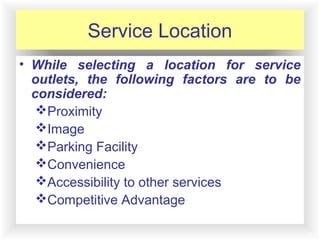
Service Location
• While selecting a location for service
outlets, the following factors are to be
considered:
Proximity
Image
Parking Facility
Convenience
Accessibility to other services
Competitive Advantage
12-6
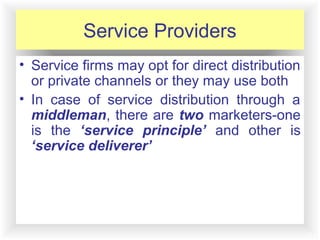
Service Providers
• Service firms may opt for direct distribution
or private channels or they may use both
• In case of service distribution through a
middleman, there are two marketers-one
is the ‘service principle’ and other is
‘service deliverer’
12-7
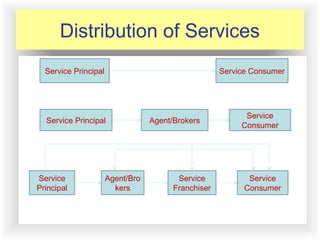
Distribution of Services
Service Principal Service Consumer
Service Principal Agent/Brokers
Service
Consumer
Service
Principal
Agent/Bro
kers
Service
Franchiser
Service
Consumer
12-8
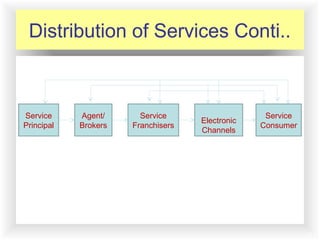
Distribution of Services Conti..
Service
Principal
Agent/
Brokers
Service
Franchisers
Electronic
Channels
Service
Consumer
12-9
Distributors for Service Delivery
1. Franchising
-Mostly used in educational institutions, film-processing
companies, hotels and restaurants
-Agreements and contracts are essential documents in
franchising
-Agreements and contracts include:
 Nature of the service
 The geographic territory
 The percentage share to be paid to the franchiser on the revenue
of the franchisee
 The time period of agreement
 The instructions, interactions and conditions
 The roles and responsibilities of franchisee
 The rules and regulations of termination of agreement
12-10
Distributors for Service Delivery
Conti..
• Benefits and challenges of franchising:
Business expansion and revenue gains
Consistency in outlets
Knowledge of local markets
Sharing financial risk and less investment burden
Challenges:
Problems in maintaining and motivating
franchises
Quality inconsistency may affect company image
Control of customer relationship by the
franchisee
12-11
Distributors for Service Delivery
Conti..
2. Agent and Brokers
-Benefits of agents and brokers:
 Low selling and distribution cost
 Specialised skills and knowledge of the agents
and brokers
 Wider representation in the market
 Knowledge of local markets
 Customer choice
Challenge:
-loss of control, in pricing and other aspects of
marketing when agents and brokers interfere and
prevail over the producers as well as consumers
12-12
Distributors for Service Delivery
Conti..
2. Electronic Channels
-Benefits and challenges of electronic channels:
 Quality control
 Low cost
 Customer convenience
 Wide distribution customer choice
Challenges:
 No control on electronic environment
 Inability to customise
 Customer involvement
12-13
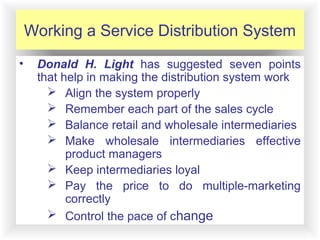
Working a Service Distribution System
• Donald H. Light has suggested seven points
that help in making the distribution system work
 Align the system properly
 Remember each part of the sales cycle
 Balance retail and wholesale intermediaries
 Make wholesale intermediaries effective
product managers
 Keep intermediaries loyal
 Pay the price to do multiple-marketing
correctly
 Control the pace of change
12-14
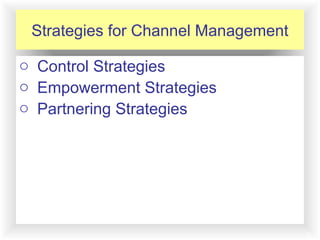
Strategies for Channel Management
o Control Strategies
o Empowerment Strategies
o Partnering Strategies

Distribution

  • 1.
  • 2.
    12-2 Designing Distribution Channels:What are the Objectives to be Accomplished? • Objectives of distribution channels: – Increase the availability of the good or service to potential customers. – Satisfy customer requirements by providing high levels of service. – Ensure promotional effort. – Obtain timely and detailed market information. – Increase cost- effectiveness. – Maintain flexibility.
  • 3.
    12-3 Service Transactions • Transactionsin services can be broadly categorised into three groups: 1. Customers Calling Service Outlets Example: Educational institute, theatres, beauty care centres, health clubs etc. 2. Service Firms Calling Customers Example: Postal services, security services, personal services etc. 3. Service Provider and Consumer Transact at Arms Length Example: Telecom services, cellular services, credit cards services etc.
  • 4.
    12-4 Distribution Strategy Availableto Service Organization • Extensive Distribution, suitable for mass consumption, E.g. Transportation, electricity, telecommunication and primary education • Selective Distribution, suitable for service that require to follow specified conditions and regulations and special skills to the service provider, E.g. Higher and technical education, tourism and courier services • Exclusive Distribution, used for services that reflect the corporate brand image and exclusivity in many dimensions of the service package, E.g. Health care services, hospitality services, retail networks etc.
  • 5.
    12-5 Service Location • Whileselecting a location for service outlets, the following factors are to be considered: Proximity Image Parking Facility Convenience Accessibility to other services Competitive Advantage
  • 6.
    12-6 Service Providers • Servicefirms may opt for direct distribution or private channels or they may use both • In case of service distribution through a middleman, there are two marketers-one is the ‘service principle’ and other is ‘service deliverer’
  • 7.
    12-7 Distribution of Services ServicePrincipal Service Consumer Service Principal Agent/Brokers Service Consumer Service Principal Agent/Bro kers Service Franchiser Service Consumer
  • 8.
    12-8 Distribution of ServicesConti.. Service Principal Agent/ Brokers Service Franchisers Electronic Channels Service Consumer
  • 9.
    12-9 Distributors for ServiceDelivery 1. Franchising -Mostly used in educational institutions, film-processing companies, hotels and restaurants -Agreements and contracts are essential documents in franchising -Agreements and contracts include:  Nature of the service  The geographic territory  The percentage share to be paid to the franchiser on the revenue of the franchisee  The time period of agreement  The instructions, interactions and conditions  The roles and responsibilities of franchisee  The rules and regulations of termination of agreement
  • 10.
    12-10 Distributors for ServiceDelivery Conti.. • Benefits and challenges of franchising: Business expansion and revenue gains Consistency in outlets Knowledge of local markets Sharing financial risk and less investment burden Challenges: Problems in maintaining and motivating franchises Quality inconsistency may affect company image Control of customer relationship by the franchisee
  • 11.
    12-11 Distributors for ServiceDelivery Conti.. 2. Agent and Brokers -Benefits of agents and brokers:  Low selling and distribution cost  Specialised skills and knowledge of the agents and brokers  Wider representation in the market  Knowledge of local markets  Customer choice Challenge: -loss of control, in pricing and other aspects of marketing when agents and brokers interfere and prevail over the producers as well as consumers
  • 12.
    12-12 Distributors for ServiceDelivery Conti.. 2. Electronic Channels -Benefits and challenges of electronic channels:  Quality control  Low cost  Customer convenience  Wide distribution customer choice Challenges:  No control on electronic environment  Inability to customise  Customer involvement
  • 13.
    12-13 Working a ServiceDistribution System • Donald H. Light has suggested seven points that help in making the distribution system work  Align the system properly  Remember each part of the sales cycle  Balance retail and wholesale intermediaries  Make wholesale intermediaries effective product managers  Keep intermediaries loyal  Pay the price to do multiple-marketing correctly  Control the pace of change
  • 14.
    12-14 Strategies for ChannelManagement o Control Strategies o Empowerment Strategies o Partnering Strategies