PRESENTED BY-
MANIK
(B.T.M – 1st Year )
2975110011
CULTURE-:
Culture is everything which is socially shared and learned by
the members of society.
 Culture is something that unites people.
 Culture is us.
 We make it
 We shape it as we love it to be.
 It is the totality of human experience acquired during transmission of heritage
from one generation to another and to learn the ways of learning, eating,
drinking, behaving, walking, dressing, and working is the culture of man.
 There Are Twelve Features Of Cultures -:
 1. Culture is learned
 2. Culture is social
 3. Culture is shared
 4. Culture is transmitted
 5. Culture is continuous
 6. Culture is accumulative
 7. Culture is integrated
 8. Culture is changing
 9. Culture varies from society to society
9. Culture varies from society to society
10. Culture is responsive
11. Culture is gratifying
12. Linked with society
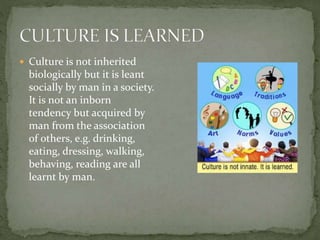
 Culture is not inherited
biologically but it is leant
socially by man in a society.
It is not an inborn
tendency but acquired by
man from the association
of others, e.g. drinking,
eating, dressing, walking,
behaving, reading are all
learnt by man.
 It is not an individual phenomena but it is the product
of society. It develops in the society through social
interaction. It is shared by the man of society No man
can acquire it without the association of others. Man is
man only among men. It helps to develop qualities of
human beings in a social environment. Deprivation of
a man from his company is the deprivation of human
qualities.
 Culture is something shared. It is nothing that an
individual can passes but shared by common people of
a territory. For example, customs, traditions, values,
beliefs are all shared by man in a social situation.
These beliefs and practices are adopted by all equally.
 Culture is capable of transmitted from one generation
to the next. Parents papas cultural traits to their
children and in return they pass to their children and
son on. It is not transmitted through genes but
through language. Language is means to
communication which passes cultural traits from one
generation to another.
 5. Culture is continuous
 It is continuous process. It is
like a stream which is
flowing from one
generation to another
through centuries. “Culture
is the memory of human
race.
 6. Culture is
accumulative
 Culture is not a matter of
month or a year. It is the
continuous process and
adding new cultural traits.
Many cultural traits are
borrowed from out side
and these absorbed in that
culture which adopt it, as
culture is accumulative and
combines the suitable
cultural traits.
 7. Culture is integrated
 All the cultural aspects
are inter-connected with
each other. The
development of culture is
the integration of its
various parts. For
example, values system is
interlinked with
morality, customs, beliefs
and religion.
 8. Culture is changing
 It remains changing but
not static. Cultural
process undergoes
changes. But with
different speeds from
society to society and
generation to generation.
 9. Culture varies from society
to society
 Every society has its own culture
and ways of behaving. It is not
uniform every where but occurs
differently in various societies.
Every culture is unique in itself
is a specific society. For example,
values, customs, traditions,
ideologies, religion, belief,
practices are not similar but
different in every society.
However the ways of eating,
drinking, speaking, greeting,
dressing etc are differs from one
social situation to another in the
same time.
 10. Culture is responsive
 Culture is responsive to the
changing conditions of a
physical world. It intervenes in
the natural environment and
helps man from all dangers and
natural calamities e.g. our
houses are responsible to give us
shelter and safety from storm
and heavy rains.
 11. Culture is gratifying
 It is gratifying and provide all the opportunities for
needs and desires satisfaction. These needs may be
biological or social but It is responsible to satisfy it.
Our needs are food, shelter, clothing and desires are
status, fame, money, sex etc are all the examples which
are fulfilled according to the cultural ways. In fact it is
defined as the process through which human beings
satisfy their need.
 12. Linked with society
 Last but not the least one of the characteristics of
culture that culture and society are one and the same.
But if we say that these turn two are twin sister, it
would not be wrong. Society is a composite of people
and they interact each other through it. It is to bind
the people within the society.
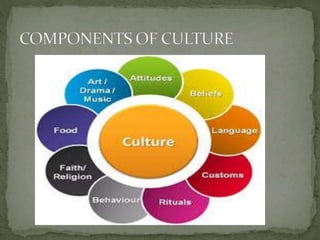
 1. LANGUAGE -:
 Language is used for
communication. It can
be written or spoken.
Even when a culture uses
the same basic language
as another culture,
difference in terminology
and inflection create
new meanings.
 2. SYMBOLS-:
Symbols may be either
physical or non-physical.
A Flag is an example of a
physical symbol and bows
and curtsies are example
of non- physical symbols.
 3. VALUES-:
 Values help define
acceptable behaviour
within the society. Values
can be different for each
group to which a person
belongs . For example, it
may be acceptable in the
family group to eat certain
foods that are not accepted
within the religious group a
person chooses.
 4. BELIEFS-:
 Beliefs fulfil the spiritual
needs of a culture. A whole
culture can be based on
one set of beliefs, yet a
larger cultural group may
have many different set of
beliefs.
 5. NORMS -:
Norms are the rules, mores and traditions within
a culture. As a group develop laws and regulations , norms change . A
law that was necessary 100 years ago may not be needed in modern
times.
 THANK YOU

CULTURE HISTORY DEFINATION

  • 1.
    PRESENTED BY- MANIK (B.T.M –1st Year ) 2975110011
  • 2.
    CULTURE-: Culture is everythingwhich is socially shared and learned by the members of society.  Culture is something that unites people.  Culture is us.  We make it  We shape it as we love it to be.  It is the totality of human experience acquired during transmission of heritage from one generation to another and to learn the ways of learning, eating, drinking, behaving, walking, dressing, and working is the culture of man.
  • 3.
     There AreTwelve Features Of Cultures -:  1. Culture is learned  2. Culture is social  3. Culture is shared  4. Culture is transmitted  5. Culture is continuous  6. Culture is accumulative  7. Culture is integrated  8. Culture is changing  9. Culture varies from society to society
  • 4.
    9. Culture variesfrom society to society 10. Culture is responsive 11. Culture is gratifying 12. Linked with society
  • 5.
     Culture isnot inherited biologically but it is leant socially by man in a society. It is not an inborn tendency but acquired by man from the association of others, e.g. drinking, eating, dressing, walking, behaving, reading are all learnt by man.
  • 6.
     It isnot an individual phenomena but it is the product of society. It develops in the society through social interaction. It is shared by the man of society No man can acquire it without the association of others. Man is man only among men. It helps to develop qualities of human beings in a social environment. Deprivation of a man from his company is the deprivation of human qualities.
  • 7.
     Culture issomething shared. It is nothing that an individual can passes but shared by common people of a territory. For example, customs, traditions, values, beliefs are all shared by man in a social situation. These beliefs and practices are adopted by all equally.
  • 8.
     Culture iscapable of transmitted from one generation to the next. Parents papas cultural traits to their children and in return they pass to their children and son on. It is not transmitted through genes but through language. Language is means to communication which passes cultural traits from one generation to another.
  • 9.
     5. Cultureis continuous  It is continuous process. It is like a stream which is flowing from one generation to another through centuries. “Culture is the memory of human race.  6. Culture is accumulative  Culture is not a matter of month or a year. It is the continuous process and adding new cultural traits. Many cultural traits are borrowed from out side and these absorbed in that culture which adopt it, as culture is accumulative and combines the suitable cultural traits.
  • 10.
     7. Cultureis integrated  All the cultural aspects are inter-connected with each other. The development of culture is the integration of its various parts. For example, values system is interlinked with morality, customs, beliefs and religion.  8. Culture is changing  It remains changing but not static. Cultural process undergoes changes. But with different speeds from society to society and generation to generation.
  • 11.
     9. Culturevaries from society to society  Every society has its own culture and ways of behaving. It is not uniform every where but occurs differently in various societies. Every culture is unique in itself is a specific society. For example, values, customs, traditions, ideologies, religion, belief, practices are not similar but different in every society. However the ways of eating, drinking, speaking, greeting, dressing etc are differs from one social situation to another in the same time.  10. Culture is responsive  Culture is responsive to the changing conditions of a physical world. It intervenes in the natural environment and helps man from all dangers and natural calamities e.g. our houses are responsible to give us shelter and safety from storm and heavy rains.
  • 12.
     11. Cultureis gratifying  It is gratifying and provide all the opportunities for needs and desires satisfaction. These needs may be biological or social but It is responsible to satisfy it. Our needs are food, shelter, clothing and desires are status, fame, money, sex etc are all the examples which are fulfilled according to the cultural ways. In fact it is defined as the process through which human beings satisfy their need.
  • 13.
     12. Linkedwith society  Last but not the least one of the characteristics of culture that culture and society are one and the same. But if we say that these turn two are twin sister, it would not be wrong. Society is a composite of people and they interact each other through it. It is to bind the people within the society.
  • 15.
     1. LANGUAGE-:  Language is used for communication. It can be written or spoken. Even when a culture uses the same basic language as another culture, difference in terminology and inflection create new meanings.  2. SYMBOLS-: Symbols may be either physical or non-physical. A Flag is an example of a physical symbol and bows and curtsies are example of non- physical symbols.
  • 16.
     3. VALUES-: Values help define acceptable behaviour within the society. Values can be different for each group to which a person belongs . For example, it may be acceptable in the family group to eat certain foods that are not accepted within the religious group a person chooses.  4. BELIEFS-:  Beliefs fulfil the spiritual needs of a culture. A whole culture can be based on one set of beliefs, yet a larger cultural group may have many different set of beliefs.
  • 17.
     5. NORMS-: Norms are the rules, mores and traditions within a culture. As a group develop laws and regulations , norms change . A law that was necessary 100 years ago may not be needed in modern times.
  • 18.