Plant-Parasitic
Plant-Parasitic
Nematodes
Nematodes
• Over 6000known
Over 6000 known
species
species
• Present in all ecological
Present in all ecological
niches
niches
• Attacks almost all plants
Attacks almost all plants
• Cause 10% losses to
Cause 10% losses to
crops
crops
• Reduces ornamental
Reduces ornamental
growth
growth
• Serious turf problems
Serious turf problems
• Big problem on tree
Big problem on tree
crops
crops
Nematode
Nematode Names
Names
• Plantnematodes have both
Plant nematodes have both common
common and
and
scientific
scientific names, some of economical
names, some of economical
importance, by common name, are:
importance, by common name, are:
Root-knot, Sting, Stubby-root, Reniform,
Root-knot, Sting, Stubby-root, Reniform,
Lance, Ring, Lesion, Burrowing, Citrus,
Lance, Ring, Lesion, Burrowing, Citrus,
Spiral, and Cyst
Spiral, and Cyst
6.
Feeding Habits
Feeding Habits
Nematodesmay be grouped by feeding habit as:
Nematodes may be grouped by feeding habit as:
• Endoparasitic
Endoparasitic– entire body inside the root
– entire body inside the root
• Ectoparasitic
Ectoparasitic– entire body outside the root
– entire body outside the root
• Semi-endoparasitic
Semi-endoparasitic- part of body inside root
- part of body inside root
By movement when feeding, they are called:
By movement when feeding, they are called:
• Sedentary
Sedentary – mostly immobile during their life
– mostly immobile during their life
• Migratory
Migratory – mobile for all their life.
– mobile for all their life.
7.
Feeding Habits ofSome
Feeding Habits of Some
Plant-parasitic Nematodes
Plant-parasitic Nematodes
Root-knot
Lesion
8.
Cyst
Feeding Habits ofSome
Feeding Habits of Some
Plant-parasitic Nematodes
Plant-parasitic Nematodes
9.
Feeding Habits ofSome
Feeding Habits of Some
Plant-parasitic Nematodes
Plant-parasitic Nematodes
Stubby root
10.
Nematode Damage
Nematode Damage
•Nematodes damage plants by
Nematodes damage plants by
reducing or modifying root mass
reducing or modifying root mass
• Root cells are killed or modified to
Root cells are killed or modified to
serve as food for the nematode
serve as food for the nematode
• Typical root and foliar symptoms
Typical root and foliar symptoms
result
result
Disease Interactions
Disease Interactions
•Nematodes cause plant disease and can
Nematodes cause plant disease and can
make fungal and bacterial diseases worse.
make fungal and bacterial diseases worse.
An example is Fusarium wilt where root-knot
An example is Fusarium wilt where root-knot
nematodes create entry points for the fungus.
nematodes create entry points for the fungus.
Control Fusarium(F) Mi +(F) Mh +(F) Mj +(F)
25.
Problem Identification
Problem Identification
•Combinations of:
Combinations of:
• Foliar Symptoms
Foliar Symptoms
• Roots Symptoms
Roots Symptoms
• Cropping History
Cropping History
• Laboratory Analysis
Laboratory Analysis
26.
Management
Management Methods
Methods
• Exclusion/Quarantine
Exclusion/Quarantine
•Sanitation/Clean seed/Cleaning of farm implements
Sanitation/Clean seed/Cleaning of farm implements
• Rotation
Rotation
• Plant Resistance/Resistant varieties
Plant Resistance/Resistant varieties
• Fallow
Fallow
• Organic manure
Organic manure
• Enemy plants
Enemy plants
• Trap crops
Trap crops
• Biological control
Biological control
• Sterilization with steam
Sterilization with steam
• Solarization
Solarization
• Chemical control/Nematicides
Chemical control/Nematicides
27.
Exclusion/Sanitation
Exclusion/Sanitation
• Buy orgrow transplants that are
Buy or grow transplants that are
nematode-
nematode-
free.
free.
• Use nematode-free soil or potting
Use nematode-free soil or potting
medium
medium
• Clean tools and equipment when
Clean tools and equipment when
changing areas or fields
changing areas or fields
• Remove infected plant roots
Remove infected plant roots
28.
Rotation
Rotation
• Move gardento a new location
Move garden to a new location
• Rotate grasses with broadleaf plants
Rotate grasses with broadleaf plants
• Plant cover crops that are poor hosts
Plant cover crops that are poor hosts
• Keep weeds in check, many are hosts
Keep weeds in check, many are hosts
• Maintain high organic matter levels
Maintain high organic matter levels
• Irrigate frequently and use higher
Irrigate frequently and use higher
fertilizer rates
fertilizer rates
Resistance
Resistance
• Resistance breedinghas been mainly to
Resistance breeding has been mainly to
root-knot nematode
root-knot nematode (
(Meloidogyne spp.
Meloidogyne spp.)
)
• Resistance, however, may be to only 1
Resistance, however, may be to only 1
root-knot species
root-knot species
• Examples of resistance can be found in
Examples of resistance can be found in
tomato, snap bean and some southern
tomato, snap bean and some southern
peas
peas
• Little resistance is available to other
Little resistance is available to other
nematode species
nematode species
Solarization
Solarization
• Only worksmoderately well with
Only works moderately well with
nematodes
nematodes
• Has added advantage of reducing
Has added advantage of reducing
weed problems
weed problems
• Use clear plastic, make sure soil is
Use clear plastic, make sure soil is
tilled and moist
tilled and moist
• Use in the hottest months and leave
Use in the hottest months and leave
6-8 weeks
6-8 weeks
Organic Matter
Organic Matter
Doescompost and organic
Does compost and organic
matter control nematodes?
matter control nematodes?
• The answer is generally
The answer is generally no
no,
,
however, they increase water and
however, they increase water and
nutrients available to the plant.
nutrients available to the plant.
• Thus, a healthier plant can
Thus, a healthier plant can
tolerate more nematode damage.
tolerate more nematode damage.
37.
Do nematodes causedamage
Do nematodes cause damage
under both wet and dry
under both wet and dry
conditions?
conditions?
• Greatest damage is caused when
Greatest damage is caused when
conditions are dry.
conditions are dry.
• Wet conditions mask some
Wet conditions mask some
damage until root rotting from
damage until root rotting from
nematode damage begins.
nematode damage begins.
Wet or Dry
Wet or Dry
38.
Fallow
Fallow
Is fallow recommendedfor nematode
Is fallow recommended for nematode
management?
management?
• Fallow makes sense because, if nematodes
Fallow makes sense because, if nematodes
cannot feed, they will starve, however:
cannot feed, they will starve, however:
• Many weeds are host to nematodes,
Many weeds are host to nematodes,
thus, they must not be allowed to grow.
thus, they must not be allowed to grow.
• At least one growing season of fallow must be
At least one growing season of fallow must be
used and fallow depletes soil organic matter
used and fallow depletes soil organic matter
• During the ‘winter’, most nematodes are
During the ‘winter’, most nematodes are
relatively dormant and do not feed anyway.
relatively dormant and do not feed anyway.
Editor's Notes
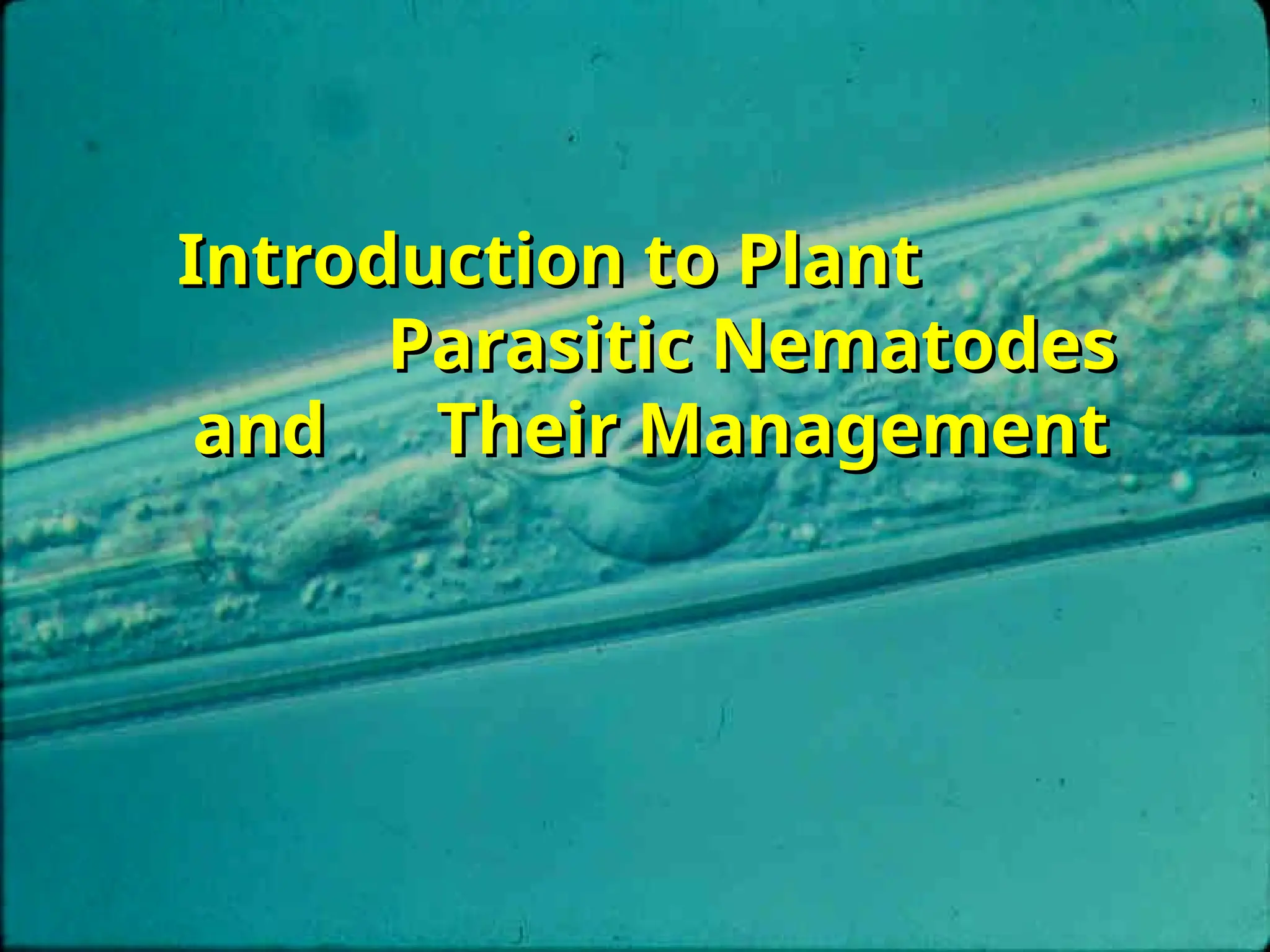
#2 Nematodes – Nematodes are small, mostly microscopic, nonsegemented roundworms. However, sizes range widely, and animal parasitic nematodes are generally largest. The vast majority of nematodes are beneficial microbial feeders and reside in the soil. They help promote healthy soil environments, that includes nutrient recycling. Other nematodes, such as insect feeders, provide benefits through reduction in populations of insects, e.g. mosquitoes, that are harmful to plants, animals and man. (The drawing shows the morphology of a typical plant-parasitic nematode. Note that some nematodes swell and are not vermiform (wormlike) during parts of their life cycle. This drawing is of a ‘ring’ nematode, it is widely found and quite damaging in golf courses and home lawns.
#3 Plant Nematodes – The study of plant-parasitic nematodes is relatively young compared to study of plant diseases and insects. Thus, there is still very much to be learned. However, we know that nematodes parasitize a huge number of plants (if not all) and cause billions of dollars worth of damage to world food crops as well as tree crops, turf and ornamentals. Damage or potential damage from nematodes must always be considered when producing plants. (The photos show palm trees declining with eventual death from the ‘red ring’ nematode disease. The nematodes are transmitted by the palm weevil.
#4 Stylet – Plant-parasites possess a stylet (spear) which differentiates them from other groups of nematodes. The stylet is used to puncture plant cell walls and membranes to allow withdrawal of cell contents. Stylets of most plant nematodes are hollow which provides a channel for cell contents to pass. A few have solid stylets that contain groves on the outside for this purpose. The general feeding process is: 1) the stylet pierces a cell; 2) digestive glands (esophageal glands) discharge enzymes which partially dissolve cell contents; then 3) contents are sucked by the action of the pumping bulb (median bulb) into the intestines (no stomach).
#5 Nematode Names – Plant nematodes are generally given common names according to either damage symptoms they produce on plants or some striking morphological feature they possess. For example, root-knot nematodes produce root ‘knots’ while stubby root nematodes cause ‘stubby’ looking roots. The cuticle of ring nematodes looks like a stack of coins giving it a ‘ringed’ appearance, while lance nematodes have a robust stylet, resembling a ‘lance’.
#6 Feeding Habits. Nematode feeding habits are described according to whether they feed inside or outside a root and if they move or not while feeding.
#7 Feeding Habits –Root-knot nematodes are sedentary and endoparasitic while the lesion nematode is migratory and endoparasitic. Note that the root-knot nematodes swell and appear pear-shaped, and thus, become sedentary.
#8 Feeding Habits – Cyst nematodes are sedentary and semi-endoparasitic while ring nematodes are sedentary and ectoparasitic.
#9 Feeding Habits – The stubby-root nematode is migratory and ectoparasitic while reniform nematodes are sedentary and semi-endoparasitic. Most nematodes initiate feeding just behind tips of young roots. However, some like the stubby-root nematode feed directly on the root tip, generally preventing further root elongation – hence stubby roots.
#10 Nematode Damage – Nematode damage is mainly a function of reduction of plant root mass. The feeding activities of most plant nematode result in plant root destruction, thereby limiting water and nutrient uptake by the plant. However, some nematodes cause the production of giant or nurse cells whose sole purpose is to feed the nematode (for example, root-knot nematodes). These nematodes not only physically damage a root from their activities but also redirect plant food for themselves.
#11 Foliar Symptoms - Damage from nematodes in plant foliage may be manifest directly from feeding activity on leaves, flowers and stems. Foliar feeding nematodes, however, are much less prevalent than those feeding on roots. Root feeding nematodes produce foliar symptoms that mirror root damage. In fact, most foliar-induced symptoms are the same as those plants show when not receiving sufficient water and nutrients – wilting, yellowing, and stunting. As a result, nematode problems are often misdiagnosed and blamed on a lack of fertilizer and water.
#12 Damage Patterns – Unlike the previous slide, most nematode damage will result in stunted, yellowing or both symptoms on plants. Areas of damage in a field are spotty across a field and irregular, usually oval, in shape. Nematodes almost never produce ‘row’ patterns.
#13 Plant Death – These grape tomatoes are in the last stages of decline/death due to root-knot nematodes. Nematodes do not usually kill plants outright but rather lead to a slow decline sometimes leading to death.
#14 Stunting – Cabbage plants in rows shown in this slide are the same age and planted on the same day. A nematicide was used to kill ‘sting’ nematodes before planting the cabbage on the left.
#16 Stunting – The cabbage plant on the left simply looks young, not necessarily nematode damaged. However, it is greatly stunted compared to the same age plant on the right.
#17 Root Damage Symptoms – Nematode damage on roots is only readily diagnosed in a few cases. For example, presence of root swellings or galls would usually indicate that root-knot nematodes are present. Also, plant root systems that show stubby and swollen root tips are typical of sting and stubby root nematode damage. However, most nematode damage simply results in stunted root systems or roots that show areas of dead tissue (lesions). These symptoms could be caused by a variety of other causal agents. For accurate problem determination, nematodes must be extracted and identified in a laboratory.
Slide 22. Root Damage Symptoms – Nematode damage on roots is only readily diagnosed in a few cases. For example, presence of root swellings or galls would usually indicate that root-knot nematodes are present. Also, plant root systems that show stubby and swollen root tips are typical of sting and stubby root nematode damage. However, most nematode damage simply results in stunted root systems or roots that show areas of dead tissue (lesions). These symptoms could be caused by a variety of other causal agents. For accurate problem determination, nematodes must be extracted and identified in a laboratory.
Slide 23. Root Galling – Root-knot nematodes are widely distributed and major soil pests worldwide. These nematodes cause plant cells to multiply rapid producing ‘knot’ (galls) on roots. Females are imbedded inside these galls. As indicated, root galling is easily observed and quite diagnostic for presence of these nematodes.
#18 Root Galling – Root-knot nematodes are widely distributed and major soil pests worldwide. These nematodes cause plant cells to multiply rapidly producing ‘knots’ (galls) on roots. Females are imbedded inside these galls. As indicated, root galling is easily observed and quite diagnostic for presence of these nematodes.
#19 Cysts on Roots – Cyst nematodes do not cause major malformations or lesions on roots. However, their swollen bodies are on the outside the root. By careful examination with a magnifying glass, ‘pearly’ white cysts on the roots can be seen.
#20 Root Lesion - Root lesions may be caused by any number of factors. Among these are nematodes, primarily lesion and burrowing, that produce dead areas on roots. For accurate diagnosis, however, soil and root samples must be analyzed in a laboratory.
#21 Sweet Potatoes - Nematodes not only damage roots, thus affecting plant growth, but also other plant parts present in soil. Root and tuber crops are affected in appearance and quality as well as quantity produced. Pictured here are sweet potatoes infected with root-knot nematodes resulting in a serious reduction in both appearance and quality.
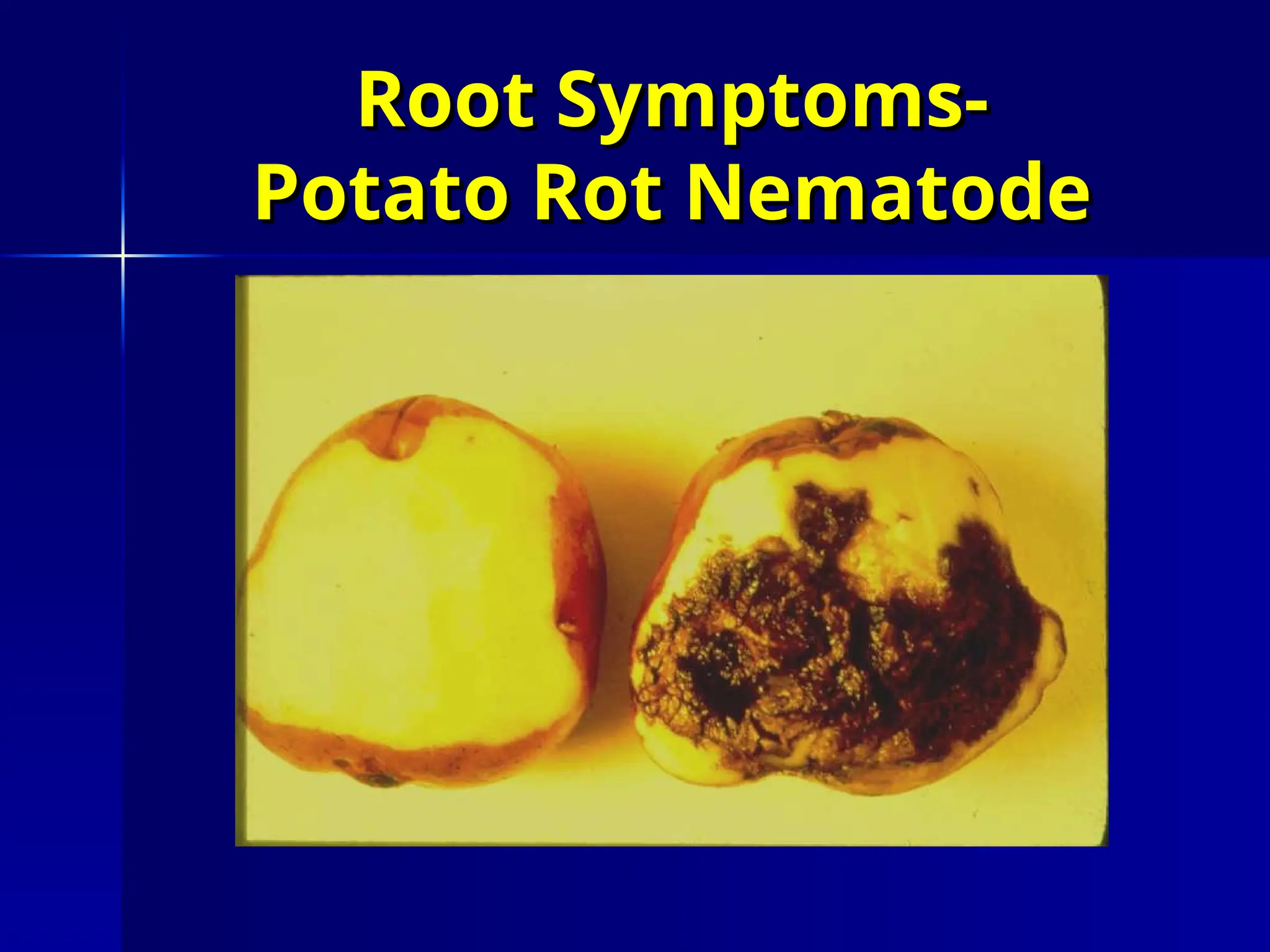
#22 Potato Rot - The ‘potato rot’ nematode causes accelerated tuber rotting as shown in this photograph. Tubers infected with these nematodes are a total loss
#23 Root Sprangling - Nematodes are a major problem on some root crops, reducing yield and resulting in rotting but sometimes more importantly, growth distortion. For example, even low populations of nematodes can cause root ‘sprangling’ on crops such as carrots and turnips, thus rendering them unmarketable.
#24 Disease Interactions - Nematodes not only cause plant disease by themselves but also increase plant damage caused by other disease-causing organisms such as bacteria and fungi. For example, the presence of nematodes provides entry points for invasion of Fusarium wilt fungi in a number of crops. (Note in the photograph that presence of the Fusarium wilt fungus showed little affect on plant growth, but damage dramatically increased in the presence of root-knot nematodes (Mi, Mh, and Mj).
#25 Problem Identification – To identify a nematode problem, one must consider individual plant foliar and root symptoms, field damage patterns, plus have an idea of cropping history (were susceptible crops previously grown?). If nematodes are suspected, a final laboratory analysis is often needed to confirm suspicions.
#26 Management - Methods for nematode management are generally broken down into: 1) exclusion, 2) sanitation, 3) cultural practices, 4) plant resistance, and 5) nematicides. The heading, cultural practices, is not listed in the slide. Rather, those cultural practices of rotation, solarization, and fallow are listed separately. This was done to emphasize the importance of these techniques, particularly where use of nematicides are prohibited or not available.
#27 Exclusion/Sanitation – Keep pests out!! For example, buy or grow transplants that are nematode-free. The soil medium is obviously the greatest consideration here and it should be nematode-free. Remove potentially contaminated soil and plant materials from tools and other equipment when moving from one area or field to another. For nematodes, this is usually just a matter of rinsing tools thoroughly with water.
#28 Rotation – This ‘cultural practice’ can/should be a cornerstone of any nematode management program. In most annual crops, proper crop rotation with non- or poor hosts of nematodes is the only nematode management needed. However, economics of growing ‘rotation’ crops, practicality including land requirements, and specific nematode host range many times limits rotation options. This practice should always be keep in mind, even in small garden plots, where perhaps sweet corn could be rotated with more susceptible crops such as okra.
#29 Soybean Rotation – Planting a poor or nonhost of nematodes for two years will generally reduce nematode populations and allow acceptable plant growth of a susceptible crop.
#30 Resistance - The use of plant resistance, when available, should always be encouraged. Resistance to root-knot nematodes is available in crops such tomato, soybean, snap bean, southern peas and several other crops. A word of caution, do not rely solely on plant resistance since certain populations of nematodes can overcome resistance beginning either immediately or sometimes several years after regularly planting the resistant plant.
#31 Resistant/Not Resistant – The process of finding, breeding and selecting plants with resistance to nematodes is long and tedious. The plant on the left shows good resistance to root-knot nematodes as evidenced by lack of galling, note the susceptible, galled root system on the right.
#32 Solarization – This practice dramatically increases soil temperatures which in turn kills many weed, fungal, insect and nematode pests. Temperatures that kill nematodes are reached only in the first six inches or so of soil leaving living nematodes present at lower depths. Thus, correct use of solarization will reduce nematode populations, but not enough to prevent all nematode damage to crop plants. It is only useful to minimize nematode damage but should be used in combination with other management practices.
#33 Laying Clear Plastic – Solarization increases soil temperatures and these temperatures kill nematodes. l Soil temperatures that kill nematodes, however, are only reached to depths of 6-8 inches. Remaining nematodes below this depth are usually present in high enough numbers to still cause plant damage.
#35 Management Summary - At least two management practices must be used to minimize nematode damage. In addition, good crop husbandry practices such as addition of organic matter, good soil fertility and irrigation will also help reduce nematode damage.