Prepared by
Umesh Timilsina
Assistant Professor
CNRM, Bardibas
Agriculture and Forestry University
Maturity and Maturity Indices of
fruits and vegetables
• Once a crop is harvested, the quality can no longer be
improved but it can be maintained for a considerable
length of time.
MATURITY OR MATURATION
 It is the stage of full development of tissue of fruit and vegetables
only after which it will ripen normally.
 Also defined as the stage of development leading the attainment of
physiological or horticultural maturity.
 Ripening stage comes only after maturity.
 During the process of maturation the fruit receives a regular supply
of food material from the plant.
 When mature, the abscission or corky layer which forms at the stem
end stops this inflow.
 Afterwards, the fruit depend on its own reserves.
 In addition to this, typical flavour and characteristic colour also
develop.
 It has been determined that the stage of maturity at the time of
picking influence the storage life and quality of fruit.
Premature Harvesting??
 Premature harvesting results poor quality and
deterioration at faster rate than harvested at proper stage
of maturity
 Yield may also be lower since the commodities grow
considerably towards the end of maturation.
 Fruits that are harvested too early will generally present
insufficient red skin coloration, low sugar contents (Soluble
solids), high acidity levels, will be too firm, small sized,
lacking flavor and/or be susceptible to physiological
disorders such as bitter pit or storage scalds.
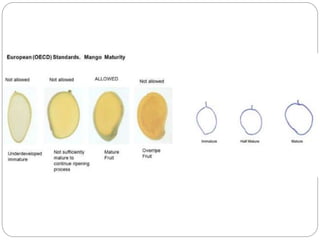
 When picked immature like mango whereby develop white
patches or air pockets during ripening and lacking in
normal brix acid ratio or sugar acid ratio, taste and
flavor.
Overmature harvesting??
 On the other hand if the fruits are harvested over mature or
full ripe they are easily susceptible to microbial and
physiological spoilage and their storage life is considerably
reduce.
 Such fruits persist numerous problems during handling,
storage and transportation
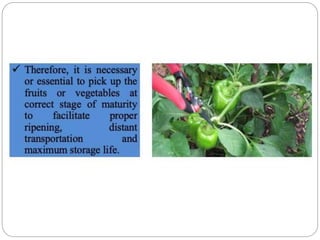
 Therefore, it is necessary or essential to pick up the fruits or
vegetables at correct stage of maturity to facilitate proper
ripening, distant transportation and maximum storage life.
 We can have good harvest if we harvest at proper time as the
development of the fruits occurs at later stage of
development.
Fruits harvested too early may lack flavor and may not
ripen properly, deteriorate faster and have short shelf life
While produce harvested too late may be fibrous or have
very limited market life.
Yield may also be lower.
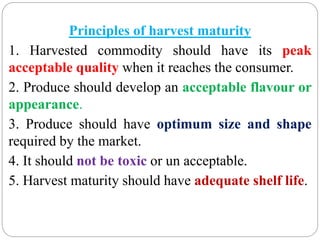
Principles of harvest maturity
1. Harvested commodity should have its peak
acceptable quality when it reaches the consumer.
2. Produce should develop an acceptable flavour or
appearance.
3. Produce should have optimum size and shape
required by the market.
4. It should not be toxic or un acceptable.
5. Harvest maturity should have adequate shelf life.
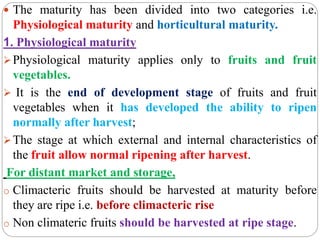
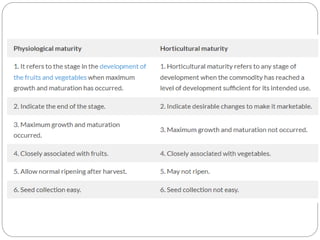
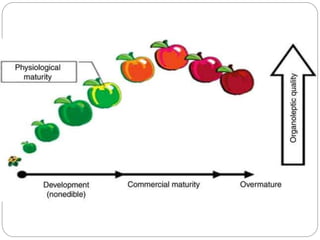
 The maturity has been divided into two categories i.e.
Physiological maturity and horticultural maturity.
1. Physiological maturity
Physiological maturity applies only to fruits and fruit
vegetables.
 It is the end of development stage of fruits and fruit
vegetables when it has developed the ability to ripen
normally after harvest;
The stage at which external and internal characteristics of
the fruit allow normal ripening after harvest.
For distant market and storage,
o Climacteric fruits should be harvested at maturity before
they are ripe i.e. before climacteric rise
o Non climateric fruits should be harvested at ripe stage.
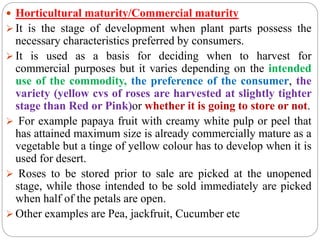
 Horticultural maturity/Commercial maturity
 It is the stage of development when plant parts possess the
necessary characteristics preferred by consumers.
 It is used as a basis for deciding when to harvest for
commercial purposes but it varies depending on the intended
use of the commodity, the preference of the consumer, the
variety (yellow cvs of roses are harvested at slightly tighter
stage than Red or Pink)or whether it is going to store or not.
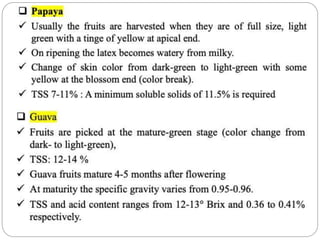
 For example papaya fruit with creamy white pulp or peel that
has attained maximum size is already commercially mature as a
vegetable but a tinge of yellow colour has to develop when it is
used for desert.
 Roses to be stored prior to sale are picked at the unopened
stage, while those intended to be sold immediately are picked
when half of the petals are open.
 Other examples are Pea, jackfruit, Cucumber etc
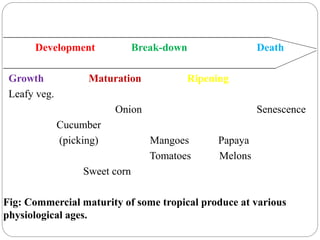
__________________________________________________
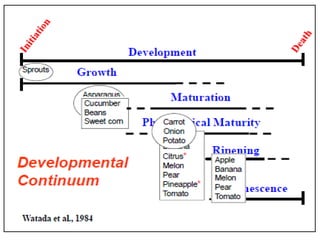
Development Break-down Death
___________________________________________________
Growth Maturation Ripening
Leafy veg.
Onion Senescence
Cucumber
(picking) Mangoes Papaya
Tomatoes Melons
Sweet corn
Fig: Commercial maturity of some tropical produce at various
physiological ages.
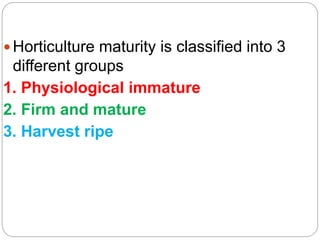
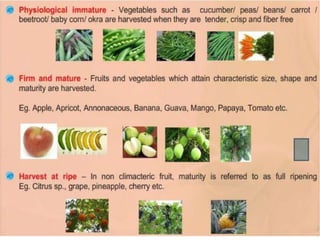
 Horticulture maturity is classified into 3
different groups
1. Physiological immature
2. Firm and mature
3. Harvest ripe
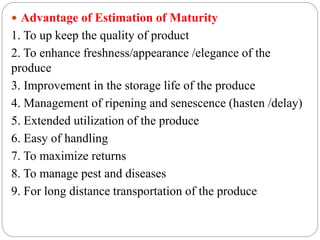
 Advantage of Estimation of Maturity
1. To up keep the quality of product
2. To enhance freshness/appearance /elegance of the
produce
3. Improvement in the storage life of the produce
4. Management of ripening and senescence (hasten /delay)
5. Extended utilization of the produce
6. Easy of handling
7. To maximize returns
8. To manage pest and diseases
9. For long distance transportation of the produce
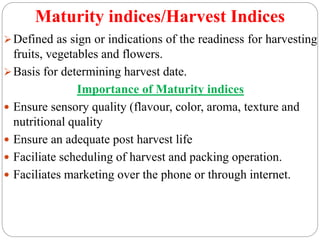
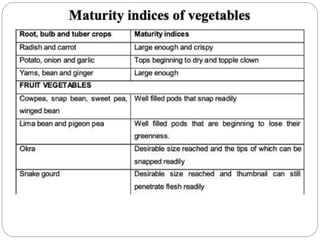
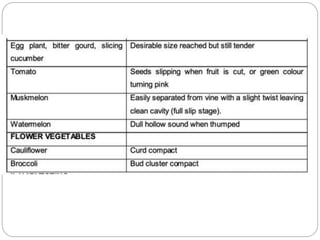
Maturity indices/Harvest Indices
Defined as sign or indications of the readiness for harvesting
fruits, vegetables and flowers.
Basis for determining harvest date.
Importance of Maturity indices
 Ensure sensory quality (flavour, color, aroma, texture and
nutritional quality
 Ensure an adequate post harvest life
 Faciliate scheduling of harvest and packing operation.
 Faciliates marketing over the phone or through internet.
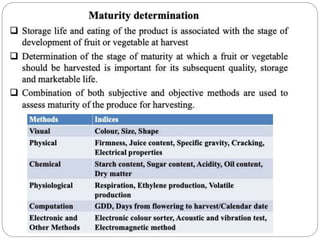
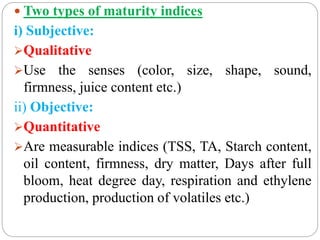
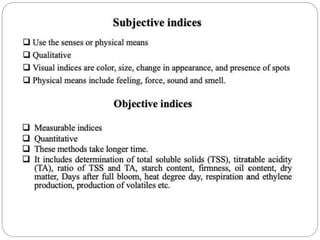
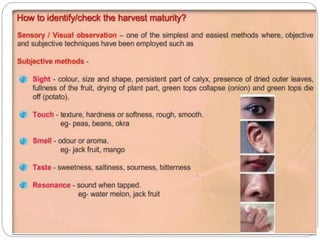
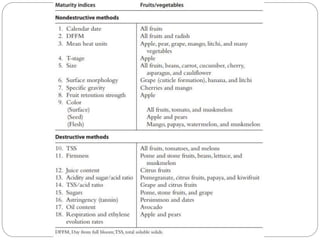
 Two types of maturity indices
i) Subjective:
Qualitative
Use the senses (color, size, shape, sound,
firmness, juice content etc.)
ii) Objective:
Quantitative
Are measurable indices (TSS, TA, Starch content,
oil content, firmness, dry matter, Days after full
bloom, heat degree day, respiration and ethylene
production, production of volatiles etc.)
Types of maturity indices/Methods of maturity
determination
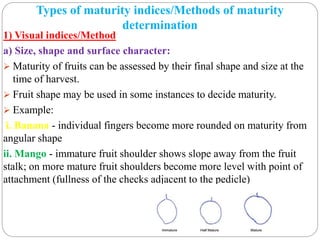
1) Visual indices/Method
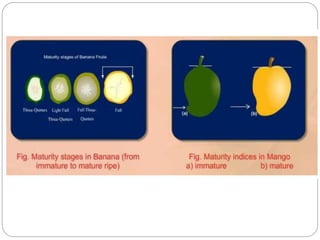
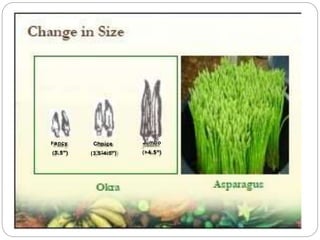
a) Size, shape and surface character:
 Maturity of fruits can be assessed by their final shape and size at the
time of harvest.
 Fruit shape may be used in some instances to decide maturity.
 Example:
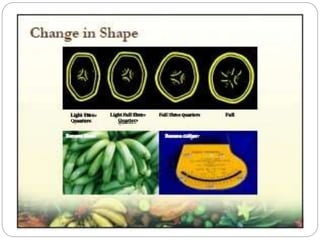
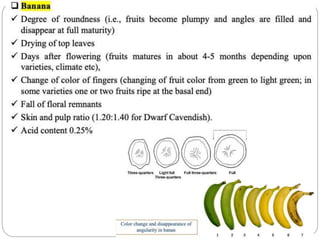
i. Banana - individual fingers become more rounded on maturity from
angular shape
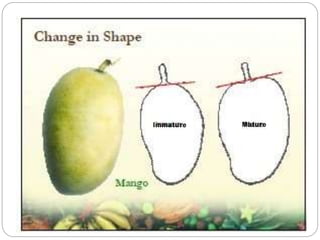
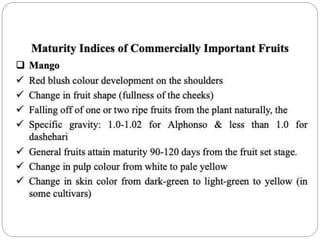
ii. Mango - immature fruit shoulder shows slope away from the fruit
stalk; on more mature fruit shoulders become more level with point of
attachment (fullness of the checks adjacent to the pedicle)
Light Three
Quarters
Light Full Three
Quarters
Full Three Quarters Full
Banana Hand Banana Caliper
Immature Mature
Fancy
(3.5”)
Choice
(3.5-4.5”)
Jumbo
(>4.5”)
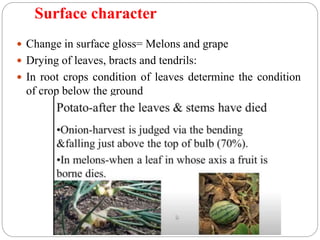
Surface character
 Change in surface gloss= Melons and grape
 Drying of leaves, bracts and tendrils:
 In root crops condition of leaves determine the condition
of crop below the ground
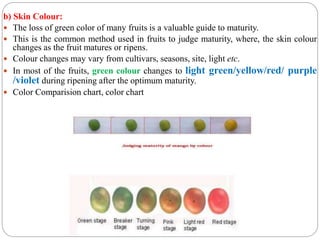
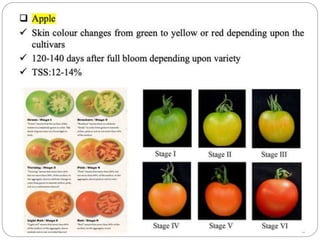
b) Skin Colour:
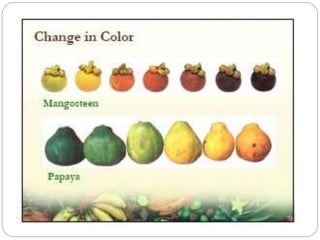
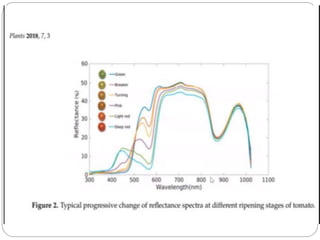
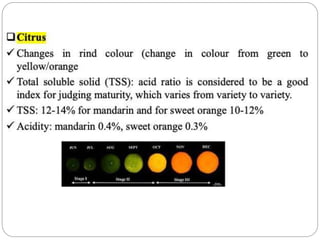
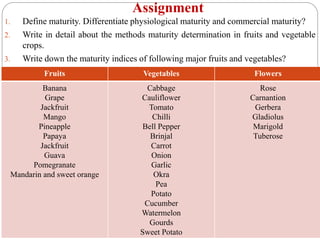
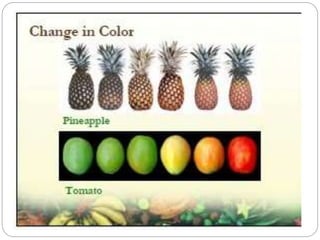
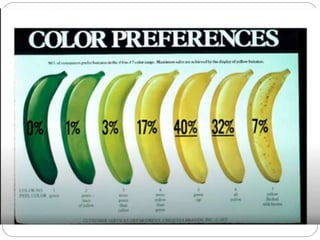
 The loss of green color of many fruits is a valuable guide to maturity.
 This is the common method used in fruits to judge maturity, where, the skin colour
changes as the fruit matures or ripens.
 Colour changes may vary from cultivars, seasons, site, light etc.
 In most of the fruits, green colour changes to light green/yellow/red/ purple
/violet during ripening after the optimum maturity.
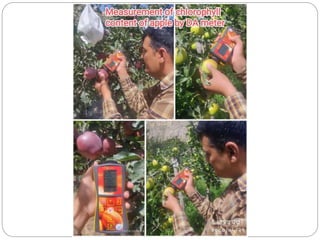
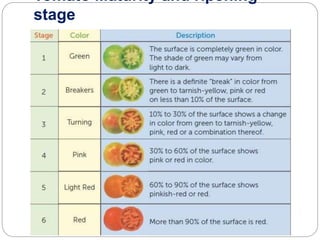
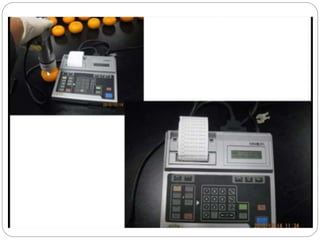
 Color Comparision chart, color chart
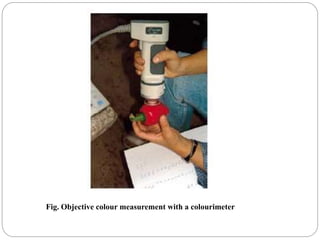
Fig. Objective colour measurement with a colourimeter
Tomato Maturity and ripening
stage
2. Physical method
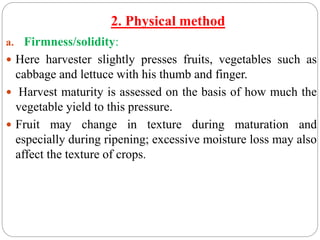
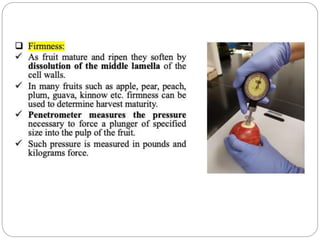
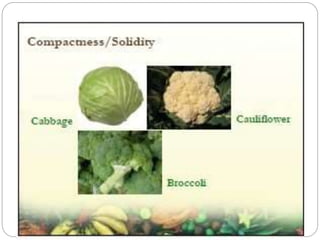
a. Firmness/solidity:
 Here harvester slightly presses fruits, vegetables such as
cabbage and lettuce with his thumb and finger.
 Harvest maturity is assessed on the basis of how much the
vegetable yield to this pressure.
 Fruit may change in texture during maturation and
especially during ripening; excessive moisture loss may also
affect the texture of crops.
 Destructive firmness test methods
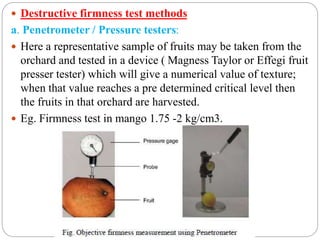
a. Penetrometer / Pressure testers:
 Here a representative sample of fruits may be taken from the
orchard and tested in a device ( Magness Taylor or Effegi fruit
presser tester) which will give a numerical value of texture;
when that value reaches a pre determined critical level then
the fruits in that orchard are harvested.
 Eg. Firmness test in mango 1.75 -2 kg/cm3.
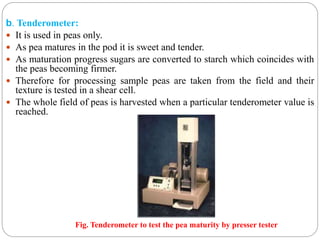
b. Tenderometer:
 It is used in peas only.
 As pea matures in the pod it is sweet and tender.
 As maturation progress sugars are converted to starch which coincides with
the peas becoming firmer.
 Therefore for processing sample peas are taken from the field and their
texture is tested in a shear cell.
 The whole field of peas is harvested when a particular tenderometer value is
reached.
Fig. Tenderometer to test the pea maturity by presser tester
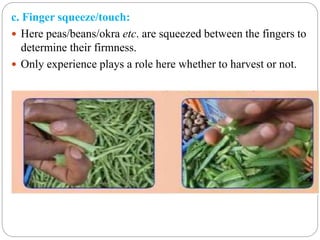
c. Finger squeeze/touch:
 Here peas/beans/okra etc. are squeezed between the fingers to
determine their firmness.
 Only experience plays a role here whether to harvest or not.
b) Specific gravity:
Specific gravity is the ratio of the density of a substance to
the density of a reference substance.
As fruit mature, their specific gravity increases.
This parameter is rarely used in practice to determine when to
harvest a crop.
It is used to grade crops into different maturities.
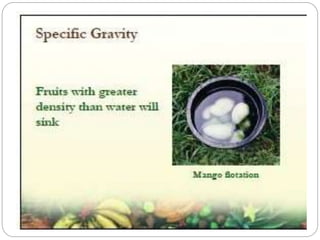
To do this the fruit or vegetable is placed in a tank of water;
those that float will be less mature that those that sink.
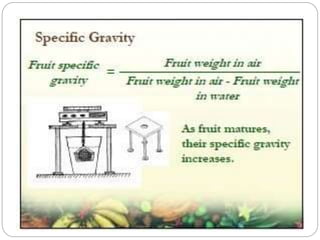
In practice, the fruit or vegetable is weighed in air, then in pure
water.
The weight in air divided by the weight in water gives the
specific gravity.
Image processing technique and hydrometer are used in the
industry.
Specific gravity of Dasheri mango: 1.02
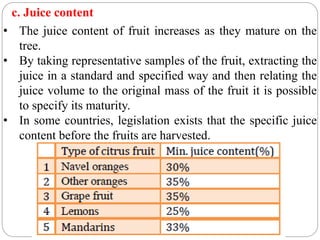
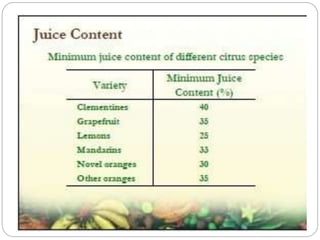
c. Juice content
• The juice content of fruit increases as they mature on the
tree.
• By taking representative samples of the fruit, extracting the
juice in a standard and specified way and then relating the
juice volume to the original mass of the fruit it is possible
to specify its maturity.
• In some countries, legislation exists that the specific juice
content before the fruits are harvested.
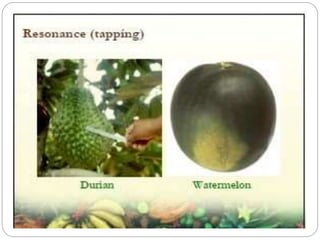
d. Acoustic/sound (resonance) tests:
 The sound of a fruit as it is tapped sharply with a
finger knuckle can change during maturation and
ripening.
 This method of testing fruit is sometimes used by
consumers when purchasing fruit.
 Eg. - Water melon fruit may be tapped in the
field to judge whether they are ready to be
harvest, ripe fruit gives dull sound and also in
jackfruit
e. Exudation of milk when pierced
 Eg. Papaya
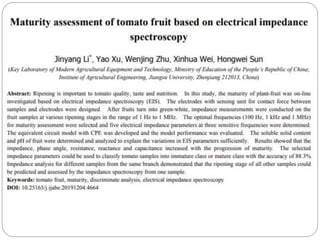
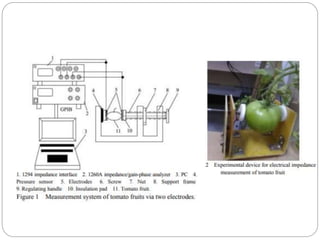
f. Electrical properties
 Experiments: Passing electric current through the fruits
 Correlation between the way electric current pass
through the fruit and fruit ripening.
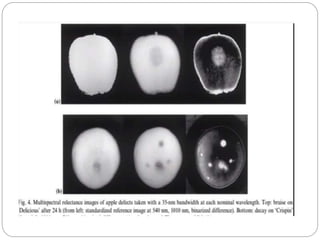
g. Electro magnetic rays/Nucleic Magnetic Resonance
Shown to correlate well with the sugar content of apple
and banana and oil content of Avocado.
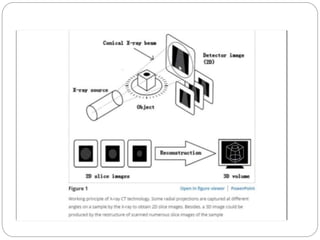
h. Radiation: Both x-rays and Gamma rays
 Lettuce harvester use X-rays to determine the maturity.
3) Chemical Measurement
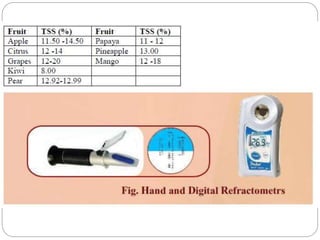
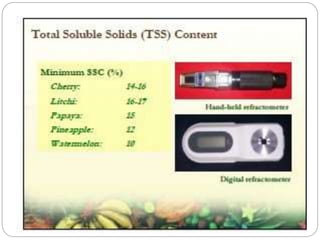
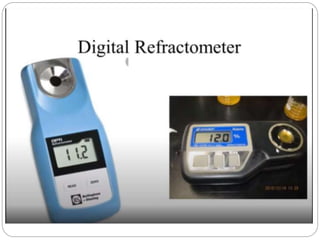
 The total soluble solids of the fruit can be measured with
refractometer, which indicate the harvest maturity of fruits.
 Acidity is readily determined on a sample of extracted juice by
titration with 0.1 N NaOH.
 TSS/TA is better to judge maturity as it gives the sugar acid
blending of product
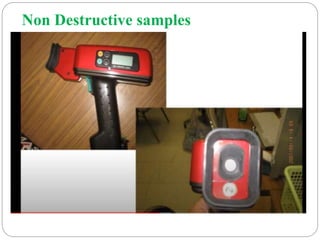
a) Total Soluble Solids
 can be determined in a small sample of fruit juice using hand
refractometer
 The refractometer measures the refractive index, which indicates
how much a light beam will be slowed down when it passes
through the fruit juice.
 The refractometer has different scales (0-32OB), (28-62OB) and
(56-92OB) which can be read directly.
The fruit tissues should be macerated thoroughly in pastle
motor and then from the macerated pulp the juice is
extracted by passing through muslin cloth.
A drop of juice is then put on the prism of the refractometer
and TSS content can be read directly on the scale.
However, in case of small fruits like grapes, the juice content
can be extracted by simply pressing the whole fruit.
Non Destructive samples
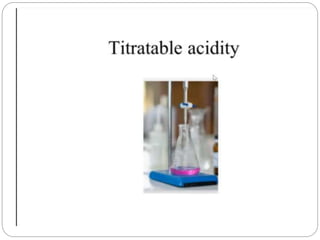
b) Titratable acidity:
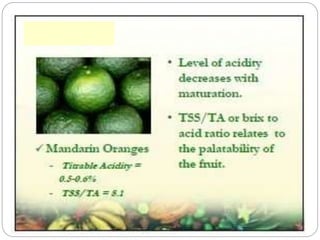
 In many citrus fruits and others acidity progressively
reduces on maturation and ripening.
 Extract the juice from the sample and titrating it against a
standard alkaline solution gives a measure which can be
related to optimum time of harvest.
 This measure gives the brix: acid ratio
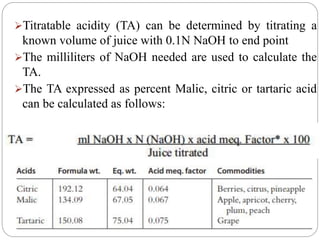
Titratable acidity (TA) can be determined by titrating a
known volume of juice with 0.1N NaOH to end point
The milliliters of NaOH needed are used to calculate the
TA.
The TA expressed as percent Malic, citric or tartaric acid
can be calculated as follows:
c. Oil content:
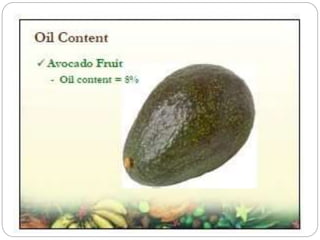
 Oil content of the fruit may be used to determine the harvest
maturity of avocados.
 At the time of picking and at all times there after shall
contain not less than 8% of oil by weight of the avocado
excluding the skin and seed.
 There is good correlation between taste and oil content and
dry matter.
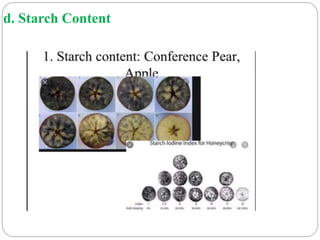
d. Starch Content
4) Calculated indices:
a) Calendar Date:
 It is one of the commonly used indices of maturity and is
reasonably accurate provided flowering and weather during
growing season is normal.
 But standardization requires study for many seasons for given
variety, location, rootstock etc.
 Eg. Mango harvesting period – May to July
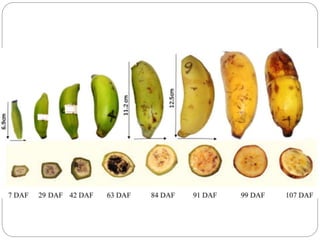
b) DFFB(Days From Full Bloom) to harvest:
 It is reliable but varies greatly from year to year and location to
location.
 Eg. Mango 110 -125 day (Var. Alphonso and Pairi ), Banana 99 -
107 days in dwarf Cavendish
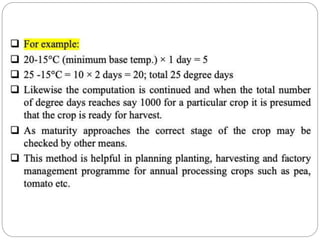
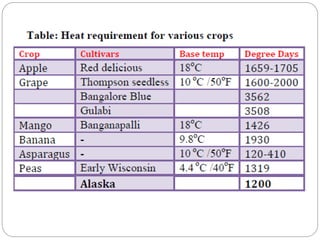
c) Growing Degree Days (GDD)/Heat Units:
Maturity can be predicted on the basis of cumulative heat
units obtained during growing season.
It is based on the principle that growth of plant organ is
directly proportional with ambient temperature.
The number of degree-days to maturity is determined over
a period of several years.
10°C /50°F is the temperature at which growth occurs for
apple and base temperature varies with crop.
The degree day is based on a growth-temperature relation.
However this heat units work only within limited
temperature.
A Heat unit is calculated by GDD=(Daily mean temp –
Base temp) X No. of Days (flowering to harvest)
Base temperature for mango, tomato, spinach and pumpkin
is 17.5°C, 15°C, 2°C and 13°C respectively.
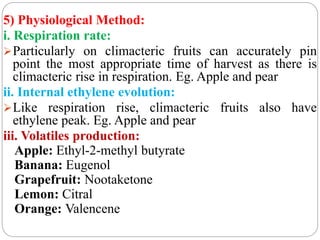
5) Physiological Method:
i. Respiration rate:
Particularly on climacteric fruits can accurately pin
point the most appropriate time of harvest as there is
climacteric rise in respiration. Eg. Apple and pear
ii. Internal ethylene evolution:
Like respiration rise, climacteric fruits also have
ethylene peak. Eg. Apple and pear
iii. Volatiles production:
Apple: Ethyl-2-methyl butyrate
Banana: Eugenol
Grapefruit: Nootaketone
Lemon: Citral
Orange: Valencene
Assignment
1. Define maturity. Differentiate physiological maturity and commercial maturity?
2. Write in detail about the methods maturity determination in fruits and vegetable
crops.
3. Write down the maturity indices of following major fruits and vegetables?
Fruits Vegetables Flowers
Banana
Grape
Jackfruit
Mango
Pineapple
Papaya
Jackfruit
Guava
Pomegranate
Mandarin and sweet orange
Cabbage
Cauliflower
Tomato
Chilli
Bell Pepper
Brinjal
Carrot
Onion
Garlic
Okra
Pea
Potato
Cucumber
Watermelon
Gourds
Sweet Potato
Rose
Carnantion
Gerbera
Gladiolus
Marigold
Tuberose