Cultivation
Deepak K. Birla
P’cognosy
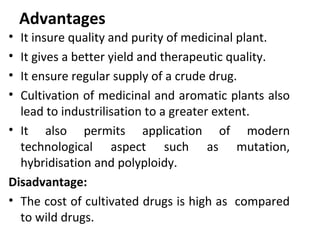
Advantages
• It insure quality and purity of medicinal plant.
• It gives a better yield and therapeutic quality.
• It ensure regular supply of a crude drug.
• Cultivation of medicinal and aromatic plants also
lead to industrilisation to a greater extent.
• It also permits application of modern
technological aspect such as mutation,
hybridisation and polyploidy.
Disadvantage:
• The cost of cultivated drugs is high as compared
to wild drugs.
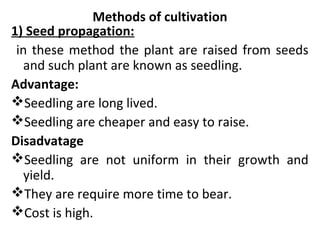
Methods of cultivation
1) Seed propagation:
in these method the plant are raised from seeds
and such plant are known as seedling.
Advantage:
Seedling are long lived.
Seedling are cheaper and easy to raise.
Disadvatage
Seedling are not uniform in their growth and
yield.
They are require more time to bear.
Cost is high.
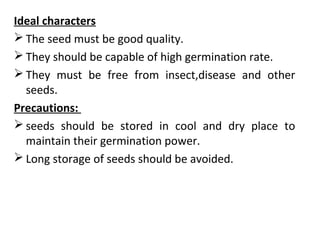
Ideal characters
 The seed must be good quality.
 They should be capable of high germination rate.
 They must be free from insect,disease and other
seeds.
Precautions:
 seeds should be stored in cool and dry place to
maintain their germination power.
 Long storage of seeds should be avoided.
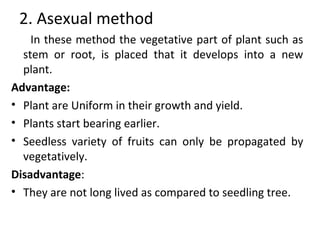
2. Asexual method
In these method the vegetative part of plant such as
stem or root, is placed that it develops into a new
plant.
Advantage:
• Plant are Uniform in their growth and yield.
• Plants start bearing earlier.
• Seedless variety of fruits can only be propagated by
vegetatively.
Disadvantage:
• They are not long lived as compared to seedling tree.
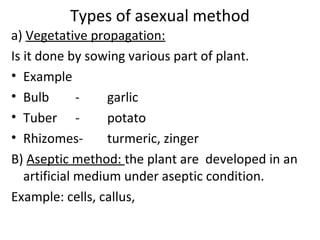
Types of asexual method
a) Vegetative propagation:
Is it done by sowing various part of plant.
• Example
• Bulb - garlic
• Tuber - potato
• Rhizomes- turmeric, zinger
B) Aseptic method: the plant are developed in an
artificial medium under aseptic condition.
Example: cells, callus,
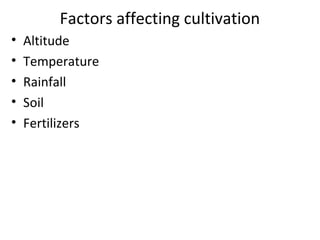
Factors affecting cultivation
• Altitude
• Temperature
• Rainfall
• Soil
• Fertilizers
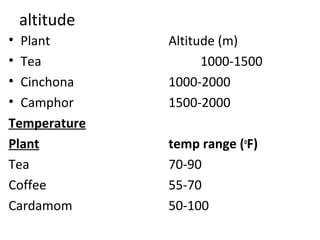
altitude
• Plant Altitude (m)
• Tea 1000-1500
• Cinchona 1000-2000
• Camphor 1500-2000
Temperature
Plant temp range (o
F)
Tea 70-90
Coffee 55-70
Cardamom 50-100
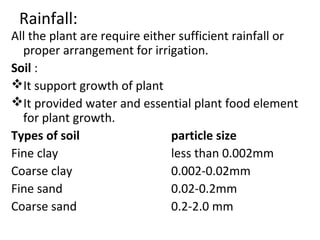
Rainfall:
All the plant are require either sufficient rainfall or
proper arrangement for irrigation.
Soil :
It support growth of plant
It provided water and essential plant food element
for plant growth.
Types of soil particle size
Fine clay less than 0.002mm
Coarse clay 0.002-0.02mm
Fine sand 0.02-0.2mm
Coarse sand 0.2-2.0 mm
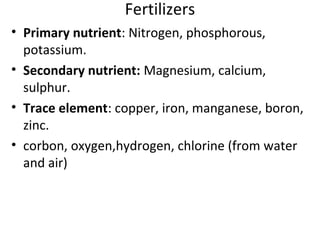
Fertilizers
• Primary nutrient: Nitrogen, phosphorous,
potassium.
• Secondary nutrient: Magnesium, calcium,
sulphur.
• Trace element: copper, iron, manganese, boron,
zinc.
• corbon, oxygen,hydrogen, chlorine (from water
and air)
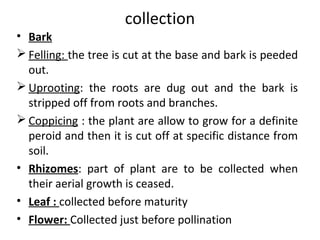
collection
• Bark
 Felling: the tree is cut at the base and bark is peeded
out.
 Uprooting: the roots are dug out and the bark is
stripped off from roots and branches.
 Coppicing : the plant are allow to grow for a definite
peroid and then it is cut off at specific distance from
soil.
• Rhizomes: part of plant are to be collected when
their aerial growth is ceased.
• Leaf : collected before maturity
• Flower: Collected just before pollination
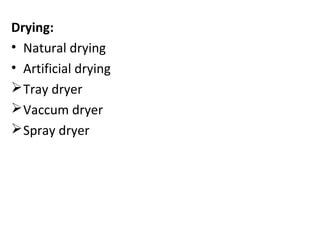
Drying:
• Natural drying
• Artificial drying
Tray dryer
Vaccum dryer
Spray dryer

Cultivation

  • 1.
  • 2.
    Advantages • It insurequality and purity of medicinal plant. • It gives a better yield and therapeutic quality. • It ensure regular supply of a crude drug. • Cultivation of medicinal and aromatic plants also lead to industrilisation to a greater extent. • It also permits application of modern technological aspect such as mutation, hybridisation and polyploidy. Disadvantage: • The cost of cultivated drugs is high as compared to wild drugs.
  • 3.
    Methods of cultivation 1)Seed propagation: in these method the plant are raised from seeds and such plant are known as seedling. Advantage: Seedling are long lived. Seedling are cheaper and easy to raise. Disadvatage Seedling are not uniform in their growth and yield. They are require more time to bear. Cost is high.
  • 4.
    Ideal characters  Theseed must be good quality.  They should be capable of high germination rate.  They must be free from insect,disease and other seeds. Precautions:  seeds should be stored in cool and dry place to maintain their germination power.  Long storage of seeds should be avoided.
  • 5.
    2. Asexual method Inthese method the vegetative part of plant such as stem or root, is placed that it develops into a new plant. Advantage: • Plant are Uniform in their growth and yield. • Plants start bearing earlier. • Seedless variety of fruits can only be propagated by vegetatively. Disadvantage: • They are not long lived as compared to seedling tree.
  • 6.
    Types of asexualmethod a) Vegetative propagation: Is it done by sowing various part of plant. • Example • Bulb - garlic • Tuber - potato • Rhizomes- turmeric, zinger B) Aseptic method: the plant are developed in an artificial medium under aseptic condition. Example: cells, callus,
  • 7.
    Factors affecting cultivation •Altitude • Temperature • Rainfall • Soil • Fertilizers
  • 8.
    altitude • Plant Altitude(m) • Tea 1000-1500 • Cinchona 1000-2000 • Camphor 1500-2000 Temperature Plant temp range (o F) Tea 70-90 Coffee 55-70 Cardamom 50-100
  • 9.
    Rainfall: All the plantare require either sufficient rainfall or proper arrangement for irrigation. Soil : It support growth of plant It provided water and essential plant food element for plant growth. Types of soil particle size Fine clay less than 0.002mm Coarse clay 0.002-0.02mm Fine sand 0.02-0.2mm Coarse sand 0.2-2.0 mm
  • 10.
    Fertilizers • Primary nutrient:Nitrogen, phosphorous, potassium. • Secondary nutrient: Magnesium, calcium, sulphur. • Trace element: copper, iron, manganese, boron, zinc. • corbon, oxygen,hydrogen, chlorine (from water and air)
  • 11.
    collection • Bark  Felling:the tree is cut at the base and bark is peeded out.  Uprooting: the roots are dug out and the bark is stripped off from roots and branches.  Coppicing : the plant are allow to grow for a definite peroid and then it is cut off at specific distance from soil. • Rhizomes: part of plant are to be collected when their aerial growth is ceased. • Leaf : collected before maturity • Flower: Collected just before pollination
  • 12.
    Drying: • Natural drying •Artificial drying Tray dryer Vaccum dryer Spray dryer