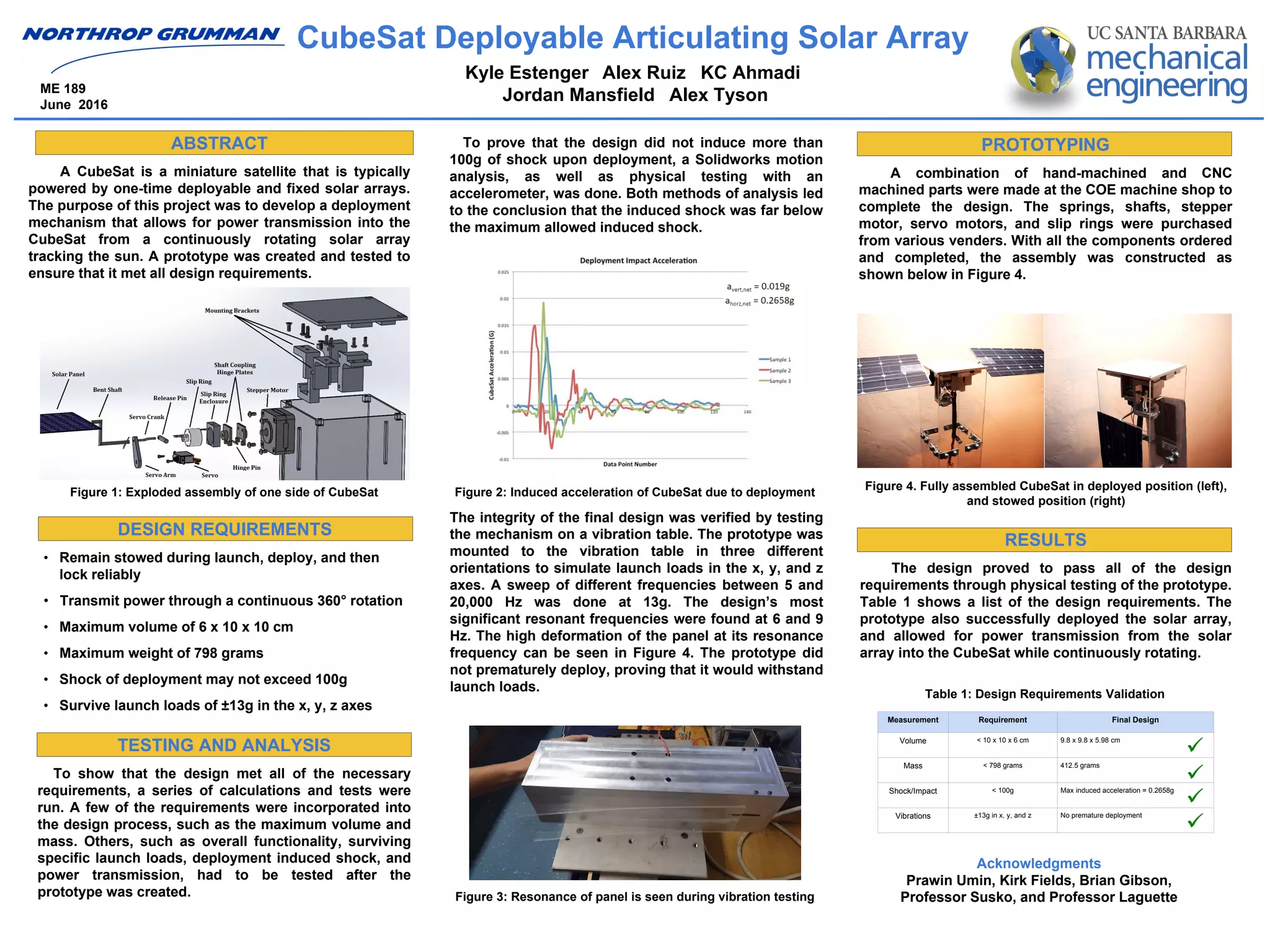
DESIGN REQUIREMENTS
• Remain stowed during launch, deploy, and then
lock reliably
• Transmit power through a continuous 360° rotation
• Maximum volume of 6 x 10 x 10 cm
• Maximum weight of 798 grams
• Shock of deployment may not exceed 100g
• Survive launch loads of ±13g in the x, y, z axes
PROTOTYPING
A combination of hand-machined and CNC
machined parts were made at the COE machine shop to
complete the design. The springs, shafts, stepper
motor, servo motors, and slip rings were purchased
from various venders. With all the components ordered
and completed, the assembly was constructed as
shown below in Figure 4.
CubeSat Deployable Articulating Solar Array
Acknowledgments
Prawin Umin, Kirk Fields, Brian Gibson,
Professor Susko, and Professor Laguette
Kyle Estenger Alex Ruiz KC Ahmadi
Jordan Mansfield Alex Tyson
ABSTRACT
A CubeSat is a miniature satellite that is typically
powered by one-time deployable and fixed solar arrays.
The purpose of this project was to develop a deployment
mechanism that allows for power transmission into the
CubeSat from a continuously rotating solar array
tracking the sun. A prototype was created and tested to
ensure that it met all design requirements.
TESTING AND ANALYSIS
To show that the design met all of the necessary
requirements, a series of calculations and tests were
run. A few of the requirements were incorporated into
the design process, such as the maximum volume and
mass. Others, such as overall functionality, surviving
specific launch loads, deployment induced shock, and
power transmission, had to be tested after the
prototype was created.
ME 189
June 2016
Figure 2: Induced acceleration of CubeSat due to deployment
Figure 4. Fully assembled CubeSat in deployed position (left),
and stowed position (right)
RESULTS
The design proved to pass all of the design
requirements through physical testing of the prototype.
Table 1 shows a list of the design requirements. The
prototype also successfully deployed the solar array,
and allowed for power transmission from the solar
array into the CubeSat while continuously rotating.
Figure 3: Resonance of panel is seen during vibration testing
The integrity of the final design was verified by testing
the mechanism on a vibration table. The prototype was
mounted to the vibration table in three different
orientations to simulate launch loads in the x, y, and z
axes. A sweep of different frequencies between 5 and
20,000 Hz was done at 13g. The design’s most
significant resonant frequencies were found at 6 and 9
Hz. The high deformation of the panel at its resonance
frequency can be seen in Figure 4. The prototype did
not prematurely deploy, proving that it would withstand
launch loads.
To prove that the design did not induce more than
100g of shock upon deployment, a Solidworks motion
analysis, as well as physical testing with an
accelerometer, was done. Both methods of analysis led
to the conclusion that the induced shock was far below
the maximum allowed induced shock.
Figure 1: Exploded assembly of one side of CubeSat
Measurement Requirement Final Design
Volume < 10 x 10 x 6 cm 9.8 x 9.8 x 5.98 cm
Mass < 798 grams 412.5 grams
Shock/Impact < 100g Max induced acceleration = 0.2658g
Vibrations ±13g in x, y, and z No premature deployment
Table 1: Design Requirements Validation

CubeSat Poster

  • 1.
    DESIGN REQUIREMENTS • Remainstowed during launch, deploy, and then lock reliably • Transmit power through a continuous 360° rotation • Maximum volume of 6 x 10 x 10 cm • Maximum weight of 798 grams • Shock of deployment may not exceed 100g • Survive launch loads of ±13g in the x, y, z axes PROTOTYPING A combination of hand-machined and CNC machined parts were made at the COE machine shop to complete the design. The springs, shafts, stepper motor, servo motors, and slip rings were purchased from various venders. With all the components ordered and completed, the assembly was constructed as shown below in Figure 4. CubeSat Deployable Articulating Solar Array Acknowledgments Prawin Umin, Kirk Fields, Brian Gibson, Professor Susko, and Professor Laguette Kyle Estenger Alex Ruiz KC Ahmadi Jordan Mansfield Alex Tyson ABSTRACT A CubeSat is a miniature satellite that is typically powered by one-time deployable and fixed solar arrays. The purpose of this project was to develop a deployment mechanism that allows for power transmission into the CubeSat from a continuously rotating solar array tracking the sun. A prototype was created and tested to ensure that it met all design requirements. TESTING AND ANALYSIS To show that the design met all of the necessary requirements, a series of calculations and tests were run. A few of the requirements were incorporated into the design process, such as the maximum volume and mass. Others, such as overall functionality, surviving specific launch loads, deployment induced shock, and power transmission, had to be tested after the prototype was created. ME 189 June 2016 Figure 2: Induced acceleration of CubeSat due to deployment Figure 4. Fully assembled CubeSat in deployed position (left), and stowed position (right) RESULTS The design proved to pass all of the design requirements through physical testing of the prototype. Table 1 shows a list of the design requirements. The prototype also successfully deployed the solar array, and allowed for power transmission from the solar array into the CubeSat while continuously rotating. Figure 3: Resonance of panel is seen during vibration testing The integrity of the final design was verified by testing the mechanism on a vibration table. The prototype was mounted to the vibration table in three different orientations to simulate launch loads in the x, y, and z axes. A sweep of different frequencies between 5 and 20,000 Hz was done at 13g. The design’s most significant resonant frequencies were found at 6 and 9 Hz. The high deformation of the panel at its resonance frequency can be seen in Figure 4. The prototype did not prematurely deploy, proving that it would withstand launch loads. To prove that the design did not induce more than 100g of shock upon deployment, a Solidworks motion analysis, as well as physical testing with an accelerometer, was done. Both methods of analysis led to the conclusion that the induced shock was far below the maximum allowed induced shock. Figure 1: Exploded assembly of one side of CubeSat Measurement Requirement Final Design Volume < 10 x 10 x 6 cm 9.8 x 9.8 x 5.98 cm Mass < 798 grams 412.5 grams Shock/Impact < 100g Max induced acceleration = 0.2658g Vibrations ±13g in x, y, and z No premature deployment Table 1: Design Requirements Validation