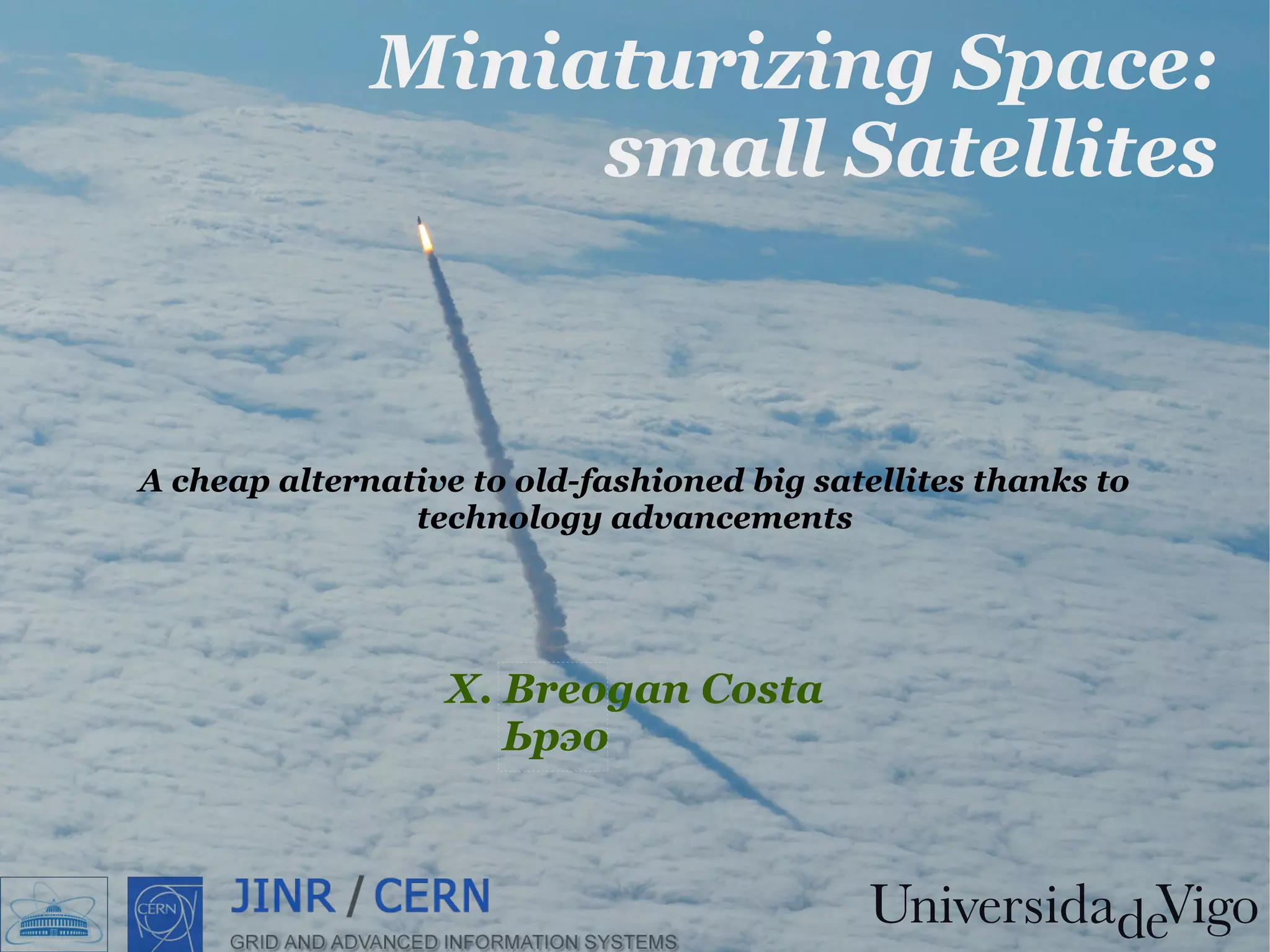
Miniaturizing Space:
small Satellites
A cheap alternative to old-fashioned big satellites thanks to
technology advancements
X. Breogan Costa
Ьрэо
Index
● Motivation
● Technology advancements
● Satellite Systems Technology
– User, Ground & Space Segment
– Standards
– Components
● Platform & Payloads
– Communications
– Anomalies
– Security in Satellites
– Recommendations for Project Organization
● Lessons Learned
● Examples related to my studies and former job
● Appendixes
2/53 + Extra contents
Extra contents
Motivation
Index
●
● Technology advancements
● Satellite Systems Technology
– User, Ground & Space Segment
– Standards
– Components
● Platform & Payloads
– Communications
– Anomalies
– Security in Satellites
– Recommendations for Project Organization
● Lessons Learned
Why “miniaturized”
Satellites?
3/53
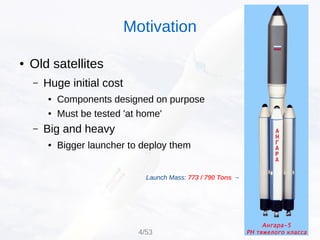
● Old satellites
– Huge initial cost
● Components designed on purpose
● Must be tested 'at home'
– Big and heavy
● Bigger launcher to deploy them
Launch Mass: 773 / 790 Tons →
Motivation
4/53
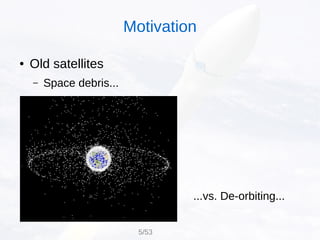
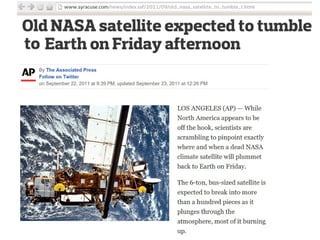
● Old satellites
– Space debris...
...vs. De-orbiting...
Motivation
5/53
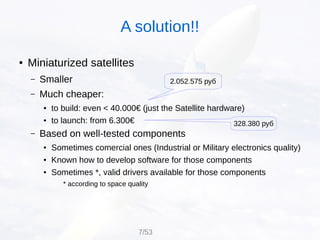
● Miniaturized satellites
– Smaller
– Much cheaper:
● to build: even < 40.000€ (just the Satellite hardware)
● to launch: from 6.300€
– Based on well-tested components
● Sometimes comercial ones (Industrial or Military electronics quality)
● Known how to develop software for those components
● Sometimes *, valid drivers available for those components
* according to space quality
A solution!!
7/53
2.052.575 руб
328.380 руб
Technology advancements
Index
● Motivation
●
● Satellite Systems Technology
– User, Ground & Space Segment
– Standards
– Components
● Platform & Payloads
– Communications
– Anomalies
– Security in Satellites
– Recommendations for Project Organization
● Lessons Learned
● Examples related to my studies and former job
● Appendixes
But... how is it
even possible?
8/53
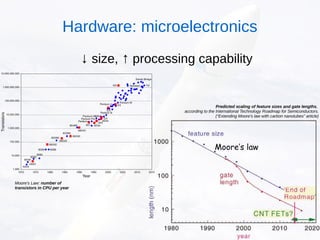
Hardware: microelectronics
↓ size, ↑ processing capability
Predicted scaling of feature sizes and gate lengths,
according to the International Technology Roadmap for Semiconductors.
(“Extending Moore's law with carbon nanotubes” article)
Moore's Law: number of
transistors in CPU per year
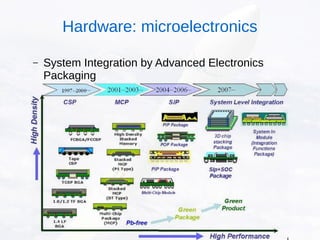
– System Integration by Advanced Electronics
Packaging
Hardware: microelectronics
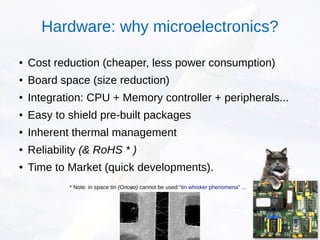
● Cost reduction (cheaper, less power consumption)
● Board space (size reduction)
●
Integration: CPU + Memory controller + peripherals...
● Easy to shield pre-built packages
● Inherent thermal management
● Reliability (& RoHS * )
● Time to Market (quick developments).
* Note: in space tin (Олово) cannot be used:“tin whisker phenomena” ...
Hardware: why microelectronics?
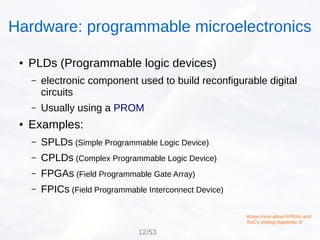
● PLDs (Programmable logic devices)
– electronic component used to build reconfigurable digital
circuits
– Usually using a PROM
● Examples:
– SPLDs (Simple Programmable Logic Device)
– CPLDs (Complex Programmable Logic Device)
– FPGAs (Field Programmable Gate Array)
– FPICs (Field Programmable Interconnect Device)
Hardware: programmable microelectronics
Know more about FPGAs and
SoC's visiting Appendix III
12/53
OK, I'm convinced: let's build a satellite!
13/53
… but we should know something else before!
14/53
Satellite Systems Technology
Index
● Motivation
● Technology advancements
●
– User, Ground & Space Segment
– Standards
– Components
● Platform & Payloads
– Communications
– Anomalies
– Security in Satellites
– Recommendations for Project Organization
● Lessons Learned
● Examples related to my studies and former job
● Appendixes
How about
Systems
Engineering?
15/53
Index
● Motivation
● Technology advancements
●
Satellite Systems Technology
–
– Standards
– Components
●
Platform & Payloads
– Communications
– Anomalies
– Security in Satellites
– Recommendations for Project Organization
● Lessons Learned
● Examples related to my studies and former job
● Appendixes
User, Ground & Space Segment
How the system
is structured?
16/53
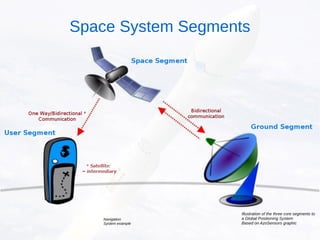
Illustration of the three core segments to
a Global Positioning System
Based on AzoSensors graphic
Navigation
System example
Space System Segments
User Segment
18/53
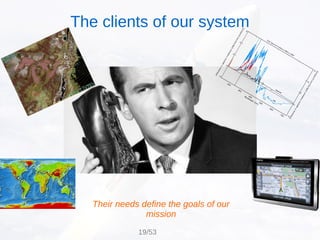
The clients of our system
Their needs define the goals of our
mission
19/53
Ground Segment
20/53
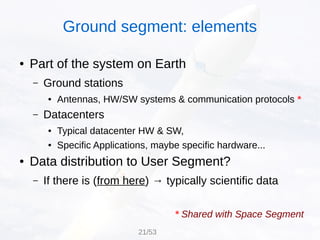
Ground segment: elements
● Part of the system on Earth
– Ground stations
● Antennas, HW/SW systems & communication protocols *
– Datacenters
● Typical datacenter HW & SW,
● Specific Applications, maybe specific hardware...
● Data distribution to User Segment?
– If there is (from here) → typically scientific data
* Shared with Space Segment
21/53
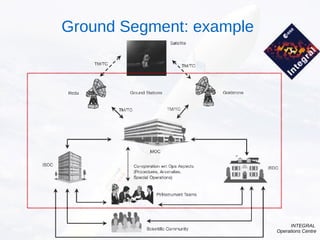
INTEGRAL
Operations Centre
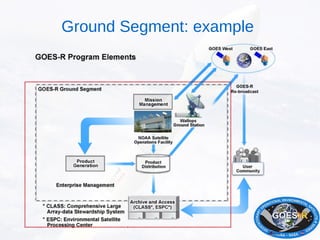
Ground Segment: example
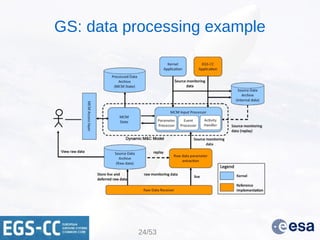
GS: data processing example
24/53
Space Segment
25/53
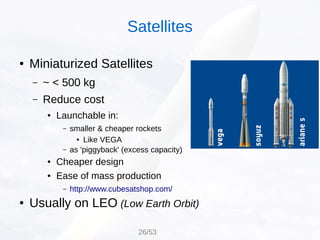
● Miniaturized Satellites
– ~ < 500 kg
– Reduce cost
● Launchable in:
– smaller & cheaper rockets
● Like VEGA
– as 'piggyback' (excess capacity)
● Cheaper design
● Ease of mass production
– http://www.cubesatshop.com/
● Usually on LEO (Low Earth Orbit)
Satellites
26/53
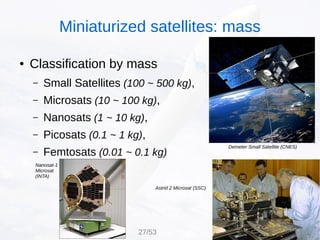
● Classification by mass
– Small Satellites (100 ~ 500 kg),
– Microsats (10 ~ 100 kg),
– Nanosats (1 ~ 10 kg),
– Picosats (0.1 ~ 1 kg),
– Femtosats (0.01 ~ 0.1 kg)
Nanosat-1
Microsat
(INTA)
Demeter Small Satellite (CNES)
Astrid 2 Microsat (SSC)
Miniaturized satellites: mass
27/53
Standards (some)
Index
● Motivation
● Technology advancements
● Satellite Systems Technology
– User, Ground & Space Segment
–
– Components
● Platform & Payloads
– Communications
– Anomalies
– Security in Satellites
– Recommendations for Project Organization
● Lessons Learned
Is there some
uniform way to
do it?
28/53
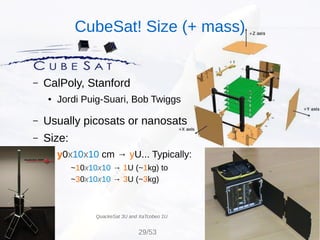
– CalPoly, Stanford
● Jordi Puig-Suari, Bob Twiggs
– Usually picosats or nanosats
– Size:
● y0x10x10 cm → yU... Typically:
~10x10x10 → 1U (~1kg) to
~30x10x10 → 3U (~3kg)
QuackeSat 3U and XaTcobeo 1U
CubeSat! Size (+ mass)
29/53
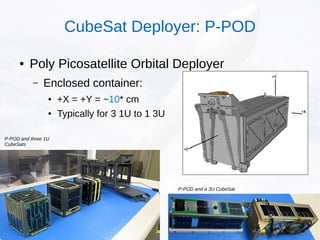
● Poly Picosatellite Orbital Deployer
– Enclosed container:
● +X = +Y = ~10* cm
● Typically for 3 1U to 1 3U
P-POD and three 1U
CubeSats
P-POD and a 3U CubeSat
CubeSat Deployer: P-POD
Components
Platform & Payloads
Index
● Motivation
● Technology advancements
● Satellite Systems Technology
– User, Ground & Space Segment
– Standards
–
●
– Communications
– Anomalies
– Security in Satellites
– Recommendations for Project Organization
● Lessons Learned
What we should
put inside?
31/53
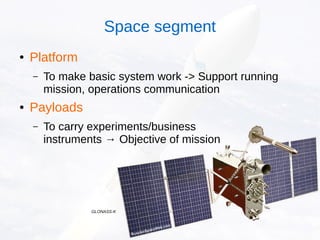
● Platform
– To make basic system work -> Support running
mission, operations communication
● Payloads
– To carry experiments/business
instruments → Objective of mission
GLONASS-K
Space segment
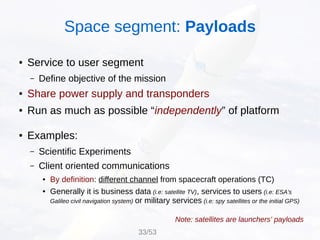
● Service to user segment
– Define objective of the mission
● Share power supply and transponders
● Run as much as possible “independently” of platform
● Examples:
– Scientific Experiments
– Client oriented communications
● By definition: different channel from spacecraft operations (TC)
● Generally it is business data (i.e: satellite TV), services to users (i.e: ESA's
Galileo civil navigation system) or military services (i.e: spy satellites or the initial GPS)
Note: satellites are launchers' payloads
Space segment: Payloads
33/53
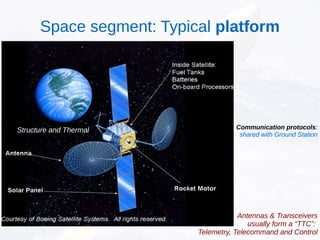
Antennas & Transceivers
usually form a “TTC”:
Telemetry, Telecommand and Control
Structure and Thermal Communication protocols:
shared with Ground Station
Space segment: Typical platform
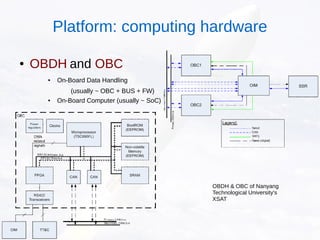
● OBDH and OBC
● On-Board Data Handling
(usually ~ OBC + BUS + FW)
● On-Board Computer (usually ~ SoC)
OBDH & OBC of Nanyang
Technological University's
XSAT
Platform: computing hardware
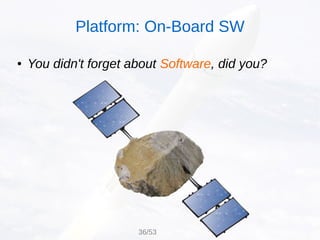
● You didn't forget about Software, did you?
Platform: On-Board SW
36/53
● OBSW is going to be a RTOS
● RTOS: Real Time Operating System
– There are many Generic OS: examples (usually not valid for Space Systems):
● FreeRTOS, RTLinux, eCos, QNX [all POSIX-like or based], ...
– Generic OS: usually not designed for Space Environments → problems?
● OBSW: On-Board Software
– Specific OS designed for Satellites or flying devices
– Ready for spacecraft error conditions and recovery
– Examples:
● ESA: CorDeT OBSW-RA (Reference Arquitecture),
● University of Vigo: XaTcobeo's XMS (110.000 SLOC), HumSAT-D HMS (105.000 SLOC)
● VxWorks
Platform: RTOS's and OBSW Intro
37/53
Communications
Index
● Motivation
● Technology advancements
● Satellite Systems Technology
– User, Ground & Space Segment
– Standards
– Components
● Platform & Payloads
–
– Anomalies
– Security in Satellites
– Recommendations for Project Organization
● Lessons Learned
How we 'speak'
with it?
38/53
Ground Segment → Space Segment
– GS: Operation commands and parameters packet
– Sat-Comms-Module: unpack network packets &
reassemble TCs data
● Usually called TTC: Telemetry, Telecommand and Control
– Sat-OBSW: validate & process them
Communications: telecommands (TC)
39/53
Space Segment → Ground Segment
– Sat-OBSW: gather satellite-data
– Sat-Comms-Module: segment TM-data & pack into
network packets
– GS: validate & store/process the data
– TM data:
● Housekeeping data
● Sometimes also Scientific/other data
– When it has to be processed in GS
● Usually, business data ↔ payloads
– Data goes directly to User Segment
Communications: telemetry (TM)
40/53
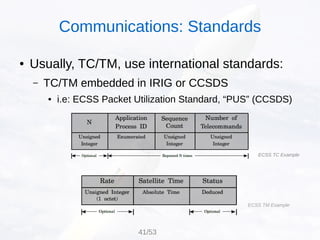
● Usually, TC/TM, use international standards:
– TC/TM embedded in IRIG or CCSDS
● i.e: ECSS Packet Utilization Standard, “PUS” (CCSDS)
ECSS TC Example
ECSS TM Example
Communications: Standards
41/53
Anomalies
Index
● Motivation
● Technology advancements
● Satellite Systems Technology
– User, Ground & Space Segment
– Standards
– Components
● Platform & Payloads
– Communications
–
– Security in Satellites
– Recommendations for Project Organization
● Lessons Learned
But... Could
something just
go wrong?
42/53
● Ionizing radiation:
– particle radiation
– high-energy electromagnetic radiation
– Examples: Proton Events & Geomagnetic Storms
● Electro-magnetic radiation: Single Event Effects (SE)
– SEL (SE Latch-up)
● Potentially destructive
– SEU (SE Upset)
● Non-destructive: unpredictable system failures
– SEGR (SE Gate Rupture)
● Gate oxide breakdown
● Other running anomalies
Space Anomalies: sources
43/53
● Called “Radiation hardening”
● Shielding
● Rad-Tol electronics
● Using best allowed orbits
– Different radiation in different orbits
Space Anomalies: HW protection
44/53
● Hardware Periodical resets
– Using “watchdog timers”
● Software resets
– Coming from Software (error detection)
● Robust and secure software development
– TDD: Test-driven development
– Fault tolerant & Error recovery OBSW design
– Parity bits & Redundant elements
(continues)
Space Anomalies: error recovery
45/53
● Robust and secure software development
– Check Input parameters in procedure calls
– Error-detection and correction codes
– Limit (or avoid) usage of pointers
– Usage of finite-state machines →
→ Operation modes
● Allowed state changes
● State:
– Control of operations executable in every state
– Control of components usage
Learn how this affect
Satellites in Appendix IV
Space Anomalies: error recovery
46/53
Security in Satellites
Index
● Motivation
● Technology advancements
● Satellite Systems Technology
– User, Ground & Space Segment
– Standards
– Components
● Platform & Payloads
– Communications
– Anomalies
–
– Recommendations for Project Organization
● Lessons Learned
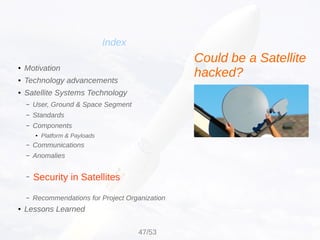
Could be a Satellite
hacked?
47/53
● Physical
● Communications
– TC/TM Encryption
● In amateur stations it could be not allowed (law)
● Software
– Validate origin & size of incoming TCs?
● Memory overwriting? Data injection?
– Always analyze & design SW taking in account
security
Review the ICT Security
goals visiting Appendix I
Security in satellite systems
48/53
Basic Recommendations Project Organization
Index
● Motivation
● Technology advancements
● Satellite Systems Technology
– User, Ground & Space Segment
– Standards
– Components
● Platform & Payloads
– Communications
– Anomalies
– Security in Satellites
–
● Lessons Learned
How to start a
Space project?
49/53
● There are many standards (engineering + project
management)
– ECSS (European, interested: Brazil, China, Russia...),
– Gosstandart (Госстандарт) GOST,
– NASA SP-2007-6105...
● Recommended to use some of them
– Cover stages (phases) to solve most of the problems
that could appear
● Technical review after each phase
– Even technical specifications, quality requirements
and validation (huge amount of details in ECSS)
Know more about Space Projects
Management visiting Appendix II
Space Projects & Systems Engineering
50/53
Lessons Learned
Index
● Motivation
● Technology advancements
● Satellite Systems Technology
– User, Ground & Space Segment
– Standards
– Components
● Platform & Payloads
– Communications
– Anomalies
– Security in Satellites
– Recommendations for Project Organization
●
“Takeaway”
51/53
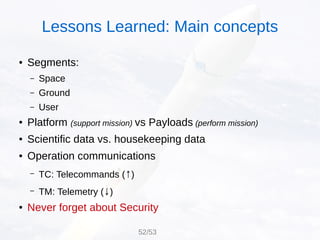
● Segments:
– Space
– Ground
– User
● Platform (support mission) vs Payloads (perform mission)
● Scientific data vs. housekeeping data
● Operation communications
– TC: Telecommands (↑)
– TM: Telemetry (↓)
● Never forget about Security
52/53
Lessons Learned: Main concepts
● There are space & RF laws
● Space environment “Single Events” protection
– Hardware protection *:
● Shielding,
● Rad-Tol electronics, ...
– Robust and secure Software development *:
● Error detection and correction codes,
● Finite-state machine,
● Check Input parameters in procedure calls
● There are standards → clear phases + reviews
* usually53/53
Lessons Learned: Main concepts
Examples related to my former collaboration
Just examples: 54/89
● Involved in several dependent projects
– XaTcobeo
● Project in which I participate
– Genso
– HumSAT
– HumSAT D
– FemtoXat
Just examples: 55/89
Examples: University of Vigo
University of Vigo: www.uvigo.gal UVIGO: Applied Informatics Lab
UVIGO: Signal Theory & Comms Dep Computer Engineering School
Telecoms. Engineering School Industrial Engineering School
● 13x10x10 1U CubeSat
– Educational project for ESA's VEGA maiden flight
● Platform
– OBDH based on a FPGA, homemade OBSW
– EPS
– TTC
● Payloads:
– RDS: Radiation Displacement Damage Sensor
– PDM: Panel Deployment Mechanism
– SRAD: Software Radio
Just examples: 56/89
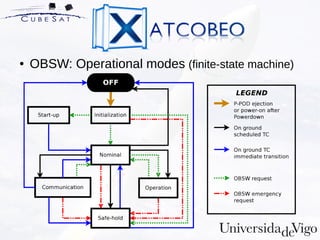
● OBSW: Operational modes (finite-state machine)
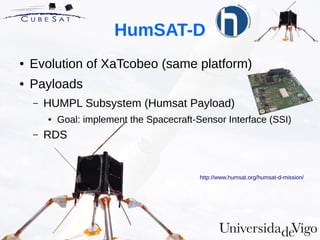
HumSAT-D
● Evolution of XaTcobeo (same platform)
● Payloads
– HUMPL Subsystem (Humsat Payload)
● Goal: implement the Spacecraft-Sensor Interface (SSI)
– RDS
http://www.humsat.org/humsat-d-mission/
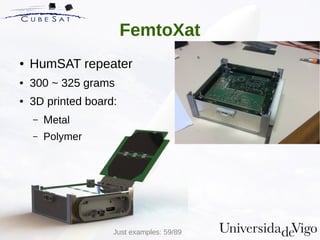
FemtoXat
● HumSAT repeater
● 300 ~ 325 grams
● 3D printed board:
– Metal
– Polymer
Just examples: 59/89
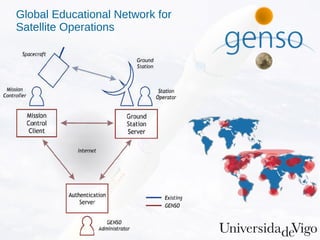
Global Educational Network for
Satellite Operations
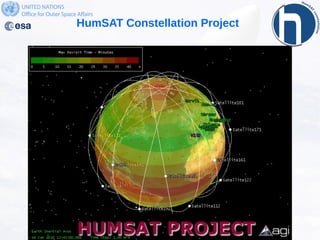
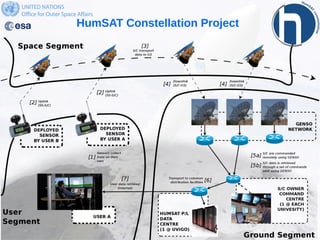
HumSAT Constellation Project
Appendix I: A short review of basic ICT Security
goals
Appendixes: 63/89
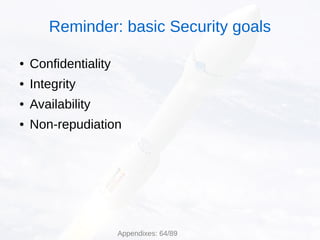
● Confidentiality
● Integrity
● Availability
● Non-repudiation
Appendixes: 64/89
Reminder: basic Security goals
Appendix II: How Space Projects are structured
Appendixes: 65/89
● There are many standards (engineering + project
management)
– ECSS (European, interested: Brazil, China, Russia...),
Gosstandart (Госстандарт) GOST, NASA SP-2007-
6105...
● Project Life cycle:
– clear phases defined & strict phase reviews at end of
each phase (+ acceptance)
● Traceability & a good communication between
teams
● Take in account there are space laws
Space Projects: Important details
Appendixes: 66/89
● Very important common document: ICD
– Interfaces Control Document
– All groups detail their technical interfaces
specifications since early phases
● Internal/external interfaces
● Mechanical, hardware and logical interfaces
● Subsystem interfaces should meet requirements of other
subsystems
● Interface users are going to review those interfaces
● Interface designer are going to keep the ICD updated
Space Projects: Important details
Appendixes: 67/89
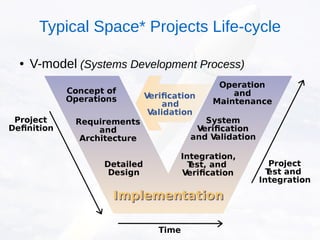
● V-model (Systems Development Process)
Typical Space* Projects Life-cycle
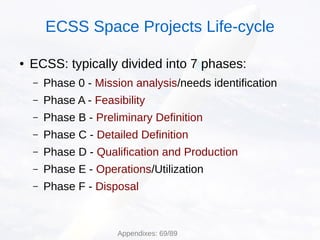
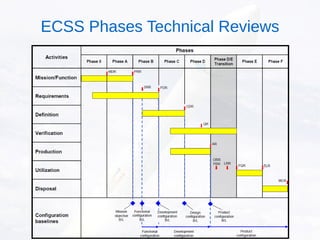
● ECSS: typically divided into 7 phases:
– Phase 0 - Mission analysis/needs identification
– Phase A - Feasibility
– Phase B - Preliminary Definition
– Phase C - Detailed Definition
– Phase D - Qualification and Production
– Phase E - Operations/Utilization
– Phase F - Disposal
ECSS Space Projects Life-cycle
Appendixes: 69/89
ECSS Phases Technical Reviews
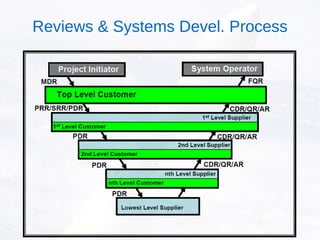
Reviews & Systems Devel. Process
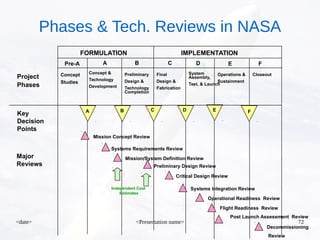
<date> <Presentation name> 72
Key
Decision
Points
FORMULATION IMPLEMENTATION
Major
Reviews
A C D E
Project
Phases
Concept
Studies
Concept &
Technology
Development
Preliminary
Design &
Technology
Completion
Final
Design &
Fabrication
System
Assembly,
Test, & Launch
CloseoutOperations &
Sustainment
A B
B
C
F
D E FPre-A
Mission Concept Review
Systems Requirements Review
Mission/System Definition Review
Critical Design Review
Systems Integration Review
Operational Readiness Review
Flight Readiness Review
Post Launch Assessment Review
Decommissioning
Review
Preliminary Design Review
Independent Cost
Estimates
Phases & Tech. Reviews in NASA
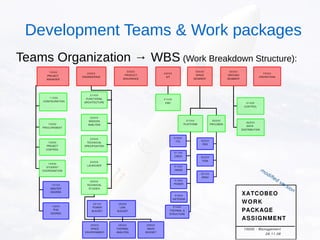
Development Teams & Work packages
Teams Organization → WBS (Work Breakdown Structure):
Appendix III: FPGAs, how is designing HW in a
FPGA and & SoC's
Appendixes: 74/89
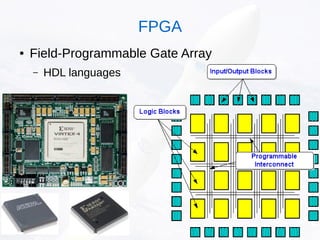
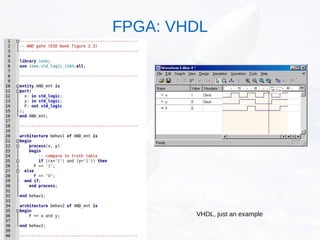
● Field-Programmable Gate Array
– HDL languages
FPGA
VHDL, just an example
FPGA: VHDL
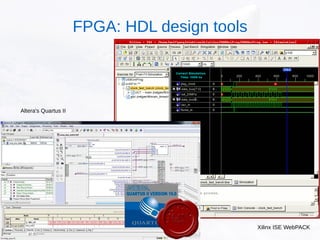
Xilinx ISE WebPACK
Altera's Quartus II
FPGA: HDL design tools
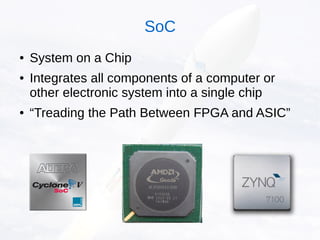
● System on a Chip
● Integrates all components of a computer or
other electronic system into a single chip
● “Treading the Path Between FPGA and ASIC”
SoC
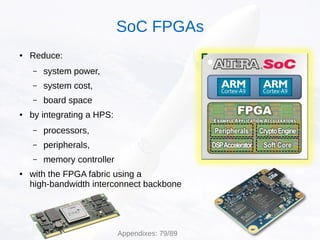
● Reduce:
– system power,
– system cost,
– board space
● by integrating a HPS:
– processors,
– peripherals,
– memory controller
● with the FPGA fabric using a
high-bandwidth interconnect backbone
SoC FPGAs
Appendixes: 79/89
Appendix IV: How radiation affect satellites
Appendixes: 80/89
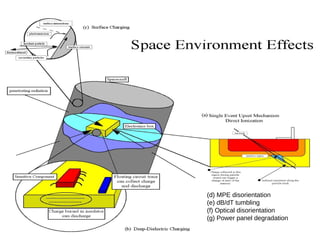
(d) MPE disorientation
(e) dB/dT tumbling
(f) Optical disorientation
(g) Power panel degradation
Appendix V: Tin whisker phenomena
Appendixes: 82/89
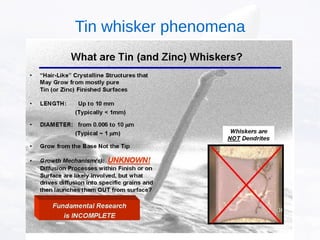
Tin whisker phenomena
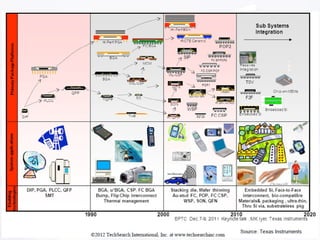
Appendix VI: detailed graphic regarding to past
and future of microelectronics packaging
Appendixes: 84/89
● Some Cubesats:
● www.xatcobeo.com (sorry, discontinued -mission finished)
– http://www.dk3wn.info/sat/afu/sat_xatcobeo.shtml
● www.humsat.org … for teams who worked or are working in XaTcobeo, HumSAT, GENSO, etc, visit:
– lia.ei.uvigo.es (University of Vigo, Computer Engineering School, Applied Computing Lab.)
– tsc.uvigo.es (University of Vigo, Telecommunications Engineering School: Singal & Comunications Dept.)
● https://www.quakefinder.com/science/about-quakesat/
● http://www.delfispace.nl/index.php/delfi-n3xt
● … https://en.wikipedia.org/wiki/List_of_CubeSats
● Some components Shops:
● www.clyde-space.com ,
● www.cubesatshop.com ,
● www.cubesatkit.com
● International projects
● http://www.esa.int/Education/How_GENSO_works
● http://cubesat.org
● Standards:
● http://www.ihs.com/products/industry-standards/org/gost/english-aircraft/index.aspx
● http://www.ecss.nl
Useful links
Appendixes: 86/89
● CERN AMS experiment (running in International Space Agency)
– http://ams.cern.ch/
● Links to some Space Agencies sites:
● http://roscosmos.ru
● http://www.esa.int/ESA
● http://www.nasa.gov
● www.isro.org
● www.cnsa.gov.cn
● http://global.jaxa.jp
● www.asc-csa.gc.ca/eng
● www.aeb.gov.br
● Social media (there are a lot of twitter accounts from agencies or related to space technology)
– Example: https://twitter.com/fka_roscosmos
● Websites that you can find on Yandex / Google / etc; like:
● www.russianspaceweb.com
● www.navipedia.net
● www.spaceflight101.com
● Your Own Satellite: 7 Things to Know Before You Go
● ...
Appendixes: 87/89
More useful links
?
You talkin' to me?
OK, OK...
breo@cern.ch
Because we all are social...
One of my (unatended) birds:
@BreoSys
Also...
www.linkedin.com/in/breocosta
Who? Me?
X. Breogán Costa L.
Systems Engineer (VSE) & UX @ CERN
Born in Galicia
(Галызя)
Medieval Galician Kingdom coat of
arms (L'armorial Le Blancq, c.
1560 AD)
89/89
You can find me there or in VK...
...and watch Taxi Driver
Note: in social networks I only add people that
I personally meet and I only follow those with
interesting content...

Miniaturizing Space: Small-satellites

  • 1.
    Miniaturizing Space: small Satellites Acheap alternative to old-fashioned big satellites thanks to technology advancements X. Breogan Costa Ьрэо
  • 2.
    Index ● Motivation ● Technologyadvancements ● Satellite Systems Technology – User, Ground & Space Segment – Standards – Components ● Platform & Payloads – Communications – Anomalies – Security in Satellites – Recommendations for Project Organization ● Lessons Learned ● Examples related to my studies and former job ● Appendixes 2/53 + Extra contents Extra contents
  • 3.
    Motivation Index ● ● Technology advancements ●Satellite Systems Technology – User, Ground & Space Segment – Standards – Components ● Platform & Payloads – Communications – Anomalies – Security in Satellites – Recommendations for Project Organization ● Lessons Learned Why “miniaturized” Satellites? 3/53
  • 4.
    ● Old satellites –Huge initial cost ● Components designed on purpose ● Must be tested 'at home' – Big and heavy ● Bigger launcher to deploy them Launch Mass: 773 / 790 Tons → Motivation 4/53
  • 5.
    ● Old satellites –Space debris... ...vs. De-orbiting... Motivation 5/53
  • 7.
    ● Miniaturized satellites –Smaller – Much cheaper: ● to build: even < 40.000€ (just the Satellite hardware) ● to launch: from 6.300€ – Based on well-tested components ● Sometimes comercial ones (Industrial or Military electronics quality) ● Known how to develop software for those components ● Sometimes *, valid drivers available for those components * according to space quality A solution!! 7/53 2.052.575 руб 328.380 руб
  • 8.
    Technology advancements Index ● Motivation ● ●Satellite Systems Technology – User, Ground & Space Segment – Standards – Components ● Platform & Payloads – Communications – Anomalies – Security in Satellites – Recommendations for Project Organization ● Lessons Learned ● Examples related to my studies and former job ● Appendixes But... how is it even possible? 8/53
  • 9.
    Hardware: microelectronics ↓ size,↑ processing capability Predicted scaling of feature sizes and gate lengths, according to the International Technology Roadmap for Semiconductors. (“Extending Moore's law with carbon nanotubes” article) Moore's Law: number of transistors in CPU per year
  • 10.
    – System Integrationby Advanced Electronics Packaging Hardware: microelectronics
  • 11.
    ● Cost reduction(cheaper, less power consumption) ● Board space (size reduction) ● Integration: CPU + Memory controller + peripherals... ● Easy to shield pre-built packages ● Inherent thermal management ● Reliability (& RoHS * ) ● Time to Market (quick developments). * Note: in space tin (Олово) cannot be used:“tin whisker phenomena” ... Hardware: why microelectronics?
  • 12.
    ● PLDs (Programmablelogic devices) – electronic component used to build reconfigurable digital circuits – Usually using a PROM ● Examples: – SPLDs (Simple Programmable Logic Device) – CPLDs (Complex Programmable Logic Device) – FPGAs (Field Programmable Gate Array) – FPICs (Field Programmable Interconnect Device) Hardware: programmable microelectronics Know more about FPGAs and SoC's visiting Appendix III 12/53
  • 13.
    OK, I'm convinced:let's build a satellite! 13/53
  • 14.
    … but weshould know something else before! 14/53
  • 15.
    Satellite Systems Technology Index ●Motivation ● Technology advancements ● – User, Ground & Space Segment – Standards – Components ● Platform & Payloads – Communications – Anomalies – Security in Satellites – Recommendations for Project Organization ● Lessons Learned ● Examples related to my studies and former job ● Appendixes How about Systems Engineering? 15/53
  • 16.
    Index ● Motivation ● Technologyadvancements ● Satellite Systems Technology – – Standards – Components ● Platform & Payloads – Communications – Anomalies – Security in Satellites – Recommendations for Project Organization ● Lessons Learned ● Examples related to my studies and former job ● Appendixes User, Ground & Space Segment How the system is structured? 16/53
  • 17.
    Illustration of thethree core segments to a Global Positioning System Based on AzoSensors graphic Navigation System example Space System Segments
  • 18.
  • 19.
    The clients ofour system Their needs define the goals of our mission 19/53
  • 20.
  • 21.
    Ground segment: elements ●Part of the system on Earth – Ground stations ● Antennas, HW/SW systems & communication protocols * – Datacenters ● Typical datacenter HW & SW, ● Specific Applications, maybe specific hardware... ● Data distribution to User Segment? – If there is (from here) → typically scientific data * Shared with Space Segment 21/53
  • 22.
  • 23.
  • 24.
    GS: data processingexample 24/53
  • 25.
  • 26.
    ● Miniaturized Satellites –~ < 500 kg – Reduce cost ● Launchable in: – smaller & cheaper rockets ● Like VEGA – as 'piggyback' (excess capacity) ● Cheaper design ● Ease of mass production – http://www.cubesatshop.com/ ● Usually on LEO (Low Earth Orbit) Satellites 26/53
  • 27.
    ● Classification bymass – Small Satellites (100 ~ 500 kg), – Microsats (10 ~ 100 kg), – Nanosats (1 ~ 10 kg), – Picosats (0.1 ~ 1 kg), – Femtosats (0.01 ~ 0.1 kg) Nanosat-1 Microsat (INTA) Demeter Small Satellite (CNES) Astrid 2 Microsat (SSC) Miniaturized satellites: mass 27/53
  • 28.
    Standards (some) Index ● Motivation ●Technology advancements ● Satellite Systems Technology – User, Ground & Space Segment – – Components ● Platform & Payloads – Communications – Anomalies – Security in Satellites – Recommendations for Project Organization ● Lessons Learned Is there some uniform way to do it? 28/53
  • 29.
    – CalPoly, Stanford ●Jordi Puig-Suari, Bob Twiggs – Usually picosats or nanosats – Size: ● y0x10x10 cm → yU... Typically: ~10x10x10 → 1U (~1kg) to ~30x10x10 → 3U (~3kg) QuackeSat 3U and XaTcobeo 1U CubeSat! Size (+ mass) 29/53
  • 30.
    ● Poly PicosatelliteOrbital Deployer – Enclosed container: ● +X = +Y = ~10* cm ● Typically for 3 1U to 1 3U P-POD and three 1U CubeSats P-POD and a 3U CubeSat CubeSat Deployer: P-POD
  • 31.
    Components Platform & Payloads Index ●Motivation ● Technology advancements ● Satellite Systems Technology – User, Ground & Space Segment – Standards – ● – Communications – Anomalies – Security in Satellites – Recommendations for Project Organization ● Lessons Learned What we should put inside? 31/53
  • 32.
    ● Platform – Tomake basic system work -> Support running mission, operations communication ● Payloads – To carry experiments/business instruments → Objective of mission GLONASS-K Space segment
  • 33.
    ● Service touser segment – Define objective of the mission ● Share power supply and transponders ● Run as much as possible “independently” of platform ● Examples: – Scientific Experiments – Client oriented communications ● By definition: different channel from spacecraft operations (TC) ● Generally it is business data (i.e: satellite TV), services to users (i.e: ESA's Galileo civil navigation system) or military services (i.e: spy satellites or the initial GPS) Note: satellites are launchers' payloads Space segment: Payloads 33/53
  • 34.
    Antennas & Transceivers usuallyform a “TTC”: Telemetry, Telecommand and Control Structure and Thermal Communication protocols: shared with Ground Station Space segment: Typical platform
  • 35.
    ● OBDH andOBC ● On-Board Data Handling (usually ~ OBC + BUS + FW) ● On-Board Computer (usually ~ SoC) OBDH & OBC of Nanyang Technological University's XSAT Platform: computing hardware
  • 36.
    ● You didn'tforget about Software, did you? Platform: On-Board SW 36/53
  • 37.
    ● OBSW isgoing to be a RTOS ● RTOS: Real Time Operating System – There are many Generic OS: examples (usually not valid for Space Systems): ● FreeRTOS, RTLinux, eCos, QNX [all POSIX-like or based], ... – Generic OS: usually not designed for Space Environments → problems? ● OBSW: On-Board Software – Specific OS designed for Satellites or flying devices – Ready for spacecraft error conditions and recovery – Examples: ● ESA: CorDeT OBSW-RA (Reference Arquitecture), ● University of Vigo: XaTcobeo's XMS (110.000 SLOC), HumSAT-D HMS (105.000 SLOC) ● VxWorks Platform: RTOS's and OBSW Intro 37/53
  • 38.
    Communications Index ● Motivation ● Technologyadvancements ● Satellite Systems Technology – User, Ground & Space Segment – Standards – Components ● Platform & Payloads – – Anomalies – Security in Satellites – Recommendations for Project Organization ● Lessons Learned How we 'speak' with it? 38/53
  • 39.
    Ground Segment →Space Segment – GS: Operation commands and parameters packet – Sat-Comms-Module: unpack network packets & reassemble TCs data ● Usually called TTC: Telemetry, Telecommand and Control – Sat-OBSW: validate & process them Communications: telecommands (TC) 39/53
  • 40.
    Space Segment →Ground Segment – Sat-OBSW: gather satellite-data – Sat-Comms-Module: segment TM-data & pack into network packets – GS: validate & store/process the data – TM data: ● Housekeeping data ● Sometimes also Scientific/other data – When it has to be processed in GS ● Usually, business data ↔ payloads – Data goes directly to User Segment Communications: telemetry (TM) 40/53
  • 41.
    ● Usually, TC/TM,use international standards: – TC/TM embedded in IRIG or CCSDS ● i.e: ECSS Packet Utilization Standard, “PUS” (CCSDS) ECSS TC Example ECSS TM Example Communications: Standards 41/53
  • 42.
    Anomalies Index ● Motivation ● Technologyadvancements ● Satellite Systems Technology – User, Ground & Space Segment – Standards – Components ● Platform & Payloads – Communications – – Security in Satellites – Recommendations for Project Organization ● Lessons Learned But... Could something just go wrong? 42/53
  • 43.
    ● Ionizing radiation: –particle radiation – high-energy electromagnetic radiation – Examples: Proton Events & Geomagnetic Storms ● Electro-magnetic radiation: Single Event Effects (SE) – SEL (SE Latch-up) ● Potentially destructive – SEU (SE Upset) ● Non-destructive: unpredictable system failures – SEGR (SE Gate Rupture) ● Gate oxide breakdown ● Other running anomalies Space Anomalies: sources 43/53
  • 44.
    ● Called “Radiationhardening” ● Shielding ● Rad-Tol electronics ● Using best allowed orbits – Different radiation in different orbits Space Anomalies: HW protection 44/53
  • 45.
    ● Hardware Periodicalresets – Using “watchdog timers” ● Software resets – Coming from Software (error detection) ● Robust and secure software development – TDD: Test-driven development – Fault tolerant & Error recovery OBSW design – Parity bits & Redundant elements (continues) Space Anomalies: error recovery 45/53
  • 46.
    ● Robust andsecure software development – Check Input parameters in procedure calls – Error-detection and correction codes – Limit (or avoid) usage of pointers – Usage of finite-state machines → → Operation modes ● Allowed state changes ● State: – Control of operations executable in every state – Control of components usage Learn how this affect Satellites in Appendix IV Space Anomalies: error recovery 46/53
  • 47.
    Security in Satellites Index ●Motivation ● Technology advancements ● Satellite Systems Technology – User, Ground & Space Segment – Standards – Components ● Platform & Payloads – Communications – Anomalies – – Recommendations for Project Organization ● Lessons Learned Could be a Satellite hacked? 47/53
  • 48.
    ● Physical ● Communications –TC/TM Encryption ● In amateur stations it could be not allowed (law) ● Software – Validate origin & size of incoming TCs? ● Memory overwriting? Data injection? – Always analyze & design SW taking in account security Review the ICT Security goals visiting Appendix I Security in satellite systems 48/53
  • 49.
    Basic Recommendations ProjectOrganization Index ● Motivation ● Technology advancements ● Satellite Systems Technology – User, Ground & Space Segment – Standards – Components ● Platform & Payloads – Communications – Anomalies – Security in Satellites – ● Lessons Learned How to start a Space project? 49/53
  • 50.
    ● There aremany standards (engineering + project management) – ECSS (European, interested: Brazil, China, Russia...), – Gosstandart (Госстандарт) GOST, – NASA SP-2007-6105... ● Recommended to use some of them – Cover stages (phases) to solve most of the problems that could appear ● Technical review after each phase – Even technical specifications, quality requirements and validation (huge amount of details in ECSS) Know more about Space Projects Management visiting Appendix II Space Projects & Systems Engineering 50/53
  • 51.
    Lessons Learned Index ● Motivation ●Technology advancements ● Satellite Systems Technology – User, Ground & Space Segment – Standards – Components ● Platform & Payloads – Communications – Anomalies – Security in Satellites – Recommendations for Project Organization ● “Takeaway” 51/53
  • 52.
    ● Segments: – Space –Ground – User ● Platform (support mission) vs Payloads (perform mission) ● Scientific data vs. housekeeping data ● Operation communications – TC: Telecommands (↑) – TM: Telemetry (↓) ● Never forget about Security 52/53 Lessons Learned: Main concepts
  • 53.
    ● There arespace & RF laws ● Space environment “Single Events” protection – Hardware protection *: ● Shielding, ● Rad-Tol electronics, ... – Robust and secure Software development *: ● Error detection and correction codes, ● Finite-state machine, ● Check Input parameters in procedure calls ● There are standards → clear phases + reviews * usually53/53 Lessons Learned: Main concepts
  • 54.
    Examples related tomy former collaboration Just examples: 54/89
  • 55.
    ● Involved inseveral dependent projects – XaTcobeo ● Project in which I participate – Genso – HumSAT – HumSAT D – FemtoXat Just examples: 55/89 Examples: University of Vigo University of Vigo: www.uvigo.gal UVIGO: Applied Informatics Lab UVIGO: Signal Theory & Comms Dep Computer Engineering School Telecoms. Engineering School Industrial Engineering School
  • 56.
    ● 13x10x10 1UCubeSat – Educational project for ESA's VEGA maiden flight ● Platform – OBDH based on a FPGA, homemade OBSW – EPS – TTC ● Payloads: – RDS: Radiation Displacement Damage Sensor – PDM: Panel Deployment Mechanism – SRAD: Software Radio Just examples: 56/89
  • 57.
    ● OBSW: Operationalmodes (finite-state machine)
  • 58.
    HumSAT-D ● Evolution ofXaTcobeo (same platform) ● Payloads – HUMPL Subsystem (Humsat Payload) ● Goal: implement the Spacecraft-Sensor Interface (SSI) – RDS http://www.humsat.org/humsat-d-mission/
  • 59.
    FemtoXat ● HumSAT repeater ●300 ~ 325 grams ● 3D printed board: – Metal – Polymer Just examples: 59/89
  • 60.
    Global Educational Networkfor Satellite Operations
  • 61.
  • 62.
  • 63.
    Appendix I: Ashort review of basic ICT Security goals Appendixes: 63/89
  • 64.
    ● Confidentiality ● Integrity ●Availability ● Non-repudiation Appendixes: 64/89 Reminder: basic Security goals
  • 65.
    Appendix II: HowSpace Projects are structured Appendixes: 65/89
  • 66.
    ● There aremany standards (engineering + project management) – ECSS (European, interested: Brazil, China, Russia...), Gosstandart (Госстандарт) GOST, NASA SP-2007- 6105... ● Project Life cycle: – clear phases defined & strict phase reviews at end of each phase (+ acceptance) ● Traceability & a good communication between teams ● Take in account there are space laws Space Projects: Important details Appendixes: 66/89
  • 67.
    ● Very importantcommon document: ICD – Interfaces Control Document – All groups detail their technical interfaces specifications since early phases ● Internal/external interfaces ● Mechanical, hardware and logical interfaces ● Subsystem interfaces should meet requirements of other subsystems ● Interface users are going to review those interfaces ● Interface designer are going to keep the ICD updated Space Projects: Important details Appendixes: 67/89
  • 68.
    ● V-model (SystemsDevelopment Process) Typical Space* Projects Life-cycle
  • 69.
    ● ECSS: typicallydivided into 7 phases: – Phase 0 - Mission analysis/needs identification – Phase A - Feasibility – Phase B - Preliminary Definition – Phase C - Detailed Definition – Phase D - Qualification and Production – Phase E - Operations/Utilization – Phase F - Disposal ECSS Space Projects Life-cycle Appendixes: 69/89
  • 70.
  • 71.
    Reviews & SystemsDevel. Process
  • 72.
    <date> <Presentation name>72 Key Decision Points FORMULATION IMPLEMENTATION Major Reviews A C D E Project Phases Concept Studies Concept & Technology Development Preliminary Design & Technology Completion Final Design & Fabrication System Assembly, Test, & Launch CloseoutOperations & Sustainment A B B C F D E FPre-A Mission Concept Review Systems Requirements Review Mission/System Definition Review Critical Design Review Systems Integration Review Operational Readiness Review Flight Readiness Review Post Launch Assessment Review Decommissioning Review Preliminary Design Review Independent Cost Estimates Phases & Tech. Reviews in NASA
  • 73.
    Development Teams &Work packages Teams Organization → WBS (Work Breakdown Structure):
  • 74.
    Appendix III: FPGAs,how is designing HW in a FPGA and & SoC's Appendixes: 74/89
  • 75.
    ● Field-Programmable GateArray – HDL languages FPGA
  • 76.
    VHDL, just anexample FPGA: VHDL
  • 77.
    Xilinx ISE WebPACK Altera'sQuartus II FPGA: HDL design tools
  • 78.
    ● System ona Chip ● Integrates all components of a computer or other electronic system into a single chip ● “Treading the Path Between FPGA and ASIC” SoC
  • 79.
    ● Reduce: – systempower, – system cost, – board space ● by integrating a HPS: – processors, – peripherals, – memory controller ● with the FPGA fabric using a high-bandwidth interconnect backbone SoC FPGAs Appendixes: 79/89
  • 80.
    Appendix IV: Howradiation affect satellites Appendixes: 80/89
  • 81.
    (d) MPE disorientation (e)dB/dT tumbling (f) Optical disorientation (g) Power panel degradation
  • 82.
    Appendix V: Tinwhisker phenomena Appendixes: 82/89
  • 83.
  • 84.
    Appendix VI: detailedgraphic regarding to past and future of microelectronics packaging Appendixes: 84/89
  • 86.
    ● Some Cubesats: ●www.xatcobeo.com (sorry, discontinued -mission finished) – http://www.dk3wn.info/sat/afu/sat_xatcobeo.shtml ● www.humsat.org … for teams who worked or are working in XaTcobeo, HumSAT, GENSO, etc, visit: – lia.ei.uvigo.es (University of Vigo, Computer Engineering School, Applied Computing Lab.) – tsc.uvigo.es (University of Vigo, Telecommunications Engineering School: Singal & Comunications Dept.) ● https://www.quakefinder.com/science/about-quakesat/ ● http://www.delfispace.nl/index.php/delfi-n3xt ● … https://en.wikipedia.org/wiki/List_of_CubeSats ● Some components Shops: ● www.clyde-space.com , ● www.cubesatshop.com , ● www.cubesatkit.com ● International projects ● http://www.esa.int/Education/How_GENSO_works ● http://cubesat.org ● Standards: ● http://www.ihs.com/products/industry-standards/org/gost/english-aircraft/index.aspx ● http://www.ecss.nl Useful links Appendixes: 86/89
  • 87.
    ● CERN AMSexperiment (running in International Space Agency) – http://ams.cern.ch/ ● Links to some Space Agencies sites: ● http://roscosmos.ru ● http://www.esa.int/ESA ● http://www.nasa.gov ● www.isro.org ● www.cnsa.gov.cn ● http://global.jaxa.jp ● www.asc-csa.gc.ca/eng ● www.aeb.gov.br ● Social media (there are a lot of twitter accounts from agencies or related to space technology) – Example: https://twitter.com/fka_roscosmos ● Websites that you can find on Yandex / Google / etc; like: ● www.russianspaceweb.com ● www.navipedia.net ● www.spaceflight101.com ● Your Own Satellite: 7 Things to Know Before You Go ● ... Appendixes: 87/89 More useful links
  • 88.
  • 89.
    You talkin' tome? OK, OK... breo@cern.ch Because we all are social... One of my (unatended) birds: @BreoSys Also... www.linkedin.com/in/breocosta Who? Me? X. Breogán Costa L. Systems Engineer (VSE) & UX @ CERN Born in Galicia (Галызя) Medieval Galician Kingdom coat of arms (L'armorial Le Blancq, c. 1560 AD) 89/89 You can find me there or in VK... ...and watch Taxi Driver Note: in social networks I only add people that I personally meet and I only follow those with interesting content...