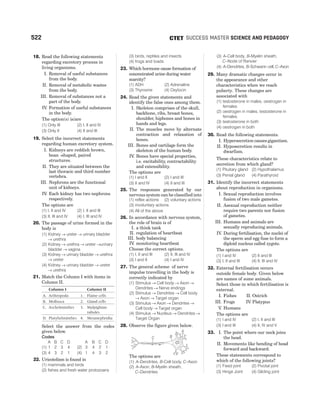
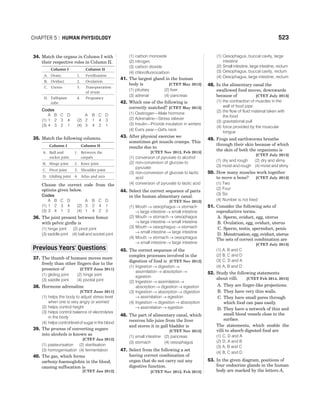
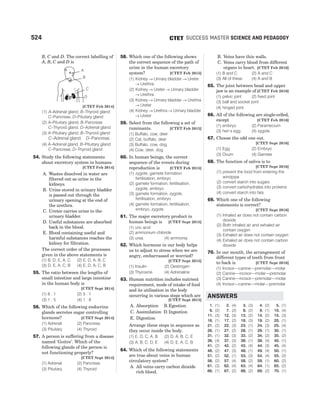
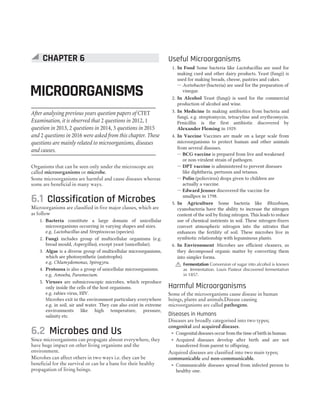
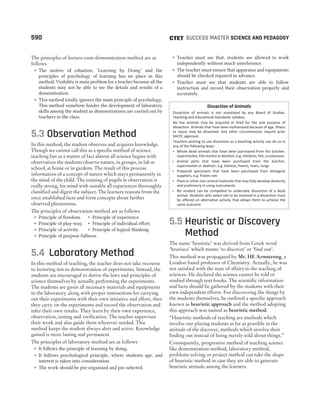
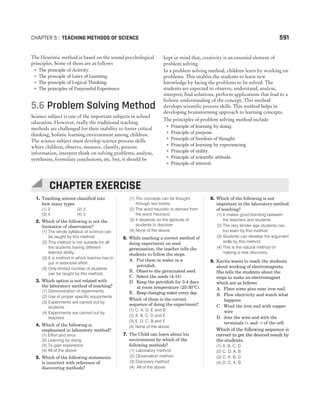
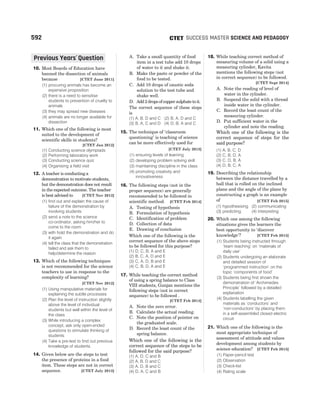
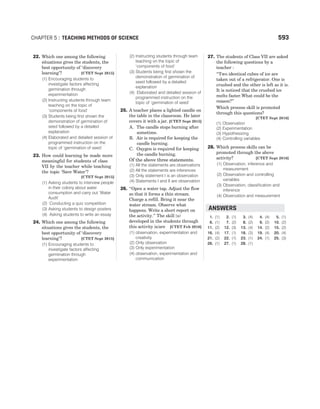
Compiled & Edited by
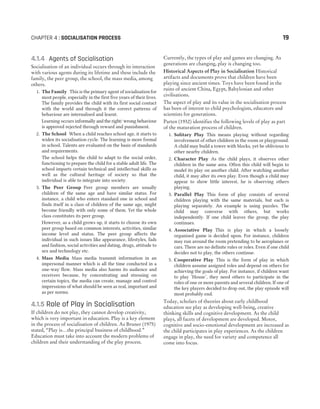
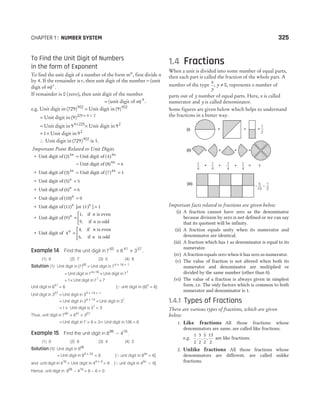
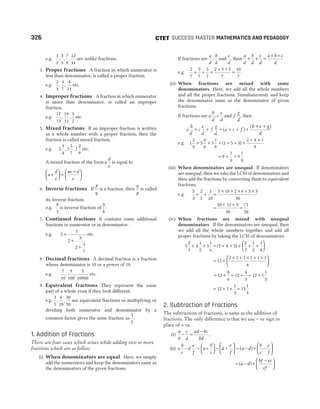
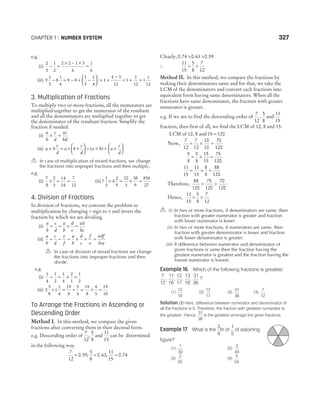
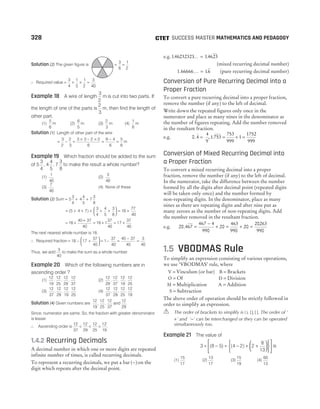
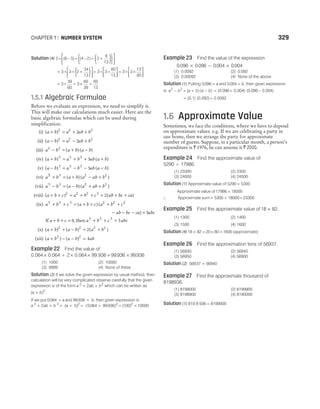
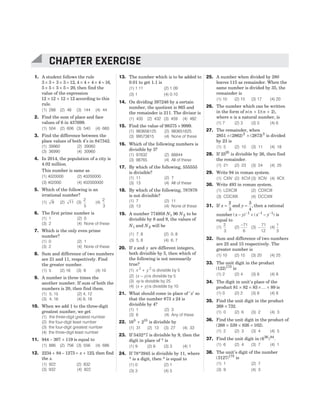
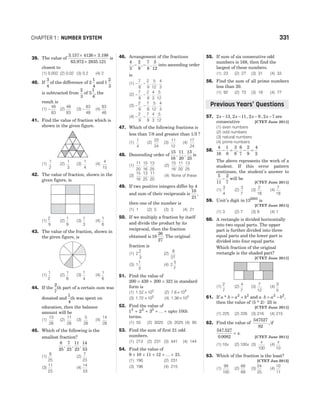
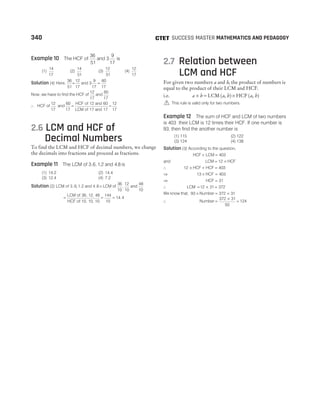
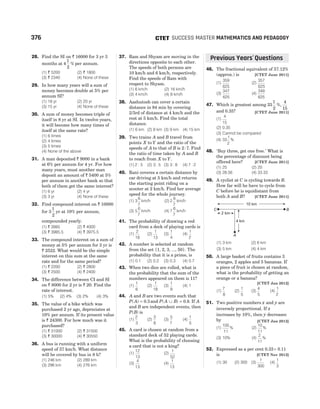
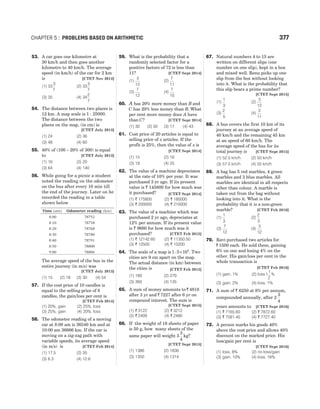
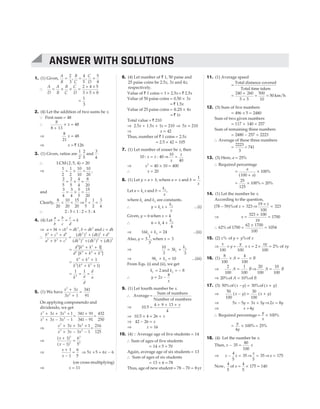
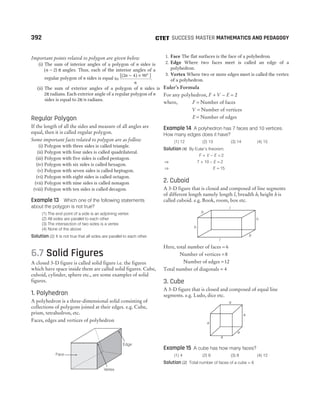
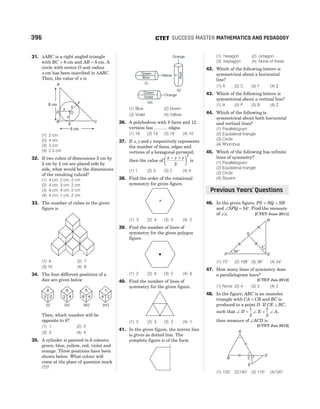
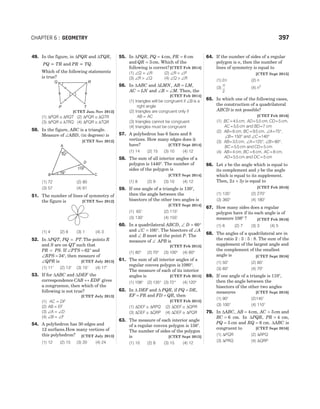
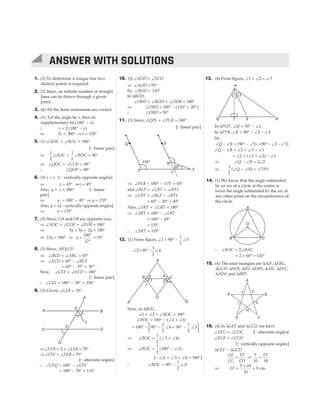
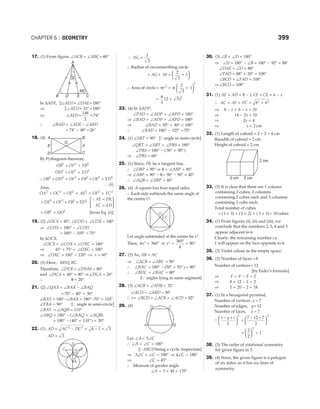
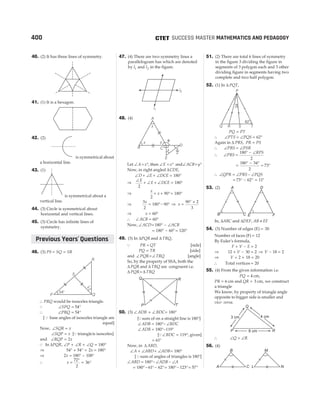
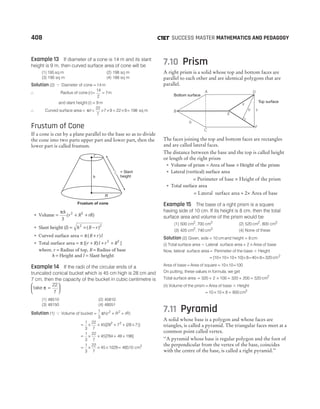
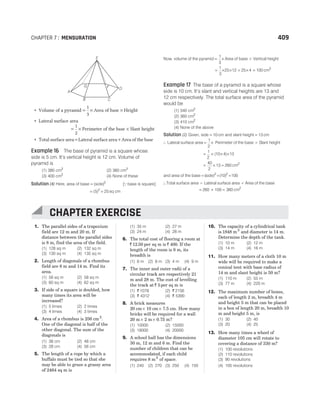
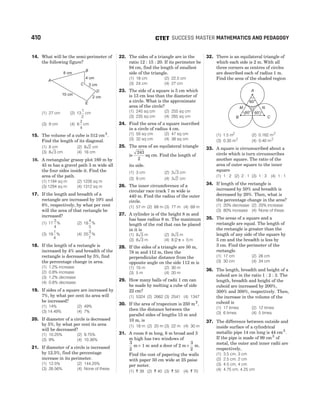
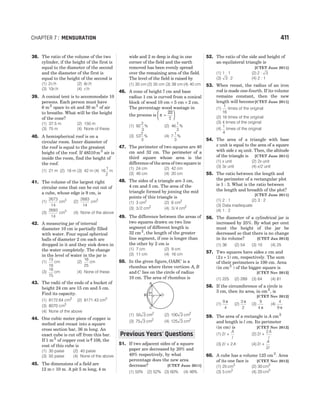
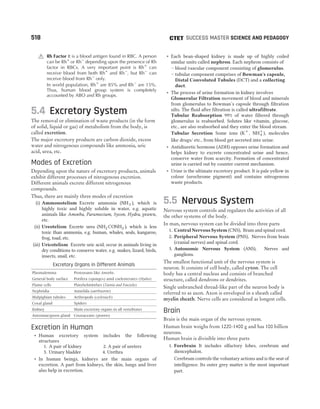
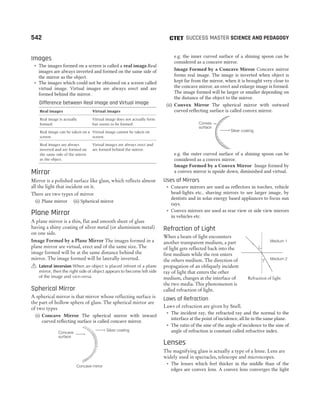
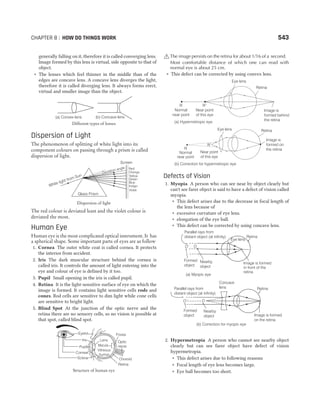
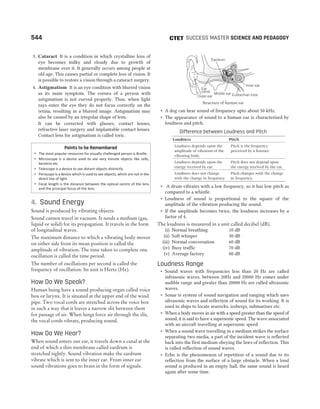
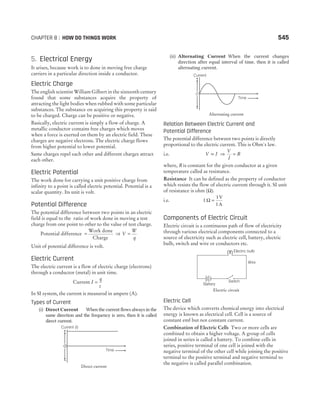
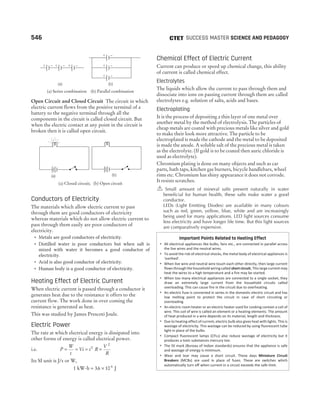
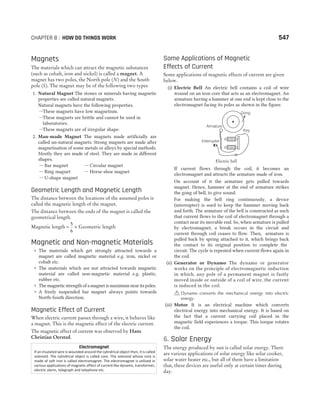
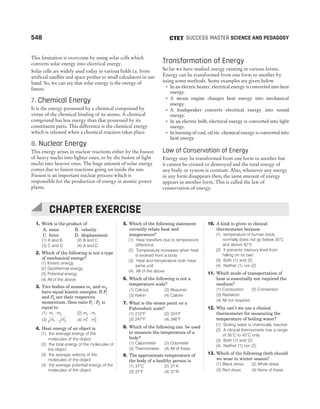
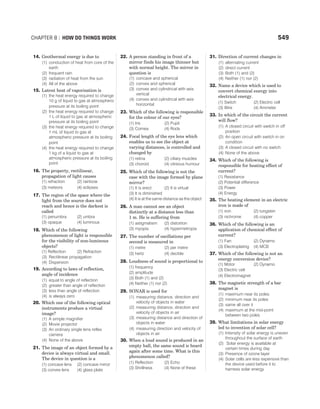
Arihant 'Expert Team'
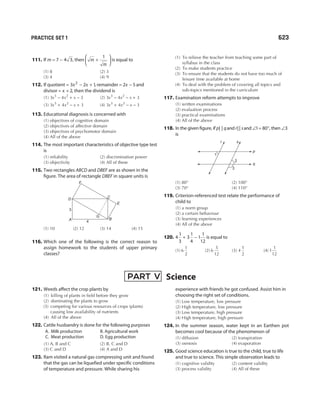
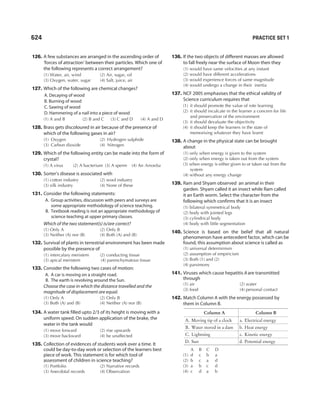
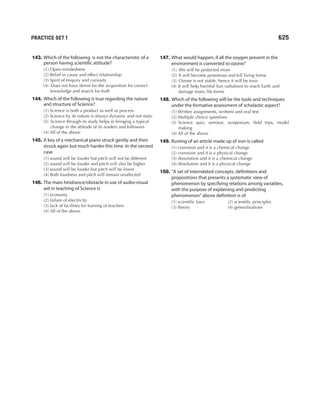
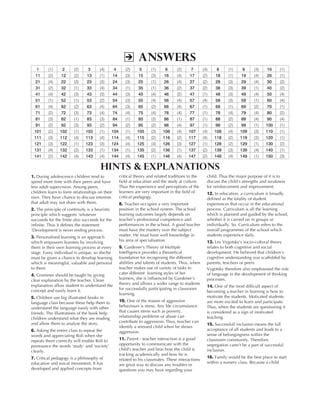
Arihant Publications (India) Ltd.
C
CRACKER
C
CRACKER
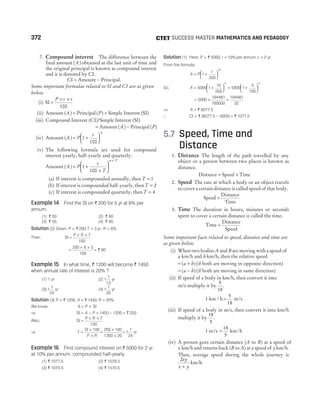
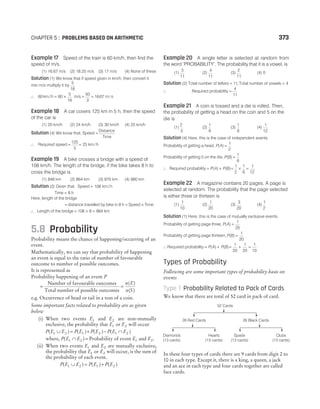
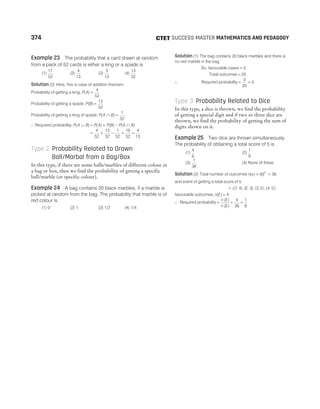
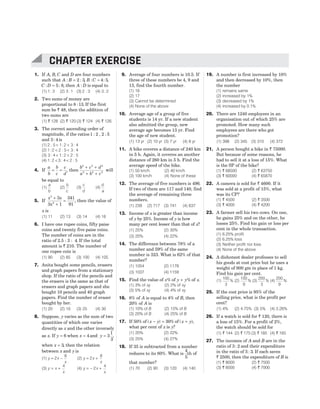
All Rights Reserved
ARIHANT PUBLICATIONS (INDIA) LIMITED
Š Publisher
No part of this publication may be re-produced, stored in a retrieval system or by any means,
electronic, mechanical, photocopying, recording, scanning, web or otherwise without the
written permission of the publisher. Arihant has obtained all the information in this book
from the sources believed to be reliable and true. However, Arihant or its editors or authors
or illustrators don’t take any responsibility for the absolute accuracy of any information
published and the damage or loss suffered thereupon.
All disputes subject to Meerut (UP) jurisdiction only.
Administrative & Production Offices
Regd.Office
‘Ramchhaya’4577/15, Agarwal Road, Darya Ganj, New Delhi -110002
Tele: 011- 47630600, 43518550
HeadOffice
Kalindi, TP Nagar, Meerut (UP) - 250002
Tel: 0121-7156203, 7156204
Sales & Support Offices
Agra, Ahmedabad, Bengaluru, Bareilly, Chennai, Delhi, Guwahati,
Hyderabad, Jaipur, Jhansi, Kolkata, Lucknow, Nagpur & Pune.
ISBN 978-93-24195-03-6
PO No : TXT-XX-XXXXXXX-X-XX
Published by Arihant Publications (India) Ltd.
For further information about the books published by Arihant, log on to
www.arihantbooks.com or e-mail at info@arihantbooks.com
Follow us on
C
CRACKER
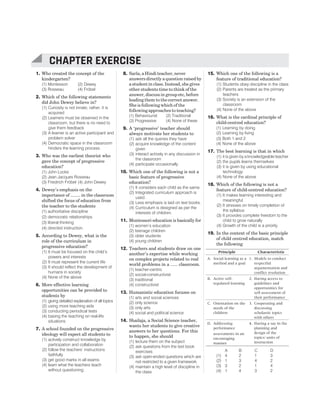
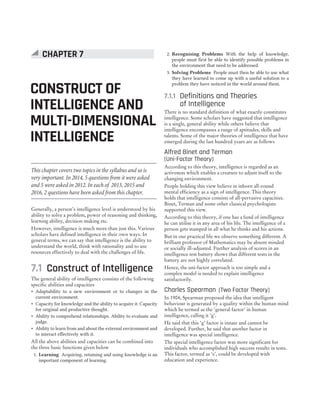
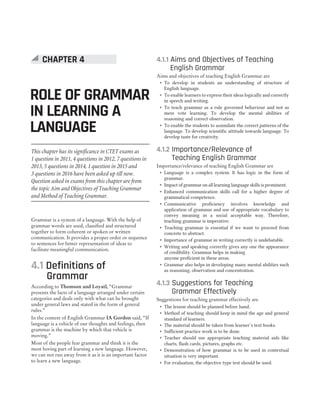
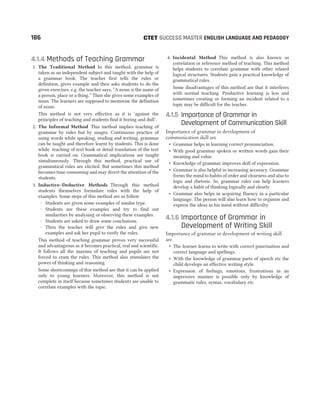
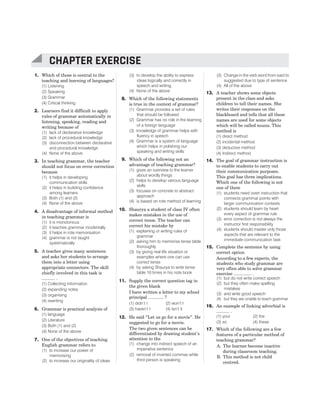
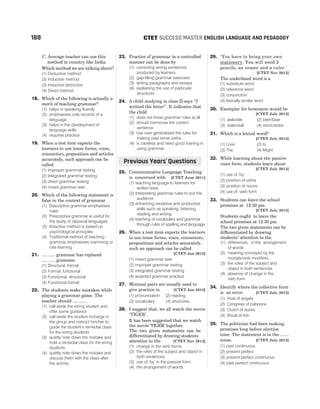
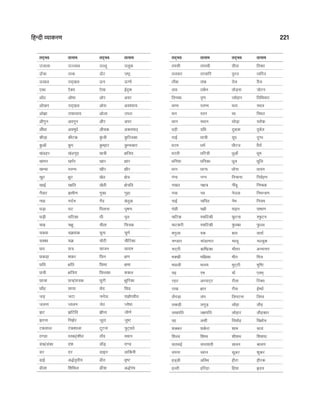
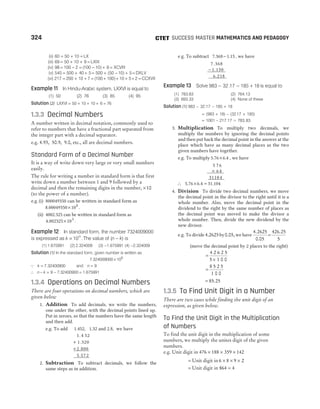
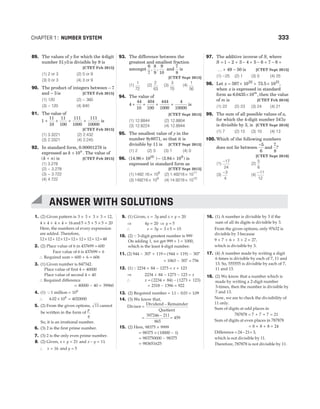
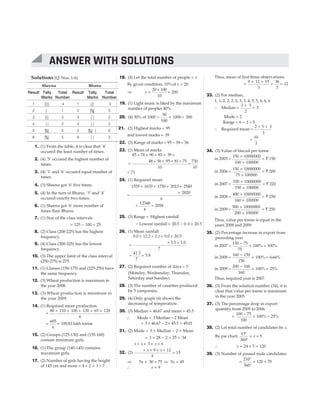
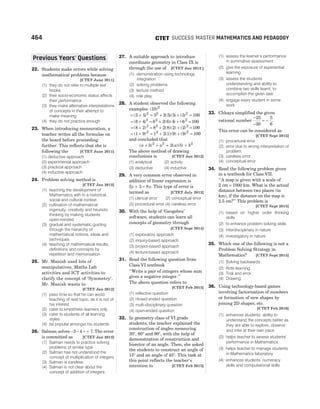
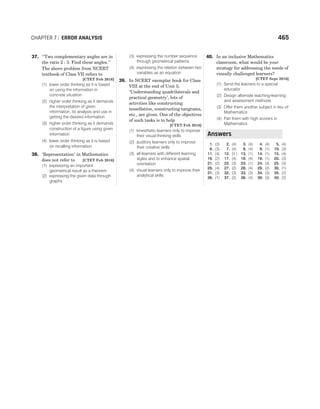
8. Teaching Learning Materials 206-210
2. An{R>V JÚm§e 228-251
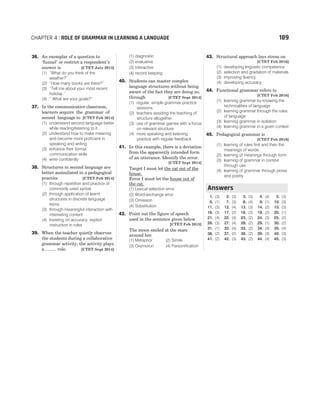
4. Role of Grammar in Learning
a Language 185-189
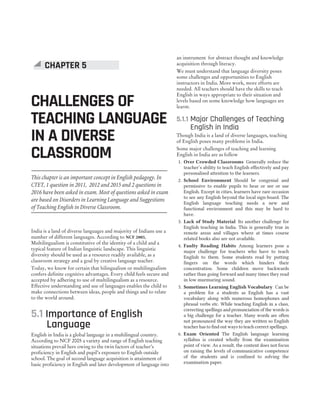
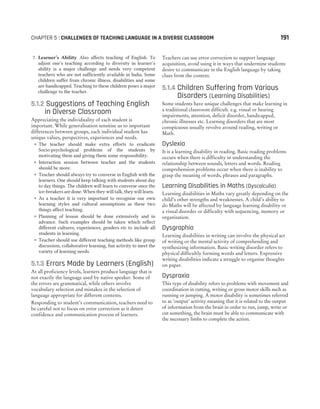
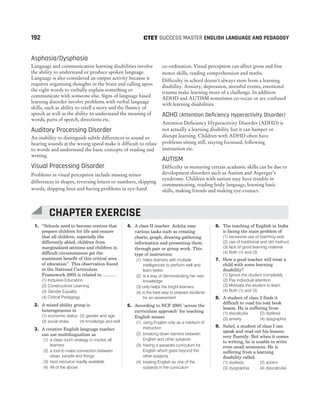
5. Challenges of Teaching Language
in a Diverse Classroom 190-193
6. Language Skills 194-199
7. Evaluation of Comprehension and
Language Skills 200-205
{hÝXr ^mfm Ed§ {ejmemñÌ 215-316
3. An{R>V nÚm§e 252-268
{hÝXr ì¶mH$aU 217-227
9. Remedial Teaching 211-214
SOLVED PAPER 2016 1-16
SOLVED PAPER (Dec 2018) 1-14
17. Basic process of Teaching and Learning 84-90
1. Concept of Development and its
Relationship with Learning 3-7
18. Child: A Problem-Solver and as a
Scientific Investigator. 91-94
22. National Curriculum Framework 111-116
1. Learning and Acquisition 168-173
SOLVED PAPER (July 2019) 1-18
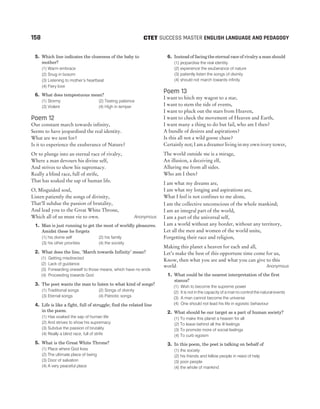
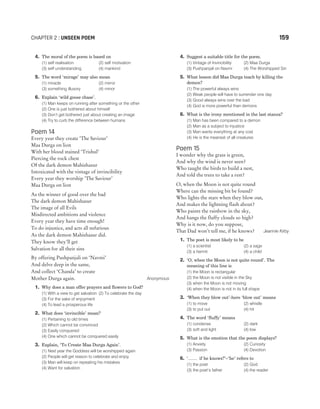
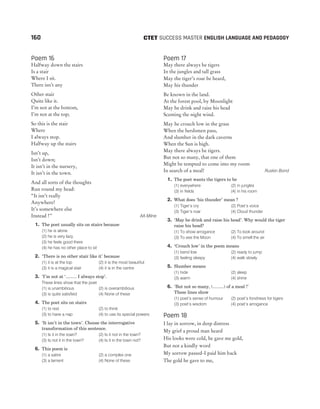
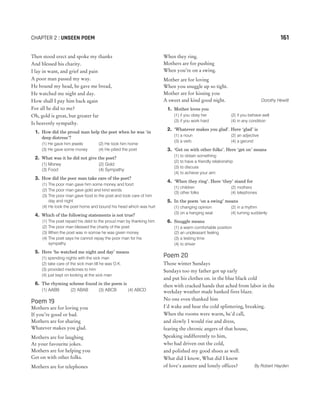
2. Unseen Poem 150-167
2. Principles of Language Teaching 174-179
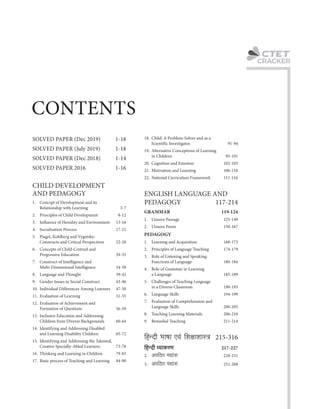
4. Socialisation Process 17-21
6. Concepts of Child-Centred and
Progressive Education 29-33
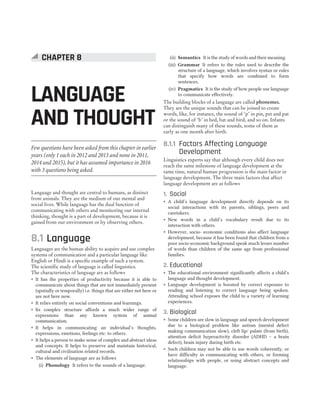
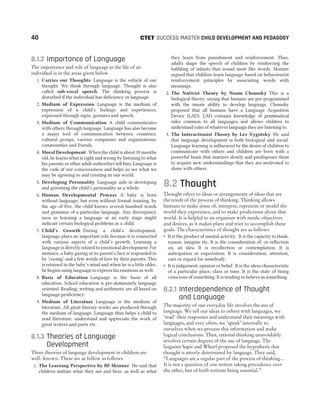
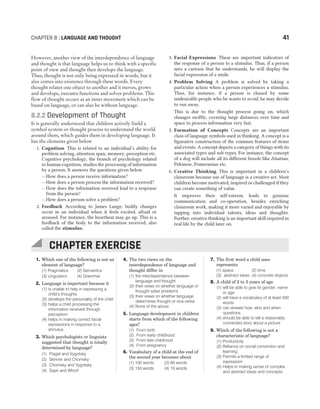
8. Language and Thought 39-42
SOLVED PAPER (Dec 2019) 1-18
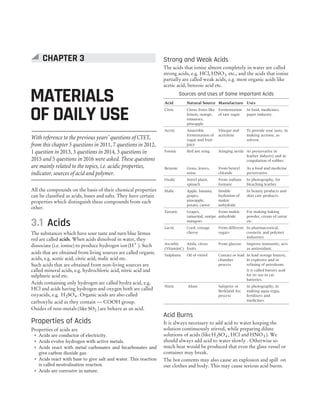
11. Evaluation of Learning 51-55
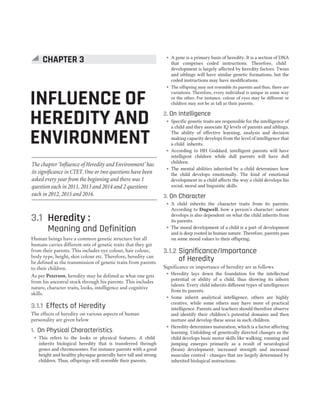
3. Influence of Heredity and Environment 13-16
12. Evaluation of Achievement and
Formation of Questions 56-59
19. Alternative Conceptions of Learning
in Children 95-101
5. Piaget, Kohlberg and Vygotsky:
Constructs and Critical Perspectives 22-28
21. Motivation and Learning 106-110
14. Identifying and Addressing Disabled
and Learning Disability Children 65-72
3. Role of Listening and Speaking:
Functions of Language 180-184
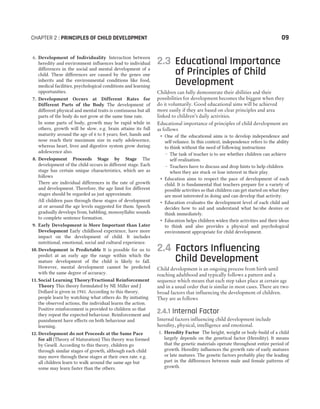
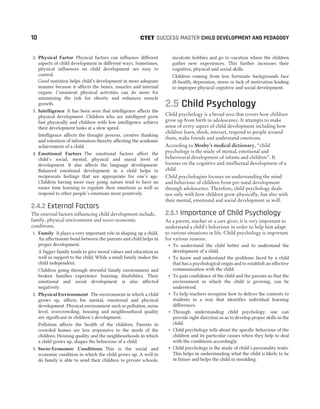
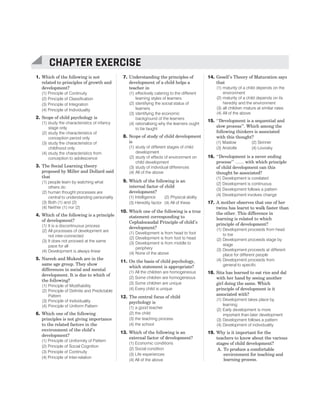
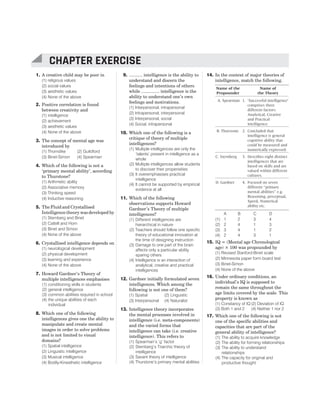
CHILD DEVELOPMENT
AND PEDAGOGY
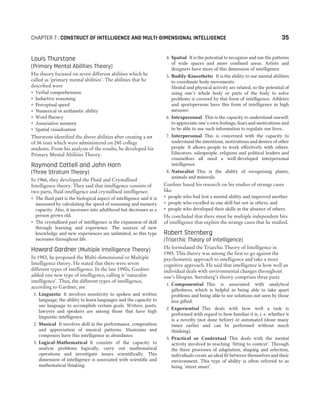
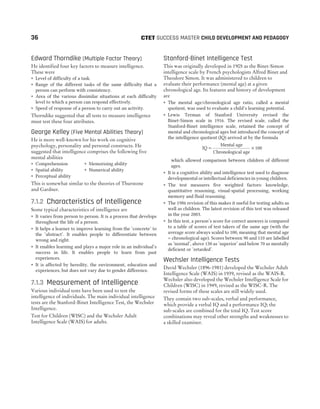
7. Construct of Intelligence and
Multi-Dimensional Intelligence 34-38
16. Thinking and Learning in Children 79-83
10. Individual Differences Among Learners 47-50
20. Cognition and Emotion 102-105
2. Principles of Child Development 8-12
ENGLISH LANGUAGE AND
PEDAGOGY 117-214
GRAMMAR 119-124
13. Inclusive Education and Addressing
Children from Diverse Backgrounds 60-64
1. Unseen Passage 125-149
15. Identifying and Addressing the Talented,
Creative Specially-Abled Learners. 73-78
9. Gender Issues in Social Construct 43-46
PEDAGOGY
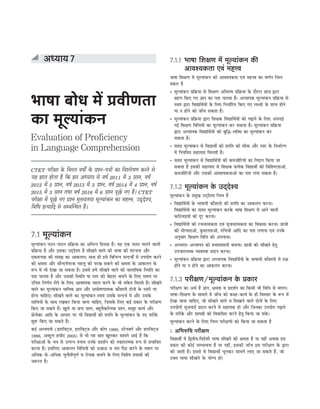
CONTENTS
C
CRACKER
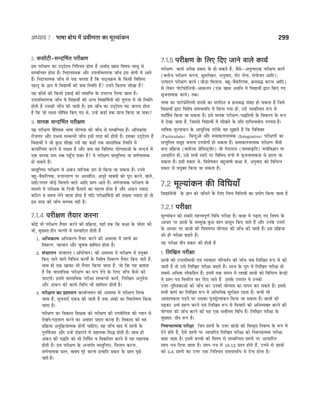
7. ^mfm ~moY (gwZZm, ~mobZm n‹T>Zm Ed§
{bIZm) ‘| àdrUVm H$m ‘yë¶m§H$Z 298-303
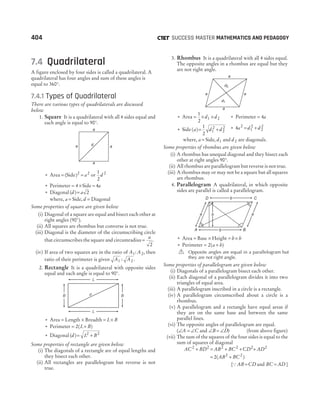
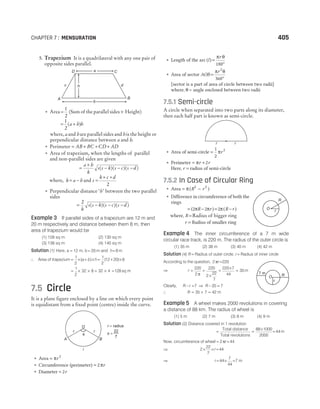
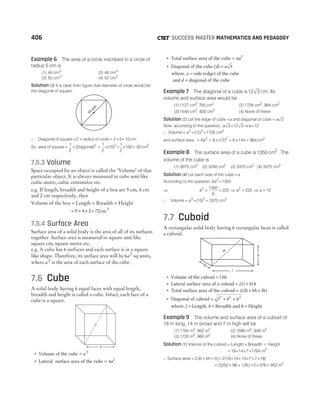
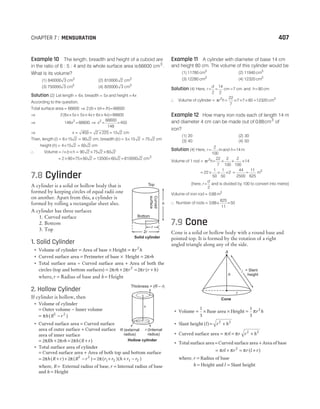
7. Mensuration 402-418
PEDAGOGY
1. Nature of Mathematics 430-437
3. Language of Mathematics 443-445
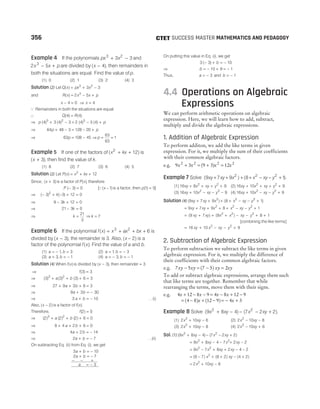
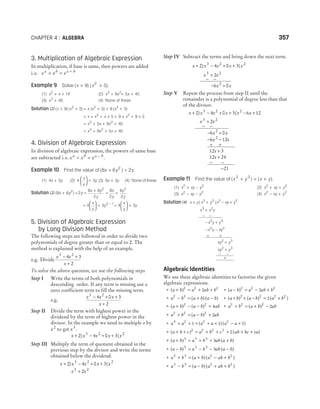
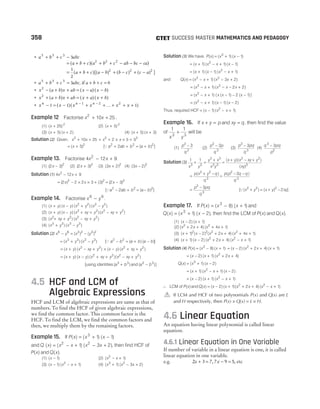
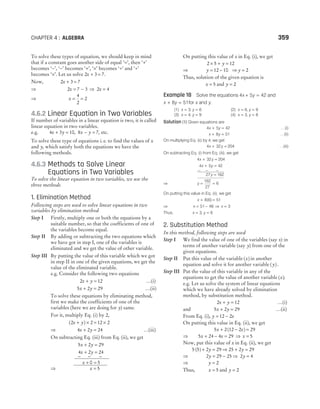
1. Number System 319-336
2. ^mfm {ejU Ho$ {gÕmÝV 271-275
2. Place of Mathematics in Curriculum 438-442
4. Community Mathematics 446-449
5. ^mfmÂśr {d{dYVm dmbo H$jm-H$j H$s
g‘ñ¶mE± 284-287
8. Data Handling 419-429
5. Evaluation 450-456
6. Problem of Teaching in Mathematics 457-459
MATHAMATICS
1. A{YJ‘ Ed§ AO©Z 267-270
8. {eúmH ghm¶H$ gm‘J«r 304-309
9. CnMmamˑH$ {ejU 310-315
2. LCM and HCF 337-343
{ejmemñÌ
3. ^mfm Ho$ H$m¶© Ed§ BgHo$ {dH$mg ‘|
~mobZo Ed§ gwZZo H$s ^y{‘H$m 276-279
4. ^mfm A{YJ‘ ‘| ì¶mH$aU H$s ^y{‘H$m 280-283
3. Square-Square Root &
Cube-Cube Root 344-353
6. ^mfm H$mÂĄeb 288-297
5. Problem Based on Arithmetic 369-381
6. Geometry 382-401
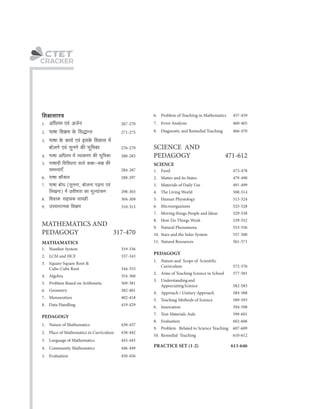
MATHEMATICS AND
PEDAGOGY 317-470
4. Algebra 354-368
8. Evaluation 602-606
PEDAGOGY
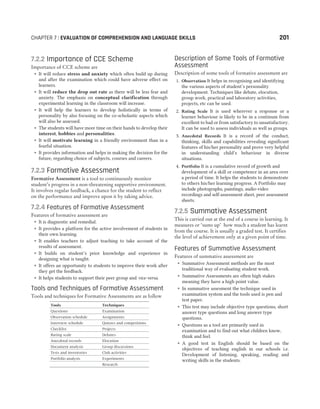
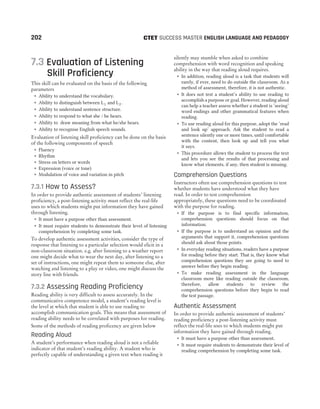
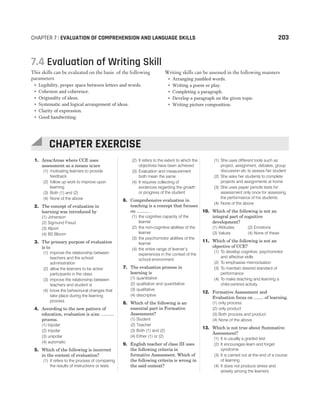
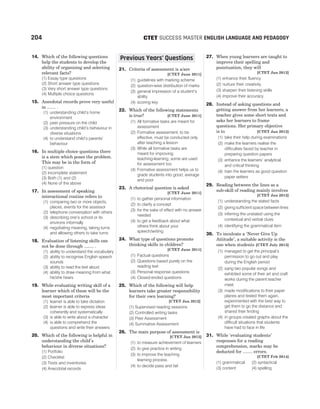
PRACTICE SET (1-2) 613-646
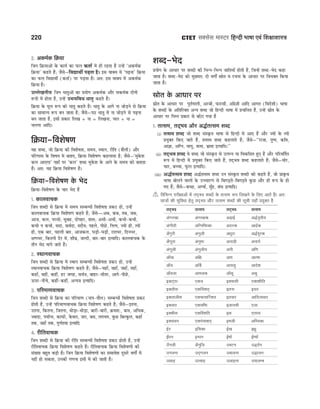
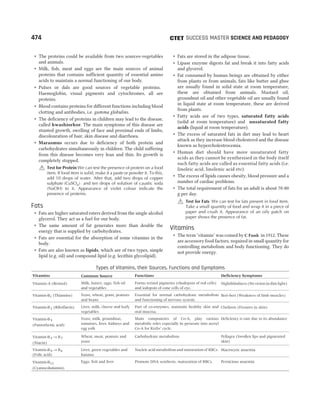
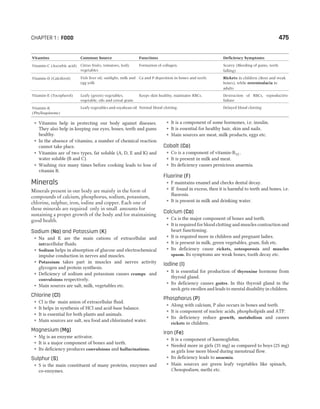
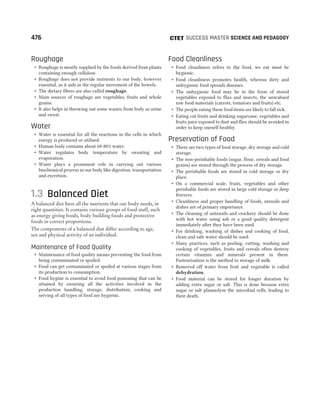
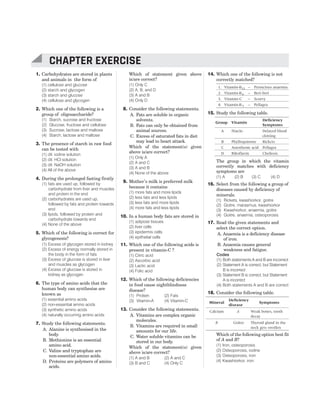
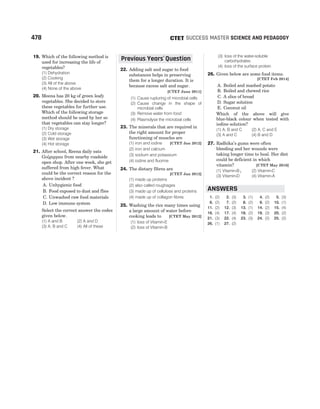
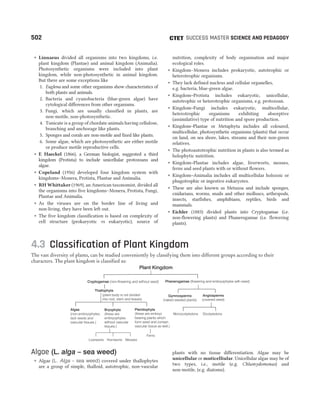
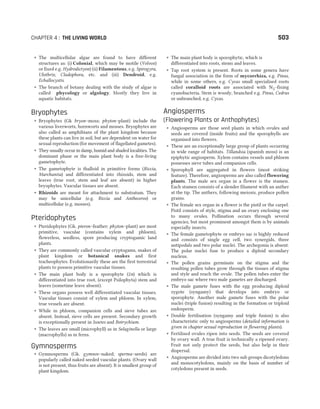
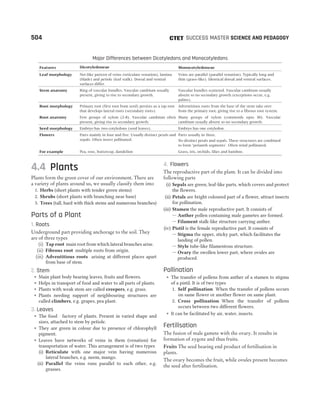
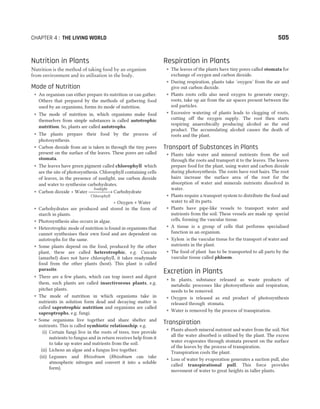
1. Food 473-478
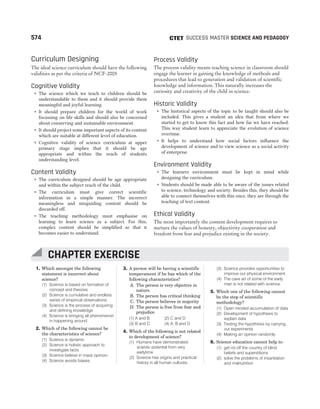
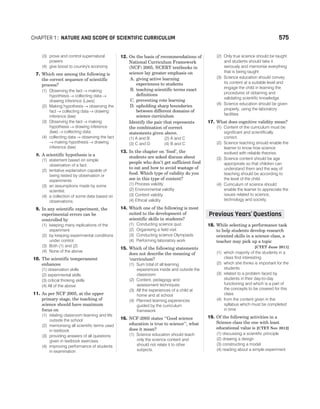
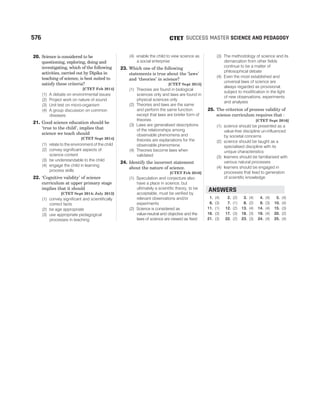
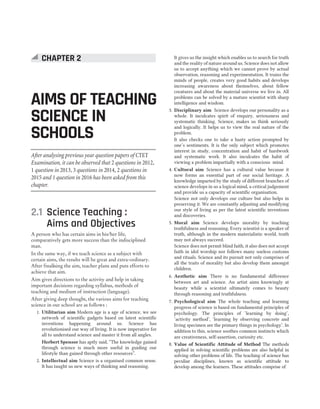
1. Nature and Scope of Scientific
Curriculum 572-576
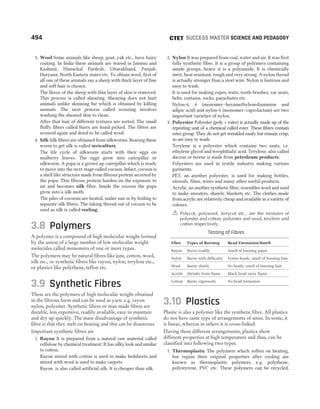
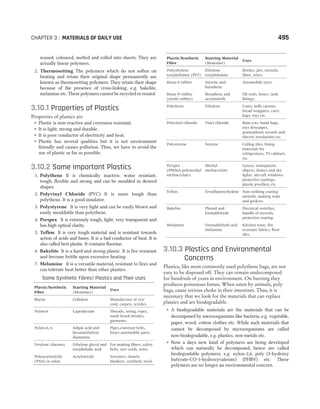
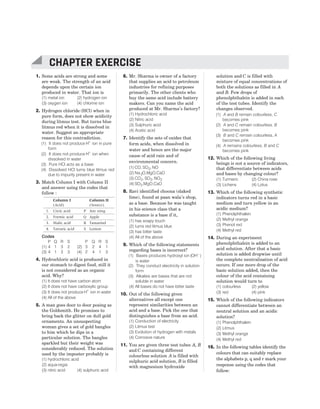
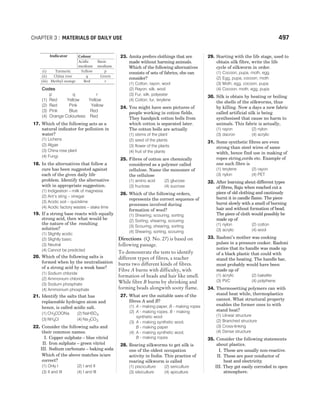
3. Materials of Daily Use 491-499
SCIENCE AND
PEDAGOGY 471-612
8. How Do Things Work 539-552
6. Microorganisms 525-528
5. Human Physiology 515-524
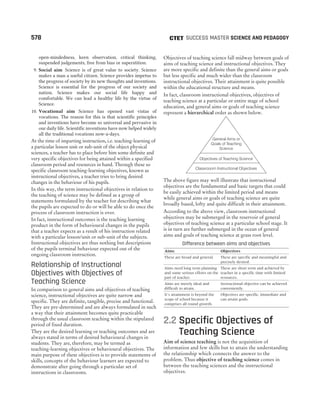
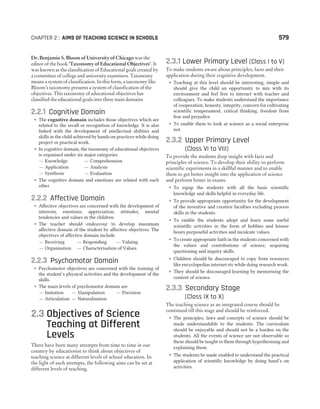
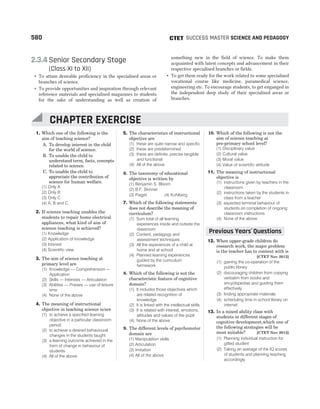
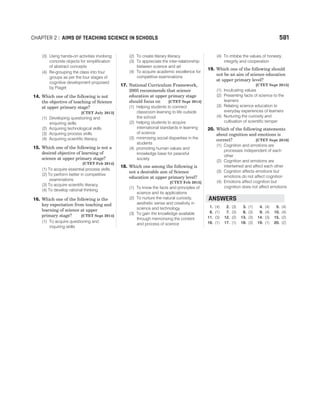
2. Aims of Teaching Science in School 577-581
5. Teaching Methods of Science 589-593
11. Natural Resources 561-571
6. Innovation 594-598
7. Text Materials Aids 599-601
9. Problem Related to Science Teaching 607-609
7. Moving things People and Ideas 529-538
4. Approach / Unitary Approach 584-588
10. Remedial Teaching 610-612
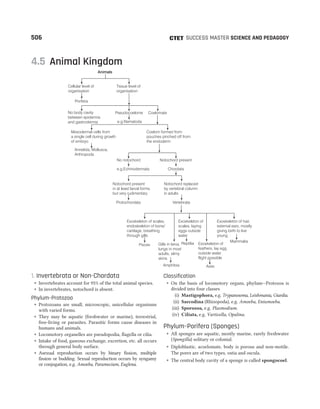
4. The Living World 500-514
7. Error Analysis 460-465
9. Natural Phenomena 553-556
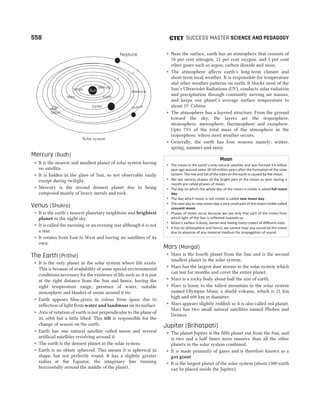
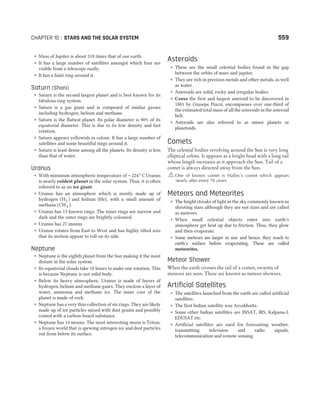
10. Stars and the Solar System 557-560
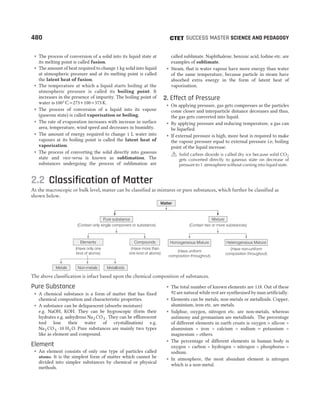
2. Matter and its States 479-490
SCIENCE
3. Understandingand
AppreciatingScience 582-583
8. Diagnostic and Remedial Teaching 466-470
C
CRACKER
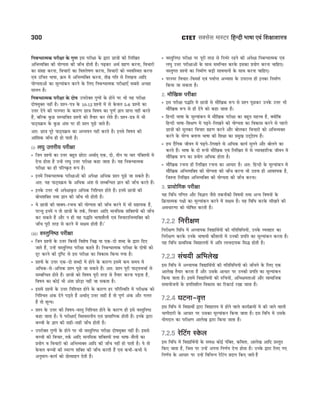
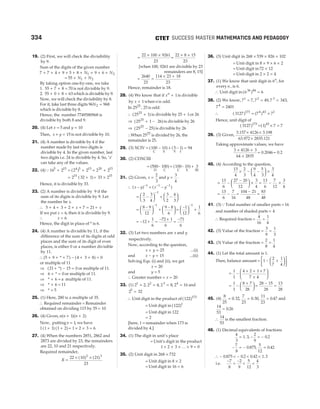
! CTET may also apply to the unaided private
schools, who may exercise the option of
considering the CTET.
(i) Paper I will be for a person who intends to be a teacher for
classes I to V.
The CTET is presently being conducted annually. The Validity
Period of CTET qualifying certificate for appointment will be seven
years for all categories.
VALIDITY PERIOD OF CTET
CERTIFICATE
ABOUT CTET
All questions in CTET test will be Multiple Choice Questions
(MCQs), each carrying one mark, with four alternatives out of
which one answer will be correct. There will be no negative marking.
! The CTET shall apply to schools of the
Central Government (KVS, NVS, Tibetan
Schools, etc) and schools under the
administrative control of UT of Chandigarh
and Andaman & Nicobar Islands.
STRUCTURE AND PATTERN
OF CTET
There will be two papers of CTET.
(ii) Paper II will be for a person who intends to be a teacher for
classes VI to VIII.
! Schools owned and managed by the State
Government/local bodies and aided schools
shall consider the TET conducted by the State
Government. However, a State Government
can also consider the CTET if it decides not to
conduct the State TET.
Note A person who intends to be a teacher for both levels
(classes I to V and classes VI to VIII) will have to appear in both
the papers (Paper I and Paper II).
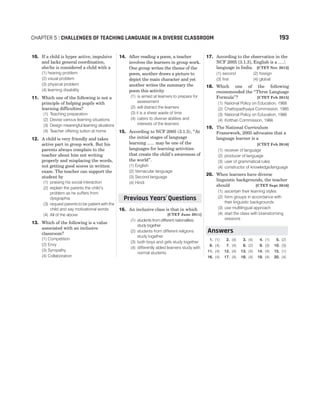
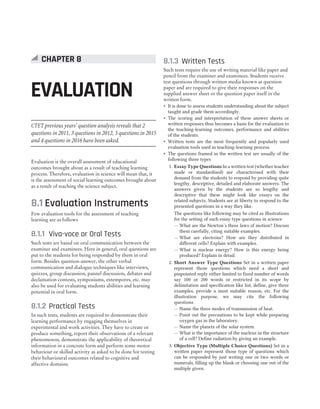
Throughout the world, teaching is looked at as
one of the most respected and noble jobs a person
can have and a good teacher not only shows the
right path that the students should follow but also
prepares the human resource for the further
development of the nation. There are various
exams for the appointment of the teachers.
Recently the as per the norms of the Right of
Children to Free and Compulsory Education
(RTE) Act, 2009 The Ministry of Human
Resource Development, Government of India has
entrusted the responsibility of conducting the
Central Teacher Eligibility Test (CTET) to the
Central Board of Secondary Education Delhi.
Now it become compulsory for a person who
aspires to become a teacher at elementary level (I
to VIII class) to qualify the Central Teacher
Eligibility Test (CTET).
There is no restriction on the number of attempts a person can take
for acquiring a CTET Certificate. A person who has qualified
CTET may also appear again for improving his/her score.
APPLICABILITY OF CTET
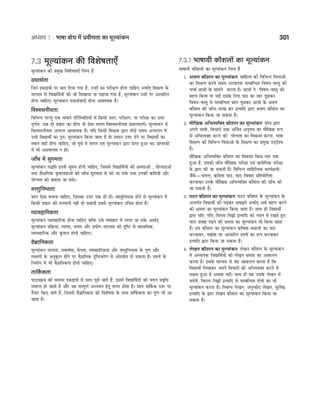
Duration of examination :150 minutes
PAPER II (for Class VI to VIII)
Child Development and Pedagogy
Language I (English)
Language II (Hindi)
Mathematics / Science
Total
30
30
30
60
150
30
30
30
60
150
i
ii
iii
iv
Subject Question No Marks
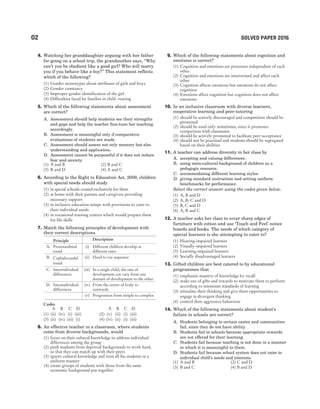
Directions (Q. Nos. 1-30) Answer the following
questions by selecting the most appropriate options.
1. Noor forgot to bring her tiffin to school and asked
Tanya to share her tiffin saying ‘‘You should share
your tiffin with me today because I shared my tiffin
with you yesterday.’’ According to Lawrence
Kohlberg’s theory of moral development, Noor’s
statements represents ……… orientation typical at
………… stage.
(1) law and order ; post-conventional
(2) obedience ; pre-conventional
(3) being nice ; conventional
(4) exchange ; conventional
2. Widely held beliefs about typified characteristics
deemed appropriate for different sexes in the society
are referred
to as
(1) gender discrimination (2) gender roles
(3) gender identity (4) gender stereotypes
3. Recently there have been conscious efforts to include
stories in curriculum where father is involved in
household works and mother is doing adventure
activities. This move is important because
(1) it aims to strengthen gender bias
(2) it aims to eliminate gender stereotyping
(3) it aims to encourage gender constancy
(4) it aims to increase gender discrimination
4. According to Vygotsky, ‘‘when adults adjust the
support to extend the child’s current level of
performance’’, it is called
(1) discovery learning
(2) zone of proximal development
(3) scaffolding (4) inter-subjectivity
5. According to Jean Piaget’s theory of cognitive
development, ‘‘hypothetic-deductive reasoning
develops during
(1) sensori-motor stage (2) pre-operational stage
(3) concrete operational stage (4) formal operational stage
2019 DEC PAPER II (CLASS VI-VIII) SOLVED PAPER
CTET
SOLVED
PAPER
1.
2.
3.
8 DECEMBER, 2019
This question paper consists of 150 objective type questions, to be completed in maximum 2 hrs 30 min.
Each question carries 1 mark and there is no negative marking.
This paper has five parts : Part I Child Development & Pedagogy (Q. 1-30),
Part II Maths & Science (Q. 31-90), Part III English (Language I) (Q. 91-120),
Part IV Hindi (Q. 121-150).
PAPER II (CLASS VI-VIII)
CTET
CentralTeacher’s EligibilityTest
INSTRUCTIONS
Child Development and Pedagogy
PART I
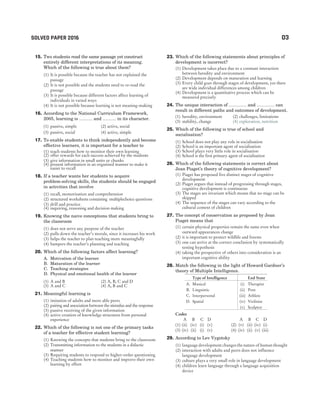
6. According to ………, ‘‘it is important to understand the
social processes and influence of the cultural context
on children’s thinking.’’
(1) Lawrence Kohlberg (2) Jean Piaget
(3) Lev Vygotsky (4) Albert Bandura
7. Drawing implications from Piaget’s theory of cognitive
development, a teacher of grade 6-8 in his classroom
should
(1) discourage use of logical arguments.
(2) present problems that require reasoning based solutions
(3) use only concrete materials to teach a concept
(4) rely solely on prescribed syllabus
8. As per Howard Gardner’s theory of multiple
intelligence, what would be the characteristics of a
person with ‘Logico-mathematical’ intelligence?
(1) Sensitivity to the sounds, rhythms and meaning of words
(2) Ability to perceive visual-spatial world accurately
(3) Ability to produce and appreciate pitch, rhythm and
aesthetic quality of musical expressiveness
(4) Sensitivity to and capacity to detect patterns, handle long
chains of reasoning
9. The process by which children develop habits, skills,
values and motives that make them responsible,
productive members of society is called
(1) socialization (2) inclusion
(3) mainstreaming (4) differentiation
10. Which of the following statements about the role of
heredity and environment in human development is
correct?
(1) The only reason for individual differences is heredity
(2) Environmental influencs totally shape the development of a
human
(3) neither heredity nor environment influence human
development.
(4) Heredity and environment both influence human
development in a complex interplay
11. In a progressive classroom
(1) knowledge is constructed by the learner
(2) knowledge is received passively by the learner
(3) knowledge is reproduced by the learner as it is
(4) knowledge is recalled by the learner as per instructions of
the teacher
12. Continuous and comprehensive evaluation includes
(1) only formative assessment
(2) only summative assessment
(3) neither formation nor summative assessment
(4) both formative and summative assessments using a wide
variety of strategies
13. A student in your class has been told again and again
from different sources that people from his social
group typically perform poorly in academics. To reduce
the impact of this stereotype and resultant stereotype
threat, a teacher’s initial step can be
(1) ignoring such concerns
(2) organizing competition between students from different
social groups
(3) suggesting the student to leave academics and join some
other domain
(4) presenting stories and examples of role models from
different social groups
14. In an inclusive classroom, a teacher should
(1) believe that every child has a potential to learn as per their
abilities and strength
(2) show an attitude of pity and sympathy towards disabled
learners.
(3) use label such as ‘handicapped child’, ‘retarded child’ to
categorise children
(4) pay attention only to the gifted and talented children
15. A student shows the following signs in the classroom
– Anxiety around rending
– Difficulty in recognising words or letters
– Poor vocabulary skills
– Difficulty with understanding or remembering what
was read
These are an indication of
(1) an autistic student
(2) a creative student
(3) a student with learning disability
(4) a student with ‘mental impairment’
16. A teacher can address needs of specially abled learners
in an inclusive classroom by
(1) emphasizing upon practice and drill and using paper-pencil
tests for assessment.
(2) following uniform ways of instructing the students
(3) giving a lot of written homework and stressing on copying
of answer from other ‘bright students’
(4) developing specific learning objectives based on an
analysis of each student’s learning strengths and
weaknesses.
17. A teacher can encourage creative learners in her
classroom by
(1) emphasizing convergent thinking
(2) discouraging divergent thinking
(3) encouraging multiple perspectives and appreciating original
ideas
(4) discouraging the students from taking risks and
undertaking challenges
18. Which of the following factors supports meaningful
learning in the classroom?
(1) Increasing number of tests to motivate children to learn
(2) Increasing rewards to motivate children to learn
(3) Following only the lecture mode of instruction
(4) Showing genuine interest in the content matter and having
concern for children’s overall well-being and learning
19. An example of effective problem solving strategy is
(1) Not paying any attention to evaluating the solution
(2) Functional fixedness - focusing on only the conventional
function of an object
(3) Response set-getting stuck on one way of representing a
problem
(4) Means end analysis dividing the problem into number of
sub-goals.
02 2019 DEC PAPER II (CLASS VI-VIII) SOLVED PAPER
CTET
03
20. Which of the following is NOT an effective strategy for
teaching-learning?
(1) Encouraging children to make intuitive guesses
(2) Experimentation and exploration
(3) Dialogue and discussion
(4) Focusing on reproduction of knowledge as given
21. How can teachers deal with children who are
non-attentive in the classroom?
(1) Ask the children to go out of the class
(2) Scold them frequently in front of the entire class
(3) Talk to them and find out reasons for their disinterest
(4) Given them a lot of worksheets as homework
22. Constructivist approach suggests that ……… is crucial
for constructing knowledge.
(1) prior knowledge of the learner
(2) conditioning
(3) punishment (4) rote memorization
23. Children construct ‘naive theories’ about various
phenomenon. In this background a teacher should
(1) challenge these conceptions of the children through
dialogue
(2) dismiss these ideas that children have
(3) ignore children’s ideas and theories
(4) scold the children for having these ideas that interfere with
her teaching.
24. The relationship between cognition and emotions is
(1) independent of each other
(2) uni-directional - emotions influence cognition
(3) uni-directional - cognition influences emotions
(4) bi-directional - a dynamic interplay between both
25. Which of the following factors affect learning?
(i) Interest of the student
(ii) Emotional health of the student
(iii) Pedagogical strategies
(iv) Social and cultural context of the student
(1) (i), (ii) (2) (ii), (iii)
(3) (i), (ii), (iii) (4) (i), (ii), (iii), (iv)
26. ……… are an important aspect of the process of
meaningful construction of knowledge.
(1) Social interactions
(2) Drill and repetitive recall
(3) Rewards and punishment
(4) Stimulus-response associations
27. When student repeatedly engage in an activity
(such as design and conduct an experiment) to
earn a reward that is not directly related to that
activity (such as earn a ‘star’ or ‘badge’) they are
likely to
(1) develop materialistic attitude towards learning
(2) enjoy learning for the sake of understanding
(3) persist in doing the activity even without the reward
(4) set mastery goals for themselves rather than work to please
others
28. The concept of childhood is
(1) universally the same across different cultural contexts
(2) a social construction according to contemporary
socio-constructivist theories
(3) that children are born evil and have to be civilised
(4) that children begin with nothing at all and their
characteristics are shaped entirely by environment
29. Which of the following characterise the period of
‘middle childhood’?
(1) Physical growth and development occur at a very rapid
pace.
(2) Ability to think abstractly and use of scientific reasoning
develops
(3) Children begin to think logically but concretely
(4) Learning occurs primarily through sensory and motor
activities
30. Family and neighbourhood are
(1) psychological agencies for children
(2) primary socialising agencies
(3) middle socialising agencies
(4) secondary socialising agencies
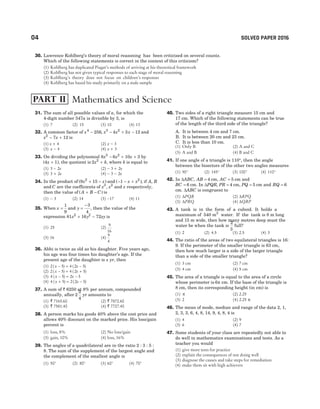
31. Which of the following aligns with the overall objective
of achieving ‘Mathematics for All’ as per NCF-2005 ?
(1) Mathematically talented students should be groomed in
isolation
(2) It should be acknowledged that Mathematics is meant for
selected few students
(3) Textbooks should only include problems of average
difficulty
(4) Contributions of Mathematicians from different regions
and different social groups should be highlighted
32. Which of the following is considered as a characteristic
of an effective Mathematics classroom?
(1) Steps for solving a new problem are neatly demonstrated
on the board by the teacher
(2) Group work and group problem solving is discouraged
(3) It is emphasized that, Mathematics is essentially a concrete
subject
(4) Multiple ways of approaching a problem are encouraged
33. Which of the following is a desirable practice in the
context of teaching and learning of measurement of
volume?
(1) Encourage students to figure out ways to calculate the
volume of different objects
(2) Begin by writing the formula of volume of a cube
(3) Encourage precise calculation right from the beginning
(4) Begin by introducing students to the volume of 2-D figures
34. Which of the following is not true according to Piaget’s
view of children’s understanding of space?
(1) Co-ordination of different visual and tactile experiences is
required for understanding projective space
2019 DEC PAPER II (CLASS VI-VIII) SOLVED PAPER
CTET
Maths & Science
PART II
(2) Progression of geometric ideas follows a definite order
(3) Progression of geometric ideas follows a historical rather
than a logical order
(4) Early understanding of space is formed by child’s sensory
motor experiences
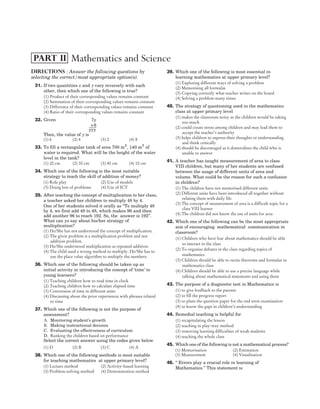
35. If − × − + ÷ − − − ÷ − ÷ −
12 3 20 4 24 8 16 2
( ) [ ( ) ( ) ] [ ( )]
= − ÷ +
( ) ,
28 7 x then the value of x is
(1) 47 (2) 29 (3) 39 (4) 46
36. If a 8-digit number 30 0867
x y is divisible by 88, then
what is the value of ( )
3x y
+ ?
(1) 7 (2) 4 (3) 5(4) 6
37. The value of
6
2
3
2
1
2
3
3
4
5
1
2
4
1
4
1
2
3
7
8
3
4
2
3
÷ × − × + + ×





 is
(1) −6
1
2
(2) −11
1
12
(3) 11
1
12
(4) 6
1
2
38. How many pairs of twin primes are there between the
integers 1 to 100?
(1) 8 (2) 5 (3) 6 (4) 7
39. If 21168 2 3 7
= × ×
a b c
, where a b
, and c are natural
numbers, then what is the value of ( )
4 5
a b c
− + ?
(1) 3 (2) 0 (3) 1 (4) 2
40. Let x be the least number which when divided by 8,
12, 20, 28, 35 leaves a remainder 5 in each case. What
is the sum of digits of x ?
(1) 17 (2) 11 (3) 14 (4) 15
41. What number should be subtracted from each of 50,
61, 92, 117 so that the numbers, so obtained in this
order are in proportion?
(1) 23 (2) 14 (3) 17 (4) 19
42. A sum of ` 1710 is divided in A B
, and C such that 4
times of A, 6 times of B and 9 times of C are equal.
What is the difference between A and C?
(1) ` 540 (2) ` 360 (3) ` 450 (4) ` 480
43. The number of fruits in baskets A and B are in the
ratio 7 : 9. If six fruits are taken out from A and put in
B, then this ratio becomes 1 : 3. The total number of
fruits in A and B is
(1) 40 (2) 28
(3) 32 (4) 36
44. ∆ABC and ∆ADB are on the common base AB and on
the same side of AB. DA AB
⊥ , CB AB
⊥ and AC DB
= .
Which of the following is true?
(1) ∆ ≅ ∆
ABC BDA (2)∆ ≅ ∆
ABC ABD
(3) ∆ ≅ ∆
ABC ADB (4) ∆ ≅ ∆
ABC BAD
45. The sides of four triangles are given below
(i) 20 cm, 22 cm, 24 cm
(ii) 15 cm, 32 cm, 37 cm
(iii) 11 cm, 60 cm, 61 cm
(iv) 19 cm, 40 cm, 41 cm
Which of them forms a right triangle?
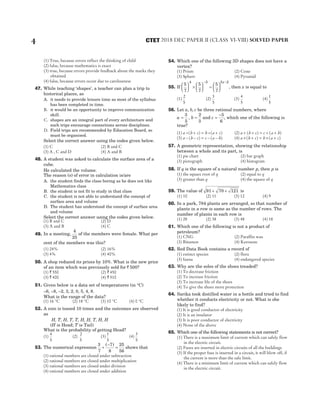
(1) (iv) (2) (i) (3) (ii) (4) (iii)
46. The angles of a quadrilateral are in the ratio
3 : 5 : 7 : 9. What is the difference between the least
and the greatest angles of the quadrilateral?
(1) 90° (2) 50° (3) 60° (4) 72°
47. The perimeter of a triangle is 12 cm. If all the three
sides have lengths (in cm), in integers, then how many
such different triangles are possible?
(1) 5 (2) 2 (3) 3 (4) 4
48. A godown is in the shape of a cuboid whose length,
breadth and height are 56 m, 42 m and 10 m
respectively. How many (maximum) cuboidal boxes
each measuring 2 8 2 5 70
. .
m m cm
× × can be stored into
the godown?
(1) 5400 (2) 2400 (3) 3600 (4) 4800
49. The circumference of the base of a right circular
cylinder is 528 cm and its height is 2 m. What is the
volume of the cylinder ? Take π =






22
7
(1) 6.6528 m3
(2) 2.2176 m3
(3) 3.3264 m3
(4) 4.4352 m3
50. The area of a quadrilateral is 227.2cm2
and the length
of the perpendiculars from the opposite vertices to a
diagonal are 7.2 cm and 8.8 cm. What is the length of
the diagonal ?
(1) 32.6 cm (2) 26.8 cm (3) 28.4 cm (4) 30.2 cm
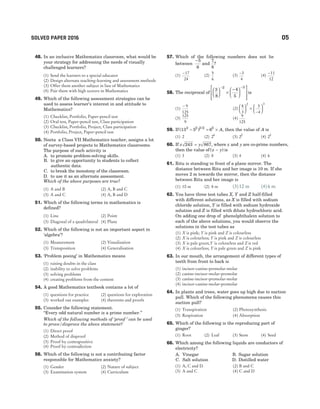
51. If 5 3 4 8 6 7 9 8
( ) ( )
x x x
+ − + = − , then what is the value
of ( )
x x
2
2 1
− + ?
(1)
25
9
(2)
2
3
(3)
4
9
(4)
5
3
52. What is the value of
a a b c b a b c c a b
( ) ( ) ( )
+ + + + + − +
2 2 2 2 2 2
, when
a b
= = −
1 3
, and c = −2 ?
(1) 176 (2) 138 (3) 154 (4) 162
53. The expression
( )( ) ( )( )
x y x xy y x y x xy y
− + + + + − +
2 2 2 2
− + −
( ) ( )
x y x y
2 2
is equal to
(1) x y xy x y
3 3
+ + −
( ) (2) x y xy x y
3 3
− + +
( )
(3) y x xy x y
3 3
− + +
( ) (4) x y xy y x
3 3
+ + −
( )
54. What is the mean of the median, mode and range for
the data given below?
11, 25, 0, 8, 25, 30, 44, 50, 30, 18, 20, 17, 11, 9, 24,
25, 29
(1) 34 (2) 31 (3) 32 (4) 33
55. A mathematical theorem is
(1) a statement without sufficient evidence for proof
(2) a statement that has been proven by logical arguments
based on axioms
(3) a statement which is always true and doesn’t need proof
(4) a statement whose truth or falsity is not known
56. ‘‘Things which are equal to the same thing are equal to
one another.’’ This axiom which is basis to Arithmetic
and Algebra is given by
(1) Euler (2) Euclid (3) Pythagoras (4) Descartes
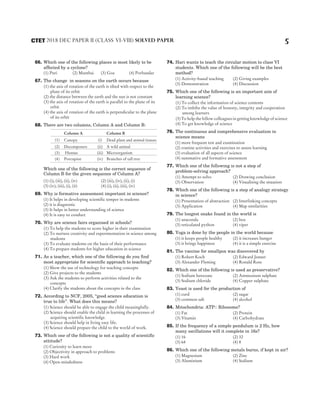
04 2019 DEC PAPER II (CLASS VI-VIII) SOLVED PAPER
CTET
05
57. Which of the following can be used as assessment
strategy to encourage interdisciplinary in
Mathematics?
A. Projects B. Field trips
C. Anecdotal records D. Olympiad
(1) C & D (2) A & B
(3) A & C (4) B & C
58. Which method can be used to prove ‘‘The sum of two
even integers is always even’’ ?
(1) Counter positive proof
(2) Proof by induction
(3) Direct proof
(4) Proof by contradiction
59. Which of the following skills are promoted by
Mathematics at upper primary stage?
A. Visualisation B. Transposition
C. Memorisation D. Generalisation
E. Estimation
(1) A, C, D, E (2) A, B, D, E
(3) A, B, C, D (4) B, C, D, E
60. Which of the following tasks is least likely to develop
critical thinking among students ?
(1) Calculate the volume of a right circular cylinder of radius
3.5 cm and height 10 cm.
(2) Evaluate 72 73
× in three different ways and compare the
result.
(3) Formulate any two situations to represent the equation
7 3 24
x + =
(4) A student calculated the volume of a right circular cylinder
of radius 3.5 cm and height 10 cm is 385 3
. cm . Where did he
go wrong?
Directions : Answer the following questions by
selecting the correct/most appropriate options.
61. A teacher begins the class by demonstrating the
chemical test of starch in a given sample of food. The
cognitive process associated with the underlined word
in the above statement is
(1) Understanding (2) Creating
(3) Analysing (4) Language
62. Which one of the following activities will not provide
for active learning among children?
(1) Listening to a lecture in class
(2) Establishing science club
(3) Organisation of field trip
(4) Developing a science corner
63. Which of the following is used for finding the learning
gaps of learners in Science?
A. Concept map
B. Anecdotal record
C. Portfolio
D. Term end achievement test
(1) B, C and D
(2) D only
(3) A and D
(4) A, B and C
64. Which one of the following tools is based on the
technique of observation?
(1) Anecdotal record (2) Oral test
(3) Written test (4) Paper-pencil test
65. Which of the following statements are correct?
A. Pashmina shawl is made from hair of goats.
B. Angora is a type of wool obtained from rabbits.
C. Camel wool is used to make carpets.
D. Pashmina wool is obtained from rabbits.
(1) C and D (2) A and C
(3) A and B (4) B and C
66. Identity the animal on the basis of features listed
below:
A. Long back bone
B. Many muscles
C. Body curves into many loops for moving forward
(1) Hook worm (2) Snake
(3) Earthworm (4) Snail
67. Which one of the following statement is not true?
(1) Arteries have elastic walls
(2) All arteries carry oxygen rich blood
(3) All arteries carry oxygen from heart to other parts
(4) Arteries have thick walls
68. Which of the following represents correct matching
order?
A. Acetic acid I. Curd
B. Lactic acid II. Spinach
C. Oxalic acid III. Citrus fruits
D. Ascorbic acid IV. Vinegar
(1) A-II, B-IV, C-I, D-III (2) A-II, B-III, C-IV, D-I
(3) A-I, B-II, C-III, D-IV (4) A-IV, B-I, C-II, D-III
69. ‘X’ is a chemical present in our stomach and is
necessary for digestion of food. When ‘ ’
X is secreted in
excess, it causes health problems like indigestion. ‘Y’
is a chemical used to treat this condition. What could
be ‘X’ and ‘Y’ ?
(1) X is milk of magnesia andY is ascorbic acid
(2) X is hydrochloric acid andY is sodium carbonate
(3) X is milk of magnesia andY is hydrochloric acid
(4) X is hydrochloric acid andY is milk of magnesia
70. In which of the following processes, bacteria is not
used?
(1) Nitrogen fixation
(2) Formation of curd
(3) Baking of bread
(4) Fermentation of sugarcane juice
71. Which of the following is different from the rest ?
(1) Conservation (2) Deforestation
(3) Desertification (4) Erosion
72. Which of the following statements is not correct?
(1) Crystallisation is a chemical change
(2) Digestion is a chemical change
(3) Photosynthesis is a chemical change
(4) Respiration is a chemical change
2019 DEC PAPER II (CLASS VI-VIII) SOLVED PAPER
CTET
73. Which of the following represents an ascending order
as per the size of particles?
(1) Rock, gravel, sand, silt, clay (2) Rock, clay, sand, gravel, silt
(3) Clay, silt, sand, gravel, rock (4) Silt, clay, sand, gravel, rock
74. The function of gills in the fish is to
(1) excrete waste into water (2) take in oxygen from air
(3) absorb nutrients present in water
(4) absorb dissolved oxygen from water
75. Which of the following can be used to complete an
electric circuit, if one runs out of connecting wire?
(1) A blade (2) A paper strip
(3) A rubber belt (4) A wooden stick
76. Manjula is observing her image in a plane mirror. The
distance between herself and the mirror is 5 m. She
moves 1 m towards the mirror. The distance between
herself and her image now is
(1) 10 m (2) 1m (3) 4 m (4) 8 m
77. A pendulum oscillates 30 times in 3 s. Choose the
correct statement from among the following.
(1) Its time period is 0.3 s and frequency is 0.3 Hz.
(2) Its time period is 10 s and frequency is 3Hz.
(3) Its time period is 0.1 s and frequency is 10 Hz.
(4) Its time period is 10 s and frequency is 0.3 Hz.
78. Identify the incorrect statement from among the
following.
(1) The friction force on an object moving through a fluid
depends upon its shape.
(2) Ball bearings are used to increase friction between parts of
machines.
(3) Friction between two surfaces in contact can never be
eliminated on earth.
(4) Rolling friction is less than sliding friction.
79. Which of the following statements is/are correct ?
A. Iron can replace zinc from zinc sulphate solution.
B. Zinc can replace copper from copper sulphate
solution.
C. Copper can replace iron from iron sulphate
solution.
(1) B and C (2) Only A (3) Only B (4) A and B
80. Identify the correct statement from among the
following.
(1) The range of a laboratory thermometer is greater than that
of a clinical thermometer.
(2) Clinical thermometer can be used to measure the
temperature of boiling liquids.
(3) Room thermometers have a range from 30°C to 100 °C.
(4) Laboratory thermometers have a range from 35°C to 42 °C.
81. Identify the incorrect statements.
(1) The calorific value of CNG is more than that of diesel
(2) The calorific value of kerosene is more than that of coal
(3) The calorific value of coal is more than that of wood
(4) The calorific value of biogas is more than that of LPG
82. A bus travels at a speed of 50 km/h for 12 min and then
at a speed of 40 km/h for the next 18 min. Total
distance covered by the bus during this time is
(1) 28 km (2) 20 km (3) 22 km (4) 24 km
83. Identify the incorrect statement from among the
following.
(1) All periodic motions are circular motions.
(2) The motion of earth around its axis is periodic motion.
(3) The motion of light is rectilinear motion.
(4) The motion of plucked string of a sitar is oscillatory motion.
84. Which of the following statements is/are correct
regarding image formation in plane mirror?
A. Image is erect
B. Image is real
C. Image is laterally inverted
D. The image size is same that of object
(1) A, B, D (2) A, B, C (3) A, C, D (4) B, C, D
85. Which of the following is a not true with respect to the
nature of science?
(1) Science is equivalent to a set of facts
(2) Science is an interdisciplinary area of learning
(3) Science is always tentative
(4) Science promotes scepticism
86. As per NCF-2005, good science education should be the
(1) true to the classroom culture
(2) true to science teacher
(3) true to the child
(4) true to the environment of the school
87. Which of the following validities of a good science
education curriculum is satisfied by activity and
experiment?
(1) Process (2) Cognitive
(3) Historical (4) Environmental
88. Anu took her class VIII children to field trip. Which of
the following could be the most appropriate objective/s
for this activity?
A. It encourages interaction among the children.
B. It promotes process skills through concrete
experiences.
C. It enhances observation skills among the children.
D. It breaks the monotony of class as well as of
teacher.
(1) A and C only (2) A, B and C
(3) B and C only (4) A, C and D
89. Which of the following should not be an objective of
science education at the upper primary level?
(1) Emphasizing the textbook definitions of concepts
(2) Nurturing the natural curiosity of children
(3) Inculcating the values of co-operation and concern for life
(4) Cultivating scientific temper
90. Which of the following can enhance critical thinking
among children ?
(1) Demonstration of experiments by the teacher
(2) Asking children to read science textbook in the class
(3) Asking children to read the extended learning given at the
end of the textbook
(4) Asking children to discuss among themselves in groups
followed by sharing in large group
6 2019 DEC PAPER II (CLASS VI-VIII) SOLVED PAPER
CTET
Directions (Q. Nos. 91-96) Read the passage given
below and answer the questions that follow by selecting
the correct/most appropriate options.
Learning a language under any circumstances requires hard work
and concentration. However, the circumstances can make a
difference in both quality and quantity. Most foreign language
students learn in a classroom, from a text-book. In a classroom,
language learning can be controlled so that all the necessary
structures are taught. Highly motivated students can thus learn
the language efficiently and quickly. Learning on the streets and
in the markets from experience and need can be effective although
the student learns only what he happens to need, in a haphazard
way.
Some language students find this real-life situation more
meaningful because the students success in fulfilling their needs
depends on their language ability. However, shop-keepers are
more likely to be tolerant of incorrect grammar than classroom
teachers, so mispronunciations and errors will not matter much.
Nevertheless, the rewards are different for the type of language
learning situations. They are immediate (goods, bought in a store)
in the real-life but delayed until a quiz or oral recital for the
classroom learner.
The kind of language learnt in each, setting differs too. In the
classroom, the student is more likely to learn the grammatical
language of educated people. The language learnt out of necessity
often lacks the fine details of the classroom variety and might
include informal expressions such as slang. The people learning on
the street must be easily understood. Therefore, they might
actually sound more like native speakers - although not
necessarily educated people. So a combination of classroom
instruction and the experience of using language in the street will
result in the best language learning of all.
91. Language needs of real-life situations are fulfilled by
(1) studying text-books carefully
(2) learning the language structures
(3) learning on the streets
(4) learning proper pronunciation
92. Which of the following statements is NOT true?
(1) Shopkeepers are intolerant of incorrect pronunciation
(2) Real-life situations are more meaningful for language
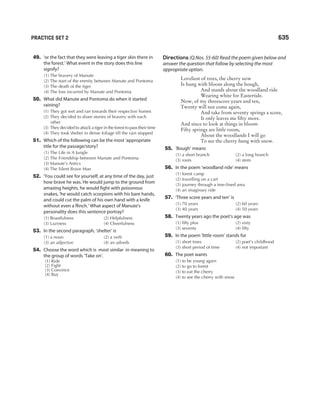
learning
(3) Classroom learning can be tested in an oral recital
(4) Foreign students learn language mostly from text-books
93. Study the following statements
(a) At school one learns the language of educated
people.
(b) Language learnt on the street includes the use of
slang.
(1) (a) is right and (b) is wrong.
(2) (a) is wrong and (b) is right.
(3) Both (a) and (b) are right.
(4) Both (a) and (b) are wrong.
94. Which part of speech is the underlined word in the
following sentence?
The kind of language learnt in each setting differs
too.
(1) Pronoun (2) Determiner
(3) Conjunction (4) Preposition
95. Study the following phrase. Which part of speech is
the underlined word?
‘but delayed until a quiz …’
(1) Pronoun (2) Determiner
(3) Conjunction (4) Preposition
96. What does the word ‘motivated’ mean in the following
phrase?
‘Highly motivated students can thus ……’
(1) intelligent (2) resourceful
(3) muddled (4) interested
97. ‘……… in a haphazard way.’
The word ‘haphazard’ means
(1) dangerous (2) unorganised
(3) safe (4) proper
98. The best place to correctly and quickly learn a foreign
language is
(1) only the classroom
(2) only the market place
(3) both the classroom and the market place
(4) home
99. A text-book :
(1) controls language learning
(2) motivates the students
(3) teaches what a student needs
(4) is an inexpensive tool of learning
Directions (Q.Nos. 100-105) Read the extract given
below and answer the questions that follow by selecting
the correct/most appropriate options :
Great, wide, beautiful, wonderful world,
With the Wonderful water around you curled,
And the wonderful grass upon your breast
World, you are beautifully drest.
The wonderful air is over me,
And the wonderful wind is shaking the tree,
It walks on the water, and whirls the mills,
And talks to itself on the tops of the hills.
You friendly Earth, how far do you go,
With the wheat-fields that nod and the rivers that flow
With cities and gardens, and cliffs and isles,
And people upon you for thousands of miles?
Ah ! You are so great and I am so small,
2019 DEC PAPER II (CLASS VI-VIII) SOLVED PAPER
CTET
Language I [English]
PART III
I tremble to think of you, world, at all;
And yet when I said my prayers today,
A whisper inside me seemed to say,
‘You are more than the Earth, though you are such a dot,
You can love and think, and the Earth cannot !’
100. The cities, gardens, cliffs and isles show that the
Earth is
(1) huge (2) friendly
(3) small (4) well populated
101. In the extract, the poet has compared:
(1) Man with the Earth (2) World with the Earth
(3) World with the Air (4) the Earth with the Air
102. Mood of the speaker in all of these lines is :
(1) serious (2) joyous
(3) sad (4) introspective
103. The figure of speech used in the first stanza of the
extract is :
(1) Simile (2) Synecdoche
(3) Onomatopoeia (4) Personification
104. The figure of speech used in the phrase ‘and whirls
the mills’ is
(1) Simile (2) Synecdoche
(3) Onomatopoeia (4) Personification
105. The beautiful dress worn by the Earth is made of
(1) mills and the hills
(2) gardens and wheat-fields
(3) water and grass
(4) mountains and forests
106. A teacher asks her learners to collect words / phrases
on various aspects they see and notice in their
markets and streets. Later, the learners write the
words and phrases according to the category and
discuss them in the class. What is this practice known
as?
(1) Topic words learning
(2) Genre based words
(3) Active vocabulary
(4) Thematic vocabulary learning
107. What does CLIL. stand for?
(1) Content Language Inter Learning
(2) Content and Language based Interesting Learning
(3) Content and Language Integrated Learning
(4) Context for Language Integrated Learning
108. Which of the following statements is correct?
(1) Receptive vocabulary are words we speak and productive
vocabulary are words we hear.
(2) Receptive vocabulary are words we recognise when we
hear or see and productive vocabulary are words we speak
or write.
(3) Receptive vocabulary are words we discourse with people
and productive vocabulary are words in written text.
(4) Words from other languages are receptive vocabulary
and words from native languages are productive
vocabulary.
109. A teacher divides her class into groups of four and
reads out a text of about six sentences. Learners listen
to and jot down important words and phrases. The
teacher reads out the text the second time. Then
learners discuss in groups the jotted down words and
recreate the text nearer to the one read out by the
teacher. What is this task known as?
(1) Composition Dictation (2) Mutual Dictation
(3) Punctuation Dictation (4) Real Dictation
110. Intensive reading refers to
(1) reading a text for detailed information.
(2) reading a text for pleasure.
(3) reading a text for editing.
(4) reading a text for someone else.
111. Knowing a word means
(1) how, where and when it is used.
(2) how, the word is spelt.
(3) who speaks the word.
(4) to know to write the word.
112. Which typology of question does the following question
belong to?
Imagine you are the narrator of the story. Write an
entry in your diary about your experiences in about
100 words.
(1) Informative question (2) Inferential question
(3) Cloze question (4) Extrapolative question
113. Poetry teaching is ……… .
(1) to learn words and phrases
(2) to learn poetic devices
(3) for enjoyment and appreciation
(4) to write a critical commentary
114. Learning outcomes aim at
(1) output oriented learning
(2) achieving maximum levels of learning
(3) achieving minimum levels of learning
(4) ensuring all the competencies are acquired by learners.
115. A teacher brings a newspaper to her class VIII
students and asks them to find some advertisements.
She then asks them to list out how advertisements are
designed and what an advertisement contains. What is
the newspaper here?
(1) For reading
(2) An instrument of language learning
(3) A technique of language learning
(4) Materials for language learning
116. National Curriculum Framework 2005 assigns
‘supplementary’ and ‘complimentary’ roles to English
language. This means that
(1) English language teaching should support learning of other
languages and subjects.
(2) English language teaching has nothing to do with
teaching-learning of other languages.
(3) English language teaching is a hindrance to learning of
other languages.
(4) English language teaching violates the mother tongue based
language education.
08 2019 DEC PAPER II (CLASS VI-VIII) SOLVED PAPER
CTET
09
117. A reader uses her prior knowledge, makes semantic
cues and syntactic cues then moves to other more
specific information. What model of reading the reader
here adopts?
(1) Bottom up model (2) Top down model
(3) Interactive model (4) Whole language model
118. Drilling is a teaching-learning technique or a strategy
in ……… .
(1) Constructivist language teaching
(2) Structuralism
(3) Communicative learning teaching
(4) Lexical approach
119. Which of the following statements is TRUE of
language learning?
(1) First language interferes in the learning of second language
(2) First language' supports the learning of second language
(3) Language learning has nothing to do with content learning
(4) Every language is different and learning of languages is also
discrete
120. Multilingualism as a resource in education aims at
(1) Making use of languages of learners for teaching-learning
(2) making learners learn as many languages as possible
(3) using classical languages for teaching-learning
(4) enabling to learn English language for jobs and mother
tongue for culture
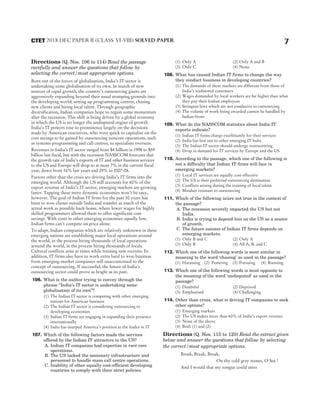
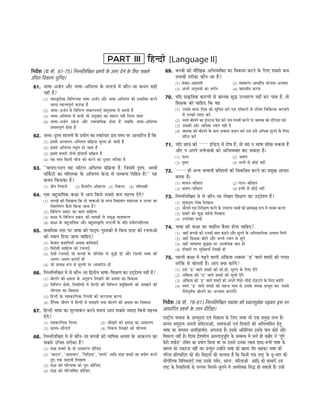
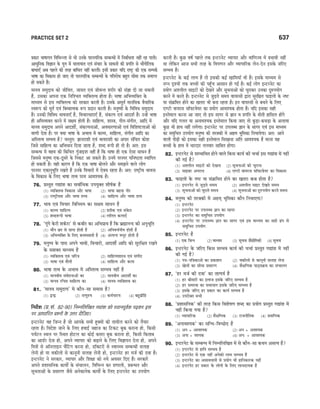
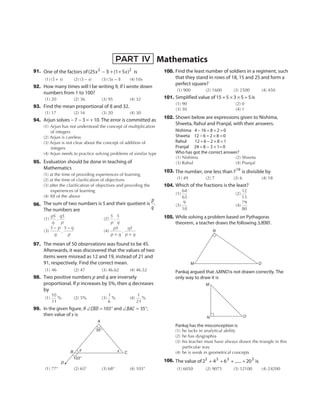
efveoxMe (Øe. meb. 121-128) veerÛes efoS ieS ieÅeebMe keâes heÌ{keâj hetÚs ieS ØeMveeW kesâ
mener/meyemes GefÛele Gòej Jeeues efJekeâuhe keâes ÛegefveS~
nceejs osMe ceW Skeâ Ssmee Yeer Ùegie Lee, peye veweflekeâ Deewj DeeOÙeeeflcekeâ efJekeâeme ner peerJeve
keâe JeemleefJekeâ ue#Ùe ceevee peelee Lee~ Deefnbmee keâer YeeJevee meJeexheefj Leer~ Deepe hetje
peerJeve-oMe&ve ner yeoue ieÙee nw~ meJe&$e hewmes keâer neÙe-neÙe leLee Oeve keâe Gheepe&ve ner
cegKÙe OÙesÙe nes ieÙee nw, Yeues ner Oeve-Gheepe&ve kesâ lejerkesâ ieuele ner keäÙeeW ve neW~ Fve
meyekeâe Demej ceveg<Ùe kesâ Øeefleefove kesâ peerJeve hej heÌ[ jne nw~ meceepe keâe JeeleeJejCe
otef<ele nes ieÙee nw~ Fve meyekesâ keâejCe ceeveefmekeâ Deewj Meejerefjkeâ leveeJe-efKebÛeeJe Deewj
JÙeeefOeÙeeB hewoe nes jner nQ~
Deepe Deeoceer Oeve kesâ heerÚs DebOeeOegbOe oewÌ[ jne nw~ heeBÛe ®heÙes efceueves hej ome, ome
efceueves hej meew Deewj meew efceueves hej npeej keâer ueeuemee efueS Jen Fme DebOeer oewÌ[ ceW
Meeefceue nw~ Fme oewÌ[ keâe keâesF& Deble veneR~ Oeve keâer Fme oewÌ[ ceW meYeer heeefjJeeefjkeâ Deewj
ceeveJeerÙe mecyevOe heerÚs Útš ieS~
JÙeefkeäle melÙe-DemelÙe, GefÛele-DevegefÛele, vÙeeÙe-DevÙeeÙe Deewj Deheves-hejeS kesâ Yeso-YeeJe
keâes Yetue ieÙee~ Gmekesâ heeme Deheveer helveer Deewj mebleeve kesâ efueS Yeer meceÙe veneR~ Oeve kesâ
efueS heg$e keâe efhelee kesâ meeLe, yesťer keâe ceeB kesâ meeLe Deewj heefle keâe helveer kesâ meeLe
PeieÌ[e nes jne nw~ YeeF&-YeeF& kesâ Ketve keâe hÙeemee nw~ Oeve keâer ueeuemee JÙeefkeäle keâes
peIevÙe mes peIevÙe keâeÙe& keâjves kesâ efueS Gkeâmee jner nw~ Fme ueeuemee keâe ner heefjCeece nw
efkeâ peien-peien nlÙee, uetš, DehenjCe Deewj Ûeesjer-[kewâleer keâer IešveeSB yeÌ{ jner nQ~ Fme
jesieer ceveesJe=efòe keâes yeoueves kesâ efueS nceW nj mlej hej ØeÙelve keâjves neWies~
121. ‘Oeve Gheepe&ve’ ceW meefvOe keâjves hej Meyo yevesiee
(1) Oevegheepe&ve (2) Oeveeshepe&ve
(3) Oevethepe&ve (4) Oeveesheepe&ve
122. ‘‘Deepe hetje peerJeve-oMe&ve yeoue ieÙee nw~’’
Gkeäle keâLeve keâe DeeMeÙe nw
(1) Deepe peerJeve ceW heefjJele&ve Dee ieÙee nw~
(2) Deepe peerJeve kesâ Øeefle Âef<škeâesCe ceW yeoueeJe Dee ieÙee nw~
(3) Deepe mechetCe& peerJeve yeoue ieÙee nw~
(4) Deepe meceÙe yeoueves mes efoveÛeÙee& yeoue ieF& nw~
123. ØeeÛeervekeâeue ceW peerJeve keâe JeemleefJekeâ ue#Ùe keäÙee ceevee ieÙee Lee?
(1) DeeOÙeeeflcekeâ Deewj meeceeefpekeâ efJekeâeme (2) DeeefLe&keâ Deewj meeceeefpekeâ Øeieefle
(3) peerJeve-oMe&ve ceW heefjJele&ve (4) veweflekeâ Deewj DeeOÙeeflcekeâ efJekeâeme
124. ‘peIevÙe’ Meyo keâe DeLe& veneR nw
(1) efvebefole (2) efveke=â<ť
(3) lÙeeie osves ÙeesiÙe (4) peeBIe mes mecyeefvOele
125. nceejs ceeveJeerÙe mecyevOe heerÚs Útšves keâe keâejCe nw
(1) Oeve keâceeves keâer FÛÚe (2) Oeve keâceeves keâer ueeuemee
(3) Oeve keâceeves keâer DebOeer oewÌ[ (4) Oeve keâceeves keâer efJeJeMelee
126. ceeveefmekeâ leveeJe keâer JÙeeefOeÙeeW keâe keâejCe uesKekeâ ves keäÙee ceevee nw?
(1) heÙee&JejCe Øeot<eCe
(2) efkeâmeer Yeer Øekeâej Oeve keâceeves keâer FÛÚe
(3) Skeâ efove oewÌ[les jnvee
(4) Ûeesjer-[kewâleer keâer IešveeSB
127. Gme Meyo Ùegice keâes henÛeeefveS pees Mes<e mes efYevve nes
(1) GefÛele-DevegefÛele (2) Ûeesjer-[kewâleer
(3) melÙe-DemelÙe (4) vÙeeÙe-DevÙeeÙe
128. efkeâme oewÌ[ keâes Devlenerve ceevee ieÙee nw?
(1) Deeies yeÌ{ves keâer (2) JeemleefJekeâ ue#Ùe heeves keâer
(3) efkeâmeer Yeer Øekeâej Oeve peesÌ[ves keâer (4) Deheves-hejeS keâes Yeguee osves keâer
efveoxMe (Øe. meb. 129-135) veerÛes efoS ieS ØeMveeW kesâ mener/meyemes GefÛele Gòej
Jeeues efJekeâuhe keâes ÛegefveS~
efMe#ee ceveg<Ùe kesâ ceefmle<keâ Deewj Mejerj keâe GefÛele leeuecesue keâjvee efmeKeeleer nw~ Jen
efMe#ee pees ceeveJe keâes hee"dÙe-hegmlekeâeW kesâ %eeve kesâ Deefleefjkeäle kegâÚ iecYeerj efÛevleve ve os~
Ùeefo nceejer efMe#ee megmebmke=âle, meYÙe, meÛÛeefj$e SJeb DeÛÚs veeieefjkeâ veneR yevee mekeâleer
lees Gmemes keäÙee ueeYe? meùoÙe, meÛÛee hejvleg DeveheÌ{ cepeotj Gme mveelekeâ kesâ keâneR
DeÛÚe nw, pees efveo&Ùe Deewj Ûeefj$enerve nw~ mebmeej kesâ meYeer JewYeJe Deewj megKe-meeOeve Yeer
ceveg<Ùe keâes leye lekeâ megKeer veneR yevee mekeâles, peye lekeâ efkeâ ceveg<Ùe keâes Deeeflcekeâ %eeve ve
nes~ nceejs kegâÚ DeefOekeâej Deewj keâòe&JÙe Yeer nQ~ efMeef#ele JÙeefkeäle keâes keâòe&JÙeeW keâe Glevee
ner OÙeeve jKevee ÛeeefnS efpelevee efkeâ DeefOekeâejeW keâe~
129. ‘megKe-meeOeve’ keâe efJe«en Deewj meceeme nw
(1) megKe Deewj meeOeve-ÉvÉ (2) megKeeW kesâ meeOeve-lelheg®<e
(3) megKeeW kesâ meeOeveeW keâe mecetn-efÉieg (4) megKe mes meOes pees meeOeve-keâce&OeejÙe
130. Jen DeefMeef#ele, efMeef#ele JÙeefkeäle mes DeÛÚe nw, pees
(1) oÙeeueg Deewj meÛÛeefj$e nes
(2) iecYeerj efÛevleve os
(3) Deheves DeefOekeâej peevelee nes
(4) ceefmle<keâ keâe mener GheÙeesie keâjlee nes
131. DeÛÚer efMe#ee keâer efJeMes<elee veneR nw
(1) meÛÛeefj$e veeieefjkeâ yeveevee (2) megmebmke=âle yeveevee
(3) DevegòejoeÙeer yeveevee (4) Deeeflcekeâ %eeve osvee
2019 DEC PAPER II (CLASS VI-VIII) SOLVED PAPER
CTET
^mfm II [ ]
{hÝXr
^mJ IV
132. DeefOekeâejeW Deewj keâòe&JÙeeW kesâ efJe<eÙe ceW megefMeef#ele JÙeefkeäle
(1) DeefOekeâejeW keâer peevekeâejer jKelee nw (2) keâòe&JÙeeW kesâ Øeefle meÛesle jnlee nw
(3) oesveeW keâe yejeyej OÙeeve jKelee nw (4) FvnW efJeMes<e cenòJe veneR oslee
133. ‘‘nceejs kegâÚ DeefOekeâej Deewj keâòe&JÙe Yeer nQ~’’
GheÙeg&keäle JeekeäÙe efkeâme Øekeâej keâe nw?
(1) mejue JeekeäÙe (2) mebÙegkeäle JeekeäÙe
(3) efceße JeekeäÙe (4) cegKÙe JeekeäÙe
134. keâewve-mee Meyo Deved Ghemeie& mes veneR yevee nw?
(1) Deveghece (2) DeveheÌ{
(3) DevegheÙeesieer (4) Deveghekeâej
135. ceveg<Ùe leYeer megKeer keâne pee mekeâlee nw, peye
(1) Jen efMeef#ele nes (2) Gmekesâ heeme megKe kesâ meeOeve neW
(3) Gmes GòejoeefÙelJe efveYeevee Deelee nes (4) Gmes Deeeflcekeâ %eeve nes
136. ‘‘hee" mes leerveeW Øekeâej keâer meb%eeDeeW kesâ GoenjCe Keespekeâj efueefKeS~’’ DeYÙeeme ØeMve
.......... keâe GoenjCe nw~
(1) mevoYe& ceW JÙeekeâjCe (2) JÙeekeâjefCekeâ peefšuelee
(3) JÙeekeâjCe hej DelÙeefOekeâ yeue (4) JÙeekeâjCe keâC"mLe keâjves
137. GÛÛe ØeeLeefcekeâ mlej hej yeÛÛes keâer Yee<ee #ecelee keâe Deekeâueve keâjves keâer Âef<š mes
meyemes keâcepeesj ØeMve nw
(1) Deehekesâ meheveeW keâe Yeejle kewâmee nesvee ÛeeefnS? equeefKeS~
(2) meceeÛeej ÛewveueeW kesâ keâeÙe&›eâceeW keâer meeLe&keâlee hej leke&â meefnle Deheves efJeÛeej
efueefKeS~
(3) uesKekeâ ves Deheves peerJeve keâer efkeâve oes IešveeDeeW keâes cenòJehetCe& yeleeÙee nw?
(4) oes<eeW keâe heoe&heâeMe keâjvee keâye yegje ¤he ues mekeâlee nw?
138. eqnvoer Yee<ee efMe#ekeâ kesâ ¤he ceW meJee&efOekeâ cenòJehetCe& nw
(1) meeefneflÙekeâ uesKeve SJeb hegjmkeâej (2) Yee<ee keâer efMe#ee Meem$eerÙe mecePe
(3) meeefneflÙekeâ mebieesef<"ÙeeW ceW Yeeieeroejer (4) Yee<ee keâer heefjYee<eeDeeW keâe Ùeeo nesvee
139. Yee<ee efMe#eCe kesâ mevoYe& ceW meleled Deewj JÙeehekeâ Deekeâueve kesâ efueS meJee&efOekeâ
cenòJehetCe& efyevog nw
(1) yeÛÛeeW kesâ Yee<ee-ØeÙeesie keâe efvejvlej DeJeueeskeâve
(2) yeÛÛeeW kesâ Yee<ee-ØeÙeesie keâe keâ#eeÙeer DeJeueeskeâve
(3) yeÛÛeeW kesâ heÌ{ves-efueKeves keâer kegâMeuelee keâe DeJeueeskeâve
(4) yeÛÛeeW keâer GÛÛeejCe $egefšÙeeW hej DelÙeefOekeâ OÙeeve osvee
140. Dee"JeeR keâ#ee keâe cegefole heÌ{les meceÙe hejsMeeveer keâe DevegYeJe keâjlee nw~ mecYeJele:
cegefole .......... mes ÂŤemle nw~
(1) ef[mkesâuekegâefueÙee (2) DehesâefpeÙee
(3) ef[m«eeefheâÙee (4) ef[muesefkeämeÙee
141. ØeejefcYekeâ mlej hej efnvoer Yee<ee keâer hee"dÙe-hegmlekeâ keâe efvecee&Ce keâjles meceÙe Fme
yeele keâe OÙeeve jKee peeS efkeâ hee"
(1) yeÛÛeeW ceW meeefneflÙekeâ uesKeve keâer #ecelee keâe ner efJekeâeme keâjW~
(2) kegâÚ hetJe&efveOee&efjle mebosMeeW keâes hengBÛeeves kesâ GodosMÙe jKeles neW~
(3) kegâÚ hetJe&efveOee&efjle mebosMeeW keâes hengBÛeeves kesâ GodosMÙe ve jKeles neW~
(4) yeÛÛeeW ceW heÌ{ves-efueKeves keâer kegâMeuelee keâe ner efJekeâeme keâjW~
142. yeÛÛeeW ceW he"ve kesâ Øeefle ®efÛe peeie=le keâjves kesâ efueS hee"dÙe-hegmlekeâ kesâ Deefleefjkeäle
.......... meece«eer keâe efJekeâeme efkeâÙee pee mekeâlee nw~
(1) mejue (2) hetjkeâ
(3) peefšue (4) cetuÙehejkeâ
143. ‘Yee<ee keâer efveÙeceyeæ ØeJe=efòe keâes henÛeevevee Deewj Gmekeâe efJeMues<eCe keâjvee’ GÛÛe
ØeeLeefcekeâ mlej kesâ Yee<ee-efMe#eCe keâe Skeâ .......... GodosMÙe nw~
(1) cenòJehetCe& (2) efvejLe&keâ
(3) keâcepeesj (4) meJeexheefj
144. keâ#ee Dee" kesâ yeÛÛeeW keâer he"ve DeJeyeesOeve #ecelee keâe efJekeâeme keâjves ceW meneÙekeâ nw
(1) hee"dÙe-meece«eer keâes oesnjevee (2) keäueespe hejer#eCe
(3) efueefKele hejer#ee (4) veeškeâ keâe cebÛeve
145. GÛÛe ØeeLeefcekeâ mlej hej yeÛÛeeW kesâ Yee<ee-efJekeâeme keâer Âef<š mes meyemes keâce
cenòJehetCe& nw
(1) heefjÛeÛee& (2) ßegleuesKe
(3) mebJeeo DeoeÙeieer (4) me=peveelcekeâ uesKeve
146. heÌ{ves keâe mecyevOe .......... mes nw~
(1) Megælee (2) leer›e ieefle
(3) De#ej %eeve (4) DeLe&
147. GÛÛe ØeeLeefcekeâ mlej hej efnvoer Yee<ee keâer hee"dÙe-hegmlekeâeW ceW DevÙeÙe efJe<eÙeeW kesâ
hee"eW keâes mLeeve osves keâe Skeâ cenòJehetCe& GodosMÙe nw
(1) otmejs efJe<eÙeeW keâe %eeve osvee~
(2) efJe<eÙe keâer MeyoeJeueer keâe efJekeâeme~
(3) DevÙe efJe<eÙeeW keâe keâeÙe&Yeej keâce keâjvee~
(4) efnvoer keâer hee"dÙe-hegmlekeâ keâes meceeJesMeer yeveevee~
148. yeÛÛeeW ceW pevcepeele Yeeef<ekeâ #ecelee nesleer nw~ Fmekeâe Skeâ efMe#eeMeem$eerÙe he#e Ùen nw
efkeâ heÙee&hle DeJemej efceueves hej yeÛÛee
(1) heefjefÛele Yee<ee peuoer meerKesiee (2) veF& Yee<ee Deemeeveer mes meerKesiee
(3) heÌ{vee-efueKevee peuoer meerKesiee (4) megvevee-yeesuevee peuoer meerKesiee
149. JeeCeer DemLeeÙeer nesleer nw Deewj .......... Yee<ee keâer leguevee ceW keâeheâer lespeer mes yeoueleer
jnleer nw~
(1) Meem$eerÙe (2) ceewefKekeâ
(3) efueefKele (4) heejcheefjkeâ
150. GÛÛe ØeeLeefcekeâ mlej hej Yee<ee meerKeves keâe Skeâ cenòJehetCe& GodosMÙe nw
(1) heef"le meeceeer keâe leeefke&âkeâ efJeMues<eCe keâjvee
(2) heef"le meeceeer kesâ he#e ceW Deheveer yeele jKevee
(3) heef"le meeceeer kesâ efJeŽÌ Deheveer yeele jKevee
(4) heef"le meece«eer keâes pÙeeW keâe lÙeeW Øemlegle keâjvee
10 2019 DEC PAPER II (CLASS VI-VIII) SOLVED PAPER
CTET
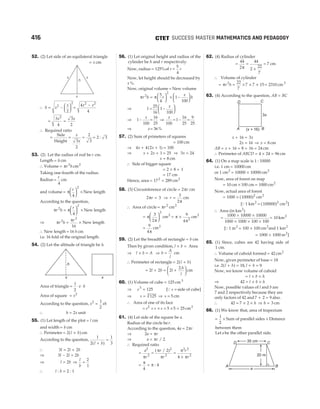
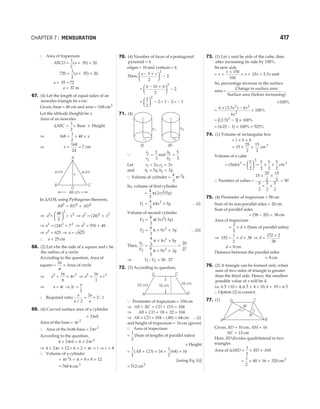
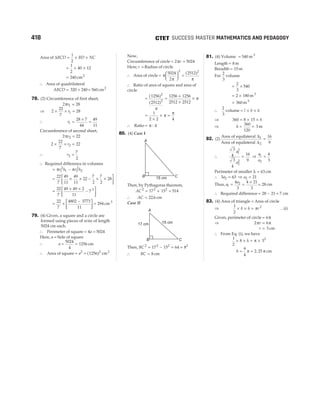
1. (4) According to Lawrence Kohlberg's
theory of moral development, Noor's
statements represents exchange orientation
typical at conventional stage.
The conventional stage as per theory of moral
development, is tied to personal and societal
relationships. Children accept the rules as
they now believe that in necessary to ensure
positive relationship and societal order.
Noor’s statement represents exchange which
shows an individual sense of morality and
acceptance of rules learnt at pre-conventional
stage.
2. (4) Widely held beliefs about typified
characteristics deemed appropriate for
different sexes in the society are referred
to as gender stereotypes.
Its refer to well defined gender norms that
have taken the shape of beliefs and
characteristics. They are widely accepted
beliefs in our society for example, men
should not cry, women are good at house
keeping etc.
3. (2) In order to eliminate gender
stereotyping, conscious efforts are made by
giving opposite tasks. Fathers are involved in
house hold works and mothers are
considered adventure activities.
This develops greater working capacity and
eliminates the harmful effects of gender
stereotyping.
4. (3) Vygotsky scaffolding refers to a
teaching method that helps students to learn
more by collaborating with others who have
wider range of skills and knowledge than the
student currently does. It gives better results
than to learn independently.
According to this method, when adults
extend support, then the child’s current level
of performance improves.
5. (4) According to Jean Piaget’s theory of
cognitive development, hypothetic-deductive
reasoning develops during formal operational
stage.
In the formal operational stage, students
acquire the ability to think in an abstract way
by manipulating ideas. This state becomes
operational from 12 years of age to
adulthood.
6. (3) According to Lev Vygotsky’s, Social
Development Theory stresses on the
fundamental role of social interaction in
learning. He believed that learning is a
necessary and universal aspect of the process
of developing culturally organised, specific
psychological functions.
Social learning preceeds development
therefore it is essential to understand the
cultural context on children’s thinking.
7. (2) As per Piaget’s theory of cognitive
development, students of grade 6-8 in his
classroom should present problems that
require reasoning based solutions.
8. (4) As per Howard Gardener's Theory of
Multiple Intelligence, A person with Logico-
mathematical intelligence has the capacity to
do logical reasoning, abstractions, critical
thinking and understand logic.
Such a person would be able to handle long
chains of reasoning and have a capacity to
detect patterns.
9. (1) The process by which children develop
habits, skills, values and motives that make
them responsible, productive members of
society is called socialization.
Socialization is a process whereby an
individual learns to adjust to a group and
behave in a manner approved by the group.
10. (4) Among the given statement,
‘Heredity and environment both influence
human development in a complex interplay’,
is the correct statement.
Heredity is responsible for the inborn traits
in a child for example, emotions, IQ, reflex
actions, physical traits.
Environment is responsible for physical,
psychological, emotional and social
development. Together they play an
important role in shaping up of an individual.
11. (1) In a progressive classroom knowledge
is constructed by the learner and teacher aims
to provide experiential learning by providing
motivational learning environment. This is
done by linking education to social
responsibility, integration of learning projects
into curriculum. The aim is to nurture talent.
This classroom values experiences over
learning facts so the students construct
knowledge through their experiences.
12. (4) Continuous and comprehensive
evaluation includes both formative and
summative assessments using a wide variety
of strategies.
It is a system of evaluation introduced by
CBSE to assess students’s development.
Formative means evaluation done through
out the year and comprises of class tests,
homework, quiz, projects, assignment etc.
2019 DEC PAPER II (CLASS VI-VIII) SOLVED PAPER
CTET
sOLVED PAPER 2019 Hints & Solutions
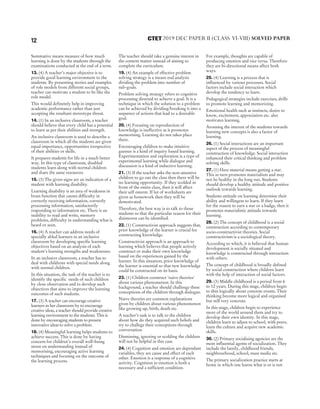
Answers
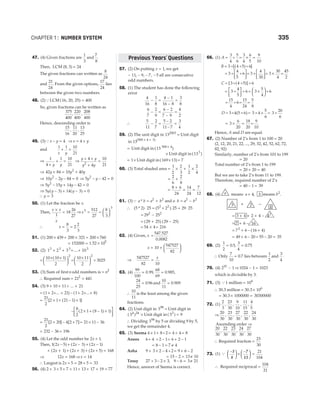
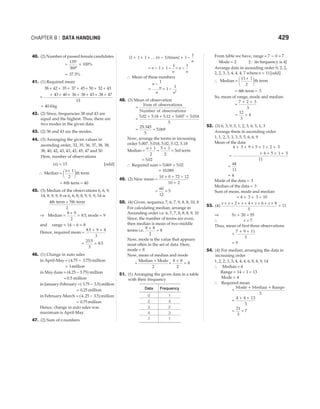
1 (4) 2 (4) 3 (2) 4 (3) 5 (4) 6 (3) 7 (2) 8 (4) 9 (1) 10 (4)
11 (1) 12 (4) 13 (4) 14 (1) 15 (3) 16 (4) 17 (3) 18 (4) 19 (4) 20 (4)
21 (3) 22 (1) 23 (1) 24 (4) 25 (4) 26 (1) 27 (1) 28 (2) 29 (3) 30 (2)
31 (4) 32 (4) 33 (1) 34 (3) 35 (4) 36 (3) 37 (2) 38 (1) 39 (1) 40 (1)
41 (3) 42 (3) 43 (3) 44 (4) 45 (4) 46 (1) 47 (3) 48 (4) 49 (4) 50 (3)
51 (1) 52 (3) 53 (4) 54 (4) 55 (2) 56 (2) 57 (4) 58 (3) 59 (2) 60 (1)
61 (4) 62 (1) 63 (4) 64 (1) 65 (*) 66 (2) 67 (2) 68 (4) 69 (4) 70 (3)
71 (1) 72 (1) 73 (3) 74 (4) 75 (1) 76 (4) 77 (3) 78 (2) 79 (3) 80 (1)
81 (4) 82 (3) 83 (1) 84 (3) 85 (4) 86 (3) 87 (1) 88 (3) 89 (1) 90 (4)
91 (3) 92 (1) 93 (3) 94 (2) 95 (3) 96 (4) 97 (2) 98 (1) 99 (1) 100 (2)
101 (1) 102 (2) 103 (4) 104 (3) 105 (3) 106 (4) 107 (3) 108 (2) 109 (1) 110 (1)
111 (1) 112 (4) 113 (3) 114 (4) 115 (4) 116 (1) 117 (2) 118 (2) 119 (2) 120 (1)
121 (4) 122 (2) 123 (4) 124 (4) 125 (3) 126 (2) 127 (2) 128 (3) 129 (2) 130 (1)
131 (3) 132 (3) 133 (1) 134 (2) 135 (4) 136 (1) 137 (3) 138 (2) 139 (1) 140 (4)
141 (3) 142 (2) 143 (1) 144 (2) 145 (2) 146 (4) 147 (4) 148 (2) 149 (3) 150 (1)
(*) None of the given options is correct.
Summative means measure of how much
learning is done by the students through the
examinations conducted at the end of a term.
13. (4) A teacher’s major objective is to
provide good learning environment to the
students. By presenting stories and examples
of role models from different social groups,
teacher can motivate a student to be like the
role model.
This would definetely help in improving
academic performance rather than just
accepting the resultant stereotype threat.
14. (1) In an inclusive classroom, a teacher
should believe that every child has a potential
to learn as per their abilities and strength.
An inclusive classroom is used to describe a
classroom in which all the students are given
equal importance, opportunities irrespective
of their abilities or skills.
It prepares students for life in a much better
way. In this type of classroom, disabled
students learn along with normal children
and share the same resources.
15. (3) The given signs are an indication of a
student with learning disability.
Learning disability is an area of weakness in
brain function that causes difficulty in
correctly receiving information, correctly
processing information, satisfactorily
responding to information etc. There is an
inability to read and write, memory
problems, difficulty in understanding what is
heard or seen.
16. (4) A teacher can address needs of
specially abled learners in an inclusive
classroom by developing specific learning
objectives based on an analysis of each
student's learning strengths and weaknesses.
In an inclusive classroom, a teacher has to
deal with childrens with special needs along
with normal children.
In this situation, the task of the teacher is to
identify the specific needs of such children
by close observation and to develop such
objectives that aims to improve the learning
outcomes of such students.
17. (3) A teacher can encourage creative
learners in her classroom by to encourage
creative ideas, a teacher should provide creative
learning environment to the students. This is
done by encouraging students to present
innovative ideas to solve a problem.
18. (4) Meaningful learning helps students to
achieve success. This is done by having
concern for children’s overall well–being
stress on understanding instead of
memorising, encouraging active learning
techniques and focusing on the outcome of
the learning process.
The teacher should take a genuine interest in
the content matter instead of aiming to
complete the curriculum.
19. (4) An example of effective problem
solving strategy is a means end analysis
dividing the problem into number of
sub-goals.
Problem solving strategy refers to cognitive
processing directed to achieve a goal. It is a
technique in which the solution to a problem
can be achieved by dividing/breaking it into a
sequence of actions that lead to a desirable
goal.
20. (4) Focusing on reproduction of
knowledge is ineffective as it promotes
memorising. Learning do not takes place
there.
Encouraging children to make intuitive
guesses is a kind of inquiry based learning.
Experimentation and exploration is a type of
experimental learning while dialogue and
discussion is a kind of inductive learning.
21. (3) If the teacher asks the non-attentive
children to go out the class then there will be
no learning opportunity. If they scolded in
front of the entire class, then it will affect
their self esteem. If lot of worksheets are
given as homework then they will be
demotivated.
Therefore, the best way is to talk to those
students so that the particular reason for their
disinterest can be identified.
22. (1) Constructivist approach suggests that,
prior knowledge of the learner is crucial for
constructing knowledge.
Constructivist approach is an approach to
learning which believes that people actively
construct or make their own knowledge
based on the experiences gained by the
learner. In this situation, prior knowledge of
the learner is essential so that new knowledge
could be constructed on its basis.
23. (1) Children construct ‘naive theories'
about various phenomenon. In this
background, a teacher should challenge these
conceptions of the children through dialogue.
Naive theories are common explanations
given by children about various phenomenon
like growing up, birth, death etc.
A teacher’s task is to talk to the children
about how do they acquired such beliefs and
try to challege their conceptions through
conversation.
Dismissing, ignoring or scolding the children
will not be helpful in this case.
24. (4) Cognition and emotion are dependant
variables, they are cause and effect of each
other. Emotion is a response of a cognitive
activity. Cognition in emotion is both a
necessary and a sufficient condition.
For example, thoughts are capable of
producing emotion and vice versa. Therefore
they are bi-directional means affect both
ways.
25. (4) Learning is a process that is
influenced by various processes. Social
factors include social interaction which
develop the tendency to learn.
Pedagogical strategies include exercises, drills
to promote learning and memorizing.
Emotional health such as instincts, desire to
know, excitement, appreciation etc. also
motivates learning.
Arousing the interest of the students towards
learning new concepts is also a factor of
learning.
26. (1) Social interactions are an important
aspect of the process of meaningful
construction of knowledge. Social interaction
enhanced their critical thinking and problem
solving skills.
27. (1) Here material means getting a star.
This in turn promotes materialism and may
not be healthy in the long run. Students
should develop a healthy attitude and positive
outlook towards learning.
Students attitude on learning determine their
ability and willingess to learn. If they learn
for the reason to earn a star or a badge, then it
promotes materialistic attitude towards
learning.
28. (2) The concept of childhood is a social
construction according to contemporary
socio-constructivist theories. Social
constructivism is a sociological theory.
According to which, it is believed that human
development is socially situated and
knowledge is constructed through interaction
with others.
The concept of childhood is broadly defined
by social construction where children learn
with the help of interaction of social factors.
29. (3) Middle childhood is a period from 6
to 12 years. During this stage, children begin
to thin logically about concrete events. Their
thinking become more logical and organised
but still very concrete.
In this stage, children begin to experience
more of the world around them and try to
develop their own identity. In this stage,
children learn to adjust to school, with peers,
learn the culture and acquire new academic
skills.
30. (2) Primary socialising agencies are the
most influential agents of socialization. They
include the family, childhood friends,
neighbourhood, school, mass media etc.
The primary socialization practice starts at
home in which one learns what is or is not
12 2019 DEC PAPER II (CLASS VI-VIII) SOLVED PAPER
CTET
accepted in society, social norms and cultural
practices that one is likely to take up.
31. (4) Contributions of Mathematicians
from different regions and different social
groups should be highlighted with the overall
objective of achieving ‘Mathematics for All’
as per NCF - 2005.
32. (4) Multiple ways of approaching a
problem are encouraged by teacher is
considered as a characteristic of an effective
Mathematics classroom.
33. (1) Encourage students to figure out
ways to calculate the volume of different
objects is a desirable practice in the context of
teaching and learning of measurement of
volume.
34. (3) According to Piaget’s view of
children’s understanding of space following
statements are true
(1) Co-ordination of different visual and
tactile experiences is required for
understanding projective space
(2) Progression of geometric ideas
follows a definite order
(4) Early understanding of space is
formed by child’s sensory motor
experiences
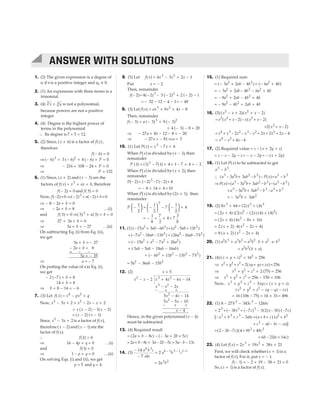
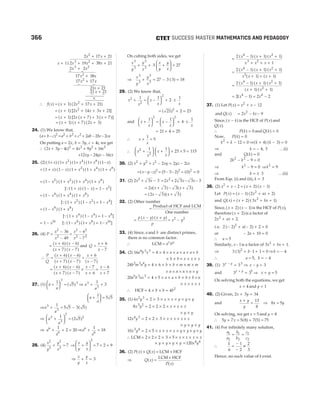
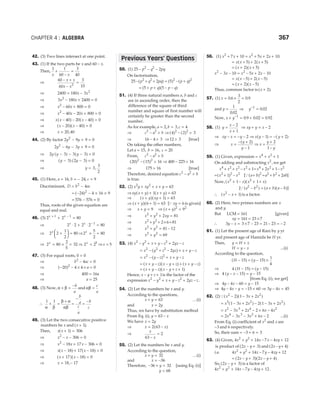
35. (4) Given,
− × − + ÷ − − − ÷
12 3 20 4 24 8
( ) [ ( ) ( ) ]
− ÷ −
[ ( )]
16 2 = − ÷ +
( )
28 7 x
⇒ 36
20
4
24
8
16
2
28
7
+
−
−
−











 −
−






=
−





 + x
⇒ 36 5 3 8 4
+ − + − − = − +
[ ] ( ) ( ) x
⇒ 36 2 8 4
− + = − + x
⇒ x = +
42 4
∴ x = 46
36. (3) Number 30 0867
x y should follow the
divisibility rule of ( )
88 8
= and 11
For 8, the number made by last three digits of
the given number (67 y) is divisible by 8.
8) 67 y (84
64
3y
32
×
∴ y = 2
For 11, if the difference of the sum of digits
at even places( )
3 8 7
+ + +
x and the sum of
digits at odd places( )
0 0 6
+ + + y is 0 or a
multiple of 11.
( ) ( )
3 8 7 0 0 6 0
+ + + − + + + =
x y or 11
⇒ 18 6 2 0
+ − + =
x ( ) or 11
⇒ 18 8 0 11
+ − =
x or
∴ x = − =
11 10 1
∴ 3 3 1 2 5
x y
+ = × + =
37. (2) Given,
6
2
3
2
1
2
3
3
4
5
1
2
4
1
4
1
2
3
7
8
3
4
2
3
÷ × − × + + ×





 = ?
(According to VBODMAS)
⇒
20
3
5
2
15
4
11
2
17
4
5
3
7
8
1
2
÷ × − × + +





 = ?
⇒
20
3
2
5
15
4
187
8
5
3
7 4
8
× × − +
+





 = ?
⇒ 10
187
8
55
24
− + =?
⇒
240 561 55
24
− +
= ?
⇒
295 561
24
−
= ?
⇒ − =
266
24
?
∴ ? =
−
=−
133
12
11
1
12
38. (1) Total pairs of twin primes between
the integers 1 to 100
= 8[ (3, 5), (5, 7), (11, 13), (17, 19),
(29, 31), (41, 43), (59, 61) and (71, 73)]
Note Two consecutive prime numbers with
the difference of 2 are called ‘‘Twin primes ’’.
39. (1) Prime factors of 21168 ,
2 21168
2 10584
2 5292
2 2646
3 1323
3 441
3 147
7 49
7 7
1
= × × × × × × × ×
2 2 2 2 3 3 3 7 7
= × ×
2 3 7
4 3 2
On comparing,
2 3 7 2 3 7
4 3 2
× × = × ×
a b c
∴ a =4, b = 3 and c =2
Now, 4 5 4 4 5 3 2
a b c
− + = × − × +
= − +
16 15 2
= 3
40. (1) LCM of 8, 12, 20, 28, 35
2 8, 12, 20, 28, 35
2 4, 6, 10, 14, 35
5 2, 3, 5, 7, 35
2, 3, 1, 7, 7
= × × × × ×
2 2 2 3 5 7 = 840
∴Required number = LCM of 8, 12, 20, 28,
35 5
+ = + =
840 5 845
Now, sum of number = + + =
8 4 5 17
41. (3) Let the number be ‘x’.
According to the question,
( ) : ( ) : :( ) : ( )
50 61 92 117
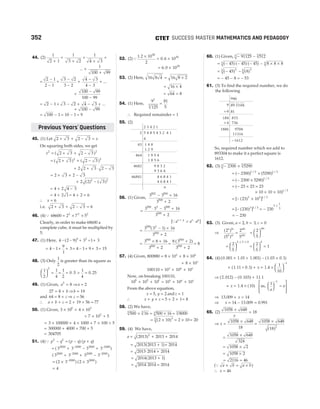
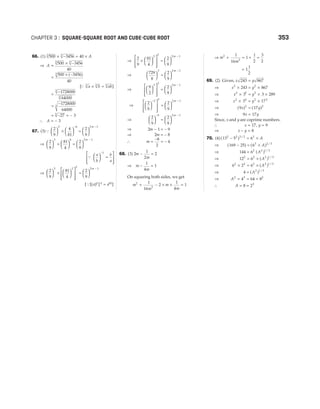
− − − −
x x x x
⇒( ) ( ) ( ) ( )
50 117 61 92
− × − = − × −
x x x x
⇒ 5850 50 117 2
− − +
x x x
= − − +
5612 61 92 2
x x x
⇒ 5612 153 5850 167
− = −
x x
⇒ 167 153 5850 5612
x x
− = −
⇒ 14 238
x =
∴ x = =
238
14
17
42. (3) Given,
4 6 9
× = × = × =
A B C k (Let)
⇒ A
k
B
k
= =
4 6
, and C
k
=
9
∴ A B C
k k k
: : : :
=
4 6 9
=
36
4
36
6
36
9
: :
[Q LCM of 4, 6 and 9 = 36]
= 9 6 4
: :
A’s amount = ×
+ +
1710
9
9 6 4
= × =
1710
9
19
` 810
C’s amount = ×
+ +
1710
4
9 6 4
= × =
1710
4
19
` 360
Hence, required difference
= −
810 360 =` 450
43. (3) Let the fruits in baskets A and B be7x
and 9x respectively.
According to the question,
7 6
9 6
1
3
x
x
−
+
=
⇒ 21 18 9 6
x x
− = +
⇒ 12 24
x =
∴ x = 2
Hence, total fruits in baskets A and B
= +
7 9
x x
= × + ×
7 2 9 2
= + =
14 18 32
44. (4) Given
13
2019 DEC PAPER II (CLASS VI-VIII) SOLVED PAPER
CTET
C
B A
D
In ∆ABC and ∆ABD,
→ a common side AB (given)
→ AC BD
= (given)
→ a common angle 90°
Hence, ∆ ≅ ∆
ABC BAD
45. (4) We know that, sides of right angle
triangle always follows Pythagoras theorem.
By Statement (i), ( ) ( ) ( )
24 20 22
2 2 2
= +
⇒ 576 400 484
= +
⇒ 576 884
≠
By Statement (ii), ( ) ( ) ( )
37 15 32
2 2 2
= +
⇒ 1369 225 1024
= +
⇒ 1369 1249
≠
By Statement (iv), ( ) ( ) ( )
41 40 19
2 2 2
= +
⇒ 1681 1600 361
= +
⇒ 1681 1961
≠
By Statement (iii), ( ) ( ) ( )
61 60 11
2 2 2
= +
⇒ 3721 3600 121
= +
⇒ 3721 3721
=
Hence, sides given in Statement (iii) forms a
right triangle.
46. (1) Let the angles of quadrilateral be
3 5 7
x x x
, , and 9x.
According to the question,
Sum of quadrilateral = °
360
⇒ 3 5 7 9 360
x x x x
+ + + = °
⇒ 24 360
x = °
∴ x = °
15
Hence, required difference
= × − ×
9 15 3 15
= ° − ° = °
135 45 90
47. (3) We know that,
Sum of any two sides of triangle > Third side
Q Sum of any two sides > 6
∴Only possible combinations are as below.
= 3[(2, 5, 5), (3, 4, 5), and (4, 4, 4)].
48. (4) Volume of godown
= Length × Breadth × Height
= × ×
( )
56 42 10 m3
3
Volume of box
= × ×
28 25
70
100
. . Q1
1
100
cm m
=






= × ×
( . . . )
28 25 0 70 m3
Hence, total number of boxes
=
Volume of godown
Volume of box
=
× ×
× ×
=
56 42 10
28 25 0 70
4800
. . .
49. (4) Given,
∴Circumference of the base (circle) = 528 cm
⇒ 2 528
π =
r
∴ r =
π
528
2
cm …(i)
Hence, volume of cylinder = πr h
2
= π ×
π





 ×
528
2
2
2
= π ×
×
× π
×
528 528
4
2
2
[Q from Eq. (i)]
=
× ×
× ×
264 528 7
22 100 100
= 4 4352
. m3
50. (3) Given,
∴ Area of ABCD
= ∆ + ∆
Area Area
of of
ABD CBD
⇒ 227 2
1
2
7 2
1
2
8 8
. . .
= × × + × ×
BD BD
[Q Area of triangle =
1
2
× base × height]
⇒ 227 2 2 16
. × = × BD
∴ BD =
×
227 2 2
16
.
= 28 4
. cm
51. (1) Given, 5 3 4 8 6 7 9 8
( ) ( )
x x x
+ − + = −
⇒ 15 20 48 56 9 8
x x x
+ − − = −
⇒ − − = −
33 36 9 8
x x
⇒ 33 9 28
x x
+ = −
⇒ 42 28
x = −
∴ x =
−2
3
∴( )
x x
2
2
2 1
2
3
2
2
3
1
− + =
−





 − −





 +
= + + =
+ +
4
9
4
3
1
4 12 9
9
=
25
9
52. (3) Given,
a b
= = −
1 3
, and c =− 2
∴ a a b c b a b c c a b
( ) ( ) ( )
+ + + + + − +
2 2 2 2 2 2
= + + + + + − −
a ab ac a b b b c ac cb
2 2 2 2 4 2 2 2
= + − + − + −
( ) ( )( ) ( ) ( ) ( )
1 1 3 1 3 3
2 2 2 2 4
+ − − − − −
( ) ( ) ( )( )
3 2 2 3
2 2 2
= + + + + + =
1 9 9 81 36 18 154
53. (4) Given,
( )( ) ( )( )
x y x xy y x y x xy y
− + + + + − +
2 2 2 2
− + −
( )( )
x y x y
2 2
= − + + − − + −
x y x y x xy yx y
3 3 3 3 3 2 2 3
[ ]
[Q a b a b a ab b
3 3 2 2
Âą = Âą +
( )( )
m ]
= − + − +
2 3 3 2 2 3
x x xy yx y
= + + −
x y xy y x
3 3
( )
54. (4) Arrange given data in ascending
order,
0, 8, 9, 11, 11, 17, 18, 20, 24, 25, 25, 25, 29, 30,
30, 44, 50
Median =
+
( )
n 1
2
th term
[Q n = odd]
=
+
=
( )
17 1
2
9
th term
th term = 24
Mode = term with maximum frequency = 25
Range = Highest term − Lowest term
= − =
50 0 50
Hence, required mean
=
Median + Mode + Range
3
=
+ +
24 25 50
3
= =
99
3
33
55. (2) A mathematical theorem is a
statement that has been proven by logical
arguments based on axioms.
56. (2) ‘‘Things which are equal to the same
thing are equal to one another’’. This axiom
which is basis to Arithmetic and Algebra is
given by Euclid.
57. (4) Field trips and Anecdotal records can
be used as assessment strategy to encourage
interdisciplinary in Mathematics.
58. (3) ‘‘The sum of two even integers is
always even’’ is proof by direct proof.
59. (2) Following skills are promoted by
Mathematics at upper primary stage
●
Visualisation ●
Transposition
●
Generalisation ●
Estimation
Hence, option (2) is correct answer.
14 2019 DEC PAPER II (CLASS VI-VIII) SOLVED PAPER
CTET
2m
A B
D C
7.2
cm
8.8
cm
60. (1) By a student calculate the volume of a
right circular cylinder of radius 3.5 cm and
height 10 cm is least likely to develop critical
thinking among students.
61. (4) A teacher begins the class by
demonstrating the chemical test of starch in a
given sample of food. The cognitive process
associated with the language.
There are several types of cognitive process.
They involve attention, memory, perception,
learning and language.
62. (1) Active learning is a process that has
student learning at its centre. Active learning
focuses on how students learn, not just on
what they learn. Students are encouraged to
‘think hard’, rather than passively receive
information from the teacher.
There are misconceptions about active
learning
● Active learning is established science club,
organisation of field trip and developing a
science corner.
● Active learning is all about doing a
particular activity.
●
Active learning is the same as enquiry
based learning.
●
Active learning means taking away the
teacher’s influence.
Hence, listening to a lecture in class will not
provide for active learning among children.
63. (4) Concept mapping is a general method
that can be used to help any individual or
group to describe their ideas about some
topic in a pictorial form.
An anecdotal record is an observation
method used frequently in classroom of
learning setting in which the observers
summarises a single developmental incident
after the event has occurred.
A student portfolio is a compilation of
academic work.
Hence, Statement A, B and C is used for
finding the learning gaps of learners in
science.
64. (1) Anecdotal record are used to record
specific observations of individual students
behaviours, skills and attitudes as they relate
to the outcomes in the programme of studies.
Such record provide cumulative information
on student learning and direction for further
instructions.
65. (*) Pashmina shawl is made from the soft
undercoat hair of the Kashmiri goats (Capra
hircus). Pashmina is a fine type of Kashmiri
wool. The textile made from it were first
woven in Kashmir.
Angora hair or angora fibres refers to the
downy coat produced by the angora rabbit.
Though primarily used for milk and
transportation, camels produce high quality
wool that is very warm, water resistant and
highly durable. It can be used to make textiles
carpets and ropes.
66. (2) The animal with characteristic live
long backbone, many muscles and body
which curves into many loops for moving
forward is snake.
Snakes have between 10,000 and 15,000
muscles. They have a long backbone and their
body forms many loops and each loop of the
snake gives it a forward push by pressing
against the ground.
67. (2) Statement in option (2) is not true.
Its corrected form is as follows
Except the pulmonary arteries, all the arteries
carry oxygenated (oxygen − rich) blood.
Rest statements are true.
68. (4) The correct matching is given below
A. Acetic acid IV. Vinegar
B. Lactic acid I. Curd
C. Oxalic acid II. Spinach
D. Ascorbic acid III. Citrus fruits
69. (4) The chemical X present in our
stomach is hydrochloric acid (HCl). If this
acid is secreted in excess, it causes health
problems like indigestion.
Milk of magnesia( )
Y is used to treat this
condition. Because, being a base, it neutralises
the excess HCl produced in the stomach.
70. (3) In baking of bread, bacteria is not
used. It is baker’s yeast which is used in
making bread and other bakery items, which
causes the bread to rise and become lighter
and softer.
Bacteria is used in nitrogen fixation,
formation of curd and fermentation of
sugarcane juice.
71. (1) Conservation is different from
deforestation, desertification and erosion.
Deforestation is the permanent removal of
trees in the forest for agricultural land,
grazing or using the timber for fuel,
construction or manufacturing.
Desertification is the process by which fertile
land becomes desert and erosion is the action
of water flow or wind that removes soil, rock,
etc., from one location on the earth’s crust to
another.
72. (1) Chemical changes occur when a
substance combines with another to form a
new substance. Crystallisation is not a
chemical change as no new substance is
formed in this process. It is the process of
deriving large crystals of pure substances
from their solution.
Therefore, it is a physical process.
Thus, statement (1) is not correct, while rest
are correct.
73. (3) The correct representation of soil
particles in an ascending order as per size of
the particles is as follows:
Clay (less than 0.002 mm) < Silt (0.002
− 0.02 mm), < Sand (0 02 0 2
. .
− mm) < Gravel
(1 2
− mm) < Rock (More than 2 mm)
74. (4) The function of gills in the fish is to
absorb dissolved oxygen ( )
O2 from water.
The oxygen from water is absorbed and
carbon dioxide( )
CO2 is expelled from gills in
the water.
75. (1) A blade can be used to complete the
electric circuit, because it is a metal conductor
and current flows only through conductor.
All other materials are insulators and hence
do not allow the flow of current in them.
76. (4) Given, distance of observer (Manjula)
from mirror = 5m
As, the image formed by a mirror are of same
size and at same distance behind the mirror.
So, the image distance = 5 m.
∴Distance between object and image,
= + =
5 5 10 m
Now, the observer (Manjula) moves toward
the mirror by 1 m.
So, the object distance = − =
5 1 4 m.
From symmetry, the image should have also
moved by 1 m toward the mirror.
So, the image distance = 4 m.
Now, distance between object and image,
= + =
4 4 8 m.
77. (3) Given, number of oscillations = 30
Time taken = 3 s
∴ Frequency =
Number of oscillations
Time taken
= =
30
3
10 Hz
∴ Time period = = =
1
Frequency
0.1
1
10
s
78. (2) Here, only statement given in option
(2) is incorrect, whose corrected form is that
the ball bearings are used to decrease the
friction between parts of machines.
These are the small steel balls which rolls
between two parts of a machine.
So, no kinetic friction is involved and rolling
friction being very small, use much less
energy loss.
79. (3) The reactivity series of metals is given
as follows:
Potassium > sodium > calcium > magnesium
> aluminium > zinc > iron > tin > lead >
copper > silver > gold > platinum
It is clear from the above series that, zinc is
most reactive among the given metals
followed by iron and copper.
Thus, only correct statement is (B).
Rest of the statements can be corrected as :
15
2019 DEC PAPER II (CLASS VI-VIII) SOLVED PAPER
CTET
A. Iron cannot replace zinc from zinc
sulphate solution.
C. Copper cannot replace iron from iron
sulphate solution.
80. (1) Clinical thermometer uses mercury
to measure the temperature of human body
which varies over a short range of 35°C to
42°C. A clinical thermometer cannot be used
to measure the temperature of boiling liquid
because at high temperature, the mercury will
expand too much and break the glass of the
thermometer.
Laboratory thermometer is used for
measuring temperature at high range from
− °
10 C to 110°C.
Thus, the range of a laboratory thermometer
is greater than that of a clinical thermometer.
Room thermometers have a ranges from − °
10
C to 50°C.
Hence, only statement given in option (1) is
correct.
81. (4) Calorific values of different fuels are
given as follows:
Fuel Calorific value (kJ/kg)
Wood 17,000 - 22,000
Coal 25,000 - 33,000
Kerosene 45,000
Diesel 45,000
CNG 50,000
LPG 50,000
Biogas 35,000 - 40,000
Thus, the incorrect statement is the calorific
value of biogas is more than that of LPG.
Rest of the statements are correct.
82. (3) For first interval (12 min),
speed, v1 50
= km/h
Time, t1 12
= min =
12
60
h
∴ Distance covered,
d v t
1 1 1
= ×
= × =
50
12
60
10 km
For second interval (18 min),
speed, v2 40
= km/h
Time, t1 18
= min =
18
60
h
∴ Distance covered,
d v t
2 2 2
= ×
= × =
40
18
60
12 km
Total distance covered by bus, d
= + = +
d d
1 2 10 12
= 22 km
83. (1) Here, only statement given in option
(1) is incorrect.
All periodic motions are not circular motions.
Like motion of pendulum is not circular, but
it repeats after every equal interval of time, so
it is periodic in nature.
84. (3) The image formed by a plane mirror
has following characteristics :
A. It is always virtual and erect.
B. The image is laterally inverted, i.e. the
left of the object becomes right of the
object and vice-versa.
C. The size of the image is same as the size
of the object.
85. (4) Science education has defined
characteristics of the nature of science that are
understandable by students and important
for all citizens to know.
● Scientific knowledge is tentative (subject
to change).
● Science is empirically based (based on or
derived from observations of the natural
world).
● Science is equivalent to a set of facts.
● Science is an interdisciplinary area of
learning.
Hence, option (4) is not a true with respect to
the nature of science.
86. (3) According to NCF-2005, good
science education is true to the child, true to
life and true to science.
This simple observations leads to the
following basic criteria of validity of a science
curriculum.
●
Cognitive validity requires that the
content, process, language and
pedagogical practices of the curriculum
are age appropriate.
●
Content validity requires that the
curriculum must convey significant and
correct scientific information.
●
Process validity requires that the
curriculum should engage the learner in
acquiring the method and processes that
lead to the generation and validation of
scientific knowledge.
87. (1) Process and processing are the words
we often use in our day-to-day conversations.
In teaching profession alone, the word,
process is extensively used such as admission
process, teaching process, learning process,
process of socialisation, examination process
and evaluation process etc.
Process in any involve the following
activities:
●
it helps to accomplish a task
●
ways of doing work
●
planning various stage of an activity and
●
establishing systematic steps for gathering
and retaining information.
● In science, the way of gathering,
information, thinking, measuring, solving
a problem or in other words the ways of
learning science are called the processes of
science.
88. (3) Anu took her class VIII children to
field trip. The objective/s for this activity are
(B) It promotes process skills through
concrete experiences.
(C) It enhances observation skills among the
children.
Hence, opiton (3) is correct.
89. (1) The objective of science education at
the upper primary level are as follows
● Nurturing the natural curiosity of
children
● Inculcating the values of co-operation and
concern for life
● Cultivating scientific temper
All the option are correct except (1).
Hence, option (1) is correct.
90. (4) Asking children to discuss among
themselves in groups followed by sharing in
large group can enhance critical thinking
among children.
91. (3) According to the given passage,
language needs of real life situations are
fulfilled by learning on the streets.
92. (1) According to the given passage,
shopkeepers are more likely to be tolerant of
incorrect grammar and mispronunciation
alongwith errors.
Hence, option (1) is not true.
93. (3) In the given passage, it is asserted that
in a classroom, the student learns the
grammatical language of educated while the
language learnt on streets includes informal
expressions such as slang.
Hence option (b) is correct.
94. (2) In the given sentence ‘each’ is used to
refer to every setting individually or an event.
Hence, it is a determiner.
95. (3) In the given phrase, ‘until’ is used as a
conjunction to refer to a point, in time or
future. Hence, option (3) is correct.
96. (4) ‘Motivated’ means ‘driven’. From the
given options, only interested comes closer to
the intended meaning to the given word.
97. (2) Haphazard means ‘unsystematic or
unorganised’.
98. (1) According to the passage, most
foreign language are learned by students in
classroom from a textbook. In a classroom,
language learning can be controlled so that all
the necessary structures are taught.
16 2019 DEC PAPER II (CLASS VI-VIII) SOLVED PAPER
CTET
99. (1) In the given passage, it is asserted that
in a classroom, one learns through textbooks
such that language learning is controlled and
the necessary structures are effectively taught.
100. (2) According to the given poem, it is
the ‘friendly characteristic of Earth that
extends upto cliffs, gardens and cities
irrespective of any difference that these places
represent.
101. (1) In the given poem, ‘I’ is compared to
Earth. ‘I’ here represents the author/narrator
of the poem. Hence, one can state that the
poet has compared ‘Man with the Earth’.
102. (2) In the given poem, the poet has
admired the marvellous beauty of the far and
wide Earth in a happy mood. Hence, option
(2), ‘joyous’ is the correct option.
103. (4) In the first stanza of the poem, the
Earth is described with human like qualities.
Out of the given options, personification is
the figure of speech in which an abstract
quality is represented in human form.
104. (3) Out of the given options, the figure
of speech used in the phrase ‘and whirls the
mills’ is ‘Onomatopoeia’. An onomatopoeia
is a word that actually looks like the sound it
makes and we can almost hear those sounds
as we read.
105. (3) In stanza 1 of the poetry, it is
mentioned that the Earth is dressed in
‘wonderful water’ and ‘wonderful grass’.
106. (4) Vocabulary learning that takes place
through categorisation of different words and
phrases according to their themes/category, is
called ‘Thematic vocabulary learning’. When
the teacher asks her learners to collect words
and phrases they observe in their markets and
streets to categories them, she is using the
practice of thematic vocabulary learning.
107. (3) CLIL stands for Content and
Language Integrated Llearning.
108. (2) ‘Receptive vocabulary are words we
recognise when we hear or see and
productive vocabulary are words we speak or
write’, is the correct statement, among the
given option.
109. (1) Composition dictation is a strategy
used by language teachers to develop writing
skills. In this technique, a teacher selects and
reads out a text and the students/learners are
required to got down important words and
phrases to rewrite the text orated with
minimum mistakes.
110. (1) Intensive reading involves learners
reading in detail with specific aims and tasks
an to get detailed information.
111. (1) Knowing a word means knowing
the behaviour associated with the word.
Here in behaviour refers to the ‘how, when
and where’ of the use of the word.
112. (4) In extrapolative questions, the
learners has to answer the questions by going
beyond his/her own thoughts and beliefes.
Accordingly, in the given question, the
learner will become the narrator of the story
and then write the diary entry from the
narrators perspective.
113. (3) Poetry teaching is for enjoyment
and appreciation and deriving pleasure from
the poem. The learners appreciate the beauty
of the language and enjoy the thought of the
poem.
114. (4) Learning outcomes aim at ensuring
that the students learns all skills and apply the
knowledge acquired by them. In other
words, learning outcomes focus in ensuring
that all the competencies are acquired by
learners.
115. (4) In the given situation newspaper is
used by the teacher to aid her in language
learning.
116. (1) By ‘supplementary’ and
‘complementary’ roles, one refers to the
enhancing function of English.
In other words, National Curriculum
Framework 2005 assigns English a role by
virtue of which it should support learning of
other languages.
117. (2) Here, the reader adopts top down
model of reading. In the top down model the
learner uses background information a prior
knowledge to reach to a more specific
information.
118. (2) Drilling is a teaching learning
technique in a structuralism in which learner
listens to a tape recording of a teacher and
tries to intiate the same from his/her own
experience and knowledge.
Such a strategy that focuses on the learning
that is arrived at from a learner’s experience.
119. (2) It has been found that students with
strong first language skills, acquire second
language easily as first language supports the
learning of second languages. The learner
learns the second language easily as he/she
can make connections with first language.
120. (1) Multilingualism as a resource in
education aims at making use of languages of
learners for teaching-learning.
121. (4) Oeve + Gheepe&ve keâe meefvOe keâjves hej Oeveesheepe&ve
Meyo yevesiee~ ÙeneB De + G = Dees ceW heefjJeefle&le nesves kesâ
keâejCe iegCe meefvOe nw~ Dele: efJekeâuhe (4) mener Gòej nw~
122. (2) ‘‘Deepe hetje peerJeve-oMe&ve yeoue ieÙee nw’’ keâLeve
keâe DeeMeÙe Ùen nw efkeâ Deepe peerJeve kesâ Øeefle Âef<škeâesCe ceW
yeoueeJe Dee ieÙee nw~ meye peien hewmeeW keâes cenòJe efoÙee pee
jne nw~ Dele: efJekeâuhe (2) mener Gòej nw~
123. (4) ieÅeebMe keâer ØeLece hebefkeäleÙeeW ceW mhe<š efkeâÙee ieÙee
nw efkeâ ØeeÛeervekeâeue ceW peerJeve keâe JeemleefJekeâ ue#Ùe veweflekeâ
Deewj DeeOÙeeeflcekeâ efJekeâeme keâes ceevee ieÙee Lee~ Dele: efJekeâuhe
(4) mener Gòej nw~
124. (4) ‘peIevÙe’ Meyo keâe DeLe& efvebefole, efveke=â<š leLee
lÙeeie osves ÙeesiÙe nw~ Dele: peIevÙe Meyo peeBIe mes mecyeefvOele
kesâ DeLe& ceW ØeÙegkeäle veneR ngDee nw~
FmeefueS efJekeâuhe (4) mener Gòej nw~
125. (3) ieÅeebMe ceW mhe<š ¤he mes yeleeÙee ieÙee nw efkeâ
nceejs ceeveJeerÙe mecyevOe heerÚs Útšves keâe keâejCe Oeve keâceeves
keâer DebOeer oewÌ[ nw~
Dele: efJekeâuhe (3) mener Gòej nw~
126. (2) ceeveefmekeâ leveeJe keâer JÙeeefOeÙeeW keâe keâejCe uesKekeâ
ves efkeâmeer Yeer Øekeâej Oeve keâceeves keâer FÛÚe keâes ceevee nw~
ceveg<Ùe ieuele lejerkesâ Deheveekeâj Oeve keâceelee nw, efpemekeâe
Demej Gmekesâ peerJeve hej heÌ[lee nw Deewj Jen ceeveefmekeâ
JÙeeefOeÙeeW keâe efMekeâej nes jne nw~
Dele: efJekeâuhe (2) mener Gòej nw~
127. (2) efoS ieS efJekeâuheeW ceW Ûeesjer-[kewâleer Mes<e Meyo
ÙegiceeW mes efYevve nw~ Ûeesjer Deewj [kewâleer meceeveeLe&keâ Meyo nw,
peyeefkeâ DevÙe Meyo Ùegice GefÛele-DevegefÛele, melÙe-DemelÙe,
vÙeeÙe-DevÙeeÙe efJeueesce Meyo nQ~
Dele: efJekeâuhe (2) mener Gòej nw~
128. (3) efkeâmeer Yeer Øekeâej Oeve peesÌ[ves keâer oewÌ[ keâes
Devlenerve ceevee ieÙee nw, keäÙeeWefkeâ Oeve keâceeves keâer ueeuemee
keâYeer hetCe& veneR nesieer Deewj JÙeefkeäle DeefOekeâ Oeve kesâ ueeueÛe ceW
Fme oewÌ[ ceW Meeefceue neslee Ûeuee peelee nw~
Dele: efJekeâuhe (3) mener Gòej nw~
129. (2) ‘megKe-meeOeve’ keâe meceeme efJe«en megKe kesâ meeOeve
nesiee~ ÙeneB hetJe&heo ‘megKe’ ieewCe leLee Gòej heo ‘meeOeve’
ØeOeeve nw leLee oesveeW heoeW kesâ yeerÛe ‘kesâ’ hejmeie& keâe ueeshe nesves
kesâ keâejCe FmeceW lelheg¤<e meceeme nw~
130. (1) ieÅeebMe ceW yeleeÙee ieÙee nw efkeâ Jen DeefMeef#ele,
efMeef#ele JÙeefkeäle mes DeÛÚe nw pees oÙeeueg Deewj meÛÛeefj$e nes~
Dele: efJekeâuhe (1) mener Gòej nw~
131. (3) DeÛÚer efMe#ee keâer efJeMes<elee meÛÛeefj$e veeieefjkeâ
yeveevee, megmebmke=âle yeveevee leLee Deeeflcekeâ %eeve osvee nw~ Dele:
DevegòejoeÙeer yeveevee DeÛÚer efMe#ee keâer efJeMes<elee veneR nw~
132. (3) ieÅeebMe keâer Deefvlece hebefkeäle ceW mhe<š efkeâÙee ieÙee
nw efkeâ efMeef#ele JÙeefkeäle keâes keâòe&JÙeeW keâe Glevee ner OÙeeve
jKevee ÛeeefnS, efpelevee DeefOekeâejeW keâe~ Dele: DeefOekeâejeW Deewj
keâòe&JÙeeW kesâ efJe<eÙe ceW megefMeef#ele JÙeefkeäle oesveeW keâe yejeyej
OÙeeve jKelee nw~
133. (1) Jes JeekeäÙe efpeveceW Skeâ ner GodosMÙe leLee Skeâ ner
efJeOesÙe neslee nw, mejue JeekeäÙe keânueeles nQ~ pewmes–‘‘nceejs kegâÚ
DeefOekeâej Deewj keâòe&JÙe Yeer nw~’’ JeekeäÙe ceW ‘nceejs kegâÚ
DeefOekeâej’ GodosMÙe leLee ‘keâòe&JÙe Yeer nQ’ efJeOesÙe (i) nw~
Dele: efJekeâuhe (1) mener Gòej nw~
17
2019 DEC PAPER II (CLASS VI-VIII) SOLVED PAPER
CTET
134. (2) efoS ieS efJekeâuheeW ceW Deveghece, Deveghekeâej,
DevegheÙeesieer Deeefo ceW Deved Ghemeie& ØeÙegkeäle ngDee nw~ ‘Deved’
Ghemeie& mes efveefce&le DevÙe Meyo Devevle, Deveentle, DevegheÙegkeäle,
Deveeiele Deeefo nQ~
Dele: DeveheÌ{ Meyo Deved Ghemeie& kesâ Ùeesie mes veneR yevee nw~
135. (4) ieÅeebMe ceW keâne ieÙee nw efkeâ mebmeej kesâ meYeer
JewYeJe Deewj megKe-meeOeve Yeer ceveg<Ùe keâes leye lekeâ megKeer veneR
yevee mekeâles, peye lekeâ efkeâ ceveg<Ùe keâes Deeeflcekeâ %eeve ve nes~
Dele: keân mekeâles nQ efkeâ ceveg<Ùe leYeer megKeer keâne pee mekeâlee
nw, peye Gmes Deeeflcekeâ %eeve nes~
136. (1) hee" ceW leerveeW Øekeâej keâer meb%eeDeeW kesâ GoenjCe
Keespekeâj efueefKeS~ DeYÙeeme ØeMve mevoYe& ceW JÙeekeâjCe keâe
GoenjCe nw~ efjkeäle mLeeve ceW ‘mevoYe& ceW JÙeekeâjCe’ DeeSiee~
Dele: efJekeâuhe (1) mener Gòej nw~
137. (3) GÛÛe ØeeLeefcekeâ mlej hej yeÛÛes keâer Yee<ee #ecelee
keâe Deekeâueve keâjves keâer Âef<š mes meyemes keâcepeesj ØeMve
nw–‘‘uesKekeâ ves Deheves peerJeve keâer efkeâve oes IešveeDeeW keâes
cenòJehetCe& yeleeÙee nw, keäÙeeWefkeâ Fme ØeMve ceW yeÛÛee uesKekeâ
Éeje yeleeF& ieF& IešveeDeeW kesâ efJe<eÙe ceW ner yeleeSiee Gmekesâ
mJeÙeb kesâ efJeÛeej ÙeneB mhe<š veneR nes heeSieW~ DevÙe leerveeW
efJekeâuheeW ceW yeÛÛes keâer Yee<ee SJeb leke&â #ecelee keâe %eeve nesiee,
efpememes Gmekeâe Deekeâueve efkeâÙee pee mekesâiee~
Dele: efJekeâuhe (3) mener Gòej nw~
138. (2) efnvoer Yee<ee efMe#ekeâ kesâ ¤he ceW meJee&efOekeâ
cenòJehetCe& Yee<ee keâer efMe#ee Meem$eerÙe mecePe nw, keäÙeeWefkeâ peye
efMe#ekeâeW keâes ØeejefcYekeâ mee#ejlee Deewj Gmekesâ efJeefYevve henuegDeeW
keâer mewÌeefvlekeâ SJeb DeJeOeejCeelcekeâ mecePe nesieer, leYeer Jes
yeÛÛeeW kesâ heÌ{ves-efueKeves keâer Øeef›eâÙeeDeeW keâes meeLe&keâ Deewj
menpe yevee mekeWâieW~
Dele: efJekeâuhe (2) mener Gòej nw~
139. (1) Yee<ee efMe#eCe kesâ mevoYe& cebs meleled Deewj JÙeehekeâ
Deekeâueve kesâ efueS meJee&efOekeâ cenòJehetCe& efyevog yeÛÛeeW kesâ
Yee<ee-ØeÙeesie keâe efvejvlej DeJeueeskeâve nw, keäÙeeWefkeâ Yee<ee ceW
meleled Deewj JÙeehekeâ Deekeâueve keâe GodosMÙe yeÛÛeeW keâer Yee<ee
ØeÙeesie mecyevOeer #ecelee kesâ efJekeâeme ceW ceoo keâjvee nw~ yeÛÛeeW
kesâ Yee<ee ØeÙeesie keâe efvejvlej DeJeueeskeâve keâjkesâ ner Gvekeâer
Yee<ee ØeÙeesie keâer #ecelee keâes yeÌ{eÙee pee mekeâlee nw~
Dele: efJekeâuhe (1) mener Gòej nw~
140. (4) ef[muesefkeämeÙee Skeâ JÙeehekeâ Meyo nw, efpemekeâe
mecyevOe he"ve efJekeâej mes nw~ Fme DeefOeiece DeMekeälelee ceW
yeeuekeâ keâes heÌ{ves ceW keâef"veeF& nesleer nw~ Dee"JeeR keâ#ee keâe
cegefole heÌ{les meceÙe hejsMeeveer keâe DevegYeJe keâjlee nw, mecYeJele:
cegefole ef[muesefkeämeÙee mes «emle nw~
Dele: efJekeâuhe (4) mener Gòej nw~
141. (3) ØeejefcYekeâ mlej hej efnvoer Yee<ee keâer
hee"dÙe-hegmlekeâ keâe efvecee&Ce keâjles meceÙe Fme yeele keâe OÙeeve
jKee peevee ÛeeefnS efkeâ hee" kegâÚ hetJe&efveOee&efjle mebosMeeW keâes
hengBÛeeves kesâ GodosMÙe ve jKeles neW~
Dele: efJekeâuhe (3) mener Gòej nw~
142. (2) yeÛÛeeW kesâ he"ve kesâ Øeefle ®efÛe peeie=le keâjves kesâ
efueS hee"dÙe-hegmlekeâeW kesâ Deefleefjkeäle hetjkeâ meece«eer keâe efJekeâeme
efkeâÙee pee mekeâlee nw~ Fme Øekeâej efjkeäle mLeeve ceW hetjkeâ Meyo
DeeSiee~
Dele: efJekeâuhe (2) mener Gòej nw~
143. (1) ‘Yee<ee keâer efveÙeceyeæ ØeJe=efòe keâes henÛeevevee Deewj
Gmekeâe efJeMues<eCe keâjvee’ GÛÛe ØeeLeefcekeâ mlej kesâ
Yee<ee-efMe#eCe keâe Skeâ cenòJehetCe& GodosMÙe nw~ Fme Øekeâej
efjkeäle mLeeve ceW cenòJehetCe& Meyo DeeSiee~
Dele: efJekeâuhe (1) mener Gòej nw~
144. (2) keâ#ee Dee" kesâ yeÛÛeeW keâer he"ve DeJeyeesOeve
#ecelee keâe efJekeâeme keâjves ceW keäueespe hejer#eCe meneÙekeâ nw~
keäueespe hejer#eCe Øeef›eâÙee Skeâ meeLe Skeâ mes DeefOekeâ
heefjkeâuhevee hejer#eCe keâjves kesâ efueS Skeâ meeceevÙe efJeefOe nw,
pees he"ve DeJeyeesOeve #ecelee keâe efJekeâeme keâjves ceW meneÙekeâ
nesleer nw~
Dele: efJekeâuhe (2) mener Gòej nw~
145. (2) GÛÛe ØeeLeefcekeâ mlej hej yeÛÛeeW kesâ Yee<ee efJekeâeme
keâer Âef<š mes meyemes keâce cenòJehetCe& ßegleuesKe nw, keäÙeeWbefkeâ
Fmekesâ ceeOÙece mes Yee<ee efJekeâeme Glevee DeefOekeâ veneR nes
heeSiee efpelevee efkeâ heefjÛeÛee&, mebJeeo DeoeÙeieer, me=peveelcekeâ
uesKeve mes nes mekeâlee nw~
Dele: efJekeâuhe (2) mener Gòej nw~
146. (4) heÌ{ves keâe mecyevOe DeLe& mes nw, keäÙeeWefkeâ yeÛÛee
Meyo Ùee JeekeäÙeeW keâe heÌ{keâj Gvekeâe DeLe& mecePeves keâe ØeÙeeme
keâjlee nw~ Fme Øekeâej efjkeäle mLeeve ceW DeLe& Meyo DeeSiee~
Dele: efJekeâuhe (4) mener Gòej nw~
147. (4) GÛÛe ØeeLeefcekeâ mlej hej efnvoer Yee<ee keâer
hee"dÙe-hegmlekeâeW ceW DevÙe efJe<eÙeeW kesâ hee"eW keâes mLeeve osves keâe
Skeâ cenòJehetCe& GodosMÙe efnvoer keâer hee"dÙe-hegmlekeâ keâes
meceeJesMeer yeveevee nw~
Dele: efJekeâuhe (4) mener Gòej nw~
148. (2) yeÛÛeeW ceW pevcepeele Yeeef<ekeâ #ecelee nesleer nw~
Fmekeâe efMe#eeMeem$eerÙe he#e Ùen nw efkeâ heÙee&hle DeJemej efceueves
hej yeÛÛee veF& Yee<ee Deemeeveer mes meerKesiee~
Dele: efJekeâuhe (2) mener Gòej nw~
149. (3) JeeCeer DemLeeÙeer nesleer nw Deewj efueefKele Yee<ee keâer
leguevee ceW keâeheâer lespeer mes yeoueleer jnleer nw~ Fme Øekeâej efjkeäle
mLeeve ceW efueefKele Meyo DeeSiee~
Dele: efJekeâuhe (3) mener Gòej nw~
150. (1) GÛÛe ØeeLeefcekeâ mlej hej Yee<ee meerKeves keâe Skeâ
cenòJehetCe& GodosMÙe heef"le meece«eer keâe leeefke&âkeâ efJeMues<eCe
keâjvee nw Fmemes yeÛÛeeW keâer leke&â #ecelee keâe efJekeâeme nesiee leLee
Jen leke&â-efJeleke&â keâjvee meerKe peeSiee~
Dele: efJekeâuhe (1) mener Gòej nw~
18 2019 DEC PAPER II (CLASS VI-VIII) SOLVED PAPER
CTET
1. This question paper consists of 150 objective type questions, to be completed in maximum 2 hrs 30 min.
2. Each question carries 1 mark and there is no negative marking.
3. This paper has 4 parts: Part I Child Development and Pedagogy (Q. Nos. 1-30), Part II Maths & Science
(Q. Nos. 31-90), Part III Language I (English) (Q. Nos. 91-120) and Part IV Language II (Hindi) (Q. Nos. 121-150).
Directions (Q. Nos. 1-30) Answer the following questions by selecting the correct most appropriate options.
1. Children’s errors and misconceptions
(1) signify that children’s capabilities are far inferior than that of adults.
(2) are a significant step in the teaching learning process.
(3) are a hindrance and obstacle to the teaching learning process.
(4) should be ignored in the teaching learning process.
2. In the constructivist frame child is viewed as
(1) a ‘problem solver’ and a ‘scientific investigator’
(2) miniature adult who less than adult in all aspects such as size, cognition, emotions
(3) ‘tabula rasa’ or ‘blank slate’ whose life is shaped entirely by experience
(4) a ‘passive being’ who can be shaped and molded into any form through conditioning
3. A teacher’s role while using co-operative learning in her class
(1) is to support the group which has the ‘bright’ and ‘talented’ children.
(2) is to be a silent spectator and let children do what they want.
(3) is to leave the class and let children work on their own.
(4) is to be supportive and monitor each group.
4. According to Lev Vygotsky, basic mental capacities are transformed into higher cognitive processes primarily through
(1) adaptation and organisation (2) rewards and punishment
(3) social interaction (4) stimulus-response association
1
2019 July (CLASSVI-VIII) Solved Paper
CTET
SOLVED
PAPER
07 JULY, 2019
PAPER II (CLASS VI-VIII)
CTET
CentralTeacher’s EligibilityTest
INSTRUCTIONS
Child Development and Pedagogy
PART I
5. Which of the following statements denotes the
relationship between development and learning
correctly?
(1) Development and learning are inter-related and
inter-dependent
(2) Development and learning are not related
(3) Learning takes place irrespective of development
(4) Rate of learning far exceeds the rate of development
6. According to Piaget, specific psychological structures
(organised ways of making sense of experience) are
called
(1) mental maps (2) mental tools
(3) schemas (4) images
7. ‘‘With an appropriate question/suggestion, the child’s
understanding can be extended far beyond the point
which she could have reached alone.’’ Which construct
does the above statement highlight?
(1) Intelligence
(2) Zone of proximal development
(3) Equilibration
(4) Conservation
8. Selecting and presenting stories and clippings from
newspaper that portray both men and women in
non-traditional roles is an effective strategy to
(1) counter gender stereotypes
(2) promote gender bias
(3) promote gender constancy
(4) encourage stereotypical gender roles
9. Read the following description and identify the stage of
moral reasoning of Kohlberg.
Description
Right action is defined by self-chosen ethical principles
of conscience that are valid for all humanity,
regardless of law and social agreement.
(1) The universal ethical principle orientation
(2) The instrumental purpose orientation
(3) The social-contract orientation
(4) The social-order maintaining orientation
10. One of the major accomplishments of concrete
operational stage is
(1) secondary circular reactions
(2) animistic thinking
(3) ability to conserve
(4) hypothetic deductive reasoning
11. Constructivists such as Jean Piaget and Lev Vygotsky
view learning as
(1) process of meaning making by active engagement
(2) acquisition of skills
(3) conditioning of responses
(4) passive repetitive process
12. Which of the following play an important role in a
child’s socialisation?
(i) Media (ii) School
(iii) Family (iv) Neighbourhood
(1) (i), (ii), (iii), (iv) (2) (iii), (i)
(3) (ii), (iii) (4) (i), (iii), (iv)
13. As per Howard Gardner’s theory of multiple
intelligence, how would the intelligence of a person
with the following characteristics be categorised?
Characteristics :
‘‘Ability to detect and respond appropriately to the
moods, temperaments, motivations and intentions of
others.’’
(1) Therapeutic (2) Naturalistic
(3) Intrapersonal (4) Interpersonal
14. Which of the following should be the reasons for
assessment of children?
(i) To separate and label children into non-achievers,
‘low achievers, ‘average’ and high achievers.
(ii) To improve teaching and learning processes in the
classroom.
(iii) To find out what changes and progress in learning
that takes place in the child over a period of time.
(iv) To discuss the capabilities, potential, strengths
and challenging areas of the child with the
parents.
(1) (ii), (iv) (2) (i), (ii), (iii), (iv)
(3) (i), (ii), (iii) (4) (ii), (iii), (iv)
15. Several research studies show that teachers have more
overall interaction with boys than girls. What is the
correct explanation for this?
(1) Boys are easier to manage than girls in the classroom.
(2) Boys have much more academic capabilities than girls.
(3) Boys need more attention than girls.
(4) This is an example of gender bias in teaching.
16. Which of the following is central to the concept of
progressive education?
(1) Extrinsic motivation and uniform assessment parameters
(2) Textbook centric learning
(3) Belief in the capability and potential of every child
(4) Standard instruction and assessment
17. To understand individual differences in development it
is important
(1) to consider both inherited characteristics as well as
environmental factors and their interplay.
(2) to look at the inherited characteristics that give each person a
special start in life.
(3) to look at the environmental factors that affect individuals.
(4) to consider maturation of the body and the brain.
18. Which of the following is not a principle of development?
(1) Exact course and nature of development is determined at the
time of birth itself.
(2) Individuals develop at different rates.
(3) Development is relatively orderly.
(4) Development takes place gradually over a period of time.
19. Which of the following is most important in an inclusive
classroom?
(1) Individualised education plan
(2) Uniform instruction
(3) Standardised testing
(4) Promoting competitive learning
2 2019 July (CLASSVI-VIII) Solved Paper
CTET
20. Which of the following is a correctly matched pair of
learners and their primary characteristics?
(1) Attention deficit learners – High motivation; can sustain
attention for long periods of time
(2) Hearing impaired learners – Cannot comprehend visual
information
(3) ‘Dyslexic’ learners – Lack reading and writing fluency
(4) Creative leaners – Hyperactive; slow in completing work
21. The ability to come up with original and divergent
solutions to a problem is a primary characteristics of
(1) children with learning disability
(2) egocentric children
(3) impaired children
(4) creative children
22. What instructional adaptations should a teacher make
while working with students who are ‘Visually
Challenged’?
(1) Focus on a variety of written tasks especially worksheets
(2) Speak clearly and use a lot of touch and feel materials
(3) Use a variety of visual presentations
(4) Orient herself so that the students can watch her closely
23. Co-operative learning and peer-tutoring ……… in an
inclusive classroom.
(1) should not be used
(2) should be actively promoted
(3) should be actively discouraged
(4) should be occasionally used
24. Which of the following does not result in meaningful
facilitation of learning?
(1) Encouraging multiple ways of looking at a problem
(2) Connecting new knowledge to pre-existing knowledge
(3) Promoting repetition and recall
(4) Use of examples and non-examples
25. Which of the following would not be consistent with a
constructivist environment?
(1) Teachers employ specific end of the term assessment strategies
and give feedback on products rather than processes.
(2) Students are given frequent opportunities to engage in
complex, meaningful, problem based activities.
(3) Students work collaboratively and are given support to
engage in task-oriented dialogue with each other
(4) Teachers elicit student's ideas and experiences in relationship
to key topics and plant teaching learning to elaborate or
restructure their current knowledge.
26. A teacher should encourage students to set ………
rather than ………
(1) marks seeking goals; failure avoiding goals
(2) learning goals; performance goals
(3) performance goals; learning goals
(4) failure avoiding goals; marks seeking goals
27. Which of the following strategies would promote
meaning-making in children?
(1) Uniform and standardised testing
(2) Exploration and discussion
(3) Transmission of information
(4) Using punitive measures
28. Which of the following are examples of effective
learning strategies?
(i) Setting goals and time tables
(ii) Making organisational charts and concept maps
(iii) Thinking of examples and non-examples
(iv) Explaining to a peer
(v) Self-questioning
(1) (i), (ii), (iii), (iv), (v)
(2) (i), (ii), (iii)
(3) (i), (iv), (v)
(4) (i), (ii), (iii), (iv)
29. Which of these is an example of extrinsic motivation?
(1) I complete my homework because the teacher gives us marks
for each assignment.
(2) I enjoy doing my homework because it is so much fun.
(3) I learn so much when I do my homework.
(4) Doing homework makes me understand my concepts better
30. In a primary classroom a teacher should
(1) not give any example and non-example
(2) give only examples
(3) give only non-examples
(4) give both examples and non-examples
Directions (Q. Nos. 31-35) Answer the following questions by selecting the correct/most appropriate options.
31. Which of the following statements reflects a desirable
assessment practice in the context of Mathematics
learning?
(1) Incorrect answers of children should largely be ignored
because we need to focus on children’s strengths
(2) Only paper-pencil tasks are suited to assess students because
they require precise answers
(3) Holding conversations and one to one discussion with
children can also be helpful in assessing them
(4) Assessment should be product oriented and focus on the
right answer of the child
32. Which of the following statements is true of learning
Mathematics?
(1) Informal algorithms are inferior to formal Mathematics
(2) Everyone can learn and succeed in Mathematics
(3) Girls need extra attention because they are weaker in
Mathematics
(4) Mathematics is a specialised subject meant for a select few
33. The role of proportional reasoning in understanding the
concept related to ratio and proportion was highlighted by
(1) Lev Vygotsky (2) Van Hiele
(3) Zoltan Dienes (4) Jean Piaget
3
2019 July (CLASSVI-VIII) Solved Paper
CTET
Maths & Science
PARTII
34. A student is not able to solve those word problems
which involve transposition in algebra. The best
remedial strategy is to
(1) explain concept of equality using alternate method
(2) give lot of practise questions on transposition of numbers
(3) give lot of practise questions of word problems in another
language
(4) explain him/her word problem in simple language
35. Contemporary understanding of Mathematics
Pedagogy encourages teachers to do all of the following,
except
(1) Develop the skill of systematic reasoning in students
(2) Encourage the ability to approximate solutions
(3) Introduce computation of problems before development of
conceptual understanding
(4) Create opportunities for students to guess and verify the
solutions to problems
36. The value of [( ) ] ( ) ( )[( ) ( ) ]
− ÷ × − − − − × − −
4 2 3 3 3 7 8
+ − ÷
( ) [( ) ]
4 48 6 is
(1) − 16 (2) 9
(3) − 11 (4) 13
37. The fractions
44
49
33
38
22
25
, , and
24
29
are written in
descending order as
(1)
44
49
33
38
24
29
22
25
, , , (2)
24
29
33
38
22
25
44
49
, , ,
(3)
22
25
24
29
33
38
44
49
, , , (4)
44
49
22
25
33
38
24
29
, , ,
38. Which one of the following statements is not true for
integers?
(1) Subtraction is not commutative
(2) Multiplication is associative
(3) Division is commutative
(4) 1 is the multiplicative identity
39. If x = × × ×
2 3 5 7
3 2 3 3
, y = × × ×
2 3 5 7
2 3 4 3
, and
z = × × ×
2 3 5 7
4 4 2 5
, then HCF of x y
, and z is
(1) 30 75
× (2) ( )
30 7
2 3
×
(3) ( )
15 7
3 4
× (4) ( )
30 7
3 3
×
40. If 52272 2 3 4
= × ×
p q r , where p q
, and r are prime
numbers, then the value of ( )
2p q r
+ − is
(1) 29 (2) 21 (3) 22 (4) 23
41. If the 7-digit number 134 58
x y is divisible by 72, then
the value of ( )
2x y
+ is
(1) 9 (2) 6 (3) 7 (4) 8
42. Which of the following is not a Pythagorean triplet?
(1) 13, 84, 85 (2) 7, 24, 25
(3) 8, 15, 17 (4) 11, 60, 63
43. The measure of an angle for which the measure of the
supplement is four times the measure of the
complement is
(1) 75° (2) 30° (3) 45° (4) 60°
44. If the angles, in degrees, of a triangle are x x
, 3 20
+ and
6x, the triangle must be
(1) isosceles (2) obtuse
(3) acute (4) right
45. In triangles ABC and DEF, ∠ = ∠
C F, AC DF
= , and
BC EF
= . If AB x
= −
2 1 and DE x
= −
5 4, then the value
of x is
(1) 4 (2) 1 (3) 2 (4) 3
46. One side of a triangle is 5 cm and the other side is 10
cm and its perimeter is P cm, where P is an integer.
The least and the greatest possible values of P are,
respectively.
(1) 22 and 27 (2) 19 and 29
(3) 20 and 28 (4) 21 and 29
47. Let x be the median of the data 13, 8, 15, 14, 17, 9, 14,
16, 13, 17, 14, 15, 16, 15, 14.
If 8 is replaced by 18, then the median of the data is y.
What is the sum of the values of x and y?
(1) 30 (2) 27
(3) 28 (4) 29
48. A bag contains 3 white, 2 blue and 5 red balls. One ball
is drawn at random from the bag. What is the
probability that the ball drawn is not red?
(1)
1
2
(2)
4
5
(3)
3
10
(4)
1
5
49. The total surface area of a cuboid is 194 m2
. If its
length is 8 m and breadth is 6 m, then what is its
volume (in m2
)?
(1) 224 (2) 112 (3) 126 (4) 168
50. The area of a trapezium is 105 cm2
and its height is
7 cm. If one of the parallel sides is longer than the other
by 6 cm, then the length of the longer side, (in cm) is
(1) 12 (2) 18 (3) 16 (4) 15
51. The curved surface area of a right circular cylinder of
base radius 3 cm is 94.2 cm2
. The volume (in cm3
) of
the cylinder is (take π = 3 14
. )
(1) 113.04 (2) 138.6
(3) 141.3 (4) 125.6
52. If x is added to each of 14, 12, 34 and 30, the numbers
so obtained, in this order, are in proportion. What is the
value of 12 9
x + ?
(1) 13 (2) 8
(3) 9 (4) 11
53. Which one of the following statements is true?
(1) An angle has two lines of symmetry
(2) A regular hexagon has only 4 lines of symmetry
(3) A regular polygon of 10 sides has 10 lines of symmetry
(4) A circle has no line of symmetry
54. The value of x which satisfies the equation
10 6 8 3 5 5 4
( ) ( ) ( )
x x x
+ + − = −
also satisfies the equation
(1) 5 5 2 3 5
( ) ( )
x x
− = − +
(2) 5 3 5
( )
x x
− = +
(3) 3 3 5 2 1
( )
x x
− = +
(4) 2 3 5 5 4
( ) ( )
x x
+ = − +
55. What should be subtracted from 5 13 8
y x a
− − to obtain
11 16 7
x y a
− + ?
(1) 24 21
x y a
− + (2) 6 21 15
x y a
+ +
(3) 21 5
y x a
− − (4) 21 24 15
y x a
− −
4 2019 July (CLASSVI-VIII) Solved Paper
CTET
56. Which of the following statement(s) is correct regarding
children coming to school from rural areas in the
context of Mathematics?
(1) They have poor communication skills in Mathematics
(2) They need not learn formal Mathematics as it is of no use to
them
(3) They may have rich oral Mathematical traditions and
knowledge
(4) They do not know any Mathematics
57. Read the following statements
A. Axioms are propositions which are assumed.
B. Axioms are special theorems.
C. Axioms are definitions.
D. Axioms, when proved becomes theorems.
Which of the following statement(s) is correct?
(1) Only A (2) A and C (3) A and D (4) Only B
58. Which of the following statements does not reflect
contemporary view of students errors in Mathematics?
(1) They can guide the teacher in planning her classes
(2) They should be overlooked
(3) They are a part of learning
(4) They are a rich source of information
59. Which of the following statement(s) regarding
Mathematics is true?
A. Mathematics is a tool.
B. Mathematics is a form of art.
C. Mathematics is a language.
(1) A, B and C (2) A and B (3) B and C (4) Only A
60. To prove that 2 is an irrational number, a teacher
begins by assuming that it is a rational number and
then proceeds to show how this assumption is not
feasible. This is an example of proof by
(1) Verification (2) Induction
(3) Deduction (4) Contradiction
Directions Answer the following questions by
selecting the correct/most appropriate options.
61. By which of the following strategy meaningful
clarification on the concept of reflection of light can be
given?
(1) Asking closed ended questions related to the concept
(2) Animated video on the concept
(3) Chart showing the reflection of light
(4) Observing reflection of light on white paper screen by the
learners and drawing conclusions
62. Why are field visits important in science?
(1) It develops habit of hardwork among learners
(2) It provides hands on experiences to the learners
(3) It is easy to conduct
(4) It collects the information of science
63. Which of the following tool is for learner centered
assessment?
A. Portfolio B. Concept mapping
C. Paper-pencil test D. Journal writing
(1) B, C, and D (2) C only
(3) A, B and D (4) A and C only
64. Assessment as learning in science means ……… .
(1) term assessment (2) formative assessment
(3) summative assessment (4) self assessment
65. Amrita is trying to set-up an electric circuit. She runs
short of connecting wires. Which of the following
materials can she use to complete the circuit?
(1) Rubber pipe (2) Thick thread
(3) Steel wire (4) Glass rod
66. Identify the correct statement.
(1) A convex mirror forms erect as well as inverted image.
(2) A concave mirror always forms an erect image.
(3) A concave mirror forms an erect as well as inverted image.
(4) A convex mirror always forms an inverted image.
67. Which of the following acids is found in ant’s sting?
(1) Acetic acid (2) Ascorbic acid
(3) Formic acid (4) Oxalic acid
68. 3.7 kg of a fuel is completely burnt to give off
1665 108
. × J of energy. The calorific value of the fuel in
standard unit is
(1) 25000 (2) 45000 (3) 22222 (4) 61605
69. Myra cycles to a friend’s house 5 km away to deliver a
packet. She goes at a speed of 12 km/h and returns at a
speed of 8 km/h. Her average speed during the whole
trip is
(1) 5 m/s (2) 20 km/h (3) 9.6 km/h (4) 10 km/h
70. Which of the following sets contains only the units of
measuring distance?
(1) Metre, Hertz, Cubit (2) Metre, Light year, Hertz
(3) Cubit, year, Light year (4) Cubit, Metre, Light year
71. Sameer rolls his marble on three different surfaces
spread out on floor–taut cellophane sheet, carpet and
newspaper. The force of friction acting on the marble in
the increasing order is
(1) Cellophane sheet, Carpet, Newspaper
(2) Newspaper, Cellophane sheet, Carpet
(3) Newspaper, Carpet, Cellophane sheet
(4) Cellophane sheet, Newspaper, Carpet
72. An object is moving linearly with a uniform velocity. If
time is represented along X-axis, then which of the
following statements is correct?
(1) The velocity-time graph of the motion will be a straight line
parallel to X-axis.
(2) The distance-will time graph of the motion be a straight line
parallel to X-axis.
(3) The velocity-time graph of the motion will be a straight line
parallel to Y-axis.
(4) The distance-time graph of the motion will be a straight line
parallel to Y-axis.
73. Which of the following is not a by-product of petroleum?
(1) Lubricating oil (2) Paraffin wax
(3) Coke (4) Bitumen
74. Aman keeps a plastic bottle, a wooden spoon and a
metallic spoon in a closed room overnight. The room
temperature is 30°C. In the morning, he records the
5
2019 July (CLASSVI-VIII) Solved Paper
CTET
temperatures of the three objects as T T
1 2
, and T3 .
Which of the following most likely represents the
relation between them?
(1) T T T
1 2 3
> > (2) T T T
1 2 3
= =
(3) T T T
3 2 1
> > (4) T T T
1 2 3
= <
75. Which of the following organisms can prepare their own
food by photosynthesis?
(1) Virus (2) Algae (3) Fungi (4) Rhizobium
76. Which of the following features help polar bears adapt
in extreme cold conditions?
(1) Strong smell, Flat feet, Layers of fur
(2) White fur, Flat feet, Fat under skin
(3) White fur, Long curved sharp claws, Fat under skin
(4) White fur, Flat feet, Layers of fur
77. Which of the following nutrients are present in milk?
(1) Protein, Iron, Vitamin-D
(2) Protein, Calcium, Vitamin-D
(3) Protein, Vitamin-C, Vitamin-A
(4) Carbohydrates, Vitamin-C, Iron
78. The non-metal used in the purple coloured solution
applied on wounds as antiseptic is
(1) sulphur (2) chlorine (3) iodine (4) bromine
79. Which of the following statements regarding ‘Air’ is
incorrect?
(1) Air occupies space
(2) Air has weight
(3) Air is not present in soil
(4) Air plays important role in water cycle
80. Which of the following represents correct matching of
the organs of digestive system in Column A with the
function in Column B?
Column A Column B
A. Liver 1. Where protein digestion starts
B. Stomach 2. Where bile juice is stored
C. Gall bladder 3. Releases digestive juice into small
intestine
D. Pancreas 4. Largest gland
A B C D AB C D
(1) 34 2 1 (2) 1 2 4 3
(3) 41 2 3 (4) 1 3 2 4
81. Which of the following statement about cells is true?
(1) All the cells have nucleus.
(2) All cells are round in shape.
(3) Cells of a tissue have similar structure.
(4) Size of cells is same in a well organised organism.
82. Which of the following are correctly matched with their
mode of reproduction?
Column A Column B
A. Yeast 1. Vegetative propagation
B. Potato 2. Spore formation
C. Algae 3. Fragmentation
D. Fungi 4. Budding
A B C D A B C D
(1) 3 2 4 1 (2) 4 1 3 2
(3) 1 3 2 4 (4) 2 4 3 1
83. Which of the following pollutants are responsible for
depletion of ozone layer?
(1) Methane and Carbon dioxide
(2) Carbon dioxide and Carbon monoxide
(3) Chlorofluoro carbons
(4) Acid rain
84. Which of the following set represents communicable
diseases?
(1) Diabetes, Typhoid, Malaria, Anaemia
(2) Anaemia, Scurvy, Diarrhoea, Cholera
(3) Typhoid, Malaria, Anaemia, Swine flu
(4) Typhoid, Swine flu, Malaria, Polio
85. Which one of the following is not true of the nature of
science?
A. Science is always tentative.
B. Science promotes scepticism.
C. Science is a process of constructing knowledge.
D. Science is static in nature.
(1) A (2) D (3) B (4) C
86. Which of the following is/are developed by science?
A. Equity B. Scientific attitude
C. Scientific temper D. Static mind set
(1) C and D (2) A and D
(3) B, C and D (4) A, B and C
87. The role of a science teacher should be to ……… .
(1) encourage all learners to frame questions of high cognitive
abilities
(2) provide rich variety of learning experiences to learners
(3) provide product based teaching-learning environment to
learners
(4) guide learners to practice the memorisation of the creative
ideas
88. As per NCF-2005, good science education should be
A. true to the learner
B. true to the environment of the learner
C. true to the teacher
D. true to science
(1) D only (2) A, B and D
(3) B and C only (4) A, B and C
89. “Conducting a survey on the awareness of people about
sources of air pollution in learners localities.”
Which of the following cognitive process will be most
associated with the above learning objective having
action verb conducting?
(1) Applying (2) Remembering
(3) Understanding (4) Creating
90. Which of the following strategy can be the most
appropriate for involving learners in the teaching
learning of science?
(1) Encouraging learners to do group assessment
(2) Reading a science book
(3) Clarifying the hard spots of learners
(4) Working on engaging the learners first
6 2019 July (CLASSVI-VIII) Solved Paper
CTET
Direction (Q. Nos. 91-99) Read the passage given
below and answer the questions by selecting the
correct/most appropriate options.
There’s an air of excitement on the platform as the train’s departure
time draws close. You’ve found your name on the passenger’s list,
together with the names of these in the compartment with you; so
you already know your ‘fellow passengers’ names, ages, sex and
destination. People are pushing past you to get on, as you show
your coupon to the conductor and he tells you to board.
Your fellow passengers are settling in, staking out their claims to
territory with too much luggage. A bell clangs but there is no
slamming of carriage doors, no blowing of whistles and no shout
of “All aboard!” as in the states. The train simply draws out of the
station while people stroll alongside and with studied nonchalance,
clamber on, one after the other through the still-open doors.
You claim your own seat, pleased to be on the move. Since you
have a long journey ahead in the company of strangers, what
happens next will govern your enjoyment of the trip. You can start
up a conversation and make friends, allies quickly or he anti-social
and lonely for the whole of the journey. Of course, is depends on
your personality but if you are travelling alone you’ll need an ally,
someone you feel you can trust to watch your luggage when you
go to the washroom. You cannot isolate yourself completely on a
train so if that’s your style, train travel isn’t for you.
I get a thrill out of the start of every train journey. It’s not just the
excitement of moving on to a new place, there’s the anticipation of
what’s going to happen during the journey; the pleasure at the new
acquaintances I’m going to make; the dissolving of city skyline into
lush, rural landscape beyond the windows; and the heightened
emotions of everyone on board. Indians love to travel by trains;
they are used to it and prepare properly so it becomes in picnic on
wheels. I get excited when I am part of it, you will too.
91. Which part of the following sentence has an error in it?
“Once you have made this decision
(a)
there would be no going back”
(b) (c)
Ram warned me.
(d)
(1) (d) (2) (a)
(3) (b) (4) (c)
92. You are well informed about your fellow passengers
(1) when you have settled in your seats.
(2) even before you have entered the compartment.
(3) after you have been introduced to them.
(4) after you have interacted with them.
93. Who stake a claim to territory in the compartment?
(1) Those who haven’t reserved seats.
(2) Those who need more space in it.
(3) Those whose seats are already occupied.
(4) Those who don’t travel light.
94. Even after the train has started moving why do some
people stroll alongside?
(1) The doors are still open.
(2) They reached the platform late.
(3) They want to enjoy the outside scene.
(4) They enjoy getting into a moving train.
95. What can prevent you from enjoying your train trip?
(1) The travellers around you don’t trust you.
(2) There are strangers around you.
(3) You are lonely by temperament.
(4) You are worried about your luggage.
96. Which of the following statements is NOT TRUE ?
(1) He/she is thrilled at the scene outside.
(2) The narrator enjoys going to a new place.
(3) He/she loves to make friends.
(4) He/she does not enjoy a picnic in the train.
97. What does the word ‘Coupon’ here mean?
(1) A counterfoil (2) A railways pass
(3) A passport (4) A railway ticket
98. The phrase, ‘draws out’ as used here means
(1) breaks away (2) clears out
(3) moves out (4) hurries out
99. Which part of speech is the underlined word in the
following sentence?
People are pushing past you.
(1) Verb (2) Preposition
(3) Adverb (4) Adjective
Directions (Q. Nos. 100-105) Read the extract given
below and answer the questions by selecting the
correct/most appropriate options.
The work of hunters is another thing:
I have come after them and made repair
Where they have left not one stone on a stone,
But they would have the rabbit out of hiding,
To please the yelping dogs. The gaps I mean,
No one has seen them made or heard them made,
But at spring mending-time we find them there.
I let my neighbour know beyond the hill;
And on a day we meet to walk the line
And set the wall between us once again.
We keep the wall between us as we go.
To each the boulders that have fallen to each.
And some are loaves and some so nearly balls
We have to use a spell to make them balance:
‘Stay where you are until our backs are turned!’
100. Identify the figure of speech used in the expression
‘And some are loaves and some so nearly balls’
(1) Irony (2) Simile
(3) Metaphor (4) Personification
7
2019 July (CLASSVI-VIII) Solved Paper
CTET
Language I [English]
PART III
101. The hunters’ main aim is
(1) to make the neighbours build the wall again
(2) to remove the stones.
(3) to please their dogs.
(4) to catch the rabbits.
102. The gaps in the wall are made by
(1) nature (2) rabbits
(3) dogs (4) hunters
103. The neighbours meet in the spring season to
(1) to lift the stones.
(2) fill the gaps in the wall.
(3) to go on a long walk.
(4) to find out who broke the wall.
104. The neighbours have to use a spell to
(1) to fix the irregular stones in the wall.
(2) look for the rabbits.
(3) to count the number of stones.
(4) to make the stones obey them.
105. The figure of speech used in the lines 9-10 is
(1) Irony
(2) Personification
(3) Metaphor
(4) Simile
Directions (Q. Nos. 106-120) Answer the following
questions by selecting the most appropriate option out of
the given options.
106. Which of the following statements are true of teaching
of grammar?
A. Teaching of rules at the initial stage does not lend
much to language learning.
B. Rules of grammar are essential during the
formative years of language learning.
C. Grammar teaching should move from meaning to
form.
D. Grammar teaching should move from to meaning.
(1) Statements A and D are true
(2) Statements B and D are true
(3) Statements C and B are true
(4) Statements A and C are true
107. A teacher draws the attention of learners to individual
sounds, words and then sentences while teaching the
listening skill. What approach to listening does the
teacher adopt?
(1) Bottom-up approach
(2) Top-down approach
(3) Elastic approach
(4) Communicative approach
108. A teacher along with her learners writes the names of
objects in the classroom (like door, black board,
windows etc) in their mother tongue and in English on
pieces of paper and pastes them on the objects for
learners to notice the words. What is the teacher trying
to do?
(1) The teacher is creating a situation for the students to learn
the spelling of the words.
(2) The teacher wants her learners to write well.
(3) The teacher is creating a (print) language rich environment in
the classroom.
(4) The teacher is trying to teach letters of alphabet.
109. This is assumed to be a major difference between
language acquisition and learning.
(1) Language acquisition is meaning formation and language
learning is making meaning.
(2) Language acquisition is natural and language learning is
deliberate/instructed.
(3) Language acquisition happens at an early stage while
language learning takes place later.
(4) Language acquisition always happens in mother tongue and
language learning happens in the second language.
110. LAC stands for
(1) Language Across the Curriculum
(2) Language Acquisition Culture
(3) Languages Across the Cultures
(4) Language Acquisition of Content
111. Many minor and tribal languages are not available in
school curriculum and the number of speakers is
receding in those languages. What is this known as in
socio-educational linguistics?
(1) Language revival
(2) Language death
(3) Language minority in education
(4) Language endangerment
112. A teacher asks her learners to find words and word
chunks relating to different themes on the reading
lesson. Learners in groups have to make word charts of
the same category. What is this strategy known as?
(1) A writing project
(2) Thematic language teaching
(3) Word collocations
(4) Communicative language teaching
113. A student reads through an article in a newspaper to
get the overall idea of the article. What is this (practice)
known as?
(1) Bottom-up model
(2) Scanning
(3) Skimming
(4) Top-down model
114. Sight words are developed
(1) by knowing meanings of difficult words
(2) by seeing them on sight
(3) by teachers from text books
(4) by using words in meaningful contexts
115. Language is
(1) a human system which changes frequently
(2) a rule governed system
(3) a structure formed system
(4) a formation of words, rules and meanings
8 2019 July (CLASSVI-VIII) Solved Paper
CTET
116. ‘Comprehensible input’ as proposed by Krashen (1985)
is
(1) enabling learners to read in many languages
(2) enabling learners to comprehend ideas
(3) exposing learners to language somewhat above their level
(4) exposing learners to language below their level so that they
can comprehend
117. Extensive Reading is
(1) reading for pleasure and overall understanding of the text
(2) reading in detail every word and idea for deep understanding
(3) reading for facts
(4) reading to write
118. A teacher keeps the students’ work of language use and
uses it for assessing the learners’ achievement. What is
this strategy for assessment known as?
(1) Summative assessment (2) Portfolio assessment
(3) Diagnostic test (4) CCE
119. A teacher brought real life objects like a hammer, a
screw driver and so on to her class. She asked her
learners to describe the objects in five to seven
sentences. What are the materials in language teaching
known as?
(1) Realia
(2) Teaching implements
(3) Tools
(4) Language input
120. Mother tongue based multilingualism advocates that
(1) learners learn their mother tongue, Hindi and English from
class-I
(2) all learners learn in mother-tongue only in primary school
(3) learners begin their schooling in mother tongue and move on
to add many (at least two) languages in school
(4) learners begin with their state language and more on to
English medium.
efveoxMe (Øe. meb. 121-150) hejer#eeLeea Yeeie-V kesâ ØeMveeW kesâ Gòej kesâJeue leYeer
oW Ùeefo GvneWves Yee<ee II keâe efJekeâuhe efnvoer Ûegvee nes~
efveoxMe (Øe. meb. 121-128) efvecveefueefKele ieÅeebMe keâes heÌ{keâj hetÚs ieS ØeMveeW
kesâ meyemes GheÙegkeäle Gòej Jeeues efJekeâuhe keâes ÛegefveS
Deepe efMe#ee kesâ #es$e ceW Yeer yeepeejerkeâjCe nes peeves kesâ keâejCe efMe#ee cenBieer Deewj iejeryeeW
keâer hengBÛe mes yeenj nes Ûegkeâer nw~ Skeâ Deesj lees ®efÛe Deewj GheÙeesefielee kesâ Devegmeej
GheÙegkeäle efMe#ee heeves kesâ efueS iejeryeeW kesâ heeme Oeve GheueyOe veneR nw, lees Jener pees
mechevve nw, Gvekesâ heeme meceÙe keâe DeYeeJe nw~ Ssmes ceW Dee@veueeFve efMe#ee JÙeJemLee Skeâ
yesnlej efJekeâuhe kesâ leewj hej GYejer nw~ efheÚues Je<e& osMe kesâ iejerye Deewj mketâue ve pee
mekeâves Jeeues yeÛÛeeW kesâ efueS mejkeâej keâer Deesj mes ØeYeeJeer keâoce G"eles ngS F&-efMe#ee
JÙeJemLee keâer Meg®Deele keâjles ngS ‘mJeÙeb [e@š peerDeesJeer [e@š Fve’ Jesye heesš&ue keâer
Meg®Deele keâer ieF& nw~ Fmemes yeÛÛes Dee@veueeFve efMe#ee hee mekeWâies Deewj GvnW efkeâmeer Yeer
lejn keâe Megukeâ veneR osvee nesiee~ Fme heesš&ue keâer efJeMes<elee Ùen nw efkeâ Fmemes Úe$e
cewvespecesCš, FbpeerefveÙeefjbie meefnle leceece hee"dÙe›eâceeW keâer heÌ{eF& Iej yew"s keâj mekeWâies~ Fmemes
Úe$eeW keâes Iej yew"s ner mee|šefheâkesâš Deewj ef[«eer Yeer neefmeue nesieer, pees efkeâmeer Yeer
efJeMJeefJeÅeeueÙe ceW ceevÙe neWies~
Dee@veueeFve SpegkesâMeve kesâ Øeefle ueesieeW keâe yeÌ{lee Glmeen osKekeâj keâne pee mekeâlee nw efkeâ
Yeejle ceW Fmekeâe YeefJe<Ùe GppJeue nw~ Ùener keâejCe nw efkeâ Deye DeefOekeâlej efMe#eCe
mebmLeeve Fme JÙeJemLee keâes Dehevee jns nQ~ heÌ{eF& keâe yeÌ{lee KeÛe& Deewj efkeâmeer Yeer
ØeeshesâMeveue keâesme& keâer ef[«eer Øeehle keâjves kesâ efueS keâe@uespeeW keâe ÛegveeJe, ØeJesMe hejer#ee
Deewj efheâj Skeâ meeLe ceesšer heâerme Ûegkeâevee ÙegJeeDeeW keâer yeÌ{leer mebKÙee kesâ efueS keâeheâer
cegefMkeâue meeefyele nes jne nw~ Yeejle ceW kesâJeue yeenj ØeefleMele Úe$eeW keâes efJeMJeefJeÅeeueÙe
ceW ØeJesMe efceuelee nw~ Ssmes ceW Dee@veueeFve efMe#ee osves Jeeueer keâcheefveÙeeW kesâ efueS Yeejle
Skeâ yengle yeÌ[e yeepeej yeve ieÙee nw~ Deepe Skeâ-otmejs keâes mecePeves-peeveves keâer efpe%eemee Yeer
ueesieeW ceW yeÌ{er ngF& osKeer peeleer nw~ Ssmes ceW efkeâmeer osMe keâer Yee<ee meerKevee DeeJeMÙekeâ nes
peelee nw, keäÙeeWefkeâ Yee<ee meerKeves mes Gme osMe keâer mebmke=âefle leLee DevÙe yeeleW mecePeer pee
mekeâleer nQ~ FmeerefueS Yeejle kesâ Øeefle Yeer ®efÛe yeÌ{er nw Deewj efnvoer meerKeves-efmeKeeves keâer ceeBie
keâer yeÌ{er nw~ Ùen Yeejle kesâ efueS, efJeMes<ekeâj efnvoer Yee<ee kesâ efueS MegYe mebkesâle nw~
121. ‘GheÙeesefielee’ Meyo ceW Ghemeie& Deewj ØelÙeÙe ›eâceMe: nQ
(1) Ghe, lee (2) lee, Ghe
(3) Ghe, Flee (4) G, efielee
122. Deepe efMe#ee iejeryeeW keâer hengBÛe mes yeenj nesleer pee jner nw, Fmekeâe keâejCe nw
(1) yeepeejerkeâjCe kesâ keâejCe efMe#ee cenBieer nes ieF& nw
(2) iejerye DeefOekeâ iejerye nesles pee jns nQ
(3) iejerye Deej#eCe keâe ueeYe veneR G"e heeles
(4) Fme JÙeJemLee keâe mejkeâejerkeâjCe nes ieÙee nw
123. ‘Dee@veueeFve efMe#ee JÙeJemLee’ keâe leelheÙe& nw
(1) iejerye Deewj meeOevenerve ueesieeW kesâ efueS efMe#ee
(2) efkeâmeer Yeer Øekeâej kesâ Megukeâ mes cegkeäle efMe#ee
(3) Iej yew"s FCšjvesš kesâ ceeOÙece mes efMe#ee
(4) cewvespecesCš, FbpeerefveÙeefjbie Deeefo keâer efMe#ee
124. Yeejle kesâ efueS MegYe-mebkesâle nw
(1) efve:Megukeâ efMe#ee JÙeJemLee (2) Dee@veueeFve efMe#ee
(3) efMe#ee keâe yeepeejerkeâjCe (4) efnvoer meerKeves-efmeKeeves keâer ceeBie yeÌ{vee
125. Yeejle ceW Dee@veueeFve efMe#ee ceW efvejvlej ®efÛe yeÌ{ves keâe GheÙegkeäle keâejCe veneR
nw
(1) efJeMJe kesâ Deveskeâ osMeeW keâer Yeejle ceW ®efÛe yeÌ{ jner nw
(2) DeefOekeâlej Úe$eeW keâes efJeMJeefJeÅeeueÙeeW ceW ØeJesMe veneR efceuelee
(3) DeefOekeâlej efMe#eCe mebmLeeve Dee@veueeFve JÙeJemLee Dehevee jns nQ
(4) cenBieer nesves kesâ keâejCe heÌ{eF& ceW KeÛe& yeÌ{lee pee jne nw
126. Yeejle Dee@veueeFve efMe#ee osves Jeeueer keâcheefveÙeeW kesâ efueS yengle yeÌ[e yeepeej
yeve ieÙee nw, keäÙeeWefkeâ
(1) ueesieeW keâes keâesF& keâ<ť G"eS efyevee ef[eer efceue peeleer nw
(2) DeefOekeâebMe ÙegJekeâ efkeâvneR keâejCeeW mes efJeMJeefJeÅeeueÙeer efMe#ee mes JebefÛele jn peeles
nQ
(3) Deepe Skeâ-otmejs keâes mecePeves keâer efpe%eemee yeÌ{er nw
(4) Dee@veueeFve efMe#ee heeves keâe hewâMeve ÙegJekeâ-ÙegJeefleÙeeW keâes Deekeâe|<ele keâjlee nw
9
2019 July (CLASSVI-VIII) Solved Paper
CTET
^mfm II [ ]
{hÝXr
^mJ V
127. ieÅeebMe ceW ØeÙegkeäle efvecveefueefKele JeekeäÙe keâes Ûeej YeeieeW ceW yeeBše ieÙee nw,
efpeveceW mes efkeâmeer Skeâ Yeeie ceW DeMegefæ nw~ DeMegæ Yeeie keâes henÛeevekeâj
efÛeefÖle keâerefpeS~
Deepe Skeâ-otmejs keâes mecePeves-peeveves keâer efpe%eemee Yeer
(i) (ii)
ueesieeW ceW yeÌ{er ngF& osKeer peeleer nw~
(iii) (iv)
ketâť
(1) iv (2) i (3) ii (4) iii
128. Glheefòe keâer Âef<š mes ‘Dee@veueeFve’ Deewj ‘efMe#ee’ Meyo nQ, ›eâceMe:
(1) leodYeJe, lelmece (2) lelmece, leodYeJe
(3) leodYeJe, Deeiele (4) Deeiele, lelmece
efveoxMe (Øe. meb. 129-135) efvecveefueKele ieÅeebMe keâes heÌ{keâj hetÚs ieS ØeMveeW kesâ
meyemes GheÙegkeäle Gòej Jeeues efJekeâuhe keâes efÛeefÖle keâerefpeS
nceejs JÙeeJeneefjkeâ DeLeJee JeemleefJekeâ peerJeve ceW Yeer Ùener efmeæevle keâece keâjlee nw efkeâ
nce meceepe DeLeJee ueesieeW keâes pees osles nQ, Jener nceejs heeme ueewťkeâj Deelee nw~ nce
ueesieeW mes hÙeej keâjles nQ lees ueesie Yeer nceW hÙeej keâjles nQ, uesefkeâve Ùeefo nce ueesieeW mes
Ie=Cee keâjles nQ, lees Jes Yeer ncemes Ie=Cee ner keâjWies FmeceW mevosn veneR~ Ùeefo nce meyekesâ
meeLe menÙeesie keâjles nQ DeLeJee F&ceeveoej yeves jnles nQ, lees otmejs Yeer nceejs Øeefle
menÙeesieelcekeâ Deewj F&ceeveoej nes peeles nQ~ Fmes Deekeâ<e&Ce keâe efveÙece keâne ieÙee nw~
nce pewmee mJeYeeJe efJekeâefmele keâj uesles nQ, Jewmeer ner ÛeerpeW nceejer Deesj Deekeâe|<ele nesleer
nQ~ ievoieer cekeäKeer keâes Deekeâe|<ele keâjleer nw, lees hetâue efleleueer keâes Deekeâe|<ele keâjles nQ~
Ùeefo nce mJeÙeb keâes hetâue pewmee megvoj, megJeeefmele, ceme=Cee Je jbieerve DeLee&led megvoj iegCeeW
mes Ùegkeäle yevee ueWies lees mJeeYeeefJekeâ nw efkeâ meceepe kesâ megvoj iegCeer JÙeefkeäle nceejer Deesj
Deekeâe|<ekeâ neWies ner~
Ùeefo nce Ûeenles nQ efkeâ nceejs mecheke&â ceW kesâJeue DeÛÚs ueesie ner DeeSB, lees nceW mJeÙeb keâes
Gvekesâ Deveg¤he yeveevee nesiee-ogie&CeeW ceW veneR, meodiegCeeW ceW~ Deheves JÙeJenej keâes JÙeJeefmLele
Je DeeoleeW keâes DeÛÚe keâjvee nesiee~ Deheveer JeeCeer keâes keâesceue Je ceOegj yeveevee nesiee~
kesâJeue cee$e yeenj mes veneR, ceve keâer ienjeFÙeeW ceW mJeÙeb keâes megvoj yeveevee nesiee~ Ùeefo
nce yeenjer ¤he-mJe¤he mes veneR, Jejved ceve mes megvoj yeve heeles nQ, lees efJeÛeej Deewj keâce&
mJeÙeb megvoj nes peeSBies~ peerJeve ¤heer efmeleej "erkeâ yepeves ueiesiee~ peerJeve kesâ Øeefle
melÙeced, efMeJeced Deewj megvojced keâe Deekeâ<e&Ce yeÌ{ves ueiesiee~
129. hetâue kesâ efueS keâewve-mee efJeMes<eCe DevegØeÙegkeäle nw?
(1) Deekeâe|<ele (2) megJeeefmele
(3) jbieerve (4) ceme=Cee
130. efvecveefueefKele Meyo-ÙegiceeW ceW Gme Ùegice keâes henÛeeefveS, pees Mes<e mes efYevve nes
(1) megvoj-Demegvoj (2) ¤he-mJe¤he
(3) meodiegCe-ogieg&Ce (4) Deekeâ<e&Ce-efJekeâ<e&Ce
131. hetâue Deewj efleleueer keâe GoenjCe oskeâj uesKekeâ efmeæ keâjvee Ûeenlee nw efkeâ
(1) iegCeer peveeW keâes iegCeJeeve ner Deekeâe|<ele keâjles nQ
(2) efleleueer hetâueeW keâer Deesj ner Deekeâe|<ele nesleer nw
(3) nceW peerJeve keâes efleleueer pewmee yeveevee ÛeeefnS
(4) Yeues ueesieeW keâes hetâue Deewj efleleefueÙeeB efØeÙe nesles nQ
132. DevegÛÚso kesâ efvecveefueefKele JeekeäÙe keâes Ûeej YeeieeW ceW yeeBše ieÙee nw, efpemekesâ
Skeâ Yeeie ceW DeMegefæ nw~ Gme Yeeie keâes henÛeeefveS
kesâJeue cee$e yeenj mes veneR, ceve keâer ienjeFÙeeW ceW
(i) (ii)
mJeÙeb keâes megvoj yeveevee nesiee~
(iii) (iv)
ketâť
(1) iv (2) i
(3) ii (4) iii
133. Deheves JÙeJenej keâes JÙeJeefmLele Deewj DeeoleeW keâes DeÛÚe keâjves mes keäÙee nesiee?
(1) ogieg&Ce meodiegCeeW ceW yeoue peeSBies
(2) peerJeve megKeer Deewj mechevve nes peeSiee
(3) DeÛÚs ueesie ner nceejs mecheke&â ceW DeeSBies
(4) JeeCeer keâesceue Deewj ceOegj nes peeSieer
134. nceejs JÙeJenej Deewj keâeÙe& mJeÙeb "erkeâ nes peeSBies, Ùeefo nce
(1) yeenj mes ner veneR, Yeerlej mes Yeer DeÛÚs yeveW
(2) JeerCee Deewj JeeCeer mes ceOegj mJej efvekeâeueW
(3) megKeer peerJeve JÙeleerle keâjW
(4) meyemes DeÛÚe JÙeJenej keâjW
135. uesKekeâ Éeje Deekeâ<e&Ce keâe efveÙece efkeâmes keâne ieÙee nw?
(1) ievoieer ceefkeäKeÙeeW keâes Deekeâe|<ele keâjleer nw
(2) Ûegcyekeâ ueesns keâes Deekeâe|<ele keâjleer nw
(3) hetâue iegCeJeeveeW keâes Deekeâe|<ele keâjles nQ
(4) DeÛÚe-yegje mJeYeeJe Ssmes ner ueesieeW keâes Deekeâe|<ele keâjlee nw
efveoxMe (Øe. meb. 136 mes 150) efvecveefueefKele ØeMveeW keâe Gòej meJee&efOekeâ
GheÙegkeäle Gòej Jeeues efJekeâuhe keâe ÛegveeJe keâjkesâ oerefpeS
136. GÛÛe ØeeLeefcekeâ mlej hej cegneJejs Deewj ueeskeâesefkeäleÙeeW kesâ efMe#eCe kesâ mevoYe& ceW
meJee&efOekeâ cenòJehetCe& nw
(1) mevoYee&vegmeej Gvekeâe ØeÙeesie keâjvee
(2) Gvekeâer heefjYee<ee Ùeeo keâjvee
(3) Gvekesâ DeLe& peevevee
(4) Gvekeâe ›eâce Ùeeo jKevee
137. keâ#ee Deewj yengYeeef<ekeâ Deewj yengmeebmke=âeflekeâ mevoYeeX kesâ Øeefle mebJesoveMeeruelee
keâe efJekeâeme keâjvee
(1) efnvoer Yee<ee efMe#eCe keâe Skeâ cegKÙe GodosMÙe nw
(2) Yee<ee-veerefle keâer peefšue mecemÙee nw
(3) efnvoer Yee<ee-efMe#eCe kesâ Øeefle De®efÛe keâe keâejCe nw
(4) efnvoer Yee<ee efMe#eCe ceW Skeâ peefšue mecemÙee nw
138. GÛÛe ØeeLeefcekeâ mlej hej hee"dÙe-hegmlekeâ ceW efoS ieS efJeefYevve meeefneflÙekeâ
efJeOeeDeeW kesâ hee" yeÛÛeeW keâes
(1) oMee&S meYeer efJekeâuhe
(2) efnvoer Yee<ee keâer efJeefYevve jbieleeW mes heefjefÛele keâjeles nQ
(3) efnvoer Yee<ee kesâ Øeefmeæ jÛeveekeâejeW mes heefjefÛele keâjeles nQ
(4) efnvoer Yee<ee ceW meeefnlÙe-me=peve kesâ efueS Øesefjle keâjles nQ
139. GÛÛe ØeeLeefcekeâ mlej hej efnvoer Yee<ee-efMe#eCe keâe GodosMÙe veneR nw
(1) efJeefYevve meeefneflÙekeâ efJeOeeDeeW Deewj %eeve mes mecyeefvOele DevÙe efJe<eÙeeW keâer mecePe
keâe efJekeâeme keâjvee~
(2) mejmejer leewj hej efkeâmeer hee" keâes osKekeâj Gmekeâer efJe<eÙe-Jemleg keâe helee keâjvee~
(3) efvepeer DevegYeJeeW kesâ DeeOeej hej Yee<ee keâe me=peveMeerue Fmlesceeue keâjvee~
(4) Yee<ee keâer yeejerkeâer Deewj meewvoÙe&yeesOe kesâ efueS efnvoer Yee<e keâe JÙeekeâjCe
keâC"mLe keâjvee~
140. GÛÛe ØeeLeefcekeâ mlej hej efnvoer Yee<ee meerKeves ceW meyemes keâce meneÙekeâ nw
(1) DevÙe efJe<eÙeeW keâer keâ#eeDeeW ceW Yee<ee hej OÙeeve osvee
(2) mece=Ì Yee<ee-heefjJesMe keâer GheueyOelee
(3) hee"dÙe-hegmlekeâeW keâe ØeÙeesie
(4) mebÛeej-ceeOÙeceeW keâe ØeÙeesie
141. GÛÛe ØeeLeefcekeâ mlej hej yeÛÛeeW kesâ efueS meeefnlÙe keâe ÛeÙeve keâjles meceÙe
Deehe efkeâme yeele keâe meJee&efOekeâ OÙeeve jKeWies?
(1) mejue Yee<ee
(2) jÛeveekeâej keâer Øeefmeefæ
(3) jÛeveeDeeW keâer uecyeeF&
(4) yeÛÛeeW keâe mlej Deewj ®efÛe
10 2019 July (CLASSVI-VIII) Solved Paper
CTET
142. GÛÛe ØeeLeefcekeâ mlej hej yeÛÛeeW kesâ Yee<ee-Deekeâueve ceW meJee&efOekeâ ØeYeeJeer
ØeMve nw
(1) legce Yeer Deheves {bie mes ‘leefvekeâ’ Meyo keâe Fmlesceeue keâjles ngS heeBÛe JeekeäÙe
yeveeDees~
(2) ¤he yeouekeâj yeeoue efkeâmeeve kesâ keâewve-mes meheveeW keâes meekeâej keâjsiee?
(3) yeeoueeW kesâ efIej Deeves hej keâefJe efkeâmeeve keâes G"ves kesâ efueS keäÙeeW keânlee nw?
(4) peye nje Kesle uenjeSiee lees keäÙee nesiee?
143. ‘Deheveer ceele=Yee<ee ceW ‘efkeâmeeve’ hej efueKeer ieF& keâefJelee keâes Deheves efce$eeW Je
efMe#ekeâ keâes megveeDees~’
efnvoer Yee<ee keâer hee"dÙe-hegmlekeâ ceW Ùen ØeMve
(1) keâ#ee ceW meceÙe kesâ meogheÙeesie keâe Glke=â<š GoenjCe nw
(2) keâ#ee ceW ceveesjbpeve keâe meeOeve nw
(3) keâ#ee ceW yeÛÛeeW keâes ieerle ieeves keâe DeJemej oslee nw
(4) keâ#ee kesâ yengYeeef<ekeâ mevoYe& keâes heesef<ele keâjlee nw
144. GÛÛe ØeeLeefcekeâ mlej hej yeÛÛeeW keâes Yee<ee-ØeÙeesie keâe Deekeâueve keâjves ceW
meyemes keâce ØeYeeJeer nw
(1) peeBÛe metÛeer (2) heesš&heâesefueÙees
(3) DeJeueeskeâve (4) yeeleÛeerle
145. jeefOekeâe meeleJeeR keâ#ee ceW heÌ{eleer nw~ Jen yeÛÛeeW keâes veece mecyevOeer kegâÚ
GoenjCe osleer nw efheâj ‘meb%ee’ kesâ yeejs ceW mecePeeleer nQ~ jeefOekeâe Éeje ØeÙegkeäle
efJeefOe nw
(1) Yee<ee-mebmeie& efJeefOe (2) efveieceve efJeefOe
(3) Deeieceve efJeefOe (4) met$e efJeefOe
146. Dee"JeeR keâ#ee ceW heÌ{eves Jeeues Deueer Dekeâmej yeÛÛeeW kesâ ieuele MeyoeW kesâ veerÛes
Meyo keâe "erkeâ ¤he efueKekeâj oesveeW ceW Devlej keâjves kesâ efueS keânles nQ~
Fmekeâe cegKÙe GodosMÙe nw
(1) Deekeâueve keâes ueÛeeruee Deewj megefJeOeehetCe& yeleevee
(2) yeÛÛeeW keâes Gvekeâer ieueleer keâe DevegYeJe keâjevee
(3) MeyoeW keâer mener Jele&veer keâer peevekeâejer osvee
(4) DeJeueeskeâve Éeje mener Jele&veer keâer Deesj OÙeeve Deeke=â<š keâjvee
147. GÛÛe ØeeLeefcekeâ mlej hej yeÛÛeeW keâer efueefKele DeefYeJÙeefkeäle keâe efJekeâeme keâjves
ceW meyemes keâce meneÙekeâ nw
(1) ‘veeoeve oesmle’ keâneveer keâe Devle heefjJee|lele keâjles ngS keâneveer keâes Deheves MeyoeW
ceW efueKees
(2) keâefJelee keâer DeOetjer hebefkeäleÙeeW keâes osKekeâj hetje keâjes
(3) Deheves yeÛeheve keâer keâesF& Ssmeer Iešvee efueKees peye Mejejle keâjves hej [eBš heÌ[er
nes
(4) Deiej legcnejs Iej kesâ efkeâmeer keâesves ceW efÛeefÌ[Ùee Dehevee IeeWmeuee yevee ues lees legce
keäÙee keâjeWies?
148. yeÛÛeeW ceW heÌ{ves-efueKeves keâer kegâMeuelee kesâ efJekeâeme ceW meJee&efOekeâ meneÙekeâ nw
(1) ‘Øeot<eCe’ hej efveyevOe efueKevee (2) meguesKe keâe keâeÙe&
(3) ßegleuesKe keâe keâeÙe& (4) keâneveer heÌ{keâj meJeeue yeveevee
149. keâ#ee keâe yengYeeef<ekeâ mevoYe& Ùen ceeBie keâjlee nw efkeâ
(1) yeÛÛeeW keâe Yee<ee-Deekeâueve efyeuekegâue ve nes
(2) yeÛÛeeW keâer ceele=Yee<ee keâes keâ#ee ceW mLeeve efoÙee peeS
(3) yeÛÛeeW keâer ceele=Yee<ee keâes ner heÌ{eÙee peeS
(4) yeÛÛeeW keâes Ûeej-Ûeej Yee<eeSB heÌ{eF& peeSB
150. GÛÛe ØeeLeefcekeâ mlej hej efnvoer Yee<ee efMe#eCe keâe Skeâ cenòJehetCe& GodosMÙe nw
(1) efnvoer Yee<ee ceW Devetefole meece«eer keâes heÌ{vee
(2) yeesueves keâer #ecelee kesâ Deveg¤he efueKeves keâer #ecelee keâe efJekeâeme
(3) efnvoer kesâ JÙeekeâjefCekeâ efyevogDeeW keâes keâC"mLe keâjvee
(4) efnvoer Yee<ee kesâ efJeefJeOe mJe¤heeW keâer peevekeâejer osvee
11
2019 July (CLASSVI-VIII) Solved Paper
CTET
Answers
1 (2) 2 (1) 3 (4) 4 (3) 5 (1) 6 (3) 7 (2) 8 (1) 9 (1) 10 (3)
11 (1) 12 (1) 13 (4) 14 (4) 15 (4) 16 (3) 17 (1) 18 (1) 19 (1) 20 (3)
21 (4) 22 (2) 23 (2) 24 (3) 25 (1) 26 (2) 27 (2) 28 (1) 29 (1) 30 (4)
31 (3) 32 (2) 33 (4) 34 (1) 35 (3) 36 (4) 37 (4) 38 (3) 39 (2) 40 (4)
41 (4) 42 (4) 43 (4) 44 (2) 45 (2) 46 (4) 47 (4) 48 (1) 49 (4) 50 (2)
51 (3) 52 (3) 53 (3) 54 (1) 55 (4) 56 (1) 57 (4) 58 (4) 59 (1) 60 (4)
61 (4) 62 (2) 63 (3) 64 (4) 65 (3) 66 (3) 67 (3) 68 (2) 69 (3) 70 (4)
71 (4) 72 (1) 73 (3) 74 (2) 75 (2) 76 (2) 77 (2) 78 (3) 79 (3) 80 (3)
81 (3) 82 (2) 83 (3) 84 (4) 85 (2) 86 (4) 87 (3) 88 (1) 89 (3) 90 (1)
91 (3) 92 (2) 93 (3) 94 (1) 95 (3) 96 (4) 97 (4) 98 (3) 99 (2) 100 (3)
101 (4) 102 (4) 103 (2) 104 (1) 105 (1) 106 (4) 107 (1) 108 (3) 109 (2) 110 (1)
111 (4) 112 (3) 113 (2) 114 (4) 115 (2) 116 (3) 117 (1) 118 (2) 119 (1) 120 (3)
121 (3) 122 (1) 123 (3) 124 (4) 125 (1) 126 (2) 127 (3) 128 (4) 129 (1) 130 (2)
131 (1) 132 (2) 133 (3) 134 (1) 135 (4) 136 (1) 137 (1) 138 (4) 139 (4) 140 (3)
141 (4) 142 (1) 143 (4) 144 (1) 145 (3) 146 (4) 147 (2) 148 (4) 149 (2) 150 (4)
1. (2) Children’s errors and misconceptions
are the integral part of learning.Teacher in
class tries to give best of her efforts to make
student understand the topic. But, despite
being presenting best of the knowledge,
students lack the fundamental concept. This
leads to the failure and misconception.
Thus, the role of the teacher is not only to
present the concept, but have to do an effort
to make it clear to the student. This makes it
clear that children’s errors and
misconceptions are significant step in
teaching learning process.
2. (1) The theory of cognitivist deals with
the nature of knowledge and how humans
gradually come to acquire, construct and use
it. In constructivist frame or approach, child
is viewed as a ‘problem solver’ and a
‘scientific investigator’.
3. (4) Co-operative learning is an
educational approach which aims to organise
classroom activities into academic and social
learning experiences.
A teacher’s role while using co-operative
learning in her class is to be supportive and
monitor each group. Due to this, students get
the habit to work in groups to complete tasks
and collectively achieve academic goals.
4. (3) Lev Vygotsky was psychologist who
founded the theory of socio-cultural
development. He believed in cognitive
apprenticeship where according to him, the
thinking process of the child is governed by
three major faculties i.e. Language, culture
and society. Thus, it is true to say that the
mental cognitive development of the child is
the result of social interaction.
5. (1) Development refers to both
quantitative as well as qualitative changes.
Learning is the on going process throughout
the life span. Both the terms are inter-related
and inter-dependent.
6. (3) According to Piaget, specific
psychological structures (organised ways of
making sense of experience) are called
schemas. He believed that schemas are the
basic building blocks of such cognitive
models and enable us to form a mental
representation of the world.
7. (2) The statement given in question
highlight about the zone of proximal
development was given by Vygotsky.
8. (1) Our society is formulated on the basis
of gender stereotype, which says that the
role of men and women is fixed and they
cannot intermingle with others. But in
school education through stories or potrays
or clipping we try to showcase that both
men and women are equal. There is a break in
traditional role hierarchy among the both
genders. Thus, the ultimate aim is to eradicate
and counter gender stereotypes and society free
from gender hierarchical.
9. (1) Kohlberg presented three stages of moral
development. i.e. preconventional,
conventional and postconventional.
He believed that the development of the child
tend to place in different levels. When it is
about the abstract principles rather than
concrete to follow the universal ethical
principle orientation.
10. (3) One of the major accomplishments of
concrete operational stage is ability to conserve.
Concrete operational stage is one where
student is moving towards the adolescent stage
i.e. 7-14 years. On this stage he tries to
understand various issues like mass, weight,
volume and other basic terms.
11. (1) Constructivists such as Jean Piaget and
Lev Vygotsky view learning as process of
meaning making by active engagement.
Constructivists deal with the development in
learning processes through knowledge.
12. (1) Media, Neighbourhood, School and
family play an important role in child’s
socialisation.
13. (4) Gardner categories that people do not
just having intellectual capacity but have many
other kinds of intelligence. One among them is
interpersonal intelligence. It is interpersonal
intelligence are able to pick up on the mood,
characteristics, emotions and intentions of
those around them.
14. (4) Assessment is the major part of
teaching curriculum. Various reasons for
assessment of children are
(ii) To improve teaching and learning
processes in the classroom.
(iii) To find out what changes and progress in
learning that takes place in the child over a
period of time.
(iv) To discuss the capabilities, potential,
strengths and challenging areas of the child with
the parents.
15. (4) If the research says that in the
classroom interaction teacher is more
interactive towards boy than girl then it shows
that it is nothing other than the gender bias
where more favour is towards boys than girls.
This kind of attitude is not appreciable in the
teaching curriculum since both girl and boy
are equal for teacher.
16. (3) Progressive education is a reaction to
the traditional style of teaching. Belief in the
capability and potential of every child is central
to the concept of progressive education.
17. (1) In the development of an individual,
the two major factors are hereditary effect and
environment.
To understand individual differences in
development it is important to consider both
inherited characteristics as well as
environmental factors and their interplay.
18. (1) Development is evolving and ongoing
process that creates growth, progress, positive
change or the addition of physical, economic,
environmental, social and demographic
components. Thus, it is incorrect to say that
nature of development is determined at the
time of birth.
19. (1) Individualised education plan is most
important in an inclusive classroom
An inclusive classroom is to promote
co-operative and peer-oriented learning.
20. (3) Dyslexia refers to a cluster of
symptoms, which result in people having
difficulties with specific language skills,
particularly reading. Dyslexic students in
education have learning differences. Their
brain cannot hold information as efficiently as
non-dyslexics, often making their learning a
slow, difficult and at times impossible process.
Thus, it is clear that the person facing dyslexia
have language based learning disability.
21. (4) Creative children are one that have the
ability or capacity to create and produce
something new from the existing resources.
The ability to come up with original and
divergent solutions to a problem is a primary
characteristics of creative children.
22. (2) Students with disability like ‘visually
challenged’ face many problems in
educational process. So, it is important for a
teacher to be speak clear and use a lot of touch
and feel material.
23. (2) Co-operative learning and
peer-tutoring should be actively promoted in
an inclusive classroom.
The most efficient way to do inclusive
classroom learning is to promote co-operative
and peer-oriented learning.
24. (3) Learning is the continuous process
and it tends to provide new knowledge.
Among the given options except option (3) i.e.
promoting repetition and recall all shows
meaningful facilitation of learning.
25. (1) Constructive environment theory
provides a comprehensive set of methods to
promote constructivist learning environment.
The theory focuses on problem solving and
conceptual development in ill-defined and
ill-structured domain. They don’t believe in
the end result of the learner. So, in such a case
12 2019 July (CLASSVI-VIII) Solved Paper
CTET
sOLVED PAPER 2019 Hints & Solutions
teacher employ specific end of the term
assessment strategies and give feedback or
rather than process.
26. (2) A teacher should encourage students
to set learning goals rather than
performance goals. While only focussing on
performance goals students may distract
from achieving their learning goals.
27. (2) Meaning-making is a process of
people understand or make sense of life
events, relationships and the self. When we
talk about meaning-making in children,
exploration and discussion are the best
strategies to promote in children.
28. (1) There are many strategies of
effective learning, but the best one which a
teacher should inculcate in students are the
following such as:
(i) Setting goals and time-tables : These
help students to be organised and do
their task on time without any delay.
(ii) Making organisational charts and
concept maps : These help students to
be on the right track while achieving
their aims.
(iii) Thinking of examples and
non-examples : These help students to
further extend their study.
(iv) Explaining to a peer : It helps students
to recall and make concept clear.
(v) Self-questioning : It helps students to
clear their doubts.
29. (1) Extrinsic motivation refers to
behaviour that is driven by external rewards
such as money, fame, grades and praise.
Some examples of Extrinsic motivation are
— Learning a new language because you
like experiencing new things, not
because your job requires it.
— Playing cards because you enjoy the
challenge instead of playing to win
money.
— I complete my homework because the
teacher gives us marks for each assignment.
30. (4) In the primary classroom i.e. the
class of students from age 5 to 9 years tries
to learn At this age it is important to
perform the both learning in the form of
example and non-example because it will
make things retained in mind.
31. (3) In the context of Mathematics, given
statement reflects a desirable assessment
practice learning, holding conversations and
one to one discussion with children can also
be helpful in assessing them.
32. (2) Learning Mathematics everyone can
learn and succeed in Mathematics.
33. (4) The role of proportional reasoning
in understanding the concept related to
ratio and proportion was highlighted by
Jean Piaget.
34. (1) A student is not able to solve those word
problems which involve transposition in algebra.
The best remedial strategy is to explain concept of
equality using alternate method.
35. (3) Contemporary understanding of
Mathematics Pedagogy encourages teachers to
do all of the following,
— develop the skill of systematic reasoning in
students.
— encourage the ability of approximate
solutions and
— create opportunities for students to guess
and verify the solutions to problems.
except introduce computation of problems
before development of conceptual
understanding.
36. (4) Given expression,
[( ) ] ( ) ( )
− ÷ × − − −
4 2 3 3 [( ) ( ) ]
− × − −
3 7 8
+ − ÷
( ) [( ) ]
4 48 6
= −






× − − −
4
2
3 3
( ) ( ) [ ]
21 8 4
48
6
− + −






= − × − + × + −
[ ] ( ) [ ]
2 3 3 13 4 8
= + − =
6 39 32 13
37. (4) To convert given fractions into decimal
fractions,
44
49
0 89
33
38
0 86
= =
. , . ,
22
25
0 88
= . and
24
29
0 83
= .
⇒ 0 89 0 88 0 86 0 83
. . . .
> > >
Hence, required descending order is
44
49
22
25
33
38
24
29
, , , .
38. (3) By option (1), For integers, subtraction
is not commutative. (3)
By option (2), Every integer follows the rule of
commutative and associative for addition and
multiplication. (3)
By option (3), For integers, division is
commutative. (7)
By option (4), Multiplicative identity of integers
is 1. (3)
39. (2) Given, x = × × ×
2 3 5 7
3 2 3 3
y = × × ×
2 3 5 7
2 3 4 3
and z = × × ×
2 3 5 7
4 4 2 5
Hence, HCF of x y
, and z = × × ×
2 3 5 7
2 2 2 3
[Qto take lowest power of common factors]
= × × ×
( )
2 3 5 7
2 3
= ×
( )
30 7
2 3
40. (4) Given, 52272 = × ×
p q r
2 3 4
.
By prime factorisation of 52272,
2 5 2 2 7 2
2 2 6 1 3 6
2 1 3 0 6 8
2 6 5 3 4
3 3 2 6 7
3 1 0 8 9
3 3 6 3
11 1 2 1
11 11
1
2 2 2 2 3 3 3 11 11
× × × × × × × ×
= × ×
p q r
2 3 4
⇒ 2 3 11
4 3 2 2 3 4
× × = × ×
p q r
⇒ 11 3 2
2 3 4 2 3 4
× × = × ×
p q r
On comparing of both sides, we get
p = 11, q = 3 and r = 2
∴ 2 2 11 3 2 22 1
p q r
+ − = × + − = +
= 23
41. (4) Given, 7-digit number 134 58
x y is
divisible by 72 ( )
= ×
8 9 factors of
72 2
= , 3, 6, 8, 9, 18, 24, 36 and 72.
⇒ This 7-digit number divisible by 8 because
8 is a factor of 72. So, last three digits of a
number is divisible by 8, for y = 4
8)584(73
56
24
24
×
QThis 7-digit number also divisible by 9.
So, the sum of all the digits of given number is
divisible by 9.
Hence, 1 3 4 5 8 4 25
+ + + + + + = +
x x
so, x = 2
= + =
25 2 27, divisible by 9.
Hence, x = 2and y = 4
∴ 2 2 2 4 4 4 8
x y
+ = × + = + =
42. (4) From option (1), ( ) ( ) ( )
85 84 13
2 2 2
= +
⇒ 7225 7056 169
= +
∴ 7225 7225
=
Hence, 13, 84, 85 is a Pythagorean triplet.
From option (2), ( ) ( ) ( )
25 24 7
2 2 2
= +
⇒ 625 576 49
= +
∴ 625 625
=
Hence, 7, 24, 25 is a Pythagorean triplet.
From option (3), ( ) ( ) ( )
17 15 8
2 2 2
= +
⇒ 289 225 64
= +
∴ 289 289
=
Hence, 8, 15, 17 is a Pythagorean triplet.
From option (4), ( ) ( ) ( )
63 60 11
2 2 2
= +
⇒ 3969 3600 121
= +
∴ 3969 3721
≠
Hence, 11, 60, 63 is not a Pythagorean triplet.
43. (4) Let the angle be θ. Then,
Supplementary angle of θ θ
= ° −
180
and complementary angle of θ θ
= ° −
90
According to the question, Supplementary
angle = ×
4 Complementary angle
⇒ 180 4 90
° − = × ° −
θ θ
( )
⇒ 180 360 4
° − = ° −
θ θ ⇒3 180
θ = °
∴ θ = °
60
44. (2) Given, the angles of triangle
= +
x x
, 3 20 and 6x.
We know that, sum of angles of triangle
= °
180
⇒ x x x
+ + + = °
3 20 6 180
⇒ 10 160
x = °
∴ x = °
16
∴Angles of triangle
= ° × + ×
16 3 16 20 6 16
, ,
= ° ° °
16 68 96
, ,
13
2019 July (CLASSVI-VIII) Solved Paper
CTET
There is a angle (96°) is greater than 90.
Hence, the triangle must be obtuse triangle.
45. (2) In ∆ABC and ∆DEF,
∠ = ∠ =
C F AC DF
, and BC EF
=
∴ ∆ ∆
ABC DEF
~
= [Qby SAS
congruency]
∴ AB DE
=
⇒ 2 1 5 4
x x
− = −
[QAB x
= −
2 1, DE x
= −
5 4]
⇒ 5 2 4 1
x x
− = − ⇒3 3
x = ⇒x = 1
46. (4) Given, sides of a triangle be 5 cm and
10 cm.
Perimeter of triangle = P cm.
If third side of triangle is greatest ( )
> 10 , then
maximum value of third side = 14
[Qsum of any two sides > third
side]
∴Maximum value of P = Sum of all sides
= + + =
5 10 14 29 cm
If third side of triangle is less than 10.
Minimum value of third side = 6 cm.
∴Minimum value of P = + + =
5 10 6 21cm
Hence, possible maximum and minimum
value of P is 29 and 21, respectively.
47. (4) By first condition, ascending order of
given data,
8, 9, 13, 13, 14, 14, 14, 14, 15, 15, 15, 16, 16,
17, 17
Here, n = 15
∴Median ( )
x
n
=
+ 1
2
th term =
+
15 1
2
th term
= 8th term = 14
By second condition, ascending order of
given data,
9, 13, 13, 14, 14, 14, 14, 15, 15, 15, 16, 16, 17,
17, 18
∴Median ( )
y
n
=
+ 1
2
th term =
+
15 1
2
th term
= 8 th term = 15
∴ x y
+ = + =
14 15 29
48. (1) In the bag, number of white balls = 3
Number of blue balls = 2
Number of red balls = 5
∴Total balls in the bag = + + =
3 2 5 10
∴Total number of outcomes n S
( ) = 10
Let E be the event of selecting an red ball.
Then, number of outcomes favourable to
n E
( ) = 5
∴Probability of getting a red ball P E
( )
= = =
n E
n S
( )
( )
5
10
1
2
Hence, required probability of getting a ball
not red
= − = − =
1 1
1
2
1
2
P E
( )
49. (4) Given, length of cuboid ( )
l = 8 m and
height of cuboid = h(let)
breadth of cuboid ( )
b = 6 m
QTotal surface area of cuboid = 194 m2
2 194
( )
lb bh hl
+ + =
⇒ 8 6 6 8 97
× + × + × =
h h
⇒ 14 49
h =
∴ h =
7
2
m
∴Volume of cuboid = × × = × ×
l b h 8 6
7
2
= 168 m3
50. (2) Given, area of trapezium = 105 cm2
and height = 7 cm
Let the parallel sides of trapezium be x cm and
( )
x + 6 cm. Then,
Area of trapezium
= ×
1
2
(sum of parallel sides) × height
⇒ 105
1
2
6 7
= × + + ×
( )
x x
⇒
105 2
7
2 6
×
= +
x ⇒ 30 6 2
− = x
∴ x = =
24
2
12cm
Hence, larger side = + =
12 6 18 cm
51. (3) Given, radius of right circular cylinder
= 3 cm
Let the height of cylinder = hcm
Curved surface area of cylinder = 94 2
. cm2
⇒ 2π × radius × height = 94 2
.
⇒ 2
22
7
3 94 2
× × × =
h .
⇒ h =
×
× ×
=
94 2 7
2 22 3
5
.
cm
∴Volume of cylinder = πr h
2
= × ×
314 3 5
2
. ( ) = 1413
. cm3
52. (3) According to the question,
14
12
34
30
+
+
=
+
+
x
x
x
x
⇒ ( )( ) ( ) ( )
14 30 34 12
+ + = + +
x x x x
⇒ 420 14 30 2
+ + +
x x x
= +
408 12x + +
34 2
x x
⇒ 420 44 408 46
+ = +
x x
⇒ 420 408 46 44
− = −
x x
⇒ 2 12
x =
∴ x = 6
Hence, the value of 12 9
x +
= × + = +
12 6 9 72 9 = =
81 9
53. (3) From option (1), an angle has two lines
of symmetry (✗)
QAn angle has only one line of symmetry.
From option (2), a regular hexagon has only 4
lines of symmetry (✗)
QA regular hexagon has 6 lines of symmetry.
From option (3), a regular polygon of 10 sides
has 10 lines of symmetry (✓)
From option (4), a circle has no line of
symmetry (✗)
QA circle has infinite line of symmetry.
54. (1) Given,
10 6 8 3 5 5 4
( ) ( ) ( )
x x x
+ + − = −
⇒ 10 60 8 24 25 20
x x x
+ + − = −
⇒ 18 36 25 20
x x
+ = −
⇒ 7 56
x =
∴ x = 8
Put the value of x in option (1),
5 8 5 2 8 3 5
( ) ( )
− = − +
⇒ 5 3 2 5 5
× = × + ⇒ 15 15
= (true)
55. (4) Let P be subtracted, then
5 13 8 11 16 7
y x a P x y a
− − − = − +
⇒ P y y x x a a
= + − − − −
5 16 13 11 8 7
∴ P y x a
= − −
21 24 15
56. (1) In the context of Mathematics,
children coming to school from rural areas
have poor communication skills in
Mathematics.
57. (4) Only statement (B) is correct. Axioms
are special theorems.
58. (4) Students errors in Mathematics are
rich sources of information, this statement
does not reflect contemporary view.
59. (1) Statements (A), (B) and (C) are true,
Mathematics is a tool. Mathematics is a form
of art. Mathematics is a language.
60. (4) To prove that 2 is an irrational
number, a teacher begins by assuming that it
is a rational number and then proceeds to
show how this assumption is not feasible.
This is an example of proof by contradiction.
61. (4) The meaningful clarification on the
concept of reflection of light can be given by
observing reflection of light on white paper
screen by the learners and drawing conclusion.
62. (2) Field visits are important in science
because it provides hands on experiences to
the learners. Science subject cannot be
understood through theory but experiments,
activities and field visits are very effective
tools to understood science.
63. (3) The tool is for learner centered
assessment are as follows
A. Portfolio
B. Concept mapping
D. Journal writing
Thus, option (3) is correct
64. (4) Assessment as learning in science
means self assessment.
65. (3) Steel wire can be used to complete the
circuit. Because steel wire is conductor of
electricity which offers lower resistance to the
flow of electrons in a electric circuit.
14 2019 July (CLASSVI-VIII) Solved Paper
CTET
A
C
B
D
F
E
While rubber pipe, thick thread and glass rod
are insulator which offers very high resistance
to the flow of electrons.
66. (3) A concave mirror forms an erect as
well as inverted image, while a convex mirror
forms an erect image.
67. (3) Formic acid is found in ant’s sting.
The formula of formic acid is HCOOH. It is
the simplest carboxylic acid.
68. (2) given value,
Amount of fuel = 37
. kg
Produced energy = ×
1665 108
. Joules
= ×
1665 105
. kJ
Heat produced by 3.7 kg of fuel
= ×
1665 105
. kJ
Therefore, heat produced by 1 kg of fuel
=
×
1665 10
37
5
.
.
kJ
kg
=
1665000
37
= 45000 kJ/kg
Hence, the calorific value of the fuel
= 45000 kJ/kg.
69. (3) Given, distance covered by Myra to a
friend’s house, d1 5
= km
Distance covered by Myra in return journey,
d2 5
= km
Speed of Myra goes to friend’s house,
v1 12
= km/hour
Speed of Myra in return journey, v2 8
= km/h
Her average speed during whole trip,
V
d d
t t
= =
+
+
total distance
total time
1 2
1 2
or V
d d
d
v
d
v
=
+
+
=
+
+
=
× ×
+
1 2
1
1
2
2
5 5
5
12
5
8
12 8 2
12 8
V =
× ×
=
12 8 2
20
9 6
. km/h
70. (4) Cubit is an ancient unit of length
1 cubit = 4572
. cm = 0 4572
. m
Metre is the base unit of length in the
international system of units.
Light year is a unit of length used to express
astronomical distances.
1 light year = 1016
meter (approx).
A year is the orbital period of the earth
moving its orbit around the sun.
Hertz is the derived unit of frequency in the
internations system of units.
Hence, option (4) is correct.
71. (4) The force of friction acting on the
marble in the increasing order is-
Cellophane sheet, Newspaper carpet. A force
of friction is any force that opposes the
motion of an object due to the contact of the
object with other bodies.
72. (1) If an object covers equal displacements
in equal intervals of time without changing
direction, then its velocity is known as
uniform velocity, i.e. constant velocity.
When an object is moving linearly with a
uniform velocity. If time is represented along
X-axis then the velocity-time graph of the
motion will be a straight line parallel to
X-axis.
73. (3) Petroleum products are materials
derived from crude oil as it is processed in oil
refineries. These fuels include or can be
blended to give gasoline, jet fuel, diesel fuel,
heating oil, lubricating oil, paraffin wax,
bitumen etc. Hence, coke is not a by-product
of petroleum.
74. (2) Given,
Temperature of a plastic bottle = T1
Temperature of a wooden spoon = T2
Temperature of a metallic spoon = T3
Room temperature = °
30 C
Here, most likely represents the temperature
relation is T T T
1 2 3
= =
Because the room temperature (30°C) is
stable. It has no any other changes. So the
temperature of these things will be same.
75. (2) Algae can prepare their own food by
photosynthesis. Algae are chlorophyll–
bearing, simple thalloid, autotrophic and
mostly aquatic organisms.
Fungi and virus are parasites and Rizobium
are heterotrophic organisms.
76. (2) White fur, flat feet and fat under skin
are the features that helps polar bears to adapt
in extreme cold conditions. White fur helps
them blend in with the snow and ice, a layer
of fat under skin helps to prevent heat losses
to stay warm and flat feet help to walk in the
snow.
77. (2) Protein, Calcium, Vitamin-D,
Carbohydrates like lactose and other
nutrients are present in milk. Phosphorus,
potassium, magnesium and Vitamin B12
also
found in milk. Milk builds healthy bones
and repairs muscle tissue. It lacks iron and
vitamin-C.
78. (3) Iodine is a non-metal which is used to
make purple coloured solution called tincture
iodine which is applied on cuts and wounds as
an antiseptic.
79. (3) In these statements regarding ‘air’ the
statements (1), (2) and (4) are true, but
statement (3) is not true because air is present
in soil. The air in the soil is similar in
composition to that in the atmosphere with
the exception of oxygen, carbon dioxide and
water vapour.
80. (3) The correct matching is
Column A Column B
A. Liver 4. Largest gland
B. Stomach 1. Where protein
digestion starts
C. Gall
bladder
2. Where bile juice is
stored
D. Pancreas 3. Releases digestive
juice into small
intestine
81. (3) Cells of a tissue have similar structure,
this statement is true. Other statements are
wrong because cells vary in their shapes. They
can be polygonal, disc-like amoeboid,
thread-like, cuboid or irregular. Since, cells in
plants and red blood cells in humans do not
have nucleus and size of cells is not same in a
well organised organisms.
82. (2) The correct matching is
Column A Column B
A. Yeast 4. Budding
B. Potato 1. Vegetative propagation
C. Algae 3. Fragmentation
D. Fungi 2. Spore formation
83. (3) Chlorofluoro carbons (CFCs) are
responsible for depeletion of ozone layer.
CFC molecules reacts with ozone molecules
and result in formation of oxygen gas ( )
O2
and
free radicals of oxygen, which further reacts
with other ozone molecules and depletes the
ozone. They are usually used in refrigerators,
air conditioners and in manufacturing foams
and aerosol sprays.
84. (4) Typhoid, Swine-flu, Malaria, Polio are
set of communicable diseases. These diseases
are easily transmitted from one person to
another via contaminated food, water or
vectors or physical contract or sneezes, etc.
85. (2) Science is static in nature, this
statement is not true because the nature of
science is unstatic.
And, science is always tentative. (True)
Science promotes scepticism. (True)
Science is a process of constructing
knowledge. (True)
86. (4) Equity, scientific attitude, scientific
temper are developed by science, but static
mind set is not developed by science.
87. (3) The role of a science teacher should be
to provide product based teaching-learning
environment to learners. Otherwise,
encourage all learnears to frame questions of
high cognitive abilities, provide rich variety of
learning experiences to learners and guide
learners to practice to memorisation of the
creative ideas, are not right process of teaching
of a science teacher.
15
2019 July (CLASSVI-VIII) Solved Paper
CTET
88. (1) As per NCF-2005, good science
education should be true to science.
89. (3) Conducting a survey on the awareness
of people about sources of air pollution in
learners localities. ‘Understanding’ cognitive
process will be most associated with the above
learning objective having action verb
conducting.
90. (1) Encouraging learners to do group
assessment can be the most appropriate for
involving learners in the teaching learning of
science.
91. option (3) (b) part has error, In place of
using would, first form ‘will’ should be used
as speech is direct and it is put in in verb
commas.
92. (2) You are well informed about your
fellow passengers even before you have
entered the compartment. The chart pasted
outside the coach while you are trying to find
your name and seat number in the chart.
93. (4) The passengers who carry a lot of
luggage try to claim territory in the
compartment. They need space to adjust their
luggage. So, they stake a claim to large area in
the compartment by keeping their luggage
everywhere.
94. (1) People love to stroll alongside the
moving train as the doors of the compartment
are open and they can enter inside as soon as
the train starts picking up speed. Such type of
people are quite adventurous.
95. (3) If someone is unsocial and does not
want to mix up with others, and is travelling
alone, he can not enjoy the train journey. It
means that by temperament he is lonely and
does not like interacting with others or to
make friends during train journey.
96. (4) The statement that she/he does not
enjoy a picnic in the train is not true as
Indians love to travel and do preparations by
bringing variety of food, snacks, sweets etc.
So, that they get the feeling of enjoying a
picnic inside the train.
97. (4) ‘A Coupon’ here means the railway
ticket which is required while you are
travelling from one place to another.
Travelling without coupon or ticket entails
fine.
98. (3) The word ‘draws out’ as used in the
passage means ‘moves out’ of the platform
towards its destination. Some other meanings
can be ‘to leave,’ go away etc.
99. (2) The word ‘past’ here is used as
preposition because it is followed by a
pronoun ‘you’ here.
100. (3) Figure of speech used in given line is
‘metaphor’. The figure of speech implied
comparison is made between objects different
in nature.
101. option (4) The hunter’s main is to catch
the rabbits as stated is the poem. The hunter
wants to catch them to please their dags.
102. option (4) The gaps in the wall,
according to the poet’s assumption, are made
by hunters they come there to catch the rabbit
and in this process, they try to remove
boulders so that they could catch them easily.
103. (2) The neighbours meet in the spring
season to repair the walls and fill the gaps in
the wall. They work together to rebuild this
boundary which keeps them apart from each
other.
104. (1) As stated in the stanza, the
neighbours have to use a spell to fix the
irregular stones in the wall. It is in reality a
difficult task.
105. (1) The figure of speech used in the lines
9-10 is Irony. Through, these lines, the poet
states that though he and his neighbour are
friendly to each other.
106. option (4) Statement A and C and true.
At the initial stage teaching of grammar rule
does not help in language learning as the child
is not very familiar with the language. More
over grammar teaching should move from
meaning to meaning of a particular concept.
107. (1) The teacher is adopting ‘Bottom-up
approach’ while teaching listening skills.
Bottom-up approach involves beginning with
the component parts of a subject and
gradually building up the whole.
108. (3) The teacher is creating a language
rich environment in the classroom by using
both mother tongue and English to show the
names of objects along with their names.
109. (2) option is correct. Language Ac is
natural. Every learner acquires it the birth.
Language learning of other than maths tongue
is a deliberate attempt. It is learnt consistent
effects and with the help of instruction the
teacher.
110. (1) LAC stands for Language Across the
Curriculum.
111. (4) It means that such languages are in
danger of becoming extinct as most people are
not aware of them and are not using them.
112. option (3) Word collocations is the
appropriate answer. This is called the action of
place words side by side. Collocation refers to
a of two or more words that usually go to
gets their fluency because they are words that
usually go to getter.
113. option (2) Scanning is the correct
answer. Scanning is reading a Text quickly
order to find specific information. Learners to
learn different ways and understand which of
reading to use to improve their reading skills.
114. (4) Sight words are core words that are
used most often in reading and writing. They
are developed by using words in meaningful
contexts.
115. (2) Language is governed be some
inherent rules which should be following
while using it, specially while writing.
116. (3) ‘Comprehensible input’ as proposed
by Krashen is exposing learners to language
somewhat above their level. Comprehensible
input is a hypothesis first proposed by
Stephen Krashen.
117. (1) Extensive Reading is reading for
pleasure and overall understanding of the text.
For example, a teacher reads a short story
with learners but does not set them any tasks
except to read and listen.
118. (2) A teacher keeps the students’ work
of language use and uses it for assessing the
learners’ achievement. Portfolio assessment
portfolio assessment isa strategy for
assessment that.
In portfolio assessment it is the quality that
counts not the quantity.
119. (1) Realia A teacher brought real life
objects like a hammer, a screw driver and so
on to her class. She asked her learners to
describe the objects in five to seven sentences.
What are the materials in language teaching
known as?
120. (3) Mother tongue multilingualism
advocates that learner begin their schooling in
mother-tongue and move on to the add many
languages in school. This type of education is
an important factor for inclusion and quality
in education.
121. (3) GheÙeesefielee Meyo ‘Ghe’ Ghemeie&, ‘Ùeesie’ cetue Meyo
leLee ‘Flee’ ØelÙeÙe kesâ mebÙeesie mes yevee nw~
Dele: mhe<š nw efkeâ GheÙeesefielee Meyo ceW Ghemeie& Deewj ØelÙeÙe
›eâceMe: Ghe leLee Flee nQ~
122. (1) ieÅeebMe kesâ Devegmeej, Deepe yeepeejerkeâjCe kesâ
keâejCe efMe#ee iejeryeeW keâer hengBÛe mes yeenj nesleer pee jner nw,
Fmekeâe keâejCe Ùen nw efkeâ yeepeejerkeâjCe kesâ keâejCe efMe#ee
cenBieer nes ieF& nw Deewj iejerye JÙeefkeäle kesâ heeme cenBieer efMe#ee
Øeehle keâjves kesâ efueS Oeve keâe DeYeeJe nw~
123. (3) ‘Dee@veueeFve efMe#ee JÙeJemLee’ keâe leelheÙe& Iej yew"s
FCšjvesš kesâ ceeOÙece mes efMe#ee Øeehle keâjvee nw~ Dee@veueeFve
efMe#ee iejerye leLee Deceerj oesveeW JeieeX kesâ efueS Skeâ yesnlej
efJekeâuhe yevekeâj GYejer nw~
124. (4) ieÅeebMe kesâ Devegmeej Yeejle kesâ efueS MegYe-mebkesâle
Ùen nw efkeâ Dee@veueeFve efMe#ee kesâ ceeOÙece mes efnvoer
meerKeves-efmeKeeves keâer ceeBie yeÌ{er nw, meeLe ner Yeejle kesâ Øeefle
efJeMJe kesâ DevÙe osMeeW keâer ®efÛe Yeer yeÌ{er nw~
125. (1) Yeejle ceW Dee@veueeFve efMe#ee ceW efvejvlej ®efÛe
yeÌ{ves keâe keâejCe DeefOekeâlej Úe$eeW keâes efJeMJeefJeÅeeueÙe
ceW ØeJesMe ve efceue heevee, cenBieer efMe#ee ØeCeeueer leLee
efMe#eCe mebmLeeve Éeje Dee@veueeFve JÙeJemLee Deheveevee nw,
peyeefkeâ efJeMJe kesâ Deveskeâ osMeeW keâer Yeejle ceW ®efÛe yeÌ{vee
Dee@veueeFve efMe#ee kesâ efvejvlej yeÌ{ves keâe GheÙegkeäle
keâejCe veneR nw~
16 2019 July (CLASSVI-VIII) Solved Paper
CTET
126. (2) ieÅeebMe kesâ DeeOeej hej keân mekeâles nQ efkeâ Yeejle
ceW Dee@veueeFve efMe#ee osves Jeeueer keâcheefveÙeeW kesâ efueS yengle
yeÌ[e yeepeej yeve ieÙee nw, keäÙeeWefkeâ DeefOekeâebMe ÙegJekeâ efkeâvneR
keâejCeeW mes efJeMJeefJeÅeeueÙeer efMe#ee mes JebefÛele jn peeles nQ,
FmeerefueS Dee@veueeFve efMe#ee kesâ ceeOÙece mes Jes mejuelee mes
Deheveer heÌ{eF& hetjer keâj mekeâles nQ~
127. (3) ieÅeebMe ceW ØeÙegkeäle JeekeäÙe
Deepe Skeâ-otmejs keâes mecePeves-peeveves keâer efpe%eemee Yeer
(i) (ii)
ueesieeW ceW yeÌ{er ngF& osKeer peeleer nw
(iii) (iv)
ceW DeMegæ Yeeie (ii) ‘mecePeves-peeveves keâer efpe%eemee Yeer’ nw~
Fmekesâ mLeeve hej ‘peeveves-mecePeves keâer efpe%eemee nesvee
ÛeeefnS’~
128. (4) Glheefle keâer Âef<š mes ‘Dee@veueeFve’ Meyo Deeiele
nw, Ùen Deb«espeer Yee<ee keâe Meyo nw leLee ‘efMe#ee’ lelmece
Meyo nw~
129. (1) Øemlegle ieÅeebMe ceW hetâue kesâ efueS megvoj, megJeeefmele
ceme=Ce Je jbieerve pewmes efJeMes<eCeeW keâe ØeÙeesie ngDee nw~
Dele: Deekeâe|<ele Meyo, hetâue kesâ efueS DevegØeÙegkeäle efJeMes<eCe
nw~
130. (2) efoS ieS efJekeâuheeW ceW megvoj-Demegvoj, meodiegCe,
ogieg&Ce, Deekeâ<e&Ce-efJekeâ<e&Ce efJehejerleeLe&keâ Meyo Ùegice nQ,
Dele: ¤he-mJe¤he Mes<e leerveeW mes efYevve nw, keäÙeeWefkeâ Ùen
meceeveeLeea Meyo Ùegice nw~
131. (1) ieÅeebMe ceW hetâue Deewj efleleueer keâe GoenjCe
oskeâj uesKekeâ Ùen efmeæ keâjvee Ûeenlee nw efkeâ iegCeer peveeW
keâes iegCeJeeve ner Deekeâe|<ele keâjles nQ~ efpeme Øekeâej efleleueer
megvoj hetâueeW keâer Deesj Deekeâe|<ele nesleer nw, Gmeer Øekeâej
iegCeer ueesie Yeer iegCeJeeveeW keâer Deesj Deekeâe|<ele nesles nQ~
132. (2) ieÅeebMe ceW ØeÙegkeäle JeekeäÙe
kesâJeue cee$e yeenj mes veneR, ceve keâer ienjeFÙeeW ceW
(i) (ii)
mJeÙeb keâes megvoj yeveevee nesiee~
(iii) (iv)
ceW DeMegÌ Yeeie (i) kesâJeue cee$e yeenj mes veneR nw~ Fmekesâ
mLeeve hej ‘cee$e yeenj mes veneR’ nesvee ÛeeefnS, keäÙeeWefkeâ kesâJeue
leLee cee$e Skeâ ner DeLe& keâe yeesOe keâjeles nQ, Dele: oesveeW Skeâ
meeLe ØeÙeesie veneR efkeâS pee mekeâles~
133. (3) ieÅeebMe kesâ Devegmeej Ùeefo nce Ûeenles nQ efkeâ DeÛÚs
ueesie nceejs mecheke&â ceW DeeSB, lees nceW mJeÙeb keâes Gvekesâ
Deveg¤he yeveevee nesiee~ Deheves JÙeJenej keâes JÙeJeefmLele Deewj
DeeoleeW keâes DeÛÚe keâjves mes Ùen nesiee efkeâ DeÛÚs ueesie ner
nceejs mecheke&â ceW DeeSBies~
134. (1) ieÅeebMe kesâ DeeOeej hej keân mekeâles nQ efkeâ nceejs
JÙeJenej Deewj keâeÙe& mJeÙeb "erkeâ nes peeSBies, Ùeefo nce yeenj
mes ner veneR, Yeerlej mes Yeer DeÛÚs yeveW, Dele: nceW Deheves
efJeÛeejeW keâes Yeer megvoj yeveevee nesiee~
135. (4) ‘DeÛÚe-yegje mJeYeeJe Ssmes ner ueesieeW keâes Deekeâe|<ele
keâjlee nw’ Fmes ner ieÅeebMe ceW uesKekeâ Éeje Deekeâ<e&Ce keâe
efveÙece keâne ieÙee nw~ uesKekeâ kesâ Devegmeej nce pewmee mJeYeeJe
efJekeâefmele keâj uesles nQ, Jewmeer ner ÛeerpeW nceejer Deesj Deekeâe|<ele
nesleer nQ~
136. (1) GÛÛe ØeeLeefcekeâ mlej hej cegneJejs Deewj
ueeskeâesefkeäleÙeeW kesâ efMe#eCe kesâ mevoYe& ceW meJee&efOekeâ cenòJehetCe&
mevoYee&vegmeej Gvekeâe ØeÙeesie keâjvee nw, peyeefkeâ Gvekeâer
heefjYee<ee, DeLe& SJeb ›eâce ØeeLeefcekeâ mlej hej cenòJehetCe& nesles
nQ~
137. (1) keâ#ee ceW yengYeeef<ekeâ Deewj yengmeebmke=âeflekeâ mevoYeeX
kesâ Øeefle mebJesoveMeeruelee keâe efJekeâeme keâjvee ‘efnvoer Yee<ee
efMe#eCe keâe Skeâ cegKÙe GodosMÙe nw’~
138. (4) GÛÛe ØeeLeefcekeâ mlej hej hee"dÙe-hegmlekeâ ceW efoS
ieS efJeefYevve meeefneflÙekeâ efJeOeeDeeW kesâ hee" yeÛÛeeW keâes ‘efnvoer
Yee<ee ceW meeefnlÙe me=peve kesâ efueS Øesefjle keâjles nQ~’
meeefneflÙekeâ efJeOeeDeeW ceW GhevÙeeme, keâneveer, veeškeâ, keâefJeleeSB
Deeefo Deeles nQ~ FvnW heÌ{eves keâe GodosMÙe yeÛÛeeW ceW meeefnlÙe
me=peve keâjves keâer ØesjCee osvee neslee nw~
139. (4) GÛÛe ØeeLeefcekeâ mlej hej efnvoer Yee<ee-efMe#eCe keâe
GodosMÙe efJeefYevve meeefneflÙekeâ efJeOeeDeeW Deewj %eeve mes
mecyeefvOele DevÙe efJe<eÙeeW keâer mecePe keâe efJekeâeme keâjvee, veerefle
DevegYeJeeW kesâ DeeOeej hej Yee<ee keâe me=peveMeerue ØeÙeesie keâjvee,
mejmejer leewj hej efkeâmeer hee" keâes osKekeâj Gmekeâer efJe<eÙe-Jemleg
keâe helee ueieevee nw~ Dele: Yee<ee keâer yeejerkeâer Deewj
meewvoÙe&yeesOe kesâ efueS efnvoer Yee<ee keâe JÙeekeâjCe keâC"mLe
keâjvee GÛÛe ØeeLeefcekeâ mlej hej efnvoer Yee<ee-efMe#eCe keâe
GodosMÙe veneR nw~
140. (3) GÛÛe ØeeLeefcekeâ mlej hej efnvoer Yee<ee meerKeves ceW
meyemes keâce meneÙekeâ hee"dÙe-hegmlekeâeW keâe ØeÙeesie nw, keäÙeeWefkeâ
hee"dÙe-hegmlekeâeW kesâ ØeÙeesie mes efJeÅeeLeea keâes meerKeves kesâ efueS
Skeâ meerefcele #es$e GheueyOe nesiee, peyeefkeâ mece=Ì Yee<ee
heefjJesMe, mebÛeej ceeOÙece leLee DevÙe efJe<eÙeeW keâer keâ#eeSB
meerKeves keâe efJemle=le #es$e osleer nQ~
141. (4) GÛÛe ØeeLeefcekeâ mlej hej yeÛÛeeW kesâ efueS meeefnlÙe
keâe ÛeÙeve keâjles meceÙe ‘yeÛÛeeW kesâ mlej Deewj ®efÛe’ hej nce
meJee&efOekeâ OÙeeve oWies, keäÙeeWefkeâ meeefnlÙe yeÛÛeeW kesâ mlej Deewj ®efÛe
kesâ Devegmeej nesiee, lees Gmes mecePeves ceW GvnW Deemeeveer nesieer~
142. (1) GÛÛe ØeeLeefcekeâ mlej hej yeÛÛeeW kesâ
Yee<ee-Deekeâueve ceW meJee&efOekeâ ØeYeeJeer ØeMve Ùen nw efkeâ ‘legce
Yeer Deheves {bie mes leefvekeâ Meyo keâe ØeÙeesie keâjles ngS heeBÛe
JeekeäÙe yeveeDees’, keäÙeeWefkeâ Fme ØeMve kesâ ceeOÙece mes yeÛÛeeW keâes
leke&âMeefkeäle keâer peevekeâejer Øeehle nesieer, meeLe ner JeekeäÙe ceW
ØeÙeesie keâer ieF& Yee<ee mes Gmekeâer Yee<ee keâe Deekeâueve efkeâÙee
pee mekesâiee~
143. (4) ‘Deheveer ceele=Yee<ee ceW efkeâmeeve hej efueKeer ieF&
keâefJelee keâes Deheves efce$eeW Je efMe#ekeâ keâes megveeDees’ Ùen ØeMve
efnvoer Yee<ee keâer hee"dÙe-hegmlekeâ ceW keâ#ee kesâ yengYeeef<ekeâ mevoYe&
keâes heesef<ele keâjlee nw~ keâ#ee ceW Skeâ mes DeefOekeâ Yee<eeDeeW keâe
ØeÙeesie yengYeeef<ekeâlee keâer Deesj mebkesâle keâjlee nw~
144. (1) GÛÛe ØeeLeefcekeâ mlej hej yeÛÛeeW kesâ Yee<ee ØeÙeesie
keâe Deekeâueve keâjves ceW meyemes keâce ØeYeeJeer ‘peeBÛe metÛeer’
nw, peyeefkeâ DeJeueeskeâve, yeeleÛeerle leLee heesšheâesefueÙees Yee<ee
ØeÙeesie keâe Deekeâueve keâjves ceW DeefOekeâ ØeYeeJeer nw~
145. (3) GoenjCe oskeâj efJe<eÙe kesâ mecyevOe ceW ÛeÛee& keâjvee
‘Deeieceve efJeefOe’ kesâ Devleie&le Deelee nw~
Dele: jeefOekeâe Éeje yeÛÛeeW keâes veece mecyevOeer GoenjCe osves
kesâ yeeo meb%ee kesâ yeejs ceW (mecePeeves ceW) yeleevee Deeieceve
efJeefOe keâe GoenjCe nw~
146. (4) Dee"JeeR keâ#ee ceW heÌ{eves Jeeues Deueer Dekeâmej
yeÛÛeeW kesâ ieuele MeyoeW kesâ veerÛes Meyo keâe "erkeâ ¤he
efueKekeâj oesveeW ceW Devlej keâjves kesâ efueS keânles nQ~ Fmekeâe
cegKÙe GodosMÙe ‘DeJeueeskeâve Éeje mener Jele&veer keâer Deesj OÙeeve
Deeke=â<š keâjvee’ nw, leeefkeâ yeÛÛes mener Jele&veer efueKevee meerKe
mekeWâ~
147. (2) GÛÛe ØeeLeefcekeâ mlej hej yeÛÛeeW keâer efueefKele
DeefYeJÙeefkeäle keâe efJekeâeme keâjves ceW meyemes keâce meneÙekeâ
‘keâefJelee keâer DeOetjer hebefkeäleÙeeW keâes osKekeâj hetje keâjvee nw’,
keäÙeeWefkeâ Fmemes yeÛÛeeW keâer ceewefuekeâ DeefYeJÙeefkeäle leLee
Gmekesâ efJeÛeejeW keâes hebefkeäleyeæ veneR efkeâÙee pee mekesâiee, peyeefkeâ
DevÙe leerveeW efJekeâuheeW ceW yeÛÛeeW kesâ efJeÛeejeW keâes efueKee pee
mekeâlee nw~
148. (4) yeÛÛeeW kesâ heÌ{ves-efueKeves keâer kegâMeuelee kesâ
efJekeâeme ceW meJee&efOekeâ meneÙekeâ ‘keâneveer heÌ{keâj ØeMve
yeveevee nw~’ Fmemes yeÛÛeeW keâes heÌ{ves kesâ meeLe efueKeves keâe
DeYÙeeme keâjves keâe Yeer DeJemej Øeehle nesiee leLee
Jen Deheveer leke&âMeefkeäle kesâ DeeOeej hej ØeMve yevee mekesâiee~
149. (2) keâuee keâe yengYeeef<ekeâ mevoYe& Ùen ceeBie keâjlee nw
efkeâ ‘yeÛÛeeW keâer ceele=Yee<ee keâes keâ#ee ceW mLeeve efoÙee peeS’,
leeefkeâ keâ#ee kesâ meYeer yeÛÛes DevÙe yeÛÛeeW keâer ceele=Yee<eeDeeW mes
Yeer heefjefÛele nes mekeWâ~
150. (4) GÛÛe ØeeLeefcekeâ mlej hej efnvoer Yee<ee efMe#eCe keâe
Skeâ cenòJehetCe& GodosMÙe efnvoer Yee<ee kesâ efJeefJeOe mJe¤heeW keâer
peevekeâjer osvee nw~ efnvoer Yee<ee kesâ efJeefJeOe mJe¤heeW kesâ
Devleie&le yeesueÛeeue keâer Yee<ee, ceevekeâ Yee<ee, mecheke&â Yee<ee,
jepeYee<ee leLee je<ĹĄ^Yee<ee Deeleer nQ~
17
2019 July (CLASSVI-VIII) Solved Paper
CTET
Directions (Q.Nos. 1-30) Answer the following
questions by selecting the correct/most appropriate
options.
1. Creativity is thought to be related to the concept of
(1) crystallised intelligence (2) convergent thinking
(3) divergent thinking (4) fluid intelligence
2. The acceptable sound combinations of a language
are specified in its ……… rules.
(1) grammatical (2) syntactic
(3) inflection (4) phonological
3. The position where thought patterns are influenced
by language is called
(1) linguistic determination (2) cognitive bias
(3) sociolinguistic genesis (4) cultural tendency
4. Ravi repairs appliances by testing hypothesis about
the cause of the malfunction based on his
experiences with the symptoms. He uses
(1) algorithms (2) mental set
(3) heuristics (4) insight
5. Divya often divides the assigned job into small tasks
which she can handle easily. She is using
(1) secondary elaboration (2) subgoal analysis
(3) functional fixedness (4) reductionism
6. ‘‘Society determines the roles of male and female.’’ This
statement articulates
(1) gender as a hereditary endowment
(2) gender as an intuitive construct
(3) gender as a social construct
(4) gender as an inherent construct
7. Grading, coding, marking and credit accumulation
systems are some of the examples of
(1) symbolising position of children in the class
(2) depicting the academic progress in report card
(3) scoring procedure of assessment of learner’s achievement
(4) evaluation procedure of answer sheets of the examination
8. Assessment of learner’s achievement helps the teachers to
(1) evaluate the effectiveness of pedagogy
(2) make ability grouping of learners in the classrooms
(3) prepare activity log for teaching
(4) maintain the performance record of learners
2018 DEC PAPER II (CLASS VI-VIII) SOLVED PAPER
CTET
SOLVED
PAPER
1.
2.
3.
9 DECEMBER, 2018
This Question paper consists of 150 objective type questions, to be completed in maximum 2 hrs 30 min.
Each question carries 1 mark and there is no negative marking.
This paper has four parts : Part I Child Development & Pedagogy (Q. 1-30), Part II Mathematics & Science (Q. 31-90)
Part III English (Language I) (Q. 91-120), Part IV Hindi (Language II) (Q. 121-150).
PAPER II (CLASS VI-VIII)
CTET
CentralTeacher’s EligibilityTest
INSTRUCTIONS
Child Development and Pedagogy
PART I
9. Inclusive education is based on the principle of
(1) equity and equal opportunities
(2) social existence and globalisation
(3) world brotherhood
(4) social equilibrium
10. The Rights of Persons with Disabilities Act has been
enacted in the year
(1) 1995 (2) 1999 (3) 2016 (4) 1992
11. Children with individual differences should be taught
in a school having teachers
(1) trained to use different pedagogy to meet their diverse
learning needs
(2) trained to teach children with specific individual differences
(3) trained to make them homogeneous learners
(4) to teach in different sections of classrooms based on their
individual differences
12. The Right of Children to Free and Compulsory
Education Act, 2009 ensures the Rights of Children
with disabilities to free education from
(1) 3 years to 18 years (2) 6 years to 14 years
(3) 6 years to 22 years (4) 6 years to 18 years
13. Providing teaching-learning materials in accessible
formats to the diverse learners implies
(1) Universal Code of Teaching Practices
(2) Universal Humanistic Approach of Teaching
(3) Universal Design of Learning
(4) Universal Inclusive Education Ethical Considerate
14. ………… involves self-awareness and control of
cognitive abilities, e.g. planning, reviewing and
revising, etc.
(1) Metacognition (2) Cognition
(3) Accommodation (4) Centration
15. When children think to interpret the received
information according to their experiences, it is called
(1) creative thinking (2) abstract thinking
(3) concrete thinking (4) reflective thinking
16. Teaching learners at varying levels of difficulty based
on the ability of individual learner is known as
(1) selective instruction (2) precision teaching
(3) errorless instruction (4) differentiated instruction
17. Maintenance is the specific stage of learning which is
antecedent to ……… stage of learning.
(1) motivation (2) independent
(3) generalisation (4) acquisition
18. Zajonc believes that cognition and emotion are
(1) independent (2) interrelated
(3) integrated (4) interdependent
19. A teacher is teaching children by demonstration of a
task to correct the performances of an already learned
task. He is using ………… method of teaching.
(1) observation (2) correction
(3) modelling (4) imitation
20. According to Mann and Janis, decision maker children
analyse the problem, list the alternatives and weigh
each option for its advantages and disadvantages. His
behaviour reflects
(1) vigilant (2) outgoing
(3) autocratic (4) surveillance
21. In ………… thinking, a child as a problem solver
evaluates the truth or likelihood of statements.
(1) aesthetic (2) abstract
(3) logical (4) creative
22. The task in which the children get experience while
enjoying themselves is known as
(1) consumer type task (2) producer type task
(3) problem type task (4) drill and practice task
23. Multisensory approach in teaching-learning is the
simultaneous use of visual, auditory, tactile and ……
senses to enhance learning.
(1) vestibular (2) perceptual
(3) observational (4) kinesthetic
24. The development from central part of the body towards
peripheries or extremities denotes the
(1) principles of decentralised development
(2) principles of proximodistal development
(3) principles of cascade development
(4) principles of radiated development
25. School is an institution of socialisation of children, where
(1) school routines occupy the central position
(2) school activities occupy the central position
(3) school teachers occupy the central position
(4) school children occupy the central position
26. If you join a teacher fraternity and choose to dress like
most of the others in your group, you are exhibiting
(1) obedience (2) compliance
(3) conformity (4) group identity
27. The concept of object permanence is attained during
Piaget’s ………… stage of development.
(1) preoperational (2) concrete operational
(3) formal operational (4) sensorimotor
28. Individualised Education Programme is planned from
the perspective of
(1) Child-Centered Education Programme
(2) Open School Education Programme
(3) e-Learning Education Programme
(4) Special Education Programme
29. Between ………… months of age, most children begin
to combine words into short sentences while speaking.
(1) 18 and 24 (2) 24 and 30
(3) 30 and 36 (4) 12 and 18
30. The concept of Intelligence Quotient or IQ was
developed by
(1) Binet (2) Stern
(3) Terman (4) Galton
2 2018 DEC PAPER II (CLASS VI-VIII) SOLVED PAPER
CTET
Directions : Answer the following questions by
selecting the correct/most appropriate option(s).
31. If two quantities x and y vary inversely with each
other, then which one of the following is true?
(1) Product of their corresponding values remains constant
(2) Summation of their corresponding values remains constant
(3) Difference of their corresponding values remains constant
(4) Ratio of their corresponding values remains constant
32. Given 7y
×6
yyy
Then, the value of y is
(1) 6 (2) 4 (3) 2 (4) 8
33. To fill a rectangular tank of area 700 m2
, 140 m3
of
water is required. What will be the height of the water
level in the tank?
(1) 20 cm (2) 30 cm (3) 40 cm (4) 10 cm
34. Which one of the following is the most suitable
strategy to teach the skill of addition of money?
(1) Role play (2) Use of models
(3) Doing lots of problems (4) Use of ICT
35. After teaching the concept of multiplication to her class,
a teacher asked her children to multiply 48 by 4.
One of her students solved it orally as ‘‘To multiply 48
by 4, we first add 48 to 48, which makes 96 and then
add another 96 to reach 192. So, the answer is 192’’.
What can yo say about his/her strategy of
multiplication?
(1) He/She has not understood the concept of multiplication.
(2) The given problem is a multiplication problem and not
addition problem.
(3) He/She understood multiplication as repeated addition.
(4) The child used a wrong method to multiply. He/She has to
use the place value algorithm to multiply the numbers.
36. Which one of the following should be taken up as
initial activity in introducing the concept of ‘time’ to
young learners?
(1) Teaching children how to read time in clock
(2) Teaching children how to calculate elapsed time
(3) Conversion of time in different units
(4) Discussing about the prior experiences with phrases related
to time
37. Which one of the following is not the purpose of
assessment?
A. Monitoring student’s growth
B. Making instructional decision
C. Evaluating the effectiveness of curriculum
D. Ranking the children based on performance
Select the correct answer using the codes given below
(1) D (2) B (3) C (4) A
38. Which one of the following methods is most suitable
for teaching mathematics at upper primary level?
(1) Lecture method (2) Activity-based learning
(3) Problem-solving method (4) Demonstration method
39. Which one of the following is most essential in
learning mathematics at upper primary level?
(1) Exploring different ways of solving a problem
(2) Memorising all formulas
(3) Copying correctly what teacher writes on the board
(4) Solving a problem many times
40. The strategy of questioning used in the mathematics
class at upper primary level
(1) makes the classroom noisy as the children would be taking
too much
(2) could create stress among children and may lead them to
accept the teacher’s authority
(3) helps children to express their thoughts or understanding
and think critically
(4) should be discouraged as it demoralises the child who is
unable to answer
41. A teacher has taught measurement of area to class
VIII children, but many of her students are confused
between the usage of different units of area and
volume. What could be the reason for such a confusion
in children?
(1) The children have not memorised different units
(2) Different units have been introduced all together without
relating them with daily life
(3) The concept of measurement of area is a difficult topic for a
class VIII learner
(4) The children did not know the use of units for area
42. Which one of the following can be the most appropriate
aim of encouraging mathematical communication in
classroom?
(1) Children who have fear about mathematics should be able
to interact in the class
(2) To organise debates in the class regarding topics of
mathematics
(3) Children should be able to recite theorems and formulas in
mathematics class
(4) Children should be able to use a precise language while
talking about mathematical statements and using them
43. The purpose of a diagnostic test in Mathematics is
(1) to give feedback to the parents
(2) to fill the progress report
(3) to plant the question paper for the end term examination
(4) to know the gaps in children’s understanding
44. Remedial teaching is helpful for
(1) recapitulating the lesson
(2) teaching in play-way method
(3) removing learning difficulties of weak students
(4) teaching the whole class
45. Which one of the following is not a mathematical process?
(1) Memorisation (2) Estimation
(3) Measurement (4) Visualisation
46. ‘‘ Errors play a crucial role in learning of
Mathematics.’’ This statement is
3
2018 DEC PAPER II (CLASS VI-VIII) SOLVED PAPER
CTET
Mathematics and Science
PART II
(1) True, because errors reflect the thinking of child
(2) false, because mathematics is exact
(3) true, because errors provide feedback about the marks they
obtained
(4) false, because errors occur due to carelessness
47. While teaching ‘shapes’, a teacher can plan a trip to
historical places, as
A. it needs to provide leisure time as most of the syllabus
has been completed in time.
B. it would be an opportunity to improve communication
skill.
C. shapes are an integral part of every architecture and
such trips encourage connections across disciplines.
D. Field trips are recommended by Education Board, so
must be organised.
Select the correct answer using the codes given below.
(1) C (2) B and C
(3) A , C and D (4) A and B
48. A student was asked to calculate the surface area of a
cube.
He calculated the volume.
The reason (s) of error in calculation is/are
A. the student finds the class boring as he does not like
Mathematics class
B. the student is not fit to study in that class
C. the student is not able to understand the concept of
surface area and volume
D. The student has understood the concept of surface area
and volume
Select the correct answer using the codes given below.
(1) B and C (2) D
(3) A and B (4) C
49. In a meeting,
4
25
of the members were female. What per
cent of the members was this?
(1) 24% (2) 16%
(3) 4% (4) 40%
50. A shop reduced its prices by 10%. What is the new price
of an item which was previously sold for ` 500?
(1) ` 550 (2) ` 450
(3) ` 400 (4) ` 510
51. Given below is a data set of temperatures (in °C)
–6, –8, –2, 3, 2, 0, 5, 4, 8.
What is the range of the data?
(1) 16 °C (2) 18 °C (3) 10 °C (4) 0 °C
52. A coin is tossed 10 times and the outcomes are observed
as
H, T, H, T, T, H, H, T, H, H
(H is Head; T is Tail)
What is the probability of getting Head?
(1)
4
5
(2)
2
5
(3)
1
5
(4)
3
5
53. The numerical expression
3
7
7
8
25
56
+
−
=
( )
shows that
(1) rational numbers are closed under subtraction
(2) rational numbers are closed under multiplication
(3) rational numbers are closed under division
(4) rational numbers are closed under addition
54. Which one of the following 3D shapes does not have a
vertex?
(1) Prism (2) Cone
(3) Sphere (4) Pyramid
55. If
5
7
5
7
5
7
4 3 5 2





 ×





 =






− −
x
, then x is equal to
(1)
2
5
(2)
3
5
(3)
4
5
(4)
1
5
56. Let a b c
, , be three rational numbers, where
a b
= =
3
5
2
3
, and c =
−5
6
, which one of the following is
true?
(1) a b c b a c
á + = á +
( ) ( ) (2) a b c c a b
+ + = + +
( ) ( )
(3) a b c c a b
− − = − −
( ) ( ) (4) a b c b a c
× + = × +
( ) ( )
57. A geometric representation, showing the relationship
between a whole and its part, is
(1) pie chart (2) bar graph
(3) pictograph (4) histogram
58. If q is the square of a natural number p, then p is
(1) the square root of q (2) equal to q
(3) greater than q (4) the square of q
59. The value of 91 70 121
+ + is
(1) 10 (2) 11 (3) 12 (4) 9
60. In a park, 784 plants are arranged, so that number of
plants in a row is same as the number of rows. The
number of plants in each row is
(1) 28 (2) 38 (3) 48 (4) 18
61. Which one of the following is not a product of
petroleum?
(1) CNG (2) Paraffin wax
(3) Bitumen (4) Kerosene
62. Red Data Book contains a record of
(1) extinct species (2) flora
(3) fauna (4) endangered species
63. Why are the soles of the shoes treaded?
(1) To decrease friction
(2) To increase friction
(3) To increase life of the shoes
(4) To give the shoes more protection
64. Sarika took distilled water in a bottle and tried to find
whether it conducts electricity or not. What is she
likely to find?
(1) It is good conductor of electricity
(2) It is an insulator
(3) It is poor conductor of electricity
(4) None of the above
65. Which one of the following statements is not correct?
(1) There is a maximum limit of current which can safely flow
in the electric circuit.
(2) Fuses are inserted in electric circuits of all the buildings
(3) If the proper fuse is inserted in a circuit, it will blow off, if
the current is more than the safe limit.
(4) There is a minimum limit of current which can safely flow
in the electric circuit.
4 2018 DEC PAPER II (CLASS VI-VIII) SOLVED PAPER
CTET
66. Which one of the following places is most likely to be
affected by a cyclone?
(1) Puri (2) Mumbai (3) Goa (4) Porbandar
67. The change in seasons on the earth occurs because
(1) the axis of rotation of the earth is tilted with respect to the
plane of its orbit
(2) the distance between the earth and the sun is not constant
(3) the axis of rotation of the earth is parallel to the plane of its
orbit
(4) the axis of rotation of the earth is perpendicular to the plane
of its orbit
68. There are two columns, Column A and Column B:
Column A Column B
(1) Canopy (i) Dead plant and animal tissues
(2) Decomposers (ii) A wild animal
(3) Humus (iii) Microorganism
(4) Porcupine (iv) Branches of tall tree
Which one of the following is the correct sequence of
Column B for the given sequence of Column A?
(1) (i), (iii), (ii), (iv) (2) (iii), (iv), (ii), (i)
(3) (iv), (iii), (i), (ii) (4) (i), (ii), (iii), (iv)
69. Why is formative assessment important in science?
(1) It helps in developing scientific temper in students
(2) it is diagnostic
(3) It helps in better understanding of science
(4) It is easy to conduct
70. Why are science fairs organised in schools?
(1) To help the students to score higher in their examination
(2) To nurture creativity and experimentation in science among
students
(3) To evaluate students on the basis of their performance
(4) To prepare students for higher education in science
71. As a teacher, which one of the following do you find
most appropriate for scientific approach to teaching?
(1) Show the use of technology for teaching concepts
(2) Give projects to the students
(3) Ask the students to perform activities related to the
concepts
(4) Clarify the students about the concepts in the class
72. According to NCF, 2005, ‘‘good science education is
true to life’’. What does this means?
(1) Science should be able to engage the child meaningfully.
(2) Science should enable the child in learning the processes of
acquiring scientific knowledge.
(3) Science should help in living easy life.
(4) Science should prepare the child to the world of work.
73. Which one of the following is not a quality of scientific
attitude?
(1) Curiosity to learn more
(2) Objectivity in approach to problems
(3) Hard work
(4) Open-mindedness
74. Hari wants to teach the circular motion to class VI
students. Which one of the following will be the best
method?
(1) Activity-based teaching (2) Giving examples
(3) Demonstration (4) Discussion
75. Which one of the following is an important aim of
learning science?
(1) To collect the information of science contents
(2) To imbibe the value of honesty, integrity and cooperation
among learners
(3) To help the fellow colleagues in getting knowledge of science
(4) To get knowledge of science
76. The continuous and comprehensive evaluation in
science means
(1) more frequent test and examination
(2) routine activities and exercises to assess learning
(3) evaluation of all aspects of science
(4) summative and formative assessment
77. Which one of the following is not a step of
problem-solving approach?
(1) Attempt to solve (2) Drawing conclusion
(3) Observation (4) Visualising the situation
78. Which one of the following is a step of analogy strategy
in science?
(1) Presentation of abstraction (2) Interlinking concepts
(3) Application (4) Map similarities
79. The longest snake found in the world is
(1) anaconda (2) boa
(3) reticulated python (4) viper
80. Yoga is done by the people in the world because
(1) it keeps people healthy (2) it increases hunger
(3) it brings happiness (4) it is a simple exercise
81. The vaccine for smallpox was discovered by
(1) Robert Koch (2) Edward Jenner
(3) Alexander Fleming (4) Ronald Ross
82. Which one of the following is used as preservative?
(1) Sodium benzoate (2) Ammonium sulphate
(3) Sodium chloride (4) Copper sulphate
83. Yeast is used for the production of
(1) curd (2) sugar
(3) common salt (4) alcohol
84. Mitochondria: ATP:: Ribosome?
(1) Fat (2) Protein
(3) Vitamin (4) Carbohydrate
85. If the frequency of a simple pendulum is 2 Hz, how
many oscillations will it complete in 16s?
(1) 16 (2) 32
(3) 64 (4) 8
86. Which one of the following metals burns, if kept in air?
(1) Magnesium (2) Zinc
(3) Aluminium (4) Sodium
5
2018 DEC PAPER II (CLASS VI-VIII) SOLVED PAPER
CTET
87. Magnesium hydroxide (Mg (OH)2) is used as
(1) reducing agent (2) anti-acid
(3) fermentation agent (4) oxidising agent
88. Which one of the following gases burn with pop sound?
(1) Hydrogen (2) Nitrogen dioxide
(3) Sulphur dioxide (4) Oxygen
89. Which of the following is/are example(s)of non-contact
force?
(1) Muscular force (2) Gravitation force
(3) Magnetic force (4) Both (1) and (2)
90. Diabetes is controlled by which hormone?
(1) Adrenaline (2) Insulin
(3) Thymosin (4) Thyroxine
Directions (Q. Nos. 91 to 105) Answer the following
questions by selecting the correct/most appropriate
options.
91. Grammar-translation method is basically used to teach
(1) foreign language
(2) rules of any language usage
(3) classical language
(4) grammar
92. Which one of the following can be used as a rubric for
the assessment of fluency and coherence of language?
(1) Can initiate and logically develop simple conversation on a
familiar topic
(2) Is always comprehensible, uses appropriate intonation
(3) Demonstrates hesitation to find words or use correct
grammatical structures
(4) Can express with some flexibility and appropriacy on
variety of topics
93. Which one of the following is not the objective defined by
NCF-2005 for teaching English at upper primary level?
(1) To use dictionary suitable to their needs
(2) To be able to articulate individual/personal responses
effectively
(3) To promote learners’ conceptualisation of printed texts in
terms of heading, paragraph and horizontal lines
(4) To negotiate their own learning goals and evaluate their
own progress; edit, revise, review their own work
94. If you are listening to the description of how to reach a
specific location, then you are doing
(1) focused listening (2) intensive listening
(3) extensive listening (4) casual listening
95. If a language teacher has put the words ‘school,
teacher, headmaster, peon’ in a group, then she is
following
(1) semantic grouping (2) phonetic grouping
(3) grammatical grouping (4) lexical grouping
96. ‘‘At the initial stages of language learning, …………
may be one of the languages for learning activities that
create the child’s awareness to the world’’ (NCF-2005)
(1) Vernacular language (2) Second language
(3) Hindi (4) English
97. Little or no attention is given to pronunciation in
………… method.
(1) grammar-translation (2) CLT
(3) SLT (4) audio-lingual
98. Which one of the following does not come under the
principle of selection and gradation?
(1) Availability (2) Coverage
(3) Frequency (4) Accuracy
99. The phenomenon, where a single word is associated
with two or several related meanings, is known as
(1) homograph (2) polysemy
(3) homonymy (4) homonyms
100. ‘‘The dog lived in the garden, but the cat, who was
smarter, lived inside the house’’ is an example of
(1) complex compound sentence
(2) complex sentence
(3) compound sentence
(4) simple sentence
101. If a student of language is cramming his/her answers,
then he/she would not be able to
(1) attempt vocabulary-based exercise
(2) attempt structural questions
(3) attempt creative writing
(4) attempt question answers
102. During reading, if a student is piercing information
together as they read a text keeping track of what is
happening, he/she is
(1) skimming
(2) paraphrasing
(3) synthesizing
(4) inferring
103. Which one of the following does not affect the intonation?
(1) Tone
(2) Rhythm
(3) Loudness
(4) Voice/Pronunciation
104. ………… are involved in thinking.
(1) Image, imagination, concept, proposition
(2) Imagination, language, concept, proposition
(3) Image, language, concept, proposition
(4) Image, language, imagination, proposition
105. Language laboratory is the place where the learners
have to listen on headphone. The language labs are set
up with a view to provide listening activities in order
to develop
(1) speech habit (2) criticising habit
(3) listening activities (4) analysis habit
6 2018 DEC PAPER II (CLASS VI-VIII) SOLVED PAPER
CTET
Language I [English]
PART III
Directions (Q. Nos. 106 to 114) Read the passage
carefully and answer the questions that follow by
selecting the correct/most appropriate options.
Born out of the forces of globalisation, India’s IT sector is
undertaking some globalisation of its own. In search of new
sources of rapid growth, the country’s outsourcing giants are
aggressively expanding beyond their usual stomping grounds into
the developing world; setting up programming centres, chasing
new clients and hiring local talent. Through geographic
diversification, Indian companies hope to regain some momentum
after the recession. This shift is being driven by a global economy
in which the US is no longer the undisputed engine of growth.
India’s IT powers rose to prominence largely on the decisions
made by American executives, who were quick to capitalise on the
cost savings to be gained by outsourcing noncore operations, such
as systems programming and call centres, to specialists overseas.
Revenues in India’s IT sector surged from $4 billion in 1998 to $59
billion last fiscal, but with the recession NASSCOM forecasts that
the growth rate of India’s exports of IT and other business services
to the US and Europe will drop to at most 7% in the current fiscal
year, down from 16% last years and 29% in 2007-08.
Factors other than the crisis are driving India’s IT firms into the
emerging world. Although the US still accounts for 60% of the
export revenue of India’s IT sector, emerging markets are growing
faster. Tapping these more dynamic economies won’t be easy,
however. The goal of Indian IT firms for the past 30 years has
been to woo clients outside India and transfer as much of the
actual work as possible back home, where lower wages for highly
skilled programmers allowed them to offer significant cost
savings. With costs in other emerging economies equally low,
Indian firms can’t compete on price alone.
To adapt, Indian companies which are relatively unknown in these
emerging nations are establishing major local operations around
the world, in the process hiring thousands of local operations
around the world, in the process hiring thousands of locals.
Cultural conflicts arise at times while training new recruits. In
addition, IT firms also have to work extra hard to woo business
from emerging-market companies still unaccustomed to the
concept of outsourcing. If successful, the future of India’s
outsourcing sector could prove as bright as its past.
106. What is the author trying to convey through the
phrase ‘‘India’s IT sector is undertaking some
globalisation of its own’’?
(1) The Indian IT sector is competing with other emerging
nations for American business
(2) The Indian IT sector is considering outsourcing to
developing economies
(3) Indian IT firms are engaging in expanding their presence
internationally
(4) India has usurped America’s position as the leader in IT
107. Which of the following factors made the services
offered by the Indian IT attractive to the US?
A. Indian IT companies had expertise in rare core
operations.
B. The US lacked the necessary infrastructure and
personnel to handle mass call centre operations.
C. Inability of other equally cost-efficient developing
countries to comply with their strict policies.
(1) Only A (2) Only A and B
(3) Only C (4) None
108. What has caused Indian IT firms to change the way
they conduct business in developing countries?
(1) The demands of these markets are different from those of
India’s traditional customers
(2) Wages demanded by local workers are far higher than what
they pay their Indian employees
(3) Stringent laws which are not conducive to outsourcing
(4) The volume of work being awarded cannot be handled by
Indian firms
109. What do the NASSCOM statistics about India IT
exports indicate?
(1) Indian IT firms charge exorbitantly for their services
(2) India has lost out to other emerging IT hubs
(3) The Indian IT sector should undergo restructuring
(4) Drop in demand for IT services by Europe and the US
110. According to the passage, which one of the following is
not a difficulty that Indian IT firms will face in
emerging markets?
(1) Local IT services are equally cost-effective
(2) The US is their preferred outsourcing destination
(3) Conflicts arising during the training of local talent
(4) Mindset resistant to outsourcing
111. Which of the following is/are not true in the context of
the passage?
A. The recession severely impacted the US but not
India.
B. India is trying to depend less on the US as a source
of growth.
C. The future success of Indian IT firms depends on
emerging markets.
(1) Only B and C (2) Only A
(3) Only B (4) All A, B, and C
112. Which one of the following words is most similar in
meaning to the word ‘chasing’ as used in the passage?
(1) Harassing (2) Pestering (3) Pursuing (4) Running
113. Which one of the following words is most opposite to
the meaning of the word ‘undisputed’ as used in the
passage?
(1) Doubtful (2) Deprived
(3) Emphasised (4) Challenging
114. Other than crisis, what is driving IT companies to seek
other options?
(1) Emerging markets
(2) The US makes more than 60% of India’s export revenue
(3) None of the above
(4) Both (1) and (2)
Directions (Q. Nos. 115 to 120) Read the extract given
below and answer the questions that follow by selecting
the correct/most appropriate options.
Break, Break, Break,
On thy cold gray stones, O Sea !
And I would that my tongue could utter
7
2018 DEC PAPER II (CLASS VI-VIII) SOLVED PAPER
CTET
The thoughts that arise in me.
O, well for the fisherman’s boy,
That he shouts with his sister at play !
O, well for the sailor lad,
That he sings in his boat on the bay !
And the stately ships go on
To their haven under the hill;
But O for the touch of a vanish’s hand,
And the sound of a voice that is still !
Break, Break, Break,
At the foot of thy crags, O Sea !
But the tender grace of a day that is dead
Will never come back to me.
115. What is ‘breaking’ in ‘Break, Break, Break’?
(1) Poet’s heart
(2) The wind
(3) The sunshine through the clouds
(4) The sea
116. The mood of the speaker in ‘Break, Break, Break’ is
(1) lighthearted
(2) somber and grieved
(3) energised
(4) contemplative and hopeful
117. The speaker in ‘Break, Break, Break’ observes all the
following, except
(1) a sailor boy singing
(2) a lady in a tower
(3) ships coming in
(4) children playing
118. The speaker of ‘Break, Break, Break’ cannot
(1) see (2) speak (3) hear (4) feel
119. In the first two lines of the poem, the poet uses
(1) apostrophe (2) assonance
(3) metaphor (4) simile
120. The phrase ‘haven under the hill’ is an example of
(1) metaphor (2) alliteration
(3) personification (4) simile
efveoxMe (ØeMve meb. 121 mes 135) veerÛes efoS ieS ØeMveeW kesâ mener/meyemes GheÙegkeäle
Gòej Jeeues efJekeâuhe keâes ÛegefveS~
121. Deekeâueve keâe ØeÙeesie ............. kesâ efueS nesvee ÛeeefnS~
(1) efkeâlevee meerKee keâes DeeBkeâves (2) hejmhej leguevee
(3) Yee<ee keâer peevekeâejer (4) meerKeves ceW ceodo
122. ÂMÙe-ßeJÙe meece«eer keâe ØeÙeesie leye GheÙeesie neslee nw, peye yeÛÛes—
(1) Gme hej Deheveer yeewefækeâ Øeefleef›eâÙee os mekeWâ
(2) Gmekeâer Yee<ee keâe DevegkeâjCe keâj mekeWâ
(3) Gmekesâ yeveves keâer Øeef›eâÙee keâes yelee mekeWâ
(4) Gmes yengle mejuelee mes mecePe mekeWâ
123. GÛÛe ØeeLeefcekeâ mlej hej efJeefYevve GodosMÙeeW kesâ efueS efkeâS peeves Jeeues uesKeve
keâeÙe& ceW meyemes cenòJehetCe& nw
(1) Deeheoe ØeyevOeve hej mueesieve efueKevee
(2) DeOetjer keâneveer keâe Devle efueKevee
(3) [eÙejer efueKevee
(4) peue mebj#eCe keâe efJe%eeheve yeveevee
124. GÛÛe ØeeLeefcekeâ mlej hej efnvoer Yee<ee kesâ Deekeâueve keâe meyemes keâcepeesj efyevog nw
(1) uesKeve ceW leee|keâkeâlee keâe meceeJesMe (2) Yee<ee keâe me=peveelcekeâ ØeÙeesie
(3) mebmke=âleefve<" MeyoeJeueer keâe ØeÙeesie (4) efueKeves ceW veS Meyo Fmlesceeue keâjvee
125. Yee<ee Deewj efueefhe kesâ yeerÛe
(1) keâesF& efveefMÛele mecyevOe veneR neslee
(2) Skeâ leeefke&âkeâ mecyevOe neslee nw
(3) keâesF& mecyevOe neslee ner veneR nw
(4) Skeâ efveefMÛele mecyevOe neslee nw
126. GÛÛe ØeeLeefcekeâ mlej hej efnvoer Yee<ee keâe Deekeâueve keâjles meceÙe Deehe
meJee&efOekeâ yeue efkeâme hej oWies?
(1) ceewefKekeâ hejer#ee (2) heesš&heâesefueÙees
(3) peeBÛe-metÛeer (4) efueefKele hejer#ee
127. yengYeeef<ekeâ keâ#ee ceW yeÛÛeeW keâer Yee<eeSB
(1) mebmeeOeve kesâ ™he ceW Fmlesceeue keâer pee mekeâleer nQ
(2) Skeâ peefšue mecemÙee nw, pees DevÙe mecemÙeeSB hewoe keâjleer nQ
(3) efnvoer Yee<ee keâer keâ#eeDeeW mes yeenj ner jner ÛeeefnS
(4) yengle iecYeerj mecemÙee nw, efpemekeâe keâesF& meceeOeeve veneR nw
128. GÛÛe ØeeLeefcekeâ mlej hej JÙeekeâjCe heÌ{eves keâer Deeieceve heæefle ceW
(1) GoenjCe mes efveÙece keâer Deesj peeles nQ
(2) efveÙece mes GoenjCe keâer Deesj peeles nQ
(3) JÙeekeâjCe keâer hee"dÙe-hegmlekeâ hej kesâefvõle jnles nQ
(4) peefťue mes mejue keâer Deesj peeles nQ
129. Devlee|veefnle Yee<ee #ecelee keâe mecyevOe ............. kesâ meeLe nw~
(1) efheÙeepes (2) efmkeâvej
(3) JeeFieeslmkeâer (4) Ûee@cemkeâer
130. GÛÛe ØeeLeefcekeâ mlej hej Yee<ee meerKeves-efmeKeeves keâe Skeâ GodosMÙe nw—
(1) meeefnlÙe keâer ieÅe SJeb heÅe efJeOeeDeeW keâer jÛevee
(2) efnvoer Yee<ee kesâ mecee Fefleneme kesâ yeej ceW peevevee
(3) Yee<ee keâer efveÙeceyeæ Øeke=âefle keâer henÛeeve Deewj Gmekeâe efJeMues<eCe keâjvee
(4) JÙeekeâjCe kesâ meYeer efveÙeceeW keâes keâC"mLe keâjvee
131. efnvoer Yee<ee meerKeves kesâ mevoYe& ceW keâ#ee Dee" ceW heÌ{ves Jeeues yeÛÛes mes Ùen
Dehesef#ele nw efkeâ Jen
(1) eqnvoer Yee<ee kesâ cegneJejeW Deewj ueeskeâeefkeäleÙeeW keâes peeve mekesâ
(2) efJeefYevve mevoYeeX ceW efnvoer Yee<ee keâe ØeYeeJeer ØeÙeesie keâj mekesâ
(3) lelmeceØeOeeve Yee<ee keâe ØeYeeJeer ØeÙeesie keâj mekesâ
(4) efnvoer Yee<ee keâer mecemle efveÙeceeJeueer keâes peeve mekesâ
132. efnvoer Yee<ee meerKeves-efmeKeeves kesâ efueS DeefveJeeÙe& nw
(1) mece=Ì Yee<ee-heefjJesMe keâer GheueyOelee
(2) efnvoer Yee<ee keâer efueefKele hejer#ee
(3) Yee<ee keâer ÂMÙe-ßeJÙe meece«eer keâer GheueyOelee
(4) Yee<ee keâer hee"dÙe-hegmlekeâ keâer GheueyOelee
8 2018 DEC PAPER II (CLASS VI-VIII) SOLVED PAPER
CTET
Language II [Hindi]
PART IV
133. GÛÛe ØeeLeefcekeâ mlej hej efnvoer Yee<ee kesâ Deekeâueve ceW meyemes cenòJehetCe& nw
(1) efnvoer Yee<ee keâer yeejerefkeâÙeeW keâer mecePe Je ØeÙeesie
(2) efnvoer Yee<ee kesâ meeefnlÙekeâejeW keâer peevekeâejer
(3) efnvoer Yee<ee keâer ceevekeâ Jele&veer keâer peevekeâejer
(4) efnvoer Yee<ee kesâ JÙeekeâjCe keâer peevekeâejer
134. Yee<ee Depe&ve kesâ mecyevOe ceW keâewve-mee keâLeve mener nw?
(1) Ùen mejue neslee nw (2) Ùen keâef"ve neslee nw
(3) Ùen meerKee peelee nw (4) Ùen menpe neslee nw
135. GÛÛe ØeeLeefcekeâ mlej hej efJeefYevve efJe<eÙeeW hej DeeOeeefjle hee"eW keâes
hee"dÙe-hegmlekeâ ceW Meeefceue keâjves keâe GodosMÙe nw
(1) yeÛÛeeW keâes efJeefYevve ØeÙegefkeäleÙeeW mes hejerefÛele keâjevee
(2) DevÙe efJe<eÙeeW keâes meerKeves ceW ceodo keâjvee
(3) DevÙe efJe<eÙeeW keâe mejueerkeâjCe keâjvee
(4) yeÛÛeeW keâes efJeefYevve efJe<eÙeeW keâer peevekeâejer osvee
efveoxMe (ØeMve meb. 136-143) veerÛes efoS ieS DevegÛÚso keâes heÌ{keâj hetÚs ieS ØeMveeW
kesâ mener/meyemes GheÙegkeäle Gòej Jeeues efJekeâuhe keâes ÛegefveS~
cesje LeesÌ[e yengle mecyevOe meeefnlÙe keâer ogefveÙee mes Yeer nw~ Ùener neueele ceQ ÙeneB Yeer
osKelee nBt~ ÙetjesheerÙe meeefnlÙe keâe hewâMeve nceejs GhevÙeemekeâejeW, keâneveer-uesKekeâeW Deewj
keâefJeÙeeW hej Peš neJeer nes peelee nw~ ceQ Deheves Øeevle hebpeeye keâer yeele keâjlee nBt~ cesjs
hebpeeye ceW ÙegJee keâefJeÙeeW keâer veF& heewOe meeceeefpekeâ JÙeJemLee kesâ efKeueeheâ Fbkeâueeyeer
pepyes mes Deesle-Øeesle nw~ FmeceW Yeü°Ûeej, DevÙeeÙe, Mees<eCe keâes nševes Deewj Skeâ veF&
JÙeJemLee yeveeves keâer yeele keâer ieF& nw~ neB, nceW meeceeefpekeâ yeoueeJe keâer pe™jle nw
Deewj Fve keâefJeleeDeeW ceW yeeleW lees yengle DeÛÚs {bie mes keâner ieF& nQ, hej Fvekeâe
mJe™he osmeer veneR nw~ Fme hej heefMÛece keâe ØeYeeJe nw~ heefjCeece Ùen nw efkeâ Ùen meeje
Fbkeâueeye Skeâ Úesšs-mes keâeiepe hej meerefcele jn peelee nw~ yeme, meeefneflÙekeâ mecePe
jKeves Jeeues Skeâ Úesšs-mes mecetn ceW Fvekeâer yeele nesleer nw~ efkeâmeeve, cepeotj, pees
Mees<eCe keâes Pesue jns nQ, efpevnW Jes Fbkeâueeye keâer ØesjCee osvee Ûeenles nQ, Jes Fmes mecePe
ner veneR heeles nQ~ Fme meeue cesjer ceele=Yetefce hebpeeye ceW cegPes ieg®veevekeâ efJeMJeefJeÅeeueÙe
kesâ meervesš keâe meomÙe yeveeves kesâ efueS veeefcele efkeâÙee ieÙee~ peye cegPes Gmekeâer henueer
ceereEšie ceW Meeefceue nesves kesâ efueS yegueeÙee ieÙee, lees ceQ hebpeeye ceW ner Øeerleveiej kesâ
heeme Lee~ Skeâ efove Meece keâes Deheves eeceerCe oesmleeW mes ieheMehe keâjles ngS ceQves
Dece=lemej ceW nesves Jeeueer meervesš keâer ceereEšie ceW peeves keâe efpe›eâ efkeâÙee lees efkeâmeer ves
keâne, ‘‘nceejs meeLe lees DeeHe lenceo (uegbieer) Deewj kegâlex ceW nceejs pewmes ner yeves efheâjles
nes, JeneB metš-yetš henve keâj meenye yeneogj yeve peeDeesies!’’ ceWQves nBmeles ngS
keâne—‘‘keäÙeeW, Deehe Deiej Ûeenles nQ lees ceQ Ssmes ner Ûeuee peeTBiee!’’ leYeer keâesF&
otmeje yeesuee, ‘‘Deehe Ssmee keâj ner veneR mekeâles~’’
136. ‘ÙegJee keâefJeÙeeW keâer veF& heewOe’ mes keäÙee leelheÙe& nw?
(1) Jes keâefJe pees DeYeer veS ÙegJee nQ
(2) Jes ÙegJee keâefJe efpevneWves uesKeves Meg™ efkeâÙee nw
(3) Jes ÙegJee keâefJe pees veS efJe<eÙeeW hej efueKe jns nQ
(4) Jes keâefJe pees veS efJe<eÙeeW hej efueKe jns nQ
137. hebpeeye kesâ ÙegJee keâefJeÙeeW kesâ uesKeve keâe efJe<eÙe nw
(1) vÙeeÙe (2) Yeü<šeÛeej (3) YeeJeveeSB (4) megJÙeJemLee
138. ‘‘keâefJeleeDeeW keâe mJe™he osMeer veneR nw~’’ JeekeäÙe mes DeefYeØeeÙe nw
(1) keâefJeleeDeeW ceW Meyo heefMÛece mes ØeYeeefJele veneR nQ~
(2) keâefJeleeDeeW keâer DeefYeJÙeefkeäle heefMÛece mes ØeYeeefJele nw~
(3) keâefJeleeDeeW keâe ØekeâeMeve heefMÛece mes ØeYeeefJele nw~
(4) keâefJeleeDeeW ceW Meyo heefMÛece mes ØeYeeefJele nQ~
139. DevegÛÚso kesâ DeeOeej hej yeleeFS efkeâ efkeâvekeâe Mees<eCe nes jne nw?
(1) keâefJeÙeeW Deewj cepeotjeW keâe (2) keâefJeÙeeW Deewj uesKekeâeW keâe
(3) efkeâmeeveeW Deewj cepeotjeW keâe (4) efkeâmeeveeW Deewj keâefJeÙeeW keâe
140. DevegÛÚso kesâ DeeOeej hej yeleeFS efkeâ hebpeeye Øeevle kesâ JÙeefkeäle meeceevÙele:
keäÙee henveles nQ?
(1) kegâlee&-uebgieer (2) kegâlee& Deewj heQť
(3) metť-yetť (4) kegâlee&-heepeecee
141. keâeiepe hej meerefcele nes peeves mes leelheÙe& nw
(1) peceerveer mlej hej yeoueeJe Deevee (2) peceerveer mlej hej TBÛee G"vee
(3) peceerveer mlej hej TBÛee ve G"vee (4) peceerveer mlej hej yeoueeJe ve Deevee
142. ‘‘Fme hej heefMÛece keâe ØeYeeJe nw~’’ JeekeäÙe nw
(1) eqJeOeeveJeeÛekeâ (2) ØeMveJeeÛekeâ (3) mebosnJeeÛekeâ (4) mecyevOeJeeÛekeâ
143. ‘«eeceerCe, meeceeefpekeâ, ÙegJee’ Deeefo Meyo nQ
(1) meJe&veece (2) efJeMes<eCe (3) ef›eâÙee (4) meb%ee
efveoxMe (ØeMve meb. 144-150) veerÛes efoS ieS DevegÛÚso keâes heÌ{keâj hetÚs ieS ØeMveeW
kesâ mener/meyemes GheÙegkeäle Gòej Jeeues efJekeâuhe keâes ÛegefveS~
ceeFkeâueSbpesuees Fšueer kesâ yengle Øeefmeæ efMeuhekeâej Les~ Jes yeÌ[er megvoj cete|leÙeeB yeveeles
Les~ ueesieeW ves hetÚe efkeâ Deehe Fleveer megvoj cete|le kewâmes ieÌ{ uesles nQ~ GvneWves keâne efkeâ
ceQ cete|le keâneB ieÌ{lee nBt, Jen cete|le lees henues mes ner helLej ceW efJeÅeceeve nesleer nw, ceQves
lees efmehe&â helLej keâe heâeuelet efnmmee efvekeâeue efoÙee lees cete|le Øekeâš nes ieF& Gmeer Øekeâej
efJeÅeeLeea keâes Dehevee heefjÛeÙe heeves ceW, mJe-Yeeve nesves ceW ceodo keâjvee ner efMe#ekeâ keâe
keâece nw~ Deye Ùen mJe-Yeeve kewâmes nes? keânles nQ, mesuheâ Fpe ueeFkeâ De js—pees
meeFbme ceW ceevee peelee nw efkeâ ØekeâeMe keâer efkeâjCe DeÂMÙe nesleer nw, Jen Deehekeâes
efoKeeF& osleer nw, Jewmes ner nceeje pees ‘mJe’ nw Jen MetvÙe ceW, DeYeeJe ceW mecePe ceW veneR
Deelee~ Jen leye Øekeâš neslee nw, peye ceQ mJe-Oece& keâòe&JÙe-keâce& keâjlee nBt~ keâce&
keâjles-keâjles cegefMkeâue keâe peye ceQ meecevee keâjlee nBt leye cesje ™he, cesjer Meefkeäle, cesjs
mJe keâe cegPes helee Ûeuelee nw~ mJe-Oece& ™he keâce& keâjles ngS pees mJe cesjs meeceves
JÙekeäle neslee nw, Jener cesjs efMe#ee nw~ FmeefueS efMe#ee oer veneR pee mekeâleer, yeefukeâ
Devoj mes Debkegâefjle nesleer nw Deewj Gme Øeef›eâÙee ceW efMe#ekeâ kesâJeue yeenj ceW ceodo
keâjlee nw~ pewmes heewOes kesâ Debkegâefjle nesves ceW, Fmekesâ Øehegâefuuele nesves ceW meerOee nce kegâÚ
veneR keâj mekeâles, hejvleg yeenj mes Keeo-heeveer osvee, efvejeF& keâjvee, ØekeâeMe keâer
JÙeJemLee Deeefo keâj mekeâles nQ~
144. DevegÛÚso kesâ DeeOeej hej keâne pee mekeâlee nw efkeâ
(1) efMe#ee osvee mecYeJe veneR nw (2) efMe#ee efJeÅeeueÙe ceW efceueleer nw
(3) efMe#ee heefjJeej ceW efceueleer nw (4) efMe#ee osvee mecYeJe nw
145. efMe#ekeâ keâe keâece nw
(1) eqJeÅeeLeea keâes otmejeW mes heefjefÛele keâjevee
(2) efJeÅeeLeea keâes efJe<eÙeeW mes heefjefÛele keâjveevee
(3) efJeÅeeLeea keâes efMeuhe-keâuee mes heefjefÛele keâjevee
(4) efJeÅeeLeea keâes mJeÙeb mes heefjefÛele keâjevee
146. ‘mJe’ keâe ØekeâešdÙe ............. ceW neslee nw~
(1) keâce& (2) Meefkeäle (3) MetvÙe (4) jesMeveer
147. DevegÛÚso ceW Keeo-heeveer osves, efvejeF& keâjves keâe GoenjCe yeleelee nw efkeâ
efMe#ekeâ keâe keâeÙe& yeÛÛeeW keâes
(1) efveÙeefv$ele keâjvee nw (2) GefÛele ceenewue osvee nw
(3) yeeieJeeveer efmeKeevee nw (4) Yeespeve-heeveer osves keâe nw
148. ‘mJe’
(1) ØekeâeMe neslee nw (2) efkeâjCe neslee nw
(3) DeÂMÙe neslee nw (4) o=MÙeceeve neslee nw
149. ‘‘Jes yeÌ[er megvoj cete|leÙeeB yeveeles Les~’’ JeekeäÙe ceW ØeefJeMes<eCe nw
(1) yeÌ[er (2) megvoj (3) cete|leÙeeB (4) Jes
150. ‘Debkegâefjle’ Meyo ceW ØelÙeÙe nw
(1) eqjle (2) le (3) Deb (4) Fle
9
2018 DEC PAPER II (CLASS VI-VIII) SOLVED PAPER
CTET
ANSWERS
1. (3) Divergent thinking is a thought process
where new ideas are generated by exploring
many possible solutions. Creativity means
generating new ideas and ways of approaching a
thing. Therefore, creativity is related to the
concept of divergent thinking.
2. (4) The acceptable sound combinations of a
language are specified in its phonological rules.
A phonological rule is a formeal way of
expressing a systematic phonological process or
diachronic sound change in language.
3. (1) The position where thought patterns are
influenced by language is called linguistic
determination. Linguistic determination is the
idea that language and its structures limit and
determine human thought, knowledge and
perception.
4. (1) Algorithms are procedures for computing
or reaching to a conclusion by performing
calculations, analysis, and reasoning that are
based on past experiences. Therefore, option (1)
algorithms is the correct option.
5. (2) Subgoal analysis means step by step
description of a process to achieve a related
goal. So, dividing the assigned jobs into small
tasks to handle it easily is called subgoal
analysis.
6. (3) Society creates specific gender roles
which are prescribed as ideal or appropriate
behaviour for females and males. The specific
gender roles are constructed in the society.
They are not hereditary, intuitive or inherent.
So, option (3) is correct.
7. (3) Grading, coding. Marking and credit
accumulation system are scoring procedure
of assessment of Learner’s performance.
These are part of assessment which helps
the teachers and parents to know about the
learner’s achievements.
8. (4) Assessment of learner’s achievement
helps the teachers to maintain the
performance record of learners. This helps
in indicating each learner’s performance
and plan effective ways of their
improvement.
9. (1) Inclusive education refers to a
learning environment that promotes the
complete development of all learners
irrespective of race, class, colour, gender,
disability and language. It provides equity
and equal opportunities for all. So option
(1) is correct.
10. (3) The Rights of Persons with
Disabilities Act have been enacted in the
year 2016 by the Indian Parliament. The
Act replaced Persons with Disabilities Act
of 1995. The 2016 Act is in line with the
United Nations Convention on the rights
of pelesons with disabilities.
11. (2) Children with individual
differences should be taught in a school
having teachers who have been trained to
teach children with specific individual
differences. Trained teachers can better
understand the needs of individual child
and thus help in child’s development.
12. (2) Right of Children to Free and
Compulsory Education Act or Right to
Education Act (RTE) was enacted by the
Indian Parliament on 4th August, 2009. The
Act describes the importance of free and
compulsory education for children between
the age group 6 to 14 years under Article 21A
of the Indian Constitution.
13. (3) Universal Design of Learning refers
to developing flexible learning environments
that can accommodate individual learning
differences. So, providing appropriate
teaching-learning materials to diverse learners
in universal design of learning.
14. (1) Metacognition is the understanding of
one’s own thought process. It involves
self-awareness and control of cognitive
abilities like planning, reviewing and revising.
It is a process of higher order thinking.
15. (1) In creative thinking new ideas, ways
or thoughts are developed to approach a
particular task. The ways to approach is
based on individual thinking pattern,
experiences and interpretation. Therefore,
option (1) is correct.
16. (4) Differentiated instruction means
modifying instructions to meet individual
needs of the learners. Teachers provide
differentiated instruction by generating
different content, process, materials, learning
environment and flexible grouping.
17. (3) While teaching the children with
intellectual disability, an intellectual
10 2018 DEC PAPER II (CLASS VI-VIII) SOLVED PAPER
CTET
1 (3) 2 (4) 3 (1) 4 (1) 5 (2) 6 (3) 7 (3) 8 (4) 9 (1) 10 (3)
11 (2) 12 (2) 13 (3) 14 (1) 15 (1) 16 (4) 17 (3) 18 (1) 19 (1) 20 (1)
21 (3) 22 (4) 23 (4) 24 (1) 25 (4) 26 (4) 27 (4) 28 (1) 29 (1) 30 (1)
31 (1) 32 (2) 33 (1) 34 (1) 35 (3) 36 (4) 37 (1) 38 (3) 39 (1) 40 (3)
41 (2) 42 (4) 43 (4) 44 (3) 45 (1) 46 (3) 47 (1) 48 (4) 49 (2) 50 (2)
51 (1) 52 (4) 53 (4) 54 (3) 55 (2) 56 (2) 57 (1) 58 (1) 59 (1) 60 (1)
61 (3) 62 (4) 63 (2) 64 (3) 65 (4) 66 (1) 67 (1) 68 (3) 69 (2) 70 (2)
71 (3) 72 (4) 73 (3) 74 (1) 75 (2) 76 (2) 77 (3) 78 (4) 79 (1) 80 (1)
81 (2) 82 (1) 83 (4) 84 (2) 85 (2) 86 (4) 87 (2) 88 (1) 89 (2) 90 (2)
91 (1) 92 (1) 93 (1) 94 (3) 95 (4) 96 (1) 97 (1) 98 (3) 99 (2) 100 (1)
101 (3) 102 (4) 103 (3) 104 (3) 105 (1) 106 (3) 107 (3) 108 (2) 109 (4) 110 (3)
111 (2) 112 (3) 113 (1) 114 (4) 115 (4) 116 (2) 117 (2) 118 (3) 119 (1) 120 (3)
121 (1) 122 (4) 123 (2) 124 (3) 125 (4) 126 (4) 127 (1) 128 (1) 129 (4) 130 (3)
131 (2) 132 (1) 133 (1) 134 (3) 135 (4) 136 (3) 137 (2) 138 (4) 139 (3) 140 (1)
141 (4) 142 (1) 143 (4) 144 (1) 145 (4) 146 (3) 147 (2) 148 (3) 149 (1) 150 (4)
(*) None of the given options is correct.
sOLVED PAPER 2018 Hints & Solutions
hierarchy is followed which is divided into
four stages: Acquisition, Fluency,
Maintenance and Generalisation. So, the
correct answer is generalisation as it comes
after maintenance.
18. (1) American Social Psychologist Robert
Zajonc believed that emotion is independent
from cognition. He focussed on processes
involved in social behaviour with emphasis
on the relationship between affect, emotion
and cognition.
19. (1) When the teacher is demonstrating
the way of doing a task again then it means
that the students are not doing the task
properly. Here, the teacher has used the
method of observing the students carefully,
so option (1) is correct.
20. (1) Mann and Janis have propound a
specific decision making pattern known as
vigilance, where individuals seek information,
analyse the problems, list the alternatives and
then make careful decisions.
21. (3) Logical thinking refers to the process
where a person uses reasoning consistently to
come to a conclusion. So, when a child starts
evaluating and analysing a problem then it is
logical thinking.
22. (4) The drill and practice task is a way of
instruction characterised by systematic
repetition of concepts, examples and practice
problems. It is used as an active means of
teaching and children also get enjoying
themselves.
23. (4) Kinesthetic movements require whole
body movements such as hands, legs and
finger. This helps in learning effectively. The
multisensory approach is used in
kindergarten classes where children learn
various actions and rhymes.
24. (1) Principles of decentralised
development is the correct choice. According
to this principle, development takes place
from the central part of the body and moves
towards the peripheries or extremities.
25. (4) In a school, the children occupy the
central or the most important position. A
school functions well if its children get a
stress free and happy learning environment.
School routine, school activities and school
teachers always focus on creating a good
learning environment.
26. (4) Group identity refers to a sense of
belonging of a person towards a particular
group. Therefore, if a teacher dresses like
most of the other teachers, then he/she shows
a sense of belonging towards the teacher
fraternity.
27. (4) The concept of object permanence is
attained during sensorimotor stage of
development as formulated by Jean Piaget.
This stage is from 0 to 2 years. Babies gain
knowledge through their senses and motor
developments in this stage.
28. (1) Child- Centered Education
Programme focuses on individualised
education programme that is centered around
the child. It adopts various teaching strategies
and techniques which suits the specific needs
of the child.
29. (1) Child growth is divided into different
stages. In the age of 18 and 24 months child is
no more limited to one-word sentence.
Children in this age group start combining
words to form a short sentence.
30. (1) Psychologist Alfred Binet developed
the concept of Intelligence Quotient (IQ)
which is a psychometric test to understand
the ratio of mental age to chronological age.
It is a measure of general intelligence.
31. (1) Given, x
y
∝
1
⇒ x
k
y
= [Q k = constant]
⇒ k xy
= … (i)
Again, y
x
∝
1
⇒ y
m
x
= [Q m = constant]
⇒ m xy
= … (ii)
From Eqs. (i) and (ii), we get k m
=
Hence, product of their corresponding values
remains constant.
32. (2) By option (1), if y = 6, than
7 6
6
456
×
By option (2), if y = 4, then
7 4
6
444
×
Hence, option (2) is correct.
33. (1) Given, volume of tank =140 3
m
and area of tank = 700 2
m
Q Volume of tank = Area of tank × Height
⇒ 140 700
= × Height
∴ Height = =
140
700
1
5
m = ×
1
5
100 cm
= 20 cm
34. (1) Role play is a strategy that allows
students to explore realistic situations by
interacting with other people in a managed
way in order to develop experience and trial
different strategies in a supported
environment. So, ‘Role-play’ is the most
suitable strategy to teach the skill of addition
of money.
35. (3) We know that, the answer obtained
by multipling 48 to 4 ( )
48 4 192
× = can also
be obtained by adding 48, 4 times
( )
48 48 48 48 192
+ + + = . Hence, the
student learn the multiplication of numbers
by repeated addition.
36. (4) Discussing about the prior
experiences with phrases related to time in
the best initial activity in introducing the
concept of ‘time’ to young learners.
37. (1) Ranking the children based on
performance is not the purpose of assessment.
Assessment has important place in education
system. Assessment shows us the capability
of a student to achieve his aim.
38. (3) Problem-solving method is most
suitable for teaching mathematics at upper
primary level. In this, students are inspired to
solve the different problem by their evolution
capability.
39. (1) Exploring different ways of solving a
problem is most essential in learning
mathematics at upper primary level.
40. (3) The strategy of questioning used in
the mathematics class at upper primary level
helps children to express their thought or
understanding and think critically.
41. (2) A teacher has taught measurement of
area to class VIII children, but many of her
students are confused between the usage of
different units of area and volume. The
reason for such a confusion in children are
different units have been introduced all
together without relating them with their
daily life.
42. (4) Children should be able to use a
precise language while talking about
mathematical statements and using them is
the most appropriate aim of encouraging
mathematical communication in classroom.
43. (4) The purpose of a diagnostic test in
Mathematics is to know the gaps in children’s
understanding. Diagnostic test is very helpful
to solve mathematical problem in class.
44. (3) Remedial teaching is helpful for
removing learning difficulties of weak
students. Weaker students in Mathematics
can be taken with normal students by
remedial teaching.
45. (1) ‘Memorisation’ is not a mathematical
process. Mathematics subject based on
practice because it has concept.
46. (3) “Errors play a crucial role in learning
of Mathematics”. This statement is
completely true, because errors provide
feedback about the marks they obtained.
11
2018 DEC PAPER II (CLASS VI-VIII) SOLVED PAPER
CTET
47. (1) While teaching ‘shapes’, a teacher can
plan a trip to historical places, as shapes are an
integral part of every architecture and such
trips encourage connections across disciplines.
48. (4) The student is not able to understand
the concept of surface area and volume. So,
the student find volume besides of area.
49. (2) Let the total number of members in
meeting = x
Then, the total number of females in meeting
=
4
25
x
∴Required percentage
= ×
Number of females
Total number of members
100%
= ×
4
25 100
x
x
% = 16%
50. (2) Given, original price of an item
= ` 500
and reduced percentage =10%
∴New price of item = Original price
× −
( )
100
100
Reduced percentage
= ×
−
500
100 10
100
( )
= × =
500
90
100
450
`
51. (1) Required range
= Maximum value − Minimum value
= − −
8 8
( ) = + =
8 8 16ÂşC
52. (4) Given, outcomes are
H T H T T H H T H H
, , , , , , , , ,
Number of favourable outcomes, n E
( ) = 6
Total number of possible outcomes, n S
( ) =10
∴Required probability = = =
n E
n S
( )
( )
6
10
3
5
53. (4) The numerical expression
3
7
7
8
25
56
+
−
=
( )
shows that rational numbers
are closed under addition.
54. (3) In 3D shapes, sphere does not have a
vertex.
55. (2)
5
7
5
7
5
7
4 3 5 2





 ×





 =






− −
x
⇒
5
7
5
7
4 3 5 2





 =






− −
x
[ ]
Q a a a
m n m n
× = +
On comparing, we set
1 5 2
= −
x
⇒ 5 3
x = ⇒ x =
3
5
56. (2) By option (1),
a b c b a c
á + = á +
( ) ( )
⇒
3
5
2
3
5
6
2
3
3
5
5
6
÷ −





 = ÷ −






⇒
3
5
12 15
18
2
3
18 25
30
á
−





 = á
−






⇒
3
5
3
18
2
3
7
30
÷ −





 = ÷ −






⇒
3
5
18
3
2
3
30
7
× −





 = × −






⇒ − ≠ −
18
5
20
7
By option (2),
a b c c a b
+ + = + +
( ) ( )
⇒
3
5
2
3
5
6
5
6
3
5
2
3
+ −





 = − + +






⇒
3
5
4 5
6
5
6
9 10
15
+
−





 = − +
+






⇒
3
5
1
6
5
6
19
15
− = − +
⇒
18 5
30
25 38
30
−
=
− +
⇒ 13 13
=
57. (1) A geometric representation, showing
the relationship between a whole and its part
is known as pie chart.
58. (1) According to the question,
p q
2
=
∴ p q
=
Hence, p is square root of q.
59. (1) 91 70 121
+ +
= + +
91 70 11
= +
91 81= +
91 9
= 100 =10
60. (1) Required number of plants in each
row
= 784
= × × × × ×
2 2 2 2 7 7
= × ×
2 2 7 = 28
61. (3) Bitumen is most common coal
containing 78-86% carbon which is used for
domestic purposes. It is formed over millions
of years, in absence of air which high
temperature and pressure which transformed
the dead vegetations into coal. So, it is not a
petroleum products. Petroleum products are
the mixtures of several hydrocarbons.
CNG (methane + ethane), paraffin wax,
kerosene, etc., are the examples of petroleum
products.
62. (4) Red Data Book contains record of
endangered species. It was founded in 1965
by IUCN. It uses the set criteria to evaluate
the extinction risk of thousands of species
whose number is very less and might got
extinct if proper care is not taken.
63. (2) The soles of the shoes treaded to
increase friction. The cause of increased
friction we can move easily on plane surface
without slipping.
64. (3) Electrical conductivity of any liquid
depends on quantity of ions that present in it.
Electrical conductivity of liquid is increased
with increasing of quantity of ions. There are
not sufficient ions in distilled water so it is a
poor conductor of electricity.
65. (4) There is a maximum limit of current
which can safely flow in the electric circuit.
When current is flow above this limit then
maximum heat is produced in electrical
component. Cause of this, electrical
component can be damage fuse is used to
prevent the possible damage caused by
overloading and short circuiting.
66. (1) A cyclone is a large scale air mass that
rotates around strong centre of low
atmospheric pressure.
The 1999 Odisha cyclone is the strongest
storm to hit the Indian coast, as well as the
strongest in the basin till date. Mostly
cyclone comes in India from Bay of Bengal.
So, Puri is most likely to be affected by a
cyclone.
67. (1) The change is seasons on the earth
occurs because the axis of rotation of the earth
is tilted with respect to the plane of its orbit.
68. (3)
a. Canopy iv Branches of tall tree
b. Decomposers iii Microorganism
c. Humus i Dead plant and animal
tissues
d. Porcupine ii A wild animal
69. (2) Formative assessment is very
important in science. The goal of formative
assessment is to monitor student learning to
provide ongoing feedback that can be used by
instructors to improve their teaching and by
students to improve their learning.
70. (2) Science fairs are organised in schools
to nurture creativity and experimentation in
science among students.
71. (3) As a teacher, ask the students to
perform activities related to the concepts, is
12 2018 DEC PAPER II (CLASS VI-VIII) SOLVED PAPER
CTET
the most appropriate for scientific approach
to teaching.
72. (4) According to NCF-2005, “Good
science education is true to life”, means
science should prepare the child to the world
of work.
73. (3) Hard work is not a quality of
scientific attitude.
74. (1) Activity-based teaching core premises
include the requirement that learning should
be based on doing some hands-on
experiments and activities.
75. (2) An important aim of learning science
to imbibe the value of honesty, integrity and
cooperation among learner.
76. (2) The continuous and comprehensive
evaluation in science means routine activities
and exercises to assess learning.
77. (3) Observation is not step of problem
solving approach. The term problem solving
means slightly different things depending on
the discipline.
78. (4) Map similarities is a step of analogy
strategy in science.
79. (1) Anaconda is the largest and longest
snake species. It’s average length is 17 feet.
Some may grow even 30 feet. Green Anaconda
is largest by weight. It is non-venous snake
prevelent in South America.
80. (1) Yoga is practiced all over the world as
it has been recognised to enhance the
physical, mental and spiritual abilities of
human beings. It is originated in ancient
India.
81. (2) The vaccine for smallpox was
discovered by Edward Jenner. It prevents the
incidence of smallpox. Edward Jenner was a
English physician and is known as father of
Immunology. The vaccine of smallpox is the
first vaccine of the world.
82. (1) Sodium benzoate ( )
NaC H O
7 5
+ 2 is
used as food preservative. They prevent
spoilage of food due to the microbial growth.
The most commonly used preservatives
include table salt, sugar, sodium
metabisulphate. Food preservatives reduces
the rate of biochemical reaction (i.e. occurring
in living organisms).
83. (4) Yeast is a unicellular fungus which is
used for the production of alcohol on large
scale. It is mixed with sugar/malt solution. It
brings about fermentation of sugar solution
anaerobically and sugar solution is converted
into carbon dioxide, alcohol and small amount
of energy is produced in the form of ATP
molecules.
84. (2) Mitochondria is a site of ATP
synthesis. It is double membrane bound cell
organelle where cellular respiration takes
place and energy is produced in the form of
ATP. Ribosomes are the site of protein
synthesis.
85. (2) Given, frequency = 2 Hz = 2
oscillations
Pendulum oscillates two times in one second.
Then, oscillations in 16s
= ×
16 2 = 32 oscillations
86. (4) Sodium is stored under kerosene oil
to prevent their reaction with the oxygen,
moisture and carbon dioxide of air. They are
so reactive that they react vigorously with
oxygen. They catch fire and start burning
when kept open in the air.
87. (2) Magnesium hydroxide[ ]
Mg(OH)2 is
used as anti-acid or antacid. During
indigestion, the stomach produces too much
acid and this causes pain and irritation. To get
rid of this pain, people use bases called
anti-acids or antacids such as magnesium
hydroxide[ ]
(Mg(OH)2 or milk of magnesia.
These antacids neutralise the excess acid.
88. (1) Hydrogen reacts vigorously in air.
The pop sound comes from the small
explosion formed by the burning of
hydrogen with oxygen. Non-metals generally
do not react with acids but metals react with
acids and produce hydrogen gas that burns
with a ‘pop’ sound.
89. (2) When objects feels the force without
being in contact with each other that force is
called non-contact force, e.g. gravitational
force, nuclear force, electromagnetic force,
etc.
90. (2) Diabetes is controlled by insulin
hormone. It is secreted by β cells of pancreas.
It keeps the blood sugar level at normal level
by converting excess sugar into glycogen in
livers.
91. (1) Grammar-translation method is
basically used to teach foreign languages.
92. (1) ‘Can initiate and logically develop
simple conversation a familiar topic’ can be
used as a rubric for the assessment of fluency
and coherence of language.
93. (1) To use dictionary suitable to
children’s needs is not the objective defined
by NCF 2005 for teaching English at upper
primary level.
94. (3) Extensive listening is correct answer.
Extensive listening focuses on overall
understanding and helps students to
understand spoken language in real-world
contexts.
95. (4) Lexical grouping is the correct
answer. A lexical set is a group of words with
the same topic, function or form. School,
teacher, headmaster and peon are all part of
one group.
96. (1) Vernacular language is the native
language of a specific population living
within a country. As per NCF 2005, a child’s
mother tongue or local language should be
considered as the best medium of instruction
in initial stages.
97. (1) In grammar-translation method little
or no attention is given to pronunciation.
98. (3) Frequency does not come under the
principle of selection and gradation.
Availability, coverage and accuracy are part
of selection and gradation.
99. (2) Polysemy means the coexistence of
many possible meanings for a word or
phrase.
100. (1) The given sentence is an example of
complex compound sentence with two
independent clauses and one dependent clause.
101. (3) If a student crams the answers, it
suggests he / she is not able to understand the
language, then obviously he will not be able
to attempt creative writing.
102. (4) Inferring is the correct answer. In
reading comprehension, when we try to
figure out something from the text, it is called
Inferring information.
103. (3) Loudness does not affect the
intonation. The word intonation means rise
and fall of the voice in speaking.
104. (3) Image, language, concept and
proposition are all involved in thinking.
105. (1) Language laboratory are set up with
a view to provide listening activities in order
to develop speech habit.
106. (3) The author is trying to convey
through this phrase that Indian IT firms are
engaging in expanding their presence
internationally.
107. (3) Only (3) the inability of other
equally cost efficient developing countries to
comply with American company’s strict
policies made the services offered by the
Indian IT attractive to the US.
108. (2) India’s IT firms have changed the way
they conduct business in developing countries as
wages demanded by local workers are far higher
than what they pay their Indian employees.
109. (4) According to NASSCOM Statistics,
there has been a drop in demand for IT
services in Europe and the US.
110. (3) Conflicts arising during the training
of local talent is not a difficulty that Indian IT
firms will face in emerging markets.
111. (2) Only (A) Recession severely
impacted US but not India is not true in
context of the passage.
13
2018 DEC PAPER II (CLASS VI-VIII) SOLVED PAPER
CTET
112. (3) ‘Pursuing’ is most similar in
meaning to the word ‘chasing’.
113. (1) ‘Doubtful’ is the correct antonym
of the word ‘Undisputed’ which means
Unquestioned or Sure.
114. (4) Other than crisis, IT companies are
seeking other options due to other emerging
markets and the fact that US makes more
than 60% of India’s export revenue.
115. (4) Breaking in this poem refers to sea
or waves whom poet addresses to break onto
the story shore.
116. (2) Mood of the poet is somber and
grieved as the poem is an elegy that describes
Tennyson’s feelings after loss of his dear
friend Arthur Hallam.
117. (2) From the given options, there is no
reference to a lady in a tower in this poem.
118. (3) The poet cannot hear the sound of
dead friend’s voice.
119. (1) In first 2 lines, the poet uses
apostrophe while addressing the sea.
120. (3) The phrase ‘haven under the hill’ is
an example of personification.
121. (1) Deekeâueve keâe ØeÙeesie efkeâlevee meerKee keâes DeeBkeâves
kesâ efueS nesvee ÛeeefnS, keäÙeeWefkeâ Deekeâueve keâe GodosMÙe
efJeefYevve efJe<eÙeeW mes mecyeefvOele uesKeeW keâer iegCeJeòee keâer
peevekeâejer Skeâ$e keâjvee nw, efpememes efJeÅeeLeea Deheveer hemevo kesâ
efJe<eÙeeW kesâ DehetCe& uesKeeW ceW megOeej keâj mekeWâ~
122. (4) ÂMÙe-ßeJÙe meece«eer keâe ØeÙeesie leye GheÙeesieer
neslee nw peye yeÛÛes Gmes yengle mejuelee mes mecePe mekeWâ Ùeefo
ÂMÙe-ßeJÙe meece«eer kesâ ØeÙeesie mes yeÛÛeeW keâes keâesF& keâef"veeF&
nesleer nw, lees ÂMÙe-ßeJÙe meece«eer GheÙeesieer efmeæ veneR nesleer~
123. (2) GÛÛe ØeeLeefcekeâ mlej hej efJeefYevve GodosMÙeeW kesâ
efueS efkeâS peeves Jeeues uesKeve keâeÙe& ceW meyemes cenòJehetCe&
DeOetjer keâneveer keâe Devle efueKevee nw, keäÙeeWefkeâ Fmekesâ Éeje
efJeÅeeLeea keâer leee|keâkeâ Meefkeäle Je mecePe keâe helee Ûeuelee nw~
124. (3) GÛÛe ØeeLeefcekeâ mlej hej efnvoer Yee<ee kesâ
Deekeâueve keâe meyemes keâcepeesj efyevog mebmke=âleefve<" MeyoeJeueer
keâe ØeÙeesie nw~
125. (4) Yee<ee Deewj efueefhe kesâ yeerÛe Skeâ efveefMÛele
mecyevOe neslee nw~ GoenjCe kesâ efueS, Gòej Yeejle kesâ keâF&
jepÙeeW ceW efnvoer Yee<ee yeesueer peeleer nw, efpemekeâer efueheer
osJeveeiejer nw~
126. (4) ‘efueefKele hejer#ee’ kesâ ceeOÙece mes nce GÛÛe
ØeeLeefcekeâ mlej hej efnvoer Yee<ee keâe Deekeâueve keâjles meceÙe
meJee&efOekeâ yeue oWies, keäÙeeWefkeâ efueefKele hejer#ee kesâ ceeOÙece mes
ner nce yeÛÛeeW keâer Yee<ee-mecyevOeer peevekeâejer keâe Deekeâueve keâj
mekeâles nQ~
127. (1) keâF& yeej efMe#eCe-DeefOeiece Øeef›eâÙee kesâ Devle&iele
Deveskeâ Øekeâej keâer mecemÙeeSB Glhevve nes peeleer nw~ yengYeeef<ekeâ
keâ#ee Fmekeâe Skeâ DeÛÚe GoenjCe ceevee pee mekeâlee nw, efkeâvleg
je<š^erÙe hee"dÙeÛeÙee& keâer ®hejsKee 2005 kesâ Devegmeej yengYeeef<ekeâ
keâ#ee ceW yeÛÛeeW keâer Yee<eeDeeW keâes Skeâ mebmeeOeve kesâ ¤he ceW
heÇÙeesie efkeâÙee pee mekeâlee nw~
128. (1) GÛÛe ØeeLeefcekeâ mlej hej JÙeekeâjCe heÌ{eves keâer
Deeieceve heæefle ceW GoenjCe mes efveÙece keâer Deesj peeles nQ~
FmeceW henues GoenjCe osles nQ, efHeâj heefjYee<ee hej Deeles nQ~
129. (4) Devlee|veefnle Yee<ee #ecelee keâe mecyevOe ‘Ûee@cemkeâer’
kesâ meeLe nw~
130. (3) GÛÛe ØeeLeefcekeâ mlej hej Yee<ee meerKeves-efmeKeeves
keâe Skeâ GodosMÙe Yee<ee keâer efveÙeceyeæ Øeke=âefle keâer henÛeeve
Deewj Gmekeâe efJeMues<eCe keâjvee nw~
131. (2) efnvoer Yee<ee meerKeves kesâ mevoYe& ceW keâ#ee Dee" ceW
heÌ{ves Jeeues yeÛÛes mes Ùen Dehes#ee keâer peeleer nw efkeâ Jen
efJeefYevve mevoYeeX ceW efnvoer Yee<ee keâe ØeYeeJeer ØeÙeesie keâj mekesâ~
132. (1) efnvoer Yee<ee meerKeves-efmeKeeves kesâ efueS mece=Ì
Yee<ee-heefjJesMe keâer GheueyOelee DeefveJeeÙe& nw keäÙeeWefkeâ nerveYee<ee
heefjJesMe ceW meerKeves-efmeKeeves kesâ ØeÙeeme Yeer keâce nesles nw~
133. (1) GÛÛe ØeeLeefcekeâ mlej hej efnvoer Yee<ee kesâ Deekeâueve
ceW meyemes cenòJehetCe& nw efkeâ efnvoer Yee<ee keâer yeejerefkeâÙeeW keâer
mecePe Je ØeÙeesie keâjvee~
134. (3) Yee<ee Depe&ve Gme Øeef›eâÙee keâes keânles nQ, efpemekesâ
Éeje ceeveJe Yee<ee keâes «enCe keâjves SJeb mecePeves keâer #ecelee
Dee|pele keâjlee nw~ Dele: Yee<ee Depe&ve kesâ mecyevOe ceW Ùen
keâLeve mener nw efkeâ Ùen meerKee peelee nw~
135. (4) GÛÛe ØeeLeefcekeâ mlej hej efJeefYevve efJe<eÙeeW hej
DeeOeeefjle hee"eW keâes hee"Ùe-hegmlekeâ ceW Meeefceue keâjves keâe
GodosMÙe yeÛÛeeW keâes efJeefYevve efJe<eÙeeW keâer peevekeâejer osvee nw~
136. (3) ieÅeebMe kesâ DeeOeej hej keâne pee mekeâlee nw efkeâ
ÙegJee keâefJeÙeeW keâer veF& heewOe mes leelheÙe& veS keâefJeÙeeW kesâ Éeje
veS efJe<eÙeeW hej efueKeves mes nw~ veS keâefJe meeceeefpekeâ JÙeJemLee
kesâ efKeueeHeâ Fbkeâueeyeer pepyes mes Deesle-Øeesle nQ~
137. (2) hebpeeye kesâ ÙegJee keâefJe meeceeefpekeâ JÙeJemLee hej
Dee›eâesMe Øekeâš keâj jns nQ, efpemeceW Yeü<šeÛeej, DevÙeeÙe,
Mees<eCe keâes nševes Deewj Skeâ veF& JÙeJemLee yeveeves keâer yeele
keâner ieF& nw~
138. (4) ‘keâefJeleeDeeW keâe mJe™he osMeer veneR nw’ JeekeäÙe keâe
DeefYeØeeÙe Ùen nw efkeâ meeceeefpekeâ yeoueeJe kesâ efueS ÙegJeeDeeW ves
pees Deheves YeeJeeW keâer DeefYeJÙeefkeäle keâer nw GmeceW heefMÛece keâe
ØeYeeJe nw DeLee&led keâefJeleeDeeW keâe mJe™he osMeer (Deheves osMe kesâ
Deveg™he) ve neskeâj heeMÛeelÙe kesâ ØeYeeJe mes ØeYeeefJele nw~
139. (3) DevegÛÚso kesâ DeeOeej hej keâne pee mekeâlee nw efkeâ
efkeâmeeveeW Deewj cepeotjeW keâe Mees<eCe nes jne nw, keäÙeeWefkeâ Jes veJe
ÙegJekeâeW keâer meeefneflÙekeâ yeeleW mecePe ner veneR heeles Deewj Mees<eCe
keâe efMekeâej nesles nQ~
140. (1) DevegÛÚso kesâ DeeOeej hej keâne pee mekeâlee nw efkeâ
hebpeeye kesâ ueesie meeceevÙele: kegâlee&-uebgieer henveles nQ~
141. (4) keâeiepe hej meerefcele nes peeves mes leelheÙe& Ùen nw
efkeâ ÙegJeeDeeW keâer Fbkeâueeye mecyevOeer yeeleW efmeHe&â keâeiepe hej ner
jn ieF& nQ~ efmLeefle ceW keâesF& yeoueeJe veneR DeeÙee DeLee&led
heefjJele&ve neslee ngDee keâneR vepej veneR DeeÙee~
142. (1) efpeve JeekeäÙeeW mes efkeâmeer yeele Ùee keâeÙe& kesâ nesves
keâe yeesOe neslee nw, Jes efJeOeeveJeeÛekeâ JeekeäÙe nesles nQ; pewmes-‘Fme
hej heefMÛece keâe ØeYeeJe nw’~ FmeceW heefMÛece kesâ ØeYeeJe kesâ YeeJe
kesâ nesves keâe yeesOe nes jne nw~
143. (4) efpeve MeyoeW mes efkeâmeer JÙeefkeäle, Jemleg, mLeeve
Deeefo keâe yeesOe keâjeves keâe YeeJe Glhevve neslee nw, Gve MeyoeW
keâes meb%ee keânles nQ~ Dele: heÇMve ces efoS ngS Meyo ieÇeceerCe,
meeeceeefpekeâ, SJeb ÙegJee meb%ee nw~
144. (1) DevegÛÚso kesâ DeeOeej hej keâne pee mekeâlee nw efkeâ
efMe#ee osvee mecYeJe veneR nw, keäÙeeWefkeâ efMe#ee oer veneR pee
mekeâleer, yeefukeâ Devoj mes Debkegâefjle nesleer nw~
145. (4) efMe#ekeâ keâe keâece efJeÅeeLeea keâes mJeÙeb mes heefjefÛele
keâjevee nw, keäÙeeWefkeâ Skeâ efMe#ekeâ ner nw pees helLej ™heer
efJeÅeeLeea ceW mes helLej keâe Heâeuelet efnmmee nšekeâj Gmes mJeÙeb mes
heefjefÛele keâjelee nw~
146. (3) ieÅeebMe ceW mhe<š ™he mes yeleeÙee ieÙee nw efkeâ
‘mJe’ keâe ØekeâešdÙe ‘MetvÙe’ ceW neslee nw~
147. (2) DevegÛÚso ceW Keeo-heeveer osves leLee efvejeF& keâjves
keâe GoenjCe yeleelee nw efkeâ efMe#ekeâ keâe keâeÙe& yeÛÛeeW keâes
GefÛele ceenewue osvee nw~
148. (3) ‘mJe’ DeÂMÙe neslee nw, keäÙeeWefkeâ Jen MetvÙe kesâ
DeYeeJe ceW neslee nw~
149. (1) pees Meyo meb%ee Ùee meJe&veece keâer efJeMes<elee yeleeles
nQ, GvnW efJeMes<eCe keânles nQ~ efJeMes<eCe efpemekeâer efJeMes<elee
yeleelee nw Gmes efJeMes<Ùe keânles nQ~ efJeMes<eCeeW keâer efJeMes<elee
yeleeves Jeeues Meyo keâes ØeefJeMes<eCe keânles nQ
150. (4) ‘Debkegâefjle’ Meyo ceW ‘Fle’ ØelÙeÙe nw, keäÙeeWefkeâ
‘Debkegâj’ cetue Meyo ceW ‘Fle’ ØelÙeÙe kesâ mebÙeesie mes Debkegâefjle
yevee nw~
14 2018 DEC PAPER II (CLASS VI-VIII) SOLVED PAPER
CTET
pewmes— Jes yeÌ[er megvoj cetefle&Ùee@B yeveeles LesW~
efJeMes<Ùe
ØeefJeMes<eCe
efJeMes<eCe
Directions (Q. Nos. 1-30) Answer the following questions by selecting the most appropriate options.
1. Which of the following highlights assessment for learning?
(1) The teacher assesses the students by comparing their responses to ‘standard’ responses
(2) The teacher assesses conceptual understanding of the students besides focussing on the processes of thinking
(3) The teacher assesses the students based on the information given in the textbooks
(4) The teacher assesses a student based on his/her performance in comparison to others
2. ‘Child-centred’ pedagogy means
(1) giving primacy to children’s experiences and their voices
(2) the teacher dictating the children what should be done
(3) enabling the children to follow prescribed information
(4) the teacher leading all the learning in the classroom
3. Which of the following statements describes Piaget and Vygotsky’s views on language and thought correctly?
(1) According to Piaget, thought emerges first and according to Vygotsky, language has a profound effect on thought
(2) According to Vygotsky, thought emerges first and according to Piaget, language has a profound effect on thought
(3) Both view thought as emerging from the child’s language
(4) Both view language as emerging from the child’s thought
SOLVED PAPER 2016 01
Child Development and Pedagogy
PART I
SOLVED
PAPER
1.
2.
3.
18 SEPTEMBER, 2016
This Question paper consists of 150 objective type questions, to be completed in maximum 2 hrs 30 min.
Each question carries 1 mark and there is no negative marking.
This paper has five parts : Part I Child Development & Pedagogy (Q. 1-30),
Part II English (Language I) (Q. 31-60), Part III Hindi (Language II) (Q. 61-90),
Part IV Mathematics (Q. 91-120) and Part V Science (Q. 121-150).
INSTRUCTIONS
PAPER II (CLASS VI-VIII)
CTET
CentralTeacher’s EligibilityTest
02 SOLVED PAPER 2016
4. Watching her granddaughter arguing with her father
for going on a school trip, the grandmother says, ‘‘Why
can’t you be obedient like a good girl? Who will marry
you if you behave like a boy?’’ This statement reflects
which of the following?
(1) Gender stereotypes about attributes of girls and boys
(2) Gender constancy
(3) Improper gender identification of the girl
(4) Difficulties faced by families in child -rearing
5. Which of the following statements about assessment
are correct?
A. Assessment should help students see their strengths
and gaps and help the teacher fine-tune her teaching
accordingly.
B. Assessment is meaningful only if comparative
evaluations of students are made.
C. Assessment should assess not only memory but also
understanding and application.
D. Assessment cannot be purposeful if it does not induce
fear and anxiety.
(1) A and B (2) B and C
(3) B and D (4) A and C
6. According to the Right to Education Act, 2009, children
with special needs should study
(1) in special schools created exclusively for them
(2) at home with their parents and caregivers providing
necessary support
(3) in inclusive education setups with provisions to cater to
their individual needs
(4) in vocational training centres which would prepare them
for life skills
7. Match the following principles of development with
their correct descriptions.
Principle Description
A. Proximodistal
trend
(i) Different children develop at
different rates
B. Cephalocaudal
trend
(ii) Head to toe sequence
C. Interindividual
differences
(iii) In a single child, the rate of
development can vary from one
domain of development to the other
D. Intraindividual
differences
(iv) From the centre of body to
outwards
(v) Progression from simple to complex
Codes
A B C D A B C D
(1) (ii) (iv) (i) (iii) (2) (v) (ii) (i) (iii)
(3) (ii) (iv) (iii) (i) (4) (iv) (ii) (i) (iii)
8. An effective teacher in a classroom, where students
come from diverse backgrounds, would
(1) focus on their cultural knowledge to address individual
differences among the group
(2) push students from deprived backgrounds to work hard,
so that they can match up with their peers
(3) ignore cultural knowledge and treat all his students in a
uniform manner
(4) create groups of students with those from the same
economic background put together
9. Which of the following statements about cognition and
emotions is correct?
(1) Cognition and emotions are processes independent of each
other
(2) Cognition and emotions are intertwined and affect each
other
(3) Cognition affects emotions but emotions do not affect
cognition
(4) Emotions affect cognition but cognition does not affect
emotions
10. In an inclusive classroom with diverse learners,
cooperative learning and peer-tutoring
(1) should be actively discouraged and competition should be
promoted
(2) should be used only sometimes, since it promotes
comparison with classmates
(3) should be actively promoted to facilitate peer-acceptance
(4) should not be practised and students should be segregated
based on their abilities
11. A teacher can address diversity in her class by
A. accepting and valuing differences.
B. using socio-cultural background of children as a
pedagogic resource.
C. accommodating different learning styles.
D. giving standard instruction and setting uniform
benchmarks for performance.
Select the correct answer using the codes given below.
(1) A, B and D
(2) A, B, C and D
(3) B, C and D
(4) A, B and C
12. A teacher asks her class to cover sharp edges of
furniture with cotton and use ‘Touch and Feel’ notice
boards and books. The needs of which category of
special learners is she attempting to cater to?
(1) Hearing-impaired learners
(2) Visually-impaired learners
(3) Learning-impaired learners
(4) Socially disadvantaged learners
13. Gifted children are best catered to by educational
programmes that
(1) emphasise mastery of knowledge by recall
(2) make use of gifts and rewards to motivate them to perform
according to minimum standards of learning
(3) stimulate their thinking and give them opportunities to
engage in divergent thinking
(4) control their aggressive behaviour
14. Which of the following statements about student’s
failure in schools are correct?
A. Students belonging to certain castes and communities
fail, since they do not have ability.
B. Students fail in schools because appropriate rewards
are not offered for their learning.
C. Students fail because teaching is not done in a manner
in which it is meaningful to them.
D. Students fail because school system does not cater to
individual child’s needs and interests.
(1) A and B (2) C and D
(3) B and C (4) B and D
15. Two students read the same passage yet construct
entirely different interpretations of its meaning.
Which of the following is true about them?
(1) It is possible because the teacher has not explained the
passage
(2) It is not possible and the students need to re-read the
passage
(3) It is possible because different factors affect learning of
individuals in varied ways
(4) It is not possible because learning is not meaning-making
16. According to the National Curriculum Framework,
2005, learning is ……… and ……… in its character.
(1) passive, simple (2) active, social
(3) passive, social (4) active, simple
17. To enable students to think independently and become
effective learners, it is important for a teacher to
(1) teach students how to monitor their own learning
(2) offer rewards for each success achieved by the students
(3) give information in small units or chunks
(4) present information in an organised manner to make it
easier to recall
18. If a teacher wants her students to acquire
problem-solving skills, the students should be engaged
in activities that involve
(1) recall, memorisation and comprehension
(2) structured worksheets containing multiplechoice questions
(3) drill and practice
(4) inquiring, reasoning and decision making
19. Knowing the naive conceptions that students bring to
the classroom
(1) does not serve any purpose of the teacher
(2) pulls down the teacher’s morale, since it increases his work
(3) helps the teacher to plan teaching more meaningfully
(4) hampers the teacher’s planning and teaching
20. Which of the following factors affect learning?
A. Motivation of the learner
B. Maturation of the learner
C. Teaching strategies
D. Physical and emotional health of the learner
(1) A and B (2) A, B, C and D
(3) A and C (4) A, B and C
21. Meaningful learning is
(1) imitation of adults and more able peers
(2) pairing and association between the stimulus and the response
(3) passive receiving of the given information
(4) active creation of knowledge structures from personal
experience
22. Which of the following is not one of the primary tasks
of a teacher for effective student learning?
(1) Knowing the concepts that students bring to the classroom
(2) Transmitting information to the students in a didactic
manner
(3) Requiring students to respond to higher-order questioning
(4) Teaching students how to monitor and improve their own
learning by effort
23. Which of the following statements about principles of
development is incorrect?
(1) Development takes place due to a constant interaction
between heredity and environment
(2) Development depends on maturation and learning
(3) Every child goes through stages of development, yet there
are wide individual differences among children
(4) Development is a quantitative process which can be
measured precisely
24. The unique interaction of ………… and ………… can
result in different paths and outcomes of development.
(1) heredity, environment (2) challenges, limitations
(3) stability, change (4) exploration, nutrition
25. Which of the following is true of school and
socialisation?
(1) School does not play any role in socialisation
(2) School is an important agent of socialisation
(3) School plays very little role in socialisation
(4) School is the first primary agent of socialisation
26. Which of the following statements is correct about
Jean Piaget’s theory of cognitive development?
(1) Piaget has proposed five distinct stages of cognitive
development
(2) Piaget argues that instead of progressing through stages,
cognitive development is continuous
(3) The stages are invariant which means that no stage can be
skipped
(4) The sequence of the stages can vary according to the
cultural context of children
27. The concept of conservation as proposed by Jean
Piaget means that
(1) certain physical properties remain the same even when
outward appearances change
(2) it is important to protect wildlife and forests
(3) one can arrive at the correct conclusion by systematically
testing hypothesis
(4) taking the perspective of others into consideration is an
important cognitive ability
28. Match the following in the light of Howard Gardner’s
theory of Multiple Intelligence.
Type of Intelligence End State
A. Musical (i) Therapist
B. Linguistic (ii) Poet
C. Interpersonal (iii) Athlete
D. Spatial (iv) Violinist
(v) Sculptor
Codes
A B C D A B C D
(1) (ii) (iv) (i) (v) (2) (v) (ii) (iv) (i)
(3) (iv) (ii) (i) (v) (4) (iv) (ii) (v) (iii)
29. According to Lev Vygotsky
(1) language development changes the nature of human thought
(2) interaction with adults and peers does not influence
language development
(3) culture plays a very small role in language development
(4) children learn language through a language acquisition
device
SOLVED PAPER 2016 03
30. Lawrence Kohlberg’s theory of moral reasoning has been criticised on several counts.
Which of the following statements is correct in the context of this criticism?
(1) Kohlberg has duplicated Piaget’s methods of arriving at his theoretical framework
(2) Kohlberg has not given typical responses to each stage of moral reasoning
(3) Kohlberg’s theory does not focus on children’s responses
(4) Kohlberg has based his study primarily on a male sample
31. The sum of all possible values of a, for which the
4-digit number 547a is divisible by 3, is
(1) 7 (2) 15 (3) 10 (4) 13
32. A common factor of x4
256
− , x x x
3 2
4 3 12
− + − and
x x
2
7 12
− + is
(1) x + 4 (2) x − 3
(3) x − 4 (4) x + 3
33. On dividing the polynomial 8 6 10 3
3 2
x x x
− + + by
( ),
4 1
x + the quotient is 2 2
x k
+ , where k is equal to
(1) 3 2
− x (2) − +
3 2x
(3) 3 2
+ x (4) − −
3 2x
34. In the product of ( )
9 15
2
x x
+ − and ( )
− − +
1 2
x x , if A B
,
and C are the coefficients of x3
, x2
and x respectively,
then the value of ( )
A B C
+ − is
(1) − 3 (2) 14 (3) −17 (4) 11
35. When x =
1
9
and y =
−3
4
, then the value of the
expression 81 16 72
2 2
x y xy
+ − is
(1) 25 (2)
9
16
(3) 16 (4)
9
4
36. Abhi is twice as old as his daughter. Five years ago,
his age was four times his daughter’s age. If the
present age of the daughter is x yr, then
(1) 2 5 4 2 5
( ) ( )
x x
− = −
(2) 2 5 4 2 5
( ) ( )
x x
− = +
(3) 4 5 2 5
( )
x x
− = −
(4) 4 5 2 2 5
( ) ( )
x x
+ = −
37. A sum of ` 6250 at 8% per annum, compounded
annually, after 2
3
4
yr amounts to
(1) ` 7165.60 (2) ` 7872.60
(3) ` 7581.40 (4) ` 7727.40
38. A person marks his goods 40% above the cost price and
allows 40% discount on the marked price. His loss/gain
percent is
(1) loss, 8% (2) No loss/gain
(3) gain, 10% (4) loss, 16%
39. The angles of a quadrilateral are in the ratio 2 : 3 : 5 :
8. The sum of the supplement of the largest angle and
the complement of the smallest angle is
(1) 50° (2) 80° (3) 60° (4) 70°
40. Two sides of a right triangle measure 15 cm and
17 cm. Which of the following statements can be true
of the length of the third side of the triangle?
A. It is between 4 cm and 7 cm.
B. It is between 20 cm and 23 cm.
C. It is less than 10 cm.
(1) Only B (2) A and C
(3) A and B (4) B and C
41. If one angle of a triangle is 110°, then the angle
between the bisectors of the other two angles measures
(1) 90° (2) 145° (3) 100° (4) 110°
42. In ∆ABC AB
, = 4 cm, AC = 5 cm and
BC = 6 cm. In ∆PQR PR
, = 4 cm, PQ = 5 cm and RQ = 6
cm. ∆ABC is congruent to
(1) ∆PQR (2) ∆RPQ
(3) ∆PRQ (4) ∆QRP
43. A tank is in the form of a cuboid. It holds a
maximum of 540 m3
water. If the tank is 8 m long
and 15 m wide, then how many metres deep must the
water be when the tank is
2
3
full?
(1) 2 (2) 4.5 (3) 2.5 (4) 3
44. The ratio of the areas of two equilateral triangles is 16:
9. If the perimeter of the smaller triangle is 63 cm,
then how much larger is a side of the larger triangle
than a side of the smaller triangle?
(1) 3 cm (2) 7 cm
(3) 4 cm (4) 5 cm
45. The area of a triangle is equal to the area of a circle
whose perimeter is 6π cm. If the base of the triangle is
8 cm, then its corresponding height (in cm) is
(1) π (2) 2.25
(3) 2 (4) 2.25 π
46. The mean of mode, median and range of the data 2, 1,
2, 3, 3, 6, 4, 8, 14, 9, 4, 8, 4 is
(1) 4 (2) 9
(3) 6 (4) 7
47. Some students of your class are repeatedly not able to
do well in mathematics examinations and tests. As a
teacher you would
(1) give more tests for practice
(2) explain the consequences of not doing well
(3) diagnose the causes and take steps for remediation
(4) make them sit with high achievers
04 SOLVED PAPER 2016
Mathematics and Science
PART II
48. In an inclusive Mathematics classroom, what would be
your strategy for addressing the needs of visually
challenged learners?
(1) Send the learners to a special educator
(2) Design alternate teaching-learning and assessment methods
(3) Offer them another subject in lieu of Mathematics
(4) Pair them with high scorers in Mathematics
49. Which of the following assessment strategies can be
used to assess learner’s interest in and attitude to
Mathematics?
(1) Checklist, Portfolio, Paper-pencil test
(2) Oral test, Paper-pencil test, Class participation
(3) Checklist, Portfolio, Project, Class participation
(4) Portfolio, Project, Paper-pencil test
50. Neeta a Class VII Mathematics teacher, assigns a lot
of survey-based projects to Mathematics classrooms.
The purpose of such activity is
A. to promote problem-solving skills.
B. to give an opportunity to students to collect
authentic data.
C. to break the monotony of the classroom.
D. to use it as an alternate assessment.
Which of the above purposes are true?
(1) A and B (2) A, B and C
(3) A and C (4) A, B and D
51. Which of the following terms in mathematics is
defined?
(1) Line (2) Point
(3) Diagonal of a quadrilateral (4) Plane
52. Which of the following is not an important aspect in
‘algebra’?
(1) Measurement (2) Visualisation
(3) Transposition (4) Generalisation
53. ‘Problem posing’ in Mathematics means
(1) raising doubts in the class
(2) inability to solve problems
(3) solving problems
(4) creating problems from the content
54. A good Mathematics textbook contains a lot of
(1) questions for practice (2) questions for exploration
(3) worked out examples (4) theorems and proofs
55. Consider the following statement.
“Every odd natural number is a prime number.’’
Which of the following methods of ‘proof ’ can be used
to prove/disprove the above statement?
(1) Direct proof
(2) Method of disproof
(3) Proof by contrapositive
(4) Proof by contradiction
56. Which of the following is not a contributing factor
responsible for Mathematics anxiety?
(1) Gender (2) Nature of subject
(3) Examination system (4) Curriculum
57. Which of the following numbers does not lie
between
−5
6
and
7
8
?
(1)
−17
24
(2)
5
6
(3)
−3
4
(4)
−11
12
58. The reciprocal of
3
8
4
5
2 3





 ×
−














− −
is
(1)
− 9
125
(2)
8
3
5
4
2 3





 ×
−






(3)
125
9
(4)
9
125
59. If ( ) /
13 5 6
2 2 3 2 3
− = × A, then the value of A is
(1) 2 (2) 24
(3) 22
(4) 23
60. If x y
243 867
= , where x and y are co-prime numbers,
then the value of ( )
x y
− is
(1) 3 (2) 8 (3) 4 (4) 6
61. Ritu is standing in front of a plane mirror. The
distance between Ritu and her image is 10 m. If she
moves 2 m towards the mirror, then the distance
between Ritu and her image is
(1) 10 m (2) 8 m (3)12 m (4) 6 m
62. You have three test tubes X, Y and Z half-filled
with different solutions, as X is filled with sodium
chloride solution, Y is filled with sodium hydroxide
solution and Z is filled with dilute hydrochloric acid.
On adding one drop of phenolphthalein solution to
each of the above solutions, you would observe the
solutions in the test tubes as
(1) X is pink; Y is pink and Z is colourless
(2) X is colourless; Y is pink and Z is colourless
(3) X is pale green;Y is colourless and Z is red
(4) X is colourless; Y is pale green and Z is pink
63. In our mouth, the arrangement of different types of
teeth from front to back is
(1) incisor-canine-premolar-molar
(2) canine-incisor-molar-premolar
(3) canine-incisor-premolar-molar
(4) incisor-canine-molar-premolar
64. In plants and trees, water goes up high due to suction
pull. Which of the following phenomena causes this
suction pull?
(1) Transpiration (2) Photosynthesis
(3) Respiration (4) Absorption
65. Which of the following is the reproducing part of
ginger?
(1) Root (2) Leaf (3) Stem (4) Seed
66. Which among the following liquids are conductors of
electricity?
A. Vinegar B. Sugar solution
C. Salt solution D. Distilled water
(1) A, C and D (2) B and C
(3) A and C (4) C and D
SOLVED PAPER 2016 05
67. Consider the following statements.
A. Plants can survive for sometime even without
photosynthesis.
B. Plants can survive for sometime even without
respiration.
C. Photosynthesis and respiration both are essential
for the survival of plants.
D. Photosynthesis and respiration both are
simultaneous processes in plants during daytime.
The correct statements are
(1) A, B and C
(2) A, B and D
(3) B, C and D
(4) A, C and D
68. A block of wood is lying at rest on a table. What can be
said about the force(s) acting on it?
(1) There is no force acting on it
(2) Gravitational and frictional forces are acting on it
(3) There is a pair of balanced forces acting on it
(4) Only gravitational force is acting on it
69. Which type of leaf pattern, i.e., leaf venation and root
type are present in bamboo?
(1) Parallel venation and fibrous root
(2) Reticulate venation and tap root
(3) Parallel venation and tap root
(4) Reticulate venation and fibrous root
70. Which of the following facts is not correct about
magnets?
(1) Attraction is a sure test of magnetism
(2) Magnetic field lines originate from North-pole and merge
at South-pole of a magnet
(3) Like poles of magnet repel each other
(4) Magnetic field is stronger at the poles of a bar magnet
71. Match the following metals and non-metals with their
uses.
Metals and
Non-metals
Their uses
A. Iodine (i) Water purification
B. Mercury (ii) On wounds
C. Aluminium (iii) Thermometers
D. Chlorine (iv) Food packaging
Codes
A B C D
(1) (i) (ii) (iii) (iv)
(2) (iv) (ii) (iii) (i)
(3) (ii) (iii) (iv) (i)
(4) (iii) (ii) (iv) (i)
72. Select the true statement from the following.
(1) Bakelite and melamine are both thermoplastics
(2) Melamine is a thermoplastic whereas bakelite is a
thermosetting plastic
(3) Bakelite and melamine are both thermosetting plastics
(4) Bakelite is a thermoplastic whereas melamine is a
thermosetting plastic
Directions (Q. Nos. 73-75) Read the following
passage carefully and give the answer.
A teacher of Class VIII demonstrates the following activity in her
class
‘‘The teacher takes a small amount of sulphur in a spoon and
burns it. She then puts the spoon into a tumbler with a lid to
ensure that the gas produced does not escape. After a few minutes,
she adds water to the tumbler.’’
73. What happens if blue and red litmus papers are put
into the tumbler?
(1) Blue litmus turns red
(2) No change in both
(3) Blue litmus remains blue
(4) Red litmus turns blue
74. In the above demonstrated activity, which substance is
formed when sulphur dioxide is dissolved in water?
(1) Sulphuric acid (2) Sulphur hydroxide
(3) Sulphuric oxide (4) Sulphurous acid
75. Which process skills can be promoted through the
above activity?
(1) Observation, inference and measurement
(2) Observation and controlling variables
(3) Observation, classification and inference
(4) Observation and measurement
76. A Science teacher asks her students to put two drops
each of oil and sugar solution on a flat surface. She
then asks them to tilt the surface and observe the
order in which the drops reach the bottom. Which
property of the liquids is the teacher trying to bring to
the student’s attention through this activity?
(1) Viscosity (2) Point
(3) Solubility (4) Volume
77. You find that many of your Class VI students believe
that raw material for plant growth comes only from
the soil. Which among the following would be the most
appropriate strategy to counter this idea?
(1) Explain in detail the process of photosynthesis and the
chemical reactions involved
(2) Show the students a well-prepared Power Point
presentation on photosynthesis
(3) Provide the students with a money plant in water and ask
them to observe its growth and make an inference
(4) Provide the students with an interesting reading material on
the process of food manufacture in plants
78. The criterion of process validity of Science Curriculum
requires that
(1) Science should be presented as a value-free discipline
uninfluenced by societal concerns
(2) Science should be taught as a specialised discipline with its
unique characteristics
(3) learners should be familiarised with various natural processes
(4) learners should be engaged in processes that lead to
generation of scientific knowledge
06 SOLVED PAPER 2016
79. Which of the following is not a purpose of conducting
practicals/experimental activities in Science?
(1) They enhance understanding of Science ideas
(2) They help in scoring high grades or marks
(3) They provide an opportunity for problem-solving
(4) They help in developing manipulative skills
80. A few small wax pieces are fixed at nearly equal
distances on a flat strip of aluminium. One end of the
strip is clamped to a stand and the other end is
heated.
Consider the following statements A and B.
A. Wax pieces begin to fall one-by-one in the order of
their increasing distance from the flame.
B. Aluminium strip transfers heat from the end
nearest to the flame to the other end.
Of the two statements given above
(1) A is observation and B is inference
(2) Both A and B are inferences
(3) B is observation and A is inference
(4) Both A and B are observations
81. The students of Class VII are asked the following
question by a teacher.
“Two identical cubes of ice are taken out of a
refrigerator. One is crushed and the other is left as it
is. It is noticed that the crushed ice melts faster. What
could be the reason?’’
Which process skill is promoted through this question?
(1) Observation (2) Experimentation
(3) Hypothesising (4) Controlling variables
82. A teacher of Class VII demonstrates the following
activity in the class.
“A leaf is put in a test tube and spirit is poured over it.
Then the test tube is put in a beaker half-filled with
water and heated till the leaf is discoloured. The leaf is
then taken out and a few drops of iodine are put on it.
The leaf turns blue-black in colour.’’
After this activity, the teacher gives some questions for
the assessment of various indicators of learning.
Which of the following would assess ‘analysis’?
(1) What care is taken while pouring spirit into the test tube?
(2) What care is taken to prevent damage to the leaf?
(3) What happens to the colour of the leaf when solution is
poured on it?
(4) Can this test be done without removing chlorophyll?
83. You want your Class VI students to figure out that the
property of solubility of salt in water can be used to
separate a mixture of sand and salt. As a supporter of
inquiry- oriented pedagogy, you would
(1) explain different methods of separation of mixtures
first and then explain the separation of sand and salt
mixture
(2) provide the mixture of sand and salt to students, ask them
to think up different ways of separation and help them in
trying out their ideas
(3) ask students to hypothesise about different ways in which
a mixture of sand and salt can be separated and then
lead them to the correct answer through detailed
explanations
(4) take a mixture of sand and salt, demonstrate its
separation and then ask students to repeat it on their own
84. Which among the following statements describes the
relationship between
Science and Technology?
(1) Technology is a more creative process as compared to
Science
(2) Science is a broader endeavour while Technology is
goal-oriented and often locale-specific
(3) Science is an ancient enterprise but Technology is relatively
recent
(4) Science and Technology proceed independently and in
isolation from each other
85. Which among the following is not a single flower but a
group of flowers?
(1) Rose (2) Datura
(3) China rose (4) Sunflower
86. A bicycle is moving on a straight road at a constant
speed. The wheels of the cycle exhibit
(1) circular and translational motion
(2) circular, translational and periodic motion
(3) translational and periodic motion
(4) circular and periodic motion
87. Suppose you are a farmer living at a place having
black soil. If the climate of your region is warm and
you want to grow fibre-yielding plants in your fields,
then which of the following would you prefer?
(1) Coconut (2) Rayon
(3) Jute (4) Cotton
88. Choose the odd one out.
(1) Egg (2) Embryo
(3) Ovum (4) Gamete
89. The function of saliva is to
(1) prevent the food from entering the windpipe
(2) convert starch into sugars
(3) convert carbohydrates into proteins
(4) convert starch into fats
90. Which of the following statements is correct?
(1) Inhaled air does not contain carbon dioxide
(2) Both inhaled air and exhaled air contain oxygen
(3) Exhaled air does not contain oxygen
(4) Exhaled air does not contain carbon dioxide
SOLVED PAPER 2016 07
Directions (Q. Nos. 91-96) Read the extract given
below and answer the questions that follow by selecting
the correct/most appropriate options.
I love the Brooks which down their channels fret,
Even more than when I tripped lightly as they;
The innocent brightness of a new-born Day Is lovely yet;
The Clouds that gather round the setting Sun
Do take a sober colouring from an eye
That hath kept watch o’er man’s mortality;
Another race hath been and other palms are won.
Thanks to the human heart by which we live,
Thanks to its tenderness, its joys and fears,
To me the meanest flower that blows can give
Thoughts that do often lie too deep for tears.
91. Today the poet is thankful for
A. the human heart which is full of joys and sorrows.
B. the beauty of the meanest flower.
C. the palms won by him in the race of life.
Which of the above are true?
(1) A and B (2) A, B and C (3) B and C (4) A and C
92. The figure of speech used in line 1 is
(1) a simile (2) irony
(3) a metaphor (4) personification
93. “The innocent brightness ........ ” is an example of
(1) metonymy (2) irony
(3) synecdoche (4) transferred epithet
94. The poet loves the brooks
(1) because they flow between their banks
(2) because he too can run briskly like them
(3) now more than when he was young
(4) as they are overflowing their banks
95. The clouds around the setting Sun make the poet
(1) thoughtful (2) sad (3) happy (4) curious
96. During his lifetime, the poet has thought about
(1) the rat race of man (2) love in human heart
(3) the dawn of the new day (4) mortal nature of man
Directions (Q. Nos. 97-111) Answer the following
questions by selecting the correct/most appropriate
options.
97. When learners have diverse linguistic backgrounds,
the teacher should
(1) ascertain their learning styles
(2) form groups in accordance with their linguistic
backgrounds
(3) use multilingual approach
(4) start the class with brainstorming sessions
98. Which of the following ways is not appropriate for
teaching a reading text?
(1) Learners are made into groups and asked to read by taking
turns
(2) Teacher reads out and explains the text line-by-line
(3) Learners read individually and discuss with their friends the
ideas of the text
(4) Learners divide the text into small chunks and read
99. Post-reading tasks are meant for
(1) giving the meaning of difficult words
(2) assessing the learning and connecting it to real life situations
(3) introducing the main idea of the text
(4) explaining the grammatical rules in the text
100. Intensive reading is aimed at helping the learners read
a text for
(1) accuracy (2) improving study skills
(3) pleasure only (4) information
101. Process writing approach could be described as
(1) bottom-up approach (2) horizontal approach
(3) top-down approach (4) vertical approach
102. Abeera, an English teacher, describes a scene and asks
the learners to draw what they have heard. This is a
(1) mutual dictation (2) picture story
(3) picture dictation (4) picture composition
103. While teaching a ‘One-Act Play’, a tableau can be used
as one of the teaching strategies. The tableau refers to
(1) silent still image made by actors posing as characters
(2) a monologue
(3) some musical instrument
(4) dialogues between different actors
104. A teacher divides her class into pairs to exchange their
notebooks and make corrections as per the direction of
the teacher. What does she do?
(1) Correction (2) Group assessment
(3) Assessment (4) Peer assessment
105. Language is a tool because
(1) it is used for processing ideas
(2) it is used for communication
(3) it is used for thinking
(4) it is used for conveying ideas
106. Children can best learn a language when they have
(1) inhibition
(2) a proficient language teacher
(3) motivation
(4) a good textbook
107. TBLT in second language teaching is
(1) Tool Based Language Teaching
(2) Task Book Language Teaching
(3) Task Based Language Teaching
(4) Task Based Language Training
08 SOLVED PAPER 2016
Language I [English]
PART III
SOLVED PAPER 2016 09
108. The second language should be taught through
(1) mother tongue and translation
(2) using the target language as much as it is possible
(3) learners’ background and talent
(4) grammar and rules of language
109. There are 44 sounds in English. Out of these, how
many sounds are vowels and how many are
consonants respectively?
(1) 22, 22 (2) 5, 39
(3) 10, 34 (4) 20, 24
110. A speech community refers to a community which
(1) uses different languages
(2) speaks different dialects
(3) speaks the same language
(4) connects by virtue of a link language
111. Pedagogical grammar is
(1) learning of rules first and then the meanings of words
(2) learning of meanings through form
(3) learning of grammar in context through use
(4) learning of grammar through prose and poetry
Directions (Q. Nos. 112-120) Read the passage
given below and answer the questions that follow by
selecting the correct/most appropriate options.
What we call Old Delhi is actually only about 350 years old,
which is not terribly ancient, considering that the city was
inhabited around 1000-800 BC. But it is a good place to look
because Old Delhi has retained its character from the Mughal
days. Most of what we call Old Delhi was built by the emperor
Shah Jahan who, with characteristic modesty, called it
Shahjahanabad. The city was built around 1640-1650 AD (so,
by Delhi standards, it is actually young!) and remained the
capital of the Mughal empire ever since.
India was one of the world’s richest countries in that age, so the
capital’s commercial quarter was one of the most important
trading and business centres in the East. The original Chandni
Chowk was built around a canal of the Yamuna, which passed
down the street, forming a pool that reflected the moonlight
and gave the area its name.
The business of Chandni Chowk was business only. Some
people say that it was the ruthless reprisals from the British
after the 1857 Mutiny/War of Independence that destroyed the
peaceful character of Chandni Chowk as did the looting that
was the hallmark of the East India Company’s soldiers. Others
say that the rot set in after New Delhi was created in the 20th
century. Either way, Chandni Chowk is a mess now. It is
overcrowded, parts of it are dirty and its wonderful historical
mansions are now in disrepair. In an era when the world’s great
squares have become landmarks, why should Chandni Chowk
become a slum?
112. East India Company’s soldiers were
(1) noble and brave
(2) greedy but not cruel
(3) cruel and greedy
(4) cruel but not greedy
113. “... a pool that reflected the moonlight ... ’’
Which part of speech is the underlined word?
(1) A pronoun
(2) An interjection
(3) An adjective
(4) A determiner
114. ‘‘.... terribly ancient, considering that .....’’
The underlined word is a/ an
(1) noun (2) adverb
(3) participle (4) verb
115. “Either way, Chandni Chowk is a mess now.’’
The word ‘mess’ means the same as
(1) canteen (2) upset
(3) snare (4) confusion
116. “.... a pool that reflected the moonlight ...’’
The word opposite in meaning to ‘reflected’ is
(1) imitated (2) discredited
(3) claimed (4) absorbed
117. Study the following statements.
A. A canal used to run through Chandni Chowk.
B. Business and trading was done on the banks of the canal.
C. People visited Chandni Chowk to view the moonlight
reflected in the canal.
Which of the above statements are true?
(1) A and B (2) A, B and C
(3) B and C (4) A and C
118. Shah Jahan named the new city of Delhi,
Shahjahanabad. It shows his
(1) pride (2) love of art
(3) modesty (4) character
119. By Delhi standards, Old Delhi is called young because
(1) it was an active business centre
(2) it was built around 1640-1650 AD
(3) it was visited by young tourists
(4) it was inhabited around 1000-800 BC
120. During the Mughal period, Delhi was very prosperous
because
(1) it was looted by East India Company’s soldiers
(2) it was built by Shah Jahan
(3) a lot of trade and commerce took place here
(4) it was ruled by the rich Mughals
010 SOLVED PAPER 2016
efveoxMe (Øe. meb. 121-127) veerÛes efoS ieS ieÅeebMe keâes heÌ{keâj hetÚs ieS ØeMveeW kesâ
mener/meyemes GefÛele Gòej Jeeues efJekeâuhe keâes ÛegefveS~
efMe#ee Deepe ogefJeOee kesâ Depeye oesjens hej KeÌ[er nw~ Skeâ jemlee ÛekeâeÛeeQOe keâe nw, ce=iele=<Cee
keâe nw~ yeepeej keâer ce=iele=<Cee efMe#eeLeea keâes ueesYe-ueeueÛe oskeâj Deheveer lejheâ oewÌ[eles jnves
keâes efJeJeMe keâjves keâes Glee¤ KeÌ[er nw~ yeepeej kesâ Fve ueueÛeeves Jeeues jemleeW hej Deekeâ<e&Ce
nw, ÛekeâeÛeeQOe nw Deewj mecceesefnle keâj osves Jeeues meheves nQ~ otmejer lejheâ efMe#ee keâe meeOevee
ceeie& nw, pees Meeefvle os mekeâlee nw, mevlees<e os mekeâlee nw Deewj nceejs DeelcelelJe keâes Øeyeue
keâjlee ngDee efJeceue efJeJeskeâ os mekeâlee nw~ efveefMÛele ner Jen ceeie& ßesÙemkeâj nw, ceiej Deheveer
Deesj Deekeâe|<ele keâjves Jeeues yeepeej keâe ceeie& ØesÙemkeâj nw~ Fme oesjens hej KeÌ[e efMe#eeLeea
yeepeej keâes Ûegve ueslee nw~ ueeKeeW-keâjesÌ[eW ueesie Deepe Fmeer jemles kesâ ueeueÛe ceW Dee ieS nQ
Deewj efMe#ee kesâ YeBJejpeeue ceW heBâme ieS nQ~ yeepeej keâer Ketyeer Ùener nw efkeâ Jen heBâmeves keâe
Denmeeme efkeâmeer keâes veneR nesves oslee Deewj ceveg<Ùe ueieeleej heBâmelee Ûeuee peelee nw~ efkeâmeer keâes
Ùen cenmetme veneR neslee efkeâ Jen oueoue ceW nw, yeefukeâ cenmetme Ùen neslee nw efkeâ yeepeej
Éeje efoS ieS hewkesâpe kesâ keâejCe Jen megKeer nw~ Deye Ùen Deueie yeele nw efkeâ meÛÛee megKe
keäÙee nw? Deewj megKe keâe Yeüce keäÙee nw? pe¤jle efJeÛeej keâjves keâer nw~ meJeeue Ùen nw efkeâ
yeepeej efJeÛeej keâjves keâe Yeer DeJekeâeMe oslee nw Ùee efkeâ veneR~
121. ieÅeebMe kesâ DeeOeej hej keâne pee mekeâlee nw efkeâ
(1) YeeweflekeâleeJeeoer meesÛe neJeer veneR nes jner nw
(2) ueesie otmejeW keâes "ieves ceW Deeveefvole nesles nQ
(3) YeeweflekeâleeJeeoer meesÛe neJeer nes jner nw
(4) ueesie meebmeeefjkeâ peerJeve peervee hemevo keâjles nQ
122. ‘Deekeâ<e&Ce’ keâe efJeueesce Meyo nw
(1) iegŽlJeekeâ<e&Ce
(2) efJekeâ<e&Ce
(3) mebIe<e&Ce
(4) Glkeâ<e&
123. ‘ce=iele=<Cee’ keâe leelheÙe& nw
(1) efnjveeW keâer hÙeeme keâe meecetefnkeâ veece
(2) efkeâmeer keâes heBâmeeves keâe <e[dÙev$e
(3) otj mes ueueÛeeves Jeeueer Jemleg keâe Yeüce
(4) osj mes ueieer ngF& hÙeeme keâe Snmeeme
124. uesKekeâ ves efMe#ee kesâ mevoYe& ceW efkeâme yeele keâes cenòJe efoÙee nw?
(1) efMe#ee keâes (2) efJeJeskeâ keâes
(3) yeepeej keâes (4) meeOevee keâes
125. ‘‘otmejer lejheâ efMe#ee keâe meeOevee ceeie& nw’’ lees henueer lejheâ keäÙee nw?
(1) ogefJeOee keâe oesjene Deewj YeťkeâeJe
(2) oueoue ceW heBâmes nesves keâe Denmeeme
(3) yeepeej keâer ÛekeâeÛeeQOe, mecceesnve Deewj meheves
(4) Skeâ DeÛÚe hewkesâpe Deewj megKe-Meeefvle
126. efvecve ceW mes keâewve-meer efJeMes<elee yeepeej keâer veneR nw?
(1) yeepeej ueesieeW keâes Deheves Deekeâ<e&Ce mes yeeBOelee nw
(2) yeepeej ueesieeW keâes megKe-Meeefvle oslee nw
(3) yeepeej Skeâ oueoue keâer lejn nw
(4) yeepeej megKeer nesves keâe Yeßce hewoe keâjlee nw
127. ieÅeebMe kesâ Devegmeej ueesie yeepeej keâes Ûegveles nQ, keäÙeeWefkeâ
(1) meYeer ueesie ueeueÛeer nQ
(2) ueesie yeepeej mes Øesce keâjles nQ
(3) yeepeej ceW Deekeâ<e&Ce nw
(4) ueesieeW kesâ heeme Oeve-mecheefòe keâer keâceer nw
efveoxMe (Øe. meb. 128-142) veerÛes efoS ieS ØeMveeW kesâ mener/meyemes GefÛele Gòej
Jeeues efJekeâuhe keâes ÛegefveS~
128. hee"dÙe-hegmlekeâ keâes DeeOeej yeveekeâj hetÚs peeves Jeeues ØeMve
(1) hee" ceW efoS ieS leLÙeeW hej ner DeeOeeefjle nesves ÛeeefnS
(2) hee" keâer efJe<eÙe-Jemleg keâe efJemleej keâjves Jeeues nesves ÛeeefnS
(3) efueKeeJeš keâes megvoj yeveeves ceW menÙeesieer nesves ÛeeefnS
(4) mcejCe-Meefkeäle keâes mece=æ keâjves Jeeues nesves ÛeeefnS
129. mevoYe& kesâ Devegmeej, MeyoeW kesâ GheÙegkeäle ÛeÙeve mecyevOeer $egefšÙeeW keâes otj keâjves kesâ
efueS meJee&efOekeâ keâejiej lejerkeâe keäÙee nw?
(1) JÙeekeâjCe keâer efJeefJeOe hegmlekeWâ heÌ{evee
(2) efJeefJeOe MeyoeW keâe JeekeäÙe-ØeÙeesie keâjJeevee
(3) efJeefJeOe MeyoeW keâer metÛeer Ùeeo keâjJeevee
(4) efJeefJeOe Yee<ee-ØeÙeesie mes heefjefÛele keâjevee
130. MÙeeceuee kesâJeue GvneR ØeMveeW kesâ Gòej efueKeleer nw, pees Gmeves Ùeeo efkeâS nesles nQ~
Fmekeâe keâejCe nes mekeâlee nw
(1) Gmekeâer mcejCe-Meefkeäle yengle lespe nw
(2) Gmekeâer efJeÛeej-Øeef›eâÙee DeJÙeJeefmLele nw
(3) GmeceW keâuheveeMeeruelee pewmes iegCe keâe DeYeeJe nw
(4) Gmekeâer keâ#ee ceW meye Ssmee ner keâjles nQ
131. efkeâme lejn kesâ yeÛÛeeW keâes efnvoer Yee<ee meerKeves ceW DeefOekeâ keâef"veeF& keâe meecevee
keâjvee heÌ[siee?
(1) efpevekeâer ceele=Yee<ee efnvoer mes efYevve nw
(2) efpevekeâer ceele=Yee<ee mejue nw
(3) efpevekeâer ceele=Yee<ee efnvoer kesâ meceeve nw
(4) efpevekeâer ceele=Yee<ee ceevekeâ efnvoer veneR nw
132. yeÛÛeeW keâer Yee<ee #ecelee keâe Deekeâueve keâjves keâer Âef<š mes efvecveefueefKele ceW mes
keâewve-mee ØeMve meJee&efOekeâ GheÙeesieer SJeb meeLe&keâ nw?
(1) veerÛes efoS ieS MeyoeW kesâ JeÛeve yeoefueS
efleleueer; Ûetne
(2) veerÛes efueKes JeekeäÙe keâes heÌ{keâj megveeFS
‘‘cegPes keâneveer megvevee DeÛÚe ueielee nw~’’
(3) hesâjerJeeueeW keâer DeeJeepeW megefveS Deewj efkeâmeer Skeâ keâe keâ#ee ceW DeefYeveÙe
keâjkesâ efoKeeFS
(4) veerÛes efueKes MeyoeW keâes heÌ{keâj megveeFS- pebieue; Oejleer
133. meYeer Yee<eeÙeer kegâMeueleeSB
(1) Skeâ-otmejs mes Deueie nQ
(2) Skeâ-otmejs mes yeÌ{keâj nQ
(3) Skeâ-otmejs keâes ØeYeeefJele veneR keâjleer
(4) Skeâ-otmejs mes mecyeÌ nQ
134. Yee<ee keâe ØecegKe ØekeâeÙe& nw
(1) Yee<eCe osvee
(2) ØeefleJesove uesKeve
(3) mecØes<eCe keâjvee
(4) uesKeve o#elee
135. hee"dÙe-hegmlekeâ keâe veÙee hee" DeejcYe keâjves mes henues DeOÙeehekeâ kesâ efueS
DeeJeMÙekeâ nw efkeâ Jen
(1) hee" kesâ keâef"ve MeyoeW keâes MÙeecehešdš hej efueKekeâj Gvekeâe DeLe& yeleeS
(2) hee" kesâ cetue YeeJe hej yeeleÛeerle keâjs
(3) hee" kesâ jÛeveekeâej keâe heefjÛeÙe efueKeJeeS
(4) hee" mes efceueves Jeeueer meerKe kesâ yeejs ceW yeleeS
^mfm II [ ]
{hÝXr
^mJ IV
136. Yee<ee-efMe#eCe kesâ mevoYe& ceW ‘yengYee<eer keâ#ee’ mes leelheÙe& nw keâ#ee ceW
(1) DeefOekeâeefOekeâ Yee<eeDeeW keâer hegmlekeâeW keâer GheueyOelee
(2) keâce-mes-keâce oes Yee<eeDeeW ceW Meyokeâes<e keâer DeeJeMÙekeâlee
(3) meYeer yeÛÛeeW keâes Deheveer-Deheveer Yee<ee ceW yeesueves kesâ DeJemejeW keâer GheueyOelee
(4) efYevve-efYevve Yee<eeDeeW ceW keâneveer-keâefJelee kesâ Ûeeš& Deeefo keâer GheueyOelee
137. JÙeekeâjCe kesâ %eeve keâe cegKÙe GodosMÙe nw
(1) JÙeekeâjefCekeâ efyevogDeeW keâer heefjYee<ee Ùeeo keâjvee
(2) Yee<ee-ØeÙeesie ceW DeefleMegæleeJeeoer nesvee
(3) JÙeekeâjefCekeâ lelJeeW keâer metÛeer yeveevee
(4) Yee<ee-ØeÙeesie ceW JÙeekeâjCe keâe OÙeeve jKevee
138. DevegmJeej SJeb Devegveeefmekeâ keâe ØeÙeesie keâjves mecyevOeer $egefšÙeeW keâes otj efkeâÙee pee
mekeâlee nw
(1) mJeÙeb mener GÛÛeejCe keâe DeeoMe& Øemlegle keâj
(2) DevegmJeej Jeeues MeyoeW keâer metÛeer yeveJeekeâj
(3) Devegveeefmekeâ kesâ efveÙece yeleekeâj
(4) Úheer meece«eer mes mece=æ JeeleeJejCe oskeâj
139. Mewef#ekeâ Øeef›eâÙeeDeeW kesâ cetuÙeebkeâve kesâ mevoYe& ceW Deehe efkeâme keâLeve mes menceefle Øekeâš
keâjWies?
(1) yeÛÛeeW keâes heeme-hesâue keâjvee JeemleJe ceW JÙeJemLeeiele efJeheâueleeDeeW keâes
yeÛÛeeW kesâ efmej ceÌ{vee nw
(2) hejer#ee Deewj hesâue nes peeves keâe [j JeemleJe ceW yeÛÛeeW kesâ efueS ØesjCee keâe
œeesle yevekeâj keâece keâjlee nw
(3) keâ#ee 8 lekeâ efJeÅeee|LeÙeeW keâes hesâue veneR keâjves kesâ ØeeJeOeeve kesâ keâejCe osMe
ceW efMe#ee keâe mlej efiej jne nw
(4) keâ#ee 8 lekeâ efJeÅeee|LeÙeeW keâes hesâue ve efkeâS peeves kesâ ØeeJeOeeve kesâ keâejCe ner
efJeÅeeLeea meerKe veneR hee jns nQ
140. GÛÛe ØeeLeefcekeâ mlej hej uesKeve #ecelee keâe Deekeâueve keâjles meceÙe Deehe efkeâme
efyevog keâes meJee&efOekeâ cenòJe oWies?
(1) Jele&veeriele MegĂŚlee
(2) efJeÛeejeW keâer ceewefuekeâlee
(3) lelmece MeyoeJeueer
(4) efceefßele JeekeäÙe-mebjÛevee
141. meerKeves-efmeKeeves keâer Øeef›eâÙee kesâ mevoYe& ceW Deehe efkeâme keâLeve mes mencele nQ?
(1) pees yeÛÛes efheÚueer keâ#ee keâer yeeleW veneR meerKe heeS nQ, Jes Deieueer keâ#ee ceW
Deewj efheÚÌ[ peeSBies~ Dele: GvnW Gmeer keâ#ee ceW jeskeâ osvee ÛeeefnS
(2) yeÛÛeeW keâes efkeâvneR DeJeOeejCeeDeeW keâes ve meerKeves kesâ keâejCe hesâue keâjkesâ
jeskeâvee GefÛele ner nw
(3) pees yeÛÛes efkeâmeer keâ#ee ceW meerKe veneR heeS nQ, GvnW hesâue keâjkesâ jeskeâves mes
Yeer pe¤jer veneR efkeâ Jes meerKe peeSB
(4) Skeâ keâ#ee ceW nce pees meerKeles nQ Gmekesâ meYeer DebMe Deieueer keâ#ee kesâ efueS
DeefveJeeÙe& yegefveÙeeo nesles nQ
142. keâ#ee 8 kesâ efueS hee"dÙe-hegmlekeâ keâe efvecee&Ce keâjles meceÙe cenòJehetCe& nw
(1) hee"eW keâer mebKÙee meerefcele nesvee
(2) efJeOeeiele efJeefJeOelee nesvee
(3) meYeer JÙeekeâjefCekeâ lelJeeW keâe meceeJesMe
(4) Øeefmeæ uesKekeâeW keâer jÛeveeSB
efveoxMe (Øe. meb. 143-150) veerÛes efoS ieS ieÅeebMe keâes heÌ{keâj hetÚs ieS ØeMveeW kesâ
mener/meyemes GefÛele Gòej Jeeues efJekeâuhe keâes ÛegefveS~
cesjss cekeâeve kesâ Deeies Ûeewjens hej {eyes kesâ Deeies hegâšheeLe hej Keevee Keeves Jeeues ueesie
yew"les nQ—efjkeäMesJeeues, cepeotj, hesâjerJeeues, keâyeeÌ[er Jeeues...~ Deevee-peevee ueiee ner jnlee
nw~ ueesie keânles nQ ‘‘Deehekeâes yegje veneR ueielee? ueesie meÌ[keâ hej ievoe hewâuee jns nQ Deewj
Deehe FvnW yejoeMle keâj jns nQ? Fvekesâ keâejCe hetjs ceesnuues keâer DeeyeesnJee Kejeye nes jner
nw~’’ceQ Gvekeâer yeeleeW keâes nukesâ ceW ner ueslee nBt~ cegPes helee nw efkeâ ÙeneB pees ueesie pegšles nQ
Jes iejerye ueesie nesles nQ~ Deheves keâece-Oeece kesâ yeerÛe jesšer Keeves Ûeues Deeles nQ Deewj Keekeâj
Ûeues peeles nQ~ Ùes Deeceleewj hej efyenej mes DeeS iejerye F&ceeveoej ueesie nQ pees nceejs Fme
heefjmej kesâ mLeeÙeer meomÙe nes ieS nQ~ Ùes Gve DeefMe<š DeceerjeW mes efYevve nQ, pees
meeOeejCe-meer yeele hej Yeer nbieecee KeÌ[e keâj osles nQ~ ueesieeW kesâ heeme hewmee lees Dee ieÙee
hej Oeveer nesves keâe MeTj veneR DeeÙee~ DeOepeue ieiejer Úuekeâle peeS keâer lepe& hej FveceW
efoKeeJes keâer YeeJevee Gyeeue Keeleer nw~ Demeue ceW Ùen {eyee nceW Yeer Deheves ceenewue mes
peesÌ[lee nw~ ceQ uesKekeâ nBt lees keäÙee ngDee? ieeBJe kesâ Skeâ meeceevÙe Iej mes DeeÙee ngDee JÙeefkeäle
nBt~ yeÛeheve ceW ieeBJe-IejeW keâer iejeryeer osKeer nw Deewj Yeesieer Yeer nw~ KesleeW keâer efcešdšer ceW jcee nBt,
Jen cegPeceW jceer nw~ Deepe Yeer Gme efcešdšer keâes PeeÌ[PetÌ[ keâj Yeues ner Menjer yeveves keâer
keâesefMeMe keâjlee nBt, yeve veneR heelee~ Jen efcešdšer yeenj mes Ûeens ve efoKeeF& os, Deheveer cenkeâ
Deewj jmeceÙelee mes Jen cesjs Yeerlej yemeer ngF& nw~ FmeerefueS cegPes efcešdšer mes pegÌ[s Ùes leceece
ueesie Yeeles nQ~ Fme ogefveÙee ceW keâne-megveer nesleer nw, neLeeheeF& Yeer nes peeleer nw uesefkeâve keâesF&
efkeâmeer kesâ Øeefle ieeB" veneR yeeBOelee~ otmejs-leermejs ner efove hejmhej nBmeles-yeefleÙeeles Deewj
Skeâ-otmejs kesâ ogKe-oo& ceW Meeefceue nesles efoKeeF& heÌ[les nQ~ Ùes meYeer keâYeer-ve-keâYeer Skeâ-otmejs
mes ueÌ[ Ûegkesâ nQ uesefkeâve keâYeer Fmekeâer Øeleerefle veneR nesleer efkeâ Ùes ueÌ[ Ûegkesâ nQ~ keâue kesâ iegmmes
keâes Deieues efove Oetue keâer lejn PeeÌ[keâj heWâkeâ osles nQ~
143. ‘ieeB" yeeBOevee’ keâe DeLe& nw
(1) ieeB" ueieevee (2) mecYeeuekeâj jKevee
(3) ceve ceW jKevee (4) ›eâesOe keâjvee
144. ‘‘Fme ogefveÙee ceW keâne-megveer nesleer nw’’—‘Fme ogefveÙee’ keâe mebkesâle nw
(1) Menj mes ieeBJe Dee yemes cepeotjeW keâer ogefveÙee
(2) ieeBJe mes Menj Dee yemes iejerye
(3) uesKekeâ keâes Gkeâmeeves Jeeuee heÌ[esme
(4) Deceerj efkeâvleg DeefMe<ť ueesie
145. ‘DeOepeue ieiejer Úuekeâle peeS’ efkeâmekesâ mevoYe& ceW keâne ieÙee nw?
(1) uesKekeâ pewmes ØeyegÌeW kesâ efueS
(2) ieeBJe mes Menj Deekeâej keâceeF& keâjves JeeueeW kesâ efueS
(3) DeveheÌ{ ieÇeceerCeeW kesâ efueS
(4) Deceerj yeve ieS DemeYÙe ueesieeW kesâ efueS
146. ‘Oetue keâer lejn PeeÌ[keâj heWâkeâ osvee’ keâe DeeMeÙe nw
(1) otmejs keâes os osvee (2) ÚesšeW keâer Ghes#ee keâjvee
(3) hetjer lejn Yeguee osvee (4) meheâeF& mes jnvee
147. ueesie uesKekeâ mes hetÚles nQ efkeâ keäÙee Deehekeâes yegje veneR ueielee
(1) Jes uesKekeâ mes Ž<ť jnles nQ
(2) Jes ueesie Deeme-heeme ievoieer efyeKesj osles nQ
(3) GvnW iejeryeeW mes cesue-peesue hemevo veneR
(4) Jes ievos ueesie nQ
148. uesKekeâ ueesieeW keâer efMekeâeÙeleeW keâes nukesâ ceW ueslee nw, keäÙeeWefkeâ
(1) Jen efkeâmeer yeele keâes iecYeerjlee mes veneR ueslee
(2) efMekeâeÙele keâjvee ueesieeW keâer Deeole nesleer nw
(3) uesKekeâ GvnW peevelee-henÛeevelee nw
(4) pegĹĄves Jeeues ueesie iejerye Deewj F&ceeveoej nQ
149. meeOeejCe yeele hej Yeer nbieecee keâewve KeÌ[e keâj osles nQ?
(1) DeefMe<š jsnÌ[er-hešjer Jeeues (2) uesKekeâ kesâ heefjefÛele ueesie
(3) ieeBJe mes DeeS iejerye cepeotj (4) Deceerj efkeâvleg DemeYÙe ueesie
150. Øemlegle ieÅeebMe meeefnlÙe keâer efkeâme efJeOee kesâ Devleie&le DeeSiee?
(1) peerJeveer (2) keâneveer
(3) mebmcejCe (4) jsKeeefÛe$e
SOLVED PAPER 2016 11
12 SOLVED PAPER 2016
ANSWERS
1. (2) The teacher assesses conceptual
understanding of the students besides
focussing on the processes of thinking
highlights assessment for learning.
2. (1) ‘Child-centred’ pedagogy means giving
primacy to children’s experiences and their
voices.
3. (1) According to Piaget, thought emerges
first and according to Vygotsky, language has a
profound effect on thought.
4. (1) The statement shows the father and
grandmother nature of gender stereotypes
about attributes of girls and boys.
5. (4) Assessment should help students see
their strengths and gaps and help the teacher
fine-tune her teaching accordingly and
assessment should assess not only memory but
also understanding and application.
6. (3) According to the Right to Education
Act, 2009, children with special needs should
study in inclusive education setups with
provisions to cater to their individual needs.
7. (2) The correct matching should be
Principle Description
(A) Proximodistal
trend
(v) Progression from simple
to complex
(B) Cephalocaudal
trend
(ii) Head to toe sequence
(C) Inter-individual
differences
(i) Different children
develop at different rates
(D) Intra-individua
l differences
(iii) In a single child, the rate
of development can vary
from one domain of
development to the other
8. (1) An effective teacher in a classroom,
where students come from diverse
backgrounds would focus on their cultural
knowledge to address individual differences
among the group.
9. (2) Cognition and emotions are
intertwined and affect each other. They are
interdependent on each other.
10. (3) In an inclusive classroom with
diverse learners, cooperative learning and
peer-tutoring should be actively promoted
to facilitate peer-acceptance.
11. (4) A teacher can address diversity in
her class by accepting and valuing
differences, using socio-cultural background
of children as a pedagogic resource and
accommodating different learning styles.
12. (2) Student with visual impairment need
a range of accommodation that may include
visual tactual and auditory accommodation.
13. (3) Gifted children are best catered to
by educational programmes that stimulate
their thinking and give them opportunities
to engage in divergent thinking.
14. (3) Students fail in school because
appropriate rewards are not offered for their
learning and teaching is not done in a
manner in which it is meaningful to them.
15. (3) Two students read the same passage
yet construct entirely different
interpretation of its meaning. It is possible
because different factors affect learning of
individuals in varied ways.
16. (2) According to the National
Curriculum Framework, 2005 learning is
active and social in its character.
17. (1) To enable students to think
independently and become effective learners,
it is important for a teacher to teach students
how to moniter their own learning.
18. (4) If a teacher wants her students to
acquire problem-solving skills, the students
should be engaged in activities that involve
inquiring, reasoning and decision making.
19. (3) Knowing the naive conceptions that
students bring to the classroom helps the
teacher to plan teaching more meaningfully.
20. (2) Motivation, maturation, teaching
strategies and physical and emotional health
of the learner affect learning.
21. (4) Meaningful learning is active creation
of knowledge structures from personal
experience.
22. (2) Transmitting information to the
students in a didactic manner is not one of the
primary tasks of a teacher for effective
student.
23. (4) Development is a quantitative process
which can be measured precisely and this is
used as the principle of development.
24. (1) The unique interaction of heredity
and environment can result in different paths
and outcomes of development.
25. (2) School helps child learn skills to relate
to different personality types. School is an
important agent of socialisation.
1 (2) 2 (1) 3 (1) 4 (1) 5 (4) 6 (3) 7 (2) 8 (1) 9 (2) 10 (3)
11 (4) 12 (2) 13 (3) 14 (3) 15 (3) 16 (2) 17 (1) 18 (4) 19 (3) 20 (2)
21 (4) 22 (2) 23 (4) 24 (1) 25 (2) 26 (2) 27 (1) 28 (3) 29 (1) 30 (4)
31 (2) 32 (3) 33 (1) 34 (4) 35 (3) 36 (3) 37 (4) 38 (4) 39 (4) 40 (4)
41 (2) 42 (3) 43 (4) 44 (2) 45 (4) 46 (4) 47 (3) 48 (2) 49 (3) 50 (4)
51 (1) 52 (1) 53 (4) 54 (2) 55 (2) 56 (1) 57 (4) 58 (1) 59 (4) 60 (2)
61 (4) 62 (2) 63 (1) 64 (1) 65 (3) 66 (3) 67 (4) 68 (3) 69 (1) 70 (1)
71 (3) 72 (3) 73 (1) 74 (4) 75 (3) 76 (1) 77 (3) 78 (4) 79 (2) 80 (1)
81 (1) 82 (4) 83 (1) 84 (2) 85 (4) 86 (2) 87 (4) 88 (2) 89 (2) 90 (2)
91 (4) 92 (4) 93 (*) 94 (3) 95 (1) 96 (4) 97 (4) 98 (4) 99 (3) 100 (2)
101 (1) 102 (3) 103 (1) 104 (1) 105 (2) 106 (3) 107 (3) 108 (2) 109 (4) 110 (3)
111 (3) 112 (2) 113 (1) 114 (3) 115 (4) 116 (4) 117 (1) 118 (1) 119 (2) 120 (3)
121 (3) 122 (2) 123 (3) 124 (1) 125 (3) 126 (2) 127 (3) 128 (2) 129 (4) 130 (3)
131 (1) 132 (3) 133 (4) 134 (3) 135 (2) 136 (3) 137 (4) 138 (4) 139 (1) 140 (2)
141 (1) 142 (2) 143 (3) 144 (2) 145 (4) 146 (3) 147 (2) 148 (4) 149 (4) 150 (3)
(*) None of the given options is correct.
sOLVED PAPER 2016 Hints & Solutions
26. (2) Jean Piaget’s theory of cognitive
development argues that instead of
progressing through stages, cognitive
development is continuous.
27. (1) The concept of conservation as
proposed by Jean Piaget means that certain
physical properties remain the same even
when outward appearances change.
28. (3) Correct matching are as follow
Type of In
telligence
End State
(A) Musical (iv) Violinist
(B) Linguistic (ii) Poet
(C) Interpersonal (i) Therapist
(D) Spatial (v) Sculptor
29. (1) According to Lev Vygotsky, language
development changes the nature of human
thought.
30. (4) Lawrence Kohlberg’s theory of
moral reasoning has been criticised because
Kohlberg has based his study primarily on a
male sample.
31. (2) The value of a should be decided in
such a way that the sum of the digits is
divided by 3 completely.
∴547a = + + + =
5 4 7 a Number divisible
by 3 = +
16 a
[It should be divided by 3 completely]
⇒ a = 2 5 8
, ,
= + +
2 5 8 [Sum of values of a]
=15
32. (3) x4
256 0
− = ⇒ ( ) ( )
x2 2 2 2
4 0
− =
⇒ ( ) ( )
x x
2 2 2 2
4 4 0
− + =
⇒ ( )( )( )
x x x
− + + =
4 4 4 0
2 2 ...(i)
Now, x x x
3 2
4 3 12 0
− + − =
⇒ x x x
2
4 3 4 0
( ) ( )
− + − =
⇒ ( )( )
x x
2
3 4 0
+ − = …(ii)
And, x x
2
7 12 0
− + =
⇒ x x x
2
4 3 12 0
– – + =
⇒ x x x
( ) ( )
− − − =
4 3 4 0
⇒ ( )( )
x x
− − =
3 4 0 …(iii)
In all the above Eqs.(i), (ii) and (iii) ( )
x − 4 is
the common factor.
33. (1) 4 1
x + ) 8 6 10 3
3 2
x x x
− + +
(2 2 3
2
x x
− +
8 2
3 2
x x
+
− −
− + +
8 10 3
2
x x
− −
+ +
8 2
2
x x
12 3
x +
12 3
x +
− −
×
Now, quotient is 2 2 3 2
2 2
x x x k
− + = +
(given)
⇒ k x
= − +
2 3
⇒ k x
= −
3 2
34. (4) ( ) ( )
9 15 1
2 2
x x x x
+ − − − +
= − − + − −
9 9 9 15 15
2 3 4
x x x x
+ + + −
15 2 2 3
x x x x
= − + − −
9 10 7 14 15
4 3 2
x x x x
A = −10, B = 7, C = −14
Now, A B C
+ − = − + +
10 7 14 =11
35. (3) x =
1
9
and y =
−3
4
(given)
81 16 72
2 2
x y xy
+ − = −
( )
9 4 2
x y
= × − ×
−












9
1
9
4
3
4
2
[On putting value of x and y in the equation]
= +
[ ]
1 3 2
= 42
=16
36. (3) Let the present age of his daughter be
x yr and present age of Abhi be y yr.
Then, y x
= 2 …(i)
Five years ago, y x
− = −
5 4 5
( )
Putting the value of Eq.(i) in this equation,
we get
4 5 2 5
( )
x x
− = −
37. (4) Principal = ` 6250
Rate = 8% compounded annually
Time = 2
3
4
, t C
a
b
= yr,
C
a
b
= =
2
3
4
,
Amount = +





 × +
×










P
R
a
b
R
C
1
100
1
100
= +






× +
×










6250 1
8
100
1
3
4
8
100
2
=





 ×






6250
108
100
106
100
2
= ` 7727.40
38. (4) Let the cost price be ` 100.
Then, marked price is ` 140.
Selling price = 40% discount on MRP
= − ×
140 140
40
100
= −
140 56
SP = ` 84
Q SP < CP
∴ There is a loss.
Loss percentage =
−
×
CP SP
CP
100
=
−
×
100 84
100
100 =16% Loss
39. (4) Let 2 3 5
x x x
, , and 8x be the angles of
the quadrilateral.
Sum of angles of a quadrilateral = °
360
⇒ 2 3 5 8 360
x x x x
+ + + = °
⇒ 18 360
x = ° ⇒ x = °
20
Now, smallest angle
= = × ° = °
2 2 20 40
x
Complement of the smallest angle
= ° − ° = °
90 40 50 …(i)
Largest angle
= = × ° = °
8 8 20 160
x
Supplement of the largest angle
= ° − ° = °
180 160 20 …(ii)
Now, sum of the supplement of largest angle
and complement of smallest angle
= ° + °
20 50 = °
70
40. (4) In a right triangle, measure of two
sides are 15 m and 17 cm.
Let the 3rd side of the triangle be ‘x’ cm
Now, there are two cases,
(i) ( ) ( )
15 17
2 2 2
+ =
x
[As according to the Pythagoras theorem]
⇒ 225 289
2
+ =
x
⇒ x2
289 225
= −
⇒ x2
64
= ⇒ x = 8 cm
(ii) ( ) ( )
15 17
2 2 2
+ = x
⇒ 225 289 2
+ = x ⇒ x2
514
=
⇒ x = 2267
. cm
So, statement B and C are true.
41. (2) Let the ∆ABC, in which AM and CN
are angle bisectors.
∠ + ∠ + ∠ = °
A B C 180
⇒∠ + ° + ∠ = °
A C
110 180
⇒ ∠ + ∠ = ° − °
A C 180 110
⇒
∠
+
∠
=
°
A C
2 2
70
2
⇒
∠
+
∠
= °
A C
2 2
35 ...(i)
Now the angle bisectors meet at O.
In ∆AOC,
∠
+
∠
+ ∠ = °
A C
AOC
2 2
180
⇒ 35 180
° + ∠ = °
AOC
[From Eq. (i)]
⇒ ∠ = ° − °
AOC 180 35
∴ ∠ = °
AOC 145
SOLVED PAPER 2016 13
M C
B
A
N
110° O
42. (3)
⇒ ∆ ∆
ABC PRQ
≈
43. (4) Volume of a cuboid (tank)
= × ×
l b h
⇒ 540 m3
= × ×
8 15 h
⇒ Height of the tank =
×
540
8 15
= 4 5
. m
Now, water height in the tank =
2
3
of tank
height = × =
2
3
4 5 3
. m
44. (2) Area of an equilateral triangle
=
3
4
2
a
Now,
Area of equilateral triangle
Area of equilateral
1
triangle 2
=
16
9
⇒
3
4
3
4
16
9
1
2
2
2
a
a
= ⇒
a
a
1
2
2
2
16
9
= ⇒
a
a
1
2
4
3
=
Now, smaller triangle perimeter = 63 cm
⇒ 3 63
2
a = ⇒ a2 21
= cm
⇒ a a
1 2
4
3
= × = ×
4
3
21
= 28 cm
Now, a a
1 2
− = 28 − 21= 7 cm
45. (4) Perimeter of circle = 2πr
⇒6 2
π π
= r ⇒ r = 3 cm
Area of circle = πr2
= π( )
3 2
= 9π cm2
…(i)
Q Area of a triangle = Area of a
circle(given)
⇒
1
2
× Base × Height = 9π
[Put the value of Eq (i) i.e., A = 9π]
⇒
1
2
8 9
× × =
h π ⇒ h = ×
9
2
8
π
⇒ h =
9
4
π ⇒ h = 2 25
. π
46. (4) First of all rewrite the data in
assending order
1 2 2 3 3 4 4 4 6 8 8 9 14
, , , , , , , , , , , ,
13 numbers
1 2
44444 3
44444
Now, median is the middle value,
There are total 13 numbers.
∴ Median
13 1
2
+
= 7th term = 4
Mode Mode is the number that is repeated
more often than any other.
So, 4 is the mode.
Range Range is the difference between the
largest and the smallest number.
Range = − =
14 1 13
∴ Mean =
+ +
4 4 13
3
= =
21
3
7
47. (3) If my students are not able to do well,
then I will diagnose the causes and take
remedial steps as this is the only way to
improve the performance of the students who
are not doing well.
48. (2) We shall design alternate
teaching-learning and assessment methods.
By changing the teaching method like
teaching students with more oral examples
and by repeating the question and answer
orally helps them to understand what is
exactly written on the blackboard and by
assessment methods, we shall know the
student’s understanding.
49. (3) Assessment plays a very important
role which are generally based on Portfolios,
Projects, class participation and checklist .
Portfolios is a method in which some
student’s mathematical work is gathered to be
graded by the teacher or an outsider.
Quality of portfolio depends upon the
quality of projects or assignments done by
the students and quality of students improve
only when the class participation in any
activity is maximum.
50. (4) With the help of this activity, students
will increase their problem solving skill and
get to know that what is the difference in
actual survey data and the book data and this
data can be used as an alternate assessment
also.
51. (1) In Mathematics, Euclid defined a line
as ‘'breadthless length’’ which ‘‘lies equally
with respect to the points on itself.’’
52. (1) Visualisation, generalisation and
transposition are the important aspect in
algebra.
53. (4) Problem posing is the method used to
improve the quality of teachers. By this
method, teachers create problems from
the content which they think that are difficult
and can’t be done by everyone easily and
then the complete data is solved by many
other teachers and thus improve the quality
of teachers.
54. (2) A good Mathematics textbook
contains the questions which are explored
from different topics. It enables the students
to explore all the new topics, not doing the
same type of questions again and again.
55. (2) ‘‘Every odd natural number is a prime
number’’. Method of disproof is used to
disprove the above statement. As in method
of disproof, we can disprove the statement
with the help of counter example. e.g.
Let us assume a odd number = 9
9 is an odd positive natural number but it is
not a prime number.
56. (1) Gender is not related to Mathematics.
So, except gender all others could be
responsible for Mathematics anxiety.
57. (4) −
5
6
and
7
8
LCM,
− ×
5 4
24
of 6 and 8 = 24
⇒
– – –
5
6
5 4
6 4
20
24
×
×
=
and
7
8
7 3
8 3
=
×
×
=
21
24
By plotting on number line,
(1)
−17
24
lies between
–20
24
and
21
24
(2)
5
6
5 4
6 4
=
×
×
=
20
24
lies between
–20
24
and
21
24
(3)
−
=
− ×
×
3
4
3 6
4 6
=
−18
24
lies between
–20
24
and
21
24
(4)
−
=
− ×
×
11
12
11 2
12 2
=
−22
24
does not lies
between
–20
24
and
21
24
.
58. (1)
3
8
4
5
2 3





 ×
−














− −
=






×
−


















1
3
8
1
4
5
2 3
=





 ×
−














8
3
5
4
2 3
= ×
−
64
9
125
64
=
−
125
9
∴ Reciprocal =
−9
125
59. (4) ( ) /
13 5 6
2 2 3 2 3
− = × A
⇒ [( )( )] /
13 5 13 5 6
3 2 3
− + = × A
[Q a b a b a b
2 2
− = − +
( ) ( )]
⇒ [ ] /
8 18 6
3 2 3
× = × A
⇒ [ ] /
2 2 2 2 3 3 3 2
× × × × × = ×
63
A
⇒ ( )
2 2 3 6
3 3
× × = × A
14 SOLVED PAPER 2016
6 cm
Q
R
P
5 cm
4 cm
–20
24
–19
24
–18
24
–17
24
21
24
20
24
0
6 cm
C
B
A
5 cm
4 cm
SOLVED PAPER 2016 15
⇒ A =
12
6
3
3
=






12
6
3
⇒ A = 23
60. (2) x y
243 867
=
x
y
=
867
243
=
289
81
=
17
9
⇒ x y
= ×
17
9
If y = 9, then x = × =
17
9
9 17
9 and 17 are co-prime numbers.
⇒ x y
−
⇒ x y
− = −
17 9 = 8
61. (4) We know that the distance of the
object from the mirror equals the distance
of image from the mirror. So, firstly Ritu is
standing at 5 m from the mirror. If she
moves 2m towards the morror, then her
image will come closer by 2m.
∴ New distance between Ritu and her
image is = + =
3 3 6
m m m.
62. (2) Phenolphthalein is a weak acid so it
is colourless in acidic solution, pink in basic
solution and since NaCl is neutral so it
remains colourless when neutral.
63. (1) The arrangement of different types
of teeth from front to back is
Incisors–canines–premolars–molars.
64. (1) Transpiration is the process by which
moisture is carried through plants from roots
to small pores on the underside of leaves,
where it changes to vapour and is released to
the atmosphere.
65. (3) Stem is the as exuelly reproducing
underground part of ginger plant.
66. (3) Vinegar is a good conductor of
electricity because an aqueous solution of
acetic acid dissociates in to ions. When
sugar is dissolved in water, the solution
does not conduct electricity because of no
ions in formed the solution. Salt water is a
good conductor of electricity because it is
an electrolyte solution and dissociates in to
ions in aguenes solution. Distilled water
does not conduct electricity because it does
not contain any impurities.
67. (4) Among the given statements, only
(b) is not true as plants cannot survive
without respiration.
68. (3) When an object is at rest, then a pair
of balanced forces are acting on it which
cancel out each other and hence, the net
force is zero.
69. (1) Bamboo leaves have parallel
venation and fibrous root.
70. (1) Repulsion and not attraction is a
sure test of magnetism. The other magnetic
substances which are also non-magnets
would only be attracted to a magnet.
71. (3) Iodine is used to treat the wounds.
Mercury is filled in thermometer to check
temperature. Aluminium is a food packaging
material and chlorine is required in water
purification.
72. (3) Both Bakelite and Metamine are the
example of thermosetting polymers. due to
extensive cross-linking, these polymers have
strongest intermolecular forces and are brittle as
cross-linking reduces to mobility of polymer
chain.
73. (1) When sulphur is burned in air, it forms
sulphur dioxide gas. When sulphur dioxide
reacts with water, it forms sulphurous acid
which turns blue litmus red.
74. (4) When sulphur dioxide gas is dissolves in
water, it form sulphurous acid.
SO H O
2 2
+ → H SO
2 3
75. (3) The given activity promotes
observation, classification and inference skills.
76. (1) Viscosity is an important fluid property
when analysing fluid motion. It is a measure of
its resistance to flow. So the liquid which
reaches the bottom earlier has less viscosity.
77. (3) The most appropriate idea to make the
student understand is to show a counter example
like money plant which grows in water.
78. (4) Process validity requires that the
curriculum engage the learner in acquiring the
methods and processes that lead to generation
and validation of scientific knowledge and
nurture the natural curiosity and creativity of
child in Science.
79. (2) The purpose of conducting
practicals/experimental activities is not to score
high grades but to understand how knowledge
is created and to provide problem solving and
manipulative skills.
80. (1) Since wax pieces begin to fall
one-by-one in the order of their increasing
distance from the flame. So A is observation. So
B is infernce Aluminium strip transferred from
one end of the flame to other end.
81. (1) By this experiment, we observe that
melting point is a surface phenomenon. The
more the amount of space occupied, the less
time it will take to melt and vice versa.
82. (4) It is important to remove chlorophyll
because it is a green pigment and so marks the
colour change of the Iodine test for starch.
83. (1) As a supporter of inquiry-oriented
pedagogy, you should first explain the students
about various methods of separating mixtures
and then lead them to correct explanation of
separating sand and salt mixture.
84. (2) Science is a broader endeavour while
Technology is goal oriented and often
local-specific.
85. (4) Sunflower is not a single flower, instead
it is made up of a composite bouquet of
hundreds of flowers.
86. (2) The wheels of the cycle moving on a
straight road at a constant speed undergo
circular, translational as well as periodic
motion.
87. (4) Cotton is the most important fibre
crop which grows in black soil, alluvial soil
and red and laterite soil.
88. (2) All sexually reproducing organisms
make gametes. The gamete produced by
female is called ovum or egg. But an embryo
is an unborn offspring.
89. (2) Saliva contains the enzyme amylase,
which is capable of breaking down starch
into simpler sugars.
90. (2) Both inhaled and exhaled air contain
oxygen and carbon dioxide. But inhaled air
contains
• more oxygen to create energy
• less carbon dioxide and exhaled air
contains
• more carbon dioxide
• less oxygen.
91. (4) Today the poet is thankful for both
the human heart which is full of joys and
sorrows and the palms won by him in the
race of life.
92. (4) The figure of speech used in line 1 is
personification.
93. (*) In the poem ‘the innocent
brightness...’ can be an example of
metonymy.
So (1) can be the answer.
94. (3) The poet loves the brooks now more
than when he was young.
95. (1) The clouds around the setting Sun
make the poet thoughtful.
96. (4) During his life time, the poet has
thought about mortal nature of man.
97. (4) When the learners have diverse
linguistic backgrounds, the teacher should
start the class with brainstorming sessions.
98. (4) That ‘learners divide the text into
small chunks and read’ that is not
appropriate for teaching a reading text.
99. (3) Post-reading tasks are meant for
introducing the main idea of the text.
100. (2) Intensive reading is aimed at
helping the learners read a text for improving
study skills.
101. (2) Process writing approach could be
described as bottom up approach.
102. (3) This is a picture dictation.
103. (1) The tableau refers to silent still
image made by actors posing as characters.
104. (1) She does correction thus.
105. (2) Language is a tool because it is used
for communication.
16 SOLVED PAPER 2016
106. (3) Children can best learn a language
when they have motivation.
107. (3) TBLT in second language teaching
is Task Based Language Teaching.
108. (2) The second language should be
taught by using the target language as much
as is possible.
109. (4) Out of these 44 sounds, 20 sounds
are vowels and 24 sounds are consonants.
110. (3) A speech community refers to a
community which speaks the same language.
111. (3) Pedagogical grammar is learning of
grammar in context through use.
112. (2) East India Company’s soldiers
were cruel but not greedy.
113. (1) In the given sentence ‘that’ has been
used as a relative pronoun.
114. (3) Here, ‘considering’ is a present
participle.
115. (4) Here, the word ‘mess’ means the
same as ‘confusion’.
116. (4) The word opposite in meaning to
‘reflected’ is absorbed. Reflect means to
throw back heat, light, sound etc from a
surface. Absorb means to take in and keep
heat, light, sound etc instead of reflecting.
117. (1) According to the passage only A
and B are true.
118. (1) Shah Jahan named the new city of
Delhi, Shahjahanabad. It shows his pride.
119. (2) By Delhi standards, old Delhi is
called young because it was built around
1640-1650 AD.
120. (3) During the Mughal period, Delhi
was prosperous because a lot of trade and
commerce took place here.
121. (3) ieÅeebMe kesâ DeeOeej hej keâne pee mekeâlee nw efkeâ
DeeOegefvekeâ Ùegie ceW YeeweflekeâleeJeeoer meesÛe neJeer nes jner nw~
122. (2) Deekeâ<e&Ce keâe efJeueesce efJekeâ<e&Ce neslee nw~
123. (3) ieÅeebMe ceW efoS ieS meej mes mhe<š nw efkeâ ce=iele=<Cee,
otj mes ueueÛeeves Jeeueer Jemleg keâe Yeüce nw~
124. (1) uesKekeâ ves efMe#ee kesâ mevoYe& ceW oes jemles yeleeS
nQ—Skeâ jemlee ÛekeâeÛeeQOe keâe peyeefkeâ otmeje meeOevee keâe
ceeie&~ otmeje ceeie& nceW Meeefvle, mevlees<e leLee efJeJeskeâ os
mekeâlee nw~ henues jemles keâes uesKekeâ ves efMe#ee kesâ mevoYe& ceW
cenòJe efoÙee nw~
125. (3) pewmee efkeâ Ghejeskeäle Gòej (124) ceW oes jemles
yeleeS ieS nQ efkeâ henueer lejHeâ yeepeej keâer ÛekeâeÛeeQOe,
mecceesnve Deewj meheves nQ Deewj otmejer lejHeâ efMe#ee keâe meeOevee
ceeie& nw~
126. (2) efoS ieS ieÅeebMe kesâ Devegmeej yeepeej, ueesieeW keâes
megKe-Meeefvle veneR oslee nw~ Dele: efJekeâuhe (2) ceW oer ieF&
efJeMes<elee yeepeej keâer efJeMes<elee veneR nw~
127. (3) ieÅeebMe kesâ Devegmeej ueesie ØeeÙe: yeepeej keâes Ûegveles
nQ, keäÙeeWefkeâ yeepeej ceW Deekeâ<e&Ce nw, ÛekeâeÛeeQOe nw leLee mecceesefnle
keâjves Jeeues meheves nQ~
128. (2) hee"dÙe-hegmlekeâ keâes DeeOeej yeveekeâj hetÚs peeves
Jeeues ØeMve hee" keâer efJe<eÙe-Jemleg keâe efJemleej keâjves Jeeues nesves
ÛeeefnS leeefkeâ ØeMveeW keâe Gòej osles meceÙe efJeÅeeLeea hee" keâe
iecYeerjleehetJe&keâ OÙeeve keâjW leLee Gmekesâ efJemleej keâes mecePe
mekeWâ~
129. (4) MeyoeW kesâ GheÙegkeäle ÛeÙeve mecyevOeer $egefšÙeeW keâes
otj keâjves kesâ efueS meJee&efOekeâ keâejiej lejerkeâe efJeefJeOe
Yee<ee-ØeÙeesie mes heefjefÛele keâjevee nw~ Fmekesâ ceeOÙece mes efJeÅeeLeea
Yee<ee keâe ØeÙeesie keâjvee meerKeWies Je MeyoeW keâe mešerkeâ ÛeÙeve
keâj Yee<ee-mecyevOeer $egefšÙeeB keâce keâjWies~
130. (3) MÙeeceuee Éeje kesâJeue GvneR ØeMveeW keâe Gòej
efueKevee pees Gmeves Ùeeo efkeâS nQ Ùen oMee&lee nw efkeâ Jen jšves
keâer heæefle Deheveeleer nw~ Jen mJeÙeb keâuhevee keâjkesâ kegâÚ Yeer
veneR efueKe heeleer nw~ efpemekeâe keâejCe Ùen nw efkeâ GmeceW
keâuheveeMeeruelee pewmes iegCe keâe DeYeeJe nw~
131. (1) Ssmes yeÛÛeeW keâes efnvoer Yee<ee meerKeves ceW DeefOekeâ
keâef"veeF& keâe meecevee keâjvee heÌ[lee nw efpevekeâer ceele=Yee<ee efnvoer
mes efYevve nw~ pewmes efkeâmeer yeÛÛes keâer ceele=Yee<ee Deb«espeer nw, lees
Gmes efnvoer meerKeves ceW keâef"veeF& cenmetme nesieer keäÙeesbefkeâ ØelÙeskeâ
Yee<ee keâer mebjÛevee efYevve nesleer nQ~
132. (3) yeÛÛeeW keâer Yee<ee #ecelee keâe Deekeâueve keâjves keâer
Âef<š mes meJee&efOekeâ GheÙeesieer SJeb meeLe&keâ lejerkeâe nw-hesâjerJeeueeW
keâer DeeJeepe keâes megveevee Deewj efkeâmeer Skeâ keâe keâ#ee ceW
DeefYeveÙe keâjkesâ efoKeevee~ Fmemes Ùen mhe<š nes peeSiee efkeâ
yeÛÛeeW keâer Yee<ee hej hekeâÌ[ efkeâleveer DeÛÚer nw~
133. (4) Skeâ Yee<ee, otmejer Yee<ee mes Yeues ner efYevve nes,
hejvleg meYeer Yee<eeSB kegâueleeSB Skeâ-otmejs mes mecyeÌ nesleer nQ~
134. (3) Yee<ee keâe ØecegKe ØekeâeÙe& mecØes<eCe keâjvee nw,
keäÙeeWefkeâ mecØes<eCe kesâ ceeOÙece mes ner Skeâ JÙeefkeäle otmejs JÙeefkeäle
kesâ YeeJeeW Deewj efJeÛeejeW keâes mecePe mekeâlee nw~
135. (2) keâesF& Yeer veÙee hee" DeejcYe keâjves mes henues
DeOÙeehekeâ kesâ efueS DeeJeMÙekeâ nw efkeâ Jen hee" kesâ cetue YeeJe
hej yeeleÛeerle keâjs~
136. (3) Yee<ee-efMe#eCe kesâ mevoYe& ceW yengYee<eer keâ#ee mes
leelheÙe& Skeâ Ssmeer keâ#ee mes nw, peneB meYeer yeÛÛeeW keâes
Deheveer-Deheveer Yee<ee ceW yeesueves kesâ DeJemejeW keâer GheueyOelee
Øeehle nes~
137. (4) JÙeekeâjCe kesâ %eeve keâe cegKÙe GodosMÙe, Yee<ee-ØeÙeesie
ceW JÙeekeâjCe keâe OÙeeve jKevee neslee nw keäÙeeWefkeâ ØelÙeskeâ Yee<ee keâe
ceevekeâ, meeLe&keâ Je Megæ nesvee Gmekeâer JÙeekeâjCe hej efveYe&j keâjlee
nw~
138. (4) DevegmJeej Je Devegveeefmekeâ keâe ØeÙeesie keâjves
mecyevOeer $egefšÙeeW keâes otj keâjves kesâ efueS Úheer mes mece=æ
JeeleeJejCe Øeoeve efkeâÙee peeS~
139. (1) Mewef#ekeâ Øeef›eâÙeeDeeW kesâ cetuÙeebkeâve kesâ mevoYe& ceW
nce Fme keâLeve mes menceefle Øekeâš keâjWies efkeâ yeÛÛeeW keâes
heeme-hesâue keâjvee JeemleJe ceW JÙeJemLeeiele efJeheâueleeDeeW keâes
yeÛÛes kesâ efmej ceÌ{vee nw, keäÙeeWefkeâ yeÛÛes keâes pees efmeKeeÙee peelee
nw, Jen Gmeer kesâ Deveg¤he Gòej efueKelee nw~
140. (2) GÛÛe ØeeLeefcekeâ mlej hej uesKeve #ecelee keâe
Deekeâueve keâjles meceÙe nce ‘efJeÛeejeW keâer ceewefuekeâlee’ keâes
meJee&efOekeâ cenòJe oWies keäÙeeWefkeâ efJeÛeejeW keâer ceewefuekeâlee ner Jen
iegCe nw, efpemekesâ DeeOeej hej yeÛÛeeW keâer uesKeve #ecelee keâes
ceehee pee mekeâlee nw~
141. (1) meerKeves-efmeKeeves keâer Øeef›eâÙee kesâ mevoYe& ceW Skeâ
keâ#ee ceW nce pees meerKeles nQ, Gmekesâ meYeer DebMe Deieueer keâ#ee
kesâ efueS DeeOeej efyevog nesles nQ~ Dele: Ùeefo efJeÅeeLeea ves hetJe&
keâ#ee mes kegâÚ veneR meerKee nw, lees Deieueer keâ#ee ceW meerKeles
meceÙe Gmes DeJeMÙe keâef"veeF& cenmetme nesieer~
142. (2) keâ#ee 8 kesâ efueS hee"dÙe-hegmlekeâ keâe efvecee&Ce keâjles
meceÙe efJeOeeiele efJeefJeOelee nesvee cenòJehetCe& nw, keäÙeeWefkeâ Fme
DeeÙeg kesâ efJeÅeeefLe&ÙeeW kesâ efueS efJeefYevve efJeOeeDeeW keâer efJeefJeOelee
nesves mes Gvekeâer peevekeâejer yeÌ{sieer~ meeLe ner Jes Yee<ee kesâ
jÛeveelcekeâ henuegDeeW keâes Yeer Yeueer-YeeBefle mecePe mekeWâies~
143. (3) ieeB" yeeBOevee keâe DeLe& nw– ceve ceW jKevee~
144. (2) ‘‘Fme ogefveÙee ceW keâne-megveer nesleer nw’’ ceW DeeS
‘Fme ogefveÙee’ mes DeeMeÙe nw- ieeBJe mes Menj Dee yemes iejerye~
145. (4) ‘DeOepeue ieiejer Úuekeâle peeS’ ueeskeâesefkeäle keâe
ØeÙeesie efoS ieS ieÅeebMe ceW Gve ueesieeW kesâ mevoYe& ceW keâne nw
pees Deceerj yeve ieS DemeYÙe ueesie nQ~
146. (3) Oetue keâer lejn PeeÌ[keâj HeWâkeâ osves keâe DeeMeÙe
nw—hetjer lejn Yeguee osvee~
147. (2) efoS ieS ieÅeebMe kesâ Devegmeej, ueesie keânles nQ,
‘‘Deehekeâes yegje veneR ueielee, ueesie meÌ[keâ hej ievoieer Hewâuee jns
nQ~’’ mes mhe<š nw efkeâ ueesie Deeme-heeme ievoieer efyeKesj osles nQ~
148. (4) uesKekeâ ueesieeW keâer yeeleeW SJeb efMekeâeÙeleeW keâes
peeve-yetPekeâj nukesâ ceW ueslee nw, keäÙeeWefkeâ pees ueesie JeneB
Fkeâťd"e nesles nQ, Jes ieeBJe mes ner DeeS ngS iejerye SJeb
F&ceeveoej nQ Deewj uesKekeâ keâe veelee Yeer DeejcYe ceW ieeBJe mes
jne nw, FmeefueS Jen peevelee nw efkeâ iejeryeer keäÙee nesleer nw?
149. (4) meeOeejCe yeele hej Yeer nbieecee KeÌ[e keâj osves
Jeeues ueesie Deceerj, efkeâvleg DemeYÙe ueesie nQ, pees Oeveer lees nes
ieS nQ, hej GvnW MeTj veneR DeeÙee nw DeLee&led efMe<šlee veneR
meerKeer nw~
150. (3) Øemlegle ieÅeebMe ceW uesKekeâ ves Deheves efJeÛeejeW keâes
mebmcejCeelcekeâ Mewueer ceW efueKee nw~ Dele: Ùen ieÅeebMe meeefnlÙe
keâer mebmcejCe efJeÅee kesâ Devleie&le DeeSiee~
CTET &
OTHER TETs
CHILD DEVELOPMENT
& PEDAGOGY
2 SUCCESS MASTER ENGLISH LANGUAGE AND PEDAGOGY
1.1 Concept of Development
The term ‘development’ refers to the various qualitative and
quantitative changes taking place simultaneously with the
changes to growth. Therefore, development may be defined as
a progressive series of mannered and coherent changes. The
word development indicates the changes related to growth
and the moves towards maturity. In other words,
development can be described as growth in physical, mental
and emotional state of an individual.
In the process of development, new abilities and
characteristics get manifested and there is a progressive
change in the behaviour of individual. Definitions of
development given by various thinkers are given below
˜ According to Jersild, Telford and Sawrey, “Development
refers to the complex set of process involved in the emergence
of a mature functioning organism from fertilised ovum”.
˜ According to E Hurlock, “Development is not limited to
growing layer. Instead, it consists of progressive series of
changes towards the goal of maturity”. Due to development,
new abilities grow in a man.
˜ According to JE Anderson, “Development is concerned with
growth as well as those changes in behaviour which results
from environmental situations”.
˜ According to Heinz Werner, “Development consists of
two processes integration and differentiation”.
1.1.1 Characteristics of Development
Following are the six important characteristics of
development
1. The process of development continues from the moment
of conception until the individual reaches maturity.
2. Development occurs in an orderly manner and follows a
certain sequence. The following sequence is followed in
the process of development in human beings
Infancy— Early childhood— Late childhood—
Adolescence— Maturity
3. Development is both qualitative and quantitative. As the
child grows physically, he also develops the qualitative
aspects of his personality. Thus, these two aspects are
inseparable.
4. Human growth and development is very complex
phenomenon. It is affected by a number of factors, e.g.
physical intelligence, sex etc.
5. It is possible to predict the rate of development by seeing
a slow learner and a superior child, but it cannot be
predicted accurately.
6. Individuals differ from each other in their pattern and
rate of development. The individual differences are
caused by differences in heredity, endowments and
environment influences.
1.1.2 Types of Development
Following are the types of development
1. Physical Development It is the most recognised and
observable change in the life of a child. It includes the
gross motor skills, such as walking, jumping, catching
etc and the fine motor skills for painting, writing,
drawing etc. This development is largely dependent
upon the child’s health and nutritional status. This
development is also called as maturation.
2. Cognitive Development It focuses on how children
learn and process information. As the children grow in
age, they can understand their environment by using
their senses (such as seeing, listening, touching, smelling
and tasting), registering information in their minds and
efficiently retrieving it from their memory. This
development indicates the development of intelligence.
3. Social and Emotional Development These are
indicators of sound social development among children.
The seeds of this social behaviour are sown in infancy
itself. Young children also enjoy company of their
friends. They develop social skills like sharing,
cooperation, patience etc in their interaction with peers
and others. According to Hurlock, “Social development
means acquisition of the ability to have in accordance with
social exceptions”.
CONCEPT OF
DEVELOPMENT AND
ITS RELATIONSHIP
WITH LEARNING
CHAPTER 1
This chapter lays the foundations of pedagogy, as without
understanding the relationship between development and
learning, suitable pedagogical action connot be taken.
However, it has very few questions asked in exams, 2
questions were asked in 2011, 1 question each in 2012 and
2015 and 2 questions in 2016.
Emotions are the stimulated or moved state of mind and
are excitement or disturbance in feeling of an
individual. Emotional development is the ability to
control and manage once’s emotions. It is important
that children in their early childhood are surrounded by
people who are emotionally mature and stable and are
able to manage their emotions.
4. Language Development Interaction with one another
through various methods of communication i.e.
writing, speaking, sign, language etc but above all
language is an important medium of communication.
Language is a form of communication that uses words
and symbols to express thoughts, desires and feelings.
5. Moral Development Moral development deals with
the development of ethics or ethical norms, to value the
conscience and the ability to judge an act morally.
Children cannot make moral judgements until they
achieve a certain level of cognitive maturity.
1.2 Growth
Growth means the growth of different parts of human
body and the ability of those parts to work. The
physical growth affects our behaviour and vice-versa.
Thus, growth means shape and growth in weight, which
includes growth of muscles also. Herbert Sevenson
refers physical growth as ‘big and heavy’.
In other words, growth refers to increase in weight,
height and changes in body proportions. Growth takes
place in the physical aspect only. Growth also refers to
quantitative changes e.g. it is possible to measures how
tall a child has grown over a specific period of time.
1.2.1 Differences between Growth
and Development
There are some differences that can be put forth easily
on the basis of their concepts. The differences are as
follows
Growth Development
The term growth is used in purely
physical sense. It generally refers
to an increase in size, length,
height and weight. Changes in the
quantitative aspects come into the
domain growth.
Development implies overall
changes in shape, form or
structure resulting in improved
working or functioning. It
indicates the changes in the
quality or character rather than
in quantitative aspects.
The change produced by growth
are the subject of measurement.
They may be quantified and are
observable in nature.
Development implies
environment in functioning
and behaviour and hence
brings qualitative changes,
which are difficult to measure
directly.
Growth Development
Growth is one of the parts of
development process. In strict sense,
development in its quantitative
aspect is termed as growth.
Development is a wider and
comprehensive term. It refers to overall
changes in individual. Growth is one of
its parts.
Growth may or may not bring
development. A child may grow by
becoming fat but this growth may
not bring any functional
improvement or development.
Development is also possible with
growth. When some children do not
gain in terms of height, size etc but they
do experience function improvement
(qualitative change) or development.
Growth does not continue
throughout life. It stops when
maturity has been attained.
Development is a continuous process.
It goes from womb to tomb. It does not
end with the attainment of maturity.
1.2.2 Factors Responsible for
Growth and Development
Following are some important factors that directly or
indirectly influencing the development and growth.
They are as follows
1. Heredity It is a biological process through which the
transmission of physical and social characteristics takes place
from parents to off-springs.
It generally influences the different aspects of growth and
development i.e. height, weight and structure of the body,
colour of hair and eyes, intelligence, aptitude and instincts.
2. Environment It plays an important role in growth and
development of an individual.
It consists of the sum total of physical and psychological
aspects of an individual which he receives from his conception.
The environment can be controlled to make heredity more
favourable for an individual’s growth.
3. Nutrition It is essential for the healthy development of an
individual in terms of physical and mental attributes.
Growth and development of an individual mainly depend on
his food habits and nutrition.
The malnutrition has adverse effect on the structural and
functional development of an individual or child.
4. Sex It acts as an important factor of growth and development.
There is difference in growth and development of boys and
girls. The boys are generally taller, courageous than the girls
but girls show rapid physical growth in adolescence and excel
to the boys. In general, the body constitution and structural
growth of girls are different from that of boys and the
functions of boys and girls are also different in nature.
5. Early Stimulation Environment encourages the development
of the child’s heredity potentials. e.g. talking to a baby or
showing a pre-school pictures in story books, encourages
his/her interest in learning words and a desire and to learn and
to read. A stimulating environment encourages good physical
and mental development, while an unstimulating environment
causes the child’s development to fall below its potential.
04 SUCCESS MASTER CHILD DEVELOPMENT AND PEDAGOGY
CTET
6. Child Rearing Practice Children brought up by
permissive parents tend to lack a sense of
responsibility, to have poor emotional control and to
become under achievers in whatever they undertake.
Those brought up by democratic or even firm parents
are likely to make better personal and social
adjustments.
1.3 Stages of Human
Development
The process of development continues even after the
individual has attained physical maturity (means
growth). The individual is continuously changing as
he/she interacts with the environment.
The stages of development have been classified into as
below
1.3.1 Infancy Stage
˜ This is the first stage of growth after pre-natal and it
comprises ‘new born to 2 years old’.
˜ According to the Erik Erikson’s Theory, “The infant
depends on the parents, especially the mother. The
major developmental task in infancy is to learn whether
or not other people, especially primary caregivers,
regularly satisfy basic needs”.
˜ The growth is mostly seen as increase in size, shape and
weight. The cells become larger in size, the cervical and
lumber curvatures of the spine show up as the baby
starts to straighten the head and tries to sit and stand.
1.3.2 Childhood Stage
The childhood stage can be simplified into two stages
i.e. early childhood and late childhood.
1. Early Childhood Stage or Toy Age
(2 to 6 Years)
˜ The early childhood is a time of tremendous growth
across all areas of development. At this stage, child likes
to do work independently and can take care of his/her
own body and interact effectively with others. It is a
sensitive period of language development.
˜ In this stage, the child becomes a toddler with a more
balanced, adult like appearance. Despite the age of
4 years child has mastered many skills such as sitting,
walking, using toilet, using spoon, scribbling and
sufficient hand-eye coordination to catch and throw
and also communicate with others and solve problems.
˜ By the age of six, most children demonstrate the
fine-motor skills. A child learns to identify members of
family and gets involved in his surroundings.
2. Late Childhood Stage (6 to 12 Years)
˜ In this, a child refines his skills acquired during the early
childhood period and learns new skills as well. At this stage,
child gains height and also physical entities such as mass,
number and area etc.
˜ Sigmund Freud’s psychoanalytic theory labeled this stage of
life as the latency stage, a time when sexual and aggressive
urges are repressed.
˜ During this stage, children learn the values of their societies.
Thus, the primary developmental task of late childhood could
be called integration, both in terms of development within the
individual and of the individual within the social context.
˜ The social skills learned through peer and family relationships
and children’s increasing ability to participate in meaningful
interpersonal communication, provide a necessary foundation
for the challenges of adolescence.
˜ Best friends are important at this stage and the skills gained in
these relationships may provide the building blocks for healthy
adult relationships.
1.3.3 Adolescence Stage (12 to 18 Years)
˜ This stage is considered as the period of development and
adjustment during the transitional period between childhood
and adulthood.
˜ Adolescence is defined as a culturally constructed period that
generally begins as individuals reach sexual maturity and ends
when the individual has established an identity as an adult
within his/her social context.
˜ In other words, the primary development task of adolescence is
considered as the identity formation.
˜ Adolescence is an important period for cognitive development as
well as it marks a transition in the way in which individuals think
and reason about problems and ideas.
1.3.4 Adulthood (18 to 65 + Years)
For better understanding of adulthood, it can be divided into
following stages. These are
1. Early Adulthood (18 to 20-25 years) This stage is a
development bridge between pre-adulthood and young
adulthood. This phase is considered as the healthiest time of life.
2. Young Adulthood (25 to 40 years) At this stage, strength
and physical performance reach their peak, flexibility may
decrease with age throughout adulthood.
3. Mature Adulthood (40 to 65 years) There are some
differences in mature adulthood. Some defines it between
middle age 45 to 64 years, but Erik Erikson defines it as
between 40 to 65 years of age.
4. Aging Adulthood (65 + years) Aging adulthood is also
called as late adulthood, which is generally considered to begin
at the age of 65. In late adulthood, a variety of physiological
changes may occur, including some degree of atrophy of the
brain and a decrease in the rate of neural processes.
CHAPTER 1 : CONCEPT OF DEVELOPMENT AND ITS RELATIONSHIP WITH LEARNING 05
1. Development occurs in human
beings
(1) upto the end of adolescence period
(2) upto the end of childhood
(3) upto the starting of adulthood
(4) throughout the life
2. The meaning of development is
(1) progressive series of changes
(2) progressive series of changes as a
result of motivation
(3) progressive series of changes as a
result of motivation and experience
(4) series of changes as a result of
maturation and experience
3. Which of the following statements
is not correct about development?
(1) Each phase of development has
variations
(2) Development is not aided by
stimulation
(3) Development is affected by cultural
changes
(4) Each phase of the development has
its own characteristic behaviour
4. Which of the following
characteristics of development is an
incorrect one?
(1) There are individual differences in
development
(2) Development is the result of
coincidences
(3) It is a continuous process
(4) It is predictable
5. Which of the following statements
about development is correct?
(1) The rate of development differs from
individual to individual
(2) The rate of development differs at
every stage in an individual
(3) Development is a continuous
process
(4) All of the above
6. Cognitive development means
(1) development of intelligence
(2) development of child
(3) development of physical skills
(4) development of individual
7. Under which of the following
conditions does the emotional and
social development of the child
occur in a positive manner?
(1) When the child is considered as
important and his feelings are
respected
(2) When the child told to learn more
and more
(3) When the child gets good marks in
the class
(4) When the teacher teaches the child
according to its intellectual level
8. Language development of children
depends on
(1) better socio-economic environment
(2) better schooling
(3) freedom of expression given to the
child
(4) All of the above
9. Factors influencing emotional
development are
(1) physical health (2) mental abilities
(3) fatigue (4) All of these
10. What is the meaning of growth?
(1) Change related to result
(2) Change related to measurement
(3) All of the above
(4) None of the above
11. Which statement about growth is
correct?
(1) Sharp growth rate is seen at the
time of spurts in height
(2) Retarded physical development
retards social development too
(3) The rate of growth during infancy
and pre-adolescence is very high
(4) All of the above
12. The feeling of shame and pride
develops in ........ stage.
(1) infancy (2) childhood
(3) adolescence (4) adulthood
13. The major difference about the
concept of development between JE
Anderson and E Hurlock is that
Anderson considers it as ..........
and Hurlock considers it as ..........
(1) growth and behavioural changes,
processes for maturing an organism
(2) growth and behavioural changes,
growth and changes relating to
maturity
(3) growth and changes relating to
maturity, processes for maturing an
organism
(4) None of the above
14. Which one of the following is not a
difference between growth and
development?
(1) Growth is only physical whereas
development means overall
changes in quality and character
(2) Growth is easier to be measured
than development
(3) Developmentenables growth but
growth does not enable development
(4) Development is lifelong whereas
growth stops after attaining maturity
06 SUCCESS MASTER CHILD DEVELOPMENT AND PEDAGOGY
CTET
1.4 Learning
Learning is a key process in human behaviour. It is defined
as “any relative permanent change in behaviour that occurs
as a result of practice and experience”.
Definition of learning are given below
According to EL Thorndike, “Learning is a gradual
process where the individual will make many attempts to
learn”.
According to Crow and Crow, “The learning involves in
the acquisition of habits, knowledge and attitudes”.
Relationship between Learning and Development
• Learning and development are important and distinct psychological
processes. Development is a process which concerns the totality of the
structures of knowledge. On the other hand, learning is provoked by
situation or by a teacher or by an external situation.
• Learning awakens the developmental processes through social
interactions with peers and teachers in such a way that it would not
occur if the child were in isolation.
• Learning affects development and development also affects learning.
As a child grows, he learns about his surroundings and interacts with
new environment.
• This helps in learning and developing his mental and behavioural
abilities to adjust or survive in his life.
CHAPTER EXERCISE
15. Which of the following is not a
matter relating development to
learning?
(1) Both learning and development are
reversible processes
(2) Learning initiates development
through social interactions
(3) Learning and development affect
each other
(4) Both learning and development are
psychological processes
16. The difficult age of development is
(1) earlier childhood
(2) teen age
(3) young-adult age
(4) old-adult age
17. Adolescents get pleasure
(1) in the company of their friends
(2) by examining their body structure
and physique
(3) in the company of the opposite sex
(4) All of the above
18. The most appropriate meaning of
learning is
(1) acquisition of skills
(2) inculcation of knowledge
(3) modification of behaviour
(4) personal adjustment
19. Learning is
(1) a change in behaviour
(2) the result of experience or practice
(3) relatively permanent change in
behaviour
(4) All of the above
20. Which one of the following is
indicative of learning through
development?
(1) Recognising symbols, numbers and
other things
(2) Forming logical assumptions for a
situation
(3) Both (1) and (2)
(4) Neither (1) nor (2)
21. Which of the following statements
cannot be considered as a feature of
‘learning’? [CTET June 2011]
(1) Learning is something that occurs as a
result of certain experiences
(2) Study of behaviour is learning
(3) Unlearning is also a part of learning
(4) Learning is a process that mediates
behaviour
22. Human development is based on
certain principles. Which of the
following is not a principle of human
development? [CTET June 2011]
(1) Sequentially (2) General to specific
(3) Reversible (4) Continuity
23. Development starts from
[CTET Jan 2012]
(1) post-childhood stage
(2) pre-natal stage
(3) the stage of infancy
(4) pre-childhood stage
24. Which one of the following statements
best sums up the relationship between
development and learning?
[CTET Sept 2015]
(1) Development is independent of
learning
(2) Learning trails behind development
(3) Learning and development are
synonymous terms
(4) Learning and development are
inter-related in a complex manner
25. Which one of the following
statements about development is
correct? [CTET Feb 2016]
(1) Development occurs at a
different rate among different
individuals
(2) Development occurs at a very
fast pace from birth till
adolescence and then it stops
(3) Development proceeds from birth
to adolescence in a forward
manner and then it goes
backwards
(4) Developmental changes go
forward in a straight line
26. Which of the following
statements about principles of
development is incorrect?
[CTET Sept 2016]
(1) Development takes place due to
a constant interaction between
heredity and environment
(2) Development depends on
maturation and learning
(3) Every child goes through stages
of development, yet there are
wide individual differences
among children
(4) Development is a quantitative
process which can be measured
precisely
1. (4) 2. (4) 3. (2) 4. (2) 5. (4)
6. (1) 7. (1) 8. (4) 9. (4) 10. (2)
11. (4) 12. (2) 13. (2) 14. (3) 15. (1)
16. (2) 17. (4) 18. (3) 19. (4) 20. (3)
21. (2) 22. (3) 23. (2) 24. (4) 25. (1)
26. (4)
CHAPTER 1 : CONCEPT OF DEVELOPMENT AND ITS RELATIONSHIP WITH LEARNING 07
Previous Years Questions
’
Answers
2.1 Concepts of Child
Development
Child development involves the scientific study of the
patterns of growth, change and stability that occurs from
conception through adolescence.
There are many concepts of child. Some of them are as
follows
1. Child is Unique and Special Child is very unique as
there are no two children that are completely same. Even
though, if a twin have same physical features but they are
different in terms of development, characteristic,
personality, behaviour etc.
2. Childhood This is a very important stage as it is the time
when the child builds up his foundation for his life later on.
At the same time, his cognitive development also takes
place, where his memory, understanding, experience and
knowledge gets accumulated.
3. Measured Qualitatively Development is said to be a
qualitative process that happens as progressive series in
human beings from the day being conceived to baby,
toddler children, teenager, adult and getting older and
older until we die.
2.2 Principles of Child
Development
There is a set of principles that characterises the pattern and
process of growth and development. These principles
describe typical development as a predictable and orderly
process.
Following are the principles of child development
1. Development Follows a Pattern or a Sequence Each
child has a different rate of development. However, the
development of all human beings follows a similar pattern,
similar sequence or direction. Sequential pattern of
development can be seen in two directions.
Cephalocaudal Sequence According to this principle, the
child first gains control of the head, then the arms, then the
legs. Infant gains control of head and face movements
within the first two months after birth.
In the next few month, they are able to lift themselves up
using their arms. By 6 to 12 months of age, infants start to
gain leg control and may be able to crawl, stand or walk.
2. Development Involves Change Human being is never
static. From the moment of conception to the time of death,
the person undergoes changes.
The major changes include changes in size and
proportions, acquisition of new mental, motor and
behavioural skills. e.g. a child shows language development
and better ability to reason and remember.
3. Development Proceeds from General to Specific In all
the phases of pre-natal development and post-natal life, the
child’s response are from general to specific.
General activity proceeds to specific activity means the
infant is able to grasp an object with the whole hand just
after the birth before using only the thumb and forefinger.
The infant’s motor movements are very generalised,
undirected and reflexive, waving arms or kicking before
being able to reach or creep towards an object.
4. Development is Correlated or Integrated All types of
development i.e. physical, mental, social and emotional is
related to one another. e.g. child who is physically healthy
is likely to have superior sociability and emotional
stability. The child develops as a unified whole.
Each area of development is dependent on the other and
thus, influences the other developments.
5. Development is a Continuous Process Development
does not occur in spurts, it continues from the moments of
conception until the individual reaches maturity.
It takes place at a slow regular pace rather than by leaps
and bounds. Although, development is a continuous
process yet the tempo of growth is not even, during
infancy and early years growth moves swiftly and later it
slackens.
PRINCIPLES OF
CHILD
DEVELOPMENT
CHAPTER 2
‘Child Development’ deals with the fundamentals of
development in children. These developments form the
basis of the concepts in the coming chapters. On analysing
the previous years’ paper, we see that this chapter has the
weightage of very few questions. 3 questions were asked
in 2011, in 2012, 2014, 2015 and in 2016 just 1 question.
6. Development of Individuality Interaction between
heredity and environment influences lead to individual
differences in the social and mental development of a
child. These differences are caused by the genes one
inherits and the environmental conditions like food,
medical facilities, psychological conditions and learning
opportunities.
7. Development Occurs at Different Rates for
Different Parts of the Body The development of
different physical and mental traits is continuous but all
parts of the body do not grow at the same time rate.
In some parts of body, growth may be rapid while in
others, growth will be slow. e.g. brain attains its full
maturity around the age of 6 to 8 years; feet, hands and
nose reach their maximum size in early adolescence,
whereas heart, liver and digestive system grow during
adolescence also.
8. Development Proceeds Stage by Stage The
development of the child occurs in different stage. Each
stage has certain unique characteristics, which are as
follows
There are individual differences in the rate of growth
and development. Therefore, the age limit for different
stages should be regarded as just approximate.
All children pass through these stages of development
at or around the age levels suggested for them. Speech
gradually develops from, babbling, monosyllabic sounds
to complete sentence formation.
9. Early Development is More Important than Later
Development Early childhood experience, have more
impact on the development of child. It includes
nutritional, emotional, social and cultural experience.
10. Development is Predictable It is possible for us to
predict at an early age the range within which the
mature development of the child is likely to fall.
However, mental development cannot be predicted
with the same degree of accuracy.
11. Social Learning Theory/Fractional Reinforcement
Theory This theory formulated by NE Miller and J
Dollard is given in 1941. According to this theory,
people learn by watching what others do. By initiating
the observed actions, the individual learns the action.
Positive reinforcement is provided to children so that
they repeat the expected behaviour. Reinforcement and
punishment have effects on both behaviour and
learning.
12. Development do not Proceeds at the Same Pace
for all (Theory of Maturation) This theory was formed
by Gesell. According to this theory, children go
through similar stages of growth, although each child
may move through these stages at their own rate. e.g.
all children learn to walk around the same age but
some may learn faster than the others.
2.3 Educational Importance
of Principles of Child
Development
Children can fully demonstrate their abilities and their
possibilities for development becomes the biggest when they
do it voluntarily. Good educational aims will be achieved
more easily if they are based on clear principles and area
linked to children’s daily activities.
Educational importance of principles of child development are
as follows
˜ One of the educational aims is to develop independence and
self-reliance. In this context, independence refers to the ability
to think without the need of following instructions
— The task of teacher is to see whether children can achieve
self-realisation.
— Teachers have to discuss and drop hints to help children
when they are stuck or lose interest in their play.
˜ Education aims to respect the pace of development of each
child. It is fundamental that teachers prepare for a variety of
possible activities so that children can get started on what they
are most interested in doing and can develop that activity.
˜ Education evaluates the development level of each child and
decides how to aid and understand what he/she desires or
think immediately.
˜ Education helps children widen their activities and their ideas
to think and also provides a physical and psychological
environment appropriate for child development.
2.4 Factors Influencing
Child Development
Child development is an ongoing process from birth until
reaching adulthood and typically follows a pattern and a
sequence which means that each step takes place at certain age
and in a usual order that is similar in most cases. There are two
broad factors that influencing the development of children.
They are as follows
2.4.1 Internal Factor
Internal factors influencing child development include
heredity, physical, intelligence and emotional.
1. Heredity Factor The height, weight or body-build of a child
largely depends on the genetical factor (Heredity). It means
that the genetic materials operate throughout entire period of
growth. Heredity influences the growth rate of early matures
or late matures. The genetic factors probably play the leading
part in the differences between male and female patterns of
growth.
CHAPTER 2 : PRINCIPLES OF CHILD DEVELOPMENT 09
2. Physical Factor Physical factors can influence different
aspects of child development in different ways. Sometimes,
physical influences on child development are easy to
control.
Good nutrition helps child’s development in more adequate
manner because it affects the bones, muscles and internal
organs. Consistent physical activities can do more for
minimising the risk for obesity and enhances muscle
growth.
3. Intelligence It has been seen that intelligence affects the
physical development. Children who are intelligent grow
fast physically and children with low intelligence achieve
their development tasks at a slow speed.
Intelligence affects the thought process, creative thinking
and retention of information thereby affecting the academic
achievement of a child.
4. Emotional Factors The emotional factors affect the
child’s social, mental, physical and moral level of
development. It also affects the language development.
Balanced emotional development in a child helps to
reciprocate feelings that are appropriate for one’s age.
Children having more easy going nature tend to have an
easier time learning to regulate their emotions as well as
respond to other people’s emotions more positively.
2.4.2 External Factors
The external factors influencing child development include,
family, physical environment and socio-economic
conditions.
1. Family It plays a very important role in shaping up a child.
An affectionate bond between the parents and child helps in
proper development.
A bigger family tends to give moral values and education as
well as support to the child. While a small family makes the
child independent.
Children going through stressful family environment and
broken families experience learning disabilities. Their
emotional and social development is also affected
negatively.
2. Physical Environment The environment in which a child
grows up, affects his mental, emotional and physical
development. Physical environment such as pollution, noise
level, overcrowding, housing and neighbourhood quality
are significant in children’s development.
Pollution affects the health of the children. Parents in
crowded homes are less responsive to the needs of the
children. Housing quality and the neighbourhoods in which
a child grows up, shapes the behaviour of a child.
3. Socio-Economic Conditions This is the social and
economic condition in which the child grows up. A well to
do family is able to send their children to private schools,
inculcate hobbies and go to vacation where the children
gather new experiences. This further increases their
cognitive, physical and social skills.
Children coming from less fortunate backgrounds face
ill-health, depression, stress or lack of motivation leading
to improper physical cognitive and social development.
2.5 Child Psychology
Child psychology is a broad area that covers how children
grow up from birth to adolescence. It attempts to make
sense of every aspect of child development including how
children learn, think, interact, respond to people around
them, make friends and understand emotions.
According to Mosby’s medical dictionary, ‘‘child
psychology is the study of mental, emotional and
behavioural development of infants and children”. It
focuses on the cognitive and intellectual development of a
child.
Child psychologists focuses on understanding the mind
and behaviour of children from pre-natal development
through adolescence. Therefore, child psychology deals
not only with how children grow physically, but also with
their mental, emotional and social development as well.
2.5.1 Importance of Child Psychology
As a parent, teacher or a care giver, it is very important to
understand a child’s behaviour in order to help him adapt
to various situations in life. Child psychology is important
for various reasons.
˜ To understand the child better and to understand the
development of a child.
˜ To know and understand the problems faced by a child
that has a psychological origin and to establish an effective
communication with the child.
˜ To gain confidence of the child and the parents so that the
environment in which the child is growing, can be
understood.
˜ To help teachers recognise how to deliver the contents to
students in a way that identifies individual learning
differences.
˜ Through understanding child psychology, one can
provide right direction so as to develop proper skills in the
child.
˜ Child psychology tells about the specific behaviour of the
children and its particular causes when they help to deal
with the conditions accordingly.
˜ Child psychology is the study of child’s personality traits.
This helps in understanding what the child is likely to be
in future and helps the child in moulding.
10 SUCCESS MASTER CHILD DEVELOPMENT AND PEDAGOGY
CTET
1. Which of the following is not
related to principles of growth and
development?
(1) Principle of Continuity
(2) Principle of Classification
(3) Principle of Integration
(4) Principle of Individuality
2. Scope of child psychology is
(1) study the characteristics of infancy
stage only
(2) study the characteristics of
conception period only
(3) study the characteristics of
childhood only
(4) study the characteristics from
conception to adolescence
3. The Social Learning theory
proposed by Miller and Dollard said
that
(1) people learn by watching what
others do
(2) human thought processes are
central to understanding personality
(3) Both (1) and (2)
(4) Neither (1) nor (2)
4. Which of the following is a principle
of development?
(1) It is a discontinuous process
(2) All processes of development are
not inter-connected
(3) It does not proceed at the same
pace for all
(4) Development is always linear
5. Naresh and Mukesh are in the
same age group. They show
differences in social and mental
development. It is due to which of
the following?
(1) Principle of Modifiability
(2) Principle of Definite and Predictable
Pattern
(3) Principle of Individuality
(4) Principle of Uniform Pattern
6. Which one of the following
principles is not giving importance
to the related factors in the
environment of the child’s
development?
(1) Principle of Uniformity of Pattern
(2) Principle of Social Cognition
(3) Principle of Continuity
(4) Principle of Inter-relation
7. Understanding the principles of
development of a child helps a
teacher in
(1) effectively catering to the different
learning styles of learners
(2) identifying the social status of
learners
(3) identifying the economic
background of the learners
(4) rationalising why the learners ought
to be taught
8. Scope of study of child development
is
(1) study of different stages of child
development
(2) study of effects of environment on
child development
(3) study of individual differences
(4) All of the above
9. Which of the following is an
internal factor of child
development?
(1) Intelligence (2) Physical ability
(3) Heredity factor (4) All of these
10. Which one of the following is a true
statement corresponding to
Cephalocaudal Principle of child’s
development?
(1) Development is from head to foot
(2) Development is from foot to head
(3) Development is from middle to
periphery
(4) None of the above
11. On the basis of child psychology,
which statement is appropriate?
(1) All the children are homogeneous
(2) Some children are homogeneous
(3) Some children are unique
(4) Every child is unique
12. The central focus of child
psychology is
(1) a good teacher
(2) the child
(3) the teaching process
(4) the school
13. Which of the following is an
external factor of development?
(1) Economic conditions
(2) Social condition
(3) Life experiences
(4) All of the above
14. Gesell’s Theory of Maturation says
that
(1) maturity of a child depends on the
environment
(2) maturity of a child depends on its
heredity and the environment
(3) all children mature at similar rates
(4) All of the above
15. ‘‘Development is a sequential and
slow process’’. Which among the
following thinkers is associated
with this thought?
(1) Maslow (2) Skinner
(3) Aristotle (4) Lovosky
16. ‘‘Development is a never ending
process’’ …… with which principle
of child development can this
thought be associated?
(1) Development is corelated
(2) Development is continuous
(3) Development follows a pattern
(4) Development involves change
17. A mother observes that one of her
twins has learnt to walk faster than
the other. This difference in
learning is related to which
principle of development?
(1) Development proceeds from head
to toe
(2) Development proceeds stage by
stage
(3) Development proceeds at different
place for different people
(4) Development proceeds from
general to specific
18. Sita has learned to eat rice and dal
with her hand by seeing another
girl doing the same. Which
principle of development is it
associated with?
(1) Development takes place by
learning
(2) Early development is more
important than later development
(3) Development follows a pattern
(4) Development of individuality
19. Why is it important for the
teachers to know about the various
stages of child development?
A. To produce a comfortable
environment for teaching and
learning process.
CHAPTER 2 : PRINCIPLES OF CHILD DEVELOPMENT 11
CHAPTER EXERCISE
B. To know and understand the
problems faced by a child.
C. To establish an effective
communication with the child.
(1) Only A (2) Only B
(3) Both A and C (4) All of these
20. Which one of the following is not a
reason for the importance of
studying child psychology?
(1) It helps us in giving direction to the
child to develop its skills
(2) It makes us understand the causes
for particular behaviours of the child
in response to situations, so that we
can guide the child to deal properly
with such situations
(3) It helps in understanding why
children become deformed after birth
(4) It helps teachers in creating an
effective learning environment in the
classroom
21. Understanding the principles of
development of a child helps a
teacher in [CTET June 2011]
(1) identifying the economic
background of the learner
(2) rationalising why the learner ought
to be taught
(3) effectively catering to the different
learning styles of learners
(4) identifying the social status of the
learner
22. Development of concepts is
primarily a part of [CTET June 2011]
(1) intellectual development
(2) physical development
(3) social development
(4) emotional development
23. The statement: ‘‘An important
precondition for the proper
development of a child is ensuring
her/ his healthy physical
development’’ [CTET June 2011]
(1) may be incorrect as development
varies from individual to individual
(2) is true because physical
development occupies the topmost
place in the sequence of
development
(3) is true because physical
development is interrelated with
other domains of development
(4) is untrue as physical development
does not affect other domains of
development in any way
24. Systematic presentation of concepts
may be related with which of the
following principles of
development? [CTET Nov 2012]
(1) Development leads to growth
(2) Development proceeds from
heteronomy to autonomy
(3) Students develop at different rates
(4) Development is relatively orderly
25. A teacher finds that a student is
facing difficulty in drawing a
square. He/She assumes that this
student would also find it difficult
to draw a diamond. He/She applies
which of the following principles to
arrive at his/her assumption?
[CTET Feb 2014]
(1) Development is gradual
(2) Development is different for different
people
(3) Development tends to follow an
orderly sequence
(4) Development is saltatory
26. Which one of these is a principle of
child development? [CTET Feb 2015]
(1) Development occurs due to
interaction between maturation and
experience
(2) Development can accurately predict
the pace of each individual child
(3) Experience is the sole determinant
of development
(4) Development is determined by
reinforcement and punishment
27. Match the following principles of
development with their correct
descriptions [CTET Sept 2016]
Principle Description
A. Proximodistal
trend
1. Different children
develop at different
rates
B. Cephalocaudal
trend
2. Head to toe
sequence
C. Inter-individual
differences
3. In a single child, the
rate of development
can vary from one
domain of
development to other
D. Intra-individual
differences
4. From the centre of
the body to outwards
5. Progression from
simple to complex
Codes
A B C D A B C D
(1) 2 4 1 3 (2) 4 2 1 3
(3) 2 4 3 1 (4) 4 2 1 3
1. (2) 2. (4) 3. (3) 4. (3) 5. (3)
6. (2) 7. (1) 8. (4) 9. (4) 10. (1)
11. (4) 12. (2) 13. (4) 14. (2) 15. (2)
16. (2) 17. (3) 18. (1) 19. (4) 20. (3)
21. (3) 22. (1) 23. (3) 24. (2) 25. (3)
26. (1) 27. (1) 27. (4)
12 SUCCESS MASTER CHILD DEVELOPMENT AND PEDAGOGY
CTET
Previous Years Questions
’
Answers
3.1 Heredity :
Meaning and Definition
Human beings have a common genetic structure but all
humans carries different sets of genetic traits that they get
from their parents. This includes eye colour, hair colour,
body type, height, skin colour etc. Therefore, heredity can
be defined as the transmission of genetic traits from parents
to their children.
As per Peterson, heredity may be defined as what one gets
from his ancestral stock through his parents. This includes
nature, character traits, looks, intelligence and cognitive
skills.
3.1.1 Effects of Heredity
The effects of heredity on various aspects of human
personality are given below
1. On Physical Characteristics
˜ This refers to the looks or physical features. A child
inherits biological heredity that is transferred through
genes and chromosomes. For instance parents with a good
height and healthy physique generally have tall and strong
children. Thus, offsprings will resemble their parents.
˜ A gene is a primary basis of heredity. It is a section of DNA
that comprises coded instructions. Therefore, child
development is largely affected by heredity factors. Twins
and siblings will have similar genetic formations, but the
coded instructions may have modifications.
˜ The offspring may not resemble its parents and thus, there are
variations. Therefore, every individual is unique in some way
or the other. For instance, colour of eyes may be different or
children may not be as tall as their parents.
2. On Intelligence
˜ Specific genetic traits are responsible for the intelligence of
a child and they associate IQ levels of parents and siblings.
The ability of effective learning, analysis and decision
making capacity develops from the level of intelligence that
a child inherits.
˜ According to HH Goddard, intelligent parents will have
intelligent children while dull parents will have dull
children.
˜ The mental abilities inherited by a child determines how
the child develops emotionally. The kind of emotional
development in a child affects the way a child develops his
social, moral and linguistic skills.
3. On Character
˜ A child inherits the character traits from its parents.
According to Dugwell, how a person’s character/ nature
develops is also dependent on what the child inherits from
its parents.
˜ The moral development of a child is a part of development
and is deep rooted in human nature. Therefore, parents pass
on some moral values to their offspring.
3.1.2 Significance/Importance
of Heredity
Significance or importance of heredity are as follows
˜ Heredity lays down the foundation for the intellectual
potential or ability of a child, thus showing its inborn
talents. Every child inherits different types of intelligences
from its parents.
˜ Some inherit analytical intelligence, others are highly
creative, while some others may have more of practical
intelligence. Parents and teachers should therefore observe
and identify their children’s potential domains and then
nurture and develop these areas in such children.
˜ Heredity determines maturation, which is a factor affecting
learning. Unfolding of genetically directed changes as the
child develops basic motor skills like walking, running and
jumping emerges primarily as a result of neurological
(brain) development, increased strength and increased
muscular control - changes that are largely determined by
inherited biological instructions.
CHAPTER 3 : INFLUENCE OF HEREDITY AND ENVIRONMENT 13
INFLUENCE OF
HEREDITY AND
ENVIRONMENT
CHAPTER 3
The chapter ‘Influence of Heredity and Environment’ has
its significance in CTET. One or two questions have been
asked every year from the beginning and there was 1
question each in 2011, 2013 and 2014 and 2 questions
each in 2012, 2015 and 2016.
˜ Hereditydetermines personality i.e. temperament. Children
seem to have distinct temperaments almost from birth.
˜ Temperament of an individual dictates general activity level,
adaptability, persistence, adventurousness, shyness,
inhibition level, irritability and distractibility.
3.2 Environment :
Meaning and Definition
Environment is a sum total of our surroundings. The word
environment has been derived from a French word
‘Environia’ meaning ‘to surround’. It refers to the
environment in which organisms live.
Human beings interact with their environment more
vigorously than other living beings. Human beings are
surrounded by air, water, vegetation, mountains, plateaus,
rivers and other objects. All these together make up the
environment.
˜ In other words, environment refers to those which surround
the living beings from all sides and affect their life in total.
˜ Environment plays an important role in the development of
human life. Contribution of environment is equally
important to the development of human life, as is the
contribution of heredity. So, some psychologists call
psychological environment as social heredity.
˜ Behavioural psychologists have laid more emphasis on
environment as compared to heredity.
Definitions of environment given by various
thinkers are
According to Ann Nastase, ‘‘Environment is that factor
which affects a human being besides his life’’.
According to Holland and Douglas, ‘‘The term
environment is used to describe in aggregate all the external
forces, influences and conditions which affect the life, nature,
behaviour and the growth, development and maturity of
living organism”.
According to Gisbert, ‘‘Environment is anything
immediately surrounding an object and exerting a direct
influence on it’’.
3.2.1 Effects of Environment
Environment affects the development of a child in various
ways. These are as follows
1. Physical Dissimilarities
˜ Though physical attributes are mostly hereditary, but effect
of environment can be clearly seen.
˜ For instance, people living in mountainous areas are short
structured whereas people living in plains are generally
tall and strong.
˜ For many generations, it has been observed that change of
location affects a person’s physical structure.
2. Effect on Superiority of Races
˜ Some races are intellectually superior to others not
because of heredity but because of environment.
These races are able to score better on tests as they are
equipped with a better intellectual, cultural and social
environment.
˜ If a son of a great leader is left in an incompatible
environment devoid of good intellectual and cultural
atmosphere, he will not be able to become great like his
father.
3. Effect on Personality
˜ Personality development or modulation depends more on
environment than heredity factors. Any person can
evolve into a better human being if he gets a proper
environment. It is a fact that personalities change due to
difference in environment.
˜ We come across many examples near us where people
who are born in low income or poor families have been
able to rise due to better environment which enabled their
capabilities to work to the full potential.
˜ Newman, Freeman and Holzinger studied 20 pairs of
twins who were kept in different environments to prove
this. They kept one child of pair of twins in a rural area on
a farm and the other of the pair was nurtured in an urban
area full of social and cultural facilities.
˜ When both children of these pairs grew up, a considerable
difference was found in their personality traits.
˜ The child of the pair who was brought up in a rural
background was found to be discourteous, full of anxiety
and less intelligent. On the contrary, the child of the same
pair who was brought up in an urban environment was
found to be more sophisticated, carefree and more
intelligent.
4. Effect on Mental Growth
˜ The psychologist Gardon is of the view that, mental
growth slows down in human beings in the absence of a
proper social and cultural atmosphere.
˜ He conducted a study on children living in riverine areas.
The environment of these children was bad and away
from good effects of society. The study revealed that these
children’s mental development was also hampered due to
their environment.
14 SUCCESS MASTER CHILD DEVELOPMENT AND PEDAGOGY
CTET
1. Determinants of individual
differences in human beings relate
to
(1) differences in environment
(2) differences in heredity
(3) interaction between heredity and
environment
(4) Both heredity and environment
interacting separately
2. ‘‘Environment is an external force
which influences us’’.Who said
this?
(1) Woodworth (2) EJ Ross
(3) Anastasi (4) None of these
3. Which one of the following is
correctly matched?
(1) Physical attributes : Environment
(2) Development of : Heredity
personality
(3) Intellectual superiority : Environment
of a particular race
(4) Mental growth of children : Heredity
4. Which of the following refers to the
questions related to a child, abilities
and its proper development?
(1) Heredity factors
(2) Environmental factors
(3) Both of the above
(4) None of the above
5. Which of the following is not the
law of heredity?
(1) Similarity (2) Variation
(3) Regression (4) Motivation
6. Which of the following traits can
be related to heredity?
(1) Insight (2) Appearance
(3) Knowledge (4) Hard work
7. Which thinker defined environment
as “anything immediately
surrounding an object and exerting
a direct influence on it”?
(1) Ann Nastase
(2) Holland and Douglas
(3) P Gisbert
(4) EJ Ross
8. To which of the following
statements can the role of heredity
and environment be linked?
(1) Role of environment is static while
heredity changes
(2) Behavioural theories and related to
heredity
(3) Comparative effects of heredity and
environment differ in many areas of
human development
(4) None of the above
9. Which among the following forms
of development is influenced by
heredity and environment?
A. Social development
B. Emotional development
C. Mental development
D. Physical development
(1) Only D (2) A and B
(3) A, B and C (4) All of these
10. Rita has got a nose similar to her
father. It is due to
(1) biological heredity
(2) societal heredity
(3) behavioural heredity
(4) educational heredity
11. An intelligent father has an
intelligent child due to
(1) nurture (2) nutrition
(3) school curriculum (4) heredity
12. Which of the following is an
environmental factor?
(1) Family
(2) Pre-disposition to certain diseases
like diabetes
(3) Colour of eyes
(4) Blood type
13. Which of the following is
predominantly a heredity related
factor?
(1) Participation in social activities
(2) Attitude towards peer group
(3) Thinking pattern
(4) Colour of the eyes
14. Which of the following is incorrect
regarding heredity?
(1) Two siblings will have identical
physical characteristics due to
heredity
(2) Heredity determines maturation,
which is a factor affecting learning
(3) Heredity determines temperament
of a person when he grows up
(4) Inborn talents of a child are strongly
related to heredity
15. The physical characteristics of a
child is influenced by
(1) Father’s DNA
(2) Mother’s DNA
(3) DNA of both mother and father
(4) Environment
16. Environmental factors that shape
development include all of the
following except
(1) culture
(2) quality of education
(3) physique
(4) quality of nutrition
CHAPTER 3 : INFLUENCE OF HEREDITY AND ENVIRONMENT 15
5. Environment’s Multiple Effects
on Growing Children
Environment plays a crucial role in the development of
physical, mental, social and emotional aspects of any
human being. The study of a child who was reared in deep
forests shows that he was reared among wild animals. Some
hunters caught hold of this child in 1979. At that time, he
was 11 or 12 years.
His physical structure became like that of animals. He used
to walk with his hands and legs and eat raw meat. He was
not able to think and speak like humans. All the efforts to
educate and make him civilised failed.
Nature v/s Nurture
• Nature refers to the genetic influence or the traits inherited by a child
from its parents. Nurture is all about the upbringing of a child or the
environment in which a child grows.
• Philosophers like Plato and Socrates suggest that a child is born with
intelligence, talents and skills that is regardless of environmental
influences. Thinkers like John Locke believed that the mind starts like a
blank state and knowledge is determined by experiences.
• However, the impact of nature (heredity) and environment (nurture) on
child development is equally essential. Heredity begins the moment an
ovum is fertilised while the role of environment begins with the birth of
the child, but both play their roles throughout the life of a child.
• For example, a wrestler has a strong body type due to genetic influences
but his fitness and stamina depends upon the food and surroundings in
which he lives and practises.
CHAPTER EXERCISE
17. Heredity and environment are ........
to each other.
A. Dependant B. Complementary
C. Cooperative
(1) Only A (2) Only B
(3) Only C (4) All of these
18. One boy out of identical orphan twin
brothers is adopted by a
socio-economically rich family, while
the other brother is adopted by a
poor family. After one year, which of
the following may be most likely
observed?
(1) The boy adopted by the poor family
will score better in academics than
his twin
(2) The boy adopted by the
socio-economically rich family will
have a much higher IQ than his twin
brother
(3) The boy adopted by the
socio-economically rich family will be
more healthy than his twin brother
(4) Both the boys will develop equally
19. A child learns properly in an
environment which
(1) gives due weightage to the emotions
and experiences of a child
(2) gives ample space to play
(3) promotes strict discipline
(4) gives opportunities to make friends
20. Heredity is considered as a ..........
social structure. [CTET June 2011]
(1) secondary (2) dynamic
(3) static (4) primary
21. Which of the following is
predominantly a heredity related
factor? [CTET Jan 2012]
(1) Colour of the eyes
(2) Participation in social activities
(3) Attitude towards peer group
(4) Thinking pattern
22. Environmental factors that shape
development include all of the
following except [CTET Jan 2012]
(1) quality of nutrition (2) culture
(3) quality of education
(4) physique
23. Which of the following statements
supports the role of environments
in the development of a child?
[CTET July 2013]
(1) Some students quickly process
information while others in the
same class do not
(2) There has been a steady increase
in students’ average performance
on IQ tests in last few decades
(3) Correlation between IQs of
identical twins raised in different
homes is as high as 0.75
(4) Physically fit children are often
found to be morally good
24. Which one of the following
statements is true regarding role of
heredity and environment in
human development?
[CTET Feb 2014]
(1) The relative effects of heredity and
environment vary in different areas
of development
(2) The policy of compensatory
discrimination of the Government
of India is based on the role of
‘nature’ in human development
(3) The role of environment is almost
fixed, whereas the impact of
heredity can be altered
(4) The theories based on the
‘behaviourism’ are largely based
on the role of ‘nature’ in human
development
25. In the context of ‘nature-nurture’
debate, which one of the following
statements seem appropriate to
you? [CTET Feb 2015]
(1) A child is like a blank slate whose
character can be moulded by the
environment into any shape
(2) Children are genetically
predisposed to what they would be
like irrespective of whatever
environment they grow up in
(3) Environmental influences only have
a little value in shaping up a child’s
behaviour which is primarily
genetically determined
(4) Heredity and environment are
inseparably interwoven and both
influence development
26. Do children acquire language
because they are genetically
predisposed to do so or because
parents intensively teach them
from an early age? This question
essentially highlights
[CTET Sept 2015]
(1) whether development is a
continuous process or
discontinuous one
(2) the influence of cognition on
development of language
(3) the nature-nurture debate
(4) the discussion on development is a
multi-factor ability
27. ‘‘Environmental factors do not play
any role in shaping an individual,
since growth of each individual is
determined by his genetic
makeup.’’ This statement is
[CTET Feb 2016]
(1) correct, since there have been
several researches to prove that
genetic material alone predicts an
individual’s development
(2) incorrect, since environmental
factors contribute little in an
individual’s growth and
development
(3) incorrect, since there have been
several researches to prove that
environment can have a major
influence on development
(4) correct, since genetic makeup of an
individual is very strong
28. The unique interaction of .... and ....
can result in different paths and
outcomes of development.
[CTET Sept 2016]
(1) heredity; environment
(2) challenges; limitations
(3) stability; change
(4) exploration; nutrition
1. (3) 2. (2) 3. (3) 4. (3) 5. (4)
6. (2) 7. (3) 8. (3) 9. (4) 10. (1)
11. (4) 12. (1) 13. (4) 14. (4) 15. (3)
16. (3) 17. (4) 18. (3) 19. (1) 20. (2)
21. (1) 22. (4) 23. (3) 24. (1) 25. (4)
26. (3) 27. (3) 28. (1)
16 SUCCESS MASTER CHILD DEVELOPMENT AND PEDAGOGY
CTET
Previous Years Questions
’
Answers
4.1 Concept of Socialisation
Socialisation is a term used by scholars to refer to the
lifelong process of inheriting and passing on norms,
customs, values and ideologies by providing an individual
with the skills and habits necessary for participating within
its own society. It is the process by which children and
adults learn from others. Learning from others starts from
the earliest days of life and the majority of people continue
social learning throughout their lives. However, some of the
most important socialisation occurs in infanthood and
childhood. The child performs its unique and effective role
in society when it is appropriately socialised.
Various sociologists have defined socialisation as follows
˜ According to JJ Macionis, “The lifelong process by which
an individual becomes a proper member of society and
develops human characterisitics”.
˜ According to PB Horton and CL Hunt, “It is a learning
process in which groups interact and learn social norms, also
developing themselves”.
˜ According to WF Ogburn, “It is the process of learning the
norms of the group and society”.
˜ According to RM Mclver, “It is the process through which
social beings develop relationships and association with
each other”.
˜ According to ES Bogardus, “A process of learning to live
and work together is called socialisation”.
On the basis of the above definitions, we can understand
that socialisation is a learning process through which an
individual adjusts himself in society and fine tunes his role
and position in society.
4.1.1 Types of Socialisation
Socialisation can be divided into two major types
1. Primary This is important for a child because it sets the
groundwork for all future socialisation. It occurs when a
child learns the attitudes, values and actions appropriate
for a member of a particular culture. It is influenced most
by the immediate family and friends.
2. Secondary This refers to the process of learning the
appropriate behaviour as a member of a smaller group
within the larger society which is reinforced by
socialising agents of society other than the immediate
family.
Secondary socialisation is usually associated with
teenagers and adults. It takes place outside the home. For
instance, schools and colleges require very different
behaviour from the home and children must act
according to the rules of school when they are there.
4.1.2 Factors Influencing Socialisation
Factor influencing process of socialisation are
1. Social Interaction Interacting socially in the family,
neighbourhood and schools, as well as with friends,
classmates and the community is an organised
psychological process characterised by
— Imitation of Others This means copying someone
else’s behaviour in our own style which develops a
unique aspect of our personality.
— Suggestion by Others Suggestions may be
conveyed through language, pictures or some similar
medium to the child. They influence the child’s
behaviour with others as well as its own private and
individual behaviour.
— Sympathy This helps the child to empathise with
other and helps it to initiate conversation.
2. Identification In its early age, most of the child’s
actions are random, natural and unconscious. As the
child grows, it realises the nature of things which satisfy
its needs.
Such things become the object of its identification like
the mother, a toy or a picture book. Through
identification the child becomes sociable.
3. Language It is the means of cultural transmission and
social interaction. At first, the child utters some random
syllables which have no meaning, but gradually it comes
to learn its mother-tongue.
SOCIALISATION
PROCESS
CHAPTER 4
This is an important chapter because 1 question was
asked in each of 2011 and 2014, 3 questions each have
been asked from it in 2013 and 2016, besides two
questions in 2015.
4.1.3 Stages of Socialisation
Eric Erickson mentioned eight stages of life (including adulthood), in each of which the individual faces a specific crisis on
challenge and moves from one stage to the next when the crisis is resolved. These stages are
Stage
Range of
Ages
Crisis/
Conflict/
Challenge
Important
Events
Activities Outcomes of Success / Failure
Infancy Birth to 18
months
Trust vs
Mistrust
Feeding, love
and care
The parents’ nurturing ability and care for the
child, due to visual contact and touch, is
emphasised.
The child will develop optimism, trust,
confidence and security if properly cared
for and handled. If a child does not
experience trust, it may develop
insecurity, worthlessness and general
mistrust to the world.
Early-
Childhood
18 months
to 3 years
Autonomy vs
Shame
Control,
coordination
and toilet
training
The child learns to control and coordinate its
muscles, walk, talk, appreciate and
understand different gestures and also learns
to control its natural processes.
The child will develop autonomy and
sense of independence, if successful. But
it feels ashamed if condemned by its
parents for doing something wrong.
Pre-school 3 to 6 years Initiative vs
Guilt
Obedience and
exploration
The child becomes a member of the family as a
whole and enters school. It learns to obey
other adults besides its parents (e.g. teachers),
develops a sense of equality with peers, plays
games, handles equipment and fits in the new
routine of a school day. Language
developments starts at this stage.
The child will develop a sense of purpose
if successful, but failure will lead to a
feeling of guilt.
School Age /
Later
Childhood
6 to 11
years
Industry vs
Inferiority
Autonomy and
skill acquisition
The child changes from a dependent person to
full autonomous status. Here, it begins to
acquire skills through education that will
prepare it for adult roles.
If successful, achievement values develop
due to parental emphasis on competence and
autonomy for the child to solve problems
and succeed on its own. Failure will make
the child feel inferior and incompetent.
Adolescence 11 to 18
years
Identity vs
Role
Development
of values
This marks the transition from childhood to
adulthood. The most intense and crucial
socialisation takes place in this stage. The
person experiences many biological changes.
Peer groups enormously influence socialisation.
At this stage, individuals must have a clear idea
about their own beliefs and values.
The individual develops conventional
values of society and identifies with it, if
successful. Failure leads to role confusion.
Young
Adulthood
18 to 35
years
Intimacy vs
Isolation
Development
of relationships
Individuals seek companionship and love.
Some also begin to “settle down” and start
families. They seek deep intimacy and
satisfying relationships. They may help others
in socialisation at this stage.
The individual develops intimacy and
satisfying relationships, if successful.
Loneliness and isolation may occur if the
individual is unsuccessful.
Middle
Adulthood
35 to 65
years
Generativity
vs Stagnation
Work and
family
responsibilities
Career and work are the most important
things at this stage, along with family. At this
time, people can take on greater
responsibilities and control and work to
establish stability.
Success leads to a sense of achievement
and of having made a difference to
society. Failure will result in a feeling of
stagnation and a feeling of the
meaninglessness of life.
Maturity 65 years to
death
Integrity vs
Despair
Reflection on
life
The physical and psychological problems
associated with menopause in women get
coupled with the sad feeling of departure of
the children from home, resulting in
discontinuity of roles. Among men, the
transition from active adult status to
retirement is often more traumatic, especially
if the transition involves a drastic loss in
economic status. When this retirement is
accompanied by relative poverty and
deprivation, older people experience a loss of
identity and personal worth.
Successful people feel a sense of
achievement. Failure leads to regret,
bitterness and despair.
Thus, the stages of socialisation show that socialisation is a never-ending process, starting with the birth of the child and
continues till death.
18 SUCCESS MASTER CHILD DEVELOPMENT AND PEDAGOGY
CTET
4.1.4 Agents of Socialisation
Socialisation of an individual occurs through its interaction
with various agents during its lifetime and these include the
family, the peer group, the school, the mass media, among
others.
1. The Family This is the primary agent of socialisation for
most people, especially in the first five years of their lives.
The family provides the child with its first social contact
with the world and through it the correct patterns of
behaviour are internalised and learnt.
Learning occurs informally and the right/ wrong behaviour
is approved rejected through reward and punishment.
2. The School When a child reaches school age, it starts to
widen its socialisation cycle. The learning is more formal
in school. Talents are evaluated on the basis of standards
and requirements.
The school helps the child to adapt to the social order,
functioning to prepare the child for a stable adult life. The
school imparts certain technical and intellectual skills as
well as the cultural heritage of society so that the
individual is able to integrate into society.
3. The Peer Group Peer group members are usually
children of the same age and have similar status. For
instance, a child who enters standard one in school and
finds itself in a class of children of the same age, might
become friendly with only some of them. Yet the whole
class constitutes its peer group.
However, as a child grows up, it starts to choose its own
peer group based on common interests, activities, similar
income level and status. The peer group affects the
individual in such issues like appearance, lifestyles, fads
and fashion, social activities and dating, drugs, attitude to
sex and technology etc.
4. Mass Media Mass media transmit information in an
impersonal manner which is all the time conducted in a
one-way flow. Mass media also harms its audience and
receivers because, by concentrating and stressing on
certain topics, the media can create, manage and control
impressions of what should be seen as real, important and
as per norms.
4.1.5 Role of Play in Socialisation
If children do not play, they cannot develop creativity,
which is very important in education. Play is a key element
in the process of socialisation of children. As Bruner (1975)
stated, “Play is…the principal business of childhood.”
Education must take into account the modern problems of
children and their understanding of the play process.
Currently, the types of play and games are changing. As
generations are changing, play is changing too.
Historical Aspects of Play in Socialisation Historical
artifacts and documents prove that children have been
playing since ancient times. Toys have been found in the
ruins of ancient China, Egypt, Babylonian and other
civilisations.
The aspect of play and its value in the socialisation process
has been of interest to child psychologists, educators and
scientists for generations.
Parten (1932) identifies the following levels of play as part
of the maturation process of children.
1. Solitary Play This means playing without regarding
involvement of other children in the room or playground.
A child may build a tower with blocks, yet be oblivious to
other nearby children.
2. Character Play As the child plays, it observes other
children in the same area. Often this child will begin to
model its play on another child. After watching another
child, it may alter its own play. Even though a child may
appear to show little interest, he is observing others
playing.
3. Parallel Play This form of play consists of several
children playing with the same materials, but each is
playing separately. An example is using puzzles. The
child may converse with others, but works
independently. If one child leaves the group, the play
continues.
4. Associative Play This is play in which a loosely
organised game is decided upon. For instance, children
may run around the room pretending to be aeroplanes or
cars. There are no definite rules or roles. Even if one child
decides not to play, the others continue.
5. Cooperative Play This is the form of play in which
children assume assigned roles and depend on others for
achieving the goals of play. For instance, if children want
to play ‘House’, they need others to participate in the
roles of one or more parents and several children. If one of
the key players decided to drop out, the play episode will
most probably end.
Today, scholars of theories about early childhood
education see play as developing well-being, creative
thinking skills and cognitive development. As the child
plays, all facets of development are developed. Motor,
cognitive and socio-emotional development are increased as
the child participates in play experiences. As the children
engage in play, the need for variety and competence all
come into focus.
CHAPTER 4 : SOCIALISATION PROCESS 19
1. In the context of education,
socialisation means
(1) always following social norms
(2) creating one’s own social norms
(3) respecting elders in society
(4) adapting and adjusting to social
environment
2. Socialisation includes social
integration, culture transmission
and
(1) providing emotional support
(2) adiscouragement of rebellion
(3) development of the individual’s
personality
(4) fitting individual into society
forcefully
3. Peer Groups refers to
(1) people of roughly the same age
(2) friends, buddies, pals
(3) family members
(4) All of the above
4. In the progressive model of
education as implemented by
CBSE, socialisation of children is
done in such a way so as to expect
them to
(1) give up time-consuming social
habits and learn how to score good
grades
(2) be an active participant in the group
work and learn social skills
(3) prepare themselves to conform to
the rules and regulations of society
without questioning
(4) accept what they are offered by the
school irrespective of their social
background
5. Which of the following discoveries
tell us that children’s play was
known even in ancient times?
(1) Toys found in ancient ruins of the
Indus Valley Civilisation
(2) Mention of toys in ancient Greek
inscriptions
(3) Historical artifacts and documents
(4) None of the above
6. The feeling of shame and pride
develops in stage of
(1) infancy
(2) early childhood
(3) adolescence
(4) adulthood
7. Which of the following is a correct
match?
(1) Middle Adulthood : Trust vs Mistrust
(2) Adolescence : Intimacy vs
Isolation
(3) Pre-School : Identity vs Role
confusion
(4) Early Childhood : Autonomy vs
Shame and
doubt
8. Intimate and close friendship is
shown in
(1) early childhood
(2) late childhood
(3) adolescence
(4) young adulthood
9. According to Erikson, in which of
the following stages in life is an
individual able to start assisting in
the socialisation of others?
(1) Stage of industry vs inferiority
(2) Stage of identity vs role
(3) Stage of intimacy vs isolation
(4) Stage of generativity vs stagnation
10. What is regarded as the first age of
socialisation in school?
(1) Infancy (2) Childhood
(3) Adulthood (4) Adolescence
11. Development of language starts in
which stage of Erik Erikson’s
theory of development?
(1) Stage one
(2) Stage two
(3) Stage three
(4) Stage four
12. A 13 years old boy quarrels with his
elders in most matters and always
tries to prove himself right. In
which stage of development is he?
(1) Early childhood
(2) Childhood
(3) Adolescence
(4) Youth
13. Which one of the following is the
first source for the socialisation for
a child?
(1) Family
(2) School
(3) Peer group
(4) Temple
14. Which one of the following agents
of socialisation is specialised to
impart technical and intellectual
skills to the child?
(1) The family
(2) The peer group
(3) Mass media
(4) The school
15. What nature of classroom should
we have to increase the process of
socialisation?
(1) Strict
(2) Loving and sympathetic
(3) Normal
(4) None of the above
16. Children’s attitudes towards
persons of ethnic groups different
from them are most strongly
influenced by the attitudes of
(1) their parents (2) their peers
(3) the mass media(4) their siblings
17. The meaning of cooperative play,
when referred to socialisation of
children, is
(1) playing without regarding
involvement of other children
(2) several children playing with the
same materials, but each is playing
separately
(3) playing loosely organised games
(4) assuming assigned roles and
depending on others for achieving
the goals of play
18. The most intense and crucial
socialisation takes place
[CTET June 2011]
(1) during adolescence
(2) during early childhood
(3) during adulthood
(4) throughout the life of a person
19. Students observe fashion shows
and try to imitate models. This
kind of imitation may be called
[CTET July 2013]
(1) primary simulation
(2) secondary simulation
(3) social learning
(4) generalisation
20 SUCCESS MASTER CHILD DEVELOPMENT AND PEDAGOGY
CTET
CHAPTER EXERCISE
Previous Years Questions
’
20. Which one of the following is
correctly matched? [CTET July 2013]
(1) Physical development : Environment
(2) Cognitive development : Maturation
(3) Social development : Environment
(4) Emotional development : Maturation
21. Socialisation includes cultural
transmission and [CTET July 2013]
(1) discourages rebellion
(2) development of individual
personality
(3) fits children into labels
(4) provides emotional support
22. In the context of socialisation,
schools often have a hidden
curriculum which consists of
[CTET Feb 2014]
(1) negotiating and resisting
socialisation of students through
their families
(2) teaching and assessment of values
and attitudes
(3) forcible learning, thinking and
behaving in particular ways by
imitating peers and teachers
(4) the informal cues about social roles
presented in schools through
interaction and matter
23. Socialisation is a process of
[CTET Feb 2015]
(1) acquiring values, beliefs and
expectations
(2) socialising with friends
(3) assimilation and accommodation
(4) learning to critique the culture of a
society
24. Process of socialisation does not
include [CTET Sept 2015]
(1) acquiring values and beliefs
(2) genetic transmission
(3) learning the customs and norms of
a culture
(4) acquisition of skills
25. ....... is a process through which a
human infant begins to acquire the
necessary skills to perform as a
functioning member of the society.
[CTET Feb 2016]
(1) Learning (2) Maturation
(3) Development (4) Socialisation
26. Middle childhood is the period from
[CTET Feb 2016]
(1) 2 to 6 years
(2) 6 years to 11 years
(3) 10 years onwards
(4) birth to 2 years
27. Which of the following is true of
school and socialisation?
[CTET Sept 2016]
(1) School does not play role in
socialisation
(2) School an important agent of
socialisation
(3) School plays very little in
socialisation
(4) School is the first primary agent in
socialisation
1. (4) 2. (3) 3. (2) 4. (2) 5. (3)
6. (2) 7. (4) 8. (4) 9. (3) 10. (2)
11. (3) 12. (3) 13. (1) 14. (4) 15. (2)
16. (1) 17. (4) 18. (1) 19. (3) 20. (3)
21. (2) 22. (4) 23. (1) 24. (2) 25. (4)
26. (2) 27. (2)
CHAPTER 4 : SOCIALISATION PROCESS 21
Answers
All persons go through various stages of development and
learning during their lives. The major areas of development
are cognitive (obtaining knowledge through thoughts,
experience and the senses), moral (concerned with
principles of right and wrong behaviour) and socio-cultural
(relating to the arts, customs and institutions of society). To
understand these developments, psychologists and
educationists have described the various stages of
development in their theories.
5.1 Theories of Development
Three psychologists have given the most well-known
theories. They are
1. Jean Piaget (1896-1980) This Swiss psychologist stated his
cognitive theory of development of children in 1936.
2. Lawrence Kohlberg (1927-1987) This American
developmental psychologist stated his theory of moral
development of children in 1958.
3. Lev Vygotsky (1896-1934) This Russian psychologist gave
his theory of human cultural and bio-social development.
5.1.1 Piaget’s Theory of Cognitive
Development
The term ‘cognitive’ is related to a person’s consciousness
of his mind, which makes him active. Cognition includes
activities like reasoning and thinking. Piaget observed the
intellectual abilities of children and adolescents, finding
that children think in a different way from adults. The
three components of Piaget’s theory are as listed below
1. Schemas
A schema is a systematic pattern of thought or behaviour.
For instance, while solving a puzzle or problem involving
logical reasoning, a child will organise its knowledge and
past experience with its thinking to solve it. The ideas that
occur to the child during the process of solving the
problem are known as schemas.
Piaget defined a schema as a “cohesive, repeatable action
sequence possessing component actions that are tightly
interconnected and governed by a core meaning”. He said
that a schema helps the child to understand any situation
and respond to it.
2. Stages of Adaptation
Adaptation is a process of getting familiarised with the
world. The stages of adaptation are the stages of
intellectual development which occur due to this
adaptation process. These stages are as follows
(i) Assimilation This means absorbing something into
the present schemas.
(ii) Accommodation This means changing the ways of
thinking and actions for managing objects.
(iii) Equilibration/Disequilibration Equilibration takes
place when a child’s schemas can deal successfully with
the present information given through assimilation.
This provides motivation for the child’s development.
However, a disequilibration occurs if new information
cannot be dealt with successfully with the existing
schemas. Such a new situation will cause
disequilibrium.
3. Stages of Development
Piaget suggested that children understand the world
around them by adjusting their ideas when they find
differences between what they know and what they
discover.
This means that cognitive development of the child comes
before learning takes place. He stated that children go
through the following four stages of cognitive development
PIAGET, KOHLBERG
AND VYGOTSKY:
CONSTRUCTS AND
CRITICAL
PERSPECTIVES
CHAPTER 5
This is the most important chapter of all because in the
most recent years, 1 question each was asked in year 2011
and 2013; 6 in year 2012; 10 in 2014; 11 in year 2015 and
9 questions in year 2016.
(i) Sensori-Motor Stage (birth – 2 years)
˜ Infants and toddlers acquire knowledge through sensory
experiences and manipulation of objects, not through
thinking. At this point in development, a child’s
intelligence consists of its basic motor (i.e. due to
movement) and sensory (i.e. through eyes, ears, mouth,
nose and touch) explorations of the world.
˜ Piaget said that developing the understanding that objects
continue to exist even when they cannot be seen, was an
important element at this point of development of a child.
This concept is called ‘object permanence’.
˜ By learning that objects are separate and distinct entities
and that they have an existence of their own outside of
individual perception, children are then able to begin to
attach names and words to objects.
(ii) Pre-Operational Stage (2 years – 7 years)
˜ Children learn through pretence and play but are still not
logical thinkers. For instance, an adult might take a lump of
clay, divide it into two equal pieces with different shapes
and then give a child at this stage of cognitive development
a choice between which piece to play with.
˜ The adult has rolled one piece of clay into a compact ball
while the other is flattened into the shape of a chapati. Since
the chapati shape looks larger, the child will most likely
choose that piece, even though the two pieces are exactly the
same overall size. In this stage, children remember objects
and happenings and their thinking becomes more
imaginative and centred on themselves. Concepts formed are
crude, but not easily changed afterwards.
˜ Their vocabulary increases from about 200 words at 2 years
to about 2000 words at 7 years. They also believe that
inanimate objects like toys (dolls, for instance) have
feelings and emotions.
(iii) Concrete Operational Stage (7 years – 11 years)
˜ Children begin to think more logically, but their thinking
may be very rigid. They tend to struggle with abstract and
hypothetical concepts. At this point, children also become
less centred on themselves and begin to think about how
other people might think and feel. They also start exploring
and wandering now.
˜ They also begin to understand that their thoughts are
unique to them and that others need to share their
thoughts, feelings and opinions. They start solving
mathematical problems by using, for instance, building
blocks, their fingers etc.
˜ They solve visual problems better than verbal ones. They
realise that objects remain the same even when they are
turned around or their appearance is changed. This concept
is known as ‘conservation’. Imagination of the previous
stage is replaced with actual facts. Experimentation for
learning in the previous stage is replaced by wanting to use
rules for learning.
(iv) Formal Operations Stage
(11 years – 15 years and above)
˜ This final stage of development involves an increase in
logic, the ability to use deductive reasoning and an
understanding of abstract ideas. At this point, children
become capable of seeing more than one potential solution
to the same problem and think more scientifically and
logically about the world around them.
˜ They can do mathematical calculations and think
creatively. They start introspecting (i.e. examining their
own thoughts and feelings) and thinking about their roles
in society.
˜ Piaget considered that children’s intellectual development is
a process in which they do not just add more information
and knowledge to their existing knowledge as they get older,
but that there is a qualitative change in how children think
as they gradually progress through these four stages. Thus, a
child at age seven doesn’t just have more information about
the world than he did at age two; there is also a fundamental
change in how he thinks about the world.
5.1.2 Kohlberg’s Theory of Moral
Development
Kohlberg worked further on Piaget’s theory by explaining
the development of moral reasoning in children as well as
adults. He identified six stages of moral development
grouped into three levels, which are as follows
˜ Pre-Conventional Level Stages I and II are combined to
form this level, during which morality is externally
controlled. This is usually at the primary and elementary
levels in school.
˜ Conventional Level Stages III and IV are combined to
form this level, during which morality is characterised by
an acceptance of society’s conventions concerning right
and wrong. This is at the ages of adolescence and young
adulthood.
˜ Post-Conventional Level Stages V and VI are combined
to form this level (sometimes also called the principled
level), during which morality is controlled by the
individual’s own perspective, which may be preferred over
society’s view. Thus, individuals may even sometimes
disobey rules which do not match their own principles.
The six stages are as follows
1. Obedience and Punishment Orientation Children at
this stage of moral development will follow rules to avoid
punishment by adults. The worse the punishment for the
act is, the more ‘bad’ the act is understood to be. An
instance of such behaviour is that if a child’s classmate asks
the child to avoid going to school and go playing with him.
The child asked to do this refuses to skip school because he
knows that he would get punished.
CHAPTER 5 : PIAGET, KOHLBERG AND VYGOTSKY: CONSTRUCTS AND CRITICAL PERSPECTIVES 23
2. Self-Interest and Reward Orientation In this stage,
correct behaviour is understood as whatever the child
believes to be in its best interest, but does not consider its
reputation or relationships to groups of people. Thus,
children follow rules to get the rewards they are expecting
for obedience to rules. An instance is when a child is asked
by its parents to go from home to a nearby shop to buy
something and offer the child an incentive by giving it
some additional money (e.g. for buying toffees for itself) to
compensate. Thus, the child is motivated by self-interest to
do this work.
3. Good Boy or Good Girl Orientation Persons at this
stage try to conform to social standards. They are receptive
to approval or disapproval from others, as it reflects
society’s views. They try to be a ‘good boy’ or ‘good girl’ to
live up to these expectations because they have learned that
being regarded as ‘good’ benefits them. They may judge the
morality of an action by evaluating its consequences on
their relationships with others, which now begin to include
qualities like respect, gratitude etc.
4. Law and Order Morality At this stage, persons
understand that it is important to obey laws and social
conventions because they are important in proper
functioning of society. Thus, this goes beyond the need for
individual approval exhibited in stage three.
A central ideal or ideals often prescribe what is right and
wrong. Accountability is thus a significant factor at this
stage, as it separates the ‘bad’ from the ‘good’ persons.
Most active members of society remain at stage four, where
morality is still predominantly dictated by an outside force.
5. Social Contract Orientation The world is viewed as
holding different opinions, rights and values by persons
who reach this stage of moral development. Laws are
regarded as social contracts rather than rigid rules.
The thinking at this level is that those laws which are not
welfare oriented should be changed when necessary to
meet the greatest good for the greatest number of people.
This is achieved through majority decisions and, usually,
reaching a compromise. Democratic government is based
on such reasoning.
6. Universal Ethical Principle Orientation At this stage,
moral reasoning becomes based on abstract reasoning
using universal ethical principles. Laws are valid only if
they are justified and may be disobeyed if they are unjust.
Legal rights are unnecessary, as social contracts are not
essential for moral action. Decisions are reached by the
person imagining what he would do in another person’s
place if he believed what that other person believed. In this
way, any action is never a means to fulfil an end, but is an
end in itself. The individual acts because it is right, and not
because it avoids punishment, is expected, is legal, or has
been previously agreed upon. However, very few people
reach this stage of moral development in life.
5.1.3 Vygotsky’s Theory
of Socio-Cultural Development
Socio-cultural theory, as stated by Cole, John-Steiner,
Scribner and Souberman, is the belief that every function in
the child’s cultural development appears twice: first, on the
social level, and later, on the individual level. This means
that the skills children learn first are related to interactions
with others and then they take that information and use it
within themselves.
The main idea of Vygotsky’s theory is that the ways people
interact with others and the culture they live in shape their
mental abilities. Vygotsky believed that parents, relatives,
peers and society all have an important role in forming
higher levels of functioning. By saying “Learning is a
necessary and universal aspect of the process of developing
culturally organised, specifically human psychological
function.”, Vygotsky contradicted Piaget’s theory that
development comes before learning.
Vygotsky’s theory states “An essential feature of learning is
that it creates the zone of proximal development; i.e.
learning awakens a variety of internal developmental
processes that are able to operate only when the child is
interacting with people in his environment and in
cooperation with his peers. Once these processes are
internalised, they become part of the child’s independent
developmental achievement.”
Three key areas of this theory are as follows
1. Zone of Proximal Development
This is the gap between the actual developmental level of a
person, as determined by independent problem solving,
and the level of potential development as determined
through problem solving under adult guidance or in
collaboration with more capable peers. The zone of
proximal development defines those functions that have
not yet matured but are in the process of maturation.
During the 1970s, the psychologists Bruner, Wood and
Ross created the term ‘scaffolding’ to add to Vygotsky’s
socio-cultural theory. Scaffolding describes the interaction
between a child and an adult who helps the child finish a
task that it could not do alone. Thus, it recognises the role
of social interaction on learning and how other people
affect the development of children.
2. Private Speech
This takes place when children talk to themselves. By using
private speech, a child’s biological instincts are made into
culturally acceptable ways of acting. Vygotsky suggested
that children spoke to themselves as a way of guiding
themselves through an action.
24 SUCCESS MASTER CHILD DEVELOPMENT AND PEDAGOGY
CTET
He said that private speech changes as children grow with
age, beginning as external (speaking out loud) when they
are younger, but later on becoming more internal (speaking
within themselves) as they age.
Through relationships with more capable people, children
get information and use that understanding in their private
speech. Vygotsky thought that private speech showed how
children use the support given to them by others to assist
their own way of thinking and how they act.
3. Make-Believe Play
This is one of the main ways of development during the
pre-school years. Children use make-believe play (like
playing ‘House’) to test multiple skills and achieve
important cultural abilities. Vygotsky suggested that, as
children take part in made up situations, they learn how to
act in agreement with their internal ideas, not just external
ones. During the play, children put themselves into the
adult roles of their culture and practice how they will act in
the future. Play takes place before development so that
children can start to gain the motivation, abilities and
attitudes needed for social participation, which can be done
only with the help of peers and adults. This allows children
to practice how they would act in the real world. It
provides them with a way to gain the basic skills needed to
function in their society before they become adults.
However, learning these roles and skills is only done with
the help from others in their culture.
Similarities and Differences Between the Three Theories
Some important similarities and differences between these three theories
are as follows
• Piaget and Kohlberg Both of them explained that personal
development is influenced by heredity and the social environment.
Though Piaget suggested four stages of cognitive development of
children, Kohlberg suggested a six stage moral development of an
individual throughout his lifespan. While Piaget related cognitive
development to biological development, Kohlberg related moral
development to socialisation with family, teachers etc.
• Piaget and Vygotsky Both of them said that children build knowledge
through experiences in life. However, while Piaget said that children learn
from their own adaptive and organising abilities, Vygotsky stated that
children learn from social interactions with others through language and
culture. Also, while Piaget said that biological development comes before
learning starts, Vygotsky stated that socio-cultural learning causes
development.
CHAPTER 5 : PIAGET, KOHLBERG AND VYGOTSKY: CONSTRUCTS AND CRITICAL PERSPECTIVES 25
1. With reference to Piaget’s stages
of cognitive development, match
the following.
Stage of Cognitive
Development
Characteristic
A. Sensori-
motor
1. Think logically
about objects and
events.
B. Pre-
operational
2. Recognise self as
an agent of action
and begin to act
intentionally.
C. Concrete
operational
3. Differentiate self
from objects.
D. Formal
operations
4. Thinking is still
egocentric; has
difficulty taking
the viewpoints of
others.
A B C D
(1) 1 2 3 4
(2) 2 4 1 3
(3) 3 4 1 2
(4) 2 4 3 1
2. ‘Development precedes learning.’
is a statement attributed to
(1) Dewey (2) Vygotsky
(3) Piaget (4) Bruner
3. Accommodation, according to
Piaget’s cognitive development
theory, means
(1) arrangement of perceptual and
cognitive information into
meaningful patterns
(2) equilibrium between previous
knowledge and new knowledge
(3) adjusting to new ways of behaving
and thinking by modifying existing
cognitive structures
(4) finding the matching between
existing cognitive structures and
the environmental needs as they
arise
4. The concept of ‘Zone of Proximal
Development’ was given by
(1) Piaget (2) Vygotsky
(3) Kohlberg (4) Erikson
5. The level of development in which
the child’s morality is controlled
by the fear of punishment is
called, according to Kohlberg,
.......... .
(1) morality level
(2) convention morality level
(3) self-accepted moral principle level
(4) pre-moral level
6. With reference to Piaget’s key
ideas, the realisation that objects
or sets of objects stay the same
even when they are turned around
or made to look different is
defined as
(1) decentration (2) classification
(3) class inclusion (4) conservation
7. In which of the following stages of
development do individuals first
develop great love of exploring and
wandering?
(1) Maturity
(2) Adolescence
(3) Later childhood
(4) Infancy
8. In constructivism, as followed by
Piaget,
(1) education is behaviourist in nature
(2) children participate passively in
learning
(3) education is teacher-centred
(4) education is child-centred
9. Which of the following is not
stated in Piaget’s theory of
cognitive development?
(1) Children go through a series of
stages of development
CHAPTER EXERCISE
(2) Children acquire new skills in these
development stages that are without
limits to what they can learn
(3) Both 1 and 2
(4) Neither 1 nor 2
10. When Sonu was 6 months old, he
played with a teddy bear, but when
his view of the bear was blocked
(i.e. he could not see the bear), he
did not look for it. Now Sonu is 18
months old and searches for the
teddy bear when he cannot see it.
This shows in Sonu the presence of
the quality of
(1) assimilation
(2) adaptation
(3) self-differentiation
(4) object permanence
11. A one year old child is likely to
learn something in the ‘Zone of
Proximal Development’ if
(1) parents or others do not interfere
(2) the task is more difficult than the
child can do alone
(3) the child has mastered the skills
necessary
(4) the child needs little or no help from
anybody
12. Which one of the following is not a
basic feature of pre-operational
period, according to Piaget?
(1) Transformation
(2) Centration
(3) Conservation
(4) Decentration
13. Kohlberg’s theory of moral
development as a follow-up of
Piaget’s theory was a result of
(1) observing children in action
(2) creating game-like situations
(3) creating moral dilemmas for people
(4) talking to parents
14. According to Kohlberg, at which
level is morality externally
controlled?
(1) Pre-conventional level
(2) Conventional level
(3) Post-conventional level
(4) None of the above
15. Which one of the following is not a
part of a stage proposed by
Kohlberg in his Theory of Moral
Development?
(1) Self-interest and reward
(2) Relationships with others
(3) Social contract and social rights
(4) Following universal ethical principles
16. Sameera returned the book she
took from Malti’s bag because she
was afraid of being punished if she
was caught. This illustrates
Kohlberg’s
(1) pre-conventional level
(2) conventional level
(3) post-conventional level
(4) pre-operational level
17. With reference to types of speech
described by Vygotsky, match the
following.
Type of
Speech
Characteristic
A. Social 1. used for
communication and
has no relation to
cognition. Social
aspects of speech are
separate from
intellectual aspects.
B. Ego-centric 2. Language is still used to
regulate thoughts, but
the child can use it
internally.
C. Inner 3. Children use speech to
form thoughts and
regulate intellectual
function. They talk to
themselves, as they
cannot internalise,
using it to guide
behaviour.
A B C
(1) 1 3 2
(2) 2 3 1
(3) 3 2 1
(4) 2 1 3
18. According to Piaget, during the
first stage of development (birth to
about 2 years age), a child learns
best [CTET June 2011]
(1) by comprehending neutral words
(2) by thinking in an abstract fashion
(3) by applying newly acquired
knowledge of language
(4) by using the senses
19. According to Piaget’s cognitive
theory of learning, the process by
which the cognitive structure is
modified is called [CTET Jan 2012]
(1) perception
(2) accommodation
(3) assimilation
(4) schema
20. According to Kohlberg, thinking
process involved in judgements
about questions of right and wrong
is called [CTET Jan 2012]
(1) morality co-operation
(2) moral reasoning
(3) moral realism (4) moral dilemma
21. The stage of cognitive development,
according to Piaget, in which a
child displays ‘object permanence’
is [CTET Jan 2012]
(1) concrete operational stage
(2) formal operational stage
(3) sensori-motor stage
(4) pre-operational stage
22. Scaffolding in the context of
learning theories refers to
[CTET Nov 2012]
(1) temporary support in learning by
adults
(2) ascertaining the causes of mistakes
done by students
(3) simulation teaching
(4) recapitulation of previous learning
23. Children in primary schools follow
which of the following stages as
proposed by Lawrence Kohlberg?
[CTET Nov 2012]
A. Obedience and Punishment
Orientation
B. Individualism and Exchange
C. Good Interpersonal
Relationships
D. Social Contract and Individual
Rights
(1) B and A (2) B and D
(3) A and D (4) A and C
24. Knowledge of ...... will be most
significant for a teacher dealing
with a class comprising students of
mixed age groups. [CTET Nov 2012]
(1) occupation of their parents
(2) socio-economic background
(3) cultural background
(4) developmental stages
25. Karnail Singh does not pay income
tax despite legal procedures and
expenses. He thinks that he cannot
support a corrupt government
which spends millions of rupees in
building unnecessary dams. He is
probably in which state of
Kohlberg’s stages of moral
development? [CTET July 2013]
(1) Conventional
(2) Post- conventional
(3) Pre - conventional
(4) Para - conventional
26 SUCCESS MASTER CHILD DEVELOPMENT AND PEDAGOGY
CTET
Previous Years Questions
’
26. Attaching importance to the home
setting of students for
understanding children’s behaviour
and using this information for
building effective pedagogy is
related to which of the following
theories of learning?
[CTET Feb 2014]
(1) Constructivist
(2) Social-constructivist
(3) Behaviourist
(4) Ecological
27. Which of the following figures
correctly represents the
development according to Piaget’s
developmental theory?
[CTET Feb 2014]
28. Which of the following implications
cannot be derived from Piaget’s
theory of cognitive development?
[CTET Feb 2014]
(1) Discovery learning
(2) Need of verbal teaching
(3) Sensitivity to children’s readiness to
learn
(4) Acceptance of individual differences
29. Which of the following is a
characteristic of Kohlberg’s stages
of moral development?
[CTET Feb 2014]
(1) Universal sequences of stages
across all cultures
(2) Stages proceed in a non-hierarchic
manner
(3) Variable sequence of stages
(4) Stages are isolated responses and
not general pattern
30. In the context of language
development, which of the
following areas was underestimated
by Piaget? [CTET Feb 2014]
(1) Ego-centric speech
(2) Active construction by the child
(3) Heredity
(4) Social interaction
31. Theory of social learning emphasises
on which of the following factors?
[CTET Sept 2014]
(1) Nature (2) Nurture
(3) Adaptation (4) Emendation
32. The fact that children require
culturally relevant knowledge
and skills is attributed to
(1) Charles Darwin [CTET Sept 2014]
(2) BF Skinner
(3) Urie Bronfenbrenner
(4) Lev Vygotsky
33. As a teacher you firmly believe in
‘saying no to ragging and bullying’
and put up posters and form
committees in schools. The young
adolescents who join you with strong
beliefs, are at which of the following
stages? [CTET Sept 2014]
(1) The conventional level
(2) The pre-conventional level
(3) The post-conventional level
(4) Social order maintaining level
34. Retrieving hidden objects is evidence
that infants have begun to master
which of the following cognitive
functions? [CTET Sept 2014]
(1) Intentional behaviour
(2) Object-permanence
(3) Problem-solving
(4) Experimentation
35. According to Socio-Cultural theory of
Vygotsky [CTET Sept 2014]
(1) culture and language play a crucial
role in development
(2) the child thinks in different domains
and does not take a complete
perspective
(3) children think in abstract terms if
presented abstract material at a lower
age
(4) self-directed speech is the lowest
stage of the scaffold
36. According to Vygotsky, zone of
proximal development is
[CTET Feb 2015]
(1) zone demarcating the support offered
by the teacher
(2) what the child can do on her own
which cannot be assessed
(3) the gap between what the child
can do independently and with
assistance
(4) the amount and nature of support
provided to the child to achieve her
potential
37. According to Piaget’s theory,
children learn by [CTET Feb 2015]
(1) memorising information by paying
due attention
(2) changing their behaviour when
offered appropriate rewards
(3) scaffolding provided by more able
members of the society
(4) processes of adaptation
38. Piaget proposes that
pre-operational children are
unable to conserve. He attributes
this inability to which one of the
following factors? [CTET Feb 2015]
(1) Inability of hypothetico-deductive
reasoning
(2) Lack of high-level abstract
reasoning
(3) Personal fable
(4) Irreversibility of thought
39. What is a major criticism
of Kohlberg’s theory?
[CTET Feb 2015]
(1) Kohlberg proposed a theory
without any empirical basis
(2) Kohlberg did not give clear cut
stages of moral development
(3) Kohlberg proposed that moral
reasoning is developmental
(4) Kohlberg did not account for
cultural differences in moral
reasoning of men and women
40. Which one of the following
statements best summarises the
relationship between development
and learning as proposed by
Vygotsky? [CTET Feb 2015]
(1) Development is independent of
learning
(2) Learning and development are
parallel processes
(3) Development process lags behind
the learning process
(4) Development is synonymous with
learning
41. A major difference between the
perspectives of Vygotsky and
Piaget pertains to [CTET Feb 2015]
(1) their critique of behaviouristic
principles
(2) their conception of children as
active constructors of knowledge
(3) the role of providing a nurturing
environment to children
(4) their views about language and
thought
CHAPTER 5 : PIAGET, KOHLBERG AND VYGOTSKY: CONSTRUCTS AND CRITICAL PERSPECTIVES 27
Age
Age
Age
Age
Development
Development
Development
Development
(1)
(2)
(3)
(d)
42. The amount and type of scaffolding
to a child would change depending
on the [CTET Feb 2015]
(1) mood of the teacher
(2) child’s innate abilities
(3) rewards offered for the task
(4) level of the child’s performance
43. What term/ phrase does Piaget use
for ‘mental structures which are
the building blocks of thinking’?
[CTET Sept 2015]
(1) Gene
(2) Maturation blocks
(3) Schemas
(4) Zones of development
44. According to Vygotsky, why do
children speak to themselves?
[CTET Sept 2015]
(1) Children use their speech to attract
the attention of adults to them
(2) Children are very talkative by nature
(3) Children are egocentric
(4) Children use speech to guide their
actions
45. Development of the capacity for
abstract scientific thinking is a
characteristic of [CTET Sept 2015]
(1) concrete operational stage
(2) formal operational stage
(3) sensori-motor stage
(4) pre-operational stage
46. A child reasons ‘You do this for me
and I’ll do that for you.’ In which
stage of Kohlberg’s moral
reasoning would this child fall?
[CTET Sept 2015]
(1) The ‘good boy-good girl’ orientation
(2) The social-contract orientation
(3) The instrumental purpose
orientation
(4) The punishment and obedience
orientation
47. Which one of the following is a good
example of ‘scaffolding’ (learning of
a problem-solving task till the
student is able to do it by herself)?
[CTET Feb 2016]
(1) Providing a half-solved example
(2) Telling her she cannot go home till
she solves the problem
(3) Offering a reward for solving the
problem quickly
(4) Telling her that she can do it by
trying again and again
48. According to Piaget, which one of
the following factors play an
important role in influencing
development? [CTET Feb 2016]
(1) Experience with the physical world
(2) Imitation
(3) Reinforcement (4) Language
49. The cognitive ability that comes in
pre-operational period is
[CTET Feb 2016]
(1) ability of goal-directed behaviour
(2) ability to take other’s perspective
(3) hypothetico-deductive thinking
(4) ability for abstract thinking
50. Which one of the following is a
correctly matched pair?
[CTET Feb 2016]
(1) Good boy and
good girl
orientation
: One earns
approval by
being nice
(2) Law and order
orientation
: Ethical
principles are
self-chosen on
the basis of the
value of human
rights
(3) Social contract
orientation
: Physical
consequences
of an action
determine
whether it is
good or bad
(4) Punishment and
obedience
orientation
: Laws are not
fixed, but can
be changed for
the good of
society
51. The concept of ‘private speech’ of
children as proposed by Vygotsky
[CTET Feb 2016]
(1) shows that children love themselves
(2) illustrates that children use speech
to guide their own actions
(3) shows that children are stupid and
thus need guidance of adults
(4) illustrates that children are
egocentric
52. According to Vygotsky, learning
cannot be separated from
(1) reinforcement [CTET Feb 2016]
(2) a measurable change in behaviour
(3) perception and attentional
processes
(4) its social context
53. Which of the following statements
is correct about Jean Piaget’s
theory of cognitive development?
[CTET Sept 2016]
(1) Piaget has proposed five distinct
stages of cognitive development.
(2) Piaget argues that instead of
progressing through stages,
cognitive development is continuous
(3) The stages are invariant, which
means that no stage can be skipped
(4) The sequence of the stages can
vary according to the cultural in
context of children
54. The concept of ‘conservation’ as
proposed by Jean Piaget means
that [CTET Sept 2016]
(1) certain physical properties the same
even when appearances change
(2) it is important to protect and forests
(3) one can arrive at the correct
conclusion by systematically testing
hypothesis
(4) taking the perspective into
consideration is an cognitive ability
55. Lawrence Kohlberg’s theory of
moral reasoning has been criticised
on several counts. Which of the
following statements is correct in
the context of this criticism?
[CTET Sept 2016]
(1) Kohlberg has duplicated Piaget's
methods of arriving at his theoretical
framework
(2) Kohlberg has not given typical
responses to each stage of moral
reasoning
(3) Kohlberg's theory does not focus on
children's responses
(4) Kohlberg has based his study
primarily on a male sample
1. (3) 2. (3) 3. (3) 4. (2) 5. (4)
6. (4) 7. (3) 8. (4) 9. (4) 10. (4)
11. (2) 12. (4) 13. (3) 14. (1) 15. (3)
16. (1) 17. (1) 18. (4) 19. (2) 20. (2)
21. (3) 22. (1) 23. (1) 24. (4) 25. (2)
26. (2) 27. (1) 28. (2) 29. (1) 30. (4)
31. (2) 32. (4) 33. (1) 34. (2) 35. (1)
36. (3) 37. (4) 38. (4) 39. (4) 40. (3)
41. (4) 42. (4) 43. (3) 44. (4) 45. (2)
46. (1) 47. (1) 48. (1) 49. (1) 50. (1)
51. (2) 52. (4) 53. (3) 54. (1) 55. (4)
28 SUCCESS MASTER CHILD DEVELOPMENT AND PEDAGOGY
CTET
Answers
6.1 Child-Centred Learning
and its Characteristics
Progressive education can be traced to the work of John
Locke (1632-1704), Jean-Jacques Rousseau (1712-1778) and
Friedrich FrĂśbel (1782-1852), all of whom are known as
forerunners of ideas that would be developed by theorists
such as John Dewey (1859-1952). Child-centred education
is an important aspect of progressive education.
Child-centred learning is one aspect of progressive education
because it considers learning as a natural process for a child
in which it learns from carrying out day-to-day activities.
Here the teacher focuses on a child’s learning, not on what
the teacher teaches. The teacher must act as a guide who
encourages, instructs and stimulates a child as per its needs,
because every child has different capabilities and needs. The
characteristics of child-centred education are as follows
˜ It considers the growth of a child as a priority. It makes the
child’s learning interesting and meaningful.
˜ It recognises the child’s potential and utilises it effectively.
˜ It leads to overall development of the child in physical,
moral and spiritual areas. It enables the child to learn
through experiences.
˜ It provides for the child’s full freedom for natural growth.
6.1.1 Principles of Child-Centred
Learning
The basic principles of child-centred learning can be best
understood through its various aspects given below
1. Understanding of Child Psychology The teacher/
educator must understand that the children’s behaviour is
governed by their requirements, social conditions, abilities
etc, thus shifting the focus of instruction from the teacher
to the student. Thus, for instance, the teacher will need to
adopt different strategies for educating the high
intelligence, average intelligence and poor intelligence
children.
2. Evaluation and Testing Evaluation of learning is
important to understand that it has been effective.
Traditional testing techniques are replaced in child-centred
learning by Continuous and Comprehensive Evaluation
(followed by CBSE since 2010). This ensures that the
development of the child proceeds as planned and allows
corrections to be made where a child is not learning as
required. This evaluation is carried out through multiple
means like projects, discussions, activities, class tests etc.
3. Syllabus This needs to be upgraded periodically, but must
be based on a psychological analysis of the children’s
needs, values and variety required. It should be flexible to
take care of all types of learners.
4. Managing Discipline Child psychology is used to manage
discipline in a child-centred classroom. The teacher will need
to have a flexible response to various kinds of in-discipline
indulged in by the learners. He must understand the real
reasons behind this behaviour and act accordingly to
maintain discipline.
5. Practical Orientation Learners should be oriented
towards practical aspects of the topic being taught to them.
They must learn the value of experimentation to solve
problems. As research in child psychology gives new
knowledge of the psychology of children, the teacher
should try to implement this knowledge in the classroom.
6. Diagnosis and Dismantling of Problems Various kinds
of problems occur in the classroom. The teacher must
understand how to categorise each problem and find a
solution to it by using his knowledge of child psychology.
6.2 Progressive Education :
Meaning and History
Progressive education is a reaction against the traditional style
of teaching. It is a pedagogical movement which values
experience over learning facts at the expense of understanding
what is being taught. It is based on the idea that we should
teach children how to think and that a test cannot measure
whether or not a child is an educated person.
CONCEPTS OF
CHILD-CENTRED
AND PROGRESSIVE
EDUCATION
CHAPTER 6
The chapter ‘Concepts of Child-Centred…’ is an
interesting chapter in the pedagogical sense. Trend says
that questions have been asked regularly from this
chapter. There were 3 questions each in 2012 and 2014.
There were 4 questions in 2015 and 3 questions in 2016.
The process of ‘learning by doing’ is at the heart of this style
of learning. It uses ‘hands-on’ projects as a means of learning.
The concept of experiential learning (i.e. learning by
experiencing) enhances the student’s experience the most. By
actively engaging in an activity that puts a student’s
knowledge to use, it develops a stronger understanding of the
task at hand. Theorists who developed the concept of
progressive education were as follows
1. Locke He believed that “truth and knowledge… arise out
of observation and experience rather than manipulation
of accepted or given ideas.” He further mentioned that
children need to have concrete experiences in order to
learn.
2. Rousseau He continued in Locke’s line of thinking by saying
that sub-ordination of students to teachers and only
memorisation of facts would not lead to an education.
3. FrĂśbel He laid the foundation for modern education based
on his understanding that children have unique needs and
capabilities. He believed in ‘self-activity’ and play as
essential in child education. According to him, the teacher’s
role was to encourage self-expression through play, both
individually and in group activities. He created the concept
of the ‘kindergarten’.
4. Dewey He was a principal figure in the ‘Progressive
Education Movement’ from the 1880s to 1904, and developed
the philosophy of education as well as concrete school
reforms. His reactions to the prevailing theories and
practices in education, corrections made to these
philosophies, and recommendations to teachers and
administrators to embrace the new style of education, were a
major part of the history of the development of educational
thinking in late 19th and early 20th century. Beginning in
1897, Dewey published a summary of his theory on
progressive education. This is outlined below
6.2.1 Dewey’s Theory of Progressive
Education
According to Dewey, progressive education consists of the
following five aspects
1. Education It is ‘participation of the individual in the
social consciousness of the race’. The educational process
has two sides, the psychological and the sociological, with
the psychological forming the basis. A child’s own instincts
will help develop the material that is presented to it. This
forms the basis of Dewey’s assumption that one cannot
learn without motivation.
2. School It must represent the current life; thus, parts of the
student’s home life (such as moral and ethical education)
should take part in the schooling process. The teacher is a
part of this, not as an authoritative figure, but as a member of
the community who is there to assist the student.
3. Curriculum The curriculum in schools should reflect the
development of humans in society. The study of the core
subjects like languages, science, history etc, should be
coupled with the study of practical skills like cooking,
sewing and manual training. Dewey also felt that progress
is not in a succession of studies but in the development of
new attitudes towards, and new interests in, actual
experiences.
4. Method of Education This must be focused on the child’s
powers and interests. Information presented to the student
will be transformed into new forms, images and symbols by
it so that the information fits with its development and
interests. The development of this is natural.
5. Social Progress as Related to the School Education is
the most fundamental method of social reconstruction for
progress and reform. Thus, Dewey understood that schools
were a means to reconstruct society and so, educationists
must be given the proper equipment to help perform this
task and guide their students.
6.2.2 Importance of Progressive
Education
Learners have different capabilities and interests, so they
develop in different ways. Thus, progressive education is
important, because it takes care of this variation by
˜ giving children full opportunity to develop by providing an
environment for development.
˜ not allowing any discrimination between learners and
developing democratic values in the students. Making
education more practical with emphasis on self-learning.
˜ asking teachers to permit learners to design their own
learning experiences according to their interests and
capabilities.
˜ making children work on projects, so that they develop
self-confidence, maturity and independence.
˜ making children learn how to work together with others,
which instils discipline in their personalities and
developing their moral character.
6.2.3 Characteristics and Types
of Progressive Education
From the above discussion, we can deduce the
characteristics of progressive education given below
˜ Curriculum is designed according to the interests of
children.
˜ The approach to education is developmental, meaning that
each child has unique needs for its own development.
˜ Collaborative learning is used for developing social values
and skills. The teacher works as a facilitator.
30 SUCCESS MASTER CHILD DEVELOPMENT AND PEDAGOGY
CTET
Progressive education can be humanistic (focusing on arts and
social sciences), constructivist (focusing on the child’s
creativity) or Montessori (teachers act as facilitators of
learning in this type developed by the Italian doctor and
educationist Maria Montessori). These are discussed below
Humanistic
This is also called person-centred education. It is an approach
to education based on the work of humanistic psychologists
like Abraham Maslow and Carl Rogers. It focuses on the arts
and social sciences.
Here empathy, caring about students and genuineness on the
part of the learning facilitator (i.e. teacher) were found to be
the key traits of the most effective teachers. Important
objectives include developing children’s self-esteem, their
ability to set and achieve appropriate goals and their
development toward full autonomy.
Constructivist
This is a philosophy of learning founded on the premise that,
by reflecting on our experiences, we construct our own
understanding of the world we live in. Its guiding principles
are as follows
˜ Learning starts with the issues around which students are
actively trying to construct its meaning. Thus, it eliminates a
standardised curriculum.
˜ The learning process focuses on primary concepts, not only
isolated facts. Thus, the educators focus on making
connections between facts and fostering new understanding
in students.
˜ The educators understand the mental models that students
use to perceive the world and the assumptions they make to
support those models. The teachers tailor their teaching
strategies to student responses and encourage students to
analyse, interpret and predict information. They do this
through open-ended questions and promoting extensive
dialogue among students.
˜ The only effective way to measure learning is to make
the assessment a part of the learning process, so that it
provides students with information on the quality of
their learning.
Montessori
The Montessori philosophy is a child-directed approach
for primary level school children that is based on
scientific observation of individuals from birth to
adulthood.
˜ It is focused on allowing children to make their own
choices in learning, with a teacher guiding the process
rather than leading it.
˜ Much of this education method relies on hands-on
learning, self-directed activity and collaborative play.
One of the differences between Dr Montessori’s
approach to early childhood education and the approach
found in many primary schools is the adoption of
elements of the multiple intelligences theory.
Differences Between Traditional
Education and Progressive Education
Traditional education is vastly different from progressive
education, as given below
Parameter Traditional Progressive
School Institution for preparing
children for life
A part of life
Learners Absorb information and
obey rules
Actively participate in
problem solving
Parents Treated as outsiders Considered as the primary
(first) teachers
Society Separate from school Extension of the classroom
Knowledge Given by lectures and
assignments
Constructed through direct
experience and social
interaction
CHAPTER 6 : CONCEPTS OF CHILD-CENTRED AND PROGRESSIVE EDUCATION 31
1. Who created the concept of the
kindergarten?
(1) Montessori (2) Dewey
(3) Rosseau (4) FrĂśbel
2. Which of the following statements
did John Dewey believe in?
(1) Curiosity is not innate; rather, it is
acquired
(2) Learners must be observed in the
classroom, but there is no need to
give them feedback
(3) A learner is an active participant and
problem solver
(4) Democratic space in the classroom
hinders the learning process
3. Who was the earliest theorist who
gave the concept of progressive
education?
(1) John Locke
(2) Jean Jacques Rosseau
(3) Friedrich FrĂśbel (4) John Dewey
4. Dewey’s emphasis on the
importance of ........ in the classroom
shifted the focus of education from
the teacher to the students
(1) authoritative discipline
(2) democratic relationships
(3) liberal thinking
(4) directed instruction.
5. According to Dewey, what is the
role of the curriculum in
progressive education?
(1) It must be focused on the child’s
powers and interests
(2) It must represent the current life
(3) It should reflect the development of
humans in society
(4) None of the above
6. More effective learning
opportunities can be provided to
students by
(1) giving detailed explanation of all topics
(2) using more teaching aids
(3) conducting periodical tests
(4) basing the teaching on real-life
situations
7. A school founded on the progressive
ideology will expect all students to
(1) actively construct knowledge by
participation and collaboration
(2) follow the teachers’ instructions
faithfully
(3) get good marks in all exams
(4) learn what the teachers teach
without questioning
8. Sarla, a Hindi teacher, never
answers directly a question raised by
a student in class. Instead, she gives
other students time to think of the
answer, discuss in group etc, before
leading them to the correct answer.
She is following which of the
following approaches to teaching?
(1) Behaviourist (2) Traditional
(3) Progressive (4) None of these
9. A ‘progressive’ teacher should
always motivate her students to
(1) ask all the queries they have
(2) acquire knowledge of the content
given
(3) interact actively in any discussion in
the classroom
(4) participate occasionally
10. Which one of the following is not a
basic feature of progressive
education?
(1) It considers each child as the same.
(2) Integrated curriculum approach is
used.
(3) Less emphasis is laid on text books.
(4) Curriculum is designed as per the
interests of children.
11. Montessori education is basically for
(1) women’s education
(2) teenage children
(3) older students
(4) young children
12. Teachers and students draw on one
another’s expertise while working
on complex projects related to real
world problems in a ...... classroom.
(1) teacher-centric
(2) social-constructivist
(3) traditional
(4) constructivist
13. Humanistic education focuses on
(1) arts and social sciences
(2) only science
(3) only arts
(4) social and political science
14. Shailaja, a Social Science teacher,
wants her students to give creative
answers to her questions. For this
to happen, she should
(1) lecture them on the subject
(2) ask questions from the text book
exercises
(3) ask open-ended questions which are
not restricted to a given framework
(4) maintain a high level of discipline in
the class
15. Which one of the following is a
feature of traditional education?
(1) Students obey discipline in the class
(2) Parents are treated as the primary
teachers
(3) Society is an extension of the
classroom
(4) None of the above
16. What is the cardinal principle of
child-centred education?
(1) Learning by doing
(2) Learning by living
(3) Both 1 and 2
(4) None of the above
17. The best learning is that in which
(1) it is given by a knowledgeable teacher
(2) the pupils learns themselves
(3) it is given by using educational
technology
(4) None of the above
18. Which of the following is not a
feature of child-centred education?
(1) It makes learning interesting and
meaningful
(2) It stresses on timely completion of
the syllabus
(3) It provides complete freedom to the
child to grow naturally
(4) Growth of the child is a priority
19. In the context of the basic principle
of child centred education, match
the following
Principle Characteristic
A. Social learning as a
method and a goal
1. Models to conduct
respectful
argumentation and
conflict resolution
B. Active self-
regulated learning
2. Having access to
guidelines and
opportunities for
self-assessment of
their performance
C. Orientation on the
needs of the
children
3. Cooperating and
discussing
scholastic topics
with others
D. Addressing
performance
assessments in an
encouraging
manner
4. Having a say in the
planning and
design of the
topics/ units of
instruction
A B C D
(1) 4 2 1 3
(2) 1 3 4 2
(3) 3 2 1 4
(4) 1 4 3 2
32 SUCCESS MASTER CHILD DEVELOPMENT AND PEDAGOGY
CTET
CHAPTER EXERCISE
20. Which are the kinds of progressive
education?
(1) Montessori, traditional and
constructivist
(2) Montessori, humanistic and
child-centred
(3) Montessori, humanistic and
constructivist
(4) Child-centred, humanistic and
constructivist
21. In a child-centred classroom,
children generally learn
[CTET Jan 2012]
(1) individually and in groups
(2) mainly from the teacher
(3) individually
(4) in groups
22. The ‘Lab Schools’ advocated by John
Dewey were examples of
(1) public schools [CTET Nov 2012]
(2) common schools
(3) factory schools
(4) progressive schools
23. Child-centred education was
advocated by which of the following
thinkers? [CTET Nov 2012]
(1) Eric Erickson (2) Charles Darwin
(3) BF Skinner (4) John Dewey
24. In the context of progressive
education, the term ‘equal
educational opportunity’ implies that
all students should
[CTET Feb 2014]
(1) be provided an education by using
the same methods and materials
without any distinction
(2) be provided an education which is
most appropriate to them and their
future life at work
(3) receive equal education irrespective
of their caste, creed, colour, region
and religion
(4) be allowed to prove their capability
after receiving an equal education
25. Progressive education is associated
with which of the following
statements? [CTET Sept 2014]
(1) Teachers are the originators of
information and authority
(2) Knowledge is generated through
direct experience and collaboration
(3) Learning proceeds in a straight way
with factual gathering and skill mastery
(4) Examination is norm-referenced and
external
26. A Class VII student makes errors
in Mathematics. As a teacher you
would [CTET Sept 2014]
(1) provide the student the correct
answer
(2) allow the student to use
calculator
(3) ask the student to use alternative
method or redo it to find out
errors on his/ her own
(4) show the student where the
errors were made and ask the
student to redo it
27. Which one of the following
statements best describes why
children should be encouraged to
ask questions in the class?
[CTET Feb 2015]
(1) Questions increase the curiosity
of the children
(2) Children can be made to realise
that they lack intelligence by
making them think of all the
things they don’t know about
(3) Questions take learning forward
by interactions and lead to
conceptual clarity
(4) Children need to practise their
language skills
28. In a learner-centred classroom,
the teacher would
[CTET Feb 2015]
(1) encourage children to compete
with each other for marks to
facilitate learning
(2) use lecture method to explain key
facts and then assess the
learners for their attentiveness
(3) demonstrate what she expects
her students to do and then gives
them guidelines to do the same
(4) employ such methods in which
the learners are encouraged to
take initiative for their own
learning
29. Progressive education
[CTET Sept 2015]
(1) is based on the principles of
conditioning and reinforcement
(2) is centred around textbooks
since they are the only valid
source of knowledge
(3) reaffirms the belief that the
teacher has to be firm in her
approach and in today’s world
children cannot be taught without
using punishment
(4) lays strong emphasis on problem
solving and critical thinking
30. A key feature of a child-centred
classroom is that in which
[CTET Sept 2015]
(1) the teacher’s role is to present the
knowledge to be learned and to
assess the students on standard
parameters
(2) the students, with the teacher’s
guidance, are made responsible for
constructing their own understanding
(3) there’s coercive and psychological
control of the teacher who
determines the learning trajectory
and the behaviour of the children
(4) the teacher lays down uniform ways
of behaviour for children and gives
them appropriate rewards when they
do the same
31. Learner-centred approach means
[CTET Feb 2016]
(1) that teachers draw conclusions for
the learners
(2) traditional expository methods
(3) use of methods in which teacher is
the main actor
(4) methods where learners’ own
initiative and efforts are involved in
learning
32. Progressive education entails that
the classroom is [CTET Feb 2016]
(1) authoritarian, where the teacher
dictates and the students follow
meekly
(2) free for all with the teacher absent
from it
(3) in full control of the teacher, who is
dictatorial
(4) democratic and there is space given
to children for understanding
33. ‘Child-centred’ pedagogy means
[CTET Sept 2016]
(1) giving primacy to children's
experiences and their voices
(2) the teacher dictating the children
what should be done
(3) enabling the children to follow
prescribed information
(4) the teacher leading all the learning in
the classroom
1. (4) 2. (3) 3. (1) 4. (2) 5. (3)
6. (4) 7. (1) 8. (3) 9. (3) 10. (1)
11. (4) 12. (2) 13. (1) 14. (3) 15. (1)
16. (3) 17. (2) 18. (2) 19. (2) 20. (3)
21. (1) 22. (4) 23. (4) 24. (2) 25. (2)
26. (3) 27. (3) 28. (4) 29. (4) 30. (2)
31. (4) 32. (4) 33. (1)
CHAPTER 6 : CONCEPTS OF CHILD-CENTRED AND PROGRESSIVE EDUCATION 33
Previous Years Questions
’
Answers
Generally, a person’s intelligence level is understood by his
ability to solve a problem, power of reasoning and thinking,
learning ability, decision making etc.
However, intelligence is much more than just this. Various
scholars have defined intelligence in their own ways. In
general terms, we can say that intelligence is the ability to
understand the world, think with rationality and to use
resources effectively to deal with the challenges of life.
7.1 Construct of Intelligence
The general ability of intelligence consists of the following
specific abilities and capacities
˜ Adaptability to a new environment or to changes in the
current environment.
˜ Capacity for knowledge and the ability to acquire it. Capacity
for original and productive thought.
˜ Ability to comprehend relationships. Ability to evaluate and
judge.
˜ Ability to learn from and about the external environment and
to interact effectively with it.
All the above abilities and capacities can be combined into
the three basic functions given below
1. Learning Acquiring, retaining and using knowledge is an
important component of learning.
2. Recognising Problems With the help of knowledge,
people must first be able to identify possible problems in
the environment that need to be addressed.
3. Solving Problems People must then be able to use what
they have learned to come up with a useful solution to a
problem they have noticed in the world around them.
7.1.1 Definitions and Theories
of Intelligence
There is no standard definition of what exactly constitutes
intelligence. Some scholars have suggested that intelligence
is a single, general ability while others believe that
intelligence encompasses a range of aptitudes, skills and
talents. Some of the major theories of intelligence that have
emerged during the last hundred years are as follows
Alfred Binet and Terman
(Uni-Factor Theory)
According to this theory, intelligence is regarded as an
activeness which enables a creature to adjust itself to the
changing environment.
People holding this view believe in inborn all-round
mental efficiency as a sign of intelligence. This theory
holds that intelligence consists of all-pervasive capacities.
Binet, Terman and some other classical psychologists
supported this view.
According to this theory, if one has a fund of intelligence
he can utilise it in any area of his life. The intelligence of a
person gets stamped in all what he thinks and his actions.
But in our practical life we observe something different. A
brilliant professor of Mathematics may be absent minded
or socially ill-adjusted. Further analysis of scores in an
intelligence test battery shows that different tests in the
battery are not highly correlated.
Hence, the uni-factor approach is too simple and a
complex model is needed to explain intelligence
satisfactorily.
Charles Spearman (Two Factor Theory)
In 1904, Spearman proposed the idea that intelligent
behaviour is generated by a quality within the human mind
which he termed as the ‘general factor’ in human
intelligence, calling it ‘g’.
He said that this ‘g’ factor is innate and cannot be
developed. Further, he said that another factor in
intelligence was special intelligence.
The special intelligence factor was more significant for
individuals who accomplished high success results in tests.
This factor, termed as ‘s’, could be developed with
education and experience.
CONSTRUCT OF
INTELLIGENCE AND
MULTI-DIMENSIONAL
INTELLIGENCE
CHAPTER 7
This chapter covers two topics in the syllabus and so is
very important. In 2014, 5 questions from it were asked
and 5 were asked in 2012. In each of 2013, 2015 and
2016, 2 questions have been asked from this chapter.
CHAPTER 7 : CONSTRUCT OF INTELLIGENCE AND MULTI-DIMENSIONAL INTELLIGENCE 35
Louis Thurstone
(Primary Mental Abilities Theory)
His theory focused on seven different abilities which he
called as ‘primary mental abilities’. The abilities that he
described were
˜ Verbal comprehension
˜ Inductive reasoning
˜ Perceptual speed
˜ Numerical or arithmetic ability
˜ Word fluency
˜ Associative memory
˜ Spatial visualisation
Thurstone identified the above abilities after creating a set
of 56 tests which were administered on 240 college
students. From his analysis of the results, he developed his
Primary Mental Abilities Theory.
Raymond Cattell and John Horn
(Three Stratum Theory)
In 1966, they developed the Fluid and Crystallised
Intelligence theory. They said that intelligence consists of
two parts, fluid intelligence and crystallised intelligence.
˜ The fluid part is the biological aspect of intelligence and it is
measured by calculating the speed of reasoning and memory
capacity. Also, it increases into adulthood but decreases as a
person grows old.
˜ The crystallised part of intelligence is the expansion of skill
through learning and experience. The sources of new
knowledge and new experiences are unlimited, so this type
increases throughout life.
Howard Gardner (Multiple Intelligence Theory)
In 1983, he proposed the Multi-dimensional or Multiple
Intelligence theory. He stated that there were seven
different types of intelligence. In the late 1990s, Gardner
added one new type of intelligence, calling it ‘naturalist
intelligence’. Thus, the different types of intelligence,
according to Gardner, are
1. Linguistic It involves sensitivity to spoken and written
language, the ability to learn languages and the capacity to
use language to accomplish certain goals. Writers, poets,
lawyers and speakers are among those that have high
linguistic intelligence.
2. Musical It involves skill in the performance, composition
and appreciation of musical patterns. Musicians and
composers have this intelligence in abundance.
3. Logical-Mathematical It consists of the capacity to
analyse problems logically, carry out mathematical
operations and investigate issues scientifically. This
dimension of intelligence is associated with scientific and
mathematical thinking.
4. Spatial It is the potential to recognise and use the patterns
of wide spaces and more confined areas. Artists and
designers have more of this dimension of intelligence.
5. Bodily-Kinesthetic It is the ability to use mental abilities
to coordinate body movements.
Mental and physical activity are related, so the potential of
using one’s whole body or parts of the body to solve
problems is covered by this form of intelligence. Athletes
and sportspersons have this form of intelligence in high
measure.
6. Intrapersonal This is the capacity to understand oneself,
to appreciate one’s own feelings, fears and motivations and
to be able to use such information to regulate our lives..
7. Interpersonal This is concerned with the capacity to
understand the intentions, motivations and desires of other
people. It allows people to work effectively with others.
Educators, salespeople, religious and political leaders and
counsellors all need a well-developed interpersonal
intelligence.
8. Naturalist This is the ability of recognising plants,
animals and minerals.
Gardner based his research on his studies of strange cases
like
˜ people who had lost a mental ability and improved another
˜ people who excelled in one skill but not in others, and
˜ people who developed their skills in the absence of others.
He concluded that there must be multiple independent bits
of intelligence that explain the strange cases that he studied.
Robert Sternberg
(Triarchic Theory of Intelligence)
He formulated the Triarchic Theory of Intelligence in
1985. This theory was among the first to go against the
psychometric approach to intelligence and take a more
cognitive approach. He said that intelligence is how well an
individual deals with environmental changes throughout
one’s lifespan. Sternberg’s theory comprises three parts
1. Componential This is associated with analytical
giftedness, which is helpful in being able to take apart
problems and being able to see solutions not seen by those
less gifted.
2. Experiential This deals with how well a task is
performed with regard to how familiar it is, i. e. whether it
is a novelty (not done before) or automated (done many
times earlier and can be performed without much
thinking).
3. Practical or Contextual This deals with the mental
activity involved in reaching ‘fitting to context’. Through
the three processes of adaptation, shaping and selection,
individuals create an ideal fit between themselves and their
environment. This type of ability is often referred to as
being ‘street smart’.
Edward Thorndike (Multiple Factor Theory)
He identified four key factors to measure intelligence.
These were
˜ Level of difficulty of a task.
˜ Range of the different tasks of the same difficulty that a
person can perform with consistency.
˜ Area of the various dissimilar situations at each difficulty
level to which a person can respond effectively.
˜ Speed of response of a person to carry out an activity.
Thorndike suggested that all tests to measure intelligence
must test these four attributes.
George Kelley (Five Mental Abilities Theory)
He is more well-known for his work on cognitive
psychology, personality and personal constructs. He
suggested that intelligence comprises the following five
mental abilities
˜ Comprehension ˜ Memorising ability
˜ Spatial ability ˜ Numerical ability
˜ Perceptual ability
This is somewhat similar to the theories of Thurstone
and Gardner.
7.1.2 Characteristics of Intelligence
Some typical characteristics of intelligence are
˜ It varies from person to person. It is a process that develops
throughout the life of a person.
˜ It helps a learner to improve learning from the ‘concrete’ to
the ‘abstract’. It enables people to differentiate between
wrong and right.
˜ It enables learning and plays a major role in an individual’s
success in life. It enables people to learn from past
experiences.
˜ It is affected by heredity, the environment, education and
experiences, but does not vary due to gender difference.
7.1.3 Measurement of Intelligence
Various individual tests have been used to test the
intelligence of individuals. The main individual intelligence
tests are the Stanford-Binet Intelligence Test, the Wechsler
Intelligence.
Test for Children (WISC) and the Wechsler Adult
Intelligence Scale (WAIS) for adults.
Stanford-Binet Intelligence Test
This was originally developed in 1905 as the Binet-Simon
intelligence scale by French psychologists Alfred Binet and
Theodore Simon. It was administered to children to
evaluate their performance (mental age) at a given
chronological age. Its features and history of development
are
˜ The mental age/chronological age ratio, called a mental
quotient, was used to evaluate a child’s learning potential.
˜ Lewis Terman of Stanford University revised the
Binet-Simon scale in 1916. The revised scale, called the
Stanford-Binet intelligence scale, retained the concept of
mental and chronological ages but introduced the concept of
the intelligence quotient (IQ) arrived at by the formula
IQ
Mental age
Chronological age
100
= ×
which allowed comparison between children of different
ages.
˜ It is a cognitive ability and intelligence test used to diagnose
developmental or intellectual deficiencies in young children.
˜ The test measures five weighted factors: knowledge,
quantitative reasoning, visual-spatial processing, working
memory and fluid reasoning.
˜ The 1986 revision of this makes it useful for testing adults as
well as children. The latest revision of this test was released
in the year 2003.
˜ In this test, a person’s score for correct answers is compared
to a table of scores of test takers of the same age (with the
average score always scaled to 100, meaning that mental age
= chronological age). Scores between 90 and 110 are labelled
as ‘normal’, above 130 as ‘superior’ and below 70 as mentally
deficient or ‘retarded’.
Wechsler Intelligence Tests
David Wechsler (1896-1981) developed the Wechsler Adult
Intelligence Scale (WAIS) in 1939, revised as the WAIS-R.
Wechsler also developed the Wechsler Intelligence Scale for
Children (WISC) in 1949, revised as the WISC-R. The
revised forms of these scales are still widely used.
They contain two sub-scales, verbal and performance,
which provide a verbal IQ and a performance IQ; the
sub-scales are combined for the total IQ. Test score
combinations may reveal other strengths and weaknesses to
a skilled examiner.
36 SUCCESS MASTER CHILD DEVELOPMENT AND PEDAGOGY
CTET
1. A creative child may be poor in
(1) religious values
(2) social values
(3) aesthetic values
(4) None of the above
2. Positive correlation is found
between creativity and
(1) intelligence
(2) achievement
(3) aesthetic values
(4) None of the above
3. The concept of mental age was
introduced by
(1) Thorndike (2) Guildford
(3) Binet-Simon (4) Spearman
4. Which of the following is not a
‘primary mental ability’, according
to Thurstone?
(1) Arithmetic ability
(2) Associative memory
(3) Thinking speed
(4) Inductive reasoning
5. The Fluid and Crystallised
Intelligence theory was developed by
(1) Sternberg and Binet
(2) Cattell and Horn
(3) Binet and Simon
(4) None of the above
6. Crystallised intelligence depends on
(1) neurological development
(2) physical development
(3) learning and experience
(4) None of the above
7. Howard Gardner’s Theory of
multiple intelligences emphasises
(1) conditioning skills in students
(2) general intelligence
(3) common abilities required in school
(4) the unique abilities of each
individual
8. Which one of the following
intelligences gives one the ability to
manipulate and create mental
images in order to solve problems
and is not limited to visual
domains?
(1) Spatial intelligence
(2) Linguistic intelligence
(3) Musical intelligence
(4) Bodily-Kinesthetic intelligence
9. ........... intelligence is the ability to
understand and discern the
feelings and intentions of others
while ............... intelligence is the
ability to understand one’s own
feelings and motivations.
(1) Interpersonal, intrapersonal
(2) Intrapersonal, interpersonal
(3) Interpersonal, social
(4) Social, intrapersonal
10. Which one of the following is a
critique of theory of multiple
intelligences?
(1) Multiple intelligences are only the
‘talents’ present in intelligence as a
whole
(2) Multiple intelligences allow students
to discover their propensities
(3) It overemphasises practical
intelligence
(4) It cannot be supported by empirical
evidence at all
11. Which of the following
observations supports Howard
Gardner’s Theory of multiple
intelligences?
(1) Different intelligences are
hierarchical in nature
(2) Teachers should follow one specific
theory of educational innovation at
the time of designing instruction
(3) Damage to one part of the brain
affects only a particular ability
sparing others
(4) Intelligence is an interaction of
analytical, creative and practical
intelligences
12. Gardner initially formulated seven
intelligences. Which among the
following is not one of them?
(1) Spatial (2) Linguistic
(3) Interpersonal (4) Naturalist
13. Intelligence theory incorporates
the mental processes involved in
intelligence (i.e. meta-components)
and the varied forms that
intelligence can take (i.e. creative
intelligence). This refers to
(1) Spearman’s ‘g’ factor
(2) Sternberg’s Triarchic theory of
intelligence
(3) Savant theory of intelligence
(4) Thurstone’s primary mental abilities
14. In the context of major theories of
intelligence, match the following.
Name of the
Propounder
Name of
the Theory
A. Spearman 1. ‘Successful intelligence’
comprises three
different factors:
Analytical, Creative
and Practical
intelligence.
B. Thurstone 2. Concluded that
intelligence is general
cognitive ability that
could be measured and
numerically expressed.
C. Sternberg 3. Describes eight distinct
intelligences that are
based on skills and are
valued within different
cultures.
D. Gardner 4. Focused on seven
different “primary
mental abilities” e.g.
Reasoning, perceptual,
Speed, Numerical
ability etc.
A B C D
(1) 1 2 3 4
(2) 2 4 1 3
(3) 3 4 1 2
(4) 2 4 3 1
15. IQ = (Mental age Chronological
age) × 100 was propounded by
(1) Revised Stanford-Binet scale
(2) Minnesota paper form board test
(3) Binet-Simon
(4) None of the above
16. Under ordinary conditions, an
individual’s IQ is supposed to
remain the same throughout the
age limits covered by the scale. This
property is known as
(1) Constancy of IQ (2) Deviation of IQ
(3) Both 1 and 2 (4) Neither 1 nor 2
17. Which one of the following is not
one of the specific abilities and
capacities that are part of the
general ability of intelligence?
(1) The ability to acquire knowledge
(2) The ability for forming relationships
(3) The ability to understand
relationships
(4) The capacity for original and
productive thought
CHAPTER EXERCISE
18. Ability to recognise and classify all
varieties of animals, minerals and
plants, according to multiple
intelligences theory, is called
[CTET Jan 2012]
(1) logico-mathematical intelligence
(2) naturalist intelligence
(3) linguistic intelligence
(4) spatial intelligence
19. The statement “Majority of the
people are average, a few very
bright and a few very dull” is based
on the established principle of
[CTET Jan 2012]
(1) intelligence and racial differences
(2) distribution of intelligence
(3) growth of intelligence
(4) intelligence and sex differences
20. The word ‘Comprehensive’ in the
scheme of Continuous and
Comprehensive Evaluation is
supported by the following except
[CTET Nov 2012]
(1) JP Guildford’s theory of structure of
intellect
(2) LL Thurstone’s theory of primary
mental abilities
(3) theory of Multiple intelligence
(4) theory of information processing
21. Classification of students in
different groups on the basis of
their IQ tends to .......... their
self-esteem and to .......... their
academic performance.
[CTET Nov 2012]
(1) decrease; decrease
(2) decrease; have no effect on
(3) increase; decrease
(4) increase; increase
22. Which one of the following could
be an end stage of a child
possessing bodily kinesthetic
intelligence?
[CTET Nov 2012]
(1) Surgeon (2) Poet
(3) Orator (4) Political leader
23. Which one of the following is a
critique of theory of multiple
intelligences? [CTET July 2013]
(1) Multiple intelligences are only the
‘talents’ present in intelligence as a
whole
(2) Multiple intelligences provide
students to discover their
propensities
(3) It over-emphasises practical
intelligence
(4) It cannot be supported by empirical
evidence at all
24. Intelligence theory incorporates the
mental processes involved in
intelligence (i.e. metacomponents)
and the varied forms that
intelligence can take (i.e., creative
intelligence) [CTET July 2013]
(1) Spearman’s ‘g’ factor
(2) Sternberg’s triarchic theory of
intelligence
(3) Savant theory of intelligence
(4) Thurstone’s primary mental abilities
25. An 11 yr old child’s score on
Stanford Binet Intelligence Scale is
130. By assuming Âľ=100 and s = 15
in a normal probability curve,
calculate the percentage of 11 yr old
children this child has scored better
than. [CTET Feb 2014]
(1) 78% (2) 80% (3) 98% (4) 88%
26. Which of the following observations
supports Howard Gardner’s theory
of multiple intelligences?
[CTET Feb 2014]
(1) Different intelligences are
hierarchical in nature
(2) Teachers should follow one specific
theory of educational innovation at
the time of designing instruction
(3) Damage to one part of the brain
affects only a particular ability
sparing others
(4) Intelligence is an interaction of
analytical, creative and practical
intelligences
27. In context of ‘theory of multiple
intelligences’, which one of the
following intelligences is required for
an air force pilot? [CTET Sept 2014]
(1) Interpersonal (2) Linguistic
(3) Kinesthetic (4) Intrapersonal
28. The factor ‘g’ in the Spearman
definition of intelligence stands for
[CTET Sept 2014]
(1) genetic intelligence
(2) generative intelligence
(3) general intelligence
(4) global intelligence
29. Emotional intelligence may be
associated with which domain of
theory of Multiple Intelligence?
[CTET Sept 2014]
(1) Intrapersonal and interpersonal
intelligences
(2) Naturalist intelligence
(3) Visual-spatial intelligence
(4) Existential intelligence
30. According to Gardner’s theory of
multiple intelligence, the factor
that would contribute most for
being a ‘self-aware’ individual
would be [CTET Febt 2015]
(1) Musical (2) Intrapersonal
(3) Spiritual (4) Linguistic
31. Which one of the following
statements is most appropriate
about intelligence? [CTET Sept 2015]
(1) Intelligence can be reliably
determined only by administering
standardised IQ tests
(2) Intelligence is fundamentally
neurological functioning, e.g. speed
of processing, sensory
discrimination etc.
(3) Intelligence is the ability to do well in
school
(4) Intelligence is multi-dimensional
having several aspects to it
32. Which one of the following
illustrates a person with linguistic
intelligence? [CTET Feb 2016]
(1) Sensitivity to pitch, melody and tone
(2) The ability to notice and make
distinctions among others
(3) The ability to handle long chains of
reasoning
(4) Sensitivity to the meaning and order
of words and the varied uses of
language
33. Match the following in the light of
Howard Gardner’s theory of
Multiple Intelligence:
[CTET Sept 2016]
Type of
Intelligence
End State
(a) Musical 1. Therapist
(b) Linguistic 2. Poet
(c) Interpersonal 3. Athlete
(d) Spatial 4. Violinist
5. Sculptor
A B C D A B C D
(1) 4 2 1 5 (2) 4 2 5 3
(3) 5 2 4 1 (4) 2 4 1 5
1. (1) 2. (1) 3. (3) 4. (3) 5. (2)
6. (3) 7. (4) 8. (1) 9. (1) 10. (1)
11. (3) 12. (4) 13. (2) 14. (4) 15. (1)
16. (1) 17. (2) 18. (2) 19. (2) 20. (4)
21. (1) 22. (1) 23. (1) 24. (2) 25. (3)
26. (3) 27. (3) 28. (3) 29. (1) 30. (2)
31. (4) 32. (4) 33. (1)
38 SUCCESS MASTER CHILD DEVELOPMENT AND PEDAGOGY
CTET
Answers
Previous Years Questions
’
Language and thought are central to humans, as distinct
from animals. They are the medium of our mental and
social lives. While language has the dual function of
communicating with others and monitoring our internal
thinking, thought is a part of development, because it is
gained from our environment or by observing others.
8.1 Language
Languages are the human ability to acquire and use complex
systems of communication and a particular language like
English or Hindi is a specific example of such a system.
The scientific study of language is called linguistics.
The characteristics of language are as follows
˜ It has the properties of productivity because it is able to
communicate about things that are not immediately present
(spatially or temporally) i.e. things that are either not here or
are not here now.
˜ It relies entirely on social conventions and learnings.
˜ Its complex structure affords a much wider range of
expressions than any known system of animal
communication.
˜ It helps in communicating an individual’s thoughts,
expressions, emotions, feelings etc. to others.
˜ It helps a person to make sense of complex and abstract ideas
and concepts. It helps to preserve and maintain historical,
cultural and civilisation related records.
˜ The elements of language are as follows
(i) Phonology It refers to the sounds of a language.
(ii) Semantics It is the study of words and their meaning.
(iii) Grammar It refers to the rules used to describe the
structure of a language, which involves syntax or rules
that specify how words are combined to form
sentences.
(iv) Pragmatics It is the study of how people use language
to communicate effectively.
The building blocks of a language are called phonemes.
They are the unique sounds that can be joined to create
words, like, for instance, the sound of ‘p’ in pin, pet and pat
or the sound of ‘b’ in bed, bat and bird, and so on. Infants
can distinguish many of these sounds, some of them as
early as one month after birth.
8.1.1 Factors Affecting Language
Development
Linguistics experts say that although every child does not
reach the same milestone of language development at the
same time, natural human progression is the main factor in
language development. The three main factors that affect
language development are as follows
1. Social
˜ A child’s language development directly depends on its
social interactions with its parents, siblings, peers and
caretakers.
˜ New words in a child’s vocabulary result due to its
interaction with others.
˜ However, socio- economic conditions also affect language
development, because it has been found that children from a
poor socio-economic background speak much lesser number
of words than children of the same age from professional
families.
2. Educational
˜ The educational environment significantly affects a child’s
language and thought development.
˜ Language development is boosted by correct exposure to
reading and listening to correct language being spoken.
Attending school exposes the child to a variety of learning
experiences.
3. Biological
˜ Some children are slow in language and speech development
due to a biological problem like autism (mental defect
making communication slow), cleft lip/ palate (from birth),
attention deficit hyperactivity disorder (ADHD – a brain
defect), brain injury during birth etc.
˜ Such children may not be able to use words coherently, or
have difficulty in communicating with others, or forming
relationships with people, or using abstract concepts and
language.
CHAPTER 8 : LANGUAGE AND THOUGHT 39
LANGUAGE
AND THOUGHT
CHAPTER 8
Few questions have been asked from this chapter in earlier
years (only 1 each in 2012 and 2013 and none in 2011,
2014 and 2015), but it has assumed importance in 2016
with 3 questions being asked.
8.1.2 Importance of Language
The importance and role of language in the life of an
individual is in the areas given below
1. Carries our Thoughts Language is the vehicle of our
thought. We think through language. Thought is also
called sub-vocal speech. The thinking process is
disturbed if the individual has deficiency in language.
2. Medium of Expression Language is the medium of
expression of a child’s feelings and experiences,
expressed through signs, gestures and speech.
3. Medium of Communication A child communicates
with others through language. Language has also become
a major tool of communication between countries,
cultural groups, various companies and organisations,
communities and friends.
4. Moral Development When the child is about 18 months
old, he learns what is right and wrong by listening to what
his parents or other adult authorities tell him. Language is
the code of our consciousness and helps us see what we
may be agreeing to and creating in our world.
5. Developing Personality Language aids in developing
and grooming the child’s personality as a whole.
6. Human Developmental Process A baby is born
without language, but even without formal training, by
the age of five, the child knows several hundred words
and grammar of a particular language. Any discrepancy
seen in learning a language at an early stage might
indicate certain biological problems in a child.
7. Child’s Growth During a child’s development,
language plays an important role because it is connected
with various aspects of a child’s growth. Learning a
language is directly related to emotional development. For
instance, a baby gazing at its parent’s face is responded to
by ‘cooing’ and a few words of love by their parents. This
is retained in the baby’s mind and when he is a little older,
he begins using language to express his emotions as well.
8. Basis of Education Language is the basis of all
education. School education is pre-dominately language
oriented. Reading, writing and arithmetic are all based on
language proficiency.
9. Medium of Literature Language is the medium of
literature. All great literary works are produced through
the medium of language. Language thus helps a child to
read literature, understand and appreciate the work of
great writers and poets etc.
8.1.3 Theories of Language
Development
Three theories of language development in children are
well- known. These are as follow as follows
1. The Learning Perspective by BF Skinner He said that
children imitate what they see and hear, as well as what
they learn from punishment and reinforcement. Thus,
adults shape the speech of children by reinforcing the
babbling of infants that sound most like words. Skinner
argued that children learn language based on behaviourist
reinforcement principles by associating words with
meanings.
2. The Nativist Theory by Noam Chomsky This is a
biological theory, saying that humans are pre-programmed
with the innate ability to develop language. Chomsky
proposed that all humans have a Language Acqusition
Device (LAD). LAD contains knowledge of grammatical
rules common to all languages and allows children to
understand rules of whatever language they are listening to.
3. The Interactionist Theory by Lev Vygotsky He said
that language development is both biological and social.
Language learning is influenced by the desire of children to
communicate with others and children are born with a
powerful brain that matures slowly and predisposes them
to acquire new understandings that they are motivated to
share with others.
8.2 Thought
Thought refers to ideas or arrangements of ideas that are
the result of the process of thinking. Thinking allows
humans to make sense of, interpret, represent or model the
world they experience, and to make predictions about that
world. It is helpful to an organism with needs, objectives
and desires, as it makes plans and tries to accomplish these
goals. The characteristics of thought are as follows
˜ It is the product of mental activity. It is the capacity to think,
reason, imagine etc. It is the consideration of, or reflection
on, an idea. It is recollection or contemplation. It is
anticipation or expectation. It is consideration, attention,
care or regard for somebody.
˜ It is judgement, opinion or belief. It is the ideas characteristic
of a particular place, class or time. It is the state of being
conscious of something. It is tending to believe in something.
8.2.1 Interdependence of Thought
and Language
The majority of our everyday life involves the use of
language. We tell our ideas to others with languages, we
‘read’ their responses and understand their meanings with
languages, and very often, we ‘speak’ internally to
ourselves when we process this information and make
logical conclusions. Thus, rational thinking unavoidably
involves certain degrees of the use of language. The
linguists Sapir and Whorf proposed the hypothesis that
thought is utterly determined by language. They said,
“Languages are a regular part of the process of thinking…
It is not a question of one notion taking precedence over
the other, but of both notions being essential.”
40 SUCCESS MASTER CHILD DEVELOPMENT AND PEDAGOGY
CTET
However, another view of the interdependence of language
and thought is that language helps us to think with a specific
point of view and thought then develops the language.
Thus, thought is not only being expressed in words, but it
also comes into existence through these words. Every
thought relates one object to another and it moves, grows
and develops, executes functions and solves problems. This
flow of thought occurs as an inner movement which can be
based on language, or can also be without language.
8.2.2 Development of Thought
It is generally understood that children actively build a
symbol system or thought process to understand the world
around them, which guides them in developing language. It
has the elements given below
1. Cognition This is related to an individual’s ability for
problem solving, attention span, memory, perception etc.
Cognitive psychology, the branch of psychology related
to human cognition, studies the processing of information
by a person. It answers the questions given below
– How does a person receive information?
– How does a person process the information received?
– How does the information received lead to a response
from the person?
– How does a person solve a problem?
2. Feedback According to James Lange, bodily changes
occur in an individual when it feels excited, afraid or
aroused. For instance, the heartbeat may go up. This is a
feedback of the body to the information received, also
called the stimulus.
3. Facial Expressions These are important indicators of
the response of a person to a stimulus. Thus, if a person
sees a cartoon that he understands, he will display the
facial expression of a smile.
4. Problem Solving A problem is solved by taking a
particular action when a person experiences a stimulus.
Thus, for instance, if a person is chased by some
undesirable people who he wants to avoid, he may decide
to run away.
This is due to the thought process going on, which
changes swiftly, covering large distances over time and
space to process information very fast.
5. Formation of Concepts Concepts are an important
class of language symbols used in thinking. A concept is a
figurative construction of the common features of items
and events. A concept depicts a category of things with its
associated types and sub-types. For instance, the concept
of a dog will include all its different breeds like Alsatian,
Pekinese, Pomeranian etc.
6. Creative Thinking This is important in a children’s
classroom because use of language is a creative act. Most
children become motivated, inspired or challenged if they
can create something of value.
It improves their self-esteem, leads to genuine
communication and co-operation, besides enriching
classroom work, making it more varied and enjoyable by
tapping into individual talents, ideas and thoughts.
Further, creative thinking is an important skill required in
real life by the child later on.
CHAPTER 8 : LANGUAGE AND THOUGHT 41
1. Which one of the following is not an
element of language?
(1) Pragmatics (2) Semantics
(3) Linguistics (4) Grammar
2. Language is important because it
(1) is unable to help in expressing a
child’s thoughts
(2) develops the personality of the child
(3) helps a child processing the
information received through
perception
(4) helps in making correct facial
expressions in response to a
stimulus
3. Which psychologists or linguists
suggested that thought is totally
determined by language?
(1) Piaget and Vygotsky
(2) Skinner and Chomsky
(3) Chomsky and Vygotsky
(4) Sapir and Whorf
4. The two views on the
interdependence of language and
thought differ in
(1) the interdependence between
language and thought
(2) their views on whether language or
thought solve problems
(3) their views on whether language
determines thought or vice-versa
(4) None of the above
5. Language development in children
starts from which of the following
ages?
(1) From birth
(2) From early childhood
(3) From late childhood
(4) From pregnancy
6. Vocabulary of a child at the end of
the second year becomes about
(1) 100 words (2) 60 words
(3) 150 words (4) 10 words
7. The first word a child uses
represents
(1) space (2) time
(3) abstract ideas (4) concrete objects
8. A child of 2 to 3 years of age
(1) will be able to give its gender, name
or age
(2) will have a vocabulary of at least 500
words
(3) can answer how, who and when
questions
(4) should be able to tell a reasonably
connected story about a picture
9. Which of the following is not a
characteristic of language?
(1) Productivity
(2) Reliance on social convention and
learning
(3) Permits a limited range of
expression
(4) Helps in making sense of complex
and abstract ideas and concepts
CHAPTER EXERCISE
10. An instance of a biological problem
affecting language development is
(1) poor socio-economic background
(2) a cleft lip
(3) the educational environment
(4) autism
11. Which one of the following is an
educational factor affecting
language development?
(1) Listening to correct language being
spoken
(2) Difficulty in communicating with
others
(3) Using abstract concepts
(4) Social interaction with parents and
classmates
12. Language development of children
depends on
(1) better socio-economic environment
(2) better schooling
(3) freedom of expression given to the
child
(4) All of the above
13. Which of the following statements
about cognitive development is
correct?
(1) It represents activities that reinforce
traditional methods
(2) It thrives when the child is given a
varied and rich environment
(3) It focuses more on individual
activities in comparison to
collaboration
(4) It allows conducting of relevant and
well-designed tests frequently
14. The theory that we are born with a
language acquisition device was
formulated by
(1) Jean Piaget
(2) Ivan Pavlov
(3) Noam Chomsky
(4) BF Skinner
15. Which theory of language claims
that language is a product of
conditioning?
(1) The behaviourism theory
(2) The constructivism theory
(3) The functionalism theory
(4) The humanism theory
16. Which psychologist formulated the
theory in which interaction is
considered the most important in
language development of a child?
(1) Jean Piaget (2) Lev Vygotsky
(3) BF Skinner (4) Noam Chomsky
17. Which of the following is not a social
factor affecting language
development?
(1) Interactions with parents
(2) Interactions with peers
(3) Interactions with the educational
environment
(4) Interactions with the socio-economic
conditions
18. Which of the following facts
illustrates the principle that
language carries our thoughts?
(1) Our thinking process is disturbed if we
have a deficiency in language
(2) Language is a medium of expression
of our experiences
(3) Language is the code of our cons
(4) None of the above
19. Thinking is a part of cognition
because
(1) it helps in directing attention towards a
stimulus
(2) it helps in receiving information
(3) it helps in processing information
received
(4) All of the above
20. The sentence ‘Madam drives a
bicycle’ is [CTET Nov 2012]
(1) semantically as well as syntactically
correct
(2) semantically as well as syntactically
incorrect
(3) correct syntactically but semantically
incorrect
(4) correct semantically but syntactically
incorrect
21. Which one of the following pair is
least likely to be a correct match?
[CTET July 2013]
(1) Children enter in the world with certain
knowledge about language Chomsky
(2) Language and thought are initially
two different activities – Vygotsky
(3) Language is contingent on
thought – Piaget
(4) Language is a stimuli in
environment – BF Skinner
22. Language .......... thought
processes. [CTET Feb 2016]
(1) totally governs our
(2) has an influence on our
(3) cannot determine the
(4) does not influence the
23. According to Lev Vygotsky:
[CTET Sept 2016]
(1) language development changes
the nature of human thought
(2) interaction with adults and peers
does not influence language
development
(3) culture plays a very small role in
language development
(4) children learn language through a
language acquisition device
24. Which of the following statements
describes Piaget and Vygotsky's
views on language and thought
correctly? [CTET Sept 2016]
(1) According to Piaget, thought
emerges first and according to
Vygotsky, language has a
profound effect on thought
(2) According to Vygotsky, thought
emerges first and according to
Piaget, language has a profound
effect on thought
(3) Both view thought as emerging
from the language
(4) Both view language as emerging
from the child's thought
1. (3) 2. (2) 3. (4) 4. (3) 5. (1)
6. (3) 7. (4) 8. (1) 9. (3) 10. (4)
11. (1) 12. (4) 13. (2) 14. (3) 15. (1)
16. (2) 17. (3) 18. (1) 19. (3) 20. (3)
21. (4) 22. (2) 23. (1) 24. (1)
42 SUCCESS MASTER CHILD DEVELOPMENT AND PEDAGOGY
CTET
Previous Years Questions
’
Answers
This chapter deals with an important social issue, but the
number of questions asked have been varying over the
years. Although, 1 question were asked in 2011, 3
questions were asked in 2012, 1 question in 2013 and
2014, 2 questions were asked in each of 2015 and 2016.
One of the burning issues these days is the equality of
opportunities for education and work for both male
and female.
This issue has arisen due to the historical, cultural and social
domination of males over females. Thus, gender related
issues must be understood in detail for minimising the bias
towards males in society.
9.1 Evolution of Gender as
a Social Construct
Gender According to West and Zimmerman, “Gender is
not a personal trait, it is an emergent feature of social
situations both as an outcome of, and a rationale for,
various social arrangements and as a means of legitimising
one of the most fundamental divisions of society.”
The distinctions between genders can be observed in the
separate roles defined for both the genders by society.
Evolution of the Concept of Gender in Society Gender
was considered achieved and more or less stable after it is
acquired in early childhood.
Male or female are usually the only categories our world
relates to when it comes to gender. We often relate each
gender category to the way we dress, talk, eat, walk etc.
˜ Women are usually seen as submissive, reserved and
well-behaved, while men are understood to be strong, active
and straightforward. These gender normalities are often
constructed by our society’s co-existing features and needs.
The social construct of both genders is usually not given a
choice to decide their own identity in this category.
9.1.1 Gender, Socialisation
and Education
Distinction Between Sex and Gender First, we must
distinguish between the terms sex and gender. While sex
refers to the biological distinctions between males and
females, gender refers to the social distinctions between
men and women which have been developed by society.
Socialisation Causes Learning Culturally Defined
Gender Roles This is an important part of the
socialisation of children at home, at school and elsewhere.
Thus, boys and girls have different socialisation
experiences. When they enter school, they already have a
good idea of their gender identity, which has been learnt
from their parents, other family members, the media and
other agents of socialisation.
The gender identity includes attitudes, values and
behaviour divided on the basis of gender. Thus, ‘boys learn
to be boys’ and ‘girls learn to be girls’. These separate
identities are reinforced during education.
9.1.2 Gender Roles, Stereotypes
and Discrimination
˜ Gender Roles are based on norms or standards created by
society. Masculine roles are usually associated with
strength, aggression and dominance, while feminine roles
are associated with passivity, nurturing and subordination.
˜ Gender Socialisation begins at birth and occurs through
four major agents of socialisation: family, education, peer
groups and mass media.
˜ Continuous Socialisation over a period of time makes
individuals think that they are acting naturally, rather than
following a socially constructed role.
˜ Attitudes and Expectations surrounding gender roles are
not based on any inherent gender differences, but on
stereotypes about the attitudes, traits, or behaviour patterns
of men and women in society.
˜ Gender Stereotypes forms the basis of prejudiced beliefs that
value males over females, leading to discrimination.
˜ Gender Discrimination is discrimination based on
gender, as well as the conditions that foster stereotypes of
gender roles.
˜ Stereotypes that result in gender discrimination are mostly
descriptive and prescriptive beliefs about how men and
women ‘should’ behave.
˜ Occupational Sexism refers to discriminatory practices,
statements or actions based on a person’s gender which
occur in a workplace where both men and women work.
˜ Discrimination against women, violence against them,
including sexual assault, domestic violence and sexual
slavery, remain a serious problem around the world.
GENDER ISSUES IN
SOCIAL CONSTRUCT
CHAPTER 9
9.1.3 Gender Biases Prevailing in
Curriculum and Pedagogy and
their Effects
Gender biases prevailing in curriculum and their effects on
teaching learning process and on students
˜ Gender Bias in the Classroom This occurs when teachers
expect certain types of behaviour, abilities or preferences of
students based upon their gender. For instance, teachers
expect that boys will naturally be boisterous and unruly, but
are academically able, rational and socially uncommunicative.
In contrast, girls are expected to be quiet, polite and studious,
besides possessing better social skills than boys. Girls are also
expected to excel at reading, languages and the arts.
˜ Children not Matching Role Stereotypes Suffer Because
there are strong gender role stereotypes for masculinity and
femininity, students who do not match them can encounter
problems with teachers and with their peers. Thus, girls who
present discipline problems for teachers, or quiet and studious
boys, may encounter a lack of understanding from peers and
teachers. Within the classroom, these biases unfold in
students’ practices and teachers’ acceptance of certain
behaviour from one student or another based upon the
students’ gender.
˜ Impact of Gender Bias Gender bias can impact students’
attitudes towards learning. If affected by gender bias, girls will
tend to believe that any success they have is due to hard work
rather than any innate talent or intelligence. Boys may be
encouraged to believe that success in Science
and Mathematics should come easily to them because of their
gender.
˜ Teachers’ Expectations Overall, teachers have lower
expectations for girls’ academic success compared to boys,
and their attitudes are shown through the type and quality of
the student-teacher interaction. Teachers’ comments on girls’
work focuses on its appearance, whereas with boys’ work,
teachers focus on the content.
˜ Discrimination Against Girls Girls often do not receive
adequate comments or criticism from teachers from which
they could improve their ability to learn. They also receive less
time and attention from teachers than boys. Teachers usually
ask girls easier questions than they ask boys. Typically, girls
receive fewer opportunities to engage in classroom
discussion, use equipment and assert their knowledge in
classrooms.
˜ Gender-biased Hidden Curriculum Causes
Discrimination From the above, it is clear that the use of
a gender-biased hidden curriculum leads to an unfair
difference between education for boys and girls.
9.1.4 Education as a Method for
Reducing Gender Bias
Teachers can take a variety of measures to create a fair and
gender equitable environment for students by
˜ Improving their Own Attitudes and Behaviour They
should provide equal opportunity to both girls and boys to
speak, avoid responding more quickly to children of one
gender than another, discuss gender issues by involving
children in helping to solve gender-related problems that
may arise, and use gender-neutral language. They should
change traditional children’s music, rhymes and finger
plays so that they include characters of both genders.
˜ Changing the Environment to Reflect Classroom
Diversity This can be done by including gender neutral
career puzzles with images of women in non-stereotypical
roles of being physically strong, in leadership roles and
having occupations in fields such as sports, science,
mechanics etc. They may show boys and men displaying
emotions other than anger, participating in domestic tasks,
providing care for families and having occupations in fields
such as dancing, nursing, cooking etc.
˜ Arranging a Broader Range of Activities Teachers
should observe the ways children’s choices seem influenced
by gender lines and then vary groupings during free time or
play time. Teachers can establish non-sexist routines and
experiences by ensuring that all children have equal
responsibility in assigned jobs.
˜ Helping Children to Develop Good Habits Teachers
can let children explore their ideas about gender identity
and think about what is or is not ‘fair’ with respect to
gender. Teachers can explain to children how to address
others without hurting them regarding their gender.
Teachers should honour children when they stand up for
themselves or others in the face of gender bias.
˜ Creating Programmes for Giving Girls Respect
Teachers can celebrate girls’ strong identity, respect girls as
central players in society, connect girls to caring adults,
ensure girls’ participation and success and empower girls to
realise their dreams.
44 SUCCESS MASTER CHILD DEVELOPMENT AND PEDAGOGY
CTET
1. Sex refers to the biological
attributes of being male or female
while gender refers to
(1) the psychologically constructed
attributes of being male or female or
of femininity and masculinity
(2) the socially constructed attributes of
being male or female or of femininity
and masculinity
(3) the biological attributes itself in Latin
(4) the femininity and masculinity
quoted in medical science
2. Boys learn from their families how
to be a good son, brother, husband
and father. This learning results
due to the process of
(1) maturity (2) adaptability
(3) socialisation (4) change
3. When a boy started crying because
he was hit a blow by a bigger boy,
the bigger boy said, “Don’t cry like
a girl.” The reason for his comment
could be
(1) his primary socialisation
(2) his socialisation in school
(3) because he feels that only girls
should cry
(4) None of the above
4. Which type of socialisation explains
why females and males behave
differently in order to perform
different social roles?
(1) Anticipatory socialisation
(2) Group socialisation
(3) Re-socialisation
(4) Gender socialisation
5. Gender norms are often
constructed by society to
(1) follow tradition
(2) prevent confusion
(3) satisfy its needs
(4) None of the above
6. Gender role identity is the image
that a person has of himself /
herself as
(1) goal directed or social-emotional
(2) cultural or stereotypical
(3) masculine or feminine
(4) All of the above
7. Separate roles defined for both the
genders by society illustrates
(1) distinctions between genders
(2) society’s bias towards girls
(3) that gender is a personal trait
(4) None of the above
8. The term ‘gender’ refers to the
.......... distinctions between males
and females, while the term ‘sex’
refers to the .......... distinctions
between them.
(1) biological, social
(2) social, biological
(3) social, stereotyping
(4) role play, social
9. Attitudes and expectations
regarding gender roles are based on
(1) stereotypes
(2) inherent gender differences
(3) discriminatory policies followed
through generations
(4) All of the above
10. Social roles designated for women
in society displays
(1) gender identity
(2) gender discrimination
(3) gender role attitude
(4) gender role stereotyping
11. Which one of the following is the
main reason for readily accepting
women as teachers?
(1) Gender stereotyping
(2) Gender parity
(3) Gender immunity
(4) Gender bias
12. Which one of the following
statements best illustrates gender
stereotyping?
(1) Both men and women are good
teachers
(2) Women are equally competent as
men
(3) Women are well behaved, gentle
and emotional
(4) Women can handle both work and
family
13. Which one of the following may be
classified under ‘gender
discrimination’?
(1) Selection of women as fighter pilots
in the Indian Air Force
(2) Stereotypes about the attitudes,
traits or behaviour of people
(3) Employment of both male and
female nurses in hospitals
(4) Conditions that promote gender role
stereotypes
14. A school girl wants to join the
Indian Air Force, but her peers and
parents make fun of her. The cause
of their making fun of the girl’s
aspiration is
(1) because girls are not eligible to join
the Indian Air Force
(2) that they are just making casual
remarks
(3) that the girl is physically weak
(4) gender discriminatory behaviour
15. It is popularly said that if we
educate women, the whole society
will become educated. This is due
to
(1) the poor learning ability of women
(2) the excellent capacity of women as
teachers
(3) the social image of women
(4) the intelligence of women
16. ........... may be misunderstood by
teachers.
(1) Quiet and studious boys
(2) Girls who are undisciplined in class
(3) Both (1) and (2)
(4) Neither (1) nor (2)
17. Teachers’ expectations are
(1) that girls will do better than boys in
academics
(2) biased against girls
(3) higher for girls’ academic success
(4) lower for girls’ academic success
18. Which of the following measures
taken by teachers is not a method
for reducing gender bias in the
school?
(1) Arranging a wider range of activities
for students
(2) Celebrating girls’ strong identity
(3) Ensuring that girls are given more
jobs having responsibility than boys
(4) Improving the teachers’ attitudes
and behaviour
19. Co-educational schools
(1) increase gender bias
(2) follow the Western pattern of
schooling
(3) promote gender equality
(4) None of the above
20. An important action displaying
gender equality is
(1) providing analytical work to women
(2) providing the same opportunities to
both men and women
(3) creating reservations for women in
education
(4) All of the above
CHAPTER EXERCISE
21. The statement "Men are generally
more intelligent than women’’
(1) may be true [CTET June 2011]
(2) shows gender bias
(3) is true for different domains of
intelligence
(4) is true
22. A good textbook avoids
(1) gender equality [CTET Jan 2012]
(2) social responsibility
(3) gender bias
(4) gender sensitivity
23. How teachers and students ..........
gender in the classroom .......... the
learning environment.
(1) adapt, perturbs [CTET Nov 2012]
(2) define, vitiates
(3) interpret, does not affect
(4) construct, impacts
24. In Science practicals, boys
generally take control of apparatus
and ask girls to record data or wash
utensils. This tendency reflects
that [CTET Nov 2012]
(1) stereotyping of masculine and
feminine roles takes place in
schools also
(2) boys can handle equipment more
efficiently as they are naturally
endowed for doing such things
(3) girls being delicate prefer such less
energy consuming tasks
(4) girls are excellent observers and
record data flawlessly
25. Features assigned due to social
roles and not due to biological
endowment are called
[CTET July 2013]
(1) gender role attitudes
(2) gender role strain
(3) gender role stereotypes
(4) gender role diagnosticity
26. Which one of the following may be
the criteria of gender parity in a
society? [CTET Sept 2014]
(1) Comparison of number of male and
female teachers in school
(2) Equal number of distinctions achieved
by boys and girls in Class 12
(3) Comparison of number of boys and
girls who survive upto Class 12
(4) Whether the girl students are
allowed to participate in
competitions organised outside the
school
27. A lot of debate surrounds whether
girls and boys have specific sets of
abilities due to their genetic
materials. Which one of the
following are you most likely to
agree with in this context?
[CTET Feb 2015]
(1) Girls are socialised to be caring
while boys are discouraged to show
emotions such as crying
(2) Boys cannot be caring since they
are born that way
(3) After puberty boys and girls
cannot play with each other since
their interests are complete
opposites
(4) All girls have inherent talent for arts
while boys are genetically
programmed to be better at
aggressive sports
28. Gender bias refers to
[CTET Sept 2015]
(1) genetic differences that exist
between boys and girls
(2) perception of self as relatively
feminine and masculine in
characteristics
(3) acknowledgement of differences
between boys and girls due to their
physiology
(4) differential treatment of boys and
girls based on expectations due to
cultural attitudes
29. A textbook of Class VIII has the
following illustrations: women as
teachers and maids while men as
doctors and pilots. This type of
depiction is likely to promote
[CTET Feb 2016]
(1) gender role play
(2) gender constancy
(3) gender empowerment
(4) gender stereotyping
30. Watching her granddaughter
arguing with her father for going
on a school trip, the grandmother
says, ‘‘Why can't you be obedient
like a good girl? Who will marry
you if you behave like a boy?’’ This
statement reflects which of the
following? [CTET Sept 2016]
(1) Gender stereotypes about attributes
of girls and boys
(2) Gender constancy
(3) Improper gender identification of
the girl
(4) Difficulties faced by families in
child-rearing
1. (2) 2. (3) 3. (3) 4. (4) 5. (3)
6. (3) 7. (1) 8. (2) 9. (1) 10. (4)
11. (1) 12. (3) 13. (4) 14. (4) 15. (3)
16. (3) 17. (4) 18. (3) 19. (3) 20. (2)
21. (2) 22. (3) 23. (4) 24. (1) 25. (3)
26. (3) 27. (1) 28. (4) 29. (4) 30. (1)
46 SUCCESS MASTER CHILD DEVELOPMENT AND PEDAGOGY
CTET
Answers
Previous Years Questions
’
Thistopicoflearningisimportanttoteaching,butithasnot
been given much prominence in the exams. 2 questions
have been asked in 2011. Only 1 question each was asked in
2012, 2013, 2014 and 2016.
10.1 Meaning of Individual
Differences
Individual differences can be defined as the variations we
observe among members of any group of individuals in a
particular characteristic, such as language, culture, religion,
gender, attitude etc.
We are aware that no two persons are exactly alike. Thus,
children born of the same parents, and even twins, differ in
various aspects.
The two main causes of individual differences can be
classified under the broad categories of heredity (i.e. traits
inherited from the parents) and the environment. (i.e. what
is acquired from and communicated in different cultures,
communities, religions etc.) Broadly, individual differences
may be classified into two categories such as inherited traits
and acquired traits, as given below
Each student is a unique individual, being different in
cognitive and affective development, social maturity,
ability, motivation, aspiration, learning styles, needs,
interests, potential etc from others.
Apart from this, other factors underlying student
differences include innate differences in intelligence,
differences in social and economic background and
variations in past learning experiences. Thus, educators
should not try to narrow the gap between individuals or to
even out their abilities and performance. Instead, they
should aim for understanding why students are able or
unable to learn well and find appropriate ways to help
them learn better.
10.1.1 Understanding Differences
Educators and teachers need to understand individual
differences based on
1. Diversity of Language
India is a land of a large number of languages being spoken
in various communities. Thus, it is not necessary that the
language used at home and neighbourhood of a learner is
the same as that used as the medium of instruction in
school, particularly if this language of instruction is
English. Thus, children face difficulties in reading
comprehension and writing skills. The low level of
proficiency of learners in a language may be due to
˜ not understanding the nature and structure of the language,
˜ not comprehending the scope of the language,
˜ failure of teachers to consider biases taking place due to
caste, creed, race and gender, and
˜ reluctance of teachers to understand the role of the mother
tongue for the child’s cognitive development.
2. Culture, Community and Religion
It is well-known that learners belonging to socially and
culturally poor backgrounds face problems in excelling in
academics. The Scheduled Castes (SCs) and Scheduled
Tribes (STs) are having such backgrounds. Learners from
these sections need to be brought into the mainstream of
the society.
3. Gender
Due to gender difference, one individual differs from
another. Men are strong in mental power. On the other
hand, women on the average show a slight superiority over
men in memory, language and aesthetic sense. Women
excel men in shouldering social responsibilities, but are
more emotional than men.
Individual Differences
Inherited Acquired
Physical Social
Mental Cultural Educational
Temperamental Emotional
INDIVIDUAL
DIFFERENCES
AMONG LEARNERS
CHAPTER 10
4. Family
Even two children from the same family (having similar
genetic traits) may differ in personality significantly. This
may be due to physical differences, gender and various
environmental factors like treatment by parents, education
etc. This causes variation in learning among people.
5. Emotion
In some individuals, positive emotions like love, affection,
amusement and the like are prominent, whereas in some,
individuals negative emotions are more powerful. Some
persons are emotionally stable and mature, while others are
emotionally unstable and immature. This affects learning
significantly.
6. Physical Differences
Individuals differ in height, weight, colour of skin, colour
of eyes and hair, size of hands and heads, arms, feet, mouth
and nose, length of waistline, structure and functioning of
internal organs, facial expression, mannerisms of speech
and walking and other such native or acquired physical
characteristics. These may cause individual differences in
learning.
7. Attitude
Research has demonstrated that some individuals possess
attitudes that are highly consistent with both their feelings
and beliefs, whereas other individuals possess attitudes that
are less consistent with these. Persons with highly
structured attitudes provided faster affective and cognitive
attitudinal responses than those whose attitudes are not
well structured.
8. Personality
Individuals may vary in personality and social behaviour. It
is generally accepted that some of this variation is due to
differences in genes and some to the environment, i.e. to
differences in that individual’s experiences. This variation
causes learning differences.
9. Aptitude, Intelligence and
Acquisition of Core Skills
Individuals are also found to have different aptitudes. Some
have mechanical aptitude, while the others have scholastic,
musical or artistic aptitudes.
Thus, they will differ in their effective learning of certain
skills.
Individuals differ in intellectual abilities and capacities like
reasoning and thinking, power of imagination, creative
expression, concentration etc. These cause differences
among learners.
Individual differences in core skill acquisition are
influenced by factors like general intelligence, speed of
being able to understand procedures and psychomotor
speed.
10.1.2 Importance of Understanding
Individual Differences
in Education
It is important for teachers to understand individual
differences so that they can create a learning environment
to take care of the learners’ physical and socio-cultural
differences.
For effective learning, teachers have to reconcile the
differences within a class of learners with regard to
psychological, personal, social, religious and other factors.
They should adopt the methods given below for taking care
of such differences effectively.
˜ Divide children into groups for classroom activities with
each group consisting of learners with diverse cultures and
talents.
˜ Develop a curriculum to accommodate learners’ individual
differences.
˜ Decide teaching-learning strategies to suit the individual needs
of students. This will make the students to learn better.
˜ Take physical differences between learners into account and
control the learning environment in the classroom to ensure
optimal learning opportunities for all.
48 SUCCESS MASTER CHILD DEVELOPMENT AND PEDAGOGY
CTET
1. The determinants of individual
differences in humans relate to
(1) differences in their environment
(2) differences in their heredity
(3) differences in both heredity and
environment
(4) an interaction between the factors of
heredity and factors of environment
2. Which of the following is not an
acquired trait of a learner?
(1) Height (2) Cultural outlook
(3) Education (4) Manners
3. Poor performance of learners in
learning a language other than the
mother tongue may be due to
(1) not understanding the role of the
mother tongue in learning the other
language
(2) not understanding the nature and
structure of the language
(3) failure of the learners to consider
biases taking place due to caste
and creed
(4) None of the above
4. Sarla is usually not able to follow
the examples given by her Science
teacher to explain a principle. The
teacher tells her, “You do not even
understand simple things.” The
teacher
(1) motivates Sarla
(2) humiliates Sarla
(3) uses a differentiated method of
instruction
(4) understands individual differences
in her class
5. A teacher usually assigns different
tasks to different students. She
believes that
(1) students do not like the same kind
of work being assigned to all
(2) there exist individual differences
between students
(3) it promotes competition among the
students
(4) with this method the students will not
be able to copy each other’s work
6. It is necessary to value individual
differences in the classroom
because it is
(1) necessary for proper development
for all the children
(2) the learners’ right
(3) the teacher’s responsibility
(4) All of the above
7. The reason for a learner facing
difficulty in understanding a lesson
in a literature textbook is
(1) being not clear about the scope of
the language
(2) not comprehending the structure of
the language
(3) Both 1 and 2
(4) Neither 1 nor 2
8. Women are better than men in
handling social responsibilities.
This is due to difference in
(1) gender (2) culture
(3) aesthetic sense (4) memory
9. Individual differences due to
families being different include
(1) differences in personality
(2) differences in emotions
(3) attitudinal differences
(4) physical differences
10. A person having a highly
structured attitude will
(1) give a poor cognitive response to a
stimulus
(2) give a quick cognitive response to a
stimulus
(3) have feelings and beliefs which are
in conflict with his/ her attitude
(4) None of the above
11. Individual differences between two
persons can be due to
(1) dissimilarities between their
personalities
(2) similarities between their
personalities
(3) conflicts between them
(4) uniformity of personality among
human beings
12. Variations in personality among
different people are due to
(1) their different experiences in life
(2) differences in their heredity
(3) Both 1 and 2
(4) Neither 1 nor 2
13. Teachers should adopt which of the
methods for effectively taking care
of individual differences?
(1) Decide the teaching-learning
strategy to suit the class as one unit
(2) Develop a curriculum to suit the
average learner in the class
(3) Form groups of children for
classroom activities with similar kind
of children together in each group
(4) None of the above
14. Variations in acquisition of manual
skills are usually due to variations
in
(1) psychomotor speed
(2) ability for and quickness in
understanding procedures
(3) general intelligence
(4) All of the above
15. It is important for teachers to
understand individual differences
among learners so that
(1) they can ensure that all students
pass the examinations
(2) they can create an atmosphere
taking care of the learners’
differences
(3) their work becomes easy
(4) they can create a happy
classroom
16. As a Social Science teacher, how
would you view individual
differences in your class?
(1) This will increase conflict between
the teacher and students
(2) It hinders the learning process
(3) It creates a challenge for the teacher
to involve all the learners
(4) It provides space to discuss wider
perspectives in the class
17. Individual attention to students is
important in the classroom because
it
(1) helps the teacher to take care of
individual differences between
students
(2) it creates homogeneity in class
(3) it is taught in the teacher education
programme
(4) it checks the teacher’s ability to
handle individual differences
successfully
18. Sarita, an English teacher,
observed that her students show
differences in learning what she
teaches. So Sarita should
(1) follow a uniform way of teaching so
that individual differences in learning
are reduced
(2) make very strict rules for the
students to follow
(3) incorporate a variety of
experiences in her teaching to
improve learning
(4) not worry about these differences
CHAPTER 10 : INDIVIDUAL DIFFERENCES AMONG LEARNERS 49
CHAPTER EXERCISE
19. How can studying individual
differences between students help a
teacher?
(1) It will help develop a competitive feeling
among his students
(2) It will help him to devise the best
instructional strategies
(3) It will help him in avoiding cultural
conflicts
(4) None of the above
20. What should be the role of the teacher
in reducing the effects of individual
differences?
(1) The teacher should try to adjust the
curriculum as per the individuals’ needs
(2) The teacher should try to understand
the abilities, aptitudes and interests of
the students
(3) Both 1 and 2
(4) Neither 1 nor 2
21. Every learner is unique means that
[CTET June 2011]
(1) learners do not have any common
qualities, nor do they share common
goals
(2) a common curriculum for all learners is
not possible
(3) it is impossible to develop the potential
of learners in a heterogeneous class
(4) no two learners are alike in their abilities,
interests and talents
22. Individual learners differ from
each other in [CTET June 2011]
(1) rate of development
(2) sequence of development
(3) general capacity for
development
(4) principles of growth and
development
23. Seema learns every lesson very
quickly but Leena takes longer
to learn them. It denotes the
developmental principle of
[CTET Jan 2012]
(1) individual differences
(2) inter-relationships
(3) continuity
(4) general to specific
24. Differentiated instruction is
[CTET July 2013]
(1) using a variety of groupings to
meet student needs
(2) doing something different for
every student in the class
(3) disorderly or undisciplined
student activity
(4) using groups that never change
25. The knowledge of individual
differences helps teachers in
[CTET Sept 2014]
(1) understanding the futility of
working hard with backward
students as they can never be at
par with the class
(2) accepting and attributing the failure
of students to their individual
differences
(3) making their presentation style
uniform to benefit all students
equally
(4) assessing the individual needs of all
students and teaching them
accordingly
26. There are vast differences among
the students. Of these, a teacher
needs to be sensitive to
A. differences based on cognitive
capabilities and learning levels.
B. differences based on diversity of
language, caste, gender, religion,
community. [CTET Feb 2016]
(1) Only B
(2) Both A and B
(3) Neither A nor B
(4) Only A
1. (4) 2. (1) 3. (2) 4. (2) 5. (2)
6. (4) 7. (3) 8. (1) 9. (1) 10. (2)
11. (1) 12. (3) 13. (4) 14. (4) 15. (2)
16. (4) 17. (1) 18. (3) 19. (2) 20. (3)
21. (4) 22. (1) 23. (1) 24. (1) 25. (4)
26. (2)
50 SUCCESS MASTER CHILD DEVELOPMENT AND PEDAGOGY
CTET
Answers
Previous Years Questions
’
Learning has been defined as an act of acquiring new, or
modifying and reinforcing existing, knowledge, behaviours,
skills, values or preferences which may lead to a potential
change in generating new information, and changing attitudes
or behaviours related to the type and range of experience.
Thus, it is important to evaluate learning, particularly in
education, to ensure that learning has actually been achieved.
11.1 Evaluation
Education is a continuously changing process and thus needs
to be continuously evaluated. Measurement is a precondition
for evaluation. Measurement is quantitative and objective
while evaluation is qualitative and subjective. Thus, while
measurement aims only at ascertaining the quantity,
evaluation aims at correcting the weaknesses discovered.
Evaluation is largely based on the educational objectives and
the learning experience. Thus, it can be correctly represented
as the Triangle of Evaluation (given below)
11.1.1 Differences between
Assessment and Evaluation
˜ Assessment is the process of objectively understanding
the state or condition of a thing by observation and
measurement. Thus, assessment of teaching means
measurement of its effectiveness.
˜ Evaluation is the process of observing and measuring a
thing for the purpose of judging it and of determining its
value, either by comparison to similar things, or to a
standard. Evaluation of teaching means passing
judgement on the teaching as part of an administrative
process.
˜ Formative assessment is done by conducting tests,
evaluating assignments, assessing projects, making
observations etc. This assessment gives a good idea to the
teacher about the effectiveness of his teaching activity.
The teacher must give an honest feedback to the learners
about their performance in the Formative Assessment.
˜ In contrast, Summative Assessment is measurement for
the purpose of improving it. Summative assessment is
what we normally call evaluation.
11.1.2 How to Evaluate?
Generally, two methods of evaluation have been used in
education, norm referenced evaluation and criterion
referenced evaluation. These are described below
1. Norm Referenced Evaluation This refers to
standardised tests that are designed to compare and
rank test takers in relation to one another.
Norm-referenced tests give the information about how
test takers have performed when compared to a
hypothetical average student, which is determined by
comparing scores against the performance results of a
statistically selected group of test takers of the same age
group or grade level who have already taken the exam.
Norm-referenced achievement is reported as a
percentage or percentile ranking. Usually, such tests
involve questions based on the multiple choice format
used in competitive examinations.
2. Criterion Referenced Evaluation Criterion-
referenced tests and assessments measure student
performance against a fixed set of pre-determined
criteria or learning standards. This means concise,
written descriptions of what students are expected to
know and be able to do at a specific stage of their
education.
These are extensively used in school education, where
criterion-referenced tests are used to evaluate whether
students have learned a specific body of knowledge or
acquired a specific skill set.
Educational objective
Evaluation
Learning
experiences
Triangle of Evaluation
EVALUATION OF
LEARNING
CHAPTER 11
‘Evaluation of Learning’ deals with the theme of the process
of evaluation of the learners. This measures the ability of
students and reflects what areas of improvement are
required. On the analysis of the previous years’ papers, we
see that 3 questions were asked in 2011, 2012 and 2016; 4
questions in 2014 and 2 each in 2013 and 2015.
11.1.3 Reasons for Evaluation
Evaluation of education in schools is necessary for
1. Ensuring Learning Takes Place Assessment should
provide information about the levels of understanding
that students are reaching. Frequent feedback to learners
is required so that learners monitor their learning and
actively evaluate their strategies and their current levels
of understanding.
2. Ensuring Teacher Effectiveness Teaching can be
effective if teachers start by setting student learning
objectives, instead of about what the teacher will do.
Teachers must assess their students based on these
primary learning objectives rather than on arbitrary
standards.
3. For Creating a Quality Learning Environment A
quality learning environment is
(i) Learner-Centred It pays attention to the
knowledge, skills, attitudes and beliefs that learners
bring to the educational setting.
(ii) Knowledge-Centred It takes seriously the need to
help students become knowledgeable by learning in
ways that lead to understanding.
(iii) Assessment-Centred It provides opportunities for
feedback and revision, and also about the fact that the
assessment matches the students’ learning goals.
(iv) Community-Centred This refers to several aspects
of the community, including the classroom as
community, the school as a community, and the
degree to which students, teachers and
administrators feel connected to the larger
community of homes, business, states, the nation and
even the world.
11.1.4 Types of Assessment
There are three kinds of assessment usually used in
school education. These are as follows
1. Formative
˜ This occurs over the short term, as learners are in the
process of making meaning of new content and
integrating it into what they already know.
˜ Feedback to the learner is quick, to enable the learners to
change their behaviours and understanding.
˜ Formative assessment also enables the teachers to rethink
their instructional strategies, activities and content based
on student understanding and performance.
˜ The teacher’s role here is similar to that of a coach.
Formative Assessment can be informal, like observing the
learner's work, or formal, like a written test. It is the most
powerful type of assessment for improving student
understanding and performance.
2. Portfolio
This is also called interim assessment. This takes place
occasionally over a longer period of time.
˜ Feedback to the learner is more formal, using tools for
assessment like projects, written assignments and tests.
˜ The learners should be given opportunities to re-demonstrate
their understanding when the feedback has been understood
and acted upon.
˜ Interim assessments can help teachers identify gaps between
students’ understanding and the teachers’ instruction. Teachers
should address these gaps before moving on or by
incorporating solutions into upcoming instructions and
activities.
3. Summative
˜ This takes place at the end of a large period of learning like the
end of a term or an year.
˜ The results are primarily used by the teachers and schools to
identify strengths and weaknesses of curriculum and
instruction, with improvements affecting the next year’s/
term’s students.
˜ Results of Summative Assessment may take time to be returned
to the student/ parent, feedback to the student is usually very
limited, and the student usually has no opportunity to be
reassessed. Thus, Summative Assessment tends to have the
least impact on improving an individual student's
understanding or performance.
˜ Students/ parents can use the results of Summative Assessment to
understand where the student's performance lies compared to
either a standard or to a group of students.
11.1.5 Distinction between Assessment
for Learning and Assessment of
Learning
The terms ‘Assessment for learning’ and ‘Assessment of
learning’ are used in education, besides the term, ‘Assessment
as learning’. These are explained below
1. Assessment for Learning Assessment for learning is the
process of looking for and interpreting evidence for use by
learners and their teachers to decide where the learners are in
their learning, where they need to go and how best to get
there. This is also known as Formative Assessment.
2. Assessment of Learning Assessment of learning occurs
when teachers use evidence of students learning to make
judgements on student achievement against goals and
standards. This is also known as Summative Assessment.
3. Assessment as Learning (feedback to Learners) This is the
use of a task or an activity which helps students to use
assessment to improve their own learning. Self and peer
assessments allow students to reflect on their own learning
and making adjustments so that they achieve deeper
understanding.
52 SUCCESS MASTER CHILD DEVELOPMENT AND PEDAGOGY
CTET
11.2 School-Based
Assessment (SBA)
This form of assessment is performed at the school level by
teachers and educators. It is done fully in the school based on
guidelines by the Board of Education to which the school is
affiliated. The features of SBA are as follows
˜ It is child-centred and multi-dimensional. Thus, it improves
the social, physical, emotional and intellectual development of
children.
˜ Teachers have full authority in SBA without external
interference.
˜ It is more transparent in nature compared to Summative
Assessment.
˜ It provides a good idea to teachers about what the children
have learnt, how they learn, what difficulties they face, what
their interests are, and so on.
˜ The traditional evaluation system used earlier, in which only
the School Board exams were the determining factors, suffered
from various drawbacks, the most important being that it
assessed only the scholastic areas of learning and not the
actual capabilities of the learners. It also did not take into
consideration the improvement aspect of children’s learning.
˜ Now, SBA focuses on continuously developing the skills and
competencies of children, diagnosing the deficiencies and
taking appropriate remedial measures. In this regard, the
Central Board of Secondary Education (CBSE) started using
SBA in the form of Continuous & Comprehensive Evaluation
(CCE) from 2010 onwards.
11.2.1 Continuous and Comprehensive
Evaluation (CCE)
CCE is a form of school based assessment that focuses on the
development of both scholastic and co-scholastic areas of
children’s learning. CCE can be better understood under the
following heads
Perspective of CCE
The main objective of CCE is to improve the ongoing
teaching-learning processes by identifying learning gaps
through honest feedback.
˜ It considers assessment as a method of motivating children
to improve their future performance. In CCE, which has
been introduced up to the secondary level (class 10) by
CBSE, the year is divided into two terms.
˜ In each term, one Summative Assessment (SA) and two
formal Formative Assessments (FA) are conducted in each
subject.
˜ Formative Assessment involves monitoring the progress of
children through class work, home assignments, quizzes,
projects etc. Summative Assessment is conducted at the
end of each term to judge the children’s understanding.
Scholastic and Co-Scholastic Domains
While scholastic areas relate to intellectual development
involving curricular subjects, assignments, project work,
tests etc, co-scholastic areas cover development of
psychomotor skills, life skills, attitudes etc.
Actual Practice
Both the scholastic and co-scholastic domains are
important for a child’s development and both should be
properly evaluated. According to CBSE, the assessment
in co-scholastic areas is to be done by the school using
multiple techniques based on identified criteria.
Assessment of life skills is to be done by schools on the
basis of indicators of assessment and checklists.
However, in actual practice, the scholastic domain is
always dominant while the co-scholastic domain gets
ignored. The co-scholastic areas assessment is done only
as a formality by the teachers. To make up the
deficiencies in the co-scholastic domain of schools, some
parents help the students in developing their own
interests through various means.
CHAPTER 11 : EVALUATION OF LEARNING 53
1. The purpose of measurement in
education is to
(1) quantify the achievement of
objectives
(2) evaluate the teacher’s ability
(3) collect information for evaluation
(4) make decisions about students
2. The objective of evaluation is to
(1) establish that learning has actually
been achieved
(2) know what the child has learnt
(3) know about learning difficulties of
the child
(4) All of the above
3. Which of the following is not a
characteristic of evaluation?
(1) It is a comprehensive process
covering all of the three domains of
behaviour
(2) It is a systematic process going in
the direction of pre-determined
objectives
(3) It is done at the end of the task
(4) It is a purposeful activity fulfilling the
requirement of the teacher and
taught
4. Which of the following statements
is true?
(1) Evaluation is a component of
measurement
(2) Evaluation is an extension of
measurement
(3) Evaluation is a term used
interchangeably with measurement
(4) Evaluation is completely different
from measurement
5. Measurement and evaluation can
be used to
(1) check the effectiveness of teaching
(2) motivate the learners
(3) improve the teaching
(4) All of the above
6. Which of the following is not a part
of the triangle of evaluation?
(1) Educational objectives
(2) Evaluation
(3) Teaching experiences
(4) Learning experiences
7. Which of the following is / are not
part of a quality learning
environment?
(1) It includes Summative Assessment
(2) It takes into consideration the
beliefs, attitudes, skills, and
knowledge of the learners
(3) It helps learners to become
knowledgeable by learning in ways
that lead to understanding
(4) It allows learners, teachers and
administrators feel connected to the
community as a whole
8. The main purpose of conducting a
diagnostic test is for identifying
(1) the general area of weakness in the
performance of the class
(2) the specific nature of remedial
programme needed
(3) the causes underlying academic
difficulties
(4) specific nature of student difficulties
9. Which of the following refers to
criterion referenced evaluation?
(1) It measures student performance
against a fixed set of learning
standards
(2) It informs about how test takers
have performed when compared to
an average student
(3) Both 1 and 2
(4) Neither 1 nor 2
10. The main purpose of conducting
evaluation is
(1) to label children as either slow
learners or gifted
(2) to identify children who need
remediation
(3) to diagnose learning difficulties and
problem areas
(4) to provide feedback on the extent to
which we have been successful in
imparting education for a productive
life
11. Formative Assessment may be a
(1) pre-test
(2) post-test
(3) Both 1 and 2
(4) Neither 1 nor 2
12. A collection of a student’s work in
an area showing growth,
self-reflection and achievement is
known as
(1) assessment (2) judgement
(3) portfolio (4) cumulative record
13. School Based Assessment (SBA)
allows teachers to
(1) evaluate students in each term
(2) evaluate students without giving
them feedback
(3) engage regularly with the learners
(4) not evaluate students
14. School Based Assessment (SBA)
focuses on
(1) diagnosing the deficiencies in
learners
(2) taking appropriate remedial
measures
(3) continuously developing the skills
and competencies of learners
(4) All of the above
15. CCE stands for
(1) Continuous Curricular Examination
(2) Curricular and Co-curricular
Examination
(3) Continuous and Comprehensive
Evaluation
(4) Compulsory Comprehensive
Evaluation
16. Which of the following is not a tool
to be used in Formative
Assessment in the scholastic
domain?
(1) Conversational skill
(2) Open-ended questions
(3) Projects
(4) Classroom activity
17. Which of the following is not a type
of evaluation?
(1) Norms (2) Formative
(3) Summative (4) CCE
18. Christina took her class for a field
trip and after coming back, she
discussed the trip with her
students. It may be connotated as
[CTET June 2011]
(1) assessment for learning
(2) learning for assessment
(3) learning of assessment
(4) assessment of learning
19. Which of the following is not an
appropriate tool for Formative
Assessment? [CTET June 2011]
(1) Oral questions (2) Term test
(3) Quiz and games (4) Assignment
20. Diagnosis of the gaps in the
learning of students should be
followed by [CTET June 2011]
(1) intensive drill and practice
(2) systematic revision of all lessons
(3) reporting the findings to learners
and parents
(4) appropriate remedial measures
54 SUCCESS MASTER CHILD DEVELOPMENT AND PEDAGOGY
CTET
CHAPTER EXERCISE
Previous Years Questions
’
21. Assessment .......... learning
influences learning by reinforcing
the .......... between assessment and
instruction. [CTET Nov 2012]
(1) of, difference (2) of, variance
(3) for, connections (4) for, difference
22. Raven’s Progressive Matrices test
is an example of .......... test.
[CTET Nov 2012]
(1) non-group IQ
(2) personality
(3) verbal IQ
(4) culture-free IQ
23. The following are features of
anecdotal record except
[CTET Nov 2012]
(1) it is a factual report with enough
detail
(2) it is subjective evidence of
behaviour and therefore does not
provide feedback for scholastic area
(3) it is an accurate description of
events
(4) it describes personal development
or social interactions of a child
24. All of the following promote
assessment as learning except
[CTET July 2013]
(1) telling students to take internal
feedback
(2) generating a safe environment for
students to take chances
(3) tell students to reflect on the topic
taught
(4) testing students as frequently as
possible
25. When a cook tastes a food during
cooking it may be akin to
[CTET July 2013]
(1) assessment of learning
(2) assessment for learning
(3) assessment as learning
(4) assessment and learning
26. Which one of the following
statements is true? [CTET Feb 2014]
(1) The major objective of the formative
assessment is to grade the
achievement of students
(2) The Formative Assessment
summarises the development of
learners during a time interval
(3) The formative assessment can
sometimes be summative
assessment and vice versa
(4) The summative assessment implies
that assessment is a continuous
and integral part of learning
27. A teacher asks his/ her students to
draw a concept map to reflect their
comprehension of a topic. He/ she is
[CTET Feb 2014]
(1) testing the ability of the students to
summarise the main points
(2) trying to develop rubrics to evaluate
the achievement of the students
(3) jogging the memory of the students
(4) conducting formative assessment
28. Assessment for learning
[CTET Sept 2014]
(1) fosters motivation
(2) is done for the purpose of
segregation and ranking
(3) emphasises the overall importance
of grades
(4) is an exclusive and a per se
assessment activity
29. School based assessments
[CTET Sept 2014]
(1) focus on exam techniques rather
than outcomes
(2) offer less control to the students
over what will be assessed
(3) improve learning by providing a
constructive feedback
(4) encourage teaching to the test as
they involve frequent testing
30. Which one of the following
assessment practices will bring out
the best in students?
[CTET Feb 2015]
(1) When students are required to
reproduce facts as tested via
multiple choice questions
(2) When the emphasis is laid upon
positive correlation between test
scores and student ability
(3) When conceptual change and
students’ alternative solutions are
assessed through several different
methods of assessment
(4) When the marks obtained and the
position secured by the student in
the class are the ultimate
determinants of success
31. Assessment is an integral part of
teaching learning process because
[CTET Sept 2015]
(1) assessment helps the teacher to
understand children’s learning and
serves as a feedback for her own
teaching
(2) assessment is the only way to
ensure that teachers have taught
and students have learnt
(3) in today’s time, marks are the only
important thing in education
(4) children need to be marked so that
they know where they stand in
comparison to their peers
32. Assessment by only paper-pencil
tests [CTET Feb 2016]
(1) facilitates comprehensive evaluation
(2) facilitates continuous evaluation
(3) promotes holistic assessment
(4) limits assessment
33. Which of the following highlights
assessment for learning?
[CTET Sept 2016]
(1) The teacher assesses the students
by comparing their responses to
standard responses
(2) The teacher assesses conceptual
understanding of the students
besides focusing on the. processes
of thinking
(3) The teacher assesses the students
based on the information given in
the textbooks
(4) The teacher assesses a student
based on his/ her performance in
comparison to others
34. Which of the following statements
about assessment are correct?
[CTET Sept 2016]
A. Assessment. should help
students see their strengths and
gaps and help the teacher
fine-tune her teaching
accordingly.
B. Assessment is meaningful only if
comparative evaluations of
students are made.
C. Assessment should assess not
only memory but also
understanding and application.
D. Assessment cannot be purposeful
if it does not induce fear and
anxiety.
(1) A and B (2) B and C
(3) B and D (4) A and C
1. (3) 2. (4) 3. (3) 4. (2) 5. (4)
6. (3) 7. (1) 8. (3) 9. (1) 10. (4)
11. (3) 12. (3) 13. (3) 14. (4) 15. (3)
16. (1) 17. (1) 18. (4) 19. (2) 20. (4)
21. (3) 22. (4) 23. (1) 24. (4) 25. (2)
26. (2) 27. (4) 28. (1) 29. (3) 30. (3)
31. (1) 32. (4) 33. (2) 34. (4)
CHAPTER 11 : EVALUATION OF LEARNING 55
Answers
Teachers teach and help learners to learn. This learning
must be assessed for the learner to know what he has
achieved and for the teacher to evaluate his teaching. At the
end of a lesson, the teacher needs feedback to understand
the learners’ achievements by the teacher’s efforts and thus
also assesses his own achievement as a teacher. This
feedback usually uses a tool called an achievement test.
12.1 Meaning of Achievement
ofaLearner
Academic achievement of a learner is the knowledge,
understanding, skills, learning attitudes etc which can be
assessed by means of tests during or after the
learning-teaching activity. Academic achievements of
learners also indicate the learners’ quality, the quality of the
curriculum, the quality of the learning-teaching activity
and the ability of both the teacher and the learner.
This depends on three factors, which are discussed below
1. Bio-social These are inborn characteristics due to gender
and age, alongwith features such as education, hometown,
upbringing, personal differences etc.
2. Affective These include achievement motivation, study
habits, anxiety, adjustment, responsibility and interaction
between teachers and students.
3. Environmental These include parents’ support, teaching
quality and classroom atmosphere.
12.1.1 Evaluate Achievement by
Aligning to Learning Outcomes
It is important that assessment aligns with learning
outcomes. In an outcomes-based learning environment, a
variety of learners are helped to achieve the learning
outcomes. As learning outcomes are performance-based,
learners must not only just know, but also be able to show
what they know. Thus, well planned assessments allow
learners to demonstrate that they have achieved the
necessary learning outcomes or give feedback that identifies
the progress they are making towards their achievement.
There may be several ways to assess student learning, but
they should all be linked directly to the learning outcomes.
12.1.2 Designing Assessments
(Diagnostic Tests)
To ensure that a diagnostic test is of adequate quality, it
must have both validity and reliability. These two terms are
explained below
Validity
This means that the test must measure what it is supposed to
measure. To have confidence that a test is valid, and thus the
inferences we make based on the test scores are valid, three
kinds of validity evidence should be considered. These are
1. Content It is the extent to which the content of the test,
matches the instructional objectives.
2. Criterion It is the extent to which scores on the test are in
agreement with or predict an external criterion.
3. Construct It is the extent to which an assessment
corresponds to other variables as predicted by some
rationale or theory.
Reliability
It refers to the consistency of a measurement. A test is
considered to be reliable, if we obtain the same result
repeatedly. For instance, if a test is designed to measure a
trait then each time the text is administered to a subject, the
result should be approximately the same. Reliability of a
diagnostic test can be measured by measuring the following
parameters
˜ Stability Give the same assessment twice, which may be
separated by days, weeks or months. If the correlation between
scores at Time 1 and Time 2 are good, the test is stable.
˜ Alternate Form Create two forms of the same test by
varying the questions slightly. If the correlation between
scores on Test 1 and Test 2 are good, the test is reliable.
CHAPTER 12
EVALUATION OF
ACHIEVEMENT AND
FORMATION OF
QUESTIONS
Evaluation is a necessary evil because it tells teachers
thestatus of learning in learners. Therefore, it is a highly
important segment. On analysing the previous papers, we
know that less questions have been raised from this
chapter. There were no questions asked in 2013 and 2016,
only 1 each in 2011 and 2014, 3 in 2012 and 5 in 2015.
12.1.3 Types of Assessment Tasks
Assessment tasks are of various types. They are explained
below
1. Essay Type Essay type tests are important because they
test learning outcomes like organising, summarising,
integrating ideas and expressing them in one’s own way.
These outcomes cannot be adequately tested through other
types of tasks. Within essay type questions, usually some
kind of restriction on the length of the answer is put to
reduce subjectivity in marking. Learning outcomes like
interpretation and application are also fulfilled by such
questions.
2. Short Answer and Very Short Answer Type Such
questions usually require exact answers. They may take
various forms like ‘fill in the blanks’, answering direct facts
which test knowledge, make inferences on the subject
matter etc. All of these have the distinct features of
(i) including guidance on the extent of answer required,
for instance, “in 30-40 words”, “in one sentence”, “in
not more than 40 words” etc.
(ii) taking very little time to answer, from a minute to
less than five minutes,
(iii) the answer being given by the learner, and not selected
from options (like in objective questions).
3. Diagrammatic Such questions may ask learners to make a
labelled diagram, fill a map, or any other kind of
illustration. Here the ability of the learner to draw neatly
and accurately as well as the accuracy of labelling are
tested.
4. Objective Objective questions are free from any subjective
bias. There can be only one right answer to such a
question. They may take various forms, but will require
little or no writing (just a tick mark etc). Some forms of
objective questions are
(i) Multiple Choice This type has three parts, a stem,
the key and distracters. The key and distracters are
together called as options. The stem may be either a
direct question or an incomplete statement. The key
is the correct answer. The distracters are included to
fulfil their role of trying to distract the learner from
the correct answer. Such questions are usually asked
in competitive examinations.
(ii) Alternative This type is usually in the form of a
statement, to which the learner must respond
appropriately. It may be worded in the forms ‘Yes / No’,
True / False’, ‘greater / less’, ‘plus / minus’, ‘often /
rarely’, ‘same / different’, ‘faster / slower’ etc.
(iii) Matching This type consists of two lists and the
learner is required to correlate correctly one or more
entries from one list to one or more entries from the
other list so that correct matching by elimination is not
possible.
12.1.4 Formulating Appropriate
Questions
Formulation of tests and questions should be based on the
parameters given below
1. Getting Appropriate Answers If a question is vague or
improperly worded, the answers will be insufficient or
inappropriate.
2. Category of Questions Decide whether each question is
informational, judgemental, analytical etc and use the
appropriate question words like who, where, when, what,
how or why.
3. Important Elements Focus on the important elements of
the correct answer to use as key words in the question.
12.1.5 Assessing Readiness Levels of
Learners
Readiness level of students for a particular topic to be
taught in the classroom can be tested through a
pre-instruction assessment which
˜ previews the upcoming topic,
˜ determines prior mastery of students’ knowledge, skills, and
understanding before the topic is taught,
˜ gauges appropriate content and pacing of instruction for
individual students, and
˜ helps the teacher make instructional decisions about student
strengths and needs, which includes
– recognising students’ preference for learning, and
– identifying students’ interests, curiosities and passion.
12.1.6 Enhancing Learning and Critical
Thinking in the Classroom
Critical thinking is a skill that learners will need and use
beyond their school years also. In keeping up with the
ever-changing technological advances, students will need to
obtain, understand and analyse information on a much
more efficient level.
It is the job of educators to equip students with the
strategies and skills. They need to think critically to cope
with complex problems. This can be accomplished by using
teaching strategies to encourage creativity. This will allow
students to become critical thinkers.
These strategies should include the methods as given below
1. Assist in Finding the Solution Instead of always finding
a solution for your students, try responding with “Let’s
think about how we can find the solution.” Then, you can
assist the student in figuring out the best possible solution.
2. Brainstorm Regardless of the subject, let students think
about what they’ll be doing, learning or reading before
actually starting each activity. Ask questions like “What do
CHAPTER 12 : EVALUATION OF ACHIEVEMENT AND FORMATION OF QUESTIONS 57
1. Academic achievement of a learner
includes
(1) knowledge and understanding
(2) skills and learning attitudes
(3) Both (1) and (2)
(4) Neither (1) nor (2)
2. Academic achievement of a student
depends on .......... factors.
(1) affective
(2) environmental
(3) bio-social
(4) All of the above
3. The affective factor influencing
achievement of a learner includes
(1) the learner’s education
(2) the parents’ support to the learner
(3) the achievement motivation of the
learner
(4) All of the above
4. A teacher will design a/ an ..........
test to find out the cause of poor
grades of students in her class.
(1) aptitude (2) proficiency
(3) achievement (4) diagnostic
5. Evidence of validity can be related to
(1) construct
(2) content
(3) criterion
(4) All of the above
6. Which one of the following indicates
that a diagnostic test is valid?
(1) The test content corresponds to the
instructional objectives
(2) The test gives similar results when
given at different times
(3) The test gives similar results when
given to different students
(4) None of the above
7. Reliability of a diagnostic test is
good if
(1) it is of good quality
(2) it gives consistency of test results
over various parameters
(3) it gives variations in test scores for
different learners
(4) it measures what it is intended to
measure
8. Which of the following is the
best choice for an essay type
question?
(1) Write a note on Newton’s laws of
motion
(2) What are Newton’s laws of
motion?
(3) Explain each of Newton’s laws of
motion
(4) Discuss Newton’s laws of motion
58 SUCCESS MASTER CHILD DEVELOPMENT AND PEDAGOGY
CTET
you think this chapter will be about?” or “Tell me three
things you think you will be learning in this lesson about
the language.” Give students every opportunity to be
critical thinkers.
3. Classify and Categorise Critical thinking requires
students to understand and apply a set of rules. Give
students a variety of objects and ask them to identify
each object and then sort objects into categories.
4. Compare and Contrast You can compare and contrast
anything, for the students to make them understand about
the subject matters. For instance, compare and contrast
the weather forecast for today and yesterday, compare the
shape and colour of a pumpkin to another vegetable, and
so on.
5. Make Connections Encourage students to make
connections to a real-life situation and identify patterns.
This will help to practise their critical thinking skills. Ask
students to be on the lookout for these connections all the
time.
6. Provide Group Opportunities Group settings are the
best way for students to indulge in critical thinking. In
such settings they get exposed to the thought processes
of their peers. They learn how to understand how other
people think and that their own way is not the only route
to explore.
Thus, when this valuable skill is introduced to students
early in the education process, students will be capable
of thinking complex thoughts and become better
problem-solvers when presented with difficult problems.
It’s important for students to possess a variety of skills, but
it’s just as important for them to understand the skills as well
as how and when to use them.
12.1.7 Assessing Learner Achievement
To assess actual learner achievement, students should be asked
to perform a task, rather than select an answer from a
ready-made list. For instance, a student may be asked to
explain historical events, generate scientific hypotheses, solve
mathematics problems, converse in a foreign language or even
conduct research on an assigned topic. Experienced teachers
or other experienced assessors then judge the quality of the
student’s work based on an agreed-upon set of criteria.
To plan assessments through achievement tests, the teacher
should design achievement tests to
˜ match the expected learning outcomes or course learning
requirement.
˜ adequately represent and elicit the content and skills the
teacher expects the students to attain.
˜ enable students to demonstrate their capabilities and progress.
Use authentic and real world tasks and require the learners to
integrate their learning.
˜ match an important outcome which reflects complex thinking
skills.
˜ pose an enduring problem type which the learners are likely to
encounter in the future.
˜ be seen as meaningful by important stakeholders.
˜ be meaningful and engaging to students so that they will be
motivated to show their capabilities.
CHAPTER EXERCISE
9. One of the distinct features of Very
Short Answer type questions is
(1) they fulfil learning outcomes like
interpretation and application
(2) the correct answer is selected from
options
(3) Both (1) and (2)
(4) None of the above
10. Which of the following is not a
distinct feature of Very Short
Answer type questions?
(1) It should be able to be answered
very quickly.
(2) The learner should be guided on
the extent of answer required.
(3) The answer must be given by the
learner, not selected from
alternatives.
(4) None of the above
11. Distracters are used in .......... type
questions.
(1) essay
(2) alternative
(3) multiple-choice
(4) matching
12. Why should a teacher develop
critical thinking skills in students?
(1) To arm students with skills which
will help them combat challenges
later on in life
(2) To enable the students to be more
effective
(3) To enable the students have better
relations with their families
(4) None of the above
13. What does critical thinking ability
enable students to achieve?
(1) They become good scholars
(2) They become better problem
solvers
(3) They achieve as much as students
who are two classes ahead of them
(4) All of the above
14. Learners should not be encouraged
to [CTET June 2011]
(1) actively interact with other learners
in group work
(2) participate in as many co-curricular
activities as possible
(3) memorise all the answers to
questions which the teacher may
ask
(4) ask as many questions as possible
both inside and outside the class
15. Ideal ‘waiting time’ for getting
response from students should be
proportional to [CTET Nov 2012]
(1) time taken by the students for
answering questions from previous
lessons
(2) relevance of the question in the real life
(3) time allotted to specific topic in the
curriculum
(4) difficulty level of the question
16. Suppose you are the Chairperson of
a Board of School Education. How
would you plan to improve the
overall quality of education in the
schools under your jurisdiction?
This type of question is an
example of [CTET Nov 2012]
(1) lower order convergent
(2) lower order divergent
(3) higher order convergent
(4) higher order divergent
17. Group project activity as prescribed
by CBSE is a powerful means
[CTET Nov 2012]
(1) of relieving the stress caused due to
routine teaching
(2) to promote the concept of unity in
diversity
(3) of facilitating social participation
(4) of alleviating the burden of teachers
18. Students in a class are asked to
assemble various artifacts of their
work in a notebook, to demonstrate
what they can do for their society.
What kind of activity is this?
[CTET Sept 2014]
(1) Essay type assessment
(2) Anecdotal records
(3) Problem solving assessment
(4) Portfolio assessment
19. Failure of a child to perform well in
class tests leads us to believe that
[CTET Feb 2015]
(1) assessment is objective and can be
used to clearly identify failures
(2) children are born with certain
capabilities and deficits
(3) there is a need to reflect upon the
syllabus, pedagogy and assessment
processes
(4) some children are deemed to fail
irrespective of how hard the system
tries
20. An upper primary school
constructivist classroom would
foresee the following role of
students in their own assessment
[CTET Feb 2015]
(1) make detailed guidelines for how
marks would be correlated to
students’ achievement and prestige
in class
(2) denying that assessment has a role
in teaching-learning
(3) students would be the sole
determinants of their own
assessment
(4) students would plan for assessment
with the teacher
21. As an upper primary school
Mathematics teacher you believe
that [CTET Feb 2015]
(1) students’ errors provide insights into
their thinking
(2) students need to possess
procedural knowledge even if they
don’t understand conceptual basis
(3) not all children have the ability to
study mathematics in upper primary
school
(4) boys will learn mathematics without
much effort since they are ‘born with
it’ and you need to pay more
attention to girls
22. Which one of these statements do
you agree with? [CTET Feb 2015]
(1) A child fails because the
government is not giving enough
technological resources in schools.
(2) A child’s failure is primarily due to
lack of parent’s education and
economic status
(3) A child’s failure can be attributed
directly to the genetic material
he/she has acquired from his/her
parents
(4) A child’s failure is a reflection on the
system and its inability to respond
to the child
23. Multiple Choice Questions
assess the child’s ability to
[CTET Sept 2015]
(1) construct the correct answer
(2) explain the correct answer
(3) recognise the correct answer
(4) recall the correct answer
1. (3) 2. (4) 3. (3) 4. (4) 5. (4)
6. (1) 7. (2) 8. (3) 9. (4) 10. (4)
11. (3) 12. (1) 13. (2) 14. (3) 15. (4)
16. (3) 17. (2) 18. (4) 19. (3) 20. (4)
21. (1) 22. (4) 23. (4)
CHAPTER 12 : EVALUATION OF ACHIEVEMENT AND FORMATION OF QUESTIONS 59
Previous Years Questions
’
Answers
Under various articles of the Indian Constitution, free and
compulsory education is provided as a fundamental right to
all children irrespective of race, class, colour, gender,
disability and language between the ages of 6 and 14 under
the RTE Act, 2009. Thus, the disadvantaged and deprived
communities (backward classes, Scheduled Castes (SCs),
Scheduled Tribes (STs), disabled and girls have been
brought into the mainstream of education.
13.1 Inclusive Education
Inclusive Education is defined as a learning environment
that promotes the full personal, academic and professional
development of all learners irrespective of race, class,
colour, gender, disability and language. The history of
Inclusive Education in India includes the milestones given
below
˜ Integrated Education for Disabled Children, a scheme started
in 1974. District Education Programme, 1985
˜ National Policy on Education, 1986
˜ Integrated Education for the Disabled, a project started in
1987. Persons with Disabilities Act, 1995
˜ Sarva Shiksha Abhiyan, 2000
˜ Making all schools ‘Disabled Friendly’ by 2020 ...... (2005).
13.1.1 Concept and Implications of
Inclusive Education
Inclusive education allows children to develop friendships
with their peers and feel less social tension about their
backgrounds or disabilities. It has been observed that
children placed in a standard classroom environment,
generally have higher self-esteem than children who are
isolated into different classrooms, simply because they have
special needs.
˜ Other studies shows that children with special needs
actually learn more in regular classroom environments,
provided they get the help and support when they are need
in and out of the classroom, when it comes to academic
subjects.
˜ The principles of inclusive education are as follows
(i) No discrimination between students.
(ii) Equal educational opportunity to all.
(iii) Schools adapt to the needs of students.
(iv) Equal educational benefits for all students.
(v) The students’ views are listened to and taken
seriously.
(vi) Individual differences between students are a source
of richness in diversity, not a problem.
˜ The purposes and need for inclusive education are
as follows
(i) To fulfil the constitutional responsibilities of
government
(ii) To enable children to stay with their families
(iii) For the development of healthy citizenship
(iv) For achieving universalisation of education
(v) For enabling all students to develop a feeling of
self-respect
(vi) For the use of modern technology to fulfil the
objectives
(vii) For enabling social equality of all students
irrespective of their differences
(viii) For making the students self-reliant
13.1.2 Understanding Children with
Special Needs
Initially, a learner with Special Educational Needs (SEN)
was defined as a child with visual, hearing, locomotor or
intellectual disability, in line with Western thinking.
However, in India, a learner with SEN also includes
learners from the disadvantaged and deprived communities.
These includes the children belonging to the groups of
child labour, street children, victims of natural catastrophes
and social conflicts, ethnic and religious minorities,
Economically Weaker Sections (EWS) and those in extreme
social and economic deprivation (meaning the backward
classes, SCs, STs, disabled and girls).
CHAPTER 13
INCLUSIVE EDUCATION
AND ADDRESSING
CHILDREN FROM
DIVERSE BACKGROUNDS
‘Inclusive Education ........’ is a newer but a better concept
to inculcate education for all children across the strata of
the society. Modern Pedagogy is an advocacy of inclusive
education. On analysing the previous years’ papers, it is
found that questions from this chapter have been
increasing over the years. 1 question was asked in 2011, 3
each in 2012 and 2014, 2 in 2013 and in 2015, 8 questions
were asked and 5 in 2016.
13.1.3 Learners from Diverse
Backgrounds
Education of learners with Special Educational Needs (SEN)
is a powerful instrument of social change, and often initiates
upward movement in the social structure, thereby helping to
bridge the gap between different sections of society.
However, many more needs to be fulfilled, as students
studies in government schools have shown that in the
classroom, such disadvantaged and deprived children are
subjected to various forms of discrimination and
humiliation, both by the teachers and by the other students,
which severely affects their self-respect and self-confidence.
Disadvantaged and Deprived Learners
The socially and culturally disadvantaged and deprived
children include children from backward communities, SCs,
STs, as well as those who get separated from their families
due to poverty, natural calamities, epidemics etc. They are
termed as socially maladjusted because they face problems in
adjustment with other learners due to social, economic and
educational disparities. They are not given proper guidance
or proper educational opportunities.
They can be identified by the following reasons
˜ A lack of verbal and language abilities, as they have a very
poor vocabulary in the common language of instruction,
leading to poor communication of their ideas to others.
˜ Low level of motivation they are not being provided with
adequate stimulation by their families, peers and immediate
surroundings.
˜ Having inadequate nutrition, unhealthy sleep patterns and
lacking a sense of cleanliness.
To fulfil their needs, the steps to be taken are as follows
˜ Their basic needs of food, clothing and shelter should
be met.
˜ Government should waive off their school fees and provide
them text books and school uniforms free of cost.
˜ They should be made to feel self-sufficient by encouraging
them to develop vocational skills.
˜ Psychological counselling and rehabilitation centres should be
arranged for socially problematic children, who are also
labelled as ‘juvenile delinquents’.
13.2 Methods of Inclusion
Inclusion does not only mean the placement of
disadvantaged and deprived students in normal classes
along with other children. It must also incorporate a
fundamental change in the way a school community
supports and address the individual needs of each child.
Two such methods in which the school and the teacher
are involved are given below
13.2.1 Improvement in Pedagogy
One of the most important principles of inclusive
education is that no two learners are alike, so inclusive
schools must place great importance on creating
opportunities for students to learn and be assessed in a
variety of ways. Thus, teachers in inclusive schools must
consider a wide range of learning modalities (visual,
auditory, kinesthetic etc) in designing their instruction.
˜ The curriculum should be designed so that it promotes
identification and creativity, not alienation. Creative arts
and crafts as well as oral expression should be incorporated
in it, particularly those which are rooted in indigenous
knowledge and skill systems.
˜ Both these initiatives will not only increase the ways in
which educators provide support and accommodation for
such students, but also will diversify the educational
experience for all students.
13.2.2 Improvement in Language
of Instruction
There is a possibility that disadvantaged and deprived
learners speak in their local dialect (also called ‘home
language’) instead of the language in which they are
instructed. In such a case, the teacher should acknowledge
their language, not reject or dismiss it.
˜ The teacher should understand that a child can express
itself best in its home language.
˜ The knowledge of such learners can be increased by the
teacher using concrete concepts whenever possible. These
concepts must relate the knowledge being imparted to daily
life experiences.
CHAPTER 13 : INCLUSIVE EDUCATION 61
1. A provision for education of
children with learning disabilities
can be done through
(1) mainstreaming
(2) integration
(3) inclusive education
(4) None of the above
2. In 2005, the Government of India
decided to make all schools
“disabled-friendly” by the year
.......... .
(1) 2018 (2) 2030
(3) 2022 (4) 2020
3. While dealing with poverty-stricken
students, schools must
(1) provide them with appropriate
training to develop skills so as to
develop self-esteem
(2) have zero tolerance for excuses for
not attending school regularly
(3) attach greater importance to
curricular activity by segregating
them for better attention
(4) expect them to possess a high
standard of behaviour
4. Inclusive education signifies
(1) having the same teaching
methodology for all children in the
class
(2) having the same facilities for normal
and differently-abled students
(3) having the same schools for normal
and differently-abled students
(4) having different schools for normal
and differently-abled students
5. Research shows that children with
mild retardation placed in regular
classrooms learn
(1) and perform at the same level as
normal students
(2) more than they would if placed in
special classrooms
(3) about the same as they would if
placed in special classrooms
(4) less than they would if placed in
special classrooms
6. Which one of the following
facilitates inclusive education the
most?
(1) The teacher should give due
importance to the views of all
students.
(2) Individual differences among
students become a major problem
for a teacher.
(3) Children with low IQ will learn and
benefit from studying with normal
children.
(4) When included in a normal
classroom, specially-abled children
will further lag behind because the
performance of other students will
frustrate them.
7. Which one of the following is not a
principle of Inclusive Education?
(1) Schools should adapt to the needs
of students
(2) The students’ views are listened to
and taken seriously
(3) Individual differences between
students are a source of problems
(4) Equal educational opportunities are
given to all students
8. Which one of the following is not a
purpose of Inclusive Education?
(1) Using modern technology to fulfil
the objectives
(2) teaching students to develop a
feeling of happiness irrespective of
their background
(3) enabling all students to develop a
feeling of self-respect
(4) enabling social equality of all
students irrespective of their
differences
9. Which one of the following is not a
milestone in the history of inclusive
education in India?
(1) Sarva Shiksha Abhiyan, 2000
(2) Persons with Disabilities Act, 1995
(3) National Policy on Education, 1986
(4) None of the above
10. Which of the following is not a
problem which socially deprived
people face?
(1) Discriminatory behaviour by
students and teachers in school
(2) Lack of motivation for learning
(3) Lack of opportunities to develop
their creativity
(4) Healthy living conditions
11. In India, learners with Special
Educational Needs (SEN) do not
include
(1) Children from backward classes
(2) Children belonging to SC and ST
families
(3) Children with locomotor disabilities
(4) None of the above
12. For an inclusive classroom, what
kind of preparation is not necessary
for teachers?
(1) Having a low level of patience
(2) Good contact with children from
disadvantaged families
(3) Good understanding of interaction
between family background and
behaviour of students
(4) Exposure to diagnostic and
remedial procedures
13. Inclusive education does not
mean that
(1) individual differences between
students are a source of problems
(2) the students’ views are listened to
and taken seriously
(3) there is no discrimination between
students
(4) schools adapt to the needs of
students
14. A child who behaves against social
rules and regulations is called a/ an
.......... child.
(1) backward (2) idiotic
(3) dull (4) delinquent
15. Which one of the following is least
important in an inclusive
classroom?
(1) Less stress on competition and
grades
(2) More cooperative and collaborative
activity
(3) More efforts by the teacher to cover
the course completely
(4) More choice for classroom activities
for the students
16. The improvement in pedagogy
method of inclusion implies
(1) teachers should acknowledge the
language that disadvantaged and
deprived learners speak
(2) teachers must consider the
methods of learning of the students
like visual, auditory, kinesthetic etc
(3) Both (1) and (2)
(4) Neither (1) nor (2)
17. Which one of the following is the
most crucial factor for a
differently-abled child?
(1) Controlling its behaviour
(2) Improving its skills
(3) Improving its grades
(4) Reducing its suffering
62 SUCCESS MASTER CHILD DEVELOPMENT AND PEDAGOGY
CTET
CHAPTER EXERCISE
18. Multilingual character of Indian
society should be seen as
[CTET June 2011]
(1) a resource for enrichment of
school life
(2) a challenge to teacher’s capacity to
motivate students to learn
(3) a factor that makes school life a
complex experience for the learners
(4) a hindrance in teaching-learning
process
19. When a teacher involves a visually
challenged learner in group activities
with the other learners of the class,
she is [CTET Jan 2012]
(1) creating barriers to learning for the
class
(2) acting according to the spirit of
inclusive education
(3) helping all the learners to develop
sympathy towards the visually
challenged learner
(4) likely to increase the stress on the
visually challenged learner
20. Inclusive education refers to a school
education system that[CTET Jan 2012]
(1) encourages education of children with
special needs through exclusive
schools
(2) emphasises the need to promote the
education of the girl child only
(3) includes children with disability
(4) includes children regardless of
physical, intellectual, social, linguistic or
other differently abled conditions
21. While teaching a single parent child,
a teacher should
[CTET Nov 2012]
(1) provide stable and consistent
environment
(2) overlook this fact and treat such a
child at par with other children
(3) treat such a child differently
(4) assign lesser home assignments to
such a child
22. In a culturally and linguistically
diverse classroom, before deciding
whether a student comes under
special education category, a teacher
should [CTET July 2013]
(1) not involve parents as parents have
their own work
(2) evaluate student on her/ his mother
language to establish disability
(3) use specialised psychologists
(4) segregate the child to neutralise
environmental factor
23. An inclusive school reflects on all
the following questions except
[CTET July 2013]
(1) Do we believe that all students
can learn?
(2) Do we work in teams to plan and
deliver learning enabling
environment?
(3) Do we properly segregate special
children from normal to provide
better care?
(4) Do we adopt strategies catering
for the diverse needs of
students?
24. Teachers must believe in which
of the following values in the
context of dealing with
disadvantaged learners?
[CTET Feb 2014]
(1) No demands of any sort on the
student
(2) For immediate compliance of
students, use of being shocked
and angry
(3) Personal accountability for
students’ success
(4) High expectations of appropriate
behaviour
25. An inclusive classroom is that
where [CTET Feb 2014]
(1) there is an active involvement of
children in solving as many
problems as possible
(2) teachers create diverse and
meaningful learning experiences
for every learner
(3) assessments are repeated till the
time every learner achieves
minimum grades
(4) teachers teach from only
prescribed books to lessen the
burden of the students
26. By placing students in the least
restricted school environment,
the school [CTET Sept 2014]
(1) equalises the educational
opportunities for girls and
disadvantaged groups
(2) normalises the lives of children
from deprived groups who were
increasing the linkage of school
with the parents and communities
of these children
(3) gets disadvantaged children’s
involvement in activities such as
science fairs and quizzes
(4) sensitises other children not to
bully or to put the disadvantaged
children down
27. Research has pointed out that
several levels of discrimination exist
in the schools. Which of these is not
an example of discrimination at
upper primary level?[CTET Feb 2015]
(1) Many teachers use only lecture
method to teach
(2) Teachers have low expectations of
children from lower socio-economic
strata
(3) Dalit children are made to sit
separately during mid-day meals
(4) Girls are not encouraged to take up
Maths and Science
28. A teacher can effectively respond to
the needs of children from
‘disadvantaged sections’ of society
by [CTET Feb 2015]
(1) telling the ‘other children’ to
co-operate with the ‘disadvantaged
children’ and help them learn the
ways of the school
(2) sensitising the disadvantaged
children to the norms and strictures
of schools so that they can comply
with those
(3) reflecting on the school system and
herself about various ways in which
biases and stereotypes surface
(4) ensuring that the children do not get
a chance to interact with each other
to minimise the chances of their
being bullied
29. A teacher in a multi-cultural
classroom would ensure that the
assessment considers the following
[CTET Feb 2015]
(1) reliability and validity of her
assessment tool
(2) socio-cultural context of her
students
(3) expectations of the school
administration by complying with the
minimum levels of learning
(4) standardisation of the assessment
tool
30. The rationale behind inclusive
education is that [CTET Feb 2015]
(1) society is heterogeneous and
schools need to be inclusive to
cater to heterogeneous society
(2) the benchmarks for performance of
each child should be uniform and
standardised
(3) we need to take pity on special
children and provide them access to
facilities
(4) it is not cost-effective to provide for
separate schools for special
children
CHAPTER 13 : INCLUSIVE EDUCATION 63
Previous Years Questions
’
31. A teacher’s most important role in
an inclusive classroom is
[CTET Sept 2015]
(1) to ensure that the teacher gives
standard instructions to the class
(2) to find out the occupations of
parents of children so that the
teacher knows what each child’s
future occupation would be
(3) to ensure that every child gets an
opportunity to realise her potential
(4) to plan for the class so that every
child progresses at the same pace
32. A lot of children in India, especially
girls do household chores before
coming to school and after going
back from school. What do you
think a teacher should do regarding
homework in this context?
[CTET Sept 2015]
(1) The teacher should give homework
that connects the learning at school
to the children’s lives at home
(2) The teacher should ensure that the
children wake up early in the
morning and stay till late to
complete their homework
(3) Ask the parents of the children to
get tuition for completing the
homework for their children
(4) She should give harsh punishment
to the children who do not complete
their homework
33. As an upper primary school teacher
you have quite a few children who
are ‘first generation school goers’
in your classroom. Which one of the
following are you most likely to do?
[CTET Sept 2015]
(1) Provide scaffolding and other kinds
of support during classroom
activities and for homework
(2) Give them homework of memorising
and copying the answers in their
notebooks five times
(3) Tell the children that they do not
have the capability to study further
and they should now help their
parents at work
(4) Call the parents and gently ask them
to enrol their children for tuition
34. Even children of the same age vary
greatly in appearance, abilities,
temperament, interests, aptitude
amongst other things. What is the
role of the school in this regard?
[CTET Sept 2015]
(1) Lay down normative standards of
assessment for children
(2) Ensure that the teacher uses
standardised instruction and
textbooks
(3) Ensure that all children develop in
the same manner
(4) Ensure that each child gets
opportunities to develop as per her
potential
35. A teacher can effectively respond to
the needs of the children from
‘disadvantaged sections’ of society
by [CTET Feb 2016]
(1) making them sit separately in the
classroom so that they do not mix
with other children
(2) telling other children to treat the
children from disadvantaged
background with sympathy
(3) adapting her pedagogy to the
needs of every child in the
classroom
(4) ignoring their background and
asking them to do chores in the
school
36. Which one of the following
philosophical perspectives
needs to be followed to deal with
children with special needs?
[CTET Feb 2016]
(1) They should be segregated and put
in separate educational institutions
(2) They should be given only
vocational training
(3) They have a right to inclusive
education and study in regular
schools
(4) They do not need any education
at all
37. An effective teacher in a classroom,
where students come from diverse
backgrounds, would
[CTET Sept 2016]
(1) focus on their cultural knowledge to
address individual differences
(2) push students from deprived
backgrounds to work hard so
that they can match up with
their peers
(3) ignore cultural knowledge and treat
all his students in a uniform manner
(4) create groups of students with those
from the same economic
background put together
38. In an inclusive classroom with
diverse learners, cooperative
learning and peer tutoring
[CTET Sept 2016]
(1) should be actively discouraged and
competition should be promoted
(2) should be used only sometimes
science it promotes comparison
with classmates
(3) should be actively promoted to
facilitate peer acceptance
(4) should not be practiced and student
be segregated on their abilities
39. A teacher can address diversity in
her class by [CTET Sept 2016]
A. accepting and valuing differences.
B. using socio-cultural background
of children as a pedagogic
resource.
C. accommodating different
learning styles.
D. giving standard instruction and
setting uniform benchmarks for
performance.
Select the correct answer using the
code given below
(1) A, B and D (2) A, B, C and D
(3) B, C and D (4) A, B and C
1. (3) 2. (4) 3. (1) 4. (3) 5. (2)
6. (1) 7. (3) 8. (2) 9. (4) 10. (4)
11. (4) 12. (1) 13. (1) 14. (4) 15. (3)
16. (2) 17. (2) 18. (1) 19. (1) 20. (4)
21. (2) 22. (2) 23. (3) 24. (3) 25. (2)
26. (4) 27. (1) 28. (3) 29. (2) 30. (1)
31. (3) 32. (1) 33. (1) 34. (4) 35. (3)
36. (3) 37. (1) 38. (3) 39. (4)
64 SUCCESS MASTER CHILD DEVELOPMENT AND PEDAGOGY
CTET
Answers
A physical disability may be defined as a person’s
limitation on physical functioning, mobility or stamina.
Such persons are also called as ‘differently-abled’.
They may have the following kinds of impairments:
˜ Visual (related to seeing)
˜ Aural (related to hearing)
˜ Physical (related to movement)
˜ Language and other related (related to language, speaking,
listening, reading, writing)
˜ Paying attention
˜ Mathematical
˜ Motor
˜ Intellectual (related to brain function) disability.
Many children have difficulty with reading, writing or
other learning-related tasks at some point of time, but this
does not mean they have learning disabilities.
A child with a learning disability often has several related
signs, and these persist over time. The signs of learning
disabilities vary from person to person.
14.1 Disabilities and
Impairments
Methods of identifying and addressing disabled learners are
given below based on the category of disability. These
are as follows
14.1.1 Visually Disabled
˜ Such learners are born with visual impairment or become
visually impaired later on due to illness, malnutrition or an
accident.
˜ They may be either partially blind or fully blind. Thus, they
face difficulties in various aspects of their life.
˜ Partially blind students can be identified if they rub their
eyes frequently, face difficulties in reading what is written
on the class board etc.
˜ To address their difficulties, a teacher should
– shift them to the front row of the classroom.
– ask their parents to get their eyes checked by a
qualified optician so that remedial action like wearing
of spectacles or other suitable action can be taken.
– try to arrange textbooks for such children with larger
print sizes.
– arrange suitable counselling for them and their family.
˜ Fully blind children must be trained to use books using Braille
printing and such books should be arranged for them.
14.1.2 Aurally Disabled
˜ Partial or full deafness may be from birth or caused later on
due to illness, or an accident.
˜ They can be identified if they do not respond when called
(unless the calling is very loud) or respond only after
repeated calling, watch others to imitate what they are doing,
increase the volume of a TV set they are watching to a very
high level etc.
˜ To address their difficulties, a teacher should
– shift them to the front row of the classroom.
– ask their parents to get their hearing checked by a
qualified ear specialist, so that remedial action like
wearing a hearing aid or other suitable action can be
taken.
– If a hearing aid is used, they must be trained with its
proper and efficient use.
– arrange suitable counselling for them and
their families.
CHAPTER 14
IDENTIFYING AND
ADDRESSING DISABLED
AND LEARNING
DISABILITY CHILDREN
The chapter ‘Identifying and Addressing……’ is the most
important chapter of the pedogogical section. This chapter
deals with the methods of teaching of the disabled. On
analysing the previous years’ papers, we find that there
were 9 questions asked in 2014, 3 each in 2012, 2013 and
2016, with 2 each in 2011 and 2015.
14.1.3 Physically Disabled
˜ Many causes and conditions can affect proper mobility and
movement. The inability to use legs, arms or the trunk of the
body effectively may be due to paralysis, stiffness, pain, or
other impairments. It may be the result of birth defects,
disease, age or accidents.
˜ These disabilities may also change over a period of time.
Physical disability may also contribute to other disabilities
such as impaired speech, memory loss, short stature, hearing
loss etc.
˜ Such learners may find it difficult to participate in the
classroom when facing social and physical barriers.
However, often they have a lot of courage and want to be
independent, having a desire to contribute to the fullest level
of their ability. Thus, teachers can address their disabilities
by using the following methods are as follows
– Talk to them just like to anyone else. Having a physical
disability does not mean that an individual has an
intellectual or hearing disability.
– Adapt situations to help individuals maintain
self-respect. Avoid situations that may embarrass or
frighten a person with a physical disability.
– Remember that participation in a classroom is
important to all children. People with physical
disabilities can contribute in classroom activities as
well as others.
– Show compassion, sensitivity, and sincerity by
respecting the learner’s wishes. Maintain a balance
between helping and allowing the learner to grow by
providing for itself.
14.1.4 Language and Other
Learning Disabled
Such learners face significant difficulties in acquiring and
using their abilities for speaking, listening with
understanding, reading, writing, speaking, paying attention,
mathematical or motor abilities disabilities. To address each
of these disabilities following are to be discussed
Speaking
˜ Speech disorders commonly found are stammering,
stuttering, defect in pronunciation, defects in speaking
sentences correctly etc.
˜ Most of the such defects can be cured if early action is taken.
To address them, a teacher can
– suggest their parents to get them checked for any
physical defect in their vocal cords and other speech
related structures in their body.
– Introduce new words to them and explain their meaning.
– have frequent interactions with them.
– avoid criticising them for speaking faulty language.
They should be gently encouraged to speak correctly.
˜ To address such disadvantaged learners, teachers should
– focus on interactive communication.
– use active listening.
– incorporate the student’s interests into their speech.
– ensure that the students have a way to express its
wants and needs appropriately.
– reinforce communication attempts (e.g. their gestures,
partial verbalisations).
– paraphrase back what the student has said or indicated.
– use storybook sharing, in which a story is read to the
learner and responses are asked (praise is given for
appropriate comments about the content).
– ask open-ended appropriate questions.
– use linguistic scaffolding techniques that involve a
series of questions.
– use language for social interaction and to resolve
conflicts.
– emphasise goals and tasks that are easy for the student
to accomplish.
– work at the student’s pace.
– present only one concept at a time.
– encourage reading and writing daily.
– use tactile and visual cues (e.g. pictures, 3-∆ objects).
– incorporate vocabulary with the unit being taught.
– provide activities that are functional and practical.
– be aware of the student’s functioning level in auditory
skills, semantics, word recall, syntax, phonology and
pragmatics as well as how they affect academic
performance.
Listening
˜ Such learners have Auditory Processing Disorder (APD).
They struggle to remember or process what they hear, and
thus they do not like a story being read to them. They have
poor listening comprehension.
˜ They are also very sensitive to sounds and have difficulty in
filtering out background noises.
˜ To address such disadvantaged learners, teachers should
– show rather than explain any item.
– supplement with other senses (use visual cues, signals,
handouts).
– reduce or space directions and give cues such as
“ready?”.
– reword or help decipher confusing oral and/ or written
directions.
– teach abstract vocabulary, word roots, synonyms/
antonyms.
– vary pitch and tone of voice, alter pace, stress key
words.
– ask specific questions as the teachers teach to find out
if they do understand.
– allow them 5-6 seconds to respond (“thinking time”).
– have the student constantly verbalise concepts,
vocabulary words, rules etc.
66 SUCCESS MASTER CHILD DEVELOPMENT AND PEDAGOGY
CTET
Reading
˜ Such learners have trouble with accurate and fluent word
recognition due to weaknesses in phonological processing in
combination with fluency and comprehension problems.
˜ These students have trouble learning sound-symbol
correspondence, sounding out words, and spelling.
˜ The term Dyslexia is most often applied to this disability.
Learners with Dyslexia often show other signs of this
condition. These may include the following
– failure to fully understand what others are saying.
– difficulty organising written and spoken language.
– delayed ability to speak.
– poor self-expression (for instance, saying “thing” or
“stuff” for words not remembered).
– difficulty learning new vocabulary.
– trouble learning foreign languages.
– slowness in learning songs and poetry.
– slow reading as well as giving up on longer reading
tasks.
– difficulty understanding questions and following
directions.
– poor spelling.
– difficulty recalling numbers in sequence (for instance,
telephone numbers and addresses).
– trouble distinguishing left from right in directions.
˜ To address such disadvantaged learners, teachers should
– Provide a quiet area to them for activities like reading,
answering comprehension questions etc.
– use audio recorded books.
– use books with large print and big spaces between lines.
– provide a copy of lecture notes.
– disregard wrong spelling in science or other similar tests.
– allow alternative forms for book reports.
– use multi-sensory teaching methods.
– teach students to use logic rather than rote learning.
– present material in small units.
Writing
˜ This disorder may cause a learner to be tense and awkward
when holding a pen or pencil, and may even twist its body.
Such learners have very poor handwriting that they are not
able to improve.
˜ The term Dysgraphia is most often applied to this disability.
Learners with Dysgraphia often show other signs of the
condition. These may include
– a strong dislike of writing and/ or drawing.
– problems with grammar.
– trouble writing down ideas.
– a quick loss of energy and interest while writing.
– trouble writing down thoughts in a logical sequence.
– saying words out loud while writing.
– leaving words unfinished or omitting them when
writing sentences.
˜ To address such disadvantaged learners, teachers should
– avoid scolding them for sloppy or careless work.
– use oral exams.
– allow use of tape recorder for lectures.
– allow the use of a note-taker.
– provide notes or outlines to reduce the amount of
writing required.
– reduce copying aspects of work (give pre-printed
questions).
– allow use of wide rule paper and graph paper.
– suggest use of pencil grips and/ or specially designed
writing aids.
– provide alternatives to written assignments (e.g.
audio-recorded reports).
Language
˜ Language is related to meanings, rather than sounds.
˜ A language disorder refers to an impaired ability to
understand and/ or use words in context.
˜ A learner may have an expressive language disorder
(difficulty in expressing ideas or needs), a receptive
language disorder (difficulty in understanding what others
are saying), or a mixed language disorder (which involves
both).
˜ Learners having language related disorders can be identified
by
– improper use of words and their meanings.
– inability to express ideas.
– inappropriate grammatical patterns.
– reduced vocabulary.
– inability to follow directions.
˜ To address such disadvantaged learners, teachers should
– speak slowly and clearly and use simple sentences to
convey information.
– refer the student to a speech pathologist.
– allow a recorder for note taking.
– write the main concepts on the board.
– provide a support person or tutor of a similar age.
– use visualisation techniques to increase listening and
comprehension.
– use story starters for creative writing assignments.
– draw out details with questions and visualisation
strategies.
CHAPTER 14 : IDENTIFYING AND ADDRESSING DISABLED AND LEARNING DISABILITY CHILDREN 67
Paying Attention
˜ This is a mental disorder of the neuro-developmental type. It
is characterised by problems of paying attention, excessive
activity or difficulty controlling behaviour, all of which are
not appropriate for the learner’s age.
˜ This disorder is also called Attention Deficit Hyperactivity
Disorder (ADHD). Learners with ADHD often show other
signs of the condition. These may include
– becoming easily distracted, missing details, forgetting
things and frequently switching from one activity to
another.
– having difficulty maintaining focus on one task.
– becoming bored with a task after only a few minutes,
unless doing something enjoyable.
– having difficulty focusing attention on organising and
completing a task or learning something new.
– having trouble completing or submitting homework
assignments, often losing things (e.g. pencils, toys,
assignments) needed to complete tasks or activities.
– appearing not to be listening to when spoken to.
– daydreaming, becoming easily confused, and moving
slowly.
– having difficulty processing information as quickly and
as accurately as others.
– struggling to follow instructions.
– having trouble understanding minute details.
˜ To address such disadvantaged learners, teachers should
– seat a child with ADHD away from windows and near
their desk.
– create a quiet area free of distractions for test-taking
and study.
– give instructions one at a time.
– make sure the student has a system for writing
assignments and important dates.
– keep instructions simple and structured using charts
and other visual aids.
– allow for frequent breaks.
Logical and Mathematical Ability
˜ Signs of this disability include problems understanding basic
arithmetic concepts, such as fractions, number lines, and
positive and negative numbers.
˜ The term Dyscalculia is most often applied to
this disability.
˜ Learners with Dyscalculia often show other signs of the
condition. These may include
– difficulty with maths-related word problems.
– trouble making change in cash transactions.
– disorganisation in putting maths problems on paper.
– trouble recognising logical information sequences (for
instance, steps in maths problems).
– trouble with understanding the time sequence of
events.
– difficulty with verbally describing maths processes.
˜ To address such disadvantaged learners, teachers should
– allow use of fingers and rough paper to solve maths
problems.
– use diagrams and draw maths concepts.
– provide peer assistance.
– suggest use of graph paper.
– suggest use of coloured pencils to differentiate
problems.
– draw pictures of word problems.
– use mnemonic devices to learn steps of a maths
concept.
Motor Abilities
˜ Such learners have problems with motor tasks, such as
hand-eye coordination, that can interfere with learning. The
term Dyspraxia is most often applied to this disability.
˜ Learners with Dyspraxia often show other signs of the
condition. These may include
– problems with organising themselves and their
possessions.
– breaking things.
– trouble with tasks that require hand-eye coordination,
such as colouring within a box, assembling puzzles and
cutting accurately.
– poor body balance.
– sensitivity to loud and/ or repetitive noises.
– sensitivity to touch, including irritation over clothing
which feels rough or unfit.
˜ To address such disadvantaged learners, teachers should
– disregard poor handwriting.
– allow students to dictate creative stories.
– provide alternatives for written assignments.
– suggest use of pencil grips and specially designed
pencils and pens.
– restrict copying tasks.
– provide tracking tools like a ruler.
– use large print books.
– experiment with different paper types: pastel colours,
graph paper etc.
Intellectually Disabled
˜ Such learners are also called mentally disadvantaged or
mentally challenged. Earlier they were kept in reform
institutions to make them normal.
˜ However, now most mentally disadvantaged learners are
encouraged to live with their families, participate with their
peer groups and even strive for independence.
68 SUCCESS MASTER CHILD DEVELOPMENT AND PEDAGOGY
CTET
˜ This change in attitude is due to a better understanding of
what defines mental retardation, and what does not.
˜ Such learners can be identified as those who are
– slow to learn.
– slow to process thought.
– have an impaired adaptive ability.
– slow in their physical development.
˜ Such children have both a significantly low IQ and serious
difficulties functioning in their day-to-day life. According to
experts, a child with an IQ of 75 or lower falls into the
mentally challenged range.
˜ Most mentally challenged children are aware that they are
not as intellectually adept as their peers. This leads to loss of
self-esteem as well as emotional and behavioural problems.
˜ Younger children may be withdrawn or anxious, or they
may exhibit angry or attention-seeking outbursts. These
problems, if not treated, can impede a learner’s progress.
14.2 Different Degrees of
Intellectually Disabled
There are four different degrees of mental retardation.
These are based on the functioning level of the individual.
They are as follows
Mild
˜ Their IQ score ranges from 50 to 75, and they can often
acquire academic skills up to the elementary level.
˜ They can become fairly self-sufficient and in some cases live
independently, but with community and social support.
They are commonly labelled as ‘morons’.
Moderate
˜ Their IQ scores range from 35 to 55. They can carry out
work and self-care tasks with moderate supervision.
˜ They are able to acquire communication skills in childhood
and are able to live and function successfully within the
community in a supervised environment such as a group
home.
Severe
˜ Their IQ scores range from 20 to 40. They may master very
basic self-care skills and some communication skills.
˜ Many severely retarded individuals are able to live in a group
home. Both moderate and severe types of persons together
are commonly labelled as ‘imbeciles’.
Profound
˜ Their IQ scores are below 20 to 25. They may be able to
develop basic self-care and communication skills with
appropriate support and training.
˜ Their retardation is often caused by an accompanying
neurological disorder. They need a high level of structure and
supervision. They are commonly labelled as ‘idiots’.
14.2.1 Addressing Intellectual
Disability
For learners diagnosed with intellectual disability early in
life, training in independent living and job skills is often
begun in early adulthood. The level of training depends on
the degree of retardation. Mildly retarded individuals can
often acquire the skills needed to live independently and
hold a job outside the home also.
Moderate to profoundly retarded individuals usually
require supervised community living. Family therapy can
help relatives of the mentally retarded develop coping skills.
This can also help parents deal with feelings of guilt or
anger. A supportive, warm home environment is essential to
help the mentally retarded reach their full potential.
However, there is no real cure for mental retardation.
CHAPTER 14 : IDENTIFYING AND ADDRESSING DISABLED AND LEARNING DISABILITY CHILDREN 69
1. Which of the following is not a
‘differently-abled’ learner?
(1) A learner with one artificial leg
(2) A learner who requires a hearing aid
(3) A learner who finds difficulty in
speaking sentences correctly
(4) A learner who behaves rudely with
and bullies younger learners
2. Visually impaired children will get
maximum support in the
classroom from peers if
(1) their learning takes place through
lectures given by teachers
(2) software assisted Braille script is
used for teaching them
(3) their survival strategies are
strengthened
(4) they improve their social skills
3. A teacher can address the
difficulties of physically disabled
learners by
(1) talking to them just like another
normal person
(2) adapt classroom situations to help
them maintain their self-respect
(3) Both 1 and 2
(4) Neither 1 nor 2
4. Which one of the following is an
example of specific learning
disability?
(1) Mental retardation
(2) Dyslexia
(3) Attention Deficit Hyperactivity Disorder
(4) Autism
5. Which one of the following is the
most significant challenge facing a
learner with learning disabilities?
(1) Reading difficulties
(2) Behavioural difficulties
(3) Maths related difficulties
(4) Writing difficulties
6. Which one of the following could
cause a learning disability?
(1) Variation of culture
(2) Apathy shown by peers
(3) Prenatal drug use by mother
(4) Attitude of the teacher
7. A physical difficulty which affects
proper mobility and movement
may also help in creating
(1) a reduction in height
(2) slurring and stammering in speech
(3) partial loss of memory
(4) All of the above
8. Dyslexia is a .......... disorder.
(1) behavioural
(2) neurological
(3) genetic
(4) mental
9. Which one of the following is not a
speech disorder?
(1) talking at a slow or fast speed
(2) slurring and lipsing
(3) stammering and stuttering
(4) defect in pronunciation
10. If a learner writes ‘61’ as ‘16’ and
also gets confused between the
letters ‘b’ and ‘d’, it shows
(1) learning disability
(2) visual impairment
(3) mental retardation
(4) mental impairment
11. Learners who are very sensitive to
sounds and have difficulty in
filtering out background noises
have the disability called
(1) ADHD
(2) APD
(3) Autism
(4) None of the above
12. Which one of the following
statements about dyslexia is false?
(1) It is the most commonly diagnosed
learning disability
(2) Learners with dyslexia have poor
spelling abilities
(3) It is inheritable and runs in families
(4) It affects boys more than girls
13. A handwriting problem can be
classified as which of the following
difficulties?
(1) Dyslexia (2) Dysphasia
(3) Dysgraphia (4) Dyscalculia
14. Most learners who have been
diagnosed with a learning
disability have which one of the
following problems?
(1) Speech and language impairment
(2) Emotional disturbance
(3) Autism
(4) Hearing impairment
15. Which one of the following
statements is true for ADHD?
(1) It is primarily a behavioural
disorder and normally cannot be
inherited
(2) Most cases of ADHD involve both
inattention and hyperactivity
(3) ADHD is found equally in girls and
boys
(4) All of the above
16. A hyperactive child needs
(1) special attention in the classroom
(2) a separate classroom
(3) a special teacher
(4) a special curriculum
17. Poonam does well when studying
languages but faces immense
difficulty with mathematical
calculations despite repeated efforts.
Poonam has the learning disability
called
(1) Dyslexia (2) Dysphasia
(3) Dyscalculia (4) Dysgraphia
18. Which one of the following methods
should a teacher use to address a
learner with motor disability?
(1) Pay special attention to his
handwriting
(2) Allow the disabled learner an
alternative to written assignments
(3) Allow him to copy from the textbooks
(4) Do not allow him to use a ruler while
writing
19. Diagnosis of mental retardation helps
us to know
(1) an estimate of the individual’s present
level of functioning in terms of test
performance, social adjustment etc
(2)the causes of the individual’s
inadequacies so as to provide proper
treatment
(3) suitable placement for these individuals
(4) All of the above
20. A mentally healthy person is one who
(1) adapts himself to the changing
conditions of the environment
(2) can participate in social activities even
in a state of emotional disturbances
(3) does not get involved in any
anti-social activities and abides by the
law
(4) All of the above
21. A learner whose IQ is .......... is
normally called mentally retarded.
(1) below 70
(2) between 80 and 100
(3) above 70
(4) None of the above
70 SUCCESS MASTER CHILD DEVELOPMENT AND PEDAGOGY
CTET
CHAPTER EXERCISE
22. Which of the following is not a
characteristic of mental
retardation?
(1) IQ below 70
(2) Learning is slow and inability to
carry out day-to-day activities
(3) Poor adaptation to the environment
(4) Poor interpersonal relations
23. Your Principal has asked you to
admit two mildly mentally retarded
students in your class. As a
teacher, you will
(1) refuse to accept them as your
students
(2) request the Principal to
accommodate them in another
class exclusively for mentally
retarded children
(3) learn techniques to make learning
effective for such students
(4) None of the above
24. Which one of the following skills
should be stressed more for
mentally underdeveloped children?
(1) Life skills
(2) Adaptation skills
(3) Communication skills
(4) Numerical skills
25. Which of the following is not a sign
of reading difficulty among young
learners? Difficulty in
[CTET June 2011]
(1) reading speed and fluency
(2) understanding words and ideas
(3) spelling consistency
(4) letter and word recognition
26. Centrally sponsored scheme of
Integrated Education for Disabled
Children aims at providing
educational opportunities to
children with disabilities in
[CTET June 2011]
(1) special schools
(2) open schools
(3) Blind Relief Association schools
(4) regular schools
27. A student is aggressive in his
behaviour towards his peer group
and does not conform to the norms
of the school. This student needs
help in [CTET Jan 2012]
(1) affective domain
(2) higher order thinking skills
(3) cognitive domain
(4) psychomotor domain
28. The major frustration that children
with hearing loss face in the
classroom is [CTET Jan 2012]
(1) the inability to communicate or
share information with others
(2) the inability to take examinations
with other students
(3) the inability to read the prescribed
textbook
(4) the inability to participate in sports
and games
29. Dyslexia is associated mainly with
difficulties in [CTET Jan 2012]
(1) hearing (2) reading
(3) speaking (4) speaking and hearing
30. Learning disabilities may occur due
to all of the following except
[CTET July 2013]
(1) teacher’s way of teaching
(2) prenatal use of alcohol
(3) mental retardation
(4) meningitis during infancy
31. If students repeatedly make errors
during a lesson, a teacher should
[CTET July 2013]
(1) make changes in instruction, tasks,
time-table or seating arrangements
(2) leave the lesson for the time being
and come back to it after some time
(3) identify, the erring students and talk
to principal about them
(4) make erring students stand outside
the classroom
32. A, B and C are three students
studying English. ‘A’ finds it
interesting and thinks it will be
helpful for her in future. ‘B’ studies
English as she wants to secure first
rank in the class. ‘C’ studies it as
she is primarily concerned to
secure passing grades. The goals of
A, B and C respectively are
[CTET July 2013]
(1) mastery, performance, performance
avoidance
(2) performance, performance
avoidance, mastery
(3) performance avoidance, mastery,
performance
(4) mastery, performance avoidance,
performance
33. Stuttering problems in students can
be dealt by applying which of the
following methods? [CTET Feb 2014]
(1) Pragmatic speech
(2) Protracted speech
(3) Dictated speech
(4) Prolonged speech
34. In the context of learning-disabled
children, providing immediate
connections, stressing collaboration
and leveraging non-learning
technologies such as instant
messaging, intelligent search and
content management are associated
with which of the following designs?
[CTET Feb 2014]
(1) Reply to remediation
(2) Universal design for learning
(3) Embedded learning
(4) Interventionist learning
35. Many measures have been taken at
institutional level to check the
dropout cases in the schools run by
government agencies. Which of the
following is an institutional reason
for children dropping out of these
schools? [CTET Feb 2014]
(1) Teachers have not been sensitised
about the need of treating children
well
(2) There is no alternative curriculum for
children who reject the compulsory
curriculum offered
(3) There is a lack of infrastructure,
such as blackboards and toilets
(4) Teachers are not having appropriate
qualifications and are paid lesser
salaries
36. Learning disabilities [CTET Feb 2014]
(1) are also present in children with
average or above average IQ
(2) are not immutable irrespective of
time and nature of interventions
(3) objective facts and culture have no
role in determining them
(4) are synonymous with dyslexia
37. Which of the following may be the
best way to deal with an inattentive
child in the classroom?
[CTET Feb 2014]
(1) Allow the child to stand while
working, so as to enable the child to
focus attention
(2) Provide the child frequent breaks to
refresh her/his attention
(3) Nag the child as frequently in front
of the class to make her/him realise
(4) Make the child sit in the most
distraction reduced area
38. Reducing the time allotted to
complete an assignment to make it
coincide with time of attention and
increasing this time in a phased
manner will be best suited to deal
with which of the following
disorders? [CTET Sept 2014]
CHAPTER 14 : IDENTIFYING AND ADDRESSING DISABLED AND LEARNING DISABILITY CHILDREN 71
Previous Years Questions
’
(1) Disruptive behaviour disorder
(2) Dysphasia
(3) Sensory integration disorder
(4) Attention deficit hyperactivity disorder
39. Which of the following approaches
suggests interaction of the child
with the people around him and
with social institutions to deal with
disruptive behaviour disorder?
[CTET Sept 2014]
(1) Psychodynamic(2) Ecological
(3) Biological (4) Behavioural
40. Which of the following is the most
appropriate method to monitor the
progress of children with learning
disabilities? [CTET Sept 2014]
(1) Case-study
(2) Anecdotal records
(3) Behaviour-rating scale
(4) Structured behavioural observation
41. The best way to increase the
chances of learning disabled
students to lead a full and
productive life, is by
[CTET Sept 2014]
(1) focusing on weaknesses of such
students
(2) maintaining a high expectation from
such students
(3) teaching a variety of skills and
strategies to such students that can
be applied across a range of contexts
(4) encouraging these children to define
their own goals
42. Which of these is a characteristic of
a child with learning disability?
[CTET Feb 2015]
(1) An IQ below 50
(2) Difficulty in reading fluently and
reversing words
(3) Bullying other children and engaging
in aggressive acts
(4) Doing the same motor action
repeatedly
43. Children with learning disabilities
[CTET Sept 2015]
(1) have confusion between letters and
alphabets that look alike
(2) easily recognise and comprehend
sight words
(3) have retarded mental development
(4) have low IQ
44. A teacher has a ‘hearing impaired’
child in her middle school class. It is
important for her to
[CTET Feb 2016]
(1) keep pointing to what the
child cannot do over and over
again
(2) ridicule the child and make her sit
separately so that she joins an
institution for hearing impaired
(3) ask the school counsellor to talk to
the child’s parents and tell them to
withdraw their child from school
(4) make the child sit at a place from
where she can see the teacher’s lips
and facial expressions clearly
45. Children with learning disability
[CTET Feb 2016]
(1) cannot learn anything
(2) struggle with some aspects of
learning
(3) are very active, but have a low IQ
(4) are very wise and mature
46. A teacher asks her class to cover
sharp edges of furniture with
cotton and use ‘Touch and Feel’
notice boards and books. The needs
of which category of special.
learners is she attempting to cater
to? [CTET Sept 2016]
(1) Hearing-impaired learners
(2) Visually-impaired learner
(3) Learning-impaired learners
(4) Socially disadvantaged learners
1. (4) 2. (4) 3. (3) 4. (2) 5. (2)
6. (3) 7. (4) 8. (2) 9. (1) 10. (1)
11. (2) 12. (4) 13. (3) 14. (1) 15. (2)
16. (1) 17. (3) 18. (2) 19. (4) 20. (4)
21. (1) 22. (4) 23. (3) 24. (2) 25. (2)
26. (4) 27. (1) 28. (1) 29. (2) 30. (1)
31. (1) 32. (1) 33. (4) 34. (4) 35. (2)
36. (1) 37. (4) 38. (4) 39. (2) 40. (4)
41. (3) 42. (2) 43. (1) 44. (4) 45. (2)
46. (2)
72 SUCCESS MASTER CHILD DEVELOPMENT AND PEDAGOGY
CTET
Answers
Gifted and talented children are at the opposite end of the
learning scale to learning disabled learners. Thus, they are
also called specially-abled learners.
However, our educational traditions make it difficult to
address student differences.
Normally, the teacher presents the lessons to the whole
class together and all students complete the same
assignments at the same time.
However, such a method of pedagogy has become
increasingly ineffective as classrooms become more
inclusive and diverse.
Consequently, strategies for differentiating instruction are
required, not only for the learning disabled, but also for the
specially-abled learners.
These learners need to be identified and strategies of
pedagogy to address their needs should be formulated so
that their development proceeds normally.
15.1 Specially Abled Learners
˜ In the past, gifted, talented or creative children were
associated primarily with high IQ. It was assumed that gifted
students were born with high intelligence, were identifiable
by their high grades and test scores and were capable of
excelling in all areas of school and of life. But this view is
changing now due to general acceptability of Gardner’s
theory of multiple intelligences.
˜ Thus, it is now understood that there are different ways of
being gifted rather than a fixed list of qualities of such
learners. This theory reflects what teachers know about their
students, there are many different ways of being ‘smart’.
˜ Traditional IQ tests and most other standardised tests also
measure only logical-mathematical and linguistic intelligence,
but this is changing as teachers attempt to include all eight of
Gardner’s intelligences into their teaching.
˜ Thus, schools must become more specific about identifying
abilities and areas of strength rather than giving students a
general ‘gifted’ or ‘talented’ label.
˜ To address the needs of such learners, they need to be
identified by understanding their characteristics.
15.1.1 Characteristics of Gifted and
Talented Learners
Teacher observations are often the best source of
information for identifying high-ability students. Students
who are gifted in Mathematics and/or Science may not
excel in other school subjects (like music, art etc), and
therefore may not be formally identified as gifted. Some
indicators of mathematical and scientific giftedness are
given below
Indicators of Mathematical
Giftedness
Indicators of Scientific
Giftedness
Unusual curiosity about numbers
and mathematical information
Strong curiosity about objects and
environments
Ability to understand and apply
ideas quickly
High interest in investigating
scientific phenomena
High ability to see patterns and
think abstractly
Tendency to make observations
and ask questions
Use of flexible and creative
strategies and solutions
Interest in collecting, sorting and
classifying objects
Ability to transfer a mathematical
concept to an unfamiliar situation
Ability to make connections
between scientific concepts and
observed phenomena
Use of analytical, deductive and
inductive reasoning
Unusual ability to generate
creative and valid explanations
Persistence in solving difficult and
complex problems
CHAPTER 15
IDENTIFYING AND
ADDRESSING THE
TALENTED, CREATIVE
AND SPECIALLY
ABLED LEARNERS
Talented and creative learners make the classroom a lively
place in terms of learning. These students are the centre of
learning by themselves, requiring minimum supervision.
This chapter is highly important from the pedagogical
aspect. On analysing the previous papers, we came to
know that there were 3 questions asked in 2011, 5 in 2012,
2 each in 2013, 2015 and 2016, as well as 4 in 2014.
Levels of Ability
Levels of ability of gifted and talented children vary
over a range of IQ from 130 upto 200. Accordingly,
they have been classified in levels of giftedness
differently by different educational psychologists.
One such classification (WISC – IV, 2008) is given
below
1. Moderately gifted — IQ 130 – 144
2. Highly gifted — IQ 145 – 159
3. Exceptionally Gifted — IQ 160 – 179
4. Profoundly Gifted — IQ 180+
15.1.2 Characteristics of
Creative Learners
When suggested activities to be carried out by learners
in the classrooms, the teacher can make such activities
more interesting for creative learners by observing their
typical characteristics given below (suggested by
educational psychologist EP Torrance) and providing
the opportunities to such learners as given under each
characteristics.
1. Fluency This is the ability to produce a number of
different ideas. To promote fluency, the teacher can
provide learners with more opportunities that stimulate
their thought process. They can ask open-ended
questions and children’s opinions. They should
encourage the learner to explore and experiment, as
this will enhance cognitive growth.
2. Flexibility This is the ability to approach different
situations and develop solutions to them from a number
of different perspectives. The teacher should encourage
flexibility by allowing learners to experiment and make
mistakes. This unleashes their creative thinking.
They feel free to imagine, invent, create and try out new
ways to do things. Asking questions during an activity
or when a problem arises such as “How is another way
we could do this or solve it?” encourages children to
think ‘out-of- the- box’.
3. Originality This is the ability to have a new or novel
idea. To promote originality, the teacher can provide a
variety of materials and experiences in which children
can use their imagination and create something now.
For instance, by painting or constructing something out
of plasticine (a soft modelling material) they are
creating something out of nothing.
4. Elaboration This is the ability to extend ideas. The
teacher can give children new ways of doing familiar
activities everyday. For instance, providing a pipe
cleaner and other items to stick into plasticine would
allow children to elaborate during their play.
15.1.3 Considerations in Identification
of Gifted, Talented and Creative
Learners
According to educational psychologists, the terms ‘giftedness’
and ‘talent‘ have slightly different meanings. Gagne (1992)
defines giftedness and talent slightly differently from each
other in his Differentiating Model of Giftedness and Talent
(DMGT). He says, “Giftedness is the possession and use of
untrained and spontaneously expressed natural abilities (called
aptitudes or gifts) in at least one ability domain to a degree that
places an individual at least among the top 10% of age peers”.
Talent has been defined by him as “The superior mastery of
systematically developed abilities (or skills) and knowledge in
at least one field of human activity to a degree that places an
individual at least among the top 10% of age group peers who
are or have been active in that field or fields”.
Thus, ‘giftedness’ is concerned with natural abilities (which
may be more to do with heredity) whereas ‘talent’ is related to
systematically developed abilities (or skills) and knowledge due
to developmental processes with intrapersonal and
environmental catalysts (which is more to do with the
environment).
Teachers and schools must use multiple sources of data to
identify gifted students. Besides grades and test scores, other
forms of assessment provide a richer and more accurate picture
of students’ strengths and abilities. These include
1. Teacher Observations Teachers who establish relationships
with their students are able to identify high-ability students
immediately and they are the best source to do so. Thus, it is
important for all teachers to learn about gifted behaviours and
characteristics.
2. Interviews With Students Trained educational psychologists
can identify such learners by interviewing them.
3. Information From Parents Often the parents of the child can
identify a child who is talented or gifted in a particular domain
by observing the child’s behaviour at home.
4. Portfolios of Student Work These are more useful for
identifying creative learners.
15.2 Addressing Specially
Abled Learners in an
Inclusive Classroom
Researches on the human brain indicates that learning takes
place when students’ abilities and interests are stimulated by a
suitable challenge. This often leads to problems for gifted
students in an inclusive classroom, in which all levels of
learning ability students are present.
74 SUCCESS MASTER CHILD DEVELOPMENT AND PEDAGOGY
CTET
If the content and tasks that are suitable for a normal
learner at their grade level are too easy for gifted students,
they will not be engaged, so that they will not interested in
learning. Mathematics and Science curricula, as they are
traditionally taught, are often unsuitable for gifted students
because they are highly repetitive and provide little depth.
The suggested method to keep such bright students
engaged is called ability grouping.
15.2.1 Ability Grouping
˜ This term refers to groups organised by the teacher within
heterogeneous classrooms.
˜ There are two types of groups which can be created by the
teacher for effective engagement of the gifted learners and
also to benefit other learners. These are
(i) Heterogeneous Group A group of students having
varied intellectual levels and interests. Thus, all gifted
or talented children in a particular domain will be put
under different groups of learners.
(ii) Homogeneous Group A group of students having a
similar intellectual level. Thus, all gifted or talented
children in a particular domain should be grouped
together.
˜ Sometimes, gifted students benefit from the challenge and the
extended possibilities of working with other students of
similar abilities. Yet they also need to work in heterogeneous
groups where they learn from their classmates and have
opportunities to deepen their understanding by explaining
what they have learned from others.
˜ Specialists in gifted students’ education make the following
recommendations about grouping students
(i) Heterogeneous groups are suitable for working on
open-ended problem-solving tasks, for science inquiry
activities, or when students are discussing concepts that
are new to all students.
(ii) Homogeneous groups are more appropriate, when
students are working on skill development or reviewing
material that they have already learned.
(iii) Grouping strategies should be flexible and gifted
students should be allowed sometimes to work
independently according to their preferences.
(iv) Gifted students should have opportunities to select their
own groups based on common interests.
(v) All students need to learn the skills of working together
for group learning activities to be successful.
15.2.2 Pedagogy Strategies
˜ An effective strategy for pedagogy to address gifted, talented
and creative learners in an inclusive classroom requires the
teacher to use the concept called Differentiated Instruction.
˜ This is a comprehensive approach of teaching that guides
teachers in all aspects.
˜ It is a continuous process of learning about students’ needs
and interests and using that knowledge to guide instruction.
˜ However, it does not mean grading gifted students harder
than others or assigning extra work to keep them busy.
˜ Teachers should use their knowledge of students to
determine how content is presented, what activities are
suitable and how to guide students in demonstrating what
they have learned.
In this context, the teachers may follow the strategies given
below
Changing the Learning Environment
˜ The classroom organisation should be suitably changed to
3allow students to choose what they want to work on at least
part of the time. However, they will still be accountable for
completing specific activities or demonstrating what they
have learned within a certain period of time, but they may
choose when or how they will work.
˜ This can be accomplished by the teacher using methods like
those given below
(i) Use activities that students can complete with little
supervision, like writing journal entries or working on a
portfolio, so that the teacher can work directly with the
rest of the students.
(ii) Involve students in creating classroom procedures and
rules and in organising their time. This helps them to
build important skills in decision making, negotiating
and planning. It also ensures that students feel at home
and involved in the classroom.
(iii) Create assignment cards instead of giving directions
orally or writing multiple sets of directions on the
board. This will help in having instructions available for
easy access to all.
(iv) Designate a student to serve as ‘Expert of the Day’ who
has shown a deep understanding of the concept or task.
This will enable students with difficulties not having to
wait until the teacher is free.
Differentiating Content
Many approaches for addressing gifted learners have been
suggested in this regard. Some of these approaches are
˜ Organising the curriculum around major themes and ideas
increasing the level of abstractness and complexity of the
content (particularly for Mathematics and Science).
˜ Adding variety to the content.
˜ Providing gifted students with advanced materials like trade
books, textbooks of higher classes, higher level books
available in the school library etc.
˜ Designing content for gifted learners corresponding to the
three higher levels of Bloom’s Taxonomy. These levels are
analysis, synthesis and evaluation. This will enable such
students to work with content in more advanced and
challenging ways.
CHAPTER 15 : IDENTIFYING TALENTED AND CREATIVE LEARNERS 75
Differentiating Processes
˜ The most common method used for keeping gifted and
creative learners engaged is to involve them in ‘self-directed
learning’. This means that such learners should be able to
(i) make decisions based on self-knowledge
(ii) take responsibility for completing their work in time
and at an acceptable level
(iii) seek and articulate problems and determine a method
for solving them, and
(iv) evaluate their own work
˜ They can achieve these objectives through
(i) Orientation They develop an understanding of their
abilities, skills, interests and learning styles.
(ii) Enrichment Activities They are exposed to a wide
range of content areas, including cultural activities and
field trips, and discuss their emerging interests.
(iii) Seminars They explore topics of interest in small
groups.
(iv) Individual Development They learn skills of problem
solving, goal setting, creativity and self- assessment, as
well as knowledge about careers and interpersonal skills.
(v) Indepth Study They pursue their individual interests
and become producers of knowledge and may even
conduct some research.
Differentiating Products
˜ Gifted, talented and creative learners should be asked to
create complex products similar to those created by
professionals.
˜ These products should require such learners to stretch their
abilities and extend their knowledge, provide authentic and
challenging learning experiences, as well as making
meaningful assessments. For instance, they may conclude a
unit in Science by creating a ‘product’ for publication that
will communicate what they have learned, such as news
articles, technical reports, letters or drawings based on their
findings from an inquiry.
˜ The important requirement is that their ‘product’ requires
them to transform information.
˜ In collaboration with the teacher, such learners should
develop the criteria for judging their own work.
˜ They can also be made responsible for finding and correcting
their mistakes, as well as discovering methods to verify their
work.
76 SUCCESS MASTER CHILD DEVELOPMENT AND PEDAGOGY
CTET
1. Which of the following learners
are included in the term ‘specially-
abled learners’?
A. Gifted
B. Creative
C. Physically disabled
D. Learning disabled
(1) A and B
(2) A, B and C
(3) C and D
(4) All of the above
2. The earlier understanding among
educational psychologists
regarding gifted children, that
they were associated primarily
with high IQ, is changing now
because of
(1) universal criticism of Sternberg’s
Triarchic Theory of Intelligence
(2) better understanding of Vygotsky’s
theory of socio-cultural
development
(3) general acceptability of Gardner’s
theory of multiple intelligences
(4) None of the above
3. Abhishek finishes all his work
quicker than the others in his
class. Abhishek is most likely
(1) a case of ADHD
(2) a naughty child
(3) a gifted child
(4) an attention seeker
4. Which of the following are
indicators of Mathematical
giftedness?
A. Ability to transfer a
mathematical concept to an
unfamiliar situation
B. Strong curiosity about objects
and environments
C. Persistence in solving difficult
and complex problems
D. Unusual ability to generate
creative and valid explanations
(1) Only A and B
(2) A, B and C
(3) A, B and D
(4) Only A and C
5. Mohini, a Class IV student, is very
good at dancing and has won many
prizes and awards for her dancing.
However, she is not good at
academics at all. Mohini is .......... .
(1) an underachiever
(2) a gifted child
(3) a talented child
(4) a creative learner
6. Which of the following statements
are true for gifted children?
A. They are able to observe the
cause-effect relationship
between events.
B. They are generally inquisitive
and seek information for its
own sake.
C. They often display intellectual
playfulness and like to
fantasise and imagine.
D. They are not sensitive to
beauty but are attracted to
aesthetic values.
(1) B and C (2) A, B and C
(3) B, C and D (4) A and B
CHAPTER EXERCISE
7. Which one of the following is not a
characteristic of a creative child?
(1) Discipline (2) Originality
(3) Fluency (4) Flexibility
8. Which of the following statements
is not true?
(1) Highly intelligent learners are
creative but the reverse is not true
(2) Creative learners are highly social in
regard to personal relations with
others
(3) Creative learners are sensitive to
criticism
(4) Creative learners are risk takers,
enthusiastic and dedicated to the
pursuit of their own ideas
9. Amit is in Class 5. He shows a
remarkable ability in generating
new ideas and finding new
perspectives in an existing
phenomenon. He is .......... learner.
(1) a talented
(2) a creative
(3) an intellectually bright
(4) a gifted
10. In your opinion, which of the
following methods should be
adopted for the education of gifted
learners?
(1) Separate schools
(2) Ability grouping
(3) Enrichment programmes
(4) Both (2) and (3)
11. Which of the following is not
helpful for development of
creativity in children?
(1) Playing
(2) Lectures
(3) Story-writing
(4) Experiments
12. Which of the following will
encourage creativity among
learners?
(1) Emphasising achievement goals
(2) Coaching students to get good
marks in exams
(3) Telling students the practical value
of a good education
(4) Providing opportunities to students
to question what you are teaching
13. Teaching methods for gifted
children should encourage
(1) convergent thinking
(2) abstract thinking
(3) creative thinking
(4) Both 2 and 3
14. Which of the methods can be
adopted by a teacher to develop
creativity in her students?
(1) By giving freedom to respond to
students
(2) By giving opportunities for
development
(3) By encouraging originality and
flexibility
(4) All of the above
15. Which of the following activities
will interest an intellectually gifted
child?
(1) Conducting a summative exam as
an invigilator
(2) Writing an original hypothetical skit
(3) Writing a report on teaching in the
classrooms
(4) None of the above
16. Teachers can change the learning
environment in the classroom to
address gifted and talented
children by .......... .
(1) involving them in organising how
they spend their time in the class
(2) nominate a student talented in a
particular subject as an ‘expert’ who
the other students can refer to when
facing difficulties in that subject
(3) Both 1 and 2
(4) Neither 1 nor 2
17. Which of the following activities
can be classified as a highly
creative activity?
(1) Making models of existing objects
(2) Decorating objects
(3) Decorating only new objects
(4) Making new models of objects
described by the teachers
18. ‘Self-directed learning’ for gifted
students means that they .......... .
(1) make decisions based on
information given by another
student
(2) speak out their problems and find
methods for solving them
(3) ask the teacher to evaluate their
work
(4) All of the above
19. The teacher can differentiate
content so as to engage gifted
learners by .......... .
(1) reducing its level of abstractness
and complexity
(2) adding variety to the content
(3) designing content corresponding to
remembering, understanding and
applying the concepts being taught
(4) All of the above
20. Which of the following is the usual
method used by good teachers to
keep gifted and creative learners
engaged?
(1) Allowing them to complete their
work beyond the normal time
(2) Involving them in self-directed
learning
(3) Getting their work assessed by
normal learners
(4) All of these
21. Creative answers require
[CTET June 2011]
(1) content-based questions
(2) open-ended questions
(3) a highly disciplined classroom
(4) direct teaching and direct questions
22. A teacher wants the gifted children
of her class to achieve their
potential. Which of the following
should she not do to achieve her
objective? [CTET June 2011]
(1) Teach them to manage stress
(2) Segregate them from their peers for
special attention
(3) Challenge them to enhance their
creativity
(4) Teach them to enjoy non-academic
activities
23. A creative learner refers to one who
is [CTET June 2011]
(1) highly intelligent
(2) capable of scoring consistently
good marks in tests
(3) good at lateral thinking and problem
solving
(4) very talented in drawing and
painting
24. Science and art exhibitions, music
and dance shows and bringing out
school magazines, are meant to
[CTET Jan 2012]
(1) provide a creative channel for
learners
(2) train students for various
professions
(3) establish a name for the school
(4) satisfy the parents
25. Gifted students will realise their
potential when [CTET Jan 2012]
(1) they are tested frequently
(2) they learn with other students
(3) they are segregated from other
students
(4) they attend private coaching classes
CHAPTER 15 : IDENTIFYING TALENTED AND CREATIVE LEARNERS 77
Previous Years Questions
’
26. Gifted students [CTET Nov 2012]
(1) realise their full potential without
any help
(2) perform exceptionally well in any
field important to human beings
(3) are generally physically weak and
not good at social interaction
(4) generally do not like their teachers
27. Acceleration with reference to
gifted children means
[CTET Nov 2012]
(1) promoting such students to next
higher grade by skipping the
present grade
(2) accelerating the process of
assessment
(3) accelerating the transaction of
scholastic activities
(4) speeding up the transaction of
co-scholastic activities
28. Which of the following is the most
appropriate for gifted students?
[CTET Nov 2012]
(1) Write a report on a school match
recently held
(2) Write an original play on given
concepts
(3) Solve exercises given at the end of
five chapters at one go
(4) Teach their class on Teachers Day
29. Gifted students are
[CTET July 2013]
(1) convergent thinkers
(2) divergent thinkers
(3) extroverts
(4) very hard working
30. The shaded area represents
students in a normal distribution
who fall [CTET July 2013]
(1) at σ = 0
(2) between 2 3
σ σ
−
(3) after 3σ
(4) between σ σ
− 2
31. Which one of the following
statements is true about ability and
ability grouping? [CTET Feb 2014]
(1) Children are intolerant and do not
accept differences
(2) Teachers may use multi-level
teaching to cater to different ability
groups
(3) Students learn better in
homogeneous groups
(4) For smooth and effective teaching,
class should be homogeneous
32. Which one of the following is an
appropriate assignment for a gifted
student? [CTET Feb 2014]
(1) Create a prototype of a new Science
book based on different themes
(2) Letting him/ her finish the textbook on
his/ her own before the entire class
(3) Many more exercises of the same
type in comparison to other students
(4) Asking him/ her to tutor the peers to
channelise the energy and keep him/
her busy
33. Renzulli is known for his ..........
definition of giftedness.
[CTET Sept 2014]
(1) four-tiered
(2) four level
(3) three circle
(4) three-sided
34. For gifted students, [CTET Sept 2014]
(1) it is safe to consider aptitude as a
skill
(2) there is no need to monitor progress
(3) the teacher should adapt as the
student changes
(4) the teacher should initiate and lead
problem solving
35. Which one of the following would be
the most effective way to identify a
creative child by the teacher?
[CTET Feb 2015]
(1) Observing how the child interacts
with peers in team tasks
(2) Detailed observation of the child
especially when she solves
problems
(3) Administering standardised
intelligence tests
(4) Giving objective type tests
36. What is Creativity?[CTET Sept 2015]
(1) A form of intelligence that refers to
skills that depend on accumulated
knowledge and experience
(2) A form of intelligence that depends
heavily on information-processing
skills including the speed of
processing
(3) Ability to identify or prepare original
and divergent solutions to problems
(4) Creativity is best defined as an IQ of
above 200
37. Teachers can encourage children to
think creatively by [CTET Feb 2016]
(1) asking them to memorise answers
(2) asking them recall-based questions
(3) giving them multiple-choice
questions
(4) asking them to think of different
ways to solve a problem
38. Gifted children are best catered to
by educational programmes that:
[CTET Sept 2016]
(1) emphasise mastery of knowledge
by recall
(2) make use of gifts and rewards to
motivate them to perform according
to minimum standards of learning
(3) stimulate their thinking and give
them opportunities to engage in
divergent thinking
(4) control their aggressive behaviour
1. (1) 2. (3) 3. (3) 4. (4) 5. (2)
6. (2) 7. (1) 8. (2) 9. (2) 10. (4)
11. (2) 12. (4) 13. (4) 14. (4) 15. (2)
16. (3) 17. (4) 18. (2) 19. (2) 20. (2)
21. (2) 22. (2) 23. (3) 24. (1) 25. (2)
26. (2) 27. (1) 28. (2) 29. (2) 30. (3)
31. (2) 32. (1) 33. (3) 34. (3) 35. (2)
36. (3) 37. (4) 38. (3)
78 SUCCESS MASTER CHILD DEVELOPMENT AND PEDAGOGY
CTET
High
Motivation
High
Creativity
High
Intelligence
Answers
Before children enter school, they have already started
learning from various sources like their family, friends, the
neighbourhood etc. They already possess basic skills like
eating, washing, toilet etiquettes etc at the time of joining a
school.
16.1 How Children Think
and Learn
Children are full of ideas and thoughts due to their
experiences. Their thought patterns are different from
those of adults and are also expressed in different ways.
They develop over a certain period of time categorised by
Piaget into the four stages of cognitive development which
he called as Sensori-motor (birth – 2 yrs), Pre-operational
(2 yrs – 7 yrs), Concrete operational (7 yrs – 11 yrs) and
Formal operations (11 yrs – 15 yrs and above).
16.1.1 Thinking Processes in Children
The thinking processes in children are based on
1. Manifestation When children observe objects and
situations in their physical and psychological
environment, they increase their knowledge and develop
their thinking.
2. Imagination Even if some person or object is not
observable, a child can use its imagination to increase its
learning and decide future behaviour.
3. Concepts Concepts require a higher level of thinking for a
child. Concepts like location, weight, time, distance and
numbers are examples of concepts.
4. Experience–Good/Bad Based on their favourable or
unfavourable experiences, children draw conclusions about
their observations.
5. Interest/ Desire Children develop new ways of thinking
due to their interests and desires. The family members and
teachers should encourage this to develop their curiosity
and speed up their learning.
6. Imitation When children observe others taking some
actions and the results of such actions, they try to imitate the
same and increase their power accordingly.
7. Logic and Reasoning This is the highest level of thinking
and develops it as the child’s language develops. Children
follow two kinds of reasoning i.e. deductive and inductive.
(i) Deductive reasoning, also called top-down logic, starts
with a general statement like “All green plants need
sunlight.” The next step is reducing the general to a
particular example, like “This rosebush is a green plant.”
Finally, the child draws the conclusion “Thus, this rosebush
needs sunlight.”
(ii) Inductive reasoning or bottom-up logic, is the reverse of
deductive reasoning. This method starts with pieces of
information or observations and concludes with a
generalisation. However, this may or may not be actually
factual. An instance is two statements like “My bicycle has a
flat tyre” and “My bicycle is black in colour” which may lead
the child to wrongly conclude, “Thus, black colour bicycles
have flat tyres.” Inductive reasoning is rarely as good as
deductive reasoning because it goes from a limited
experience to a generality.
16.1.2 Steps to Improve Thinking in
Children
Parents and teachers must pay attention to developing the
thinking capacity of children. It can be accomplished by the
methods given below
˜ Children must be encouraged and motivated to think and
articulate their thoughts through language development.
˜ Children’s interests should be developed, otherwise thinking
will not develop.
˜ Children should be given tasks to shoulder various
responsibilities according to their age or developmental stage.
This will make the children think how they can successfully
manage their responsibilities.
˜ Children should be taught how to solve on their own the
problems that they face in everyday life. This can be
developed by parents and teachers by giving them new
knowledge according to their age.
CHAPTER 16
THINKING AND
LEARNING IN
CHILDREN
‘Thinking and Learning in Children’ is a chapter based on
the insight development of a child. It is always expected
that a child may think by itself for it is an essential part of
learning. In previous years’ exams, this chapter had 3
questions from it asked in year 2011, 5 questions in year
2012, 1 question in year 2013, 1 question in year 2014, 4
questions in year 2015, 7 questions in year 2016.
˜ In case children are not able to solve problems on their own,
they should be taught how to discuss the issues with their
parents and teachers.
˜ A learning environment should be created for the child so
that they can understands the importance of thinking.
16.1.3 Theories of Learning in Children
Various experts have suggested theories on how children
learn. The most popular one was proposed by Edward
Thorndike, which is also labelled as ‘Connectionism’. He
said that learning is the result of associations forming
between Stimuli (S) and Responses (R). Such associations
or ‘habits’ become strengthened or weakened by the nature
and frequency of S-R pairings. The principle for S-R
theory is trial and error learning, in which certain responses
come to dominate others due to rewards. Thorndike’s
‘Laws’ of learning are given below
Law of Readiness
Learning takes place when an action tendency is aroused
through preparatory adjustment, set or attitude. Readiness
means a preparation for action. If one is not prepared to learn,
learning cannot be automatically instilled in one. For instance,
unless a person who wants to become a typist prepares to start
learning typing, he would not make much progress due to
working in a lethargic and unprepared manner.
Law of Exercise
Drill or practice helps in increasing efficiency and durability
of learning. Connections are strengthened with trial or
practice, as well as being weakened when trial or practice is
discontinued. Examples of this are learning to drive a motor
car, typing, singing or memorising a poem etc.
Law of Effect
The trial or practice leading to satisfaction gives connection
to the learning. A satisfying state leads to consolidation and
strengthening of the connection, whereas dissatisfaction,
annoyance or pain leads to the weakening of the
connection. Thus, the law says that if the response satisfies
the child, it is learnt and selected, while dissatisfying
responses are eliminated. We can also say that the greater
the satisfaction, the stronger will be the motive to learn.
Besides these three basic laws, Thorndike referred to five
subordinate laws which further help to explain the learning
process. These laws are related to
(i) Multiple–Response The child varies or changes its
response till a suitable behaviour is found.
(ii) Set or Attitude Learning is more effective in the child
if it has the attitude to learn more or to excel.
(iii) Pre-potency of Elements The child reacts selectively to
the important or essential elements in the situation and
neglects the other features or elements which may be
irrelevant or non-essential. This is similar to the Gestalt
theory proposed by other educational psychologists.
(iv) Response by Analogy The child utilises elements in the
new situation which are common with a past situation.
(v) Associative Shifting The child will give a response, of
which it is capable, associated with any other situation
to which he is sensitive.
16.1.4 Children’s Failure in School
Some students fails in school because they are, bored or
confused. Others may fail due to poor and ineffective
teaching methods used by teachers. Manifestations of such
failure and their reasons are given below
Reasons of failure
The most common reasons for failure in schools are
discussed below
1. Fear Sometimes there is an environment of fear of failure,
humiliation or disapproval in the classroom, either created by
the parents or by the teacher due to his responses to the
student’s answers to questions. Thus, the student will lack
self-esteem or confidence, which can prevent it from building
on its strengths. Too much confidence can prevent a student
from acknowledging and improving on weaknesses. For some
children, the very thought of not being able to succeed is
enough to stop them from attempting anything at all.
2. Boredom When children are smaller, they do not attend
school and can explore freely and indulge in activities that
interest them. But when they start attending school, the
teachers usually ask them to perform repetitive tasks which
may not match their interests and needs. Thus, their
capabilities and potential are not utilised. They feel bored
with life at school and want to escape from it at any cost.
3. Confusion A child may be confused due to contradiction
between what it learns at home before joining school and
what it is taught in school. The questions asked by the child
to the teacher often do not get answers which satisfy the
child, unlike the home, where parents are more attentive.
After some time, the child may simply stop asking
questions to resolve its doubts in school due to such
confusion. This will ultimately lead to poor results.
4. Poor Teaching Strategy Teacher’s strategies often may not
match the child’s interests and capabilities. If these strategies
create a fear of humiliation, the child may create a defence
mechanism. This may show itself as either pretending not to
understand something or, just the reverse, act
over-enthusiastic. Instead of actually understanding a topic,
the child will learn how to survive by avoiding the teacher’s
questions without embarrassment. This ultimately deprives
the child from learning the required skills and abilities.
5. Lack of Motivation Children get demotivated in school
due to factors like lack of communication with the teacher,
little interest in academics, classroom environment not
understood etc.
80 SUCCESS MASTER CHILD DEVELOPMENT AND PEDAGOGY
CTET
1. Thinking in childhood can be
explained as a/ an ......... .
(1) cognitive activity
(2) emotional behaviour
(3) social process
(4) psychomotor process
2. The thinking processes in children
are not based on which one of the
following?
(1) Preconceived notions about right
and wrong
(2) Interests and desires
(3) Deductive reasoning
(4) Observation of objects and
situations
3. Thinking processes in children are
not based on
(1) imaginations (2) experiences
(3) decisions (4) interests
4. How can children be taught to solve
on their own the problems that
they face in everyday life?
(1) By making them skilled in problem
solving
(2) Teachers and parents may give
them the necessary knowledge
(3) By making them mentally strong
(4) Teachers and parents may let them
solve the problems on their own
5. Example, observation, analysis,
classification and generalisation are
the steps of which of the following
method of reasoning?
(1) Deductive method
(2) Inductive method
(3) Introspection method
(4) Extrospection method
6. Why is inductive reasoning not
always correct?
(1) Because it generalises an
observation
(2) Because it starts with a general
statement and then goes to a
particular example of that statement
(3) Both 1 and 2
(4) Neither 1 nor 2
7. Why is deductive reasoning also
called ‘top-down logic’?
(1) It starts with many observations and
ends with a generalisation based on
these observations
(2) It starts with a general statement
and ends with examples of that
statement
(3) It goes from top of bottom of the
child’s brain when it is using this
form of logic
(4) Both (2) and (3)
8. Which one of the following
statements does not relate to the
Law of Exercise?
(1) A child not wanting to learn cycling
will not do so easily
(2) Connections are strengthened
with trial
(3) Drilling increases efficiency and
durability of learning
(4) None of the above
9. ‘Connectionism’ means that
(1) making meaning out of the
interaction between experiences
and ideas
(2) learning is the result of associations
forming between stimuli and
responses to them
(3) learning is the result of mental
construction
(4) None of the above
10. The ‘Laws of Learning’ were
given by
(1) Pavlov (2) Skinner
(3) Thorndike (4) Kohler
11. In class teaching the step of
introducing a lesson is based on
which law of learning?
(1) Law of effect
(2) Law of analogy
(3) Law of readiness
(4) Law of association
12. The Law of Exercise for children’s
learning means which of the
following?
(1) Learning takes place when
dissatisfying responses are
eliminated
(2) Learning takes place when the child
is interested in it
(3) Practice leading to satisfaction
improves learning
(4) Practice increases the permanency
of learning
CHAPTER 16 : THINKING AND LEARNING IN CHILDREN 81
16.1.5 Solutions to Tackle and Avoid Failure
To avoid failure or to tackle it when it looks likely, both parents and teachers must get involved. They can do this by
1. Involvement of Parents They play a major role just before and after when the child starts attending school. Most learners
want a stable family atmosphere and at least one parent who constantly supports the child about school matters, whether it is
helping the child to complete its homework, explaining new concepts taught in school, or any other related matter. Parents
must display their appreciation for any scholastic achievement of the child and also provide opportunities for learning outside
the classroom.
2. Skill Development Both teachers and parents must help the child to develop their reading, writing, mathematical,
organisational and social skills. This will help the child to face any future challenges in school life.
3. Increase in Motivation More motivation will drive the child to perform better in school. Success in academics and support
from parents will increase the child’s self-esteem. This can be done by the teacher and parents providing constant positive
feedback to the child. From the earliest age, children must know that all persons learn from their failures and then improve. All
new skills require practice and repetition before they can be mastered.
CHAPTER EXERCISE
13. Which of the following is an
example of the ‘Law of Effect’ in
action?
(1) When the practice of learning is
discontinued
(2) Learning to drive a motor car
(3) When the practice of learning
leading to pain strengthens the
learning
(4) When the practice of learning
leading to pain weakens the
learning
14. Which one of the following is a
subordinate law regarding the
learning process, as proposed by
Thorndike?
(1) Law of exercise
(2) Law of effect
(3) Law of readiness
(4) Law of associative shifting
15. Children may fail in school due
to ……… .
(1) ineffective teaching methods
(2) bullying by peers
(3) not understanding the classroom
environment
(4) All of the above
16. A typical sign of a child likely to
fail in school is ......... .
(1) having a negative attitude
towards the school
(2) being full of enthusiasm
(3) not improving its marks and
grades in some subjects
(4) None of the above
17. Which of the following is related
to the manifestation aspect of
thinking processes in children?
(1) Children observing objects and
situations
(2) Children thinking about
unobservable items
(3) Children basing their thinking on
an unfavourable experience
(4) Children daydreaming
18. A child can fail in school due to
confusion caused by which of the
following?
(1) It is asked to perform repetitive
tasks
(2) It may lack self-esteem
(3) Differences between what it
learns at home before joining
school and what it is taught in
school
(4) It reacts over-enthusiastically to
whatever the teacher tells in class
19. Which of the following will result in a
child lacking motivation to perform
well in school?
(1) Having poor communication with the
teacher
(2) Avoiding the teacher’s questions
without embarrassment
(3) Being asked to carry out work in which
it is not interested
(4) Teacher’s poor responses to the
child’s questions
20. Which of the following methods to
avoid failure of a child in school will
succeed?
(1) Teachers and parents help the child to
develop its skills
(2) Increased support from
parents
(3) Parents must display their
appreciation for any scholastic
achievement of the child
(4) All of the above
21. Irfan breaks toys and dismantles
them to explore their components.
What would you do? [CTET June 2011]
(1) Always keep a close watch
(2) Encourage his inquisitive nature and
channelise his energy
(3) Make him understand that toys should
not be broken
(4) Never let Irfan play with toys
22. Which of the following statements is
true about ‘learning’?
[CTET June 2011]
(1) Learning is effective in an environment
that is emotionally positive and
satisfying for the learners
(2) Learning is not affected by emotional
factors at any stage of learning
(3) Learning is fundamentally a mental
activity
(4) Errors made by children indicate that
no learning has taken place
23. Helping learners recapitulate or
recall what they have already learnt
is important because
[CTET June 2011]
(1) relating new information to prior
knowledge enhances learning
(2) it is an effective way of revising old
lessons
(3) it enhances the memory of learners,
thereby strengthening learning
(4) it is a convenient beginning for any
classroom instruction
24. In co-operative learning, older and
more proficient students assist
younger and lesser skilled students.
This leads to [CTET Jan 2012]
(1) intense competition
(2) higher moral development
(3) conflict between the groups
(4) higher achievement and self-esteem
25. When previous learning makes no
difference at all to the learning in a
new situation, it is called
[CTET Jan 2012]
(1) zero transfer of learning
(2) absolute transfer of learning
(3) positive transfer of learning
(4) negative transfer of learning
26. Thinking is essentially
[CTET Jan 2012]
(1) a cognitive activity
(2) a psychomotor process
(3) a psychological phenomenon
(4) an affective behaviour
27. Creativity is usually
associated with [CTET Jan 2012]
(1) modelling
(2) imitations
(3) convergent thinking
(4) divergent thinking
28. The ‘doing’ aspect of behaviour falls
in the [CTET Jan 2012]
(1) conative domain of learning
(2) psychological domain of learning
(3) cognitive domain of learning
(4) affective domain of learning
29. Which one of the following pairs
would be the most appropriate
choice to complete the following
sentence?
Children .......... faster when they are
involved in the activities that seem to
be .......... . [CTET July 2013]
(1) forget, useful in a classroom
(2) recall,linkedwiththeirclassworkonly
(3) memorise, culturally neutral
(4) learn, useful in real life
30. Learners cannot learn unless
[CTET Sept 2014]
(1) they are taught according to the
needs of social aims of education
(2) they know that the material being
taught will be tested in the near future
(3) they are prepared to learn
(4) they are asked about their learning in
schools by their parents at home on a
daily basis
82 SUCCESS MASTER CHILD DEVELOPMENT AND PEDAGOGY
CTET
Previous Years Questions
’
31. A student highlights the main
points in a chapter, draws a visual
representation and poses questions
that arise in her mind at the end of
the chapter. She is [CTET Feb 2015]
(1) trying to regulate her own thinking
by organisation of ideas
(2) trying to use method of loci
(3) trying to use the strategy of
maintenance rehearsal
(4) ensuring observational learning
32. Ofthefollowingstatements,which
onedoyouagreewith?
[CTET Feb 2015]
(1) Learning is completely governed by
external stimuli
(2) Learning takes place in a
socio-cultural context
(3) Learning cannot take place unless it
is assessed externally in terms of
marks
(4) Learning has taken place only if it is
evident in behaviour
33. How would you help children in
your class to make changes in their
concepts? [CTET Sept 2015]
(1) By dictating the information to the
children and then asking them to
memorise it
(2) By punishing children if their
concepts are wrong
(3) By giving factual information
(4) By giving children an opportunity to
express their own understanding of
the concepts
34. Which of the following statements
is most appropriate about children
making errors? [CTET Sept 2015]
(1) To avoid making errors, children
need to imitate the teacher
(2) Children’s errors need to be taken
seriously and they should be
punished severely so that they do
not repeat the mistakes
(3) Children commit errors since they
do not have the capacity to think
(4) Children’s errors are a window into
how they think
35. Which one of the following is
central to learning?[CTET Feb 2016]
(1) Conditioning
(2) Rote memorisation
(3) Imitation
(4) Meaning-making
36. In a constructivist classroom as
envisioned by Piaget and Vygotsky,
learning [CTET Feb 2016]
(1) is dictated by the teacher and the
students are passive recipients of
the same
(2) happens by pairing of a stimulus
and a response
(3) is offering of reinforcement by the
teacher
(4) is constructed by the students
themselves who play an active role
37. Nowadays, there is a tendency to
refer to ‘wrong concepts’ of
children as ‘alternative
conceptions’. This could be
attributed to [CTET Feb 2016]
(1) using fancy terms to describe
children’s errors
(2) children being thought of as
adult-like in their thinking
(3) children’s understanding being
nuanced and their being passive in
their own learning
(4) recognition that children are
capable of thinking and their
thinking is different from that of
adults
38. Which one of the following
statements about learning is
correct? [CTET Feb 2016]
(1) Learning is equivalent to acquisition
of skills
(2) Learning is facilitated by social
actions
(3) Learning is a passive receptive
process
(4) Learning does not depend on
learner's previous knowledge
39. Which of the following statements
about students' failure in schools
are correct? [CTET Sept 2016]
A. Students belonging to certain
castes and communities fail
since they do not have ability.
B. Students fail in schools because
appropriate rewards are not
offered for their learning.
C. Students fail because teaching is
not done in a manner in which
it is meaningful to them.
D. Students fail because school
system does not cater to
individual child's needs and
interests.
(1) A and B (2) C and D
(3) B and C (4) B and D
40. Two students read the same
passage yet construct entirely
different interpretations of its
meaning. Which of the following is
true about them? [CTET Sept 2016]
(1) It is possible because the teacher
has not explained the passage
(2) It is not possible and the students
need to re-read the passage
(3) It is possible because different
factors affect learning of individuals
in varied ways
(4) It is not possible because learning is
not meaning-making
41. Meaningful learning is
[CTET Sept 2016]
(1) imitation of adults and more able
peers
(2) pairing and association between the
stimulus and the response
(3) passive receiving of the given
information
(4) active creation of knowledge
structures from personal experience
1. (1) 2. (1) 3. (3) 4. (2) 5. (2)
6. (1) 7. (2) 8. (1) 9. (2) 10. (3)
11. (3) 12. (4) 13. (4) 14. (4) 15. (4)
16. (1) 17. (1) 18. (3) 19. (1) 20. (4)
21. (2) 22. (1) 23. (1) 24. (4) 25. (1)
26. (1) 27. (4) 28. (3) 29. (4) 30. (3)
31. (1) 32. (2) 33. (4) 34. (4) 35. (4)
36. (4) 37. (4) 38. (2) 39. (2) 40. (3)
41. (4)
CHAPTER 16 : THINKING AND LEARNING IN CHILDREN 83
Answers
‘Basic Process of Teaching and Learning’ is the most
important chapter in pedagogy. It deals with the
methodology involved in the process of teaching. In the
previous exams, there were 3 questions each of 2011, 2013
and 2014, 7 questions in 2012, and 5 each in 2015 and
2016.
17.1 Teaching
Teaching is a series of events through which a teacher
attempts to bring desired change in the behaviour of their
students. This brings about a change in the feeling, thinking
and action of the students. It helps them to adapt to their
environment.
Definitions of teaching given by various thinkers are
Edmund Amidon “Teaching is an interactive process,
primarily classroom talk which takes place between
teacher and pupils and occurs during certain definable
activities.”
HC Morrison “Teaching is an intimate contact between
a more mature personality and a less mature one
which is designed to further the education of the
latter.”
Clarke “Teaching refers to activities that are designed
and performed to produce change in students’
behaviour.”
17.1.1 Teaching Skills
A great teacher is one who a student remembers and
cherishes forever. Teachers have long-lasting impacts on the
lives of their students and the greatest teachers inspire
students towards greatness.
According to NL Gaze, “Teaching skills are specific
instructional activities and procedures that a teacher may use
in the classroom. These are related to various stages of
teaching or in the continuous flow of a teacher’s
performance.”
Various teaching skills are used for making teaching effective
so that learning takes place.
Different educationists have classified these skills
differently. Some of them are as follows
˜ Stimulus variation ˜ Set induction
˜ Closure
˜ Silence and non-verbal cues
˜ Reinforcement ˜ Asking questions
˜ Probing questions ˜ Divergent questions
˜ Higher order questions
˜ Attending behaviour ˜ Illustrating
˜ Lecturing ˜ Planned repetition
˜ Completeness of communication
17.1.2 Teaching Learning Process
Teaching involves interaction between teacher and students
for students to understand a given concept. The motive
behind teaching is to develop cognitive skills and bring
changes in the behaviour of students which is called
‘learning’ in educational psychology.
Learning is a constant process which never ends. Thus, we
can say that teaching and learning both are two sides of the
same coin.
There are various principles of teaching-learning process,
which have been suggested by famous educationists and
psychologists. Some of them are given below
1. Definite Purpose Before teaching, a teacher should
define his teaching purpose. In other words, the teaching
should follow certain goals or aims. These aims can be of
two types- ‘general aims’ and ‘specific aims’ -both of
which are related to the subject and teaching content
simultaneously.
2. Correlation The principle of correlation forces on the
teacher to teach with the help of the correlation method.
In other words, it can be said that this principle follows
the rule of inductive to deductive teaching. This method
not only makes teaching effective, but also makes
learning permanent for the students.
3. Motivation Motivation is the most important factor in
the development of a student. It can be internal or
external. Internal motivation is the result of students’
internal reward, but external motivation is related to the
behaviour of the teacher towards the students.
Motivation helps both the teacher to teach and the
students to learn.
84 SUCCESS MASTER CHILD DEVELOPMENT AND PEDAGOGY
CTET
CHAPTER 17
BASIC PROCESS OF
TEACHING AND
LEARNING
4. Reinforcement This process is based on the concepts of
behavioural psychology. The theory about reinforcement
producing learning was propounded by the famous
behaviouristic psychologist named BF Skinner.
According to this theory human behaviour is governed by
two types of reinforcements positive and negative.
5. Stimulation This refers to a state of arousal within the
individual. It means that when an individual is stimulated,
he is more effective and active during the learning process.
Factors like environment, personal interests, teaching
technology, teaching-learning material etc are examples of
agents of slimulation.
7. Revision and Practice The proverb ‘Practice makes a
man perfect’ means that a teacher must provide exercises
for practice to enable the students’ to revise their lesson
and learning. It is also used to evaluate the students’
learning and the teacher's teaching.
17.1.3 Methods of Teaching-Learning
The method of teaching is directly related to the presentation
of the lesson, which a teacher should use depending on the
nature of the subject and the expertise of the teacher.
There are four methods of presenting the subject matter
1. Telling-Method This includes Lecture, Discussion,
Story telling and so on.
2. Project-Method This includes Project, Problem-solving,
Textbook method and so on.
3. Visual-Method This includes Demonstration,
Supervised study and so on.
4. Mental-Method This includes Inductive, Deductive,
Analysis, Synthesis etc.
(insert topic ‘Lesson Plan’ from attached sheet)
17.1.4 Lesson Plan
A lesson plan is a day to day, step by step approach to
learning. It sets forth the proposal programme or the
instructional activities for each lesson.
˜ Experienced teachers may make it briefly as an outline of the
teacher’s activities.
˜ A semi-detailed plan is made by new teachers and includes
all activities and teacher’s questions.
˜ A trainee teacher should make a detailed plan, in which all
activities, teacher’s questions and students’ expected
answers are written down.
A lesson plan consists of the following components
1. Learning Objectives These may be classified under
cognitive, psychomotor and affective objectives.
2. Subject matter This includes topics/ concepts, values
integral to the lesson, references and other materials.
3. Learning activities These include
(i) Preparatory activities These are
– Drill Activity enabling students to automate
response to pre–requisite skills of the new lesson
– Review Activity that will refresh or renew
previously taught material
– Introduction An activity that will set the
purpose of the day’s lesson.
– Motivation All activities that arouse the
interest of the learners (both intrinsic and
extrinsic)
(ii) Developmental Activities These include
– Presentation of the Lesson A real life
situation or within the experience of the learners
is incorporated. The teacher uses different
activities as a vehicle to translate the knowledge,
values and skills into learning that could be
applied in their lives outside the school.
– Discussion / analysis The teacher asks a series
of affective or cognitive questions about the
lesson presented.
– Abstraction / generalisation The lesson is
summarised by organising significant
information about the lesson presented.
– Closure / application This relates the lesson to
other situations in the forms of dramatisation,
simulation and play, storytelling, oral reading,
construction / drawing, written composition,
singing or reciting a poem, a test, or solving
problems.
4. Evaluation This determines whether the objectives
are met and achieved by questioning and
summarising, comparing present and previous
learning, assigning work, administering a short
quiz etc.
5. Assignment This is an activity done outside the
classroom/ at home to reinforce or enrich the day’s
lesson and decide the materials that students have to
bring to school to implement the next lesson. The
activity should help attain the lesson’s objective.
It should be interesting and differentiated
(with provision for remedial, reinforcement
and enrichment activities).
17.1.5 Strategy of Teaching
Generally, strategy in a war or battle is the art and science of
directing and controlling the movements and activities of an
army.
In teaching, strategy means the procedures and methods
by which objectives of teaching are realised in the
class rooms.
CHAPTER 17 : BASIC PROCESS OF TEACHING AND LEARNING 85
Types of Teaching Strategy
Selection and use of teaching strategies depends on the nature
of the school/educational institution.
Teaching strategies are divided into two categories autocratic
and democratic.
1. Autocratic Teaching Strategy
This method is a teacher-centred method. Teachers exercise
full control over students. The learners are given little chance
to act freely. Students can only do what they are allowed to do.
Autocratic streategy can be classified into four types. These are
given below
Story Telling Method
This method increases interest of the pupils. It also helps in
improving their vocabulary and increases imaginative power.
It helps in developing good qualities of the students. This
method is useful in teaching language and social science.
Lecture Method
It is helpful for introducing a new lesson. Cognitive and
affective domains can be developed with the help of this
method and more content can be presented. It lays much stress
on presentation, thereby developing ability of presentation in
students also. It helps the concentration of students for a
longer period of time. All school subjects can be taught by
using this strategy.
Demonstration Method
Teacher shows all the activities given in the lesson to the
students as an action and explains the important points before
them during demonstration. It is helpful in teaching skills in
training institutions. Lower and middle level of objective,
cognitive and psychomotor domains can be easily achieved
through this method.
It is useful in teaching Science subjects in schools as every
practical work needs demonstration. With the help of this
method, observation and thinking capacity of students can be
developed. Senses of students can also be trained. This method
is applicable in teaching Science, arts and crafts and agriculture.
Tutorial Method
The class is divided into different groups on the basis of
difficulty levels of different subjects. Every group is handled
by different teachers separately. It is a type of remedial
teaching.
Teacher can teach in the class keeping the individual
differences in mind due to the small size of the class. Absence
of previous knowledge can be compensated. Every student
gets the chance to express his problem openly and individually.
This method is used in teaching natural science and
Mathematics.
2. Democratic Teaching Strategy
This is completely child-centred strategy. Interests,
capacities, attitudes and needs of learners are taken into
account.
It develops affective and cognitive domains. Maximum
interaction between teachers and students is seen. Both
teachers and students equally remain active.
It is important for all round development of learners.
Teachers work as guides and helpers.
Democratic method can be divided into six types. These
are discussed below
Discussion Method
It is an oral method like Question-Answer method.
Thinking and communicating power in students can be
developed. Leadership quality and ability of expression
can also be developed. It helps in development of the
creative potential in students.
Attitude and interest of students can be drawn
toward learning. Higher level cognitive and affective
objectives can be realised through classroom discussion.
All subjects except Maths, art, music and dance can be
taught through it.
Heuristic Method
Students learn themselves as the teacher raises a
problematic situation before the students and also guides
them to solve those problems. It helps in gaining
knowledge through self-study, self-learning and learning
through investigation and research. It also helps in
developing a scientific attitude.
It also motivates students to accept newer challenges.
Highest level of cognitive objectives can be achieved
through this method. It is useful in teaching Maths and
Science.
Discovery Method
This method is used in social science to clarify facts and
concepts which are explained in an objective manner.
Project Method
This method was propounded by WH Kilpartr. Students
are assigned a project under this method which has direct
utility for the students. They find a solution to the problem
based on their experience. It is based on principles of
learning. Students learn how to solve real life problems.
Students get real experience of working on their projects.
Learning which is associated with doing is more stable and
meaningful. Students learn co-operation, tolerance and
mutual acceptance. It is a boon since students work on a
project collectively in a group.
86 SUCCESS MASTER CHILD DEVELOPMENT AND PEDAGOGY
CTET
1. Which one of the following is
related to learning?
(1) Story telling
(2) Change in behaviour
(3) Lecturing
(4) All of the above
2. The emphasis from teaching to
learning can be shifted by
(1) adopting child-centered pedagogy
(2) encouraging rote learning
(3) adopting frontal teaching
(4) focusing on examination results
3. Which one of the following learning
is permanent?
(1) By rote
(2) By listening
(3) By understanding
(4) By seeing
4. Which of the following is not a
method which should be used for
presenting the subject matter while
teaching?
(1) Discovery
(2) Demonstrations
(3) Supervised study
(4) Story telling
5. In the learning process mistakes
are
(1) not very important
(2) as important as success
(3) more important than success
(4) None of the above
6. Which of the following aspects is
emphasised most in all teaching
theories?
(1) Classroom interaction
(2) Presentation of the content
(3) Preparation of the environment
(4) Enquiry of knowledge
7. A teacher never gives answer to
questions herself. She encourages
her students to suggest answers,
have group discussions and adopt
collaborative learning. This
approach is based on the principle
of
(1) proper organisation of
instructional material
(2) setting a good example and
being a role-model
(3) readiness to learn
(4) active participation
8. What should a teacher do to
develop children in a positive
manner?
(1) Encouraging good hobbies
(2) Motivating them to take rich diet
(3) Developing good reading habits
(4) All of the above
9. All are the characteristics of
learning except
(1) learning is a progress of the
organism
(2) learning is a process related to
educating environment
(3) learning is the result of practice
(4) learning reinforces further learning
10. Teaching through a lesson plan is
beneficial because
(1) a teacher can modify his own
behaviour after evaluating his
pupils
(2) a teacher can achieve all the
objectives by adopting suitable
strategies
(3) teacher can complete his
syllabus in time
(4) All of the above
CHAPTER 17 : BASIC PROCESS OF TEACHING AND LEARNING 87
Role-Playing Method
Students are given a chance to play the role of a teacher. The
teacher later criticises or gives suggestions to them for
improvement. This method is usually adopted in training
colleges, where it is known as ‘microteaching.’ Repeated
teaching of the same topic increases learning and social skills.
Students learn the methods of analysis, synthesis and
evaluation. Critical power of students develop and they get a
chance to correct their mistakes.
Brain-Storming Method
A problem is given to students and they are asked to put
forward their views one by one. A conclusion is drawn after
evaluating their ideas. Cognitive and effective objectives can
be achieved. Good ideas can be inculcated through this
method. Imaginative power of students can be developed.
17.2 Micro Teaching
Micro teaching is a teacher training technique first developed
by Dwight W Allen and his colleagues at Stanford
University. According to Allen, “Micro teaching is a scaled
down teaching encounter in class size and class time.”
Micro teaching is an excellent way to build up skills and
confidence, to experience a range of lecturing styles and to
learn and practise giving constructive feedback. As a tool for
teacher preparation, micro teaching trains teaching
behaviours and skills in small group settings aided by
video-recordings. In a protected environment of friends and
colleagues, teachers can try out a short piece of what they
usually do with their students and receive a well-intended
collegial feedback. Micro teaching can be defined with the
help of the following diagram
Principles of Micro-teaching are as follows
˜ It is real teaching. It emphasises only one skill at one time.
˜ The process of exercise can be controlled.
˜ It develops the effectiveness of feedback.
1. PLAN 2. TEACH
3. FEEDBACK
6. RE-FEEDBACK
4. RE-PLAN
5. RE-TEACH
CHAPTER EXERCISE
11. Which of the following is not an
autocratic method of teaching?
(1) Tutorial
(2) Demonstrations
(3) Story telling
(4) Heuristic
12. The purpose of Microteaching is
(1) to learn and practise giving
constructive feedback
(2) to be used as a tool for teacher
preparation
(3) to build up confidence and skill in
teaching
(4) All of the above
13. A child performing well in the
class, must be
(1) praised (2) given reward
(3) recognised (4) All of these
14. Punishment is a
(1) negative reinforcer
(2) positive reinforcer
(3) not a reinforcer at all
(4) None of the above
15. Role of a teacher is necessary for
the development of
(1) educational development of children
(2) intellectual development of children
(3) emotional development of children
(4) All of the above
16. Which of the following strategies is
problem centred?
(1) Project (2) Heuristic
(3) Discovery (4) All of these
17. Purpose of teaching method is the
effective presentation of the subject
matter while the purpose of
teaching strategy is
(1) creating conducive learning
environment
(2) realisation of objectives
(3) increasing the interaction of the
teacher with pupils
(4) All of the above
18. In order to make story telling
strategy a success what should a
teacher do?
(1) Story should be made interesting
by communication skills and
gestures
(2) Natural sequence in the story
should be maintained
(3) Characters of the story should be
properly elaborated and
compared to the present life
situations
(4) All of the above
19. The purpose of text book strategy is
(1) to enable the pupils to have
mastery over the subject matter
(2) to complete the course in less time
(3) Both 1 and 2
(4) None of the above
20. All of the following are needed to
achieve learning objectives except
(1) selection of suitable teaching
tactics
(2) selection of suitable strategies
(3) use of suitable audio-visual aids
(4) None of the above
21. What is reference point of
assessment for learning?
(1) Other students
(2) Personal goals and external
standards
(3) External standards or
expectations
(4) None of the above
22. A lesson can be introduced in the
class by
(1) asking questions
(2) illlustration
(3) telling stories
(4) All of the above
23. According to you, which is the most
important principle of a teacher?
(1) Subject matter
(2) Teaching method
(3) Relation between teacher and
students
(4) The furniture of the school
24. What are the key concepts of
problem based learning?
(1) Class activities are constructed
around a problem
(2) Students have to take initiatives to
enquire and learn
(3) Students are empowered to take
a responsible role in their learning
(4) All of the above
25. The first American psychologist
who introduced the concept of
reinforcement for learning was
(1) BF Skinner (2) EL Thorndike
(3) Glitheric (4) None of these
26. Teaching theories help the teacher
to know
(1) the common factors of teaching
and learning
(2) the pupils well
(3) how to adapt the strategies to the
subject matter
(4) All of the above
27. Teaching theories give
(1) knowledge of assumptions and
principles to teachers by studying
the effects of independent
variables on dependent ones
(2) knowledge about different levels
of teaching and models of
teaching concurrent to it
(3) knowledge about how to
investigate teaching problems
and how to solve them
(4) All of the above
28. Deductive method of teaching is
especially suitable for teaching
(1) numericals of physics and chemistry
(2) theorems in geometry
(3) how to test rules and formulae
(4) All of the above
29. Strategy based on cause and effect
relationship is
(1) deductive
(2) inductive
(3) mastery learning
(4) supervised study
30. The strategy close to heuristic
discovery strategy is
(1) inductive (2) deductive
(3) analysis (4) brain
31. In teaching-learning process which
of the following things is done first?
(1) Determination of objectives
(2) Determination of strategies
(3) Task analysis
(4) Writing objectives
32. Which of the following does not
reflect ‘teaching for understanding’?
[CTET June 2011]
(1) Teach students to provide
examples to illustrate how a law
works.
(2) Help students see similarities and
differences and generate
analogies.
(3) Enable students to memorise
isolated facts and procedures.
(4) Ask students to explain a
phenomenon or a concept in their
own words.
33. Theory of learning which totally
and only depends on ‘observable
behaviour’ is associated with ..........
theory of learning. [CTET June 2011]
(1) developmental (2) behaviourist
(3) constructivist (4) cognitivist
88 SUCCESS MASTER CHILD DEVELOPMENT AND PEDAGOGY
CTET
Previous Years Questions
’
34. Constructivism as a theory
[CTET June 2011]
(1) emphasises the role of the learner
in constructing his own view of
the world
(2) emphasises on memorising
information and testing through
recall
(3) emphasises on the dominant role
of the teacher
(4) focuses on the role of imitation
35. A teacher always helps her learners
link the knowledge they have
derived in one subject area with the
knowledge from other subject
areas. This helps to promote
[CTET Jan 2012]
(1) reinforcement
(2) correlation and transfer of
knowledge
(3) individual differences
(4) learner autonomy
36. A teacher engages her learners in a
number of group activities such as
group discussions, group projects,
role plays, etc. The learning
dimension it highlights is
[CTET Jan 2012]
(1) learning as a social activity
(2) learning through recreation
(3) language-guided learning
(4) competition-based learning
37. A teacher uses audio-visual aids
and physical activities in her
teaching because they
[CTET Jan 2012]
(1) provide relief to the teacher
(2) facilitate effective assessment
(3) provide a diversion to learners
(4) utilise maximum number of
senses to enhance learning
38. Teachers are advised to involve
their learners in group activities
because, besides facilitating
learning, they also help in
[CTET Jan 2012]
(1) anxiety
(2) socialisation
(3) value conflicts
(4) aggression
39. Teachers should study the errors of
their students as they often
indicate the [CTET Jan 2012]
(1) pathways for ability grouping
(2) need for differentiated curriculum
(3) extent of their knowledge
(4) remedial strategies needed
40. Which of the following principles
is not involved in lesson planning?
[CTET Nov 2012]
(1) Rigidity of planning
(2) Knowledge of pupils
(3) Clarity of objectives
(4) Knowledge of teaching
41. A student says, ‘‘My mother
ringed Principal ma’am last
night.’’ As a teacher your response
should be
[CTET Nov 2012]
(1) It should not be ringed, it should
rather be rang.
(2) Why don’t you listen carefully?
As I told you earlier, it should be
rang, not ringed.
(3) Oh really, your mother rang up
Principal ma’am last night? Did
she seek an appointment with
her?
(4) Dear child, you are not using the
form of verb.
42. Which of the following will be
most appropriate to maximise
learning? [CTET July 2013]
(1) Teacher should identify her own
cognitive style as well as that of
her students.
(2) Individual difference in students
should be smoothened by
pairing similar students.
(3) Teacher should focus on only
one learning style to bring
optimum result.
(4) Students of similar cultural
background should be kept in
the same class to avoid
difference in opinion.
43. CBSE prescribed group activities
for students in place of activities
for individual students. The idea
behind doing so could be
[CTET July 2013]
(1) to overcome the negative
emotional response to individual
competition which may
generalise across learning
(2) to make it easy for teachers to
observe groups instead of
individual students
(3) to rationalise the time available
with schools most of which do
not have enough time for
individual activities
(4) to reduce the infrastructural cost
of the activity
44. Extinction of a response is more
difficult following [CTET July 2013]
(1) partial reinforcement
(2) continuous reinforcement
(3) punishment
(4) verbal reproach
45. Which of the following should be a
right way for a teacher who intends
to correct errors of his/ her
students? [CTET Feb 2014]
(1) He/ She should correct errors that
interfere with the general meaning
and understandability
(2) He/ She should not correct errors if
it irritates children
(3) He/ She must correct every error of
his/ her students even if it requires
late sitting in the school
(4) He/ She should correct less-
frequent errors more often than
high-frequent and generality errors
46. Teachers and students draw on one
another’s expertise while working
on complex projects related to real
world problems in the ..........
classroom. [CTET Feb 2014]
(1) teacher-centric
(2) social-constructivist
(3) traditional
(4) constructivist
47. Developmental perspective of
teaching demands teachers to
[CTET Sept 2014]
(1) be strict disciplinarians as children
experiment quite frequently
(2) adapt instructional strategies
based on the knowledge of
developmental factors
(3) treat children in different
developmental stages in an
equitable manner
(4) provide learning that results in the
development of only the cognitive
domain
48. There are a few children in your class
who make errors. Which of these is
most likely to be your analysis of the
situation? [CTET Feb 2015]
(1) The children have poor intelligence
(2) The children have not yet gained
conceptual clarity and there is need
for you to reflect on your pedagogy
(3) The children are not interested in
studies and want to create
indiscipline
(4) The children should not have been
promoted to your class
CHAPTER 17 : BASIC PROCESS OF TEACHING AND LEARNING 89
49. A certificate is given to children when
they read a specific number of books.
In long run this strategy might not
work since [CTET Sept 2015]
(1) this might lead to children reading
only for getting the certificates
(2) the library would need to buy a lot of
books
(3) a large number of certificates would
have to be given when more
children start reading
(4) reading books would distract
children from completing their
homework
50. Role of a teacher in a class is to
[CTET Sept 2015]
(1) follow the time-table strictly and
stick to the course
(2) provide authentic learning situations
and facilitate independent thinking
in students
(3) fill the students with her own
knowledge and prepare them for
examinations
(4) transmit knowledge in a straight
fashion and prepare students for
right answers
51. In an effective classroom
[CTET Sept 2015]
(1) the children look up to the teacher
for guidance and support to
facilitate their learning
(2) the children are always anxious and
kept on their toes since the teacher
keeps on giving regular tests to
assess their ability for recall
(3) the children fear the teacher since
the teacher uses verbal and
physical punishment
(4) the children don’t have any regard
for the teacher and do as they
please
52. Presenting disconnected chunks
of knowledge would
[CTET Sept 2015]
(1) help learners organise
information on their own
(2) make the task of the teacher
difficult and that of the learners
easy
(3) make it difficult for the learners
to gain conceptual
understanding
(4) make recall easier for the
learners
53. Your class has learners with
different learning styles. To
assess them, you would give
them [CTET Feb 2016]
(1) a variety of tasks and tests
(2) the same time to perform on
the tests
(3) a uniform set of instructions
and subsequently label the
children according to their
marks in the test
(4) the same set of tasks and tests
54. Which one of the following best
describes a teacher’s role in a
middle school classroom?
CTET Feb 2016]
(1) Providing opportunities for
discussions
(2) Promoting students to
compete amongst themselves
for the first position
(3) Discouraging multiple
perspectives and focusing on a
uni-dimensional perspective
(4) Using Power point
presentations to give lectures
55. Which one of the following is an
important activity to enable
children to learn?[CTET Feb 2016]
(1) Lectures (2) Instructions
(3) Rewards (4) Dialogues
56. Knowing the naive conceptions
that students bring to the
Classroom [CTET Sept 2016]
(1) does not serve any purpose of
the teacher
(2) pulls down the teacher's morale
since it increases his work
(3) helps the teacher to plan teaching
more meaningfully
(4) hampers the teacher's planning
and teaching
57. Which of the following is not one of
the primary tasks of a teacher for
effective student learning?
[CTET Sept 2016]
(1) Knowing the concepts
the students bring to the
classroom
(2) Transmitting information to the
students in a didactic manner
(3) Requiring students to respond
to higher-order questioning
(4) Teaching students how to
monitor and improve their own
learning by effort
1. (2) 2. (1) 3. (3) 4. (1) 5. (2)
6. (1) 7. (4) 8. (4) 9. (2) 10. (4)
11. (4) 12. (4) 13. (4) 14. (3) 15. (4)
16. (4) 17. (4) 18. (4) 19. (1) 20. (4)
21. (3) 22. (4) 23. (3) 24. (4) 25. (2)
26. (4) 27. (4) 28. (4) 29. (1) 30. (3)
31. (1) 32. (3) 33. (2) 34. (1) 35. (2)
36. (1) 37. (4) 38. (2) 39. (4) 40. (1)
41. (3) 42. (1) 43. (1) 44. (1) 45. (1)
46. (2) 47. (2) 48. (2) 49. (1) 50. (2)
51. (1) 52. (3) 53. (1) 54. (1) 55. (4)
56. (3) 57. (2)
90 SUCCESS MASTER CHILD DEVELOPMENT AND PEDAGOGY
CTET
Answers
18.1 Problem-Solving
Problem-solving means arriving at solutions of tasks or
situations that are complex or ambiguous with difficulties or
obstacles of some kind. Problem-solving is needed, for
instance, when a doctor analyses a lung X-ray : evaluation of
and analysis of the picture of lungs requires skill, experience
and resourcefulness to decide which obscure-looking blobs
to ignore, and which to interpret as real structures.
Problem-solving is also needed when a store manager has to
decide how to improve the sales of a product, should she
price it lower or publicise it more through advertisements.
According to Stanley Grey, “Problem-solving is that
attribute which encompasses rational thinking”.
Most often, when two children take their problem to an
adult to solve it for them or the adult “steps in” without
invitation, the adult has assumed ownership of the problem.
When the adult makes an independent judgement, it usually
results in a win-lose situation. One child gets what it wants,
the other doesn’t.
However, by guiding children through a series of
problem-solving steps, the adult can teach students how to
solve their own problems and make better decisions so that it
changes into a win-win situation for both children.
There are many levels of problem-solving. Some problems
are easy and can be solved without much difficulty.
There are three elements of problem solving
1. Problem 2. Target
3. Steps towards target
The three main processes that are used mainly in solving such
problems are as follows
1. Step-based problem solving method
2. Algorithm Method The process or set of rules used in
solving the problem .
3. Heuristic Method Learning by oneself to solve the
problem when a problematic situation is raised.
18.1.1 Steps to be Followed in
Problem-Solving
Step 1 Identify or define the problematic situation.
Step 2 Think of all the possible alternative solutions.
Step 3 Check the viability of the alternatives.
Step 4 Decision making concerning the most suitable
alternative.
Step 5 Application of the decided alternative.
Step 6 Feedback and follow-up after the application of the
decision.
Step 7 Rectification and repair work.
18.1.2 Types of Problems
There may be many types of problems but on the basis of the
merit of the problems, problemsare classified broadly into
two types
Ill-Structured Problem A problem is said to be
ill-structured when one can not judge the nature of the
problem, can not be able to reach its possible solution or can
not even exactly define it.
Well-Structured Problem A problem is said to be
well-structured when all aspects of the problem are clearly
visible and a solver can judge them well.
18.1.3 Strategies to be Adopted During
the Classroom for Problem-Solving
Various strategies can be adopted by teachers during
teaching in class for problem-solving. They are as follows
1. Analyse the Problem The first task at hand is to analyse
the problem. Try to figure out what is the problem and
how it can be solved, what could be the possible methods
and how relevant these can be in connection with the
problem stated. The best way of analysing the problem is
to break into two parts and then analyse the parts one by
one and know what the problem is about.
CHAPTER 18 : CHILD AS A PROBLEM-SOLVER AND AS A SCIENTIFIC INVESTIGATOR 91
CHAPTER 18
CHILD AS A PROBLEM-
SOLVER AND AS A
SCIENTIFIC INVESTIGATOR
The chapter at hand ‘Child as a Problem-Solver and as a
Scientific Investigator’ describes the way a child uses its
wits to solve problems in a scientific way. The chapter
presents the methods and manners in which children
carry out an investigation. In previous years’ exams, there
was 1 question each in 2011, 2012 , 2013 and 2015, while
there were 2 questions each in 2014 and 2016.
2. Working Backward from the Final Solution When the
problem is discrete in nature and clearly mentioned, then to
solve these problem may have another way, which is
directed in backward direction. It means that one has to go
with the solution and unlock the previous steps that have
been used to reach the solution.
3. Analogical Thinking Sometimes, problems can be solved
using analogical thinking. This method works well when the
problem is similar to another problem that occurred in the
past. One has to use the methods analogically to solve the
existing problem in a manner similar to the previous one.
This method needs prior experience of solving problems.
18.2 Child as a Problem-Solver
Both young ones and adults have to face many problems in
their lives. As a student, a child encounters many problems
and he must know how to deal with the problems. A teacher
must instil those values into him so that he can solve the
problems with his own learning, perception and ability.
18.2.1 Traits to be Developed in the
Child as a Problem-Solver
Traits to be developed in the child as a problem solver are
given as under
˜ By developing the trait of self-recognition in the children.
˜ By enabling children to accept demerits and remove them.
˜ By encouraging the children to be self dependent.
˜ By developing thoughts and rationality in the children.
˜ By developing language in the children.
˜ By making them try multiple times to find a solution.
˜ By rewarding them when they solve problems.
˜ By developing language skills in them.
18.2.2 Child as a Scientific Investigator
Science is all about reason, rationality and realism. There is
nothing fictitious about it. A scientific investigator needs to be
rationally sound. So, if we see a child as a scientific
investigator, then it is required that he must be able to use his
reasoning and logic.
18.2.3 Traits that Need to be Developed
to Make a Child a Scientific
Investigator
Curiosity is a fundamental human trait. By valuing this natural
impulse to learn, the inquiry process can give children direct
feedback and the personal experiences they need to shape new
and enduring views of the world.
A spirit of inquiry can make a difference in the way
children acquire and understand scientific concepts. From
an early age, students puzzle over phenomena of nature
they encounter and ask many questions about them.
Whether asked verbally or in actions, these questions
indicate curiosity an intense desire to know or to find out.
Curiosity is, thus, a fundamental human trait.
This is the first sign of the arousal of scientific investigation
in students. The traits that need to be developed for
scientific investigation are
1. Persistence This necessary characteristic
encompasses traits such as dogged perseverance,
patience, tenacity, thoroughness and singleness of
purpose. For scientific success, persistence must
continue beyond research and through to publication.
2. Curiosity The desire to know more and
inquisitiveness that is not satisfied with shallow
explanations is the key to scientific progress.
3. Self-Motivation Self-motivation is rare in most
students. Single-minded drive undoubtedly increases
effort. Self-motivated students can produce better
results than those students who have lost their
internal drive.
4. Focus Focus is the ability to spot the crux among
details and then stay concentrated on it. Focus assures
that the target receives all the attention needed. Lack
of focus is evidenced by tendencies toward
incompleteness, inefficiency, overlooked significant
details and panic reaction to setbacks.
5. Imagination Imagination is necessary for insight and
even for the everyday problem-solving that is
intrinsic to most students. Almost all students are
unusually imaginative. When imagination is
combined with both will and a vision of what is
achievable, the results are good.
6. Desire to Improve Desire to improve could be an
important stimulus to scientific insight because it
leads to trial of a variety of different behaviours. Like
curiosity, dissatisfaction certainly is a stimulus to
scientific progress.
7. Self-Confidence Self-confidence fosters a
willingness to face challenges and a constructive
optimism relatively free of worries of others and
about whether the problem can be solved. Both
self-motivation and self-confidence are needed if
students want to lead a scientific discipline into new
productive directions, rather than just following the
majority. Self-confidence inspires acceptance of one’s
opinions by others, inspite of the claims that they are
influenced only by the evidence, not by the
presentation.
92 SUCCESS MASTER CHILD DEVELOPMENT AND PEDAGOGY
CTET
1. The teacher is responsible for
which of the following to effectively
teach problem solving to learners?
(1) Trusting the learners
(2) Creating an environment conducing
to problem solving
(3) Both (1) and (2)
(4) Neither (1) nor (2)
2. What changes does a child make in
itself when it is at the
concrete-operational stage?
(1) A child begins to think logically
about objects and events
(2) A child becomes active towards its
day to day operations
(3) A child brings the experience of
others in the operations that are
meant for it
(4) A child becomes responsive to
external stimuli
3. Problem-solving attitude comes
from creative learners. Which of
the given statements supports the
concept in the best way?
(1) By enabling the teachers and
students know the value of good
education
(2) Training the students to score high
in the exams they appears in
(3) Creating a hype in the students
since childhood about grades
(4) Providing opportunities to question
and to nurture innate talents of a
learner
4. In the scientific method of
problem-solving what comes in the
last out of the given ones?
(1) Identification of problem
(2) Collection of information
(3) Formation of alternatives
(4) Authenticating the alternatives
5. A teacher was to teach the concept
of making curd from milk. Which
method do you think is most
suitable for the purpose?
(1) To explain the process of curd
formation
(2) To make diagrams showing the
process
(3) To allow students to make curd by
themselves and observe the
proceedings
(4) To give pictorial presentation
6. Which of the following is / are
elements of a successful problem
solving environment?
(1) Having enough space in the
classroom
(2) Availability of different kinds of
materials
(3) Availability of adequate time
(4) All of the above.
7. If there is a hallmark of
problem-solving approach then
which one is that particular
characteristic?
(1) The statement that explains the
problem is equipped with an implicit
hint
(2) There is only one pathway that leads
to the right answer
(3) The problem is based on only a
definite topic or principle
(4) The problem relates to daily life
situations
8. Which of the following is the idea
given by EL Thorndike?
(1) Learning a concept and using it over
a period of time helps in reduction
of the errors committed by students
(2) Learning a concept and then using it
repeatedly will not help reducing
errors until the teacher supervises
every time
(3) By learning a difficult concept and
then applying it to a problem is
difficult too but to a certain extent
(4) A student will take time in learning
the concept but once he learns it
then he will apply it successfully
9. Which of the following is the
difference in thinking between
young children and adolescents as
scientific investigators?
(1) Younger children are able to
hypothesise and deduce while
adolescents cannot do so
(2) Younger children judge the truth of
the logical relation between
propositions but adolescents cannot
do so
(3) Younger children react to what they
observe while adolescents assess
all possible solutions to find the best
one
(4) None of the above
10. A teacher wants the learning
curves of his students to be better.
Which of the following will help
him achieve this?
(1) Students should be allowed to read
more books so that they gain more
knowledge
(2) Students should be subjected to
tests more often
(3) Teacher should use the carrot and
stick policy
(4) Students should be given an
opportunity to discuss a problem in
groups
11. Out of the given statements, which
one is not correct about children?
(1) Children are not passive but active
explorers of their surrounding
(2) There is a scientific investigator in
every child
(3) Children receive knowledge in the
passive form
(4) Children are more of problem
solvers and less of problem creators
12. A student is asked to sum up the
steps in the process of problem-
solving. Out of the given
statements, choose which one is not
a step related to problem-solving.
(1) Problem should be identified
(2) The problem should be broken
down into smaller units
(3) Thinking out the possible strategies
or solutions
(4) Outcomes are to be verified
13. Which of the following is correct for
the statement : “A problem
statement has enough of clear
hints”?
(1) Problem-solving approach
(2) Identification of the problem
(3) Assessment of the problem
(4) Anticipation to the solution of the
problem
14. Self-regulation’ of learners refers to
[CTET June 2011]
(1) creating regulations for student
behaviour
(2) rules and regulations made by the
student body
(3) self-discipline and control
(4) their ability to monitor their own
learning
CHAPTER 18 : CHILD AS A PROBLEM-SOLVER AND AS A SCIENTIFIC INVESTIGATOR 93
CHAPTER EXERCISE
Previous Years Questions
’
15. What does ‘self-regulation of
learners mean? [CTET Nov 2012]
(1) Rules and regulations made by the
student body
(2) Creating regulations for student
behaviour
(3) Self-discipline and control
(4) Ability to monitor their own learning
16. Mastery orientation can be
encouraged by [CTET July 2013]
(1) focusing on students’ individual effort
(2) comparing students’ successes with
each other
(3) assigning lot of practice material as
home assignments
(4) taking unexpected tests
17. Problem solving is more likely to
succeed in schools where
[CTET Feb 2014]
(1) the emphasis is only on higher order
academic achievement
(2) teacher-centric pedagogy is in effect
(3) a flexible curriculum is in place
(4) homogeneous groups of students
are present in the classes
18. To explain, predict, and/ or control
phenomena are the goals of
[CTET Sept 2014]
(1) traditional reasoning
(2) inductive reasoning
(3) deductive reasoning
(4) the scientific method
19. How can teachers help children
become better problem solvers?
[CTET Feb 2015]
(1) By giving children a variety of
problems to solve and support
while solving them
(2) By giving tangible rewards for
solving problems
(3) By encouraging children to look for
answers to the problems in the
textbook
(4) By providing correct solutions to all
the problems they pose to students
20. To enable students to think
independently and become
effective learners, it is important
for a teacher to [CTET Sept 2016]
(1) teach students how to monitor their
own learning
(2) offer rewards for each success
achieved by the students
(3) give information in small units or
chunks
(4) present information in an organised
manner to make it easier to recall
21. If a teacher wants her students to
acquire problem-solving skills, the
students should be engaged in
activities that involve.
[CTET Sept 2016]
(1) recall, memorisation comprehension
(2) structured worksheets containing
multiple-choice questions
(3) drill and practice
(4) inquiring, reasoning and decision
making
1. (3) 2. (1) 3. (4) 4. (4) 5. (3)
6. (4) 7. (1) 8. (1) 9. (3) 10. (4)
11. (3) 12. (2) 13. (1) 14. (4) 15. (4)
16. (1) 17. (3) 18. (4) 19. (1) 20. (1)
21. (4)
94 SUCCESS MASTER CHILD DEVELOPMENT AND PEDAGOGY
CTET
Answers
19.1 Meaning of Learning
We use the term ‘learning’ all the time in everyday life. But
within the field of pedagogy, thus is actually a specific term.
Different people use different words to define learning
within pedagogy, but in general, we are talking about a
step-by-step process in which an individual experiences
permanent, lasting changes in knowledge, behaviours or
ways of processing the world. Some of the important
characteristics of learning are given below
˜ Learning is growth ˜ Learning is adjustment
˜ Learning is purposeful ˜ Learning is experience
˜ Learning is intelligent ˜ Learning is active
˜ Learning is both individual and social
˜ Learning is the product of the environment
˜ Learning affects the conduct of the learner
19.1.1 Types of Learning
Learning is further classified as formal and informal learning.
1. Formal Learning Organised learning guided by a formal
curriculum, leads to a formally recognised credential such
as a high school completion certificate or a degree, and is
often recognised by government at some level. Teachers
who guide the learning are usually trained as
professionals in some way.
2. Informal Learning In this, there is no formal
curriculum and no formal recognition. The teacher is
simply someone with more experience such as a parent,
grandparent or a friend. A father teaching his child to
play catch or a babysitter teaching a child its ABC’s is an
example of informal education.
19.2 Alternative Conceptions
of Learning
Although there are many different approaches to learning,
there are two basic types of learning theory
1. Behaviourist Knowledge is a repertoire of behavioural
responses to environmental stimuli. Passive absorption
of a pre-defined body of knowledge by the learner is
promoted by repetition and positive reinforcement.
2. Cognitive Knowledge systems of cognitive structures
are actively constructed by learners based on
pre-existing cognitive structures. Active assimilation
and accommodation of new information to existing
cognitive structures and discovery by learners are done.
19.2.1 Thorndike’s Theory of Trial
and Error
Thorndike explained this theory and arrived at it after a
number of experiments. According to him, learning takes
place through a process of approximation and correction.
A person makes a number of trials; some responses do not
give satisfaction to the individual, but he goes on making
further trials till he gets a satisfactory response.
Thorndike’s experiment on a cat in a puzzle is widely known
and often quoted in journals. The experimental set-up was
very simple. A hungry cat was confined in a puzzle box and
outside the box a dish of food was kept.
The cat in the box had to pull a string to come out of the box.
The cat in the box made several random movements of
jumping, dashing and running to get out of the box.
The cat at last succeeded in pulling the string. The door of
the puzzle box opened, the cat came out and ate the food.
Thorndike promptly put the cat on to the next trial. The cat
again gave a frantic behaviour but it soon succeeded in
pulling the string.
This was repeated several times, Thorndike noticed that, as
the repetitions increased the errors also reduced, i.e.
Thorndike’s cat showed slow, gradual and continuous
improvement in performance over successive trials. He
concluded that learning of the cat in the puzzle box can be
explained in terms of a formation of direct connectionism
between stimulus and response.
CHAPTER 19
ALTERNATIVE
CONCEPTIONS
OF LEARNING IN
CHILDREN
The chapter ‘Alternative Conceptions of Learning in
Children’ describes the various theories of learning
proposed by psychologists. In the previous exams, there
are 2 questions in year 2013 and 3 questions in year 2014.
Educational importance of theory of trial and error is
as follows
˜ Learning by trial and error is a gradual process.
˜ For learning to occur, the learner must be definitely
motivated.
˜ The learner makes random and variable responses.
˜ Some responses do not lead to the goal.
(annoying respons)
˜ Some responses lead to the goal. (satisfying responses)
˜ With the increase in number of trials, the annoying
responses will tend to be eliminated and the satisfying
responses will be strengthened and repeated.
˜ The time taken to perform the task (to repeat the satisfying
response) decreases with successive trials.
19.2.2Classical Conditioning
Theory of Watson
Little Albert was a 9 month old infant, who was tested on his
reactions to various stimuli. He was shown a white rat, a
rabbit, a monkey and various masks. Albert, described as
“on the whole stolid and unemotional”, showed no fear of
any of these stimuli.
However, what did startle him and cause him to be afraid
was if a hammer was struck against a steel bar behind his
head. The sudden loud noise would cause “little Albert to
burst into tears.”
When little Albert was just over 11 months old, the white rat
was shown and seconds later, the hammer was struck against
the steel bar. This was done 7 times over the next 7 weeks
and each time little Albert burst into tears. By now little
Albert only had to see the rat and he immediately showed
every sign of fear. He would cry (whether or not the hammer
was hit against the steel bar) and he would attempt to crawl
away.
19.2.3Classical Conditioning
Theory of Pavlov
Pavlov showed the existence of the unconditioned response
by presenting a dog with a bowl of food and measuring its
salivary secretions. When Pavlov discovered that any object
or event which the dog learnt to associate with food would
trigger the same response. Pavlov knew that somehow, the
dogs in his lab had learned to associate food with his lab
assistant.
This must have been learned, because at one point the dogs
did not associate the labassistant with food and there came a
point where they started, so their behaviour had changed. A
change in behaviour of this type must be the result of
learning.
Educational Importance of Classical
Conditioning Theory
The following are the some of the educational implications
of classical conditioning theory
˜ Fear, love or hatred towards specific subjects are created
through conditioning. e.g. a Maths teacher creates fear
with his or her defective method of teaching and improper
behaviour in the classroom that may be disliked by
learners. The learners develop hatred towards Maths due
to the teacher’s behaviour.
˜ The good method and kind treatment of a teacher can
create desirable impacts upon the learners. The learners
may like a boring subject because of the teacher’s role.
˜ In teaching, the role of audio-video aids is very vital. When
a teacher wants to teach how to spell the word ‘cat’, he or
she shows the picture of the cat along with the spelling.
When the teacher shows the picture at the same time he or
she spells out the word, after a while when only the picture
is shown, learners will spell the word cat.
19.2.4 Conditioning Theory of Skinner
Skinner studied operant conditioning by conducting
experiments using animals which he placed in a ‘Skinner
Box’ which was similar to Thorndike’s puzzle box. Skinner
showed how positive reinforcement worked by placing a
hungry rat in his skinner box.
The box contained a lever on the side and as the rat moved
about the box it would accidentally knock the lever.
Immediately it did so a food pellet would drop into a
container next to the lever. The rats quickly learned to go
straight to the lever after a few times of being put in the box.
The consequence of receiving food if they pressed the lever
ensured that they would repeat the action again and again.
Educational importance of conditioning theory of Skinner
are as follows
˜ Practice should take the form of question (stimulus) -
answer (response) frames which expose the student to the
subject in gradual steps.
˜ The teacher requires that the learner make a response for
every frame and receive immediate feedback.
˜ The teacher will try, to arrange the difficulty of the
questions so that the response is always correct and hence,
a positive reinforcement.
˜ The teacher will ensure that good performance in the
lesson is paired with secondary reinforcement such as
verbal praise, prizes and good grades.
˜ Behaviour that is positively reinforced will reoccur.
Intermittent reinforcement is particularly effective.
˜ Information should be presented in small amounts so that
responses can be reinforced.
˜ Reinforcements will generalise across similar stimuli,
producing secondary conditioning.
96 SUCCESS MASTER CHILD DEVELOPMENT AND PEDAGOGY
CTET
19.2.5 Insight Theory of Kohler
A form of cognitive learning, originally described by the
Gestalt psychologists, in which problem-solving occurs by
means of a sudden reorganisation of perception, is called
insight learning.
In his experiment, Kohler Hung one piece of fruit just out of
reach of each of a number of chimpanzees. He then provided
the chimpanzees with either two sticks or three boxes, then
waited and watched. Kohler noticed that after the
chimpanzees realised they could not simply reach or jump
up to retrieve the fruit, they stopped, sat down, and thought
about how they might solve the problem. Then after a few
moments, the chimpanzees stood up and proceeded to solve
the problem.
In the first scenario, the problem was solved by placing the
smaller stick into the longer stick to create one very long
stick that could be used to knock down the hanging fruit. In
the second scenario, the chimpanzees would solve the
problem by stacking the boxes on top of each other, which
allowed them to climb up to the top of the stack of boxes and
reach the fruit.
Initially, it was thought that learning was the result of
reproductive thinking. This means that an organism
reproduces a response to a given problem from past
experience. Insight learning, however, does not directly
involve using past experiences to solve a problem. While past
experiences may help the process, an insight or novel idea is
necessary to solve the problem. Prior knowledge is of limited
help in these situations. Educational importance of Insight
Theory of Kohler are as follows
˜ Combining previously learned behaviours together in
order to solve a problem.
˜ Changing viewpoint or thought process to solve a
problem. To use simple knowledge to find a solution to a
complex problem.
˜ Enabling use of problem-solving to help reach a goal.
19.2.6 Lewin’s Field Theory of Learning
Kurt Lewin conducted experiments on the study of
behaviour in children. He emphasised the study of behaviour
as a function of the total physical and social situation. He
explains the individual behaviour on the basis of life-space.
An individual’s life-space depends on his psychological
force. It includes the person; his drives, tensions, thoughts
and his environment, which consists of perceived objects and
events. Lewin began with behaviour and what produces it,
and then moved on to the problems of how people perceived
their own and others’ behaviour. When a perceptual set
affected the way learned associations were expressed, Lewin
saw it as a conflict between competing determining
tendencies.
Lewin’s theory regards learning as a relativistic process by
which a learner develops new insight or changes old ones.
According to the theory, learning is not a mechanistic
process of connecting stimuli and responses within a
biological organism. Field psychology explains development
of insight as a change in cognitive structure of life-space.
The main concepts used in Lewin’s field theory are as
follows
1. Topology It is also called topological. Two basic concepts
which topological space denotes are connectedness
part-whole relationships.
Topological concepts are used to represent the structure
of life-space in such a way as to define the range of
possible perceptions and actions. This is accomplished by
showing the arrangements of the functional parts of
life-space.
2. Vector The term vector represents a force which is
influencing movement towards a goal or away from it. If
there is only one vector (force), there is movement in the
direction of the vector.
3. Life-Space It is also called the psychological field. The
psychological field is the space in which the person moves
psychologically. It contains the whole of one’s
psychological reality – one’s self and what one thinks of
or what one gains from one’s physical and social
environment.
4. The Person in Life-Space The person is often
represented as a point moving about in his life-space,
affected by pulls and pushes upon him, circumventing
barriers in his locomotion in his own life-space.
Educational Utility of Lewin’s
Field Theory of Learning
This theory can be applied in education in the following
ways
˜ In defining the change one wants to see. One may write
down the goal or vision of a future desired state or may
prefer to understand the present status quo or equilibrium.
CHAPTER 19 : ALTERNATIVE CONCEPTIONS OF LEARNING IN CHILDREN 97
Vector
Goal
PERSON
Barrier
Lewin’s Theory of Learning
Psychological
Environment
Boundary of
Life Space
Vector
Driving
Force
Restraining
Force
+
˜ In brainstorming or in mind mapping the driving forces that
are favourable to change.
˜ In brainstorming or in mind mapping the restraining forces
-those that are unfavourable to, or oppose, change.
˜ In evaluating the driving and restraining forces. One can do
this by rating each force, from 1 (weak) to 5 (strong), and total
each side. Or one can leave the numbers out completely and
focus holistically on the impact each has.
˜ In reviewing the forces.
˜ In creating a strategy to strengthen the driving forces or
weaken the restraining forces, or both. If you’ve rated each
force how can you raise the scores of the driving forces or
lower the scores of the restraining forces, or both.
˜ In prioritising action steps. What action steps can one take
that will achieve the greatest impact?
19.2.7 Experiential Learning
Theory of Karl Rogers
Rogers distinguished two types of learning: cognitive
(meaningless) and experiential (significant). The former
corresponds to academic knowledge and the latter refers to
applied knowledge.
The key to the distinction is that experiential learning addresses
the needs and wants of the learner. Rogers lists these qualities of
experiential learning as
˜ Personal involvement ˜ Self-initiated
˜ Evaluated by learner ˜ Pervasive effects on learner
Experiential learning is equivalent to personal change and
growth. He feels that all human beings have a natural
propensity to learn and the role of the teacher is to facilitate
such learning. This includes
˜ Setting a positive climate for learning.
˜ Clarifying the purposes of the learner.
˜ Organising and making available learning resources.
˜ Balancing intellectual and emotional components of learning.
˜ Sharing feelings and thoughts with learners but not
dominating.
According to Rogers, learning is facilitated when
˜ the student participates completely in the learning process
and has control over its nature and direction.
˜ it is primarily based upon direct confrontation with practical,
social, personal or research problems.
˜ self-evaluation is the principal method of assessing progress
or success.
Roger’s theory of learning applies primarily to adult learners
and has influenced other theories of adult learning.
19.2.8 Social Learning Theory
of Bandura
Albert Bandura’s Social Learning Theory proposed that
people learn from one another through observation,
imitation, and modelling. The theory has often been
called a bridge between behaviourist and cognitive
learning theories because it encompasses attention,
memory, and motivation. The key concept in this theory
is that people learn through observing others’ behaviour,
attitudes, and outcomes of those behaviours.
Examples of social learning include cognitive
apprenticeships, instructional conversations between
teacher and learner etc.
Bandura explained, “Most human behaviour is learned
observationally through modelling: from observing
others, one forms an idea of how new behaviours are
performed, and on later occasions this coded information
serves as a guide for action.”
The four necessary conditions for effective modelling are
as follows
1. Attention The extent to which we are exposed to or
notice the behaviour. Although we observe many
types of behaviour on a daily basis, many of these are
not noteworthy. Attention is, thus, extremely
important in whether a particular behaviour has an
influence on others imitating it.
2. Retention This is how well the behaviour is
remembered. The behaviour may be noticed, but is it
not always remembered, which prevents imitation. It
is important, thus, that a memory of the behaviour is
formed to be performed later by the observer.
3. Reproduction This is the ability to perform the
behaviour that the model has just demonstrated. We
see much behaviour on a daily basis that we would like
to be able to imitate but this not always possible. We
are limited by our physical ability and, for that reason,
even if we wish to reproduce a particular behaviour,
we are unable to do so.
4. Motivation This is the will to perform the behaviour.
The reward and punishment that follow a behaviour
will be considered by the observer. If the perceived
reward outweighs the perceived costs (if there are
any), then the behaviour will be more likely to be
imitated by the observer. If the vicarious
reinforcement is not seen to be important enough to
the observer, then he will not imitate the behaviour.
98 SUCCESS MASTER CHILD DEVELOPMENT AND PEDAGOGY
CTET
CHAPTER 19 : ALTERNATIVE CONCEPTIONS OF LEARNING IN CHILDREN 99
19.2.9Bloom’s Revised Taxonomy of Cognitive Learning
This was created in 1956 by a committee under the leadership of educational psychologist Dr Benjamin Bloom to promote
higher forms of thinking in education, such as analysing and evaluating concepts, processes, procedures, and principles,
rather than just remembering facts (rote learning). It is most often used when designing educational, training, and learning
processes.
The committee identified three domains of educational activities or learning
˜ Cognitive This covers mental skills (knowledge).
˜ Affective This includes growth in feelings or emotional areas (attitude or self).
˜ Psychomotor These are manual or physical skills.
The cognitive domain includes the recall or recognition of specific facts, procedural patterns, and concepts that serve in the
development of intellectual abilities and skills. There are six major categories of cognitive processes, starting from the
simplest to the most complex. These were revised in 2000 by L Anderson, a former student of Bloom, and D Krathwohl. This
new taxonomy reflects a more active form of thinking and is more accurate. The new version of Bloom's Taxonomy is shown
below
Level Category Examples
Key words used to describe
activity
Technologies used for
learning
1. (Lowest) Remembering Recall or retrieve
previous learned information.
Recite a poem, quote prices from
memory to a customer, recite
safety rules
Defines, describes, identifies,
knows, labels, lists, matches,
names, outlines, recalls, recognises,
reproduces
Bookmarking, flash cards,
rote learning based on
repetition
2. Understanding Comprehending
the meaning of a sentence,
translation, interpolation,
interpretation of instructions and
problems, stating a problem in
one’s own words
Rewrite the principles of learning,
explain in one’s own words the
steps for performing a complex
task, translate an equation into
an excel spreadsheet
Comprehends, converts, defends,
distinguishes, estimates, explains,
extends, generalises, gives an
example, infers, interprets,
paraphrases, predicts, rewrites,
summarises, translates
Create an analogy,
participating in cooperative
learning, taking notes,
storytelling, internet search
3. Applying Use a concept in a new
situation or unprompted use of an
abstraction. Applies what was
learned in the classroom into novel
situations in the workplace.
Use a manual to calculate an
employee’s leave time, apply laws
of statistics to evaluate the
reliability of a written test
Applies, changes, computes,
constructs, demonstrates, discovers,
manipulates, modifies, operates,
predicts, prepares, produces,
relates, shows, solves, uses
Collaborative learning,
create a process, blog,
practice
4. Analysing Separate material or
concepts into component parts so
that its organisational structure
may be understood, distinguish
between facts and inferences
Repair a piece of equipment by
using logical deduction, recognise
logical fallacies in reasoning,
gather information from a
department
Analyses, breaks down, compares,
contrasts, diagrams, deconstructs,
differentiates, discriminates,
distinguishes, identifies, illustrates,
infers, outlines, relates, selects,
separates
Dynamic group
involvement, debating,
questioning what
happened, running a test
5. Evaluating Make judgements
about the value of ideas or
materials
Select the most effective solution,
hire the most qualified candidate,
explain and justify a new budget,
judge the logical consistency of a
solution
Appraises, compares, concludes,
contrasts, criticises, critiques,
defends, describes, discriminates,
evaluates, explains, interprets,
justifies, relates, summarises,
supports
Survey, blogging
6. (Highest) Creating Build a structure or
pattern from diverse elements, put
parts together to form a whole,
with emphasis on creating a new
meaning or structure
Write a company operations or
process manual, design a
machine to perform a specific
task, integrate training from
several sources to solve a
problem, revise and process to
improve the outcome
Categorises, combines, compiles,
composes, creates, devises, designs,
explains, generates, modifies,
organises, plans, rearranges,
reconstructs, relates, reorganises,
revises, rewrites, summarises, tells,
writes
Create a new model, write
an essay, network with
others
1. Which of the given statements is
not correct about the process of
learning?
(1) It is a continuous and
comprehensive process
(2) Learning is a target-oriented
process
(3) Learning is not just self-centred
(4) Schools are the only place to learn
2. ‘Gestalt theorists’ are associated
with
(1) Social behaviour
(2) Hit and trial methods
(3) Insight theory
(4) None of the above
3. Which of the following roles should
parents not play when it comes to
learning process of their child?
(1) Proactive
(2) Positive
(3) Neutral
(4) Supportive
4. ‘Active participation’ has the
elements except
(1) reading books to find answers
(2) encouraging to find answers
(3) group discussions
(4) collaborative learning
5. Which of the following can be a
concern for teacher related
learning factor?
(1) Good environment of the
classroom
(2) Infrastructure of the school
(3) Students being passive receiver
(4) Teacher’s grasp over the
subject-matter
6. The requirement of mechanical
drill is indicative of the following
except
(1) errors of learners
(2) the need of remedial teaching
(3) a gap in learning periods
(4) attention to be paid on the students
in the process of learning
7. A shift from teaching to learning
can be carried out by employing
(1) entertainment at the institution
(2) child-centred pedagogy
(3) emphasis on the term-end results
(4) All of the above
8. Making learning activity useful and
letting the learner develop his own
ability is called reinforcement.
Assuming this definition to be true,
which one would you suggest?
(1) Partial reinforcement, as it is more
effective for a learner
(2) Continuous reinforcement as it lets
the learner learn quickly
(3) A blend of reinforcement as and
when needed by the learner on
selective basis
(4) Reinforcement is not recommended
as it creates dependency
9. Which of the following is not a
characteristic of learning?
(1) Adjustment
(2) Informal
(3) Purposeful
(4) Active
10. Which one defines Present
Cognitive level of students in the
learning continum in the best way?
(1) Willingness to learn
(2) Learning habit
(3) Readiness for learning
(4) Suitability for learning
11. As the head of the institution how
would you create an environment
that is suitable for thinking and
learning in children?
(1) By allocating tasks on an individual
basis
(2) By allowing students to help in
deciding what to and how to learn
(3) By extending the periods so that
students get more time to learn
(4) By creating an environment replete
with fun and enjoyment
12. Learning in a classroom can be
supported by
(1) supporting the individuality and
autonomy of the children by the
teachers
(2) exposing the learners to a number
and variety of tests so that they can
be motivated to learn
(3) allowing the teachers to resort to
physical punishment to create a fear
in the minds of children
(4) changing the time and duration of
the period of the subjects
13. Which one of the following is not a
concept in the learning theory of
trial and error?
(1) The time reduces with succeeding
trials
(2) The learner makes random
responses.
(3) It is conditioning based on a
stimulus.
(4) It is a gradual process
14. Learning can be made positive
by adopting which of the
followings?
(1) Creating a fear of failure in children
(2) Pressurising students to study more
(3) Constructive and meaningful
association
(4) Allowing children to carry on the
way they want
15. A good environment of the
classroom is required for better
learning of children. Which one of
the given conditions doesn’t fulfil
the purpose?
(1) Accepting the child for his
individuality
(2) Students should agree with their
teacher in all matters
(3) Accepting and approving the effort
of the children
(4) Positivity of the teacher in the
classroom
16. The process of knowledge
construction by the teacher
requires
(1) active participation of the learner
(2) formation of a group of students to
allow interaction at micro level
(3) cramming of the useful concepts by
the learner
(4) a regular interaction between
teacher and students to form a
healthy relation
17. Lewin’s field theory regards
learning as a process in which
(1) old insights are changed to new
ones
(2) stimuli and responses are
connected
(3) simple knowledge is used to solve
complex problems
(4) reinforcements produce secondary
conditioning
100 SUCCESS MASTER CHILD DEVELOPMENT AND PEDAGOGY
CTET
CHAPTER EXERCISE
18. Making learning meaningful is
meticulous planning. Which of the
followings supports the idea?
(1) Framing questions based on the
subject matter
(2) Organising either a debate or a group
discussion in the class
(3) Detailed presentation of the topic in
the classroom
(4) All of the above
19. Which of the following doesn’t
support the way a child learns?
(1) Children learn when they are
prepared cognitively
(2) There can be multiple pathways by
which a child learns
(3) It is only the classroom where the
child can learn
(4) Intrinsic motivation is required for a
child to learn something
20. Out of the given statements, which
one is not false about learning?
(1) It is a process of give and take
between the teacher and the students
(2) It is influenced by the learner’s
emotions
(3) It is a mutual exchange of experience
between the teacher and the students
(4) A teacher doesn’t influence the
learner in any way
21. The conclusion ‘Children can learn
violent behaviour depicted in movies’
may be derived on the basis of the
work done by which of the following
psychologists? [CTET July 2013]
(1) Edward L Thorndike
(2) JB Watson
(3) Albert Bandura
(4) Jean Piaget
22. Bloom’s taxonomy is a hierarchical
organisation of ..... . [CTET July 2013]
(1) achievement goals
(2) curricular declarations
(3) reading skills
(4) cognitive objectives
23. Which one of the following
represents the domain ‘evaluating’
in Bloom’s revised taxonomy?
[CTET Feb 2014]
(1) Evaluating the pertinence of the data
provided
(2) Formulating a new way for
categorising objects
(3) Creating a graph or chart using the
data
(4) Judging the logical consistency of a
solution
24. Cognitive apprenticeships and
instructional conversations
[CTET Feb 2014]
(1) emphasise on systematic
organisation of textual
material
(2) highlight the need of practical
training to achieve efficiency
(3) conceive learning as a social
activity
(4) are based on application of
inductive reasoning
25. Which of the following is a
process in the social
observational learning theory of
Bandura? [CTET Sept 2014]
(1) Reflection
(2) Retention
(3) Repetition
(4) Recapitulation
1. (4) 2. (3) 3. (3) 4. (1) 5. (4)
6. (3) 7. (2) 8. (1) 9. (2) 10. (3)
11. (2) 12. (1) 13. (3) 14. (3) 15. (2)
16. (1) 17. (1) 18. (4) 19. (3) 20. (2)
21. (3) 22. (4) 23. (4) 24. (3) 25. (2)
CHAPTER 19 : ALTERNATIVE CONCEPTIONS OF LEARNING IN CHILDREN 101
Answers
Previous Years Questions
’
20.1 Cognition
Cognition is a term referring to the mental processes
involved in gaining knowledge and comprehension. These
processes include thinking, knowing, remembering,
judging and problem-solving. These are higher-level
functions of the brain and encompass language,
imagination, perception and planning.
20.1.1 Components of Cognition
The various components of cognition are given below
1. Perception Cognitive perception allows us to organise
and understand the world through stimuli that we receive
from our different senses, like sight, hearing, taste, smell
and touch.
2. Attention Attention is the cognitive process that allows
us to concentrate on a stimuli or activity in order to
process it more thoroughly later. Attention is a
fundamental cognitive function for the understanding of
daily situations.
3. Memory Memory is the cognitive function that allows us
to code, store and recover information from the past.
Memory is a basic process for learning, as it allows us to
create a sense of identity.
4. Thought Thought is fundamental to all cognitive
processes. It allows us to integrate all of the information
that we’ve received and establish relationships between
events and knowledge.
5. Language Language is the ability to express our thoughts
and feelings through the spoken and the written word.
Language and thought are developed together and are
closely related and they mutually influence each other.
6. Learning Learning is the cognitive process that we use to
incorporate new information into our prior knowledge.
Learning includes things as diverse as behaviours or habits
and knowledge that we learn through socialisation.
20.1.2 Cognitive Development
in Children
Cognitive development is a field of study focusing on a child’s
development in terms of information processing, conceptual
resources, perceptual skill, language learning and other
aspects of brain development and cognitive psychology
compared to an adult’s point of view. In other words,
cognitive development is the emergence of the ability to think
and understand.
In Piaget’s four cognitive stages during childhood
development, cognition develops as given below
1. Sensori-motor Stage (From Birth to About 2 Years)
During this stage, children learn about the world through
their senses and the manipulation of objects. In this period,
intelligence is demonstrated through motor activity
without the use of symbols. Knowledge of the world is
limited in the child but it develops, as the age increases
because it is based on physical interactions and
experiences. Children acquire object permanence at about
seven months of age (memory). Physical development
(mobility) allows the child to begin developing new
intellectual abilities. Some symbolic (language) abilities are
developed at the end of this stage.
2. Pre-operational Stage (2 to 7 Years) During this stage,
children develop memory and imagination. They are also
able to understand things symbolically, and to understand
the ideas of past and future. In this period, intelligence is
demonstrated through the use of symbols, language use
matures, and memory and imagination are developed, but
thinking is done in a non-logical, non-reversible manner.
Egocentric thinking predominates.
3. Concrete Operational Stage (7 to 11 Years) During this stage,
children become more aware of external events, as well as
feelings other than their own. They become less egocentric and
begin to understand that not everyone shares their thoughts,
beliefs or feelings. In this stage, characterised by seven types of
conservation (number, length, liquid, mass, weight, area and
volume), intelligence is demonstrated through logical and
systematic manipulation of symbols related to concrete objects.
Operational thinking (mental actions that are reversible)
develops. Egocentric thought diminishes.
CHAPTER 20
COGNITION AND EMOTION
The chapter ‘Cognition and Emotion’ deals with mental
and psychological processes involved in learning. The
chapter also highlights the importance of the emotional
aspect in education. In previous years, there were no
questions in 2011, 2012 and 2015, while there were 2 in
2013, 3 in 2014 and 1 in 2016.
4. Formal Operational Stage (11 Years and More) During
this stage, children are able to use logic to solve problems,
view the world around them and plan for the future. In this
stage, intelligence is demonstrated through the logical use
of symbols related to abstract concepts. Early in this period
there is a return to egocentric thought. Only 35 percent of
high school graduates in industrialised countries obtain
formal operations; many of these do not think formally
even during adulthood.
20.2 Emotion
Emotion is one type of effect of a stimulus, other types being
mood, temperament and sensation. Emotions can be
understood as either states or as processes. When
understood as a state (like being angry or afraid), an emotion
is a type of mental state that interacts with other mental states
and causes certain behaviours. Emotions are part of the state
of the mind. Basically, emotions are the body’s reaction to
external or internal events. They are based on the
interpretation of these events, and not on the event itself.
Psychologist Paul Eckman suggested that there are six
basic emotions that are universal throughout human
cultures : fear disgust, anger, surprise, happiness
and sadness.
Robert Plutchik introduced another emotion classification
system known as the ‘wheel of emotions’. This model
demonstrated how different emotions can be combined or
mixed together, much the same way as an artist mixes
primary colours to create other colours.
20.2.1 Nature of Emotion
It is a conscious and subjective mental reaction toward a
particular event and is usually accompanied by changes in
the physiologic and behavioural aspects.
Emotion is a subjective experience. Emotions are needed for
adaptation and survival, they influences a person on how he
perceives the world. Most distracting emotions are
connected to being uninformed or misinformed.
20.2.2 Types of Emotion
Emotions play a vital role in human life, whether in
day-to-day life situations or in an artificial setting like a
dramatic sequence. Emotion is a mental reaction whose
outlet or expression is immediately sought.
Dance, which includes the expressions of various emotions,
demands of the artistes to have an insight into this aspect of
human behaviour.
Various instincts and emotions related to it are given below
Instincts Emotions
Flight Fear
Repulsion Disgust
Curiosity Wonder
Pugnacity Anger
Self-Assertion Positive or self-feeling
Self-Abasement Subjection
Parental love Tender Emotion
Gregariousness Loneliness
Acquisitiveness Feeling of Ownership
Constructiveness Feeling of Creativeness
Food Seeking Appetite
Reproduction Lust
Appeal Distress
Laughter Amusement
20.2.3 Features of Emotions
Emotions have some outstanding features. These are
as follows
˜ Emotion has a wide range.
˜ Whenever an individual experiences an emotion, it has a
reference to a particular object and not to a general
situation.
˜ Emotions have two resources namely direct perception
and ideas (indirect). Direct perception of a situation may
provoke one or other emotion. However, ideas and
memory may also provoke emotions.
˜ Emotions are closely related with the working of
biological needs while satisfaction leads to the arousal of
pleasant emotions; non-satisfaction may lead to
unpleasant emotions.
˜ Emotions and thinking are inversely related.
˜ Emotions are always accompanied by some internal
changes which are known only to the individual who has
experienced the emotions.
˜ Emotions also bring about certain external changes which
can be seen by others in the form of facial expressions or
behaviour pattern.
CHAPTER 20 : COGNITION AND EMOTION 103
20.2.4 Components/ Factors
of Emotions
Expressive behaviour is the outward sign that an emotion is
being experienced. Outward signs of emotions can include
fainting, a flushed face, muscle tensing, particular facial
expressions, tone of voice, rapid breathing, restlessness or
other body language. The outward expression of an emotion
gives other people clues to what someone is experiencing and
helps to regulate social interactions.
Physical Change
American scientist William James and Danish scientist Carl
Lange both studied the relationship between emotion and
physical changes in the body.
They independently proposed that feeling an emotion is
dependent on two factors: the physical changes that occur in
the body and the person’s understanding of the body changes
after the emotional event. James and Lange believed that
physical changes occur first, and then interpretation of those
physical changes occurs. Together, they create the emotion.
According to this theory, when for instance someone
experienced a threatening situation (almost being hit by a car),
her body first sent out chemical messengers, like adrenaline,
that caused physical changes such as increased breathing and a
faster heart rate. Her brain then sensed these physical changes
and interpreted them as the emotion of fear.
Changes in Behaviour
and Emotional Expressions
According to the Schacter-Singer model of emotion, both
physical changes and conscious mental processing are needed
to fully experience any emotion. The emotional label selected
for the feelings was fear, and it depended in part on one’s
experience with dangerous objects. This model explains why
the same physical responses can produce different emotions.
The brain decides whether fear, anger or surprise is the
appropriate emotion, based on mental processing of physical
information. Thus, interpretation of information from the
environment, body feelings and experience figure more
prominently in the Schacter-Singer model.
Emotional Feelings
Emotions, often called feelings, include experiences such as
love, hate, anger, trust, joy, panic, fear or grief. Emotions are
related to, but different from moods, Emotions are specific
reactions to a particular event that are usually of fairly short
duration.
Mood is a more general feeling such as happiness, sadness,
frustration, contentment or anxiety that lasts for a longer
time. Although everyone experiences emotions, scientists
do not all agree on what emotions are or how they should be
measured or studied.
Emotions are complex and have both physical and mental
components. Generally researchers agree that emotions
have the following parts: subjective feelings, physiological
(body) responses and expressive behaviour.
The component of emotions that scientists call subjective
feelings refers to the way each individual experiences
feelings, and this component is the most difficult to describe
or measure.
Subjective feelings cannot be observed, instead, the person
experiencing the emotion must describe it to others, and
each person’s description and interpretation of a feeling
may be slightly different. For instance, two people falling in
love will not experience or describe their feeling in exactly
the same ways.
20.2.5 Importance of Emotions
in Education
Most educational institutions, schools and colleges
emphasise the thinking aspect or cognition. Less attention is
paid to the emotional aspects.
Yet, emotions are important in educational institutions, as
they play a vital part in learning, and can also help or hinder
a child’s academic commitment and success in school.
˜ Positive emotions directly relate to interest and
self-motivation, which drive the attitudes critical for
acquiring knowledge; negative emotions like depression
are just the reverse.
˜ Positive emotions and motivation increase our attention
to a task. Education depends upon emotions for the
motivation of learning and for personal development.
˜ Learning in the classrooms can be better facilitated if the
learner practises with satisfaction and if success crowns
his efforts. Effective learning requires that conditions be
controlled so that they will be satisfying.
˜ Pleasure in learning has an additional value. Intense
emotions, whether pleasurable or annoying, may inhibit
learning.
˜ Learning proceeds more effectively when pupils are not
emotionally disturbed.
˜ Emotion is important in education, it drives attention,
which in turn drives learning and memory.
104 SUCCESS MASTER CHILD DEVELOPMENT AND PEDAGOGY
CTET
1. Which of the following is not an
attribute of cognition?
(1) It is a mental process involved in
gaining knowledge and
comprehension
(2) Thinking, knowing, remembering,
judging and problem-solving are the
elements of cognition
(3) Cognition is the higher-level function
of brain that includes imagination
and perception
(4) Cognition is an integral part of
learning though not necessary for
children in the earlier stages
2. Consider the given statements
about the components of cognition
and choose the option that weakens
the concept.
(1) Cognitive perceptions allow us to
organise and understand the world
through stimuli
(2) Attention is to concentrate on the
stimuli or an activity
(3) Memory is a basic function of
learning in the mere sense of
creating identity
(4) Thought is the most fundamental
cognitive process
3. Which of the given combinations, in
terms of instincts-emotions is
correct ?
(1) Fight-Disgust
(2) Curiosity-Wonder
(3) Self-assertion-Subjection
(4) Appeal-Lust
4. Which of the following is not a
component of cognition?
(1) Feelings (2) Thoughts
(3) Attention (4) Perception
5. Which of the following instincts is
responsible for the emotion which
gives a feeling of ownership?
(1) Constructiveness
(2) Self-abasement
(3) Pugnacity
(4) Acquisitiveness
6. Which of the following is not a
basic universal emotion, as
suggested by Paul Eckman?
(1) Disgust
(2) Repulsion
(3) Happiness
(4) Anger
7. Identify the emotions expressed by
the four faces A, B, C and D shown
below and select the correct option
accordingly.
A B C D
(1) Happiness Disgust Contempt Surprise
(2) Anger Contempt Fear Sadness
(3) Surprise Contempt Disgust Fear
(4) Fear Sadness Contempt Happiness
8. Identify the mismatch in following
(1) Formal
operational stage
: Develop
imagination
(2) Concrete
operational stage
: Understand
conservation
(3) Preoperational
stage
: Understand past
and future
(4) Sensorimotor
stage
: Acquire object
permanence
9. According to Piaget’s stages of
cognitive development, memory and
imagination developing belongs to
(1) Pre-operational state
(2) Concrete-operational stage
(3) Sensori-motor stage
(4) Formal-operational stage
10. Which of the following is associated
with formal operational stage?
(1) Motor activity and use of symbols
(2) Logical use of symbols
(3) Development of memory and
imagination
(4) Diminishing of egocentric thought
11. Following are some techniques to
manage anxiety due to an
approaching examination, except
[CTET July 2013]
(1) familiarising with the pattern of
question paper
(2) thinking too much about the result
(3) seeking support
(4) emphasising strengths
12. All the following facts indicate that
a child is emotionally and socially
fit in a class except [CTET July 2013]
(1) develop good relationships with peers
(2) concentrate on and persist with
challenging tasks
(3) manage both anger and joy effectively
(4) concentrate persistently on
competition with peers
13. The following skills are involved in
emotional intelligence, except
[CTET Feb 2014]
(1) criticism of emotions
(2) amicable relation with class fellows
(3) awareness of emotions
(4) management of emotions
14. While appearing in an assessment,
Devika finds her arousal as
energising, whereas Rajesh finds
his arousal as discouraging. Their
emotional experiences are most
likely to differ with respect to
[CTET Feb 2014]
(1) the level of adaptation
(2) the intensity of thought
(3) the duration of time
(4) the extremity of emotion
15. Which of the following facts has
been least discussed in the
psychology of emotion?
[CTET Sept 2014]
(1) Emotion is a subjective feeling and
varies from person to person.
(2) Emotions may not only occur within
individual students, but also within
the entire class.
(3) Emotions are a complex pattern of
arousal and cognitive interpretation.
(4) Emotional process involves
physiological as well as
psychological reactions.
16. Which of the following statements
about cognition and emotions is
correct? [CTET Sept 2016]
(1) Cognition and emotions are
processes independent of each
other.
(2) Cognition and emotions are
intertwined and affect each other.
(3) Cognition affects emotions but
emotions do not affect cognition.
(4) Emotions affect cognition but
cognition does not affect emotions.
1. (4) 2. (3) 3. (2) 4. (1) 5. (4)
6. (2) 7. (3) 8. (1) 9. (1) 10. (2)
11. (2) 12. (2) 13. (1) 14. (1) 15. (2)
16. (2)
CHAPTER 20 : COGNITION AND EMOTION 105
CHAPTER EXERCISE
Previous Years Questions
’
Answers
21.1 Motivation
Motivation is one of the most important and frequently
used words in psychology. It refers to the factors which
move or activate individuals. We infer the presence of
motivation when we see that people work toward certain
goals. For instance, we might observe that a student works
hard almost at every task that comes to him/ her. From this,
we infer that the person has a motive to achieve. All human
behaviour appears to arise in response to some form of
internal (physiological) or external (environmental)
stimulation. The behaviours, however, are not random.
They often involve some purpose or goal. It is often held
that behaviours takes place as a result of the arousal of
certain motives. Thus, motivation can be defined as the
process of activating, maintaining and directing behaviour
towards a particular goal.
Definitions of motivation given by various thinkers are as
follows
According to Skinner, “Motivation is the super highway to
learning”.
According to Good, “Motivation is the process of arousing,
sustaining and regulating activity”.
21.1.1 Types of Motivation
There are two types of motivation or arousal. They can
either be internally or externally driven. The desire for food
or sex arises from within us (intrinsic), while the yearning
to obtain recognition or approval is influenced by the
conditions in our environment (extrinsic). In view of the
above explanation, motivation is divided into intrinsic and
extrinsic, which are as follows
1. Intrinsic (Internal) Motivation It is an internal force or
motive within the individual which propels him/her into
displaying certain behaviour. It is an innate or genetically
predetermined disposition to behave in a particular way
when he/ she faces a particular situation. This type of
motivation can make an individual have the feelings of
self-confidence and competence. A student who is
intrinsically motivated may carry out a task because of the
enjoyment he/ she derives from such a task.
2. Extrinsic (External) Motivation It is the external or
environmental factor, which sets the individual’s
behaviour into motion. The incentive/ reinforcement
drives an individual’s behaviour towards a goal. A student
who is extrinsically motivated will execute an action in
order to obtain some reward or avoid some sanctions. For
instance, a student who studied hard for the examination
because of the desire to obtain a better grade. Similarly, a
runner who wants to win a prize will need constant
practice compared to a person who wants to run for the
fun of it. Extrinsic rewards should be used with caution
because they have the potential for decreasing intrinsic
motivation.
For instance extrinsic incentive may spur a student to
actively participate in the task for which the student has no
interest, but may undermine intrinsic and continuing
motivation in him/ her. Therefore, students’ motivation
automatically has to do with the students’ desire to
participate in the learning process. It also concerns the
reasons or goals that underlie their involvement or
non-involvement in academic activities.
21.1.2 Characteristics of Motivation
On analysis of the definition of motivation, we can derive
the following characteristics of motivation
1. Motivation is a psychological phenomenon
Motivation is an internal feeling which is generated
within an individual. Motivating factors are always
unconscious but they are aroused by other actions.
2. Motivation is based on needs Needs may be consciously
or unconsciously felt. Needs may be
(i) fundamental needs such as food, clothes, shelter etc.
(ii) ego-satisfaction needs such as self-development,
self-actualisation etc.
These needs vary with individuals and with the same
individual over time.
3. Goals are motivators Motivation causes goal-directed
behaviour. Feeling of need by a person causes him to
behave in such a way that the tries to satisfy himself.
4. Motivation is different from satisfaction Motivation
implies a drive toward an outcome, while satisfaction
involves outcomes already experienced. Satisfaction is the
contentment experienced when a desire is satisfied.
CHAPTER 21
MOTIVATION AND LEARNING
‘Motivation and Learning’ is a very important topic in
child psychology, child development and pedagogy. Due
to its importance, questions from this section are always
asked. There were 5 questions in 2012, 3 questions each in
2014 and 2015, 2 in 2016, and 1 each in 2011 and 2013.
5. Motivation is a continuous process Wants are
innumerable and cannot be satisfied at one time. As
satisfaction of needs is an unending process, the process of
motivation is also unending.
6. Motivation is related to person in totality A person’s
basic needs are inter-related because each individual is an
integrated organised whole.
21.1.3 Principles of Motivation in
Learning
Motivating students is a complicated business no matter
what age they may be. When students want to complete
their work and want to succeed, things will go well in your
classroom, they will learn and you will have a rewarding
day at school. Useful ideas for teaching are as follows
1. All learning must have a purpose Teachers and students
should work together to establish long-term goals so that
the work is relevant to students’ lives and driven by a
purpose. There is rarely a student who wants to work just
for the sake of working.
2. Students need skills and knowledge All students require
necessary knowledge to complete their work and achieve
their goals. Help students to achieve their short-term goals to
develop the competencies they need to be successful.
Listening carefully and paying attention are some of the
skills that students need to make learning accessible.
3. Specific directions empower students When students
know exactly what they must do to complete assignments,
they will approach their work with confidence and interest.
Giving good directions requires practice. Keep them
simple, brief and logical.
4. Students want to have fun while they work Teachers
who offer enjoyable learning activities find that students
are less likely to be bored.
5. Offer activities that involve higher-order thinking
skills Students find open-ended questions and critical
thinking more engaging than activities involving just recall
of facts. Rote drills do have a place in any learning
environment, but few learners are really inspired by them.
Work that requires higher-level thinking skills will move
your students in the right direction.
6. Curiosity is an important component of motivation
When students want to learn more about a topic, they will
tackle challenging assignments in order to satisfy their
curiosity. Even something as simple as asking a
provocative question to get students thinking in a new way
can spark curiosity.
7. A blend of praise and encouragement is effective in
building self-reliance Teachers who offer sincere praise
and encouragement establish a positive, nurturing
classroom atmosphere. When students know that they are
on the right track, they want to continue.
8. A combination of extrinsic and intrinsic rewards
Rewards helps in increasing the student’s focus and time on
task behaviour. When used separately, both types of
rewards motivate students. However, when teachers
combine them, the effect is much greater.
9. Involve students in collaborative activities When
students work together, motivation and achievement both
increase.
10. Students tend to work harder When students believe
that their teacher likes them, this is probably the most
important principle of motivation. Why should students
work for a bed-tempered teacher? If your students know
that they matter to you, then they will be much more
inclined to continue working than if they believe that you
are not interested in their success.
21.2 Maslow’s Hierarchy
of Needs
Maslow's theory of motivation states that man's behaviour
is controlled by both internal and external motivational
factors which he calls ‘needs’. In addition he emphasised
that humans have the unique ability to make choices and
exercise free-will. He said that these needs are the same in
all cultures and are both physiological and psychological.
He described these needs as being hierarchal in nature,
meaning that some needs are more basic or more powerful
than others and as these needs are satisfied, other higher
needs emerge. He classified them into two categories, i.e.
into basic needs and growth needs.
Originally he proposed only five levels of needs, but other
psychologists added the ‘Understanding and knowledge’
and ‘Aesthetics’ needs later on.
The two basic needs are
1. Physiological The needs for sleep and rest, food, drink,
shelter, sex and oxygen.
2. Safety The needs to be safe from harm, for a predictable
world with consistency, fairness, routine, for a sense of
stability and security.
The growth needs are
1. Love and Belonging The need for love and affectionate
relationships, belonging to a group, and caring.
2. Esteem This has two parts
(i) Self-respect, meaning a desire for confidence,
competence, adequacy, achievement and mastery.
(ii) Respect of others, meaning a desire for acceptance,
recognition, reputation, appreciation, status and prestige.
3. Understanding and Knowledge The need to satisfy
curiosity, explore, discover, find solutions, look for
relationships and meaning, and seek intellectual challenges
4. Aesthetics The need for beauty in the surroundings
CHAPTER 21 : MOTIVATION AND LEARNING 107
5. Self-actualisation The need for growth, development and
utilisation of potential, achieving what you wanted to
achieve in life and self-fulfilment.
21.2.1 Suggestions for Application
to Education
Maslow’s theory may be applied in education by fulfilling
each of the above needs as given below
Need Suggestions for applying
Physiological Subsidised food and snacks from the school canteen,
comfortable classroom temperature, bathroom breaks
and water breaks etc.
Safety Emergency procedures well planned, discussed &
practised, controlled classroom behaviour, fair
discipline, accepting & non-judgemental attitude of
teacher etc.
Love and
belonging
(i) Teacher-student relationship Teacher
personality is empathetic, considerate and interested
in the individual, is patient, fair, having a positive
attitude, a good listener, provide positive comments
and feedback rather than negative, available for
students in need, listens to students, shows trust in
students etc.
(ii) Student-student relationships Class meetings,
group discussions, peer tutoring, provide situations
requiring mutual trust, show and tell, sharing etc.
Esteem (i) Self-esteem Teacher uses scaffolding methods to
teach, takes individual needs and abilities into account
when planning and executing lessons, involves all
students in class participation, disciplines a student,
when necessary, as privately as possible etc
(ii) Respect from others Teacher develops a
classroom environment where students are positive
and non-judgmental about other students, award
programmes for jobs well done, recognition
programmes for special effort, employment of
cooperative learning so as to develop trust between
group members, involves students in activities of
importance and worthiness like cleaning up the
environment, running a food drive for the needy etc.
Understanding
and knowledge
Teacher provides lessons that are intellectually
challenging, uses a discovery approach to learning
whenever possible, provides opportunities for
philosophical thought and discussion, gets students
involved in intellectually challenging programs etc.
Aesthetics Classroom is organised in a neat and appealing way,
student art work is displayed in an attractive manner,
worn out classroom materials periodically replaced,
classrooms painted in pleasing colours, large window
areas, well maintained physical surroundings, clean
and fresh smelling rooms etc.
Self-
actualisation
Expect students to do their best, give students freedom
to explore and discover on their own, make learning
meaningful by connecting to real life situations, plan
lessons involving metacognitive activities, get students
involved in creative activities and self-expressive
projects etc.
21.3 Motivation and
Learning
Motivation has several effects on a student’s learning and
behaviour. They are as follows
˜ Motivation directs behaviour towards particular goals.
Motivation determines the specific goals towards which
learners strive.
˜ Thus, it affects the choices students make; for instance,
whether to enroll in physics or art, whether to spend an
evening completing a challenging homework assignment,
or playing videogames with friends.
˜ Motivation leads to increased effort and energy.
Motivation increases the amount of effort and energy that
learners expend in activities directly related to their needs
and goals. It determines whether they pursue a task
enthusiastically and wholeheartedly or apathetically and
lackadaisically.
˜ Motivation increases initiation of, and persistence in,
activities. Learners are more likely to begin a task they
actually want to do.
˜ They are also more likely to continue working at it until
they’ ve completed it, even if they are occasionally
interrupted or frustrated in the process.
˜ Motivation affects cognitive processes. Motivation affects
what learners pay attention to and how effectively they
process it. For instance, motivated learners often make a
concerted effort to truly understand classroom material — to
learn it meaningfully — and consider how they might use it in
their own lives.
˜ Motivation determines which consequences are
reinforcing and punishing. The more learners are
motivated to achieve academic success, the more they will
be proud of an ‘A’ grade and upset by a low grade.
˜ Motivation often enhances performance. Because of the
other effects like goal directed behaviour, effort and
energy, initiation and persistence, cognitive processing
and the impact of consequences, motivation often leads to
improved performance.
21.3.1 Important Suggestions to Keep
Students Motivated for Learning
Important suggestions to students motivated for learning
are given as under
˜ Plan for every class; never try to go without preparation.
˜ Pay attention to the strengths and limitations of each of
your students. Reward their strengths and strengthen
their weaknesses.
˜ Vary your instructional strategies, lectures,
demonstration, discussions, case studies, group activities
and other activities.
108 SUCCESS MASTER CHILD DEVELOPMENT AND PEDAGOGY
CTET
˜ Review the learning objectives with your students. Be sure students know what they are expected to learn, do, know etc.
˜ Put some excitement into your speech; vary your pitch, volume and rate and give lots of examples.
˜ Encourage students to share their ideas and comments, even if they are incorrect. You'll never know what students don't
understand unless you ask them. Involve your students in your teaching. Ask for feedback.
21.3.2 Importance of Motivation for Teachers
Importance of motivation for teachers are given below
˜ Make your classes relevant. Be sure that students can see the content should relates to them and the world around them.
˜ Make yourself consistent in your treatment of students.
˜ Make sure that your tests are current, valid and reliable. Tie your assessment to your course objectives.
˜ Provide opportunities for students to speak to the class.
˜ Plan around 30 to 40 minute periods. Students have difficulty in maintaining their attention after a longer period of time.
˜ Make yourself expressive and productive and make your class environment competitive.
1. Human behaviour is a result of
.......... stimulus.
(1) physiological (2) environmental
(3) Both 1 and 2 (4) Neither 1 nor 2
2. Which of the following factors is
not related to motivation?
(1) Interest (2) Objectives of life
(3) Physical fitness (4) Mental health
3. Abraham Maslow explained theory
of motivation in 1954 in the
perspective of
(1) needs (2) rewards
(3) expectancy (4) objectives
4. As soon as the process of
motivation stops
(1) activity of the person also stops
(2) need of the activity becomes dead
(3) Both of the above
(4) None of the above
5. Goals of life also become a
motivating force because
(1) goals become the need of the
person
(2) goals stimulate internal process of
the person involved
(3) Both of the above
(4) None of the above
6. The theory similar to Maslow’s
theory of motivation is
(1) drive theory (2) social theory
(3) instinct theory(4) None of these
7. Which point is taken into account
by the teacher while selecting a
particular technique of motivation?
(1) Learning-objectives and its level
(2) Learning structure
(3) Both of the above
(4) None of the above
8. Motivation technique can work
only upto the
(1) application level of cognitive
objectives
(2) comprehension level of objectives
(3) highest level of cognitive domain
(4) None of the above
9. Techniques of motivation are most
useful for realising
(1) cognitive objectives
(2) affective objectives
(3) psychomotor objectives
(4) All of the above
10. With reference to activities relating
to the issue of motivation, match
the two columns.
Key Elements Action
(i) Intrinsic
motivation
A. Begin with some
unconditional
positive praise : ‘You
did that well’
(ii) Extrinsic
motivation
B. The teacher and/ or
the pupils reconnect
with the lesson
overview and
specific objectives
and with agreed
personal goals
and targets
(iii) Expectation for
success
C. Encourage learners
to identify their own
reasons for taking
part in the lesson
Codes
(i) (ii) (iii) (i) (ii) (iii)
(1) B A C (2) C A B
(3) A B C (4) A C B
11. ........ is considered a sign of
motivated teaching.
(1) Maximum attendance in the class
(2) Remedial work given by the teacher
(3) Questioning by students
(4) Pin drop silence in the class
12. Which of the following is not needed
for students to be motivated to learn?
(1) Skills and knowledge required for
satisfactory learning
(2) Giving praise and encouragement
while learning is going on
(3) Involving students in activities which
make them work with each other
(4) None of the above
13. A student works hard to clear an
entrance test for admission into a
medical college. The student is said
to be motivated
(1) experientially (2) intrinsically
(3) extrinsically (4) individually
14. Which one of the following is not a
property of learning?
(1) It only applies to humans
(2) Reorganising experiences
(3) Goal directed
(4) Promotes changes in behaviour
15. Learning can be enriched if
(1) situations from the real world are
brought into the class in which
students interact with each other
and the teacher facilities
(2) more and more teaching aids are
used in the class
(3) teachers use different types of
lectures and explanation
(4) due attention is paid to periodic
tests in the class
CHAPTER 21 : MOTIVATION AND LEARNING 109
CHAPTER EXERCISE
16. Which of the following is not a
principle of motivation as applied
in learning?
(1) Students want to have fun while
they work
(2) Complicated issues
(3) Curiosity
(4) Rewards
17. Which one of the following
optimises motivation to learn?
(1) Tendency to choose very easy or
difficult goals
(2) Personal satisfaction in meeting
targets.
(3) Extrinsic factor
(4) Motivation to avoid failure
18. Which of the following is not a
characteristic feature of
intrinsically motivated children?
[CTET June 2011]
(1) They enjoy doing their work
(2) They display a high level of energy
while working
(3) They like challenging tasks
(4) They always succeed
19. According to theories of motivation,
a teacher can enhance learning by
[CTET Jan 2012]
(1) setting realistic expectations from
students
(2) setting uniform standards of
expectations
(3) not having any expectations from
students
(4) setting extremely high expectations
from students
20. A student works hard to clear an
entrance test for admission into a
medical college. The student is said
to be motivated [CTET Jan 2012]
(1) individually (2) experientially
(3) intrinsically (4) extrinsically
21. For an intrinsically motivated
student, [CTET Nov 2012]
(1) the level of motivation is lower than
an extrinsically motivated student
(2) there is no need of formal
education
(3) rewards are not at all required
(4) external rewards are not enough to
keep him/her motivated
22. Achievement motivation is
[CTET Nov 2012]
(1) willingness to accept success and
failure equally
(2) tendency to act impulsively
(3) the tendency to persist at
challenging tasks
(4) the tendency to avoid failure
23. The news of ‘a woman selling her
child to obtain food’ may be
understood best on the basis of
[CTET Nov 2012]
(1) Psychosocial theory
(2) Theory of reinforced contingencies
(3) Psychoanalytical theory
(4) Theory of hierarchical needs
24. Even though this was clearly in
violation of his safety needs,
Captain Vikram Batra died fighting
in the Kargil War, while protecting
his country. He might have
[CTET July 2013]
(1) sought novel experience
(2) achieved self-actualisation
(3) ignored his belongingness needs
(4) wanted to earn a good name to his
family
25. The Government of India has
started Mid-day Meal Scheme for
the elementary schools. Which of
the following theories of motivation
supports this scheme?
[CTET Feb 2014]
(1) Cognitive (2) Humanistic
(3) Behaviourist (4) Socio-cultural
26. Rajesh is struggling to solve a
problem of Mathematics
completely. The inner force
compelling him to search for a way
to solve it completely, is known as
[CTET Sept 2014]
(1) motive (2) personality trait
(3) emotion (4) perception
27. Which of the following is properly
sequenced in the context of
motivation cycle? [CTET Sept 2014]
(1) Arousal, Drive, Need, Achievement,
Goal-directed behaviour, Reduction
of arousal
(2) Drive, Need, Arousal, Goal-directed
behaviour, Achievement, Reduction
of arousal
(3) Need, Goal-directed behaviour,
Drive, Arousal, Achievement,
Reduction of arousal
(4) Need, Drive, Arousal, Goal-directed
behaviour, Achievement, Reduction
of arousal
28. A teacher wants to ensure that her
students are motivated intrinsically.
She would [CTET Feb 2015]
(1) specify uniform standards of
achievement for all children
(2) plan learning activities which
encourage convergent thinking
(3) focus on the processes of learning
of individual children rather than on
the final outcome
(4) offer tangible rewards
29. To encourage children to put in
efforts in their studies teachers
need to [CTET Sept 2015]
(1) control the child
(2) compare the child with others
(3) motivate the child
(4) scold the child
30. Which one of these statements in
the context of emotions, learning
and motivation is most
appropriate? [CTET Sept 2015]
(1) Emotions need to be pushed aside
to allow for learning to take place.
(2) Emotions are inextricably
intertwined with motivation and
learning.
(3) Emotions do not play any role in
motivating us to learn.
(4) Learning something new is dependent
on how good we are at that.
31. Which one of the following
statements about motivation and
learning is correct? [CTET Feb 2016]
(1) Learning is effective only when the
students have intrinsic motivation -
a desire to learn from inside
(2) Learning is effective only when the
students are extrinsically motivated
- motivated by external factors
(3) Motivation does not have any role
to play in learning
(4) Learning is effective only when the
students are motivated using
external rewards
32. Which of the following factors
affect learning? [CTET Sept 2016]
A. Motivation of the learner
B. Maturation of the learner
C. Teaching strategies
D. Physical and emotional health
of the learner
(1) A and B (2) A, B, C and D
(3) A and C (4) A, B and C
1. (3) 2. (3) 3. (1) 4. (3) 5. (1)
6. (4) 7. (1) 8. (3) 9. (4) 10. (1)
11. (3) 12. (4) 13. (2) 14. (1) 15. (1)
16. (2) 17. (2) 18. (4) 19. (1) 20. (3)
21. (3) 22. (3) 23. (4) 24. (2) 25. (2)
26. (1) 27. (4) 28. (3) 29. (3) 30. (2)
31. (1) 32. (2)
110 SUCCESS MASTER CHILD DEVELOPMENT AND PEDAGOGY
CTET
Previous Years Questions
’
Answers
22.1 What and How to Teach
Children?
The NCF 2005 begins with a quotation from Tagore’s
essay Civilisation and Progress in which the poet reminds
us that a ‘creative spirit’ and ‘generous joy’ are keys in
childhood. Both of which can be distorted by an
unthinking adult world. Seeking guidance from the
constitutional vision of India as a secular, egalitarian and
pluralistic society, founded on the values of social justice
and equality, certain broad aims of education have been
identified in this document NCF 2005.
These include independence of thought and action,
sensitivity to others’ wellbeing and feelings, learning to
respond to new situations in a flexible and creative manner,
pre-disposition towards participation in democratic
process, and the ability to work towards and contribute to
economic processes and social change.
For teaching to serve as a means of strengthening our
democratic way of life, it must respond to the presence of
first generation school goers, whose retention is imperative
owing to the constitutional amendment that has made
elementary education a fundamental right of every child.
The fact that learning has become a source of burden and
stress on children and their parents is an evidence of a deep
distortion in educational aims and quality.
To correct this distortion, the present NCF proposes five
guiding principles for curriculum development
˜ Connecting knowledge to life outside the school.
˜ Ensuring that learning shifts away from rote methods.
˜ Enriching the curriculum so that it goes beyond textbooks.
˜ Making examinations more flexible and integrating them
with classroom life.
˜ Nurturing an over-riding identity informed by caring
concerns within the democratic polity of the country.
22.1.1 Implications for Curriculum and
Practice and Teaching for
Construction of Knowledge
In the construction perspective, learning is a process of the
construction of knowledge. Learners actively construct
their own knowledge by connecting new ideas to existing
ideas on the basis of materials/activities presented to them
(experience). e.g. using a text or a set of pictures/visuals on
a transport system coupled with discussions will allow
young learners to be facilitated to construct the idea of a
transport system.
˜ Initial construction (mental representation) may be based
on the idea of the road transport system and a child from a
remote rural setting may form the idea centred around the
bullock cart. Learners construct mental representations
(images) of external reality (transport system) through a
given set of activities (experiences).
˜ The structuring and restructuring of ideas are essential
features as the learners progress in learning. For instance,
the initial idea of a transport system twilt around road
transport will be reconstructed to accomodate other types
of transport systems-sea and air-using appropriate
activities.
˜ The engagement of learners, through relevant activities,
can further facilitate in the construction of mental images
of the relationships (cause-effect) between a transport
system and human life/economy.
˜ However, there is a social aspect in the construction
process in the sense that knowledge needed for a complex
task can reside in a group situation. In this context,
collaborative learning provides room for negotiation of
meaning, sharing of multiple views and changing the
internal representation of the external reality.
˜ Construction indicates that each learner individually and
socially constructs meaning as he/she learns. Constructing
meaning is learning. The constructivist perspective
provides strategies for promoting learning by all.
˜ The teacher’s own role in children’s cognition could be
enhanced if they assume a more active role in relation to
the process of knowledge construction in which children
are engaged.
CHAPTER 22
NATIONAL CURRICULUM
FRAMEWORK 2005
NCF 2005 sets the teaching-learning standards to be
followed in the country. This is highly appreciative in all
its aspect. In previous years, though, not many questions
have been asked but still there is all the chance that
questions will come in the exams. There were no questions
in 2013 and 2014. There was 1 question each in 2011,
2012, 2015 while 2 in 2016.
˜ A child constructs her/his knowledge while engaged in the
process of learning. Allowing children to ask questions that
require them to, relate what they are learning in school to
things happening outside. Encouraging children to answer
in their own words and from their own experiences, rather
than simply memorising and getting answers right in just
one way-all these are small but important steps in helping
children develop their understanding.
˜ ‘Intelligent guessing’ must be encouraged as a valid
pedagogic way too. Quite often, children have an idea
arising from their everyday experiences, or because of their
exposure to the media, but they are not quite ready to
articulate it in ways that a teacher might appreciate. It is in
the ‘zone’ between what you know and what you almost
know that new knowledge is constructed. Such knowledge
often takes the form of skills, which are cultivated outside
the school, at home or in the community.
˜ All such forms of knowledge and skills must be respected. A
sensitive and informed teacher is aware of this and is able to
engage children through well-chosen tasks and questions, so
that they are able to realise their developmental potential.
22.1.2 The Value of Interactions
Learning takes place through interactions with the
environment around, nature, things and people, both
through actions and through language. The physical activity
of moving, exploring and doing things, on their own, with
one’s peers or in the company of adults and using
language-to read, to express or ask, to listen and to interact
are the key processes through which learning occurs. The
context in which learning takes place is thus of direct
cognitive significance.
Much of our school learning is still individual based
(although not individualised). The teacher is seen as
transmitting ‘knowledge’, which is usually confused with
information, to children and organising experiences in order
to help children learn. But interaction with teachers, with
peers, as well as those who are older and younger can open
up many more rich learning possibilities. Learning in the
company of others is a process of interacting with each
other and also through the learning task at hand. This kind
of learning is enriched when schools enrol children from
different socio-economic backgrounds.
22.1.3 National Curriculum Framework
National Curriculum Framework 2005 is divided into five
areas
Perspective
˜ To uphold values enshrined in the Constitution of India.
˜ To reduce of curriculum load.
˜ To ensure quality education for all.
˜ To initiate certain systemic changes.
Learning and Knowledge
Correspondence between learner development and
learning is intrinsic to curricular practices. Knowledge is
different from information.
˜ Organising learning experiences for construction of
knowledge and fostering creativity.
˜ Connecting knowledge across disciplinary boundaries for
insightful construction of knowledge.
˜ Learning experiences for developing critical perspectives
on social issues.
˜ Plurality of textbooks and other material incorporating
local knowledge mediated through constitutional values
and principles.
Curriculum Areas, School Stages and
Assessment
Implementation of three language formula with renewed
efforts. The idea that home language/mother tongue is the
best medium to build a foundation for education applies
to tribal languages as well.
˜ Multilingual character of Indian society is a resource for
promoting language proficiency.
˜ Teaching mathematics to focus on developing child’s
resources to think and reason, to visualise abstractions
and to formulate and solve problems.
˜ Teaching of Science to be recast to enable learners to
acquire methods and processes that will nurture thinking
process, curiosity and creativity.
˜ Social Sciences to be considered from disciplinary
perspective while emphasising integrated approach in the
treatment of significant themes.
˜ Enabling pedagogic practices are critical for developing
thinking process, decision making and critical reflections
on social issues.
˜ The arts and heritage crafts and heath and physical
education to form critical components of school
curriculum.
School and Classroom Environment
Critical pre-requisites for improved performance-
minimum infrastructure and material facilities and support
for planning a flexible daily schedule.
˜ Focus on nurturing an enabling environment.
˜ Revisits tradition notions of discipline.
˜ Discuss needs for providing space to parents and
community.
˜ Discuss other learning sites and resources like Texts and
Books, Libraries and Laboratories and Media and ICT.
˜ Addresses the need for plurality of material and teacher
autonomy/professional independence to use such
material.
112 SUCCESS MASTER CHILD DEVELOPMENT AND PEDAGOGY
CTET
Systemic Reform
˜ Teaching is a professional activity and availability of
minimum infrastructure and material facilities for
improved teacher performance.
˜ Locally planned, flexible school calendars and time tables
and reconceptualisation of textbooks, teachers’ handbooks
and other material based on new perspectives and access to
interactive technologies.
˜ Strengthening the Panchayati Raj Institutions and
encouraging community participation for enhancing
quality and accountability.
˜ Teacher education programmes to be recast to reflect
professionalism in the process of training and teaching.
˜ Productive work as pedagogic medium in the school
curriculum from pre-primary to senior secondary stages.
˜ Vocational education and training to be conceived and
implemented in a mission mode.
22.2 Approaches to
Planning
˜ Our educational practice is still based on limited ‘lesson
plans’ aimed at achieving measurable ‘behaviours’,
according to this view, the child is akin to a creature that
can be trained, or a computer that can be programmed.
˜ Hence, there is too much focus on ‘outcomes, and
presenting knowledge divided into bits of information to be
memorised directly from the text or through activities after
‘motivating’ children and finally on evaluating to see if
children remember what they have learnt. Instead, we need
to view the child as ‘constructing knowledge’ all the time.
˜ This is true not only of ‘cognitive subjects’ such as
mathematics and science, language and social science, but
equally of values, skills and attitudes.
˜ This perspective on the learner may sound ‘obvious’, but, in
fact, many teachers, evaluators and textbook writers still
lack the conviction that this can become a reality.
– The term ‘activity’ is now a part of the register of most
elementary school teachers, but in many cases this has
just been grafted onto the ‘Herbartian’ lesson plan, still
driven by ‘Outcomes’ at the end of each lesson.
– There is now more talk of competencies, but these
competencies are still pegged onto lessons much in the
manner of ‘outcomes’.
– Instead, teachers need to develop the ability to plan
‘units’ of four or five sessions for each topic. The
development of understanding and of competencies is
also possible only through repeated opportunities to use
the competencies in different situation, and in a variety
of ways.
– While the development of knowledge, understanding
and skills can be assessed both at the end of a unit and
revisited at a later date, the assessment cycle for
competencies needs to be longer.
Organising Experiences
• Observing something happen, say, the process of seed germination, in
a real situation or observing different stage of milk collection,
processing and packaging different kinds of products in a dairy farm.
• Participating in an exercise involving body and mind such as planning a
role play around a theme and presenting it.
• Talking about and reflecting on something the child has experience of
(e.g. dialogue on gender-differentiated practices in the family) and
society or participating in a mental game of numbers).
• Making something, say, a system of gear wheels or trying out an
experiment to lift a load using a system of pulleys.
• After the experience, teachers could organise a discussion, an exercise
involving writing, drawing and display. She could identify along with
the children questions to be thought about and answered. She could
connect the experience with textbook knowledge and other references
and deepen the experience.
• Such experiences and post-experience activities would be valuable at
any level of schooling. Only the nature and complexity of the
experience would need to change over the years. Language is key to
organising experiences. Hence, there should be a proper coordination
between kind of experience and the level of language development.
˜ Activities could enable teachers to give individualised
attention to children and to make alternations in a task
depending on their requirements and variations in the level
of interest. In fact, teachers could also consider involving
children and older learners in planning the class work, such
variety would bring tremendous richness to the classroom
processes. It would also allow teachers to respond to the
special needs of some children without making it seem as if
it is an obvious exception. There is still not enough
engagement on the part of the teacher with the learning of
each child, children are treated enmasse, and only those
who are regarded as ‘stars’ or ‘problematic’ are noticed. All
children would benefit from such attention.
˜ A lesson plan or unit plan for an inclusive class should
indicate how the teacher alters the ongoing activity to meet
the different needs of children. Failure to learn is currently
being mechanically addressed through ‘remediation, which
usually means simply repeating lessons.
˜ Many teachers are also looking for ‘cures’ to set right the
problems that some children may experience. They still
find it difficult to individualise learning for children by
buiding upon the strengths that children may have.
˜ Teachers need to understand how to plan lessons so that
children are challenged to think and to try out what they
are learning, and not simply repeat what is told to them. A
new problem is that in the name of ‘activities’ and ‘play
way’ methods, a lot of learning is being diluted by giving
children things to do that are far below their capability.
CHAPTER 22 : NATIONAL CURRICULUM FRAMEWORK 2005 113
˜ One concern is that a focus on activities would become too
time consuming and make greater demands on teachers,
time, Certainly, doing activities requires that time be spent
in planning and preparing for activities. Initially, teachers
need to make an effort to establish the classroom culture for
activities and to establish the rules that will govern the
space and use of materials.
˜ Planning with the support of appropriate material
resources for individualised, small group and whole group
work is the key to effective management of instruction in a
multigrade, multiability or vertically grouped classroom.
˜ Instead of finding ways of juggling lesson plans based on
mono-grade textbooks, teachers would need to devise, in
advance, thematic topic plans in order to engage learners
with exercises created for their level.
˜ The practices of teachers in classrooms, the materials they
use, and the evaluation techniques employed must be
internally consistent with each other.
Discipline and Participatory Management
The pupils ‘own’ the school as much as the teachers and
headmasters, especially in government schools. There is a
relationship of inter-dependency between the teacher and
the pupils, especially in this era, where learning transaction
is based on access to information, and knowledge creation
is based on a foundation of resources of which the teacher
is the pivot. One cannot function without the other.
˜ Educational transaction has to shift from the benefactor
(teacher) and the beneficiary (pupil) to a motivator and
facilitator and learner, all of whom have rights and
responsibilities in ensuring that educational transaction
takes place.
˜ At present, school rules, norms and conventions define
permitted ‘good’ and ‘proper’ behaviour for individual and
groups of students. Maintaining discipline in schools is
usually the prerogative of teachers and adults in positions
of authority (often the sports master and administrators).
˜ Frequently, they also induct children as ‘monitors’ and
‘prefects’ and delegate the responsibility of maintaining
‘order’ and ensuring control. Punishment and reward play
an important role in this.
˜ Those who implement rarely question the rules, or the
implications that ensuring compliance may have for
children’s overall development, self-esteem and also their
interest in learning.
˜ Forms of disciplining such as corporal punishment and,
verbal and non-verbal abuse of children, continue to
feature in many schools, and are used to humiliate children
in front of their peers. Yet many teachers and even parents
still believe that such punishment is important, unaware of
the immediate and long-term detrimental effects of these
practices.
˜ It is important for teachers to reflect on the rationale that
underlies the rules and conventions that govern schools,
and whether these are consistent with our aims of
education.
˜ For instance, rules such as the length of socks and the
whiteness of sports shoes are of no educationally defensible
importance. Rules regarding maintaining silence in
classrooms, answering ‘one at a time’, and answering only
if you know the right answer, can undermine the values of
equality and equal opportunity.
˜ Such rules may also discourage processes that are integral
to children’s learning, the development of a sense of
community among peers, though they may make the class
‘easy to manage’ for the teacher and facilitate ‘covering the
syllabus’.
22.3 Aims of Education
The aims of education serve as broad guidelines to align
educational processes to chosen ideals and accepted
principles. The aims of education simultaneously reflect the
current needs and aspirations of a society as well as its
lasting values, and the immediate concerns of a community
as well as broad human ideals.
˜ At any given time and place they can be called the
contemporary and contextual articulations of broad and
lasting human aspirations and values.
˜ Educational aims turn the different activities undertaken in
schools and other educational institutions into a creative
pattern and give them the distinctive character of being
educational.
˜ An educational aim helps the teacher connect her present
classroom activity to a cherished future outcome without
making it instrumental, and therefore give it direction
without divorcing it from current concerns. Thus, an aim is
a foreseen end, it is not an idle view of a mere spectator,
rather, it influences the steps taken to reach the end.
˜ An aim must provide foresight. It can do this in three ways:
First, it involves careful observation of the given conditions
to see what means are available for reaching the end, and to
discover the hindrances in the way.
˜ This may require a careful study of children, and an
understanding of what they are capable of learning at
different ages. Second, this foresight suggests the proper
order or sequence that would be effective. Third, it makes
the choice of alternatives possible. Therefore, acting with
an aim allows us to act intelligently.
˜ The school, the classroom and related learning sites are
space where the core of educational activity takes place.
These must become spaces where learners have
experiences that help them achieve the desired curricular
objectives. An understanding of learners, educational aims,
the nature of knowledge and the nature of the school as a
social space can help us arrive at principles to guide
classroom practices.
114 SUCCESS MASTER CHILD DEVELOPMENT AND PEDAGOGY
CTET
˜ The guiding principles discussed earlier provide the landscape of social values within which we locate our educational aims.
The first is a commitment to democracy and the values of equality, justice, freedom, concern for others’ well-being, secularism,
respect for human dignity and rights. Education should aim to build a commitment to these values, which are based on reason
and understanding.
˜ The curriculum therefore, should provide adequate experience and space for dialogue and discourse in the school to build such
a commitment in children.
˜ Independence of thought and action points to a capacity of carefully considered, value-based decision making, both
independently and collectively.
˜ A sensitivity to others’ well-being and feelings, together with knowledge and understanding of the world, should form the
basis of a rational commitment to values.
˜ Learning to learn and the willingness to unlearn and relearn are important as means of responding to new situations in a
flexible and creative manner. The curriculum needs to emphasise the processes of constructing knowledge.
1. What is the aim of integrating
child-centred learning with the
curriculum?
(1) Strengthens student motivation
(2) Promotes discovery/active learning
(3) Responsibility for one’s own learning
(4) All of the above
2. Which one of the following is not the
tool for formative assessment in
scholastic domain?
(1) Oral questions
(2) Multiple choice questions
(3) Projects
(4) Assignments
3. Match the following
Curriculums Characteristics
1. Official
curriculum
A. This is learning the
rules of behaviour
need to function in
formally organised
groups.
2. Social
curriculum
B. This curriculum often
reinforces but what
was learned in the
family, but it can also
challenged family
socialisation.
3. Hidden
curriculum
C. Reinforces and
depends gender role
socialisation started in
the family and
continued in the peer
group.
Codes
A B C
(1) 1 3 2
(2) 1 2 3
(3) 3 2 1
(4) 2 3 1
4. School Based Assessment
(1) make students and teachers
non-serious and casual
(2) dilutes the accountability of boards
of education
(3) hinders achieving universal national
standards
(4) helps all students learn more
through diagnosis
5. Who gave this definition?
“Problem based learning as a
curriculum development and
instructional system that
simultaneously develops both
problem solving strategies and
disciplinary knowledge basis and
skills by placing students in the
active role of problem solver
confronted with its structured
problem that mirrors real-word
problems”.
(1) Finkle and Torp
(2) Savery
(3) Duffy
(4) Howard Barrows
6. Monika, a Maths teacher, asks
Radhika a question. On not
getting any answer from
Radhika, she quickly moves on
and asks Mohan another
question. She rewards her
question after realising that
Mohan is struggling to find the
answer. This tendency of Monika
reflects that she is
(1) slightly nervous about her question
(2) supporting gender stereotyping of
roles by favouring Mohan
(3) trying not to put Radhika in an
embarrassing situation
(4) well aware of the fact that Radhika is
not capable of answering questions
7. Safety need refers to the
protection of the organism from
his enemies of the environment.
These enemies may be
(1) his fellow being
(2) heat, cold or rain
(3) All of the above
(4) None of the above
8. To make assessment a ‘useful
and interesting’ process, one
should be careful about
(1) making comparisons between
different students
(2) labelling students as intelligent or
average learners
(3) using a variety of ways to
collect information about the
student’s learning across the
scholastic and co-scholastic
boundaries
(4) using technical language to give
feedback
9. In trial and error theory
(1) success (learning) is obtained by
chance
(2) right responses are selected from
among so many responses after
repeated trials
(3) the organism reaches to the point of
success slowly
(4) All of the above
10. A few students of your class are
exceptionally bright. You will
teach them
(1) along with rest of the class
(2) by using enriched curriculum
(3) along with higher classes
(4) only when they want
CHAPTER 22 : NATIONAL CURRICULUM FRAMEWORK 2005 115
CHAPTER EXERCISE
11. A teacher, after preparing a
question paper, checks whether the
questions test specific testing
objectives.
He is concerned primarily about
the questions paper’s
(1) content coverage
(2) typology of questions
(3) reliability
(4) validity
12. The term ‘curriculum’ in the field of
education refers to [CTET June 2011]
(1) methods of teaching and the content
to be taught
(2) overall programme of the school which
students experience on a day-to-day
basis
(3) evaluation process
(4) text-material to be used in the class
13. Young learners should be
encouraged to interact with peers
in the classroom so that
[CTET Jan 2012]
(1) the teacher can control the classroom
better
(2) they can learn answers to questions
from each other
(3) he syllabus can be covered quickly
(4) they learn social skills in the course of
study
14. According to NCF 2005, errors are
important because they
[CTET Feb 2015]
(1) are an important tool in classifying
students into groups of ‘passed’ and
‘failed’
(2) provide a way to the teachers to scold
the children
(3) provide an insight into the child’s
thinking and help to identify
solutions
(4) provide space for removing some
children from the class
15. Assessment is purposeful if
[CTET Sept 2016]
(1) it serves as a feedback for the
students as well as the teachers
(2) it is done only once at the end of the
year
(3) comparative evaluations are made to
differentiate between the students’
achievements
(4) it induces fear and stress among the
students
16. According to NCF, 2005, the role of
a teacher has to be [CTET Sept 2016]
(1) dictatorial (2) permissive
(3) facilitative (4) authoritative
1. (4) 2. (2) 3. (1) 4. (4) 5. (1)
6. (2) 7. (3) 8. (3) 9. (4) 10. (2)
11. (1) 12. (2) 13. (4) 14. (3) 15. (2)
16. (3)
116 SUCCESS MASTER CHILD DEVELOPMENT AND PEDAGOGY
CTET
Previous Years Questions
’
Answers
ENGLISH LANGUAGE
& PEDAGOGY
118 SUCCESS MASTER ENGLISH LANGUAGE AND PEDAGOGY
This section includes parts of speech, tenses, voice,
narration, synonyms, antonyms, phrasal verb and figure
of speech. No direct question, is asked based on these
topics but this section is helpful in answering questions
based on passages and poems.
Parts of Speech
Traditionally, English Grammar has eight parts of speech
in which a word can be classified. Some word can belong to
different parts of speech depending on its position in the
sentence. A word used as noun can be used as verb or
adverb or adjective in different sentences. First, let us
discuss the different parts of speech.
Look at the sentence given below
Let us now learn about the different parts of speech
starting with the noun
1. Nouns are words that are used for a name, a place, thing or
idea. Some examples of nouns are Taj Mahal, apple,
Mohan, table, gold, milk, Greece, honesty, intelligence etc.
2. Pronouns are words that are used in place of a noun.
Some examples of pronouns are He, she, they, who,
myself, herself, one another etc.
3. Adjectives are words that modify a noun or a pronoun.
Examples of adjectives are Black horse, red apple, beautiful
girl, intelligent boy, heavy box, which, this, those etc.
4. A verb is a word that tells or asserts something about a
person or a thing. A verb may tell us what a person or
thing does. Examples of verbs are Jump, weep, come, go,
break, write, is, am, are, cry etc.
5. Adverbs are words that qualify a verb, adjective or
another adverb. Some examples of adverbs are Quickly,
very, quite, before, yesterday, seldom, slowly etc.
6. A preposition is word placed before a noun or a pronoun
and shows the relationship of it with the other words in
the sentence. Examples of preposition are In, into, on,
upon, over, with, by, between and among.
7. Conjunction It is a word that joins together sentences,
clauses or words. Some examples of common conjunctions
are And, as, for, or, if, yet and so.
8. Interjections are words used to express emotions such as
joy or sorrow, excitement, surprise. Examples of
interjection are Hurray! alas! wow! etc.
Uses of Different Tense
A tense is a form taken by verb to show the time of an
action. Various forms of tenses and their usage is
given below
The Present Simple Tense
˜ This tense is generally used to denote ‘‘habit, custom,
practice, repeated action, permanent activity, general
truth’’ etc.
These ideas are expressed by the adverbs of frequency such
as often, seldom, usually, never, occasionally, sometimes,
normally, generally, always, frequently, rarely, daily. e.g.
(i) The old lady goes for walk in the morning.
(ii) Parul usually believes everybody.
˜ This tense is also used to make a statement in the present
showing permanent nature and activity of the subject and
eternal principles. e.g.
(i) I know him well.
(ii) He teaches in St. Xavier College.
˜ Historical present. e.g.
(i) Now Netaji enters and addresses the Indian soldiers.
(ii) Now Arjun shoots arrows at Bhishma.
˜ Future arrangement. e.g.
(i) The Prime Minister arrives from New York tomorrow.
(ii) He leaves his job next week.
The Present Continuous Tense
˜ This tense is normally used for an action in progress that is
temporary in nature (not for a permanent activity) in the
present at the time of speaking. e.g.
GRAMMAR 119
GRAMMAR
Slowly the mother regained her
consciousness and looked
for her small children in the room.
Adverb Noun
Conjunction
Adjective Preposition
Verb Pronoun
CTET
(i) She is not working. She is swimming in the river.
(ii) It is raining outside.
˜ It also expresses future action or a definite arrangement
in the near future. e.g.
(i) I am going to the cinema tomorrow.
(ii) She is coming next week.
˜ Continuous tense with ‘always’ may express an idea
which is not to the liking of the speaker. e.g.
(i) She is always teaching her children.
(ii) He is always praising his friends.
˜ There are some of the verbs which sometime don’t admit
of progressive action. Such verbs are called + non-
progressive (Stative verbs). e.g.
(i) Verbs of Perception See, taste, smell, hear, prefer
please.
(ii) Verbs of Thinking Process Think, know, mean,
mind.
(iii) Verbs Showing Possessing Own, have, belong,
comprise, possess, contain.
(iv) Verbs Expressing Feelings or State of Mind
Believe, like, love, want, wish, desire, hate.
(v) Verbs in General Look, seem, appear, affect,
resemble, cost, require, stand, face, become.
(vi) ‘While still, at the moment’ presently (at present)
and ‘now’ may help students to express progressive
present.
The Present Perfect Tense
˜ This tense is a mixture of present and past. At the time of
speaking, the action is already complete in the past, It
always implies a strong connection with the present
though action took place in the past.
˜ Generally, the following adverbs and conjunctions are
used to express the preceding action. “Ever, just, recently,
already, yet , till (time), so far, of ‘late, lately, before, by the
time, after” etc. e.g.
(i) I have just seen that film.
(ii) I have already had my breakfast.
˜ Present Perfect + Point of Time = Simple Past
It should be noted that point of time in the past indicates
that action took place at a point in the past. The point of
time in the past is expressed by ‘since, ever since’.
The Past Indefinite Tense
˜ This tense is used for a past habit, indicated generally by
“often, seldom, usually, normally, generally, occasionally,
sometimes, never, always, frequently, rarely, daily, used
to, would’’ etc. e.g.
(i) They never drank wine.
(ii) He always carried an umbrella.
˜ This tense is also used for a single act completed in the past
definite point of time is denoted by “since, ever since, earlier,
ago, back, before, last, yesterday, the other day’’ (Any point
of time in the past) etc. e.g.
(i) I met your brother yesterday.
(ii) She bought a car two years ago.
The Past Continuous Tense
˜ This tense is chiefly used for past action in progress. e.g.
(i) It was still raining when I reached there.
(Past action in progress)
(ii) He was busy in packing last evening.
(Past action in progress)
˜ It is also used for a definite arrangement for future in the
past. e.g.
(i) He was leaving that night.
(Definite arrangement for future in the past)
(ii) I asked her what she was doing next Sunday.
(Definite arrangement for future in the past)
˜ As mentioned in the case of the present continuous tense,
certain verbs don‘t admit of progressive action. Please study
such verbs carefully. Refer to such verbs under present
continuous tense section.
˜ While, still, at that moment, ‘then’ may help the students to
express progressive action in the past.
The Past Perfect Tense
˜ This tense is used when out of two actions it is necessary to
emphasise that the preceding action was completely finished
before the succeeding action started. e.g.
(i) I had gone to Delhi last week before my father came.
(Correct)
(ii) I had gone to Delhi last week.
(Incorrect, because preceding action is not implied here)
˜ Sometimes preceding action is implied and is indicated by
the use of ever, just, recently, already, yet, so far, till time. by
the time, before, after etc. e.g.
(i) I had already taken breakfast.
(ii) I had finished the book before he came.
˜ This tense is also used as time expression with “since, for,
how long, whole, all, throughout all along’’ etc. e.g.
(i) She had known him for two years.
(ii) He had owned this plaza for five years.
˜ Past perfect tense used with verbs such as want, hope,
expect, think, suppose. mean, intend indicate that the action
mentioned did not take place. e.g.
(i) I had wanted to help my brother. (But could not help)
(ii) I had expected to pass. (But did not pass)
(iii) My sister had hoped that I would send her money.
(Unfulfilled hope)
120 SUCCESS MASTER ENGLISH LANGUAGE AND PEDAGOGY
The Future Indefinite Tense
˜ This tense expresses an action that is to take place in future.
e.g. “soon, shortly, in a few moments tomorrow, presently
(soon), next year/month/week’’ etc indicate future action.
e.g.
(i) They will come here shortly.
(ii) Ritu will take examination next month.
˜ It should be noted that there are several ways to express
future action in English as given below:
(i) Future action is expressed in the present continuous
tense But it is more definite action than the action
expressed in the future indefinite. e.g.
˜ They are coming tomorrow. (Certain to come)
˜ She is marrying soon. (Certain to marry)
(ii) Future action is also expressed in the future
continuous. e.g.
˜ Sushant will be arriving soon. (He will arrive)
˜ I shall be going tomorrow. (I shall go)
(iii) Future action is also expressed in the present
indefinite tense. e.g.
˜ She arrives from the USA next month. (Will arrive)
˜ The Prime Minister leaves for Lucknow
tommorrow. (Will leave)
The Future Continuous Tense
˜ This tense is used to express an action that will be in
progress with a point of time in future. e.g.
–She will be waiting for me when I reach her home.
˜ This tense is also used to express the future indefinite tense
or definite future arrangement. e.g.
–He will be going to Pune by car today.
˜ As mentioned in the case of the present continuous tense
certain verbs do not admit of progressive action. Refer to
such verbs under present continuous tense section.
The Future Perfect Tense
˜ This tense is used when out of two actions it is necessary to
emphasis that the preceding action will be completely
finished before the succeeding action starts in future.
Sometimes preceding action is implied and indicated by the
use of ‘‘ever, just, already, recently yet, so far, till time,
before, by the time after.’’ e.g.
(i) She will have already prepared food when I reach
home.
(ii) He will have rung up his wife before he arrives.
˜ This tense is also used to express time expression. “since,
for, how long, whole, all, throughout, all long” denote that
action started sometime in the past and is continuing into
the present. e.g.
(i) He will have known her for two years next month.
(ii) He will have suffered a lot by now since his birth.
Perfect Continuous
Present, Past, Future (Time Expression)
• Perfect continuous tense (Present, Past and Future) denotes an action
continuing from the past into the present. It implies the duration of an
action. (Past to Present)
The time expression is normally indicated by “since, for, how long,
whole, all, throughout, all along.’’
‘For’ is used for a period of time from the past to present, ‘Since’ is used
for a particular point of time or some event in the past to present.
l
Time expression can be used with both continuous and indefinite tenses
as follows
(i) Continuous + Time Expression = Perfect Continuous
(Present, Past, Future)
(Action is not yet complete)
(ii) Indefinite + Time Expression = Perfect Indefinite
(Present, Past and Future)
(Action is completed)
Active and Passive Voice
In a sentence, voice indicates what a person or thing does.
It is Active Voice. Here, the verb is said to be an action on
the part of a subject. e.g.
(i) The mother cooked the food. (Active voice)
(ii) He writes a letter. (Active voice)
Here, the verb cook or write are transitive verbs.
When an active sentence is converted into passive sentence,
the subject of the active sentence becomes the object of the
passive sentence. e.g.
(i) The food was cooked by the mother. (Passive voice)
(ii) A letter is written by him. (Passive voice)
We can change a sentence into passive voice only it has a
transitive verb.
Transitive verbs are action verbs expressing an action. e.g.
She saw a film.
In transitive verb, action passes over from the doer or
subject to an object.
Intransitive verb denotes an action which does not pass
over to a direct object. e.g.
(i) The baby sleeps.
(ii) The bubble burst.
We cannot change a sentence containing an intransitive
verb into a passive sentence, except if the sentence is
imperative.
Tense denotes time and action.
or
Tense is that form of verb which states the time and action
of an event.
GRAMMAR 121
Examples of Active and Passive Voice
(i) There is a lot of work to complete. (Active voice)
(ii) There is a lot of work to be completed. (Passive voice)
(iii) People speak Hindi only in northern parts of India.
(Active voice)
(iv) Hindi is spoken by people only in northen parts of India.
(Passive voice)
(v) The peon opened the gate. (Active voice)
(vi) The gate was opened by the peon. (Passive voice)
(vii) The mason is building the wall. (Active voice)
(viii) The wall is being built by the mason. (Passive voice)
(ix) Some boys played hockey the whole day. (Active voice)
(x) Hockey was played by some boys the whole day.
(Passive voice)
(xi) The people were helping the accident victims.
(Active voice)
(xii) The accident victims were helped by the people.
(Passive voice)
(xiii) I have eaten a mango. (Active voice)
(xiv) A mango has been eaten by me. (Passive voice)
(xv) Circumstances will oblige me to go. (Active voice)
(xvi) I will be obliged to go. (Passive voice)
(xviii) Work hard. (Active voice)
(xviii) You are advised to work hard. (Passive voice)
(xix) Open the door. (Active voice)
(xx) Let the door be opened. (Passive voice)
Vocabulary
Vocabulary refers to the words that one needs to
communicate effectively. It can be either synonyms or
antonyms or phrasal verbs or idioms.
Here, we will have a look at Synonym, Antonym, Phrasal
Verbs and One Word Substitution that constitute English
vocabulary.
Synonym
A synonym is a word or phrase that means exactly or
nearly the same as another word or phrase in the same
language. Here is a list of some words alongwith their
synonyms
Words Synonyms
Admire praise, esteem, adorn
Awkward clumsy, rough, ponderous
Aversion dislike, hatred, indifferent
Brittle frail, delicate, breakable
Words Synonyms
Blame censure, reproach, reprove
Contrary conflicting, opposite, contradictory
Contradict confront, oppose, deny
Consequence outcome, repercussion, result
Comparison sympathy, kindless, clemency
Disdain detest, despise, scorn
Deliberate intentional, meditate, ponder
Deceipt deception, treachery, duplicity
Evident obvious, apparent, conspicuous
Eradicate destroy, abolish, remove
Frivolous worthless, capricious, volatile
Fantasy imagination, vision, visualise
Hideous frightful, shocking, monstrous
Hazard peril, risk, danger
Invincible unbeatable, unsubdued, impregnable
Intrigue scheme, conspiracy, manipulation
Listless lazy, inattentive, spiritless
Languid pensive, lethargic, exhausted
Morose sulky, sullen, depressed
Paramount foremost, eminent, supreme
Sway influence, control, command
Antonyms
Antonyms are words that are opposite in meaning to the
given word. Here is a list of words alongwith their
antonyms
Words Antonyms
Apathy concern, care, eagerness
Adversity prosperity, fortune, assistance
Accomplish deter, disappoint, collapse
Bleak bright, pleasant, cheerful
Baffle cooperate, composure, facilitate
Convenient unsuitable, unpractical, fatiguing
Consolidate separate, weak, scattering
Despicable honourable, respectable, decent
Defile Purify, cleanse, disinfect
Decay flourish, progress, growth
Evade confront, verify, confirm
Endurance break down, despair, agitating
Formidable harmless, insignificant, weak
Fallacy veracity, truth, honesty
Gracious rude, unforgiving, discourteous
122 SUCCESS MASTER ENGLISH LANGUAGE AND PEDAGOGY
CTET
Words Antonyms
Insipid delicious, luscious, pungent
Justify accuse, incriminate, impute
Liable unaccountable, exempt,
irresponsible
Morose buoyant, sprightly, blithe
Modest pompous, arrogant, audacious
Novice Ingenious, mentor, experienced
Overwhelm falter, restore, impotent
Panic calm, confidence, tranquility
Remonstrate laud, endorse, commend
Spurious genuine, positive, original
Phrasal Verbs
English language abounds in the use of verb with
prepositions or adverbs to obtain a variety of meanings.
The verbs used with preposition, adverbs or both are
defined as phrasal verbs.
Here is a list of some common phrasal verbs
Phrasal Verbs Meanings
Ask for request for
Back out withdraw from promise
Break through major achievement
Call out ask to come for help
Carry on continue
Catch up with make up for deficiency
Do away with eradicate
Drop in to pay a short visit
Fall off decrease in number, get separated
Get away with without being punished
Give way collapse under pressure
Go through read hurriedly, endure
Hold out resist
Keep off keep at a distance
Lay off to discontinue work
Look down upon to hate, despise
Look out watch out, be careful
Make up for compensate for
Pass through go through, endure
Put down keep down, crush
Run into come across, meet by chance
Set aside allocate, strike down
Stand up for defend
Phrasal Verbs Meanings
Take over take up responsibility
Turn on switch on, start
Turn over change, upset
Wipe away remove, cleanse
Wipe out destroy completely
Work upon influence
Wind up bring to an end
One Word Substitution
One word substitution is a process of using one word for a
phrase, it helps in making sentence structure more clear.
Here is a list of some one word substitution
Words Meanings
Abdicate renounce a high office or throne
Acrobat one who performs gymnastic feats
Anecdote a short amusing story
Amnesty general pardon
Biennial happening once every two years
Bookworm a person who is too fond of reading
Boulevard a broad street having trees on each side
Cerebral connected with brain
Clean sweep a complete victory
Debacle a sudden complete failure
Dividend money which is divided among shareholders
Embargo an official order forbidding trade with
another country
Epic a long narrative poem
Enigmatic mysterious and hard to understand
Extrovert a person who likes to spend time with others
Farce a light humourous play fall of silly things
happening
Gastronomy the art and science of cooking and eating
good food
Heirloom a valuable object passed on for generations
Hypochondriac a person who is over conscious about his
health
Impregnable that cannot be entered by force
Insolvent a person who is not able to pay his debts
Recluse one who lives in seclusion
Swashbuckler a boastful fellow
Veteran one who has a long experience of
any occupation
Blasphemy an act of speaking against religion
GRAMMAR 123
Words Meanings
Facsimile an exact copy of hand writing, printing
Plagiarism literary theft
Referendum general vote of the pubic to decide a question
Souvenir a momento kept in memory of an event
Verbatim repetition of a speech word by word
Figures of Speech
A figure of speech is a departure from the ordinary form of
expression to produce a better effect. It can be a special
repetition, arrangement or omission of words with literal
meaning or a phrase with specialised meaning.
Main figures of speech are given below
1. Simile It is a figure of speech comparing two unlike
things, often introduced with the word ‘like’ or ‘as’. e.g.
(i) He fights like a lion.
(ii) She swims as fast as a fish.
2. Metaphor It is a figure of speech where we directly
compare seemingly unrelated subjects. e.g.
(i) All the world’s stage.
(ii) All the man and women merely players.
(iii) They have their exits and their entrances.
3. Alliteration It is the repetition of initial sounds in
neighbouring words. Alliteration draws attention to the
phrase and is often used for emphasis.
e.g.
(i) Sweet smell of success.
(ii) Bigger and better.
4. Hyperbole This device is the use of exaggeration as a
rhetorical device. It may be used to evoke strong feelings
or to create strong impression, but is not meant to be
taken literally. e.g.
(i) I could sleep for a year; I was so tired.
(ii) She is older than the hills.
5. Oxymoron This figure of speech combines incongrous or
contradictory terms. e.g.
(i) Dark light. (ii) Living dead.
6. Personification In this figure of speech human
characteristics are attributed to an abstract quality, animal
or inanimate object. e.g.
(i) The wind howled in the night.
(ii) My alarm clock yells at me every morning.
7. Onomatopoeia It is a word that actually looks like a
sound it makes and we can almost hear those sounds as
we read. e.g.
(i) Water plops into pond.
(ii) Splish splash down hill.
8. Irony It is a mode of speech in which the real meaning is
exactly the opposite of that which is literally conveyed.
e.g.
Here, under leave of Brutus and the rest (for Brutus is an
honourable man) but Brutus says he was ambitious and
Brutus is an honourable man.
124 SUCCESS MASTER ENGLISH LANGUAGE AND PEDAGOGY
CTET
In CTET exam English Language I consists of 1 prose
passage and 1 poem extract. Total 9 questions based on
passage have been asked up till now.
About the Section
This section consists of comprehension based on Prose. As
you know, a comprehension exercise consists of an unseen
passage, upon which questions are set to test the candidate.
A comprehension exercise is used to test the candidate’s
ability to understand the given text and to deduce
information and meanings from it.
Types of Questions Asked
There are four types of questions asked on a
comprehension in the CTET Exam.
1. Facts or conclusion based
2. Title or theme based
3. Vocabulary based
4. Grammar based
The candidate is advised to solve a number of exercises on
comprehension keeping the given tips in mind in order to
gain mastery in solving the various types of questions.
Tips of Solving Comprehension
1. Read the passage quickly in the first go to get the
general idea of the passage.
2. In the second go, read the passage slowly so as to
know the details.
3. Now, study the questions thoroughly. Turn to the
relevant part of the passage to get the answer of the
questions.
4. If you are asked to give the meaning of any phrase or
word from the passage, the answer should be based on
the context of the passage.
SOLVED EXAMPLES
DIRECTIONS (Passages Nos. 1-2) Read the following passages
carefully and answer the questions that follow.
Passage 1
A new appointed teacher with a good academic record has
come to take up English classes of class VII. He is sincere
enough and has sound knowledge of the new trends and
approach of teaching English Language, whether through,
functional communicative method or the direct method.
He tries to follow his professional skills acquired from the
handbook or the teacher’s manual and advice from
linguists. In the classroom, he uses only English as the
medium of his instruction.
He advises his learners to guess the meanings. He sincerely
tries to improve the standard of teaching by means of
interaction.
As a man, he is a sociable one and within a few days he
becomes popular among his students. But, unfortunately,
after a few days he comes to know from one of his students
outside the classroom that they could understand very little
of what he taught. The teacher asks politely, “Why did you
not confess your problem in the classroom?” The student
replies modestly but hesitatingly, “We could not say anything
as you were not speaking our mother tongue and we cannot
speak English”.
1. The teacher is a sociable one, which means he is
(1) friendly
(2) gets easily influenced
(3) does not like society
(4) very popular
Ans (1) As per the given passage, sociable means ‘friendly’.
2. As a result of his teachings, the students
(1) were able to understand everything
(2) could understand only little of what was taught
(3) found everything very interesting and pleasing
(4) got bored and stressed
Ans (2) After reading the complete passage, we come to know that
the students could understand very little of what was taught to
them as they could not speak English.
3. Modestly means
(1) rude
(2) bashful
(3) polite and genuine
(4) ashamed
Ans (3) Modestly means ‘politely and genuinely’. So, option (3) is
the correct answer.
CHAPTER 1 : UNSEEN PASSAGE 125
UNSEEN
PASSAGE
CHAPTER 1
4. If Hindi is our mother tongue, then English is our
(1) first language (2) third language
(3) second language (4) None of these
Ans (3) If Hindi is our mother tongue, English would be our second
language.
5. His teaching skills are aided by
(1) teacher’s manual (2) advice from linguists
(3) website (4) Both (1) and (2)
Ans (4) Here, teacher’s manual and advice from linguists is the
answer.
6. What is his method of teaching?
(1) Functional communicative method
(2) Direct method
(3) Both (1) and (2)
(4) Descriptive and elaborate
Ans (3) The passage clearly states that his method of teaching is
functional communicative method and direct method.
7. The word ‘professional’ in (line 6) of the para is
(1) an adjective (2) a noun
(3) an adverb (4) a verb
Ans (2) The word ‘professional’ is a noun which means a person
engaged in a specified activity.
8. The children could not say anything because
(1) they could not speak English
(2) the teacher was not speaking their mother tongue
(3) Both (1) and (2)
(4) they did not like the way he was teaching
Ans (3) Here, both the reasons i.e. ‘they could not speak English’ and
‘the teacher was not speaking their language’ would be included.
9. Pick out a word or phrase from 1st para of the passage
that means the same as ‘a specialist in language’.
(1) Phrasal (2) Biographer
(3) Verbatins (4) Linguist
Ans (4) Linguist is appropriate option as English was the only medium
of teaching used by the teacher in the classroom.
Passage 2
When I learned that my 71 year old mother was playing
scrabble against herself, I knew I had to do something. “Who
is playing?” I asked one day when I saw a half finished game
on the table. “My right hand versus my left”. “Excuse me” I
said. “ Well your father doesn’t play and I want to keep my
mind sharp.” An admirable pursuit, but I questioned
whether my mother’s solitary version of scrabble would
achieve that goal. My husband suggested we give her a
computer to play against. I wasn’t sure my mother was ready
for a cyber scrabble it had taken 15 years to persuade her to
buy a microwave. Nevertheless we packed up our old PC,
complete with scrabble and word-processing programmes
and delivered it to my parent’s home. And so began my
mother’s adventure in the world of computers.
It also marked the beginning of an unusual teaching
assignment for me. I’ve taught children and adults of all
ages, but never thought I would be teaching my mother
to do anything. Despite the look of horror on her face
when she first saw our gift, my mother was eager to get
started. She sat mesmerised on the screen lit up and the
various icons presented themselves. Slowly, but surely
my mother caught on, making notes in a little spiral
book. I wondered how she’d fair without me. But
thereafter, she only spoke on her game on the computer
to me. She even forgot to ask her stock question, ‘‘What
did you have for supper?’’ It was no longer on the
agenda. Instead she talked about RAM, ROM and CPU
terms spilled out effortlessly from her mouth. My mother
had acquired a new mother tongue.
After a lifetime of being her child, I was finally the one
with knowledge to share with my mum. But even now, I
realise she continues to teach me. I’m learning that no
matter how old you are, a willing spirit is capable of
anything.
1. What was the language mother newly acquired?
(1) Language of computer (2) RAM
(3) ROM (4) CPU
Ans (1) The author’s mother acquired the language of computer.
2. What changes were seen in mother?
(1) She started liking the game all the more
(2) She became very proud of herself
(3) She got busy on the computer
(4) She did not like the household work anymore
Ans (3) After reading the passage, we come to know that the
author’s mother got busy on the computer.
3. With whom did the mother play earlier?
(1) With her right hand (2) With her left hand
(3) With her husband (4) With computer
Ans (3) The author’s mother used to play with her husband earlier.
4. What did the author learn from her mother?
(1) Will power is not enough to gain target
(2) How to live life better
(3) Positive attitude
(4) A willing spirit is capable of anything
Ans (4) The last line of the passage is the answer to this question
i.e. a willing spirit is capable of doing anything.
5. The author’s mother played scrabble alone because
(1) her husband does not play scrabble
(2) she wants to keep her mind sharp
(3) she is alone at home
(4) Both 1 and 2
Ans (4) As her husband does not play scrabble and she wanted
to keep her mind sharp. So, the mother played scrabble alone
at home.
126 SUCCESS MASTER ENGLISH LANGUAGE AND PEDAGOGY
CTET
Directions (Passage Nos. 1-20) Read the following passages carefully and answer the questions that follow.
Passage 1
The small village of Somnathpur contains an extraordinary
temple, built around AD 1268 by the Hoyasalas of
Karnataka- one of the most prolific temple builders. Belur
and Helebid are among their better known works. While
these suffered during the invasion of the 14th century, the
Somnathpur temple stands more or less intact in
near-original condition.
This small temple captivates with the beauty and vitality of
its detailed sculpture, covering almost every inch of the
walls, pillars and even ceilings. It has three shikharas and
stands on a star shaped platform with 24 edges. The outer
walls have a profusion of detailed carvings: the entire
surface runs over by a carved plaque of stone. There were
vertical panels covered by exquisite figures of Gods and
Goddesses. Vishnu seemed the most popular, with many of
his incarnations being depicted. Shiv, Brahma and Indra
weren’t left out and there were plenty of female deities too
Durga and Saraswati. There were shapely nymphs too,
some carrying an ear of maize. The elaborate
ornamentation, very characteristic of Hoyasalas sculptures,
was a remarkable feature. On closer look and it is worth, it-
the series of friezes on the outer walls revealed intricately
carved caparisoned elephants, charging horsemen, stylised
flowers, warriors, musicians, crocodiles and swans.
The temple was actually commissioned by Soma
Dandanayaka or ( Somnath), he named the temple after
him, the minister of the Hoyasalas king, Narsimha the
Third. The temple was built to house three versions of
Krishna. The inner center of the temple was Kalyana
Mandapa. Leading from here were three corridors, each
ending in a shrine, one for each kind of
Krishna-Venugopala, Janardana and Prasanna Keshava,
though only two remain in their original form. In the
darkness of the sanctum, I tried to discern the different
images. The temple’s sculptural perfection is amazing and it
includes the doors of the temple and the three elegantly
carved towers.
1. After whom was the temple named?
(1) Kalyana Mandapa
(2) Lord Shiva
(3) Minister of the Hoyasalas king
(4) Lord Krishna
2. What would the word ‘maize’ mean here?
(1) Grain (2) Deer
(3) Symbol of prosperity (4) Symbol of weakness
3. The most remarkable feature of Hoyasalas sculptures
was
(1) elaborate ornamentation (2) beautiful clothing
(3) sharply cut sculptures (4) real expression
4. What stands on the 24 edges star shaped raised
platform?
(1) Shrines (2) Temple
(3) Shikharas (4) Pillars
5. What will be the most suitable antonym of ‘reveal’?
(1) Impart (2) Disclose (3) Conceal (4) Refuse
CHAPTER 1 : UNSEEN PASSAGE 127
6. Why did author and her husband decide to give a computer
to the mother?
(1) Because sitting and playing was outdated
(2) She would get to learn more
(3) She would get a competent rival to play
(4) Her birthday was coming
Ans (3) The author and her husband decided to give a computer to her
mother so, that she would get a competent rival to play with.
7. The author was not sure whether her mother would use a
computer because
(1) she was a very rigid lady
(2) she did not like to spend so much on her
(3) it took 15 years to persuade her to buy a microwave
(4) she did not know how to operate it
Ans (3) The author’s mother was persuaded for 15 years to buy a
microwave. So, the author was not sure whether her mother would use
a computer.
8. The author’s mother was interested in learning
about the computer as
(1) she would sit mesmerised in front of computer
(2) she got bored from the way she was playing
(3) she wanted to show off her knowledge
(4) sitting and playing was outdated
Ans (1) As per the passage, the author’s mother was interested
in learning about the computer as she would sit mesmerised
in front of it.
9. The passage suggests that
(1) age can obstruct a person from learning
(2) age is no bar to learning
(3) age is a very big constraint to work
(4) it was not good to play at old age
Ans (2) After reading the passage, we came to know that age is
no bar to learning.
CHAPTER EXERCISE
6. The word ‘intricately’ can also mean
(1) easy (2) complicated
(3) tangled (4) simple
7. Which female deities could also be seen?
(1) Laxmi (2) Durga
(3) Saraswati (4) Both (2) and (3)
8. The vertical panels are covered by exquisite figures.
Here, the word ‘exquisite’ is a
(1) noun (2) adjective
(3) adverb (4) pronoun
9. Whose incarnations were mainly and mostly seen?
(1) Lord Krishna (2) Lord Vishnu
(3) Lord Shiva (4) Somnath
Passage 2
There was a time when the aged were revered in India as
symbols of tradition, respect, wisdom and experience.
They controlled and guided the destinies of all the
members of joint families. Urbanisation and
industrialisation has led to the breaking up of the joint
family system. The disintegration of joint families has had
an adverse impact on the elderly people. Many elderly
people get neglected because of the nuclear set up of
families. The aged are now viewed as a useless and
non-productive entity. Modernisation has led to the
degradation of their status and authority. Their existence
as integral part of the family is now uprooted. With the
decline in their functional position as the head of the
family, they have lost their authority, respect and prestige
they used to command earlier.
The changing values and the dependence of the aged on
their sons and daughter-in-law has complicated the
problems. The aged are marginalised, alienated and left out
of mainstream. Neglect, lack of respect, verbal taunts,
inter-actional stress and increasing gap in communication
make the aged feel unwanted and unpleasant entities. The
only peaceful place for these weak, sad and depressed
people in the evening of their life are the homes of the
aged. Under the existing circumstances, the need for old
age homes has certainly increased and they have become a
must for the elderly to lead a peaceful and happy life
among those who share and care for them.
1. Urbanisation and industrialisation has led to
(1) neglect and stress
(2) degradation of the families
(3) breakup of joint family set up
(4) non-productive entity
2. The elderly people are getting neglected
(1) because of the joint family system
(2) nuclear set up
(3) because of their age
(4) their ailing health
3. We should behave more responsible and revise our
(1) past (2) moral values
(3) behaviour and conduct (4) strengths and weakness
4. The only peaceful place left for the aged is
(1) their native place
(2) their parents home
(3) old age home
(4) orphanage
5. Who were seen as symbols of tradition, respect and
experience?
(1) The palatial buildings (2) The aged
(3) The new generation (4) Joint families
6. Neglect, lack of respect, verbal taunts, communication
gap make the aged feel
(1) unwanted and unpleasant
(2) cared and concerned
(3) stressed and strained
(4) unavailable and outdated
7. What is the main positive point of an old aged home?
(1) Sharing and caring
(2) Individual set up
(3) One can do whatever he feels like
(4) Enjoy in peace
8. The word ‘degradation’ can be replaced by
(1) humiliation (2) admiration
(3) esteem (4) indignity
9. Pick out the false statement.
(1) Many elderly people have to line in old age homes.
(2) The aged are now viewed as useless entity.
(3) ‘Old Age Home’ is the only peaceful place for sad,
depressed old people.
(4) Elderly people still enjoy the authority and respect of others
family members.
Passage 3
In spite of all the honours that we heaped upon him,
Pasteur, as has been said, remained simple at heart. Perhaps
the imagery of his boyhood days, when he drew the
familiar scenes of his birthplace and the longing to be a
great artist, never wholly left him. In truth he did become a
great artist, though after his sixteenth year he abandoned
the brush forever.
Like every artist of worth, he put his whole soul and energy
into his work and it was this very energy that in the end
wore him out. For to him, each sufferer was more than just
a case that was to be cured. He looked upon the fight
against hydrophobia as a battle and he was absorbed in his
determination to win.
The sight of injured children, particularly, moved him to an
indescribable extent. He suffered with his patients and yet
he would not deny himself a share in that suffering. His
greatest grief was when sheer physical exhaustion made him
give up his active work.
128 SUCCESS MASTER ENGLISH LANGUAGE AND PEDAGOGY
CTET
He retired to the estate of at Villeneuve Etang, where he
had his kennels for the study of rabies and there he passed
his last summer, as his great biographer, Vallery Robot, has
said, ‘‘practicing the gospel virtues.’’
The attitude of this man to the Science, he had done so
much to perfect, can be best summed up in a sentence that
he is reputed once to have uttered, concerning the
materialism of many of his contemporaries in similar
branches of learning to his own: ‘‘the more I contemplate
the mysteries of nature, the more my faith becomes like
that of a peasant.’’
But even then, in retirement he loved to see his former
pupils, and it was then he would reiterate his life’s
principles: ‘Work,’ he would say, ‘‘never cease to work.’’
He passed as simply as a child, the greatest man France had
ever produced, derived from a plebiscite among the French
people. Napoleon, the idol of France was placed fifth. No
greater tribute could have been given to Louis Pasteur, the
tanner’s son, the scientist, the man of peace and the patient
worker for humanity.
1. What advice he always gave to his pupils?
(1) Never to stop working
(2) To work according to one’s health
(3) Work and rest at the same time
(4) Work to earn money
2. How did Pasteur engage himself in the estate?
(1) He took enough rest as he was very exhausted
(2) Conducted study on rabies
(3) Practiced the Gospel Virtues
(4) Both (2) and (3)
3. How did Pasteur view those who suffered from diseases?
(1) He gave them best treatment
(2) As subjects to pity
(3) The sufferer was more than just a case for him
(4) He dealt carefully not to give pain in wounded areas
4. Give one word for the phrase- Vote by the people of
the country to decide a matter of national importance.
(1) Election (2) Plebiscite
(3) Hydrophobia (4) Contemporaries
5. Who was ranked fifth after the achievements of Louis
Pasteur?
(1) Napoleon (2) Hitler
(3) Nelson Mandela (4) Thomas Addison
6. Even accolades and honours did not change the simple
man that Pasteur was
(1) because he did not like false praises
(2) he was very simple and child like at heart
(3) he wanted more than what he had achieved
(4) he was very egoistic
7. Opposite word for humanity is
(1) callousness (2) early man
(3) homogeneous (4) people
8. How did France, the country of his birth, honour this
great scientist?
(1) By holding a seminar in his honour
(2) A book was published explaining his achievements
(3) He was awarded a ransom amount
(4) He was voted as the greatest man France had ever
produced
9. Find the word from para 1 for the term ‘to give up’.
(1) Indescribable
(2) Abandoned
(3) Grief
(4) Imagery
Passage 4
The modern youth are more intelligent and hardworking
than the previous generations. They have more facilities for
education and they do utilise them. But they lack proper
direction. In the absence of proper guidance, young boys
and girls go on increasing their academic qualifications.
Some of them secure high percentage of marks whereas
most of them get average or below average marks. Since the
number of aspirants for a job is much higher than the
number of vacancies, most of the young boys and girls do
not get any employment. This causes the problem of the
educated unemployment and depression among the youth.
The problem of the educated unemployed can be solved
partly through proper guidance and counseling and partly
through grooming. Young students often disregard the
advice of their parents and go on imitating their peers. This
sets in the chain of the blind leading the blind. Uneducated
or semi-educated parents think of academic qualification as
achievement. Young students must seek the advice of the
school counselors and select a course of studies that suits
their aptitude. Instead of pursuit of academic excellence,
they must go in for proficiency in technical field of
information technology, computers, biotechnology,
biochemistry and consumer services. In this way their
youthful energy will get directed in the proper channel and
they may get fruitful employment or become competent
enough to launch their own project and give employment
to others.
1. What is the positive aspect of today’s generation?
(1) They are more intelligent and hardworking
(2) They are more into fashion and time pass
(3) They have the power to work less and get more
(4) The youth now knows what he has to do
2. Academic qualification is seen as an achievement, which
adds to the problem due to
(1) uneducated or semi-educated parents
(2) increase in the urge of getting higher remunerations
(3) lack of focus and attention
(4) disillusionment and depression
CHAPTER 1 : UNSEEN PASSAGE 129
3. Frustration, irritation, anger, indiscipline, arrogance,
disillusionment and depression are all the result of
(1) growing modernisation
(2) educated unemployment
(3) aspirations not meeting goals
(4) lack of grooming and counseling
4. Suggest a suitable title for this extract.
(1) Educated unemployed (2) Education- a revolution
(3) Fight for power (4) Professionalism
5. The synonym for ‘cautioned’ is
(1) ignorance (2) negligence
(3) prudence (4) discretion
6. Identify the correct statement.
(1) Young students must seek the advice of the school
counselors to select a course
(2) Young students must take a course which their friends are
opting for
(3) Young students must take a course as suggested by their
parents
(4) Young students get the employment easily
7. Opposite word for ‘proficiency’ is
(1) incompetence (2) expertise
(3) skill (4) formula
8. ‘Students should not follow and imitate their
counterparts’, find a phrase related to this meaning.
(1) Imitating their peers
(2) Chain of the blind leading the blind
(3) Lack of proper guidance
(4) Check piracy
9. Many young boys and girls do not get employment
(1) because they are not thorough with their subjects
(2) lack of guidance and knowledge
(3) number of aspirants out number the vacancies
(4) recession
Passage 5
‘Why did you keep away yesterday? Asked the head
master, looking up. Swaminathan’s first impulse was to
protest that he had never been absent. But the attendance
register was there. ‘No-No-I was stoned. I tried to come,
but they took away my cap and burnt it. Many strong men
held me down when I tried to come ... When a great man is
sent to gaol ... I am surprised to see you a slave of the
Englishmen ... Didn’t they cut off - Dacca Muslin - Slaves
of Slaves ...’.
These were some of the disjoined explanations which
streamed into his head and which, even at that moment, he
was discreet enough not to express. He wanted to mention
a headache, but he found to his distress that others beside
him had one. The head master shouted, ‘won’t you open
your mouth?’ He brought the cane sharply down on
Swaminathan’s right shoulder. Swaminathan kept staring at
the head master with tearful eyes, massaging with his left
hand the spot, where the cane was laid. ‘I will kill you if
you keep on staring without answering my question,’ cried
the head master.
“I-I- couldn’t come,” stammered Swaminathan.
“Is that so? Asked the head master and turning to a boy
said, bring the peon”.
Swaminathan thought What ! is he going to ask the peon to
thrash me? If he does any such thing, I will bite everybody
dead’. The peon came. The head master said to him, ‘now
say what you know about this rascal on the desk.’
The peon eyed Swaminathan with a sinister look, grunted
and demanded, ‘Didn’t I see you break the panes?’
Of the ventilators in my room? added the head master with
zest.
Here, there was no chance of escape. Swaminathan kept
staring foolishly till he received another whack on the back.
The head master demanded what the young brigand had to
say about it. The brigand had nothing to say. It was a fact
that he had broken the panes. They had seen it. There was
nothing more to it. He had unconsciously become defiant
and did not care to deny the charge. When another whack
came on his back, he ejaculated, ‘don’t beat me, Sir. It
pains.’ This was an invitation to the head master to bring
down the cane four times again. He said, “keep standing
here, on this desk , staring like an idiot, till I announce your
dismissal”.
1. The head master’s reaction to Swami’s pleading is
(1) to beat Swami more (2) to forgive Swami
(3) to allow him to go (4) not to allow him to go
2. The title of the passage can be
(1) the peon’s evidence (2) Swami’s punishment
(3) Swami’s excuses (4) Swami at school
3. In the end, Swami is
(1) defiant (2) submissive
(3) calm (4) indifferent
4. According to the peon, Swami had
(1) broken the panes (2) bitten someone
(3) been rude (4) been absent from school
5. If Swami is not ‘discreet’, he would be
(1) careless (2) intelligent
(3) wise (4) smart
6. The head master’s attitude towards Swami is one of
(1) kindness for Swami
(2) pleasure in punishing him
(3) pleasure in asking questions (4) hatred for Swami
7. Swami felt trapped because
(1) he didn’t find a good excuse
(2) he could not deny the charge
(3) the head master blocked his escape
(4) the peon stopped him
130 SUCCESS MASTER ENGLISH LANGUAGE AND PEDAGOGY
CTET
8. The ‘sinister look’ of the peon indicates that he is
(1) sympathetic
(2) sarcastic
(3) cruel
(4) threatening
9. ‘‘I will kill you if you keep on staring without answering
me”. The voice of the above sentence has been correctly
changed in which sentence.
(1) You had been killed by me if you keep on staring without
answering me
(2) You will be killed by me if you keep on staring without
answering me
(3) You are being killed by me if you keep on staring without
answering me
(4) You were killed by me if you keep on staring without
answering me
Passage 6
If you have been missing the once-familiar chirping of
sparrows around your house, here’s your chance to
contribute to finding out why this common bird seems to
have disappeared from cities across India.
A two months long online survey called citizen sparrow
was launched inviting responses from people on questions
such as when they last sighted the bird and details about
the area they live in.
‘‘It is an elementary step to gather information. We are
encouraging people to report their experience, be it a
drastic drop in sparrow count or a sudden spurt. These
inputs will give us valuable leads to compile pan-India
data,’’ said Suhel Quader, evolutionary ecologist at the
National Centre for Biological Sciences.
The disappearance of the house sparrow, so widespread till
recently that the Chinese Communist Party declared it a
pest in 1958 and asked people to exterminate it, remains a
great modern mystery world wide. In the UK, sparrows are
estimated to have declined from over 12 million to 6
million, since the mid 70s.
‘‘The survey would give us the first baseline data about
distribution of sparrows in the country. This would form
the basis for further research,’’ said Karthik K, project
coordinator. The objective of involving ordinary citizens
rather than experts comes with a purpose. ‘‘Almost
everyone know about sparrows. It is an attempt to reach
out to people, asking them to share their stories and their
understanding of these birds,’’ said Quader.
Participants in the survey would be asked to mark locations
on a map and give information about their sparrow
sightings, including sightings from last year and even
earlier. Such information will enable a comparison of
population of sparrows in different places and this is
expected to point to particular threats or problems. The
findings are intended to feed detailed studies investigating
causes of decline and potential measures for the recovery of
sparrow populations.
The sparrow is an indicator of a trend. A number of other
birds have also declined sharply in the past few decades.
The survey would provide more clues about why these
birds are disappearing.
1. The estimated decline in sparrows in the UK is
(1) a quarter of the number in the mid 70s
(2) half of the number in the mid 70s
(3) one-eighth of the number in the mid 70s
(4) three-fourth of the number in the mid 70s
2. By marking locations on maps, participants will be
able to
(1) inform sighting of sparrows in different places
(2) give an account of sparrows from previous years
(3) tell about sparrows from current years
(4) mark locations of sparrows and give information about
them
3. The reasons for involving the ordinary citizen are that
(1) they are more committed
(2) they are better than experts
(3) they know about sparrows
(4) they have stories about sparrows
4. Choose the correct statement.
(1) Only sparrows are declining
(2) Number of other birds is also declining
(3) People have lost interest in birds
(4) Sparrows are increasing
5. The passage is about
(1) saving sparrows
(2) evolution of sparrows
(3) elimination of sparrows
(4) dwindling rate of sparrows
6. In the sentence ‘findings are intended to feed detailed
studies’ means
(1) to give food to sparrows
(2) to give substance for growth
(3) to supply in depth information
(4) food habits of finds
7. The function of an ‘ecologist’ is to
(1) study environment
(2) study evolution of birds
(3) study species and their evolution
(4) study habitation of various species
8. The outcome of the information collected would be to
(1) investigate causes of decline
(2) help take measures for recovery
(3) study of the behavioural patterns of birds
(4) investigate and take measures for recovery
9. ‘Pan-India’ data would imply data
(1) from selected parts of India (2) from all over India
(3) from South India
(4) not from India
CHAPTER 1 : UNSEEN PASSAGE 131
Passage 7
There was great excitement on the planet of Venus this
week. For the first time Venusian scientists managed to
land an unmanned spacecraft on the planet Earth and it has
been sending back signals, as well as photographs ever
since.
The craft was directed into an area known as Gonebay
named after the great Venusian astronomer Professor
Gonebay, who first discovered it with his telescope 200000
light years ago. Because of the excellent weather conditions
and extremely strong signals, Venusian scientists were able
to get valuable information on the feasibility of a manned
spaceship’s landing on Earth. A press conference was held
at the Venus Institute of Technology.
“We have come to the conclusion based on last week’s
landing, Professor Bright said, ‘‘that there is no life on
Earth.”
‘‘How do you know this?’’ the Science reporter of Venus
Evening Standard asked.
‘‘For one thing, Earth’s surface in the area of Gonebay is
composed of deadly soil and nothing new can grow there.
For another, the atmosphere is filled with carbon monoxide
and other deadly gases and nobody could possibly breathe
this air and survive.’’
‘‘But, Professor Bright, the photographs indicate some
movement and possibly there are millions of crawling
beings.’’
‘‘They may be crawling but they are not living, according
to the Venusian Standards. These crawling objects, called
‘human beings’ inhale and exhale such deadly gases that
they lost the power to live long, long ago.’’
‘‘What will happen if the Venusians land there?’’
‘‘Certainly they will die. We shall have to take our own
oxygen with us, if we are to land our people in any of the
concrete jungles on Earth.’’
1. The main idea of this story is that
(1) people on Venus do not want to live on Earth
(2) Earth has become very polluted
(3) people on Venus are very advanced in Science
(4) there is no life on Earth
2. Choose the correct form of reported speech for the
sentence : ‘‘We have come to the conclusion’’ Professor
Bright said, ‘‘that there is no life on Earth.’’
(1) Professor Bright said that we have come to the conclusion
that there is no life on Earth
(2) Professor Bright said they came to the conclusion that there
was no life on Earth
(3) Professor Bright said that they had come to the conclusion
that there was no life on Earth
(4) Professor Bright says they have come to the conclusion that
there is no life on Earth
3. In the sentence ‘‘There are concrete jungles on Earth’’,
the phrase ‘concrete jungles’ means
(1) there are barren forests on Earth
(2) there are vast forests on Earth
(3) there are many places with little oxygen
(4) there are cities crowded with buildings
4. The Venusians were excited because
(1) they were going to travel to Earth
(2) they had landed an unmanned spacecraft on Earth
(3) they had landed on Earth
(4) they had found a new planet
5. The word ‘feasibility’ is nearest in meaning to
(1) possibility (2) suitability
(3) utility (4) desirability
6. According to the passage, the scientists on Venus are of
the view
(1) that they are cleverer than scientists on Earth
(2) that some of their observations may be wrong
(3) that no one can live on Earth
(4) that there will be no life on Earth in the future
7. The word ‘Venusian’ is used for inhabitants of the
planet Venus. What do Venusians call the inhabitants of
Earth?
(1) Crawling objects (2) Living objects
(3) Non-living beings (4) Earth people
8. The information about Earth was obtained by the
Venusian scientists by means of
(1) satellites (2) manned spacecraft
(3) unmanned spacecraft (4) long distance radio signals
9. The scientific activities of the Venusians show that
(1) they were not advanced in Science
(2) they wanted to study life on Earth
(3) they were unable to understand what was happening of
Earth
(4) they wanted to live on Earth
Passage 8
In a cartoon, whenever someone has a bright new idea, a
light bulb lights up over his head. What is the catalyst for
ground-breaking inventions? In his new book, the
journalist Jonah Lehrer examines some classic case studies.
The idea for post it notes came about when Arthur Fry, an
engineer at 3 M, was day-dreaming in Church, thinking
how annoying it was that the bookmarks he’d placed in his
hymn book so frequently fell out. He, then remembered a
3 M colleague’s talk about a new glue he’d developed : a
paste so feeble that it could barely hold two pieces of paper
together. That weak glue, Fry suddenly thought, might
help him create the perfect bookmark, one that would stay
put.
In describing such creation myths, Lehrer, a contributing
editor at ‘Wired’ and contributor to ‘The New Yorker’
explains the mysteries of the imagination and the Science of
132 SUCCESS MASTER ENGLISH LANGUAGE AND PEDAGOGY
CTET
innovation. Lehrer takes scientific concepts and makes them
accessible to the lay reader while giving practical insights for
self-improvement tips along the way. With these
suggestions, the book implies, you too might be able to
maximise your creative output.
The 18th century philosopher David Hume, Lehrer notes,
argued that invention was often an act of recombination, of
compounding an idea or transposing it from one field to
another. ‘‘Johannes Gutenberg transformed his knowledge
of wine presses into an idea for a printing machine capable
of mass-producing words”. George De Mestral came up
with Velcro after noticing burrs clinging to the fur of his
dog. In each case, Lehrer points out, ‘‘the radical concept
was merely a new mixture of old ideas,’’ and of thinking out
of the box.
1. The example of how old ideas are mixed to create new
once is
(1) a printing machine capable of mass-producing words
(2) burrs on dog fur giving rise to the idea of Velcro
(3) printing machines transforming into wine presses
(4) observing burrs stuck on the fur of dogs
2. The best summary of para 3 is
(1) Lehrer explains in simple terms how creativity works and
suggests practical ways to develop one’s own creativity
(2) Lehrer, a contributing editor, gives practical advice on the
mysteries of the imagination
(3) the author narrates creation myths and explains them to the
readers to maximise their creativity
(4) the author, a contributing editor at wired, gives scientific tips
on self-improvement
3. The word ‘catalyst’ in para 1 means
(1) a person or thing that causes a change
(2) a substance that causes a chemical reaction
(3) a person or thing that makes new light-bulbs
(4) a substance that develops scientific concepts
4. ‘Stay put’ in para 2 means
(1) remain in place (2) stay like a bookmark
(3) joined to a place (4) be stationary
5. A suitable title for this passage would be
(1) Thinking Creatively (2) Classic Case Studies
(3) Science of Invention (4) Maximise Creativity
6. The expression, ‘thinking out of the box’ means
(1) thinking while travelling (2) thinking very fast
(3) thinking in a logical way (4) thinking differently
7. The passage is an extract from
(1) a speech (2) an essay
(3) a story (4) a book review
8. New ideas are born from
(1) reading about scientific concepts
(2) day-dreaming in Church
(3) using ground-breaking inventions
(4) thinking about old ideas in a new way
9. Invention is explained as
(1) an act of thinking old ideas
(2) an act of transforming knowledge to new areas
(3) an act of changing radical concepts
(4) an act of applying existing ideas to other areas
Passage 9
I played cricket during my college days. My father always
wanted me to be a chess player. He discouraged me from
cricket saying, ‘‘eleven players play and 11000 people
watch and waste their precious time.’’ I still remember
how I sneaked out of the house during the 1983 world cup
to watch India play and win and was punished by him the
next day.
Presently I am working as a sales manager. A couple of
years ago, Dad had called me up to ask me about the
movie Iqbal. ‘‘Sitaram why don’t you take your son to the
movie and motivate him,’’ he said. I replied that my son
was interested in chess like his grandfather. ‘‘But he
should know about other games too!’’ he retorted, I was
dumbfounded.
Today, when my sister called, she believed she had spotted
Dad on television, cheering the Indian team. I decided to
call and find out from mother. It was news for her. ‘‘Is it?
He said he was going to Anna’s house to watch the match.
I slept and don’t remember,’’ she said.
Anna was his friend and neighbour. Immediately I dialed
his number and enquired. He spoke enthusiastically and
said that these days your father has developed a
fascination for cricket. So, we both went to the stadium to
watch. It’s the companionship that makes the difference.
Those days he neither had the time nor a friend. The
annoyance that had accumulated inside me in the past
years moved out like passing clouds. My eyes started to
shed tears. Twenty-eight years was too long a period to
hold my anger.
We all decided to watch the match together and finally
when the D-Day arrived we cheered team India and
hugged when India won. Both of us apologised each other,
Dad for punishing me during 1983 and myself for the
teenage ego that had become an obstacle.
1. How long did it take to resolve things?
(1) 15 years
(2) 20 years
(3) 28 years
(4) 10 years
2. His Dad felt guilty for
(1) not motivating him
(2) not letting him play cricket
(3) punishing him to watch cricket
(4) not letting him play chess
CHAPTER 1 : UNSEEN PASSAGE 133
3. An appropriate title of this passage can be
(1) Me and My Father
(2) Cricket : A Fool’s Game
(3) Companionship Makes the Difference
(4) Egoistic Son
4. His father could not enjoy cricket those days due to lack
of
(1) time and money (2) time and friend
(3) hatred for cricket (4) love for chess
5. He spoke enthusiastically. The underlined word is a
(1) Noun (2) Adjective
(3) Adverb (4) Verb
6. Sitaram felt guilty for
(1) being egoistic (2) being anxious
(3) being annoyed (4) being angry
7. I was dumbfounded means
(1) I was speechless (2) annoyed and angry
(3) startled (4) happy and satisfied
8. The phrase ‘move out like a passing cloud’ will
mean.
(1) It is going to rain for days
(2) It will stop raining soon and clouds will disappear
(3) The whole area is going to be cloudy
(4) The clouds are moving from one side to another
9. The synonym of ‘fascination’ will be
(1) unpleasantness (2) repulsiveness
(3) charishma (4) delightfulness
Passage 10
It is difficult to reconcile the ideas of different schools
of thought on the question of education. Some people
maintain that pupils at school should concentrate on a
narrow range of subjects which will benefit them
directly in their subsequent careers.
Others contend that they should study a wide range of
subjects so that they have not only the specialised
knowledge necessary for their chosen careers but also
sound general knowledge about the world they will
have to work and live in. Supporters of the first theory
state that the greatest contributions to civilisation are
made by those who are most expert in their trade or
profession. Those on the other side say that, unless
they have a broad general education, the experts will be
too narrow in their outlook to have sympathy with
their fellows or a proper sense of responsibility
towards humanity as a whole.
1. ‘Schools of thought’ can be explained as
(1) groups of people whose job is to think
(2) groups of people who are schooled to think
(3) groups of people who study in a particular school
thoughtfully
(4) groups of people having the same ideas but with
different perception on a particular subject
2. Broad general knowledge is necessary because
(1) specialisation is incomplete without it
(2) without it no one would get a job
(3) it teaches us about different things
(4) it broadens one’s outlook
3. The idea of the first school of thought in the passage is that
(1) students should concentrate on studies
(2) students should not undertake any specialised work
(3) students should study all the subjects they want to
(4) students should study a few subjects that will help them
in their profession
4. Supporters of the first theory say that
(1) experts have contributed most to progress in the modern world
(2) people with general knowledge have contributed to civilisation
(3) experts have done nothing to help mankind
(4) people with general knowledge are more useful than experts
5. According to the second school of thought, education will not
be very effective if pupils
(1) have inadequate knowledge of their own work
(2) do not have a wide general education
(3) ignore the study of fine arts
(4) have nothing but general knowledge
6. Which is similar in meaning to the word ‘subsequent’ as
used in the passage?
(1) Going along
(2) Waiting eagerly
(3) Happening after something else
(4) Predetermined
7. ‘Contend’ in the passage means
(1) support (2) realise (3) quarrel (4) wish
8. ‘Unless’ in the passage is used as
(1) interjection (2) conjunction
(3) participle (4) gerund
9. Pick out a word from the passage, that means “to find a way
of dealing with two or more things”.
(1) Expert (2) Concentrate
(3) Reconcile (4) Outlook
Passage 11
The supervisor would have to change his attitude towards
people first. The staff under him must be perceived as human
beings with feelings and needs. ‘They are not automations
within a complex work machinery. One of the greatest needs of
today’s worker is to have a feeling that he is in control of his
work place and not vice-versa. The best way is to satisfy this
need as far as possible. He must feel firstly, that his work is
meaningful. To do this, the supervisor must delegate
responsibility and limited authority for the man to execute his
job well. The subordinate must be properly trained to assume
responsibility and authority. Once he is ready to assume these
he can be made accountable for his job. Very often supervisors
assume all responsibility and accountability for fear of losing
control of the workplace. This makes workers under him
pawns in a vast chessboard.
134 SUCCESS MASTER ENGLISH LANGUAGE AND PEDAGOGY
CTET
Delegating accountability gives the worker a purpose in life
and the need to do a job well. Most important is to sit with
each worker and chalk out common objectives and agreed
norms to achieve them. This gives workers a security as to
what is expected of them. When he has met his objectives, he
certainly has a feeling of achievement. This feeling of
achievement is the greatest motivator.
1. A human attitude on the part of the supervisor towards
his staff is necessary to
(1) get them to work
(2) keep them happy
(3) have a congenial atmosphere at workplace
(4) get the best out of them
2. Responsibility and accountability make a worker
(1) shirk his duties
(2) do his job properly
(3) tense and frightened
(4) vulnerable before his supervisors
3. Supervisors do not delegate responsibility and authority to
their subordinates because
(1) subordinates are not capable enough
(2) they can’t trust their subordinates
(3) they are apprehensive of losing their hold on the place of work
(4) final responsibility is their’s
4. Orientation of subordinates of common objectives and
how to achieve them is
(1) not very important (2) a must
(3) not at all necessary (4) optional
5. The greatest motivator is
(1) a good supervisor (2) a good environment
(3) a sense of security (4) fulfilment of purpose
6. The word ‘execute’ in the passage means
(1) to kill (2) to perform
(3) to instruct (4) to follow
7. Choose the word opposite in meaning to the word ‘vast’.
(1) Limited (2) Extreme (3) Small (4) Spread
8. The author’s motive is to
(1) suggest a solution (2) criticise the supervisor
(3) criticise the workers (4) write a balanced article
9. Pick out a word from the passage that means ‘to
understand or think of something in a particular way’.
(1) Delegate (2) Perceived (3) Purpose (4) Norms
Passage 12
Regular physical activity provides numerous health
benefits-from leaner bodies and lower blood pressure to
improved mental health and cognitive functioning. As the
school physical education programme promotes physical
activity and can teach skills, as well as, form or change
behaviour, it holds an important key to influencing health
and well-being across the life span. To improve the fitness of
students, we need to rethink the design and delivery of
school-based physical education programme.
Adults in the United States think that information about
health was more important for students to learn than
content in language arts, mathematics, science, history or
any other subject. Despite this high ranking, most schools
devote minimal curriculum time to teaching students how
to lead healthy lives.
Our first step might be to consider ways to increase
curriculum time devoted to physical education. In
addition, schools need to thoughtfully analyse the design
and delivery of school physical education programme to
ensure that they are engaging, developmentally
appropriate, inclusive and instructionally powerful.
1. According to this passage, regular physical activity is
needed to
(1) control one’s blood pressure
(2) lose one’s weight
(3) improve one’s cognitive skills
(4) improve one’s physical as well as mental health
2. In order to tone up the physical education programme
(1) It should be made compulsory at school
(2) As assessment of the existing programme should be
made
(3) A committee should be set up in every school
(4) The programme should be reoriented and implemented
3. According the Americans, health education is more
important than teaching
(1) social sciences (2) liberal arts
(3) any subject (4) natural sciences
4. The author wants the reoriented physical education
programme to be
(1) increased minimum curriculum time
(2) very comprehensive
(3) relevant to the modern society
(4) thoughtful
5. In order to improve the physical education programme,
we should first of all
(1) allot more time to the teaching and learning of physical
activity
(2) decide on the number of activities to be taught
(3) employ qualified instructors
(4) or decrease the teaching load of instructors
6. Find out the correct statement.
(1) School based physical education programmes need to be
redsigned to improve the fitness of students
(2) Content in language and arts is more important than
health issues
(3) Regular physical activity has nothing to do with our blood
pressure
(4) There will be no advantage in increase periods for physical
education in schools
7. The antonym of ‘numerous’ will be
(1) rare (2) various
(3) few (4) uniform
CHAPTER 1 : UNSEEN PASSAGE 135
8. Pick out a word from the passage that means
concerned with the process of knowing or perceiving.
(1) Recognition (2) Cognitive
(3) Reasoning (4) Understanding
9. Regular physical activity provides numerous health
benefits.
The voice of the above sentence has been correctly
changed in which sentence?
(1) Numerous health benefits are being provided by regular
physical activity
(2) Numerous health benefits are provided by regular physical
activity
(3) Numerous health benefits will be provided by regular
physical activity
(4) Numerous health benefits were provided by regular
physical activity
Passage 13
As heart disease continues to be the number one killer in
the United States, researchers have become increasingly
interested in identifying the potential risk factors that
trigger heart attacks. High-fat diets and life in the fast lane
have long been known to contribute to the high incidence
of heart failure. But according to new studies, the list of
risk factors may be significantly longer and quite
surprising.
Heart failure, e.g. appears to have seasonal and temporal
patterns. A higher percentage of heart attacks occurs in
cold weather and more people experience heart failure on
Monday than on any other day of the week. In addition,
people are more susceptible to heart attacks in the first few
hours after waking. Cardiologists first observed this
morning phenomenon in the mid-1980 and have since
discovered a number of possible causes.
An early-morning rise in blood pressure, heart rate and
concentration of heart stimulating hormones, plus a
reduction of blood flow to the heart, may all contribute to
the higher incidence of heart attacks between the hours of
8:00 am and 10:00 am. In other studies, both birthday and
bachelorhood have been implicated as risk factors.
Statistics reveal that heart attack rate increases
significantly for both females and males in the few days
immediately preceding and following their birthdays.
And unmarried men are more at risk for heart attacks than
their married counterparts. Though stress is thought to be
linked in some way to all of the aforementioned risk
factors, intense research continues in the hope of future
comprehending why and how heart failure is triggered.
1. What does the passage mainly discuss?
(1) Cardiology
(2) Diet and stress as factors in heart attacks
(3) Seasonal and temporal patterns of heart attacks
(4) Risk factors in heart attacks
2. The word ‘potential’ could best be replaced by which of
the following?
(1) Harmful (2) Possible (3) Unknown (4) Primary
3. According to the passage, which of the following is not a
possible cause of many heart attacks?
(1) Decreased blood flow to the heart
(2) Increased blood pressure
(3) Lower heart rate
(4) Increase in hormones
4. Which of the following is cited as a possible risk factor?
(1) Getting married (2) Rainy weather
(3) Eating fatty foods (4) Driving fast
5. As used in the passage, which of the following could best
replace the word ‘reveal’?
(1) Observe (2) Show
(3) Explain (4) Mean
6. Which of the following does the passage infer?
(1) We now fully understand how the risk factors trigger heart
attacks
(2) We do not fully understand how the risk factors trigger heart
attacks
(3) We have not identified risk factors associated with heart
attacks
(4) We have recently begun to study how risk factors work
7. Choose the word opposite in meaning to the word
‘intense’ as used in the passage.
(1) Casual (2) Significant
(3) Serious (4) Necessary
8. Pick out a word from the passage, which means ‘very
likely to be influenced or affected’.
(1) Triggered (2) Stimulating
(3) Susceptible (4) Temporal
9. The passage is most likely to be
(1) a report (2) an article
(3) a letter (4) an itinery
Passage 14
It is to progress in the Human Sciences that we must look to
undo the evils which have resulted from a knowledge of the
physical world hastily and superficially acquired by
populations unconscious of the changes in themselves that
the new knowledge has made imperative.
The road to a happier world than any known in the past lies
open before us if atavistic destructive passions can be kept in
leash while the necessary adaptations are made. Fears are
inevitable in our time, but hopes are equally rational and far
more likely to bear good fruit. We must learn to think rather
less of the dangers to be avoided than of the good that will
lie within our grasp if we can believe in it and let it dominate
our thoughts.
Science, whatever unpleasant consequences it may have by
the way, is in its very nature a liberator, a liberator of
bondage to physical nature and in to come, a liberator from
136 SUCCESS MASTER ENGLISH LANGUAGE AND PEDAGOGY
CTET
the weight of destructive passions. We are on the threshold
of utter disaster or unprecedentedly glorious achievement.
No previous age has been fraught with problems so
momentous and it is to Science that we must look to for a
happy future.
1. What does Science liberate us from?
It liberates us from
(1) bondage to physical nature
(2) fears and destructive passions
(3) idealistic hopes of a glorious future
(4) slavery to physical nature and from passions
2. To carve out a bright future a man should
(1) try to avoid dangers
(2) overcome fears and dangers
(3) cultivate a positive outlook
(4) analyse dangers that lie ahead
3. If man’s bestial yearning is controlled
(1) the present will be brighter than the future
(2) the present will become tolerant
(3) the future will be brighter than the present
(4) the future will be tolerant
4. Fears and hopes, according to the author
(1) can yield good results
(2) can bear fruit
(3) are irrational
(4) are closely linked with the life of modern man
5. Should Human Sciences be developed because they will
(1) eliminate the destruction caused by a superficial
knowledge of the physical world
(2) make us conscious of the changes in ourselves
(3) make us conscious of the changing world
(4) provide more knowledge of the physical world
6. The word ‘imperative’ means
(1) vital (2) threatening
(3) trivial (4) discrete
7. Choose the word opposite in meaning to the word
‘superficially’.
(1) Gradually (2) Legally (3) Thoroughly (4) Primarily
8. ‘To keep in leash’ means
(1) to punish (2) to control
(3) to observe (4) to criticise
9. Pick out a word from the passage that means ‘the point
just before a new situation begins’.
(1) Previous (2) Rational (3) Threshold (4) Inevitable
Passage 15
Mountaineering is now looked upon as the king of sports.
But men have lived amongst the mountains since
pre-historic time and in some parts of the world, as in the
Andes and Himalayas, diffcult mountain journeys have
inevitably been part of their everyday life. However, some
of the peaks were easily accessible from most of the cities
of Europe. It is quite interesting that while modern
mountaineers prefer difficult routes for the greater
enjoyment of sport, the early climbers looked for the easiest
ones, for the summit was the prize they all set their eyes on.
Popular interest in mountaineering increased considerably
after the ascent of the Alpine peak of Matterhorn in 1865
and Edward Whymper’s dramatic account of the climb and
fatal accident which occurred during the descent.
In the risky sport of mountaineering, the element of
competition between either individuals or teams is totally
absent. Rather one can say that the competition is between
the team and the peaks themselves. The individuals making
up a party must climb together as a team, for they depend
upon one another for their safety. Mountaineering can be
dangerous unless reasonable precautions are taken.
However, the majority of fatal accidents happen to parties
which are inexperienced or not properly equipped. Since
many accidents are caused by bad weather, the safe climber
is the man who knows when it is time to turn back, how so
ever tempting it may be to press on and try to reach the
summit.
1. Mountaineering is different from other sports because
(1) it is risky and dangerous
(2) it can be fatal
(3) it is most thrilling and exciting, there is no competition
between individuals
(4) None of the above
2. People living in the Andes and the Himalayas made
mountain journeys because
(1) it was a kind of sport
(2) they had to undertake them in their day-to-day life
(3) they lived in pre-historic time
(4) of the challenge offered by the difficult journey
3. Mountaineers climb as a team because
(1) the height is too much for one individual
(2) the competition is between the team and the peak
(3) they have to rely on each other for safety
(4) there is no competition among them
4. ‘‘........... the summit was the prize they all set their eyes
on.’’ In the context of the passage, this means
(1) reaching the top was their exculsive concern
(2) they kept their eyes steadily on reaching the summit
(3) they cared for nothing but the prize of reaching the summit
(4) they close a route from which they could see the summit
clearly
5. ‘To press’ in the last sentence of the passage means
(1) to struggle in a forceful manner
(2) to force upon others
(3) to work fearlessly
(4) to continue in a determined manner
6. The ascent of the Alpine peak of Matterhorn in 1865 was
responsible for
(1) less interest in mountaineering
(2) increase of popular interest in mountaineering
(3) death of many mountaineers
(4) None of the above
CHAPTER 1 : UNSEEN PASSAGE 137
7. Find out a similar meaning word of ‘easily reachable’ from
the passage.
(1) Descent (2) Easily
(3) Accessible (4) Reasonable
8. Find out which statement is not true.
(1) Mountaineering is now considered as king of sports
(2) Modern mountaineers prefer difficult routes
(3) Element of competition between individuals climbers is very
intense
(4) Mountaineering can be dangerous if precautions are not taken
9. ‘Not properly equipped’ means
(1) travelling without a guide
(2) climbing without proper training
(3) climbing alone
(4) climbing without proper arrangements and equipments
Passage 16
It is strange that, according to his position in life, an
extravagant man is admired or despised. A successful business
man does nothing to increase his popularity by being careful
with his money. He is expected to display his success, to
have a smart car, an expensive life and to be lavish with his
hospitality. If he is not so, he is considered mean and his
reputation in business may even suffer in consequence. The
paradox remains that if he had not been careful with his
money in the first place, he would never have achieved his
present wealth.
Among the low income group, a different set of values exists.
The young clerk, who makes his wife a present of a new
dress when he hasn’t paid his house rent, is condemned as
extravagant. Carefulness with money to the point of
meanness is applauded as a virtue. Nothing in his life is
considered more worthy than paying his bills. The ideal wife
for such a man separates her housekeeping money into
joyless little piles- so much for rent, for food, for the
children’s shoes; she is able to face the milkman with
equanimity every month, satisfied with her economising
ways, and never knows the guilt of buying something she
can’t really afford. As for myself, I fall into neither of these
categories. If I have money to spare, I can be extravagant, but
when, as is usually the case, I am hard up, then I am the
meanest man imaginable.
1. Which of the following would be the most suitable title for
the passage?
(1) Extravagance is Always Condemnable
(2) Extravagance Leads to Poverty
(3) Extravagance in the Life of the Rich and the Poor
(4) Miserly Habits of the Poor
2. In the opinion of the writer, a successful businessman
(1) should not bother about popularity
(2) is expected to have expensive tastes
(3) is more popular if he appears to be doing nothing
(4) must be extravagant before achieving success
3. The phrase ‘lavish with his hospitality’ in the third
sentence of the first paragraph signifies
(1) considerateness in spending on guests and strangers
(2) indifference in treating his friends and relatives
(3) miserliness in dealing with his friends
(4) extravagance in entertaining guests
4. The word ‘paradox’ in the last sentence of the first
paragraph means
(1) statement based on the popular opinion
(2) that which is contrary to received opinion
(3) statement based on facts
(4) that which brings out the inner meaning
5. It seems that low paid people should
(1) feel guilty if they overspend
(2) borrow money to meet their essential needs
(3) not keep their creditors waiting
(4) not pay their bills promptly
6. How does the housewife, described by the writer, feel
when she saves money? She
(1) wishes she could sometimes be extravagant
(2) is still troubled by a sense of guilt
(3) wishes life were less burdensome
(4) is content to be so thrifty
7. The statement “she is able to face the milkman with
equanimity” implies that
(1) she is not upset as she has been paying the milkman his
dues regularly
(2) she loses her nerve at the sight of the milkman who
always demands his dues
(3) she manages to keep cool as she has to pay the milkman
only a month’s dues
(4) she remains composed and confident as she knows that
she can handle the milkman tactfully
8. Which of the following is opposite in meaning to the
word ‘applauded’ in the passage?
(1) Suppressed (2) Cherished
(3) Decried (4) Humiliated
9. We understand from the passage that
(1) thrift may lead to success
(2) wealthy people are invariably successful
(3) all mean people are wealthy
(4) carefulness generally leads to failure
Passage 17
Are the 1980s and 1990s the era of colour? According to
some people, they are. Now you can buy radios and
electric fans in lavender and pink. Restaurants have an
emphasis of flowers and colourful plates. Cars are coming
out in pink and aqua. Even bathroom fixtures are being
made in ‘honeydew’ and ‘blond’. Part of the importance
of the colour of an object is that the colour affects the
way one feels about it. You want a vacuum cleaner to
look light and easy, which is why it may be coloured in
pastels and light colours. But gardening equipment and
138 SUCCESS MASTER ENGLISH LANGUAGE AND PEDAGOGY
CTET
athletic equipment you want to look powerful. You
would never find a lawn mower in pink, but red would
be fine. Not very long ago, sheets were always white and
refrigerators commonly came in colours like ‘old gold’
‘avocado green’ and ‘coppertone’. Now those are thought
of as old-fashioned, popular colours change because
fashion influences everthing. In fact, new colours often
spring from the fashion industry. It’s a lot cheaper to
make a blouse or skirt than a sofa. After people get used
to seeing new colours on clothing or towels, they are
ready to accept those colours in carpeting, refrigerators
or cars. Colour-analysis consultants have been very
successful in recent years. People want to choose the
most flattering colours for make up and clothing. Some
car designers are even saying that people may buying cars
of the colour that goes with their skin colour. This
sounds too extreme. It’s hard to believe that people are
that impressionable.
1. The main subject of the passage is
(1) popular colours today
(2) colour consultants
(3) the influence of colour
(4) colours that flatter people
2. The word ‘era’ in line 1 could best be replaced by
which of the following words?
(1) Season (2) Age
(3) Epic (4) Generation
3. According to the author, which of the following is not
popular now?
(1) Coppertone
(2) Colourful cars
(3) Pastels
(4) Colourful bathroom fixtures
4. According to the author, why would red be a good
colour for a lawn mower?
(1) Because it is strong (2) Because it is cheap
(3) Because it is light (4) Because it is pastel
5. According to the author, how a vacuum cleaner can
look light and easy?
(1) Use of light plastic
(2) Small in size
(3) Use of pastel and light colours
(4) None of the above
6. Choose the incorrect statement
(1) Colour affects the way one feels about it
(2) One can buy radio and electric fans in lavender and pink
colour
(3) Old fashioned popular colours do not change after being
influenced by fashion
(4) New colours often spring from the fashion industry
7. The antonym of the word ‘extreme’ is
(1) medium (2) soft
(3) moderate (4) remotest
8. The synonym of ‘impressionable’ will be
(1) obstinate (2) stubborn
(3) open (4) influenceable
9. In this passage, which of the following are not used as
names for colour?
(1) Fruits (2) Hair colour
(3) Minerals (4) Soft drinks
Passage 18
Ernest Rutherford was the son of a Scot emigrant to
New Zealand. His parents had 12 children, of whom Ernest
was the fourth.
His education was in a state primary school from which
children at the age of 13 could get grants of scholarships to
secondary schools and to the universities. Rutherford had no
intention of following an academic career. He was no
book-worm. He was good in any rough-and-tumble game
and a keen football player. But he was good at Latin and he
had a passion for music and a mechanical bent of mind. At
Nelson College, a state boarding school, he was an
outstanding pupil, he sat for a scholarship to Canterbury
College and this was because his masters expected it of him
and he won it. There, Rutherford as a student was fascinated
by Hertz’s work on radio waves and he began to conduct his
own experiments in the cloakroom of the college, where the
students hung their gowns.
1. Rutherford was his parent’s ..... child.
(1) last (2) only
(3) fourth (4) second
2. Nelson’s College was a
(1) state boarding school in New Zealand
(2) college in England
(3) school in Scotland
(4) school in the United States
3. Rutherford sat for a scholarship test because
(1) he was an outstanding student
(2) he was a book-worm
(3) he thought of following an academic career
(4) his masters wanted him to do that
4. Rutherford carried out his own private experiments in
(1) some corner of the cloakroom of Nelson College
(2) some corner of the cloakroom of Canterbury College
(3) a corner of the room allotted to him in the boarding house
(4) in the laboratory of Nelson College
5. The phrase ‘mechanical bent’ suggests that Rutherford
(1) was quite mechanical
(2) was devoid of human warmth, emotion, feeling,
intelligence etc
(3) did things and lived as thoughtlessly as a machine
(4) had an aptitude for the Science of machinery
6. Rutherford has a passion for
(1) books (2) language
(3) music (4) science
CHAPTER 1 : UNSEEN PASSAGE 139
7. Choose the word which is opposite in meaning to
‘fascinated’.
(1) Uninterested (2) Hindered
(3) Enthtralled (4) Perturbed
8. The phrase ‘book worm’ means
(1) intellectual
(2) a person unusually devoted to reading and study
(3) scholar
(4) thinker
9. Identify the correct statement.
(1) Rutherford was an abnormal child
(2) Rutherford was an outstanding pupil and a keen football
player
(3) Rutherford was more interested in art and painting
(4) Rutherford was passionate about an academic career
Passage 19
A jolly musicologist by the entirely unobjectionable name
of Henry Pleasants has written a book called ‘The Agony
of Modern Music’. That word ‘agony’ is right. Much of it is
just not written down but improvised. Much of what
passes for music of these times is raucous noise and the
excuse for persisting with it is that every common
youngster understands and likes it. That pleasant fellow
concedes that ‘serious’ music is virtually dead. This may be
dismissed as yet another pleasantry which the undirected
young indulge in. Paul Hindesmith, possibly one of the last
of the classical giants, once said that some composers
tended to develop an over-sublimated technique which
produces images of emotions that are far removed from any
emotional experience, a relatively normal human being ever
has. That is just the point. High art can never be totally
democratised. There is a barrier between the egghead and
the hoi polloi and it would be lazy idealism to ignore this.
When Bach played and Beethoven roared, who was then
the gentleman? The pity of it is that while talking music to
the masses, all known rules are broken and improvisation
becomes king. That, roughly speaking, is how jazz was
born; by dropping discipline, inspiration, deep personal
emotions and every element of creative art and adopting
improvisation as its main rationale. Why, they even tried to
smuggle bits of jazz into serious music so that the
composers could somehow survive. Now, they are going
one step further : learn it by ear, don’t write down the
stuff, make it up as you go along and hope, by these
shoddy techniques, that everyone present will applaud and
thus provide the composer and the performers with their
daily bread.
1. The author uses the word ‘improvisation’ to suggest
(1) making the original more sublime
(2) tampering with the original
(3) rendering the original more popular
(4) simplifying the original
2. According to the author, high art cannot be
democratised because
(1) high art is oversublimated
(2) people differ in their emotional experience
(3) masses cannot be expected to appreciate what only the
few intelligent can
(4) democratising necessarily involves improvisation
3. They tried to introduce bits of jazz in serious music so
that
(1) music might survive
(2) the masses could take to serious music
(3) the new composers might survive
(4) music is democratised
4. Which of the following words can best replace the word
‘raucous’ in the paragraph?
(1) shrill (2) Smoothing
(3) Pleasant (4) Popular
5. Speaking of the techniques of some composers Paul
Hindesmith said that they evoked image of emotions
(1) not experienced by normal people
(2) felt only by subnormal people
(3) never felt by masses
(4) not experienced by eggheads
6. ‘Egghead’ means
(1) a very stupid person
(2) a very lazy person
(3) a person who is ugly
(4) a person who is intelligent and is only interested in studying
7. Choose the word which is opposite to ‘agony’.
(1) Cowardice (2) Sympathy
(3) Ecstasy (4) Praise
8. The word ‘shoddy’ means
(1) done badly and without care
(2) highly developed
(3) old and poor
(4) new and interesting
9. This passage is must likely to appear in
(1) a Science magazine
(2) an autobiography
(3) a fashion magazine
(4) a school magazine
Passage 20
If life exists on Mars, it is most likely to be in the form of
bacteria buried deep in the planet’s permafrost or lichens
growing within rocks, say scientists from NASA. There
might even be fossilised Martian algae locked up in ancient
lake beds, waiting to be found.
Christopher Mckay of NASA’s Ames Research Centre in
California told the AAAS that exobiologists, who look for
life on other planets, should look for clues among the life
forms of the Earth’s ultra-cold regions, where conditions
are similar to those on Mars.
140 SUCCESS MASTER ENGLISH LANGUAGE AND PEDAGOGY
CTET
Lichens, for example, are found within some Antarctic
rocks, just beneath the surface where sunlight can still reach
them. The rock protects the lichen from cold and absorbs
water, providing enough for the lichen’s needs, said Mckay.
Bacteria have also been found in 3-million-year-old
permafrost dug up from Siberia. If there are any bacteria
alive on Mars today, they would have had to have survived
from the time before the planet cooled more than 3 billion
years ago. Nevertheless, McKay is optimistic: ‘‘It may be
possible that bacteria frozen in to the premafrost at the
Marian South Pole, may be viable.
McKay said algae are found in Antarctic lakes with
permanently frozen surfaces. Although no lakes are
thought to exist on Mars, they might have existed long ago.
If so, the dried-out Martian lake beds may contain the
fossilised remains of algae. On Earth, masses of microscopic
algae form large, layerted structures known as
stromatolites, which survive as fossils on lake beds, said
Jack Farmer, one of McKay’s colleagues.
The researchers are compiling a list of promising Martian
lake beds to be photographed from spacecraft, said Farmer.
Those photographs could help to select for landers that
would search for signs of life, past or present. ‘‘If we find
algae on Mars, I would say the Universe is lousy with
algae,’’ McKay said, ‘‘intelligence would be another
question.’’
1. The passage is primarily concerned with
(1) the possibility of life on Mars
(2) selecting sites for landers on Mars
(3) research on Mars
(4) findings of Christopher McKay
2. Lichens survive in the extreme cold conditions of
Antarctica on earth for all the following reasons, except
(1) some Antarctic rocks protect lichens beneath their surface
(2) bacteria in the Antarctic frost protect lichen from the residual
cold after the rock absorbs water
(3) sunlight penetrates the surface of the Antarctic rock where
lichen grows
(4) the Antarctic rocks protect the lichen from cold by absorbing
water and leaving enough for the lichen’s needs
3. Which of the following statements is not true?
(1) If any bacteria are alive today on Mars, they must have
survived from the time before the planet cooled
(2) Space photographs of Martian craters should reveal to the
explorers signs of life there
(3) Bacteria frozen into permafrost at the Martian South Pole
may be viable
(4) On digging up, more than 3 million years old Siberan
permafrost has revealed bacteria
4. The most primitive forms of life likely to exist on Mars
are all the following except
(1) Villus and space (2) Bacteria
(3) algae (4) lichen
5. Exobiologists might find on Mars algae similar to
stromatolites on earth because
(1) on our planet, stromatolites are formed by microscopic
algae
(2) Martian lake beds may contain fossilised remains of algae
similar to stromatolites on earth
(3) there is evidence that photosynthesis which takes place in
earth’s algae can be found in Martian algae too
(4) All of the above
6. The passage is most likely to be
(1) a report
(2) an article in science magazine
(3) a letter
(4) an itinery
7. Choose the word opposite in meaning to the word
‘survived’.
(1) Living (2) Subsist
(3) Discontinue (4) Withstand
8. Pick out a word from the passage which means very
hopeful or positive.
(1) Fossilised (2) Optimistic (3) Clues (4) Possible
9. As used in the passage, which of the following could
best replace the word ‘Viable’
(1) Unreasonable (2) Feasible
(3) Applicable (4) Unpractical
Directions (Q. Nos. 21-30) Read the passage given below and
answer the questions that follow by selecting the most
appropriate option.
Passage 21
Surviving a Snakebite
(a) Annually, there are a million cases of snakebite in India
and of these, close to 50000 succumb to the bites.
(b) When you look around the countryside, where most
bites occur, and notice people’s habits and lifestyles, these
figures aren’t surprising. People walk barefoot without a
torch at night when they are most likely to step on a
foraging venomous snake.
(c) We encourage rodents by disposing waste food out in
the open, or by storing foodgrains in the house. Attracted
by the smell of rats, snakes enter houses and when one
crawls over someone asleep on the floor and the person
twitches or rolls over, it may bite in defence.
(d) Once bitten, we don’t rush to the hospital. Instead, we
seek out the nearest conman, tie tourniquets, eat vile
tasting herbal chutneys, apply poultices or spurious stones,
cut/slice/suck the bitten spot, and other ghastly
time-consuming deadly ‘remedies’.
CHAPTER 1 : UNSEEN PASSAGE 141
Previous Years Questions
’
(e) As Rom cattily remarks : “If the snake hasn’t injected
enough venom, even popping an aspirin can save your life.”
That’s the key — snakes inject venom voluntarily and we
have no way of knowing if it has injected venom, and if it is
a lethal dose. The only first aid is to immobilise the bitten
limb like you would a fracture, and get to a hospital for
anti-venom serum without wasting time. [CTET June 2011]
1. Of the people who are bitten by snakes in India, the
fatality rate is
(1) 25% (2) 50%
(3) 100% (4) 5%
2. According to the author, people living in which
parts are more prone to snake bites?
(1) The open (2) Villages
(3) Forests (4) Crowded cities
3. Storing foodgrains in the house is one of the causes for
snake bites because
(1) snakes enter houses in search of stored foodgrains
(2) the smell of foodgrains brings both snakes and other
animals into the house
(3) stored foodgrains create convenient hiding places for
snakes within houses
(4) foodgrains attract rats which in turn attract snakes
4. ‘... it may bite in defence’ (Para c). This observation
implies that
(1) a snake may bite a human being in order to defend its prey
(2) human beings are defenceless against snakes
(3) a snake bites a human only when it is threatened
(4) a snake is very good at defending itself
5. What, according to the author, is the reason for the high
fatality rate due to snakebites in India?
(1) Lack of scientific knowledge about snakebites
(2) Shortage of anti-venom serum
(3) Shortage of doctors
(4) Shortage of medical facilities
6. In the instance of a snakebite, what should we do
immediately?
(1) Eat herbal chutneys
(2) Immobilise the bitten part and get anti-venom serum
(3) Cut-slice-suck the bitten spot
(4) Tie torniquets
7. Pick out a word from the passage which means ‘to go
around in search of food’. (Para b)
(1) Countryside (2) Venomous
(3) Barefoot (4) Foraging
8. “If the snake hasn’t injected enough venom, even
popping an aspirin can save your life.” This sentence
can be rewritten without changing the meaning as
(1) Life can be saved even by swallowing an aspirin, even
though the snake hasn’t injected enough venom
(2) Even popping an aspirin can save your life, in spite of a
snake not having injected enough venom
(3) As long as you are popping an aspirin to save your life, the
snake will not inject enough venom
(4) When a snake has not injected enough venom, life can be
saved even by swallowing an aspirin
9. Pick out a word from the passage, that means ‘having
the power to cause death’. (Para e)
(1) Voluntarily (2) Iethal
(3) Serum (4) Immobilise
Passage 22
The Big Ben
Every evening, some part of the British Commonwealth
hears the chimes of Big Ben, largest of the bells in the clock
tower of the Palace of Westminster. The bell is popularly
called Big Ben and it is this bell which chimes out the quarter
hours to the people of London. For Britons at sea or living in
distant lands, the sound of Big Ben is still a link with home,
for the chimes are broadcast each evening by the British
Broadcasting Corporation. Big Ben has been chiming out the
quarter hours now for more than one-and-a-half centuries. It
started chiming on June 11, 1859.
At that time, the Parliament couldn’t decide what to name
the bell. A light-hearted Member of Parliament called
attention, in a speech, to the impressive bulk of Sir
Benjamin Hall, Queen Victoria’s Chief Lord of the Woods
and Forests.
“Call it Big Ben’’, said the speaker and the name stuck.
Big Ben is 9 feet in diameter, 7 feet 6 inches tall and the
thickness where the hammer strikes is 8.75 inches.
The clock that regulates the chiming of Big Ben keeps good
time. In 1939, the Royal Astronomer made a 290 days
check on the performance of the clock. He found that
during this test, the margin of error was less than two-tenth
of a second in 24 hours on 93 days and greater than one
second only on 16 out of the 290 days.
There was an unexpected lapse on August 12, 1945 and
consternation, swept through the Ministry of Works. On
that dark day, the clock was five minutes slow. A flock of
starlings had roosted on the minute hand. [CTET Jan 2012]
1. Aside from popular usage, Big Ben is really the
(1) exclusive radio signal of the BBC
(2) name of Chief Lord of the Woods and Forests
(3) clock tower of the Palace of Westminster
(4) great bell in the clock tower of the Palace of Westminster
2. The year 1959 was the
(1) 100th anniversary of Big Ben
(2) year in which Big Ben was restored
(3) 59th anniversary of Big Ben
(4) last year Big Ben was heard
142 SUCCESS MASTER ENGLISH LANGUAGE AND PEDAGOGY
CTET
3. The word ‘consternation’ used in the last paragraph
stands for
(1) alarm (2) sorrow
(3) anxiety (4) despair
4. In the Royal Astronomer’s 290 days check, it was
established that
(1) the clock did not function properly for 93 days
(2) the clock was maintaining accurate time on all days
(3) the clock was reasonably accurate
(4) the clock was losing time alarmingly
5. On 12th August, 1945, Big Ben’s clock was
(1) being checked for accuracy
(2) 5 minutes fast
(3) bombed
(4) 5 minutes slow
6. For the Britons at sea or living in distant lands, the Big
Ben serves as a link with home. It shows that
(1) the British are very patriotic
(2) the British are very sentimental
(3) the British are fond of travelling to far-off lands
(4) the Big Ben has become a powerful national symbol
7. People outside London can hear the chimes of the Big
Ben because
(1) the BBC broadcasts the chimes
(2) the recording of the bell’s chime is available all over the
world
(3) the bell’s sound is so loud that it can travel to all parts of the
world
(4) the legendary bell has become a global phenomenon
8. The clock lost five minutes once because
(1) some starlings had roosted on the minute hand
(2) there was an unexpected lapse
(3) the maintenance was not done by the Ministry of works
(4) it was a dark day
9. “Call it Big Ben” can be written in passive voice as
(1) We may call it Big Ben
(2) You will call it Big Ben
(3) Let it be called Big Ben
(4) People should call it Big Ben
Passage 23
Clearly the socialisation of gender is reinforced at school.
“Because classrooms are microcosms of society, mirroring
its strengths and ills alike, it follows that the normal
socialisation patterns of young children that often lead to
distorted perceptions of gender roles are reflected in the
classrooms.” (Marshall, 1997). Yet gender bias in education
reaches beyond socialisation patterns, bias is embedded in
textbooks, lessons and teacher interactions with students.
This type of gender bias is part of the hidden curriculum of
lessons taught implicitly to students through the everyday
functioning of their classroom.
Research has found that boys were far more likely to
receive praise or remediation from a teacher than were girls.
The girls were most likely to receive an acknowledgement
response from their teacher. They give boys greater
opportunity to expand ideas and be animated than they do
girls and that they reinforce boys more for general
responses than they do for girls. Clearly the socialisation of
gender roles and the use of a gender biased hidden
curriculum lead to an inequitable education for boys and
girls. Gender bias in education is an insidious problem that
causes very few people to stand up and take notice.
[CTET Nov 2012]
1. Socialisation is a process of
(1) molding a child to conform to certain norms of behaviour
(2) learning to accept moral values of a society
(3) causing to conform to environmental demands
(4) succumbing to psychological pressures
2. A ‘microcosm of society’
(1) reflects the exceptional achievements of its government
(2) imitates life outside the classroom learning environment
(3) has educational facilities
(4) has excellent learning environment
3. A ‘perception’ referred to here is that
(1) teachers balance the bias
(2) there is no bias in schools
(3) school curriculum supports the girl child
(4) boys are more intelligent and lively
4. A word from the essay which is the opposite of
‘demonstrated’ is
(1) implicit (2) distorted
(3) animated (4) clearly
5. ‘Remediation’ in the classroom is the process of
(1) giving special coaching for quiet students
(2) stopping a negative trend in learning achievement
(3) error correction orally during class
(4) reinforcement of good behaviour among learners
6. In inequitable education
(1) teachers disrespect girls
(2) learning is not a balanced process between the
genders
(3) boys get more school hours
(4) course books are prescribed differently for boys and girls
7. An ‘insidious problem’ would be one that is caused see
mingly
(1) carelessly
(2) ignorantly
(3) deliberately
(4) harmlessly
8. A ‘hidden curriculum’ implies here that
(1) the curriculum is gender—biased
(2) girls need more attention while teaching
(3) boys need preferential treatment
(4) the school system enforces sexual stereo-types
9. A synonym for ‘general’ is
(1) precise (2) special
(3) customary (4) diminutive
CHAPTER 1 : UNSEEN PASSAGE 143
Passage 24
Renowned educationalist Sir Tim Brighouse, observed that
an outstanding school has four factors that are visible.
‘‘Teachers talk about teaching, teachers observe each
other’s practice, teachers plan, organise and evaluate their
work together rather than separately and that teachers
teach each other.’’
He continues ‘‘One of the reasons I like that is that you can
immediately see ways in which you could make it more
likely that teachers talk about teaching.’’
Sir Tim then encouraged schools to focus on activities that
were low effort but high impact, describing them as
‘‘butterflies’’. Some examples he gave included rotating
staff meetings around different classrooms with the host, at
the start, describing the room layout and displays or
discussing other teaching techniques and approaches. With
modern technology teachers could observe their own
lessons and then when viewing them back, decide whether
they want to share them with a mentor.
The role of mentoring was vital and suggested that more
schools could send teachers out in small groups to learn
from colleagues in other schools.
He said ‘‘If this were widespread practice, if people were to
attend to their butterflies, the outcome in terms of teacher
morale and teacher satisfaction would be positive. We all
agree that professional development is the vital
ingredient.’’ [CTET July 2013]
1. In the mode suggested by Sir Tim, teachers may
self-evaluate and self-reflect
(1) using technology (2) without technology
(3) through a students’ survey(4) interviewing each other
2. ‘Teachers talk about teaching’ means that they
(1) make some suggestions
(2) discuss their own practices
(3) criticise one another
(4) freely change opinions
3. ‘Low effort but high impact’ in this context implies that
schools
(1) pay teachers a lower salary
(2) extract more work for the same pay
(3) decrease the work load and salary
(4) create opportunities within the system for development
4. In this extract, it is observed that technology supports
teachers to
(1) improve students
(2) conduct meetings for teachers
(3) follow up/remediation activities for students
(4) self-diagnose their practices
5. Here, ‘visible’ means
(1) seen (2) obvious
(3) appealing (4) bright
6. ‘Rotating staff meetings in the classrooms’ permits
teachers to
(1) be informal with each other
(2) miss some of them
(3) share their own practices with others
(4) keep busy all the time
7. A synonym for the word ‘counselling’, from the passage is
(1) describing (2) mentoring
(3) discussing (4) teaching
8. The talk by Sir Tim is about the
(1) teachers who dress like butterflies
(2) visiting schools to socialise
(3) knowledge teachers gain for job growth
(4) schools who control their teachers
9. ‘Butterflies’ here refer to
(1) the dress code
(2) a practice of staff interaction
(3) changing schools
(4) going to classes in rotation
Passage 25
Have you ever wondered what the qualities of a really
professional teacher are? I know that all teachers want their
students to like them, but being liked isn’t the be-all and
end-all really, is it? I mean teachers have to make some
unpopular decisions sometimes. Teachers can be popular
just because they are friendly and helpful but to be truly
professional and effective, we need to be able to identify
the skills and behaviour we require in a true professional.
A professional teacher needs to be confident without being
arrogant. Nobody can expect to have all the answers, so, if
a student asks a real stinker, the professional teacher should
be able to admit defeat but offer to find out more for the
student. And they must carry that promise out.
When the teacher enters the classroom, she/he should have
all the required materials and the lesson-plan ready. And, in
orchestrating the class, the teacher must give everyone their
chance to contribute and should be flexible enough to
modify lessons if they are obviously not going to plan.
Indeed, a fallback position is part of good planning. It
stands to reason also that a teacher must observe
punctuality and appropriate tidiness and dress : it is not
possible to demand such behaviour from students if the
teacher doesn’t set the standards.
The last thing I would mention is that teachers should be
able to feel that their professionalism entitles them to back
up from the school directors. If a teacher has a problem
class or student, then the school should have procedures
for handling the difficulties. The teacher should not have to
feel alone and vulnerable, if a difficult situation arises. So,
yes, professionalism cuts both ways : in the standards we
demand of teachers and the framework we have for giving
them support. [CTET Feb 2014]
144 SUCCESS MASTER ENGLISH LANGUAGE AND PEDAGOGY
CTET
1. The expression ...is not the be-all and end-all ... is an
assumption that pertains to the ...... point of view.
(1) students (2) general
(3) writer’s (4) teachers
2. Here, the fallback position is the system where .......
well-prepared.
(1) teachers, even if caught out unexpectedly, are still
(2) students and teachers who support each other are
(3) good students are
(4) good teachers are
3. Here, able to admit defeat implies that
(1) it doesn’t matter, if students often contradict what their
teacher says
(2) teachers should be confident enough to own up to their
‘unpreparednes’
(3) students can ‘catch’ a teacher unaware
(4) teachers easily lose self-confidence as they lack
professionalism
4. Here, orchestrating the class suggests
(1) acknowledging the individual differences in the process of
achievement
(2) that music helps academic achievement
(3) the teacher controlling the class to ensure high grades
(4) the whole class performing uniformly well
5. Here, ... asks a real stinker ... suggests that
(1) students dislike teachers in general
(2) teachers are unprofessional in students’ eyes
(3) teachers are always unprepared
(4) students can be better informed than their teachers
6. A word that can best replace the word entitles in the
passage is
(1) calls
(2) gives
(3) warrants
(4) names
7. The writer’s view that professionalism cuts both ways
means
(1) trustees and their employees owe each other support
(2) students and teachers owe respect to the management of
their school
(3) teachers are faced with students and trustees hold them
accountable
(4) teachers teach well when trustees pay them well
8. A word from the passage that is the antonym of the
word unshakable, is
(1) helpful
(2) effective
(3) vulnerable
(4) difficult
9. Here, framework refers to the overall
(1) system for assessment of teachers’ performance
(2) transparency in fixing teachers’ salary
(3) school curriculum
(4) clearly spelt out duties for teachers
Passage 26
The first detailed description of plastic surgical procedures
is found in the clinical text on Indian surgery, the Sushruta
Samhita which incorporates details of surgical tools and
operative techniques. Sushruta wrote, based on the lectures
of his teacher, the famous surgeon king, Devadas. He
taught his pupils to try their knives first on natural as well
as artificial objects resembling diseased parts of the body
before undertaking the actual operations. It is interesting to
note that modern surgery stresses, so much upon
simulation, models and cadaver training before actual
performance to increase and improve patient safety. He
stressed on both theoretical and practical training and had
famously remarked once : “The physician who has only the
book of knowledge (Sastras) but is unacquainted with the
practical methods of treatment or who knows the practical
details of the treatment but from self-confidence, does not
study the books, is unfit to practice his calling.” Sushruta
considered surgery to be the most important branch of all
the healing arts, and had performed and described in detail
several complicated operations. This include operations for
intestinal obstruction, hernia repairs, bladder stone, but
more importantly, several plastic surgical operations,
including those for cleft lip and nose reshaping, which are
performed virtually unchanged even today from his
descriptions about 3000 years ago! [CTET Sept 2014]
1. The paragraph focuses on the
(1) evolution of medicine in India
(2) life of Sushruta and his work
(3) India’s contribution to medical science
(4) methods of plastic surgery in India
2. Sushruta’s training consisted of
(1) acquiring complete theoretical knowledge
(2) apprenticeship under a guru
(3) practice on objects similar to human body parts
(4) focusing on non-surgical procedures
3. The passage gives us details about
(1) how to perform certain types of surgery
(2) how to become a good surgeon
(3) how surgery can replace other treatments
(4) how patients have to be treated after surgery
4. The closest meaning of the word ‘undertaking’ is
(1) experimenting on (2) taking up
(3) trying out (4) venturing to
5. A word or phrase that can replace ‘virtually unchanged’
in the text is
(1) literally unknown (2) very well known
(3) factually unaltered (4) slowly evolving
6. An antonym of the word ‘complicated’ is
(1) facile (2) stressful
(3) unknown (4) mysterious
CHAPTER 1 : UNSEEN PASSAGE 145
7. The personal quality which Sushruta warns against is
(1) arrogance (2) cowardice
(3) rudeness (4) ignorance
8. According to Sushruta, .......... are above all healing arts.
(1) observation and counselling
(2) surgery and post-operative care
(3) timely administration of medicine and counselling
(4) study of patient’s condition
9. The writer’s objective here is to
(1) present a short history of ancient surgical practices
(2) outline about India’s potential in the medical field
(3) draw attention to Indian traditional knowledge
(4) compare modern and ancient practices
Passage 27
The real indictment against colonialism was to be found in
the villages of India. There was a rot at the top, too, in the
thousands of young intellectuals trained in English schools
for jobs that did not exist except in the limited Civil
Service. The towns and cities were frothing with unhappy
young men, cultured and well educated, who could find
no jobs and were not allowed by the old super-structure of
empire to create them. But the real proof of evil, I say
again, was in the miserable villages. I thought I had seen
poverty in China, yet when I saw the Indian villages, I
knew that the Chinese peasant was rich in comparison.
Only the Russian peasant I had seen years before could
compare with the Indian villager, although that Russian
was a very different creature and inferior in many ways.
And the children, the little children of the Indian village,
how they tore at my heart thin, big bellied and all with
huge dark eyes! I wondered that any Englishman could
look at them and not excuse himself. Three hundred years
of English occupation and rule and could there be children
like this? Yes, millions of them! And the final indictment
surely was that the life span in India was only
twenty-seven years. Twenty-seven years! No wonder,
then that a man married very young so that there could be
children, as many as possible, before he died. I loved
England, remembering all the happy journeys there, but in
India I saw an England I did not know. [CTET Feb 2015]
1. During the colonial rule, the villages suffered because
there was/were
(1) no schools in the villages
(2) no jobs in the villages
(3) not enough land for agriculture
(4) not enough food for the children
2. Even the city people were not happy because
(1) there were not enough jobs for all
(2) business was not flourishing
(3) the trade was under the colonial control
(4) there was a large number of young intellectuals
3. However, the cities were better off than the village
because
(1) the young men were happy
(2) the educated youth got jobs
(3) the children, atleast were not hungry
(4) all children were highly educated
4. Which one of the following is true?
(1) The Russian peasant could compare with the Indian peasant
(2) The Indian peasant was inferior to the Russian peasant
(3) The Indian peasants were superior to the Chinese peasants
(4) The Chinese peasants were better off than the Russian
peasants
5. The writer believes that a/an ......... should feel sorry at
the sight of these poor children.
(1) Russian (2) Englishman
(3) Indian (4) Chinese
6. The English rule made India
(1) technically rich (2) economically poor
(3) industrially strong (4) culturally strong
7. The average life of an Indian during the British rule was
27 yr. The result was that
(1) Indians married young
(2) Indians lived a healthy life
(3) Indians did not have many children
(4) India was full of young people
8. The towns and cities were frothing with unhappy young
men. The underlined phrase means
(1) devoid of (2) angry with (3) full of (4) lacking in
9. The final indictment was inevitable. What does the
underlined word mean?
(1) award (2) punishment
(3) negation (4) accusation
Passage 28
One of the unhealthiest emotions is anger. It destroys our
ability to think clearly, properly and in totality. Anger also
has adverse impact on health. If you ask a selection of
people what triggers their anger, you would get a wide
range of answers. However, whatever the cause, even a
single word spoken in anger can leave a lasting impression
on a person’s heart and has the ability to ruin the sweetness
of any relationship.
A sage once said, “How can there be peace on earth if the
hearts of men are like volcanoes?” We can live in harmony
with others only when we overcome anger and make room
for peace. So, how can we set about creating that sense of
peace within ourselves? It starts with the realisation that we
do have the choice to think and feel the way we want to.
If we look at what it is that makes us angry, we might
discover there is nothing that has the power to make us feel
this way. We can only allow something to trigger our
anger-the anger is a way in which we respond to an event or
person.
146 SUCCESS MASTER ENGLISH LANGUAGE AND PEDAGOGY
CTET
But because we are so used to reacting on impulse, we
forget to choose how we want to feel and end up reacting
inappropriately, leaving ourselves with angry feelings.
Meditation helps us create personal space within ourselves
so that we have the chance to look, weight the situation
and respond accordingly, remaining in a state of
self-control. When we are angry, we have no self-control.
At that moment, we are in a state of internal chaos and
anger can be a very destructive force .
Stability that comes from practice of meditation can create
a firm foundation, a kind of positive stubbornness. Others
can say whatever they want and it may also be true, but
we don’t lose our peace or happiness on account of that.
This is to respect what is eternal within each of us.
We give ourselves the opportunity to maintain our own
peace of mind because let’s face it, no one’s going to turn
up at our door with a box full of peace and say, “Here, I
think you could do with some of this today!” There is a
method which could be described as sublimation or the
changing of form. With daily practice and application of
spiritual principles in our practical life, experience of inner
peace can come naturally. [CTET Sept 2015]
1. The synonym for the word, ‘adverse’ is
(1) unfavourable (2) similar
(3) angry (4) successful
2. Which part of speech is the underlined word? .............
can leave a lasting impression on a ........... .
(1) Verb (2) Adjective
(3) Noun (4) Pronoun
3. Meditation helps us create personal space.
Voice in the above sentence has been correctly changed in
(1) we have been helped to create personal space
(2) personal space is helped by meditation
(3) we are helped by meditation to create personal space
(4) personal space has been created by meditation
4. What is anger?
(1) It is release of our pent up emotions
(2) It is an effort to avenge ourselves
(3) It is loss of control over our temper
(4) It is our reaction to an event or person
5. Getting angry ............ .
(1) makes us feel ashamed of ourselves
(2) affects our digestive system
(3) affects the clarity of our mind
(4) gives us a feeling of superiority
6. How can we get peace of mind?
(1) By enjoying good health
(2) By overcoming anger
(3) Through prolonged medication
(4) By accepting life as it comes
7. To overcome anger, meditation helps us by ........... .
(1) remaining in a state of self-control
(2) offering us a wide range of answers
(3) removing the trigger
(4) giving us the choice to think
8. Why should we not get angry with a friend?
(1) It ruins our relationship
(2) It damages our intellectual ability
(3) It may give us a heart attack
(4) It affects our health
9. The antonym for the word, ‘triggers’ is
(1) deviates (2) controls
(3) excites (4) prolongs
Passage 29
When the Sun had descended on the other side of the
narrow strip of land, and a day of sunshine was followed by
a night without twilight, the new lighthouse keeper was in
his place evidently, for the lighthouse was casting its bright
rays on the water as usual. The night was perfectly calm,
silent, genuinely tropical, filled with a transparent haze,
forming around the Moon a great coloured rainbow with
soft, unbroken edges; the sea was moving only because the
tide raised it.
The keeper on the balcony seemed from below like a small
black point. He tried to collect his thoughts and take in his
new position; but his mind was under too much pressure to
move with regularity. He felt somewhat as a hunted beast
feels when at last it has found refuge from pursuit on some
inaccessible rock or in a cave. Now on that rock he can
simply laugh at his previous wanderings, his misfortunes
and failures. He was in truth like a ship whose masts, ropes
and sails had been broken and rent by a tempest and might
have been broken and rent by a tempest and might have
been cast to the bottom of the sea, a ship on which the
tempest had hurled waves and spat form, but which still
wound its way to the harbour.
The pictures of that storm passed quickly through his mind
as he compared it with the calm future now beginning. Part
of his wonderful adventures he had related to Mr. Shyam
when he was interviewed for the job of the keeper; he had
not mentioned however, thousands of other incidents. It has
been his misfortune that as often as he pitched his tent and
fixed his fireplace to settle down permanently, some wind
tore the stakes of his tent, whirled away the first and bore
him on towards destruction.
Looking now from the balcony of the tower at the
illuminated waves, he remembered everything through
which he had passed. He had campaigned in the four parts
of the world and in wandering had tried almost every
occupation. [CTET Feb 2016 ]
CHAPTER 1 : UNSEEN PASSAGE 147
1. The water around the lighthouse got lit up because
(1) the night was in the twilight zone
(2) the keeper had started his job
(3) the Sun had set
(4) the lighthouse was casting its bright rays
2. ......... had made a rainbow around the Moon.
(1) Rising sea tide (2) Transparent haze
(3) Rays from the light house (4) Tropical climate
3. The lighthouse keeper’s mind was free from pressure,
because
(1) his job was quite easy
(2) there was regularity in his movements
(3) there were only 400 steps to the top
(4) he no longer felt like a hunted beast
4. The ship of his life was hit by a storm
(1) and it reached the port in a damaged condition
(2) yet it kept on sailing on the sea
(3) and it went down to the bottom of the sea
(4) yet it reached the harbour safely
5. “He was in truth like a ship”.
The figure of speech used in the above sentence is
(1) a metaphor (2) personification
(3) a hyperbole (4) a simile
6. “… a day of sunshine was followed by a night …”
When the voice in the above sentence is changed, it
becomes
(1) A night is followed by a day of sunshine
(2) A night followed a day of sunshine
(3) A night followed the sunny day
(4) The night follows the sunny day
7. The antonym of ‘narrow’ is
(1) deep (2) steep
(3) wide (4) broad
8. “The night was perfectly calm”.
The word ‘perfectly’ is a/an
(1) verb (2) adjective
(3) adverb (4) noun
9. The word ‘illuminated’ means
(1) decorated (2) tossed up
(3) calm (4) lighted up
Passage 30
What we call old Delhi is actually only about 350 years old,
which is not terribly ancient, considering that the city was
inhabited around 1000 to 800 BC. But it is a good place to
look because Old Delhi has retained its character from the
Mughal days. Most of what we call Old Delhi was built by
the emperor Shah Jahan who, with characteristic modesty,
called it Shahjahanabad. The city was built around AD
1640-1650 (so, by Delhi standards, it is actually young!)
and remained the capital of the Mughal empire ever since.
India was one of the world’s richest countries in that age,
so the capital’s commercial quarter was one of the most
important trading and business centres in the East. The
original Chandni Chowk was built around a canal of the
Yamuna, which passed down the street, forming a pool that
reflected the moonlight and gave the area its name.
The business of Chandni Chowk was business only. Some
people say that it was the ruthless reprisals from the British
after the 1857 Mutiny/War of Independence that destroyed
the peaceful character of Chandni Chowk; as did the
looting that was the hallmark of the East India Company’s
soldiers. Others say that the rot set in after New Delhi was
created in the 20th century.
Either way, Chandni Chowk is a mess now. It is
overcrowded, parts of it are dirty and its wonderful
historical mansions are now in disrepair. In an era when the
world’s great squares have become landmarks, why should
Chandni Chowk become a slum? [CTET Sept 2016]
1. East Indian Company’s soldiers were
(1) noble and brave (2) greedy but not cruel
(3) cruel and greedy (4) cruel but not greedy
2. “… a pool that reflected the moonlight …”
Which part of speech is the underlined word?
(1) A pronoun (2) An interjection
(3) An adjective (4) A determiner
3. “… terribly ancient, considering that …”
The underlined word is a/an
(1) noun (2) adverb
(3) participle (4) verb
4. “Either way, Chandni Chowk is a mess now.’’
The word ‘mess’ means the same as
(1) canteen (2) upset
(3) snare (4) confusion
5. “… a pool that reflected the moonlight …”
The word opposite in meaning to ‘reflected’ is
(1) imitated (2) discredited
(3) claimed (4) absorbed
6. Study the following statements
A. A canal used to run through Chandni Chowk.
B. Business and trading was done on the banks of the
canal.
C. People visited Chandni Chowk to view the
moonlight reflected in the canal.
Which of the above statements are true?
(1) A and B (2) A, B and C
(3) B and C (4) A and C
7. Shah Jahan named the new city of Delhi,
Shahjahanabad. It shows his
(1) pride (2) love of art
(3) modesty (4) character
148 SUCCESS MASTER ENGLISH LANGUAGE AND PEDAGOGY
CTET
8. By Delhi standards, Old Delhi is called young because
(1) it was an active business centre
(2) it was built around AD 1640-1650
(3) it was visited by young tourists
(4) it was inhabited around 1000-800 BC
9. During the Mughal period, Delhi was very prosperous
because
(1) it was looted by East India Company’s soldiers
(2) it was built by Shah Jahan
(3) a lot of trade and commerce took place here
(4) it was ruled by the rich Mughals
Answers
Passage 1 1. (3), 2. (3), 3. (1), 4. (2), 5. (3), 6. (2),
7. (4), 8. (2), 9. (2)
Passage 2 1. (3), 2. (2), 3. (2), 4. (3), 5. (2), 6. (1)
Passage 3 1. (1), 2. (4), 3. (3), 4. (2), 5. (1), 6. (2),
7. (1), 8. (4), 9. (2)
Passage 4 1. (1), 2. (1), 3. (2), 4. (1), 5. (3), 6. (1),
7. (1), 8. (2), 9. (3)
Passage 5 1. (1), 2. (4), 3. (1), 4. (1), 5. (1), 6. (2)
Passage 6 1. (2), 2. (1), 3. (3), 4. (2), 5. (4), 6. (3),
7. (1), 8. (4), 9. (2)
Passage 7 1. (3), 2. (3), 3. (4), 4. (2), 5. (1), 6. (3),
7. (1), 8. (3), 9. (2)
Passage 8 1. (2), 2. (2), 3. (1), 4. (1), 5. (3), 6. (4),
7. (2), 8. (4), 9. (4)
Passage 9 1. (3), 2. (3), 3. (3), 4. (2), 5. (3), 6. (1),
7. (1), 8. (2), 9. (3)
Passage 10 1. (4), 2. (4), 3. (4), 4. (1), 5. (2), 6. (3),
Passage 11 1. (4), 2. (2), 3. (3), 4. (2), 5. (2), 6. (2),
7. (1), 8. (1), 9. (2)
Passage 12 1. (4), 2. (4), 3. (3), 4. (3), 5. (1), 6. (1),
7. (3), 8. (2), 9. (2)
Passage 13 1. (3), 2. (2), 3. (3), 4. (3), 5. (2), 6. (2),
7. (1), 8. (3), 9. (2)
Passage 14 1. (4), 2. (3), 3. (3), 4. (4), 5. (1), 6. (1),
7. (3), 8. (2), 9. (3)
Passage 15 1. (3), 2. (2), 3. (3), 4. (1), 5. (4), 6. (2),
7. (3), 8. (3), 9. (4)
Passage 16 1. (3), 2. (2), 3. (4), 4. (2), 5. (1), 6. (4),
7. (1), 8. (3), 9. (2)
Passage 17 1. (3), 2. (2), 3. (1), 4. (1), 5. (3), 6. (3),
7. (3), 8. (4), 9. (1)
Passage 18 1. (3), 2. (1), 3. (4), 4. (2), 5. (4), 6. (3),
7. (1), 8. (2), 9. (2)
Passage 19 1. (2), 2. (3), 3. (3), 4. (1), 5. (1), 6. (4),
7. (3), 8. (1), 9. (3)
Passage 20 1. (1), 2. (3), 3. (2), 4. (1), 5. (4), 6. (2),
7. (1), 8. (2), 9. (2)
Passage 21 1. (4), 2. (2), 3. (4), 4. (3), 5. (1), 6. (2),
7. (4), 8. (4), 9. (2)
Passage 22 1. (4), 2. (1), 3. (4), 4. (3), 5. (4), 6. (4),
7. (1), 8. (1), 9. (3)
Passage 23 1. (1), 2. (2), 3. (1), 4. (1), 5. (2), 6. (2),
7. (2), 8. (1), 9. (2)
Passage 24 1. (1), 2. (4), 3. (4), 4. (4), 5. (2), 6. (3),
7. (2), 8. (3), 9. (2)
Passage 25 1. (3), 2. (1), 3. (2), 4. (3), 5. (4), 6. (3),
7. (1), 8. (3), 9. (1)
Passage 26 1. (2), 2. (3), 3. (1), 4. (3), 5. (3), 6. (1),
7. (4), 8. (1), 9. (1)
Passage 27 1. (4), 2. (1), 3. (3), 4. (1), 5. (2), 6. (2),
7. (1), 8. (3), 9. (4)
Passage 28 1. (1), 2. (2), 3. (3), 4. (4), 5. (3), 6. (2),
7. (4), 8. (1), 9. (1)
Passage 29 1. (4), 2. (2), 3. (4), 4. (4), 5. (4), 6. (2),
7. (3), 8. (3), 9. (4)
Passage 30 1. (3), 2. (3), 3. (3), 4. (4), 5. (4), 6. (1),
7. (1), 8. (2), 9. (3)
CHAPTER 1 : UNSEEN PASSAGE 149
Previous Years Questions
’
150 SUCCESS MASTER ENGLISH LANGUAGE AND PEDAGOGY
CTET
In the CTET exam, English Language I paper consists of
1 Poem from which 6 questions have been asked up till
now. The candidate has to go through the poem and
answer the questions by selecting the most appropriate
option from the given options.
Types of Question Asked
Questions are asked either on title, theme or central idea of
the poem. Some questions are asked on certain words or
phrases or lines of the poem. The students must be well
versed in knowledge of figures of speech and rhyming
schemes of the poem as one or two questions are asked on
these also.
Tips to Solve Poetry Reading
Comprehension
1. Read the poem thoroughly to understand what the poet is
trying to convey through the poem.
2. Reread the poem to find out the theme or central idea of the
poem. Pay attention to the key words also that may help
to understand the tone or mood of the poem.
3. One must try to attempt vocabulary questions very carefully
as apart from knowing the literal meaning of a phrase or a
line, these questions focus on ‘understanding’ the meaning
in context of the poem.
4. Knowledge of figure of speech and rhyme scheme can be
attempted only if one is aware of these, so candidates must
try to learn the different figures of speech while preparing
for the exam.
5. To know the rhyme scheme one must pay attention to
pronunciation than spelling of words.
SOLVED EXAMPLES
DIRECTIONS (Poem Nos. 1-2) Read the following poems and
answer the questions that follow.
Poem 1
When did my childhood go?
Was it the day I ceased to be eleven.
Was it the time I realised that Hell and Heaven,
Could not be found in Geography,
And therefore could not be,
Was that the day!
When did my childhood go?
Was it the time I realised that adults were not
All they seemed to be,
They talked of love and preached of love,
But did not act so lovingly,
Was that the day!
When did my childhood go?
Was it when I found my mind was really mine,
To use whichever way I choose,
Producing thoughts that were not those of other people
But my own and mine alone
Was that the day!
Where did my childhood go?
It went to some forgotten place,
That is hidden in an infant’s face,
That’s all I know. Marcus Natten
1. The central theme of the poem is
(1) childhood never comes back
(2) identifying the lost childhood
(3) childhood is a swift dream
(4) a memory of poet childhood
Ans (2) As we go through the poem, we come to know that the
poem is about identifying the lost childhood. So, the central
theme of the poem would be option (2).
2. Find out the figure of speech in the line ‘Was it the time
I realised that Hell and Heaven’.
(1) Personification
(2) Hyperbole
(3) Oxymoron
(4) Alliteration
Ans (4) The lines have the words ‘Hell’ and ‘Heaven’. So,
alliteration is used in it.
UNSEEN
POEM
CHAPTER 2
3. The poet ....... when he lost his childhood.
(1) dumbfounded (2) wonders
(3) shocked (4) realised
Ans (2) ‘Wonders’ would be right word to fill the blank as the poet
wonders when he lost his childhood.
4. The poet realised that he could form his own ....... as he
grew up.
(1) unique decision (2) prejudiced opinions
(3) thoughts and experience (4) reality of some other infant
Ans (1) Stanza 3 of the poem clearly states that the poet can make
use of his mind to make his choices. So, option (1) would be
used to fill in the blank.
5. What is the name of the poem?
(1) The Lost Childhood (2) Child : A Dream
(3) Childhood (4) None of these
Ans (3) The name of the poem is Childhood.
6. What made the poet question his faith more rationally?
(1) Geography (2) Education
(3) Childhood (4) Sense of realisation
Ans (2) From Stanza 1 of the poem, we come to know that once
the poet was educated, he knew that hell and heaven could
not be found in geography books. So, option (2) is the answer.
Poem 2
Two roads diverged in a yellow wood,
And sorry I could not travel both
And be one traveller, long I stood
And looked down one as far as I could
To where it bent in the undergrowth;
Then, took the other, as just as fair,
And having perhaps the better claim
Because it was grassy and wanted wear,
Though as for that the passing there
Had worn them really about the same,
And both that morning equally lay
In leaves no step had trodden black.
Oh, I kept the first for another day!
Yet knowing how way leads on to way
I doubted if I should ever come back.
I shall be telling this with a sigh
Somewhere ages and ages hence:
Two roads diverged in a wood, and I,
I took the one less travelled by,
And that has made all the difference. Robert Frost
1. The poet writes, ‘Two roads diverged in a yellow wood’.
The word ‘diverged’ means
(1) appeared (2) curved
(3) branched off (4) continued on
Ans (3) The word ‘diverged’ in the poem means to branch off or go
in different directions.
2. In the poem, a traveller comes to a fork in the road and
needs to decide which way to go, to continue his journey.
Figuratively the choice of the road denotes
(1) the tough choices people make in the road of life
(2) the time wasted on deciding what to do
(3) life is like a forest
(4) one must travel a lot to realise his dreams
Ans (1) Figuratively the choice of the road denotes the tough
choices the people make in the road of life.
3. The tone of the speaker in the first stanza is that of
(1) excitement
(2) anger
(3) hesitation and thoughtfulness
(4) sorrow
Ans (3) In the first stanza of the poem, the tone of the poet is that of
hesitation and thoughtfulness.
4. Rhyme scheme of the poem is
(1) aabba
(2) abababc
(3) abaab
(4) abcb
Ans (3) As we go through the poem, we come to know that the
rhyme scheme of the poem is abaab.
5. The poet chooses
(1) the road which was less travelled by the people
(2) two roads which diverged in a yellow wood
(3) the unknown road
(4) to sit alone near the road side
Ans (1) As it is clear in the last stanza of the poem that the poet
chose the road which was less travelled by people.
6. An example of ‘Alliteration’ is
(1) to where it bent in the underneath
(2) I shall be telling this with a sigh
(3) because it was grassy and wanted wear
(4) though as for that the passing there
Ans (4) ‘Though as for that passing there’ is an example of
alliteration.
CHAPTER 2 : UNSEEN POEM 151
DIRECTIONS (Poem Nos. 1-30) Read each of the following poem carefully and answer the questions that follow.
Poem 1
The Laburnum Top is silent, quite still
in the afternoon yellow September sunlight,
A few leaves yellowing, all its seeds fallen
Till the goldfinch comes, with a twitching chirrup
A suddeness, a startlement, at a branch end
Then, sleek as a lizard, and alert and abrupt,
She enters the thickness, and a machine starts up
Of chitterings, and of tremor of wings, and trillings
The whole tree trembles and thrills
It is the engine of her family.
She stokes it full, then flirts out to a branch-end
Showing her barred face identity mask
Then with eerie delicate whistle chirrup whisperings.
She launches away, towards the infinite
And the laburnum subsides to empty Ted Hughes
1. Laburnum is a kind of
(1) sweetmeat which is served after meal
(2) the golden chain tree. A commonly found tree with golden
flowers that hang in bunches
(3) a strange bird which is short fly itself
(4) rays of sunlight
2. The poet ‘Ted Hughes’ got the inspiration from ........ to
compose the poem.
(1) the top of laburnum
(2) the relationship between goldfinch and the poet
(3) the romantic pre-nature poets William Blake
(4) None of the above
3. What do you notice about the beginning of the poem?
(1) Some laburnum were getting yellowish gradually
(2) Sunlight has added the beauty to laburnum
(3) The laburnum top is silent and still
(4) Activity of some goldfinches
4. The line ‘A suddeness, a startlement at a branch end’
contains which figure of speech.
(1) Alliteration (2) Simile
(3) Personification (4) Hyperbole
5. The poet evoked the image of engine,
(1) it produces a variety of sounds
(2) it moves faster than other
(3) it has been compared with bird who provides energy to
her family
(4) it makes the machine work
6. What does the phrase ‘her barred face identity mask’
mean?
(1) The beauty of laburnum top
(2) The rays of sunlight
(3) The striped face of the goldfinch
(4) The image of the engine of her family
Poem 2
I do not understand this child
Though we have lived together now
In the same house for years. I know
Nothing of him, so try to build
Up a relationship from how
He was when small. Yet have I killed
The seed I spent or sown it where
The land is his and none of mine?
We speak like strangers, there’s no sign
Of understanding in the air.
This child is built to my design
Yet what he loves I cannot share,
Silence surrounds us. I would have
Him prodigal, returning to
His father’s house, the home he knew,
Rather than see him make and move
His world. I would forgive him too,
Shaping from sorrow a new love.
Father and son, we both must live
On the same globe and the same land.
He speaks: I cannot understand
Myself, why anger grows from grief.
We each put out an empty hand,
Longing for something to forgive. Elizabeth Jennings
1. What is the name of the poem from which these lines
have been extracted?
(1) Son to Father (2) Son to Mother
(3) Father to Son (4) Son and Father
152 SUCCESS MASTER ENGLISH LANGUAGE AND PEDAGOGY
CTET
CHAPTER EXERCISE
2. This poem seems to be
(1) personal (2) non-subjective
(3) subjective (4) memory of childhood
3. This poem deals with
(1) general issue of generation gap
(2) extravagance of son
(3) caring for elderly
(4) comfortable relationship
4. The father’s helplessness is brought out very
(1) differently (2) poignantly
(3) seriously (4) commonly
5. The rhyme scheme is
(1) a, b, b, a, b, a (2) abcdef, faebdc
(3) aaba (4) a, b, a, b, ab, c, c
6. Identify the phrase or line that indicates distance
between father and son.
(1) In the same house for years
(2) Silence surrounds us
(3) On the same globe and the same land
(4) Shaping from sorrow a new love
Poem 3
A chieftain, to the Highlands bound, Cries,
“Boatman, do not tarry!
And I’ll give thee a silver pound
To row us o’er the ferry!”--
‘‘Now, who be ye, would cross Lochgyle,
This dark and stormy weather?”
‘‘O, I’m the chief of Ulva’s isle,
And this, Lord Ullin’s daughter”.
‘‘And fast before her father’s men
Three days we’ve fled together,
For should he find us in the glen,
My blood would stain the heather.
“His horsemen hard behind us ride
Should they our steps discover,
Then, who will cheer my bonny bride
When they have slain her lover?’’--
“And by my word! the bonny bird
In danger shall not tarry;
So, though the waves are raging white,
I’ll row you o’er the ferry.’’-
By this the storm grew loud space,
The water-wraith was shrieking;
And in the scowl of heaven each face
Grew dark as they were speaking.
But still as wilder blew the wind,
And as the night grew drearer,
Adown the glen rode armed men,
Their trampling sounded nearer. Thomas Campbell
1. Lord Ullin’s daughter and her lover are trying to
(1) escape the wrath of her father
(2) settle in a distant land
(3) challenge the storm in the lake
(4) trying to prove their love for each other
2. The boatman agrees to ferry them across because
(1) he has fallen in love with Lord Ullin’s daughter
(2) he wants to avenge Lord Ullin
(3) he has lost his love
(4) he is sorry for the childlike innocence of the lady
3. The mood changes in the poem. It transforms from
(1) happiness to fear (2) anxiety to grief
(3) fear to happiness (4) love to pain
4. The shore of Lochgyle has been referred to as ‘fatal
shore’! The poetic device used here is
(1) Metaphor (2) Simile
(3) Transferred epithet (4) Onomatopoeia
5. The name of the poem is
(1) The Love Has no Bound (2) Wishful
(3) Lord Ullin’s Daughter (4) The Last First Again
6. Who is the ‘highland bound’?
(1) A chieftain (2) The boatman
(3) Lord Ullin (4) Daughter of Lord Ullin
Poem 4
All the world’s a stage,
And all the men and women merely players;
They have their exits and their entrances,
And one man in his time plays many parts.
His acts being seven ages. At first the infant,
Mewling and puking in the nurse’s arms;
And then the whining schoolboy, with his satchel
And shining morning face, creeping like snail.
Unwillingly to school. And then the lover,
Sighing like furnace, with a woeful ballad,
Made to his mistress’ eyebrow. Then, a soldier,
Full of strange oaths, and bearded like the pard,
Jealous in honor, sudden and quick in quarrel,
Seeking the bubble reputation
Even in the cannon’s mouth. And then the justice,
In fair round belly with good capon lined,
With eyes severe and beard of formal cut,
Full of wise saws and modern instances;
CHAPTER 2 : UNSEEN POEM 153
154 SUCCESS MASTER ENGLISH LANGUAGE AND PEDAGOGY
CTET
And so he plays his part. The sixth age shifts
Into the lean and slippered pantaloon,
With spectacles on nose and pouch on side;
His youthful hose, well saved, a world too wide
For his shrunk shank: and his big manly voice,
Turning again toward childish treble, pipes
And whistles in his sound. Last scene of all,
That ends this strange eventful history,
Is second childishness and mere oblivion,
Sans teeth, sans eyes, sans taste, sans everything.
William Shakespeare
1. All the world’s a stage is an extended Metaphor for
(1) the life shown in well known plays
(2) seeing the well known plays
(3) life of well known actors
(4) life of man that comes to an end
2. All ‘have their exits and their entrances’. Exits and entrances
refer to
(1) birth and death
(2) beginning and end of play
(3) coming and going of actors
(4) the end of the Shakespearean era
3. The seven roles that a man plays correspond to his
(1) chronological age in life (2) desires
(3) mental age in life (4) idea of a perfect life
4. These lines have been taken from
(1) famous play ‘‘As You Like It’’
(2) Responsibilities
(3) The Stages of life
(4) Turning Again Toward Childish
5. The line ‘Creeping like snail unwilling to go to school’
contains the poetic device of
(1) Metaphor (2) Simile
(3) Personification (4) Hyperbole
6. In the first stage ‘Infancy’. What are the characteristic
feature?
(1) Complaining, properly dressed
(2) Wise, protective
(3) Weak, dependent
(4) Teethless, poor eyesight
Poem 5
Oh, I wish I’d looked after me teeth,
And spotted the dangers beneath
All the toffees I chewed,
And the sweet sticky food.
Oh, I wish I’d looked after me teeth.
I wish I’d been that much more willin’
When I had more tooth there than fillin’
To give up gobstoppers.
From respect to me choppers,
And to buy something else with me shillin’.
When I think of the lollies I licked
And the liquorice allsorts I picked,
Sherbet dabs, big and little,
All that hard peanut brittle,
My conscience gets horribly pricked.
My mother, she told me no end,
‘If you got a tooth, you got a friend’.
I was young then, and careless,
My toothbrush was hairless,
I never had much time to spend. Pam Ayres
1. The poet went to the ....... for the treatment.
(1) doctor (2) surgeon
(3) dental college (4) dentist
2. The title ‘Oh, I wish I’d Looked After Me Teeth’,
expresses
(1) regret and longing (2) humour
(3) excitement (4) pleasure
3. The conscience of the speaker pricks her as she
has
(1) been careless (2) been ignorant
(3) been fun loving (4) been rude
4. The speaker says that she has paved the way for
cavities and decay by
(1) eating the wrong food and not brushing
(2) not listening to his mother
(3) laughing at his mother’s false teeth
(4) not listening to the dentist
5. The word that replace gobstoppers is ......... .
(1) dark chocolate
(2) bunch of flowers
(3) a hard round candy
(4) boiled sweets
6. Here ‘I never had much time to spend’ means that
the poetess
(1) was very busy
(2) has too lazy
(3) did not take out time for brushing her teeth
(4) was very tired to brush her teeth
Poem 6
I am dotted silver threads dropped from heaven
By the gods. Nature then takes me, to adorn
Her fields and valleys.
I am beautiful pearls, plucked from the
Crown of Ishtar by the daughter of Dawn
To embellish the gardens.
When I cry the hills laugh;
When I humble myself the flowers rejoice;
When I bow, all things are elated.
The field and the cloud are lovers
And between them I am a messenger of mercy.
I quench the thirst of one;
I cure the ailment of the other.
The voice of thunder declares my arrival;
The rainbow announces my departure.
I am like earthly life, which begins at
The feet of the mad elements and ends
Under the upraised wings of death.
I emerge from the heard of the sea
Soar with the breeze. When I see a field in
Need, I descend and embrace the flowers and
The trees in a million little ways. Khalil Gibran
1. Who is ‘I’ in the poem?
(1) The poet (2) The rain
(3) The nature (4) The heaven
2. The rain calls itself the ‘dotted silver threads’ as
(1) the shimmering drops fall one after the other
(2) it ties heaven and Earth
(3) it dots the Earth with shimmering water
(4) it decorates the fields
3. The tone and mood of the rain in the poem reflect its
(1) love for the Earth (2) desire to take revenge
(3) merriment as it destroys (4) desire to look beautiful
4. ‘When I cry, the hills laugh’ here cry refers to
(1) heavy rain (2) drizzling
(3) rain like cats and dogs (4) flood
5. The poet wants to convey the idea that
(1) rain is blissful
(2) everybody hears the sound of rain
(3) it gives freshness and sorrow
(4) it provides us prosperity
6. The poetic device used in the
‘Rain embraces the trees’ is a
(1) Metaphor (2) Simile
(3) Alliteration (4) Personification
Poem 7
Where is the peace, the wishful thinking of us all?
Where is the law and order, the basic desire of each and all?
We look for a thing, which we have seldom wished for
from our genuine heart.
How to get rid of this rotten society where everyone is
sick, but calls himself healthy?
Life is short but the wish to live is too long.
The more and more we are heading towards death,
The more and more the allurements of the world do
seize us,
The germs of discord and dissension prey on us,
And life is reduced to a mere dream;
What a strange world this is indeed, which keeps us all
restless and dissatisfied;
Perhaps this is all the leela the play of Maya, entrapping
us all.
O God! You have made us all slaves to Maya, seizing us
from all sides and keeping us disturbed;
I don’t know what is good and what is evil,
I fail to distinguish between Maya and reality, the foul and
the fair,
As if being born in this world was a punishment;
Are we condemned to live in this hell once and for all?
Where we have to come again and again to suffer,
God! Make us get rid of all that glitters but is not gold.
Anonymous
1. According to the poet, what is a punishment for us?
(1) To be born in this world
(2) To live in discord
(3) The play of Maya
(4) Death
2. The poet is not being able to distinguish between
(1) life and death (2) foul and fair
(3) rich and poor (4) strong and weak
3. What does the line; ‘‘where we have to come again and
again to suffer’’ signify?
(1) Cycle of birth and death (2) Place to visit
(3) Our homes (4) This world
4. Allurement here refers to
(1) being unsatisfied (2) getting carried away
(3) worldly pleasures (4) emotions
5. What according to the poet is our wishful thinking?
(1) Law and order (2) Outer peace
(3) Inner peace (4) Genuine heart
CHAPTER 2 : UNSEEN POEM 155
6. Our life has been condemned to like
(1) living in hell (2) living in luxury
(3) Maya (4) Leela
Poem 8
She lives in a garret
Up a haunted stair,
And even when she’s frightened
There’s nobody to care.
She cooks so small a dinner
She dines on the smell,
And even if she’s hungry
There’s nobody to tell.
She sweeps her musty lodging
As the dawn steals near,
And even when she’s crying
There’s nobody to hear.
I haven’t seen my neighbour
Since a long time ago,
And even if she’s dead
There’s nobody to know. Frances Park
1. The line ‘She dines on the smell’ means
(1) her food is stale
(2) she eats very little
(3) she dislikes the smell of her food
(d) she dislikes the food
2. Who is ‘she’ in the poem?
(1) A miserly woman
(2) A hungry woman
(3) A woman who lives next door
(4) A woman who lives in an old age home
3. The woman cooks a small dinner because
(1) she has no food to cook
(2) she is alone
(3) she is stingy
(4) she dislikes food
4. The attitude of the speaker is
(1) indifferent (2) uncaring
(3) sympathetic (3) pitiable
5. The purpose of the poem is to tell us that
(1) no one cares for lonely people
(2) the speaker’s neighbour is dead
(3) the speaker’s neighbour is hungry
(4) the woman was treated badly
6. The woman described in the poem is
(a) brave (b) helpless
(c) sad and lonely (d) disappointed
Poem 9
These few precepts in thy memory
See thou character. Give thy thoughts no tongue,
Nor any unproportioned thought this act:
Be thou familiar, but by no means vulgar
Those friends thou hast, and their adoption tried
Grapple them to thy soul with hoops of steel,
But do not dull thy palm with entertainment
One each new hatched, unfledged comrade. Beware
Of entrance to a quarrel, but being in,
Bear that the opposed may beware of thee.
Give every man thy ear, but few thy voice,
Take each man’s censure, but reserve thy judgement.
Costly thy habit as thy purse can buy,
But not expressed in fancy; rich not gaudy;
For the apparel often proclaims the man.
Neither a borrower nor a lender be;
For loan oft loses both itself and friend,
And borrowing dulls the edge of husbandry.
William Shakespeare
1. It is always suggested to beware of
(1) dogs (2) backbiting
(3) quarrels (4) artificial policies
2. Here, the poet proposes that habit should be in ratio
(1) to one’s pocket
(2) to what suits him
(3) with the ability
(4) what are his engagements
3. What is seen through precept in memory?
(1) Face
(2) Character
(3) Appearance
(4) Clause
4. It is always said to speak less
(1) still you can see everything
(2) but you can hear everyone
(3) and eat properly
(4) and be more productive
5. What is the side effect of taking a loan?
(1) You will have to pay interest
(2) It loses friend and itself
(3) It earns bad name
(4) You can die in debt
6. What is the opposite of rich here in line 14?
(1) Poor (2) Borrower
(3) Poverty (4) Gaudy
156 SUCCESS MASTER ENGLISH LANGUAGE AND PEDAGOGY
CTET
Poem 10
The nightingale, that all day long
Had cheered the village with his song
Not yet at eve his note suspended,
Nor yet when eventide was ended,
Began to feel, as well he might,
The keen demands of appetite;
When, looking eagerly around,
He spied far off, upon the ground
A something shining in the dark,
And knew the glow-worm by his spark;
So, stooping down from hawthorn top,
He thought to put him in his crop
The worm, aware of his intent,
Harangued him thus, right eloquent-
‘Did you admire my lamp,’ quoth he,
‘As much as I your minstrelsy’,
You would abhor to do me wrong,
As much as I to spoil your song;
For’t was the self-same power divine,
Taught you to sing, and me to shine;
That you with music, I with light,
Might beautify and cheer the night;
The songster heard his short oration
And warbling out his approbation,
Released him as my story tells,
And found a supper somewhere else. William Cowper
1. Whom did the nightingale wish to make his crop?
(1) Hawthorn top (2) Glow worm
(3) Mils insects (4) Something else
2. Who taught the nightingale to sing and worm to shine?
(1) Their parents (2) God
(3) Right from birth (4) Each other
3. Explain, ‘The keen demands of appetite’.
(1) Good appetite is important for singing
(2) The nightingale was now very hungry
(3) He had a very large appetite
(4) He thought he could not fulfill his appetite
4. What is the rhyming scheme of the poem?
(1) Abba (2) Abab (3) Baba (4) Aabb
5. What did the nightingale finally decide?
(1) To make the glowworm his supper
(2) To find his supper somewhere else
(3) To sit and wait for something else
(4) To keep singing for the whole night
6. Suggest a suitable topic for the poem.
(1) Song Versus Light
(2) Power of Divine
(3) The Nightingale and the Glowworm
(4) The Nightingale’s Tragedy
Poem 11
Snug in mother’s bosom
The newly born
Rests in warm embrace,
Listening to mother’s heart beat
Love takes another form
In the friendship of mates,
Eating, playing and fighting,
Childhood moves on to youth,
The irresistible attraction
Of the opposite sexes,
Brings a fiery love
Through tempestuous adulthood.
This melts into paternal love
Losing sleep when a child is sick
Untold pleasure in his achievements,
And anxiety in his misfortunes.
Old age brings another love,
And lust for life
Seeking pleasures when pleasure recedes,
And love gets colder by the day.
Inexorably moving towards the end
The ultimate love lies ahead.
But through changing seasons,
It has been all the way. Anonymous
1. What is the significant aspect of adulthood?
(1) Friendship of mates (2) Eating
(3) Playing and fighting (4) All of these
2. Who is snug in mother’s bosom?
(1) The new born baby (2) A child
(3) A boy (4) A girl
3. What is the person attracted to most in adulthood?
(1) Studies
(2) Opposite sex
(3) Games
(4) Roaming here and there
4. We receive untold pleasures in
(1) when we grow up
(2) when we become a parent
(3) a child achievements
(4) in misfortunes
CHAPTER 2 : UNSEEN POEM 157
158 SUCCESS MASTER ENGLISH LANGUAGE AND PEDAGOGY
CTET
5. Which line indicates the closeness of the baby to
mother?
(1) Warm embrace
(2) Snug in bosom
(3) Listening to mother’s heartbeat
(4) Fiery love
6. What does tempestuous mean?
(1) Stormy (2) Testing patience
(3) Violent (4) High in temper
Poem 12
Our constant march towards infinity,
Seems to have jeopardised the real identity.
What are we sent for?
Is it to experience the exuberance of Nature?
Or to plunge into an eternal race of rivalry,
Where a man devours his divine self,
And strives to show his supremacy.
Really a blind race, full of strife,
That has soaked the sap of human life.
O, Misguided soul,
Listen patiently the songs of divinity,
That’ll subdue the passion of brutality,
And lead you to the Great White Throne,
Which all of us must vie to own. Anonymous
1. Man is just running to get the most of worldly pleasures.
Amidst these he forgets
(1) his divine self (2) his family
(3) his other priorities (4) the society
2. What does the line, ‘March towards Infinity’ mean?
(1) Getting misdirected
(2) Lack of guidance
(3) Forwarding oneself to those means, which have no ends
(4) Proceeding towards God
3. The poet wants the man to listen to what kind of songs?
(1) Traditional songs (2) Songs of divinity
(3) Eternal songs (4) Patriotic songs
4. Life is like a fight, full of struggle; find the related line
in the poem.
(1) Has soaked the sap of human life
(2) And strives to show his supremacy
(3) Subdue the passion of brutality
(4) Really a blind race, full of strife
5. What is the Great White Throne?
(1) Place where God lives
(2) The ultimate place of being
(3) Door of salvation
(4) A very peaceful place
6. Instead of facing the eternal race of rivalry a man should
(1) jeopardise the real identity
(2) experience the exuberance of nature
(3) patiently listen the songs of divinity
(4) should not march towards infinity
Poem 13
I want to hitch my wagon to a star,
I want to stem the tide of events,
I want to pluck out the stars from Heaven,
I want to check the movement of Heaven and Earth,
I want many a thing to do but fail, who am I then?
A bundle of desires and aspirations?
Is this all not a wild goose chase?
Certainly not; I am a dreamer living in my own ivory tower,
The world outside me is a mirage,
An illusion, a deceiving elf,
Alluring me from all sides.
Who am I then?
I am what my dreams are,
I am what my longing and aspirations are,
What I feel is not confines to me alone,
I am the collective unconscious of the whole mankind;
I am an integral part of the world,
I am a part of the universal self,
I am a world without any border, without any territory,
Let all the men and women of the world unite,
Forgetting their race and religion,
Making this planet a heaven for each and all,
Let’s make the best of this opportune time come for us,
Know, then what you are and what you can give to this
world. Anonymous
1. What could be the nearest interpretation of the first
stanza?
(1) Wish to become the supreme power
(2) It is not in the capacity of a man to control the natural events
(3) A man cannot become the universe
(4) One should not lead his life in egoistic behaviour
2. What should be our target as a part of human society?
(1) To make this planet a heaven for all
(2) To leave behind all the ill feelings
(3) To promote more of social feelings
(4) To curb egoism
3. In this poem, the poet is talking on behalf of
(1) the society
(2) his friends and fellow people in need of help
(3) poor people
(4) the whole of mankind
CHAPTER 2 : UNSEEN POEM 159
4. The moral of the poem is based on
(1) self realisation (2) self motivation
(3) self understanding (4) mankind
5. The word ‘mirage’ may also mean
(1) miracle (2) mirror
(3) something illusory (4) minor
6. Explain ‘wild goose chase’.
(1) Man keeps on running after something or the other
(2) One is just bothered about himself
(3) Don‘t get bothered just about creating an image
(4) Try to curb the difference between humans
Poem 14
Every year they create ‘The Saviour’
Maa Durga on lion
With her blood stained ‘Trishul’
Piercing the rock chest
Of the dark demon Mahishasur
Intoxicated with the vintage of invincibility
Every year they worship ‘The Saviour’
Maa Durga on lion
As the winner of good over the bad
The dark demon Mahishasur
The image of all Evils
Misdirected ambitions and violence
Every year they have time enough!
To do injustice, and acts all nefarious
As the dark demon Mahishasur did.
They know they’ll get
Salvation for all their sins
By offering Pushpanjali on ‘Navmi’
And delve deep in the same,
And collect ‘Chanda’ to create
Mother Durga again. Anonymous
1. Why does a man offer prayers and flowers to God?
(1) With a view to get salvation (2) To celebrate the day
(3) For the sake of enjoyment
(4) To lead a prosperous life
2. What does ‘invincible’ mean?
(1) Pertaining to old times
(2) Which cannot be convinced
(3) Easily conquered
(4) One which cannot be conquered easily
3. Explain, ‘To Create Maa Durga Again’.
(1) Next year the Goddess will be worshipped again
(2) People will get reason to celebrate and enjoy
(3) Man will keep on repeating his mistakes
(4) Want for salvation
4. Suggest a suitable title for the poem.
(1) Vintage of Invincibility (2) Maa Durga
(3) Pushpanjali on Navmi (4) The Worshipped Sin
5. What lesson did Maa Durga teach by killing the
demon?
(1) The powerful always wins
(2) Weak people will have to surrender one day
(3) Good always wins over the bad
(4) God is more powerful than demons
6. What is the irony mentioned in the last stanza?
(1) Man has been compared to a demon
(2) Man as a subject to injustice
(3) Man wants everything at any cost
(4) He is the meanest of all creatures
Poem 15
I wonder why the grass is green,
And why the wind is never seen?
Who taught the birds to build a nest,
And told the trees to take a rest?
O, when the Moon is not quite round
Where can the missing bit be found?
Who lights the stars when they blow out,
And makes the lightning flash about?
Who paints the rainbow in the sky,
And hangs the fluffy clouds so high?
Why is it now, do you suppose,
That Dad won’t tell me, if he knows? Jeannie Kirby
1. The poet is most likely to be
(1) a scientist (2) a sage
(3) a hermit (4) a child
2. ‘O, when the Moon is not quite round’. The
meaning of this line is
(1) the Moon is rectangular
(2) the Moon is not visible in the Sky
(3) when the Moon is not moving
(4) when the Moon is not in its full shape
3. ‘When they blow out’-here ‘blow out’ means
(1) to move (2) whistle
(3) to put out (4) hit
4. The word ‘fluffy’ means
(1) condense (2) dark
(3) soft and light (4) low
5. What is the emotion that the poem displays?
(1) Anxiety (2) Curiosity
(3) Passion (4) Devotion
6. ‘…… if he knows?’−‘he’ refers to
(1) the poet (2) God
(3) the poet’s father (4) the reader
Poem 16
Halfway down the stairs
Is a stair
Where I sit.
There isn’t any
Other stair
Quite like it.
I’m not at the bottom,
I’m not at the top;
So this is the stair
Where
I always stop.
Halfway up the stairs
Isn’t up,
Isn’t down;
It isn’t in the nursery,
It isn’t in the town.
And all sorts of the thoughts
Run round my head:
“It isn’t really
Anywhere!
It’s somewhere else
Instead !’’ AA Milne
1. The poet usually sits on stairs because
(1) he is alone
(2) he is very lazy
(3) he feels good there
(4) he has no other place to sit
2. ‘There is no other stair like it’ because
(1) it is at the top (2) it is the most beautiful
(3) it is a magical stair (4) it is in the centre
3. ‘I’m not at ‘......... I always stop’.
These lines show that the poet
(1) is unambitious (2) is overambitious
(3) is quite satisfied (4) None of these
4. The poet sits on stairs
(1) to rest (2) to think
(3) to have a nap (4) to use its special powers
5. ‘It isn’t in the town’. Choose the interrogative
transformation of this sentence.
(1) Is it in the town? (2) Is it not in the town?
(3) Is not it in the town? (4) Is it in the town not?
6. This poem is
(1) a satire (2) a complex one
(3) a lament (4) None of these
Poem 17
May there always be tigers
In the jungles and tall grass
May the tiger’s roar be heard,
May his thunder
Be known in the land.
At the forest pool, by Moonlight
May he drink and raise his head
Scenting the night wind.
May he crouch low in the grass
When the herdsmen pass,
And slumber in the dark caverns
When the Sun is high.
May there always be tigers.
But not so many, that one of them
Might be tempted to come into my room
In search of a meal! Ruskin Bond
1. The poet wants the tigers to be
(1) everywhere (2) in jungles
(3) in fields (4) in his room
2. What does ‘his thunder’ mean ?
(1) Tiger’s cry (2) Poet’s voice
(3) Tiger’s roar (4) Cloud thunder
3. ‘May he drink and raise his head’. Why would the tiger
raise his head?
(1) To show arrogance (2) To look around
(3) To see the Moon (4) To smell the air
4. ‘Crouch low’ in the poem means
(1) bend low (2) ready to jump
(3) feeling sleepy (4) walk slowly
5. Slumber means
(1) hide (2) sleep
(3) warm (4) shine
6. ‘But not so many, (.........) of a meal !’
These lines show
(1) poet’s sense of humour (2) poet’s fondness for tigers
(3) poet’s wisdom (4) poet’s arrogance
Poem 18
I lay in sorrow, in deep distress
My grief a proud man heard
His looks were cold, he gave me gold,
But not a kindly word
My sorrow passed-I paid him back
The gold he gave to me,
160 SUCCESS MASTER ENGLISH LANGUAGE AND PEDAGOGY
CTET
Then stood erect and spoke my thanks
And blessed his charity.
I lay in want, and grief and pain
A poor man passed my way.
He bound my head, he gave me bread,
He watched me night and day.
How shall I pay him back again
For all he did to me?
Oh, gold is great, but greater far
Is heavenly sympathy.
1. How did the proud man help the poet when he was ‘in
deep distress’?
(1) He gave him jewels (2) He took him home
(3) He gave some money (4) He pitied the poet
2. What was it he did not give the poet?
(1) Money (2) Gold
(3) Food (4) Sympathy
3. How did the poor man take care of the poet?
(1) The poor man gave him some money and food
(2) The poor man gave gold and kind words
(3) The poor man gave food to the poet and took care of him
day and night
(4) He took the poet home and bound his head which was hurt
4. Which of the following statements is not true?
(1) The poet repaid his debt to the proud man by thanking him
(2) The poor man blessed the charity of the poet
(3) When the poet was in sorrow he was given money
(4) The poet says he cannot repay the poor man for his
sympathy
5. Here ‘he watched me night and day’ means
(1) spending nights with the sick man
(2) take care of the sick man till he was O.K.
(3) provided medicines to him
(4) just kept on looking at the sick man
6. The rhyming scheme found in the poem is
(1) AABB (2) ABAB (3) ABCB (4) ABCD
Poem 19
Mothers are for loving you
If you’re good or bad.
Mothers are for sharing
Whatever makes you glad.
Mothers are for laughing
At your favourite jokes.
Mothers are for helping you
Get on with other folks.
Mothers are for telephones
When they ring.
Mothers are for pushing
When you’re on a swing.
Mother are for loving
When you snuggle up so tight.
Mother are for kissing you
A sweet and kind good night. Dorothy Hewitt
1. Mother loves you
(1) if you obey her (2) if you behave well
(3) if you work hard (4) in any condition
2. ‘Whatever makes you glad’. Here ‘glad’ is
(1) a noun (2) an adjective
(3) a verb (4) a gerund
3. ‘Get on with other folks’. Here ‘get on’ means
(1) to obtain something
(2) to have a friendly relationship
(3) to discuss
(4) to achieve your aim
4. ‘When they ring’. Here ‘they’ stand for
(1) children (2) mothers
(3) other folks (4) telephones
5. In the poem ‘on a swing’ means
(1) changing opinion (2) in a rhythm
(3) on a hanging seat (4) turning suddenly
6. Snuggle means
(1) a warm comfortable position
(2) an unpleasant feeling
(3) a testing time
(4) to shiver
Poem 20
Those winter Sundays
Sundays too my father got up early
and put his clothes on. in the blue black cold
then with cracked hands that ached from labor in the
weekday weather made banked fires blaze.
No one even thanked him
I'd wake and hear the cold splintering, breaking.
When the rooms were warm, he'd call,
and slowly I would rise and dress,
fearing the chronic angers of that house,
Speaking indifferently to him,
who had driven out the cold,
and polished my good shoes as well.
What did I know, What did I know
of love's austere and lonely offices? By Robert Hayden
CHAPTER 2 : UNSEEN POEM 161
1. The word ‘too’ in the first line of the poem suggests
(1) continuity of action
(2) change of circumstances
(3) brevity of existence
(4) freezing of good fortune
2. What can be the theme of the poem?
(1) One gets disillusioned as one gets older
(2) As a child one always believed in unconditional love
(3) One appreciates paternal love only in hindsight
(4) It is difficult to come to terms with the fact that one has
grown up
3. The word ‘chronic’ suggest that is
(1) long lasting (2) well considered
(3) hurried (4) unjustifiable
4. The indifference of the son can be equated with ...... .
(1) the harshness of the cold
(2) his father's warm and loving actions
(3) his recollection of the times gone by
(4) the overcoming of cold by the blazing fire
5. What is the tone of the poem in the last 2 lines?
(1) Approbatory (2) Rueful
(3) Remonstrative (4) Audacious
6. The word ‘austere’ may also mean
(1) elaborate (2) encouraging
(3) stringent (4) sober
DIRECTIONS (Poem Nos. 21-29) Read each of the following poem
carefully and answer the questions that follow.
Poem 21
Common Cold
(a) Go hang yourself, you old M.D.!
You shall not sneer at me.
Pick up your hat and stethoscope,
Go wash your mouth with laundry soap;
I contemplate a joy exquisite
I’m not paying you for your visit.
I did not call you to be told
My malady is a common cold.
(b) By pounding brow and swollen lip;
By fever’s hot and scaly grip;
By those two red redundant eyes
That weep like woeful April skies;
By racking snuffle, snort, and sniff;
By handkerchief after handkerchief;
This cold you wave away as naught
Is the damnedest cold man ever caught!
(c) Bacilli swarm within my portals
Such as were ne’er conceived by mortals,
But bred by scientists wise and hoary
In some Olympic laboratory;
Bacteria as large as mice,
With feet of fire and heads of ice
Who never interrupt for slumber
Their stamping elephantine rumba.
[CTET June 2011]
1. What is the emotion that the poet displays in the first
stanza?
(1) Joy (2) Jealousy
(3) Sympathy (4) Anger
2. Why and at whom does the poet show his emotion?
(1) At a doctor for an incorrect diagnosis of his medical
condition
(2) At a friend who is happy at the poet’s plight
(3) At a doctor who has said the poet merely has a cold
(4) At an old man because he has sneered at the poet
3. The poet describes his eyes as ‘two red redundant eyes’
because
(1) they show how furious the poet is
(2) they have been affected by an eye-disease
(3) in his medical condition the poet is imagining things
(4) he cannot see properly due to the cold
4. ‘Bacteria as large as mice’ is an instance of a/an
(1) metaphor (2) personification
(3) alliteration (4) simile and a hyperbole
5. ‘Who never interrupt for slumber Their stamping
elephantine rumba.’
The meaning of these lines is that
(1) the cold causing germs are causing much discomfort and
pain to the poet without any break
(2) the bacilli are so active that they refuse to go to sleep
(3) the poet is not able to concentrate on his work due to the
raging cold
(4) the bacteria are continuously stamping their elephant-like
feet
6. The general tone of the poem can be described as
(1) ironical and mocking
(2) whimsical and humorous
(3) sad and tragic
(4) satirical and harsh
162 SUCCESS MASTER ENGLISH LANGUAGE AND PEDAGOGY
CTET
Previous Year’s Questions
Poem 22
I Build Walls
I build walls
Walls that protect,
Walls that shield,
Walls that say I shall not yield
Or reveal
Who I am or how I feel.
I build walls
Walls that hide,
Walls that cover what’s inside,
Walls that stare or smile or look away,
Silent lies,
Walls that even block my eyes
From the tears I might have cried.
I build walls
Walls that never let me
Truly touch
Those I love so very much.
Walls that need to fall!
Walls meant to be fortresses
Are prisons after all. [CTET Jan 2012]
1. What are the walls in this poem made of?
(1) Blood and flesh
(2) Hidden feelings and thoughts
(3) Bricks or any physical material
(4) Cement and tiles
2. The poet uses ‘walls’ as a
(1) metaphor (2) alliteration
(3) simile (4) personification
3. When walls act as a protection, they
(1) touch the ones who are truly loved
(2) surrender to strong feelings
(3) do not reveal what is inside
(4) make one shed tears
4. The expression ‘silent lies’ in the second stanza implies
that
(1) walls make one hide one’s true feelings
(2) walls lie silently around all of us
(3) walls are silent
(4) walls are liars
5. Why is it not a good idea to have these ‘walls’?
(1) They are made of bricks
(2) They hurt others
(3) They act as a fortress
(4) They act as a prison and keep loved ones away
6. Walls built to protect us ultimately turn into a prison. It
is an example of a
(1) puzzle (2) riddle (3) satire (4) paradox
Poem 23
Hope is the thing with feathers
That perches in the soul,
And sings the tune—without the words,
And never stops at all,
And sweetest in the gale is heard;
And sore must be the storm
That could abash the little bird
That kept so many warm,
I’ve heard it in the chillest land,
And on the strangest sea;
Yet, never, in extremity,
It asked a crumb of me. Emily Dickinson
[CTET Nov 2012]
1. In the line ‘Hope is the thing with feathers’ the poet is
using a/an
(1) allegory (2) hyperbole
(3) imagery (4) simile
2. The observation ‘perches in the soul’ refers to human
(1) expectation (2) spirituality
(3) worries (4) disappointment
3. ‘And sweetest in the gale is heard’ means
(1) expectation of relief even in sorrow
(2) joy and happiness go hand in hand
(3) winds blow loudly during a gale
(4) sorrow is the greatest during a storm
4. ‘Abash’ means a sense of
(1) loss (2) pride
(3) embarrassmen (4) hope
5. ‘Never, in extremity’, refers to
(1) hope costs nothing (2) unexpected
(3) extreme happiness (4) longing excessively
6. ‘A crumb’ is a metaphor for
(1) reward (2) food
(3) hope (4) sadness
Poem 24
As I Watch You Grow
Do you know how much you mean to me?
As you grow into what you will be.
You came from within, from just beneath my heart
It’s there you’ll always be though your own life will
now start.
CHAPTER 2 : UNSEEN POEM 163
You’re growing so fast it sends me a whirl,
With misty eyes I ask, where’s my little girl?
I know sometimes to you I seem harsh and so unfair,
But one day you will see, I taught you well because I care.
The next few years will so quickly fly,
With laughter and joy, mixed with a few tears to cry.
As you begin your growth to womanhood, this fact you
must know,
You’ll always be my source of pride, no matter where
you go.
You must stand up tall and proud, within you feel no fear,
For all you dreams and goals, sit before you very near.
With God’s love in your heart and the world by its tail,
You’ll always be my winner and victory will prevail.
For you this poem was written, with help from above,
To tell you in a rhythm of your mother’s heartfelt love!
Kay Theese
[CTET July 2013]
1. ‘Do you know how much you mean to me?’ is a .........
question.
(1) rhetorical (2) restrictive
(3) convergent (4) divergent
2. An antonym for the word ‘harsh’ is
(1) severe (2) mild
(3) grim (4) clashing
3. In the expression ‘It sends me a whirl’, ‘it’ refers to
(1) travelling far (2) growing up
(3) new experiences (4) the real world
4. To ‘stand up tall’ is
(1) growing up healthy (2) be tall like the boys
(3) being fearless (4) getting ambitious
5. The phrase‘ the world by its tail’ means to
(1) be a good follower (2) overcome challenges
(3) face one’s enemies (4) to avoid challenges
6. The poem addresses a
(1) friend (2) daughter
(3) mother (4) girl
Poem 25
Hawk
All eyes are fearful of the spotted hawk, whose dappled
wingspread opens to a phrase that only victims gaping in
the gaze of death ocurring can recite. To stalk; to plunge; to
harvest; the denial-squawk of dying’s struggle; these are
but a day’s rebuke to hunger for the hawk, whose glazed
accord with death admits no show of shock.
Death’s users know it is not theirs to own, nor can they
fathom all it means to die for young to know a different
death from old. But when the spotted hawk’s last flight is
flown, he too becomes a novice, fear struck by the certain
plummet once these feathers fold. Daniel Waters
[CTET, Feb 2014]
1. The denial-squawk refers to the
(1) warning call by the hawk before killing its prey
(2) desperate, pitiable cry of the prey
(3) hawk’s response to the cry of its prey
(4) helpless cry of its prey to avert death
2. To the hawk, a day’s rebuke to hunger suggests that the
bird
(1) averts own death by killing and eating its prey
(2) faces death fearlessly in contrast to its prey
(3) bows to hunger
(4) causes death by preying on lesser animals
3. Here, glazed accord with death means that
(1) death is in partnership with starvation
(2) the hawk also becomes a victim of death at the end
(3) the prey meets death willingly
(4) death is inevitable
4. The word that is closest in meaning to the word dappled
in the poem is
(1) glazed (2) flown
(3) spotted (4) fearful
5. Here, he too becomes a novice suggests that
(1) death comes swiftly to the fearless hawk
(2) the hawk also meets death, as weak and helpless as
its prey
(3) the hawk’s prey becomes a predator instead
(4) all living creatures are potentially victims of others
6. The following line exemplifies the use of personification
as a poetic device
(1) to stalk; to plunge; to harvest;...
(2) but when the spotted hawk’s last flight is flown ...
(3) death’s users know it is not theirs to own,...
(4) ... the certain plummet once these feathers fold
Poem 26
Remnants Left Behind
A leaf detaching
herself from a tree
strong winds howling
catching in a gale
just won’t let her be.
A ship sailing on an ocean
being bashed by heavy winds
forcing her to dry land
seeking asylum once again.
164 SUCCESS MASTER ENGLISH LANGUAGE AND PEDAGOGY
CTET
Footprints in the sand
leaving behind positive thoughts
until the tide rushes in
and everything is lost.
Remnants of two lovers
once, so young, and bold
signatures etched on a heart
A love story never told. Heather Burns
[CTET Sept 2014]
1. The poet’s message here is about the power of
(1) human love that is permanent
(2) nature that can create or destroy
(3) the sea over human life
(4) human beings over nature
2. “… just won’t let her be …” uses ............ as the poetic
device.
(1) Simile
(2) Personification
(3) fallacy
(4) exaggeration
3. In the phrase “… seeking asylum”, ‘asylum’ here means
(1) port (2) shore
(3) beach (4) cliff
4. “… Footprints in the sand …” symbolises
(1) false images (2) brief lives
(3) short memories (4) patterns on the sand
5. The line “Remnants of two lovers …” suggests to the
reader that the lovers
(1) had died together at sea
(2) have decided to spend their lives together
(3) are no longer in love with each other
(4) are now separated from each other
6. In “… signatures etched on a …”, ‘etched’ means
(1) chipped (2) scratched
(3) engraved (4) cut
Poem 27
I want to be with people who submerge
in the task, who go into the fields of harvest
and work in a row and pass the bags along,
who are not parlour generals and field deserters
but move in common rhythm
when the food must come in or the fire be put out.
The work of the world is common as mud.
Botched, it smears the hands, crumbles to dust.
But the thing worth doing well done
has a shape that satisfies, clean and evident.
Greek amphoras for wine and oil,
Hopi vases that held corn, are put in museums
but you know they were made to be used.
The pitcher cries for water to carry and the person for
work that is real. [CTET Feb 2015]
1. The poet seems to admire
(1) parlour generals (2) farm workers
(3) field deserters (4) wage earners
2. What is common between parlour generals and field
deserters?
(1) Both love to work
(2) Both of them love fighting
(3) Both enjoy respect in society
(4) Neither of them fights
3. What happens when work with mud gets botched?
(1) It leads to satisfaction (2) It is abandoned
(3) Hands get dirty (4) No one pays for it
4. The figure of speech used in lines 12-14 is
(1) personification (2) metaphor
(3) alliteration (4) irony
5. Mud in the hands of a good craftsman becomes
(1) a useful article (2) a museum piece
(3) an expensive article (4) a work of art
6. Amphoras, vases and pitchers are metaphors for
(1) useful human labour (2) antique art
(3) pride in wealth (4) items of luxury
Poem 28
I must go down to the seas again, to the lonely sea and the
sky,
And all I ask is a tall ship and a star to steer her by,
And the wheel’s kick and the wind’s song and the white
sail’s shaking,
And a gray mist on the sea’s face and a gray drawn
breaking.
I must go down to the seas again, for the call of the running
tide
Is a wild call and a clear call that may not be denied;
And all I ask is a windy day with the white clouds flying,
And the flung spray all the blown spume and the sea-gulls
crying.
I must go down to the seas again to the vagrant gypsy life.
To the gull’s way and the whale’s way where the wind’s
like a whetted knife;
And all I ask is a merry yarn from a laughing fellow-rover,
And quiet sleep and a sweet dream when the long trick’s
over. [CTET Sept 2015]
CHAPTER 2 : UNSEEN POEM 165
1. What does the poet need to steer the ship?
(1) Wheel, star and wind (2) Wheel, wind and sail
(3) Star, sail and wind (4) Wheel, sail and star
2. Which figure of speech is used in ‘where the wind is like
a whetted knife?
(1) Personification (2) Transferred Epithet
(3) Metaphor (4) Simile
3. The phrase ‘a merry yarn’ in the poem is an example of
(1) assonance (2) simile
(3) transferred Epithet (4) metphor
4. Invitation of the running tide can’t be denied because
(1) it can turn violent (2) it is made very lovingly
(3) it is wild and clear (4) it is made on a windy day
5. The poet likes a windy day because
(1) sea-gulls enjoy it among the clouds
(2) it helps the ship sail smoothly
(3) it brings drops of rain
(4) the sky gets overcast with white clouds
6. What does the poet want to listen to?
(1) A sad song of the wailing winds
(2) The sound of flapping sails
(3) A happy tale of adventure
(4) A happy song of the sea
Poem 29
Dark house, by which once more I stand
Here in the long unlovely street,
Doors where my heart was used to beat
So quickly, waiting for a hand.
A hand that can be clasp’d no more
Behold me, for I cannot sleep,
And like a guilty thing I creep (7)
At earliest morning to the door.
He is not here; but far away
The noise of life begins again,
And ghastly thro’ the drizzling rain
On the bald street breaks the blank day. (12) [CTET Feb 2016]
1. The speaker is standing in front of a/an
(1) dark road (2) empty house
(3) graveyard (4) open field
2. The poet is waiting for someone to hold his
(1) arm (2) heart (3) body (4) hand
3. The poet is standing in the ‘unlovely street’
(1) to meet his friend
(2) to experience the drizzling rain
(3) to get rid of his fear
(4) to overcome his loneliness
4. The phrase ‘noise of life’ signifies
(1) the poet’s friend while talking
(2) nature’s sympathy for the poet
(3) daily routine of life
(4) the sound of drizzling rain
5. The poetic device used in line 7 is
(1) a metaphor (2) a simile
(3) a hyperbole (4) onomatopoeia
6. In line 12, the poetic device used is
(1) an irony (2) a simile (3) a metaphor (4) alliteration
Poem 30
I love the Brooks which down their channels fret,
Even more than when I tripped lightly as they;
The innocent brightness of a new-born Day is lovely yet;
The Clouds that gather round the setting sun
Do take a sober colouring from an eye
That hath kept watch o’er man’s mortality;
Another race hath been, and other palms are won.
Thanks to the human heart by which we live,
Thanks to its tenderness, its joys, and fears,
To me the meanest flower that blows can give
Thoughts that do often lie too deep for tears.
[CTET Sept 2016]
1. Today the poet is thankful for
A. the human heart which is full of joys and sorrows
B. the beauty of the meanest flower
C. the palms won by him in the race of life
Whch of the above are true?
(1) A and B (2) A, B and C (3) B and C (4) A and C
2. The figure of speech used in line 1 is
(1) a simile (2) irony
(3) a metaphor (4) personification
3. “The innocent brightness …” is an example of
(1) metonymy (2) irony
(3) synecdoche (4) transferred epithet
4. The poet loves the brooks
(1) because they flow between their banks
(2) because he too can run briskly like them
(3) now more than when he was young
(4) as they are overflowing their banks
5. The clouds around the setting sun make the poet
(1) thoughtful (2) sad
(3) happy (4) curious
6. During his lifetime, the poet has thought about
(1) the rat race of man (2) love in human heart
(3) the dawn of the new day (4) mortal nature of man
166 SUCCESS MASTER ENGLISH LANGUAGE AND PEDAGOGY
CTET
CHAPTER 2 : UNSEEN POEM 167
ANSWERS
Poem 1. 1. (2), 2. (3), 3. (3), 4. (1), 5. (1), 6. (3)
Poem 2. 1. (3), 2. (3), 3. (1), 4. (2), 5. (1), 6. (2)
Poem 3. 1. (1), 2. (4), 3. (2), 4. (3), 5. (3), 6. (2)
Poem 4. 1. (4), 2. (1), 3. (1), 4. (1), 5. (2), 6. (3)
Poem 5. 1. (4), 2. (1), 3. (1), 4. (1), 5. (3), 6. (3)
Poem 6. 1. (2), 2. (1), 3. (1), 4. (1), 5. (1), 6. (1)
Poem 7. 1. (1), 2. (2), 3. (1), 4. (3), 5. (3), 6. (3)
Poem 8. 1. (2), 2. (3), 3. (2), 4. (3), 5. (1), 6. (3)
Poem 9. 1. (3), 2. (1), 3. (2), 4. (2), 5. (2), 6. (1)
Poem 10. 1. (2), 2. (2), 3. (2), 4. (4), 5. (2), 6. (3)
Poem 11. 1. (4), 2. (1), 3. (2), 4. (3), 5. (3), 6. (3)
Poem 12. 1. (1), 2. (3), 3. (2), 4. (4), 5. (3), 6. (2)
Poem 13. 1. (2), 2. (1), 3. (4), 4. (1), 5. (3), 6. (1)
Poem 14. 1. (1), 2. (4), 3. (3), 4. (4), 5. (3), 6. (1)
Poem 15. 1. (4), 2. (4), 3. (3), 4. (3), 5. (2), 6. (3)
Poem 16. 1. (3), 2. (4), 3. (3), 4. (2), 5. (2), 6. (4)
Poem 17. 1. (2), 2. (3), 3. (2), 4. (1), 5. (2), 6. (1)
Poem 18. 1. (3), 2. (4), 3. (3), 4. (2), 5. (2), 6. (3)
Poem 19. 1. (4), 2. (2), 3. (2), 4. (4), 5. (3), 6. (1)
Poem 20. 1. (1), 2. (3), 3. (1), 4. (1), 5. (2), 6. (3)
Poem 21. 1. (4), 2. (3), 3. (4), 4. (4), 5. (2), 6. (2)
Poem 22. 1. (2), 2. (4), 3. (3), 4. (1), 5. (4), 6. (4)
Poem 23. 1. (3), 2. (1), 3. (1), 4. (3), 5. (3), 6. (1)
Poem 24. 1. (1), 2. (2), 3. (3), 4. (3), 5. (2), 6. (2)
Poem 25. 1. (4), 2. (4), 3. (4), 4. (3), 5. (2), 6. (3)
Poem 26. 1. (2), 2. (2), 3. (1), 4. (2), 5. (1), 6. (3)
Poem 27. 1. (2), 2. (4), 3. (3), 4. (1), 5. (1), 6. (1)
Poem 28. 1. (1), 2. (3), 3. (4), 4. (3), 5. (2), 6. (3)
Poem 29. 1. (2), 2. (4), 3. (4), 4. (3), 5. (1), 6. (4)
Poem 30. 1. (4), 2. (3), 3. (4), 4. (4), 5. (1), 6. (4)
168 SUCCESS MASTER ENGLISH LANGUAGE AND PEDAGOGY
CTET
In CTET exams, 2 question in 2012, 2 questions in
2013, 6 questions in 2014, 7 questions in 2015 and
5 questions in 2016. This show that this chapter is
important concept in English pedagogy.
1.1 Concept of Learning
Learning is a process of acquiring new skills or
knowledge and improving the existing skills also. An
individual undergoes a change in his/her knowledge
and behaviour on account of learning. Everyone is
different from one another in acquiring skills, means
everyone has different rate or speed of learning.
Certain factors such as environment, learner’s ability
and motivation, teacher’s capabilities and ways of
imparting knowledge-all impact a person’s learning
experience.
The Critical Period Hypothesis states that the first
few years of life constitute the time during which
language develops readily and after which language
acquisition is much more difficult and ultimately less
successful.
A commonly drawn, though not absolute necessary,
corollary of the CPH is that any language learning
which occurs after the age of puberty will be slower
and less successful than normal first language learning.
1.1.1 Types of Learning
There are three types of learning
1. Motor Learning Most of our activities in day to day
life refer to motor activities e.g. walking, running,
driving, climbing etc. All these activities involve
muscular co-ordination.
2. Verbal Learning This type of learning involves the language
we speak, the communication methods we adopt e.g. signs,
pictures, symbols, words, sounds etc are the tools used in such
activities.
3. Conceptual Learning In this form of learning, we require higher
order mental processes like thinking, reasoning, intelligence. With
the use of these, child learns different concepts.
1.1.2 Factors Affecting Learning
Certain factors affect learning of individuals. These factors can
be divided into three categories, which are as follow
˜ Factors related to learner are
— Learner’s motivation determines the intensity of learning.
— Learner’s efficiency or mental capacity.
— Learner’s interest and aptitude towards the subject.
— Learner’s general health.
— Learner’s attention, readiness and will power.
˜ Factors related to teacher are
— Teacher’s command over the subject.
— Teacher’s way of communicating.
— Teacher’s personality and attitude towards learners.
— Teacher’s behaviour with students.
˜ Factors related to the environment, teaching materials and
human resource are
— Conducive environment to learning.
— Structure and size of classrooms.
— Availability of appropriate subject material to facilitate the
learning process.
— Home environment of the learner.
RTE ACT
The Right of Children to Free and Compulsory Education Act, 2009 or Right to
Education is an Act of Parliament of India enacted on 4th August, 2009 which
describes the modalities of the importance of free and compulsory education
for children between 6 and 14 in India.
The RTE Act is the first legislation in the world that puts the responsibility of
ensuring enrolment, attendance and completion on the government.
This RTE Act stipulates that no child admitted in a school shall be held back in
any class or expelled from school till the completion of elementary education. It
also stipulates that no child shall be subjected to physical punishment or mental
harassment. The act wants that learning should be in a manner which are child
friendly.
1.2 Concept of Acquisition
When language is learnt naturally and without any systematic
practice, it is called acquisition. The term ‘learning and
acquisition’ are complementary. Learners acquire language when
it is used in natural environment.
CHAPTER 1
LEARNING AND
ACQUISITION
Pedagogy
CHAPTER 1 : LEARNING AND ACQUISITION 169
1.2.1 Language Acquisition
Language acquisition is the process by which humans
acquire the capacity to perceive, produce and use words to
understand and communicate.
˜ This capacity involves the picking up of diverse capacities
including syntax, phonetics and an extensive vocabulary.
˜ This language might be vocal as with speech or manual as
in sign.
˜ Language acquisition usually refers to first language
acquisition, which studies infants’ acquisition of their native
language, rather than second language acquisition, which
deals with acquisition (in both children and adults) of
additional languages.
˜ The capacity to acquire and use language is a key aspect that
distinguishes humans from other organisms. While many
forms of animal communication exist, they have a limited
range of non-syntactically structured vocabulary tokens that
lack cross cultural variation between groups.
1.2.2 Concepts Associated with
Acquisition and Learning
Concepts of various scholars associated with learning and
acquisition are as follow
Piaget’s Concept
This concept states that learning starts with adaptation,
assimilation and accommodation. He also said that
classification was also important to learning language.
˜ Certain words and sounds needed to be grouped together to
better understand and use them in speech.
˜ Through assimilation, the learner takes the information and
changes it to make it suitable for him.
Concept of Chomsky
Chomsky states that every person possesses a Language
Learning Device or (LLD) which is a hypothetical tool hard
wired into the brain.
˜ It helps children in rapidly learning and understanding a
language.
˜ He also states that all children are born with an
understanding of the rules of language, they simply need to
acquire vocabulary.
Vogotsky’s Concept of Learning and
Acquisition
Vogotsky was of the opinion that social interaction played
an important role in the development of cognition.
˜ According to him, ‘community’ also plays a central role in
the process of making meaning and learning is a
necessary and universal aspect of the process of
developing culturally organised, specifically human
psychological function.
˜ In other words, higher mental processes in the individual
have their origin in social processes. He places more
emphasis on the role of language in cognitive
development.
Pavlov’s Concept of Learning
Pavlov propounded a new theory of learning known as
Classical Conditioning.
˜ According to him classical conditioning is a reflexive or
automatic type of learning in which a stimulus acquires
the capacity to evoke a response that was originally
evoked by another stimulus.
˜ ‘Classical conditioning’ is based on the habit formation.
Pavlov was of the view that humans learn due to some
stimulus.
1.3 Language Development
in Children
Communication between people who know each other
and respect each other is one of the most important
factors in language development of the child.
Children need to learn a language in order to understand
things around them.
It is through language that they express their feelings and
communicate with others. With the development of
language only, the children are able to represent and
express new ideas and complex matters also. When
children are not able to put their feelings into words, they
are very disturbed and this situation can reduce or damage
their self-esteem.
170 SUCCESS MASTER ENGLISH LANGUAGE AND PEDAGOGY
CTET
1.3.1 Initial Stage of Language
Development
Desire to communicate starts at birth. Babies learn
quickly how to get their needs met by crying,
cooing and making eye-contact with their
immediate family.
˜ A child’s over all development and his mental
health is affected greatly by his ability to
communicate in a variety of ways.
˜ Words are the most important tool through which
a child gets connected to his family as well as to the
rest of the world.
˜ Through words only a child stores information and
parts with his feelings and experiences.
˜ Children as young as 3 years of age already possess
a remarkable knowledge of language structure and
syntax which is so complex and precise that it must
challenge any known learning theory to account
for its acquisition.
1.3.2 Actual Stage of Language
Development
Initial years of childhood can be called preparation
time of learning a language.
˜ The language development starts with the oral
expressions which a child uses to express himself.
He/She learns a language through words,
sentences and then complex structures.
˜ After a child starts going to school, child develops
ability to read as well as write. Slowly, the child
becomes proficient in all types of learning skills
from listening and speaking to reading and writing.
˜ Language development thus helps him not only in
using language as an expression tool but through
proficiency in language the child becomes
knowledgeable and changes into an all developed
personality.
1.3.3 Development of Vocabulary
In the initial years of growing up child’s vocabulary
also grows manifold. Children typically understand
or recognise more words than they usually speak.
When the child is 1 or one and a half years old, he
understands more words than he speaks.
Table showing vocabulary of
children in different age group
Children's Age Children's Vocabulary
From birth to 8 months 0
From 9th months to one year upto one
and half years
Three to four words
10 to 12 words
upto 2 years 272 words
upto 2 years 6 months 450 words
upto 3 years 1000 words
upto 3 year and 6 months 1250 words
upto 4 years 1600 words
upto 5 years 2100 words
upto 11 years 50000 words
upto 14 years 80000 words
16 years and ahead More than 1 lakh (million)
words
1.3.4 Vocabulary Learning
Vocabulary learning of a child in different age group is given
below
˜ Child reaches school age and heads to kindergarten, he/she will
have a vocabulary of around 2000 words. Talking and reading are a
very good source of vocabulary development in a child.
˜ Parents or other family members must talk to the child about
his/her day at school, about teachers, about books she/he checked
out at the libraries or something funny that happened at school etc.
˜ It is important to encourage children’s vocabulary development so
that they develop the language and literacy skills necessary to
succeed in school.
1.3.5 Strategies to Increase Vocabulary
Some tips or strategies to increase child’s vocabulary which are
as follow
˜ Follow your child’s lead. If parents talk about what interests the
child, he/she may pay attention and learn new words.
˜ Don’t bombard child with new words-child should be given time to
make a response and use his/her vocabulary to express feelings.
˜ Children need to hear a word repeatedly. Along with speaking new
word, some actions or gestures should follow. It really helps in
acquiring new word easily.
1. Which of the following is a
pre-requisite to learning a
language?
(1) Motivation
(2) Habit formation
(3) Imitation
(4) Oral approach
2. Learning a language is a
(1) gradual process
(2) last process
(3) instant process
(4) all inclusive process
3. Which one of the following is
considered as a great deterrant to
learning English?
(1) Lack of opportunity for the pupils to
listen and use English outside the
classroom
(2) English is a difficult language to
learn
(3) English phonemes are
unscrupulous
(4) English has a vast vocabulary
4. “Language acquisition can be
automatically attained” this
statement is favoured by
(1) cognitivists
(2) behaviourists
(3) Both (1) and (2)
(4) None of the above
5. Language acquisition occurs only
when
(1) the child is taught the rules of
grammar
(2) the child is given an award
(3) the child has exposure to the
language
(4) the child absorbs the language
without conscious attention
6. Mother tongue influence can be
effectively minimised in the
classroom by
(1) using the mother tongue more often
(2) giving examples from the mother
tongue
(3) giving a lot of exposure in the target
language
(4) giving inputs from the target
language in a simple, graded
manner.
7. A child has to use higher order of
mental processes such as
intelligence or reasoning in which
types of learning?
(1) Motor skills learning
(2) Speaking
(3) Concept learning
(4) Verbal learning
8. Which of the following is not
correctly matched?
Person
Work/Theory/
Publication
A. BF Skinner Language
Learning
Device (LAD)
B. Pavlov Theory of
classical
conditioning
C. Chomsky Theory of
operant
conditioning
(1) Only A (2) A and B
(3) A and C (4) B and C
9. State which is not true in context of
learning and acquisition.
(1) Acquisition is a natural process
(2) Learning is a continuous process
(3) Learning results in subject
proficiency
(4) Acquisition helps in cognitive
abilities
10. From the given factors which one
may not affect learning outcome.
(1) Learner’s motivation and interest
(2) Structure and size of classroom
(3) Teacher’s personality and altitude
(4) Parent’s income and status
11. Which one of the theory based on
the habit formation says that
humans or any creatures give
response due to stimulus or human
learn due to stimulus?
(1) Classical conditioning
(2) Operant conditioning
(3) Generalisation
(4) Adaptation
12. A teacher is explaining a new
concept in the class. Shreya knows
the meaning of difficult words and
concepts. She also understands the
concept without any difficulty she
is good in
(1) motor skills
(2) cognitive abilities
(3) rote memory
(4) verbal ability
13. According to Vogotsky, learning in
a child or adult takes place due to
(1) inborn abilities
(2) scientific attitude
(3) social interaction
(4) introduction of a stimulus
14. According to Piaget, learning
occurs due to
(1) inborn speaking abilities
(2) stimulus recognition
(3) assimilation and adaptation
(4) scientific investigation
15. The children suffer from lack of
self-esteem when they are
(1) not allowed to eat what they want
(2) not able to express their feelings
through words or language
(3) are not allowed to play with friends
(4) None of the above
16. Which is not a very good method of
learning vocabulary?
(1) Writing
(2) Watching movies
(3) Talking and reading
(4) Both (1) and (2)
17. For a small child ‘words’ are
(1) an effective tool of communication
(2) best way to express feelings
(3) Both (1) and (2)
(4) None of the above
18. A teacher in class II shows real
objects one by one and then calls
out its name. Her purpose in doing
this activity is
(1) motivate the child and make lesson
interesting
(2) helping learners to acquire
vocabulary by associating words
with real life objects
(3) helps in improving correct
pronunciation
(4) to teach the correct spelling of the
word
CHAPTER 1 : LEARNING AND ACQUISITION 171
CHAPTER EXERCISE
172 SUCCESS MASTER ENGLISH LANGUAGE AND PEDAGOGY
CTET
19. The best way to develop a child’s
vocabulary at the initial stage is
to
(1) leave the child alone with story
books
(2) make him go to a school at a
very young age
(3) engaging in talks with the child
and reading out aloud
(4) show the child various
programmes on TV
20. For a first generation learners,
learning 2nd language (English)
can be easy if
(1) the learner lives in a home
environment
(2) if learner is highly motivated
(3 if learner gets an environment
where 2nd language (English)
only is spoken
(4) Both (2) and (3)
21. Child of class 2 falls sick very
often. He has to be absent from
class to seek medical advice
again and again. This problem
will effect his
(1) cognitive abilities
(2) motor skills
(3) learning 2nd language
(4) talking and speaking
22. Arti Saxena of English teacher
of class V always tries that her
learners should pronounce the
word correctly and spell it
correctly. Which aspect of
vocabulary development she
tries to develop in her learners.
(1) Semantic
(2) Phonetic
(3) Phonetic cum graphic
(4) Graphic
23. Which of the following
statements is correct?
(1) Learning is an unconscious
process
(2) Acquisition is a conscious
process
(3) Group activity helps in transfer
of information
(4) Inputs from the target language
in a complex graded manner
can help in minimising the
influence of mother tongue
24. When students learn a language for
bright employment opportunities,
their motivation is [CTET Jan 2012]
(1) eccentric (2) extrinsic
(3) intrinsic (4) exotic
25. The process of word formation
consists of [CTET Nov 2012]
(1) spelling and compounding
(2) using synonyms or euphemisms
(3) compounding and conversion
(4) conversion and meaning
26. Which learning domain constitutes
higher order thinking?
[CTET July 2013]
(1) Remembering (2) Understanding
(3) Application (4) Evaluation
27. The process of word formation
consists of [CTET July 2013]
(1) compounding and affixes
(2) opposites and meaning
(3) verbs and nouns
(4) using synonyms or euphemisms
28. Providing students ....... can encourage
second language acquisition.
[CTET Feb 2014]
(1) frequent feedback on spoken and
written outputs
(2) informal interviews
(3) adequate speaking and writing
assignments
(4) the opportunity to voice their opinions
and to solve problem in the target
language
29. Generally speaking, the first language
is [CTET Feb 2014]
(1) marked by the accent and regional
expressions of the area where
students grow up
(2) influenced by the grammar and style of
second language
(3) marked by the characteristic difficulty
in mastering it
(4) marked by the influences of the school
environment the child is studying in
30. Language learning is better achieved
if what students learn [CTET Feb 2014]
(1) is functional in terms of their life values
and goals
(2) is in a controlled classroom
environment
(3) is closer in form and sound to their
mother tongue
(4) helps them improve their chances
of college admission
31. Students always find it difficult to
listen to and understand a second
language presentation inside or
outside their class. This can be
helped by [CTET Feb 2014]
(1) recommending to choose another
language closer to L1
(2) being taught by only native
speakers of L2
(3) increasing the number of periods
for the second language
(4) practice by using the second
language more
32. A dual-language classroom
consisting of students speaking a
native language and the target
language is beneficial because it
[CTET Feb 2014]
(1) justifies conducting more activities
in each language
(2) causes less distractions in the class
as students will talk less
(3) motivates target language speaking
students learn another language
and vice versa
(4) offers an opportunity for separate
project work
33. The ‘acquired system’ or
‘acquisition’ of a language is the
[CTET Sept 2014]
(1) formal skills development
(2) subconscious process of learning
(3) input-output process
(4) self-monitoring of learning
34. One of the objectives of teaching
vocabulary is not to
[CTET Feb 2015]
(1) be able to use words in different
contexts
(2) develop active and passive
vocabulary
(3) enable learners to use the dictionary
(4) understand the meaning of words
35. Active vocabulary consists of words
which [CTET Feb 2015]
(1) we use frequently in our daily life
(2) we use occasionally
(3) are difficult
(4) we recognise and understand
Previous Years Questions
’
CHAPTER 1 : LEARNING AND ACQUISITION 173
36. Combining of movement abilities
with academics such as speaking a
language is referred to as
.......... . [CTET Sept 2015]
(1) cognitive skills
(2) affective skills
(3) motor perception skills
(4) interaction skills
37. While learning vocabulary,
learners connect one word with its
related words and the words
which can occur before and after
it. What is this technique called?
[CTET Sept 2015]
(1) Dictation (2) Note making
(3) Collocation (4) Conversation
38. The first generation learners are
those who are [CTET Sept 2015]
(1) learning Hindi for the first time
(2) learning English for the first time
(3) the first from their family to come
to school
(4) coming first time to school to seek
admission
39. A word gets its meaning
[CTET Sept 2015]
(1) from dictionary only
(2) spelling
(3) from its origin
(4) in relation to its context
40. When we sing a rhyme in an English
language classroom, we
[CTET Sept 2015]
(1) familiarise the learner with the English
sounds
(2) teach them to read
(3) teach learners to understand the
words
(4) teach them to learn to sing
41. Which one of the following is not true
about the status of English language
across the word?
[CTET Feb 2016]
(1) English as a foreign language
(2) English as a second language
(3) English as a heritage language
(4) English as a native language
42. The study of words and their
meanings is known as [CTET Feb 2016]
(1) phonetics (2) syntax
(3) linguistics (4) semantics
43. Which one of the following is not a
language component? [CTET Feb 2016]
(1) Grammar (2) Speech
(3) Sound system (4) Manuscript
44. The second language should be
taught through [CTET Sept 2016]
(1) mother tongue and translation
(2) using the target language as
much as it is possible
(3) learner background and talent
(4) grammar and rules of language
45. There are 44 sounds in English.
Out of these, how many sounds
are vowels and how many are
consonants respectively?
(1) 22, 22 [CTET Sept 2016]
(2) 5, 39
(3) 10, 34
(4) 20, 24
1. (1) 2. (1) 3. (1) 4. (1) 5. (3)
6. (4) 7. (3) 8. (3) 9. (4) 10. (4)
11. (1) 12. (2 ) 13. (3) 14. (3) 15. (2)
16. (4) 17. (3) 18. (2) 19. (3) 20. (4)
21. (3) 22. (1) 23. (3) 24. (3) 25. (4)
26. (3) 27. (1) 28. (4) 29. (1) 30. (1)
31. (4) 32. (1) 33. (2) 34. (3) 35. (1)
36. (3) 37. (3) 38. (2) 39. (3) 40. (3)
41. (4) 42. (4) 43. (4) 44. (2) 45. (4)
Answers
CTET
In previous year CTET exams 4 questions in 2011,
5 questions in 2012, 1 question in 2013, 3 questions in
2014, 8 questions in 2015 and 6 questions in 2016 have
been asked. This shows that this segment has its
importance in CTET exam.
2.1 Language :
Definition and Meaning
Language is a medium through which one can express one’s
ideas, thoughts, feelings etc. Different languages are spoken
in the world. It is very difficult to ascertain how these
languages originated. It is believed that people started
conveying message through signals, postures, gestures etc.
So, we can say that language is a human system of
communication that uses arbitrary signals such as voice,
sounds, gestures and written symbols.
According to Edward Sapir, “Language is a purely human
and non-instinctive method of communicating ideas,
emotions and desires by means of a system of voluntarily
produced symbols”.
2.1.1 Characteristics of a Language
Some of the important characteristics of language are given
below
1. Language is a Vital Part of Growth Process It is a social
act, a means of adjustment to control over other people.
Language exists in a society, it is a means of nourishing and
developing culture and establishing human relations.
2. Language is Symbolic Language consists of various
symbols that are employed to denote some objects,
occurrences or meaning.
3. Language is Systematic Although language is symbolic,
yet its symbols are arranged in a particular system. All
languages have phonological and grammatical systems
and within a system there are several sub-systems.
4. Language is Arbitrary There is no inherent relation
between the words of a language and their meaning or
CTET Success Master Maths & Science (Class 6-8).pdf

CTET Success Master Maths & Science (Class 6-8).pdf

  • 2.
    Compiled & Editedby Arihant 'Expert Team' Arihant Publications (India) Ltd. C CRACKER
  • 3.
    C CRACKER All Rights Reserved ARIHANTPUBLICATIONS (INDIA) LIMITED © Publisher No part of this publication may be re-produced, stored in a retrieval system or by any means, electronic, mechanical, photocopying, recording, scanning, web or otherwise without the written permission of the publisher. Arihant has obtained all the information in this book from the sources believed to be reliable and true. However, Arihant or its editors or authors or illustrators don’t take any responsibility for the absolute accuracy of any information published and the damage or loss suffered thereupon. All disputes subject to Meerut (UP) jurisdiction only. Administrative & Production Offices Regd.Office ‘Ramchhaya’4577/15, Agarwal Road, Darya Ganj, New Delhi -110002 Tele: 011- 47630600, 43518550 HeadOffice Kalindi, TP Nagar, Meerut (UP) - 250002 Tel: 0121-7156203, 7156204 Sales & Support Offices Agra, Ahmedabad, Bengaluru, Bareilly, Chennai, Delhi, Guwahati, Hyderabad, Jaipur, Jhansi, Kolkata, Lucknow, Nagpur & Pune. ISBN 978-93-24195-03-6 PO No : TXT-XX-XXXXXXX-X-XX Published by Arihant Publications (India) Ltd. For further information about the books published by Arihant, log on to www.arihantbooks.com or e-mail at info@arihantbooks.com Follow us on
  • 4.
    C CRACKER 8. Teaching LearningMaterials 206-210 2. An{R>V JÚm§e 228-251 4. Role of Grammar in Learning a Language 185-189 5. Challenges of Teaching Language in a Diverse Classroom 190-193 6. Language Skills 194-199 7. Evaluation of Comprehension and Language Skills 200-205 {hÝXr ^mfm Ed§ {ejmemñÌ 215-316 3. An{R>V nÚm§e 252-268 {hÝXr ì¶mH$aU 217-227 9. Remedial Teaching 211-214 SOLVED PAPER 2016 1-16 SOLVED PAPER (Dec 2018) 1-14 17. Basic process of Teaching and Learning 84-90 1. Concept of Development and its Relationship with Learning 3-7 18. Child: A Problem-Solver and as a Scientific Investigator. 91-94 22. National Curriculum Framework 111-116 1. Learning and Acquisition 168-173 SOLVED PAPER (July 2019) 1-18 2. Unseen Poem 150-167 2. Principles of Language Teaching 174-179 4. Socialisation Process 17-21 6. Concepts of Child-Centred and Progressive Education 29-33 8. Language and Thought 39-42 SOLVED PAPER (Dec 2019) 1-18 11. Evaluation of Learning 51-55 3. Influence of Heredity and Environment 13-16 12. Evaluation of Achievement and Formation of Questions 56-59 19. Alternative Conceptions of Learning in Children 95-101 5. Piaget, Kohlberg and Vygotsky: Constructs and Critical Perspectives 22-28 21. Motivation and Learning 106-110 14. Identifying and Addressing Disabled and Learning Disability Children 65-72 3. Role of Listening and Speaking: Functions of Language 180-184 CHILD DEVELOPMENT AND PEDAGOGY 7. Construct of Intelligence and Multi-Dimensional Intelligence 34-38 16. Thinking and Learning in Children 79-83 10. Individual Differences Among Learners 47-50 20. Cognition and Emotion 102-105 2. Principles of Child Development 8-12 ENGLISH LANGUAGE AND PEDAGOGY 117-214 GRAMMAR 119-124 13. Inclusive Education and Addressing Children from Diverse Backgrounds 60-64 1. Unseen Passage 125-149 15. Identifying and Addressing the Talented, Creative Specially-Abled Learners. 73-78 9. Gender Issues in Social Construct 43-46 PEDAGOGY CONTENTS
  • 5.
    C CRACKER 7. ^mfm ~moY(gwZZm, ~mobZm n‹T>Zm Ed§ {bIZm) ‘| àdrUVm H$m ‘yë¶m§H$Z 298-303 7. Mensuration 402-418 PEDAGOGY 1. Nature of Mathematics 430-437 3. Language of Mathematics 443-445 1. Number System 319-336 2. ^mfm {ejU Ho$ {gÕmÝV 271-275 2. Place of Mathematics in Curriculum 438-442 4. Community Mathematics 446-449 5. ^mfm¶r {d{dYVm dmbo H$jm-H$j H$s g‘ñ¶mE± 284-287 8. Data Handling 419-429 5. Evaluation 450-456 6. Problem of Teaching in Mathematics 457-459 MATHAMATICS 1. A{YJ‘ Ed§ AO©Z 267-270 8. {eúmH ghm¶H$ gm‘J«r 304-309 9. CnMmamË‘H$ {ejU 310-315 2. LCM and HCF 337-343 {ejmemñÌ 3. ^mfm Ho$ H$m¶© Ed§ BgHo$ {dH$mg ‘| ~mobZo Ed§ gwZZo H$s ^y{‘H$m 276-279 4. ^mfm A{YJ‘ ‘| ì¶mH$aU H$s ^y{‘H$m 280-283 3. Square-Square Root & Cube-Cube Root 344-353 6. ^mfm H$m¡eb 288-297 5. Problem Based on Arithmetic 369-381 6. Geometry 382-401 MATHEMATICS AND PEDAGOGY 317-470 4. Algebra 354-368 8. Evaluation 602-606 PEDAGOGY PRACTICE SET (1-2) 613-646 1. Food 473-478 1. Nature and Scope of Scientific Curriculum 572-576 3. Materials of Daily Use 491-499 SCIENCE AND PEDAGOGY 471-612 8. How Do Things Work 539-552 6. Microorganisms 525-528 5. Human Physiology 515-524 2. Aims of Teaching Science in School 577-581 5. Teaching Methods of Science 589-593 11. Natural Resources 561-571 6. Innovation 594-598 7. Text Materials Aids 599-601 9. Problem Related to Science Teaching 607-609 7. Moving things People and Ideas 529-538 4. Approach / Unitary Approach 584-588 10. Remedial Teaching 610-612 4. The Living World 500-514 7. Error Analysis 460-465 9. Natural Phenomena 553-556 10. Stars and the Solar System 557-560 2. Matter and its States 479-490 SCIENCE 3. Understandingand AppreciatingScience 582-583 8. Diagnostic and Remedial Teaching 466-470
  • 6.
    C CRACKER ! CTET mayalso apply to the unaided private schools, who may exercise the option of considering the CTET. (i) Paper I will be for a person who intends to be a teacher for classes I to V. The CTET is presently being conducted annually. The Validity Period of CTET qualifying certificate for appointment will be seven years for all categories. VALIDITY PERIOD OF CTET CERTIFICATE ABOUT CTET All questions in CTET test will be Multiple Choice Questions (MCQs), each carrying one mark, with four alternatives out of which one answer will be correct. There will be no negative marking. ! The CTET shall apply to schools of the Central Government (KVS, NVS, Tibetan Schools, etc) and schools under the administrative control of UT of Chandigarh and Andaman & Nicobar Islands. STRUCTURE AND PATTERN OF CTET There will be two papers of CTET. (ii) Paper II will be for a person who intends to be a teacher for classes VI to VIII. ! Schools owned and managed by the State Government/local bodies and aided schools shall consider the TET conducted by the State Government. However, a State Government can also consider the CTET if it decides not to conduct the State TET. Note A person who intends to be a teacher for both levels (classes I to V and classes VI to VIII) will have to appear in both the papers (Paper I and Paper II). Throughout the world, teaching is looked at as one of the most respected and noble jobs a person can have and a good teacher not only shows the right path that the students should follow but also prepares the human resource for the further development of the nation. There are various exams for the appointment of the teachers. Recently the as per the norms of the Right of Children to Free and Compulsory Education (RTE) Act, 2009 The Ministry of Human Resource Development, Government of India has entrusted the responsibility of conducting the Central Teacher Eligibility Test (CTET) to the Central Board of Secondary Education Delhi. Now it become compulsory for a person who aspires to become a teacher at elementary level (I to VIII class) to qualify the Central Teacher Eligibility Test (CTET). There is no restriction on the number of attempts a person can take for acquiring a CTET Certificate. A person who has qualified CTET may also appear again for improving his/her score. APPLICABILITY OF CTET Duration of examination :150 minutes PAPER II (for Class VI to VIII) Child Development and Pedagogy Language I (English) Language II (Hindi) Mathematics / Science Total 30 30 30 60 150 30 30 30 60 150 i ii iii iv Subject Question No Marks
  • 8.
    Directions (Q. Nos.1-30) Answer the following questions by selecting the most appropriate options. 1. Noor forgot to bring her tiffin to school and asked Tanya to share her tiffin saying ‘‘You should share your tiffin with me today because I shared my tiffin with you yesterday.’’ According to Lawrence Kohlberg’s theory of moral development, Noor’s statements represents ……… orientation typical at ………… stage. (1) law and order ; post-conventional (2) obedience ; pre-conventional (3) being nice ; conventional (4) exchange ; conventional 2. Widely held beliefs about typified characteristics deemed appropriate for different sexes in the society are referred to as (1) gender discrimination (2) gender roles (3) gender identity (4) gender stereotypes 3. Recently there have been conscious efforts to include stories in curriculum where father is involved in household works and mother is doing adventure activities. This move is important because (1) it aims to strengthen gender bias (2) it aims to eliminate gender stereotyping (3) it aims to encourage gender constancy (4) it aims to increase gender discrimination 4. According to Vygotsky, ‘‘when adults adjust the support to extend the child’s current level of performance’’, it is called (1) discovery learning (2) zone of proximal development (3) scaffolding (4) inter-subjectivity 5. According to Jean Piaget’s theory of cognitive development, ‘‘hypothetic-deductive reasoning develops during (1) sensori-motor stage (2) pre-operational stage (3) concrete operational stage (4) formal operational stage 2019 DEC PAPER II (CLASS VI-VIII) SOLVED PAPER CTET SOLVED PAPER 1. 2. 3. 8 DECEMBER, 2019 This question paper consists of 150 objective type questions, to be completed in maximum 2 hrs 30 min. Each question carries 1 mark and there is no negative marking. This paper has five parts : Part I Child Development & Pedagogy (Q. 1-30), Part II Maths & Science (Q. 31-90), Part III English (Language I) (Q. 91-120), Part IV Hindi (Q. 121-150). PAPER II (CLASS VI-VIII) CTET CentralTeacher’s EligibilityTest INSTRUCTIONS Child Development and Pedagogy PART I
  • 9.
    6. According to………, ‘‘it is important to understand the social processes and influence of the cultural context on children’s thinking.’’ (1) Lawrence Kohlberg (2) Jean Piaget (3) Lev Vygotsky (4) Albert Bandura 7. Drawing implications from Piaget’s theory of cognitive development, a teacher of grade 6-8 in his classroom should (1) discourage use of logical arguments. (2) present problems that require reasoning based solutions (3) use only concrete materials to teach a concept (4) rely solely on prescribed syllabus 8. As per Howard Gardner’s theory of multiple intelligence, what would be the characteristics of a person with ‘Logico-mathematical’ intelligence? (1) Sensitivity to the sounds, rhythms and meaning of words (2) Ability to perceive visual-spatial world accurately (3) Ability to produce and appreciate pitch, rhythm and aesthetic quality of musical expressiveness (4) Sensitivity to and capacity to detect patterns, handle long chains of reasoning 9. The process by which children develop habits, skills, values and motives that make them responsible, productive members of society is called (1) socialization (2) inclusion (3) mainstreaming (4) differentiation 10. Which of the following statements about the role of heredity and environment in human development is correct? (1) The only reason for individual differences is heredity (2) Environmental influencs totally shape the development of a human (3) neither heredity nor environment influence human development. (4) Heredity and environment both influence human development in a complex interplay 11. In a progressive classroom (1) knowledge is constructed by the learner (2) knowledge is received passively by the learner (3) knowledge is reproduced by the learner as it is (4) knowledge is recalled by the learner as per instructions of the teacher 12. Continuous and comprehensive evaluation includes (1) only formative assessment (2) only summative assessment (3) neither formation nor summative assessment (4) both formative and summative assessments using a wide variety of strategies 13. A student in your class has been told again and again from different sources that people from his social group typically perform poorly in academics. To reduce the impact of this stereotype and resultant stereotype threat, a teacher’s initial step can be (1) ignoring such concerns (2) organizing competition between students from different social groups (3) suggesting the student to leave academics and join some other domain (4) presenting stories and examples of role models from different social groups 14. In an inclusive classroom, a teacher should (1) believe that every child has a potential to learn as per their abilities and strength (2) show an attitude of pity and sympathy towards disabled learners. (3) use label such as ‘handicapped child’, ‘retarded child’ to categorise children (4) pay attention only to the gifted and talented children 15. A student shows the following signs in the classroom – Anxiety around rending – Difficulty in recognising words or letters – Poor vocabulary skills – Difficulty with understanding or remembering what was read These are an indication of (1) an autistic student (2) a creative student (3) a student with learning disability (4) a student with ‘mental impairment’ 16. A teacher can address needs of specially abled learners in an inclusive classroom by (1) emphasizing upon practice and drill and using paper-pencil tests for assessment. (2) following uniform ways of instructing the students (3) giving a lot of written homework and stressing on copying of answer from other ‘bright students’ (4) developing specific learning objectives based on an analysis of each student’s learning strengths and weaknesses. 17. A teacher can encourage creative learners in her classroom by (1) emphasizing convergent thinking (2) discouraging divergent thinking (3) encouraging multiple perspectives and appreciating original ideas (4) discouraging the students from taking risks and undertaking challenges 18. Which of the following factors supports meaningful learning in the classroom? (1) Increasing number of tests to motivate children to learn (2) Increasing rewards to motivate children to learn (3) Following only the lecture mode of instruction (4) Showing genuine interest in the content matter and having concern for children’s overall well-being and learning 19. An example of effective problem solving strategy is (1) Not paying any attention to evaluating the solution (2) Functional fixedness - focusing on only the conventional function of an object (3) Response set-getting stuck on one way of representing a problem (4) Means end analysis dividing the problem into number of sub-goals. 02 2019 DEC PAPER II (CLASS VI-VIII) SOLVED PAPER CTET
  • 10.
    03 20. Which ofthe following is NOT an effective strategy for teaching-learning? (1) Encouraging children to make intuitive guesses (2) Experimentation and exploration (3) Dialogue and discussion (4) Focusing on reproduction of knowledge as given 21. How can teachers deal with children who are non-attentive in the classroom? (1) Ask the children to go out of the class (2) Scold them frequently in front of the entire class (3) Talk to them and find out reasons for their disinterest (4) Given them a lot of worksheets as homework 22. Constructivist approach suggests that ……… is crucial for constructing knowledge. (1) prior knowledge of the learner (2) conditioning (3) punishment (4) rote memorization 23. Children construct ‘naive theories’ about various phenomenon. In this background a teacher should (1) challenge these conceptions of the children through dialogue (2) dismiss these ideas that children have (3) ignore children’s ideas and theories (4) scold the children for having these ideas that interfere with her teaching. 24. The relationship between cognition and emotions is (1) independent of each other (2) uni-directional - emotions influence cognition (3) uni-directional - cognition influences emotions (4) bi-directional - a dynamic interplay between both 25. Which of the following factors affect learning? (i) Interest of the student (ii) Emotional health of the student (iii) Pedagogical strategies (iv) Social and cultural context of the student (1) (i), (ii) (2) (ii), (iii) (3) (i), (ii), (iii) (4) (i), (ii), (iii), (iv) 26. ……… are an important aspect of the process of meaningful construction of knowledge. (1) Social interactions (2) Drill and repetitive recall (3) Rewards and punishment (4) Stimulus-response associations 27. When student repeatedly engage in an activity (such as design and conduct an experiment) to earn a reward that is not directly related to that activity (such as earn a ‘star’ or ‘badge’) they are likely to (1) develop materialistic attitude towards learning (2) enjoy learning for the sake of understanding (3) persist in doing the activity even without the reward (4) set mastery goals for themselves rather than work to please others 28. The concept of childhood is (1) universally the same across different cultural contexts (2) a social construction according to contemporary socio-constructivist theories (3) that children are born evil and have to be civilised (4) that children begin with nothing at all and their characteristics are shaped entirely by environment 29. Which of the following characterise the period of ‘middle childhood’? (1) Physical growth and development occur at a very rapid pace. (2) Ability to think abstractly and use of scientific reasoning develops (3) Children begin to think logically but concretely (4) Learning occurs primarily through sensory and motor activities 30. Family and neighbourhood are (1) psychological agencies for children (2) primary socialising agencies (3) middle socialising agencies (4) secondary socialising agencies 31. Which of the following aligns with the overall objective of achieving ‘Mathematics for All’ as per NCF-2005 ? (1) Mathematically talented students should be groomed in isolation (2) It should be acknowledged that Mathematics is meant for selected few students (3) Textbooks should only include problems of average difficulty (4) Contributions of Mathematicians from different regions and different social groups should be highlighted 32. Which of the following is considered as a characteristic of an effective Mathematics classroom? (1) Steps for solving a new problem are neatly demonstrated on the board by the teacher (2) Group work and group problem solving is discouraged (3) It is emphasized that, Mathematics is essentially a concrete subject (4) Multiple ways of approaching a problem are encouraged 33. Which of the following is a desirable practice in the context of teaching and learning of measurement of volume? (1) Encourage students to figure out ways to calculate the volume of different objects (2) Begin by writing the formula of volume of a cube (3) Encourage precise calculation right from the beginning (4) Begin by introducing students to the volume of 2-D figures 34. Which of the following is not true according to Piaget’s view of children’s understanding of space? (1) Co-ordination of different visual and tactile experiences is required for understanding projective space 2019 DEC PAPER II (CLASS VI-VIII) SOLVED PAPER CTET Maths & Science PART II
  • 11.
    (2) Progression ofgeometric ideas follows a definite order (3) Progression of geometric ideas follows a historical rather than a logical order (4) Early understanding of space is formed by child’s sensory motor experiences 35. If − × − + ÷ − − − ÷ − ÷ − 12 3 20 4 24 8 16 2 ( ) [ ( ) ( ) ] [ ( )] = − ÷ + ( ) , 28 7 x then the value of x is (1) 47 (2) 29 (3) 39 (4) 46 36. If a 8-digit number 30 0867 x y is divisible by 88, then what is the value of ( ) 3x y + ? (1) 7 (2) 4 (3) 5(4) 6 37. The value of 6 2 3 2 1 2 3 3 4 5 1 2 4 1 4 1 2 3 7 8 3 4 2 3 ÷ × − × + + ×       is (1) −6 1 2 (2) −11 1 12 (3) 11 1 12 (4) 6 1 2 38. How many pairs of twin primes are there between the integers 1 to 100? (1) 8 (2) 5 (3) 6 (4) 7 39. If 21168 2 3 7 = × × a b c , where a b , and c are natural numbers, then what is the value of ( ) 4 5 a b c − + ? (1) 3 (2) 0 (3) 1 (4) 2 40. Let x be the least number which when divided by 8, 12, 20, 28, 35 leaves a remainder 5 in each case. What is the sum of digits of x ? (1) 17 (2) 11 (3) 14 (4) 15 41. What number should be subtracted from each of 50, 61, 92, 117 so that the numbers, so obtained in this order are in proportion? (1) 23 (2) 14 (3) 17 (4) 19 42. A sum of ` 1710 is divided in A B , and C such that 4 times of A, 6 times of B and 9 times of C are equal. What is the difference between A and C? (1) ` 540 (2) ` 360 (3) ` 450 (4) ` 480 43. The number of fruits in baskets A and B are in the ratio 7 : 9. If six fruits are taken out from A and put in B, then this ratio becomes 1 : 3. The total number of fruits in A and B is (1) 40 (2) 28 (3) 32 (4) 36 44. ∆ABC and ∆ADB are on the common base AB and on the same side of AB. DA AB ⊥ , CB AB ⊥ and AC DB = . Which of the following is true? (1) ∆ ≅ ∆ ABC BDA (2)∆ ≅ ∆ ABC ABD (3) ∆ ≅ ∆ ABC ADB (4) ∆ ≅ ∆ ABC BAD 45. The sides of four triangles are given below (i) 20 cm, 22 cm, 24 cm (ii) 15 cm, 32 cm, 37 cm (iii) 11 cm, 60 cm, 61 cm (iv) 19 cm, 40 cm, 41 cm Which of them forms a right triangle? (1) (iv) (2) (i) (3) (ii) (4) (iii) 46. The angles of a quadrilateral are in the ratio 3 : 5 : 7 : 9. What is the difference between the least and the greatest angles of the quadrilateral? (1) 90° (2) 50° (3) 60° (4) 72° 47. The perimeter of a triangle is 12 cm. If all the three sides have lengths (in cm), in integers, then how many such different triangles are possible? (1) 5 (2) 2 (3) 3 (4) 4 48. A godown is in the shape of a cuboid whose length, breadth and height are 56 m, 42 m and 10 m respectively. How many (maximum) cuboidal boxes each measuring 2 8 2 5 70 . . m m cm × × can be stored into the godown? (1) 5400 (2) 2400 (3) 3600 (4) 4800 49. The circumference of the base of a right circular cylinder is 528 cm and its height is 2 m. What is the volume of the cylinder ? Take π =       22 7 (1) 6.6528 m3 (2) 2.2176 m3 (3) 3.3264 m3 (4) 4.4352 m3 50. The area of a quadrilateral is 227.2cm2 and the length of the perpendiculars from the opposite vertices to a diagonal are 7.2 cm and 8.8 cm. What is the length of the diagonal ? (1) 32.6 cm (2) 26.8 cm (3) 28.4 cm (4) 30.2 cm 51. If 5 3 4 8 6 7 9 8 ( ) ( ) x x x + − + = − , then what is the value of ( ) x x 2 2 1 − + ? (1) 25 9 (2) 2 3 (3) 4 9 (4) 5 3 52. What is the value of a a b c b a b c c a b ( ) ( ) ( ) + + + + + − + 2 2 2 2 2 2 , when a b = = − 1 3 , and c = −2 ? (1) 176 (2) 138 (3) 154 (4) 162 53. The expression ( )( ) ( )( ) x y x xy y x y x xy y − + + + + − + 2 2 2 2 − + − ( ) ( ) x y x y 2 2 is equal to (1) x y xy x y 3 3 + + − ( ) (2) x y xy x y 3 3 − + + ( ) (3) y x xy x y 3 3 − + + ( ) (4) x y xy y x 3 3 + + − ( ) 54. What is the mean of the median, mode and range for the data given below? 11, 25, 0, 8, 25, 30, 44, 50, 30, 18, 20, 17, 11, 9, 24, 25, 29 (1) 34 (2) 31 (3) 32 (4) 33 55. A mathematical theorem is (1) a statement without sufficient evidence for proof (2) a statement that has been proven by logical arguments based on axioms (3) a statement which is always true and doesn’t need proof (4) a statement whose truth or falsity is not known 56. ‘‘Things which are equal to the same thing are equal to one another.’’ This axiom which is basis to Arithmetic and Algebra is given by (1) Euler (2) Euclid (3) Pythagoras (4) Descartes 04 2019 DEC PAPER II (CLASS VI-VIII) SOLVED PAPER CTET
  • 12.
    05 57. Which ofthe following can be used as assessment strategy to encourage interdisciplinary in Mathematics? A. Projects B. Field trips C. Anecdotal records D. Olympiad (1) C & D (2) A & B (3) A & C (4) B & C 58. Which method can be used to prove ‘‘The sum of two even integers is always even’’ ? (1) Counter positive proof (2) Proof by induction (3) Direct proof (4) Proof by contradiction 59. Which of the following skills are promoted by Mathematics at upper primary stage? A. Visualisation B. Transposition C. Memorisation D. Generalisation E. Estimation (1) A, C, D, E (2) A, B, D, E (3) A, B, C, D (4) B, C, D, E 60. Which of the following tasks is least likely to develop critical thinking among students ? (1) Calculate the volume of a right circular cylinder of radius 3.5 cm and height 10 cm. (2) Evaluate 72 73 × in three different ways and compare the result. (3) Formulate any two situations to represent the equation 7 3 24 x + = (4) A student calculated the volume of a right circular cylinder of radius 3.5 cm and height 10 cm is 385 3 . cm . Where did he go wrong? Directions : Answer the following questions by selecting the correct/most appropriate options. 61. A teacher begins the class by demonstrating the chemical test of starch in a given sample of food. The cognitive process associated with the underlined word in the above statement is (1) Understanding (2) Creating (3) Analysing (4) Language 62. Which one of the following activities will not provide for active learning among children? (1) Listening to a lecture in class (2) Establishing science club (3) Organisation of field trip (4) Developing a science corner 63. Which of the following is used for finding the learning gaps of learners in Science? A. Concept map B. Anecdotal record C. Portfolio D. Term end achievement test (1) B, C and D (2) D only (3) A and D (4) A, B and C 64. Which one of the following tools is based on the technique of observation? (1) Anecdotal record (2) Oral test (3) Written test (4) Paper-pencil test 65. Which of the following statements are correct? A. Pashmina shawl is made from hair of goats. B. Angora is a type of wool obtained from rabbits. C. Camel wool is used to make carpets. D. Pashmina wool is obtained from rabbits. (1) C and D (2) A and C (3) A and B (4) B and C 66. Identity the animal on the basis of features listed below: A. Long back bone B. Many muscles C. Body curves into many loops for moving forward (1) Hook worm (2) Snake (3) Earthworm (4) Snail 67. Which one of the following statement is not true? (1) Arteries have elastic walls (2) All arteries carry oxygen rich blood (3) All arteries carry oxygen from heart to other parts (4) Arteries have thick walls 68. Which of the following represents correct matching order? A. Acetic acid I. Curd B. Lactic acid II. Spinach C. Oxalic acid III. Citrus fruits D. Ascorbic acid IV. Vinegar (1) A-II, B-IV, C-I, D-III (2) A-II, B-III, C-IV, D-I (3) A-I, B-II, C-III, D-IV (4) A-IV, B-I, C-II, D-III 69. ‘X’ is a chemical present in our stomach and is necessary for digestion of food. When ‘ ’ X is secreted in excess, it causes health problems like indigestion. ‘Y’ is a chemical used to treat this condition. What could be ‘X’ and ‘Y’ ? (1) X is milk of magnesia andY is ascorbic acid (2) X is hydrochloric acid andY is sodium carbonate (3) X is milk of magnesia andY is hydrochloric acid (4) X is hydrochloric acid andY is milk of magnesia 70. In which of the following processes, bacteria is not used? (1) Nitrogen fixation (2) Formation of curd (3) Baking of bread (4) Fermentation of sugarcane juice 71. Which of the following is different from the rest ? (1) Conservation (2) Deforestation (3) Desertification (4) Erosion 72. Which of the following statements is not correct? (1) Crystallisation is a chemical change (2) Digestion is a chemical change (3) Photosynthesis is a chemical change (4) Respiration is a chemical change 2019 DEC PAPER II (CLASS VI-VIII) SOLVED PAPER CTET
  • 13.
    73. Which ofthe following represents an ascending order as per the size of particles? (1) Rock, gravel, sand, silt, clay (2) Rock, clay, sand, gravel, silt (3) Clay, silt, sand, gravel, rock (4) Silt, clay, sand, gravel, rock 74. The function of gills in the fish is to (1) excrete waste into water (2) take in oxygen from air (3) absorb nutrients present in water (4) absorb dissolved oxygen from water 75. Which of the following can be used to complete an electric circuit, if one runs out of connecting wire? (1) A blade (2) A paper strip (3) A rubber belt (4) A wooden stick 76. Manjula is observing her image in a plane mirror. The distance between herself and the mirror is 5 m. She moves 1 m towards the mirror. The distance between herself and her image now is (1) 10 m (2) 1m (3) 4 m (4) 8 m 77. A pendulum oscillates 30 times in 3 s. Choose the correct statement from among the following. (1) Its time period is 0.3 s and frequency is 0.3 Hz. (2) Its time period is 10 s and frequency is 3Hz. (3) Its time period is 0.1 s and frequency is 10 Hz. (4) Its time period is 10 s and frequency is 0.3 Hz. 78. Identify the incorrect statement from among the following. (1) The friction force on an object moving through a fluid depends upon its shape. (2) Ball bearings are used to increase friction between parts of machines. (3) Friction between two surfaces in contact can never be eliminated on earth. (4) Rolling friction is less than sliding friction. 79. Which of the following statements is/are correct ? A. Iron can replace zinc from zinc sulphate solution. B. Zinc can replace copper from copper sulphate solution. C. Copper can replace iron from iron sulphate solution. (1) B and C (2) Only A (3) Only B (4) A and B 80. Identify the correct statement from among the following. (1) The range of a laboratory thermometer is greater than that of a clinical thermometer. (2) Clinical thermometer can be used to measure the temperature of boiling liquids. (3) Room thermometers have a range from 30°C to 100 °C. (4) Laboratory thermometers have a range from 35°C to 42 °C. 81. Identify the incorrect statements. (1) The calorific value of CNG is more than that of diesel (2) The calorific value of kerosene is more than that of coal (3) The calorific value of coal is more than that of wood (4) The calorific value of biogas is more than that of LPG 82. A bus travels at a speed of 50 km/h for 12 min and then at a speed of 40 km/h for the next 18 min. Total distance covered by the bus during this time is (1) 28 km (2) 20 km (3) 22 km (4) 24 km 83. Identify the incorrect statement from among the following. (1) All periodic motions are circular motions. (2) The motion of earth around its axis is periodic motion. (3) The motion of light is rectilinear motion. (4) The motion of plucked string of a sitar is oscillatory motion. 84. Which of the following statements is/are correct regarding image formation in plane mirror? A. Image is erect B. Image is real C. Image is laterally inverted D. The image size is same that of object (1) A, B, D (2) A, B, C (3) A, C, D (4) B, C, D 85. Which of the following is a not true with respect to the nature of science? (1) Science is equivalent to a set of facts (2) Science is an interdisciplinary area of learning (3) Science is always tentative (4) Science promotes scepticism 86. As per NCF-2005, good science education should be the (1) true to the classroom culture (2) true to science teacher (3) true to the child (4) true to the environment of the school 87. Which of the following validities of a good science education curriculum is satisfied by activity and experiment? (1) Process (2) Cognitive (3) Historical (4) Environmental 88. Anu took her class VIII children to field trip. Which of the following could be the most appropriate objective/s for this activity? A. It encourages interaction among the children. B. It promotes process skills through concrete experiences. C. It enhances observation skills among the children. D. It breaks the monotony of class as well as of teacher. (1) A and C only (2) A, B and C (3) B and C only (4) A, C and D 89. Which of the following should not be an objective of science education at the upper primary level? (1) Emphasizing the textbook definitions of concepts (2) Nurturing the natural curiosity of children (3) Inculcating the values of co-operation and concern for life (4) Cultivating scientific temper 90. Which of the following can enhance critical thinking among children ? (1) Demonstration of experiments by the teacher (2) Asking children to read science textbook in the class (3) Asking children to read the extended learning given at the end of the textbook (4) Asking children to discuss among themselves in groups followed by sharing in large group 6 2019 DEC PAPER II (CLASS VI-VIII) SOLVED PAPER CTET
  • 14.
    Directions (Q. Nos.91-96) Read the passage given below and answer the questions that follow by selecting the correct/most appropriate options. Learning a language under any circumstances requires hard work and concentration. However, the circumstances can make a difference in both quality and quantity. Most foreign language students learn in a classroom, from a text-book. In a classroom, language learning can be controlled so that all the necessary structures are taught. Highly motivated students can thus learn the language efficiently and quickly. Learning on the streets and in the markets from experience and need can be effective although the student learns only what he happens to need, in a haphazard way. Some language students find this real-life situation more meaningful because the students success in fulfilling their needs depends on their language ability. However, shop-keepers are more likely to be tolerant of incorrect grammar than classroom teachers, so mispronunciations and errors will not matter much. Nevertheless, the rewards are different for the type of language learning situations. They are immediate (goods, bought in a store) in the real-life but delayed until a quiz or oral recital for the classroom learner. The kind of language learnt in each, setting differs too. In the classroom, the student is more likely to learn the grammatical language of educated people. The language learnt out of necessity often lacks the fine details of the classroom variety and might include informal expressions such as slang. The people learning on the street must be easily understood. Therefore, they might actually sound more like native speakers - although not necessarily educated people. So a combination of classroom instruction and the experience of using language in the street will result in the best language learning of all. 91. Language needs of real-life situations are fulfilled by (1) studying text-books carefully (2) learning the language structures (3) learning on the streets (4) learning proper pronunciation 92. Which of the following statements is NOT true? (1) Shopkeepers are intolerant of incorrect pronunciation (2) Real-life situations are more meaningful for language learning (3) Classroom learning can be tested in an oral recital (4) Foreign students learn language mostly from text-books 93. Study the following statements (a) At school one learns the language of educated people. (b) Language learnt on the street includes the use of slang. (1) (a) is right and (b) is wrong. (2) (a) is wrong and (b) is right. (3) Both (a) and (b) are right. (4) Both (a) and (b) are wrong. 94. Which part of speech is the underlined word in the following sentence? The kind of language learnt in each setting differs too. (1) Pronoun (2) Determiner (3) Conjunction (4) Preposition 95. Study the following phrase. Which part of speech is the underlined word? ‘but delayed until a quiz …’ (1) Pronoun (2) Determiner (3) Conjunction (4) Preposition 96. What does the word ‘motivated’ mean in the following phrase? ‘Highly motivated students can thus ……’ (1) intelligent (2) resourceful (3) muddled (4) interested 97. ‘……… in a haphazard way.’ The word ‘haphazard’ means (1) dangerous (2) unorganised (3) safe (4) proper 98. The best place to correctly and quickly learn a foreign language is (1) only the classroom (2) only the market place (3) both the classroom and the market place (4) home 99. A text-book : (1) controls language learning (2) motivates the students (3) teaches what a student needs (4) is an inexpensive tool of learning Directions (Q.Nos. 100-105) Read the extract given below and answer the questions that follow by selecting the correct/most appropriate options : Great, wide, beautiful, wonderful world, With the Wonderful water around you curled, And the wonderful grass upon your breast World, you are beautifully drest. The wonderful air is over me, And the wonderful wind is shaking the tree, It walks on the water, and whirls the mills, And talks to itself on the tops of the hills. You friendly Earth, how far do you go, With the wheat-fields that nod and the rivers that flow With cities and gardens, and cliffs and isles, And people upon you for thousands of miles? Ah ! You are so great and I am so small, 2019 DEC PAPER II (CLASS VI-VIII) SOLVED PAPER CTET Language I [English] PART III
  • 15.
    I tremble tothink of you, world, at all; And yet when I said my prayers today, A whisper inside me seemed to say, ‘You are more than the Earth, though you are such a dot, You can love and think, and the Earth cannot !’ 100. The cities, gardens, cliffs and isles show that the Earth is (1) huge (2) friendly (3) small (4) well populated 101. In the extract, the poet has compared: (1) Man with the Earth (2) World with the Earth (3) World with the Air (4) the Earth with the Air 102. Mood of the speaker in all of these lines is : (1) serious (2) joyous (3) sad (4) introspective 103. The figure of speech used in the first stanza of the extract is : (1) Simile (2) Synecdoche (3) Onomatopoeia (4) Personification 104. The figure of speech used in the phrase ‘and whirls the mills’ is (1) Simile (2) Synecdoche (3) Onomatopoeia (4) Personification 105. The beautiful dress worn by the Earth is made of (1) mills and the hills (2) gardens and wheat-fields (3) water and grass (4) mountains and forests 106. A teacher asks her learners to collect words / phrases on various aspects they see and notice in their markets and streets. Later, the learners write the words and phrases according to the category and discuss them in the class. What is this practice known as? (1) Topic words learning (2) Genre based words (3) Active vocabulary (4) Thematic vocabulary learning 107. What does CLIL. stand for? (1) Content Language Inter Learning (2) Content and Language based Interesting Learning (3) Content and Language Integrated Learning (4) Context for Language Integrated Learning 108. Which of the following statements is correct? (1) Receptive vocabulary are words we speak and productive vocabulary are words we hear. (2) Receptive vocabulary are words we recognise when we hear or see and productive vocabulary are words we speak or write. (3) Receptive vocabulary are words we discourse with people and productive vocabulary are words in written text. (4) Words from other languages are receptive vocabulary and words from native languages are productive vocabulary. 109. A teacher divides her class into groups of four and reads out a text of about six sentences. Learners listen to and jot down important words and phrases. The teacher reads out the text the second time. Then learners discuss in groups the jotted down words and recreate the text nearer to the one read out by the teacher. What is this task known as? (1) Composition Dictation (2) Mutual Dictation (3) Punctuation Dictation (4) Real Dictation 110. Intensive reading refers to (1) reading a text for detailed information. (2) reading a text for pleasure. (3) reading a text for editing. (4) reading a text for someone else. 111. Knowing a word means (1) how, where and when it is used. (2) how, the word is spelt. (3) who speaks the word. (4) to know to write the word. 112. Which typology of question does the following question belong to? Imagine you are the narrator of the story. Write an entry in your diary about your experiences in about 100 words. (1) Informative question (2) Inferential question (3) Cloze question (4) Extrapolative question 113. Poetry teaching is ……… . (1) to learn words and phrases (2) to learn poetic devices (3) for enjoyment and appreciation (4) to write a critical commentary 114. Learning outcomes aim at (1) output oriented learning (2) achieving maximum levels of learning (3) achieving minimum levels of learning (4) ensuring all the competencies are acquired by learners. 115. A teacher brings a newspaper to her class VIII students and asks them to find some advertisements. She then asks them to list out how advertisements are designed and what an advertisement contains. What is the newspaper here? (1) For reading (2) An instrument of language learning (3) A technique of language learning (4) Materials for language learning 116. National Curriculum Framework 2005 assigns ‘supplementary’ and ‘complimentary’ roles to English language. This means that (1) English language teaching should support learning of other languages and subjects. (2) English language teaching has nothing to do with teaching-learning of other languages. (3) English language teaching is a hindrance to learning of other languages. (4) English language teaching violates the mother tongue based language education. 08 2019 DEC PAPER II (CLASS VI-VIII) SOLVED PAPER CTET
  • 16.
    09 117. A readeruses her prior knowledge, makes semantic cues and syntactic cues then moves to other more specific information. What model of reading the reader here adopts? (1) Bottom up model (2) Top down model (3) Interactive model (4) Whole language model 118. Drilling is a teaching-learning technique or a strategy in ……… . (1) Constructivist language teaching (2) Structuralism (3) Communicative learning teaching (4) Lexical approach 119. Which of the following statements is TRUE of language learning? (1) First language interferes in the learning of second language (2) First language' supports the learning of second language (3) Language learning has nothing to do with content learning (4) Every language is different and learning of languages is also discrete 120. Multilingualism as a resource in education aims at (1) Making use of languages of learners for teaching-learning (2) making learners learn as many languages as possible (3) using classical languages for teaching-learning (4) enabling to learn English language for jobs and mother tongue for culture efveoxMe (Øe. meb. 121-128) veerÛes efoS ieS ieÅeebMe keâes heÌ{keâj hetÚs ieS ØeMveeW kesâ mener/meyemes GefÛele Gòej Jeeues efJekeâuhe keâes ÛegefveS~ nceejs osMe ceW Skeâ Ssmee Yeer Ùegie Lee, peye veweflekeâ Deewj DeeOÙeeeflcekeâ efJekeâeme ner peerJeve keâe JeemleefJekeâ ue#Ùe ceevee peelee Lee~ Deefnbmee keâer YeeJevee meJeexheefj Leer~ Deepe hetje peerJeve-oMe&ve ner yeoue ieÙee nw~ meJe&$e hewmes keâer neÙe-neÙe leLee Oeve keâe Gheepe&ve ner cegKÙe OÙesÙe nes ieÙee nw, Yeues ner Oeve-Gheepe&ve kesâ lejerkesâ ieuele ner keäÙeeW ve neW~ Fve meyekeâe Demej ceveg<Ùe kesâ Øeefleefove kesâ peerJeve hej heÌ[ jne nw~ meceepe keâe JeeleeJejCe otef<ele nes ieÙee nw~ Fve meyekesâ keâejCe ceeveefmekeâ Deewj Meejerefjkeâ leveeJe-efKebÛeeJe Deewj JÙeeefOeÙeeB hewoe nes jner nQ~ Deepe Deeoceer Oeve kesâ heerÚs DebOeeOegbOe oewÌ[ jne nw~ heeBÛe ®heÙes efceueves hej ome, ome efceueves hej meew Deewj meew efceueves hej npeej keâer ueeuemee efueS Jen Fme DebOeer oewÌ[ ceW Meeefceue nw~ Fme oewÌ[ keâe keâesF& Deble veneR~ Oeve keâer Fme oewÌ[ ceW meYeer heeefjJeeefjkeâ Deewj ceeveJeerÙe mecyevOe heerÚs Útš ieS~ JÙeefkeäle melÙe-DemelÙe, GefÛele-DevegefÛele, vÙeeÙe-DevÙeeÙe Deewj Deheves-hejeS kesâ Yeso-YeeJe keâes Yetue ieÙee~ Gmekesâ heeme Deheveer helveer Deewj mebleeve kesâ efueS Yeer meceÙe veneR~ Oeve kesâ efueS heg$e keâe efhelee kesâ meeLe, yesšer keâe ceeB kesâ meeLe Deewj heefle keâe helveer kesâ meeLe PeieÌ[e nes jne nw~ YeeF&-YeeF& kesâ Ketve keâe hÙeemee nw~ Oeve keâer ueeuemee JÙeefkeäle keâes peIevÙe mes peIevÙe keâeÙe& keâjves kesâ efueS Gkeâmee jner nw~ Fme ueeuemee keâe ner heefjCeece nw efkeâ peien-peien nlÙee, uetš, DehenjCe Deewj Ûeesjer-[kewâleer keâer IešveeSB yeÌ{ jner nQ~ Fme jesieer ceveesJe=efòe keâes yeoueves kesâ efueS nceW nj mlej hej ØeÙelve keâjves neWies~ 121. ‘Oeve Gheepe&ve’ ceW meefvOe keâjves hej Meyo yevesiee (1) Oevegheepe&ve (2) Oeveeshepe&ve (3) Oevethepe&ve (4) Oeveesheepe&ve 122. ‘‘Deepe hetje peerJeve-oMe&ve yeoue ieÙee nw~’’ Gkeäle keâLeve keâe DeeMeÙe nw (1) Deepe peerJeve ceW heefjJele&ve Dee ieÙee nw~ (2) Deepe peerJeve kesâ Øeefle Âef<škeâesCe ceW yeoueeJe Dee ieÙee nw~ (3) Deepe mechetCe& peerJeve yeoue ieÙee nw~ (4) Deepe meceÙe yeoueves mes efoveÛeÙee& yeoue ieF& nw~ 123. ØeeÛeervekeâeue ceW peerJeve keâe JeemleefJekeâ ue#Ùe keäÙee ceevee ieÙee Lee? (1) DeeOÙeeeflcekeâ Deewj meeceeefpekeâ efJekeâeme (2) DeeefLe&keâ Deewj meeceeefpekeâ Øeieefle (3) peerJeve-oMe&ve ceW heefjJele&ve (4) veweflekeâ Deewj DeeOÙeeflcekeâ efJekeâeme 124. ‘peIevÙe’ Meyo keâe DeLe& veneR nw (1) efvebefole (2) efveke=â<š (3) lÙeeie osves ÙeesiÙe (4) peeBIe mes mecyeefvOele 125. nceejs ceeveJeerÙe mecyevOe heerÚs Útšves keâe keâejCe nw (1) Oeve keâceeves keâer FÛÚe (2) Oeve keâceeves keâer ueeuemee (3) Oeve keâceeves keâer DebOeer oewÌ[ (4) Oeve keâceeves keâer efJeJeMelee 126. ceeveefmekeâ leveeJe keâer JÙeeefOeÙeeW keâe keâejCe uesKekeâ ves keäÙee ceevee nw? (1) heÙee&JejCe Øeot<eCe (2) efkeâmeer Yeer Øekeâej Oeve keâceeves keâer FÛÚe (3) Skeâ efove oewÌ[les jnvee (4) Ûeesjer-[kewâleer keâer IešveeSB 127. Gme Meyo Ùegice keâes henÛeeefveS pees Mes<e mes efYevve nes (1) GefÛele-DevegefÛele (2) Ûeesjer-[kewâleer (3) melÙe-DemelÙe (4) vÙeeÙe-DevÙeeÙe 128. efkeâme oewÌ[ keâes Devlenerve ceevee ieÙee nw? (1) Deeies yeÌ{ves keâer (2) JeemleefJekeâ ue#Ùe heeves keâer (3) efkeâmeer Yeer Øekeâej Oeve peesÌ[ves keâer (4) Deheves-hejeS keâes Yeguee osves keâer efveoxMe (Øe. meb. 129-135) veerÛes efoS ieS ØeMveeW kesâ mener/meyemes GefÛele Gòej Jeeues efJekeâuhe keâes ÛegefveS~ efMe#ee ceveg<Ùe kesâ ceefmle<keâ Deewj Mejerj keâe GefÛele leeuecesue keâjvee efmeKeeleer nw~ Jen efMe#ee pees ceeveJe keâes hee"dÙe-hegmlekeâeW kesâ %eeve kesâ Deefleefjkeäle kegâÚ iecYeerj efÛevleve ve os~ Ùeefo nceejer efMe#ee megmebmke=âle, meYÙe, meÛÛeefj$e SJeb DeÛÚs veeieefjkeâ veneR yevee mekeâleer lees Gmemes keäÙee ueeYe? meùoÙe, meÛÛee hejvleg DeveheÌ{ cepeotj Gme mveelekeâ kesâ keâneR DeÛÚe nw, pees efveo&Ùe Deewj Ûeefj$enerve nw~ mebmeej kesâ meYeer JewYeJe Deewj megKe-meeOeve Yeer ceveg<Ùe keâes leye lekeâ megKeer veneR yevee mekeâles, peye lekeâ efkeâ ceveg<Ùe keâes Deeeflcekeâ %eeve ve nes~ nceejs kegâÚ DeefOekeâej Deewj keâòe&JÙe Yeer nQ~ efMeef#ele JÙeefkeäle keâes keâòe&JÙeeW keâe Glevee ner OÙeeve jKevee ÛeeefnS efpelevee efkeâ DeefOekeâejeW keâe~ 129. ‘megKe-meeOeve’ keâe efJe«en Deewj meceeme nw (1) megKe Deewj meeOeve-ÉvÉ (2) megKeeW kesâ meeOeve-lelheg®<e (3) megKeeW kesâ meeOeveeW keâe mecetn-efÉieg (4) megKe mes meOes pees meeOeve-keâce&OeejÙe 130. Jen DeefMeef#ele, efMeef#ele JÙeefkeäle mes DeÛÚe nw, pees (1) oÙeeueg Deewj meÛÛeefj$e nes (2) iecYeerj efÛevleve os (3) Deheves DeefOekeâej peevelee nes (4) ceefmle<keâ keâe mener GheÙeesie keâjlee nes 131. DeÛÚer efMe#ee keâer efJeMes<elee veneR nw (1) meÛÛeefj$e veeieefjkeâ yeveevee (2) megmebmke=âle yeveevee (3) DevegòejoeÙeer yeveevee (4) Deeeflcekeâ %eeve osvee 2019 DEC PAPER II (CLASS VI-VIII) SOLVED PAPER CTET ^mfm II [ ] {hÝXr ^mJ IV
  • 17.
    132. DeefOekeâejeW Deewjkeâòe&JÙeeW kesâ efJe<eÙe ceW megefMeef#ele JÙeefkeäle (1) DeefOekeâejeW keâer peevekeâejer jKelee nw (2) keâòe&JÙeeW kesâ Øeefle meÛesle jnlee nw (3) oesveeW keâe yejeyej OÙeeve jKelee nw (4) FvnW efJeMes<e cenòJe veneR oslee 133. ‘‘nceejs kegâÚ DeefOekeâej Deewj keâòe&JÙe Yeer nQ~’’ GheÙeg&keäle JeekeäÙe efkeâme Øekeâej keâe nw? (1) mejue JeekeäÙe (2) mebÙegkeäle JeekeäÙe (3) efceße JeekeäÙe (4) cegKÙe JeekeäÙe 134. keâewve-mee Meyo Deved Ghemeie& mes veneR yevee nw? (1) Deveghece (2) DeveheÌ{ (3) DevegheÙeesieer (4) Deveghekeâej 135. ceveg<Ùe leYeer megKeer keâne pee mekeâlee nw, peye (1) Jen efMeef#ele nes (2) Gmekesâ heeme megKe kesâ meeOeve neW (3) Gmes GòejoeefÙelJe efveYeevee Deelee nes (4) Gmes Deeeflcekeâ %eeve nes 136. ‘‘hee" mes leerveeW Øekeâej keâer meb%eeDeeW kesâ GoenjCe Keespekeâj efueefKeS~’’ DeYÙeeme ØeMve .......... keâe GoenjCe nw~ (1) mevoYe& ceW JÙeekeâjCe (2) JÙeekeâjefCekeâ peefšuelee (3) JÙeekeâjCe hej DelÙeefOekeâ yeue (4) JÙeekeâjCe keâC"mLe keâjves 137. GÛÛe ØeeLeefcekeâ mlej hej yeÛÛes keâer Yee<ee #ecelee keâe Deekeâueve keâjves keâer Âef<š mes meyemes keâcepeesj ØeMve nw (1) Deehekesâ meheveeW keâe Yeejle kewâmee nesvee ÛeeefnS? equeefKeS~ (2) meceeÛeej ÛewveueeW kesâ keâeÙe&›eâceeW keâer meeLe&keâlee hej leke&â meefnle Deheves efJeÛeej efueefKeS~ (3) uesKekeâ ves Deheves peerJeve keâer efkeâve oes IešveeDeeW keâes cenòJehetCe& yeleeÙee nw? (4) oes<eeW keâe heoe&heâeMe keâjvee keâye yegje ¤he ues mekeâlee nw? 138. eqnvoer Yee<ee efMe#ekeâ kesâ ¤he ceW meJee&efOekeâ cenòJehetCe& nw (1) meeefneflÙekeâ uesKeve SJeb hegjmkeâej (2) Yee<ee keâer efMe#ee Meem$eerÙe mecePe (3) meeefneflÙekeâ mebieesef<"ÙeeW ceW Yeeieeroejer (4) Yee<ee keâer heefjYee<eeDeeW keâe Ùeeo nesvee 139. Yee<ee efMe#eCe kesâ mevoYe& ceW meleled Deewj JÙeehekeâ Deekeâueve kesâ efueS meJee&efOekeâ cenòJehetCe& efyevog nw (1) yeÛÛeeW kesâ Yee<ee-ØeÙeesie keâe efvejvlej DeJeueeskeâve (2) yeÛÛeeW kesâ Yee<ee-ØeÙeesie keâe keâ#eeÙeer DeJeueeskeâve (3) yeÛÛeeW kesâ heÌ{ves-efueKeves keâer kegâMeuelee keâe DeJeueeskeâve (4) yeÛÛeeW keâer GÛÛeejCe $egefšÙeeW hej DelÙeefOekeâ OÙeeve osvee 140. Dee"JeeR keâ#ee keâe cegefole heÌ{les meceÙe hejsMeeveer keâe DevegYeJe keâjlee nw~ mecYeJele: cegefole .......... mes «emle nw~ (1) ef[mkesâuekegâefueÙee (2) DehesâefpeÙee (3) ef[m«eeefheâÙee (4) ef[muesefkeämeÙee 141. ØeejefcYekeâ mlej hej efnvoer Yee<ee keâer hee"dÙe-hegmlekeâ keâe efvecee&Ce keâjles meceÙe Fme yeele keâe OÙeeve jKee peeS efkeâ hee" (1) yeÛÛeeW ceW meeefneflÙekeâ uesKeve keâer #ecelee keâe ner efJekeâeme keâjW~ (2) kegâÚ hetJe&efveOee&efjle mebosMeeW keâes hengBÛeeves kesâ GodosMÙe jKeles neW~ (3) kegâÚ hetJe&efveOee&efjle mebosMeeW keâes hengBÛeeves kesâ GodosMÙe ve jKeles neW~ (4) yeÛÛeeW ceW heÌ{ves-efueKeves keâer kegâMeuelee keâe ner efJekeâeme keâjW~ 142. yeÛÛeeW ceW he"ve kesâ Øeefle ®efÛe peeie=le keâjves kesâ efueS hee"dÙe-hegmlekeâ kesâ Deefleefjkeäle .......... meece«eer keâe efJekeâeme efkeâÙee pee mekeâlee nw~ (1) mejue (2) hetjkeâ (3) peefšue (4) cetuÙehejkeâ 143. ‘Yee<ee keâer efveÙeceyeæ ØeJe=efòe keâes henÛeevevee Deewj Gmekeâe efJeMues<eCe keâjvee’ GÛÛe ØeeLeefcekeâ mlej kesâ Yee<ee-efMe#eCe keâe Skeâ .......... GodosMÙe nw~ (1) cenòJehetCe& (2) efvejLe&keâ (3) keâcepeesj (4) meJeexheefj 144. keâ#ee Dee" kesâ yeÛÛeeW keâer he"ve DeJeyeesOeve #ecelee keâe efJekeâeme keâjves ceW meneÙekeâ nw (1) hee"dÙe-meece«eer keâes oesnjevee (2) keäueespe hejer#eCe (3) efueefKele hejer#ee (4) veeškeâ keâe cebÛeve 145. GÛÛe ØeeLeefcekeâ mlej hej yeÛÛeeW kesâ Yee<ee-efJekeâeme keâer Âef<š mes meyemes keâce cenòJehetCe& nw (1) heefjÛeÛee& (2) ßegleuesKe (3) mebJeeo DeoeÙeieer (4) me=peveelcekeâ uesKeve 146. heÌ{ves keâe mecyevOe .......... mes nw~ (1) Megælee (2) leer›e ieefle (3) De#ej %eeve (4) DeLe& 147. GÛÛe ØeeLeefcekeâ mlej hej efnvoer Yee<ee keâer hee"dÙe-hegmlekeâeW ceW DevÙeÙe efJe<eÙeeW kesâ hee"eW keâes mLeeve osves keâe Skeâ cenòJehetCe& GodosMÙe nw (1) otmejs efJe<eÙeeW keâe %eeve osvee~ (2) efJe<eÙe keâer MeyoeJeueer keâe efJekeâeme~ (3) DevÙe efJe<eÙeeW keâe keâeÙe&Yeej keâce keâjvee~ (4) efnvoer keâer hee"dÙe-hegmlekeâ keâes meceeJesMeer yeveevee~ 148. yeÛÛeeW ceW pevcepeele Yeeef<ekeâ #ecelee nesleer nw~ Fmekeâe Skeâ efMe#eeMeem$eerÙe he#e Ùen nw efkeâ heÙee&hle DeJemej efceueves hej yeÛÛee (1) heefjefÛele Yee<ee peuoer meerKesiee (2) veF& Yee<ee Deemeeveer mes meerKesiee (3) heÌ{vee-efueKevee peuoer meerKesiee (4) megvevee-yeesuevee peuoer meerKesiee 149. JeeCeer DemLeeÙeer nesleer nw Deewj .......... Yee<ee keâer leguevee ceW keâeheâer lespeer mes yeoueleer jnleer nw~ (1) Meem$eerÙe (2) ceewefKekeâ (3) efueefKele (4) heejcheefjkeâ 150. GÛÛe ØeeLeefcekeâ mlej hej Yee<ee meerKeves keâe Skeâ cenòJehetCe& GodosMÙe nw (1) heef"le meece«eer keâe leeefke&âkeâ efJeMues<eCe keâjvee (2) heef"le meece«eer kesâ he#e ceW Deheveer yeele jKevee (3) heef"le meece«eer kesâ efJe®æ Deheveer yeele jKevee (4) heef"le meece«eer keâes pÙeeW keâe lÙeeW Øemlegle keâjvee 10 2019 DEC PAPER II (CLASS VI-VIII) SOLVED PAPER CTET
  • 18.
    1. (4) Accordingto Lawrence Kohlberg's theory of moral development, Noor's statements represents exchange orientation typical at conventional stage. The conventional stage as per theory of moral development, is tied to personal and societal relationships. Children accept the rules as they now believe that in necessary to ensure positive relationship and societal order. Noor’s statement represents exchange which shows an individual sense of morality and acceptance of rules learnt at pre-conventional stage. 2. (4) Widely held beliefs about typified characteristics deemed appropriate for different sexes in the society are referred to as gender stereotypes. Its refer to well defined gender norms that have taken the shape of beliefs and characteristics. They are widely accepted beliefs in our society for example, men should not cry, women are good at house keeping etc. 3. (2) In order to eliminate gender stereotyping, conscious efforts are made by giving opposite tasks. Fathers are involved in house hold works and mothers are considered adventure activities. This develops greater working capacity and eliminates the harmful effects of gender stereotyping. 4. (3) Vygotsky scaffolding refers to a teaching method that helps students to learn more by collaborating with others who have wider range of skills and knowledge than the student currently does. It gives better results than to learn independently. According to this method, when adults extend support, then the child’s current level of performance improves. 5. (4) According to Jean Piaget’s theory of cognitive development, hypothetic-deductive reasoning develops during formal operational stage. In the formal operational stage, students acquire the ability to think in an abstract way by manipulating ideas. This state becomes operational from 12 years of age to adulthood. 6. (3) According to Lev Vygotsky’s, Social Development Theory stresses on the fundamental role of social interaction in learning. He believed that learning is a necessary and universal aspect of the process of developing culturally organised, specific psychological functions. Social learning preceeds development therefore it is essential to understand the cultural context on children’s thinking. 7. (2) As per Piaget’s theory of cognitive development, students of grade 6-8 in his classroom should present problems that require reasoning based solutions. 8. (4) As per Howard Gardener's Theory of Multiple Intelligence, A person with Logico- mathematical intelligence has the capacity to do logical reasoning, abstractions, critical thinking and understand logic. Such a person would be able to handle long chains of reasoning and have a capacity to detect patterns. 9. (1) The process by which children develop habits, skills, values and motives that make them responsible, productive members of society is called socialization. Socialization is a process whereby an individual learns to adjust to a group and behave in a manner approved by the group. 10. (4) Among the given statement, ‘Heredity and environment both influence human development in a complex interplay’, is the correct statement. Heredity is responsible for the inborn traits in a child for example, emotions, IQ, reflex actions, physical traits. Environment is responsible for physical, psychological, emotional and social development. Together they play an important role in shaping up of an individual. 11. (1) In a progressive classroom knowledge is constructed by the learner and teacher aims to provide experiential learning by providing motivational learning environment. This is done by linking education to social responsibility, integration of learning projects into curriculum. The aim is to nurture talent. This classroom values experiences over learning facts so the students construct knowledge through their experiences. 12. (4) Continuous and comprehensive evaluation includes both formative and summative assessments using a wide variety of strategies. It is a system of evaluation introduced by CBSE to assess students’s development. Formative means evaluation done through out the year and comprises of class tests, homework, quiz, projects, assignment etc. 2019 DEC PAPER II (CLASS VI-VIII) SOLVED PAPER CTET sOLVED PAPER 2019 Hints & Solutions Answers 1 (4) 2 (4) 3 (2) 4 (3) 5 (4) 6 (3) 7 (2) 8 (4) 9 (1) 10 (4) 11 (1) 12 (4) 13 (4) 14 (1) 15 (3) 16 (4) 17 (3) 18 (4) 19 (4) 20 (4) 21 (3) 22 (1) 23 (1) 24 (4) 25 (4) 26 (1) 27 (1) 28 (2) 29 (3) 30 (2) 31 (4) 32 (4) 33 (1) 34 (3) 35 (4) 36 (3) 37 (2) 38 (1) 39 (1) 40 (1) 41 (3) 42 (3) 43 (3) 44 (4) 45 (4) 46 (1) 47 (3) 48 (4) 49 (4) 50 (3) 51 (1) 52 (3) 53 (4) 54 (4) 55 (2) 56 (2) 57 (4) 58 (3) 59 (2) 60 (1) 61 (4) 62 (1) 63 (4) 64 (1) 65 (*) 66 (2) 67 (2) 68 (4) 69 (4) 70 (3) 71 (1) 72 (1) 73 (3) 74 (4) 75 (1) 76 (4) 77 (3) 78 (2) 79 (3) 80 (1) 81 (4) 82 (3) 83 (1) 84 (3) 85 (4) 86 (3) 87 (1) 88 (3) 89 (1) 90 (4) 91 (3) 92 (1) 93 (3) 94 (2) 95 (3) 96 (4) 97 (2) 98 (1) 99 (1) 100 (2) 101 (1) 102 (2) 103 (4) 104 (3) 105 (3) 106 (4) 107 (3) 108 (2) 109 (1) 110 (1) 111 (1) 112 (4) 113 (3) 114 (4) 115 (4) 116 (1) 117 (2) 118 (2) 119 (2) 120 (1) 121 (4) 122 (2) 123 (4) 124 (4) 125 (3) 126 (2) 127 (2) 128 (3) 129 (2) 130 (1) 131 (3) 132 (3) 133 (1) 134 (2) 135 (4) 136 (1) 137 (3) 138 (2) 139 (1) 140 (4) 141 (3) 142 (2) 143 (1) 144 (2) 145 (2) 146 (4) 147 (4) 148 (2) 149 (3) 150 (1) (*) None of the given options is correct.
  • 19.
    Summative means measureof how much learning is done by the students through the examinations conducted at the end of a term. 13. (4) A teacher’s major objective is to provide good learning environment to the students. By presenting stories and examples of role models from different social groups, teacher can motivate a student to be like the role model. This would definetely help in improving academic performance rather than just accepting the resultant stereotype threat. 14. (1) In an inclusive classroom, a teacher should believe that every child has a potential to learn as per their abilities and strength. An inclusive classroom is used to describe a classroom in which all the students are given equal importance, opportunities irrespective of their abilities or skills. It prepares students for life in a much better way. In this type of classroom, disabled students learn along with normal children and share the same resources. 15. (3) The given signs are an indication of a student with learning disability. Learning disability is an area of weakness in brain function that causes difficulty in correctly receiving information, correctly processing information, satisfactorily responding to information etc. There is an inability to read and write, memory problems, difficulty in understanding what is heard or seen. 16. (4) A teacher can address needs of specially abled learners in an inclusive classroom by developing specific learning objectives based on an analysis of each student's learning strengths and weaknesses. In an inclusive classroom, a teacher has to deal with childrens with special needs along with normal children. In this situation, the task of the teacher is to identify the specific needs of such children by close observation and to develop such objectives that aims to improve the learning outcomes of such students. 17. (3) A teacher can encourage creative learners in her classroom by to encourage creative ideas, a teacher should provide creative learning environment to the students. This is done by encouraging students to present innovative ideas to solve a problem. 18. (4) Meaningful learning helps students to achieve success. This is done by having concern for children’s overall well–being stress on understanding instead of memorising, encouraging active learning techniques and focusing on the outcome of the learning process. The teacher should take a genuine interest in the content matter instead of aiming to complete the curriculum. 19. (4) An example of effective problem solving strategy is a means end analysis dividing the problem into number of sub-goals. Problem solving strategy refers to cognitive processing directed to achieve a goal. It is a technique in which the solution to a problem can be achieved by dividing/breaking it into a sequence of actions that lead to a desirable goal. 20. (4) Focusing on reproduction of knowledge is ineffective as it promotes memorising. Learning do not takes place there. Encouraging children to make intuitive guesses is a kind of inquiry based learning. Experimentation and exploration is a type of experimental learning while dialogue and discussion is a kind of inductive learning. 21. (3) If the teacher asks the non-attentive children to go out the class then there will be no learning opportunity. If they scolded in front of the entire class, then it will affect their self esteem. If lot of worksheets are given as homework then they will be demotivated. Therefore, the best way is to talk to those students so that the particular reason for their disinterest can be identified. 22. (1) Constructivist approach suggests that, prior knowledge of the learner is crucial for constructing knowledge. Constructivist approach is an approach to learning which believes that people actively construct or make their own knowledge based on the experiences gained by the learner. In this situation, prior knowledge of the learner is essential so that new knowledge could be constructed on its basis. 23. (1) Children construct ‘naive theories' about various phenomenon. In this background, a teacher should challenge these conceptions of the children through dialogue. Naive theories are common explanations given by children about various phenomenon like growing up, birth, death etc. A teacher’s task is to talk to the children about how do they acquired such beliefs and try to challege their conceptions through conversation. Dismissing, ignoring or scolding the children will not be helpful in this case. 24. (4) Cognition and emotion are dependant variables, they are cause and effect of each other. Emotion is a response of a cognitive activity. Cognition in emotion is both a necessary and a sufficient condition. For example, thoughts are capable of producing emotion and vice versa. Therefore they are bi-directional means affect both ways. 25. (4) Learning is a process that is influenced by various processes. Social factors include social interaction which develop the tendency to learn. Pedagogical strategies include exercises, drills to promote learning and memorizing. Emotional health such as instincts, desire to know, excitement, appreciation etc. also motivates learning. Arousing the interest of the students towards learning new concepts is also a factor of learning. 26. (1) Social interactions are an important aspect of the process of meaningful construction of knowledge. Social interaction enhanced their critical thinking and problem solving skills. 27. (1) Here material means getting a star. This in turn promotes materialism and may not be healthy in the long run. Students should develop a healthy attitude and positive outlook towards learning. Students attitude on learning determine their ability and willingess to learn. If they learn for the reason to earn a star or a badge, then it promotes materialistic attitude towards learning. 28. (2) The concept of childhood is a social construction according to contemporary socio-constructivist theories. Social constructivism is a sociological theory. According to which, it is believed that human development is socially situated and knowledge is constructed through interaction with others. The concept of childhood is broadly defined by social construction where children learn with the help of interaction of social factors. 29. (3) Middle childhood is a period from 6 to 12 years. During this stage, children begin to thin logically about concrete events. Their thinking become more logical and organised but still very concrete. In this stage, children begin to experience more of the world around them and try to develop their own identity. In this stage, children learn to adjust to school, with peers, learn the culture and acquire new academic skills. 30. (2) Primary socialising agencies are the most influential agents of socialization. They include the family, childhood friends, neighbourhood, school, mass media etc. The primary socialization practice starts at home in which one learns what is or is not 12 2019 DEC PAPER II (CLASS VI-VIII) SOLVED PAPER CTET
  • 20.
    accepted in society,social norms and cultural practices that one is likely to take up. 31. (4) Contributions of Mathematicians from different regions and different social groups should be highlighted with the overall objective of achieving ‘Mathematics for All’ as per NCF - 2005. 32. (4) Multiple ways of approaching a problem are encouraged by teacher is considered as a characteristic of an effective Mathematics classroom. 33. (1) Encourage students to figure out ways to calculate the volume of different objects is a desirable practice in the context of teaching and learning of measurement of volume. 34. (3) According to Piaget’s view of children’s understanding of space following statements are true (1) Co-ordination of different visual and tactile experiences is required for understanding projective space (2) Progression of geometric ideas follows a definite order (4) Early understanding of space is formed by child’s sensory motor experiences 35. (4) Given, − × − + ÷ − − − ÷ 12 3 20 4 24 8 ( ) [ ( ) ( ) ] − ÷ − [ ( )] 16 2 = − ÷ + ( ) 28 7 x ⇒ 36 20 4 24 8 16 2 28 7 + − − −             − −       = −       + x ⇒ 36 5 3 8 4 + − + − − = − + [ ] ( ) ( ) x ⇒ 36 2 8 4 − + = − + x ⇒ x = + 42 4 ∴ x = 46 36. (3) Number 30 0867 x y should follow the divisibility rule of ( ) 88 8 = and 11 For 8, the number made by last three digits of the given number (67 y) is divisible by 8. 8) 67 y (84 64 3y 32 × ∴ y = 2 For 11, if the difference of the sum of digits at even places( ) 3 8 7 + + + x and the sum of digits at odd places( ) 0 0 6 + + + y is 0 or a multiple of 11. ( ) ( ) 3 8 7 0 0 6 0 + + + − + + + = x y or 11 ⇒ 18 6 2 0 + − + = x ( ) or 11 ⇒ 18 8 0 11 + − = x or ∴ x = − = 11 10 1 ∴ 3 3 1 2 5 x y + = × + = 37. (2) Given, 6 2 3 2 1 2 3 3 4 5 1 2 4 1 4 1 2 3 7 8 3 4 2 3 ÷ × − × + + ×       = ? (According to VBODMAS) ⇒ 20 3 5 2 15 4 11 2 17 4 5 3 7 8 1 2 ÷ × − × + +       = ? ⇒ 20 3 2 5 15 4 187 8 5 3 7 4 8 × × − + +       = ? ⇒ 10 187 8 55 24 − + =? ⇒ 240 561 55 24 − + = ? ⇒ 295 561 24 − = ? ⇒ − = 266 24 ? ∴ ? = − =− 133 12 11 1 12 38. (1) Total pairs of twin primes between the integers 1 to 100 = 8[ (3, 5), (5, 7), (11, 13), (17, 19), (29, 31), (41, 43), (59, 61) and (71, 73)] Note Two consecutive prime numbers with the difference of 2 are called ‘‘Twin primes ’’. 39. (1) Prime factors of 21168 , 2 21168 2 10584 2 5292 2 2646 3 1323 3 441 3 147 7 49 7 7 1 = × × × × × × × × 2 2 2 2 3 3 3 7 7 = × × 2 3 7 4 3 2 On comparing, 2 3 7 2 3 7 4 3 2 × × = × × a b c ∴ a =4, b = 3 and c =2 Now, 4 5 4 4 5 3 2 a b c − + = × − × + = − + 16 15 2 = 3 40. (1) LCM of 8, 12, 20, 28, 35 2 8, 12, 20, 28, 35 2 4, 6, 10, 14, 35 5 2, 3, 5, 7, 35 2, 3, 1, 7, 7 = × × × × × 2 2 2 3 5 7 = 840 ∴Required number = LCM of 8, 12, 20, 28, 35 5 + = + = 840 5 845 Now, sum of number = + + = 8 4 5 17 41. (3) Let the number be ‘x’. According to the question, ( ) : ( ) : :( ) : ( ) 50 61 92 117 − − − − x x x x ⇒( ) ( ) ( ) ( ) 50 117 61 92 − × − = − × − x x x x ⇒ 5850 50 117 2 − − + x x x = − − + 5612 61 92 2 x x x ⇒ 5612 153 5850 167 − = − x x ⇒ 167 153 5850 5612 x x − = − ⇒ 14 238 x = ∴ x = = 238 14 17 42. (3) Given, 4 6 9 × = × = × = A B C k (Let) ⇒ A k B k = = 4 6 , and C k = 9 ∴ A B C k k k : : : : = 4 6 9 = 36 4 36 6 36 9 : : [Q LCM of 4, 6 and 9 = 36] = 9 6 4 : : A’s amount = × + + 1710 9 9 6 4 = × = 1710 9 19 ` 810 C’s amount = × + + 1710 4 9 6 4 = × = 1710 4 19 ` 360 Hence, required difference = − 810 360 =` 450 43. (3) Let the fruits in baskets A and B be7x and 9x respectively. According to the question, 7 6 9 6 1 3 x x − + = ⇒ 21 18 9 6 x x − = + ⇒ 12 24 x = ∴ x = 2 Hence, total fruits in baskets A and B = + 7 9 x x = × + × 7 2 9 2 = + = 14 18 32 44. (4) Given 13 2019 DEC PAPER II (CLASS VI-VIII) SOLVED PAPER CTET C B A D
  • 21.
    In ∆ABC and∆ABD, → a common side AB (given) → AC BD = (given) → a common angle 90° Hence, ∆ ≅ ∆ ABC BAD 45. (4) We know that, sides of right angle triangle always follows Pythagoras theorem. By Statement (i), ( ) ( ) ( ) 24 20 22 2 2 2 = + ⇒ 576 400 484 = + ⇒ 576 884 ≠ By Statement (ii), ( ) ( ) ( ) 37 15 32 2 2 2 = + ⇒ 1369 225 1024 = + ⇒ 1369 1249 ≠ By Statement (iv), ( ) ( ) ( ) 41 40 19 2 2 2 = + ⇒ 1681 1600 361 = + ⇒ 1681 1961 ≠ By Statement (iii), ( ) ( ) ( ) 61 60 11 2 2 2 = + ⇒ 3721 3600 121 = + ⇒ 3721 3721 = Hence, sides given in Statement (iii) forms a right triangle. 46. (1) Let the angles of quadrilateral be 3 5 7 x x x , , and 9x. According to the question, Sum of quadrilateral = ° 360 ⇒ 3 5 7 9 360 x x x x + + + = ° ⇒ 24 360 x = ° ∴ x = ° 15 Hence, required difference = × − × 9 15 3 15 = ° − ° = ° 135 45 90 47. (3) We know that, Sum of any two sides of triangle > Third side Q Sum of any two sides > 6 ∴Only possible combinations are as below. = 3[(2, 5, 5), (3, 4, 5), and (4, 4, 4)]. 48. (4) Volume of godown = Length × Breadth × Height = × × ( ) 56 42 10 m3 3 Volume of box = × × 28 25 70 100 . . Q1 1 100 cm m =       = × × ( . . . ) 28 25 0 70 m3 Hence, total number of boxes = Volume of godown Volume of box = × × × × = 56 42 10 28 25 0 70 4800 . . . 49. (4) Given, ∴Circumference of the base (circle) = 528 cm ⇒ 2 528 π = r ∴ r = π 528 2 cm …(i) Hence, volume of cylinder = πr h 2 = π × π       × 528 2 2 2 = π × × × π × 528 528 4 2 2 [Q from Eq. (i)] = × × × × 264 528 7 22 100 100 = 4 4352 . m3 50. (3) Given, ∴ Area of ABCD = ∆ + ∆ Area Area of of ABD CBD ⇒ 227 2 1 2 7 2 1 2 8 8 . . . = × × + × × BD BD [Q Area of triangle = 1 2 × base × height] ⇒ 227 2 2 16 . × = × BD ∴ BD = × 227 2 2 16 . = 28 4 . cm 51. (1) Given, 5 3 4 8 6 7 9 8 ( ) ( ) x x x + − + = − ⇒ 15 20 48 56 9 8 x x x + − − = − ⇒ − − = − 33 36 9 8 x x ⇒ 33 9 28 x x + = − ⇒ 42 28 x = − ∴ x = −2 3 ∴( ) x x 2 2 2 1 2 3 2 2 3 1 − + = −       − −       + = + + = + + 4 9 4 3 1 4 12 9 9 = 25 9 52. (3) Given, a b = = − 1 3 , and c =− 2 ∴ a a b c b a b c c a b ( ) ( ) ( ) + + + + + − + 2 2 2 2 2 2 = + + + + + − − a ab ac a b b b c ac cb 2 2 2 2 4 2 2 2 = + − + − + − ( ) ( )( ) ( ) ( ) ( ) 1 1 3 1 3 3 2 2 2 2 4 + − − − − − ( ) ( ) ( )( ) 3 2 2 3 2 2 2 = + + + + + = 1 9 9 81 36 18 154 53. (4) Given, ( )( ) ( )( ) x y x xy y x y x xy y − + + + + − + 2 2 2 2 − + − ( )( ) x y x y 2 2 = − + + − − + − x y x y x xy yx y 3 3 3 3 3 2 2 3 [ ] [Q a b a b a ab b 3 3 2 2 ± = ± + ( )( ) m ] = − + − + 2 3 3 2 2 3 x x xy yx y = + + − x y xy y x 3 3 ( ) 54. (4) Arrange given data in ascending order, 0, 8, 9, 11, 11, 17, 18, 20, 24, 25, 25, 25, 29, 30, 30, 44, 50 Median = + ( ) n 1 2 th term [Q n = odd] = + = ( ) 17 1 2 9 th term th term = 24 Mode = term with maximum frequency = 25 Range = Highest term − Lowest term = − = 50 0 50 Hence, required mean = Median + Mode + Range 3 = + + 24 25 50 3 = = 99 3 33 55. (2) A mathematical theorem is a statement that has been proven by logical arguments based on axioms. 56. (2) ‘‘Things which are equal to the same thing are equal to one another’’. This axiom which is basis to Arithmetic and Algebra is given by Euclid. 57. (4) Field trips and Anecdotal records can be used as assessment strategy to encourage interdisciplinary in Mathematics. 58. (3) ‘‘The sum of two even integers is always even’’ is proof by direct proof. 59. (2) Following skills are promoted by Mathematics at upper primary stage ● Visualisation ● Transposition ● Generalisation ● Estimation Hence, option (2) is correct answer. 14 2019 DEC PAPER II (CLASS VI-VIII) SOLVED PAPER CTET 2m A B D C 7.2 cm 8.8 cm
  • 22.
    60. (1) Bya student calculate the volume of a right circular cylinder of radius 3.5 cm and height 10 cm is least likely to develop critical thinking among students. 61. (4) A teacher begins the class by demonstrating the chemical test of starch in a given sample of food. The cognitive process associated with the language. There are several types of cognitive process. They involve attention, memory, perception, learning and language. 62. (1) Active learning is a process that has student learning at its centre. Active learning focuses on how students learn, not just on what they learn. Students are encouraged to ‘think hard’, rather than passively receive information from the teacher. There are misconceptions about active learning ● Active learning is established science club, organisation of field trip and developing a science corner. ● Active learning is all about doing a particular activity. ● Active learning is the same as enquiry based learning. ● Active learning means taking away the teacher’s influence. Hence, listening to a lecture in class will not provide for active learning among children. 63. (4) Concept mapping is a general method that can be used to help any individual or group to describe their ideas about some topic in a pictorial form. An anecdotal record is an observation method used frequently in classroom of learning setting in which the observers summarises a single developmental incident after the event has occurred. A student portfolio is a compilation of academic work. Hence, Statement A, B and C is used for finding the learning gaps of learners in science. 64. (1) Anecdotal record are used to record specific observations of individual students behaviours, skills and attitudes as they relate to the outcomes in the programme of studies. Such record provide cumulative information on student learning and direction for further instructions. 65. (*) Pashmina shawl is made from the soft undercoat hair of the Kashmiri goats (Capra hircus). Pashmina is a fine type of Kashmiri wool. The textile made from it were first woven in Kashmir. Angora hair or angora fibres refers to the downy coat produced by the angora rabbit. Though primarily used for milk and transportation, camels produce high quality wool that is very warm, water resistant and highly durable. It can be used to make textiles carpets and ropes. 66. (2) The animal with characteristic live long backbone, many muscles and body which curves into many loops for moving forward is snake. Snakes have between 10,000 and 15,000 muscles. They have a long backbone and their body forms many loops and each loop of the snake gives it a forward push by pressing against the ground. 67. (2) Statement in option (2) is not true. Its corrected form is as follows Except the pulmonary arteries, all the arteries carry oxygenated (oxygen − rich) blood. Rest statements are true. 68. (4) The correct matching is given below A. Acetic acid IV. Vinegar B. Lactic acid I. Curd C. Oxalic acid II. Spinach D. Ascorbic acid III. Citrus fruits 69. (4) The chemical X present in our stomach is hydrochloric acid (HCl). If this acid is secreted in excess, it causes health problems like indigestion. Milk of magnesia( ) Y is used to treat this condition. Because, being a base, it neutralises the excess HCl produced in the stomach. 70. (3) In baking of bread, bacteria is not used. It is baker’s yeast which is used in making bread and other bakery items, which causes the bread to rise and become lighter and softer. Bacteria is used in nitrogen fixation, formation of curd and fermentation of sugarcane juice. 71. (1) Conservation is different from deforestation, desertification and erosion. Deforestation is the permanent removal of trees in the forest for agricultural land, grazing or using the timber for fuel, construction or manufacturing. Desertification is the process by which fertile land becomes desert and erosion is the action of water flow or wind that removes soil, rock, etc., from one location on the earth’s crust to another. 72. (1) Chemical changes occur when a substance combines with another to form a new substance. Crystallisation is not a chemical change as no new substance is formed in this process. It is the process of deriving large crystals of pure substances from their solution. Therefore, it is a physical process. Thus, statement (1) is not correct, while rest are correct. 73. (3) The correct representation of soil particles in an ascending order as per size of the particles is as follows: Clay (less than 0.002 mm) < Silt (0.002 − 0.02 mm), < Sand (0 02 0 2 . . − mm) < Gravel (1 2 − mm) < Rock (More than 2 mm) 74. (4) The function of gills in the fish is to absorb dissolved oxygen ( ) O2 from water. The oxygen from water is absorbed and carbon dioxide( ) CO2 is expelled from gills in the water. 75. (1) A blade can be used to complete the electric circuit, because it is a metal conductor and current flows only through conductor. All other materials are insulators and hence do not allow the flow of current in them. 76. (4) Given, distance of observer (Manjula) from mirror = 5m As, the image formed by a mirror are of same size and at same distance behind the mirror. So, the image distance = 5 m. ∴Distance between object and image, = + = 5 5 10 m Now, the observer (Manjula) moves toward the mirror by 1 m. So, the object distance = − = 5 1 4 m. From symmetry, the image should have also moved by 1 m toward the mirror. So, the image distance = 4 m. Now, distance between object and image, = + = 4 4 8 m. 77. (3) Given, number of oscillations = 30 Time taken = 3 s ∴ Frequency = Number of oscillations Time taken = = 30 3 10 Hz ∴ Time period = = = 1 Frequency 0.1 1 10 s 78. (2) Here, only statement given in option (2) is incorrect, whose corrected form is that the ball bearings are used to decrease the friction between parts of machines. These are the small steel balls which rolls between two parts of a machine. So, no kinetic friction is involved and rolling friction being very small, use much less energy loss. 79. (3) The reactivity series of metals is given as follows: Potassium > sodium > calcium > magnesium > aluminium > zinc > iron > tin > lead > copper > silver > gold > platinum It is clear from the above series that, zinc is most reactive among the given metals followed by iron and copper. Thus, only correct statement is (B). Rest of the statements can be corrected as : 15 2019 DEC PAPER II (CLASS VI-VIII) SOLVED PAPER CTET
  • 23.
    A. Iron cannotreplace zinc from zinc sulphate solution. C. Copper cannot replace iron from iron sulphate solution. 80. (1) Clinical thermometer uses mercury to measure the temperature of human body which varies over a short range of 35°C to 42°C. A clinical thermometer cannot be used to measure the temperature of boiling liquid because at high temperature, the mercury will expand too much and break the glass of the thermometer. Laboratory thermometer is used for measuring temperature at high range from − ° 10 C to 110°C. Thus, the range of a laboratory thermometer is greater than that of a clinical thermometer. Room thermometers have a ranges from − ° 10 C to 50°C. Hence, only statement given in option (1) is correct. 81. (4) Calorific values of different fuels are given as follows: Fuel Calorific value (kJ/kg) Wood 17,000 - 22,000 Coal 25,000 - 33,000 Kerosene 45,000 Diesel 45,000 CNG 50,000 LPG 50,000 Biogas 35,000 - 40,000 Thus, the incorrect statement is the calorific value of biogas is more than that of LPG. Rest of the statements are correct. 82. (3) For first interval (12 min), speed, v1 50 = km/h Time, t1 12 = min = 12 60 h ∴ Distance covered, d v t 1 1 1 = × = × = 50 12 60 10 km For second interval (18 min), speed, v2 40 = km/h Time, t1 18 = min = 18 60 h ∴ Distance covered, d v t 2 2 2 = × = × = 40 18 60 12 km Total distance covered by bus, d = + = + d d 1 2 10 12 = 22 km 83. (1) Here, only statement given in option (1) is incorrect. All periodic motions are not circular motions. Like motion of pendulum is not circular, but it repeats after every equal interval of time, so it is periodic in nature. 84. (3) The image formed by a plane mirror has following characteristics : A. It is always virtual and erect. B. The image is laterally inverted, i.e. the left of the object becomes right of the object and vice-versa. C. The size of the image is same as the size of the object. 85. (4) Science education has defined characteristics of the nature of science that are understandable by students and important for all citizens to know. ● Scientific knowledge is tentative (subject to change). ● Science is empirically based (based on or derived from observations of the natural world). ● Science is equivalent to a set of facts. ● Science is an interdisciplinary area of learning. Hence, option (4) is not a true with respect to the nature of science. 86. (3) According to NCF-2005, good science education is true to the child, true to life and true to science. This simple observations leads to the following basic criteria of validity of a science curriculum. ● Cognitive validity requires that the content, process, language and pedagogical practices of the curriculum are age appropriate. ● Content validity requires that the curriculum must convey significant and correct scientific information. ● Process validity requires that the curriculum should engage the learner in acquiring the method and processes that lead to the generation and validation of scientific knowledge. 87. (1) Process and processing are the words we often use in our day-to-day conversations. In teaching profession alone, the word, process is extensively used such as admission process, teaching process, learning process, process of socialisation, examination process and evaluation process etc. Process in any involve the following activities: ● it helps to accomplish a task ● ways of doing work ● planning various stage of an activity and ● establishing systematic steps for gathering and retaining information. ● In science, the way of gathering, information, thinking, measuring, solving a problem or in other words the ways of learning science are called the processes of science. 88. (3) Anu took her class VIII children to field trip. The objective/s for this activity are (B) It promotes process skills through concrete experiences. (C) It enhances observation skills among the children. Hence, opiton (3) is correct. 89. (1) The objective of science education at the upper primary level are as follows ● Nurturing the natural curiosity of children ● Inculcating the values of co-operation and concern for life ● Cultivating scientific temper All the option are correct except (1). Hence, option (1) is correct. 90. (4) Asking children to discuss among themselves in groups followed by sharing in large group can enhance critical thinking among children. 91. (3) According to the given passage, language needs of real life situations are fulfilled by learning on the streets. 92. (1) According to the given passage, shopkeepers are more likely to be tolerant of incorrect grammar and mispronunciation alongwith errors. Hence, option (1) is not true. 93. (3) In the given passage, it is asserted that in a classroom, the student learns the grammatical language of educated while the language learnt on streets includes informal expressions such as slang. Hence option (b) is correct. 94. (2) In the given sentence ‘each’ is used to refer to every setting individually or an event. Hence, it is a determiner. 95. (3) In the given phrase, ‘until’ is used as a conjunction to refer to a point, in time or future. Hence, option (3) is correct. 96. (4) ‘Motivated’ means ‘driven’. From the given options, only interested comes closer to the intended meaning to the given word. 97. (2) Haphazard means ‘unsystematic or unorganised’. 98. (1) According to the passage, most foreign language are learned by students in classroom from a textbook. In a classroom, language learning can be controlled so that all the necessary structures are taught. 16 2019 DEC PAPER II (CLASS VI-VIII) SOLVED PAPER CTET
  • 24.
    99. (1) Inthe given passage, it is asserted that in a classroom, one learns through textbooks such that language learning is controlled and the necessary structures are effectively taught. 100. (2) According to the given poem, it is the ‘friendly characteristic of Earth that extends upto cliffs, gardens and cities irrespective of any difference that these places represent. 101. (1) In the given poem, ‘I’ is compared to Earth. ‘I’ here represents the author/narrator of the poem. Hence, one can state that the poet has compared ‘Man with the Earth’. 102. (2) In the given poem, the poet has admired the marvellous beauty of the far and wide Earth in a happy mood. Hence, option (2), ‘joyous’ is the correct option. 103. (4) In the first stanza of the poem, the Earth is described with human like qualities. Out of the given options, personification is the figure of speech in which an abstract quality is represented in human form. 104. (3) Out of the given options, the figure of speech used in the phrase ‘and whirls the mills’ is ‘Onomatopoeia’. An onomatopoeia is a word that actually looks like the sound it makes and we can almost hear those sounds as we read. 105. (3) In stanza 1 of the poetry, it is mentioned that the Earth is dressed in ‘wonderful water’ and ‘wonderful grass’. 106. (4) Vocabulary learning that takes place through categorisation of different words and phrases according to their themes/category, is called ‘Thematic vocabulary learning’. When the teacher asks her learners to collect words and phrases they observe in their markets and streets to categories them, she is using the practice of thematic vocabulary learning. 107. (3) CLIL stands for Content and Language Integrated Llearning. 108. (2) ‘Receptive vocabulary are words we recognise when we hear or see and productive vocabulary are words we speak or write’, is the correct statement, among the given option. 109. (1) Composition dictation is a strategy used by language teachers to develop writing skills. In this technique, a teacher selects and reads out a text and the students/learners are required to got down important words and phrases to rewrite the text orated with minimum mistakes. 110. (1) Intensive reading involves learners reading in detail with specific aims and tasks an to get detailed information. 111. (1) Knowing a word means knowing the behaviour associated with the word. Here in behaviour refers to the ‘how, when and where’ of the use of the word. 112. (4) In extrapolative questions, the learners has to answer the questions by going beyond his/her own thoughts and beliefes. Accordingly, in the given question, the learner will become the narrator of the story and then write the diary entry from the narrators perspective. 113. (3) Poetry teaching is for enjoyment and appreciation and deriving pleasure from the poem. The learners appreciate the beauty of the language and enjoy the thought of the poem. 114. (4) Learning outcomes aim at ensuring that the students learns all skills and apply the knowledge acquired by them. In other words, learning outcomes focus in ensuring that all the competencies are acquired by learners. 115. (4) In the given situation newspaper is used by the teacher to aid her in language learning. 116. (1) By ‘supplementary’ and ‘complementary’ roles, one refers to the enhancing function of English. In other words, National Curriculum Framework 2005 assigns English a role by virtue of which it should support learning of other languages. 117. (2) Here, the reader adopts top down model of reading. In the top down model the learner uses background information a prior knowledge to reach to a more specific information. 118. (2) Drilling is a teaching learning technique in a structuralism in which learner listens to a tape recording of a teacher and tries to intiate the same from his/her own experience and knowledge. Such a strategy that focuses on the learning that is arrived at from a learner’s experience. 119. (2) It has been found that students with strong first language skills, acquire second language easily as first language supports the learning of second languages. The learner learns the second language easily as he/she can make connections with first language. 120. (1) Multilingualism as a resource in education aims at making use of languages of learners for teaching-learning. 121. (4) Oeve + Gheepe&ve keâe meefvOe keâjves hej Oeveesheepe&ve Meyo yevesiee~ ÙeneB De + G = Dees ceW heefjJeefle&le nesves kesâ keâejCe iegCe meefvOe nw~ Dele: efJekeâuhe (4) mener Gòej nw~ 122. (2) ‘‘Deepe hetje peerJeve-oMe&ve yeoue ieÙee nw’’ keâLeve keâe DeeMeÙe Ùen nw efkeâ Deepe peerJeve kesâ Øeefle Âef<škeâesCe ceW yeoueeJe Dee ieÙee nw~ meye peien hewmeeW keâes cenòJe efoÙee pee jne nw~ Dele: efJekeâuhe (2) mener Gòej nw~ 123. (4) ieÅeebMe keâer ØeLece hebefkeäleÙeeW ceW mhe<š efkeâÙee ieÙee nw efkeâ ØeeÛeervekeâeue ceW peerJeve keâe JeemleefJekeâ ue#Ùe veweflekeâ Deewj DeeOÙeeeflcekeâ efJekeâeme keâes ceevee ieÙee Lee~ Dele: efJekeâuhe (4) mener Gòej nw~ 124. (4) ‘peIevÙe’ Meyo keâe DeLe& efvebefole, efveke=â<š leLee lÙeeie osves ÙeesiÙe nw~ Dele: peIevÙe Meyo peeBIe mes mecyeefvOele kesâ DeLe& ceW ØeÙegkeäle veneR ngDee nw~ FmeefueS efJekeâuhe (4) mener Gòej nw~ 125. (3) ieÅeebMe ceW mhe<š ¤he mes yeleeÙee ieÙee nw efkeâ nceejs ceeveJeerÙe mecyevOe heerÚs Útšves keâe keâejCe Oeve keâceeves keâer DebOeer oewÌ[ nw~ Dele: efJekeâuhe (3) mener Gòej nw~ 126. (2) ceeveefmekeâ leveeJe keâer JÙeeefOeÙeeW keâe keâejCe uesKekeâ ves efkeâmeer Yeer Øekeâej Oeve keâceeves keâer FÛÚe keâes ceevee nw~ ceveg<Ùe ieuele lejerkesâ Deheveekeâj Oeve keâceelee nw, efpemekeâe Demej Gmekesâ peerJeve hej heÌ[lee nw Deewj Jen ceeveefmekeâ JÙeeefOeÙeeW keâe efMekeâej nes jne nw~ Dele: efJekeâuhe (2) mener Gòej nw~ 127. (2) efoS ieS efJekeâuheeW ceW Ûeesjer-[kewâleer Mes<e Meyo ÙegiceeW mes efYevve nw~ Ûeesjer Deewj [kewâleer meceeveeLe&keâ Meyo nw, peyeefkeâ DevÙe Meyo Ùegice GefÛele-DevegefÛele, melÙe-DemelÙe, vÙeeÙe-DevÙeeÙe efJeueesce Meyo nQ~ Dele: efJekeâuhe (2) mener Gòej nw~ 128. (3) efkeâmeer Yeer Øekeâej Oeve peesÌ[ves keâer oewÌ[ keâes Devlenerve ceevee ieÙee nw, keäÙeeWefkeâ Oeve keâceeves keâer ueeuemee keâYeer hetCe& veneR nesieer Deewj JÙeefkeäle DeefOekeâ Oeve kesâ ueeueÛe ceW Fme oewÌ[ ceW Meeefceue neslee Ûeuee peelee nw~ Dele: efJekeâuhe (3) mener Gòej nw~ 129. (2) ‘megKe-meeOeve’ keâe meceeme efJe«en megKe kesâ meeOeve nesiee~ ÙeneB hetJe&heo ‘megKe’ ieewCe leLee Gòej heo ‘meeOeve’ ØeOeeve nw leLee oesveeW heoeW kesâ yeerÛe ‘kesâ’ hejmeie& keâe ueeshe nesves kesâ keâejCe FmeceW lelheg¤<e meceeme nw~ 130. (1) ieÅeebMe ceW yeleeÙee ieÙee nw efkeâ Jen DeefMeef#ele, efMeef#ele JÙeefkeäle mes DeÛÚe nw pees oÙeeueg Deewj meÛÛeefj$e nes~ Dele: efJekeâuhe (1) mener Gòej nw~ 131. (3) DeÛÚer efMe#ee keâer efJeMes<elee meÛÛeefj$e veeieefjkeâ yeveevee, megmebmke=âle yeveevee leLee Deeeflcekeâ %eeve osvee nw~ Dele: DevegòejoeÙeer yeveevee DeÛÚer efMe#ee keâer efJeMes<elee veneR nw~ 132. (3) ieÅeebMe keâer Deefvlece hebefkeäle ceW mhe<š efkeâÙee ieÙee nw efkeâ efMeef#ele JÙeefkeäle keâes keâòe&JÙeeW keâe Glevee ner OÙeeve jKevee ÛeeefnS, efpelevee DeefOekeâejeW keâe~ Dele: DeefOekeâejeW Deewj keâòe&JÙeeW kesâ efJe<eÙe ceW megefMeef#ele JÙeefkeäle oesveeW keâe yejeyej OÙeeve jKelee nw~ 133. (1) Jes JeekeäÙe efpeveceW Skeâ ner GodosMÙe leLee Skeâ ner efJeOesÙe neslee nw, mejue JeekeäÙe keânueeles nQ~ pewmes–‘‘nceejs kegâÚ DeefOekeâej Deewj keâòe&JÙe Yeer nw~’’ JeekeäÙe ceW ‘nceejs kegâÚ DeefOekeâej’ GodosMÙe leLee ‘keâòe&JÙe Yeer nQ’ efJeOesÙe (i) nw~ Dele: efJekeâuhe (1) mener Gòej nw~ 17 2019 DEC PAPER II (CLASS VI-VIII) SOLVED PAPER CTET
  • 25.
    134. (2) efoSieS efJekeâuheeW ceW Deveghece, Deveghekeâej, DevegheÙeesieer Deeefo ceW Deved Ghemeie& ØeÙegkeäle ngDee nw~ ‘Deved’ Ghemeie& mes efveefce&le DevÙe Meyo Devevle, Deveentle, DevegheÙegkeäle, Deveeiele Deeefo nQ~ Dele: DeveheÌ{ Meyo Deved Ghemeie& kesâ Ùeesie mes veneR yevee nw~ 135. (4) ieÅeebMe ceW keâne ieÙee nw efkeâ mebmeej kesâ meYeer JewYeJe Deewj megKe-meeOeve Yeer ceveg<Ùe keâes leye lekeâ megKeer veneR yevee mekeâles, peye lekeâ efkeâ ceveg<Ùe keâes Deeeflcekeâ %eeve ve nes~ Dele: keân mekeâles nQ efkeâ ceveg<Ùe leYeer megKeer keâne pee mekeâlee nw, peye Gmes Deeeflcekeâ %eeve nes~ 136. (1) hee" ceW leerveeW Øekeâej keâer meb%eeDeeW kesâ GoenjCe Keespekeâj efueefKeS~ DeYÙeeme ØeMve mevoYe& ceW JÙeekeâjCe keâe GoenjCe nw~ efjkeäle mLeeve ceW ‘mevoYe& ceW JÙeekeâjCe’ DeeSiee~ Dele: efJekeâuhe (1) mener Gòej nw~ 137. (3) GÛÛe ØeeLeefcekeâ mlej hej yeÛÛes keâer Yee<ee #ecelee keâe Deekeâueve keâjves keâer Âef<š mes meyemes keâcepeesj ØeMve nw–‘‘uesKekeâ ves Deheves peerJeve keâer efkeâve oes IešveeDeeW keâes cenòJehetCe& yeleeÙee nw, keäÙeeWefkeâ Fme ØeMve ceW yeÛÛee uesKekeâ Éeje yeleeF& ieF& IešveeDeeW kesâ efJe<eÙe ceW ner yeleeSiee Gmekesâ mJeÙeb kesâ efJeÛeej ÙeneB mhe<š veneR nes heeSieW~ DevÙe leerveeW efJekeâuheeW ceW yeÛÛes keâer Yee<ee SJeb leke&â #ecelee keâe %eeve nesiee, efpememes Gmekeâe Deekeâueve efkeâÙee pee mekesâiee~ Dele: efJekeâuhe (3) mener Gòej nw~ 138. (2) efnvoer Yee<ee efMe#ekeâ kesâ ¤he ceW meJee&efOekeâ cenòJehetCe& Yee<ee keâer efMe#ee Meem$eerÙe mecePe nw, keäÙeeWefkeâ peye efMe#ekeâeW keâes ØeejefcYekeâ mee#ejlee Deewj Gmekesâ efJeefYevve henuegDeeW keâer mewæeefvlekeâ SJeb DeJeOeejCeelcekeâ mecePe nesieer, leYeer Jes yeÛÛeeW kesâ heÌ{ves-efueKeves keâer Øeef›eâÙeeDeeW keâes meeLe&keâ Deewj menpe yevee mekeWâieW~ Dele: efJekeâuhe (2) mener Gòej nw~ 139. (1) Yee<ee efMe#eCe kesâ mevoYe& cebs meleled Deewj JÙeehekeâ Deekeâueve kesâ efueS meJee&efOekeâ cenòJehetCe& efyevog yeÛÛeeW kesâ Yee<ee-ØeÙeesie keâe efvejvlej DeJeueeskeâve nw, keäÙeeWefkeâ Yee<ee ceW meleled Deewj JÙeehekeâ Deekeâueve keâe GodosMÙe yeÛÛeeW keâer Yee<ee ØeÙeesie mecyevOeer #ecelee kesâ efJekeâeme ceW ceoo keâjvee nw~ yeÛÛeeW kesâ Yee<ee ØeÙeesie keâe efvejvlej DeJeueeskeâve keâjkesâ ner Gvekeâer Yee<ee ØeÙeesie keâer #ecelee keâes yeÌ{eÙee pee mekeâlee nw~ Dele: efJekeâuhe (1) mener Gòej nw~ 140. (4) ef[muesefkeämeÙee Skeâ JÙeehekeâ Meyo nw, efpemekeâe mecyevOe he"ve efJekeâej mes nw~ Fme DeefOeiece DeMekeälelee ceW yeeuekeâ keâes heÌ{ves ceW keâef"veeF& nesleer nw~ Dee"JeeR keâ#ee keâe cegefole heÌ{les meceÙe hejsMeeveer keâe DevegYeJe keâjlee nw, mecYeJele: cegefole ef[muesefkeämeÙee mes «emle nw~ Dele: efJekeâuhe (4) mener Gòej nw~ 141. (3) ØeejefcYekeâ mlej hej efnvoer Yee<ee keâer hee"dÙe-hegmlekeâ keâe efvecee&Ce keâjles meceÙe Fme yeele keâe OÙeeve jKee peevee ÛeeefnS efkeâ hee" kegâÚ hetJe&efveOee&efjle mebosMeeW keâes hengBÛeeves kesâ GodosMÙe ve jKeles neW~ Dele: efJekeâuhe (3) mener Gòej nw~ 142. (2) yeÛÛeeW kesâ he"ve kesâ Øeefle ®efÛe peeie=le keâjves kesâ efueS hee"dÙe-hegmlekeâeW kesâ Deefleefjkeäle hetjkeâ meece«eer keâe efJekeâeme efkeâÙee pee mekeâlee nw~ Fme Øekeâej efjkeäle mLeeve ceW hetjkeâ Meyo DeeSiee~ Dele: efJekeâuhe (2) mener Gòej nw~ 143. (1) ‘Yee<ee keâer efveÙeceyeæ ØeJe=efòe keâes henÛeevevee Deewj Gmekeâe efJeMues<eCe keâjvee’ GÛÛe ØeeLeefcekeâ mlej kesâ Yee<ee-efMe#eCe keâe Skeâ cenòJehetCe& GodosMÙe nw~ Fme Øekeâej efjkeäle mLeeve ceW cenòJehetCe& Meyo DeeSiee~ Dele: efJekeâuhe (1) mener Gòej nw~ 144. (2) keâ#ee Dee" kesâ yeÛÛeeW keâer he"ve DeJeyeesOeve #ecelee keâe efJekeâeme keâjves ceW keäueespe hejer#eCe meneÙekeâ nw~ keäueespe hejer#eCe Øeef›eâÙee Skeâ meeLe Skeâ mes DeefOekeâ heefjkeâuhevee hejer#eCe keâjves kesâ efueS Skeâ meeceevÙe efJeefOe nw, pees he"ve DeJeyeesOeve #ecelee keâe efJekeâeme keâjves ceW meneÙekeâ nesleer nw~ Dele: efJekeâuhe (2) mener Gòej nw~ 145. (2) GÛÛe ØeeLeefcekeâ mlej hej yeÛÛeeW kesâ Yee<ee efJekeâeme keâer Âef<š mes meyemes keâce cenòJehetCe& ßegleuesKe nw, keäÙeeWbefkeâ Fmekesâ ceeOÙece mes Yee<ee efJekeâeme Glevee DeefOekeâ veneR nes heeSiee efpelevee efkeâ heefjÛeÛee&, mebJeeo DeoeÙeieer, me=peveelcekeâ uesKeve mes nes mekeâlee nw~ Dele: efJekeâuhe (2) mener Gòej nw~ 146. (4) heÌ{ves keâe mecyevOe DeLe& mes nw, keäÙeeWefkeâ yeÛÛee Meyo Ùee JeekeäÙeeW keâe heÌ{keâj Gvekeâe DeLe& mecePeves keâe ØeÙeeme keâjlee nw~ Fme Øekeâej efjkeäle mLeeve ceW DeLe& Meyo DeeSiee~ Dele: efJekeâuhe (4) mener Gòej nw~ 147. (4) GÛÛe ØeeLeefcekeâ mlej hej efnvoer Yee<ee keâer hee"dÙe-hegmlekeâeW ceW DevÙe efJe<eÙeeW kesâ hee"eW keâes mLeeve osves keâe Skeâ cenòJehetCe& GodosMÙe efnvoer keâer hee"dÙe-hegmlekeâ keâes meceeJesMeer yeveevee nw~ Dele: efJekeâuhe (4) mener Gòej nw~ 148. (2) yeÛÛeeW ceW pevcepeele Yeeef<ekeâ #ecelee nesleer nw~ Fmekeâe efMe#eeMeem$eerÙe he#e Ùen nw efkeâ heÙee&hle DeJemej efceueves hej yeÛÛee veF& Yee<ee Deemeeveer mes meerKesiee~ Dele: efJekeâuhe (2) mener Gòej nw~ 149. (3) JeeCeer DemLeeÙeer nesleer nw Deewj efueefKele Yee<ee keâer leguevee ceW keâeheâer lespeer mes yeoueleer jnleer nw~ Fme Øekeâej efjkeäle mLeeve ceW efueefKele Meyo DeeSiee~ Dele: efJekeâuhe (3) mener Gòej nw~ 150. (1) GÛÛe ØeeLeefcekeâ mlej hej Yee<ee meerKeves keâe Skeâ cenòJehetCe& GodosMÙe heef"le meece«eer keâe leeefke&âkeâ efJeMues<eCe keâjvee nw Fmemes yeÛÛeeW keâer leke&â #ecelee keâe efJekeâeme nesiee leLee Jen leke&â-efJeleke&â keâjvee meerKe peeSiee~ Dele: efJekeâuhe (1) mener Gòej nw~ 18 2019 DEC PAPER II (CLASS VI-VIII) SOLVED PAPER CTET
  • 26.
    1. This questionpaper consists of 150 objective type questions, to be completed in maximum 2 hrs 30 min. 2. Each question carries 1 mark and there is no negative marking. 3. This paper has 4 parts: Part I Child Development and Pedagogy (Q. Nos. 1-30), Part II Maths & Science (Q. Nos. 31-90), Part III Language I (English) (Q. Nos. 91-120) and Part IV Language II (Hindi) (Q. Nos. 121-150). Directions (Q. Nos. 1-30) Answer the following questions by selecting the correct most appropriate options. 1. Children’s errors and misconceptions (1) signify that children’s capabilities are far inferior than that of adults. (2) are a significant step in the teaching learning process. (3) are a hindrance and obstacle to the teaching learning process. (4) should be ignored in the teaching learning process. 2. In the constructivist frame child is viewed as (1) a ‘problem solver’ and a ‘scientific investigator’ (2) miniature adult who less than adult in all aspects such as size, cognition, emotions (3) ‘tabula rasa’ or ‘blank slate’ whose life is shaped entirely by experience (4) a ‘passive being’ who can be shaped and molded into any form through conditioning 3. A teacher’s role while using co-operative learning in her class (1) is to support the group which has the ‘bright’ and ‘talented’ children. (2) is to be a silent spectator and let children do what they want. (3) is to leave the class and let children work on their own. (4) is to be supportive and monitor each group. 4. According to Lev Vygotsky, basic mental capacities are transformed into higher cognitive processes primarily through (1) adaptation and organisation (2) rewards and punishment (3) social interaction (4) stimulus-response association 1 2019 July (CLASSVI-VIII) Solved Paper CTET SOLVED PAPER 07 JULY, 2019 PAPER II (CLASS VI-VIII) CTET CentralTeacher’s EligibilityTest INSTRUCTIONS Child Development and Pedagogy PART I
  • 27.
    5. Which ofthe following statements denotes the relationship between development and learning correctly? (1) Development and learning are inter-related and inter-dependent (2) Development and learning are not related (3) Learning takes place irrespective of development (4) Rate of learning far exceeds the rate of development 6. According to Piaget, specific psychological structures (organised ways of making sense of experience) are called (1) mental maps (2) mental tools (3) schemas (4) images 7. ‘‘With an appropriate question/suggestion, the child’s understanding can be extended far beyond the point which she could have reached alone.’’ Which construct does the above statement highlight? (1) Intelligence (2) Zone of proximal development (3) Equilibration (4) Conservation 8. Selecting and presenting stories and clippings from newspaper that portray both men and women in non-traditional roles is an effective strategy to (1) counter gender stereotypes (2) promote gender bias (3) promote gender constancy (4) encourage stereotypical gender roles 9. Read the following description and identify the stage of moral reasoning of Kohlberg. Description Right action is defined by self-chosen ethical principles of conscience that are valid for all humanity, regardless of law and social agreement. (1) The universal ethical principle orientation (2) The instrumental purpose orientation (3) The social-contract orientation (4) The social-order maintaining orientation 10. One of the major accomplishments of concrete operational stage is (1) secondary circular reactions (2) animistic thinking (3) ability to conserve (4) hypothetic deductive reasoning 11. Constructivists such as Jean Piaget and Lev Vygotsky view learning as (1) process of meaning making by active engagement (2) acquisition of skills (3) conditioning of responses (4) passive repetitive process 12. Which of the following play an important role in a child’s socialisation? (i) Media (ii) School (iii) Family (iv) Neighbourhood (1) (i), (ii), (iii), (iv) (2) (iii), (i) (3) (ii), (iii) (4) (i), (iii), (iv) 13. As per Howard Gardner’s theory of multiple intelligence, how would the intelligence of a person with the following characteristics be categorised? Characteristics : ‘‘Ability to detect and respond appropriately to the moods, temperaments, motivations and intentions of others.’’ (1) Therapeutic (2) Naturalistic (3) Intrapersonal (4) Interpersonal 14. Which of the following should be the reasons for assessment of children? (i) To separate and label children into non-achievers, ‘low achievers, ‘average’ and high achievers. (ii) To improve teaching and learning processes in the classroom. (iii) To find out what changes and progress in learning that takes place in the child over a period of time. (iv) To discuss the capabilities, potential, strengths and challenging areas of the child with the parents. (1) (ii), (iv) (2) (i), (ii), (iii), (iv) (3) (i), (ii), (iii) (4) (ii), (iii), (iv) 15. Several research studies show that teachers have more overall interaction with boys than girls. What is the correct explanation for this? (1) Boys are easier to manage than girls in the classroom. (2) Boys have much more academic capabilities than girls. (3) Boys need more attention than girls. (4) This is an example of gender bias in teaching. 16. Which of the following is central to the concept of progressive education? (1) Extrinsic motivation and uniform assessment parameters (2) Textbook centric learning (3) Belief in the capability and potential of every child (4) Standard instruction and assessment 17. To understand individual differences in development it is important (1) to consider both inherited characteristics as well as environmental factors and their interplay. (2) to look at the inherited characteristics that give each person a special start in life. (3) to look at the environmental factors that affect individuals. (4) to consider maturation of the body and the brain. 18. Which of the following is not a principle of development? (1) Exact course and nature of development is determined at the time of birth itself. (2) Individuals develop at different rates. (3) Development is relatively orderly. (4) Development takes place gradually over a period of time. 19. Which of the following is most important in an inclusive classroom? (1) Individualised education plan (2) Uniform instruction (3) Standardised testing (4) Promoting competitive learning 2 2019 July (CLASSVI-VIII) Solved Paper CTET
  • 28.
    20. Which ofthe following is a correctly matched pair of learners and their primary characteristics? (1) Attention deficit learners – High motivation; can sustain attention for long periods of time (2) Hearing impaired learners – Cannot comprehend visual information (3) ‘Dyslexic’ learners – Lack reading and writing fluency (4) Creative leaners – Hyperactive; slow in completing work 21. The ability to come up with original and divergent solutions to a problem is a primary characteristics of (1) children with learning disability (2) egocentric children (3) impaired children (4) creative children 22. What instructional adaptations should a teacher make while working with students who are ‘Visually Challenged’? (1) Focus on a variety of written tasks especially worksheets (2) Speak clearly and use a lot of touch and feel materials (3) Use a variety of visual presentations (4) Orient herself so that the students can watch her closely 23. Co-operative learning and peer-tutoring ……… in an inclusive classroom. (1) should not be used (2) should be actively promoted (3) should be actively discouraged (4) should be occasionally used 24. Which of the following does not result in meaningful facilitation of learning? (1) Encouraging multiple ways of looking at a problem (2) Connecting new knowledge to pre-existing knowledge (3) Promoting repetition and recall (4) Use of examples and non-examples 25. Which of the following would not be consistent with a constructivist environment? (1) Teachers employ specific end of the term assessment strategies and give feedback on products rather than processes. (2) Students are given frequent opportunities to engage in complex, meaningful, problem based activities. (3) Students work collaboratively and are given support to engage in task-oriented dialogue with each other (4) Teachers elicit student's ideas and experiences in relationship to key topics and plant teaching learning to elaborate or restructure their current knowledge. 26. A teacher should encourage students to set ……… rather than ……… (1) marks seeking goals; failure avoiding goals (2) learning goals; performance goals (3) performance goals; learning goals (4) failure avoiding goals; marks seeking goals 27. Which of the following strategies would promote meaning-making in children? (1) Uniform and standardised testing (2) Exploration and discussion (3) Transmission of information (4) Using punitive measures 28. Which of the following are examples of effective learning strategies? (i) Setting goals and time tables (ii) Making organisational charts and concept maps (iii) Thinking of examples and non-examples (iv) Explaining to a peer (v) Self-questioning (1) (i), (ii), (iii), (iv), (v) (2) (i), (ii), (iii) (3) (i), (iv), (v) (4) (i), (ii), (iii), (iv) 29. Which of these is an example of extrinsic motivation? (1) I complete my homework because the teacher gives us marks for each assignment. (2) I enjoy doing my homework because it is so much fun. (3) I learn so much when I do my homework. (4) Doing homework makes me understand my concepts better 30. In a primary classroom a teacher should (1) not give any example and non-example (2) give only examples (3) give only non-examples (4) give both examples and non-examples Directions (Q. Nos. 31-35) Answer the following questions by selecting the correct/most appropriate options. 31. Which of the following statements reflects a desirable assessment practice in the context of Mathematics learning? (1) Incorrect answers of children should largely be ignored because we need to focus on children’s strengths (2) Only paper-pencil tasks are suited to assess students because they require precise answers (3) Holding conversations and one to one discussion with children can also be helpful in assessing them (4) Assessment should be product oriented and focus on the right answer of the child 32. Which of the following statements is true of learning Mathematics? (1) Informal algorithms are inferior to formal Mathematics (2) Everyone can learn and succeed in Mathematics (3) Girls need extra attention because they are weaker in Mathematics (4) Mathematics is a specialised subject meant for a select few 33. The role of proportional reasoning in understanding the concept related to ratio and proportion was highlighted by (1) Lev Vygotsky (2) Van Hiele (3) Zoltan Dienes (4) Jean Piaget 3 2019 July (CLASSVI-VIII) Solved Paper CTET Maths & Science PARTII
  • 29.
    34. A studentis not able to solve those word problems which involve transposition in algebra. The best remedial strategy is to (1) explain concept of equality using alternate method (2) give lot of practise questions on transposition of numbers (3) give lot of practise questions of word problems in another language (4) explain him/her word problem in simple language 35. Contemporary understanding of Mathematics Pedagogy encourages teachers to do all of the following, except (1) Develop the skill of systematic reasoning in students (2) Encourage the ability to approximate solutions (3) Introduce computation of problems before development of conceptual understanding (4) Create opportunities for students to guess and verify the solutions to problems 36. The value of [( ) ] ( ) ( )[( ) ( ) ] − ÷ × − − − − × − − 4 2 3 3 3 7 8 + − ÷ ( ) [( ) ] 4 48 6 is (1) − 16 (2) 9 (3) − 11 (4) 13 37. The fractions 44 49 33 38 22 25 , , and 24 29 are written in descending order as (1) 44 49 33 38 24 29 22 25 , , , (2) 24 29 33 38 22 25 44 49 , , , (3) 22 25 24 29 33 38 44 49 , , , (4) 44 49 22 25 33 38 24 29 , , , 38. Which one of the following statements is not true for integers? (1) Subtraction is not commutative (2) Multiplication is associative (3) Division is commutative (4) 1 is the multiplicative identity 39. If x = × × × 2 3 5 7 3 2 3 3 , y = × × × 2 3 5 7 2 3 4 3 , and z = × × × 2 3 5 7 4 4 2 5 , then HCF of x y , and z is (1) 30 75 × (2) ( ) 30 7 2 3 × (3) ( ) 15 7 3 4 × (4) ( ) 30 7 3 3 × 40. If 52272 2 3 4 = × × p q r , where p q , and r are prime numbers, then the value of ( ) 2p q r + − is (1) 29 (2) 21 (3) 22 (4) 23 41. If the 7-digit number 134 58 x y is divisible by 72, then the value of ( ) 2x y + is (1) 9 (2) 6 (3) 7 (4) 8 42. Which of the following is not a Pythagorean triplet? (1) 13, 84, 85 (2) 7, 24, 25 (3) 8, 15, 17 (4) 11, 60, 63 43. The measure of an angle for which the measure of the supplement is four times the measure of the complement is (1) 75° (2) 30° (3) 45° (4) 60° 44. If the angles, in degrees, of a triangle are x x , 3 20 + and 6x, the triangle must be (1) isosceles (2) obtuse (3) acute (4) right 45. In triangles ABC and DEF, ∠ = ∠ C F, AC DF = , and BC EF = . If AB x = − 2 1 and DE x = − 5 4, then the value of x is (1) 4 (2) 1 (3) 2 (4) 3 46. One side of a triangle is 5 cm and the other side is 10 cm and its perimeter is P cm, where P is an integer. The least and the greatest possible values of P are, respectively. (1) 22 and 27 (2) 19 and 29 (3) 20 and 28 (4) 21 and 29 47. Let x be the median of the data 13, 8, 15, 14, 17, 9, 14, 16, 13, 17, 14, 15, 16, 15, 14. If 8 is replaced by 18, then the median of the data is y. What is the sum of the values of x and y? (1) 30 (2) 27 (3) 28 (4) 29 48. A bag contains 3 white, 2 blue and 5 red balls. One ball is drawn at random from the bag. What is the probability that the ball drawn is not red? (1) 1 2 (2) 4 5 (3) 3 10 (4) 1 5 49. The total surface area of a cuboid is 194 m2 . If its length is 8 m and breadth is 6 m, then what is its volume (in m2 )? (1) 224 (2) 112 (3) 126 (4) 168 50. The area of a trapezium is 105 cm2 and its height is 7 cm. If one of the parallel sides is longer than the other by 6 cm, then the length of the longer side, (in cm) is (1) 12 (2) 18 (3) 16 (4) 15 51. The curved surface area of a right circular cylinder of base radius 3 cm is 94.2 cm2 . The volume (in cm3 ) of the cylinder is (take π = 3 14 . ) (1) 113.04 (2) 138.6 (3) 141.3 (4) 125.6 52. If x is added to each of 14, 12, 34 and 30, the numbers so obtained, in this order, are in proportion. What is the value of 12 9 x + ? (1) 13 (2) 8 (3) 9 (4) 11 53. Which one of the following statements is true? (1) An angle has two lines of symmetry (2) A regular hexagon has only 4 lines of symmetry (3) A regular polygon of 10 sides has 10 lines of symmetry (4) A circle has no line of symmetry 54. The value of x which satisfies the equation 10 6 8 3 5 5 4 ( ) ( ) ( ) x x x + + − = − also satisfies the equation (1) 5 5 2 3 5 ( ) ( ) x x − = − + (2) 5 3 5 ( ) x x − = + (3) 3 3 5 2 1 ( ) x x − = + (4) 2 3 5 5 4 ( ) ( ) x x + = − + 55. What should be subtracted from 5 13 8 y x a − − to obtain 11 16 7 x y a − + ? (1) 24 21 x y a − + (2) 6 21 15 x y a + + (3) 21 5 y x a − − (4) 21 24 15 y x a − − 4 2019 July (CLASSVI-VIII) Solved Paper CTET
  • 30.
    56. Which ofthe following statement(s) is correct regarding children coming to school from rural areas in the context of Mathematics? (1) They have poor communication skills in Mathematics (2) They need not learn formal Mathematics as it is of no use to them (3) They may have rich oral Mathematical traditions and knowledge (4) They do not know any Mathematics 57. Read the following statements A. Axioms are propositions which are assumed. B. Axioms are special theorems. C. Axioms are definitions. D. Axioms, when proved becomes theorems. Which of the following statement(s) is correct? (1) Only A (2) A and C (3) A and D (4) Only B 58. Which of the following statements does not reflect contemporary view of students errors in Mathematics? (1) They can guide the teacher in planning her classes (2) They should be overlooked (3) They are a part of learning (4) They are a rich source of information 59. Which of the following statement(s) regarding Mathematics is true? A. Mathematics is a tool. B. Mathematics is a form of art. C. Mathematics is a language. (1) A, B and C (2) A and B (3) B and C (4) Only A 60. To prove that 2 is an irrational number, a teacher begins by assuming that it is a rational number and then proceeds to show how this assumption is not feasible. This is an example of proof by (1) Verification (2) Induction (3) Deduction (4) Contradiction Directions Answer the following questions by selecting the correct/most appropriate options. 61. By which of the following strategy meaningful clarification on the concept of reflection of light can be given? (1) Asking closed ended questions related to the concept (2) Animated video on the concept (3) Chart showing the reflection of light (4) Observing reflection of light on white paper screen by the learners and drawing conclusions 62. Why are field visits important in science? (1) It develops habit of hardwork among learners (2) It provides hands on experiences to the learners (3) It is easy to conduct (4) It collects the information of science 63. Which of the following tool is for learner centered assessment? A. Portfolio B. Concept mapping C. Paper-pencil test D. Journal writing (1) B, C, and D (2) C only (3) A, B and D (4) A and C only 64. Assessment as learning in science means ……… . (1) term assessment (2) formative assessment (3) summative assessment (4) self assessment 65. Amrita is trying to set-up an electric circuit. She runs short of connecting wires. Which of the following materials can she use to complete the circuit? (1) Rubber pipe (2) Thick thread (3) Steel wire (4) Glass rod 66. Identify the correct statement. (1) A convex mirror forms erect as well as inverted image. (2) A concave mirror always forms an erect image. (3) A concave mirror forms an erect as well as inverted image. (4) A convex mirror always forms an inverted image. 67. Which of the following acids is found in ant’s sting? (1) Acetic acid (2) Ascorbic acid (3) Formic acid (4) Oxalic acid 68. 3.7 kg of a fuel is completely burnt to give off 1665 108 . × J of energy. The calorific value of the fuel in standard unit is (1) 25000 (2) 45000 (3) 22222 (4) 61605 69. Myra cycles to a friend’s house 5 km away to deliver a packet. She goes at a speed of 12 km/h and returns at a speed of 8 km/h. Her average speed during the whole trip is (1) 5 m/s (2) 20 km/h (3) 9.6 km/h (4) 10 km/h 70. Which of the following sets contains only the units of measuring distance? (1) Metre, Hertz, Cubit (2) Metre, Light year, Hertz (3) Cubit, year, Light year (4) Cubit, Metre, Light year 71. Sameer rolls his marble on three different surfaces spread out on floor–taut cellophane sheet, carpet and newspaper. The force of friction acting on the marble in the increasing order is (1) Cellophane sheet, Carpet, Newspaper (2) Newspaper, Cellophane sheet, Carpet (3) Newspaper, Carpet, Cellophane sheet (4) Cellophane sheet, Newspaper, Carpet 72. An object is moving linearly with a uniform velocity. If time is represented along X-axis, then which of the following statements is correct? (1) The velocity-time graph of the motion will be a straight line parallel to X-axis. (2) The distance-will time graph of the motion be a straight line parallel to X-axis. (3) The velocity-time graph of the motion will be a straight line parallel to Y-axis. (4) The distance-time graph of the motion will be a straight line parallel to Y-axis. 73. Which of the following is not a by-product of petroleum? (1) Lubricating oil (2) Paraffin wax (3) Coke (4) Bitumen 74. Aman keeps a plastic bottle, a wooden spoon and a metallic spoon in a closed room overnight. The room temperature is 30°C. In the morning, he records the 5 2019 July (CLASSVI-VIII) Solved Paper CTET
  • 31.
    temperatures of thethree objects as T T 1 2 , and T3 . Which of the following most likely represents the relation between them? (1) T T T 1 2 3 > > (2) T T T 1 2 3 = = (3) T T T 3 2 1 > > (4) T T T 1 2 3 = < 75. Which of the following organisms can prepare their own food by photosynthesis? (1) Virus (2) Algae (3) Fungi (4) Rhizobium 76. Which of the following features help polar bears adapt in extreme cold conditions? (1) Strong smell, Flat feet, Layers of fur (2) White fur, Flat feet, Fat under skin (3) White fur, Long curved sharp claws, Fat under skin (4) White fur, Flat feet, Layers of fur 77. Which of the following nutrients are present in milk? (1) Protein, Iron, Vitamin-D (2) Protein, Calcium, Vitamin-D (3) Protein, Vitamin-C, Vitamin-A (4) Carbohydrates, Vitamin-C, Iron 78. The non-metal used in the purple coloured solution applied on wounds as antiseptic is (1) sulphur (2) chlorine (3) iodine (4) bromine 79. Which of the following statements regarding ‘Air’ is incorrect? (1) Air occupies space (2) Air has weight (3) Air is not present in soil (4) Air plays important role in water cycle 80. Which of the following represents correct matching of the organs of digestive system in Column A with the function in Column B? Column A Column B A. Liver 1. Where protein digestion starts B. Stomach 2. Where bile juice is stored C. Gall bladder 3. Releases digestive juice into small intestine D. Pancreas 4. Largest gland A B C D AB C D (1) 34 2 1 (2) 1 2 4 3 (3) 41 2 3 (4) 1 3 2 4 81. Which of the following statement about cells is true? (1) All the cells have nucleus. (2) All cells are round in shape. (3) Cells of a tissue have similar structure. (4) Size of cells is same in a well organised organism. 82. Which of the following are correctly matched with their mode of reproduction? Column A Column B A. Yeast 1. Vegetative propagation B. Potato 2. Spore formation C. Algae 3. Fragmentation D. Fungi 4. Budding A B C D A B C D (1) 3 2 4 1 (2) 4 1 3 2 (3) 1 3 2 4 (4) 2 4 3 1 83. Which of the following pollutants are responsible for depletion of ozone layer? (1) Methane and Carbon dioxide (2) Carbon dioxide and Carbon monoxide (3) Chlorofluoro carbons (4) Acid rain 84. Which of the following set represents communicable diseases? (1) Diabetes, Typhoid, Malaria, Anaemia (2) Anaemia, Scurvy, Diarrhoea, Cholera (3) Typhoid, Malaria, Anaemia, Swine flu (4) Typhoid, Swine flu, Malaria, Polio 85. Which one of the following is not true of the nature of science? A. Science is always tentative. B. Science promotes scepticism. C. Science is a process of constructing knowledge. D. Science is static in nature. (1) A (2) D (3) B (4) C 86. Which of the following is/are developed by science? A. Equity B. Scientific attitude C. Scientific temper D. Static mind set (1) C and D (2) A and D (3) B, C and D (4) A, B and C 87. The role of a science teacher should be to ……… . (1) encourage all learners to frame questions of high cognitive abilities (2) provide rich variety of learning experiences to learners (3) provide product based teaching-learning environment to learners (4) guide learners to practice the memorisation of the creative ideas 88. As per NCF-2005, good science education should be A. true to the learner B. true to the environment of the learner C. true to the teacher D. true to science (1) D only (2) A, B and D (3) B and C only (4) A, B and C 89. “Conducting a survey on the awareness of people about sources of air pollution in learners localities.” Which of the following cognitive process will be most associated with the above learning objective having action verb conducting? (1) Applying (2) Remembering (3) Understanding (4) Creating 90. Which of the following strategy can be the most appropriate for involving learners in the teaching learning of science? (1) Encouraging learners to do group assessment (2) Reading a science book (3) Clarifying the hard spots of learners (4) Working on engaging the learners first 6 2019 July (CLASSVI-VIII) Solved Paper CTET
  • 32.
    Direction (Q. Nos.91-99) Read the passage given below and answer the questions by selecting the correct/most appropriate options. There’s an air of excitement on the platform as the train’s departure time draws close. You’ve found your name on the passenger’s list, together with the names of these in the compartment with you; so you already know your ‘fellow passengers’ names, ages, sex and destination. People are pushing past you to get on, as you show your coupon to the conductor and he tells you to board. Your fellow passengers are settling in, staking out their claims to territory with too much luggage. A bell clangs but there is no slamming of carriage doors, no blowing of whistles and no shout of “All aboard!” as in the states. The train simply draws out of the station while people stroll alongside and with studied nonchalance, clamber on, one after the other through the still-open doors. You claim your own seat, pleased to be on the move. Since you have a long journey ahead in the company of strangers, what happens next will govern your enjoyment of the trip. You can start up a conversation and make friends, allies quickly or he anti-social and lonely for the whole of the journey. Of course, is depends on your personality but if you are travelling alone you’ll need an ally, someone you feel you can trust to watch your luggage when you go to the washroom. You cannot isolate yourself completely on a train so if that’s your style, train travel isn’t for you. I get a thrill out of the start of every train journey. It’s not just the excitement of moving on to a new place, there’s the anticipation of what’s going to happen during the journey; the pleasure at the new acquaintances I’m going to make; the dissolving of city skyline into lush, rural landscape beyond the windows; and the heightened emotions of everyone on board. Indians love to travel by trains; they are used to it and prepare properly so it becomes in picnic on wheels. I get excited when I am part of it, you will too. 91. Which part of the following sentence has an error in it? “Once you have made this decision (a) there would be no going back” (b) (c) Ram warned me. (d) (1) (d) (2) (a) (3) (b) (4) (c) 92. You are well informed about your fellow passengers (1) when you have settled in your seats. (2) even before you have entered the compartment. (3) after you have been introduced to them. (4) after you have interacted with them. 93. Who stake a claim to territory in the compartment? (1) Those who haven’t reserved seats. (2) Those who need more space in it. (3) Those whose seats are already occupied. (4) Those who don’t travel light. 94. Even after the train has started moving why do some people stroll alongside? (1) The doors are still open. (2) They reached the platform late. (3) They want to enjoy the outside scene. (4) They enjoy getting into a moving train. 95. What can prevent you from enjoying your train trip? (1) The travellers around you don’t trust you. (2) There are strangers around you. (3) You are lonely by temperament. (4) You are worried about your luggage. 96. Which of the following statements is NOT TRUE ? (1) He/she is thrilled at the scene outside. (2) The narrator enjoys going to a new place. (3) He/she loves to make friends. (4) He/she does not enjoy a picnic in the train. 97. What does the word ‘Coupon’ here mean? (1) A counterfoil (2) A railways pass (3) A passport (4) A railway ticket 98. The phrase, ‘draws out’ as used here means (1) breaks away (2) clears out (3) moves out (4) hurries out 99. Which part of speech is the underlined word in the following sentence? People are pushing past you. (1) Verb (2) Preposition (3) Adverb (4) Adjective Directions (Q. Nos. 100-105) Read the extract given below and answer the questions by selecting the correct/most appropriate options. The work of hunters is another thing: I have come after them and made repair Where they have left not one stone on a stone, But they would have the rabbit out of hiding, To please the yelping dogs. The gaps I mean, No one has seen them made or heard them made, But at spring mending-time we find them there. I let my neighbour know beyond the hill; And on a day we meet to walk the line And set the wall between us once again. We keep the wall between us as we go. To each the boulders that have fallen to each. And some are loaves and some so nearly balls We have to use a spell to make them balance: ‘Stay where you are until our backs are turned!’ 100. Identify the figure of speech used in the expression ‘And some are loaves and some so nearly balls’ (1) Irony (2) Simile (3) Metaphor (4) Personification 7 2019 July (CLASSVI-VIII) Solved Paper CTET Language I [English] PART III
  • 33.
    101. The hunters’main aim is (1) to make the neighbours build the wall again (2) to remove the stones. (3) to please their dogs. (4) to catch the rabbits. 102. The gaps in the wall are made by (1) nature (2) rabbits (3) dogs (4) hunters 103. The neighbours meet in the spring season to (1) to lift the stones. (2) fill the gaps in the wall. (3) to go on a long walk. (4) to find out who broke the wall. 104. The neighbours have to use a spell to (1) to fix the irregular stones in the wall. (2) look for the rabbits. (3) to count the number of stones. (4) to make the stones obey them. 105. The figure of speech used in the lines 9-10 is (1) Irony (2) Personification (3) Metaphor (4) Simile Directions (Q. Nos. 106-120) Answer the following questions by selecting the most appropriate option out of the given options. 106. Which of the following statements are true of teaching of grammar? A. Teaching of rules at the initial stage does not lend much to language learning. B. Rules of grammar are essential during the formative years of language learning. C. Grammar teaching should move from meaning to form. D. Grammar teaching should move from to meaning. (1) Statements A and D are true (2) Statements B and D are true (3) Statements C and B are true (4) Statements A and C are true 107. A teacher draws the attention of learners to individual sounds, words and then sentences while teaching the listening skill. What approach to listening does the teacher adopt? (1) Bottom-up approach (2) Top-down approach (3) Elastic approach (4) Communicative approach 108. A teacher along with her learners writes the names of objects in the classroom (like door, black board, windows etc) in their mother tongue and in English on pieces of paper and pastes them on the objects for learners to notice the words. What is the teacher trying to do? (1) The teacher is creating a situation for the students to learn the spelling of the words. (2) The teacher wants her learners to write well. (3) The teacher is creating a (print) language rich environment in the classroom. (4) The teacher is trying to teach letters of alphabet. 109. This is assumed to be a major difference between language acquisition and learning. (1) Language acquisition is meaning formation and language learning is making meaning. (2) Language acquisition is natural and language learning is deliberate/instructed. (3) Language acquisition happens at an early stage while language learning takes place later. (4) Language acquisition always happens in mother tongue and language learning happens in the second language. 110. LAC stands for (1) Language Across the Curriculum (2) Language Acquisition Culture (3) Languages Across the Cultures (4) Language Acquisition of Content 111. Many minor and tribal languages are not available in school curriculum and the number of speakers is receding in those languages. What is this known as in socio-educational linguistics? (1) Language revival (2) Language death (3) Language minority in education (4) Language endangerment 112. A teacher asks her learners to find words and word chunks relating to different themes on the reading lesson. Learners in groups have to make word charts of the same category. What is this strategy known as? (1) A writing project (2) Thematic language teaching (3) Word collocations (4) Communicative language teaching 113. A student reads through an article in a newspaper to get the overall idea of the article. What is this (practice) known as? (1) Bottom-up model (2) Scanning (3) Skimming (4) Top-down model 114. Sight words are developed (1) by knowing meanings of difficult words (2) by seeing them on sight (3) by teachers from text books (4) by using words in meaningful contexts 115. Language is (1) a human system which changes frequently (2) a rule governed system (3) a structure formed system (4) a formation of words, rules and meanings 8 2019 July (CLASSVI-VIII) Solved Paper CTET
  • 34.
    116. ‘Comprehensible input’as proposed by Krashen (1985) is (1) enabling learners to read in many languages (2) enabling learners to comprehend ideas (3) exposing learners to language somewhat above their level (4) exposing learners to language below their level so that they can comprehend 117. Extensive Reading is (1) reading for pleasure and overall understanding of the text (2) reading in detail every word and idea for deep understanding (3) reading for facts (4) reading to write 118. A teacher keeps the students’ work of language use and uses it for assessing the learners’ achievement. What is this strategy for assessment known as? (1) Summative assessment (2) Portfolio assessment (3) Diagnostic test (4) CCE 119. A teacher brought real life objects like a hammer, a screw driver and so on to her class. She asked her learners to describe the objects in five to seven sentences. What are the materials in language teaching known as? (1) Realia (2) Teaching implements (3) Tools (4) Language input 120. Mother tongue based multilingualism advocates that (1) learners learn their mother tongue, Hindi and English from class-I (2) all learners learn in mother-tongue only in primary school (3) learners begin their schooling in mother tongue and move on to add many (at least two) languages in school (4) learners begin with their state language and more on to English medium. efveoxMe (Øe. meb. 121-150) hejer#eeLeea Yeeie-V kesâ ØeMveeW kesâ Gòej kesâJeue leYeer oW Ùeefo GvneWves Yee<ee II keâe efJekeâuhe efnvoer Ûegvee nes~ efveoxMe (Øe. meb. 121-128) efvecveefueefKele ieÅeebMe keâes heÌ{keâj hetÚs ieS ØeMveeW kesâ meyemes GheÙegkeäle Gòej Jeeues efJekeâuhe keâes ÛegefveS Deepe efMe#ee kesâ #es$e ceW Yeer yeepeejerkeâjCe nes peeves kesâ keâejCe efMe#ee cenBieer Deewj iejeryeeW keâer hengBÛe mes yeenj nes Ûegkeâer nw~ Skeâ Deesj lees ®efÛe Deewj GheÙeesefielee kesâ Devegmeej GheÙegkeäle efMe#ee heeves kesâ efueS iejeryeeW kesâ heeme Oeve GheueyOe veneR nw, lees Jener pees mechevve nw, Gvekesâ heeme meceÙe keâe DeYeeJe nw~ Ssmes ceW Dee@veueeFve efMe#ee JÙeJemLee Skeâ yesnlej efJekeâuhe kesâ leewj hej GYejer nw~ efheÚues Je<e& osMe kesâ iejerye Deewj mketâue ve pee mekeâves Jeeues yeÛÛeeW kesâ efueS mejkeâej keâer Deesj mes ØeYeeJeer keâoce G"eles ngS F&-efMe#ee JÙeJemLee keâer Meg®Deele keâjles ngS ‘mJeÙeb [e@š peerDeesJeer [e@š Fve’ Jesye heesš&ue keâer Meg®Deele keâer ieF& nw~ Fmemes yeÛÛes Dee@veueeFve efMe#ee hee mekeWâies Deewj GvnW efkeâmeer Yeer lejn keâe Megukeâ veneR osvee nesiee~ Fme heesš&ue keâer efJeMes<elee Ùen nw efkeâ Fmemes Úe$e cewvespecesCš, FbpeerefveÙeefjbie meefnle leceece hee"dÙe›eâceeW keâer heÌ{eF& Iej yew"s keâj mekeWâies~ Fmemes Úe$eeW keâes Iej yew"s ner mee|šefheâkesâš Deewj ef[«eer Yeer neefmeue nesieer, pees efkeâmeer Yeer efJeMJeefJeÅeeueÙe ceW ceevÙe neWies~ Dee@veueeFve SpegkesâMeve kesâ Øeefle ueesieeW keâe yeÌ{lee Glmeen osKekeâj keâne pee mekeâlee nw efkeâ Yeejle ceW Fmekeâe YeefJe<Ùe GppJeue nw~ Ùener keâejCe nw efkeâ Deye DeefOekeâlej efMe#eCe mebmLeeve Fme JÙeJemLee keâes Dehevee jns nQ~ heÌ{eF& keâe yeÌ{lee KeÛe& Deewj efkeâmeer Yeer ØeeshesâMeveue keâesme& keâer ef[«eer Øeehle keâjves kesâ efueS keâe@uespeeW keâe ÛegveeJe, ØeJesMe hejer#ee Deewj efheâj Skeâ meeLe ceesšer heâerme Ûegkeâevee ÙegJeeDeeW keâer yeÌ{leer mebKÙee kesâ efueS keâeheâer cegefMkeâue meeefyele nes jne nw~ Yeejle ceW kesâJeue yeenj ØeefleMele Úe$eeW keâes efJeMJeefJeÅeeueÙe ceW ØeJesMe efceuelee nw~ Ssmes ceW Dee@veueeFve efMe#ee osves Jeeueer keâcheefveÙeeW kesâ efueS Yeejle Skeâ yengle yeÌ[e yeepeej yeve ieÙee nw~ Deepe Skeâ-otmejs keâes mecePeves-peeveves keâer efpe%eemee Yeer ueesieeW ceW yeÌ{er ngF& osKeer peeleer nw~ Ssmes ceW efkeâmeer osMe keâer Yee<ee meerKevee DeeJeMÙekeâ nes peelee nw, keäÙeeWefkeâ Yee<ee meerKeves mes Gme osMe keâer mebmke=âefle leLee DevÙe yeeleW mecePeer pee mekeâleer nQ~ FmeerefueS Yeejle kesâ Øeefle Yeer ®efÛe yeÌ{er nw Deewj efnvoer meerKeves-efmeKeeves keâer ceeBie keâer yeÌ{er nw~ Ùen Yeejle kesâ efueS, efJeMes<ekeâj efnvoer Yee<ee kesâ efueS MegYe mebkesâle nw~ 121. ‘GheÙeesefielee’ Meyo ceW Ghemeie& Deewj ØelÙeÙe ›eâceMe: nQ (1) Ghe, lee (2) lee, Ghe (3) Ghe, Flee (4) G, efielee 122. Deepe efMe#ee iejeryeeW keâer hengBÛe mes yeenj nesleer pee jner nw, Fmekeâe keâejCe nw (1) yeepeejerkeâjCe kesâ keâejCe efMe#ee cenBieer nes ieF& nw (2) iejerye DeefOekeâ iejerye nesles pee jns nQ (3) iejerye Deej#eCe keâe ueeYe veneR G"e heeles (4) Fme JÙeJemLee keâe mejkeâejerkeâjCe nes ieÙee nw 123. ‘Dee@veueeFve efMe#ee JÙeJemLee’ keâe leelheÙe& nw (1) iejerye Deewj meeOevenerve ueesieeW kesâ efueS efMe#ee (2) efkeâmeer Yeer Øekeâej kesâ Megukeâ mes cegkeäle efMe#ee (3) Iej yew"s FCšjvesš kesâ ceeOÙece mes efMe#ee (4) cewvespecesCš, FbpeerefveÙeefjbie Deeefo keâer efMe#ee 124. Yeejle kesâ efueS MegYe-mebkesâle nw (1) efve:Megukeâ efMe#ee JÙeJemLee (2) Dee@veueeFve efMe#ee (3) efMe#ee keâe yeepeejerkeâjCe (4) efnvoer meerKeves-efmeKeeves keâer ceeBie yeÌ{vee 125. Yeejle ceW Dee@veueeFve efMe#ee ceW efvejvlej ®efÛe yeÌ{ves keâe GheÙegkeäle keâejCe veneR nw (1) efJeMJe kesâ Deveskeâ osMeeW keâer Yeejle ceW ®efÛe yeÌ{ jner nw (2) DeefOekeâlej Úe$eeW keâes efJeMJeefJeÅeeueÙeeW ceW ØeJesMe veneR efceuelee (3) DeefOekeâlej efMe#eCe mebmLeeve Dee@veueeFve JÙeJemLee Dehevee jns nQ (4) cenBieer nesves kesâ keâejCe heÌ{eF& ceW KeÛe& yeÌ{lee pee jne nw 126. Yeejle Dee@veueeFve efMe#ee osves Jeeueer keâcheefveÙeeW kesâ efueS yengle yeÌ[e yeepeej yeve ieÙee nw, keäÙeeWefkeâ (1) ueesieeW keâes keâesF& keâ<š G"eS efyevee ef[«eer efceue peeleer nw (2) DeefOekeâebMe ÙegJekeâ efkeâvneR keâejCeeW mes efJeMJeefJeÅeeueÙeer efMe#ee mes JebefÛele jn peeles nQ (3) Deepe Skeâ-otmejs keâes mecePeves keâer efpe%eemee yeÌ{er nw (4) Dee@veueeFve efMe#ee heeves keâe hewâMeve ÙegJekeâ-ÙegJeefleÙeeW keâes Deekeâe|<ele keâjlee nw 9 2019 July (CLASSVI-VIII) Solved Paper CTET ^mfm II [ ] {hÝXr ^mJ V
  • 35.
    127. ieÅeebMe ceWØeÙegkeäle efvecveefueefKele JeekeäÙe keâes Ûeej YeeieeW ceW yeeBše ieÙee nw, efpeveceW mes efkeâmeer Skeâ Yeeie ceW DeMegefæ nw~ DeMegæ Yeeie keâes henÛeevekeâj efÛeefÖle keâerefpeS~ Deepe Skeâ-otmejs keâes mecePeves-peeveves keâer efpe%eemee Yeer (i) (ii) ueesieeW ceW yeÌ{er ngF& osKeer peeleer nw~ (iii) (iv) ketâš (1) iv (2) i (3) ii (4) iii 128. Glheefòe keâer Âef<š mes ‘Dee@veueeFve’ Deewj ‘efMe#ee’ Meyo nQ, ›eâceMe: (1) leodYeJe, lelmece (2) lelmece, leodYeJe (3) leodYeJe, Deeiele (4) Deeiele, lelmece efveoxMe (Øe. meb. 129-135) efvecveefueKele ieÅeebMe keâes heÌ{keâj hetÚs ieS ØeMveeW kesâ meyemes GheÙegkeäle Gòej Jeeues efJekeâuhe keâes efÛeefÖle keâerefpeS nceejs JÙeeJeneefjkeâ DeLeJee JeemleefJekeâ peerJeve ceW Yeer Ùener efmeæevle keâece keâjlee nw efkeâ nce meceepe DeLeJee ueesieeW keâes pees osles nQ, Jener nceejs heeme ueewškeâj Deelee nw~ nce ueesieeW mes hÙeej keâjles nQ lees ueesie Yeer nceW hÙeej keâjles nQ, uesefkeâve Ùeefo nce ueesieeW mes Ie=Cee keâjles nQ, lees Jes Yeer ncemes Ie=Cee ner keâjWies FmeceW mevosn veneR~ Ùeefo nce meyekesâ meeLe menÙeesie keâjles nQ DeLeJee F&ceeveoej yeves jnles nQ, lees otmejs Yeer nceejs Øeefle menÙeesieelcekeâ Deewj F&ceeveoej nes peeles nQ~ Fmes Deekeâ<e&Ce keâe efveÙece keâne ieÙee nw~ nce pewmee mJeYeeJe efJekeâefmele keâj uesles nQ, Jewmeer ner ÛeerpeW nceejer Deesj Deekeâe|<ele nesleer nQ~ ievoieer cekeäKeer keâes Deekeâe|<ele keâjleer nw, lees hetâue efleleueer keâes Deekeâe|<ele keâjles nQ~ Ùeefo nce mJeÙeb keâes hetâue pewmee megvoj, megJeeefmele, ceme=Cee Je jbieerve DeLee&led megvoj iegCeeW mes Ùegkeäle yevee ueWies lees mJeeYeeefJekeâ nw efkeâ meceepe kesâ megvoj iegCeer JÙeefkeäle nceejer Deesj Deekeâe|<ekeâ neWies ner~ Ùeefo nce Ûeenles nQ efkeâ nceejs mecheke&â ceW kesâJeue DeÛÚs ueesie ner DeeSB, lees nceW mJeÙeb keâes Gvekesâ Deveg¤he yeveevee nesiee-ogie&CeeW ceW veneR, meodiegCeeW ceW~ Deheves JÙeJenej keâes JÙeJeefmLele Je DeeoleeW keâes DeÛÚe keâjvee nesiee~ Deheveer JeeCeer keâes keâesceue Je ceOegj yeveevee nesiee~ kesâJeue cee$e yeenj mes veneR, ceve keâer ienjeFÙeeW ceW mJeÙeb keâes megvoj yeveevee nesiee~ Ùeefo nce yeenjer ¤he-mJe¤he mes veneR, Jejved ceve mes megvoj yeve heeles nQ, lees efJeÛeej Deewj keâce& mJeÙeb megvoj nes peeSBies~ peerJeve ¤heer efmeleej "erkeâ yepeves ueiesiee~ peerJeve kesâ Øeefle melÙeced, efMeJeced Deewj megvojced keâe Deekeâ<e&Ce yeÌ{ves ueiesiee~ 129. hetâue kesâ efueS keâewve-mee efJeMes<eCe DevegØeÙegkeäle nw? (1) Deekeâe|<ele (2) megJeeefmele (3) jbieerve (4) ceme=Cee 130. efvecveefueefKele Meyo-ÙegiceeW ceW Gme Ùegice keâes henÛeeefveS, pees Mes<e mes efYevve nes (1) megvoj-Demegvoj (2) ¤he-mJe¤he (3) meodiegCe-ogieg&Ce (4) Deekeâ<e&Ce-efJekeâ<e&Ce 131. hetâue Deewj efleleueer keâe GoenjCe oskeâj uesKekeâ efmeæ keâjvee Ûeenlee nw efkeâ (1) iegCeer peveeW keâes iegCeJeeve ner Deekeâe|<ele keâjles nQ (2) efleleueer hetâueeW keâer Deesj ner Deekeâe|<ele nesleer nw (3) nceW peerJeve keâes efleleueer pewmee yeveevee ÛeeefnS (4) Yeues ueesieeW keâes hetâue Deewj efleleefueÙeeB efØeÙe nesles nQ 132. DevegÛÚso kesâ efvecveefueefKele JeekeäÙe keâes Ûeej YeeieeW ceW yeeBše ieÙee nw, efpemekesâ Skeâ Yeeie ceW DeMegefæ nw~ Gme Yeeie keâes henÛeeefveS kesâJeue cee$e yeenj mes veneR, ceve keâer ienjeFÙeeW ceW (i) (ii) mJeÙeb keâes megvoj yeveevee nesiee~ (iii) (iv) ketâš (1) iv (2) i (3) ii (4) iii 133. Deheves JÙeJenej keâes JÙeJeefmLele Deewj DeeoleeW keâes DeÛÚe keâjves mes keäÙee nesiee? (1) ogieg&Ce meodiegCeeW ceW yeoue peeSBies (2) peerJeve megKeer Deewj mechevve nes peeSiee (3) DeÛÚs ueesie ner nceejs mecheke&â ceW DeeSBies (4) JeeCeer keâesceue Deewj ceOegj nes peeSieer 134. nceejs JÙeJenej Deewj keâeÙe& mJeÙeb "erkeâ nes peeSBies, Ùeefo nce (1) yeenj mes ner veneR, Yeerlej mes Yeer DeÛÚs yeveW (2) JeerCee Deewj JeeCeer mes ceOegj mJej efvekeâeueW (3) megKeer peerJeve JÙeleerle keâjW (4) meyemes DeÛÚe JÙeJenej keâjW 135. uesKekeâ Éeje Deekeâ<e&Ce keâe efveÙece efkeâmes keâne ieÙee nw? (1) ievoieer ceefkeäKeÙeeW keâes Deekeâe|<ele keâjleer nw (2) Ûegcyekeâ ueesns keâes Deekeâe|<ele keâjleer nw (3) hetâue iegCeJeeveeW keâes Deekeâe|<ele keâjles nQ (4) DeÛÚe-yegje mJeYeeJe Ssmes ner ueesieeW keâes Deekeâe|<ele keâjlee nw efveoxMe (Øe. meb. 136 mes 150) efvecveefueefKele ØeMveeW keâe Gòej meJee&efOekeâ GheÙegkeäle Gòej Jeeues efJekeâuhe keâe ÛegveeJe keâjkesâ oerefpeS 136. GÛÛe ØeeLeefcekeâ mlej hej cegneJejs Deewj ueeskeâesefkeäleÙeeW kesâ efMe#eCe kesâ mevoYe& ceW meJee&efOekeâ cenòJehetCe& nw (1) mevoYee&vegmeej Gvekeâe ØeÙeesie keâjvee (2) Gvekeâer heefjYee<ee Ùeeo keâjvee (3) Gvekesâ DeLe& peevevee (4) Gvekeâe ›eâce Ùeeo jKevee 137. keâ#ee Deewj yengYeeef<ekeâ Deewj yengmeebmke=âeflekeâ mevoYeeX kesâ Øeefle mebJesoveMeeruelee keâe efJekeâeme keâjvee (1) efnvoer Yee<ee efMe#eCe keâe Skeâ cegKÙe GodosMÙe nw (2) Yee<ee-veerefle keâer peefšue mecemÙee nw (3) efnvoer Yee<ee-efMe#eCe kesâ Øeefle De®efÛe keâe keâejCe nw (4) efnvoer Yee<ee efMe#eCe ceW Skeâ peefšue mecemÙee nw 138. GÛÛe ØeeLeefcekeâ mlej hej hee"dÙe-hegmlekeâ ceW efoS ieS efJeefYevve meeefneflÙekeâ efJeOeeDeeW kesâ hee" yeÛÛeeW keâes (1) oMee&S meYeer efJekeâuhe (2) efnvoer Yee<ee keâer efJeefYevve jbieleeW mes heefjefÛele keâjeles nQ (3) efnvoer Yee<ee kesâ Øeefmeæ jÛeveekeâejeW mes heefjefÛele keâjeles nQ (4) efnvoer Yee<ee ceW meeefnlÙe-me=peve kesâ efueS Øesefjle keâjles nQ 139. GÛÛe ØeeLeefcekeâ mlej hej efnvoer Yee<ee-efMe#eCe keâe GodosMÙe veneR nw (1) efJeefYevve meeefneflÙekeâ efJeOeeDeeW Deewj %eeve mes mecyeefvOele DevÙe efJe<eÙeeW keâer mecePe keâe efJekeâeme keâjvee~ (2) mejmejer leewj hej efkeâmeer hee" keâes osKekeâj Gmekeâer efJe<eÙe-Jemleg keâe helee keâjvee~ (3) efvepeer DevegYeJeeW kesâ DeeOeej hej Yee<ee keâe me=peveMeerue Fmlesceeue keâjvee~ (4) Yee<ee keâer yeejerkeâer Deewj meewvoÙe&yeesOe kesâ efueS efnvoer Yee<e keâe JÙeekeâjCe keâC"mLe keâjvee~ 140. GÛÛe ØeeLeefcekeâ mlej hej efnvoer Yee<ee meerKeves ceW meyemes keâce meneÙekeâ nw (1) DevÙe efJe<eÙeeW keâer keâ#eeDeeW ceW Yee<ee hej OÙeeve osvee (2) mece=æ Yee<ee-heefjJesMe keâer GheueyOelee (3) hee"dÙe-hegmlekeâeW keâe ØeÙeesie (4) mebÛeej-ceeOÙeceeW keâe ØeÙeesie 141. GÛÛe ØeeLeefcekeâ mlej hej yeÛÛeeW kesâ efueS meeefnlÙe keâe ÛeÙeve keâjles meceÙe Deehe efkeâme yeele keâe meJee&efOekeâ OÙeeve jKeWies? (1) mejue Yee<ee (2) jÛeveekeâej keâer Øeefmeefæ (3) jÛeveeDeeW keâer uecyeeF& (4) yeÛÛeeW keâe mlej Deewj ®efÛe 10 2019 July (CLASSVI-VIII) Solved Paper CTET
  • 36.
    142. GÛÛe ØeeLeefcekeâmlej hej yeÛÛeeW kesâ Yee<ee-Deekeâueve ceW meJee&efOekeâ ØeYeeJeer ØeMve nw (1) legce Yeer Deheves {bie mes ‘leefvekeâ’ Meyo keâe Fmlesceeue keâjles ngS heeBÛe JeekeäÙe yeveeDees~ (2) ¤he yeouekeâj yeeoue efkeâmeeve kesâ keâewve-mes meheveeW keâes meekeâej keâjsiee? (3) yeeoueeW kesâ efIej Deeves hej keâefJe efkeâmeeve keâes G"ves kesâ efueS keäÙeeW keânlee nw? (4) peye nje Kesle uenjeSiee lees keäÙee nesiee? 143. ‘Deheveer ceele=Yee<ee ceW ‘efkeâmeeve’ hej efueKeer ieF& keâefJelee keâes Deheves efce$eeW Je efMe#ekeâ keâes megveeDees~’ efnvoer Yee<ee keâer hee"dÙe-hegmlekeâ ceW Ùen ØeMve (1) keâ#ee ceW meceÙe kesâ meogheÙeesie keâe Glke=â<š GoenjCe nw (2) keâ#ee ceW ceveesjbpeve keâe meeOeve nw (3) keâ#ee ceW yeÛÛeeW keâes ieerle ieeves keâe DeJemej oslee nw (4) keâ#ee kesâ yengYeeef<ekeâ mevoYe& keâes heesef<ele keâjlee nw 144. GÛÛe ØeeLeefcekeâ mlej hej yeÛÛeeW keâes Yee<ee-ØeÙeesie keâe Deekeâueve keâjves ceW meyemes keâce ØeYeeJeer nw (1) peeBÛe metÛeer (2) heesš&heâesefueÙees (3) DeJeueeskeâve (4) yeeleÛeerle 145. jeefOekeâe meeleJeeR keâ#ee ceW heÌ{eleer nw~ Jen yeÛÛeeW keâes veece mecyevOeer kegâÚ GoenjCe osleer nw efheâj ‘meb%ee’ kesâ yeejs ceW mecePeeleer nQ~ jeefOekeâe Éeje ØeÙegkeäle efJeefOe nw (1) Yee<ee-mebmeie& efJeefOe (2) efveieceve efJeefOe (3) Deeieceve efJeefOe (4) met$e efJeefOe 146. Dee"JeeR keâ#ee ceW heÌ{eves Jeeues Deueer Dekeâmej yeÛÛeeW kesâ ieuele MeyoeW kesâ veerÛes Meyo keâe "erkeâ ¤he efueKekeâj oesveeW ceW Devlej keâjves kesâ efueS keânles nQ~ Fmekeâe cegKÙe GodosMÙe nw (1) Deekeâueve keâes ueÛeeruee Deewj megefJeOeehetCe& yeleevee (2) yeÛÛeeW keâes Gvekeâer ieueleer keâe DevegYeJe keâjevee (3) MeyoeW keâer mener Jele&veer keâer peevekeâejer osvee (4) DeJeueeskeâve Éeje mener Jele&veer keâer Deesj OÙeeve Deeke=â<š keâjvee 147. GÛÛe ØeeLeefcekeâ mlej hej yeÛÛeeW keâer efueefKele DeefYeJÙeefkeäle keâe efJekeâeme keâjves ceW meyemes keâce meneÙekeâ nw (1) ‘veeoeve oesmle’ keâneveer keâe Devle heefjJee|lele keâjles ngS keâneveer keâes Deheves MeyoeW ceW efueKees (2) keâefJelee keâer DeOetjer hebefkeäleÙeeW keâes osKekeâj hetje keâjes (3) Deheves yeÛeheve keâer keâesF& Ssmeer Iešvee efueKees peye Mejejle keâjves hej [eBš heÌ[er nes (4) Deiej legcnejs Iej kesâ efkeâmeer keâesves ceW efÛeefÌ[Ùee Dehevee IeeWmeuee yevee ues lees legce keäÙee keâjeWies? 148. yeÛÛeeW ceW heÌ{ves-efueKeves keâer kegâMeuelee kesâ efJekeâeme ceW meJee&efOekeâ meneÙekeâ nw (1) ‘Øeot<eCe’ hej efveyevOe efueKevee (2) meguesKe keâe keâeÙe& (3) ßegleuesKe keâe keâeÙe& (4) keâneveer heÌ{keâj meJeeue yeveevee 149. keâ#ee keâe yengYeeef<ekeâ mevoYe& Ùen ceeBie keâjlee nw efkeâ (1) yeÛÛeeW keâe Yee<ee-Deekeâueve efyeuekegâue ve nes (2) yeÛÛeeW keâer ceele=Yee<ee keâes keâ#ee ceW mLeeve efoÙee peeS (3) yeÛÛeeW keâer ceele=Yee<ee keâes ner heÌ{eÙee peeS (4) yeÛÛeeW keâes Ûeej-Ûeej Yee<eeSB heÌ{eF& peeSB 150. GÛÛe ØeeLeefcekeâ mlej hej efnvoer Yee<ee efMe#eCe keâe Skeâ cenòJehetCe& GodosMÙe nw (1) efnvoer Yee<ee ceW Devetefole meece«eer keâes heÌ{vee (2) yeesueves keâer #ecelee kesâ Deveg¤he efueKeves keâer #ecelee keâe efJekeâeme (3) efnvoer kesâ JÙeekeâjefCekeâ efyevogDeeW keâes keâC"mLe keâjvee (4) efnvoer Yee<ee kesâ efJeefJeOe mJe¤heeW keâer peevekeâejer osvee 11 2019 July (CLASSVI-VIII) Solved Paper CTET Answers 1 (2) 2 (1) 3 (4) 4 (3) 5 (1) 6 (3) 7 (2) 8 (1) 9 (1) 10 (3) 11 (1) 12 (1) 13 (4) 14 (4) 15 (4) 16 (3) 17 (1) 18 (1) 19 (1) 20 (3) 21 (4) 22 (2) 23 (2) 24 (3) 25 (1) 26 (2) 27 (2) 28 (1) 29 (1) 30 (4) 31 (3) 32 (2) 33 (4) 34 (1) 35 (3) 36 (4) 37 (4) 38 (3) 39 (2) 40 (4) 41 (4) 42 (4) 43 (4) 44 (2) 45 (2) 46 (4) 47 (4) 48 (1) 49 (4) 50 (2) 51 (3) 52 (3) 53 (3) 54 (1) 55 (4) 56 (1) 57 (4) 58 (4) 59 (1) 60 (4) 61 (4) 62 (2) 63 (3) 64 (4) 65 (3) 66 (3) 67 (3) 68 (2) 69 (3) 70 (4) 71 (4) 72 (1) 73 (3) 74 (2) 75 (2) 76 (2) 77 (2) 78 (3) 79 (3) 80 (3) 81 (3) 82 (2) 83 (3) 84 (4) 85 (2) 86 (4) 87 (3) 88 (1) 89 (3) 90 (1) 91 (3) 92 (2) 93 (3) 94 (1) 95 (3) 96 (4) 97 (4) 98 (3) 99 (2) 100 (3) 101 (4) 102 (4) 103 (2) 104 (1) 105 (1) 106 (4) 107 (1) 108 (3) 109 (2) 110 (1) 111 (4) 112 (3) 113 (2) 114 (4) 115 (2) 116 (3) 117 (1) 118 (2) 119 (1) 120 (3) 121 (3) 122 (1) 123 (3) 124 (4) 125 (1) 126 (2) 127 (3) 128 (4) 129 (1) 130 (2) 131 (1) 132 (2) 133 (3) 134 (1) 135 (4) 136 (1) 137 (1) 138 (4) 139 (4) 140 (3) 141 (4) 142 (1) 143 (4) 144 (1) 145 (3) 146 (4) 147 (2) 148 (4) 149 (2) 150 (4)
  • 37.
    1. (2) Children’serrors and misconceptions are the integral part of learning.Teacher in class tries to give best of her efforts to make student understand the topic. But, despite being presenting best of the knowledge, students lack the fundamental concept. This leads to the failure and misconception. Thus, the role of the teacher is not only to present the concept, but have to do an effort to make it clear to the student. This makes it clear that children’s errors and misconceptions are significant step in teaching learning process. 2. (1) The theory of cognitivist deals with the nature of knowledge and how humans gradually come to acquire, construct and use it. In constructivist frame or approach, child is viewed as a ‘problem solver’ and a ‘scientific investigator’. 3. (4) Co-operative learning is an educational approach which aims to organise classroom activities into academic and social learning experiences. A teacher’s role while using co-operative learning in her class is to be supportive and monitor each group. Due to this, students get the habit to work in groups to complete tasks and collectively achieve academic goals. 4. (3) Lev Vygotsky was psychologist who founded the theory of socio-cultural development. He believed in cognitive apprenticeship where according to him, the thinking process of the child is governed by three major faculties i.e. Language, culture and society. Thus, it is true to say that the mental cognitive development of the child is the result of social interaction. 5. (1) Development refers to both quantitative as well as qualitative changes. Learning is the on going process throughout the life span. Both the terms are inter-related and inter-dependent. 6. (3) According to Piaget, specific psychological structures (organised ways of making sense of experience) are called schemas. He believed that schemas are the basic building blocks of such cognitive models and enable us to form a mental representation of the world. 7. (2) The statement given in question highlight about the zone of proximal development was given by Vygotsky. 8. (1) Our society is formulated on the basis of gender stereotype, which says that the role of men and women is fixed and they cannot intermingle with others. But in school education through stories or potrays or clipping we try to showcase that both men and women are equal. There is a break in traditional role hierarchy among the both genders. Thus, the ultimate aim is to eradicate and counter gender stereotypes and society free from gender hierarchical. 9. (1) Kohlberg presented three stages of moral development. i.e. preconventional, conventional and postconventional. He believed that the development of the child tend to place in different levels. When it is about the abstract principles rather than concrete to follow the universal ethical principle orientation. 10. (3) One of the major accomplishments of concrete operational stage is ability to conserve. Concrete operational stage is one where student is moving towards the adolescent stage i.e. 7-14 years. On this stage he tries to understand various issues like mass, weight, volume and other basic terms. 11. (1) Constructivists such as Jean Piaget and Lev Vygotsky view learning as process of meaning making by active engagement. Constructivists deal with the development in learning processes through knowledge. 12. (1) Media, Neighbourhood, School and family play an important role in child’s socialisation. 13. (4) Gardner categories that people do not just having intellectual capacity but have many other kinds of intelligence. One among them is interpersonal intelligence. It is interpersonal intelligence are able to pick up on the mood, characteristics, emotions and intentions of those around them. 14. (4) Assessment is the major part of teaching curriculum. Various reasons for assessment of children are (ii) To improve teaching and learning processes in the classroom. (iii) To find out what changes and progress in learning that takes place in the child over a period of time. (iv) To discuss the capabilities, potential, strengths and challenging areas of the child with the parents. 15. (4) If the research says that in the classroom interaction teacher is more interactive towards boy than girl then it shows that it is nothing other than the gender bias where more favour is towards boys than girls. This kind of attitude is not appreciable in the teaching curriculum since both girl and boy are equal for teacher. 16. (3) Progressive education is a reaction to the traditional style of teaching. Belief in the capability and potential of every child is central to the concept of progressive education. 17. (1) In the development of an individual, the two major factors are hereditary effect and environment. To understand individual differences in development it is important to consider both inherited characteristics as well as environmental factors and their interplay. 18. (1) Development is evolving and ongoing process that creates growth, progress, positive change or the addition of physical, economic, environmental, social and demographic components. Thus, it is incorrect to say that nature of development is determined at the time of birth. 19. (1) Individualised education plan is most important in an inclusive classroom An inclusive classroom is to promote co-operative and peer-oriented learning. 20. (3) Dyslexia refers to a cluster of symptoms, which result in people having difficulties with specific language skills, particularly reading. Dyslexic students in education have learning differences. Their brain cannot hold information as efficiently as non-dyslexics, often making their learning a slow, difficult and at times impossible process. Thus, it is clear that the person facing dyslexia have language based learning disability. 21. (4) Creative children are one that have the ability or capacity to create and produce something new from the existing resources. The ability to come up with original and divergent solutions to a problem is a primary characteristics of creative children. 22. (2) Students with disability like ‘visually challenged’ face many problems in educational process. So, it is important for a teacher to be speak clear and use a lot of touch and feel material. 23. (2) Co-operative learning and peer-tutoring should be actively promoted in an inclusive classroom. The most efficient way to do inclusive classroom learning is to promote co-operative and peer-oriented learning. 24. (3) Learning is the continuous process and it tends to provide new knowledge. Among the given options except option (3) i.e. promoting repetition and recall all shows meaningful facilitation of learning. 25. (1) Constructive environment theory provides a comprehensive set of methods to promote constructivist learning environment. The theory focuses on problem solving and conceptual development in ill-defined and ill-structured domain. They don’t believe in the end result of the learner. So, in such a case 12 2019 July (CLASSVI-VIII) Solved Paper CTET sOLVED PAPER 2019 Hints & Solutions
  • 38.
    teacher employ specificend of the term assessment strategies and give feedback or rather than process. 26. (2) A teacher should encourage students to set learning goals rather than performance goals. While only focussing on performance goals students may distract from achieving their learning goals. 27. (2) Meaning-making is a process of people understand or make sense of life events, relationships and the self. When we talk about meaning-making in children, exploration and discussion are the best strategies to promote in children. 28. (1) There are many strategies of effective learning, but the best one which a teacher should inculcate in students are the following such as: (i) Setting goals and time-tables : These help students to be organised and do their task on time without any delay. (ii) Making organisational charts and concept maps : These help students to be on the right track while achieving their aims. (iii) Thinking of examples and non-examples : These help students to further extend their study. (iv) Explaining to a peer : It helps students to recall and make concept clear. (v) Self-questioning : It helps students to clear their doubts. 29. (1) Extrinsic motivation refers to behaviour that is driven by external rewards such as money, fame, grades and praise. Some examples of Extrinsic motivation are — Learning a new language because you like experiencing new things, not because your job requires it. — Playing cards because you enjoy the challenge instead of playing to win money. — I complete my homework because the teacher gives us marks for each assignment. 30. (4) In the primary classroom i.e. the class of students from age 5 to 9 years tries to learn At this age it is important to perform the both learning in the form of example and non-example because it will make things retained in mind. 31. (3) In the context of Mathematics, given statement reflects a desirable assessment practice learning, holding conversations and one to one discussion with children can also be helpful in assessing them. 32. (2) Learning Mathematics everyone can learn and succeed in Mathematics. 33. (4) The role of proportional reasoning in understanding the concept related to ratio and proportion was highlighted by Jean Piaget. 34. (1) A student is not able to solve those word problems which involve transposition in algebra. The best remedial strategy is to explain concept of equality using alternate method. 35. (3) Contemporary understanding of Mathematics Pedagogy encourages teachers to do all of the following, — develop the skill of systematic reasoning in students. — encourage the ability of approximate solutions and — create opportunities for students to guess and verify the solutions to problems. except introduce computation of problems before development of conceptual understanding. 36. (4) Given expression, [( ) ] ( ) ( ) − ÷ × − − − 4 2 3 3 [( ) ( ) ] − × − − 3 7 8 + − ÷ ( ) [( ) ] 4 48 6 = −       × − − − 4 2 3 3 ( ) ( ) [ ] 21 8 4 48 6 − + −       = − × − + × + − [ ] ( ) [ ] 2 3 3 13 4 8 = + − = 6 39 32 13 37. (4) To convert given fractions into decimal fractions, 44 49 0 89 33 38 0 86 = = . , . , 22 25 0 88 = . and 24 29 0 83 = . ⇒ 0 89 0 88 0 86 0 83 . . . . > > > Hence, required descending order is 44 49 22 25 33 38 24 29 , , , . 38. (3) By option (1), For integers, subtraction is not commutative. (3) By option (2), Every integer follows the rule of commutative and associative for addition and multiplication. (3) By option (3), For integers, division is commutative. (7) By option (4), Multiplicative identity of integers is 1. (3) 39. (2) Given, x = × × × 2 3 5 7 3 2 3 3 y = × × × 2 3 5 7 2 3 4 3 and z = × × × 2 3 5 7 4 4 2 5 Hence, HCF of x y , and z = × × × 2 3 5 7 2 2 2 3 [Qto take lowest power of common factors] = × × × ( ) 2 3 5 7 2 3 = × ( ) 30 7 2 3 40. (4) Given, 52272 = × × p q r 2 3 4 . By prime factorisation of 52272, 2 5 2 2 7 2 2 2 6 1 3 6 2 1 3 0 6 8 2 6 5 3 4 3 3 2 6 7 3 1 0 8 9 3 3 6 3 11 1 2 1 11 11 1 2 2 2 2 3 3 3 11 11 × × × × × × × × = × × p q r 2 3 4 ⇒ 2 3 11 4 3 2 2 3 4 × × = × × p q r ⇒ 11 3 2 2 3 4 2 3 4 × × = × × p q r On comparing of both sides, we get p = 11, q = 3 and r = 2 ∴ 2 2 11 3 2 22 1 p q r + − = × + − = + = 23 41. (4) Given, 7-digit number 134 58 x y is divisible by 72 ( ) = × 8 9 factors of 72 2 = , 3, 6, 8, 9, 18, 24, 36 and 72. ⇒ This 7-digit number divisible by 8 because 8 is a factor of 72. So, last three digits of a number is divisible by 8, for y = 4 8)584(73 56 24 24 × QThis 7-digit number also divisible by 9. So, the sum of all the digits of given number is divisible by 9. Hence, 1 3 4 5 8 4 25 + + + + + + = + x x so, x = 2 = + = 25 2 27, divisible by 9. Hence, x = 2and y = 4 ∴ 2 2 2 4 4 4 8 x y + = × + = + = 42. (4) From option (1), ( ) ( ) ( ) 85 84 13 2 2 2 = + ⇒ 7225 7056 169 = + ∴ 7225 7225 = Hence, 13, 84, 85 is a Pythagorean triplet. From option (2), ( ) ( ) ( ) 25 24 7 2 2 2 = + ⇒ 625 576 49 = + ∴ 625 625 = Hence, 7, 24, 25 is a Pythagorean triplet. From option (3), ( ) ( ) ( ) 17 15 8 2 2 2 = + ⇒ 289 225 64 = + ∴ 289 289 = Hence, 8, 15, 17 is a Pythagorean triplet. From option (4), ( ) ( ) ( ) 63 60 11 2 2 2 = + ⇒ 3969 3600 121 = + ∴ 3969 3721 ≠ Hence, 11, 60, 63 is not a Pythagorean triplet. 43. (4) Let the angle be θ. Then, Supplementary angle of θ θ = ° − 180 and complementary angle of θ θ = ° − 90 According to the question, Supplementary angle = × 4 Complementary angle ⇒ 180 4 90 ° − = × ° − θ θ ( ) ⇒ 180 360 4 ° − = ° − θ θ ⇒3 180 θ = ° ∴ θ = ° 60 44. (2) Given, the angles of triangle = + x x , 3 20 and 6x. We know that, sum of angles of triangle = ° 180 ⇒ x x x + + + = ° 3 20 6 180 ⇒ 10 160 x = ° ∴ x = ° 16 ∴Angles of triangle = ° × + × 16 3 16 20 6 16 , , = ° ° ° 16 68 96 , , 13 2019 July (CLASSVI-VIII) Solved Paper CTET
  • 39.
    There is aangle (96°) is greater than 90. Hence, the triangle must be obtuse triangle. 45. (2) In ∆ABC and ∆DEF, ∠ = ∠ = C F AC DF , and BC EF = ∴ ∆ ∆ ABC DEF ~ = [Qby SAS congruency] ∴ AB DE = ⇒ 2 1 5 4 x x − = − [QAB x = − 2 1, DE x = − 5 4] ⇒ 5 2 4 1 x x − = − ⇒3 3 x = ⇒x = 1 46. (4) Given, sides of a triangle be 5 cm and 10 cm. Perimeter of triangle = P cm. If third side of triangle is greatest ( ) > 10 , then maximum value of third side = 14 [Qsum of any two sides > third side] ∴Maximum value of P = Sum of all sides = + + = 5 10 14 29 cm If third side of triangle is less than 10. Minimum value of third side = 6 cm. ∴Minimum value of P = + + = 5 10 6 21cm Hence, possible maximum and minimum value of P is 29 and 21, respectively. 47. (4) By first condition, ascending order of given data, 8, 9, 13, 13, 14, 14, 14, 14, 15, 15, 15, 16, 16, 17, 17 Here, n = 15 ∴Median ( ) x n = + 1 2 th term = + 15 1 2 th term = 8th term = 14 By second condition, ascending order of given data, 9, 13, 13, 14, 14, 14, 14, 15, 15, 15, 16, 16, 17, 17, 18 ∴Median ( ) y n = + 1 2 th term = + 15 1 2 th term = 8 th term = 15 ∴ x y + = + = 14 15 29 48. (1) In the bag, number of white balls = 3 Number of blue balls = 2 Number of red balls = 5 ∴Total balls in the bag = + + = 3 2 5 10 ∴Total number of outcomes n S ( ) = 10 Let E be the event of selecting an red ball. Then, number of outcomes favourable to n E ( ) = 5 ∴Probability of getting a red ball P E ( ) = = = n E n S ( ) ( ) 5 10 1 2 Hence, required probability of getting a ball not red = − = − = 1 1 1 2 1 2 P E ( ) 49. (4) Given, length of cuboid ( ) l = 8 m and height of cuboid = h(let) breadth of cuboid ( ) b = 6 m QTotal surface area of cuboid = 194 m2 2 194 ( ) lb bh hl + + = ⇒ 8 6 6 8 97 × + × + × = h h ⇒ 14 49 h = ∴ h = 7 2 m ∴Volume of cuboid = × × = × × l b h 8 6 7 2 = 168 m3 50. (2) Given, area of trapezium = 105 cm2 and height = 7 cm Let the parallel sides of trapezium be x cm and ( ) x + 6 cm. Then, Area of trapezium = × 1 2 (sum of parallel sides) × height ⇒ 105 1 2 6 7 = × + + × ( ) x x ⇒ 105 2 7 2 6 × = + x ⇒ 30 6 2 − = x ∴ x = = 24 2 12cm Hence, larger side = + = 12 6 18 cm 51. (3) Given, radius of right circular cylinder = 3 cm Let the height of cylinder = hcm Curved surface area of cylinder = 94 2 . cm2 ⇒ 2π × radius × height = 94 2 . ⇒ 2 22 7 3 94 2 × × × = h . ⇒ h = × × × = 94 2 7 2 22 3 5 . cm ∴Volume of cylinder = πr h 2 = × × 314 3 5 2 . ( ) = 1413 . cm3 52. (3) According to the question, 14 12 34 30 + + = + + x x x x ⇒ ( )( ) ( ) ( ) 14 30 34 12 + + = + + x x x x ⇒ 420 14 30 2 + + + x x x = + 408 12x + + 34 2 x x ⇒ 420 44 408 46 + = + x x ⇒ 420 408 46 44 − = − x x ⇒ 2 12 x = ∴ x = 6 Hence, the value of 12 9 x + = × + = + 12 6 9 72 9 = = 81 9 53. (3) From option (1), an angle has two lines of symmetry (✗) QAn angle has only one line of symmetry. From option (2), a regular hexagon has only 4 lines of symmetry (✗) QA regular hexagon has 6 lines of symmetry. From option (3), a regular polygon of 10 sides has 10 lines of symmetry (✓) From option (4), a circle has no line of symmetry (✗) QA circle has infinite line of symmetry. 54. (1) Given, 10 6 8 3 5 5 4 ( ) ( ) ( ) x x x + + − = − ⇒ 10 60 8 24 25 20 x x x + + − = − ⇒ 18 36 25 20 x x + = − ⇒ 7 56 x = ∴ x = 8 Put the value of x in option (1), 5 8 5 2 8 3 5 ( ) ( ) − = − + ⇒ 5 3 2 5 5 × = × + ⇒ 15 15 = (true) 55. (4) Let P be subtracted, then 5 13 8 11 16 7 y x a P x y a − − − = − + ⇒ P y y x x a a = + − − − − 5 16 13 11 8 7 ∴ P y x a = − − 21 24 15 56. (1) In the context of Mathematics, children coming to school from rural areas have poor communication skills in Mathematics. 57. (4) Only statement (B) is correct. Axioms are special theorems. 58. (4) Students errors in Mathematics are rich sources of information, this statement does not reflect contemporary view. 59. (1) Statements (A), (B) and (C) are true, Mathematics is a tool. Mathematics is a form of art. Mathematics is a language. 60. (4) To prove that 2 is an irrational number, a teacher begins by assuming that it is a rational number and then proceeds to show how this assumption is not feasible. This is an example of proof by contradiction. 61. (4) The meaningful clarification on the concept of reflection of light can be given by observing reflection of light on white paper screen by the learners and drawing conclusion. 62. (2) Field visits are important in science because it provides hands on experiences to the learners. Science subject cannot be understood through theory but experiments, activities and field visits are very effective tools to understood science. 63. (3) The tool is for learner centered assessment are as follows A. Portfolio B. Concept mapping D. Journal writing Thus, option (3) is correct 64. (4) Assessment as learning in science means self assessment. 65. (3) Steel wire can be used to complete the circuit. Because steel wire is conductor of electricity which offers lower resistance to the flow of electrons in a electric circuit. 14 2019 July (CLASSVI-VIII) Solved Paper CTET A C B D F E
  • 40.
    While rubber pipe,thick thread and glass rod are insulator which offers very high resistance to the flow of electrons. 66. (3) A concave mirror forms an erect as well as inverted image, while a convex mirror forms an erect image. 67. (3) Formic acid is found in ant’s sting. The formula of formic acid is HCOOH. It is the simplest carboxylic acid. 68. (2) given value, Amount of fuel = 37 . kg Produced energy = × 1665 108 . Joules = × 1665 105 . kJ Heat produced by 3.7 kg of fuel = × 1665 105 . kJ Therefore, heat produced by 1 kg of fuel = × 1665 10 37 5 . . kJ kg = 1665000 37 = 45000 kJ/kg Hence, the calorific value of the fuel = 45000 kJ/kg. 69. (3) Given, distance covered by Myra to a friend’s house, d1 5 = km Distance covered by Myra in return journey, d2 5 = km Speed of Myra goes to friend’s house, v1 12 = km/hour Speed of Myra in return journey, v2 8 = km/h Her average speed during whole trip, V d d t t = = + + total distance total time 1 2 1 2 or V d d d v d v = + + = + + = × × + 1 2 1 1 2 2 5 5 5 12 5 8 12 8 2 12 8 V = × × = 12 8 2 20 9 6 . km/h 70. (4) Cubit is an ancient unit of length 1 cubit = 4572 . cm = 0 4572 . m Metre is the base unit of length in the international system of units. Light year is a unit of length used to express astronomical distances. 1 light year = 1016 meter (approx). A year is the orbital period of the earth moving its orbit around the sun. Hertz is the derived unit of frequency in the internations system of units. Hence, option (4) is correct. 71. (4) The force of friction acting on the marble in the increasing order is- Cellophane sheet, Newspaper carpet. A force of friction is any force that opposes the motion of an object due to the contact of the object with other bodies. 72. (1) If an object covers equal displacements in equal intervals of time without changing direction, then its velocity is known as uniform velocity, i.e. constant velocity. When an object is moving linearly with a uniform velocity. If time is represented along X-axis then the velocity-time graph of the motion will be a straight line parallel to X-axis. 73. (3) Petroleum products are materials derived from crude oil as it is processed in oil refineries. These fuels include or can be blended to give gasoline, jet fuel, diesel fuel, heating oil, lubricating oil, paraffin wax, bitumen etc. Hence, coke is not a by-product of petroleum. 74. (2) Given, Temperature of a plastic bottle = T1 Temperature of a wooden spoon = T2 Temperature of a metallic spoon = T3 Room temperature = ° 30 C Here, most likely represents the temperature relation is T T T 1 2 3 = = Because the room temperature (30°C) is stable. It has no any other changes. So the temperature of these things will be same. 75. (2) Algae can prepare their own food by photosynthesis. Algae are chlorophyll– bearing, simple thalloid, autotrophic and mostly aquatic organisms. Fungi and virus are parasites and Rizobium are heterotrophic organisms. 76. (2) White fur, flat feet and fat under skin are the features that helps polar bears to adapt in extreme cold conditions. White fur helps them blend in with the snow and ice, a layer of fat under skin helps to prevent heat losses to stay warm and flat feet help to walk in the snow. 77. (2) Protein, Calcium, Vitamin-D, Carbohydrates like lactose and other nutrients are present in milk. Phosphorus, potassium, magnesium and Vitamin B12 also found in milk. Milk builds healthy bones and repairs muscle tissue. It lacks iron and vitamin-C. 78. (3) Iodine is a non-metal which is used to make purple coloured solution called tincture iodine which is applied on cuts and wounds as an antiseptic. 79. (3) In these statements regarding ‘air’ the statements (1), (2) and (4) are true, but statement (3) is not true because air is present in soil. The air in the soil is similar in composition to that in the atmosphere with the exception of oxygen, carbon dioxide and water vapour. 80. (3) The correct matching is Column A Column B A. Liver 4. Largest gland B. Stomach 1. Where protein digestion starts C. Gall bladder 2. Where bile juice is stored D. Pancreas 3. Releases digestive juice into small intestine 81. (3) Cells of a tissue have similar structure, this statement is true. Other statements are wrong because cells vary in their shapes. They can be polygonal, disc-like amoeboid, thread-like, cuboid or irregular. Since, cells in plants and red blood cells in humans do not have nucleus and size of cells is not same in a well organised organisms. 82. (2) The correct matching is Column A Column B A. Yeast 4. Budding B. Potato 1. Vegetative propagation C. Algae 3. Fragmentation D. Fungi 2. Spore formation 83. (3) Chlorofluoro carbons (CFCs) are responsible for depeletion of ozone layer. CFC molecules reacts with ozone molecules and result in formation of oxygen gas ( ) O2 and free radicals of oxygen, which further reacts with other ozone molecules and depletes the ozone. They are usually used in refrigerators, air conditioners and in manufacturing foams and aerosol sprays. 84. (4) Typhoid, Swine-flu, Malaria, Polio are set of communicable diseases. These diseases are easily transmitted from one person to another via contaminated food, water or vectors or physical contract or sneezes, etc. 85. (2) Science is static in nature, this statement is not true because the nature of science is unstatic. And, science is always tentative. (True) Science promotes scepticism. (True) Science is a process of constructing knowledge. (True) 86. (4) Equity, scientific attitude, scientific temper are developed by science, but static mind set is not developed by science. 87. (3) The role of a science teacher should be to provide product based teaching-learning environment to learners. Otherwise, encourage all learnears to frame questions of high cognitive abilities, provide rich variety of learning experiences to learners and guide learners to practice to memorisation of the creative ideas, are not right process of teaching of a science teacher. 15 2019 July (CLASSVI-VIII) Solved Paper CTET
  • 41.
    88. (1) Asper NCF-2005, good science education should be true to science. 89. (3) Conducting a survey on the awareness of people about sources of air pollution in learners localities. ‘Understanding’ cognitive process will be most associated with the above learning objective having action verb conducting. 90. (1) Encouraging learners to do group assessment can be the most appropriate for involving learners in the teaching learning of science. 91. option (3) (b) part has error, In place of using would, first form ‘will’ should be used as speech is direct and it is put in in verb commas. 92. (2) You are well informed about your fellow passengers even before you have entered the compartment. The chart pasted outside the coach while you are trying to find your name and seat number in the chart. 93. (4) The passengers who carry a lot of luggage try to claim territory in the compartment. They need space to adjust their luggage. So, they stake a claim to large area in the compartment by keeping their luggage everywhere. 94. (1) People love to stroll alongside the moving train as the doors of the compartment are open and they can enter inside as soon as the train starts picking up speed. Such type of people are quite adventurous. 95. (3) If someone is unsocial and does not want to mix up with others, and is travelling alone, he can not enjoy the train journey. It means that by temperament he is lonely and does not like interacting with others or to make friends during train journey. 96. (4) The statement that she/he does not enjoy a picnic in the train is not true as Indians love to travel and do preparations by bringing variety of food, snacks, sweets etc. So, that they get the feeling of enjoying a picnic inside the train. 97. (4) ‘A Coupon’ here means the railway ticket which is required while you are travelling from one place to another. Travelling without coupon or ticket entails fine. 98. (3) The word ‘draws out’ as used in the passage means ‘moves out’ of the platform towards its destination. Some other meanings can be ‘to leave,’ go away etc. 99. (2) The word ‘past’ here is used as preposition because it is followed by a pronoun ‘you’ here. 100. (3) Figure of speech used in given line is ‘metaphor’. The figure of speech implied comparison is made between objects different in nature. 101. option (4) The hunter’s main is to catch the rabbits as stated is the poem. The hunter wants to catch them to please their dags. 102. option (4) The gaps in the wall, according to the poet’s assumption, are made by hunters they come there to catch the rabbit and in this process, they try to remove boulders so that they could catch them easily. 103. (2) The neighbours meet in the spring season to repair the walls and fill the gaps in the wall. They work together to rebuild this boundary which keeps them apart from each other. 104. (1) As stated in the stanza, the neighbours have to use a spell to fix the irregular stones in the wall. It is in reality a difficult task. 105. (1) The figure of speech used in the lines 9-10 is Irony. Through, these lines, the poet states that though he and his neighbour are friendly to each other. 106. option (4) Statement A and C and true. At the initial stage teaching of grammar rule does not help in language learning as the child is not very familiar with the language. More over grammar teaching should move from meaning to meaning of a particular concept. 107. (1) The teacher is adopting ‘Bottom-up approach’ while teaching listening skills. Bottom-up approach involves beginning with the component parts of a subject and gradually building up the whole. 108. (3) The teacher is creating a language rich environment in the classroom by using both mother tongue and English to show the names of objects along with their names. 109. (2) option is correct. Language Ac is natural. Every learner acquires it the birth. Language learning of other than maths tongue is a deliberate attempt. It is learnt consistent effects and with the help of instruction the teacher. 110. (1) LAC stands for Language Across the Curriculum. 111. (4) It means that such languages are in danger of becoming extinct as most people are not aware of them and are not using them. 112. option (3) Word collocations is the appropriate answer. This is called the action of place words side by side. Collocation refers to a of two or more words that usually go to gets their fluency because they are words that usually go to getter. 113. option (2) Scanning is the correct answer. Scanning is reading a Text quickly order to find specific information. Learners to learn different ways and understand which of reading to use to improve their reading skills. 114. (4) Sight words are core words that are used most often in reading and writing. They are developed by using words in meaningful contexts. 115. (2) Language is governed be some inherent rules which should be following while using it, specially while writing. 116. (3) ‘Comprehensible input’ as proposed by Krashen is exposing learners to language somewhat above their level. Comprehensible input is a hypothesis first proposed by Stephen Krashen. 117. (1) Extensive Reading is reading for pleasure and overall understanding of the text. For example, a teacher reads a short story with learners but does not set them any tasks except to read and listen. 118. (2) A teacher keeps the students’ work of language use and uses it for assessing the learners’ achievement. Portfolio assessment portfolio assessment isa strategy for assessment that. In portfolio assessment it is the quality that counts not the quantity. 119. (1) Realia A teacher brought real life objects like a hammer, a screw driver and so on to her class. She asked her learners to describe the objects in five to seven sentences. What are the materials in language teaching known as? 120. (3) Mother tongue multilingualism advocates that learner begin their schooling in mother-tongue and move on to the add many languages in school. This type of education is an important factor for inclusion and quality in education. 121. (3) GheÙeesefielee Meyo ‘Ghe’ Ghemeie&, ‘Ùeesie’ cetue Meyo leLee ‘Flee’ ØelÙeÙe kesâ mebÙeesie mes yevee nw~ Dele: mhe<š nw efkeâ GheÙeesefielee Meyo ceW Ghemeie& Deewj ØelÙeÙe ›eâceMe: Ghe leLee Flee nQ~ 122. (1) ieÅeebMe kesâ Devegmeej, Deepe yeepeejerkeâjCe kesâ keâejCe efMe#ee iejeryeeW keâer hengBÛe mes yeenj nesleer pee jner nw, Fmekeâe keâejCe Ùen nw efkeâ yeepeejerkeâjCe kesâ keâejCe efMe#ee cenBieer nes ieF& nw Deewj iejerye JÙeefkeäle kesâ heeme cenBieer efMe#ee Øeehle keâjves kesâ efueS Oeve keâe DeYeeJe nw~ 123. (3) ‘Dee@veueeFve efMe#ee JÙeJemLee’ keâe leelheÙe& Iej yew"s FCšjvesš kesâ ceeOÙece mes efMe#ee Øeehle keâjvee nw~ Dee@veueeFve efMe#ee iejerye leLee Deceerj oesveeW JeieeX kesâ efueS Skeâ yesnlej efJekeâuhe yevekeâj GYejer nw~ 124. (4) ieÅeebMe kesâ Devegmeej Yeejle kesâ efueS MegYe-mebkesâle Ùen nw efkeâ Dee@veueeFve efMe#ee kesâ ceeOÙece mes efnvoer meerKeves-efmeKeeves keâer ceeBie yeÌ{er nw, meeLe ner Yeejle kesâ Øeefle efJeMJe kesâ DevÙe osMeeW keâer ®efÛe Yeer yeÌ{er nw~ 125. (1) Yeejle ceW Dee@veueeFve efMe#ee ceW efvejvlej ®efÛe yeÌ{ves keâe keâejCe DeefOekeâlej Úe$eeW keâes efJeMJeefJeÅeeueÙe ceW ØeJesMe ve efceue heevee, cenBieer efMe#ee ØeCeeueer leLee efMe#eCe mebmLeeve Éeje Dee@veueeFve JÙeJemLee Deheveevee nw, peyeefkeâ efJeMJe kesâ Deveskeâ osMeeW keâer Yeejle ceW ®efÛe yeÌ{vee Dee@veueeFve efMe#ee kesâ efvejvlej yeÌ{ves keâe GheÙegkeäle keâejCe veneR nw~ 16 2019 July (CLASSVI-VIII) Solved Paper CTET
  • 42.
    126. (2) ieÅeebMekesâ DeeOeej hej keân mekeâles nQ efkeâ Yeejle ceW Dee@veueeFve efMe#ee osves Jeeueer keâcheefveÙeeW kesâ efueS yengle yeÌ[e yeepeej yeve ieÙee nw, keäÙeeWefkeâ DeefOekeâebMe ÙegJekeâ efkeâvneR keâejCeeW mes efJeMJeefJeÅeeueÙeer efMe#ee mes JebefÛele jn peeles nQ, FmeerefueS Dee@veueeFve efMe#ee kesâ ceeOÙece mes Jes mejuelee mes Deheveer heÌ{eF& hetjer keâj mekeâles nQ~ 127. (3) ieÅeebMe ceW ØeÙegkeäle JeekeäÙe Deepe Skeâ-otmejs keâes mecePeves-peeveves keâer efpe%eemee Yeer (i) (ii) ueesieeW ceW yeÌ{er ngF& osKeer peeleer nw (iii) (iv) ceW DeMegæ Yeeie (ii) ‘mecePeves-peeveves keâer efpe%eemee Yeer’ nw~ Fmekesâ mLeeve hej ‘peeveves-mecePeves keâer efpe%eemee nesvee ÛeeefnS’~ 128. (4) Glheefle keâer Âef<š mes ‘Dee@veueeFve’ Meyo Deeiele nw, Ùen Deb«espeer Yee<ee keâe Meyo nw leLee ‘efMe#ee’ lelmece Meyo nw~ 129. (1) Øemlegle ieÅeebMe ceW hetâue kesâ efueS megvoj, megJeeefmele ceme=Ce Je jbieerve pewmes efJeMes<eCeeW keâe ØeÙeesie ngDee nw~ Dele: Deekeâe|<ele Meyo, hetâue kesâ efueS DevegØeÙegkeäle efJeMes<eCe nw~ 130. (2) efoS ieS efJekeâuheeW ceW megvoj-Demegvoj, meodiegCe, ogieg&Ce, Deekeâ<e&Ce-efJekeâ<e&Ce efJehejerleeLe&keâ Meyo Ùegice nQ, Dele: ¤he-mJe¤he Mes<e leerveeW mes efYevve nw, keäÙeeWefkeâ Ùen meceeveeLeea Meyo Ùegice nw~ 131. (1) ieÅeebMe ceW hetâue Deewj efleleueer keâe GoenjCe oskeâj uesKekeâ Ùen efmeæ keâjvee Ûeenlee nw efkeâ iegCeer peveeW keâes iegCeJeeve ner Deekeâe|<ele keâjles nQ~ efpeme Øekeâej efleleueer megvoj hetâueeW keâer Deesj Deekeâe|<ele nesleer nw, Gmeer Øekeâej iegCeer ueesie Yeer iegCeJeeveeW keâer Deesj Deekeâe|<ele nesles nQ~ 132. (2) ieÅeebMe ceW ØeÙegkeäle JeekeäÙe kesâJeue cee$e yeenj mes veneR, ceve keâer ienjeFÙeeW ceW (i) (ii) mJeÙeb keâes megvoj yeveevee nesiee~ (iii) (iv) ceW DeMegæ Yeeie (i) kesâJeue cee$e yeenj mes veneR nw~ Fmekesâ mLeeve hej ‘cee$e yeenj mes veneR’ nesvee ÛeeefnS, keäÙeeWefkeâ kesâJeue leLee cee$e Skeâ ner DeLe& keâe yeesOe keâjeles nQ, Dele: oesveeW Skeâ meeLe ØeÙeesie veneR efkeâS pee mekeâles~ 133. (3) ieÅeebMe kesâ Devegmeej Ùeefo nce Ûeenles nQ efkeâ DeÛÚs ueesie nceejs mecheke&â ceW DeeSB, lees nceW mJeÙeb keâes Gvekesâ Deveg¤he yeveevee nesiee~ Deheves JÙeJenej keâes JÙeJeefmLele Deewj DeeoleeW keâes DeÛÚe keâjves mes Ùen nesiee efkeâ DeÛÚs ueesie ner nceejs mecheke&â ceW DeeSBies~ 134. (1) ieÅeebMe kesâ DeeOeej hej keân mekeâles nQ efkeâ nceejs JÙeJenej Deewj keâeÙe& mJeÙeb "erkeâ nes peeSBies, Ùeefo nce yeenj mes ner veneR, Yeerlej mes Yeer DeÛÚs yeveW, Dele: nceW Deheves efJeÛeejeW keâes Yeer megvoj yeveevee nesiee~ 135. (4) ‘DeÛÚe-yegje mJeYeeJe Ssmes ner ueesieeW keâes Deekeâe|<ele keâjlee nw’ Fmes ner ieÅeebMe ceW uesKekeâ Éeje Deekeâ<e&Ce keâe efveÙece keâne ieÙee nw~ uesKekeâ kesâ Devegmeej nce pewmee mJeYeeJe efJekeâefmele keâj uesles nQ, Jewmeer ner ÛeerpeW nceejer Deesj Deekeâe|<ele nesleer nQ~ 136. (1) GÛÛe ØeeLeefcekeâ mlej hej cegneJejs Deewj ueeskeâesefkeäleÙeeW kesâ efMe#eCe kesâ mevoYe& ceW meJee&efOekeâ cenòJehetCe& mevoYee&vegmeej Gvekeâe ØeÙeesie keâjvee nw, peyeefkeâ Gvekeâer heefjYee<ee, DeLe& SJeb ›eâce ØeeLeefcekeâ mlej hej cenòJehetCe& nesles nQ~ 137. (1) keâ#ee ceW yengYeeef<ekeâ Deewj yengmeebmke=âeflekeâ mevoYeeX kesâ Øeefle mebJesoveMeeruelee keâe efJekeâeme keâjvee ‘efnvoer Yee<ee efMe#eCe keâe Skeâ cegKÙe GodosMÙe nw’~ 138. (4) GÛÛe ØeeLeefcekeâ mlej hej hee"dÙe-hegmlekeâ ceW efoS ieS efJeefYevve meeefneflÙekeâ efJeOeeDeeW kesâ hee" yeÛÛeeW keâes ‘efnvoer Yee<ee ceW meeefnlÙe me=peve kesâ efueS Øesefjle keâjles nQ~’ meeefneflÙekeâ efJeOeeDeeW ceW GhevÙeeme, keâneveer, veeškeâ, keâefJeleeSB Deeefo Deeles nQ~ FvnW heÌ{eves keâe GodosMÙe yeÛÛeeW ceW meeefnlÙe me=peve keâjves keâer ØesjCee osvee neslee nw~ 139. (4) GÛÛe ØeeLeefcekeâ mlej hej efnvoer Yee<ee-efMe#eCe keâe GodosMÙe efJeefYevve meeefneflÙekeâ efJeOeeDeeW Deewj %eeve mes mecyeefvOele DevÙe efJe<eÙeeW keâer mecePe keâe efJekeâeme keâjvee, veerefle DevegYeJeeW kesâ DeeOeej hej Yee<ee keâe me=peveMeerue ØeÙeesie keâjvee, mejmejer leewj hej efkeâmeer hee" keâes osKekeâj Gmekeâer efJe<eÙe-Jemleg keâe helee ueieevee nw~ Dele: Yee<ee keâer yeejerkeâer Deewj meewvoÙe&yeesOe kesâ efueS efnvoer Yee<ee keâe JÙeekeâjCe keâC"mLe keâjvee GÛÛe ØeeLeefcekeâ mlej hej efnvoer Yee<ee-efMe#eCe keâe GodosMÙe veneR nw~ 140. (3) GÛÛe ØeeLeefcekeâ mlej hej efnvoer Yee<ee meerKeves ceW meyemes keâce meneÙekeâ hee"dÙe-hegmlekeâeW keâe ØeÙeesie nw, keäÙeeWefkeâ hee"dÙe-hegmlekeâeW kesâ ØeÙeesie mes efJeÅeeLeea keâes meerKeves kesâ efueS Skeâ meerefcele #es$e GheueyOe nesiee, peyeefkeâ mece=æ Yee<ee heefjJesMe, mebÛeej ceeOÙece leLee DevÙe efJe<eÙeeW keâer keâ#eeSB meerKeves keâe efJemle=le #es$e osleer nQ~ 141. (4) GÛÛe ØeeLeefcekeâ mlej hej yeÛÛeeW kesâ efueS meeefnlÙe keâe ÛeÙeve keâjles meceÙe ‘yeÛÛeeW kesâ mlej Deewj ®efÛe’ hej nce meJee&efOekeâ OÙeeve oWies, keäÙeeWefkeâ meeefnlÙe yeÛÛeeW kesâ mlej Deewj ®efÛe kesâ Devegmeej nesiee, lees Gmes mecePeves ceW GvnW Deemeeveer nesieer~ 142. (1) GÛÛe ØeeLeefcekeâ mlej hej yeÛÛeeW kesâ Yee<ee-Deekeâueve ceW meJee&efOekeâ ØeYeeJeer ØeMve Ùen nw efkeâ ‘legce Yeer Deheves {bie mes leefvekeâ Meyo keâe ØeÙeesie keâjles ngS heeBÛe JeekeäÙe yeveeDees’, keäÙeeWefkeâ Fme ØeMve kesâ ceeOÙece mes yeÛÛeeW keâes leke&âMeefkeäle keâer peevekeâejer Øeehle nesieer, meeLe ner JeekeäÙe ceW ØeÙeesie keâer ieF& Yee<ee mes Gmekeâer Yee<ee keâe Deekeâueve efkeâÙee pee mekesâiee~ 143. (4) ‘Deheveer ceele=Yee<ee ceW efkeâmeeve hej efueKeer ieF& keâefJelee keâes Deheves efce$eeW Je efMe#ekeâ keâes megveeDees’ Ùen ØeMve efnvoer Yee<ee keâer hee"dÙe-hegmlekeâ ceW keâ#ee kesâ yengYeeef<ekeâ mevoYe& keâes heesef<ele keâjlee nw~ keâ#ee ceW Skeâ mes DeefOekeâ Yee<eeDeeW keâe ØeÙeesie yengYeeef<ekeâlee keâer Deesj mebkesâle keâjlee nw~ 144. (1) GÛÛe ØeeLeefcekeâ mlej hej yeÛÛeeW kesâ Yee<ee ØeÙeesie keâe Deekeâueve keâjves ceW meyemes keâce ØeYeeJeer ‘peeBÛe metÛeer’ nw, peyeefkeâ DeJeueeskeâve, yeeleÛeerle leLee heesšheâesefueÙees Yee<ee ØeÙeesie keâe Deekeâueve keâjves ceW DeefOekeâ ØeYeeJeer nw~ 145. (3) GoenjCe oskeâj efJe<eÙe kesâ mecyevOe ceW ÛeÛee& keâjvee ‘Deeieceve efJeefOe’ kesâ Devleie&le Deelee nw~ Dele: jeefOekeâe Éeje yeÛÛeeW keâes veece mecyevOeer GoenjCe osves kesâ yeeo meb%ee kesâ yeejs ceW (mecePeeves ceW) yeleevee Deeieceve efJeefOe keâe GoenjCe nw~ 146. (4) Dee"JeeR keâ#ee ceW heÌ{eves Jeeues Deueer Dekeâmej yeÛÛeeW kesâ ieuele MeyoeW kesâ veerÛes Meyo keâe "erkeâ ¤he efueKekeâj oesveeW ceW Devlej keâjves kesâ efueS keânles nQ~ Fmekeâe cegKÙe GodosMÙe ‘DeJeueeskeâve Éeje mener Jele&veer keâer Deesj OÙeeve Deeke=â<š keâjvee’ nw, leeefkeâ yeÛÛes mener Jele&veer efueKevee meerKe mekeWâ~ 147. (2) GÛÛe ØeeLeefcekeâ mlej hej yeÛÛeeW keâer efueefKele DeefYeJÙeefkeäle keâe efJekeâeme keâjves ceW meyemes keâce meneÙekeâ ‘keâefJelee keâer DeOetjer hebefkeäleÙeeW keâes osKekeâj hetje keâjvee nw’, keäÙeeWefkeâ Fmemes yeÛÛeeW keâer ceewefuekeâ DeefYeJÙeefkeäle leLee Gmekesâ efJeÛeejeW keâes hebefkeäleyeæ veneR efkeâÙee pee mekesâiee, peyeefkeâ DevÙe leerveeW efJekeâuheeW ceW yeÛÛeeW kesâ efJeÛeejeW keâes efueKee pee mekeâlee nw~ 148. (4) yeÛÛeeW kesâ heÌ{ves-efueKeves keâer kegâMeuelee kesâ efJekeâeme ceW meJee&efOekeâ meneÙekeâ ‘keâneveer heÌ{keâj ØeMve yeveevee nw~’ Fmemes yeÛÛeeW keâes heÌ{ves kesâ meeLe efueKeves keâe DeYÙeeme keâjves keâe Yeer DeJemej Øeehle nesiee leLee Jen Deheveer leke&âMeefkeäle kesâ DeeOeej hej ØeMve yevee mekesâiee~ 149. (2) keâuee keâe yengYeeef<ekeâ mevoYe& Ùen ceeBie keâjlee nw efkeâ ‘yeÛÛeeW keâer ceele=Yee<ee keâes keâ#ee ceW mLeeve efoÙee peeS’, leeefkeâ keâ#ee kesâ meYeer yeÛÛes DevÙe yeÛÛeeW keâer ceele=Yee<eeDeeW mes Yeer heefjefÛele nes mekeWâ~ 150. (4) GÛÛe ØeeLeefcekeâ mlej hej efnvoer Yee<ee efMe#eCe keâe Skeâ cenòJehetCe& GodosMÙe efnvoer Yee<ee kesâ efJeefJeOe mJe¤heeW keâer peevekeâjer osvee nw~ efnvoer Yee<ee kesâ efJeefJeOe mJe¤heeW kesâ Devleie&le yeesueÛeeue keâer Yee<ee, ceevekeâ Yee<ee, mecheke&â Yee<ee, jepeYee<ee leLee je<š^Yee<ee Deeleer nQ~ 17 2019 July (CLASSVI-VIII) Solved Paper CTET
  • 44.
    Directions (Q.Nos. 1-30)Answer the following questions by selecting the correct/most appropriate options. 1. Creativity is thought to be related to the concept of (1) crystallised intelligence (2) convergent thinking (3) divergent thinking (4) fluid intelligence 2. The acceptable sound combinations of a language are specified in its ……… rules. (1) grammatical (2) syntactic (3) inflection (4) phonological 3. The position where thought patterns are influenced by language is called (1) linguistic determination (2) cognitive bias (3) sociolinguistic genesis (4) cultural tendency 4. Ravi repairs appliances by testing hypothesis about the cause of the malfunction based on his experiences with the symptoms. He uses (1) algorithms (2) mental set (3) heuristics (4) insight 5. Divya often divides the assigned job into small tasks which she can handle easily. She is using (1) secondary elaboration (2) subgoal analysis (3) functional fixedness (4) reductionism 6. ‘‘Society determines the roles of male and female.’’ This statement articulates (1) gender as a hereditary endowment (2) gender as an intuitive construct (3) gender as a social construct (4) gender as an inherent construct 7. Grading, coding, marking and credit accumulation systems are some of the examples of (1) symbolising position of children in the class (2) depicting the academic progress in report card (3) scoring procedure of assessment of learner’s achievement (4) evaluation procedure of answer sheets of the examination 8. Assessment of learner’s achievement helps the teachers to (1) evaluate the effectiveness of pedagogy (2) make ability grouping of learners in the classrooms (3) prepare activity log for teaching (4) maintain the performance record of learners 2018 DEC PAPER II (CLASS VI-VIII) SOLVED PAPER CTET SOLVED PAPER 1. 2. 3. 9 DECEMBER, 2018 This Question paper consists of 150 objective type questions, to be completed in maximum 2 hrs 30 min. Each question carries 1 mark and there is no negative marking. This paper has four parts : Part I Child Development & Pedagogy (Q. 1-30), Part II Mathematics & Science (Q. 31-90) Part III English (Language I) (Q. 91-120), Part IV Hindi (Language II) (Q. 121-150). PAPER II (CLASS VI-VIII) CTET CentralTeacher’s EligibilityTest INSTRUCTIONS Child Development and Pedagogy PART I
  • 45.
    9. Inclusive educationis based on the principle of (1) equity and equal opportunities (2) social existence and globalisation (3) world brotherhood (4) social equilibrium 10. The Rights of Persons with Disabilities Act has been enacted in the year (1) 1995 (2) 1999 (3) 2016 (4) 1992 11. Children with individual differences should be taught in a school having teachers (1) trained to use different pedagogy to meet their diverse learning needs (2) trained to teach children with specific individual differences (3) trained to make them homogeneous learners (4) to teach in different sections of classrooms based on their individual differences 12. The Right of Children to Free and Compulsory Education Act, 2009 ensures the Rights of Children with disabilities to free education from (1) 3 years to 18 years (2) 6 years to 14 years (3) 6 years to 22 years (4) 6 years to 18 years 13. Providing teaching-learning materials in accessible formats to the diverse learners implies (1) Universal Code of Teaching Practices (2) Universal Humanistic Approach of Teaching (3) Universal Design of Learning (4) Universal Inclusive Education Ethical Considerate 14. ………… involves self-awareness and control of cognitive abilities, e.g. planning, reviewing and revising, etc. (1) Metacognition (2) Cognition (3) Accommodation (4) Centration 15. When children think to interpret the received information according to their experiences, it is called (1) creative thinking (2) abstract thinking (3) concrete thinking (4) reflective thinking 16. Teaching learners at varying levels of difficulty based on the ability of individual learner is known as (1) selective instruction (2) precision teaching (3) errorless instruction (4) differentiated instruction 17. Maintenance is the specific stage of learning which is antecedent to ……… stage of learning. (1) motivation (2) independent (3) generalisation (4) acquisition 18. Zajonc believes that cognition and emotion are (1) independent (2) interrelated (3) integrated (4) interdependent 19. A teacher is teaching children by demonstration of a task to correct the performances of an already learned task. He is using ………… method of teaching. (1) observation (2) correction (3) modelling (4) imitation 20. According to Mann and Janis, decision maker children analyse the problem, list the alternatives and weigh each option for its advantages and disadvantages. His behaviour reflects (1) vigilant (2) outgoing (3) autocratic (4) surveillance 21. In ………… thinking, a child as a problem solver evaluates the truth or likelihood of statements. (1) aesthetic (2) abstract (3) logical (4) creative 22. The task in which the children get experience while enjoying themselves is known as (1) consumer type task (2) producer type task (3) problem type task (4) drill and practice task 23. Multisensory approach in teaching-learning is the simultaneous use of visual, auditory, tactile and …… senses to enhance learning. (1) vestibular (2) perceptual (3) observational (4) kinesthetic 24. The development from central part of the body towards peripheries or extremities denotes the (1) principles of decentralised development (2) principles of proximodistal development (3) principles of cascade development (4) principles of radiated development 25. School is an institution of socialisation of children, where (1) school routines occupy the central position (2) school activities occupy the central position (3) school teachers occupy the central position (4) school children occupy the central position 26. If you join a teacher fraternity and choose to dress like most of the others in your group, you are exhibiting (1) obedience (2) compliance (3) conformity (4) group identity 27. The concept of object permanence is attained during Piaget’s ………… stage of development. (1) preoperational (2) concrete operational (3) formal operational (4) sensorimotor 28. Individualised Education Programme is planned from the perspective of (1) Child-Centered Education Programme (2) Open School Education Programme (3) e-Learning Education Programme (4) Special Education Programme 29. Between ………… months of age, most children begin to combine words into short sentences while speaking. (1) 18 and 24 (2) 24 and 30 (3) 30 and 36 (4) 12 and 18 30. The concept of Intelligence Quotient or IQ was developed by (1) Binet (2) Stern (3) Terman (4) Galton 2 2018 DEC PAPER II (CLASS VI-VIII) SOLVED PAPER CTET
  • 46.
    Directions : Answerthe following questions by selecting the correct/most appropriate option(s). 31. If two quantities x and y vary inversely with each other, then which one of the following is true? (1) Product of their corresponding values remains constant (2) Summation of their corresponding values remains constant (3) Difference of their corresponding values remains constant (4) Ratio of their corresponding values remains constant 32. Given 7y ×6 yyy Then, the value of y is (1) 6 (2) 4 (3) 2 (4) 8 33. To fill a rectangular tank of area 700 m2 , 140 m3 of water is required. What will be the height of the water level in the tank? (1) 20 cm (2) 30 cm (3) 40 cm (4) 10 cm 34. Which one of the following is the most suitable strategy to teach the skill of addition of money? (1) Role play (2) Use of models (3) Doing lots of problems (4) Use of ICT 35. After teaching the concept of multiplication to her class, a teacher asked her children to multiply 48 by 4. One of her students solved it orally as ‘‘To multiply 48 by 4, we first add 48 to 48, which makes 96 and then add another 96 to reach 192. So, the answer is 192’’. What can yo say about his/her strategy of multiplication? (1) He/She has not understood the concept of multiplication. (2) The given problem is a multiplication problem and not addition problem. (3) He/She understood multiplication as repeated addition. (4) The child used a wrong method to multiply. He/She has to use the place value algorithm to multiply the numbers. 36. Which one of the following should be taken up as initial activity in introducing the concept of ‘time’ to young learners? (1) Teaching children how to read time in clock (2) Teaching children how to calculate elapsed time (3) Conversion of time in different units (4) Discussing about the prior experiences with phrases related to time 37. Which one of the following is not the purpose of assessment? A. Monitoring student’s growth B. Making instructional decision C. Evaluating the effectiveness of curriculum D. Ranking the children based on performance Select the correct answer using the codes given below (1) D (2) B (3) C (4) A 38. Which one of the following methods is most suitable for teaching mathematics at upper primary level? (1) Lecture method (2) Activity-based learning (3) Problem-solving method (4) Demonstration method 39. Which one of the following is most essential in learning mathematics at upper primary level? (1) Exploring different ways of solving a problem (2) Memorising all formulas (3) Copying correctly what teacher writes on the board (4) Solving a problem many times 40. The strategy of questioning used in the mathematics class at upper primary level (1) makes the classroom noisy as the children would be taking too much (2) could create stress among children and may lead them to accept the teacher’s authority (3) helps children to express their thoughts or understanding and think critically (4) should be discouraged as it demoralises the child who is unable to answer 41. A teacher has taught measurement of area to class VIII children, but many of her students are confused between the usage of different units of area and volume. What could be the reason for such a confusion in children? (1) The children have not memorised different units (2) Different units have been introduced all together without relating them with daily life (3) The concept of measurement of area is a difficult topic for a class VIII learner (4) The children did not know the use of units for area 42. Which one of the following can be the most appropriate aim of encouraging mathematical communication in classroom? (1) Children who have fear about mathematics should be able to interact in the class (2) To organise debates in the class regarding topics of mathematics (3) Children should be able to recite theorems and formulas in mathematics class (4) Children should be able to use a precise language while talking about mathematical statements and using them 43. The purpose of a diagnostic test in Mathematics is (1) to give feedback to the parents (2) to fill the progress report (3) to plant the question paper for the end term examination (4) to know the gaps in children’s understanding 44. Remedial teaching is helpful for (1) recapitulating the lesson (2) teaching in play-way method (3) removing learning difficulties of weak students (4) teaching the whole class 45. Which one of the following is not a mathematical process? (1) Memorisation (2) Estimation (3) Measurement (4) Visualisation 46. ‘‘ Errors play a crucial role in learning of Mathematics.’’ This statement is 3 2018 DEC PAPER II (CLASS VI-VIII) SOLVED PAPER CTET Mathematics and Science PART II
  • 47.
    (1) True, becauseerrors reflect the thinking of child (2) false, because mathematics is exact (3) true, because errors provide feedback about the marks they obtained (4) false, because errors occur due to carelessness 47. While teaching ‘shapes’, a teacher can plan a trip to historical places, as A. it needs to provide leisure time as most of the syllabus has been completed in time. B. it would be an opportunity to improve communication skill. C. shapes are an integral part of every architecture and such trips encourage connections across disciplines. D. Field trips are recommended by Education Board, so must be organised. Select the correct answer using the codes given below. (1) C (2) B and C (3) A , C and D (4) A and B 48. A student was asked to calculate the surface area of a cube. He calculated the volume. The reason (s) of error in calculation is/are A. the student finds the class boring as he does not like Mathematics class B. the student is not fit to study in that class C. the student is not able to understand the concept of surface area and volume D. The student has understood the concept of surface area and volume Select the correct answer using the codes given below. (1) B and C (2) D (3) A and B (4) C 49. In a meeting, 4 25 of the members were female. What per cent of the members was this? (1) 24% (2) 16% (3) 4% (4) 40% 50. A shop reduced its prices by 10%. What is the new price of an item which was previously sold for ` 500? (1) ` 550 (2) ` 450 (3) ` 400 (4) ` 510 51. Given below is a data set of temperatures (in °C) –6, –8, –2, 3, 2, 0, 5, 4, 8. What is the range of the data? (1) 16 °C (2) 18 °C (3) 10 °C (4) 0 °C 52. A coin is tossed 10 times and the outcomes are observed as H, T, H, T, T, H, H, T, H, H (H is Head; T is Tail) What is the probability of getting Head? (1) 4 5 (2) 2 5 (3) 1 5 (4) 3 5 53. The numerical expression 3 7 7 8 25 56 + − = ( ) shows that (1) rational numbers are closed under subtraction (2) rational numbers are closed under multiplication (3) rational numbers are closed under division (4) rational numbers are closed under addition 54. Which one of the following 3D shapes does not have a vertex? (1) Prism (2) Cone (3) Sphere (4) Pyramid 55. If 5 7 5 7 5 7 4 3 5 2       ×       =       − − x , then x is equal to (1) 2 5 (2) 3 5 (3) 4 5 (4) 1 5 56. Let a b c , , be three rational numbers, where a b = = 3 5 2 3 , and c = −5 6 , which one of the following is true? (1) a b c b a c ÷ + = ÷ + ( ) ( ) (2) a b c c a b + + = + + ( ) ( ) (3) a b c c a b − − = − − ( ) ( ) (4) a b c b a c × + = × + ( ) ( ) 57. A geometric representation, showing the relationship between a whole and its part, is (1) pie chart (2) bar graph (3) pictograph (4) histogram 58. If q is the square of a natural number p, then p is (1) the square root of q (2) equal to q (3) greater than q (4) the square of q 59. The value of 91 70 121 + + is (1) 10 (2) 11 (3) 12 (4) 9 60. In a park, 784 plants are arranged, so that number of plants in a row is same as the number of rows. The number of plants in each row is (1) 28 (2) 38 (3) 48 (4) 18 61. Which one of the following is not a product of petroleum? (1) CNG (2) Paraffin wax (3) Bitumen (4) Kerosene 62. Red Data Book contains a record of (1) extinct species (2) flora (3) fauna (4) endangered species 63. Why are the soles of the shoes treaded? (1) To decrease friction (2) To increase friction (3) To increase life of the shoes (4) To give the shoes more protection 64. Sarika took distilled water in a bottle and tried to find whether it conducts electricity or not. What is she likely to find? (1) It is good conductor of electricity (2) It is an insulator (3) It is poor conductor of electricity (4) None of the above 65. Which one of the following statements is not correct? (1) There is a maximum limit of current which can safely flow in the electric circuit. (2) Fuses are inserted in electric circuits of all the buildings (3) If the proper fuse is inserted in a circuit, it will blow off, if the current is more than the safe limit. (4) There is a minimum limit of current which can safely flow in the electric circuit. 4 2018 DEC PAPER II (CLASS VI-VIII) SOLVED PAPER CTET
  • 48.
    66. Which oneof the following places is most likely to be affected by a cyclone? (1) Puri (2) Mumbai (3) Goa (4) Porbandar 67. The change in seasons on the earth occurs because (1) the axis of rotation of the earth is tilted with respect to the plane of its orbit (2) the distance between the earth and the sun is not constant (3) the axis of rotation of the earth is parallel to the plane of its orbit (4) the axis of rotation of the earth is perpendicular to the plane of its orbit 68. There are two columns, Column A and Column B: Column A Column B (1) Canopy (i) Dead plant and animal tissues (2) Decomposers (ii) A wild animal (3) Humus (iii) Microorganism (4) Porcupine (iv) Branches of tall tree Which one of the following is the correct sequence of Column B for the given sequence of Column A? (1) (i), (iii), (ii), (iv) (2) (iii), (iv), (ii), (i) (3) (iv), (iii), (i), (ii) (4) (i), (ii), (iii), (iv) 69. Why is formative assessment important in science? (1) It helps in developing scientific temper in students (2) it is diagnostic (3) It helps in better understanding of science (4) It is easy to conduct 70. Why are science fairs organised in schools? (1) To help the students to score higher in their examination (2) To nurture creativity and experimentation in science among students (3) To evaluate students on the basis of their performance (4) To prepare students for higher education in science 71. As a teacher, which one of the following do you find most appropriate for scientific approach to teaching? (1) Show the use of technology for teaching concepts (2) Give projects to the students (3) Ask the students to perform activities related to the concepts (4) Clarify the students about the concepts in the class 72. According to NCF, 2005, ‘‘good science education is true to life’’. What does this means? (1) Science should be able to engage the child meaningfully. (2) Science should enable the child in learning the processes of acquiring scientific knowledge. (3) Science should help in living easy life. (4) Science should prepare the child to the world of work. 73. Which one of the following is not a quality of scientific attitude? (1) Curiosity to learn more (2) Objectivity in approach to problems (3) Hard work (4) Open-mindedness 74. Hari wants to teach the circular motion to class VI students. Which one of the following will be the best method? (1) Activity-based teaching (2) Giving examples (3) Demonstration (4) Discussion 75. Which one of the following is an important aim of learning science? (1) To collect the information of science contents (2) To imbibe the value of honesty, integrity and cooperation among learners (3) To help the fellow colleagues in getting knowledge of science (4) To get knowledge of science 76. The continuous and comprehensive evaluation in science means (1) more frequent test and examination (2) routine activities and exercises to assess learning (3) evaluation of all aspects of science (4) summative and formative assessment 77. Which one of the following is not a step of problem-solving approach? (1) Attempt to solve (2) Drawing conclusion (3) Observation (4) Visualising the situation 78. Which one of the following is a step of analogy strategy in science? (1) Presentation of abstraction (2) Interlinking concepts (3) Application (4) Map similarities 79. The longest snake found in the world is (1) anaconda (2) boa (3) reticulated python (4) viper 80. Yoga is done by the people in the world because (1) it keeps people healthy (2) it increases hunger (3) it brings happiness (4) it is a simple exercise 81. The vaccine for smallpox was discovered by (1) Robert Koch (2) Edward Jenner (3) Alexander Fleming (4) Ronald Ross 82. Which one of the following is used as preservative? (1) Sodium benzoate (2) Ammonium sulphate (3) Sodium chloride (4) Copper sulphate 83. Yeast is used for the production of (1) curd (2) sugar (3) common salt (4) alcohol 84. Mitochondria: ATP:: Ribosome? (1) Fat (2) Protein (3) Vitamin (4) Carbohydrate 85. If the frequency of a simple pendulum is 2 Hz, how many oscillations will it complete in 16s? (1) 16 (2) 32 (3) 64 (4) 8 86. Which one of the following metals burns, if kept in air? (1) Magnesium (2) Zinc (3) Aluminium (4) Sodium 5 2018 DEC PAPER II (CLASS VI-VIII) SOLVED PAPER CTET
  • 49.
    87. Magnesium hydroxide(Mg (OH)2) is used as (1) reducing agent (2) anti-acid (3) fermentation agent (4) oxidising agent 88. Which one of the following gases burn with pop sound? (1) Hydrogen (2) Nitrogen dioxide (3) Sulphur dioxide (4) Oxygen 89. Which of the following is/are example(s)of non-contact force? (1) Muscular force (2) Gravitation force (3) Magnetic force (4) Both (1) and (2) 90. Diabetes is controlled by which hormone? (1) Adrenaline (2) Insulin (3) Thymosin (4) Thyroxine Directions (Q. Nos. 91 to 105) Answer the following questions by selecting the correct/most appropriate options. 91. Grammar-translation method is basically used to teach (1) foreign language (2) rules of any language usage (3) classical language (4) grammar 92. Which one of the following can be used as a rubric for the assessment of fluency and coherence of language? (1) Can initiate and logically develop simple conversation on a familiar topic (2) Is always comprehensible, uses appropriate intonation (3) Demonstrates hesitation to find words or use correct grammatical structures (4) Can express with some flexibility and appropriacy on variety of topics 93. Which one of the following is not the objective defined by NCF-2005 for teaching English at upper primary level? (1) To use dictionary suitable to their needs (2) To be able to articulate individual/personal responses effectively (3) To promote learners’ conceptualisation of printed texts in terms of heading, paragraph and horizontal lines (4) To negotiate their own learning goals and evaluate their own progress; edit, revise, review their own work 94. If you are listening to the description of how to reach a specific location, then you are doing (1) focused listening (2) intensive listening (3) extensive listening (4) casual listening 95. If a language teacher has put the words ‘school, teacher, headmaster, peon’ in a group, then she is following (1) semantic grouping (2) phonetic grouping (3) grammatical grouping (4) lexical grouping 96. ‘‘At the initial stages of language learning, ………… may be one of the languages for learning activities that create the child’s awareness to the world’’ (NCF-2005) (1) Vernacular language (2) Second language (3) Hindi (4) English 97. Little or no attention is given to pronunciation in ………… method. (1) grammar-translation (2) CLT (3) SLT (4) audio-lingual 98. Which one of the following does not come under the principle of selection and gradation? (1) Availability (2) Coverage (3) Frequency (4) Accuracy 99. The phenomenon, where a single word is associated with two or several related meanings, is known as (1) homograph (2) polysemy (3) homonymy (4) homonyms 100. ‘‘The dog lived in the garden, but the cat, who was smarter, lived inside the house’’ is an example of (1) complex compound sentence (2) complex sentence (3) compound sentence (4) simple sentence 101. If a student of language is cramming his/her answers, then he/she would not be able to (1) attempt vocabulary-based exercise (2) attempt structural questions (3) attempt creative writing (4) attempt question answers 102. During reading, if a student is piercing information together as they read a text keeping track of what is happening, he/she is (1) skimming (2) paraphrasing (3) synthesizing (4) inferring 103. Which one of the following does not affect the intonation? (1) Tone (2) Rhythm (3) Loudness (4) Voice/Pronunciation 104. ………… are involved in thinking. (1) Image, imagination, concept, proposition (2) Imagination, language, concept, proposition (3) Image, language, concept, proposition (4) Image, language, imagination, proposition 105. Language laboratory is the place where the learners have to listen on headphone. The language labs are set up with a view to provide listening activities in order to develop (1) speech habit (2) criticising habit (3) listening activities (4) analysis habit 6 2018 DEC PAPER II (CLASS VI-VIII) SOLVED PAPER CTET Language I [English] PART III
  • 50.
    Directions (Q. Nos.106 to 114) Read the passage carefully and answer the questions that follow by selecting the correct/most appropriate options. Born out of the forces of globalisation, India’s IT sector is undertaking some globalisation of its own. In search of new sources of rapid growth, the country’s outsourcing giants are aggressively expanding beyond their usual stomping grounds into the developing world; setting up programming centres, chasing new clients and hiring local talent. Through geographic diversification, Indian companies hope to regain some momentum after the recession. This shift is being driven by a global economy in which the US is no longer the undisputed engine of growth. India’s IT powers rose to prominence largely on the decisions made by American executives, who were quick to capitalise on the cost savings to be gained by outsourcing noncore operations, such as systems programming and call centres, to specialists overseas. Revenues in India’s IT sector surged from $4 billion in 1998 to $59 billion last fiscal, but with the recession NASSCOM forecasts that the growth rate of India’s exports of IT and other business services to the US and Europe will drop to at most 7% in the current fiscal year, down from 16% last years and 29% in 2007-08. Factors other than the crisis are driving India’s IT firms into the emerging world. Although the US still accounts for 60% of the export revenue of India’s IT sector, emerging markets are growing faster. Tapping these more dynamic economies won’t be easy, however. The goal of Indian IT firms for the past 30 years has been to woo clients outside India and transfer as much of the actual work as possible back home, where lower wages for highly skilled programmers allowed them to offer significant cost savings. With costs in other emerging economies equally low, Indian firms can’t compete on price alone. To adapt, Indian companies which are relatively unknown in these emerging nations are establishing major local operations around the world, in the process hiring thousands of local operations around the world, in the process hiring thousands of locals. Cultural conflicts arise at times while training new recruits. In addition, IT firms also have to work extra hard to woo business from emerging-market companies still unaccustomed to the concept of outsourcing. If successful, the future of India’s outsourcing sector could prove as bright as its past. 106. What is the author trying to convey through the phrase ‘‘India’s IT sector is undertaking some globalisation of its own’’? (1) The Indian IT sector is competing with other emerging nations for American business (2) The Indian IT sector is considering outsourcing to developing economies (3) Indian IT firms are engaging in expanding their presence internationally (4) India has usurped America’s position as the leader in IT 107. Which of the following factors made the services offered by the Indian IT attractive to the US? A. Indian IT companies had expertise in rare core operations. B. The US lacked the necessary infrastructure and personnel to handle mass call centre operations. C. Inability of other equally cost-efficient developing countries to comply with their strict policies. (1) Only A (2) Only A and B (3) Only C (4) None 108. What has caused Indian IT firms to change the way they conduct business in developing countries? (1) The demands of these markets are different from those of India’s traditional customers (2) Wages demanded by local workers are far higher than what they pay their Indian employees (3) Stringent laws which are not conducive to outsourcing (4) The volume of work being awarded cannot be handled by Indian firms 109. What do the NASSCOM statistics about India IT exports indicate? (1) Indian IT firms charge exorbitantly for their services (2) India has lost out to other emerging IT hubs (3) The Indian IT sector should undergo restructuring (4) Drop in demand for IT services by Europe and the US 110. According to the passage, which one of the following is not a difficulty that Indian IT firms will face in emerging markets? (1) Local IT services are equally cost-effective (2) The US is their preferred outsourcing destination (3) Conflicts arising during the training of local talent (4) Mindset resistant to outsourcing 111. Which of the following is/are not true in the context of the passage? A. The recession severely impacted the US but not India. B. India is trying to depend less on the US as a source of growth. C. The future success of Indian IT firms depends on emerging markets. (1) Only B and C (2) Only A (3) Only B (4) All A, B, and C 112. Which one of the following words is most similar in meaning to the word ‘chasing’ as used in the passage? (1) Harassing (2) Pestering (3) Pursuing (4) Running 113. Which one of the following words is most opposite to the meaning of the word ‘undisputed’ as used in the passage? (1) Doubtful (2) Deprived (3) Emphasised (4) Challenging 114. Other than crisis, what is driving IT companies to seek other options? (1) Emerging markets (2) The US makes more than 60% of India’s export revenue (3) None of the above (4) Both (1) and (2) Directions (Q. Nos. 115 to 120) Read the extract given below and answer the questions that follow by selecting the correct/most appropriate options. Break, Break, Break, On thy cold gray stones, O Sea ! And I would that my tongue could utter 7 2018 DEC PAPER II (CLASS VI-VIII) SOLVED PAPER CTET
  • 51.
    The thoughts thatarise in me. O, well for the fisherman’s boy, That he shouts with his sister at play ! O, well for the sailor lad, That he sings in his boat on the bay ! And the stately ships go on To their haven under the hill; But O for the touch of a vanish’s hand, And the sound of a voice that is still ! Break, Break, Break, At the foot of thy crags, O Sea ! But the tender grace of a day that is dead Will never come back to me. 115. What is ‘breaking’ in ‘Break, Break, Break’? (1) Poet’s heart (2) The wind (3) The sunshine through the clouds (4) The sea 116. The mood of the speaker in ‘Break, Break, Break’ is (1) lighthearted (2) somber and grieved (3) energised (4) contemplative and hopeful 117. The speaker in ‘Break, Break, Break’ observes all the following, except (1) a sailor boy singing (2) a lady in a tower (3) ships coming in (4) children playing 118. The speaker of ‘Break, Break, Break’ cannot (1) see (2) speak (3) hear (4) feel 119. In the first two lines of the poem, the poet uses (1) apostrophe (2) assonance (3) metaphor (4) simile 120. The phrase ‘haven under the hill’ is an example of (1) metaphor (2) alliteration (3) personification (4) simile efveoxMe (ØeMve meb. 121 mes 135) veerÛes efoS ieS ØeMveeW kesâ mener/meyemes GheÙegkeäle Gòej Jeeues efJekeâuhe keâes ÛegefveS~ 121. Deekeâueve keâe ØeÙeesie ............. kesâ efueS nesvee ÛeeefnS~ (1) efkeâlevee meerKee keâes DeeBkeâves (2) hejmhej leguevee (3) Yee<ee keâer peevekeâejer (4) meerKeves ceW ceodo 122. ÂMÙe-ßeJÙe meece«eer keâe ØeÙeesie leye GheÙeesie neslee nw, peye yeÛÛes— (1) Gme hej Deheveer yeewefækeâ Øeefleef›eâÙee os mekeWâ (2) Gmekeâer Yee<ee keâe DevegkeâjCe keâj mekeWâ (3) Gmekesâ yeveves keâer Øeef›eâÙee keâes yelee mekeWâ (4) Gmes yengle mejuelee mes mecePe mekeWâ 123. GÛÛe ØeeLeefcekeâ mlej hej efJeefYevve GodosMÙeeW kesâ efueS efkeâS peeves Jeeues uesKeve keâeÙe& ceW meyemes cenòJehetCe& nw (1) Deeheoe ØeyevOeve hej mueesieve efueKevee (2) DeOetjer keâneveer keâe Devle efueKevee (3) [eÙejer efueKevee (4) peue mebj#eCe keâe efJe%eeheve yeveevee 124. GÛÛe ØeeLeefcekeâ mlej hej efnvoer Yee<ee kesâ Deekeâueve keâe meyemes keâcepeesj efyevog nw (1) uesKeve ceW leee|keâkeâlee keâe meceeJesMe (2) Yee<ee keâe me=peveelcekeâ ØeÙeesie (3) mebmke=âleefve<" MeyoeJeueer keâe ØeÙeesie (4) efueKeves ceW veS Meyo Fmlesceeue keâjvee 125. Yee<ee Deewj efueefhe kesâ yeerÛe (1) keâesF& efveefMÛele mecyevOe veneR neslee (2) Skeâ leeefke&âkeâ mecyevOe neslee nw (3) keâesF& mecyevOe neslee ner veneR nw (4) Skeâ efveefMÛele mecyevOe neslee nw 126. GÛÛe ØeeLeefcekeâ mlej hej efnvoer Yee<ee keâe Deekeâueve keâjles meceÙe Deehe meJee&efOekeâ yeue efkeâme hej oWies? (1) ceewefKekeâ hejer#ee (2) heesš&heâesefueÙees (3) peeBÛe-metÛeer (4) efueefKele hejer#ee 127. yengYeeef<ekeâ keâ#ee ceW yeÛÛeeW keâer Yee<eeSB (1) mebmeeOeve kesâ ™he ceW Fmlesceeue keâer pee mekeâleer nQ (2) Skeâ peefšue mecemÙee nw, pees DevÙe mecemÙeeSB hewoe keâjleer nQ (3) efnvoer Yee<ee keâer keâ#eeDeeW mes yeenj ner jner ÛeeefnS (4) yengle iecYeerj mecemÙee nw, efpemekeâe keâesF& meceeOeeve veneR nw 128. GÛÛe ØeeLeefcekeâ mlej hej JÙeekeâjCe heÌ{eves keâer Deeieceve heæefle ceW (1) GoenjCe mes efveÙece keâer Deesj peeles nQ (2) efveÙece mes GoenjCe keâer Deesj peeles nQ (3) JÙeekeâjCe keâer hee"dÙe-hegmlekeâ hej kesâefvõle jnles nQ (4) peefšue mes mejue keâer Deesj peeles nQ 129. Devlee|veefnle Yee<ee #ecelee keâe mecyevOe ............. kesâ meeLe nw~ (1) efheÙeepes (2) efmkeâvej (3) JeeFieeslmkeâer (4) Ûee@cemkeâer 130. GÛÛe ØeeLeefcekeâ mlej hej Yee<ee meerKeves-efmeKeeves keâe Skeâ GodosMÙe nw— (1) meeefnlÙe keâer ieÅe SJeb heÅe efJeOeeDeeW keâer jÛevee (2) efnvoer Yee<ee kesâ mece«e Fefleneme kesâ yeej ceW peevevee (3) Yee<ee keâer efveÙeceyeæ Øeke=âefle keâer henÛeeve Deewj Gmekeâe efJeMues<eCe keâjvee (4) JÙeekeâjCe kesâ meYeer efveÙeceeW keâes keâC"mLe keâjvee 131. efnvoer Yee<ee meerKeves kesâ mevoYe& ceW keâ#ee Dee" ceW heÌ{ves Jeeues yeÛÛes mes Ùen Dehesef#ele nw efkeâ Jen (1) eqnvoer Yee<ee kesâ cegneJejeW Deewj ueeskeâeefkeäleÙeeW keâes peeve mekesâ (2) efJeefYevve mevoYeeX ceW efnvoer Yee<ee keâe ØeYeeJeer ØeÙeesie keâj mekesâ (3) lelmeceØeOeeve Yee<ee keâe ØeYeeJeer ØeÙeesie keâj mekesâ (4) efnvoer Yee<ee keâer mecemle efveÙeceeJeueer keâes peeve mekesâ 132. efnvoer Yee<ee meerKeves-efmeKeeves kesâ efueS DeefveJeeÙe& nw (1) mece=æ Yee<ee-heefjJesMe keâer GheueyOelee (2) efnvoer Yee<ee keâer efueefKele hejer#ee (3) Yee<ee keâer ÂMÙe-ßeJÙe meece«eer keâer GheueyOelee (4) Yee<ee keâer hee"dÙe-hegmlekeâ keâer GheueyOelee 8 2018 DEC PAPER II (CLASS VI-VIII) SOLVED PAPER CTET Language II [Hindi] PART IV
  • 52.
    133. GÛÛe ØeeLeefcekeâmlej hej efnvoer Yee<ee kesâ Deekeâueve ceW meyemes cenòJehetCe& nw (1) efnvoer Yee<ee keâer yeejerefkeâÙeeW keâer mecePe Je ØeÙeesie (2) efnvoer Yee<ee kesâ meeefnlÙekeâejeW keâer peevekeâejer (3) efnvoer Yee<ee keâer ceevekeâ Jele&veer keâer peevekeâejer (4) efnvoer Yee<ee kesâ JÙeekeâjCe keâer peevekeâejer 134. Yee<ee Depe&ve kesâ mecyevOe ceW keâewve-mee keâLeve mener nw? (1) Ùen mejue neslee nw (2) Ùen keâef"ve neslee nw (3) Ùen meerKee peelee nw (4) Ùen menpe neslee nw 135. GÛÛe ØeeLeefcekeâ mlej hej efJeefYevve efJe<eÙeeW hej DeeOeeefjle hee"eW keâes hee"dÙe-hegmlekeâ ceW Meeefceue keâjves keâe GodosMÙe nw (1) yeÛÛeeW keâes efJeefYevve ØeÙegefkeäleÙeeW mes hejerefÛele keâjevee (2) DevÙe efJe<eÙeeW keâes meerKeves ceW ceodo keâjvee (3) DevÙe efJe<eÙeeW keâe mejueerkeâjCe keâjvee (4) yeÛÛeeW keâes efJeefYevve efJe<eÙeeW keâer peevekeâejer osvee efveoxMe (ØeMve meb. 136-143) veerÛes efoS ieS DevegÛÚso keâes heÌ{keâj hetÚs ieS ØeMveeW kesâ mener/meyemes GheÙegkeäle Gòej Jeeues efJekeâuhe keâes ÛegefveS~ cesje LeesÌ[e yengle mecyevOe meeefnlÙe keâer ogefveÙee mes Yeer nw~ Ùener neueele ceQ ÙeneB Yeer osKelee nBt~ ÙetjesheerÙe meeefnlÙe keâe hewâMeve nceejs GhevÙeemekeâejeW, keâneveer-uesKekeâeW Deewj keâefJeÙeeW hej Peš neJeer nes peelee nw~ ceQ Deheves Øeevle hebpeeye keâer yeele keâjlee nBt~ cesjs hebpeeye ceW ÙegJee keâefJeÙeeW keâer veF& heewOe meeceeefpekeâ JÙeJemLee kesâ efKeueeheâ Fbkeâueeyeer pepyes mes Deesle-Øeesle nw~ FmeceW Yeü°Ûeej, DevÙeeÙe, Mees<eCe keâes nševes Deewj Skeâ veF& JÙeJemLee yeveeves keâer yeele keâer ieF& nw~ neB, nceW meeceeefpekeâ yeoueeJe keâer pe™jle nw Deewj Fve keâefJeleeDeeW ceW yeeleW lees yengle DeÛÚs {bie mes keâner ieF& nQ, hej Fvekeâe mJe™he osmeer veneR nw~ Fme hej heefMÛece keâe ØeYeeJe nw~ heefjCeece Ùen nw efkeâ Ùen meeje Fbkeâueeye Skeâ Úesšs-mes keâeiepe hej meerefcele jn peelee nw~ yeme, meeefneflÙekeâ mecePe jKeves Jeeues Skeâ Úesšs-mes mecetn ceW Fvekeâer yeele nesleer nw~ efkeâmeeve, cepeotj, pees Mees<eCe keâes Pesue jns nQ, efpevnW Jes Fbkeâueeye keâer ØesjCee osvee Ûeenles nQ, Jes Fmes mecePe ner veneR heeles nQ~ Fme meeue cesjer ceele=Yetefce hebpeeye ceW cegPes ieg®veevekeâ efJeMJeefJeÅeeueÙe kesâ meervesš keâe meomÙe yeveeves kesâ efueS veeefcele efkeâÙee ieÙee~ peye cegPes Gmekeâer henueer ceereEšie ceW Meeefceue nesves kesâ efueS yegueeÙee ieÙee, lees ceQ hebpeeye ceW ner Øeerleveiej kesâ heeme Lee~ Skeâ efove Meece keâes Deheves «eeceerCe oesmleeW mes ieheMehe keâjles ngS ceQves Dece=lemej ceW nesves Jeeueer meervesš keâer ceereEšie ceW peeves keâe efpe›eâ efkeâÙee lees efkeâmeer ves keâne, ‘‘nceejs meeLe lees DeeHe lenceo (uegbieer) Deewj kegâlex ceW nceejs pewmes ner yeves efheâjles nes, JeneB metš-yetš henve keâj meenye yeneogj yeve peeDeesies!’’ ceWQves nBmeles ngS keâne—‘‘keäÙeeW, Deehe Deiej Ûeenles nQ lees ceQ Ssmes ner Ûeuee peeTBiee!’’ leYeer keâesF& otmeje yeesuee, ‘‘Deehe Ssmee keâj ner veneR mekeâles~’’ 136. ‘ÙegJee keâefJeÙeeW keâer veF& heewOe’ mes keäÙee leelheÙe& nw? (1) Jes keâefJe pees DeYeer veS ÙegJee nQ (2) Jes ÙegJee keâefJe efpevneWves uesKeves Meg™ efkeâÙee nw (3) Jes ÙegJee keâefJe pees veS efJe<eÙeeW hej efueKe jns nQ (4) Jes keâefJe pees veS efJe<eÙeeW hej efueKe jns nQ 137. hebpeeye kesâ ÙegJee keâefJeÙeeW kesâ uesKeve keâe efJe<eÙe nw (1) vÙeeÙe (2) Yeü<šeÛeej (3) YeeJeveeSB (4) megJÙeJemLee 138. ‘‘keâefJeleeDeeW keâe mJe™he osMeer veneR nw~’’ JeekeäÙe mes DeefYeØeeÙe nw (1) keâefJeleeDeeW ceW Meyo heefMÛece mes ØeYeeefJele veneR nQ~ (2) keâefJeleeDeeW keâer DeefYeJÙeefkeäle heefMÛece mes ØeYeeefJele nw~ (3) keâefJeleeDeeW keâe ØekeâeMeve heefMÛece mes ØeYeeefJele nw~ (4) keâefJeleeDeeW ceW Meyo heefMÛece mes ØeYeeefJele nQ~ 139. DevegÛÚso kesâ DeeOeej hej yeleeFS efkeâ efkeâvekeâe Mees<eCe nes jne nw? (1) keâefJeÙeeW Deewj cepeotjeW keâe (2) keâefJeÙeeW Deewj uesKekeâeW keâe (3) efkeâmeeveeW Deewj cepeotjeW keâe (4) efkeâmeeveeW Deewj keâefJeÙeeW keâe 140. DevegÛÚso kesâ DeeOeej hej yeleeFS efkeâ hebpeeye Øeevle kesâ JÙeefkeäle meeceevÙele: keäÙee henveles nQ? (1) kegâlee&-uebgieer (2) kegâlee& Deewj heQš (3) metš-yetš (4) kegâlee&-heepeecee 141. keâeiepe hej meerefcele nes peeves mes leelheÙe& nw (1) peceerveer mlej hej yeoueeJe Deevee (2) peceerveer mlej hej TBÛee G"vee (3) peceerveer mlej hej TBÛee ve G"vee (4) peceerveer mlej hej yeoueeJe ve Deevee 142. ‘‘Fme hej heefMÛece keâe ØeYeeJe nw~’’ JeekeäÙe nw (1) eqJeOeeveJeeÛekeâ (2) ØeMveJeeÛekeâ (3) mebosnJeeÛekeâ (4) mecyevOeJeeÛekeâ 143. ‘«eeceerCe, meeceeefpekeâ, ÙegJee’ Deeefo Meyo nQ (1) meJe&veece (2) efJeMes<eCe (3) ef›eâÙee (4) meb%ee efveoxMe (ØeMve meb. 144-150) veerÛes efoS ieS DevegÛÚso keâes heÌ{keâj hetÚs ieS ØeMveeW kesâ mener/meyemes GheÙegkeäle Gòej Jeeues efJekeâuhe keâes ÛegefveS~ ceeFkeâueSbpesuees Fšueer kesâ yengle Øeefmeæ efMeuhekeâej Les~ Jes yeÌ[er megvoj cete|leÙeeB yeveeles Les~ ueesieeW ves hetÚe efkeâ Deehe Fleveer megvoj cete|le kewâmes ieÌ{ uesles nQ~ GvneWves keâne efkeâ ceQ cete|le keâneB ieÌ{lee nBt, Jen cete|le lees henues mes ner helLej ceW efJeÅeceeve nesleer nw, ceQves lees efmehe&â helLej keâe heâeuelet efnmmee efvekeâeue efoÙee lees cete|le Øekeâš nes ieF& Gmeer Øekeâej efJeÅeeLeea keâes Dehevee heefjÛeÙe heeves ceW, mJe-Yeeve nesves ceW ceodo keâjvee ner efMe#ekeâ keâe keâece nw~ Deye Ùen mJe-Yeeve kewâmes nes? keânles nQ, mesuheâ Fpe ueeFkeâ De js—pees meeFbme ceW ceevee peelee nw efkeâ ØekeâeMe keâer efkeâjCe DeÂMÙe nesleer nw, Jen Deehekeâes efoKeeF& osleer nw, Jewmes ner nceeje pees ‘mJe’ nw Jen MetvÙe ceW, DeYeeJe ceW mecePe ceW veneR Deelee~ Jen leye Øekeâš neslee nw, peye ceQ mJe-Oece& keâòe&JÙe-keâce& keâjlee nBt~ keâce& keâjles-keâjles cegefMkeâue keâe peye ceQ meecevee keâjlee nBt leye cesje ™he, cesjer Meefkeäle, cesjs mJe keâe cegPes helee Ûeuelee nw~ mJe-Oece& ™he keâce& keâjles ngS pees mJe cesjs meeceves JÙekeäle neslee nw, Jener cesjs efMe#ee nw~ FmeefueS efMe#ee oer veneR pee mekeâleer, yeefukeâ Devoj mes Debkegâefjle nesleer nw Deewj Gme Øeef›eâÙee ceW efMe#ekeâ kesâJeue yeenj ceW ceodo keâjlee nw~ pewmes heewOes kesâ Debkegâefjle nesves ceW, Fmekesâ Øehegâefuuele nesves ceW meerOee nce kegâÚ veneR keâj mekeâles, hejvleg yeenj mes Keeo-heeveer osvee, efvejeF& keâjvee, ØekeâeMe keâer JÙeJemLee Deeefo keâj mekeâles nQ~ 144. DevegÛÚso kesâ DeeOeej hej keâne pee mekeâlee nw efkeâ (1) efMe#ee osvee mecYeJe veneR nw (2) efMe#ee efJeÅeeueÙe ceW efceueleer nw (3) efMe#ee heefjJeej ceW efceueleer nw (4) efMe#ee osvee mecYeJe nw 145. efMe#ekeâ keâe keâece nw (1) eqJeÅeeLeea keâes otmejeW mes heefjefÛele keâjevee (2) efJeÅeeLeea keâes efJe<eÙeeW mes heefjefÛele keâjveevee (3) efJeÅeeLeea keâes efMeuhe-keâuee mes heefjefÛele keâjevee (4) efJeÅeeLeea keâes mJeÙeb mes heefjefÛele keâjevee 146. ‘mJe’ keâe ØekeâešdÙe ............. ceW neslee nw~ (1) keâce& (2) Meefkeäle (3) MetvÙe (4) jesMeveer 147. DevegÛÚso ceW Keeo-heeveer osves, efvejeF& keâjves keâe GoenjCe yeleelee nw efkeâ efMe#ekeâ keâe keâeÙe& yeÛÛeeW keâes (1) efveÙeefv$ele keâjvee nw (2) GefÛele ceenewue osvee nw (3) yeeieJeeveer efmeKeevee nw (4) Yeespeve-heeveer osves keâe nw 148. ‘mJe’ (1) ØekeâeMe neslee nw (2) efkeâjCe neslee nw (3) DeÂMÙe neslee nw (4) o=MÙeceeve neslee nw 149. ‘‘Jes yeÌ[er megvoj cete|leÙeeB yeveeles Les~’’ JeekeäÙe ceW ØeefJeMes<eCe nw (1) yeÌ[er (2) megvoj (3) cete|leÙeeB (4) Jes 150. ‘Debkegâefjle’ Meyo ceW ØelÙeÙe nw (1) eqjle (2) le (3) Deb (4) Fle 9 2018 DEC PAPER II (CLASS VI-VIII) SOLVED PAPER CTET
  • 53.
    ANSWERS 1. (3) Divergentthinking is a thought process where new ideas are generated by exploring many possible solutions. Creativity means generating new ideas and ways of approaching a thing. Therefore, creativity is related to the concept of divergent thinking. 2. (4) The acceptable sound combinations of a language are specified in its phonological rules. A phonological rule is a formeal way of expressing a systematic phonological process or diachronic sound change in language. 3. (1) The position where thought patterns are influenced by language is called linguistic determination. Linguistic determination is the idea that language and its structures limit and determine human thought, knowledge and perception. 4. (1) Algorithms are procedures for computing or reaching to a conclusion by performing calculations, analysis, and reasoning that are based on past experiences. Therefore, option (1) algorithms is the correct option. 5. (2) Subgoal analysis means step by step description of a process to achieve a related goal. So, dividing the assigned jobs into small tasks to handle it easily is called subgoal analysis. 6. (3) Society creates specific gender roles which are prescribed as ideal or appropriate behaviour for females and males. The specific gender roles are constructed in the society. They are not hereditary, intuitive or inherent. So, option (3) is correct. 7. (3) Grading, coding. Marking and credit accumulation system are scoring procedure of assessment of Learner’s performance. These are part of assessment which helps the teachers and parents to know about the learner’s achievements. 8. (4) Assessment of learner’s achievement helps the teachers to maintain the performance record of learners. This helps in indicating each learner’s performance and plan effective ways of their improvement. 9. (1) Inclusive education refers to a learning environment that promotes the complete development of all learners irrespective of race, class, colour, gender, disability and language. It provides equity and equal opportunities for all. So option (1) is correct. 10. (3) The Rights of Persons with Disabilities Act have been enacted in the year 2016 by the Indian Parliament. The Act replaced Persons with Disabilities Act of 1995. The 2016 Act is in line with the United Nations Convention on the rights of pelesons with disabilities. 11. (2) Children with individual differences should be taught in a school having teachers who have been trained to teach children with specific individual differences. Trained teachers can better understand the needs of individual child and thus help in child’s development. 12. (2) Right of Children to Free and Compulsory Education Act or Right to Education Act (RTE) was enacted by the Indian Parliament on 4th August, 2009. The Act describes the importance of free and compulsory education for children between the age group 6 to 14 years under Article 21A of the Indian Constitution. 13. (3) Universal Design of Learning refers to developing flexible learning environments that can accommodate individual learning differences. So, providing appropriate teaching-learning materials to diverse learners in universal design of learning. 14. (1) Metacognition is the understanding of one’s own thought process. It involves self-awareness and control of cognitive abilities like planning, reviewing and revising. It is a process of higher order thinking. 15. (1) In creative thinking new ideas, ways or thoughts are developed to approach a particular task. The ways to approach is based on individual thinking pattern, experiences and interpretation. Therefore, option (1) is correct. 16. (4) Differentiated instruction means modifying instructions to meet individual needs of the learners. Teachers provide differentiated instruction by generating different content, process, materials, learning environment and flexible grouping. 17. (3) While teaching the children with intellectual disability, an intellectual 10 2018 DEC PAPER II (CLASS VI-VIII) SOLVED PAPER CTET 1 (3) 2 (4) 3 (1) 4 (1) 5 (2) 6 (3) 7 (3) 8 (4) 9 (1) 10 (3) 11 (2) 12 (2) 13 (3) 14 (1) 15 (1) 16 (4) 17 (3) 18 (1) 19 (1) 20 (1) 21 (3) 22 (4) 23 (4) 24 (1) 25 (4) 26 (4) 27 (4) 28 (1) 29 (1) 30 (1) 31 (1) 32 (2) 33 (1) 34 (1) 35 (3) 36 (4) 37 (1) 38 (3) 39 (1) 40 (3) 41 (2) 42 (4) 43 (4) 44 (3) 45 (1) 46 (3) 47 (1) 48 (4) 49 (2) 50 (2) 51 (1) 52 (4) 53 (4) 54 (3) 55 (2) 56 (2) 57 (1) 58 (1) 59 (1) 60 (1) 61 (3) 62 (4) 63 (2) 64 (3) 65 (4) 66 (1) 67 (1) 68 (3) 69 (2) 70 (2) 71 (3) 72 (4) 73 (3) 74 (1) 75 (2) 76 (2) 77 (3) 78 (4) 79 (1) 80 (1) 81 (2) 82 (1) 83 (4) 84 (2) 85 (2) 86 (4) 87 (2) 88 (1) 89 (2) 90 (2) 91 (1) 92 (1) 93 (1) 94 (3) 95 (4) 96 (1) 97 (1) 98 (3) 99 (2) 100 (1) 101 (3) 102 (4) 103 (3) 104 (3) 105 (1) 106 (3) 107 (3) 108 (2) 109 (4) 110 (3) 111 (2) 112 (3) 113 (1) 114 (4) 115 (4) 116 (2) 117 (2) 118 (3) 119 (1) 120 (3) 121 (1) 122 (4) 123 (2) 124 (3) 125 (4) 126 (4) 127 (1) 128 (1) 129 (4) 130 (3) 131 (2) 132 (1) 133 (1) 134 (3) 135 (4) 136 (3) 137 (2) 138 (4) 139 (3) 140 (1) 141 (4) 142 (1) 143 (4) 144 (1) 145 (4) 146 (3) 147 (2) 148 (3) 149 (1) 150 (4) (*) None of the given options is correct. sOLVED PAPER 2018 Hints & Solutions
  • 54.
    hierarchy is followedwhich is divided into four stages: Acquisition, Fluency, Maintenance and Generalisation. So, the correct answer is generalisation as it comes after maintenance. 18. (1) American Social Psychologist Robert Zajonc believed that emotion is independent from cognition. He focussed on processes involved in social behaviour with emphasis on the relationship between affect, emotion and cognition. 19. (1) When the teacher is demonstrating the way of doing a task again then it means that the students are not doing the task properly. Here, the teacher has used the method of observing the students carefully, so option (1) is correct. 20. (1) Mann and Janis have propound a specific decision making pattern known as vigilance, where individuals seek information, analyse the problems, list the alternatives and then make careful decisions. 21. (3) Logical thinking refers to the process where a person uses reasoning consistently to come to a conclusion. So, when a child starts evaluating and analysing a problem then it is logical thinking. 22. (4) The drill and practice task is a way of instruction characterised by systematic repetition of concepts, examples and practice problems. It is used as an active means of teaching and children also get enjoying themselves. 23. (4) Kinesthetic movements require whole body movements such as hands, legs and finger. This helps in learning effectively. The multisensory approach is used in kindergarten classes where children learn various actions and rhymes. 24. (1) Principles of decentralised development is the correct choice. According to this principle, development takes place from the central part of the body and moves towards the peripheries or extremities. 25. (4) In a school, the children occupy the central or the most important position. A school functions well if its children get a stress free and happy learning environment. School routine, school activities and school teachers always focus on creating a good learning environment. 26. (4) Group identity refers to a sense of belonging of a person towards a particular group. Therefore, if a teacher dresses like most of the other teachers, then he/she shows a sense of belonging towards the teacher fraternity. 27. (4) The concept of object permanence is attained during sensorimotor stage of development as formulated by Jean Piaget. This stage is from 0 to 2 years. Babies gain knowledge through their senses and motor developments in this stage. 28. (1) Child- Centered Education Programme focuses on individualised education programme that is centered around the child. It adopts various teaching strategies and techniques which suits the specific needs of the child. 29. (1) Child growth is divided into different stages. In the age of 18 and 24 months child is no more limited to one-word sentence. Children in this age group start combining words to form a short sentence. 30. (1) Psychologist Alfred Binet developed the concept of Intelligence Quotient (IQ) which is a psychometric test to understand the ratio of mental age to chronological age. It is a measure of general intelligence. 31. (1) Given, x y ∝ 1 ⇒ x k y = [Q k = constant] ⇒ k xy = … (i) Again, y x ∝ 1 ⇒ y m x = [Q m = constant] ⇒ m xy = … (ii) From Eqs. (i) and (ii), we get k m = Hence, product of their corresponding values remains constant. 32. (2) By option (1), if y = 6, than 7 6 6 456 × By option (2), if y = 4, then 7 4 6 444 × Hence, option (2) is correct. 33. (1) Given, volume of tank =140 3 m and area of tank = 700 2 m Q Volume of tank = Area of tank × Height ⇒ 140 700 = × Height ∴ Height = = 140 700 1 5 m = × 1 5 100 cm = 20 cm 34. (1) Role play is a strategy that allows students to explore realistic situations by interacting with other people in a managed way in order to develop experience and trial different strategies in a supported environment. So, ‘Role-play’ is the most suitable strategy to teach the skill of addition of money. 35. (3) We know that, the answer obtained by multipling 48 to 4 ( ) 48 4 192 × = can also be obtained by adding 48, 4 times ( ) 48 48 48 48 192 + + + = . Hence, the student learn the multiplication of numbers by repeated addition. 36. (4) Discussing about the prior experiences with phrases related to time in the best initial activity in introducing the concept of ‘time’ to young learners. 37. (1) Ranking the children based on performance is not the purpose of assessment. Assessment has important place in education system. Assessment shows us the capability of a student to achieve his aim. 38. (3) Problem-solving method is most suitable for teaching mathematics at upper primary level. In this, students are inspired to solve the different problem by their evolution capability. 39. (1) Exploring different ways of solving a problem is most essential in learning mathematics at upper primary level. 40. (3) The strategy of questioning used in the mathematics class at upper primary level helps children to express their thought or understanding and think critically. 41. (2) A teacher has taught measurement of area to class VIII children, but many of her students are confused between the usage of different units of area and volume. The reason for such a confusion in children are different units have been introduced all together without relating them with their daily life. 42. (4) Children should be able to use a precise language while talking about mathematical statements and using them is the most appropriate aim of encouraging mathematical communication in classroom. 43. (4) The purpose of a diagnostic test in Mathematics is to know the gaps in children’s understanding. Diagnostic test is very helpful to solve mathematical problem in class. 44. (3) Remedial teaching is helpful for removing learning difficulties of weak students. Weaker students in Mathematics can be taken with normal students by remedial teaching. 45. (1) ‘Memorisation’ is not a mathematical process. Mathematics subject based on practice because it has concept. 46. (3) “Errors play a crucial role in learning of Mathematics”. This statement is completely true, because errors provide feedback about the marks they obtained. 11 2018 DEC PAPER II (CLASS VI-VIII) SOLVED PAPER CTET
  • 55.
    47. (1) Whileteaching ‘shapes’, a teacher can plan a trip to historical places, as shapes are an integral part of every architecture and such trips encourage connections across disciplines. 48. (4) The student is not able to understand the concept of surface area and volume. So, the student find volume besides of area. 49. (2) Let the total number of members in meeting = x Then, the total number of females in meeting = 4 25 x ∴Required percentage = × Number of females Total number of members 100% = × 4 25 100 x x % = 16% 50. (2) Given, original price of an item = ` 500 and reduced percentage =10% ∴New price of item = Original price × − ( ) 100 100 Reduced percentage = × − 500 100 10 100 ( ) = × = 500 90 100 450 ` 51. (1) Required range = Maximum value − Minimum value = − − 8 8 ( ) = + = 8 8 16ºC 52. (4) Given, outcomes are H T H T T H H T H H , , , , , , , , , Number of favourable outcomes, n E ( ) = 6 Total number of possible outcomes, n S ( ) =10 ∴Required probability = = = n E n S ( ) ( ) 6 10 3 5 53. (4) The numerical expression 3 7 7 8 25 56 + − = ( ) shows that rational numbers are closed under addition. 54. (3) In 3D shapes, sphere does not have a vertex. 55. (2) 5 7 5 7 5 7 4 3 5 2       ×       =       − − x ⇒ 5 7 5 7 4 3 5 2       =       − − x [ ] Q a a a m n m n × = + On comparing, we set 1 5 2 = − x ⇒ 5 3 x = ⇒ x = 3 5 56. (2) By option (1), a b c b a c ÷ + = ÷ + ( ) ( ) ⇒ 3 5 2 3 5 6 2 3 3 5 5 6 ÷ −       = ÷ −       ⇒ 3 5 12 15 18 2 3 18 25 30 ÷ −       = ÷ −       ⇒ 3 5 3 18 2 3 7 30 ÷ −       = ÷ −       ⇒ 3 5 18 3 2 3 30 7 × −       = × −       ⇒ − ≠ − 18 5 20 7 By option (2), a b c c a b + + = + + ( ) ( ) ⇒ 3 5 2 3 5 6 5 6 3 5 2 3 + −       = − + +       ⇒ 3 5 4 5 6 5 6 9 10 15 + −       = − + +       ⇒ 3 5 1 6 5 6 19 15 − = − + ⇒ 18 5 30 25 38 30 − = − + ⇒ 13 13 = 57. (1) A geometric representation, showing the relationship between a whole and its part is known as pie chart. 58. (1) According to the question, p q 2 = ∴ p q = Hence, p is square root of q. 59. (1) 91 70 121 + + = + + 91 70 11 = + 91 81= + 91 9 = 100 =10 60. (1) Required number of plants in each row = 784 = × × × × × 2 2 2 2 7 7 = × × 2 2 7 = 28 61. (3) Bitumen is most common coal containing 78-86% carbon which is used for domestic purposes. It is formed over millions of years, in absence of air which high temperature and pressure which transformed the dead vegetations into coal. So, it is not a petroleum products. Petroleum products are the mixtures of several hydrocarbons. CNG (methane + ethane), paraffin wax, kerosene, etc., are the examples of petroleum products. 62. (4) Red Data Book contains record of endangered species. It was founded in 1965 by IUCN. It uses the set criteria to evaluate the extinction risk of thousands of species whose number is very less and might got extinct if proper care is not taken. 63. (2) The soles of the shoes treaded to increase friction. The cause of increased friction we can move easily on plane surface without slipping. 64. (3) Electrical conductivity of any liquid depends on quantity of ions that present in it. Electrical conductivity of liquid is increased with increasing of quantity of ions. There are not sufficient ions in distilled water so it is a poor conductor of electricity. 65. (4) There is a maximum limit of current which can safely flow in the electric circuit. When current is flow above this limit then maximum heat is produced in electrical component. Cause of this, electrical component can be damage fuse is used to prevent the possible damage caused by overloading and short circuiting. 66. (1) A cyclone is a large scale air mass that rotates around strong centre of low atmospheric pressure. The 1999 Odisha cyclone is the strongest storm to hit the Indian coast, as well as the strongest in the basin till date. Mostly cyclone comes in India from Bay of Bengal. So, Puri is most likely to be affected by a cyclone. 67. (1) The change is seasons on the earth occurs because the axis of rotation of the earth is tilted with respect to the plane of its orbit. 68. (3) a. Canopy iv Branches of tall tree b. Decomposers iii Microorganism c. Humus i Dead plant and animal tissues d. Porcupine ii A wild animal 69. (2) Formative assessment is very important in science. The goal of formative assessment is to monitor student learning to provide ongoing feedback that can be used by instructors to improve their teaching and by students to improve their learning. 70. (2) Science fairs are organised in schools to nurture creativity and experimentation in science among students. 71. (3) As a teacher, ask the students to perform activities related to the concepts, is 12 2018 DEC PAPER II (CLASS VI-VIII) SOLVED PAPER CTET
  • 56.
    the most appropriatefor scientific approach to teaching. 72. (4) According to NCF-2005, “Good science education is true to life”, means science should prepare the child to the world of work. 73. (3) Hard work is not a quality of scientific attitude. 74. (1) Activity-based teaching core premises include the requirement that learning should be based on doing some hands-on experiments and activities. 75. (2) An important aim of learning science to imbibe the value of honesty, integrity and cooperation among learner. 76. (2) The continuous and comprehensive evaluation in science means routine activities and exercises to assess learning. 77. (3) Observation is not step of problem solving approach. The term problem solving means slightly different things depending on the discipline. 78. (4) Map similarities is a step of analogy strategy in science. 79. (1) Anaconda is the largest and longest snake species. It’s average length is 17 feet. Some may grow even 30 feet. Green Anaconda is largest by weight. It is non-venous snake prevelent in South America. 80. (1) Yoga is practiced all over the world as it has been recognised to enhance the physical, mental and spiritual abilities of human beings. It is originated in ancient India. 81. (2) The vaccine for smallpox was discovered by Edward Jenner. It prevents the incidence of smallpox. Edward Jenner was a English physician and is known as father of Immunology. The vaccine of smallpox is the first vaccine of the world. 82. (1) Sodium benzoate ( ) NaC H O 7 5 + 2 is used as food preservative. They prevent spoilage of food due to the microbial growth. The most commonly used preservatives include table salt, sugar, sodium metabisulphate. Food preservatives reduces the rate of biochemical reaction (i.e. occurring in living organisms). 83. (4) Yeast is a unicellular fungus which is used for the production of alcohol on large scale. It is mixed with sugar/malt solution. It brings about fermentation of sugar solution anaerobically and sugar solution is converted into carbon dioxide, alcohol and small amount of energy is produced in the form of ATP molecules. 84. (2) Mitochondria is a site of ATP synthesis. It is double membrane bound cell organelle where cellular respiration takes place and energy is produced in the form of ATP. Ribosomes are the site of protein synthesis. 85. (2) Given, frequency = 2 Hz = 2 oscillations Pendulum oscillates two times in one second. Then, oscillations in 16s = × 16 2 = 32 oscillations 86. (4) Sodium is stored under kerosene oil to prevent their reaction with the oxygen, moisture and carbon dioxide of air. They are so reactive that they react vigorously with oxygen. They catch fire and start burning when kept open in the air. 87. (2) Magnesium hydroxide[ ] Mg(OH)2 is used as anti-acid or antacid. During indigestion, the stomach produces too much acid and this causes pain and irritation. To get rid of this pain, people use bases called anti-acids or antacids such as magnesium hydroxide[ ] (Mg(OH)2 or milk of magnesia. These antacids neutralise the excess acid. 88. (1) Hydrogen reacts vigorously in air. The pop sound comes from the small explosion formed by the burning of hydrogen with oxygen. Non-metals generally do not react with acids but metals react with acids and produce hydrogen gas that burns with a ‘pop’ sound. 89. (2) When objects feels the force without being in contact with each other that force is called non-contact force, e.g. gravitational force, nuclear force, electromagnetic force, etc. 90. (2) Diabetes is controlled by insulin hormone. It is secreted by β cells of pancreas. It keeps the blood sugar level at normal level by converting excess sugar into glycogen in livers. 91. (1) Grammar-translation method is basically used to teach foreign languages. 92. (1) ‘Can initiate and logically develop simple conversation a familiar topic’ can be used as a rubric for the assessment of fluency and coherence of language. 93. (1) To use dictionary suitable to children’s needs is not the objective defined by NCF 2005 for teaching English at upper primary level. 94. (3) Extensive listening is correct answer. Extensive listening focuses on overall understanding and helps students to understand spoken language in real-world contexts. 95. (4) Lexical grouping is the correct answer. A lexical set is a group of words with the same topic, function or form. School, teacher, headmaster and peon are all part of one group. 96. (1) Vernacular language is the native language of a specific population living within a country. As per NCF 2005, a child’s mother tongue or local language should be considered as the best medium of instruction in initial stages. 97. (1) In grammar-translation method little or no attention is given to pronunciation. 98. (3) Frequency does not come under the principle of selection and gradation. Availability, coverage and accuracy are part of selection and gradation. 99. (2) Polysemy means the coexistence of many possible meanings for a word or phrase. 100. (1) The given sentence is an example of complex compound sentence with two independent clauses and one dependent clause. 101. (3) If a student crams the answers, it suggests he / she is not able to understand the language, then obviously he will not be able to attempt creative writing. 102. (4) Inferring is the correct answer. In reading comprehension, when we try to figure out something from the text, it is called Inferring information. 103. (3) Loudness does not affect the intonation. The word intonation means rise and fall of the voice in speaking. 104. (3) Image, language, concept and proposition are all involved in thinking. 105. (1) Language laboratory are set up with a view to provide listening activities in order to develop speech habit. 106. (3) The author is trying to convey through this phrase that Indian IT firms are engaging in expanding their presence internationally. 107. (3) Only (3) the inability of other equally cost efficient developing countries to comply with American company’s strict policies made the services offered by the Indian IT attractive to the US. 108. (2) India’s IT firms have changed the way they conduct business in developing countries as wages demanded by local workers are far higher than what they pay their Indian employees. 109. (4) According to NASSCOM Statistics, there has been a drop in demand for IT services in Europe and the US. 110. (3) Conflicts arising during the training of local talent is not a difficulty that Indian IT firms will face in emerging markets. 111. (2) Only (A) Recession severely impacted US but not India is not true in context of the passage. 13 2018 DEC PAPER II (CLASS VI-VIII) SOLVED PAPER CTET
  • 57.
    112. (3) ‘Pursuing’is most similar in meaning to the word ‘chasing’. 113. (1) ‘Doubtful’ is the correct antonym of the word ‘Undisputed’ which means Unquestioned or Sure. 114. (4) Other than crisis, IT companies are seeking other options due to other emerging markets and the fact that US makes more than 60% of India’s export revenue. 115. (4) Breaking in this poem refers to sea or waves whom poet addresses to break onto the story shore. 116. (2) Mood of the poet is somber and grieved as the poem is an elegy that describes Tennyson’s feelings after loss of his dear friend Arthur Hallam. 117. (2) From the given options, there is no reference to a lady in a tower in this poem. 118. (3) The poet cannot hear the sound of dead friend’s voice. 119. (1) In first 2 lines, the poet uses apostrophe while addressing the sea. 120. (3) The phrase ‘haven under the hill’ is an example of personification. 121. (1) Deekeâueve keâe ØeÙeesie efkeâlevee meerKee keâes DeeBkeâves kesâ efueS nesvee ÛeeefnS, keäÙeeWefkeâ Deekeâueve keâe GodosMÙe efJeefYevve efJe<eÙeeW mes mecyeefvOele uesKeeW keâer iegCeJeòee keâer peevekeâejer Skeâ$e keâjvee nw, efpememes efJeÅeeLeea Deheveer hemevo kesâ efJe<eÙeeW kesâ DehetCe& uesKeeW ceW megOeej keâj mekeWâ~ 122. (4) ÂMÙe-ßeJÙe meece«eer keâe ØeÙeesie leye GheÙeesieer neslee nw peye yeÛÛes Gmes yengle mejuelee mes mecePe mekeWâ Ùeefo ÂMÙe-ßeJÙe meece«eer kesâ ØeÙeesie mes yeÛÛeeW keâes keâesF& keâef"veeF& nesleer nw, lees ÂMÙe-ßeJÙe meece«eer GheÙeesieer efmeæ veneR nesleer~ 123. (2) GÛÛe ØeeLeefcekeâ mlej hej efJeefYevve GodosMÙeeW kesâ efueS efkeâS peeves Jeeues uesKeve keâeÙe& ceW meyemes cenòJehetCe& DeOetjer keâneveer keâe Devle efueKevee nw, keäÙeeWefkeâ Fmekesâ Éeje efJeÅeeLeea keâer leee|keâkeâ Meefkeäle Je mecePe keâe helee Ûeuelee nw~ 124. (3) GÛÛe ØeeLeefcekeâ mlej hej efnvoer Yee<ee kesâ Deekeâueve keâe meyemes keâcepeesj efyevog mebmke=âleefve<" MeyoeJeueer keâe ØeÙeesie nw~ 125. (4) Yee<ee Deewj efueefhe kesâ yeerÛe Skeâ efveefMÛele mecyevOe neslee nw~ GoenjCe kesâ efueS, Gòej Yeejle kesâ keâF& jepÙeeW ceW efnvoer Yee<ee yeesueer peeleer nw, efpemekeâer efueheer osJeveeiejer nw~ 126. (4) ‘efueefKele hejer#ee’ kesâ ceeOÙece mes nce GÛÛe ØeeLeefcekeâ mlej hej efnvoer Yee<ee keâe Deekeâueve keâjles meceÙe meJee&efOekeâ yeue oWies, keäÙeeWefkeâ efueefKele hejer#ee kesâ ceeOÙece mes ner nce yeÛÛeeW keâer Yee<ee-mecyevOeer peevekeâejer keâe Deekeâueve keâj mekeâles nQ~ 127. (1) keâF& yeej efMe#eCe-DeefOeiece Øeef›eâÙee kesâ Devle&iele Deveskeâ Øekeâej keâer mecemÙeeSB Glhevve nes peeleer nw~ yengYeeef<ekeâ keâ#ee Fmekeâe Skeâ DeÛÚe GoenjCe ceevee pee mekeâlee nw, efkeâvleg je<š^erÙe hee"dÙeÛeÙee& keâer ®hejsKee 2005 kesâ Devegmeej yengYeeef<ekeâ keâ#ee ceW yeÛÛeeW keâer Yee<eeDeeW keâes Skeâ mebmeeOeve kesâ ¤he ceW heÇÙeesie efkeâÙee pee mekeâlee nw~ 128. (1) GÛÛe ØeeLeefcekeâ mlej hej JÙeekeâjCe heÌ{eves keâer Deeieceve heæefle ceW GoenjCe mes efveÙece keâer Deesj peeles nQ~ FmeceW henues GoenjCe osles nQ, efHeâj heefjYee<ee hej Deeles nQ~ 129. (4) Devlee|veefnle Yee<ee #ecelee keâe mecyevOe ‘Ûee@cemkeâer’ kesâ meeLe nw~ 130. (3) GÛÛe ØeeLeefcekeâ mlej hej Yee<ee meerKeves-efmeKeeves keâe Skeâ GodosMÙe Yee<ee keâer efveÙeceyeæ Øeke=âefle keâer henÛeeve Deewj Gmekeâe efJeMues<eCe keâjvee nw~ 131. (2) efnvoer Yee<ee meerKeves kesâ mevoYe& ceW keâ#ee Dee" ceW heÌ{ves Jeeues yeÛÛes mes Ùen Dehes#ee keâer peeleer nw efkeâ Jen efJeefYevve mevoYeeX ceW efnvoer Yee<ee keâe ØeYeeJeer ØeÙeesie keâj mekesâ~ 132. (1) efnvoer Yee<ee meerKeves-efmeKeeves kesâ efueS mece=æ Yee<ee-heefjJesMe keâer GheueyOelee DeefveJeeÙe& nw keäÙeeWefkeâ nerveYee<ee heefjJesMe ceW meerKeves-efmeKeeves kesâ ØeÙeeme Yeer keâce nesles nw~ 133. (1) GÛÛe ØeeLeefcekeâ mlej hej efnvoer Yee<ee kesâ Deekeâueve ceW meyemes cenòJehetCe& nw efkeâ efnvoer Yee<ee keâer yeejerefkeâÙeeW keâer mecePe Je ØeÙeesie keâjvee~ 134. (3) Yee<ee Depe&ve Gme Øeef›eâÙee keâes keânles nQ, efpemekesâ Éeje ceeveJe Yee<ee keâes «enCe keâjves SJeb mecePeves keâer #ecelee Dee|pele keâjlee nw~ Dele: Yee<ee Depe&ve kesâ mecyevOe ceW Ùen keâLeve mener nw efkeâ Ùen meerKee peelee nw~ 135. (4) GÛÛe ØeeLeefcekeâ mlej hej efJeefYevve efJe<eÙeeW hej DeeOeeefjle hee"eW keâes hee"Ùe-hegmlekeâ ceW Meeefceue keâjves keâe GodosMÙe yeÛÛeeW keâes efJeefYevve efJe<eÙeeW keâer peevekeâejer osvee nw~ 136. (3) ieÅeebMe kesâ DeeOeej hej keâne pee mekeâlee nw efkeâ ÙegJee keâefJeÙeeW keâer veF& heewOe mes leelheÙe& veS keâefJeÙeeW kesâ Éeje veS efJe<eÙeeW hej efueKeves mes nw~ veS keâefJe meeceeefpekeâ JÙeJemLee kesâ efKeueeHeâ Fbkeâueeyeer pepyes mes Deesle-Øeesle nQ~ 137. (2) hebpeeye kesâ ÙegJee keâefJe meeceeefpekeâ JÙeJemLee hej Dee›eâesMe Øekeâš keâj jns nQ, efpemeceW Yeü<šeÛeej, DevÙeeÙe, Mees<eCe keâes nševes Deewj Skeâ veF& JÙeJemLee yeveeves keâer yeele keâner ieF& nw~ 138. (4) ‘keâefJeleeDeeW keâe mJe™he osMeer veneR nw’ JeekeäÙe keâe DeefYeØeeÙe Ùen nw efkeâ meeceeefpekeâ yeoueeJe kesâ efueS ÙegJeeDeeW ves pees Deheves YeeJeeW keâer DeefYeJÙeefkeäle keâer nw GmeceW heefMÛece keâe ØeYeeJe nw DeLee&led keâefJeleeDeeW keâe mJe™he osMeer (Deheves osMe kesâ Deveg™he) ve neskeâj heeMÛeelÙe kesâ ØeYeeJe mes ØeYeeefJele nw~ 139. (3) DevegÛÚso kesâ DeeOeej hej keâne pee mekeâlee nw efkeâ efkeâmeeveeW Deewj cepeotjeW keâe Mees<eCe nes jne nw, keäÙeeWefkeâ Jes veJe ÙegJekeâeW keâer meeefneflÙekeâ yeeleW mecePe ner veneR heeles Deewj Mees<eCe keâe efMekeâej nesles nQ~ 140. (1) DevegÛÚso kesâ DeeOeej hej keâne pee mekeâlee nw efkeâ hebpeeye kesâ ueesie meeceevÙele: kegâlee&-uebgieer henveles nQ~ 141. (4) keâeiepe hej meerefcele nes peeves mes leelheÙe& Ùen nw efkeâ ÙegJeeDeeW keâer Fbkeâueeye mecyevOeer yeeleW efmeHe&â keâeiepe hej ner jn ieF& nQ~ efmLeefle ceW keâesF& yeoueeJe veneR DeeÙee DeLee&led heefjJele&ve neslee ngDee keâneR vepej veneR DeeÙee~ 142. (1) efpeve JeekeäÙeeW mes efkeâmeer yeele Ùee keâeÙe& kesâ nesves keâe yeesOe neslee nw, Jes efJeOeeveJeeÛekeâ JeekeäÙe nesles nQ; pewmes-‘Fme hej heefMÛece keâe ØeYeeJe nw’~ FmeceW heefMÛece kesâ ØeYeeJe kesâ YeeJe kesâ nesves keâe yeesOe nes jne nw~ 143. (4) efpeve MeyoeW mes efkeâmeer JÙeefkeäle, Jemleg, mLeeve Deeefo keâe yeesOe keâjeves keâe YeeJe Glhevve neslee nw, Gve MeyoeW keâes meb%ee keânles nQ~ Dele: heÇMve ces efoS ngS Meyo ieÇeceerCe, meeeceeefpekeâ, SJeb ÙegJee meb%ee nw~ 144. (1) DevegÛÚso kesâ DeeOeej hej keâne pee mekeâlee nw efkeâ efMe#ee osvee mecYeJe veneR nw, keäÙeeWefkeâ efMe#ee oer veneR pee mekeâleer, yeefukeâ Devoj mes Debkegâefjle nesleer nw~ 145. (4) efMe#ekeâ keâe keâece efJeÅeeLeea keâes mJeÙeb mes heefjefÛele keâjevee nw, keäÙeeWefkeâ Skeâ efMe#ekeâ ner nw pees helLej ™heer efJeÅeeLeea ceW mes helLej keâe Heâeuelet efnmmee nšekeâj Gmes mJeÙeb mes heefjefÛele keâjelee nw~ 146. (3) ieÅeebMe ceW mhe<š ™he mes yeleeÙee ieÙee nw efkeâ ‘mJe’ keâe ØekeâešdÙe ‘MetvÙe’ ceW neslee nw~ 147. (2) DevegÛÚso ceW Keeo-heeveer osves leLee efvejeF& keâjves keâe GoenjCe yeleelee nw efkeâ efMe#ekeâ keâe keâeÙe& yeÛÛeeW keâes GefÛele ceenewue osvee nw~ 148. (3) ‘mJe’ DeÂMÙe neslee nw, keäÙeeWefkeâ Jen MetvÙe kesâ DeYeeJe ceW neslee nw~ 149. (1) pees Meyo meb%ee Ùee meJe&veece keâer efJeMes<elee yeleeles nQ, GvnW efJeMes<eCe keânles nQ~ efJeMes<eCe efpemekeâer efJeMes<elee yeleelee nw Gmes efJeMes<Ùe keânles nQ~ efJeMes<eCeeW keâer efJeMes<elee yeleeves Jeeues Meyo keâes ØeefJeMes<eCe keânles nQ 150. (4) ‘Debkegâefjle’ Meyo ceW ‘Fle’ ØelÙeÙe nw, keäÙeeWefkeâ ‘Debkegâj’ cetue Meyo ceW ‘Fle’ ØelÙeÙe kesâ mebÙeesie mes Debkegâefjle yevee nw~ 14 2018 DEC PAPER II (CLASS VI-VIII) SOLVED PAPER CTET pewmes— Jes yeÌ[er megvoj cetefle&Ùee@B yeveeles LesW~ efJeMes<Ùe ØeefJeMes<eCe efJeMes<eCe
  • 58.
    Directions (Q. Nos.1-30) Answer the following questions by selecting the most appropriate options. 1. Which of the following highlights assessment for learning? (1) The teacher assesses the students by comparing their responses to ‘standard’ responses (2) The teacher assesses conceptual understanding of the students besides focussing on the processes of thinking (3) The teacher assesses the students based on the information given in the textbooks (4) The teacher assesses a student based on his/her performance in comparison to others 2. ‘Child-centred’ pedagogy means (1) giving primacy to children’s experiences and their voices (2) the teacher dictating the children what should be done (3) enabling the children to follow prescribed information (4) the teacher leading all the learning in the classroom 3. Which of the following statements describes Piaget and Vygotsky’s views on language and thought correctly? (1) According to Piaget, thought emerges first and according to Vygotsky, language has a profound effect on thought (2) According to Vygotsky, thought emerges first and according to Piaget, language has a profound effect on thought (3) Both view thought as emerging from the child’s language (4) Both view language as emerging from the child’s thought SOLVED PAPER 2016 01 Child Development and Pedagogy PART I SOLVED PAPER 1. 2. 3. 18 SEPTEMBER, 2016 This Question paper consists of 150 objective type questions, to be completed in maximum 2 hrs 30 min. Each question carries 1 mark and there is no negative marking. This paper has five parts : Part I Child Development & Pedagogy (Q. 1-30), Part II English (Language I) (Q. 31-60), Part III Hindi (Language II) (Q. 61-90), Part IV Mathematics (Q. 91-120) and Part V Science (Q. 121-150). INSTRUCTIONS PAPER II (CLASS VI-VIII) CTET CentralTeacher’s EligibilityTest
  • 59.
    02 SOLVED PAPER2016 4. Watching her granddaughter arguing with her father for going on a school trip, the grandmother says, ‘‘Why can’t you be obedient like a good girl? Who will marry you if you behave like a boy?’’ This statement reflects which of the following? (1) Gender stereotypes about attributes of girls and boys (2) Gender constancy (3) Improper gender identification of the girl (4) Difficulties faced by families in child -rearing 5. Which of the following statements about assessment are correct? A. Assessment should help students see their strengths and gaps and help the teacher fine-tune her teaching accordingly. B. Assessment is meaningful only if comparative evaluations of students are made. C. Assessment should assess not only memory but also understanding and application. D. Assessment cannot be purposeful if it does not induce fear and anxiety. (1) A and B (2) B and C (3) B and D (4) A and C 6. According to the Right to Education Act, 2009, children with special needs should study (1) in special schools created exclusively for them (2) at home with their parents and caregivers providing necessary support (3) in inclusive education setups with provisions to cater to their individual needs (4) in vocational training centres which would prepare them for life skills 7. Match the following principles of development with their correct descriptions. Principle Description A. Proximodistal trend (i) Different children develop at different rates B. Cephalocaudal trend (ii) Head to toe sequence C. Interindividual differences (iii) In a single child, the rate of development can vary from one domain of development to the other D. Intraindividual differences (iv) From the centre of body to outwards (v) Progression from simple to complex Codes A B C D A B C D (1) (ii) (iv) (i) (iii) (2) (v) (ii) (i) (iii) (3) (ii) (iv) (iii) (i) (4) (iv) (ii) (i) (iii) 8. An effective teacher in a classroom, where students come from diverse backgrounds, would (1) focus on their cultural knowledge to address individual differences among the group (2) push students from deprived backgrounds to work hard, so that they can match up with their peers (3) ignore cultural knowledge and treat all his students in a uniform manner (4) create groups of students with those from the same economic background put together 9. Which of the following statements about cognition and emotions is correct? (1) Cognition and emotions are processes independent of each other (2) Cognition and emotions are intertwined and affect each other (3) Cognition affects emotions but emotions do not affect cognition (4) Emotions affect cognition but cognition does not affect emotions 10. In an inclusive classroom with diverse learners, cooperative learning and peer-tutoring (1) should be actively discouraged and competition should be promoted (2) should be used only sometimes, since it promotes comparison with classmates (3) should be actively promoted to facilitate peer-acceptance (4) should not be practised and students should be segregated based on their abilities 11. A teacher can address diversity in her class by A. accepting and valuing differences. B. using socio-cultural background of children as a pedagogic resource. C. accommodating different learning styles. D. giving standard instruction and setting uniform benchmarks for performance. Select the correct answer using the codes given below. (1) A, B and D (2) A, B, C and D (3) B, C and D (4) A, B and C 12. A teacher asks her class to cover sharp edges of furniture with cotton and use ‘Touch and Feel’ notice boards and books. The needs of which category of special learners is she attempting to cater to? (1) Hearing-impaired learners (2) Visually-impaired learners (3) Learning-impaired learners (4) Socially disadvantaged learners 13. Gifted children are best catered to by educational programmes that (1) emphasise mastery of knowledge by recall (2) make use of gifts and rewards to motivate them to perform according to minimum standards of learning (3) stimulate their thinking and give them opportunities to engage in divergent thinking (4) control their aggressive behaviour 14. Which of the following statements about student’s failure in schools are correct? A. Students belonging to certain castes and communities fail, since they do not have ability. B. Students fail in schools because appropriate rewards are not offered for their learning. C. Students fail because teaching is not done in a manner in which it is meaningful to them. D. Students fail because school system does not cater to individual child’s needs and interests. (1) A and B (2) C and D (3) B and C (4) B and D
  • 60.
    15. Two studentsread the same passage yet construct entirely different interpretations of its meaning. Which of the following is true about them? (1) It is possible because the teacher has not explained the passage (2) It is not possible and the students need to re-read the passage (3) It is possible because different factors affect learning of individuals in varied ways (4) It is not possible because learning is not meaning-making 16. According to the National Curriculum Framework, 2005, learning is ……… and ……… in its character. (1) passive, simple (2) active, social (3) passive, social (4) active, simple 17. To enable students to think independently and become effective learners, it is important for a teacher to (1) teach students how to monitor their own learning (2) offer rewards for each success achieved by the students (3) give information in small units or chunks (4) present information in an organised manner to make it easier to recall 18. If a teacher wants her students to acquire problem-solving skills, the students should be engaged in activities that involve (1) recall, memorisation and comprehension (2) structured worksheets containing multiplechoice questions (3) drill and practice (4) inquiring, reasoning and decision making 19. Knowing the naive conceptions that students bring to the classroom (1) does not serve any purpose of the teacher (2) pulls down the teacher’s morale, since it increases his work (3) helps the teacher to plan teaching more meaningfully (4) hampers the teacher’s planning and teaching 20. Which of the following factors affect learning? A. Motivation of the learner B. Maturation of the learner C. Teaching strategies D. Physical and emotional health of the learner (1) A and B (2) A, B, C and D (3) A and C (4) A, B and C 21. Meaningful learning is (1) imitation of adults and more able peers (2) pairing and association between the stimulus and the response (3) passive receiving of the given information (4) active creation of knowledge structures from personal experience 22. Which of the following is not one of the primary tasks of a teacher for effective student learning? (1) Knowing the concepts that students bring to the classroom (2) Transmitting information to the students in a didactic manner (3) Requiring students to respond to higher-order questioning (4) Teaching students how to monitor and improve their own learning by effort 23. Which of the following statements about principles of development is incorrect? (1) Development takes place due to a constant interaction between heredity and environment (2) Development depends on maturation and learning (3) Every child goes through stages of development, yet there are wide individual differences among children (4) Development is a quantitative process which can be measured precisely 24. The unique interaction of ………… and ………… can result in different paths and outcomes of development. (1) heredity, environment (2) challenges, limitations (3) stability, change (4) exploration, nutrition 25. Which of the following is true of school and socialisation? (1) School does not play any role in socialisation (2) School is an important agent of socialisation (3) School plays very little role in socialisation (4) School is the first primary agent of socialisation 26. Which of the following statements is correct about Jean Piaget’s theory of cognitive development? (1) Piaget has proposed five distinct stages of cognitive development (2) Piaget argues that instead of progressing through stages, cognitive development is continuous (3) The stages are invariant which means that no stage can be skipped (4) The sequence of the stages can vary according to the cultural context of children 27. The concept of conservation as proposed by Jean Piaget means that (1) certain physical properties remain the same even when outward appearances change (2) it is important to protect wildlife and forests (3) one can arrive at the correct conclusion by systematically testing hypothesis (4) taking the perspective of others into consideration is an important cognitive ability 28. Match the following in the light of Howard Gardner’s theory of Multiple Intelligence. Type of Intelligence End State A. Musical (i) Therapist B. Linguistic (ii) Poet C. Interpersonal (iii) Athlete D. Spatial (iv) Violinist (v) Sculptor Codes A B C D A B C D (1) (ii) (iv) (i) (v) (2) (v) (ii) (iv) (i) (3) (iv) (ii) (i) (v) (4) (iv) (ii) (v) (iii) 29. According to Lev Vygotsky (1) language development changes the nature of human thought (2) interaction with adults and peers does not influence language development (3) culture plays a very small role in language development (4) children learn language through a language acquisition device SOLVED PAPER 2016 03
  • 61.
    30. Lawrence Kohlberg’stheory of moral reasoning has been criticised on several counts. Which of the following statements is correct in the context of this criticism? (1) Kohlberg has duplicated Piaget’s methods of arriving at his theoretical framework (2) Kohlberg has not given typical responses to each stage of moral reasoning (3) Kohlberg’s theory does not focus on children’s responses (4) Kohlberg has based his study primarily on a male sample 31. The sum of all possible values of a, for which the 4-digit number 547a is divisible by 3, is (1) 7 (2) 15 (3) 10 (4) 13 32. A common factor of x4 256 − , x x x 3 2 4 3 12 − + − and x x 2 7 12 − + is (1) x + 4 (2) x − 3 (3) x − 4 (4) x + 3 33. On dividing the polynomial 8 6 10 3 3 2 x x x − + + by ( ), 4 1 x + the quotient is 2 2 x k + , where k is equal to (1) 3 2 − x (2) − + 3 2x (3) 3 2 + x (4) − − 3 2x 34. In the product of ( ) 9 15 2 x x + − and ( ) − − + 1 2 x x , if A B , and C are the coefficients of x3 , x2 and x respectively, then the value of ( ) A B C + − is (1) − 3 (2) 14 (3) −17 (4) 11 35. When x = 1 9 and y = −3 4 , then the value of the expression 81 16 72 2 2 x y xy + − is (1) 25 (2) 9 16 (3) 16 (4) 9 4 36. Abhi is twice as old as his daughter. Five years ago, his age was four times his daughter’s age. If the present age of the daughter is x yr, then (1) 2 5 4 2 5 ( ) ( ) x x − = − (2) 2 5 4 2 5 ( ) ( ) x x − = + (3) 4 5 2 5 ( ) x x − = − (4) 4 5 2 2 5 ( ) ( ) x x + = − 37. A sum of ` 6250 at 8% per annum, compounded annually, after 2 3 4 yr amounts to (1) ` 7165.60 (2) ` 7872.60 (3) ` 7581.40 (4) ` 7727.40 38. A person marks his goods 40% above the cost price and allows 40% discount on the marked price. His loss/gain percent is (1) loss, 8% (2) No loss/gain (3) gain, 10% (4) loss, 16% 39. The angles of a quadrilateral are in the ratio 2 : 3 : 5 : 8. The sum of the supplement of the largest angle and the complement of the smallest angle is (1) 50° (2) 80° (3) 60° (4) 70° 40. Two sides of a right triangle measure 15 cm and 17 cm. Which of the following statements can be true of the length of the third side of the triangle? A. It is between 4 cm and 7 cm. B. It is between 20 cm and 23 cm. C. It is less than 10 cm. (1) Only B (2) A and C (3) A and B (4) B and C 41. If one angle of a triangle is 110°, then the angle between the bisectors of the other two angles measures (1) 90° (2) 145° (3) 100° (4) 110° 42. In ∆ABC AB , = 4 cm, AC = 5 cm and BC = 6 cm. In ∆PQR PR , = 4 cm, PQ = 5 cm and RQ = 6 cm. ∆ABC is congruent to (1) ∆PQR (2) ∆RPQ (3) ∆PRQ (4) ∆QRP 43. A tank is in the form of a cuboid. It holds a maximum of 540 m3 water. If the tank is 8 m long and 15 m wide, then how many metres deep must the water be when the tank is 2 3 full? (1) 2 (2) 4.5 (3) 2.5 (4) 3 44. The ratio of the areas of two equilateral triangles is 16: 9. If the perimeter of the smaller triangle is 63 cm, then how much larger is a side of the larger triangle than a side of the smaller triangle? (1) 3 cm (2) 7 cm (3) 4 cm (4) 5 cm 45. The area of a triangle is equal to the area of a circle whose perimeter is 6π cm. If the base of the triangle is 8 cm, then its corresponding height (in cm) is (1) π (2) 2.25 (3) 2 (4) 2.25 π 46. The mean of mode, median and range of the data 2, 1, 2, 3, 3, 6, 4, 8, 14, 9, 4, 8, 4 is (1) 4 (2) 9 (3) 6 (4) 7 47. Some students of your class are repeatedly not able to do well in mathematics examinations and tests. As a teacher you would (1) give more tests for practice (2) explain the consequences of not doing well (3) diagnose the causes and take steps for remediation (4) make them sit with high achievers 04 SOLVED PAPER 2016 Mathematics and Science PART II
  • 62.
    48. In aninclusive Mathematics classroom, what would be your strategy for addressing the needs of visually challenged learners? (1) Send the learners to a special educator (2) Design alternate teaching-learning and assessment methods (3) Offer them another subject in lieu of Mathematics (4) Pair them with high scorers in Mathematics 49. Which of the following assessment strategies can be used to assess learner’s interest in and attitude to Mathematics? (1) Checklist, Portfolio, Paper-pencil test (2) Oral test, Paper-pencil test, Class participation (3) Checklist, Portfolio, Project, Class participation (4) Portfolio, Project, Paper-pencil test 50. Neeta a Class VII Mathematics teacher, assigns a lot of survey-based projects to Mathematics classrooms. The purpose of such activity is A. to promote problem-solving skills. B. to give an opportunity to students to collect authentic data. C. to break the monotony of the classroom. D. to use it as an alternate assessment. Which of the above purposes are true? (1) A and B (2) A, B and C (3) A and C (4) A, B and D 51. Which of the following terms in mathematics is defined? (1) Line (2) Point (3) Diagonal of a quadrilateral (4) Plane 52. Which of the following is not an important aspect in ‘algebra’? (1) Measurement (2) Visualisation (3) Transposition (4) Generalisation 53. ‘Problem posing’ in Mathematics means (1) raising doubts in the class (2) inability to solve problems (3) solving problems (4) creating problems from the content 54. A good Mathematics textbook contains a lot of (1) questions for practice (2) questions for exploration (3) worked out examples (4) theorems and proofs 55. Consider the following statement. “Every odd natural number is a prime number.’’ Which of the following methods of ‘proof ’ can be used to prove/disprove the above statement? (1) Direct proof (2) Method of disproof (3) Proof by contrapositive (4) Proof by contradiction 56. Which of the following is not a contributing factor responsible for Mathematics anxiety? (1) Gender (2) Nature of subject (3) Examination system (4) Curriculum 57. Which of the following numbers does not lie between −5 6 and 7 8 ? (1) −17 24 (2) 5 6 (3) −3 4 (4) −11 12 58. The reciprocal of 3 8 4 5 2 3       × −               − − is (1) − 9 125 (2) 8 3 5 4 2 3       × −       (3) 125 9 (4) 9 125 59. If ( ) / 13 5 6 2 2 3 2 3 − = × A, then the value of A is (1) 2 (2) 24 (3) 22 (4) 23 60. If x y 243 867 = , where x and y are co-prime numbers, then the value of ( ) x y − is (1) 3 (2) 8 (3) 4 (4) 6 61. Ritu is standing in front of a plane mirror. The distance between Ritu and her image is 10 m. If she moves 2 m towards the mirror, then the distance between Ritu and her image is (1) 10 m (2) 8 m (3)12 m (4) 6 m 62. You have three test tubes X, Y and Z half-filled with different solutions, as X is filled with sodium chloride solution, Y is filled with sodium hydroxide solution and Z is filled with dilute hydrochloric acid. On adding one drop of phenolphthalein solution to each of the above solutions, you would observe the solutions in the test tubes as (1) X is pink; Y is pink and Z is colourless (2) X is colourless; Y is pink and Z is colourless (3) X is pale green;Y is colourless and Z is red (4) X is colourless; Y is pale green and Z is pink 63. In our mouth, the arrangement of different types of teeth from front to back is (1) incisor-canine-premolar-molar (2) canine-incisor-molar-premolar (3) canine-incisor-premolar-molar (4) incisor-canine-molar-premolar 64. In plants and trees, water goes up high due to suction pull. Which of the following phenomena causes this suction pull? (1) Transpiration (2) Photosynthesis (3) Respiration (4) Absorption 65. Which of the following is the reproducing part of ginger? (1) Root (2) Leaf (3) Stem (4) Seed 66. Which among the following liquids are conductors of electricity? A. Vinegar B. Sugar solution C. Salt solution D. Distilled water (1) A, C and D (2) B and C (3) A and C (4) C and D SOLVED PAPER 2016 05
  • 63.
    67. Consider thefollowing statements. A. Plants can survive for sometime even without photosynthesis. B. Plants can survive for sometime even without respiration. C. Photosynthesis and respiration both are essential for the survival of plants. D. Photosynthesis and respiration both are simultaneous processes in plants during daytime. The correct statements are (1) A, B and C (2) A, B and D (3) B, C and D (4) A, C and D 68. A block of wood is lying at rest on a table. What can be said about the force(s) acting on it? (1) There is no force acting on it (2) Gravitational and frictional forces are acting on it (3) There is a pair of balanced forces acting on it (4) Only gravitational force is acting on it 69. Which type of leaf pattern, i.e., leaf venation and root type are present in bamboo? (1) Parallel venation and fibrous root (2) Reticulate venation and tap root (3) Parallel venation and tap root (4) Reticulate venation and fibrous root 70. Which of the following facts is not correct about magnets? (1) Attraction is a sure test of magnetism (2) Magnetic field lines originate from North-pole and merge at South-pole of a magnet (3) Like poles of magnet repel each other (4) Magnetic field is stronger at the poles of a bar magnet 71. Match the following metals and non-metals with their uses. Metals and Non-metals Their uses A. Iodine (i) Water purification B. Mercury (ii) On wounds C. Aluminium (iii) Thermometers D. Chlorine (iv) Food packaging Codes A B C D (1) (i) (ii) (iii) (iv) (2) (iv) (ii) (iii) (i) (3) (ii) (iii) (iv) (i) (4) (iii) (ii) (iv) (i) 72. Select the true statement from the following. (1) Bakelite and melamine are both thermoplastics (2) Melamine is a thermoplastic whereas bakelite is a thermosetting plastic (3) Bakelite and melamine are both thermosetting plastics (4) Bakelite is a thermoplastic whereas melamine is a thermosetting plastic Directions (Q. Nos. 73-75) Read the following passage carefully and give the answer. A teacher of Class VIII demonstrates the following activity in her class ‘‘The teacher takes a small amount of sulphur in a spoon and burns it. She then puts the spoon into a tumbler with a lid to ensure that the gas produced does not escape. After a few minutes, she adds water to the tumbler.’’ 73. What happens if blue and red litmus papers are put into the tumbler? (1) Blue litmus turns red (2) No change in both (3) Blue litmus remains blue (4) Red litmus turns blue 74. In the above demonstrated activity, which substance is formed when sulphur dioxide is dissolved in water? (1) Sulphuric acid (2) Sulphur hydroxide (3) Sulphuric oxide (4) Sulphurous acid 75. Which process skills can be promoted through the above activity? (1) Observation, inference and measurement (2) Observation and controlling variables (3) Observation, classification and inference (4) Observation and measurement 76. A Science teacher asks her students to put two drops each of oil and sugar solution on a flat surface. She then asks them to tilt the surface and observe the order in which the drops reach the bottom. Which property of the liquids is the teacher trying to bring to the student’s attention through this activity? (1) Viscosity (2) Point (3) Solubility (4) Volume 77. You find that many of your Class VI students believe that raw material for plant growth comes only from the soil. Which among the following would be the most appropriate strategy to counter this idea? (1) Explain in detail the process of photosynthesis and the chemical reactions involved (2) Show the students a well-prepared Power Point presentation on photosynthesis (3) Provide the students with a money plant in water and ask them to observe its growth and make an inference (4) Provide the students with an interesting reading material on the process of food manufacture in plants 78. The criterion of process validity of Science Curriculum requires that (1) Science should be presented as a value-free discipline uninfluenced by societal concerns (2) Science should be taught as a specialised discipline with its unique characteristics (3) learners should be familiarised with various natural processes (4) learners should be engaged in processes that lead to generation of scientific knowledge 06 SOLVED PAPER 2016
  • 64.
    79. Which ofthe following is not a purpose of conducting practicals/experimental activities in Science? (1) They enhance understanding of Science ideas (2) They help in scoring high grades or marks (3) They provide an opportunity for problem-solving (4) They help in developing manipulative skills 80. A few small wax pieces are fixed at nearly equal distances on a flat strip of aluminium. One end of the strip is clamped to a stand and the other end is heated. Consider the following statements A and B. A. Wax pieces begin to fall one-by-one in the order of their increasing distance from the flame. B. Aluminium strip transfers heat from the end nearest to the flame to the other end. Of the two statements given above (1) A is observation and B is inference (2) Both A and B are inferences (3) B is observation and A is inference (4) Both A and B are observations 81. The students of Class VII are asked the following question by a teacher. “Two identical cubes of ice are taken out of a refrigerator. One is crushed and the other is left as it is. It is noticed that the crushed ice melts faster. What could be the reason?’’ Which process skill is promoted through this question? (1) Observation (2) Experimentation (3) Hypothesising (4) Controlling variables 82. A teacher of Class VII demonstrates the following activity in the class. “A leaf is put in a test tube and spirit is poured over it. Then the test tube is put in a beaker half-filled with water and heated till the leaf is discoloured. The leaf is then taken out and a few drops of iodine are put on it. The leaf turns blue-black in colour.’’ After this activity, the teacher gives some questions for the assessment of various indicators of learning. Which of the following would assess ‘analysis’? (1) What care is taken while pouring spirit into the test tube? (2) What care is taken to prevent damage to the leaf? (3) What happens to the colour of the leaf when solution is poured on it? (4) Can this test be done without removing chlorophyll? 83. You want your Class VI students to figure out that the property of solubility of salt in water can be used to separate a mixture of sand and salt. As a supporter of inquiry- oriented pedagogy, you would (1) explain different methods of separation of mixtures first and then explain the separation of sand and salt mixture (2) provide the mixture of sand and salt to students, ask them to think up different ways of separation and help them in trying out their ideas (3) ask students to hypothesise about different ways in which a mixture of sand and salt can be separated and then lead them to the correct answer through detailed explanations (4) take a mixture of sand and salt, demonstrate its separation and then ask students to repeat it on their own 84. Which among the following statements describes the relationship between Science and Technology? (1) Technology is a more creative process as compared to Science (2) Science is a broader endeavour while Technology is goal-oriented and often locale-specific (3) Science is an ancient enterprise but Technology is relatively recent (4) Science and Technology proceed independently and in isolation from each other 85. Which among the following is not a single flower but a group of flowers? (1) Rose (2) Datura (3) China rose (4) Sunflower 86. A bicycle is moving on a straight road at a constant speed. The wheels of the cycle exhibit (1) circular and translational motion (2) circular, translational and periodic motion (3) translational and periodic motion (4) circular and periodic motion 87. Suppose you are a farmer living at a place having black soil. If the climate of your region is warm and you want to grow fibre-yielding plants in your fields, then which of the following would you prefer? (1) Coconut (2) Rayon (3) Jute (4) Cotton 88. Choose the odd one out. (1) Egg (2) Embryo (3) Ovum (4) Gamete 89. The function of saliva is to (1) prevent the food from entering the windpipe (2) convert starch into sugars (3) convert carbohydrates into proteins (4) convert starch into fats 90. Which of the following statements is correct? (1) Inhaled air does not contain carbon dioxide (2) Both inhaled air and exhaled air contain oxygen (3) Exhaled air does not contain oxygen (4) Exhaled air does not contain carbon dioxide SOLVED PAPER 2016 07
  • 65.
    Directions (Q. Nos.91-96) Read the extract given below and answer the questions that follow by selecting the correct/most appropriate options. I love the Brooks which down their channels fret, Even more than when I tripped lightly as they; The innocent brightness of a new-born Day Is lovely yet; The Clouds that gather round the setting Sun Do take a sober colouring from an eye That hath kept watch o’er man’s mortality; Another race hath been and other palms are won. Thanks to the human heart by which we live, Thanks to its tenderness, its joys and fears, To me the meanest flower that blows can give Thoughts that do often lie too deep for tears. 91. Today the poet is thankful for A. the human heart which is full of joys and sorrows. B. the beauty of the meanest flower. C. the palms won by him in the race of life. Which of the above are true? (1) A and B (2) A, B and C (3) B and C (4) A and C 92. The figure of speech used in line 1 is (1) a simile (2) irony (3) a metaphor (4) personification 93. “The innocent brightness ........ ” is an example of (1) metonymy (2) irony (3) synecdoche (4) transferred epithet 94. The poet loves the brooks (1) because they flow between their banks (2) because he too can run briskly like them (3) now more than when he was young (4) as they are overflowing their banks 95. The clouds around the setting Sun make the poet (1) thoughtful (2) sad (3) happy (4) curious 96. During his lifetime, the poet has thought about (1) the rat race of man (2) love in human heart (3) the dawn of the new day (4) mortal nature of man Directions (Q. Nos. 97-111) Answer the following questions by selecting the correct/most appropriate options. 97. When learners have diverse linguistic backgrounds, the teacher should (1) ascertain their learning styles (2) form groups in accordance with their linguistic backgrounds (3) use multilingual approach (4) start the class with brainstorming sessions 98. Which of the following ways is not appropriate for teaching a reading text? (1) Learners are made into groups and asked to read by taking turns (2) Teacher reads out and explains the text line-by-line (3) Learners read individually and discuss with their friends the ideas of the text (4) Learners divide the text into small chunks and read 99. Post-reading tasks are meant for (1) giving the meaning of difficult words (2) assessing the learning and connecting it to real life situations (3) introducing the main idea of the text (4) explaining the grammatical rules in the text 100. Intensive reading is aimed at helping the learners read a text for (1) accuracy (2) improving study skills (3) pleasure only (4) information 101. Process writing approach could be described as (1) bottom-up approach (2) horizontal approach (3) top-down approach (4) vertical approach 102. Abeera, an English teacher, describes a scene and asks the learners to draw what they have heard. This is a (1) mutual dictation (2) picture story (3) picture dictation (4) picture composition 103. While teaching a ‘One-Act Play’, a tableau can be used as one of the teaching strategies. The tableau refers to (1) silent still image made by actors posing as characters (2) a monologue (3) some musical instrument (4) dialogues between different actors 104. A teacher divides her class into pairs to exchange their notebooks and make corrections as per the direction of the teacher. What does she do? (1) Correction (2) Group assessment (3) Assessment (4) Peer assessment 105. Language is a tool because (1) it is used for processing ideas (2) it is used for communication (3) it is used for thinking (4) it is used for conveying ideas 106. Children can best learn a language when they have (1) inhibition (2) a proficient language teacher (3) motivation (4) a good textbook 107. TBLT in second language teaching is (1) Tool Based Language Teaching (2) Task Book Language Teaching (3) Task Based Language Teaching (4) Task Based Language Training 08 SOLVED PAPER 2016 Language I [English] PART III
  • 66.
    SOLVED PAPER 201609 108. The second language should be taught through (1) mother tongue and translation (2) using the target language as much as it is possible (3) learners’ background and talent (4) grammar and rules of language 109. There are 44 sounds in English. Out of these, how many sounds are vowels and how many are consonants respectively? (1) 22, 22 (2) 5, 39 (3) 10, 34 (4) 20, 24 110. A speech community refers to a community which (1) uses different languages (2) speaks different dialects (3) speaks the same language (4) connects by virtue of a link language 111. Pedagogical grammar is (1) learning of rules first and then the meanings of words (2) learning of meanings through form (3) learning of grammar in context through use (4) learning of grammar through prose and poetry Directions (Q. Nos. 112-120) Read the passage given below and answer the questions that follow by selecting the correct/most appropriate options. What we call Old Delhi is actually only about 350 years old, which is not terribly ancient, considering that the city was inhabited around 1000-800 BC. But it is a good place to look because Old Delhi has retained its character from the Mughal days. Most of what we call Old Delhi was built by the emperor Shah Jahan who, with characteristic modesty, called it Shahjahanabad. The city was built around 1640-1650 AD (so, by Delhi standards, it is actually young!) and remained the capital of the Mughal empire ever since. India was one of the world’s richest countries in that age, so the capital’s commercial quarter was one of the most important trading and business centres in the East. The original Chandni Chowk was built around a canal of the Yamuna, which passed down the street, forming a pool that reflected the moonlight and gave the area its name. The business of Chandni Chowk was business only. Some people say that it was the ruthless reprisals from the British after the 1857 Mutiny/War of Independence that destroyed the peaceful character of Chandni Chowk as did the looting that was the hallmark of the East India Company’s soldiers. Others say that the rot set in after New Delhi was created in the 20th century. Either way, Chandni Chowk is a mess now. It is overcrowded, parts of it are dirty and its wonderful historical mansions are now in disrepair. In an era when the world’s great squares have become landmarks, why should Chandni Chowk become a slum? 112. East India Company’s soldiers were (1) noble and brave (2) greedy but not cruel (3) cruel and greedy (4) cruel but not greedy 113. “... a pool that reflected the moonlight ... ’’ Which part of speech is the underlined word? (1) A pronoun (2) An interjection (3) An adjective (4) A determiner 114. ‘‘.... terribly ancient, considering that .....’’ The underlined word is a/ an (1) noun (2) adverb (3) participle (4) verb 115. “Either way, Chandni Chowk is a mess now.’’ The word ‘mess’ means the same as (1) canteen (2) upset (3) snare (4) confusion 116. “.... a pool that reflected the moonlight ...’’ The word opposite in meaning to ‘reflected’ is (1) imitated (2) discredited (3) claimed (4) absorbed 117. Study the following statements. A. A canal used to run through Chandni Chowk. B. Business and trading was done on the banks of the canal. C. People visited Chandni Chowk to view the moonlight reflected in the canal. Which of the above statements are true? (1) A and B (2) A, B and C (3) B and C (4) A and C 118. Shah Jahan named the new city of Delhi, Shahjahanabad. It shows his (1) pride (2) love of art (3) modesty (4) character 119. By Delhi standards, Old Delhi is called young because (1) it was an active business centre (2) it was built around 1640-1650 AD (3) it was visited by young tourists (4) it was inhabited around 1000-800 BC 120. During the Mughal period, Delhi was very prosperous because (1) it was looted by East India Company’s soldiers (2) it was built by Shah Jahan (3) a lot of trade and commerce took place here (4) it was ruled by the rich Mughals
  • 67.
    010 SOLVED PAPER2016 efveoxMe (Øe. meb. 121-127) veerÛes efoS ieS ieÅeebMe keâes heÌ{keâj hetÚs ieS ØeMveeW kesâ mener/meyemes GefÛele Gòej Jeeues efJekeâuhe keâes ÛegefveS~ efMe#ee Deepe ogefJeOee kesâ Depeye oesjens hej KeÌ[er nw~ Skeâ jemlee ÛekeâeÛeeQOe keâe nw, ce=iele=<Cee keâe nw~ yeepeej keâer ce=iele=<Cee efMe#eeLeea keâes ueesYe-ueeueÛe oskeâj Deheveer lejheâ oewÌ[eles jnves keâes efJeJeMe keâjves keâes Glee¤ KeÌ[er nw~ yeepeej kesâ Fve ueueÛeeves Jeeues jemleeW hej Deekeâ<e&Ce nw, ÛekeâeÛeeQOe nw Deewj mecceesefnle keâj osves Jeeues meheves nQ~ otmejer lejheâ efMe#ee keâe meeOevee ceeie& nw, pees Meeefvle os mekeâlee nw, mevlees<e os mekeâlee nw Deewj nceejs DeelcelelJe keâes Øeyeue keâjlee ngDee efJeceue efJeJeskeâ os mekeâlee nw~ efveefMÛele ner Jen ceeie& ßesÙemkeâj nw, ceiej Deheveer Deesj Deekeâe|<ele keâjves Jeeues yeepeej keâe ceeie& ØesÙemkeâj nw~ Fme oesjens hej KeÌ[e efMe#eeLeea yeepeej keâes Ûegve ueslee nw~ ueeKeeW-keâjesÌ[eW ueesie Deepe Fmeer jemles kesâ ueeueÛe ceW Dee ieS nQ Deewj efMe#ee kesâ YeBJejpeeue ceW heBâme ieS nQ~ yeepeej keâer Ketyeer Ùener nw efkeâ Jen heBâmeves keâe Denmeeme efkeâmeer keâes veneR nesves oslee Deewj ceveg<Ùe ueieeleej heBâmelee Ûeuee peelee nw~ efkeâmeer keâes Ùen cenmetme veneR neslee efkeâ Jen oueoue ceW nw, yeefukeâ cenmetme Ùen neslee nw efkeâ yeepeej Éeje efoS ieS hewkesâpe kesâ keâejCe Jen megKeer nw~ Deye Ùen Deueie yeele nw efkeâ meÛÛee megKe keäÙee nw? Deewj megKe keâe Yeüce keäÙee nw? pe¤jle efJeÛeej keâjves keâer nw~ meJeeue Ùen nw efkeâ yeepeej efJeÛeej keâjves keâe Yeer DeJekeâeMe oslee nw Ùee efkeâ veneR~ 121. ieÅeebMe kesâ DeeOeej hej keâne pee mekeâlee nw efkeâ (1) YeeweflekeâleeJeeoer meesÛe neJeer veneR nes jner nw (2) ueesie otmejeW keâes "ieves ceW Deeveefvole nesles nQ (3) YeeweflekeâleeJeeoer meesÛe neJeer nes jner nw (4) ueesie meebmeeefjkeâ peerJeve peervee hemevo keâjles nQ 122. ‘Deekeâ<e&Ce’ keâe efJeueesce Meyo nw (1) ieg®lJeekeâ<e&Ce (2) efJekeâ<e&Ce (3) mebIe<e&Ce (4) Glkeâ<e& 123. ‘ce=iele=<Cee’ keâe leelheÙe& nw (1) efnjveeW keâer hÙeeme keâe meecetefnkeâ veece (2) efkeâmeer keâes heBâmeeves keâe <e[dÙev$e (3) otj mes ueueÛeeves Jeeueer Jemleg keâe Yeüce (4) osj mes ueieer ngF& hÙeeme keâe Snmeeme 124. uesKekeâ ves efMe#ee kesâ mevoYe& ceW efkeâme yeele keâes cenòJe efoÙee nw? (1) efMe#ee keâes (2) efJeJeskeâ keâes (3) yeepeej keâes (4) meeOevee keâes 125. ‘‘otmejer lejheâ efMe#ee keâe meeOevee ceeie& nw’’ lees henueer lejheâ keäÙee nw? (1) ogefJeOee keâe oesjene Deewj YeškeâeJe (2) oueoue ceW heBâmes nesves keâe Denmeeme (3) yeepeej keâer ÛekeâeÛeeQOe, mecceesnve Deewj meheves (4) Skeâ DeÛÚe hewkesâpe Deewj megKe-Meeefvle 126. efvecve ceW mes keâewve-meer efJeMes<elee yeepeej keâer veneR nw? (1) yeepeej ueesieeW keâes Deheves Deekeâ<e&Ce mes yeeBOelee nw (2) yeepeej ueesieeW keâes megKe-Meeefvle oslee nw (3) yeepeej Skeâ oueoue keâer lejn nw (4) yeepeej megKeer nesves keâe Yeüce hewoe keâjlee nw 127. ieÅeebMe kesâ Devegmeej ueesie yeepeej keâes Ûegveles nQ, keäÙeeWefkeâ (1) meYeer ueesie ueeueÛeer nQ (2) ueesie yeepeej mes Øesce keâjles nQ (3) yeepeej ceW Deekeâ<e&Ce nw (4) ueesieeW kesâ heeme Oeve-mecheefòe keâer keâceer nw efveoxMe (Øe. meb. 128-142) veerÛes efoS ieS ØeMveeW kesâ mener/meyemes GefÛele Gòej Jeeues efJekeâuhe keâes ÛegefveS~ 128. hee"dÙe-hegmlekeâ keâes DeeOeej yeveekeâj hetÚs peeves Jeeues ØeMve (1) hee" ceW efoS ieS leLÙeeW hej ner DeeOeeefjle nesves ÛeeefnS (2) hee" keâer efJe<eÙe-Jemleg keâe efJemleej keâjves Jeeues nesves ÛeeefnS (3) efueKeeJeš keâes megvoj yeveeves ceW menÙeesieer nesves ÛeeefnS (4) mcejCe-Meefkeäle keâes mece=æ keâjves Jeeues nesves ÛeeefnS 129. mevoYe& kesâ Devegmeej, MeyoeW kesâ GheÙegkeäle ÛeÙeve mecyevOeer $egefšÙeeW keâes otj keâjves kesâ efueS meJee&efOekeâ keâejiej lejerkeâe keäÙee nw? (1) JÙeekeâjCe keâer efJeefJeOe hegmlekeWâ heÌ{evee (2) efJeefJeOe MeyoeW keâe JeekeäÙe-ØeÙeesie keâjJeevee (3) efJeefJeOe MeyoeW keâer metÛeer Ùeeo keâjJeevee (4) efJeefJeOe Yee<ee-ØeÙeesie mes heefjefÛele keâjevee 130. MÙeeceuee kesâJeue GvneR ØeMveeW kesâ Gòej efueKeleer nw, pees Gmeves Ùeeo efkeâS nesles nQ~ Fmekeâe keâejCe nes mekeâlee nw (1) Gmekeâer mcejCe-Meefkeäle yengle lespe nw (2) Gmekeâer efJeÛeej-Øeef›eâÙee DeJÙeJeefmLele nw (3) GmeceW keâuheveeMeeruelee pewmes iegCe keâe DeYeeJe nw (4) Gmekeâer keâ#ee ceW meye Ssmee ner keâjles nQ 131. efkeâme lejn kesâ yeÛÛeeW keâes efnvoer Yee<ee meerKeves ceW DeefOekeâ keâef"veeF& keâe meecevee keâjvee heÌ[siee? (1) efpevekeâer ceele=Yee<ee efnvoer mes efYevve nw (2) efpevekeâer ceele=Yee<ee mejue nw (3) efpevekeâer ceele=Yee<ee efnvoer kesâ meceeve nw (4) efpevekeâer ceele=Yee<ee ceevekeâ efnvoer veneR nw 132. yeÛÛeeW keâer Yee<ee #ecelee keâe Deekeâueve keâjves keâer Âef<š mes efvecveefueefKele ceW mes keâewve-mee ØeMve meJee&efOekeâ GheÙeesieer SJeb meeLe&keâ nw? (1) veerÛes efoS ieS MeyoeW kesâ JeÛeve yeoefueS efleleueer; Ûetne (2) veerÛes efueKes JeekeäÙe keâes heÌ{keâj megveeFS ‘‘cegPes keâneveer megvevee DeÛÚe ueielee nw~’’ (3) hesâjerJeeueeW keâer DeeJeepeW megefveS Deewj efkeâmeer Skeâ keâe keâ#ee ceW DeefYeveÙe keâjkesâ efoKeeFS (4) veerÛes efueKes MeyoeW keâes heÌ{keâj megveeFS- pebieue; Oejleer 133. meYeer Yee<eeÙeer kegâMeueleeSB (1) Skeâ-otmejs mes Deueie nQ (2) Skeâ-otmejs mes yeÌ{keâj nQ (3) Skeâ-otmejs keâes ØeYeeefJele veneR keâjleer (4) Skeâ-otmejs mes mecyeæ nQ 134. Yee<ee keâe ØecegKe ØekeâeÙe& nw (1) Yee<eCe osvee (2) ØeefleJesove uesKeve (3) mecØes<eCe keâjvee (4) uesKeve o#elee 135. hee"dÙe-hegmlekeâ keâe veÙee hee" DeejcYe keâjves mes henues DeOÙeehekeâ kesâ efueS DeeJeMÙekeâ nw efkeâ Jen (1) hee" kesâ keâef"ve MeyoeW keâes MÙeecehešdš hej efueKekeâj Gvekeâe DeLe& yeleeS (2) hee" kesâ cetue YeeJe hej yeeleÛeerle keâjs (3) hee" kesâ jÛeveekeâej keâe heefjÛeÙe efueKeJeeS (4) hee" mes efceueves Jeeueer meerKe kesâ yeejs ceW yeleeS ^mfm II [ ] {hÝXr ^mJ IV
  • 68.
    136. Yee<ee-efMe#eCe kesâmevoYe& ceW ‘yengYee<eer keâ#ee’ mes leelheÙe& nw keâ#ee ceW (1) DeefOekeâeefOekeâ Yee<eeDeeW keâer hegmlekeâeW keâer GheueyOelee (2) keâce-mes-keâce oes Yee<eeDeeW ceW Meyokeâes<e keâer DeeJeMÙekeâlee (3) meYeer yeÛÛeeW keâes Deheveer-Deheveer Yee<ee ceW yeesueves kesâ DeJemejeW keâer GheueyOelee (4) efYevve-efYevve Yee<eeDeeW ceW keâneveer-keâefJelee kesâ Ûeeš& Deeefo keâer GheueyOelee 137. JÙeekeâjCe kesâ %eeve keâe cegKÙe GodosMÙe nw (1) JÙeekeâjefCekeâ efyevogDeeW keâer heefjYee<ee Ùeeo keâjvee (2) Yee<ee-ØeÙeesie ceW DeefleMegæleeJeeoer nesvee (3) JÙeekeâjefCekeâ lelJeeW keâer metÛeer yeveevee (4) Yee<ee-ØeÙeesie ceW JÙeekeâjCe keâe OÙeeve jKevee 138. DevegmJeej SJeb Devegveeefmekeâ keâe ØeÙeesie keâjves mecyevOeer $egefšÙeeW keâes otj efkeâÙee pee mekeâlee nw (1) mJeÙeb mener GÛÛeejCe keâe DeeoMe& Øemlegle keâj (2) DevegmJeej Jeeues MeyoeW keâer metÛeer yeveJeekeâj (3) Devegveeefmekeâ kesâ efveÙece yeleekeâj (4) Úheer meece«eer mes mece=æ JeeleeJejCe oskeâj 139. Mewef#ekeâ Øeef›eâÙeeDeeW kesâ cetuÙeebkeâve kesâ mevoYe& ceW Deehe efkeâme keâLeve mes menceefle Øekeâš keâjWies? (1) yeÛÛeeW keâes heeme-hesâue keâjvee JeemleJe ceW JÙeJemLeeiele efJeheâueleeDeeW keâes yeÛÛeeW kesâ efmej ceÌ{vee nw (2) hejer#ee Deewj hesâue nes peeves keâe [j JeemleJe ceW yeÛÛeeW kesâ efueS ØesjCee keâe œeesle yevekeâj keâece keâjlee nw (3) keâ#ee 8 lekeâ efJeÅeee|LeÙeeW keâes hesâue veneR keâjves kesâ ØeeJeOeeve kesâ keâejCe osMe ceW efMe#ee keâe mlej efiej jne nw (4) keâ#ee 8 lekeâ efJeÅeee|LeÙeeW keâes hesâue ve efkeâS peeves kesâ ØeeJeOeeve kesâ keâejCe ner efJeÅeeLeea meerKe veneR hee jns nQ 140. GÛÛe ØeeLeefcekeâ mlej hej uesKeve #ecelee keâe Deekeâueve keâjles meceÙe Deehe efkeâme efyevog keâes meJee&efOekeâ cenòJe oWies? (1) Jele&veeriele Megælee (2) efJeÛeejeW keâer ceewefuekeâlee (3) lelmece MeyoeJeueer (4) efceefßele JeekeäÙe-mebjÛevee 141. meerKeves-efmeKeeves keâer Øeef›eâÙee kesâ mevoYe& ceW Deehe efkeâme keâLeve mes mencele nQ? (1) pees yeÛÛes efheÚueer keâ#ee keâer yeeleW veneR meerKe heeS nQ, Jes Deieueer keâ#ee ceW Deewj efheÚÌ[ peeSBies~ Dele: GvnW Gmeer keâ#ee ceW jeskeâ osvee ÛeeefnS (2) yeÛÛeeW keâes efkeâvneR DeJeOeejCeeDeeW keâes ve meerKeves kesâ keâejCe hesâue keâjkesâ jeskeâvee GefÛele ner nw (3) pees yeÛÛes efkeâmeer keâ#ee ceW meerKe veneR heeS nQ, GvnW hesâue keâjkesâ jeskeâves mes Yeer pe¤jer veneR efkeâ Jes meerKe peeSB (4) Skeâ keâ#ee ceW nce pees meerKeles nQ Gmekesâ meYeer DebMe Deieueer keâ#ee kesâ efueS DeefveJeeÙe& yegefveÙeeo nesles nQ 142. keâ#ee 8 kesâ efueS hee"dÙe-hegmlekeâ keâe efvecee&Ce keâjles meceÙe cenòJehetCe& nw (1) hee"eW keâer mebKÙee meerefcele nesvee (2) efJeOeeiele efJeefJeOelee nesvee (3) meYeer JÙeekeâjefCekeâ lelJeeW keâe meceeJesMe (4) Øeefmeæ uesKekeâeW keâer jÛeveeSB efveoxMe (Øe. meb. 143-150) veerÛes efoS ieS ieÅeebMe keâes heÌ{keâj hetÚs ieS ØeMveeW kesâ mener/meyemes GefÛele Gòej Jeeues efJekeâuhe keâes ÛegefveS~ cesjss cekeâeve kesâ Deeies Ûeewjens hej {eyes kesâ Deeies hegâšheeLe hej Keevee Keeves Jeeues ueesie yew"les nQ—efjkeäMesJeeues, cepeotj, hesâjerJeeues, keâyeeÌ[er Jeeues...~ Deevee-peevee ueiee ner jnlee nw~ ueesie keânles nQ ‘‘Deehekeâes yegje veneR ueielee? ueesie meÌ[keâ hej ievoe hewâuee jns nQ Deewj Deehe FvnW yejoeMle keâj jns nQ? Fvekesâ keâejCe hetjs ceesnuues keâer DeeyeesnJee Kejeye nes jner nw~’’ceQ Gvekeâer yeeleeW keâes nukesâ ceW ner ueslee nBt~ cegPes helee nw efkeâ ÙeneB pees ueesie pegšles nQ Jes iejerye ueesie nesles nQ~ Deheves keâece-Oeece kesâ yeerÛe jesšer Keeves Ûeues Deeles nQ Deewj Keekeâj Ûeues peeles nQ~ Ùes Deeceleewj hej efyenej mes DeeS iejerye F&ceeveoej ueesie nQ pees nceejs Fme heefjmej kesâ mLeeÙeer meomÙe nes ieS nQ~ Ùes Gve DeefMe<š DeceerjeW mes efYevve nQ, pees meeOeejCe-meer yeele hej Yeer nbieecee KeÌ[e keâj osles nQ~ ueesieeW kesâ heeme hewmee lees Dee ieÙee hej Oeveer nesves keâe MeTj veneR DeeÙee~ DeOepeue ieiejer Úuekeâle peeS keâer lepe& hej FveceW efoKeeJes keâer YeeJevee Gyeeue Keeleer nw~ Demeue ceW Ùen {eyee nceW Yeer Deheves ceenewue mes peesÌ[lee nw~ ceQ uesKekeâ nBt lees keäÙee ngDee? ieeBJe kesâ Skeâ meeceevÙe Iej mes DeeÙee ngDee JÙeefkeäle nBt~ yeÛeheve ceW ieeBJe-IejeW keâer iejeryeer osKeer nw Deewj Yeesieer Yeer nw~ KesleeW keâer efcešdšer ceW jcee nBt, Jen cegPeceW jceer nw~ Deepe Yeer Gme efcešdšer keâes PeeÌ[PetÌ[ keâj Yeues ner Menjer yeveves keâer keâesefMeMe keâjlee nBt, yeve veneR heelee~ Jen efcešdšer yeenj mes Ûeens ve efoKeeF& os, Deheveer cenkeâ Deewj jmeceÙelee mes Jen cesjs Yeerlej yemeer ngF& nw~ FmeerefueS cegPes efcešdšer mes pegÌ[s Ùes leceece ueesie Yeeles nQ~ Fme ogefveÙee ceW keâne-megveer nesleer nw, neLeeheeF& Yeer nes peeleer nw uesefkeâve keâesF& efkeâmeer kesâ Øeefle ieeB" veneR yeeBOelee~ otmejs-leermejs ner efove hejmhej nBmeles-yeefleÙeeles Deewj Skeâ-otmejs kesâ ogKe-oo& ceW Meeefceue nesles efoKeeF& heÌ[les nQ~ Ùes meYeer keâYeer-ve-keâYeer Skeâ-otmejs mes ueÌ[ Ûegkesâ nQ uesefkeâve keâYeer Fmekeâer Øeleerefle veneR nesleer efkeâ Ùes ueÌ[ Ûegkesâ nQ~ keâue kesâ iegmmes keâes Deieues efove Oetue keâer lejn PeeÌ[keâj heWâkeâ osles nQ~ 143. ‘ieeB" yeeBOevee’ keâe DeLe& nw (1) ieeB" ueieevee (2) mecYeeuekeâj jKevee (3) ceve ceW jKevee (4) ›eâesOe keâjvee 144. ‘‘Fme ogefveÙee ceW keâne-megveer nesleer nw’’—‘Fme ogefveÙee’ keâe mebkesâle nw (1) Menj mes ieeBJe Dee yemes cepeotjeW keâer ogefveÙee (2) ieeBJe mes Menj Dee yemes iejerye (3) uesKekeâ keâes Gkeâmeeves Jeeuee heÌ[esme (4) Deceerj efkeâvleg DeefMe<š ueesie 145. ‘DeOepeue ieiejer Úuekeâle peeS’ efkeâmekesâ mevoYe& ceW keâne ieÙee nw? (1) uesKekeâ pewmes ØeyegæeW kesâ efueS (2) ieeBJe mes Menj Deekeâej keâceeF& keâjves JeeueeW kesâ efueS (3) DeveheÌ{ ieÇeceerCeeW kesâ efueS (4) Deceerj yeve ieS DemeYÙe ueesieeW kesâ efueS 146. ‘Oetue keâer lejn PeeÌ[keâj heWâkeâ osvee’ keâe DeeMeÙe nw (1) otmejs keâes os osvee (2) ÚesšeW keâer Ghes#ee keâjvee (3) hetjer lejn Yeguee osvee (4) meheâeF& mes jnvee 147. ueesie uesKekeâ mes hetÚles nQ efkeâ keäÙee Deehekeâes yegje veneR ueielee (1) Jes uesKekeâ mes ®<š jnles nQ (2) Jes ueesie Deeme-heeme ievoieer efyeKesj osles nQ (3) GvnW iejeryeeW mes cesue-peesue hemevo veneR (4) Jes ievos ueesie nQ 148. uesKekeâ ueesieeW keâer efMekeâeÙeleeW keâes nukesâ ceW ueslee nw, keäÙeeWefkeâ (1) Jen efkeâmeer yeele keâes iecYeerjlee mes veneR ueslee (2) efMekeâeÙele keâjvee ueesieeW keâer Deeole nesleer nw (3) uesKekeâ GvnW peevelee-henÛeevelee nw (4) pegšves Jeeues ueesie iejerye Deewj F&ceeveoej nQ 149. meeOeejCe yeele hej Yeer nbieecee keâewve KeÌ[e keâj osles nQ? (1) DeefMe<š jsnÌ[er-hešjer Jeeues (2) uesKekeâ kesâ heefjefÛele ueesie (3) ieeBJe mes DeeS iejerye cepeotj (4) Deceerj efkeâvleg DemeYÙe ueesie 150. Øemlegle ieÅeebMe meeefnlÙe keâer efkeâme efJeOee kesâ Devleie&le DeeSiee? (1) peerJeveer (2) keâneveer (3) mebmcejCe (4) jsKeeefÛe$e SOLVED PAPER 2016 11
  • 69.
    12 SOLVED PAPER2016 ANSWERS 1. (2) The teacher assesses conceptual understanding of the students besides focussing on the processes of thinking highlights assessment for learning. 2. (1) ‘Child-centred’ pedagogy means giving primacy to children’s experiences and their voices. 3. (1) According to Piaget, thought emerges first and according to Vygotsky, language has a profound effect on thought. 4. (1) The statement shows the father and grandmother nature of gender stereotypes about attributes of girls and boys. 5. (4) Assessment should help students see their strengths and gaps and help the teacher fine-tune her teaching accordingly and assessment should assess not only memory but also understanding and application. 6. (3) According to the Right to Education Act, 2009, children with special needs should study in inclusive education setups with provisions to cater to their individual needs. 7. (2) The correct matching should be Principle Description (A) Proximodistal trend (v) Progression from simple to complex (B) Cephalocaudal trend (ii) Head to toe sequence (C) Inter-individual differences (i) Different children develop at different rates (D) Intra-individua l differences (iii) In a single child, the rate of development can vary from one domain of development to the other 8. (1) An effective teacher in a classroom, where students come from diverse backgrounds would focus on their cultural knowledge to address individual differences among the group. 9. (2) Cognition and emotions are intertwined and affect each other. They are interdependent on each other. 10. (3) In an inclusive classroom with diverse learners, cooperative learning and peer-tutoring should be actively promoted to facilitate peer-acceptance. 11. (4) A teacher can address diversity in her class by accepting and valuing differences, using socio-cultural background of children as a pedagogic resource and accommodating different learning styles. 12. (2) Student with visual impairment need a range of accommodation that may include visual tactual and auditory accommodation. 13. (3) Gifted children are best catered to by educational programmes that stimulate their thinking and give them opportunities to engage in divergent thinking. 14. (3) Students fail in school because appropriate rewards are not offered for their learning and teaching is not done in a manner in which it is meaningful to them. 15. (3) Two students read the same passage yet construct entirely different interpretation of its meaning. It is possible because different factors affect learning of individuals in varied ways. 16. (2) According to the National Curriculum Framework, 2005 learning is active and social in its character. 17. (1) To enable students to think independently and become effective learners, it is important for a teacher to teach students how to moniter their own learning. 18. (4) If a teacher wants her students to acquire problem-solving skills, the students should be engaged in activities that involve inquiring, reasoning and decision making. 19. (3) Knowing the naive conceptions that students bring to the classroom helps the teacher to plan teaching more meaningfully. 20. (2) Motivation, maturation, teaching strategies and physical and emotional health of the learner affect learning. 21. (4) Meaningful learning is active creation of knowledge structures from personal experience. 22. (2) Transmitting information to the students in a didactic manner is not one of the primary tasks of a teacher for effective student. 23. (4) Development is a quantitative process which can be measured precisely and this is used as the principle of development. 24. (1) The unique interaction of heredity and environment can result in different paths and outcomes of development. 25. (2) School helps child learn skills to relate to different personality types. School is an important agent of socialisation. 1 (2) 2 (1) 3 (1) 4 (1) 5 (4) 6 (3) 7 (2) 8 (1) 9 (2) 10 (3) 11 (4) 12 (2) 13 (3) 14 (3) 15 (3) 16 (2) 17 (1) 18 (4) 19 (3) 20 (2) 21 (4) 22 (2) 23 (4) 24 (1) 25 (2) 26 (2) 27 (1) 28 (3) 29 (1) 30 (4) 31 (2) 32 (3) 33 (1) 34 (4) 35 (3) 36 (3) 37 (4) 38 (4) 39 (4) 40 (4) 41 (2) 42 (3) 43 (4) 44 (2) 45 (4) 46 (4) 47 (3) 48 (2) 49 (3) 50 (4) 51 (1) 52 (1) 53 (4) 54 (2) 55 (2) 56 (1) 57 (4) 58 (1) 59 (4) 60 (2) 61 (4) 62 (2) 63 (1) 64 (1) 65 (3) 66 (3) 67 (4) 68 (3) 69 (1) 70 (1) 71 (3) 72 (3) 73 (1) 74 (4) 75 (3) 76 (1) 77 (3) 78 (4) 79 (2) 80 (1) 81 (1) 82 (4) 83 (1) 84 (2) 85 (4) 86 (2) 87 (4) 88 (2) 89 (2) 90 (2) 91 (4) 92 (4) 93 (*) 94 (3) 95 (1) 96 (4) 97 (4) 98 (4) 99 (3) 100 (2) 101 (1) 102 (3) 103 (1) 104 (1) 105 (2) 106 (3) 107 (3) 108 (2) 109 (4) 110 (3) 111 (3) 112 (2) 113 (1) 114 (3) 115 (4) 116 (4) 117 (1) 118 (1) 119 (2) 120 (3) 121 (3) 122 (2) 123 (3) 124 (1) 125 (3) 126 (2) 127 (3) 128 (2) 129 (4) 130 (3) 131 (1) 132 (3) 133 (4) 134 (3) 135 (2) 136 (3) 137 (4) 138 (4) 139 (1) 140 (2) 141 (1) 142 (2) 143 (3) 144 (2) 145 (4) 146 (3) 147 (2) 148 (4) 149 (4) 150 (3) (*) None of the given options is correct. sOLVED PAPER 2016 Hints & Solutions
  • 70.
    26. (2) JeanPiaget’s theory of cognitive development argues that instead of progressing through stages, cognitive development is continuous. 27. (1) The concept of conservation as proposed by Jean Piaget means that certain physical properties remain the same even when outward appearances change. 28. (3) Correct matching are as follow Type of In telligence End State (A) Musical (iv) Violinist (B) Linguistic (ii) Poet (C) Interpersonal (i) Therapist (D) Spatial (v) Sculptor 29. (1) According to Lev Vygotsky, language development changes the nature of human thought. 30. (4) Lawrence Kohlberg’s theory of moral reasoning has been criticised because Kohlberg has based his study primarily on a male sample. 31. (2) The value of a should be decided in such a way that the sum of the digits is divided by 3 completely. ∴547a = + + + = 5 4 7 a Number divisible by 3 = + 16 a [It should be divided by 3 completely] ⇒ a = 2 5 8 , , = + + 2 5 8 [Sum of values of a] =15 32. (3) x4 256 0 − = ⇒ ( ) ( ) x2 2 2 2 4 0 − = ⇒ ( ) ( ) x x 2 2 2 2 4 4 0 − + = ⇒ ( )( )( ) x x x − + + = 4 4 4 0 2 2 ...(i) Now, x x x 3 2 4 3 12 0 − + − = ⇒ x x x 2 4 3 4 0 ( ) ( ) − + − = ⇒ ( )( ) x x 2 3 4 0 + − = …(ii) And, x x 2 7 12 0 − + = ⇒ x x x 2 4 3 12 0 – – + = ⇒ x x x ( ) ( ) − − − = 4 3 4 0 ⇒ ( )( ) x x − − = 3 4 0 …(iii) In all the above Eqs.(i), (ii) and (iii) ( ) x − 4 is the common factor. 33. (1) 4 1 x + ) 8 6 10 3 3 2 x x x − + + (2 2 3 2 x x − + 8 2 3 2 x x + − − − + + 8 10 3 2 x x − − + + 8 2 2 x x 12 3 x + 12 3 x + − − × Now, quotient is 2 2 3 2 2 2 x x x k − + = + (given) ⇒ k x = − + 2 3 ⇒ k x = − 3 2 34. (4) ( ) ( ) 9 15 1 2 2 x x x x + − − − + = − − + − − 9 9 9 15 15 2 3 4 x x x x + + + − 15 2 2 3 x x x x = − + − − 9 10 7 14 15 4 3 2 x x x x A = −10, B = 7, C = −14 Now, A B C + − = − + + 10 7 14 =11 35. (3) x = 1 9 and y = −3 4 (given) 81 16 72 2 2 x y xy + − = − ( ) 9 4 2 x y = × − × −             9 1 9 4 3 4 2 [On putting value of x and y in the equation] = + [ ] 1 3 2 = 42 =16 36. (3) Let the present age of his daughter be x yr and present age of Abhi be y yr. Then, y x = 2 …(i) Five years ago, y x − = − 5 4 5 ( ) Putting the value of Eq.(i) in this equation, we get 4 5 2 5 ( ) x x − = − 37. (4) Principal = ` 6250 Rate = 8% compounded annually Time = 2 3 4 , t C a b = yr, C a b = = 2 3 4 , Amount = +       × + ×           P R a b R C 1 100 1 100 = +       × + ×           6250 1 8 100 1 3 4 8 100 2 =       ×       6250 108 100 106 100 2 = ` 7727.40 38. (4) Let the cost price be ` 100. Then, marked price is ` 140. Selling price = 40% discount on MRP = − × 140 140 40 100 = − 140 56 SP = ` 84 Q SP < CP ∴ There is a loss. Loss percentage = − × CP SP CP 100 = − × 100 84 100 100 =16% Loss 39. (4) Let 2 3 5 x x x , , and 8x be the angles of the quadrilateral. Sum of angles of a quadrilateral = ° 360 ⇒ 2 3 5 8 360 x x x x + + + = ° ⇒ 18 360 x = ° ⇒ x = ° 20 Now, smallest angle = = × ° = ° 2 2 20 40 x Complement of the smallest angle = ° − ° = ° 90 40 50 …(i) Largest angle = = × ° = ° 8 8 20 160 x Supplement of the largest angle = ° − ° = ° 180 160 20 …(ii) Now, sum of the supplement of largest angle and complement of smallest angle = ° + ° 20 50 = ° 70 40. (4) In a right triangle, measure of two sides are 15 m and 17 cm. Let the 3rd side of the triangle be ‘x’ cm Now, there are two cases, (i) ( ) ( ) 15 17 2 2 2 + = x [As according to the Pythagoras theorem] ⇒ 225 289 2 + = x ⇒ x2 289 225 = − ⇒ x2 64 = ⇒ x = 8 cm (ii) ( ) ( ) 15 17 2 2 2 + = x ⇒ 225 289 2 + = x ⇒ x2 514 = ⇒ x = 2267 . cm So, statement B and C are true. 41. (2) Let the ∆ABC, in which AM and CN are angle bisectors. ∠ + ∠ + ∠ = ° A B C 180 ⇒∠ + ° + ∠ = ° A C 110 180 ⇒ ∠ + ∠ = ° − ° A C 180 110 ⇒ ∠ + ∠ = ° A C 2 2 70 2 ⇒ ∠ + ∠ = ° A C 2 2 35 ...(i) Now the angle bisectors meet at O. In ∆AOC, ∠ + ∠ + ∠ = ° A C AOC 2 2 180 ⇒ 35 180 ° + ∠ = ° AOC [From Eq. (i)] ⇒ ∠ = ° − ° AOC 180 35 ∴ ∠ = ° AOC 145 SOLVED PAPER 2016 13 M C B A N 110° O
  • 71.
    42. (3) ⇒ ∆∆ ABC PRQ ≈ 43. (4) Volume of a cuboid (tank) = × × l b h ⇒ 540 m3 = × × 8 15 h ⇒ Height of the tank = × 540 8 15 = 4 5 . m Now, water height in the tank = 2 3 of tank height = × = 2 3 4 5 3 . m 44. (2) Area of an equilateral triangle = 3 4 2 a Now, Area of equilateral triangle Area of equilateral 1 triangle 2 = 16 9 ⇒ 3 4 3 4 16 9 1 2 2 2 a a = ⇒ a a 1 2 2 2 16 9 = ⇒ a a 1 2 4 3 = Now, smaller triangle perimeter = 63 cm ⇒ 3 63 2 a = ⇒ a2 21 = cm ⇒ a a 1 2 4 3 = × = × 4 3 21 = 28 cm Now, a a 1 2 − = 28 − 21= 7 cm 45. (4) Perimeter of circle = 2πr ⇒6 2 π π = r ⇒ r = 3 cm Area of circle = πr2 = π( ) 3 2 = 9π cm2 …(i) Q Area of a triangle = Area of a circle(given) ⇒ 1 2 × Base × Height = 9π [Put the value of Eq (i) i.e., A = 9π] ⇒ 1 2 8 9 × × = h π ⇒ h = × 9 2 8 π ⇒ h = 9 4 π ⇒ h = 2 25 . π 46. (4) First of all rewrite the data in assending order 1 2 2 3 3 4 4 4 6 8 8 9 14 , , , , , , , , , , , , 13 numbers 1 2 44444 3 44444 Now, median is the middle value, There are total 13 numbers. ∴ Median 13 1 2 + = 7th term = 4 Mode Mode is the number that is repeated more often than any other. So, 4 is the mode. Range Range is the difference between the largest and the smallest number. Range = − = 14 1 13 ∴ Mean = + + 4 4 13 3 = = 21 3 7 47. (3) If my students are not able to do well, then I will diagnose the causes and take remedial steps as this is the only way to improve the performance of the students who are not doing well. 48. (2) We shall design alternate teaching-learning and assessment methods. By changing the teaching method like teaching students with more oral examples and by repeating the question and answer orally helps them to understand what is exactly written on the blackboard and by assessment methods, we shall know the student’s understanding. 49. (3) Assessment plays a very important role which are generally based on Portfolios, Projects, class participation and checklist . Portfolios is a method in which some student’s mathematical work is gathered to be graded by the teacher or an outsider. Quality of portfolio depends upon the quality of projects or assignments done by the students and quality of students improve only when the class participation in any activity is maximum. 50. (4) With the help of this activity, students will increase their problem solving skill and get to know that what is the difference in actual survey data and the book data and this data can be used as an alternate assessment also. 51. (1) In Mathematics, Euclid defined a line as ‘'breadthless length’’ which ‘‘lies equally with respect to the points on itself.’’ 52. (1) Visualisation, generalisation and transposition are the important aspect in algebra. 53. (4) Problem posing is the method used to improve the quality of teachers. By this method, teachers create problems from the content which they think that are difficult and can’t be done by everyone easily and then the complete data is solved by many other teachers and thus improve the quality of teachers. 54. (2) A good Mathematics textbook contains the questions which are explored from different topics. It enables the students to explore all the new topics, not doing the same type of questions again and again. 55. (2) ‘‘Every odd natural number is a prime number’’. Method of disproof is used to disprove the above statement. As in method of disproof, we can disprove the statement with the help of counter example. e.g. Let us assume a odd number = 9 9 is an odd positive natural number but it is not a prime number. 56. (1) Gender is not related to Mathematics. So, except gender all others could be responsible for Mathematics anxiety. 57. (4) − 5 6 and 7 8 LCM, − × 5 4 24 of 6 and 8 = 24 ⇒ – – – 5 6 5 4 6 4 20 24 × × = and 7 8 7 3 8 3 = × × = 21 24 By plotting on number line, (1) −17 24 lies between –20 24 and 21 24 (2) 5 6 5 4 6 4 = × × = 20 24 lies between –20 24 and 21 24 (3) − = − × × 3 4 3 6 4 6 = −18 24 lies between –20 24 and 21 24 (4) − = − × × 11 12 11 2 12 2 = −22 24 does not lies between –20 24 and 21 24 . 58. (1) 3 8 4 5 2 3       × −               − − =       × −                   1 3 8 1 4 5 2 3 =       × −               8 3 5 4 2 3 = × − 64 9 125 64 = − 125 9 ∴ Reciprocal = −9 125 59. (4) ( ) / 13 5 6 2 2 3 2 3 − = × A ⇒ [( )( )] / 13 5 13 5 6 3 2 3 − + = × A [Q a b a b a b 2 2 − = − + ( ) ( )] ⇒ [ ] / 8 18 6 3 2 3 × = × A ⇒ [ ] / 2 2 2 2 3 3 3 2 × × × × × = × 63 A ⇒ ( ) 2 2 3 6 3 3 × × = × A 14 SOLVED PAPER 2016 6 cm Q R P 5 cm 4 cm –20 24 –19 24 –18 24 –17 24 21 24 20 24 0 6 cm C B A 5 cm 4 cm
  • 72.
    SOLVED PAPER 201615 ⇒ A = 12 6 3 3 =       12 6 3 ⇒ A = 23 60. (2) x y 243 867 = x y = 867 243 = 289 81 = 17 9 ⇒ x y = × 17 9 If y = 9, then x = × = 17 9 9 17 9 and 17 are co-prime numbers. ⇒ x y − ⇒ x y − = − 17 9 = 8 61. (4) We know that the distance of the object from the mirror equals the distance of image from the mirror. So, firstly Ritu is standing at 5 m from the mirror. If she moves 2m towards the morror, then her image will come closer by 2m. ∴ New distance between Ritu and her image is = + = 3 3 6 m m m. 62. (2) Phenolphthalein is a weak acid so it is colourless in acidic solution, pink in basic solution and since NaCl is neutral so it remains colourless when neutral. 63. (1) The arrangement of different types of teeth from front to back is Incisors–canines–premolars–molars. 64. (1) Transpiration is the process by which moisture is carried through plants from roots to small pores on the underside of leaves, where it changes to vapour and is released to the atmosphere. 65. (3) Stem is the as exuelly reproducing underground part of ginger plant. 66. (3) Vinegar is a good conductor of electricity because an aqueous solution of acetic acid dissociates in to ions. When sugar is dissolved in water, the solution does not conduct electricity because of no ions in formed the solution. Salt water is a good conductor of electricity because it is an electrolyte solution and dissociates in to ions in aguenes solution. Distilled water does not conduct electricity because it does not contain any impurities. 67. (4) Among the given statements, only (b) is not true as plants cannot survive without respiration. 68. (3) When an object is at rest, then a pair of balanced forces are acting on it which cancel out each other and hence, the net force is zero. 69. (1) Bamboo leaves have parallel venation and fibrous root. 70. (1) Repulsion and not attraction is a sure test of magnetism. The other magnetic substances which are also non-magnets would only be attracted to a magnet. 71. (3) Iodine is used to treat the wounds. Mercury is filled in thermometer to check temperature. Aluminium is a food packaging material and chlorine is required in water purification. 72. (3) Both Bakelite and Metamine are the example of thermosetting polymers. due to extensive cross-linking, these polymers have strongest intermolecular forces and are brittle as cross-linking reduces to mobility of polymer chain. 73. (1) When sulphur is burned in air, it forms sulphur dioxide gas. When sulphur dioxide reacts with water, it forms sulphurous acid which turns blue litmus red. 74. (4) When sulphur dioxide gas is dissolves in water, it form sulphurous acid. SO H O 2 2 + → H SO 2 3 75. (3) The given activity promotes observation, classification and inference skills. 76. (1) Viscosity is an important fluid property when analysing fluid motion. It is a measure of its resistance to flow. So the liquid which reaches the bottom earlier has less viscosity. 77. (3) The most appropriate idea to make the student understand is to show a counter example like money plant which grows in water. 78. (4) Process validity requires that the curriculum engage the learner in acquiring the methods and processes that lead to generation and validation of scientific knowledge and nurture the natural curiosity and creativity of child in Science. 79. (2) The purpose of conducting practicals/experimental activities is not to score high grades but to understand how knowledge is created and to provide problem solving and manipulative skills. 80. (1) Since wax pieces begin to fall one-by-one in the order of their increasing distance from the flame. So A is observation. So B is infernce Aluminium strip transferred from one end of the flame to other end. 81. (1) By this experiment, we observe that melting point is a surface phenomenon. The more the amount of space occupied, the less time it will take to melt and vice versa. 82. (4) It is important to remove chlorophyll because it is a green pigment and so marks the colour change of the Iodine test for starch. 83. (1) As a supporter of inquiry-oriented pedagogy, you should first explain the students about various methods of separating mixtures and then lead them to correct explanation of separating sand and salt mixture. 84. (2) Science is a broader endeavour while Technology is goal oriented and often local-specific. 85. (4) Sunflower is not a single flower, instead it is made up of a composite bouquet of hundreds of flowers. 86. (2) The wheels of the cycle moving on a straight road at a constant speed undergo circular, translational as well as periodic motion. 87. (4) Cotton is the most important fibre crop which grows in black soil, alluvial soil and red and laterite soil. 88. (2) All sexually reproducing organisms make gametes. The gamete produced by female is called ovum or egg. But an embryo is an unborn offspring. 89. (2) Saliva contains the enzyme amylase, which is capable of breaking down starch into simpler sugars. 90. (2) Both inhaled and exhaled air contain oxygen and carbon dioxide. But inhaled air contains • more oxygen to create energy • less carbon dioxide and exhaled air contains • more carbon dioxide • less oxygen. 91. (4) Today the poet is thankful for both the human heart which is full of joys and sorrows and the palms won by him in the race of life. 92. (4) The figure of speech used in line 1 is personification. 93. (*) In the poem ‘the innocent brightness...’ can be an example of metonymy. So (1) can be the answer. 94. (3) The poet loves the brooks now more than when he was young. 95. (1) The clouds around the setting Sun make the poet thoughtful. 96. (4) During his life time, the poet has thought about mortal nature of man. 97. (4) When the learners have diverse linguistic backgrounds, the teacher should start the class with brainstorming sessions. 98. (4) That ‘learners divide the text into small chunks and read’ that is not appropriate for teaching a reading text. 99. (3) Post-reading tasks are meant for introducing the main idea of the text. 100. (2) Intensive reading is aimed at helping the learners read a text for improving study skills. 101. (2) Process writing approach could be described as bottom up approach. 102. (3) This is a picture dictation. 103. (1) The tableau refers to silent still image made by actors posing as characters. 104. (1) She does correction thus. 105. (2) Language is a tool because it is used for communication.
  • 73.
    16 SOLVED PAPER2016 106. (3) Children can best learn a language when they have motivation. 107. (3) TBLT in second language teaching is Task Based Language Teaching. 108. (2) The second language should be taught by using the target language as much as is possible. 109. (4) Out of these 44 sounds, 20 sounds are vowels and 24 sounds are consonants. 110. (3) A speech community refers to a community which speaks the same language. 111. (3) Pedagogical grammar is learning of grammar in context through use. 112. (2) East India Company’s soldiers were cruel but not greedy. 113. (1) In the given sentence ‘that’ has been used as a relative pronoun. 114. (3) Here, ‘considering’ is a present participle. 115. (4) Here, the word ‘mess’ means the same as ‘confusion’. 116. (4) The word opposite in meaning to ‘reflected’ is absorbed. Reflect means to throw back heat, light, sound etc from a surface. Absorb means to take in and keep heat, light, sound etc instead of reflecting. 117. (1) According to the passage only A and B are true. 118. (1) Shah Jahan named the new city of Delhi, Shahjahanabad. It shows his pride. 119. (2) By Delhi standards, old Delhi is called young because it was built around 1640-1650 AD. 120. (3) During the Mughal period, Delhi was prosperous because a lot of trade and commerce took place here. 121. (3) ieÅeebMe kesâ DeeOeej hej keâne pee mekeâlee nw efkeâ DeeOegefvekeâ Ùegie ceW YeeweflekeâleeJeeoer meesÛe neJeer nes jner nw~ 122. (2) Deekeâ<e&Ce keâe efJeueesce efJekeâ<e&Ce neslee nw~ 123. (3) ieÅeebMe ceW efoS ieS meej mes mhe<š nw efkeâ ce=iele=<Cee, otj mes ueueÛeeves Jeeueer Jemleg keâe Yeüce nw~ 124. (1) uesKekeâ ves efMe#ee kesâ mevoYe& ceW oes jemles yeleeS nQ—Skeâ jemlee ÛekeâeÛeeQOe keâe peyeefkeâ otmeje meeOevee keâe ceeie&~ otmeje ceeie& nceW Meeefvle, mevlees<e leLee efJeJeskeâ os mekeâlee nw~ henues jemles keâes uesKekeâ ves efMe#ee kesâ mevoYe& ceW cenòJe efoÙee nw~ 125. (3) pewmee efkeâ Ghejeskeäle Gòej (124) ceW oes jemles yeleeS ieS nQ efkeâ henueer lejHeâ yeepeej keâer ÛekeâeÛeeQOe, mecceesnve Deewj meheves nQ Deewj otmejer lejHeâ efMe#ee keâe meeOevee ceeie& nw~ 126. (2) efoS ieS ieÅeebMe kesâ Devegmeej yeepeej, ueesieeW keâes megKe-Meeefvle veneR oslee nw~ Dele: efJekeâuhe (2) ceW oer ieF& efJeMes<elee yeepeej keâer efJeMes<elee veneR nw~ 127. (3) ieÅeebMe kesâ Devegmeej ueesie ØeeÙe: yeepeej keâes Ûegveles nQ, keäÙeeWefkeâ yeepeej ceW Deekeâ<e&Ce nw, ÛekeâeÛeeQOe nw leLee mecceesefnle keâjves Jeeues meheves nQ~ 128. (2) hee"dÙe-hegmlekeâ keâes DeeOeej yeveekeâj hetÚs peeves Jeeues ØeMve hee" keâer efJe<eÙe-Jemleg keâe efJemleej keâjves Jeeues nesves ÛeeefnS leeefkeâ ØeMveeW keâe Gòej osles meceÙe efJeÅeeLeea hee" keâe iecYeerjleehetJe&keâ OÙeeve keâjW leLee Gmekesâ efJemleej keâes mecePe mekeWâ~ 129. (4) MeyoeW kesâ GheÙegkeäle ÛeÙeve mecyevOeer $egefšÙeeW keâes otj keâjves kesâ efueS meJee&efOekeâ keâejiej lejerkeâe efJeefJeOe Yee<ee-ØeÙeesie mes heefjefÛele keâjevee nw~ Fmekesâ ceeOÙece mes efJeÅeeLeea Yee<ee keâe ØeÙeesie keâjvee meerKeWies Je MeyoeW keâe mešerkeâ ÛeÙeve keâj Yee<ee-mecyevOeer $egefšÙeeB keâce keâjWies~ 130. (3) MÙeeceuee Éeje kesâJeue GvneR ØeMveeW keâe Gòej efueKevee pees Gmeves Ùeeo efkeâS nQ Ùen oMee&lee nw efkeâ Jen jšves keâer heæefle Deheveeleer nw~ Jen mJeÙeb keâuhevee keâjkesâ kegâÚ Yeer veneR efueKe heeleer nw~ efpemekeâe keâejCe Ùen nw efkeâ GmeceW keâuheveeMeeruelee pewmes iegCe keâe DeYeeJe nw~ 131. (1) Ssmes yeÛÛeeW keâes efnvoer Yee<ee meerKeves ceW DeefOekeâ keâef"veeF& keâe meecevee keâjvee heÌ[lee nw efpevekeâer ceele=Yee<ee efnvoer mes efYevve nw~ pewmes efkeâmeer yeÛÛes keâer ceele=Yee<ee Deb«espeer nw, lees Gmes efnvoer meerKeves ceW keâef"veeF& cenmetme nesieer keäÙeesbefkeâ ØelÙeskeâ Yee<ee keâer mebjÛevee efYevve nesleer nQ~ 132. (3) yeÛÛeeW keâer Yee<ee #ecelee keâe Deekeâueve keâjves keâer Âef<š mes meJee&efOekeâ GheÙeesieer SJeb meeLe&keâ lejerkeâe nw-hesâjerJeeueeW keâer DeeJeepe keâes megveevee Deewj efkeâmeer Skeâ keâe keâ#ee ceW DeefYeveÙe keâjkesâ efoKeevee~ Fmemes Ùen mhe<š nes peeSiee efkeâ yeÛÛeeW keâer Yee<ee hej hekeâÌ[ efkeâleveer DeÛÚer nw~ 133. (4) Skeâ Yee<ee, otmejer Yee<ee mes Yeues ner efYevve nes, hejvleg meYeer Yee<eeSB kegâueleeSB Skeâ-otmejs mes mecyeæ nesleer nQ~ 134. (3) Yee<ee keâe ØecegKe ØekeâeÙe& mecØes<eCe keâjvee nw, keäÙeeWefkeâ mecØes<eCe kesâ ceeOÙece mes ner Skeâ JÙeefkeäle otmejs JÙeefkeäle kesâ YeeJeeW Deewj efJeÛeejeW keâes mecePe mekeâlee nw~ 135. (2) keâesF& Yeer veÙee hee" DeejcYe keâjves mes henues DeOÙeehekeâ kesâ efueS DeeJeMÙekeâ nw efkeâ Jen hee" kesâ cetue YeeJe hej yeeleÛeerle keâjs~ 136. (3) Yee<ee-efMe#eCe kesâ mevoYe& ceW yengYee<eer keâ#ee mes leelheÙe& Skeâ Ssmeer keâ#ee mes nw, peneB meYeer yeÛÛeeW keâes Deheveer-Deheveer Yee<ee ceW yeesueves kesâ DeJemejeW keâer GheueyOelee Øeehle nes~ 137. (4) JÙeekeâjCe kesâ %eeve keâe cegKÙe GodosMÙe, Yee<ee-ØeÙeesie ceW JÙeekeâjCe keâe OÙeeve jKevee neslee nw keäÙeeWefkeâ ØelÙeskeâ Yee<ee keâe ceevekeâ, meeLe&keâ Je Megæ nesvee Gmekeâer JÙeekeâjCe hej efveYe&j keâjlee nw~ 138. (4) DevegmJeej Je Devegveeefmekeâ keâe ØeÙeesie keâjves mecyevOeer $egefšÙeeW keâes otj keâjves kesâ efueS Úheer mes mece=æ JeeleeJejCe Øeoeve efkeâÙee peeS~ 139. (1) Mewef#ekeâ Øeef›eâÙeeDeeW kesâ cetuÙeebkeâve kesâ mevoYe& ceW nce Fme keâLeve mes menceefle Øekeâš keâjWies efkeâ yeÛÛeeW keâes heeme-hesâue keâjvee JeemleJe ceW JÙeJemLeeiele efJeheâueleeDeeW keâes yeÛÛes kesâ efmej ceÌ{vee nw, keäÙeeWefkeâ yeÛÛes keâes pees efmeKeeÙee peelee nw, Jen Gmeer kesâ Deveg¤he Gòej efueKelee nw~ 140. (2) GÛÛe ØeeLeefcekeâ mlej hej uesKeve #ecelee keâe Deekeâueve keâjles meceÙe nce ‘efJeÛeejeW keâer ceewefuekeâlee’ keâes meJee&efOekeâ cenòJe oWies keäÙeeWefkeâ efJeÛeejeW keâer ceewefuekeâlee ner Jen iegCe nw, efpemekesâ DeeOeej hej yeÛÛeeW keâer uesKeve #ecelee keâes ceehee pee mekeâlee nw~ 141. (1) meerKeves-efmeKeeves keâer Øeef›eâÙee kesâ mevoYe& ceW Skeâ keâ#ee ceW nce pees meerKeles nQ, Gmekesâ meYeer DebMe Deieueer keâ#ee kesâ efueS DeeOeej efyevog nesles nQ~ Dele: Ùeefo efJeÅeeLeea ves hetJe& keâ#ee mes kegâÚ veneR meerKee nw, lees Deieueer keâ#ee ceW meerKeles meceÙe Gmes DeJeMÙe keâef"veeF& cenmetme nesieer~ 142. (2) keâ#ee 8 kesâ efueS hee"dÙe-hegmlekeâ keâe efvecee&Ce keâjles meceÙe efJeOeeiele efJeefJeOelee nesvee cenòJehetCe& nw, keäÙeeWefkeâ Fme DeeÙeg kesâ efJeÅeeefLe&ÙeeW kesâ efueS efJeefYevve efJeOeeDeeW keâer efJeefJeOelee nesves mes Gvekeâer peevekeâejer yeÌ{sieer~ meeLe ner Jes Yee<ee kesâ jÛeveelcekeâ henuegDeeW keâes Yeer Yeueer-YeeBefle mecePe mekeWâies~ 143. (3) ieeB" yeeBOevee keâe DeLe& nw– ceve ceW jKevee~ 144. (2) ‘‘Fme ogefveÙee ceW keâne-megveer nesleer nw’’ ceW DeeS ‘Fme ogefveÙee’ mes DeeMeÙe nw- ieeBJe mes Menj Dee yemes iejerye~ 145. (4) ‘DeOepeue ieiejer Úuekeâle peeS’ ueeskeâesefkeäle keâe ØeÙeesie efoS ieS ieÅeebMe ceW Gve ueesieeW kesâ mevoYe& ceW keâne nw pees Deceerj yeve ieS DemeYÙe ueesie nQ~ 146. (3) Oetue keâer lejn PeeÌ[keâj HeWâkeâ osves keâe DeeMeÙe nw—hetjer lejn Yeguee osvee~ 147. (2) efoS ieS ieÅeebMe kesâ Devegmeej, ueesie keânles nQ, ‘‘Deehekeâes yegje veneR ueielee, ueesie meÌ[keâ hej ievoieer Hewâuee jns nQ~’’ mes mhe<š nw efkeâ ueesie Deeme-heeme ievoieer efyeKesj osles nQ~ 148. (4) uesKekeâ ueesieeW keâer yeeleeW SJeb efMekeâeÙeleeW keâes peeve-yetPekeâj nukesâ ceW ueslee nw, keäÙeeWefkeâ pees ueesie JeneB Fkeâšd"e nesles nQ, Jes ieeBJe mes ner DeeS ngS iejerye SJeb F&ceeveoej nQ Deewj uesKekeâ keâe veelee Yeer DeejcYe ceW ieeBJe mes jne nw, FmeefueS Jen peevelee nw efkeâ iejeryeer keäÙee nesleer nw? 149. (4) meeOeejCe yeele hej Yeer nbieecee KeÌ[e keâj osves Jeeues ueesie Deceerj, efkeâvleg DemeYÙe ueesie nQ, pees Oeveer lees nes ieS nQ, hej GvnW MeTj veneR DeeÙee nw DeLee&led efMe<šlee veneR meerKeer nw~ 150. (3) Øemlegle ieÅeebMe ceW uesKekeâ ves Deheves efJeÛeejeW keâes mebmcejCeelcekeâ Mewueer ceW efueKee nw~ Dele: Ùen ieÅeebMe meeefnlÙe keâer mebmcejCe efJeÅee kesâ Devleie&le DeeSiee~
  • 74.
    CTET & OTHER TETs CHILDDEVELOPMENT & PEDAGOGY
  • 75.
    2 SUCCESS MASTERENGLISH LANGUAGE AND PEDAGOGY
  • 76.
    1.1 Concept ofDevelopment The term ‘development’ refers to the various qualitative and quantitative changes taking place simultaneously with the changes to growth. Therefore, development may be defined as a progressive series of mannered and coherent changes. The word development indicates the changes related to growth and the moves towards maturity. In other words, development can be described as growth in physical, mental and emotional state of an individual. In the process of development, new abilities and characteristics get manifested and there is a progressive change in the behaviour of individual. Definitions of development given by various thinkers are given below ˜ According to Jersild, Telford and Sawrey, “Development refers to the complex set of process involved in the emergence of a mature functioning organism from fertilised ovum”. ˜ According to E Hurlock, “Development is not limited to growing layer. Instead, it consists of progressive series of changes towards the goal of maturity”. Due to development, new abilities grow in a man. ˜ According to JE Anderson, “Development is concerned with growth as well as those changes in behaviour which results from environmental situations”. ˜ According to Heinz Werner, “Development consists of two processes integration and differentiation”. 1.1.1 Characteristics of Development Following are the six important characteristics of development 1. The process of development continues from the moment of conception until the individual reaches maturity. 2. Development occurs in an orderly manner and follows a certain sequence. The following sequence is followed in the process of development in human beings Infancy— Early childhood— Late childhood— Adolescence— Maturity 3. Development is both qualitative and quantitative. As the child grows physically, he also develops the qualitative aspects of his personality. Thus, these two aspects are inseparable. 4. Human growth and development is very complex phenomenon. It is affected by a number of factors, e.g. physical intelligence, sex etc. 5. It is possible to predict the rate of development by seeing a slow learner and a superior child, but it cannot be predicted accurately. 6. Individuals differ from each other in their pattern and rate of development. The individual differences are caused by differences in heredity, endowments and environment influences. 1.1.2 Types of Development Following are the types of development 1. Physical Development It is the most recognised and observable change in the life of a child. It includes the gross motor skills, such as walking, jumping, catching etc and the fine motor skills for painting, writing, drawing etc. This development is largely dependent upon the child’s health and nutritional status. This development is also called as maturation. 2. Cognitive Development It focuses on how children learn and process information. As the children grow in age, they can understand their environment by using their senses (such as seeing, listening, touching, smelling and tasting), registering information in their minds and efficiently retrieving it from their memory. This development indicates the development of intelligence. 3. Social and Emotional Development These are indicators of sound social development among children. The seeds of this social behaviour are sown in infancy itself. Young children also enjoy company of their friends. They develop social skills like sharing, cooperation, patience etc in their interaction with peers and others. According to Hurlock, “Social development means acquisition of the ability to have in accordance with social exceptions”. CONCEPT OF DEVELOPMENT AND ITS RELATIONSHIP WITH LEARNING CHAPTER 1 This chapter lays the foundations of pedagogy, as without understanding the relationship between development and learning, suitable pedagogical action connot be taken. However, it has very few questions asked in exams, 2 questions were asked in 2011, 1 question each in 2012 and 2015 and 2 questions in 2016.
  • 77.
    Emotions are thestimulated or moved state of mind and are excitement or disturbance in feeling of an individual. Emotional development is the ability to control and manage once’s emotions. It is important that children in their early childhood are surrounded by people who are emotionally mature and stable and are able to manage their emotions. 4. Language Development Interaction with one another through various methods of communication i.e. writing, speaking, sign, language etc but above all language is an important medium of communication. Language is a form of communication that uses words and symbols to express thoughts, desires and feelings. 5. Moral Development Moral development deals with the development of ethics or ethical norms, to value the conscience and the ability to judge an act morally. Children cannot make moral judgements until they achieve a certain level of cognitive maturity. 1.2 Growth Growth means the growth of different parts of human body and the ability of those parts to work. The physical growth affects our behaviour and vice-versa. Thus, growth means shape and growth in weight, which includes growth of muscles also. Herbert Sevenson refers physical growth as ‘big and heavy’. In other words, growth refers to increase in weight, height and changes in body proportions. Growth takes place in the physical aspect only. Growth also refers to quantitative changes e.g. it is possible to measures how tall a child has grown over a specific period of time. 1.2.1 Differences between Growth and Development There are some differences that can be put forth easily on the basis of their concepts. The differences are as follows Growth Development The term growth is used in purely physical sense. It generally refers to an increase in size, length, height and weight. Changes in the quantitative aspects come into the domain growth. Development implies overall changes in shape, form or structure resulting in improved working or functioning. It indicates the changes in the quality or character rather than in quantitative aspects. The change produced by growth are the subject of measurement. They may be quantified and are observable in nature. Development implies environment in functioning and behaviour and hence brings qualitative changes, which are difficult to measure directly. Growth Development Growth is one of the parts of development process. In strict sense, development in its quantitative aspect is termed as growth. Development is a wider and comprehensive term. It refers to overall changes in individual. Growth is one of its parts. Growth may or may not bring development. A child may grow by becoming fat but this growth may not bring any functional improvement or development. Development is also possible with growth. When some children do not gain in terms of height, size etc but they do experience function improvement (qualitative change) or development. Growth does not continue throughout life. It stops when maturity has been attained. Development is a continuous process. It goes from womb to tomb. It does not end with the attainment of maturity. 1.2.2 Factors Responsible for Growth and Development Following are some important factors that directly or indirectly influencing the development and growth. They are as follows 1. Heredity It is a biological process through which the transmission of physical and social characteristics takes place from parents to off-springs. It generally influences the different aspects of growth and development i.e. height, weight and structure of the body, colour of hair and eyes, intelligence, aptitude and instincts. 2. Environment It plays an important role in growth and development of an individual. It consists of the sum total of physical and psychological aspects of an individual which he receives from his conception. The environment can be controlled to make heredity more favourable for an individual’s growth. 3. Nutrition It is essential for the healthy development of an individual in terms of physical and mental attributes. Growth and development of an individual mainly depend on his food habits and nutrition. The malnutrition has adverse effect on the structural and functional development of an individual or child. 4. Sex It acts as an important factor of growth and development. There is difference in growth and development of boys and girls. The boys are generally taller, courageous than the girls but girls show rapid physical growth in adolescence and excel to the boys. In general, the body constitution and structural growth of girls are different from that of boys and the functions of boys and girls are also different in nature. 5. Early Stimulation Environment encourages the development of the child’s heredity potentials. e.g. talking to a baby or showing a pre-school pictures in story books, encourages his/her interest in learning words and a desire and to learn and to read. A stimulating environment encourages good physical and mental development, while an unstimulating environment causes the child’s development to fall below its potential. 04 SUCCESS MASTER CHILD DEVELOPMENT AND PEDAGOGY CTET
  • 78.
    6. Child RearingPractice Children brought up by permissive parents tend to lack a sense of responsibility, to have poor emotional control and to become under achievers in whatever they undertake. Those brought up by democratic or even firm parents are likely to make better personal and social adjustments. 1.3 Stages of Human Development The process of development continues even after the individual has attained physical maturity (means growth). The individual is continuously changing as he/she interacts with the environment. The stages of development have been classified into as below 1.3.1 Infancy Stage ˜ This is the first stage of growth after pre-natal and it comprises ‘new born to 2 years old’. ˜ According to the Erik Erikson’s Theory, “The infant depends on the parents, especially the mother. The major developmental task in infancy is to learn whether or not other people, especially primary caregivers, regularly satisfy basic needs”. ˜ The growth is mostly seen as increase in size, shape and weight. The cells become larger in size, the cervical and lumber curvatures of the spine show up as the baby starts to straighten the head and tries to sit and stand. 1.3.2 Childhood Stage The childhood stage can be simplified into two stages i.e. early childhood and late childhood. 1. Early Childhood Stage or Toy Age (2 to 6 Years) ˜ The early childhood is a time of tremendous growth across all areas of development. At this stage, child likes to do work independently and can take care of his/her own body and interact effectively with others. It is a sensitive period of language development. ˜ In this stage, the child becomes a toddler with a more balanced, adult like appearance. Despite the age of 4 years child has mastered many skills such as sitting, walking, using toilet, using spoon, scribbling and sufficient hand-eye coordination to catch and throw and also communicate with others and solve problems. ˜ By the age of six, most children demonstrate the fine-motor skills. A child learns to identify members of family and gets involved in his surroundings. 2. Late Childhood Stage (6 to 12 Years) ˜ In this, a child refines his skills acquired during the early childhood period and learns new skills as well. At this stage, child gains height and also physical entities such as mass, number and area etc. ˜ Sigmund Freud’s psychoanalytic theory labeled this stage of life as the latency stage, a time when sexual and aggressive urges are repressed. ˜ During this stage, children learn the values of their societies. Thus, the primary developmental task of late childhood could be called integration, both in terms of development within the individual and of the individual within the social context. ˜ The social skills learned through peer and family relationships and children’s increasing ability to participate in meaningful interpersonal communication, provide a necessary foundation for the challenges of adolescence. ˜ Best friends are important at this stage and the skills gained in these relationships may provide the building blocks for healthy adult relationships. 1.3.3 Adolescence Stage (12 to 18 Years) ˜ This stage is considered as the period of development and adjustment during the transitional period between childhood and adulthood. ˜ Adolescence is defined as a culturally constructed period that generally begins as individuals reach sexual maturity and ends when the individual has established an identity as an adult within his/her social context. ˜ In other words, the primary development task of adolescence is considered as the identity formation. ˜ Adolescence is an important period for cognitive development as well as it marks a transition in the way in which individuals think and reason about problems and ideas. 1.3.4 Adulthood (18 to 65 + Years) For better understanding of adulthood, it can be divided into following stages. These are 1. Early Adulthood (18 to 20-25 years) This stage is a development bridge between pre-adulthood and young adulthood. This phase is considered as the healthiest time of life. 2. Young Adulthood (25 to 40 years) At this stage, strength and physical performance reach their peak, flexibility may decrease with age throughout adulthood. 3. Mature Adulthood (40 to 65 years) There are some differences in mature adulthood. Some defines it between middle age 45 to 64 years, but Erik Erikson defines it as between 40 to 65 years of age. 4. Aging Adulthood (65 + years) Aging adulthood is also called as late adulthood, which is generally considered to begin at the age of 65. In late adulthood, a variety of physiological changes may occur, including some degree of atrophy of the brain and a decrease in the rate of neural processes. CHAPTER 1 : CONCEPT OF DEVELOPMENT AND ITS RELATIONSHIP WITH LEARNING 05
  • 79.
    1. Development occursin human beings (1) upto the end of adolescence period (2) upto the end of childhood (3) upto the starting of adulthood (4) throughout the life 2. The meaning of development is (1) progressive series of changes (2) progressive series of changes as a result of motivation (3) progressive series of changes as a result of motivation and experience (4) series of changes as a result of maturation and experience 3. Which of the following statements is not correct about development? (1) Each phase of development has variations (2) Development is not aided by stimulation (3) Development is affected by cultural changes (4) Each phase of the development has its own characteristic behaviour 4. Which of the following characteristics of development is an incorrect one? (1) There are individual differences in development (2) Development is the result of coincidences (3) It is a continuous process (4) It is predictable 5. Which of the following statements about development is correct? (1) The rate of development differs from individual to individual (2) The rate of development differs at every stage in an individual (3) Development is a continuous process (4) All of the above 6. Cognitive development means (1) development of intelligence (2) development of child (3) development of physical skills (4) development of individual 7. Under which of the following conditions does the emotional and social development of the child occur in a positive manner? (1) When the child is considered as important and his feelings are respected (2) When the child told to learn more and more (3) When the child gets good marks in the class (4) When the teacher teaches the child according to its intellectual level 8. Language development of children depends on (1) better socio-economic environment (2) better schooling (3) freedom of expression given to the child (4) All of the above 9. Factors influencing emotional development are (1) physical health (2) mental abilities (3) fatigue (4) All of these 10. What is the meaning of growth? (1) Change related to result (2) Change related to measurement (3) All of the above (4) None of the above 11. Which statement about growth is correct? (1) Sharp growth rate is seen at the time of spurts in height (2) Retarded physical development retards social development too (3) The rate of growth during infancy and pre-adolescence is very high (4) All of the above 12. The feeling of shame and pride develops in ........ stage. (1) infancy (2) childhood (3) adolescence (4) adulthood 13. The major difference about the concept of development between JE Anderson and E Hurlock is that Anderson considers it as .......... and Hurlock considers it as .......... (1) growth and behavioural changes, processes for maturing an organism (2) growth and behavioural changes, growth and changes relating to maturity (3) growth and changes relating to maturity, processes for maturing an organism (4) None of the above 14. Which one of the following is not a difference between growth and development? (1) Growth is only physical whereas development means overall changes in quality and character (2) Growth is easier to be measured than development (3) Developmentenables growth but growth does not enable development (4) Development is lifelong whereas growth stops after attaining maturity 06 SUCCESS MASTER CHILD DEVELOPMENT AND PEDAGOGY CTET 1.4 Learning Learning is a key process in human behaviour. It is defined as “any relative permanent change in behaviour that occurs as a result of practice and experience”. Definition of learning are given below According to EL Thorndike, “Learning is a gradual process where the individual will make many attempts to learn”. According to Crow and Crow, “The learning involves in the acquisition of habits, knowledge and attitudes”. Relationship between Learning and Development • Learning and development are important and distinct psychological processes. Development is a process which concerns the totality of the structures of knowledge. On the other hand, learning is provoked by situation or by a teacher or by an external situation. • Learning awakens the developmental processes through social interactions with peers and teachers in such a way that it would not occur if the child were in isolation. • Learning affects development and development also affects learning. As a child grows, he learns about his surroundings and interacts with new environment. • This helps in learning and developing his mental and behavioural abilities to adjust or survive in his life. CHAPTER EXERCISE
  • 80.
    15. Which ofthe following is not a matter relating development to learning? (1) Both learning and development are reversible processes (2) Learning initiates development through social interactions (3) Learning and development affect each other (4) Both learning and development are psychological processes 16. The difficult age of development is (1) earlier childhood (2) teen age (3) young-adult age (4) old-adult age 17. Adolescents get pleasure (1) in the company of their friends (2) by examining their body structure and physique (3) in the company of the opposite sex (4) All of the above 18. The most appropriate meaning of learning is (1) acquisition of skills (2) inculcation of knowledge (3) modification of behaviour (4) personal adjustment 19. Learning is (1) a change in behaviour (2) the result of experience or practice (3) relatively permanent change in behaviour (4) All of the above 20. Which one of the following is indicative of learning through development? (1) Recognising symbols, numbers and other things (2) Forming logical assumptions for a situation (3) Both (1) and (2) (4) Neither (1) nor (2) 21. Which of the following statements cannot be considered as a feature of ‘learning’? [CTET June 2011] (1) Learning is something that occurs as a result of certain experiences (2) Study of behaviour is learning (3) Unlearning is also a part of learning (4) Learning is a process that mediates behaviour 22. Human development is based on certain principles. Which of the following is not a principle of human development? [CTET June 2011] (1) Sequentially (2) General to specific (3) Reversible (4) Continuity 23. Development starts from [CTET Jan 2012] (1) post-childhood stage (2) pre-natal stage (3) the stage of infancy (4) pre-childhood stage 24. Which one of the following statements best sums up the relationship between development and learning? [CTET Sept 2015] (1) Development is independent of learning (2) Learning trails behind development (3) Learning and development are synonymous terms (4) Learning and development are inter-related in a complex manner 25. Which one of the following statements about development is correct? [CTET Feb 2016] (1) Development occurs at a different rate among different individuals (2) Development occurs at a very fast pace from birth till adolescence and then it stops (3) Development proceeds from birth to adolescence in a forward manner and then it goes backwards (4) Developmental changes go forward in a straight line 26. Which of the following statements about principles of development is incorrect? [CTET Sept 2016] (1) Development takes place due to a constant interaction between heredity and environment (2) Development depends on maturation and learning (3) Every child goes through stages of development, yet there are wide individual differences among children (4) Development is a quantitative process which can be measured precisely 1. (4) 2. (4) 3. (2) 4. (2) 5. (4) 6. (1) 7. (1) 8. (4) 9. (4) 10. (2) 11. (4) 12. (2) 13. (2) 14. (3) 15. (1) 16. (2) 17. (4) 18. (3) 19. (4) 20. (3) 21. (2) 22. (3) 23. (2) 24. (4) 25. (1) 26. (4) CHAPTER 1 : CONCEPT OF DEVELOPMENT AND ITS RELATIONSHIP WITH LEARNING 07 Previous Years Questions ’ Answers
  • 81.
    2.1 Concepts ofChild Development Child development involves the scientific study of the patterns of growth, change and stability that occurs from conception through adolescence. There are many concepts of child. Some of them are as follows 1. Child is Unique and Special Child is very unique as there are no two children that are completely same. Even though, if a twin have same physical features but they are different in terms of development, characteristic, personality, behaviour etc. 2. Childhood This is a very important stage as it is the time when the child builds up his foundation for his life later on. At the same time, his cognitive development also takes place, where his memory, understanding, experience and knowledge gets accumulated. 3. Measured Qualitatively Development is said to be a qualitative process that happens as progressive series in human beings from the day being conceived to baby, toddler children, teenager, adult and getting older and older until we die. 2.2 Principles of Child Development There is a set of principles that characterises the pattern and process of growth and development. These principles describe typical development as a predictable and orderly process. Following are the principles of child development 1. Development Follows a Pattern or a Sequence Each child has a different rate of development. However, the development of all human beings follows a similar pattern, similar sequence or direction. Sequential pattern of development can be seen in two directions. Cephalocaudal Sequence According to this principle, the child first gains control of the head, then the arms, then the legs. Infant gains control of head and face movements within the first two months after birth. In the next few month, they are able to lift themselves up using their arms. By 6 to 12 months of age, infants start to gain leg control and may be able to crawl, stand or walk. 2. Development Involves Change Human being is never static. From the moment of conception to the time of death, the person undergoes changes. The major changes include changes in size and proportions, acquisition of new mental, motor and behavioural skills. e.g. a child shows language development and better ability to reason and remember. 3. Development Proceeds from General to Specific In all the phases of pre-natal development and post-natal life, the child’s response are from general to specific. General activity proceeds to specific activity means the infant is able to grasp an object with the whole hand just after the birth before using only the thumb and forefinger. The infant’s motor movements are very generalised, undirected and reflexive, waving arms or kicking before being able to reach or creep towards an object. 4. Development is Correlated or Integrated All types of development i.e. physical, mental, social and emotional is related to one another. e.g. child who is physically healthy is likely to have superior sociability and emotional stability. The child develops as a unified whole. Each area of development is dependent on the other and thus, influences the other developments. 5. Development is a Continuous Process Development does not occur in spurts, it continues from the moments of conception until the individual reaches maturity. It takes place at a slow regular pace rather than by leaps and bounds. Although, development is a continuous process yet the tempo of growth is not even, during infancy and early years growth moves swiftly and later it slackens. PRINCIPLES OF CHILD DEVELOPMENT CHAPTER 2 ‘Child Development’ deals with the fundamentals of development in children. These developments form the basis of the concepts in the coming chapters. On analysing the previous years’ paper, we see that this chapter has the weightage of very few questions. 3 questions were asked in 2011, in 2012, 2014, 2015 and in 2016 just 1 question.
  • 82.
    6. Development ofIndividuality Interaction between heredity and environment influences lead to individual differences in the social and mental development of a child. These differences are caused by the genes one inherits and the environmental conditions like food, medical facilities, psychological conditions and learning opportunities. 7. Development Occurs at Different Rates for Different Parts of the Body The development of different physical and mental traits is continuous but all parts of the body do not grow at the same time rate. In some parts of body, growth may be rapid while in others, growth will be slow. e.g. brain attains its full maturity around the age of 6 to 8 years; feet, hands and nose reach their maximum size in early adolescence, whereas heart, liver and digestive system grow during adolescence also. 8. Development Proceeds Stage by Stage The development of the child occurs in different stage. Each stage has certain unique characteristics, which are as follows There are individual differences in the rate of growth and development. Therefore, the age limit for different stages should be regarded as just approximate. All children pass through these stages of development at or around the age levels suggested for them. Speech gradually develops from, babbling, monosyllabic sounds to complete sentence formation. 9. Early Development is More Important than Later Development Early childhood experience, have more impact on the development of child. It includes nutritional, emotional, social and cultural experience. 10. Development is Predictable It is possible for us to predict at an early age the range within which the mature development of the child is likely to fall. However, mental development cannot be predicted with the same degree of accuracy. 11. Social Learning Theory/Fractional Reinforcement Theory This theory formulated by NE Miller and J Dollard is given in 1941. According to this theory, people learn by watching what others do. By initiating the observed actions, the individual learns the action. Positive reinforcement is provided to children so that they repeat the expected behaviour. Reinforcement and punishment have effects on both behaviour and learning. 12. Development do not Proceeds at the Same Pace for all (Theory of Maturation) This theory was formed by Gesell. According to this theory, children go through similar stages of growth, although each child may move through these stages at their own rate. e.g. all children learn to walk around the same age but some may learn faster than the others. 2.3 Educational Importance of Principles of Child Development Children can fully demonstrate their abilities and their possibilities for development becomes the biggest when they do it voluntarily. Good educational aims will be achieved more easily if they are based on clear principles and area linked to children’s daily activities. Educational importance of principles of child development are as follows ˜ One of the educational aims is to develop independence and self-reliance. In this context, independence refers to the ability to think without the need of following instructions — The task of teacher is to see whether children can achieve self-realisation. — Teachers have to discuss and drop hints to help children when they are stuck or lose interest in their play. ˜ Education aims to respect the pace of development of each child. It is fundamental that teachers prepare for a variety of possible activities so that children can get started on what they are most interested in doing and can develop that activity. ˜ Education evaluates the development level of each child and decides how to aid and understand what he/she desires or think immediately. ˜ Education helps children widen their activities and their ideas to think and also provides a physical and psychological environment appropriate for child development. 2.4 Factors Influencing Child Development Child development is an ongoing process from birth until reaching adulthood and typically follows a pattern and a sequence which means that each step takes place at certain age and in a usual order that is similar in most cases. There are two broad factors that influencing the development of children. They are as follows 2.4.1 Internal Factor Internal factors influencing child development include heredity, physical, intelligence and emotional. 1. Heredity Factor The height, weight or body-build of a child largely depends on the genetical factor (Heredity). It means that the genetic materials operate throughout entire period of growth. Heredity influences the growth rate of early matures or late matures. The genetic factors probably play the leading part in the differences between male and female patterns of growth. CHAPTER 2 : PRINCIPLES OF CHILD DEVELOPMENT 09
  • 83.
    2. Physical FactorPhysical factors can influence different aspects of child development in different ways. Sometimes, physical influences on child development are easy to control. Good nutrition helps child’s development in more adequate manner because it affects the bones, muscles and internal organs. Consistent physical activities can do more for minimising the risk for obesity and enhances muscle growth. 3. Intelligence It has been seen that intelligence affects the physical development. Children who are intelligent grow fast physically and children with low intelligence achieve their development tasks at a slow speed. Intelligence affects the thought process, creative thinking and retention of information thereby affecting the academic achievement of a child. 4. Emotional Factors The emotional factors affect the child’s social, mental, physical and moral level of development. It also affects the language development. Balanced emotional development in a child helps to reciprocate feelings that are appropriate for one’s age. Children having more easy going nature tend to have an easier time learning to regulate their emotions as well as respond to other people’s emotions more positively. 2.4.2 External Factors The external factors influencing child development include, family, physical environment and socio-economic conditions. 1. Family It plays a very important role in shaping up a child. An affectionate bond between the parents and child helps in proper development. A bigger family tends to give moral values and education as well as support to the child. While a small family makes the child independent. Children going through stressful family environment and broken families experience learning disabilities. Their emotional and social development is also affected negatively. 2. Physical Environment The environment in which a child grows up, affects his mental, emotional and physical development. Physical environment such as pollution, noise level, overcrowding, housing and neighbourhood quality are significant in children’s development. Pollution affects the health of the children. Parents in crowded homes are less responsive to the needs of the children. Housing quality and the neighbourhoods in which a child grows up, shapes the behaviour of a child. 3. Socio-Economic Conditions This is the social and economic condition in which the child grows up. A well to do family is able to send their children to private schools, inculcate hobbies and go to vacation where the children gather new experiences. This further increases their cognitive, physical and social skills. Children coming from less fortunate backgrounds face ill-health, depression, stress or lack of motivation leading to improper physical cognitive and social development. 2.5 Child Psychology Child psychology is a broad area that covers how children grow up from birth to adolescence. It attempts to make sense of every aspect of child development including how children learn, think, interact, respond to people around them, make friends and understand emotions. According to Mosby’s medical dictionary, ‘‘child psychology is the study of mental, emotional and behavioural development of infants and children”. It focuses on the cognitive and intellectual development of a child. Child psychologists focuses on understanding the mind and behaviour of children from pre-natal development through adolescence. Therefore, child psychology deals not only with how children grow physically, but also with their mental, emotional and social development as well. 2.5.1 Importance of Child Psychology As a parent, teacher or a care giver, it is very important to understand a child’s behaviour in order to help him adapt to various situations in life. Child psychology is important for various reasons. ˜ To understand the child better and to understand the development of a child. ˜ To know and understand the problems faced by a child that has a psychological origin and to establish an effective communication with the child. ˜ To gain confidence of the child and the parents so that the environment in which the child is growing, can be understood. ˜ To help teachers recognise how to deliver the contents to students in a way that identifies individual learning differences. ˜ Through understanding child psychology, one can provide right direction so as to develop proper skills in the child. ˜ Child psychology tells about the specific behaviour of the children and its particular causes when they help to deal with the conditions accordingly. ˜ Child psychology is the study of child’s personality traits. This helps in understanding what the child is likely to be in future and helps the child in moulding. 10 SUCCESS MASTER CHILD DEVELOPMENT AND PEDAGOGY CTET
  • 84.
    1. Which ofthe following is not related to principles of growth and development? (1) Principle of Continuity (2) Principle of Classification (3) Principle of Integration (4) Principle of Individuality 2. Scope of child psychology is (1) study the characteristics of infancy stage only (2) study the characteristics of conception period only (3) study the characteristics of childhood only (4) study the characteristics from conception to adolescence 3. The Social Learning theory proposed by Miller and Dollard said that (1) people learn by watching what others do (2) human thought processes are central to understanding personality (3) Both (1) and (2) (4) Neither (1) nor (2) 4. Which of the following is a principle of development? (1) It is a discontinuous process (2) All processes of development are not inter-connected (3) It does not proceed at the same pace for all (4) Development is always linear 5. Naresh and Mukesh are in the same age group. They show differences in social and mental development. It is due to which of the following? (1) Principle of Modifiability (2) Principle of Definite and Predictable Pattern (3) Principle of Individuality (4) Principle of Uniform Pattern 6. Which one of the following principles is not giving importance to the related factors in the environment of the child’s development? (1) Principle of Uniformity of Pattern (2) Principle of Social Cognition (3) Principle of Continuity (4) Principle of Inter-relation 7. Understanding the principles of development of a child helps a teacher in (1) effectively catering to the different learning styles of learners (2) identifying the social status of learners (3) identifying the economic background of the learners (4) rationalising why the learners ought to be taught 8. Scope of study of child development is (1) study of different stages of child development (2) study of effects of environment on child development (3) study of individual differences (4) All of the above 9. Which of the following is an internal factor of child development? (1) Intelligence (2) Physical ability (3) Heredity factor (4) All of these 10. Which one of the following is a true statement corresponding to Cephalocaudal Principle of child’s development? (1) Development is from head to foot (2) Development is from foot to head (3) Development is from middle to periphery (4) None of the above 11. On the basis of child psychology, which statement is appropriate? (1) All the children are homogeneous (2) Some children are homogeneous (3) Some children are unique (4) Every child is unique 12. The central focus of child psychology is (1) a good teacher (2) the child (3) the teaching process (4) the school 13. Which of the following is an external factor of development? (1) Economic conditions (2) Social condition (3) Life experiences (4) All of the above 14. Gesell’s Theory of Maturation says that (1) maturity of a child depends on the environment (2) maturity of a child depends on its heredity and the environment (3) all children mature at similar rates (4) All of the above 15. ‘‘Development is a sequential and slow process’’. Which among the following thinkers is associated with this thought? (1) Maslow (2) Skinner (3) Aristotle (4) Lovosky 16. ‘‘Development is a never ending process’’ …… with which principle of child development can this thought be associated? (1) Development is corelated (2) Development is continuous (3) Development follows a pattern (4) Development involves change 17. A mother observes that one of her twins has learnt to walk faster than the other. This difference in learning is related to which principle of development? (1) Development proceeds from head to toe (2) Development proceeds stage by stage (3) Development proceeds at different place for different people (4) Development proceeds from general to specific 18. Sita has learned to eat rice and dal with her hand by seeing another girl doing the same. Which principle of development is it associated with? (1) Development takes place by learning (2) Early development is more important than later development (3) Development follows a pattern (4) Development of individuality 19. Why is it important for the teachers to know about the various stages of child development? A. To produce a comfortable environment for teaching and learning process. CHAPTER 2 : PRINCIPLES OF CHILD DEVELOPMENT 11 CHAPTER EXERCISE
  • 85.
    B. To knowand understand the problems faced by a child. C. To establish an effective communication with the child. (1) Only A (2) Only B (3) Both A and C (4) All of these 20. Which one of the following is not a reason for the importance of studying child psychology? (1) It helps us in giving direction to the child to develop its skills (2) It makes us understand the causes for particular behaviours of the child in response to situations, so that we can guide the child to deal properly with such situations (3) It helps in understanding why children become deformed after birth (4) It helps teachers in creating an effective learning environment in the classroom 21. Understanding the principles of development of a child helps a teacher in [CTET June 2011] (1) identifying the economic background of the learner (2) rationalising why the learner ought to be taught (3) effectively catering to the different learning styles of learners (4) identifying the social status of the learner 22. Development of concepts is primarily a part of [CTET June 2011] (1) intellectual development (2) physical development (3) social development (4) emotional development 23. The statement: ‘‘An important precondition for the proper development of a child is ensuring her/ his healthy physical development’’ [CTET June 2011] (1) may be incorrect as development varies from individual to individual (2) is true because physical development occupies the topmost place in the sequence of development (3) is true because physical development is interrelated with other domains of development (4) is untrue as physical development does not affect other domains of development in any way 24. Systematic presentation of concepts may be related with which of the following principles of development? [CTET Nov 2012] (1) Development leads to growth (2) Development proceeds from heteronomy to autonomy (3) Students develop at different rates (4) Development is relatively orderly 25. A teacher finds that a student is facing difficulty in drawing a square. He/She assumes that this student would also find it difficult to draw a diamond. He/She applies which of the following principles to arrive at his/her assumption? [CTET Feb 2014] (1) Development is gradual (2) Development is different for different people (3) Development tends to follow an orderly sequence (4) Development is saltatory 26. Which one of these is a principle of child development? [CTET Feb 2015] (1) Development occurs due to interaction between maturation and experience (2) Development can accurately predict the pace of each individual child (3) Experience is the sole determinant of development (4) Development is determined by reinforcement and punishment 27. Match the following principles of development with their correct descriptions [CTET Sept 2016] Principle Description A. Proximodistal trend 1. Different children develop at different rates B. Cephalocaudal trend 2. Head to toe sequence C. Inter-individual differences 3. In a single child, the rate of development can vary from one domain of development to other D. Intra-individual differences 4. From the centre of the body to outwards 5. Progression from simple to complex Codes A B C D A B C D (1) 2 4 1 3 (2) 4 2 1 3 (3) 2 4 3 1 (4) 4 2 1 3 1. (2) 2. (4) 3. (3) 4. (3) 5. (3) 6. (2) 7. (1) 8. (4) 9. (4) 10. (1) 11. (4) 12. (2) 13. (4) 14. (2) 15. (2) 16. (2) 17. (3) 18. (1) 19. (4) 20. (3) 21. (3) 22. (1) 23. (3) 24. (2) 25. (3) 26. (1) 27. (1) 27. (4) 12 SUCCESS MASTER CHILD DEVELOPMENT AND PEDAGOGY CTET Previous Years Questions ’ Answers
  • 86.
    3.1 Heredity : Meaningand Definition Human beings have a common genetic structure but all humans carries different sets of genetic traits that they get from their parents. This includes eye colour, hair colour, body type, height, skin colour etc. Therefore, heredity can be defined as the transmission of genetic traits from parents to their children. As per Peterson, heredity may be defined as what one gets from his ancestral stock through his parents. This includes nature, character traits, looks, intelligence and cognitive skills. 3.1.1 Effects of Heredity The effects of heredity on various aspects of human personality are given below 1. On Physical Characteristics ˜ This refers to the looks or physical features. A child inherits biological heredity that is transferred through genes and chromosomes. For instance parents with a good height and healthy physique generally have tall and strong children. Thus, offsprings will resemble their parents. ˜ A gene is a primary basis of heredity. It is a section of DNA that comprises coded instructions. Therefore, child development is largely affected by heredity factors. Twins and siblings will have similar genetic formations, but the coded instructions may have modifications. ˜ The offspring may not resemble its parents and thus, there are variations. Therefore, every individual is unique in some way or the other. For instance, colour of eyes may be different or children may not be as tall as their parents. 2. On Intelligence ˜ Specific genetic traits are responsible for the intelligence of a child and they associate IQ levels of parents and siblings. The ability of effective learning, analysis and decision making capacity develops from the level of intelligence that a child inherits. ˜ According to HH Goddard, intelligent parents will have intelligent children while dull parents will have dull children. ˜ The mental abilities inherited by a child determines how the child develops emotionally. The kind of emotional development in a child affects the way a child develops his social, moral and linguistic skills. 3. On Character ˜ A child inherits the character traits from its parents. According to Dugwell, how a person’s character/ nature develops is also dependent on what the child inherits from its parents. ˜ The moral development of a child is a part of development and is deep rooted in human nature. Therefore, parents pass on some moral values to their offspring. 3.1.2 Significance/Importance of Heredity Significance or importance of heredity are as follows ˜ Heredity lays down the foundation for the intellectual potential or ability of a child, thus showing its inborn talents. Every child inherits different types of intelligences from its parents. ˜ Some inherit analytical intelligence, others are highly creative, while some others may have more of practical intelligence. Parents and teachers should therefore observe and identify their children’s potential domains and then nurture and develop these areas in such children. ˜ Heredity determines maturation, which is a factor affecting learning. Unfolding of genetically directed changes as the child develops basic motor skills like walking, running and jumping emerges primarily as a result of neurological (brain) development, increased strength and increased muscular control - changes that are largely determined by inherited biological instructions. CHAPTER 3 : INFLUENCE OF HEREDITY AND ENVIRONMENT 13 INFLUENCE OF HEREDITY AND ENVIRONMENT CHAPTER 3 The chapter ‘Influence of Heredity and Environment’ has its significance in CTET. One or two questions have been asked every year from the beginning and there was 1 question each in 2011, 2013 and 2014 and 2 questions each in 2012, 2015 and 2016.
  • 87.
    ˜ Hereditydetermines personalityi.e. temperament. Children seem to have distinct temperaments almost from birth. ˜ Temperament of an individual dictates general activity level, adaptability, persistence, adventurousness, shyness, inhibition level, irritability and distractibility. 3.2 Environment : Meaning and Definition Environment is a sum total of our surroundings. The word environment has been derived from a French word ‘Environia’ meaning ‘to surround’. It refers to the environment in which organisms live. Human beings interact with their environment more vigorously than other living beings. Human beings are surrounded by air, water, vegetation, mountains, plateaus, rivers and other objects. All these together make up the environment. ˜ In other words, environment refers to those which surround the living beings from all sides and affect their life in total. ˜ Environment plays an important role in the development of human life. Contribution of environment is equally important to the development of human life, as is the contribution of heredity. So, some psychologists call psychological environment as social heredity. ˜ Behavioural psychologists have laid more emphasis on environment as compared to heredity. Definitions of environment given by various thinkers are According to Ann Nastase, ‘‘Environment is that factor which affects a human being besides his life’’. According to Holland and Douglas, ‘‘The term environment is used to describe in aggregate all the external forces, influences and conditions which affect the life, nature, behaviour and the growth, development and maturity of living organism”. According to Gisbert, ‘‘Environment is anything immediately surrounding an object and exerting a direct influence on it’’. 3.2.1 Effects of Environment Environment affects the development of a child in various ways. These are as follows 1. Physical Dissimilarities ˜ Though physical attributes are mostly hereditary, but effect of environment can be clearly seen. ˜ For instance, people living in mountainous areas are short structured whereas people living in plains are generally tall and strong. ˜ For many generations, it has been observed that change of location affects a person’s physical structure. 2. Effect on Superiority of Races ˜ Some races are intellectually superior to others not because of heredity but because of environment. These races are able to score better on tests as they are equipped with a better intellectual, cultural and social environment. ˜ If a son of a great leader is left in an incompatible environment devoid of good intellectual and cultural atmosphere, he will not be able to become great like his father. 3. Effect on Personality ˜ Personality development or modulation depends more on environment than heredity factors. Any person can evolve into a better human being if he gets a proper environment. It is a fact that personalities change due to difference in environment. ˜ We come across many examples near us where people who are born in low income or poor families have been able to rise due to better environment which enabled their capabilities to work to the full potential. ˜ Newman, Freeman and Holzinger studied 20 pairs of twins who were kept in different environments to prove this. They kept one child of pair of twins in a rural area on a farm and the other of the pair was nurtured in an urban area full of social and cultural facilities. ˜ When both children of these pairs grew up, a considerable difference was found in their personality traits. ˜ The child of the pair who was brought up in a rural background was found to be discourteous, full of anxiety and less intelligent. On the contrary, the child of the same pair who was brought up in an urban environment was found to be more sophisticated, carefree and more intelligent. 4. Effect on Mental Growth ˜ The psychologist Gardon is of the view that, mental growth slows down in human beings in the absence of a proper social and cultural atmosphere. ˜ He conducted a study on children living in riverine areas. The environment of these children was bad and away from good effects of society. The study revealed that these children’s mental development was also hampered due to their environment. 14 SUCCESS MASTER CHILD DEVELOPMENT AND PEDAGOGY CTET
  • 88.
    1. Determinants ofindividual differences in human beings relate to (1) differences in environment (2) differences in heredity (3) interaction between heredity and environment (4) Both heredity and environment interacting separately 2. ‘‘Environment is an external force which influences us’’.Who said this? (1) Woodworth (2) EJ Ross (3) Anastasi (4) None of these 3. Which one of the following is correctly matched? (1) Physical attributes : Environment (2) Development of : Heredity personality (3) Intellectual superiority : Environment of a particular race (4) Mental growth of children : Heredity 4. Which of the following refers to the questions related to a child, abilities and its proper development? (1) Heredity factors (2) Environmental factors (3) Both of the above (4) None of the above 5. Which of the following is not the law of heredity? (1) Similarity (2) Variation (3) Regression (4) Motivation 6. Which of the following traits can be related to heredity? (1) Insight (2) Appearance (3) Knowledge (4) Hard work 7. Which thinker defined environment as “anything immediately surrounding an object and exerting a direct influence on it”? (1) Ann Nastase (2) Holland and Douglas (3) P Gisbert (4) EJ Ross 8. To which of the following statements can the role of heredity and environment be linked? (1) Role of environment is static while heredity changes (2) Behavioural theories and related to heredity (3) Comparative effects of heredity and environment differ in many areas of human development (4) None of the above 9. Which among the following forms of development is influenced by heredity and environment? A. Social development B. Emotional development C. Mental development D. Physical development (1) Only D (2) A and B (3) A, B and C (4) All of these 10. Rita has got a nose similar to her father. It is due to (1) biological heredity (2) societal heredity (3) behavioural heredity (4) educational heredity 11. An intelligent father has an intelligent child due to (1) nurture (2) nutrition (3) school curriculum (4) heredity 12. Which of the following is an environmental factor? (1) Family (2) Pre-disposition to certain diseases like diabetes (3) Colour of eyes (4) Blood type 13. Which of the following is predominantly a heredity related factor? (1) Participation in social activities (2) Attitude towards peer group (3) Thinking pattern (4) Colour of the eyes 14. Which of the following is incorrect regarding heredity? (1) Two siblings will have identical physical characteristics due to heredity (2) Heredity determines maturation, which is a factor affecting learning (3) Heredity determines temperament of a person when he grows up (4) Inborn talents of a child are strongly related to heredity 15. The physical characteristics of a child is influenced by (1) Father’s DNA (2) Mother’s DNA (3) DNA of both mother and father (4) Environment 16. Environmental factors that shape development include all of the following except (1) culture (2) quality of education (3) physique (4) quality of nutrition CHAPTER 3 : INFLUENCE OF HEREDITY AND ENVIRONMENT 15 5. Environment’s Multiple Effects on Growing Children Environment plays a crucial role in the development of physical, mental, social and emotional aspects of any human being. The study of a child who was reared in deep forests shows that he was reared among wild animals. Some hunters caught hold of this child in 1979. At that time, he was 11 or 12 years. His physical structure became like that of animals. He used to walk with his hands and legs and eat raw meat. He was not able to think and speak like humans. All the efforts to educate and make him civilised failed. Nature v/s Nurture • Nature refers to the genetic influence or the traits inherited by a child from its parents. Nurture is all about the upbringing of a child or the environment in which a child grows. • Philosophers like Plato and Socrates suggest that a child is born with intelligence, talents and skills that is regardless of environmental influences. Thinkers like John Locke believed that the mind starts like a blank state and knowledge is determined by experiences. • However, the impact of nature (heredity) and environment (nurture) on child development is equally essential. Heredity begins the moment an ovum is fertilised while the role of environment begins with the birth of the child, but both play their roles throughout the life of a child. • For example, a wrestler has a strong body type due to genetic influences but his fitness and stamina depends upon the food and surroundings in which he lives and practises. CHAPTER EXERCISE
  • 89.
    17. Heredity andenvironment are ........ to each other. A. Dependant B. Complementary C. Cooperative (1) Only A (2) Only B (3) Only C (4) All of these 18. One boy out of identical orphan twin brothers is adopted by a socio-economically rich family, while the other brother is adopted by a poor family. After one year, which of the following may be most likely observed? (1) The boy adopted by the poor family will score better in academics than his twin (2) The boy adopted by the socio-economically rich family will have a much higher IQ than his twin brother (3) The boy adopted by the socio-economically rich family will be more healthy than his twin brother (4) Both the boys will develop equally 19. A child learns properly in an environment which (1) gives due weightage to the emotions and experiences of a child (2) gives ample space to play (3) promotes strict discipline (4) gives opportunities to make friends 20. Heredity is considered as a .......... social structure. [CTET June 2011] (1) secondary (2) dynamic (3) static (4) primary 21. Which of the following is predominantly a heredity related factor? [CTET Jan 2012] (1) Colour of the eyes (2) Participation in social activities (3) Attitude towards peer group (4) Thinking pattern 22. Environmental factors that shape development include all of the following except [CTET Jan 2012] (1) quality of nutrition (2) culture (3) quality of education (4) physique 23. Which of the following statements supports the role of environments in the development of a child? [CTET July 2013] (1) Some students quickly process information while others in the same class do not (2) There has been a steady increase in students’ average performance on IQ tests in last few decades (3) Correlation between IQs of identical twins raised in different homes is as high as 0.75 (4) Physically fit children are often found to be morally good 24. Which one of the following statements is true regarding role of heredity and environment in human development? [CTET Feb 2014] (1) The relative effects of heredity and environment vary in different areas of development (2) The policy of compensatory discrimination of the Government of India is based on the role of ‘nature’ in human development (3) The role of environment is almost fixed, whereas the impact of heredity can be altered (4) The theories based on the ‘behaviourism’ are largely based on the role of ‘nature’ in human development 25. In the context of ‘nature-nurture’ debate, which one of the following statements seem appropriate to you? [CTET Feb 2015] (1) A child is like a blank slate whose character can be moulded by the environment into any shape (2) Children are genetically predisposed to what they would be like irrespective of whatever environment they grow up in (3) Environmental influences only have a little value in shaping up a child’s behaviour which is primarily genetically determined (4) Heredity and environment are inseparably interwoven and both influence development 26. Do children acquire language because they are genetically predisposed to do so or because parents intensively teach them from an early age? This question essentially highlights [CTET Sept 2015] (1) whether development is a continuous process or discontinuous one (2) the influence of cognition on development of language (3) the nature-nurture debate (4) the discussion on development is a multi-factor ability 27. ‘‘Environmental factors do not play any role in shaping an individual, since growth of each individual is determined by his genetic makeup.’’ This statement is [CTET Feb 2016] (1) correct, since there have been several researches to prove that genetic material alone predicts an individual’s development (2) incorrect, since environmental factors contribute little in an individual’s growth and development (3) incorrect, since there have been several researches to prove that environment can have a major influence on development (4) correct, since genetic makeup of an individual is very strong 28. The unique interaction of .... and .... can result in different paths and outcomes of development. [CTET Sept 2016] (1) heredity; environment (2) challenges; limitations (3) stability; change (4) exploration; nutrition 1. (3) 2. (2) 3. (3) 4. (3) 5. (4) 6. (2) 7. (3) 8. (3) 9. (4) 10. (1) 11. (4) 12. (1) 13. (4) 14. (4) 15. (3) 16. (3) 17. (4) 18. (3) 19. (1) 20. (2) 21. (1) 22. (4) 23. (3) 24. (1) 25. (4) 26. (3) 27. (3) 28. (1) 16 SUCCESS MASTER CHILD DEVELOPMENT AND PEDAGOGY CTET Previous Years Questions ’ Answers
  • 90.
    4.1 Concept ofSocialisation Socialisation is a term used by scholars to refer to the lifelong process of inheriting and passing on norms, customs, values and ideologies by providing an individual with the skills and habits necessary for participating within its own society. It is the process by which children and adults learn from others. Learning from others starts from the earliest days of life and the majority of people continue social learning throughout their lives. However, some of the most important socialisation occurs in infanthood and childhood. The child performs its unique and effective role in society when it is appropriately socialised. Various sociologists have defined socialisation as follows ˜ According to JJ Macionis, “The lifelong process by which an individual becomes a proper member of society and develops human characterisitics”. ˜ According to PB Horton and CL Hunt, “It is a learning process in which groups interact and learn social norms, also developing themselves”. ˜ According to WF Ogburn, “It is the process of learning the norms of the group and society”. ˜ According to RM Mclver, “It is the process through which social beings develop relationships and association with each other”. ˜ According to ES Bogardus, “A process of learning to live and work together is called socialisation”. On the basis of the above definitions, we can understand that socialisation is a learning process through which an individual adjusts himself in society and fine tunes his role and position in society. 4.1.1 Types of Socialisation Socialisation can be divided into two major types 1. Primary This is important for a child because it sets the groundwork for all future socialisation. It occurs when a child learns the attitudes, values and actions appropriate for a member of a particular culture. It is influenced most by the immediate family and friends. 2. Secondary This refers to the process of learning the appropriate behaviour as a member of a smaller group within the larger society which is reinforced by socialising agents of society other than the immediate family. Secondary socialisation is usually associated with teenagers and adults. It takes place outside the home. For instance, schools and colleges require very different behaviour from the home and children must act according to the rules of school when they are there. 4.1.2 Factors Influencing Socialisation Factor influencing process of socialisation are 1. Social Interaction Interacting socially in the family, neighbourhood and schools, as well as with friends, classmates and the community is an organised psychological process characterised by — Imitation of Others This means copying someone else’s behaviour in our own style which develops a unique aspect of our personality. — Suggestion by Others Suggestions may be conveyed through language, pictures or some similar medium to the child. They influence the child’s behaviour with others as well as its own private and individual behaviour. — Sympathy This helps the child to empathise with other and helps it to initiate conversation. 2. Identification In its early age, most of the child’s actions are random, natural and unconscious. As the child grows, it realises the nature of things which satisfy its needs. Such things become the object of its identification like the mother, a toy or a picture book. Through identification the child becomes sociable. 3. Language It is the means of cultural transmission and social interaction. At first, the child utters some random syllables which have no meaning, but gradually it comes to learn its mother-tongue. SOCIALISATION PROCESS CHAPTER 4 This is an important chapter because 1 question was asked in each of 2011 and 2014, 3 questions each have been asked from it in 2013 and 2016, besides two questions in 2015.
  • 91.
    4.1.3 Stages ofSocialisation Eric Erickson mentioned eight stages of life (including adulthood), in each of which the individual faces a specific crisis on challenge and moves from one stage to the next when the crisis is resolved. These stages are Stage Range of Ages Crisis/ Conflict/ Challenge Important Events Activities Outcomes of Success / Failure Infancy Birth to 18 months Trust vs Mistrust Feeding, love and care The parents’ nurturing ability and care for the child, due to visual contact and touch, is emphasised. The child will develop optimism, trust, confidence and security if properly cared for and handled. If a child does not experience trust, it may develop insecurity, worthlessness and general mistrust to the world. Early- Childhood 18 months to 3 years Autonomy vs Shame Control, coordination and toilet training The child learns to control and coordinate its muscles, walk, talk, appreciate and understand different gestures and also learns to control its natural processes. The child will develop autonomy and sense of independence, if successful. But it feels ashamed if condemned by its parents for doing something wrong. Pre-school 3 to 6 years Initiative vs Guilt Obedience and exploration The child becomes a member of the family as a whole and enters school. It learns to obey other adults besides its parents (e.g. teachers), develops a sense of equality with peers, plays games, handles equipment and fits in the new routine of a school day. Language developments starts at this stage. The child will develop a sense of purpose if successful, but failure will lead to a feeling of guilt. School Age / Later Childhood 6 to 11 years Industry vs Inferiority Autonomy and skill acquisition The child changes from a dependent person to full autonomous status. Here, it begins to acquire skills through education that will prepare it for adult roles. If successful, achievement values develop due to parental emphasis on competence and autonomy for the child to solve problems and succeed on its own. Failure will make the child feel inferior and incompetent. Adolescence 11 to 18 years Identity vs Role Development of values This marks the transition from childhood to adulthood. The most intense and crucial socialisation takes place in this stage. The person experiences many biological changes. Peer groups enormously influence socialisation. At this stage, individuals must have a clear idea about their own beliefs and values. The individual develops conventional values of society and identifies with it, if successful. Failure leads to role confusion. Young Adulthood 18 to 35 years Intimacy vs Isolation Development of relationships Individuals seek companionship and love. Some also begin to “settle down” and start families. They seek deep intimacy and satisfying relationships. They may help others in socialisation at this stage. The individual develops intimacy and satisfying relationships, if successful. Loneliness and isolation may occur if the individual is unsuccessful. Middle Adulthood 35 to 65 years Generativity vs Stagnation Work and family responsibilities Career and work are the most important things at this stage, along with family. At this time, people can take on greater responsibilities and control and work to establish stability. Success leads to a sense of achievement and of having made a difference to society. Failure will result in a feeling of stagnation and a feeling of the meaninglessness of life. Maturity 65 years to death Integrity vs Despair Reflection on life The physical and psychological problems associated with menopause in women get coupled with the sad feeling of departure of the children from home, resulting in discontinuity of roles. Among men, the transition from active adult status to retirement is often more traumatic, especially if the transition involves a drastic loss in economic status. When this retirement is accompanied by relative poverty and deprivation, older people experience a loss of identity and personal worth. Successful people feel a sense of achievement. Failure leads to regret, bitterness and despair. Thus, the stages of socialisation show that socialisation is a never-ending process, starting with the birth of the child and continues till death. 18 SUCCESS MASTER CHILD DEVELOPMENT AND PEDAGOGY CTET
  • 92.
    4.1.4 Agents ofSocialisation Socialisation of an individual occurs through its interaction with various agents during its lifetime and these include the family, the peer group, the school, the mass media, among others. 1. The Family This is the primary agent of socialisation for most people, especially in the first five years of their lives. The family provides the child with its first social contact with the world and through it the correct patterns of behaviour are internalised and learnt. Learning occurs informally and the right/ wrong behaviour is approved rejected through reward and punishment. 2. The School When a child reaches school age, it starts to widen its socialisation cycle. The learning is more formal in school. Talents are evaluated on the basis of standards and requirements. The school helps the child to adapt to the social order, functioning to prepare the child for a stable adult life. The school imparts certain technical and intellectual skills as well as the cultural heritage of society so that the individual is able to integrate into society. 3. The Peer Group Peer group members are usually children of the same age and have similar status. For instance, a child who enters standard one in school and finds itself in a class of children of the same age, might become friendly with only some of them. Yet the whole class constitutes its peer group. However, as a child grows up, it starts to choose its own peer group based on common interests, activities, similar income level and status. The peer group affects the individual in such issues like appearance, lifestyles, fads and fashion, social activities and dating, drugs, attitude to sex and technology etc. 4. Mass Media Mass media transmit information in an impersonal manner which is all the time conducted in a one-way flow. Mass media also harms its audience and receivers because, by concentrating and stressing on certain topics, the media can create, manage and control impressions of what should be seen as real, important and as per norms. 4.1.5 Role of Play in Socialisation If children do not play, they cannot develop creativity, which is very important in education. Play is a key element in the process of socialisation of children. As Bruner (1975) stated, “Play is…the principal business of childhood.” Education must take into account the modern problems of children and their understanding of the play process. Currently, the types of play and games are changing. As generations are changing, play is changing too. Historical Aspects of Play in Socialisation Historical artifacts and documents prove that children have been playing since ancient times. Toys have been found in the ruins of ancient China, Egypt, Babylonian and other civilisations. The aspect of play and its value in the socialisation process has been of interest to child psychologists, educators and scientists for generations. Parten (1932) identifies the following levels of play as part of the maturation process of children. 1. Solitary Play This means playing without regarding involvement of other children in the room or playground. A child may build a tower with blocks, yet be oblivious to other nearby children. 2. Character Play As the child plays, it observes other children in the same area. Often this child will begin to model its play on another child. After watching another child, it may alter its own play. Even though a child may appear to show little interest, he is observing others playing. 3. Parallel Play This form of play consists of several children playing with the same materials, but each is playing separately. An example is using puzzles. The child may converse with others, but works independently. If one child leaves the group, the play continues. 4. Associative Play This is play in which a loosely organised game is decided upon. For instance, children may run around the room pretending to be aeroplanes or cars. There are no definite rules or roles. Even if one child decides not to play, the others continue. 5. Cooperative Play This is the form of play in which children assume assigned roles and depend on others for achieving the goals of play. For instance, if children want to play ‘House’, they need others to participate in the roles of one or more parents and several children. If one of the key players decided to drop out, the play episode will most probably end. Today, scholars of theories about early childhood education see play as developing well-being, creative thinking skills and cognitive development. As the child plays, all facets of development are developed. Motor, cognitive and socio-emotional development are increased as the child participates in play experiences. As the children engage in play, the need for variety and competence all come into focus. CHAPTER 4 : SOCIALISATION PROCESS 19
  • 93.
    1. In thecontext of education, socialisation means (1) always following social norms (2) creating one’s own social norms (3) respecting elders in society (4) adapting and adjusting to social environment 2. Socialisation includes social integration, culture transmission and (1) providing emotional support (2) adiscouragement of rebellion (3) development of the individual’s personality (4) fitting individual into society forcefully 3. Peer Groups refers to (1) people of roughly the same age (2) friends, buddies, pals (3) family members (4) All of the above 4. In the progressive model of education as implemented by CBSE, socialisation of children is done in such a way so as to expect them to (1) give up time-consuming social habits and learn how to score good grades (2) be an active participant in the group work and learn social skills (3) prepare themselves to conform to the rules and regulations of society without questioning (4) accept what they are offered by the school irrespective of their social background 5. Which of the following discoveries tell us that children’s play was known even in ancient times? (1) Toys found in ancient ruins of the Indus Valley Civilisation (2) Mention of toys in ancient Greek inscriptions (3) Historical artifacts and documents (4) None of the above 6. The feeling of shame and pride develops in stage of (1) infancy (2) early childhood (3) adolescence (4) adulthood 7. Which of the following is a correct match? (1) Middle Adulthood : Trust vs Mistrust (2) Adolescence : Intimacy vs Isolation (3) Pre-School : Identity vs Role confusion (4) Early Childhood : Autonomy vs Shame and doubt 8. Intimate and close friendship is shown in (1) early childhood (2) late childhood (3) adolescence (4) young adulthood 9. According to Erikson, in which of the following stages in life is an individual able to start assisting in the socialisation of others? (1) Stage of industry vs inferiority (2) Stage of identity vs role (3) Stage of intimacy vs isolation (4) Stage of generativity vs stagnation 10. What is regarded as the first age of socialisation in school? (1) Infancy (2) Childhood (3) Adulthood (4) Adolescence 11. Development of language starts in which stage of Erik Erikson’s theory of development? (1) Stage one (2) Stage two (3) Stage three (4) Stage four 12. A 13 years old boy quarrels with his elders in most matters and always tries to prove himself right. In which stage of development is he? (1) Early childhood (2) Childhood (3) Adolescence (4) Youth 13. Which one of the following is the first source for the socialisation for a child? (1) Family (2) School (3) Peer group (4) Temple 14. Which one of the following agents of socialisation is specialised to impart technical and intellectual skills to the child? (1) The family (2) The peer group (3) Mass media (4) The school 15. What nature of classroom should we have to increase the process of socialisation? (1) Strict (2) Loving and sympathetic (3) Normal (4) None of the above 16. Children’s attitudes towards persons of ethnic groups different from them are most strongly influenced by the attitudes of (1) their parents (2) their peers (3) the mass media(4) their siblings 17. The meaning of cooperative play, when referred to socialisation of children, is (1) playing without regarding involvement of other children (2) several children playing with the same materials, but each is playing separately (3) playing loosely organised games (4) assuming assigned roles and depending on others for achieving the goals of play 18. The most intense and crucial socialisation takes place [CTET June 2011] (1) during adolescence (2) during early childhood (3) during adulthood (4) throughout the life of a person 19. Students observe fashion shows and try to imitate models. This kind of imitation may be called [CTET July 2013] (1) primary simulation (2) secondary simulation (3) social learning (4) generalisation 20 SUCCESS MASTER CHILD DEVELOPMENT AND PEDAGOGY CTET CHAPTER EXERCISE Previous Years Questions ’
  • 94.
    20. Which oneof the following is correctly matched? [CTET July 2013] (1) Physical development : Environment (2) Cognitive development : Maturation (3) Social development : Environment (4) Emotional development : Maturation 21. Socialisation includes cultural transmission and [CTET July 2013] (1) discourages rebellion (2) development of individual personality (3) fits children into labels (4) provides emotional support 22. In the context of socialisation, schools often have a hidden curriculum which consists of [CTET Feb 2014] (1) negotiating and resisting socialisation of students through their families (2) teaching and assessment of values and attitudes (3) forcible learning, thinking and behaving in particular ways by imitating peers and teachers (4) the informal cues about social roles presented in schools through interaction and matter 23. Socialisation is a process of [CTET Feb 2015] (1) acquiring values, beliefs and expectations (2) socialising with friends (3) assimilation and accommodation (4) learning to critique the culture of a society 24. Process of socialisation does not include [CTET Sept 2015] (1) acquiring values and beliefs (2) genetic transmission (3) learning the customs and norms of a culture (4) acquisition of skills 25. ....... is a process through which a human infant begins to acquire the necessary skills to perform as a functioning member of the society. [CTET Feb 2016] (1) Learning (2) Maturation (3) Development (4) Socialisation 26. Middle childhood is the period from [CTET Feb 2016] (1) 2 to 6 years (2) 6 years to 11 years (3) 10 years onwards (4) birth to 2 years 27. Which of the following is true of school and socialisation? [CTET Sept 2016] (1) School does not play role in socialisation (2) School an important agent of socialisation (3) School plays very little in socialisation (4) School is the first primary agent in socialisation 1. (4) 2. (3) 3. (2) 4. (2) 5. (3) 6. (2) 7. (4) 8. (4) 9. (3) 10. (2) 11. (3) 12. (3) 13. (1) 14. (4) 15. (2) 16. (1) 17. (4) 18. (1) 19. (3) 20. (3) 21. (2) 22. (4) 23. (1) 24. (2) 25. (4) 26. (2) 27. (2) CHAPTER 4 : SOCIALISATION PROCESS 21 Answers
  • 95.
    All persons gothrough various stages of development and learning during their lives. The major areas of development are cognitive (obtaining knowledge through thoughts, experience and the senses), moral (concerned with principles of right and wrong behaviour) and socio-cultural (relating to the arts, customs and institutions of society). To understand these developments, psychologists and educationists have described the various stages of development in their theories. 5.1 Theories of Development Three psychologists have given the most well-known theories. They are 1. Jean Piaget (1896-1980) This Swiss psychologist stated his cognitive theory of development of children in 1936. 2. Lawrence Kohlberg (1927-1987) This American developmental psychologist stated his theory of moral development of children in 1958. 3. Lev Vygotsky (1896-1934) This Russian psychologist gave his theory of human cultural and bio-social development. 5.1.1 Piaget’s Theory of Cognitive Development The term ‘cognitive’ is related to a person’s consciousness of his mind, which makes him active. Cognition includes activities like reasoning and thinking. Piaget observed the intellectual abilities of children and adolescents, finding that children think in a different way from adults. The three components of Piaget’s theory are as listed below 1. Schemas A schema is a systematic pattern of thought or behaviour. For instance, while solving a puzzle or problem involving logical reasoning, a child will organise its knowledge and past experience with its thinking to solve it. The ideas that occur to the child during the process of solving the problem are known as schemas. Piaget defined a schema as a “cohesive, repeatable action sequence possessing component actions that are tightly interconnected and governed by a core meaning”. He said that a schema helps the child to understand any situation and respond to it. 2. Stages of Adaptation Adaptation is a process of getting familiarised with the world. The stages of adaptation are the stages of intellectual development which occur due to this adaptation process. These stages are as follows (i) Assimilation This means absorbing something into the present schemas. (ii) Accommodation This means changing the ways of thinking and actions for managing objects. (iii) Equilibration/Disequilibration Equilibration takes place when a child’s schemas can deal successfully with the present information given through assimilation. This provides motivation for the child’s development. However, a disequilibration occurs if new information cannot be dealt with successfully with the existing schemas. Such a new situation will cause disequilibrium. 3. Stages of Development Piaget suggested that children understand the world around them by adjusting their ideas when they find differences between what they know and what they discover. This means that cognitive development of the child comes before learning takes place. He stated that children go through the following four stages of cognitive development PIAGET, KOHLBERG AND VYGOTSKY: CONSTRUCTS AND CRITICAL PERSPECTIVES CHAPTER 5 This is the most important chapter of all because in the most recent years, 1 question each was asked in year 2011 and 2013; 6 in year 2012; 10 in 2014; 11 in year 2015 and 9 questions in year 2016.
  • 96.
    (i) Sensori-Motor Stage(birth – 2 years) ˜ Infants and toddlers acquire knowledge through sensory experiences and manipulation of objects, not through thinking. At this point in development, a child’s intelligence consists of its basic motor (i.e. due to movement) and sensory (i.e. through eyes, ears, mouth, nose and touch) explorations of the world. ˜ Piaget said that developing the understanding that objects continue to exist even when they cannot be seen, was an important element at this point of development of a child. This concept is called ‘object permanence’. ˜ By learning that objects are separate and distinct entities and that they have an existence of their own outside of individual perception, children are then able to begin to attach names and words to objects. (ii) Pre-Operational Stage (2 years – 7 years) ˜ Children learn through pretence and play but are still not logical thinkers. For instance, an adult might take a lump of clay, divide it into two equal pieces with different shapes and then give a child at this stage of cognitive development a choice between which piece to play with. ˜ The adult has rolled one piece of clay into a compact ball while the other is flattened into the shape of a chapati. Since the chapati shape looks larger, the child will most likely choose that piece, even though the two pieces are exactly the same overall size. In this stage, children remember objects and happenings and their thinking becomes more imaginative and centred on themselves. Concepts formed are crude, but not easily changed afterwards. ˜ Their vocabulary increases from about 200 words at 2 years to about 2000 words at 7 years. They also believe that inanimate objects like toys (dolls, for instance) have feelings and emotions. (iii) Concrete Operational Stage (7 years – 11 years) ˜ Children begin to think more logically, but their thinking may be very rigid. They tend to struggle with abstract and hypothetical concepts. At this point, children also become less centred on themselves and begin to think about how other people might think and feel. They also start exploring and wandering now. ˜ They also begin to understand that their thoughts are unique to them and that others need to share their thoughts, feelings and opinions. They start solving mathematical problems by using, for instance, building blocks, their fingers etc. ˜ They solve visual problems better than verbal ones. They realise that objects remain the same even when they are turned around or their appearance is changed. This concept is known as ‘conservation’. Imagination of the previous stage is replaced with actual facts. Experimentation for learning in the previous stage is replaced by wanting to use rules for learning. (iv) Formal Operations Stage (11 years – 15 years and above) ˜ This final stage of development involves an increase in logic, the ability to use deductive reasoning and an understanding of abstract ideas. At this point, children become capable of seeing more than one potential solution to the same problem and think more scientifically and logically about the world around them. ˜ They can do mathematical calculations and think creatively. They start introspecting (i.e. examining their own thoughts and feelings) and thinking about their roles in society. ˜ Piaget considered that children’s intellectual development is a process in which they do not just add more information and knowledge to their existing knowledge as they get older, but that there is a qualitative change in how children think as they gradually progress through these four stages. Thus, a child at age seven doesn’t just have more information about the world than he did at age two; there is also a fundamental change in how he thinks about the world. 5.1.2 Kohlberg’s Theory of Moral Development Kohlberg worked further on Piaget’s theory by explaining the development of moral reasoning in children as well as adults. He identified six stages of moral development grouped into three levels, which are as follows ˜ Pre-Conventional Level Stages I and II are combined to form this level, during which morality is externally controlled. This is usually at the primary and elementary levels in school. ˜ Conventional Level Stages III and IV are combined to form this level, during which morality is characterised by an acceptance of society’s conventions concerning right and wrong. This is at the ages of adolescence and young adulthood. ˜ Post-Conventional Level Stages V and VI are combined to form this level (sometimes also called the principled level), during which morality is controlled by the individual’s own perspective, which may be preferred over society’s view. Thus, individuals may even sometimes disobey rules which do not match their own principles. The six stages are as follows 1. Obedience and Punishment Orientation Children at this stage of moral development will follow rules to avoid punishment by adults. The worse the punishment for the act is, the more ‘bad’ the act is understood to be. An instance of such behaviour is that if a child’s classmate asks the child to avoid going to school and go playing with him. The child asked to do this refuses to skip school because he knows that he would get punished. CHAPTER 5 : PIAGET, KOHLBERG AND VYGOTSKY: CONSTRUCTS AND CRITICAL PERSPECTIVES 23
  • 97.
    2. Self-Interest andReward Orientation In this stage, correct behaviour is understood as whatever the child believes to be in its best interest, but does not consider its reputation or relationships to groups of people. Thus, children follow rules to get the rewards they are expecting for obedience to rules. An instance is when a child is asked by its parents to go from home to a nearby shop to buy something and offer the child an incentive by giving it some additional money (e.g. for buying toffees for itself) to compensate. Thus, the child is motivated by self-interest to do this work. 3. Good Boy or Good Girl Orientation Persons at this stage try to conform to social standards. They are receptive to approval or disapproval from others, as it reflects society’s views. They try to be a ‘good boy’ or ‘good girl’ to live up to these expectations because they have learned that being regarded as ‘good’ benefits them. They may judge the morality of an action by evaluating its consequences on their relationships with others, which now begin to include qualities like respect, gratitude etc. 4. Law and Order Morality At this stage, persons understand that it is important to obey laws and social conventions because they are important in proper functioning of society. Thus, this goes beyond the need for individual approval exhibited in stage three. A central ideal or ideals often prescribe what is right and wrong. Accountability is thus a significant factor at this stage, as it separates the ‘bad’ from the ‘good’ persons. Most active members of society remain at stage four, where morality is still predominantly dictated by an outside force. 5. Social Contract Orientation The world is viewed as holding different opinions, rights and values by persons who reach this stage of moral development. Laws are regarded as social contracts rather than rigid rules. The thinking at this level is that those laws which are not welfare oriented should be changed when necessary to meet the greatest good for the greatest number of people. This is achieved through majority decisions and, usually, reaching a compromise. Democratic government is based on such reasoning. 6. Universal Ethical Principle Orientation At this stage, moral reasoning becomes based on abstract reasoning using universal ethical principles. Laws are valid only if they are justified and may be disobeyed if they are unjust. Legal rights are unnecessary, as social contracts are not essential for moral action. Decisions are reached by the person imagining what he would do in another person’s place if he believed what that other person believed. In this way, any action is never a means to fulfil an end, but is an end in itself. The individual acts because it is right, and not because it avoids punishment, is expected, is legal, or has been previously agreed upon. However, very few people reach this stage of moral development in life. 5.1.3 Vygotsky’s Theory of Socio-Cultural Development Socio-cultural theory, as stated by Cole, John-Steiner, Scribner and Souberman, is the belief that every function in the child’s cultural development appears twice: first, on the social level, and later, on the individual level. This means that the skills children learn first are related to interactions with others and then they take that information and use it within themselves. The main idea of Vygotsky’s theory is that the ways people interact with others and the culture they live in shape their mental abilities. Vygotsky believed that parents, relatives, peers and society all have an important role in forming higher levels of functioning. By saying “Learning is a necessary and universal aspect of the process of developing culturally organised, specifically human psychological function.”, Vygotsky contradicted Piaget’s theory that development comes before learning. Vygotsky’s theory states “An essential feature of learning is that it creates the zone of proximal development; i.e. learning awakens a variety of internal developmental processes that are able to operate only when the child is interacting with people in his environment and in cooperation with his peers. Once these processes are internalised, they become part of the child’s independent developmental achievement.” Three key areas of this theory are as follows 1. Zone of Proximal Development This is the gap between the actual developmental level of a person, as determined by independent problem solving, and the level of potential development as determined through problem solving under adult guidance or in collaboration with more capable peers. The zone of proximal development defines those functions that have not yet matured but are in the process of maturation. During the 1970s, the psychologists Bruner, Wood and Ross created the term ‘scaffolding’ to add to Vygotsky’s socio-cultural theory. Scaffolding describes the interaction between a child and an adult who helps the child finish a task that it could not do alone. Thus, it recognises the role of social interaction on learning and how other people affect the development of children. 2. Private Speech This takes place when children talk to themselves. By using private speech, a child’s biological instincts are made into culturally acceptable ways of acting. Vygotsky suggested that children spoke to themselves as a way of guiding themselves through an action. 24 SUCCESS MASTER CHILD DEVELOPMENT AND PEDAGOGY CTET
  • 98.
    He said thatprivate speech changes as children grow with age, beginning as external (speaking out loud) when they are younger, but later on becoming more internal (speaking within themselves) as they age. Through relationships with more capable people, children get information and use that understanding in their private speech. Vygotsky thought that private speech showed how children use the support given to them by others to assist their own way of thinking and how they act. 3. Make-Believe Play This is one of the main ways of development during the pre-school years. Children use make-believe play (like playing ‘House’) to test multiple skills and achieve important cultural abilities. Vygotsky suggested that, as children take part in made up situations, they learn how to act in agreement with their internal ideas, not just external ones. During the play, children put themselves into the adult roles of their culture and practice how they will act in the future. Play takes place before development so that children can start to gain the motivation, abilities and attitudes needed for social participation, which can be done only with the help of peers and adults. This allows children to practice how they would act in the real world. It provides them with a way to gain the basic skills needed to function in their society before they become adults. However, learning these roles and skills is only done with the help from others in their culture. Similarities and Differences Between the Three Theories Some important similarities and differences between these three theories are as follows • Piaget and Kohlberg Both of them explained that personal development is influenced by heredity and the social environment. Though Piaget suggested four stages of cognitive development of children, Kohlberg suggested a six stage moral development of an individual throughout his lifespan. While Piaget related cognitive development to biological development, Kohlberg related moral development to socialisation with family, teachers etc. • Piaget and Vygotsky Both of them said that children build knowledge through experiences in life. However, while Piaget said that children learn from their own adaptive and organising abilities, Vygotsky stated that children learn from social interactions with others through language and culture. Also, while Piaget said that biological development comes before learning starts, Vygotsky stated that socio-cultural learning causes development. CHAPTER 5 : PIAGET, KOHLBERG AND VYGOTSKY: CONSTRUCTS AND CRITICAL PERSPECTIVES 25 1. With reference to Piaget’s stages of cognitive development, match the following. Stage of Cognitive Development Characteristic A. Sensori- motor 1. Think logically about objects and events. B. Pre- operational 2. Recognise self as an agent of action and begin to act intentionally. C. Concrete operational 3. Differentiate self from objects. D. Formal operations 4. Thinking is still egocentric; has difficulty taking the viewpoints of others. A B C D (1) 1 2 3 4 (2) 2 4 1 3 (3) 3 4 1 2 (4) 2 4 3 1 2. ‘Development precedes learning.’ is a statement attributed to (1) Dewey (2) Vygotsky (3) Piaget (4) Bruner 3. Accommodation, according to Piaget’s cognitive development theory, means (1) arrangement of perceptual and cognitive information into meaningful patterns (2) equilibrium between previous knowledge and new knowledge (3) adjusting to new ways of behaving and thinking by modifying existing cognitive structures (4) finding the matching between existing cognitive structures and the environmental needs as they arise 4. The concept of ‘Zone of Proximal Development’ was given by (1) Piaget (2) Vygotsky (3) Kohlberg (4) Erikson 5. The level of development in which the child’s morality is controlled by the fear of punishment is called, according to Kohlberg, .......... . (1) morality level (2) convention morality level (3) self-accepted moral principle level (4) pre-moral level 6. With reference to Piaget’s key ideas, the realisation that objects or sets of objects stay the same even when they are turned around or made to look different is defined as (1) decentration (2) classification (3) class inclusion (4) conservation 7. In which of the following stages of development do individuals first develop great love of exploring and wandering? (1) Maturity (2) Adolescence (3) Later childhood (4) Infancy 8. In constructivism, as followed by Piaget, (1) education is behaviourist in nature (2) children participate passively in learning (3) education is teacher-centred (4) education is child-centred 9. Which of the following is not stated in Piaget’s theory of cognitive development? (1) Children go through a series of stages of development CHAPTER EXERCISE
  • 99.
    (2) Children acquirenew skills in these development stages that are without limits to what they can learn (3) Both 1 and 2 (4) Neither 1 nor 2 10. When Sonu was 6 months old, he played with a teddy bear, but when his view of the bear was blocked (i.e. he could not see the bear), he did not look for it. Now Sonu is 18 months old and searches for the teddy bear when he cannot see it. This shows in Sonu the presence of the quality of (1) assimilation (2) adaptation (3) self-differentiation (4) object permanence 11. A one year old child is likely to learn something in the ‘Zone of Proximal Development’ if (1) parents or others do not interfere (2) the task is more difficult than the child can do alone (3) the child has mastered the skills necessary (4) the child needs little or no help from anybody 12. Which one of the following is not a basic feature of pre-operational period, according to Piaget? (1) Transformation (2) Centration (3) Conservation (4) Decentration 13. Kohlberg’s theory of moral development as a follow-up of Piaget’s theory was a result of (1) observing children in action (2) creating game-like situations (3) creating moral dilemmas for people (4) talking to parents 14. According to Kohlberg, at which level is morality externally controlled? (1) Pre-conventional level (2) Conventional level (3) Post-conventional level (4) None of the above 15. Which one of the following is not a part of a stage proposed by Kohlberg in his Theory of Moral Development? (1) Self-interest and reward (2) Relationships with others (3) Social contract and social rights (4) Following universal ethical principles 16. Sameera returned the book she took from Malti’s bag because she was afraid of being punished if she was caught. This illustrates Kohlberg’s (1) pre-conventional level (2) conventional level (3) post-conventional level (4) pre-operational level 17. With reference to types of speech described by Vygotsky, match the following. Type of Speech Characteristic A. Social 1. used for communication and has no relation to cognition. Social aspects of speech are separate from intellectual aspects. B. Ego-centric 2. Language is still used to regulate thoughts, but the child can use it internally. C. Inner 3. Children use speech to form thoughts and regulate intellectual function. They talk to themselves, as they cannot internalise, using it to guide behaviour. A B C (1) 1 3 2 (2) 2 3 1 (3) 3 2 1 (4) 2 1 3 18. According to Piaget, during the first stage of development (birth to about 2 years age), a child learns best [CTET June 2011] (1) by comprehending neutral words (2) by thinking in an abstract fashion (3) by applying newly acquired knowledge of language (4) by using the senses 19. According to Piaget’s cognitive theory of learning, the process by which the cognitive structure is modified is called [CTET Jan 2012] (1) perception (2) accommodation (3) assimilation (4) schema 20. According to Kohlberg, thinking process involved in judgements about questions of right and wrong is called [CTET Jan 2012] (1) morality co-operation (2) moral reasoning (3) moral realism (4) moral dilemma 21. The stage of cognitive development, according to Piaget, in which a child displays ‘object permanence’ is [CTET Jan 2012] (1) concrete operational stage (2) formal operational stage (3) sensori-motor stage (4) pre-operational stage 22. Scaffolding in the context of learning theories refers to [CTET Nov 2012] (1) temporary support in learning by adults (2) ascertaining the causes of mistakes done by students (3) simulation teaching (4) recapitulation of previous learning 23. Children in primary schools follow which of the following stages as proposed by Lawrence Kohlberg? [CTET Nov 2012] A. Obedience and Punishment Orientation B. Individualism and Exchange C. Good Interpersonal Relationships D. Social Contract and Individual Rights (1) B and A (2) B and D (3) A and D (4) A and C 24. Knowledge of ...... will be most significant for a teacher dealing with a class comprising students of mixed age groups. [CTET Nov 2012] (1) occupation of their parents (2) socio-economic background (3) cultural background (4) developmental stages 25. Karnail Singh does not pay income tax despite legal procedures and expenses. He thinks that he cannot support a corrupt government which spends millions of rupees in building unnecessary dams. He is probably in which state of Kohlberg’s stages of moral development? [CTET July 2013] (1) Conventional (2) Post- conventional (3) Pre - conventional (4) Para - conventional 26 SUCCESS MASTER CHILD DEVELOPMENT AND PEDAGOGY CTET Previous Years Questions ’
  • 100.
    26. Attaching importanceto the home setting of students for understanding children’s behaviour and using this information for building effective pedagogy is related to which of the following theories of learning? [CTET Feb 2014] (1) Constructivist (2) Social-constructivist (3) Behaviourist (4) Ecological 27. Which of the following figures correctly represents the development according to Piaget’s developmental theory? [CTET Feb 2014] 28. Which of the following implications cannot be derived from Piaget’s theory of cognitive development? [CTET Feb 2014] (1) Discovery learning (2) Need of verbal teaching (3) Sensitivity to children’s readiness to learn (4) Acceptance of individual differences 29. Which of the following is a characteristic of Kohlberg’s stages of moral development? [CTET Feb 2014] (1) Universal sequences of stages across all cultures (2) Stages proceed in a non-hierarchic manner (3) Variable sequence of stages (4) Stages are isolated responses and not general pattern 30. In the context of language development, which of the following areas was underestimated by Piaget? [CTET Feb 2014] (1) Ego-centric speech (2) Active construction by the child (3) Heredity (4) Social interaction 31. Theory of social learning emphasises on which of the following factors? [CTET Sept 2014] (1) Nature (2) Nurture (3) Adaptation (4) Emendation 32. The fact that children require culturally relevant knowledge and skills is attributed to (1) Charles Darwin [CTET Sept 2014] (2) BF Skinner (3) Urie Bronfenbrenner (4) Lev Vygotsky 33. As a teacher you firmly believe in ‘saying no to ragging and bullying’ and put up posters and form committees in schools. The young adolescents who join you with strong beliefs, are at which of the following stages? [CTET Sept 2014] (1) The conventional level (2) The pre-conventional level (3) The post-conventional level (4) Social order maintaining level 34. Retrieving hidden objects is evidence that infants have begun to master which of the following cognitive functions? [CTET Sept 2014] (1) Intentional behaviour (2) Object-permanence (3) Problem-solving (4) Experimentation 35. According to Socio-Cultural theory of Vygotsky [CTET Sept 2014] (1) culture and language play a crucial role in development (2) the child thinks in different domains and does not take a complete perspective (3) children think in abstract terms if presented abstract material at a lower age (4) self-directed speech is the lowest stage of the scaffold 36. According to Vygotsky, zone of proximal development is [CTET Feb 2015] (1) zone demarcating the support offered by the teacher (2) what the child can do on her own which cannot be assessed (3) the gap between what the child can do independently and with assistance (4) the amount and nature of support provided to the child to achieve her potential 37. According to Piaget’s theory, children learn by [CTET Feb 2015] (1) memorising information by paying due attention (2) changing their behaviour when offered appropriate rewards (3) scaffolding provided by more able members of the society (4) processes of adaptation 38. Piaget proposes that pre-operational children are unable to conserve. He attributes this inability to which one of the following factors? [CTET Feb 2015] (1) Inability of hypothetico-deductive reasoning (2) Lack of high-level abstract reasoning (3) Personal fable (4) Irreversibility of thought 39. What is a major criticism of Kohlberg’s theory? [CTET Feb 2015] (1) Kohlberg proposed a theory without any empirical basis (2) Kohlberg did not give clear cut stages of moral development (3) Kohlberg proposed that moral reasoning is developmental (4) Kohlberg did not account for cultural differences in moral reasoning of men and women 40. Which one of the following statements best summarises the relationship between development and learning as proposed by Vygotsky? [CTET Feb 2015] (1) Development is independent of learning (2) Learning and development are parallel processes (3) Development process lags behind the learning process (4) Development is synonymous with learning 41. A major difference between the perspectives of Vygotsky and Piaget pertains to [CTET Feb 2015] (1) their critique of behaviouristic principles (2) their conception of children as active constructors of knowledge (3) the role of providing a nurturing environment to children (4) their views about language and thought CHAPTER 5 : PIAGET, KOHLBERG AND VYGOTSKY: CONSTRUCTS AND CRITICAL PERSPECTIVES 27 Age Age Age Age Development Development Development Development (1) (2) (3) (d)
  • 101.
    42. The amountand type of scaffolding to a child would change depending on the [CTET Feb 2015] (1) mood of the teacher (2) child’s innate abilities (3) rewards offered for the task (4) level of the child’s performance 43. What term/ phrase does Piaget use for ‘mental structures which are the building blocks of thinking’? [CTET Sept 2015] (1) Gene (2) Maturation blocks (3) Schemas (4) Zones of development 44. According to Vygotsky, why do children speak to themselves? [CTET Sept 2015] (1) Children use their speech to attract the attention of adults to them (2) Children are very talkative by nature (3) Children are egocentric (4) Children use speech to guide their actions 45. Development of the capacity for abstract scientific thinking is a characteristic of [CTET Sept 2015] (1) concrete operational stage (2) formal operational stage (3) sensori-motor stage (4) pre-operational stage 46. A child reasons ‘You do this for me and I’ll do that for you.’ In which stage of Kohlberg’s moral reasoning would this child fall? [CTET Sept 2015] (1) The ‘good boy-good girl’ orientation (2) The social-contract orientation (3) The instrumental purpose orientation (4) The punishment and obedience orientation 47. Which one of the following is a good example of ‘scaffolding’ (learning of a problem-solving task till the student is able to do it by herself)? [CTET Feb 2016] (1) Providing a half-solved example (2) Telling her she cannot go home till she solves the problem (3) Offering a reward for solving the problem quickly (4) Telling her that she can do it by trying again and again 48. According to Piaget, which one of the following factors play an important role in influencing development? [CTET Feb 2016] (1) Experience with the physical world (2) Imitation (3) Reinforcement (4) Language 49. The cognitive ability that comes in pre-operational period is [CTET Feb 2016] (1) ability of goal-directed behaviour (2) ability to take other’s perspective (3) hypothetico-deductive thinking (4) ability for abstract thinking 50. Which one of the following is a correctly matched pair? [CTET Feb 2016] (1) Good boy and good girl orientation : One earns approval by being nice (2) Law and order orientation : Ethical principles are self-chosen on the basis of the value of human rights (3) Social contract orientation : Physical consequences of an action determine whether it is good or bad (4) Punishment and obedience orientation : Laws are not fixed, but can be changed for the good of society 51. The concept of ‘private speech’ of children as proposed by Vygotsky [CTET Feb 2016] (1) shows that children love themselves (2) illustrates that children use speech to guide their own actions (3) shows that children are stupid and thus need guidance of adults (4) illustrates that children are egocentric 52. According to Vygotsky, learning cannot be separated from (1) reinforcement [CTET Feb 2016] (2) a measurable change in behaviour (3) perception and attentional processes (4) its social context 53. Which of the following statements is correct about Jean Piaget’s theory of cognitive development? [CTET Sept 2016] (1) Piaget has proposed five distinct stages of cognitive development. (2) Piaget argues that instead of progressing through stages, cognitive development is continuous (3) The stages are invariant, which means that no stage can be skipped (4) The sequence of the stages can vary according to the cultural in context of children 54. The concept of ‘conservation’ as proposed by Jean Piaget means that [CTET Sept 2016] (1) certain physical properties the same even when appearances change (2) it is important to protect and forests (3) one can arrive at the correct conclusion by systematically testing hypothesis (4) taking the perspective into consideration is an cognitive ability 55. Lawrence Kohlberg’s theory of moral reasoning has been criticised on several counts. Which of the following statements is correct in the context of this criticism? [CTET Sept 2016] (1) Kohlberg has duplicated Piaget's methods of arriving at his theoretical framework (2) Kohlberg has not given typical responses to each stage of moral reasoning (3) Kohlberg's theory does not focus on children's responses (4) Kohlberg has based his study primarily on a male sample 1. (3) 2. (3) 3. (3) 4. (2) 5. (4) 6. (4) 7. (3) 8. (4) 9. (4) 10. (4) 11. (2) 12. (4) 13. (3) 14. (1) 15. (3) 16. (1) 17. (1) 18. (4) 19. (2) 20. (2) 21. (3) 22. (1) 23. (1) 24. (4) 25. (2) 26. (2) 27. (1) 28. (2) 29. (1) 30. (4) 31. (2) 32. (4) 33. (1) 34. (2) 35. (1) 36. (3) 37. (4) 38. (4) 39. (4) 40. (3) 41. (4) 42. (4) 43. (3) 44. (4) 45. (2) 46. (1) 47. (1) 48. (1) 49. (1) 50. (1) 51. (2) 52. (4) 53. (3) 54. (1) 55. (4) 28 SUCCESS MASTER CHILD DEVELOPMENT AND PEDAGOGY CTET Answers
  • 102.
    6.1 Child-Centred Learning andits Characteristics Progressive education can be traced to the work of John Locke (1632-1704), Jean-Jacques Rousseau (1712-1778) and Friedrich Fröbel (1782-1852), all of whom are known as forerunners of ideas that would be developed by theorists such as John Dewey (1859-1952). Child-centred education is an important aspect of progressive education. Child-centred learning is one aspect of progressive education because it considers learning as a natural process for a child in which it learns from carrying out day-to-day activities. Here the teacher focuses on a child’s learning, not on what the teacher teaches. The teacher must act as a guide who encourages, instructs and stimulates a child as per its needs, because every child has different capabilities and needs. The characteristics of child-centred education are as follows ˜ It considers the growth of a child as a priority. It makes the child’s learning interesting and meaningful. ˜ It recognises the child’s potential and utilises it effectively. ˜ It leads to overall development of the child in physical, moral and spiritual areas. It enables the child to learn through experiences. ˜ It provides for the child’s full freedom for natural growth. 6.1.1 Principles of Child-Centred Learning The basic principles of child-centred learning can be best understood through its various aspects given below 1. Understanding of Child Psychology The teacher/ educator must understand that the children’s behaviour is governed by their requirements, social conditions, abilities etc, thus shifting the focus of instruction from the teacher to the student. Thus, for instance, the teacher will need to adopt different strategies for educating the high intelligence, average intelligence and poor intelligence children. 2. Evaluation and Testing Evaluation of learning is important to understand that it has been effective. Traditional testing techniques are replaced in child-centred learning by Continuous and Comprehensive Evaluation (followed by CBSE since 2010). This ensures that the development of the child proceeds as planned and allows corrections to be made where a child is not learning as required. This evaluation is carried out through multiple means like projects, discussions, activities, class tests etc. 3. Syllabus This needs to be upgraded periodically, but must be based on a psychological analysis of the children’s needs, values and variety required. It should be flexible to take care of all types of learners. 4. Managing Discipline Child psychology is used to manage discipline in a child-centred classroom. The teacher will need to have a flexible response to various kinds of in-discipline indulged in by the learners. He must understand the real reasons behind this behaviour and act accordingly to maintain discipline. 5. Practical Orientation Learners should be oriented towards practical aspects of the topic being taught to them. They must learn the value of experimentation to solve problems. As research in child psychology gives new knowledge of the psychology of children, the teacher should try to implement this knowledge in the classroom. 6. Diagnosis and Dismantling of Problems Various kinds of problems occur in the classroom. The teacher must understand how to categorise each problem and find a solution to it by using his knowledge of child psychology. 6.2 Progressive Education : Meaning and History Progressive education is a reaction against the traditional style of teaching. It is a pedagogical movement which values experience over learning facts at the expense of understanding what is being taught. It is based on the idea that we should teach children how to think and that a test cannot measure whether or not a child is an educated person. CONCEPTS OF CHILD-CENTRED AND PROGRESSIVE EDUCATION CHAPTER 6 The chapter ‘Concepts of Child-Centred…’ is an interesting chapter in the pedagogical sense. Trend says that questions have been asked regularly from this chapter. There were 3 questions each in 2012 and 2014. There were 4 questions in 2015 and 3 questions in 2016.
  • 103.
    The process of‘learning by doing’ is at the heart of this style of learning. It uses ‘hands-on’ projects as a means of learning. The concept of experiential learning (i.e. learning by experiencing) enhances the student’s experience the most. By actively engaging in an activity that puts a student’s knowledge to use, it develops a stronger understanding of the task at hand. Theorists who developed the concept of progressive education were as follows 1. Locke He believed that “truth and knowledge… arise out of observation and experience rather than manipulation of accepted or given ideas.” He further mentioned that children need to have concrete experiences in order to learn. 2. Rousseau He continued in Locke’s line of thinking by saying that sub-ordination of students to teachers and only memorisation of facts would not lead to an education. 3. Fröbel He laid the foundation for modern education based on his understanding that children have unique needs and capabilities. He believed in ‘self-activity’ and play as essential in child education. According to him, the teacher’s role was to encourage self-expression through play, both individually and in group activities. He created the concept of the ‘kindergarten’. 4. Dewey He was a principal figure in the ‘Progressive Education Movement’ from the 1880s to 1904, and developed the philosophy of education as well as concrete school reforms. His reactions to the prevailing theories and practices in education, corrections made to these philosophies, and recommendations to teachers and administrators to embrace the new style of education, were a major part of the history of the development of educational thinking in late 19th and early 20th century. Beginning in 1897, Dewey published a summary of his theory on progressive education. This is outlined below 6.2.1 Dewey’s Theory of Progressive Education According to Dewey, progressive education consists of the following five aspects 1. Education It is ‘participation of the individual in the social consciousness of the race’. The educational process has two sides, the psychological and the sociological, with the psychological forming the basis. A child’s own instincts will help develop the material that is presented to it. This forms the basis of Dewey’s assumption that one cannot learn without motivation. 2. School It must represent the current life; thus, parts of the student’s home life (such as moral and ethical education) should take part in the schooling process. The teacher is a part of this, not as an authoritative figure, but as a member of the community who is there to assist the student. 3. Curriculum The curriculum in schools should reflect the development of humans in society. The study of the core subjects like languages, science, history etc, should be coupled with the study of practical skills like cooking, sewing and manual training. Dewey also felt that progress is not in a succession of studies but in the development of new attitudes towards, and new interests in, actual experiences. 4. Method of Education This must be focused on the child’s powers and interests. Information presented to the student will be transformed into new forms, images and symbols by it so that the information fits with its development and interests. The development of this is natural. 5. Social Progress as Related to the School Education is the most fundamental method of social reconstruction for progress and reform. Thus, Dewey understood that schools were a means to reconstruct society and so, educationists must be given the proper equipment to help perform this task and guide their students. 6.2.2 Importance of Progressive Education Learners have different capabilities and interests, so they develop in different ways. Thus, progressive education is important, because it takes care of this variation by ˜ giving children full opportunity to develop by providing an environment for development. ˜ not allowing any discrimination between learners and developing democratic values in the students. Making education more practical with emphasis on self-learning. ˜ asking teachers to permit learners to design their own learning experiences according to their interests and capabilities. ˜ making children work on projects, so that they develop self-confidence, maturity and independence. ˜ making children learn how to work together with others, which instils discipline in their personalities and developing their moral character. 6.2.3 Characteristics and Types of Progressive Education From the above discussion, we can deduce the characteristics of progressive education given below ˜ Curriculum is designed according to the interests of children. ˜ The approach to education is developmental, meaning that each child has unique needs for its own development. ˜ Collaborative learning is used for developing social values and skills. The teacher works as a facilitator. 30 SUCCESS MASTER CHILD DEVELOPMENT AND PEDAGOGY CTET
  • 104.
    Progressive education canbe humanistic (focusing on arts and social sciences), constructivist (focusing on the child’s creativity) or Montessori (teachers act as facilitators of learning in this type developed by the Italian doctor and educationist Maria Montessori). These are discussed below Humanistic This is also called person-centred education. It is an approach to education based on the work of humanistic psychologists like Abraham Maslow and Carl Rogers. It focuses on the arts and social sciences. Here empathy, caring about students and genuineness on the part of the learning facilitator (i.e. teacher) were found to be the key traits of the most effective teachers. Important objectives include developing children’s self-esteem, their ability to set and achieve appropriate goals and their development toward full autonomy. Constructivist This is a philosophy of learning founded on the premise that, by reflecting on our experiences, we construct our own understanding of the world we live in. Its guiding principles are as follows ˜ Learning starts with the issues around which students are actively trying to construct its meaning. Thus, it eliminates a standardised curriculum. ˜ The learning process focuses on primary concepts, not only isolated facts. Thus, the educators focus on making connections between facts and fostering new understanding in students. ˜ The educators understand the mental models that students use to perceive the world and the assumptions they make to support those models. The teachers tailor their teaching strategies to student responses and encourage students to analyse, interpret and predict information. They do this through open-ended questions and promoting extensive dialogue among students. ˜ The only effective way to measure learning is to make the assessment a part of the learning process, so that it provides students with information on the quality of their learning. Montessori The Montessori philosophy is a child-directed approach for primary level school children that is based on scientific observation of individuals from birth to adulthood. ˜ It is focused on allowing children to make their own choices in learning, with a teacher guiding the process rather than leading it. ˜ Much of this education method relies on hands-on learning, self-directed activity and collaborative play. One of the differences between Dr Montessori’s approach to early childhood education and the approach found in many primary schools is the adoption of elements of the multiple intelligences theory. Differences Between Traditional Education and Progressive Education Traditional education is vastly different from progressive education, as given below Parameter Traditional Progressive School Institution for preparing children for life A part of life Learners Absorb information and obey rules Actively participate in problem solving Parents Treated as outsiders Considered as the primary (first) teachers Society Separate from school Extension of the classroom Knowledge Given by lectures and assignments Constructed through direct experience and social interaction CHAPTER 6 : CONCEPTS OF CHILD-CENTRED AND PROGRESSIVE EDUCATION 31
  • 105.
    1. Who createdthe concept of the kindergarten? (1) Montessori (2) Dewey (3) Rosseau (4) Fröbel 2. Which of the following statements did John Dewey believe in? (1) Curiosity is not innate; rather, it is acquired (2) Learners must be observed in the classroom, but there is no need to give them feedback (3) A learner is an active participant and problem solver (4) Democratic space in the classroom hinders the learning process 3. Who was the earliest theorist who gave the concept of progressive education? (1) John Locke (2) Jean Jacques Rosseau (3) Friedrich Fröbel (4) John Dewey 4. Dewey’s emphasis on the importance of ........ in the classroom shifted the focus of education from the teacher to the students (1) authoritative discipline (2) democratic relationships (3) liberal thinking (4) directed instruction. 5. According to Dewey, what is the role of the curriculum in progressive education? (1) It must be focused on the child’s powers and interests (2) It must represent the current life (3) It should reflect the development of humans in society (4) None of the above 6. More effective learning opportunities can be provided to students by (1) giving detailed explanation of all topics (2) using more teaching aids (3) conducting periodical tests (4) basing the teaching on real-life situations 7. A school founded on the progressive ideology will expect all students to (1) actively construct knowledge by participation and collaboration (2) follow the teachers’ instructions faithfully (3) get good marks in all exams (4) learn what the teachers teach without questioning 8. Sarla, a Hindi teacher, never answers directly a question raised by a student in class. Instead, she gives other students time to think of the answer, discuss in group etc, before leading them to the correct answer. She is following which of the following approaches to teaching? (1) Behaviourist (2) Traditional (3) Progressive (4) None of these 9. A ‘progressive’ teacher should always motivate her students to (1) ask all the queries they have (2) acquire knowledge of the content given (3) interact actively in any discussion in the classroom (4) participate occasionally 10. Which one of the following is not a basic feature of progressive education? (1) It considers each child as the same. (2) Integrated curriculum approach is used. (3) Less emphasis is laid on text books. (4) Curriculum is designed as per the interests of children. 11. Montessori education is basically for (1) women’s education (2) teenage children (3) older students (4) young children 12. Teachers and students draw on one another’s expertise while working on complex projects related to real world problems in a ...... classroom. (1) teacher-centric (2) social-constructivist (3) traditional (4) constructivist 13. Humanistic education focuses on (1) arts and social sciences (2) only science (3) only arts (4) social and political science 14. Shailaja, a Social Science teacher, wants her students to give creative answers to her questions. For this to happen, she should (1) lecture them on the subject (2) ask questions from the text book exercises (3) ask open-ended questions which are not restricted to a given framework (4) maintain a high level of discipline in the class 15. Which one of the following is a feature of traditional education? (1) Students obey discipline in the class (2) Parents are treated as the primary teachers (3) Society is an extension of the classroom (4) None of the above 16. What is the cardinal principle of child-centred education? (1) Learning by doing (2) Learning by living (3) Both 1 and 2 (4) None of the above 17. The best learning is that in which (1) it is given by a knowledgeable teacher (2) the pupils learns themselves (3) it is given by using educational technology (4) None of the above 18. Which of the following is not a feature of child-centred education? (1) It makes learning interesting and meaningful (2) It stresses on timely completion of the syllabus (3) It provides complete freedom to the child to grow naturally (4) Growth of the child is a priority 19. In the context of the basic principle of child centred education, match the following Principle Characteristic A. Social learning as a method and a goal 1. Models to conduct respectful argumentation and conflict resolution B. Active self- regulated learning 2. Having access to guidelines and opportunities for self-assessment of their performance C. Orientation on the needs of the children 3. Cooperating and discussing scholastic topics with others D. Addressing performance assessments in an encouraging manner 4. Having a say in the planning and design of the topics/ units of instruction A B C D (1) 4 2 1 3 (2) 1 3 4 2 (3) 3 2 1 4 (4) 1 4 3 2 32 SUCCESS MASTER CHILD DEVELOPMENT AND PEDAGOGY CTET CHAPTER EXERCISE
  • 106.
    20. Which arethe kinds of progressive education? (1) Montessori, traditional and constructivist (2) Montessori, humanistic and child-centred (3) Montessori, humanistic and constructivist (4) Child-centred, humanistic and constructivist 21. In a child-centred classroom, children generally learn [CTET Jan 2012] (1) individually and in groups (2) mainly from the teacher (3) individually (4) in groups 22. The ‘Lab Schools’ advocated by John Dewey were examples of (1) public schools [CTET Nov 2012] (2) common schools (3) factory schools (4) progressive schools 23. Child-centred education was advocated by which of the following thinkers? [CTET Nov 2012] (1) Eric Erickson (2) Charles Darwin (3) BF Skinner (4) John Dewey 24. In the context of progressive education, the term ‘equal educational opportunity’ implies that all students should [CTET Feb 2014] (1) be provided an education by using the same methods and materials without any distinction (2) be provided an education which is most appropriate to them and their future life at work (3) receive equal education irrespective of their caste, creed, colour, region and religion (4) be allowed to prove their capability after receiving an equal education 25. Progressive education is associated with which of the following statements? [CTET Sept 2014] (1) Teachers are the originators of information and authority (2) Knowledge is generated through direct experience and collaboration (3) Learning proceeds in a straight way with factual gathering and skill mastery (4) Examination is norm-referenced and external 26. A Class VII student makes errors in Mathematics. As a teacher you would [CTET Sept 2014] (1) provide the student the correct answer (2) allow the student to use calculator (3) ask the student to use alternative method or redo it to find out errors on his/ her own (4) show the student where the errors were made and ask the student to redo it 27. Which one of the following statements best describes why children should be encouraged to ask questions in the class? [CTET Feb 2015] (1) Questions increase the curiosity of the children (2) Children can be made to realise that they lack intelligence by making them think of all the things they don’t know about (3) Questions take learning forward by interactions and lead to conceptual clarity (4) Children need to practise their language skills 28. In a learner-centred classroom, the teacher would [CTET Feb 2015] (1) encourage children to compete with each other for marks to facilitate learning (2) use lecture method to explain key facts and then assess the learners for their attentiveness (3) demonstrate what she expects her students to do and then gives them guidelines to do the same (4) employ such methods in which the learners are encouraged to take initiative for their own learning 29. Progressive education [CTET Sept 2015] (1) is based on the principles of conditioning and reinforcement (2) is centred around textbooks since they are the only valid source of knowledge (3) reaffirms the belief that the teacher has to be firm in her approach and in today’s world children cannot be taught without using punishment (4) lays strong emphasis on problem solving and critical thinking 30. A key feature of a child-centred classroom is that in which [CTET Sept 2015] (1) the teacher’s role is to present the knowledge to be learned and to assess the students on standard parameters (2) the students, with the teacher’s guidance, are made responsible for constructing their own understanding (3) there’s coercive and psychological control of the teacher who determines the learning trajectory and the behaviour of the children (4) the teacher lays down uniform ways of behaviour for children and gives them appropriate rewards when they do the same 31. Learner-centred approach means [CTET Feb 2016] (1) that teachers draw conclusions for the learners (2) traditional expository methods (3) use of methods in which teacher is the main actor (4) methods where learners’ own initiative and efforts are involved in learning 32. Progressive education entails that the classroom is [CTET Feb 2016] (1) authoritarian, where the teacher dictates and the students follow meekly (2) free for all with the teacher absent from it (3) in full control of the teacher, who is dictatorial (4) democratic and there is space given to children for understanding 33. ‘Child-centred’ pedagogy means [CTET Sept 2016] (1) giving primacy to children's experiences and their voices (2) the teacher dictating the children what should be done (3) enabling the children to follow prescribed information (4) the teacher leading all the learning in the classroom 1. (4) 2. (3) 3. (1) 4. (2) 5. (3) 6. (4) 7. (1) 8. (3) 9. (3) 10. (1) 11. (4) 12. (2) 13. (1) 14. (3) 15. (1) 16. (3) 17. (2) 18. (2) 19. (2) 20. (3) 21. (1) 22. (4) 23. (4) 24. (2) 25. (2) 26. (3) 27. (3) 28. (4) 29. (4) 30. (2) 31. (4) 32. (4) 33. (1) CHAPTER 6 : CONCEPTS OF CHILD-CENTRED AND PROGRESSIVE EDUCATION 33 Previous Years Questions ’ Answers
  • 107.
    Generally, a person’sintelligence level is understood by his ability to solve a problem, power of reasoning and thinking, learning ability, decision making etc. However, intelligence is much more than just this. Various scholars have defined intelligence in their own ways. In general terms, we can say that intelligence is the ability to understand the world, think with rationality and to use resources effectively to deal with the challenges of life. 7.1 Construct of Intelligence The general ability of intelligence consists of the following specific abilities and capacities ˜ Adaptability to a new environment or to changes in the current environment. ˜ Capacity for knowledge and the ability to acquire it. Capacity for original and productive thought. ˜ Ability to comprehend relationships. Ability to evaluate and judge. ˜ Ability to learn from and about the external environment and to interact effectively with it. All the above abilities and capacities can be combined into the three basic functions given below 1. Learning Acquiring, retaining and using knowledge is an important component of learning. 2. Recognising Problems With the help of knowledge, people must first be able to identify possible problems in the environment that need to be addressed. 3. Solving Problems People must then be able to use what they have learned to come up with a useful solution to a problem they have noticed in the world around them. 7.1.1 Definitions and Theories of Intelligence There is no standard definition of what exactly constitutes intelligence. Some scholars have suggested that intelligence is a single, general ability while others believe that intelligence encompasses a range of aptitudes, skills and talents. Some of the major theories of intelligence that have emerged during the last hundred years are as follows Alfred Binet and Terman (Uni-Factor Theory) According to this theory, intelligence is regarded as an activeness which enables a creature to adjust itself to the changing environment. People holding this view believe in inborn all-round mental efficiency as a sign of intelligence. This theory holds that intelligence consists of all-pervasive capacities. Binet, Terman and some other classical psychologists supported this view. According to this theory, if one has a fund of intelligence he can utilise it in any area of his life. The intelligence of a person gets stamped in all what he thinks and his actions. But in our practical life we observe something different. A brilliant professor of Mathematics may be absent minded or socially ill-adjusted. Further analysis of scores in an intelligence test battery shows that different tests in the battery are not highly correlated. Hence, the uni-factor approach is too simple and a complex model is needed to explain intelligence satisfactorily. Charles Spearman (Two Factor Theory) In 1904, Spearman proposed the idea that intelligent behaviour is generated by a quality within the human mind which he termed as the ‘general factor’ in human intelligence, calling it ‘g’. He said that this ‘g’ factor is innate and cannot be developed. Further, he said that another factor in intelligence was special intelligence. The special intelligence factor was more significant for individuals who accomplished high success results in tests. This factor, termed as ‘s’, could be developed with education and experience. CONSTRUCT OF INTELLIGENCE AND MULTI-DIMENSIONAL INTELLIGENCE CHAPTER 7 This chapter covers two topics in the syllabus and so is very important. In 2014, 5 questions from it were asked and 5 were asked in 2012. In each of 2013, 2015 and 2016, 2 questions have been asked from this chapter.
  • 108.
    CHAPTER 7 :CONSTRUCT OF INTELLIGENCE AND MULTI-DIMENSIONAL INTELLIGENCE 35 Louis Thurstone (Primary Mental Abilities Theory) His theory focused on seven different abilities which he called as ‘primary mental abilities’. The abilities that he described were ˜ Verbal comprehension ˜ Inductive reasoning ˜ Perceptual speed ˜ Numerical or arithmetic ability ˜ Word fluency ˜ Associative memory ˜ Spatial visualisation Thurstone identified the above abilities after creating a set of 56 tests which were administered on 240 college students. From his analysis of the results, he developed his Primary Mental Abilities Theory. Raymond Cattell and John Horn (Three Stratum Theory) In 1966, they developed the Fluid and Crystallised Intelligence theory. They said that intelligence consists of two parts, fluid intelligence and crystallised intelligence. ˜ The fluid part is the biological aspect of intelligence and it is measured by calculating the speed of reasoning and memory capacity. Also, it increases into adulthood but decreases as a person grows old. ˜ The crystallised part of intelligence is the expansion of skill through learning and experience. The sources of new knowledge and new experiences are unlimited, so this type increases throughout life. Howard Gardner (Multiple Intelligence Theory) In 1983, he proposed the Multi-dimensional or Multiple Intelligence theory. He stated that there were seven different types of intelligence. In the late 1990s, Gardner added one new type of intelligence, calling it ‘naturalist intelligence’. Thus, the different types of intelligence, according to Gardner, are 1. Linguistic It involves sensitivity to spoken and written language, the ability to learn languages and the capacity to use language to accomplish certain goals. Writers, poets, lawyers and speakers are among those that have high linguistic intelligence. 2. Musical It involves skill in the performance, composition and appreciation of musical patterns. Musicians and composers have this intelligence in abundance. 3. Logical-Mathematical It consists of the capacity to analyse problems logically, carry out mathematical operations and investigate issues scientifically. This dimension of intelligence is associated with scientific and mathematical thinking. 4. Spatial It is the potential to recognise and use the patterns of wide spaces and more confined areas. Artists and designers have more of this dimension of intelligence. 5. Bodily-Kinesthetic It is the ability to use mental abilities to coordinate body movements. Mental and physical activity are related, so the potential of using one’s whole body or parts of the body to solve problems is covered by this form of intelligence. Athletes and sportspersons have this form of intelligence in high measure. 6. Intrapersonal This is the capacity to understand oneself, to appreciate one’s own feelings, fears and motivations and to be able to use such information to regulate our lives.. 7. Interpersonal This is concerned with the capacity to understand the intentions, motivations and desires of other people. It allows people to work effectively with others. Educators, salespeople, religious and political leaders and counsellors all need a well-developed interpersonal intelligence. 8. Naturalist This is the ability of recognising plants, animals and minerals. Gardner based his research on his studies of strange cases like ˜ people who had lost a mental ability and improved another ˜ people who excelled in one skill but not in others, and ˜ people who developed their skills in the absence of others. He concluded that there must be multiple independent bits of intelligence that explain the strange cases that he studied. Robert Sternberg (Triarchic Theory of Intelligence) He formulated the Triarchic Theory of Intelligence in 1985. This theory was among the first to go against the psychometric approach to intelligence and take a more cognitive approach. He said that intelligence is how well an individual deals with environmental changes throughout one’s lifespan. Sternberg’s theory comprises three parts 1. Componential This is associated with analytical giftedness, which is helpful in being able to take apart problems and being able to see solutions not seen by those less gifted. 2. Experiential This deals with how well a task is performed with regard to how familiar it is, i. e. whether it is a novelty (not done before) or automated (done many times earlier and can be performed without much thinking). 3. Practical or Contextual This deals with the mental activity involved in reaching ‘fitting to context’. Through the three processes of adaptation, shaping and selection, individuals create an ideal fit between themselves and their environment. This type of ability is often referred to as being ‘street smart’.
  • 109.
    Edward Thorndike (MultipleFactor Theory) He identified four key factors to measure intelligence. These were ˜ Level of difficulty of a task. ˜ Range of the different tasks of the same difficulty that a person can perform with consistency. ˜ Area of the various dissimilar situations at each difficulty level to which a person can respond effectively. ˜ Speed of response of a person to carry out an activity. Thorndike suggested that all tests to measure intelligence must test these four attributes. George Kelley (Five Mental Abilities Theory) He is more well-known for his work on cognitive psychology, personality and personal constructs. He suggested that intelligence comprises the following five mental abilities ˜ Comprehension ˜ Memorising ability ˜ Spatial ability ˜ Numerical ability ˜ Perceptual ability This is somewhat similar to the theories of Thurstone and Gardner. 7.1.2 Characteristics of Intelligence Some typical characteristics of intelligence are ˜ It varies from person to person. It is a process that develops throughout the life of a person. ˜ It helps a learner to improve learning from the ‘concrete’ to the ‘abstract’. It enables people to differentiate between wrong and right. ˜ It enables learning and plays a major role in an individual’s success in life. It enables people to learn from past experiences. ˜ It is affected by heredity, the environment, education and experiences, but does not vary due to gender difference. 7.1.3 Measurement of Intelligence Various individual tests have been used to test the intelligence of individuals. The main individual intelligence tests are the Stanford-Binet Intelligence Test, the Wechsler Intelligence. Test for Children (WISC) and the Wechsler Adult Intelligence Scale (WAIS) for adults. Stanford-Binet Intelligence Test This was originally developed in 1905 as the Binet-Simon intelligence scale by French psychologists Alfred Binet and Theodore Simon. It was administered to children to evaluate their performance (mental age) at a given chronological age. Its features and history of development are ˜ The mental age/chronological age ratio, called a mental quotient, was used to evaluate a child’s learning potential. ˜ Lewis Terman of Stanford University revised the Binet-Simon scale in 1916. The revised scale, called the Stanford-Binet intelligence scale, retained the concept of mental and chronological ages but introduced the concept of the intelligence quotient (IQ) arrived at by the formula IQ Mental age Chronological age 100 = × which allowed comparison between children of different ages. ˜ It is a cognitive ability and intelligence test used to diagnose developmental or intellectual deficiencies in young children. ˜ The test measures five weighted factors: knowledge, quantitative reasoning, visual-spatial processing, working memory and fluid reasoning. ˜ The 1986 revision of this makes it useful for testing adults as well as children. The latest revision of this test was released in the year 2003. ˜ In this test, a person’s score for correct answers is compared to a table of scores of test takers of the same age (with the average score always scaled to 100, meaning that mental age = chronological age). Scores between 90 and 110 are labelled as ‘normal’, above 130 as ‘superior’ and below 70 as mentally deficient or ‘retarded’. Wechsler Intelligence Tests David Wechsler (1896-1981) developed the Wechsler Adult Intelligence Scale (WAIS) in 1939, revised as the WAIS-R. Wechsler also developed the Wechsler Intelligence Scale for Children (WISC) in 1949, revised as the WISC-R. The revised forms of these scales are still widely used. They contain two sub-scales, verbal and performance, which provide a verbal IQ and a performance IQ; the sub-scales are combined for the total IQ. Test score combinations may reveal other strengths and weaknesses to a skilled examiner. 36 SUCCESS MASTER CHILD DEVELOPMENT AND PEDAGOGY CTET
  • 110.
    1. A creativechild may be poor in (1) religious values (2) social values (3) aesthetic values (4) None of the above 2. Positive correlation is found between creativity and (1) intelligence (2) achievement (3) aesthetic values (4) None of the above 3. The concept of mental age was introduced by (1) Thorndike (2) Guildford (3) Binet-Simon (4) Spearman 4. Which of the following is not a ‘primary mental ability’, according to Thurstone? (1) Arithmetic ability (2) Associative memory (3) Thinking speed (4) Inductive reasoning 5. The Fluid and Crystallised Intelligence theory was developed by (1) Sternberg and Binet (2) Cattell and Horn (3) Binet and Simon (4) None of the above 6. Crystallised intelligence depends on (1) neurological development (2) physical development (3) learning and experience (4) None of the above 7. Howard Gardner’s Theory of multiple intelligences emphasises (1) conditioning skills in students (2) general intelligence (3) common abilities required in school (4) the unique abilities of each individual 8. Which one of the following intelligences gives one the ability to manipulate and create mental images in order to solve problems and is not limited to visual domains? (1) Spatial intelligence (2) Linguistic intelligence (3) Musical intelligence (4) Bodily-Kinesthetic intelligence 9. ........... intelligence is the ability to understand and discern the feelings and intentions of others while ............... intelligence is the ability to understand one’s own feelings and motivations. (1) Interpersonal, intrapersonal (2) Intrapersonal, interpersonal (3) Interpersonal, social (4) Social, intrapersonal 10. Which one of the following is a critique of theory of multiple intelligences? (1) Multiple intelligences are only the ‘talents’ present in intelligence as a whole (2) Multiple intelligences allow students to discover their propensities (3) It overemphasises practical intelligence (4) It cannot be supported by empirical evidence at all 11. Which of the following observations supports Howard Gardner’s Theory of multiple intelligences? (1) Different intelligences are hierarchical in nature (2) Teachers should follow one specific theory of educational innovation at the time of designing instruction (3) Damage to one part of the brain affects only a particular ability sparing others (4) Intelligence is an interaction of analytical, creative and practical intelligences 12. Gardner initially formulated seven intelligences. Which among the following is not one of them? (1) Spatial (2) Linguistic (3) Interpersonal (4) Naturalist 13. Intelligence theory incorporates the mental processes involved in intelligence (i.e. meta-components) and the varied forms that intelligence can take (i.e. creative intelligence). This refers to (1) Spearman’s ‘g’ factor (2) Sternberg’s Triarchic theory of intelligence (3) Savant theory of intelligence (4) Thurstone’s primary mental abilities 14. In the context of major theories of intelligence, match the following. Name of the Propounder Name of the Theory A. Spearman 1. ‘Successful intelligence’ comprises three different factors: Analytical, Creative and Practical intelligence. B. Thurstone 2. Concluded that intelligence is general cognitive ability that could be measured and numerically expressed. C. Sternberg 3. Describes eight distinct intelligences that are based on skills and are valued within different cultures. D. Gardner 4. Focused on seven different “primary mental abilities” e.g. Reasoning, perceptual, Speed, Numerical ability etc. A B C D (1) 1 2 3 4 (2) 2 4 1 3 (3) 3 4 1 2 (4) 2 4 3 1 15. IQ = (Mental age Chronological age) × 100 was propounded by (1) Revised Stanford-Binet scale (2) Minnesota paper form board test (3) Binet-Simon (4) None of the above 16. Under ordinary conditions, an individual’s IQ is supposed to remain the same throughout the age limits covered by the scale. This property is known as (1) Constancy of IQ (2) Deviation of IQ (3) Both 1 and 2 (4) Neither 1 nor 2 17. Which one of the following is not one of the specific abilities and capacities that are part of the general ability of intelligence? (1) The ability to acquire knowledge (2) The ability for forming relationships (3) The ability to understand relationships (4) The capacity for original and productive thought CHAPTER EXERCISE
  • 111.
    18. Ability torecognise and classify all varieties of animals, minerals and plants, according to multiple intelligences theory, is called [CTET Jan 2012] (1) logico-mathematical intelligence (2) naturalist intelligence (3) linguistic intelligence (4) spatial intelligence 19. The statement “Majority of the people are average, a few very bright and a few very dull” is based on the established principle of [CTET Jan 2012] (1) intelligence and racial differences (2) distribution of intelligence (3) growth of intelligence (4) intelligence and sex differences 20. The word ‘Comprehensive’ in the scheme of Continuous and Comprehensive Evaluation is supported by the following except [CTET Nov 2012] (1) JP Guildford’s theory of structure of intellect (2) LL Thurstone’s theory of primary mental abilities (3) theory of Multiple intelligence (4) theory of information processing 21. Classification of students in different groups on the basis of their IQ tends to .......... their self-esteem and to .......... their academic performance. [CTET Nov 2012] (1) decrease; decrease (2) decrease; have no effect on (3) increase; decrease (4) increase; increase 22. Which one of the following could be an end stage of a child possessing bodily kinesthetic intelligence? [CTET Nov 2012] (1) Surgeon (2) Poet (3) Orator (4) Political leader 23. Which one of the following is a critique of theory of multiple intelligences? [CTET July 2013] (1) Multiple intelligences are only the ‘talents’ present in intelligence as a whole (2) Multiple intelligences provide students to discover their propensities (3) It over-emphasises practical intelligence (4) It cannot be supported by empirical evidence at all 24. Intelligence theory incorporates the mental processes involved in intelligence (i.e. metacomponents) and the varied forms that intelligence can take (i.e., creative intelligence) [CTET July 2013] (1) Spearman’s ‘g’ factor (2) Sternberg’s triarchic theory of intelligence (3) Savant theory of intelligence (4) Thurstone’s primary mental abilities 25. An 11 yr old child’s score on Stanford Binet Intelligence Scale is 130. By assuming µ=100 and s = 15 in a normal probability curve, calculate the percentage of 11 yr old children this child has scored better than. [CTET Feb 2014] (1) 78% (2) 80% (3) 98% (4) 88% 26. Which of the following observations supports Howard Gardner’s theory of multiple intelligences? [CTET Feb 2014] (1) Different intelligences are hierarchical in nature (2) Teachers should follow one specific theory of educational innovation at the time of designing instruction (3) Damage to one part of the brain affects only a particular ability sparing others (4) Intelligence is an interaction of analytical, creative and practical intelligences 27. In context of ‘theory of multiple intelligences’, which one of the following intelligences is required for an air force pilot? [CTET Sept 2014] (1) Interpersonal (2) Linguistic (3) Kinesthetic (4) Intrapersonal 28. The factor ‘g’ in the Spearman definition of intelligence stands for [CTET Sept 2014] (1) genetic intelligence (2) generative intelligence (3) general intelligence (4) global intelligence 29. Emotional intelligence may be associated with which domain of theory of Multiple Intelligence? [CTET Sept 2014] (1) Intrapersonal and interpersonal intelligences (2) Naturalist intelligence (3) Visual-spatial intelligence (4) Existential intelligence 30. According to Gardner’s theory of multiple intelligence, the factor that would contribute most for being a ‘self-aware’ individual would be [CTET Febt 2015] (1) Musical (2) Intrapersonal (3) Spiritual (4) Linguistic 31. Which one of the following statements is most appropriate about intelligence? [CTET Sept 2015] (1) Intelligence can be reliably determined only by administering standardised IQ tests (2) Intelligence is fundamentally neurological functioning, e.g. speed of processing, sensory discrimination etc. (3) Intelligence is the ability to do well in school (4) Intelligence is multi-dimensional having several aspects to it 32. Which one of the following illustrates a person with linguistic intelligence? [CTET Feb 2016] (1) Sensitivity to pitch, melody and tone (2) The ability to notice and make distinctions among others (3) The ability to handle long chains of reasoning (4) Sensitivity to the meaning and order of words and the varied uses of language 33. Match the following in the light of Howard Gardner’s theory of Multiple Intelligence: [CTET Sept 2016] Type of Intelligence End State (a) Musical 1. Therapist (b) Linguistic 2. Poet (c) Interpersonal 3. Athlete (d) Spatial 4. Violinist 5. Sculptor A B C D A B C D (1) 4 2 1 5 (2) 4 2 5 3 (3) 5 2 4 1 (4) 2 4 1 5 1. (1) 2. (1) 3. (3) 4. (3) 5. (2) 6. (3) 7. (4) 8. (1) 9. (1) 10. (1) 11. (3) 12. (4) 13. (2) 14. (4) 15. (1) 16. (1) 17. (2) 18. (2) 19. (2) 20. (4) 21. (1) 22. (1) 23. (1) 24. (2) 25. (3) 26. (3) 27. (3) 28. (3) 29. (1) 30. (2) 31. (4) 32. (4) 33. (1) 38 SUCCESS MASTER CHILD DEVELOPMENT AND PEDAGOGY CTET Answers Previous Years Questions ’
  • 112.
    Language and thoughtare central to humans, as distinct from animals. They are the medium of our mental and social lives. While language has the dual function of communicating with others and monitoring our internal thinking, thought is a part of development, because it is gained from our environment or by observing others. 8.1 Language Languages are the human ability to acquire and use complex systems of communication and a particular language like English or Hindi is a specific example of such a system. The scientific study of language is called linguistics. The characteristics of language are as follows ˜ It has the properties of productivity because it is able to communicate about things that are not immediately present (spatially or temporally) i.e. things that are either not here or are not here now. ˜ It relies entirely on social conventions and learnings. ˜ Its complex structure affords a much wider range of expressions than any known system of animal communication. ˜ It helps in communicating an individual’s thoughts, expressions, emotions, feelings etc. to others. ˜ It helps a person to make sense of complex and abstract ideas and concepts. It helps to preserve and maintain historical, cultural and civilisation related records. ˜ The elements of language are as follows (i) Phonology It refers to the sounds of a language. (ii) Semantics It is the study of words and their meaning. (iii) Grammar It refers to the rules used to describe the structure of a language, which involves syntax or rules that specify how words are combined to form sentences. (iv) Pragmatics It is the study of how people use language to communicate effectively. The building blocks of a language are called phonemes. They are the unique sounds that can be joined to create words, like, for instance, the sound of ‘p’ in pin, pet and pat or the sound of ‘b’ in bed, bat and bird, and so on. Infants can distinguish many of these sounds, some of them as early as one month after birth. 8.1.1 Factors Affecting Language Development Linguistics experts say that although every child does not reach the same milestone of language development at the same time, natural human progression is the main factor in language development. The three main factors that affect language development are as follows 1. Social ˜ A child’s language development directly depends on its social interactions with its parents, siblings, peers and caretakers. ˜ New words in a child’s vocabulary result due to its interaction with others. ˜ However, socio- economic conditions also affect language development, because it has been found that children from a poor socio-economic background speak much lesser number of words than children of the same age from professional families. 2. Educational ˜ The educational environment significantly affects a child’s language and thought development. ˜ Language development is boosted by correct exposure to reading and listening to correct language being spoken. Attending school exposes the child to a variety of learning experiences. 3. Biological ˜ Some children are slow in language and speech development due to a biological problem like autism (mental defect making communication slow), cleft lip/ palate (from birth), attention deficit hyperactivity disorder (ADHD – a brain defect), brain injury during birth etc. ˜ Such children may not be able to use words coherently, or have difficulty in communicating with others, or forming relationships with people, or using abstract concepts and language. CHAPTER 8 : LANGUAGE AND THOUGHT 39 LANGUAGE AND THOUGHT CHAPTER 8 Few questions have been asked from this chapter in earlier years (only 1 each in 2012 and 2013 and none in 2011, 2014 and 2015), but it has assumed importance in 2016 with 3 questions being asked.
  • 113.
    8.1.2 Importance ofLanguage The importance and role of language in the life of an individual is in the areas given below 1. Carries our Thoughts Language is the vehicle of our thought. We think through language. Thought is also called sub-vocal speech. The thinking process is disturbed if the individual has deficiency in language. 2. Medium of Expression Language is the medium of expression of a child’s feelings and experiences, expressed through signs, gestures and speech. 3. Medium of Communication A child communicates with others through language. Language has also become a major tool of communication between countries, cultural groups, various companies and organisations, communities and friends. 4. Moral Development When the child is about 18 months old, he learns what is right and wrong by listening to what his parents or other adult authorities tell him. Language is the code of our consciousness and helps us see what we may be agreeing to and creating in our world. 5. Developing Personality Language aids in developing and grooming the child’s personality as a whole. 6. Human Developmental Process A baby is born without language, but even without formal training, by the age of five, the child knows several hundred words and grammar of a particular language. Any discrepancy seen in learning a language at an early stage might indicate certain biological problems in a child. 7. Child’s Growth During a child’s development, language plays an important role because it is connected with various aspects of a child’s growth. Learning a language is directly related to emotional development. For instance, a baby gazing at its parent’s face is responded to by ‘cooing’ and a few words of love by their parents. This is retained in the baby’s mind and when he is a little older, he begins using language to express his emotions as well. 8. Basis of Education Language is the basis of all education. School education is pre-dominately language oriented. Reading, writing and arithmetic are all based on language proficiency. 9. Medium of Literature Language is the medium of literature. All great literary works are produced through the medium of language. Language thus helps a child to read literature, understand and appreciate the work of great writers and poets etc. 8.1.3 Theories of Language Development Three theories of language development in children are well- known. These are as follow as follows 1. The Learning Perspective by BF Skinner He said that children imitate what they see and hear, as well as what they learn from punishment and reinforcement. Thus, adults shape the speech of children by reinforcing the babbling of infants that sound most like words. Skinner argued that children learn language based on behaviourist reinforcement principles by associating words with meanings. 2. The Nativist Theory by Noam Chomsky This is a biological theory, saying that humans are pre-programmed with the innate ability to develop language. Chomsky proposed that all humans have a Language Acqusition Device (LAD). LAD contains knowledge of grammatical rules common to all languages and allows children to understand rules of whatever language they are listening to. 3. The Interactionist Theory by Lev Vygotsky He said that language development is both biological and social. Language learning is influenced by the desire of children to communicate with others and children are born with a powerful brain that matures slowly and predisposes them to acquire new understandings that they are motivated to share with others. 8.2 Thought Thought refers to ideas or arrangements of ideas that are the result of the process of thinking. Thinking allows humans to make sense of, interpret, represent or model the world they experience, and to make predictions about that world. It is helpful to an organism with needs, objectives and desires, as it makes plans and tries to accomplish these goals. The characteristics of thought are as follows ˜ It is the product of mental activity. It is the capacity to think, reason, imagine etc. It is the consideration of, or reflection on, an idea. It is recollection or contemplation. It is anticipation or expectation. It is consideration, attention, care or regard for somebody. ˜ It is judgement, opinion or belief. It is the ideas characteristic of a particular place, class or time. It is the state of being conscious of something. It is tending to believe in something. 8.2.1 Interdependence of Thought and Language The majority of our everyday life involves the use of language. We tell our ideas to others with languages, we ‘read’ their responses and understand their meanings with languages, and very often, we ‘speak’ internally to ourselves when we process this information and make logical conclusions. Thus, rational thinking unavoidably involves certain degrees of the use of language. The linguists Sapir and Whorf proposed the hypothesis that thought is utterly determined by language. They said, “Languages are a regular part of the process of thinking… It is not a question of one notion taking precedence over the other, but of both notions being essential.” 40 SUCCESS MASTER CHILD DEVELOPMENT AND PEDAGOGY CTET
  • 114.
    However, another viewof the interdependence of language and thought is that language helps us to think with a specific point of view and thought then develops the language. Thus, thought is not only being expressed in words, but it also comes into existence through these words. Every thought relates one object to another and it moves, grows and develops, executes functions and solves problems. This flow of thought occurs as an inner movement which can be based on language, or can also be without language. 8.2.2 Development of Thought It is generally understood that children actively build a symbol system or thought process to understand the world around them, which guides them in developing language. It has the elements given below 1. Cognition This is related to an individual’s ability for problem solving, attention span, memory, perception etc. Cognitive psychology, the branch of psychology related to human cognition, studies the processing of information by a person. It answers the questions given below – How does a person receive information? – How does a person process the information received? – How does the information received lead to a response from the person? – How does a person solve a problem? 2. Feedback According to James Lange, bodily changes occur in an individual when it feels excited, afraid or aroused. For instance, the heartbeat may go up. This is a feedback of the body to the information received, also called the stimulus. 3. Facial Expressions These are important indicators of the response of a person to a stimulus. Thus, if a person sees a cartoon that he understands, he will display the facial expression of a smile. 4. Problem Solving A problem is solved by taking a particular action when a person experiences a stimulus. Thus, for instance, if a person is chased by some undesirable people who he wants to avoid, he may decide to run away. This is due to the thought process going on, which changes swiftly, covering large distances over time and space to process information very fast. 5. Formation of Concepts Concepts are an important class of language symbols used in thinking. A concept is a figurative construction of the common features of items and events. A concept depicts a category of things with its associated types and sub-types. For instance, the concept of a dog will include all its different breeds like Alsatian, Pekinese, Pomeranian etc. 6. Creative Thinking This is important in a children’s classroom because use of language is a creative act. Most children become motivated, inspired or challenged if they can create something of value. It improves their self-esteem, leads to genuine communication and co-operation, besides enriching classroom work, making it more varied and enjoyable by tapping into individual talents, ideas and thoughts. Further, creative thinking is an important skill required in real life by the child later on. CHAPTER 8 : LANGUAGE AND THOUGHT 41 1. Which one of the following is not an element of language? (1) Pragmatics (2) Semantics (3) Linguistics (4) Grammar 2. Language is important because it (1) is unable to help in expressing a child’s thoughts (2) develops the personality of the child (3) helps a child processing the information received through perception (4) helps in making correct facial expressions in response to a stimulus 3. Which psychologists or linguists suggested that thought is totally determined by language? (1) Piaget and Vygotsky (2) Skinner and Chomsky (3) Chomsky and Vygotsky (4) Sapir and Whorf 4. The two views on the interdependence of language and thought differ in (1) the interdependence between language and thought (2) their views on whether language or thought solve problems (3) their views on whether language determines thought or vice-versa (4) None of the above 5. Language development in children starts from which of the following ages? (1) From birth (2) From early childhood (3) From late childhood (4) From pregnancy 6. Vocabulary of a child at the end of the second year becomes about (1) 100 words (2) 60 words (3) 150 words (4) 10 words 7. The first word a child uses represents (1) space (2) time (3) abstract ideas (4) concrete objects 8. A child of 2 to 3 years of age (1) will be able to give its gender, name or age (2) will have a vocabulary of at least 500 words (3) can answer how, who and when questions (4) should be able to tell a reasonably connected story about a picture 9. Which of the following is not a characteristic of language? (1) Productivity (2) Reliance on social convention and learning (3) Permits a limited range of expression (4) Helps in making sense of complex and abstract ideas and concepts CHAPTER EXERCISE
  • 115.
    10. An instanceof a biological problem affecting language development is (1) poor socio-economic background (2) a cleft lip (3) the educational environment (4) autism 11. Which one of the following is an educational factor affecting language development? (1) Listening to correct language being spoken (2) Difficulty in communicating with others (3) Using abstract concepts (4) Social interaction with parents and classmates 12. Language development of children depends on (1) better socio-economic environment (2) better schooling (3) freedom of expression given to the child (4) All of the above 13. Which of the following statements about cognitive development is correct? (1) It represents activities that reinforce traditional methods (2) It thrives when the child is given a varied and rich environment (3) It focuses more on individual activities in comparison to collaboration (4) It allows conducting of relevant and well-designed tests frequently 14. The theory that we are born with a language acquisition device was formulated by (1) Jean Piaget (2) Ivan Pavlov (3) Noam Chomsky (4) BF Skinner 15. Which theory of language claims that language is a product of conditioning? (1) The behaviourism theory (2) The constructivism theory (3) The functionalism theory (4) The humanism theory 16. Which psychologist formulated the theory in which interaction is considered the most important in language development of a child? (1) Jean Piaget (2) Lev Vygotsky (3) BF Skinner (4) Noam Chomsky 17. Which of the following is not a social factor affecting language development? (1) Interactions with parents (2) Interactions with peers (3) Interactions with the educational environment (4) Interactions with the socio-economic conditions 18. Which of the following facts illustrates the principle that language carries our thoughts? (1) Our thinking process is disturbed if we have a deficiency in language (2) Language is a medium of expression of our experiences (3) Language is the code of our cons (4) None of the above 19. Thinking is a part of cognition because (1) it helps in directing attention towards a stimulus (2) it helps in receiving information (3) it helps in processing information received (4) All of the above 20. The sentence ‘Madam drives a bicycle’ is [CTET Nov 2012] (1) semantically as well as syntactically correct (2) semantically as well as syntactically incorrect (3) correct syntactically but semantically incorrect (4) correct semantically but syntactically incorrect 21. Which one of the following pair is least likely to be a correct match? [CTET July 2013] (1) Children enter in the world with certain knowledge about language Chomsky (2) Language and thought are initially two different activities – Vygotsky (3) Language is contingent on thought – Piaget (4) Language is a stimuli in environment – BF Skinner 22. Language .......... thought processes. [CTET Feb 2016] (1) totally governs our (2) has an influence on our (3) cannot determine the (4) does not influence the 23. According to Lev Vygotsky: [CTET Sept 2016] (1) language development changes the nature of human thought (2) interaction with adults and peers does not influence language development (3) culture plays a very small role in language development (4) children learn language through a language acquisition device 24. Which of the following statements describes Piaget and Vygotsky's views on language and thought correctly? [CTET Sept 2016] (1) According to Piaget, thought emerges first and according to Vygotsky, language has a profound effect on thought (2) According to Vygotsky, thought emerges first and according to Piaget, language has a profound effect on thought (3) Both view thought as emerging from the language (4) Both view language as emerging from the child's thought 1. (3) 2. (2) 3. (4) 4. (3) 5. (1) 6. (3) 7. (4) 8. (1) 9. (3) 10. (4) 11. (1) 12. (4) 13. (2) 14. (3) 15. (1) 16. (2) 17. (3) 18. (1) 19. (3) 20. (3) 21. (4) 22. (2) 23. (1) 24. (1) 42 SUCCESS MASTER CHILD DEVELOPMENT AND PEDAGOGY CTET Previous Years Questions ’ Answers
  • 116.
    This chapter dealswith an important social issue, but the number of questions asked have been varying over the years. Although, 1 question were asked in 2011, 3 questions were asked in 2012, 1 question in 2013 and 2014, 2 questions were asked in each of 2015 and 2016. One of the burning issues these days is the equality of opportunities for education and work for both male and female. This issue has arisen due to the historical, cultural and social domination of males over females. Thus, gender related issues must be understood in detail for minimising the bias towards males in society. 9.1 Evolution of Gender as a Social Construct Gender According to West and Zimmerman, “Gender is not a personal trait, it is an emergent feature of social situations both as an outcome of, and a rationale for, various social arrangements and as a means of legitimising one of the most fundamental divisions of society.” The distinctions between genders can be observed in the separate roles defined for both the genders by society. Evolution of the Concept of Gender in Society Gender was considered achieved and more or less stable after it is acquired in early childhood. Male or female are usually the only categories our world relates to when it comes to gender. We often relate each gender category to the way we dress, talk, eat, walk etc. ˜ Women are usually seen as submissive, reserved and well-behaved, while men are understood to be strong, active and straightforward. These gender normalities are often constructed by our society’s co-existing features and needs. The social construct of both genders is usually not given a choice to decide their own identity in this category. 9.1.1 Gender, Socialisation and Education Distinction Between Sex and Gender First, we must distinguish between the terms sex and gender. While sex refers to the biological distinctions between males and females, gender refers to the social distinctions between men and women which have been developed by society. Socialisation Causes Learning Culturally Defined Gender Roles This is an important part of the socialisation of children at home, at school and elsewhere. Thus, boys and girls have different socialisation experiences. When they enter school, they already have a good idea of their gender identity, which has been learnt from their parents, other family members, the media and other agents of socialisation. The gender identity includes attitudes, values and behaviour divided on the basis of gender. Thus, ‘boys learn to be boys’ and ‘girls learn to be girls’. These separate identities are reinforced during education. 9.1.2 Gender Roles, Stereotypes and Discrimination ˜ Gender Roles are based on norms or standards created by society. Masculine roles are usually associated with strength, aggression and dominance, while feminine roles are associated with passivity, nurturing and subordination. ˜ Gender Socialisation begins at birth and occurs through four major agents of socialisation: family, education, peer groups and mass media. ˜ Continuous Socialisation over a period of time makes individuals think that they are acting naturally, rather than following a socially constructed role. ˜ Attitudes and Expectations surrounding gender roles are not based on any inherent gender differences, but on stereotypes about the attitudes, traits, or behaviour patterns of men and women in society. ˜ Gender Stereotypes forms the basis of prejudiced beliefs that value males over females, leading to discrimination. ˜ Gender Discrimination is discrimination based on gender, as well as the conditions that foster stereotypes of gender roles. ˜ Stereotypes that result in gender discrimination are mostly descriptive and prescriptive beliefs about how men and women ‘should’ behave. ˜ Occupational Sexism refers to discriminatory practices, statements or actions based on a person’s gender which occur in a workplace where both men and women work. ˜ Discrimination against women, violence against them, including sexual assault, domestic violence and sexual slavery, remain a serious problem around the world. GENDER ISSUES IN SOCIAL CONSTRUCT CHAPTER 9
  • 117.
    9.1.3 Gender BiasesPrevailing in Curriculum and Pedagogy and their Effects Gender biases prevailing in curriculum and their effects on teaching learning process and on students ˜ Gender Bias in the Classroom This occurs when teachers expect certain types of behaviour, abilities or preferences of students based upon their gender. For instance, teachers expect that boys will naturally be boisterous and unruly, but are academically able, rational and socially uncommunicative. In contrast, girls are expected to be quiet, polite and studious, besides possessing better social skills than boys. Girls are also expected to excel at reading, languages and the arts. ˜ Children not Matching Role Stereotypes Suffer Because there are strong gender role stereotypes for masculinity and femininity, students who do not match them can encounter problems with teachers and with their peers. Thus, girls who present discipline problems for teachers, or quiet and studious boys, may encounter a lack of understanding from peers and teachers. Within the classroom, these biases unfold in students’ practices and teachers’ acceptance of certain behaviour from one student or another based upon the students’ gender. ˜ Impact of Gender Bias Gender bias can impact students’ attitudes towards learning. If affected by gender bias, girls will tend to believe that any success they have is due to hard work rather than any innate talent or intelligence. Boys may be encouraged to believe that success in Science and Mathematics should come easily to them because of their gender. ˜ Teachers’ Expectations Overall, teachers have lower expectations for girls’ academic success compared to boys, and their attitudes are shown through the type and quality of the student-teacher interaction. Teachers’ comments on girls’ work focuses on its appearance, whereas with boys’ work, teachers focus on the content. ˜ Discrimination Against Girls Girls often do not receive adequate comments or criticism from teachers from which they could improve their ability to learn. They also receive less time and attention from teachers than boys. Teachers usually ask girls easier questions than they ask boys. Typically, girls receive fewer opportunities to engage in classroom discussion, use equipment and assert their knowledge in classrooms. ˜ Gender-biased Hidden Curriculum Causes Discrimination From the above, it is clear that the use of a gender-biased hidden curriculum leads to an unfair difference between education for boys and girls. 9.1.4 Education as a Method for Reducing Gender Bias Teachers can take a variety of measures to create a fair and gender equitable environment for students by ˜ Improving their Own Attitudes and Behaviour They should provide equal opportunity to both girls and boys to speak, avoid responding more quickly to children of one gender than another, discuss gender issues by involving children in helping to solve gender-related problems that may arise, and use gender-neutral language. They should change traditional children’s music, rhymes and finger plays so that they include characters of both genders. ˜ Changing the Environment to Reflect Classroom Diversity This can be done by including gender neutral career puzzles with images of women in non-stereotypical roles of being physically strong, in leadership roles and having occupations in fields such as sports, science, mechanics etc. They may show boys and men displaying emotions other than anger, participating in domestic tasks, providing care for families and having occupations in fields such as dancing, nursing, cooking etc. ˜ Arranging a Broader Range of Activities Teachers should observe the ways children’s choices seem influenced by gender lines and then vary groupings during free time or play time. Teachers can establish non-sexist routines and experiences by ensuring that all children have equal responsibility in assigned jobs. ˜ Helping Children to Develop Good Habits Teachers can let children explore their ideas about gender identity and think about what is or is not ‘fair’ with respect to gender. Teachers can explain to children how to address others without hurting them regarding their gender. Teachers should honour children when they stand up for themselves or others in the face of gender bias. ˜ Creating Programmes for Giving Girls Respect Teachers can celebrate girls’ strong identity, respect girls as central players in society, connect girls to caring adults, ensure girls’ participation and success and empower girls to realise their dreams. 44 SUCCESS MASTER CHILD DEVELOPMENT AND PEDAGOGY CTET
  • 118.
    1. Sex refersto the biological attributes of being male or female while gender refers to (1) the psychologically constructed attributes of being male or female or of femininity and masculinity (2) the socially constructed attributes of being male or female or of femininity and masculinity (3) the biological attributes itself in Latin (4) the femininity and masculinity quoted in medical science 2. Boys learn from their families how to be a good son, brother, husband and father. This learning results due to the process of (1) maturity (2) adaptability (3) socialisation (4) change 3. When a boy started crying because he was hit a blow by a bigger boy, the bigger boy said, “Don’t cry like a girl.” The reason for his comment could be (1) his primary socialisation (2) his socialisation in school (3) because he feels that only girls should cry (4) None of the above 4. Which type of socialisation explains why females and males behave differently in order to perform different social roles? (1) Anticipatory socialisation (2) Group socialisation (3) Re-socialisation (4) Gender socialisation 5. Gender norms are often constructed by society to (1) follow tradition (2) prevent confusion (3) satisfy its needs (4) None of the above 6. Gender role identity is the image that a person has of himself / herself as (1) goal directed or social-emotional (2) cultural or stereotypical (3) masculine or feminine (4) All of the above 7. Separate roles defined for both the genders by society illustrates (1) distinctions between genders (2) society’s bias towards girls (3) that gender is a personal trait (4) None of the above 8. The term ‘gender’ refers to the .......... distinctions between males and females, while the term ‘sex’ refers to the .......... distinctions between them. (1) biological, social (2) social, biological (3) social, stereotyping (4) role play, social 9. Attitudes and expectations regarding gender roles are based on (1) stereotypes (2) inherent gender differences (3) discriminatory policies followed through generations (4) All of the above 10. Social roles designated for women in society displays (1) gender identity (2) gender discrimination (3) gender role attitude (4) gender role stereotyping 11. Which one of the following is the main reason for readily accepting women as teachers? (1) Gender stereotyping (2) Gender parity (3) Gender immunity (4) Gender bias 12. Which one of the following statements best illustrates gender stereotyping? (1) Both men and women are good teachers (2) Women are equally competent as men (3) Women are well behaved, gentle and emotional (4) Women can handle both work and family 13. Which one of the following may be classified under ‘gender discrimination’? (1) Selection of women as fighter pilots in the Indian Air Force (2) Stereotypes about the attitudes, traits or behaviour of people (3) Employment of both male and female nurses in hospitals (4) Conditions that promote gender role stereotypes 14. A school girl wants to join the Indian Air Force, but her peers and parents make fun of her. The cause of their making fun of the girl’s aspiration is (1) because girls are not eligible to join the Indian Air Force (2) that they are just making casual remarks (3) that the girl is physically weak (4) gender discriminatory behaviour 15. It is popularly said that if we educate women, the whole society will become educated. This is due to (1) the poor learning ability of women (2) the excellent capacity of women as teachers (3) the social image of women (4) the intelligence of women 16. ........... may be misunderstood by teachers. (1) Quiet and studious boys (2) Girls who are undisciplined in class (3) Both (1) and (2) (4) Neither (1) nor (2) 17. Teachers’ expectations are (1) that girls will do better than boys in academics (2) biased against girls (3) higher for girls’ academic success (4) lower for girls’ academic success 18. Which of the following measures taken by teachers is not a method for reducing gender bias in the school? (1) Arranging a wider range of activities for students (2) Celebrating girls’ strong identity (3) Ensuring that girls are given more jobs having responsibility than boys (4) Improving the teachers’ attitudes and behaviour 19. Co-educational schools (1) increase gender bias (2) follow the Western pattern of schooling (3) promote gender equality (4) None of the above 20. An important action displaying gender equality is (1) providing analytical work to women (2) providing the same opportunities to both men and women (3) creating reservations for women in education (4) All of the above CHAPTER EXERCISE
  • 119.
    21. The statement"Men are generally more intelligent than women’’ (1) may be true [CTET June 2011] (2) shows gender bias (3) is true for different domains of intelligence (4) is true 22. A good textbook avoids (1) gender equality [CTET Jan 2012] (2) social responsibility (3) gender bias (4) gender sensitivity 23. How teachers and students .......... gender in the classroom .......... the learning environment. (1) adapt, perturbs [CTET Nov 2012] (2) define, vitiates (3) interpret, does not affect (4) construct, impacts 24. In Science practicals, boys generally take control of apparatus and ask girls to record data or wash utensils. This tendency reflects that [CTET Nov 2012] (1) stereotyping of masculine and feminine roles takes place in schools also (2) boys can handle equipment more efficiently as they are naturally endowed for doing such things (3) girls being delicate prefer such less energy consuming tasks (4) girls are excellent observers and record data flawlessly 25. Features assigned due to social roles and not due to biological endowment are called [CTET July 2013] (1) gender role attitudes (2) gender role strain (3) gender role stereotypes (4) gender role diagnosticity 26. Which one of the following may be the criteria of gender parity in a society? [CTET Sept 2014] (1) Comparison of number of male and female teachers in school (2) Equal number of distinctions achieved by boys and girls in Class 12 (3) Comparison of number of boys and girls who survive upto Class 12 (4) Whether the girl students are allowed to participate in competitions organised outside the school 27. A lot of debate surrounds whether girls and boys have specific sets of abilities due to their genetic materials. Which one of the following are you most likely to agree with in this context? [CTET Feb 2015] (1) Girls are socialised to be caring while boys are discouraged to show emotions such as crying (2) Boys cannot be caring since they are born that way (3) After puberty boys and girls cannot play with each other since their interests are complete opposites (4) All girls have inherent talent for arts while boys are genetically programmed to be better at aggressive sports 28. Gender bias refers to [CTET Sept 2015] (1) genetic differences that exist between boys and girls (2) perception of self as relatively feminine and masculine in characteristics (3) acknowledgement of differences between boys and girls due to their physiology (4) differential treatment of boys and girls based on expectations due to cultural attitudes 29. A textbook of Class VIII has the following illustrations: women as teachers and maids while men as doctors and pilots. This type of depiction is likely to promote [CTET Feb 2016] (1) gender role play (2) gender constancy (3) gender empowerment (4) gender stereotyping 30. Watching her granddaughter arguing with her father for going on a school trip, the grandmother says, ‘‘Why can't you be obedient like a good girl? Who will marry you if you behave like a boy?’’ This statement reflects which of the following? [CTET Sept 2016] (1) Gender stereotypes about attributes of girls and boys (2) Gender constancy (3) Improper gender identification of the girl (4) Difficulties faced by families in child-rearing 1. (2) 2. (3) 3. (3) 4. (4) 5. (3) 6. (3) 7. (1) 8. (2) 9. (1) 10. (4) 11. (1) 12. (3) 13. (4) 14. (4) 15. (3) 16. (3) 17. (4) 18. (3) 19. (3) 20. (2) 21. (2) 22. (3) 23. (4) 24. (1) 25. (3) 26. (3) 27. (1) 28. (4) 29. (4) 30. (1) 46 SUCCESS MASTER CHILD DEVELOPMENT AND PEDAGOGY CTET Answers Previous Years Questions ’
  • 120.
    Thistopicoflearningisimportanttoteaching,butithasnot been given muchprominence in the exams. 2 questions have been asked in 2011. Only 1 question each was asked in 2012, 2013, 2014 and 2016. 10.1 Meaning of Individual Differences Individual differences can be defined as the variations we observe among members of any group of individuals in a particular characteristic, such as language, culture, religion, gender, attitude etc. We are aware that no two persons are exactly alike. Thus, children born of the same parents, and even twins, differ in various aspects. The two main causes of individual differences can be classified under the broad categories of heredity (i.e. traits inherited from the parents) and the environment. (i.e. what is acquired from and communicated in different cultures, communities, religions etc.) Broadly, individual differences may be classified into two categories such as inherited traits and acquired traits, as given below Each student is a unique individual, being different in cognitive and affective development, social maturity, ability, motivation, aspiration, learning styles, needs, interests, potential etc from others. Apart from this, other factors underlying student differences include innate differences in intelligence, differences in social and economic background and variations in past learning experiences. Thus, educators should not try to narrow the gap between individuals or to even out their abilities and performance. Instead, they should aim for understanding why students are able or unable to learn well and find appropriate ways to help them learn better. 10.1.1 Understanding Differences Educators and teachers need to understand individual differences based on 1. Diversity of Language India is a land of a large number of languages being spoken in various communities. Thus, it is not necessary that the language used at home and neighbourhood of a learner is the same as that used as the medium of instruction in school, particularly if this language of instruction is English. Thus, children face difficulties in reading comprehension and writing skills. The low level of proficiency of learners in a language may be due to ˜ not understanding the nature and structure of the language, ˜ not comprehending the scope of the language, ˜ failure of teachers to consider biases taking place due to caste, creed, race and gender, and ˜ reluctance of teachers to understand the role of the mother tongue for the child’s cognitive development. 2. Culture, Community and Religion It is well-known that learners belonging to socially and culturally poor backgrounds face problems in excelling in academics. The Scheduled Castes (SCs) and Scheduled Tribes (STs) are having such backgrounds. Learners from these sections need to be brought into the mainstream of the society. 3. Gender Due to gender difference, one individual differs from another. Men are strong in mental power. On the other hand, women on the average show a slight superiority over men in memory, language and aesthetic sense. Women excel men in shouldering social responsibilities, but are more emotional than men. Individual Differences Inherited Acquired Physical Social Mental Cultural Educational Temperamental Emotional INDIVIDUAL DIFFERENCES AMONG LEARNERS CHAPTER 10
  • 121.
    4. Family Even twochildren from the same family (having similar genetic traits) may differ in personality significantly. This may be due to physical differences, gender and various environmental factors like treatment by parents, education etc. This causes variation in learning among people. 5. Emotion In some individuals, positive emotions like love, affection, amusement and the like are prominent, whereas in some, individuals negative emotions are more powerful. Some persons are emotionally stable and mature, while others are emotionally unstable and immature. This affects learning significantly. 6. Physical Differences Individuals differ in height, weight, colour of skin, colour of eyes and hair, size of hands and heads, arms, feet, mouth and nose, length of waistline, structure and functioning of internal organs, facial expression, mannerisms of speech and walking and other such native or acquired physical characteristics. These may cause individual differences in learning. 7. Attitude Research has demonstrated that some individuals possess attitudes that are highly consistent with both their feelings and beliefs, whereas other individuals possess attitudes that are less consistent with these. Persons with highly structured attitudes provided faster affective and cognitive attitudinal responses than those whose attitudes are not well structured. 8. Personality Individuals may vary in personality and social behaviour. It is generally accepted that some of this variation is due to differences in genes and some to the environment, i.e. to differences in that individual’s experiences. This variation causes learning differences. 9. Aptitude, Intelligence and Acquisition of Core Skills Individuals are also found to have different aptitudes. Some have mechanical aptitude, while the others have scholastic, musical or artistic aptitudes. Thus, they will differ in their effective learning of certain skills. Individuals differ in intellectual abilities and capacities like reasoning and thinking, power of imagination, creative expression, concentration etc. These cause differences among learners. Individual differences in core skill acquisition are influenced by factors like general intelligence, speed of being able to understand procedures and psychomotor speed. 10.1.2 Importance of Understanding Individual Differences in Education It is important for teachers to understand individual differences so that they can create a learning environment to take care of the learners’ physical and socio-cultural differences. For effective learning, teachers have to reconcile the differences within a class of learners with regard to psychological, personal, social, religious and other factors. They should adopt the methods given below for taking care of such differences effectively. ˜ Divide children into groups for classroom activities with each group consisting of learners with diverse cultures and talents. ˜ Develop a curriculum to accommodate learners’ individual differences. ˜ Decide teaching-learning strategies to suit the individual needs of students. This will make the students to learn better. ˜ Take physical differences between learners into account and control the learning environment in the classroom to ensure optimal learning opportunities for all. 48 SUCCESS MASTER CHILD DEVELOPMENT AND PEDAGOGY CTET
  • 122.
    1. The determinantsof individual differences in humans relate to (1) differences in their environment (2) differences in their heredity (3) differences in both heredity and environment (4) an interaction between the factors of heredity and factors of environment 2. Which of the following is not an acquired trait of a learner? (1) Height (2) Cultural outlook (3) Education (4) Manners 3. Poor performance of learners in learning a language other than the mother tongue may be due to (1) not understanding the role of the mother tongue in learning the other language (2) not understanding the nature and structure of the language (3) failure of the learners to consider biases taking place due to caste and creed (4) None of the above 4. Sarla is usually not able to follow the examples given by her Science teacher to explain a principle. The teacher tells her, “You do not even understand simple things.” The teacher (1) motivates Sarla (2) humiliates Sarla (3) uses a differentiated method of instruction (4) understands individual differences in her class 5. A teacher usually assigns different tasks to different students. She believes that (1) students do not like the same kind of work being assigned to all (2) there exist individual differences between students (3) it promotes competition among the students (4) with this method the students will not be able to copy each other’s work 6. It is necessary to value individual differences in the classroom because it is (1) necessary for proper development for all the children (2) the learners’ right (3) the teacher’s responsibility (4) All of the above 7. The reason for a learner facing difficulty in understanding a lesson in a literature textbook is (1) being not clear about the scope of the language (2) not comprehending the structure of the language (3) Both 1 and 2 (4) Neither 1 nor 2 8. Women are better than men in handling social responsibilities. This is due to difference in (1) gender (2) culture (3) aesthetic sense (4) memory 9. Individual differences due to families being different include (1) differences in personality (2) differences in emotions (3) attitudinal differences (4) physical differences 10. A person having a highly structured attitude will (1) give a poor cognitive response to a stimulus (2) give a quick cognitive response to a stimulus (3) have feelings and beliefs which are in conflict with his/ her attitude (4) None of the above 11. Individual differences between two persons can be due to (1) dissimilarities between their personalities (2) similarities between their personalities (3) conflicts between them (4) uniformity of personality among human beings 12. Variations in personality among different people are due to (1) their different experiences in life (2) differences in their heredity (3) Both 1 and 2 (4) Neither 1 nor 2 13. Teachers should adopt which of the methods for effectively taking care of individual differences? (1) Decide the teaching-learning strategy to suit the class as one unit (2) Develop a curriculum to suit the average learner in the class (3) Form groups of children for classroom activities with similar kind of children together in each group (4) None of the above 14. Variations in acquisition of manual skills are usually due to variations in (1) psychomotor speed (2) ability for and quickness in understanding procedures (3) general intelligence (4) All of the above 15. It is important for teachers to understand individual differences among learners so that (1) they can ensure that all students pass the examinations (2) they can create an atmosphere taking care of the learners’ differences (3) their work becomes easy (4) they can create a happy classroom 16. As a Social Science teacher, how would you view individual differences in your class? (1) This will increase conflict between the teacher and students (2) It hinders the learning process (3) It creates a challenge for the teacher to involve all the learners (4) It provides space to discuss wider perspectives in the class 17. Individual attention to students is important in the classroom because it (1) helps the teacher to take care of individual differences between students (2) it creates homogeneity in class (3) it is taught in the teacher education programme (4) it checks the teacher’s ability to handle individual differences successfully 18. Sarita, an English teacher, observed that her students show differences in learning what she teaches. So Sarita should (1) follow a uniform way of teaching so that individual differences in learning are reduced (2) make very strict rules for the students to follow (3) incorporate a variety of experiences in her teaching to improve learning (4) not worry about these differences CHAPTER 10 : INDIVIDUAL DIFFERENCES AMONG LEARNERS 49 CHAPTER EXERCISE
  • 123.
    19. How canstudying individual differences between students help a teacher? (1) It will help develop a competitive feeling among his students (2) It will help him to devise the best instructional strategies (3) It will help him in avoiding cultural conflicts (4) None of the above 20. What should be the role of the teacher in reducing the effects of individual differences? (1) The teacher should try to adjust the curriculum as per the individuals’ needs (2) The teacher should try to understand the abilities, aptitudes and interests of the students (3) Both 1 and 2 (4) Neither 1 nor 2 21. Every learner is unique means that [CTET June 2011] (1) learners do not have any common qualities, nor do they share common goals (2) a common curriculum for all learners is not possible (3) it is impossible to develop the potential of learners in a heterogeneous class (4) no two learners are alike in their abilities, interests and talents 22. Individual learners differ from each other in [CTET June 2011] (1) rate of development (2) sequence of development (3) general capacity for development (4) principles of growth and development 23. Seema learns every lesson very quickly but Leena takes longer to learn them. It denotes the developmental principle of [CTET Jan 2012] (1) individual differences (2) inter-relationships (3) continuity (4) general to specific 24. Differentiated instruction is [CTET July 2013] (1) using a variety of groupings to meet student needs (2) doing something different for every student in the class (3) disorderly or undisciplined student activity (4) using groups that never change 25. The knowledge of individual differences helps teachers in [CTET Sept 2014] (1) understanding the futility of working hard with backward students as they can never be at par with the class (2) accepting and attributing the failure of students to their individual differences (3) making their presentation style uniform to benefit all students equally (4) assessing the individual needs of all students and teaching them accordingly 26. There are vast differences among the students. Of these, a teacher needs to be sensitive to A. differences based on cognitive capabilities and learning levels. B. differences based on diversity of language, caste, gender, religion, community. [CTET Feb 2016] (1) Only B (2) Both A and B (3) Neither A nor B (4) Only A 1. (4) 2. (1) 3. (2) 4. (2) 5. (2) 6. (4) 7. (3) 8. (1) 9. (1) 10. (2) 11. (1) 12. (3) 13. (4) 14. (4) 15. (2) 16. (4) 17. (1) 18. (3) 19. (2) 20. (3) 21. (4) 22. (1) 23. (1) 24. (1) 25. (4) 26. (2) 50 SUCCESS MASTER CHILD DEVELOPMENT AND PEDAGOGY CTET Answers Previous Years Questions ’
  • 124.
    Learning has beendefined as an act of acquiring new, or modifying and reinforcing existing, knowledge, behaviours, skills, values or preferences which may lead to a potential change in generating new information, and changing attitudes or behaviours related to the type and range of experience. Thus, it is important to evaluate learning, particularly in education, to ensure that learning has actually been achieved. 11.1 Evaluation Education is a continuously changing process and thus needs to be continuously evaluated. Measurement is a precondition for evaluation. Measurement is quantitative and objective while evaluation is qualitative and subjective. Thus, while measurement aims only at ascertaining the quantity, evaluation aims at correcting the weaknesses discovered. Evaluation is largely based on the educational objectives and the learning experience. Thus, it can be correctly represented as the Triangle of Evaluation (given below) 11.1.1 Differences between Assessment and Evaluation ˜ Assessment is the process of objectively understanding the state or condition of a thing by observation and measurement. Thus, assessment of teaching means measurement of its effectiveness. ˜ Evaluation is the process of observing and measuring a thing for the purpose of judging it and of determining its value, either by comparison to similar things, or to a standard. Evaluation of teaching means passing judgement on the teaching as part of an administrative process. ˜ Formative assessment is done by conducting tests, evaluating assignments, assessing projects, making observations etc. This assessment gives a good idea to the teacher about the effectiveness of his teaching activity. The teacher must give an honest feedback to the learners about their performance in the Formative Assessment. ˜ In contrast, Summative Assessment is measurement for the purpose of improving it. Summative assessment is what we normally call evaluation. 11.1.2 How to Evaluate? Generally, two methods of evaluation have been used in education, norm referenced evaluation and criterion referenced evaluation. These are described below 1. Norm Referenced Evaluation This refers to standardised tests that are designed to compare and rank test takers in relation to one another. Norm-referenced tests give the information about how test takers have performed when compared to a hypothetical average student, which is determined by comparing scores against the performance results of a statistically selected group of test takers of the same age group or grade level who have already taken the exam. Norm-referenced achievement is reported as a percentage or percentile ranking. Usually, such tests involve questions based on the multiple choice format used in competitive examinations. 2. Criterion Referenced Evaluation Criterion- referenced tests and assessments measure student performance against a fixed set of pre-determined criteria or learning standards. This means concise, written descriptions of what students are expected to know and be able to do at a specific stage of their education. These are extensively used in school education, where criterion-referenced tests are used to evaluate whether students have learned a specific body of knowledge or acquired a specific skill set. Educational objective Evaluation Learning experiences Triangle of Evaluation EVALUATION OF LEARNING CHAPTER 11 ‘Evaluation of Learning’ deals with the theme of the process of evaluation of the learners. This measures the ability of students and reflects what areas of improvement are required. On the analysis of the previous years’ papers, we see that 3 questions were asked in 2011, 2012 and 2016; 4 questions in 2014 and 2 each in 2013 and 2015.
  • 125.
    11.1.3 Reasons forEvaluation Evaluation of education in schools is necessary for 1. Ensuring Learning Takes Place Assessment should provide information about the levels of understanding that students are reaching. Frequent feedback to learners is required so that learners monitor their learning and actively evaluate their strategies and their current levels of understanding. 2. Ensuring Teacher Effectiveness Teaching can be effective if teachers start by setting student learning objectives, instead of about what the teacher will do. Teachers must assess their students based on these primary learning objectives rather than on arbitrary standards. 3. For Creating a Quality Learning Environment A quality learning environment is (i) Learner-Centred It pays attention to the knowledge, skills, attitudes and beliefs that learners bring to the educational setting. (ii) Knowledge-Centred It takes seriously the need to help students become knowledgeable by learning in ways that lead to understanding. (iii) Assessment-Centred It provides opportunities for feedback and revision, and also about the fact that the assessment matches the students’ learning goals. (iv) Community-Centred This refers to several aspects of the community, including the classroom as community, the school as a community, and the degree to which students, teachers and administrators feel connected to the larger community of homes, business, states, the nation and even the world. 11.1.4 Types of Assessment There are three kinds of assessment usually used in school education. These are as follows 1. Formative ˜ This occurs over the short term, as learners are in the process of making meaning of new content and integrating it into what they already know. ˜ Feedback to the learner is quick, to enable the learners to change their behaviours and understanding. ˜ Formative assessment also enables the teachers to rethink their instructional strategies, activities and content based on student understanding and performance. ˜ The teacher’s role here is similar to that of a coach. Formative Assessment can be informal, like observing the learner's work, or formal, like a written test. It is the most powerful type of assessment for improving student understanding and performance. 2. Portfolio This is also called interim assessment. This takes place occasionally over a longer period of time. ˜ Feedback to the learner is more formal, using tools for assessment like projects, written assignments and tests. ˜ The learners should be given opportunities to re-demonstrate their understanding when the feedback has been understood and acted upon. ˜ Interim assessments can help teachers identify gaps between students’ understanding and the teachers’ instruction. Teachers should address these gaps before moving on or by incorporating solutions into upcoming instructions and activities. 3. Summative ˜ This takes place at the end of a large period of learning like the end of a term or an year. ˜ The results are primarily used by the teachers and schools to identify strengths and weaknesses of curriculum and instruction, with improvements affecting the next year’s/ term’s students. ˜ Results of Summative Assessment may take time to be returned to the student/ parent, feedback to the student is usually very limited, and the student usually has no opportunity to be reassessed. Thus, Summative Assessment tends to have the least impact on improving an individual student's understanding or performance. ˜ Students/ parents can use the results of Summative Assessment to understand where the student's performance lies compared to either a standard or to a group of students. 11.1.5 Distinction between Assessment for Learning and Assessment of Learning The terms ‘Assessment for learning’ and ‘Assessment of learning’ are used in education, besides the term, ‘Assessment as learning’. These are explained below 1. Assessment for Learning Assessment for learning is the process of looking for and interpreting evidence for use by learners and their teachers to decide where the learners are in their learning, where they need to go and how best to get there. This is also known as Formative Assessment. 2. Assessment of Learning Assessment of learning occurs when teachers use evidence of students learning to make judgements on student achievement against goals and standards. This is also known as Summative Assessment. 3. Assessment as Learning (feedback to Learners) This is the use of a task or an activity which helps students to use assessment to improve their own learning. Self and peer assessments allow students to reflect on their own learning and making adjustments so that they achieve deeper understanding. 52 SUCCESS MASTER CHILD DEVELOPMENT AND PEDAGOGY CTET
  • 126.
    11.2 School-Based Assessment (SBA) Thisform of assessment is performed at the school level by teachers and educators. It is done fully in the school based on guidelines by the Board of Education to which the school is affiliated. The features of SBA are as follows ˜ It is child-centred and multi-dimensional. Thus, it improves the social, physical, emotional and intellectual development of children. ˜ Teachers have full authority in SBA without external interference. ˜ It is more transparent in nature compared to Summative Assessment. ˜ It provides a good idea to teachers about what the children have learnt, how they learn, what difficulties they face, what their interests are, and so on. ˜ The traditional evaluation system used earlier, in which only the School Board exams were the determining factors, suffered from various drawbacks, the most important being that it assessed only the scholastic areas of learning and not the actual capabilities of the learners. It also did not take into consideration the improvement aspect of children’s learning. ˜ Now, SBA focuses on continuously developing the skills and competencies of children, diagnosing the deficiencies and taking appropriate remedial measures. In this regard, the Central Board of Secondary Education (CBSE) started using SBA in the form of Continuous & Comprehensive Evaluation (CCE) from 2010 onwards. 11.2.1 Continuous and Comprehensive Evaluation (CCE) CCE is a form of school based assessment that focuses on the development of both scholastic and co-scholastic areas of children’s learning. CCE can be better understood under the following heads Perspective of CCE The main objective of CCE is to improve the ongoing teaching-learning processes by identifying learning gaps through honest feedback. ˜ It considers assessment as a method of motivating children to improve their future performance. In CCE, which has been introduced up to the secondary level (class 10) by CBSE, the year is divided into two terms. ˜ In each term, one Summative Assessment (SA) and two formal Formative Assessments (FA) are conducted in each subject. ˜ Formative Assessment involves monitoring the progress of children through class work, home assignments, quizzes, projects etc. Summative Assessment is conducted at the end of each term to judge the children’s understanding. Scholastic and Co-Scholastic Domains While scholastic areas relate to intellectual development involving curricular subjects, assignments, project work, tests etc, co-scholastic areas cover development of psychomotor skills, life skills, attitudes etc. Actual Practice Both the scholastic and co-scholastic domains are important for a child’s development and both should be properly evaluated. According to CBSE, the assessment in co-scholastic areas is to be done by the school using multiple techniques based on identified criteria. Assessment of life skills is to be done by schools on the basis of indicators of assessment and checklists. However, in actual practice, the scholastic domain is always dominant while the co-scholastic domain gets ignored. The co-scholastic areas assessment is done only as a formality by the teachers. To make up the deficiencies in the co-scholastic domain of schools, some parents help the students in developing their own interests through various means. CHAPTER 11 : EVALUATION OF LEARNING 53
  • 127.
    1. The purposeof measurement in education is to (1) quantify the achievement of objectives (2) evaluate the teacher’s ability (3) collect information for evaluation (4) make decisions about students 2. The objective of evaluation is to (1) establish that learning has actually been achieved (2) know what the child has learnt (3) know about learning difficulties of the child (4) All of the above 3. Which of the following is not a characteristic of evaluation? (1) It is a comprehensive process covering all of the three domains of behaviour (2) It is a systematic process going in the direction of pre-determined objectives (3) It is done at the end of the task (4) It is a purposeful activity fulfilling the requirement of the teacher and taught 4. Which of the following statements is true? (1) Evaluation is a component of measurement (2) Evaluation is an extension of measurement (3) Evaluation is a term used interchangeably with measurement (4) Evaluation is completely different from measurement 5. Measurement and evaluation can be used to (1) check the effectiveness of teaching (2) motivate the learners (3) improve the teaching (4) All of the above 6. Which of the following is not a part of the triangle of evaluation? (1) Educational objectives (2) Evaluation (3) Teaching experiences (4) Learning experiences 7. Which of the following is / are not part of a quality learning environment? (1) It includes Summative Assessment (2) It takes into consideration the beliefs, attitudes, skills, and knowledge of the learners (3) It helps learners to become knowledgeable by learning in ways that lead to understanding (4) It allows learners, teachers and administrators feel connected to the community as a whole 8. The main purpose of conducting a diagnostic test is for identifying (1) the general area of weakness in the performance of the class (2) the specific nature of remedial programme needed (3) the causes underlying academic difficulties (4) specific nature of student difficulties 9. Which of the following refers to criterion referenced evaluation? (1) It measures student performance against a fixed set of learning standards (2) It informs about how test takers have performed when compared to an average student (3) Both 1 and 2 (4) Neither 1 nor 2 10. The main purpose of conducting evaluation is (1) to label children as either slow learners or gifted (2) to identify children who need remediation (3) to diagnose learning difficulties and problem areas (4) to provide feedback on the extent to which we have been successful in imparting education for a productive life 11. Formative Assessment may be a (1) pre-test (2) post-test (3) Both 1 and 2 (4) Neither 1 nor 2 12. A collection of a student’s work in an area showing growth, self-reflection and achievement is known as (1) assessment (2) judgement (3) portfolio (4) cumulative record 13. School Based Assessment (SBA) allows teachers to (1) evaluate students in each term (2) evaluate students without giving them feedback (3) engage regularly with the learners (4) not evaluate students 14. School Based Assessment (SBA) focuses on (1) diagnosing the deficiencies in learners (2) taking appropriate remedial measures (3) continuously developing the skills and competencies of learners (4) All of the above 15. CCE stands for (1) Continuous Curricular Examination (2) Curricular and Co-curricular Examination (3) Continuous and Comprehensive Evaluation (4) Compulsory Comprehensive Evaluation 16. Which of the following is not a tool to be used in Formative Assessment in the scholastic domain? (1) Conversational skill (2) Open-ended questions (3) Projects (4) Classroom activity 17. Which of the following is not a type of evaluation? (1) Norms (2) Formative (3) Summative (4) CCE 18. Christina took her class for a field trip and after coming back, she discussed the trip with her students. It may be connotated as [CTET June 2011] (1) assessment for learning (2) learning for assessment (3) learning of assessment (4) assessment of learning 19. Which of the following is not an appropriate tool for Formative Assessment? [CTET June 2011] (1) Oral questions (2) Term test (3) Quiz and games (4) Assignment 20. Diagnosis of the gaps in the learning of students should be followed by [CTET June 2011] (1) intensive drill and practice (2) systematic revision of all lessons (3) reporting the findings to learners and parents (4) appropriate remedial measures 54 SUCCESS MASTER CHILD DEVELOPMENT AND PEDAGOGY CTET CHAPTER EXERCISE Previous Years Questions ’
  • 128.
    21. Assessment ..........learning influences learning by reinforcing the .......... between assessment and instruction. [CTET Nov 2012] (1) of, difference (2) of, variance (3) for, connections (4) for, difference 22. Raven’s Progressive Matrices test is an example of .......... test. [CTET Nov 2012] (1) non-group IQ (2) personality (3) verbal IQ (4) culture-free IQ 23. The following are features of anecdotal record except [CTET Nov 2012] (1) it is a factual report with enough detail (2) it is subjective evidence of behaviour and therefore does not provide feedback for scholastic area (3) it is an accurate description of events (4) it describes personal development or social interactions of a child 24. All of the following promote assessment as learning except [CTET July 2013] (1) telling students to take internal feedback (2) generating a safe environment for students to take chances (3) tell students to reflect on the topic taught (4) testing students as frequently as possible 25. When a cook tastes a food during cooking it may be akin to [CTET July 2013] (1) assessment of learning (2) assessment for learning (3) assessment as learning (4) assessment and learning 26. Which one of the following statements is true? [CTET Feb 2014] (1) The major objective of the formative assessment is to grade the achievement of students (2) The Formative Assessment summarises the development of learners during a time interval (3) The formative assessment can sometimes be summative assessment and vice versa (4) The summative assessment implies that assessment is a continuous and integral part of learning 27. A teacher asks his/ her students to draw a concept map to reflect their comprehension of a topic. He/ she is [CTET Feb 2014] (1) testing the ability of the students to summarise the main points (2) trying to develop rubrics to evaluate the achievement of the students (3) jogging the memory of the students (4) conducting formative assessment 28. Assessment for learning [CTET Sept 2014] (1) fosters motivation (2) is done for the purpose of segregation and ranking (3) emphasises the overall importance of grades (4) is an exclusive and a per se assessment activity 29. School based assessments [CTET Sept 2014] (1) focus on exam techniques rather than outcomes (2) offer less control to the students over what will be assessed (3) improve learning by providing a constructive feedback (4) encourage teaching to the test as they involve frequent testing 30. Which one of the following assessment practices will bring out the best in students? [CTET Feb 2015] (1) When students are required to reproduce facts as tested via multiple choice questions (2) When the emphasis is laid upon positive correlation between test scores and student ability (3) When conceptual change and students’ alternative solutions are assessed through several different methods of assessment (4) When the marks obtained and the position secured by the student in the class are the ultimate determinants of success 31. Assessment is an integral part of teaching learning process because [CTET Sept 2015] (1) assessment helps the teacher to understand children’s learning and serves as a feedback for her own teaching (2) assessment is the only way to ensure that teachers have taught and students have learnt (3) in today’s time, marks are the only important thing in education (4) children need to be marked so that they know where they stand in comparison to their peers 32. Assessment by only paper-pencil tests [CTET Feb 2016] (1) facilitates comprehensive evaluation (2) facilitates continuous evaluation (3) promotes holistic assessment (4) limits assessment 33. Which of the following highlights assessment for learning? [CTET Sept 2016] (1) The teacher assesses the students by comparing their responses to standard responses (2) The teacher assesses conceptual understanding of the students besides focusing on the. processes of thinking (3) The teacher assesses the students based on the information given in the textbooks (4) The teacher assesses a student based on his/ her performance in comparison to others 34. Which of the following statements about assessment are correct? [CTET Sept 2016] A. Assessment. should help students see their strengths and gaps and help the teacher fine-tune her teaching accordingly. B. Assessment is meaningful only if comparative evaluations of students are made. C. Assessment should assess not only memory but also understanding and application. D. Assessment cannot be purposeful if it does not induce fear and anxiety. (1) A and B (2) B and C (3) B and D (4) A and C 1. (3) 2. (4) 3. (3) 4. (2) 5. (4) 6. (3) 7. (1) 8. (3) 9. (1) 10. (4) 11. (3) 12. (3) 13. (3) 14. (4) 15. (3) 16. (1) 17. (1) 18. (4) 19. (2) 20. (4) 21. (3) 22. (4) 23. (1) 24. (4) 25. (2) 26. (2) 27. (4) 28. (1) 29. (3) 30. (3) 31. (1) 32. (4) 33. (2) 34. (4) CHAPTER 11 : EVALUATION OF LEARNING 55 Answers
  • 129.
    Teachers teach andhelp learners to learn. This learning must be assessed for the learner to know what he has achieved and for the teacher to evaluate his teaching. At the end of a lesson, the teacher needs feedback to understand the learners’ achievements by the teacher’s efforts and thus also assesses his own achievement as a teacher. This feedback usually uses a tool called an achievement test. 12.1 Meaning of Achievement ofaLearner Academic achievement of a learner is the knowledge, understanding, skills, learning attitudes etc which can be assessed by means of tests during or after the learning-teaching activity. Academic achievements of learners also indicate the learners’ quality, the quality of the curriculum, the quality of the learning-teaching activity and the ability of both the teacher and the learner. This depends on three factors, which are discussed below 1. Bio-social These are inborn characteristics due to gender and age, alongwith features such as education, hometown, upbringing, personal differences etc. 2. Affective These include achievement motivation, study habits, anxiety, adjustment, responsibility and interaction between teachers and students. 3. Environmental These include parents’ support, teaching quality and classroom atmosphere. 12.1.1 Evaluate Achievement by Aligning to Learning Outcomes It is important that assessment aligns with learning outcomes. In an outcomes-based learning environment, a variety of learners are helped to achieve the learning outcomes. As learning outcomes are performance-based, learners must not only just know, but also be able to show what they know. Thus, well planned assessments allow learners to demonstrate that they have achieved the necessary learning outcomes or give feedback that identifies the progress they are making towards their achievement. There may be several ways to assess student learning, but they should all be linked directly to the learning outcomes. 12.1.2 Designing Assessments (Diagnostic Tests) To ensure that a diagnostic test is of adequate quality, it must have both validity and reliability. These two terms are explained below Validity This means that the test must measure what it is supposed to measure. To have confidence that a test is valid, and thus the inferences we make based on the test scores are valid, three kinds of validity evidence should be considered. These are 1. Content It is the extent to which the content of the test, matches the instructional objectives. 2. Criterion It is the extent to which scores on the test are in agreement with or predict an external criterion. 3. Construct It is the extent to which an assessment corresponds to other variables as predicted by some rationale or theory. Reliability It refers to the consistency of a measurement. A test is considered to be reliable, if we obtain the same result repeatedly. For instance, if a test is designed to measure a trait then each time the text is administered to a subject, the result should be approximately the same. Reliability of a diagnostic test can be measured by measuring the following parameters ˜ Stability Give the same assessment twice, which may be separated by days, weeks or months. If the correlation between scores at Time 1 and Time 2 are good, the test is stable. ˜ Alternate Form Create two forms of the same test by varying the questions slightly. If the correlation between scores on Test 1 and Test 2 are good, the test is reliable. CHAPTER 12 EVALUATION OF ACHIEVEMENT AND FORMATION OF QUESTIONS Evaluation is a necessary evil because it tells teachers thestatus of learning in learners. Therefore, it is a highly important segment. On analysing the previous papers, we know that less questions have been raised from this chapter. There were no questions asked in 2013 and 2016, only 1 each in 2011 and 2014, 3 in 2012 and 5 in 2015.
  • 130.
    12.1.3 Types ofAssessment Tasks Assessment tasks are of various types. They are explained below 1. Essay Type Essay type tests are important because they test learning outcomes like organising, summarising, integrating ideas and expressing them in one’s own way. These outcomes cannot be adequately tested through other types of tasks. Within essay type questions, usually some kind of restriction on the length of the answer is put to reduce subjectivity in marking. Learning outcomes like interpretation and application are also fulfilled by such questions. 2. Short Answer and Very Short Answer Type Such questions usually require exact answers. They may take various forms like ‘fill in the blanks’, answering direct facts which test knowledge, make inferences on the subject matter etc. All of these have the distinct features of (i) including guidance on the extent of answer required, for instance, “in 30-40 words”, “in one sentence”, “in not more than 40 words” etc. (ii) taking very little time to answer, from a minute to less than five minutes, (iii) the answer being given by the learner, and not selected from options (like in objective questions). 3. Diagrammatic Such questions may ask learners to make a labelled diagram, fill a map, or any other kind of illustration. Here the ability of the learner to draw neatly and accurately as well as the accuracy of labelling are tested. 4. Objective Objective questions are free from any subjective bias. There can be only one right answer to such a question. They may take various forms, but will require little or no writing (just a tick mark etc). Some forms of objective questions are (i) Multiple Choice This type has three parts, a stem, the key and distracters. The key and distracters are together called as options. The stem may be either a direct question or an incomplete statement. The key is the correct answer. The distracters are included to fulfil their role of trying to distract the learner from the correct answer. Such questions are usually asked in competitive examinations. (ii) Alternative This type is usually in the form of a statement, to which the learner must respond appropriately. It may be worded in the forms ‘Yes / No’, True / False’, ‘greater / less’, ‘plus / minus’, ‘often / rarely’, ‘same / different’, ‘faster / slower’ etc. (iii) Matching This type consists of two lists and the learner is required to correlate correctly one or more entries from one list to one or more entries from the other list so that correct matching by elimination is not possible. 12.1.4 Formulating Appropriate Questions Formulation of tests and questions should be based on the parameters given below 1. Getting Appropriate Answers If a question is vague or improperly worded, the answers will be insufficient or inappropriate. 2. Category of Questions Decide whether each question is informational, judgemental, analytical etc and use the appropriate question words like who, where, when, what, how or why. 3. Important Elements Focus on the important elements of the correct answer to use as key words in the question. 12.1.5 Assessing Readiness Levels of Learners Readiness level of students for a particular topic to be taught in the classroom can be tested through a pre-instruction assessment which ˜ previews the upcoming topic, ˜ determines prior mastery of students’ knowledge, skills, and understanding before the topic is taught, ˜ gauges appropriate content and pacing of instruction for individual students, and ˜ helps the teacher make instructional decisions about student strengths and needs, which includes – recognising students’ preference for learning, and – identifying students’ interests, curiosities and passion. 12.1.6 Enhancing Learning and Critical Thinking in the Classroom Critical thinking is a skill that learners will need and use beyond their school years also. In keeping up with the ever-changing technological advances, students will need to obtain, understand and analyse information on a much more efficient level. It is the job of educators to equip students with the strategies and skills. They need to think critically to cope with complex problems. This can be accomplished by using teaching strategies to encourage creativity. This will allow students to become critical thinkers. These strategies should include the methods as given below 1. Assist in Finding the Solution Instead of always finding a solution for your students, try responding with “Let’s think about how we can find the solution.” Then, you can assist the student in figuring out the best possible solution. 2. Brainstorm Regardless of the subject, let students think about what they’ll be doing, learning or reading before actually starting each activity. Ask questions like “What do CHAPTER 12 : EVALUATION OF ACHIEVEMENT AND FORMATION OF QUESTIONS 57
  • 131.
    1. Academic achievementof a learner includes (1) knowledge and understanding (2) skills and learning attitudes (3) Both (1) and (2) (4) Neither (1) nor (2) 2. Academic achievement of a student depends on .......... factors. (1) affective (2) environmental (3) bio-social (4) All of the above 3. The affective factor influencing achievement of a learner includes (1) the learner’s education (2) the parents’ support to the learner (3) the achievement motivation of the learner (4) All of the above 4. A teacher will design a/ an .......... test to find out the cause of poor grades of students in her class. (1) aptitude (2) proficiency (3) achievement (4) diagnostic 5. Evidence of validity can be related to (1) construct (2) content (3) criterion (4) All of the above 6. Which one of the following indicates that a diagnostic test is valid? (1) The test content corresponds to the instructional objectives (2) The test gives similar results when given at different times (3) The test gives similar results when given to different students (4) None of the above 7. Reliability of a diagnostic test is good if (1) it is of good quality (2) it gives consistency of test results over various parameters (3) it gives variations in test scores for different learners (4) it measures what it is intended to measure 8. Which of the following is the best choice for an essay type question? (1) Write a note on Newton’s laws of motion (2) What are Newton’s laws of motion? (3) Explain each of Newton’s laws of motion (4) Discuss Newton’s laws of motion 58 SUCCESS MASTER CHILD DEVELOPMENT AND PEDAGOGY CTET you think this chapter will be about?” or “Tell me three things you think you will be learning in this lesson about the language.” Give students every opportunity to be critical thinkers. 3. Classify and Categorise Critical thinking requires students to understand and apply a set of rules. Give students a variety of objects and ask them to identify each object and then sort objects into categories. 4. Compare and Contrast You can compare and contrast anything, for the students to make them understand about the subject matters. For instance, compare and contrast the weather forecast for today and yesterday, compare the shape and colour of a pumpkin to another vegetable, and so on. 5. Make Connections Encourage students to make connections to a real-life situation and identify patterns. This will help to practise their critical thinking skills. Ask students to be on the lookout for these connections all the time. 6. Provide Group Opportunities Group settings are the best way for students to indulge in critical thinking. In such settings they get exposed to the thought processes of their peers. They learn how to understand how other people think and that their own way is not the only route to explore. Thus, when this valuable skill is introduced to students early in the education process, students will be capable of thinking complex thoughts and become better problem-solvers when presented with difficult problems. It’s important for students to possess a variety of skills, but it’s just as important for them to understand the skills as well as how and when to use them. 12.1.7 Assessing Learner Achievement To assess actual learner achievement, students should be asked to perform a task, rather than select an answer from a ready-made list. For instance, a student may be asked to explain historical events, generate scientific hypotheses, solve mathematics problems, converse in a foreign language or even conduct research on an assigned topic. Experienced teachers or other experienced assessors then judge the quality of the student’s work based on an agreed-upon set of criteria. To plan assessments through achievement tests, the teacher should design achievement tests to ˜ match the expected learning outcomes or course learning requirement. ˜ adequately represent and elicit the content and skills the teacher expects the students to attain. ˜ enable students to demonstrate their capabilities and progress. Use authentic and real world tasks and require the learners to integrate their learning. ˜ match an important outcome which reflects complex thinking skills. ˜ pose an enduring problem type which the learners are likely to encounter in the future. ˜ be seen as meaningful by important stakeholders. ˜ be meaningful and engaging to students so that they will be motivated to show their capabilities. CHAPTER EXERCISE
  • 132.
    9. One ofthe distinct features of Very Short Answer type questions is (1) they fulfil learning outcomes like interpretation and application (2) the correct answer is selected from options (3) Both (1) and (2) (4) None of the above 10. Which of the following is not a distinct feature of Very Short Answer type questions? (1) It should be able to be answered very quickly. (2) The learner should be guided on the extent of answer required. (3) The answer must be given by the learner, not selected from alternatives. (4) None of the above 11. Distracters are used in .......... type questions. (1) essay (2) alternative (3) multiple-choice (4) matching 12. Why should a teacher develop critical thinking skills in students? (1) To arm students with skills which will help them combat challenges later on in life (2) To enable the students to be more effective (3) To enable the students have better relations with their families (4) None of the above 13. What does critical thinking ability enable students to achieve? (1) They become good scholars (2) They become better problem solvers (3) They achieve as much as students who are two classes ahead of them (4) All of the above 14. Learners should not be encouraged to [CTET June 2011] (1) actively interact with other learners in group work (2) participate in as many co-curricular activities as possible (3) memorise all the answers to questions which the teacher may ask (4) ask as many questions as possible both inside and outside the class 15. Ideal ‘waiting time’ for getting response from students should be proportional to [CTET Nov 2012] (1) time taken by the students for answering questions from previous lessons (2) relevance of the question in the real life (3) time allotted to specific topic in the curriculum (4) difficulty level of the question 16. Suppose you are the Chairperson of a Board of School Education. How would you plan to improve the overall quality of education in the schools under your jurisdiction? This type of question is an example of [CTET Nov 2012] (1) lower order convergent (2) lower order divergent (3) higher order convergent (4) higher order divergent 17. Group project activity as prescribed by CBSE is a powerful means [CTET Nov 2012] (1) of relieving the stress caused due to routine teaching (2) to promote the concept of unity in diversity (3) of facilitating social participation (4) of alleviating the burden of teachers 18. Students in a class are asked to assemble various artifacts of their work in a notebook, to demonstrate what they can do for their society. What kind of activity is this? [CTET Sept 2014] (1) Essay type assessment (2) Anecdotal records (3) Problem solving assessment (4) Portfolio assessment 19. Failure of a child to perform well in class tests leads us to believe that [CTET Feb 2015] (1) assessment is objective and can be used to clearly identify failures (2) children are born with certain capabilities and deficits (3) there is a need to reflect upon the syllabus, pedagogy and assessment processes (4) some children are deemed to fail irrespective of how hard the system tries 20. An upper primary school constructivist classroom would foresee the following role of students in their own assessment [CTET Feb 2015] (1) make detailed guidelines for how marks would be correlated to students’ achievement and prestige in class (2) denying that assessment has a role in teaching-learning (3) students would be the sole determinants of their own assessment (4) students would plan for assessment with the teacher 21. As an upper primary school Mathematics teacher you believe that [CTET Feb 2015] (1) students’ errors provide insights into their thinking (2) students need to possess procedural knowledge even if they don’t understand conceptual basis (3) not all children have the ability to study mathematics in upper primary school (4) boys will learn mathematics without much effort since they are ‘born with it’ and you need to pay more attention to girls 22. Which one of these statements do you agree with? [CTET Feb 2015] (1) A child fails because the government is not giving enough technological resources in schools. (2) A child’s failure is primarily due to lack of parent’s education and economic status (3) A child’s failure can be attributed directly to the genetic material he/she has acquired from his/her parents (4) A child’s failure is a reflection on the system and its inability to respond to the child 23. Multiple Choice Questions assess the child’s ability to [CTET Sept 2015] (1) construct the correct answer (2) explain the correct answer (3) recognise the correct answer (4) recall the correct answer 1. (3) 2. (4) 3. (3) 4. (4) 5. (4) 6. (1) 7. (2) 8. (3) 9. (4) 10. (4) 11. (3) 12. (1) 13. (2) 14. (3) 15. (4) 16. (3) 17. (2) 18. (4) 19. (3) 20. (4) 21. (1) 22. (4) 23. (4) CHAPTER 12 : EVALUATION OF ACHIEVEMENT AND FORMATION OF QUESTIONS 59 Previous Years Questions ’ Answers
  • 133.
    Under various articlesof the Indian Constitution, free and compulsory education is provided as a fundamental right to all children irrespective of race, class, colour, gender, disability and language between the ages of 6 and 14 under the RTE Act, 2009. Thus, the disadvantaged and deprived communities (backward classes, Scheduled Castes (SCs), Scheduled Tribes (STs), disabled and girls have been brought into the mainstream of education. 13.1 Inclusive Education Inclusive Education is defined as a learning environment that promotes the full personal, academic and professional development of all learners irrespective of race, class, colour, gender, disability and language. The history of Inclusive Education in India includes the milestones given below ˜ Integrated Education for Disabled Children, a scheme started in 1974. District Education Programme, 1985 ˜ National Policy on Education, 1986 ˜ Integrated Education for the Disabled, a project started in 1987. Persons with Disabilities Act, 1995 ˜ Sarva Shiksha Abhiyan, 2000 ˜ Making all schools ‘Disabled Friendly’ by 2020 ...... (2005). 13.1.1 Concept and Implications of Inclusive Education Inclusive education allows children to develop friendships with their peers and feel less social tension about their backgrounds or disabilities. It has been observed that children placed in a standard classroom environment, generally have higher self-esteem than children who are isolated into different classrooms, simply because they have special needs. ˜ Other studies shows that children with special needs actually learn more in regular classroom environments, provided they get the help and support when they are need in and out of the classroom, when it comes to academic subjects. ˜ The principles of inclusive education are as follows (i) No discrimination between students. (ii) Equal educational opportunity to all. (iii) Schools adapt to the needs of students. (iv) Equal educational benefits for all students. (v) The students’ views are listened to and taken seriously. (vi) Individual differences between students are a source of richness in diversity, not a problem. ˜ The purposes and need for inclusive education are as follows (i) To fulfil the constitutional responsibilities of government (ii) To enable children to stay with their families (iii) For the development of healthy citizenship (iv) For achieving universalisation of education (v) For enabling all students to develop a feeling of self-respect (vi) For the use of modern technology to fulfil the objectives (vii) For enabling social equality of all students irrespective of their differences (viii) For making the students self-reliant 13.1.2 Understanding Children with Special Needs Initially, a learner with Special Educational Needs (SEN) was defined as a child with visual, hearing, locomotor or intellectual disability, in line with Western thinking. However, in India, a learner with SEN also includes learners from the disadvantaged and deprived communities. These includes the children belonging to the groups of child labour, street children, victims of natural catastrophes and social conflicts, ethnic and religious minorities, Economically Weaker Sections (EWS) and those in extreme social and economic deprivation (meaning the backward classes, SCs, STs, disabled and girls). CHAPTER 13 INCLUSIVE EDUCATION AND ADDRESSING CHILDREN FROM DIVERSE BACKGROUNDS ‘Inclusive Education ........’ is a newer but a better concept to inculcate education for all children across the strata of the society. Modern Pedagogy is an advocacy of inclusive education. On analysing the previous years’ papers, it is found that questions from this chapter have been increasing over the years. 1 question was asked in 2011, 3 each in 2012 and 2014, 2 in 2013 and in 2015, 8 questions were asked and 5 in 2016.
  • 134.
    13.1.3 Learners fromDiverse Backgrounds Education of learners with Special Educational Needs (SEN) is a powerful instrument of social change, and often initiates upward movement in the social structure, thereby helping to bridge the gap between different sections of society. However, many more needs to be fulfilled, as students studies in government schools have shown that in the classroom, such disadvantaged and deprived children are subjected to various forms of discrimination and humiliation, both by the teachers and by the other students, which severely affects their self-respect and self-confidence. Disadvantaged and Deprived Learners The socially and culturally disadvantaged and deprived children include children from backward communities, SCs, STs, as well as those who get separated from their families due to poverty, natural calamities, epidemics etc. They are termed as socially maladjusted because they face problems in adjustment with other learners due to social, economic and educational disparities. They are not given proper guidance or proper educational opportunities. They can be identified by the following reasons ˜ A lack of verbal and language abilities, as they have a very poor vocabulary in the common language of instruction, leading to poor communication of their ideas to others. ˜ Low level of motivation they are not being provided with adequate stimulation by their families, peers and immediate surroundings. ˜ Having inadequate nutrition, unhealthy sleep patterns and lacking a sense of cleanliness. To fulfil their needs, the steps to be taken are as follows ˜ Their basic needs of food, clothing and shelter should be met. ˜ Government should waive off their school fees and provide them text books and school uniforms free of cost. ˜ They should be made to feel self-sufficient by encouraging them to develop vocational skills. ˜ Psychological counselling and rehabilitation centres should be arranged for socially problematic children, who are also labelled as ‘juvenile delinquents’. 13.2 Methods of Inclusion Inclusion does not only mean the placement of disadvantaged and deprived students in normal classes along with other children. It must also incorporate a fundamental change in the way a school community supports and address the individual needs of each child. Two such methods in which the school and the teacher are involved are given below 13.2.1 Improvement in Pedagogy One of the most important principles of inclusive education is that no two learners are alike, so inclusive schools must place great importance on creating opportunities for students to learn and be assessed in a variety of ways. Thus, teachers in inclusive schools must consider a wide range of learning modalities (visual, auditory, kinesthetic etc) in designing their instruction. ˜ The curriculum should be designed so that it promotes identification and creativity, not alienation. Creative arts and crafts as well as oral expression should be incorporated in it, particularly those which are rooted in indigenous knowledge and skill systems. ˜ Both these initiatives will not only increase the ways in which educators provide support and accommodation for such students, but also will diversify the educational experience for all students. 13.2.2 Improvement in Language of Instruction There is a possibility that disadvantaged and deprived learners speak in their local dialect (also called ‘home language’) instead of the language in which they are instructed. In such a case, the teacher should acknowledge their language, not reject or dismiss it. ˜ The teacher should understand that a child can express itself best in its home language. ˜ The knowledge of such learners can be increased by the teacher using concrete concepts whenever possible. These concepts must relate the knowledge being imparted to daily life experiences. CHAPTER 13 : INCLUSIVE EDUCATION 61
  • 135.
    1. A provisionfor education of children with learning disabilities can be done through (1) mainstreaming (2) integration (3) inclusive education (4) None of the above 2. In 2005, the Government of India decided to make all schools “disabled-friendly” by the year .......... . (1) 2018 (2) 2030 (3) 2022 (4) 2020 3. While dealing with poverty-stricken students, schools must (1) provide them with appropriate training to develop skills so as to develop self-esteem (2) have zero tolerance for excuses for not attending school regularly (3) attach greater importance to curricular activity by segregating them for better attention (4) expect them to possess a high standard of behaviour 4. Inclusive education signifies (1) having the same teaching methodology for all children in the class (2) having the same facilities for normal and differently-abled students (3) having the same schools for normal and differently-abled students (4) having different schools for normal and differently-abled students 5. Research shows that children with mild retardation placed in regular classrooms learn (1) and perform at the same level as normal students (2) more than they would if placed in special classrooms (3) about the same as they would if placed in special classrooms (4) less than they would if placed in special classrooms 6. Which one of the following facilitates inclusive education the most? (1) The teacher should give due importance to the views of all students. (2) Individual differences among students become a major problem for a teacher. (3) Children with low IQ will learn and benefit from studying with normal children. (4) When included in a normal classroom, specially-abled children will further lag behind because the performance of other students will frustrate them. 7. Which one of the following is not a principle of Inclusive Education? (1) Schools should adapt to the needs of students (2) The students’ views are listened to and taken seriously (3) Individual differences between students are a source of problems (4) Equal educational opportunities are given to all students 8. Which one of the following is not a purpose of Inclusive Education? (1) Using modern technology to fulfil the objectives (2) teaching students to develop a feeling of happiness irrespective of their background (3) enabling all students to develop a feeling of self-respect (4) enabling social equality of all students irrespective of their differences 9. Which one of the following is not a milestone in the history of inclusive education in India? (1) Sarva Shiksha Abhiyan, 2000 (2) Persons with Disabilities Act, 1995 (3) National Policy on Education, 1986 (4) None of the above 10. Which of the following is not a problem which socially deprived people face? (1) Discriminatory behaviour by students and teachers in school (2) Lack of motivation for learning (3) Lack of opportunities to develop their creativity (4) Healthy living conditions 11. In India, learners with Special Educational Needs (SEN) do not include (1) Children from backward classes (2) Children belonging to SC and ST families (3) Children with locomotor disabilities (4) None of the above 12. For an inclusive classroom, what kind of preparation is not necessary for teachers? (1) Having a low level of patience (2) Good contact with children from disadvantaged families (3) Good understanding of interaction between family background and behaviour of students (4) Exposure to diagnostic and remedial procedures 13. Inclusive education does not mean that (1) individual differences between students are a source of problems (2) the students’ views are listened to and taken seriously (3) there is no discrimination between students (4) schools adapt to the needs of students 14. A child who behaves against social rules and regulations is called a/ an .......... child. (1) backward (2) idiotic (3) dull (4) delinquent 15. Which one of the following is least important in an inclusive classroom? (1) Less stress on competition and grades (2) More cooperative and collaborative activity (3) More efforts by the teacher to cover the course completely (4) More choice for classroom activities for the students 16. The improvement in pedagogy method of inclusion implies (1) teachers should acknowledge the language that disadvantaged and deprived learners speak (2) teachers must consider the methods of learning of the students like visual, auditory, kinesthetic etc (3) Both (1) and (2) (4) Neither (1) nor (2) 17. Which one of the following is the most crucial factor for a differently-abled child? (1) Controlling its behaviour (2) Improving its skills (3) Improving its grades (4) Reducing its suffering 62 SUCCESS MASTER CHILD DEVELOPMENT AND PEDAGOGY CTET CHAPTER EXERCISE
  • 136.
    18. Multilingual characterof Indian society should be seen as [CTET June 2011] (1) a resource for enrichment of school life (2) a challenge to teacher’s capacity to motivate students to learn (3) a factor that makes school life a complex experience for the learners (4) a hindrance in teaching-learning process 19. When a teacher involves a visually challenged learner in group activities with the other learners of the class, she is [CTET Jan 2012] (1) creating barriers to learning for the class (2) acting according to the spirit of inclusive education (3) helping all the learners to develop sympathy towards the visually challenged learner (4) likely to increase the stress on the visually challenged learner 20. Inclusive education refers to a school education system that[CTET Jan 2012] (1) encourages education of children with special needs through exclusive schools (2) emphasises the need to promote the education of the girl child only (3) includes children with disability (4) includes children regardless of physical, intellectual, social, linguistic or other differently abled conditions 21. While teaching a single parent child, a teacher should [CTET Nov 2012] (1) provide stable and consistent environment (2) overlook this fact and treat such a child at par with other children (3) treat such a child differently (4) assign lesser home assignments to such a child 22. In a culturally and linguistically diverse classroom, before deciding whether a student comes under special education category, a teacher should [CTET July 2013] (1) not involve parents as parents have their own work (2) evaluate student on her/ his mother language to establish disability (3) use specialised psychologists (4) segregate the child to neutralise environmental factor 23. An inclusive school reflects on all the following questions except [CTET July 2013] (1) Do we believe that all students can learn? (2) Do we work in teams to plan and deliver learning enabling environment? (3) Do we properly segregate special children from normal to provide better care? (4) Do we adopt strategies catering for the diverse needs of students? 24. Teachers must believe in which of the following values in the context of dealing with disadvantaged learners? [CTET Feb 2014] (1) No demands of any sort on the student (2) For immediate compliance of students, use of being shocked and angry (3) Personal accountability for students’ success (4) High expectations of appropriate behaviour 25. An inclusive classroom is that where [CTET Feb 2014] (1) there is an active involvement of children in solving as many problems as possible (2) teachers create diverse and meaningful learning experiences for every learner (3) assessments are repeated till the time every learner achieves minimum grades (4) teachers teach from only prescribed books to lessen the burden of the students 26. By placing students in the least restricted school environment, the school [CTET Sept 2014] (1) equalises the educational opportunities for girls and disadvantaged groups (2) normalises the lives of children from deprived groups who were increasing the linkage of school with the parents and communities of these children (3) gets disadvantaged children’s involvement in activities such as science fairs and quizzes (4) sensitises other children not to bully or to put the disadvantaged children down 27. Research has pointed out that several levels of discrimination exist in the schools. Which of these is not an example of discrimination at upper primary level?[CTET Feb 2015] (1) Many teachers use only lecture method to teach (2) Teachers have low expectations of children from lower socio-economic strata (3) Dalit children are made to sit separately during mid-day meals (4) Girls are not encouraged to take up Maths and Science 28. A teacher can effectively respond to the needs of children from ‘disadvantaged sections’ of society by [CTET Feb 2015] (1) telling the ‘other children’ to co-operate with the ‘disadvantaged children’ and help them learn the ways of the school (2) sensitising the disadvantaged children to the norms and strictures of schools so that they can comply with those (3) reflecting on the school system and herself about various ways in which biases and stereotypes surface (4) ensuring that the children do not get a chance to interact with each other to minimise the chances of their being bullied 29. A teacher in a multi-cultural classroom would ensure that the assessment considers the following [CTET Feb 2015] (1) reliability and validity of her assessment tool (2) socio-cultural context of her students (3) expectations of the school administration by complying with the minimum levels of learning (4) standardisation of the assessment tool 30. The rationale behind inclusive education is that [CTET Feb 2015] (1) society is heterogeneous and schools need to be inclusive to cater to heterogeneous society (2) the benchmarks for performance of each child should be uniform and standardised (3) we need to take pity on special children and provide them access to facilities (4) it is not cost-effective to provide for separate schools for special children CHAPTER 13 : INCLUSIVE EDUCATION 63 Previous Years Questions ’
  • 137.
    31. A teacher’smost important role in an inclusive classroom is [CTET Sept 2015] (1) to ensure that the teacher gives standard instructions to the class (2) to find out the occupations of parents of children so that the teacher knows what each child’s future occupation would be (3) to ensure that every child gets an opportunity to realise her potential (4) to plan for the class so that every child progresses at the same pace 32. A lot of children in India, especially girls do household chores before coming to school and after going back from school. What do you think a teacher should do regarding homework in this context? [CTET Sept 2015] (1) The teacher should give homework that connects the learning at school to the children’s lives at home (2) The teacher should ensure that the children wake up early in the morning and stay till late to complete their homework (3) Ask the parents of the children to get tuition for completing the homework for their children (4) She should give harsh punishment to the children who do not complete their homework 33. As an upper primary school teacher you have quite a few children who are ‘first generation school goers’ in your classroom. Which one of the following are you most likely to do? [CTET Sept 2015] (1) Provide scaffolding and other kinds of support during classroom activities and for homework (2) Give them homework of memorising and copying the answers in their notebooks five times (3) Tell the children that they do not have the capability to study further and they should now help their parents at work (4) Call the parents and gently ask them to enrol their children for tuition 34. Even children of the same age vary greatly in appearance, abilities, temperament, interests, aptitude amongst other things. What is the role of the school in this regard? [CTET Sept 2015] (1) Lay down normative standards of assessment for children (2) Ensure that the teacher uses standardised instruction and textbooks (3) Ensure that all children develop in the same manner (4) Ensure that each child gets opportunities to develop as per her potential 35. A teacher can effectively respond to the needs of the children from ‘disadvantaged sections’ of society by [CTET Feb 2016] (1) making them sit separately in the classroom so that they do not mix with other children (2) telling other children to treat the children from disadvantaged background with sympathy (3) adapting her pedagogy to the needs of every child in the classroom (4) ignoring their background and asking them to do chores in the school 36. Which one of the following philosophical perspectives needs to be followed to deal with children with special needs? [CTET Feb 2016] (1) They should be segregated and put in separate educational institutions (2) They should be given only vocational training (3) They have a right to inclusive education and study in regular schools (4) They do not need any education at all 37. An effective teacher in a classroom, where students come from diverse backgrounds, would [CTET Sept 2016] (1) focus on their cultural knowledge to address individual differences (2) push students from deprived backgrounds to work hard so that they can match up with their peers (3) ignore cultural knowledge and treat all his students in a uniform manner (4) create groups of students with those from the same economic background put together 38. In an inclusive classroom with diverse learners, cooperative learning and peer tutoring [CTET Sept 2016] (1) should be actively discouraged and competition should be promoted (2) should be used only sometimes science it promotes comparison with classmates (3) should be actively promoted to facilitate peer acceptance (4) should not be practiced and student be segregated on their abilities 39. A teacher can address diversity in her class by [CTET Sept 2016] A. accepting and valuing differences. B. using socio-cultural background of children as a pedagogic resource. C. accommodating different learning styles. D. giving standard instruction and setting uniform benchmarks for performance. Select the correct answer using the code given below (1) A, B and D (2) A, B, C and D (3) B, C and D (4) A, B and C 1. (3) 2. (4) 3. (1) 4. (3) 5. (2) 6. (1) 7. (3) 8. (2) 9. (4) 10. (4) 11. (4) 12. (1) 13. (1) 14. (4) 15. (3) 16. (2) 17. (2) 18. (1) 19. (1) 20. (4) 21. (2) 22. (2) 23. (3) 24. (3) 25. (2) 26. (4) 27. (1) 28. (3) 29. (2) 30. (1) 31. (3) 32. (1) 33. (1) 34. (4) 35. (3) 36. (3) 37. (1) 38. (3) 39. (4) 64 SUCCESS MASTER CHILD DEVELOPMENT AND PEDAGOGY CTET Answers
  • 138.
    A physical disabilitymay be defined as a person’s limitation on physical functioning, mobility or stamina. Such persons are also called as ‘differently-abled’. They may have the following kinds of impairments: ˜ Visual (related to seeing) ˜ Aural (related to hearing) ˜ Physical (related to movement) ˜ Language and other related (related to language, speaking, listening, reading, writing) ˜ Paying attention ˜ Mathematical ˜ Motor ˜ Intellectual (related to brain function) disability. Many children have difficulty with reading, writing or other learning-related tasks at some point of time, but this does not mean they have learning disabilities. A child with a learning disability often has several related signs, and these persist over time. The signs of learning disabilities vary from person to person. 14.1 Disabilities and Impairments Methods of identifying and addressing disabled learners are given below based on the category of disability. These are as follows 14.1.1 Visually Disabled ˜ Such learners are born with visual impairment or become visually impaired later on due to illness, malnutrition or an accident. ˜ They may be either partially blind or fully blind. Thus, they face difficulties in various aspects of their life. ˜ Partially blind students can be identified if they rub their eyes frequently, face difficulties in reading what is written on the class board etc. ˜ To address their difficulties, a teacher should – shift them to the front row of the classroom. – ask their parents to get their eyes checked by a qualified optician so that remedial action like wearing of spectacles or other suitable action can be taken. – try to arrange textbooks for such children with larger print sizes. – arrange suitable counselling for them and their family. ˜ Fully blind children must be trained to use books using Braille printing and such books should be arranged for them. 14.1.2 Aurally Disabled ˜ Partial or full deafness may be from birth or caused later on due to illness, or an accident. ˜ They can be identified if they do not respond when called (unless the calling is very loud) or respond only after repeated calling, watch others to imitate what they are doing, increase the volume of a TV set they are watching to a very high level etc. ˜ To address their difficulties, a teacher should – shift them to the front row of the classroom. – ask their parents to get their hearing checked by a qualified ear specialist, so that remedial action like wearing a hearing aid or other suitable action can be taken. – If a hearing aid is used, they must be trained with its proper and efficient use. – arrange suitable counselling for them and their families. CHAPTER 14 IDENTIFYING AND ADDRESSING DISABLED AND LEARNING DISABILITY CHILDREN The chapter ‘Identifying and Addressing……’ is the most important chapter of the pedogogical section. This chapter deals with the methods of teaching of the disabled. On analysing the previous years’ papers, we find that there were 9 questions asked in 2014, 3 each in 2012, 2013 and 2016, with 2 each in 2011 and 2015.
  • 139.
    14.1.3 Physically Disabled ˜Many causes and conditions can affect proper mobility and movement. The inability to use legs, arms or the trunk of the body effectively may be due to paralysis, stiffness, pain, or other impairments. It may be the result of birth defects, disease, age or accidents. ˜ These disabilities may also change over a period of time. Physical disability may also contribute to other disabilities such as impaired speech, memory loss, short stature, hearing loss etc. ˜ Such learners may find it difficult to participate in the classroom when facing social and physical barriers. However, often they have a lot of courage and want to be independent, having a desire to contribute to the fullest level of their ability. Thus, teachers can address their disabilities by using the following methods are as follows – Talk to them just like to anyone else. Having a physical disability does not mean that an individual has an intellectual or hearing disability. – Adapt situations to help individuals maintain self-respect. Avoid situations that may embarrass or frighten a person with a physical disability. – Remember that participation in a classroom is important to all children. People with physical disabilities can contribute in classroom activities as well as others. – Show compassion, sensitivity, and sincerity by respecting the learner’s wishes. Maintain a balance between helping and allowing the learner to grow by providing for itself. 14.1.4 Language and Other Learning Disabled Such learners face significant difficulties in acquiring and using their abilities for speaking, listening with understanding, reading, writing, speaking, paying attention, mathematical or motor abilities disabilities. To address each of these disabilities following are to be discussed Speaking ˜ Speech disorders commonly found are stammering, stuttering, defect in pronunciation, defects in speaking sentences correctly etc. ˜ Most of the such defects can be cured if early action is taken. To address them, a teacher can – suggest their parents to get them checked for any physical defect in their vocal cords and other speech related structures in their body. – Introduce new words to them and explain their meaning. – have frequent interactions with them. – avoid criticising them for speaking faulty language. They should be gently encouraged to speak correctly. ˜ To address such disadvantaged learners, teachers should – focus on interactive communication. – use active listening. – incorporate the student’s interests into their speech. – ensure that the students have a way to express its wants and needs appropriately. – reinforce communication attempts (e.g. their gestures, partial verbalisations). – paraphrase back what the student has said or indicated. – use storybook sharing, in which a story is read to the learner and responses are asked (praise is given for appropriate comments about the content). – ask open-ended appropriate questions. – use linguistic scaffolding techniques that involve a series of questions. – use language for social interaction and to resolve conflicts. – emphasise goals and tasks that are easy for the student to accomplish. – work at the student’s pace. – present only one concept at a time. – encourage reading and writing daily. – use tactile and visual cues (e.g. pictures, 3-∆ objects). – incorporate vocabulary with the unit being taught. – provide activities that are functional and practical. – be aware of the student’s functioning level in auditory skills, semantics, word recall, syntax, phonology and pragmatics as well as how they affect academic performance. Listening ˜ Such learners have Auditory Processing Disorder (APD). They struggle to remember or process what they hear, and thus they do not like a story being read to them. They have poor listening comprehension. ˜ They are also very sensitive to sounds and have difficulty in filtering out background noises. ˜ To address such disadvantaged learners, teachers should – show rather than explain any item. – supplement with other senses (use visual cues, signals, handouts). – reduce or space directions and give cues such as “ready?”. – reword or help decipher confusing oral and/ or written directions. – teach abstract vocabulary, word roots, synonyms/ antonyms. – vary pitch and tone of voice, alter pace, stress key words. – ask specific questions as the teachers teach to find out if they do understand. – allow them 5-6 seconds to respond (“thinking time”). – have the student constantly verbalise concepts, vocabulary words, rules etc. 66 SUCCESS MASTER CHILD DEVELOPMENT AND PEDAGOGY CTET
  • 140.
    Reading ˜ Such learnershave trouble with accurate and fluent word recognition due to weaknesses in phonological processing in combination with fluency and comprehension problems. ˜ These students have trouble learning sound-symbol correspondence, sounding out words, and spelling. ˜ The term Dyslexia is most often applied to this disability. Learners with Dyslexia often show other signs of this condition. These may include the following – failure to fully understand what others are saying. – difficulty organising written and spoken language. – delayed ability to speak. – poor self-expression (for instance, saying “thing” or “stuff” for words not remembered). – difficulty learning new vocabulary. – trouble learning foreign languages. – slowness in learning songs and poetry. – slow reading as well as giving up on longer reading tasks. – difficulty understanding questions and following directions. – poor spelling. – difficulty recalling numbers in sequence (for instance, telephone numbers and addresses). – trouble distinguishing left from right in directions. ˜ To address such disadvantaged learners, teachers should – Provide a quiet area to them for activities like reading, answering comprehension questions etc. – use audio recorded books. – use books with large print and big spaces between lines. – provide a copy of lecture notes. – disregard wrong spelling in science or other similar tests. – allow alternative forms for book reports. – use multi-sensory teaching methods. – teach students to use logic rather than rote learning. – present material in small units. Writing ˜ This disorder may cause a learner to be tense and awkward when holding a pen or pencil, and may even twist its body. Such learners have very poor handwriting that they are not able to improve. ˜ The term Dysgraphia is most often applied to this disability. Learners with Dysgraphia often show other signs of the condition. These may include – a strong dislike of writing and/ or drawing. – problems with grammar. – trouble writing down ideas. – a quick loss of energy and interest while writing. – trouble writing down thoughts in a logical sequence. – saying words out loud while writing. – leaving words unfinished or omitting them when writing sentences. ˜ To address such disadvantaged learners, teachers should – avoid scolding them for sloppy or careless work. – use oral exams. – allow use of tape recorder for lectures. – allow the use of a note-taker. – provide notes or outlines to reduce the amount of writing required. – reduce copying aspects of work (give pre-printed questions). – allow use of wide rule paper and graph paper. – suggest use of pencil grips and/ or specially designed writing aids. – provide alternatives to written assignments (e.g. audio-recorded reports). Language ˜ Language is related to meanings, rather than sounds. ˜ A language disorder refers to an impaired ability to understand and/ or use words in context. ˜ A learner may have an expressive language disorder (difficulty in expressing ideas or needs), a receptive language disorder (difficulty in understanding what others are saying), or a mixed language disorder (which involves both). ˜ Learners having language related disorders can be identified by – improper use of words and their meanings. – inability to express ideas. – inappropriate grammatical patterns. – reduced vocabulary. – inability to follow directions. ˜ To address such disadvantaged learners, teachers should – speak slowly and clearly and use simple sentences to convey information. – refer the student to a speech pathologist. – allow a recorder for note taking. – write the main concepts on the board. – provide a support person or tutor of a similar age. – use visualisation techniques to increase listening and comprehension. – use story starters for creative writing assignments. – draw out details with questions and visualisation strategies. CHAPTER 14 : IDENTIFYING AND ADDRESSING DISABLED AND LEARNING DISABILITY CHILDREN 67
  • 141.
    Paying Attention ˜ Thisis a mental disorder of the neuro-developmental type. It is characterised by problems of paying attention, excessive activity or difficulty controlling behaviour, all of which are not appropriate for the learner’s age. ˜ This disorder is also called Attention Deficit Hyperactivity Disorder (ADHD). Learners with ADHD often show other signs of the condition. These may include – becoming easily distracted, missing details, forgetting things and frequently switching from one activity to another. – having difficulty maintaining focus on one task. – becoming bored with a task after only a few minutes, unless doing something enjoyable. – having difficulty focusing attention on organising and completing a task or learning something new. – having trouble completing or submitting homework assignments, often losing things (e.g. pencils, toys, assignments) needed to complete tasks or activities. – appearing not to be listening to when spoken to. – daydreaming, becoming easily confused, and moving slowly. – having difficulty processing information as quickly and as accurately as others. – struggling to follow instructions. – having trouble understanding minute details. ˜ To address such disadvantaged learners, teachers should – seat a child with ADHD away from windows and near their desk. – create a quiet area free of distractions for test-taking and study. – give instructions one at a time. – make sure the student has a system for writing assignments and important dates. – keep instructions simple and structured using charts and other visual aids. – allow for frequent breaks. Logical and Mathematical Ability ˜ Signs of this disability include problems understanding basic arithmetic concepts, such as fractions, number lines, and positive and negative numbers. ˜ The term Dyscalculia is most often applied to this disability. ˜ Learners with Dyscalculia often show other signs of the condition. These may include – difficulty with maths-related word problems. – trouble making change in cash transactions. – disorganisation in putting maths problems on paper. – trouble recognising logical information sequences (for instance, steps in maths problems). – trouble with understanding the time sequence of events. – difficulty with verbally describing maths processes. ˜ To address such disadvantaged learners, teachers should – allow use of fingers and rough paper to solve maths problems. – use diagrams and draw maths concepts. – provide peer assistance. – suggest use of graph paper. – suggest use of coloured pencils to differentiate problems. – draw pictures of word problems. – use mnemonic devices to learn steps of a maths concept. Motor Abilities ˜ Such learners have problems with motor tasks, such as hand-eye coordination, that can interfere with learning. The term Dyspraxia is most often applied to this disability. ˜ Learners with Dyspraxia often show other signs of the condition. These may include – problems with organising themselves and their possessions. – breaking things. – trouble with tasks that require hand-eye coordination, such as colouring within a box, assembling puzzles and cutting accurately. – poor body balance. – sensitivity to loud and/ or repetitive noises. – sensitivity to touch, including irritation over clothing which feels rough or unfit. ˜ To address such disadvantaged learners, teachers should – disregard poor handwriting. – allow students to dictate creative stories. – provide alternatives for written assignments. – suggest use of pencil grips and specially designed pencils and pens. – restrict copying tasks. – provide tracking tools like a ruler. – use large print books. – experiment with different paper types: pastel colours, graph paper etc. Intellectually Disabled ˜ Such learners are also called mentally disadvantaged or mentally challenged. Earlier they were kept in reform institutions to make them normal. ˜ However, now most mentally disadvantaged learners are encouraged to live with their families, participate with their peer groups and even strive for independence. 68 SUCCESS MASTER CHILD DEVELOPMENT AND PEDAGOGY CTET
  • 142.
    ˜ This changein attitude is due to a better understanding of what defines mental retardation, and what does not. ˜ Such learners can be identified as those who are – slow to learn. – slow to process thought. – have an impaired adaptive ability. – slow in their physical development. ˜ Such children have both a significantly low IQ and serious difficulties functioning in their day-to-day life. According to experts, a child with an IQ of 75 or lower falls into the mentally challenged range. ˜ Most mentally challenged children are aware that they are not as intellectually adept as their peers. This leads to loss of self-esteem as well as emotional and behavioural problems. ˜ Younger children may be withdrawn or anxious, or they may exhibit angry or attention-seeking outbursts. These problems, if not treated, can impede a learner’s progress. 14.2 Different Degrees of Intellectually Disabled There are four different degrees of mental retardation. These are based on the functioning level of the individual. They are as follows Mild ˜ Their IQ score ranges from 50 to 75, and they can often acquire academic skills up to the elementary level. ˜ They can become fairly self-sufficient and in some cases live independently, but with community and social support. They are commonly labelled as ‘morons’. Moderate ˜ Their IQ scores range from 35 to 55. They can carry out work and self-care tasks with moderate supervision. ˜ They are able to acquire communication skills in childhood and are able to live and function successfully within the community in a supervised environment such as a group home. Severe ˜ Their IQ scores range from 20 to 40. They may master very basic self-care skills and some communication skills. ˜ Many severely retarded individuals are able to live in a group home. Both moderate and severe types of persons together are commonly labelled as ‘imbeciles’. Profound ˜ Their IQ scores are below 20 to 25. They may be able to develop basic self-care and communication skills with appropriate support and training. ˜ Their retardation is often caused by an accompanying neurological disorder. They need a high level of structure and supervision. They are commonly labelled as ‘idiots’. 14.2.1 Addressing Intellectual Disability For learners diagnosed with intellectual disability early in life, training in independent living and job skills is often begun in early adulthood. The level of training depends on the degree of retardation. Mildly retarded individuals can often acquire the skills needed to live independently and hold a job outside the home also. Moderate to profoundly retarded individuals usually require supervised community living. Family therapy can help relatives of the mentally retarded develop coping skills. This can also help parents deal with feelings of guilt or anger. A supportive, warm home environment is essential to help the mentally retarded reach their full potential. However, there is no real cure for mental retardation. CHAPTER 14 : IDENTIFYING AND ADDRESSING DISABLED AND LEARNING DISABILITY CHILDREN 69
  • 143.
    1. Which ofthe following is not a ‘differently-abled’ learner? (1) A learner with one artificial leg (2) A learner who requires a hearing aid (3) A learner who finds difficulty in speaking sentences correctly (4) A learner who behaves rudely with and bullies younger learners 2. Visually impaired children will get maximum support in the classroom from peers if (1) their learning takes place through lectures given by teachers (2) software assisted Braille script is used for teaching them (3) their survival strategies are strengthened (4) they improve their social skills 3. A teacher can address the difficulties of physically disabled learners by (1) talking to them just like another normal person (2) adapt classroom situations to help them maintain their self-respect (3) Both 1 and 2 (4) Neither 1 nor 2 4. Which one of the following is an example of specific learning disability? (1) Mental retardation (2) Dyslexia (3) Attention Deficit Hyperactivity Disorder (4) Autism 5. Which one of the following is the most significant challenge facing a learner with learning disabilities? (1) Reading difficulties (2) Behavioural difficulties (3) Maths related difficulties (4) Writing difficulties 6. Which one of the following could cause a learning disability? (1) Variation of culture (2) Apathy shown by peers (3) Prenatal drug use by mother (4) Attitude of the teacher 7. A physical difficulty which affects proper mobility and movement may also help in creating (1) a reduction in height (2) slurring and stammering in speech (3) partial loss of memory (4) All of the above 8. Dyslexia is a .......... disorder. (1) behavioural (2) neurological (3) genetic (4) mental 9. Which one of the following is not a speech disorder? (1) talking at a slow or fast speed (2) slurring and lipsing (3) stammering and stuttering (4) defect in pronunciation 10. If a learner writes ‘61’ as ‘16’ and also gets confused between the letters ‘b’ and ‘d’, it shows (1) learning disability (2) visual impairment (3) mental retardation (4) mental impairment 11. Learners who are very sensitive to sounds and have difficulty in filtering out background noises have the disability called (1) ADHD (2) APD (3) Autism (4) None of the above 12. Which one of the following statements about dyslexia is false? (1) It is the most commonly diagnosed learning disability (2) Learners with dyslexia have poor spelling abilities (3) It is inheritable and runs in families (4) It affects boys more than girls 13. A handwriting problem can be classified as which of the following difficulties? (1) Dyslexia (2) Dysphasia (3) Dysgraphia (4) Dyscalculia 14. Most learners who have been diagnosed with a learning disability have which one of the following problems? (1) Speech and language impairment (2) Emotional disturbance (3) Autism (4) Hearing impairment 15. Which one of the following statements is true for ADHD? (1) It is primarily a behavioural disorder and normally cannot be inherited (2) Most cases of ADHD involve both inattention and hyperactivity (3) ADHD is found equally in girls and boys (4) All of the above 16. A hyperactive child needs (1) special attention in the classroom (2) a separate classroom (3) a special teacher (4) a special curriculum 17. Poonam does well when studying languages but faces immense difficulty with mathematical calculations despite repeated efforts. Poonam has the learning disability called (1) Dyslexia (2) Dysphasia (3) Dyscalculia (4) Dysgraphia 18. Which one of the following methods should a teacher use to address a learner with motor disability? (1) Pay special attention to his handwriting (2) Allow the disabled learner an alternative to written assignments (3) Allow him to copy from the textbooks (4) Do not allow him to use a ruler while writing 19. Diagnosis of mental retardation helps us to know (1) an estimate of the individual’s present level of functioning in terms of test performance, social adjustment etc (2)the causes of the individual’s inadequacies so as to provide proper treatment (3) suitable placement for these individuals (4) All of the above 20. A mentally healthy person is one who (1) adapts himself to the changing conditions of the environment (2) can participate in social activities even in a state of emotional disturbances (3) does not get involved in any anti-social activities and abides by the law (4) All of the above 21. A learner whose IQ is .......... is normally called mentally retarded. (1) below 70 (2) between 80 and 100 (3) above 70 (4) None of the above 70 SUCCESS MASTER CHILD DEVELOPMENT AND PEDAGOGY CTET CHAPTER EXERCISE
  • 144.
    22. Which ofthe following is not a characteristic of mental retardation? (1) IQ below 70 (2) Learning is slow and inability to carry out day-to-day activities (3) Poor adaptation to the environment (4) Poor interpersonal relations 23. Your Principal has asked you to admit two mildly mentally retarded students in your class. As a teacher, you will (1) refuse to accept them as your students (2) request the Principal to accommodate them in another class exclusively for mentally retarded children (3) learn techniques to make learning effective for such students (4) None of the above 24. Which one of the following skills should be stressed more for mentally underdeveloped children? (1) Life skills (2) Adaptation skills (3) Communication skills (4) Numerical skills 25. Which of the following is not a sign of reading difficulty among young learners? Difficulty in [CTET June 2011] (1) reading speed and fluency (2) understanding words and ideas (3) spelling consistency (4) letter and word recognition 26. Centrally sponsored scheme of Integrated Education for Disabled Children aims at providing educational opportunities to children with disabilities in [CTET June 2011] (1) special schools (2) open schools (3) Blind Relief Association schools (4) regular schools 27. A student is aggressive in his behaviour towards his peer group and does not conform to the norms of the school. This student needs help in [CTET Jan 2012] (1) affective domain (2) higher order thinking skills (3) cognitive domain (4) psychomotor domain 28. The major frustration that children with hearing loss face in the classroom is [CTET Jan 2012] (1) the inability to communicate or share information with others (2) the inability to take examinations with other students (3) the inability to read the prescribed textbook (4) the inability to participate in sports and games 29. Dyslexia is associated mainly with difficulties in [CTET Jan 2012] (1) hearing (2) reading (3) speaking (4) speaking and hearing 30. Learning disabilities may occur due to all of the following except [CTET July 2013] (1) teacher’s way of teaching (2) prenatal use of alcohol (3) mental retardation (4) meningitis during infancy 31. If students repeatedly make errors during a lesson, a teacher should [CTET July 2013] (1) make changes in instruction, tasks, time-table or seating arrangements (2) leave the lesson for the time being and come back to it after some time (3) identify, the erring students and talk to principal about them (4) make erring students stand outside the classroom 32. A, B and C are three students studying English. ‘A’ finds it interesting and thinks it will be helpful for her in future. ‘B’ studies English as she wants to secure first rank in the class. ‘C’ studies it as she is primarily concerned to secure passing grades. The goals of A, B and C respectively are [CTET July 2013] (1) mastery, performance, performance avoidance (2) performance, performance avoidance, mastery (3) performance avoidance, mastery, performance (4) mastery, performance avoidance, performance 33. Stuttering problems in students can be dealt by applying which of the following methods? [CTET Feb 2014] (1) Pragmatic speech (2) Protracted speech (3) Dictated speech (4) Prolonged speech 34. In the context of learning-disabled children, providing immediate connections, stressing collaboration and leveraging non-learning technologies such as instant messaging, intelligent search and content management are associated with which of the following designs? [CTET Feb 2014] (1) Reply to remediation (2) Universal design for learning (3) Embedded learning (4) Interventionist learning 35. Many measures have been taken at institutional level to check the dropout cases in the schools run by government agencies. Which of the following is an institutional reason for children dropping out of these schools? [CTET Feb 2014] (1) Teachers have not been sensitised about the need of treating children well (2) There is no alternative curriculum for children who reject the compulsory curriculum offered (3) There is a lack of infrastructure, such as blackboards and toilets (4) Teachers are not having appropriate qualifications and are paid lesser salaries 36. Learning disabilities [CTET Feb 2014] (1) are also present in children with average or above average IQ (2) are not immutable irrespective of time and nature of interventions (3) objective facts and culture have no role in determining them (4) are synonymous with dyslexia 37. Which of the following may be the best way to deal with an inattentive child in the classroom? [CTET Feb 2014] (1) Allow the child to stand while working, so as to enable the child to focus attention (2) Provide the child frequent breaks to refresh her/his attention (3) Nag the child as frequently in front of the class to make her/him realise (4) Make the child sit in the most distraction reduced area 38. Reducing the time allotted to complete an assignment to make it coincide with time of attention and increasing this time in a phased manner will be best suited to deal with which of the following disorders? [CTET Sept 2014] CHAPTER 14 : IDENTIFYING AND ADDRESSING DISABLED AND LEARNING DISABILITY CHILDREN 71 Previous Years Questions ’
  • 145.
    (1) Disruptive behaviourdisorder (2) Dysphasia (3) Sensory integration disorder (4) Attention deficit hyperactivity disorder 39. Which of the following approaches suggests interaction of the child with the people around him and with social institutions to deal with disruptive behaviour disorder? [CTET Sept 2014] (1) Psychodynamic(2) Ecological (3) Biological (4) Behavioural 40. Which of the following is the most appropriate method to monitor the progress of children with learning disabilities? [CTET Sept 2014] (1) Case-study (2) Anecdotal records (3) Behaviour-rating scale (4) Structured behavioural observation 41. The best way to increase the chances of learning disabled students to lead a full and productive life, is by [CTET Sept 2014] (1) focusing on weaknesses of such students (2) maintaining a high expectation from such students (3) teaching a variety of skills and strategies to such students that can be applied across a range of contexts (4) encouraging these children to define their own goals 42. Which of these is a characteristic of a child with learning disability? [CTET Feb 2015] (1) An IQ below 50 (2) Difficulty in reading fluently and reversing words (3) Bullying other children and engaging in aggressive acts (4) Doing the same motor action repeatedly 43. Children with learning disabilities [CTET Sept 2015] (1) have confusion between letters and alphabets that look alike (2) easily recognise and comprehend sight words (3) have retarded mental development (4) have low IQ 44. A teacher has a ‘hearing impaired’ child in her middle school class. It is important for her to [CTET Feb 2016] (1) keep pointing to what the child cannot do over and over again (2) ridicule the child and make her sit separately so that she joins an institution for hearing impaired (3) ask the school counsellor to talk to the child’s parents and tell them to withdraw their child from school (4) make the child sit at a place from where she can see the teacher’s lips and facial expressions clearly 45. Children with learning disability [CTET Feb 2016] (1) cannot learn anything (2) struggle with some aspects of learning (3) are very active, but have a low IQ (4) are very wise and mature 46. A teacher asks her class to cover sharp edges of furniture with cotton and use ‘Touch and Feel’ notice boards and books. The needs of which category of special. learners is she attempting to cater to? [CTET Sept 2016] (1) Hearing-impaired learners (2) Visually-impaired learner (3) Learning-impaired learners (4) Socially disadvantaged learners 1. (4) 2. (4) 3. (3) 4. (2) 5. (2) 6. (3) 7. (4) 8. (2) 9. (1) 10. (1) 11. (2) 12. (4) 13. (3) 14. (1) 15. (2) 16. (1) 17. (3) 18. (2) 19. (4) 20. (4) 21. (1) 22. (4) 23. (3) 24. (2) 25. (2) 26. (4) 27. (1) 28. (1) 29. (2) 30. (1) 31. (1) 32. (1) 33. (4) 34. (4) 35. (2) 36. (1) 37. (4) 38. (4) 39. (2) 40. (4) 41. (3) 42. (2) 43. (1) 44. (4) 45. (2) 46. (2) 72 SUCCESS MASTER CHILD DEVELOPMENT AND PEDAGOGY CTET Answers
  • 146.
    Gifted and talentedchildren are at the opposite end of the learning scale to learning disabled learners. Thus, they are also called specially-abled learners. However, our educational traditions make it difficult to address student differences. Normally, the teacher presents the lessons to the whole class together and all students complete the same assignments at the same time. However, such a method of pedagogy has become increasingly ineffective as classrooms become more inclusive and diverse. Consequently, strategies for differentiating instruction are required, not only for the learning disabled, but also for the specially-abled learners. These learners need to be identified and strategies of pedagogy to address their needs should be formulated so that their development proceeds normally. 15.1 Specially Abled Learners ˜ In the past, gifted, talented or creative children were associated primarily with high IQ. It was assumed that gifted students were born with high intelligence, were identifiable by their high grades and test scores and were capable of excelling in all areas of school and of life. But this view is changing now due to general acceptability of Gardner’s theory of multiple intelligences. ˜ Thus, it is now understood that there are different ways of being gifted rather than a fixed list of qualities of such learners. This theory reflects what teachers know about their students, there are many different ways of being ‘smart’. ˜ Traditional IQ tests and most other standardised tests also measure only logical-mathematical and linguistic intelligence, but this is changing as teachers attempt to include all eight of Gardner’s intelligences into their teaching. ˜ Thus, schools must become more specific about identifying abilities and areas of strength rather than giving students a general ‘gifted’ or ‘talented’ label. ˜ To address the needs of such learners, they need to be identified by understanding their characteristics. 15.1.1 Characteristics of Gifted and Talented Learners Teacher observations are often the best source of information for identifying high-ability students. Students who are gifted in Mathematics and/or Science may not excel in other school subjects (like music, art etc), and therefore may not be formally identified as gifted. Some indicators of mathematical and scientific giftedness are given below Indicators of Mathematical Giftedness Indicators of Scientific Giftedness Unusual curiosity about numbers and mathematical information Strong curiosity about objects and environments Ability to understand and apply ideas quickly High interest in investigating scientific phenomena High ability to see patterns and think abstractly Tendency to make observations and ask questions Use of flexible and creative strategies and solutions Interest in collecting, sorting and classifying objects Ability to transfer a mathematical concept to an unfamiliar situation Ability to make connections between scientific concepts and observed phenomena Use of analytical, deductive and inductive reasoning Unusual ability to generate creative and valid explanations Persistence in solving difficult and complex problems CHAPTER 15 IDENTIFYING AND ADDRESSING THE TALENTED, CREATIVE AND SPECIALLY ABLED LEARNERS Talented and creative learners make the classroom a lively place in terms of learning. These students are the centre of learning by themselves, requiring minimum supervision. This chapter is highly important from the pedagogical aspect. On analysing the previous papers, we came to know that there were 3 questions asked in 2011, 5 in 2012, 2 each in 2013, 2015 and 2016, as well as 4 in 2014.
  • 147.
    Levels of Ability Levelsof ability of gifted and talented children vary over a range of IQ from 130 upto 200. Accordingly, they have been classified in levels of giftedness differently by different educational psychologists. One such classification (WISC – IV, 2008) is given below 1. Moderately gifted — IQ 130 – 144 2. Highly gifted — IQ 145 – 159 3. Exceptionally Gifted — IQ 160 – 179 4. Profoundly Gifted — IQ 180+ 15.1.2 Characteristics of Creative Learners When suggested activities to be carried out by learners in the classrooms, the teacher can make such activities more interesting for creative learners by observing their typical characteristics given below (suggested by educational psychologist EP Torrance) and providing the opportunities to such learners as given under each characteristics. 1. Fluency This is the ability to produce a number of different ideas. To promote fluency, the teacher can provide learners with more opportunities that stimulate their thought process. They can ask open-ended questions and children’s opinions. They should encourage the learner to explore and experiment, as this will enhance cognitive growth. 2. Flexibility This is the ability to approach different situations and develop solutions to them from a number of different perspectives. The teacher should encourage flexibility by allowing learners to experiment and make mistakes. This unleashes their creative thinking. They feel free to imagine, invent, create and try out new ways to do things. Asking questions during an activity or when a problem arises such as “How is another way we could do this or solve it?” encourages children to think ‘out-of- the- box’. 3. Originality This is the ability to have a new or novel idea. To promote originality, the teacher can provide a variety of materials and experiences in which children can use their imagination and create something now. For instance, by painting or constructing something out of plasticine (a soft modelling material) they are creating something out of nothing. 4. Elaboration This is the ability to extend ideas. The teacher can give children new ways of doing familiar activities everyday. For instance, providing a pipe cleaner and other items to stick into plasticine would allow children to elaborate during their play. 15.1.3 Considerations in Identification of Gifted, Talented and Creative Learners According to educational psychologists, the terms ‘giftedness’ and ‘talent‘ have slightly different meanings. Gagne (1992) defines giftedness and talent slightly differently from each other in his Differentiating Model of Giftedness and Talent (DMGT). He says, “Giftedness is the possession and use of untrained and spontaneously expressed natural abilities (called aptitudes or gifts) in at least one ability domain to a degree that places an individual at least among the top 10% of age peers”. Talent has been defined by him as “The superior mastery of systematically developed abilities (or skills) and knowledge in at least one field of human activity to a degree that places an individual at least among the top 10% of age group peers who are or have been active in that field or fields”. Thus, ‘giftedness’ is concerned with natural abilities (which may be more to do with heredity) whereas ‘talent’ is related to systematically developed abilities (or skills) and knowledge due to developmental processes with intrapersonal and environmental catalysts (which is more to do with the environment). Teachers and schools must use multiple sources of data to identify gifted students. Besides grades and test scores, other forms of assessment provide a richer and more accurate picture of students’ strengths and abilities. These include 1. Teacher Observations Teachers who establish relationships with their students are able to identify high-ability students immediately and they are the best source to do so. Thus, it is important for all teachers to learn about gifted behaviours and characteristics. 2. Interviews With Students Trained educational psychologists can identify such learners by interviewing them. 3. Information From Parents Often the parents of the child can identify a child who is talented or gifted in a particular domain by observing the child’s behaviour at home. 4. Portfolios of Student Work These are more useful for identifying creative learners. 15.2 Addressing Specially Abled Learners in an Inclusive Classroom Researches on the human brain indicates that learning takes place when students’ abilities and interests are stimulated by a suitable challenge. This often leads to problems for gifted students in an inclusive classroom, in which all levels of learning ability students are present. 74 SUCCESS MASTER CHILD DEVELOPMENT AND PEDAGOGY CTET
  • 148.
    If the contentand tasks that are suitable for a normal learner at their grade level are too easy for gifted students, they will not be engaged, so that they will not interested in learning. Mathematics and Science curricula, as they are traditionally taught, are often unsuitable for gifted students because they are highly repetitive and provide little depth. The suggested method to keep such bright students engaged is called ability grouping. 15.2.1 Ability Grouping ˜ This term refers to groups organised by the teacher within heterogeneous classrooms. ˜ There are two types of groups which can be created by the teacher for effective engagement of the gifted learners and also to benefit other learners. These are (i) Heterogeneous Group A group of students having varied intellectual levels and interests. Thus, all gifted or talented children in a particular domain will be put under different groups of learners. (ii) Homogeneous Group A group of students having a similar intellectual level. Thus, all gifted or talented children in a particular domain should be grouped together. ˜ Sometimes, gifted students benefit from the challenge and the extended possibilities of working with other students of similar abilities. Yet they also need to work in heterogeneous groups where they learn from their classmates and have opportunities to deepen their understanding by explaining what they have learned from others. ˜ Specialists in gifted students’ education make the following recommendations about grouping students (i) Heterogeneous groups are suitable for working on open-ended problem-solving tasks, for science inquiry activities, or when students are discussing concepts that are new to all students. (ii) Homogeneous groups are more appropriate, when students are working on skill development or reviewing material that they have already learned. (iii) Grouping strategies should be flexible and gifted students should be allowed sometimes to work independently according to their preferences. (iv) Gifted students should have opportunities to select their own groups based on common interests. (v) All students need to learn the skills of working together for group learning activities to be successful. 15.2.2 Pedagogy Strategies ˜ An effective strategy for pedagogy to address gifted, talented and creative learners in an inclusive classroom requires the teacher to use the concept called Differentiated Instruction. ˜ This is a comprehensive approach of teaching that guides teachers in all aspects. ˜ It is a continuous process of learning about students’ needs and interests and using that knowledge to guide instruction. ˜ However, it does not mean grading gifted students harder than others or assigning extra work to keep them busy. ˜ Teachers should use their knowledge of students to determine how content is presented, what activities are suitable and how to guide students in demonstrating what they have learned. In this context, the teachers may follow the strategies given below Changing the Learning Environment ˜ The classroom organisation should be suitably changed to 3allow students to choose what they want to work on at least part of the time. However, they will still be accountable for completing specific activities or demonstrating what they have learned within a certain period of time, but they may choose when or how they will work. ˜ This can be accomplished by the teacher using methods like those given below (i) Use activities that students can complete with little supervision, like writing journal entries or working on a portfolio, so that the teacher can work directly with the rest of the students. (ii) Involve students in creating classroom procedures and rules and in organising their time. This helps them to build important skills in decision making, negotiating and planning. It also ensures that students feel at home and involved in the classroom. (iii) Create assignment cards instead of giving directions orally or writing multiple sets of directions on the board. This will help in having instructions available for easy access to all. (iv) Designate a student to serve as ‘Expert of the Day’ who has shown a deep understanding of the concept or task. This will enable students with difficulties not having to wait until the teacher is free. Differentiating Content Many approaches for addressing gifted learners have been suggested in this regard. Some of these approaches are ˜ Organising the curriculum around major themes and ideas increasing the level of abstractness and complexity of the content (particularly for Mathematics and Science). ˜ Adding variety to the content. ˜ Providing gifted students with advanced materials like trade books, textbooks of higher classes, higher level books available in the school library etc. ˜ Designing content for gifted learners corresponding to the three higher levels of Bloom’s Taxonomy. These levels are analysis, synthesis and evaluation. This will enable such students to work with content in more advanced and challenging ways. CHAPTER 15 : IDENTIFYING TALENTED AND CREATIVE LEARNERS 75
  • 149.
    Differentiating Processes ˜ Themost common method used for keeping gifted and creative learners engaged is to involve them in ‘self-directed learning’. This means that such learners should be able to (i) make decisions based on self-knowledge (ii) take responsibility for completing their work in time and at an acceptable level (iii) seek and articulate problems and determine a method for solving them, and (iv) evaluate their own work ˜ They can achieve these objectives through (i) Orientation They develop an understanding of their abilities, skills, interests and learning styles. (ii) Enrichment Activities They are exposed to a wide range of content areas, including cultural activities and field trips, and discuss their emerging interests. (iii) Seminars They explore topics of interest in small groups. (iv) Individual Development They learn skills of problem solving, goal setting, creativity and self- assessment, as well as knowledge about careers and interpersonal skills. (v) Indepth Study They pursue their individual interests and become producers of knowledge and may even conduct some research. Differentiating Products ˜ Gifted, talented and creative learners should be asked to create complex products similar to those created by professionals. ˜ These products should require such learners to stretch their abilities and extend their knowledge, provide authentic and challenging learning experiences, as well as making meaningful assessments. For instance, they may conclude a unit in Science by creating a ‘product’ for publication that will communicate what they have learned, such as news articles, technical reports, letters or drawings based on their findings from an inquiry. ˜ The important requirement is that their ‘product’ requires them to transform information. ˜ In collaboration with the teacher, such learners should develop the criteria for judging their own work. ˜ They can also be made responsible for finding and correcting their mistakes, as well as discovering methods to verify their work. 76 SUCCESS MASTER CHILD DEVELOPMENT AND PEDAGOGY CTET 1. Which of the following learners are included in the term ‘specially- abled learners’? A. Gifted B. Creative C. Physically disabled D. Learning disabled (1) A and B (2) A, B and C (3) C and D (4) All of the above 2. The earlier understanding among educational psychologists regarding gifted children, that they were associated primarily with high IQ, is changing now because of (1) universal criticism of Sternberg’s Triarchic Theory of Intelligence (2) better understanding of Vygotsky’s theory of socio-cultural development (3) general acceptability of Gardner’s theory of multiple intelligences (4) None of the above 3. Abhishek finishes all his work quicker than the others in his class. Abhishek is most likely (1) a case of ADHD (2) a naughty child (3) a gifted child (4) an attention seeker 4. Which of the following are indicators of Mathematical giftedness? A. Ability to transfer a mathematical concept to an unfamiliar situation B. Strong curiosity about objects and environments C. Persistence in solving difficult and complex problems D. Unusual ability to generate creative and valid explanations (1) Only A and B (2) A, B and C (3) A, B and D (4) Only A and C 5. Mohini, a Class IV student, is very good at dancing and has won many prizes and awards for her dancing. However, she is not good at academics at all. Mohini is .......... . (1) an underachiever (2) a gifted child (3) a talented child (4) a creative learner 6. Which of the following statements are true for gifted children? A. They are able to observe the cause-effect relationship between events. B. They are generally inquisitive and seek information for its own sake. C. They often display intellectual playfulness and like to fantasise and imagine. D. They are not sensitive to beauty but are attracted to aesthetic values. (1) B and C (2) A, B and C (3) B, C and D (4) A and B CHAPTER EXERCISE
  • 150.
    7. Which oneof the following is not a characteristic of a creative child? (1) Discipline (2) Originality (3) Fluency (4) Flexibility 8. Which of the following statements is not true? (1) Highly intelligent learners are creative but the reverse is not true (2) Creative learners are highly social in regard to personal relations with others (3) Creative learners are sensitive to criticism (4) Creative learners are risk takers, enthusiastic and dedicated to the pursuit of their own ideas 9. Amit is in Class 5. He shows a remarkable ability in generating new ideas and finding new perspectives in an existing phenomenon. He is .......... learner. (1) a talented (2) a creative (3) an intellectually bright (4) a gifted 10. In your opinion, which of the following methods should be adopted for the education of gifted learners? (1) Separate schools (2) Ability grouping (3) Enrichment programmes (4) Both (2) and (3) 11. Which of the following is not helpful for development of creativity in children? (1) Playing (2) Lectures (3) Story-writing (4) Experiments 12. Which of the following will encourage creativity among learners? (1) Emphasising achievement goals (2) Coaching students to get good marks in exams (3) Telling students the practical value of a good education (4) Providing opportunities to students to question what you are teaching 13. Teaching methods for gifted children should encourage (1) convergent thinking (2) abstract thinking (3) creative thinking (4) Both 2 and 3 14. Which of the methods can be adopted by a teacher to develop creativity in her students? (1) By giving freedom to respond to students (2) By giving opportunities for development (3) By encouraging originality and flexibility (4) All of the above 15. Which of the following activities will interest an intellectually gifted child? (1) Conducting a summative exam as an invigilator (2) Writing an original hypothetical skit (3) Writing a report on teaching in the classrooms (4) None of the above 16. Teachers can change the learning environment in the classroom to address gifted and talented children by .......... . (1) involving them in organising how they spend their time in the class (2) nominate a student talented in a particular subject as an ‘expert’ who the other students can refer to when facing difficulties in that subject (3) Both 1 and 2 (4) Neither 1 nor 2 17. Which of the following activities can be classified as a highly creative activity? (1) Making models of existing objects (2) Decorating objects (3) Decorating only new objects (4) Making new models of objects described by the teachers 18. ‘Self-directed learning’ for gifted students means that they .......... . (1) make decisions based on information given by another student (2) speak out their problems and find methods for solving them (3) ask the teacher to evaluate their work (4) All of the above 19. The teacher can differentiate content so as to engage gifted learners by .......... . (1) reducing its level of abstractness and complexity (2) adding variety to the content (3) designing content corresponding to remembering, understanding and applying the concepts being taught (4) All of the above 20. Which of the following is the usual method used by good teachers to keep gifted and creative learners engaged? (1) Allowing them to complete their work beyond the normal time (2) Involving them in self-directed learning (3) Getting their work assessed by normal learners (4) All of these 21. Creative answers require [CTET June 2011] (1) content-based questions (2) open-ended questions (3) a highly disciplined classroom (4) direct teaching and direct questions 22. A teacher wants the gifted children of her class to achieve their potential. Which of the following should she not do to achieve her objective? [CTET June 2011] (1) Teach them to manage stress (2) Segregate them from their peers for special attention (3) Challenge them to enhance their creativity (4) Teach them to enjoy non-academic activities 23. A creative learner refers to one who is [CTET June 2011] (1) highly intelligent (2) capable of scoring consistently good marks in tests (3) good at lateral thinking and problem solving (4) very talented in drawing and painting 24. Science and art exhibitions, music and dance shows and bringing out school magazines, are meant to [CTET Jan 2012] (1) provide a creative channel for learners (2) train students for various professions (3) establish a name for the school (4) satisfy the parents 25. Gifted students will realise their potential when [CTET Jan 2012] (1) they are tested frequently (2) they learn with other students (3) they are segregated from other students (4) they attend private coaching classes CHAPTER 15 : IDENTIFYING TALENTED AND CREATIVE LEARNERS 77 Previous Years Questions ’
  • 151.
    26. Gifted students[CTET Nov 2012] (1) realise their full potential without any help (2) perform exceptionally well in any field important to human beings (3) are generally physically weak and not good at social interaction (4) generally do not like their teachers 27. Acceleration with reference to gifted children means [CTET Nov 2012] (1) promoting such students to next higher grade by skipping the present grade (2) accelerating the process of assessment (3) accelerating the transaction of scholastic activities (4) speeding up the transaction of co-scholastic activities 28. Which of the following is the most appropriate for gifted students? [CTET Nov 2012] (1) Write a report on a school match recently held (2) Write an original play on given concepts (3) Solve exercises given at the end of five chapters at one go (4) Teach their class on Teachers Day 29. Gifted students are [CTET July 2013] (1) convergent thinkers (2) divergent thinkers (3) extroverts (4) very hard working 30. The shaded area represents students in a normal distribution who fall [CTET July 2013] (1) at σ = 0 (2) between 2 3 σ σ − (3) after 3σ (4) between σ σ − 2 31. Which one of the following statements is true about ability and ability grouping? [CTET Feb 2014] (1) Children are intolerant and do not accept differences (2) Teachers may use multi-level teaching to cater to different ability groups (3) Students learn better in homogeneous groups (4) For smooth and effective teaching, class should be homogeneous 32. Which one of the following is an appropriate assignment for a gifted student? [CTET Feb 2014] (1) Create a prototype of a new Science book based on different themes (2) Letting him/ her finish the textbook on his/ her own before the entire class (3) Many more exercises of the same type in comparison to other students (4) Asking him/ her to tutor the peers to channelise the energy and keep him/ her busy 33. Renzulli is known for his .......... definition of giftedness. [CTET Sept 2014] (1) four-tiered (2) four level (3) three circle (4) three-sided 34. For gifted students, [CTET Sept 2014] (1) it is safe to consider aptitude as a skill (2) there is no need to monitor progress (3) the teacher should adapt as the student changes (4) the teacher should initiate and lead problem solving 35. Which one of the following would be the most effective way to identify a creative child by the teacher? [CTET Feb 2015] (1) Observing how the child interacts with peers in team tasks (2) Detailed observation of the child especially when she solves problems (3) Administering standardised intelligence tests (4) Giving objective type tests 36. What is Creativity?[CTET Sept 2015] (1) A form of intelligence that refers to skills that depend on accumulated knowledge and experience (2) A form of intelligence that depends heavily on information-processing skills including the speed of processing (3) Ability to identify or prepare original and divergent solutions to problems (4) Creativity is best defined as an IQ of above 200 37. Teachers can encourage children to think creatively by [CTET Feb 2016] (1) asking them to memorise answers (2) asking them recall-based questions (3) giving them multiple-choice questions (4) asking them to think of different ways to solve a problem 38. Gifted children are best catered to by educational programmes that: [CTET Sept 2016] (1) emphasise mastery of knowledge by recall (2) make use of gifts and rewards to motivate them to perform according to minimum standards of learning (3) stimulate their thinking and give them opportunities to engage in divergent thinking (4) control their aggressive behaviour 1. (1) 2. (3) 3. (3) 4. (4) 5. (2) 6. (2) 7. (1) 8. (2) 9. (2) 10. (4) 11. (2) 12. (4) 13. (4) 14. (4) 15. (2) 16. (3) 17. (4) 18. (2) 19. (2) 20. (2) 21. (2) 22. (2) 23. (3) 24. (1) 25. (2) 26. (2) 27. (1) 28. (2) 29. (2) 30. (3) 31. (2) 32. (1) 33. (3) 34. (3) 35. (2) 36. (3) 37. (4) 38. (3) 78 SUCCESS MASTER CHILD DEVELOPMENT AND PEDAGOGY CTET High Motivation High Creativity High Intelligence Answers
  • 152.
    Before children enterschool, they have already started learning from various sources like their family, friends, the neighbourhood etc. They already possess basic skills like eating, washing, toilet etiquettes etc at the time of joining a school. 16.1 How Children Think and Learn Children are full of ideas and thoughts due to their experiences. Their thought patterns are different from those of adults and are also expressed in different ways. They develop over a certain period of time categorised by Piaget into the four stages of cognitive development which he called as Sensori-motor (birth – 2 yrs), Pre-operational (2 yrs – 7 yrs), Concrete operational (7 yrs – 11 yrs) and Formal operations (11 yrs – 15 yrs and above). 16.1.1 Thinking Processes in Children The thinking processes in children are based on 1. Manifestation When children observe objects and situations in their physical and psychological environment, they increase their knowledge and develop their thinking. 2. Imagination Even if some person or object is not observable, a child can use its imagination to increase its learning and decide future behaviour. 3. Concepts Concepts require a higher level of thinking for a child. Concepts like location, weight, time, distance and numbers are examples of concepts. 4. Experience–Good/Bad Based on their favourable or unfavourable experiences, children draw conclusions about their observations. 5. Interest/ Desire Children develop new ways of thinking due to their interests and desires. The family members and teachers should encourage this to develop their curiosity and speed up their learning. 6. Imitation When children observe others taking some actions and the results of such actions, they try to imitate the same and increase their power accordingly. 7. Logic and Reasoning This is the highest level of thinking and develops it as the child’s language develops. Children follow two kinds of reasoning i.e. deductive and inductive. (i) Deductive reasoning, also called top-down logic, starts with a general statement like “All green plants need sunlight.” The next step is reducing the general to a particular example, like “This rosebush is a green plant.” Finally, the child draws the conclusion “Thus, this rosebush needs sunlight.” (ii) Inductive reasoning or bottom-up logic, is the reverse of deductive reasoning. This method starts with pieces of information or observations and concludes with a generalisation. However, this may or may not be actually factual. An instance is two statements like “My bicycle has a flat tyre” and “My bicycle is black in colour” which may lead the child to wrongly conclude, “Thus, black colour bicycles have flat tyres.” Inductive reasoning is rarely as good as deductive reasoning because it goes from a limited experience to a generality. 16.1.2 Steps to Improve Thinking in Children Parents and teachers must pay attention to developing the thinking capacity of children. It can be accomplished by the methods given below ˜ Children must be encouraged and motivated to think and articulate their thoughts through language development. ˜ Children’s interests should be developed, otherwise thinking will not develop. ˜ Children should be given tasks to shoulder various responsibilities according to their age or developmental stage. This will make the children think how they can successfully manage their responsibilities. ˜ Children should be taught how to solve on their own the problems that they face in everyday life. This can be developed by parents and teachers by giving them new knowledge according to their age. CHAPTER 16 THINKING AND LEARNING IN CHILDREN ‘Thinking and Learning in Children’ is a chapter based on the insight development of a child. It is always expected that a child may think by itself for it is an essential part of learning. In previous years’ exams, this chapter had 3 questions from it asked in year 2011, 5 questions in year 2012, 1 question in year 2013, 1 question in year 2014, 4 questions in year 2015, 7 questions in year 2016.
  • 153.
    ˜ In casechildren are not able to solve problems on their own, they should be taught how to discuss the issues with their parents and teachers. ˜ A learning environment should be created for the child so that they can understands the importance of thinking. 16.1.3 Theories of Learning in Children Various experts have suggested theories on how children learn. The most popular one was proposed by Edward Thorndike, which is also labelled as ‘Connectionism’. He said that learning is the result of associations forming between Stimuli (S) and Responses (R). Such associations or ‘habits’ become strengthened or weakened by the nature and frequency of S-R pairings. The principle for S-R theory is trial and error learning, in which certain responses come to dominate others due to rewards. Thorndike’s ‘Laws’ of learning are given below Law of Readiness Learning takes place when an action tendency is aroused through preparatory adjustment, set or attitude. Readiness means a preparation for action. If one is not prepared to learn, learning cannot be automatically instilled in one. For instance, unless a person who wants to become a typist prepares to start learning typing, he would not make much progress due to working in a lethargic and unprepared manner. Law of Exercise Drill or practice helps in increasing efficiency and durability of learning. Connections are strengthened with trial or practice, as well as being weakened when trial or practice is discontinued. Examples of this are learning to drive a motor car, typing, singing or memorising a poem etc. Law of Effect The trial or practice leading to satisfaction gives connection to the learning. A satisfying state leads to consolidation and strengthening of the connection, whereas dissatisfaction, annoyance or pain leads to the weakening of the connection. Thus, the law says that if the response satisfies the child, it is learnt and selected, while dissatisfying responses are eliminated. We can also say that the greater the satisfaction, the stronger will be the motive to learn. Besides these three basic laws, Thorndike referred to five subordinate laws which further help to explain the learning process. These laws are related to (i) Multiple–Response The child varies or changes its response till a suitable behaviour is found. (ii) Set or Attitude Learning is more effective in the child if it has the attitude to learn more or to excel. (iii) Pre-potency of Elements The child reacts selectively to the important or essential elements in the situation and neglects the other features or elements which may be irrelevant or non-essential. This is similar to the Gestalt theory proposed by other educational psychologists. (iv) Response by Analogy The child utilises elements in the new situation which are common with a past situation. (v) Associative Shifting The child will give a response, of which it is capable, associated with any other situation to which he is sensitive. 16.1.4 Children’s Failure in School Some students fails in school because they are, bored or confused. Others may fail due to poor and ineffective teaching methods used by teachers. Manifestations of such failure and their reasons are given below Reasons of failure The most common reasons for failure in schools are discussed below 1. Fear Sometimes there is an environment of fear of failure, humiliation or disapproval in the classroom, either created by the parents or by the teacher due to his responses to the student’s answers to questions. Thus, the student will lack self-esteem or confidence, which can prevent it from building on its strengths. Too much confidence can prevent a student from acknowledging and improving on weaknesses. For some children, the very thought of not being able to succeed is enough to stop them from attempting anything at all. 2. Boredom When children are smaller, they do not attend school and can explore freely and indulge in activities that interest them. But when they start attending school, the teachers usually ask them to perform repetitive tasks which may not match their interests and needs. Thus, their capabilities and potential are not utilised. They feel bored with life at school and want to escape from it at any cost. 3. Confusion A child may be confused due to contradiction between what it learns at home before joining school and what it is taught in school. The questions asked by the child to the teacher often do not get answers which satisfy the child, unlike the home, where parents are more attentive. After some time, the child may simply stop asking questions to resolve its doubts in school due to such confusion. This will ultimately lead to poor results. 4. Poor Teaching Strategy Teacher’s strategies often may not match the child’s interests and capabilities. If these strategies create a fear of humiliation, the child may create a defence mechanism. This may show itself as either pretending not to understand something or, just the reverse, act over-enthusiastic. Instead of actually understanding a topic, the child will learn how to survive by avoiding the teacher’s questions without embarrassment. This ultimately deprives the child from learning the required skills and abilities. 5. Lack of Motivation Children get demotivated in school due to factors like lack of communication with the teacher, little interest in academics, classroom environment not understood etc. 80 SUCCESS MASTER CHILD DEVELOPMENT AND PEDAGOGY CTET
  • 154.
    1. Thinking inchildhood can be explained as a/ an ......... . (1) cognitive activity (2) emotional behaviour (3) social process (4) psychomotor process 2. The thinking processes in children are not based on which one of the following? (1) Preconceived notions about right and wrong (2) Interests and desires (3) Deductive reasoning (4) Observation of objects and situations 3. Thinking processes in children are not based on (1) imaginations (2) experiences (3) decisions (4) interests 4. How can children be taught to solve on their own the problems that they face in everyday life? (1) By making them skilled in problem solving (2) Teachers and parents may give them the necessary knowledge (3) By making them mentally strong (4) Teachers and parents may let them solve the problems on their own 5. Example, observation, analysis, classification and generalisation are the steps of which of the following method of reasoning? (1) Deductive method (2) Inductive method (3) Introspection method (4) Extrospection method 6. Why is inductive reasoning not always correct? (1) Because it generalises an observation (2) Because it starts with a general statement and then goes to a particular example of that statement (3) Both 1 and 2 (4) Neither 1 nor 2 7. Why is deductive reasoning also called ‘top-down logic’? (1) It starts with many observations and ends with a generalisation based on these observations (2) It starts with a general statement and ends with examples of that statement (3) It goes from top of bottom of the child’s brain when it is using this form of logic (4) Both (2) and (3) 8. Which one of the following statements does not relate to the Law of Exercise? (1) A child not wanting to learn cycling will not do so easily (2) Connections are strengthened with trial (3) Drilling increases efficiency and durability of learning (4) None of the above 9. ‘Connectionism’ means that (1) making meaning out of the interaction between experiences and ideas (2) learning is the result of associations forming between stimuli and responses to them (3) learning is the result of mental construction (4) None of the above 10. The ‘Laws of Learning’ were given by (1) Pavlov (2) Skinner (3) Thorndike (4) Kohler 11. In class teaching the step of introducing a lesson is based on which law of learning? (1) Law of effect (2) Law of analogy (3) Law of readiness (4) Law of association 12. The Law of Exercise for children’s learning means which of the following? (1) Learning takes place when dissatisfying responses are eliminated (2) Learning takes place when the child is interested in it (3) Practice leading to satisfaction improves learning (4) Practice increases the permanency of learning CHAPTER 16 : THINKING AND LEARNING IN CHILDREN 81 16.1.5 Solutions to Tackle and Avoid Failure To avoid failure or to tackle it when it looks likely, both parents and teachers must get involved. They can do this by 1. Involvement of Parents They play a major role just before and after when the child starts attending school. Most learners want a stable family atmosphere and at least one parent who constantly supports the child about school matters, whether it is helping the child to complete its homework, explaining new concepts taught in school, or any other related matter. Parents must display their appreciation for any scholastic achievement of the child and also provide opportunities for learning outside the classroom. 2. Skill Development Both teachers and parents must help the child to develop their reading, writing, mathematical, organisational and social skills. This will help the child to face any future challenges in school life. 3. Increase in Motivation More motivation will drive the child to perform better in school. Success in academics and support from parents will increase the child’s self-esteem. This can be done by the teacher and parents providing constant positive feedback to the child. From the earliest age, children must know that all persons learn from their failures and then improve. All new skills require practice and repetition before they can be mastered. CHAPTER EXERCISE
  • 155.
    13. Which ofthe following is an example of the ‘Law of Effect’ in action? (1) When the practice of learning is discontinued (2) Learning to drive a motor car (3) When the practice of learning leading to pain strengthens the learning (4) When the practice of learning leading to pain weakens the learning 14. Which one of the following is a subordinate law regarding the learning process, as proposed by Thorndike? (1) Law of exercise (2) Law of effect (3) Law of readiness (4) Law of associative shifting 15. Children may fail in school due to ……… . (1) ineffective teaching methods (2) bullying by peers (3) not understanding the classroom environment (4) All of the above 16. A typical sign of a child likely to fail in school is ......... . (1) having a negative attitude towards the school (2) being full of enthusiasm (3) not improving its marks and grades in some subjects (4) None of the above 17. Which of the following is related to the manifestation aspect of thinking processes in children? (1) Children observing objects and situations (2) Children thinking about unobservable items (3) Children basing their thinking on an unfavourable experience (4) Children daydreaming 18. A child can fail in school due to confusion caused by which of the following? (1) It is asked to perform repetitive tasks (2) It may lack self-esteem (3) Differences between what it learns at home before joining school and what it is taught in school (4) It reacts over-enthusiastically to whatever the teacher tells in class 19. Which of the following will result in a child lacking motivation to perform well in school? (1) Having poor communication with the teacher (2) Avoiding the teacher’s questions without embarrassment (3) Being asked to carry out work in which it is not interested (4) Teacher’s poor responses to the child’s questions 20. Which of the following methods to avoid failure of a child in school will succeed? (1) Teachers and parents help the child to develop its skills (2) Increased support from parents (3) Parents must display their appreciation for any scholastic achievement of the child (4) All of the above 21. Irfan breaks toys and dismantles them to explore their components. What would you do? [CTET June 2011] (1) Always keep a close watch (2) Encourage his inquisitive nature and channelise his energy (3) Make him understand that toys should not be broken (4) Never let Irfan play with toys 22. Which of the following statements is true about ‘learning’? [CTET June 2011] (1) Learning is effective in an environment that is emotionally positive and satisfying for the learners (2) Learning is not affected by emotional factors at any stage of learning (3) Learning is fundamentally a mental activity (4) Errors made by children indicate that no learning has taken place 23. Helping learners recapitulate or recall what they have already learnt is important because [CTET June 2011] (1) relating new information to prior knowledge enhances learning (2) it is an effective way of revising old lessons (3) it enhances the memory of learners, thereby strengthening learning (4) it is a convenient beginning for any classroom instruction 24. In co-operative learning, older and more proficient students assist younger and lesser skilled students. This leads to [CTET Jan 2012] (1) intense competition (2) higher moral development (3) conflict between the groups (4) higher achievement and self-esteem 25. When previous learning makes no difference at all to the learning in a new situation, it is called [CTET Jan 2012] (1) zero transfer of learning (2) absolute transfer of learning (3) positive transfer of learning (4) negative transfer of learning 26. Thinking is essentially [CTET Jan 2012] (1) a cognitive activity (2) a psychomotor process (3) a psychological phenomenon (4) an affective behaviour 27. Creativity is usually associated with [CTET Jan 2012] (1) modelling (2) imitations (3) convergent thinking (4) divergent thinking 28. The ‘doing’ aspect of behaviour falls in the [CTET Jan 2012] (1) conative domain of learning (2) psychological domain of learning (3) cognitive domain of learning (4) affective domain of learning 29. Which one of the following pairs would be the most appropriate choice to complete the following sentence? Children .......... faster when they are involved in the activities that seem to be .......... . [CTET July 2013] (1) forget, useful in a classroom (2) recall,linkedwiththeirclassworkonly (3) memorise, culturally neutral (4) learn, useful in real life 30. Learners cannot learn unless [CTET Sept 2014] (1) they are taught according to the needs of social aims of education (2) they know that the material being taught will be tested in the near future (3) they are prepared to learn (4) they are asked about their learning in schools by their parents at home on a daily basis 82 SUCCESS MASTER CHILD DEVELOPMENT AND PEDAGOGY CTET Previous Years Questions ’
  • 156.
    31. A studenthighlights the main points in a chapter, draws a visual representation and poses questions that arise in her mind at the end of the chapter. She is [CTET Feb 2015] (1) trying to regulate her own thinking by organisation of ideas (2) trying to use method of loci (3) trying to use the strategy of maintenance rehearsal (4) ensuring observational learning 32. Ofthefollowingstatements,which onedoyouagreewith? [CTET Feb 2015] (1) Learning is completely governed by external stimuli (2) Learning takes place in a socio-cultural context (3) Learning cannot take place unless it is assessed externally in terms of marks (4) Learning has taken place only if it is evident in behaviour 33. How would you help children in your class to make changes in their concepts? [CTET Sept 2015] (1) By dictating the information to the children and then asking them to memorise it (2) By punishing children if their concepts are wrong (3) By giving factual information (4) By giving children an opportunity to express their own understanding of the concepts 34. Which of the following statements is most appropriate about children making errors? [CTET Sept 2015] (1) To avoid making errors, children need to imitate the teacher (2) Children’s errors need to be taken seriously and they should be punished severely so that they do not repeat the mistakes (3) Children commit errors since they do not have the capacity to think (4) Children’s errors are a window into how they think 35. Which one of the following is central to learning?[CTET Feb 2016] (1) Conditioning (2) Rote memorisation (3) Imitation (4) Meaning-making 36. In a constructivist classroom as envisioned by Piaget and Vygotsky, learning [CTET Feb 2016] (1) is dictated by the teacher and the students are passive recipients of the same (2) happens by pairing of a stimulus and a response (3) is offering of reinforcement by the teacher (4) is constructed by the students themselves who play an active role 37. Nowadays, there is a tendency to refer to ‘wrong concepts’ of children as ‘alternative conceptions’. This could be attributed to [CTET Feb 2016] (1) using fancy terms to describe children’s errors (2) children being thought of as adult-like in their thinking (3) children’s understanding being nuanced and their being passive in their own learning (4) recognition that children are capable of thinking and their thinking is different from that of adults 38. Which one of the following statements about learning is correct? [CTET Feb 2016] (1) Learning is equivalent to acquisition of skills (2) Learning is facilitated by social actions (3) Learning is a passive receptive process (4) Learning does not depend on learner's previous knowledge 39. Which of the following statements about students' failure in schools are correct? [CTET Sept 2016] A. Students belonging to certain castes and communities fail since they do not have ability. B. Students fail in schools because appropriate rewards are not offered for their learning. C. Students fail because teaching is not done in a manner in which it is meaningful to them. D. Students fail because school system does not cater to individual child's needs and interests. (1) A and B (2) C and D (3) B and C (4) B and D 40. Two students read the same passage yet construct entirely different interpretations of its meaning. Which of the following is true about them? [CTET Sept 2016] (1) It is possible because the teacher has not explained the passage (2) It is not possible and the students need to re-read the passage (3) It is possible because different factors affect learning of individuals in varied ways (4) It is not possible because learning is not meaning-making 41. Meaningful learning is [CTET Sept 2016] (1) imitation of adults and more able peers (2) pairing and association between the stimulus and the response (3) passive receiving of the given information (4) active creation of knowledge structures from personal experience 1. (1) 2. (1) 3. (3) 4. (2) 5. (2) 6. (1) 7. (2) 8. (1) 9. (2) 10. (3) 11. (3) 12. (4) 13. (4) 14. (4) 15. (4) 16. (1) 17. (1) 18. (3) 19. (1) 20. (4) 21. (2) 22. (1) 23. (1) 24. (4) 25. (1) 26. (1) 27. (4) 28. (3) 29. (4) 30. (3) 31. (1) 32. (2) 33. (4) 34. (4) 35. (4) 36. (4) 37. (4) 38. (2) 39. (2) 40. (3) 41. (4) CHAPTER 16 : THINKING AND LEARNING IN CHILDREN 83 Answers
  • 157.
    ‘Basic Process ofTeaching and Learning’ is the most important chapter in pedagogy. It deals with the methodology involved in the process of teaching. In the previous exams, there were 3 questions each of 2011, 2013 and 2014, 7 questions in 2012, and 5 each in 2015 and 2016. 17.1 Teaching Teaching is a series of events through which a teacher attempts to bring desired change in the behaviour of their students. This brings about a change in the feeling, thinking and action of the students. It helps them to adapt to their environment. Definitions of teaching given by various thinkers are Edmund Amidon “Teaching is an interactive process, primarily classroom talk which takes place between teacher and pupils and occurs during certain definable activities.” HC Morrison “Teaching is an intimate contact between a more mature personality and a less mature one which is designed to further the education of the latter.” Clarke “Teaching refers to activities that are designed and performed to produce change in students’ behaviour.” 17.1.1 Teaching Skills A great teacher is one who a student remembers and cherishes forever. Teachers have long-lasting impacts on the lives of their students and the greatest teachers inspire students towards greatness. According to NL Gaze, “Teaching skills are specific instructional activities and procedures that a teacher may use in the classroom. These are related to various stages of teaching or in the continuous flow of a teacher’s performance.” Various teaching skills are used for making teaching effective so that learning takes place. Different educationists have classified these skills differently. Some of them are as follows ˜ Stimulus variation ˜ Set induction ˜ Closure ˜ Silence and non-verbal cues ˜ Reinforcement ˜ Asking questions ˜ Probing questions ˜ Divergent questions ˜ Higher order questions ˜ Attending behaviour ˜ Illustrating ˜ Lecturing ˜ Planned repetition ˜ Completeness of communication 17.1.2 Teaching Learning Process Teaching involves interaction between teacher and students for students to understand a given concept. The motive behind teaching is to develop cognitive skills and bring changes in the behaviour of students which is called ‘learning’ in educational psychology. Learning is a constant process which never ends. Thus, we can say that teaching and learning both are two sides of the same coin. There are various principles of teaching-learning process, which have been suggested by famous educationists and psychologists. Some of them are given below 1. Definite Purpose Before teaching, a teacher should define his teaching purpose. In other words, the teaching should follow certain goals or aims. These aims can be of two types- ‘general aims’ and ‘specific aims’ -both of which are related to the subject and teaching content simultaneously. 2. Correlation The principle of correlation forces on the teacher to teach with the help of the correlation method. In other words, it can be said that this principle follows the rule of inductive to deductive teaching. This method not only makes teaching effective, but also makes learning permanent for the students. 3. Motivation Motivation is the most important factor in the development of a student. It can be internal or external. Internal motivation is the result of students’ internal reward, but external motivation is related to the behaviour of the teacher towards the students. Motivation helps both the teacher to teach and the students to learn. 84 SUCCESS MASTER CHILD DEVELOPMENT AND PEDAGOGY CTET CHAPTER 17 BASIC PROCESS OF TEACHING AND LEARNING
  • 158.
    4. Reinforcement Thisprocess is based on the concepts of behavioural psychology. The theory about reinforcement producing learning was propounded by the famous behaviouristic psychologist named BF Skinner. According to this theory human behaviour is governed by two types of reinforcements positive and negative. 5. Stimulation This refers to a state of arousal within the individual. It means that when an individual is stimulated, he is more effective and active during the learning process. Factors like environment, personal interests, teaching technology, teaching-learning material etc are examples of agents of slimulation. 7. Revision and Practice The proverb ‘Practice makes a man perfect’ means that a teacher must provide exercises for practice to enable the students’ to revise their lesson and learning. It is also used to evaluate the students’ learning and the teacher's teaching. 17.1.3 Methods of Teaching-Learning The method of teaching is directly related to the presentation of the lesson, which a teacher should use depending on the nature of the subject and the expertise of the teacher. There are four methods of presenting the subject matter 1. Telling-Method This includes Lecture, Discussion, Story telling and so on. 2. Project-Method This includes Project, Problem-solving, Textbook method and so on. 3. Visual-Method This includes Demonstration, Supervised study and so on. 4. Mental-Method This includes Inductive, Deductive, Analysis, Synthesis etc. (insert topic ‘Lesson Plan’ from attached sheet) 17.1.4 Lesson Plan A lesson plan is a day to day, step by step approach to learning. It sets forth the proposal programme or the instructional activities for each lesson. ˜ Experienced teachers may make it briefly as an outline of the teacher’s activities. ˜ A semi-detailed plan is made by new teachers and includes all activities and teacher’s questions. ˜ A trainee teacher should make a detailed plan, in which all activities, teacher’s questions and students’ expected answers are written down. A lesson plan consists of the following components 1. Learning Objectives These may be classified under cognitive, psychomotor and affective objectives. 2. Subject matter This includes topics/ concepts, values integral to the lesson, references and other materials. 3. Learning activities These include (i) Preparatory activities These are – Drill Activity enabling students to automate response to pre–requisite skills of the new lesson – Review Activity that will refresh or renew previously taught material – Introduction An activity that will set the purpose of the day’s lesson. – Motivation All activities that arouse the interest of the learners (both intrinsic and extrinsic) (ii) Developmental Activities These include – Presentation of the Lesson A real life situation or within the experience of the learners is incorporated. The teacher uses different activities as a vehicle to translate the knowledge, values and skills into learning that could be applied in their lives outside the school. – Discussion / analysis The teacher asks a series of affective or cognitive questions about the lesson presented. – Abstraction / generalisation The lesson is summarised by organising significant information about the lesson presented. – Closure / application This relates the lesson to other situations in the forms of dramatisation, simulation and play, storytelling, oral reading, construction / drawing, written composition, singing or reciting a poem, a test, or solving problems. 4. Evaluation This determines whether the objectives are met and achieved by questioning and summarising, comparing present and previous learning, assigning work, administering a short quiz etc. 5. Assignment This is an activity done outside the classroom/ at home to reinforce or enrich the day’s lesson and decide the materials that students have to bring to school to implement the next lesson. The activity should help attain the lesson’s objective. It should be interesting and differentiated (with provision for remedial, reinforcement and enrichment activities). 17.1.5 Strategy of Teaching Generally, strategy in a war or battle is the art and science of directing and controlling the movements and activities of an army. In teaching, strategy means the procedures and methods by which objectives of teaching are realised in the class rooms. CHAPTER 17 : BASIC PROCESS OF TEACHING AND LEARNING 85
  • 159.
    Types of TeachingStrategy Selection and use of teaching strategies depends on the nature of the school/educational institution. Teaching strategies are divided into two categories autocratic and democratic. 1. Autocratic Teaching Strategy This method is a teacher-centred method. Teachers exercise full control over students. The learners are given little chance to act freely. Students can only do what they are allowed to do. Autocratic streategy can be classified into four types. These are given below Story Telling Method This method increases interest of the pupils. It also helps in improving their vocabulary and increases imaginative power. It helps in developing good qualities of the students. This method is useful in teaching language and social science. Lecture Method It is helpful for introducing a new lesson. Cognitive and affective domains can be developed with the help of this method and more content can be presented. It lays much stress on presentation, thereby developing ability of presentation in students also. It helps the concentration of students for a longer period of time. All school subjects can be taught by using this strategy. Demonstration Method Teacher shows all the activities given in the lesson to the students as an action and explains the important points before them during demonstration. It is helpful in teaching skills in training institutions. Lower and middle level of objective, cognitive and psychomotor domains can be easily achieved through this method. It is useful in teaching Science subjects in schools as every practical work needs demonstration. With the help of this method, observation and thinking capacity of students can be developed. Senses of students can also be trained. This method is applicable in teaching Science, arts and crafts and agriculture. Tutorial Method The class is divided into different groups on the basis of difficulty levels of different subjects. Every group is handled by different teachers separately. It is a type of remedial teaching. Teacher can teach in the class keeping the individual differences in mind due to the small size of the class. Absence of previous knowledge can be compensated. Every student gets the chance to express his problem openly and individually. This method is used in teaching natural science and Mathematics. 2. Democratic Teaching Strategy This is completely child-centred strategy. Interests, capacities, attitudes and needs of learners are taken into account. It develops affective and cognitive domains. Maximum interaction between teachers and students is seen. Both teachers and students equally remain active. It is important for all round development of learners. Teachers work as guides and helpers. Democratic method can be divided into six types. These are discussed below Discussion Method It is an oral method like Question-Answer method. Thinking and communicating power in students can be developed. Leadership quality and ability of expression can also be developed. It helps in development of the creative potential in students. Attitude and interest of students can be drawn toward learning. Higher level cognitive and affective objectives can be realised through classroom discussion. All subjects except Maths, art, music and dance can be taught through it. Heuristic Method Students learn themselves as the teacher raises a problematic situation before the students and also guides them to solve those problems. It helps in gaining knowledge through self-study, self-learning and learning through investigation and research. It also helps in developing a scientific attitude. It also motivates students to accept newer challenges. Highest level of cognitive objectives can be achieved through this method. It is useful in teaching Maths and Science. Discovery Method This method is used in social science to clarify facts and concepts which are explained in an objective manner. Project Method This method was propounded by WH Kilpartr. Students are assigned a project under this method which has direct utility for the students. They find a solution to the problem based on their experience. It is based on principles of learning. Students learn how to solve real life problems. Students get real experience of working on their projects. Learning which is associated with doing is more stable and meaningful. Students learn co-operation, tolerance and mutual acceptance. It is a boon since students work on a project collectively in a group. 86 SUCCESS MASTER CHILD DEVELOPMENT AND PEDAGOGY CTET
  • 160.
    1. Which oneof the following is related to learning? (1) Story telling (2) Change in behaviour (3) Lecturing (4) All of the above 2. The emphasis from teaching to learning can be shifted by (1) adopting child-centered pedagogy (2) encouraging rote learning (3) adopting frontal teaching (4) focusing on examination results 3. Which one of the following learning is permanent? (1) By rote (2) By listening (3) By understanding (4) By seeing 4. Which of the following is not a method which should be used for presenting the subject matter while teaching? (1) Discovery (2) Demonstrations (3) Supervised study (4) Story telling 5. In the learning process mistakes are (1) not very important (2) as important as success (3) more important than success (4) None of the above 6. Which of the following aspects is emphasised most in all teaching theories? (1) Classroom interaction (2) Presentation of the content (3) Preparation of the environment (4) Enquiry of knowledge 7. A teacher never gives answer to questions herself. She encourages her students to suggest answers, have group discussions and adopt collaborative learning. This approach is based on the principle of (1) proper organisation of instructional material (2) setting a good example and being a role-model (3) readiness to learn (4) active participation 8. What should a teacher do to develop children in a positive manner? (1) Encouraging good hobbies (2) Motivating them to take rich diet (3) Developing good reading habits (4) All of the above 9. All are the characteristics of learning except (1) learning is a progress of the organism (2) learning is a process related to educating environment (3) learning is the result of practice (4) learning reinforces further learning 10. Teaching through a lesson plan is beneficial because (1) a teacher can modify his own behaviour after evaluating his pupils (2) a teacher can achieve all the objectives by adopting suitable strategies (3) teacher can complete his syllabus in time (4) All of the above CHAPTER 17 : BASIC PROCESS OF TEACHING AND LEARNING 87 Role-Playing Method Students are given a chance to play the role of a teacher. The teacher later criticises or gives suggestions to them for improvement. This method is usually adopted in training colleges, where it is known as ‘microteaching.’ Repeated teaching of the same topic increases learning and social skills. Students learn the methods of analysis, synthesis and evaluation. Critical power of students develop and they get a chance to correct their mistakes. Brain-Storming Method A problem is given to students and they are asked to put forward their views one by one. A conclusion is drawn after evaluating their ideas. Cognitive and effective objectives can be achieved. Good ideas can be inculcated through this method. Imaginative power of students can be developed. 17.2 Micro Teaching Micro teaching is a teacher training technique first developed by Dwight W Allen and his colleagues at Stanford University. According to Allen, “Micro teaching is a scaled down teaching encounter in class size and class time.” Micro teaching is an excellent way to build up skills and confidence, to experience a range of lecturing styles and to learn and practise giving constructive feedback. As a tool for teacher preparation, micro teaching trains teaching behaviours and skills in small group settings aided by video-recordings. In a protected environment of friends and colleagues, teachers can try out a short piece of what they usually do with their students and receive a well-intended collegial feedback. Micro teaching can be defined with the help of the following diagram Principles of Micro-teaching are as follows ˜ It is real teaching. It emphasises only one skill at one time. ˜ The process of exercise can be controlled. ˜ It develops the effectiveness of feedback. 1. PLAN 2. TEACH 3. FEEDBACK 6. RE-FEEDBACK 4. RE-PLAN 5. RE-TEACH CHAPTER EXERCISE
  • 161.
    11. Which ofthe following is not an autocratic method of teaching? (1) Tutorial (2) Demonstrations (3) Story telling (4) Heuristic 12. The purpose of Microteaching is (1) to learn and practise giving constructive feedback (2) to be used as a tool for teacher preparation (3) to build up confidence and skill in teaching (4) All of the above 13. A child performing well in the class, must be (1) praised (2) given reward (3) recognised (4) All of these 14. Punishment is a (1) negative reinforcer (2) positive reinforcer (3) not a reinforcer at all (4) None of the above 15. Role of a teacher is necessary for the development of (1) educational development of children (2) intellectual development of children (3) emotional development of children (4) All of the above 16. Which of the following strategies is problem centred? (1) Project (2) Heuristic (3) Discovery (4) All of these 17. Purpose of teaching method is the effective presentation of the subject matter while the purpose of teaching strategy is (1) creating conducive learning environment (2) realisation of objectives (3) increasing the interaction of the teacher with pupils (4) All of the above 18. In order to make story telling strategy a success what should a teacher do? (1) Story should be made interesting by communication skills and gestures (2) Natural sequence in the story should be maintained (3) Characters of the story should be properly elaborated and compared to the present life situations (4) All of the above 19. The purpose of text book strategy is (1) to enable the pupils to have mastery over the subject matter (2) to complete the course in less time (3) Both 1 and 2 (4) None of the above 20. All of the following are needed to achieve learning objectives except (1) selection of suitable teaching tactics (2) selection of suitable strategies (3) use of suitable audio-visual aids (4) None of the above 21. What is reference point of assessment for learning? (1) Other students (2) Personal goals and external standards (3) External standards or expectations (4) None of the above 22. A lesson can be introduced in the class by (1) asking questions (2) illlustration (3) telling stories (4) All of the above 23. According to you, which is the most important principle of a teacher? (1) Subject matter (2) Teaching method (3) Relation between teacher and students (4) The furniture of the school 24. What are the key concepts of problem based learning? (1) Class activities are constructed around a problem (2) Students have to take initiatives to enquire and learn (3) Students are empowered to take a responsible role in their learning (4) All of the above 25. The first American psychologist who introduced the concept of reinforcement for learning was (1) BF Skinner (2) EL Thorndike (3) Glitheric (4) None of these 26. Teaching theories help the teacher to know (1) the common factors of teaching and learning (2) the pupils well (3) how to adapt the strategies to the subject matter (4) All of the above 27. Teaching theories give (1) knowledge of assumptions and principles to teachers by studying the effects of independent variables on dependent ones (2) knowledge about different levels of teaching and models of teaching concurrent to it (3) knowledge about how to investigate teaching problems and how to solve them (4) All of the above 28. Deductive method of teaching is especially suitable for teaching (1) numericals of physics and chemistry (2) theorems in geometry (3) how to test rules and formulae (4) All of the above 29. Strategy based on cause and effect relationship is (1) deductive (2) inductive (3) mastery learning (4) supervised study 30. The strategy close to heuristic discovery strategy is (1) inductive (2) deductive (3) analysis (4) brain 31. In teaching-learning process which of the following things is done first? (1) Determination of objectives (2) Determination of strategies (3) Task analysis (4) Writing objectives 32. Which of the following does not reflect ‘teaching for understanding’? [CTET June 2011] (1) Teach students to provide examples to illustrate how a law works. (2) Help students see similarities and differences and generate analogies. (3) Enable students to memorise isolated facts and procedures. (4) Ask students to explain a phenomenon or a concept in their own words. 33. Theory of learning which totally and only depends on ‘observable behaviour’ is associated with .......... theory of learning. [CTET June 2011] (1) developmental (2) behaviourist (3) constructivist (4) cognitivist 88 SUCCESS MASTER CHILD DEVELOPMENT AND PEDAGOGY CTET Previous Years Questions ’
  • 162.
    34. Constructivism asa theory [CTET June 2011] (1) emphasises the role of the learner in constructing his own view of the world (2) emphasises on memorising information and testing through recall (3) emphasises on the dominant role of the teacher (4) focuses on the role of imitation 35. A teacher always helps her learners link the knowledge they have derived in one subject area with the knowledge from other subject areas. This helps to promote [CTET Jan 2012] (1) reinforcement (2) correlation and transfer of knowledge (3) individual differences (4) learner autonomy 36. A teacher engages her learners in a number of group activities such as group discussions, group projects, role plays, etc. The learning dimension it highlights is [CTET Jan 2012] (1) learning as a social activity (2) learning through recreation (3) language-guided learning (4) competition-based learning 37. A teacher uses audio-visual aids and physical activities in her teaching because they [CTET Jan 2012] (1) provide relief to the teacher (2) facilitate effective assessment (3) provide a diversion to learners (4) utilise maximum number of senses to enhance learning 38. Teachers are advised to involve their learners in group activities because, besides facilitating learning, they also help in [CTET Jan 2012] (1) anxiety (2) socialisation (3) value conflicts (4) aggression 39. Teachers should study the errors of their students as they often indicate the [CTET Jan 2012] (1) pathways for ability grouping (2) need for differentiated curriculum (3) extent of their knowledge (4) remedial strategies needed 40. Which of the following principles is not involved in lesson planning? [CTET Nov 2012] (1) Rigidity of planning (2) Knowledge of pupils (3) Clarity of objectives (4) Knowledge of teaching 41. A student says, ‘‘My mother ringed Principal ma’am last night.’’ As a teacher your response should be [CTET Nov 2012] (1) It should not be ringed, it should rather be rang. (2) Why don’t you listen carefully? As I told you earlier, it should be rang, not ringed. (3) Oh really, your mother rang up Principal ma’am last night? Did she seek an appointment with her? (4) Dear child, you are not using the form of verb. 42. Which of the following will be most appropriate to maximise learning? [CTET July 2013] (1) Teacher should identify her own cognitive style as well as that of her students. (2) Individual difference in students should be smoothened by pairing similar students. (3) Teacher should focus on only one learning style to bring optimum result. (4) Students of similar cultural background should be kept in the same class to avoid difference in opinion. 43. CBSE prescribed group activities for students in place of activities for individual students. The idea behind doing so could be [CTET July 2013] (1) to overcome the negative emotional response to individual competition which may generalise across learning (2) to make it easy for teachers to observe groups instead of individual students (3) to rationalise the time available with schools most of which do not have enough time for individual activities (4) to reduce the infrastructural cost of the activity 44. Extinction of a response is more difficult following [CTET July 2013] (1) partial reinforcement (2) continuous reinforcement (3) punishment (4) verbal reproach 45. Which of the following should be a right way for a teacher who intends to correct errors of his/ her students? [CTET Feb 2014] (1) He/ She should correct errors that interfere with the general meaning and understandability (2) He/ She should not correct errors if it irritates children (3) He/ She must correct every error of his/ her students even if it requires late sitting in the school (4) He/ She should correct less- frequent errors more often than high-frequent and generality errors 46. Teachers and students draw on one another’s expertise while working on complex projects related to real world problems in the .......... classroom. [CTET Feb 2014] (1) teacher-centric (2) social-constructivist (3) traditional (4) constructivist 47. Developmental perspective of teaching demands teachers to [CTET Sept 2014] (1) be strict disciplinarians as children experiment quite frequently (2) adapt instructional strategies based on the knowledge of developmental factors (3) treat children in different developmental stages in an equitable manner (4) provide learning that results in the development of only the cognitive domain 48. There are a few children in your class who make errors. Which of these is most likely to be your analysis of the situation? [CTET Feb 2015] (1) The children have poor intelligence (2) The children have not yet gained conceptual clarity and there is need for you to reflect on your pedagogy (3) The children are not interested in studies and want to create indiscipline (4) The children should not have been promoted to your class CHAPTER 17 : BASIC PROCESS OF TEACHING AND LEARNING 89
  • 163.
    49. A certificateis given to children when they read a specific number of books. In long run this strategy might not work since [CTET Sept 2015] (1) this might lead to children reading only for getting the certificates (2) the library would need to buy a lot of books (3) a large number of certificates would have to be given when more children start reading (4) reading books would distract children from completing their homework 50. Role of a teacher in a class is to [CTET Sept 2015] (1) follow the time-table strictly and stick to the course (2) provide authentic learning situations and facilitate independent thinking in students (3) fill the students with her own knowledge and prepare them for examinations (4) transmit knowledge in a straight fashion and prepare students for right answers 51. In an effective classroom [CTET Sept 2015] (1) the children look up to the teacher for guidance and support to facilitate their learning (2) the children are always anxious and kept on their toes since the teacher keeps on giving regular tests to assess their ability for recall (3) the children fear the teacher since the teacher uses verbal and physical punishment (4) the children don’t have any regard for the teacher and do as they please 52. Presenting disconnected chunks of knowledge would [CTET Sept 2015] (1) help learners organise information on their own (2) make the task of the teacher difficult and that of the learners easy (3) make it difficult for the learners to gain conceptual understanding (4) make recall easier for the learners 53. Your class has learners with different learning styles. To assess them, you would give them [CTET Feb 2016] (1) a variety of tasks and tests (2) the same time to perform on the tests (3) a uniform set of instructions and subsequently label the children according to their marks in the test (4) the same set of tasks and tests 54. Which one of the following best describes a teacher’s role in a middle school classroom? CTET Feb 2016] (1) Providing opportunities for discussions (2) Promoting students to compete amongst themselves for the first position (3) Discouraging multiple perspectives and focusing on a uni-dimensional perspective (4) Using Power point presentations to give lectures 55. Which one of the following is an important activity to enable children to learn?[CTET Feb 2016] (1) Lectures (2) Instructions (3) Rewards (4) Dialogues 56. Knowing the naive conceptions that students bring to the Classroom [CTET Sept 2016] (1) does not serve any purpose of the teacher (2) pulls down the teacher's morale since it increases his work (3) helps the teacher to plan teaching more meaningfully (4) hampers the teacher's planning and teaching 57. Which of the following is not one of the primary tasks of a teacher for effective student learning? [CTET Sept 2016] (1) Knowing the concepts the students bring to the classroom (2) Transmitting information to the students in a didactic manner (3) Requiring students to respond to higher-order questioning (4) Teaching students how to monitor and improve their own learning by effort 1. (2) 2. (1) 3. (3) 4. (1) 5. (2) 6. (1) 7. (4) 8. (4) 9. (2) 10. (4) 11. (4) 12. (4) 13. (4) 14. (3) 15. (4) 16. (4) 17. (4) 18. (4) 19. (1) 20. (4) 21. (3) 22. (4) 23. (3) 24. (4) 25. (2) 26. (4) 27. (4) 28. (4) 29. (1) 30. (3) 31. (1) 32. (3) 33. (2) 34. (1) 35. (2) 36. (1) 37. (4) 38. (2) 39. (4) 40. (1) 41. (3) 42. (1) 43. (1) 44. (1) 45. (1) 46. (2) 47. (2) 48. (2) 49. (1) 50. (2) 51. (1) 52. (3) 53. (1) 54. (1) 55. (4) 56. (3) 57. (2) 90 SUCCESS MASTER CHILD DEVELOPMENT AND PEDAGOGY CTET Answers
  • 164.
    18.1 Problem-Solving Problem-solving meansarriving at solutions of tasks or situations that are complex or ambiguous with difficulties or obstacles of some kind. Problem-solving is needed, for instance, when a doctor analyses a lung X-ray : evaluation of and analysis of the picture of lungs requires skill, experience and resourcefulness to decide which obscure-looking blobs to ignore, and which to interpret as real structures. Problem-solving is also needed when a store manager has to decide how to improve the sales of a product, should she price it lower or publicise it more through advertisements. According to Stanley Grey, “Problem-solving is that attribute which encompasses rational thinking”. Most often, when two children take their problem to an adult to solve it for them or the adult “steps in” without invitation, the adult has assumed ownership of the problem. When the adult makes an independent judgement, it usually results in a win-lose situation. One child gets what it wants, the other doesn’t. However, by guiding children through a series of problem-solving steps, the adult can teach students how to solve their own problems and make better decisions so that it changes into a win-win situation for both children. There are many levels of problem-solving. Some problems are easy and can be solved without much difficulty. There are three elements of problem solving 1. Problem 2. Target 3. Steps towards target The three main processes that are used mainly in solving such problems are as follows 1. Step-based problem solving method 2. Algorithm Method The process or set of rules used in solving the problem . 3. Heuristic Method Learning by oneself to solve the problem when a problematic situation is raised. 18.1.1 Steps to be Followed in Problem-Solving Step 1 Identify or define the problematic situation. Step 2 Think of all the possible alternative solutions. Step 3 Check the viability of the alternatives. Step 4 Decision making concerning the most suitable alternative. Step 5 Application of the decided alternative. Step 6 Feedback and follow-up after the application of the decision. Step 7 Rectification and repair work. 18.1.2 Types of Problems There may be many types of problems but on the basis of the merit of the problems, problemsare classified broadly into two types Ill-Structured Problem A problem is said to be ill-structured when one can not judge the nature of the problem, can not be able to reach its possible solution or can not even exactly define it. Well-Structured Problem A problem is said to be well-structured when all aspects of the problem are clearly visible and a solver can judge them well. 18.1.3 Strategies to be Adopted During the Classroom for Problem-Solving Various strategies can be adopted by teachers during teaching in class for problem-solving. They are as follows 1. Analyse the Problem The first task at hand is to analyse the problem. Try to figure out what is the problem and how it can be solved, what could be the possible methods and how relevant these can be in connection with the problem stated. The best way of analysing the problem is to break into two parts and then analyse the parts one by one and know what the problem is about. CHAPTER 18 : CHILD AS A PROBLEM-SOLVER AND AS A SCIENTIFIC INVESTIGATOR 91 CHAPTER 18 CHILD AS A PROBLEM- SOLVER AND AS A SCIENTIFIC INVESTIGATOR The chapter at hand ‘Child as a Problem-Solver and as a Scientific Investigator’ describes the way a child uses its wits to solve problems in a scientific way. The chapter presents the methods and manners in which children carry out an investigation. In previous years’ exams, there was 1 question each in 2011, 2012 , 2013 and 2015, while there were 2 questions each in 2014 and 2016.
  • 165.
    2. Working Backwardfrom the Final Solution When the problem is discrete in nature and clearly mentioned, then to solve these problem may have another way, which is directed in backward direction. It means that one has to go with the solution and unlock the previous steps that have been used to reach the solution. 3. Analogical Thinking Sometimes, problems can be solved using analogical thinking. This method works well when the problem is similar to another problem that occurred in the past. One has to use the methods analogically to solve the existing problem in a manner similar to the previous one. This method needs prior experience of solving problems. 18.2 Child as a Problem-Solver Both young ones and adults have to face many problems in their lives. As a student, a child encounters many problems and he must know how to deal with the problems. A teacher must instil those values into him so that he can solve the problems with his own learning, perception and ability. 18.2.1 Traits to be Developed in the Child as a Problem-Solver Traits to be developed in the child as a problem solver are given as under ˜ By developing the trait of self-recognition in the children. ˜ By enabling children to accept demerits and remove them. ˜ By encouraging the children to be self dependent. ˜ By developing thoughts and rationality in the children. ˜ By developing language in the children. ˜ By making them try multiple times to find a solution. ˜ By rewarding them when they solve problems. ˜ By developing language skills in them. 18.2.2 Child as a Scientific Investigator Science is all about reason, rationality and realism. There is nothing fictitious about it. A scientific investigator needs to be rationally sound. So, if we see a child as a scientific investigator, then it is required that he must be able to use his reasoning and logic. 18.2.3 Traits that Need to be Developed to Make a Child a Scientific Investigator Curiosity is a fundamental human trait. By valuing this natural impulse to learn, the inquiry process can give children direct feedback and the personal experiences they need to shape new and enduring views of the world. A spirit of inquiry can make a difference in the way children acquire and understand scientific concepts. From an early age, students puzzle over phenomena of nature they encounter and ask many questions about them. Whether asked verbally or in actions, these questions indicate curiosity an intense desire to know or to find out. Curiosity is, thus, a fundamental human trait. This is the first sign of the arousal of scientific investigation in students. The traits that need to be developed for scientific investigation are 1. Persistence This necessary characteristic encompasses traits such as dogged perseverance, patience, tenacity, thoroughness and singleness of purpose. For scientific success, persistence must continue beyond research and through to publication. 2. Curiosity The desire to know more and inquisitiveness that is not satisfied with shallow explanations is the key to scientific progress. 3. Self-Motivation Self-motivation is rare in most students. Single-minded drive undoubtedly increases effort. Self-motivated students can produce better results than those students who have lost their internal drive. 4. Focus Focus is the ability to spot the crux among details and then stay concentrated on it. Focus assures that the target receives all the attention needed. Lack of focus is evidenced by tendencies toward incompleteness, inefficiency, overlooked significant details and panic reaction to setbacks. 5. Imagination Imagination is necessary for insight and even for the everyday problem-solving that is intrinsic to most students. Almost all students are unusually imaginative. When imagination is combined with both will and a vision of what is achievable, the results are good. 6. Desire to Improve Desire to improve could be an important stimulus to scientific insight because it leads to trial of a variety of different behaviours. Like curiosity, dissatisfaction certainly is a stimulus to scientific progress. 7. Self-Confidence Self-confidence fosters a willingness to face challenges and a constructive optimism relatively free of worries of others and about whether the problem can be solved. Both self-motivation and self-confidence are needed if students want to lead a scientific discipline into new productive directions, rather than just following the majority. Self-confidence inspires acceptance of one’s opinions by others, inspite of the claims that they are influenced only by the evidence, not by the presentation. 92 SUCCESS MASTER CHILD DEVELOPMENT AND PEDAGOGY CTET
  • 166.
    1. The teacheris responsible for which of the following to effectively teach problem solving to learners? (1) Trusting the learners (2) Creating an environment conducing to problem solving (3) Both (1) and (2) (4) Neither (1) nor (2) 2. What changes does a child make in itself when it is at the concrete-operational stage? (1) A child begins to think logically about objects and events (2) A child becomes active towards its day to day operations (3) A child brings the experience of others in the operations that are meant for it (4) A child becomes responsive to external stimuli 3. Problem-solving attitude comes from creative learners. Which of the given statements supports the concept in the best way? (1) By enabling the teachers and students know the value of good education (2) Training the students to score high in the exams they appears in (3) Creating a hype in the students since childhood about grades (4) Providing opportunities to question and to nurture innate talents of a learner 4. In the scientific method of problem-solving what comes in the last out of the given ones? (1) Identification of problem (2) Collection of information (3) Formation of alternatives (4) Authenticating the alternatives 5. A teacher was to teach the concept of making curd from milk. Which method do you think is most suitable for the purpose? (1) To explain the process of curd formation (2) To make diagrams showing the process (3) To allow students to make curd by themselves and observe the proceedings (4) To give pictorial presentation 6. Which of the following is / are elements of a successful problem solving environment? (1) Having enough space in the classroom (2) Availability of different kinds of materials (3) Availability of adequate time (4) All of the above. 7. If there is a hallmark of problem-solving approach then which one is that particular characteristic? (1) The statement that explains the problem is equipped with an implicit hint (2) There is only one pathway that leads to the right answer (3) The problem is based on only a definite topic or principle (4) The problem relates to daily life situations 8. Which of the following is the idea given by EL Thorndike? (1) Learning a concept and using it over a period of time helps in reduction of the errors committed by students (2) Learning a concept and then using it repeatedly will not help reducing errors until the teacher supervises every time (3) By learning a difficult concept and then applying it to a problem is difficult too but to a certain extent (4) A student will take time in learning the concept but once he learns it then he will apply it successfully 9. Which of the following is the difference in thinking between young children and adolescents as scientific investigators? (1) Younger children are able to hypothesise and deduce while adolescents cannot do so (2) Younger children judge the truth of the logical relation between propositions but adolescents cannot do so (3) Younger children react to what they observe while adolescents assess all possible solutions to find the best one (4) None of the above 10. A teacher wants the learning curves of his students to be better. Which of the following will help him achieve this? (1) Students should be allowed to read more books so that they gain more knowledge (2) Students should be subjected to tests more often (3) Teacher should use the carrot and stick policy (4) Students should be given an opportunity to discuss a problem in groups 11. Out of the given statements, which one is not correct about children? (1) Children are not passive but active explorers of their surrounding (2) There is a scientific investigator in every child (3) Children receive knowledge in the passive form (4) Children are more of problem solvers and less of problem creators 12. A student is asked to sum up the steps in the process of problem- solving. Out of the given statements, choose which one is not a step related to problem-solving. (1) Problem should be identified (2) The problem should be broken down into smaller units (3) Thinking out the possible strategies or solutions (4) Outcomes are to be verified 13. Which of the following is correct for the statement : “A problem statement has enough of clear hints”? (1) Problem-solving approach (2) Identification of the problem (3) Assessment of the problem (4) Anticipation to the solution of the problem 14. Self-regulation’ of learners refers to [CTET June 2011] (1) creating regulations for student behaviour (2) rules and regulations made by the student body (3) self-discipline and control (4) their ability to monitor their own learning CHAPTER 18 : CHILD AS A PROBLEM-SOLVER AND AS A SCIENTIFIC INVESTIGATOR 93 CHAPTER EXERCISE Previous Years Questions ’
  • 167.
    15. What does‘self-regulation of learners mean? [CTET Nov 2012] (1) Rules and regulations made by the student body (2) Creating regulations for student behaviour (3) Self-discipline and control (4) Ability to monitor their own learning 16. Mastery orientation can be encouraged by [CTET July 2013] (1) focusing on students’ individual effort (2) comparing students’ successes with each other (3) assigning lot of practice material as home assignments (4) taking unexpected tests 17. Problem solving is more likely to succeed in schools where [CTET Feb 2014] (1) the emphasis is only on higher order academic achievement (2) teacher-centric pedagogy is in effect (3) a flexible curriculum is in place (4) homogeneous groups of students are present in the classes 18. To explain, predict, and/ or control phenomena are the goals of [CTET Sept 2014] (1) traditional reasoning (2) inductive reasoning (3) deductive reasoning (4) the scientific method 19. How can teachers help children become better problem solvers? [CTET Feb 2015] (1) By giving children a variety of problems to solve and support while solving them (2) By giving tangible rewards for solving problems (3) By encouraging children to look for answers to the problems in the textbook (4) By providing correct solutions to all the problems they pose to students 20. To enable students to think independently and become effective learners, it is important for a teacher to [CTET Sept 2016] (1) teach students how to monitor their own learning (2) offer rewards for each success achieved by the students (3) give information in small units or chunks (4) present information in an organised manner to make it easier to recall 21. If a teacher wants her students to acquire problem-solving skills, the students should be engaged in activities that involve. [CTET Sept 2016] (1) recall, memorisation comprehension (2) structured worksheets containing multiple-choice questions (3) drill and practice (4) inquiring, reasoning and decision making 1. (3) 2. (1) 3. (4) 4. (4) 5. (3) 6. (4) 7. (1) 8. (1) 9. (3) 10. (4) 11. (3) 12. (2) 13. (1) 14. (4) 15. (4) 16. (1) 17. (3) 18. (4) 19. (1) 20. (1) 21. (4) 94 SUCCESS MASTER CHILD DEVELOPMENT AND PEDAGOGY CTET Answers
  • 168.
    19.1 Meaning ofLearning We use the term ‘learning’ all the time in everyday life. But within the field of pedagogy, thus is actually a specific term. Different people use different words to define learning within pedagogy, but in general, we are talking about a step-by-step process in which an individual experiences permanent, lasting changes in knowledge, behaviours or ways of processing the world. Some of the important characteristics of learning are given below ˜ Learning is growth ˜ Learning is adjustment ˜ Learning is purposeful ˜ Learning is experience ˜ Learning is intelligent ˜ Learning is active ˜ Learning is both individual and social ˜ Learning is the product of the environment ˜ Learning affects the conduct of the learner 19.1.1 Types of Learning Learning is further classified as formal and informal learning. 1. Formal Learning Organised learning guided by a formal curriculum, leads to a formally recognised credential such as a high school completion certificate or a degree, and is often recognised by government at some level. Teachers who guide the learning are usually trained as professionals in some way. 2. Informal Learning In this, there is no formal curriculum and no formal recognition. The teacher is simply someone with more experience such as a parent, grandparent or a friend. A father teaching his child to play catch or a babysitter teaching a child its ABC’s is an example of informal education. 19.2 Alternative Conceptions of Learning Although there are many different approaches to learning, there are two basic types of learning theory 1. Behaviourist Knowledge is a repertoire of behavioural responses to environmental stimuli. Passive absorption of a pre-defined body of knowledge by the learner is promoted by repetition and positive reinforcement. 2. Cognitive Knowledge systems of cognitive structures are actively constructed by learners based on pre-existing cognitive structures. Active assimilation and accommodation of new information to existing cognitive structures and discovery by learners are done. 19.2.1 Thorndike’s Theory of Trial and Error Thorndike explained this theory and arrived at it after a number of experiments. According to him, learning takes place through a process of approximation and correction. A person makes a number of trials; some responses do not give satisfaction to the individual, but he goes on making further trials till he gets a satisfactory response. Thorndike’s experiment on a cat in a puzzle is widely known and often quoted in journals. The experimental set-up was very simple. A hungry cat was confined in a puzzle box and outside the box a dish of food was kept. The cat in the box had to pull a string to come out of the box. The cat in the box made several random movements of jumping, dashing and running to get out of the box. The cat at last succeeded in pulling the string. The door of the puzzle box opened, the cat came out and ate the food. Thorndike promptly put the cat on to the next trial. The cat again gave a frantic behaviour but it soon succeeded in pulling the string. This was repeated several times, Thorndike noticed that, as the repetitions increased the errors also reduced, i.e. Thorndike’s cat showed slow, gradual and continuous improvement in performance over successive trials. He concluded that learning of the cat in the puzzle box can be explained in terms of a formation of direct connectionism between stimulus and response. CHAPTER 19 ALTERNATIVE CONCEPTIONS OF LEARNING IN CHILDREN The chapter ‘Alternative Conceptions of Learning in Children’ describes the various theories of learning proposed by psychologists. In the previous exams, there are 2 questions in year 2013 and 3 questions in year 2014.
  • 169.
    Educational importance oftheory of trial and error is as follows ˜ Learning by trial and error is a gradual process. ˜ For learning to occur, the learner must be definitely motivated. ˜ The learner makes random and variable responses. ˜ Some responses do not lead to the goal. (annoying respons) ˜ Some responses lead to the goal. (satisfying responses) ˜ With the increase in number of trials, the annoying responses will tend to be eliminated and the satisfying responses will be strengthened and repeated. ˜ The time taken to perform the task (to repeat the satisfying response) decreases with successive trials. 19.2.2Classical Conditioning Theory of Watson Little Albert was a 9 month old infant, who was tested on his reactions to various stimuli. He was shown a white rat, a rabbit, a monkey and various masks. Albert, described as “on the whole stolid and unemotional”, showed no fear of any of these stimuli. However, what did startle him and cause him to be afraid was if a hammer was struck against a steel bar behind his head. The sudden loud noise would cause “little Albert to burst into tears.” When little Albert was just over 11 months old, the white rat was shown and seconds later, the hammer was struck against the steel bar. This was done 7 times over the next 7 weeks and each time little Albert burst into tears. By now little Albert only had to see the rat and he immediately showed every sign of fear. He would cry (whether or not the hammer was hit against the steel bar) and he would attempt to crawl away. 19.2.3Classical Conditioning Theory of Pavlov Pavlov showed the existence of the unconditioned response by presenting a dog with a bowl of food and measuring its salivary secretions. When Pavlov discovered that any object or event which the dog learnt to associate with food would trigger the same response. Pavlov knew that somehow, the dogs in his lab had learned to associate food with his lab assistant. This must have been learned, because at one point the dogs did not associate the labassistant with food and there came a point where they started, so their behaviour had changed. A change in behaviour of this type must be the result of learning. Educational Importance of Classical Conditioning Theory The following are the some of the educational implications of classical conditioning theory ˜ Fear, love or hatred towards specific subjects are created through conditioning. e.g. a Maths teacher creates fear with his or her defective method of teaching and improper behaviour in the classroom that may be disliked by learners. The learners develop hatred towards Maths due to the teacher’s behaviour. ˜ The good method and kind treatment of a teacher can create desirable impacts upon the learners. The learners may like a boring subject because of the teacher’s role. ˜ In teaching, the role of audio-video aids is very vital. When a teacher wants to teach how to spell the word ‘cat’, he or she shows the picture of the cat along with the spelling. When the teacher shows the picture at the same time he or she spells out the word, after a while when only the picture is shown, learners will spell the word cat. 19.2.4 Conditioning Theory of Skinner Skinner studied operant conditioning by conducting experiments using animals which he placed in a ‘Skinner Box’ which was similar to Thorndike’s puzzle box. Skinner showed how positive reinforcement worked by placing a hungry rat in his skinner box. The box contained a lever on the side and as the rat moved about the box it would accidentally knock the lever. Immediately it did so a food pellet would drop into a container next to the lever. The rats quickly learned to go straight to the lever after a few times of being put in the box. The consequence of receiving food if they pressed the lever ensured that they would repeat the action again and again. Educational importance of conditioning theory of Skinner are as follows ˜ Practice should take the form of question (stimulus) - answer (response) frames which expose the student to the subject in gradual steps. ˜ The teacher requires that the learner make a response for every frame and receive immediate feedback. ˜ The teacher will try, to arrange the difficulty of the questions so that the response is always correct and hence, a positive reinforcement. ˜ The teacher will ensure that good performance in the lesson is paired with secondary reinforcement such as verbal praise, prizes and good grades. ˜ Behaviour that is positively reinforced will reoccur. Intermittent reinforcement is particularly effective. ˜ Information should be presented in small amounts so that responses can be reinforced. ˜ Reinforcements will generalise across similar stimuli, producing secondary conditioning. 96 SUCCESS MASTER CHILD DEVELOPMENT AND PEDAGOGY CTET
  • 170.
    19.2.5 Insight Theoryof Kohler A form of cognitive learning, originally described by the Gestalt psychologists, in which problem-solving occurs by means of a sudden reorganisation of perception, is called insight learning. In his experiment, Kohler Hung one piece of fruit just out of reach of each of a number of chimpanzees. He then provided the chimpanzees with either two sticks or three boxes, then waited and watched. Kohler noticed that after the chimpanzees realised they could not simply reach or jump up to retrieve the fruit, they stopped, sat down, and thought about how they might solve the problem. Then after a few moments, the chimpanzees stood up and proceeded to solve the problem. In the first scenario, the problem was solved by placing the smaller stick into the longer stick to create one very long stick that could be used to knock down the hanging fruit. In the second scenario, the chimpanzees would solve the problem by stacking the boxes on top of each other, which allowed them to climb up to the top of the stack of boxes and reach the fruit. Initially, it was thought that learning was the result of reproductive thinking. This means that an organism reproduces a response to a given problem from past experience. Insight learning, however, does not directly involve using past experiences to solve a problem. While past experiences may help the process, an insight or novel idea is necessary to solve the problem. Prior knowledge is of limited help in these situations. Educational importance of Insight Theory of Kohler are as follows ˜ Combining previously learned behaviours together in order to solve a problem. ˜ Changing viewpoint or thought process to solve a problem. To use simple knowledge to find a solution to a complex problem. ˜ Enabling use of problem-solving to help reach a goal. 19.2.6 Lewin’s Field Theory of Learning Kurt Lewin conducted experiments on the study of behaviour in children. He emphasised the study of behaviour as a function of the total physical and social situation. He explains the individual behaviour on the basis of life-space. An individual’s life-space depends on his psychological force. It includes the person; his drives, tensions, thoughts and his environment, which consists of perceived objects and events. Lewin began with behaviour and what produces it, and then moved on to the problems of how people perceived their own and others’ behaviour. When a perceptual set affected the way learned associations were expressed, Lewin saw it as a conflict between competing determining tendencies. Lewin’s theory regards learning as a relativistic process by which a learner develops new insight or changes old ones. According to the theory, learning is not a mechanistic process of connecting stimuli and responses within a biological organism. Field psychology explains development of insight as a change in cognitive structure of life-space. The main concepts used in Lewin’s field theory are as follows 1. Topology It is also called topological. Two basic concepts which topological space denotes are connectedness part-whole relationships. Topological concepts are used to represent the structure of life-space in such a way as to define the range of possible perceptions and actions. This is accomplished by showing the arrangements of the functional parts of life-space. 2. Vector The term vector represents a force which is influencing movement towards a goal or away from it. If there is only one vector (force), there is movement in the direction of the vector. 3. Life-Space It is also called the psychological field. The psychological field is the space in which the person moves psychologically. It contains the whole of one’s psychological reality – one’s self and what one thinks of or what one gains from one’s physical and social environment. 4. The Person in Life-Space The person is often represented as a point moving about in his life-space, affected by pulls and pushes upon him, circumventing barriers in his locomotion in his own life-space. Educational Utility of Lewin’s Field Theory of Learning This theory can be applied in education in the following ways ˜ In defining the change one wants to see. One may write down the goal or vision of a future desired state or may prefer to understand the present status quo or equilibrium. CHAPTER 19 : ALTERNATIVE CONCEPTIONS OF LEARNING IN CHILDREN 97 Vector Goal PERSON Barrier Lewin’s Theory of Learning Psychological Environment Boundary of Life Space Vector Driving Force Restraining Force +
  • 171.
    ˜ In brainstormingor in mind mapping the driving forces that are favourable to change. ˜ In brainstorming or in mind mapping the restraining forces -those that are unfavourable to, or oppose, change. ˜ In evaluating the driving and restraining forces. One can do this by rating each force, from 1 (weak) to 5 (strong), and total each side. Or one can leave the numbers out completely and focus holistically on the impact each has. ˜ In reviewing the forces. ˜ In creating a strategy to strengthen the driving forces or weaken the restraining forces, or both. If you’ve rated each force how can you raise the scores of the driving forces or lower the scores of the restraining forces, or both. ˜ In prioritising action steps. What action steps can one take that will achieve the greatest impact? 19.2.7 Experiential Learning Theory of Karl Rogers Rogers distinguished two types of learning: cognitive (meaningless) and experiential (significant). The former corresponds to academic knowledge and the latter refers to applied knowledge. The key to the distinction is that experiential learning addresses the needs and wants of the learner. Rogers lists these qualities of experiential learning as ˜ Personal involvement ˜ Self-initiated ˜ Evaluated by learner ˜ Pervasive effects on learner Experiential learning is equivalent to personal change and growth. He feels that all human beings have a natural propensity to learn and the role of the teacher is to facilitate such learning. This includes ˜ Setting a positive climate for learning. ˜ Clarifying the purposes of the learner. ˜ Organising and making available learning resources. ˜ Balancing intellectual and emotional components of learning. ˜ Sharing feelings and thoughts with learners but not dominating. According to Rogers, learning is facilitated when ˜ the student participates completely in the learning process and has control over its nature and direction. ˜ it is primarily based upon direct confrontation with practical, social, personal or research problems. ˜ self-evaluation is the principal method of assessing progress or success. Roger’s theory of learning applies primarily to adult learners and has influenced other theories of adult learning. 19.2.8 Social Learning Theory of Bandura Albert Bandura’s Social Learning Theory proposed that people learn from one another through observation, imitation, and modelling. The theory has often been called a bridge between behaviourist and cognitive learning theories because it encompasses attention, memory, and motivation. The key concept in this theory is that people learn through observing others’ behaviour, attitudes, and outcomes of those behaviours. Examples of social learning include cognitive apprenticeships, instructional conversations between teacher and learner etc. Bandura explained, “Most human behaviour is learned observationally through modelling: from observing others, one forms an idea of how new behaviours are performed, and on later occasions this coded information serves as a guide for action.” The four necessary conditions for effective modelling are as follows 1. Attention The extent to which we are exposed to or notice the behaviour. Although we observe many types of behaviour on a daily basis, many of these are not noteworthy. Attention is, thus, extremely important in whether a particular behaviour has an influence on others imitating it. 2. Retention This is how well the behaviour is remembered. The behaviour may be noticed, but is it not always remembered, which prevents imitation. It is important, thus, that a memory of the behaviour is formed to be performed later by the observer. 3. Reproduction This is the ability to perform the behaviour that the model has just demonstrated. We see much behaviour on a daily basis that we would like to be able to imitate but this not always possible. We are limited by our physical ability and, for that reason, even if we wish to reproduce a particular behaviour, we are unable to do so. 4. Motivation This is the will to perform the behaviour. The reward and punishment that follow a behaviour will be considered by the observer. If the perceived reward outweighs the perceived costs (if there are any), then the behaviour will be more likely to be imitated by the observer. If the vicarious reinforcement is not seen to be important enough to the observer, then he will not imitate the behaviour. 98 SUCCESS MASTER CHILD DEVELOPMENT AND PEDAGOGY CTET
  • 172.
    CHAPTER 19 :ALTERNATIVE CONCEPTIONS OF LEARNING IN CHILDREN 99 19.2.9Bloom’s Revised Taxonomy of Cognitive Learning This was created in 1956 by a committee under the leadership of educational psychologist Dr Benjamin Bloom to promote higher forms of thinking in education, such as analysing and evaluating concepts, processes, procedures, and principles, rather than just remembering facts (rote learning). It is most often used when designing educational, training, and learning processes. The committee identified three domains of educational activities or learning ˜ Cognitive This covers mental skills (knowledge). ˜ Affective This includes growth in feelings or emotional areas (attitude or self). ˜ Psychomotor These are manual or physical skills. The cognitive domain includes the recall or recognition of specific facts, procedural patterns, and concepts that serve in the development of intellectual abilities and skills. There are six major categories of cognitive processes, starting from the simplest to the most complex. These were revised in 2000 by L Anderson, a former student of Bloom, and D Krathwohl. This new taxonomy reflects a more active form of thinking and is more accurate. The new version of Bloom's Taxonomy is shown below Level Category Examples Key words used to describe activity Technologies used for learning 1. (Lowest) Remembering Recall or retrieve previous learned information. Recite a poem, quote prices from memory to a customer, recite safety rules Defines, describes, identifies, knows, labels, lists, matches, names, outlines, recalls, recognises, reproduces Bookmarking, flash cards, rote learning based on repetition 2. Understanding Comprehending the meaning of a sentence, translation, interpolation, interpretation of instructions and problems, stating a problem in one’s own words Rewrite the principles of learning, explain in one’s own words the steps for performing a complex task, translate an equation into an excel spreadsheet Comprehends, converts, defends, distinguishes, estimates, explains, extends, generalises, gives an example, infers, interprets, paraphrases, predicts, rewrites, summarises, translates Create an analogy, participating in cooperative learning, taking notes, storytelling, internet search 3. Applying Use a concept in a new situation or unprompted use of an abstraction. Applies what was learned in the classroom into novel situations in the workplace. Use a manual to calculate an employee’s leave time, apply laws of statistics to evaluate the reliability of a written test Applies, changes, computes, constructs, demonstrates, discovers, manipulates, modifies, operates, predicts, prepares, produces, relates, shows, solves, uses Collaborative learning, create a process, blog, practice 4. Analysing Separate material or concepts into component parts so that its organisational structure may be understood, distinguish between facts and inferences Repair a piece of equipment by using logical deduction, recognise logical fallacies in reasoning, gather information from a department Analyses, breaks down, compares, contrasts, diagrams, deconstructs, differentiates, discriminates, distinguishes, identifies, illustrates, infers, outlines, relates, selects, separates Dynamic group involvement, debating, questioning what happened, running a test 5. Evaluating Make judgements about the value of ideas or materials Select the most effective solution, hire the most qualified candidate, explain and justify a new budget, judge the logical consistency of a solution Appraises, compares, concludes, contrasts, criticises, critiques, defends, describes, discriminates, evaluates, explains, interprets, justifies, relates, summarises, supports Survey, blogging 6. (Highest) Creating Build a structure or pattern from diverse elements, put parts together to form a whole, with emphasis on creating a new meaning or structure Write a company operations or process manual, design a machine to perform a specific task, integrate training from several sources to solve a problem, revise and process to improve the outcome Categorises, combines, compiles, composes, creates, devises, designs, explains, generates, modifies, organises, plans, rearranges, reconstructs, relates, reorganises, revises, rewrites, summarises, tells, writes Create a new model, write an essay, network with others
  • 173.
    1. Which ofthe given statements is not correct about the process of learning? (1) It is a continuous and comprehensive process (2) Learning is a target-oriented process (3) Learning is not just self-centred (4) Schools are the only place to learn 2. ‘Gestalt theorists’ are associated with (1) Social behaviour (2) Hit and trial methods (3) Insight theory (4) None of the above 3. Which of the following roles should parents not play when it comes to learning process of their child? (1) Proactive (2) Positive (3) Neutral (4) Supportive 4. ‘Active participation’ has the elements except (1) reading books to find answers (2) encouraging to find answers (3) group discussions (4) collaborative learning 5. Which of the following can be a concern for teacher related learning factor? (1) Good environment of the classroom (2) Infrastructure of the school (3) Students being passive receiver (4) Teacher’s grasp over the subject-matter 6. The requirement of mechanical drill is indicative of the following except (1) errors of learners (2) the need of remedial teaching (3) a gap in learning periods (4) attention to be paid on the students in the process of learning 7. A shift from teaching to learning can be carried out by employing (1) entertainment at the institution (2) child-centred pedagogy (3) emphasis on the term-end results (4) All of the above 8. Making learning activity useful and letting the learner develop his own ability is called reinforcement. Assuming this definition to be true, which one would you suggest? (1) Partial reinforcement, as it is more effective for a learner (2) Continuous reinforcement as it lets the learner learn quickly (3) A blend of reinforcement as and when needed by the learner on selective basis (4) Reinforcement is not recommended as it creates dependency 9. Which of the following is not a characteristic of learning? (1) Adjustment (2) Informal (3) Purposeful (4) Active 10. Which one defines Present Cognitive level of students in the learning continum in the best way? (1) Willingness to learn (2) Learning habit (3) Readiness for learning (4) Suitability for learning 11. As the head of the institution how would you create an environment that is suitable for thinking and learning in children? (1) By allocating tasks on an individual basis (2) By allowing students to help in deciding what to and how to learn (3) By extending the periods so that students get more time to learn (4) By creating an environment replete with fun and enjoyment 12. Learning in a classroom can be supported by (1) supporting the individuality and autonomy of the children by the teachers (2) exposing the learners to a number and variety of tests so that they can be motivated to learn (3) allowing the teachers to resort to physical punishment to create a fear in the minds of children (4) changing the time and duration of the period of the subjects 13. Which one of the following is not a concept in the learning theory of trial and error? (1) The time reduces with succeeding trials (2) The learner makes random responses. (3) It is conditioning based on a stimulus. (4) It is a gradual process 14. Learning can be made positive by adopting which of the followings? (1) Creating a fear of failure in children (2) Pressurising students to study more (3) Constructive and meaningful association (4) Allowing children to carry on the way they want 15. A good environment of the classroom is required for better learning of children. Which one of the given conditions doesn’t fulfil the purpose? (1) Accepting the child for his individuality (2) Students should agree with their teacher in all matters (3) Accepting and approving the effort of the children (4) Positivity of the teacher in the classroom 16. The process of knowledge construction by the teacher requires (1) active participation of the learner (2) formation of a group of students to allow interaction at micro level (3) cramming of the useful concepts by the learner (4) a regular interaction between teacher and students to form a healthy relation 17. Lewin’s field theory regards learning as a process in which (1) old insights are changed to new ones (2) stimuli and responses are connected (3) simple knowledge is used to solve complex problems (4) reinforcements produce secondary conditioning 100 SUCCESS MASTER CHILD DEVELOPMENT AND PEDAGOGY CTET CHAPTER EXERCISE
  • 174.
    18. Making learningmeaningful is meticulous planning. Which of the followings supports the idea? (1) Framing questions based on the subject matter (2) Organising either a debate or a group discussion in the class (3) Detailed presentation of the topic in the classroom (4) All of the above 19. Which of the following doesn’t support the way a child learns? (1) Children learn when they are prepared cognitively (2) There can be multiple pathways by which a child learns (3) It is only the classroom where the child can learn (4) Intrinsic motivation is required for a child to learn something 20. Out of the given statements, which one is not false about learning? (1) It is a process of give and take between the teacher and the students (2) It is influenced by the learner’s emotions (3) It is a mutual exchange of experience between the teacher and the students (4) A teacher doesn’t influence the learner in any way 21. The conclusion ‘Children can learn violent behaviour depicted in movies’ may be derived on the basis of the work done by which of the following psychologists? [CTET July 2013] (1) Edward L Thorndike (2) JB Watson (3) Albert Bandura (4) Jean Piaget 22. Bloom’s taxonomy is a hierarchical organisation of ..... . [CTET July 2013] (1) achievement goals (2) curricular declarations (3) reading skills (4) cognitive objectives 23. Which one of the following represents the domain ‘evaluating’ in Bloom’s revised taxonomy? [CTET Feb 2014] (1) Evaluating the pertinence of the data provided (2) Formulating a new way for categorising objects (3) Creating a graph or chart using the data (4) Judging the logical consistency of a solution 24. Cognitive apprenticeships and instructional conversations [CTET Feb 2014] (1) emphasise on systematic organisation of textual material (2) highlight the need of practical training to achieve efficiency (3) conceive learning as a social activity (4) are based on application of inductive reasoning 25. Which of the following is a process in the social observational learning theory of Bandura? [CTET Sept 2014] (1) Reflection (2) Retention (3) Repetition (4) Recapitulation 1. (4) 2. (3) 3. (3) 4. (1) 5. (4) 6. (3) 7. (2) 8. (1) 9. (2) 10. (3) 11. (2) 12. (1) 13. (3) 14. (3) 15. (2) 16. (1) 17. (1) 18. (4) 19. (3) 20. (2) 21. (3) 22. (4) 23. (4) 24. (3) 25. (2) CHAPTER 19 : ALTERNATIVE CONCEPTIONS OF LEARNING IN CHILDREN 101 Answers Previous Years Questions ’
  • 175.
    20.1 Cognition Cognition isa term referring to the mental processes involved in gaining knowledge and comprehension. These processes include thinking, knowing, remembering, judging and problem-solving. These are higher-level functions of the brain and encompass language, imagination, perception and planning. 20.1.1 Components of Cognition The various components of cognition are given below 1. Perception Cognitive perception allows us to organise and understand the world through stimuli that we receive from our different senses, like sight, hearing, taste, smell and touch. 2. Attention Attention is the cognitive process that allows us to concentrate on a stimuli or activity in order to process it more thoroughly later. Attention is a fundamental cognitive function for the understanding of daily situations. 3. Memory Memory is the cognitive function that allows us to code, store and recover information from the past. Memory is a basic process for learning, as it allows us to create a sense of identity. 4. Thought Thought is fundamental to all cognitive processes. It allows us to integrate all of the information that we’ve received and establish relationships between events and knowledge. 5. Language Language is the ability to express our thoughts and feelings through the spoken and the written word. Language and thought are developed together and are closely related and they mutually influence each other. 6. Learning Learning is the cognitive process that we use to incorporate new information into our prior knowledge. Learning includes things as diverse as behaviours or habits and knowledge that we learn through socialisation. 20.1.2 Cognitive Development in Children Cognitive development is a field of study focusing on a child’s development in terms of information processing, conceptual resources, perceptual skill, language learning and other aspects of brain development and cognitive psychology compared to an adult’s point of view. In other words, cognitive development is the emergence of the ability to think and understand. In Piaget’s four cognitive stages during childhood development, cognition develops as given below 1. Sensori-motor Stage (From Birth to About 2 Years) During this stage, children learn about the world through their senses and the manipulation of objects. In this period, intelligence is demonstrated through motor activity without the use of symbols. Knowledge of the world is limited in the child but it develops, as the age increases because it is based on physical interactions and experiences. Children acquire object permanence at about seven months of age (memory). Physical development (mobility) allows the child to begin developing new intellectual abilities. Some symbolic (language) abilities are developed at the end of this stage. 2. Pre-operational Stage (2 to 7 Years) During this stage, children develop memory and imagination. They are also able to understand things symbolically, and to understand the ideas of past and future. In this period, intelligence is demonstrated through the use of symbols, language use matures, and memory and imagination are developed, but thinking is done in a non-logical, non-reversible manner. Egocentric thinking predominates. 3. Concrete Operational Stage (7 to 11 Years) During this stage, children become more aware of external events, as well as feelings other than their own. They become less egocentric and begin to understand that not everyone shares their thoughts, beliefs or feelings. In this stage, characterised by seven types of conservation (number, length, liquid, mass, weight, area and volume), intelligence is demonstrated through logical and systematic manipulation of symbols related to concrete objects. Operational thinking (mental actions that are reversible) develops. Egocentric thought diminishes. CHAPTER 20 COGNITION AND EMOTION The chapter ‘Cognition and Emotion’ deals with mental and psychological processes involved in learning. The chapter also highlights the importance of the emotional aspect in education. In previous years, there were no questions in 2011, 2012 and 2015, while there were 2 in 2013, 3 in 2014 and 1 in 2016.
  • 176.
    4. Formal OperationalStage (11 Years and More) During this stage, children are able to use logic to solve problems, view the world around them and plan for the future. In this stage, intelligence is demonstrated through the logical use of symbols related to abstract concepts. Early in this period there is a return to egocentric thought. Only 35 percent of high school graduates in industrialised countries obtain formal operations; many of these do not think formally even during adulthood. 20.2 Emotion Emotion is one type of effect of a stimulus, other types being mood, temperament and sensation. Emotions can be understood as either states or as processes. When understood as a state (like being angry or afraid), an emotion is a type of mental state that interacts with other mental states and causes certain behaviours. Emotions are part of the state of the mind. Basically, emotions are the body’s reaction to external or internal events. They are based on the interpretation of these events, and not on the event itself. Psychologist Paul Eckman suggested that there are six basic emotions that are universal throughout human cultures : fear disgust, anger, surprise, happiness and sadness. Robert Plutchik introduced another emotion classification system known as the ‘wheel of emotions’. This model demonstrated how different emotions can be combined or mixed together, much the same way as an artist mixes primary colours to create other colours. 20.2.1 Nature of Emotion It is a conscious and subjective mental reaction toward a particular event and is usually accompanied by changes in the physiologic and behavioural aspects. Emotion is a subjective experience. Emotions are needed for adaptation and survival, they influences a person on how he perceives the world. Most distracting emotions are connected to being uninformed or misinformed. 20.2.2 Types of Emotion Emotions play a vital role in human life, whether in day-to-day life situations or in an artificial setting like a dramatic sequence. Emotion is a mental reaction whose outlet or expression is immediately sought. Dance, which includes the expressions of various emotions, demands of the artistes to have an insight into this aspect of human behaviour. Various instincts and emotions related to it are given below Instincts Emotions Flight Fear Repulsion Disgust Curiosity Wonder Pugnacity Anger Self-Assertion Positive or self-feeling Self-Abasement Subjection Parental love Tender Emotion Gregariousness Loneliness Acquisitiveness Feeling of Ownership Constructiveness Feeling of Creativeness Food Seeking Appetite Reproduction Lust Appeal Distress Laughter Amusement 20.2.3 Features of Emotions Emotions have some outstanding features. These are as follows ˜ Emotion has a wide range. ˜ Whenever an individual experiences an emotion, it has a reference to a particular object and not to a general situation. ˜ Emotions have two resources namely direct perception and ideas (indirect). Direct perception of a situation may provoke one or other emotion. However, ideas and memory may also provoke emotions. ˜ Emotions are closely related with the working of biological needs while satisfaction leads to the arousal of pleasant emotions; non-satisfaction may lead to unpleasant emotions. ˜ Emotions and thinking are inversely related. ˜ Emotions are always accompanied by some internal changes which are known only to the individual who has experienced the emotions. ˜ Emotions also bring about certain external changes which can be seen by others in the form of facial expressions or behaviour pattern. CHAPTER 20 : COGNITION AND EMOTION 103
  • 177.
    20.2.4 Components/ Factors ofEmotions Expressive behaviour is the outward sign that an emotion is being experienced. Outward signs of emotions can include fainting, a flushed face, muscle tensing, particular facial expressions, tone of voice, rapid breathing, restlessness or other body language. The outward expression of an emotion gives other people clues to what someone is experiencing and helps to regulate social interactions. Physical Change American scientist William James and Danish scientist Carl Lange both studied the relationship between emotion and physical changes in the body. They independently proposed that feeling an emotion is dependent on two factors: the physical changes that occur in the body and the person’s understanding of the body changes after the emotional event. James and Lange believed that physical changes occur first, and then interpretation of those physical changes occurs. Together, they create the emotion. According to this theory, when for instance someone experienced a threatening situation (almost being hit by a car), her body first sent out chemical messengers, like adrenaline, that caused physical changes such as increased breathing and a faster heart rate. Her brain then sensed these physical changes and interpreted them as the emotion of fear. Changes in Behaviour and Emotional Expressions According to the Schacter-Singer model of emotion, both physical changes and conscious mental processing are needed to fully experience any emotion. The emotional label selected for the feelings was fear, and it depended in part on one’s experience with dangerous objects. This model explains why the same physical responses can produce different emotions. The brain decides whether fear, anger or surprise is the appropriate emotion, based on mental processing of physical information. Thus, interpretation of information from the environment, body feelings and experience figure more prominently in the Schacter-Singer model. Emotional Feelings Emotions, often called feelings, include experiences such as love, hate, anger, trust, joy, panic, fear or grief. Emotions are related to, but different from moods, Emotions are specific reactions to a particular event that are usually of fairly short duration. Mood is a more general feeling such as happiness, sadness, frustration, contentment or anxiety that lasts for a longer time. Although everyone experiences emotions, scientists do not all agree on what emotions are or how they should be measured or studied. Emotions are complex and have both physical and mental components. Generally researchers agree that emotions have the following parts: subjective feelings, physiological (body) responses and expressive behaviour. The component of emotions that scientists call subjective feelings refers to the way each individual experiences feelings, and this component is the most difficult to describe or measure. Subjective feelings cannot be observed, instead, the person experiencing the emotion must describe it to others, and each person’s description and interpretation of a feeling may be slightly different. For instance, two people falling in love will not experience or describe their feeling in exactly the same ways. 20.2.5 Importance of Emotions in Education Most educational institutions, schools and colleges emphasise the thinking aspect or cognition. Less attention is paid to the emotional aspects. Yet, emotions are important in educational institutions, as they play a vital part in learning, and can also help or hinder a child’s academic commitment and success in school. ˜ Positive emotions directly relate to interest and self-motivation, which drive the attitudes critical for acquiring knowledge; negative emotions like depression are just the reverse. ˜ Positive emotions and motivation increase our attention to a task. Education depends upon emotions for the motivation of learning and for personal development. ˜ Learning in the classrooms can be better facilitated if the learner practises with satisfaction and if success crowns his efforts. Effective learning requires that conditions be controlled so that they will be satisfying. ˜ Pleasure in learning has an additional value. Intense emotions, whether pleasurable or annoying, may inhibit learning. ˜ Learning proceeds more effectively when pupils are not emotionally disturbed. ˜ Emotion is important in education, it drives attention, which in turn drives learning and memory. 104 SUCCESS MASTER CHILD DEVELOPMENT AND PEDAGOGY CTET
  • 178.
    1. Which ofthe following is not an attribute of cognition? (1) It is a mental process involved in gaining knowledge and comprehension (2) Thinking, knowing, remembering, judging and problem-solving are the elements of cognition (3) Cognition is the higher-level function of brain that includes imagination and perception (4) Cognition is an integral part of learning though not necessary for children in the earlier stages 2. Consider the given statements about the components of cognition and choose the option that weakens the concept. (1) Cognitive perceptions allow us to organise and understand the world through stimuli (2) Attention is to concentrate on the stimuli or an activity (3) Memory is a basic function of learning in the mere sense of creating identity (4) Thought is the most fundamental cognitive process 3. Which of the given combinations, in terms of instincts-emotions is correct ? (1) Fight-Disgust (2) Curiosity-Wonder (3) Self-assertion-Subjection (4) Appeal-Lust 4. Which of the following is not a component of cognition? (1) Feelings (2) Thoughts (3) Attention (4) Perception 5. Which of the following instincts is responsible for the emotion which gives a feeling of ownership? (1) Constructiveness (2) Self-abasement (3) Pugnacity (4) Acquisitiveness 6. Which of the following is not a basic universal emotion, as suggested by Paul Eckman? (1) Disgust (2) Repulsion (3) Happiness (4) Anger 7. Identify the emotions expressed by the four faces A, B, C and D shown below and select the correct option accordingly. A B C D (1) Happiness Disgust Contempt Surprise (2) Anger Contempt Fear Sadness (3) Surprise Contempt Disgust Fear (4) Fear Sadness Contempt Happiness 8. Identify the mismatch in following (1) Formal operational stage : Develop imagination (2) Concrete operational stage : Understand conservation (3) Preoperational stage : Understand past and future (4) Sensorimotor stage : Acquire object permanence 9. According to Piaget’s stages of cognitive development, memory and imagination developing belongs to (1) Pre-operational state (2) Concrete-operational stage (3) Sensori-motor stage (4) Formal-operational stage 10. Which of the following is associated with formal operational stage? (1) Motor activity and use of symbols (2) Logical use of symbols (3) Development of memory and imagination (4) Diminishing of egocentric thought 11. Following are some techniques to manage anxiety due to an approaching examination, except [CTET July 2013] (1) familiarising with the pattern of question paper (2) thinking too much about the result (3) seeking support (4) emphasising strengths 12. All the following facts indicate that a child is emotionally and socially fit in a class except [CTET July 2013] (1) develop good relationships with peers (2) concentrate on and persist with challenging tasks (3) manage both anger and joy effectively (4) concentrate persistently on competition with peers 13. The following skills are involved in emotional intelligence, except [CTET Feb 2014] (1) criticism of emotions (2) amicable relation with class fellows (3) awareness of emotions (4) management of emotions 14. While appearing in an assessment, Devika finds her arousal as energising, whereas Rajesh finds his arousal as discouraging. Their emotional experiences are most likely to differ with respect to [CTET Feb 2014] (1) the level of adaptation (2) the intensity of thought (3) the duration of time (4) the extremity of emotion 15. Which of the following facts has been least discussed in the psychology of emotion? [CTET Sept 2014] (1) Emotion is a subjective feeling and varies from person to person. (2) Emotions may not only occur within individual students, but also within the entire class. (3) Emotions are a complex pattern of arousal and cognitive interpretation. (4) Emotional process involves physiological as well as psychological reactions. 16. Which of the following statements about cognition and emotions is correct? [CTET Sept 2016] (1) Cognition and emotions are processes independent of each other. (2) Cognition and emotions are intertwined and affect each other. (3) Cognition affects emotions but emotions do not affect cognition. (4) Emotions affect cognition but cognition does not affect emotions. 1. (4) 2. (3) 3. (2) 4. (1) 5. (4) 6. (2) 7. (3) 8. (1) 9. (1) 10. (2) 11. (2) 12. (2) 13. (1) 14. (1) 15. (2) 16. (2) CHAPTER 20 : COGNITION AND EMOTION 105 CHAPTER EXERCISE Previous Years Questions ’ Answers
  • 179.
    21.1 Motivation Motivation isone of the most important and frequently used words in psychology. It refers to the factors which move or activate individuals. We infer the presence of motivation when we see that people work toward certain goals. For instance, we might observe that a student works hard almost at every task that comes to him/ her. From this, we infer that the person has a motive to achieve. All human behaviour appears to arise in response to some form of internal (physiological) or external (environmental) stimulation. The behaviours, however, are not random. They often involve some purpose or goal. It is often held that behaviours takes place as a result of the arousal of certain motives. Thus, motivation can be defined as the process of activating, maintaining and directing behaviour towards a particular goal. Definitions of motivation given by various thinkers are as follows According to Skinner, “Motivation is the super highway to learning”. According to Good, “Motivation is the process of arousing, sustaining and regulating activity”. 21.1.1 Types of Motivation There are two types of motivation or arousal. They can either be internally or externally driven. The desire for food or sex arises from within us (intrinsic), while the yearning to obtain recognition or approval is influenced by the conditions in our environment (extrinsic). In view of the above explanation, motivation is divided into intrinsic and extrinsic, which are as follows 1. Intrinsic (Internal) Motivation It is an internal force or motive within the individual which propels him/her into displaying certain behaviour. It is an innate or genetically predetermined disposition to behave in a particular way when he/ she faces a particular situation. This type of motivation can make an individual have the feelings of self-confidence and competence. A student who is intrinsically motivated may carry out a task because of the enjoyment he/ she derives from such a task. 2. Extrinsic (External) Motivation It is the external or environmental factor, which sets the individual’s behaviour into motion. The incentive/ reinforcement drives an individual’s behaviour towards a goal. A student who is extrinsically motivated will execute an action in order to obtain some reward or avoid some sanctions. For instance, a student who studied hard for the examination because of the desire to obtain a better grade. Similarly, a runner who wants to win a prize will need constant practice compared to a person who wants to run for the fun of it. Extrinsic rewards should be used with caution because they have the potential for decreasing intrinsic motivation. For instance extrinsic incentive may spur a student to actively participate in the task for which the student has no interest, but may undermine intrinsic and continuing motivation in him/ her. Therefore, students’ motivation automatically has to do with the students’ desire to participate in the learning process. It also concerns the reasons or goals that underlie their involvement or non-involvement in academic activities. 21.1.2 Characteristics of Motivation On analysis of the definition of motivation, we can derive the following characteristics of motivation 1. Motivation is a psychological phenomenon Motivation is an internal feeling which is generated within an individual. Motivating factors are always unconscious but they are aroused by other actions. 2. Motivation is based on needs Needs may be consciously or unconsciously felt. Needs may be (i) fundamental needs such as food, clothes, shelter etc. (ii) ego-satisfaction needs such as self-development, self-actualisation etc. These needs vary with individuals and with the same individual over time. 3. Goals are motivators Motivation causes goal-directed behaviour. Feeling of need by a person causes him to behave in such a way that the tries to satisfy himself. 4. Motivation is different from satisfaction Motivation implies a drive toward an outcome, while satisfaction involves outcomes already experienced. Satisfaction is the contentment experienced when a desire is satisfied. CHAPTER 21 MOTIVATION AND LEARNING ‘Motivation and Learning’ is a very important topic in child psychology, child development and pedagogy. Due to its importance, questions from this section are always asked. There were 5 questions in 2012, 3 questions each in 2014 and 2015, 2 in 2016, and 1 each in 2011 and 2013.
  • 180.
    5. Motivation isa continuous process Wants are innumerable and cannot be satisfied at one time. As satisfaction of needs is an unending process, the process of motivation is also unending. 6. Motivation is related to person in totality A person’s basic needs are inter-related because each individual is an integrated organised whole. 21.1.3 Principles of Motivation in Learning Motivating students is a complicated business no matter what age they may be. When students want to complete their work and want to succeed, things will go well in your classroom, they will learn and you will have a rewarding day at school. Useful ideas for teaching are as follows 1. All learning must have a purpose Teachers and students should work together to establish long-term goals so that the work is relevant to students’ lives and driven by a purpose. There is rarely a student who wants to work just for the sake of working. 2. Students need skills and knowledge All students require necessary knowledge to complete their work and achieve their goals. Help students to achieve their short-term goals to develop the competencies they need to be successful. Listening carefully and paying attention are some of the skills that students need to make learning accessible. 3. Specific directions empower students When students know exactly what they must do to complete assignments, they will approach their work with confidence and interest. Giving good directions requires practice. Keep them simple, brief and logical. 4. Students want to have fun while they work Teachers who offer enjoyable learning activities find that students are less likely to be bored. 5. Offer activities that involve higher-order thinking skills Students find open-ended questions and critical thinking more engaging than activities involving just recall of facts. Rote drills do have a place in any learning environment, but few learners are really inspired by them. Work that requires higher-level thinking skills will move your students in the right direction. 6. Curiosity is an important component of motivation When students want to learn more about a topic, they will tackle challenging assignments in order to satisfy their curiosity. Even something as simple as asking a provocative question to get students thinking in a new way can spark curiosity. 7. A blend of praise and encouragement is effective in building self-reliance Teachers who offer sincere praise and encouragement establish a positive, nurturing classroom atmosphere. When students know that they are on the right track, they want to continue. 8. A combination of extrinsic and intrinsic rewards Rewards helps in increasing the student’s focus and time on task behaviour. When used separately, both types of rewards motivate students. However, when teachers combine them, the effect is much greater. 9. Involve students in collaborative activities When students work together, motivation and achievement both increase. 10. Students tend to work harder When students believe that their teacher likes them, this is probably the most important principle of motivation. Why should students work for a bed-tempered teacher? If your students know that they matter to you, then they will be much more inclined to continue working than if they believe that you are not interested in their success. 21.2 Maslow’s Hierarchy of Needs Maslow's theory of motivation states that man's behaviour is controlled by both internal and external motivational factors which he calls ‘needs’. In addition he emphasised that humans have the unique ability to make choices and exercise free-will. He said that these needs are the same in all cultures and are both physiological and psychological. He described these needs as being hierarchal in nature, meaning that some needs are more basic or more powerful than others and as these needs are satisfied, other higher needs emerge. He classified them into two categories, i.e. into basic needs and growth needs. Originally he proposed only five levels of needs, but other psychologists added the ‘Understanding and knowledge’ and ‘Aesthetics’ needs later on. The two basic needs are 1. Physiological The needs for sleep and rest, food, drink, shelter, sex and oxygen. 2. Safety The needs to be safe from harm, for a predictable world with consistency, fairness, routine, for a sense of stability and security. The growth needs are 1. Love and Belonging The need for love and affectionate relationships, belonging to a group, and caring. 2. Esteem This has two parts (i) Self-respect, meaning a desire for confidence, competence, adequacy, achievement and mastery. (ii) Respect of others, meaning a desire for acceptance, recognition, reputation, appreciation, status and prestige. 3. Understanding and Knowledge The need to satisfy curiosity, explore, discover, find solutions, look for relationships and meaning, and seek intellectual challenges 4. Aesthetics The need for beauty in the surroundings CHAPTER 21 : MOTIVATION AND LEARNING 107
  • 181.
    5. Self-actualisation Theneed for growth, development and utilisation of potential, achieving what you wanted to achieve in life and self-fulfilment. 21.2.1 Suggestions for Application to Education Maslow’s theory may be applied in education by fulfilling each of the above needs as given below Need Suggestions for applying Physiological Subsidised food and snacks from the school canteen, comfortable classroom temperature, bathroom breaks and water breaks etc. Safety Emergency procedures well planned, discussed & practised, controlled classroom behaviour, fair discipline, accepting & non-judgemental attitude of teacher etc. Love and belonging (i) Teacher-student relationship Teacher personality is empathetic, considerate and interested in the individual, is patient, fair, having a positive attitude, a good listener, provide positive comments and feedback rather than negative, available for students in need, listens to students, shows trust in students etc. (ii) Student-student relationships Class meetings, group discussions, peer tutoring, provide situations requiring mutual trust, show and tell, sharing etc. Esteem (i) Self-esteem Teacher uses scaffolding methods to teach, takes individual needs and abilities into account when planning and executing lessons, involves all students in class participation, disciplines a student, when necessary, as privately as possible etc (ii) Respect from others Teacher develops a classroom environment where students are positive and non-judgmental about other students, award programmes for jobs well done, recognition programmes for special effort, employment of cooperative learning so as to develop trust between group members, involves students in activities of importance and worthiness like cleaning up the environment, running a food drive for the needy etc. Understanding and knowledge Teacher provides lessons that are intellectually challenging, uses a discovery approach to learning whenever possible, provides opportunities for philosophical thought and discussion, gets students involved in intellectually challenging programs etc. Aesthetics Classroom is organised in a neat and appealing way, student art work is displayed in an attractive manner, worn out classroom materials periodically replaced, classrooms painted in pleasing colours, large window areas, well maintained physical surroundings, clean and fresh smelling rooms etc. Self- actualisation Expect students to do their best, give students freedom to explore and discover on their own, make learning meaningful by connecting to real life situations, plan lessons involving metacognitive activities, get students involved in creative activities and self-expressive projects etc. 21.3 Motivation and Learning Motivation has several effects on a student’s learning and behaviour. They are as follows ˜ Motivation directs behaviour towards particular goals. Motivation determines the specific goals towards which learners strive. ˜ Thus, it affects the choices students make; for instance, whether to enroll in physics or art, whether to spend an evening completing a challenging homework assignment, or playing videogames with friends. ˜ Motivation leads to increased effort and energy. Motivation increases the amount of effort and energy that learners expend in activities directly related to their needs and goals. It determines whether they pursue a task enthusiastically and wholeheartedly or apathetically and lackadaisically. ˜ Motivation increases initiation of, and persistence in, activities. Learners are more likely to begin a task they actually want to do. ˜ They are also more likely to continue working at it until they’ ve completed it, even if they are occasionally interrupted or frustrated in the process. ˜ Motivation affects cognitive processes. Motivation affects what learners pay attention to and how effectively they process it. For instance, motivated learners often make a concerted effort to truly understand classroom material — to learn it meaningfully — and consider how they might use it in their own lives. ˜ Motivation determines which consequences are reinforcing and punishing. The more learners are motivated to achieve academic success, the more they will be proud of an ‘A’ grade and upset by a low grade. ˜ Motivation often enhances performance. Because of the other effects like goal directed behaviour, effort and energy, initiation and persistence, cognitive processing and the impact of consequences, motivation often leads to improved performance. 21.3.1 Important Suggestions to Keep Students Motivated for Learning Important suggestions to students motivated for learning are given as under ˜ Plan for every class; never try to go without preparation. ˜ Pay attention to the strengths and limitations of each of your students. Reward their strengths and strengthen their weaknesses. ˜ Vary your instructional strategies, lectures, demonstration, discussions, case studies, group activities and other activities. 108 SUCCESS MASTER CHILD DEVELOPMENT AND PEDAGOGY CTET
  • 182.
    ˜ Review thelearning objectives with your students. Be sure students know what they are expected to learn, do, know etc. ˜ Put some excitement into your speech; vary your pitch, volume and rate and give lots of examples. ˜ Encourage students to share their ideas and comments, even if they are incorrect. You'll never know what students don't understand unless you ask them. Involve your students in your teaching. Ask for feedback. 21.3.2 Importance of Motivation for Teachers Importance of motivation for teachers are given below ˜ Make your classes relevant. Be sure that students can see the content should relates to them and the world around them. ˜ Make yourself consistent in your treatment of students. ˜ Make sure that your tests are current, valid and reliable. Tie your assessment to your course objectives. ˜ Provide opportunities for students to speak to the class. ˜ Plan around 30 to 40 minute periods. Students have difficulty in maintaining their attention after a longer period of time. ˜ Make yourself expressive and productive and make your class environment competitive. 1. Human behaviour is a result of .......... stimulus. (1) physiological (2) environmental (3) Both 1 and 2 (4) Neither 1 nor 2 2. Which of the following factors is not related to motivation? (1) Interest (2) Objectives of life (3) Physical fitness (4) Mental health 3. Abraham Maslow explained theory of motivation in 1954 in the perspective of (1) needs (2) rewards (3) expectancy (4) objectives 4. As soon as the process of motivation stops (1) activity of the person also stops (2) need of the activity becomes dead (3) Both of the above (4) None of the above 5. Goals of life also become a motivating force because (1) goals become the need of the person (2) goals stimulate internal process of the person involved (3) Both of the above (4) None of the above 6. The theory similar to Maslow’s theory of motivation is (1) drive theory (2) social theory (3) instinct theory(4) None of these 7. Which point is taken into account by the teacher while selecting a particular technique of motivation? (1) Learning-objectives and its level (2) Learning structure (3) Both of the above (4) None of the above 8. Motivation technique can work only upto the (1) application level of cognitive objectives (2) comprehension level of objectives (3) highest level of cognitive domain (4) None of the above 9. Techniques of motivation are most useful for realising (1) cognitive objectives (2) affective objectives (3) psychomotor objectives (4) All of the above 10. With reference to activities relating to the issue of motivation, match the two columns. Key Elements Action (i) Intrinsic motivation A. Begin with some unconditional positive praise : ‘You did that well’ (ii) Extrinsic motivation B. The teacher and/ or the pupils reconnect with the lesson overview and specific objectives and with agreed personal goals and targets (iii) Expectation for success C. Encourage learners to identify their own reasons for taking part in the lesson Codes (i) (ii) (iii) (i) (ii) (iii) (1) B A C (2) C A B (3) A B C (4) A C B 11. ........ is considered a sign of motivated teaching. (1) Maximum attendance in the class (2) Remedial work given by the teacher (3) Questioning by students (4) Pin drop silence in the class 12. Which of the following is not needed for students to be motivated to learn? (1) Skills and knowledge required for satisfactory learning (2) Giving praise and encouragement while learning is going on (3) Involving students in activities which make them work with each other (4) None of the above 13. A student works hard to clear an entrance test for admission into a medical college. The student is said to be motivated (1) experientially (2) intrinsically (3) extrinsically (4) individually 14. Which one of the following is not a property of learning? (1) It only applies to humans (2) Reorganising experiences (3) Goal directed (4) Promotes changes in behaviour 15. Learning can be enriched if (1) situations from the real world are brought into the class in which students interact with each other and the teacher facilities (2) more and more teaching aids are used in the class (3) teachers use different types of lectures and explanation (4) due attention is paid to periodic tests in the class CHAPTER 21 : MOTIVATION AND LEARNING 109 CHAPTER EXERCISE
  • 183.
    16. Which ofthe following is not a principle of motivation as applied in learning? (1) Students want to have fun while they work (2) Complicated issues (3) Curiosity (4) Rewards 17. Which one of the following optimises motivation to learn? (1) Tendency to choose very easy or difficult goals (2) Personal satisfaction in meeting targets. (3) Extrinsic factor (4) Motivation to avoid failure 18. Which of the following is not a characteristic feature of intrinsically motivated children? [CTET June 2011] (1) They enjoy doing their work (2) They display a high level of energy while working (3) They like challenging tasks (4) They always succeed 19. According to theories of motivation, a teacher can enhance learning by [CTET Jan 2012] (1) setting realistic expectations from students (2) setting uniform standards of expectations (3) not having any expectations from students (4) setting extremely high expectations from students 20. A student works hard to clear an entrance test for admission into a medical college. The student is said to be motivated [CTET Jan 2012] (1) individually (2) experientially (3) intrinsically (4) extrinsically 21. For an intrinsically motivated student, [CTET Nov 2012] (1) the level of motivation is lower than an extrinsically motivated student (2) there is no need of formal education (3) rewards are not at all required (4) external rewards are not enough to keep him/her motivated 22. Achievement motivation is [CTET Nov 2012] (1) willingness to accept success and failure equally (2) tendency to act impulsively (3) the tendency to persist at challenging tasks (4) the tendency to avoid failure 23. The news of ‘a woman selling her child to obtain food’ may be understood best on the basis of [CTET Nov 2012] (1) Psychosocial theory (2) Theory of reinforced contingencies (3) Psychoanalytical theory (4) Theory of hierarchical needs 24. Even though this was clearly in violation of his safety needs, Captain Vikram Batra died fighting in the Kargil War, while protecting his country. He might have [CTET July 2013] (1) sought novel experience (2) achieved self-actualisation (3) ignored his belongingness needs (4) wanted to earn a good name to his family 25. The Government of India has started Mid-day Meal Scheme for the elementary schools. Which of the following theories of motivation supports this scheme? [CTET Feb 2014] (1) Cognitive (2) Humanistic (3) Behaviourist (4) Socio-cultural 26. Rajesh is struggling to solve a problem of Mathematics completely. The inner force compelling him to search for a way to solve it completely, is known as [CTET Sept 2014] (1) motive (2) personality trait (3) emotion (4) perception 27. Which of the following is properly sequenced in the context of motivation cycle? [CTET Sept 2014] (1) Arousal, Drive, Need, Achievement, Goal-directed behaviour, Reduction of arousal (2) Drive, Need, Arousal, Goal-directed behaviour, Achievement, Reduction of arousal (3) Need, Goal-directed behaviour, Drive, Arousal, Achievement, Reduction of arousal (4) Need, Drive, Arousal, Goal-directed behaviour, Achievement, Reduction of arousal 28. A teacher wants to ensure that her students are motivated intrinsically. She would [CTET Feb 2015] (1) specify uniform standards of achievement for all children (2) plan learning activities which encourage convergent thinking (3) focus on the processes of learning of individual children rather than on the final outcome (4) offer tangible rewards 29. To encourage children to put in efforts in their studies teachers need to [CTET Sept 2015] (1) control the child (2) compare the child with others (3) motivate the child (4) scold the child 30. Which one of these statements in the context of emotions, learning and motivation is most appropriate? [CTET Sept 2015] (1) Emotions need to be pushed aside to allow for learning to take place. (2) Emotions are inextricably intertwined with motivation and learning. (3) Emotions do not play any role in motivating us to learn. (4) Learning something new is dependent on how good we are at that. 31. Which one of the following statements about motivation and learning is correct? [CTET Feb 2016] (1) Learning is effective only when the students have intrinsic motivation - a desire to learn from inside (2) Learning is effective only when the students are extrinsically motivated - motivated by external factors (3) Motivation does not have any role to play in learning (4) Learning is effective only when the students are motivated using external rewards 32. Which of the following factors affect learning? [CTET Sept 2016] A. Motivation of the learner B. Maturation of the learner C. Teaching strategies D. Physical and emotional health of the learner (1) A and B (2) A, B, C and D (3) A and C (4) A, B and C 1. (3) 2. (3) 3. (1) 4. (3) 5. (1) 6. (4) 7. (1) 8. (3) 9. (4) 10. (1) 11. (3) 12. (4) 13. (2) 14. (1) 15. (1) 16. (2) 17. (2) 18. (4) 19. (1) 20. (3) 21. (3) 22. (3) 23. (4) 24. (2) 25. (2) 26. (1) 27. (4) 28. (3) 29. (3) 30. (2) 31. (1) 32. (2) 110 SUCCESS MASTER CHILD DEVELOPMENT AND PEDAGOGY CTET Previous Years Questions ’ Answers
  • 184.
    22.1 What andHow to Teach Children? The NCF 2005 begins with a quotation from Tagore’s essay Civilisation and Progress in which the poet reminds us that a ‘creative spirit’ and ‘generous joy’ are keys in childhood. Both of which can be distorted by an unthinking adult world. Seeking guidance from the constitutional vision of India as a secular, egalitarian and pluralistic society, founded on the values of social justice and equality, certain broad aims of education have been identified in this document NCF 2005. These include independence of thought and action, sensitivity to others’ wellbeing and feelings, learning to respond to new situations in a flexible and creative manner, pre-disposition towards participation in democratic process, and the ability to work towards and contribute to economic processes and social change. For teaching to serve as a means of strengthening our democratic way of life, it must respond to the presence of first generation school goers, whose retention is imperative owing to the constitutional amendment that has made elementary education a fundamental right of every child. The fact that learning has become a source of burden and stress on children and their parents is an evidence of a deep distortion in educational aims and quality. To correct this distortion, the present NCF proposes five guiding principles for curriculum development ˜ Connecting knowledge to life outside the school. ˜ Ensuring that learning shifts away from rote methods. ˜ Enriching the curriculum so that it goes beyond textbooks. ˜ Making examinations more flexible and integrating them with classroom life. ˜ Nurturing an over-riding identity informed by caring concerns within the democratic polity of the country. 22.1.1 Implications for Curriculum and Practice and Teaching for Construction of Knowledge In the construction perspective, learning is a process of the construction of knowledge. Learners actively construct their own knowledge by connecting new ideas to existing ideas on the basis of materials/activities presented to them (experience). e.g. using a text or a set of pictures/visuals on a transport system coupled with discussions will allow young learners to be facilitated to construct the idea of a transport system. ˜ Initial construction (mental representation) may be based on the idea of the road transport system and a child from a remote rural setting may form the idea centred around the bullock cart. Learners construct mental representations (images) of external reality (transport system) through a given set of activities (experiences). ˜ The structuring and restructuring of ideas are essential features as the learners progress in learning. For instance, the initial idea of a transport system twilt around road transport will be reconstructed to accomodate other types of transport systems-sea and air-using appropriate activities. ˜ The engagement of learners, through relevant activities, can further facilitate in the construction of mental images of the relationships (cause-effect) between a transport system and human life/economy. ˜ However, there is a social aspect in the construction process in the sense that knowledge needed for a complex task can reside in a group situation. In this context, collaborative learning provides room for negotiation of meaning, sharing of multiple views and changing the internal representation of the external reality. ˜ Construction indicates that each learner individually and socially constructs meaning as he/she learns. Constructing meaning is learning. The constructivist perspective provides strategies for promoting learning by all. ˜ The teacher’s own role in children’s cognition could be enhanced if they assume a more active role in relation to the process of knowledge construction in which children are engaged. CHAPTER 22 NATIONAL CURRICULUM FRAMEWORK 2005 NCF 2005 sets the teaching-learning standards to be followed in the country. This is highly appreciative in all its aspect. In previous years, though, not many questions have been asked but still there is all the chance that questions will come in the exams. There were no questions in 2013 and 2014. There was 1 question each in 2011, 2012, 2015 while 2 in 2016.
  • 185.
    ˜ A childconstructs her/his knowledge while engaged in the process of learning. Allowing children to ask questions that require them to, relate what they are learning in school to things happening outside. Encouraging children to answer in their own words and from their own experiences, rather than simply memorising and getting answers right in just one way-all these are small but important steps in helping children develop their understanding. ˜ ‘Intelligent guessing’ must be encouraged as a valid pedagogic way too. Quite often, children have an idea arising from their everyday experiences, or because of their exposure to the media, but they are not quite ready to articulate it in ways that a teacher might appreciate. It is in the ‘zone’ between what you know and what you almost know that new knowledge is constructed. Such knowledge often takes the form of skills, which are cultivated outside the school, at home or in the community. ˜ All such forms of knowledge and skills must be respected. A sensitive and informed teacher is aware of this and is able to engage children through well-chosen tasks and questions, so that they are able to realise their developmental potential. 22.1.2 The Value of Interactions Learning takes place through interactions with the environment around, nature, things and people, both through actions and through language. The physical activity of moving, exploring and doing things, on their own, with one’s peers or in the company of adults and using language-to read, to express or ask, to listen and to interact are the key processes through which learning occurs. The context in which learning takes place is thus of direct cognitive significance. Much of our school learning is still individual based (although not individualised). The teacher is seen as transmitting ‘knowledge’, which is usually confused with information, to children and organising experiences in order to help children learn. But interaction with teachers, with peers, as well as those who are older and younger can open up many more rich learning possibilities. Learning in the company of others is a process of interacting with each other and also through the learning task at hand. This kind of learning is enriched when schools enrol children from different socio-economic backgrounds. 22.1.3 National Curriculum Framework National Curriculum Framework 2005 is divided into five areas Perspective ˜ To uphold values enshrined in the Constitution of India. ˜ To reduce of curriculum load. ˜ To ensure quality education for all. ˜ To initiate certain systemic changes. Learning and Knowledge Correspondence between learner development and learning is intrinsic to curricular practices. Knowledge is different from information. ˜ Organising learning experiences for construction of knowledge and fostering creativity. ˜ Connecting knowledge across disciplinary boundaries for insightful construction of knowledge. ˜ Learning experiences for developing critical perspectives on social issues. ˜ Plurality of textbooks and other material incorporating local knowledge mediated through constitutional values and principles. Curriculum Areas, School Stages and Assessment Implementation of three language formula with renewed efforts. The idea that home language/mother tongue is the best medium to build a foundation for education applies to tribal languages as well. ˜ Multilingual character of Indian society is a resource for promoting language proficiency. ˜ Teaching mathematics to focus on developing child’s resources to think and reason, to visualise abstractions and to formulate and solve problems. ˜ Teaching of Science to be recast to enable learners to acquire methods and processes that will nurture thinking process, curiosity and creativity. ˜ Social Sciences to be considered from disciplinary perspective while emphasising integrated approach in the treatment of significant themes. ˜ Enabling pedagogic practices are critical for developing thinking process, decision making and critical reflections on social issues. ˜ The arts and heritage crafts and heath and physical education to form critical components of school curriculum. School and Classroom Environment Critical pre-requisites for improved performance- minimum infrastructure and material facilities and support for planning a flexible daily schedule. ˜ Focus on nurturing an enabling environment. ˜ Revisits tradition notions of discipline. ˜ Discuss needs for providing space to parents and community. ˜ Discuss other learning sites and resources like Texts and Books, Libraries and Laboratories and Media and ICT. ˜ Addresses the need for plurality of material and teacher autonomy/professional independence to use such material. 112 SUCCESS MASTER CHILD DEVELOPMENT AND PEDAGOGY CTET
  • 186.
    Systemic Reform ˜ Teachingis a professional activity and availability of minimum infrastructure and material facilities for improved teacher performance. ˜ Locally planned, flexible school calendars and time tables and reconceptualisation of textbooks, teachers’ handbooks and other material based on new perspectives and access to interactive technologies. ˜ Strengthening the Panchayati Raj Institutions and encouraging community participation for enhancing quality and accountability. ˜ Teacher education programmes to be recast to reflect professionalism in the process of training and teaching. ˜ Productive work as pedagogic medium in the school curriculum from pre-primary to senior secondary stages. ˜ Vocational education and training to be conceived and implemented in a mission mode. 22.2 Approaches to Planning ˜ Our educational practice is still based on limited ‘lesson plans’ aimed at achieving measurable ‘behaviours’, according to this view, the child is akin to a creature that can be trained, or a computer that can be programmed. ˜ Hence, there is too much focus on ‘outcomes, and presenting knowledge divided into bits of information to be memorised directly from the text or through activities after ‘motivating’ children and finally on evaluating to see if children remember what they have learnt. Instead, we need to view the child as ‘constructing knowledge’ all the time. ˜ This is true not only of ‘cognitive subjects’ such as mathematics and science, language and social science, but equally of values, skills and attitudes. ˜ This perspective on the learner may sound ‘obvious’, but, in fact, many teachers, evaluators and textbook writers still lack the conviction that this can become a reality. – The term ‘activity’ is now a part of the register of most elementary school teachers, but in many cases this has just been grafted onto the ‘Herbartian’ lesson plan, still driven by ‘Outcomes’ at the end of each lesson. – There is now more talk of competencies, but these competencies are still pegged onto lessons much in the manner of ‘outcomes’. – Instead, teachers need to develop the ability to plan ‘units’ of four or five sessions for each topic. The development of understanding and of competencies is also possible only through repeated opportunities to use the competencies in different situation, and in a variety of ways. – While the development of knowledge, understanding and skills can be assessed both at the end of a unit and revisited at a later date, the assessment cycle for competencies needs to be longer. Organising Experiences • Observing something happen, say, the process of seed germination, in a real situation or observing different stage of milk collection, processing and packaging different kinds of products in a dairy farm. • Participating in an exercise involving body and mind such as planning a role play around a theme and presenting it. • Talking about and reflecting on something the child has experience of (e.g. dialogue on gender-differentiated practices in the family) and society or participating in a mental game of numbers). • Making something, say, a system of gear wheels or trying out an experiment to lift a load using a system of pulleys. • After the experience, teachers could organise a discussion, an exercise involving writing, drawing and display. She could identify along with the children questions to be thought about and answered. She could connect the experience with textbook knowledge and other references and deepen the experience. • Such experiences and post-experience activities would be valuable at any level of schooling. Only the nature and complexity of the experience would need to change over the years. Language is key to organising experiences. Hence, there should be a proper coordination between kind of experience and the level of language development. ˜ Activities could enable teachers to give individualised attention to children and to make alternations in a task depending on their requirements and variations in the level of interest. In fact, teachers could also consider involving children and older learners in planning the class work, such variety would bring tremendous richness to the classroom processes. It would also allow teachers to respond to the special needs of some children without making it seem as if it is an obvious exception. There is still not enough engagement on the part of the teacher with the learning of each child, children are treated enmasse, and only those who are regarded as ‘stars’ or ‘problematic’ are noticed. All children would benefit from such attention. ˜ A lesson plan or unit plan for an inclusive class should indicate how the teacher alters the ongoing activity to meet the different needs of children. Failure to learn is currently being mechanically addressed through ‘remediation, which usually means simply repeating lessons. ˜ Many teachers are also looking for ‘cures’ to set right the problems that some children may experience. They still find it difficult to individualise learning for children by buiding upon the strengths that children may have. ˜ Teachers need to understand how to plan lessons so that children are challenged to think and to try out what they are learning, and not simply repeat what is told to them. A new problem is that in the name of ‘activities’ and ‘play way’ methods, a lot of learning is being diluted by giving children things to do that are far below their capability. CHAPTER 22 : NATIONAL CURRICULUM FRAMEWORK 2005 113
  • 187.
    ˜ One concernis that a focus on activities would become too time consuming and make greater demands on teachers, time, Certainly, doing activities requires that time be spent in planning and preparing for activities. Initially, teachers need to make an effort to establish the classroom culture for activities and to establish the rules that will govern the space and use of materials. ˜ Planning with the support of appropriate material resources for individualised, small group and whole group work is the key to effective management of instruction in a multigrade, multiability or vertically grouped classroom. ˜ Instead of finding ways of juggling lesson plans based on mono-grade textbooks, teachers would need to devise, in advance, thematic topic plans in order to engage learners with exercises created for their level. ˜ The practices of teachers in classrooms, the materials they use, and the evaluation techniques employed must be internally consistent with each other. Discipline and Participatory Management The pupils ‘own’ the school as much as the teachers and headmasters, especially in government schools. There is a relationship of inter-dependency between the teacher and the pupils, especially in this era, where learning transaction is based on access to information, and knowledge creation is based on a foundation of resources of which the teacher is the pivot. One cannot function without the other. ˜ Educational transaction has to shift from the benefactor (teacher) and the beneficiary (pupil) to a motivator and facilitator and learner, all of whom have rights and responsibilities in ensuring that educational transaction takes place. ˜ At present, school rules, norms and conventions define permitted ‘good’ and ‘proper’ behaviour for individual and groups of students. Maintaining discipline in schools is usually the prerogative of teachers and adults in positions of authority (often the sports master and administrators). ˜ Frequently, they also induct children as ‘monitors’ and ‘prefects’ and delegate the responsibility of maintaining ‘order’ and ensuring control. Punishment and reward play an important role in this. ˜ Those who implement rarely question the rules, or the implications that ensuring compliance may have for children’s overall development, self-esteem and also their interest in learning. ˜ Forms of disciplining such as corporal punishment and, verbal and non-verbal abuse of children, continue to feature in many schools, and are used to humiliate children in front of their peers. Yet many teachers and even parents still believe that such punishment is important, unaware of the immediate and long-term detrimental effects of these practices. ˜ It is important for teachers to reflect on the rationale that underlies the rules and conventions that govern schools, and whether these are consistent with our aims of education. ˜ For instance, rules such as the length of socks and the whiteness of sports shoes are of no educationally defensible importance. Rules regarding maintaining silence in classrooms, answering ‘one at a time’, and answering only if you know the right answer, can undermine the values of equality and equal opportunity. ˜ Such rules may also discourage processes that are integral to children’s learning, the development of a sense of community among peers, though they may make the class ‘easy to manage’ for the teacher and facilitate ‘covering the syllabus’. 22.3 Aims of Education The aims of education serve as broad guidelines to align educational processes to chosen ideals and accepted principles. The aims of education simultaneously reflect the current needs and aspirations of a society as well as its lasting values, and the immediate concerns of a community as well as broad human ideals. ˜ At any given time and place they can be called the contemporary and contextual articulations of broad and lasting human aspirations and values. ˜ Educational aims turn the different activities undertaken in schools and other educational institutions into a creative pattern and give them the distinctive character of being educational. ˜ An educational aim helps the teacher connect her present classroom activity to a cherished future outcome without making it instrumental, and therefore give it direction without divorcing it from current concerns. Thus, an aim is a foreseen end, it is not an idle view of a mere spectator, rather, it influences the steps taken to reach the end. ˜ An aim must provide foresight. It can do this in three ways: First, it involves careful observation of the given conditions to see what means are available for reaching the end, and to discover the hindrances in the way. ˜ This may require a careful study of children, and an understanding of what they are capable of learning at different ages. Second, this foresight suggests the proper order or sequence that would be effective. Third, it makes the choice of alternatives possible. Therefore, acting with an aim allows us to act intelligently. ˜ The school, the classroom and related learning sites are space where the core of educational activity takes place. These must become spaces where learners have experiences that help them achieve the desired curricular objectives. An understanding of learners, educational aims, the nature of knowledge and the nature of the school as a social space can help us arrive at principles to guide classroom practices. 114 SUCCESS MASTER CHILD DEVELOPMENT AND PEDAGOGY CTET
  • 188.
    ˜ The guidingprinciples discussed earlier provide the landscape of social values within which we locate our educational aims. The first is a commitment to democracy and the values of equality, justice, freedom, concern for others’ well-being, secularism, respect for human dignity and rights. Education should aim to build a commitment to these values, which are based on reason and understanding. ˜ The curriculum therefore, should provide adequate experience and space for dialogue and discourse in the school to build such a commitment in children. ˜ Independence of thought and action points to a capacity of carefully considered, value-based decision making, both independently and collectively. ˜ A sensitivity to others’ well-being and feelings, together with knowledge and understanding of the world, should form the basis of a rational commitment to values. ˜ Learning to learn and the willingness to unlearn and relearn are important as means of responding to new situations in a flexible and creative manner. The curriculum needs to emphasise the processes of constructing knowledge. 1. What is the aim of integrating child-centred learning with the curriculum? (1) Strengthens student motivation (2) Promotes discovery/active learning (3) Responsibility for one’s own learning (4) All of the above 2. Which one of the following is not the tool for formative assessment in scholastic domain? (1) Oral questions (2) Multiple choice questions (3) Projects (4) Assignments 3. Match the following Curriculums Characteristics 1. Official curriculum A. This is learning the rules of behaviour need to function in formally organised groups. 2. Social curriculum B. This curriculum often reinforces but what was learned in the family, but it can also challenged family socialisation. 3. Hidden curriculum C. Reinforces and depends gender role socialisation started in the family and continued in the peer group. Codes A B C (1) 1 3 2 (2) 1 2 3 (3) 3 2 1 (4) 2 3 1 4. School Based Assessment (1) make students and teachers non-serious and casual (2) dilutes the accountability of boards of education (3) hinders achieving universal national standards (4) helps all students learn more through diagnosis 5. Who gave this definition? “Problem based learning as a curriculum development and instructional system that simultaneously develops both problem solving strategies and disciplinary knowledge basis and skills by placing students in the active role of problem solver confronted with its structured problem that mirrors real-word problems”. (1) Finkle and Torp (2) Savery (3) Duffy (4) Howard Barrows 6. Monika, a Maths teacher, asks Radhika a question. On not getting any answer from Radhika, she quickly moves on and asks Mohan another question. She rewards her question after realising that Mohan is struggling to find the answer. This tendency of Monika reflects that she is (1) slightly nervous about her question (2) supporting gender stereotyping of roles by favouring Mohan (3) trying not to put Radhika in an embarrassing situation (4) well aware of the fact that Radhika is not capable of answering questions 7. Safety need refers to the protection of the organism from his enemies of the environment. These enemies may be (1) his fellow being (2) heat, cold or rain (3) All of the above (4) None of the above 8. To make assessment a ‘useful and interesting’ process, one should be careful about (1) making comparisons between different students (2) labelling students as intelligent or average learners (3) using a variety of ways to collect information about the student’s learning across the scholastic and co-scholastic boundaries (4) using technical language to give feedback 9. In trial and error theory (1) success (learning) is obtained by chance (2) right responses are selected from among so many responses after repeated trials (3) the organism reaches to the point of success slowly (4) All of the above 10. A few students of your class are exceptionally bright. You will teach them (1) along with rest of the class (2) by using enriched curriculum (3) along with higher classes (4) only when they want CHAPTER 22 : NATIONAL CURRICULUM FRAMEWORK 2005 115 CHAPTER EXERCISE
  • 189.
    11. A teacher,after preparing a question paper, checks whether the questions test specific testing objectives. He is concerned primarily about the questions paper’s (1) content coverage (2) typology of questions (3) reliability (4) validity 12. The term ‘curriculum’ in the field of education refers to [CTET June 2011] (1) methods of teaching and the content to be taught (2) overall programme of the school which students experience on a day-to-day basis (3) evaluation process (4) text-material to be used in the class 13. Young learners should be encouraged to interact with peers in the classroom so that [CTET Jan 2012] (1) the teacher can control the classroom better (2) they can learn answers to questions from each other (3) he syllabus can be covered quickly (4) they learn social skills in the course of study 14. According to NCF 2005, errors are important because they [CTET Feb 2015] (1) are an important tool in classifying students into groups of ‘passed’ and ‘failed’ (2) provide a way to the teachers to scold the children (3) provide an insight into the child’s thinking and help to identify solutions (4) provide space for removing some children from the class 15. Assessment is purposeful if [CTET Sept 2016] (1) it serves as a feedback for the students as well as the teachers (2) it is done only once at the end of the year (3) comparative evaluations are made to differentiate between the students’ achievements (4) it induces fear and stress among the students 16. According to NCF, 2005, the role of a teacher has to be [CTET Sept 2016] (1) dictatorial (2) permissive (3) facilitative (4) authoritative 1. (4) 2. (2) 3. (1) 4. (4) 5. (1) 6. (2) 7. (3) 8. (3) 9. (4) 10. (2) 11. (1) 12. (2) 13. (4) 14. (3) 15. (2) 16. (3) 116 SUCCESS MASTER CHILD DEVELOPMENT AND PEDAGOGY CTET Previous Years Questions ’ Answers
  • 190.
  • 191.
    118 SUCCESS MASTERENGLISH LANGUAGE AND PEDAGOGY
  • 192.
    This section includesparts of speech, tenses, voice, narration, synonyms, antonyms, phrasal verb and figure of speech. No direct question, is asked based on these topics but this section is helpful in answering questions based on passages and poems. Parts of Speech Traditionally, English Grammar has eight parts of speech in which a word can be classified. Some word can belong to different parts of speech depending on its position in the sentence. A word used as noun can be used as verb or adverb or adjective in different sentences. First, let us discuss the different parts of speech. Look at the sentence given below Let us now learn about the different parts of speech starting with the noun 1. Nouns are words that are used for a name, a place, thing or idea. Some examples of nouns are Taj Mahal, apple, Mohan, table, gold, milk, Greece, honesty, intelligence etc. 2. Pronouns are words that are used in place of a noun. Some examples of pronouns are He, she, they, who, myself, herself, one another etc. 3. Adjectives are words that modify a noun or a pronoun. Examples of adjectives are Black horse, red apple, beautiful girl, intelligent boy, heavy box, which, this, those etc. 4. A verb is a word that tells or asserts something about a person or a thing. A verb may tell us what a person or thing does. Examples of verbs are Jump, weep, come, go, break, write, is, am, are, cry etc. 5. Adverbs are words that qualify a verb, adjective or another adverb. Some examples of adverbs are Quickly, very, quite, before, yesterday, seldom, slowly etc. 6. A preposition is word placed before a noun or a pronoun and shows the relationship of it with the other words in the sentence. Examples of preposition are In, into, on, upon, over, with, by, between and among. 7. Conjunction It is a word that joins together sentences, clauses or words. Some examples of common conjunctions are And, as, for, or, if, yet and so. 8. Interjections are words used to express emotions such as joy or sorrow, excitement, surprise. Examples of interjection are Hurray! alas! wow! etc. Uses of Different Tense A tense is a form taken by verb to show the time of an action. Various forms of tenses and their usage is given below The Present Simple Tense ˜ This tense is generally used to denote ‘‘habit, custom, practice, repeated action, permanent activity, general truth’’ etc. These ideas are expressed by the adverbs of frequency such as often, seldom, usually, never, occasionally, sometimes, normally, generally, always, frequently, rarely, daily. e.g. (i) The old lady goes for walk in the morning. (ii) Parul usually believes everybody. ˜ This tense is also used to make a statement in the present showing permanent nature and activity of the subject and eternal principles. e.g. (i) I know him well. (ii) He teaches in St. Xavier College. ˜ Historical present. e.g. (i) Now Netaji enters and addresses the Indian soldiers. (ii) Now Arjun shoots arrows at Bhishma. ˜ Future arrangement. e.g. (i) The Prime Minister arrives from New York tomorrow. (ii) He leaves his job next week. The Present Continuous Tense ˜ This tense is normally used for an action in progress that is temporary in nature (not for a permanent activity) in the present at the time of speaking. e.g. GRAMMAR 119 GRAMMAR Slowly the mother regained her consciousness and looked for her small children in the room. Adverb Noun Conjunction Adjective Preposition Verb Pronoun
  • 193.
    CTET (i) She isnot working. She is swimming in the river. (ii) It is raining outside. ˜ It also expresses future action or a definite arrangement in the near future. e.g. (i) I am going to the cinema tomorrow. (ii) She is coming next week. ˜ Continuous tense with ‘always’ may express an idea which is not to the liking of the speaker. e.g. (i) She is always teaching her children. (ii) He is always praising his friends. ˜ There are some of the verbs which sometime don’t admit of progressive action. Such verbs are called + non- progressive (Stative verbs). e.g. (i) Verbs of Perception See, taste, smell, hear, prefer please. (ii) Verbs of Thinking Process Think, know, mean, mind. (iii) Verbs Showing Possessing Own, have, belong, comprise, possess, contain. (iv) Verbs Expressing Feelings or State of Mind Believe, like, love, want, wish, desire, hate. (v) Verbs in General Look, seem, appear, affect, resemble, cost, require, stand, face, become. (vi) ‘While still, at the moment’ presently (at present) and ‘now’ may help students to express progressive present. The Present Perfect Tense ˜ This tense is a mixture of present and past. At the time of speaking, the action is already complete in the past, It always implies a strong connection with the present though action took place in the past. ˜ Generally, the following adverbs and conjunctions are used to express the preceding action. “Ever, just, recently, already, yet , till (time), so far, of ‘late, lately, before, by the time, after” etc. e.g. (i) I have just seen that film. (ii) I have already had my breakfast. ˜ Present Perfect + Point of Time = Simple Past It should be noted that point of time in the past indicates that action took place at a point in the past. The point of time in the past is expressed by ‘since, ever since’. The Past Indefinite Tense ˜ This tense is used for a past habit, indicated generally by “often, seldom, usually, normally, generally, occasionally, sometimes, never, always, frequently, rarely, daily, used to, would’’ etc. e.g. (i) They never drank wine. (ii) He always carried an umbrella. ˜ This tense is also used for a single act completed in the past definite point of time is denoted by “since, ever since, earlier, ago, back, before, last, yesterday, the other day’’ (Any point of time in the past) etc. e.g. (i) I met your brother yesterday. (ii) She bought a car two years ago. The Past Continuous Tense ˜ This tense is chiefly used for past action in progress. e.g. (i) It was still raining when I reached there. (Past action in progress) (ii) He was busy in packing last evening. (Past action in progress) ˜ It is also used for a definite arrangement for future in the past. e.g. (i) He was leaving that night. (Definite arrangement for future in the past) (ii) I asked her what she was doing next Sunday. (Definite arrangement for future in the past) ˜ As mentioned in the case of the present continuous tense, certain verbs don‘t admit of progressive action. Please study such verbs carefully. Refer to such verbs under present continuous tense section. ˜ While, still, at that moment, ‘then’ may help the students to express progressive action in the past. The Past Perfect Tense ˜ This tense is used when out of two actions it is necessary to emphasise that the preceding action was completely finished before the succeeding action started. e.g. (i) I had gone to Delhi last week before my father came. (Correct) (ii) I had gone to Delhi last week. (Incorrect, because preceding action is not implied here) ˜ Sometimes preceding action is implied and is indicated by the use of ever, just, recently, already, yet, so far, till time. by the time, before, after etc. e.g. (i) I had already taken breakfast. (ii) I had finished the book before he came. ˜ This tense is also used as time expression with “since, for, how long, whole, all, throughout all along’’ etc. e.g. (i) She had known him for two years. (ii) He had owned this plaza for five years. ˜ Past perfect tense used with verbs such as want, hope, expect, think, suppose. mean, intend indicate that the action mentioned did not take place. e.g. (i) I had wanted to help my brother. (But could not help) (ii) I had expected to pass. (But did not pass) (iii) My sister had hoped that I would send her money. (Unfulfilled hope) 120 SUCCESS MASTER ENGLISH LANGUAGE AND PEDAGOGY
  • 194.
    The Future IndefiniteTense ˜ This tense expresses an action that is to take place in future. e.g. “soon, shortly, in a few moments tomorrow, presently (soon), next year/month/week’’ etc indicate future action. e.g. (i) They will come here shortly. (ii) Ritu will take examination next month. ˜ It should be noted that there are several ways to express future action in English as given below: (i) Future action is expressed in the present continuous tense But it is more definite action than the action expressed in the future indefinite. e.g. ˜ They are coming tomorrow. (Certain to come) ˜ She is marrying soon. (Certain to marry) (ii) Future action is also expressed in the future continuous. e.g. ˜ Sushant will be arriving soon. (He will arrive) ˜ I shall be going tomorrow. (I shall go) (iii) Future action is also expressed in the present indefinite tense. e.g. ˜ She arrives from the USA next month. (Will arrive) ˜ The Prime Minister leaves for Lucknow tommorrow. (Will leave) The Future Continuous Tense ˜ This tense is used to express an action that will be in progress with a point of time in future. e.g. –She will be waiting for me when I reach her home. ˜ This tense is also used to express the future indefinite tense or definite future arrangement. e.g. –He will be going to Pune by car today. ˜ As mentioned in the case of the present continuous tense certain verbs do not admit of progressive action. Refer to such verbs under present continuous tense section. The Future Perfect Tense ˜ This tense is used when out of two actions it is necessary to emphasis that the preceding action will be completely finished before the succeeding action starts in future. Sometimes preceding action is implied and indicated by the use of ‘‘ever, just, already, recently yet, so far, till time, before, by the time after.’’ e.g. (i) She will have already prepared food when I reach home. (ii) He will have rung up his wife before he arrives. ˜ This tense is also used to express time expression. “since, for, how long, whole, all, throughout, all long” denote that action started sometime in the past and is continuing into the present. e.g. (i) He will have known her for two years next month. (ii) He will have suffered a lot by now since his birth. Perfect Continuous Present, Past, Future (Time Expression) • Perfect continuous tense (Present, Past and Future) denotes an action continuing from the past into the present. It implies the duration of an action. (Past to Present) The time expression is normally indicated by “since, for, how long, whole, all, throughout, all along.’’ ‘For’ is used for a period of time from the past to present, ‘Since’ is used for a particular point of time or some event in the past to present. l Time expression can be used with both continuous and indefinite tenses as follows (i) Continuous + Time Expression = Perfect Continuous (Present, Past, Future) (Action is not yet complete) (ii) Indefinite + Time Expression = Perfect Indefinite (Present, Past and Future) (Action is completed) Active and Passive Voice In a sentence, voice indicates what a person or thing does. It is Active Voice. Here, the verb is said to be an action on the part of a subject. e.g. (i) The mother cooked the food. (Active voice) (ii) He writes a letter. (Active voice) Here, the verb cook or write are transitive verbs. When an active sentence is converted into passive sentence, the subject of the active sentence becomes the object of the passive sentence. e.g. (i) The food was cooked by the mother. (Passive voice) (ii) A letter is written by him. (Passive voice) We can change a sentence into passive voice only it has a transitive verb. Transitive verbs are action verbs expressing an action. e.g. She saw a film. In transitive verb, action passes over from the doer or subject to an object. Intransitive verb denotes an action which does not pass over to a direct object. e.g. (i) The baby sleeps. (ii) The bubble burst. We cannot change a sentence containing an intransitive verb into a passive sentence, except if the sentence is imperative. Tense denotes time and action. or Tense is that form of verb which states the time and action of an event. GRAMMAR 121
  • 195.
    Examples of Activeand Passive Voice (i) There is a lot of work to complete. (Active voice) (ii) There is a lot of work to be completed. (Passive voice) (iii) People speak Hindi only in northern parts of India. (Active voice) (iv) Hindi is spoken by people only in northen parts of India. (Passive voice) (v) The peon opened the gate. (Active voice) (vi) The gate was opened by the peon. (Passive voice) (vii) The mason is building the wall. (Active voice) (viii) The wall is being built by the mason. (Passive voice) (ix) Some boys played hockey the whole day. (Active voice) (x) Hockey was played by some boys the whole day. (Passive voice) (xi) The people were helping the accident victims. (Active voice) (xii) The accident victims were helped by the people. (Passive voice) (xiii) I have eaten a mango. (Active voice) (xiv) A mango has been eaten by me. (Passive voice) (xv) Circumstances will oblige me to go. (Active voice) (xvi) I will be obliged to go. (Passive voice) (xviii) Work hard. (Active voice) (xviii) You are advised to work hard. (Passive voice) (xix) Open the door. (Active voice) (xx) Let the door be opened. (Passive voice) Vocabulary Vocabulary refers to the words that one needs to communicate effectively. It can be either synonyms or antonyms or phrasal verbs or idioms. Here, we will have a look at Synonym, Antonym, Phrasal Verbs and One Word Substitution that constitute English vocabulary. Synonym A synonym is a word or phrase that means exactly or nearly the same as another word or phrase in the same language. Here is a list of some words alongwith their synonyms Words Synonyms Admire praise, esteem, adorn Awkward clumsy, rough, ponderous Aversion dislike, hatred, indifferent Brittle frail, delicate, breakable Words Synonyms Blame censure, reproach, reprove Contrary conflicting, opposite, contradictory Contradict confront, oppose, deny Consequence outcome, repercussion, result Comparison sympathy, kindless, clemency Disdain detest, despise, scorn Deliberate intentional, meditate, ponder Deceipt deception, treachery, duplicity Evident obvious, apparent, conspicuous Eradicate destroy, abolish, remove Frivolous worthless, capricious, volatile Fantasy imagination, vision, visualise Hideous frightful, shocking, monstrous Hazard peril, risk, danger Invincible unbeatable, unsubdued, impregnable Intrigue scheme, conspiracy, manipulation Listless lazy, inattentive, spiritless Languid pensive, lethargic, exhausted Morose sulky, sullen, depressed Paramount foremost, eminent, supreme Sway influence, control, command Antonyms Antonyms are words that are opposite in meaning to the given word. Here is a list of words alongwith their antonyms Words Antonyms Apathy concern, care, eagerness Adversity prosperity, fortune, assistance Accomplish deter, disappoint, collapse Bleak bright, pleasant, cheerful Baffle cooperate, composure, facilitate Convenient unsuitable, unpractical, fatiguing Consolidate separate, weak, scattering Despicable honourable, respectable, decent Defile Purify, cleanse, disinfect Decay flourish, progress, growth Evade confront, verify, confirm Endurance break down, despair, agitating Formidable harmless, insignificant, weak Fallacy veracity, truth, honesty Gracious rude, unforgiving, discourteous 122 SUCCESS MASTER ENGLISH LANGUAGE AND PEDAGOGY CTET
  • 196.
    Words Antonyms Insipid delicious,luscious, pungent Justify accuse, incriminate, impute Liable unaccountable, exempt, irresponsible Morose buoyant, sprightly, blithe Modest pompous, arrogant, audacious Novice Ingenious, mentor, experienced Overwhelm falter, restore, impotent Panic calm, confidence, tranquility Remonstrate laud, endorse, commend Spurious genuine, positive, original Phrasal Verbs English language abounds in the use of verb with prepositions or adverbs to obtain a variety of meanings. The verbs used with preposition, adverbs or both are defined as phrasal verbs. Here is a list of some common phrasal verbs Phrasal Verbs Meanings Ask for request for Back out withdraw from promise Break through major achievement Call out ask to come for help Carry on continue Catch up with make up for deficiency Do away with eradicate Drop in to pay a short visit Fall off decrease in number, get separated Get away with without being punished Give way collapse under pressure Go through read hurriedly, endure Hold out resist Keep off keep at a distance Lay off to discontinue work Look down upon to hate, despise Look out watch out, be careful Make up for compensate for Pass through go through, endure Put down keep down, crush Run into come across, meet by chance Set aside allocate, strike down Stand up for defend Phrasal Verbs Meanings Take over take up responsibility Turn on switch on, start Turn over change, upset Wipe away remove, cleanse Wipe out destroy completely Work upon influence Wind up bring to an end One Word Substitution One word substitution is a process of using one word for a phrase, it helps in making sentence structure more clear. Here is a list of some one word substitution Words Meanings Abdicate renounce a high office or throne Acrobat one who performs gymnastic feats Anecdote a short amusing story Amnesty general pardon Biennial happening once every two years Bookworm a person who is too fond of reading Boulevard a broad street having trees on each side Cerebral connected with brain Clean sweep a complete victory Debacle a sudden complete failure Dividend money which is divided among shareholders Embargo an official order forbidding trade with another country Epic a long narrative poem Enigmatic mysterious and hard to understand Extrovert a person who likes to spend time with others Farce a light humourous play fall of silly things happening Gastronomy the art and science of cooking and eating good food Heirloom a valuable object passed on for generations Hypochondriac a person who is over conscious about his health Impregnable that cannot be entered by force Insolvent a person who is not able to pay his debts Recluse one who lives in seclusion Swashbuckler a boastful fellow Veteran one who has a long experience of any occupation Blasphemy an act of speaking against religion GRAMMAR 123
  • 197.
    Words Meanings Facsimile anexact copy of hand writing, printing Plagiarism literary theft Referendum general vote of the pubic to decide a question Souvenir a momento kept in memory of an event Verbatim repetition of a speech word by word Figures of Speech A figure of speech is a departure from the ordinary form of expression to produce a better effect. It can be a special repetition, arrangement or omission of words with literal meaning or a phrase with specialised meaning. Main figures of speech are given below 1. Simile It is a figure of speech comparing two unlike things, often introduced with the word ‘like’ or ‘as’. e.g. (i) He fights like a lion. (ii) She swims as fast as a fish. 2. Metaphor It is a figure of speech where we directly compare seemingly unrelated subjects. e.g. (i) All the world’s stage. (ii) All the man and women merely players. (iii) They have their exits and their entrances. 3. Alliteration It is the repetition of initial sounds in neighbouring words. Alliteration draws attention to the phrase and is often used for emphasis. e.g. (i) Sweet smell of success. (ii) Bigger and better. 4. Hyperbole This device is the use of exaggeration as a rhetorical device. It may be used to evoke strong feelings or to create strong impression, but is not meant to be taken literally. e.g. (i) I could sleep for a year; I was so tired. (ii) She is older than the hills. 5. Oxymoron This figure of speech combines incongrous or contradictory terms. e.g. (i) Dark light. (ii) Living dead. 6. Personification In this figure of speech human characteristics are attributed to an abstract quality, animal or inanimate object. e.g. (i) The wind howled in the night. (ii) My alarm clock yells at me every morning. 7. Onomatopoeia It is a word that actually looks like a sound it makes and we can almost hear those sounds as we read. e.g. (i) Water plops into pond. (ii) Splish splash down hill. 8. Irony It is a mode of speech in which the real meaning is exactly the opposite of that which is literally conveyed. e.g. Here, under leave of Brutus and the rest (for Brutus is an honourable man) but Brutus says he was ambitious and Brutus is an honourable man. 124 SUCCESS MASTER ENGLISH LANGUAGE AND PEDAGOGY CTET
  • 198.
    In CTET examEnglish Language I consists of 1 prose passage and 1 poem extract. Total 9 questions based on passage have been asked up till now. About the Section This section consists of comprehension based on Prose. As you know, a comprehension exercise consists of an unseen passage, upon which questions are set to test the candidate. A comprehension exercise is used to test the candidate’s ability to understand the given text and to deduce information and meanings from it. Types of Questions Asked There are four types of questions asked on a comprehension in the CTET Exam. 1. Facts or conclusion based 2. Title or theme based 3. Vocabulary based 4. Grammar based The candidate is advised to solve a number of exercises on comprehension keeping the given tips in mind in order to gain mastery in solving the various types of questions. Tips of Solving Comprehension 1. Read the passage quickly in the first go to get the general idea of the passage. 2. In the second go, read the passage slowly so as to know the details. 3. Now, study the questions thoroughly. Turn to the relevant part of the passage to get the answer of the questions. 4. If you are asked to give the meaning of any phrase or word from the passage, the answer should be based on the context of the passage. SOLVED EXAMPLES DIRECTIONS (Passages Nos. 1-2) Read the following passages carefully and answer the questions that follow. Passage 1 A new appointed teacher with a good academic record has come to take up English classes of class VII. He is sincere enough and has sound knowledge of the new trends and approach of teaching English Language, whether through, functional communicative method or the direct method. He tries to follow his professional skills acquired from the handbook or the teacher’s manual and advice from linguists. In the classroom, he uses only English as the medium of his instruction. He advises his learners to guess the meanings. He sincerely tries to improve the standard of teaching by means of interaction. As a man, he is a sociable one and within a few days he becomes popular among his students. But, unfortunately, after a few days he comes to know from one of his students outside the classroom that they could understand very little of what he taught. The teacher asks politely, “Why did you not confess your problem in the classroom?” The student replies modestly but hesitatingly, “We could not say anything as you were not speaking our mother tongue and we cannot speak English”. 1. The teacher is a sociable one, which means he is (1) friendly (2) gets easily influenced (3) does not like society (4) very popular Ans (1) As per the given passage, sociable means ‘friendly’. 2. As a result of his teachings, the students (1) were able to understand everything (2) could understand only little of what was taught (3) found everything very interesting and pleasing (4) got bored and stressed Ans (2) After reading the complete passage, we come to know that the students could understand very little of what was taught to them as they could not speak English. 3. Modestly means (1) rude (2) bashful (3) polite and genuine (4) ashamed Ans (3) Modestly means ‘politely and genuinely’. So, option (3) is the correct answer. CHAPTER 1 : UNSEEN PASSAGE 125 UNSEEN PASSAGE CHAPTER 1
  • 199.
    4. If Hindiis our mother tongue, then English is our (1) first language (2) third language (3) second language (4) None of these Ans (3) If Hindi is our mother tongue, English would be our second language. 5. His teaching skills are aided by (1) teacher’s manual (2) advice from linguists (3) website (4) Both (1) and (2) Ans (4) Here, teacher’s manual and advice from linguists is the answer. 6. What is his method of teaching? (1) Functional communicative method (2) Direct method (3) Both (1) and (2) (4) Descriptive and elaborate Ans (3) The passage clearly states that his method of teaching is functional communicative method and direct method. 7. The word ‘professional’ in (line 6) of the para is (1) an adjective (2) a noun (3) an adverb (4) a verb Ans (2) The word ‘professional’ is a noun which means a person engaged in a specified activity. 8. The children could not say anything because (1) they could not speak English (2) the teacher was not speaking their mother tongue (3) Both (1) and (2) (4) they did not like the way he was teaching Ans (3) Here, both the reasons i.e. ‘they could not speak English’ and ‘the teacher was not speaking their language’ would be included. 9. Pick out a word or phrase from 1st para of the passage that means the same as ‘a specialist in language’. (1) Phrasal (2) Biographer (3) Verbatins (4) Linguist Ans (4) Linguist is appropriate option as English was the only medium of teaching used by the teacher in the classroom. Passage 2 When I learned that my 71 year old mother was playing scrabble against herself, I knew I had to do something. “Who is playing?” I asked one day when I saw a half finished game on the table. “My right hand versus my left”. “Excuse me” I said. “ Well your father doesn’t play and I want to keep my mind sharp.” An admirable pursuit, but I questioned whether my mother’s solitary version of scrabble would achieve that goal. My husband suggested we give her a computer to play against. I wasn’t sure my mother was ready for a cyber scrabble it had taken 15 years to persuade her to buy a microwave. Nevertheless we packed up our old PC, complete with scrabble and word-processing programmes and delivered it to my parent’s home. And so began my mother’s adventure in the world of computers. It also marked the beginning of an unusual teaching assignment for me. I’ve taught children and adults of all ages, but never thought I would be teaching my mother to do anything. Despite the look of horror on her face when she first saw our gift, my mother was eager to get started. She sat mesmerised on the screen lit up and the various icons presented themselves. Slowly, but surely my mother caught on, making notes in a little spiral book. I wondered how she’d fair without me. But thereafter, she only spoke on her game on the computer to me. She even forgot to ask her stock question, ‘‘What did you have for supper?’’ It was no longer on the agenda. Instead she talked about RAM, ROM and CPU terms spilled out effortlessly from her mouth. My mother had acquired a new mother tongue. After a lifetime of being her child, I was finally the one with knowledge to share with my mum. But even now, I realise she continues to teach me. I’m learning that no matter how old you are, a willing spirit is capable of anything. 1. What was the language mother newly acquired? (1) Language of computer (2) RAM (3) ROM (4) CPU Ans (1) The author’s mother acquired the language of computer. 2. What changes were seen in mother? (1) She started liking the game all the more (2) She became very proud of herself (3) She got busy on the computer (4) She did not like the household work anymore Ans (3) After reading the passage, we come to know that the author’s mother got busy on the computer. 3. With whom did the mother play earlier? (1) With her right hand (2) With her left hand (3) With her husband (4) With computer Ans (3) The author’s mother used to play with her husband earlier. 4. What did the author learn from her mother? (1) Will power is not enough to gain target (2) How to live life better (3) Positive attitude (4) A willing spirit is capable of anything Ans (4) The last line of the passage is the answer to this question i.e. a willing spirit is capable of doing anything. 5. The author’s mother played scrabble alone because (1) her husband does not play scrabble (2) she wants to keep her mind sharp (3) she is alone at home (4) Both 1 and 2 Ans (4) As her husband does not play scrabble and she wanted to keep her mind sharp. So, the mother played scrabble alone at home. 126 SUCCESS MASTER ENGLISH LANGUAGE AND PEDAGOGY CTET
  • 200.
    Directions (Passage Nos.1-20) Read the following passages carefully and answer the questions that follow. Passage 1 The small village of Somnathpur contains an extraordinary temple, built around AD 1268 by the Hoyasalas of Karnataka- one of the most prolific temple builders. Belur and Helebid are among their better known works. While these suffered during the invasion of the 14th century, the Somnathpur temple stands more or less intact in near-original condition. This small temple captivates with the beauty and vitality of its detailed sculpture, covering almost every inch of the walls, pillars and even ceilings. It has three shikharas and stands on a star shaped platform with 24 edges. The outer walls have a profusion of detailed carvings: the entire surface runs over by a carved plaque of stone. There were vertical panels covered by exquisite figures of Gods and Goddesses. Vishnu seemed the most popular, with many of his incarnations being depicted. Shiv, Brahma and Indra weren’t left out and there were plenty of female deities too Durga and Saraswati. There were shapely nymphs too, some carrying an ear of maize. The elaborate ornamentation, very characteristic of Hoyasalas sculptures, was a remarkable feature. On closer look and it is worth, it- the series of friezes on the outer walls revealed intricately carved caparisoned elephants, charging horsemen, stylised flowers, warriors, musicians, crocodiles and swans. The temple was actually commissioned by Soma Dandanayaka or ( Somnath), he named the temple after him, the minister of the Hoyasalas king, Narsimha the Third. The temple was built to house three versions of Krishna. The inner center of the temple was Kalyana Mandapa. Leading from here were three corridors, each ending in a shrine, one for each kind of Krishna-Venugopala, Janardana and Prasanna Keshava, though only two remain in their original form. In the darkness of the sanctum, I tried to discern the different images. The temple’s sculptural perfection is amazing and it includes the doors of the temple and the three elegantly carved towers. 1. After whom was the temple named? (1) Kalyana Mandapa (2) Lord Shiva (3) Minister of the Hoyasalas king (4) Lord Krishna 2. What would the word ‘maize’ mean here? (1) Grain (2) Deer (3) Symbol of prosperity (4) Symbol of weakness 3. The most remarkable feature of Hoyasalas sculptures was (1) elaborate ornamentation (2) beautiful clothing (3) sharply cut sculptures (4) real expression 4. What stands on the 24 edges star shaped raised platform? (1) Shrines (2) Temple (3) Shikharas (4) Pillars 5. What will be the most suitable antonym of ‘reveal’? (1) Impart (2) Disclose (3) Conceal (4) Refuse CHAPTER 1 : UNSEEN PASSAGE 127 6. Why did author and her husband decide to give a computer to the mother? (1) Because sitting and playing was outdated (2) She would get to learn more (3) She would get a competent rival to play (4) Her birthday was coming Ans (3) The author and her husband decided to give a computer to her mother so, that she would get a competent rival to play with. 7. The author was not sure whether her mother would use a computer because (1) she was a very rigid lady (2) she did not like to spend so much on her (3) it took 15 years to persuade her to buy a microwave (4) she did not know how to operate it Ans (3) The author’s mother was persuaded for 15 years to buy a microwave. So, the author was not sure whether her mother would use a computer. 8. The author’s mother was interested in learning about the computer as (1) she would sit mesmerised in front of computer (2) she got bored from the way she was playing (3) she wanted to show off her knowledge (4) sitting and playing was outdated Ans (1) As per the passage, the author’s mother was interested in learning about the computer as she would sit mesmerised in front of it. 9. The passage suggests that (1) age can obstruct a person from learning (2) age is no bar to learning (3) age is a very big constraint to work (4) it was not good to play at old age Ans (2) After reading the passage, we came to know that age is no bar to learning. CHAPTER EXERCISE
  • 201.
    6. The word‘intricately’ can also mean (1) easy (2) complicated (3) tangled (4) simple 7. Which female deities could also be seen? (1) Laxmi (2) Durga (3) Saraswati (4) Both (2) and (3) 8. The vertical panels are covered by exquisite figures. Here, the word ‘exquisite’ is a (1) noun (2) adjective (3) adverb (4) pronoun 9. Whose incarnations were mainly and mostly seen? (1) Lord Krishna (2) Lord Vishnu (3) Lord Shiva (4) Somnath Passage 2 There was a time when the aged were revered in India as symbols of tradition, respect, wisdom and experience. They controlled and guided the destinies of all the members of joint families. Urbanisation and industrialisation has led to the breaking up of the joint family system. The disintegration of joint families has had an adverse impact on the elderly people. Many elderly people get neglected because of the nuclear set up of families. The aged are now viewed as a useless and non-productive entity. Modernisation has led to the degradation of their status and authority. Their existence as integral part of the family is now uprooted. With the decline in their functional position as the head of the family, they have lost their authority, respect and prestige they used to command earlier. The changing values and the dependence of the aged on their sons and daughter-in-law has complicated the problems. The aged are marginalised, alienated and left out of mainstream. Neglect, lack of respect, verbal taunts, inter-actional stress and increasing gap in communication make the aged feel unwanted and unpleasant entities. The only peaceful place for these weak, sad and depressed people in the evening of their life are the homes of the aged. Under the existing circumstances, the need for old age homes has certainly increased and they have become a must for the elderly to lead a peaceful and happy life among those who share and care for them. 1. Urbanisation and industrialisation has led to (1) neglect and stress (2) degradation of the families (3) breakup of joint family set up (4) non-productive entity 2. The elderly people are getting neglected (1) because of the joint family system (2) nuclear set up (3) because of their age (4) their ailing health 3. We should behave more responsible and revise our (1) past (2) moral values (3) behaviour and conduct (4) strengths and weakness 4. The only peaceful place left for the aged is (1) their native place (2) their parents home (3) old age home (4) orphanage 5. Who were seen as symbols of tradition, respect and experience? (1) The palatial buildings (2) The aged (3) The new generation (4) Joint families 6. Neglect, lack of respect, verbal taunts, communication gap make the aged feel (1) unwanted and unpleasant (2) cared and concerned (3) stressed and strained (4) unavailable and outdated 7. What is the main positive point of an old aged home? (1) Sharing and caring (2) Individual set up (3) One can do whatever he feels like (4) Enjoy in peace 8. The word ‘degradation’ can be replaced by (1) humiliation (2) admiration (3) esteem (4) indignity 9. Pick out the false statement. (1) Many elderly people have to line in old age homes. (2) The aged are now viewed as useless entity. (3) ‘Old Age Home’ is the only peaceful place for sad, depressed old people. (4) Elderly people still enjoy the authority and respect of others family members. Passage 3 In spite of all the honours that we heaped upon him, Pasteur, as has been said, remained simple at heart. Perhaps the imagery of his boyhood days, when he drew the familiar scenes of his birthplace and the longing to be a great artist, never wholly left him. In truth he did become a great artist, though after his sixteenth year he abandoned the brush forever. Like every artist of worth, he put his whole soul and energy into his work and it was this very energy that in the end wore him out. For to him, each sufferer was more than just a case that was to be cured. He looked upon the fight against hydrophobia as a battle and he was absorbed in his determination to win. The sight of injured children, particularly, moved him to an indescribable extent. He suffered with his patients and yet he would not deny himself a share in that suffering. His greatest grief was when sheer physical exhaustion made him give up his active work. 128 SUCCESS MASTER ENGLISH LANGUAGE AND PEDAGOGY CTET
  • 202.
    He retired tothe estate of at Villeneuve Etang, where he had his kennels for the study of rabies and there he passed his last summer, as his great biographer, Vallery Robot, has said, ‘‘practicing the gospel virtues.’’ The attitude of this man to the Science, he had done so much to perfect, can be best summed up in a sentence that he is reputed once to have uttered, concerning the materialism of many of his contemporaries in similar branches of learning to his own: ‘‘the more I contemplate the mysteries of nature, the more my faith becomes like that of a peasant.’’ But even then, in retirement he loved to see his former pupils, and it was then he would reiterate his life’s principles: ‘Work,’ he would say, ‘‘never cease to work.’’ He passed as simply as a child, the greatest man France had ever produced, derived from a plebiscite among the French people. Napoleon, the idol of France was placed fifth. No greater tribute could have been given to Louis Pasteur, the tanner’s son, the scientist, the man of peace and the patient worker for humanity. 1. What advice he always gave to his pupils? (1) Never to stop working (2) To work according to one’s health (3) Work and rest at the same time (4) Work to earn money 2. How did Pasteur engage himself in the estate? (1) He took enough rest as he was very exhausted (2) Conducted study on rabies (3) Practiced the Gospel Virtues (4) Both (2) and (3) 3. How did Pasteur view those who suffered from diseases? (1) He gave them best treatment (2) As subjects to pity (3) The sufferer was more than just a case for him (4) He dealt carefully not to give pain in wounded areas 4. Give one word for the phrase- Vote by the people of the country to decide a matter of national importance. (1) Election (2) Plebiscite (3) Hydrophobia (4) Contemporaries 5. Who was ranked fifth after the achievements of Louis Pasteur? (1) Napoleon (2) Hitler (3) Nelson Mandela (4) Thomas Addison 6. Even accolades and honours did not change the simple man that Pasteur was (1) because he did not like false praises (2) he was very simple and child like at heart (3) he wanted more than what he had achieved (4) he was very egoistic 7. Opposite word for humanity is (1) callousness (2) early man (3) homogeneous (4) people 8. How did France, the country of his birth, honour this great scientist? (1) By holding a seminar in his honour (2) A book was published explaining his achievements (3) He was awarded a ransom amount (4) He was voted as the greatest man France had ever produced 9. Find the word from para 1 for the term ‘to give up’. (1) Indescribable (2) Abandoned (3) Grief (4) Imagery Passage 4 The modern youth are more intelligent and hardworking than the previous generations. They have more facilities for education and they do utilise them. But they lack proper direction. In the absence of proper guidance, young boys and girls go on increasing their academic qualifications. Some of them secure high percentage of marks whereas most of them get average or below average marks. Since the number of aspirants for a job is much higher than the number of vacancies, most of the young boys and girls do not get any employment. This causes the problem of the educated unemployment and depression among the youth. The problem of the educated unemployed can be solved partly through proper guidance and counseling and partly through grooming. Young students often disregard the advice of their parents and go on imitating their peers. This sets in the chain of the blind leading the blind. Uneducated or semi-educated parents think of academic qualification as achievement. Young students must seek the advice of the school counselors and select a course of studies that suits their aptitude. Instead of pursuit of academic excellence, they must go in for proficiency in technical field of information technology, computers, biotechnology, biochemistry and consumer services. In this way their youthful energy will get directed in the proper channel and they may get fruitful employment or become competent enough to launch their own project and give employment to others. 1. What is the positive aspect of today’s generation? (1) They are more intelligent and hardworking (2) They are more into fashion and time pass (3) They have the power to work less and get more (4) The youth now knows what he has to do 2. Academic qualification is seen as an achievement, which adds to the problem due to (1) uneducated or semi-educated parents (2) increase in the urge of getting higher remunerations (3) lack of focus and attention (4) disillusionment and depression CHAPTER 1 : UNSEEN PASSAGE 129
  • 203.
    3. Frustration, irritation,anger, indiscipline, arrogance, disillusionment and depression are all the result of (1) growing modernisation (2) educated unemployment (3) aspirations not meeting goals (4) lack of grooming and counseling 4. Suggest a suitable title for this extract. (1) Educated unemployed (2) Education- a revolution (3) Fight for power (4) Professionalism 5. The synonym for ‘cautioned’ is (1) ignorance (2) negligence (3) prudence (4) discretion 6. Identify the correct statement. (1) Young students must seek the advice of the school counselors to select a course (2) Young students must take a course which their friends are opting for (3) Young students must take a course as suggested by their parents (4) Young students get the employment easily 7. Opposite word for ‘proficiency’ is (1) incompetence (2) expertise (3) skill (4) formula 8. ‘Students should not follow and imitate their counterparts’, find a phrase related to this meaning. (1) Imitating their peers (2) Chain of the blind leading the blind (3) Lack of proper guidance (4) Check piracy 9. Many young boys and girls do not get employment (1) because they are not thorough with their subjects (2) lack of guidance and knowledge (3) number of aspirants out number the vacancies (4) recession Passage 5 ‘Why did you keep away yesterday? Asked the head master, looking up. Swaminathan’s first impulse was to protest that he had never been absent. But the attendance register was there. ‘No-No-I was stoned. I tried to come, but they took away my cap and burnt it. Many strong men held me down when I tried to come ... When a great man is sent to gaol ... I am surprised to see you a slave of the Englishmen ... Didn’t they cut off - Dacca Muslin - Slaves of Slaves ...’. These were some of the disjoined explanations which streamed into his head and which, even at that moment, he was discreet enough not to express. He wanted to mention a headache, but he found to his distress that others beside him had one. The head master shouted, ‘won’t you open your mouth?’ He brought the cane sharply down on Swaminathan’s right shoulder. Swaminathan kept staring at the head master with tearful eyes, massaging with his left hand the spot, where the cane was laid. ‘I will kill you if you keep on staring without answering my question,’ cried the head master. “I-I- couldn’t come,” stammered Swaminathan. “Is that so? Asked the head master and turning to a boy said, bring the peon”. Swaminathan thought What ! is he going to ask the peon to thrash me? If he does any such thing, I will bite everybody dead’. The peon came. The head master said to him, ‘now say what you know about this rascal on the desk.’ The peon eyed Swaminathan with a sinister look, grunted and demanded, ‘Didn’t I see you break the panes?’ Of the ventilators in my room? added the head master with zest. Here, there was no chance of escape. Swaminathan kept staring foolishly till he received another whack on the back. The head master demanded what the young brigand had to say about it. The brigand had nothing to say. It was a fact that he had broken the panes. They had seen it. There was nothing more to it. He had unconsciously become defiant and did not care to deny the charge. When another whack came on his back, he ejaculated, ‘don’t beat me, Sir. It pains.’ This was an invitation to the head master to bring down the cane four times again. He said, “keep standing here, on this desk , staring like an idiot, till I announce your dismissal”. 1. The head master’s reaction to Swami’s pleading is (1) to beat Swami more (2) to forgive Swami (3) to allow him to go (4) not to allow him to go 2. The title of the passage can be (1) the peon’s evidence (2) Swami’s punishment (3) Swami’s excuses (4) Swami at school 3. In the end, Swami is (1) defiant (2) submissive (3) calm (4) indifferent 4. According to the peon, Swami had (1) broken the panes (2) bitten someone (3) been rude (4) been absent from school 5. If Swami is not ‘discreet’, he would be (1) careless (2) intelligent (3) wise (4) smart 6. The head master’s attitude towards Swami is one of (1) kindness for Swami (2) pleasure in punishing him (3) pleasure in asking questions (4) hatred for Swami 7. Swami felt trapped because (1) he didn’t find a good excuse (2) he could not deny the charge (3) the head master blocked his escape (4) the peon stopped him 130 SUCCESS MASTER ENGLISH LANGUAGE AND PEDAGOGY CTET
  • 204.
    8. The ‘sinisterlook’ of the peon indicates that he is (1) sympathetic (2) sarcastic (3) cruel (4) threatening 9. ‘‘I will kill you if you keep on staring without answering me”. The voice of the above sentence has been correctly changed in which sentence. (1) You had been killed by me if you keep on staring without answering me (2) You will be killed by me if you keep on staring without answering me (3) You are being killed by me if you keep on staring without answering me (4) You were killed by me if you keep on staring without answering me Passage 6 If you have been missing the once-familiar chirping of sparrows around your house, here’s your chance to contribute to finding out why this common bird seems to have disappeared from cities across India. A two months long online survey called citizen sparrow was launched inviting responses from people on questions such as when they last sighted the bird and details about the area they live in. ‘‘It is an elementary step to gather information. We are encouraging people to report their experience, be it a drastic drop in sparrow count or a sudden spurt. These inputs will give us valuable leads to compile pan-India data,’’ said Suhel Quader, evolutionary ecologist at the National Centre for Biological Sciences. The disappearance of the house sparrow, so widespread till recently that the Chinese Communist Party declared it a pest in 1958 and asked people to exterminate it, remains a great modern mystery world wide. In the UK, sparrows are estimated to have declined from over 12 million to 6 million, since the mid 70s. ‘‘The survey would give us the first baseline data about distribution of sparrows in the country. This would form the basis for further research,’’ said Karthik K, project coordinator. The objective of involving ordinary citizens rather than experts comes with a purpose. ‘‘Almost everyone know about sparrows. It is an attempt to reach out to people, asking them to share their stories and their understanding of these birds,’’ said Quader. Participants in the survey would be asked to mark locations on a map and give information about their sparrow sightings, including sightings from last year and even earlier. Such information will enable a comparison of population of sparrows in different places and this is expected to point to particular threats or problems. The findings are intended to feed detailed studies investigating causes of decline and potential measures for the recovery of sparrow populations. The sparrow is an indicator of a trend. A number of other birds have also declined sharply in the past few decades. The survey would provide more clues about why these birds are disappearing. 1. The estimated decline in sparrows in the UK is (1) a quarter of the number in the mid 70s (2) half of the number in the mid 70s (3) one-eighth of the number in the mid 70s (4) three-fourth of the number in the mid 70s 2. By marking locations on maps, participants will be able to (1) inform sighting of sparrows in different places (2) give an account of sparrows from previous years (3) tell about sparrows from current years (4) mark locations of sparrows and give information about them 3. The reasons for involving the ordinary citizen are that (1) they are more committed (2) they are better than experts (3) they know about sparrows (4) they have stories about sparrows 4. Choose the correct statement. (1) Only sparrows are declining (2) Number of other birds is also declining (3) People have lost interest in birds (4) Sparrows are increasing 5. The passage is about (1) saving sparrows (2) evolution of sparrows (3) elimination of sparrows (4) dwindling rate of sparrows 6. In the sentence ‘findings are intended to feed detailed studies’ means (1) to give food to sparrows (2) to give substance for growth (3) to supply in depth information (4) food habits of finds 7. The function of an ‘ecologist’ is to (1) study environment (2) study evolution of birds (3) study species and their evolution (4) study habitation of various species 8. The outcome of the information collected would be to (1) investigate causes of decline (2) help take measures for recovery (3) study of the behavioural patterns of birds (4) investigate and take measures for recovery 9. ‘Pan-India’ data would imply data (1) from selected parts of India (2) from all over India (3) from South India (4) not from India CHAPTER 1 : UNSEEN PASSAGE 131
  • 205.
    Passage 7 There wasgreat excitement on the planet of Venus this week. For the first time Venusian scientists managed to land an unmanned spacecraft on the planet Earth and it has been sending back signals, as well as photographs ever since. The craft was directed into an area known as Gonebay named after the great Venusian astronomer Professor Gonebay, who first discovered it with his telescope 200000 light years ago. Because of the excellent weather conditions and extremely strong signals, Venusian scientists were able to get valuable information on the feasibility of a manned spaceship’s landing on Earth. A press conference was held at the Venus Institute of Technology. “We have come to the conclusion based on last week’s landing, Professor Bright said, ‘‘that there is no life on Earth.” ‘‘How do you know this?’’ the Science reporter of Venus Evening Standard asked. ‘‘For one thing, Earth’s surface in the area of Gonebay is composed of deadly soil and nothing new can grow there. For another, the atmosphere is filled with carbon monoxide and other deadly gases and nobody could possibly breathe this air and survive.’’ ‘‘But, Professor Bright, the photographs indicate some movement and possibly there are millions of crawling beings.’’ ‘‘They may be crawling but they are not living, according to the Venusian Standards. These crawling objects, called ‘human beings’ inhale and exhale such deadly gases that they lost the power to live long, long ago.’’ ‘‘What will happen if the Venusians land there?’’ ‘‘Certainly they will die. We shall have to take our own oxygen with us, if we are to land our people in any of the concrete jungles on Earth.’’ 1. The main idea of this story is that (1) people on Venus do not want to live on Earth (2) Earth has become very polluted (3) people on Venus are very advanced in Science (4) there is no life on Earth 2. Choose the correct form of reported speech for the sentence : ‘‘We have come to the conclusion’’ Professor Bright said, ‘‘that there is no life on Earth.’’ (1) Professor Bright said that we have come to the conclusion that there is no life on Earth (2) Professor Bright said they came to the conclusion that there was no life on Earth (3) Professor Bright said that they had come to the conclusion that there was no life on Earth (4) Professor Bright says they have come to the conclusion that there is no life on Earth 3. In the sentence ‘‘There are concrete jungles on Earth’’, the phrase ‘concrete jungles’ means (1) there are barren forests on Earth (2) there are vast forests on Earth (3) there are many places with little oxygen (4) there are cities crowded with buildings 4. The Venusians were excited because (1) they were going to travel to Earth (2) they had landed an unmanned spacecraft on Earth (3) they had landed on Earth (4) they had found a new planet 5. The word ‘feasibility’ is nearest in meaning to (1) possibility (2) suitability (3) utility (4) desirability 6. According to the passage, the scientists on Venus are of the view (1) that they are cleverer than scientists on Earth (2) that some of their observations may be wrong (3) that no one can live on Earth (4) that there will be no life on Earth in the future 7. The word ‘Venusian’ is used for inhabitants of the planet Venus. What do Venusians call the inhabitants of Earth? (1) Crawling objects (2) Living objects (3) Non-living beings (4) Earth people 8. The information about Earth was obtained by the Venusian scientists by means of (1) satellites (2) manned spacecraft (3) unmanned spacecraft (4) long distance radio signals 9. The scientific activities of the Venusians show that (1) they were not advanced in Science (2) they wanted to study life on Earth (3) they were unable to understand what was happening of Earth (4) they wanted to live on Earth Passage 8 In a cartoon, whenever someone has a bright new idea, a light bulb lights up over his head. What is the catalyst for ground-breaking inventions? In his new book, the journalist Jonah Lehrer examines some classic case studies. The idea for post it notes came about when Arthur Fry, an engineer at 3 M, was day-dreaming in Church, thinking how annoying it was that the bookmarks he’d placed in his hymn book so frequently fell out. He, then remembered a 3 M colleague’s talk about a new glue he’d developed : a paste so feeble that it could barely hold two pieces of paper together. That weak glue, Fry suddenly thought, might help him create the perfect bookmark, one that would stay put. In describing such creation myths, Lehrer, a contributing editor at ‘Wired’ and contributor to ‘The New Yorker’ explains the mysteries of the imagination and the Science of 132 SUCCESS MASTER ENGLISH LANGUAGE AND PEDAGOGY CTET
  • 206.
    innovation. Lehrer takesscientific concepts and makes them accessible to the lay reader while giving practical insights for self-improvement tips along the way. With these suggestions, the book implies, you too might be able to maximise your creative output. The 18th century philosopher David Hume, Lehrer notes, argued that invention was often an act of recombination, of compounding an idea or transposing it from one field to another. ‘‘Johannes Gutenberg transformed his knowledge of wine presses into an idea for a printing machine capable of mass-producing words”. George De Mestral came up with Velcro after noticing burrs clinging to the fur of his dog. In each case, Lehrer points out, ‘‘the radical concept was merely a new mixture of old ideas,’’ and of thinking out of the box. 1. The example of how old ideas are mixed to create new once is (1) a printing machine capable of mass-producing words (2) burrs on dog fur giving rise to the idea of Velcro (3) printing machines transforming into wine presses (4) observing burrs stuck on the fur of dogs 2. The best summary of para 3 is (1) Lehrer explains in simple terms how creativity works and suggests practical ways to develop one’s own creativity (2) Lehrer, a contributing editor, gives practical advice on the mysteries of the imagination (3) the author narrates creation myths and explains them to the readers to maximise their creativity (4) the author, a contributing editor at wired, gives scientific tips on self-improvement 3. The word ‘catalyst’ in para 1 means (1) a person or thing that causes a change (2) a substance that causes a chemical reaction (3) a person or thing that makes new light-bulbs (4) a substance that develops scientific concepts 4. ‘Stay put’ in para 2 means (1) remain in place (2) stay like a bookmark (3) joined to a place (4) be stationary 5. A suitable title for this passage would be (1) Thinking Creatively (2) Classic Case Studies (3) Science of Invention (4) Maximise Creativity 6. The expression, ‘thinking out of the box’ means (1) thinking while travelling (2) thinking very fast (3) thinking in a logical way (4) thinking differently 7. The passage is an extract from (1) a speech (2) an essay (3) a story (4) a book review 8. New ideas are born from (1) reading about scientific concepts (2) day-dreaming in Church (3) using ground-breaking inventions (4) thinking about old ideas in a new way 9. Invention is explained as (1) an act of thinking old ideas (2) an act of transforming knowledge to new areas (3) an act of changing radical concepts (4) an act of applying existing ideas to other areas Passage 9 I played cricket during my college days. My father always wanted me to be a chess player. He discouraged me from cricket saying, ‘‘eleven players play and 11000 people watch and waste their precious time.’’ I still remember how I sneaked out of the house during the 1983 world cup to watch India play and win and was punished by him the next day. Presently I am working as a sales manager. A couple of years ago, Dad had called me up to ask me about the movie Iqbal. ‘‘Sitaram why don’t you take your son to the movie and motivate him,’’ he said. I replied that my son was interested in chess like his grandfather. ‘‘But he should know about other games too!’’ he retorted, I was dumbfounded. Today, when my sister called, she believed she had spotted Dad on television, cheering the Indian team. I decided to call and find out from mother. It was news for her. ‘‘Is it? He said he was going to Anna’s house to watch the match. I slept and don’t remember,’’ she said. Anna was his friend and neighbour. Immediately I dialed his number and enquired. He spoke enthusiastically and said that these days your father has developed a fascination for cricket. So, we both went to the stadium to watch. It’s the companionship that makes the difference. Those days he neither had the time nor a friend. The annoyance that had accumulated inside me in the past years moved out like passing clouds. My eyes started to shed tears. Twenty-eight years was too long a period to hold my anger. We all decided to watch the match together and finally when the D-Day arrived we cheered team India and hugged when India won. Both of us apologised each other, Dad for punishing me during 1983 and myself for the teenage ego that had become an obstacle. 1. How long did it take to resolve things? (1) 15 years (2) 20 years (3) 28 years (4) 10 years 2. His Dad felt guilty for (1) not motivating him (2) not letting him play cricket (3) punishing him to watch cricket (4) not letting him play chess CHAPTER 1 : UNSEEN PASSAGE 133
  • 207.
    3. An appropriatetitle of this passage can be (1) Me and My Father (2) Cricket : A Fool’s Game (3) Companionship Makes the Difference (4) Egoistic Son 4. His father could not enjoy cricket those days due to lack of (1) time and money (2) time and friend (3) hatred for cricket (4) love for chess 5. He spoke enthusiastically. The underlined word is a (1) Noun (2) Adjective (3) Adverb (4) Verb 6. Sitaram felt guilty for (1) being egoistic (2) being anxious (3) being annoyed (4) being angry 7. I was dumbfounded means (1) I was speechless (2) annoyed and angry (3) startled (4) happy and satisfied 8. The phrase ‘move out like a passing cloud’ will mean. (1) It is going to rain for days (2) It will stop raining soon and clouds will disappear (3) The whole area is going to be cloudy (4) The clouds are moving from one side to another 9. The synonym of ‘fascination’ will be (1) unpleasantness (2) repulsiveness (3) charishma (4) delightfulness Passage 10 It is difficult to reconcile the ideas of different schools of thought on the question of education. Some people maintain that pupils at school should concentrate on a narrow range of subjects which will benefit them directly in their subsequent careers. Others contend that they should study a wide range of subjects so that they have not only the specialised knowledge necessary for their chosen careers but also sound general knowledge about the world they will have to work and live in. Supporters of the first theory state that the greatest contributions to civilisation are made by those who are most expert in their trade or profession. Those on the other side say that, unless they have a broad general education, the experts will be too narrow in their outlook to have sympathy with their fellows or a proper sense of responsibility towards humanity as a whole. 1. ‘Schools of thought’ can be explained as (1) groups of people whose job is to think (2) groups of people who are schooled to think (3) groups of people who study in a particular school thoughtfully (4) groups of people having the same ideas but with different perception on a particular subject 2. Broad general knowledge is necessary because (1) specialisation is incomplete without it (2) without it no one would get a job (3) it teaches us about different things (4) it broadens one’s outlook 3. The idea of the first school of thought in the passage is that (1) students should concentrate on studies (2) students should not undertake any specialised work (3) students should study all the subjects they want to (4) students should study a few subjects that will help them in their profession 4. Supporters of the first theory say that (1) experts have contributed most to progress in the modern world (2) people with general knowledge have contributed to civilisation (3) experts have done nothing to help mankind (4) people with general knowledge are more useful than experts 5. According to the second school of thought, education will not be very effective if pupils (1) have inadequate knowledge of their own work (2) do not have a wide general education (3) ignore the study of fine arts (4) have nothing but general knowledge 6. Which is similar in meaning to the word ‘subsequent’ as used in the passage? (1) Going along (2) Waiting eagerly (3) Happening after something else (4) Predetermined 7. ‘Contend’ in the passage means (1) support (2) realise (3) quarrel (4) wish 8. ‘Unless’ in the passage is used as (1) interjection (2) conjunction (3) participle (4) gerund 9. Pick out a word from the passage, that means “to find a way of dealing with two or more things”. (1) Expert (2) Concentrate (3) Reconcile (4) Outlook Passage 11 The supervisor would have to change his attitude towards people first. The staff under him must be perceived as human beings with feelings and needs. ‘They are not automations within a complex work machinery. One of the greatest needs of today’s worker is to have a feeling that he is in control of his work place and not vice-versa. The best way is to satisfy this need as far as possible. He must feel firstly, that his work is meaningful. To do this, the supervisor must delegate responsibility and limited authority for the man to execute his job well. The subordinate must be properly trained to assume responsibility and authority. Once he is ready to assume these he can be made accountable for his job. Very often supervisors assume all responsibility and accountability for fear of losing control of the workplace. This makes workers under him pawns in a vast chessboard. 134 SUCCESS MASTER ENGLISH LANGUAGE AND PEDAGOGY CTET
  • 208.
    Delegating accountability givesthe worker a purpose in life and the need to do a job well. Most important is to sit with each worker and chalk out common objectives and agreed norms to achieve them. This gives workers a security as to what is expected of them. When he has met his objectives, he certainly has a feeling of achievement. This feeling of achievement is the greatest motivator. 1. A human attitude on the part of the supervisor towards his staff is necessary to (1) get them to work (2) keep them happy (3) have a congenial atmosphere at workplace (4) get the best out of them 2. Responsibility and accountability make a worker (1) shirk his duties (2) do his job properly (3) tense and frightened (4) vulnerable before his supervisors 3. Supervisors do not delegate responsibility and authority to their subordinates because (1) subordinates are not capable enough (2) they can’t trust their subordinates (3) they are apprehensive of losing their hold on the place of work (4) final responsibility is their’s 4. Orientation of subordinates of common objectives and how to achieve them is (1) not very important (2) a must (3) not at all necessary (4) optional 5. The greatest motivator is (1) a good supervisor (2) a good environment (3) a sense of security (4) fulfilment of purpose 6. The word ‘execute’ in the passage means (1) to kill (2) to perform (3) to instruct (4) to follow 7. Choose the word opposite in meaning to the word ‘vast’. (1) Limited (2) Extreme (3) Small (4) Spread 8. The author’s motive is to (1) suggest a solution (2) criticise the supervisor (3) criticise the workers (4) write a balanced article 9. Pick out a word from the passage that means ‘to understand or think of something in a particular way’. (1) Delegate (2) Perceived (3) Purpose (4) Norms Passage 12 Regular physical activity provides numerous health benefits-from leaner bodies and lower blood pressure to improved mental health and cognitive functioning. As the school physical education programme promotes physical activity and can teach skills, as well as, form or change behaviour, it holds an important key to influencing health and well-being across the life span. To improve the fitness of students, we need to rethink the design and delivery of school-based physical education programme. Adults in the United States think that information about health was more important for students to learn than content in language arts, mathematics, science, history or any other subject. Despite this high ranking, most schools devote minimal curriculum time to teaching students how to lead healthy lives. Our first step might be to consider ways to increase curriculum time devoted to physical education. In addition, schools need to thoughtfully analyse the design and delivery of school physical education programme to ensure that they are engaging, developmentally appropriate, inclusive and instructionally powerful. 1. According to this passage, regular physical activity is needed to (1) control one’s blood pressure (2) lose one’s weight (3) improve one’s cognitive skills (4) improve one’s physical as well as mental health 2. In order to tone up the physical education programme (1) It should be made compulsory at school (2) As assessment of the existing programme should be made (3) A committee should be set up in every school (4) The programme should be reoriented and implemented 3. According the Americans, health education is more important than teaching (1) social sciences (2) liberal arts (3) any subject (4) natural sciences 4. The author wants the reoriented physical education programme to be (1) increased minimum curriculum time (2) very comprehensive (3) relevant to the modern society (4) thoughtful 5. In order to improve the physical education programme, we should first of all (1) allot more time to the teaching and learning of physical activity (2) decide on the number of activities to be taught (3) employ qualified instructors (4) or decrease the teaching load of instructors 6. Find out the correct statement. (1) School based physical education programmes need to be redsigned to improve the fitness of students (2) Content in language and arts is more important than health issues (3) Regular physical activity has nothing to do with our blood pressure (4) There will be no advantage in increase periods for physical education in schools 7. The antonym of ‘numerous’ will be (1) rare (2) various (3) few (4) uniform CHAPTER 1 : UNSEEN PASSAGE 135
  • 209.
    8. Pick outa word from the passage that means concerned with the process of knowing or perceiving. (1) Recognition (2) Cognitive (3) Reasoning (4) Understanding 9. Regular physical activity provides numerous health benefits. The voice of the above sentence has been correctly changed in which sentence? (1) Numerous health benefits are being provided by regular physical activity (2) Numerous health benefits are provided by regular physical activity (3) Numerous health benefits will be provided by regular physical activity (4) Numerous health benefits were provided by regular physical activity Passage 13 As heart disease continues to be the number one killer in the United States, researchers have become increasingly interested in identifying the potential risk factors that trigger heart attacks. High-fat diets and life in the fast lane have long been known to contribute to the high incidence of heart failure. But according to new studies, the list of risk factors may be significantly longer and quite surprising. Heart failure, e.g. appears to have seasonal and temporal patterns. A higher percentage of heart attacks occurs in cold weather and more people experience heart failure on Monday than on any other day of the week. In addition, people are more susceptible to heart attacks in the first few hours after waking. Cardiologists first observed this morning phenomenon in the mid-1980 and have since discovered a number of possible causes. An early-morning rise in blood pressure, heart rate and concentration of heart stimulating hormones, plus a reduction of blood flow to the heart, may all contribute to the higher incidence of heart attacks between the hours of 8:00 am and 10:00 am. In other studies, both birthday and bachelorhood have been implicated as risk factors. Statistics reveal that heart attack rate increases significantly for both females and males in the few days immediately preceding and following their birthdays. And unmarried men are more at risk for heart attacks than their married counterparts. Though stress is thought to be linked in some way to all of the aforementioned risk factors, intense research continues in the hope of future comprehending why and how heart failure is triggered. 1. What does the passage mainly discuss? (1) Cardiology (2) Diet and stress as factors in heart attacks (3) Seasonal and temporal patterns of heart attacks (4) Risk factors in heart attacks 2. The word ‘potential’ could best be replaced by which of the following? (1) Harmful (2) Possible (3) Unknown (4) Primary 3. According to the passage, which of the following is not a possible cause of many heart attacks? (1) Decreased blood flow to the heart (2) Increased blood pressure (3) Lower heart rate (4) Increase in hormones 4. Which of the following is cited as a possible risk factor? (1) Getting married (2) Rainy weather (3) Eating fatty foods (4) Driving fast 5. As used in the passage, which of the following could best replace the word ‘reveal’? (1) Observe (2) Show (3) Explain (4) Mean 6. Which of the following does the passage infer? (1) We now fully understand how the risk factors trigger heart attacks (2) We do not fully understand how the risk factors trigger heart attacks (3) We have not identified risk factors associated with heart attacks (4) We have recently begun to study how risk factors work 7. Choose the word opposite in meaning to the word ‘intense’ as used in the passage. (1) Casual (2) Significant (3) Serious (4) Necessary 8. Pick out a word from the passage, which means ‘very likely to be influenced or affected’. (1) Triggered (2) Stimulating (3) Susceptible (4) Temporal 9. The passage is most likely to be (1) a report (2) an article (3) a letter (4) an itinery Passage 14 It is to progress in the Human Sciences that we must look to undo the evils which have resulted from a knowledge of the physical world hastily and superficially acquired by populations unconscious of the changes in themselves that the new knowledge has made imperative. The road to a happier world than any known in the past lies open before us if atavistic destructive passions can be kept in leash while the necessary adaptations are made. Fears are inevitable in our time, but hopes are equally rational and far more likely to bear good fruit. We must learn to think rather less of the dangers to be avoided than of the good that will lie within our grasp if we can believe in it and let it dominate our thoughts. Science, whatever unpleasant consequences it may have by the way, is in its very nature a liberator, a liberator of bondage to physical nature and in to come, a liberator from 136 SUCCESS MASTER ENGLISH LANGUAGE AND PEDAGOGY CTET
  • 210.
    the weight ofdestructive passions. We are on the threshold of utter disaster or unprecedentedly glorious achievement. No previous age has been fraught with problems so momentous and it is to Science that we must look to for a happy future. 1. What does Science liberate us from? It liberates us from (1) bondage to physical nature (2) fears and destructive passions (3) idealistic hopes of a glorious future (4) slavery to physical nature and from passions 2. To carve out a bright future a man should (1) try to avoid dangers (2) overcome fears and dangers (3) cultivate a positive outlook (4) analyse dangers that lie ahead 3. If man’s bestial yearning is controlled (1) the present will be brighter than the future (2) the present will become tolerant (3) the future will be brighter than the present (4) the future will be tolerant 4. Fears and hopes, according to the author (1) can yield good results (2) can bear fruit (3) are irrational (4) are closely linked with the life of modern man 5. Should Human Sciences be developed because they will (1) eliminate the destruction caused by a superficial knowledge of the physical world (2) make us conscious of the changes in ourselves (3) make us conscious of the changing world (4) provide more knowledge of the physical world 6. The word ‘imperative’ means (1) vital (2) threatening (3) trivial (4) discrete 7. Choose the word opposite in meaning to the word ‘superficially’. (1) Gradually (2) Legally (3) Thoroughly (4) Primarily 8. ‘To keep in leash’ means (1) to punish (2) to control (3) to observe (4) to criticise 9. Pick out a word from the passage that means ‘the point just before a new situation begins’. (1) Previous (2) Rational (3) Threshold (4) Inevitable Passage 15 Mountaineering is now looked upon as the king of sports. But men have lived amongst the mountains since pre-historic time and in some parts of the world, as in the Andes and Himalayas, diffcult mountain journeys have inevitably been part of their everyday life. However, some of the peaks were easily accessible from most of the cities of Europe. It is quite interesting that while modern mountaineers prefer difficult routes for the greater enjoyment of sport, the early climbers looked for the easiest ones, for the summit was the prize they all set their eyes on. Popular interest in mountaineering increased considerably after the ascent of the Alpine peak of Matterhorn in 1865 and Edward Whymper’s dramatic account of the climb and fatal accident which occurred during the descent. In the risky sport of mountaineering, the element of competition between either individuals or teams is totally absent. Rather one can say that the competition is between the team and the peaks themselves. The individuals making up a party must climb together as a team, for they depend upon one another for their safety. Mountaineering can be dangerous unless reasonable precautions are taken. However, the majority of fatal accidents happen to parties which are inexperienced or not properly equipped. Since many accidents are caused by bad weather, the safe climber is the man who knows when it is time to turn back, how so ever tempting it may be to press on and try to reach the summit. 1. Mountaineering is different from other sports because (1) it is risky and dangerous (2) it can be fatal (3) it is most thrilling and exciting, there is no competition between individuals (4) None of the above 2. People living in the Andes and the Himalayas made mountain journeys because (1) it was a kind of sport (2) they had to undertake them in their day-to-day life (3) they lived in pre-historic time (4) of the challenge offered by the difficult journey 3. Mountaineers climb as a team because (1) the height is too much for one individual (2) the competition is between the team and the peak (3) they have to rely on each other for safety (4) there is no competition among them 4. ‘‘........... the summit was the prize they all set their eyes on.’’ In the context of the passage, this means (1) reaching the top was their exculsive concern (2) they kept their eyes steadily on reaching the summit (3) they cared for nothing but the prize of reaching the summit (4) they close a route from which they could see the summit clearly 5. ‘To press’ in the last sentence of the passage means (1) to struggle in a forceful manner (2) to force upon others (3) to work fearlessly (4) to continue in a determined manner 6. The ascent of the Alpine peak of Matterhorn in 1865 was responsible for (1) less interest in mountaineering (2) increase of popular interest in mountaineering (3) death of many mountaineers (4) None of the above CHAPTER 1 : UNSEEN PASSAGE 137
  • 211.
    7. Find outa similar meaning word of ‘easily reachable’ from the passage. (1) Descent (2) Easily (3) Accessible (4) Reasonable 8. Find out which statement is not true. (1) Mountaineering is now considered as king of sports (2) Modern mountaineers prefer difficult routes (3) Element of competition between individuals climbers is very intense (4) Mountaineering can be dangerous if precautions are not taken 9. ‘Not properly equipped’ means (1) travelling without a guide (2) climbing without proper training (3) climbing alone (4) climbing without proper arrangements and equipments Passage 16 It is strange that, according to his position in life, an extravagant man is admired or despised. A successful business man does nothing to increase his popularity by being careful with his money. He is expected to display his success, to have a smart car, an expensive life and to be lavish with his hospitality. If he is not so, he is considered mean and his reputation in business may even suffer in consequence. The paradox remains that if he had not been careful with his money in the first place, he would never have achieved his present wealth. Among the low income group, a different set of values exists. The young clerk, who makes his wife a present of a new dress when he hasn’t paid his house rent, is condemned as extravagant. Carefulness with money to the point of meanness is applauded as a virtue. Nothing in his life is considered more worthy than paying his bills. The ideal wife for such a man separates her housekeeping money into joyless little piles- so much for rent, for food, for the children’s shoes; she is able to face the milkman with equanimity every month, satisfied with her economising ways, and never knows the guilt of buying something she can’t really afford. As for myself, I fall into neither of these categories. If I have money to spare, I can be extravagant, but when, as is usually the case, I am hard up, then I am the meanest man imaginable. 1. Which of the following would be the most suitable title for the passage? (1) Extravagance is Always Condemnable (2) Extravagance Leads to Poverty (3) Extravagance in the Life of the Rich and the Poor (4) Miserly Habits of the Poor 2. In the opinion of the writer, a successful businessman (1) should not bother about popularity (2) is expected to have expensive tastes (3) is more popular if he appears to be doing nothing (4) must be extravagant before achieving success 3. The phrase ‘lavish with his hospitality’ in the third sentence of the first paragraph signifies (1) considerateness in spending on guests and strangers (2) indifference in treating his friends and relatives (3) miserliness in dealing with his friends (4) extravagance in entertaining guests 4. The word ‘paradox’ in the last sentence of the first paragraph means (1) statement based on the popular opinion (2) that which is contrary to received opinion (3) statement based on facts (4) that which brings out the inner meaning 5. It seems that low paid people should (1) feel guilty if they overspend (2) borrow money to meet their essential needs (3) not keep their creditors waiting (4) not pay their bills promptly 6. How does the housewife, described by the writer, feel when she saves money? She (1) wishes she could sometimes be extravagant (2) is still troubled by a sense of guilt (3) wishes life were less burdensome (4) is content to be so thrifty 7. The statement “she is able to face the milkman with equanimity” implies that (1) she is not upset as she has been paying the milkman his dues regularly (2) she loses her nerve at the sight of the milkman who always demands his dues (3) she manages to keep cool as she has to pay the milkman only a month’s dues (4) she remains composed and confident as she knows that she can handle the milkman tactfully 8. Which of the following is opposite in meaning to the word ‘applauded’ in the passage? (1) Suppressed (2) Cherished (3) Decried (4) Humiliated 9. We understand from the passage that (1) thrift may lead to success (2) wealthy people are invariably successful (3) all mean people are wealthy (4) carefulness generally leads to failure Passage 17 Are the 1980s and 1990s the era of colour? According to some people, they are. Now you can buy radios and electric fans in lavender and pink. Restaurants have an emphasis of flowers and colourful plates. Cars are coming out in pink and aqua. Even bathroom fixtures are being made in ‘honeydew’ and ‘blond’. Part of the importance of the colour of an object is that the colour affects the way one feels about it. You want a vacuum cleaner to look light and easy, which is why it may be coloured in pastels and light colours. But gardening equipment and 138 SUCCESS MASTER ENGLISH LANGUAGE AND PEDAGOGY CTET
  • 212.
    athletic equipment youwant to look powerful. You would never find a lawn mower in pink, but red would be fine. Not very long ago, sheets were always white and refrigerators commonly came in colours like ‘old gold’ ‘avocado green’ and ‘coppertone’. Now those are thought of as old-fashioned, popular colours change because fashion influences everthing. In fact, new colours often spring from the fashion industry. It’s a lot cheaper to make a blouse or skirt than a sofa. After people get used to seeing new colours on clothing or towels, they are ready to accept those colours in carpeting, refrigerators or cars. Colour-analysis consultants have been very successful in recent years. People want to choose the most flattering colours for make up and clothing. Some car designers are even saying that people may buying cars of the colour that goes with their skin colour. This sounds too extreme. It’s hard to believe that people are that impressionable. 1. The main subject of the passage is (1) popular colours today (2) colour consultants (3) the influence of colour (4) colours that flatter people 2. The word ‘era’ in line 1 could best be replaced by which of the following words? (1) Season (2) Age (3) Epic (4) Generation 3. According to the author, which of the following is not popular now? (1) Coppertone (2) Colourful cars (3) Pastels (4) Colourful bathroom fixtures 4. According to the author, why would red be a good colour for a lawn mower? (1) Because it is strong (2) Because it is cheap (3) Because it is light (4) Because it is pastel 5. According to the author, how a vacuum cleaner can look light and easy? (1) Use of light plastic (2) Small in size (3) Use of pastel and light colours (4) None of the above 6. Choose the incorrect statement (1) Colour affects the way one feels about it (2) One can buy radio and electric fans in lavender and pink colour (3) Old fashioned popular colours do not change after being influenced by fashion (4) New colours often spring from the fashion industry 7. The antonym of the word ‘extreme’ is (1) medium (2) soft (3) moderate (4) remotest 8. The synonym of ‘impressionable’ will be (1) obstinate (2) stubborn (3) open (4) influenceable 9. In this passage, which of the following are not used as names for colour? (1) Fruits (2) Hair colour (3) Minerals (4) Soft drinks Passage 18 Ernest Rutherford was the son of a Scot emigrant to New Zealand. His parents had 12 children, of whom Ernest was the fourth. His education was in a state primary school from which children at the age of 13 could get grants of scholarships to secondary schools and to the universities. Rutherford had no intention of following an academic career. He was no book-worm. He was good in any rough-and-tumble game and a keen football player. But he was good at Latin and he had a passion for music and a mechanical bent of mind. At Nelson College, a state boarding school, he was an outstanding pupil, he sat for a scholarship to Canterbury College and this was because his masters expected it of him and he won it. There, Rutherford as a student was fascinated by Hertz’s work on radio waves and he began to conduct his own experiments in the cloakroom of the college, where the students hung their gowns. 1. Rutherford was his parent’s ..... child. (1) last (2) only (3) fourth (4) second 2. Nelson’s College was a (1) state boarding school in New Zealand (2) college in England (3) school in Scotland (4) school in the United States 3. Rutherford sat for a scholarship test because (1) he was an outstanding student (2) he was a book-worm (3) he thought of following an academic career (4) his masters wanted him to do that 4. Rutherford carried out his own private experiments in (1) some corner of the cloakroom of Nelson College (2) some corner of the cloakroom of Canterbury College (3) a corner of the room allotted to him in the boarding house (4) in the laboratory of Nelson College 5. The phrase ‘mechanical bent’ suggests that Rutherford (1) was quite mechanical (2) was devoid of human warmth, emotion, feeling, intelligence etc (3) did things and lived as thoughtlessly as a machine (4) had an aptitude for the Science of machinery 6. Rutherford has a passion for (1) books (2) language (3) music (4) science CHAPTER 1 : UNSEEN PASSAGE 139
  • 213.
    7. Choose theword which is opposite in meaning to ‘fascinated’. (1) Uninterested (2) Hindered (3) Enthtralled (4) Perturbed 8. The phrase ‘book worm’ means (1) intellectual (2) a person unusually devoted to reading and study (3) scholar (4) thinker 9. Identify the correct statement. (1) Rutherford was an abnormal child (2) Rutherford was an outstanding pupil and a keen football player (3) Rutherford was more interested in art and painting (4) Rutherford was passionate about an academic career Passage 19 A jolly musicologist by the entirely unobjectionable name of Henry Pleasants has written a book called ‘The Agony of Modern Music’. That word ‘agony’ is right. Much of it is just not written down but improvised. Much of what passes for music of these times is raucous noise and the excuse for persisting with it is that every common youngster understands and likes it. That pleasant fellow concedes that ‘serious’ music is virtually dead. This may be dismissed as yet another pleasantry which the undirected young indulge in. Paul Hindesmith, possibly one of the last of the classical giants, once said that some composers tended to develop an over-sublimated technique which produces images of emotions that are far removed from any emotional experience, a relatively normal human being ever has. That is just the point. High art can never be totally democratised. There is a barrier between the egghead and the hoi polloi and it would be lazy idealism to ignore this. When Bach played and Beethoven roared, who was then the gentleman? The pity of it is that while talking music to the masses, all known rules are broken and improvisation becomes king. That, roughly speaking, is how jazz was born; by dropping discipline, inspiration, deep personal emotions and every element of creative art and adopting improvisation as its main rationale. Why, they even tried to smuggle bits of jazz into serious music so that the composers could somehow survive. Now, they are going one step further : learn it by ear, don’t write down the stuff, make it up as you go along and hope, by these shoddy techniques, that everyone present will applaud and thus provide the composer and the performers with their daily bread. 1. The author uses the word ‘improvisation’ to suggest (1) making the original more sublime (2) tampering with the original (3) rendering the original more popular (4) simplifying the original 2. According to the author, high art cannot be democratised because (1) high art is oversublimated (2) people differ in their emotional experience (3) masses cannot be expected to appreciate what only the few intelligent can (4) democratising necessarily involves improvisation 3. They tried to introduce bits of jazz in serious music so that (1) music might survive (2) the masses could take to serious music (3) the new composers might survive (4) music is democratised 4. Which of the following words can best replace the word ‘raucous’ in the paragraph? (1) shrill (2) Smoothing (3) Pleasant (4) Popular 5. Speaking of the techniques of some composers Paul Hindesmith said that they evoked image of emotions (1) not experienced by normal people (2) felt only by subnormal people (3) never felt by masses (4) not experienced by eggheads 6. ‘Egghead’ means (1) a very stupid person (2) a very lazy person (3) a person who is ugly (4) a person who is intelligent and is only interested in studying 7. Choose the word which is opposite to ‘agony’. (1) Cowardice (2) Sympathy (3) Ecstasy (4) Praise 8. The word ‘shoddy’ means (1) done badly and without care (2) highly developed (3) old and poor (4) new and interesting 9. This passage is must likely to appear in (1) a Science magazine (2) an autobiography (3) a fashion magazine (4) a school magazine Passage 20 If life exists on Mars, it is most likely to be in the form of bacteria buried deep in the planet’s permafrost or lichens growing within rocks, say scientists from NASA. There might even be fossilised Martian algae locked up in ancient lake beds, waiting to be found. Christopher Mckay of NASA’s Ames Research Centre in California told the AAAS that exobiologists, who look for life on other planets, should look for clues among the life forms of the Earth’s ultra-cold regions, where conditions are similar to those on Mars. 140 SUCCESS MASTER ENGLISH LANGUAGE AND PEDAGOGY CTET
  • 214.
    Lichens, for example,are found within some Antarctic rocks, just beneath the surface where sunlight can still reach them. The rock protects the lichen from cold and absorbs water, providing enough for the lichen’s needs, said Mckay. Bacteria have also been found in 3-million-year-old permafrost dug up from Siberia. If there are any bacteria alive on Mars today, they would have had to have survived from the time before the planet cooled more than 3 billion years ago. Nevertheless, McKay is optimistic: ‘‘It may be possible that bacteria frozen in to the premafrost at the Marian South Pole, may be viable. McKay said algae are found in Antarctic lakes with permanently frozen surfaces. Although no lakes are thought to exist on Mars, they might have existed long ago. If so, the dried-out Martian lake beds may contain the fossilised remains of algae. On Earth, masses of microscopic algae form large, layerted structures known as stromatolites, which survive as fossils on lake beds, said Jack Farmer, one of McKay’s colleagues. The researchers are compiling a list of promising Martian lake beds to be photographed from spacecraft, said Farmer. Those photographs could help to select for landers that would search for signs of life, past or present. ‘‘If we find algae on Mars, I would say the Universe is lousy with algae,’’ McKay said, ‘‘intelligence would be another question.’’ 1. The passage is primarily concerned with (1) the possibility of life on Mars (2) selecting sites for landers on Mars (3) research on Mars (4) findings of Christopher McKay 2. Lichens survive in the extreme cold conditions of Antarctica on earth for all the following reasons, except (1) some Antarctic rocks protect lichens beneath their surface (2) bacteria in the Antarctic frost protect lichen from the residual cold after the rock absorbs water (3) sunlight penetrates the surface of the Antarctic rock where lichen grows (4) the Antarctic rocks protect the lichen from cold by absorbing water and leaving enough for the lichen’s needs 3. Which of the following statements is not true? (1) If any bacteria are alive today on Mars, they must have survived from the time before the planet cooled (2) Space photographs of Martian craters should reveal to the explorers signs of life there (3) Bacteria frozen into permafrost at the Martian South Pole may be viable (4) On digging up, more than 3 million years old Siberan permafrost has revealed bacteria 4. The most primitive forms of life likely to exist on Mars are all the following except (1) Villus and space (2) Bacteria (3) algae (4) lichen 5. Exobiologists might find on Mars algae similar to stromatolites on earth because (1) on our planet, stromatolites are formed by microscopic algae (2) Martian lake beds may contain fossilised remains of algae similar to stromatolites on earth (3) there is evidence that photosynthesis which takes place in earth’s algae can be found in Martian algae too (4) All of the above 6. The passage is most likely to be (1) a report (2) an article in science magazine (3) a letter (4) an itinery 7. Choose the word opposite in meaning to the word ‘survived’. (1) Living (2) Subsist (3) Discontinue (4) Withstand 8. Pick out a word from the passage which means very hopeful or positive. (1) Fossilised (2) Optimistic (3) Clues (4) Possible 9. As used in the passage, which of the following could best replace the word ‘Viable’ (1) Unreasonable (2) Feasible (3) Applicable (4) Unpractical Directions (Q. Nos. 21-30) Read the passage given below and answer the questions that follow by selecting the most appropriate option. Passage 21 Surviving a Snakebite (a) Annually, there are a million cases of snakebite in India and of these, close to 50000 succumb to the bites. (b) When you look around the countryside, where most bites occur, and notice people’s habits and lifestyles, these figures aren’t surprising. People walk barefoot without a torch at night when they are most likely to step on a foraging venomous snake. (c) We encourage rodents by disposing waste food out in the open, or by storing foodgrains in the house. Attracted by the smell of rats, snakes enter houses and when one crawls over someone asleep on the floor and the person twitches or rolls over, it may bite in defence. (d) Once bitten, we don’t rush to the hospital. Instead, we seek out the nearest conman, tie tourniquets, eat vile tasting herbal chutneys, apply poultices or spurious stones, cut/slice/suck the bitten spot, and other ghastly time-consuming deadly ‘remedies’. CHAPTER 1 : UNSEEN PASSAGE 141 Previous Years Questions ’
  • 215.
    (e) As Romcattily remarks : “If the snake hasn’t injected enough venom, even popping an aspirin can save your life.” That’s the key — snakes inject venom voluntarily and we have no way of knowing if it has injected venom, and if it is a lethal dose. The only first aid is to immobilise the bitten limb like you would a fracture, and get to a hospital for anti-venom serum without wasting time. [CTET June 2011] 1. Of the people who are bitten by snakes in India, the fatality rate is (1) 25% (2) 50% (3) 100% (4) 5% 2. According to the author, people living in which parts are more prone to snake bites? (1) The open (2) Villages (3) Forests (4) Crowded cities 3. Storing foodgrains in the house is one of the causes for snake bites because (1) snakes enter houses in search of stored foodgrains (2) the smell of foodgrains brings both snakes and other animals into the house (3) stored foodgrains create convenient hiding places for snakes within houses (4) foodgrains attract rats which in turn attract snakes 4. ‘... it may bite in defence’ (Para c). This observation implies that (1) a snake may bite a human being in order to defend its prey (2) human beings are defenceless against snakes (3) a snake bites a human only when it is threatened (4) a snake is very good at defending itself 5. What, according to the author, is the reason for the high fatality rate due to snakebites in India? (1) Lack of scientific knowledge about snakebites (2) Shortage of anti-venom serum (3) Shortage of doctors (4) Shortage of medical facilities 6. In the instance of a snakebite, what should we do immediately? (1) Eat herbal chutneys (2) Immobilise the bitten part and get anti-venom serum (3) Cut-slice-suck the bitten spot (4) Tie torniquets 7. Pick out a word from the passage which means ‘to go around in search of food’. (Para b) (1) Countryside (2) Venomous (3) Barefoot (4) Foraging 8. “If the snake hasn’t injected enough venom, even popping an aspirin can save your life.” This sentence can be rewritten without changing the meaning as (1) Life can be saved even by swallowing an aspirin, even though the snake hasn’t injected enough venom (2) Even popping an aspirin can save your life, in spite of a snake not having injected enough venom (3) As long as you are popping an aspirin to save your life, the snake will not inject enough venom (4) When a snake has not injected enough venom, life can be saved even by swallowing an aspirin 9. Pick out a word from the passage, that means ‘having the power to cause death’. (Para e) (1) Voluntarily (2) Iethal (3) Serum (4) Immobilise Passage 22 The Big Ben Every evening, some part of the British Commonwealth hears the chimes of Big Ben, largest of the bells in the clock tower of the Palace of Westminster. The bell is popularly called Big Ben and it is this bell which chimes out the quarter hours to the people of London. For Britons at sea or living in distant lands, the sound of Big Ben is still a link with home, for the chimes are broadcast each evening by the British Broadcasting Corporation. Big Ben has been chiming out the quarter hours now for more than one-and-a-half centuries. It started chiming on June 11, 1859. At that time, the Parliament couldn’t decide what to name the bell. A light-hearted Member of Parliament called attention, in a speech, to the impressive bulk of Sir Benjamin Hall, Queen Victoria’s Chief Lord of the Woods and Forests. “Call it Big Ben’’, said the speaker and the name stuck. Big Ben is 9 feet in diameter, 7 feet 6 inches tall and the thickness where the hammer strikes is 8.75 inches. The clock that regulates the chiming of Big Ben keeps good time. In 1939, the Royal Astronomer made a 290 days check on the performance of the clock. He found that during this test, the margin of error was less than two-tenth of a second in 24 hours on 93 days and greater than one second only on 16 out of the 290 days. There was an unexpected lapse on August 12, 1945 and consternation, swept through the Ministry of Works. On that dark day, the clock was five minutes slow. A flock of starlings had roosted on the minute hand. [CTET Jan 2012] 1. Aside from popular usage, Big Ben is really the (1) exclusive radio signal of the BBC (2) name of Chief Lord of the Woods and Forests (3) clock tower of the Palace of Westminster (4) great bell in the clock tower of the Palace of Westminster 2. The year 1959 was the (1) 100th anniversary of Big Ben (2) year in which Big Ben was restored (3) 59th anniversary of Big Ben (4) last year Big Ben was heard 142 SUCCESS MASTER ENGLISH LANGUAGE AND PEDAGOGY CTET
  • 216.
    3. The word‘consternation’ used in the last paragraph stands for (1) alarm (2) sorrow (3) anxiety (4) despair 4. In the Royal Astronomer’s 290 days check, it was established that (1) the clock did not function properly for 93 days (2) the clock was maintaining accurate time on all days (3) the clock was reasonably accurate (4) the clock was losing time alarmingly 5. On 12th August, 1945, Big Ben’s clock was (1) being checked for accuracy (2) 5 minutes fast (3) bombed (4) 5 minutes slow 6. For the Britons at sea or living in distant lands, the Big Ben serves as a link with home. It shows that (1) the British are very patriotic (2) the British are very sentimental (3) the British are fond of travelling to far-off lands (4) the Big Ben has become a powerful national symbol 7. People outside London can hear the chimes of the Big Ben because (1) the BBC broadcasts the chimes (2) the recording of the bell’s chime is available all over the world (3) the bell’s sound is so loud that it can travel to all parts of the world (4) the legendary bell has become a global phenomenon 8. The clock lost five minutes once because (1) some starlings had roosted on the minute hand (2) there was an unexpected lapse (3) the maintenance was not done by the Ministry of works (4) it was a dark day 9. “Call it Big Ben” can be written in passive voice as (1) We may call it Big Ben (2) You will call it Big Ben (3) Let it be called Big Ben (4) People should call it Big Ben Passage 23 Clearly the socialisation of gender is reinforced at school. “Because classrooms are microcosms of society, mirroring its strengths and ills alike, it follows that the normal socialisation patterns of young children that often lead to distorted perceptions of gender roles are reflected in the classrooms.” (Marshall, 1997). Yet gender bias in education reaches beyond socialisation patterns, bias is embedded in textbooks, lessons and teacher interactions with students. This type of gender bias is part of the hidden curriculum of lessons taught implicitly to students through the everyday functioning of their classroom. Research has found that boys were far more likely to receive praise or remediation from a teacher than were girls. The girls were most likely to receive an acknowledgement response from their teacher. They give boys greater opportunity to expand ideas and be animated than they do girls and that they reinforce boys more for general responses than they do for girls. Clearly the socialisation of gender roles and the use of a gender biased hidden curriculum lead to an inequitable education for boys and girls. Gender bias in education is an insidious problem that causes very few people to stand up and take notice. [CTET Nov 2012] 1. Socialisation is a process of (1) molding a child to conform to certain norms of behaviour (2) learning to accept moral values of a society (3) causing to conform to environmental demands (4) succumbing to psychological pressures 2. A ‘microcosm of society’ (1) reflects the exceptional achievements of its government (2) imitates life outside the classroom learning environment (3) has educational facilities (4) has excellent learning environment 3. A ‘perception’ referred to here is that (1) teachers balance the bias (2) there is no bias in schools (3) school curriculum supports the girl child (4) boys are more intelligent and lively 4. A word from the essay which is the opposite of ‘demonstrated’ is (1) implicit (2) distorted (3) animated (4) clearly 5. ‘Remediation’ in the classroom is the process of (1) giving special coaching for quiet students (2) stopping a negative trend in learning achievement (3) error correction orally during class (4) reinforcement of good behaviour among learners 6. In inequitable education (1) teachers disrespect girls (2) learning is not a balanced process between the genders (3) boys get more school hours (4) course books are prescribed differently for boys and girls 7. An ‘insidious problem’ would be one that is caused see mingly (1) carelessly (2) ignorantly (3) deliberately (4) harmlessly 8. A ‘hidden curriculum’ implies here that (1) the curriculum is gender—biased (2) girls need more attention while teaching (3) boys need preferential treatment (4) the school system enforces sexual stereo-types 9. A synonym for ‘general’ is (1) precise (2) special (3) customary (4) diminutive CHAPTER 1 : UNSEEN PASSAGE 143
  • 217.
    Passage 24 Renowned educationalistSir Tim Brighouse, observed that an outstanding school has four factors that are visible. ‘‘Teachers talk about teaching, teachers observe each other’s practice, teachers plan, organise and evaluate their work together rather than separately and that teachers teach each other.’’ He continues ‘‘One of the reasons I like that is that you can immediately see ways in which you could make it more likely that teachers talk about teaching.’’ Sir Tim then encouraged schools to focus on activities that were low effort but high impact, describing them as ‘‘butterflies’’. Some examples he gave included rotating staff meetings around different classrooms with the host, at the start, describing the room layout and displays or discussing other teaching techniques and approaches. With modern technology teachers could observe their own lessons and then when viewing them back, decide whether they want to share them with a mentor. The role of mentoring was vital and suggested that more schools could send teachers out in small groups to learn from colleagues in other schools. He said ‘‘If this were widespread practice, if people were to attend to their butterflies, the outcome in terms of teacher morale and teacher satisfaction would be positive. We all agree that professional development is the vital ingredient.’’ [CTET July 2013] 1. In the mode suggested by Sir Tim, teachers may self-evaluate and self-reflect (1) using technology (2) without technology (3) through a students’ survey(4) interviewing each other 2. ‘Teachers talk about teaching’ means that they (1) make some suggestions (2) discuss their own practices (3) criticise one another (4) freely change opinions 3. ‘Low effort but high impact’ in this context implies that schools (1) pay teachers a lower salary (2) extract more work for the same pay (3) decrease the work load and salary (4) create opportunities within the system for development 4. In this extract, it is observed that technology supports teachers to (1) improve students (2) conduct meetings for teachers (3) follow up/remediation activities for students (4) self-diagnose their practices 5. Here, ‘visible’ means (1) seen (2) obvious (3) appealing (4) bright 6. ‘Rotating staff meetings in the classrooms’ permits teachers to (1) be informal with each other (2) miss some of them (3) share their own practices with others (4) keep busy all the time 7. A synonym for the word ‘counselling’, from the passage is (1) describing (2) mentoring (3) discussing (4) teaching 8. The talk by Sir Tim is about the (1) teachers who dress like butterflies (2) visiting schools to socialise (3) knowledge teachers gain for job growth (4) schools who control their teachers 9. ‘Butterflies’ here refer to (1) the dress code (2) a practice of staff interaction (3) changing schools (4) going to classes in rotation Passage 25 Have you ever wondered what the qualities of a really professional teacher are? I know that all teachers want their students to like them, but being liked isn’t the be-all and end-all really, is it? I mean teachers have to make some unpopular decisions sometimes. Teachers can be popular just because they are friendly and helpful but to be truly professional and effective, we need to be able to identify the skills and behaviour we require in a true professional. A professional teacher needs to be confident without being arrogant. Nobody can expect to have all the answers, so, if a student asks a real stinker, the professional teacher should be able to admit defeat but offer to find out more for the student. And they must carry that promise out. When the teacher enters the classroom, she/he should have all the required materials and the lesson-plan ready. And, in orchestrating the class, the teacher must give everyone their chance to contribute and should be flexible enough to modify lessons if they are obviously not going to plan. Indeed, a fallback position is part of good planning. It stands to reason also that a teacher must observe punctuality and appropriate tidiness and dress : it is not possible to demand such behaviour from students if the teacher doesn’t set the standards. The last thing I would mention is that teachers should be able to feel that their professionalism entitles them to back up from the school directors. If a teacher has a problem class or student, then the school should have procedures for handling the difficulties. The teacher should not have to feel alone and vulnerable, if a difficult situation arises. So, yes, professionalism cuts both ways : in the standards we demand of teachers and the framework we have for giving them support. [CTET Feb 2014] 144 SUCCESS MASTER ENGLISH LANGUAGE AND PEDAGOGY CTET
  • 218.
    1. The expression...is not the be-all and end-all ... is an assumption that pertains to the ...... point of view. (1) students (2) general (3) writer’s (4) teachers 2. Here, the fallback position is the system where ....... well-prepared. (1) teachers, even if caught out unexpectedly, are still (2) students and teachers who support each other are (3) good students are (4) good teachers are 3. Here, able to admit defeat implies that (1) it doesn’t matter, if students often contradict what their teacher says (2) teachers should be confident enough to own up to their ‘unpreparednes’ (3) students can ‘catch’ a teacher unaware (4) teachers easily lose self-confidence as they lack professionalism 4. Here, orchestrating the class suggests (1) acknowledging the individual differences in the process of achievement (2) that music helps academic achievement (3) the teacher controlling the class to ensure high grades (4) the whole class performing uniformly well 5. Here, ... asks a real stinker ... suggests that (1) students dislike teachers in general (2) teachers are unprofessional in students’ eyes (3) teachers are always unprepared (4) students can be better informed than their teachers 6. A word that can best replace the word entitles in the passage is (1) calls (2) gives (3) warrants (4) names 7. The writer’s view that professionalism cuts both ways means (1) trustees and their employees owe each other support (2) students and teachers owe respect to the management of their school (3) teachers are faced with students and trustees hold them accountable (4) teachers teach well when trustees pay them well 8. A word from the passage that is the antonym of the word unshakable, is (1) helpful (2) effective (3) vulnerable (4) difficult 9. Here, framework refers to the overall (1) system for assessment of teachers’ performance (2) transparency in fixing teachers’ salary (3) school curriculum (4) clearly spelt out duties for teachers Passage 26 The first detailed description of plastic surgical procedures is found in the clinical text on Indian surgery, the Sushruta Samhita which incorporates details of surgical tools and operative techniques. Sushruta wrote, based on the lectures of his teacher, the famous surgeon king, Devadas. He taught his pupils to try their knives first on natural as well as artificial objects resembling diseased parts of the body before undertaking the actual operations. It is interesting to note that modern surgery stresses, so much upon simulation, models and cadaver training before actual performance to increase and improve patient safety. He stressed on both theoretical and practical training and had famously remarked once : “The physician who has only the book of knowledge (Sastras) but is unacquainted with the practical methods of treatment or who knows the practical details of the treatment but from self-confidence, does not study the books, is unfit to practice his calling.” Sushruta considered surgery to be the most important branch of all the healing arts, and had performed and described in detail several complicated operations. This include operations for intestinal obstruction, hernia repairs, bladder stone, but more importantly, several plastic surgical operations, including those for cleft lip and nose reshaping, which are performed virtually unchanged even today from his descriptions about 3000 years ago! [CTET Sept 2014] 1. The paragraph focuses on the (1) evolution of medicine in India (2) life of Sushruta and his work (3) India’s contribution to medical science (4) methods of plastic surgery in India 2. Sushruta’s training consisted of (1) acquiring complete theoretical knowledge (2) apprenticeship under a guru (3) practice on objects similar to human body parts (4) focusing on non-surgical procedures 3. The passage gives us details about (1) how to perform certain types of surgery (2) how to become a good surgeon (3) how surgery can replace other treatments (4) how patients have to be treated after surgery 4. The closest meaning of the word ‘undertaking’ is (1) experimenting on (2) taking up (3) trying out (4) venturing to 5. A word or phrase that can replace ‘virtually unchanged’ in the text is (1) literally unknown (2) very well known (3) factually unaltered (4) slowly evolving 6. An antonym of the word ‘complicated’ is (1) facile (2) stressful (3) unknown (4) mysterious CHAPTER 1 : UNSEEN PASSAGE 145
  • 219.
    7. The personalquality which Sushruta warns against is (1) arrogance (2) cowardice (3) rudeness (4) ignorance 8. According to Sushruta, .......... are above all healing arts. (1) observation and counselling (2) surgery and post-operative care (3) timely administration of medicine and counselling (4) study of patient’s condition 9. The writer’s objective here is to (1) present a short history of ancient surgical practices (2) outline about India’s potential in the medical field (3) draw attention to Indian traditional knowledge (4) compare modern and ancient practices Passage 27 The real indictment against colonialism was to be found in the villages of India. There was a rot at the top, too, in the thousands of young intellectuals trained in English schools for jobs that did not exist except in the limited Civil Service. The towns and cities were frothing with unhappy young men, cultured and well educated, who could find no jobs and were not allowed by the old super-structure of empire to create them. But the real proof of evil, I say again, was in the miserable villages. I thought I had seen poverty in China, yet when I saw the Indian villages, I knew that the Chinese peasant was rich in comparison. Only the Russian peasant I had seen years before could compare with the Indian villager, although that Russian was a very different creature and inferior in many ways. And the children, the little children of the Indian village, how they tore at my heart thin, big bellied and all with huge dark eyes! I wondered that any Englishman could look at them and not excuse himself. Three hundred years of English occupation and rule and could there be children like this? Yes, millions of them! And the final indictment surely was that the life span in India was only twenty-seven years. Twenty-seven years! No wonder, then that a man married very young so that there could be children, as many as possible, before he died. I loved England, remembering all the happy journeys there, but in India I saw an England I did not know. [CTET Feb 2015] 1. During the colonial rule, the villages suffered because there was/were (1) no schools in the villages (2) no jobs in the villages (3) not enough land for agriculture (4) not enough food for the children 2. Even the city people were not happy because (1) there were not enough jobs for all (2) business was not flourishing (3) the trade was under the colonial control (4) there was a large number of young intellectuals 3. However, the cities were better off than the village because (1) the young men were happy (2) the educated youth got jobs (3) the children, atleast were not hungry (4) all children were highly educated 4. Which one of the following is true? (1) The Russian peasant could compare with the Indian peasant (2) The Indian peasant was inferior to the Russian peasant (3) The Indian peasants were superior to the Chinese peasants (4) The Chinese peasants were better off than the Russian peasants 5. The writer believes that a/an ......... should feel sorry at the sight of these poor children. (1) Russian (2) Englishman (3) Indian (4) Chinese 6. The English rule made India (1) technically rich (2) economically poor (3) industrially strong (4) culturally strong 7. The average life of an Indian during the British rule was 27 yr. The result was that (1) Indians married young (2) Indians lived a healthy life (3) Indians did not have many children (4) India was full of young people 8. The towns and cities were frothing with unhappy young men. The underlined phrase means (1) devoid of (2) angry with (3) full of (4) lacking in 9. The final indictment was inevitable. What does the underlined word mean? (1) award (2) punishment (3) negation (4) accusation Passage 28 One of the unhealthiest emotions is anger. It destroys our ability to think clearly, properly and in totality. Anger also has adverse impact on health. If you ask a selection of people what triggers their anger, you would get a wide range of answers. However, whatever the cause, even a single word spoken in anger can leave a lasting impression on a person’s heart and has the ability to ruin the sweetness of any relationship. A sage once said, “How can there be peace on earth if the hearts of men are like volcanoes?” We can live in harmony with others only when we overcome anger and make room for peace. So, how can we set about creating that sense of peace within ourselves? It starts with the realisation that we do have the choice to think and feel the way we want to. If we look at what it is that makes us angry, we might discover there is nothing that has the power to make us feel this way. We can only allow something to trigger our anger-the anger is a way in which we respond to an event or person. 146 SUCCESS MASTER ENGLISH LANGUAGE AND PEDAGOGY CTET
  • 220.
    But because weare so used to reacting on impulse, we forget to choose how we want to feel and end up reacting inappropriately, leaving ourselves with angry feelings. Meditation helps us create personal space within ourselves so that we have the chance to look, weight the situation and respond accordingly, remaining in a state of self-control. When we are angry, we have no self-control. At that moment, we are in a state of internal chaos and anger can be a very destructive force . Stability that comes from practice of meditation can create a firm foundation, a kind of positive stubbornness. Others can say whatever they want and it may also be true, but we don’t lose our peace or happiness on account of that. This is to respect what is eternal within each of us. We give ourselves the opportunity to maintain our own peace of mind because let’s face it, no one’s going to turn up at our door with a box full of peace and say, “Here, I think you could do with some of this today!” There is a method which could be described as sublimation or the changing of form. With daily practice and application of spiritual principles in our practical life, experience of inner peace can come naturally. [CTET Sept 2015] 1. The synonym for the word, ‘adverse’ is (1) unfavourable (2) similar (3) angry (4) successful 2. Which part of speech is the underlined word? ............. can leave a lasting impression on a ........... . (1) Verb (2) Adjective (3) Noun (4) Pronoun 3. Meditation helps us create personal space. Voice in the above sentence has been correctly changed in (1) we have been helped to create personal space (2) personal space is helped by meditation (3) we are helped by meditation to create personal space (4) personal space has been created by meditation 4. What is anger? (1) It is release of our pent up emotions (2) It is an effort to avenge ourselves (3) It is loss of control over our temper (4) It is our reaction to an event or person 5. Getting angry ............ . (1) makes us feel ashamed of ourselves (2) affects our digestive system (3) affects the clarity of our mind (4) gives us a feeling of superiority 6. How can we get peace of mind? (1) By enjoying good health (2) By overcoming anger (3) Through prolonged medication (4) By accepting life as it comes 7. To overcome anger, meditation helps us by ........... . (1) remaining in a state of self-control (2) offering us a wide range of answers (3) removing the trigger (4) giving us the choice to think 8. Why should we not get angry with a friend? (1) It ruins our relationship (2) It damages our intellectual ability (3) It may give us a heart attack (4) It affects our health 9. The antonym for the word, ‘triggers’ is (1) deviates (2) controls (3) excites (4) prolongs Passage 29 When the Sun had descended on the other side of the narrow strip of land, and a day of sunshine was followed by a night without twilight, the new lighthouse keeper was in his place evidently, for the lighthouse was casting its bright rays on the water as usual. The night was perfectly calm, silent, genuinely tropical, filled with a transparent haze, forming around the Moon a great coloured rainbow with soft, unbroken edges; the sea was moving only because the tide raised it. The keeper on the balcony seemed from below like a small black point. He tried to collect his thoughts and take in his new position; but his mind was under too much pressure to move with regularity. He felt somewhat as a hunted beast feels when at last it has found refuge from pursuit on some inaccessible rock or in a cave. Now on that rock he can simply laugh at his previous wanderings, his misfortunes and failures. He was in truth like a ship whose masts, ropes and sails had been broken and rent by a tempest and might have been broken and rent by a tempest and might have been cast to the bottom of the sea, a ship on which the tempest had hurled waves and spat form, but which still wound its way to the harbour. The pictures of that storm passed quickly through his mind as he compared it with the calm future now beginning. Part of his wonderful adventures he had related to Mr. Shyam when he was interviewed for the job of the keeper; he had not mentioned however, thousands of other incidents. It has been his misfortune that as often as he pitched his tent and fixed his fireplace to settle down permanently, some wind tore the stakes of his tent, whirled away the first and bore him on towards destruction. Looking now from the balcony of the tower at the illuminated waves, he remembered everything through which he had passed. He had campaigned in the four parts of the world and in wandering had tried almost every occupation. [CTET Feb 2016 ] CHAPTER 1 : UNSEEN PASSAGE 147
  • 221.
    1. The wateraround the lighthouse got lit up because (1) the night was in the twilight zone (2) the keeper had started his job (3) the Sun had set (4) the lighthouse was casting its bright rays 2. ......... had made a rainbow around the Moon. (1) Rising sea tide (2) Transparent haze (3) Rays from the light house (4) Tropical climate 3. The lighthouse keeper’s mind was free from pressure, because (1) his job was quite easy (2) there was regularity in his movements (3) there were only 400 steps to the top (4) he no longer felt like a hunted beast 4. The ship of his life was hit by a storm (1) and it reached the port in a damaged condition (2) yet it kept on sailing on the sea (3) and it went down to the bottom of the sea (4) yet it reached the harbour safely 5. “He was in truth like a ship”. The figure of speech used in the above sentence is (1) a metaphor (2) personification (3) a hyperbole (4) a simile 6. “… a day of sunshine was followed by a night …” When the voice in the above sentence is changed, it becomes (1) A night is followed by a day of sunshine (2) A night followed a day of sunshine (3) A night followed the sunny day (4) The night follows the sunny day 7. The antonym of ‘narrow’ is (1) deep (2) steep (3) wide (4) broad 8. “The night was perfectly calm”. The word ‘perfectly’ is a/an (1) verb (2) adjective (3) adverb (4) noun 9. The word ‘illuminated’ means (1) decorated (2) tossed up (3) calm (4) lighted up Passage 30 What we call old Delhi is actually only about 350 years old, which is not terribly ancient, considering that the city was inhabited around 1000 to 800 BC. But it is a good place to look because Old Delhi has retained its character from the Mughal days. Most of what we call Old Delhi was built by the emperor Shah Jahan who, with characteristic modesty, called it Shahjahanabad. The city was built around AD 1640-1650 (so, by Delhi standards, it is actually young!) and remained the capital of the Mughal empire ever since. India was one of the world’s richest countries in that age, so the capital’s commercial quarter was one of the most important trading and business centres in the East. The original Chandni Chowk was built around a canal of the Yamuna, which passed down the street, forming a pool that reflected the moonlight and gave the area its name. The business of Chandni Chowk was business only. Some people say that it was the ruthless reprisals from the British after the 1857 Mutiny/War of Independence that destroyed the peaceful character of Chandni Chowk; as did the looting that was the hallmark of the East India Company’s soldiers. Others say that the rot set in after New Delhi was created in the 20th century. Either way, Chandni Chowk is a mess now. It is overcrowded, parts of it are dirty and its wonderful historical mansions are now in disrepair. In an era when the world’s great squares have become landmarks, why should Chandni Chowk become a slum? [CTET Sept 2016] 1. East Indian Company’s soldiers were (1) noble and brave (2) greedy but not cruel (3) cruel and greedy (4) cruel but not greedy 2. “… a pool that reflected the moonlight …” Which part of speech is the underlined word? (1) A pronoun (2) An interjection (3) An adjective (4) A determiner 3. “… terribly ancient, considering that …” The underlined word is a/an (1) noun (2) adverb (3) participle (4) verb 4. “Either way, Chandni Chowk is a mess now.’’ The word ‘mess’ means the same as (1) canteen (2) upset (3) snare (4) confusion 5. “… a pool that reflected the moonlight …” The word opposite in meaning to ‘reflected’ is (1) imitated (2) discredited (3) claimed (4) absorbed 6. Study the following statements A. A canal used to run through Chandni Chowk. B. Business and trading was done on the banks of the canal. C. People visited Chandni Chowk to view the moonlight reflected in the canal. Which of the above statements are true? (1) A and B (2) A, B and C (3) B and C (4) A and C 7. Shah Jahan named the new city of Delhi, Shahjahanabad. It shows his (1) pride (2) love of art (3) modesty (4) character 148 SUCCESS MASTER ENGLISH LANGUAGE AND PEDAGOGY CTET
  • 222.
    8. By Delhistandards, Old Delhi is called young because (1) it was an active business centre (2) it was built around AD 1640-1650 (3) it was visited by young tourists (4) it was inhabited around 1000-800 BC 9. During the Mughal period, Delhi was very prosperous because (1) it was looted by East India Company’s soldiers (2) it was built by Shah Jahan (3) a lot of trade and commerce took place here (4) it was ruled by the rich Mughals Answers Passage 1 1. (3), 2. (3), 3. (1), 4. (2), 5. (3), 6. (2), 7. (4), 8. (2), 9. (2) Passage 2 1. (3), 2. (2), 3. (2), 4. (3), 5. (2), 6. (1) Passage 3 1. (1), 2. (4), 3. (3), 4. (2), 5. (1), 6. (2), 7. (1), 8. (4), 9. (2) Passage 4 1. (1), 2. (1), 3. (2), 4. (1), 5. (3), 6. (1), 7. (1), 8. (2), 9. (3) Passage 5 1. (1), 2. (4), 3. (1), 4. (1), 5. (1), 6. (2) Passage 6 1. (2), 2. (1), 3. (3), 4. (2), 5. (4), 6. (3), 7. (1), 8. (4), 9. (2) Passage 7 1. (3), 2. (3), 3. (4), 4. (2), 5. (1), 6. (3), 7. (1), 8. (3), 9. (2) Passage 8 1. (2), 2. (2), 3. (1), 4. (1), 5. (3), 6. (4), 7. (2), 8. (4), 9. (4) Passage 9 1. (3), 2. (3), 3. (3), 4. (2), 5. (3), 6. (1), 7. (1), 8. (2), 9. (3) Passage 10 1. (4), 2. (4), 3. (4), 4. (1), 5. (2), 6. (3), Passage 11 1. (4), 2. (2), 3. (3), 4. (2), 5. (2), 6. (2), 7. (1), 8. (1), 9. (2) Passage 12 1. (4), 2. (4), 3. (3), 4. (3), 5. (1), 6. (1), 7. (3), 8. (2), 9. (2) Passage 13 1. (3), 2. (2), 3. (3), 4. (3), 5. (2), 6. (2), 7. (1), 8. (3), 9. (2) Passage 14 1. (4), 2. (3), 3. (3), 4. (4), 5. (1), 6. (1), 7. (3), 8. (2), 9. (3) Passage 15 1. (3), 2. (2), 3. (3), 4. (1), 5. (4), 6. (2), 7. (3), 8. (3), 9. (4) Passage 16 1. (3), 2. (2), 3. (4), 4. (2), 5. (1), 6. (4), 7. (1), 8. (3), 9. (2) Passage 17 1. (3), 2. (2), 3. (1), 4. (1), 5. (3), 6. (3), 7. (3), 8. (4), 9. (1) Passage 18 1. (3), 2. (1), 3. (4), 4. (2), 5. (4), 6. (3), 7. (1), 8. (2), 9. (2) Passage 19 1. (2), 2. (3), 3. (3), 4. (1), 5. (1), 6. (4), 7. (3), 8. (1), 9. (3) Passage 20 1. (1), 2. (3), 3. (2), 4. (1), 5. (4), 6. (2), 7. (1), 8. (2), 9. (2) Passage 21 1. (4), 2. (2), 3. (4), 4. (3), 5. (1), 6. (2), 7. (4), 8. (4), 9. (2) Passage 22 1. (4), 2. (1), 3. (4), 4. (3), 5. (4), 6. (4), 7. (1), 8. (1), 9. (3) Passage 23 1. (1), 2. (2), 3. (1), 4. (1), 5. (2), 6. (2), 7. (2), 8. (1), 9. (2) Passage 24 1. (1), 2. (4), 3. (4), 4. (4), 5. (2), 6. (3), 7. (2), 8. (3), 9. (2) Passage 25 1. (3), 2. (1), 3. (2), 4. (3), 5. (4), 6. (3), 7. (1), 8. (3), 9. (1) Passage 26 1. (2), 2. (3), 3. (1), 4. (3), 5. (3), 6. (1), 7. (4), 8. (1), 9. (1) Passage 27 1. (4), 2. (1), 3. (3), 4. (1), 5. (2), 6. (2), 7. (1), 8. (3), 9. (4) Passage 28 1. (1), 2. (2), 3. (3), 4. (4), 5. (3), 6. (2), 7. (4), 8. (1), 9. (1) Passage 29 1. (4), 2. (2), 3. (4), 4. (4), 5. (4), 6. (2), 7. (3), 8. (3), 9. (4) Passage 30 1. (3), 2. (3), 3. (3), 4. (4), 5. (4), 6. (1), 7. (1), 8. (2), 9. (3) CHAPTER 1 : UNSEEN PASSAGE 149 Previous Years Questions ’
  • 223.
    150 SUCCESS MASTERENGLISH LANGUAGE AND PEDAGOGY CTET In the CTET exam, English Language I paper consists of 1 Poem from which 6 questions have been asked up till now. The candidate has to go through the poem and answer the questions by selecting the most appropriate option from the given options. Types of Question Asked Questions are asked either on title, theme or central idea of the poem. Some questions are asked on certain words or phrases or lines of the poem. The students must be well versed in knowledge of figures of speech and rhyming schemes of the poem as one or two questions are asked on these also. Tips to Solve Poetry Reading Comprehension 1. Read the poem thoroughly to understand what the poet is trying to convey through the poem. 2. Reread the poem to find out the theme or central idea of the poem. Pay attention to the key words also that may help to understand the tone or mood of the poem. 3. One must try to attempt vocabulary questions very carefully as apart from knowing the literal meaning of a phrase or a line, these questions focus on ‘understanding’ the meaning in context of the poem. 4. Knowledge of figure of speech and rhyme scheme can be attempted only if one is aware of these, so candidates must try to learn the different figures of speech while preparing for the exam. 5. To know the rhyme scheme one must pay attention to pronunciation than spelling of words. SOLVED EXAMPLES DIRECTIONS (Poem Nos. 1-2) Read the following poems and answer the questions that follow. Poem 1 When did my childhood go? Was it the day I ceased to be eleven. Was it the time I realised that Hell and Heaven, Could not be found in Geography, And therefore could not be, Was that the day! When did my childhood go? Was it the time I realised that adults were not All they seemed to be, They talked of love and preached of love, But did not act so lovingly, Was that the day! When did my childhood go? Was it when I found my mind was really mine, To use whichever way I choose, Producing thoughts that were not those of other people But my own and mine alone Was that the day! Where did my childhood go? It went to some forgotten place, That is hidden in an infant’s face, That’s all I know. Marcus Natten 1. The central theme of the poem is (1) childhood never comes back (2) identifying the lost childhood (3) childhood is a swift dream (4) a memory of poet childhood Ans (2) As we go through the poem, we come to know that the poem is about identifying the lost childhood. So, the central theme of the poem would be option (2). 2. Find out the figure of speech in the line ‘Was it the time I realised that Hell and Heaven’. (1) Personification (2) Hyperbole (3) Oxymoron (4) Alliteration Ans (4) The lines have the words ‘Hell’ and ‘Heaven’. So, alliteration is used in it. UNSEEN POEM CHAPTER 2
  • 224.
    3. The poet....... when he lost his childhood. (1) dumbfounded (2) wonders (3) shocked (4) realised Ans (2) ‘Wonders’ would be right word to fill the blank as the poet wonders when he lost his childhood. 4. The poet realised that he could form his own ....... as he grew up. (1) unique decision (2) prejudiced opinions (3) thoughts and experience (4) reality of some other infant Ans (1) Stanza 3 of the poem clearly states that the poet can make use of his mind to make his choices. So, option (1) would be used to fill in the blank. 5. What is the name of the poem? (1) The Lost Childhood (2) Child : A Dream (3) Childhood (4) None of these Ans (3) The name of the poem is Childhood. 6. What made the poet question his faith more rationally? (1) Geography (2) Education (3) Childhood (4) Sense of realisation Ans (2) From Stanza 1 of the poem, we come to know that once the poet was educated, he knew that hell and heaven could not be found in geography books. So, option (2) is the answer. Poem 2 Two roads diverged in a yellow wood, And sorry I could not travel both And be one traveller, long I stood And looked down one as far as I could To where it bent in the undergrowth; Then, took the other, as just as fair, And having perhaps the better claim Because it was grassy and wanted wear, Though as for that the passing there Had worn them really about the same, And both that morning equally lay In leaves no step had trodden black. Oh, I kept the first for another day! Yet knowing how way leads on to way I doubted if I should ever come back. I shall be telling this with a sigh Somewhere ages and ages hence: Two roads diverged in a wood, and I, I took the one less travelled by, And that has made all the difference. Robert Frost 1. The poet writes, ‘Two roads diverged in a yellow wood’. The word ‘diverged’ means (1) appeared (2) curved (3) branched off (4) continued on Ans (3) The word ‘diverged’ in the poem means to branch off or go in different directions. 2. In the poem, a traveller comes to a fork in the road and needs to decide which way to go, to continue his journey. Figuratively the choice of the road denotes (1) the tough choices people make in the road of life (2) the time wasted on deciding what to do (3) life is like a forest (4) one must travel a lot to realise his dreams Ans (1) Figuratively the choice of the road denotes the tough choices the people make in the road of life. 3. The tone of the speaker in the first stanza is that of (1) excitement (2) anger (3) hesitation and thoughtfulness (4) sorrow Ans (3) In the first stanza of the poem, the tone of the poet is that of hesitation and thoughtfulness. 4. Rhyme scheme of the poem is (1) aabba (2) abababc (3) abaab (4) abcb Ans (3) As we go through the poem, we come to know that the rhyme scheme of the poem is abaab. 5. The poet chooses (1) the road which was less travelled by the people (2) two roads which diverged in a yellow wood (3) the unknown road (4) to sit alone near the road side Ans (1) As it is clear in the last stanza of the poem that the poet chose the road which was less travelled by people. 6. An example of ‘Alliteration’ is (1) to where it bent in the underneath (2) I shall be telling this with a sigh (3) because it was grassy and wanted wear (4) though as for that the passing there Ans (4) ‘Though as for that passing there’ is an example of alliteration. CHAPTER 2 : UNSEEN POEM 151
  • 225.
    DIRECTIONS (Poem Nos.1-30) Read each of the following poem carefully and answer the questions that follow. Poem 1 The Laburnum Top is silent, quite still in the afternoon yellow September sunlight, A few leaves yellowing, all its seeds fallen Till the goldfinch comes, with a twitching chirrup A suddeness, a startlement, at a branch end Then, sleek as a lizard, and alert and abrupt, She enters the thickness, and a machine starts up Of chitterings, and of tremor of wings, and trillings The whole tree trembles and thrills It is the engine of her family. She stokes it full, then flirts out to a branch-end Showing her barred face identity mask Then with eerie delicate whistle chirrup whisperings. She launches away, towards the infinite And the laburnum subsides to empty Ted Hughes 1. Laburnum is a kind of (1) sweetmeat which is served after meal (2) the golden chain tree. A commonly found tree with golden flowers that hang in bunches (3) a strange bird which is short fly itself (4) rays of sunlight 2. The poet ‘Ted Hughes’ got the inspiration from ........ to compose the poem. (1) the top of laburnum (2) the relationship between goldfinch and the poet (3) the romantic pre-nature poets William Blake (4) None of the above 3. What do you notice about the beginning of the poem? (1) Some laburnum were getting yellowish gradually (2) Sunlight has added the beauty to laburnum (3) The laburnum top is silent and still (4) Activity of some goldfinches 4. The line ‘A suddeness, a startlement at a branch end’ contains which figure of speech. (1) Alliteration (2) Simile (3) Personification (4) Hyperbole 5. The poet evoked the image of engine, (1) it produces a variety of sounds (2) it moves faster than other (3) it has been compared with bird who provides energy to her family (4) it makes the machine work 6. What does the phrase ‘her barred face identity mask’ mean? (1) The beauty of laburnum top (2) The rays of sunlight (3) The striped face of the goldfinch (4) The image of the engine of her family Poem 2 I do not understand this child Though we have lived together now In the same house for years. I know Nothing of him, so try to build Up a relationship from how He was when small. Yet have I killed The seed I spent or sown it where The land is his and none of mine? We speak like strangers, there’s no sign Of understanding in the air. This child is built to my design Yet what he loves I cannot share, Silence surrounds us. I would have Him prodigal, returning to His father’s house, the home he knew, Rather than see him make and move His world. I would forgive him too, Shaping from sorrow a new love. Father and son, we both must live On the same globe and the same land. He speaks: I cannot understand Myself, why anger grows from grief. We each put out an empty hand, Longing for something to forgive. Elizabeth Jennings 1. What is the name of the poem from which these lines have been extracted? (1) Son to Father (2) Son to Mother (3) Father to Son (4) Son and Father 152 SUCCESS MASTER ENGLISH LANGUAGE AND PEDAGOGY CTET CHAPTER EXERCISE
  • 226.
    2. This poemseems to be (1) personal (2) non-subjective (3) subjective (4) memory of childhood 3. This poem deals with (1) general issue of generation gap (2) extravagance of son (3) caring for elderly (4) comfortable relationship 4. The father’s helplessness is brought out very (1) differently (2) poignantly (3) seriously (4) commonly 5. The rhyme scheme is (1) a, b, b, a, b, a (2) abcdef, faebdc (3) aaba (4) a, b, a, b, ab, c, c 6. Identify the phrase or line that indicates distance between father and son. (1) In the same house for years (2) Silence surrounds us (3) On the same globe and the same land (4) Shaping from sorrow a new love Poem 3 A chieftain, to the Highlands bound, Cries, “Boatman, do not tarry! And I’ll give thee a silver pound To row us o’er the ferry!”-- ‘‘Now, who be ye, would cross Lochgyle, This dark and stormy weather?” ‘‘O, I’m the chief of Ulva’s isle, And this, Lord Ullin’s daughter”. ‘‘And fast before her father’s men Three days we’ve fled together, For should he find us in the glen, My blood would stain the heather. “His horsemen hard behind us ride Should they our steps discover, Then, who will cheer my bonny bride When they have slain her lover?’’-- “And by my word! the bonny bird In danger shall not tarry; So, though the waves are raging white, I’ll row you o’er the ferry.’’- By this the storm grew loud space, The water-wraith was shrieking; And in the scowl of heaven each face Grew dark as they were speaking. But still as wilder blew the wind, And as the night grew drearer, Adown the glen rode armed men, Their trampling sounded nearer. Thomas Campbell 1. Lord Ullin’s daughter and her lover are trying to (1) escape the wrath of her father (2) settle in a distant land (3) challenge the storm in the lake (4) trying to prove their love for each other 2. The boatman agrees to ferry them across because (1) he has fallen in love with Lord Ullin’s daughter (2) he wants to avenge Lord Ullin (3) he has lost his love (4) he is sorry for the childlike innocence of the lady 3. The mood changes in the poem. It transforms from (1) happiness to fear (2) anxiety to grief (3) fear to happiness (4) love to pain 4. The shore of Lochgyle has been referred to as ‘fatal shore’! The poetic device used here is (1) Metaphor (2) Simile (3) Transferred epithet (4) Onomatopoeia 5. The name of the poem is (1) The Love Has no Bound (2) Wishful (3) Lord Ullin’s Daughter (4) The Last First Again 6. Who is the ‘highland bound’? (1) A chieftain (2) The boatman (3) Lord Ullin (4) Daughter of Lord Ullin Poem 4 All the world’s a stage, And all the men and women merely players; They have their exits and their entrances, And one man in his time plays many parts. His acts being seven ages. At first the infant, Mewling and puking in the nurse’s arms; And then the whining schoolboy, with his satchel And shining morning face, creeping like snail. Unwillingly to school. And then the lover, Sighing like furnace, with a woeful ballad, Made to his mistress’ eyebrow. Then, a soldier, Full of strange oaths, and bearded like the pard, Jealous in honor, sudden and quick in quarrel, Seeking the bubble reputation Even in the cannon’s mouth. And then the justice, In fair round belly with good capon lined, With eyes severe and beard of formal cut, Full of wise saws and modern instances; CHAPTER 2 : UNSEEN POEM 153
  • 227.
    154 SUCCESS MASTERENGLISH LANGUAGE AND PEDAGOGY CTET And so he plays his part. The sixth age shifts Into the lean and slippered pantaloon, With spectacles on nose and pouch on side; His youthful hose, well saved, a world too wide For his shrunk shank: and his big manly voice, Turning again toward childish treble, pipes And whistles in his sound. Last scene of all, That ends this strange eventful history, Is second childishness and mere oblivion, Sans teeth, sans eyes, sans taste, sans everything. William Shakespeare 1. All the world’s a stage is an extended Metaphor for (1) the life shown in well known plays (2) seeing the well known plays (3) life of well known actors (4) life of man that comes to an end 2. All ‘have their exits and their entrances’. Exits and entrances refer to (1) birth and death (2) beginning and end of play (3) coming and going of actors (4) the end of the Shakespearean era 3. The seven roles that a man plays correspond to his (1) chronological age in life (2) desires (3) mental age in life (4) idea of a perfect life 4. These lines have been taken from (1) famous play ‘‘As You Like It’’ (2) Responsibilities (3) The Stages of life (4) Turning Again Toward Childish 5. The line ‘Creeping like snail unwilling to go to school’ contains the poetic device of (1) Metaphor (2) Simile (3) Personification (4) Hyperbole 6. In the first stage ‘Infancy’. What are the characteristic feature? (1) Complaining, properly dressed (2) Wise, protective (3) Weak, dependent (4) Teethless, poor eyesight Poem 5 Oh, I wish I’d looked after me teeth, And spotted the dangers beneath All the toffees I chewed, And the sweet sticky food. Oh, I wish I’d looked after me teeth. I wish I’d been that much more willin’ When I had more tooth there than fillin’ To give up gobstoppers. From respect to me choppers, And to buy something else with me shillin’. When I think of the lollies I licked And the liquorice allsorts I picked, Sherbet dabs, big and little, All that hard peanut brittle, My conscience gets horribly pricked. My mother, she told me no end, ‘If you got a tooth, you got a friend’. I was young then, and careless, My toothbrush was hairless, I never had much time to spend. Pam Ayres 1. The poet went to the ....... for the treatment. (1) doctor (2) surgeon (3) dental college (4) dentist 2. The title ‘Oh, I wish I’d Looked After Me Teeth’, expresses (1) regret and longing (2) humour (3) excitement (4) pleasure 3. The conscience of the speaker pricks her as she has (1) been careless (2) been ignorant (3) been fun loving (4) been rude 4. The speaker says that she has paved the way for cavities and decay by (1) eating the wrong food and not brushing (2) not listening to his mother (3) laughing at his mother’s false teeth (4) not listening to the dentist 5. The word that replace gobstoppers is ......... . (1) dark chocolate (2) bunch of flowers (3) a hard round candy (4) boiled sweets 6. Here ‘I never had much time to spend’ means that the poetess (1) was very busy (2) has too lazy (3) did not take out time for brushing her teeth (4) was very tired to brush her teeth
  • 228.
    Poem 6 I amdotted silver threads dropped from heaven By the gods. Nature then takes me, to adorn Her fields and valleys. I am beautiful pearls, plucked from the Crown of Ishtar by the daughter of Dawn To embellish the gardens. When I cry the hills laugh; When I humble myself the flowers rejoice; When I bow, all things are elated. The field and the cloud are lovers And between them I am a messenger of mercy. I quench the thirst of one; I cure the ailment of the other. The voice of thunder declares my arrival; The rainbow announces my departure. I am like earthly life, which begins at The feet of the mad elements and ends Under the upraised wings of death. I emerge from the heard of the sea Soar with the breeze. When I see a field in Need, I descend and embrace the flowers and The trees in a million little ways. Khalil Gibran 1. Who is ‘I’ in the poem? (1) The poet (2) The rain (3) The nature (4) The heaven 2. The rain calls itself the ‘dotted silver threads’ as (1) the shimmering drops fall one after the other (2) it ties heaven and Earth (3) it dots the Earth with shimmering water (4) it decorates the fields 3. The tone and mood of the rain in the poem reflect its (1) love for the Earth (2) desire to take revenge (3) merriment as it destroys (4) desire to look beautiful 4. ‘When I cry, the hills laugh’ here cry refers to (1) heavy rain (2) drizzling (3) rain like cats and dogs (4) flood 5. The poet wants to convey the idea that (1) rain is blissful (2) everybody hears the sound of rain (3) it gives freshness and sorrow (4) it provides us prosperity 6. The poetic device used in the ‘Rain embraces the trees’ is a (1) Metaphor (2) Simile (3) Alliteration (4) Personification Poem 7 Where is the peace, the wishful thinking of us all? Where is the law and order, the basic desire of each and all? We look for a thing, which we have seldom wished for from our genuine heart. How to get rid of this rotten society where everyone is sick, but calls himself healthy? Life is short but the wish to live is too long. The more and more we are heading towards death, The more and more the allurements of the world do seize us, The germs of discord and dissension prey on us, And life is reduced to a mere dream; What a strange world this is indeed, which keeps us all restless and dissatisfied; Perhaps this is all the leela the play of Maya, entrapping us all. O God! You have made us all slaves to Maya, seizing us from all sides and keeping us disturbed; I don’t know what is good and what is evil, I fail to distinguish between Maya and reality, the foul and the fair, As if being born in this world was a punishment; Are we condemned to live in this hell once and for all? Where we have to come again and again to suffer, God! Make us get rid of all that glitters but is not gold. Anonymous 1. According to the poet, what is a punishment for us? (1) To be born in this world (2) To live in discord (3) The play of Maya (4) Death 2. The poet is not being able to distinguish between (1) life and death (2) foul and fair (3) rich and poor (4) strong and weak 3. What does the line; ‘‘where we have to come again and again to suffer’’ signify? (1) Cycle of birth and death (2) Place to visit (3) Our homes (4) This world 4. Allurement here refers to (1) being unsatisfied (2) getting carried away (3) worldly pleasures (4) emotions 5. What according to the poet is our wishful thinking? (1) Law and order (2) Outer peace (3) Inner peace (4) Genuine heart CHAPTER 2 : UNSEEN POEM 155
  • 229.
    6. Our lifehas been condemned to like (1) living in hell (2) living in luxury (3) Maya (4) Leela Poem 8 She lives in a garret Up a haunted stair, And even when she’s frightened There’s nobody to care. She cooks so small a dinner She dines on the smell, And even if she’s hungry There’s nobody to tell. She sweeps her musty lodging As the dawn steals near, And even when she’s crying There’s nobody to hear. I haven’t seen my neighbour Since a long time ago, And even if she’s dead There’s nobody to know. Frances Park 1. The line ‘She dines on the smell’ means (1) her food is stale (2) she eats very little (3) she dislikes the smell of her food (d) she dislikes the food 2. Who is ‘she’ in the poem? (1) A miserly woman (2) A hungry woman (3) A woman who lives next door (4) A woman who lives in an old age home 3. The woman cooks a small dinner because (1) she has no food to cook (2) she is alone (3) she is stingy (4) she dislikes food 4. The attitude of the speaker is (1) indifferent (2) uncaring (3) sympathetic (3) pitiable 5. The purpose of the poem is to tell us that (1) no one cares for lonely people (2) the speaker’s neighbour is dead (3) the speaker’s neighbour is hungry (4) the woman was treated badly 6. The woman described in the poem is (a) brave (b) helpless (c) sad and lonely (d) disappointed Poem 9 These few precepts in thy memory See thou character. Give thy thoughts no tongue, Nor any unproportioned thought this act: Be thou familiar, but by no means vulgar Those friends thou hast, and their adoption tried Grapple them to thy soul with hoops of steel, But do not dull thy palm with entertainment One each new hatched, unfledged comrade. Beware Of entrance to a quarrel, but being in, Bear that the opposed may beware of thee. Give every man thy ear, but few thy voice, Take each man’s censure, but reserve thy judgement. Costly thy habit as thy purse can buy, But not expressed in fancy; rich not gaudy; For the apparel often proclaims the man. Neither a borrower nor a lender be; For loan oft loses both itself and friend, And borrowing dulls the edge of husbandry. William Shakespeare 1. It is always suggested to beware of (1) dogs (2) backbiting (3) quarrels (4) artificial policies 2. Here, the poet proposes that habit should be in ratio (1) to one’s pocket (2) to what suits him (3) with the ability (4) what are his engagements 3. What is seen through precept in memory? (1) Face (2) Character (3) Appearance (4) Clause 4. It is always said to speak less (1) still you can see everything (2) but you can hear everyone (3) and eat properly (4) and be more productive 5. What is the side effect of taking a loan? (1) You will have to pay interest (2) It loses friend and itself (3) It earns bad name (4) You can die in debt 6. What is the opposite of rich here in line 14? (1) Poor (2) Borrower (3) Poverty (4) Gaudy 156 SUCCESS MASTER ENGLISH LANGUAGE AND PEDAGOGY CTET
  • 230.
    Poem 10 The nightingale,that all day long Had cheered the village with his song Not yet at eve his note suspended, Nor yet when eventide was ended, Began to feel, as well he might, The keen demands of appetite; When, looking eagerly around, He spied far off, upon the ground A something shining in the dark, And knew the glow-worm by his spark; So, stooping down from hawthorn top, He thought to put him in his crop The worm, aware of his intent, Harangued him thus, right eloquent- ‘Did you admire my lamp,’ quoth he, ‘As much as I your minstrelsy’, You would abhor to do me wrong, As much as I to spoil your song; For’t was the self-same power divine, Taught you to sing, and me to shine; That you with music, I with light, Might beautify and cheer the night; The songster heard his short oration And warbling out his approbation, Released him as my story tells, And found a supper somewhere else. William Cowper 1. Whom did the nightingale wish to make his crop? (1) Hawthorn top (2) Glow worm (3) Mils insects (4) Something else 2. Who taught the nightingale to sing and worm to shine? (1) Their parents (2) God (3) Right from birth (4) Each other 3. Explain, ‘The keen demands of appetite’. (1) Good appetite is important for singing (2) The nightingale was now very hungry (3) He had a very large appetite (4) He thought he could not fulfill his appetite 4. What is the rhyming scheme of the poem? (1) Abba (2) Abab (3) Baba (4) Aabb 5. What did the nightingale finally decide? (1) To make the glowworm his supper (2) To find his supper somewhere else (3) To sit and wait for something else (4) To keep singing for the whole night 6. Suggest a suitable topic for the poem. (1) Song Versus Light (2) Power of Divine (3) The Nightingale and the Glowworm (4) The Nightingale’s Tragedy Poem 11 Snug in mother’s bosom The newly born Rests in warm embrace, Listening to mother’s heart beat Love takes another form In the friendship of mates, Eating, playing and fighting, Childhood moves on to youth, The irresistible attraction Of the opposite sexes, Brings a fiery love Through tempestuous adulthood. This melts into paternal love Losing sleep when a child is sick Untold pleasure in his achievements, And anxiety in his misfortunes. Old age brings another love, And lust for life Seeking pleasures when pleasure recedes, And love gets colder by the day. Inexorably moving towards the end The ultimate love lies ahead. But through changing seasons, It has been all the way. Anonymous 1. What is the significant aspect of adulthood? (1) Friendship of mates (2) Eating (3) Playing and fighting (4) All of these 2. Who is snug in mother’s bosom? (1) The new born baby (2) A child (3) A boy (4) A girl 3. What is the person attracted to most in adulthood? (1) Studies (2) Opposite sex (3) Games (4) Roaming here and there 4. We receive untold pleasures in (1) when we grow up (2) when we become a parent (3) a child achievements (4) in misfortunes CHAPTER 2 : UNSEEN POEM 157
  • 231.
    158 SUCCESS MASTERENGLISH LANGUAGE AND PEDAGOGY CTET 5. Which line indicates the closeness of the baby to mother? (1) Warm embrace (2) Snug in bosom (3) Listening to mother’s heartbeat (4) Fiery love 6. What does tempestuous mean? (1) Stormy (2) Testing patience (3) Violent (4) High in temper Poem 12 Our constant march towards infinity, Seems to have jeopardised the real identity. What are we sent for? Is it to experience the exuberance of Nature? Or to plunge into an eternal race of rivalry, Where a man devours his divine self, And strives to show his supremacy. Really a blind race, full of strife, That has soaked the sap of human life. O, Misguided soul, Listen patiently the songs of divinity, That’ll subdue the passion of brutality, And lead you to the Great White Throne, Which all of us must vie to own. Anonymous 1. Man is just running to get the most of worldly pleasures. Amidst these he forgets (1) his divine self (2) his family (3) his other priorities (4) the society 2. What does the line, ‘March towards Infinity’ mean? (1) Getting misdirected (2) Lack of guidance (3) Forwarding oneself to those means, which have no ends (4) Proceeding towards God 3. The poet wants the man to listen to what kind of songs? (1) Traditional songs (2) Songs of divinity (3) Eternal songs (4) Patriotic songs 4. Life is like a fight, full of struggle; find the related line in the poem. (1) Has soaked the sap of human life (2) And strives to show his supremacy (3) Subdue the passion of brutality (4) Really a blind race, full of strife 5. What is the Great White Throne? (1) Place where God lives (2) The ultimate place of being (3) Door of salvation (4) A very peaceful place 6. Instead of facing the eternal race of rivalry a man should (1) jeopardise the real identity (2) experience the exuberance of nature (3) patiently listen the songs of divinity (4) should not march towards infinity Poem 13 I want to hitch my wagon to a star, I want to stem the tide of events, I want to pluck out the stars from Heaven, I want to check the movement of Heaven and Earth, I want many a thing to do but fail, who am I then? A bundle of desires and aspirations? Is this all not a wild goose chase? Certainly not; I am a dreamer living in my own ivory tower, The world outside me is a mirage, An illusion, a deceiving elf, Alluring me from all sides. Who am I then? I am what my dreams are, I am what my longing and aspirations are, What I feel is not confines to me alone, I am the collective unconscious of the whole mankind; I am an integral part of the world, I am a part of the universal self, I am a world without any border, without any territory, Let all the men and women of the world unite, Forgetting their race and religion, Making this planet a heaven for each and all, Let’s make the best of this opportune time come for us, Know, then what you are and what you can give to this world. Anonymous 1. What could be the nearest interpretation of the first stanza? (1) Wish to become the supreme power (2) It is not in the capacity of a man to control the natural events (3) A man cannot become the universe (4) One should not lead his life in egoistic behaviour 2. What should be our target as a part of human society? (1) To make this planet a heaven for all (2) To leave behind all the ill feelings (3) To promote more of social feelings (4) To curb egoism 3. In this poem, the poet is talking on behalf of (1) the society (2) his friends and fellow people in need of help (3) poor people (4) the whole of mankind
  • 232.
    CHAPTER 2 :UNSEEN POEM 159 4. The moral of the poem is based on (1) self realisation (2) self motivation (3) self understanding (4) mankind 5. The word ‘mirage’ may also mean (1) miracle (2) mirror (3) something illusory (4) minor 6. Explain ‘wild goose chase’. (1) Man keeps on running after something or the other (2) One is just bothered about himself (3) Don‘t get bothered just about creating an image (4) Try to curb the difference between humans Poem 14 Every year they create ‘The Saviour’ Maa Durga on lion With her blood stained ‘Trishul’ Piercing the rock chest Of the dark demon Mahishasur Intoxicated with the vintage of invincibility Every year they worship ‘The Saviour’ Maa Durga on lion As the winner of good over the bad The dark demon Mahishasur The image of all Evils Misdirected ambitions and violence Every year they have time enough! To do injustice, and acts all nefarious As the dark demon Mahishasur did. They know they’ll get Salvation for all their sins By offering Pushpanjali on ‘Navmi’ And delve deep in the same, And collect ‘Chanda’ to create Mother Durga again. Anonymous 1. Why does a man offer prayers and flowers to God? (1) With a view to get salvation (2) To celebrate the day (3) For the sake of enjoyment (4) To lead a prosperous life 2. What does ‘invincible’ mean? (1) Pertaining to old times (2) Which cannot be convinced (3) Easily conquered (4) One which cannot be conquered easily 3. Explain, ‘To Create Maa Durga Again’. (1) Next year the Goddess will be worshipped again (2) People will get reason to celebrate and enjoy (3) Man will keep on repeating his mistakes (4) Want for salvation 4. Suggest a suitable title for the poem. (1) Vintage of Invincibility (2) Maa Durga (3) Pushpanjali on Navmi (4) The Worshipped Sin 5. What lesson did Maa Durga teach by killing the demon? (1) The powerful always wins (2) Weak people will have to surrender one day (3) Good always wins over the bad (4) God is more powerful than demons 6. What is the irony mentioned in the last stanza? (1) Man has been compared to a demon (2) Man as a subject to injustice (3) Man wants everything at any cost (4) He is the meanest of all creatures Poem 15 I wonder why the grass is green, And why the wind is never seen? Who taught the birds to build a nest, And told the trees to take a rest? O, when the Moon is not quite round Where can the missing bit be found? Who lights the stars when they blow out, And makes the lightning flash about? Who paints the rainbow in the sky, And hangs the fluffy clouds so high? Why is it now, do you suppose, That Dad won’t tell me, if he knows? Jeannie Kirby 1. The poet is most likely to be (1) a scientist (2) a sage (3) a hermit (4) a child 2. ‘O, when the Moon is not quite round’. The meaning of this line is (1) the Moon is rectangular (2) the Moon is not visible in the Sky (3) when the Moon is not moving (4) when the Moon is not in its full shape 3. ‘When they blow out’-here ‘blow out’ means (1) to move (2) whistle (3) to put out (4) hit 4. The word ‘fluffy’ means (1) condense (2) dark (3) soft and light (4) low 5. What is the emotion that the poem displays? (1) Anxiety (2) Curiosity (3) Passion (4) Devotion 6. ‘…… if he knows?’−‘he’ refers to (1) the poet (2) God (3) the poet’s father (4) the reader
  • 233.
    Poem 16 Halfway downthe stairs Is a stair Where I sit. There isn’t any Other stair Quite like it. I’m not at the bottom, I’m not at the top; So this is the stair Where I always stop. Halfway up the stairs Isn’t up, Isn’t down; It isn’t in the nursery, It isn’t in the town. And all sorts of the thoughts Run round my head: “It isn’t really Anywhere! It’s somewhere else Instead !’’ AA Milne 1. The poet usually sits on stairs because (1) he is alone (2) he is very lazy (3) he feels good there (4) he has no other place to sit 2. ‘There is no other stair like it’ because (1) it is at the top (2) it is the most beautiful (3) it is a magical stair (4) it is in the centre 3. ‘I’m not at ‘......... I always stop’. These lines show that the poet (1) is unambitious (2) is overambitious (3) is quite satisfied (4) None of these 4. The poet sits on stairs (1) to rest (2) to think (3) to have a nap (4) to use its special powers 5. ‘It isn’t in the town’. Choose the interrogative transformation of this sentence. (1) Is it in the town? (2) Is it not in the town? (3) Is not it in the town? (4) Is it in the town not? 6. This poem is (1) a satire (2) a complex one (3) a lament (4) None of these Poem 17 May there always be tigers In the jungles and tall grass May the tiger’s roar be heard, May his thunder Be known in the land. At the forest pool, by Moonlight May he drink and raise his head Scenting the night wind. May he crouch low in the grass When the herdsmen pass, And slumber in the dark caverns When the Sun is high. May there always be tigers. But not so many, that one of them Might be tempted to come into my room In search of a meal! Ruskin Bond 1. The poet wants the tigers to be (1) everywhere (2) in jungles (3) in fields (4) in his room 2. What does ‘his thunder’ mean ? (1) Tiger’s cry (2) Poet’s voice (3) Tiger’s roar (4) Cloud thunder 3. ‘May he drink and raise his head’. Why would the tiger raise his head? (1) To show arrogance (2) To look around (3) To see the Moon (4) To smell the air 4. ‘Crouch low’ in the poem means (1) bend low (2) ready to jump (3) feeling sleepy (4) walk slowly 5. Slumber means (1) hide (2) sleep (3) warm (4) shine 6. ‘But not so many, (.........) of a meal !’ These lines show (1) poet’s sense of humour (2) poet’s fondness for tigers (3) poet’s wisdom (4) poet’s arrogance Poem 18 I lay in sorrow, in deep distress My grief a proud man heard His looks were cold, he gave me gold, But not a kindly word My sorrow passed-I paid him back The gold he gave to me, 160 SUCCESS MASTER ENGLISH LANGUAGE AND PEDAGOGY CTET
  • 234.
    Then stood erectand spoke my thanks And blessed his charity. I lay in want, and grief and pain A poor man passed my way. He bound my head, he gave me bread, He watched me night and day. How shall I pay him back again For all he did to me? Oh, gold is great, but greater far Is heavenly sympathy. 1. How did the proud man help the poet when he was ‘in deep distress’? (1) He gave him jewels (2) He took him home (3) He gave some money (4) He pitied the poet 2. What was it he did not give the poet? (1) Money (2) Gold (3) Food (4) Sympathy 3. How did the poor man take care of the poet? (1) The poor man gave him some money and food (2) The poor man gave gold and kind words (3) The poor man gave food to the poet and took care of him day and night (4) He took the poet home and bound his head which was hurt 4. Which of the following statements is not true? (1) The poet repaid his debt to the proud man by thanking him (2) The poor man blessed the charity of the poet (3) When the poet was in sorrow he was given money (4) The poet says he cannot repay the poor man for his sympathy 5. Here ‘he watched me night and day’ means (1) spending nights with the sick man (2) take care of the sick man till he was O.K. (3) provided medicines to him (4) just kept on looking at the sick man 6. The rhyming scheme found in the poem is (1) AABB (2) ABAB (3) ABCB (4) ABCD Poem 19 Mothers are for loving you If you’re good or bad. Mothers are for sharing Whatever makes you glad. Mothers are for laughing At your favourite jokes. Mothers are for helping you Get on with other folks. Mothers are for telephones When they ring. Mothers are for pushing When you’re on a swing. Mother are for loving When you snuggle up so tight. Mother are for kissing you A sweet and kind good night. Dorothy Hewitt 1. Mother loves you (1) if you obey her (2) if you behave well (3) if you work hard (4) in any condition 2. ‘Whatever makes you glad’. Here ‘glad’ is (1) a noun (2) an adjective (3) a verb (4) a gerund 3. ‘Get on with other folks’. Here ‘get on’ means (1) to obtain something (2) to have a friendly relationship (3) to discuss (4) to achieve your aim 4. ‘When they ring’. Here ‘they’ stand for (1) children (2) mothers (3) other folks (4) telephones 5. In the poem ‘on a swing’ means (1) changing opinion (2) in a rhythm (3) on a hanging seat (4) turning suddenly 6. Snuggle means (1) a warm comfortable position (2) an unpleasant feeling (3) a testing time (4) to shiver Poem 20 Those winter Sundays Sundays too my father got up early and put his clothes on. in the blue black cold then with cracked hands that ached from labor in the weekday weather made banked fires blaze. No one even thanked him I'd wake and hear the cold splintering, breaking. When the rooms were warm, he'd call, and slowly I would rise and dress, fearing the chronic angers of that house, Speaking indifferently to him, who had driven out the cold, and polished my good shoes as well. What did I know, What did I know of love's austere and lonely offices? By Robert Hayden CHAPTER 2 : UNSEEN POEM 161
  • 235.
    1. The word‘too’ in the first line of the poem suggests (1) continuity of action (2) change of circumstances (3) brevity of existence (4) freezing of good fortune 2. What can be the theme of the poem? (1) One gets disillusioned as one gets older (2) As a child one always believed in unconditional love (3) One appreciates paternal love only in hindsight (4) It is difficult to come to terms with the fact that one has grown up 3. The word ‘chronic’ suggest that is (1) long lasting (2) well considered (3) hurried (4) unjustifiable 4. The indifference of the son can be equated with ...... . (1) the harshness of the cold (2) his father's warm and loving actions (3) his recollection of the times gone by (4) the overcoming of cold by the blazing fire 5. What is the tone of the poem in the last 2 lines? (1) Approbatory (2) Rueful (3) Remonstrative (4) Audacious 6. The word ‘austere’ may also mean (1) elaborate (2) encouraging (3) stringent (4) sober DIRECTIONS (Poem Nos. 21-29) Read each of the following poem carefully and answer the questions that follow. Poem 21 Common Cold (a) Go hang yourself, you old M.D.! You shall not sneer at me. Pick up your hat and stethoscope, Go wash your mouth with laundry soap; I contemplate a joy exquisite I’m not paying you for your visit. I did not call you to be told My malady is a common cold. (b) By pounding brow and swollen lip; By fever’s hot and scaly grip; By those two red redundant eyes That weep like woeful April skies; By racking snuffle, snort, and sniff; By handkerchief after handkerchief; This cold you wave away as naught Is the damnedest cold man ever caught! (c) Bacilli swarm within my portals Such as were ne’er conceived by mortals, But bred by scientists wise and hoary In some Olympic laboratory; Bacteria as large as mice, With feet of fire and heads of ice Who never interrupt for slumber Their stamping elephantine rumba. [CTET June 2011] 1. What is the emotion that the poet displays in the first stanza? (1) Joy (2) Jealousy (3) Sympathy (4) Anger 2. Why and at whom does the poet show his emotion? (1) At a doctor for an incorrect diagnosis of his medical condition (2) At a friend who is happy at the poet’s plight (3) At a doctor who has said the poet merely has a cold (4) At an old man because he has sneered at the poet 3. The poet describes his eyes as ‘two red redundant eyes’ because (1) they show how furious the poet is (2) they have been affected by an eye-disease (3) in his medical condition the poet is imagining things (4) he cannot see properly due to the cold 4. ‘Bacteria as large as mice’ is an instance of a/an (1) metaphor (2) personification (3) alliteration (4) simile and a hyperbole 5. ‘Who never interrupt for slumber Their stamping elephantine rumba.’ The meaning of these lines is that (1) the cold causing germs are causing much discomfort and pain to the poet without any break (2) the bacilli are so active that they refuse to go to sleep (3) the poet is not able to concentrate on his work due to the raging cold (4) the bacteria are continuously stamping their elephant-like feet 6. The general tone of the poem can be described as (1) ironical and mocking (2) whimsical and humorous (3) sad and tragic (4) satirical and harsh 162 SUCCESS MASTER ENGLISH LANGUAGE AND PEDAGOGY CTET Previous Year’s Questions
  • 236.
    Poem 22 I BuildWalls I build walls Walls that protect, Walls that shield, Walls that say I shall not yield Or reveal Who I am or how I feel. I build walls Walls that hide, Walls that cover what’s inside, Walls that stare or smile or look away, Silent lies, Walls that even block my eyes From the tears I might have cried. I build walls Walls that never let me Truly touch Those I love so very much. Walls that need to fall! Walls meant to be fortresses Are prisons after all. [CTET Jan 2012] 1. What are the walls in this poem made of? (1) Blood and flesh (2) Hidden feelings and thoughts (3) Bricks or any physical material (4) Cement and tiles 2. The poet uses ‘walls’ as a (1) metaphor (2) alliteration (3) simile (4) personification 3. When walls act as a protection, they (1) touch the ones who are truly loved (2) surrender to strong feelings (3) do not reveal what is inside (4) make one shed tears 4. The expression ‘silent lies’ in the second stanza implies that (1) walls make one hide one’s true feelings (2) walls lie silently around all of us (3) walls are silent (4) walls are liars 5. Why is it not a good idea to have these ‘walls’? (1) They are made of bricks (2) They hurt others (3) They act as a fortress (4) They act as a prison and keep loved ones away 6. Walls built to protect us ultimately turn into a prison. It is an example of a (1) puzzle (2) riddle (3) satire (4) paradox Poem 23 Hope is the thing with feathers That perches in the soul, And sings the tune—without the words, And never stops at all, And sweetest in the gale is heard; And sore must be the storm That could abash the little bird That kept so many warm, I’ve heard it in the chillest land, And on the strangest sea; Yet, never, in extremity, It asked a crumb of me. Emily Dickinson [CTET Nov 2012] 1. In the line ‘Hope is the thing with feathers’ the poet is using a/an (1) allegory (2) hyperbole (3) imagery (4) simile 2. The observation ‘perches in the soul’ refers to human (1) expectation (2) spirituality (3) worries (4) disappointment 3. ‘And sweetest in the gale is heard’ means (1) expectation of relief even in sorrow (2) joy and happiness go hand in hand (3) winds blow loudly during a gale (4) sorrow is the greatest during a storm 4. ‘Abash’ means a sense of (1) loss (2) pride (3) embarrassmen (4) hope 5. ‘Never, in extremity’, refers to (1) hope costs nothing (2) unexpected (3) extreme happiness (4) longing excessively 6. ‘A crumb’ is a metaphor for (1) reward (2) food (3) hope (4) sadness Poem 24 As I Watch You Grow Do you know how much you mean to me? As you grow into what you will be. You came from within, from just beneath my heart It’s there you’ll always be though your own life will now start. CHAPTER 2 : UNSEEN POEM 163
  • 237.
    You’re growing sofast it sends me a whirl, With misty eyes I ask, where’s my little girl? I know sometimes to you I seem harsh and so unfair, But one day you will see, I taught you well because I care. The next few years will so quickly fly, With laughter and joy, mixed with a few tears to cry. As you begin your growth to womanhood, this fact you must know, You’ll always be my source of pride, no matter where you go. You must stand up tall and proud, within you feel no fear, For all you dreams and goals, sit before you very near. With God’s love in your heart and the world by its tail, You’ll always be my winner and victory will prevail. For you this poem was written, with help from above, To tell you in a rhythm of your mother’s heartfelt love! Kay Theese [CTET July 2013] 1. ‘Do you know how much you mean to me?’ is a ......... question. (1) rhetorical (2) restrictive (3) convergent (4) divergent 2. An antonym for the word ‘harsh’ is (1) severe (2) mild (3) grim (4) clashing 3. In the expression ‘It sends me a whirl’, ‘it’ refers to (1) travelling far (2) growing up (3) new experiences (4) the real world 4. To ‘stand up tall’ is (1) growing up healthy (2) be tall like the boys (3) being fearless (4) getting ambitious 5. The phrase‘ the world by its tail’ means to (1) be a good follower (2) overcome challenges (3) face one’s enemies (4) to avoid challenges 6. The poem addresses a (1) friend (2) daughter (3) mother (4) girl Poem 25 Hawk All eyes are fearful of the spotted hawk, whose dappled wingspread opens to a phrase that only victims gaping in the gaze of death ocurring can recite. To stalk; to plunge; to harvest; the denial-squawk of dying’s struggle; these are but a day’s rebuke to hunger for the hawk, whose glazed accord with death admits no show of shock. Death’s users know it is not theirs to own, nor can they fathom all it means to die for young to know a different death from old. But when the spotted hawk’s last flight is flown, he too becomes a novice, fear struck by the certain plummet once these feathers fold. Daniel Waters [CTET, Feb 2014] 1. The denial-squawk refers to the (1) warning call by the hawk before killing its prey (2) desperate, pitiable cry of the prey (3) hawk’s response to the cry of its prey (4) helpless cry of its prey to avert death 2. To the hawk, a day’s rebuke to hunger suggests that the bird (1) averts own death by killing and eating its prey (2) faces death fearlessly in contrast to its prey (3) bows to hunger (4) causes death by preying on lesser animals 3. Here, glazed accord with death means that (1) death is in partnership with starvation (2) the hawk also becomes a victim of death at the end (3) the prey meets death willingly (4) death is inevitable 4. The word that is closest in meaning to the word dappled in the poem is (1) glazed (2) flown (3) spotted (4) fearful 5. Here, he too becomes a novice suggests that (1) death comes swiftly to the fearless hawk (2) the hawk also meets death, as weak and helpless as its prey (3) the hawk’s prey becomes a predator instead (4) all living creatures are potentially victims of others 6. The following line exemplifies the use of personification as a poetic device (1) to stalk; to plunge; to harvest;... (2) but when the spotted hawk’s last flight is flown ... (3) death’s users know it is not theirs to own,... (4) ... the certain plummet once these feathers fold Poem 26 Remnants Left Behind A leaf detaching herself from a tree strong winds howling catching in a gale just won’t let her be. A ship sailing on an ocean being bashed by heavy winds forcing her to dry land seeking asylum once again. 164 SUCCESS MASTER ENGLISH LANGUAGE AND PEDAGOGY CTET
  • 238.
    Footprints in thesand leaving behind positive thoughts until the tide rushes in and everything is lost. Remnants of two lovers once, so young, and bold signatures etched on a heart A love story never told. Heather Burns [CTET Sept 2014] 1. The poet’s message here is about the power of (1) human love that is permanent (2) nature that can create or destroy (3) the sea over human life (4) human beings over nature 2. “… just won’t let her be …” uses ............ as the poetic device. (1) Simile (2) Personification (3) fallacy (4) exaggeration 3. In the phrase “… seeking asylum”, ‘asylum’ here means (1) port (2) shore (3) beach (4) cliff 4. “… Footprints in the sand …” symbolises (1) false images (2) brief lives (3) short memories (4) patterns on the sand 5. The line “Remnants of two lovers …” suggests to the reader that the lovers (1) had died together at sea (2) have decided to spend their lives together (3) are no longer in love with each other (4) are now separated from each other 6. In “… signatures etched on a …”, ‘etched’ means (1) chipped (2) scratched (3) engraved (4) cut Poem 27 I want to be with people who submerge in the task, who go into the fields of harvest and work in a row and pass the bags along, who are not parlour generals and field deserters but move in common rhythm when the food must come in or the fire be put out. The work of the world is common as mud. Botched, it smears the hands, crumbles to dust. But the thing worth doing well done has a shape that satisfies, clean and evident. Greek amphoras for wine and oil, Hopi vases that held corn, are put in museums but you know they were made to be used. The pitcher cries for water to carry and the person for work that is real. [CTET Feb 2015] 1. The poet seems to admire (1) parlour generals (2) farm workers (3) field deserters (4) wage earners 2. What is common between parlour generals and field deserters? (1) Both love to work (2) Both of them love fighting (3) Both enjoy respect in society (4) Neither of them fights 3. What happens when work with mud gets botched? (1) It leads to satisfaction (2) It is abandoned (3) Hands get dirty (4) No one pays for it 4. The figure of speech used in lines 12-14 is (1) personification (2) metaphor (3) alliteration (4) irony 5. Mud in the hands of a good craftsman becomes (1) a useful article (2) a museum piece (3) an expensive article (4) a work of art 6. Amphoras, vases and pitchers are metaphors for (1) useful human labour (2) antique art (3) pride in wealth (4) items of luxury Poem 28 I must go down to the seas again, to the lonely sea and the sky, And all I ask is a tall ship and a star to steer her by, And the wheel’s kick and the wind’s song and the white sail’s shaking, And a gray mist on the sea’s face and a gray drawn breaking. I must go down to the seas again, for the call of the running tide Is a wild call and a clear call that may not be denied; And all I ask is a windy day with the white clouds flying, And the flung spray all the blown spume and the sea-gulls crying. I must go down to the seas again to the vagrant gypsy life. To the gull’s way and the whale’s way where the wind’s like a whetted knife; And all I ask is a merry yarn from a laughing fellow-rover, And quiet sleep and a sweet dream when the long trick’s over. [CTET Sept 2015] CHAPTER 2 : UNSEEN POEM 165
  • 239.
    1. What doesthe poet need to steer the ship? (1) Wheel, star and wind (2) Wheel, wind and sail (3) Star, sail and wind (4) Wheel, sail and star 2. Which figure of speech is used in ‘where the wind is like a whetted knife? (1) Personification (2) Transferred Epithet (3) Metaphor (4) Simile 3. The phrase ‘a merry yarn’ in the poem is an example of (1) assonance (2) simile (3) transferred Epithet (4) metphor 4. Invitation of the running tide can’t be denied because (1) it can turn violent (2) it is made very lovingly (3) it is wild and clear (4) it is made on a windy day 5. The poet likes a windy day because (1) sea-gulls enjoy it among the clouds (2) it helps the ship sail smoothly (3) it brings drops of rain (4) the sky gets overcast with white clouds 6. What does the poet want to listen to? (1) A sad song of the wailing winds (2) The sound of flapping sails (3) A happy tale of adventure (4) A happy song of the sea Poem 29 Dark house, by which once more I stand Here in the long unlovely street, Doors where my heart was used to beat So quickly, waiting for a hand. A hand that can be clasp’d no more Behold me, for I cannot sleep, And like a guilty thing I creep (7) At earliest morning to the door. He is not here; but far away The noise of life begins again, And ghastly thro’ the drizzling rain On the bald street breaks the blank day. (12) [CTET Feb 2016] 1. The speaker is standing in front of a/an (1) dark road (2) empty house (3) graveyard (4) open field 2. The poet is waiting for someone to hold his (1) arm (2) heart (3) body (4) hand 3. The poet is standing in the ‘unlovely street’ (1) to meet his friend (2) to experience the drizzling rain (3) to get rid of his fear (4) to overcome his loneliness 4. The phrase ‘noise of life’ signifies (1) the poet’s friend while talking (2) nature’s sympathy for the poet (3) daily routine of life (4) the sound of drizzling rain 5. The poetic device used in line 7 is (1) a metaphor (2) a simile (3) a hyperbole (4) onomatopoeia 6. In line 12, the poetic device used is (1) an irony (2) a simile (3) a metaphor (4) alliteration Poem 30 I love the Brooks which down their channels fret, Even more than when I tripped lightly as they; The innocent brightness of a new-born Day is lovely yet; The Clouds that gather round the setting sun Do take a sober colouring from an eye That hath kept watch o’er man’s mortality; Another race hath been, and other palms are won. Thanks to the human heart by which we live, Thanks to its tenderness, its joys, and fears, To me the meanest flower that blows can give Thoughts that do often lie too deep for tears. [CTET Sept 2016] 1. Today the poet is thankful for A. the human heart which is full of joys and sorrows B. the beauty of the meanest flower C. the palms won by him in the race of life Whch of the above are true? (1) A and B (2) A, B and C (3) B and C (4) A and C 2. The figure of speech used in line 1 is (1) a simile (2) irony (3) a metaphor (4) personification 3. “The innocent brightness …” is an example of (1) metonymy (2) irony (3) synecdoche (4) transferred epithet 4. The poet loves the brooks (1) because they flow between their banks (2) because he too can run briskly like them (3) now more than when he was young (4) as they are overflowing their banks 5. The clouds around the setting sun make the poet (1) thoughtful (2) sad (3) happy (4) curious 6. During his lifetime, the poet has thought about (1) the rat race of man (2) love in human heart (3) the dawn of the new day (4) mortal nature of man 166 SUCCESS MASTER ENGLISH LANGUAGE AND PEDAGOGY CTET
  • 240.
    CHAPTER 2 :UNSEEN POEM 167 ANSWERS Poem 1. 1. (2), 2. (3), 3. (3), 4. (1), 5. (1), 6. (3) Poem 2. 1. (3), 2. (3), 3. (1), 4. (2), 5. (1), 6. (2) Poem 3. 1. (1), 2. (4), 3. (2), 4. (3), 5. (3), 6. (2) Poem 4. 1. (4), 2. (1), 3. (1), 4. (1), 5. (2), 6. (3) Poem 5. 1. (4), 2. (1), 3. (1), 4. (1), 5. (3), 6. (3) Poem 6. 1. (2), 2. (1), 3. (1), 4. (1), 5. (1), 6. (1) Poem 7. 1. (1), 2. (2), 3. (1), 4. (3), 5. (3), 6. (3) Poem 8. 1. (2), 2. (3), 3. (2), 4. (3), 5. (1), 6. (3) Poem 9. 1. (3), 2. (1), 3. (2), 4. (2), 5. (2), 6. (1) Poem 10. 1. (2), 2. (2), 3. (2), 4. (4), 5. (2), 6. (3) Poem 11. 1. (4), 2. (1), 3. (2), 4. (3), 5. (3), 6. (3) Poem 12. 1. (1), 2. (3), 3. (2), 4. (4), 5. (3), 6. (2) Poem 13. 1. (2), 2. (1), 3. (4), 4. (1), 5. (3), 6. (1) Poem 14. 1. (1), 2. (4), 3. (3), 4. (4), 5. (3), 6. (1) Poem 15. 1. (4), 2. (4), 3. (3), 4. (3), 5. (2), 6. (3) Poem 16. 1. (3), 2. (4), 3. (3), 4. (2), 5. (2), 6. (4) Poem 17. 1. (2), 2. (3), 3. (2), 4. (1), 5. (2), 6. (1) Poem 18. 1. (3), 2. (4), 3. (3), 4. (2), 5. (2), 6. (3) Poem 19. 1. (4), 2. (2), 3. (2), 4. (4), 5. (3), 6. (1) Poem 20. 1. (1), 2. (3), 3. (1), 4. (1), 5. (2), 6. (3) Poem 21. 1. (4), 2. (3), 3. (4), 4. (4), 5. (2), 6. (2) Poem 22. 1. (2), 2. (4), 3. (3), 4. (1), 5. (4), 6. (4) Poem 23. 1. (3), 2. (1), 3. (1), 4. (3), 5. (3), 6. (1) Poem 24. 1. (1), 2. (2), 3. (3), 4. (3), 5. (2), 6. (2) Poem 25. 1. (4), 2. (4), 3. (4), 4. (3), 5. (2), 6. (3) Poem 26. 1. (2), 2. (2), 3. (1), 4. (2), 5. (1), 6. (3) Poem 27. 1. (2), 2. (4), 3. (3), 4. (1), 5. (1), 6. (1) Poem 28. 1. (1), 2. (3), 3. (4), 4. (3), 5. (2), 6. (3) Poem 29. 1. (2), 2. (4), 3. (4), 4. (3), 5. (1), 6. (4) Poem 30. 1. (4), 2. (3), 3. (4), 4. (4), 5. (1), 6. (4)
  • 241.
    168 SUCCESS MASTERENGLISH LANGUAGE AND PEDAGOGY CTET In CTET exams, 2 question in 2012, 2 questions in 2013, 6 questions in 2014, 7 questions in 2015 and 5 questions in 2016. This show that this chapter is important concept in English pedagogy. 1.1 Concept of Learning Learning is a process of acquiring new skills or knowledge and improving the existing skills also. An individual undergoes a change in his/her knowledge and behaviour on account of learning. Everyone is different from one another in acquiring skills, means everyone has different rate or speed of learning. Certain factors such as environment, learner’s ability and motivation, teacher’s capabilities and ways of imparting knowledge-all impact a person’s learning experience. The Critical Period Hypothesis states that the first few years of life constitute the time during which language develops readily and after which language acquisition is much more difficult and ultimately less successful. A commonly drawn, though not absolute necessary, corollary of the CPH is that any language learning which occurs after the age of puberty will be slower and less successful than normal first language learning. 1.1.1 Types of Learning There are three types of learning 1. Motor Learning Most of our activities in day to day life refer to motor activities e.g. walking, running, driving, climbing etc. All these activities involve muscular co-ordination. 2. Verbal Learning This type of learning involves the language we speak, the communication methods we adopt e.g. signs, pictures, symbols, words, sounds etc are the tools used in such activities. 3. Conceptual Learning In this form of learning, we require higher order mental processes like thinking, reasoning, intelligence. With the use of these, child learns different concepts. 1.1.2 Factors Affecting Learning Certain factors affect learning of individuals. These factors can be divided into three categories, which are as follow ˜ Factors related to learner are — Learner’s motivation determines the intensity of learning. — Learner’s efficiency or mental capacity. — Learner’s interest and aptitude towards the subject. — Learner’s general health. — Learner’s attention, readiness and will power. ˜ Factors related to teacher are — Teacher’s command over the subject. — Teacher’s way of communicating. — Teacher’s personality and attitude towards learners. — Teacher’s behaviour with students. ˜ Factors related to the environment, teaching materials and human resource are — Conducive environment to learning. — Structure and size of classrooms. — Availability of appropriate subject material to facilitate the learning process. — Home environment of the learner. RTE ACT The Right of Children to Free and Compulsory Education Act, 2009 or Right to Education is an Act of Parliament of India enacted on 4th August, 2009 which describes the modalities of the importance of free and compulsory education for children between 6 and 14 in India. The RTE Act is the first legislation in the world that puts the responsibility of ensuring enrolment, attendance and completion on the government. This RTE Act stipulates that no child admitted in a school shall be held back in any class or expelled from school till the completion of elementary education. It also stipulates that no child shall be subjected to physical punishment or mental harassment. The act wants that learning should be in a manner which are child friendly. 1.2 Concept of Acquisition When language is learnt naturally and without any systematic practice, it is called acquisition. The term ‘learning and acquisition’ are complementary. Learners acquire language when it is used in natural environment. CHAPTER 1 LEARNING AND ACQUISITION Pedagogy
  • 242.
    CHAPTER 1 :LEARNING AND ACQUISITION 169 1.2.1 Language Acquisition Language acquisition is the process by which humans acquire the capacity to perceive, produce and use words to understand and communicate. ˜ This capacity involves the picking up of diverse capacities including syntax, phonetics and an extensive vocabulary. ˜ This language might be vocal as with speech or manual as in sign. ˜ Language acquisition usually refers to first language acquisition, which studies infants’ acquisition of their native language, rather than second language acquisition, which deals with acquisition (in both children and adults) of additional languages. ˜ The capacity to acquire and use language is a key aspect that distinguishes humans from other organisms. While many forms of animal communication exist, they have a limited range of non-syntactically structured vocabulary tokens that lack cross cultural variation between groups. 1.2.2 Concepts Associated with Acquisition and Learning Concepts of various scholars associated with learning and acquisition are as follow Piaget’s Concept This concept states that learning starts with adaptation, assimilation and accommodation. He also said that classification was also important to learning language. ˜ Certain words and sounds needed to be grouped together to better understand and use them in speech. ˜ Through assimilation, the learner takes the information and changes it to make it suitable for him. Concept of Chomsky Chomsky states that every person possesses a Language Learning Device or (LLD) which is a hypothetical tool hard wired into the brain. ˜ It helps children in rapidly learning and understanding a language. ˜ He also states that all children are born with an understanding of the rules of language, they simply need to acquire vocabulary. Vogotsky’s Concept of Learning and Acquisition Vogotsky was of the opinion that social interaction played an important role in the development of cognition. ˜ According to him, ‘community’ also plays a central role in the process of making meaning and learning is a necessary and universal aspect of the process of developing culturally organised, specifically human psychological function. ˜ In other words, higher mental processes in the individual have their origin in social processes. He places more emphasis on the role of language in cognitive development. Pavlov’s Concept of Learning Pavlov propounded a new theory of learning known as Classical Conditioning. ˜ According to him classical conditioning is a reflexive or automatic type of learning in which a stimulus acquires the capacity to evoke a response that was originally evoked by another stimulus. ˜ ‘Classical conditioning’ is based on the habit formation. Pavlov was of the view that humans learn due to some stimulus. 1.3 Language Development in Children Communication between people who know each other and respect each other is one of the most important factors in language development of the child. Children need to learn a language in order to understand things around them. It is through language that they express their feelings and communicate with others. With the development of language only, the children are able to represent and express new ideas and complex matters also. When children are not able to put their feelings into words, they are very disturbed and this situation can reduce or damage their self-esteem.
  • 243.
    170 SUCCESS MASTERENGLISH LANGUAGE AND PEDAGOGY CTET 1.3.1 Initial Stage of Language Development Desire to communicate starts at birth. Babies learn quickly how to get their needs met by crying, cooing and making eye-contact with their immediate family. ˜ A child’s over all development and his mental health is affected greatly by his ability to communicate in a variety of ways. ˜ Words are the most important tool through which a child gets connected to his family as well as to the rest of the world. ˜ Through words only a child stores information and parts with his feelings and experiences. ˜ Children as young as 3 years of age already possess a remarkable knowledge of language structure and syntax which is so complex and precise that it must challenge any known learning theory to account for its acquisition. 1.3.2 Actual Stage of Language Development Initial years of childhood can be called preparation time of learning a language. ˜ The language development starts with the oral expressions which a child uses to express himself. He/She learns a language through words, sentences and then complex structures. ˜ After a child starts going to school, child develops ability to read as well as write. Slowly, the child becomes proficient in all types of learning skills from listening and speaking to reading and writing. ˜ Language development thus helps him not only in using language as an expression tool but through proficiency in language the child becomes knowledgeable and changes into an all developed personality. 1.3.3 Development of Vocabulary In the initial years of growing up child’s vocabulary also grows manifold. Children typically understand or recognise more words than they usually speak. When the child is 1 or one and a half years old, he understands more words than he speaks. Table showing vocabulary of children in different age group Children's Age Children's Vocabulary From birth to 8 months 0 From 9th months to one year upto one and half years Three to four words 10 to 12 words upto 2 years 272 words upto 2 years 6 months 450 words upto 3 years 1000 words upto 3 year and 6 months 1250 words upto 4 years 1600 words upto 5 years 2100 words upto 11 years 50000 words upto 14 years 80000 words 16 years and ahead More than 1 lakh (million) words 1.3.4 Vocabulary Learning Vocabulary learning of a child in different age group is given below ˜ Child reaches school age and heads to kindergarten, he/she will have a vocabulary of around 2000 words. Talking and reading are a very good source of vocabulary development in a child. ˜ Parents or other family members must talk to the child about his/her day at school, about teachers, about books she/he checked out at the libraries or something funny that happened at school etc. ˜ It is important to encourage children’s vocabulary development so that they develop the language and literacy skills necessary to succeed in school. 1.3.5 Strategies to Increase Vocabulary Some tips or strategies to increase child’s vocabulary which are as follow ˜ Follow your child’s lead. If parents talk about what interests the child, he/she may pay attention and learn new words. ˜ Don’t bombard child with new words-child should be given time to make a response and use his/her vocabulary to express feelings. ˜ Children need to hear a word repeatedly. Along with speaking new word, some actions or gestures should follow. It really helps in acquiring new word easily.
  • 244.
    1. Which ofthe following is a pre-requisite to learning a language? (1) Motivation (2) Habit formation (3) Imitation (4) Oral approach 2. Learning a language is a (1) gradual process (2) last process (3) instant process (4) all inclusive process 3. Which one of the following is considered as a great deterrant to learning English? (1) Lack of opportunity for the pupils to listen and use English outside the classroom (2) English is a difficult language to learn (3) English phonemes are unscrupulous (4) English has a vast vocabulary 4. “Language acquisition can be automatically attained” this statement is favoured by (1) cognitivists (2) behaviourists (3) Both (1) and (2) (4) None of the above 5. Language acquisition occurs only when (1) the child is taught the rules of grammar (2) the child is given an award (3) the child has exposure to the language (4) the child absorbs the language without conscious attention 6. Mother tongue influence can be effectively minimised in the classroom by (1) using the mother tongue more often (2) giving examples from the mother tongue (3) giving a lot of exposure in the target language (4) giving inputs from the target language in a simple, graded manner. 7. A child has to use higher order of mental processes such as intelligence or reasoning in which types of learning? (1) Motor skills learning (2) Speaking (3) Concept learning (4) Verbal learning 8. Which of the following is not correctly matched? Person Work/Theory/ Publication A. BF Skinner Language Learning Device (LAD) B. Pavlov Theory of classical conditioning C. Chomsky Theory of operant conditioning (1) Only A (2) A and B (3) A and C (4) B and C 9. State which is not true in context of learning and acquisition. (1) Acquisition is a natural process (2) Learning is a continuous process (3) Learning results in subject proficiency (4) Acquisition helps in cognitive abilities 10. From the given factors which one may not affect learning outcome. (1) Learner’s motivation and interest (2) Structure and size of classroom (3) Teacher’s personality and altitude (4) Parent’s income and status 11. Which one of the theory based on the habit formation says that humans or any creatures give response due to stimulus or human learn due to stimulus? (1) Classical conditioning (2) Operant conditioning (3) Generalisation (4) Adaptation 12. A teacher is explaining a new concept in the class. Shreya knows the meaning of difficult words and concepts. She also understands the concept without any difficulty she is good in (1) motor skills (2) cognitive abilities (3) rote memory (4) verbal ability 13. According to Vogotsky, learning in a child or adult takes place due to (1) inborn abilities (2) scientific attitude (3) social interaction (4) introduction of a stimulus 14. According to Piaget, learning occurs due to (1) inborn speaking abilities (2) stimulus recognition (3) assimilation and adaptation (4) scientific investigation 15. The children suffer from lack of self-esteem when they are (1) not allowed to eat what they want (2) not able to express their feelings through words or language (3) are not allowed to play with friends (4) None of the above 16. Which is not a very good method of learning vocabulary? (1) Writing (2) Watching movies (3) Talking and reading (4) Both (1) and (2) 17. For a small child ‘words’ are (1) an effective tool of communication (2) best way to express feelings (3) Both (1) and (2) (4) None of the above 18. A teacher in class II shows real objects one by one and then calls out its name. Her purpose in doing this activity is (1) motivate the child and make lesson interesting (2) helping learners to acquire vocabulary by associating words with real life objects (3) helps in improving correct pronunciation (4) to teach the correct spelling of the word CHAPTER 1 : LEARNING AND ACQUISITION 171 CHAPTER EXERCISE
  • 245.
    172 SUCCESS MASTERENGLISH LANGUAGE AND PEDAGOGY CTET 19. The best way to develop a child’s vocabulary at the initial stage is to (1) leave the child alone with story books (2) make him go to a school at a very young age (3) engaging in talks with the child and reading out aloud (4) show the child various programmes on TV 20. For a first generation learners, learning 2nd language (English) can be easy if (1) the learner lives in a home environment (2) if learner is highly motivated (3 if learner gets an environment where 2nd language (English) only is spoken (4) Both (2) and (3) 21. Child of class 2 falls sick very often. He has to be absent from class to seek medical advice again and again. This problem will effect his (1) cognitive abilities (2) motor skills (3) learning 2nd language (4) talking and speaking 22. Arti Saxena of English teacher of class V always tries that her learners should pronounce the word correctly and spell it correctly. Which aspect of vocabulary development she tries to develop in her learners. (1) Semantic (2) Phonetic (3) Phonetic cum graphic (4) Graphic 23. Which of the following statements is correct? (1) Learning is an unconscious process (2) Acquisition is a conscious process (3) Group activity helps in transfer of information (4) Inputs from the target language in a complex graded manner can help in minimising the influence of mother tongue 24. When students learn a language for bright employment opportunities, their motivation is [CTET Jan 2012] (1) eccentric (2) extrinsic (3) intrinsic (4) exotic 25. The process of word formation consists of [CTET Nov 2012] (1) spelling and compounding (2) using synonyms or euphemisms (3) compounding and conversion (4) conversion and meaning 26. Which learning domain constitutes higher order thinking? [CTET July 2013] (1) Remembering (2) Understanding (3) Application (4) Evaluation 27. The process of word formation consists of [CTET July 2013] (1) compounding and affixes (2) opposites and meaning (3) verbs and nouns (4) using synonyms or euphemisms 28. Providing students ....... can encourage second language acquisition. [CTET Feb 2014] (1) frequent feedback on spoken and written outputs (2) informal interviews (3) adequate speaking and writing assignments (4) the opportunity to voice their opinions and to solve problem in the target language 29. Generally speaking, the first language is [CTET Feb 2014] (1) marked by the accent and regional expressions of the area where students grow up (2) influenced by the grammar and style of second language (3) marked by the characteristic difficulty in mastering it (4) marked by the influences of the school environment the child is studying in 30. Language learning is better achieved if what students learn [CTET Feb 2014] (1) is functional in terms of their life values and goals (2) is in a controlled classroom environment (3) is closer in form and sound to their mother tongue (4) helps them improve their chances of college admission 31. Students always find it difficult to listen to and understand a second language presentation inside or outside their class. This can be helped by [CTET Feb 2014] (1) recommending to choose another language closer to L1 (2) being taught by only native speakers of L2 (3) increasing the number of periods for the second language (4) practice by using the second language more 32. A dual-language classroom consisting of students speaking a native language and the target language is beneficial because it [CTET Feb 2014] (1) justifies conducting more activities in each language (2) causes less distractions in the class as students will talk less (3) motivates target language speaking students learn another language and vice versa (4) offers an opportunity for separate project work 33. The ‘acquired system’ or ‘acquisition’ of a language is the [CTET Sept 2014] (1) formal skills development (2) subconscious process of learning (3) input-output process (4) self-monitoring of learning 34. One of the objectives of teaching vocabulary is not to [CTET Feb 2015] (1) be able to use words in different contexts (2) develop active and passive vocabulary (3) enable learners to use the dictionary (4) understand the meaning of words 35. Active vocabulary consists of words which [CTET Feb 2015] (1) we use frequently in our daily life (2) we use occasionally (3) are difficult (4) we recognise and understand Previous Years Questions ’
  • 246.
    CHAPTER 1 :LEARNING AND ACQUISITION 173 36. Combining of movement abilities with academics such as speaking a language is referred to as .......... . [CTET Sept 2015] (1) cognitive skills (2) affective skills (3) motor perception skills (4) interaction skills 37. While learning vocabulary, learners connect one word with its related words and the words which can occur before and after it. What is this technique called? [CTET Sept 2015] (1) Dictation (2) Note making (3) Collocation (4) Conversation 38. The first generation learners are those who are [CTET Sept 2015] (1) learning Hindi for the first time (2) learning English for the first time (3) the first from their family to come to school (4) coming first time to school to seek admission 39. A word gets its meaning [CTET Sept 2015] (1) from dictionary only (2) spelling (3) from its origin (4) in relation to its context 40. When we sing a rhyme in an English language classroom, we [CTET Sept 2015] (1) familiarise the learner with the English sounds (2) teach them to read (3) teach learners to understand the words (4) teach them to learn to sing 41. Which one of the following is not true about the status of English language across the word? [CTET Feb 2016] (1) English as a foreign language (2) English as a second language (3) English as a heritage language (4) English as a native language 42. The study of words and their meanings is known as [CTET Feb 2016] (1) phonetics (2) syntax (3) linguistics (4) semantics 43. Which one of the following is not a language component? [CTET Feb 2016] (1) Grammar (2) Speech (3) Sound system (4) Manuscript 44. The second language should be taught through [CTET Sept 2016] (1) mother tongue and translation (2) using the target language as much as it is possible (3) learner background and talent (4) grammar and rules of language 45. There are 44 sounds in English. Out of these, how many sounds are vowels and how many are consonants respectively? (1) 22, 22 [CTET Sept 2016] (2) 5, 39 (3) 10, 34 (4) 20, 24 1. (1) 2. (1) 3. (1) 4. (1) 5. (3) 6. (4) 7. (3) 8. (3) 9. (4) 10. (4) 11. (1) 12. (2 ) 13. (3) 14. (3) 15. (2) 16. (4) 17. (3) 18. (2) 19. (3) 20. (4) 21. (3) 22. (1) 23. (3) 24. (3) 25. (4) 26. (3) 27. (1) 28. (4) 29. (1) 30. (1) 31. (4) 32. (1) 33. (2) 34. (3) 35. (1) 36. (3) 37. (3) 38. (2) 39. (3) 40. (3) 41. (4) 42. (4) 43. (4) 44. (2) 45. (4) Answers
  • 247.
    CTET In previous yearCTET exams 4 questions in 2011, 5 questions in 2012, 1 question in 2013, 3 questions in 2014, 8 questions in 2015 and 6 questions in 2016 have been asked. This shows that this segment has its importance in CTET exam. 2.1 Language : Definition and Meaning Language is a medium through which one can express one’s ideas, thoughts, feelings etc. Different languages are spoken in the world. It is very difficult to ascertain how these languages originated. It is believed that people started conveying message through signals, postures, gestures etc. So, we can say that language is a human system of communication that uses arbitrary signals such as voice, sounds, gestures and written symbols. According to Edward Sapir, “Language is a purely human and non-instinctive method of communicating ideas, emotions and desires by means of a system of voluntarily produced symbols”. 2.1.1 Characteristics of a Language Some of the important characteristics of language are given below 1. Language is a Vital Part of Growth Process It is a social act, a means of adjustment to control over other people. Language exists in a society, it is a means of nourishing and developing culture and establishing human relations. 2. Language is Symbolic Language consists of various symbols that are employed to denote some objects, occurrences or meaning. 3. Language is Systematic Although language is symbolic, yet its symbols are arranged in a particular system. All languages have phonological and grammatical systems and within a system there are several sub-systems. 4. Language is Arbitrary There is no inherent relation between the words of a language and their meaning or