Textbook in English for ClassVIII
Honeydew
Textbook in English for ClassVIII
Honeydew
State Council of Educational Research & Training
AndhraPradesh
OFFICES OF THE PUBLICATION
DIVISION, NCERT
NCERT Campus
Sri Aurobindo Marg
New Delhi 110 016 Phone : 011-26562708
108, 100 Feet Road
Hosdakere Halli Extension
Banashankari III Stage
Bengaluru 560 085 Phone : 080-26725740
Navjivan Trust Building
P.O.Navjivan
Ahmedabad 380 014 Phone : 079-27541446
CWC Campus
Opp. Dhankal Bus Stop
Panihati
Kolkata 700 114 Phone : 033-25530454
CWC Complex
Maligaon
Guwahati 781 021 Phone : 0361-2674869
OFFICES OF THE PUBLICATION
DIVISION, NCERT
NCERT Campus
Sri Aurobindo Marg
New Delhi 110 016 Phone : 011-26562708
108, 100 Feet Road
Hosdakere Halli Extension
Banashankari III Stage
Bengaluru 560 085 Phone : 080-26725740
Navjivan Trust Building
P.O.Navjivan
Ahmedabad 380 014 Phone : 079-27541446
CWC Campus
Opp. Dhankal Bus Stop
Panihati
Kolkata 700 114 Phone : 033-25530454
CWC Complex
Maligaon
Guwahati 781 021 Phone : 0361-2674869
Publication Team
Publication Team
Publication Team
Publication Team
Publication Team
Head, Publication : Anup Kumar Rajput
Division
Chief Editor : Shveta Uppal
Chief Production : Arun Chitkara
Officer
Chief Business : Vipin Dewan
Manager
Assistant Production : Deepak Jaiswal
Officer
Cover
Cover
Cover
Cover
Cover, Layout and Illustrations
, Layout and Illustrations
Blue Fish
Photographs
Photographs
Photographs
Photographs
Photographs
Nimisha Kapoor
First Edition
First Edition
First Edition
First Edition
First Edition
February 2008 Phalguna 1929
Reprint Edition
Reprint Edition
Reprint Edition
Reprint Edition
Reprint Edition
January 2009 Pausa 1930
January 2010 Magha 1931
January 2011 Magha 1932
January 2012 Magha 1933
December 2012 Agrahayana 1934
October 2013 Asvina 1935
December 2014 Agrahayana 1936
December 2015 Agrahayana 1937
December 2016 Pausa 1938
January 2018 Magha 1939
December 2018 Agrahayana 1940
January 2019 Pausa 1940
August 2019 Bhadrapada 1941
January 2021 Pausa 1942
November 2021 Kartika 1943
PD 500T RSP
PD 500T RSP
PD 500T RSP
PD 500T RSP
PD 500T RSP
© National Council of Educa-
tional Research and Training,
2 0 0 8
2 0 0 8
2 0 0 8
2 0 0 8
2 0 0 8
`
Printed on 80 GSM paper with
NCERT watermark
Published at the Publication Division
by the Secretary, National Council of
Educational Research and Training,
Sri Aurobindo Marg, New Delhi 110016
and printed at Shri Ram Printers, D-6
& F-455, Sector-63, Noida-201301
(U.P.)
ISBN 978-81-7450-821-8
0849
0849
0849
0849
0849 – H
– H
– H
– H
– HONEYDEW
ONEYDEW
ONEYDEW
ONEYDEW
ONEYDEW
Textbook for Class VIII
ALL RIGHTS RESERVED
 No part of this publication may be reproduced, stored in a retrieval
system or transmitted, in any form or by any means, electronic,
mechanical, photocopying, recording or otherwise without the prior
permission of the publisher.
 This book is sold subject to the condition that it shall not, by way of
trade, be lent, re-sold, hired out or otherwise disposed of without
the publisher’s consent, in any form of binding or cover other than
that in which it is published.
 The correct price of this publication is the price printed on this
page, Any revised price indicated by a rubber stamp or by a sticker
or by any other means is incorrect and should be unacceptable.
Published by Samagra Shiksha, Government of Andhra Pradesh
Text Book Development Committee
Asst. Subject Co-ordinator
Programme Co-ordinators
Sri. S. Suresh Kumar
Commissioner of School Education
I.A.S
Smt. Vetriselvi. K I.A.S
State Project Director, Samagra Siksha, AP
Dr. B. Pratap Reddy
Sri. K. Ravindranadh Reddy
Dr. G. Kesava Reddy
Prof. C&T, SCERT, AP
Smt. V. Swarnalatha
Lecturer, C&T, SCERT, AP
MA., B.Ed., Ph.D.
Director, SCERT, AP
M.A., B.Ed.
Director - Govt. Text book Press,AP
Subject Co-ordinator
Smt. G. Sudha Lakshmi
Faculty, SCERT, AP
Smt. T.L. Sailaja
Faculty, SCERT, AP
Dr. Ch.V.S. Ramesh Kumar
Faculty, SCERT, AP
Technical Co-ordinator
C
C
C
C
CHAIRPERSON
HAIRPERSON
HAIRPERSON
HAIRPERSON
HAIRPERSON, A
, A
, A
, A
, ADVISORY
DVISORY
DVISORY
DVISORY
DVISORY G
G
G
G
GROUP
ROUP
ROUP
ROUP
ROUP F
F
F
F
FOR
OR
OR
OR
OR T
T
T
T
TEXTBOOKS
EXTBOOKS
EXTBOOKS
EXTBOOKS
EXTBOOKS IN
IN
IN
IN
IN S
S
S
S
SCIENCE
CIENCE
CIENCE
CIENCE
CIENCE AND
AND
AND
AND
AND M
M
M
M
MATH
ATH
ATH
ATH
ATH-
-
-
-
-
EMATICS
EMATICS
EMATICS
EMATICS
EMATICS
J.V. Narlikar, Emeritus Professor, Inter University Centre for Astronomy and
Astrophysics (IUCCA), Ganeshkhind, Pune University, Pune
C
C
C
C
CHIEF
HIEF
HIEF
HIEF
HIEF A
A
A
A
ADVISOR
DVISOR
DVISOR
DVISOR
DVISOR
V.B. Bhatia, Professor (Retd.) (Physics), Delhi University, Delhi
M
M
M
M
MEMBERS
EMBERS
EMBERS
EMBERS
EMBERS
Bharati Sarkar, Reader (Retd.) (Zoology), Maitreyi College, Delhi University, Delhi
C. V. Shimray, Lecturer, Department of Education in Science and Mathematics,
(DESM), NCERT, Sri Aurobindo Marg, New Delhi
Gagandeep Bajaj, Lecturer, Department of Education, SPM College, Delhi
University, Delhi
H.C. Jain, Principal, (Retd.) Regional Institute of Education, Ajmer
Harsh Kumari, Headmistress, CIE Experimental Basic School, Department of
Education, Delhi University, Delhi
J. S. Gill, Professor (Retd.), DESM, NCERT, Sri Aurobindo Marg, New Delhi
Kanhiya Lal, Principal (Retd.), Directorate of Education, Delhi
Lalita S. Kumar, Reader (Chemistry), School of Sciences, Indira Gandhi National
Open University (IGNOU), Maidan Garhi, New Delhi
P.C. Agarwal, Reader, Regional Institute of Education, Ajmer
P.S. Yadava, Professor, Department of Life Sciences, Manipur University, Imphal
Puranchand, Professor and Joint Director (Retd.), Central Institute of
Educational Technology (CIET), NCERT, Sri Aurobindo Marg, New Delhi
R. Joshi, Lecturer (SG), DESM, NCERT, Sri Aurobindo Marg, New Delhi
Rachna Garg, Lecturer, Central Institute of Educational Technology (CIET),
NCERT, Sri Aurobindo Marg, New Delhi
Rashmi Sharma, Lecturer, North-East Regional Institute of Education, Shillong
R.K. Parashar, Reader, Regional Institute of Education, Bhubaneshwar
Ruchi Verma, Lecturer, DESM, NCERT, Sri Aurobindo Marg, New Delhi
Shashi Prabha, Lecturer, DESM, NCERT, Sri Aurobindo Marg, New Delhi
Sunila Masih, Teacher, Mitra GHS School, Suhagpur, P.O. Hoshangabad,
Madhya Pradesh
M
M
M
M
MEMBER
EMBER
EMBER
EMBER
EMBER-
-
-
-
-COORDINATOR
COORDINATOR
COORDINATOR
COORDINATOR
COORDINATOR
R. S. Sindhu, Professor, DESM, NCERT, Sri Aurobindo Marg, New Delhi
Textbook Development Committee
(NCER
(NCER
(NCER
(NCER
(NCERT)
T)
T)
T)
T)
Foreword
Foreword
Foreword
Foreword
Foreword
THE National Curriculum Framework (NCF), 2005, recommends that children’s
life at school must be linked to their life outside the school. This principle
marks a departure from the legacy of bookish learning which continues to
shape our system and causes a gap between the school, home and
community. The syllabi and textbooks developed on the basis of NCF signify
an attempt to implement this basic idea. They also attempt to discourage
rote learning and the maintenance of sharp boundaries between different
subject areas. We hope these measures will take us significantly further in
the direction of a child-centered system of education outlined in the National
Policy of Education (1986).
The success of this effort depends on the steps that school principals
and teachers will take to encourage children to reflect on their own learning
and to pursue imaginative activities and questions. We must recognise that,
given space, time and freedom, children generate new knowledge by engaging
with the information passed on to them by adults. Treating the prescribed
textbook as the sole basis of examination is one of the key reasons why
other resources and sites of learning are ignored. Inculcating creativity and
initiative is possible if we perceive and treat children as participants in
learning, not as receivers of a fixed body of knowledge.
These aims imply considerable change in school routines and mode of
functioning. Flexibility in the daily time-table is as necessary as rigour in
implementing the annual calendar so that the required number of teaching
days are actually devoted to teaching. The methods used for teaching and
evaluation will also determine how effective this textbook proves for making
children’s life at school a happy experience, rather than a source of stress
or boredom. Syllabus designers have tried to address the problem of curricular
burden by restructuring and reorienting knowledge at different stages with
greater consideration for child psychology and the time available for teaching.
The textbook attempts to enhance this endeavour by giving higher priority
and space to opportunities for contemplation and wondering, discussion in
small groups, and activities requiring hands-on experience.
The National Council of Educational Research and Training (NCERT)
appreciates the hard work done by the textbook development committee
responsible for this book. We wish to thank the Chairperson of the advisory
committee in languages, Professor Namwar Singh, and the Chief Advisor for
this book, Professor R. Amritavalli, for guiding the work of this committee.
Several teachers contributed to the development of this textbook; we are
grateful to their principals for making this possible. We are indebted to the
institutions and organisations which have generously permitted us to draw
upon their resources, materials and personnel. We are especially grateful to
the members of the National Monitoring Committee, appointed by the
Department of Secondary and Higher Education, Ministry of Human Resource
Development under the Chairpersonship of Professor Mrinal Miri and
Professor G.P. Deshpande for their valuable time and contribution. As an
organisation committed to systemic reform and continuous improvement in
the quality of its products, NCERT welcomes comments and suggestions
which will enable us to undertake further revision and refinements.
Director
New Delhi National Council of Educational
30 November 2007 Research and Training
Foreword
The Government of Andhra Pradesh has unleashed a new era in
school education by introducing extensive curricular reforms from the
academic year 2021-22. The Government has taken up curricular reforms
intending to enhance the learning outcomes of the children with focus on
building solid foundational learning and to build up an environment
conducive for an effective teaching-learning process. To achieve this
objective, special care has been taken in designing the textbooks to achieve
global standards.
As a part of curricular reforms Andhra Pradesh State Govt adopted
NCERT Text Books for VIII class from the academic year 2022-23. This
English TB is a good source of learning but don’t treat this text book as
sole basis of examination. Language acquisition should be encouraged
through different sources. Hence teachers are requested to encourage
joyful learning through different activities and integrating technology. Ac-
tivities like group discussions and for hands on experience should be en-
couraged to develop communication skills.
We are grateful to the Honourable Chief Minister of Andhra Pradesh
Sri Y.S.Jagan Mohan Reddy for being our source of inspiration to carry
out such an extensive reform in the field of education. We extend our
gratitude to Honourable Minister of Education Sri. B. Satyanarayana, for
striving towards qualitative education. Our special thanks to Sri
B.Rajsekhar, IAS, Special Chief Secretary, School Education, Sri S. Suresh
Kumar, IAS, Commissioner, School Education, Mrs. Vetriselvi. K, IAS State
Project Director, Samagra Shiksha, for their constant motivation and
esteemed guidance.
Our sincere thanks to the Director NCERT, for designing the text-
book and issueing copyrights to govt of Andhra Pradesh, we also thank
our textbook writers, editors, artists and layout designers for their contri-
bution and dedication in the development of this textbook.
Constructive feedback from the teachers and parents is invited for
the refinement of the textbook.
Dr. B. Pratap Reddy
Director
SCERT – Andhra Pradesh
CONTENTS
CONTENTS
CONTENTS
CONTENTS
CONTENTS
CONTENTS
CONTENTS
CONTENTS
CONTENTS
CONTENTS NOTES FOR THE TEACHER (UNITS 1-3) 1-8
1 .
1 .
1 .
1 .
1 . The Best Christmas Present
The Best Christmas Present
The Best Christmas Present 9
in the W
in the W
in the W
in the W
in the World
orld
orld
orld
orld
The Ant and the Cricket 21
2 .
2 .
2 .
2 .
2 . The Tsunami
The Tsunami
The Tsunami
The Tsunami
The Tsunami 24
Geography Lesson 34
3 .
3 .
3 .
3 .
3 . Glimpses of the Past
Glimpses of the Past
Glimpses of the Past 36
Macavity : The Mystery Cat 50
NOTES FOR THE TEACHER (UNITS 4-7) 53-58
4 .
4 .
4 .
4 .
4 . Bepin Choudhury’s Lapse of Memory
Bepin Choudhury’s Lapse of Memory
Bepin Choudhury’s Lapse of Memory 59
The Last Bargain 73
5 .
5 .
5 .
5 .
5 . The Summit Within
The Summit Within
The Summit Within
The Summit Within
The Summit Within 75
The School Boy 83
6.
6.
6.
6.
6. This is Jody’s Fawn
This is Jody’s Fawn
This is Jody’s Fawn
This is Jody’s Fawn
This is Jody’s Fawn 86
7 .
7 .
7 .
7 .
7 . A Visit to Cambridge
A Visit to Cambridge
A Visit to Cambridge 96
When I set out for Lyonnesse 105
NOTES FOR THE TEACHER (UNITS 8-10) 107-108
8 .
8 .
8 .
8 .
8 . A Short Monsoon Diary
A Short Monsoon Diary
A Short Monsoon Diary 109
On the Grasshopper and Cricket 118
9 .
9 .
9 .
9 .
9 . The Great Stone Face–I
The Great Stone Face–I
The Great Stone Face–I 120
10.
10.
10.
10.
10. The Great Stone Face–II
The Great Stone Face–II
The Great Stone Face–II 128
Notes for the Teacher 1
General
General
General
General
General
Learning a language means using it for a wide variety of
purposes. Language is best acquired when attention is
focused on meaning, not on form.
Words and phrases not closely related to objects and action
remain empty and lifeless to young learners. Language
comes alive when presented in meaning-making contexts.
Words/phrases that are used to accomplish many useful
purposes follow a certain system inherent in the language
itself.
Learners become familiar with the system through
continuous exposure to the language in meaning-focused
situations.
Interaction, discussion and sharing of ideas among learners
provide opportunities that elicit ‘real’ information about them
and their experiences and opinions.
Encourage learners to work in pairs and small groups and
let them go beyond the textbook by providing a variety of
language inputs for spontaneous and natural use of
language.
Build on the exercises given in the textbook and design more
tasks/activities in keeping with learners’ interests, needs
and surroundings. Employ free-response exercises (with
more than one possible response).
Promote reading habits through story reading (not merely
teaching stories as texts), story retelling, choral reading,
shared reading, etc.
Create class libraries for exchange of books and shared
reading. The library may also move with children to the
next higher class.
Poems need not be taught line by line, word by word. You may
give a model reading but let every child read the poem on her/
his own to feel the richness of language, rhythm and music of
words. Exercises accompanying the poem are more for
understanding the poem as a whole than for teaching language
items.
Advertisement is also literary genre. You will find that some
advertisements have been given on the inner covers of the
textbook. Have a discussion in the class on these concerns.
2 Honeydew
You may ask them to do a project on these social issues and
concerns. Such as educating the girlchild, environment
protection.
Encourage learners to tell new stories, narrate anecdotes,
compose short poems in English or their own language, talk
about pictures, illustrations in the book and cartoons in
newspapers/magazines. Don’t get anxious about the errors
they will make. Constant exposure, practice and correction
in the form of feedback will help them improve themselves by
and by.
Every page has a column for words and meanings.
Encourage children to write down other words they find
difficult, along with their meanings, in this column.
U
U
U
U
UNITS
NITS
NITS
NITS
NITS 1-3
1-3
1-3
1-3
1-3
The Best Christmas Present in the World
Some suggestions given below are applicable to all prose lessons
in the book.
A war story against the backdrop of Christmas, a festival
marked by family reunion, exchange of presents and
universal bonhomie. Connie, aged 101, receives a present
from a stranger whom she mistakes for her long-awaited
husband. What is the present — the letter or the mistaken
identity of the visitor?
Spend about 20 minutes discussing the dates and events
given under Before you read. Since the answers are given
later in the book, the focus should be on the nature of each
event — whether, in human terms, the event recalls defeat
and destruction or endeavour and success. Let children
express their own views. Even if their observations do not
reveal any understanding of the nature of events, the
discussion session will provide an excellent base for initiating
work on the story under reference.
The story is sectioned into three parts. Parts II and III may
be sectioned further according to convenience and time
available.
Discuss each illustration with reference to the story.
Illustrations are given for better comprehension and sharper
visual appeal.
Comprehension Check at the end of each section is a recall
of what children have read so far. Design while-reading
comprehension exercises in the form of factual
comprehension questions, multiple choice questions and/
or completion of sentences, etc.
Notes for the Teacher 3
Here is one example in three formats:
Factual or inferential comprehension (Answer the
question in your own words.)
Why is Jim ‘ashamed to say’ that Fritz ‘began it’?
Multiple choice (Mark the right answer.)
Jim is ‘ashamed to say’ that Fritz ‘began it’ because
(i) he didn’t know how to do it.
(ii) he wishes he had done it first.
(iii) he didn’t want to do it.
Sentence completion : (Choose the right item and
complete the sentence.)
But it is true, _______________, that Fritz began it.
(much to my delight / shame / dismay)
A related item here is the use of ‘begin’ and ‘start’ in
appropriate contexts.
Use ‘begin’ or ‘start’ appropriately in the following
sentences.
(i) What time do you _________ work in the morning?
(ii) If we want to get there, we should ___________ now.
(iii) The film ___________ at 7 pm.
(iv) No matter how you try, the car won’t ___________.
Very often ‘begin’ and ‘start’ can be used in the same
way, though ‘start’ is more common in informal speech.
[See sentences (i) and (iii)]
In some constructions only ‘start’ can be used. [See
sentences (ii) and (iv)].
Questions under working with the text to be answered orally,
later to be written in the copy book.
At the end of the lesson, draw children’s attention to the
two quotations given in the box. Let them discuss how the
story illustrates the same ideas. Then, ask them to find
sentences in the story which appeal to them most. Here are
some examples:
We agreed about everything and he was my enemy.
No one dies in a football match. No children are
orphaned. No wives become widows.
I know from all that happened today how much both armies
long for peace. We shall be together again, I’m sure of it.
(It’s a good example of the use of ‘irony’ in the story.)
4 Honeydew
The Ant and the Cricket
Spend about 15 minutes eliciting, and listening to, fables
or fable-like stories from children, preferably in their own
language(s). Help them retell one or two in English by
providing appropriate words and phrases.
The story about the Sun and the Wind at the end of ‘Glimpses
of the Past’ may be used here. Ask them if it’s a fable, though
there are no animals in it.
Try the following writing task.
Rearrange the following sentences to construct a story. Start
with sentence 4.
1. One cold day, a hungry grasshopper came to the anthill
and begged for a little something to eat.
2. He replied, “Alas! I spent all my time singing and playing
and dancing, and never thought about winter.”
3. One ant asked him how he had spent his time during
summer and whether he had saved anything for winter.
4. A nest of ants had been occupied all through the summer
and autumn collecting food for winter.
5. They carefully stored it in the underground chambers of
their home.
6. Then we have nothing to give you.
7. Thus, when winter came, they had plenty to eat.
8. People who play and sing all summer should only dance
in winter.
9. The ant answered.
Find three adjectives in the first stanza associated with
summer and spring.
Find four phrases/lines in the same stanza associated with
the onset of winter.
Suppose the last line of the first stanza were to be rewritten
as ‘Oh! What will become of me? Says the cricket.’ Would you
find it acceptable in the poem? If not, why not?
Speak the words given below. Ask children to write the word,
and against it two new words that rhyme.
Notes for the Teacher 5
· sing ____________ ___________
· crumb ____________ ___________
· through ____________ ___________
· wished ____________ ___________
(Last sound in ‘crumb’ is ‘m’. In ‘wished’ it is ‘t’.)
Activity 4 under working with language needs patience and
time. Punctuation in writing sentences is an important
teaching point. Since the activity is to be taken up in groups,
there will be several versions of each sentence to begin with.
Encourage children to discuss why only one version is
grammatically acceptable and not the other.
The Tsunami
A natural calamity causing huge destruction and loss of
life and property. Alongside the story of deep sorrow are
reassuring details of courage, survival and resilience.
While covering sections and sub sections of the text, focus
on situations in which children realise the importance of
doing whatever possible to save human and animal life, to
participate in relief work and to understand the concept of
disaster management.
Elicit their comments on, and reactions to, the stories of
Meghna and Almas. Focus on values such as courage, care
and compassion in the bitter struggle for survival and
rehabilitation.
The activity under Before you read is like an elementary
geography lesson. Map reading along with language work
(asking/answering questions, spotting location/ direction
and describing them with precision) is a good example of
softening subject boundaries and conforming to the idea of
language across the curriculum. Use other maps from the
geography/history textbook for further practice.
While dealing with ‘Active/Passive voice’ (working with
language: Activity 3), provide samples of texts exemplifying
the use of passive voice such as short newspaper reports and
descriptions of processes/experiments. As far as possible,
avoid a mechanical transformation exercise confined to
isolated sentences. Try a simple exercise given here.
6 Honeydew
Complete the passage using passive forms of the verbs given
in brackets.
Olive oil ________ (use) for cooking, salad dressing, etc.
Olives_____ (pick) in autumn when they are ripe. They
______(shake) from the trees and ________ (gather) up, usually
by hand. Then they _______ (grind) to a thick paste which
_______ (spread) onto special mats. The mats then ______
(layer) up on the pressing machine which will gently squeeze
them to produce olive oil.
The last activity under speaking and writing is a step towards
reducing the gap between children’s life at school and their
life outside the school.
Geography Lesson
Children already know words like ‘aeroplane, airport’, etc.
Draw their attention to words like ‘jetliner’, ‘jet engine’ and
‘jetlag’ in the following activity.
(i) Match items under A
A
A
A
A with those under B
B
B
B
B
A
A
A
A
A B
B
B
B
B
Jetliner • fatigue/tiredness after a long flight
Jetlag • rich social group flying around the
world for business or pleasure
Jet engine • aircraft powered by a jet engine
(the) jet set • engine that emits high-speed hot
gases at the back when it moves
forward.
(ii) Check the meaning of ‘jet black’ and ‘jetsam’ in the
dictionary. Complete the idiom : jetsam and _________
Today, if there is a border dispute or any other contentious
issue between two countries, an organisation called the
United Nations acts as a mediator to keep peace and order in
the world. Encourage children to gather information about
the UN and its constituent bodies.
Peace Memorial Park is the only park of its kind in the world.
It is in Hiroshima, Japan, and marks the spot where the first
atomic bomb was dropped on ___________ (Children will
remember the date and event if they recall the activity under
Notes for the Teacher 7
Before you read in The Best Christmas Present in the World).
A mini project could be planned on this.
Ask children to draw a map of their locality/village depicting
its physical features and distances between places, etc.
Recite and write on the blackboard the following poem and
discuss the items given at the end of the poem.
Wake
gently this morning
to a different day.
Listen
There is no bray
of buses,
no horns blow.
There is only
the silence
of a city
hushed
with snow.
Name a few cities in India which the poem reminds you of.
Which words/phrases in the poem evoke images different
from those suggested by ‘the silence of the city’?
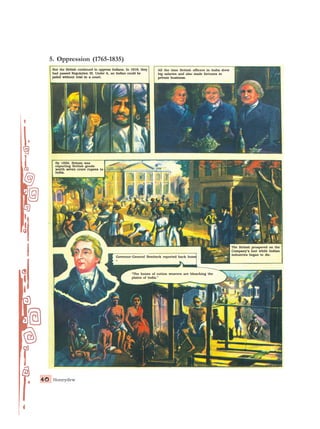
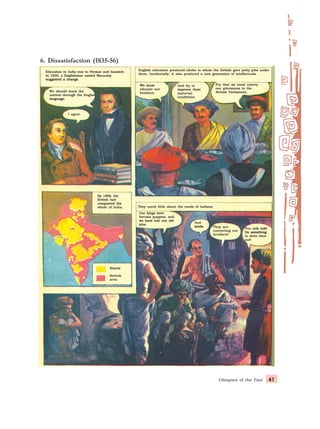
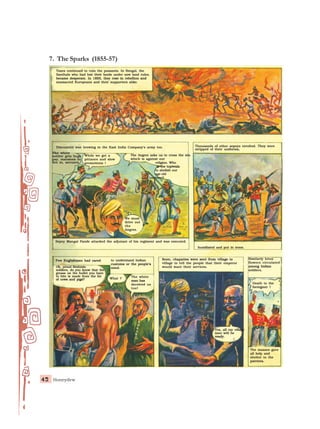
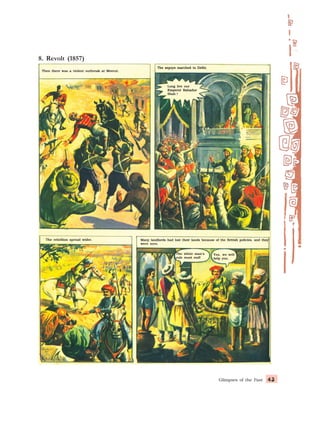
Glimpses of the Past
‘Glimpses’ of the history of our country to be understood
through pictures with strips of text for support. Children
have a natural enthusiasm for this kind of material in the
textbook.
Children may read the comic strip aloud. Then they break
up into small groups, discuss what they have read and write
a summary. Each group presents its summary one by one.
The whole class then enters into a general discussion, and
a consolidated draft of the composition is prepared with the
active support of the teacher.
Conversely, divide the class into small groups. Let each group
look at and describe a set of pictures (assigned to them) and
construct their own text. Texts thus produced can be put
together to form a coherent story, to be edited for accuracy.
8 Honeydew
If necessary, texts may first be produced in the child’s own
language and the teacher can help them to reformulate these
in English. For children fluent in English, this may be an
opportunity to formulate equivalent texts in their own
languages.
Some details of each ‘glimpse’ of the past may be had from
the history textbook of the same class. The history teacher
may be invited to facilitate the activity.
Picture reading under speaking and writing to be attempted
in the same manner.
Creating a comic (Activity 5) will be great fun if children
can be persuaded to draw/learn to draw matchstick figures.
Enlist the help of the art teacher.
Macavity – The Mystery Cat
Have you ever wondered why people generally communicate
with their pet dog mainly in English?
What would you say to persuade your cat to leave the mouse
alone? Try to say it in English.
Which sentence about Macavity has been repeated four times
in the poem? Why has it been repeated? Think about it.
Mention a couple of ‘crimes’ discovered in the kitchen, and
your Macavity was nowhere to be seen.
a fiend in feline shape
Does it remind you of a similar expression about a wolf?
What is it, and what does it mean?
Here are four lines about someone’s cat. Read them and say
whether it is a mystery cat.
My kitten walks on velvet feet
And makes no sound at all.
And in the doorway nightly sits
To watch the darkness fall.
spotted it:
saw it; found it
(informal)
scorch marks: burn
marks
was going for: was
selling for (informal)
restore:
(here) repair
veneer:
a thin layer of plastic
or decorative wood on
furniture of cheap
wood
taken their toll on:
damaged
stuck fast:
shut tight
Before you read
Before you read
Before you read
Before you read
Before you read
There are some dates or periods of time in the history of
the world that are so significant that everyone knows
and remembers them. The story you will read mentions
one such date and event: a war between the British and
the Germans in 1914. Can you guess which war it was?
Do you know which events the dates below refer to?
(a) 4 July 1776 (b) 17 December 1903
(c) 6 August 1945 (d) 30 January 1948
(e) 12 April 1961 (f) 20 July 1969
The answers are on page 23.
I
I
I
I
I
I spotted it in a junk shop in Bridport, a roll-top desk.
The man said it was early nineteenth century, and oak.
I had wanted one, but they were far too expensive.
This one was in a bad condition, the roll-top in several
pieces, one leg clumsily mended, scorch marks all down
one side. It was going for very little money. I thought I
could restore it. It would be a risk, a challenge, but I
had to have it. I paid the man and brought it back to
my workroom at the back of the garage. I began work
on it on Christmas Eve.
I removed the roll-top completely and pulled out
the drawers. The veneer had lifted almost everywhere
Honeydew
10
— it looked like water damage to me. Both fire and
water had clearly taken their toll on this desk. The last
drawer was stuck fast. I tried all I could to ease it out
gently. In the end I used brute force. I struck it sharply
with the side of my fist and the drawer flew open to
reveal a shallow space underneath, a secret drawer.
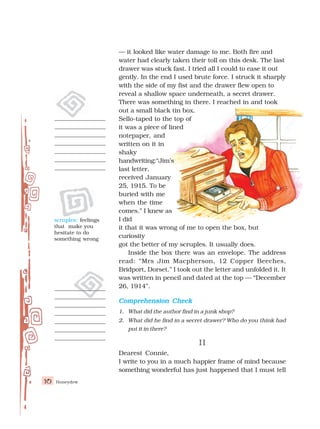
There was something in there. I reached in and took
out a small black tin box.
Sello-taped to the top of
it was a piece of lined
notepaper, and
written on it in
shaky
handwriting:“Jim’s
last letter,
received January
25, 1915. To be
buried with me
when the time
comes.” I knew as
I did
it that it was wrong of me to open the box, but
curiosity
got the better of my scruples. It usually does.
Inside the box there was an envelope. The address
read: “Mrs Jim Macpherson, 12 Copper Beeches,
Bridport, Dorset.” I took out the letter and unfolded it. It
was written in pencil and dated at the top — “December
26, 1914”.
Comprehension Check
Comprehension Check
Comprehension Check
Comprehension Check
Comprehension Check
1. What did the author find in a junk shop?
2. What did he find in a secret drawer? Who do you think had
put it in there?
II
II
II
II
II
Dearest Connie,
I write to you in a much happier frame of mind because
something wonderful has just happened that I must tell
scruples: feelings
that make you
hesitate to do
something wrong
The Best Christmas Present in the World 11
you about at once. We were all standing to in our trenches
yesterday morning, Christmas morning. It was crisp and
quiet all about, as beautiful a morning as I’ve ever seen,
as cold and frosty as a Christmas morning should be.
I should like to be able to tell you that we began it.
But the truth, I’m ashamed to say, is that Fritz began it.
First someone saw a white flag waving from the trenches
opposite. Then they were calling out to us from across
no man’s land, “Happy Christmas, Tommy! Happy
Christmas!” When we had got over the surprise, some of
us shouted back, “Same to you, Fritz! Same to you!” I
thought that would be that. We all did. But then suddenly
one of them was up there in his grey greatcoat and waving
a white flag. “Don’t shoot, lads!” someone shouted. And
no one did. Then there was another Fritz up on the
parapet, and another. “Keep your heads down,” I told
the men, “it’s a trick.” But it wasn’t.
One of the Germans was waving a bottle above his
head. “It is Christmas Day, Tommy. We have schnapps.
We have sausage. We meet you? Yes?” By this time
there were dozens of them walking towards us across
no man’s land and not a rifle between them. Little
Private Morris was the first up. “Come on, boys. What
are we waiting for?” And then there was no stopping
them. I was the officer. I should have stopped them
there and then, I suppose, but the truth is that it never
even occurred to me I should. All along their line and
ours I could see men walking slowly towards one
another, grey coats, khaki coats meeting in the middle.
And I was one of them. I was part of this. In the middle
of the war we were making peace.
You cannot imagine, dearest Connie, my feelings as
I looked into the eyes of the Fritz officer, who
approached me, hand outstretched. “Hans Wolf,” he
said, gripping my hand warmly and holding it. “I am
from Dusseldorf. I play the cello in the orchestra. Happy
Christmas.”
standing to:
taking up
positions
trenches:
long deep
ditches in the
ground where
soldiers hide
from the
enemy
Fritz:
(here), a name
for a German
soldier (Fritz is
a common
German name)
Tommy:
a common
English name,
used here to
refer to British
soldiers
that would be
that:
that was all;
that was the
end of the
matter
schnapps
(pronounced,
sh-naps):
a German
drink made
from grain
cello:
a musical
instrument
like a large
violin
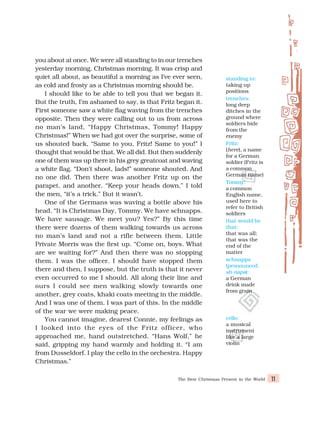
Honeydew
12
“Captain Jim Macpherson,” I replied. “And a Happy
Christmas to you too. I’m a school teacher from Dorset,
in the west of England.”
“Ah, Dorset,” he smiled. “I know this place. I know it
very well.” We shared my rum ration and his excellent
sausage. And we talked, Connie, how we talked. He
spoke almost perfect English. But it turned out that he
had never set foot in Dorset, never even been to
England. He had learned all he knew of England from
school, and from reading books in English. His favourite
writer was Thomas Hardy, his favourite book Far from
the Madding Crowd. So out there in no man’s land we
talked of Bathsheba and Gabriel Oak and Sergeant Troy
and Dorset. He had a wife and one son, born just six
months ago. As I looked about me there were huddles
of khaki and grey everywhere, all over no man’s land,
smoking, laughing, talking, drinking, eating. Hans Wolf
and I shared what was left of your wonderful Christmas
cake, Connie. He thought the marzipan was the best
he had ever tasted. I agreed. We agreed about
everything, and he was my enemy. There never was a
Christmas party like it, Connie.
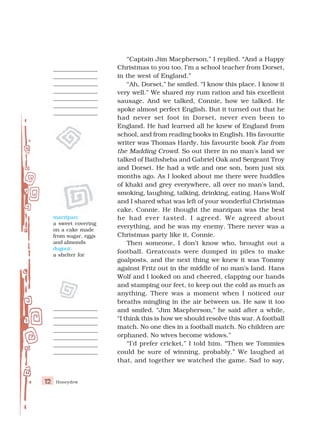
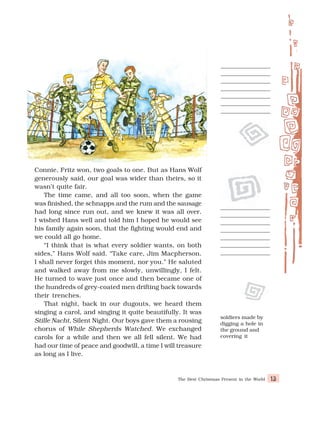
Then someone, I don’t know who, brought out a
football. Greatcoats were dumped in piles to make
goalposts, and the next thing we knew it was Tommy
against Fritz out in the middle of no man’s land. Hans
Wolf and I looked on and cheered, clapping our hands
and stamping our feet, to keep out the cold as much as
anything. There was a moment when I noticed our
breaths mingling in the air between us. He saw it too
and smiled. “Jim Macpherson,” he said after a while,
“I think this is how we should resolve this war. A football
match. No one dies in a football match. No children are
orphaned. No wives become widows.”
“I’d prefer cricket,” I told him. “Then we Tommies
could be sure of winning, probably.” We laughed at
that, and together we watched the game. Sad to say,
marzipan:
a sweet covering
on a cake made
from sugar, eggs
and almonds
dugout:
a shelter for
The Best Christmas Present in the World 13
Connie, Fritz won, two goals to one. But as Hans Wolf
generously said, our goal was wider than theirs, so it
wasn’t quite fair.
The time came, and all too soon, when the game
was finished, the schnapps and the rum and the sausage
had long since run out, and we knew it was all over.
I wished Hans well and told him I hoped he would see
his family again soon, that the fighting would end and
we could all go home.
“I think that is what every soldier wants, on both
sides,” Hans Wolf said. “Take care, Jim Macpherson.
I shall never forget this moment, nor you.” He saluted
and walked away from me slowly, unwillingly, I felt.
He turned to wave just once and then became one of
the hundreds of grey-coated men drifting back towards
their trenches.
That night, back in our dugouts, we heard them
singing a carol, and singing it quite beautifully. It was
Stille Nacht, Silent Night. Our boys gave them a rousing
chorus of While Shepherds Watched. We exchanged
carols for a while and then we all fell silent. We had
had our time of peace and goodwill, a time I will treasure
as long as I live.
soldiers made by
digging a hole in
the ground and
covering it
Honeydew
14
Dearest Connie, by Christmas time next year, this
war will be nothing but a distant and terrible memory.
I know from all that happened today how much both
armies long for peace. We shall be together again soon,
I’m sure of it.
Your loving, Jim.
Comprehension Check
Comprehension Check
Comprehension Check
Comprehension Check
Comprehension Check
1. Who had written the letter, to whom, and when?
2. Why was the letter written — what was the wonderful thing
that had happened?
3. What jobs did Hans Wolf and Jim Macpherson have when they
were not soldiers?
4. Had Hans Wolf ever been to Dorset? Why did he say he knew it?
5. Do you think Jim Macpherson came back from the war? How
do you know this?
III
III
III
III
III
I folded the letter again and slipped it carefully back
into its envelope. I kept awake all night. By morning I
knew what I had to do. I drove into Bridport, just a few
miles away. I asked a boy walking his dog where Copper
Beeches was. House number 12 turned out to be
nothing but a burned-out shell, the roof gaping, the
windows boarded-up. I knocked at the house next door
and asked if anyone knew the whereabouts of a Mrs
Macpherson. Oh yes, said the old man in his slippers,
he knew her well. A lovely old lady, he told me, a bit
muddle-headed, but at her age she was entitled to be,
wasn’t she? A hundred and one years old. She had been
in the house when it caught fire. No one really knew
how the fire had started, but it could well have been
candles. She used candles rather than electricity,
because she always thought electricity was too expensive.
The fireman had got her out just in time. She was in a
nursing home now, he told me, Burlington House, on
the Dorchester road, on the other side of town.
burned out:
destroyed by fire
boarded-up:
covered with
wooden boards
muddle-headed:
confused
The Best Christmas Present in the World 15
Comprehension Check
Comprehension Check
Comprehension Check
Comprehension Check
Comprehension Check
1. Why did the author go to Bridport?
2. How old was Mrs Macpherson now? Where was she?
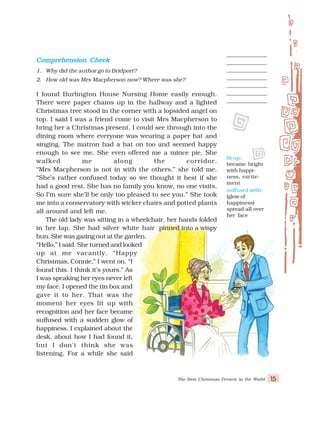
I found Burlington House Nursing Home easily enough.
There were paper chains up in the hallway and a lighted
Christmas tree stood in the corner with a lopsided angel on
top. I said I was a friend come to visit Mrs Macpherson to
bring her a Christmas present. I could see through into the
dining room where everyone was wearing a paper hat and
singing. The matron had a hat on too and seemed happy
enough to see me. She even offered me a mince pie. She
walked me along the corridor.
“Mrs Macpherson is not in with the others,” she told me.
“She’s rather confused today so we thought it best if she
had a good rest. She has no family you know, no one visits.
So I’m sure she’ll be only too pleased to see you.” She took
me into a conservatory with wicker chairs and potted plants
all around and left me.
The old lady was sitting in a wheelchair, her hands folded
in her lap. She had silver white hair pinned into a wispy
bun. She was gazing out at the garden.
“Hello,” I said. She turned and looked
up at me vacantly. “Happy
Christmas, Connie,” I went on. “I
found this. I think it’s yours.” As
I was speaking her eyes never left
my face. I opened the tin box and
gave it to her. That was the
moment her eyes lit up with
recognition and her face became
suffused with a sudden glow of
happiness. I explained about the
desk, about how I had found it,
but I don't think she was
listening. For a while she said
lit up:
became bright
with happi-
ness, excite-
ment
suffused with:
(glow of
happiness)
spread all over
her face
Honeydew
16
nothing, but stroked the letter tenderly with her
fingertips.
Suddenly she reached out and took my hand. Her
eyes were filled with tears. “You told me you’d come
home by Christmas, dearest,” she said. “And here you
are, the best Christmas present in the world. Come
closer, Jim dear, sit down.”
I sat down beside her, and she kissed my cheek. “I
read your letter so often Jim, every day. I wanted to
hear your voice in my head. It always made me feel you
were with me. And now you are. Now you’re back you
can read it to me yourself. Would you do that for me,
Jim dear? I just want to hear your voice again. I’d love
that so much. And then perhaps we’ll have some tea.
I’ve made you a nice Christmas cake, marzipan all
around. I know how much you love marzipan.”
MICHAEL MORPURGO
Comprehension Check
Comprehension Check
Comprehension Check
Comprehension Check
Comprehension Check
1. Who did Connie Macpherson think her visitor was?
2. Which sentence in the text shows that the visitor did not try
to hide his identity?
1. For how long do you think Connie had kept Jim’s letter? Give reasons for your
answer.
2. Why do you think the desk had been sold, and when?
3. Why do Jim and Hans think that games or sports are good ways of resolving
conflicts? Do you agree?
4. Do you think the soldiers of the two armies are like each other, or different from
each other? Find evidence from the story to support your answer.
5. Mention the various ways in which the British and the German soldiers become
friends and find things in common at Christmas.
6. What is Connie’s Christmas present? Why is it “the best Christmas present in the
world”?
7. Do you think the title of this story is suitable for it? Can you think of any other
title(s)?
The Best Christmas Present in the World 17
1. Look at these sentences from the story.
I spotted it in a junk shop in Bridport... The man said it was made in the early
nineteenth century… This one was in a bad condition…
The italicised verbs are in the past tense. They tell us what happened in the past,
before now.
(i) Read the passage below and underline the verbs in the past tense.
A man got on the train and sat down. The compartment was empty except
for one lady. She took her gloves off. A few hours later the police arrested
the man. They held him for 24 hours and then freed him.
Now look at these sentences.
The veneer had lifted almost everywhere. Both fire and water had taken
their toll on this desk.
Notice the verb forms had lifted, had taken (their toll).
The author found and bought the desk in the past.
The desk was damaged before the author found it and bought it.
Fire and water had damaged the desk before the author found it and bought
it.
We use verb forms like had damaged for an event in the ‘earlier past’. If there
are two events in the past, we use the ‘had…’ form for the event that occurred
first in the past.
We also use the past perfect tense to show that something was wished
for, or expected before a particular time in the past. For example, I had
always wanted one…
Discuss with your partner the difference in meaning in the sentences
below.
When I reached the station, the train left.
When I reached the station, the train had left.
(ii) Fill in the blanks using the correct form of the verbs in brackets.
My little sister is very naughty. When she __________ (come) back
from school yesterday, she had __________ (tear) her dress.
We __________ (ask) her how it had __________ (happen). She __________ (say)
she __________ __________ (have, quarrel) with a boy. She __________ __________
(have, beat) him in a race and he __________ __________ (have, try) to push her.
Honeydew
18
She __________ __________ (have, tell) the teacher and so he __________ __________
(have, chase) her, and she __________ __________ (have, fall) down and __________
__________ (have, tear) her dress.
(iii) Underline the verbs and arrange them in two columns, Past and Earlier past.
(a) My friends set out to see the caves in the next town, but I stayed at home,
because I had seen them already.
(b) When they arrived at the station, their train had left. They came back home,
but by that time I had gone out to see a movie!
(c) So they sat outside and ate the lunch I had packed for them.
(d) By the time I returned, they had fallen asleep!
Past
Past
Past
Past
Past Earlier past
Earlier past
Earlier past
Earlier past
Earlier past
2. Dictionary work
By the end of the journey, we had run out of drinking water.
Look at the verb run out of in this sentence. It is a phrasal verb: it has two parts,
a verb and a preposition or an adverb. Phrasal verbs often have meanings that
are different from the meanings of their parts.
Find these phrasal verbs in the story.
burn out light up look on run out keep out
Write down the sentences in which they occur. Consult a dictionary and write
down the meaning that you think matches the meaning of the phrasal verb in
the sentence.
3. Noun phrase
Read the following sentence.
I took out a small black tin box.
The phrase in italics is a noun phrase.
It has the noun — box — as the head word, and three adjectives
preceding it.
The Best Christmas Present in the World 19
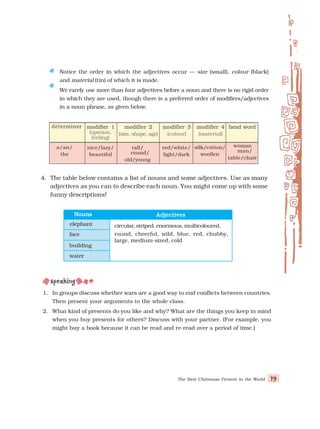
Notice the order in which the adjectives occur — size (small), colour (black)
and material (tin) of which it is made.
We rarely use more than four adjectives before a noun and there is no rigid order
in which they are used, though there is a preferred order of modifiers/adjectives
in a noun phrase, as given below.
4. The table below contains a list of nouns and some adjectives. Use as many
adjectives as you can to describe each noun. You might come up with some
funny descriptions!
1. In groups discuss whether wars are a good way to end conflicts between countries.
Then present your arguments to the whole class.
2. What kind of presents do you like and why? What are the things you keep in mind
when you buy presents for others? Discuss with your partner. (For example, you
might buy a book because it can be read and re-read over a period of time.)
determiner
determiner
determiner
determiner
determiner mod
mod
mod
mod
modifier 1
ifier 1
ifier 1
ifier 1
ifier 1
(opinion,
feeling)
mod
mod
mod
mod
modifier 2
ifier 2
ifier 2
ifier 2
ifier 2
(size, shape, age)
modifier 3
modifier 3
modifier 3
modifier 3
modifier 3
(colour)
modifier 4
modifier 4
modifier 4
modifier 4
modifier 4
(material)
head word
head word
head word
head word
head word
a/an/
the
nice/lazy/
beautiful
tall/
round/
old/young
red/white/
light/dark
silk/cotton/
woollen
woman
man/
table/chair
Nouns
Nouns
Nouns
Nouns
Nouns Adjectives
Adjectives
Adjectives
Adjectives
Adjectives
face
building
water
circular, striped, enormous, multicoloured,
round, cheerful, wild, blue, red, chubby,
large, medium-sized, cold
elephant
Honeydew
20
1. Imagine that you are Jim. You have returned to your town after the war. In your
diary record how you feel about the changes you see and the events that occur in
your town. You could begin like this
25 December, 1919
It’s Christmas today, but the town looks…..
Or
Suppose you are the visitor. You are in a dilemma. You don't know whether to disclose
your identity and disappoint the old lady or let her believe that her dear Jim has
come back. Write a letter to a friend highlighting your anxiety, fears and feelings.
2. Given below is the outline of a story. Construct the story using the outline.
A young, newly married doctor _______________ freedom fighter _______________
exiled to the Andaman and Nicobar Islands by the British _______________ infamous
Cellular Jail _______________ prisoners tortured _______________ revolt by inmates
_______________ doctor hanged _______________ wife waits for his return
_______________ becomes old _______________ continues to wait with hope and
faith.
War is the greatest plague that can afflict humanity; it destroys religion, it destroys
states, it destroys families.
— Martin Luther
This book is to be neither an accusation nor a confession, and least of all an adventure,
for death is not an adventure to those who stand face to face with it. It will try simply
to tell of a generation of men who, even though they may have escaped shells, were
destroyed by the war.
— Erich Maria Remarque, author of All Quiet on the Western Front
The Best Christmas Present in the World 21
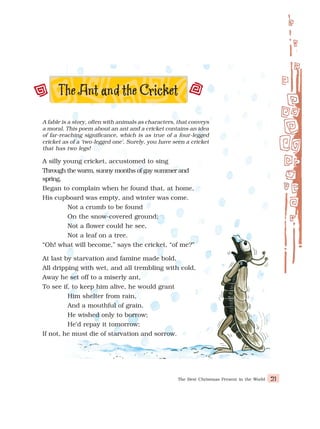
A fable is a story, often with animals as characters, that conveys
a moral. This poem about an ant and a cricket contains an idea
of far-reaching significance, which is as true of a four-legged
cricket as of a ‘two-legged one’. Surely, you have seen a cricket
that has two legs!
A silly young cricket, accustomed to sing
Through the warm, sunny months of gay summer and
spring,
Began to complain when he found that, at home,
His cupboard was empty, and winter was come.
Not a crumb to be found
On the snow-covered ground;
Not a flower could he see,
Not a leaf on a tree.
“Oh! what will become,” says the cricket, “of me?”
At last by starvation and famine made bold,
All dripping with wet, and all trembling with cold,
Away he set off to a miserly ant,
To see if, to keep him alive, he would grant
Him shelter from rain,
And a mouthful of grain.
He wished only to borrow;
He’d repay it tomorrow;
If not, he must die of starvation and sorrow.
Honeydew
22
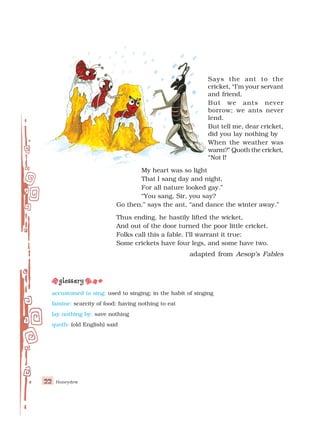
Says the ant to the
cricket, “I’m your servant
and friend,
But we ants never
borrow; we ants never
lend.
But tell me, dear cricket,
did you lay nothing by
When the weather was
warm?” Quoth the cricket,
“Not I!
My heart was so light
That I sang day and night,
For all nature looked gay.”
“You sang, Sir, you say?
Go then,” says the ant, “and dance the winter away.”
Thus ending, he hastily lifted the wicket,
And out of the door turned the poor little cricket.
Folks call this a fable. I’ll warrant it true:
Some crickets have four legs, and some have two.
adapted from Aesop’s Fables
accustomed to sing: used to singing; in the habit of singing
famine: scarcity of food; having nothing to eat
lay nothing by: save nothing
quoth: (old English) said
The Best Christmas Present in the World 23
1. The cricket says, “Oh! what will become of me?” When does he say it,
and why?
2. (i) Find in the poem the lines that mean the same as “Neither a borrower nor a
lender be” (Shakespeare).
(ii) What is your opinion of the ant’s principles?
3. The ant tells the cricket to “dance the winter away”. Do you think the word ‘dance’
is appropriate here? If so, why?
4. (i) Which lines in the poem express the poet's comment? Read them aloud.
(ii) Write the comment in your own words.
If you know a fable in your own language, narrate it to your classmates.
Answers to Questions on page 9.
(a) American Declaration of Independence.
(b) Wilbur and Orville Wright made the first flight, remaining in the air for 12
seconds and covering 120 feet.
(c) HiroshimaDay:anatomicbombwasdroppedon HiroshimainJapanonthisday.
(d) Assassination of Mahatma Gandhi.
(e) Yuri A. Gagarin became the first human to orbit the Earth.
(f) Neil Armstrong became the first human to set foot on the Moon.
Honeydew
24
24
24
24
24
Before you read
Before you read
Before you read
Before you read
Before you read
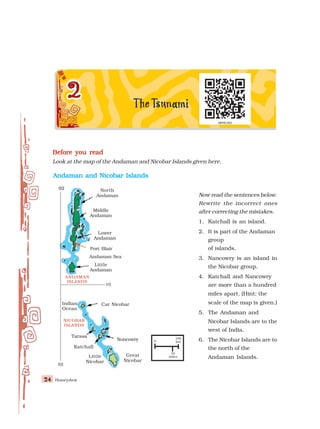
Look at the map of the Andaman and Nicobar Islands given here.
Andaman and Nicobar Islands
North
Andaman
Middle
Andaman
Lower
Andaman
Port Blair
Andaman Sea
Little
Andaman
ANDAMAN
ISLANDS
10°
92°
Car Nicobar
Indian
Ocean
NICOBAR
ISLANDS
Tarasa
Katchall
Great
Nicobar
Noncowry 0
100
km
70
miles
92°
Little
Nicobar
Now read the sentences below.
Rewrite the incorrect ones
after correcting the mistakes.
1. Katchall is an island.
2. It is part of the Andaman
group
of islands.
3. Nancowry is an island in
the Nicobar group.
4. Katchall and Nancowry
are more than a hundred
miles apart. (Hint: the
scale of the map is given.)
5. The Andaman and
Nicobar Islands are to the
west of India.
6. The Nicobar Islands are to
the north of the
Andaman Islands.
The Tsunami 25
25
25
25
25
I
I
I
I
I
These stories are all from the Andaman and Nicobar
archipelago.
Ignesious was the manager of a cooperative society
in Katchall. His wife woke him up at 6 a.m. because
she felt an earthquake. Ignesious carefully took his
television set off its table and put it down on the ground
so that it would not fall and break. Then the family
rushed out of the house.
When the tremors stopped, they saw the sea rising.
In the chaos and confusion, two of his children caught
hold of the hands of their mother’s father and mother’s
brother, and rushed in the opposite direction. He never
saw them again. His wife was also swept away. Only
the three other children who came with him were saved.
A tsunami is a very large and powerful wave caused by
earthquakes under the sea. On 26 December 2004, a tsunami hit
Thailand and parts of India such as the Andaman and Nicobar
Islands, and the Tamil Nadu coast. Here are some stories of
courage and survival.
Did animals sense that a tsunami was coming? Some stories
suggest that they did.
archipelago:
a group of many
islands and the
surrounding sea
tremor:
a slight shake
Earth tremors:
the earth’s
shakes during
an earthquake
chaos:
complete disorder
or confusion
[pronounced, kay-
os]
relief
helicopters:
helicopters
Honeydew
26
26
26
26
26
Sanjeev was a policeman, serving in the Katchall island
of the Nicobar group of islands. He somehow managed to
save himself, his wife and his baby daughter from the
waves. But then he heard cries for help from the wife of
John, the guesthouse cook. Sanjeev jumped into the water
to rescue her, but they were both swept away.
Thirteen year-old Meghna was swept away along with
her parents and seventy-seven other people. She spent
two days floating in the sea, holding on to a wooden door.
Eleven times she saw relief helicopters overhead, but they
did not see her. She was brought to the shore by a wave,
and was found walking on the seashore in a daze.
Almas Javed was ten years old. She was a student
of Carmel Convent in Port Blair where her father had a
petrol pump. Her mother Rahila’s home was in
Nancowry island. The family had gone there to celebrate
Christmas.
When the tremors came early in the morning, the
family was sleeping. Almas’s father saw the sea water
recede. He understood that the water would come
rushing back with great force. He woke everyone up
and tried to rush them to a safer place.
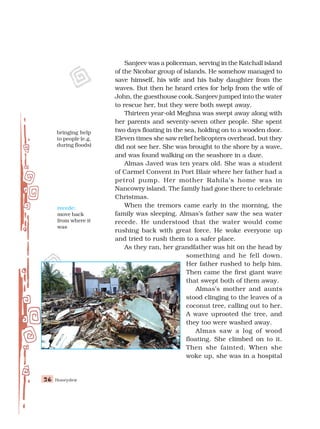
As they ran, her grandfather was hit on the head by
something and he fell down.
Her father rushed to help him.
Then came the first giant wave
that swept both of them away.
Almas’s mother and aunts
stood clinging to the leaves of a
coconut tree, calling out to her.
A wave uprooted the tree, and
they too were washed away.
Almas saw a log of wood
floating. She climbed on to it.
Then she fainted. When she
woke up, she was in a hospital
recede:
move back
from where it
was
bringing help
to people (e.g.
during floods)
The Tsunami 27
27
27
27
27
in Kamorta. From there she was brought to Port Blair.
The little girl does not want to talk about the incident
with anyone. She is still traumatised.
Comprehension Check
Comprehension Check
Comprehension Check
Comprehension Check
Comprehension Check
Say whether the following are true or false.
1. Ignesious lost his wife, two children, his father-in-law, and
his brother-in-law in the tsunami.
2. Sanjeev made it to safety after the tsunami.
3. Meghna was saved by a relief helicopter.
4. Almas’s father realised that a tsunami was going to hit the
island.
5. Her mother and aunts were washed away with the tree that
they were holding on to.
II
II
II
II
II
Tilly Smith (a British school girl) was able to save many lives when
the tsunami struck Phuket beach in Thailand. Though she has
won a number of awards, her parents have not allowed their
daughter to be interviewed on television and made into a heroine.
Why do you think they took that decision?
Now here is a story from Thailand.
The Smith family from South-East England were
celebrating Christmas at a beach resort in southern
Thailand. Tilly Smith was a ten-year-old schoolgirl; her
sister was seven years old. Their parents were Penny
and Colin Smith.
It was 26 December 2004. Deadly tsunami waves
were already on their way. They had been triggered
by a massive earthquake off northern Sumatra earlier
that morning.
“The water was swelling and kept coming in,” Penny
Smith remembered. “The beach was getting smaller and
smaller. I didn’t know what was happening.”
resort:
a place where
people go on
holiday
triggered:
caused
(describes a
sudden, violent
reaction –
here, an
undersea
earthquake
caused the
tsunami)
hysterical:
when you are
traumatised:
greatly
shocked and
distressed
Honeydew
28
28
28
28
28
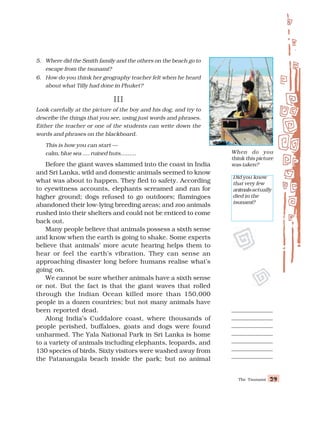
But Tilly Smith sensed that something was wrong.
Her mind kept going back to a geography lesson she
had taken in England just two weeks before she flew
out to Thailand with her family.
Tilly saw the sea slowly rise, and start to foam,
bubble and form whirlpools. She remembered that she
had seen this in class in a video of a tsunami that had
hit the Hawaiian islands in 1946. Her geography
teacher had shown her class the video, and told them
that tsunamis can be caused by earthquakes, volcanoes
and landslides.
Tilly started to scream at her family to get off the
beach. “She talked about an earthquake under the sea.
She got more and more hysterical,” said her mother
Penny. “I didn’t know what a tsunami was. But seeing
my daughter so frightened, I thought something serious
must be going on.”
Tilly’s parents took her and her sister away from
the beach, to the swimming pool at the hotel. A number
of other tourists also left the beach with them. “Then it
was as if the entire sea had come out after them. I was
screaming, ‘Run!’”
The family took refuge in the third floor of the hotel.
The building withstood the surge of three tsunami
waves. If they had stayed on the beach, they would not
have been alive.
The Smiths later met other tourists who had lost
entire families. Thanks to Tilly and her geography
lesson, they had been forewarned. Tilly went back to
her school in England and told her classmates her
terrifying tale.
Comprehension Check
Comprehension Check
Comprehension Check
Comprehension Check
Comprehension Check
Answer the following in a phrase or sentence.
1. Why did Tilly’s family come to Thailand?
2. What were the warning signs that both Tilly and her mother saw?
3. Do you think Tilly’s mother was alarmed by them?
4. Where had Tilly seen the sea behaving in the same strange
fashion?
hysterical, you
shout, laugh or cry
in a wild excited
way, without any
control over
yourself
refuge:
shelter or
protection from
danger
withstood: endured
without
collapsing
surge:
force; momentum
The Tsunami 29
29
29
29
29
5. Where did the Smith family and the others on the beach go to
escape from the tsunami?
6. How do you think her geography teacher felt when he heard
about what Tilly had done in Phuket?
III
III
III
III
III
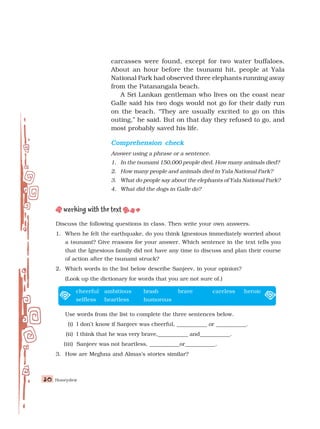
Look carefully at the picture of the boy and his dog, and try to
describe the things that you see, using just words and phrases.
Either the teacher or one of the students can write down the
words and phrases on the blackboard.
This is how you can start —
calm, blue sea …. ruined huts………
Before the giant waves slammed into the coast in India
and Sri Lanka, wild and domestic animals seemed to know
what was about to happen. They fled to safety. According
to eyewitness accounts, elephants screamed and ran for
higher ground; dogs refused to go outdoors; flamingoes
abandoned their low-lying breeding areas; and zoo animals
rushed into their shelters and could not be enticed to come
back out.
Many people believe that animals possess a sixth sense
and know when the earth is going to shake. Some experts
believe that animals’ more acute hearing helps them to
hear or feel the earth’s vibration. They can sense an
approaching disaster long before humans realise what’s
going on.
We cannot be sure whether animals have a sixth sense
or not. But the fact is that the giant waves that rolled
through the Indian Ocean killed more than 150,000
people in a dozen countries; but not many animals have
been reported dead.
Along India’s Cuddalore coast, where thousands of
people perished, buffaloes, goats and dogs were found
unharmed. The Yala National Park in Sri Lanka is home
to a variety of animals including elephants, leopards, and
130 species of birds. Sixty visitors were washed away from
the Patanangala beach inside the park; but no animal
When do you
think this picture
was taken?
Did you know
that very few
animalsactually
died in the
tsunami?
Honeydew
30
30
30
30
30
Discuss the following questions in class. Then write your own answers.
1. When he felt the earthquake, do you think Ignesious immediately worried about
a tsunami? Give reasons for your answer. Which sentence in the text tells you
that the Ignesious family did not have any time to discuss and plan their course
of action after the tsunami struck?
2. Which words in the list below describe Sanjeev, in your opinion?
(Look up the dictionary for words that you are not sure of.)
cheerful ambitious brash brave careless heroic
selfless heartless humorous
Use words from the list to complete the three sentences below.
(i) I don’t know if Sanjeev was cheerful, ___________ or ___________.
(ii) I think that he was very brave,___________ and___________.
(iii) Sanjeev was not heartless, ___________or___________.
3. How are Meghna and Almas’s stories similar?
carcasses were found, except for two water buffaloes.
About an hour before the tsunami hit, people at Yala
National Park had observed three elephants running away
from the Patanangala beach.
A Sri Lankan gentleman who lives on the coast near
Galle said his two dogs would not go for their daily run
on the beach. “They are usually excited to go on this
outing,” he said. But on that day they refused to go, and
most probably saved his life.
Comprehension check
Comprehension check
Comprehension check
Comprehension check
Comprehension check
Answer using a phrase or a sentence.
1. In the tsunami 150,000 people died. How many animals died?
2. How many people and animals died in Yala National Park?
3. What do people say about the elephants of Yala National Park?
4. What did the dogs in Galle do?
The Tsunami 31
31
31
31
31
4. What are the different ways in which Tilly’s parents could have reacted to her
behaviour? What would you have done if you were in their place?
5. If Tilly’s award was to be shared, who do you think she should share it with — her
parents or her geography teacher?
6. What are the two different ideas about why so few animals were killed in the
tsunami? Which idea do you find more believable?
1. Go through Part-I carefully, and make a list of as many words as you can find that
indicate movement of different kinds. (There is one word that occurs repeatedly —
count how many times!) Put them into three categories.
fast movement slow movement neither slow nor fast
Can you explain why there are many words in one column and not in the others?
2. Fill in the blanks in the sentences below (the verbs given in brackets will give you
a clue).
(i) The earth trembled, but not many people felt the _________. (tremble)
(ii) When the zoo was flooded, there was a lot of _________ and many animals
escaped into the countryside. (confuse)
(iii) We heard with _________ that the lion had been recaptured. (relieve)
(iv) The zookeeper was stuck in a tree and his _________ was filmed by the TV
crew. (rescue)
(v) There was much _________ in the village when the snake charmer came visiting.
(excite)
3. Study the sentences in the columns A
A
A
A
A and B
B
B
B
B.
A
A
A
A
A B
B
B
B
B
Meghna was swept away. The waves swept Meghna away.
Almas's grandfather was hit on the
head.
Something hit Almas’s grandfather on
the head.
Sixty visitors were washed away. The waves washed away sixty visitors.
No animal carcasses were found. People did not find any animal carcasses.
Honeydew
32
32
32
32
32
Compare the sentences in A
A
A
A
A to the ones in B
B
B
B
B. Who is the ‘doer’ of the action in
every case? Is the ‘doer’ mentioned in A
A
A
A
A, or in B
B
B
B
B?
Notice the verbs in A
A
A
A
A: ‘was swept away’, ‘was hit’, ‘were washed away’, ‘were
found’. They are in the passive form. The sentences are in the Passive Voice. In
these sentences, the focus is not on the person who does the action.
In B
B
B
B
B, the ‘doer’ of the action is named. The verbs are in the active form. The
sentences are in the Active Voice.
Say whether the following sentences are in the Active or the Passive voice. Write A
or P after each sentence as shown in the first sentence.
(i) Someone stole my bicycle. __A__
(ii) The tyres were deflated by the traffic police. _______________
(iii) I found it last night in a ditch near my house. _______________
(iv) It had been thrown there. _______________
(v) My father gave it to the mechanic. _______________
(vi) The mechanic repaired it for me. _______________
1. Suppose you are one of the volunteers who went to the Andaman and Nicobar
Islands for relief work after the tsunami. You work in the relief camps, distributing
food, water and medicine among the victims. You listen to the various stories of
bravery of ordinary people even as they fight against odds to bring about some
semblance of normalcy in their lives. You admire their grit and determination.
Write a diary entry.
You may start in this way.
31 December, 2004
The killer tsunami struck these islands five days ago. But the victims are being
brought in even now. Each one has a story to tell...
2. The story shows how a little girl saved the lives of many tourists when a tsunami
struck the beach, thanks to the geography lesson that she had learnt at school.
She remembered the visuals of a tsunami and warned her parents.
The Tsunami 33
33
33
33
33
Do you remember any incident when something that you learnt in the classroom
helped you in some way outside the classroom?
Write your experiences in a paragraph of about 90–100 words or narrate it to the
whole class like an anecdote.
Katchall is one of the largest islands in the central group. It is about 61
sqmilesinarea.Itisslightlyhillyatthecentre,butotherwiseremarkably
flat.
B
B
B
B
Betty at the P
etty at the P
etty at the P
etty at the P
etty at the Party
arty
arty
arty
arty
‘When I was at the party,’
Said Betty, aged just four,
‘A little girl fell off her chair
Right down upon the floor;
And all the other little girls
Began to laugh, but me –
I didn’t laugh a single bit’,
Said Betty seriously.
‘Why not?’– her mother asked her,
Full of delight to find
That Betty – bless her little heart! –
Had been so sweetly kind.
‘Why didn’t you laugh, my darling?
Or don’t you like to tell?’
‘I didn’t laugh,’ said Betty,
‘Because it was I that fell.’
–Unknown
Honeydew
34
34
34
34
34
Can you imagine what your city would look like if you saw it from
ten thousand feet above the ground? Neatly planned and perfect
in proportion like a geometric design, it would strike you as
something very different from what it actually is while you are in
the thick of it.
Here is a poet's description of just such a view of the city, and
some questions that come to his mind.
When the jet sprang into the sky,
it was clear why the city
had developed the way it had,
seeing it scaled six inches to the mile.
There seemed an inevitability
about what on ground had looked haphazard,
unplanned and without style
When the jet sprang into the sky.
When the jet reached ten thousand feet,
it was clear why the country
had cities where the rivers ran
and why the valleys were populated.
The logic of geography —
that land and water attracted man —
was clearly delineated
When the jet reached ten thousand feet.
When the jet rose six miles high,
it was clear the earth was round
and that it had more sea than land.
The Tsunami 35
35
35
35
35
inevitable: that cannot be avoided
haphazard: without plan or order
delineated: shown
1. Find three or four phrases in stanzas one and two which are likely to occur in a
geography lesson.
2. Seen from the window of an aeroplane, the city appears
(i) as haphazard as on ground.
(ii) as neat as a map.
(iii) as developed as necessary.
Mark the right answer.
3. Which of the following statements are examples of “the logic of geography”?
(i) There are cities where there are rivers.
(ii) Cities appear as they are not from six miles above the ground.
(iii) It is easy to understand why valleys are populated.
(iv) It is difficult to understand why humans hate and kill one another.
(v) The earth is round, and it has more sea than land.
4. Mention two things that are
(i) clear from the height.
But it was difficult to understand
that the men on the earth found
causes to hate each other, to build
walls across cities and to kill.
From that height, it was not clear why.
ZULFIKAR GHOSE
Honeydew
36
36
36
36
36
Before you read
Before you read
Before you read
Before you read
Before you read
Here are some pictorial glimpses of the history of our
country from 1757 to 1857. These pictures and ‘speech
bubbles’ will help clarify your understanding of the
conditions that led to the event known as the First War
of Independence in 1857.
At a function in Delhi
At a function in Delhi Oh my countrymen!
Oh my countrymen!
Oh my countrymen!
Oh my countrymen!
Oh my countrymen!
Let your eyes fill with
Let your eyes fill with tears,
tears,
tears,
tears,
tears,
as you
as you
as you
as you
as you recall the sacrifices of
recall the sacrifices of
India’s
India’s
India’s
India’s
India’s martyrs.
martyrs.
martyrs.
martyrs.
martyrs.
1. The Martyrs
Glimpses of the Past 37
37
37
37
37
2. The Company’s conquests (1757-1849)
With its superior weapons,
With its superior weapons, the British East
the British East
the British East
the British East
the British East
India Company
India Company
India Company
India Company
India Company was extending its power in
was extending its power in
18th century India.
18th century India.
18th century India.
18th century India.
18th century India.
INDIA 1765
INDIA 1765
INDIA 1765
INDIA 1765
INDIA 1765
Indian Princes
Indian Princes
Indian Princes
Indian Princes
Indian Princes
British
British
British
British
British
Territory
Territory
Territory
Territory
Territory
Indian princes were short-sighted.
That upstart Rajah
That upstart Rajah
That upstart Rajah
That upstart Rajah
That upstart Rajah
Bah! Call the English
m
m
m
m
merchants. They will help
erchants. They will help
me to defeat him.
me to defeat him.
me to defeat him.
me to defeat him.
me to defeat him.
The people had no peace due to such constant fights.
A far-seeing ruler like the
brave Tipu of Mysore fought
the British till he died
fighting!
fighting!
fighting!
fighting!
fighting!
The rivalries helped the East India C
The rivalries helped the East India Company and
ompany and
ompany and
ompany and
ompany and
it could easily subdue
it could easily subdue Indian princes one by one.
Indian princes one by one.
Thank God, there is peace in
the country now! No more
wars and no looting by thugs !
It is God who
It is God who
It is God who
It is God who
It is God who
sent the
sent the
sent the
sent the
sent the
British!
British!
British!
British!
British!
Our destiny is
Our destiny is
Our destiny is
Our destiny is
Our destiny is
linked with
linked with
linked with
linked with
linked with
them!
them!
them!
them!
them!
How did Indians react to these conquests?
The white man has
The white man has
The white man has
The white man has
The white man has
killed or dethroned
killed or dethroned
killed or dethroned
killed or dethroned
killed or dethroned
our kings.
our kings.
our kings.
our kings.
our kings.
Some kings were not
Some kings were not
Some kings were not
Some kings were not
Some kings were not
good, but after all, they
were of this land.
were of this land.
were of this land.
were of this land.
were of this land.
Now we have
Now we have
Now we have
Now we have
Now we have
become slaves of
become slaves of
become slaves of
become slaves of
become slaves of
foreigners!
foreigners!
foreigners!
foreigners!
foreigners!
Honeydew
38
38
38
38
38
Religious leaders preached ideas like untouchability and child marriage.
The truth was that Indians had lost self-respect.
The British scorned them.
Being merchants, the British wanted quick profits, their heavy
taxes forced farmers to abandon their fields.
All the misery in the world is
due to women.
due to women.
due to women.
due to women.
due to women.
But your men are taking
all my crop!
all my crop!
all my crop!
all my crop!
all my crop!
You are still in arrears.
If you don’t pay next
week. I will send you to
jail.
jail.
jail.
jail.
jail.
The natives are
The natives are
The natives are
The natives are
The natives are
unworthy of trust,
unworthy of trust,
unworthy of trust,
unworthy of trust,
unworthy of trust,
incapable of honesty–
True, your honour,
True, your honour,
True, your honour,
True, your honour,
True, your honour,
but I am honest.
but I am honest.
but I am honest.
but I am honest.
but I am honest.
Still, the British invented other methods which gave
them more profits.
them more profits.
them more profits.
them more profits.
them more profits.
Inevitably famines followed. Between 1822 and 1836
fifteen lakh Indians died of starvation.
The British policies
ruined the expert
ruined the expert
ruined the expert
ruined the expert
ruined the expert
artisans and their
artisans and their
artisans and their
artisans and their
artisans and their
business.
business.
business.
business.
business.
A good
A good
A good
A good
A good
idea!
idea!
idea!
idea!
idea!
The goods
The goods
The goods
The goods
The goods manufactured
manufactured
manufactured
manufactured
manufactured in
in
in
in
in
England should not have any
import duty
import duty
import duty
import duty
import duty when brought into
when brought into
when brought into
when brought into
when brought into
India.
India.
India.
India.
India.
The East India Company’s
laws began to cripple Indian
industries.
industries.
industries.
industries.
industries.
3. British Rule (1765-1836)
Anyone who crosses the seas
loses his religion.
loses his religion.
loses his religion.
loses his religion.
loses his religion.
Glimpses of the Past 39
39
39
39
39
4. Ram Mohan Roy (1772-1833)
Ram Mohan Roy, a learned man from Bengal, understood
what was wrong with the country.
Let us not despise ourselves, our ancient culture is great. And
we are capable of greater achievements. We must first
reform our society.
reform our society.
reform our society.
reform our society.
reform our society.
Superstitions have been
ruining us.
ruining us.
ruining us.
ruining us.
ruining us.
He told his wife Uma–
Cows are of different colours, but the
colour of their milk is the same.
Different teachers have different
opinions but the essence of every religion
is the same.
is the same.
is the same.
is the same.
is the same.
He was attracted by science
and modern knowledge.
Knowledge should be
Knowledge should be
Knowledge should be
Knowledge should be
Knowledge should be
practical and
practical and
practical and
practical and
practical and
scientific.
scientific.
scientific.
scientific.
scientific.
He crossed the seas and went to
England to see what made the
British powerful. There he told
them–
them–
them–
them–
them–
We accept you as rulers, and
you must accept us as
subjects. But you must
remember the responsibility
a ruler owes to his subjects.
He started
He started
He started
He started
He started
newspapers but
newspapers but
newspapers but
newspapers but
newspapers but
the suspicious
the suspicious
the suspicious
the suspicious
the suspicious
British stopped
British stopped
British stopped
British stopped
British stopped
them in 1823.
them in 1823.
them in 1823.
them in 1823.
them in 1823.
Honeydew
40
40
40
40
40
5. Oppression (1765-1835)
But the British continued to oppress Indians. In 1818, they
had passed
had passed
had passed
had passed
had passed R
R
R
R
Regulation III. Under it, an Indian could be
egulation III. Under it, an Indian could be
jailed without trial in a court.
All the time British officers in India drew
big salaries and also made fortunes in
private business.
private business.
private business.
private business.
private business.
By 1829, Britain was
exporting British goods
worth seven crore rupees to
India.
India.
India.
India.
India.
The British prospered on the
Company’s loot while Indian
industries began to die.
Governor-General Bentinck reported back home
–
–
–
–
–
“The bones of cotton weavers are bleaching the
plains of India.”
plains of India.”
plains of India.”
plains of India.”
plains of India.”
Glimpses of the Past 41
41
41
41
41
Education in India was in Persian and Sanskrit.
In 1835, a Englishman named Macaulay
suggested a change.
suggested a change.
suggested a change.
suggested a change.
suggested a change.
6. Dissatisfaction (1835-56)
We should teach the
We should teach the
We should teach the
We should teach the
We should teach the
natives through the English
language.
language.
language.
language.
language.
I agree.
I agree.
I agree.
I agree.
I agree.
English education produced clerks to whom the British gave petty jobs under
them. Incidentally, it also produced a new generation of intellectuals.
We must
We must
We must
We must
We must
educate our
educate our
educate our
educate our
educate our
brothers.
brothers.
brothers.
brothers.
brothers.
And try to
And try to
And try to
And try to
And try to
improve their
improve their
improve their
improve their
improve their
material
material
material
material
material
conditions.
conditions.
conditions.
conditions.
conditions.
For that we must convey
our grievances to the
British Parliament.
British Parliament.
British Parliament.
British Parliament.
British Parliament.
By 1856, the
By 1856, the
By 1856, the
By 1856, the
By 1856, the
British had
British had
British had
British had
British had
conquered the
conquered the
conquered the
conquered the
conquered the
whole of India.
whole of India.
whole of India.
whole of India.
whole of India.
Our kings have
Our kings have
Our kings have
Our kings have
Our kings have
become puppets, and
become puppets, and
become puppets, and
become puppets, and
become puppets, and
we have lost our old
jobs.
jobs.
jobs.
jobs.
jobs.
They cared little about the needs of Indians.
And
And
And
And
And
lands.
lands.
lands.
lands.
lands. They are
They are
They are
They are
They are
converting our
converting our
converting our
converting our
converting our
brothers!
brothers!
brothers!
brothers!
brothers!
You only talk!
You only talk!
You only talk!
You only talk!
You only talk!
Do something
Do something
Do something
Do something
Do something
to drive
to drive
to drive
to drive
to drive then
then
then
then
then
out!
out!
out!
out!
out!
States
States
States
States
States
British
British
British
British
British
area
area
area
area
area
Honeydew
42
42
42
42
42
7. The Sparks (1855-57)
Taxes continued to ruin the peasants. In Bengal, the
Santhals who had lost their lands under new land rules,
became desperate. In 1855, they rose in rebellion and
massacred Europeans and their supporters alike.
Discontent was brewing in the East India Company’s army too.
The white
The white
The white
The white
The white
soldier gets huge
soldier gets huge
soldier gets huge
soldier gets huge
soldier gets huge
pay, mansions to
pay, mansions to
pay, mansions to
pay, mansions to
pay, mansions to
live in, servants.
live in, servants.
live in, servants.
live in, servants.
live in, servants.
While we get a
While we get a
While we get a
While we get a
While we get a
pittance and slow
pittance and slow
pittance and slow
pittance and slow
pittance and slow
promotions !
promotions !
promotions !
promotions !
promotions !
The Angrez asks us to cross the sea
which is against our
religion. Who
religion. Who
religion. Who
religion. Who
religion. Who
is the topiwala
is the topiwala
is the topiwala
is the topiwala
is the topiwala
to abolish our
to abolish our
to abolish our
to abolish our
to abolish our
age-old
age-old
age-old
age-old
age-old
customs?
customs?
customs?
customs?
customs?
We must
We must
We must
We must
We must
drive out
drive out
drive out
drive out
drive out
the
the
the
the
the
Angrez.
Angrez.
Angrez.
Angrez.
Angrez.
Thousands of other sepoys revolted. They were
stripped of their uniforms,
humiliated and put in irons.
Sepoy Mangal Pande attacked the adjutant of his regiment and was executed.
Few Englishmen had cared
O
O
O
O
Oh
h
h
h
h, proud Brahmin
, proud Brahmin
, proud Brahmin
, proud Brahmin
, proud Brahmin
soldiers, do you know that the
g
g
g
g
grease on the bullet you have
rease on the bullet you have
to bite is made from the fat
of cows and pigs?
of cows and pigs?
of cows and pigs?
of cows and pigs?
of cows and pigs?
to understand Indian
customs or the people’s
mind.
mind.
mind.
mind.
mind.
The white
The white
The white
The white
The white
man has
man has
man has
man has
man has
deceived us
deceived us
deceived us
deceived us
deceived us
too!
too!
too!
too!
too!
Soon, chapaties were sent from village to
village to tell the people that their emperor
would want their services.
Similarly lotus
Similarly lotus
Similarly lotus
Similarly lotus
Similarly lotus
flowers circulated
flowers circulated
flowers circulated
flowers circulated
flowers circulated
among Indian
among Indian
among Indian
among Indian
among Indian
soldiers.
soldiers.
soldiers.
soldiers.
soldiers.
Death to the
Death to the
Death to the
Death to the
Death to the
foreigner !
foreigner !
foreigner !
foreigner !
foreigner !
Yes, all my village
Yes, all my village
Yes, all my village
Yes, all my village
Yes, all my village
men will be
men will be
men will be
men will be
men will be
ready.
ready.
ready.
ready.
ready.
The masses gave
The masses gave
The masses gave
The masses gave
The masses gave
all help and
all help and
all help and
all help and
all help and
shelter to the
shelter to the
shelter to the
shelter to the
shelter to the
patriots.
patriots.
patriots.
patriots.
patriots.
What ?
What ?
What ?
What ?
What ?
Glimpses of the Past 43
43
43
43
43
Then there was a violent outbreak at Meerut.
8. Revolt (1857)
The sepoys marched to Delhi.
Long live our
Long live our
Long live our
Long live our
Long live our
Emperor Bahadur
Emperor Bahadur
Emperor Bahadur
Emperor Bahadur
Emperor Bahadur
Shah !
Shah !
Shah !
Shah !
Shah !
The rebellion spread wider.
The rebellion spread wider. Many landlords had lost their lands because of the British policies, and they
Many landlords had lost their lands because of the British policies, and they
were sore.
were sore.
were sore.
were sore.
were sore.
The white man’s
The white man’s
The white man’s
The white man’s
The white man’s
rule must end!
rule must end!
rule must end!
rule must end!
rule must end!
Yes, we will
Yes, we will
Yes, we will
Yes, we will
Yes, we will
help you.
help you.
help you.
help you.
help you.
Honeydew
44
44
44
44
44
from Our Freedom Movement
S.D. SAWANT
9. The Fight for Freedom (1857)
Many former rulers like Begum Hazrat Mahal of
Lucknow were bitter.
The white man has
The white man has
The white man has
The white man has
The white man has
taken away my
taken away my
taken away my
taken away my
taken away my
kingdom !
kingdom !
kingdom !
kingdom !
kingdom !
Popular leaders like Maulvi Ahmedulla of Faizabad told the people –
Rise, brothers, rise !
The Angrez is ruining our
land !
land !
land !
land !
land !
They joined the upsurge against the foreigner.
Azimulla Khan told
Azimulla Khan told
Azimulla Khan told
Azimulla Khan told
Azimulla Khan told
Tatya Tope
Tatya Tope
Tatya Tope
Tatya Tope
Tatya Tope
We should have Peshwa Nana Saheb
as our leader in this war of
independence
independence
independence
independence
independence
Eighty
Eighty
Eighty
Eighty
Eighty-
-
-
-
-year old Kunwar Singh of Bihar
year old Kunwar Singh of Bihar
year old Kunwar Singh of Bihar r
r
r
r
received a bullet in
eceived a bullet in
eceived a bullet in
eceived a bullet in
eceived a bullet in
his wrist.
his wrist.
his wrist.
his wrist.
his wrist.
Mother Ganga ! This is
my last offering to you
!
!
!
!
!
The patriots pounced upon the British
and fought pitched battles all over
North India.
North India.
North India.
North India.
North India.
The people rose everywhere, in Bareilly, Kanpur and Allahabad.
Glimpses of the Past 45
45
45
45
45
Answer the following questions.
1. Do you think the Indian princes were short-sighted in their approach to the
events of 1757?
2. How did the East India Company subdue the Indian princes?
3. Quote the words used by Ram Mohan Roy to say that every religion teaches the
same principles.
4. In what ways did the British officers exploit Indians?
5. Name these people.
(i) The ruler who fought pitched battles against the British and died fighting.
(ii) The person who wanted to reform the society.
(iii) The person who recommended the introduction of English education in
India.
(iv) Two popular leaders who led the revolt (Choices may vary.)
6. Mention the following.
(i) Two examples of social practices prevailing then.
(ii) Two oppressive policies of the British.
(iii) Two ways in which common people suffered.
(iv) Four reasons for the discontent that led to the 1857 War of Independence.
In comics what the characters speak is put in bubbles. This is direct narration. When
we report what the characters speak, we use the method of indirect narration.
Comprehension Check
Comprehension Check
Comprehension Check
Comprehension Check
Comprehension Check
1. Lookatpicture1andrecalltheopeninglinesoftheoriginalsongin
Hindi. Who is the singer? Who else do you see in this picture?
2. In picture 2 what do you understand by the Company’s
“superior weapons”?
3. Who is an artisan? Why do you think the artisans suffered?
(picture 3)
4. Which picture, according to you, reveals the first sparks of the
fire of revolt?
Honeydew
46
46
46
46
46
Study these examples.
First farmer: Why are your men taking away the entire crop?
Second farmer: Your men have taken away everything.
Officer: You are still in arrears. If you don’t pay tax next week, I’ll send you to jail.
 The first farmer asked the officer why his men were taking away the entire crop.
 The second farmer said that their men had taken away everything.
 The officer replied that they were still in arrears and warned them that if they
did not pay tax the following week, he (the officer) would send them (the farmers)
to jail.
1. Change the following sentences into indirect speech.
(i) First man: We must educate our brothers.
Second man: And try to improve their material conditions.
Third man: For that we must convey our grievances to the British Parliament.
The first man said that ______________________________________________
___________________________________________________________________
The second man added that _______________________________________
___________________________________________________________________
The third man suggested that ________________________________________
___________________________________________________________________
(ii) First soldier: The white soldier gets huge pay, mansions and servants.
Second soldier: We get a pittance and slow promotions.
Third soldier: Who are the British to abolish our customs?
The first soldier said that ___________________________________________
___________________________________________________________________
The second soldier remarked that __________________________________
__________________________________________________________________
The third soldier asked __________________________________________
_________________________________________________________________
1. Playact the role of farmers who have grievances against the policies
of the government. Rewrite their ‘speech bubbles’ in dialogue form first.
Glimpses of the Past 47
47
47
47
47
Fox accidentally falls into a well
“How do I get out of here?” “Hello! Is this water sweet?”
2. Look at the pictures.
Honeydew
48
48
48
48
48
(i) Ask one another questions about the pictures.
 Where is the fox?  How did it happen?
 What is the fox thinking?  Who is the visitor?
 What does she want to know?  What is the fox’s reply?
 What happens next?  Where is the goat?
 Where is the fox now?  What is the goat thinking?
(ii) Write the story in your own words. Give it a title.
________________________________________________________________________
________________________________________________________________________
“My mother used to say:
Be careful how you take the advice
of people you don’t know.”
“Too sweet! I’ve had so
much, I might faint.”
“Thanks for the help.
Come out when you can.”
“Let me taste it.”
Glimpses of the Past 49
49
49
49
49
3. Read the following news item.
4. Find the chapters in your history book that correspond to the episodes and events
described in this comic. Note how the information contained in a few chapters of
history has been condensed to a few pages with the help of pictures and ‘speech
bubbles’.
5. Create a comic of your own using this story.
Once the Sun and the Wind began to quarrel, each one saying that he was
stronger than the other. At last they decided to test each other’s strength. A
man with a cloak around his shoulders was passing by. The Wind boasted,
“Using my strength I can make that man take off the cloak.” The Sun agreed.
The Wind blew hard. The man felt so cold that he clasped his cloak round his
body as tightly as possible.
Now it was the turn of the Sun which shone very hot indeed. The man
felt so hot that he at once removed the cloak from his body. Seeing the man
taking off the cloak, the Wind conceded defeat.
History becomes fun at this school
Mumbai: Students in the sixth grade of a certain school in Navi Mumbai love
their history lessons thanks to a novel teaching aid. It is not surprising given the
fact that their study material includes comic books and they use their textbooks
for reference to put things into perspective. Besides, students are encouraged to
tap other sources of information as well. During history classes, students pore
over comic strips of historical periods, enact characters of emperors and tyrants,
and have animated discussions on the subject. History has become fun.
In the class students are asked to read the comic strip aloud, after which
they break up into groups of four, discuss what they have heard and write a
summary. Each group leader reads his group's summary aloud and the whole
class jumps into discussion and debate, adding points, disagreeing and
qualifying points of view. A sixth grade student says, “It’s a lot of fun because
everyone gets a chance to express themselves and the summary takes everyone's
ideas into account.”
According to the school principal the comic strip format and visuals appeal
to students. A historian feels that using comics in schools is a great idea. Comics
and acting help students understand what characters in the story are actually
thinking.
(adapted from The Times of India, New Delhi, October 2007)
Based on this news item, write a paragraph on what you think about this new
method of teaching history.
Honeydew
50
50
50
50
50
Do you have a pet cat? Have you ever noticed anything mysterious
about it? It is not easy to say whether every cat is a mystery, but
Macavity is one, for sure. What is it that makes him a perfect
mystery cat? Read the poem and find out.
Macavity’s a Mystery Cat: he’s called the Hidden
Paw —
For he’s the master criminal who can defy the Law.
He’s the bafflement of Scotland Yard, the Flying Squad’s
despair:
For when they reach the scene of crime —
Macavity’s not there!
Macavity, Macavity, there’s no one like Macavity,
He’s broken every human law, he breaks the
law of gravity.
His powers of levitation would make a fakir stare,
And when you reach the scene of crime —
Macavity’s not there!
You may seek him in the basement, you may
look up in the air —
But I tell you once and once again, Macavity’s
not there!
Macavity’s a ginger cat, he’s very tall and thin;
You would know him if you saw him, for his eyes
are sunken in.
His brow is deeply lined with thought, his head
is highly domed;
Macavity :The Mystery Cat
Glimpses of the Past 51
51
51
51
51
His coat is dusty from neglect, his whiskers are uncombed.
He sways his head from side to side, with movements
like a snake;
Andwhenyouthinkhe’shalfasleep,he’salwayswideawake.
Macavity, Macavity, there’s no one like Macavity,
For he’s a fiend in feline shape, a monster of depravity.
You may meet him in a by-street, you may see him in
the square —
But when a crime’s discovered, then Macavity’s not
there!
T.S. ELIOT
defy: disobey or resist openly
Scotland Yard: the headquarters of the London police force
Flying Squad: a group of police or soldiers ready to move into action quickly
levitation: floating in the air without support
fiend: devil
feline: of, or relating to, a cat
depravity: moral corruption
1. Read the first stanza and think.
(i) Is Macavity a cat really?
(ii) If not, who can Macavity be?
2. Complete the following sentences.
(i) A master criminal is one who ___________________
(ii) The Scotland Yard is baffled because ___________________
(iii) ___________________ because Macavity moves much faster than them.
3. “A cat, I am sure, could walk on a cloud without coming through”.
(Jules Verne)
Which law is Macavity breaking in the light of the comment above?
Honeydew
52
52
52
52
52
4. Read stanza 3, and then, describe Macavity in two or three sentences of your own.
5. Say ‘False’ or ‘True’ for each of the following statements.
(i) Macavity is not an ordinary cat.
(ii) Macavity cannot do what a fakir can easily do.
(iii) Macavity has supernatural powers.
(iv) Macavity is well-dressed, smart and bright.
(v) Macavity is a spy, a trickster and a criminal, all rolled in one.
6. Having read the poem, try to guess whether the poet is fond of cats. If so, why does he
call Macavity a fiend and monster?
7. Has the poet used exaggeration for special effect? Find a few examples of it and read
those lines aloud.
Rick: What did Papa Firefly tell Mama Firefly?
Hick: I don’t know.
Rick: Isn’t our child bright for his age!
Mary: Why isn’t a nose twelve inches long?
Jo: I don’t know. Why?
Mary: Because if it was twelve inches long it would be
a foot.
Anita: I got a hundred in school today.
Mother: That’s wonderful. What did you get a hundred in?
Anita: Forty in Maths and sixty in English.
Notes for the Teacher 53
U
U
U
U
UNITS
NITS
NITS
NITS
NITS 4-7
4-7
4-7
4-7
4-7
Bepin Choudhury’s Lapse of Memory
A Satyajit Ray story with a surprise ending that brings in its wake
the much needed psychological relief to the sophisticated executive
beleagured by a conspiracy, which is a humorous take after all.
Before asking children to read the text, tell the story part by part,
each part ending where the listener wonders what comes next.
Activity 3 under working with language is about two tense forms
— simple past and present perfect. Notice how both have been
used in conjunction with each other. The following explanatory
notes may be useful.
• The present perfect tense is used to refer to an action initiated
and completed in the past and is associated with the present.
It has its effect on the present situation.
I have seen the Taj. (I know what it looks like.)
He has arrived. (He is here.)
I have finished my work. (I am free now.)
Present perfect tense is usual with already, so far,not yet, ever,
never etc.
It is not used with ago, yesterday, last week/month/year, etc.
The Last Bargain
Here is a method of teaching that may be tried.
(a) Let children read the first stanza silently.
Ask the following questions.
(i) How many persons/characters are there?
(ii) Who are they?
(iii) Who is big and who is small?
(iv) What does the person in the first line say?
(v) What does the other one in the fourth line say?
(vi) Do they stay together or part company? Why?
54 Honeydew
(b) Now reconstruct the episode. Begin like this.
I was walking on the road looking for work. I saw the king
in his chariot. He had a sword in his hand. He was very
kind to me. He shook my hand and offered to hire me. I
did not accept his offer. To me, power is not a valuable
thing. It is not permanent. It won’t make me happy. I was
looking for something else as a reward for my work.
What is he looking for?
Let us read the next stanza.
(c) Do the other stanzas in the same way.
The clue to what the person is looking for lies in the last
line. The operative phrases are ‘the child’s play’ and ‘a free
man’.
The child and her/his play is a metaphor for innocence and
inward happiness, which gives this person a sense of fulfilment
and freedom from stress and strife. He feels genuinely free
and happy in the company of the child.
Recite each stanza with feeling, pausing at the right places.
The method suggested may work better for a poem with a story.
The Summit Within
Adventure and the world of nature – the arduous task of
reaching the highest summit in the world makes the climber
reflect on the ‘internal summits’ which are, perhaps, higher
than the Everest. The text underscores the physical,
emotional and spiritual aspects of the adventure in a single
perspective.
Divide the text into three parts. A convenient division is
suggested here.
‘...............that mountains are a means of communion with
God’. (end of Part-I)
‘It is emotional. It is spiritual’. (end of Part-II)
The remaining is Part-III.
Design while-reading comprehension questions for each part.
The multiple choice items are given at the end of the lesson.
You may try the following as additional questions.
What is the author’s personal answer to the question as
to why people climb mountains?
How is the same question answered in Part-II in a different
way?
Notes for the Teacher 55
Famous climbers have recorded how they needed just
that help? Explain the italicised phrase.
Looking round from the summit, you tell yourself that
_____________________________.
(a) Complete this sentence using the same words as in
the text without referring to the book.
(b) Now complete it using a clause/phrase of your own
without changing meaning.
Activities 2 and 3 under working with language provide
ample opportunities for vocabulary development. Extend
Activity 2 by choosing new words from the text to cover their
adjective and/or adverb forms.
remark – remarkable – remarkably
type – typical – typically
Use each item in a meaningful context, involving more than one
sentence.
‘What you say is not appropriate, though it’s a good remark.’
‘Isn’t that remarkable?’
‘It may be so, but it doesn’t mean you are remarkably
objective.’
You may not find the dialogue above remarkable enough,
but it meets the immediate requirement appropriately.
Re-read and discuss passages where the author’s admiration
for the mountains and passion for adventure comes through.
The School Boy
A school is a place where children and teachers assemble
every morning to learn from one another. Find out if any child
would like to describe school in a different way.
An interesting discussion on different types of schools,
supported by pictures from magazines/newspapers, may
ensue — a village school where children are sitting on the
floor; another school where they are sitting at long desks;
an outdoor lesson under a tree, etc.
Ask children how they reach school. Do they walk or take a
bus, etc.? What problems others in remote areas may face in
reaching school on time?
Any suggestions as to how to make school an interesting
and enjoyable place!
56 Honeydew
This is Jody’s Fawn
A story about a child’s emotional preoccupation with the
fawn whose mother had to be killed to save his father’s life.
The story highlights values such as compassion and justice,
care and concern for human and animal life.
Spend some time on a discussion about ‘home remedies’ for
commonplace health problems/ailments. Should we see a
doctor about every little thing, or should we talk to the
grandmother first?
The growing concern about preservation of environment and
protection of animal life has gone a long way in persuading
schools to refrain from dissecting animals for experiment. Elicit
children’s comments on the issue and on the law that punishes
humans for hurting animals.
Activity 1 under working with language is about reporting
questions – yes/no and wh-questions. The use of ‘if/whether’
in the case of yes/no type questions should be explicitly
explained. Devise separate exercises for teaching the use of
‘if/whether’, the appropriate reporting verb, the changes in
pronominals in the reported speech and the sequence of
tenses.
Here is a simple exercise to exemplify some of these points.
Choose the correct word to complete statements in indirect
speech given below. Write words in the blanks given.
(a) “Where do you come from?”
I ___________(said/asked) him where ______________ (he/
you) come from.
(b) “What is your name?”
He asked me what ____________ (my/his) name. (is/was)
(c) “Are you happy?”
I asked him ______________ (if/whether) he _____________
(is/was) happy.
(d) “Do you live here?”
He asked me ___________ (whether/if) I ____________ (live/
lived) ___________ (here/there).
(e) “Why are you crying?”
The teacher asked the child ______________ (if/why) she
_____ (is/was/were) crying.
Notes for the Teacher 57
Here is another exercise.
Read the following dialogue between Jody and his father.
Rewrite their conversation in indirect speech.
Penny lay quiet, staring at the ceiling.
“Boy, you’ve got me hemmed in.”
“It won’t take much to raise the fawn.
It will soon start eating leaves.”
“You are smarter than boys of your age.”
“We took its mother, and it wasn’t to blame.”
“It seems ungrateful to leave it to starve.”
Begin like this:
Penny lay quiet staring at the ceiling. He said to Jody that
______________________________________________. Jody replied
that it wouldn’t _________________________
Activity 2 under working with language deals with transitive
and intransitive verbs.
Ask children to underline the direct object in the following
sentences.
He brought me a colourful umbrella.
I will write a letter to him.
You should give yourself a chance.
Activity 3 under writing may be linked with the first task
covering home remedies under ‘Before you read,’ It will be
useful to take it up separately also.
A Visit to Cambridge
Excerpt from a travelogue highlighting exchange of views
between two extraordinary persons on what it means to be
‘differently abled’. A tour through Cambridge had a surprise,
both pleasant and poignant, for the author. He met the
brilliant and completely paralysed author of A Brief History
of Time, and talked to him for a full half-hour.
Activity 2 under working with language is about the present
participle (dancing/walking) used as adjective.
Running on the road, he saw __________. (participle)
The train is running. __________ (verb)
58 Honeydew
The running train __________ (adjective)
The use of past participle as adjective may also be illustrated
here.
He has broken the window. (verb)
The window was broken when the almirah was taken out
(verb — in passive)
See the broken window. (adjective)
Activity 3 under speaking and writing may be done as a
project. Lot of oral work to precede the writing task. The final
draft should be edited and improved before it is put up on the
board.
Activities 1 and 2 under speaking and writing are about word
stress. Stressed syllables to be pronounced clearly and loudly.
Some words of more than one syllable from the text may also
be listed according to whether the stress falls on the first or
the second syllable.
When I Set Out for Lyonnesse
The poem has a clear beginning-middle-end structure. The
beginning is ‘setting out’, the middle is ‘sojourn’ and the
end is ‘return’.
Draw children’s attention to appropriate words/phrases/
lines that suggest and reinforce each phase of the journey.
‘Lyonnesse’ to be pronounced as lie-an-ness. The last syllable
receives the primary stress.
If feasible and useful, explain the rhyme scheme and its
musical effect on the listener.
Stanza 1 – A B B A A B Lyonnesse - A
Stanza 2 – A C C A A C away - B
Stanza 3 – A D D A A D there - C
eyes - D
Before you read
Before you read
Before you read
Before you read
Before you read
Do you have a good memory? Has your memory ever
played any tricks on you?
Forgetfulness often puts you in a tight spot. But forgetting
a part of your life completely may drive you crazy. In this
story, Bepin Babu goes nearly crazy because he cannot
recollect his stay at Ranchi. He has never been to Ranchi,
heinsists,thoughtherearemanywitnessestothecontrary.
What is the suspense all about?
I
I
I
I
I
Every Monday, on his way back from work, Bepin
Choudhury would drop in at Kalicharan's in New Market
to buy books. Crime stories, ghost stories and thrillers.
He had to buy at least five at a time to last him through
the week. He lived alone, was not a good mixer, had
few friends, and didn’t like spending time in idle chat.
Today, at Kalicharan’s, Bepin Babu had the feeling that
someone was observing him from close quarters. He
turned round and found himself looking at a round
faced, meek looking man who now broke into a smile.
“I don’t suppose you recognise me.”
“Have we met before?” asked Bepin Babu.
The man looked greatly surprised. “We met every day for a
whole week. I arranged for a car to take you to the Hudroo
falls. In 1958. In Ranchi. My name is Parimal Ghose.”
idle chat:
unnecessary,
routine
conversation
meek:
quiet; humble
Honeydew
60
60
60
60
60
“Ranchi?”
Now Bepin Babu realised that it was not he but this
man who was making a mistake. Bepin Babu had never
been to Ranchi. He had been at the point of going several
times, but never made it. He smiled and said, “Do you
know who I am?”
The man raised his eyebrows, bit his tongue and
said, “Do I know you? Who doesn’t know Bepin
Choudhury?”
Bepin Babu now turned towards the bookshelves
and said, “Still you’re making a mistake. One often
does. I’ve never been to Ranchi.”
The man now laughed aloud.
“What are you saying, Mr Choudhury? You had a
fall in Hudroo and cut your right knee. I brought you
iodine. I had fixed up a car for you to go to Netarhat the
next day, but you couldn’t because of the pain in the
knee. Can’t you recall anything? Someone else you
know was also in Ranchi at that time. Mr Dinesh
Mukerji. You stayed in a bungalow. You said you didn’t
like hotel food and would prefer to have your meals
cooked by a bawarchi. Mr Mukerji stayed with his
sister. You had a big argument about the moon landing,
Bepin Choudhury’s Lapse of Memory 61
61
61
61
61
remember? I’ll tell you more: you always carried a bag
with your books in it on your sight-seeing trips. Am I
right or not?”
Bepin Babu spoke quietly, his eyes still on the books.
“Which month in ’58 are you talking about?”
The man said, “October.”
“No, sir,” said Bepin Babu. “I spent Puja in ’58 with
a friend in Kanpur. You’re making a mistake. Good
day.”
But the man didn’t go, nor did he stop talking.
“Very strange. One evening I had tea with you in a
veranda of your bungalow. You spoke about your family.
You said you had no children, and that you had lost
your wife ten years ago. Your only brother had died
insane, which is why you didn’t want to visit the mental
hospital in Ranchi...”
When Bepin Babu had paid for the books and was
leaving the shop, the man was still looking at him in
utter disbelief.
Comprehension Check
Comprehension Check
Comprehension Check
Comprehension Check
Comprehension Check
1. Why did the man stare at Bepin Babu in disbelief?
2. Where did Bepin Babu say he went in October '58?
3. Mention any three (or more) things that Parimal Ghose knew
about Bepin Babu.
II
II
II
II
II
Bepin Babu’s car was safely parked in Bertram Street
by the Lighthouse Cinema. He told the driver as he got
into the car, “Just drive by the Ganga, will you,
Sitaram.” Driving up the Strand Road, Bepin Babu
regretted having paid so much attention to the intruder.
He had never been to Ranchi — no question about it. It
was inconceivable that he should forget such an
incident which took place only six or seven years ago.
He had an excellent memory. Unless — Bepin Babu’s
head reeled.
utter disbelief:
complete
surprise
(his) head reeled:
he was shocked
and confused
losing his mind:
becoming mad
bracing:
stimulating
Honeydew
62
62
62
62
62
Was he losing his mind? But how could that be? He
was working daily in his office. It was a big firm, and he
was doing a responsible job. He wasn’t aware of
anything ever going seriously wrong. Only today he
spoke for half an hour at an important meeting. And
yet...
And yet the man knew a great deal about him. How?
He even seemed to know some intimate details. The
bag of books, wife’s death, brother’s insanity... The only
mistake was about his having gone to Ranchi. Not a
mistake; a deliberate lie. In ’58, during the Pujas, he
was in Kanpur at his friend Haridas Bagchi’s place.
All Bepin Babu had to do was write to — no, there was
no way of writing to Haridas. Bepin Babu suddenly
remembered that Haridas had left with his wife for
Japan some weeks ago, and he didn’t have his address.
But where was the need for proof? He himself was
fully aware that he hadn’t been to Ranchi — and that
was that.
The river breeze was bracing, and yet a slight
discomfort lingered in Bepin Babu’s mind.
Around Hastings, Bepin Babu decided to roll up his
trousers and take a look at his right knee.
There was the mark of an old inch-long cut. It was
impossible to tell when the injury had occurred.
intimate:
very personal and
private
Bepin Choudhury’s Lapse of Memory 63
63
63
63
63
Had he never had a fall as a boy and cut his knee? He
tried to recall such an incident, but couldn’t.
Then Bepin Babu suddenly thought of Dinesh
Mukerji. The man had said that Dinesh was in Ranchi
at the same time. The best thing surely would be to
ask him. He lived quite near — in Beninandan Street.
What about going right now? But then, if he had really
never been to Ranchi, what would Dinesh think if Bepin
Babu asked for a confirmation? He would probably
conclude Bepin Babu was going nuts. No; it would be
ridiculous to ask him.
And he knew how ruthless Dinesh’s sarcasm
could be.
Sipping a cold drink in his air-conditioned living
room, Bepin Babu felt at ease again. Such a nuisance!
Just because they have nothing else to do, they go
about getting into other people’s hair.
After dinner, snuggling in bed with one of the new
thrillers, Bepin Babu forgot all about the man in New
Market.
Next day, in the office, Bepin Babu noticed that with
every passing hour, the previous day’s encounter was
occupying more and more of his mind. If the man knew
so much about Bepin Babu, how could he make such a
mistake about the Ranchi trip?
Just before lunch Bepin Babu decided to ring up
Dinesh Mukerji. It was better to settle the question
over the phone; at least the embarrassment on his face
wouldn’t show.
Two-Three-Five-Six-One-Six. Bepin Babu dialled
the number.
“Hallo.”
“Is that Dinesh? This is Bepin here.”
“Well, well — what’s the news?”
“I just wanted to find out if you recalled an incident
which took place in’ 58.”
going nuts: going
mad/crazy
getting into
people’s hair:
interfering with
and annoying
people.
Honeydew
64
64
64
64
64
“’58? What incident?”
“Were you in Calcutta right through that year? That’s
the first thing I’ve got to know.”
“Wait just a minute... ’58... just let me check in
my diary.”
For a minute there was silence. Bepin Babu could
feel that his heartbeat had gone up. He was sweating
a little.
“Hallo.”
“Yes.”
“I've got it. I’d been out twice.”
“Where?”
“Once in February — nearby — to Krishnanagar to
a nephew’s wedding. And then... but you’d know about
this one. The trip to Ranchi. You were there too. That’s
all. But what’s all this sleuthing about?”
“No. I just wanted to — anyway, thanks.”
Bepin Babu slammed the receiver down and gripped
his head with his hands. He felt his head swimming. A
chill seemed to spread over his body. There were
sandwiches in his tiffin box, but he didn’t eat them. He
had lost his appetite.
Comprehension Check
Comprehension Check
Comprehension Check
Comprehension Check
Comprehension Check
1. Why did Bepin Babu worry about what Parimal Ghose had said?
2. How did he try to decide who was right—his memory or
Parimal Ghose?
3. Why did Bepin Babu hesitate to visit Mr Mukerji? Why did he
finally decide to phone him?
4. What did Mr Mukerji say? Did it comfort Bepin Babu, or add to
his worries?
III
III
III
III
III
After lunch-time, Bepin Babu realised that he couldn’t
possibly carry on sitting at his desk and working. This
had never happened in the twenty-five years he had
been with the firm. He had a reputation for being a
sleuthing:
investigating (an
event)
carry on:
continue
Bepin Choudhury’s Lapse of Memory 65
65
65
65
65
tireless, conscientious worker. But today his head was
in a whirl.
Back home at two-thirty, Bepin Babu lay down in
bed and tried to gather his wits together. He knew that
it was possible to lose one’s memory through an injury
in the head, but he didn’t know of a single instance of
someone remembering everything except one particular
incident — and a fairly recent and significant one at
that. He had always wanted to go to Ranchi; to have
gone there, done things, and not to remember was
something utterly impossible.
At seven thirty, Bepin Babu’s servant came and
announced, “Chuni Babu, sir. Says it’s very important.”
Bepin Babu knew what Chuni had come for.
Chunilal had been at school with him. He’d been having
a rough time lately and had been coming to see him
about a job. Bepin Babu knew it was not possible to do
anything for him and, in fact, told him so. But Chuni
kept turning up like a bad penny.
Bepin Babu sent word that not only was it not
possible for him to see Chuni now, but not in several
weeks.
But as soon as the servant stepped out of the room,
it struck Bepin Babu that Chuni might remember
something about the ’58 trip. There was no harm in
asking him.
Bepin Babu hurried down the stairs and into the
living room. Chuni was about to leave, but seeing Bepin
Babu appear, he turned round hopefully.
Bepin Babu didn’t beat about the bush.
“Listen, Chuni - I want to ask you something. You
have a good memory, and you've been seeing me off
and on for a long time. Just throw your mind back and
tell me - did I go to Ranchi in ’58?”
Chuni said, “’58? It must have been ’58. Or was it
’59?”
bush:
came straight
to the point
off and on:
now and then
throw your
mind back:
think back
and recall a
past event
rough time:
having a lot of
problems
turning up
like a bad
penny:
appearing at a
place where
one is not
welcome
didn’t beat
about the
conscientious:
careful and
correct
head was in a
whirl:
(here)
confused and
unable to
think clearly
gather his wits
together:
make an effort
to become
calm and
think clearly
having a
Honeydew
66
66
66
66
66
“You’re sure that I did go to Ranchi?”
Chuni’s look of amazement was not unmixed with
worry.
“D’ you mean you have doubts about having gone at
all?”
“Did I go? Do you remember clearly?”
Chuni sat down on the sofa, fixed Bepin Babu with
a long, hard stare and said, “Bepin, have you taken to
drugs or something? As far as I know, you had a clean
record where such things were concerned. I know that
old friendships don’t mean much to you, but at least
you had a good memory. You can’t really mean that
you’ve forgotten about the Ranchi trip?”
Bepin Babu had to turn away from Chuni’s
incredulous stare.
“Do you remember what my last job was?” asked
Chunilal.
“Of course. You worked in a travel agency.”
“You remember that and you don’t remember that
it was I who fixed up your railway booking for Ranchi?
I went to the station to see you off; one of the fans in
your compartment was not working — I got an
electrician to fix it. Have you forgotten everything?
Whatever is the matter with you? You don’t look too
well, you know.”
Bepin Babu sighed and shook his head.
“I’ve been working too hard,” he said at last. “That
must be the reason. Must see about consulting a
specialist.”
Doubtless it was Bepin’s condition which made
Chunilal leave without mentioning anything about a job.
Paresh Chanda was a young physician with a pair
of bright eyes and a sharp nose. He became thoughtful
when he heard about Bepin Babu’s symptoms. “Look,
Dr Chanda,” said Bepin Babu desperately, “You must
cure me of this horrible illness. I can’t tell you how it's
affecting my work.”
must see about
consulting:
(here) may
have to consult
tranquilliser:
Bepin Choudhury’s Lapse of Memory 67
67
67
67
67
Dr Chanda shook his head.
“You know what, Mr Choudhury,” he said. “I’ve never
had to deal with a case such as yours. Frankly, this is
quite outside my field of experience. But I have one
suggestion. I don’t know if it’ll work, but it’s worth a
try. It can do no harm.”
Bepin Babu leaned forward anxiously.
“As far as I can make out,” said Dr Chanda, “And I
think you’re of the same opinion — you must have
been to Ranchi, but due to some unknown reason, the
entire episode has slipped out of your mind. What I
suggest is that you go to Ranchi once again. The sight
of the place may remind you of your trip. This is not
impossible. More than that I cannot do at the moment.
I’m prescribing a nerve tonic and a tranquilliser. Sleep
is essential, or the symptoms will get more pronounced.”
Bepin Babu felt somewhat better the next morning.
After breakfast, he rang up his office, gave some
instructions and then procured a first class ticket for
Ranchi for the same evening.
Comprehension Check
Comprehension Check
Comprehension Check
Comprehension Check
Comprehension Check
1. Who was Chunilal? What did he want from Bepin Babu?
2. Why was Dr Chanda puzzled? What was unusual about Bepin
Babu's loss of memory?
IV
IV
IV
IV
IV
Getting off the train at Ranchi next morning, he realised
at once that he had never been there before.
He came out of the station, took a taxi and drove
around the town for a while. He realised that the streets,
the buildings, the hotels, the bazaars, the Morabadi Hill
— with none of these had he the slightest acquaintance.
Would a trip to the Hudroo Falls help? He didn't believe
so, but, at the same time, he didn't wish to leave with
the feeling that he hadn’t tried enough. So he arranged
for a car and left for Hudroo in the afternoon.
a medicine to
reduce stress
and anxiety
procured:
got (with a little
difficulty)
Honeydew
68
68
68
68
68
At five o’clock the same afternoon in Hudroo, two
Gujarati gentlemen from a group of picnickers
discovered Bepin Babu lying unconscious beside a
boulder. When he came round, the first thing Bepin
Babu said was, “I’m finished. There’s no hope left.”
Next morning, Bepin Babu was back in Calcutta.
He realised that there was truly no hope for him. Soon
he would lose everything: his will to work, his
confidence, his ability, his balance of mind. Was he
going to end up in the asylum at...? Bepin Babu couldn’t
think any more.
Back home, he rang up Dr Chanda and asked him to
come over. Then, after a shower, he got into bed with an
ice bag clamped on his head. Just then the servant brought
him a letter which someone had left in the letter box.
A greenish envelope with his name in red ink on it.
Above the name it said ‘Urgent and Confidential’. In spite
of his condition, Bepin Babu had a feeling that he ought
to go through the letter. He tore open the envelope and
took out the letter. This is what he read —
came round:
regained
consciousness
in retribution of:
Bepin Choudhury’s Lapse of Memory 69
69
69
69
69
Dear Bepin,
I had no idea that affluence would bring about the kind of change in
you that it has done. Was it so difficult for you to help out an old friend
down on his luck? I have no money, so my resources are limited.
What I have is imagination, a part of which I used in retribution of your
unfeeling behaviour.
Well, you’ll be all right again now. A novel I’ve written is being
considered by a publisher. If he likes it enough, it'll see me through
the next few months.
Yours, Chunilal
When Dr Chanda came, Bepin Babu said, “I’m fine.
It all came back as soon as I got off the train at Ranchi.”
“A unique case,” said Dr Chanda. “I shall certainly
write about it in a medical journal.”
“The reason why I sent for you,” said Bepin Babu,
“is that I have a pain in the hip from a fall I had in
Ranchi. If you could prescribe a pain killer…”
SATYAJIT RAY
Comprehension Check
Comprehension Check
Comprehension Check
Comprehension Check
Comprehension Check
1. Had Bepin Babu really lost his memory and forgotten all about
a trip to Ranchi?
2. Why do you think Chunilal did what he did? Chunilal says he
has no money; what is it that he does have?
1. The author describes Bepin Babu as a serious and hardworking man. What evidence
can you find in the story to support this?
2. Why did Bepin Babu change his mind about meeting Chunilal? What was the result
of this meeting?
3. Bepin Babu lost consciousness at Hudroo Falls. What do you think was the reason
for this?
4. How do you think Bepin Babu reacted when he found out that Chunilal had tricked
him?
in retribution
of:
as a
punishment for
Honeydew
70
70
70
70
70
1. Look at these two sentences.
He had to buy at least five books to last him through the week.
Bepin had to ask Chuni to leave.
Had to is used to show that it was very important or necessary for Bepin Babu to
do something. He had no choice. We can also use ‘have to’/ ‘has to’ in the same
way.
Fill in the blanks below using ‘had to’/ ‘have to’/ ‘has to’.
(i) I ________________ cut my hair every month.
(ii) We ________________ go for swimming lessons last year.
(iii) She ________________ tell the principal the truth.
(iv) They ________________ take the baby to the doctor.
(v) We ________________ complain to the police about the noise.
(vi) Romit ________________ finish his homework before he could come out to
play.
(vii) I ________________ repair my cycle yesterday.
2. Here are a few idioms that you will find in the story. Look for them in the dictionary
in the following way.
First, arrange them in the order in which you would find them in a dictionary.
(Clue: An idiom is usually listed under the first noun, verb, adjective or adverb in
it. Ignore articles or prepositions in the idiom).
To help you, we have put in bold the word under which you must look for the
idiom in the dictionary.)
(i) at/from close quarters (close: adjective)
(ii) break into a smile (break: verb; look under ‘break into
something’)
(iii) carry on (carry: verb)
(iv) have a clean record (you may find related meanings under
both these words)
(v) beat about the bush (verb)
Now refer to your dictionary and find out what they mean.
Bepin Choudhury’s Lapse of Memory 71
71
71
71
71
3. Study the sentences in the columns below.
Compare the sentences in the two columns, especially the verb forms. Answer the
following questions about each pair of sentences.
(i) Which column tells us that Bepin Babu is still working at the same place?
(ii) Which column suggests that Chunilal is now waiting for a reply from the
publisher?
(iii) Which column suggests that the person still remembers the movie he saw?
(iv) Which column suggests that the experience of visiting Ranchi is still fresh in
the speaker's mind?
4. Given below are jumbled sentences. Working in groups, rearrange the words in
each sentence to form correct sentences.
You will find that each sentence contains an idiomatic expression that you have
come across in the lesson. Underline the idiom and write down its meaning. Then
use your dictionary to check the meaning.
One sentence has been worked out for you as an example.
Jumbled sentence: vanished/ The car/ seemed to/ into thin/ have/ air.
Ans: The car seemed to have vanished into thin air.
Idiom: vanished into thin air: disappeared or vanished in a mysterious way
(i) Stop/and tell me/beating about/what you want/the bush
Ans: ____________________________________________________________________
Idiom: ___________________________________________________________________
A
A
A
A
A B
B
B
B
B
I visited Ranchi once, long ago. I have visited Ranchi once before.
I have seen this movie already.
Bepin Babu has worked here since
2003.
Chunilal has written to a publisher.
I saw this movie yesterday.
Bepin Babu worked here for a week
last year.
Chunilal wrote to a publisher last
week.
Honeydew
72
72
72
72
72
(ii) don’t pay/If you/ attention/you might/the wrong train/to the
announcement/board
Ans: _______________________________________________________
Idiom: _____________________________________________________
(iii) The villagers/tried/the crime/on the young woman/to pin
Ans: _______________________________________________________
Idiom: _____________________________________________________
(iv) Bepin Babu/orders to/telling people/under/loved/doctor’s/eat early/that
he was
Ans: _______________________________________________________
Idiom: _____________________________________________________
(v) the students/The teacher/his eyebrows/when/said that/all their lessons/
raised/they had revised
Ans: _______________________________________________________
Idiom: _____________________________________________________
1. What do you think happened after Bepin Babu came to know the truth? Was he
angry with this friend for playing such a trick on him? Or do you think he decided
to help a friend in need?
2. Imagine you are Bepin Choudhury. You have received Chunilal’s letter and feel
ashamed that you did not bother to help an old friend down on his luck. Now you
want to do something for him. Write a letter to Chunilal promising to help him
soon.
Or
Or
Or
Or
Or
A prank is a childish trick. Do you remember any incident when someone played
a prank on you or your friends? Describe the prank in a paragraph.
There was an old woman
Who lived under a hill,
And if she’s not gone
She lives there still.
Bepin Choudhury’s Lapse of Memory 73
73
73
73
73
A bargain is an agreement in which both parties promise to do
something for each other. Someone is looking for work, waiting
to be hired. He strikes a bargain but thinks it worthless. He tries
twice again but doesn't like either. Finally, in the last bargain,
when he is hired for nothing whatever, he is happy as never
before. What is the bargain, and why is it the best?
“Come and hire me,” I cried, while in the morning
I was walking on the stone-paved road.
Sword in hand the King came in his chariot.
He held my hand and said, “I will hire you with
my power,”
But his power counted for naught, and he went away
in his chariot.
In the heat of the mid-day the houses stood with
shut doors.
I wandered along the crooked lane.
An old man came out with his bag of gold.
He pondered and said, “I will hire you with my money.”
He weighed his coins one by one, but I turned away.
Honeydew
74
74
74
74
74
It was evening. The garden hedge was all aflower.
The fair maid came out and said, “I will hire you with
a smile.”
Her smile paled and melted into tears, and she went
back alone into the dark.
The sun glistened on the sand, and the sea waves broke
waywardly.
A child sat playing with shells.
He raised his head and seemed to know me and said,
“I hire you with nothing.”
From henceforward that bargain struck in child’s play
made me a free man.
RABINDRANATH TAGORE
1. Who is the speaker in the poem?
2. “The king, sword in hand” suggests
(i) wealth
(ii) power
(iii) more power than wealth.
Mark the appropriate item in the context of stanza 1.
3. The old man offered the speaker a lot of money.
Why did he turn down the offer?
4. Find in the poem, lines that match the following. Read both one after
another.
(i) I have nothing to give you
except goodwill and cheer.
(ii) Her happiness was no more
than sorrow in disguise.
(iii) The king’s might was not worth much.
5. How did the speaker feel after talking to the child on the beach?
The Summit Within 75
75
75
75
75
Before you read
Before you read
Before you read
Before you read
Before you read
Major H.P.S. Ahluwalia was a member of the first
successful Indian expedition to Mount Everest in 1965.
How did he feel when he stood on the highest point in
the world? Let us hear his story in his words — climbing
the summit and, then, the more difficult task of climbing
the summit within.
Of all the emotions which surged through me as I stood
on the summit of Everest, looking over miles of
panorama below us, the dominant one I think was
humility. The physical in me seemed to say, ‘Thank
God, it’s all over!” However, instead of being jubilant,
there was a tinge of sadness. Was it because I had
already done the ‘ultimate’ in climbing and there would
be nothing higher to climb and all roads hereafter would
lead down?
By climbing the summit of Everest you are
overwhelmed by a deep sense of joy and thankfulness.
It is a joy which lasts a lifetime. The experience changes
you completely. The man who has been to the
mountains is never the same again.
As I look back at life after climbing Everest I cannot
help remarking about the other summit — the summit
of the mind — no less formidable and no easier to climb.
surged:
arose
suddenly and
intensely
panorama: view
of a wide area
jubilant:
very happy
because of
success
tinge:
trace/shade
exhilarating: very
exciting
Honeydew
76
76
76
76
76
Even when getting down from the summit, once the
physical exhaustion had gone, I began asking myself
the question why I had climbed Everest. Why did the
act of reaching the summit have such a hold on my
imagination? It was already a thing of the past,
something done yesterday. With every passing day, it
would become more remote. And then what would
remain? Would my memories fade slowly away?
All these thoughts led me to question myself as
to why people climb mountains. It is not easy to
answer the question. The simplest answer would
be, as others have said, “Because it is there.” It
presents great difficulties. Man takes delight in
overcoming obstacles. The obstacles in climbing a
mountain are physical. A climb to a summit means
endurance, persistence and will power. The
demonstration of these physical qualities is no doubt
exhilarating, as it was for me also.
I have a more personal answer to the question. From
my childhood I have been attracted by mountains. I
had been miserable, lost, when away from mountains,
in the plains. Mountains are nature at its best. Their
beauty and majesty pose a great challenge, and like
many, I believe that mountains are a means of
communion with God.
Once having granted this, the question remains:
Why Everest? Because it is the highest, the mightiest
and has defied many previous attempts. It takes the
last ounce of one’s energy. It is a brutal struggle with
rock and ice. Once taken up, it cannot be given up
halfway even when one’s life is at stake. The passage
back is as difficult as the passage onwards. And then,
when the summit is climbed, there is the exhilaration,
the joy of having done something, the sense of a battle
fought and won. There is a feeling of victory and of
happiness.
Glimpsing a peak in the distance, I get transported
to another world. I experience a change within myself
exhaustion:
fatigue;
tiredness
communion:
state or
feeling of
close relation-
ship
defied:
frustrated;
resisted
The Summit Within 77
77
77
77
77
which can only be called mystical. By its beauty,
aloofness, might, ruggedness, and the difficulties
encountered on the way, the peak draws me to it — as
Everest did. It is a challenge that is
difficult to resist.
Looking back I find that I have not
yet fully explained why I climbed
Everest. It is like answering a question
why you breathe. Why do you help your
neighbour? Why do you want to do good
acts? There is no final answer possible.
And then there is the fact that Everest
is not just a physical climb. The man who
has been to the mountain-top becomes
conscious in a special manner of his own
smallness in this large universe.
The physical conquest of a mountain
is only one part of the achievement.
There is more to it than that. It is
followed by a sense of fulfilment. There
is the satisfaction of a deep urge to rise above one’s
surroundings. It is the eternal love for adventure in
man. The experience is not merely physical. It is
emotional. It is spiritual.
Consider a typical climb, towards the summit on
the last heights. You are sharing a rope with another
climber. You firm in. He cuts the steps in the hard ice.
Then he belays and you inch your way up. The climb is
grim. You strain every nerve as you take every step.
Famous climbers have left records of the help given by
others. They have also recorded how they needed just
that help. Else they might have given up. Breathing is
difficult. You curse yourself for having let yourself in
for this. You wonder why you ever undertook the ascent.
There are moments when you feel like going back. It
would be sheer relief to go down, instead of up. But
almost at once you snap out of that mood. There is
something in you that does not let you give up the
mystical:
spiritual
ascent:
climb
firm in:
make yourself
firm
belays:
fixes a rope
Honeydew
78
78
78
78
78
struggle. And you go on. Your companion keeps up
with you. Just another fifty feet. Or a hundred, maybe.
You ask yourself: Is there no end? You look at your
companion and he looks at you. You draw inspiration
from each other. And then, without first being aware of
it, you are at the summit.
Looking round from the summit you tell yourself
that it was worthwhile. Other silvery peaks appear
through the clouds. If you are lucky the sun may be on
them. The surrounding peaks look like a jewelled
necklace around the neck of your summit. Below, you
see vast valleys sloping into the distance. It is an
ennobling, enriching experience to just look down from
the summit of a mountain. You bow down and make
your obeisance to whichever God you worship.
I left on Everest a picture of Guru Nanak. Rawat left
a picture of Goddess Durga. Phu Dorji left a relic of the
Buddha. Edmund Hillary had buried a cross under a
cairn (a heap of rocks and stones) in the snow. These
are not symbols of conquest but of reverence.
The experience of having climbed to the summit
changes you completely.
There is another summit. It
is within yourself. It is in your
own mind. Each man carries
within himself his own
mountain peak. He must
climb it to reach to a fuller
knowledge of himself. It is
fearful, and unscalable. It
cannot be climbed by anyone
else. You yourself have to do
it. The physical act of climbing
to the summit of a mountain
The author and Phu-Dorji on the
summit of Mount Everest
make your
obeisance: show
your obedience
or submission
The Summit Within 79
79
79
79
79
outside is akin to the act of climbing the mountain
within. The effects of both the climbs are the same.
Whether the mountain you climb is physical or
emotional and spiritual, the climb will certainly change
you. It teaches you much about the world and about
yourself.
I venture to think that my experience as an Everester
has provided me with the inspiration to face life’s ordeals
resolutely. Climbing the mountain was a worthwhile
experience. The conquest of the internal summit is
equally worthwhile. The internal summits are, perhaps,
higher than Everest.
H.P.S. AHLUWALIA
Comprehension Check
Comprehension Check
Comprehension Check
Comprehension Check
Comprehension Check
1. Standing on Everest, the writer was
(i) overjoyed.
(ii) very sad.
(iii) jubilant and sad.
Choose the right item.
2. The emotion that gripped him was one of
(i) victory over hurdles.
(ii) humility and a sense of smallness.
(iii) greatness and self importance.
(iv) joy of discovery.
Choose the right item.
3. “The summit of the mind” refers to
(i) great intellectual achievements.
(ii) the process of maturing mentally and spiritually.
(iii) overcoming personal ambition for common welfare.
(iv) living in the world of thought and imagination.
(v) thetriumphofmindoverworldlypleasuresforanoblecause.
(vi) a fuller knowledge of oneself.
Mark the item(s) not relevant.
ordeals: painful
experiences
resolutely: with
determination or
firmness
Honeydew
80
80
80
80
80
1. Answer the following questions.
(i) What are the three qualities that played a major role in the author’s climb?
(ii) Why is adventure, which is risky, also pleasurable?
(iii) What was it about Mount Everest that the author found irresistible?
(iv) One does not do it (climb a high peak) for fame alone. What does one do it
for, really?
(v) “He becomes conscious in a special manner of his own smallness in this
large universe.” This awareness defines an emotion mentioned in the first
paragraph. Which is the emotion?
(vi) What were the “symbols of reverence” left by members of the team on Everest?
(vii) What, according to the writer, did his experience as an Everester teach
him?
2. Write a sentence against each of the following statements. Your sentence should
explain the statement. You can pick out sentences from the text and rewrite
them. The first one has been done for you.
(i) The experience changes you completely.
One who has been to the mountains is never the same again.
(ii) Man takes delight in overcoming obstacles.
_________________________________________
(iii) Mountains are nature at its best.
_________________________________________
(iv) The going was difficult but the after-effects were satisfying.
_________________________________________
(v) The physical conquest of a mountain is really a spiritual
experience.
_________________________________________
The Summit Within 81
81
81
81
81
1. Look at the italicised phrases and their meanings given in brackets.
Mountains are nature (nature’s best form and appearance)
at its best.
Your life is at risk. (in danger; you run the risk of losing
your life.)
He was at his (it was his best/worst performance.)
best/worst in the
last meeting.
Fill in the blanks in the following dialogues choosing suitable phrases
from those given in the box.
(i) Teacher: You were away from school without permission. Go to the
principal ________________ and submit your explanation.
Pupil: Yes, Madam. But would you help me write it first?
(ii) Arun: Are you unwell?
Ila: No, not ________________ Why do you ask?
Arun: If you were unwell, I would send you to my uncle.
He is a doctor.
(iii) Mary: Almost every Indian film has an episode of love ________________.
David: Is that what makes them so popular in foreign countries?
(iv) Asif: You look depressed. Why are your spirits ________________ today?
(Use such in the phrase)
Ashok: I have to write ten sentences using words that I never heard before.
(v) Shieba: Your big moment is close ________________.
Jyoti: How should I welcome it?
Shieba: Get up and receive the trophy.
2. Write the noun forms of the following words adding -ance or -ence to each.
(i) endure ________________ (ii) persist ________________
(iii) signify ________________ (iv) confide ________________
(v) maintain ________________ (vi) abhor ________________
at hand at once at all at a low ebb at first sight
Honeydew
82
82
82
82
82
3. (i) Match words under A
A
A
A
A with their meanings under B
B
B
B
B.
A
A
A
A
A B
B
B
B
B
remote difficult to overcome
means most prominent
dominant be overcome/overpowered
formidable method(s)
overwhelmed far away from
(ii) Fill in the blanks in the sentences below with appropriate words from under
A
A
A
A
A.
(a) There were ________________ obstacles on the way, but we reached our
destination safely.
(b) We have no ________________ of finding out what happened there.
(c) Why he lives in a house ________________ from any town or village is more
than I can tell.
(d) ________________ by gratitude, we bowed to the speaker for his valuable
advice.
(e) The old castle stands in a ___________ position above the sleepy town.
Write a composition describing a visit to the hills, or any place which you found
beautiful and inspiring.
Before writing, work in small groups. Discuss the points given below and decide if
you want to use some of these points in your composition.
Consider this sentence
Mountains are a means of communion with God.
Think of the act of worship or prayer. You believe yourself to be in the presence of
the divine power. In a way, you are in communion with that power.
Imagine the climber on top of the summit—the height attained; limitless sky
above; the climber’s last ounce of energy spent; feelings of gratitude, humility
and peace.
The majesty of the mountains does bring you close to nature and the spirit
and joy that lives there, if you have the ability to feel it.
Some composition may be read aloud to the entire class afterwards.
The Summit Within 83
83
83
83
83
The school boy in the poem is not a happy child. What makes him
unhappy? Why does he compare himself to a bird that lives in a cage, or
a plant that withers when it should blossom.
I love to rise in a summer morn,
When the birds sing on every tree;
The distant huntsman winds his horn,
And the skylark sings with me.
O! what sweet company.
But to go to school in a summer morn,
O! it drives all joy away;
Under a cruel eye outworn,
The little ones spend the day,
In sighing and dismay.
Ah! then at times I drooping sit,
And spend many an anxious hour.
Nor in my book can I take delight,
Nor sit in learning’s bower,
Worn thro’ with the dreary shower.
How can the bird that is born for joy,
Sit in a cage and sing.
How can a child when fears annoy,
But droop his tender wing,
And forget his youthful spring.
Honeydew
84
84
84
84
84
nip’d: (nipped) ‘to nip something in the bud’ is to stop or
destroy it at an early stage of its development
strip’d: stripped
plants strip’d of joy: if joy is taken away from plants
1. Find three or four words/phrases in stanza 1 that reflect the child's happiness
and joy.
2. In stanza 2, the mood changes. Which words/phrases reflect the changed
mood?
3. ‘A cruel eye outworn’ (stanza 2) refers to
(i) the classroom which is shabby/noisy.
(ii) the lessons which are difficult/uninteresting.
(iii) the dull/uninspiring life at school with lots of work and no play.
Mark the answer that you consider right.
4. ‘Nor sit in learning’s bower
worn thro’ with the dreary shower’
Which of the following is a close paraphrase of the lines above?
(i) Nor can I sit in a roofless classroom when it is raining.
(ii) Nor can I learn anything at school though teachers go on lecturing and
explaining.
(iii) Nor can I sit in the school garden for fear of getting wet in the rain.
O! Father and Mother, if buds are nip’d,
And blossoms blown away,
And if the tender plants are strip’d
Of their joy in the springing day,
By sorrow and cares dismay,
How shall the summer arise in joy,
Or the summer fruits appear?
WILLIAM BLAKE
The Summit Within 85
85
85
85
85
Read the following poem and compare it with The School Boy.
The One Furrow
The One Furrow
The One Furrow
The One Furrow
The One Furrow
When I was young, I went to school
With pencil and footrule
Sponge and slate,
And sat on a tall stool
At learning’s gate.
When I was older, the gate swung wide;
Clever and keen-eyed
In I pressed,
But found in the mind’s pride
No peace, no rest.
Then who was it taught me back to go
To cattle and barrow,
Field and plough:
To keep to the one furrow,
As I do now?
R.S. THOMAS
T
T
T
T
The Other
he Other
he Other
he Other
he Other W
W
W
W
Way Round
ay Round
ay Round
ay Round
ay Round
Quicksand works slowly.
There is no egg in eggplant, no ham in hamburger
and neither apple nor pine in pineapple.
Boxing rings are square.
There are noses that run and feet that smell.
Honeydew
86
86
86
86
86
Before you read
Before you read
Before you read
Before you read
Before you read
Often, instead of rushing to the doctor to treat a small
cut or burn, we find quick and effective cures using
things available at home. Can you think of some such
‘home remedies’ for
a cut on your knee?
a burn on your arm?
a bee sting?
In this story, Jody’s father has been bitten by a
rattlesnake. He quickly kills a doe and uses its heart
and liver to draw out the poison. Jody wonders what
will happen to the little fawn left without a mother.
I
I
I
I
I
Jody allowed his thoughts to drift back to the fawn. He
could not keep it out of his mind. He had held it, in his
dreams, in his arms. He slipped from the table and
went to his father’s bedside. Penny lay at rest. His eyes
were open and clear, but the pupils were still dark and
dilated.
Jody said, “How are you feeling, Pa?”
“Just fine, son. O1dDeath has gone thieving elsewhere.
But wasn’t it a close shave!”
“I agree.”
Penny said, “I’m proud of you, boy, the way you kept
your head and did what was needed.”
drift back to:
go back to
dilated:
enlarged
a close shave:
a narrow
escape
kept your
head:
stayed calm in
a difficult
situation
This is Jody’s Fawn 87
87
87
87
87
hemmed in:
(here) caught
in a situation
where one
can’t say ’no’
acorns:
small brown
nuts
“Pa-”
“Yes, son.”
“Pa, do you recollect the doe and the fawn?”
“I can never forget them. The poor doe saved me,
that’s certain.”
“Pa, the fawn may be out there yet. It might be
hungry and very scared.”
“I suppose so.”
“Pa, I’m a big boy now and don’t need to drink milk.
Why don’t I go and see if I can find the fawn?”
“And bring it here?”
“And raise it.”
Penny lay quiet, staring at the ceiling.
“Boy, you’ve got me hemmed in.”
“It won’t take much to raise it, Pa. It’ll soon start
eating leaves and acorns.”
“You are smarter than boys of your age.”
“We took its mother, and it wasn’t to blame.”
“Surely it seems ungrateful to leave it to starve. Son, I can’t
say ‘No’ to you. I never thought I’d live to see another day.”
Honeydew
88
88
88
88
88
“Can I ride back with Mill-wheel and see if I can
find it?”
“Tell your Ma I said you can go.”
He sidled back to the table and sat down. His mother
was pouring coffee for everyone.
He said, “Ma, Pa says I can go bring back the fawn.”
She held the coffee pot in mid-air.
“What fawn?”
“The fawn belonging to the doe we killed. We used
the doe’s liver to draw out the poison and save Pa.”
She gasped.
“Well, for pity sake—”
“Pa says it would be ungrateful to leave it to starve.”
Doc Wilson said, “That’s right, Ma’am. Nothing in
the world comes quite free. The boy’s right and his
daddy’s right.”
Mill-wheel said, “He can ride back with me. I’ll help
him find it.”
She set down the pot helplessly.
“Well, if you’ll give it
your milk—we’ve got
nothing else to feed it.”
Mill-wheel said, “Come
on, boy. We’ve got to get
riding.”
Ma Baxter asked
anxiously, “You’ll not be
gone long?”
Jody said, “I’ll be back
before dinner for sure. ”
Mill-wheel mounted
his horse and pulled
Jody up behind him.
He said to Mill-wheel,
“Do you think the fawn’s
still there? Will you help
me find him?”
sidled back:
walked back
quietly, trying
not to be
noticed
This is Jody’s Fawn 89
89
89
89
89
“We’ll find him if he’s alive. How you know it’s a
he?”
“The spots were all in a line. On a doe-fawn, Pa says
the spots are every which way…”
Comprehension Check
Comprehension Check
Comprehension Check
Comprehension Check
Comprehension Check
1. What had happened to Jody’s father?
2. How did the doe save Penny’s life?
3. Why does Jody want to bring the fawn home?
4. How does Jody know that the fawn is a male?
II
II
II
II
II
Jody gave himself over to thoughts of the fawn. They
passed the abandoned clearing.
He said, “Cut to the north, Mill-wheel. It was up
here that Pa got bitten by the snake and killed the doe
and I saw the fawn.”
Suddenly Jody was unwilling to have Mill-wheel with
him. If the fawn was dead, or could not be found, he
could not have his disappointment seen. And if the
fawn was there, the meeting would be so lovely and so
secret that he could not endure to share it.
He said, “It’s not far now, but the scrub is very thick
for a horse. I can make it on foot.”
“But I’m afraid to leave you, boy. Suppose you got
lost or got bitten by the snake, too?”
“I’ll take care. It might take me a long time to find
the fawn, if he’s wandered. Leave me off right here.”
“All right, but you take it easy now. You know north
here, and east?”
“There, and there. That tall pine makes a bearing.”
“So long.”
“So long, Mill-wheel. I’m obliged.”
He waited for the sound of the hooves to end, then
cut to the right. The scrub was still. Only his own
crackling of twigs sounded across the silence. He
wondered for an instant if he had mistaken his
direction. Then a buzzard rose in front of him and
makes a
bearing:
acts as a
compass and
helps to
identify
directions
every which
way:
in different
directions
Honeydew
90
90
90
90
90
flapped into the air. He came into the clearing under
the oaks. Buzzards sat in a circle around the carcass of
the doe. They turned their heads on their long scrawny
necks and hissed at him. He threw his bough at them
and they flew into an adjacent tree. The sand showed
large cat prints but the big cats killed fresh, and they
had left the doe to the carrion birds.
He parted the grass at the place where he had seen
the fawn. It did not seem possible that it was only
yesterday. The fawn was not there. He circled the
clearing. There was no sound, no sign. The buzzards
clacked their wings, impatient to return to their
business. He returned to the spot where the fawn had
emerged and dropped on all fours, studying the sand
for the small hoof prints. The night’s rain had washed
away all tracks except those of cat and buzzards.
Comprehension Check
Comprehension Check
Comprehension Check
Comprehension Check
Comprehension Check
1. Jody didn’t want Mill-wheel with him for two reasons. What
were they?
2. Why was Mill-wheel afraid to leave Jody alone?
III
III
III
III
III
Movement directly in front of him startled him so that
he tumbled backward. The fawn lifted its face to his. It
turned its head with a wide, wondering motion and
shook him through with the stare of its liquid eyes. It
was quivering. It made no effort to rise or run. Jody
could not trust himself to move.
He whispered, “It’s me.”
The fawn lifted its nose, scenting him. He reached
out one hand and laid it on the soft neck. The touch
made him delirious. He moved forward on all fours until
he was close beside it. He put his arms around its body.
A light convulsion passed over it but it did not stir.
quivering:
shaking
slightly
delirious:
(here)
extremely
excited
convulsion:
shiver
buzzard:
a large bird
like the
vulture that
eats the flesh
of dead
animals
adjacent:
nearby
parted:
moved or
pushed aside
This is Jody’s Fawn 91
91
91
91
91
He stroked its
sides as gently
as though the
fawn were a
china deer and
he might break
it. Its skin was
very soft. It was
sleek and
clean and had
a sweet scent
of grass. He
rose slowly and lifted the fawn from the ground. Its
legs hung limply. They were surprisingly long and he
had to hoist the fawn as high as possible under his
arm.
He was afraid that it might kick and bleat at sight
and smell of its mother. He skirted the clearing and
pushed his way into the thicket. It was difficult to fight
through with his burden. The fawn’s legs caught in the
bushes and he could not lift his own with freedom. He
tried to shield its face from prickling vines. Its head
bobbed with his stride. His heart thumped with the
marvel of its acceptance of him. He reached the trail
and walked as fast as he could until he came to the
intersection with the road home. He stopped to rest
and set the fawn down on its dangling legs. It wavered
on them. It looked at him and bleated.
He said, enchanted, “I’ll carry you after I get my breath.”
He remembered his father saying that a fawn would
follow if it had first been carried. He started away slowly.
The fawn stared after him. He came back to it and
stroked it and walked away again. It took a few wobbling
steps toward him and cried piteously. It was willing to
follow him. It belonged to him. It was his own. He was
light-headed with his joy. He wanted to fondle it, to
run and romp with it, to call to it to come to him. He
light-headed:
unable to
think clearly
a china deer:
a clay deer
that is easily
broken
sleek:
smooth and
shiny
hoist:
pull up higher
Honeydew
92
92
92
92
92
dared not alarm it. He picked it up and carried it in
front of him over his two arms. It seemed to him that
he walked without effort.
His arms began to ache and he was forced to stop
again. When he walked on, the fawn followed him at
once. He allowed it to walk a little distance, then picked
it up again. The distance home was nothing. He could
have walked all day and into the night, carrying it and
watching it follow. He was wet with sweat but a light
breeze blew through the June morning, cooling him.
The sky was as clear as spring water in a blue china
cup. He came to the clearing. It was fresh and green
after the night’s rain. He fumbled with the latch and
was finally obliged to set down the fawn to manage it.
Then, he had an idea — he would walk into the house,
into Penny’s bedroom, with the fawn walking behind
him. But at the steps, the fawn balked and refused to
climb them. He picked it up and went to his father.
Penny lay with closed eyes.
Jody called, “Pa! Look!”
Penny turned his head. Jody stood beside him, the
fawn clutched hard against him. It seemed to Penny
that the boy’s eyes were as bright as the fawn’s. He
said, “I’m glad you found him.”
Jody then went to the kitchen. The fawn wobbled
after him. A pan of morning’s milk stood in the kitchen
safe. The cream had risen on it. He skimmed the cream
into a jug. He poured milk into a small gourd. He held
it out to the fawn. It butted it suddenly, smelling the
milk. He saved it precariously from spilling over the
floor. It could make nothing of the milk in the gourd.
He dipped his fingers in the milk and thrust them
into the fawn’s soft wet mouth. It sucked greedily. When
he withdrew them, it bleated frantically and butted him.
He dipped his fingers again and as the fawn sucked,
he lowered them slowly into the milk. The fawn blew
romp:
play
alarm:
frighten
balked:
(also baulked)
was unwilling
(to do
something)
This is Jody’s Fawn 93
93
93
93
93
and sucked and snorted. It stamped its small hoofs
impatiently. As long as he held his fingers
below the level of the milk, the fawn was
content. It closed its eyes dreamily. It
was ecstasy to feel its tongue
against his hand. Its small tail
flicked back and forth. The last
of the milk vanished in a swirl
of foam and gurgling.
MARJORIE KINNAN
1. Why did Penny Baxter allow Jody to go find the fawn and raise it?
2. What did Doc Wilson mean when he said, “Nothing in the world ever comes quite
free”?
3. How did Jody look after the fawn, after he accepted the responsibility for doing this?
4. How does Jody’s mother react when she hears that he is going to bring the fawn
home? Why does she react in this way?
1. Look at these pairs of sentences.
Penny said to Jody, “Will you be back before dinner?”
Penny asked Jody if he would be back before dinner.
“How are you feeling, Pa?” asked Jody.
Jody asked his father how he was feeling.
RAWLINGS
Comprehension Check
Comprehension Check
Comprehension Check
Comprehension Check
Comprehension Check
1. How did Jody bring the fawn back home?
2. Jody was filled with emotion after he found the fawn. Can you
find at least three words or phrases which show how he felt?
3. How did the deer drink milk from the gourd?
4. Why didn’t the fawn follow Jody up the steps as he had thought
it would?
Honeydew
94
94
94
94
94
Here are some questions in direct speech. Put them into reported speech.
(i) Penny said, “Do you really want it son?”
(ii) Mill-wheel said, “Will he ride back with me?”
(iii) He said to Mill-wheel, “Do you think the fawn is still there?”
(iv) He asked Mill-wheel, “Will you help me find him?”
(v) He said, “Was it up here that Pa got bitten by the snake?”
2. Look at these two sentences.
He tumbled backward.
It turned its head.
The first sentence has an intransitive verb, a verb without an object.
The second sentence has a transitive verb. It has a direct object. We can
ask: “What did it turn?” You can answer: “Its head. It turned its head.”
Say whether the verb in each sentence below transitive or intransitive. Ask yourself
a ‘what’ question about the verb, as in the example above. (For some verbs, the
object is a person, so ask the question ‘who’ instead of ‘what’).
(i) Jody then went to the kitchen.
(ii) The fawn wobbled after him.
(iii) You found him.
(iv) He picked it up.
(v) He dipped his fingers in the milk.
(vi) It bleated frantically and butted him.
(vii) The fawn sucked his fingers.
(viii) He lowered his fingers slowly into the milk.
(ix) It stamped its small hoofs impatiently.
(x) He held his fingers below the level of the milk.
(xi) The fawn followed him.
(xii) He walked all day.
(xiii) He stroked its sides.
(xiv) The fawn lifted its nose.
(xv) Its legs hung limply.
This is Jody’s Fawn 95
95
95
95
95
3. Here are some words from the lesson. Working in groups, arrange them in the
order in which they would appear in the dictionary. Write down some idioms
and phrasal verbs connected to these words. Use the dictionary for more idioms
and phrasal verbs.
close draw make wonder scrawny
parted clearing sweet light pick
1. Do you think it is right to kill an animal to save a human life? Give reasons for
your answer.
2. Imagine you wake up one morning and find a tiny animal on your doorstep.
You want to keep it as a pet but your parents are not too happy about it. How
would you persuade them to let you keep it? Discuss it in groups and present
your arguments to the class.
1. Imagine you have a new pet that keeps you busy. Write a paragraph describing
your pet, the things it does, and the way it makes you feel. Here are some words
and phrases that you could use.
frisky, smart, disobedient, loyal, happy, enthusiastic, companion,
sharing, friend, rolls in mud, dirties the bed, naughty, lively, playful,
eats up food, hides the newspaper, drinks up milk, runs away when
called, floats on the water as if dead
2. Human life is dependent on nature (that’s why we call her Mother Nature). We
take everything from nature to live our lives. Do we give back anything to nature?
(i) Write down some examples of the natural resources that we use.
(ii) Write a paragraph expressing your point of view regarding our relationship
with nature.
3. In This is Jody’s Fawn, Jody’s father uses a ‘home remedy’ for a snake bite. What
should a person now do if he or she is bitten by a snake? Are all snakes poisonous?
With the help of your teacher and others, find out answers to such questions.
Then write a short paragraph on — What to do if a snake chooses to bite you.
Honeydew
96
96
96
96
96
Before you read
Before you read
Before you read
Before you read
Before you read
This is the story of a meeting between two extraordinary
people, both of them ‘disabled’, or ‘differently abled’ as
we now say. Stephen Hawking is one of the greatest
scientists of our time. He suffers from a form of paralysis
that confines him to a wheelchair, and allows him to
‘speak’ only by punching buttons on a computer, which
speaks for him in a machine-like voice. Firdaus Kanga is
a writer and journalist who lives and works in Mumbai.
Kanga was born with ‘brittle bones’ that tended to break
easily when he was a child. Like Hawking, Kanga moves
around in a wheelchair.
The two great men exchange thoughts on what it means
to live life in a wheelchair, and on how the so called
‘normal’ people react to the disabled.
Cambridge was my metaphor for England, and it was
strange that when I left it had become altogether something
else, because I had met Stephen Hawking there.
It was on a walking tour through Cambridge that the
guide mentioned Stephen Hawking, ‘poor man, who is
quite disabled now, though he is a worthy successor to
Issac Newton, whose Chair he has at the university.’
And I started, because I had quite forgotten that this
most brilliant and completely paralysed astrophysicist,
astrophysicist:
scholar of
astrophysics
— branch of
physics
dealing with
stars, planets,
etc.
A Visit to Cambridge 97
97
97
97
97
the author of A Brief History of Time, one of
the biggest best-sellers ever, lived here.
When the walking tour was done, I rushed
to a phone booth and, almost tearing the cord
so it could reach me outside, phoned
Stephen Hawking’s house. There was his
assistant on the line and I told him I had
come in a wheelchair from India (perhaps he
thought I had propelled myself all the way)
to write about my travels in Britain. I had to
see Professor Hawking — even ten minutes
would do. “Half an hour,“ he said. “From
three-thirty to four.”
And suddenly I felt weak all over. Growing up
disabled, you get fed up with people asking you to
be brave, as if you have a courage account on which
you are too lazy to draw a cheque. The only thing
that makes you stronger is seeing somebody like you,
achieving something huge. Then you know how much
is possible and you reach out further than you ever
thought you could.
“I haven’t been brave,” said his disembodied
computer-voice, the next afternoon. “I’ve had no choice.”
Surely, I wanted to say, living creatively with the
reality of his disintegrating body was a choice? But I
kept quiet, because I felt guilty every time I spoke to
him, forcing him to respond. There he was, tapping at
the little switch in his hand, trying to find the words
on his computer with the only bit of movement left to
him, his long, pale fingers. Every so often, his eyes
would shut in frustrated exhaustion. And sitting
opposite him I could feel his anguish, the mind buoyant
with thoughts that came out in frozen phrases and
sentences stiff as corpses.
“A lot of people seem to think that disabled people
are chronically unhappy,” I said. “I know that’s not true
myself. Are you often laughing inside?”
buoyant:
intensely
active and
vibrant
Honeydew
98
98
98
98
98
About three minutes later, he responded, “I find it
amusing when people patronise me.”
“And do you find it annoying when someone like
me comes and disturbs you in your work?”
The answer flashed. “Yes.” Then he smiled his one-
way smile and I knew, without being sentimental or
silly, that I was looking at one of the most beautiful
men in the world.
A first glimpse of him is shocking, because he is like a
still photograph — as if all those pictures of him in
magazines and newspapers have turned three-
dimensional.
Then you see the head twisted sideways into a
slump, the torso shrunk inside the pale blue shirt, the
wasted legs; you look at his eyes which can speak, still,
and they are saying something huge and urgent — it
is hard to tell what. But you are shaken because you
have seen something you never thought could be seen.
Before you, like a lantern whose walls are worn so
thin you glimpse only the light inside, is the
incandescence of a man. The body, almost irrelevant,
exists only like a case made of shadows. So that I, no
believer in eternal souls, know that this is what each of
us is; everything else an accessory.
“What do you think is the best thing about being
disabled?” I had asked him earlier.
“I don’t think there is anything good about being
disabled.”
“I think,” I said, “you do discover how much kindness
there is in the world.”
“Yes,” he said; it was a disadvantage of his voice
synthesiser that it could convey no inflection, no shades
or tone. And I could not tell how enthusiastically he
agreed with me.
Every time I shifted in my chair or turned my wrist
to watch the time — I wanted to make every one of our
thirty minutes count — I felt a huge relief and
exhilaration in the possibilities of my body. How little
it mattered then that I would never walk, or even stand.
incandescence:
inner glow or
light
accessory:
not essential
but extra,
though
decorative
inflection:
rise and fall of
the voice in
speaking
torso:
upper part of
the body
A Visit to Cambridge 99
99
99
99
99
I told him how he had been an inspiration beyond
cliche
´ for me, and, surely, for others — did that thought
help him?
“No,” he said; and I thought how foolish I was to
ask. When your body is a claustrophobic room and the
walls are growing narrower day by day, it doesn’t do
much good to know that there are people outside
smiling with admiration to see you breathing still.
“Is there any advice you can give disabled people,
something that might help make life better?”
“They should concentrate on what they are good at; I
think things like the disabled Olympics are a waste of
time.”
“I know what you mean.” I remembered the years I’d
spent trying to play a Spanish guitar considerably larger
than I was; and how gleefully I had unstringed it one night.
The half-hour was up. “I think I’ve annoyed you
enough,” I said, grinning. “Thank you for...”
“Stay.” I waited. “Have some tea. I can show you the
garden.”
The garden was as big as a park, but Stephen
Hawking covered every inch, rumbling along in his
motorised wheelchair while I dodged to keep out of
the way. We couldn’t talk very much; the sun made
him silent, the letters on his screen disappearing
in the glare.
An hour later, we were ready to leave. I didn’t
know what to do. I could not kiss him or cry. I
touched his shoulder and wheeled out into the
summer evening. I looked back; and I knew he was
waving, though he wasn’t. Watching him, an
embodiment of my bravest self, the one I was moving
towards, the one I had believed in for so many years,
alone, I knew that my journey was over. For now.
FIRDAUS KANGA
from Heaven on Wheels
cliché:
phrase or idea
used so often
that it loses
its meaning
claustrophobic:
very small and
suffocating
(‘Claustrophobia’
is abnormal
fear of being
in an enclosed
space)
gleefully:
very happily
Honeydew
100
100
100
100
100
Comprehension Check
Comprehension Check
Comprehension Check
Comprehension Check
Comprehension Check
Which is the right sentence?
1. “Cambridge was my metaphor for England.” To the writer,
(i) Cambridge was a reputed university in England.
(ii) England was famous for Cambridge.
(iii) Cambridge was the real England.
2. The writer phoned Stephen Hawking’s house
(i) from the nearest phone booth.
(ii) from outside a phone booth.
(iii) from inside a phone booth.
3. Every time he spoke to the scientist, the writer felt guilty
because
(i) he wasn’t sure what he wanted to ask.
(ii) he forced the scientist to use his voice synthesiser.
(iii) he was face to face with a legend.
4. “I felt a huge relief... in the possibilities of my body
possibilities of my body
possibilities of my body.” In the
given context, the highlighted words refer to
(i) shifting in the wheelchair, turning the wrist.
(ii) standing up, walking.
(iii) speaking, writing.
Answer the following questions.
1. (i) Did the prospect of meeting Stephen Hawking make the writer nervous?
If so, why?
(ii) Did he at the same time feel very excited? If so, why?
2. Guess the first question put to the scientist by the writer.
3. Stephen Hawking said, “I’ve had no choice.” Does the writer think there was
a choice? What was it?
4. “I could feel his anguish.” What could be the anguish?
5. What endeared the scientist to the writer so that he said he was looking at
one of the most beautiful men in the world?
6. Read aloud the description of ‘the beautiful’ man. Which is the most beautiful
sentence in the description?
A Visit to Cambridge 101
101
101
101
101
7. (i) If ‘the lantern’ is the man, what would its ‘walls’ be?
(ii) What is housed within the thin walls?
(iii) What general conclusion does the writer draw from this comparison?
8. What is the scientist’s message for the disabled?
9. Why does the writer refer to the guitar incident? Which idea does it support?
10. The writer expresses his great gratitude to Stephen Hawking. What is the gratitude
for?
11. Complete the following sentences taking their appropriate parts from both the boxes
below.
(i) There was his assistant on the line ...
(ii) You get fed up with people asking you to be brave, ...
(iii) There he was, ...
(iv) You look at his eyes which can speak, ...
(v) It doesn’t do much good to know ...
A
A
A
A
A
tapping at a little switch in his hand
and I told him
that there are people
as if you have a courage account
and they are saying something huge and urgent
B
B
B
B
B
trying to find the words on his computer.
I had come in a wheelchair from India.
on which you are too lazy to draw a cheque.
smiling with admiration to see you breathing still.
it is hard to tell what.
Honeydew
102
102
102
102
102
1. Fill in the blanks in the sentences below using the appropriate forms of the words
given in the following box.
guide succeed chair travel pale draw true
(i) I met a ____________ from an antique land.
(ii) I need special ____________ in mathematics. I can’t count the number of
times I have failed in the subject.
(iii) The guide called Stephen Hawking a worthy ____________ to Issac Newton.
(iv) His other problems ____________ into insignificance beside this unforeseen
mishap.
(v) The meeting was ____________ by the youngest member of the board.
(vi) Some people say ‘yours ____________’ when they informally refer to
themselves.
(vii) I wish it had been a ____________ match. We would have been spared the
noise of celebrations, at least.
2. Look at the following words.
walk stick
Can you create a meaningful phrase using both these words?
(It is simple. Add -ing to the verb and use it before the noun. Put an article at
the beginning.)
..a walking stick
Now make six such phrases using the words given in the box.
read/session smile/face revolve/chair
walk/tour dance/doll win/chance
3. Use all or both in the blanks. Tell your partner why you chose one
or the other.
(i) He has two brothers. _______ are lawyers.
(ii) More than ten persons called. _______ of them wanted to see you.
(iii) They _______ cheered the team.
(iv) _______ her parents are teachers.
(v) How much have you got? Give me _______ of it.
A Visit to Cambridge 103
103
103
103
103
4. Complete each sentence using the right form of the adjective given in brackets.
(i) My friend has one of the _______ cars on the road. (fast)
(ii) This is the _______ story I have ever read. (interesting)
(iii) What you are doing now is _______ than what you did yesterday. (easy)
(iv) Ramesh and his wife are both _______. (short)
(v) He arrived _______ as usual. Even the chief guest came _______ than he did.
(late, early)
1. Say the following words with correct stress. Pronounce the parts given in colour
loudly and clearly.
camel balloon
decent opinion
fearless enormous
careful fulfil
father together
govern degree
bottle before
In a word having more than one syllable, the stressed syllable is the one that is
more prominent than the other syllable(s)
A word has as many syllables as it has vowels.
man (one syllable)
´manner (two syllables)
The mark (´) indicates that the first syllable in ‘manner’ is more prominent than
the other.
2. Underline stressed syllables in the following words. Consult the dictionary or ask
the teacher if necessary.
artist mistake accident moment
compare satisfy relation table
illegal agree backward mountain
Honeydew
104
104
104
104
104
3. Writing a notice for the School Notice Board.
Step 1
Step 1
Step 1
Step 1
Step 1
Discuss why notices are put up on the notice board.
What kinds of ‘notices’ have you lately seen on the board?
How is a notice different from a letter or a descriptive paragraph?
Step 2
Step 2
Step 2
Step 2
Step 2
Suppose you have lost or found something on the campus.
What have you lost or found?
You want to write a notice about it. If you have lost something, you want it
restored to you in case someone has found it. If you have found something,
you want to return it to its owner.
Step 3
Step 3
Step 3
Step 3
Step 3
Write a few lines describing the object you have lost or found. Mention the
purpose of the notice in clear terms. Also write your name, class, section and
date.
Step 4
Step 4
Step 4
Step 4
Step 4
Let one member of each group read aloud the notice to the entire class.
Compare your notice with the other notices, and make changes, if necessary,
with the help of the teacher.
or
or
or
or
or
Imagine that you are a journalist.
You have been asked to interview the president of the village panchayat.
Write eight to ten questions you wish to ask.
The questions should elicit comments as well as plans regarding water
and electricity, cleanliness and school education in the village.
A Crooked Rhyme
There was a crooked man, and he walked a crooked mile,
He found a crooked coin against a crooked stile;
He bought a crooked cat, which caught a crooked mouse,
And they all lived together in a little crooked house.
A Visit to Cambridge 105
105
105
105
105
As a young apprentice architect, British poet and novelist
Thomas Hardy once visited a parish to supervise the restoration
of a church. On his return from the parish, people noticed two
things about him — a new glow in his eyes and a crumpled
piece of paper sticking out of his coat pocket. That paper, it is
recorded in one of his biographies, contained the draft of a poem.
You are going to read that very poem inspired by a visit to a
place which the poet calls Lyonnesse.
When I set out for Lyonnesse
A hundred miles away,
The rime was on the spray;
And starlight lit my lonesomeness
When I set out for Lyonnesse
A hundred miles away.
What would bechance at Lyonnesse
While I should sojourn there,
No prophet durst declare;
Nor did the wisest wizard guess
What would bechance at Lyonnesse
While I should sojourn there.
When I returned from Lyonnesse
With magic in my eyes,
All marked with mute surmise
My radiance rare and fathomless,
When I returned from Lyonnesse
With magic in my eyes.
THOMAS HARDY
Honeydew
106
106
106
106
106
Lyonnesse: (in Arthurian legend) the mythical birthplace of Sir Tristram, in
England, believed to have been submerged by the sea; here an
imaginary place.
rime: frost
the spray: leaves and branches of trees; foliage
durst: (poetic word for) dared
bechance: happen/chance to happen
sojourn: stay
radiance: glow
fathomless: so deep that the depth can’t be measured
1. In the first stanza, find words that show
(i) that it was very cold.
(ii) that it was late evening.
(iii) that the traveller was alone.
2. (i) Something happened at Lyonnesse. It was
(a) improbable.
(b) impossible.
(c) unforeseeable.
(ii) Pick out two lines from stanza 2 to justify your answer.
3. (i) Read the line (stanza 3) that implies the following.
‘Everyone noticed something, and they made
guesses, but didn’t speak a word’.
(ii) Now read the line that refers to what they noticed,
Question: Why is it unsafe to walk about in spring?
Answer: Because the grass has blades, the flowers
have pistils and the trees are shooting.
Springtime
Honeydew 107
U
U
U
U
UNITS
NITS
NITS
NITS
NITS 8-10
8-10
8-10
8-10
8-10
A Short Monsoon Diary
Some extracts from the diary of a nature lover who enjoys
the monsoon in the hills and observes the accompanying
changes in the world of flora and fauna.
Activities under working with language are numerous and
of different types. Spend sufficient time on each activity and
devise, wherever necessary, new but related exercises for
further practice.
The following project may be tried under writing.
Do you notice the changes that occur in nature as the
seasons change? Write five or six sentences about what
you see in nature in your part of the country during the
months of May, August and December.
Record the daily temperature for a fortnight and note
down the maximum and minimum temperatures.
Comment on the rise and fall in temperature.
Record the time of sunrise and sunset for a fortnight
and check if there is any appreciable change in the time.
On the Grasshopper and Cricket
This poem is relatively difficult. The difficulty lies in its
brevity of expression and complexity of thought.
The introductory note and activities under working with
the poem should be done elaborately adding additional
explanatory notes/tasks, wherever necessary.
Compare it with The Ant and the Cricket to bring out
differences of style and theme clearly with examples.
To concretise ‘the poetry of earth’ or ‘the sounds of nature’,
use the poem given below, which is all about animal cries.
Honeydew
108
Ask children to rearrange the lines taking note of the words
that rhyme. The last line of each stanza begins with ‘But’.
Cows moo.
Lions roar.
But I speak.
Bears snore.
Doves coo.
Crickets creak.
Dogs growl.
Horses neigh.
But I talk.
Wolves howl.
Donkeys bray.
Parrots squawk.
The Great Stone Face – I and II
A classic piece of American fiction juxtaposing mellowness of
humanism with magnificence of art. Ernest, an unschooled
dweller of the valley, has close affinity with the ‘Stone Face’
atop the hills beyond. Who resembles the splendid Stone Face
— not someone for all his wealth, not someone else for all his
heroic deeds, and not someone else yet again for his poetry
and sublime ideas. It is none other than Ernest who personifies
a rare blend of basic simplicity, practical wisdom and deep
love for humanity.
The original story has been heavily abridged. Simplification
has been avoided in the interest of authenticity. You may
like to read the unabridged text for pleasure and edification.
Design three or four while-reading comprehension
questions for each section of the text (parts I and II)
The writing activity (Part-II : IV) is for further practice in
language analysis. Rearranging phrases to construct
sentences and then rearranging sentences to construct a
paragraph will provide many opportunities for thinking about
cohesion and coherence.
Activities 1 and 2 under working with language (Part I) on
adding -ness and -ity for forming nouns and adding -ly to
adjectives for forming adverbs should be completed in three
or four sessions. One period may be devoted to each item
including resolving intermittent queries and offering
explanations and the writing work involved.
A Short Monsoon Diary 109
109
109
109
109
Before you read
Before you read
Before you read
Before you read
Before you read
Do you know what a diary is? It is a record of personal
experiences written day after day over a long period of
time. You can also use a diary to note down things you
plan to do immediately or in future.
One of the most famous diaries published as a book is
The Diary of Anne Frank.
Here are a few extracts from Ruskin Bond’s diary in which
he portrays the silent miracles of nature and life’s little
joys and regrets. Read on.
I
I
I
I
I
June 24
June 24
June 24
June 24
June 24
The first day of monsoon mist. And it’s strange how all
the birds fall silent as the mist comes climbing up the
hill. Perhaps that’s what makes the mist so melancholy;
not only does it conceal the hills, it blankets them in
silence too. Only an hour ago the trees were ringing
with birdsong. And now the forest is deathly still as
though it were midnight.
Through the mist Bijju is calling to his sister. I can
hear him running about on the hillside but I cannot see
him.
melancholy:
very sad (the
mist is called
melancholy
because it
makes people
feel
melancholy)
blankets:
covers
Honeydew
110
110
110
110
110
June 25
June 25
June 25
June 25
June 25
Some genuine early-
monsoon rain, warm
and humid, and not
that cold high-altitude
stuff we’ve been having
all year. The plants
seem to know it too,
and the first cobra lily
rears its head from the
ferns as I walk up to
the bank and post
office.
The mist affords a
certain privacy.
A school boy asked me to describe the hill station
and valley in one sentence, and all I could say was: “A
paradise that might have been.”
June 27
June 27
June 27
June 27
June 27
The rains have heralded the arrival of some seasonal
visitors—a leopard, and several thousand leeches.
Yesterday afternoon the leopard lifted a dog from
near the servants’ quarter below the school. In the
evening it attacked one of Bijju’s cows but fled at the
approach of Bijju’s mother, who came screaming
imprecations.
As for the leeches, I shall soon get used to a little
bloodletting every day.
Other new arrivals are the scarlet minivets (the
females are yellow), flitting silently among the leaves
like brilliant jewels. No matter how leafy the trees, these
brightly coloured birds cannot conceal themselves,
although, by remaining absolutely silent, they
sometimes contrive to go unnoticed. Along come a pair
of drongos, unnecessarily aggressive, chasing the
minivets away.
fern:
a flowerless
plant with
feathery green
leaves
heralded:
announced or
brought the
news of
imprecations:
curses
bloodletting:
losing blood
(Decades ago,
leeches were
used to
remove blood
from a
patient’s body)
scarlet
minivet:
bright red bird
like a cuckoo
drongo:
a song-bird
with a stout
bill
A Short Monsoon Diary 111
111
111
111
111
A tree creeper moves rapidly up the trunk of the
oak tree, snapping up insects all the way. Now that the
rains are here, there is no dearth of food for the
insectivorous birds.
Comprehension Check
Comprehension Check
Comprehension Check
Comprehension Check
Comprehension Check
1. Why is the author not able to see Bijju?
2. What are the two ways in which the hills appear to change
when the mist comes up?
II
II
II
II
II
August 2
August 2
August 2
August 2
August 2
All night the rain has been drumming on the corrugated
tin roof. There has been no storm, no thunder, just the
steady swish of a tropical downpour. It helps me to lie
awake; at the same time, it doesn’t keep me from
sleeping.
It is a good sound to read by — the rain outside, the
quiet within — and, although tin roofs are given to
springing unaccountable leaks, there is a feeling of being
untouched by, and yet in touch with, the rain.
August 3
August 3
August 3
August 3
August 3
The rain stops. The clouds begin to break up, the sun
strikes the hill on my left. A woman is chopping up sticks.
I hear the tinkle of cowbells. In the oak tree, a crow
shakes the raindrops from his feathers and caws
disconsolately. Water drips from a leaking drainpipe. And
suddenly, clean and pure, the song of the whistling
thrush emerges like a dark sweet secret from the depths
of the ravine.
August 12
August 12
August 12
August 12
August 12
Endless rain, and a permanent mist. We haven’t seen
the sun for eight or nine days. Everything damp and
soggy. Nowhere to go. Pace the room, look out of the
window at a few bobbing umbrellas. At least it isn’t cold
drumming:
falling noisily
disconsolately:
unhappily
ravine:
valley
Honeydew
112
112
112
112
112
rain. The hillsides are lush
as late-monsoon flowers
begin to appear — wild
balsam, dahlias, begonias
and ground orchids.
August 31
August 31
August 31
August 31
August 31
It is the last day of August,
and the lush monsoon
growth has reached its
peak. The seeds of the
cobra lily are turning red, signifying that the rains
are coming to an end.
In a few days the ferns will start turning yellow, but
right now they are still firm, green and upright. Ground
orchids, mauve lady’s slipper and the white butterfly
orchids put on a fashion display on the grassy slopes
of Landour. Wild dahlias, red, yellow and magenta, rear
their heads from the rocky crevices where they have
taken hold.
Snakes and rodents, flooded out of their holes and
burrows, take shelter in roofs, attics and godowns. A
shrew, weak of eyesight, blunders about the rooms,
much to the amusement of the children.
“Don’t kill it,” admonishes their grandmother.
“Chuchundars are lucky — they bring money!”
And sure enough, I receive a cheque in the mail.
Not a very large one, but welcome all the same.
October 3
October 3
October 3
October 3
October 3
We have gone straight from monsoon into winter rain.
Snow at higher altitudes.
After an evening hailstorm, the sky and hills are
suffused with a beautiful golden light.
crevices:
narrow
openings or
cracks in rock
or wall
shrew:
(find its Hindi
equivalent in
the next
sentence)
A Short Monsoon Diary 113
113
113
113
113
January 26
January 26
January 26
January 26
January 26
Winter Rains in the Hills
In the hushed silence of the house
when I am quite alone, and my
friend, who was here
has gone, it is very lonely, very quiet,
as I sit in a liquid silence, a silence
within,
surrounded by the rhythm of rain,
the steady drift
of water on leaves, on lemons, on
roof,
drumming on drenched dahlias and
window panes,
while the mist holds the house in a dark caress.
As I pause near a window, the rain stops.
And starts again.
And the trees, no longer green but grey,
menace me with their loneliness.
March 23
March 23
March 23
March 23
March 23
Late March. End of winter.
The blackest cloud I’ve ever seen squatted over
Mussoorie, and then it hailed marbles for half an hour.
Nothing like a hailstorm to clear the sky. Even as I
write, I see a rainbow forming.
RUSKIN BOND
Comprehension Check
Comprehension Check
Comprehension Check
Comprehension Check
Comprehension Check
1. When does the monsoon season begin and when does it end?
How do you prepare to face the monsoon?
2. Which hill-station does the author describe in this diary entry?
3. For how many days does it rain without stopping? What does
the author do on these days?
4. Where do the snakes and rodents take shelter? Why?
5. What did the author receive in the mail?
caress:
touching or
holding
lovingly
menace:
threaten
Honeydew
114
114
114
114
114
1. Look carefully at the diary entries for June 24-25, August 2 and March 23. Now
write down the changes that happen as the rains progress from June to March.
2. Why did the grandmother ask the children not to kill the Chuchundar?
3. What signs do we find in Nature which show that the monsoons are about to end?
4. Complete the following sentences.
(i) Bijju is not seen but his voice is heard because __________________.
(ii) The writer describes the hill station and valley as __________________.
(iii) The leopard was successful in __________________ but had to flee when
______________________________________________________.
(iv) The minivets are easily noticed because __________________.
(v) It looks like a fashion display on the slopes when __________________.
(vi) During the monsoon season, snakes and rodents are found in roofs and attics
because __________________________.
5. ‘Although tin roofs are given to springing unaccountable leaks, there is a feeling
of being untouched by, and yet in touch with, the rain.’
(i) Why has the writer used the word, ‘springing’?
(ii) How is the writer untouched by the rain?
(iii) How is the writer in touch with the rain at the same time?
6. Mention a few things that can happen when there is endless rain for days together.
7. What is the significance of cobra lily in relation to the monsoon season, its
beginning and end?
1. Here are some words that are associated with the monsoon. Add as many words as
you can to this list. Can you find words for these in your languages?
downpour floods mist cloudy powercuts cold umbrella
2. Look at the sentences below.
(i) Bijju wandered into the garden in the evening.
(ii) The trees were ringing with birdsong.
A Short Monsoon Diary 115
115
115
115
115
Notice the highlighted verbs.
The verb wandered tells us what Bijju did that evening. But the verb was ringing
tells us what was happening continually at same time in the past (the birds
were chirping in the trees).
Now look at the sentences below. They tell us about something that happened
in the past. They also tell us about other things that happened continually, at
the same time in the past.
Put the verbs in the brackets into their proper forms. The first one is done for you.
(i) We (get out) of the school bus. The bell (ring) and everyone (rush) to class.
We got out of the school bus. The bell was ringing and everyone was rushing
to class.
(ii) The traffic (stop). Some people (sit) on the road and they (shout) slogans.
(iii) I (wear) my raincoat. It (rain) and people (get) wet.
(iv) She (see) a film. She (narrate) it to her friends who (listen) carefully.
(v) We (go) to the exhibition. Some people (buy) clothes while others (play) games.
(vi) The class (is) quiet. Some children (read) books and the rest (draw).
3. Here are some words from the lesson which describe different kinds of sounds.
drum swish tinkle caw drip
(i) Match these words with their correct meanings.
(a) to fall in small drops
(b) to make a sound by hitting a surface repeatedly
(c) to move quickly through the air, making a soft sound
(d) harsh sound made by birds
(e) ringing sound (of a bell or breaking glass, etc.)
(ii) Now fill in the blanks using the correct form of the words
given above.
(a) Ramesh ____________ on his desk in impatience.
(b) Rain water ____________ from the umbrella all over
the carpet.
(c) The pony ____________ its tail.
Honeydew
116
116
116
116
116
(d) The _________________ of breaking glass woke me up.
(e) The ____________ of the raven disturbed the child’s sleep.
4. And sure enough, I received a cheque in the mail.
Complete each sentence below by using appropriate phrase from the ones given
below.
sure enough colourful enough serious enough
kind enough big enough fair enough
brave enough foolish enough anxious enough
(i) I saw thick black clouds in the sky. And ___________ ___________ it soon
started raining heavily.
(ii) The blue umbrella was ___________ ___________ for the brother and sister.
(iii) The butterflies are ___________ ___________ to get noticed.
(iv) The lady was ___________ ___________ to chase the leopard.
(v) The boy was ___________ ___________ to call out to his sister.
(vi) The man was ___________ ___________ to offer help.
(vii) The victim’s injury was ___________ ___________ for him to get admitted in
hospital.
(viii) That person was ___________ ___________ to repeat the same mistake again.
(ix) He told me he was sorry and he would compensate for the loss.
I said, ‘___________ ___________.’
1. Do you believe in superstitions? Why, or why not? Working with your partner,
write down three superstitious beliefs that you are familiar with.
2. How many different kinds of birds do you come across in the lesson? How many
varieties do you see in your neighbourhood? Are there any birds that you used to
see earlier in your neighbourhood but not now? In groups discuss why you think
this is happening.
A Short Monsoon Diary 117
117
117
117
117
1. The monsoons are a time of great fun and even a few adventures: playing in the
rain and getting wet, wading through knee-deep water on your way to school,
water flooding the house or the classroom, powercuts and so on.
Write a paragraph describing an incident that occurred during the rains which
you can never forget.
or
or
or
or
or
Write a poem of your own about the season of spring when trees are
in full bloom.
T
T
T
T
The O
he O
he O
he O
he Oak
ak
ak
ak
ak
The oak stands straight and tall,
but not in boots,
nor any shoes at all:
just in roots.
—Norma Farber
Honeydew
118
118
118
118
118
wrought: brought about
shrills: comes through loud and clear
Unlike The Ant and the Cricket (page 21), which tells a story, this
is a nature poem. In it, the grasshopper and cricket do not appear
as characters in a story. Rather, they act as symbols, each suggesting
something else. Read the poem and notice how ‘the poetry of earth’
keeps on through summer and winter in a never-ending song. Who
sings the song?
The poetry of earth is never dead:
When all the birds are faint with the hot sun,
And hide in cooling trees, a voice will run
From hedge to hedge about the new-mown mead,
That is the grasshopper’s — he takes the lead
In summer luxury — he has never done
With his delights, for when tired out with fun
He rests at ease beneath some pleasant weed.
The poetry of earth is ceasing never:
On a lone winter evening when the frost
Has wrought a silence, from the stone there shrills
The cricket’s song, in warmth increasing ever,
And seems to one in drowsiness half lost;
The grasshopper’s among some grassy hills.
JOHN KEATS
A Short Monsoon Diary 119
119
119
119
119
1. Discuss with your partner the following definition of a poem.
A poem is made of words arranged in a beautiful order. These words, when read
aloud with feeling, have a music and meaning of their own.
2. ‘The poetry of earth’ is not made of words. What is it made of, as suggested in the poem?
3. Find in the poem lines that match the following.
(i) The grasshopper’s happiness never comes to an end.
(ii) The cricket’s song has a warmth that never decreases.
4. Which word in stanza 2 is opposite in meaning to ‘the frost’?
5. The poetry of earth continues round the year through a cycle of two seasons. Mention
each with its representative voice.
S
S
S
S
Same is dif
ame is dif
ame is dif
ame is dif
ame is different
ferent
ferent
ferent
ferent
The bandage was wound around the wound.
The dump was so full that it had to refuse more refuse.
The soldier decided to desert his dessert in the desert.
When shot at, the dove dove into the bushes.
The insurance was invalid for the invalid.
They were too close to the door to close it.
There is no time like the present to present the present.
120
120
120
120
120 Honeydew
Before you read
Seen from a distance, hilltops and huge rocks seem to
assume various shapes. They may resemble an animal
or a human figure. People attribute stories to these
shapes. Some stories come true; others don’t.
The Great Stone Face is one such shape that reminds
the inhabitants of the valley of a prophecy. What was it?
Did it come true?
One afternoon, when the sun was going down, a mother
and her little boy sat at the door of their cottage, talking
about the Great Stone Face. They had only to lift their
eyes and there it was, plain to be seen, though miles
away, with the sunshine brightening all its features.
The Great Stone Face - I 121
121
121
121
121
And what was the Great Stone Face?
The Great Stone Face was a work of nature, formed on
the perpendicular side of a mountain by some immense
rocks, which had been thrown together so that, when
viewed at a proper distance, they resembled the features
of a human face. If the spectator approached too near, he
lost the outline of the enormous face and could see only
a heap of gigantic rocks, piled one upon another. But
seen from a distance, the clouds clustering about it, the
Great Stone Face seemed positively to be alive. It was the
belief of many people that the valley owed much of its
fertility to the benign face that was continually beaming
over it.
A mother and her little boy, as we said earlier, sat at
the door of their cottage, gazing at the Great Stone
Face and talking about it. The child’s name was Ernest.
“Mother,” said he, while the Great Face smiled
on him, “I wish that it could speak, for it looks so
very kindly that its voice must indeed be pleasant.
If I ever see a man with such a face, I should love
him very much.”
“If an old prophecy should come to pass,” answered
his mother, “we may see a man some time, with exactly
such a face as that.”
“What prophecy
do you mean, dear
Mother?” eagerly
inquired Ernest. “Please
tell me about it.”
So his mother told
him a story that her own
mother had told her,
when she herself was
younger than little
Ernest; that, at some
future day, a child
should be born near
perpendicular:
(cliff or rock-
face) rising very
steeply
immense:
huge
enormous:
very big
gigantic:
immense
clustering:
gathering
benign:
kind, gentle
prophecy:
statement that
tells what will
happen in the
future
122
122
122
122
122 Honeydew
here, who was destined to become the greatest and
noblest person of his time and whose face, in manhood,
should bear an exact resemblance to the Great Stone
Face. Many still had faith in this old prophecy. But
others took it to be nothing but idle talk. At all events
the great man of the prophecy had not yet appeared.
“O, Mother,” cried Ernest, clapping his hands above
his head, “I do hope that I shall live to see him!”
His mother was an affectionate and thoughtful
woman. It was proper, she thought, not to discourage
the fanciful hopes of her little boy. So she said to him,
“Perhaps you may.”
And Ernest never forgot the story that his mother
told him. It was always in his mind whenever he looked
upon the Great Stone Face. He spent his childhood in
the log-cottage where he was born, was dutiful to his
mother and helpful to her in many things, assisting
her much with his little hands, and more with his loving
heart. In this manner, from a happy yet often pensive
child he grew up to be a mild and quiet youth.
Ernest had had no teacher, but the Great Stone
Face became one to him. When the work of the day
was over, he would gaze at it for hours, until he began
to imagine that those vast features recognised him, and
gave him a smile of kindness and encouragement.
About this time there went a rumour throughout
the valley that the great man, who was to bear a
resemblance to the Great Stone Face, had appeared at
last. It seems that, many years before, a young man
had left the valley and settled at a distant seaport.
Gathergold, which was his name, had set up as a
shopkeeper and, being sharp in business matters, had
become so very rich that it would have taken him a
hundred years only to count his wealth. In time he
thought of his native valley, and decided to go back
there, and end his days where he had been born.
pensive:
thoughtful
The Great Stone Face - I 123
123
123
123
123
Ernest had been deeply stirred by the idea that the
great man, the noble man, the man of prophecy, after
so many ages of delay, was at length to be seen in his
native valley. While the boy was still gazing up the valley
one day and imagining that the Great Stone Face
returned his gaze, the noise of wheels was heard, and
a crowd of people cried. “Here comes the great
Mr Gathergold.”
A carriage, drawn by four horses, dashed round the
turn of the road. Within it, thrust partly out of the window
appeared the face of an old man with yellow skin.
“The very image of the Great Stone Face!” shouted
the people. “Sure enough, the old prophecy is true.
Here we have the great man, at last!”
And, what greatly puzzled Ernest, they seemed
actually to believe that here was the likeness which
they spoke of. He turned away sadly from the wrinkled
shrewdness of that unpleasant face, and gazed up the
valley, where the Stone Face seemed to say: He will
come! Fear not, Ernest; the man will come!
II
II
II
II
II
The years went on, and Ernest grew to be a young
man. He attracted little notice from the inhabitants of
the valley. They saw nothing remarkable in his way of
life, except that, when the labour of the day was over,
he still loved to gaze upon the Great Stone Face. Their
idea was that this was a folly, but pardonable, because
Ernest was industrious, kind and neighbourly. They
did not know that the Great Stone Face had become a
teacher to him, and that the sentiment which was
expressed in it would enlarge the young man's heart,
and fill it with deeper sympathies than other hearts.
They did not know that from this would come a better
wisdom than could be learnt from books. Neither did
Ernest know that the thoughts which came to him so
inhabitants:
people living
in the valley;
dwellers
labour:
work
stirred:
moved
sympathies:
feelings (of
sorrow,
approval,
understanding)
124
124
124
124
124 Honeydew
beheld:
saw
renowned:
famous
naturally, in the fields and at the fireside, were of a
higher tone than those which all men shared with him.
A simple soul — simple as when his mother first told
him the old story — he beheld the marvellous face
looking down the valley, and still wondered, why its
human likeness was so long in coming.
By this time poor Mr Gathergold was dead and
buried. His wealth, which was the body and spirit of
his existence, had disappeared before his death. Since
the melting away of his gold, it had been generally
agreed that there was no great likeness, after all,
between the ruined merchant and the majestic face
upon the mountain.
It so happened that another son of the valley had
become a soldier many years before. After a great deal
of hard fighting, he was now a famous commander. He
was known on the battlefield by the name of Blood-and-
Thunder. Old and tired now, he had lately expressed a
desire to return to his native valley. The inhabitants, his
old neighbours and their grown up children, prepared
to welcome the renowned commander. It was being said
that at last the likeness of the Great Stone Face had
actually appeared. Great, therefore, was the excitement
throughout the valley, and many people who had never
once thought of glancing at the Great Stone Face now
spent much time in gazing at it, for the sake of knowing
exactly how General Blood-and-Thunder looked.
On the day of the general’s arrival, Ernest and all
the other people of the valley left their work, and
proceeded to the spot where a great banquet had been
prepared. Soldiers stood on guard, flags waved and the
crowd roared. Ernest was standing too far back to see
Blood-and-Thunder’s face. However, he could hear
several voices.
“It’s the same face, exactly!” cried one man, dancing
for joy.
banquet:
feast
The Great Stone Face - I 125
125
125
125
125
“Wonderfully
like it, that’s a fact!”
replied another.
“And why not?”
cried a third; “he’s
the greatest man of
this or any other
age, beyond a
doubt.”
Ernest at last
could see the
general’s face; and
in the same glance,
to the side, he could
also see the Great
Stone Face. If there
was such a likeness as the crowd proclaimed, Ernest
could not recognise it.
“Fear not, Ernest,” said his heart, as if theGreat
Stone Face was whispering to him, “fear not, Ernest;
he will come.”
proclaimed:
(here) said
loudly,
announced
Comprehension check
Comprehension check
Comprehension check
Comprehension check
Comprehension check
Write ‘True’ or ‘False’ against each of the following statements.
1. The Great Stone Face stood near where Ernest and
his mother lived. ______
2. One would clearly distinguish the features of the Stone
Face only from a distance. ______
3. Ernest loved his mother and helped her in her work.
______
4. Though not very rich, Gathergold was a skilful
merchant. ______
5. Gathergold died in poverty and neglect. ______
6. The Great Stone Face seemed to suggest that Ernest
should not fear the general. ______
126
126
126
126
126 Honeydew
Answer the following questions.
1. (i) What was the Great Stone Face?
(ii) What did young Ernest wish when he gazed at it?
2. What was the story attributed to the Stone Face?
3. What gave the people of the valley the idea that the prophecy was about to
come true for the first time?
4. (i) Did Ernest see in Gathergold the likeness of the Stone Face?
(ii) Who did he confide in and how was he proved right?
5. (i) What made people believe General Blood-and-Thunder was their man?
(ii) Ernest compared the man’s face with the Stone Face. What did he conclude?
1. Look at the following words.
like - likeness
punctual - punctuality
The words on the left are adjectives and those on the right are their noun
forms.
Write the noun forms of the following words by adding -ness or -ity to them
appropriately. Check the spelling of the new words.
(i) lofty ______________ (vi) enormous ______________
(ii) able ______________ (vii) pleasant ______________
(iii) happy ______________ (viii) dense ______________
(iv) near ______________ (ix) great ______________
(v) noble ______________ (x) stable ______________
2. Add -ly to each of the following adjectives, then use them to fill in the blanks.
perfect near kind pleasant eager
(i) Why didn’t you turn up at the meeting? We all were _______ waiting for you.
(ii) _________ write your name and address in capital letters.
(iii) I was _________ surprised to see him at the railway station. I thought he
was not coming.
(iv) It is _________ believable that I am not responsible for this mess.
(v) He fell over the step and _________ broke his arm.
The Great Stone Face - I 127
127
127
127
127
3. Complete each sentence below using the appropriate forms of the verbs
in brackets.
(i) I _________ (phone) you when I _________ (get) home from school.
(ii) Hurry up! Madam _________ (be) annoyed if we _________ (be) late.
(iii) If it _________ (rain) today, we _________ (not) go to the play.
(iv) When you _________ (see) Mandal again, you _________ (not/recognise) him. He
is growing a beard.
(v) We are off today. We _________ (write) to you after we _________ (be) back.
1. Imagine you are Ernest. Narrate the story that his mother told him.
Begin like this: My mother and I were sitting at the door of our cottage. We were
looking at the Great Stone Face. I asked her if she had ever seen any one who
looked like the Stone Face. Then she told me this story.
2. Imagine you are Gathergold. Write briefly the incident of your return to the valley.
Begin like this: My name is Gathergold. I left the valley of the Great Stone Face fifty
years ago. I am now going back home. Will the people of the valley welcome me?
Do they know that I am very rich?
Honeydew
128
128
128
128
128
Before you read
Many years passed. Ernest was now a man of middle age.
To his neighbours, who never suspected that he was
anything more than an ordinary and familiar face, he was
only a humble and hardworking, though thoughtful, person.
But what about the old prophecy? Was it ever fulfilled? Let
us read and find out.
The years hurried on, and brought white hairs upon the
head of Ernest, and made wrinkles across his forehead
and furrows in his cheeks. He was an old man. But not in
vain had he grown old; more numerous than the white
hairs on his head were the wise thoughts in his mind.
furrows:
deep lines
129
129
129
129
129
The Great Stone Face -II
And Ernest had ceased to be obscure. Unsought for,
undesired, had come the fame which so many seek. He
had become famous beyond the limits of the valley.
College professors, and even the active men of cities, came
from far to see and converse with Ernest, and he received
them with gentle sincerity, and spoke freely with them
of whatever came uppermost, or lay deepest in his heart
or their own. While they talked together, his face would
brighten, unawares, and shine upon them, as with a mild
evening light.
While Ernest had been growing old, God had granted
a new poet to this earth. He, too, was a native of the
valley, but had spent the greater part of his life in distant
cities, pouring out his sweet music everywhere. Neither
was the Great Stone Face forgotten, for the poet had
celebrated it in a poem. The songs of this poet found
their way to Ernest. He read them after his customary
toil, seated on the bench before his cottage door. As he
read he lifted his eyes to the mountain.
“O Great Stone Face,” he said, “is not this man worthy
to be your likeness?”
The face seemed to smile, but did not answer.
Now it happened that the poet, though he lived so far
away, had not only heard of Ernest but had thought much
about his character and wished to meet this man whose
wisdom walked hand in hand with the noble simplicity
of his life. One summer day, therefore, he arrived at
Ernest’s door, where he found the good old man holding
a book in his hand, which he read and, then, with a
finger between the leaves, looked lovingly at the Great
Stone Face.
“Good evening,” said the poet. “Can you give a traveller
a night’s shelter?”
“Gladly,” answered Ernest; and then he added, smiling,
“I think I never saw the Great Stone Face look so
hospitably at a stranger.”
customary
toil:
usual work
obscure:
not well
known
unawares:
unknowingly
hospitably:
(here) gently,
kindly
Honeydew
130
130
130
130
130
The poet sat down beside him, and he and Ernest
talked together. Never before had the poet talked with
a man like Ernest, so wise, and gentle, and kind. Ernest,
on the other hand, was moved by the living images
flung out of the poet’s mind.
As Ernest listened to the poet, he imagined that the
Great Stone Face was bending forward to listen too. He
gazed into the poet’s eyes.
“Who are you, my gifted guest?” he asked.
The poet laid his finger on the book that Ernest had
been reading.
“You have read these poems,” said he. “You know
me, then, for I wrote them.”
Again and again, Ernest examined the poet’s
features; he turned towards the Great Stone Face then
back. He shook his head and sighed.
“Why are you sad?” inquired the poet.
“Because,” replied Ernest, “all through life I have
awaited the fulfillment of a prophecy, and when I read
these poems, I hoped that it might be fulfilled in you.”
“You hoped,” answered the poet, faintly smiling, “to
find in me the likeness of the Great Stone Face. I am
not worthy to be its likeness.”
131
131
131
131
131
The Great Stone Face -II
“And why not?” asked Ernest. He pointed to the book.
“Are not those thoughts worthy?”
“You can hear in them the distant voice of a heavenly
song. But my life, dear Ernest, has not corresponded
with my thoughts. I have had grand dreams, but they
have been only dreams. Sometimes I lack faith in my
own thoughts. Why, then, pure seeker of the good and
true, should you hope to find me in the face of the
mountain?”
The poet spoke sadly and his eyes were wet with
tears. So, too, were those of Ernest.
At the hour of sunset, as had long been his custom,
Ernest was to speak to a group of neighbours in the
open air. Together he and the poet went to the meeting
place, arm in arm. From there could be seen the Great
Stone Face.
Ernest threw a look of familiar kindness around upon
his audience. He began to speak to the people what
was in his heart and mind. His words had power,
because they agreed with his thoughts; and his thoughts
had reality and depth, because they harmonised with
the life which he had always lived. It was not mere breath
that the preacher uttered; they were the words of life.
A life of good deeds and selfless love was melted into
them. The poet, as he listened, felt that the life and
character of Ernest were a nobler strain of poetry than
he had ever written. His eyes filled with tears and he
said to himself that never was there so worthy a sage
as that mild, sweet, thoughtful face, with the glory of
white hair diffused about it.
At a distance, but clearly to be seen, high up in the
golden light of the setting sun, appeared the Great
Stone Face, with white mists around it, like the white
hairs around the brow of Ernest. At that moment,
Ernest’s face took on an expression so grand that the
poet was moved to throw his arms up and shout.
“Behold! Behold! Ernest is himself the likeness of the
Great Stone Face!”
diffused:
spread all
around
corresponded:
been in
harmony with
custom:
habit
harmonised
with:
corresponded
with; agreed
with
sage:
wise man
Honeydew
132
132
132
132
132
Then all the people looked, and saw that what the
poet said was true. The prophecy was fulfilled. But
Ernest, having finished what he had to say, took the
poet’s arm, and walked slowly homeward, still hoping
that some wiser and better man than himself would by
and by appear, bearing a resemblance to the Great Stone
Face.
NATHANIEL HAWTHORNE
(abridged)
Comprehension Check
Comprehension Check
Comprehension Check
Comprehension Check
Comprehension Check
Write ‘True’ or ‘False’ against each of the following statements.
1. Ernest’s words reminded people of the wise old sayings.
______
2. Total strangers from far away, who visited Ernest in the
valley, found his face familiar. ______
3. The Great Stone Face confirmed Ernest’s view that the
poet could be worthy of its likeness. ______
4. When Ernest and the poet met, they respected and admired
each other equally. ______
5. The poet along with Ernest addressed the inhabitants of
the valley. ______
6. The poet realised that Ernest’s thoughts were far nobler
than his own verses. ______
133
133
133
133
133
The Great Stone Face -II
Answer the following questions.
1. How was Ernest different from others in the valley?
2. Why did Ernest think the poet was like the Stone Face?
3. What did the poet himself say about his thoughts and poems?
4. What made the poet proclaim Ernest was the Stone Face?
5. Write ‘Ernest’ or ‘Poet’, against each statement below.
(i) There was a gap between his life and his words.
(ii) His words had the power of truth as they agreed with his thoughts.
(iii) His words were as soothing as a heavenly song but only as useful
as a vague dream.
(iv) His thoughts were worthy.
(v) Whatever he said was truth itself.
(vi) His poems were noble.
(vii) His life was nobler than all the poems.
(viii) He lacked faith in his own thoughts.
(ix) His thoughts had power as they agreed with the life he lived.
(x) Greatness lies in truth. Truth is best expressed in one’s actions.
He was truthful, therefore he was great.
6. (i) Who, by common consent, turned out to be like the Great Stone
Face?
(ii) Did Ernest believe that the old prophecy had come true?
What did he say about it?
1. Mark the meaning that best fits the word or a phrase in the story.
(i) (sun) going down (a) becoming smaller
(b) weakening
(c) setting
(ii) brightening (a) making (it) look bright and cheerful
(b) lending (it) a special glow
(c) causing (it) to appear hopeful
(iii) spacious (a) lonely and wild
(b) big and wide
(c) special and important
Honeydew
134
134
134
134
134
(iv) prophecy (a) proverb
(b) prediction
(c) rumour
(v) marvellous (a) wonderful
(b) surprising
(c) shocking
(vi) proclaim (a) reveal
(b) declare
(c) shout
(vii) cease (a) happen
(b) stop
(c) remain
(viii) (a night’s) shelter (a) stay
(b) safety
(c) hospitality
(ix) gazed (a) wandered about
(b) stared at
(c) thought of
(x) took on (a) challenged
(an expression) (b) resembled
(c) assumed
2. (i) Read the following sentences.
(a) I do hope I’ll live to see him.
(b) He will come! Fear not, Ernest; the man will come.
(c) Gathergold is arriving tomorrow, people said.
(d) Blood-and-Thunder starts his journey back to the valley next week,
everyone proclaimed.
(e) The great man is going to spend his old age in his native town.
Notice that in the above sentences, verbs in bold type are in four different
forms, denoting four important ways of expressing future time. None of these
can be said to be exclusively used to show future time, though each is used to
refer to some action in future.
(ii) Which form of the verb is more natural in these sentences? Encircle your choice.
(a) I’m not free this evening. I will work/am working on a project.
(b) Have you decided where you will go for your higher secondary? Yes, I have.
I will go/am going to the Kendriya Vidyalaya.
(c) Don’t worry about the dog. It won’t hurt/isn’t hurting you.
135
135
135
135
135
The Great Stone Face -II
(d) The weatherman has predicted that it will snow/is snowing in Ranikhet
tonight.
(e) Swapna can’t go out this evening. Her father will come/is coming to
see her.
3. (i) Complete these pieces of conversation using will or going to with the
verbs given.
(a) Rani : Why are you turning on the radio?
Ravi : I ___________ (listen) to the news.
(b) Rani : Oh, I can’t buy this book. I have no money.
Ravi : Don’t worry. I ___________ (lend) you some.
(c) Rani : Look at those dark clouds.
Ravi : I think it ___________ (rain).
(d) Rani : What shall we have for dinner?
Ravi : I can’t decide.
Rani : Make up your mind.
Ravi : All right, then. We ___________ (have) fried rice and dry
beans.
(e) Rani : Why are you filling the kettle with water?
Ravi : I ___________ (make) coffee.
(f) Rani : We need some bread and butter for breakfast.
Ravi : All right. I ___________ (go) to the bakery and get
some.
(Before he goes out, Ravi talks to their father.)
Ravi : I ___________ (get) some bread and butter. Do you want
any thing from the bakery?
Father : Yes, I want some salt biscuits.
Ravi : Fine, I ___________ (get) you a packet.
(ii) Let pairs of children take turns to speak aloud the dialogues.
1. Each of the following words has the sound/f/ as in feel. The words on the left
have it initially. Those on the right have it finally. Speak each word clearly.
flail life fact tough
Philip puff fail laugh
flowed deaf fast stiff
Honeydew
136
136
136
136
136
2. Underline the letter or letters representing/f/in each of the following words.
file slough faint lift
cough defence afford enough
photograph staff tough aloof
affront philosophy sophistry
3. Imagine that you are the poet. You have come to your native valley to meet a
famous preacher called Ernest. Narrate the incident of your first meeting with
him.
4. (i) Put each of the following in the correct order to construct sentences.
 a resident of Noida near Delhi,/is visually impaired/George Abraham,
___________________________________________________________________________
___________________________________________________________________________
 confidence and competitive spirit/and infuses discipline among the
participants/It provides
___________________________________________________________________________
___________________________________________________________________________
 he has helped/The brain behind the World Cup Cricket,/the disabled to
dream
__________________________________________________________________________
__________________________________________________________________________
 to the blind school in Delhi/It was a chance visit/that changed
his life
___________________________________________________________________________
___________________________________________________________________________
 sport is a powerful tool/the disabled/He believes that/for rehabilitation of
___________________________________________________________________________
___________________________________________________________________________
(ii) Now rearrange the sentences above to construct a paragraph.
George Abraham, __________________________________________________________
___________________________________________________________________________
___________________________________________________________________________
___________________________________________________________________________
___________________________________________________________________________

8th English Reader PDF 4.5.22.pdf

  • 1.
    Textbook in Englishfor ClassVIII Honeydew Textbook in English for ClassVIII Honeydew State Council of Educational Research & Training AndhraPradesh
  • 2.
    OFFICES OF THEPUBLICATION DIVISION, NCERT NCERT Campus Sri Aurobindo Marg New Delhi 110 016 Phone : 011-26562708 108, 100 Feet Road Hosdakere Halli Extension Banashankari III Stage Bengaluru 560 085 Phone : 080-26725740 Navjivan Trust Building P.O.Navjivan Ahmedabad 380 014 Phone : 079-27541446 CWC Campus Opp. Dhankal Bus Stop Panihati Kolkata 700 114 Phone : 033-25530454 CWC Complex Maligaon Guwahati 781 021 Phone : 0361-2674869 OFFICES OF THE PUBLICATION DIVISION, NCERT NCERT Campus Sri Aurobindo Marg New Delhi 110 016 Phone : 011-26562708 108, 100 Feet Road Hosdakere Halli Extension Banashankari III Stage Bengaluru 560 085 Phone : 080-26725740 Navjivan Trust Building P.O.Navjivan Ahmedabad 380 014 Phone : 079-27541446 CWC Campus Opp. Dhankal Bus Stop Panihati Kolkata 700 114 Phone : 033-25530454 CWC Complex Maligaon Guwahati 781 021 Phone : 0361-2674869 Publication Team Publication Team Publication Team Publication Team Publication Team Head, Publication : Anup Kumar Rajput Division Chief Editor : Shveta Uppal Chief Production : Arun Chitkara Officer Chief Business : Vipin Dewan Manager Assistant Production : Deepak Jaiswal Officer Cover Cover Cover Cover Cover, Layout and Illustrations , Layout and Illustrations , Layout and Illustrations , Layout and Illustrations , Layout and Illustrations Blue Fish Photographs Photographs Photographs Photographs Photographs Nimisha Kapoor First Edition First Edition First Edition First Edition First Edition February 2008 Phalguna 1929 Reprint Edition Reprint Edition Reprint Edition Reprint Edition Reprint Edition January 2009 Pausa 1930 January 2010 Magha 1931 January 2011 Magha 1932 January 2012 Magha 1933 December 2012 Agrahayana 1934 October 2013 Asvina 1935 December 2014 Agrahayana 1936 December 2015 Agrahayana 1937 December 2016 Pausa 1938 January 2018 Magha 1939 December 2018 Agrahayana 1940 January 2019 Pausa 1940 August 2019 Bhadrapada 1941 January 2021 Pausa 1942 November 2021 Kartika 1943 PD 500T RSP PD 500T RSP PD 500T RSP PD 500T RSP PD 500T RSP © National Council of Educa- © National Council of Educa- © National Council of Educa- © National Council of Educa- © National Council of Educa- tional Research and Training, tional Research and Training, tional Research and Training, tional Research and Training, tional Research and Training, 2 0 0 8 2 0 0 8 2 0 0 8 2 0 0 8 2 0 0 8 ` Printed on 80 GSM paper with NCERT watermark Published at the Publication Division by the Secretary, National Council of Educational Research and Training, Sri Aurobindo Marg, New Delhi 110016 and printed at Shri Ram Printers, D-6 & F-455, Sector-63, Noida-201301 (U.P.) ISBN 978-81-7450-821-8 ISBN 978-81-7450-821-8 ISBN 978-81-7450-821-8 ISBN 978-81-7450-821-8 ISBN 978-81-7450-821-8 0849 0849 0849 0849 0849 – H – H – H – H – HONEYDEW ONEYDEW ONEYDEW ONEYDEW ONEYDEW Textbook for Class VIII ALL RIGHTS RESERVED  No part of this publication may be reproduced, stored in a retrieval system or transmitted, in any form or by any means, electronic, mechanical, photocopying, recording or otherwise without the prior permission of the publisher.  This book is sold subject to the condition that it shall not, by way of trade, be lent, re-sold, hired out or otherwise disposed of without the publisher’s consent, in any form of binding or cover other than that in which it is published.  The correct price of this publication is the price printed on this page, Any revised price indicated by a rubber stamp or by a sticker or by any other means is incorrect and should be unacceptable.
  • 3.
    Published by SamagraShiksha, Government of Andhra Pradesh Text Book Development Committee Asst. Subject Co-ordinator Programme Co-ordinators Sri. S. Suresh Kumar Commissioner of School Education I.A.S Smt. Vetriselvi. K I.A.S State Project Director, Samagra Siksha, AP Dr. B. Pratap Reddy Sri. K. Ravindranadh Reddy Dr. G. Kesava Reddy Prof. C&T, SCERT, AP Smt. V. Swarnalatha Lecturer, C&T, SCERT, AP MA., B.Ed., Ph.D. Director, SCERT, AP M.A., B.Ed. Director - Govt. Text book Press,AP Subject Co-ordinator Smt. G. Sudha Lakshmi Faculty, SCERT, AP Smt. T.L. Sailaja Faculty, SCERT, AP Dr. Ch.V.S. Ramesh Kumar Faculty, SCERT, AP Technical Co-ordinator
  • 4.
    C C C C CHAIRPERSON HAIRPERSON HAIRPERSON HAIRPERSON HAIRPERSON, A , A ,A , A , ADVISORY DVISORY DVISORY DVISORY DVISORY G G G G GROUP ROUP ROUP ROUP ROUP F F F F FOR OR OR OR OR T T T T TEXTBOOKS EXTBOOKS EXTBOOKS EXTBOOKS EXTBOOKS IN IN IN IN IN S S S S SCIENCE CIENCE CIENCE CIENCE CIENCE AND AND AND AND AND M M M M MATH ATH ATH ATH ATH- - - - - EMATICS EMATICS EMATICS EMATICS EMATICS J.V. Narlikar, Emeritus Professor, Inter University Centre for Astronomy and Astrophysics (IUCCA), Ganeshkhind, Pune University, Pune C C C C CHIEF HIEF HIEF HIEF HIEF A A A A ADVISOR DVISOR DVISOR DVISOR DVISOR V.B. Bhatia, Professor (Retd.) (Physics), Delhi University, Delhi M M M M MEMBERS EMBERS EMBERS EMBERS EMBERS Bharati Sarkar, Reader (Retd.) (Zoology), Maitreyi College, Delhi University, Delhi C. V. Shimray, Lecturer, Department of Education in Science and Mathematics, (DESM), NCERT, Sri Aurobindo Marg, New Delhi Gagandeep Bajaj, Lecturer, Department of Education, SPM College, Delhi University, Delhi H.C. Jain, Principal, (Retd.) Regional Institute of Education, Ajmer Harsh Kumari, Headmistress, CIE Experimental Basic School, Department of Education, Delhi University, Delhi J. S. Gill, Professor (Retd.), DESM, NCERT, Sri Aurobindo Marg, New Delhi Kanhiya Lal, Principal (Retd.), Directorate of Education, Delhi Lalita S. Kumar, Reader (Chemistry), School of Sciences, Indira Gandhi National Open University (IGNOU), Maidan Garhi, New Delhi P.C. Agarwal, Reader, Regional Institute of Education, Ajmer P.S. Yadava, Professor, Department of Life Sciences, Manipur University, Imphal Puranchand, Professor and Joint Director (Retd.), Central Institute of Educational Technology (CIET), NCERT, Sri Aurobindo Marg, New Delhi R. Joshi, Lecturer (SG), DESM, NCERT, Sri Aurobindo Marg, New Delhi Rachna Garg, Lecturer, Central Institute of Educational Technology (CIET), NCERT, Sri Aurobindo Marg, New Delhi Rashmi Sharma, Lecturer, North-East Regional Institute of Education, Shillong R.K. Parashar, Reader, Regional Institute of Education, Bhubaneshwar Ruchi Verma, Lecturer, DESM, NCERT, Sri Aurobindo Marg, New Delhi Shashi Prabha, Lecturer, DESM, NCERT, Sri Aurobindo Marg, New Delhi Sunila Masih, Teacher, Mitra GHS School, Suhagpur, P.O. Hoshangabad, Madhya Pradesh M M M M MEMBER EMBER EMBER EMBER EMBER- - - - -COORDINATOR COORDINATOR COORDINATOR COORDINATOR COORDINATOR R. S. Sindhu, Professor, DESM, NCERT, Sri Aurobindo Marg, New Delhi Textbook Development Committee Textbook Development Committee Textbook Development Committee Textbook Development Committee Textbook Development Committee (NCER (NCER (NCER (NCER (NCERT) T) T) T) T)
  • 5.
    Foreword Foreword Foreword Foreword Foreword THE National CurriculumFramework (NCF), 2005, recommends that children’s life at school must be linked to their life outside the school. This principle marks a departure from the legacy of bookish learning which continues to shape our system and causes a gap between the school, home and community. The syllabi and textbooks developed on the basis of NCF signify an attempt to implement this basic idea. They also attempt to discourage rote learning and the maintenance of sharp boundaries between different subject areas. We hope these measures will take us significantly further in the direction of a child-centered system of education outlined in the National Policy of Education (1986). The success of this effort depends on the steps that school principals and teachers will take to encourage children to reflect on their own learning and to pursue imaginative activities and questions. We must recognise that, given space, time and freedom, children generate new knowledge by engaging with the information passed on to them by adults. Treating the prescribed textbook as the sole basis of examination is one of the key reasons why other resources and sites of learning are ignored. Inculcating creativity and initiative is possible if we perceive and treat children as participants in learning, not as receivers of a fixed body of knowledge. These aims imply considerable change in school routines and mode of functioning. Flexibility in the daily time-table is as necessary as rigour in implementing the annual calendar so that the required number of teaching days are actually devoted to teaching. The methods used for teaching and evaluation will also determine how effective this textbook proves for making children’s life at school a happy experience, rather than a source of stress or boredom. Syllabus designers have tried to address the problem of curricular burden by restructuring and reorienting knowledge at different stages with greater consideration for child psychology and the time available for teaching. The textbook attempts to enhance this endeavour by giving higher priority and space to opportunities for contemplation and wondering, discussion in small groups, and activities requiring hands-on experience. The National Council of Educational Research and Training (NCERT) appreciates the hard work done by the textbook development committee responsible for this book. We wish to thank the Chairperson of the advisory committee in languages, Professor Namwar Singh, and the Chief Advisor for this book, Professor R. Amritavalli, for guiding the work of this committee. Several teachers contributed to the development of this textbook; we are grateful to their principals for making this possible. We are indebted to the institutions and organisations which have generously permitted us to draw
  • 6.
    upon their resources,materials and personnel. We are especially grateful to the members of the National Monitoring Committee, appointed by the Department of Secondary and Higher Education, Ministry of Human Resource Development under the Chairpersonship of Professor Mrinal Miri and Professor G.P. Deshpande for their valuable time and contribution. As an organisation committed to systemic reform and continuous improvement in the quality of its products, NCERT welcomes comments and suggestions which will enable us to undertake further revision and refinements. Director New Delhi National Council of Educational 30 November 2007 Research and Training
  • 7.
    Foreword The Government ofAndhra Pradesh has unleashed a new era in school education by introducing extensive curricular reforms from the academic year 2021-22. The Government has taken up curricular reforms intending to enhance the learning outcomes of the children with focus on building solid foundational learning and to build up an environment conducive for an effective teaching-learning process. To achieve this objective, special care has been taken in designing the textbooks to achieve global standards. As a part of curricular reforms Andhra Pradesh State Govt adopted NCERT Text Books for VIII class from the academic year 2022-23. This English TB is a good source of learning but don’t treat this text book as sole basis of examination. Language acquisition should be encouraged through different sources. Hence teachers are requested to encourage joyful learning through different activities and integrating technology. Ac- tivities like group discussions and for hands on experience should be en- couraged to develop communication skills. We are grateful to the Honourable Chief Minister of Andhra Pradesh Sri Y.S.Jagan Mohan Reddy for being our source of inspiration to carry out such an extensive reform in the field of education. We extend our gratitude to Honourable Minister of Education Sri. B. Satyanarayana, for striving towards qualitative education. Our special thanks to Sri B.Rajsekhar, IAS, Special Chief Secretary, School Education, Sri S. Suresh Kumar, IAS, Commissioner, School Education, Mrs. Vetriselvi. K, IAS State Project Director, Samagra Shiksha, for their constant motivation and esteemed guidance. Our sincere thanks to the Director NCERT, for designing the text- book and issueing copyrights to govt of Andhra Pradesh, we also thank our textbook writers, editors, artists and layout designers for their contri- bution and dedication in the development of this textbook. Constructive feedback from the teachers and parents is invited for the refinement of the textbook. Dr. B. Pratap Reddy Director SCERT – Andhra Pradesh
  • 8.
    CONTENTS CONTENTS CONTENTS CONTENTS CONTENTS CONTENTS CONTENTS CONTENTS CONTENTS CONTENTS NOTES FORTHE TEACHER (UNITS 1-3) 1-8 1 . 1 . 1 . 1 . 1 . The Best Christmas Present The Best Christmas Present The Best Christmas Present The Best Christmas Present The Best Christmas Present 9 in the W in the W in the W in the W in the World orld orld orld orld The Ant and the Cricket 21 2 . 2 . 2 . 2 . 2 . The Tsunami The Tsunami The Tsunami The Tsunami The Tsunami 24 Geography Lesson 34 3 . 3 . 3 . 3 . 3 . Glimpses of the Past Glimpses of the Past Glimpses of the Past Glimpses of the Past Glimpses of the Past 36 Macavity : The Mystery Cat 50 NOTES FOR THE TEACHER (UNITS 4-7) 53-58 4 . 4 . 4 . 4 . 4 . Bepin Choudhury’s Lapse of Memory Bepin Choudhury’s Lapse of Memory Bepin Choudhury’s Lapse of Memory Bepin Choudhury’s Lapse of Memory Bepin Choudhury’s Lapse of Memory 59 The Last Bargain 73 5 . 5 . 5 . 5 . 5 . The Summit Within The Summit Within The Summit Within The Summit Within The Summit Within 75 The School Boy 83 6. 6. 6. 6. 6. This is Jody’s Fawn This is Jody’s Fawn This is Jody’s Fawn This is Jody’s Fawn This is Jody’s Fawn 86 7 . 7 . 7 . 7 . 7 . A Visit to Cambridge A Visit to Cambridge A Visit to Cambridge A Visit to Cambridge A Visit to Cambridge 96 When I set out for Lyonnesse 105 NOTES FOR THE TEACHER (UNITS 8-10) 107-108 8 . 8 . 8 . 8 . 8 . A Short Monsoon Diary A Short Monsoon Diary A Short Monsoon Diary A Short Monsoon Diary A Short Monsoon Diary 109 On the Grasshopper and Cricket 118 9 . 9 . 9 . 9 . 9 . The Great Stone Face–I The Great Stone Face–I The Great Stone Face–I The Great Stone Face–I The Great Stone Face–I 120 10. 10. 10. 10. 10. The Great Stone Face–II The Great Stone Face–II The Great Stone Face–II The Great Stone Face–II The Great Stone Face–II 128
  • 9.
    Notes for theTeacher 1 General General General General General Learning a language means using it for a wide variety of purposes. Language is best acquired when attention is focused on meaning, not on form. Words and phrases not closely related to objects and action remain empty and lifeless to young learners. Language comes alive when presented in meaning-making contexts. Words/phrases that are used to accomplish many useful purposes follow a certain system inherent in the language itself. Learners become familiar with the system through continuous exposure to the language in meaning-focused situations. Interaction, discussion and sharing of ideas among learners provide opportunities that elicit ‘real’ information about them and their experiences and opinions. Encourage learners to work in pairs and small groups and let them go beyond the textbook by providing a variety of language inputs for spontaneous and natural use of language. Build on the exercises given in the textbook and design more tasks/activities in keeping with learners’ interests, needs and surroundings. Employ free-response exercises (with more than one possible response). Promote reading habits through story reading (not merely teaching stories as texts), story retelling, choral reading, shared reading, etc. Create class libraries for exchange of books and shared reading. The library may also move with children to the next higher class. Poems need not be taught line by line, word by word. You may give a model reading but let every child read the poem on her/ his own to feel the richness of language, rhythm and music of words. Exercises accompanying the poem are more for understanding the poem as a whole than for teaching language items. Advertisement is also literary genre. You will find that some advertisements have been given on the inner covers of the textbook. Have a discussion in the class on these concerns.
  • 10.
    2 Honeydew You mayask them to do a project on these social issues and concerns. Such as educating the girlchild, environment protection. Encourage learners to tell new stories, narrate anecdotes, compose short poems in English or their own language, talk about pictures, illustrations in the book and cartoons in newspapers/magazines. Don’t get anxious about the errors they will make. Constant exposure, practice and correction in the form of feedback will help them improve themselves by and by. Every page has a column for words and meanings. Encourage children to write down other words they find difficult, along with their meanings, in this column. U U U U UNITS NITS NITS NITS NITS 1-3 1-3 1-3 1-3 1-3 The Best Christmas Present in the World Some suggestions given below are applicable to all prose lessons in the book. A war story against the backdrop of Christmas, a festival marked by family reunion, exchange of presents and universal bonhomie. Connie, aged 101, receives a present from a stranger whom she mistakes for her long-awaited husband. What is the present — the letter or the mistaken identity of the visitor? Spend about 20 minutes discussing the dates and events given under Before you read. Since the answers are given later in the book, the focus should be on the nature of each event — whether, in human terms, the event recalls defeat and destruction or endeavour and success. Let children express their own views. Even if their observations do not reveal any understanding of the nature of events, the discussion session will provide an excellent base for initiating work on the story under reference. The story is sectioned into three parts. Parts II and III may be sectioned further according to convenience and time available. Discuss each illustration with reference to the story. Illustrations are given for better comprehension and sharper visual appeal. Comprehension Check at the end of each section is a recall of what children have read so far. Design while-reading comprehension exercises in the form of factual comprehension questions, multiple choice questions and/ or completion of sentences, etc.
  • 11.
    Notes for theTeacher 3 Here is one example in three formats: Factual or inferential comprehension (Answer the question in your own words.) Why is Jim ‘ashamed to say’ that Fritz ‘began it’? Multiple choice (Mark the right answer.) Jim is ‘ashamed to say’ that Fritz ‘began it’ because (i) he didn’t know how to do it. (ii) he wishes he had done it first. (iii) he didn’t want to do it. Sentence completion : (Choose the right item and complete the sentence.) But it is true, _______________, that Fritz began it. (much to my delight / shame / dismay) A related item here is the use of ‘begin’ and ‘start’ in appropriate contexts. Use ‘begin’ or ‘start’ appropriately in the following sentences. (i) What time do you _________ work in the morning? (ii) If we want to get there, we should ___________ now. (iii) The film ___________ at 7 pm. (iv) No matter how you try, the car won’t ___________. Very often ‘begin’ and ‘start’ can be used in the same way, though ‘start’ is more common in informal speech. [See sentences (i) and (iii)] In some constructions only ‘start’ can be used. [See sentences (ii) and (iv)]. Questions under working with the text to be answered orally, later to be written in the copy book. At the end of the lesson, draw children’s attention to the two quotations given in the box. Let them discuss how the story illustrates the same ideas. Then, ask them to find sentences in the story which appeal to them most. Here are some examples: We agreed about everything and he was my enemy. No one dies in a football match. No children are orphaned. No wives become widows. I know from all that happened today how much both armies long for peace. We shall be together again, I’m sure of it. (It’s a good example of the use of ‘irony’ in the story.)
  • 12.
    4 Honeydew The Antand the Cricket Spend about 15 minutes eliciting, and listening to, fables or fable-like stories from children, preferably in their own language(s). Help them retell one or two in English by providing appropriate words and phrases. The story about the Sun and the Wind at the end of ‘Glimpses of the Past’ may be used here. Ask them if it’s a fable, though there are no animals in it. Try the following writing task. Rearrange the following sentences to construct a story. Start with sentence 4. 1. One cold day, a hungry grasshopper came to the anthill and begged for a little something to eat. 2. He replied, “Alas! I spent all my time singing and playing and dancing, and never thought about winter.” 3. One ant asked him how he had spent his time during summer and whether he had saved anything for winter. 4. A nest of ants had been occupied all through the summer and autumn collecting food for winter. 5. They carefully stored it in the underground chambers of their home. 6. Then we have nothing to give you. 7. Thus, when winter came, they had plenty to eat. 8. People who play and sing all summer should only dance in winter. 9. The ant answered. Find three adjectives in the first stanza associated with summer and spring. Find four phrases/lines in the same stanza associated with the onset of winter. Suppose the last line of the first stanza were to be rewritten as ‘Oh! What will become of me? Says the cricket.’ Would you find it acceptable in the poem? If not, why not? Speak the words given below. Ask children to write the word, and against it two new words that rhyme.
  • 13.
    Notes for theTeacher 5 · sing ____________ ___________ · crumb ____________ ___________ · through ____________ ___________ · wished ____________ ___________ (Last sound in ‘crumb’ is ‘m’. In ‘wished’ it is ‘t’.) Activity 4 under working with language needs patience and time. Punctuation in writing sentences is an important teaching point. Since the activity is to be taken up in groups, there will be several versions of each sentence to begin with. Encourage children to discuss why only one version is grammatically acceptable and not the other. The Tsunami A natural calamity causing huge destruction and loss of life and property. Alongside the story of deep sorrow are reassuring details of courage, survival and resilience. While covering sections and sub sections of the text, focus on situations in which children realise the importance of doing whatever possible to save human and animal life, to participate in relief work and to understand the concept of disaster management. Elicit their comments on, and reactions to, the stories of Meghna and Almas. Focus on values such as courage, care and compassion in the bitter struggle for survival and rehabilitation. The activity under Before you read is like an elementary geography lesson. Map reading along with language work (asking/answering questions, spotting location/ direction and describing them with precision) is a good example of softening subject boundaries and conforming to the idea of language across the curriculum. Use other maps from the geography/history textbook for further practice. While dealing with ‘Active/Passive voice’ (working with language: Activity 3), provide samples of texts exemplifying the use of passive voice such as short newspaper reports and descriptions of processes/experiments. As far as possible, avoid a mechanical transformation exercise confined to isolated sentences. Try a simple exercise given here.
  • 14.
    6 Honeydew Complete thepassage using passive forms of the verbs given in brackets. Olive oil ________ (use) for cooking, salad dressing, etc. Olives_____ (pick) in autumn when they are ripe. They ______(shake) from the trees and ________ (gather) up, usually by hand. Then they _______ (grind) to a thick paste which _______ (spread) onto special mats. The mats then ______ (layer) up on the pressing machine which will gently squeeze them to produce olive oil. The last activity under speaking and writing is a step towards reducing the gap between children’s life at school and their life outside the school. Geography Lesson Children already know words like ‘aeroplane, airport’, etc. Draw their attention to words like ‘jetliner’, ‘jet engine’ and ‘jetlag’ in the following activity. (i) Match items under A A A A A with those under B B B B B A A A A A B B B B B Jetliner • fatigue/tiredness after a long flight Jetlag • rich social group flying around the world for business or pleasure Jet engine • aircraft powered by a jet engine (the) jet set • engine that emits high-speed hot gases at the back when it moves forward. (ii) Check the meaning of ‘jet black’ and ‘jetsam’ in the dictionary. Complete the idiom : jetsam and _________ Today, if there is a border dispute or any other contentious issue between two countries, an organisation called the United Nations acts as a mediator to keep peace and order in the world. Encourage children to gather information about the UN and its constituent bodies. Peace Memorial Park is the only park of its kind in the world. It is in Hiroshima, Japan, and marks the spot where the first atomic bomb was dropped on ___________ (Children will remember the date and event if they recall the activity under
  • 15.
    Notes for theTeacher 7 Before you read in The Best Christmas Present in the World). A mini project could be planned on this. Ask children to draw a map of their locality/village depicting its physical features and distances between places, etc. Recite and write on the blackboard the following poem and discuss the items given at the end of the poem. Wake gently this morning to a different day. Listen There is no bray of buses, no horns blow. There is only the silence of a city hushed with snow. Name a few cities in India which the poem reminds you of. Which words/phrases in the poem evoke images different from those suggested by ‘the silence of the city’? Glimpses of the Past ‘Glimpses’ of the history of our country to be understood through pictures with strips of text for support. Children have a natural enthusiasm for this kind of material in the textbook. Children may read the comic strip aloud. Then they break up into small groups, discuss what they have read and write a summary. Each group presents its summary one by one. The whole class then enters into a general discussion, and a consolidated draft of the composition is prepared with the active support of the teacher. Conversely, divide the class into small groups. Let each group look at and describe a set of pictures (assigned to them) and construct their own text. Texts thus produced can be put together to form a coherent story, to be edited for accuracy.
  • 16.
    8 Honeydew If necessary,texts may first be produced in the child’s own language and the teacher can help them to reformulate these in English. For children fluent in English, this may be an opportunity to formulate equivalent texts in their own languages. Some details of each ‘glimpse’ of the past may be had from the history textbook of the same class. The history teacher may be invited to facilitate the activity. Picture reading under speaking and writing to be attempted in the same manner. Creating a comic (Activity 5) will be great fun if children can be persuaded to draw/learn to draw matchstick figures. Enlist the help of the art teacher. Macavity – The Mystery Cat Have you ever wondered why people generally communicate with their pet dog mainly in English? What would you say to persuade your cat to leave the mouse alone? Try to say it in English. Which sentence about Macavity has been repeated four times in the poem? Why has it been repeated? Think about it. Mention a couple of ‘crimes’ discovered in the kitchen, and your Macavity was nowhere to be seen. a fiend in feline shape Does it remind you of a similar expression about a wolf? What is it, and what does it mean? Here are four lines about someone’s cat. Read them and say whether it is a mystery cat. My kitten walks on velvet feet And makes no sound at all. And in the doorway nightly sits To watch the darkness fall.
  • 17.
    spotted it: saw it;found it (informal) scorch marks: burn marks was going for: was selling for (informal) restore: (here) repair veneer: a thin layer of plastic or decorative wood on furniture of cheap wood taken their toll on: damaged stuck fast: shut tight Before you read Before you read Before you read Before you read Before you read There are some dates or periods of time in the history of the world that are so significant that everyone knows and remembers them. The story you will read mentions one such date and event: a war between the British and the Germans in 1914. Can you guess which war it was? Do you know which events the dates below refer to? (a) 4 July 1776 (b) 17 December 1903 (c) 6 August 1945 (d) 30 January 1948 (e) 12 April 1961 (f) 20 July 1969 The answers are on page 23. I I I I I I spotted it in a junk shop in Bridport, a roll-top desk. The man said it was early nineteenth century, and oak. I had wanted one, but they were far too expensive. This one was in a bad condition, the roll-top in several pieces, one leg clumsily mended, scorch marks all down one side. It was going for very little money. I thought I could restore it. It would be a risk, a challenge, but I had to have it. I paid the man and brought it back to my workroom at the back of the garage. I began work on it on Christmas Eve. I removed the roll-top completely and pulled out the drawers. The veneer had lifted almost everywhere
  • 18.
    Honeydew 10 — it lookedlike water damage to me. Both fire and water had clearly taken their toll on this desk. The last drawer was stuck fast. I tried all I could to ease it out gently. In the end I used brute force. I struck it sharply with the side of my fist and the drawer flew open to reveal a shallow space underneath, a secret drawer. There was something in there. I reached in and took out a small black tin box. Sello-taped to the top of it was a piece of lined notepaper, and written on it in shaky handwriting:“Jim’s last letter, received January 25, 1915. To be buried with me when the time comes.” I knew as I did it that it was wrong of me to open the box, but curiosity got the better of my scruples. It usually does. Inside the box there was an envelope. The address read: “Mrs Jim Macpherson, 12 Copper Beeches, Bridport, Dorset.” I took out the letter and unfolded it. It was written in pencil and dated at the top — “December 26, 1914”. Comprehension Check Comprehension Check Comprehension Check Comprehension Check Comprehension Check 1. What did the author find in a junk shop? 2. What did he find in a secret drawer? Who do you think had put it in there? II II II II II Dearest Connie, I write to you in a much happier frame of mind because something wonderful has just happened that I must tell scruples: feelings that make you hesitate to do something wrong
  • 19.
    The Best ChristmasPresent in the World 11 you about at once. We were all standing to in our trenches yesterday morning, Christmas morning. It was crisp and quiet all about, as beautiful a morning as I’ve ever seen, as cold and frosty as a Christmas morning should be. I should like to be able to tell you that we began it. But the truth, I’m ashamed to say, is that Fritz began it. First someone saw a white flag waving from the trenches opposite. Then they were calling out to us from across no man’s land, “Happy Christmas, Tommy! Happy Christmas!” When we had got over the surprise, some of us shouted back, “Same to you, Fritz! Same to you!” I thought that would be that. We all did. But then suddenly one of them was up there in his grey greatcoat and waving a white flag. “Don’t shoot, lads!” someone shouted. And no one did. Then there was another Fritz up on the parapet, and another. “Keep your heads down,” I told the men, “it’s a trick.” But it wasn’t. One of the Germans was waving a bottle above his head. “It is Christmas Day, Tommy. We have schnapps. We have sausage. We meet you? Yes?” By this time there were dozens of them walking towards us across no man’s land and not a rifle between them. Little Private Morris was the first up. “Come on, boys. What are we waiting for?” And then there was no stopping them. I was the officer. I should have stopped them there and then, I suppose, but the truth is that it never even occurred to me I should. All along their line and ours I could see men walking slowly towards one another, grey coats, khaki coats meeting in the middle. And I was one of them. I was part of this. In the middle of the war we were making peace. You cannot imagine, dearest Connie, my feelings as I looked into the eyes of the Fritz officer, who approached me, hand outstretched. “Hans Wolf,” he said, gripping my hand warmly and holding it. “I am from Dusseldorf. I play the cello in the orchestra. Happy Christmas.” standing to: taking up positions trenches: long deep ditches in the ground where soldiers hide from the enemy Fritz: (here), a name for a German soldier (Fritz is a common German name) Tommy: a common English name, used here to refer to British soldiers that would be that: that was all; that was the end of the matter schnapps (pronounced, sh-naps): a German drink made from grain cello: a musical instrument like a large violin
  • 20.
    Honeydew 12 “Captain Jim Macpherson,”I replied. “And a Happy Christmas to you too. I’m a school teacher from Dorset, in the west of England.” “Ah, Dorset,” he smiled. “I know this place. I know it very well.” We shared my rum ration and his excellent sausage. And we talked, Connie, how we talked. He spoke almost perfect English. But it turned out that he had never set foot in Dorset, never even been to England. He had learned all he knew of England from school, and from reading books in English. His favourite writer was Thomas Hardy, his favourite book Far from the Madding Crowd. So out there in no man’s land we talked of Bathsheba and Gabriel Oak and Sergeant Troy and Dorset. He had a wife and one son, born just six months ago. As I looked about me there were huddles of khaki and grey everywhere, all over no man’s land, smoking, laughing, talking, drinking, eating. Hans Wolf and I shared what was left of your wonderful Christmas cake, Connie. He thought the marzipan was the best he had ever tasted. I agreed. We agreed about everything, and he was my enemy. There never was a Christmas party like it, Connie. Then someone, I don’t know who, brought out a football. Greatcoats were dumped in piles to make goalposts, and the next thing we knew it was Tommy against Fritz out in the middle of no man’s land. Hans Wolf and I looked on and cheered, clapping our hands and stamping our feet, to keep out the cold as much as anything. There was a moment when I noticed our breaths mingling in the air between us. He saw it too and smiled. “Jim Macpherson,” he said after a while, “I think this is how we should resolve this war. A football match. No one dies in a football match. No children are orphaned. No wives become widows.” “I’d prefer cricket,” I told him. “Then we Tommies could be sure of winning, probably.” We laughed at that, and together we watched the game. Sad to say, marzipan: a sweet covering on a cake made from sugar, eggs and almonds dugout: a shelter for
  • 21.
    The Best ChristmasPresent in the World 13 Connie, Fritz won, two goals to one. But as Hans Wolf generously said, our goal was wider than theirs, so it wasn’t quite fair. The time came, and all too soon, when the game was finished, the schnapps and the rum and the sausage had long since run out, and we knew it was all over. I wished Hans well and told him I hoped he would see his family again soon, that the fighting would end and we could all go home. “I think that is what every soldier wants, on both sides,” Hans Wolf said. “Take care, Jim Macpherson. I shall never forget this moment, nor you.” He saluted and walked away from me slowly, unwillingly, I felt. He turned to wave just once and then became one of the hundreds of grey-coated men drifting back towards their trenches. That night, back in our dugouts, we heard them singing a carol, and singing it quite beautifully. It was Stille Nacht, Silent Night. Our boys gave them a rousing chorus of While Shepherds Watched. We exchanged carols for a while and then we all fell silent. We had had our time of peace and goodwill, a time I will treasure as long as I live. soldiers made by digging a hole in the ground and covering it
  • 22.
    Honeydew 14 Dearest Connie, byChristmas time next year, this war will be nothing but a distant and terrible memory. I know from all that happened today how much both armies long for peace. We shall be together again soon, I’m sure of it. Your loving, Jim. Comprehension Check Comprehension Check Comprehension Check Comprehension Check Comprehension Check 1. Who had written the letter, to whom, and when? 2. Why was the letter written — what was the wonderful thing that had happened? 3. What jobs did Hans Wolf and Jim Macpherson have when they were not soldiers? 4. Had Hans Wolf ever been to Dorset? Why did he say he knew it? 5. Do you think Jim Macpherson came back from the war? How do you know this? III III III III III I folded the letter again and slipped it carefully back into its envelope. I kept awake all night. By morning I knew what I had to do. I drove into Bridport, just a few miles away. I asked a boy walking his dog where Copper Beeches was. House number 12 turned out to be nothing but a burned-out shell, the roof gaping, the windows boarded-up. I knocked at the house next door and asked if anyone knew the whereabouts of a Mrs Macpherson. Oh yes, said the old man in his slippers, he knew her well. A lovely old lady, he told me, a bit muddle-headed, but at her age she was entitled to be, wasn’t she? A hundred and one years old. She had been in the house when it caught fire. No one really knew how the fire had started, but it could well have been candles. She used candles rather than electricity, because she always thought electricity was too expensive. The fireman had got her out just in time. She was in a nursing home now, he told me, Burlington House, on the Dorchester road, on the other side of town. burned out: destroyed by fire boarded-up: covered with wooden boards muddle-headed: confused
  • 23.
    The Best ChristmasPresent in the World 15 Comprehension Check Comprehension Check Comprehension Check Comprehension Check Comprehension Check 1. Why did the author go to Bridport? 2. How old was Mrs Macpherson now? Where was she? I found Burlington House Nursing Home easily enough. There were paper chains up in the hallway and a lighted Christmas tree stood in the corner with a lopsided angel on top. I said I was a friend come to visit Mrs Macpherson to bring her a Christmas present. I could see through into the dining room where everyone was wearing a paper hat and singing. The matron had a hat on too and seemed happy enough to see me. She even offered me a mince pie. She walked me along the corridor. “Mrs Macpherson is not in with the others,” she told me. “She’s rather confused today so we thought it best if she had a good rest. She has no family you know, no one visits. So I’m sure she’ll be only too pleased to see you.” She took me into a conservatory with wicker chairs and potted plants all around and left me. The old lady was sitting in a wheelchair, her hands folded in her lap. She had silver white hair pinned into a wispy bun. She was gazing out at the garden. “Hello,” I said. She turned and looked up at me vacantly. “Happy Christmas, Connie,” I went on. “I found this. I think it’s yours.” As I was speaking her eyes never left my face. I opened the tin box and gave it to her. That was the moment her eyes lit up with recognition and her face became suffused with a sudden glow of happiness. I explained about the desk, about how I had found it, but I don't think she was listening. For a while she said lit up: became bright with happi- ness, excite- ment suffused with: (glow of happiness) spread all over her face
  • 24.
    Honeydew 16 nothing, but strokedthe letter tenderly with her fingertips. Suddenly she reached out and took my hand. Her eyes were filled with tears. “You told me you’d come home by Christmas, dearest,” she said. “And here you are, the best Christmas present in the world. Come closer, Jim dear, sit down.” I sat down beside her, and she kissed my cheek. “I read your letter so often Jim, every day. I wanted to hear your voice in my head. It always made me feel you were with me. And now you are. Now you’re back you can read it to me yourself. Would you do that for me, Jim dear? I just want to hear your voice again. I’d love that so much. And then perhaps we’ll have some tea. I’ve made you a nice Christmas cake, marzipan all around. I know how much you love marzipan.” MICHAEL MORPURGO Comprehension Check Comprehension Check Comprehension Check Comprehension Check Comprehension Check 1. Who did Connie Macpherson think her visitor was? 2. Which sentence in the text shows that the visitor did not try to hide his identity? 1. For how long do you think Connie had kept Jim’s letter? Give reasons for your answer. 2. Why do you think the desk had been sold, and when? 3. Why do Jim and Hans think that games or sports are good ways of resolving conflicts? Do you agree? 4. Do you think the soldiers of the two armies are like each other, or different from each other? Find evidence from the story to support your answer. 5. Mention the various ways in which the British and the German soldiers become friends and find things in common at Christmas. 6. What is Connie’s Christmas present? Why is it “the best Christmas present in the world”? 7. Do you think the title of this story is suitable for it? Can you think of any other title(s)?
  • 25.
    The Best ChristmasPresent in the World 17 1. Look at these sentences from the story. I spotted it in a junk shop in Bridport... The man said it was made in the early nineteenth century… This one was in a bad condition… The italicised verbs are in the past tense. They tell us what happened in the past, before now. (i) Read the passage below and underline the verbs in the past tense. A man got on the train and sat down. The compartment was empty except for one lady. She took her gloves off. A few hours later the police arrested the man. They held him for 24 hours and then freed him. Now look at these sentences. The veneer had lifted almost everywhere. Both fire and water had taken their toll on this desk. Notice the verb forms had lifted, had taken (their toll). The author found and bought the desk in the past. The desk was damaged before the author found it and bought it. Fire and water had damaged the desk before the author found it and bought it. We use verb forms like had damaged for an event in the ‘earlier past’. If there are two events in the past, we use the ‘had…’ form for the event that occurred first in the past. We also use the past perfect tense to show that something was wished for, or expected before a particular time in the past. For example, I had always wanted one… Discuss with your partner the difference in meaning in the sentences below. When I reached the station, the train left. When I reached the station, the train had left. (ii) Fill in the blanks using the correct form of the verbs in brackets. My little sister is very naughty. When she __________ (come) back from school yesterday, she had __________ (tear) her dress. We __________ (ask) her how it had __________ (happen). She __________ (say) she __________ __________ (have, quarrel) with a boy. She __________ __________ (have, beat) him in a race and he __________ __________ (have, try) to push her.
  • 26.
    Honeydew 18 She __________ __________(have, tell) the teacher and so he __________ __________ (have, chase) her, and she __________ __________ (have, fall) down and __________ __________ (have, tear) her dress. (iii) Underline the verbs and arrange them in two columns, Past and Earlier past. (a) My friends set out to see the caves in the next town, but I stayed at home, because I had seen them already. (b) When they arrived at the station, their train had left. They came back home, but by that time I had gone out to see a movie! (c) So they sat outside and ate the lunch I had packed for them. (d) By the time I returned, they had fallen asleep! Past Past Past Past Past Earlier past Earlier past Earlier past Earlier past Earlier past 2. Dictionary work By the end of the journey, we had run out of drinking water. Look at the verb run out of in this sentence. It is a phrasal verb: it has two parts, a verb and a preposition or an adverb. Phrasal verbs often have meanings that are different from the meanings of their parts. Find these phrasal verbs in the story. burn out light up look on run out keep out Write down the sentences in which they occur. Consult a dictionary and write down the meaning that you think matches the meaning of the phrasal verb in the sentence. 3. Noun phrase Read the following sentence. I took out a small black tin box. The phrase in italics is a noun phrase. It has the noun — box — as the head word, and three adjectives preceding it.
  • 27.
    The Best ChristmasPresent in the World 19 Notice the order in which the adjectives occur — size (small), colour (black) and material (tin) of which it is made. We rarely use more than four adjectives before a noun and there is no rigid order in which they are used, though there is a preferred order of modifiers/adjectives in a noun phrase, as given below. 4. The table below contains a list of nouns and some adjectives. Use as many adjectives as you can to describe each noun. You might come up with some funny descriptions! 1. In groups discuss whether wars are a good way to end conflicts between countries. Then present your arguments to the whole class. 2. What kind of presents do you like and why? What are the things you keep in mind when you buy presents for others? Discuss with your partner. (For example, you might buy a book because it can be read and re-read over a period of time.) determiner determiner determiner determiner determiner mod mod mod mod modifier 1 ifier 1 ifier 1 ifier 1 ifier 1 (opinion, feeling) mod mod mod mod modifier 2 ifier 2 ifier 2 ifier 2 ifier 2 (size, shape, age) modifier 3 modifier 3 modifier 3 modifier 3 modifier 3 (colour) modifier 4 modifier 4 modifier 4 modifier 4 modifier 4 (material) head word head word head word head word head word a/an/ the nice/lazy/ beautiful tall/ round/ old/young red/white/ light/dark silk/cotton/ woollen woman man/ table/chair Nouns Nouns Nouns Nouns Nouns Adjectives Adjectives Adjectives Adjectives Adjectives face building water circular, striped, enormous, multicoloured, round, cheerful, wild, blue, red, chubby, large, medium-sized, cold elephant
  • 28.
    Honeydew 20 1. Imagine thatyou are Jim. You have returned to your town after the war. In your diary record how you feel about the changes you see and the events that occur in your town. You could begin like this 25 December, 1919 It’s Christmas today, but the town looks….. Or Suppose you are the visitor. You are in a dilemma. You don't know whether to disclose your identity and disappoint the old lady or let her believe that her dear Jim has come back. Write a letter to a friend highlighting your anxiety, fears and feelings. 2. Given below is the outline of a story. Construct the story using the outline. A young, newly married doctor _______________ freedom fighter _______________ exiled to the Andaman and Nicobar Islands by the British _______________ infamous Cellular Jail _______________ prisoners tortured _______________ revolt by inmates _______________ doctor hanged _______________ wife waits for his return _______________ becomes old _______________ continues to wait with hope and faith. War is the greatest plague that can afflict humanity; it destroys religion, it destroys states, it destroys families. — Martin Luther This book is to be neither an accusation nor a confession, and least of all an adventure, for death is not an adventure to those who stand face to face with it. It will try simply to tell of a generation of men who, even though they may have escaped shells, were destroyed by the war. — Erich Maria Remarque, author of All Quiet on the Western Front
  • 29.
    The Best ChristmasPresent in the World 21 A fable is a story, often with animals as characters, that conveys a moral. This poem about an ant and a cricket contains an idea of far-reaching significance, which is as true of a four-legged cricket as of a ‘two-legged one’. Surely, you have seen a cricket that has two legs! A silly young cricket, accustomed to sing Through the warm, sunny months of gay summer and spring, Began to complain when he found that, at home, His cupboard was empty, and winter was come. Not a crumb to be found On the snow-covered ground; Not a flower could he see, Not a leaf on a tree. “Oh! what will become,” says the cricket, “of me?” At last by starvation and famine made bold, All dripping with wet, and all trembling with cold, Away he set off to a miserly ant, To see if, to keep him alive, he would grant Him shelter from rain, And a mouthful of grain. He wished only to borrow; He’d repay it tomorrow; If not, he must die of starvation and sorrow.
  • 30.
    Honeydew 22 Says the antto the cricket, “I’m your servant and friend, But we ants never borrow; we ants never lend. But tell me, dear cricket, did you lay nothing by When the weather was warm?” Quoth the cricket, “Not I! My heart was so light That I sang day and night, For all nature looked gay.” “You sang, Sir, you say? Go then,” says the ant, “and dance the winter away.” Thus ending, he hastily lifted the wicket, And out of the door turned the poor little cricket. Folks call this a fable. I’ll warrant it true: Some crickets have four legs, and some have two. adapted from Aesop’s Fables accustomed to sing: used to singing; in the habit of singing famine: scarcity of food; having nothing to eat lay nothing by: save nothing quoth: (old English) said
  • 31.
    The Best ChristmasPresent in the World 23 1. The cricket says, “Oh! what will become of me?” When does he say it, and why? 2. (i) Find in the poem the lines that mean the same as “Neither a borrower nor a lender be” (Shakespeare). (ii) What is your opinion of the ant’s principles? 3. The ant tells the cricket to “dance the winter away”. Do you think the word ‘dance’ is appropriate here? If so, why? 4. (i) Which lines in the poem express the poet's comment? Read them aloud. (ii) Write the comment in your own words. If you know a fable in your own language, narrate it to your classmates. Answers to Questions on page 9. (a) American Declaration of Independence. (b) Wilbur and Orville Wright made the first flight, remaining in the air for 12 seconds and covering 120 feet. (c) HiroshimaDay:anatomicbombwasdroppedon HiroshimainJapanonthisday. (d) Assassination of Mahatma Gandhi. (e) Yuri A. Gagarin became the first human to orbit the Earth. (f) Neil Armstrong became the first human to set foot on the Moon.
  • 32.
    Honeydew 24 24 24 24 24 Before you read Beforeyou read Before you read Before you read Before you read Look at the map of the Andaman and Nicobar Islands given here. Andaman and Nicobar Islands Andaman and Nicobar Islands Andaman and Nicobar Islands Andaman and Nicobar Islands Andaman and Nicobar Islands North Andaman Middle Andaman Lower Andaman Port Blair Andaman Sea Little Andaman ANDAMAN ISLANDS 10° 92° Car Nicobar Indian Ocean NICOBAR ISLANDS Tarasa Katchall Great Nicobar Noncowry 0 100 km 70 miles 92° Little Nicobar Now read the sentences below. Rewrite the incorrect ones after correcting the mistakes. 1. Katchall is an island. 2. It is part of the Andaman group of islands. 3. Nancowry is an island in the Nicobar group. 4. Katchall and Nancowry are more than a hundred miles apart. (Hint: the scale of the map is given.) 5. The Andaman and Nicobar Islands are to the west of India. 6. The Nicobar Islands are to the north of the Andaman Islands.
  • 33.
    The Tsunami 25 25 25 25 25 I I I I I Thesestories are all from the Andaman and Nicobar archipelago. Ignesious was the manager of a cooperative society in Katchall. His wife woke him up at 6 a.m. because she felt an earthquake. Ignesious carefully took his television set off its table and put it down on the ground so that it would not fall and break. Then the family rushed out of the house. When the tremors stopped, they saw the sea rising. In the chaos and confusion, two of his children caught hold of the hands of their mother’s father and mother’s brother, and rushed in the opposite direction. He never saw them again. His wife was also swept away. Only the three other children who came with him were saved. A tsunami is a very large and powerful wave caused by earthquakes under the sea. On 26 December 2004, a tsunami hit Thailand and parts of India such as the Andaman and Nicobar Islands, and the Tamil Nadu coast. Here are some stories of courage and survival. Did animals sense that a tsunami was coming? Some stories suggest that they did. archipelago: a group of many islands and the surrounding sea tremor: a slight shake Earth tremors: the earth’s shakes during an earthquake chaos: complete disorder or confusion [pronounced, kay- os] relief helicopters: helicopters
  • 34.
    Honeydew 26 26 26 26 26 Sanjeev was apoliceman, serving in the Katchall island of the Nicobar group of islands. He somehow managed to save himself, his wife and his baby daughter from the waves. But then he heard cries for help from the wife of John, the guesthouse cook. Sanjeev jumped into the water to rescue her, but they were both swept away. Thirteen year-old Meghna was swept away along with her parents and seventy-seven other people. She spent two days floating in the sea, holding on to a wooden door. Eleven times she saw relief helicopters overhead, but they did not see her. She was brought to the shore by a wave, and was found walking on the seashore in a daze. Almas Javed was ten years old. She was a student of Carmel Convent in Port Blair where her father had a petrol pump. Her mother Rahila’s home was in Nancowry island. The family had gone there to celebrate Christmas. When the tremors came early in the morning, the family was sleeping. Almas’s father saw the sea water recede. He understood that the water would come rushing back with great force. He woke everyone up and tried to rush them to a safer place. As they ran, her grandfather was hit on the head by something and he fell down. Her father rushed to help him. Then came the first giant wave that swept both of them away. Almas’s mother and aunts stood clinging to the leaves of a coconut tree, calling out to her. A wave uprooted the tree, and they too were washed away. Almas saw a log of wood floating. She climbed on to it. Then she fainted. When she woke up, she was in a hospital recede: move back from where it was bringing help to people (e.g. during floods)
  • 35.
    The Tsunami 27 27 27 27 27 inKamorta. From there she was brought to Port Blair. The little girl does not want to talk about the incident with anyone. She is still traumatised. Comprehension Check Comprehension Check Comprehension Check Comprehension Check Comprehension Check Say whether the following are true or false. 1. Ignesious lost his wife, two children, his father-in-law, and his brother-in-law in the tsunami. 2. Sanjeev made it to safety after the tsunami. 3. Meghna was saved by a relief helicopter. 4. Almas’s father realised that a tsunami was going to hit the island. 5. Her mother and aunts were washed away with the tree that they were holding on to. II II II II II Tilly Smith (a British school girl) was able to save many lives when the tsunami struck Phuket beach in Thailand. Though she has won a number of awards, her parents have not allowed their daughter to be interviewed on television and made into a heroine. Why do you think they took that decision? Now here is a story from Thailand. The Smith family from South-East England were celebrating Christmas at a beach resort in southern Thailand. Tilly Smith was a ten-year-old schoolgirl; her sister was seven years old. Their parents were Penny and Colin Smith. It was 26 December 2004. Deadly tsunami waves were already on their way. They had been triggered by a massive earthquake off northern Sumatra earlier that morning. “The water was swelling and kept coming in,” Penny Smith remembered. “The beach was getting smaller and smaller. I didn’t know what was happening.” resort: a place where people go on holiday triggered: caused (describes a sudden, violent reaction – here, an undersea earthquake caused the tsunami) hysterical: when you are traumatised: greatly shocked and distressed
  • 36.
    Honeydew 28 28 28 28 28 But Tilly Smithsensed that something was wrong. Her mind kept going back to a geography lesson she had taken in England just two weeks before she flew out to Thailand with her family. Tilly saw the sea slowly rise, and start to foam, bubble and form whirlpools. She remembered that she had seen this in class in a video of a tsunami that had hit the Hawaiian islands in 1946. Her geography teacher had shown her class the video, and told them that tsunamis can be caused by earthquakes, volcanoes and landslides. Tilly started to scream at her family to get off the beach. “She talked about an earthquake under the sea. She got more and more hysterical,” said her mother Penny. “I didn’t know what a tsunami was. But seeing my daughter so frightened, I thought something serious must be going on.” Tilly’s parents took her and her sister away from the beach, to the swimming pool at the hotel. A number of other tourists also left the beach with them. “Then it was as if the entire sea had come out after them. I was screaming, ‘Run!’” The family took refuge in the third floor of the hotel. The building withstood the surge of three tsunami waves. If they had stayed on the beach, they would not have been alive. The Smiths later met other tourists who had lost entire families. Thanks to Tilly and her geography lesson, they had been forewarned. Tilly went back to her school in England and told her classmates her terrifying tale. Comprehension Check Comprehension Check Comprehension Check Comprehension Check Comprehension Check Answer the following in a phrase or sentence. 1. Why did Tilly’s family come to Thailand? 2. What were the warning signs that both Tilly and her mother saw? 3. Do you think Tilly’s mother was alarmed by them? 4. Where had Tilly seen the sea behaving in the same strange fashion? hysterical, you shout, laugh or cry in a wild excited way, without any control over yourself refuge: shelter or protection from danger withstood: endured without collapsing surge: force; momentum
  • 37.
    The Tsunami 29 29 29 29 29 5.Where did the Smith family and the others on the beach go to escape from the tsunami? 6. How do you think her geography teacher felt when he heard about what Tilly had done in Phuket? III III III III III Look carefully at the picture of the boy and his dog, and try to describe the things that you see, using just words and phrases. Either the teacher or one of the students can write down the words and phrases on the blackboard. This is how you can start — calm, blue sea …. ruined huts……… Before the giant waves slammed into the coast in India and Sri Lanka, wild and domestic animals seemed to know what was about to happen. They fled to safety. According to eyewitness accounts, elephants screamed and ran for higher ground; dogs refused to go outdoors; flamingoes abandoned their low-lying breeding areas; and zoo animals rushed into their shelters and could not be enticed to come back out. Many people believe that animals possess a sixth sense and know when the earth is going to shake. Some experts believe that animals’ more acute hearing helps them to hear or feel the earth’s vibration. They can sense an approaching disaster long before humans realise what’s going on. We cannot be sure whether animals have a sixth sense or not. But the fact is that the giant waves that rolled through the Indian Ocean killed more than 150,000 people in a dozen countries; but not many animals have been reported dead. Along India’s Cuddalore coast, where thousands of people perished, buffaloes, goats and dogs were found unharmed. The Yala National Park in Sri Lanka is home to a variety of animals including elephants, leopards, and 130 species of birds. Sixty visitors were washed away from the Patanangala beach inside the park; but no animal When do you think this picture was taken? Did you know that very few animalsactually died in the tsunami?
  • 38.
    Honeydew 30 30 30 30 30 Discuss the followingquestions in class. Then write your own answers. 1. When he felt the earthquake, do you think Ignesious immediately worried about a tsunami? Give reasons for your answer. Which sentence in the text tells you that the Ignesious family did not have any time to discuss and plan their course of action after the tsunami struck? 2. Which words in the list below describe Sanjeev, in your opinion? (Look up the dictionary for words that you are not sure of.) cheerful ambitious brash brave careless heroic selfless heartless humorous Use words from the list to complete the three sentences below. (i) I don’t know if Sanjeev was cheerful, ___________ or ___________. (ii) I think that he was very brave,___________ and___________. (iii) Sanjeev was not heartless, ___________or___________. 3. How are Meghna and Almas’s stories similar? carcasses were found, except for two water buffaloes. About an hour before the tsunami hit, people at Yala National Park had observed three elephants running away from the Patanangala beach. A Sri Lankan gentleman who lives on the coast near Galle said his two dogs would not go for their daily run on the beach. “They are usually excited to go on this outing,” he said. But on that day they refused to go, and most probably saved his life. Comprehension check Comprehension check Comprehension check Comprehension check Comprehension check Answer using a phrase or a sentence. 1. In the tsunami 150,000 people died. How many animals died? 2. How many people and animals died in Yala National Park? 3. What do people say about the elephants of Yala National Park? 4. What did the dogs in Galle do?
  • 39.
    The Tsunami 31 31 31 31 31 4.What are the different ways in which Tilly’s parents could have reacted to her behaviour? What would you have done if you were in their place? 5. If Tilly’s award was to be shared, who do you think she should share it with — her parents or her geography teacher? 6. What are the two different ideas about why so few animals were killed in the tsunami? Which idea do you find more believable? 1. Go through Part-I carefully, and make a list of as many words as you can find that indicate movement of different kinds. (There is one word that occurs repeatedly — count how many times!) Put them into three categories. fast movement slow movement neither slow nor fast Can you explain why there are many words in one column and not in the others? 2. Fill in the blanks in the sentences below (the verbs given in brackets will give you a clue). (i) The earth trembled, but not many people felt the _________. (tremble) (ii) When the zoo was flooded, there was a lot of _________ and many animals escaped into the countryside. (confuse) (iii) We heard with _________ that the lion had been recaptured. (relieve) (iv) The zookeeper was stuck in a tree and his _________ was filmed by the TV crew. (rescue) (v) There was much _________ in the village when the snake charmer came visiting. (excite) 3. Study the sentences in the columns A A A A A and B B B B B. A A A A A B B B B B Meghna was swept away. The waves swept Meghna away. Almas's grandfather was hit on the head. Something hit Almas’s grandfather on the head. Sixty visitors were washed away. The waves washed away sixty visitors. No animal carcasses were found. People did not find any animal carcasses.
  • 40.
    Honeydew 32 32 32 32 32 Compare the sentencesin A A A A A to the ones in B B B B B. Who is the ‘doer’ of the action in every case? Is the ‘doer’ mentioned in A A A A A, or in B B B B B? Notice the verbs in A A A A A: ‘was swept away’, ‘was hit’, ‘were washed away’, ‘were found’. They are in the passive form. The sentences are in the Passive Voice. In these sentences, the focus is not on the person who does the action. In B B B B B, the ‘doer’ of the action is named. The verbs are in the active form. The sentences are in the Active Voice. Say whether the following sentences are in the Active or the Passive voice. Write A or P after each sentence as shown in the first sentence. (i) Someone stole my bicycle. __A__ (ii) The tyres were deflated by the traffic police. _______________ (iii) I found it last night in a ditch near my house. _______________ (iv) It had been thrown there. _______________ (v) My father gave it to the mechanic. _______________ (vi) The mechanic repaired it for me. _______________ 1. Suppose you are one of the volunteers who went to the Andaman and Nicobar Islands for relief work after the tsunami. You work in the relief camps, distributing food, water and medicine among the victims. You listen to the various stories of bravery of ordinary people even as they fight against odds to bring about some semblance of normalcy in their lives. You admire their grit and determination. Write a diary entry. You may start in this way. 31 December, 2004 The killer tsunami struck these islands five days ago. But the victims are being brought in even now. Each one has a story to tell... 2. The story shows how a little girl saved the lives of many tourists when a tsunami struck the beach, thanks to the geography lesson that she had learnt at school. She remembered the visuals of a tsunami and warned her parents.
  • 41.
    The Tsunami 33 33 33 33 33 Doyou remember any incident when something that you learnt in the classroom helped you in some way outside the classroom? Write your experiences in a paragraph of about 90–100 words or narrate it to the whole class like an anecdote. Katchall is one of the largest islands in the central group. It is about 61 sqmilesinarea.Itisslightlyhillyatthecentre,butotherwiseremarkably flat. B B B B Betty at the P etty at the P etty at the P etty at the P etty at the Party arty arty arty arty ‘When I was at the party,’ Said Betty, aged just four, ‘A little girl fell off her chair Right down upon the floor; And all the other little girls Began to laugh, but me – I didn’t laugh a single bit’, Said Betty seriously. ‘Why not?’– her mother asked her, Full of delight to find That Betty – bless her little heart! – Had been so sweetly kind. ‘Why didn’t you laugh, my darling? Or don’t you like to tell?’ ‘I didn’t laugh,’ said Betty, ‘Because it was I that fell.’ –Unknown
  • 42.
    Honeydew 34 34 34 34 34 Can you imaginewhat your city would look like if you saw it from ten thousand feet above the ground? Neatly planned and perfect in proportion like a geometric design, it would strike you as something very different from what it actually is while you are in the thick of it. Here is a poet's description of just such a view of the city, and some questions that come to his mind. When the jet sprang into the sky, it was clear why the city had developed the way it had, seeing it scaled six inches to the mile. There seemed an inevitability about what on ground had looked haphazard, unplanned and without style When the jet sprang into the sky. When the jet reached ten thousand feet, it was clear why the country had cities where the rivers ran and why the valleys were populated. The logic of geography — that land and water attracted man — was clearly delineated When the jet reached ten thousand feet. When the jet rose six miles high, it was clear the earth was round and that it had more sea than land.
  • 43.
    The Tsunami 35 35 35 35 35 inevitable:that cannot be avoided haphazard: without plan or order delineated: shown 1. Find three or four phrases in stanzas one and two which are likely to occur in a geography lesson. 2. Seen from the window of an aeroplane, the city appears (i) as haphazard as on ground. (ii) as neat as a map. (iii) as developed as necessary. Mark the right answer. 3. Which of the following statements are examples of “the logic of geography”? (i) There are cities where there are rivers. (ii) Cities appear as they are not from six miles above the ground. (iii) It is easy to understand why valleys are populated. (iv) It is difficult to understand why humans hate and kill one another. (v) The earth is round, and it has more sea than land. 4. Mention two things that are (i) clear from the height. But it was difficult to understand that the men on the earth found causes to hate each other, to build walls across cities and to kill. From that height, it was not clear why. ZULFIKAR GHOSE
  • 44.
    Honeydew 36 36 36 36 36 Before you read Beforeyou read Before you read Before you read Before you read Here are some pictorial glimpses of the history of our country from 1757 to 1857. These pictures and ‘speech bubbles’ will help clarify your understanding of the conditions that led to the event known as the First War of Independence in 1857. At a function in Delhi At a function in Delhi At a function in Delhi At a function in Delhi At a function in Delhi Oh my countrymen! Oh my countrymen! Oh my countrymen! Oh my countrymen! Oh my countrymen! Let your eyes fill with Let your eyes fill with Let your eyes fill with Let your eyes fill with Let your eyes fill with tears, tears, tears, tears, tears, as you as you as you as you as you recall the sacrifices of recall the sacrifices of recall the sacrifices of recall the sacrifices of recall the sacrifices of India’s India’s India’s India’s India’s martyrs. martyrs. martyrs. martyrs. martyrs. 1. The Martyrs
  • 45.
    Glimpses of thePast 37 37 37 37 37 2. The Company’s conquests (1757-1849) With its superior weapons, With its superior weapons, With its superior weapons, With its superior weapons, With its superior weapons, the British East the British East the British East the British East the British East India Company India Company India Company India Company India Company was extending its power in was extending its power in was extending its power in was extending its power in was extending its power in 18th century India. 18th century India. 18th century India. 18th century India. 18th century India. INDIA 1765 INDIA 1765 INDIA 1765 INDIA 1765 INDIA 1765 Indian Princes Indian Princes Indian Princes Indian Princes Indian Princes British British British British British Territory Territory Territory Territory Territory Indian princes were short-sighted. Indian princes were short-sighted. Indian princes were short-sighted. Indian princes were short-sighted. Indian princes were short-sighted. That upstart Rajah That upstart Rajah That upstart Rajah That upstart Rajah That upstart Rajah Bah! Call the English Bah! Call the English Bah! Call the English Bah! Call the English Bah! Call the English m m m m merchants. They will help erchants. They will help erchants. They will help erchants. They will help erchants. They will help me to defeat him. me to defeat him. me to defeat him. me to defeat him. me to defeat him. The people had no peace due to such constant fights. The people had no peace due to such constant fights. The people had no peace due to such constant fights. The people had no peace due to such constant fights. The people had no peace due to such constant fights. A far-seeing ruler like the A far-seeing ruler like the A far-seeing ruler like the A far-seeing ruler like the A far-seeing ruler like the brave Tipu of Mysore fought brave Tipu of Mysore fought brave Tipu of Mysore fought brave Tipu of Mysore fought brave Tipu of Mysore fought the British till he died the British till he died the British till he died the British till he died the British till he died fighting! fighting! fighting! fighting! fighting! The rivalries helped the East India C The rivalries helped the East India C The rivalries helped the East India C The rivalries helped the East India C The rivalries helped the East India Company and ompany and ompany and ompany and ompany and it could easily subdue it could easily subdue it could easily subdue it could easily subdue it could easily subdue Indian princes one by one. Indian princes one by one. Indian princes one by one. Indian princes one by one. Indian princes one by one. Thank God, there is peace in Thank God, there is peace in Thank God, there is peace in Thank God, there is peace in Thank God, there is peace in the country now! No more the country now! No more the country now! No more the country now! No more the country now! No more wars and no looting by thugs ! wars and no looting by thugs ! wars and no looting by thugs ! wars and no looting by thugs ! wars and no looting by thugs ! It is God who It is God who It is God who It is God who It is God who sent the sent the sent the sent the sent the British! British! British! British! British! Our destiny is Our destiny is Our destiny is Our destiny is Our destiny is linked with linked with linked with linked with linked with them! them! them! them! them! How did Indians react to these conquests? How did Indians react to these conquests? How did Indians react to these conquests? How did Indians react to these conquests? How did Indians react to these conquests? The white man has The white man has The white man has The white man has The white man has killed or dethroned killed or dethroned killed or dethroned killed or dethroned killed or dethroned our kings. our kings. our kings. our kings. our kings. Some kings were not Some kings were not Some kings were not Some kings were not Some kings were not good, but after all, they good, but after all, they good, but after all, they good, but after all, they good, but after all, they were of this land. were of this land. were of this land. were of this land. were of this land. Now we have Now we have Now we have Now we have Now we have become slaves of become slaves of become slaves of become slaves of become slaves of foreigners! foreigners! foreigners! foreigners! foreigners!
  • 46.
    Honeydew 38 38 38 38 38 Religious leaders preachedideas like untouchability and child marriage. Religious leaders preached ideas like untouchability and child marriage. Religious leaders preached ideas like untouchability and child marriage. Religious leaders preached ideas like untouchability and child marriage. Religious leaders preached ideas like untouchability and child marriage. The truth was that Indians had lost self-respect. The truth was that Indians had lost self-respect. The truth was that Indians had lost self-respect. The truth was that Indians had lost self-respect. The truth was that Indians had lost self-respect. The British scorned them. The British scorned them. The British scorned them. The British scorned them. The British scorned them. Being merchants, the British wanted quick profits, their heavy Being merchants, the British wanted quick profits, their heavy Being merchants, the British wanted quick profits, their heavy Being merchants, the British wanted quick profits, their heavy Being merchants, the British wanted quick profits, their heavy taxes forced farmers to abandon their fields. taxes forced farmers to abandon their fields. taxes forced farmers to abandon their fields. taxes forced farmers to abandon their fields. taxes forced farmers to abandon their fields. All the misery in the world is All the misery in the world is All the misery in the world is All the misery in the world is All the misery in the world is due to women. due to women. due to women. due to women. due to women. But your men are taking But your men are taking But your men are taking But your men are taking But your men are taking all my crop! all my crop! all my crop! all my crop! all my crop! You are still in arrears. You are still in arrears. You are still in arrears. You are still in arrears. You are still in arrears. If you don’t pay next If you don’t pay next If you don’t pay next If you don’t pay next If you don’t pay next week. I will send you to week. I will send you to week. I will send you to week. I will send you to week. I will send you to jail. jail. jail. jail. jail. The natives are The natives are The natives are The natives are The natives are unworthy of trust, unworthy of trust, unworthy of trust, unworthy of trust, unworthy of trust, incapable of honesty– incapable of honesty– incapable of honesty– incapable of honesty– incapable of honesty– True, your honour, True, your honour, True, your honour, True, your honour, True, your honour, but I am honest. but I am honest. but I am honest. but I am honest. but I am honest. Still, the British invented other methods which gave Still, the British invented other methods which gave Still, the British invented other methods which gave Still, the British invented other methods which gave Still, the British invented other methods which gave them more profits. them more profits. them more profits. them more profits. them more profits. Inevitably famines followed. Between 1822 and 1836 Inevitably famines followed. Between 1822 and 1836 Inevitably famines followed. Between 1822 and 1836 Inevitably famines followed. Between 1822 and 1836 Inevitably famines followed. Between 1822 and 1836 fifteen lakh Indians died of starvation. fifteen lakh Indians died of starvation. fifteen lakh Indians died of starvation. fifteen lakh Indians died of starvation. fifteen lakh Indians died of starvation. The British policies The British policies The British policies The British policies The British policies ruined the expert ruined the expert ruined the expert ruined the expert ruined the expert artisans and their artisans and their artisans and their artisans and their artisans and their business. business. business. business. business. A good A good A good A good A good idea! idea! idea! idea! idea! The goods The goods The goods The goods The goods manufactured manufactured manufactured manufactured manufactured in in in in in England should not have any England should not have any England should not have any England should not have any England should not have any import duty import duty import duty import duty import duty when brought into when brought into when brought into when brought into when brought into India. India. India. India. India. The East India Company’s The East India Company’s The East India Company’s The East India Company’s The East India Company’s laws began to cripple Indian laws began to cripple Indian laws began to cripple Indian laws began to cripple Indian laws began to cripple Indian industries. industries. industries. industries. industries. 3. British Rule (1765-1836) Anyone who crosses the seas Anyone who crosses the seas Anyone who crosses the seas Anyone who crosses the seas Anyone who crosses the seas loses his religion. loses his religion. loses his religion. loses his religion. loses his religion.
  • 47.
    Glimpses of thePast 39 39 39 39 39 4. Ram Mohan Roy (1772-1833) Ram Mohan Roy, a learned man from Bengal, understood Ram Mohan Roy, a learned man from Bengal, understood Ram Mohan Roy, a learned man from Bengal, understood Ram Mohan Roy, a learned man from Bengal, understood Ram Mohan Roy, a learned man from Bengal, understood what was wrong with the country. what was wrong with the country. what was wrong with the country. what was wrong with the country. what was wrong with the country. Let us not despise ourselves, our ancient culture is great. And Let us not despise ourselves, our ancient culture is great. And Let us not despise ourselves, our ancient culture is great. And Let us not despise ourselves, our ancient culture is great. And Let us not despise ourselves, our ancient culture is great. And we are capable of greater achievements. We must first we are capable of greater achievements. We must first we are capable of greater achievements. We must first we are capable of greater achievements. We must first we are capable of greater achievements. We must first reform our society. reform our society. reform our society. reform our society. reform our society. Superstitions have been Superstitions have been Superstitions have been Superstitions have been Superstitions have been ruining us. ruining us. ruining us. ruining us. ruining us. He told his wife Uma– He told his wife Uma– He told his wife Uma– He told his wife Uma– He told his wife Uma– Cows are of different colours, but the Cows are of different colours, but the Cows are of different colours, but the Cows are of different colours, but the Cows are of different colours, but the colour of their milk is the same. colour of their milk is the same. colour of their milk is the same. colour of their milk is the same. colour of their milk is the same. Different teachers have different Different teachers have different Different teachers have different Different teachers have different Different teachers have different opinions but the essence of every religion opinions but the essence of every religion opinions but the essence of every religion opinions but the essence of every religion opinions but the essence of every religion is the same. is the same. is the same. is the same. is the same. He was attracted by science He was attracted by science He was attracted by science He was attracted by science He was attracted by science and modern knowledge. and modern knowledge. and modern knowledge. and modern knowledge. and modern knowledge. Knowledge should be Knowledge should be Knowledge should be Knowledge should be Knowledge should be practical and practical and practical and practical and practical and scientific. scientific. scientific. scientific. scientific. He crossed the seas and went to He crossed the seas and went to He crossed the seas and went to He crossed the seas and went to He crossed the seas and went to England to see what made the England to see what made the England to see what made the England to see what made the England to see what made the British powerful. There he told British powerful. There he told British powerful. There he told British powerful. There he told British powerful. There he told them– them– them– them– them– We accept you as rulers, and We accept you as rulers, and We accept you as rulers, and We accept you as rulers, and We accept you as rulers, and you must accept us as you must accept us as you must accept us as you must accept us as you must accept us as subjects. But you must subjects. But you must subjects. But you must subjects. But you must subjects. But you must remember the responsibility remember the responsibility remember the responsibility remember the responsibility remember the responsibility a ruler owes to his subjects. a ruler owes to his subjects. a ruler owes to his subjects. a ruler owes to his subjects. a ruler owes to his subjects. He started He started He started He started He started newspapers but newspapers but newspapers but newspapers but newspapers but the suspicious the suspicious the suspicious the suspicious the suspicious British stopped British stopped British stopped British stopped British stopped them in 1823. them in 1823. them in 1823. them in 1823. them in 1823.
  • 48.
    Honeydew 40 40 40 40 40 5. Oppression (1765-1835) Butthe British continued to oppress Indians. In 1818, they But the British continued to oppress Indians. In 1818, they But the British continued to oppress Indians. In 1818, they But the British continued to oppress Indians. In 1818, they But the British continued to oppress Indians. In 1818, they had passed had passed had passed had passed had passed R R R R Regulation III. Under it, an Indian could be egulation III. Under it, an Indian could be egulation III. Under it, an Indian could be egulation III. Under it, an Indian could be egulation III. Under it, an Indian could be jailed without trial in a court. jailed without trial in a court. jailed without trial in a court. jailed without trial in a court. jailed without trial in a court. All the time British officers in India drew All the time British officers in India drew All the time British officers in India drew All the time British officers in India drew All the time British officers in India drew big salaries and also made fortunes in big salaries and also made fortunes in big salaries and also made fortunes in big salaries and also made fortunes in big salaries and also made fortunes in private business. private business. private business. private business. private business. By 1829, Britain was By 1829, Britain was By 1829, Britain was By 1829, Britain was By 1829, Britain was exporting British goods exporting British goods exporting British goods exporting British goods exporting British goods worth seven crore rupees to worth seven crore rupees to worth seven crore rupees to worth seven crore rupees to worth seven crore rupees to India. India. India. India. India. The British prospered on the The British prospered on the The British prospered on the The British prospered on the The British prospered on the Company’s loot while Indian Company’s loot while Indian Company’s loot while Indian Company’s loot while Indian Company’s loot while Indian industries began to die. industries began to die. industries began to die. industries began to die. industries began to die. Governor-General Bentinck reported back home Governor-General Bentinck reported back home Governor-General Bentinck reported back home Governor-General Bentinck reported back home Governor-General Bentinck reported back home – – – – – “The bones of cotton weavers are bleaching the “The bones of cotton weavers are bleaching the “The bones of cotton weavers are bleaching the “The bones of cotton weavers are bleaching the “The bones of cotton weavers are bleaching the plains of India.” plains of India.” plains of India.” plains of India.” plains of India.”
  • 49.
    Glimpses of thePast 41 41 41 41 41 Education in India was in Persian and Sanskrit. Education in India was in Persian and Sanskrit. Education in India was in Persian and Sanskrit. Education in India was in Persian and Sanskrit. Education in India was in Persian and Sanskrit. In 1835, a Englishman named Macaulay In 1835, a Englishman named Macaulay In 1835, a Englishman named Macaulay In 1835, a Englishman named Macaulay In 1835, a Englishman named Macaulay suggested a change. suggested a change. suggested a change. suggested a change. suggested a change. 6. Dissatisfaction (1835-56) We should teach the We should teach the We should teach the We should teach the We should teach the natives through the English natives through the English natives through the English natives through the English natives through the English language. language. language. language. language. I agree. I agree. I agree. I agree. I agree. English education produced clerks to whom the British gave petty jobs under English education produced clerks to whom the British gave petty jobs under English education produced clerks to whom the British gave petty jobs under English education produced clerks to whom the British gave petty jobs under English education produced clerks to whom the British gave petty jobs under them. Incidentally, it also produced a new generation of intellectuals. them. Incidentally, it also produced a new generation of intellectuals. them. Incidentally, it also produced a new generation of intellectuals. them. Incidentally, it also produced a new generation of intellectuals. them. Incidentally, it also produced a new generation of intellectuals. We must We must We must We must We must educate our educate our educate our educate our educate our brothers. brothers. brothers. brothers. brothers. And try to And try to And try to And try to And try to improve their improve their improve their improve their improve their material material material material material conditions. conditions. conditions. conditions. conditions. For that we must convey For that we must convey For that we must convey For that we must convey For that we must convey our grievances to the our grievances to the our grievances to the our grievances to the our grievances to the British Parliament. British Parliament. British Parliament. British Parliament. British Parliament. By 1856, the By 1856, the By 1856, the By 1856, the By 1856, the British had British had British had British had British had conquered the conquered the conquered the conquered the conquered the whole of India. whole of India. whole of India. whole of India. whole of India. Our kings have Our kings have Our kings have Our kings have Our kings have become puppets, and become puppets, and become puppets, and become puppets, and become puppets, and we have lost our old we have lost our old we have lost our old we have lost our old we have lost our old jobs. jobs. jobs. jobs. jobs. They cared little about the needs of Indians. They cared little about the needs of Indians. They cared little about the needs of Indians. They cared little about the needs of Indians. They cared little about the needs of Indians. And And And And And lands. lands. lands. lands. lands. They are They are They are They are They are converting our converting our converting our converting our converting our brothers! brothers! brothers! brothers! brothers! You only talk! You only talk! You only talk! You only talk! You only talk! Do something Do something Do something Do something Do something to drive to drive to drive to drive to drive then then then then then out! out! out! out! out! States States States States States British British British British British area area area area area
  • 50.
    Honeydew 42 42 42 42 42 7. The Sparks(1855-57) Taxes continued to ruin the peasants. In Bengal, the Taxes continued to ruin the peasants. In Bengal, the Taxes continued to ruin the peasants. In Bengal, the Taxes continued to ruin the peasants. In Bengal, the Taxes continued to ruin the peasants. In Bengal, the Santhals who had lost their lands under new land rules, Santhals who had lost their lands under new land rules, Santhals who had lost their lands under new land rules, Santhals who had lost their lands under new land rules, Santhals who had lost their lands under new land rules, became desperate. In 1855, they rose in rebellion and became desperate. In 1855, they rose in rebellion and became desperate. In 1855, they rose in rebellion and became desperate. In 1855, they rose in rebellion and became desperate. In 1855, they rose in rebellion and massacred Europeans and their supporters alike. massacred Europeans and their supporters alike. massacred Europeans and their supporters alike. massacred Europeans and their supporters alike. massacred Europeans and their supporters alike. Discontent was brewing in the East India Company’s army too. Discontent was brewing in the East India Company’s army too. Discontent was brewing in the East India Company’s army too. Discontent was brewing in the East India Company’s army too. Discontent was brewing in the East India Company’s army too. The white The white The white The white The white soldier gets huge soldier gets huge soldier gets huge soldier gets huge soldier gets huge pay, mansions to pay, mansions to pay, mansions to pay, mansions to pay, mansions to live in, servants. live in, servants. live in, servants. live in, servants. live in, servants. While we get a While we get a While we get a While we get a While we get a pittance and slow pittance and slow pittance and slow pittance and slow pittance and slow promotions ! promotions ! promotions ! promotions ! promotions ! The Angrez asks us to cross the sea The Angrez asks us to cross the sea The Angrez asks us to cross the sea The Angrez asks us to cross the sea The Angrez asks us to cross the sea which is against our which is against our which is against our which is against our which is against our religion. Who religion. Who religion. Who religion. Who religion. Who is the topiwala is the topiwala is the topiwala is the topiwala is the topiwala to abolish our to abolish our to abolish our to abolish our to abolish our age-old age-old age-old age-old age-old customs? customs? customs? customs? customs? We must We must We must We must We must drive out drive out drive out drive out drive out the the the the the Angrez. Angrez. Angrez. Angrez. Angrez. Thousands of other sepoys revolted. They were Thousands of other sepoys revolted. They were Thousands of other sepoys revolted. They were Thousands of other sepoys revolted. They were Thousands of other sepoys revolted. They were stripped of their uniforms, stripped of their uniforms, stripped of their uniforms, stripped of their uniforms, stripped of their uniforms, humiliated and put in irons. humiliated and put in irons. humiliated and put in irons. humiliated and put in irons. humiliated and put in irons. Sepoy Mangal Pande attacked the adjutant of his regiment and was executed. Sepoy Mangal Pande attacked the adjutant of his regiment and was executed. Sepoy Mangal Pande attacked the adjutant of his regiment and was executed. Sepoy Mangal Pande attacked the adjutant of his regiment and was executed. Sepoy Mangal Pande attacked the adjutant of his regiment and was executed. Few Englishmen had cared Few Englishmen had cared Few Englishmen had cared Few Englishmen had cared Few Englishmen had cared O O O O Oh h h h h, proud Brahmin , proud Brahmin , proud Brahmin , proud Brahmin , proud Brahmin soldiers, do you know that the soldiers, do you know that the soldiers, do you know that the soldiers, do you know that the soldiers, do you know that the g g g g grease on the bullet you have rease on the bullet you have rease on the bullet you have rease on the bullet you have rease on the bullet you have to bite is made from the fat to bite is made from the fat to bite is made from the fat to bite is made from the fat to bite is made from the fat of cows and pigs? of cows and pigs? of cows and pigs? of cows and pigs? of cows and pigs? to understand Indian to understand Indian to understand Indian to understand Indian to understand Indian customs or the people’s customs or the people’s customs or the people’s customs or the people’s customs or the people’s mind. mind. mind. mind. mind. The white The white The white The white The white man has man has man has man has man has deceived us deceived us deceived us deceived us deceived us too! too! too! too! too! Soon, chapaties were sent from village to Soon, chapaties were sent from village to Soon, chapaties were sent from village to Soon, chapaties were sent from village to Soon, chapaties were sent from village to village to tell the people that their emperor village to tell the people that their emperor village to tell the people that their emperor village to tell the people that their emperor village to tell the people that their emperor would want their services. would want their services. would want their services. would want their services. would want their services. Similarly lotus Similarly lotus Similarly lotus Similarly lotus Similarly lotus flowers circulated flowers circulated flowers circulated flowers circulated flowers circulated among Indian among Indian among Indian among Indian among Indian soldiers. soldiers. soldiers. soldiers. soldiers. Death to the Death to the Death to the Death to the Death to the foreigner ! foreigner ! foreigner ! foreigner ! foreigner ! Yes, all my village Yes, all my village Yes, all my village Yes, all my village Yes, all my village men will be men will be men will be men will be men will be ready. ready. ready. ready. ready. The masses gave The masses gave The masses gave The masses gave The masses gave all help and all help and all help and all help and all help and shelter to the shelter to the shelter to the shelter to the shelter to the patriots. patriots. patriots. patriots. patriots. What ? What ? What ? What ? What ?
  • 51.
    Glimpses of thePast 43 43 43 43 43 Then there was a violent outbreak at Meerut. Then there was a violent outbreak at Meerut. Then there was a violent outbreak at Meerut. Then there was a violent outbreak at Meerut. Then there was a violent outbreak at Meerut. 8. Revolt (1857) The sepoys marched to Delhi. The sepoys marched to Delhi. The sepoys marched to Delhi. The sepoys marched to Delhi. The sepoys marched to Delhi. Long live our Long live our Long live our Long live our Long live our Emperor Bahadur Emperor Bahadur Emperor Bahadur Emperor Bahadur Emperor Bahadur Shah ! Shah ! Shah ! Shah ! Shah ! The rebellion spread wider. The rebellion spread wider. The rebellion spread wider. The rebellion spread wider. The rebellion spread wider. Many landlords had lost their lands because of the British policies, and they Many landlords had lost their lands because of the British policies, and they Many landlords had lost their lands because of the British policies, and they Many landlords had lost their lands because of the British policies, and they Many landlords had lost their lands because of the British policies, and they were sore. were sore. were sore. were sore. were sore. The white man’s The white man’s The white man’s The white man’s The white man’s rule must end! rule must end! rule must end! rule must end! rule must end! Yes, we will Yes, we will Yes, we will Yes, we will Yes, we will help you. help you. help you. help you. help you.
  • 52.
    Honeydew 44 44 44 44 44 from Our FreedomMovement S.D. SAWANT 9. The Fight for Freedom (1857) Many former rulers like Begum Hazrat Mahal of Many former rulers like Begum Hazrat Mahal of Many former rulers like Begum Hazrat Mahal of Many former rulers like Begum Hazrat Mahal of Many former rulers like Begum Hazrat Mahal of Lucknow were bitter. Lucknow were bitter. Lucknow were bitter. Lucknow were bitter. Lucknow were bitter. The white man has The white man has The white man has The white man has The white man has taken away my taken away my taken away my taken away my taken away my kingdom ! kingdom ! kingdom ! kingdom ! kingdom ! Popular leaders like Maulvi Ahmedulla of Faizabad told the people – Popular leaders like Maulvi Ahmedulla of Faizabad told the people – Popular leaders like Maulvi Ahmedulla of Faizabad told the people – Popular leaders like Maulvi Ahmedulla of Faizabad told the people – Popular leaders like Maulvi Ahmedulla of Faizabad told the people – Rise, brothers, rise ! Rise, brothers, rise ! Rise, brothers, rise ! Rise, brothers, rise ! Rise, brothers, rise ! The Angrez is ruining our The Angrez is ruining our The Angrez is ruining our The Angrez is ruining our The Angrez is ruining our land ! land ! land ! land ! land ! They joined the upsurge against the foreigner. They joined the upsurge against the foreigner. They joined the upsurge against the foreigner. They joined the upsurge against the foreigner. They joined the upsurge against the foreigner. Azimulla Khan told Azimulla Khan told Azimulla Khan told Azimulla Khan told Azimulla Khan told Tatya Tope Tatya Tope Tatya Tope Tatya Tope Tatya Tope We should have Peshwa Nana Saheb We should have Peshwa Nana Saheb We should have Peshwa Nana Saheb We should have Peshwa Nana Saheb We should have Peshwa Nana Saheb as our leader in this war of as our leader in this war of as our leader in this war of as our leader in this war of as our leader in this war of independence independence independence independence independence Eighty Eighty Eighty Eighty Eighty- - - - -year old Kunwar Singh of Bihar year old Kunwar Singh of Bihar year old Kunwar Singh of Bihar year old Kunwar Singh of Bihar year old Kunwar Singh of Bihar r r r r received a bullet in eceived a bullet in eceived a bullet in eceived a bullet in eceived a bullet in his wrist. his wrist. his wrist. his wrist. his wrist. Mother Ganga ! This is Mother Ganga ! This is Mother Ganga ! This is Mother Ganga ! This is Mother Ganga ! This is my last offering to you my last offering to you my last offering to you my last offering to you my last offering to you ! ! ! ! ! The patriots pounced upon the British The patriots pounced upon the British The patriots pounced upon the British The patriots pounced upon the British The patriots pounced upon the British and fought pitched battles all over and fought pitched battles all over and fought pitched battles all over and fought pitched battles all over and fought pitched battles all over North India. North India. North India. North India. North India. The people rose everywhere, in Bareilly, Kanpur and Allahabad. The people rose everywhere, in Bareilly, Kanpur and Allahabad. The people rose everywhere, in Bareilly, Kanpur and Allahabad. The people rose everywhere, in Bareilly, Kanpur and Allahabad. The people rose everywhere, in Bareilly, Kanpur and Allahabad.
  • 53.
    Glimpses of thePast 45 45 45 45 45 Answer the following questions. 1. Do you think the Indian princes were short-sighted in their approach to the events of 1757? 2. How did the East India Company subdue the Indian princes? 3. Quote the words used by Ram Mohan Roy to say that every religion teaches the same principles. 4. In what ways did the British officers exploit Indians? 5. Name these people. (i) The ruler who fought pitched battles against the British and died fighting. (ii) The person who wanted to reform the society. (iii) The person who recommended the introduction of English education in India. (iv) Two popular leaders who led the revolt (Choices may vary.) 6. Mention the following. (i) Two examples of social practices prevailing then. (ii) Two oppressive policies of the British. (iii) Two ways in which common people suffered. (iv) Four reasons for the discontent that led to the 1857 War of Independence. In comics what the characters speak is put in bubbles. This is direct narration. When we report what the characters speak, we use the method of indirect narration. Comprehension Check Comprehension Check Comprehension Check Comprehension Check Comprehension Check 1. Lookatpicture1andrecalltheopeninglinesoftheoriginalsongin Hindi. Who is the singer? Who else do you see in this picture? 2. In picture 2 what do you understand by the Company’s “superior weapons”? 3. Who is an artisan? Why do you think the artisans suffered? (picture 3) 4. Which picture, according to you, reveals the first sparks of the fire of revolt?
  • 54.
    Honeydew 46 46 46 46 46 Study these examples. Firstfarmer: Why are your men taking away the entire crop? Second farmer: Your men have taken away everything. Officer: You are still in arrears. If you don’t pay tax next week, I’ll send you to jail.  The first farmer asked the officer why his men were taking away the entire crop.  The second farmer said that their men had taken away everything.  The officer replied that they were still in arrears and warned them that if they did not pay tax the following week, he (the officer) would send them (the farmers) to jail. 1. Change the following sentences into indirect speech. (i) First man: We must educate our brothers. Second man: And try to improve their material conditions. Third man: For that we must convey our grievances to the British Parliament. The first man said that ______________________________________________ ___________________________________________________________________ The second man added that _______________________________________ ___________________________________________________________________ The third man suggested that ________________________________________ ___________________________________________________________________ (ii) First soldier: The white soldier gets huge pay, mansions and servants. Second soldier: We get a pittance and slow promotions. Third soldier: Who are the British to abolish our customs? The first soldier said that ___________________________________________ ___________________________________________________________________ The second soldier remarked that __________________________________ __________________________________________________________________ The third soldier asked __________________________________________ _________________________________________________________________ 1. Playact the role of farmers who have grievances against the policies of the government. Rewrite their ‘speech bubbles’ in dialogue form first.
  • 55.
    Glimpses of thePast 47 47 47 47 47 Fox accidentally falls into a well “How do I get out of here?” “Hello! Is this water sweet?” 2. Look at the pictures.
  • 56.
    Honeydew 48 48 48 48 48 (i) Ask oneanother questions about the pictures.  Where is the fox?  How did it happen?  What is the fox thinking?  Who is the visitor?  What does she want to know?  What is the fox’s reply?  What happens next?  Where is the goat?  Where is the fox now?  What is the goat thinking? (ii) Write the story in your own words. Give it a title. ________________________________________________________________________ ________________________________________________________________________ “My mother used to say: Be careful how you take the advice of people you don’t know.” “Too sweet! I’ve had so much, I might faint.” “Thanks for the help. Come out when you can.” “Let me taste it.”
  • 57.
    Glimpses of thePast 49 49 49 49 49 3. Read the following news item. 4. Find the chapters in your history book that correspond to the episodes and events described in this comic. Note how the information contained in a few chapters of history has been condensed to a few pages with the help of pictures and ‘speech bubbles’. 5. Create a comic of your own using this story. Once the Sun and the Wind began to quarrel, each one saying that he was stronger than the other. At last they decided to test each other’s strength. A man with a cloak around his shoulders was passing by. The Wind boasted, “Using my strength I can make that man take off the cloak.” The Sun agreed. The Wind blew hard. The man felt so cold that he clasped his cloak round his body as tightly as possible. Now it was the turn of the Sun which shone very hot indeed. The man felt so hot that he at once removed the cloak from his body. Seeing the man taking off the cloak, the Wind conceded defeat. History becomes fun at this school History becomes fun at this school History becomes fun at this school History becomes fun at this school History becomes fun at this school Mumbai: Students in the sixth grade of a certain school in Navi Mumbai love their history lessons thanks to a novel teaching aid. It is not surprising given the fact that their study material includes comic books and they use their textbooks for reference to put things into perspective. Besides, students are encouraged to tap other sources of information as well. During history classes, students pore over comic strips of historical periods, enact characters of emperors and tyrants, and have animated discussions on the subject. History has become fun. In the class students are asked to read the comic strip aloud, after which they break up into groups of four, discuss what they have heard and write a summary. Each group leader reads his group's summary aloud and the whole class jumps into discussion and debate, adding points, disagreeing and qualifying points of view. A sixth grade student says, “It’s a lot of fun because everyone gets a chance to express themselves and the summary takes everyone's ideas into account.” According to the school principal the comic strip format and visuals appeal to students. A historian feels that using comics in schools is a great idea. Comics and acting help students understand what characters in the story are actually thinking. (adapted from The Times of India, New Delhi, October 2007) Based on this news item, write a paragraph on what you think about this new method of teaching history.
  • 58.
    Honeydew 50 50 50 50 50 Do you havea pet cat? Have you ever noticed anything mysterious about it? It is not easy to say whether every cat is a mystery, but Macavity is one, for sure. What is it that makes him a perfect mystery cat? Read the poem and find out. Macavity’s a Mystery Cat: he’s called the Hidden Paw — For he’s the master criminal who can defy the Law. He’s the bafflement of Scotland Yard, the Flying Squad’s despair: For when they reach the scene of crime — Macavity’s not there! Macavity, Macavity, there’s no one like Macavity, He’s broken every human law, he breaks the law of gravity. His powers of levitation would make a fakir stare, And when you reach the scene of crime — Macavity’s not there! You may seek him in the basement, you may look up in the air — But I tell you once and once again, Macavity’s not there! Macavity’s a ginger cat, he’s very tall and thin; You would know him if you saw him, for his eyes are sunken in. His brow is deeply lined with thought, his head is highly domed; Macavity :The Mystery Cat
  • 59.
    Glimpses of thePast 51 51 51 51 51 His coat is dusty from neglect, his whiskers are uncombed. He sways his head from side to side, with movements like a snake; Andwhenyouthinkhe’shalfasleep,he’salwayswideawake. Macavity, Macavity, there’s no one like Macavity, For he’s a fiend in feline shape, a monster of depravity. You may meet him in a by-street, you may see him in the square — But when a crime’s discovered, then Macavity’s not there! T.S. ELIOT defy: disobey or resist openly Scotland Yard: the headquarters of the London police force Flying Squad: a group of police or soldiers ready to move into action quickly levitation: floating in the air without support fiend: devil feline: of, or relating to, a cat depravity: moral corruption 1. Read the first stanza and think. (i) Is Macavity a cat really? (ii) If not, who can Macavity be? 2. Complete the following sentences. (i) A master criminal is one who ___________________ (ii) The Scotland Yard is baffled because ___________________ (iii) ___________________ because Macavity moves much faster than them. 3. “A cat, I am sure, could walk on a cloud without coming through”. (Jules Verne) Which law is Macavity breaking in the light of the comment above?
  • 60.
    Honeydew 52 52 52 52 52 4. Read stanza3, and then, describe Macavity in two or three sentences of your own. 5. Say ‘False’ or ‘True’ for each of the following statements. (i) Macavity is not an ordinary cat. (ii) Macavity cannot do what a fakir can easily do. (iii) Macavity has supernatural powers. (iv) Macavity is well-dressed, smart and bright. (v) Macavity is a spy, a trickster and a criminal, all rolled in one. 6. Having read the poem, try to guess whether the poet is fond of cats. If so, why does he call Macavity a fiend and monster? 7. Has the poet used exaggeration for special effect? Find a few examples of it and read those lines aloud. Rick: What did Papa Firefly tell Mama Firefly? Hick: I don’t know. Rick: Isn’t our child bright for his age! Mary: Why isn’t a nose twelve inches long? Jo: I don’t know. Why? Mary: Because if it was twelve inches long it would be a foot. Anita: I got a hundred in school today. Mother: That’s wonderful. What did you get a hundred in? Anita: Forty in Maths and sixty in English.
  • 61.
    Notes for theTeacher 53 U U U U UNITS NITS NITS NITS NITS 4-7 4-7 4-7 4-7 4-7 Bepin Choudhury’s Lapse of Memory A Satyajit Ray story with a surprise ending that brings in its wake the much needed psychological relief to the sophisticated executive beleagured by a conspiracy, which is a humorous take after all. Before asking children to read the text, tell the story part by part, each part ending where the listener wonders what comes next. Activity 3 under working with language is about two tense forms — simple past and present perfect. Notice how both have been used in conjunction with each other. The following explanatory notes may be useful. • The present perfect tense is used to refer to an action initiated and completed in the past and is associated with the present. It has its effect on the present situation. I have seen the Taj. (I know what it looks like.) He has arrived. (He is here.) I have finished my work. (I am free now.) Present perfect tense is usual with already, so far,not yet, ever, never etc. It is not used with ago, yesterday, last week/month/year, etc. The Last Bargain Here is a method of teaching that may be tried. (a) Let children read the first stanza silently. Ask the following questions. (i) How many persons/characters are there? (ii) Who are they? (iii) Who is big and who is small? (iv) What does the person in the first line say? (v) What does the other one in the fourth line say? (vi) Do they stay together or part company? Why?
  • 62.
    54 Honeydew (b) Nowreconstruct the episode. Begin like this. I was walking on the road looking for work. I saw the king in his chariot. He had a sword in his hand. He was very kind to me. He shook my hand and offered to hire me. I did not accept his offer. To me, power is not a valuable thing. It is not permanent. It won’t make me happy. I was looking for something else as a reward for my work. What is he looking for? Let us read the next stanza. (c) Do the other stanzas in the same way. The clue to what the person is looking for lies in the last line. The operative phrases are ‘the child’s play’ and ‘a free man’. The child and her/his play is a metaphor for innocence and inward happiness, which gives this person a sense of fulfilment and freedom from stress and strife. He feels genuinely free and happy in the company of the child. Recite each stanza with feeling, pausing at the right places. The method suggested may work better for a poem with a story. The Summit Within Adventure and the world of nature – the arduous task of reaching the highest summit in the world makes the climber reflect on the ‘internal summits’ which are, perhaps, higher than the Everest. The text underscores the physical, emotional and spiritual aspects of the adventure in a single perspective. Divide the text into three parts. A convenient division is suggested here. ‘...............that mountains are a means of communion with God’. (end of Part-I) ‘It is emotional. It is spiritual’. (end of Part-II) The remaining is Part-III. Design while-reading comprehension questions for each part. The multiple choice items are given at the end of the lesson. You may try the following as additional questions. What is the author’s personal answer to the question as to why people climb mountains? How is the same question answered in Part-II in a different way?
  • 63.
    Notes for theTeacher 55 Famous climbers have recorded how they needed just that help? Explain the italicised phrase. Looking round from the summit, you tell yourself that _____________________________. (a) Complete this sentence using the same words as in the text without referring to the book. (b) Now complete it using a clause/phrase of your own without changing meaning. Activities 2 and 3 under working with language provide ample opportunities for vocabulary development. Extend Activity 2 by choosing new words from the text to cover their adjective and/or adverb forms. remark – remarkable – remarkably type – typical – typically Use each item in a meaningful context, involving more than one sentence. ‘What you say is not appropriate, though it’s a good remark.’ ‘Isn’t that remarkable?’ ‘It may be so, but it doesn’t mean you are remarkably objective.’ You may not find the dialogue above remarkable enough, but it meets the immediate requirement appropriately. Re-read and discuss passages where the author’s admiration for the mountains and passion for adventure comes through. The School Boy A school is a place where children and teachers assemble every morning to learn from one another. Find out if any child would like to describe school in a different way. An interesting discussion on different types of schools, supported by pictures from magazines/newspapers, may ensue — a village school where children are sitting on the floor; another school where they are sitting at long desks; an outdoor lesson under a tree, etc. Ask children how they reach school. Do they walk or take a bus, etc.? What problems others in remote areas may face in reaching school on time? Any suggestions as to how to make school an interesting and enjoyable place!
  • 64.
    56 Honeydew This isJody’s Fawn A story about a child’s emotional preoccupation with the fawn whose mother had to be killed to save his father’s life. The story highlights values such as compassion and justice, care and concern for human and animal life. Spend some time on a discussion about ‘home remedies’ for commonplace health problems/ailments. Should we see a doctor about every little thing, or should we talk to the grandmother first? The growing concern about preservation of environment and protection of animal life has gone a long way in persuading schools to refrain from dissecting animals for experiment. Elicit children’s comments on the issue and on the law that punishes humans for hurting animals. Activity 1 under working with language is about reporting questions – yes/no and wh-questions. The use of ‘if/whether’ in the case of yes/no type questions should be explicitly explained. Devise separate exercises for teaching the use of ‘if/whether’, the appropriate reporting verb, the changes in pronominals in the reported speech and the sequence of tenses. Here is a simple exercise to exemplify some of these points. Choose the correct word to complete statements in indirect speech given below. Write words in the blanks given. (a) “Where do you come from?” I ___________(said/asked) him where ______________ (he/ you) come from. (b) “What is your name?” He asked me what ____________ (my/his) name. (is/was) (c) “Are you happy?” I asked him ______________ (if/whether) he _____________ (is/was) happy. (d) “Do you live here?” He asked me ___________ (whether/if) I ____________ (live/ lived) ___________ (here/there). (e) “Why are you crying?” The teacher asked the child ______________ (if/why) she _____ (is/was/were) crying.
  • 65.
    Notes for theTeacher 57 Here is another exercise. Read the following dialogue between Jody and his father. Rewrite their conversation in indirect speech. Penny lay quiet, staring at the ceiling. “Boy, you’ve got me hemmed in.” “It won’t take much to raise the fawn. It will soon start eating leaves.” “You are smarter than boys of your age.” “We took its mother, and it wasn’t to blame.” “It seems ungrateful to leave it to starve.” Begin like this: Penny lay quiet staring at the ceiling. He said to Jody that ______________________________________________. Jody replied that it wouldn’t _________________________ Activity 2 under working with language deals with transitive and intransitive verbs. Ask children to underline the direct object in the following sentences. He brought me a colourful umbrella. I will write a letter to him. You should give yourself a chance. Activity 3 under writing may be linked with the first task covering home remedies under ‘Before you read,’ It will be useful to take it up separately also. A Visit to Cambridge Excerpt from a travelogue highlighting exchange of views between two extraordinary persons on what it means to be ‘differently abled’. A tour through Cambridge had a surprise, both pleasant and poignant, for the author. He met the brilliant and completely paralysed author of A Brief History of Time, and talked to him for a full half-hour. Activity 2 under working with language is about the present participle (dancing/walking) used as adjective. Running on the road, he saw __________. (participle) The train is running. __________ (verb)
  • 66.
    58 Honeydew The runningtrain __________ (adjective) The use of past participle as adjective may also be illustrated here. He has broken the window. (verb) The window was broken when the almirah was taken out (verb — in passive) See the broken window. (adjective) Activity 3 under speaking and writing may be done as a project. Lot of oral work to precede the writing task. The final draft should be edited and improved before it is put up on the board. Activities 1 and 2 under speaking and writing are about word stress. Stressed syllables to be pronounced clearly and loudly. Some words of more than one syllable from the text may also be listed according to whether the stress falls on the first or the second syllable. When I Set Out for Lyonnesse The poem has a clear beginning-middle-end structure. The beginning is ‘setting out’, the middle is ‘sojourn’ and the end is ‘return’. Draw children’s attention to appropriate words/phrases/ lines that suggest and reinforce each phase of the journey. ‘Lyonnesse’ to be pronounced as lie-an-ness. The last syllable receives the primary stress. If feasible and useful, explain the rhyme scheme and its musical effect on the listener. Stanza 1 – A B B A A B Lyonnesse - A Stanza 2 – A C C A A C away - B Stanza 3 – A D D A A D there - C eyes - D
  • 67.
    Before you read Beforeyou read Before you read Before you read Before you read Do you have a good memory? Has your memory ever played any tricks on you? Forgetfulness often puts you in a tight spot. But forgetting a part of your life completely may drive you crazy. In this story, Bepin Babu goes nearly crazy because he cannot recollect his stay at Ranchi. He has never been to Ranchi, heinsists,thoughtherearemanywitnessestothecontrary. What is the suspense all about? I I I I I Every Monday, on his way back from work, Bepin Choudhury would drop in at Kalicharan's in New Market to buy books. Crime stories, ghost stories and thrillers. He had to buy at least five at a time to last him through the week. He lived alone, was not a good mixer, had few friends, and didn’t like spending time in idle chat. Today, at Kalicharan’s, Bepin Babu had the feeling that someone was observing him from close quarters. He turned round and found himself looking at a round faced, meek looking man who now broke into a smile. “I don’t suppose you recognise me.” “Have we met before?” asked Bepin Babu. The man looked greatly surprised. “We met every day for a whole week. I arranged for a car to take you to the Hudroo falls. In 1958. In Ranchi. My name is Parimal Ghose.” idle chat: unnecessary, routine conversation meek: quiet; humble
  • 68.
    Honeydew 60 60 60 60 60 “Ranchi?” Now Bepin Baburealised that it was not he but this man who was making a mistake. Bepin Babu had never been to Ranchi. He had been at the point of going several times, but never made it. He smiled and said, “Do you know who I am?” The man raised his eyebrows, bit his tongue and said, “Do I know you? Who doesn’t know Bepin Choudhury?” Bepin Babu now turned towards the bookshelves and said, “Still you’re making a mistake. One often does. I’ve never been to Ranchi.” The man now laughed aloud. “What are you saying, Mr Choudhury? You had a fall in Hudroo and cut your right knee. I brought you iodine. I had fixed up a car for you to go to Netarhat the next day, but you couldn’t because of the pain in the knee. Can’t you recall anything? Someone else you know was also in Ranchi at that time. Mr Dinesh Mukerji. You stayed in a bungalow. You said you didn’t like hotel food and would prefer to have your meals cooked by a bawarchi. Mr Mukerji stayed with his sister. You had a big argument about the moon landing,
  • 69.
    Bepin Choudhury’s Lapseof Memory 61 61 61 61 61 remember? I’ll tell you more: you always carried a bag with your books in it on your sight-seeing trips. Am I right or not?” Bepin Babu spoke quietly, his eyes still on the books. “Which month in ’58 are you talking about?” The man said, “October.” “No, sir,” said Bepin Babu. “I spent Puja in ’58 with a friend in Kanpur. You’re making a mistake. Good day.” But the man didn’t go, nor did he stop talking. “Very strange. One evening I had tea with you in a veranda of your bungalow. You spoke about your family. You said you had no children, and that you had lost your wife ten years ago. Your only brother had died insane, which is why you didn’t want to visit the mental hospital in Ranchi...” When Bepin Babu had paid for the books and was leaving the shop, the man was still looking at him in utter disbelief. Comprehension Check Comprehension Check Comprehension Check Comprehension Check Comprehension Check 1. Why did the man stare at Bepin Babu in disbelief? 2. Where did Bepin Babu say he went in October '58? 3. Mention any three (or more) things that Parimal Ghose knew about Bepin Babu. II II II II II Bepin Babu’s car was safely parked in Bertram Street by the Lighthouse Cinema. He told the driver as he got into the car, “Just drive by the Ganga, will you, Sitaram.” Driving up the Strand Road, Bepin Babu regretted having paid so much attention to the intruder. He had never been to Ranchi — no question about it. It was inconceivable that he should forget such an incident which took place only six or seven years ago. He had an excellent memory. Unless — Bepin Babu’s head reeled. utter disbelief: complete surprise (his) head reeled: he was shocked and confused losing his mind: becoming mad bracing: stimulating
  • 70.
    Honeydew 62 62 62 62 62 Was he losinghis mind? But how could that be? He was working daily in his office. It was a big firm, and he was doing a responsible job. He wasn’t aware of anything ever going seriously wrong. Only today he spoke for half an hour at an important meeting. And yet... And yet the man knew a great deal about him. How? He even seemed to know some intimate details. The bag of books, wife’s death, brother’s insanity... The only mistake was about his having gone to Ranchi. Not a mistake; a deliberate lie. In ’58, during the Pujas, he was in Kanpur at his friend Haridas Bagchi’s place. All Bepin Babu had to do was write to — no, there was no way of writing to Haridas. Bepin Babu suddenly remembered that Haridas had left with his wife for Japan some weeks ago, and he didn’t have his address. But where was the need for proof? He himself was fully aware that he hadn’t been to Ranchi — and that was that. The river breeze was bracing, and yet a slight discomfort lingered in Bepin Babu’s mind. Around Hastings, Bepin Babu decided to roll up his trousers and take a look at his right knee. There was the mark of an old inch-long cut. It was impossible to tell when the injury had occurred. intimate: very personal and private
  • 71.
    Bepin Choudhury’s Lapseof Memory 63 63 63 63 63 Had he never had a fall as a boy and cut his knee? He tried to recall such an incident, but couldn’t. Then Bepin Babu suddenly thought of Dinesh Mukerji. The man had said that Dinesh was in Ranchi at the same time. The best thing surely would be to ask him. He lived quite near — in Beninandan Street. What about going right now? But then, if he had really never been to Ranchi, what would Dinesh think if Bepin Babu asked for a confirmation? He would probably conclude Bepin Babu was going nuts. No; it would be ridiculous to ask him. And he knew how ruthless Dinesh’s sarcasm could be. Sipping a cold drink in his air-conditioned living room, Bepin Babu felt at ease again. Such a nuisance! Just because they have nothing else to do, they go about getting into other people’s hair. After dinner, snuggling in bed with one of the new thrillers, Bepin Babu forgot all about the man in New Market. Next day, in the office, Bepin Babu noticed that with every passing hour, the previous day’s encounter was occupying more and more of his mind. If the man knew so much about Bepin Babu, how could he make such a mistake about the Ranchi trip? Just before lunch Bepin Babu decided to ring up Dinesh Mukerji. It was better to settle the question over the phone; at least the embarrassment on his face wouldn’t show. Two-Three-Five-Six-One-Six. Bepin Babu dialled the number. “Hallo.” “Is that Dinesh? This is Bepin here.” “Well, well — what’s the news?” “I just wanted to find out if you recalled an incident which took place in’ 58.” going nuts: going mad/crazy getting into people’s hair: interfering with and annoying people.
  • 72.
    Honeydew 64 64 64 64 64 “’58? What incident?” “Wereyou in Calcutta right through that year? That’s the first thing I’ve got to know.” “Wait just a minute... ’58... just let me check in my diary.” For a minute there was silence. Bepin Babu could feel that his heartbeat had gone up. He was sweating a little. “Hallo.” “Yes.” “I've got it. I’d been out twice.” “Where?” “Once in February — nearby — to Krishnanagar to a nephew’s wedding. And then... but you’d know about this one. The trip to Ranchi. You were there too. That’s all. But what’s all this sleuthing about?” “No. I just wanted to — anyway, thanks.” Bepin Babu slammed the receiver down and gripped his head with his hands. He felt his head swimming. A chill seemed to spread over his body. There were sandwiches in his tiffin box, but he didn’t eat them. He had lost his appetite. Comprehension Check Comprehension Check Comprehension Check Comprehension Check Comprehension Check 1. Why did Bepin Babu worry about what Parimal Ghose had said? 2. How did he try to decide who was right—his memory or Parimal Ghose? 3. Why did Bepin Babu hesitate to visit Mr Mukerji? Why did he finally decide to phone him? 4. What did Mr Mukerji say? Did it comfort Bepin Babu, or add to his worries? III III III III III After lunch-time, Bepin Babu realised that he couldn’t possibly carry on sitting at his desk and working. This had never happened in the twenty-five years he had been with the firm. He had a reputation for being a sleuthing: investigating (an event) carry on: continue
  • 73.
    Bepin Choudhury’s Lapseof Memory 65 65 65 65 65 tireless, conscientious worker. But today his head was in a whirl. Back home at two-thirty, Bepin Babu lay down in bed and tried to gather his wits together. He knew that it was possible to lose one’s memory through an injury in the head, but he didn’t know of a single instance of someone remembering everything except one particular incident — and a fairly recent and significant one at that. He had always wanted to go to Ranchi; to have gone there, done things, and not to remember was something utterly impossible. At seven thirty, Bepin Babu’s servant came and announced, “Chuni Babu, sir. Says it’s very important.” Bepin Babu knew what Chuni had come for. Chunilal had been at school with him. He’d been having a rough time lately and had been coming to see him about a job. Bepin Babu knew it was not possible to do anything for him and, in fact, told him so. But Chuni kept turning up like a bad penny. Bepin Babu sent word that not only was it not possible for him to see Chuni now, but not in several weeks. But as soon as the servant stepped out of the room, it struck Bepin Babu that Chuni might remember something about the ’58 trip. There was no harm in asking him. Bepin Babu hurried down the stairs and into the living room. Chuni was about to leave, but seeing Bepin Babu appear, he turned round hopefully. Bepin Babu didn’t beat about the bush. “Listen, Chuni - I want to ask you something. You have a good memory, and you've been seeing me off and on for a long time. Just throw your mind back and tell me - did I go to Ranchi in ’58?” Chuni said, “’58? It must have been ’58. Or was it ’59?” bush: came straight to the point off and on: now and then throw your mind back: think back and recall a past event rough time: having a lot of problems turning up like a bad penny: appearing at a place where one is not welcome didn’t beat about the conscientious: careful and correct head was in a whirl: (here) confused and unable to think clearly gather his wits together: make an effort to become calm and think clearly having a
  • 74.
    Honeydew 66 66 66 66 66 “You’re sure thatI did go to Ranchi?” Chuni’s look of amazement was not unmixed with worry. “D’ you mean you have doubts about having gone at all?” “Did I go? Do you remember clearly?” Chuni sat down on the sofa, fixed Bepin Babu with a long, hard stare and said, “Bepin, have you taken to drugs or something? As far as I know, you had a clean record where such things were concerned. I know that old friendships don’t mean much to you, but at least you had a good memory. You can’t really mean that you’ve forgotten about the Ranchi trip?” Bepin Babu had to turn away from Chuni’s incredulous stare. “Do you remember what my last job was?” asked Chunilal. “Of course. You worked in a travel agency.” “You remember that and you don’t remember that it was I who fixed up your railway booking for Ranchi? I went to the station to see you off; one of the fans in your compartment was not working — I got an electrician to fix it. Have you forgotten everything? Whatever is the matter with you? You don’t look too well, you know.” Bepin Babu sighed and shook his head. “I’ve been working too hard,” he said at last. “That must be the reason. Must see about consulting a specialist.” Doubtless it was Bepin’s condition which made Chunilal leave without mentioning anything about a job. Paresh Chanda was a young physician with a pair of bright eyes and a sharp nose. He became thoughtful when he heard about Bepin Babu’s symptoms. “Look, Dr Chanda,” said Bepin Babu desperately, “You must cure me of this horrible illness. I can’t tell you how it's affecting my work.” must see about consulting: (here) may have to consult tranquilliser:
  • 75.
    Bepin Choudhury’s Lapseof Memory 67 67 67 67 67 Dr Chanda shook his head. “You know what, Mr Choudhury,” he said. “I’ve never had to deal with a case such as yours. Frankly, this is quite outside my field of experience. But I have one suggestion. I don’t know if it’ll work, but it’s worth a try. It can do no harm.” Bepin Babu leaned forward anxiously. “As far as I can make out,” said Dr Chanda, “And I think you’re of the same opinion — you must have been to Ranchi, but due to some unknown reason, the entire episode has slipped out of your mind. What I suggest is that you go to Ranchi once again. The sight of the place may remind you of your trip. This is not impossible. More than that I cannot do at the moment. I’m prescribing a nerve tonic and a tranquilliser. Sleep is essential, or the symptoms will get more pronounced.” Bepin Babu felt somewhat better the next morning. After breakfast, he rang up his office, gave some instructions and then procured a first class ticket for Ranchi for the same evening. Comprehension Check Comprehension Check Comprehension Check Comprehension Check Comprehension Check 1. Who was Chunilal? What did he want from Bepin Babu? 2. Why was Dr Chanda puzzled? What was unusual about Bepin Babu's loss of memory? IV IV IV IV IV Getting off the train at Ranchi next morning, he realised at once that he had never been there before. He came out of the station, took a taxi and drove around the town for a while. He realised that the streets, the buildings, the hotels, the bazaars, the Morabadi Hill — with none of these had he the slightest acquaintance. Would a trip to the Hudroo Falls help? He didn't believe so, but, at the same time, he didn't wish to leave with the feeling that he hadn’t tried enough. So he arranged for a car and left for Hudroo in the afternoon. a medicine to reduce stress and anxiety procured: got (with a little difficulty)
  • 76.
    Honeydew 68 68 68 68 68 At five o’clockthe same afternoon in Hudroo, two Gujarati gentlemen from a group of picnickers discovered Bepin Babu lying unconscious beside a boulder. When he came round, the first thing Bepin Babu said was, “I’m finished. There’s no hope left.” Next morning, Bepin Babu was back in Calcutta. He realised that there was truly no hope for him. Soon he would lose everything: his will to work, his confidence, his ability, his balance of mind. Was he going to end up in the asylum at...? Bepin Babu couldn’t think any more. Back home, he rang up Dr Chanda and asked him to come over. Then, after a shower, he got into bed with an ice bag clamped on his head. Just then the servant brought him a letter which someone had left in the letter box. A greenish envelope with his name in red ink on it. Above the name it said ‘Urgent and Confidential’. In spite of his condition, Bepin Babu had a feeling that he ought to go through the letter. He tore open the envelope and took out the letter. This is what he read — came round: regained consciousness in retribution of:
  • 77.
    Bepin Choudhury’s Lapseof Memory 69 69 69 69 69 Dear Bepin, I had no idea that affluence would bring about the kind of change in you that it has done. Was it so difficult for you to help out an old friend down on his luck? I have no money, so my resources are limited. What I have is imagination, a part of which I used in retribution of your unfeeling behaviour. Well, you’ll be all right again now. A novel I’ve written is being considered by a publisher. If he likes it enough, it'll see me through the next few months. Yours, Chunilal When Dr Chanda came, Bepin Babu said, “I’m fine. It all came back as soon as I got off the train at Ranchi.” “A unique case,” said Dr Chanda. “I shall certainly write about it in a medical journal.” “The reason why I sent for you,” said Bepin Babu, “is that I have a pain in the hip from a fall I had in Ranchi. If you could prescribe a pain killer…” SATYAJIT RAY Comprehension Check Comprehension Check Comprehension Check Comprehension Check Comprehension Check 1. Had Bepin Babu really lost his memory and forgotten all about a trip to Ranchi? 2. Why do you think Chunilal did what he did? Chunilal says he has no money; what is it that he does have? 1. The author describes Bepin Babu as a serious and hardworking man. What evidence can you find in the story to support this? 2. Why did Bepin Babu change his mind about meeting Chunilal? What was the result of this meeting? 3. Bepin Babu lost consciousness at Hudroo Falls. What do you think was the reason for this? 4. How do you think Bepin Babu reacted when he found out that Chunilal had tricked him? in retribution of: as a punishment for
  • 78.
    Honeydew 70 70 70 70 70 1. Look atthese two sentences. He had to buy at least five books to last him through the week. Bepin had to ask Chuni to leave. Had to is used to show that it was very important or necessary for Bepin Babu to do something. He had no choice. We can also use ‘have to’/ ‘has to’ in the same way. Fill in the blanks below using ‘had to’/ ‘have to’/ ‘has to’. (i) I ________________ cut my hair every month. (ii) We ________________ go for swimming lessons last year. (iii) She ________________ tell the principal the truth. (iv) They ________________ take the baby to the doctor. (v) We ________________ complain to the police about the noise. (vi) Romit ________________ finish his homework before he could come out to play. (vii) I ________________ repair my cycle yesterday. 2. Here are a few idioms that you will find in the story. Look for them in the dictionary in the following way. First, arrange them in the order in which you would find them in a dictionary. (Clue: An idiom is usually listed under the first noun, verb, adjective or adverb in it. Ignore articles or prepositions in the idiom). To help you, we have put in bold the word under which you must look for the idiom in the dictionary.) (i) at/from close quarters (close: adjective) (ii) break into a smile (break: verb; look under ‘break into something’) (iii) carry on (carry: verb) (iv) have a clean record (you may find related meanings under both these words) (v) beat about the bush (verb) Now refer to your dictionary and find out what they mean.
  • 79.
    Bepin Choudhury’s Lapseof Memory 71 71 71 71 71 3. Study the sentences in the columns below. Compare the sentences in the two columns, especially the verb forms. Answer the following questions about each pair of sentences. (i) Which column tells us that Bepin Babu is still working at the same place? (ii) Which column suggests that Chunilal is now waiting for a reply from the publisher? (iii) Which column suggests that the person still remembers the movie he saw? (iv) Which column suggests that the experience of visiting Ranchi is still fresh in the speaker's mind? 4. Given below are jumbled sentences. Working in groups, rearrange the words in each sentence to form correct sentences. You will find that each sentence contains an idiomatic expression that you have come across in the lesson. Underline the idiom and write down its meaning. Then use your dictionary to check the meaning. One sentence has been worked out for you as an example. Jumbled sentence: vanished/ The car/ seemed to/ into thin/ have/ air. Ans: The car seemed to have vanished into thin air. Idiom: vanished into thin air: disappeared or vanished in a mysterious way (i) Stop/and tell me/beating about/what you want/the bush Ans: ____________________________________________________________________ Idiom: ___________________________________________________________________ A A A A A B B B B B I visited Ranchi once, long ago. I have visited Ranchi once before. I have seen this movie already. Bepin Babu has worked here since 2003. Chunilal has written to a publisher. I saw this movie yesterday. Bepin Babu worked here for a week last year. Chunilal wrote to a publisher last week.
  • 80.
    Honeydew 72 72 72 72 72 (ii) don’t pay/Ifyou/ attention/you might/the wrong train/to the announcement/board Ans: _______________________________________________________ Idiom: _____________________________________________________ (iii) The villagers/tried/the crime/on the young woman/to pin Ans: _______________________________________________________ Idiom: _____________________________________________________ (iv) Bepin Babu/orders to/telling people/under/loved/doctor’s/eat early/that he was Ans: _______________________________________________________ Idiom: _____________________________________________________ (v) the students/The teacher/his eyebrows/when/said that/all their lessons/ raised/they had revised Ans: _______________________________________________________ Idiom: _____________________________________________________ 1. What do you think happened after Bepin Babu came to know the truth? Was he angry with this friend for playing such a trick on him? Or do you think he decided to help a friend in need? 2. Imagine you are Bepin Choudhury. You have received Chunilal’s letter and feel ashamed that you did not bother to help an old friend down on his luck. Now you want to do something for him. Write a letter to Chunilal promising to help him soon. Or Or Or Or Or A prank is a childish trick. Do you remember any incident when someone played a prank on you or your friends? Describe the prank in a paragraph. There was an old woman Who lived under a hill, And if she’s not gone She lives there still.
  • 81.
    Bepin Choudhury’s Lapseof Memory 73 73 73 73 73 A bargain is an agreement in which both parties promise to do something for each other. Someone is looking for work, waiting to be hired. He strikes a bargain but thinks it worthless. He tries twice again but doesn't like either. Finally, in the last bargain, when he is hired for nothing whatever, he is happy as never before. What is the bargain, and why is it the best? “Come and hire me,” I cried, while in the morning I was walking on the stone-paved road. Sword in hand the King came in his chariot. He held my hand and said, “I will hire you with my power,” But his power counted for naught, and he went away in his chariot. In the heat of the mid-day the houses stood with shut doors. I wandered along the crooked lane. An old man came out with his bag of gold. He pondered and said, “I will hire you with my money.” He weighed his coins one by one, but I turned away.
  • 82.
    Honeydew 74 74 74 74 74 It was evening.The garden hedge was all aflower. The fair maid came out and said, “I will hire you with a smile.” Her smile paled and melted into tears, and she went back alone into the dark. The sun glistened on the sand, and the sea waves broke waywardly. A child sat playing with shells. He raised his head and seemed to know me and said, “I hire you with nothing.” From henceforward that bargain struck in child’s play made me a free man. RABINDRANATH TAGORE 1. Who is the speaker in the poem? 2. “The king, sword in hand” suggests (i) wealth (ii) power (iii) more power than wealth. Mark the appropriate item in the context of stanza 1. 3. The old man offered the speaker a lot of money. Why did he turn down the offer? 4. Find in the poem, lines that match the following. Read both one after another. (i) I have nothing to give you except goodwill and cheer. (ii) Her happiness was no more than sorrow in disguise. (iii) The king’s might was not worth much. 5. How did the speaker feel after talking to the child on the beach?
  • 83.
    The Summit Within75 75 75 75 75 Before you read Before you read Before you read Before you read Before you read Major H.P.S. Ahluwalia was a member of the first successful Indian expedition to Mount Everest in 1965. How did he feel when he stood on the highest point in the world? Let us hear his story in his words — climbing the summit and, then, the more difficult task of climbing the summit within. Of all the emotions which surged through me as I stood on the summit of Everest, looking over miles of panorama below us, the dominant one I think was humility. The physical in me seemed to say, ‘Thank God, it’s all over!” However, instead of being jubilant, there was a tinge of sadness. Was it because I had already done the ‘ultimate’ in climbing and there would be nothing higher to climb and all roads hereafter would lead down? By climbing the summit of Everest you are overwhelmed by a deep sense of joy and thankfulness. It is a joy which lasts a lifetime. The experience changes you completely. The man who has been to the mountains is never the same again. As I look back at life after climbing Everest I cannot help remarking about the other summit — the summit of the mind — no less formidable and no easier to climb. surged: arose suddenly and intensely panorama: view of a wide area jubilant: very happy because of success tinge: trace/shade exhilarating: very exciting
  • 84.
    Honeydew 76 76 76 76 76 Even when gettingdown from the summit, once the physical exhaustion had gone, I began asking myself the question why I had climbed Everest. Why did the act of reaching the summit have such a hold on my imagination? It was already a thing of the past, something done yesterday. With every passing day, it would become more remote. And then what would remain? Would my memories fade slowly away? All these thoughts led me to question myself as to why people climb mountains. It is not easy to answer the question. The simplest answer would be, as others have said, “Because it is there.” It presents great difficulties. Man takes delight in overcoming obstacles. The obstacles in climbing a mountain are physical. A climb to a summit means endurance, persistence and will power. The demonstration of these physical qualities is no doubt exhilarating, as it was for me also. I have a more personal answer to the question. From my childhood I have been attracted by mountains. I had been miserable, lost, when away from mountains, in the plains. Mountains are nature at its best. Their beauty and majesty pose a great challenge, and like many, I believe that mountains are a means of communion with God. Once having granted this, the question remains: Why Everest? Because it is the highest, the mightiest and has defied many previous attempts. It takes the last ounce of one’s energy. It is a brutal struggle with rock and ice. Once taken up, it cannot be given up halfway even when one’s life is at stake. The passage back is as difficult as the passage onwards. And then, when the summit is climbed, there is the exhilaration, the joy of having done something, the sense of a battle fought and won. There is a feeling of victory and of happiness. Glimpsing a peak in the distance, I get transported to another world. I experience a change within myself exhaustion: fatigue; tiredness communion: state or feeling of close relation- ship defied: frustrated; resisted
  • 85.
    The Summit Within77 77 77 77 77 which can only be called mystical. By its beauty, aloofness, might, ruggedness, and the difficulties encountered on the way, the peak draws me to it — as Everest did. It is a challenge that is difficult to resist. Looking back I find that I have not yet fully explained why I climbed Everest. It is like answering a question why you breathe. Why do you help your neighbour? Why do you want to do good acts? There is no final answer possible. And then there is the fact that Everest is not just a physical climb. The man who has been to the mountain-top becomes conscious in a special manner of his own smallness in this large universe. The physical conquest of a mountain is only one part of the achievement. There is more to it than that. It is followed by a sense of fulfilment. There is the satisfaction of a deep urge to rise above one’s surroundings. It is the eternal love for adventure in man. The experience is not merely physical. It is emotional. It is spiritual. Consider a typical climb, towards the summit on the last heights. You are sharing a rope with another climber. You firm in. He cuts the steps in the hard ice. Then he belays and you inch your way up. The climb is grim. You strain every nerve as you take every step. Famous climbers have left records of the help given by others. They have also recorded how they needed just that help. Else they might have given up. Breathing is difficult. You curse yourself for having let yourself in for this. You wonder why you ever undertook the ascent. There are moments when you feel like going back. It would be sheer relief to go down, instead of up. But almost at once you snap out of that mood. There is something in you that does not let you give up the mystical: spiritual ascent: climb firm in: make yourself firm belays: fixes a rope
  • 86.
    Honeydew 78 78 78 78 78 struggle. And yougo on. Your companion keeps up with you. Just another fifty feet. Or a hundred, maybe. You ask yourself: Is there no end? You look at your companion and he looks at you. You draw inspiration from each other. And then, without first being aware of it, you are at the summit. Looking round from the summit you tell yourself that it was worthwhile. Other silvery peaks appear through the clouds. If you are lucky the sun may be on them. The surrounding peaks look like a jewelled necklace around the neck of your summit. Below, you see vast valleys sloping into the distance. It is an ennobling, enriching experience to just look down from the summit of a mountain. You bow down and make your obeisance to whichever God you worship. I left on Everest a picture of Guru Nanak. Rawat left a picture of Goddess Durga. Phu Dorji left a relic of the Buddha. Edmund Hillary had buried a cross under a cairn (a heap of rocks and stones) in the snow. These are not symbols of conquest but of reverence. The experience of having climbed to the summit changes you completely. There is another summit. It is within yourself. It is in your own mind. Each man carries within himself his own mountain peak. He must climb it to reach to a fuller knowledge of himself. It is fearful, and unscalable. It cannot be climbed by anyone else. You yourself have to do it. The physical act of climbing to the summit of a mountain The author and Phu-Dorji on the summit of Mount Everest make your obeisance: show your obedience or submission
  • 87.
    The Summit Within79 79 79 79 79 outside is akin to the act of climbing the mountain within. The effects of both the climbs are the same. Whether the mountain you climb is physical or emotional and spiritual, the climb will certainly change you. It teaches you much about the world and about yourself. I venture to think that my experience as an Everester has provided me with the inspiration to face life’s ordeals resolutely. Climbing the mountain was a worthwhile experience. The conquest of the internal summit is equally worthwhile. The internal summits are, perhaps, higher than Everest. H.P.S. AHLUWALIA Comprehension Check Comprehension Check Comprehension Check Comprehension Check Comprehension Check 1. Standing on Everest, the writer was (i) overjoyed. (ii) very sad. (iii) jubilant and sad. Choose the right item. 2. The emotion that gripped him was one of (i) victory over hurdles. (ii) humility and a sense of smallness. (iii) greatness and self importance. (iv) joy of discovery. Choose the right item. 3. “The summit of the mind” refers to (i) great intellectual achievements. (ii) the process of maturing mentally and spiritually. (iii) overcoming personal ambition for common welfare. (iv) living in the world of thought and imagination. (v) thetriumphofmindoverworldlypleasuresforanoblecause. (vi) a fuller knowledge of oneself. Mark the item(s) not relevant. ordeals: painful experiences resolutely: with determination or firmness
  • 88.
    Honeydew 80 80 80 80 80 1. Answer thefollowing questions. (i) What are the three qualities that played a major role in the author’s climb? (ii) Why is adventure, which is risky, also pleasurable? (iii) What was it about Mount Everest that the author found irresistible? (iv) One does not do it (climb a high peak) for fame alone. What does one do it for, really? (v) “He becomes conscious in a special manner of his own smallness in this large universe.” This awareness defines an emotion mentioned in the first paragraph. Which is the emotion? (vi) What were the “symbols of reverence” left by members of the team on Everest? (vii) What, according to the writer, did his experience as an Everester teach him? 2. Write a sentence against each of the following statements. Your sentence should explain the statement. You can pick out sentences from the text and rewrite them. The first one has been done for you. (i) The experience changes you completely. One who has been to the mountains is never the same again. (ii) Man takes delight in overcoming obstacles. _________________________________________ (iii) Mountains are nature at its best. _________________________________________ (iv) The going was difficult but the after-effects were satisfying. _________________________________________ (v) The physical conquest of a mountain is really a spiritual experience. _________________________________________
  • 89.
    The Summit Within81 81 81 81 81 1. Look at the italicised phrases and their meanings given in brackets. Mountains are nature (nature’s best form and appearance) at its best. Your life is at risk. (in danger; you run the risk of losing your life.) He was at his (it was his best/worst performance.) best/worst in the last meeting. Fill in the blanks in the following dialogues choosing suitable phrases from those given in the box. (i) Teacher: You were away from school without permission. Go to the principal ________________ and submit your explanation. Pupil: Yes, Madam. But would you help me write it first? (ii) Arun: Are you unwell? Ila: No, not ________________ Why do you ask? Arun: If you were unwell, I would send you to my uncle. He is a doctor. (iii) Mary: Almost every Indian film has an episode of love ________________. David: Is that what makes them so popular in foreign countries? (iv) Asif: You look depressed. Why are your spirits ________________ today? (Use such in the phrase) Ashok: I have to write ten sentences using words that I never heard before. (v) Shieba: Your big moment is close ________________. Jyoti: How should I welcome it? Shieba: Get up and receive the trophy. 2. Write the noun forms of the following words adding -ance or -ence to each. (i) endure ________________ (ii) persist ________________ (iii) signify ________________ (iv) confide ________________ (v) maintain ________________ (vi) abhor ________________ at hand at once at all at a low ebb at first sight
  • 90.
    Honeydew 82 82 82 82 82 3. (i) Matchwords under A A A A A with their meanings under B B B B B. A A A A A B B B B B remote difficult to overcome means most prominent dominant be overcome/overpowered formidable method(s) overwhelmed far away from (ii) Fill in the blanks in the sentences below with appropriate words from under A A A A A. (a) There were ________________ obstacles on the way, but we reached our destination safely. (b) We have no ________________ of finding out what happened there. (c) Why he lives in a house ________________ from any town or village is more than I can tell. (d) ________________ by gratitude, we bowed to the speaker for his valuable advice. (e) The old castle stands in a ___________ position above the sleepy town. Write a composition describing a visit to the hills, or any place which you found beautiful and inspiring. Before writing, work in small groups. Discuss the points given below and decide if you want to use some of these points in your composition. Consider this sentence Mountains are a means of communion with God. Think of the act of worship or prayer. You believe yourself to be in the presence of the divine power. In a way, you are in communion with that power. Imagine the climber on top of the summit—the height attained; limitless sky above; the climber’s last ounce of energy spent; feelings of gratitude, humility and peace. The majesty of the mountains does bring you close to nature and the spirit and joy that lives there, if you have the ability to feel it. Some composition may be read aloud to the entire class afterwards.
  • 91.
    The Summit Within83 83 83 83 83 The school boy in the poem is not a happy child. What makes him unhappy? Why does he compare himself to a bird that lives in a cage, or a plant that withers when it should blossom. I love to rise in a summer morn, When the birds sing on every tree; The distant huntsman winds his horn, And the skylark sings with me. O! what sweet company. But to go to school in a summer morn, O! it drives all joy away; Under a cruel eye outworn, The little ones spend the day, In sighing and dismay. Ah! then at times I drooping sit, And spend many an anxious hour. Nor in my book can I take delight, Nor sit in learning’s bower, Worn thro’ with the dreary shower. How can the bird that is born for joy, Sit in a cage and sing. How can a child when fears annoy, But droop his tender wing, And forget his youthful spring.
  • 92.
    Honeydew 84 84 84 84 84 nip’d: (nipped) ‘tonip something in the bud’ is to stop or destroy it at an early stage of its development strip’d: stripped plants strip’d of joy: if joy is taken away from plants 1. Find three or four words/phrases in stanza 1 that reflect the child's happiness and joy. 2. In stanza 2, the mood changes. Which words/phrases reflect the changed mood? 3. ‘A cruel eye outworn’ (stanza 2) refers to (i) the classroom which is shabby/noisy. (ii) the lessons which are difficult/uninteresting. (iii) the dull/uninspiring life at school with lots of work and no play. Mark the answer that you consider right. 4. ‘Nor sit in learning’s bower worn thro’ with the dreary shower’ Which of the following is a close paraphrase of the lines above? (i) Nor can I sit in a roofless classroom when it is raining. (ii) Nor can I learn anything at school though teachers go on lecturing and explaining. (iii) Nor can I sit in the school garden for fear of getting wet in the rain. O! Father and Mother, if buds are nip’d, And blossoms blown away, And if the tender plants are strip’d Of their joy in the springing day, By sorrow and cares dismay, How shall the summer arise in joy, Or the summer fruits appear? WILLIAM BLAKE
  • 93.
    The Summit Within85 85 85 85 85 Read the following poem and compare it with The School Boy. The One Furrow The One Furrow The One Furrow The One Furrow The One Furrow When I was young, I went to school With pencil and footrule Sponge and slate, And sat on a tall stool At learning’s gate. When I was older, the gate swung wide; Clever and keen-eyed In I pressed, But found in the mind’s pride No peace, no rest. Then who was it taught me back to go To cattle and barrow, Field and plough: To keep to the one furrow, As I do now? R.S. THOMAS T T T T The Other he Other he Other he Other he Other W W W W Way Round ay Round ay Round ay Round ay Round Quicksand works slowly. There is no egg in eggplant, no ham in hamburger and neither apple nor pine in pineapple. Boxing rings are square. There are noses that run and feet that smell.
  • 94.
    Honeydew 86 86 86 86 86 Before you read Beforeyou read Before you read Before you read Before you read Often, instead of rushing to the doctor to treat a small cut or burn, we find quick and effective cures using things available at home. Can you think of some such ‘home remedies’ for a cut on your knee? a burn on your arm? a bee sting? In this story, Jody’s father has been bitten by a rattlesnake. He quickly kills a doe and uses its heart and liver to draw out the poison. Jody wonders what will happen to the little fawn left without a mother. I I I I I Jody allowed his thoughts to drift back to the fawn. He could not keep it out of his mind. He had held it, in his dreams, in his arms. He slipped from the table and went to his father’s bedside. Penny lay at rest. His eyes were open and clear, but the pupils were still dark and dilated. Jody said, “How are you feeling, Pa?” “Just fine, son. O1dDeath has gone thieving elsewhere. But wasn’t it a close shave!” “I agree.” Penny said, “I’m proud of you, boy, the way you kept your head and did what was needed.” drift back to: go back to dilated: enlarged a close shave: a narrow escape kept your head: stayed calm in a difficult situation
  • 95.
    This is Jody’sFawn 87 87 87 87 87 hemmed in: (here) caught in a situation where one can’t say ’no’ acorns: small brown nuts “Pa-” “Yes, son.” “Pa, do you recollect the doe and the fawn?” “I can never forget them. The poor doe saved me, that’s certain.” “Pa, the fawn may be out there yet. It might be hungry and very scared.” “I suppose so.” “Pa, I’m a big boy now and don’t need to drink milk. Why don’t I go and see if I can find the fawn?” “And bring it here?” “And raise it.” Penny lay quiet, staring at the ceiling. “Boy, you’ve got me hemmed in.” “It won’t take much to raise it, Pa. It’ll soon start eating leaves and acorns.” “You are smarter than boys of your age.” “We took its mother, and it wasn’t to blame.” “Surely it seems ungrateful to leave it to starve. Son, I can’t say ‘No’ to you. I never thought I’d live to see another day.”
  • 96.
    Honeydew 88 88 88 88 88 “Can I rideback with Mill-wheel and see if I can find it?” “Tell your Ma I said you can go.” He sidled back to the table and sat down. His mother was pouring coffee for everyone. He said, “Ma, Pa says I can go bring back the fawn.” She held the coffee pot in mid-air. “What fawn?” “The fawn belonging to the doe we killed. We used the doe’s liver to draw out the poison and save Pa.” She gasped. “Well, for pity sake—” “Pa says it would be ungrateful to leave it to starve.” Doc Wilson said, “That’s right, Ma’am. Nothing in the world comes quite free. The boy’s right and his daddy’s right.” Mill-wheel said, “He can ride back with me. I’ll help him find it.” She set down the pot helplessly. “Well, if you’ll give it your milk—we’ve got nothing else to feed it.” Mill-wheel said, “Come on, boy. We’ve got to get riding.” Ma Baxter asked anxiously, “You’ll not be gone long?” Jody said, “I’ll be back before dinner for sure. ” Mill-wheel mounted his horse and pulled Jody up behind him. He said to Mill-wheel, “Do you think the fawn’s still there? Will you help me find him?” sidled back: walked back quietly, trying not to be noticed
  • 97.
    This is Jody’sFawn 89 89 89 89 89 “We’ll find him if he’s alive. How you know it’s a he?” “The spots were all in a line. On a doe-fawn, Pa says the spots are every which way…” Comprehension Check Comprehension Check Comprehension Check Comprehension Check Comprehension Check 1. What had happened to Jody’s father? 2. How did the doe save Penny’s life? 3. Why does Jody want to bring the fawn home? 4. How does Jody know that the fawn is a male? II II II II II Jody gave himself over to thoughts of the fawn. They passed the abandoned clearing. He said, “Cut to the north, Mill-wheel. It was up here that Pa got bitten by the snake and killed the doe and I saw the fawn.” Suddenly Jody was unwilling to have Mill-wheel with him. If the fawn was dead, or could not be found, he could not have his disappointment seen. And if the fawn was there, the meeting would be so lovely and so secret that he could not endure to share it. He said, “It’s not far now, but the scrub is very thick for a horse. I can make it on foot.” “But I’m afraid to leave you, boy. Suppose you got lost or got bitten by the snake, too?” “I’ll take care. It might take me a long time to find the fawn, if he’s wandered. Leave me off right here.” “All right, but you take it easy now. You know north here, and east?” “There, and there. That tall pine makes a bearing.” “So long.” “So long, Mill-wheel. I’m obliged.” He waited for the sound of the hooves to end, then cut to the right. The scrub was still. Only his own crackling of twigs sounded across the silence. He wondered for an instant if he had mistaken his direction. Then a buzzard rose in front of him and makes a bearing: acts as a compass and helps to identify directions every which way: in different directions
  • 98.
    Honeydew 90 90 90 90 90 flapped into theair. He came into the clearing under the oaks. Buzzards sat in a circle around the carcass of the doe. They turned their heads on their long scrawny necks and hissed at him. He threw his bough at them and they flew into an adjacent tree. The sand showed large cat prints but the big cats killed fresh, and they had left the doe to the carrion birds. He parted the grass at the place where he had seen the fawn. It did not seem possible that it was only yesterday. The fawn was not there. He circled the clearing. There was no sound, no sign. The buzzards clacked their wings, impatient to return to their business. He returned to the spot where the fawn had emerged and dropped on all fours, studying the sand for the small hoof prints. The night’s rain had washed away all tracks except those of cat and buzzards. Comprehension Check Comprehension Check Comprehension Check Comprehension Check Comprehension Check 1. Jody didn’t want Mill-wheel with him for two reasons. What were they? 2. Why was Mill-wheel afraid to leave Jody alone? III III III III III Movement directly in front of him startled him so that he tumbled backward. The fawn lifted its face to his. It turned its head with a wide, wondering motion and shook him through with the stare of its liquid eyes. It was quivering. It made no effort to rise or run. Jody could not trust himself to move. He whispered, “It’s me.” The fawn lifted its nose, scenting him. He reached out one hand and laid it on the soft neck. The touch made him delirious. He moved forward on all fours until he was close beside it. He put his arms around its body. A light convulsion passed over it but it did not stir. quivering: shaking slightly delirious: (here) extremely excited convulsion: shiver buzzard: a large bird like the vulture that eats the flesh of dead animals adjacent: nearby parted: moved or pushed aside
  • 99.
    This is Jody’sFawn 91 91 91 91 91 He stroked its sides as gently as though the fawn were a china deer and he might break it. Its skin was very soft. It was sleek and clean and had a sweet scent of grass. He rose slowly and lifted the fawn from the ground. Its legs hung limply. They were surprisingly long and he had to hoist the fawn as high as possible under his arm. He was afraid that it might kick and bleat at sight and smell of its mother. He skirted the clearing and pushed his way into the thicket. It was difficult to fight through with his burden. The fawn’s legs caught in the bushes and he could not lift his own with freedom. He tried to shield its face from prickling vines. Its head bobbed with his stride. His heart thumped with the marvel of its acceptance of him. He reached the trail and walked as fast as he could until he came to the intersection with the road home. He stopped to rest and set the fawn down on its dangling legs. It wavered on them. It looked at him and bleated. He said, enchanted, “I’ll carry you after I get my breath.” He remembered his father saying that a fawn would follow if it had first been carried. He started away slowly. The fawn stared after him. He came back to it and stroked it and walked away again. It took a few wobbling steps toward him and cried piteously. It was willing to follow him. It belonged to him. It was his own. He was light-headed with his joy. He wanted to fondle it, to run and romp with it, to call to it to come to him. He light-headed: unable to think clearly a china deer: a clay deer that is easily broken sleek: smooth and shiny hoist: pull up higher
  • 100.
    Honeydew 92 92 92 92 92 dared not alarmit. He picked it up and carried it in front of him over his two arms. It seemed to him that he walked without effort. His arms began to ache and he was forced to stop again. When he walked on, the fawn followed him at once. He allowed it to walk a little distance, then picked it up again. The distance home was nothing. He could have walked all day and into the night, carrying it and watching it follow. He was wet with sweat but a light breeze blew through the June morning, cooling him. The sky was as clear as spring water in a blue china cup. He came to the clearing. It was fresh and green after the night’s rain. He fumbled with the latch and was finally obliged to set down the fawn to manage it. Then, he had an idea — he would walk into the house, into Penny’s bedroom, with the fawn walking behind him. But at the steps, the fawn balked and refused to climb them. He picked it up and went to his father. Penny lay with closed eyes. Jody called, “Pa! Look!” Penny turned his head. Jody stood beside him, the fawn clutched hard against him. It seemed to Penny that the boy’s eyes were as bright as the fawn’s. He said, “I’m glad you found him.” Jody then went to the kitchen. The fawn wobbled after him. A pan of morning’s milk stood in the kitchen safe. The cream had risen on it. He skimmed the cream into a jug. He poured milk into a small gourd. He held it out to the fawn. It butted it suddenly, smelling the milk. He saved it precariously from spilling over the floor. It could make nothing of the milk in the gourd. He dipped his fingers in the milk and thrust them into the fawn’s soft wet mouth. It sucked greedily. When he withdrew them, it bleated frantically and butted him. He dipped his fingers again and as the fawn sucked, he lowered them slowly into the milk. The fawn blew romp: play alarm: frighten balked: (also baulked) was unwilling (to do something)
  • 101.
    This is Jody’sFawn 93 93 93 93 93 and sucked and snorted. It stamped its small hoofs impatiently. As long as he held his fingers below the level of the milk, the fawn was content. It closed its eyes dreamily. It was ecstasy to feel its tongue against his hand. Its small tail flicked back and forth. The last of the milk vanished in a swirl of foam and gurgling. MARJORIE KINNAN 1. Why did Penny Baxter allow Jody to go find the fawn and raise it? 2. What did Doc Wilson mean when he said, “Nothing in the world ever comes quite free”? 3. How did Jody look after the fawn, after he accepted the responsibility for doing this? 4. How does Jody’s mother react when she hears that he is going to bring the fawn home? Why does she react in this way? 1. Look at these pairs of sentences. Penny said to Jody, “Will you be back before dinner?” Penny asked Jody if he would be back before dinner. “How are you feeling, Pa?” asked Jody. Jody asked his father how he was feeling. RAWLINGS Comprehension Check Comprehension Check Comprehension Check Comprehension Check Comprehension Check 1. How did Jody bring the fawn back home? 2. Jody was filled with emotion after he found the fawn. Can you find at least three words or phrases which show how he felt? 3. How did the deer drink milk from the gourd? 4. Why didn’t the fawn follow Jody up the steps as he had thought it would?
  • 102.
    Honeydew 94 94 94 94 94 Here are somequestions in direct speech. Put them into reported speech. (i) Penny said, “Do you really want it son?” (ii) Mill-wheel said, “Will he ride back with me?” (iii) He said to Mill-wheel, “Do you think the fawn is still there?” (iv) He asked Mill-wheel, “Will you help me find him?” (v) He said, “Was it up here that Pa got bitten by the snake?” 2. Look at these two sentences. He tumbled backward. It turned its head. The first sentence has an intransitive verb, a verb without an object. The second sentence has a transitive verb. It has a direct object. We can ask: “What did it turn?” You can answer: “Its head. It turned its head.” Say whether the verb in each sentence below transitive or intransitive. Ask yourself a ‘what’ question about the verb, as in the example above. (For some verbs, the object is a person, so ask the question ‘who’ instead of ‘what’). (i) Jody then went to the kitchen. (ii) The fawn wobbled after him. (iii) You found him. (iv) He picked it up. (v) He dipped his fingers in the milk. (vi) It bleated frantically and butted him. (vii) The fawn sucked his fingers. (viii) He lowered his fingers slowly into the milk. (ix) It stamped its small hoofs impatiently. (x) He held his fingers below the level of the milk. (xi) The fawn followed him. (xii) He walked all day. (xiii) He stroked its sides. (xiv) The fawn lifted its nose. (xv) Its legs hung limply.
  • 103.
    This is Jody’sFawn 95 95 95 95 95 3. Here are some words from the lesson. Working in groups, arrange them in the order in which they would appear in the dictionary. Write down some idioms and phrasal verbs connected to these words. Use the dictionary for more idioms and phrasal verbs. close draw make wonder scrawny parted clearing sweet light pick 1. Do you think it is right to kill an animal to save a human life? Give reasons for your answer. 2. Imagine you wake up one morning and find a tiny animal on your doorstep. You want to keep it as a pet but your parents are not too happy about it. How would you persuade them to let you keep it? Discuss it in groups and present your arguments to the class. 1. Imagine you have a new pet that keeps you busy. Write a paragraph describing your pet, the things it does, and the way it makes you feel. Here are some words and phrases that you could use. frisky, smart, disobedient, loyal, happy, enthusiastic, companion, sharing, friend, rolls in mud, dirties the bed, naughty, lively, playful, eats up food, hides the newspaper, drinks up milk, runs away when called, floats on the water as if dead 2. Human life is dependent on nature (that’s why we call her Mother Nature). We take everything from nature to live our lives. Do we give back anything to nature? (i) Write down some examples of the natural resources that we use. (ii) Write a paragraph expressing your point of view regarding our relationship with nature. 3. In This is Jody’s Fawn, Jody’s father uses a ‘home remedy’ for a snake bite. What should a person now do if he or she is bitten by a snake? Are all snakes poisonous? With the help of your teacher and others, find out answers to such questions. Then write a short paragraph on — What to do if a snake chooses to bite you.
  • 104.
    Honeydew 96 96 96 96 96 Before you read Beforeyou read Before you read Before you read Before you read This is the story of a meeting between two extraordinary people, both of them ‘disabled’, or ‘differently abled’ as we now say. Stephen Hawking is one of the greatest scientists of our time. He suffers from a form of paralysis that confines him to a wheelchair, and allows him to ‘speak’ only by punching buttons on a computer, which speaks for him in a machine-like voice. Firdaus Kanga is a writer and journalist who lives and works in Mumbai. Kanga was born with ‘brittle bones’ that tended to break easily when he was a child. Like Hawking, Kanga moves around in a wheelchair. The two great men exchange thoughts on what it means to live life in a wheelchair, and on how the so called ‘normal’ people react to the disabled. Cambridge was my metaphor for England, and it was strange that when I left it had become altogether something else, because I had met Stephen Hawking there. It was on a walking tour through Cambridge that the guide mentioned Stephen Hawking, ‘poor man, who is quite disabled now, though he is a worthy successor to Issac Newton, whose Chair he has at the university.’ And I started, because I had quite forgotten that this most brilliant and completely paralysed astrophysicist, astrophysicist: scholar of astrophysics — branch of physics dealing with stars, planets, etc.
  • 105.
    A Visit toCambridge 97 97 97 97 97 the author of A Brief History of Time, one of the biggest best-sellers ever, lived here. When the walking tour was done, I rushed to a phone booth and, almost tearing the cord so it could reach me outside, phoned Stephen Hawking’s house. There was his assistant on the line and I told him I had come in a wheelchair from India (perhaps he thought I had propelled myself all the way) to write about my travels in Britain. I had to see Professor Hawking — even ten minutes would do. “Half an hour,“ he said. “From three-thirty to four.” And suddenly I felt weak all over. Growing up disabled, you get fed up with people asking you to be brave, as if you have a courage account on which you are too lazy to draw a cheque. The only thing that makes you stronger is seeing somebody like you, achieving something huge. Then you know how much is possible and you reach out further than you ever thought you could. “I haven’t been brave,” said his disembodied computer-voice, the next afternoon. “I’ve had no choice.” Surely, I wanted to say, living creatively with the reality of his disintegrating body was a choice? But I kept quiet, because I felt guilty every time I spoke to him, forcing him to respond. There he was, tapping at the little switch in his hand, trying to find the words on his computer with the only bit of movement left to him, his long, pale fingers. Every so often, his eyes would shut in frustrated exhaustion. And sitting opposite him I could feel his anguish, the mind buoyant with thoughts that came out in frozen phrases and sentences stiff as corpses. “A lot of people seem to think that disabled people are chronically unhappy,” I said. “I know that’s not true myself. Are you often laughing inside?” buoyant: intensely active and vibrant
  • 106.
    Honeydew 98 98 98 98 98 About three minuteslater, he responded, “I find it amusing when people patronise me.” “And do you find it annoying when someone like me comes and disturbs you in your work?” The answer flashed. “Yes.” Then he smiled his one- way smile and I knew, without being sentimental or silly, that I was looking at one of the most beautiful men in the world. A first glimpse of him is shocking, because he is like a still photograph — as if all those pictures of him in magazines and newspapers have turned three- dimensional. Then you see the head twisted sideways into a slump, the torso shrunk inside the pale blue shirt, the wasted legs; you look at his eyes which can speak, still, and they are saying something huge and urgent — it is hard to tell what. But you are shaken because you have seen something you never thought could be seen. Before you, like a lantern whose walls are worn so thin you glimpse only the light inside, is the incandescence of a man. The body, almost irrelevant, exists only like a case made of shadows. So that I, no believer in eternal souls, know that this is what each of us is; everything else an accessory. “What do you think is the best thing about being disabled?” I had asked him earlier. “I don’t think there is anything good about being disabled.” “I think,” I said, “you do discover how much kindness there is in the world.” “Yes,” he said; it was a disadvantage of his voice synthesiser that it could convey no inflection, no shades or tone. And I could not tell how enthusiastically he agreed with me. Every time I shifted in my chair or turned my wrist to watch the time — I wanted to make every one of our thirty minutes count — I felt a huge relief and exhilaration in the possibilities of my body. How little it mattered then that I would never walk, or even stand. incandescence: inner glow or light accessory: not essential but extra, though decorative inflection: rise and fall of the voice in speaking torso: upper part of the body
  • 107.
    A Visit toCambridge 99 99 99 99 99 I told him how he had been an inspiration beyond cliche ´ for me, and, surely, for others — did that thought help him? “No,” he said; and I thought how foolish I was to ask. When your body is a claustrophobic room and the walls are growing narrower day by day, it doesn’t do much good to know that there are people outside smiling with admiration to see you breathing still. “Is there any advice you can give disabled people, something that might help make life better?” “They should concentrate on what they are good at; I think things like the disabled Olympics are a waste of time.” “I know what you mean.” I remembered the years I’d spent trying to play a Spanish guitar considerably larger than I was; and how gleefully I had unstringed it one night. The half-hour was up. “I think I’ve annoyed you enough,” I said, grinning. “Thank you for...” “Stay.” I waited. “Have some tea. I can show you the garden.” The garden was as big as a park, but Stephen Hawking covered every inch, rumbling along in his motorised wheelchair while I dodged to keep out of the way. We couldn’t talk very much; the sun made him silent, the letters on his screen disappearing in the glare. An hour later, we were ready to leave. I didn’t know what to do. I could not kiss him or cry. I touched his shoulder and wheeled out into the summer evening. I looked back; and I knew he was waving, though he wasn’t. Watching him, an embodiment of my bravest self, the one I was moving towards, the one I had believed in for so many years, alone, I knew that my journey was over. For now. FIRDAUS KANGA from Heaven on Wheels cliché: phrase or idea used so often that it loses its meaning claustrophobic: very small and suffocating (‘Claustrophobia’ is abnormal fear of being in an enclosed space) gleefully: very happily
  • 108.
    Honeydew 100 100 100 100 100 Comprehension Check Comprehension Check ComprehensionCheck Comprehension Check Comprehension Check Which is the right sentence? 1. “Cambridge was my metaphor for England.” To the writer, (i) Cambridge was a reputed university in England. (ii) England was famous for Cambridge. (iii) Cambridge was the real England. 2. The writer phoned Stephen Hawking’s house (i) from the nearest phone booth. (ii) from outside a phone booth. (iii) from inside a phone booth. 3. Every time he spoke to the scientist, the writer felt guilty because (i) he wasn’t sure what he wanted to ask. (ii) he forced the scientist to use his voice synthesiser. (iii) he was face to face with a legend. 4. “I felt a huge relief... in the possibilities of my body possibilities of my body possibilities of my body possibilities of my body possibilities of my body.” In the given context, the highlighted words refer to (i) shifting in the wheelchair, turning the wrist. (ii) standing up, walking. (iii) speaking, writing. Answer the following questions. 1. (i) Did the prospect of meeting Stephen Hawking make the writer nervous? If so, why? (ii) Did he at the same time feel very excited? If so, why? 2. Guess the first question put to the scientist by the writer. 3. Stephen Hawking said, “I’ve had no choice.” Does the writer think there was a choice? What was it? 4. “I could feel his anguish.” What could be the anguish? 5. What endeared the scientist to the writer so that he said he was looking at one of the most beautiful men in the world? 6. Read aloud the description of ‘the beautiful’ man. Which is the most beautiful sentence in the description?
  • 109.
    A Visit toCambridge 101 101 101 101 101 7. (i) If ‘the lantern’ is the man, what would its ‘walls’ be? (ii) What is housed within the thin walls? (iii) What general conclusion does the writer draw from this comparison? 8. What is the scientist’s message for the disabled? 9. Why does the writer refer to the guitar incident? Which idea does it support? 10. The writer expresses his great gratitude to Stephen Hawking. What is the gratitude for? 11. Complete the following sentences taking their appropriate parts from both the boxes below. (i) There was his assistant on the line ... (ii) You get fed up with people asking you to be brave, ... (iii) There he was, ... (iv) You look at his eyes which can speak, ... (v) It doesn’t do much good to know ... A A A A A tapping at a little switch in his hand and I told him that there are people as if you have a courage account and they are saying something huge and urgent B B B B B trying to find the words on his computer. I had come in a wheelchair from India. on which you are too lazy to draw a cheque. smiling with admiration to see you breathing still. it is hard to tell what.
  • 110.
    Honeydew 102 102 102 102 102 1. Fill inthe blanks in the sentences below using the appropriate forms of the words given in the following box. guide succeed chair travel pale draw true (i) I met a ____________ from an antique land. (ii) I need special ____________ in mathematics. I can’t count the number of times I have failed in the subject. (iii) The guide called Stephen Hawking a worthy ____________ to Issac Newton. (iv) His other problems ____________ into insignificance beside this unforeseen mishap. (v) The meeting was ____________ by the youngest member of the board. (vi) Some people say ‘yours ____________’ when they informally refer to themselves. (vii) I wish it had been a ____________ match. We would have been spared the noise of celebrations, at least. 2. Look at the following words. walk stick Can you create a meaningful phrase using both these words? (It is simple. Add -ing to the verb and use it before the noun. Put an article at the beginning.) ..a walking stick Now make six such phrases using the words given in the box. read/session smile/face revolve/chair walk/tour dance/doll win/chance 3. Use all or both in the blanks. Tell your partner why you chose one or the other. (i) He has two brothers. _______ are lawyers. (ii) More than ten persons called. _______ of them wanted to see you. (iii) They _______ cheered the team. (iv) _______ her parents are teachers. (v) How much have you got? Give me _______ of it.
  • 111.
    A Visit toCambridge 103 103 103 103 103 4. Complete each sentence using the right form of the adjective given in brackets. (i) My friend has one of the _______ cars on the road. (fast) (ii) This is the _______ story I have ever read. (interesting) (iii) What you are doing now is _______ than what you did yesterday. (easy) (iv) Ramesh and his wife are both _______. (short) (v) He arrived _______ as usual. Even the chief guest came _______ than he did. (late, early) 1. Say the following words with correct stress. Pronounce the parts given in colour loudly and clearly. camel balloon decent opinion fearless enormous careful fulfil father together govern degree bottle before In a word having more than one syllable, the stressed syllable is the one that is more prominent than the other syllable(s) A word has as many syllables as it has vowels. man (one syllable) ´manner (two syllables) The mark (´) indicates that the first syllable in ‘manner’ is more prominent than the other. 2. Underline stressed syllables in the following words. Consult the dictionary or ask the teacher if necessary. artist mistake accident moment compare satisfy relation table illegal agree backward mountain
  • 112.
    Honeydew 104 104 104 104 104 3. Writing anotice for the School Notice Board. Step 1 Step 1 Step 1 Step 1 Step 1 Discuss why notices are put up on the notice board. What kinds of ‘notices’ have you lately seen on the board? How is a notice different from a letter or a descriptive paragraph? Step 2 Step 2 Step 2 Step 2 Step 2 Suppose you have lost or found something on the campus. What have you lost or found? You want to write a notice about it. If you have lost something, you want it restored to you in case someone has found it. If you have found something, you want to return it to its owner. Step 3 Step 3 Step 3 Step 3 Step 3 Write a few lines describing the object you have lost or found. Mention the purpose of the notice in clear terms. Also write your name, class, section and date. Step 4 Step 4 Step 4 Step 4 Step 4 Let one member of each group read aloud the notice to the entire class. Compare your notice with the other notices, and make changes, if necessary, with the help of the teacher. or or or or or Imagine that you are a journalist. You have been asked to interview the president of the village panchayat. Write eight to ten questions you wish to ask. The questions should elicit comments as well as plans regarding water and electricity, cleanliness and school education in the village. A Crooked Rhyme There was a crooked man, and he walked a crooked mile, He found a crooked coin against a crooked stile; He bought a crooked cat, which caught a crooked mouse, And they all lived together in a little crooked house.
  • 113.
    A Visit toCambridge 105 105 105 105 105 As a young apprentice architect, British poet and novelist Thomas Hardy once visited a parish to supervise the restoration of a church. On his return from the parish, people noticed two things about him — a new glow in his eyes and a crumpled piece of paper sticking out of his coat pocket. That paper, it is recorded in one of his biographies, contained the draft of a poem. You are going to read that very poem inspired by a visit to a place which the poet calls Lyonnesse. When I set out for Lyonnesse A hundred miles away, The rime was on the spray; And starlight lit my lonesomeness When I set out for Lyonnesse A hundred miles away. What would bechance at Lyonnesse While I should sojourn there, No prophet durst declare; Nor did the wisest wizard guess What would bechance at Lyonnesse While I should sojourn there. When I returned from Lyonnesse With magic in my eyes, All marked with mute surmise My radiance rare and fathomless, When I returned from Lyonnesse With magic in my eyes. THOMAS HARDY
  • 114.
    Honeydew 106 106 106 106 106 Lyonnesse: (in Arthurianlegend) the mythical birthplace of Sir Tristram, in England, believed to have been submerged by the sea; here an imaginary place. rime: frost the spray: leaves and branches of trees; foliage durst: (poetic word for) dared bechance: happen/chance to happen sojourn: stay radiance: glow fathomless: so deep that the depth can’t be measured 1. In the first stanza, find words that show (i) that it was very cold. (ii) that it was late evening. (iii) that the traveller was alone. 2. (i) Something happened at Lyonnesse. It was (a) improbable. (b) impossible. (c) unforeseeable. (ii) Pick out two lines from stanza 2 to justify your answer. 3. (i) Read the line (stanza 3) that implies the following. ‘Everyone noticed something, and they made guesses, but didn’t speak a word’. (ii) Now read the line that refers to what they noticed, Question: Why is it unsafe to walk about in spring? Answer: Because the grass has blades, the flowers have pistils and the trees are shooting. Springtime
  • 115.
    Honeydew 107 U U U U UNITS NITS NITS NITS NITS 8-10 8-10 8-10 8-10 8-10 AShort Monsoon Diary Some extracts from the diary of a nature lover who enjoys the monsoon in the hills and observes the accompanying changes in the world of flora and fauna. Activities under working with language are numerous and of different types. Spend sufficient time on each activity and devise, wherever necessary, new but related exercises for further practice. The following project may be tried under writing. Do you notice the changes that occur in nature as the seasons change? Write five or six sentences about what you see in nature in your part of the country during the months of May, August and December. Record the daily temperature for a fortnight and note down the maximum and minimum temperatures. Comment on the rise and fall in temperature. Record the time of sunrise and sunset for a fortnight and check if there is any appreciable change in the time. On the Grasshopper and Cricket This poem is relatively difficult. The difficulty lies in its brevity of expression and complexity of thought. The introductory note and activities under working with the poem should be done elaborately adding additional explanatory notes/tasks, wherever necessary. Compare it with The Ant and the Cricket to bring out differences of style and theme clearly with examples. To concretise ‘the poetry of earth’ or ‘the sounds of nature’, use the poem given below, which is all about animal cries.
  • 116.
    Honeydew 108 Ask children torearrange the lines taking note of the words that rhyme. The last line of each stanza begins with ‘But’. Cows moo. Lions roar. But I speak. Bears snore. Doves coo. Crickets creak. Dogs growl. Horses neigh. But I talk. Wolves howl. Donkeys bray. Parrots squawk. The Great Stone Face – I and II A classic piece of American fiction juxtaposing mellowness of humanism with magnificence of art. Ernest, an unschooled dweller of the valley, has close affinity with the ‘Stone Face’ atop the hills beyond. Who resembles the splendid Stone Face — not someone for all his wealth, not someone else for all his heroic deeds, and not someone else yet again for his poetry and sublime ideas. It is none other than Ernest who personifies a rare blend of basic simplicity, practical wisdom and deep love for humanity. The original story has been heavily abridged. Simplification has been avoided in the interest of authenticity. You may like to read the unabridged text for pleasure and edification. Design three or four while-reading comprehension questions for each section of the text (parts I and II) The writing activity (Part-II : IV) is for further practice in language analysis. Rearranging phrases to construct sentences and then rearranging sentences to construct a paragraph will provide many opportunities for thinking about cohesion and coherence. Activities 1 and 2 under working with language (Part I) on adding -ness and -ity for forming nouns and adding -ly to adjectives for forming adverbs should be completed in three or four sessions. One period may be devoted to each item including resolving intermittent queries and offering explanations and the writing work involved.
  • 117.
    A Short MonsoonDiary 109 109 109 109 109 Before you read Before you read Before you read Before you read Before you read Do you know what a diary is? It is a record of personal experiences written day after day over a long period of time. You can also use a diary to note down things you plan to do immediately or in future. One of the most famous diaries published as a book is The Diary of Anne Frank. Here are a few extracts from Ruskin Bond’s diary in which he portrays the silent miracles of nature and life’s little joys and regrets. Read on. I I I I I June 24 June 24 June 24 June 24 June 24 The first day of monsoon mist. And it’s strange how all the birds fall silent as the mist comes climbing up the hill. Perhaps that’s what makes the mist so melancholy; not only does it conceal the hills, it blankets them in silence too. Only an hour ago the trees were ringing with birdsong. And now the forest is deathly still as though it were midnight. Through the mist Bijju is calling to his sister. I can hear him running about on the hillside but I cannot see him. melancholy: very sad (the mist is called melancholy because it makes people feel melancholy) blankets: covers
  • 118.
    Honeydew 110 110 110 110 110 June 25 June 25 June25 June 25 June 25 Some genuine early- monsoon rain, warm and humid, and not that cold high-altitude stuff we’ve been having all year. The plants seem to know it too, and the first cobra lily rears its head from the ferns as I walk up to the bank and post office. The mist affords a certain privacy. A school boy asked me to describe the hill station and valley in one sentence, and all I could say was: “A paradise that might have been.” June 27 June 27 June 27 June 27 June 27 The rains have heralded the arrival of some seasonal visitors—a leopard, and several thousand leeches. Yesterday afternoon the leopard lifted a dog from near the servants’ quarter below the school. In the evening it attacked one of Bijju’s cows but fled at the approach of Bijju’s mother, who came screaming imprecations. As for the leeches, I shall soon get used to a little bloodletting every day. Other new arrivals are the scarlet minivets (the females are yellow), flitting silently among the leaves like brilliant jewels. No matter how leafy the trees, these brightly coloured birds cannot conceal themselves, although, by remaining absolutely silent, they sometimes contrive to go unnoticed. Along come a pair of drongos, unnecessarily aggressive, chasing the minivets away. fern: a flowerless plant with feathery green leaves heralded: announced or brought the news of imprecations: curses bloodletting: losing blood (Decades ago, leeches were used to remove blood from a patient’s body) scarlet minivet: bright red bird like a cuckoo drongo: a song-bird with a stout bill
  • 119.
    A Short MonsoonDiary 111 111 111 111 111 A tree creeper moves rapidly up the trunk of the oak tree, snapping up insects all the way. Now that the rains are here, there is no dearth of food for the insectivorous birds. Comprehension Check Comprehension Check Comprehension Check Comprehension Check Comprehension Check 1. Why is the author not able to see Bijju? 2. What are the two ways in which the hills appear to change when the mist comes up? II II II II II August 2 August 2 August 2 August 2 August 2 All night the rain has been drumming on the corrugated tin roof. There has been no storm, no thunder, just the steady swish of a tropical downpour. It helps me to lie awake; at the same time, it doesn’t keep me from sleeping. It is a good sound to read by — the rain outside, the quiet within — and, although tin roofs are given to springing unaccountable leaks, there is a feeling of being untouched by, and yet in touch with, the rain. August 3 August 3 August 3 August 3 August 3 The rain stops. The clouds begin to break up, the sun strikes the hill on my left. A woman is chopping up sticks. I hear the tinkle of cowbells. In the oak tree, a crow shakes the raindrops from his feathers and caws disconsolately. Water drips from a leaking drainpipe. And suddenly, clean and pure, the song of the whistling thrush emerges like a dark sweet secret from the depths of the ravine. August 12 August 12 August 12 August 12 August 12 Endless rain, and a permanent mist. We haven’t seen the sun for eight or nine days. Everything damp and soggy. Nowhere to go. Pace the room, look out of the window at a few bobbing umbrellas. At least it isn’t cold drumming: falling noisily disconsolately: unhappily ravine: valley
  • 120.
    Honeydew 112 112 112 112 112 rain. The hillsidesare lush as late-monsoon flowers begin to appear — wild balsam, dahlias, begonias and ground orchids. August 31 August 31 August 31 August 31 August 31 It is the last day of August, and the lush monsoon growth has reached its peak. The seeds of the cobra lily are turning red, signifying that the rains are coming to an end. In a few days the ferns will start turning yellow, but right now they are still firm, green and upright. Ground orchids, mauve lady’s slipper and the white butterfly orchids put on a fashion display on the grassy slopes of Landour. Wild dahlias, red, yellow and magenta, rear their heads from the rocky crevices where they have taken hold. Snakes and rodents, flooded out of their holes and burrows, take shelter in roofs, attics and godowns. A shrew, weak of eyesight, blunders about the rooms, much to the amusement of the children. “Don’t kill it,” admonishes their grandmother. “Chuchundars are lucky — they bring money!” And sure enough, I receive a cheque in the mail. Not a very large one, but welcome all the same. October 3 October 3 October 3 October 3 October 3 We have gone straight from monsoon into winter rain. Snow at higher altitudes. After an evening hailstorm, the sky and hills are suffused with a beautiful golden light. crevices: narrow openings or cracks in rock or wall shrew: (find its Hindi equivalent in the next sentence)
  • 121.
    A Short MonsoonDiary 113 113 113 113 113 January 26 January 26 January 26 January 26 January 26 Winter Rains in the Hills In the hushed silence of the house when I am quite alone, and my friend, who was here has gone, it is very lonely, very quiet, as I sit in a liquid silence, a silence within, surrounded by the rhythm of rain, the steady drift of water on leaves, on lemons, on roof, drumming on drenched dahlias and window panes, while the mist holds the house in a dark caress. As I pause near a window, the rain stops. And starts again. And the trees, no longer green but grey, menace me with their loneliness. March 23 March 23 March 23 March 23 March 23 Late March. End of winter. The blackest cloud I’ve ever seen squatted over Mussoorie, and then it hailed marbles for half an hour. Nothing like a hailstorm to clear the sky. Even as I write, I see a rainbow forming. RUSKIN BOND Comprehension Check Comprehension Check Comprehension Check Comprehension Check Comprehension Check 1. When does the monsoon season begin and when does it end? How do you prepare to face the monsoon? 2. Which hill-station does the author describe in this diary entry? 3. For how many days does it rain without stopping? What does the author do on these days? 4. Where do the snakes and rodents take shelter? Why? 5. What did the author receive in the mail? caress: touching or holding lovingly menace: threaten
  • 122.
    Honeydew 114 114 114 114 114 1. Look carefullyat the diary entries for June 24-25, August 2 and March 23. Now write down the changes that happen as the rains progress from June to March. 2. Why did the grandmother ask the children not to kill the Chuchundar? 3. What signs do we find in Nature which show that the monsoons are about to end? 4. Complete the following sentences. (i) Bijju is not seen but his voice is heard because __________________. (ii) The writer describes the hill station and valley as __________________. (iii) The leopard was successful in __________________ but had to flee when ______________________________________________________. (iv) The minivets are easily noticed because __________________. (v) It looks like a fashion display on the slopes when __________________. (vi) During the monsoon season, snakes and rodents are found in roofs and attics because __________________________. 5. ‘Although tin roofs are given to springing unaccountable leaks, there is a feeling of being untouched by, and yet in touch with, the rain.’ (i) Why has the writer used the word, ‘springing’? (ii) How is the writer untouched by the rain? (iii) How is the writer in touch with the rain at the same time? 6. Mention a few things that can happen when there is endless rain for days together. 7. What is the significance of cobra lily in relation to the monsoon season, its beginning and end? 1. Here are some words that are associated with the monsoon. Add as many words as you can to this list. Can you find words for these in your languages? downpour floods mist cloudy powercuts cold umbrella 2. Look at the sentences below. (i) Bijju wandered into the garden in the evening. (ii) The trees were ringing with birdsong.
  • 123.
    A Short MonsoonDiary 115 115 115 115 115 Notice the highlighted verbs. The verb wandered tells us what Bijju did that evening. But the verb was ringing tells us what was happening continually at same time in the past (the birds were chirping in the trees). Now look at the sentences below. They tell us about something that happened in the past. They also tell us about other things that happened continually, at the same time in the past. Put the verbs in the brackets into their proper forms. The first one is done for you. (i) We (get out) of the school bus. The bell (ring) and everyone (rush) to class. We got out of the school bus. The bell was ringing and everyone was rushing to class. (ii) The traffic (stop). Some people (sit) on the road and they (shout) slogans. (iii) I (wear) my raincoat. It (rain) and people (get) wet. (iv) She (see) a film. She (narrate) it to her friends who (listen) carefully. (v) We (go) to the exhibition. Some people (buy) clothes while others (play) games. (vi) The class (is) quiet. Some children (read) books and the rest (draw). 3. Here are some words from the lesson which describe different kinds of sounds. drum swish tinkle caw drip (i) Match these words with their correct meanings. (a) to fall in small drops (b) to make a sound by hitting a surface repeatedly (c) to move quickly through the air, making a soft sound (d) harsh sound made by birds (e) ringing sound (of a bell or breaking glass, etc.) (ii) Now fill in the blanks using the correct form of the words given above. (a) Ramesh ____________ on his desk in impatience. (b) Rain water ____________ from the umbrella all over the carpet. (c) The pony ____________ its tail.
  • 124.
    Honeydew 116 116 116 116 116 (d) The _________________of breaking glass woke me up. (e) The ____________ of the raven disturbed the child’s sleep. 4. And sure enough, I received a cheque in the mail. Complete each sentence below by using appropriate phrase from the ones given below. sure enough colourful enough serious enough kind enough big enough fair enough brave enough foolish enough anxious enough (i) I saw thick black clouds in the sky. And ___________ ___________ it soon started raining heavily. (ii) The blue umbrella was ___________ ___________ for the brother and sister. (iii) The butterflies are ___________ ___________ to get noticed. (iv) The lady was ___________ ___________ to chase the leopard. (v) The boy was ___________ ___________ to call out to his sister. (vi) The man was ___________ ___________ to offer help. (vii) The victim’s injury was ___________ ___________ for him to get admitted in hospital. (viii) That person was ___________ ___________ to repeat the same mistake again. (ix) He told me he was sorry and he would compensate for the loss. I said, ‘___________ ___________.’ 1. Do you believe in superstitions? Why, or why not? Working with your partner, write down three superstitious beliefs that you are familiar with. 2. How many different kinds of birds do you come across in the lesson? How many varieties do you see in your neighbourhood? Are there any birds that you used to see earlier in your neighbourhood but not now? In groups discuss why you think this is happening.
  • 125.
    A Short MonsoonDiary 117 117 117 117 117 1. The monsoons are a time of great fun and even a few adventures: playing in the rain and getting wet, wading through knee-deep water on your way to school, water flooding the house or the classroom, powercuts and so on. Write a paragraph describing an incident that occurred during the rains which you can never forget. or or or or or Write a poem of your own about the season of spring when trees are in full bloom. T T T T The O he O he O he O he Oak ak ak ak ak The oak stands straight and tall, but not in boots, nor any shoes at all: just in roots. —Norma Farber
  • 126.
    Honeydew 118 118 118 118 118 wrought: brought about shrills:comes through loud and clear Unlike The Ant and the Cricket (page 21), which tells a story, this is a nature poem. In it, the grasshopper and cricket do not appear as characters in a story. Rather, they act as symbols, each suggesting something else. Read the poem and notice how ‘the poetry of earth’ keeps on through summer and winter in a never-ending song. Who sings the song? The poetry of earth is never dead: When all the birds are faint with the hot sun, And hide in cooling trees, a voice will run From hedge to hedge about the new-mown mead, That is the grasshopper’s — he takes the lead In summer luxury — he has never done With his delights, for when tired out with fun He rests at ease beneath some pleasant weed. The poetry of earth is ceasing never: On a lone winter evening when the frost Has wrought a silence, from the stone there shrills The cricket’s song, in warmth increasing ever, And seems to one in drowsiness half lost; The grasshopper’s among some grassy hills. JOHN KEATS
  • 127.
    A Short MonsoonDiary 119 119 119 119 119 1. Discuss with your partner the following definition of a poem. A poem is made of words arranged in a beautiful order. These words, when read aloud with feeling, have a music and meaning of their own. 2. ‘The poetry of earth’ is not made of words. What is it made of, as suggested in the poem? 3. Find in the poem lines that match the following. (i) The grasshopper’s happiness never comes to an end. (ii) The cricket’s song has a warmth that never decreases. 4. Which word in stanza 2 is opposite in meaning to ‘the frost’? 5. The poetry of earth continues round the year through a cycle of two seasons. Mention each with its representative voice. S S S S Same is dif ame is dif ame is dif ame is dif ame is different ferent ferent ferent ferent The bandage was wound around the wound. The dump was so full that it had to refuse more refuse. The soldier decided to desert his dessert in the desert. When shot at, the dove dove into the bushes. The insurance was invalid for the invalid. They were too close to the door to close it. There is no time like the present to present the present.
  • 128.
    120 120 120 120 120 Honeydew Before youread Seen from a distance, hilltops and huge rocks seem to assume various shapes. They may resemble an animal or a human figure. People attribute stories to these shapes. Some stories come true; others don’t. The Great Stone Face is one such shape that reminds the inhabitants of the valley of a prophecy. What was it? Did it come true? One afternoon, when the sun was going down, a mother and her little boy sat at the door of their cottage, talking about the Great Stone Face. They had only to lift their eyes and there it was, plain to be seen, though miles away, with the sunshine brightening all its features.
  • 129.
    The Great StoneFace - I 121 121 121 121 121 And what was the Great Stone Face? The Great Stone Face was a work of nature, formed on the perpendicular side of a mountain by some immense rocks, which had been thrown together so that, when viewed at a proper distance, they resembled the features of a human face. If the spectator approached too near, he lost the outline of the enormous face and could see only a heap of gigantic rocks, piled one upon another. But seen from a distance, the clouds clustering about it, the Great Stone Face seemed positively to be alive. It was the belief of many people that the valley owed much of its fertility to the benign face that was continually beaming over it. A mother and her little boy, as we said earlier, sat at the door of their cottage, gazing at the Great Stone Face and talking about it. The child’s name was Ernest. “Mother,” said he, while the Great Face smiled on him, “I wish that it could speak, for it looks so very kindly that its voice must indeed be pleasant. If I ever see a man with such a face, I should love him very much.” “If an old prophecy should come to pass,” answered his mother, “we may see a man some time, with exactly such a face as that.” “What prophecy do you mean, dear Mother?” eagerly inquired Ernest. “Please tell me about it.” So his mother told him a story that her own mother had told her, when she herself was younger than little Ernest; that, at some future day, a child should be born near perpendicular: (cliff or rock- face) rising very steeply immense: huge enormous: very big gigantic: immense clustering: gathering benign: kind, gentle prophecy: statement that tells what will happen in the future
  • 130.
    122 122 122 122 122 Honeydew here, whowas destined to become the greatest and noblest person of his time and whose face, in manhood, should bear an exact resemblance to the Great Stone Face. Many still had faith in this old prophecy. But others took it to be nothing but idle talk. At all events the great man of the prophecy had not yet appeared. “O, Mother,” cried Ernest, clapping his hands above his head, “I do hope that I shall live to see him!” His mother was an affectionate and thoughtful woman. It was proper, she thought, not to discourage the fanciful hopes of her little boy. So she said to him, “Perhaps you may.” And Ernest never forgot the story that his mother told him. It was always in his mind whenever he looked upon the Great Stone Face. He spent his childhood in the log-cottage where he was born, was dutiful to his mother and helpful to her in many things, assisting her much with his little hands, and more with his loving heart. In this manner, from a happy yet often pensive child he grew up to be a mild and quiet youth. Ernest had had no teacher, but the Great Stone Face became one to him. When the work of the day was over, he would gaze at it for hours, until he began to imagine that those vast features recognised him, and gave him a smile of kindness and encouragement. About this time there went a rumour throughout the valley that the great man, who was to bear a resemblance to the Great Stone Face, had appeared at last. It seems that, many years before, a young man had left the valley and settled at a distant seaport. Gathergold, which was his name, had set up as a shopkeeper and, being sharp in business matters, had become so very rich that it would have taken him a hundred years only to count his wealth. In time he thought of his native valley, and decided to go back there, and end his days where he had been born. pensive: thoughtful
  • 131.
    The Great StoneFace - I 123 123 123 123 123 Ernest had been deeply stirred by the idea that the great man, the noble man, the man of prophecy, after so many ages of delay, was at length to be seen in his native valley. While the boy was still gazing up the valley one day and imagining that the Great Stone Face returned his gaze, the noise of wheels was heard, and a crowd of people cried. “Here comes the great Mr Gathergold.” A carriage, drawn by four horses, dashed round the turn of the road. Within it, thrust partly out of the window appeared the face of an old man with yellow skin. “The very image of the Great Stone Face!” shouted the people. “Sure enough, the old prophecy is true. Here we have the great man, at last!” And, what greatly puzzled Ernest, they seemed actually to believe that here was the likeness which they spoke of. He turned away sadly from the wrinkled shrewdness of that unpleasant face, and gazed up the valley, where the Stone Face seemed to say: He will come! Fear not, Ernest; the man will come! II II II II II The years went on, and Ernest grew to be a young man. He attracted little notice from the inhabitants of the valley. They saw nothing remarkable in his way of life, except that, when the labour of the day was over, he still loved to gaze upon the Great Stone Face. Their idea was that this was a folly, but pardonable, because Ernest was industrious, kind and neighbourly. They did not know that the Great Stone Face had become a teacher to him, and that the sentiment which was expressed in it would enlarge the young man's heart, and fill it with deeper sympathies than other hearts. They did not know that from this would come a better wisdom than could be learnt from books. Neither did Ernest know that the thoughts which came to him so inhabitants: people living in the valley; dwellers labour: work stirred: moved sympathies: feelings (of sorrow, approval, understanding)
  • 132.
    124 124 124 124 124 Honeydew beheld: saw renowned: famous naturally, inthe fields and at the fireside, were of a higher tone than those which all men shared with him. A simple soul — simple as when his mother first told him the old story — he beheld the marvellous face looking down the valley, and still wondered, why its human likeness was so long in coming. By this time poor Mr Gathergold was dead and buried. His wealth, which was the body and spirit of his existence, had disappeared before his death. Since the melting away of his gold, it had been generally agreed that there was no great likeness, after all, between the ruined merchant and the majestic face upon the mountain. It so happened that another son of the valley had become a soldier many years before. After a great deal of hard fighting, he was now a famous commander. He was known on the battlefield by the name of Blood-and- Thunder. Old and tired now, he had lately expressed a desire to return to his native valley. The inhabitants, his old neighbours and their grown up children, prepared to welcome the renowned commander. It was being said that at last the likeness of the Great Stone Face had actually appeared. Great, therefore, was the excitement throughout the valley, and many people who had never once thought of glancing at the Great Stone Face now spent much time in gazing at it, for the sake of knowing exactly how General Blood-and-Thunder looked. On the day of the general’s arrival, Ernest and all the other people of the valley left their work, and proceeded to the spot where a great banquet had been prepared. Soldiers stood on guard, flags waved and the crowd roared. Ernest was standing too far back to see Blood-and-Thunder’s face. However, he could hear several voices. “It’s the same face, exactly!” cried one man, dancing for joy. banquet: feast
  • 133.
    The Great StoneFace - I 125 125 125 125 125 “Wonderfully like it, that’s a fact!” replied another. “And why not?” cried a third; “he’s the greatest man of this or any other age, beyond a doubt.” Ernest at last could see the general’s face; and in the same glance, to the side, he could also see the Great Stone Face. If there was such a likeness as the crowd proclaimed, Ernest could not recognise it. “Fear not, Ernest,” said his heart, as if theGreat Stone Face was whispering to him, “fear not, Ernest; he will come.” proclaimed: (here) said loudly, announced Comprehension check Comprehension check Comprehension check Comprehension check Comprehension check Write ‘True’ or ‘False’ against each of the following statements. 1. The Great Stone Face stood near where Ernest and his mother lived. ______ 2. One would clearly distinguish the features of the Stone Face only from a distance. ______ 3. Ernest loved his mother and helped her in her work. ______ 4. Though not very rich, Gathergold was a skilful merchant. ______ 5. Gathergold died in poverty and neglect. ______ 6. The Great Stone Face seemed to suggest that Ernest should not fear the general. ______
  • 134.
    126 126 126 126 126 Honeydew Answer thefollowing questions. 1. (i) What was the Great Stone Face? (ii) What did young Ernest wish when he gazed at it? 2. What was the story attributed to the Stone Face? 3. What gave the people of the valley the idea that the prophecy was about to come true for the first time? 4. (i) Did Ernest see in Gathergold the likeness of the Stone Face? (ii) Who did he confide in and how was he proved right? 5. (i) What made people believe General Blood-and-Thunder was their man? (ii) Ernest compared the man’s face with the Stone Face. What did he conclude? 1. Look at the following words. like - likeness punctual - punctuality The words on the left are adjectives and those on the right are their noun forms. Write the noun forms of the following words by adding -ness or -ity to them appropriately. Check the spelling of the new words. (i) lofty ______________ (vi) enormous ______________ (ii) able ______________ (vii) pleasant ______________ (iii) happy ______________ (viii) dense ______________ (iv) near ______________ (ix) great ______________ (v) noble ______________ (x) stable ______________ 2. Add -ly to each of the following adjectives, then use them to fill in the blanks. perfect near kind pleasant eager (i) Why didn’t you turn up at the meeting? We all were _______ waiting for you. (ii) _________ write your name and address in capital letters. (iii) I was _________ surprised to see him at the railway station. I thought he was not coming. (iv) It is _________ believable that I am not responsible for this mess. (v) He fell over the step and _________ broke his arm.
  • 135.
    The Great StoneFace - I 127 127 127 127 127 3. Complete each sentence below using the appropriate forms of the verbs in brackets. (i) I _________ (phone) you when I _________ (get) home from school. (ii) Hurry up! Madam _________ (be) annoyed if we _________ (be) late. (iii) If it _________ (rain) today, we _________ (not) go to the play. (iv) When you _________ (see) Mandal again, you _________ (not/recognise) him. He is growing a beard. (v) We are off today. We _________ (write) to you after we _________ (be) back. 1. Imagine you are Ernest. Narrate the story that his mother told him. Begin like this: My mother and I were sitting at the door of our cottage. We were looking at the Great Stone Face. I asked her if she had ever seen any one who looked like the Stone Face. Then she told me this story. 2. Imagine you are Gathergold. Write briefly the incident of your return to the valley. Begin like this: My name is Gathergold. I left the valley of the Great Stone Face fifty years ago. I am now going back home. Will the people of the valley welcome me? Do they know that I am very rich?
  • 136.
    Honeydew 128 128 128 128 128 Before you read Manyyears passed. Ernest was now a man of middle age. To his neighbours, who never suspected that he was anything more than an ordinary and familiar face, he was only a humble and hardworking, though thoughtful, person. But what about the old prophecy? Was it ever fulfilled? Let us read and find out. The years hurried on, and brought white hairs upon the head of Ernest, and made wrinkles across his forehead and furrows in his cheeks. He was an old man. But not in vain had he grown old; more numerous than the white hairs on his head were the wise thoughts in his mind. furrows: deep lines
  • 137.
    129 129 129 129 129 The Great StoneFace -II And Ernest had ceased to be obscure. Unsought for, undesired, had come the fame which so many seek. He had become famous beyond the limits of the valley. College professors, and even the active men of cities, came from far to see and converse with Ernest, and he received them with gentle sincerity, and spoke freely with them of whatever came uppermost, or lay deepest in his heart or their own. While they talked together, his face would brighten, unawares, and shine upon them, as with a mild evening light. While Ernest had been growing old, God had granted a new poet to this earth. He, too, was a native of the valley, but had spent the greater part of his life in distant cities, pouring out his sweet music everywhere. Neither was the Great Stone Face forgotten, for the poet had celebrated it in a poem. The songs of this poet found their way to Ernest. He read them after his customary toil, seated on the bench before his cottage door. As he read he lifted his eyes to the mountain. “O Great Stone Face,” he said, “is not this man worthy to be your likeness?” The face seemed to smile, but did not answer. Now it happened that the poet, though he lived so far away, had not only heard of Ernest but had thought much about his character and wished to meet this man whose wisdom walked hand in hand with the noble simplicity of his life. One summer day, therefore, he arrived at Ernest’s door, where he found the good old man holding a book in his hand, which he read and, then, with a finger between the leaves, looked lovingly at the Great Stone Face. “Good evening,” said the poet. “Can you give a traveller a night’s shelter?” “Gladly,” answered Ernest; and then he added, smiling, “I think I never saw the Great Stone Face look so hospitably at a stranger.” customary toil: usual work obscure: not well known unawares: unknowingly hospitably: (here) gently, kindly
  • 138.
    Honeydew 130 130 130 130 130 The poet satdown beside him, and he and Ernest talked together. Never before had the poet talked with a man like Ernest, so wise, and gentle, and kind. Ernest, on the other hand, was moved by the living images flung out of the poet’s mind. As Ernest listened to the poet, he imagined that the Great Stone Face was bending forward to listen too. He gazed into the poet’s eyes. “Who are you, my gifted guest?” he asked. The poet laid his finger on the book that Ernest had been reading. “You have read these poems,” said he. “You know me, then, for I wrote them.” Again and again, Ernest examined the poet’s features; he turned towards the Great Stone Face then back. He shook his head and sighed. “Why are you sad?” inquired the poet. “Because,” replied Ernest, “all through life I have awaited the fulfillment of a prophecy, and when I read these poems, I hoped that it might be fulfilled in you.” “You hoped,” answered the poet, faintly smiling, “to find in me the likeness of the Great Stone Face. I am not worthy to be its likeness.”
  • 139.
    131 131 131 131 131 The Great StoneFace -II “And why not?” asked Ernest. He pointed to the book. “Are not those thoughts worthy?” “You can hear in them the distant voice of a heavenly song. But my life, dear Ernest, has not corresponded with my thoughts. I have had grand dreams, but they have been only dreams. Sometimes I lack faith in my own thoughts. Why, then, pure seeker of the good and true, should you hope to find me in the face of the mountain?” The poet spoke sadly and his eyes were wet with tears. So, too, were those of Ernest. At the hour of sunset, as had long been his custom, Ernest was to speak to a group of neighbours in the open air. Together he and the poet went to the meeting place, arm in arm. From there could be seen the Great Stone Face. Ernest threw a look of familiar kindness around upon his audience. He began to speak to the people what was in his heart and mind. His words had power, because they agreed with his thoughts; and his thoughts had reality and depth, because they harmonised with the life which he had always lived. It was not mere breath that the preacher uttered; they were the words of life. A life of good deeds and selfless love was melted into them. The poet, as he listened, felt that the life and character of Ernest were a nobler strain of poetry than he had ever written. His eyes filled with tears and he said to himself that never was there so worthy a sage as that mild, sweet, thoughtful face, with the glory of white hair diffused about it. At a distance, but clearly to be seen, high up in the golden light of the setting sun, appeared the Great Stone Face, with white mists around it, like the white hairs around the brow of Ernest. At that moment, Ernest’s face took on an expression so grand that the poet was moved to throw his arms up and shout. “Behold! Behold! Ernest is himself the likeness of the Great Stone Face!” diffused: spread all around corresponded: been in harmony with custom: habit harmonised with: corresponded with; agreed with sage: wise man
  • 140.
    Honeydew 132 132 132 132 132 Then all thepeople looked, and saw that what the poet said was true. The prophecy was fulfilled. But Ernest, having finished what he had to say, took the poet’s arm, and walked slowly homeward, still hoping that some wiser and better man than himself would by and by appear, bearing a resemblance to the Great Stone Face. NATHANIEL HAWTHORNE (abridged) Comprehension Check Comprehension Check Comprehension Check Comprehension Check Comprehension Check Write ‘True’ or ‘False’ against each of the following statements. 1. Ernest’s words reminded people of the wise old sayings. ______ 2. Total strangers from far away, who visited Ernest in the valley, found his face familiar. ______ 3. The Great Stone Face confirmed Ernest’s view that the poet could be worthy of its likeness. ______ 4. When Ernest and the poet met, they respected and admired each other equally. ______ 5. The poet along with Ernest addressed the inhabitants of the valley. ______ 6. The poet realised that Ernest’s thoughts were far nobler than his own verses. ______
  • 141.
    133 133 133 133 133 The Great StoneFace -II Answer the following questions. 1. How was Ernest different from others in the valley? 2. Why did Ernest think the poet was like the Stone Face? 3. What did the poet himself say about his thoughts and poems? 4. What made the poet proclaim Ernest was the Stone Face? 5. Write ‘Ernest’ or ‘Poet’, against each statement below. (i) There was a gap between his life and his words. (ii) His words had the power of truth as they agreed with his thoughts. (iii) His words were as soothing as a heavenly song but only as useful as a vague dream. (iv) His thoughts were worthy. (v) Whatever he said was truth itself. (vi) His poems were noble. (vii) His life was nobler than all the poems. (viii) He lacked faith in his own thoughts. (ix) His thoughts had power as they agreed with the life he lived. (x) Greatness lies in truth. Truth is best expressed in one’s actions. He was truthful, therefore he was great. 6. (i) Who, by common consent, turned out to be like the Great Stone Face? (ii) Did Ernest believe that the old prophecy had come true? What did he say about it? 1. Mark the meaning that best fits the word or a phrase in the story. (i) (sun) going down (a) becoming smaller (b) weakening (c) setting (ii) brightening (a) making (it) look bright and cheerful (b) lending (it) a special glow (c) causing (it) to appear hopeful (iii) spacious (a) lonely and wild (b) big and wide (c) special and important
  • 142.
    Honeydew 134 134 134 134 134 (iv) prophecy (a)proverb (b) prediction (c) rumour (v) marvellous (a) wonderful (b) surprising (c) shocking (vi) proclaim (a) reveal (b) declare (c) shout (vii) cease (a) happen (b) stop (c) remain (viii) (a night’s) shelter (a) stay (b) safety (c) hospitality (ix) gazed (a) wandered about (b) stared at (c) thought of (x) took on (a) challenged (an expression) (b) resembled (c) assumed 2. (i) Read the following sentences. (a) I do hope I’ll live to see him. (b) He will come! Fear not, Ernest; the man will come. (c) Gathergold is arriving tomorrow, people said. (d) Blood-and-Thunder starts his journey back to the valley next week, everyone proclaimed. (e) The great man is going to spend his old age in his native town. Notice that in the above sentences, verbs in bold type are in four different forms, denoting four important ways of expressing future time. None of these can be said to be exclusively used to show future time, though each is used to refer to some action in future. (ii) Which form of the verb is more natural in these sentences? Encircle your choice. (a) I’m not free this evening. I will work/am working on a project. (b) Have you decided where you will go for your higher secondary? Yes, I have. I will go/am going to the Kendriya Vidyalaya. (c) Don’t worry about the dog. It won’t hurt/isn’t hurting you.
  • 143.
    135 135 135 135 135 The Great StoneFace -II (d) The weatherman has predicted that it will snow/is snowing in Ranikhet tonight. (e) Swapna can’t go out this evening. Her father will come/is coming to see her. 3. (i) Complete these pieces of conversation using will or going to with the verbs given. (a) Rani : Why are you turning on the radio? Ravi : I ___________ (listen) to the news. (b) Rani : Oh, I can’t buy this book. I have no money. Ravi : Don’t worry. I ___________ (lend) you some. (c) Rani : Look at those dark clouds. Ravi : I think it ___________ (rain). (d) Rani : What shall we have for dinner? Ravi : I can’t decide. Rani : Make up your mind. Ravi : All right, then. We ___________ (have) fried rice and dry beans. (e) Rani : Why are you filling the kettle with water? Ravi : I ___________ (make) coffee. (f) Rani : We need some bread and butter for breakfast. Ravi : All right. I ___________ (go) to the bakery and get some. (Before he goes out, Ravi talks to their father.) Ravi : I ___________ (get) some bread and butter. Do you want any thing from the bakery? Father : Yes, I want some salt biscuits. Ravi : Fine, I ___________ (get) you a packet. (ii) Let pairs of children take turns to speak aloud the dialogues. 1. Each of the following words has the sound/f/ as in feel. The words on the left have it initially. Those on the right have it finally. Speak each word clearly. flail life fact tough Philip puff fail laugh flowed deaf fast stiff
  • 144.
    Honeydew 136 136 136 136 136 2. Underline theletter or letters representing/f/in each of the following words. file slough faint lift cough defence afford enough photograph staff tough aloof affront philosophy sophistry 3. Imagine that you are the poet. You have come to your native valley to meet a famous preacher called Ernest. Narrate the incident of your first meeting with him. 4. (i) Put each of the following in the correct order to construct sentences.  a resident of Noida near Delhi,/is visually impaired/George Abraham, ___________________________________________________________________________ ___________________________________________________________________________  confidence and competitive spirit/and infuses discipline among the participants/It provides ___________________________________________________________________________ ___________________________________________________________________________  he has helped/The brain behind the World Cup Cricket,/the disabled to dream __________________________________________________________________________ __________________________________________________________________________  to the blind school in Delhi/It was a chance visit/that changed his life ___________________________________________________________________________ ___________________________________________________________________________  sport is a powerful tool/the disabled/He believes that/for rehabilitation of ___________________________________________________________________________ ___________________________________________________________________________ (ii) Now rearrange the sentences above to construct a paragraph. George Abraham, __________________________________________________________ ___________________________________________________________________________ ___________________________________________________________________________ ___________________________________________________________________________ ___________________________________________________________________________