Christopher Stevens Youth Network: Global
             Connections 2.0
        iEARN -Jordan Workshop

            Khitam Al-Utaibi
       iEARN-Jordan Representative
             February 23rd, 2013
               Amman, Jordan
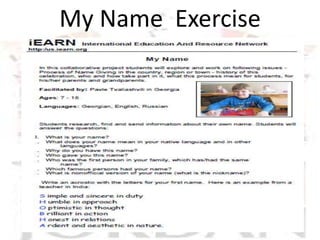
My Name Exercise
International Education and Resource Network
       Learning with the world, not just about it
Learning with the
world, not just about it…
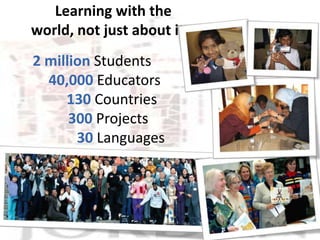
2 million Students
  40,000 Educators
     130 Countries
      300 Projects
       30 Languages
Since 1988, a global network of 130 country programs has emerged…
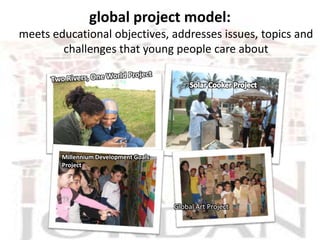
global project model:
meets educational objectives, addresses issues, topics and
        challenges that young people care about


        Millennium Development Goals
        Project
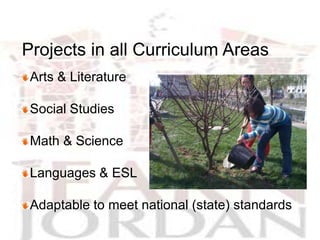
Projects in all Curriculum Areas
 Arts & Literature

 Social Studies

 Math & Science

 Languages & ESL

 Adaptable to meet national (state) standards
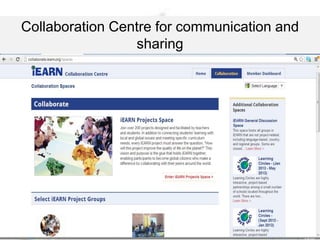
Collaboration Centre for communication and
                 sharing
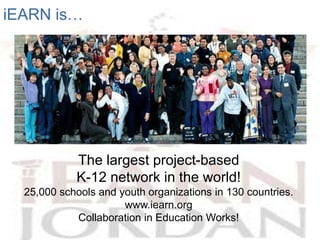
iEARN is…


            The largest project-based
            K-12 network in the world!
  25,000 schools and youth organizations in 130 countries.
                      www.iearn.org
            Collaboration in Education Works!
iEARN-Jordan
•   Started in Jordan in 1999 and was coordinated by different administrations on
    small scale.
•    In Sep 2009, iEARN –Jordan was approved by the iEARN International Assembly
    and now is coordinated by Ms. Khitam Al-Utaibi.

Achievements:
     – Video Conference Seminar between Department of Education -US and
       Jordan Ministry of Education for high school students to talk about Global
       Warming . Ten Students from public schools in Directorate of Education -
       Amman 1st. (Dec 2009)
     – Workshop for 11 teachers from private schools in Amman. (Dec 2010)
     – Workshop for youth specialized in IT. (Feb 2011).
     – Workshop for Al-Hassad Private School teachers (March 2012)
     – Presentation in the ALC Conference
Where you can find us:
You may find us on our Facebook iEARN-Jordan. Visit, like and share! Thanks!
Navigating the iEARN
Collaboration Center
Examples of iEARN Online Projects
•   Beauty of the Beasts
•   Future Citizen Project
•   My City and Me
•   To Dam or Not to Dam (Rivers), That is the
    Question
Online Course
• Mechanisms
  – Six weeks course with instructions, papers to read and
    assignments
  – Participating teachers follow the instructors guidelines
    and can send emails for any inquiry
• Where?
  – On iEARN professional Development Center
• How?
  – Teachers submit their completed assignments on
    weekly basis
  – Teachers who complete the course will take certificates
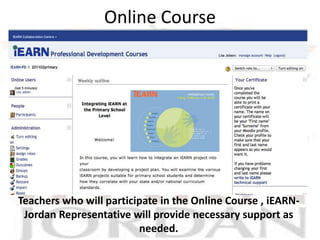
Online Course


Teachers who will participate in the Online Course , iEARN-
 Jordan Representative will provide necessary support as
                         needed.
Coffee Break
Research on the Role of Student
Characteristics in Project-Based Learning

• There is a frequently voiced claim that
  Project-Based Learning is an effective
  method for prompting heretofore
  reluctant and disengaged students (e.g.,
  low-achieving students) to become
  motivated and engaged learners (Jones
  et al., 1997).
Challenges and frustrations!
     Where do they come from?
• The formal education system:
– Human: Teacher, Supervisor, Principal, student
– Facility: classrooms, computer labs, science
  labs, library, other (gym, music room,)
– Curriculum: standards, textbooks, e-content
– Technology and applications:
  internet?, intranet?, video conferencing, online
  courses, distance collaboration
• Home, neighborhood, self, etc!
How can we bridge the gap?

An Introduction to Project –Based Learning
Introduction to Collaborative Project Based Learning through iEARN
        Handout 9.1 Steps to Planning Successful Online Projects
• Project Planning
   a. Be familiar with the topic you will teach; consult textbooks
      and other resources for teachers
   b. Establish a working environment with co-teachers
   c. Brainstorm ideas
• Project Design
   a. Define the goal of the project - It is very important that
       the student goals you specify for the activity are:
   – Tied directly to the curriculum
   – Could not be accomplished at all, or as well, using more traditional learning
     tools. The collaboration must bring added value either in content or process.
   b. Think about the project activities. If this is your first
      attempt at bringing collaboration into your class, aim for
      creating a short activity.
Introduction to Collaborative Project Based Learning through iEARN
     Handout 9.1 Steps to Planning Successful Online Projects
c. Choose the final report format
    –   Writings
    –   Art project (wall chart, poster, mural)
    –   Electronic (slide presentation, website, audio, video)
    –   Performance (debates, games, interviews, panel discussions, plays, songs)

d. Choose appropriate assessment methods
e. Construct appropriate assessment tools
   – Assessment rubrics
   – Peer evaluation forms
   – Self evaluation forms
f. Describe teacher and student roles
g. Decide on student groupings
Introduction to Collaborative Project Based Learning through iEARN
     Handout 9.1 Steps to Planning Successful Online Projects

h. Create student support materials, such as:
   •   Handouts containing instructions
   •   Project submission forms
   •   Sample student work
i. Look into resource or technology availability
j. Map out the time line for the project and specify time
   frame for each task
k. Consider balance between homework vs. schoolwork
l. Create a group action plan
m. Create a personal action plan
Introduction to Collaborative Project Based Learning through iEARN
     Handout 9.1 Steps to Planning Successful Online Projects

3. Call for Collaboration
   –   Find teachers who are willing to get their students to participate in your project
   – Write an invitation that describes who you are, where you are located, why you
     are doing this project (as part of your curriculum), what the project is
     about, when the project will start and how long it will last.
   – Be prepared to answer inquiries from other teachers.


4. Implementation
   – Start the project with an opening activity
   – Initiate communications
   – Communicate regularly
   – Keep communications alive
   – Have students write progress reports
   – End with a final, tangible product such as a report, a video, a list of
     “winners”, shared results, content analysis or a web page.
   – Schedule a closure date and make sure all class contributions are received in a
     timely fashion.
Introduction to Collaborative Project Based Learning through iEARN
     Handout 9.1 Steps to Planning Successful Online Projects

5. Facilitation and Collaboration
   a. Revisit group and personal action plans
   b. Adjust schedules and activities, as needed


5. Evaluation
   a. Assemble outputs into a portfolio
   b. Reflect on experiences
   c. Assess student learning


6. Dissemination
   a. Share experiences with colleagues through publications and
      presentations
   b. Update the Project Website
Is PBL Worth's Doing?

It Really, Actually Changed My Life
Jordan Education Reform for
          Knowledge Economy
• Knowledge Economy

• 21st century Skills

• Ways of Thinking
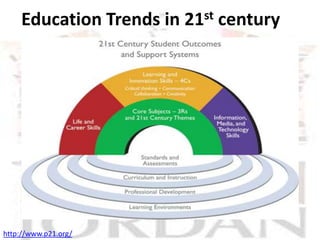
Education Trends in   21st   century


http://www.p21.org/
Project Based Learning Life Cycle
1. Planning
2. Design
  1.    Goals and objectives
  2.    Activities (collaboration)
  3.    Final product
  4.    Assessment methods and tools
  5.    Roles (teacher & student)
  6.    Grouping strategies
  7.    Support material
  8.    Resources and technology availability
  9.    Timeline and timeframe
  10.   Balance between homework vs. schoolwork
  11.   Group action plan
  12.   Personal action plan
Project Based Learning Life Cycle
3.   Call for collaboration
4.   Implementation
5.   Facilitation and collaboration
6.   Evaluation
7.   Dissemination
The Coming to California Project
A twelve-week interdisciplinary United States
  history and English project for 11th and 12th
  graders. The project focused on immigration into
  California and included a class mosaic as a
  product.

Source: The Project Based Learning
  Handbook, Buck Institute for Education. The
  Arabic version of the Handbook will be issued by
  March 2013.
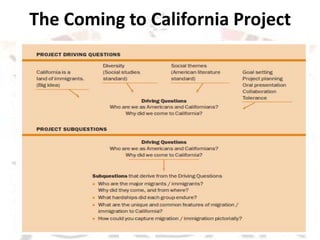
The Coming to California Project
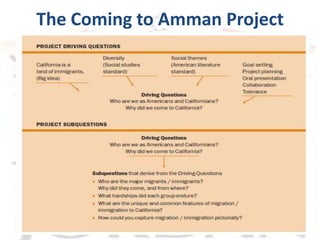
Driving Questions
How can we answer the Driving Question?
The Coming to Amman Project
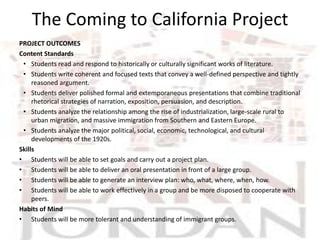
The Coming to California Project
PROJECT OUTCOMES
Content Standards
 • Students read and respond to historically or culturally significant works of literature.
 • Students write coherent and focused texts that convey a well-defined perspective and tightly
     reasoned argument.
 • Students deliver polished formal and extemporaneous presentations that combine traditional
     rhetorical strategies of narration, exposition, persuasion, and description.
 • Students analyze the relationship among the rise of industrialization, large-scale rural to
     urban migration, and massive immigration from Southern and Eastern Europe.
 • Students analyze the major political, social, economic, technological, and cultural
     developments of the 1920s.
Skills
• Students will be able to set goals and carry out a project plan.
• Students will be able to deliver an oral presentation in front of a large group.
• Students will be able to generate an interview plan: who, what, where, when, how.
• Students will be able to work effectively in a group and be more disposed to cooperate with
     peers.
Habits of Mind
• Students will be more tolerant and understanding of immigrant groups.
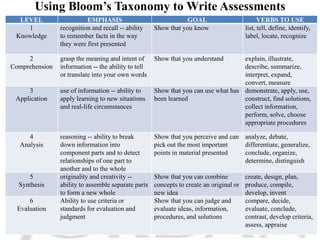
Using Bloom’s Taxonomy to Write Assessments
  LEVEL                   EMPHASIS                              GOAL                           VERBS TO USE
    1           recognition and recall -- ability    Show that you know                  list, tell, define, identify,
 Knowledge      to remember facts in the way                                             label, locate, recognize
                they were first presented

     2          grasp the meaning and intent of      Show that you understand       explain, illustrate,
Comprehension   information -- the ability to tell                                  describe, summarize,
                or translate into your own words                                    interpret, expand,
                                                                                    convert, measure
     3          use of information -- ability to     Show that you can use what has demonstrate, apply, use,
 Application    apply learning to new situations     been learned                   construct, find solutions,
                and real-life circumstances                                         collect information,
                                                                                    perform, solve, choose
                                                                                    appropriate procedures

     4          reasoning -- ability to break        Show that you perceive and can analyze, debate,
  Analysis      down information into                pick out the most important    differentiate, generalize,
                component parts and to detect        points in material presented   conclude, organize,
                relationships of one part to                                        determine, distinguish
                another and to the whole
     5          originality and creativity --        Show that you can combine           create, design, plan,
  Synthesis     ability to assemble separate parts   concepts to create an original or   produce, compile,
                to form a new whole                  new idea                            develop, invent
      6         Ability to use criteria or           Show that you can judge and         compare, decide,
  Evaluation    standards for evaluation and         evaluate ideas, information,        evaluate, conclude,
                judgment                             procedures, and solutions           contrast, develop criteria,
                                                                                         assess, appraise
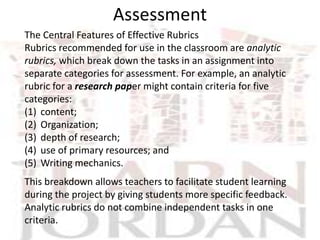
Assessment
The Central Features of Effective Rubrics
Rubrics recommended for use in the classroom are analytic
rubrics, which break down the tasks in an assignment into
separate categories for assessment. For example, an analytic
rubric for a research paper might contain criteria for five
categories:
(1) content;
(2) Organization;
(3) depth of research;
(4) use of primary resources; and
(5) Writing mechanics.
This breakdown allows teachers to facilitate student learning
during the project by giving students more specific feedback.
Analytic rubrics do not combine independent tasks in one
criteria.
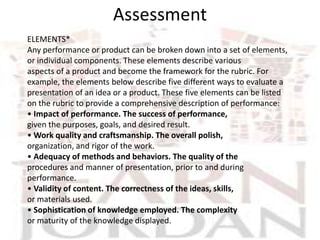
Assessment
ELEMENTS*
Any performance or product can be broken down into a set of elements,
or individual components. These elements describe various
aspects of a product and become the framework for the rubric. For
example, the elements below describe five different ways to evaluate a
presentation of an idea or a product. These five elements can be listed
on the rubric to provide a comprehensive description of performance:
• Impact of performance. The success of performance,
given the purposes, goals, and desired result.
• Work quality and craftsmanship. The overall polish,
organization, and rigor of the work.
• Adequacy of methods and behaviors. The quality of the
procedures and manner of presentation, prior to and during
performance.
• Validity of content. The correctness of the ideas, skills,
or materials used.
• Sophistication of knowledge employed. The complexity
or maturity of the knowledge displayed.
The Coming to California Project
PROJECT EVALUATION
1.Planned as a 10-week project, the Coming to California
  Project was completed in 12 weeks, with successful
  presentations and a strong a sense of student
  accomplishment.
2.A test for content knowledge showed that a majority of
  students had mastered test and lecture materials on
  immigration and key historical events, such as the
  Depression, the New Deal, and the Japanese internments.
3.In presentations, students demonstrated passion,
  tolerance, and understanding as they related the journey
  and migration stories of the ethnic group they had chosen
  to investigate.
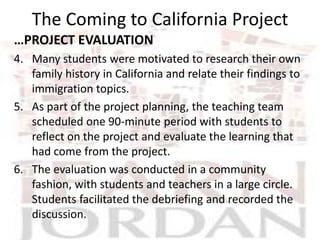
The Coming to California Project
…PROJECT EVALUATION
4. Many students were motivated to research their own
   family history in California and relate their findings to
   immigration topics.
5. As part of the project planning, the teaching team
   scheduled one 90-minute period with students to
   reflect on the project and evaluate the learning that
   had come from the project.
6. The evaluation was conducted in a community
   fashion, with students and teachers in a large circle.
   Students facilitated the debriefing and recorded the
   discussion.
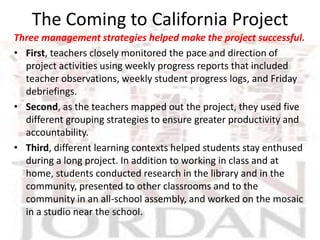
The Coming to California Project
Three management strategies helped make the project successful.
• First, teachers closely monitored the pace and direction of
  project activities using weekly progress reports that included
  teacher observations, weekly student progress logs, and Friday
  debriefings.
• Second, as the teachers mapped out the project, they used five
  different grouping strategies to ensure greater productivity and
  accountability.
• Third, different learning contexts helped students stay enthused
  during a long project. In addition to working in class and at
  home, students conducted research in the library and in the
  community, presented to other classrooms and to the
  community in an all-school assembly, and worked on the mosaic
  in a studio near the school.
Thank You 
To know more about iEARN-
Jordan, you may contact me
       through email:
   iearnjordan@aol.com

CSYN.iEARN-jordan.Feb23.2013

  • 1.
    Christopher Stevens YouthNetwork: Global Connections 2.0 iEARN -Jordan Workshop Khitam Al-Utaibi iEARN-Jordan Representative February 23rd, 2013 Amman, Jordan
  • 3.
  • 4.
    International Education andResource Network Learning with the world, not just about it
  • 5.
    Learning with the world,not just about it… 2 million Students 40,000 Educators 130 Countries 300 Projects 30 Languages
  • 6.
    Since 1988, aglobal network of 130 country programs has emerged…
  • 7.
    global project model: meetseducational objectives, addresses issues, topics and challenges that young people care about Millennium Development Goals Project
  • 8.
    Projects in allCurriculum Areas Arts & Literature Social Studies Math & Science Languages & ESL Adaptable to meet national (state) standards
  • 9.
    Collaboration Centre forcommunication and sharing
  • 10.
    iEARN is… The largest project-based K-12 network in the world! 25,000 schools and youth organizations in 130 countries. www.iearn.org Collaboration in Education Works!
  • 11.
    iEARN-Jordan • Started in Jordan in 1999 and was coordinated by different administrations on small scale. • In Sep 2009, iEARN –Jordan was approved by the iEARN International Assembly and now is coordinated by Ms. Khitam Al-Utaibi. Achievements: – Video Conference Seminar between Department of Education -US and Jordan Ministry of Education for high school students to talk about Global Warming . Ten Students from public schools in Directorate of Education - Amman 1st. (Dec 2009) – Workshop for 11 teachers from private schools in Amman. (Dec 2010) – Workshop for youth specialized in IT. (Feb 2011). – Workshop for Al-Hassad Private School teachers (March 2012) – Presentation in the ALC Conference Where you can find us: You may find us on our Facebook iEARN-Jordan. Visit, like and share! Thanks!
  • 12.
  • 13.
    Examples of iEARNOnline Projects • Beauty of the Beasts • Future Citizen Project • My City and Me • To Dam or Not to Dam (Rivers), That is the Question
  • 14.
    Online Course • Mechanisms – Six weeks course with instructions, papers to read and assignments – Participating teachers follow the instructors guidelines and can send emails for any inquiry • Where? – On iEARN professional Development Center • How? – Teachers submit their completed assignments on weekly basis – Teachers who complete the course will take certificates
  • 15.
    Online Course Teachers whowill participate in the Online Course , iEARN- Jordan Representative will provide necessary support as needed.
  • 16.
  • 17.
    Research on theRole of Student Characteristics in Project-Based Learning • There is a frequently voiced claim that Project-Based Learning is an effective method for prompting heretofore reluctant and disengaged students (e.g., low-achieving students) to become motivated and engaged learners (Jones et al., 1997).
  • 18.
    Challenges and frustrations! Where do they come from? • The formal education system: – Human: Teacher, Supervisor, Principal, student – Facility: classrooms, computer labs, science labs, library, other (gym, music room,) – Curriculum: standards, textbooks, e-content – Technology and applications: internet?, intranet?, video conferencing, online courses, distance collaboration • Home, neighborhood, self, etc!
  • 19.
    How can webridge the gap? An Introduction to Project –Based Learning
  • 20.
    Introduction to CollaborativeProject Based Learning through iEARN Handout 9.1 Steps to Planning Successful Online Projects • Project Planning a. Be familiar with the topic you will teach; consult textbooks and other resources for teachers b. Establish a working environment with co-teachers c. Brainstorm ideas • Project Design a. Define the goal of the project - It is very important that the student goals you specify for the activity are: – Tied directly to the curriculum – Could not be accomplished at all, or as well, using more traditional learning tools. The collaboration must bring added value either in content or process. b. Think about the project activities. If this is your first attempt at bringing collaboration into your class, aim for creating a short activity.
  • 21.
    Introduction to CollaborativeProject Based Learning through iEARN Handout 9.1 Steps to Planning Successful Online Projects c. Choose the final report format – Writings – Art project (wall chart, poster, mural) – Electronic (slide presentation, website, audio, video) – Performance (debates, games, interviews, panel discussions, plays, songs) d. Choose appropriate assessment methods e. Construct appropriate assessment tools – Assessment rubrics – Peer evaluation forms – Self evaluation forms f. Describe teacher and student roles g. Decide on student groupings
  • 22.
    Introduction to CollaborativeProject Based Learning through iEARN Handout 9.1 Steps to Planning Successful Online Projects h. Create student support materials, such as: • Handouts containing instructions • Project submission forms • Sample student work i. Look into resource or technology availability j. Map out the time line for the project and specify time frame for each task k. Consider balance between homework vs. schoolwork l. Create a group action plan m. Create a personal action plan
  • 23.
    Introduction to CollaborativeProject Based Learning through iEARN Handout 9.1 Steps to Planning Successful Online Projects 3. Call for Collaboration – Find teachers who are willing to get their students to participate in your project – Write an invitation that describes who you are, where you are located, why you are doing this project (as part of your curriculum), what the project is about, when the project will start and how long it will last. – Be prepared to answer inquiries from other teachers. 4. Implementation – Start the project with an opening activity – Initiate communications – Communicate regularly – Keep communications alive – Have students write progress reports – End with a final, tangible product such as a report, a video, a list of “winners”, shared results, content analysis or a web page. – Schedule a closure date and make sure all class contributions are received in a timely fashion.
  • 24.
    Introduction to CollaborativeProject Based Learning through iEARN Handout 9.1 Steps to Planning Successful Online Projects 5. Facilitation and Collaboration a. Revisit group and personal action plans b. Adjust schedules and activities, as needed 5. Evaluation a. Assemble outputs into a portfolio b. Reflect on experiences c. Assess student learning 6. Dissemination a. Share experiences with colleagues through publications and presentations b. Update the Project Website
  • 25.
    Is PBL Worth'sDoing? It Really, Actually Changed My Life
  • 26.
    Jordan Education Reformfor Knowledge Economy • Knowledge Economy • 21st century Skills • Ways of Thinking
  • 27.
    Education Trends in 21st century http://www.p21.org/
  • 28.
    Project Based LearningLife Cycle 1. Planning 2. Design 1. Goals and objectives 2. Activities (collaboration) 3. Final product 4. Assessment methods and tools 5. Roles (teacher & student) 6. Grouping strategies 7. Support material 8. Resources and technology availability 9. Timeline and timeframe 10. Balance between homework vs. schoolwork 11. Group action plan 12. Personal action plan
  • 29.
    Project Based LearningLife Cycle 3. Call for collaboration 4. Implementation 5. Facilitation and collaboration 6. Evaluation 7. Dissemination
  • 30.
    The Coming toCalifornia Project A twelve-week interdisciplinary United States history and English project for 11th and 12th graders. The project focused on immigration into California and included a class mosaic as a product. Source: The Project Based Learning Handbook, Buck Institute for Education. The Arabic version of the Handbook will be issued by March 2013.
  • 31.
    The Coming toCalifornia Project
  • 32.
    Driving Questions How canwe answer the Driving Question?
  • 33.
    The Coming toAmman Project
  • 34.
    The Coming toCalifornia Project PROJECT OUTCOMES Content Standards • Students read and respond to historically or culturally significant works of literature. • Students write coherent and focused texts that convey a well-defined perspective and tightly reasoned argument. • Students deliver polished formal and extemporaneous presentations that combine traditional rhetorical strategies of narration, exposition, persuasion, and description. • Students analyze the relationship among the rise of industrialization, large-scale rural to urban migration, and massive immigration from Southern and Eastern Europe. • Students analyze the major political, social, economic, technological, and cultural developments of the 1920s. Skills • Students will be able to set goals and carry out a project plan. • Students will be able to deliver an oral presentation in front of a large group. • Students will be able to generate an interview plan: who, what, where, when, how. • Students will be able to work effectively in a group and be more disposed to cooperate with peers. Habits of Mind • Students will be more tolerant and understanding of immigrant groups.
  • 35.
    Using Bloom’s Taxonomyto Write Assessments LEVEL EMPHASIS GOAL VERBS TO USE 1 recognition and recall -- ability Show that you know list, tell, define, identify, Knowledge to remember facts in the way label, locate, recognize they were first presented 2 grasp the meaning and intent of Show that you understand explain, illustrate, Comprehension information -- the ability to tell describe, summarize, or translate into your own words interpret, expand, convert, measure 3 use of information -- ability to Show that you can use what has demonstrate, apply, use, Application apply learning to new situations been learned construct, find solutions, and real-life circumstances collect information, perform, solve, choose appropriate procedures 4 reasoning -- ability to break Show that you perceive and can analyze, debate, Analysis down information into pick out the most important differentiate, generalize, component parts and to detect points in material presented conclude, organize, relationships of one part to determine, distinguish another and to the whole 5 originality and creativity -- Show that you can combine create, design, plan, Synthesis ability to assemble separate parts concepts to create an original or produce, compile, to form a new whole new idea develop, invent 6 Ability to use criteria or Show that you can judge and compare, decide, Evaluation standards for evaluation and evaluate ideas, information, evaluate, conclude, judgment procedures, and solutions contrast, develop criteria, assess, appraise
  • 36.
    Assessment The Central Featuresof Effective Rubrics Rubrics recommended for use in the classroom are analytic rubrics, which break down the tasks in an assignment into separate categories for assessment. For example, an analytic rubric for a research paper might contain criteria for five categories: (1) content; (2) Organization; (3) depth of research; (4) use of primary resources; and (5) Writing mechanics. This breakdown allows teachers to facilitate student learning during the project by giving students more specific feedback. Analytic rubrics do not combine independent tasks in one criteria.
  • 37.
    Assessment ELEMENTS* Any performance orproduct can be broken down into a set of elements, or individual components. These elements describe various aspects of a product and become the framework for the rubric. For example, the elements below describe five different ways to evaluate a presentation of an idea or a product. These five elements can be listed on the rubric to provide a comprehensive description of performance: • Impact of performance. The success of performance, given the purposes, goals, and desired result. • Work quality and craftsmanship. The overall polish, organization, and rigor of the work. • Adequacy of methods and behaviors. The quality of the procedures and manner of presentation, prior to and during performance. • Validity of content. The correctness of the ideas, skills, or materials used. • Sophistication of knowledge employed. The complexity or maturity of the knowledge displayed.
  • 38.
    The Coming toCalifornia Project PROJECT EVALUATION 1.Planned as a 10-week project, the Coming to California Project was completed in 12 weeks, with successful presentations and a strong a sense of student accomplishment. 2.A test for content knowledge showed that a majority of students had mastered test and lecture materials on immigration and key historical events, such as the Depression, the New Deal, and the Japanese internments. 3.In presentations, students demonstrated passion, tolerance, and understanding as they related the journey and migration stories of the ethnic group they had chosen to investigate.
  • 39.
    The Coming toCalifornia Project …PROJECT EVALUATION 4. Many students were motivated to research their own family history in California and relate their findings to immigration topics. 5. As part of the project planning, the teaching team scheduled one 90-minute period with students to reflect on the project and evaluate the learning that had come from the project. 6. The evaluation was conducted in a community fashion, with students and teachers in a large circle. Students facilitated the debriefing and recorded the discussion.
  • 40.
    The Coming toCalifornia Project Three management strategies helped make the project successful. • First, teachers closely monitored the pace and direction of project activities using weekly progress reports that included teacher observations, weekly student progress logs, and Friday debriefings. • Second, as the teachers mapped out the project, they used five different grouping strategies to ensure greater productivity and accountability. • Third, different learning contexts helped students stay enthused during a long project. In addition to working in class and at home, students conducted research in the library and in the community, presented to other classrooms and to the community in an all-school assembly, and worked on the mosaic in a studio near the school.
  • 41.
    Thank You  Toknow more about iEARN- Jordan, you may contact me through email: iearnjordan@aol.com

Editor's Notes

  • #14 Run over projects’ Title, Summary, Description, Facilitators, Languages, Student Age Levels, Dates, Possible classroom activities, Expected outcomes, Group contributions to others and/or the planet
  • #15 Run over projects’ Title, Summary, Description, Facilitators, Languages, Student Age Levels, Dates, Possible classroom activities, Expected outcomes, Group contributions to others and/or the planet
  • #16 Moodle, asynchronous, How much time do teachers spend a week on course, what do they need to participate, what are the final products, how can coordinators support teacher participation
  • #19 How can we connect between student, teacher, curriculum, and 21st century demands?