PBL[g]!
Mike Searson, Melda Yildiz and Janis Jensen
School for Global Education and Innovation
Kean University
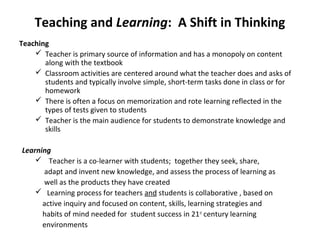
Teaching and Learning: A Shift in Thinking
Teaching
 Teacher is primary source of information and has a monopoly on content
along with the textbook
 Classroom activities are centered around what the teacher does and asks of
students and typically involve simple, short-term tasks done in class or for
homework
 There is often a focus on memorization and rote learning reflected in the
types of tests given to students
 Teacher is the main audience for students to demonstrate knowledge and
skills
Learning
 Teacher is a co-learner with students; together they seek, share,
adapt and invent new knowledge, and assess the process of learning as
well as the products they have created
 Learning process for teachers and students is collaborative , based on
active inquiry and focused on content, skills, learning strategies and
habits of mind needed for student success in 21st
century learning
environments
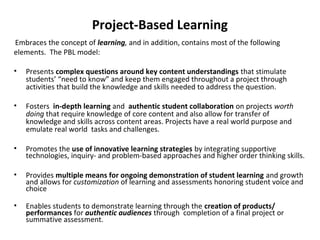
Project-Based Learning
Embraces the concept of learning, and in addition, contains most of the following
elements. The PBL model:
• Presents complex questions around key content understandings that stimulate
students’ “need to know” and keep them engaged throughout a project through
activities that build the knowledge and skills needed to address the question.
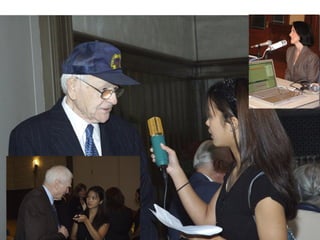
• Fosters in-depth learning and authentic student collaboration on projects worth
doing that require knowledge of core content and also allow for transfer of
knowledge and skills across content areas. Projects have a real world purpose and
emulate real world tasks and challenges.
• Promotes the use of innovative learning strategies by integrating supportive
technologies, inquiry- and problem-based approaches and higher order thinking skills.
• Provides multiple means for ongoing demonstration of student learning and growth
and allows for customization of learning and assessments honoring student voice and
choice
• Enables students to demonstrate learning through the creation of products/
performances for authentic audiences through completion of a final project or
summative assessment.
Project-Based Learning [g]!
PBL [g] is a value-added component to PBL that addresses the
development of global competency by including awareness of
cultural dimensions and ongoing opportunities for cross-cultural
interactions, mediated by the use of technology, as an integral
part of the learning process itself.
The PBL [g] model is based on the belief that that: the world is
interconnected: all peoples are interconnected economically,
socially and environmentally and have a shared future.
Accordingly, learning experiences are designed to develop
global competency and empower participation in that future.
PBL[g]! Developing Global Competence and
Perspective Consciousness
Global competence is the capacity and disposition to understand,
and act on, issues of global significance.
(Boix-Mansilla & Jackson, 2010 Draft: Educating for Global Competence)
 Knowing the World
 Investigating the World
 Recognizing Perspectives
 Communicating Effectively
 Taking Action
 Perspective Consciousness
• “State of the Planet” Awareness
• Cross-cultural Awareness
• Knowledge of Global Dynamics
• Awareness of Human Choices
PBL[g]! Developing Global Citizens
Students are active and engaged citizens that turn their ideas and
findings into appropriate actions to improve world conditions.
Through PBL[g]! , students:
• Recognize their capacity to advocate for and contribute to improvement
locally, regionally, or globally.
• Identify opportunities for personal and collaborative action to address
situations, events, issues or phenomena in ways which can make a difference.
• Assess options for action based on evidence and the potential for impact,
taking into account varied perspectives and potential consequences for others.
• Act creatively and innovatively to contribute to improvement locally,
regionally or globally both personally and collaboratively.
Disciplinary and Interdisciplinary Knowledge and
Understanding Matters
PBL[g]! supports:
• Deep knowledge acquisition and understanding of seminal content
and skills within academic disciplines in cross-cultural
environments.
• Capacity to use disciplinary methods of inquiry creatively and
productively in cross-cultural environments.
• Ability to understand prevailing world conditions, issues, and
trends through disciplinary-based and interdisciplinary learning and
others’ perspectives on situations, events or phenomena.
• Substantive engagement, over time, with the world’s complexities
and interrelatedness and the development of the cross cultural
collaboration skills needed to collectively and ethically solve
problems.
Making the case for PBL[g]!
• Instead of learning from others who have the credentials to “teach” in this
new networked world, we learn with others whom we seek (and who seek
us) on our own and with whom we often share nothing more than a
passion for knowing.
• In this global community, we are at once all teachers and learners—
changing roles as required, contributing, collaborating, and maybe even
working together to re-create the world, regardless of where we are at
any given moment.
• These learning transactions require a shifted understanding of traditional
literacies and the skills they employ, as well as new literacies and practices
that learning in networks and online social communities demands.
21st
Century Skills: Rethinking How Students Learn
(R. Brandt, 2010)
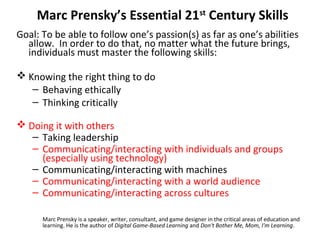
Marc Prensky’s Essential 21st
Century Skills
Goal: To be able to follow one’s passion(s) as far as one’s abilities
allow. In order to do that, no matter what the future brings,
individuals must master the following skills:
 Knowing the right thing to do
– Behaving ethically
– Thinking critically
 Doing it with others
– Taking leadership
– Communicating/interacting with individuals and groups
(especially using technology)
– Communicating/interacting with machines
– Communicating/interacting with a world audience
– Communicating/interacting across cultures
Marc Prensky is a speaker, writer, consultant, and game designer in the critical areas of education and
learning. He is the author of Digital Game-Based Learning and Don't Bother Me, Mom, I'm Learning.
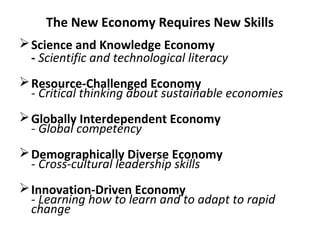
The New Economy Requires New Skills
Science and Knowledge Economy
- Scientific and technological literacy
Resource-Challenged Economy
- Critical thinking about sustainable economies
Globally Interdependent Economy
- Global competency
Demographically Diverse Economy
- Cross-cultural leadership skills
Innovation-Driven Economy
- Learning how to learn and to adapt to rapid
change
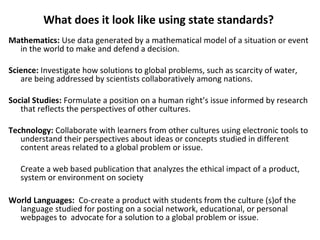
What does it look like using state standards?
Mathematics: Use data generated by a mathematical model of a situation or event
in the world to make and defend a decision.
Science: Investigate how solutions to global problems, such as scarcity of water,
are being addressed by scientists collaboratively among nations.
Social Studies: Formulate a position on a human right’s issue informed by research
that reflects the perspectives of other cultures.
Technology: Collaborate with learners from other cultures using electronic tools to
understand their perspectives about ideas or concepts studied in different
content areas related to a global problem or issue.
Create a web based publication that analyzes the ethical impact of a product,
system or environment on society
World Languages: Co-create a product with students from the culture (s)of the
language studied for posting on a social network, educational, or personal
webpages to advocate for a solution to a global problem or issue.
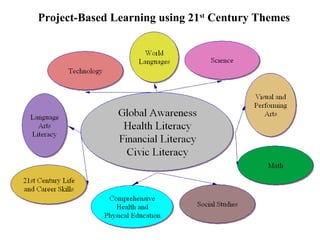
Project-Based Learning using 21st
Century Themes
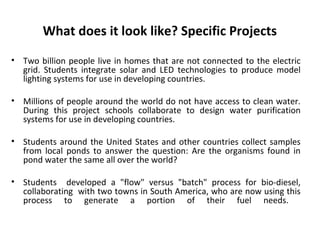
What does it look like? Specific Projects
• Two billion people live in homes that are not connected to the electric
grid. Students integrate solar and LED technologies to produce model
lighting systems for use in developing countries.
• Millions of people around the world do not have access to clean water.
During this project schools collaborate to design water purification
systems for use in developing countries.
• Students around the United States and other countries collect samples
from local ponds to answer the question: Are the organisms found in
pond water the same all over the world?
• Students developed a "flow" versus "batch" process for bio-diesel,
collaborating with two towns in South America, who are now using this
process to generate a portion of their fuel needs.
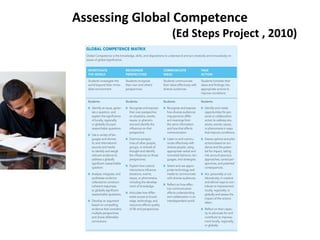
Assessing Global Competence
(Ed Steps Project , 2010)
PBL[g] represents projects that are
• Global-centric
• Authentic and relevant
• Rigorous and engaging
• Promote rich discourse among project
participants
PBL[g]
Minds-on, hands-on engagement among
international cohorts of students and
teachers in authentic projects that address
relevant and mutually defined issues and
concerns.
Sample project:
Digital Video, Participatory Culture & The
War!
PBS—Public Broadcasting Service
•Largely funded by Corporation for Public
Broadcasting, through government
sources and private donations
Ken Burns--a documentary filmmaker who has
produced a number of PBS documentaries
•The Civil War
•Baseball
•Jazz
In 2007 PBS airs Ken Burns
“The War”
•Focuses on World War II; albeit, from a US
perspective
NJN (New Jersey Network) is a local
PBS affiliate
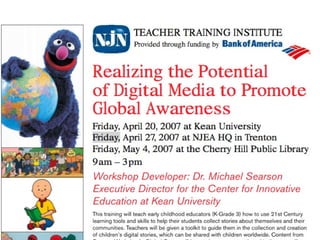
Previously, Kean University’s Center for Innovative
Education had worked with NJN on a number of emergent
media initiatives
• Middle school Digital Storytelling project
• “Global Grover” for early childhood
educators, based on the Sesame Street
character
Kean worked with NJN to prepare for airing of Burns
“War” documentary
•Students and teachers would be trained
to use emergent media tools to tell family
& community WWII stories; Funding to
support program sought.
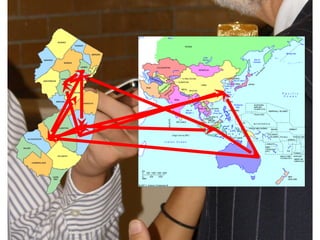
Schools include 4 high schools in New Jersey, one in
China, one in Australia
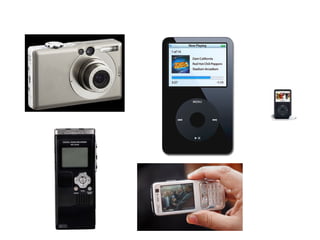
•Participants provided emergent media tools:
MacBook, iPod, digital voice recorder, Flip
video camera, appropriate software and cases
Our tools:
laptops, digital cameras, iPods, voice recorders, small
Flip video cameras
Training provided by Kean staff, Center for Digital
Storytelling & Apple Computers
Students given access to many
community leaders
•Present and past governors
•WWII veterans
•Filmmaker
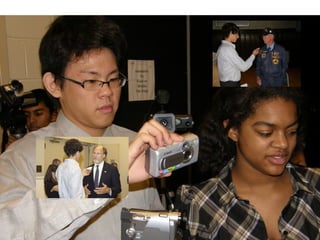
In New Jersey, students invited to participate in and
document statewide launch of “The War”
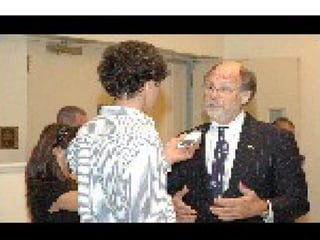
•While non-committal to an “interview,” NJ
Governor agrees to a “podcast”;
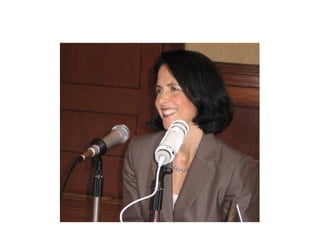
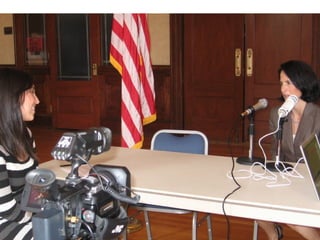
•Co-Producer of “The War” also interviewed
Teachers encouraged to work
projects into existing curriculum
Many of the projects utilized a
“digital storytelling” approach
•Efficient use of technology
•Combines digital images with audio
•“Ken Burns” effect
Project takes place over most of
the 2007-2008 school year
Resulting products take many
forms
•Digital stories
•Short movies
•“Cablevision” programming
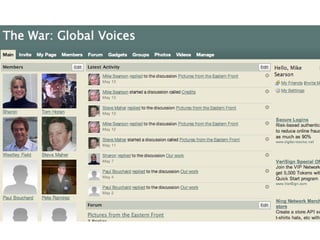
A social network (Ning) created to allow students
and teachers involved in project to share work and
perspectives
QuickTime™ and a
decompressor
are needed to see this picture.
Important opportunities for international
perspective building
•Essence of Ken Burns’s documentary is
that WWII helped shape modern United
States
Yet, some have argued that WWII (and WWI) were
essentially European conflicts that drew the rest of
the world into war
QuickTime™ and a
YUV420 codec decompressor
are needed to see this picture.
QuickTime™ and a
YUV420 codec decompressor
are needed to see this picture.
QuickTime™ and a
YUV420 codec decompressor
are needed to see this picture.
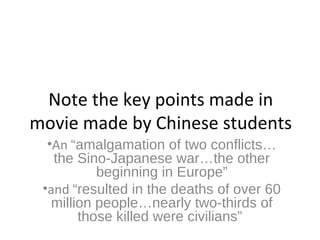
Note the key points made in
movie made by Chinese students
•An “amalgamation of two conflicts…
the Sino-Japanese war…the other
beginning in Europe”
•and “resulted in the deaths of over 60
million people…nearly two-thirds of
those killed were civilians”
These are points not well
understood by US students
•Who could tell it better to them than
fellow students from China?
Initial findings…
•(US participants)
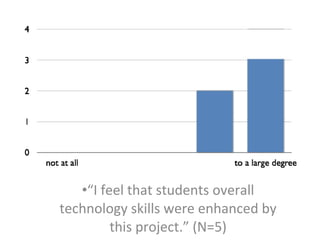
•“I feel that students overall
technology skills were enhanced by
this project.” (N=5)
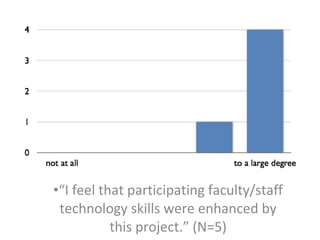
•“I feel that participating faculty/staff
technology skills were enhanced by
this project.” (N=5)
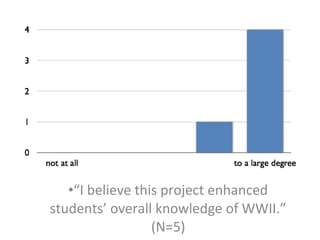
•“I believe this project enhanced
students’ overall knowledge of WWII.”
(N=5)
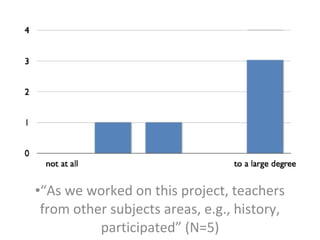
•“As we worked on this project, teachers
from other subjects areas, e.g., history,
participated” (N=5)
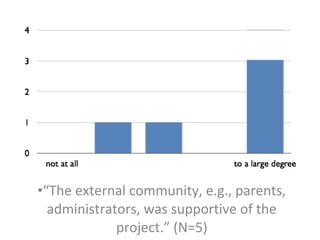
•“The external community, e.g., parents,
administrators, was supportive of the
project.” (N=5)
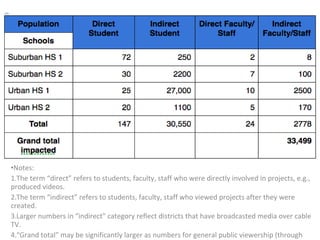
Impact on school and community
•Those “engaged” in the project
•Notes:
1.The term “direct” refers to students, faculty, staff who were directly involved in projects, e.g.,
produced videos.
2.The term “indirect” refers to students, faculty, staff who viewed projects after they were
created.
3.Larger numbers in “indirect” category reflect districts that have broadcasted media over cable
TV.
4.“Grand total” may be significantly larger as numbers for general public viewership (through
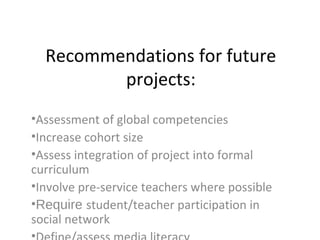
Recommendations for future
projects:
•Assessment of global competencies
•Increase cohort size
•Assess integration of project into formal
curriculum
•Involve pre-service teachers where possible
•Require student/teacher participation in
social network

Pbl[g]![1]

  • 1.
    PBL[g]! Mike Searson, MeldaYildiz and Janis Jensen School for Global Education and Innovation Kean University
  • 2.
    Teaching and Learning:A Shift in Thinking Teaching  Teacher is primary source of information and has a monopoly on content along with the textbook  Classroom activities are centered around what the teacher does and asks of students and typically involve simple, short-term tasks done in class or for homework  There is often a focus on memorization and rote learning reflected in the types of tests given to students  Teacher is the main audience for students to demonstrate knowledge and skills Learning  Teacher is a co-learner with students; together they seek, share, adapt and invent new knowledge, and assess the process of learning as well as the products they have created  Learning process for teachers and students is collaborative , based on active inquiry and focused on content, skills, learning strategies and habits of mind needed for student success in 21st century learning environments
  • 3.
    Project-Based Learning Embraces theconcept of learning, and in addition, contains most of the following elements. The PBL model: • Presents complex questions around key content understandings that stimulate students’ “need to know” and keep them engaged throughout a project through activities that build the knowledge and skills needed to address the question. • Fosters in-depth learning and authentic student collaboration on projects worth doing that require knowledge of core content and also allow for transfer of knowledge and skills across content areas. Projects have a real world purpose and emulate real world tasks and challenges. • Promotes the use of innovative learning strategies by integrating supportive technologies, inquiry- and problem-based approaches and higher order thinking skills. • Provides multiple means for ongoing demonstration of student learning and growth and allows for customization of learning and assessments honoring student voice and choice • Enables students to demonstrate learning through the creation of products/ performances for authentic audiences through completion of a final project or summative assessment.
  • 4.
    Project-Based Learning [g]! PBL[g] is a value-added component to PBL that addresses the development of global competency by including awareness of cultural dimensions and ongoing opportunities for cross-cultural interactions, mediated by the use of technology, as an integral part of the learning process itself. The PBL [g] model is based on the belief that that: the world is interconnected: all peoples are interconnected economically, socially and environmentally and have a shared future. Accordingly, learning experiences are designed to develop global competency and empower participation in that future.
  • 5.
    PBL[g]! Developing GlobalCompetence and Perspective Consciousness Global competence is the capacity and disposition to understand, and act on, issues of global significance. (Boix-Mansilla & Jackson, 2010 Draft: Educating for Global Competence)  Knowing the World  Investigating the World  Recognizing Perspectives  Communicating Effectively  Taking Action  Perspective Consciousness • “State of the Planet” Awareness • Cross-cultural Awareness • Knowledge of Global Dynamics • Awareness of Human Choices
  • 6.
    PBL[g]! Developing GlobalCitizens Students are active and engaged citizens that turn their ideas and findings into appropriate actions to improve world conditions. Through PBL[g]! , students: • Recognize their capacity to advocate for and contribute to improvement locally, regionally, or globally. • Identify opportunities for personal and collaborative action to address situations, events, issues or phenomena in ways which can make a difference. • Assess options for action based on evidence and the potential for impact, taking into account varied perspectives and potential consequences for others. • Act creatively and innovatively to contribute to improvement locally, regionally or globally both personally and collaboratively.
  • 7.
    Disciplinary and InterdisciplinaryKnowledge and Understanding Matters PBL[g]! supports: • Deep knowledge acquisition and understanding of seminal content and skills within academic disciplines in cross-cultural environments. • Capacity to use disciplinary methods of inquiry creatively and productively in cross-cultural environments. • Ability to understand prevailing world conditions, issues, and trends through disciplinary-based and interdisciplinary learning and others’ perspectives on situations, events or phenomena. • Substantive engagement, over time, with the world’s complexities and interrelatedness and the development of the cross cultural collaboration skills needed to collectively and ethically solve problems.
  • 8.
    Making the casefor PBL[g]! • Instead of learning from others who have the credentials to “teach” in this new networked world, we learn with others whom we seek (and who seek us) on our own and with whom we often share nothing more than a passion for knowing. • In this global community, we are at once all teachers and learners— changing roles as required, contributing, collaborating, and maybe even working together to re-create the world, regardless of where we are at any given moment. • These learning transactions require a shifted understanding of traditional literacies and the skills they employ, as well as new literacies and practices that learning in networks and online social communities demands. 21st Century Skills: Rethinking How Students Learn (R. Brandt, 2010)
  • 9.
    Marc Prensky’s Essential21st Century Skills Goal: To be able to follow one’s passion(s) as far as one’s abilities allow. In order to do that, no matter what the future brings, individuals must master the following skills:  Knowing the right thing to do – Behaving ethically – Thinking critically  Doing it with others – Taking leadership – Communicating/interacting with individuals and groups (especially using technology) – Communicating/interacting with machines – Communicating/interacting with a world audience – Communicating/interacting across cultures Marc Prensky is a speaker, writer, consultant, and game designer in the critical areas of education and learning. He is the author of Digital Game-Based Learning and Don't Bother Me, Mom, I'm Learning.
  • 10.
    The New EconomyRequires New Skills Science and Knowledge Economy - Scientific and technological literacy Resource-Challenged Economy - Critical thinking about sustainable economies Globally Interdependent Economy - Global competency Demographically Diverse Economy - Cross-cultural leadership skills Innovation-Driven Economy - Learning how to learn and to adapt to rapid change
  • 11.
    What does itlook like using state standards? Mathematics: Use data generated by a mathematical model of a situation or event in the world to make and defend a decision. Science: Investigate how solutions to global problems, such as scarcity of water, are being addressed by scientists collaboratively among nations. Social Studies: Formulate a position on a human right’s issue informed by research that reflects the perspectives of other cultures. Technology: Collaborate with learners from other cultures using electronic tools to understand their perspectives about ideas or concepts studied in different content areas related to a global problem or issue. Create a web based publication that analyzes the ethical impact of a product, system or environment on society World Languages: Co-create a product with students from the culture (s)of the language studied for posting on a social network, educational, or personal webpages to advocate for a solution to a global problem or issue.
  • 12.
    Project-Based Learning using21st Century Themes
  • 13.
    What does itlook like? Specific Projects • Two billion people live in homes that are not connected to the electric grid. Students integrate solar and LED technologies to produce model lighting systems for use in developing countries. • Millions of people around the world do not have access to clean water. During this project schools collaborate to design water purification systems for use in developing countries. • Students around the United States and other countries collect samples from local ponds to answer the question: Are the organisms found in pond water the same all over the world? • Students developed a "flow" versus "batch" process for bio-diesel, collaborating with two towns in South America, who are now using this process to generate a portion of their fuel needs.
  • 14.
    Assessing Global Competence (EdSteps Project , 2010)
  • 15.
    PBL[g] represents projectsthat are • Global-centric • Authentic and relevant • Rigorous and engaging • Promote rich discourse among project participants
  • 16.
    PBL[g] Minds-on, hands-on engagementamong international cohorts of students and teachers in authentic projects that address relevant and mutually defined issues and concerns.
  • 17.
    Sample project: Digital Video,Participatory Culture & The War!
  • 18.
    PBS—Public Broadcasting Service •Largelyfunded by Corporation for Public Broadcasting, through government sources and private donations
  • 19.
    Ken Burns--a documentaryfilmmaker who has produced a number of PBS documentaries •The Civil War •Baseball •Jazz
  • 20.
    In 2007 PBSairs Ken Burns “The War” •Focuses on World War II; albeit, from a US perspective
  • 21.
    NJN (New JerseyNetwork) is a local PBS affiliate
  • 22.
    Previously, Kean University’sCenter for Innovative Education had worked with NJN on a number of emergent media initiatives • Middle school Digital Storytelling project • “Global Grover” for early childhood educators, based on the Sesame Street character
  • 24.
    Kean worked withNJN to prepare for airing of Burns “War” documentary •Students and teachers would be trained to use emergent media tools to tell family & community WWII stories; Funding to support program sought.
  • 25.
    Schools include 4high schools in New Jersey, one in China, one in Australia •Participants provided emergent media tools: MacBook, iPod, digital voice recorder, Flip video camera, appropriate software and cases
  • 27.
    Our tools: laptops, digitalcameras, iPods, voice recorders, small Flip video cameras
  • 29.
    Training provided byKean staff, Center for Digital Storytelling & Apple Computers
  • 30.
    Students given accessto many community leaders •Present and past governors •WWII veterans •Filmmaker
  • 31.
    In New Jersey,students invited to participate in and document statewide launch of “The War” •While non-committal to an “interview,” NJ Governor agrees to a “podcast”; •Co-Producer of “The War” also interviewed
  • 38.
    Teachers encouraged towork projects into existing curriculum
  • 39.
    Many of theprojects utilized a “digital storytelling” approach •Efficient use of technology •Combines digital images with audio •“Ken Burns” effect
  • 40.
    Project takes placeover most of the 2007-2008 school year
  • 41.
    Resulting products takemany forms •Digital stories •Short movies •“Cablevision” programming
  • 42.
    A social network(Ning) created to allow students and teachers involved in project to share work and perspectives
  • 44.
    QuickTime™ and a decompressor areneeded to see this picture.
  • 45.
    Important opportunities forinternational perspective building •Essence of Ken Burns’s documentary is that WWII helped shape modern United States
  • 46.
    Yet, some haveargued that WWII (and WWI) were essentially European conflicts that drew the rest of the world into war
  • 47.
    QuickTime™ and a YUV420codec decompressor are needed to see this picture.
  • 48.
    QuickTime™ and a YUV420codec decompressor are needed to see this picture.
  • 49.
    QuickTime™ and a YUV420codec decompressor are needed to see this picture.
  • 50.
    Note the keypoints made in movie made by Chinese students •An “amalgamation of two conflicts… the Sino-Japanese war…the other beginning in Europe” •and “resulted in the deaths of over 60 million people…nearly two-thirds of those killed were civilians”
  • 51.
    These are pointsnot well understood by US students •Who could tell it better to them than fellow students from China?
  • 52.
  • 53.
    •“I feel thatstudents overall technology skills were enhanced by this project.” (N=5)
  • 54.
    •“I feel thatparticipating faculty/staff technology skills were enhanced by this project.” (N=5)
  • 55.
    •“I believe thisproject enhanced students’ overall knowledge of WWII.” (N=5)
  • 56.
    •“As we workedon this project, teachers from other subjects areas, e.g., history, participated” (N=5)
  • 57.
    •“The external community,e.g., parents, administrators, was supportive of the project.” (N=5)
  • 58.
    Impact on schooland community •Those “engaged” in the project
  • 59.
    •Notes: 1.The term “direct”refers to students, faculty, staff who were directly involved in projects, e.g., produced videos. 2.The term “indirect” refers to students, faculty, staff who viewed projects after they were created. 3.Larger numbers in “indirect” category reflect districts that have broadcasted media over cable TV. 4.“Grand total” may be significantly larger as numbers for general public viewership (through
  • 60.
    Recommendations for future projects: •Assessmentof global competencies •Increase cohort size •Assess integration of project into formal curriculum •Involve pre-service teachers where possible •Require student/teacher participation in social network