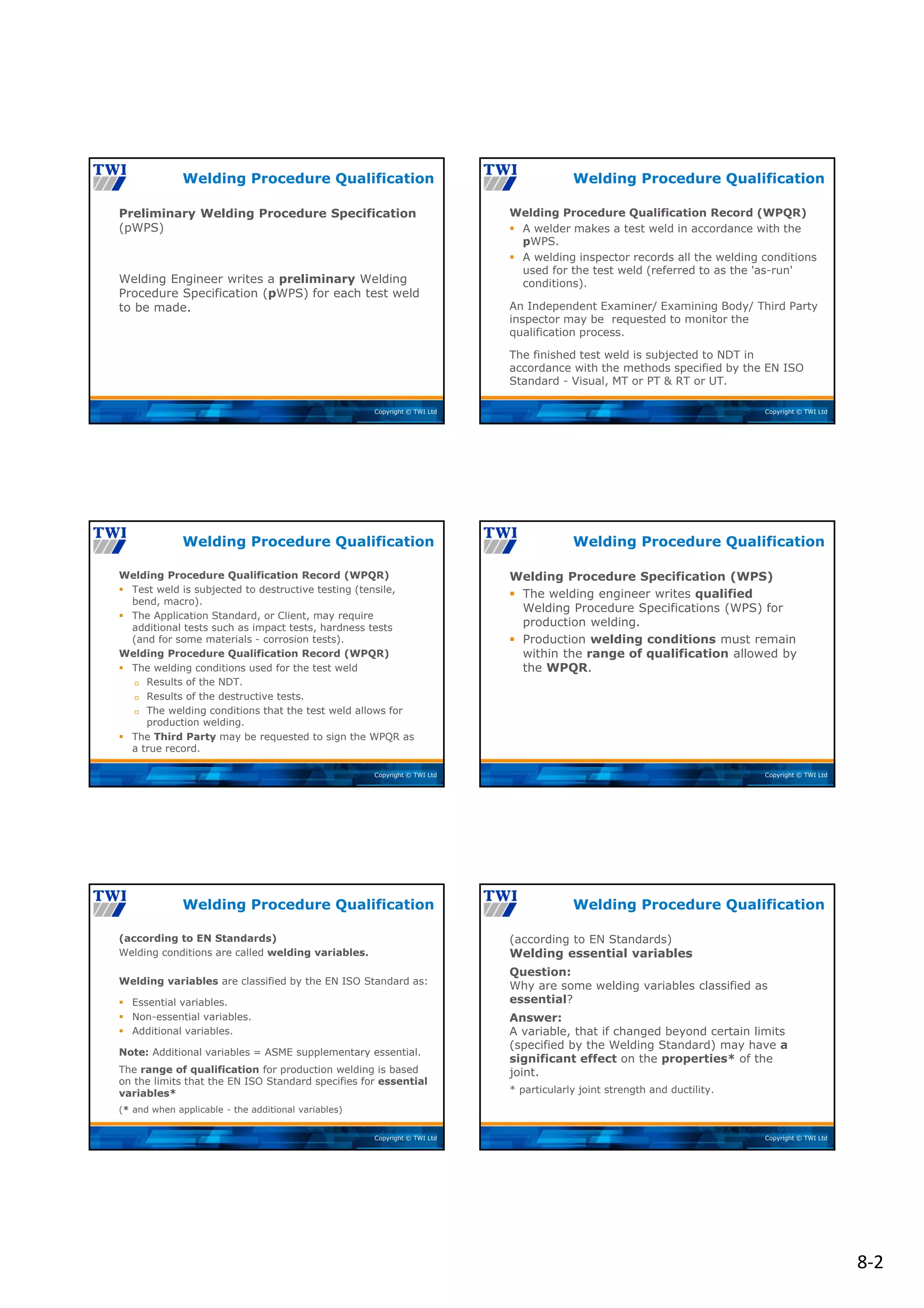
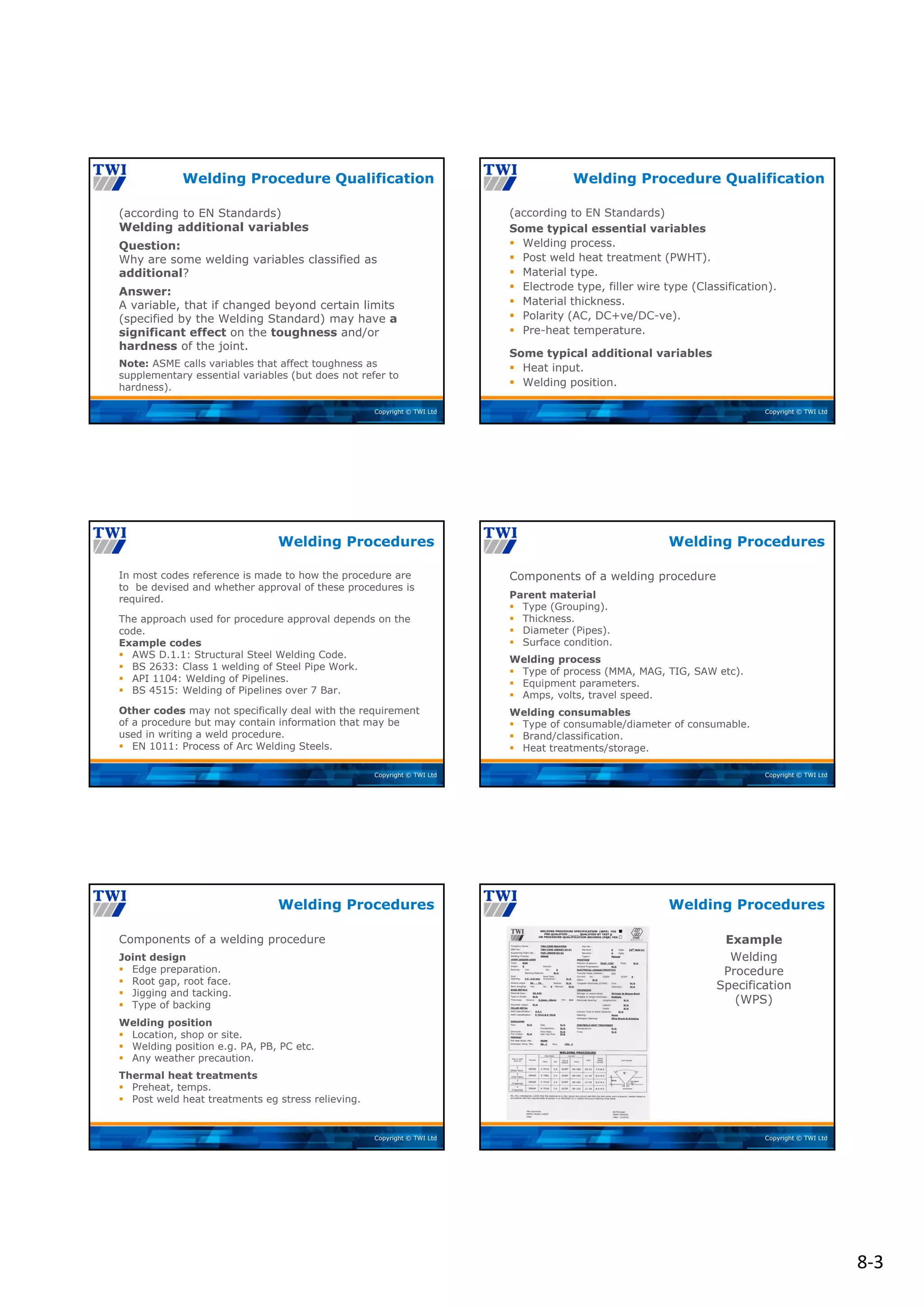
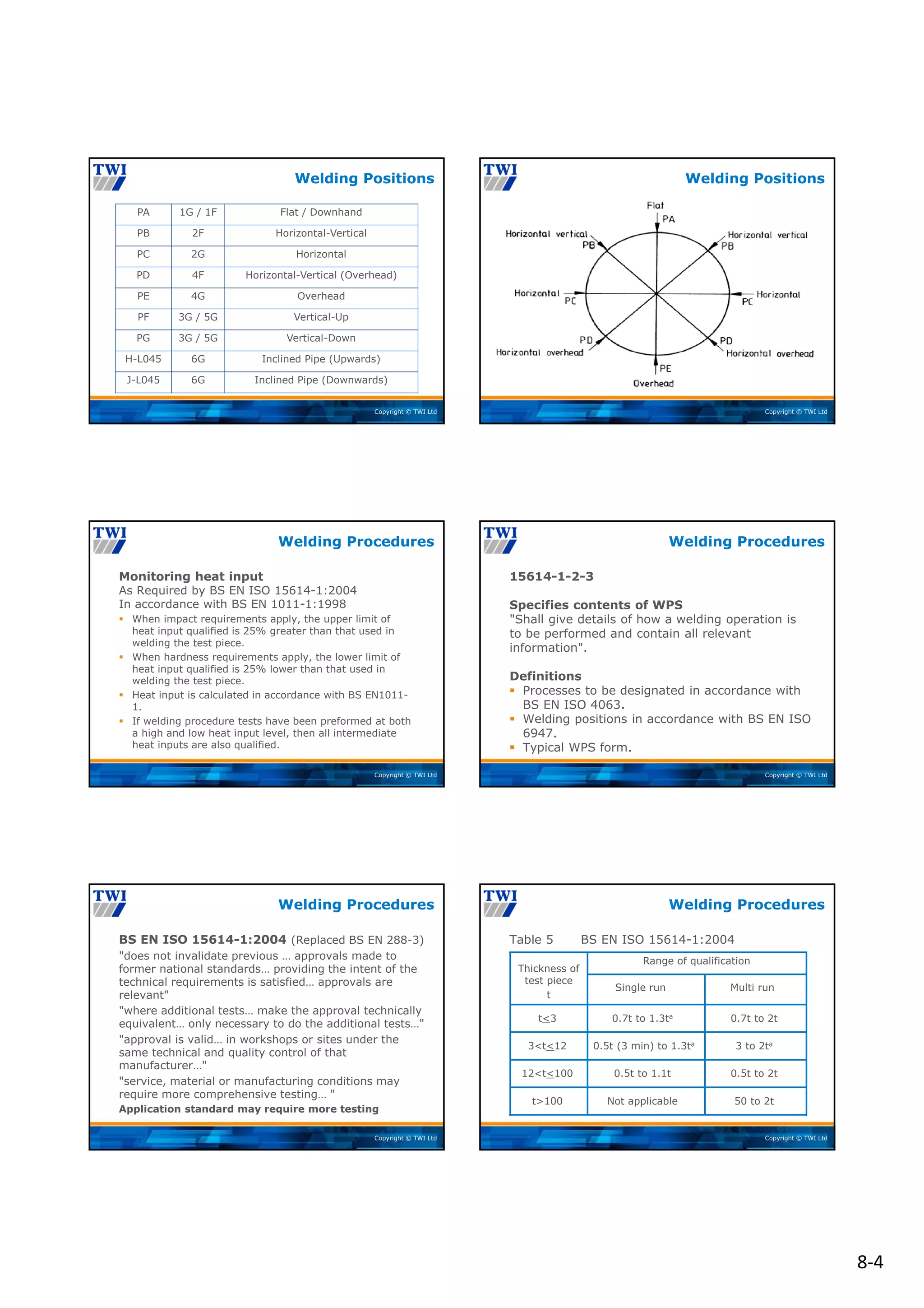
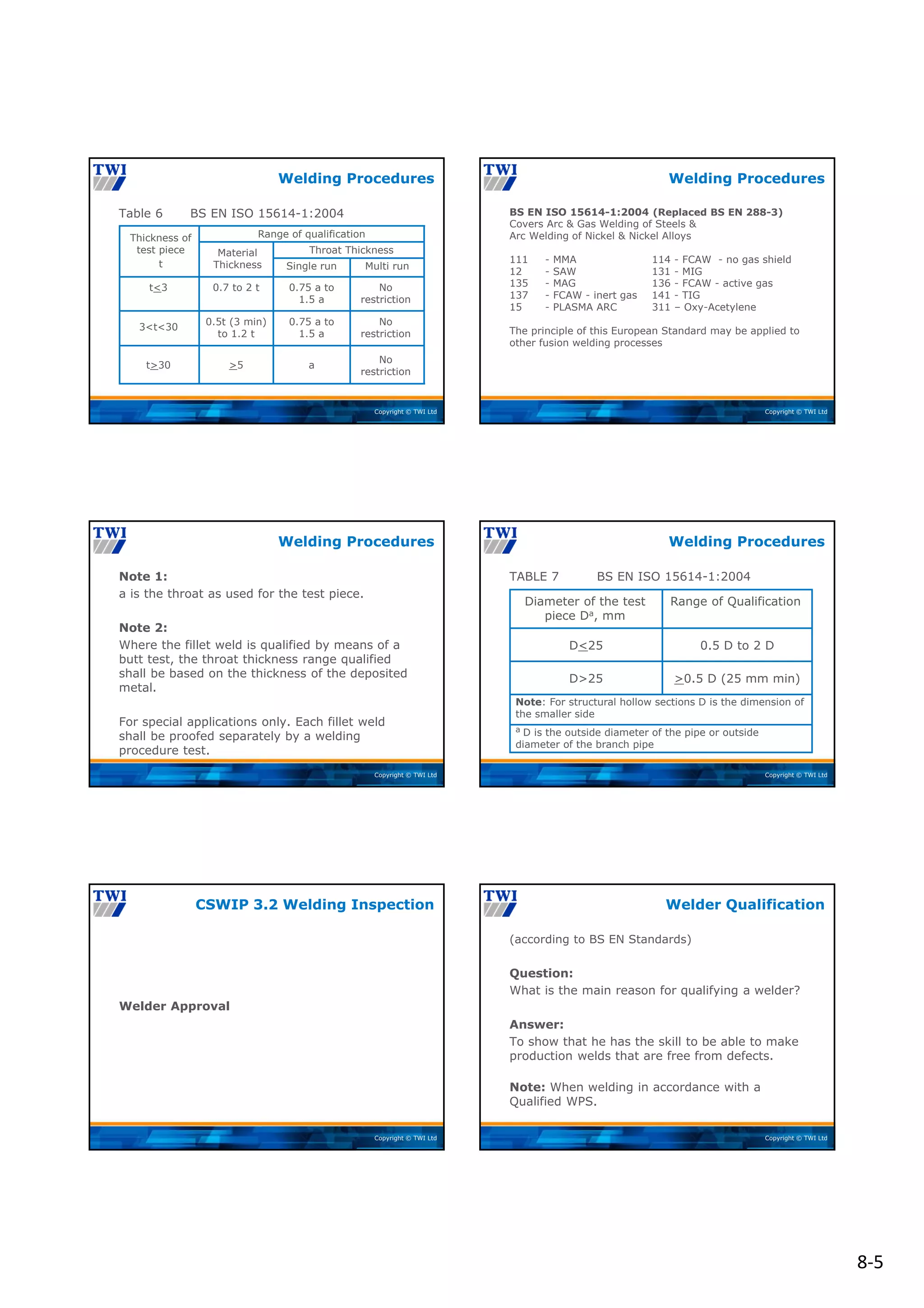
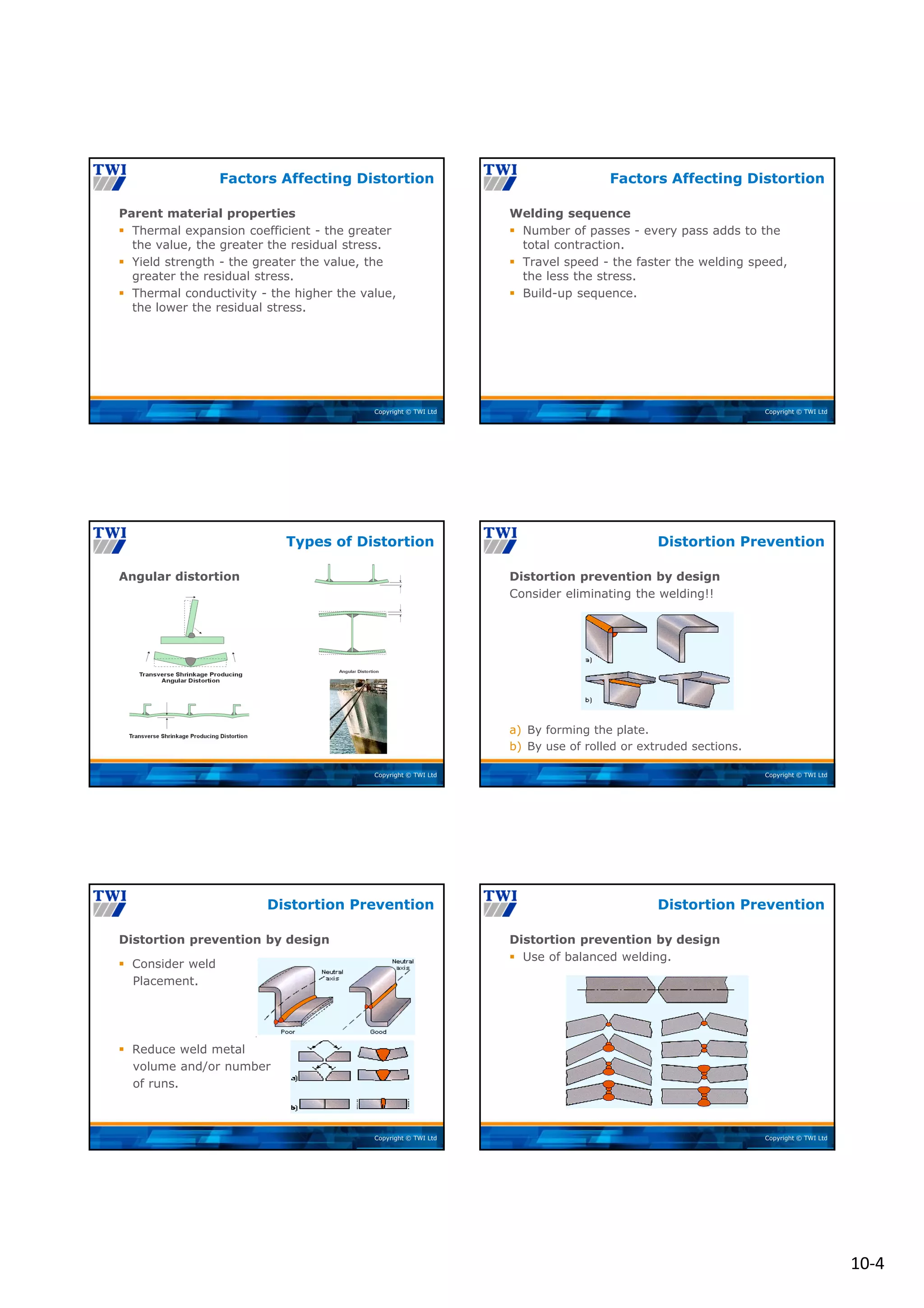
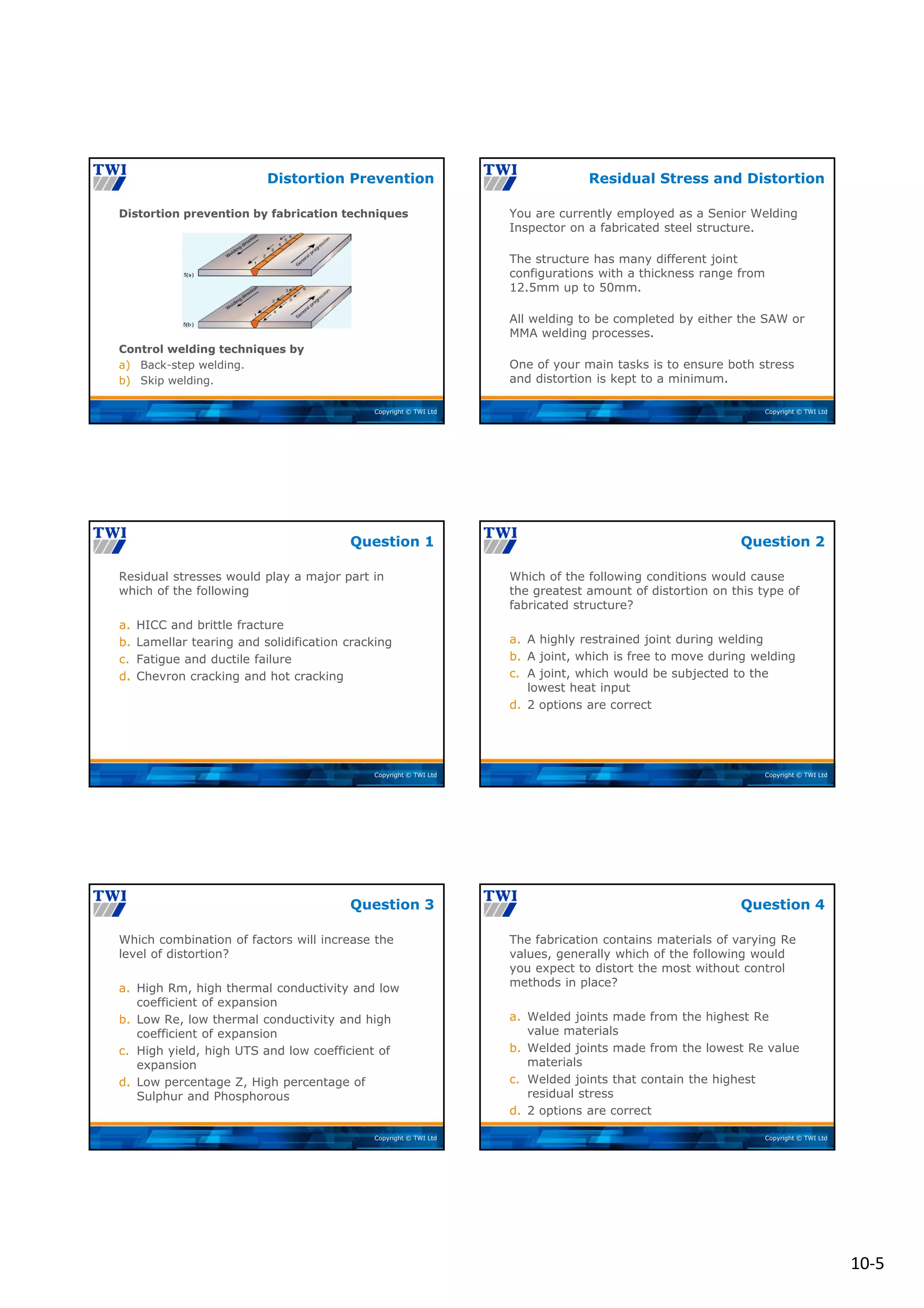
Training and Examination Services
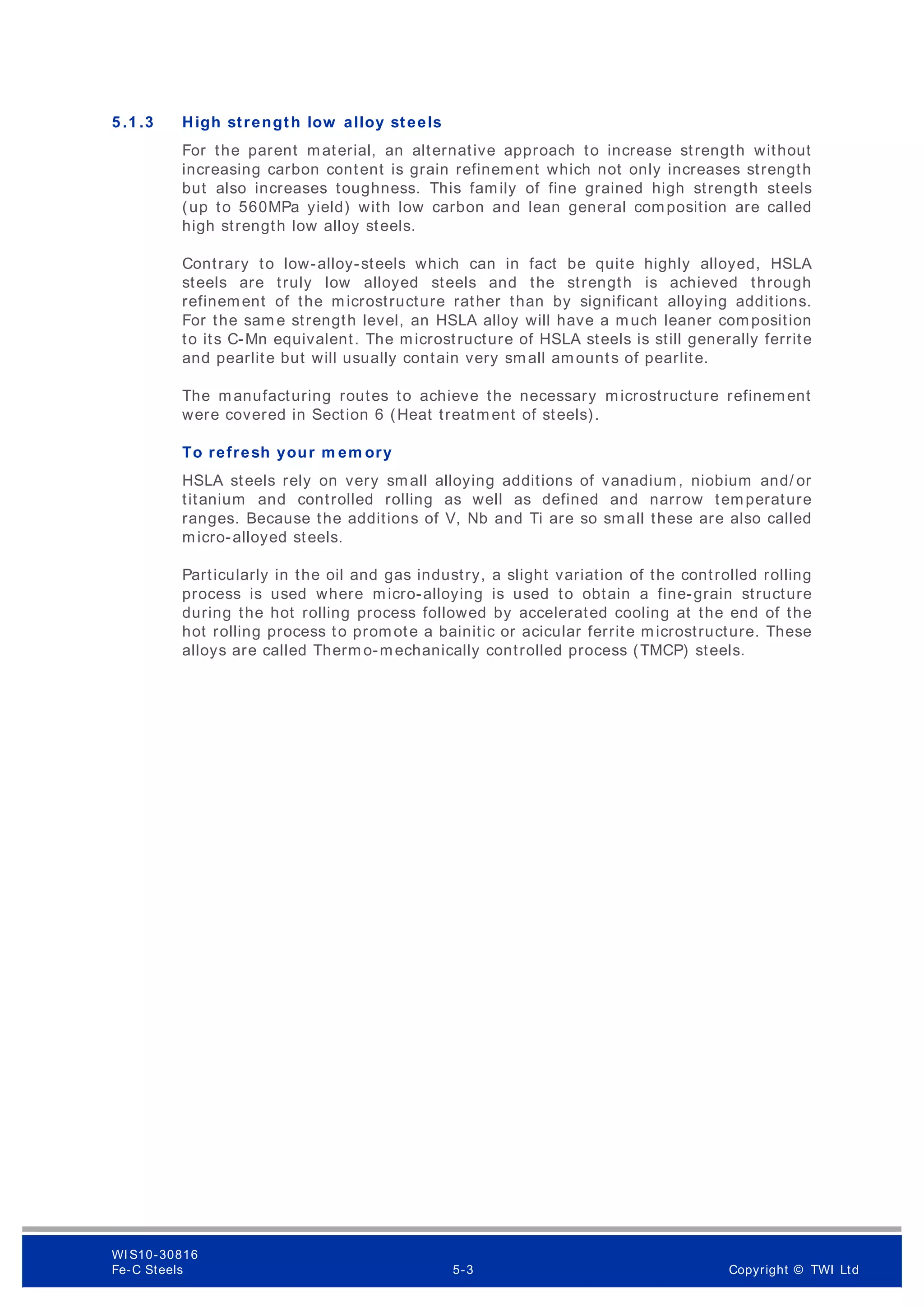
Granta Park, Great Abington
Cambridge CB21 6AL
United Kingdom
Copyright © TWI Ltd
CSWIP 3.2 – Senior Welding Inspector
WIS10
0‐1
Copyright © TWI Ltd
WIS10
CSWIP 3.2 Senior Welding Inspection
Copyright © TWI Ltd
Introduction
CSWIP 3.2 Senior Welding Inspector
Copyright © TWI Ltd
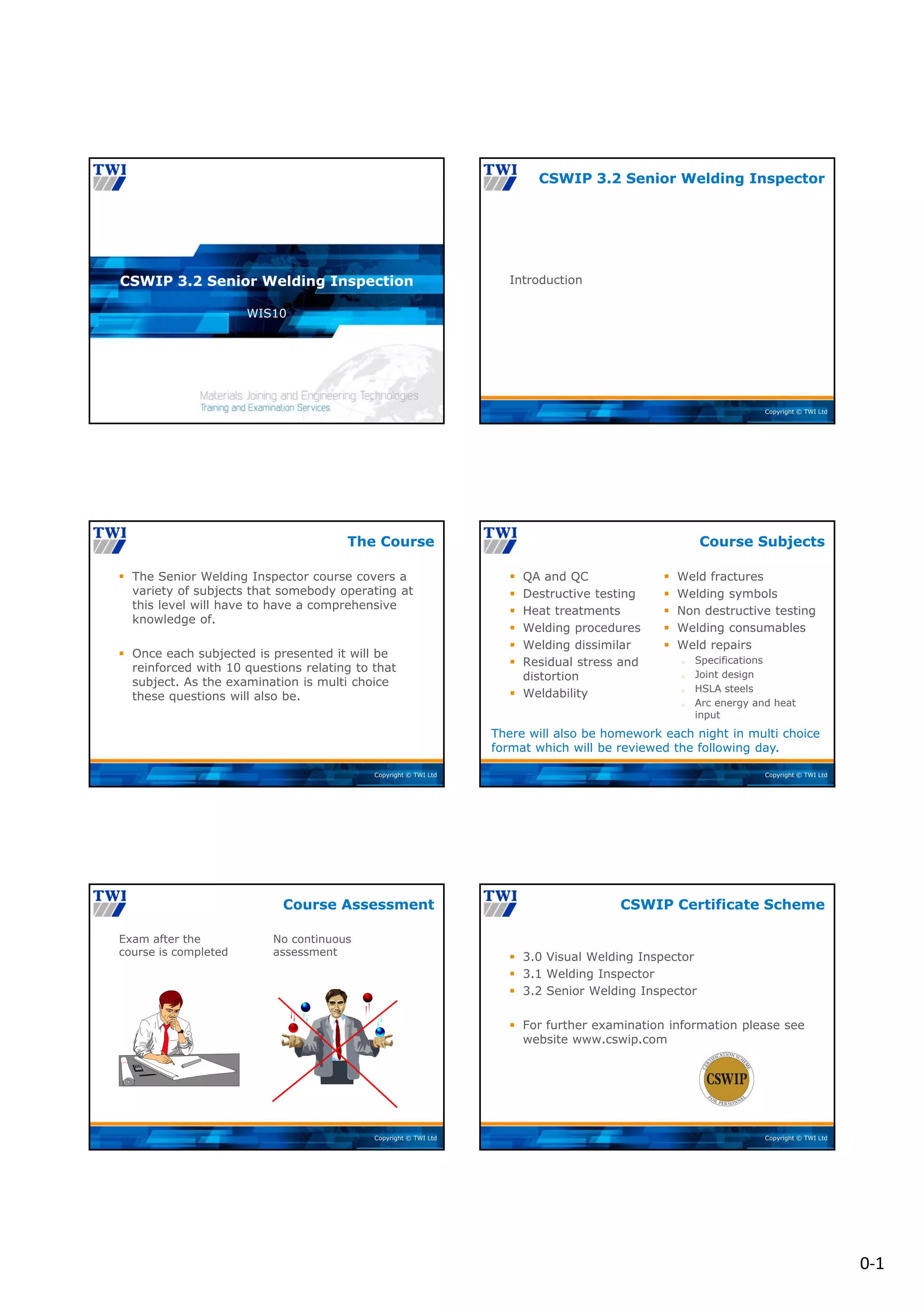
 The Senior Welding Inspector course covers a
variety of subjects that somebody operating at
this level will have to have a comprehensive
knowledge of.
 Once each subjected is presented it will be
reinforced with 10 questions relating to that
subject. As the examination is multi choice
these questions will also be.
The Course
Copyright © TWI Ltd
 QA and QC
 Destructive testing
 Heat treatments
 Welding procedures
 Welding dissimilar
 Residual stress and
distortion
 Weldability
 Weld fractures
 Welding symbols
 Non destructive testing
 Welding consumables
 Weld repairs
□ Specifications
□ Joint design
□ HSLA steels
□ Arc energy and heat
input
Course Subjects
There will also be homework each night in multi choice
format which will be reviewed the following day.
Copyright © TWI Ltd
Exam after the
course is completed
No continuous
assessment
Course Assessment
Copyright © TWI Ltd
 3.0 Visual Welding Inspector
 3.1 Welding Inspector
 3.2 Senior Welding Inspector
 For further examination information please see
website www.cswip.com
CSWIP Certificate Scheme
0‐2
Copyright © TWI Ltd
 The TWI Specification
will be used.
 To attempt the
Senior Welding
Inspectors
Examination (3.2)
you must already be
a holder of the
Welding Inspectors
Qualification (3.1).
CSWIP 3.2 Examination
Copyright © TWI Ltd
Before attempting the examination, you MUST
provide the following
 Two passport size photographs, with your name
and signature on reverse side of both.
 Eye test certificate, the certificate must show near
vision and colour tests. (N4.5 or Times Roman
numerals standard) and verified enrolment.
 Completed examination form, you can print from
the website www.twi.training.com
It is the sole responsibility of the candidate to provide the
above. Failure to do so will delay results and certification
being issued.
CSWIP 3.0 Examination
Copyright © TWI Ltd
 3.2.1 Without radiograph interpretation
70% pass mark required in all areas
of examination
 3.2.2 With radiograph interpretation
(Optional)
70% Pass mark required in all areas
of examination including radiographic
interpretation before certificate can be
issued.
CSWIP 3.2 Examination
Copyright © TWI Ltd
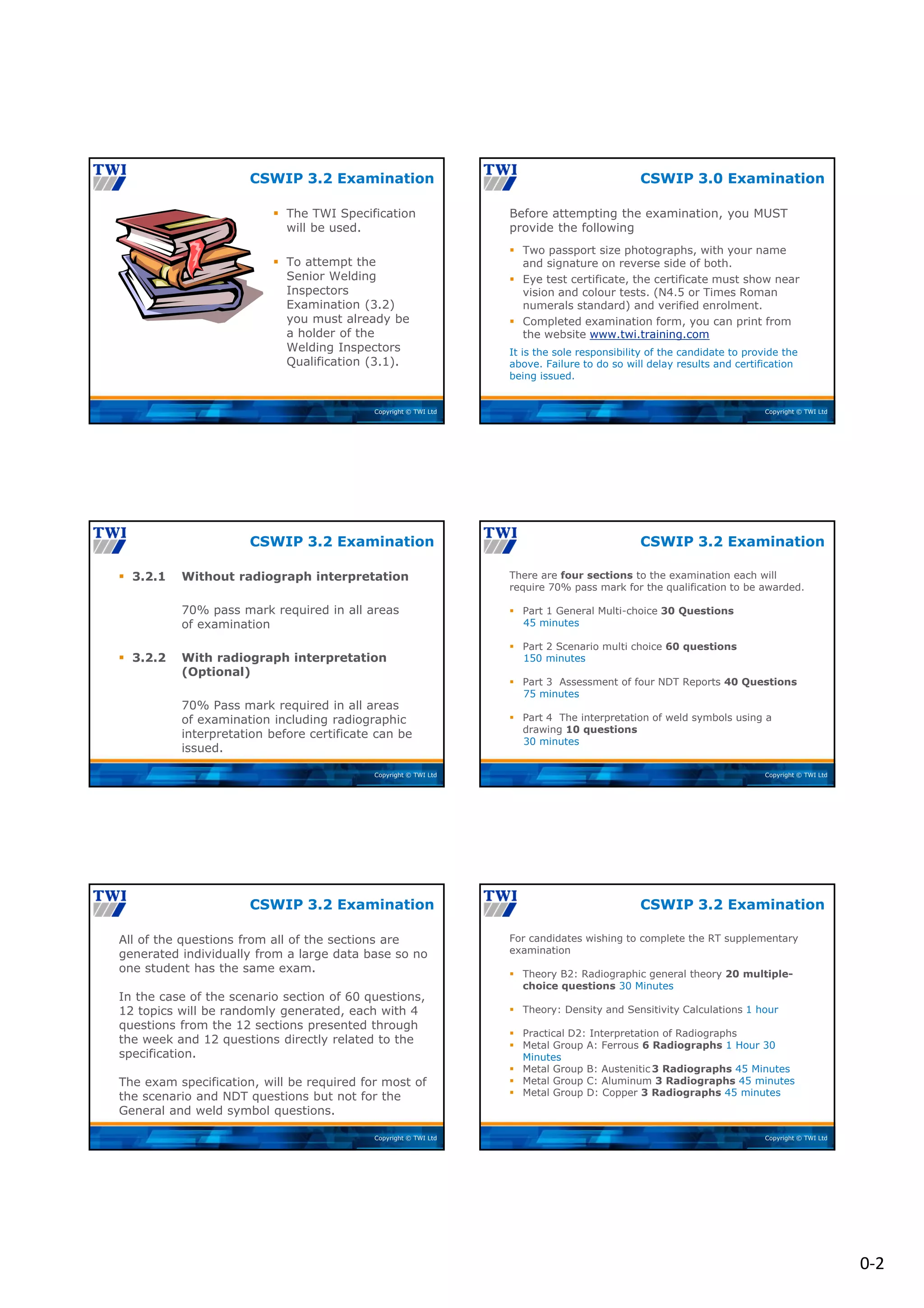
There are four sections to the examination each will
require 70% pass mark for the qualification to be awarded.
 Part 1 General Multi-choice 30 Questions
45 minutes
 Part 2 Scenario multi choice 60 questions
150 minutes
 Part 3 Assessment of four NDT Reports 40 Questions
75 minutes
 Part 4 The interpretation of weld symbols using a
drawing 10 questions
30 minutes
CSWIP 3.2 Examination
Copyright © TWI Ltd
All of the questions from all of the sections are
generated individually from a large data base so no
one student has the same exam.
In the case of the scenario section of 60 questions,
12 topics will be randomly generated, each with 4
questions from the 12 sections presented through
the week and 12 questions directly related to the
specification.
The exam specification, will be required for most of
the scenario and NDT questions but not for the
General and weld symbol questions.
CSWIP 3.2 Examination
Copyright © TWI Ltd
For candidates wishing to complete the RT supplementary
examination
 Theory B2: Radiographic general theory 20 multiple-
choice questions 30 Minutes
 Theory: Density and Sensitivity Calculations 1 hour
 Practical D2: Interpretation of Radiographs
 Metal Group A: Ferrous 6 Radiographs 1 Hour 30
Minutes
 Metal Group B: Austenitic 3 Radiographs 45 Minutes
 Metal Group C: Aluminum 3 Radiographs 45 minutes
 Metal Group D: Copper 3 Radiographs 45 minutes
CSWIP 3.2 Examination
0‐3
Copyright © TWI Ltd
70% Pass mark
required for
EVERY section
of the exam
2 copies of certificates and an identity card
sent to delegates’ sponsor
Notification of Examination Results
Copyright © TWI Ltd
5 years
Log book submittal
10 years
Renewal examination
CSWIP 3.2 Renewals
Copyright © TWI Ltd
Certification Scheme for
Personnel
Recognised Worldwide
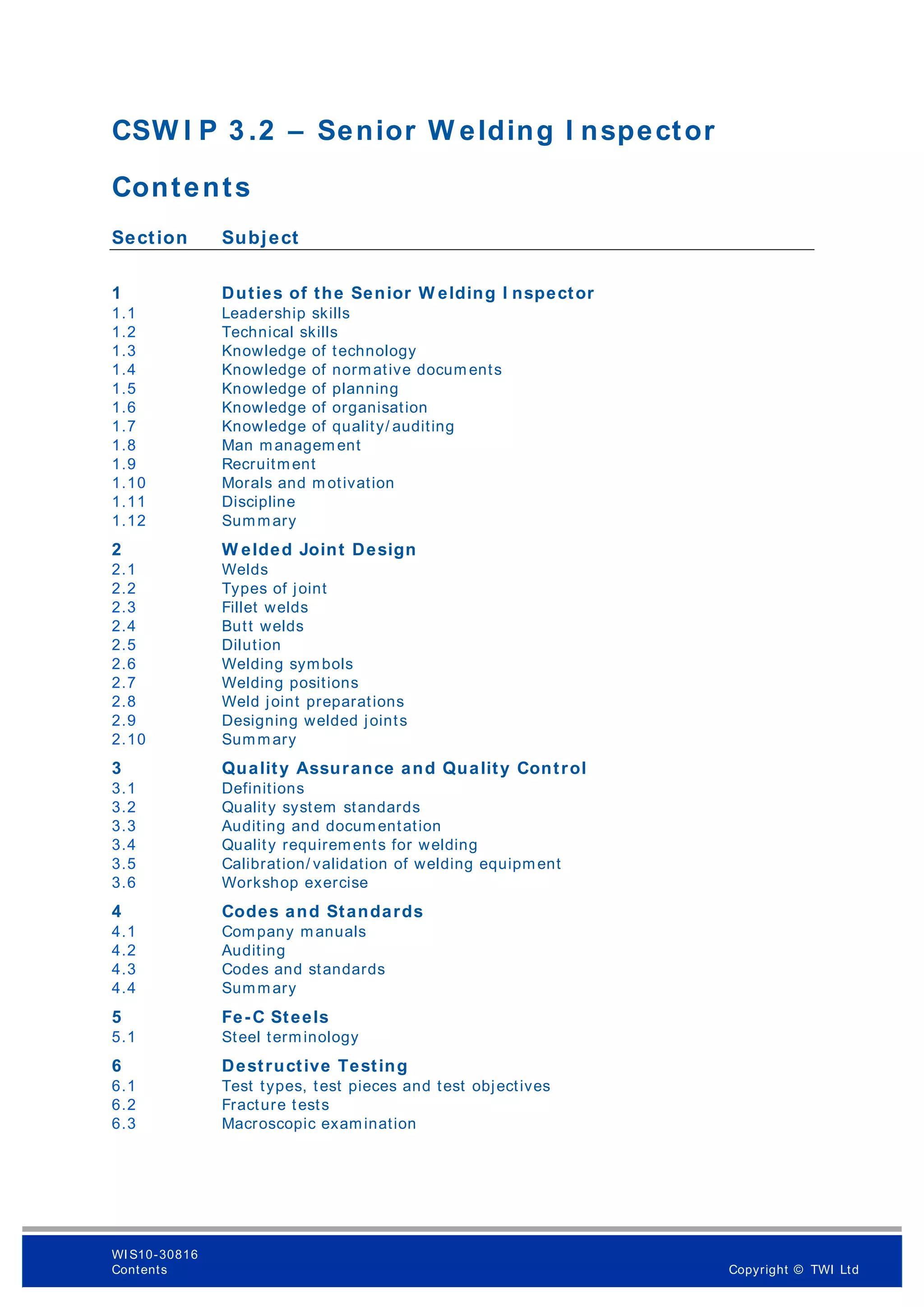
CSW I P 3 .2 – Senior W elding I nspector
Contents
Section Subject
1 Duties of the Senior W elding I nspector
1.1 Leadership skills
1.2 Technical skills
1.3 Knowledge of technology
1.4 Knowledge of normative docum ents
1.5 Knowledge of planning
1.6 Knowledge of organisation
1.7 Knowledge of quality/ auditing
1.8 Man managem ent
1.9 Recruitment
1.10 Morals and m otivation
1.11 Discipline
1.12 Summary
2 W elded Joint Design
2.1 Welds
2.2 Types of joint
2.3 Fillet welds
2.4 Butt welds
2.5 Dilution
2.6 Welding symbols
2.7 Welding positions
2.8 Weld joint preparations
2.9 Designing welded joints
2.10 Summary
3 Quality Assurance and Quality Control
3.1 Definitions
3.2 Quality system standards
3.3 Auditing and documentation
3.4 Quality requirements for welding
3.5 Calibration/ validation of welding equipment
3.6 Workshop exercise
4 Codes and Standards
4.1 Company manuals
4.2 Auditing
4.3 Codes and standards
4.4 Summary
5 Fe-C Steels
5.1 Steel terminology
6 Destructive Testing
6.1 Test types, test pieces and test objectives
6.2 Fracture tests
6.3 Macroscopic examination
WI S10-30816
Contents Copyright © TWI Ltd
7 Heat Treatm ent
7.1 Heat treatment of steel
7.2 Post weld heat treatm ent (PWHT)
7.3 PWHT thermal cycle
7.4 Heat treatment furnaces
7.5 Local PWHT
8 W PS and W elder Qualifications
8.1 Qualified welding procedure specifications
8.2 Welder qualification
9 Arc Energy and Heat I nput
9.1 Current and voltage
9.2 Arc energy or heat imput
1 0 Residual Stress and Distortion
10.1 What causes distortion?
10.2 What are the m ain types of distortion?
10.3 What are the factors affecting distortion?
10.4 Distortion – prevention by pre-setting, pre-bending or use of restraint
10.5 Distortion – prevention by design
10.6 Elimination of welding
10.7 Distortion – prevention by fabrication techniques
10.8 Distortion – corrective techniques
1 1 W eldability of Steels
11.1 Factors that effect weldability
11.2 Hydrogen cracking
11.3 Solidification cracking
11.4 Lamellar tearing
1 2 W eld Fractures
12.1 Ductile fractures
12.2 Brittle fracture
12.3 Fatigue fracture
1 3 W elding Sym bols
13.1 Standards for symbolic representation of welded joints on drawings
13.2 Elementary welding symbols
13.3 Combination of elementary symbols
13.4 Supplementary symbols
13.5 Position of symbols on drawings
13.6 Relationship between the arrow line and the joint line
13.7 Position of the reference line and position of the weld symbol
13.8 Positions of the continuous line and the dashed line
13.9 Dimensioning of welds
13.10 Indicatgion of the welding process
13.11 Other information in the tail of the reference line
13.12 Weld symbols in accordance with AWS 2.4
1 4 NDT
14.1 Radiographic methods
14.2 Magnetic particle testing
14.3 Dye penetrant testing
14.4 Surface cracks detection (magnetic particle/ dye penetrant): general
WI S10-30816
Contents Copyright © TWI Ltd
WIS10-30816
Contents Copyright © TWI Ltd
15 Welding Consumables
15.1 MMA electrodes
15.2 Cellulosic electrodes
15.3 Rutile electrodes
15.4 Basic electrodes
15.5 Classification of electrodes
15.6 TIG filler wires
15.7 MIG/MAG filler wires
15.8 SAW filler wires
16 MAG welding
16.1 The process
16.2 Process variables
16.3 Welding consumables
16.4 Important inspection point/checks when MIG/MAG welding
17 MMA Welding
17.1 Manual metal arc/shielded metal arc welding (MMA/SMAW)
17.2 MMA welding basic equipment requirements
17.3 Power requirements
17.4 Welding variables
17.5 Voltage
17.6 Type of current and polarity
17.7 Type of consumable electrode
17.8 Typical welding defects
18 Submerged Arc Welding
18.1 The process
18.2 Process variables
18.3 Storage and care of consumables
19 TIG Welding
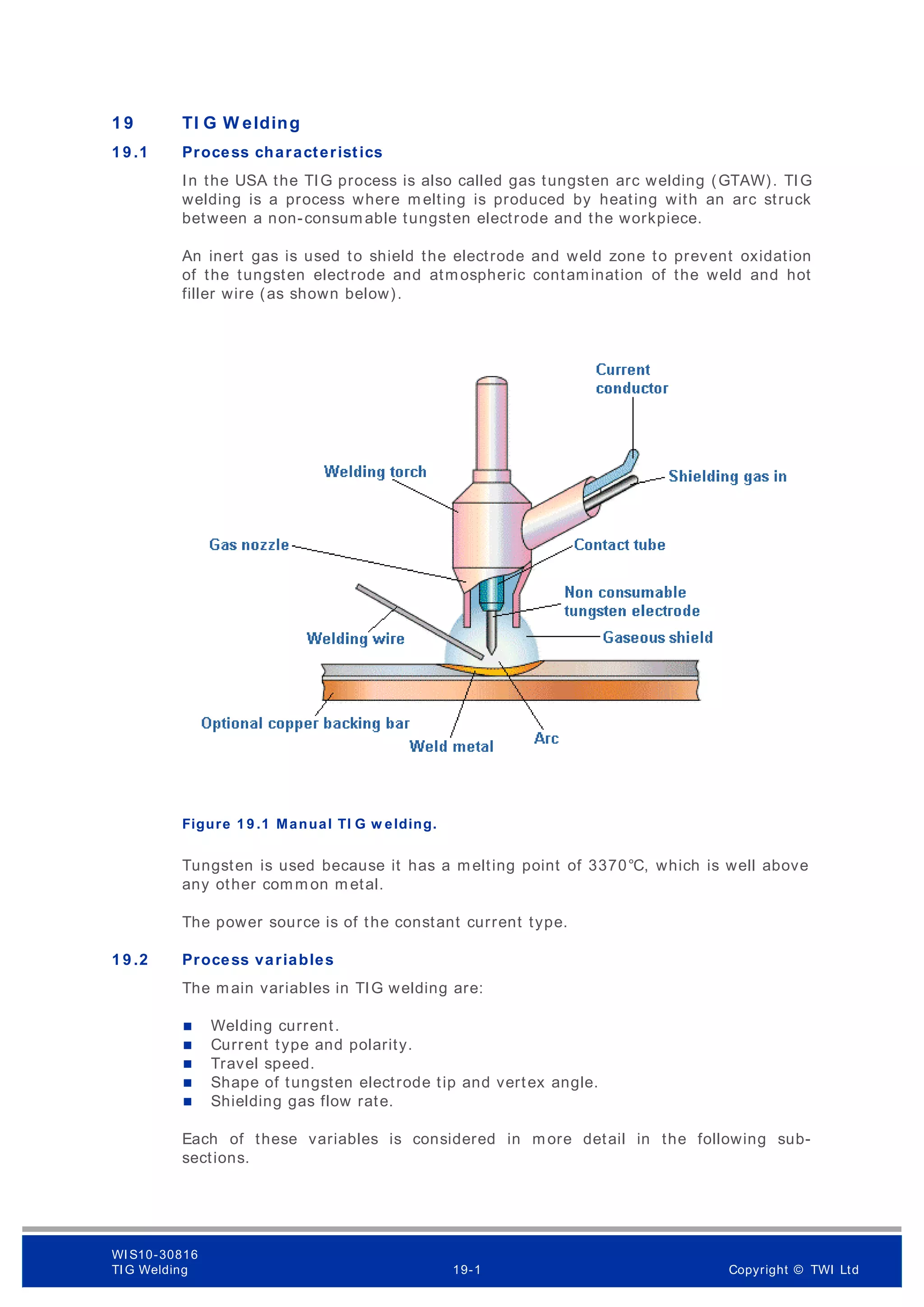
19.1 Process characteristics
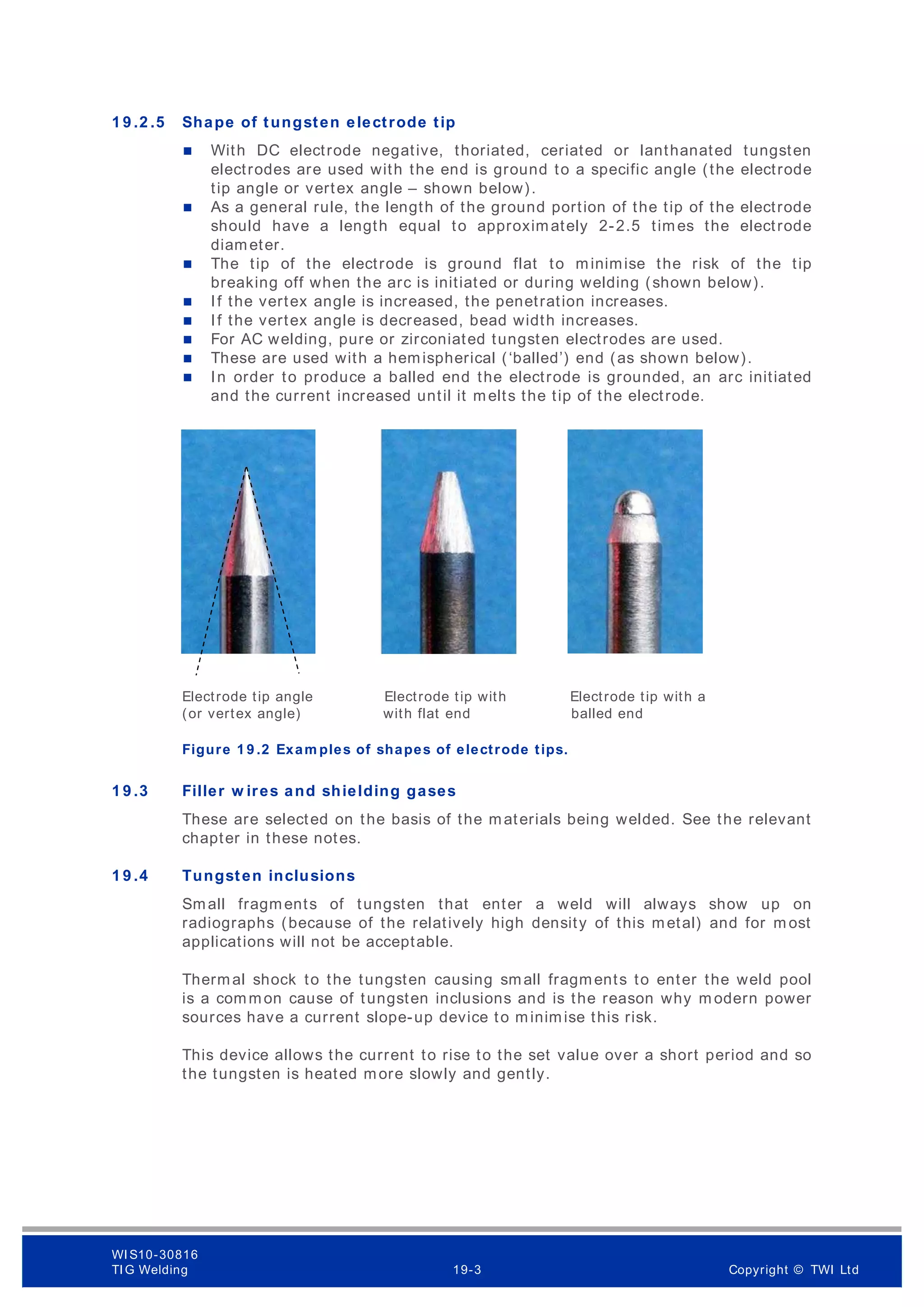
19.2 Process variables
19.3 Filler wires and shielding gases
19.4 Tungsten inclusions
19.5 Crater cracking
19.6 Common applications of the TIG process
19.7 Advantages of the TIG process
19.8 Disadvantages of the TIG process
20 Weld Repairs
20.1 Production repairs
20.2 In-service repairs
Appendix 1 Homeworks
Appendix 2 NDT Training Reports
Appendix 3 Training Drawing
Appendix 4 Specification Questions
Section 1
Duties of the Senior W elding I nspector
1 Duties of the Senior W elding I nspector
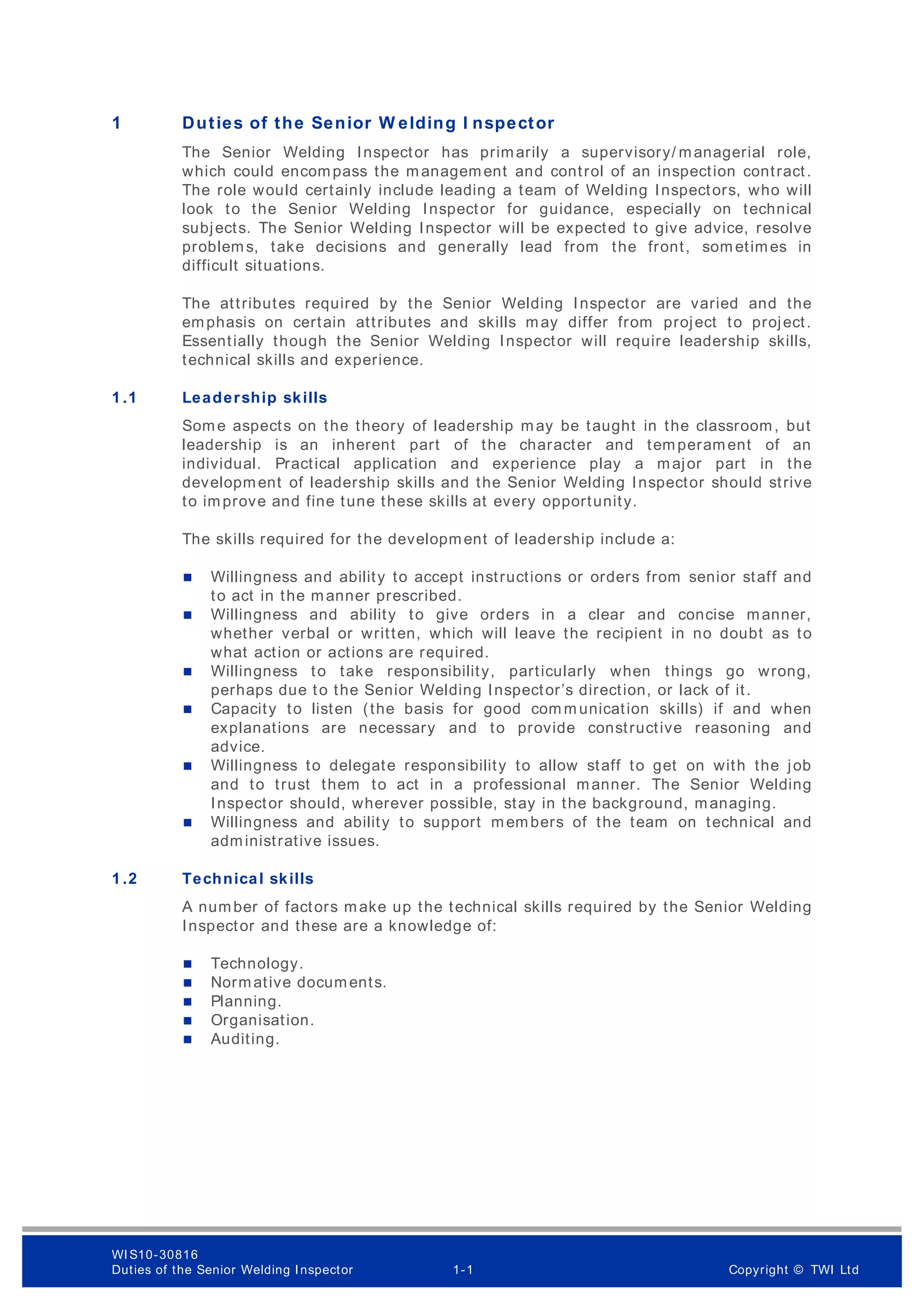
The Senior Welding Inspector has primarily a supervisory/ managerial role,
which could encompass the management and control of an inspection contract.
The role would certainly include leading a team of Welding Inspectors, who will
look to the Senior Welding Inspector for guidance, especially on technical
subjects. The Senior Welding Inspector will be expected to give advice, resolve
problems, take decisions and generally lead from the front, som etimes in
difficult situations.
The attributes required by the Senior Welding Inspector are varied and the
emphasis on certain attributes and skills may differ from project to project.
Essentially though the Senior Welding Inspector will require leadership skills,
technical skills and experience.
1 .1 Leadership skills
Some aspects on the theory of leadership may be taught in the classroom, but
leadership is an inherent part of the character and temperament of an
individual. Practical application and experience play a major part in the
development of leadership skills and the Senior Welding Inspector should strive
to improve and fine tune these skills at every opportunity.
The skills required for the development of leadership include a:
 Willingness and ability to accept instructions or orders from senior staff and
to act in the manner prescribed.
 Willingness and ability to give orders in a clear and concise manner,
whether verbal or written, which will leave the recipient in no doubt as to
what action or actions are required.
 Willingness to take responsibility, particularly when things go wrong,
perhaps due to the Senior Welding Inspector’s direction, or lack of it.
 Capacity to listen (the basis for good com m unication skills) if and when
explanations are necessary and to provide constructive reasoning and
advice.
 Willingness to delegate responsibility to allow staff to get on with the job
and to trust them to act in a professional manner. The Senior Welding
Inspector should, wherever possible, stay in the background, managing.
 Willingness and ability to support members of the team on technical and
administrative issues.
1 .2 Technical skills
A number of factors make up the technical skills required by the Senior Welding
Inspector and these are a knowledge of:
 Technology.
 Normative documents.
 Planning.
 Organisation.
 Auditing.
WI S10-30816
Duties of the Senior Welding Inspector 1-1 Copyright © TWI Ltd
1 .3 Know ledge of technology
Welding technology knowledge required by the Senior Welding Inspector is very
similar to that required by the Welding Inspector, but with some additional
scope and depth.
Certain areas where additional knowledge is required are a:
 Knowledge of quality assurance and quality control.
 Sound appreciation of the four comm only used non-destructive testing
methods.
 Basic understanding of steel metallurgy for commonly welded materials and
the application of this understanding to the assessment of fracture surfaces.
 Assessm ent of non-destructive test reports, particularly the interpretation of
radiographs.
1 .4 Know ledge of norm ative docum ents
It is not a requirem ent for Inspectors at any level to memorise the content of
relevant normative documents, except possibly with the exception of taking
examinations.
Specified normative documents (specifications, standards, codes of practice,
etc) should be available at the workplace and the Senior Welding Inspector
would be expected to read, understand and apply the requirements with the
necessary level of precision and direction required.
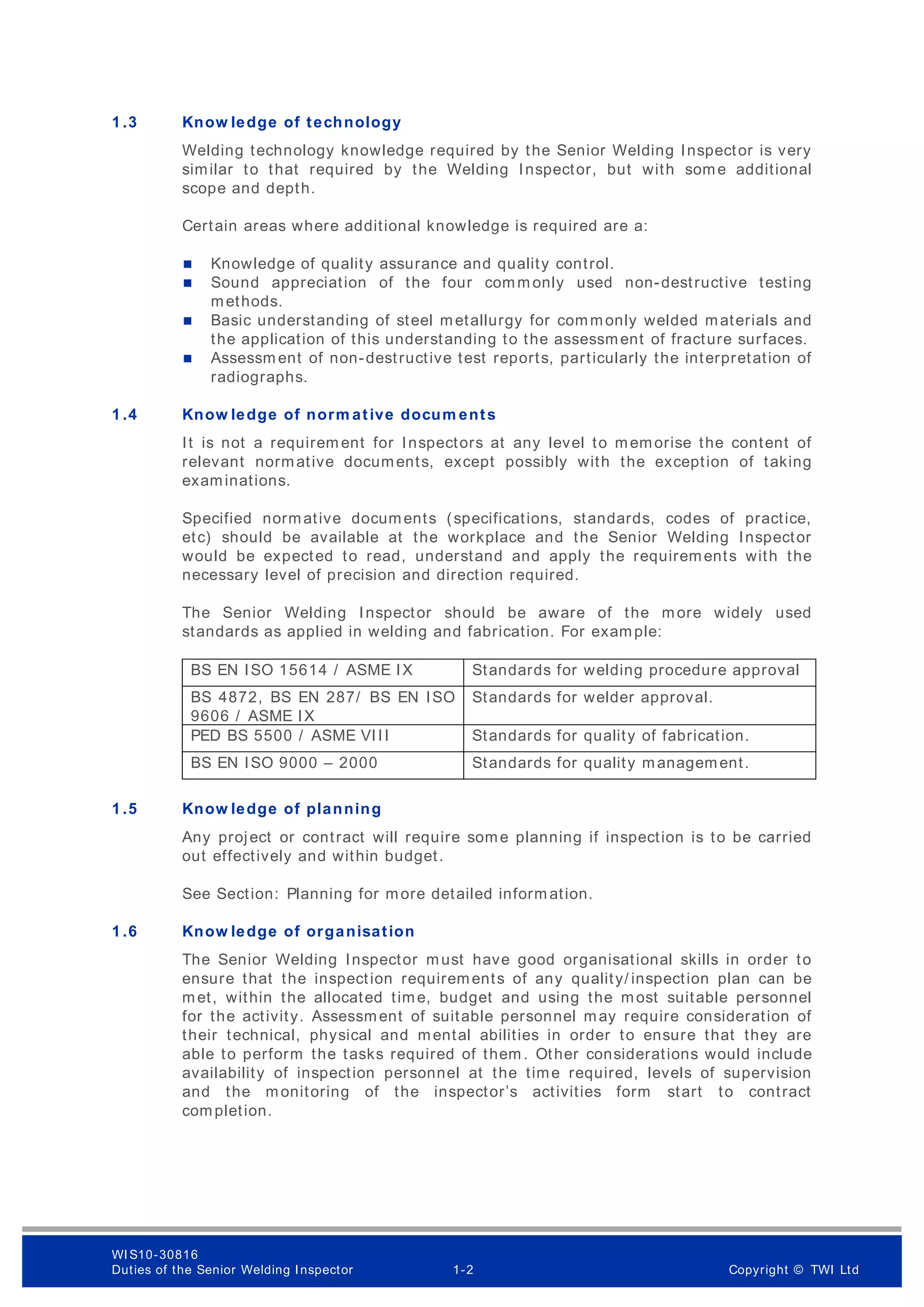
The Senior Welding Inspector should be aware of the more widely used
standards as applied in welding and fabrication. For example:
BS EN ISO 15614 / ASME IX Standards for welding procedure approval
BS 4872, BS EN 287/ BS EN ISO
9606 / ASME IX
Standards for welder approval.
PED BS 5500 / ASME VIII Standards for quality of fabrication.
BS EN ISO 9000 – 2000 Standards for quality management.
1 .5 Know ledge of planning
Any project or contract will require some planning if inspection is to be carried
out effectively and within budget.
See Section: Planning for more detailed inform ation.
1 .6 Know ledge of organisation
The Senior Welding Inspector must have good organisational skills in order to
ensure that the inspection requirements of any quality/ inspection plan can be
met, within the allocated time, budget and using the most suitable personnel
for the activity. Assessment of suitable personnel may require consideration of
their technical, physical and mental abilities in order to ensure that they are
able to perform the tasks required of them . Other considerations would include
availability of inspection personnel at the time required, levels of supervision
and the monitoring of the inspector’s activities form start to contract
completion.
WI S10-30816
Duties of the Senior Welding Inspector 1-2 Copyright © TWI Ltd
1 .7 Know ledge of quality/ auditing
There are many situations in manufacturing or on a project where the Senior
Welding Inspector may be required to carry out audits.
See section on: Quality Assurance/ Quality Control and Inspection for more
detailed information.
1 .8 Man m anagem ent
As mentioned above, the Senior Welding Inspector will have to direct and work
with a team of Inspection personnel which he may well have to pick. He will
have to liaise with customer representatives, sub-contractors and third party
Inspectors. He may have to investigate non-compliances, deal with matters of
discipline as well as personal matters of his staff.
To do this effectively he needs skills in man management.
1 .9 Recruitm ent
When recruiting an individual or a team the SWI will first have to establish the
requirem ents of the work. Am ong them would be:
 What skills are definitely required for the work and what additional ones
would be desirable?
 Are particular qualifications needed?
 Is experience of similar work desirable?
 What physical attributes are needed?
 Is the work local, in-shop, on-site, in a third world country?
 Does the job require working unsociable hours being away from hom e for
long periods?
 Is the job for permanent staff or for a fixed term?
 If overseas what are the leave and travel arrangements?
 What is the likely salary?
During subsequent interviews the SWI will need to assess other aspects of the
candidates’ suitability:
 Has he the ability to work on his own initiative?
 Can he work as part of a team?
 If overseas has the person been to a similar location?
 What is his marital/ home situation?
 Are there any Passport/ Visa problems likely?
1 .1 0 Morale and m otivation
The morale of a workforce has a significant effect on its performance so the
SWI must strive to keep the personnel happy and m otivated and be able to
detect signs of low m orale.
Low m orale can lead to am ong other things, poor productivity, less good
workmanship, lack of diligence, taking short cuts, ignoring safety procedures and
higher levels of absenteeism.
The SWI needs to be able to recognise these signs and others such as
personnel not starting work promptly, taking longer breaks, talking in groups
and grumbling about minor matters.
WI S10-30816
Duties of the Senior Welding Inspector 1-3 Copyright © TWI Ltd
A good supervisor should not allow his workforce to get into such a state.
He must keep them m otivated by:
 His own demeanour – does he have drive and enthusiasm or is he seen to
have no energy and generally depressed. The workforce will react
accordingly.
 Is he seen to be leading from the front in a fair and consistent manner?
 Favouritism in the treatment of staff, on disciplinary matters, the allocation
of work, allotment of overtime, weekend working and holidays are common
causes of problems.
 Keep them informed in all aspects of the job and their situation. Rumours of
impending redundancies or cuts in allowances etc will not make for good
morale.
1 .1 1 Discipline
Any workforce must be working in a disciplined manner, normally to rules and
standards laid down in the Company’s conditions of employm ent or relevant
company handbook. The SWI must have a good understanding of these
requirem ents and be able to apply them in a fair and equitable manner.
He must have a clear understanding as to the limits of his authority – knowing
how far he can go in disciplinary proceedings.
The usual stages of disciplinary procedure are:
 The quiet word.
 Formal verbal warning.
 Written warning.
 Possible demotion, transfer, suspension.
 Dismissal with notice.
 Instant dismissal.
Usually after the written warning stage the matter will be handled by the
Company’s Personnel or Human Resources Department.
It is of vital importance that the company rules are rigorously followed as any
deviation could result in claims for unfair or constructive dismissal.
In dealing with disciplinary matters the SWI must:
 Act promptly.
 Mean what he says.
 Treat everyone fairly and as an adult.
 Avoid constant complaining on petty issues.
Where there are serious breaches of company rules by one or two people the
rest of the workforce should be informed of the matter so that rumour and
counter-rumours can be quashed.
Some matters of discipline may well arise because of incorrect working
practices, passing off below quality work, signing for work which has not been
done, etc.
WI S10-30816
Duties of the Senior Welding Inspector 1-4 Copyright © TWI Ltd
In all such cases the SWI will need to carry out an investigation and apply
disciplinary sanctions to the personnel involved.
To do this:
 First establish the facts – by interviewing staff, from the relevant records,
by having rechecks on part of the job.
 If any suspicions are confirmed, transfer/ rem ove suspect personnel from
the job pending disciplinary proceedings. If the personnel are employed by a
sub-contractor then a meeting with the sub-contractor will be needed to
achieve the sam e end.
 Find out the extent of the problem, is it localised or widespread?
 Is there need to inform the customer and third party inspector?
 Formulate a plan of action, with other company departments where
necessary, to retrieve the situation.
 Carry out the necessary disciplinary measures on the personnel involved.
 Convene a m eeting with the rest of the workforce to inform them of the
situation and ensure that any similar lapses will be dealt with severely.
 Follow up the meeting with a written memo.
1 .1 2 Sum m ary
The Senior Welding Inspector’s role can be varied and complex, a number of
skills need to be developed in order for the individual to be effective in the role.
Every Senior Welding Inspector will have personal skills and attributes which
can be brought to the job, som e of the skills identified above may already have
been mastered or understood. The important thing for the individual to
recognise is not only do they have unique abilities which they can bring to the
role, but they also need to strive to be the best they can by strengthening
identifiable weak areas in their knowledge and understanding.
Some ways in which these goals may be achieved is through:
 Embracing facts and realities.
 Being creative.
 Being interested in solving problems.
 Being pro-active not reactive.
 Having empathy with other people.
 Having personal values.
 Being objective.
WI S10-30816
Duties of the Senior Welding Inspector 1-5 Copyright © TWI Ltd
Section 2
W elded Joint Design
2 W elded Joint Design
This section is principally concerned with structures fabricated by welding steel
plates together, examples include bridges, ships, offshore platforms, pressure
vessels and pipelines, although in some cases this may involve welding curved
plates together.
This section introduces typical joint geometries involved in joining plates
together and describes the types of weld used in these joint configurations with
typical features of butt and fillet welds described. For the structure to function
loads must be transferred from one plate to another and the features of welds
that enable them to transmit loads are described. Finally, some examples of
good and bad design practice are given.
2 .1 W elds
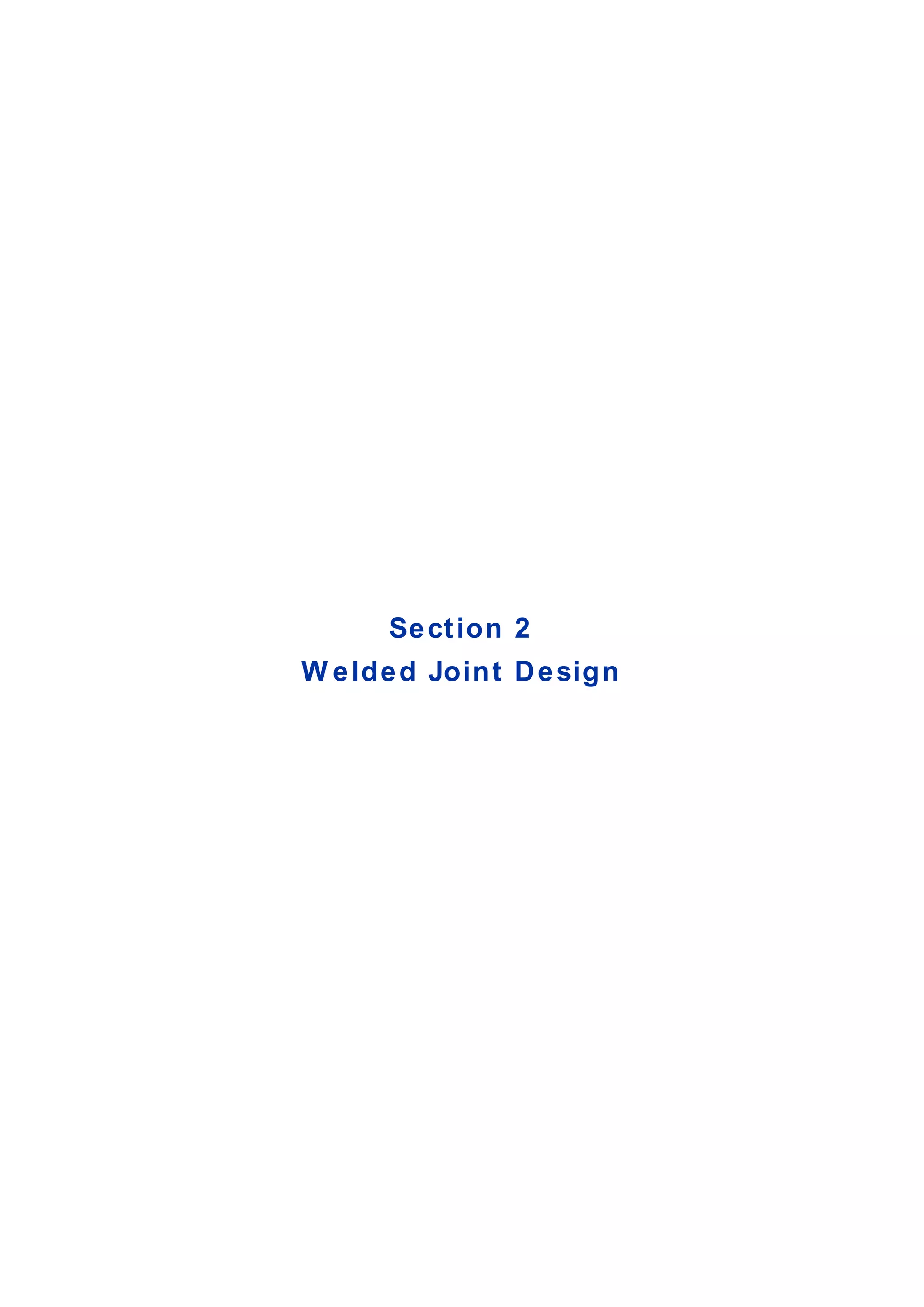
A weld is a permanent union between materials caused by the application of
heat, pressure or both and if made between two faces approximately parallel is
known as a butt weld.
Figure 2 .1 Butt w eld.
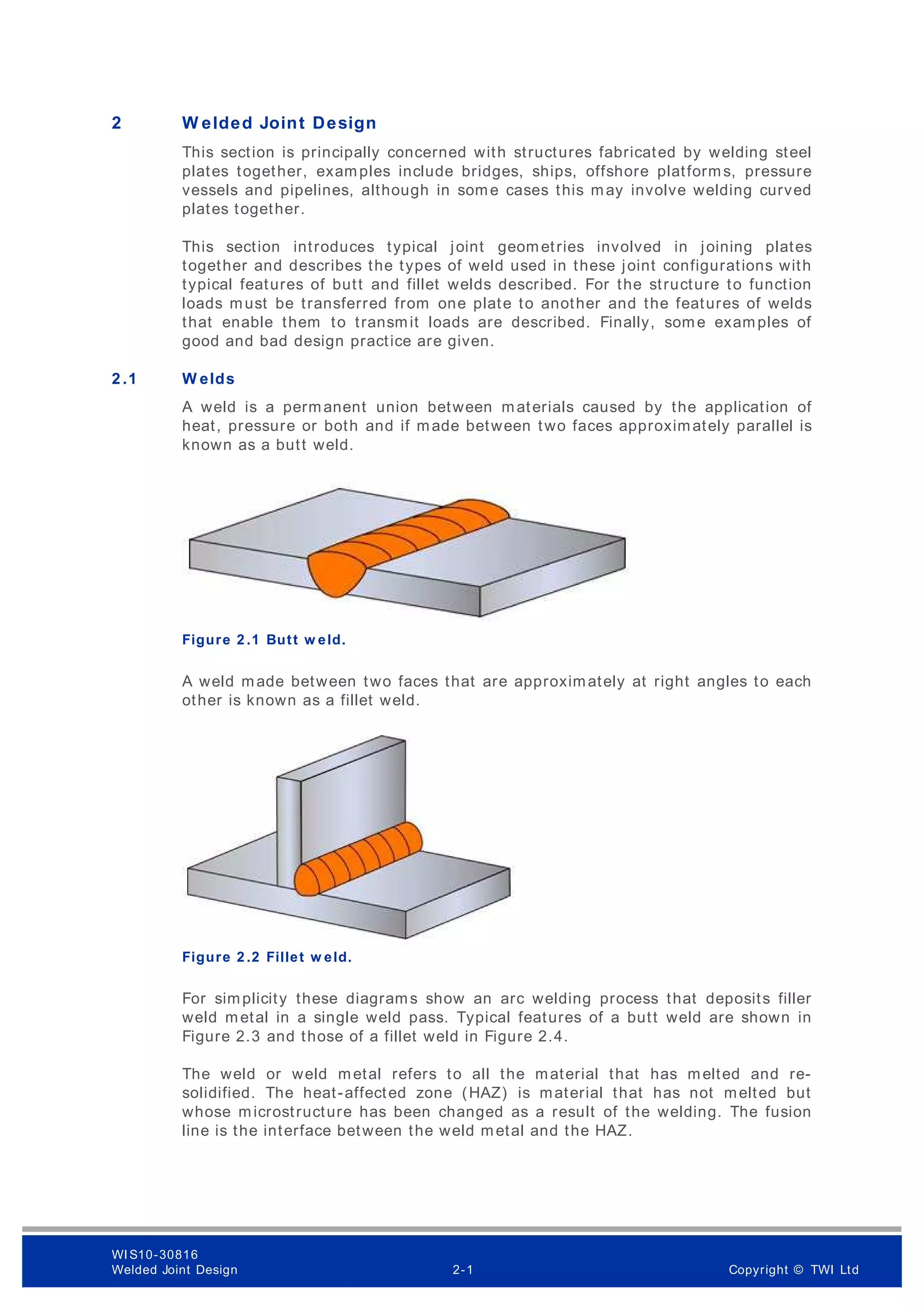
A weld made between two faces that are approximately at right angles to each
other is known as a fillet weld.
Figure 2 .2 Fillet w eld.
For simplicity these diagrams show an arc welding process that deposits filler
weld metal in a single weld pass. Typical features of a butt weld are shown in
Figure 2.3 and those of a fillet weld in Figure 2.4.
The weld or weld metal refers to all the material that has melted and re-
solidified. The heat-affected zone (HAZ) is material that has not melted but
whose microstructure has been changed as a result of the welding. The fusion
line is the interface between the weld metal and the HAZ.
WI S10-30816
Welded Joint Design 2-1 Copyright © TWI Ltd
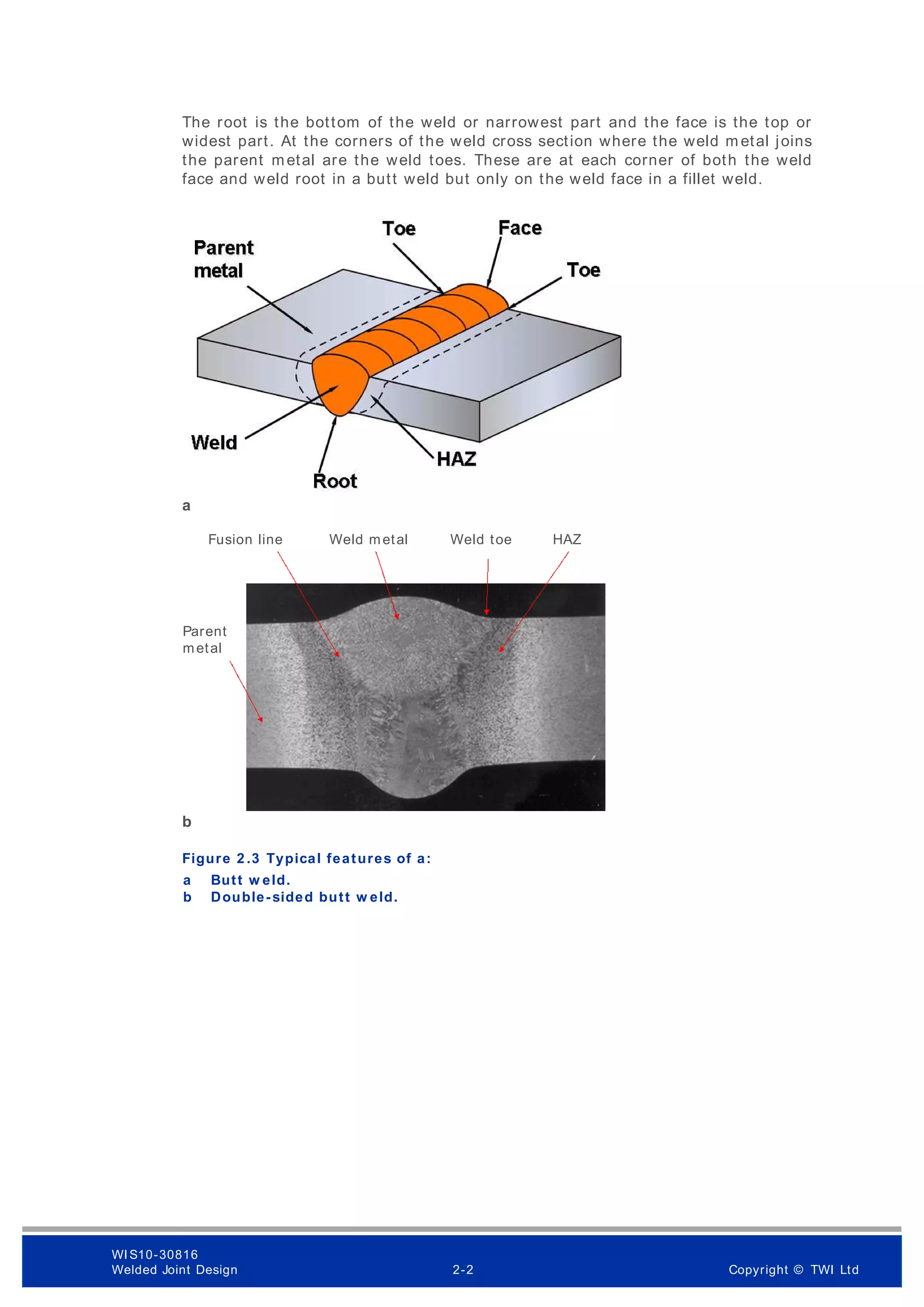
The root is the bottom of the weld or narrowest part and the face is the top or
widest part. At the corners of the weld cross section where the weld m etal joins
the parent metal are the weld toes. These are at each corner of both the weld
face and weld root in a butt weld but only on the weld face in a fillet weld.
a
b
Figure 2 .3 Typical features of a:
Butt w eld.
a
Double-sided butt w eld.
b
Fusion line
Parent
metal
Weld metal Weld toe HAZ
WI S10-30816
Welded Joint Design 2-2 Copyright © TWI Ltd
Figure 2 .4 Typical features of a fillet w eld.
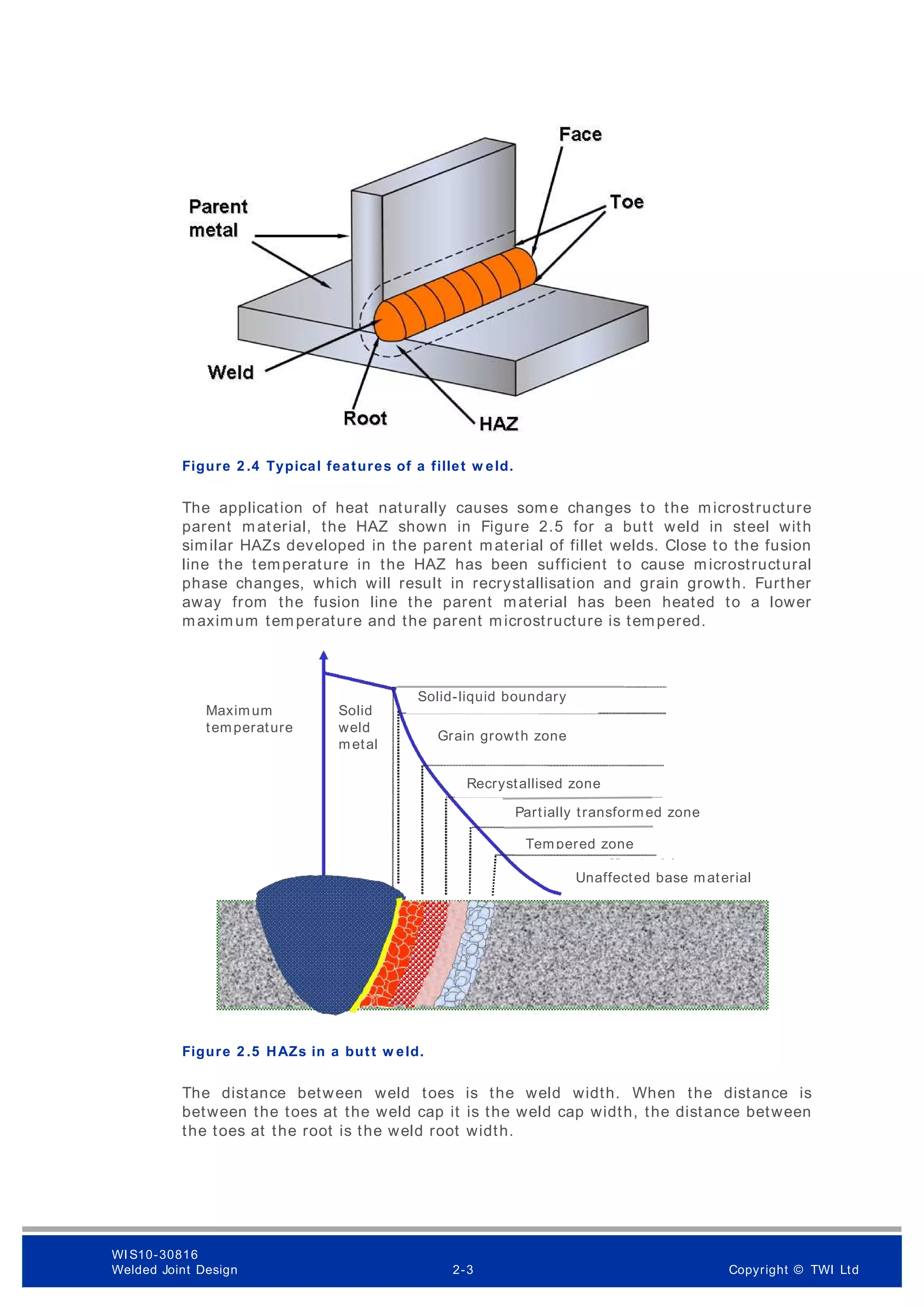
The application of heat naturally causes som e changes to the microstructure
parent material, the HAZ shown in Figure 2.5 for a butt weld in steel with
similar HAZs developed in the parent material of fillet welds. Close to the fusion
line the temperature in the HAZ has been sufficient to cause microstructural
phase changes, which will result in recrystallisation and grain growth. Further
away from the fusion line the parent material has been heated to a lower
maximum temperature and the parent microstructure is tempered.
Figure 2 .5 HAZs in a butt w eld.
The distance between weld toes is the weld width. When the distance is
between the toes at the weld cap it is the weld cap width, the distance between
the toes at the root is the weld root width.
Solid-liquid boundary
Maximum
temperature
Solid
weld
metal
Grain growth zone
Recrystallised zone
Partially transformed zone
Tempered zone
Unaffected base material
WI S10-30816
Welded Joint Design 2-3 Copyright © TWI Ltd
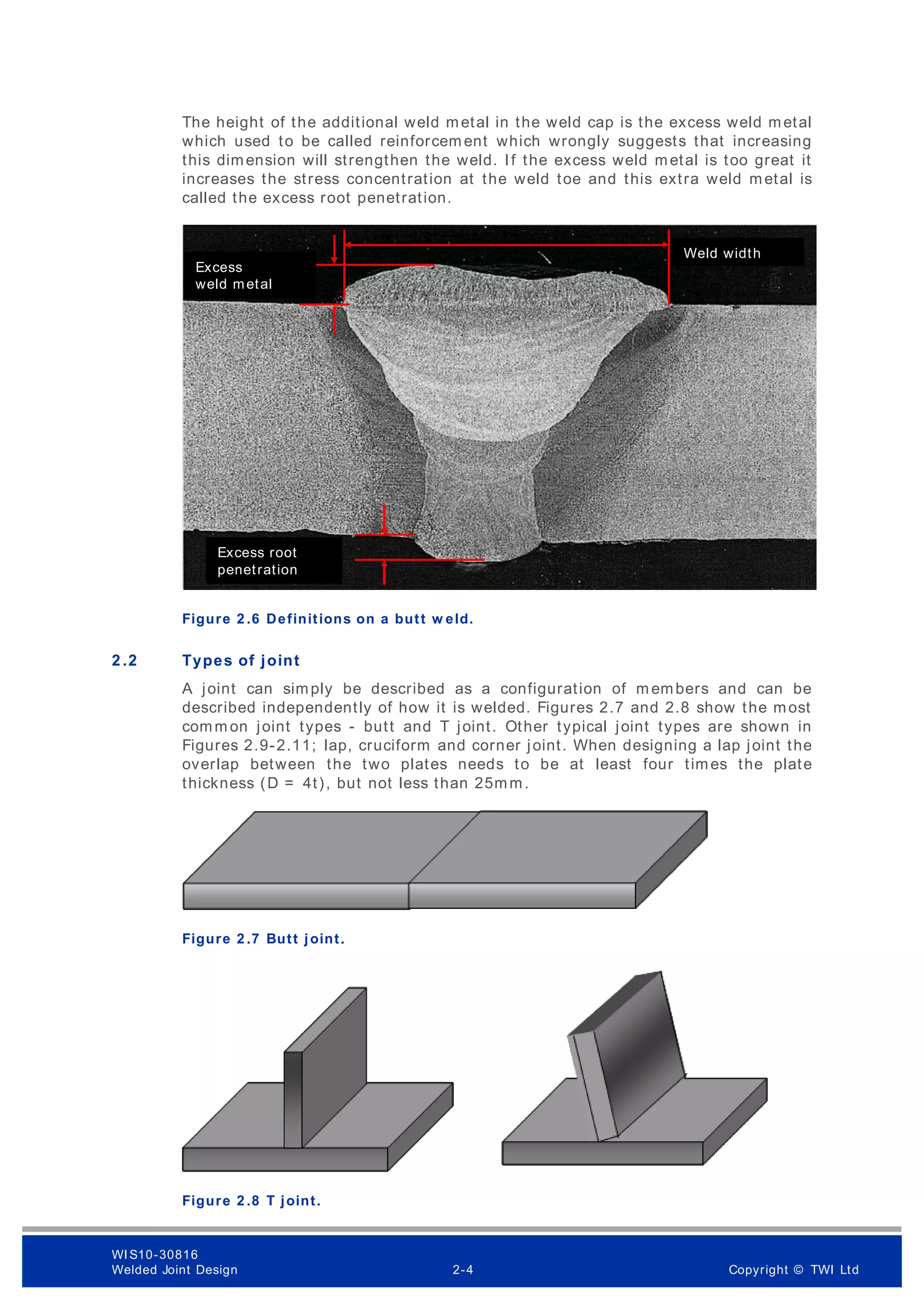
The height of the additional weld metal in the weld cap is the excess weld metal
which used to be called reinforcem ent which wrongly suggests that increasing
this dimension will strengthen the weld. If the excess weld metal is too great it
increases the stress concentration at the weld toe and this extra weld metal is
called the excess root penetration.
Figure 2 .6 Definitions on a butt w eld.
2 .2 Types of joint
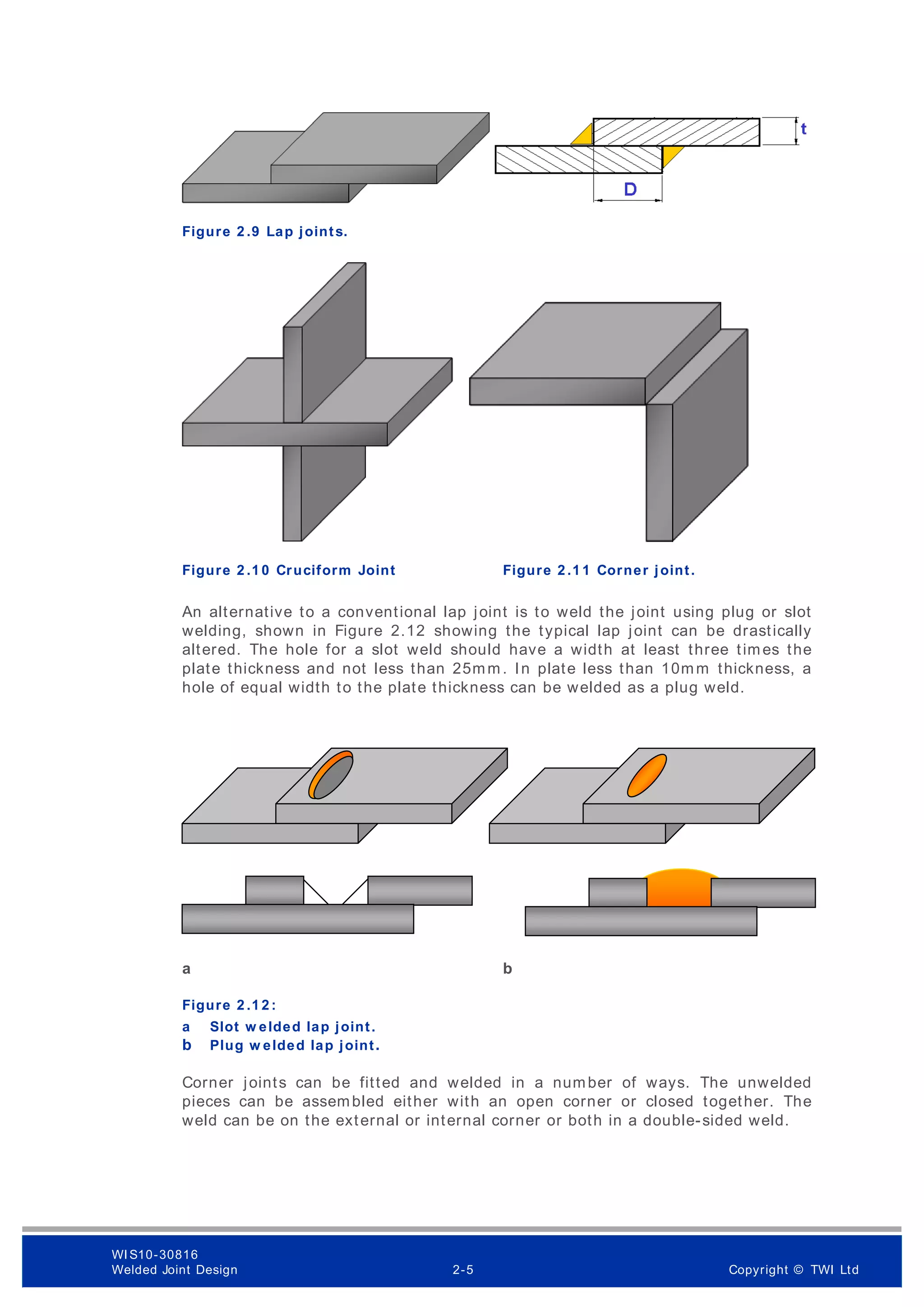
A joint can simply be described as a configuration of m embers and can be
described independently of how it is welded. Figures 2.7 and 2.8 show the most
comm on joint types - butt and T joint. Other typical joint types are shown in
Figures 2.9-2.11; lap, cruciform and corner joint. When designing a lap joint the
overlap between the two plates needs to be at least four times the plate
thickness (D = 4t), but not less than 25mm.
Figure 2 .7 Butt joint.
Figure 2 .8 T joint.
Excess
weld metal
Weld width
Excess root
penetration
WI S10-30816
Welded Joint Design 2-4 Copyright © TWI Ltd
Figure 2 .9 Lap joints.
Figure 2 .1 0 Cruciform Joint Figure 2 .1 1 Corner joint.
An alternative to a conventional lap joint is to weld the joint using plug or slot
welding, shown in Figure 2.12 showing the typical lap joint can be drastically
altered. The hole for a slot weld should have a width at least three times the
plate thickness and not less than 25mm. In plate less than 10mm thickness, a
hole of equal width to the plate thickness can be welded as a plug weld.
a b
Figure 2 .1 2 :
Slot w elded lap joint.
a
Plug w elded lap joint.
b
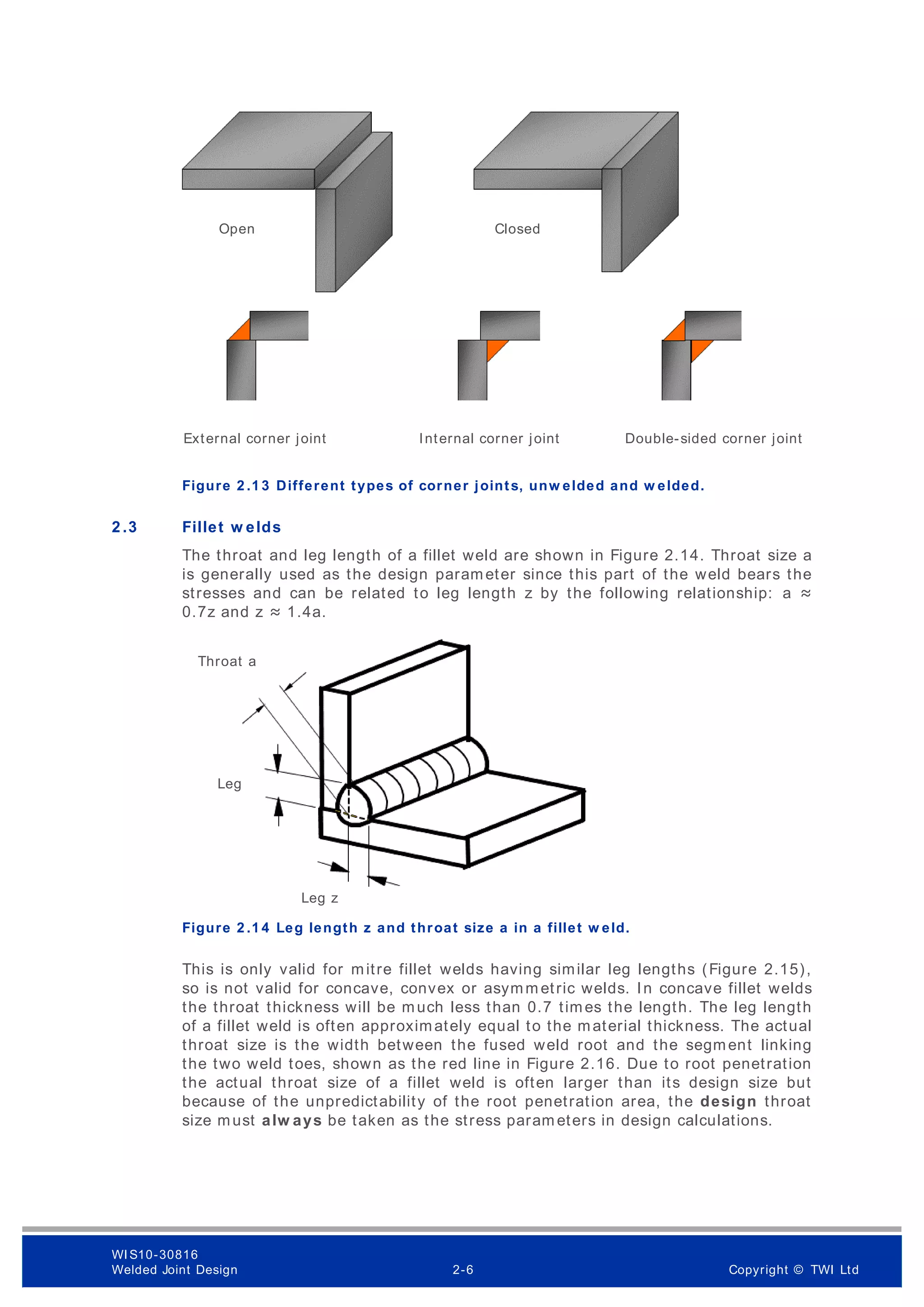
Corner joints can be fitted and welded in a number of ways. The unwelded
pieces can be assembled either with an open corner or closed together. The
weld can be on the external or internal corner or both in a double-sided weld.
WI S10-30816
Welded Joint Design 2-5 Copyright © TWI Ltd
Figure 2 .1 3 Different types of corner joints, unw elded and w elded.
2 .3 Fillet w elds
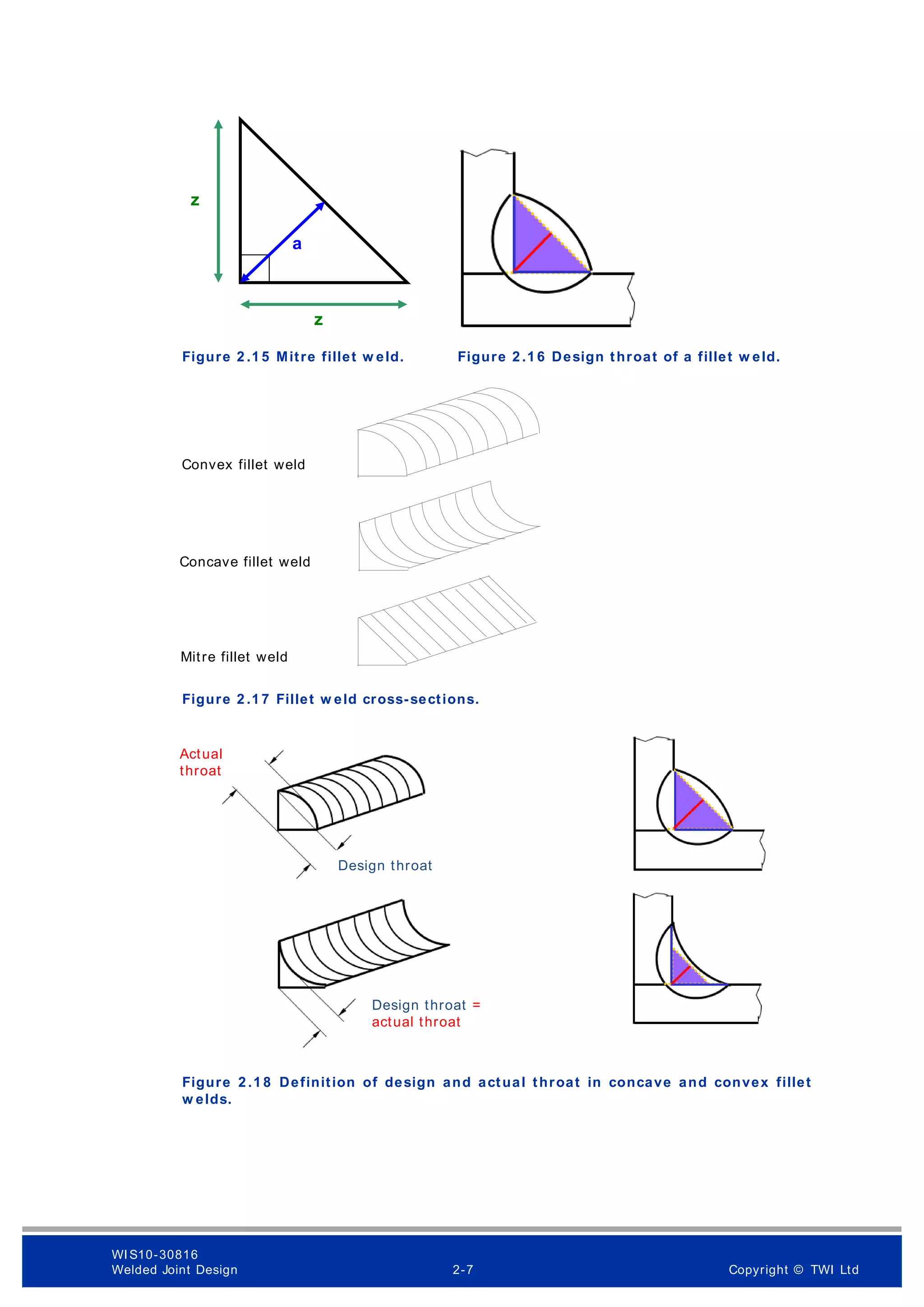
The throat and leg length of a fillet weld are shown in Figure 2.14. Throat size a
is generally used as the design parameter since this part of the weld bears the
stresses and can be related to leg length z by the following relationship: a ≈
0.7z and z ≈ 1.4a.
Figure 2 .1 4 Leg length z and throat size a in a fillet w eld.
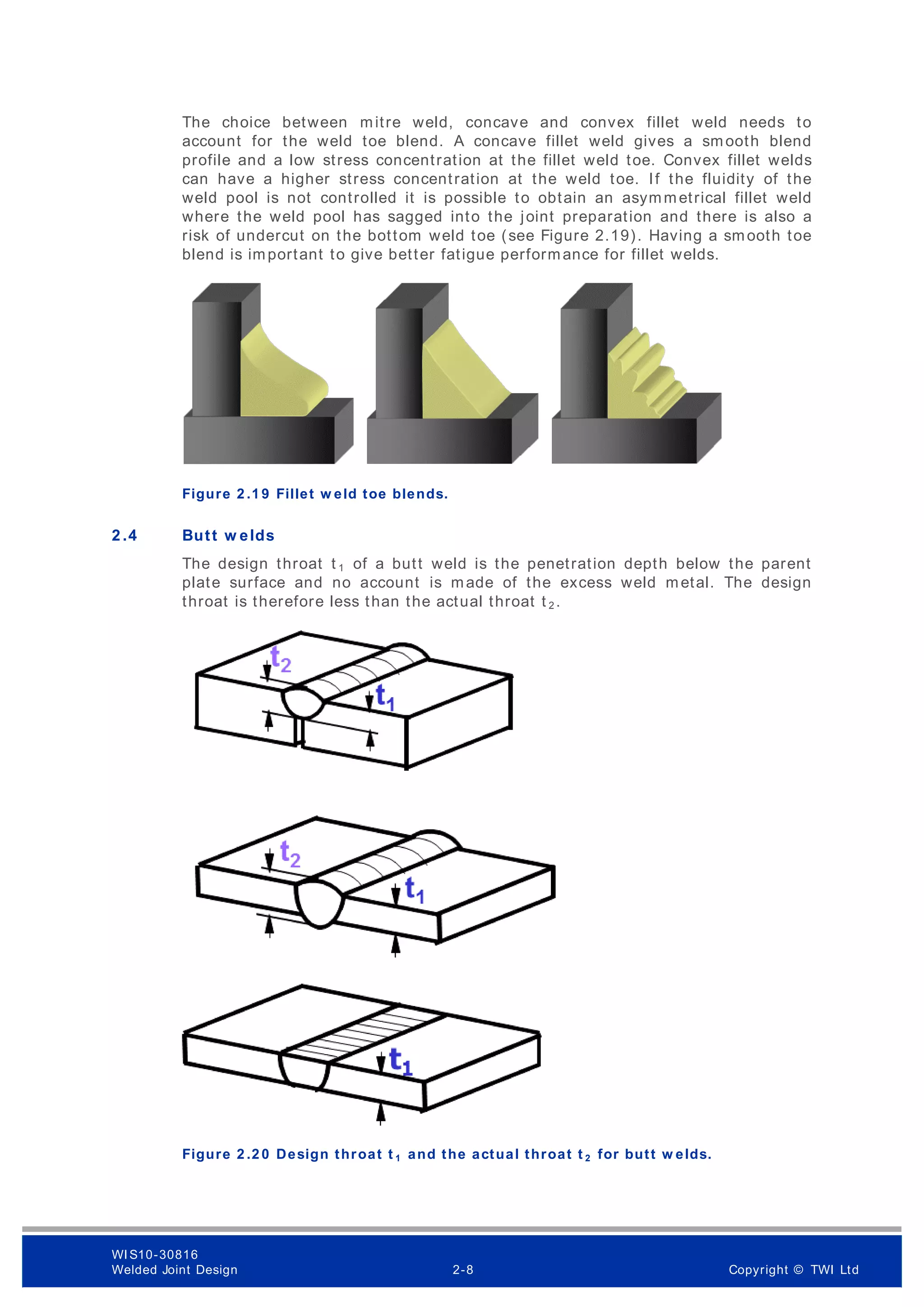
This is only valid for mitre fillet welds having similar leg lengths (Figure 2.15),
so is not valid for concave, convex or asymm etric welds. In concave fillet welds
the throat thickness will be much less than 0.7 times the length. The leg length
of a fillet weld is often approximately equal to the material thickness. The actual
throat size is the width between the fused weld root and the segment linking
the two weld toes, shown as the red line in Figure 2.16. Due to root penetration
the actual throat size of a fillet weld is often larger than its design size but
because of the unpredictability of the root penetration area, the design throat
size must alw ays be taken as the stress param eters in design calculations.
Open Closed
Double-sided corner joint
Internal corner joint
External corner joint
Throat a
Leg
Leg z
WI S10-30816
Welded Joint Design 2-6 Copyright © TWI Ltd
Figure 2 .1 5 Mitre fillet w eld. Figure 2 .1 6 Design throat of a fillet w eld.
Figure 2 .1 7 Fillet w eld cross-sections.
Figure 2 .1 8 Definition of design and actual throat in concave and convex fillet
w elds.
z
z
a
Convex fillet weld
Concave fillet weld
Mitre fillet weld
Actual
throat
Design throat
Design throat =
actual throat
WI S10-30816
Welded Joint Design 2-7 Copyright © TWI Ltd
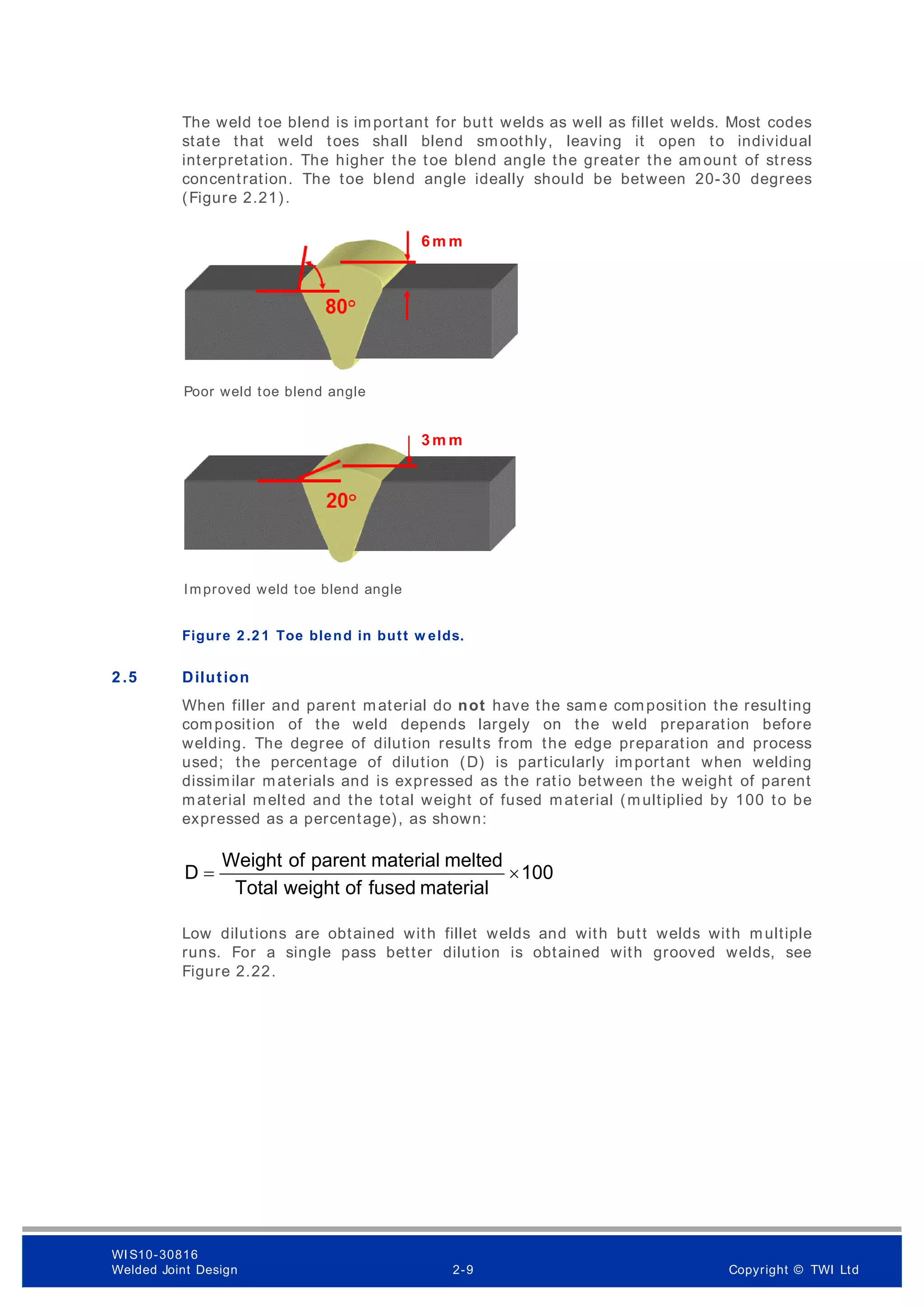
The choice between mitre weld, concave and convex fillet weld needs to
account for the weld toe blend. A concave fillet weld gives a smooth blend
profile and a low stress concentration at the fillet weld toe. Convex fillet welds
can have a higher stress concentration at the weld toe. If the fluidity of the
weld pool is not controlled it is possible to obtain an asymmetrical fillet weld
where the weld pool has sagged into the joint preparation and there is also a
risk of undercut on the bottom weld toe (see Figure 2.19). Having a smooth toe
blend is important to give better fatigue performance for fillet welds.
Figure 2 .1 9 Fillet w eld toe blends.
2 .4 Butt w elds
The design throat t 1 of a butt weld is the penetration depth below the parent
plate surface and no account is made of the excess weld metal. The design
throat is therefore less than the actual throat t 2 .
Figure 2 .2 0 Design throat t 1 and the actual throat t 2 for butt w elds.
WI S10-30816
Welded Joint Design 2-8 Copyright © TWI Ltd
The weld toe blend is important for butt welds as well as fillet welds. Most codes
state that weld toes shall blend smoothly, leaving it open to individual
interpretation. The higher the toe blend angle the greater the am ount of stress
concentration. The toe blend angle ideally should be between 20-30 degrees
(Figure 2.21).
Figure 2 .2 1 Toe blend in butt w elds.
2 .5 Dilution
When filler and parent material do not have the sam e composition the resulting
composition of the weld depends largely on the weld preparation before
welding. The degree of dilution results from the edge preparation and process
used; the percentage of dilution (D) is particularly important when welding
dissimilar materials and is expressed as the ratio between the weight of parent
material melted and the total weight of fused material (multiplied by 100 to be
expressed as a percentage), as shown:
100
material
fused
of
weight
Total
melted
material
parent
of
Weight
D ×
=
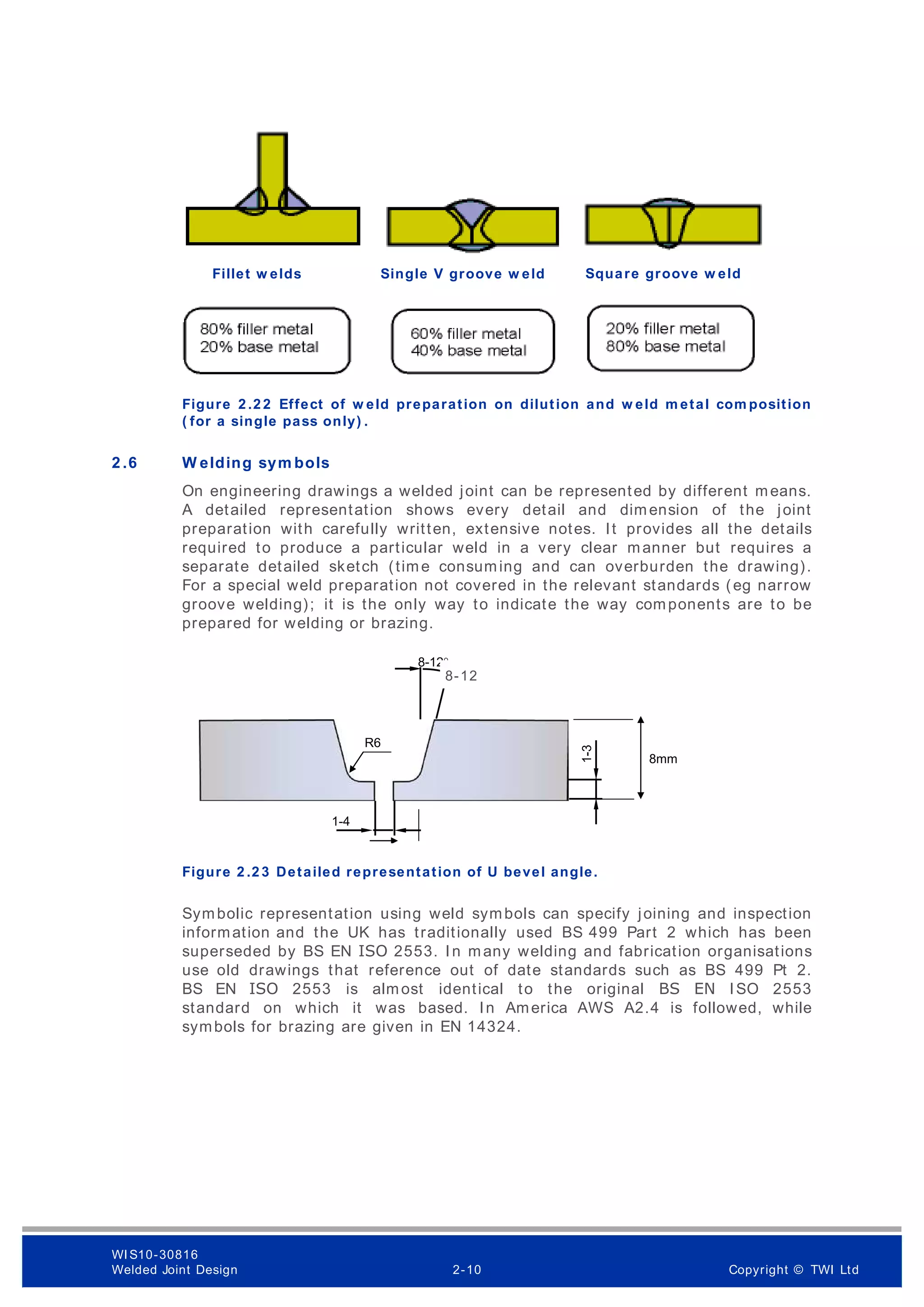
Low dilutions are obtained with fillet welds and with butt welds with multiple
runs. For a single pass better dilution is obtained with grooved welds, see
Figure 2.22.
Poor weld toe blend angle
Improved weld toe blend angle
6 m m
3 m m
WI S10-30816
Welded Joint Design 2-9 Copyright © TWI Ltd
Figure 2 .2 2 Effect of w eld preparation on dilution and w eld m etal com position
( for a single pass only) .
2 .6 W elding sym bols
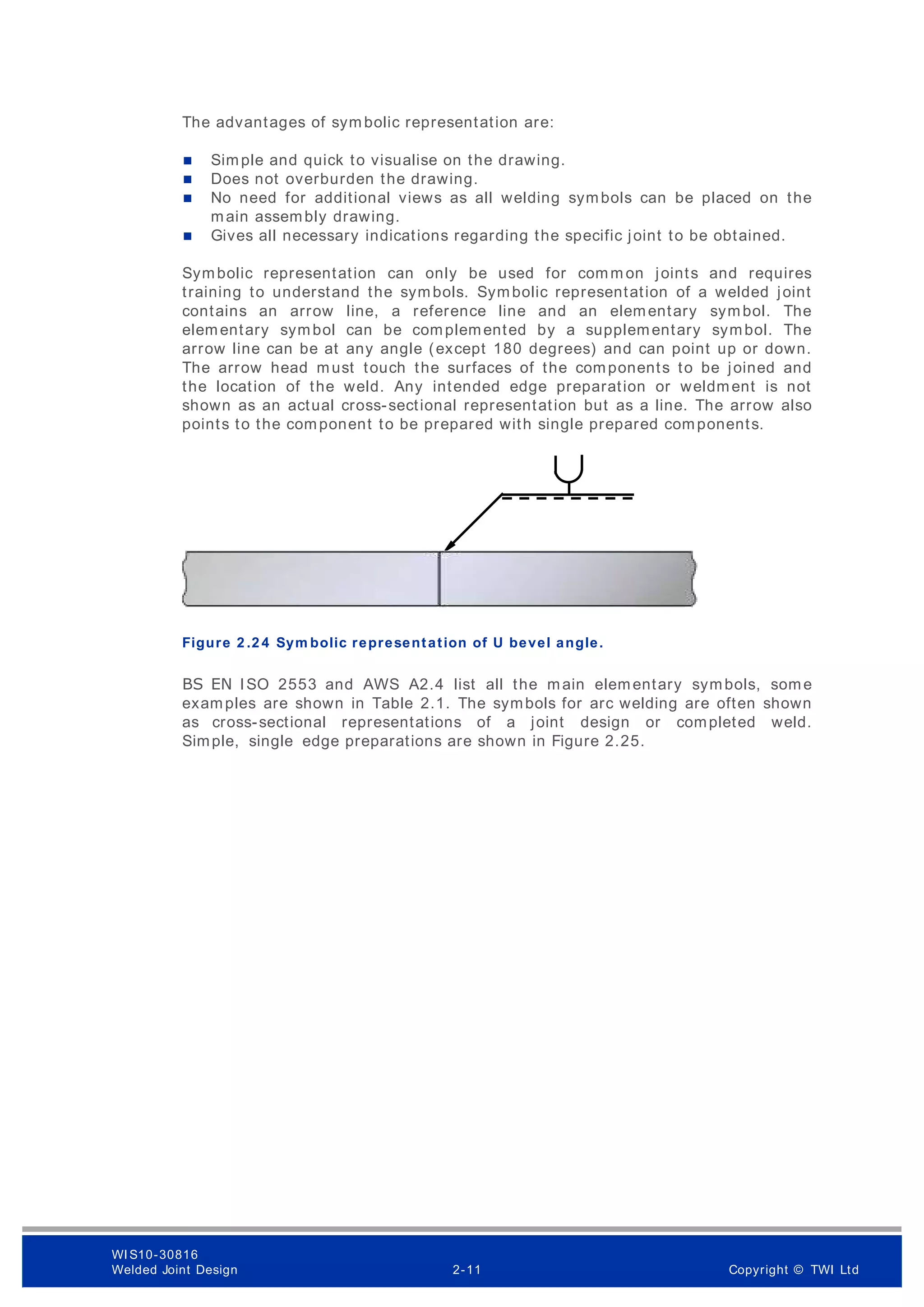
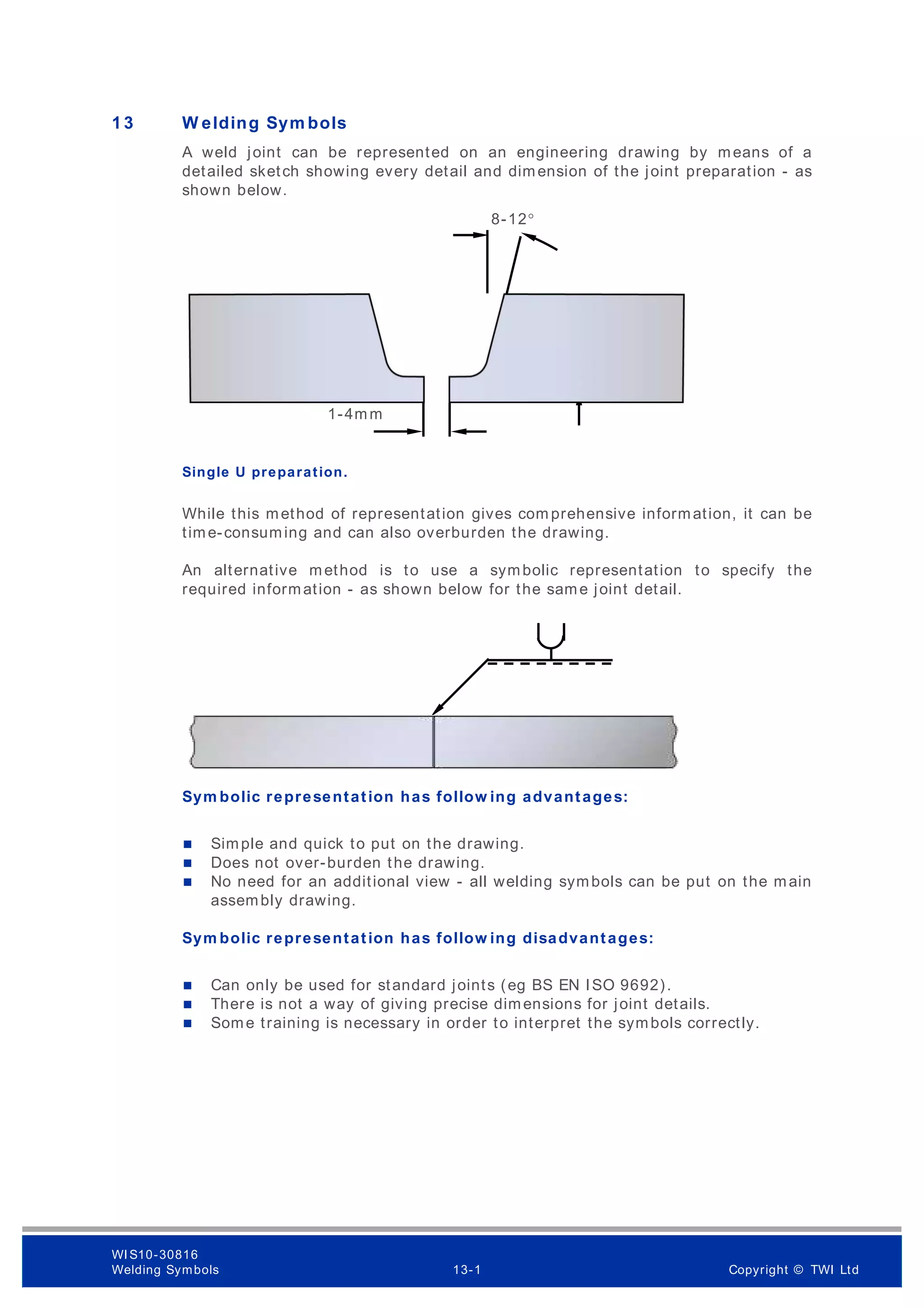
On engineering drawings a welded joint can be represented by different means.
A detailed representation shows every detail and dimension of the joint
preparation with carefully written, extensive notes. It provides all the details
required to produce a particular weld in a very clear manner but requires a
separate detailed sketch (time consuming and can overburden the drawing).
For a special weld preparation not covered in the relevant standards (eg narrow
groove welding); it is the only way to indicate the way components are to be
prepared for welding or brazing.
Figure 2 .2 3 Detailed representation of U bevel angle.
Symbolic representation using weld symbols can specify joining and inspection
information and the UK has traditionally used BS 499 Part 2 which has been
superseded by BS EN ISO 2553. In many welding and fabrication organisations
use old drawings that reference out of date standards such as BS 499 Pt 2.
BS EN ISO 2553 is almost identical to the original BS EN ISO 2553
standard on which it was based. In America AWS A2.4 is followed, while
symbols for brazing are given in EN 14324.
8-12°
≈R6
1-3
1-4
R6
8mm
8-12
Fillet w elds Single V groove w eld Square groove w eld
WI S10-30816
Welded Joint Design 2-10 Copyright © TWI Ltd
The advantages of sym bolic representation are:
 Simple and quick to visualise on the drawing.
 Does not overburden the drawing.
 No need for additional views as all welding symbols can be placed on the
main assembly drawing.
 Gives all necessary indications regarding the specific joint to be obtained.
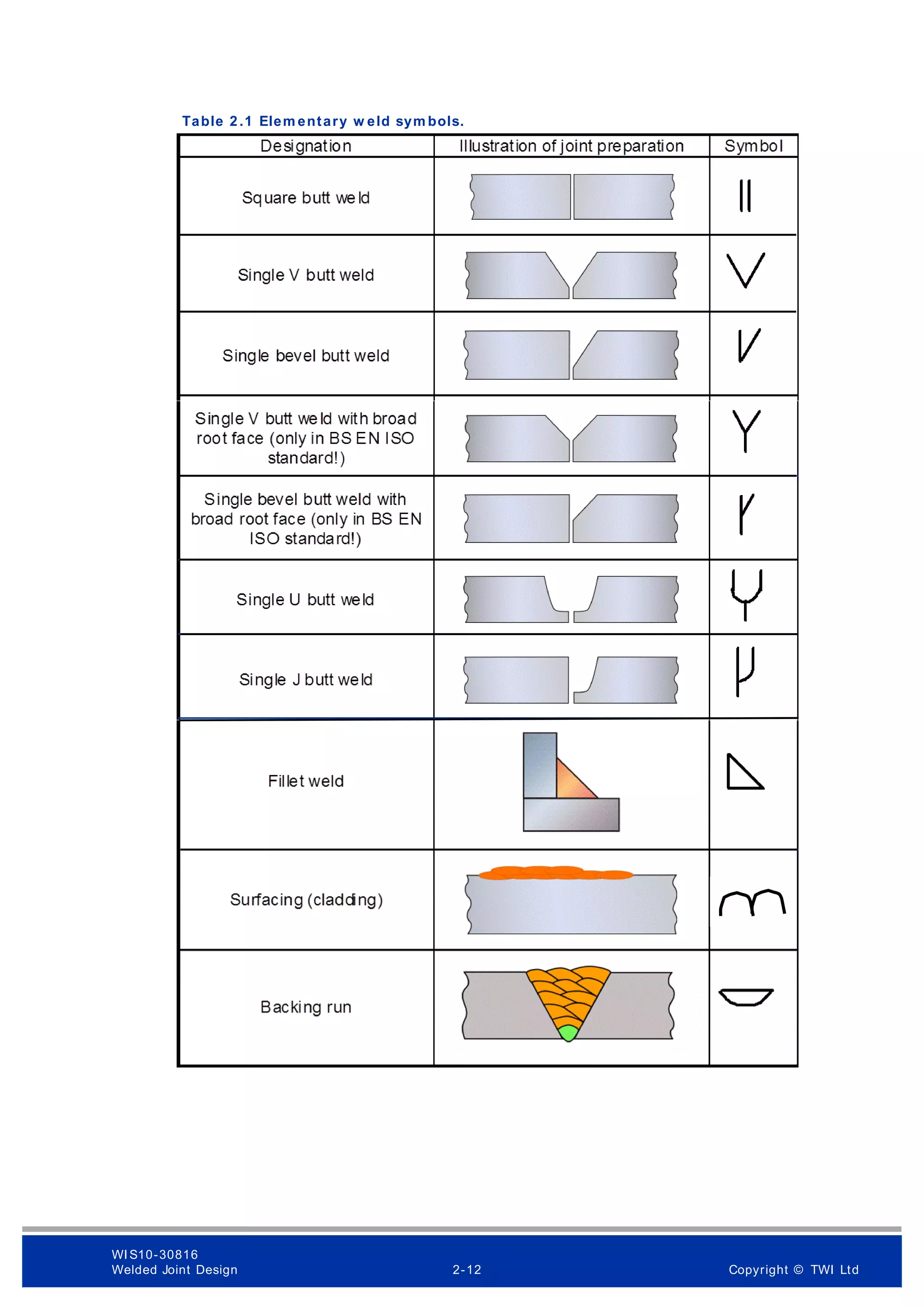
Symbolic representation can only be used for comm on joints and requires
training to understand the symbols. Symbolic representation of a welded joint
contains an arrow line, a reference line and an elementary symbol. The
elementary symbol can be complemented by a supplementary symbol. The
arrow line can be at any angle (except 180 degrees) and can point up or down.
The arrow head must touch the surfaces of the components to be joined and
the location of the weld. Any intended edge preparation or weldment is not
shown as an actual cross-sectional representation but as a line. The arrow also
points to the component to be prepared with single prepared components.
Figure 2 .2 4 Sym bolic representation of U bevel angle.
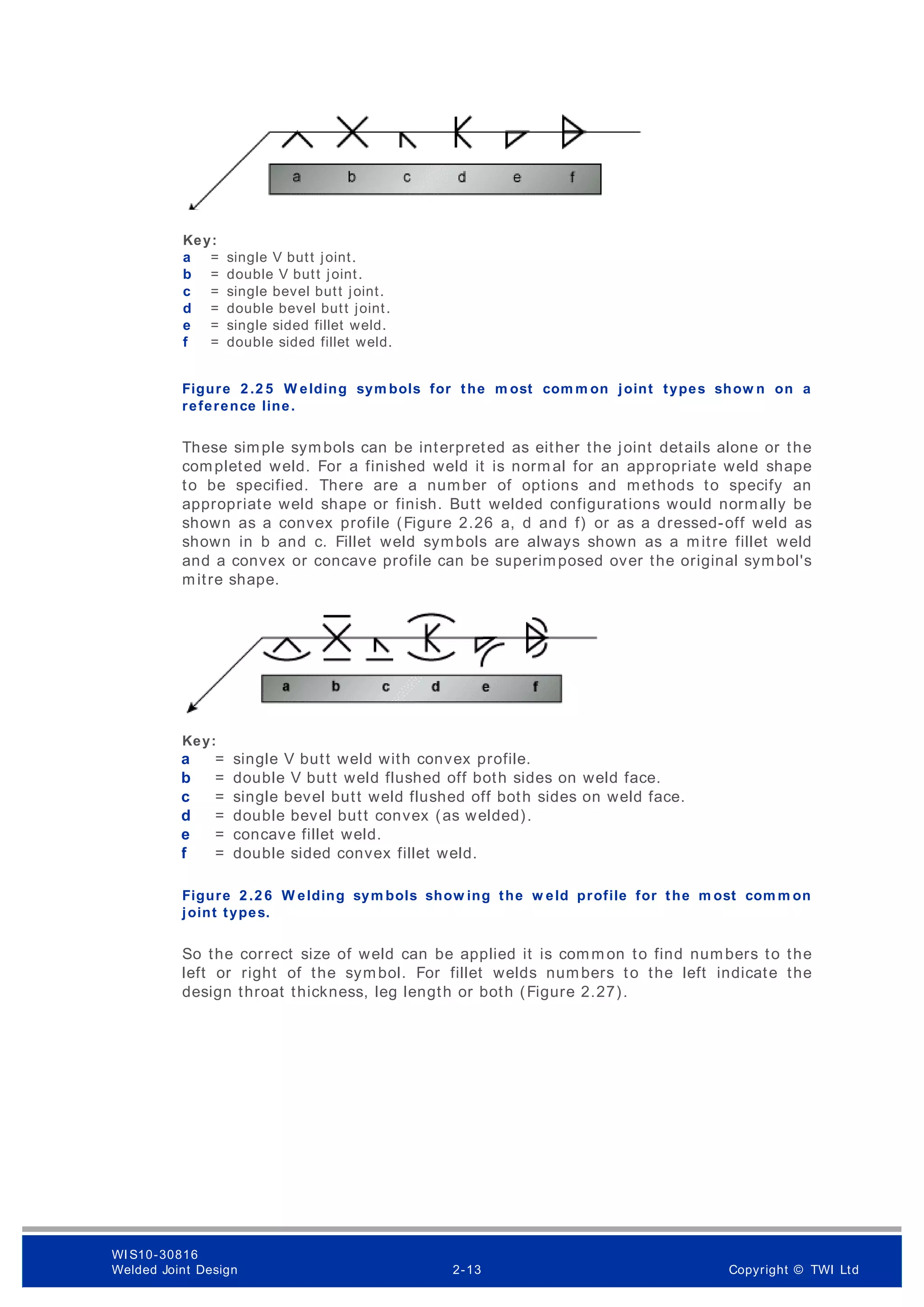
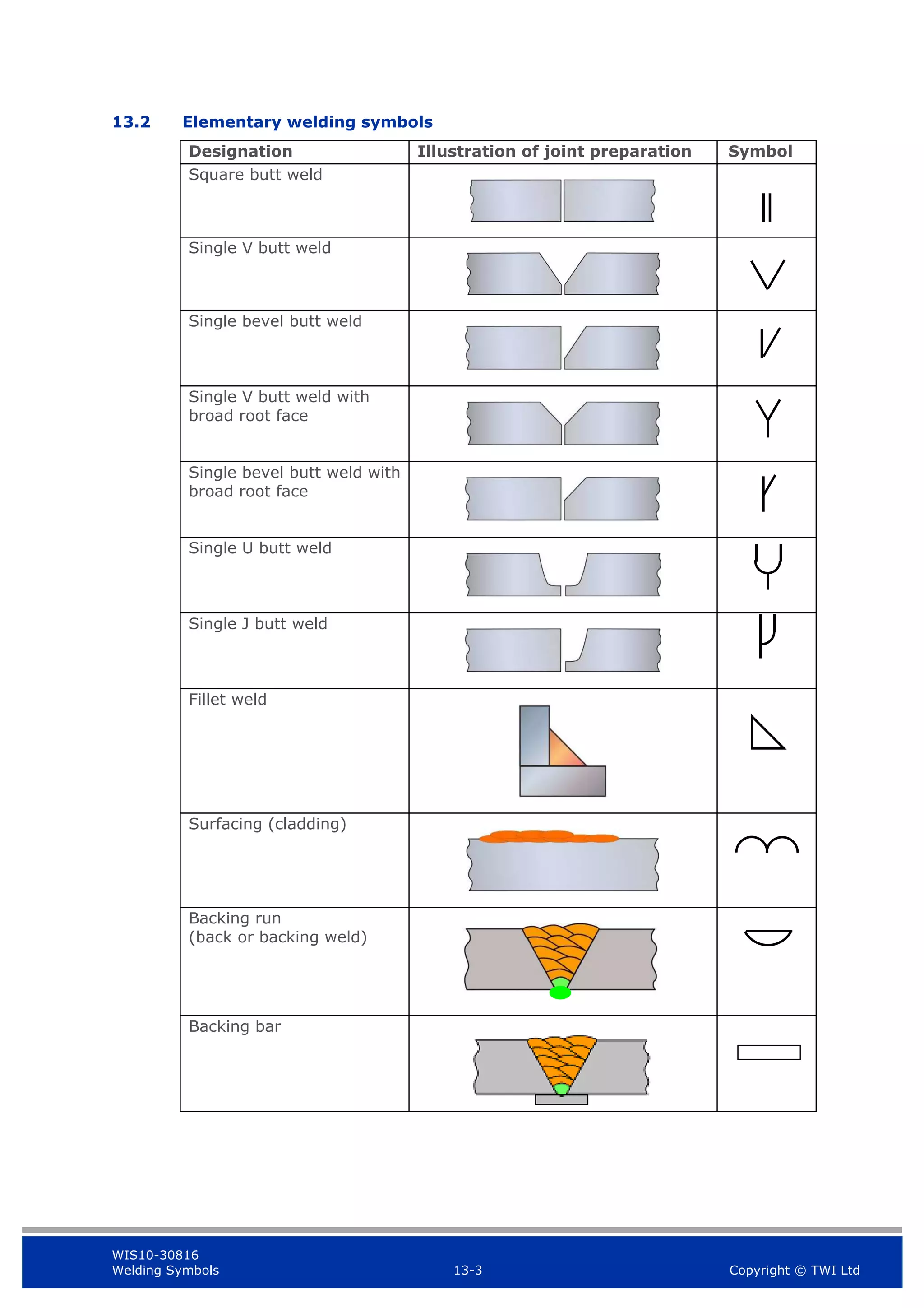
BS EN ISO 2553 and AWS A2.4 list all the main elementary symbols, some
examples are shown in Table 2.1. The symbols for arc welding are often shown
as cross-sectional representations of a joint design or completed weld.
Simple, single edge preparations are shown in Figure 2.25.
WI S10-30816
Welded Joint Design 2-11 Copyright © TWI Ltd
Table 2 .1 Elem entary w eld sym bols.
WI S10-30816
Welded Joint Design 2-12 Copyright © TWI Ltd
Figure 2 .2 5 W elding sym bols for the m ost com m on joint types show n on a
reference line.
These simple symbols can be interpreted as either the joint details alone or the
completed weld. For a finished weld it is norm al for an appropriate weld shape
to be specified. There are a number of options and methods to specify an
appropriate weld shape or finish. Butt welded configurations would normally be
shown as a convex profile (Figure 2.26 a, d and f) or as a dressed-off weld as
shown in b and c. Fillet weld symbols are always shown as a mitre fillet weld
and a convex or concave profile can be superimposed over the original symbol's
mitre shape.
Figure 2 .2 6 W elding sym bols show ing the w eld profile for the m ost com m on
joint types.
So the correct size of weld can be applied it is comm on to find numbers to the
left or right of the symbol. For fillet welds numbers to the left indicate the
design throat thickness, leg length or both (Figure 2.27).
Key:
= single V butt joint.
a
= double V butt joint.
b
= single bevel butt joint.
c
= double bevel butt joint.
d
= single sided fillet weld.
e
= double sided fillet weld.
f
Key:
a = single V butt weld with convex profile.
b = double V butt weld flushed off both sides on weld face.
c = single bevel butt weld flushed off both sides on weld face.
d = double bevel butt convex (as welded).
e = concave fillet weld.
f = double sided convex fillet weld.
WI S10-30816
Welded Joint Design 2-13 Copyright © TWI Ltd
Figure 2 .2 7 Throat and leg length dim ensions given on the w eld sym bol for a
fillet w eld.
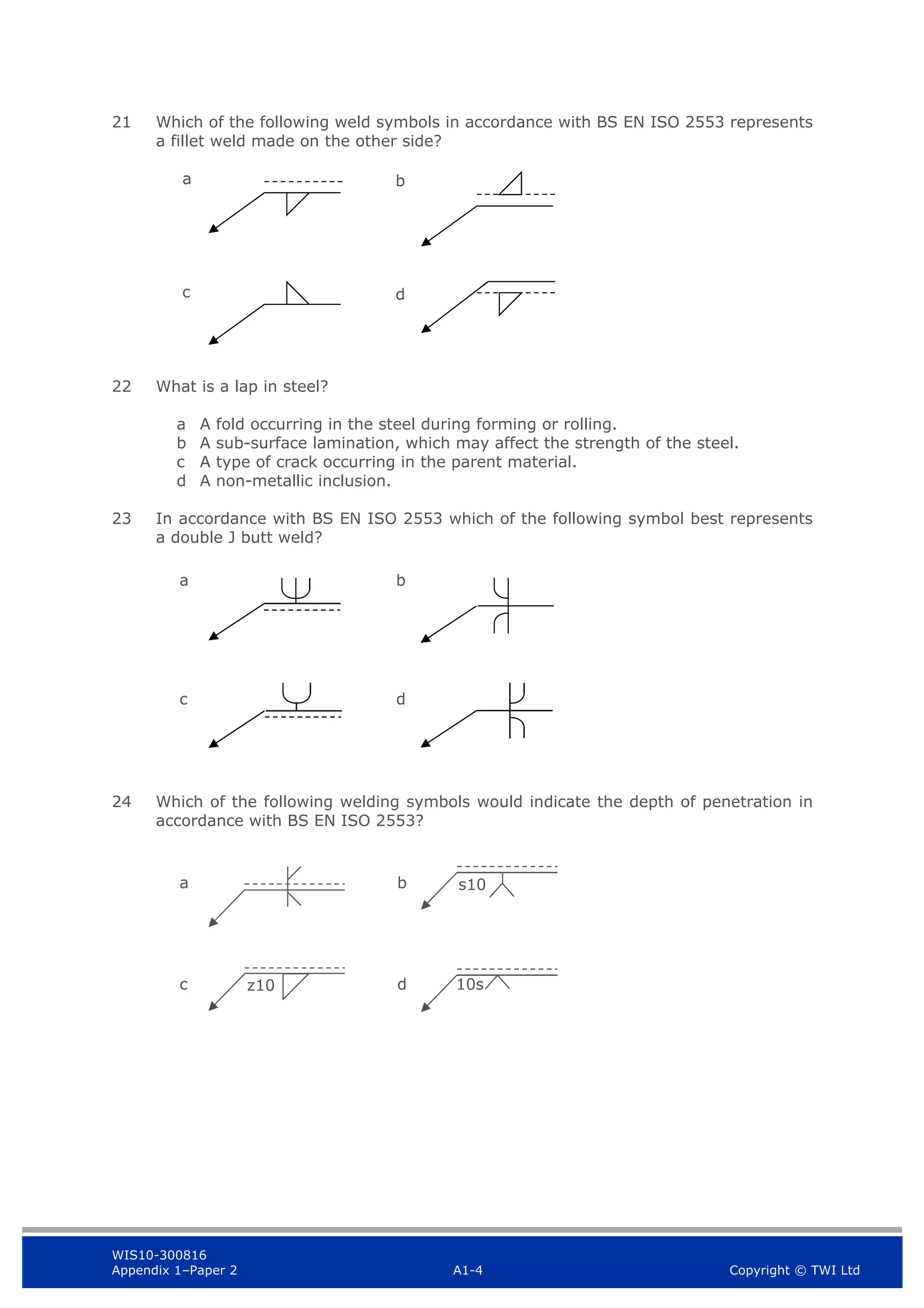
For butt joints and welds an S with a number to the left of a symbol refers to
the depth of penetration. When there are no specific dimensional requirements
specified for butt welds on a drawing using weld symbols, it would normally be
assumed that the requirem ent is for a full penetration butt weld. Numbers to
the right of a symbol or symbols relate to the longitudinal dimension of welds,
eg for fillets the number of welds, weld length and weld spacing for non-
continuous welds.
Figure 2 .2 8 W eld sym bols show ing the w eld length dim ensions to the right of
the w eld joint sym bols for an interm ittent fillet w eld.
Supplementary symbols can be used for special cases where additional
information is required (Figure 2.29). The weld all round symbols may be used
for a rectangular hollow section (RHS) welded to a plate, for example. The flag
symbol for weld in the field or on site can be added to any standard symbol. A
box attached to the tail of the arrow can contain or point to other information
such as whether NDT is required. This information is sometimes the welding
process type given as a three number reference from BS EN ISO 4063, for
example 135 refers to MAG welding.
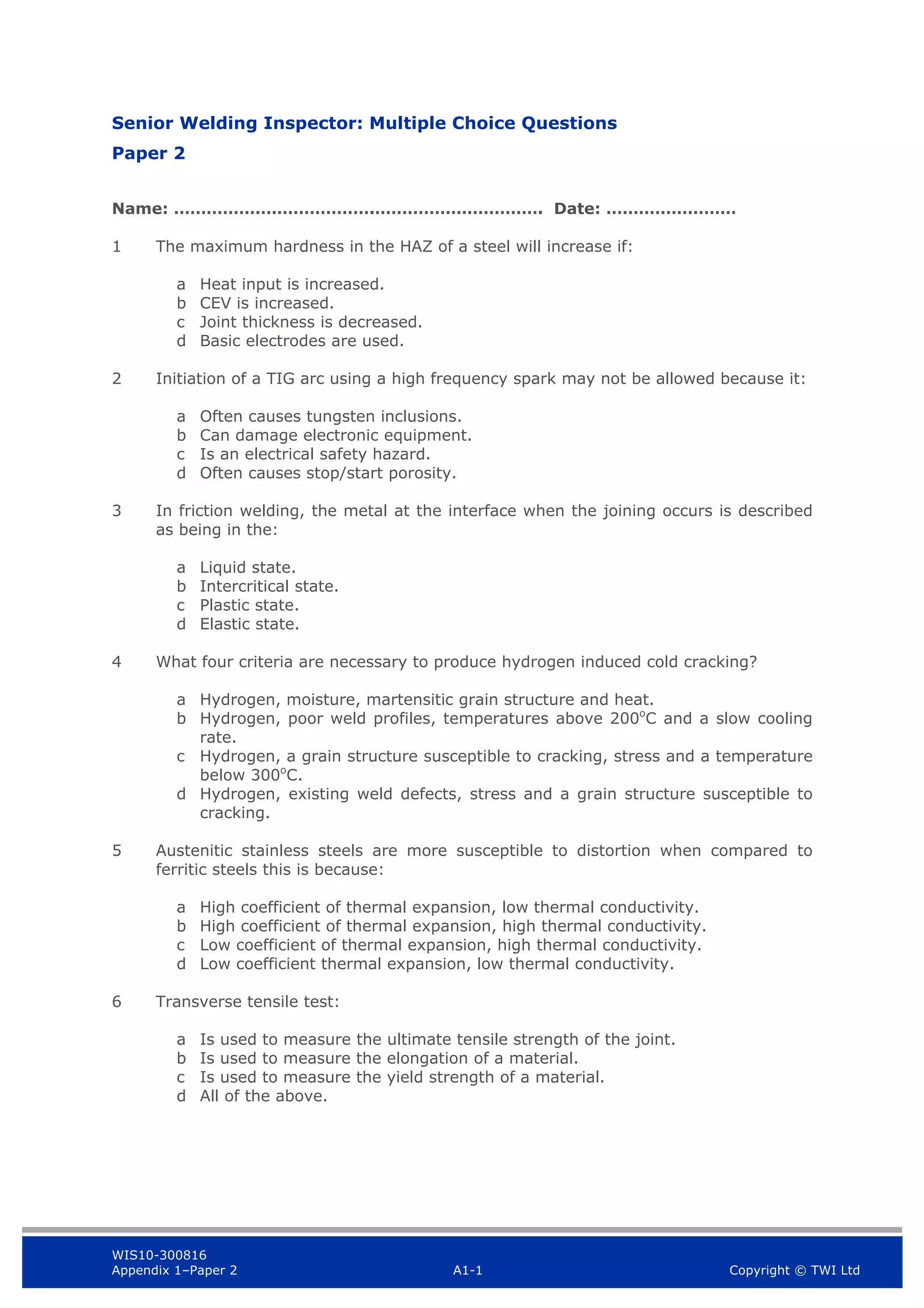
a7 z 10
a7 z 10
WI S10-30816
Welded Joint Design 2-14 Copyright © TWI Ltd
Figure 2 .2 9 Exam ples of supplem entary sym bols.
2 .7 W elding positions
In weld procedure documents and engineering drawings the type and
orientation of welds are often given a two letter abbreviation which defines
them which can vary depending on the standard the welds are conforming to.
The abbreviations here are consistent with BS EN ISO 6947 and are
summarised in Table 2.2.
WI S10-30816
Welded Joint Design 2-15 Copyright © TWI Ltd
Table 2 .2 W elding positions.
Welding position Figure/ symbol Abbreviation
Flat PA
Horizontal PB
Horizontal vertical PC
WI S10-30816
Welded Joint Design 2-16 Copyright © TWI Ltd
Welding position Figure/ symbol Abbreviation
Vertical up,
vertical down
PG/ PF
Overhead PE
Horizontal
overhead
PD
2 .8 W eld joint preparations
The simplest weld joint preparation is a square edged butt joint, either closed or
open. A closed butt joint is used in thick plate for keyhole welding processes
such as laser or electron beam welding (EBW). A square edged open butt joint
is used for thinner plate up to 3mm thickness for arc welding in a single pass or
in thick plate for welding processes such as electroslag welding.
Figure 2 .3 0 Square edge butt joints.
Square edge
closed butt
Square edge
open butt
WI S10-30816
Welded Joint Design 2-17 Copyright © TWI Ltd
It is normal to use a bevel on the edges of the parent metal to be welded to
allow access to the root for the first welding pass which is filled using fill passes.
Single-sided preparations are normally made on thinner materials or when
access from both sides is restricted. Double-sided preparations are normally
made on thicker materials or when access from both sides is unrestricted.
Edge preparation design includes the bevel angle (or included angle if both
sides are bevelled) and also the square edges root face and root gap. In a joint
where both sides are bevelled the preparation is termed a V or vee preparation
(Figure 2.31). V preparations are usually used for plate of 3-20mm thickness.
An alternative is a U preparation (or J preparation if only one side has the edge
preparation) where the edge is machined into the shape of a U. This is used in
thicker plate, over 20mm thickness, where it uses less filler metal than a V
preparation joint. J or U edge preparations also require a bevel angle and root
face, the gap to be defined, a root radius and land to be specified (Figure 2.32).
Single-sided edge preparations are often used for thinner materials or when
there is no access to the root of the weld (pipelines). If there is access to both
sides of the material then a double-sided edge preparation is used, especially
for thicker materials. Single and double edge preparations are shown in Figure
2.33.
Figure 2 .3 1 Single V bevel.
Figure 2 .3 2 U bevel.
Bevel angle
Included angle
Root face
Gap
Included angle
Bevel
angle
Gap
Root radius
Land
Root
face
WI S10-30816
Welded Joint Design 2-18 Copyright © TWI Ltd
Figure 2 .3 3 Range of single and double-sided bevel, V, J and U preparations.
2 .9 Designing w elded joints
Weld joint design selection will also be influenced by practical issues such as the
welding process used and the access required to obtain root fusion. The bevel
angle must allow good access to the root and sufficient manipulation of the
electrode to ensure good sidewall fusion (Figure 2.34). If the included angle is
too large then heavy distortions can result and more filler metal is required. If
the included angle is too small there is a risk of lack of penetration or lack of
sidewall fusion. Typical bevel angles are 30-35 degrees in a V preparation (60-
70 degrees included angle). In a single bevel joint the bevel angle might be
increased to 45 degrees.
Figure 2 .3 4 Bevel angle to allow electrode m anipulation for sidew all fusion.
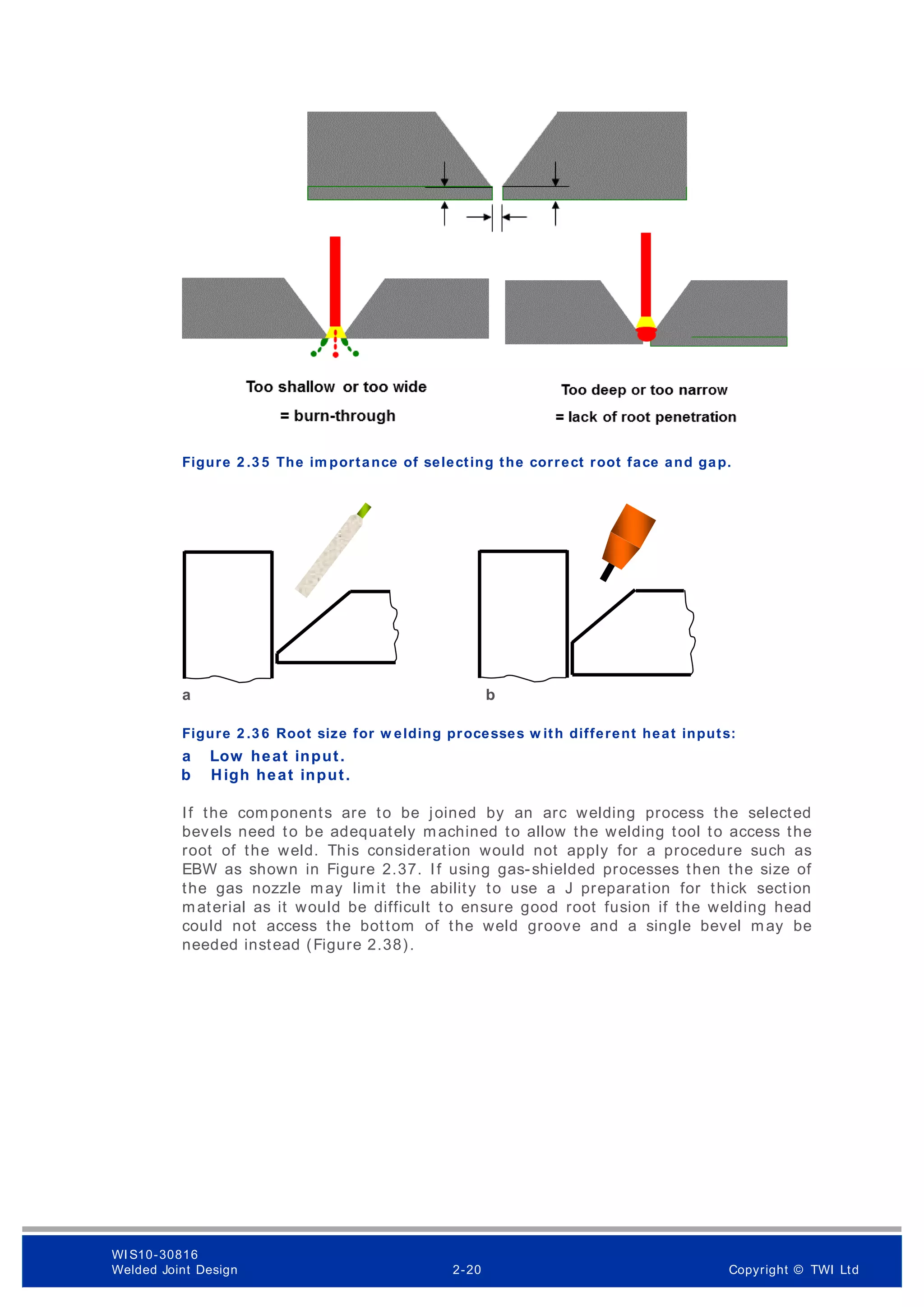
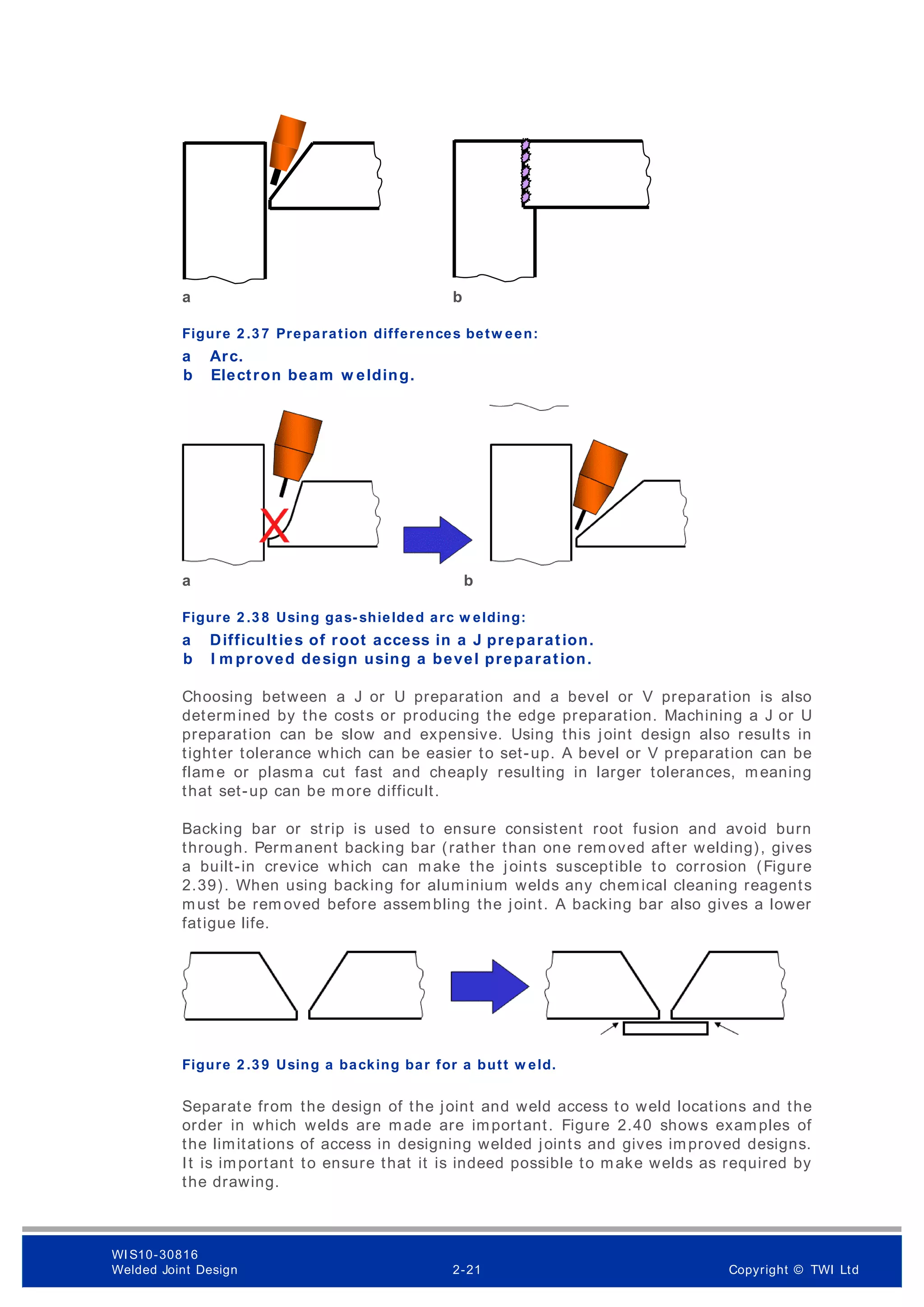
The root gap and face are selected to ensure good root fusion (Figure 2.35).
This will depend on the welding process and heat input. If the root gap is too
wide or root face too narrow there is a risk of burn through. If the root gap is
too narrow or root face is too deep there is a risk of lack of root penetration. A
balance must be found and designed for; this difference in weld root size is
shown in Figure 2.36. High heat input processes require a larger root face but
less weld metal which reduces distortions and increases productivity. Typical
values for the root face are 1.5-2.5mm and the root gap 2-4mm.
Single V Double V
Double Bevel
Single Bevel
Single J Single U Double J Double U
WI S10-30816
Welded Joint Design 2-19 Copyright © TWI Ltd
Figure 2 .3 5 The im portance of selecting the correct root face and gap.
a b
Figure 2 .3 6 Root size for w elding processes w ith different heat inputs:
Low heat input.
a
High heat input.
b
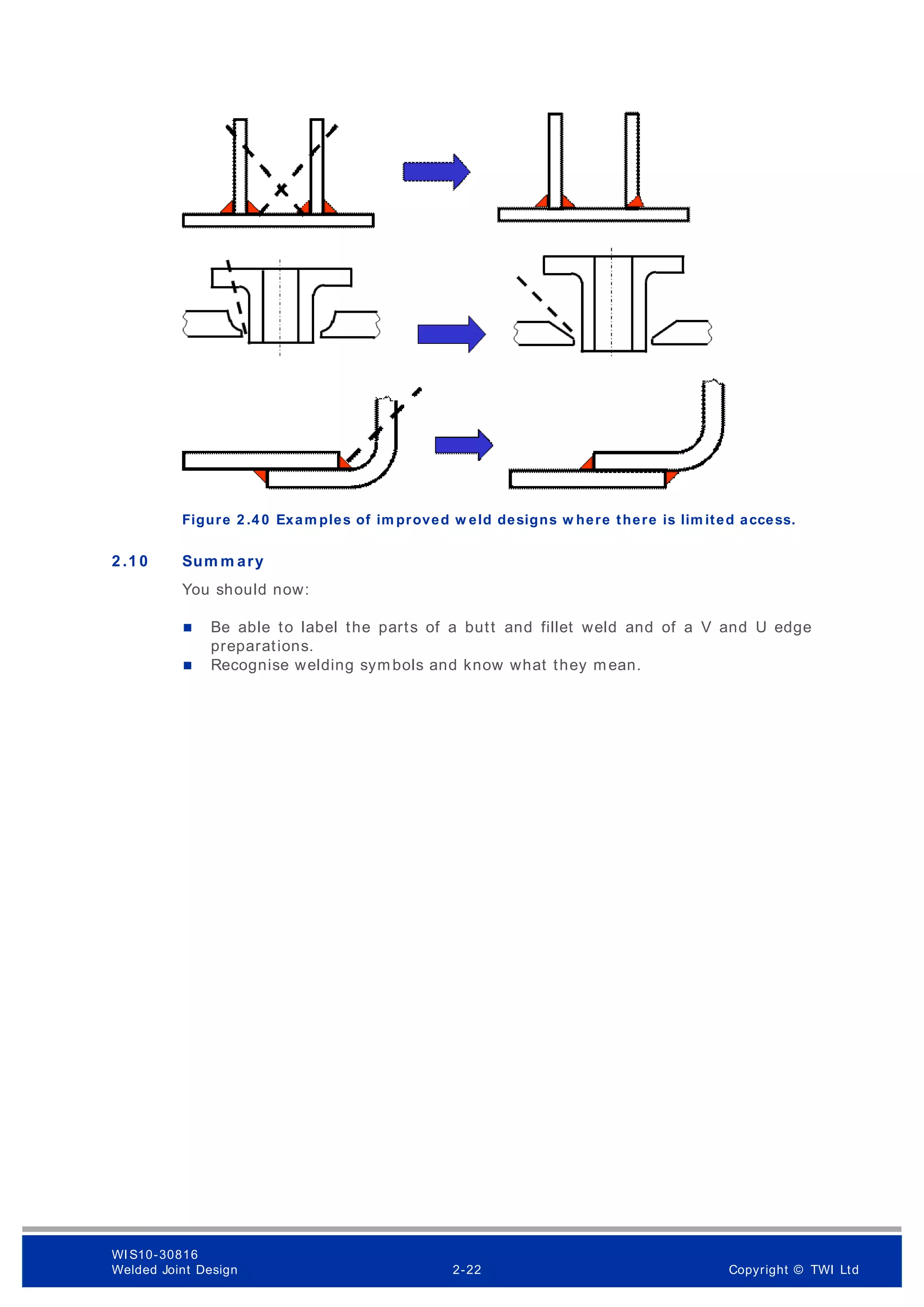
If the components are to be joined by an arc welding process the selected
bevels need to be adequately machined to allow the welding tool to access the
root of the weld. This consideration would not apply for a procedure such as
EBW as shown in Figure 2.37. If using gas-shielded processes then the size of
the gas nozzle may limit the ability to use a J preparation for thick section
material as it would be difficult to ensure good root fusion if the welding head
could not access the bottom of the weld groove and a single bevel may be
needed instead (Figure 2.38).
WI S10-30816
Welded Joint Design 2-20 Copyright © TWI Ltd
a b
Figure 2 .3 7 Preparation differences betw een:
Arc.
a
Electron beam w elding.
b
a b
Figure 2 .3 8 Using gas- shielded arc w elding:
Difficulties of root access in a J preparation.
a
I m proved design using a bevel preparation.
b
Choosing between a J or U preparation and a bevel or V preparation is also
determined by the costs or producing the edge preparation. Machining a J or U
preparation can be slow and expensive. Using this joint design also results in
tighter tolerance which can be easier to set-up. A bevel or V preparation can be
flame or plasma cut fast and cheaply resulting in larger tolerances, meaning
that set-up can be m ore difficult.
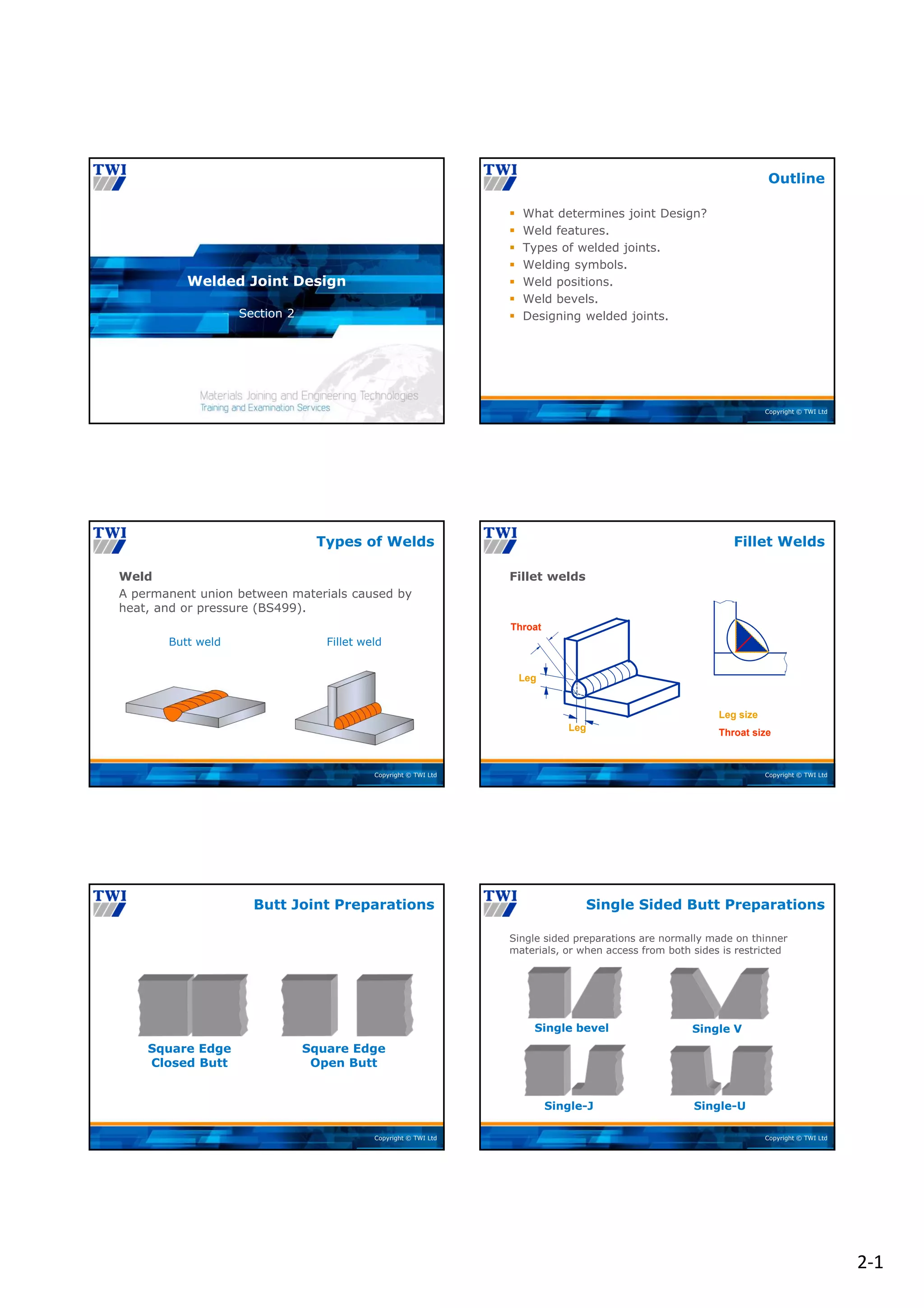
Backing bar or strip is used to ensure consistent root fusion and avoid burn
through. Permanent backing bar (rather than one rem oved after welding), gives
a built-in crevice which can make the joints susceptible to corrosion (Figure
2.39). When using backing for aluminium welds any chemical cleaning reagents
must be rem oved before assembling the joint. A backing bar also gives a lower
fatigue life.
Figure 2 .3 9 Using a backing bar for a butt w eld.
Separate from the design of the joint and weld access to weld locations and the
order in which welds are made are important. Figure 2.40 shows examples of
the limitations of access in designing welded joints and gives improved designs.
It is important to ensure that it is indeed possible to make welds as required by
the drawing.
WI S10-30816
Welded Joint Design 2-21 Copyright © TWI Ltd
Figure 2 .4 0 Exam ples of im proved w eld designs w here there is lim ited access.
2 .1 0 Sum m ary
You should now:
 Be able to label the parts of a butt and fillet weld and of a V and U edge
preparations.
 Recognise welding symbols and know what they mean.
WI S10-30816
Welded Joint Design 2-22 Copyright © TWI Ltd
2‐1
Copyright © TWI Ltd
Section 2
Welded Joint Design
Copyright © TWI Ltd
 What determines joint Design?
 Weld features.
 Types of welded joints.
 Welding symbols.
 Weld positions.
 Weld bevels.
 Designing welded joints.
Outline
Copyright © TWI Ltd
Weld
A permanent union between materials caused by
heat, and or pressure (BS499).
Types of Welds
Fillet weld
Butt weld
Copyright © TWI Ltd
Fillet welds
Fillet Welds
Leg size
Throat size
Leg
Leg
Throat
Copyright © TWI Ltd
Butt Joint Preparations
Square Edge
Closed Butt
Square Edge
Open Butt
Copyright © TWI Ltd
Single sided preparations are normally made on thinner
materials, or when access from both sides is restricted
Single Sided Butt Preparations
Single bevel Single V
Single-J Single-U
2‐2
Copyright © TWI Ltd
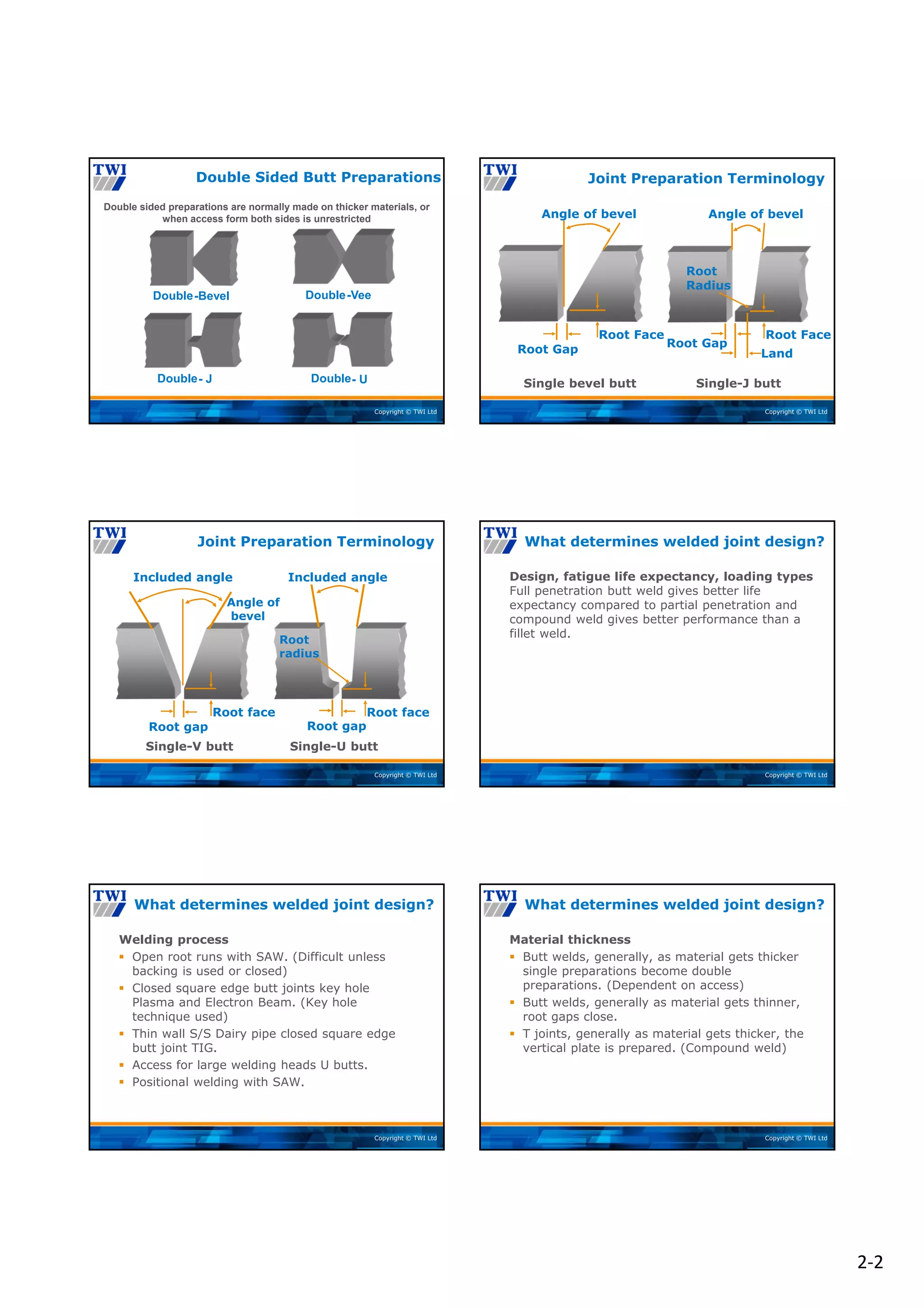
Double Sided Butt Preparations
Double sided preparations are normally made on thicker materials, or
when access form both sides is unrestricted
-Vee
Double
-Bevel
Double
- J
Double - U
Double
Copyright © TWI Ltd
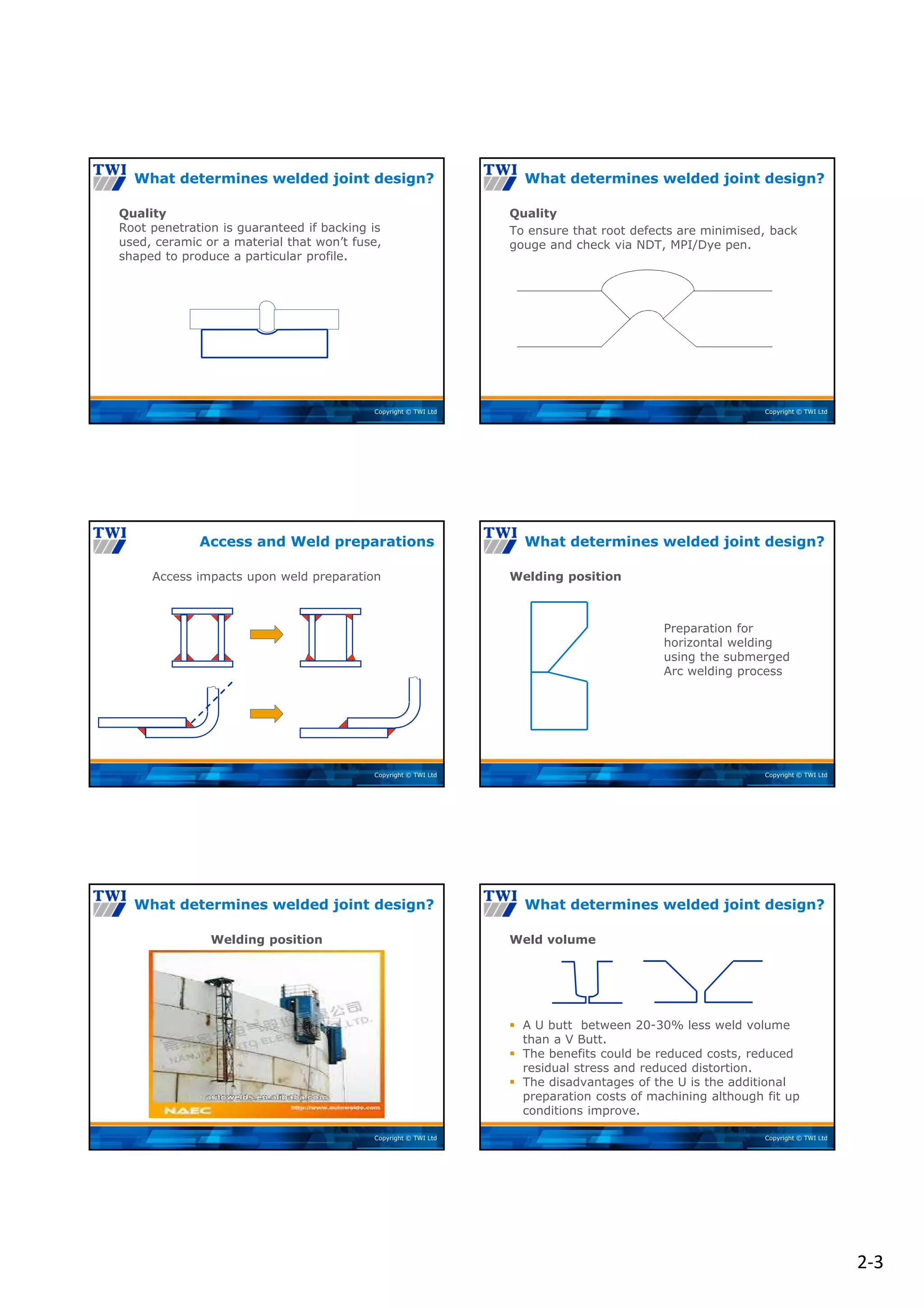
Joint Preparation Terminology
Root Gap
Root Face Root Face
Root Gap
Root
Radius
Single bevel butt Single-J butt
Angle of bevel Angle of bevel
Land
Copyright © TWI Ltd
Joint Preparation Terminology
Included angle
Root gap
Root face
Angle of
bevel
Root face
Root gap
Included angle
Root
radius
Single-V butt Single-U butt
Copyright © TWI Ltd
Design, fatigue life expectancy, loading types
Full penetration butt weld gives better life
expectancy compared to partial penetration and
compound weld gives better performance than a
fillet weld.
What determines welded joint design?
Copyright © TWI Ltd
Welding process
 Open root runs with SAW. (Difficult unless
backing is used or closed)
 Closed square edge butt joints key hole
Plasma and Electron Beam. (Key hole
technique used)
 Thin wall S/S Dairy pipe closed square edge
butt joint TIG.
 Access for large welding heads U butts.
 Positional welding with SAW.
What determines welded joint design?
Copyright © TWI Ltd
Material thickness
 Butt welds, generally, as material gets thicker
single preparations become double
preparations. (Dependent on access)
 Butt welds, generally as material gets thinner,
root gaps close.
 T joints, generally as material gets thicker, the
vertical plate is prepared. (Compound weld)
What determines welded joint design?
2‐3
Copyright © TWI Ltd
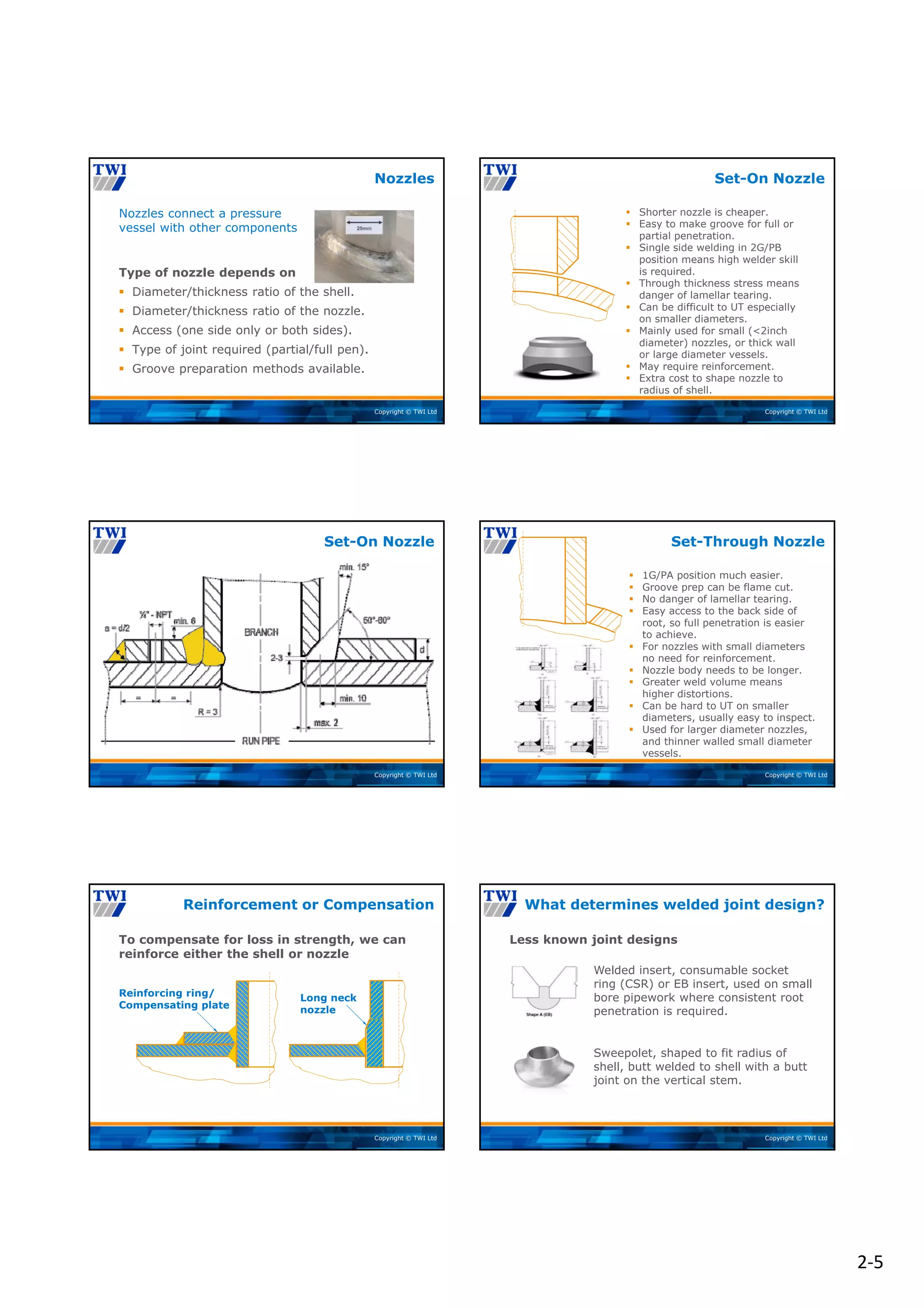
Quality
Root penetration is guaranteed if backing is
used, ceramic or a material that won’t fuse,
shaped to produce a particular profile.
What determines welded joint design?
Copyright © TWI Ltd
Quality
To ensure that root defects are minimised, back
gouge and check via NDT, MPI/Dye pen.
What determines welded joint design?
Copyright © TWI Ltd
Access impacts upon weld preparation
Access and Weld preparations
Copyright © TWI Ltd
Welding position
Preparation for
horizontal welding
using the submerged
Arc welding process
What determines welded joint design?
Copyright © TWI Ltd
Welding position
What determines welded joint design?
Copyright © TWI Ltd
Weld volume
 A U butt between 20-30% less weld volume
than a V Butt.
 The benefits could be reduced costs, reduced
residual stress and reduced distortion.
 The disadvantages of the U is the additional
preparation costs of machining although fit up
conditions improve.
What determines welded joint design?
2‐4
Copyright © TWI Ltd
Weld volume
 A double V has less weld volume than a single V.
 A double V, therefore will reduce cost, reduce
distortion and stress and should guarantee
higher quality.
 Disadvantage of the double V, access to both
sides required.
What determines welded joint design?
Copyright © TWI Ltd
Distortion control
Double V butt Asymmetrical V butt
 The asymmetrical V butt, ⅓,
ଶ
ଷ
is often used to
control distortion. The smaller v is completed
first.
What determines welded joint design?
Copyright © TWI Ltd
Distortion control
The U butt has significantly less liquid metal and a more
even distribution of weld metal in the upper most regions
than the V butt. Therefore, greater shrinkage and
distortion occurs with the V butt.
What determines welded joint design?
Shrinkage
Shrinkage
Copyright © TWI Ltd
Level of penetration
What determines welded joint design?
Full penetration Partial penetration
Copyright © TWI Ltd
Level of penetration
Full penetration Less penetration
What determines welded joint design?
Small root face Large root face
Copyright © TWI Ltd
Gas purging of pipes
It is much easier to regulate the gas purge if the
joint is closed.
What determines welded joint design?
2‐5
Copyright © TWI Ltd
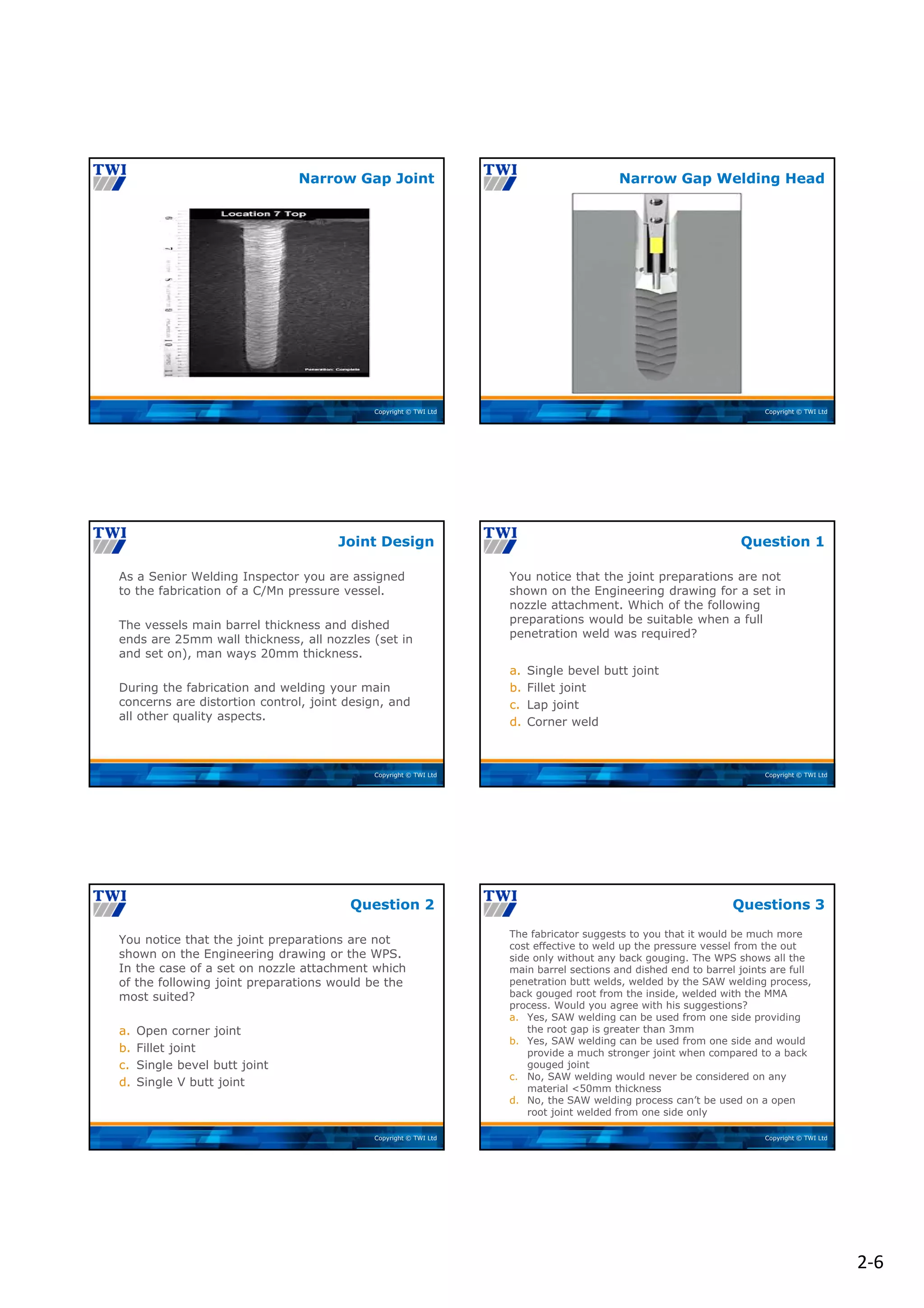
Nozzles connect a pressure
vessel with other components
Type of nozzle depends on
 Diameter/thickness ratio of the shell.
 Diameter/thickness ratio of the nozzle.
 Access (one side only or both sides).
 Type of joint required (partial/full pen).
 Groove preparation methods available.
Nozzles
Copyright © TWI Ltd
 Shorter nozzle is cheaper.
 Easy to make groove for full or
partial penetration.
 Single side welding in 2G/PB
position means high welder skill
is required.
 Through thickness stress means
danger of lamellar tearing.
 Can be difficult to UT especially
on smaller diameters.
 Mainly used for small (<2inch
diameter) nozzles, or thick wall
or large diameter vessels.
 May require reinforcement.
 Extra cost to shape nozzle to
radius of shell.
Set-On Nozzle
Copyright © TWI Ltd
Set-On Nozzle
Copyright © TWI Ltd
 1G/PA position much easier.
 Groove prep can be flame cut.
 No danger of lamellar tearing.
 Easy access to the back side of
root, so full penetration is easier
to achieve.
 For nozzles with small diameters
no need for reinforcement.
 Nozzle body needs to be longer.
 Greater weld volume means
higher distortions.
 Can be hard to UT on smaller
diameters, usually easy to inspect.
 Used for larger diameter nozzles,
and thinner walled small diameter
vessels.
Set-Through Nozzle
Copyright © TWI Ltd
To compensate for loss in strength, we can
reinforce either the shell or nozzle
Reinforcement or Compensation
Reinforcing ring/
Compensating plate
Long neck
nozzle
Copyright © TWI Ltd
Welded insert, consumable socket
ring (CSR) or EB insert, used on small
bore pipework where consistent root
penetration is required.
Sweepolet, shaped to fit radius of
shell, butt welded to shell with a butt
joint on the vertical stem.
Less known joint designs
What determines welded joint design?
2‐6
Copyright © TWI Ltd
Narrow Gap Joint
Copyright © TWI Ltd
Narrow Gap Welding Head
Copyright © TWI Ltd
As a Senior Welding Inspector you are assigned
to the fabrication of a C/Mn pressure vessel.
The vessels main barrel thickness and dished
ends are 25mm wall thickness, all nozzles (set in
and set on), man ways 20mm thickness.
During the fabrication and welding your main
concerns are distortion control, joint design, and
all other quality aspects.
Joint Design
Copyright © TWI Ltd
You notice that the joint preparations are not
shown on the Engineering drawing for a set in
nozzle attachment. Which of the following
preparations would be suitable when a full
penetration weld was required?
a. Single bevel butt joint
b. Fillet joint
c. Lap joint
d. Corner weld
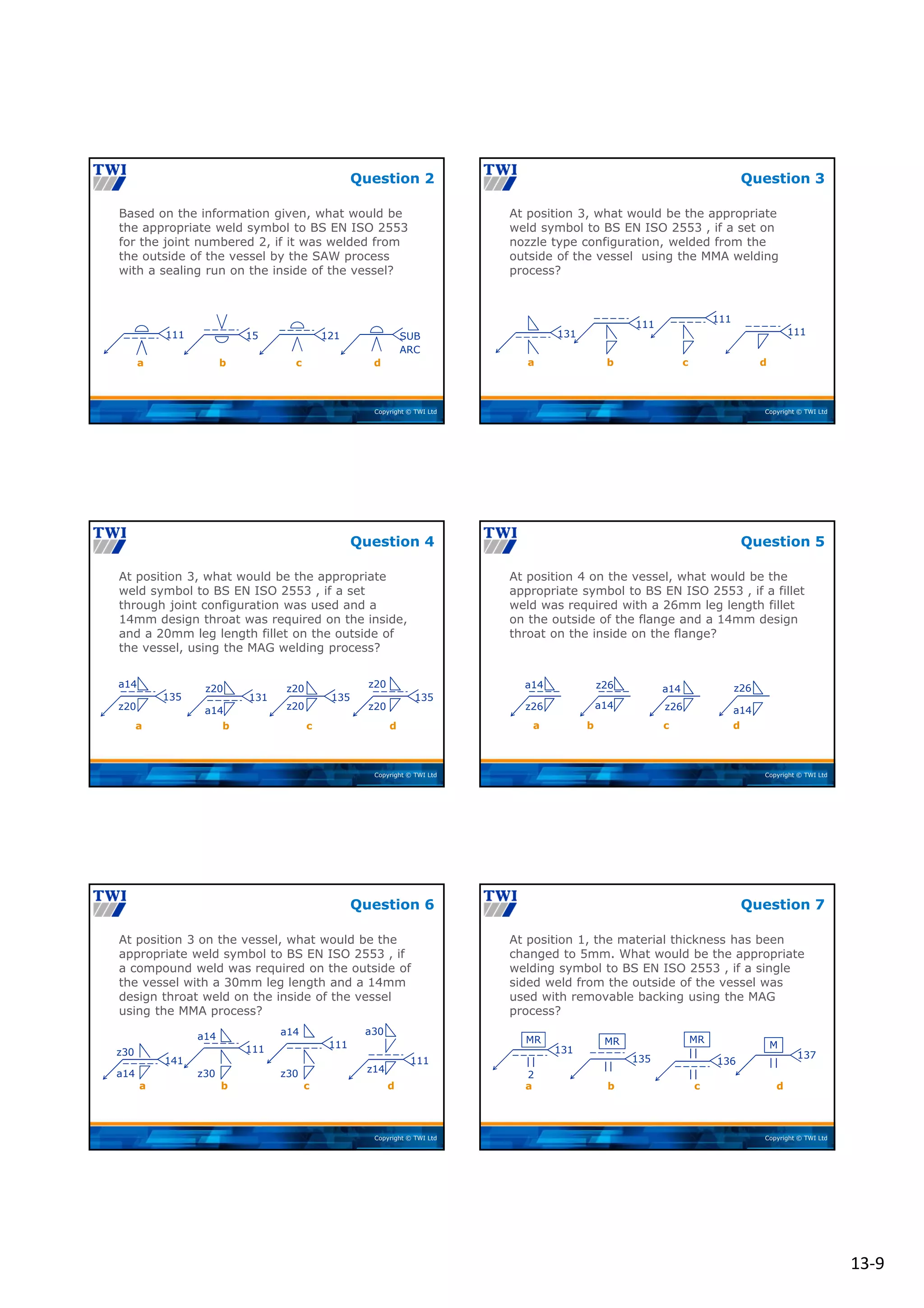
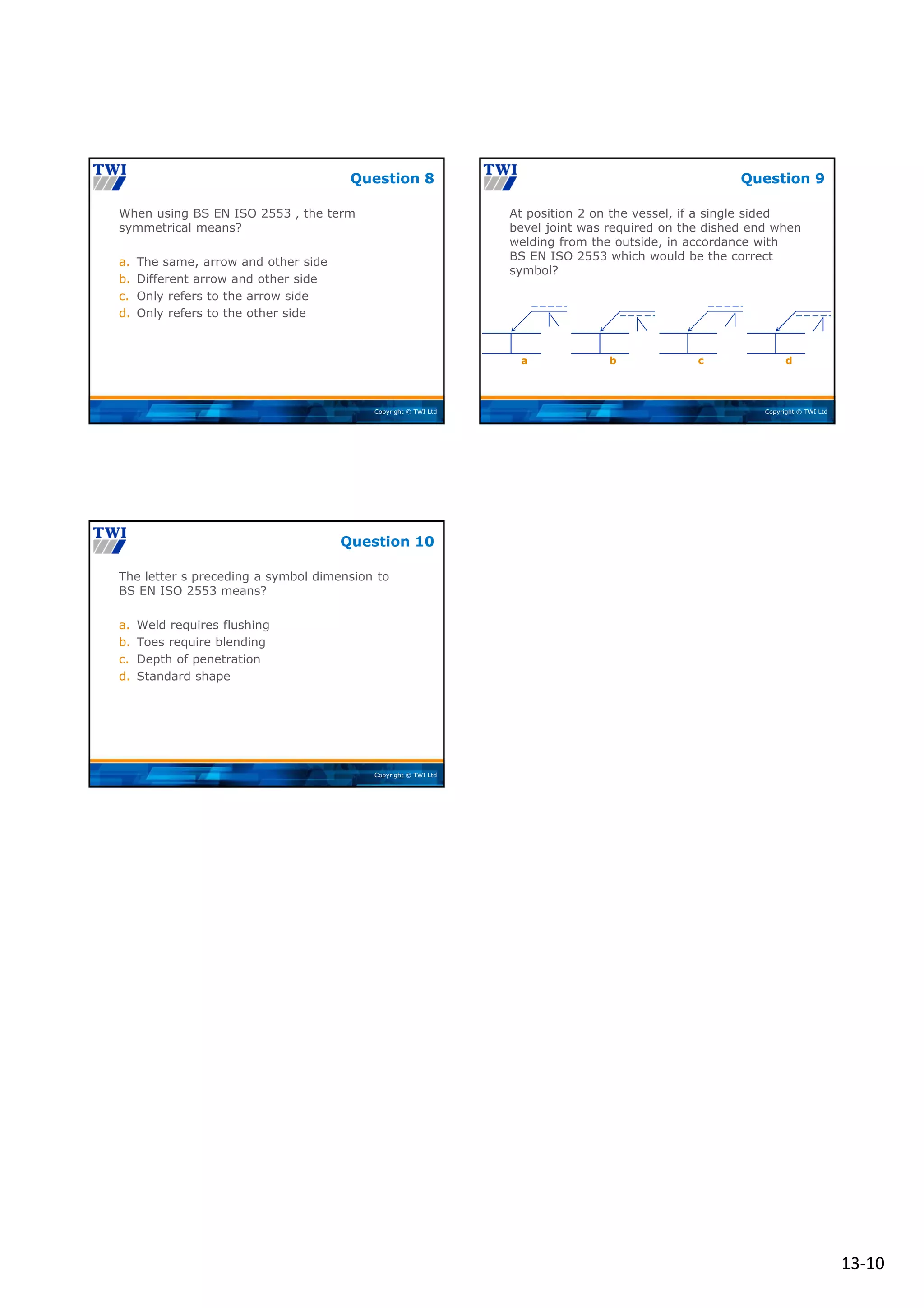
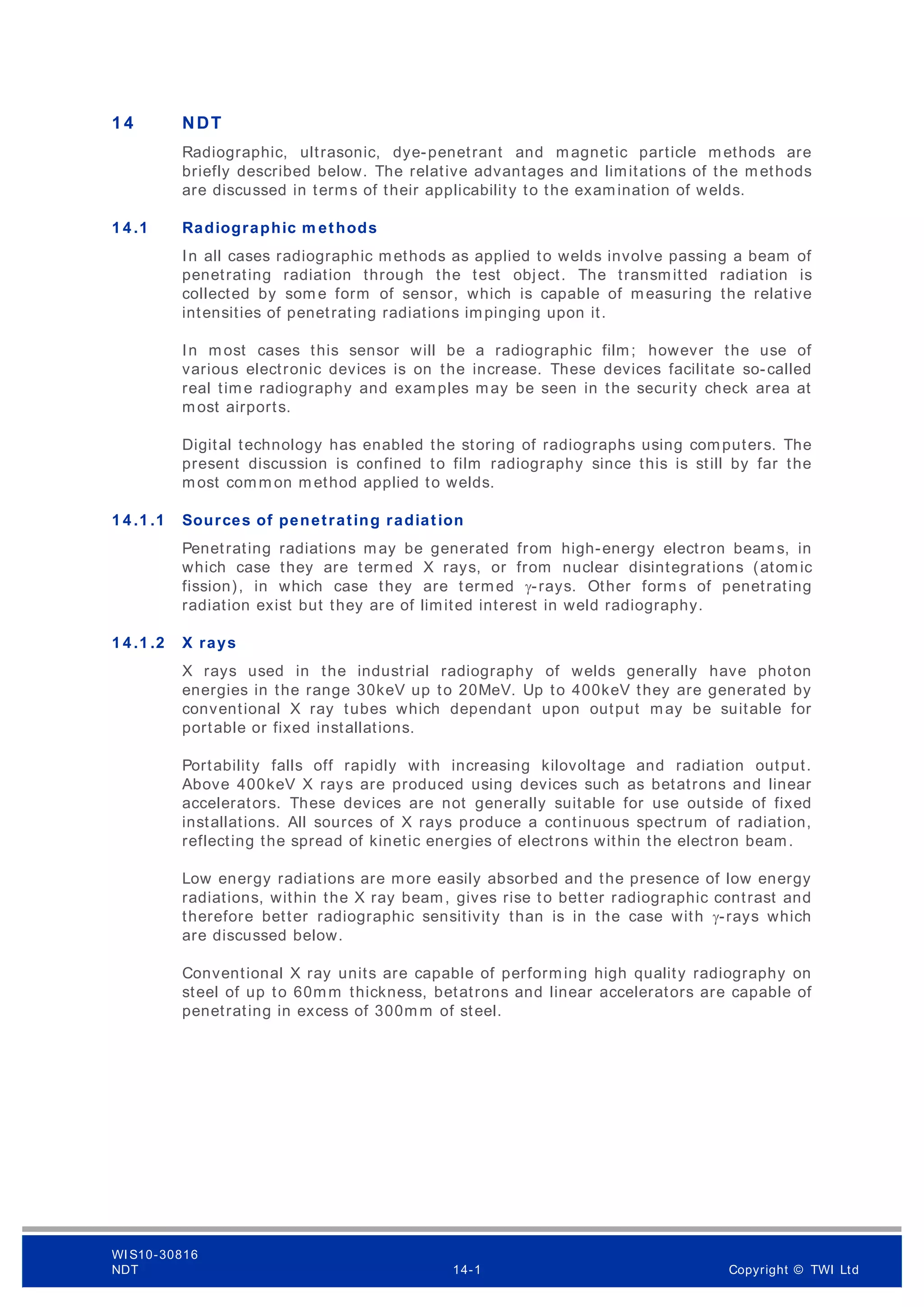
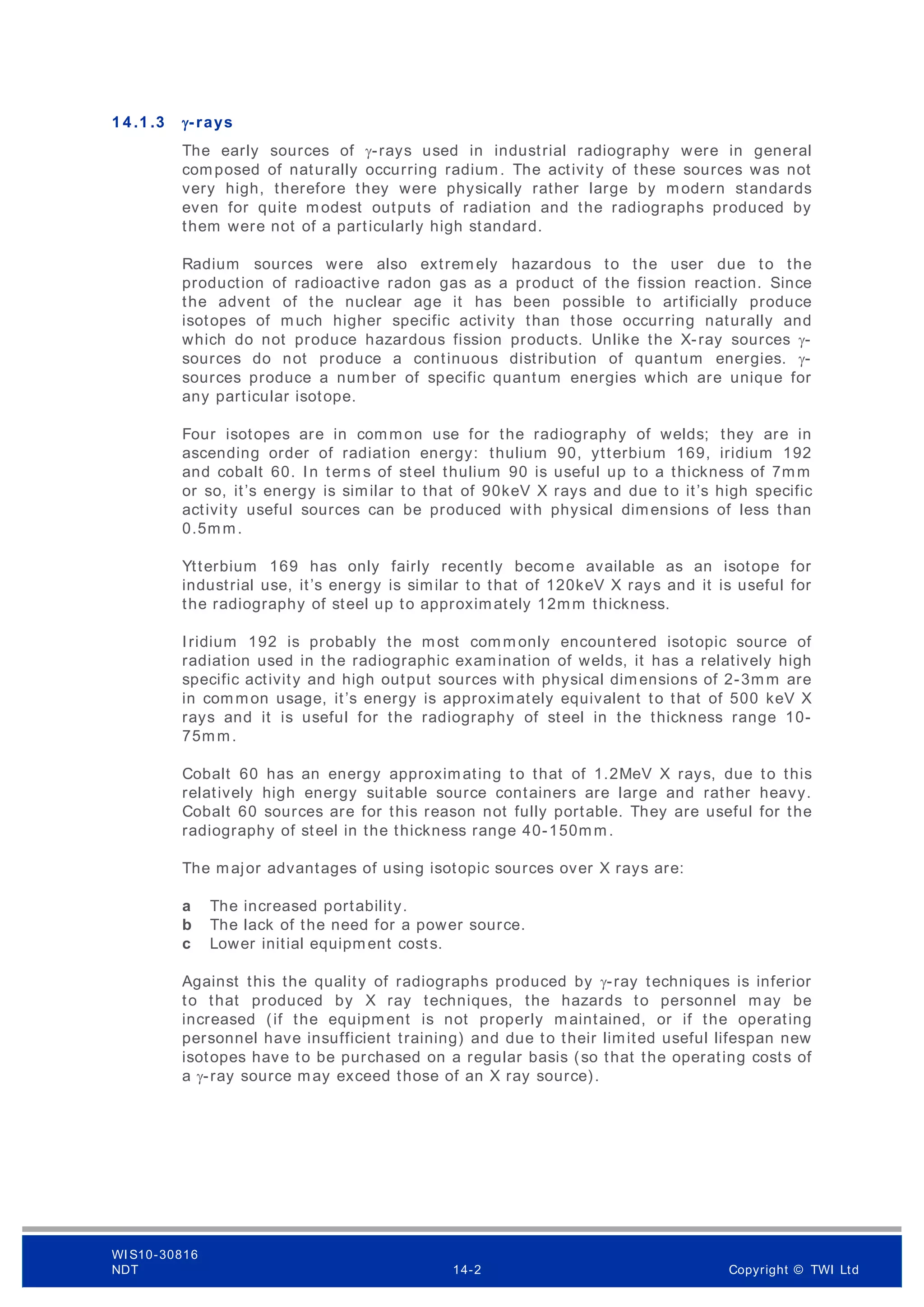
Question 1
Copyright © TWI Ltd
You notice that the joint preparations are not
shown on the Engineering drawing or the WPS.
In the case of a set on nozzle attachment which
of the following joint preparations would be the
most suited?
a. Open corner joint
b. Fillet joint
c. Single bevel butt joint
d. Single V butt joint
Question 2
Copyright © TWI Ltd
The fabricator suggests to you that it would be much more
cost effective to weld up the pressure vessel from the out
side only without any back gouging. The WPS shows all the
main barrel sections and dished end to barrel joints are full
penetration butt welds, welded by the SAW welding process,
back gouged root from the inside, welded with the MMA
process. Would you agree with his suggestions?
a. Yes, SAW welding can be used from one side providing
the root gap is greater than 3mm
b. Yes, SAW welding can be used from one side and would
provide a much stronger joint when compared to a back
gouged joint
c. No, SAW welding would never be considered on any
material <50mm thickness
d. No, the SAW welding process can’t be used on a open
root joint welded from one side only
Questions 3
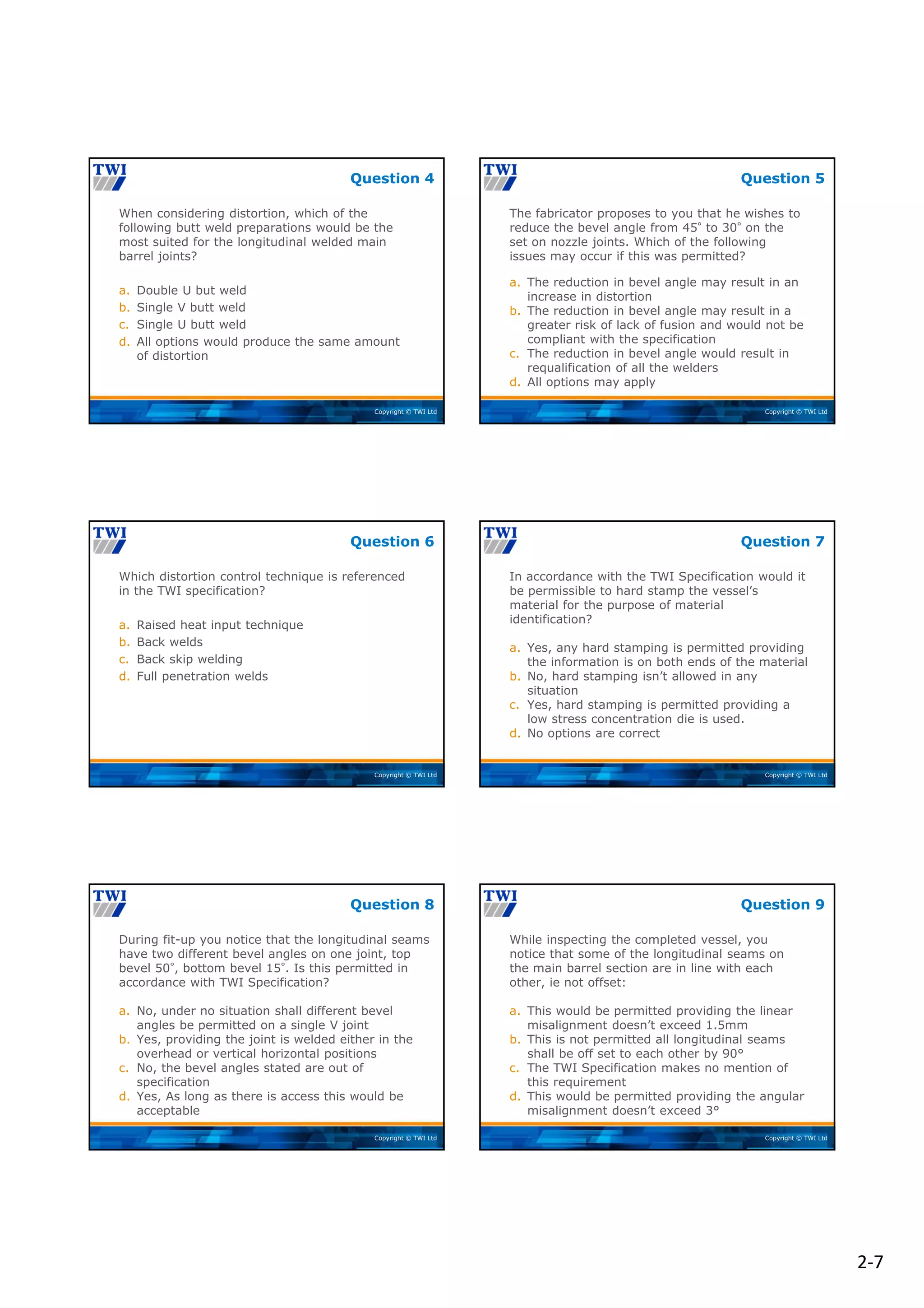
2‐7
Copyright © TWI Ltd
When considering distortion, which of the
following butt weld preparations would be the
most suited for the longitudinal welded main
barrel joints?
a. Double U but weld
b. Single V butt weld
c. Single U butt weld
d. All options would produce the same amount
of distortion
Question 4
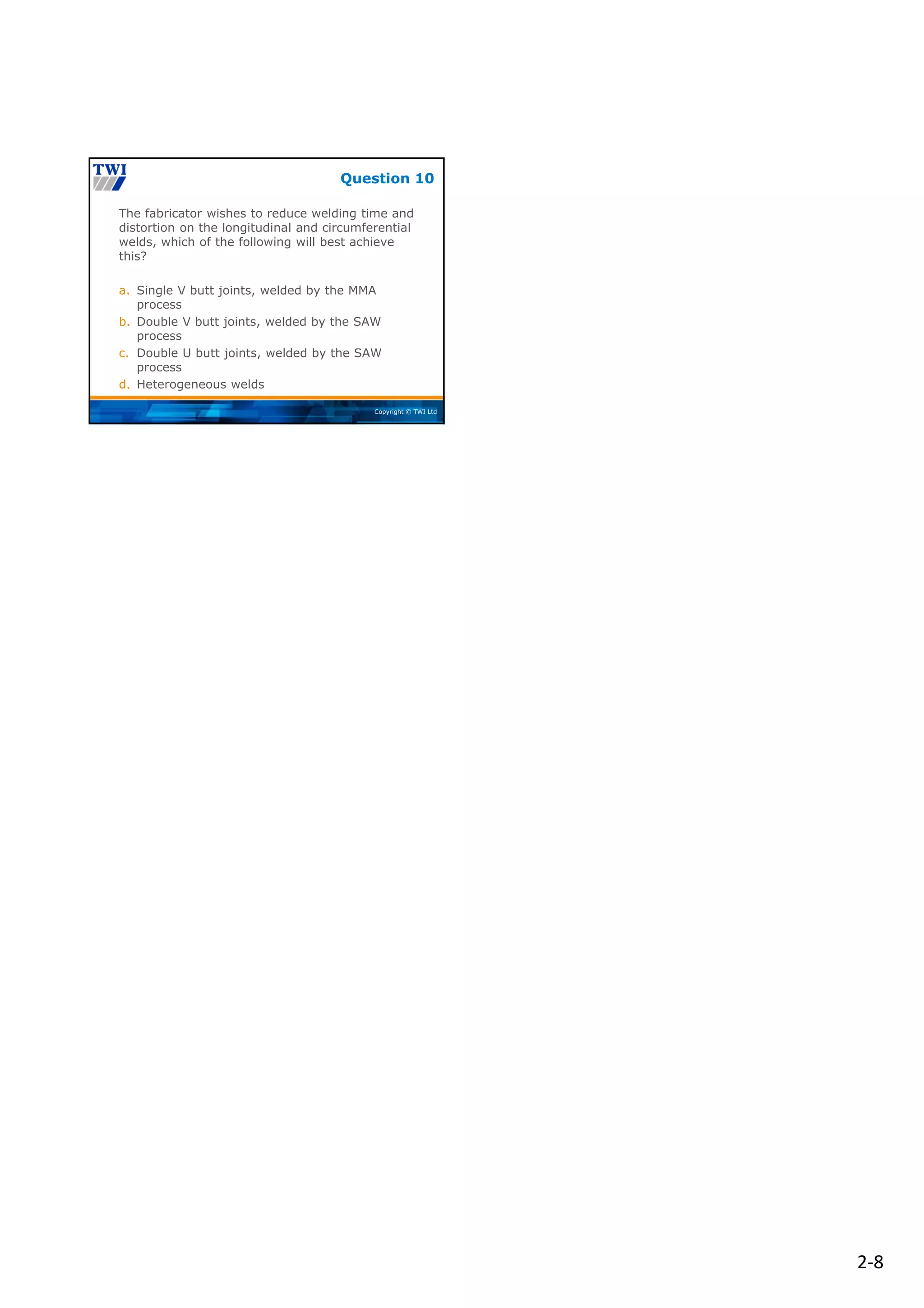
Copyright © TWI Ltd
The fabricator proposes to you that he wishes to
reduce the bevel angle from 45° to 30° on the
set on nozzle joints. Which of the following
issues may occur if this was permitted?
a. The reduction in bevel angle may result in an
increase in distortion
b. The reduction in bevel angle may result in a
greater risk of lack of fusion and would not be
compliant with the specification
c. The reduction in bevel angle would result in
requalification of all the welders
d. All options may apply
Question 5
Copyright © TWI Ltd
Which distortion control technique is referenced
in the TWI specification?
a. Raised heat input technique
b. Back welds
c. Back skip welding
d. Full penetration welds
Question 6
Copyright © TWI Ltd
In accordance with the TWI Specification would it
be permissible to hard stamp the vessel’s
material for the purpose of material
identification?
a. Yes, any hard stamping is permitted providing
the information is on both ends of the material
b. No, hard stamping isn’t allowed in any
situation
c. Yes, hard stamping is permitted providing a
low stress concentration die is used.
d. No options are correct
Question 7
Copyright © TWI Ltd
During fit-up you notice that the longitudinal seams
have two different bevel angles on one joint, top
bevel 50°, bottom bevel 15°. Is this permitted in
accordance with TWI Specification?
a. No, under no situation shall different bevel
angles be permitted on a single V joint
b. Yes, providing the joint is welded either in the
overhead or vertical horizontal positions
c. No, the bevel angles stated are out of
specification
d. Yes, As long as there is access this would be
acceptable
Question 8
Copyright © TWI Ltd
While inspecting the completed vessel, you
notice that some of the longitudinal seams on
the main barrel section are in line with each
other, ie not offset:
a. This would be permitted providing the linear
misalignment doesn’t exceed 1.5mm
b. This is not permitted all longitudinal seams
shall be off set to each other by 90°
c. The TWI Specification makes no mention of
this requirement
d. This would be permitted providing the angular
misalignment doesn’t exceed 3°
Question 9
2‐8
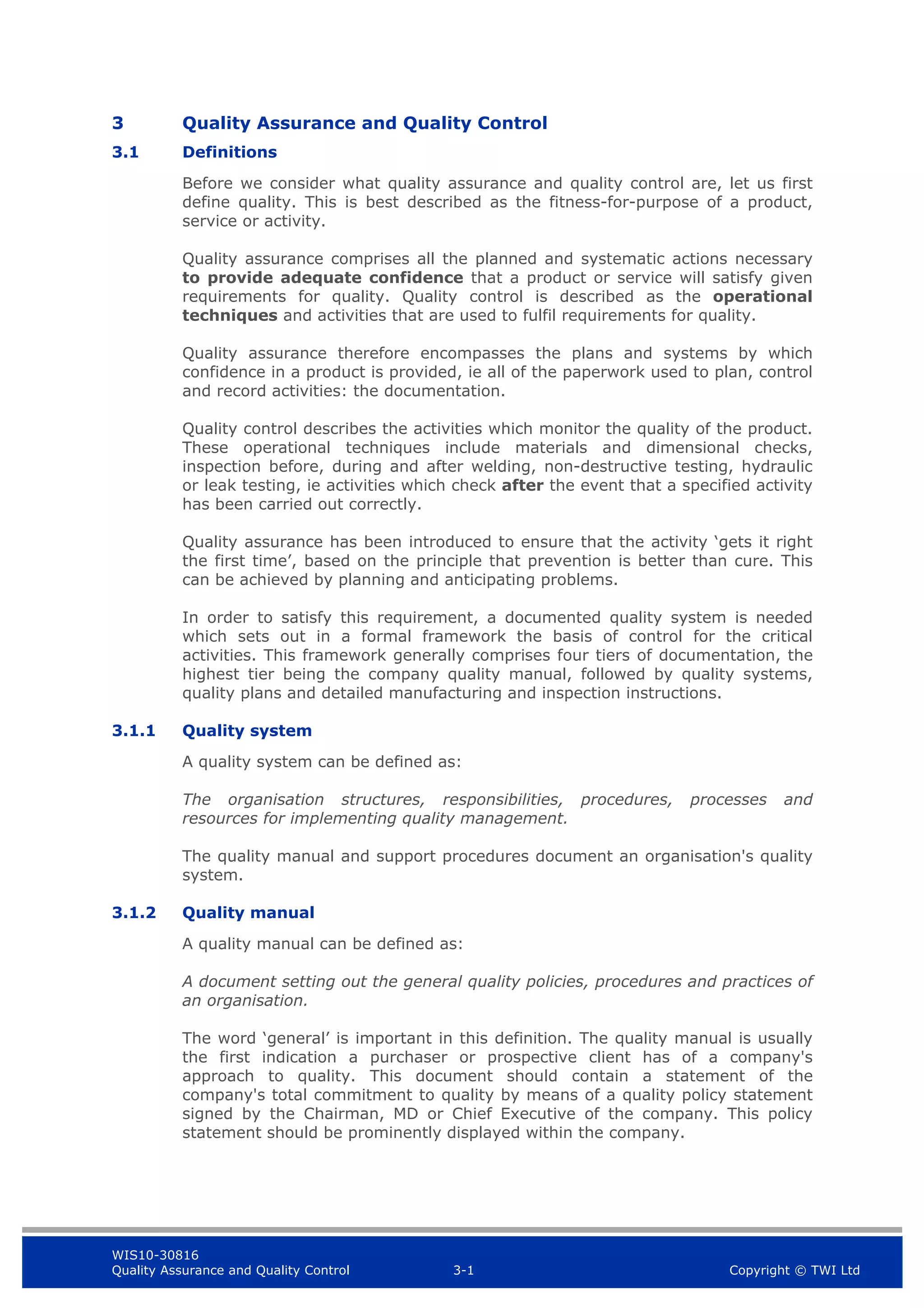
Copyright © TWI Ltd
The fabricator wishes to reduce welding time and
distortion on the longitudinal and circumferential
welds, which of the following will best achieve
this?
a. Single V butt joints, welded by the MMA
process
b. Double V butt joints, welded by the SAW
process
c. Double U butt joints, welded by the SAW
process
d. Heterogeneous welds
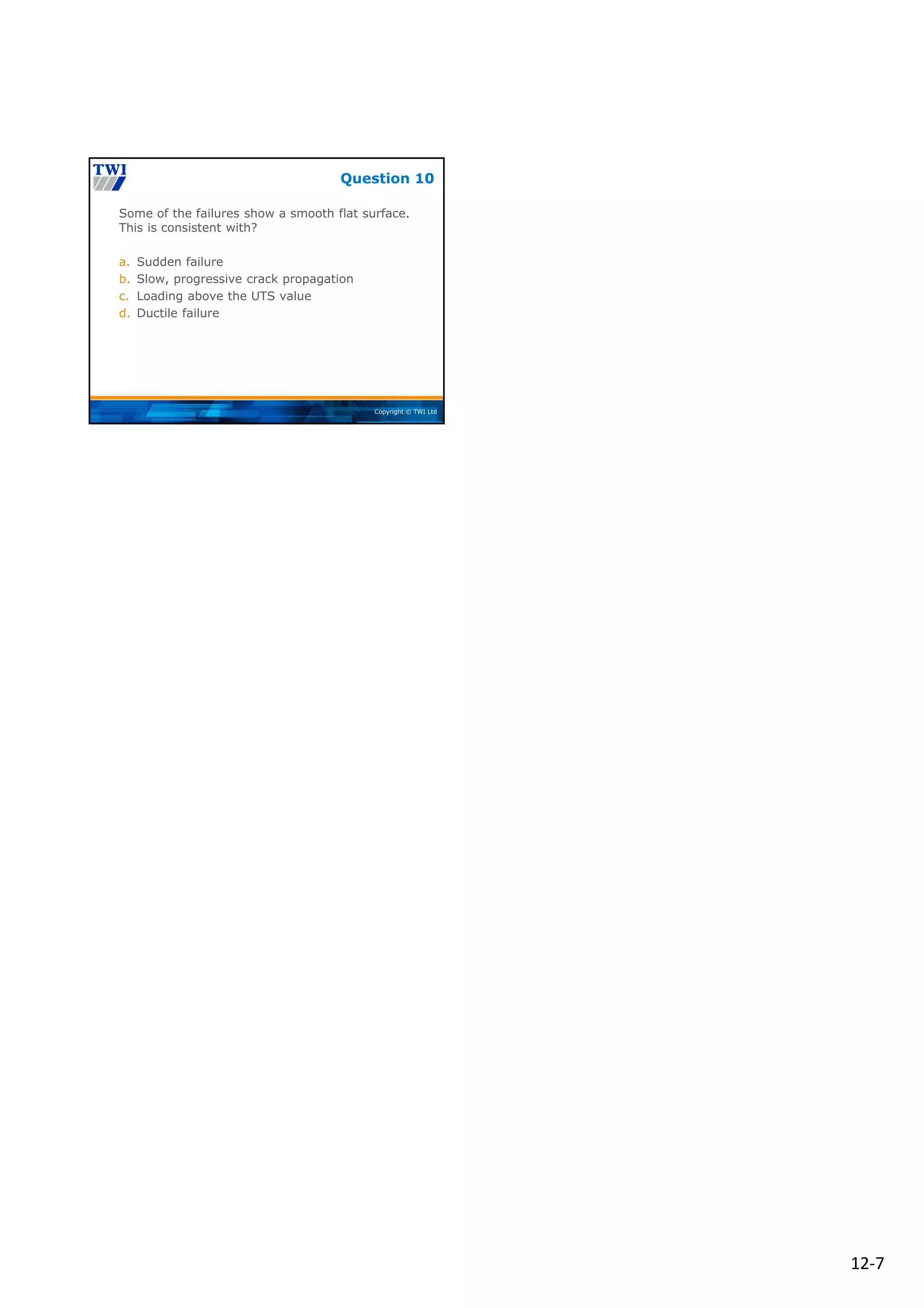
Question 10
Section 3
Quality Assurance and Quality Control
WIS10-30816
Quality Assurance and Quality Control 3-1 Copyright © TWI Ltd
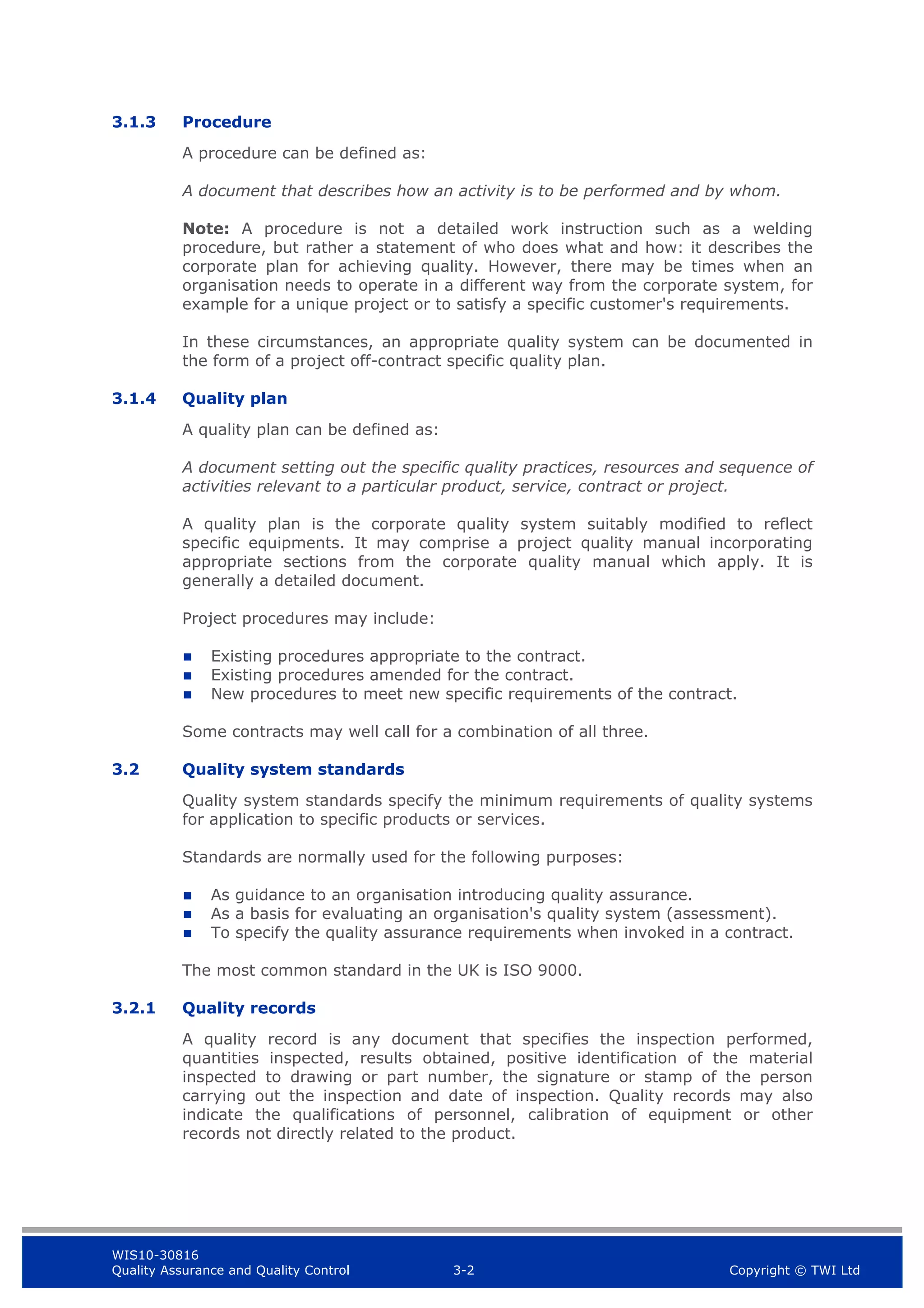
3 Quality Assurance and Quality Control
3.1 Definitions
Before we consider what quality assurance and quality control are, let us first
define quality. This is best described as the fitness-for-purpose of a product,
service or activity.
Quality assurance comprises all the planned and systematic actions necessary
to provide adequate confidence that a product or service will satisfy given
requirements for quality. Quality control is described as the operational
techniques and activities that are used to fulfil requirements for quality.
Quality assurance therefore encompasses the plans and systems by which
confidence in a product is provided, ie all of the paperwork used to plan, control
and record activities: the documentation.
Quality control describes the activities which monitor the quality of the product.
These operational techniques include materials and dimensional checks,
inspection before, during and after welding, non-destructive testing, hydraulic
or leak testing, ie activities which check after the event that a specified activity
has been carried out correctly.
Quality assurance has been introduced to ensure that the activity ‘gets it right
the first time’, based on the principle that prevention is better than cure. This
can be achieved by planning and anticipating problems.
In order to satisfy this requirement, a documented quality system is needed
which sets out in a formal framework the basis of control for the critical
activities. This framework generally comprises four tiers of documentation, the
highest tier being the company quality manual, followed by quality systems,
quality plans and detailed manufacturing and inspection instructions.
3.1.1 Quality system
A quality system can be defined as:
The organisation structures, responsibilities, procedures, processes and
resources for implementing quality management.
The quality manual and support procedures document an organisation's quality
system.
3.1.2 Quality manual
A quality manual can be defined as:
A document setting out the general quality policies, procedures and practices of
an organisation.
The word ‘general’ is important in this definition. The quality manual is usually
the first indication a purchaser or prospective client has of a company's
approach to quality. This document should contain a statement of the
company's total commitment to quality by means of a quality policy statement
signed by the Chairman, MD or Chief Executive of the company. This policy
statement should be prominently displayed within the company.
WIS10-30816
Quality Assurance and Quality Control 3-2 Copyright © TWI Ltd
3.1.3 Procedure
A procedure can be defined as:
A document that describes how an activity is to be performed and by whom.
Note: A procedure is not a detailed work instruction such as a welding
procedure, but rather a statement of who does what and how: it describes the
corporate plan for achieving quality. However, there may be times when an
organisation needs to operate in a different way from the corporate system, for
example for a unique project or to satisfy a specific customer's requirements.
In these circumstances, an appropriate quality system can be documented in
the form of a project off-contract specific quality plan.
3.1.4 Quality plan
A quality plan can be defined as:
A document setting out the specific quality practices, resources and sequence of
activities relevant to a particular product, service, contract or project.
A quality plan is the corporate quality system suitably modified to reflect
specific equipments. It may comprise a project quality manual incorporating
appropriate sections from the corporate quality manual which apply. It is
generally a detailed document.
Project procedures may include:
 Existing procedures appropriate to the contract.
 Existing procedures amended for the contract.
 New procedures to meet new specific requirements of the contract.
Some contracts may well call for a combination of all three.
3.2 Quality system standards
Quality system standards specify the minimum requirements of quality systems
for application to specific products or services.
Standards are normally used for the following purposes:
 As guidance to an organisation introducing quality assurance.
 As a basis for evaluating an organisation's quality system (assessment).
 To specify the quality assurance requirements when invoked in a contract.
The most common standard in the UK is ISO 9000.
3.2.1 Quality records
A quality record is any document that specifies the inspection performed,
quantities inspected, results obtained, positive identification of the material
inspected to drawing or part number, the signature or stamp of the person
carrying out the inspection and date of inspection. Quality records may also
indicate the qualifications of personnel, calibration of equipment or other
records not directly related to the product.
WIS10-30816
Quality Assurance and Quality Control 3-3 Copyright © TWI Ltd
Questions that need to be addressed include:
 What quality records are to be maintained, eg received inspection reports,
NDT results, test certificates, final inspection reports and non-conformance
reports (including any feedback or corrective action generated)?
 Where are the records filed and by whom?
 How long are the quality records retained?
 Are the quality records available to the customer for analysis and review?
 Are records easily retrievable?
 Is a suitable environment available to minimise deterioration or damage to
stored records?
3.2.2 Typical quality record contents
The Quality Record Package for a welded product is defined specifically for each
contract, but should include the following types of information:
a Records of stage inspections in the form of check sheets or quality plans.
b Non-conformity reports and concession records.
c Where appropriate, as-built drawings.
d Welding procedures.
e Welder approvals.
f Welding consumable records.
g Weld history records.
h NDT reports.
i Heat treatment records.
j Hydraulic and/or other testing records.
k Where appropriate, material test certificates.
l Final acceptance certificates.
WIS10-30816
Quality Assurance and Quality Control 3-4 Copyright © TWI Ltd
3.2.3 What areas of a business need to be covered by ISO 9001?
ISO 9001 requires the following elements of a business to have set procedures:
 Management responsibility - who is responsible for what?
 Quality system - how does the system operate?
 Contract review - allows personnel to see what the requirement is and who
has been asked to do what.
 Design review and control - ensures smooth passage from drawing board to
end product.
 Documentation controls - make sure the correct documents are available.
 Purchasing - make sure the right products and services are available.
 Purchaser supplied product - make sure that purchased items are in a
satisfactory condition.
 Product identification and traceability - what is it and where is it?
 Process control - lets everyone know clearly how to make the product.
 Inspection and test - describes how to inspect and test the product.
 Inspection, measuring and test equipment - make sure the equipment used
is correct.
 Inspection and test status - where is the product in the inspection cycle?
 Control of non-conforming product - ensures incorrect product is not used.
 Corrective action - finds the root cause of the problem and solves it.
 Handling, storage, packing and delivery - don't damage it now it's made.
 Quality records – fulfils the need for documented evidence that the company
meets specific requirements.
 Internal quality audits - are quality activities performed as planned?
 Training – the product cannot be manufactured effectively if people are not
adequately trained and qualified.
 Servicing - if carried out by the company, effective procedures are required.
 Statistical techniques - used to build-in product quality.
3.3 Auditing and documentation
Quality manuals, procedures, work instructions etc provide objective evidence
that the systems of control have been adequately planned.
The records and documentation generated by carrying out work in accordance
with these systems provide the evidence that the systems are being followed by
all. Systems of control, no matter how effective they are, will tend to
deteriorate because of human errors being made or perpetuated or due to
changes in the nature of the business.
In order to ensure that the systems are effective and being followed, as well as
to determine if changes are needed, it is necessary to monitor the systems.
This is achieved by auditing them and reviewing the results of the audit in order
to implement any changes.
3.3.1 What is an audit?
Quality audits examine a quality system for adequacy and correct
implementation.
They are defined in BS 4778 Part 1 as:
Systematic and independent examinations to determine whether quality
activities and related results comply with planned arrangements and whether
these arrangements are implemented effectively and are suitable to achieve
objectives.
WIS10-30816
Quality Assurance and Quality Control 3-5 Copyright © TWI Ltd
Auditing is carried out to provide objective evidence that the system is working
in accordance with the procedures. When an audit is complete the results are
analysed by management who must ensure that the quality policy is satisfied
and modify the quality system if necessary.
3.3.2 Which type of audit?
There are two levels of audit:
 A systems audit, which is quite superficial and simply examines the system
to confirm that it follows the quality manual and that procedures are in
place.
 A compliance audit, which is an in-depth audit examining compliance with
procedures.
3.3.3 Auditing of documentation
A documentation audit is regarded as being a compliance audit, where
documentation is examined in depth.
Items to check in such an audit should include:
 Is all the documentation available?
 Is the documentation schedule in accordance with contract or specification
requirements?
 Does the documentation itself comply with contract or specification
requirements? For example, are the weld procedure and welders correctly
qualified?
 Is the material composition correct?
 Is the documentation legible?
 Have all the interested parties, eg inspection department, independent third
party inspectors and client inspectors, signed off where required?
 Have provisions been made for storage (which includes the ability to
retrieve documents and storage conditions preventing deterioration)?
Documentation audits should be carried out by the manufacturer/supplier as a
matter of course.
Customers will also frequently require access to carry out their own audits.
Remember that no job is finished until the paperwork is complete.
Failure of a documentation audit carried out by a client will often result in a
delay in payment, even though the component may have been delivered to the
client. There can often be a consequential financial penalty.
3.4 Quality requirements for welding
Within the international community, welding has been defined as a special
process which means that it must be controlled by specialist management and
utilise specialist personnel.
The welding co-ordination BS EN ISO 14731 and welding quality systems
standards BS EN ISO 3834 have been prepared in support of this ruling.
It is perceived that these standards will serve as references for other
application standards and be used as set criteria for the qualification of
fabricators.
WIS10-30816
Quality Assurance and Quality Control 3-6 Copyright © TWI Ltd
Currently there are a number of European Standards or codes that refer to
BS EN ISO 3834:
 EN 13445:2002: Unfired pressure vessels.
 prEN 15085: Railway applications – Welding of railway vehicles and
components.
 prEN 1090: Execution of steel structures.
 EN 12732: 2000 Gas supply systems – Welding steel pipework – functional
requirements.
 EN 12592: 2001 Water tube boilers and auxiliary installations.
 National Structural Steelwork Specification for Building Construction (5th
Edition) (NSSSBC).
It is an increasingly common requirement for the fabricator to have a quality
system compliant with ISO 3834. This is to be specified as a condition of the
customer contract.
3.4.1 Qualification of welding fabricators – BS EN ISO 3834
BS EN ISO 3834 comprises five parts:
Part 1 - Guidance for use
This describes how the standard works.
Part 2 - Quality requirements for welding - Fusion welding of metallic
materials - Comprehensive quality system
This standard is suitable for use by a manufacturer or an assessment body, as a
supplement to ISO 9001 or 9002 providing detailed guidance on the
requirements that must be in place to adequately control welding.
Part 3 - Quality requirements for welding, Fusion welding of metallic
materials - Standard quality system
This standard can be applied where a documented quality system for the
control of welding is required but will not be used in conjunction with ISO 9001
or 9002.
Part 4 - Quality requirements for welding - Fusion welding of metallic
materials - Elementary system
This standard provides criteria appropriate for the control of welding when
either of the following applies:
 A quality system according to ISO 9001 is not to be applied.
 The combination of selected welding processes, procedures and the final
welds are such that documented welding controls have minor importance in
respect to the overall integrity of the product.
Part 5 - Documents with which it is necessary to conform to claim
conformity to the quality requirements of BS EN ISO 3834-2, BS EN ISO
3834-3 or BS EN ISO 3834-4
This lists all other documents or standards that are required for compliance with
BS EN ISO 3834, such as specification and qualification of welding procedures,
approval testing of welders, etc.
WIS10-30816
Quality Assurance and Quality Control 3-7 Copyright © TWI Ltd
The manufacturer should select one of the three parts (2-4) specifying the
different levels of quality requirements, based on the following criteria:
 The extent and significance of safety-critical products;
 The complexity of manufacture;
 The range of products manufactured;
 The range of different materials used;
 The extent to which metallurgical problems may occur;
 The extent to which manufacturing imperfections, eg misalignment,
distortion or weld imperfection, affect product performance.
This approach offers a cascading qualification; for example, Part 2
(comprehensive) also gives compliance for lower levels.
As previously stated, BS EN ISO 3834 is intended to complement, rather than
conflict with, quality systems established to meet the requirements of ISO 9001
and, in the case of a comprehensive quality system for welding fabrication (Part
2), requires in addition to ISO 9001 that specific procedures are used to control
the following:
1 Review of requirements.
2 Technical review.
3 Sub-contracting.
4 Welders and welding operators.
5 Welding co-ordination personnel.
6 Inspection and testing personnel.
7 Production and testing equipment.
8 Equipment maintenance.
9 Description of equipment.
10 Production planning.
11 Welding procedure specifications.
12 Qualification of welding procedures.
13 Batch testing of consumables (if required by contract).
14 Storage and handling of welding consumables.
15 Storage of parent material.
16 Post-weld heat treatment procedure.
17 Inspection and testing before, during and after welding.
18 Non-conformance and corrective actions.
19 Calibration or validation of measuring, inspection and testing equipment.
20 Identification during process (if required by contract).
21 Traceability (if required by contract).
22 Quality records (if required by contract).
WIS10-30816
Quality Assurance and Quality Control 3-8 Copyright © TWI Ltd
A company applying for certification to ISO 3834 will usually be required to
complete the following stages:
 Client returns preliminary enquiry.
 Quotation.
 Detailed forms sent to client.
 Assessment team appointed by auditor.
 Preliminary visit by auditor (not mandatory but common) to carry out a gap
analysis.
 Document review by auditor to review procedures against BS EN ISO 3834.
 On-site assessment conducted by auditor to demonstrate that the client has
accrued evidence that procedures are used and that these are overseen by
the welding co-ordination team.
 Assessment recommendations made.
 Certificate issued (5 year validity).
 Surveillance (yearly).
This process, from application to issuing of the certificate, can take months to
complete.
3.4.2 Welding co-ordination
A key part of BS EN ISO 3834 is the definition of responsibilities of the welding
co-ordination personnel. ISO 14731 defines these personnel and the technical
knowledge that they require. The main role falls to the Responsible Welding Co-
ordinator (RWC).
One or more personnel in a company may perform the welding co-ordination
function, but each of the requirements of BS EN ISO 3834 listed above will
require input from the welding co-ordination team.
Table 1 in BS EN ISO 14731 gives guidance for those tasks which may require a
welding co-ordinator input. The technical knowledge required from the co-
ordinator will obviously depend upon the complexity of the product.
The standard defines three levels of knowledge and experience:
1 Comprehensive: Equivalent to the level of an International/European
Welding Engineer.
2 Specific: Equivalent to the level of an International/European Welding
Technologist.
3 Basic: Equivalent to the level of an International/European Welding
Specialist.
It can be seen that the three levels of technical knowledge are defined to match
with the three levels of quality requirements given in Parts 2-4 of BS EN ISO
3834.
The IIW route is not mandatory; there are in fact three possible routes to
demonstrate technical knowledge:
1 IIW qualification and experience (via interview).
2 Interview to assess knowledge without IIW qualification (professional
review in 3834 audit).
3 Sub-contract to an external resource with appropriate knowledge and
experience; again, an interview is required (it would be expected that the
external resource will be familiar with the company applying for certification
and will be contracted to visit regularly).
WIS10-30816
Quality Assurance and Quality Control 3-9 Copyright © TWI Ltd
3.5 Calibration/validation of welding equipment
Faulty equipment compromises the quality of work. It follows that any
equipment used in production, or for welder and procedure approval tests,
should be in a sound condition in all respects in order to avoid breakdown
during production or testing.
One important point to note is the accuracy of meters and the repeatability of
the machine's controls in relation to output performance. Welding current
connections and return leads on all arc welding equipment should be checked
for tightness prior to commencing welding; failure to do so may lead to voltage
losses affecting arcing conditions.
Where semi-automatic gas shielded processes are used, care should also be
taken to ensure that the wire feeding systems are repeatable and accurate.
Additionally, flowmeters controlling shielding and purging gases are expected to
be calibrated.
This activity is collectively known as validation.
A requirement in many industries during the welding operation is the use of a
calibrated meter(s) to check the welding current, arc voltages, travel speed
and, on occasion, wire feed speed.
In addition, it must be ensured that the welders are using the correct gas, the
electrode wires are of the correct composition and the preheat temperature and
location have been applied in accordance with the welding procedure
requirements.
In the case of manual metal arc (MMA) and submerged-arc welding (SAW),
attention should be paid to any special drying requirements for fluxes or
covered electrodes and also the conditions they are kept in prior to use. The
use of a written procedure for storage and handling of consumables is
recommended and records of humidity and temperature may be required to be
kept.
Section 4
Codes and Standards
4 Codes and Standards
The control of quality in a fabrication and welding situation is achieved by
working to company procedures and codes of construction or standards. The
latter may be international, national, company’s own or specific to the particular
client or contract.
Company procedures are usually covered in quality manuals the scope of which
may vary widely depending upon the size of company, its range of work, its
working practices and many other factors.
4 .1 Com pany m anuals
4 .1 .1 Quality assurance m anual
Quality assurance is defined in IS0 9000 as; part of quality management
focused on providing confidence that quality requirements will be fulfilled.
Essentially what the QA manual sets out is how the company is organised, to
lay down the responsibilities and authority of the various departments, how
these departm ents interlink. The manual usually covers all aspects of the
company structure, not just those aspects of m anufacture.
4 .1 .2 Quality control m anual
Quality control is defined in ISO 9000 as; part of quality management focused
on fulfilling quality requirem ents.
The QC manual will be the manual most often referred to by the SWI as it will
spell out in detail how different departm ents and operations are organised and
controlled.
Typical examples would be: production and control of drawings, how materials
and consumables are purchased, how welding procedures are produced, etc.
Essentially all operations to be carried out within the organisation will have
control procedures laid down.
In particular it will lay down how the I nspection function, whether visual,
dimensional or NDT, will be perform ed, inspection being defined as the activity
of measuring, examining and testing characteristics of a product or service and
comparing these to a specified requirement. Such requirements are laid down in
codes of practice and standards.
4 .2 Auditing
Auditing is a term originating from accountancy practice which involves an
independent accountant checking the accounts of a company to see if the
accounts are fair and accurate. A similar checking process is now widely
practised in manufacturing and construction industries and inspection personnel
will be involved in the carrying out of this operation.
WI S10-30816
Codes and Standards 4-1 Copyright © TWI Ltd
Different types of audits may be performed:
 Full audit of a company, usually carried out by a third party such as a
Certifying Authority, checking the company for the award of a QA
accreditation system such as ISO 9000 or ASME stamp.
 Major audit by a potential customer prior to placem ent of a large contract.
This is usually carried out to demonstrate the company has all the
necessary facilities, plant, machinery, personnel and quality systems in
place to enable them to successfully complete the contract.
 Part audits carried out as ongoing demonstration that the quality system is
working properly.
An example of the latter case would be where a Senior Inspector is responsible
for signing-off the data book or release certificate for a product. After checking
that all the necessary documents are in the package and that they have been
correctly completed and approved where necessary, the SWI would look at a
part of the job – a beam, a piece of pipework etc and crosscheck against the
drawings, mill certificates, inspection reports etc that all comply with the job
requirem ents.
4 .3 Codes and standards
It is not necessary for the Inspector to carry a wide range of codes and
standards in the performance of his/ her duties. Normally the specification or
more precisely the contract specification is the only document required.
However the contract specification may reference supporting codes and
standards and the inspector should know where to access these normative
documents.
The following is a list of definitions relating to codes and standards which the
Inspector may com e across whilst carrying inspection duties
4 .3 .1 Definitions
Norm ative docum ent:
Provides rules, guidelines or characteristics for activities or their results.
The term normative document is generic and covers docum ents such as
standards, technical specifications, codes of practice and regulations.*
Standard
Docum ent established by consensus and approved by a recognised body.
A standard provides, for common and repeated use, guidelines, rules, and
characteristics for activities or their results, aimed at the achievem ent of the
optimum degree of order in a given context.*
Harm onised standards
Standards on the sam e subject approved by different standardising bodies, that
establish interchangeability of products, processes and services, or mutual
understanding of test results or information provided according to these
standards*
WI S10-30816
Codes and Standards 4-2 Copyright © TWI Ltd
Code of practice
Docum ent that recommends practices or procedures for the design,
manufacture, installation, maintenance, utilisation of equipment, structures or
products.
A code of practice may be a standard, part of a standard or independent of a
standard.*
Regulation
Docum ent providing binding legislative rules that is adopted by an authority.*
Authority
Body (responsible for standards and regulations legal or administrative entity
that has specific tasks and composition) that has legal powers and rights.*
Regulatory authority
Authority responsible for preparing or adopting regulations.*
Enforcem ent authority
Authority responsible for enforcing regulations.*
Specification
A docum ent stating requirements, needs or expectations.
A specification could cover both physical and technical requirements ie visual
inspection, NDT, Mechanical testing etc. essentially full data and its supporting
medium. Specifications are generally implied or obligatory.
Procedure
Specified way to carry out an activity or a process.* Usually it is a written
description of all essential parameters and precautions to be observed when
applying a technique to a specific application following an established standard,
code or specification
I nstruction
Written description of the precise steps to be followed based on an established
procedure, standard, code or specification.
Quality plan
A docum ent specifying which procedures and associated resources shall be
applied by whom and when to a specific project, product, process or contract.*
* ISO IEC Guide 2 – Standardisation and related activities – General
vocabulary.
* * EN ISO 9000 – 2000 – Quality management system s – Fundamentals and
vocabulary.
WI S10-30816
Codes and Standards 4-3 Copyright © TWI Ltd
4 .4 Sum m ary
Application of the requirements of the quality manuals, the standards and codes
of practice ensure that a structure or component will have an acceptable level
of quality and be fit for the intended purpose.
Applying the requirements of a standard, code of practice or specification can
be a problem for the inexperienced Inspector. Confidence in applying the
requirem ents of one or all of these documents to a specific application only
com es with use over a period of time.
If in doubt the Inspector must always refer to a higher authority in order to
avoid confusion and potential problems.
WI S10-30816
Codes and Standards 4-4 Copyright © TWI Ltd
Section 5
Fe-C Steels
5 Fe-C Steels
Pure iron is very soft and expensive to manufacture and thus has limited
practical engineering applications. However, as we’ve already seen, as ferrous
alloys can go through different phase changes depending on composition and
temperature, the properties and particularly the strength, ductility and
toughness can be tailored through alloying and thermal cycling (heat treatm ent
or welding for example).
Of all the alloying elements used in steels, by far the most important one is
carbon (C) and steels are defined as iron alloys containing less than 2% C.
Ferrous alloys of m ore than 2% carbon content on the other hand are called
cast irons.
Many other elements can also be present in steels, both intentionally added
alloying elements and residual elements present from ore or scrap m etal used
in the steelmaking process.
5 .1 Steel term inology
The terminology used to describe and specify different steel products can be
confusing as these can be based on a combination of:
 Product form (sheet, plate, bar, sections, pipe or wire).
 Deoxidation practice (killed, semi-killed).
 Manufacturing route such as cast, forged, rolled, extruded.
 Heat treatm ent such as annealed, normalised and quench and tempered,
which are used to achieve properties.
 Cleanliness level in terms of impurities such as sulphur and phosphorous.
 Finishing methods such as cold rolled or hot rolled.
 Presence or not of corrosion protection coatings.
 And so on.
To add to the confusion, different industry sectors use different nom enclatures
and definitions to refer to the same alloys. A simplified terminology is used here
which is widely used and is relevant to welding, but be aware that other
terminologies also exist.
In a broad sense, non-stainless steels can be divided into two major groups:
Carbon steel (also called C-Mn steels, depending on Mn level) and low alloy
steels. This nomenclature is used in American standards (Am erican Iron and
Steel Institute and The Society of Autom otive Engineering) and in modified
forms in European standards as well.
5 .1 .1 Carbon steels
In many industry sectors, carbon steel is the usual description used to refer to
any steel that is not stainless. Carbon is the single most important alloying
element in steel and a wide range of properties is possible simply by changing
its content. Strength can be increased very cost effectively by retaining more
carbon in the composition (remember, carbon is already present from the
primary steelmaking process and is in fact removed as part of steel refining).
However, when welded it is well recognized that HAZ toughness decreases and
risk of cracking during welding increases with carbon addition and welding
becomes more challenging. Surprisingly though, in some particular applications
such as in welded rail tracks this trade-off can be overcom e and steels which
are often of eutectic composition with carbon content of 0.76% are used!!
WI S10-30816
Fe-C Steels 5-1 Copyright © TWI Ltd
As shown below, hardness and strength can be achieved simply by increasing
the carbon content of the alloy. This however comes at a cost, not only in terms
of welding but also in terms of m echanical properties as ductility and toughness
also deteriorate with increasing carbon content.
Carbon steels can be divided (broadly) into plain carbon and carbon-manganese
steels:
Plain carbon steels are the m ost widely used steel type. These are usually
specified based on carbon content (example, AISI 1010 and 1018 carbon steels
have target carbon contents of approximately 0.1 and 0.18, respectively) and
are limited to a maximum of 1% manganese. The microstructures of plain
carbon steels are based around the thermodynamic equilibrium microstructures
of ferrite and pearlite.
Carbon– m anganese ( C-Mn) steels are similar to plain carbon steels except
that C-Mn steels have higher Mn contents of between 1 and 1.65 weight % .
Manganese is used for deoxidation (to rem ove oxygen from the melt during
steelmaking), as a solid solution strengthener and also can have the effect of
lowering the ductile to brittle transition temperature. However, addition of
manganese also increases the hardenability of steels which could be a drawback
when welding as will be shown later in this section.
5 .1 .2 Low Alloy steels
Some alloying elements increase the hardenability of steels, that is, they delay
the transformation from austenite to the equilibrium microstructures of ferrite
and pearlite to longer times, thus giving more opportunity for non-equilibrium
microstructures such as martensite to form during cooling. Alloys specified
based on element additions to increase hardenability to achieve designated
strength, ductility and toughness requirements are called low alloy steels. In
general, total alloy content does not exceed 5% .
Martensite is achieved with a sufficient level of carbon or other elements and a
sufficiently rapid cooling rate. It has high strength and hardness but can be
very brittle, so a softening (tempering) heat treatm ent is normally applied to
improve toughness during the manufacturing process. This is not always
possible after welding and these steels require special precautions during
welding to obtain good enough properties in the HAZ and to avoid hydrogen
cracking.
Note: In some industry sectors stainless steels are referred to as alloy steels
(minimum of 10% alloying), which is probably why low-alloy-steel is used to
describe steels with high hardenability (quenched and tempered for example)
as these have much lower alloy content compared to stainless grades.
Comparing with C-Mn steels however, these are relatively high alloyed steel
grades with much higher hardenability.
WI S10-30816
Fe-C Steels 5-2 Copyright © TWI Ltd
5 .1 .3 High strength low alloy steels
For the parent material, an alternative approach to increase strength without
increasing carbon content is grain refinement which not only increases strength
but also increases toughness. This family of fine grained high strength steels
(up to 560MPa yield) with low carbon and lean general composition are called
high strength low alloy steels.
Contrary to low-alloy-steels which can in fact be quite highly alloyed, HSLA
steels are truly low alloyed steels and the strength is achieved through
refinement of the microstructure rather than by significant alloying additions.
For the sam e strength level, an HSLA alloy will have a much leaner composition
to its C-Mn equivalent. The microstructure of HSLA steels is still generally ferrite
and pearlite but will usually contain very small amounts of pearlite.
The manufacturing routes to achieve the necessary microstructure refinement
were covered in Section 6 (Heat treatm ent of steels).
To refresh your m em ory
HSLA steels rely on very small alloying additions of vanadium, niobium and/ or
titanium and controlled rolling as well as defined and narrow temperature
ranges. Because the additions of V, Nb and Ti are so sm all these are also called
micro-alloyed steels.
Particularly in the oil and gas industry, a slight variation of the controlled rolling
process is used where micro-alloying is used to obtain a fine-grain structure
during the hot rolling process followed by accelerated cooling at the end of the
hot rolling process to promote a bainitic or acicular ferrite microstructure. These
alloys are called Therm o-mechanically controlled process (TMCP) steels.
WI S10-30816
Fe-C Steels 5-3 Copyright © TWI Ltd
Section 6
Destructive Testing
6 Destructive Testing
European Welding Standards require test coupons that are made for welding
procedure qualification testing to be subjected to non-destructive testing and
then destructive testing.
The tests are called destructive tests because the welded joint is destroyed
when various types of test piece are taken from it.
Destructive tests can be divided into 2 groups, those used to:
 Measure a m echanical property – quantitative tests
 Assess the joint quality – qualitative tests
Mechanical tests are quantitative because a quantity is measured – a
mechanical property such as tensile strength, hardness and impact toughness.
Qualitative tests are used to verify that the joint is free from defects – they are
of sound quality, exam ples of these are bend tests, macroscopic examination
and fracture tests (fillet fracture and nick-break).
6 .1 Test types, test pieces and test objectives
Various types of m echanical tests are used by material manufacturers and
suppliers to verify that plates, pipes, forgings, etc. have the minimum property
values specified for particular grades.
Design engineers use the minimum property values listed for particular grades
of material as the basis for design and the most cost-effective designs are
based on an assumption that welded joints have properties that are no worse
than those of the base metal.
The quantitative (mechanical) tests that are carried out for welding procedure
qualification are intended to demonstrate that the joint properties satisfy design
requirem ents.
The emphasis in the following sub-sections is on the destructive tests and test
methods that are widely used for welded joints.
6 .1 .1 Transverse tensile tests
Test objective
Welding procedure qualification tests always require transverse tensile tests to
show that the strength of the joint satisfies the design criterion.
Test specim ens
A transverse tensile test piece typical of the type specified by European Welding
Standards is shown below.
WI S10-30816
Destructive Testing 6-1 Copyright © TWI Ltd
Standards, such as EN 895, that specify dimensions for transverse tensile test
pieces require all excess weld metal to be rem oved and the surface to be free
from scratches.
Test pieces may be machined to represent the full thickness of the joint but for
very thick joints it may be necessary to take several transverse tensile test
specimens to be able to test the full thickness.
Test m ethod
Test specimens are accurately measured before testing. Specimens are then
fitted into the jaws of a tensile testing machine and subjected to a continually
increasing tensile force until the specimen fractures.
The tensile strength (Rm) is calculated by dividing the maximum load by the
cross-sectional area of the test specimen - m easured before testing.
The test is intended to measure the tensile strength of the joint and thereby
show that the basis for design, the base metal properties, rem ains the valid
criterion.
Acceptance criteria
If the test piece breaks in the weld metal, it is acceptable provided the
calculated strength is not less than the minimum tensile strength specified,
which is usually the minimum specified for the base m etal material grade.
In the ASME IX code, if the test specimen breaks outside the weld or fusion
zone at a stress above 95% of the minimum base m etal strength the test result
is acceptable.
6 .1 .2 All-w eld tensile tests
Test objective
There m ay be occasions when it is necessary to m easure the weld metal
strength as part of welding procedure qualification – particularly for elevated
temperature designs.
The test is carried out in order to m easure not only tensile strength but also
yield (or proof strength) and tensile ductility.
Parallel
length
WI S10-30816
Destructive Testing 6-2 Copyright © TWI Ltd
All weld tensile tests are also regularly carried out by welding consumable
manufacturers to verify that electrodes and filler wires satisfy the tensile
properties specified by the standard to which the consumables are certified.
Test specim ens
As the name indicates, test specimens are m achined from welds parallel with
their longitudinal axis and the specimen gauge length must be 100% weld
metal.
Test m ethod
Specimens are subjected to a continually increasing force in the sam e way that
transverse tensile specimens are tested.
Yield (Re) or proof stress (Rp) are m easured by means of an extensom eter that
is attached to the parallel length of the specimen and is able to accurately
measure the extension of the gauge length as the load is increased.
Round tensile specimen from a welding
procedure qualification test piece.
Round tensile specimen from an electrode
classification test piece.
WI S10-30816
Destructive Testing 6-3 Copyright © TWI Ltd
Typical load extension curves and their principal characteristics are shown
below.
Tensile ductility is measured in two ways:
1 % elongation of the gauge length (A% ).
2 % reduction of area at the point of fracture (Z% ).
Load-extension curve for a steel that
shows a distinct yield point at the elastic
limit.
Load-extension curve for a steel (or
other metal) that does not show a
distinct yield point; proof stress is a
measure of the elastic limit.
WI S10-30816
Destructive Testing 6-4 Copyright © TWI Ltd
The figures below illustrate these two ductility measurem ents.
6 .1 .3 I m pact toughness tests
Test objective
Charpy V notch test pieces have become the internationally accepted method
for assessing resistance to brittle fracture by measuring the energy to initiate,
and propagate, a crack from a sharp notch in a standard sized specimen
subjected to an impact load. The value achieved is know n as the notch or
im pact toughness.
Design engineers need to ensure that the toughness of the steel that is used for
a particular item will be high enough to avoid brittle fracture in service and so
impact specimens are tested at a temperature that is related to the design
temperature for the fabricated component.
C-Mn and low alloy steels undergo a sharp change in their resistance to brittle
fracture as their temperature is lowered so that a steel that may have very
good toughness at ambient temperature may show extrem e brittleness at sub-
zero temperatures, as illustrated in following figure.
Necking!
WI S10-30816
Destructive Testing 6-5 Copyright © TWI Ltd
Test tem perature, °C
The transition temperature is defined as the temperature mid-way between the
upper shelf (maximum toughness) and lower shelf (completely brittle). In the
above the transition temperature is –20°C.
Test specim ens
The dimensions for test specimens have been standardised internationally and
are shown below for full sized specim ens. There are also standard dimensions
for smaller sized specimens, for example 10mm x 7.5mm and 10mm x 5mm.
Charpy V notch test piece dimensions for full sized specimens.
I
m
pa
ct
e
ne
r
gy
(
Joules)
Upper shelf energy
Low er shelf energy
Transition range
Ductile fracture
( 0 % crystallinity)
Brittle fracture
( 1 0 0 % crystallinity)
WI S10-30816
Destructive Testing 6-6 Copyright © TWI Ltd
Specimens are machined from welded test plates with the notch position
located in different locations according to the testing requirem ents but typically
in the centre of the weld metal and at positions across the HAZ – as shown
below.
Typical notch positions for Charpy V notch test specimens from double V butt
welds.
Test m ethod
Test specimens are cooled to the specified test temperature by immersion in an
insulated bath containing a liquid that is held at the test temperature.
After allowing the specimen temperature to stabilise for a few minutes it is
quickly transferred to the anvil of the test machine and a pendulum hammer
quickly released so that the specimen experiences an impact load behind the
notch.
WI S10-30816
Destructive Testing 6-7 Copyright © TWI Ltd
The main features of an impact test machine are shown below.
The energy absorbed by the hammer when it strikes each test specimen is
shown by the position of the hammer pointer on the scale of the machine.
Energy values are given in Joules (or ft-lbs in US specifications).
Impact test specimens are taken in triplicate (3 specimens for each notch
position) as there is always som e degree of scatter in the results, particularly
for weldments.
Impact specimen on the anvil showing the
hammer position at point of impact
Impact testing machine
Charpy V notch test pieces
– before and after testing
WI S10-30816
Destructive Testing 6-8 Copyright © TWI Ltd
Acceptance criteria
Each test result is recorded and an average value calculated for each set of
three tests. These values are compared with the values specified by the
application standard or client to establish whether specified requirem ents have
been m et.
After impact testing, examination of the test specimens provides additional
information about their toughness characteristics and may be added to the test
report:
 % crystallinity – the % of the fracture face that has crystalline appearance
which indicates brittle fracture; 100% indicates completely brittle fracture.
 Lateral expansion – the increase in width of the back of the specimen
behind the notch – as indicated below; the larger the value the tougher the
specimen.
A specimen that exhibits extrem e brittleness will show a clean break. Both
halves of the specimen having a completely flat fracture face with little or no
lateral expansion.
A specimen that exhibits very good toughness will show only a small degree of
crack extension, without fracture and a high value of lateral expansion.
6 .1 .4 Hardness testing
Test objectives
The hardness of a m etal is its’ resistance to plastic deformation determined by
measuring the resistance to indentation by a particular type of indenter.
A steel weldment with hardness above a certain maximum may be susceptible
to cracking, either during fabrication or in service, and welding procedure
qualification testing for certain steels and applications that require the test weld
to be hardness surveyed to ensure that are no regions of the weldment that
exceed the m aximum specified hardness.
Specimens prepared for macroscopic examination can also be used for taking
hardness measurements at various positions of the weldment – referred to as a
hardness survey.
WI S10-30816
Destructive Testing 6-9 Copyright © TWI Ltd
Test m ethods
There are 3 widely used methods for hardness testing:
1 Vickers hardness test uses a square-base diamond pyramid indenter.
2 Rockwell hardness test uses a diamond cone indenter or steel ball.
3 Brinell hardness test uses a ball indenter.
The hardness value being given by the size of the indentation produced under a
standard load, the smaller the indentation, the harder the m etal.
The Vickers method of testing is illustrated below.
WI S10-30816
Destructive Testing 6-10 Copyright © TWI Ltd
Both Vickers and Rockwell methods are suitable for carrying out hardness
surveys on specimens prepared for macroscopic examination of weldments.
A typical hardness survey requires the indenter to measure the hardness in the
base metal (on both sides of the weld), in the weld metal and across the HAZ
(on both sides of the weld).
The Brinell method gives an indentation that is too large to accurately measure
the hardness in specific regions of the HAZ and is mainly used to measure
hardness of base m etals.
A typical hardness survey (using Vickers hardness indenter) is shown below:
Hardness values are shown on test reports as a number followed by letters
indicating the test m ethod, for example:
240HV10 = hardness 240, Vickers method, 10kg indenter load.
22HRC = hardness 22, Rockwell method, diamond cone indenter
(scale C).
238HBW = 238 hardness, Brinell method, tungsten ball indenter.
6 .1 .5 Crack tip opening displacem ent ( CTOD) testing
Test objective
Charpy V notch testing enables engineers to make judgem ents about risks of
brittle fracture occurring in steels, but a CTOD test m easures a material
property - fracture toughness.
Fracture toughness data enables engineers to carry out fracture mechanics
analyses such as:
 Calculating the size of a crack that would initiate a brittle fracture under
certain stress conditions at a particular temperature.
 The stress that would cause a certain sized crack to give a brittle fracture at
a particular temperature.
This data is essential for making an appropriate decision when a crack is
discovered during inspection of equipment that is in-service.
WI S10-30816
Destructive Testing 6-11 Copyright © TWI Ltd
Test specim ens
A CTOD specimen is prepared as a rectangular (or square) shaped bar cut
transverse to the axis of the butt weld. A V notch is machined at the centre of
the bar, which will be coincident with the test position - weld metal or HAZ.
A shallow saw cut is then put into the bottom of the notch and the specimen is
then put into a machine that induces a cyclic bending load until a shallow
fatigue crack initiates from the saw cut.
The specimens are relatively large – typically having a cross section B x 2B and
length ~ 10B (B = full thickness of the weld). The test piece details are shown
below.
Test m ethod
CTOD specimens are usually tested at a tem perature below ambient and the
temperature of the specimen is controlled by immersion in a bath of liquid that
has been cooled to the required test temperature.
A load is applied to the specimen to cause bending and induce a concentrated
stress at the tip of the crack and a clip gauge, attached to the specimen across
the mouth of the machined notch, gives a reading of the increase in width of
the mouth of the crack as the load is gradually increased.
For each test condition (position of notch and test temperature) it is usual
practice to carry out three tests.
WI S10-30816
Destructive Testing 6-12 Copyright © TWI Ltd
Below illustrates the main features of the CTOD test.
Fracture toughness is expressed as the distance that the crack tip opens
without initiation of a brittle crack.
The clip gauge enables a chart to be generated showing the increase in width of
the crack mouth against applied load from which a CTOD value is calculated.
Acceptance criteria
An application standard or client may specify a minimum CTOD value that
indicates ductile tearing. Alternatively, the test may be for information so that a
value can be used for an engineering critical assessm ent.
A very tough steel weldment will allow the mouth of the crack to open widely by
ductile tearing at the tip of the crack whereas a very brittle weldment will tend
to fracture when the applied load is quite low and without any extension at the
tip of the crack.
CTOD values are expressed in millimetres - typical values might be < < ~ 0.1mm
= brittle behaviour; > ~ 1mm = very tough behaviour.
WI S10-30816
Destructive Testing 6-13 Copyright © TWI Ltd
6 .1 .6 Bend testing
Test objective
Bend tests are routinely taken from welding procedure qualification test pieces
and som etimes have to be taken from welder qualification test pieces.
Subjecting specimens to bending is a simple method of verifying that there are
no significant flaws in the joint. Som e degree of ductility is also demonstrated.
Ductility is not actually measured but is demonstrated to be satisfactory if test
specimens can withstand being bent without fracture or fissures above a certain
length.
Test specim ens
There are 4 types of bend specimen:
Face bend
Specimen taken with axis transverse to butt welds up to ~ 12mm thickness and
bent so that the face of the weld is on the outside of the bend (face in tension).
Root bend
Test specimen taken with axis transverse to butt welds up to ~ 12mm thickness
and bent so that the root of the weld is on the outside of the bend (root in
tension).
Side bend
Test specimen taken as a transverse slice (~ 10mm) from the full thickness of
butt welds > ~ 12mm and bent so that the full joint thickness is tested (side in
tension).
Longitudinal bend
Test specimen taken with axis parallel to the longitudinal axis of a butt weld;
specimen thickness is ~ 12mm and the face or root of weld may be tested in
tension.
WI S10-30816
Destructive Testing 6-14 Copyright © TWI Ltd
Test m ethod
Bend tests for welding procedure qualification (and welder qualification) are
usually guided bend tests.
Guided means that the strain imposed on the specimen is uniformly controlled
by being bent around a former with a certain diameter.
The diameter of the former used for a particular test is specified in the code,
having been determined by the type of material that is being tested and the
ductility that can be expected from it after welding and any PWHT.
The diameter of the former is usually expressed as a multiple of the specimen
thickness and for C-Mn steel it is typically 4t (t is the specimen thickness) but
for materials that have lower tensile ductility the radius of the form er may be
greater than 10t.
The standard that specifies the test method will specify the minimum bend
angle that the specimen must experience and this is typically 120-180°.
Acceptance criteria
Bend test pieces should exhibit satisfactory soundness by not showing cracks or
any signs of significant fissures or cavities on the outside of the bend.
Small indications less than about 3mm in length may be allowed by some
standards.
WI S10-30816
Destructive Testing 6-15 Copyright © TWI Ltd
6 .2 Fracture tests
6 .2 .1 Fillet w eld fractures
Test objective
The quality/ soundness of a fillet weld can be assessed by fracturing test pieces
and examining the fracture surfaces.
This method for assessing the quality of fillet welds may be specified by
application standards as an alternative to macroscopic examination.
It is a test m ethod that can be used for welder qualification testing according to
European Standards but is not used for welding procedure qualification to
European Standards.
Test specim ens
A test weld is cut into short lengths (typically 50mm) and a longitudinal notch
is machined into the specimen as shown below. The notch profile may be
square, V or U shaped.
Test m ethod
Specimens are made to fracture through their throat by dynamic strokes
(hammering) or by pressing, as shown below. The welding standard or
application standard will specify the number of tests (typically 4).
Acceptance criteria
The standard for welder qualification, or application standard, will specify the
acceptance criteria for imperfections such as lack of penetration into the root of
the joint and solid inclusions and porosity that are visible on the fracture
surfaces.
Test reports should also give a description of the appearance of the fracture and
location of any imperfection
WI S10-30816
Destructive Testing 6-16 Copyright © TWI Ltd
Butt w eld fractures ( nick-break tests)
Test objective
The objective of these fracture tests is the same as for fillet fracture tests.
These tests are specified for welder qualification testing to European Standards
as an alternative to radiography. They are not used for welding procedure
qualification testing to EU Standards.
Test specim ens
Test specimens are taken from a butt weld and notched so that the fracture
path will be in the central region of the weld. Typical test piece types are shown
below.
Test m ethod
Test pieces are made to fracture by hamm ering or three-point bending.
Acceptance criteria
The standard for welder qualification, or application standard, will specify the
acceptance criteria for imperfections such as lack of fusion, solid inclusions and
porosity that are visible on the fracture surfaces.
Test reports should also give a description of the appearance of the fracture and
location of any imperfection.
WI S10-30816
Destructive Testing 6-17 Copyright © TWI Ltd
6 .3 Macroscopic exam ination
Transverse sections from butt and fillet welds are required by the EU Standards
for welding procedure qualification testing and may be required for some welder
qualification testing for assessing the quality of the welds.
This is considered in detail in a separate section of these course notes.
Macro examination Micro examination
Objectives
 Detecting weld defects. (macro).
 Measuring grain size. (micro).
 Detecting brittle structures, precipitates.
 Assessing resistance toward brittle fracture, cold cracking and corrosion
sensitivity.
WI S10-30816
Destructive Testing 6-18 Copyright © TWI Ltd
European Standards for Destructive Test Methods
The following Standards are specified by the European Welding Standards for
destructive testing of welding procedure qualification test welds and for som e
welder qualification test welds.
BS EN I SO 9 0 1 6
Destructive tests on welds in metallic materials – Impact tests – Test specimen
location, notch orientation and examination.
BS EN I SO 4 1 3 6
Destructive tests on welds in metallic materials – Transverse tensile test.
BS EN I SO 5 1 7 3 + A1
Destructive tests on welds in metallic materials – Bend tests.
BS EN I SO 1 7 6 3 9
Destructive tests on welds in metallic materials – Macroscopic and microscopic
examination of weld.
BS EN I SO 6 8 9 2 -1
Metallic materials - Tensile testing. Part 1: Method of test at ambient
temperature.
BS EN I SO 6 8 9 2 -2
Tensile testing of metallic materials. Part 2: Method of test at elevated
temperatures.
WI S10-30816
Destructive Testing 6-19 Copyright © TWI Ltd
6‐1
Copyright © TWI Ltd
Section 6
Destructive Testing
Copyright © TWI Ltd
When this presentation has been completed you
should be able to:
 Recognise a wide range of mechanical tests
and their purpose.
 Make calculations using formulae and tables to
determine various values of strength,
toughness, hardness and ductility.
Destructive Testing Objective
Copyright © TWI Ltd
The destruction of a
welded unit or by
cutting out selected
specimens from the
weld is carried out to
check the mechanical
properties of the joint
materials. They can
be produced to:
What is Destructive Testing?
Destructive Testing Definitions
 Approve welding procedures (BS EN 15614).
 Approve welders (BS EN 287).
 Production quality control.
Copyright © TWI Ltd
Destructive tests
includes
 Bend test.
 Impact test.
 Tensile test.
 Hardness test.
 Macro/micro
examination.
Destructive Tests
2 x Strength
(transverse
tensile)
2 x Ductile
(Bend test)
3 x Toughness
(Charpy V
notch)
Copyright © TWI Ltd
The following mechanical tests have units and are termed
quantitative tests to measure mechanical properties
of the joint.
 Tensile tests (transverse welded joint, all weld metal).
 Toughness testing (Charpy, Izod, CTOD).
 Hardness tests (Brinell, Rockwell, Vickers).
The following mechanical tests have no units and are
termed qualitative tests for assessing weld quality.
 Macro testing.
 Bend testing.
 Fillet weld fracture testing.
 Butt weld nick-break testing.
Qualitative and Quantitative Tests
Copyright © TWI Ltd
Mechanical Properties of metals are related
to the amount of deformation which metals can
withstand under different circumstances of force
application.
 Malleability
 Ductility
 Toughness
 Hardness
 Tensile Strength
Ability of a material to
withstand deformation
under static compressive
loading without rupture
Definitions
6‐2
Copyright © TWI Ltd
Definitions
Mechanical Properties of metals are related
to the amount of deformation which metals can
withstand under different circumstances of force
application.
 Malleability
 Ductility
 Toughness
 Hardness
 Tensile Strength
Ability of a material
undergo plastic deformation
under static tensile loading
without rupture. Measurable
elongation and reduction in
cross section area
Copyright © TWI Ltd
Definitions
Mechanical Properties of metals are related
to the amount of deformation which metals can
withstand under different circumstances of force
application.
 Malleability
 Ductility
 Toughness
 Hardness
 Tensile Strength
Ability of a material to
withstand bending or the
application of shear
stresses by impact loading
without fracture.
Copyright © TWI Ltd
Definitions
Mechanical Properties of metals are related
to the amount of deformation which metals can
withstand under different circumstances of force
application.
 Malleability
 Ductility
 Toughness
 Hardness
 Tensile Strength
Measurement of a materials
surface resistance to
indentation from another
material by static load
Copyright © TWI Ltd
Definitions
Mechanical Properties of metals are related
to the amount of deformation which metals can
withstand under different circumstances of force
application.
 Malleability
 Ductility
 Toughness
 Hardness
 Tensile Strength
Measurement of the
maximum force required to
fracture a materials bar of
unit cross-sectional area in
tension
Copyright © TWI Ltd
Mechanical Test Samples
Tensile specimens
Fracture fillet
specimen
CTOD specimen
Charpy
specimen
Bend test
specimen
Copyright © TWI Ltd
Welding Procedure Qualification Testing
Destructive Testing
Typical positions for test
pieces
Specimen type Position
Macro + hardness 5
Transverse tensile 2, 4
Bend tests 2, 4
Charpy impact tests 3
Additional tests 3
2
3
4
5
Top of fixed pipe
6‐3
Copyright © TWI Ltd
Hardness Testing
Mechanical Testing
Copyright © TWI Ltd
Definition
 Measurement of resistance of a material
against penetration of an indenter under a
constant load.
 There is a direct correlation between UTS and
hardness.
Hardness tests
 Brinell.
 Vickers.
 Rockwell.
Hardness Testing
Copyright © TWI Ltd
Objectives
 Measuring hardness in different areas of a
welded joint.
 Assessing resistance toward brittle fracture, cold
cracking and corrosion sensitivity.
Information to be supplied on the test report
 Material type.
 Location of indentation.
 Type of hardness test and load applied on the
indenter.
 Hardness value.
Hardness Testing
Copyright © TWI Ltd
Hardness test methods Typical designations
Vickers 240 HV10
Rockwell Rc 22
Brinell 200 BHN-W
Hardness Testing
Usually the hardest region
1.5 to
3mm
HAZ
Fusion
line or
fusion
boundary
Copyright © TWI Ltd
Typical location of the indentations
Vickers Hardness Test
Butt weld from
one side only
Butt weld from
both side
Copyright © TWI Ltd
Vickers hardness tests
 Indentation body is a square based diamond
pyramid (136° included angle).
 The average diagonal (d) of the impression is
converted to a hardness number from a table.
 It is measured in HV5, HV10 or HV025.
Vickers Hardness Test
Diamond indentor
Adjustable shutters
Indentation
6‐4
Copyright © TWI Ltd
Vickers Hardness Test Machine
Copyright © TWI Ltd
 Hardened steel ball of given diameter is
subjected for a given time to a given load.
 Load divided by area of indentation gives
Brinell hardness in kg/mm2.
 More suitable for on site hardness testing.
Brinell Hardness Test
30KN
Ø=10mm
steel ball
Copyright © TWI Ltd
Rockwell Hardness Test
1KN
Ø=1.6mm
steel ball
Rockwell B Rockwell C
1.5KN
120° Diamond
cone
Copyright © TWI Ltd
 Dynamic and very portable hardness test.
 Accuracy depends on the condition of the
test/support surfaces and the support of the
test piece during the test.
 For more details, see ASTM E448.
Portable Hardness Test
Copyright © TWI Ltd
Impact Testing
Mechanical Testing
Copyright © TWI Ltd
Objectives
 Measuring impact strength in different weld joint areas.
 Assessing resistance toward brittle fracture.
Information to be supplied on the test report
 Material type.
 Notch type.
 Specimen size.
 Test temperature.
 Notch location.
 Impact Strength Value.
Charpy V-Notch Impact Test
Weld metal Fusion Line (FL) FL+2mm FL+5mm Parent material
6‐5
Copyright © TWI Ltd
Charpy V-Notch Impact Test
Specimen
Pendulum
(striker)
Anvil
(support)
Copyright © TWI Ltd
Specimen dimensions according ASTM E23
ASTM: American Society of Testing Materials
Charpy V-Notch Impact Test Specimen
Copyright © TWI Ltd
100% Ductile
Charpy Impact Test
10 mm
8
mm
2
mm
22.5°
Machined notch
Machined notch
Large reduction
in area, shear
lips
Fracture surface
100% bright
crystalline
brittle fracture
Randomly torn,
dull gray
fracture surface
100% Brittle
Copyright © TWI Ltd
- 50 0
- 20 - 10
- 40 - 30
Ductile fracture
Ductile/Brittle
transition point
47 Joules
28 Joules
Testing temperature - Degrees Centigrade
Temperature range
Transition range
Brittle fracture
Ductile/Brittle Transition Curve
Three specimens are normally tested at each temperature
Energy absorbed
Mn < 1.6 % increases
toughness in steels,
and lower energy
input used.
Copyright © TWI Ltd
Impact Energy Joules
The test results show the specimens carried out at room
temperature absorb more energy than the specimens
carried out at -20oC.
Comparison Charpy
Impact Test Results
Room Temperature -20oC Temperature
1. 197 Joules
2. 191 Joules
3. 186 Joules
1. 49 Joules
2. 53 Joules
3. 51 Joules
Average = 191 Joules Average = 51 Joules
Copyright © TWI Ltd
Reporting results
 Location and orientation of notch.
 Testing temperature.
 Energy absorbed in joules.
 Description of fracture (brittle or ductile).
 Location of any defects present.
 Dimensions of specimen.
Charpy Impact Test
6‐6
Copyright © TWI Ltd
Tensile Testing
Mechanical Testing
Copyright © TWI Ltd
Tensile Testing
Copyright © TWI Ltd
UTS Tensile Test
ReL
ReH
Rm
Copyright © TWI Ltd
Tensile Tests
Copyright © TWI Ltd
Rp 0.2% - Proof stress
Refers to materials which do not have a defined
yielding such as aluminium and some steels.
Tensile Test
Copyright © TWI Ltd
Different tensile tests
 Transverse tensile.
 All-weld metal tensile test.
 Cruciform tensile test.
 Short tensile test (through thickness test).
Tensile Tests
6‐7
Copyright © TWI Ltd
All-weld metal tensile
specimen
Transverse tensile
specimen
Tensile Test
Copyright © TWI Ltd
Objective
Measuring the overall strength of the weld joint.
Information to be supplied on the test report
 Material type.
 Specimen type.
 Specimen size (see QW-462.1).
 UTS.
 Location of final rupture.
Transverse Joint Tensile Test
Copyright © TWI Ltd
Transverse Joint Tensile Test
Weld on plate
Multiple cross joint
specimens
Weld on pipe
Copyright © TWI Ltd
Maximum load applied = 220 kN
Cross sectional area = 25 mm X 12 mm
UTS =
UTS =
UTS = 733.33 N/mm2
Transverse Tensile Test
Maximum load applied
csa
220 000
25mm X 12mm
Copyright © TWI Ltd
Reporting results:
 Type of specimen eg reduced section.
 Whether weld reinforcement is removed.
 Dimensions of test specimen.
 The ultimate tensile strength in N/mm2, psi or
Mpa.
 Location of fracture.
 Location and type of any flaws present if any.
Transverse Tensile Test
Copyright © TWI Ltd
Tensile test piece cut along weld specimen
Direction of the test*
BS EN ISO 6892-1
All Weld Metal Tensile Testing
All-Weld Metal Tensile Test
6‐8
Copyright © TWI Ltd
Original gauge length = 50mm
Increased gauge length = 64
Elongation % = Increase of gauge length
Original gauge length
All-Weld Metal Tensile Test
Elongation % = 14
50
Elongation = 28%
X 100
X 100
Copyright © TWI Ltd
Gauge length
Increased gauge length
Object of test
 Ultimate tensile
strength.
 Yield strength.
 Elongation
%(ductility).
All-Weld Metal Tensile Test
Copyright © TWI Ltd
Two marks are made
Gauge length 50mm
Increased gauge length 75mm
Force Applied
During the test, yield and tensile strength are recorded
The specimen is joined and the marks are re-measured
A measurement of 75mm will give Elongation of 50%
All-Weld Metal Tensile Test
Copyright © TWI Ltd
During the test, Yield & Tensile strength are recorded
The specimen is joined and the marks are re-measured
A measurement of 75mm will give Elongation of 50%
Two marks are made
All-Weld Metal Tensile Test
Gauge length 50mm
Increased gauge length 75mm
Copyright © TWI Ltd
Reporting results
 Type of specimen eg reduced section.
 Dimensions of test specimen.
 The UTS, yield strength in N/mm2, psi or Mpa.
 Elongation %.
 Location and type of any flaws present if any.
All-Weld Metal Tensile Test
Copyright © TWI Ltd
STRA (Short Transverse
Reduction Area)
6‐9
Copyright © TWI Ltd
STRA Test
Original CSA
Reduced CSA
Copyright © TWI Ltd
STRA Test
20
15
10
STRA %
Reduction
of CSA
Probable freedom from
tearing in any joint type
Some risk in highly restrained
joints eg node joint, joints
between sub-fabs
Some risk in moderately
restrained joints eg box
columns
Some risk in lightly restrained
joints T-joints eg I-beams
Copyright © TWI Ltd
Macro/Micro Examination
Mechanical Testing
Copyright © TWI Ltd
Purpose
To examine the weld cross-section to give assurance that:
 The weld has been made in accordance with the WPS.
 The weld is free from defects.
Specimen preparation
 Full thickness slice taken from the weld (typically
~10mm thick).
 Width of slice sufficient to show all the weld and HAZ on
both sides plus some unaffected base material.
 One face ground to a progressively fine finish (grit sizes
120 to ~ 400).
 Prepared face heavily etched to show all weld runs & all
HAZ.
 Prepared face examined at up to x5 (& usually
photographed for records).
 Prepared face may also be used for a hardness survey.
Macro Preparation
Copyright © TWI Ltd
Purpose
To examine a particular region of the weld or HAZ in order to:
 To examine the microstructure.
 Identify the nature of a crack or other imperfection.
Specimen preparation
 A small piece is cut from the region of interest (typically up
to ~ 20mm x 20mm).
 The piece is mounted in plastic mould and the surface of
interest prepared by progressive grinding (to grit size 600
or 800).
 Surface polished on diamond impregnated cloths to a
mirror finish
 Prepared face may be examined in as-polished condition
and then lightly etched.
 Prepared face examined under the microscope at up to ~
100 – 1000X.
Micro Preparation
Copyright © TWI Ltd
Object
 Macro/microscopic examinations are used to
give a visual evaluation of a cross-section of a
welded joint.
 Carried out on full thickness specimens.
 The width of the specimen should include HAZ,
weld and parent plate.
 They maybe cut from a stop/start area on a
welders approval test.
Macro/Micro Examination
6‐10
Copyright © TWI Ltd
Will reveal
 Weld soundness.
 Distribution of inclusions.
 Number of weld passes.
 Metallurgical structure of weld, fusion zone
and HAZ.
 Location and depth of penetration of weld.
 Fillet weld leg and throat dimensions.
Macro/Micro Examination
Copyright © TWI Ltd
Macro
 Visual examination for
defects.
 Cut transverse from the
weld.
 Ground and polished
P400 grit paper.
 Acid etch using 5-10%
nitric acid solution.
 Wash and dry.
 Visual evaluation under
5x magnification.
 Report on results.
Micro
 Visual examination for
defects and grain
structure.
 Cut transverse from a
weld.
 Ground and polished P1200
grit paper, 1µm paste.
 Acid etch using 1-5% nitric
acid solution.
 Wash and dry.
 Visual evaluation under
100-1000x magnification.
 Report on results.
Macro/Micro Examination
Copyright © TWI Ltd
Metallographic Examination
Macro examination Micro examination
Copyright © TWI Ltd
Objectives
 Detecting weld defects (macro).
 Measuring grain size (micro).
 Detecting brittle structures, precipitates, etc.
 Assessing resistance toward brittle fracture, cold
cracking and corrosion sensitivity.
Information to be supplied on the test report
 Material type.
 Etching solution.
 Magnification.
 Grain size.
 Location of examined area.
 Weld imperfections (macro).
 Phase, constituents, precipitates (micro).
Metallographic Examination
Copyright © TWI Ltd
Bend Testing
Mechanical Testing
Copyright © TWI Ltd
Object of test
To determine the soundness of the weld zone. Bend
testing can also be used to give an assessment of weld
zone ductility.
There are three ways to perform a bend test:
Side bend tests are normally carried out on welds over
12mm in thickness.
Face bend
Root bend Side bend
Bend Tests
6‐11
Copyright © TWI Ltd
Types of bend test for welds
(acc BS EN ISO 5173):
Bending Test
Thickness of material - t
t up to 12 mm
t over 12 mm
Root/face
bend
Side bend
Copyright © TWI Ltd
Guided bend test Wrap around bend test
Bending Test Methods
Copyright © TWI Ltd
Defect indication
generally this
specimen would
be unacceptable
Face
bend
Side
bend
Root
bend
Acceptance for
minor ruptures
on tension
surface
depends upon
code
requirements.
Bend Testing
Copyright © TWI Ltd
Reporting results
 Thickness and dimensions of specimen.
 Direction of bend (root, face or side).
 Angle of bend (90°, 120°, 180°).
 Diameter of former (typical 4T).
 Appearance of joint after bending eg type and
location of any flaws.
Bend Tests
Copyright © TWI Ltd
Fillet Weld Fracture Testing
Mechanical Testing
Copyright © TWI Ltd
Object of test
 To break open the joint through the weld to
permit examination of the fracture surfaces.
 Specimens are cut to the required length.
 A saw cut approximately 2mm in depth is
applied along the fillet welds length.
 Fracture is usually made by striking the
specimen with a single hammer blow.
 Visual inspection for defects.
Fillet Weld Fracture Tests
6‐12
Copyright © TWI Ltd
2mm
Notch
Hammer
Fracture should break weld saw cut to root
Fillet Weld Fracture Tests
Copyright © TWI Ltd
This fracture indicates
lack of fusion
This fracture has
occurred saw cut to root
Fillet Weld Fracture Tests
Lack of penetration
Copyright © TWI Ltd
Reporting results
 Thickness of parent material.
 Throat thickness and leg lengths.
 Location of fracture.
 Appearance of joint after fracture.
 Depth of penetration.
 Defects present on fracture surfaces.
Fillet Weld Fracture Tests
Copyright © TWI Ltd
Nick-Break Testing
Mechanical Testing
Copyright © TWI Ltd
Object of test
 To permit evaluation of any weld defects
across the fracture surface of a butt weld.
 Specimens are cut transverse to the weld.
 A saw cut approximately 2mm in depth is
applied along the welds root and cap.
 Fracture is usually made by striking the
specimen with a single hammer blow.
 Visual inspection for defects.
Nick-Break Test
Copyright © TWI Ltd
Approximately 230 mm
19 mm
3 mm
3 mm
Notch cut by hacksaw
Weld reinforcement
may or may not be
removed
Nick-Break Test
6‐13
Copyright © TWI Ltd
Nick-Break Test
Lack of root penetration
or fusion
Inclusions on fracture
line
Alternative nick-break
test specimen, notch
applied all way around
the specimen
Copyright © TWI Ltd
Reporting results
 Thickness of parent material.
 Width of specimen.
 Location of fracture.
 Appearance of joint after fracture.
 Depth of penetration.
 Defects present on fracture surfaces.
Nick-Break Test
Copyright © TWI Ltd
We test welds to establish minimum levels of
mechanical properties and soundness of the
welded joint
We divide tests into qualitative and quantitative methods:
Qualitative: (Have no
units)
 Macro tests
 Bend tests
 Fillet weld fracture
tests
 Butt nick-break tests
Quantitative: (Have units)
 Hardness (VPN & BHN)
 Toughness (Joules &
ft.lbs)
 Strength (N/mm2 &
PSI, MPa)
 Ductility/Elongation
(E%)
Summary of Mechanical Testing
Copyright © TWI Ltd
Under pressure leakage proof test
Vessel configuration
 The test should be done after any stress relief.
 Components that will not stand the pressure
test (eg flexible pipes, diaphragms) must be
removed.
 The ambient temperature MUST be above 0°C
(preferably 15-20°C).
Hydrostatic Test
Copyright © TWI Ltd
Test procedure
 Blank off all openings with solid flanges.
 Use correct nuts and bolts, not G clamps.
 Two pressure gauges on independent tapping
points should be used.
 For safety purposes bleed all the air out.
 Pumping should be done slowly (no dynamic
pressure stresses).
 Test pressure - see relevant standards (PD
5500, ASME VIII). Usually 150% design
pressure.
 Hold the pressure for minimum 30 minutes.
Hydrostatic Test
Copyright © TWI Ltd
What to look for
 Leaks (check particularly around seams and
nozzle welds)!
 Dry off any condensation.
 Watch the gauges for pressure drop.
 Check for distortion of flange faces, etc.
Hydrostatic Test
6‐14
Copyright © TWI Ltd
?
Any Questions
Mechanical Testing
Copyright © TWI Ltd
As part of your remit as a Senior Welding
Inspector, visits to the test house are common,
witnessing mechanical testing of weld procedures
and welder qualifications in C Mn steel.
In addition, verifying the accompanying
documentation is also a major part of your role.
Therefore, your knowledge of the TWI specification
and the use of it is essential to your role.
Mechanical Testing
Copyright © TWI Ltd
You notice at the test house that root and face
bends are being conducted with a 50% reduction
in the former diameter than that stated in the
specification. What difference would this make to
the testing conditions?
a. This should make no difference as long as the
bend is to the correct angle
b. This is common practice when reinforcement
is left in place
c. This would put excessive stress on the
specimen
d. No options are correct
Question 1
Copyright © TWI Ltd
Continuing with the witnessing of bend testing,
you notice that the excess weld metal has not
been removed. Are there any consequences
attached to this practice?
a. When bends are tested in this manner, the test is
much more accurate as all the weld is under test
b. The excess weld metal is only removed if it is
excessive
c. The excess weld metal could give rise to stresses
d. Only the part in contact with the former requires
the excess weld metal to be removed
Question 2
Copyright © TWI Ltd
Testing has just been completed on a single sided butt
weld procedure, 10mm thick, PA position using the MMA
process. Which mechanical tests would you expect to find
within the documentation?
a. 1 transverse tensile, two transverse side bends, impact
tests 1 set of 3, Hardness test one specimen and
macro examination
b. 2 transverse tensile, two transverse bends-1root and 1
face bends, impact tests 1 set of 3, Hardness test one
specimen and macro examination
c. 2 transverse tensile, two transverse root and 1 face
bends, hardness test one specimen and macro
examination
d. 2 transverse tensile, two transverse side bends, impact
tests 1 set of 3, Hardness test one specimen and
macro examination
Question 3
Copyright © TWI Ltd
You are checking the test report for a transverse
tensile test on a 16mm butt weld with a UTS value of
460N/mm². Which of the following sets of tensile
samples would fail the test?
a. Test 1 failed in parent metal at 414 N/mm², test 2
failed in weld metal at 555N/mm²
b. Test 1 failed in parent metal at 420 N/mm², test 2
failed in weld metal at 480N/mm²
c. Test 1 failed in parent metal at 435 N/mm², test 2
failed in weld metal at 498N/mm²
d. Test 2 failed in weld metal at 498N/mm², test 1
failed in parent metal at 435 N/mm²
Question 4
6‐15
Copyright © TWI Ltd
Charpy impact tests have been conducted on a
16mm single V butt joint. Which of the following
set of results would meet the specification?
a. Average of set 30 joules, lowest individual
value 20 joules
b. Average of set 40 joules, lowest individual
value 32 joules
c. Average of set 38 joules, lowest individual
value 35 joules
d. Average of set 42 joules, lowest individual
value 28 joules
Question 5
Copyright © TWI Ltd
A welder qualifies in C Mn steel, 10mm thick,
MMA process using low hydrogen electrodes, PC
position using DC- polarity. Which one of the
following is the welder not qualified for?
a. C mn steel, 20mm thick, MMA process, rutile
electrode, PB position, DC-
b. C mn steel, 6mm thick, MMA process, rutile
electrode, PA position, DC-
c. C mn steel, 15mm thick, MMA process, low
hydrogen electrode, PC position, DC-
d. C mn steel, 15mm thick, MMA process, rutile
electrode, PE position, DC-
Question 6
Copyright © TWI Ltd
A charpy impact test is devised to test samples
at different temperatures. What does this hope
to establish?
a. A transition range from ductile to brittle
b. The Rm of the material
c. The Re of the material
d. The relationship between hardness and
tensile strength
Question 7
Copyright © TWI Ltd
The point at which the Rm is reached in a tensile
test is also referred to as the:
a. Yield point
b. UTS
c. A%
d. Gauge length
Question 8
Copyright © TWI Ltd
If a tensile test specimen fails to meet the
required value, what action can be taken?
a. Two more test welds are required which will
require complete testing
b. One more test sample can be submitted
c. If the specimen is large enough, two more
tests can be done
d. As many test welds as required can be
submitted until the tests meet the
specification
Question 9
Copyright © TWI Ltd
In a procedure qualification in 10m thick material
welded in the PF position when impacts are not
specified, which position(s) is the procedure
qualified for?
a. PA, PC
b. PF, PG
c. All positions
d. PF only
Question 10
Section 7
Heat Treatm ent
7 Heat Treatm ent
The heat treatm ent given to a particular grade of steel by the steelmaker/
supplier should be shown on the material test certificate and may be referred to
as the supply condition.
Welding inspectors may need to refer to material test certificates and it is
appropriate that they be familiar with the terminology that is used and have
som e understanding of the principles of some of the m ost comm only applied
heat treatments.
Welded joints may need to be subjected to heat treatment after welding
(PWHT) and the tasks of m onitoring the thermal cycle and checking the heat
treatm ent records are often delegated to welding inspectors.
7 .1 Heat treatm ent of steel
The main supply conditions for weldable steels are:
As rolled, hot rolled, hot finished
Plate is hot rolled to finished size and allowed to air cool; the temperature at
which rolling finishes may vary from plate to plate and so strength and
toughness properties vary and are not optimised:
Applied to:
Relatively thin, lower strength C-steel.
Therm o- m echanical controlled processing ( TMCP) , control rolled,
therm o-m echanically rolled
Steel plate given precisely controlled thickness reductions during hot rolling
within carefully controlled temperature ranges; final rolling temperature is also
carefully controlled;
Applied to
Relatively thin, high strength low alloy steels (HSLA) and for som e steels with
good toughness at low temperatures, eg cryogenic steels.
Norm alised
After working the steel (rolling or forging) to size, it is heated to ~ 900°C and
then allowed to cool in air to ambient temperature; this optimises strength and
toughness and gives uniform properties from item to item for a particular grade
of steel;
Applied to
C-Mn steels and some low alloy steels.
Quenched and tem pered
after working the steel (rolling or forging) to size, it is heated to ~ 900°C and
then cooled as quickly as possible by quenching in water or oil; after quenching,
the steel must be tempered (softened) to improve the ductility of the as-
quenched steel:
Applied to
Some low alloy steels to give higher strength, toughness or wear resistance.
WI S10-30816
Heat Treatment 7-1 Copyright © TWI Ltd
Solution annealed/ heat treated
After hot or cold working to size, steel heated to ~ 1100°C and rapidly cooled by
quenching into water to prevent any carbides or other phases from forming:
Applied to
Austenitic stainless steels such as 304 and 316 grades.
Annealed
After working the steel (pressing or forging etc) to size, it is heated to ~ 900°C
and then allowed to cool in the furnace to ambient temperature; this reduces
strength and toughness but improves ductility:
Applied to
C-Mn steels and some low alloy steels.
Figure 7.1-7.6 show the thermal cycles for the main supply conditions and
subsequent heat treatm ent that can be applied to steels.
7 .2 Post w eld heat treatm ent ( PW HT)
Post weld heat treatment has to be applied to some welded steels to ensure
that the properties of the weldment will be suitable for their intended
applications.
The temperature at which PWHT is carried out is usually well below the
temperature where phase changes can occur (note 1), but high enough to allow
residual stresses to be relieved quickly and to soften (temper) any hard regions
in the HAZ.
There are major benefits of reducing residual stress and ensuring that the HAZ
hardness is not too high for particular steels with certain service applications.
Examples of these benefits are:
 Improved the resistance of the joint to brittle fracture.
 Improved the resistance of the joint to stress corrosion cracking.
 Enables welded joints to be machined to accurate dimensional tolerances.
Because the main reason for (and benefit of) PWHT is to reduce residual
stresses, PWHT is often called stress relief.
Note: There are circumstances when a welded joint may need to be normalised
to restore HAZ toughness. However, these are relatively rare circumstances and
it is necessary to ensure that welding consumables are carefully selected
because normalising will significantly reduce weld metal strength.
WI S10-30816
Heat Treatment 7-2 Copyright © TWI Ltd
7 .3 PW HT therm al cycle
The application standard/ code will specify when PWHT is required to give
benefits # 1 or # 2 above and also give guidance about the thermal cycle that
must be used.
In order to ensure that a PWHT cycle is carried it in accordance with a particular
code, it is essential that a PWHT procedure is prepared and that the following
parameters are specified:
 Maximum heating rate.
 Soak temperature range.
 Minimum time at the soak temperature (soak time).
 Maximum cooling rate.
7 .3 .1 Heating rate
This must be controlled to avoid large temperature differences within the
fabricated item. Large differences in temperature (large thermal gradients) will
produce large stresses and these may be high enough to cause distortion (or
even cracking).
Application standards usually require control of the maximum heating rate when
the temperature of the item is above ~ 300°C. This is because steels start to
show significant loss of strength above this temperature and are more
susceptible to distortion if there are large therm al gradients.
The temperature of the fabricated item must be m onitored during the thermal
cycle and this is done by means of thermocouples attached to the surface at a
number of locations representing the thickness range of the item.
By monitoring furnace and item temperatures the rate of heating can be
controlled to ensure compliance with code requirem ents at all positions
w ithin the item .
Maximum heating rates specified for C-Mn steel depend on thickness of the
item but tend to be in the range ~ 60 to ~ 200°C/ h.
7 .3 .2 Soak tem perature
The soak temperature specified by the code depends on the type of steel and
thus the temperature range required to reduce residual stresses to a low level.
C and C-Mn steels require a soak temperature of ~ 600°C wher eas som e low
alloy steels (such as Cr-Mo steels used for elevated temperature service)
require higher temperatures – typically in the range ~ 700 to ~ 760°C.
Note: Soak temperature is an essential variable for a WPQR. Thus, it is very
important that the it is controlled within the specified limits otherwise it may be
necessary to carry out a new WPQ test to validate the properties of the item
and at worst it may not be fit-for-purpose.
WI S10-30816
Heat Treatment 7-3 Copyright © TWI Ltd
7 .3 .3 Soak tim e
It is necessary to allow time for all the welded joints to experience the specified
temperature throughout the full joint thickness.
The temperature is monitored by surface-contact thermocouples and it is the
thickest joint of the fabrication that governs the minimum time for temperature
equalisation.
Typical specified soak times are 1h per 25m m thickness.
7 .3 .4 Cooling rate
It is necessary to control the rate of cooling from the PWHT temperature for the
same reason that heating rate needs to be controlled – to avoid distortion (or
cracking) due to high stresses from thermal gradients.
Codes usually specify controlled cooling to ~ 300°C. Below this temperature the
item can be withdrawn from a furnace and allowed to cool in air because steel is
relatively strong and is unlikely to suffer plastic strain by any temperature
gradients that may develop.
Figure 7.6 is a typical PWHT thermal cycle.
7 .4 Heat treatm ent furnaces
It is important that oil and gas-fired furnaces used for PWHT do not allow flame
contact with the fabrication as this may induce large thermal gradients.
It is also important to ensure that the fuel (particularly for oil-fired furnaces)
does not contain high levels of potentially harmful impurities – such as sulphur.
7 .5 Local PW HT
For a pipeline or pipe spool it is often necessary to apply PWHT to individual
welds by local application of heat.
For this, a PWHT procedure must specify the previously described parameters
for controlling the thermal cycle but it is also necessary to specify the following:
 Width of the heated band (must be within the soak temperature range).
 Width of the temperature decay band (soak tem perature to ~ 300°C).
Other considerations are:
 Position of the thermocouples within the heated band width and the decay
band.
 If the item needs to be supported in a particular way to allow movem ent/
avoid distortion.
The comm onest m ethod of heating for local PWHT is by means of insulated
electrical elements (electrical ‘mats’) that are attached to the weld.
Gas-fired, radiant heating elements can also be used.
Figure 7.7 shows typical control zones for localised PWHT of a pipe butt weld.
WI S10-30816
Heat Treatment 7-4 Copyright © TWI Ltd
Figure 7 .1 Typical norm alising heat treatm ent applied to C-Mn and som e low
alloy steels.
Figure 7 .2 Typical quenching and tem pering heat treatm ent applied to som e
low alloy steels.
Norm alising
 Rapid heating to soak temperature (100% austenite).
 Short soak time at tem perature.
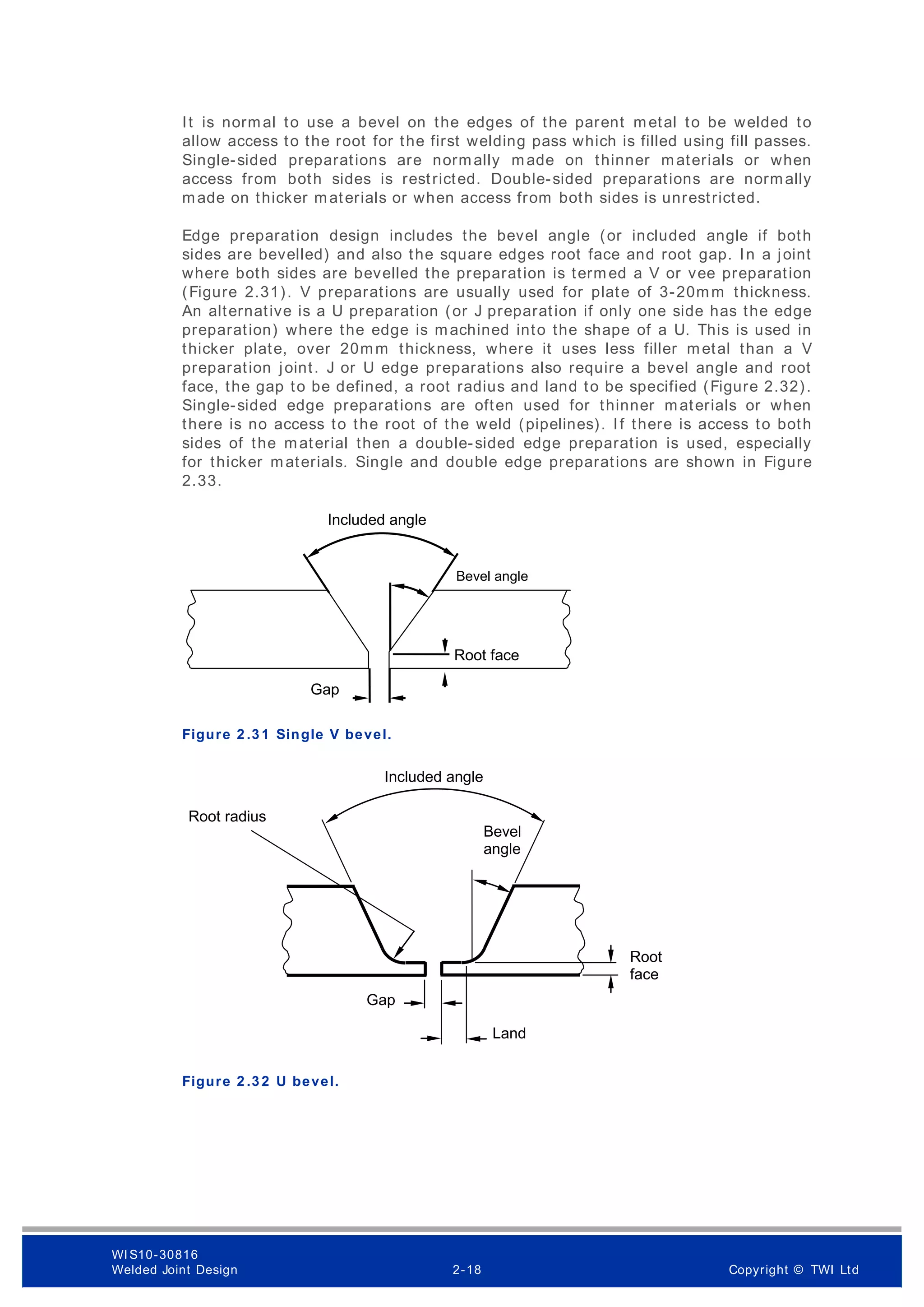
 Cool in air to ambient temperature.
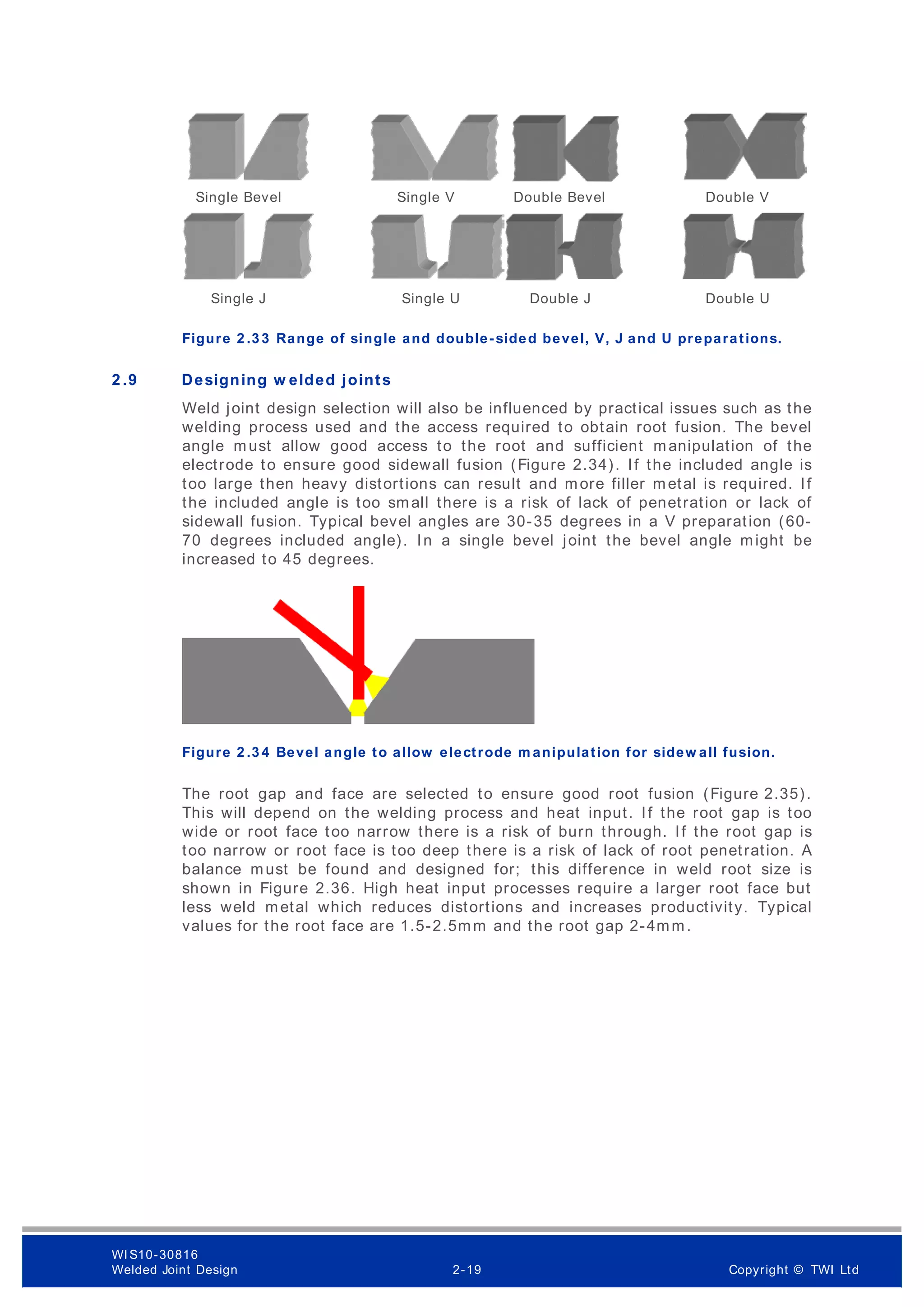
Tem
perat
ure,°C
Time
~ 900°C
Tem
perat
ure°C
Time
~ 900°C
Quenching and tem pering
 Rapid heating to soak temperature (100% austenite).
 Short soak time at tem perature.
 Rapid cooling by quenching in water or oil.
 Reheat to tempering temperature, soak and air cool.
Quenching cycle
> ~ 650°C
Tempering cycle
WI S10-30816
Heat Treatment 7-5 Copyright © TWI Ltd
Figure 7 .3 Com parison of the ‘control-rolled’ ( TMCP) and ‘as-rolled’ conditions
( = hot rolling) .
Figure 7 .4 Typical solution heat treatm ent ( solution annealing) applied to
austenitic stainless steels.
Time
Tem
perat
ure,°C
~ 900°C
Austenite + ferrite
( γ+α)
Ferrite + pearlite
(α)฀฀+ iron carbide)
As-rolled
or
hot rolled
Slab heating temperature > ~ 1050°C
Austenite
( γ)
~ 700°C
Control-rolled
or
TMCP
Tem
perat
ure,°C
Solution heat treatm ent
 Rapid heating to soak temp. (100% austenite).
 Short ‘soak’ time at tem perature.
 Rapid cool cooling by quenching into water or oil.
Time
> ~ 1050°C
Quenching
WI S10-30816
Heat Treatment 7-6 Copyright © TWI Ltd
Figure 7 .5 Typical annealing heat treatm ent applied to C-Mn and som e low alloy
steels.
Figure 7 .6 Typical PW HT applied to C-Mn steels.
Annealing
 Rapid heating to soak temperature (100% austenite).
 Short ‘soak’ time at tem perature.
 Slow cool in furnace to ambient temperature.
Tem
perat
ur
e,°C
Time
~ 900°C
Tem
perat
ure
°C
PW HT ( C-Mn steels)
 Controlled heating rate from 300°C to soak tem perat ure.
 Minimum soak time at temperature.
 Controlled cooling to ~ 300°C.
Time
~ 600°C
Soak
time
~ 300°C
Controlled heating
and cooling rates
Air cool
WI S10-30816
Heat Treatment 7-7 Copyright © TWI Ltd
Figure 7 .7 Local PW HT of a pipe girth seam .
Weld seam
WI S10-30816
Heat Treatment 7-8 Copyright © TWI Ltd
7‐1
Copyright © TWI Ltd
Section 7
Heat Treatment
Copyright © TWI Ltd
Controlled heating and cooling to bring about
desired changes in metals and alloys
Objectives
 Microstructural changes improve mechanical
properties ie toughness, machinability,
strength.
 Reduce residual stress level.
Heat Treatment
Where? Local
Global
Copyright © TWI Ltd
Carrying Out Heat Treatment
Heat
Treatment
Heating & cooling
bulk specimen
Localised Heat
treatment
Furnaces and
ovens
Gas fired
Localised heat
sources
Electric
Flame heating
Induction heating
Laser heating
Temperature
control? Use
thermocouples,
optical
pyrometers
Electric heating
mats
Copyright © TWI Ltd
Furnaces and ovens
Gas fired:
 Special attention to environment control.
 Heat from oxygen + fuel gas (methane, propane).
 High concentration of oxygen may result in scaling,
a neutral environment is beneficial.
 Avoid heat gradients.
 Radiant tube furnaces to avoid contact with
combustion product.
Electric furnaces:
 Cleaner environment.
 Expensive.
Heat Treatment Equipment
Copyright © TWI Ltd
 Heating and cooling a specific portion of a
component, ie gear edge, case or surface
hardening, weld PWHT.
 Gas flames such as oxygen + methane or
propane.
 Induction.
 Electric heating blankets.
Localised Heat Treatment
Copyright © TWI Ltd
Heat Treatment Cycle
Soaking temperature
Heating Soaking Cooling
Important
parameters
 Heating rate.
 Soaking
temperature.
 Soaking time
(1h/25mm).
 Cooling rate.
Temperature
Time
7‐2
Copyright © TWI Ltd
 Annealing.
 Normalising.
 Recovery and
re-crystallisation.
 Stress relief.
 Quenching and tempering.
 Precipitation hardening.
Types of Heat Treatment
Welds & parent
metals
Parent metals
Copyright © TWI Ltd
Normalising
Heat Treatment Temperatures
Annealing
Recovery & re-
crystallisation
Stress relief &
PWHT
Phase change
to austenite
No phase
change
Austenite
Carbon content in weight %
0.022 0.77 2.0
A3
A1
Acm
727
910
oC
600
500
PWHT
Homogenizing and hot working
Normalizing
Annealing
Recovery and recrystallization
Stress Relieve and PWHT
Copyright © TWI Ltd
 Heated to high temperature (Partially or fully
austenitic):
□ Hypereutectic steels are partially austenitized to
avoid cementite formation on grain boundaries
during slow cooling.
 Hold for some time and then slow cool.
 Coarse grain size.
 Reduced strength.
 Increased ductility.
 Homogeneous.
Full Annealing - Steel
Pearlite
Ferrite
Copyright © TWI Ltd
 Steel heated just to where austenite is stable.
 Air cooling – fairly rapid.
 Grain refinement.
 Stress relief.
 Higher strength.
 Higher toughness.
Normalising
Pearlite
Ferrite
Copyright © TWI Ltd
 Cold work increases strength and reduces
ductility and toughness.
 Reversed by recovery and re-crystallisation:
□ But if temperature too high excessive grain
growth leads to drop in strength and toughness.
 Recovery reduces the stored energy in cold-
worked or deformed (rolled) material.
 Dislocations move and align at heat treatment
temperature (recovery).
 New defect-free grains nucleate from grain
boundaries and grow (recrystallisation).
Recovery and Re-crystallisation
Copyright © TWI Ltd
Recovery and Recrystallisation
Heat treatment temperature (o C)
Heat treatment temperature (o F)
7‐3
Copyright © TWI Ltd
Non Equilibrium Heat
Treatment - Quenching
Austenite
Carbon content in weight %
0.008
0.05
0.83 2.0
A3
A1
Acm
Annealing
727
910
oC
Copyright © TWI Ltd
 Heating to annealing heat treatment
temperature range.
 Fast cooling to increase hardness:
□ Brine (Water and salt).
□ Water.
□ Oil.
 Ductility and toughness are drastically
reduced.
 Usually followed by tempering.
Non Equilibrium Heat
Treatment - Quenching
Increased quench severity
Copyright © TWI Ltd
 Subcritical (Below A1) Heat treatment to tailor
hardness/strength of martensite.
 Performed after quenching to reduce the
brittleness.
 Ductility and toughness are improved.
 Removes stresses due to quenching.
Tempering
100 200 300 400 500 600 700 o C
As-
quenched
Hardness
Copyright © TWI Ltd
Low C steel (0.12C)
Annealed at 900°C for 30
minutes and water quenched.
380Hv
After tempering at 700°C for 30
minutes and air cooled.
245Hv
Tempering
Copyright © TWI Ltd
Stress relief
 Carried out at lower temperature, to reduce
residual stresses.
Tempering
 Carried out at higher temperature (for
constructional steels).
 Not only relieves stresses but also softens the
hard HAZ microstructure.
Heat Treatments Following Welding
Copyright © TWI Ltd
 No phase
transformation.
 Slow heating and
cooling (max: 50°C/h).
 Soaking time
1hr/25mm of thickest
section.
 Usual temperature for
PWHT (C-Mn steel) –
550 to 650°C.
 Stress Relief carried
out after cold work or
welding, at lower
temperatures.
Stress Relief and PWHT
Austenite
Carbon content
in weight %
0.022 0.77 2.0
A3
A1
Acm
727
910
oC
600
500
Tempering
Stress Relief
7‐4
Copyright © TWI Ltd
PWHT Effect on Residual Stress
Time
PWHT
temperature
Actual
YS
YS at room
temperature
Soaking
temperature
Residual
stress level
YS at soaking
temperature
Copyright © TWI Ltd
PWHT Effects
Copyright © TWI Ltd
 Provide adequate support (low YS at high
temperature!).
 Control heating rate to avoid uneven thermal
expansions.
 Control soak time to equalise temperatures.
 Control temperature gradients - No direct
flame impingement.
 Control furnace atmosphere to reduce scaling.
 Control cooling rate to avoid new residual
stresses.
 For specific PWHT applications see standards,
eg ASME VIII, ASME B31.3, ASME B31.8.
PWHT Recommendations
Copyright © TWI Ltd
You are assigned to a heat treatment company
to witness heat treatments being conducted.
The heat treatments are being conducted on
various products for a major offshore oil and gas
project that you have been involved with.
Heat Treatments
Copyright © TWI Ltd
While inspecting some cast duplex valve bodies
one of your inspectors asks if the castings
require a heat treatment process. Which of the
following would most likely be applied to these
items?
a. Solution annealing
b. Quench hardening
c. No heat treatment required
d. Stress relieving would be required but only
after welding if applicable
Question 1
Copyright © TWI Ltd
A set of fabricated brackets manufactured from
316L stainless steel is about to be heat-treated,
which of the following applies?
a. This material is always stressed relieved after
welding
b. A post weld heat treat isn’t generally
conducted on this type of material
c. Quench hardening would always be applied to
this material to increase toughness after
welding
d. All options are incorrect
Question 2
7‐5
Copyright © TWI Ltd
During the post weld heat treatment of a small
welded fabrication, you observe the heat treatment
personnel applying heat by a heating torch. In
accordance with TWI Specification do you consider
this an acceptable practice?
a. Yes this is acceptable providing the temperature
attained and the soaking times are correct in
accordance with the approved PWHT procedure
b. Yes this is acceptable providing the
thermocouples are correctly placed and
calibrated
c. No, this application method isn’t acceptable
d. 2 options are correct
Question 3
Copyright © TWI Ltd
Unfortunately the stress relieving of a welded fabricated
steel structure hasn’t been witnessed by any of your
inspectors. When you review the PWHT chart you notice
only 2 thermocouples have been used. In accordance with
the TWI Specification do you consider this to be acceptable?
a. No, all PWHT shall be witnessed and a minimum of 3
thermocouples shall be used
b. Yes, only the PWHT charts require reviewing by
inspectors
c. No, all PWHT shall be witnessed, an inspector has to be
present 100% of the time throughout the PWHT process
d. No, a minimum of 3 thermocouples shall be used, and
calibration certificates require checking prior to the heat
treatment process
Question 4
Copyright © TWI Ltd
It is a requirement for a quenched and tempered
component to undergo post weld heat treatment, one
of your inspectors asks you what is the maximum
temperature required for this material. Which of the
following is correct in accordance the TWI
Specification?
a. The same as for C/Mn steel
b. You would never permit a PWHT to be carried out
on this material
c. The TWI Specification doesn’t reference this
information, but would expect it to be around
680°C
d. All options are incorrect
Question 5
Copyright © TWI Ltd
During Post Weld Heat Treatment, what
sequence of events occurs to the properties of
the material?
a. Yield strength increases, stresses decrease
then yield strength decreases
b. Ductility decreases, stresses increase then
ductility increases
c. Yield strength decreases, stresses decrease
then yield strength increases
d. Stresses increase, stresses decrease then
yield increases
Question 6
Copyright © TWI Ltd
After a PWHT process has been carried out on
some thick to thin C/Mn pipe spools (12.5mm to
25mm WT) you notice that the heating rate is
recorded at 200°C/Hr. In accordance with the
TWI Specification is this correct?
a. No, it should be a minimum of 220°C/hr
b. No, it should be 40°C/hr
c. Yes, Providing the cooling rate is the same
d. Yes, providing the cooling rate is 220°C/hr
Question 7
Copyright © TWI Ltd
While reviewing the heat treatment chart for a PWHT
process you notice that the temperature is not
recorded below 150°C on the cooling cycle. Would
you accept this chart?
a. No, the temperature must be recorded down to
room temperature
b. It would depend on the thickness and grade of
material as to whether this would be acceptable
or not
c. No, the temperature has to be recorded to at
least 110°C
d. The TWI Specification doesn’t reference this
information.
Question 8
7‐6
Copyright © TWI Ltd
In certain cases heat treatments are conducted
on cold work components such as cold rolled,
steel plate. Which of the following heat
treatments would you expect to be conducted on
these components?
a. Stress relieving
b. Densensitization
c. Quench hardening
d. Post hydrogen release
Question 9
Copyright © TWI Ltd
You notice from your records you don’t have an
inspection report for a component that has undergone
a PWHT. In this case what would your course of action
be?
a. It would be acceptable, If the component had a full
inspection report before PWHT
b. The TWI Specification makes no reference of this,
so you would have to seek advice
c. It is a requirement that all components undergo
full inspection after a PWHT process has been
conducted; in this case it would not be acceptable
d. As long as no welding has be conducted after the
PWHT process, this would be acceptable
Question 10
Section 8
W PS and W elder Qualifications
8 W PS and W elder Qualifications
When structures and pressurised items are fabricated by welding, it is essential
that all the welded joints are sound and have suitable properties for their
application.
Control of welding is by means of welding procedure specifications (WPS) that
give detailed written instructions about the welding conditions that must be
used to ensure that welded joints have the required properties.
Although WPS are shop floor documents to instruct welders, welding inspectors
need to be familiar with them because they will need to refer to WPSs when
they are checking that welders are working in accordance with the specified
requirem ents.
Welders need to understand WPSs and have the skill to make welds that are not
defective and demonstrate these abilities before being allowed to make
production welds.
8 .1 Qualified w elding procedure specifications
It is industry practice to use qualified W PS for most applications.
A welding procedure is usually qualified by m aking a test weld to demonstrate
that the properties of the joint satisfy the requirements specified by the
application standard (and the client/ end user).
Dem onstrating the mechanical properties of the joint is the principal purpose of
qualification tests but showing that a defect-free weld can be produced is also
very important.
Production welds that are made in accordance with welding conditions similar to
those used for a test weld should have similar properties and therefore be fit for
their intended purpose.
Figure 8.1 is an exam ple of a typical WPS written in accordance with the
European Welding Standard format giving details of all the welding conditions
that need to be specified.
8 .1 .1 W elding standards for procedure qualification
European and American Standards have been developed to give comprehensive
details about:
 How a welded test piece must be made to demonstrate joint properties.
 How the test piece must be tested.
 What welding details need to be included in a WPS?
 The range of production welding allowed by a particular qualification test
weld.
WI S10-30816
WPS and Welder Qualifications 8-1 Copyright © TWI Ltd
The principal European Standards that specify these requirem ents are:
BS EN I SO 1 5 6 1 4 Specification and qualification of welding procedures for
metallic materials – Welding procedure test.
Part 1 : Arc & gas welding of steels & arc welding of nickel & nickel alloys.
Part 2 : Arc welding of aluminium and its alloys.
The principal Am erican Standards for procedure qualification are:
ASME Section I X for pressurised system s (vessels & pipework).
AW S D1 .1 Structural welding of steels.
AW S D1 .2 Structural welding of aluminium.
8 .1 .2 The qualification process for w elding procedures
Although qualified WPS are usually based on test welds that have been made to
demonstrate weld joint properties; welding standards also allow qualified WPS
to be written based on other data (for som e applications).
Some alternative ways that can be used for writing qualified WPS for som e
applications are:
 Qualification by adoption of a standard w elding procedure - test
welds previously qualified and documented by other manufacturers.
 Qualification based on previous w elding experience - weld joints that
have been repeatedly made and proved to have suitable properties by their
service record.
Procedure qualification to European Standards by means of a test weld (and
similar in ASME Section IX and AWS) requires a sequence of actions that is
typified by those shown by Table 8.1.
A successful procedure qualification test is completed by the production of a
welding procedure qualification record (WPQR), an example of which is shown
by Figure 8.2.
8 .1 .3 Relationship betw een a W PQR and a W PS
Once a WPQR has been produced, the welding engineer is able to write
qualified W PSs for the various production weld joints that need to be made.
The welding conditions that are allowed to be written on a qualified WPS are
referred to as the qualification range and this range depends on the welding
conditions that were used for the test piece (the as-run details) and form part
of the WPQR.
Welding conditions are referred to as w elding variables by European and
American Welding Standards and are classified as either essential variables or
non-essential variables.
WI S10-30816
WPS and Welder Qualifications 8-2 Copyright © TWI Ltd
These variables can be defined as follows:
 Essential variable a variable that has an effect on the m echanical
properties of the weldment (and if changed beyond the limits specified by
the standard will require the WPS to be re-qualified).
 Non-essential variable a variable that must be specified on a WPS but
does not have a significant effect on the m echanical properties of the
weldment (and can be changed w ithout need for re-qualification but will
require a new WPS to be written).
It is because essential variables can have a significant effect on m echanical
properties that they are the controlling variables that govern the qualification
range and determine what can be written into a WPS.
If a welder makes a production weld using conditions outside the qualification
range given on a particular WPS, there is danger that the welded joint will not
have the required properties and there are then two options:
 Make another test weld using similar welding conditions to those used for
the affected weld and subject this to the same tests used for the relevant
WPQR to dem onstrate that the properties still satisfy specified
requirem ents.
 Remove the affected weld and re-weld the joint strictly in accordance with
the designated WPS.
Most of the welding variables that are classed as essential are the sam e in both
the European and American Welding Standards but their qualification ranges
may differ.
Some Application Standards specify their own essential variables and it is
necessary to ensure that these are taken into consideration when procedures
are qualified and WPSs are written.
Examples of essential variables (according to European Welding Standards) are
given in Table 8.2.
8 .2 W elder qualification
The use of qualified WPSs is the accepted m ethod for controlling production
welding but this will only be successful if the welders have the ability to
understand and work in accordance with them.
Welders also need to have the skill to consistently produce sound welds (free
from defects).
Welding Standards have been developed to give guidance on what particular
test welds are required in order to show that welders have the required skills to
make particular types of production welds in particular materials.
WI S10-30816
WPS and Welder Qualifications 8-3 Copyright © TWI Ltd
WIS10-30816
WPS and Welder Qualifications 8-4 Copyright © TWI Ltd
8.2.1 Welding standards for welder qualification
The principal European Standards that specify requirements are:
EN 287-1 / Qualification test of welders – Fusion welding
BS EN ISO 9606 Part 1: Steels
BS EN ISO 9606-2 Qualification test of welders – Fusion welding
Part 2: Aluminium and aluminium alloys
BS EN ISO 14732 Welding personnel. Qualification testing of welding
operators and weld setters for mechanized and automatic
welding of metallic materials
The principal American Standards that specify requirements for welder
qualification are:
ASME Section IX Pressurised systems (vessels & pipework)
AWS D1.1 Structural welding of steels
AWS D1.2 Structural welding of aluminium
8.2.2 The qualification process for welders
Qualification testing of welders to European Standards requires test welds to be
made and subjected to specified tests to demonstrate that the welder
understands the WPS and can produce a sound weld.
For manual and semi-automatic welding the emphasis of the tests is to
demonstrate ability to manipulate the electrode or welding torch.
For mechanised and automatic welding the emphasis is on demonstrating that
welding operators have ability to control particular types of welding equipment.
American Standards allow welders to demonstrate that they can produce sound
welds by subjecting their first production weld to non-destructive testing.
Table 8.3 shows the steps required for qualifying welders in accordance with
European Standards.
Figure 8.5 shows a typical Welder Qualification Certificate in accordance with
European Standards.
8.2.3 Welder qualification and production welding allowed
The welder is allowed to make production welds within the range of qualification
recorded on his welder qualification certificate.
The range of qualification is based on the limits specified by the Welding
Standard for welder qualification essential variable - defined as: a
s
variable that if changed beyond the limits specified by the Welding Standard
may require greater skill than has been demonstrated by the test weld.
Some welding variables that are classed as essential for welder qualification are
the sam e types as those classified as essential for welding procedure
qualification, but the range of qualification may be significantly wider.
Some essential variables are specific to welder qualification.
Examples of welder qualification essential variables are given in Table 8.4.
8 .2 .4 Period of validity for a w elder qualification certificate
A welder’s qualification begins from the date of welding of the test piece.
The European Standard allows a qualification certificate to remain valid for a
period of two years – provided that:
 The welding co-ordinator, or other responsible person, can confirm that the
w elder has been w orking w ithin the initial range of qualification.
 Working within the initial qualification range is confirmed every six months.
8 .2 .5 Prolongation of w elder qualification
A welder’s qualification certificate can be prolonged every two years by an
examiner/ examining body but before prolongation is allowed certain conditions
need to be satisfied:
 Records/ evidence are available that can be traced to the welder and the
WPS that have been used for production welding.
 The supporting evidence must relate to volumetric examination of the
welder’s production welds (RT or UT) on two welds made during the 6
months prior to the prolongation date.
 The supporting evidence welds must satisfy the acceptance levels for
imperfections specified by the European welding standard and have been
made under the sam e conditions as the original test weld.
WI S10-30816
WPS and Welder Qualifications 8-5 Copyright © TWI Ltd
Table 8 .1 Typical sequence for w elding procedure qualification by m eans of a
test w eld.
The w elding engineer w rites a prelim inary W elding Procedure
Specification ( pW PS) for each test coupon to be w elded
 A welder m akes the test coupon in accordance with the pWPS
 A welding inspector records all the welding conditions used to make
the test coupon (called the as-run conditions)
An Independent Examiner/ Examining Body/ Third Party Inspector m ay be
requested to m onitor the procedure qualification
The test coupon is subjected to NDT in accordance w ith the
m ethods specified by the Standard – visual inspection, MT or PT
and RT or UT
 A Welding Procedure Qualification Record (WPQR) is prepared by the
welding engineer giving details of:
» The as- run w elding conditions
» Results of the NDT
» Results of the destructive tests
» The w elding conditions allow ed for production w elding
 If a Third Party Inspector is involved he will be requested to sign the
WPQR as a true record of the test
 The test coupon is destructively tested (tensile, bend, macro tests)
 The code/ application standard/ client may require additional tests such
as hardness tests, impact tests or corrosion tests – depending on
material and application
WI S10-30816
WPS and Welder Qualifications 8-6 Copyright © TWI Ltd
Table 8 .2 Typical exam ples of W PS essential variables according to European
W elding Standards.
VARI ABLE RANGE for PROCEDURE QUALI FI CATI ON
W elding process No range – process qualified is process that must be
used in production
PW HT Joints tested after PWHT only qualify as PWHT
production joints
Joints tested ‘as-welded’ only qualify ‘as-welded’
production joints
Parent m aterial
type
Parent materials of similar composition and mechanical
properties are allocated the same Material Group No.;
qualification only allows production welding of materials
with the same Group No.
W elding
consum ables
Consumables for production welding must have the
same European designation – as a general rule
Material
thickness
A thickness range is allowed – below and above the test
coupon thickness
Type of current AC only qualifies for AC; DC polarity (+ VE or -VE)
cannot be changed; pulsed current only qualifies for
pulsed current production welding
Preheat
tem perature
The preheat temperature used for the test is the
minimum that must be applied
I nterpass
tem perature
The highest interpass temperature reached in the test is
the maximum allowed
Heat input ( HI ) When impact requirem ents apply maximum HI allowed
is 25% above test HI
when hardness requirements apply minimum HI allowed
is 25% below test HI
WI S10-30816
WPS and Welder Qualifications 8-7 Copyright © TWI Ltd
Table 8 .3 Stages for qualification of a w elder.
The w elding engineer w rites a
W PS for w elder qualification test piece
 The w elder m akes the test w eld in accordance w ith the W PS
A w elding inspector m onitors the w elding to ensure that the w elder
is w orking in accordance the W PS
An Independent Examiner/ Examining Body/ Third Party Inspector m ay be
requested to m onitor the test
 The test coupon is subjected to NDT in accordance w ith the
m ethods specified by the Standard ( visual inspection, MT or PT
and RT or UT)
 For certain m aterials, and w elding processes, som e destructive
testing m ay be required ( bends or m acros)
 A W elder’s Qualification Certificate is prepared show ing the
w elding conditions used for the test piece and the range of
qualification allow ed by the Standard for production w elding
 I f a Third Party is involved, the Qualification Certificate w ould
be endorsed as a true record of the test
WI S10-30816
WPS and Welder Qualifications 8-8 Copyright © TWI Ltd
Table 8 .4 Typical exam ples of w elder qualification essential variables according
to European W elding Standards.
VARI ABLE RANGE for W ELDER QUALI FI CATI ON
W elding process No range – process qualified is process that a welder
can use in production
Type of w eld Butt welds cover any type of joint except branch welds
fillet welds only qualify fillets
Parent m aterial
type
Parent materials of similar composition and mechanical
properties are allocated the same Material Group No.;
qualification only allows production welding of materials
with the same Group No. but the Groups allow much
wider composition ranges than the procedure Groups
Filler m aterial Electrodes and filler wires for production welding must
be of the sam e form as the test (solid wire, flux cored,
etc); for MMA coating type is essential. The filler wire
must fall within the range of the qualification of the filler
material.
Material
thickness
A thickness range is allowed; for test pieces above
12mm allow  5mm
Pipe diam eter Essential and very restricted for small diameters; test
pieces above 25mm allow  0.5 x diameter used (min.
25mm)
W elding positions Position of welding very important; H-L045 allows all
positions (except PG)
WI S10-30816
WPS and Welder Qualifications 8-9 Copyright © TWI Ltd
Figure 8 .1 Exam ple of a w elding procedure specification ( W PS) to EN 1 5 6 1 4
form at.
WI S10-30816
WPS and Welder Qualifications 8-10 Copyright © TWI Ltd
Figure 8 .2 Exam ple of a W PQR docum ent ( qualification range) to EN 1 5 6 1 4
form at.
WI S10-30816
WPS and Welder Qualifications 8-11 Copyright © TWI Ltd
Figure 8 .3 Exam ple of W PQR docum ent ( test w eld details) to EN 1 5 6 1 4 form at.
WI S10-30816
WPS and Welder Qualifications 8-12 Copyright © TWI Ltd
Figure 8 .4 Exam ple of a W PQR docum ent ( details of w eld test) to EN 1 5 6 1 4
form at.
WI S10-30816
WPS and Welder Qualifications 8-13 Copyright © TWI Ltd
Figure 8 .5 Exam ple of a w elder qualification test certificate ( W PQ) to EN 2 8 7
form at.
WI S10-30816
WPS and Welder Qualifications 8-14 Copyright © TWI Ltd
8‐1
Copyright © TWI Ltd
Section 8
Welding Procedure and Welder Qualification
Copyright © TWI Ltd
Question:
What is the main reason for carrying out a Welding
Procedure Qualification Test?
(What is the test trying to show?)
Answer:
To show that the welded joint has the properties*
that satisfy the design requirements (fit for purpose).
* Properties
 Mechanical properties are the main interest - always
strength but toughness & hardness may be important
for some applications.
 Test also demonstrates that the weld can be made
without defects.
Welding Procedure Qualification
Copyright © TWI Ltd
Purpose of a WPS
 To achieve specific properties.
□ Mechanical strength, corrosion resistance,
composition.
 To ensure freedom from defects.
 To enforce QC procedures.
 To standardise on methods and costs.
 To control production schedules.
 To form a record.
 Application standard or contract requirement.
Welding Procedures
Copyright © TWI Ltd
Object of a welding procedure test
 To give maximum confidence that the welds
mechanical and metallurgical properties meet
the requirements of the applicable
code/specification.
 Each welding procedure will show a range to
which the procedure is approved (extent of
approval).
 If a customer queries the approval evidence
can be supplied to prove its validity.
Welding Procedures
Copyright © TWI Ltd
(according to BS EN ISO 15614)
Preliminary Welding Procedure Specification (pWPS)
Welding Procedure Qualification Record (WPQR)
Welding Procedure Specification (WPS)
Welding Procedure Qualification
Copyright © TWI Ltd
Producing a welding procedure involves
 Planning the tasks.
 Collecting the data.
 Writing a procedure for use of for trial.
 Making a test welds.
 Evaluating the results.
 Approving the procedure.
 Preparing the documentation.
Welding Procedures
8‐2
Copyright © TWI Ltd
Preliminary Welding Procedure Specification
(pWPS)
Welding Engineer writes a preliminary Welding
Procedure Specification (pWPS) for each test weld
to be made.
Welding Procedure Qualification
Copyright © TWI Ltd
Welding Procedure Qualification Record (WPQR)
 A welder makes a test weld in accordance with the
pWPS.
 A welding inspector records all the welding conditions
used for the test weld (referred to as the 'as-run'
conditions).
An Independent Examiner/ Examining Body/ Third Party
inspector may be requested to monitor the
qualification process.
The finished test weld is subjected to NDT in
accordance with the methods specified by the EN ISO
Standard - Visual, MT or PT & RT or UT.
Welding Procedure Qualification
Copyright © TWI Ltd
Welding Procedure Qualification Record (WPQR)
 Test weld is subjected to destructive testing (tensile,
bend, macro).
 The Application Standard, or Client, may require
additional tests such as impact tests, hardness tests
(and for some materials - corrosion tests).
Welding Procedure Qualification Record (WPQR)
 The welding conditions used for the test weld
 Results of the NDT.
 Results of the destructive tests.
 The welding conditions that the test weld allows for
production welding.
 The Third Party may be requested to sign the WPQR as
a true record.
Welding Procedure Qualification
Copyright © TWI Ltd
Welding Procedure Specification (WPS)
 The welding engineer writes qualified
Welding Procedure Specifications (WPS) for
production welding.
 Production welding conditions must remain
within the range of qualification allowed by
the WPQR.
Welding Procedure Qualification
Copyright © TWI Ltd
(according to EN Standards)
Welding conditions are called welding variables.
Welding variables are classified by the EN ISO Standard as:
 Essential variables.
 Non-essential variables.
 Additional variables.
Note: Additional variables = ASME supplementary essential.
The range of qualification for production welding is based
on the limits that the EN ISO Standard specifies for essential
variables*
(* and when applicable - the additional variables)
Welding Procedure Qualification
Copyright © TWI Ltd
(according to EN Standards)
Welding essential variables
Question:
Why are some welding variables classified as
essential?
Answer:
A variable, that if changed beyond certain limits
(specified by the Welding Standard) may have a
significant effect on the properties* of the
joint.
* particularly joint strength and ductility.
Welding Procedure Qualification
8‐3
Copyright © TWI Ltd
(according to EN Standards)
Welding additional variables
Question:
Why are some welding variables classified as
additional?
Answer:
A variable, that if changed beyond certain limits
(specified by the Welding Standard) may have a
significant effect on the toughness and/or
hardness of the joint.
Note: ASME calls variables that affect toughness as
supplementary essential variables (but does not refer to
hardness).
Welding Procedure Qualification
Copyright © TWI Ltd
(according to EN Standards)
Some typical essential variables
 Welding process.
 Post weld heat treatment (PWHT).
 Material type.
 Electrode type, filler wire type (Classification).
 Material thickness.
 Polarity (AC, DC+ve/DC-ve).
 Pre-heat temperature.
Some typical additional variables
 Heat input.
 Welding position.
Welding Procedure Qualification
Copyright © TWI Ltd
In most codes reference is made to how the procedure are
to be devised and whether approval of these procedures is
required.
The approach used for procedure approval depends on the
code.
Example codes
 AWS D.1.1: Structural Steel Welding Code.
 BS 2633: Class 1 welding of Steel Pipe Work.
 API 1104: Welding of Pipelines.
 BS 4515: Welding of Pipelines over 7 Bar.
Other codes may not specifically deal with the requirement
of a procedure but may contain information that may be
used in writing a weld procedure.
 EN 1011: Process of Arc Welding Steels.
Welding Procedures
Copyright © TWI Ltd
Components of a welding procedure
Parent material
 Type (Grouping).
 Thickness.
 Diameter (Pipes).
 Surface condition.
Welding process
 Type of process (MMA, MAG, TIG, SAW etc).
 Equipment parameters.
 Amps, volts, travel speed.
Welding consumables
 Type of consumable/diameter of consumable.
 Brand/classification.
 Heat treatments/storage.
Welding Procedures
Copyright © TWI Ltd
Components of a welding procedure
Joint design
 Edge preparation.
 Root gap, root face.
 Jigging and tacking.
 Type of backing
Welding position
 Location, shop or site.
 Welding position e.g. PA, PB, PC etc.
 Any weather precaution.
Thermal heat treatments
 Preheat, temps.
 Post weld heat treatments eg stress relieving.
Welding Procedures
Copyright © TWI Ltd
Example
Welding
Procedure
Specification
(WPS)
Welding Procedures
8‐4
Copyright © TWI Ltd
PA 1G / 1F Flat / Downhand
PB 2F Horizontal-Vertical
PC 2G Horizontal
PD 4F Horizontal-Vertical (Overhead)
PE 4G Overhead
PF 3G / 5G Vertical-Up
PG 3G / 5G Vertical-Down
H-L045 6G Inclined Pipe (Upwards)
J-L045 6G Inclined Pipe (Downwards)
Welding Positions
Copyright © TWI Ltd
Welding Positions
Copyright © TWI Ltd
Monitoring heat input
As Required by BS EN ISO 15614-1:2004
In accordance with BS EN 1011-1:1998
 When impact requirements apply, the upper limit of
heat input qualified is 25% greater than that used in
welding the test piece.
 When hardness requirements apply, the lower limit of
heat input qualified is 25% lower than that used in
welding the test piece.
 Heat input is calculated in accordance with BS EN1011-
1.
 If welding procedure tests have been preformed at both
a high and low heat input level, then all intermediate
heat inputs are also qualified.
Welding Procedures
Copyright © TWI Ltd
15614-1-2-3
Specifies contents of WPS
"Shall give details of how a welding operation is
to be performed and contain all relevant
information".
Definitions
 Processes to be designated in accordance with
BS EN ISO 4063.
 Welding positions in accordance with BS EN ISO
6947.
 Typical WPS form.
Welding Procedures
Copyright © TWI Ltd
BS EN ISO 15614-1:2004 (Replaced BS EN 288-3)
"does not invalidate previous … approvals made to
former national standards… providing the intent of the
technical requirements is satisfied… approvals are
relevant"
"where additional tests… make the approval technically
equivalent… only necessary to do the additional tests…"
"approval is valid… in workshops or sites under the
same technical and quality control of that
manufacturer…"
"service, material or manufacturing conditions may
require more comprehensive testing… "
Application standard may require more testing
Welding Procedures
Copyright © TWI Ltd
Table 5 BS EN ISO 15614-1:2004
Welding Procedures
Single run
Range of qualification
Thickness of
test piece
t
0.7t to 2t
Multi run
3 to 2ta
0.5t to 2t
t<3
3<t<12
t>100 Not applicable
0.7t to 1.3ta
0.5t (3 min) to 1.3ta
12<t<100
50 to 2t
0.5t to 1.1t
8‐5
Copyright © TWI Ltd
Table 6 BS EN ISO 15614-1:2004
Welding Procedures
Single run
Throat Thickness
Material
Thickness
Range of qualification
Thickness of
test piece
t
No
restriction
Multi run
No
restriction
No
restriction
0.75 a to
1.5 a
a
0.75 a to
1.5 a
t<3
3<t<30
t>30 >5
0.7 to 2 t
0.5t (3 min)
to 1.2 t
Copyright © TWI Ltd
BS EN ISO 15614-1:2004 (Replaced BS EN 288-3)
Covers Arc & Gas Welding of Steels &
Arc Welding of Nickel & Nickel Alloys
111 - MMA 114 - FCAW - no gas shield
12 - SAW 131 - MIG
135 - MAG 136 - FCAW - active gas
137 - FCAW - inert gas 141 - TIG
15 - PLASMA ARC 311 – Oxy-Acetylene
The principle of this European Standard may be applied to
other fusion welding processes
Welding Procedures
Copyright © TWI Ltd
Note 1:
a is the throat as used for the test piece.
Note 2:
Where the fillet weld is qualified by means of a
butt test, the throat thickness range qualified
shall be based on the thickness of the deposited
metal.
For special applications only. Each fillet weld
shall be proofed separately by a welding
procedure test.
Welding Procedures
Copyright © TWI Ltd
TABLE 7 BS EN ISO 15614-1:2004
Welding Procedures
Diameter of the test
piece Da, mm
0.5 D to 2 D
Note: For structural hollow sections D is the dimension of
the smaller side
D<25
D>25
a D is the outside diameter of the pipe or outside
diameter of the branch pipe
Range of Qualification
>0.5 D (25 mm min)
Copyright © TWI Ltd
Welder Approval
CSWIP 3.2 Welding Inspection
Copyright © TWI Ltd
(according to BS EN Standards)
Question:
What is the main reason for qualifying a welder?
Answer:
To show that he has the skill to be able to make
production welds that are free from defects.
Note: When welding in accordance with a
Qualified WPS.
Welder Qualification
8‐6
Copyright © TWI Ltd
(according to BS EN ISO 9606)
An approved WPS should be available covering the
range of qualification required for the welder
approval.
 The welder qualifies in accordance with an
approved WPS.
 A welding inspector monitors the welding to make
sure that the welder uses the conditions specified
by the WPS.
EN Welding Standard states that an Independent
Examiner, Examining Body or Third Party Inspector
may be required to monitor the qualification process.
Welder Qualification
Copyright © TWI Ltd
(according to BS EN ISO 9606)
The finished test weld is subjected to NDT by the methods
specified by the EN Standard - Visual, MT or PT & RT or UT.
The test weld may need to be destructively tested - for
certain materials and/or welding processes specified by the
EN Standard or the Client Specification.
 A Welder’s Qualification Certificate is prepared showing
the conditions used for the test weld and the range of
qualification allowed by the EN Standard for production
welding.
 The Qualification Certificate is usually endorsed by a
Third Party Inspector as a true record of the test.
Welder Qualification
Copyright © TWI Ltd
(according to BS EN ISO 9606)
The welder is allowed to make production welds within the
range of qualification shown on the Certificate.
The range of qualification allowed for production welding is
based on the limits that the EN Standard specifies for the
welder qualification essential variables.
A Welder’s Qualification Certificate automatically expires if
the welder has not used the welding process for 6 months
or longer.
A Certificate may be withdrawn by the Employer if there is
reason to doubt the ability of the welder, for example
 A high repair rate.
 Not working in accordance with a qualified WPS.
Welder Qualification
Copyright © TWI Ltd
(according to BS EN ISO 9606)
Essential variables
Question:
What is a 'welder qualification essential variable'?
(what makes the variable 'essential'?)
Answer:
A variable, that if changed beyond the limits
specified by the EN Standard, may require more
skill than has been demonstrated by the test weld.
Welder Qualification
Copyright © TWI Ltd
(according to BS EN ISO 9606)
Typical Welder Essential Variables
 Welding process.
 Material type.
 Electrode type.
 Material thickness.
 Pipe diameter.
 Welding position.
 Weld backing (an unbacked weld requires
more skill).
Welder Qualification
Copyright © TWI Ltd
Numerous codes and standards deal with welder
qualification, eg BS EN ISO 9606
 Once the content of the procedure is approved the next
stage is to approve the welders to the approved
procedure.
 A welders test know as a Welders Qualification Test
(WQT).
Object of a welding qualification test:
 To give maximum confidence that the welder meets the
quality requirements of the approved procedure (WPS).
 The test weld should be carried out on the same
material and same conditions as for the production
welds.
Welder Qualification
8‐7
Copyright © TWI Ltd
Information that should be included on a welders
test certificate are:
 Welders name and identification number.
 Date of test and expiry date of certificate.
 Standard/code eg BS EN ISO 9606.
 Test piece details.
 Welding process.
 Welding parameters, amps, volts
 Consumables, flux type and filler classification details.
 Sketch of run sequence.
 Welding positions.
 Joint configuration details.
 Material type qualified, pipe diameter etc.
 Test results, remarks.
 Test location and witnessed by.
 Extent (range) of approval.
Welder Qualification
Copyright © TWI Ltd
The inspection of a welders qualification test
 It is normal for a qualified inspectors usually from
an independent body to witness the welding.
 Under normal circumstances only one test weld per
welder is permitted.
 If the welder fails the test weld and the failure is
not the fault of the welder eg faulty welding
equipment then a re-test would be permitted.
 The testing of the test weld is done in
accordance with the applicable code.
 It is not normal to carry out tests that test for
the mechanical properties of welds eg tensile,
charpy and hardness tests.
Welder Qualification
Copyright © TWI Ltd
Example:
Welder
Approval
Qualification
Certification
Welder Qualification
Copyright © TWI Ltd
You are in the process of ensuring that welding
procedures and qualified welders are available
for a new project involving many materials and
processes.
You have to ensure that they all comply with the
TWI specification.
Welding Procedures and
Welder Qualifications
Copyright © TWI Ltd
Within the range of variables in a welding
procedure, DC+ has been stated for the root
pass.
a. This would allow the use of DC- also
b. This would allow the use of AC also
c. In accordance with the Specification, any
polarity could now be used
d. In accordance with the specification only DC+
can be used
Question 1
Copyright © TWI Ltd
Using the TWI specification, which of the
following is true for welder qualifications?
a. Plate and pipe require separate qualifications
b. Plate qualifies pipe
c. Pipe qualifies plate
d. It depends on whether it is fillet weld or butt
weld
Question 2
8‐8
Copyright © TWI Ltd
Which of the following NDT test is specified for
all types of Stainless steel welds?
a. Visual
b. Radiographic
c. Dye penetrant
d. All options are correct
Question 3
Copyright © TWI Ltd
If a welding current of 145A was used on the
test plate during qualification, on the actual job
while using this procedure, the maximum
current permitted is?
a. 175A
b. 125A
c. 166A
d. 200A
Question 4
Copyright © TWI Ltd
With respect to the validity of using a procedure in
different positions, which one of the following is
acceptable?
a. Procedure is always valid only for the position
tested
b. Procedure is always valid for all the positions
when impacts are specified
c. Procedure qualified in vertical up position
qualifies for that position only when impacts are
specified
d. Procedure is valid for all positions only for butt
welds when impacts are specified
Question 5
Copyright © TWI Ltd
If a welder tests on a plate thickness of 14 mm,
he is qualified to weld which of the following
thicknesses?
a. 14 mm
b. 5-14 mm
c. 5-28 mm
d. 14 mm and above
Question 6
Copyright © TWI Ltd
For qualifying a welder for butt welding austenitic
stainless steels, 14 mm thick plate, using the TIG
process, which of the following tests are not
required?
a. Fillet fracture
b. Macro examination
c. Hardness tests
d. All of the above
Question 7
Copyright © TWI Ltd
Which one of the following changes does not
require re-qualification of a welder?
a. Change from PF to PG
b. Change from fillet to butt
c. Change from pipe to plate
d. Change from rutile to low hydrogen
consumable
Question 8
8‐9
Copyright © TWI Ltd
Which one of the following is true?
a. Cellulosic qualifies rutile types also
b. PG qualifies PG only
c. The addition of a backing strip requires
requalification
d. Change from argon to carbon dioxide
Question 9
Copyright © TWI Ltd
If a welder fails a qualification test due to lack of
skill, how many are allowed?
a. One
b. Two
c. No retests are allowed
d. No limit for retests
Question 10
Section 9
Arc Energy and Heat I nput
WIS10-30816
Arc Energy and Heat Input 9-1 Copyright © TWI Ltd
9 Arc Energy and Heat Input
9.1 Current and voltage
The amount of electrons on the move defines the amount of electricity that
flows termed current. i and measured in amps, A. Electron flow and therefore
electricity, move at the speed of light as, rather than being the movement of
small solid particles, it is a form of electromagnetic wave, but as this takes us
into the realm of relativity we will not offer a proof of that here. Suffice to say
that, for all practical purposes, electricity is instantaneously available
throughout a circuit.
The differential of the positive and negative used to attract the electrons from
one to the other can be regarded as the driving force. This is called the
potential difference or voltage. Because of this potential there is a tendency
for the electrons to move, ie there is a force attempting to move them from the
negative to the positive. This force is called the electromotive force, (emf),
and is measured in volts, V.
9.2 Arc Energy or heat Input
Amperage and voltage are the two main parameters used when measuring the
welding arc but so is the travel speed. These three variables are used to
calculate the arc energy or heat input, measured in kilo Joules per mm of weld
length. In general, this measurement is from 0.2 to 3.5 Kj per mm but there
are occasions when it can drop below or go above this range.
This measurement is used as a point of reference and is quoted on
documentation, such as a weld procedure. It can have a significant effect on a
materials properties, distortion and residual stress, depending on how high or
low the value is. Therefore, knowing the importance and how to calculate it is
essential for anybody involved in the process.
Arc energy, is generally the term used in conjunction with heat input although
in reality they are different measurements. Arc energy, is the energy generated
at the welding arc using a simple formula. Heat input is the energy generated in
the workpiece from the welding arc using a slightly different formula. Essentially
they are the same thing but once one type of measurement has been selected,
you should not deviate between the two or errors will occur.
American standards use the term heat input but the energy is measured at the
arc wheras the end standards use the term heat input which is the actual
energy transferred to the material. These measurements will be different in
each case, EN generally has lower values as the EN standards take into account
the thermal efficiency value of the welding process know as the “K” factor.
Therefore, the standards dictating which type of measurement shall be recorded
although a Senior Welding Inspector should have a knowledge of both.
Arc energy is reasonably easy to calculate, the amperage and voltage used are
multiplied together and divided by the travel speed in mm per second multiplied
by 1000 to give the Kj per mm.
Exam ple
A MAG weld is made and the following conditions were recorded:
 Arc volts = 24.
 Welding amperage = 240.
 Travel speed = 300m m/ minute.
W hat is the arc energy?
Arc energy (kJ/ mm) = Volts x amps
Travel speed (mm/ sec) x 1000
= 24 x 240
(300/ 60) x 1000
= 5760
5000
Arc energy = 1 .1 5 2 or 1 .2 kJ/ m m
To calculate heat input, the amount of energy produced in the work piece, we
can use the sam e values as before but multiply the amperage and voltage
values by what’s know as the efficiency value. This is based on the fact that a
certain amount of energy is lost through the arc and depending on the welding
process, more or less of this energy is lost. For example, SAW does not lose any
energy mainly due to insulation of the granular flux whereas the TIG process
loses 40% through conduction, convection and radiation.
Efficiency values via process:
 SAW = 1.0.
 MIG/ MAG, FCAW and MMAW = 0.8.
 TIG and PLASMA = 0.6.
If we use the sam e worked example of the MAG process but this time calculate
heat input it will be evident the value has dropped by 20% . Therefore, it is
essential that the values recorded are either kept the sam e or labelled as heat
input or arc energy.
WI S10-30816
Arc Energy and Heat I nput 9-2 Copyright © TWI Ltd
Exam ple
A MAG weld is made and the following conditions were recorded:
 Arc volts = 24.
 Welding amperage = 240.
 Travel speed = 300m m/ minute.
W hat is the heat input?
Heat input (kJ/ mm) = Volts x amps x 0.8 (efficiency value)
Travel speed (mm/ sec) x 1000
= 24 x 240 x 0.8
(300/ 60) x 1000
= 4608
5000
Heat input = 0 .9 2 kJ/ m m
WI S10-30816
Arc Energy and Heat I nput 9-3 Copyright © TWI Ltd
9‐1
Copyright © TWI Ltd
Section 9
Arc Energy and Heat Input
Copyright © TWI Ltd
Copyright © TWI Ltd
What are the factors that influence arc
energy/heat input?
 Amperage.
 Voltage.
 Travel speed.
Arc Energy/Heat Input
Copyright © TWI Ltd
What is the difference between arc energy
and heat input?
 Its the Thermal Efficiency Factor known as ”k”
 ASME IX – Heat Input
(but measured as Arc energy)
 BS EN ISO 15614 – Heat Input
(Arc energy x ”k”)
Arc Energy/Heat Input
Copyright © TWI Ltd
 What we call Arc Energy the American
standards reference as Heat Input?
 The difference between EN standards and
American standards is the use of a thermal
efficiency factor in EN known as the ”k” factor
 The ”k” factor denotes the thermal efficiency
value of the process used
What's the difference?
Copyright © TWI Ltd
The amount of heat generated in the welding arc
per unit length of weld.
 Expressed in kilo Joules per millimetre length
of weld (kJ/mm).
Arc energy (kJ/mm) = Volts x Amps
welding speed(mm/s) x 1000
Arc Energy
9‐2
Copyright © TWI Ltd
The energy supplied by the welding arc to the
work piece.
Expressed in terms of
arc energy x thermal efficiency factor
Thermal efficiency factor is the ratio of heat
energy introduced into the weld to the electrical
energy consumed by the arc.
Heat Input
Copyright © TWI Ltd
Heat input values for various welding processes
can be calculated from the arc energy by
multiplying by the following
 Thermal efficiency factors;
Heat Input
Copyright © TWI Ltd
Arc Energy/Heat Input
Thermal efficiency factor k of welding processes
Process No Process Factor k
121 Submerged arc welding with wire 1.0
111 Metal-arc welding with covered electrodes 0.8
131 MIG welding 0.8
135 MAG welding 0.8
114 Flux-cored wire metal-arc welding without gas shield 0.8
136 Flux-cored wire metal-arc welding with active gas shield 0.8
137 Flux-cored wire metal-arc welding with inert gas shield 0.8
138 Metal-cored wire metal-arc welding with active gas shield 0.8
139 Metal-cored wire metal-arc welding with inert gas shield 0.8
141 TIG welding 0.6
15 Plasma arc welding 0.6
Copyright © TWI Ltd
Example
A MAG weld is made and the following conditions
were recorded:
 Arc volts = 24.
 Welding amperage = 240.
 Travel speed = 300mm/minute.
What is the arc energy and heat input?
Arc Energy Calculation
Copyright © TWI Ltd
AE (kJ/mm) = Volts x amps
TS (mm/ sec) x 1000
= 24 x 240
(300/60) x 1000
= 5760
5000
Arc Energy = 1.152 or 1.2kJ/mm
Arc Energy Calculation
Copyright © TWI Ltd
AE (kJ/mm) = Volts x amps x 60 x 0.8
TS (mm/ min) x 1000
= 24 x 240 x 60 x 0.8
300 x 1000
= 276480
300000
Heat Input = 0.92kJ/mm
Heat Input
9‐3
Copyright © TWI Ltd
Arc Energy/Heat Input
Copyright © TWI Ltd
In the near future your shop floor is likely to get
fabrication jobs involving many critical materials in which
controlling heat input will be required to achieve the
desired properties.
The customer has already provided you with the
specification, the TWI specification, which talks about
welding of many materials and specifies heat input control
for some of them.
It is generally felt by you and your team that a proper
understanding of this vital area is required before initiating
any fabrication activity.
Some of the queries raised during the discussions you had
with your team are as detailed below and trying to answer
them will bring in more clarity and will help in following
correct practices during welding.
Heat Input and Arc Energy
Copyright © TWI Ltd
What is the arc energy using process 121 when
the parameters are 24V-225A-250mm per
minute ?
a. 1.3 KJ/mm
b. 1.04KJ/mm
c. 0.57KJ/mm
d. 3.2KJ/mm
Question 1
Copyright © TWI Ltd
The heat input for the TIG welding process using
parameters 20V-125A-50mm per minute will be?
a. 2.42KJ/mm
b. 1.02KJ/mm
c. 1.80 KJ/mm
d. 0.8KJ/mm
Question 2
Copyright © TWI Ltd
Using the preheat tables in the TWI specification,
when welding C-Mn steels having a carbon
equivalent of 0.38 and section combined thickness
of 25 mm using MMA process with hydrogen scale
C and a preheat of 125C with 22V-150A, Which
welding speed falls within the permitted range of
HI?
a. 68mm/min
b. 72mm/min
c. 74mm/min
d. 80mm/min
Question 3
Copyright © TWI Ltd
When welding C-Mn steels, having a carbon
equivalent of 0.40 and combined section
thickness of 102 mm, using a preheat of 50C
with MMA process with parameters 24V-100 mm
per min. From those listed which is the
maximum current permitted?
a. 276A
b. 372A
c. 555A
d. 434A
Question 4
9‐4
Copyright © TWI Ltd
Which of the following is true?
a. For a lower heat input, higher preheats are
required
b. For the same material, the heat input
increases with decreasing hydrogen levels
c. As preheat increases, the heat input increases
d. A higher heat input cannot eliminate preheat
Question 5
Copyright © TWI Ltd
Which of the following materials have specific
restrictions on heat input?
a. Q&T steels
b. Duplex stainless steels
c. Aluminium
d. All of the above options are correct
Question 6
Copyright © TWI Ltd
Using TIG process for welding 4043 aluminium
alloy having a thickness of 4.2 mm, which of the
following parameters will be acceptable?
a. 20V, 25mm/min, 18A
b. 20V, 25mm/min, 13A
c. 21V, 25mm/min, 30A
d. 20V, 25mm/min, 9A
Question 7
Copyright © TWI Ltd
When welding A514 grade material having a
thickness of 15 mm, using a preheat of 100C,
with the MMA process, which of the following
parameters can be acceptable?
a. 24V-210A-200mm/min
b. 20V-210A-200mm/min
c. 24V-210A-150mm/min
d. 25V-250A-200mm/min
Question 8
Copyright © TWI Ltd
When welding duplex stainless steels, having
23.5% Chromium, using the TIG process, for a
plate thickness of 12 mm, the heat input will be
dependent on?
a. The carbon content
b. The preheat used
c. Combined plate thickness
d. None of the above
Question 9
Copyright © TWI Ltd
When welding 75mm Q&T steels with a
maximum preheat of 100C, the minimum heat
input is restricted to
a. 2.5KJ/mm
b. 3.2KJ/mm
c. 4.8KJ/mm
d. 5.0KJ/mm
Question 10
Section 1 0
Residual Stress and Distortion
1 0 Residual Stress and Distortion
1 0 .1 W hat causes distortion?
Because welding involves highly localised heating of joint edges to fuse the
material, non-uniform stresses are set up in the component because of
expansion and contraction of the heated material.
Initially, compressive stresses are created in the surrounding cold parent metal
when the weld pool is formed due to the thermal expansion of the hot metal
(heat affected zone (HAZ)) adjacent to the weld pool. However, tensile stresses
occur on cooling when the contraction of the weld metal and immediate HAZ is
resisted by the bulk of the cold parent m etal.
The magnitude of therm al stresses induced into the material can be seen by the
volume change in the weld area on solidification and subsequent cooling to
room temperature. For example, when welding C-Mn steel, the molten weld
metal volume will be reduced by approximately 3% on solidification and the
volume of the solidified weld metal/ HAZ will be reduced by a further 7% as its
temperature falls from the melting point of steel to room temperature.
If the stresses generated from thermal expansion/ contraction exceed the yield
strength of the parent metal, localised plastic deformation of the metal occurs.
Plastic deformation causes a permanent reduction in the component dimensions
and distorts the structure.
1 0 .2 W hat are the m ain types of distortion?
Distortion occurs in several ways:
 Longitudinal shrinkage.
 Transverse shrinkage.
 Angular distortion.
 Bowing and dishing.
 Buckling.
Contraction of the weld area on cooling results in both transverse
and longitudinal shrinkage.
Non-uniform contraction (through thickness) produces angular distortion as
well as longitudinal and transverse shrinking.
For example, in a single V butt weld, the first weld run produces longitudinal
and transverse shrinkage and rotation. The second run causes the plates to
rotate using the first weld deposit as a fulcrum. Therefore balanced welding in a
double side V butt joint can be used to produce uniform contraction and prevent
angular distortion.
Similarly, in a single-sided fillet weld, non-uniform contraction will produce
angular distortion of the upstanding leg. Double-sided fillet welds can therefore
be used to control distortion in the upstanding fillet but because the weld is only
deposited on one side of the base plate, angular distortion will now be produced
in the plate.
WI S10-30816
Residual stress and Distrortion 10-1 Copyright © TWI Ltd
Longitudinal bow ing in welded plates happens when the weld centre is not
coincident with the neutral axis of the section so that longitudinal shrinkage in
the welds bends the section into a curved shape. Clad plate tends to bow in two
directions due to longitudinal and transverse shrinkage of the cladding. This
produces a dished shape.
Dishing is also produced in stiffened plating. Plates usually dish inwards
between the stiffeners, because of angular distortion at the stiffener attachment
welds.
In plating, long range compressive stresses can cause elastic buckling in thin
plates, resulting in dishing, bowing or rippling, see below.
Exam ples of distortion
Figure 1 0 .1 Exam ples of distortion.
Increasing the leg length of fillet welds, in particular, increases shrinkage.
1 0 .3 W hat are the factors affecting distortion?
If a m etal is uniformly heated and cooled there would be almost no distortion.
However, because the material is locally heated and restrained by the
surrounding cold metal, stresses are generated higher than the material yield
stress causing permanent distortion. The principal factors affecting the type and
degree of distortion are:
 Parent material properties.
 Amount of restraint.
 Joint design.
 Part fit-up.
 Welding procedure.
WI S10-30816
Residual stress and Distrortion 10-2 Copyright © TWI Ltd
1 0 .3 .1 Parent m aterial properties
Parent material properties, which influence distortion, are coefficient of thermal
expansion, thermal conductivity, and to a lesser extent, yield stress and
Young’s modulus. As distortion is determined by expansion and contraction of
the material, the coefficient of thermal expansion of the material plays a
significant role in determining the stresses generated during welding and,
hence, the degree of distortion. For example, as stainless steel has a higher
coefficient of expansion and lesser thermal conductivity than plain carbon steel,
it generally has significantly more distortion.
1 0 .3 .2 Restraint
If a component is welded without any external restraint, it distorts to relieve the
welding stresses. So, methods of restraint, such as strongbacks in butt welds,
can prevent movem ent and reduce distortion. As restraint produces higher
levels of residual stress in the material, there is a greater risk of cracking in
weld metal and HAZ especially in crack-sensitive materials.
1 0 .3 .3 Joint design
Both butt and fillet joints are prone to distortion, but it can be minimised in butt
joints by adopting a joint type, which balances the thermal stresses through the
plate thickness. For example, double- in preference to a single-sided weld.
Double-sided fillet welds should eliminate angular distortion of the upstanding
member, especially if the two welds are deposited at the sam e time.
1 0 .3 .4 Part fit- up
Fit-up should be uniform to produce predictable and consistent shrinkage.
Excessive joint gap can also increase the degree of distortion by increasing the
amount of weld metal needed to fill the joint. The joints should be adequately
tacked to prevent relative m ovem ent between the parts during welding.
1 0 .3 .5 W elding procedure
This influences the degree of distortion mainly through its effect on the heat
input. As welding procedures are usually selected for reasons of quality and
productivity, the welder has limited scope for reducing distortion. As a general
rule, weld volume should be kept to a minimum. Also, the welding sequence
and technique should aim to balance the thermally induced stresses around the
neutral axis of the component.
1 0 .4 Distortion - prevention by pre-setting, pre- bending or use of restraint
Distortion can often be prevented at the design stage, for example, by placing
the welds about the neutral axis, reducing the am ount of welding and
depositing the weld metal using a balanced welding technique. In designs where
this is not possible, distortion may be prevented by one of the following
methods:
 Pre-setting of parts.
 Pre-bending of parts.
 Use of restraint.
WI S10-30816
Residual stress and Distrortion 10-3 Copyright © TWI Ltd
The technique chosen will be influenced by the size and complexity of the
component or assembly, the cost of any restraining equipment and the need to
limit residual stresses.
Figure 1 0 .2 Pre-setting of parts to produce correct alignm ent after w elding:
a Pre-setting of fillet joint to prevent angular distortion;
b Pre-setting of butt joint to prevent angular distortion.
1 0 .4 .1 Pre-setting of parts
The parts are pre-set and left free to move during welding (see above). In
practice, the parts are pre-set by a pre-determined amount so that distortion
occurring during welding is used to achieve overall alignment and dimensional
control.
The main advantages compared with the use of restraint are that there is no
expensive equipment needed and there will be lower residual stress in the
structure.
Unfortunately, as it is difficult to predict the amount of pre-setting needed to
accommodate shrinkage, a number of trial welds will be required. For example,
when MMA or MIG/ MAG welding butt joints, the joint gap will normally close
ahead of welding; when submerged arc welding; the joint may open up during
welding. When carrying out trial welds, it is also essential that the test structure
is reasonably representative of the full size structure in order to generate the
level of distortion likely to occur in practice. For these reasons, pre-setting is a
technique more suitable for simple components or assemblies.
Figure 1 0 .3 Pre-bending, using strongbacks and w edges, to accom m odate
angular distortion in thin plates.
1 0 .4 .2 Pre-bending of parts
Pre-bending, or pre-springing the parts before welding is used to pre-stress the
assembly to counteract shrinkage during welding. As shown above, pre-bending
by means of strongbacks and wedges can be used to pre-set a seam before
welding to compensate for angular distortion. Releasing the wedges after
welding will allow the parts to m ove back into alignment.
WI S10-30816
Residual stress and Distrortion 10-4 Copyright © TWI Ltd
The figure shows the diagonal bracings and centre jack used to pre-bend the
fixture, not the component. This counteracts the distortion introduced though
out-of-balance welding.
1 0 .4 .3 Use of restraint
Because of the difficulty in applying pre-setting and pre-bending, restraint is the
more widely practised technique. The basic principle is that the parts are placed
in position and held under restraint to minimise any movem ent during welding.
When removing the component from the restraining equipment, a relatively
small amount of m ovement will occur due to locked-in stresses. This can be
cured by either applying a small amount of pre-set or stress-relieving before
rem oving the restraint.
When welding assemblies, all the component parts should be held in the correct
position until completion of welding and a suitably balanced fabrication
sequence used to minimise distortion.
Welding with restraint will generate additional residual stresses in the weld,
which may cause cracking. When welding susceptible materials, a suitable
welding sequence and the use of preheating will reduce this risk.
Restraint is relatively simple to apply using clamps, jigs and fixtures to hold the
parts during welding.
W elding jigs and fixtures
Jigs and fixtures are used to locate the parts and ensure that dimensional
accuracy is maintained whilst welding. They can be of a relatively simple
construction, as shown in a) below but the welding engineer will need to ensure
that the finished fabrication can be rem oved easily after welding.
Flexible clam ps
A flexible clamp (b) below) can be effective in applying restraint and also
setting-up and maintaining the joint gap (it can also be used to close a gap that
is too wide).
A disadvantage is that as the restraining forces in the clamp will be transferred
into the joint when the clamps are removed, the level of residual stress across
the joint can be quite high.
Figure 1 0 .4 Restraint techniques to prevent distortion.
WI S10-30816
Residual stress and Distrortion 10-5 Copyright © TWI Ltd
Strongbacks ( and w edges)
Strongbacks are a popular means of applying restraint especially for site work.
Wedged strongbacks (c)) above), will prevent angular distortion in plate and
help prevent peaking in welding cylindrical shells. As these types of strongback
will allow transverse shrinkage, the risk of cracking will be greatly reduced
compared with fully welded strongbacks.
Fully welded strongbacks (welded on both sides of the joint) (d) above) will
minimise both angular distortion and transverse shrinkage. As significant
stresses can be generated across the weld, which will increase any tendency for
cracking, care should be taken in the use of this type of strongback.
1 0 .4 .4 Best practice
Adopting the following assembly techniques will help to control distortion:
 Pre-set parts so that welding distortion will achieve overall alignment and
dimensional control with the minimum of residual stress.
 Pre-bend joint edges to counteract distortion and achieve alignment and
dimensional control with minimum residual stress.
 Apply restraint during welding by using jigs and fixtures, flexible clamps,
strongbacks and tack welding but consider the risk of cracking which can be
quite significant, especially for fully welded strongbacks.
 Use an approved procedure for welding and removal of welds for restraint
techniques, which may need preheat to avoid forming imperfections in the
component surface.
1 0 .5 Distortion - prevention by design
Design principles
At the design stage, welding distortion can often be prevented, or at least
restricted, by considering:
 Elimination of welding.
 Weld placement.
 Reducing the volume of weld metal.
 Reducing the number of runs.
 Use of balanced welding.
1 0 .6 Elim ination of w elding
As distortion and shrinkage are an inevitable result of welding, good design
requires that not only the amount of welding is kept to a minimum, but also the
smallest amount of weld metal is deposited. Welding can often be eliminated at
the design stage by forming the plate or using a standard rolled section, as
shown below.
WI S10-30816
Residual stress and Distrortion 10-6 Copyright © TWI Ltd
Figure 1 0 .5 Elim ination of w elds by:
a Form ing the plate;
b Use of rolled or extruded section.
If possible, the design should use intermittent welds rather than a continuous
run, to reduce the am ount of welding. For example, in attaching stiffening
plates, a substantial reduction in the amount of welding can often be achieved
whilst maintaining adequate strength.
1 0 .6 .1 W eld placem ent
Placing and balancing of welds are important in designing for minimum
distortion. The closer a weld is positioned to the neutral axis of a fabrication,
the lower the leverage effect of the shrinkage forces and the final distortion.
Examples of poor and good designs are shown below.
Figure 1 0 .6 Distortion m ay be reduced by placing the w elds around the neutral
axis.
As most welds are deposited away from the neutral axis, distortion can be
minimised by designing the fabrication so the shrinkage forces of an individual
weld are balanced by placing another weld on the opposite side of the neutral
axis. When possible, welding should be carried out alternately on opposite
sides, instead of completing one side first. In large structures, if distortion is
occurring preferentially on one side, it may be possible to take corrective
actions, for example, by increasing welding on the other side to control the
overall distortion.
WI S10-30816
Residual stress and Distrortion 10-7 Copyright © TWI Ltd
1 0 .6 .2 Reducing the volum e of w eld m etal
To minimise distortion, as well as for econom ic reasons, the volume of weld
metal should be limited to the design requirements. For a single-sided joint, the
cross-section of the weld should be kept as sm all as possible to reduce the level
of angular distortion, as illustrated below.
Figure 1 0 .7 Reducing the am ount of angular distortion and lateral shrinkage.
Ways of reducing angular distortion and lateral shrinkage:
 Reducing the volume of weld metal.
 Using single pass weld.
 Ensure fillet welds are not oversize.
Joint preparation angle and root gap should be minimised providing the weld
can be made satisfactorily. To facilitate access, it may be possible to specify a
larger root gap and smaller preparation angle. By cutting down the difference in
the amount of weld metal at the root and face of the weld, the degree of
angular distortion will be correspondingly reduced. Butt joints made in a single
pass using deep penetration have little angular distortion, especially if a closed
butt joint can be welded (see above). For example, thin section material can be
welded using plasma and laser welding processes and thick section can be
welded, in the vertical position, using electrogas and electroslag processes.
Although angular distortion can be eliminated, there will still be longitudinal and
transverse shrinkage.
In thick section material, as the cross-sectional area of a double V joint
preparation is often only half that of a single V preparation, the volume of weld
metal to be deposited can be substantially reduced. The double V joint
preparation also permits balanced welding about the middle of the joint to
eliminate angular distortion.
As weld shrinkage is proportional to the amount of weld metal both poor joint
fit-up and over-welding will increase the amount of distortion. Angular
distortion in fillet welds is particularly affected by over-welding. As design
strength is based on throat thickness, over-welding to produce a convex weld
bead does not increase the allowable design strength but will increase the
shrinkage and distortion.
WI S10-30816
Residual stress and Distrortion 10-8 Copyright © TWI Ltd
1 0 .6 .3 Reducing the num ber of runs
There are conflicting opinions on whether it is better to deposit a given volume
of weld metal using a small number of large weld passes or a large number of
small passes. Experience shows that for a single-sided butt joint, or fillet weld,
a large single weld deposit gives less angular distortion than if the weld is made
with a number of sm all runs. Generally, in an unrestrained joint, the degree of
angular distortion is approximately proportional to the number of passes.
Completing the joint with a small number of large weld deposits results in more
longitudinal and transverse shrinkage than a weld completed in a larger number
of small passes. In a m ulti-pass weld, previously deposited weld metal provides
restraint, so the angular distortion per pass decreases as the weld is built up.
Large deposits also increase the risk of elastic buckling particularly in thin
section plate.
1 0 .6 .4 Use of balanced w elding
Balanced welding is an effective means of controlling angular distortion in a
multi-pass butt weld by arranging the welding sequence to ensure that angular
distortion is continually being corrected and not allowed to accumulate during
welding. Comparative amounts of angular distortion from balanced welding and
welding one side of the joint first are shown below. The balanced welding
technique can also be applied to fillet joints.
Figure 1 0 .8 Balanced w elding to reduce the am ount of angular distortion.
If welding alternately on either side of the joint is not possible, or if one side
has to be completed first, an asymm etrical joint preparation may be used with
more weld metal being deposited on the second side. The greater contraction
resulting from depositing the weld metal on the second side will help counteract
the distortion on the first side.
WI S10-30816
Residual stress and Distrortion 10-9 Copyright © TWI Ltd
1 0 .6 .5 Best practice
The following design principles can control distortion:
 Eliminate welding by forming the plate and using rolled or extruded
sections.
 Minimise the amount of weld metal.
 Do not over-weld.
 Use intermittent welding in preference to a continuous weld pass.
 Place welds about the neutral axis.
 Balance the welding about the middle of the joint by using a double V joint
in preference to a single.
Adopting best practice principles can have surprising cost benefits. For example,
for a design fillet leg length of 6mm, depositing an 8mm leg length will result in
the deposition of 57% additional weld metal. Besides the extra cost of
depositing weld metal and the increase risk of distortion, it is costly to rem ove
this extra weld metal later. However, designing for distortion control may incur
additional fabrication costs. For example, the use of a double V joint
preparation is an excellent way to reduce weld volume and control distortion,
but extra costs may be incurred in production through manipulation of the
workpiece for the welder to access the reverse side.
1 0 .7 Distortion - prevention by fabrication techniques
1 0 .7 .1 Assem bly techniques
In general, the welder has little influence on the choice of welding procedure
but assembly techniques can often be crucial in minimising distortion. The
principal assembly techniques are:
 Tack welding.
 Back-to-back assembly.
 Stiffening.
Tack w elding
Tack welds are ideal for setting and maintaining the joint gap but can also be
used to resist transverse shrinkage. To be effective, thought should be given to
the number of tack welds, their length and the distance between them. With too
few, there is the risk of the joint progressively closing up as welding proceeds.
In a long seam, using MMA or MIG/ MAG, the joint edges may even overlap. It
should be noted that when using the submerged arc process, the joint might
open up if not adequately tacked.
The tack welding sequence is important to maintain a uniform root gap along
the length of the joint. Three alternative tack-welding sequences are shown
below:
 Tack weld straight through to the end of the joint a). It is necessary to
clamp the plates or to use wedges to maintain the joint gap during tacking.
 Tack weld one end and then use a back stepping technique for tacking the
rest of the joint b).
 Tack weld the centre and complete the tack welding by back stepping c).
WI S10-30816
Residual stress and Distrortion 10-10 Copyright © TWI Ltd
Figure 1 0 .9 Alternative procedures used for tack w elding to prevent transverse
shrinkage.
Directional tacking is a useful technique for controlling the joint gap, for
example closing a joint gap which is (or has become) too wide.
When tack welding, it is important that tacks which are to be fused into the
main weld, are produced to an approved procedure using appropriately qualified
welders. The procedure may require preheat and an approved consumable as
specified for the main weld. Rem oval of the tacks also needs careful control to
avoid causing defects in the component surface.
Back-to- back assem bly
By tack welding or clamping two identical components back-to-back, welding of
both components can be balanced around the neutral axis of the combined
assembly (see a) on next page). It is recommended that the assembly is stress-
relieved before separating the components. If stress-relieving is not done, it
may be necessary to insert wedges between the components (b) on next page)
so when the wedges are removed, the parts will move back to the correct shape
or alignment.
Figure 1 0 .1 0 Back-to-back assem bly to control distortion w hen w elding tw o
identical com ponents:
a Assem blies tacked together before w elding;
b Use of w edges for com ponents that distort on separation after w elding.
WI S10-30816
Residual stress and Distrortion 10-11 Copyright © TWI Ltd
Stiffening
Figure 1 0 .1 1 Longitudinal stiffeners prevent bow ing in butt w elded thin plate
joints.
Longitudinal shrinkage in butt welded seams often results in bowing, especially
when fabricating thin plate structures. Longitudinal stiffeners in the form of flats
or angles, welded along each side of the seam (see above) are effective in
preventing longitudinal bowing. Stiffener location is important: they must be at
a sufficient distance from the joint so they do not interfere with welding, unless
located on the reverse side of a joint welded from one side.
1 0 .7 .2 W elding procedure
A suitable welding procedure is usually determ ined by productivity and quality
requirem ents rather than the need to control distortion. Nevertheless, the
welding process, technique and sequence do influence the distortion level.
W elding process
General rules for selecting a welding process to prevent angular distortion are:
 Deposit the weld metal as quickly as possible.
 Use the least number of runs to fill the joint.
Unfortunately, selecting a suitable welding process based on these rules may
increase longitudinal shrinkage resulting in bowing and buckling.
In manual welding, MIG/ MAG, a high deposition rate process, is preferred to
MMA. Weld metal should be deposited using the largest diameter electrode
(MMA), or the highest current level (MIG/ MAG), without causing lack-of-fusion
imperfections. As heating is much slower and more diffuse, gas welding
normally produces m ore angular distortion than the arc processes.
Mechanised techniques combining high deposition rates and welding speeds
have the greatest potential for preventing distortion. As the distortion is more
consistent, simple techniques such as pre-setting are more effective in
controlling angular distortion.
WI S10-30816
Residual stress and Distrortion 10-12 Copyright © TWI Ltd
W elding technique
General rules for preventing distortion are:
 Keep the weld (fillet) to the minimum specified size.
 Use balanced welding about the neutral axis.
 Keep the time between runs to a minimum.
Figure 1 0 .1 2 Angular distortion of the joint as determ ined by the num ber of
runs in the fillet w eld.
In the absence of restraint, angular distortion in both fillet and butt joints will
be a function of the joint geom etry, weld size and the number of runs for a
given cross-section. Angular distortion (measured in degrees) as a function of
the number of runs for a 10mm leg length fillet weld is shown above.
If possible, balanced welding around the neutral axis should be done, for
example on double-sided fillet joints, by two people welding simultaneously. In
butt joints, the run order may be crucial in that balanced welding can be used
to correct angular distortion as it develops.
Figure 1 0 .1 3 Use of w elding direction to control distortion:
a Back-step w elding;
b Skip w elding.
WI S10-30816
Residual stress and Distrortion 10-13 Copyright © TWI Ltd
W elding sequence
The welding sequence, or direction, of welding is important and should be
towards the free end of the joint. For long welds, the whole of the weld is not
completed in one direction. Short runs, for example using the back-step or skip
welding technique, are very effective in distortion control (see above).
 Back-step welding involves depositing short adjacent weld lengths in the
opposite direction to the general progression (see above).
 Skip welding is laying short weld lengths in a pre-determined, evenly
spaced, sequence along the seam (b) in above figure). Weld lengths and the
spaces between them are generally equal to the natural run-out length of
one electrode. The direction of deposit for each electrode is the same, but it
is not necessary for the welding direction to be opposite to the direction of
general progression.
1 0 .7 .3 Best practice
The following fabrication techniques are used to control distortion:
 Using tack welds to set-up and maintain the joint gap.
 Identical components welded back-to-back so welding can be balanced
about the neutral axis.
 Attachment of longitudinal stiffeners to prevent longitudinal bowing in butt
welds of thin plate structures.
 Where there is choice of welding procedure, process and technique should
aim to deposit the weld metal as quickly as possible; MIG/ MAG in
preference to MMA or gas welding and mechanised rather than m anual
welding.
 In long runs, the whole weld should not be completed in one direction;
back-step or skip welding techniques should be used.
1 0 .8 Distortion - corrective techniques
Every effort should be made to avoid distortion at the design stage and by
using suitable fabrication procedures. As it is not always possible to avoid
distortion during fabrication, several well-established corrective techniques can
be employed. Reworking to correct distortion should not be undertaken lightly
as it is costly and needs considerable skill to avoid damaging the component.
General guidelines are provided on best practice for correcting distortion using
mechanical or therm al techniques.
1 0 .8 .1 Mechanical techniques
The principal mechanical techniques are hammering and pressing. Hammering
may cause surface dam age and work hardening.
In cases of bowing or angular distortion, the complete component can often be
straightened on a press without the disadvantages of hammering. Packing
pieces are inserted between the component and the platens of the press. It is
important to impose sufficient deformation to give over-correction so that the
normal elastic spring-back will allow the component to assum e its correct
shape.
WI S10-30816
Residual stress and Distrortion 10-14 Copyright © TWI Ltd
Figure 1 0 .1 4 Use of press to correct bow ing in T butt joint.
Pressing to correct bowing in a flanged plate is shown above. In long
components, distortion is removed progressively in a series of incremental
pressings; each one acting over a short length. In the case of the flanged plate,
the load should act on the flange to prevent local damage to the web at the
load points. As increm ental point loading will only produce an approximately
straight component, it is better to use a form er to achieve a straight component
or to produce a sm ooth curvature.
Best practice for m echanical straightening
The following should be adopted when using pressing techniques to rem ove
distortion:
 Use packing pieces which will over correct the distortion so that spring-back
will return the component to the correct shape.
 Check that the component is adequately supported during pressing to
prevent buckling.
 Use a former (or rolling) to achieve a straight component or produce a
curvature.
 As unsecured packing pieces may fly out from the press, the following safe
practice must be adopted:
฀ Bolt the packing pieces to the platen.
฀ Place a m etal plate of adequate thickness to intercept the missile.
฀ Clear personnel from the hazard area.
1 0 .8 .2 Therm al techniques
The basic principle behind thermal techniques is to create sufficiently high local
stresses so that, on cooling, the component is pulled back into shape.
Figure 1 0 .1 5 Localised heating to correct distortion.
WI S10-30816
Residual stress and Distrortion 10-15 Copyright © TWI Ltd
This is achieved by locally heating the material to a temperature where plastic
deformation will occur as the hot, low yield strength material tries to expand
against the surrounding cold, higher yield strength metal. On cooling to room
temperature the heated area will attempt to shrink to a smaller size than before
heating. The stresses generated thereby will pull the component into the
required shape (see above).
Local heating is, therefore, a relatively simple but effective means of correcting
welding distortion. Shrinkage level is determined by size, number, location and
temperature of the heated zones. Thickness and plate size determines the area
of the heated zone. Number and placement of heating zones are largely a
question of experience. For new jobs, tests will often be needed to quantify the
level of shrinkage.
Spot, line, or w edge- shaped heating techniques can all be used in thermal
correction of distortion.
Spot heating
Figure 1 0 .1 6 Spot heating for correcting buckling.
Spot heating is used to rem ove buckling, for example when a relatively thin
sheet has been welded to a stiff frame. Distortion is corrected by spot heating
on the convex side. If the buckling is regular, the spots can be arranged
symm etrically, starting at the centre of the buckle and working outwards.
Line heating
Figure 1 0 .1 7 Line heating to correct angular distortion in a fillet w eld.
WI S10-30816
Residual stress and Distrortion 10-16 Copyright © TWI Ltd
Heating in straight lines is often used to correct angular distortion, for example,
in fillet welds. The com ponent is heated along the line of the welded joint but
on the opposite side to the weld so the induced stresses will pull the flange flat.
W edge- shaped heating
To correct distortion in larger complex fabrications it may be necessary to heat
whole areas in addition to employing line heating. The pattern aims at shrinking
one part of the fabrication to pull the material back into shape.
Figure 1 0 .1 8 Use of w edge shaped heating to straighten plate.
Apart from spot heating of thin panels, a wedge-shaped heating zone should be
used from base to apex and the temperature profile should be uniform through
the plate thickness. For thicker section material, it may be necessary to use two
torches, one on each side of the plate.
As a general guideline, to straighten a curved plate wedge dimensions should
be:
 Length of wedge - two-thirds of the plate width.
 Width of wedge (base) - one sixth of its length (base to apex).
The degree of straightening will typically be 5mm in a 3m length of plate.
Wedge-shaped heating can be used to correct distortion in a variety of
situations, (see below):
 Standard rolled section, which needs correction in two planes a).
 Buckle at edge of plate as an alternative to rolling b).
 Box section fabrication, which is distorted out of plane c).
WI S10-30816
Residual stress and Distrortion 10-17 Copyright © TWI Ltd
Figure 1 0 .1 9 W edge shaped heating to correct distortion.
General precautions
The dangers of using thermal straightening techniques are the risk of over-
shrinking too large an area or causing metallurgical changes by heating to too
high a temperature. As a general rule, when correcting distortion in steels the
temperature of the area should be restricted to approximately to 600-650°C -
dull red heat.
If the heating is interrupted, or the heat lost, the operator must allow the metal
to cool and then begin again.
Best practice for distortion correction by therm al heating
The following should be adopted when using thermal techniques to rem ove
distortion:
 Use spot heating to rem ove buckling in thin sheet structures.
 Other than in spot heating of thin panels, use a wedge-shaped heating
technique.
 Use line heating to correct angular distortion in plate.
 Restrict the area of heating to avoid over-shrinking the component.
 Limit the temperature to 600-650°C (dull red heat) in steels to prevent
metallurgical damage.
 In wedge heating, heat from the base to the apex of the wedge, penetrate
evenly through the plate thickness and maintain an even temperature.
a) Standard rolled steel
section
b) Buckled edge of plate c) Box fabrication
WI S10-30816
Residual stress and Distrortion 10-18 Copyright © TWI Ltd
10‐1
Copyright © TWI Ltd
Section 10
Residual Stress and Distortion
Copyright © TWI Ltd
Residual stresses are undesirable because
 They lead to distortions.
 They affect dimensional stability of the welded
assembly.
 They enhance the risk of brittle fracture.
 They can facilitate certain types of corrosion.
Factors affecting residual stresses
 Parent material properties.
 Amount of restrain.
 Joint design.
 Fit-up.
 Welding sequence.
Residual Stress
Copyright © TWI Ltd
Parent material properties
 Thermal expansion coefficient - the greater
the value, the greater the residual stress.
 Yield strength - the greater the value, the
greater the residual stress.
 Young’s modulus - the greater the value
(increase in stiffness), the greater the residual
stress.
 Thermal conductivity - the higher the value,
the lower the residual stress.
Factors Affecting Residual Stress
Copyright © TWI Ltd
Joint design
 Weld metal volume.
 Type of joint - butt vs. fillet, single vs. double side.
Amount of restrain
 Thickness - as thickness increase, so do the stresses.
 High level of restrain lead to high stresses.
 The lack of pre heat will increase stresses.
Fit-up
 Misalignment may reduce stresses in some cases.
 Root gap - increase in root gap increases shrinkage.
Factors Affecting Residual Stress
Copyright © TWI Ltd
Welding sequence
 Number of passes - every pass adds to the
total contraction.
 Heat input - the higher the heat input, the
greater the shrinkage.
 Travel speed - the faster the welding speed,
the less the stress.
 Build-up sequence.
Factors Affecting Residual Stress
Copyright © TWI Ltd
Residual stresses
 Are a result of local plastic deformation.
 Are a result of non uniform heating and
cooling ie welding.
 Are a result of non uniform heating, cooling,
expansion and contraction.
 This is because the expansion and contraction
can be obstructed by colder surrounding
materials and also the mechanical properties
of the material being welded.
Factors Affecting Residual Stress
10‐2
Copyright © TWI Ltd
Heating and cooling leads
to expansions and
contractions.
The material as shown
can expand and contract
freely without hindrance.
A welded joint does not
react in this way!
Nature of Residual Stress
Copyright © TWI Ltd
If expansion is hindered,
compressive stresses
occur.
If on cooling shrinkage is
obstructed, tensile
stresses occur.
The overall result,
Residual Stresses.
Residual Stress
Copyright © TWI Ltd
Origins of residual stress in welded joints
Residual Stress
Hot weld
Cold weld unfused
Cold weld fused
Copyright © TWI Ltd
Residual stresses
 Temperatures higher than 600°C, depending
on the restraint, plastic deformation occurs
(distortion).
 Temperatures lower than 600°C, depending on
restraint, residual stresses occur because
temperature not high enough to yield the
material sufficiently.
Factors Affecting Residual Stress
Copyright © TWI Ltd
Longitudinal residual stress after welding
The longer the weld, the higher the tensile stress!
Types of Residual Stress
Tension
Compression
Maximum stress = YS at room temperature
Copyright © TWI Ltd
Residual stress after welding
The higher the heat input the wider the tensile zone!
Types of Residual Stress
Tension
Compression
YS at room
temperature
10‐3
Copyright © TWI Ltd
Reducing residual stresses
 The most effective way to reduce residual
stresses is to post weld heat treat uniformly.
 The most effective method is to PWHT the
whole member but this is not always possible.
 A controlled local, uniform PWHT usually
reduces stresses by 75%.
Residual Stress
Copyright © TWI Ltd
Post weld heat treatment
 Controlled ramp up to soak temperature so
that complex items are heated uniformly and
distortion does not take place.
 Held at soak temperature for approximately
one hour for every 25mm of thickness.
 Controlled reduction of temperature.
Residual Stress
Copyright © TWI Ltd
Local heat treatment using
electric heating blankets
Advantages
 Ability to vary heat.
 Ability to continuously
maintain heat.
Disadvantages
 Elements may burn
out or arcing during
heating.
Heat Treatment Methods
Copyright © TWI Ltd
HF local heat treatment
Advantages:
 High heating rates.
 Ability to heat a
narrow band.
Disadvantages
 High equipment cost.
 Large equipment,
less portable.
Heat Treatment Methods
Copyright © TWI Ltd
TEMP
TIME
Randomly
Stressed
Structure
Uniformed
Structure
STRESS
YIELD
Soak Time
650°C
Copyright © TWI Ltd
Factors affecting distortion
 Parent material properties.
 Amount of restrain.
 Joint design.
 Fit-up.
 Welding sequence.
Distortion
10‐4
Copyright © TWI Ltd
Parent material properties
 Thermal expansion coefficient - the greater
the value, the greater the residual stress.
 Yield strength - the greater the value, the
greater the residual stress.
 Thermal conductivity - the higher the value,
the lower the residual stress.
Factors Affecting Distortion
Copyright © TWI Ltd
Welding sequence
 Number of passes - every pass adds to the
total contraction.
 Travel speed - the faster the welding speed,
the less the stress.
 Build-up sequence.
Factors Affecting Distortion
Copyright © TWI Ltd
Angular distortion
Types of Distortion
Copyright © TWI Ltd
Distortion prevention by design
Consider eliminating the welding!!
a) By forming the plate.
b) By use of rolled or extruded sections.
Distortion Prevention
Copyright © TWI Ltd
Distortion prevention by design
 Consider weld
Placement.
 Reduce weld metal
volume and/or number
of runs.
Distortion Prevention
Copyright © TWI Ltd
Distortion prevention by design
 Use of balanced welding.
Distortion Prevention
10‐5
Copyright © TWI Ltd
Distortion prevention by fabrication techniques
Control welding techniques by
a) Back-step welding.
b) Skip welding.
Distortion Prevention
Copyright © TWI Ltd
You are currently employed as a Senior Welding
Inspector on a fabricated steel structure.
The structure has many different joint
configurations with a thickness range from
12.5mm up to 50mm.
All welding to be completed by either the SAW or
MMA welding processes.
One of your main tasks is to ensure both stress
and distortion is kept to a minimum.
Residual Stress and Distortion
Copyright © TWI Ltd
Residual stresses would play a major part in
which of the following
a. HICC and brittle fracture
b. Lamellar tearing and solidification cracking
c. Fatigue and ductile failure
d. Chevron cracking and hot cracking
Question 1
Copyright © TWI Ltd
Which of the following conditions would cause
the greatest amount of distortion on this type of
fabricated structure?
a. A highly restrained joint during welding
b. A joint, which is free to move during welding
c. A joint, which would be subjected to the
lowest heat input
d. 2 options are correct
Question 2
Copyright © TWI Ltd
Which combination of factors will increase the
level of distortion?
a. High Rm, high thermal conductivity and low
coefficient of expansion
b. Low Re, low thermal conductivity and high
coefficient of expansion
c. High yield, high UTS and low coefficient of
expansion
d. Low percentage Z, High percentage of
Sulphur and Phosphorous
Question 3
Copyright © TWI Ltd
The fabrication contains materials of varying Re
values, generally which of the following would
you expect to distort the most without control
methods in place?
a. Welded joints made from the highest Re
value materials
b. Welded joints made from the lowest Re value
materials
c. Welded joints that contain the highest
residual stress
d. 2 options are correct
Question 4
10‐6
Copyright © TWI Ltd
Part of the fabrication contains a joint made from
C/Mn steel welded to a 316L steel. Which of the
following best applies when considering distortion?
a. The C/Mn steel side of the joint will distort the
most due to high thermal expansion
b. The C/Mn steel side of the joint will distort the
most due to low thermal conductivity
c. The 316L side of the joint will distort the most due
to high thermal conductivity
d. The 316L side of the joint will distort the most due
to low thermal conductivity
Question 5
Copyright © TWI Ltd
Which of the following are factors affecting
distortion?
a. Parent material properties
b. Joint design/amount of restraint
c. Heat input/welding sequence
d. All options are correct
Question 6
Copyright © TWI Ltd
The fabricator approaches you on the best way to
reduce distortion. The joint configuration, welding
process, material type can’t be changed. Which of
the following could be applied to reduce distortion?
a. Increase restraint and minimize the amount of
weld beads deposited, heavier weld beads
b. Reduce restraint and minimize the amount of weld
beads deposited, heavier weld beads
c. Increase restraint and maximize the amount of
weld beads deposited, lighter weld beads
d. Reduce restraint and increase the amount of weld
beads deposited, heavier weld beads
Question 7
Copyright © TWI Ltd
Which of the following thickness and joint
configurations would you expect to produce the
highest amount of distortion?
a. 25.5mm single V butt
b. 50mm single U butt
c. 50mm double U butt
d. 25.5mm single J butt
Question 8
Copyright © TWI Ltd
After welding it is a requirement to conduct a
PWHT on certain welded joints. On this welded
structure what is the main purpose of this heat
treatment?
a. Normalising the material to increase the UTS
value for the welded structure
b. For hydrogen release, especially if a E8016
electrodes had been used for the welding of
the joint.
c. For stress relieving the welded joint
d. To anneal and temper the weld metal
Question 9
Copyright © TWI Ltd
One of your inspectors asks you what would a typical
PWHT temperature be, when applied to this
fabrication. Which of the following would be the
correct answer when taking into account the material
thickness range stated on a C/Mn to C/Mn steel
welded joint?
a. Approximately 50°C above the upper critical limit
of the material stated
b. Between 600°C to 650°C
c. Approximately 100°C lower than the lower critical
limit of the material stated
d. 2 options are correct
Question 10
Section 1 1
W eldability of Steels
1 1 W eldability of Steels
The term weldability simply means the ability to be welded and many types of
steel that are weldable have been developed for a wide range of applications.
However, it is the ease or difficulty of making a weld with suitable properties
and free from defects which determines whether steels are considered as
having ‘good weldability’ or said to have poor weldability. A steel is usually said
to have poor weldability if it is necessary take special precautions to avoid a
particular type of imperfection. Another reason may be the need to weld within
a very narrow range of parameters to achieve properties required for the joint.
1 1 .1 Factors that affect w eldability
A number of inter-related factors determine whether a steel is said to have
good or poor weldability. These are:
 Actual chemical composition.
 Weld joint configuration.
 Welding process to be used.
 Properties required from the weldments.
For steels with poor weldability it is particularly necessary to ensure that:
 Welding procedure specifications give welding conditions that do not cause
cracking but achieve the specified properties.
 Welders work strictly in accordance with the specified welding conditions.
 Welding inspectors regularly monitor welders to ensure they are working
strictly in accordance the WPSs.
Having a good understanding of the characteristics, causes, and ways of
avoiding imperfections in steel weldments should enable welding inspectors to
focus attention on the most influential welding parameters when steels with
poor weldability are being used.
1 1 .2 Hydrogen cracking
During fabrication by welding, cracks can occur in som e types of steel, due to
the presence of hydrogen. The technical name for this type of cracking is
hydrogen induced cold cracking (HICC) but it is often referred to by other
names that describe various characteristics of hydrogen cracks:
 Cold cracking - cracks occur when the weld has cooled down.
 HAZ cracking - cracks tend to occur mainly in the HAZ.
 Delayed cracking - cracks may occur som e time after welding has finished
(possibly up to ~ 48h).
 Underbead cracking - cracks occur in the HAZ beneath a weld bead.
Although most hydrogen cracks occur in the HAZ, there are circumstances when
they may form in weld metal.
Figure 11.1 shows typical locations of HAZ hydrogen cracks.
Figure 11.2 shows hydrogen crack in the HAZ of a fillet weld.
WI S10-30816
Weldability of Steels 11-1 Copyright © TWI Ltd
1 1 .2 .1 Factors influencing susceptibility to hydrogen cracking
Hydrogen cracking in the HAZ of a steel occurs when 4 conditions exist at
the sam e tim e:
Hydrogen level > 1 5 m l/ 1 0 0 g of w eld m etal deposited
Stress > 0 .5 of the yield stress
Tem perature < 3 0 0 0
C
Susceptible m icrostructure > 4 0 0 HV hardness
These four conditions (four factors) are mutually interdependent so that the
influence of one condition (its’ active level) depends on how active the others
three factors are.
1 1 .2 .2 Cracking m echanism
Hydrogen (H) can enter the m olten weld metal when hydrogen containing
molecules are broken down into H atoms in the welding arc.
Because H atoms are very small they can move about (diffuse) in solid steel
and while weld metal is hot they can diffuse to the weld surface and escape into
the atmosphere.
However, at lower temperatures H cannot diffuse as quickly and if the
weldment cools down quickly to ambient temperature H will becom e trapped -
usually the HAZ.
If the HAZ has a susceptible microstructure – indicated by being relatively hard
and brittle, there are also relatively high tensile stresses in the weldment then
H cracking can occur.
The precise m echanism that causes cracks to form is complex but H is believed
to cause embrittlement of regions of the HAZ so that high-localised stresses
cause cracking rather than plastic straining.
1 1 .2 .3 Avoiding HAZ hydrogen cracking
Because the factors that cause cracking are interdependent, and each need to
be at an active level at the sam e time, cracking can be avoided by ensuring that
at least one of the four factors is not active during welding.
Methods that can be used to minimise the influence of each of the four factors
are considered in the following sub-sections.
WI S10-30816
Weldability of Steels 11-2 Copyright © TWI Ltd
Hydrogen
The principal source of hydrogen is moisture (H2 O) and the principal source of
moisture is welding flux. Som e fluxes contain cellulose and this can be a very
active source of hydrogen.
Welding processes that do not require flux can be regarded as low hydrogen
processes.
Other sources of hydrogen are m oisture present in rust or scale, and oils and
greases (hydrocarbons).
Reducing the influence of hydrogen is possible by:
 Ensuring that fluxes (coated electrodes, flux-cored wires and SAW fluxes)
are low in H when welding comm ences.
 Low H electrodes must be either baked & then stored in a hot holding oven
or supplied in vacuum-sealed packages.
 Basic agglomerated SAW fluxes should be kept in a heated silo before issue
to maintain their as-supplied, low moisture, condition.
 Check the diffusible hydrogen content of the weld metal (sometimes it is
specified on the test certificate).
 Ensuring that a low H condition is maintained throughout welding by not
allowing fluxes to pick-up moisture from the atmosphere.
 Low hydrogen electrodes must be issued in small quantities and the
exposure time limited; heated ‘quivers’ facilitate this control.
 Flux-cored wire spools that are not seamless should be covered or returned
to a suitable storage condition when not in use.
 Basic agglomerated SAW fluxes should be returned to the heated silo when
welding is not continuous.
 Check the amount of m oisture present in the shielding gas by checking the
dew point (must be bellow -60°C).
 Ensuring that the weld zone is dry and free from rust/ scale and oil/ grease.
Tensile stress
There are always tensile stresses acting on a weld because there are always
residual stresses from welding.
The magnitude of the tensile stresses is mainly dependent on the thickness of
the steel at the joint, heat input, joint type, and size and weight of the
components being welded.
Tensile stresses in highly restrained joints may be as high as the yield strength
of the steel and this is usually the case in large components with thick joints
and it is not a factor that can easily be controlled.
The only practical ways of reducing the influence of residual stresses may be
by:
 Avoiding stress concentrations due to poor fit-up.
 Avoiding poor weld profile (sharp weld toes).
 Applying a stress-relief heat treatment after welding.
 Increasing the travel speed as practicable in order to reduce the heat input.
 Keeping weld metal volume to an as low level as possible.
These measures are particularly important when welding some low alloy steels
that have particularly sensitivity to hydrogen cracking.
WI S10-30816
Weldability of Steels 11-3 Copyright © TWI Ltd
Susceptible HAZ m icrostructure
A susceptible HAZ microstructure is one that contains a relatively high
proportion of hard brittle phases of steel - particularly martensite.
The HAZ hardness is a good indicator of susceptibility and when it exceeds a
certain value a particular steel is considered to be susceptible. For C and C-Mn
steels this hardness value is ~ 350HV and susceptibility to H cracking increases
as hardness increases above this value.
The maximum hardness of an HAZ is influenced by:
 Chemical composition of the steel.
 Cooling rate of the HAZ after each weld run is made.
For C and C-Mn steels a formula has been developed to assess how the
chemical composition will influence the tendency for significant HAZ hardening -
the carbon equivalent value (CEV) formula.
The CEV formula most widely used (and adopted by IIW) is:
CEViiw = % C + % Mn + % Cr + % Mo + % V + % Ni + % Cu
6 5 15
The CEV of a steel is calculated by inserting the material test certificate values
shown for chemical composition into the form ula. The higher the CEV of a steel
the greater its susceptibility to HAZ hardening and therefore the greater the
susceptibility to H cracking.
The element with most influence on HAZ hardness is carbon. The faster the rate
of HAZ cooling after each weld run, the greater the tendency for hardening.
Cooling rate tends to increase as:
 Heat input decreases (lower energy input).
 Joint thickness increases (bigger heat sink).
Avoiding a susceptible HAZ microstructure (for C and C-Mn steels) requires:
 Procuring steel with a CEV that is at the low-end of the range for the steel
grade(limited scope of effectiveness).
 Using moderate welding heat input so that the weld does not cool quickly
(and give HAZ hardening).
 Applying pre-heat so that the HAZ cools more slowly (and does not show
significant HAZ hardening); in multi-run welds, maintain a specific interpass
temperature.
For low alloy steels, with additions of elements such as Cr, Mo and V, the CEV
formula is not applicable and so must not be used to judge the susceptibility to
hardening. The HAZ of these steels will always tend to be relatively hard
regardless of heat input and pre-heat and so this is a ‘factor’ that cannot be
effectively controlled to reduce the risk of H cracking. This is the reason why
som e of the low alloy steels have greater tendency to show hydrogen cracking
than in weldable C and C-Mn steels, which enable HAZ hardness to be
controlled.
WI S10-30816
Weldability of Steels 11-4 Copyright © TWI Ltd
W eldm ent at low tem perature
Weldment temperature has a major influence on susceptibility to cracking
mainly by influencing the rate at which H can move (diffuse) through the weld
and HAZ. While a weld is relatively warm (> ~ 300°C) H will diffuse quite rapidly
and escape into the atmosphere rather than be trapped and cause
embrittlement.
Reducing the influence of low weldment temperature (and the risk of trapping H
in the weldment) can be effected by:
 Applying a suitable pre-heat temperature (typically 50 to ~ 250°C).
 Preventing the weld from cooling down quickly after each pass by
maintaining the preheat and the specific interpass temperature during
welding.
 Maintaining the pre-heat temperature (or raising it to ~ 250°C) when
welding has finished and holding the joint at this temperature for a number
of hours (minimum 2) to facilitate the escape of H (called post-heat * ).
* Post-heat must not be confused with PWHT which is perform ed at a
temperature ~ 600°C.
1 1 .2 .4 Hydrogen cracking in w eld m etal
Hydrogen cracks can form in steel weld metal under certain circumstances. The
mechanism of cracking, and identification of all the influencing factors, is less
clearly understood than for HAZ cracking but it can occur when welding
conditions cause H to becom e trapped in weld metal rather than in HAZ.
However it is recognised that welds in higher strength materials, thicker
sections and using large beads are the most comm on areas where problems
arise.
Hydrogen cracks in weld metal usually lie at 45° to the direction of principal
tensile stress in the weld metal and this is usually the longitudinal axis of the
weld (Figure 11.3). In som e cases the cracks are of a V formation, hence an
alternative name chevron cracking.
There are not any well-defined rules for avoiding weld metal hydrogen cracks
apart from:
 Ensure a low hydrogen welding process is used.
 Apply preheat and maintain a specific interpass temperature.
BS EN 1011-2 entitled Welding – Recomm endations for welding of metallic
materials – Part 2: Arc welding of ferritic steels gives in Annex C practical
guidelines about how to avoid H cracking. Practical controls are based
principally on the application of pre-heat and control of potential H associated
with the welding process.
1 1 .3 Solidification cracking
The technically correct name for cracks that form during weld metal
solidification is solidification cracks but other names are sometimes used when
referring to this type of cracking.
 Hot cracking - they occur at high temperatures – while the weld is hot.
 Centreline cracking - cracks may appear down the centreline of the weld
bead.
 Crater cracking - small cracks in weld craters are solidification cracks.
WI S10-30816
Weldability of Steels 11-5 Copyright © TWI Ltd
Because a weld metal may be particularly susceptible to solidification cracking it
may be said to show hot shortness because it is short of ductility when hot and
so tends to crack.
Figure 11.4 shows a transverse section of a weld with a typical centreline
solidification crack.
1 1 .3 .1 Factors influencing susceptibility to solidification cracking
Solidification cracking occurs when three conditions exist at the same time:
 Weld metal has a susceptible chemical composition.
 Welding conditions used give an unfavourable bead shape.
 High level of restraint or tensile stresses present in the weld area.
1 1 .3 .2 Cracking m echanism
All weld metals solidify over a temperature range and since solidification starts
at the fusion line towards the centreline of the weld pool, during the last stages
of weld bead solidification there may be enough liquid present to form a weak
zone in the centre of the bead. This liquid film is the result of low melting point
constituents being pushed ahead of the solidification front.
During solidification, tensile stresses start to build-up due to contraction of the
solid parts of the weld bead, and it is these stresses that can cause the weld
bead to rupture. These circumstances result in a weld bead showing a
centreline crack that is present as soon as the bead has been deposited.
Centreline solidification cracks tend to be surface breaking at some point in
their length and can be easily seen during visual inspection because they tend
to be relatively wide cracks.
1 1 .3 .3 Avoiding solidification cracking
Avoiding solidification cracking requires the influence of one of the factors
responsible, to be reduced to an inactive level.
W eld m etal com position
Most C and C-Mn steel weld metals made by modern steelmaking methods do
not have chemical com positions that are particularly sensitive to solidification
cracking.
However, these weld metals can becom e sensitive to this type of cracking if
they are contaminated with elements, or compounds, that produce relatively
low melting point films in weld metal.
Sulphur and copper are elements that can make steel weld metal sensitive to
solidification cracking if they are present in the weld at relatively high levels.
Sulphur contamination may lead to the formation of iron sulphides that remain
liquid when the bead has cooled down as low as ~ 980°C, whereas bead
solidification starts at above 1400°C.
The source of sulphur may be contamination by oil or grease or it could be
picked up from the less refined parent steel being welded by dilution into the
weld.
Copper contamination in weld metal can be similarly harmful because it has low
solubility in steel and can form films that are still molten at ~ 1100°C.
WI S10-30816
Weldability of Steels 11-6 Copyright © TWI Ltd
Avoiding solidification cracking (of an otherwise non-sensitive weld metal)
requires the avoidance of contamination with potentially harmful materials by
ensuring:
 Weld joints are thoroughly cleaned immediately before welding.
 Any copper containing welding accessories are suitable/ in suitable condition
- such as backing-bars and contact tips used for GMAW, FCAW and SAW.
Unfavourable w elding conditions
Unfavourable welding conditions are those that encourage weld beads to solidify
so that low melting point films become trapped at the centre of a solidifying
weld bead and becom e the weak zones for easy crack formation.
Figure 11.5 shows a weld bead that has solidified using unfavourable welding
conditions associated with centreline solidification cracking.
The weld bead has a cross-section that is quite deep and narrow – a width-to-
depth ratio < ~ 2 and the solidifying dendrites have pushed the lower melting
point liquid to the centre of the bead where it has becom e trapped. Since the
surrounding material is shrinking as a result of cooling, this film would be
subjected to tensile stress, which leads to cracking.
In contrast, Figure 11.6 shows a bead that has a width-to-depth ratio that is
> > 2. This bead shape shows lower melting point liquid pushed ahead of the
solidifying dendrites but it does not becom e trapped at the bead centre. Thus,
even under tensile stresses resulting from cooling, this film is self-healing and
cracking is avoided.
SAW and spray-transfer GMAW are m ore likely to give weld beads with an
unfavourable width-to-depth ratio than the other arc welding processes. Also,
electron beam and laser welding processes are extremely sensitive to this kind
of cracking as a result of the deep, narrow beads produced.
Avoiding unfavourable welding conditions that lead to centreline solidification
cracking (of weld metals with sensitive compositions) may require significant
changes to welding parameters, such as reducing the:
 Welding current (to give a shallower bead).
 Welding speed (to give a wider weld bead).
Avoiding unfavourable welding conditions that lead to crater cracking of a
sensitive weld metal requires changes to the technique used at the end of a
weld when the arc is extinguished, such as:
 For TIG welding, use a current slope-out device so that the current, and
weld pool depth gradually reduce before the arc is extinguished (gives more
favourable weld bead width-to-depth ratio). It is also a common practice to
backtrack the bead slightly before breaking the arc or lengthen the arc
gradually to avoid crater cracks.
 For TIG welding, modify weld pool solidification mode by feeding the filler
wire into the pool until solidification is almost complete and avoiding a
concave crater.
 For MMA, m odify the weld pool solidification mode by reversing the direction
of travel at the end of the weld run so that crater is filled.
WI S10-30816
Weldability of Steels 11-7 Copyright © TWI Ltd
1 1 .4 Lam ellar tearing
Lamellar tearing is a type of cracking that only occurs in steel plate or other
rolled products underneath a weld.
Characteristics of lamellar tearing are:
 Cracks only occur in the rolled products eg plate and sections.
 Most com mon in C-Mn steels.
 Cracks usually form close to, but just outside, the HAZ.
 Cracks tend to lie parallel to surface of the material (and the fusion
boundary of the weld), having a stepped aspect.
The above characteristics can be seen in Figure 11.7a.
1 1 .4 .1 Factors influencing susceptibility to lam ellar tearing
Lamellar tearing occurs when two conditions exist at the same time:
 A susceptible rolled plate is used to make a weld joint.
 High stresses act in the through-thickness direction of the susceptible
material (known as the short-transverse direction).
Susceptible rolled plate
A material that is susceptible to lamellar tearing has very low ductility in the
through-thickness direction (short-transverse direction) and is only able to
accommodate the residual stresses from welding by tearing rather than by
plastic straining.
Low through-thickness ductility in rolled products is caused by the presence of
numerous non-metallic inclusions in the form of elongated stringers. The
inclusions form in the ingot but are flattened and elongated during hot rolling of
the material.
Non-metallic inclusions associated with lamellar tearing are principally
manganese sulphides and manganese silicates.
High through-thickness stress
Weld joints that are T, K and Y configurations end up w ith a tensile residual
stress com ponent in the through-thickness direction.
The magnitude of the through-thickness stress increases as the restraint
(rigidity) of the joint increases. Section thickness and size of weld are the main
influencing factors and it is in thick section, full penetration T, K and Y joints
that lamellar tearing is more likely to occur.
1 1 .4 .2 Cracking m echanism
High stresses in the through-thickness direction, that are present as welding
residual stresses, because the inclusion stringers to open-up (de-cohese) and
the thin ligaments between individual de-cohesed inclusions then tear and
produce a stepped crack.
Figure 11.11b shows a typical step-like lamellar tear.
WI S10-30816
Weldability of Steels 11-8 Copyright © TWI Ltd
1 1 .4 .3 Avoiding lam ellar tearing
Lamellar tearing can be avoided by reducing the influence of one, or both, of
the factors.
Susceptible rolled plate
BSEN 10164 (Steel products with improved deformation properties
perpendicular to the surface of the product – Technical delivery conditions)
gives guidance on the procurement of plate to resist lamellar tearing.
Resistance to lamellar tearing can be evaluated by means of tensile test pieces
taken with their axes perpendicular to the plate surface (the through-thickness
direction). Through-thickness ductility is measured as the % reduction of area
(% R of A) at the point of fracture of the tensile test piece (Figure 11.8).
The greater the measured % R of A, the greater the resistance to lamellar
tearing. Values in excess of ~ 20% indicate good resistance even in very highly
constrained joints.
Reducing the susceptibility of rolled plate to lamellar tearing can be achieved by
ensuring that it has good through-thickness ductility by:
 Using clean steel that has low sulphur content (< ~ 0.015% ) and
consequently has relatively few inclusions.
 Procuring steel plate that has been subjected to through-thickness tensile
testing to dem onstrate good through-thickness ductility (as EN 10164).
Through-thickness stress
Through thickness stress in T, K and Y joints is principally the residual stress
from welding, although the additional service stress may have som e influence.
Reducing the magnitude of through-thickness stresses for a particular weld joint
would require modification to the joint, in some way and so may not always be
practical because of the need to satisfy design requirements. However, methods
that could be considered are:
 Reducing the size of the weld by:
 Using a partial penetration butt weld instead of full-penetration.
 Using fillet welds instead of a full, or a partial pen butt weld (Figure 11.8).
 By applying a buttering layer of weld metal to the surface of a susceptible
plate so that the highest through-thickness strain is located in the weld
metal and not the susceptible plate (Figure 11.9).
 Changing the joint design – such as using a forged or extruded intermediate
piece so that the susceptible plate does not experience through-thickness
stress (Figure 11.10).
WI S10-30816
Weldability of Steels 11-9 Copyright © TWI Ltd
Figure 1 1 .1 Typical locations of hydrogen induced cold cracks.
Figure 1 1 .2 Hydrogen induced cold crack that initiated the HAZ at the toe of a
fillet w eld.
WI S10-30816
Weldability of Steels 11-10 Copyright © TWI Ltd
Figure 1 1 .2 a and b
a Plan view of a plate butt w eld show ing subsurface transverse cracks;
b Longitudinal section X- Y of the above w eld show ing how the transverse
cracks actually lie at 4 5 ° to the surface. They ten d to rem ain w ithin an
individual w eld run and m ay be in w eld several layers. Their appearance in
this orientation has given rise to the nam e ‘chevron’ cracks ( arrow shaped
cracks) .
Y
X
Transverse
cracks
a
Weld layers with
cracks lying at
45° to X -Y axis
b
WI S10-30816
Weldability of Steels 11-11 Copyright © TWI Ltd
Figure 1 1 .3
a Solidification crack at the w eld bean centre w here colum nar dendrites have
trapped som e low er m elting point liquid
b The w eld bead does not have an ideal shape but it has solidified w ithout the
dendrites m eeting ‘end-on’ and trapping low er m elting point liquid thereby
resisting solidification cracking.
a
b
WI S10-30816
Weldability of Steels 11-12 Copyright © TWI Ltd
Figure 1 1 .4 A w eld bead w ith an unfavourable w idth-to-depth ratio.
This is responsible for liquid metal being pushed into the centre of the bead by
the advancing columnar dendrites and becoming the weak zone that is
ruptured.
Figure 1 1 .5 W eld bead w ith a favourable w idth-to-depth ratio.
The dendrites push the lowest m elting point metal towards the surface at the
centre of the bead centre and so it does not form a weak central zone.
W
D
Direction of travel
W/ D > ~ 2
W
D
Direction of travel
W/ D < 2
WI S10-30816
Weldability of Steels 11-13 Copyright © TWI Ltd
Figure 1 1 .6
a Typical lam ellar tear located just outside the visible HAZ;
b Step-like crack characteristic of a lam ellar tear.
a
Inclusion
stringer
b
Through-thickness
residual stresses
from welding
De-cohesion of
inclusion stringers
Crack propagation by tearing
of ligaments between
‘de-cohesed’ inclusion stringers
HAZ
Fusion
boundar
WI S10-30816
Weldability of Steels 11-14 Copyright © TWI Ltd
Figure 1 1 .7 Round tensile test piece taken w ith its axis in the short- transverse
direction ( through thickness of plate) to m easure the % R. of A. and assess the
plate’s resistance to lam ellar tearing.
Figure 1 1 .8 Reducing the effective size of a w eld w ill reduce the through-
thickness stress on the susceptible plate and m ay be sufficient to reduce the
risk of lam ellar tearing.
Plate surface
Plate surface
Through-thickness
tensile test piece
Reduction of diameter
at point of fracture
Susceptible plate Susceptible plate
WI S10-30816
Weldability of Steels 11-15 Copyright © TWI Ltd
Figure 1 1 .9 Lam ellar tearing can be avoided by changing the joint design.
Figure 1 1 .1 0 Tw o layers of w eld m etal ( usually by MMA) applied to susceptible
plate before the T-butt w eld is m ade.
Extruded section
Susceptible plate
Weld metal ‘buttering’
Susceptible plate
WI S10-30816
Weldability of Steels 11-16 Copyright © TWI Ltd
11‐1
Copyright © TWI Ltd
Section 11
Weldability of Steels
Copyright © TWI Ltd
Copyright © TWI Ltd
"The ease with which a material, or materials
can be welded to give an acceptable joint"
BS 499 - 1
What is Weldability?
Weldability = hardenability = susceptibility to
cracking
Copyright © TWI Ltd
Weldability can pose problems for welders,
inspectors & engineers.
Weldability is a measure of how easy (or
how difficulty) it is to:
1. Obtain crack free welds.
2. Achieve adequate mechanical properties.
Weldability Problems
Copyright © TWI Ltd
Weldability problems can be overcome through
understanding
 In order to produce a sound weld it is
necessary to know and understand the
material properties of the steels to be welded.
Weldability Problems
Copyright © TWI Ltd
Weldability is the key to successful welding
Weldability
Weldability
Effect of
carbon
Grain
structures
Weld process
crack
mechanisms
11‐2
Copyright © TWI Ltd
The effect of carbon
Copyright © TWI Ltd
Steel is an alloy of iron and carbon
(0.01 - 1.4%C). Plain Carbon Steels
The Effect of Carbon
Copyright © TWI Ltd
It affects
1. Strength.
2. Hardness.
3. Ductility.
Carbon - The Key Element in Steel
Copyright © TWI Ltd
The Effect of Carbon
Increase in tensile strength
Increase in hardness
Decrease in elongation
0.1% 1.4%
Increase in carbon
Copyright © TWI Ltd
Steel alloys can be divided into five main
groups
1. Carbon steels.
2. Alloy steels.
3. Quenched & tempered steels.
4. Heat treatable low alloy steels.
5. Chromium molybdenum steels.
The Effect of Carbon
Copyright © TWI Ltd
Plain carbon steels come in three types
Low Carbon Steels 0.01 - 0.3%C
Medium Carbon Steels 0.3 - 0.6%C
High Carbon Steels 0.6 - 1.4%C
The Effect of Carbon
11‐3
Copyright © TWI Ltd
Elements in steels
Copyright © TWI Ltd
Alloy steels contain iron and carbon plus other
alloying elements to give the steel required
mechanical & metallurgical properties.
Low alloy steels
Fe & C +Mn, Cr, Ni, Mo < 7% total
High alloy steels
Fe & C + Mn, Cr, Ni, Mo> 7% total
Alloy Steels
Copyright © TWI Ltd
Manganese (Mn) - Primary desulphuriser &
secondary deoxidizer.
 Added to steels to reduce carbon.
 Affects strength & hardenability.
Silicon (Si) - Primary deoxidizer.
Aluminium (Al) - Grain refiner & tertiary
deoxidizer.
Alloying Elements
Copyright © TWI Ltd
Molybdenum (Mo) - Improves creep resistance
and temper embrittlement.
Chromium (Cr) - Improves hardness &
resistance to wear. A major element in stainless
steels to give corrosion resistance.
Nickel (Ni) - Improves ductility, strength &
toughness. A key element in austenitic stainless
steel to improve corrosion resistance from acids.
Alloying Elements
Copyright © TWI Ltd
Sulphur (S) - An impurity in steels.
Harm full because it can cause ‘hot shortness’ -
cracking during hot working.
Phosphorus (P) - An impurity in steels.
Harmful in steels when over 0.05% because it
can cause ‘cold shortness’ - cracking during cold
working.
Alloying Elements
Copyright © TWI Ltd
Carbon content
The actual amount of carbon in the steel.
Carbon Equivalent
The carbon content in relation to other alloying
elements.
Ceq% = C + Mn + Cr + Mo + V + Cu + Ni
6 5 15
Carbon Content Vs Carbon Equivalent
11‐4
Copyright © TWI Ltd
Because Manganese has 1/6 of the effect on
hardenability compared to one part Carbon.
 The formula can be shortened to:
Ceq% = C + Mn
6
Carbon Content Vs Carbon Equivalent
Copyright © TWI Ltd
A steel contains 0.12%C and 1.3%Mn.
What is the carbon equivalent?
Ceq% = C + Mn
6
= 0.12 + 1.3
6
= 0.12 + 0.216
Ceq = 0.336%
Carbon Content Vs Carbon Equivalent
Copyright © TWI Ltd
Key grain structures
Copyright © TWI Ltd
Grain structures in materials are influenced
by
1. Elements in the material.
2. Temperature.
3. Cooling rate.
Grain Structures
Copyright © TWI Ltd
Critical cooling rate
The rate of cooling from the austenite region
which determines the final grain structure.
Critical Cooling Rate
Copyright © TWI Ltd
Time
Temperature
Austenite
Ferrite + Pearlite
Bainite
Martensite
Simplified Continuous
Cooling Diagram
11‐5
Copyright © TWI Ltd
1. Hydrogen induced cold cracking (HICC).
2. Solidification cracking.
3. Lamellar tearing.
4. Re-heat cracking.
Weld Process Crack Mechanisms
Copyright © TWI Ltd
Hydrogen Induced Cold Cracking (HICC)
TWI – Welding Inspection
Copyright © TWI Ltd
Why can Hydrogen be a problem?
It can cause embrittlement in steel.
This is the process by which steels become
brittle and fractures due to the introduction and
subsequent diffusion of hydrogen into the metal.
Hydrogen
Copyright © TWI Ltd
Factors for HICC
Tensile stress
Susceptible
microstructure
High hydrogen
concentration
Cracking
(at room
temperature)
Copyright © TWI Ltd
Factor Quantum
Diffusible
hydrogen content
> 15ml/100gm. Of weld metal
for C steels. Can reduce with
higher strength levels
Stress > 0.5 of yield strength
Temperature < 300C
Susceptible
microstructure
Hardness > 400 VPN
Factors Affecting HICC
Copyright © TWI Ltd
H2 Access into Weld
H
H2
H2
H
H
Moisture on
the electrode
or grease on
the wire
Water vapour in
the air or in the
shielding gas
Oxide or
grease on
the plate
H2
11‐6
Copyright © TWI Ltd
Hydrogen enters the weld via the welding arc.
Heat of the arc breaks down molecular hydrogen
(H2) into atomic hydrogen (H).
As weld cools hydrogen diffuses outwards into
parent plate and atmosphere.
The Process of HICC
Copyright © TWI Ltd
As the weld cools some hydrogen atoms can
become trapped between grain boundaries as
the lattice structure of the steel also contracts
and changes.
Below 300°C hydrogen prefers to be in its
molecular form (H2) so individual atoms are
attracted towards each other.
The Process of HICC
Copyright © TWI Ltd
Steel in expanded condition Steel under contraction
Atomic
Hydrogen
(H)
Above 300oC Below 300oC
Molecular
Hydrogen
(H2)
The Process of HICC
Copyright © TWI Ltd
Steel in expanded condition
Hydrogen
diffusion
Above 300oC
The Process of HICC
Copyright © TWI Ltd
When hydrogen molecules exist in large numbers
a lot of pressure is exerted, typically between
400 to 1400N/mm².
This can lead to cracking in susceptible
microstructures where ductility is poor.
The Process of HICC
Copyright © TWI Ltd
1. Clean joint preparations.
2. Pre heat.
3. Use a low hydrogen welding process.
4. Use a multi pass welding technique.
5. Delay cooling rate.
Avoidance of HICC
11‐7
Copyright © TWI Ltd
Below is a list of welding process in order of
lowest hydrogen content (H2/100 grams of
deposited weld metal).
TIG < 3ml
MIG/MAG < 5ml
MMA < 5ml  60ml
SAW < 10ml
FCAW < 15ml
Avoidance of HICC
Copyright © TWI Ltd
Below is a list of hydrogen scales taken from BS
EN 1011 with regards to 100 grams of weld
metal deposited.
Scale Hydrogen Content
A > 15 ml
B > 10 ml < 15 ml
C > 5 ml < 10 ml
D > 3 ml < 5 ml
E < 3 ml
Avoidance of HICC
Copyright © TWI Ltd
Avoiding HICC
Factor Avoiding them
Diffusible
hydrogen
Use LH consumable, process; cleaning;
conditioning of consumables; weather
conditions; use post heating; PWHT
Susceptible
microstructure
Use preheat
Temperature Maintain preheat, Use post heat
Stress Reduce weld volume; balanced
welding; skip, back step welding; pre-
setting; automate; reduce number of
runs; large weld beads; PWHT
Copyright © TWI Ltd
TWI - Welding Inspection
Solidification (hot) cracking
Solidification (Hot) Cracking
Copyright © TWI Ltd
Only occur in the weld
metal.
Appear as straight
lines along the centre
line of the weld.
Can occur in the weld
crater (star crack).
Usually readily visible.
Solidification (Hot) Cracking
Copyright © TWI Ltd
1. High tensile stresses.
2. Sulphur.
3. Joint geometry.
Factors for Solidification Cracking
11‐8
Copyright © TWI Ltd
Solidification Cracking
 Sulphur in the parent material may dilute in the
weld metal to form iron sulphides (low strength,
low melting point compounds).
 During weld metal solidification, columnar crystals
push still liquid iron sulphides in front to the last
place of solidification, weld centerline .
 The bonding between the grains which are
themselves under great stress. may now be very
poor to maintain cohesion and a crack will result,
weld centerline.
Copyright © TWI Ltd
Solidification Cracking
Factors for solidification cracking
 Columnar grain growth with impurities in weld
metal (sulphur, phosphorus and carbon).
 The amount of stress/restraint.
 Joint design high depth to width ratios.
 Liquid iron sulphides are formed around solidifying
grains.
 High contractional strains are present.
 High dilution processes are being used.
 There is a high carbon content in the weld metal.
 Most commonly occurring in sub-arc welded joints.
Copyright © TWI Ltd
Liquid Iron Sulphide films
Solidification crack
Contractional
strain
*
Solidification Cracking in Fe Steels
Copyright © TWI Ltd
Solidification Cracking
Deep, narrower weld
bead
On solidification the
bonding between the
grains may now be very
poor to maintain cohesion
and a crack may result.
Avoid > than 2:1 ratio
Shallow, wider weld
bead
On solidification the
bonding between the
grains may be adequate
to maintain cohesion and
a crack is unlikely to
occur
HAZ HAZ
Intergranular liquid
film
Columnar
grains Columnar
grains
Copyright © TWI Ltd
Solidification Cracking
Precautions for controlling solidification cracking
 The use of high manganese and low carbon
content fillers.
 Minimise the amount of stress/restraint acting on
the joint during welding.
 The use of high quality parent materials, low
levels of impurities (phosphorus and sulphur).
 Clean joint preparations contaminants (oil,
grease, paints and any other sulphur containing
product).
 Joint design selection depth to width ratios, avoid
>2:1 ratio
 Avoid high welding speeds.
Copyright © TWI Ltd
Spherical Mn Sulphide
balls form between
solidified grains
Cohesion and strength
between grains remains
Contractional
strain
Add Manganese to weld
metal
Solidification Cracking
11‐9
Copyright © TWI Ltd
Lamellar Tearing
TWI – Welding Inspection
Copyright © TWI Ltd
Lamellar Tearing
 Location: Parent metal just below the HAZ.
 Steel Type: Any steel type possible.
 Susceptible Microstructure: Poor through thickness
ductility.
 Lamellar tearing has a step like appearance due to the
solid inclusions in the parent material (eg sulphides and
silicates) linking up under the influence of welding
stresses.
 Low ductile materials (often related to thickness) in the
short transverse direction containing high levels of
impurities are very susceptible to lamellar tearing.
 It forms when the welding stresses act in the short
transverse direction of the material (through thickness
direction).
Copyright © TWI Ltd
Step like appearance
Cross section
Lamellar Tearing
Copyright © TWI Ltd
Susceptible joint types
Tee fillet weld Tee butt weld
(double-bevel)
Corner butt weld
(single-bevel)
Lamellar Tearing
Copyright © TWI Ltd
Lamellar Tearing
Critical area
Critical
area
Critical area
Copyright © TWI Ltd
Lamellar Tearing
Factors for lamellar tearing to occur
 Low quality parent materials, high levels of
impurities there is a high sulfur content in the base
metal.
 Joint design, direction of stress 90 degrees to the
rolling direction, the level of stress acting across
the joint during welding.
 Note! very susceptible joints may form lamellar
tearing under very low levels of stress.
 High contractional strains are through the short
transverse direction.
 There is low through thickness ductility in the base
metal.
 There is high restraint on the work.
11‐10
Copyright © TWI Ltd
Lamellar Tearing
Assessment of susceptibility to lamellar
tearing:
 Carry out through thickness tensile test.
 Carry out cruciform welded tensile test.
Copyright © TWI Ltd
Lamellar Tearing
Precautions for controlling lamellar tearing
 The use of high quality parent materials, low levels of
impurities.
 The use of buttering runs.
 A gap can be left between the horizontal and vertical
members enabling the contraction movement to take
place.
 Joint design selection.
 Minimise the amount of stress/restraint acting on the
joint during welding.
 Hydrogen precautions.
Copyright © TWI Ltd
Short Tensile (Through Thickness) Test
Plate Material
Friction welded
extension stubs
6.4mm
DIA
Final short transverse
tensile specimen
The short tensile test or through thickness test is a test to
determine a materials susceptibility to lamellar tearing
Short Tensile Specimen
Sample of
Parent Material
The results are given as a STRA va
Short Transverse Reduction in Are
Copyright © TWI Ltd
Methods of avoiding lamellar
tearing:*
1 Avoid restraint*.
2 Use controlled low sulfur plate*.
3 Grind out surface and butter*.
4 Change joint design*.
5 Use a forged T piece (critical
applications)*.
Lamellar Tearing
Copyright © TWI Ltd
Modifying a Tee joint to avoid lamellar tearing
Susceptible
Susceptible Improved
Non-susceptible
Non-susceptible
Use a forged Tee
piece
Susceptible Less susceptible
Prior buttering of the joint
with a ductile layer of weld
metal may avoid lamellar
tearing
Lamellar Tearing
Copyright © TWI Ltd
Modifying a corner joint to avoid lamellar tearing
Susceptible Non-Susceptible
An open corner joint
may be selected to
avoid lamellar
tearing
Lamellar Tearing
11‐11
Copyright © TWI Ltd
STRA Test
20
15
10
STRA %
Reduction
of CSA
Probable freedom from
tearing in any joint type
Some risk in highly restrained
joints eg node joint, joints
between sub-fabs
Some risk in moderately
restrained joints eg box
columns
Some risk in lightly restrained
joints T-joints eg I-beams
Copyright © TWI Ltd
You are working as a Senior Welding Inspector
during the fabrication and welding of a top side
module, the module is fabricated from C/Mn
steel maximum CE value of 0.46%.
Certain sections are fabricated from universal
beams with thicknesses ranging from 12.5 to
50mm thickness, other sections are fabricated
from steel plate again ranging from 12.5 mm to
50mm thickness.
Weldability
Copyright © TWI Ltd
One of your inspectors suggests to you that
lamellar tearing may have occurred in a single
bevel butt joint. Would you agree with this
comment?
a. No, this defect can only occur in single v butt
welds
b. No, this type of defect will only occur in C/Mn
steels with a CE value >0.48%
c. Yes, this defect is possible in a single bevel
butt, but it would require RT for clarification
d. All options are incorrect
Question 1
Copyright © TWI Ltd
You notice from the WPS on certain joints a pre heat of
150°C is required, on other joints the preheat is only
75°C. Why do you think some joints require more pre heat
than others?
a. This would be due to the different thickness of
materials being used and the increased chances of
solidification cracking
b. This would be due to the different thickness of
materials being used and the increased chances of
hydrogen cracking
c. This would be due to the fact that some welders
require more preheat than others as it increases
penetration
d. All options are incorrect; it’s due to lamellar tearing in
thicker materials
Question 2
Copyright © TWI Ltd
One of your inspectors suggests to you that the pre heat
temperatures are too low to prevent hydrogen cracking
occurring. Which of the following combinations are correct
for determining a correct pre heat temperature to be
applied prior to welding?
a. Material thickness, joint design, the amount of
hydrogen and welding process
b. Material thickness, the amount of stress, hydrogen
content and material type
c. Material type and thickness, hydrogen scale and heat
input
d. The amount of stress, welding process, hydrogen
content and material type
Question 3
Copyright © TWI Ltd
One of your inspectors asks you what are the
main factors affecting hydrogen cracking. Which
of the following would be your best reply?
a. Temperature, the amount of stress, molecular
hydrogen and material composition
b. Material thickness, atomic hydrogen, material
composition and the amount of stress
c. Sulphur content >0.03%, hydrogen content >
15ml, the amount of stress and material
composition
d. All options have insufficient information given
Question 4
11‐12
Copyright © TWI Ltd
During visual inspection one of your inspectors
detects a longitudinal crack along the weld
centerline approximately 100mm in length.
Which of the following would be reasons for the
occurrence of this type of crack?
a. Sulphur contents and manganese contents
too low
b. Sulphur contents too high, manganese
contents too low
c. Sulphur contents too low, manganese
contents too high
d. All options would cause this type of cracking
Question 5
Copyright © TWI Ltd
One of your welding inspectors informs you that
during welding one of the welders is using an
excessive long arc length. Which of the following
issues could be caused by this situation?
a. An increase in hydrogen content in the weld
b. An increased risk of carbide precipitation
occurring
c. An increased risk of solidification cracking
occurring
d. An increased risk of lamellar tearing occurring
after welding.
Question 6
Copyright © TWI Ltd
When inspecting the material certificates you notice
some of the materials are classified as Z steels.
What does this relate to?
a. All these materials when welded will be free from
solidification issues/cracking
b. All these materials will have a guaranteed
minimum UTS value of 500N/mm2, this will help
prevent the formation of hydrogen cracking
c. All these materials will have a probable freedom
from lamellar tearing when welded
d. All these materials have properties of zero
ductility
Question 7
Copyright © TWI Ltd
Which of the following could be used to prevent
the formation of hydrogen cracking?
a. The use of E8018 electrodes in standard
packaging
b. The use of E8010 electrodes, baked to 350°C
prior to use to remove moisture
c. The use of E6012 electrodes, used in a dried
condition will give a lower UTS value which
will give an increased elongation value
d. All options are incorrect
Question 8
Copyright © TWI Ltd
One of your inspectors suggests increasing the
restraint on all single V butt joints to reduce
distortion. Which of the following may have
detrimental affect of this?
a. An increase risk of solidification cracking and
lamellar tearing
b. An increased risk of solidification and
hydrogen cracking
c. An increased risk of weld decay and hydrogen
cracking
d. All options are correct
Question 9
Copyright © TWI Ltd
During the inspection of the materials prior to fabrication
one of the NDT inspection personnel reports back to you
that he has detected lamellar type defects running in the
center of the parent plate, sub-surface. Which of the
following is correct?
a. The defects detected would most likely be plate
laminations and definitely not lamellar tearing
b. Lamellar tearing does not happen sub surface, it is a
surface breaking cracking mechanism
c. If its been located in the center of the plate then it
would most likely be solidification cracking
d. NDT does not locate lamellar tearing it requires
through thickness ductility testing to locate it when
present
Question 10
Section 1 2
W eld Fractures
1 2 W eld Fractures
Welds may suffer three different fracture mechanisms:
 Ductile.
 Brittle.
 Fatigue.
Often a complete fracture of a weldment will be a combination of fracture types
eg initially fatigue followed by final ductile fracture.
1 2 .1 Ductile fractures
Occur in instances where the strength and the cross-sectional area of the
material are insufficient to carry the applied load.
Such fractures are com monly seen on material and welding procedure tensile
test specimens where failure is accompanied by yielding, stretching and
thinning as shown below.
The fracture edges are at 45° to the applied load a nd are known as shear lips.
1 2 .2 Brittle fracture
Is a fast, unstable type of fracture which can lead to catastrophic failure.
The phenom enon was first identified during World War 2 when many Liberty
Ships broke in two for no apparent reason. Since that time many brittle failures
have occurred in bridges, boilers, pressure vessels etc sometimes with loss of
life and always with expensive damage.
The risk of brittle fracture increases;
 As the temperature (am bient or operational) decreases.
 With the type and increasing thickness of the material.
 Where high levels of residual stresses are present.
 In the presence of notches.
 Increased strain rate ie speed of loading.
WI S10-30816
Weld Fractures 12-1 Copyright © TWI Ltd
Courtesy of Douglas E. Williams, P.E., Welding Handbook, Vol.1, Ninth Edition, reprinted by
permission of the American Welding Society.
Effect of notch on a tensile specimen.
Distinguishing features of a brittle fracture are:
 Surface is flat and at 90° to the applied load.
 Will show little or no plastic deformation.
 The surface will be rough and may be crystalline in appearance.
 May show chevrons which will point back to the initiation source.
Brittle fracture surface on a CTOD test piece.
WI S10-30816
Weld Fractures 12-2 Copyright © TWI Ltd
1 2 .3 Fatigue fracture
Fatigue fractures occur in situations where loading is of a cyclic nature and at
stress levels well below the yield stress of the m aterial.
Typically fatigue cracks will be found on bridges, cranes, aircraft and items
affected by out of balance or vibrating forces.
Initiation takes place from stress concentrations such as changes of section,
arc- strikes, toes of welds. Even the best designed and made welds have som e
degree of stress concentration.
As fatigue cracks take time firstly to initiate then to grow, this slow progression
allows such cracks to be found by regular inspection schedules on those items
known to be fatigue sensitive.
The growth rate of fatigue cracks is dependant on the loading and the number
of cycles. It is not time dependant
Fatigue failures are not restricted to any one type of material or tem perature
range. Stress-relief has little effect upon fatigue life.
Structures known to be at risk of fatigue failure are usually designed to codes
that acknowledge the risk and lays down the rules and calculations to predict its
design life.
Typical fatigue fracture in a T joint.
WI S10-30816
Weld Fractures 12-3 Copyright © TWI Ltd
Identifying features of fatigue fracture are:
 Very smooth fracture surface, although may have steps due to m ultiple
initiation points.
 Bounded by curved crack front.
 Bands may be visible indicating crack progression.
 Initiation point opposite curve crack front.
 Surface at 90° to applied loading.
Fatigue cracks sometimes stop of their own accord if the crack runs into an area
of low stress. On the other hand they may grow until the remaining cross-
section is insufficient to support the applied loads. At this point final failure will
take place by a secondary m echanism ie ductile or brittle.
WI S10-30816
Weld Fractures 12-4 Copyright © TWI Ltd
12‐1
Copyright © TWI Ltd
Section 12
Weld Fractures
Copyright © TWI Ltd
 Ductile fracture.
 Brittle fracture.
 Fatigue fracture.
Fracture Mechanisms
Copyright © TWI Ltd
Ductile Fracture
Fracture Mechanisms
Copyright © TWI Ltd
Ductile (overload) fracture appears when
yielding and deformation precedes failure
Ductile Fracture
Copyright © TWI Ltd
Ductile fracture distinguish features
 It is the result of overloading
 Evidence of gross yielding or plastic
deformation
 The fracture surface is rough and torn
 The surface shows 45° shear lips or have
surfaces inclined at 45° to the load direction
(because maximum shear plane is at 45° to
the load!)
Ductile Fracture
Copyright © TWI Ltd
Brittle Fracture
Fracture Mechanisms
12‐2
Copyright © TWI Ltd
Brittle fracture
It is a fast, unstable type of fracture.
Brittle Fracture
Copyright © TWI Ltd
Brittle fracture
It is a fast, unstable type of fracture.
Brittle Fracture
Copyright © TWI Ltd
Brittle Fracture
Copyright © TWI Ltd
Brittle Fracture
Copyright © TWI Ltd
Brittle Fracture
Copyright © TWI Ltd
Brittle fracture distinguish features
 There is little or no plastic deformation before
failure
 The crack surface may show chevron marks
pointing back to the initiation point
 In case of impact fracture, the surface is
rough but not torn and will usually have a
crystalline appearance
 The surface is normally perpendicular to the
load
Brittle Fracture
12‐3
Copyright © TWI Ltd
Factors affecting brittle fracture
 Temperature (transition curve, convergence of
YS and UTS as the temperature is reduced)
 Crystalline structure (b.c.c. vs. f.c.c.)
 Material toughness
 Residual stress
 Strain rate (YS increase but UTS remain
constant)
 Material thickness (restrain due to surrounding
material)
 Stress concentrations/weld defects
Brittle Fracture
Copyright © TWI Ltd
Causes for brittle fracture
 Presence of weld defects (poor quality)
 Poor toughness in parent material (wrong
choice)
 Poor toughness in HAZ (to high heat input)
 High level of residual stress (no PWHT, wrong
design)
Brittle Fracture
Copyright © TWI Ltd
Fatigue Fracture
Fracture Mechanisms
Copyright © TWI Ltd
Fatigue fracture distinguish features
 Crack growth is slow.
 It initiate from stress concentration points.
 Load is considerably below the design or yield stress level.
 The surface is smooth.
 The surface is bounded by a curve.
 Bands may sometimes be seen on the smooth surface -
'beach marks'. They show the progress of the crack front
from the point of origin.
 The surface is 90° to the load.
 Final fracture will usually take the form of gross yielding
(as the maximum stress in the remaining ligament
increase!).
 Fatigue crack need initiation + propagation periods.
Fatigue Fracture
Copyright © TWI Ltd
If a material is subjected to a static load, final
rupture is preceded by very large strains.
If the same material is subjected to cyclic
loads, failure may occur:
 At stress well below elastic limit.
 With little or no plastic deformation.
Fatigue Fracture
Copyright © TWI Ltd
Location: Any stress concentration area.
Steel Type: All steel types.
Susceptible Microstructure: All grain
structures.
Fatigue Fracture
12‐4
Copyright © TWI Ltd
 Fatigue cracks occur under cyclic stress
conditions.
 Fracture normally occurs at a change in
section, notch and weld defects ie stress
concentration area.
 All materials are susceptible to fatigue
cracking.
 Fatigue cracking starts at a specific point
referred to as a initiation point.
 The fracture surface is smooth in appearance
sometimes displaying beach markings.
 The final mode of failure may be brittle or
ductile or a combination of both.
Fatigue Fracture
Copyright © TWI Ltd
Precautions against Fatigue Cracks
 Toe grinding, profile grinding.
 The elimination of poor profiles.
 The elimination of partial penetration welds
and weld defects.
 Operating conditions under the materials
endurance limits.
 The elimination of notch effects eg mechanical
damage cap/root undercut.
 The selection of the correct material for the
service conditions of the component.
Fatigue Fracture
Copyright © TWI Ltd
Fatigue cracking at the weld toe
Fatigue Fracture
Copyright © TWI Ltd
Smooth fracture surface
Points of initiation
Fatigue Fracture
Copyright © TWI Ltd
Beach Marks
Ductile fracture
Fatigue Fracture
Copyright © TWI Ltd
Products Liable to Fatigue Failure
Aerospace
Pressure vessels
Piping systems Oil/gas platforms
12‐5
Copyright © TWI Ltd
Products Liable to Fatigue Failure
Lifting equipment
Engineering plant
Overhead Cranes
Rotating equipment
Copyright © TWI Ltd
Fatigue fracture occurs in structures subject to
repeated application of tensile stress.
Crack growth is slow (in same cases, crack may grow
into an area of low stress and stop without failure).
Fatigue Fracture
Copyright © TWI Ltd
A large C-Mn structure is due for inspection after
prolonged use.
It has been used in a variety of environments
including temperatures below zero and at times
subjected to intense cyclic loading.
There are a number of failed joints within the
structure which you have to assess and report
on.
Fractures
Copyright © TWI Ltd
A failure has occurred at the termination of a
fillet weld. Part of the surface condition of the
fractured surface shows variations in colour
contrast between different parts. This can be
described as:
a. Beach marks
b. Shear lips
c. Reduction in area
d. Crystallization marks
Question 1
Copyright © TWI Ltd
You discover a thick section failure, with a flat
surface, over one metre long. You need to
establish the initiation point of this failure. What
feature on the failed surface could help you to
find this?
a. Crystalline zone
b. Chevron marks
c. Crescent marks
d. Crack direction line
Question 2
Copyright © TWI Ltd
Cyclic loading can cause failure over time. What
best describes this?
a. Repeated loading of varying magnitude
b. Loads above the UTS of the material
c. Stress above the Rm point
d. Impact loading at low temperatures
Question 3
12‐6
Copyright © TWI Ltd
Brittle failure is consistent with which
combinations?
a. High temperature and static loading
b. Low temperature and residual stress
c. Temperatures that vary considerably and a
load below Re
d. Temperatures above ambient and low loading
Question 4
Copyright © TWI Ltd
On the failed structure, some of the failures
show distinct initiation points. Which of the
following is more likely to be these points?
a. Concave weld features
b. Mitre like weld features
c. Convex weld features
d. Unequal leg length features
Question 5
Copyright © TWI Ltd
Brittle fracture occurs at:
a. The speed of light
b. Crack propagation is very slow
c. The speed of sound
d. Crack propagation is measured at 10mm per
minute
Question 6
Copyright © TWI Ltd
Which failure combination is most common?
a. Fatigue to brittle
b. Ductile to Brittle
c. Ductile to Fatigue
d. Fatigue to Ductile
Question 7
Copyright © TWI Ltd
Which of the following materials does not suffer
from fatigue failure?
a. HSLA
b. 316L stainless steel
c. Q/T steels
d. None of the options are correct
Question 8
Copyright © TWI Ltd
One of the failed joints on the structure, has a
torn feature with shear lips at the point of
failure. What is the most likely cause of this
failure?
a. Cyclic loading
b. High residual stress
c. Over loading
d. Over loading in combination with low
temperatures
Question 9
12‐7
Copyright © TWI Ltd
Some of the failures show a smooth flat surface.
This is consistent with?
a. Sudden failure
b. Slow, progressive crack propagation
c. Loading above the UTS value
d. Ductile failure
Question 10
Section 1 3
W elding Sym bols
1 3 W elding Sym bols
A weld joint can be represented on an engineering drawing by means of a
detailed sketch showing every detail and dimension of the joint preparation - as
shown below.
Single U preparation.
While this method of representation gives com prehensive information, it can be
time-consuming and can also overburden the drawing.
An alternative method is to use a symbolic representation to specify the
required information - as shown below for the same joint detail.
Sym bolic representation has follow ing advantages:
 Simple and quick to put on the drawing.
 Does not over-burden the drawing.
 No need for an additional view - all welding symbols can be put on the main
assembly drawing.
Sym bolic representation has follow ing disadvantages:
 Can only be used for standard joints (eg BS EN ISO 9692).
 There is not a way of giving precise dimensions for joint details.
 Some training is necessary in order to interpret the symbols correctly.
8-12°
≈R6
1-4mm
1-3mm
WI S10-30816
Welding Symbols 13-1 Copyright © TWI Ltd
1 3 .1 Standards for sym bolic representation of w elded joints on draw ings
There are two principal standards that are used for welding symbols:
European Standard
BS EN ISO 2553 – Welded, brazed and soldered joints – Sym bolic
representation on drawings.
Am erican Standard
AWS A2.4 – Standard Symbols for Welding, Brazing, and Non-destructive
Examination.
These standards are very similar in many respects, but there are also som e
major differences that need to be understood to avoid mis-interpretation.
Details of the European Standard are given in the following sub-sections with
only brief information about how the American Standard differs from the
European Standard.
Elem entary W elding Sym bols
Various types of weld joint are represented by a symbol that is intended to help
interpretation by being similar to the shape of the weld to be made.
Examples of symbols used by BS EN ISO 2553 are shown on following pages.
WI S10-30816
Welding Symbols 13-2 Copyright © TWI Ltd
WIS10-30816
Welding Symbols 13-3 Copyright © TWI Ltd
13.2 Elementary welding symbols
Designation Illustration of joint preparation Symbol
Square butt weld
Single V butt weld
Single bevel butt weld
Single V butt weld with
broad root face
Single bevel butt weld with
broad root face
Single U butt weld
Single J butt weld
Fillet weld
Surfacing (cladding)
Backing run
(back or backing weld)
Backing bar
1 3 .3 Com bination of elem entary sym bols
For symm etrical welds made from both sides, the applicable elementary
symbols are combined – as shown below.
Designation I llustration of joint preparation Sym bol
Double V butt
weld (X weld)
Double bevel butt weld
(K weld)
Double U butt weld
Double J butt weld
WI S10-30816
Welding Symbols 13-4 Copyright © TWI Ltd
1 3 .4 Supplem entary sym bols
Weld symbols may be complemented by a symbol to indicate the required
shape of the weld.
Exam ples of supplem entary sym bols and how they are applied are given below .
Designation I llustration of joint preparation Sym bol
Flat (flush) single V
butt weld
Convex double V
butt weld
Concave fillet weld
Flat (flush) single V
butt weld with flat
(flush) backing run
Single V butt weld
with broad root
face and backing
run
Fillet weld with
both toes blended
smoothly
Note: If the weld symbol does not have a supplementary symbol then the
shape of the weld surface does not need to be indicated precisely.
WI S10-30816
Welding Symbols 13-5 Copyright © TWI Ltd
1 3 .5 Position of sym bols on draw ings
In order to be able to provide comprehensive details for weld joints, it is
necessary to distinguish the two sides of the weld joint.
The way this is done, according to BS EN ISO 2553, is by means of:
 An arrow line.
 A dual reference line consisting of a continuous line and a dashed line.
Below illustrates the method of representation.
1 3 .6 Relationship betw een the arrow line and the joint line
One end of the joint line is called the arrow side and the opposite end is called
other side.
The arrow side is always the end of the joint line that the arrow line points to
(and touches).
It can be at either end of the joint line and it is the draughtsman who decides
which end to make the arrow side.
Below illustrates these principles.
Joint line
1
2a
2b
3
1 = Arrow line
2a = Reference line
(continuous line)
2b = Identification line
(dashed line)
3 = Welding symbol
(single V joint)
‘arrow side’
‘arrow side’
arrow line
‘other side’
arrow line
‘other side’
arrow line
‘arrow side’
‘other side’
arrow line
‘other side’
‘arrow side’
WI S10-30816
Welding Symbols 13-6 Copyright © TWI Ltd
There are som e conventions about the arrow line:
 It must touch one end of the joint line.
 It joins one end of the continuous reference line.
 In case of a non- sym m etrical joint, such as a single bevel joint, the arrow
line must point towards the joint member that will have the weld
preparation put on to it (as shown below).
An example of how a single-bevel butt joint should be represented is shown
below.
1 3 .7 Position of the reference line and position of the w eld sym bol
The reference line should, wherever possible, be drawn parallel to the bottom
edge of the drawing (or perpendicular to it).
For a non-symmetrical weld it is essential that the arrow side and other side of
the weld be distinguished.
The convention for doing this is:
 Symbols for the weld details required on the arrow side must be placed on
the continuous line.
 Symbols for the weld details on other side must be placed on the dashed
line.
WI S10-30816
Welding Symbols 13-7 Copyright © TWI Ltd
1 3 .8 Positions of the continuous line and the dashed line
BS EN ISO 2553 allows the dashed line to be either above or below the continuous line
– as shown below.
If the weld is a symmetrical weld then it is not necessary to distinguish between
the two sides and BS EN ISO 2553 states that the dashed line should be
omitted. Thus, a single V butt weld with a backing run can be shown by either
of the four symbolic representations shown below.
Single V weld with a backing run
Note: This flexibility with the position of the continuous and dashed lines is an
interim measure that BS EN ISO 2553 allows so that old drawings (to the
obsolete BS 499 Part 2, for example) can be conveniently converted to show
the EN m ethod of representation.
1 3 .9 Dim ensioning of w elds
General rules
Dimensions may need to be specified for som e types of weld and BS EN ISO
2553 specifies a convention for this.
 Dimensions for the cross-section of the weld are written on the left-hand
side of the symbol.
 Length dimensions for the weld are written on the right hand side of the
symbol.
 In the absence of any indication to the contrary, all butt welds are full
penetration welds.
or
Arrow side
Arrow side
Other side
Other side
Arrow side
Other side Arrow side
Other side
WI S10-30816
Welding Symbols 13-8 Copyright © TWI Ltd
1 3 .9 .1 Sym bols for cross- section dim ensions
The following letters are used to indicate dimensions:
a Fillet weld throat thickness.
Z Fillet weld leg length.
s Penetration depth.
(Applicable to partial penetration butt welds and deep penetration
fillets..)
Some examples of how these symbols are used are shown below.
10mm
Partial penetration
single V butt weld
s1 0
8mm
Z8
Fillet weld with
8mm leg
a6
Fillet weld with
6mm throat
6mm
WI S10-30816
Welding Symbols 13-9 Copyright © TWI Ltd
1 3 .9 .2 Sym bols for length dim ensions
To specify weld length dimensions and, for intermittent welds the number of
individual weld lengths (weld elements), the following letters are used:
l Length of weld.
(e) Distance between adjacent weld elements.
n Number of weld elements.
The use of these letters is illustrated for the intermittent double-sided fillet weld
shown below.
Note: dashed line not required because it is a symmetrical weld.
8
n x l (e)
z n x l (e)
150mm
100mm
Plan view End view
Z8 3 × 150 (100)
Z8 3 × 150 (100)
Z
Z
WI S10-30816
Welding Symbols 13-10 Copyright © TWI Ltd
If an intermittent double-sided fillet weld is to be staggered, the convention for
indicating this is shown below.
Plan view End view
1 3 .9 .3 Com plem entary indications
Complementary indications may be needed to specify other characteristics of
welds.
Examples are:
 Field or site welds is indicated by a flag.
 A peripheral weld, to be made all around a part, is indicated by a circle.
l ( e)
z
WI S10-30816
Welding Symbols 13-11 Copyright © TWI Ltd
1 3 .1 0 I ndication of the w elding process
If required, the welding process is to be symbolised by a number written
between the two branches of a fork at the end of the reference line – as shown
below.
1 3 .1 1 Other I nform ation in the tail of the reference line
In addition to specifying the welding process, other information can be added to
an open tail (shown above) such as the NDT acceptance level the working
position and the filler m etal type and BS EN ISO 2553 defines the sequence that
must be used for this information.
A closed tail can also be used into which reference to a specific instruction can
be added – as shown below.
1 3 .1 2 W eld sym bols in accordance w ith AW S 2 .4
Many of the symbols and conventions that are specified by BS EN ISO 2553 are
the sam e as those used by AWS.
The major differences are:
 Only one reference line is used (a continuous line).
 Symbols for weld details on the arrow side go underneath the reference
line.
 Symbols for weld details on the other side go on top of the reference
line.
1 1 1
Some welding process
designations
111 = MMA
121 = SAW
131 = MIG
135 = MAG
141 = TIG
WPS 014
WI S10-30816
Welding Symbols 13-12 Copyright © TWI Ltd
Arrow side
Other side
These differences are illustrated by the following example.
WI S10-30816
Welding Symbols 13-13 Copyright © TWI Ltd
13‐1
Copyright © TWI Ltd
Section 13
Welding Symbols
Copyright © TWI Ltd
Joints in drawings may be indicated
 By detailed sketches, showing every dimension.
 By symbolic representation.
Weld Symbols on Drawings
Copyright © TWI Ltd
The above information does not tell us much about the
wishes of the designer. We obviously need some sort
of code which would be understood by everyone.
Most countries have their own standards for symbols.
Some of them are AWS A2.4 & BS EN ISO 2553
Please weld
here
A method of transferring information from the design
office to the workshop is:
Weld Symbols on Drawings
Copyright © TWI Ltd
Advantages of symbolic representation
 Simple and quick plotting on the drawing.
 Does not over-burden the drawing.
 No need for additional view.
 Gives all necessary indications regarding the
specific joint to be obtained.
Disadvantages of symbolic representation
 Used only for usual joints.
 Requires training for properly understanding of
symbols.
Weld Symbols on Drawings
Copyright © TWI Ltd
The symbolic representation includes
 An arrow line.
 A reference line.
 An elementary symbol.
The elementary symbol may be completed by
 A supplementary symbol.
 A means of showing dimensions.
 Some complementary indications.
Weld Symbols on Drawings
Copyright © TWI Ltd
(BS EN ISO 2553 & AWS A2.4)
Convention of the arrow line
 Shall touch the joint intersection.
 Shall not be parallel to the drawing.
 Shall point towards a single plate preparation
(when only one plate has preparation).
Arrow Line
13‐2
Copyright © TWI Ltd
(AWS A2.4)
Convention of the reference line
 Shall touch the arrow line.
 Shall be parallel to the bottom of the drawing.
Reference Line
Copyright © TWI Ltd
or
(BS EN ISO 2553)
Convention of the reference line
 Shall touch the arrow line.
 Shall be parallel to the bottom of the drawing.
 There shall be a further broken identification
line above or beneath the reference line (Not
necessary where the weld is symmetrical and
should be omitted).
Reference Line
Copyright © TWI Ltd
(BS EN ISO 2553 & AWS A2.4)
Convention of the elementary symbols
 Various categories of joints are characterised by an
elementary symbol.
 The vertical line in the symbols for a fillet weld,
single/double bevel butts and a J-butt welds must
always be on the left side.
Elementary Welding Symbols
Square edge
butt weld
Weld type Sketch Symbol
Single-v
butt weld
Copyright © TWI Ltd
Elementary Welding Symbols
Single-V butt
weld with
broad root face
Weld type Sketch Symbol
Single bevel
butt weld
Single bevel
butt weld with
broad root face
Backing run
Copyright © TWI Ltd
Elementary Welding Symbols
Single-U
butt weld
Weld type Sketch Symbol
Single-J
butt weld
Fillet weld
Surfacing
Copyright © TWI Ltd
Fillet weld
Double V
Double bevel
Double U
Double J
(BS EN ISO 2553 & AWS A2.4)
Convention of the double side weld symbols
Representation of welds done from both sides
of the joint intersection, touched by the arrow
head.
Double Side Weld Symbols
13‐3
Copyright © TWI Ltd
Convention of dimensions
In most standards the cross sectional dimensions are
given to the left side of the symbol, and all linear
dimensions are give on the right side.
BS EN ISO 2553
a = Design throat thickness.
s = Depth of Penetration, Throat thickness.
z = Leg length (min material thickness).
AWS A2.4
 In a fillet weld, the size of the weld is the leg length.
 In a butt weld, the size of the weld is based on the
depth of the joint preparation.
Dimensions
Copyright © TWI Ltd
Further supplementary information, such as WPS number, or
NDT may be placed in the fish tail
Ground flush
111
Welding process
numerical BS EN
MR
Removable
backing strip
Permanent
backing strip
M
(BS EN ISO 2553 & AWS A2.4)
Convention of supplementary symbols
Supplementary information such as welding
process, weld profile, NDT and any special instructions
Supplementary Symbols
Copyright © TWI Ltd
(BS EN ISO 2553 & AWS A2.4)
Convention of supplementary symbols
Supplementary information such as welding process,
weld profile, NDT and any special instructions
Concave or Convex
Toes to be ground smoothly
(BS EN only)
Site Weld
Weld all round
Supplementary Symbols
Copyright © TWI Ltd
BS EN ISO 2553
Welding Symbols
Copyright © TWI Ltd
Arrow line
Reference lines
Arrow side
Other side Arrow side
Other side
BS EN ISO 2553
Copyright © TWI Ltd
BS EN ISO 2553
Arrow side
Arrow side
13‐4
Copyright © TWI Ltd
Other side
BS EN ISO 2553
Other side
Copyright © TWI Ltd
BS EN ISO 2553
Both sides
Both sides
Copyright © TWI Ltd
b
a
d
c
BS EN ISO 2553
Copyright © TWI Ltd
Convex
Mitre
Toes shall
be blended
BS EN ISO 2553
Concave
Copyright © TWI Ltd
Field weld (site weld)
The component requires
NDT inspection
WPS
Additional information,
the reference document
is included in the box
Welding to be carried
out all round component
(peripheral weld)
BS EN ISO 2553
NDT
Copyright © TWI Ltd
z10
10
10
Peripheral welds
BS EN ISO 2553
13‐5
Copyright © TWI Ltd
a = Design throat thickness
s = Depth of penetration, throat thickness
z = Leg length (min material thickness)
a = (0.7 x z)
z 6
6mm leg
a
z s
a 4
4mm Design throat
s 6
6mm Actual throat
BS EN ISO 2553
Copyright © TWI Ltd
n = number of weld elements
l = length of each weld element
(e) = distance between each weld element
n x l (e)
Welds to be
staggered
Process
2 x 40 (50)
3 x 40 (50)
111
BS EN ISO 2553
Copyright © TWI Ltd
80 80 80
90
90
90
6
6
5
5
z5
z6
3 x 80 (90)
3 x 80 (90)
All dimensions in mm
BS EN ISO 2553
Copyright © TWI Ltd
All dimensions in mm
BS EN ISO 2553
8
8
6
6
80 80 80
90
90
90
z8
z6
3 x 80 (90)
3 x 80 (90)
Copyright © TWI Ltd
Single V butt flush cap
Single V butt with
permanent backing strip
M
Single U butt with sealing run
Single U butt with
removable backing strip
M R
BS EN ISO 2553
Copyright © TWI Ltd
Single bevel butt Double bevel butt
Single bevel butt Single J butt
BS EN ISO 2553
13‐6
Copyright © TWI Ltd
Partial penetration single V butt
‘S’ indicates the depth of penetration
s10
10
15
BS EN ISO 2553
Copyright © TWI Ltd
Plug weld
Resistance spot weld
Resistance seam weld
Square butt weld
Steep flanked
single V butt
Surfacing
BS EN ISO 2553
Copyright © TWI Ltd
Numerical values for welding processes
111: MMA welding with covered electrode
121: Sub-arc welding with wire electrode
131: MIG welding with inert gas shield
135: MAG welding with non-inert gas shield
136: Flux core arc welding
141: TIG welding
311: Oxy-acetylene welding
72: Electro-slag welding
15: Plasma arc welding
BS EN ISO 2553
Copyright © TWI Ltd
20
30
35
15
10
7
All fillet weld leg lengths 10 mm
Complete the symbol drawing for the welded
cruciform joint provided below
All welds are welded with the MAG process and fillet welds
with the MMA process
BS EN ISO 2553
Compound Weld Ex
Copyright © TWI Ltd
Complete the symbol drawing for the welded cruciform joint
provided below. All welds are welded with the MAG process
and fillet welds with the MMA process.
All fillet weld leg lengths 10 mm
135/111
20
30
35
15
10
7
z10
S30
S20
z10
135/111
z10 a 7
z10
S15
S35
BS EN ISO 2553
Compound Weld Ex
Copyright © TWI Ltd
Welds this side of joint, go on the unbroken
reference line while welds the other side of the
joint, go on the broken reference line.
Symbols with a vertical line component must
be drawn with the vertical line to the left side of
the symbol.
All CSA dimensions are shown to the left of the
symbol.
All linear dimensions are shown on the right of
the symbol ie number of welds, length of welds,
length of any spaces.
Included angle and root opening are shown on
top of the symbol.
BS EN ISO 2553
Rules
13‐7
Copyright © TWI Ltd
All leg lengths shall be preceded by z and throat
by a or s (in case of deep penetration welds)
BS EN ISO 2553
Rules - Example
z 10 3 x 50 (50)
50
50
10
Copyright © TWI Ltd
AWS A2.4
Welding Symbols
Copyright © TWI Ltd
1 (1-1/8)
60°
1/8
Depth of
bevel
Effective throat
Root opening
Groove angle
AWS Welding Symbols
Copyright © TWI Ltd
1(1-1/8)
60°
1/8
GSFCAW
Welding process
GMAW
GTAW
SAW
AWS Welding Symbols
Copyright © TWI Ltd
3 – 10
3 – 10
Welds to be staggered
SMAW
Process
10
3 3
AWS Welding Symbols
Copyright © TWI Ltd
1(1-1/8)
60°
1/8
FCAW
Sequence of
operations
1st Operation
2nd Operation
3rd Operation
AWS Welding Symbols
13‐8
Copyright © TWI Ltd
1(1-1/8)
60°
1/8
FCAW
Sequence of
operations
RT
MT
MT
AWS Welding Symbols
Copyright © TWI Ltd
Welds on arrow side of joint go underneath
the reference line while welds the other side of
the joint, go on top of the reference line.
Symbols with a vertical line component must
be drawn with the vertical line to the left side of
the symbol.
All CSA dimensions are shown to the left of the
symbol.
All linear dimensions are shown on the right of
the symbol ie number of welds, length of welds,
length of any spaces.
Included angle and root opening are shown on
top of the symbol.
AWS A 2.4 Rules
Copyright © TWI Ltd
10 3 x 50 (70)
10
50
70
AWS A 2.4 Rules - Example
Copyright © TWI Ltd
?
Any Questions
Copyright © TWI Ltd
10 Questions relating to Welding
Symbols – refer to Vessel
Drawing 1 in Appendix 3
Copyright © TWI Ltd
Based on the information given, what would be
the appropriate weld symbol to BS EN ISO 2553
for the joint numbered 1, if the excess weld
metal was removed to allow ultrasonic testing
from the outside of the vessel? The joint has
been welded using the FCAW process.
Question 1
135 136 131 136
a c d
b
13‐9
Copyright © TWI Ltd
Based on the information given, what would be
the appropriate weld symbol to BS EN ISO 2553
for the joint numbered 2, if it was welded from
the outside of the vessel by the SAW process
with a sealing run on the inside of the vessel?
Question 2
111 15 121 SUB
ARC
a b d
c
Copyright © TWI Ltd
At position 3, what would be the appropriate
weld symbol to BS EN ISO 2553 , if a set on
nozzle type configuration, welded from the
outside of the vessel using the MMA welding
process?
Question 3
131
111
111
111
a c d
b
Copyright © TWI Ltd
At position 3, what would be the appropriate
weld symbol to BS EN ISO 2553 , if a set
through joint configuration was used and a
14mm design throat was required on the inside,
and a 20mm leg length fillet on the outside of
the vessel, using the MAG welding process?
Question 4
135
a14
z20
131
a14
z20
135
z20
z20
135
z20
z20
b c d
a
Copyright © TWI Ltd
At position 4 on the vessel, what would be the
appropriate symbol to BS EN ISO 2553 , if a fillet
weld was required with a 26mm leg length fillet
on the outside of the flange and a 14mm design
throat on the inside on the flange?
Question 5
a14
z26
z26
a14
a14
z26
z26
a14
b c d
a
Copyright © TWI Ltd
At position 3 on the vessel, what would be the
appropriate weld symbol to BS EN ISO 2553 , if
a compound weld was required on the outside of
the vessel with a 30mm leg length and a 14mm
design throat weld on the inside of the vessel
using the MMA process?
Question 6
141
z30
a14
111
a14
z30
111
a14
z30
111
a30
z14
a c d
b
Copyright © TWI Ltd
At position 1, the material thickness has been
changed to 5mm. What would be the appropriate
welding symbol to BS EN ISO 2553 , if a single
sided weld from the outside of the vessel was
used with removable backing using the MAG
process?
Question 7
131
MR
2
135
MR
136
MR
137
M
a c d
b
13‐10
Copyright © TWI Ltd
When using BS EN ISO 2553 , the term
symmetrical means?
a. The same, arrow and other side
b. Different arrow and other side
c. Only refers to the arrow side
d. Only refers to the other side
Question 8
Copyright © TWI Ltd
At position 2 on the vessel, if a single sided
bevel joint was required on the dished end when
welding from the outside, in accordance with
BS EN ISO 2553 which would be the correct
symbol?
Question 9
)
b c d
a
Copyright © TWI Ltd
The letter s preceding a symbol dimension to
BS EN ISO 2553 means?
a. Weld requires flushing
b. Toes require blending
c. Depth of penetration
d. Standard shape
Question 10
Section 1 4
NDT
1 4 NDT
Radiographic, ultrasonic, dye-penetrant and magnetic particle methods are
briefly described below. The relative advantages and limitations of the methods
are discussed in terms of their applicability to the examination of welds.
1 4 .1 Radiographic m ethods
In all cases radiographic methods as applied to welds involve passing a beam of
penetrating radiation through the test object. The transmitted radiation is
collected by som e form of sensor, which is capable of measuring the relative
intensities of penetrating radiations impinging upon it.
In most cases this sensor will be a radiographic film; however the use of
various electronic devices is on the increase. These devices facilitate so-called
real time radiography and examples may be seen in the security check area at
most airports.
Digital technology has enabled the storing of radiographs using computers. The
present discussion is confined to film radiography since this is still by far the
most comm on m ethod applied to welds.
1 4 .1 .1 Sources of penetrating radiation
Penetrating radiations may be generated from high-energy electron beams, in
which case they are term ed X rays, or from nuclear disintegrations (atomic
fission), in which case they are termed γ-rays. Other form s of penetrating
radiation exist but they are of limited interest in weld radiography.
1 4 .1 .2 X rays
X rays used in the industrial radiography of welds generally have photon
energies in the range 30keV up to 20MeV. Up to 400keV they are generated by
conventional X ray tubes which dependant upon output may be suitable for
portable or fixed installations.
Portability falls off rapidly with increasing kilovoltage and radiation output.
Above 400keV X rays are produced using devices such as betatrons and linear
accelerators. These devices are not generally suitable for use outside of fixed
installations. All sources of X rays produce a continuous spectrum of radiation,
reflecting the spread of kinetic energies of electrons within the electron beam.
Low energy radiations are more easily absorbed and the presence of low energy
radiations, within the X ray beam, gives rise to better radiographic contrast and
therefore better radiographic sensitivity than is in the case with γ-rays which
are discussed below.
Conventional X ray units are capable of performing high quality radiography on
steel of up to 60mm thickness, betatrons and linear accelerators are capable of
penetrating in excess of 300mm of steel.
WI S10-30816
NDT 14-1 Copyright © TWI Ltd
1 4 .1 .3 γ-rays
The early sources of γ-rays used in industrial radiography were in general
composed of naturally occurring radium. The activity of these sources was not
very high, therefore they were physically rather large by modern standards
even for quite modest outputs of radiation and the radiographs produced by
them were not of a particularly high standard.
Radium sources were also extrem ely hazardous to the user due to the
production of radioactive radon gas as a product of the fission reaction. Since
the advent of the nuclear age it has been possible to artificially produce
isotopes of much higher specific activity than those occurring naturally and
which do not produce hazardous fission products. Unlike the X-ray sources γ-
sources do not produce a continuous distribution of quantum energies. γ-
sources produce a number of specific quantum energies which are unique for
any particular isotope.
Four isotopes are in common use for the radiography of welds; they are in
ascending order of radiation energy: thulium 90, ytterbium 169, iridium 192
and cobalt 60. In term s of steel thulium 90 is useful up to a thickness of 7mm
or so, it’s energy is similar to that of 90keV X rays and due to it’s high specific
activity useful sources can be produced with physical dimensions of less than
0.5mm.
Ytterbium 169 has only fairly recently become available as an isotope for
industrial use, it’s energy is similar to that of 120keV X rays and it is useful for
the radiography of steel up to approximately 12mm thickness.
Iridium 192 is probably the m ost comm only encountered isotopic source of
radiation used in the radiographic examination of welds, it has a relatively high
specific activity and high output sources with physical dimensions of 2-3mm are
in common usage, it’s energy is approximately equivalent to that of 500 keV X
rays and it is useful for the radiography of steel in the thickness range 10-
75mm.
Cobalt 60 has an energy approximating to that of 1.2MeV X rays, due to this
relatively high energy suitable source containers are large and rather heavy.
Cobalt 60 sources are for this reason not fully portable. They are useful for the
radiography of steel in the thickness range 40-150mm.
The major advantages of using isotopic sources over X rays are:
a The increased portability.
b The lack of the need for a power source.
c Lower initial equipment costs.
Against this the quality of radiographs produced by γ-ray techniques is inferior
to that produced by X ray techniques, the hazards to personnel may be
increased (if the equipment is not properly maintained, or if the operating
personnel have insufficient training) and due to their limited useful lifespan new
isotopes have to be purchased on a regular basis (so that the operating costs of
a γ-ray source may exceed those of an X ray source).
WI S10-30816
NDT 14-2 Copyright © TWI Ltd
1 4 .1 .4 Radiography of w elds
Radiographic techniques depend upon detecting differences in absorption of the
beam ie: changes in the effective thickness of the test object, in order to reveal
defective areas.
Volumetric weld defects such as slag inclusions (except in some special cases
where the slag absorbs radiation to a greater extent than does the weld metal)
and various forms of gas porosity are easily detected by radiographic
techniques due to the large negative absorption difference between the parent
metal and the slag or gas.
Planar defects such as cracks or lack of side wall or inter-run fusion are much
less likely to be detected by radiography since such defects may cause little or
no change in the penetrated thickness. Where defects of this type are likely to
occur other NDE techniques such as ultrasonic testing are preferable to
radiography. This lack of sensitivity to planar defects makes radiography an
unsuitable technique where a fitness-for-purpose approach is taken when
assessing the acceptability of a weld.
However, film radiography produces a permanent record of the weld condition,
which can be archived for future reference; it also provides an excellent means
of assessing the welder’s performance and for these reasons it is often still the
preferred m ethod for new construction.
Figure 1 4 .1 X ray equipm ent. Figure 1 4 .2 Gam m a-ray equipm ent.
WI S10-30816
NDT 14-3 Copyright © TWI Ltd
Figure 1 4 .3 X ray of a w elded seam show ing porosity.
1 4 .1 .5 Radiographic testing
Advantages Lim itations
 Permanent record
 Good for sizing non planar
defects/ flaws
 Can be used on all materials
 Direct image of defects/ flaws
 Real-time imaging
 Can be position inside pipe
(productivity)
 Very good thickness
penetration available
 No power required with
gamma
Health hazard. Safety (important)

 Classified workers, medicals
required
 Sensitive to defect orientation
 Not good for planar defect detection
 Limited ability to detect fine cracks
 Access to both sides required
 Skilled interpretation required
 Relatively slow
 High capital outlay and running
costs
 Isotopes have a half life (cost)
1 4 .1 .6 Ultrasonic m ethods
The velocity of ultrasound in any given material is a constant for that material
and ultrasonic beams travel in straight lines in homogeneous materials. When
ultrasonic waves pass from a given material with a given sound velocity to a
second material with different velocity refraction and reflection of the sound
beam will occur at the boundary between the two materials.
The same laws of physics apply equally to ultrasonic waves as they do to light
waves. Because ultrasonic waves are refracted at a boundary between two
materials having different acoustic properties, probes may be constructed which
can beam sound into a material at (within certain limits) any given angle.
Because sound is reflected at a boundary between two materials having
different acoustic properties ultrasound is a useful tool for the detection of weld
defects. Because the velocity is a constant for any given material and because
sound travels in a straight line (with the right equipment) ultrasound can also
be utilised to give accurate positional information about a given reflector.
WI S10-30816
NDT 14-4 Copyright © TWI Ltd
Careful observation of the echo pattern of a given reflector and its behaviour as
the ultrasonic probe is moved together with the positional information obtained
above and knowledge of the component history enables the experienced
ultrasonic operator to classify the reflector as say slag lack of fusion or a crack.
1 4 .1 .7 Equipm ent for ultrasonic testing
Equipment for manual ultrasonic testing consists of:
a A flaw detector com prising:
 Pulse generator.
 Adjustable time base generator with an adjustable delay control.
 Cathode ray tube with fully rectified display.
 Calibrated amplifier with a graduated gain control or attenuator).
b An ultrasonic probe com prising:
 Piezo-electric crystal element capable of converting electrical vibrations to
mechanical vibrations and vice-versa.
 Probe shoe, normally a Perspex block to which the crystal is firmly attached
using a suitable adhesive.
 Electrical and/ or mechanical crystal damping facilities to prevent excessive
ringing.
Such equipment is lightweight and extrem ely portable. Automated or semi-
automated systems for ultrasonic testing utilise the sam e basic equipment
although in general this will be multi-channel equipment, it is bulkier and less
portable.
Probes for automated system s are set in arrays and som e form of manipulator
is necessary in order to feed positional information about the probes to the
computer. Automated system s generate very large amounts of data and make
large demands upon the RAM of the computer. Recent advances in automated
UT have led to a reduced am ount of data being recorded for a given length of
weld.
Simplified probe arrays have greatly reduced the complexity of setting up the
automated system to carry out a particular task. Automated UT systems now
provide a serious alternative to radiography on such constructions as pipelines
where a large number of similar inspections allow the unit cost of system
development to be reduced to a competitive level.
Figure 1 4 .4 Ultrasonic equipm ent.
WI S10-30816
NDT 14-5 Copyright © TWI Ltd
Figure 1 4 .5 Com pression and shear w ave probes.
Figure 1 4 .6 Scanning technique w ith a shear w ave probe.
Figure 1 4 .7 Typical screen display w hen using a shear w ave probe.
1 4 .1 .8 Ultrasonic testing
Advantages Lim itations
Portable (no mains power)

battery
 Direct location of defect (3
dimensional)
 Good for complex geom etry
 Safe operation (can be carried out
next to someone)
 Instant results
 High penetrating capability
 Can be done from one side only
 Good for finding planar defects
 No permanent record
 Only ferritic materials (mainly)
 High level of operator skill
required
 Calibration of equipment required
 Special calibration blocks required
 No good for pin pointing porosity
 Critical of surface conditions
(clean smooth)
 Will not detect surface defects
 Material thickness > 8mm due to
dead zone
WI S10-30816
NDT 14-6 Copyright © TWI Ltd
1 4 .2 Magnetic particle testing
Surface breaking or very near surface discontinuities in ferromagnetic materials
give rise to leakage fields when high levels of magnetic flux are applied. These
leakage fields will attract magnetic particles (finely divided magnetite) to
themselves and this process leads to the formation of an indication.
The magnetic particles may be visibly or fluorescently pigmented in order to
provide contrast with the substrate or conversely the substrate may be lightly
coated with a white background paintin order to contrast with the particles.
Fluorescent magnetic particles provide the greatest sensitivity. The particles will
normally be in a liquid suspension and this will normally be applied by spraying.
In certain cases dry particles may be applied by a gentle jet of air. The
technique is applicable only to ferromagnetic materials, which are at a
temperature below the curie point (about 650°C). Th e leakage field will be
greatest for linear discontinuities lying at right angles to the magnetic field. This
means that for a com prehensive test the m agnetic field must normally be
applied in two directions, which are mutually perpendicular. The test is
economical to carry out both in terms of equipment costs and rapidity of
inspection. The level of operator training required is relatively low.
Figure 1 4 .8 Magnetic particle inspection using a yoke.
Figure 1 4 .9 Crack found using m agnetic particle inspection.
WI S10-30816
NDT 14-7 Copyright © TWI Ltd
1 4 .2 .1 Magnetic particle testing
Advantages Lim itations
 Inexpensive equipment
 Direct location of defect
 Not critical of surface conditions
 Could be applied without power
 Low skill level
 Sub defects surface 1-2mm
 Quick instant results
 Hot testing (using dry powder)
 Can be used in the dark (UV light
 Only magnetic materials
 May need to demagnetise
components
 Access may be a problem for the
yoke
 Need power if using a yoke
 No permanent record
 Calibration of equipment
 Testing in two directions required
 Need good lighting 500 Lux
minimum
1 4 .3 Dye penetrant testing
Any liquid that has good wetting properties will act as a penetrant. Penetrants
are attracted into surface breaking discontinuities by capillary forces. Penetrant,
which has entered a tight discontinuity, will remain even when the excess
penetrant is rem oved.
Application of a suitable developer will encourage the penetrant within such
discontinuities to bleed out. If there is a suitable contrast between the
penetrant and the developer an indication visible to the eye will be formed. This
contrast may be provided by either visible or fluorescent dyes. Use of
fluorescent dyes considerably increases the sensitivity of the technique.
The technique is not applicable at extremes of temperature. At low
temperatures (below 5°C) the penetrant vehicle, nor mally oil will become
excessively viscous and this will cause an increase in the penetration time with
a consequent decrease in sensitivity. At high temperatures (above 60°C) the
penetrant will dry out and the technique will not work.
Figure 1 4 .1 0 Methods of applying the red dye during dye-penetrant inspection.
WI S10-30816
NDT 14-8 Copyright © TWI Ltd
Figure 1 4 .1 1 Crack found using dye-penetrant inspection.
1 4 .3 .1 Dye penetrant
Advantages Lim itations
 All materials (non-porous)
 Portable
 Applicable to small parts
with complex geom etry
 Simple
 Inexpensive
 Sensitivity
 Relatively low skill level
(easy to interpret)
 Will only detect defects open to the
surface
 Requires careful surface preparation
 Not applicable to porous surfaces
 Temperature dependant
 Cannot retest indefinitely
 Potentially hazardous chemicals
 No permanent record
 Time lapse between application and
results
 Messy
1 4 .4 Surface crack detection ( m agnetic particle/ dye penetrant) : general
When considering the relative value of NDE techniques, it should not be
forgotten that m ost catastrophic failures initiate from the surface of a
component, therefore the value of the magnetic particle and dye Penetrant
techniques should not be underestimated.
Ultrasonic inspection may not detect near surface defects easily since the
indications may be masked by echoes arising from the component geom etry
and should therefore be supplemented by an appropriate surface crack
detection technique for maximum test confidence.
Review of NDT docum entation
In reviewing or carrying out an audit of NDT reports certain aspects apply to all
reports whilst others are specific to a particular technique.
General requirem ents:
 Date/ time/ stage of inspection.
 Place of inspection.
 Procedure or Standard to which the test was perform ed.
 Standard used for acceptance criteria.
 Material type and thickness.
 Joint configuration.
 All defects identified, located and sized.
 NDT technicians name and qualification.
 Stamped signed and dated.
WI S10-30816
NDT 14-9 Copyright © TWI Ltd
Ultrasonic specific – note not suitable for all w eld m etal types
 Surface finish ie as-welded or ground.
 Type of equipment.
 Probe types – compression and shear wave.
 Probe sizes – usually 10mm.
 Probe frequency – typically 2.5–5MHz.
 Probe angles – typically 45, 60, 70, 90.
 Type of couplant.
 Calibration block type and hole size.
 Calibration range setting.
 Scanning pattern.
 Sensitivity setting.
 Recording level.
Radiographic specific
 Type of radiation – X or gamma
 Source type, size and strength (curies)
 Tube focal spot size and power (Kva)
 Technique eg single wall single image
 Source/ focal spot to film distance
 Type and range of IQI.
 Type and size of film.
 Type and placement of intensifying screens.
 Exposure time.
 Development temps and times.
 Recorded sensitivity – better than 2% .
 Recorded density range – 2-3.5.
Magnetic particle specific – note m ethod suitable for ferritic steels only
 Method – wet/ dry, fluorescent, contrast, etc.
 Method of magnetisation- DC or AC.
 Equipment type – prod, yoke, perm. magnet, bench, coils.
 Prod spacing (7.5A/ mm).
 Lift test for magnets – 4.5kg for AC yoke, 18kg for perm. Magnet.
 Contrast paint.
 Ink type.
 Prod/ yoke test scan sequence – 2 x at 450
to weld c/ l.
 Lighting conditions – 500 Lux min for daylight, 20 Lux for UV.
 UV light -1mW/ cm2
.
 Flux measurem ent strips – Burm ah-Castrol, etc.
Penetrant specific
 Method – colour contrast or fluorescent.
 Surface preparation.
 Penetrant type.
 Application method and time (5-60min).
 Method of removal.
 Type and application of developer.
 Contrast light – 500 Lux min.
 Black light – 20 Lux.
 Operating temperature - 5–50°
C.
WI S10-30816
NDT 14-10 Copyright © TWI Ltd
14‐1
Copyright © TWI Ltd
Section 14
NDT
Copyright © TWI Ltd
A welding inspector should have a working
knowledge of NDT methods and their
applications, advantages and disadvantages.
Four basic NDT methods
 Magnetic particle inspection (MT).
 Dye penetrant inspection (PT).
 Radiographic inspection (RT).
 Ultrasonic inspection (UT).
Non-Destructive Testing
Copyright © TWI Ltd
The principles of radiography
 X or Gamma radiation is imposed upon a test
object.
 Radiation is transmitted to varying degrees
dependant upon the density of the material
through which it is travelling.
 Thinner areas and materials of a less density
show as darker areas on the radiograph.
 Thicker areas and materials of a greater
density show as lighter areas on a radiograph.
 Applicable to metal’s, non-metals and
composites.
Radiographic Testing
Copyright © TWI Ltd
X–rays
Electrically generated
Gamma rays
Generated by the decay of
unstable atoms
Radiographic Testing
Copyright © TWI Ltd
Source
Radiation beam
Image quality indicator
Test specimen
Radiographic film
Radiographic Testing
Copyright © TWI Ltd
Radiographic Testing
Radiation beam
Source
Image quality indicator
Radiographic film with latent image after exposure
Test specimen
14‐2
Copyright © TWI Ltd
Density - relates to the degree of darkness.
Contrast - relates to the degree of difference.
Definition - relates to the degree of sharpness.
Sensitivity - relates to the overall quality of the
radiograph.
Radiographic Testing
Copyright © TWI Ltd
Density strip
 Density is measured by a
densitometer.
 A densitometer should be
calibrated using a density
strip.
Radiographic Density
1.23 1.88 2.13 2.44 2.63 2.93 3.03 3.53 4.23
Copyright © TWI Ltd
IQI’s/Penetrameters are used to measure
radiographic sensitivity and the quality of the
radiographic technique used.
They are not used to measure the size of defects
detected.
Radiographic Sensitivity
Copyright © TWI Ltd
7FE12
Step/hole type IQI Wire type IQI
Radiographic Sensitivity
Copyright © TWI Ltd
Duplex type IQI Wire type IQI
Step/Hole type IQI
Radiographic Sensitivity
Copyright © TWI Ltd
Wire type IQI
Step/hole type IQI
Radiographic Sensitivity
14‐3
Copyright © TWI Ltd
Single Wall Single Image (SWSI)
 Film inside, source outside.
Single Wall Single Image (SWSI) panoramic
 Film outside, source inside (internal
exposure).
Double Wall Single Image (DWSI)
 Film outside, source outside (external
exposure).
Double Wall Double Image (DWDI)
 Film outside, source outside (elliptical
exposure).
Radiographic Techniques
Copyright © TWI Ltd
IQI’s should be placed source side
Film
Film
Single Wall Single Image (SWSI)
Copyright © TWI Ltd
Film
 IQI’s are placed on the film side.
 Source inside film outside (single exposure).
Single Wall Single Image Panoramic
Copyright © TWI Ltd
Film
 IQI’s are placed on the film side.
 Source outside film outside (multiple exposure).
 This technique is intended for pipe diameters
over 100mm.
Double Wall Single Image (DWSI)
Copyright © TWI Ltd
Film
 IQI’s are placed on the source or film side.
 Source outside film outside (multiple exposure).
 A minimum of two exposures.
 This technique is intended for pipe diameters
less than 100mm.
Double Wall Double Image (DWDI)
Copyright © TWI Ltd
Isotope Typical thickness range
Iridium 192 10 to 70 mm
Cobalt 60 > 50 mm
Ytterbium 169 <10 mm
Thulium 170 < 10 mm
Selenium 75 10 to 40mm
Gamma Isotopes
14‐4
Copyright © TWI Ltd
The half life of an isotope is the time taken for
an isotope to reduce its initial activity by a half.
After two half life's the activity is reduced to one
quarter of its initial activity. Isotopes are
normally replaced after 3 half life's.
 Cobalt 60 5.3 years.
 Iridium 192 74 days.
 Ytterbium 169 32 days.
 Selenium 75 120 days.
Gamma Isotopes Half Life
Copyright © TWI Ltd
Lead intensification screens (Pb)
 < 100 Kv’s None or up to 0.03mm thickness.
 100 to 250 KV’s up to 0.15mm thickness.
 > 250 KV’s / Ir192 up to 0.2mm thickness.
 Co60 0.25 to 0.7mm thickness.
Source Size
 Ir192 1.5 X 1.5 17Ci, 2.0 X 2.0 60Ci, 3 X 2 120Ci 4 X 4
300Ci.
Processing
 Development typically 4minutes at 20°C.
 Fixing typically around 2-4 minutes at 20°C.
Density typically 2 to 3.5.
Sensitivity typically 2% or less.
Radiographic Testing
Copyright © TWI Ltd
Advantages
 Permanent record.
 Little surface
preparation.
 Defect identification.
 No material type
limitation.
 Not so reliant upon
operator skill.
 Thin materials.
Disadvantages
 Expensive consumables.
 Bulky equipment.
 Harmful radiation.
 Defect require significant
depth in relation to the
radiation beam (not good
for planar defects).
 Slow results.
 Very little indication of
depths.
 Access to both sides
required.
Radiographic Testing
Copyright © TWI Ltd
Ultrasonic Testing
Copyright © TWI Ltd
Main features
 Surface and sub-surface detection.
 This detection method uses high frequency sound
waves, typically above 2MHz to pass through a material.
 A probe is used which contains a piezo electric crystal to
transmit and receive ultrasonic pulses and display the
signals on a cathode ray tube or digital display.
 The actual display relates to the time taken for the
ultrasonic pulses to travel the distance to the interface
and back.
 An interface could be the back of a plate material or a
defect.
 For ultrasound to enter a material a couplant must be
introduced between the probe and specimen.
Ultrasonic Testing
Copyright © TWI Ltd
Digital
UT set
Pulse echo signals
A scan display
Compression probe Checking the material thickness
Ultrasonic Testing
14‐5
Copyright © TWI Ltd
Defect
0 10 20 30 40 50
Defect
echo
Back wall
echo
CRT display
Compression probe
Material Thk
Initial
pulse
Ultrasonic Testing
Copyright © TWI Ltd
Angle
probe
UT
set
A scan
display
Ultrasonic Testing
Copyright © TWI Ltd
Initial
pulse
Defect
echo
defect
defect
defect
0 10 20 30 40 50
CRT Display
0 10 20 30 40 50
Initial
pulse
Defect
echo
CRT Display
½ Skip
Full Skip
Ultrasonic Testing
Copyright © TWI Ltd
Probes Frequency Crystal Application
0° 4 to 5 MHz Twin
10mm
Lamination scanning,
weld scanning if cap
ground flush
45° 4 to 5 MHz Single
10mm
Weld body scanning root
pass and plate thickness
above 15mm
60° 4 to 5 MHz Single
10mm
Weld body scanning plate
thickness above 10mm
70° 4 to 5 MHz Single
10mm
Weld body scanning all
plate thickness
Ultrasonic Testing Probes
Copyright © TWI Ltd
V1/A2 Block
Ultrasonic Testing Calibration Blocks
Copyright © TWI Ltd
Ultrasonic Testing Calibration Blocks
V2 (A4) Block Thickness 12.5 or 20mm
V1 (A2) Block Thickness 25mm
100 200
0
70o 25 100
0
14‐6
Copyright © TWI Ltd
Advantages
 Rapid results.
 Both surface and
 Sub-surface detection.
 Safe.
 Capable of measuring the
depth of defects.
 May be battery powered.
 Portable.
Disadvantages
 Trained and skilled
operator required.
 Requires high operator
skill.
 Good surface finish
required.
 Defect identification.
 Couplant may
contaminate.
 No permanent record.
 Calibration Required.
 Ferritic material
(mostly).
Ultrasonic Testing
Copyright © TWI Ltd
Magnetic Particle Testing
Copyright © TWI Ltd
Main features
 Surface and slight sub-surface detection.
 Relies on magnetization of component being tested.
 Only Ferro-magnetic materials can be tested.
 A magnetic field is introduced into a specimen being
tested.
 Methods of applying a magnetic field, yoke, permanent
magnet, prods and flexible cables.
 Fine particles of iron powder are applied to the test area.
 Any defect which interrupts the magnetic field, will
create a leakage field, which attracts the particles.
 Any defect will show up as either a dark indication or in
the case of fluorescent particles under UV-A light a
green/yellow indication.
Magnetic Particle Testing
Copyright © TWI Ltd
Electro-magnet
(yoke) DC or AC
Prods DC or AC
Collection of ink
particles due to
leakage field
Magnetic Particle Testing
Copyright © TWI Ltd
A crack like
indication
Magnetic Particle Testing
Copyright © TWI Ltd
Alternatively to contrast
inks, fluorescent inks
may be used for greater
sensitivity.
These inks require a UV-
A light source and a
darkened viewing area to
inspect the component.
Magnetic Particle Testing
Crack like indication
14‐7
Copyright © TWI Ltd
Typical sequence of operations to inspect a
weld
 Clean area to be tested.
 Apply contrast paint.
 Apply magnetisism to the component.
 Apply ferro-magnetic ink to the component
during magnatising.
 Interpret the test area.
 Post clean and de-magnatise if required.
Magnetic Particle Testing
Copyright © TWI Ltd
Magnetic ink composition
 Non-fluorescent ink between 1.25% to 3.5% by
volume.
 Fluorescent ink between 0.1% to 0.3% by volume.
Light requirements
 White light 500 Lux minimum.
 Black light 20 Lux or 1.0mW/cm2.
Permanent/electromagnets lifting capacity
 AC current 4.5 kg pole spacing 300mm or less.
 DC current 18 kg pole spacing above 75mm.
Prods
 6 amps/mm of spacing i.e. 200mm spacing =
1200 amps.
Magnetic Particle Testing
Copyright © TWI Ltd
Advantages
 Simple to use.
 Inexpensive.
 Rapid results.
 Little surface
preparation required.
 Possible to inspect
through thin
coatings.
Disadvantages
 Surface or slight
sub-surface
detection only.
 Magnetic materials
only.
 No indication of
defects depths.
 Only suitable for
linear defects.
 Detection is required
in two directions.
Magnetic Particle Testing
Copyright © TWI Ltd
Penetrant Testing
Copyright © TWI Ltd
Main features
 Detection of surface breaking defects only.
 This test method uses the forces of capillary
action.
 Applicable on any material type, as long they
are non porous.
 Penetrants are available in many different types:
 Water washable contrast.
 Solvent removable contrast.
 Water washable fluorescent.
 Solvent removable fluorescent.
 Post-emulsifiable fluorescent.
Penetrant Testing
Copyright © TWI Ltd
Step 1. Pre-cleaning
Ensure surface is very clean normally with the
use of a solvent.
Penetrant Testing
14‐8
Copyright © TWI Ltd
Step 2. Apply penetrant
After the application, the penetrant is normally left on
the components surface for approximately 5-15
minutes (dwell time).
The penetrant enters any defects that may be present
by capillary action.
Penetrant Testing
Copyright © TWI Ltd
Step 3. Clean off penetrant
The penetrant is removed after sufficient
penetration time (dwell time).
Care must be taken not to wash any penetrant
out/off any defects present.
Penetrant Testing
Copyright © TWI Ltd
Step 4. Apply developer
After the penetrant has be cleaned sufficiently, a thin
layer of developer is applied.
The developer acts as a contrast against the penetrant
and allows for reverse capillary action to take place.
Penetrant Testing
Copyright © TWI Ltd
Step 5. Inspection/development time
Inspection should take place immediately after the developer
has been applied.
Any defects present will show as a bleed out during
development time.
After full inspection has been carried out post cleaning is
generally required.
Penetrant Testing
Copyright © TWI Ltd
Colour contrast penetrant
crack indication
Fluorescent penetrant
crack indication
Penetrant Testing
Copyright © TWI Ltd
Test procedure
 Penetrant time 5-15 minutes.
 Development/inspection time 0-30 minutes.
Light requirements
 White light 500 Lux minimum.
 Black light 20 Lux or 1.0mW/cm2, below 20 Lux
ambient light.
 Inspectors should wait 5 minutes before
conducting inspection using fluorescent methods to
allow the eyes to become adapted to the
conditions.
Temperature
 Between 10-50°C.
Penetrant Testing
14‐9
Copyright © TWI Ltd
Advantages
 Simple to use.
 Inexpensive.
 Quick results.
 Can be used on any non-
porous material.
 Portability.
 Low operator skill
required.
Disadvantages
 Surface breaking defect
only.
 Little indication of depths.
 Penetrant may
contaminate component.
 Surface preparation
critical.
 Post cleaning required.
 Potentially hazardous
chemicals.
 Can not test unlimited
times.
 Temperature dependant.
Penetrant Testing
Copyright © TWI Ltd
?
Any Questions
Copyright © TWI Ltd
Please turn to appendix 2 in your course notes (A2-1),
here you will find four NDT reports accompanied by
five questions for each report relating to the NDT
method and referencing the TWI specification in most
cases.
There will be one correct answer for each question.
Note! Answers will be shown on screen using
PowerPoint section 14A after students have
completed the exercise.
NDT Specification Exercise
Section 1 5
W elding Consum ables
1 5 W elding Consum ables
Welding consumables are defined as all those things that are used up in the
production of a weld.
This list could include many things including electrical energy; however we
normally refer to welding consumables as those things used up by a particular
welding process.
1 5 .1 MMA electrodes
MMA electrodes can be categorised according to the type of covering they have
and consequently the characteristics that it confers.
For C-Mn and low alloy steels there are 3 generic types of electrodes:
 Cellulosic.
 Rutile.
 Basic.
These generic names indicate the type of mineral/ compound that is dominant in
the covering.
1 5 .1 .1 Covered electrode m anufacture
Electrode manufacturers produce electrodes by:
 Straightening and cutting core wire to standard lengths (typically 300, 350
and 450mm depending on electrode classification and diameter).
 Making a dry mix of powdered compounds/ minerals (precise levels of
additions depend on individual manufacturer’s formulations).
 Making a wet mix by adding the dry powders to a liquid binder.
 Extruding the covering (concentrically) on to the core wire.
 Hardening the covering by drying the electrodes.*
 Carrying out batch tests - as required for electrode certification.
 Packing the electrodes into suitable containers.
*
For low hydrogen electrodes this is a high temperature bake - ≥~450ºC.
 Vacuum packed electrodes are packed in small quantities into packaging
that is immediately vacuum sealed – to ensure no moisture pick-up.
 Electrodes that need to be re-baked are packed into standard packets and
as this may be som e time after baking, and the packaging may not be
sealed, they do not reach the end-user in a guaranteed low hydrogen
condition, they therefore require re-baking at a typical temperature of
350º C for approximately 2 hours,
Note! You should always follow the manufacturer’s recommendations.
For individual batch certification this will require the manufacture of a test pad
for chemical analysis and may require manufacture of a test weld from which a
tensile test and Charpy V notch test pieces are tested.
WI S10-30816
Welding Consumables 15-1 Copyright © TWI Ltd
1 5 .1 .2 Electrode coverings
Core wires used for m ost C-Mn electrodes, and som e low alloy steel electrodes,
are a very low C steel* and it is the formulation of the covering that determines
the composition of the deposited weld metal and the operating characteristics of
the electrode.
(* typically ~ 0.06% C, ~ 0.5% Mn)
The flux covering on an electrode is formulated to aid the manufacturing
process and to provide a number of functions during welding.
The major welding functions are:
 Facilitate arc ignition/ re-ignition and give arc stabilisation.
 Generate gas for shielding the arc and molten metal from contamination by
air.
 Interact with the molten weld metal to give de-oxidation and flux impurities
into the slag to cleanse/ refine the molten weld metal.
 Form a slag for protection of the hot weld metal from air contamination.
 Provide elements to give the weld metal the required mechanical properties.
 Enable positional welding by means of slag form ers that freeze at
temperatures above the solidification temperature range of the weld metal.
1 5 .1 .3 I nspection points for MMA consum ables
1. Size: Wire diameter and length.
2. Condition: Cracks, chips and concentricity.
3. Type (specification): Correct specification/ code.
Checks should also be made to ensure that basic electrodes have been
through the correct pre-use procedure. Having been baked to the correct
temperature (typically 300-350°C) for 1 hour and then held in a holding oven
at 1 5 0 °C before being issued to the welders in heated quivers. Most electrode
flux coatings will deteriorate rapidly when damp and care should be taken to
inspect storage facilities to ensure that they are adequately dry, and that all
electrodes are stored in conditions of controlled temperature and humidity.
E 46 3 B
WI S10-30816
Welding Consumables 15-2 Copyright © TWI Ltd
1 5 .2 Cellulosic electrodes
Cellulose is the principal substance in this type of electrode and comprising
typically ~ 40% of the flux constituents.
Cellulose is an organic material (naturally occurring) such as cotton and wood,
but it is wood pulp that is the principal source of cellulose used in the
manufacture of electrode coverings.
The main characteristics of cellulosic electrodes are:
 Cellulose breaks down during welding and produces carbon monoxide and
dioxide and hydrogen.
 Hydrogen provides part of the gas shielding function and gives a relatively
high arc voltage.
 The high arc voltage gives the electrode a hard and forceful arc with good
penetration/ fusion ability.
 The volume of slag form ed is relatively small.
 Cellulosic electrodes cannot be baked during manufacture or before welding
because this would destroy the cellulose; the m anufacturing procedure is to
harden the coating by drying (typically at 70-100º C).
 Because of the high hydrogen levels there is always som e risk of H cracking
which requires control measures such as hot-pass welding to facilitate the
rapid escape of hydrogen.
 Because of the risk of H cracking there are limits on the strength/
composition and thickness of steels on which they can be used (electrode
are manufactured in classes E60xx, E70xx, E80xx and E90xx but both lower
strength grades tend to be the m ost commonly used).
 High toughness at low temperatures cannot be consistently achieved from
this type of electrode (typically only down to about -20º C).
1 5 .2 .1 Applications of cellulosic electrodes
Cellulosic electrodes have characteristics that enable them to be used for
vertical-down welding at fast travel speed but with low risk of lack-of-fusion
because of their forceful arc.
The niche application for this type of electrode is girth seam welding of large
diameter steel pipes for overland pipelines (Transco (BGAS) P2, BS 4515 and
API 1104 applications). No other type of electrode has the ability to allow root
pass welding at high speed and still give good root penetration when the root
gap is less than ideal.
Because of their penetration ability these electrodes have also found application
on oil storage tanks – for vertical and circumferential seam welding of the
upper/ thinner courses for which preparations with large root faces or square
edge preparations are used.
WI S10-30816
Welding Consumables 15-3 Copyright © TWI Ltd
1 5 .3 Rutile electrodes
Rutile is a mineral that consists of about 90% titanium dioxide (TiO2 ) and is
present in C and C-Mn steel rutile electrodes at typically ~ 50% .
Characteristics of rutile electrodes are:
 They have a very sm ooth and stable arc and produce a relatively thin slag
covering that is easy to rem ove.
 They give a sm ooth weld profile.
 They are regarded as the m ost user-friendly of the various electrode types.
 They have relatively high combined moisture content and because they
contain typically up to ~ 10% cellulose they cannot be baked and
consequently they do not give a low H weld deposit.
 Because of the risk of cracking they are not designed for welding of high
strength or thick section steel.
 (Although electrodes are manufactured in classes E60xx, E70xx, E80xx the
E60xx grade is by far the m ost comm only used).
 They do not give high toughness at low temperatures (typically only down
to about -20º C).
The above listed characteristics mean that this type of electrode is used for
general-purpose fabrication of unalloyed, low strength steels in relatively thin
sections (typically ≤ ~13mm).
1 5 .3 .1 Rutile electrode variants
By adding iron powder to the covering a range of thick-coated electrodes have
been produced in order to enhance productivity.
Such electrodes give weld deposits that weigh between ~ 135 and 190% of their
core wire weight and so referred to as high recovery electrodes, or m ore
specifically for example a 170% recovery electrode.
The weld deposit from such electrodes can be relatively large and fluid and this
restricts welding to the flat position and for standing fillets for electrodes with
the highest recovery rates.
In all other respects these electrodes have the characteristics listed for standard
rutile electrodes.
1 5 .4 Basic electrodes
Basic electrodes are so named because the covering is made with a high
proportion of basic minerals/ compounds (alkaline compounds), such as calcium
carbonate (CaCO3 ), magnesium carbonate (MgCO3 ) and calcium fluoride
(CaF2 ).
A fully basic electrode covering will be made up with about 60% of these basic
minerals/ compounds.
WI S10-30816
Welding Consumables 15-4 Copyright © TWI Ltd
Characteristics of basic electrodes are:
 The basic slag that forms when the covering melts reacts with impurities,
such as sulphur and phosphorus, and also reduces the oxygen content of
the weld metal by de-oxidation.
 The relatively clean weld metal that is deposited gives a very significant
improvem ent in weld metal toughness (C-Mn electrodes with Ni additions
can give good toughness down to -90°C).
 They can be baked at relatively high temperatures without any of the
compounds present in the covering being destroyed, thereby giving low
moisture content in the covering and low hydrogen levels in weld metal.
 In order to maintain the electrodes in a low hydrogen condition they need to
be protected from m oisture pick-up.
฀ By means of baking before use (typically at ~ 350°C), transferring to a
holding oven (typically at ~ 120°C) and issued in sm all quantities
and/ or using heated quivers (‘portable ovens’) at the work station
(typically ~ 70°.
฀ By use of vacuum packed electrodes that do not need to be re-baked
before use.
 Basic slag is relatively viscous and thick which means that electrode
manipulation requires more skill and should be used with a short arc to
minimise the risk of porosity.
 The surface profile of weld deposits from basic electrodes tends to be
convex and slag rem oval requires more effort.
Metal pow der electrodes contain an addition of metal powder to the flux
coating to increase the maximum permissible welding current level. Thus, for a
given electrode size, the m etal deposition rate and efficiency (percentage of the
metal deposited) are increased compared with an electrode containing no iron
powder in the coating. The slag is normally easily removed. Iron powder
electrodes are mainly used in the flat and H/ V positions to take advantage of
the higher deposition rates. Efficiencies as high as 130-140% can be achieved
for rutile and basic electrodes without marked deterioration of the arcing
characteristics but the arc tends to be less forceful which reduces bead
penetration.
1 5 .4 .1 Applications of basic electrodes
Basic electrodes have to be used for all applications that require good fracture
toughness at temperatures below ~ -20°C.
To avoid the risk of hydrogen cracking basic electrodes have to be used for
welding hardenable steels (most C-Mn and all low alloy steels) and for most
steels when the joint thickness is greater than about 15mm.
WI S10-30816
Welding Consumables 15-5 Copyright © TWI Ltd
1 5 .5 Classification of electrodes
National standards for electrodes that are used for welding are:
 BS EN ISO 2560 - Covered electrodes for manual metal arc welding of non-
alloy and fine grain steels.
 AWS A5.1 - Specification for carbon steel electrodes for shielded metal arc
welding.
 AWS A5.5 - Specification for low-alloy steel electrodes for shielded metal arc
welding.
Electrode classification is based on tests specified by the standard on weld
deposits made with each type of covered electrode. The standards require
chemical analysis and mechanical tests and electrode manufacturers tend to
dual certify electrodes, wherever possible, to both the European and American
standards
1 5 .5 .1 BS EN I SO 2 5 6 0
BS EN ISO 2560 - Covered electrodes for manual metal arc welding of non-alloy
and fine grain steels (see Figure 15.1).
This is the designation that manufacturers print on to each electrode so that it
can be easily identified. The classification is split into two sections:
Com pulsory section - this includes the symbols for:
 Type of product.
 Strength.
 Impact properties.
 Chemical composition.
 Type of electrode covering.
Optional section - this includes the symbols for:
 Weld metal recovery.
 The type of current.
 The welding positions.
 The hydrogen content.
The designation, com pulsory (strength, toughness and coating including any
light alloying elements) must be identified on the electrode, however the
optional (position, hydrogen levels etc are not m andatory and may not be
shown on all electrodes.
WI S10-30816
Welding Consumables 15-6 Copyright © TWI Ltd
Figure 1 5 .1 The electrode classification system of BS EN I SO 2 5 6 0 .
1 5 .5 .2 AW S A5 .1 / 5 .1 M: 2 0 0 3
AWS A5.1/ 5.1M: 2003 - Specification for carbon steel electrodes for shielded
metal arc welding (see Figure 15.2).
This specification establishes the requirements for classification of covered
electrodes with carbon steel cores for MMA welding. Requirements include
mechanical properties of weld metal; weld metal soundness; and usability of
electrodes.
Requirements for chemical composition of the weld metal, moisture content of
low hydrogen electrodes, standard sizes and lengths, marking, manufacturing
and packaging are also included.
WI S10-30816
Welding Consumables 15-7 Copyright © TWI Ltd
A guide to the use of the standard is given in an appendix. Optional
supplementary requirements include improved toughness and ductility, lower
moisture contents and diffusible hydrogen limits.
The AWS classification system has mandatory and optional designators and
requires that both the mandatory classification designators and any optional
designators be printed on each electrode. The last two digits of the m andatory
part of the classification are used to designate the type of electrode
coating/ covering and examples of som e of the more widely used electrodes are
shown below.
Table 1 5 .1 Exam ples of som e of the com m only used AW S A5 .1 electrodes.
AW S A5 .1
classification
Tensile strength, N/ m m 2
Type of coating
E6010
414
Cellulosic
E6011 Cellulosic
E6012 Rutile
E6013 Rutile
E7014
482
Rutile, iron powder
E7015 Basic
E7016 Basic
E7018 Basic, iron powder
E7024 Rutile high recovery
Figure 1 5 .2 Mandatory classification designators.
Designates: An
electrode
Designates: The tensile
strength (min.) in PSI of
the weld metal
Designates: The welding
position the type of covering
and the kind of current
Typical electrode to AWS A5.1
WI S10-30816
Welding Consumables 15-8 Copyright © TWI Ltd
Table 1 5 .1 Com m on electrodes that are classified to BS EN I SO 2 5 6 0 & AW S
A5 .1 / 5 .5 .
General description BS EN I SO 2 5 6 0 AW S A5 .1 / 5 .5
Cellulosic electrodes
(For vertical-down welding
‘Stovepipe welding’
of pipeline girth welds)
E 38 3 C 21
E 42 3 Z C 21
E 46 3 Z C 21
E 42 3 C 25
E 46 4 1Ni C 25
E6010
E7010-G
E8010-G
E7 0 1 0 -P 1 *
E8 0 1 0 -P 1 *
* P = specially designated piping
electrodes
Rutile electrodes
(For general purpose fabrication of low
strength steels – can be used for all
positions except vertical-down)
E 38 2 R 12
E 42 0 R 12
E6013
E6013
Heavy coated rutile electrodes
(Iron-powder electrodes)
(For higher productivity welding
for general fabrication of low
strength steels – can generally
only be used for downhand or
standing fillet welding)
E 42 0 RR 13
E 42 0 RR 74
E6013
E7024
Basic electrodes
(For higher strength steels,
thicker section steels where there
is risk of H cracking; for all
applications requiring good
fracture toughness)
E 42 2 B 12 H10
E 42 4 B 32 H5
E 46 6 Mn1Ni B 12 H5
E 55 6 Mn1Ni B 32 H5
E 46 5 1Ni B 45 H5*
E7016
E7018
E 7016-G
E8018-C1
E8018-G
E9018-G
E10018-G
* Vertical-down low H electrodes
WI S10-30816
Welding Consumables 15-9 Copyright © TWI Ltd
1 5 .6 TI G filler w ires
Filler wires manufactured for TIG welding have compositions very similar to
those of base materials. However, they may contain very small additions of
elements that will combine with oxygen and nitrogen as a means of scavenging
any contaminants from the surface of the base material or from the
atmosphere.
For manual TIG, the wires are manufactured to the BS EN ISO 14341 and are
provided in 1m lengths (typically 1.2, 1.6, and 2.4mm diameter) and for
identification have flattened ends on which is stamped the wire designation (in
accordance with a particular standard) and, for som e grades, a batch number.
TIG consumable identification is stamped at the end of the wire.
For making precision root runs for pipe butt welds (particularly for automated
TIG welding) consumable inserts can be used that are made from material the
same as the base material, or are compatible with it.
For small diameter pipe, the insert may be a ring but for larger diameter pipe
an insert of the appropriate diameter is made from shaped strip/ wire, examples
of which are shown below.
1 5 .6 .1 TI G shielding gases
Pure argon is the shielding gas that is used for m ost applications and is the
preferred gas for TIG welding of steel and gas flow rates are typically ~ 8-12
litres/ min for shielding.
The shielding gas not only protects the arc and weld pool but also is the
medium required to establish a stable arc by being easy to ionise. A stable arc
cannot be established in air and hence the welder would not be able to weld if
the shielding gas were not switched on.
Argon with a helium addition – typically ~ 30% may be used when a hotter arc
is needed such as when welding metals with high thermal conductivity, such as
copper/ copper alloys or thicker section aluminium/ aluminium alloys.
WI S10-30816
Welding Consumables 15-10 Copyright © TWI Ltd
There are some circum stances when special shielding gases are beneficial, for
example:
Ar + 3-5% H for austenitic stainless steels and Cu-Ni alloys.
Ar + ~ 3% N for duplex stainless steels.
1 5 .6 .2 TI G back- purging
For m ost materials, the underside of a weld root bead needs to be protected by
an inert gas (a back-purge) – typically ~ 6-8 litres/ min during welding.
For C steels and low alloy steels with total alloying additions ≤2.5% it may not
always be necessary to use a back-purge but for higher alloyed steels and most
other materials there m ay be excessive oxidation – and risk of lack of fusion if it
is not used.
1 5 .7 MI G/ MAG filler w ires
Solid filler wires manufactured for MIG/ MAG generally have chemical
compositions that have been formulated for particular base materials and the
wires have compositions similar to these base materials. Solid wires for welding
steels with active shielding gases are deoxidised with manganese and silicon to
avoid porosity. There m ay also be titanium and aluminium additions.
Mild steel filler wires are available with different levels of deoxidants, known as
double or triple de-oxidised wires. More highly deoxidised wires are more
expensive but are m ore tolerant of the plate surface condition, eg mill scale,
surface rust, oil, paint and dust. There may, therefore, be a reduction in the
amount of cleaning of the steel before welding.
These deoxidiser additions yield a small amount of glassy slag on the surface of
the weld deposit, com monly referred to as silica deposits. These sm all pockets
of slag are easily rem oved with light brushing; but when galvanising or painting
after welding, it is necessary to use shot blasting.
During welding, it is common practice to weld over these small islands since
they do not represent a thick slag, and they usually spall off during the
contraction of the weld bead. However, when multipass welding, the slag level
may build up to an unacceptable level causing weld defects and unreliable arc
starting.
Steel wires usually have a flash coating of copper to improve current pick-up
and to extend the shelf life of the wire. However, the copper coating can
som etimes flake off and be drawn into the liner and wire feed mechanism,
particularly if there is misalignment in the wire feed system . This may cause
clogging and erratic wire feed.
Uncoated wires are available as an alternative, although electrical contact may
not be as good as with copper-coated wires, and contact tip operating
temperatures may be higher.
WI S10-30816
Welding Consumables 15-11 Copyright © TWI Ltd
Some typical Standards for specification of steel wire consumables are:
BS EN I SO 1 4 3 4 1
Welding consumables - Wire electrodes and deposits for gas shielded metal arc
welding of non-alloy and fine grain steels - Classification.
BS EN I SO 1 6 8 3 4
Welding consumables - Wire electrodes, wires, rods and deposits for gas
shielded metal arc welding of high strength steels - Classification.
Wire sizes are typically in the range 0.6-2.4mm diameter but the m ost
comm only used sizes are 0.8, 1, 1.2 and 1.6mm and provided on layer wound
spools for consistent feeding.
Spools should be labelled to show the classification of the wire and its’
diameter.
Flux-cored and m etal-cored wires are also used extensively although the
process is then referred to as FCAW (flux-cored arc welding) and MCAW
(metal cored arc welding)
1 5 .7 .1 MI G/ MAG gas shielding
For non-ferrous metals and their alloys (such as Al, Ni and Cu) an inert
shielding gas must be used. This is usually either pure argon or an argon rich
gas with a helium addition.
The use of a fully inert gas is the reason why the process is also called MI G
welding (m etal inert gas) and for precise use of terminology this name should
only be used when referring to the welding of non-ferrous m etals.
The addition of som e helium to argon gives a more uniform heat concentration
within the arc plasma and this affects the shape of the weld bead profile.
Argon-helium mixtures effectively give a hotter arc and so they are beneficial
for welding thicker base materials those with higher thermal conductivity eg
copper or aluminium.
For welding of steels – all grades, including stainless steels – there needs to be
a controlled addition of oxygen or carbon dioxide in order to generate a stable
arc and give good droplet wetting. Because these additions react with the
molten metal they are referred to as active gases and hence the name MAG
welding (m etal active gas) is the technical term that is use when referring to
the welding of steels.
WI S10-30816
Welding Consumables 15-12 Copyright © TWI Ltd
The percentage of carbon dioxide (CO2 ) or oxygen depends on the type of steel
being welded and the m ode of metal transfer being used – as indicated below:
 100% CO2
For low carbon steel to give deeper penetration (Figure 15.3) and faster
welding this gas promotes globular droplet transfer and gives high levels of
spatter and welding fume.
 Argon + 15 to 25% CO2
Widely used for carbon and some low alloy steels (and FCAW of stainless
steels).
 Argon + 1 to 5% O2
Widely used for stainless steels and som e low alloy steels.
Figure 1 5 .3 Effects of shielding gas com position on w eld penetration and
profile.
Figure 1 5 .4 Active shielding gas m ixtures for MAG w elding of carbon, carbon-
m anganese and low alloy steels.
Blue is a cooler gas mixture; red is a hotter mixture.
WI S10-30816
Welding Consumables 15-13 Copyright © TWI Ltd
Gas mixtures - helium in place of argon gives a hotter arc, m ore fluid weld pool
and better weld profile. These quaternary mixtures permit higher welding
speeds, but may not be suitable for thin sections.
Stainless steels
Austenitic stainless steels are typically welded with argon-CO2 / O2 mixtures for
spray transfer, or argon-helium-CO2 mixtures for all modes of transfer. The
oxidising potential of the mixtures are kept to a minimum (2-2.5% maximum
CO2 content) in order to stabilise the arc, but with the minimum effect on
corrosion performance. Because austenitic steels have a high thermal
conductivity, the addition of helium helps to avoid lack of fusion defects and
overcom e the high heat dissipation into the material. Helium additions are up to
85% , compared with ~ 25% for mixtures used for carbon and low alloy steels.
CO2 -containing mixtures are som etimes avoided to eliminate potential carbon
pick-up.
Figure 1 5 .5 Active shielding gas m ixtures for MAG w elding of stainless steels.
Blue is a cooler gas mixture; red is a hotter mixture.
For martensitic and duplex stainless steels, specialist advice should be sought.
Some Ar-He mixtures containing up to 2.5% N2 are available for welding duplex
stainless steels.
Light alloys, eg aluminium and magnesium, and copper and nickel and their
alloys
Inert gases are used for light alloys and alloys that are sensitive to oxidation.
Welding grade inert gases should be purchased rather than commercial purity
to ensure good weld quality.
Argon
Argon can be used for aluminium because there is sufficient surface oxide
available to stabilise the arc. For materials that are sensitive to oxygen, such as
titanium and nickel alloys, arc stability may be difficult to achieve with inert
gases in some applications.
The density of argon is approximately 1.4 times that of air. Therefore, in the
downhand position, the relatively heavy argon is very effective at displacing air.
A disadvantage is that when working in confined spaces, there is a risk of argon
building up to dangerous levels and asphyxiating the welder.
WI S10-30816
Welding Consumables 15-14 Copyright © TWI Ltd
Argon-helium m ixtures
Argon is most comm only used for MIG welding of light alloys, but some
advantage can be gained by the use of helium and argon/ helium mixtures.
Helium possesses a higher thermal conductivity than argon. The hotter weld
pool produces improved penetration and/ or an increase in welding speed. High
helium contents give a deep broad penetration profile, but produce high spatter
levels. With less than 80% argon, a true spray transfer is not possible. With
globular-type transfer, the welder should use a 'buried' arc to minimise spatter.
Arc stability can be problematic in helium and argon-helium mixtures, since
helium raises the arc voltage, and therefore there is a larger change in arc
voltage with respect to arc length. Helium mixtures require higher flow rates
than argon shielding in order to provide the same gas protection.
There is a reduced risk of lack of fusion defects when using argon-helium
mixtures, particularly on thick section aluminium. Ar-He gas mixtures will offset
the high heat dissipation in material over about 3mm thickness.
Figure 1 5 .6 I nert shielding gas m ixtures for MI G w elding of alum inium ,
m agnesium , titanium , nickel and copper alloys.
Blue is a cooler gas mixture; red is a hotter mixture.
A summary table of shielding gases and mixtures used for different base
materials is given in Table 15.2.
WI S10-30816
Welding Consumables 15-15 Copyright © TWI Ltd
Sum m ary
Table 1 5 .2 Shielding gas m ixtures for MI G/ MAG w elding – sum m ary
Metal Shielding
gas
Reaction
behaviour
Characteristics
Carbon
steel
Argon-
CO2
Slightly
oxidising
Increasing CO2 content gives hotter
arc, improved arc stability, deeper
penetration, transition from finger-
type to bowl-shaped penetration
profile, more fluid weld pool giving
flatter weld bead with good wetting,
increased spatter levels, better
toughness than CO2 . Min 80% argon
for axial spray transfer. General-
purpose mixture:
argon-10-15% CO2 .
Argon-
O2
Slightly
oxidising
Stiffer arc than Ar- CO2 mixtures
minimises undercutting, suited to
spray transfer m ode, lower
penetration than Ar-CO2 mixtures,
'finger'-type weld bead penetration
at high current levels. General-
purpose mixture: argon-3% CO2 .
Argon-
helium-
CO2
Slightly
oxidising
Substitution of helium for argon
gives hotter arc, higher arc voltage,
more fluid weld pool, flatter bead
profile, more bowl-shaped and
deeper penetration profile and
higher welding speeds, compared
with Ar- CO2 mixtures. High cost.
CO2 Oxidising Arc voltages 2-3V higher than Ar-
CO2 mixtures, best penetration,
higher welding speeds, dip transfer
or buried arc technique only, narrow
working range, high spatter levels,
low cost.
Stainless
steels
He-Ar-
CO2
Slightly
oxidising
Good arc stability with minimum
effect on corrosion resistance
(carbon pickup), higher helium
contents designed for dip transfer,
lower helium contents designed for
pulse and spray transfer. General-
purpose gas: Ar-40-60% He-2% CO2 .
Argon- O2 Slightly
oxidising
Spray transfer only, minimises
undercutting on heavier sections,
good bead profile.
Aluminium,
copper,
nickel,
titanium
alloys
Argon Inert Good arc stability, low spatter, and
general-purpose gas. Titanium
alloys require inert gas backing and
trailing shields to prevent air
contamination.
Argon-
helium
Inert Higher heat input offsets high heat
dissipation on thick sections, lower
risk of lack of fusion defects, higher
spatter and higher cost than argon.
WI S10-30816
Welding Consumables 15-16 Copyright © TWI Ltd
1 5 .8 SAW filler w ires
Filler wires for SAW are made to AWS and EN standards and the most
comm only used sizes are 2.4, 3.2, 4 and 5m m diameter and are available for
welding a wide range of steels and som e non-ferrous applications, they have
compositions similar to the base material but for certification standards require
flux/ wire weld metal deposits to be made for analysis and testing as required
1 5 .8 .1 SAW flux types
Fluxes can be categorised into two types, namely fused and agglomerated
(agglomerated fluxes are som etimes called bonded fluxes – particularly in the
USA).
Fused flux
These types are m anufactured by mixing certain suitable minerals/
compounds, fusing them together, crushing the solid mass and then sieving the
crushed mass to recover granules within a particular size range.
Fused fluxes have the following characteristics/ properties:
 Contain a high proportion of silica (up to ~ 60% ) and so the flux granules
have similar in appearance to crushed glass – irregular shaped and hard -
and have a smooth, and slightly shiny, surface.
 During re-circulation they have good resistance to breaking down into fine
particles – referred to as fines.
 Have very low m oisture content as manufactured and does not absorb
moisture during exposure and so they should always give low hydrogen
weld metal.
 Give welds beads with good surface finish and profile and de-slag easily.
The main disadvantage of fused fluxes is that the compounds that give de-
oxidation cannot be added so that welds have high oxygen content and so steel
weld metal does not have good toughness at sub-zero temperatures.
WI S10-30816
Welding Consumables 15-17 Copyright © TWI Ltd
Agglom erated flux
This is manufactured by mixing fine powdered minerals/ compounds, adding a
wet binder and further mixing to form flux granules of the required size. These
are dried/ baked to rem ove moisture, sieved and packaged in sealed containers
to ensure they are in low hydrogen condition when supplied to the user.
Some of the minerals/ compounds used in these fluxes cannot be subjected to
the high temperatures required to make fused fluxes because they would break
down and lose the properties that are needed during welding.
Agglomerated fluxes have the following characteristics:
 Granules tend to be m ore spherical and have a dull/ matt finish.
 Granules are consist of fine powders, weakly held together, and so are quite
soft and easily be broken down into fine powders during handling/
re-circulation.
 Some of the compounds and the binder itself, will tend to absorb moisture
from the atmosphere if left exposed and a controlled handling procedure* is
essential.
 The slag is less fluid than those generated by fused fluxes and the weld
bead profile tends to be more convex and m ore effort is required to remove
the slag.
* Agglomerated fluxes are similar to fluxes used for basic covered electrodes
and susceptible to moisture pick-up when they are cold and left exposed.
A typical controlled handling practice is to transfer flux from the manufacturer’s
drum/ bag to a heated silo (~ 120-150°C). This acts like the holding oven for
basic electrodes.
Warm flux is transferred to the flux hopper on the machine (usually unheated)
and at the end of a shift or when there is to be an interruption in welding, the
hopper flux should be transferred to the silo.
The particular advantage of agglomerated fluxes is there ability to give weld
metals with low oxygen content and this enables steel weld metal to be
produced with good sub-zero toughness.
WI S10-30816
Welding Consumables 15-18 Copyright © TWI Ltd
1 5 .8 .2 SAW flux basicity index
Fluxes are often referred to as having a certain basicity or basicity index (BI).
The BI indicates the flux formulation according to the ratio of basic compounds
to acid compounds and is used to give an indication of flux/ weld reaction and
can be interpreted as follows:
 A flux with a BI = 1 has an equal ratio of basic and acid compounds and
thus is neither basic nor acid but said to be neutral.*
 A flux with BI > 1 has basic characteristics; fully basic fluxes have BI of ~ 3-
~ 3.5.
 A flux with BI < 1 has acid characteristics.
 Fused and agglomerated fluxes are mixed to produce fluxes referred to as
semi-basic.
* In the USA it is customary to use the terms neutral to indicate that the flux
has no significant influence on the composition by transfer of elem ents from
flux to weld pool and active to indicate that the flux does transfer some
elements.
Fused fluxes have acid characteristics and agglomerated fluxes have basic
characteristics.
Although there are EN and AWS standards for flux classification, it is common
UK practice to order fluxes by manufacturer name and use this name on WPSs.
WI S10-30816
Welding Consumables 15-19 Copyright © TWI Ltd
15‐1
Copyright © TWI Ltd
Section 15
Welding Consumables
Copyright © TWI Ltd
Welding consumables are any products that are
used up in the production of a weld.
Welding consumables may be
 Covered electrodes, filler wires and electrode
wires.
 Shielding or oxy-fuel gases.
 Separately supplied fluxes.
 Fusible inserts.
Welding Consumables
Copyright © TWI Ltd
MMA (SMAW)
 BS EN ISO 2560: Steel electrodes.
 AWS A5.1: Non-alloyed steel electrodes.
 AWS A5.4: Chromium electrodes.
 AWS A5.5: Alloyed steel electrodes.
MIG/MAG (GMAW) TIG (GTAW)
 BS EN ISO 14343: Filler wires.
 BS EN ISO 14341: Wire electrodes.
 AWS A5.9: Filler wires.
 BS EN ISO 14175: Shielding gases.
Welding Consumable Standards
Copyright © TWI Ltd
SAW
 BS 4165: Wire and fluxes.
 BS EN ISO 14171: Wire electrodes.
 BS EN ISO 14174: Fluxes.
 AWS A5.17: Wires and fluxes.
Welding Consumable Standards
Copyright © TWI Ltd
Courtesy of ESAB AB
Covered
electrodes
MIG/MAG
solid wire
Cored wire
TIG/PAW rods
SAW strips
Welding
fluxes
(SAW)
SAW solid
wire
Welding Consumables
Copyright © TWI Ltd
Welding gases
 GMAW, FCAW, TIG, Oxy-fuel.
 Supplied in cylinders or
storage tanks for large
quantities.
 Colour coded cylinders to
minimise wrong use.
 Subject to regulations
concerned handling,
quantities and positioning of
storage areas.
Welding Consumable Gases
15‐2
Copyright © TWI Ltd
 Moisture content is
limited to avoid cold
cracking.
 Dew point (the
temperature at which
the vapour begins to
condense) must be
checked.
Welding Consumable Gases
Copyright © TWI Ltd
Each consumable is critical in respect to
 Size.
 Classification/supplier.
 Condition.
 Treatments eg baking/drying.
 Handling and storage is critical for consumable
control.
 Handling and storage of gases is critical for
safety.
Welding Consumables
Copyright © TWI Ltd
Welding consumables
 Filler material must be stored in an area with
controlled temperature and humidity.
 Poor handling and incorrect stacking may damage
coatings, rendering the electrodes unusable.
 There should be an issue and return policy for
welding consumables (system procedure).
 Control systems for electrode treatment must be
checked and calibrated; those operations must be
recorded.
 Filler material suppliers must be approved before
purchasing any material.
Quality Assurance
Copyright © TWI Ltd
MMA Covered Electrodes
Welding Consumables
Copyright © TWI Ltd
The three main electrode covering types used in
MMA welding
 Cellulosic - deep penetration/fusion.
 Rutile - general purpose.
 Basic - low hydrogen.
MMA Welding Consumables
Copyright © TWI Ltd
Plastic foil sealed cardboard box
 Rutile electrodes.
 General purpose basic electrodes.
Tin can
 Cellulosic electrodes.
Vacuum sealed pack
 Extra low hydrogen
electrodes.
Courtesy of Lincoln Electric
Courtesy
of
Lincoln
Electric
MMA Welding Consumables
15‐3
Copyright © TWI Ltd
Cellulosic electrodes
 Covering contains cellulose (organic material).
 Produce a gas shield high in hydrogen raising the
arc voltage.
 Deep penetration/fusion characteristics enables
welding at high speed without risk of lack of
fusion.
 Generates high level of fumes and H2 cold
cracking.
 Forms a thin slag layer with coarse weld profile.
 Not require baking or drying (excessive heat will
damage electrode covering).
 Mainly used for stove pipe welding.
 Hydrogen content is 80-90ml/100g of weld metal.
MMA Welding Consumables
Copyright © TWI Ltd
Rutile electrodes
 Covering contains TiO2 slag former and arc
stabiliser.
 Easy to strike arc, less spatter, excellent for
positional welding.
 Stable, easy-to-use arc can operate in both DC
and AC.
 Slag easy to detach, smooth profile.
 Reasonably good strength weld metal.
 Used mainly on general purpose work.
 Low pressure pipework, support brackets.
 Electrodes can be dried to lower H2 content but
cannot be baked as it will destroy the coating.
 Hydrogen content is 25-30ml/100g of weld metal.
MMA Welding Consumables
Copyright © TWI Ltd
High recovery rutile electrodes
Characteristics:
 Coating is bulked out with iron powder.
 Iron powder gives the electrode high recovery.
 Extra weld metal from the iron powder can
mean that weld deposit from a single
electrode can be as high as 180% of the core
wire weight.
 Give good productivity.
 Large weld beads with smooth profile can look
very similar to SAW welds.
MMA Welding Consumables
Copyright © TWI Ltd
Basic covering
 Produce convex weld profile and difficult to
detach slag.
 Very suitable for for high pressure work, thick
section steel and for high strength steels.
 Prior to use electrodes should be baked,
typically 350°C for 2 hour plus to reduce
moisture to very low levels and achieve low
hydrogen potential status.
MMA Welding Consumables
Copyright © TWI Ltd
 Contain calcium fluoride and calcium
carbonate compounds.
 Cannot be rebaked indefinitely!
 Low hydrogen potential gives weld metal very
good toughness and YS.
 Have the lowest level of hydrogen (less than
5ml/100g of weld metal).
MMA Welding Consumables
Copyright © TWI Ltd
BS EN ISO 2560
MMA Covered Electrodes
Copyright © 2004 TWI Ltd
Compulsory
Optional
15‐4
Copyright © TWI Ltd
BE EN ISO
2560
AWS A5.1
Cellulosic E XX X C
EXX10
EXX11
Rutile E XX X R
EXX12
EXX13
Rutile heavy
coated
E XX X RR EXX24
Basic E XX X B
EXX15
EXX16
EXX18
Types of electrodes (for C, C-Mn steels):
MMA Welding Consumables
Copyright © TWI Ltd
Cellulosic
electrodes
Rutile
electrodes
Use straight from the box -
No baking/drying!
If necessary, dry up to
120°C - No baking!
Vacuum
packed basic
electrodes
Use straight from the pack
within manufacturers
recommendations
Covered Electrode Treatment
Copyright © TWI Ltd
After baking, maintain
in oven at 150°C
Basic electrodes
Baking in oven 2
hours at 350°C!
Use from quivers
at 75°C
If not used within 4
hours, return to oven
and rebake!
Weld
Limited number
of rebakes!
Note: This is to be done in accordance
with manufacturers recommendations
Covered Electrode Treatment
Copyright © TWI Ltd
1: Electrode size (diameter and length).
2: Covering condition: adherence, cracks, chips and
concentricity.
3: Electrode designation.
EN 2560-E 50 3 B
Arc ignition enhancing materials (optional!)
See BS EN ISO 544 for further information
Covered Electrode Treatment
Copyright © TWI Ltd
TIG Consumables
Welding Consumables
Copyright © TWI Ltd
Welding consumables for TIG
 Filler wires, shielding gases, tungsten
electrodes (non-consumable).
 Filler wires of different materials composition
and variable diameters available in standard
lengths, with applicable code stamped for
identification.
 Steel filler wires of very high quality, with
copper coating to resist corrosion.
 Shielding gases mainly argon and helium,
usually of highest purity (99.9%).
TIG Welding Consumables
15‐5
Copyright © TWI Ltd
 Must be kept clean and free from oil and dust.
 Might require degreasing.
Courtesy of Lincoln Electric
Welding rods
 Supplied in cardboard/plastic tubes.
TIG Welding Consumables
Copyright © TWI Ltd
Before welding
Pre-placed filler material
After welding
Other terms used include
 EB inserts (electric boat
company).
 Consumable socket rings
(CSR).
Fusible Inserts
Copyright © TWI Ltd
Argon
 Low cost and greater availability.
 Heavier than air - lower flow rates than
Helium.
 Low thermal conductivity - wide top bead
profile.
 Low ionisation potential - easier arc starting,
better arc stability with AC, cleaning effect.
 For the same arc current produce less heat
than helium - reduced penetration, wider HAZ.
 To obtain the same arc power, argon requires
a higher current - increased undercut.
Shielding Gases for TIG Welding
Copyright © TWI Ltd
Helium
 Costly and lower availability than Argon.
 Lighter than air - requires a higher flow rate
compared with argon (2-3 times).
 Higher ionisation potential - poor arc stability
with AC, less forgiving for manual welding.
 For the same arc current produce more heat
than argon - increased penetration, welding of
metals with high melting point or thermal
conductivity.
 To obtain the same arc power, helium requires
a lower current - no undercut.
Shielding Gases for TIG Welding
Copyright © TWI Ltd
Hydrogen
 Not an inert gas - not used as a primary
shielding gas.
 Increase the heat input - faster travel speed
and increased penetration.
 Better wetting action - improved bead profile.
 Produce a cleaner weld bead surface.
 Added to argon (up to 5%) - only for
austenitic stainless steels and nickel alloys.
 Flammable and explosive.
Shielding Gases for TIG Welding
Copyright © TWI Ltd
Nitrogen
 Not an inert gas.
 High availability – cheap.
 Added to argon (up to 5%) - only for back
purge for duplex stainless, austenitic stainless
steels and copper alloys.
 Not used for mild steels (age embrittlement).
 Strictly prohibited in case of Ni and Ni alloys
(porosity).
Shielding Gases for TIG Welding
15‐6
Copyright © TWI Ltd
MIG/MAG Consumables
Welding Consumables
Copyright © TWI Ltd
Welding consumables for MIG/MAG
 Spools of continuous electrode wires and
shielding gases.
 Variable spool size (1-15Kg) and wire
diameter (0.6-1.6mm) supplied in random or
orderly layers.
 Basic selection of different materials and their
alloys as electrode wires.
 Some steel electrode wires copper coating
purpose is corrosion resistance and electrical
pick-up.
 Gases can be pure CO2, CO2+argon mixes and
argon+2%O2 mixes (stainless steels).
MIG/MAG Welding Consumables
Copyright © TWI Ltd
Plastic spool Wire spool Coil
Courtesy of Lincoln Electric
Courtesy of Lincoln Electric Courtesy of Lincoln Electric
Welding wires
 Supplied on wire/plastic spools or coils.
 Random or line winding.
MIG/MAG Welding Consumables
Copyright © TWI Ltd
 Wires must be kept clean and free from oil and dust.
 Flux cored wires does not require baking or drying.
Courtesy of Lincoln Electric Courtesy of ESAB AB
Welding wires
 Carbon and low alloy wires may be copper coated.
 Stainless steel wires are not coated.
MIG/MAG Welding Consumables
Copyright © TWI Ltd
How to check the quality of welding wires
MIG/MAG Welding Consumables
Cast diameter
Helix size - limited to 25mm to
avoid problems with arc
wandering!
Cast diameter improves the contact force and defines the contact point;
usually 400-1200mm.
Contact point close to
contact tip end - good!
Contact point remote from
contact tip end - poor!
Copyright © TWI Ltd
Argon (Ar)
 Higher density than air; low thermal conductivity - the
arc has a high energy inner cone; good wetting at the
toes; low ionisation potential.
Helium (He)
 Lower density than air; high thermal conductivity -
uniformly distributed arc energy; parabolic profile; high
ionisation potential.
Carbon dioxide (CO2)
 Cheap; deep penetration profile; cannot support spray
transfer; poor wetting; high spatter.
MIG/MAG Shielding Gases
Ar Ar-He He CO2
15‐7
Copyright © TWI Ltd
Gases for dip transfer
 CO2: Carbon steels only; deep penetration;
fast welding speed; high spatter levels.
 Ar + up to 25% CO2: Carbon and low alloy
steels; minimum spatter; good wetting and
bead contour.
 90% He + 7,5% Ar + 2,5% CO2: Stainless
steels; minimises undercut; small HAZ.
 Ar: Al, Mg, Cu, Ni and their alloys on thin
sections.
 Ar + He mixtures: Al, Mg, Cu, Ni and their
alloys on thicker sections (over 3mm).
MIG/MAG Shielding Gases
Copyright © TWI Ltd
Gases for spray transfer
 Ar + (5-18)% CO2: Carbon steels; minimum
spatter; good wetting and bead contour.
 Ar + 2% O2: Low alloy steels; minimise
undercut; provides good toughness.
 Ar + 2% O2 or CO2: Stainless steels;
improved arc stability; provides good fusion.
 Ar: Al, Mg, Cu, Ni, Ti and their alloys.
 Ar + He mixtures: Al, Cu, Ni and their alloys;
hotter arc than pure Ar to offset heat
dissipation.
 Ar + (25-30)% N2: Cu alloys; greater heat
input.
MIG/MAG Shielding Gases
Copyright © TWI Ltd
Flux Core Wire Consumables
Welding Consumables
Copyright © TWI Ltd
Functions of metallic
sheath
 Provide form stability
to the wire.
 Serves as current
transfer during
welding.
Function of the
filling powder
 Stabilise the arc.
 Add alloy elements.
 Produce gaseous
shield.
 Produce slag.
 Add iron powder.
Flux Core Wire Consumables
Copyright © TWI Ltd
 Not sensitive to moisture pick-up.
 Can be copper coated - better current
transfer.
 Thick sheath - good form stability - 2 roll drive
feeding possible.
 Difficult to manufacture.
Types of Cored Wire
Seamless
cored wire
Butt joint
cored wire
Overlapping
cored wire
Copyright © TWI Ltd
 Good resistance to moisture pick-up.
 Can be copper coated.
 Thick sheath.
 Difficult to seal the sheath.
Types of Cored Wire
Seamless
cored wire
Butt joint
cored wire
Overlapping
cored wire
15‐8
Copyright © TWI Ltd
Seamless
cored wire
Butt joint
cored wire
Overlapping
cored wire
 Sensitive to moisture pick-up.
 Cannot be copper coated.
 Thin sheath.
 Easy to manufacture.
Types of Cored Wire
Copyright © TWI Ltd
SAW Consumables
Welding Consumables
Copyright © TWI Ltd
Welding wires
 Supplied on coils, reels or drums.
 Random or line winding.
SAW Filler Material
Coil
(approximately 25kg)
Reel
(approximately 300kg)
Drum
(approximately 450kg)
Courtesy of ESAB AB
Courtesy of Lincoln Electric Courtesy of Lincoln Electric
Copyright © TWI Ltd
Welding wires can be used to weld
 Carbon steels.
 Low alloy steels.
 Creep resisting steels.
 Stainless steels.
 Nickel-base alloys.
 Special alloys for surfacing applications.
Welding wires can be
 Solid wires.
 Metal-cored wires.
SAW Filler Material
Copyright © TWI Ltd
 Wires must be kept clean and free from oil and dust.
Courtesy of Lincoln Electric Courtesy of Lincoln Electric
Welding wires
 Carbon and low alloy wires are copper coated.
 Stainless steel wires are not coated.
SAW Filler Material
Copyright © TWI Ltd
Copper coating functions
 To assure a good electric contact between wire
and contact tip.
 To assure a smooth feed of the wire through
the guide tube, feed rolls and contact tip
(decrease contact tube wear).
 To provide protection against corrosion.
SAW Filler Material
15‐9
Copyright © TWI Ltd
Welding fluxes
 Are granular mineral compounds mixed
according to various formulations.
 Shield the molten weld pool from the
atmosphere.
 Clean the molten weld pool.
 Can modify the chemical composition of the weld
metal.
 Prevents rapid escape of heat from welding zone.
 Influence the shape of the weld bead (wetting
action).
 Can be fused, agglomerated or mixed.
 Must be kept warm and dry to avoid porosity.
SAW Consumables
Copyright © TWI Ltd
Courtesy of Lincoln Electric Courtesy of Lincoln Electric Courtesy of Lincoln Electric
Welding flux
 Supplied in bags/pails (approximately 25kg) or
bulk bags (approximately 1200kg).
 Might be fused, agglomerated or mixed.
SAW Consumables
Copyright © TWI Ltd
SA welding flux:
 Must be kept warm and dry.
 Handling and stacking requires care.
Fused fluxes:
 Are normally not hygroscopic but particles can hold
surface moisture.
 Only drying.
Agglomerated fluxes:
 Contain chemically bonded water.
 Similar treatment as basic electrodes.
 For high quality, agglomerated fluxes can be
recycled with new flux added.
 If flux is too fine it will pack and not feed properly.
 Cannot be recycled indefinitely.
SAW Consumables
Copyright © TWI Ltd
 Allow increased welding current without danger
of burn-through - increased productivity,
consistent quality.
 Different profiles to suit different applications.
 No backing/drying required.
Ceramic backing
 Used to support the
weld pool on root
runs.
 Usually fitted on an
aluminium self
adhesive tape.
Ceramic Backing
Copyright © TWI Ltd
Welding Consumables
Inspection and Validation
CSWIP 3.2 Senior Welding Inspector
Copyright © TWI Ltd
Why?
 To assess whether the products are in
compliance with the requirements of the order
or not - see BS EN 10204.
How?
 Non-specific inspection:
 Carried out by the manufacturer in accordance
with its own procedures.
 The products inspected are not necessarily the
products supplied!
Inspection of Consumables
15‐10
Copyright © TWI Ltd
Specific inspection
 Carried out before delivery in accordance to
product specification.
 Inspection is performed on the products to be
supplied or on test units of which the products
supplied are part.
Inspection of Consumables
Copyright © TWI Ltd
BS EN 10204-Type of Documents
Non-specific
inspection
documents
 Name:
− Declaration of compliance
with the order.
 Content:
− Statement of compliance
with the order (doesn’t
include test results!)
 Who validate it:
− The manufacturer.
Type 2.1 Type 2.2
 Name:
‒ Test report.
 Content:
‒ Statement of compliance
with the order (include
test results!)
 Who validate it:
‒ The manufacturer.
Copyright © TWI Ltd
BS EN 10204-Type of Documents
Specific
inspection
documents
 Name:
− Inspection certificate 3.1.
 Content:
− Statement of compliance
with the order (include
specific test results!)
 Who validate it ?
− The manufacturer
inspection (independent
of manufacturing
department!)
Type 3.1 Type 3.2
 Name:
− Inspection certificate 3.2.
 Content:
− Statement of compliance with
the order (include specific test
results!)
 Who validate it?
− The manufacturer inspection
(independent of manufacturing
department!) + purchaser’s/
official designated authorised
inspector.
Copyright © TWI Ltd
?
Any Questions
Welding Consumables
Copyright © TWI Ltd
You are currently employed as a Senior Welding
Inspector in a fabrication yard.
The yard has numerous major oil and gas
projects under construction.
Part of your duties is to monitor the control,
storage and handling of welding consumables
used during the construction.
Welding Consumables
Copyright © TWI Ltd
One of your inspectors informs you that a batch of E8018
electrodes has arrived on site and requires a heat treatment
before use. Which of the following best applies to this type
of electrode?
a. Generally this type of electrode can be used directly
from the container with no heat treatments required
b. In accordance with the TWI Specification, these types of
electrodes are not permitted for use on this type of
fabrication
c. This type of electrode can be used providing the
electrodes flux has been recycled to a maximum of
50:50 ratios old to new
d. All options are incorrect
Question 1
15‐11
Copyright © TWI Ltd
During welding one of your inspectors informs you that the
fabricators are recycling SAW welding flux 30% new to
70% old. Is this permitted in accordance with the TWI
Specification?
a. This would not be permitted as the TWI specification
states a ratio of 50:50 shall be applied
b. SAW fluxes can’t be recycled under any conditions
c. This would be permitted as it’s in accordance with the
TWI Specifications
d. This decision would generally be up to the welding
supervisor
Question 2
Copyright © TWI Ltd
You are informed that the approved supplier of electrodes
cannot make a delivery for two weeks. He asks if another
manufacturer can be used, the electrodes are the same
specification and size.
a. No, the electrodes must be from the original
manufacturer (Table 7)
b. Yes, the electrodes can be used as they are the same
specification.
c. It depends on whether the client will accept the change
d. They can be accepted once an all weld tensile test is
completed.
Question 3
Copyright © TWI Ltd
A large batch of MAG wires has arrived on site, one of your
inspectors informs you that the copper coating on some of
the wire spools has been damaged during transportation.
What is the purpose of the copper coating?
a. The copper is added to the wire to aid fusion and
improve mechanical properties of the deposited weld
metal.
b. The copper aides electrical pick up and protects the
wire from corrosion
c. The copper coating promotes weld metal fluidity and
improves positional welding
d. All options are incorrect
Question 4
Copyright © TWI Ltd
A batch of E46 3 1Ni B electrodes has arrived on site. One
of your inspectors asks the question "what is the minimum
yield value of these electrodes". Which of the following is
correct?
a. In accordance with AWS A5.1 the minimum UTS value
would be 460 N/mm2
b. In accordance with BS EN ISO 2560 the minimum UTS
value would be 720 N/mm2
c. In accordance with BS EN ISO 2560 the minimum yield
value would be 460 N/mm2
d. In accordance with BS EN ISO 2560 the minimum yield
value would be 500 N/mm2
Question 5
Copyright © TWI Ltd
You notice a batch of cellulosic electrodes in the welding
consumable store, which of the following statements is
correct for this type of electrode?
a. These electrodes can be used to control hydrogen
levels to below 15ml per 100 grams of weld metal
b. These electrodes should be baked prior to use
c. These type of electrodes are especially suited to the PG
welding position
d. 2 Options are correct
Question 6
Copyright © TWI Ltd
During your morning inspection of the welding stores, you
notice that certain electrodes are being baked in their
original container in correctly controlled baking ovens. In
accordance with the TWI Specification is this a correct
practice?
a. Yes, providing the treatment is in accordance with the
manufacturers instructions
b. No, under no circumstances should electrodes be
baked
c. Yes providing after baking the electrodes are stored in
such a way as to keep them free from moisture intake
d. No, not permitted
Question 7
15‐12
Copyright © TWI Ltd
A Q&T section is being welded with rutile electrodes. It has
been proved that Hydrogen cracking does not occur in this
type of parent material. Which of the following statements
are true?
a. If HICC is not a problem in the parent material, rutile
electrodes can be used.
b. Basic electrodes must be used as the cracking occurs in
the weld metal
c. If the rutile electrodes are baked before use, the
hydrogen level should not be a problem
d. Any process that produces less than 20ml of hydrogen
per 100 grams of weld metal should stop any HICC
occurring.
Question 8
Copyright © TWI Ltd
One of your inspectors is unsure of the toughness value of
an electrode classified as E50 3 2Ni B, which of the
following is the correct answer?
a. Maximum toughness 47J at -30°C
b. Minimum toughness 50J at -20°C
c. Minimum toughness 47J at -30°C
d. Maximum toughness 50J at -20°C
Question 9
Copyright © TWI Ltd
Tungsten electrodes are considered consumables. Therefore,
it is crucial that they are used correctly. Which of the
following statements is correct concerning Tungsten
electrodes?
a. Zirconiated electrodes are used on DC negative as they
concentrate the arc
b. Zirconiated electrodes are used on AC as they can
withstand more heat on the positive cycle
c. Zirconiated electrodes are multi purpose for use on DC
and AC
d. Zirconiated electrodes are designed to be used with a
long taper preparation.
Question 10
Section 1 6
MAG W elding
1 6 MAG W elding
1 6 .1 The process
Known in the USA as gas metal arc welding (GMAW). The MIG/ MAG welding
process is a versatile technique suitable for both thin sheet and thick section
components in most m etallic materials.
In the process, an arc is struck between the end of a wire electrode and the
workpiece, m elting both to form a weld pool. The wire serves as the source of
heat (via the arc at the wire tip) and filler metal for the joint.
The wire is fed through a copper contact tube (also called a contact tip) which
conducts welding current into the wire. The weld pool is protected from the
surrounding atmosphere by a shielding gas fed through a nozzle surrounding
the wire.
Shielding gas selection depends on the material being welded and the
application. The wire is fed from a reel by a motor drive and the welder or
machine moves the welding gun or torch along the joint line.
The process offers high productivity and is economical because the consumable
wire is continuously fed. A diagram of the process is shown in Figure 16.1.
The MIG/ MAG process uses semiautomatic, mechanised, or automatic
equipment. In semiautomatic welding, the wire feed rate and arc length are
controlled automatically, but the travel speed and wire position are under
manual control.
In mechanised welding, all parameters are under automatic control, but they
can be varied manually during welding, eg steering of the welding head and
adjustment of wire feed speed and arc voltage.
With automatic equipment, there is no manual intervention during welding.
Figure 16.2 shows equipment required for the MIG/ MAG process.
Figure 1 6 .1 MI G/ MAG w elding.
WI S10-30816
MAG Welding 16-1 Copyright © TWI Ltd
Figure 1 6 .2 MI G/ MAG w elding equipm ent.
Advantages of the MI G/ MAG process
 Continuous wire feed.
 Automatic self-regulation of the arc length.
 High deposition rate and minimal number of stop/ start locations.
 High consumable efficiency.
 Heat inputs in the range 0.1-2.0kJ/ mm.
 Low hydrogen potential process.
 Welder has good visibility of weld pool and joint line.
 Little or no post weld cleaning.
 Can be used in all positions (dip transfer).
 Good process control possibilities.
 Wide range of application.
Disadvantages
 No independent control of filler addition.
 Difficult to set up optimum parameters to minimise spatter levels.
 Risk of lack of fusion when using dip transfer on thicker weldments.
 High level of equipment maintenance.
 Lower heat input can lead to high hardness values.
 Higher equipment cost than MMA (manual metal arc) welding.
 Site welding requires special precautions to exclude draughts which may
disturb the gas shield.
 Joint and part access is not as good as MMA or TIG welding.
 Cleanliness of base m etal slag processes can tolerate greater contamination.
WI S10-30816
MAG Welding 16-2 Copyright © TWI Ltd
1 6 .2 Process variables
The primary variables in MIG/ MAG welding are:
 Welding current/ wire feed speed.
 Voltage.
 Gases.
 Travel speed and electrode orientation.
 Inductance.
 Contact tip to work distance.
 Nozzle to work distance.
 Shielding gas nozzle.
 Type of metal transfer.
1 6 .2 .1 W elding current / w ire feed speed
On MIG/ MAG welding sets there is no control to set the welding current. The
electrical characteristics of the welding set (flat or constant voltage type)
automatically alters the welding current with changes to the set wire feed speed
to achieve a constant arc length.
Increasing the wire feed, and therefore current, increases wire burn-off,
deposition rate and penetration.
Current type is almost always DC+ ve, although som e cored wires require DC-ve
for best results.
1 6 .2 .2 Voltage
This is set to achieve steady smooth welding conditions and is generally
increased as the wire feed speed is increased.
Increase in voltage increases the width of the weld and reduces penetration.
1 6 .2 .3 Travel speed and electrode orientation
The faster the travel speed the less penetration, narrower bead width and the
higher risk of undercut
Figure 1 6 .3 The effect of travel speed.
 Increasing travel speed
 Reduced penetration and width, undercut
WI S10-30816
MAG Welding 16-3 Copyright © TWI Ltd
Figure 1 6 .4 The effect of torch angle.
1 6 .2 .4 Effect of contact tip to w orkpiece distance ( CTW D)
The CTWD has an influence over the welding current because of resistive
heating in the electrode extension (see Figure 16.4). The welding current
required to melt the electrode at the required rate (to match the wire feed
speed) reduces as the CTWD is increased. Long electrode extensions can cause
lack of penetration, for example, in narrow gap joints, or with poor
manipulation of the welding gun. Conversely, the welding current increases
when the CTWD is reduced.
Figure 1 6 .5 Contact tip to w orkpiece distance; electrode extension and nozzle
to w orkpiece distance.
Penetration Deep Moderate Shallow
Excess weld metal Maximum Moderate Minimum
Undercut Severe Moderate Minimum
Workpiece
Gas nozzle
Contact tip
Electrode
extension
Contact tip-
to-work
distance
Arc length
Contact tip
setback
Nozzle-to-work
(stand-off)
distance
WI S10-30816
MAG Welding 16-4 Copyright © TWI Ltd
Figure 1 6 .6 The effect of increasing electrode extension.
The electrode extension should be checked when setting-up welding conditions
or when fitting a new contact tube. Normally measured from the contact tube to
the work piece (Figure 16.5) suggested CTWDs for the principal metal transfer
modes are:
Metal transfer m ode CTW D, m m
Dip 10-15
Spray 20-25
Pulse 15-20
1 6 .2 .5 Effect of nozzle to w ork distance
Nozzle to work distance (see Figure 16.4) has a considerable effect on gas
shielding efficiency; a decrease having the effect of stiffening the column. The
nozzle to work distance is typically 12-15mm. If the CTWD is simultaneously
reduced, however, the deposition rate at a given current is decreased and
visibility and accessibility are affected; so, in practice, a compromise is
necessary. The following gives suggested settings for the mode of metal
transfer being used
Metal transfer m ode Contact tip position relative to nozzle
Dip 2mm inside to 2mm protruding
Spray 4-8mm inside
Spray (aluminium) 6-10mm inside
1 6 .2 .6 Shielding gas nozzle
The purpose of the shielding gas nozzle is to produce a laminar gas flow in
order to protect the weld pool from atmospheric contamination. Nozzle sizes
range from 13-22mm diameter. The nozzle diameter should be increased in
relation to the size of the weld pool.
Increased extension
WI S10-30816
MAG Welding 16-5 Copyright © TWI Ltd
1 6 .2 .7 Types of m etal transfer
Figure 1 6 .7 Arc characteristic curve.
1 Dip transfer:
Key characteristics:
 Metal transfer by wire dipping or short circuiting into the weld pool.
 Relatively low heat input process.
 Low weld pool fluidity.
 Used for thin sheet metal above 0.8 and typically less than 3.2mm,
positional welding of thicker section and root runs in open butt joints.
 Process stability and spatter can be a problem if poorly tuned.
 Lack of fusion risk if poorly set up and applied.
 Not used for non-ferrous metals and alloys.
In dip transfer the wire short-circuits the arc between 50–200 times/ sec. This
type of transfer is norm ally achieved with CO2 or mixtures of CO2 and argon gas
+ low amps and welding volts < 24V.
Figure 1 6 .8 Dip transfer.
WI S10-30816
MAG Welding 16-6 Copyright © TWI Ltd
2 Spray transfer:
Key characteristics:
 Free-flight metal transfer.
 High heat input.
 High deposition rate.
 Smooth, stable arc.
 Used on steels above 6mm thickness and aluminium alloys above 3mm
thickness.
Spray transfer occurs at high currents and high voltages. Above the transition
current, m etal transfer is in the form of a fine spray of sm all droplets, which are
projected across the arc with low spatter levels. The high welding current
produces strong electromagnetic forces (known as the pinch effect' that cause
the molten filament supporting the droplet to neck down. The droplets detach
from the tip of the wire and accelerate across the arc gap.
With steels it can be used only in down-hand butts and H/ V fillet welds, but
gives significantly higher deposition rate, penetration and fusion than the dip
transfer m ode. With aluminum alloys it can be used in all positions.
3 Pulsed transfer:
Key characteristics:
 Free-flight droplet transfer without short-circuiting over the entire working
range.
 Very low spatter.
 Lower heat input than spray transfer.
 Reduced risk of lack of fusion compared with dip transfer.
 Control of weld bead profile for dynamically loaded parts.
 Process control/ flexibility.
 Enables use of larger diameter, less expensive wires with thinner plates –
more.
 Easily fed (a particular advantage for aluminium welding).
WI S10-30816
MAG Welding 16-7 Copyright © TWI Ltd
Pulsing the welding current extends the range of spray transfer operation well
below the natural transition from dip to spray transfer. This allows smooth,
spatter-free spray transfer to be obtained at mean currents below the transition
level, eg 50-150A and at lower heat inputs.
A typical pulse waveform and the main pulse welding variables are shown
in Figure 16.10. Pulse transfer uses pulses of current to fire a single globule of
metal across the arc gap at a frequency between 50–300 pulses/ sec. Pulse
transfer is a development of spray transfer that gives positional welding
capability for steels, combined with controlled heat input, good fusion, and high
productivity. It may be used for all sheet steel thickness > 1mm , but is mainly
used for positional welding of steels > 6mm.
Figure 1 6 .1 0 Pulsed w elding w aveform and param eters.
4 Globular transfer:
Key characteristics:
 Irregular metal transfer.
 Medium heat input.
 Medium deposition rate.
 Risk of spatter.
 Not widely used in the UK; can be used for m echanised welding of medium.
 Thickness steels (typically 3-6mm) in the flat (PA) position.
The globular transfer range occupies the transitional range of arc voltage
between free flight and fully short-circuiting transfer. Irregular droplet transfer
and arc instability are inherent, particularly when operating near the transition
threshold. In globular transfer, a molten droplet of several times the electrode
diameter forms on the wire tip. Gravity eventually detaches the globule when
its weight overcom es surface tension forces and transfer takes place often with
excessive spatter
To minimise spatter levels, it is comm on to operate with a very short arc length
and in some cases a buried arc technique is adopted. Globular transfer can only
be used in the flat position and is often associated with lack of penetration,
fusion defects and uneven weld beads, because of the irregular transfer and
tendency for arc wander.
WI S10-30816
MAG Welding 16-8 Copyright © TWI Ltd
1 6 .2 .8 I nductance
W hat does inductance do?
When MIG welding in the dip transfer m ode, the welding electrode touches the
weld pool, causing a short circuit. During the short circuit, the arc voltage is
nearly zero. If the constant voltage power supply responded instantly, very high
current would immediately begin to flow through the weldingcircuit. The rapid
rise in current to a high value would melt the short-circuited electrode free with
explosive force, dispelling the weld metal and causing considerable spatter.
Inductance is the property in an electrical circuit that slows down the rate of
current rise (Figure 16.11). The current travelling through an inductance coil
creates a magnetic field. This magnetic field creates a current in the welding
circuit that is in opposition to the welding current. Increasing the inductance will
also increase the arc time and decrease the frequency of short-circuiting.
For each electrode feed rate, there is an optimum value of inductance. Too little
inductance results in excessive spatter. If too much inductance is used, the
current will not rise fast enough and the molten tip of the electrode is not
heated sufficiently causing the electrode to stub into the base m etal. Modern
electronic power sources automatically set the inductance to give a smooth arc
and metal transfer.
Figure 1 6 .1 1 Relationship betw een inductance and current rise.
1 6 .3 W elding consum ables
1 6 .3 .1 Solid w ires
Usually made in sizes from 0.6 to 1,6mm diameter they are produced with an
analysis which essentially matches the materials being joined. Additional
elements are often added especially extra de-oxidants in steel wires. C-Mn and
low alloy steel wires are usually copper coated to reduce the risk of rusting and
prom ote better electrical contact.
WI S10-30816
MAG Welding 16-9 Copyright © TWI Ltd
1 6 .3 .2 Flux cored w ires
A cored wire consists of a metal sheath containing a granular flux. This flux can
contain elements that would normally be used in MMA electrodes and so the
process has a very wide range of applications.
In addition we can also add gas producing elements and compounds to the flux
and so the process can becom e independent of a separate gas shield, which
restricted the use of conventional MIG/ MAG welding in many field applications.
Most wires are sealed mechanically and hermetically with various forms of joint.
The effectiveness of the joint of the wire is an inspection point of cored wire
welding as moisture can easily be absorbed into a damaged or poor seam.
Wire types comm only used are:
 Rutile – which give good positional capabilities..
 Basic – also positional but good on “dirty” material.
 Metal cored – higher productivity and some having excellent root run
capabilities.
 Self-shielded – no external gas needed.
Baking of cored wires is ineffective and will do nothing to restore the condition
of a contaminated flux within a wire.
Note: Unlike MMA electrodes the potential hydrogen levels and mechanical
properties of welds with rutile wires can equal those of the basic types.
1 6 .4 I m portant inspection points/ checks w hen MI G/ MAG w elding
1 The w elding equipm ent
A visual check should be made to ensure the welding equipment is in good
condition.
2 The electrode w ire
The diameter, specification and the quality of the wire are the main
inspection headings. The level of de-oxidation of the wire is an important
factor with single, double and triple de-oxidised wires being available.
The higher the level of de-oxidants in the wire, then the lower the chance of
porosity in the weld. The quality of the wire winding, copper coating, and
temper are also important factors in minimising wire feed problems.
Quality of w ire w indings and increasing costs
(a) Random w ound. (b) Layer w ound. (c) Precision layer w ound.
3 The drive rolls and liner.
Check the drive rolls are of the correct size for the wire and that the
pressure is only hand tight, or just sufficient to drive the wire. Any excess
pressure will deform the wire to an ovular shape. This will make the wire
very difficult to drive through the liner and result in arcing in the contact tip
and excessive wear of the contact tip and liner.
Check that the liner is the correct type and size for the wire. A size of liner
will generally fit 2 sizes of wire ie (0.6 and 0.8) (1.0 and 1.2) (1.4 and 1.6)
mm diameter. Steel liners are used for steel wires and Teflon liners for
aluminium wires.
WI S10-30816
MAG Welding 16-10 Copyright © TWI Ltd
4 The contact tip
Check that the contact tip is the correct size for the wire being driven, and
check the amount of wear frequently. Any loss of contact between the wire
and contact tip will reduce the efficiency of current pick. Most steel wires
are copper-coated to m aximise the transfer of current by contact between 2
copper surfaces at the contact tip, this also inhibits corrosion. The contact
tip should be replaced regularly.
5 The connections
The length of the electric arc in MIG/ MAG welding is controlled by the
voltage settings. This is achieved by using a constant voltage volt/ amp
characteristic inside the equipment. Any poor connection in the welding
circuit will affect the nature and stability of the electric arc, and is thus is a
major inspection point.
6 Gas and gas flow rate
The type of gas used is extrem ely important to MIG/ MAG welding, as is the
flow rate from the cylinder, which must be adequate to give good coverage
over the solidifying and molten metal to avoid oxidation and porosity.
7 Other variable w elding param eters
Checks should be made for correct wire feed speed, voltage, speed of
travel, and all other essential variables of the process given on the
approved welding procedure.
8 Safety checks
Checks should be made on the current carrying capacity, or duty cycle of
equipment and electrical insulation. Correct extraction system s should be in
use to avoid exposure to ozone and fumes.
A check should always be made to ensure that the welder is qualified to weld
the procedure being em ployed.
Typical w elding im perfections:
1 Silica inclusions, (on ferritic steels only) caused by poor inter-run
cleaning.
2 Lack of sidew all fusion during dip transfer welding thick section vertically
down.
3 Porosity caused from loss of gas shield and low tolerance to contaminants.
4 Burn-through from using the incorrect m etal transfer m ode on sheet
metal.
WI S10-30816
MAG Welding 16-11 Copyright © TWI Ltd
Section 1 7
MMA W elding
1 7 MMA W elding
1 7 .1 Manual m etal arc/ shielded m etal arc w elding ( MMA/ SMAW )
The most versatile of the welding processes, m anual metal arc (MMA) welding is
suitable for welding most ferrous and non-ferrous m etals, over a wide range of
thicknesses. The MMA welding process can be used in all positions, with
reasonable ease of use and relatively econom ically. The final weld quality is
primarily dependent on the skill of the welder.
When an arc is struck between the coated electrode and the workpiece, both
the electrode and workpiece surface m elt to form a weld pool. The average
temperature of the arc is approximately 6000°C, whi ch is sufficient to
simultaneously melt the parent metal, consumable core wire and the flux
coating. The flux forms gas and slag, which protects the weld pool from oxygen
and nitrogen in the surrounding atmosphere. The m olten slag solidifies and
cools and must be chipped off the weld bead once the weld run is complete (or
before the next weld pass is deposited). The process allows only short lengths
of weld to be produced before a new electrode needs to be inserted in the
holder.
Figure 1 7 .1 The m anual m etal arc w elding process.
WI S10-30816
MMA Welding 17-1 Copyright © TWI Ltd
1 7 .2 MMA w elding basic equipm ent requirem ents
1 Pow er source transform er/ rectifier (constant current type).
2 Holding oven (holds at temperatures up to 150°C).
3 I nverter pow er source (more compact and portable).
4 Electrode holder (of a suitable amperage rating).
5 Pow er cable (of a suitable amperage rating).
6 W elding visor (with correct rating for the amperage/ process).
7 Pow er return cable (of a suitable amperage rating).
8 Electrodes (of a suitable type and amperage rating).
9 Electrode oven (bakes electrodes at up to 350°C).
10 Control panel (on off/ amperage/ polarity/ OCV).
Figure 1 7 .2 MMA w elding basic equipm ent.
1 7 .3 Pow er requirem ents
Manual metal arc welding can be carried out using either direct (DC) or
alternating (AC) current. With DC welding current either positive (+ ve) or
negative (-ve) polarity can be used, so current is flowing in one direction. AC
welding current flows from negative to positive and is two directional.
Power sources for MMA welding are transform ers (which transform s mains AC
to AC suitable for welding), transformer-rectifiers (which rectifies AC to DC),
diesel or petrol driven generators (preferred for site work) or inverters (a more
recent addition to welding power sources). For MMA welding a power source
with a constant current (drooping) output characteristic must be used.
1
2
1 0
5
4
3
8
9
7
6
WI S10-30816
MMA Welding 17-2 Copyright © TWI Ltd
The power source must provide:
 An open circuit voltage (OCV) to initiate the arc, between 50 and 90V.
 Welding voltage to maintain the arc during welding, between 20 and 30V.
 A suitable current range, typically 30-350A.
 A stable arc. Rapid arc recovery or arc re-ignition without current surge.
 A constant welding current. The arc length may change during welding, but
consistent electrode burn-off rate and weld penetration characteristics must
be maintained during welding.
1 7 .4 W elding variables
Other factors, or welding variables, which affect the final quality of the MMA
weld, are:
 Current (amperage)
 Voltage. affects heat Input
 Travel speed.
 Polarity.
 Type of electrode.
1 7 .4 .1 Current ( am perage)
Amperage controls burn-off rate and depth of penetration. Welding current level
is determined by the size of electrode and the welding position - manufacturers
recomm end the normal operating range and current.
Incorrect amperage settings when using MMA can contribute to the following:
Am perage too low
Poor fusion or penetration, irregular weld bead shape, slag inclusion unstable
arc, porosity, potential arc strikes, difficult starting.
Am perage too high
Excessive penetration, burn-through, undercut, spatter, porosity, deep craters,
electrode damage due to overheating, high deposition making positional
welding difficult.
1 7 .5 Voltage
Open circuit voltage (OCV) is the voltage measured between the output
terminals of the power source when no current is flowing through the welding
circuit.
For safety reasons this should not exceed 100V and is usually between 50-90V.
Arc voltage is the voltage required to maintain the arc during welding and is
usually between 20–30V. As arc voltage is a function of arc length the welder
controls the arc length and therefore the arc voltage.
Arc voltage controls weld pool fluidity.
WI S10-30816
MMA Welding 17-3 Copyright © TWI Ltd
The effects of having the wrong arc voltage can be:
Arc Voltage too low
Poor penetration, electrode stubbing, lack of fusion defects, potential for arc
strikes, slag inclusion, unstable arc condition, irregular weld bead shape.
Arc voltage too high
Excessive spatter, porosity, arc wander, irregular weld bead shape, slag
inclusions, fluid weld pool making positional welding difficult.
1 7 .5 .1 Travel speed
Travel speed is related to whether the welding is progressed by stringer beads
or by weaving. Often the run out length (ROL) ie the length of deposit from one
standard electrode is quoted on procedures rather than speed as it is easier for
the welder to visualise.
Travel speed too fast
Narrow thin weld bead, fast cooling, slag inclusions, undercut, poor
fusion/ penetration.
Travel speed too slow
Cold lap, excess weld deposition, irregular bead shape, undercut.
1 7 .6 Type of current and polarity
Polarity will determine the distribution of heat energy at the welding arc. The
preferred polarity of the MMA system depends primarily upon the electrode
being used and the desired properties of the weld.
 Direct current. electrode positive ( DCEP / DC+ ) .
Usually produces the greatest penetration but with lesser deposition rate.
Known in some standards as reverse polarity.
 Direct current. electrode negative ( DCEN / DC-)
Usually produces less penetration with greater deposition rate.
Known in some standards as straight polarity.
When using direct current the arc can be affected by arc blow. The deflection of
the arc from its normal path due to magnetic forces.
 Alternating current ( AC)
The distribution of heat energy at the arc is equal.
 Operating factor ( O/ F)
The percentage (% ) of arc on time in a given time span.
When compared with semi automatic welding processes the MMA welding
process has a low O/ F of approximately 30% Manual semi-automatic MIG/ MAG
O/ F is in the region 60% with fully automated MIG/ MAG in the region of 90%
O/ F. A welding process O/ F can be directly linked to productivity.
Operating Factor should not to be confused with the term duty cycle, which
is a safety value given as the % of time a conductor can carry a current and is
given as a specific current at 6 0 and 1 0 0 % of 10 minutes ie 350A 60% and
300A 100% .
WI S10-30816
MMA Welding 17-4 Copyright © TWI Ltd
1 7 .7 Type of consum able electrode
For MMA welding there are three generic types of flux covering:
Rutile, basic, cellulosic
The details of these types are covered elsewhere in these notes.
1 7 .8 Typical w elding defects
1 Slag inclusions caused by poor welding technique or insufficient inter-run
cleaning.
2 Porosity from using damp or damaged electrodes or when welding
contaminated or unclean material.
3 Lack of root fusion or penetration caused by in-correct settings of the
amps, root gap or face width.
4 Undercut caused by too high amperage for the position or by a poor
welding technique eg travel speed too fast or too slow, arc length (therefore
voltage) variations particularly during excessive weaving.
5 Arc strikes caused by incorrect arc striking procedure, or lack of skill.
These may be also caused by incorrectly fitted/ secured power return lead
clamps.
6 Hydrogen cracks caused by the use of incorrect electrode type or
incorrect baking procedure and/ or control of basic coated electrodes.
WI S10-30816
MMA Welding 17-5 Copyright © TWI Ltd
Section 1 8
Subm erged Arc W elding
1 8 Subm erged Arc W elding
1 8 .1 The process
Abbreviated as SAW, this is a welding process where an arc is struck between a
continuous bare wire and the parent plate. The arc, electrode end and the
molten pool are subm erged in an agglomerated or fused powdered flux, which
turns, into gas and slag in its lower layers when subjected to the heat of the
arc, thus protecting the weld from contamination.
The wire electrode is fed continuously by a feed unit of motor-driven rollers,
which usually are voltage-controlled to ensure an arc of constant length. The
flux is fed from a hopper fixed to the welding head, and a tube from the hopper
spreads the flux in a continuous elongated mound in front of the arc along the
line of the intended weld and of sufficient depth to submerge the arc completely
so that there is no spatter, the weld is shielded from the atmosphere and there
are no ultraviolet or infra-red radiation effects (see below). Unm elted flux is
reclaimed for use. The use of powdered flux restricts the process to the flat and
horizontal-vertical welding positions.
Submerged arc welding is noted for its ability to employ high weld currents
owing to the properties and functions of the flux. Such currents give deep
penetration and high deposition rates. Generally a DC electrode positive polarity
is employed up to about 1000A because it produces a deep penetration. On
som e applications (ie cladding operations) DC electrode negative is needed to
reduce penetration and dilution. At higher currents or in case of multiple
electrode systems, AC is often preferred to avoid the problem of arc blow (when
used with multiple electrode systems, DC electrode positive is used for the lead
arc and AC is used for the trail arc).
WI S10-30816
Submerged Arc Welding 18-1 Copyright © TWI Ltd
Power sources can be of the constant current or constant voltage type either
may have outputs exceeding 1000A.
Difficulties som etimes arise in ensuring conformity of the weld with a
predetermined line owing to the obscuring effect of the flux. Where possible, a
guide wheel or stylus to run in the joint preparation is positioned in front of the
welding head and flux hoppers or alternatively a laser tracking system is used.
Submerged arc welding is widely used in the fabrication of ships, pressure
vessels, linepipe, railway carriages and anywhere where long welds are
required. It can be used to weld thicknesses from 1.5mm upwards.
Materials joined
 Welding of carbon steels.
 Welding low alloy steels (eg fine grained and creep resisting).
 Welding stainless steels.
 Welding nickel alloys.
 Cladding to base m etals to improve wear and corrosion resistance.
1 8 .2 Process variables
There are several variables which when changed can have an effect on the weld
appearance and m echanical properties:
 Welding current.
 Type of flux and particle distribution.
 Arc voltage.
 Travel speed.
 Electrode size.
 Electrode extension.
 Type of electrode.
 Width and depth of the layer of flux.
 Electrode angle, (leading, trailing).
 Polarity.
 Single-, double- or multi-wire system.
1 8 .2 .1 W elding current
Welding current effect on weld profile (2.4mm electrode diameter, 35V arc
voltage and 610mm/ min travel speed)
 Excessively high current produces a deep penetrating arc with a tendency to
burn-through, undercut or a high, narrow bead prone to solidification
cracking.
 Excessively low current produces an unstable arc, lack of penetration and
possibly lack of fusion.
WI S10-30816
Submerged Arc Welding 18-2 Copyright © TWI Ltd
1 8 .2 .2 Arc voltage
Arc voltage adjustment varies the length of the arc between the electrode and
the molten weld metal. If the arc voltage increases, the arc length increases
and vice versa. The voltage principally determines the shape of the weld bead
cross section and its external appearance.
25V 35V 45V
Arc voltage effect on weld profile (2.4mm electrode diameter, 500A welding
current and 610mm/ min travel speed).
Increasing the arc voltage will:
 Produce a flatter and wider bead.
 Increase flux consumption.
 Tend to reduce porosity caused by rust or scale on steel.
 Help to bridge excessive root opening when fit-up is poor.
 Increase pick-up of alloying elements from the flux when they are present.
Excessively high arc voltage will:
 Produce a wide bead shape that is subject to solidification cracking.
 Make slag rem oval difficult in groove welds.
 Produce a concave shaped fillet weld that may be subject to cracking.
 Increase undercut along the edge(s) of fillet welds.
 Over-alloy the weld metal, via the flux.
Reducing the arc voltage with constant current and travel speed will:
 Produce a stiffer arc which improves penetration in a deep weld groove and
resists arc blow.
Excessively low arc voltage will:
 Produce a high, narrow bead.
 Causes difficult slag removal along the weld toes.
350A 500A 650A
WI S10-30816
Submerged Arc Welding 18-3 Copyright © TWI Ltd
1 8 .2 .3 Travel speed
If the travel speed is increased:
 Heat input per unit length of weld is decreased.
 Less filler metal is applied per unit length of weld, and consequently less
excess weld metal.
 Penetration decreases and thus the weld bead becomes smaller.
300mm/ min 610mm/ min 1220mm/ min
Travel speed effect on weld profile (2.4mm electrode diameter, 500A welding
current and 35V arc voltage).
1 8 .2 .4 Electrode size
Electrode size affects:
 The weld bead shape and the depth of penetration at a given current: a high
current density results in a stiff arc that penetrates into the base metal.
Conversely, a lower current density in the same size electrode results in a
soft arc that is less penetrating.
 The deposition rate: at any given amperage setting, a small diameter
electrode will have a higher current density and a higher deposition rate of
molten metal than a larger diameter electrode. However, a larger diameter
electrode can carry m ore current than a smaller electrode, so the larger
electrode can ultimately produce a higher deposition rate at higher
amperage.
Electrode size effect on weld profile (600A welding current, 30V arc voltage and
760mm/ min travel speed).
3.2 mm 4.0 mm 5.0 mm
WI S10-30816
Submerged Arc Welding 18-4 Copyright © TWI Ltd
1 8 .2 .5 Electrode extension
The electrode extension is the distance the continuous electrode protrudes
beyond the contact tip. At high current densities, resistance heating of the
electrode between the contact tip and the arc can be utilised to increase the
electrode m elting rate (as much as 25-50% ). The longer the extension, the
greater the am ount of heating and the higher the m elting rate (see below).
1 8 .2 .6 Type of electrode
An electrode with a low electrical conductivity, such as stainless steel, can with
a normal electrode extension experience greater resistance heating. Thus for
the same size electrode and current, the melting rate of a stainless steel
electrode will be higher than that of a carbon steel electrode.
1 8 .2 .7 W idth and depth of flux
The width and depth of the layer of granular flux influence the appearance and
soundness of the finished weld as well as the welding action. If the granular
layer is too deep, the arc is too confined and a rough weld with a rope-like
appearance is likely to result, it may also produce local flat areas on the surface
often referred to as gas flats. The gases generated during welding cannot
readily escape, and the surface of the molten weld metal is irregularly distorted.
If the granular layer is too shallow, the arc will not be entirely submerged in
flux. Flashing and spattering will occur. The weld will have a poor appearance,
and it may show porosity.
1 8 .3 Storage and care of consum ables
Care must be given to fluxes supplied for SAW which, although they may be dry
when packaged, may be exposed to high humidity during storage. In such
cases they should be stored in accordance with the manufacturer's
recomm endations before use, or porosity or cracking may result. It rarely
practical or economical to re-dry fluxes which may have picked up m oisture.
Ferrous wire coils supplied as continuous feeding electrodes are usually copper-
coated. This provides som e corrosion resistance, ensures good electrical
contacts and helps in smooth feeding. Rust and mechanical damage should be
avoided in such products, as they will both interrupt smooth feeding of the
electrode. Rust will be detrimental to weld quality generally since rust is a
hygroscopic material (may contain or absorb moisture) and thus it can lead to
hydrogen induced cracking.
Contamination by carbon containing materials such as oil, grease, paint and
drawing lubricants is especially harmful with ferrous metals. Carbon pick-up in
the weld metal can cause a marked and usually undesirable change in
properties. Such contaminants may also result in hydrogen being absorbed in
the weld pool.
Welders should always follow the manufacturer's recommendations for
consumables storage and handling.
30mm 45mm 60mm 80mm
WI S10-30816
Submerged Arc Welding 18-5 Copyright © TWI Ltd
Section 1 9
TI G W elding
1 9 TI G W elding
1 9 .1 Process characteristics
In the USA the TIG process is also called gas tungsten arc welding (GTAW). TIG
welding is a process where m elting is produced by heating with an arc struck
between a non-consum able tungsten electrode and the workpiece.
An inert gas is used to shield the electrode and weld zone to prevent oxidation
of the tungsten electrode and atmospheric contamination of the weld and hot
filler wire (as shown below).
Figure 1 9 .1 Manual TI G w elding.
Tungsten is used because it has a melting point of 3370°C, which is well above
any other comm on m etal.
The power source is of the constant current type.
1 9 .2 Process variables
The main variables in TIG welding are:
 Welding current.
 Current type and polarity.
 Travel speed.
 Shape of tungsten electrode tip and vertex angle.
 Shielding gas flow rate.
Each of these variables is considered in more detail in the following sub-
sections.
WI S10-30816
TI G Welding 19-1 Copyright © TWI Ltd
1 9 .2 .1 W elding current
 Weld penetration is directly related to welding current.
 If the welding current is too low, the electrode tip will not be properly
heated and an unstable arc may result.
 If the welding current is set too high, the electrode tip might overheat and
melt, leading to tungsten inclusions.
1 9 .2 .2 Current type and polarity
 With steels DC electrode negative is used.
 Materials which have refractory oxides such as those of aluminium or
magnesium are welded using AC or DC electrode positive which break up
the oxide layer.
 With a DC positively connected electrode, heat is concentrated at the
electrode tip and therefore for DC positive welding the electrode needs to be
of greater diameter than when using DC negative if overheating of the
tungsten is to be avoided. A water-cooled torch is recomm ended if DC
positive is used.
 The current carrying capacity of a DC positive electrode is about one tenth
that of a negative one and it is therefore limited to welding thin sections.
1 9 .2 .3 Travel speed
 Travel speed affects both weld width and penetration but the effect on width
is more pronounced than on penetration.
 Increasing the travel speed reduces the penetration and width.
 Reducing the travel speed increases the penetration and width.
1 9 .2 .4 Tungsten electrode types
Different types of tungsten electrodes can be used to suit different applications:
 Pure tungsten electrodes are rarely used.
 Thoriated electrodes are alloyed with thorium oxide, typically 2% , to
improve arc initiation. They have higher current carrying capacity than pure
tungsten electrodes and maintain a sharp tip for longer. Unfortunately,
thoria is slightly radioactive (emitting α radiation) and the dust generated
during tip grinding should not be inhaled. Electrode grinding machines used
for thoriated tungsten grinding should be fitted with a dust extraction
system.
 Ceriated and lanthanated electrodes are alloyed with cerium and
lanthanum oxides, for the same reason as thoriated electrodes. They
operate successfully with DC or AC but since cerium and lanthanum are not
radioactive, these types have been used as replacem ents for thoriated
electrodes
 Zirconiated electrodes are alloyed with zirconium oxide. Operating
characteristics of these electrodes fall between the thoriated types and pure
tungsten. However, since they are able to retain a balled end during
welding, they are recommended for AC welding. Also, they have a high
resistance to contamination and so they are used for high integrity welds
where tungsten inclusions must be avoided.
WI S10-30816
TI G Welding 19-2 Copyright © TWI Ltd
1 9 .2 .5 Shape of tungsten electrode tip
 With DC electrode negative, thoriated, ceriated or lanthanated tungsten
electrodes are used with the end is ground to a specific angle (the electrode
tip angle or vertex angle – shown below).
 As a general rule, the length of the ground portion of the tip of the electrode
should have a length equal to approximately 2-2.5 times the electrode
diameter.
 The tip of the electrode is ground flat to minimise the risk of the tip
breaking off when the arc is initiated or during welding (shown below).
 If the vertex angle is increased, the penetration increases.
 If the vertex angle is decreased, bead width increases.
 For AC welding, pure or zirconiated tungsten electrodes are used.
 These are used with a hemispherical (‘balled’) end (as shown below).
 In order to produce a balled end the electrode is grounded, an arc initiated
and the current increased until it melts the tip of the electrode.
Electrode tip angle Electrode tip with Electrode tip with a
(or vertex angle) with flat end balled end
Figure 1 9 .2 Exam ples of shapes of electrode tips.
1 9 .3 Filler w ires and shielding gases
These are selected on the basis of the materials being welded. See the relevant
chapter in these notes.
1 9 .4 Tungsten inclusions
Small fragments of tungsten that enter a weld will always show up on
radiographs (because of the relatively high density of this metal) and for m ost
applications will not be acceptable.
Thermal shock to the tungsten causing small fragments to enter the weld pool
is a common cause of tungsten inclusions and is the reason why m odern power
sources have a current slope-up device to minimise this risk.
This device allows the current to rise to the set value over a short period and so
the tungsten is heated more slowly and gently.
WI S10-30816
TI G Welding 19-3 Copyright © TWI Ltd
1 9 .5 Crater cracking
Crater cracking is one form of solidification cracking and some filler metals can
be sensitive to it.
Modern power sources have a current slope-out device so that at the end of a
weld when the welder switches off the current it reduces gradually and the weld
pool gets smaller and shallower.
This means that the weld pool has a more favourable shape when it finally
solidifies and crater cracking can be avoided.
1 9 .6 Com m on applications of the TI G process
These include autogenous welding of longitudinal seams, in thin walled pipes
and tubes, in stainless steel and other alloys, on continuous forming mills.
Using filler wires, TIG is used for making high quality joints in heavier gauge
pipe and tubing for the chemical, petroleum and power generating industries.
It is also in the aerospace industry for such items as airframes and rocket
motor cases.
1 9 .7 Advantages of the TI G process
 It produces superior quality welds, with very low levels of diffusible
hydrogen and so there is less danger of cold cracking.
 It does not give weld spatter nor slag inclusions which makes it particularly
suitable for applications that require a high degree of cleanliness (eg
pipework for the food and drinks industry, sem i-conductors manufacturing,
etc).
 It can be used with filler m etal and on thin sections without filler; it can
produce welds at relatively high speed.
 It enables welding variables to be accurately controlled and is particularly
good for controlling weld root penetration in all positions of welding.
 It can be used to weld almost all weldable metals, including dissimilar joints,
but is not generally used for those with low melting points such as lead and
tin. The method is especially useful in welding the reactive metals with very
stable oxides such as aluminium, magnesium, titanium and zirconium.
 The heat source and filler m etal additions are controlled independently and
thus it is very good for joining thin base m etals.
1 9 .8 Disadvantages of the TI G process
 It gives low deposition rates compared with other arc welding processes.
 There is a need for higher dexterity and welder co-ordination than with
MIG/ MAG or MMA welding.
 It is less economical than MMA or MIG/ MAG for sections thicker than
~ 10mm.
 It is difficult to fully shield the weld zone in draughty conditions and so may
not be suitable for site/ field welding.
 Tungsten inclusions can occur if the electrode is allowed to contact the weld
pool.
 The process does not have any cleaning action and so has low tolerance for
contaminants on filler or base m etals.
WI S10-30816
TI G Welding 19-4 Copyright © TWI Ltd
Section 2 0
W elding Repairs
2 0 W eld Repairs
Weld repairs can be divided into two specific areas:
1 Production repairs.
2 In service repairs.
The reasons for making a repair are many and varied. Typically, they range
from the removal of weld defects induced during manufacture to a quick and
temporary running-repair to an item of production plant. In these terms, the
subject of welding repairs is also wide and varied and often confused with
maintenance and refurbishment where the work can be scheduled.
With planned maintenance and refurbishment, sufficient time can be allowed to
enable the tasks to be completed without production pressures being applied.
In contrast, repairs are usually unplanned and may result in shortcuts being
taken to allow the production programme to continue. It is, therefore, advisable
for a fabricator to have an established policy on repairs and to have repair
methods and procedures in place.
The manually controlled welding processes are the easiest to use, particularly if
it is a local repair or one to be carried out on-site. Probably the most frequently
used of these processes is manual metal arc (MMA) as this is versatile, portable
and readily applicable to many alloys because of the wide range of off-the-shelf
consumables. Repairs almost always result in higher residual stresses and
increased distortion compared with first time welds. With carbon-m anganese
and low/ medium alloy steels, the application of preheat and post-weld heat
treatm ents may be required.
There are a number of key factors that need to be considered before
undertaking any repair.
The most important being a judgement as to whether it is financially
worthwhile. Before this judgement can be made, the fabricator needs to answer
the following questions:
1 Can structural integrity be achieved if the item is repaired?
2 Are there any alternatives to welding?
3 What caused the defect and is it likely to happen again?
4 How is the defect to be rem oved and what welding process is to be used?
5 Which non-destructive testing (NDT) is required to ensure complete
rem oval of the defect?
6 Will the welding procedures require approval/ re-approval?
7 What will be the effect of welding distortion and residual stress?
8 Will heat treatm ent be required?
9 What NDT is required and how can acceptability of the repair be
demonstrated?
10 Will approval of the repair be required - if yes, how and by whom?
Although a weld repair may be a relatively straightforward activity, in many
instances it can be quite complex and various engineering disciplines may need
to be involved to ensure a successful outcome.
It is recommended that there be an ongoing analysis of the types of defect
carried out by the Q/ C departm ent to discover the likely reason for their
occurrence, (Material/ process or skill related.)
WI S10-30816
Weld Repairs 20-1 Copyright © TWI Ltd
In general terms, a welding repair involves:
1 A detailed assessment to find out the extremity of the defect. This may
involve the use of a surface or sub-surface NDT methods.
2 Cleaning the repair area, (removal of paint grease etc).
3 Once established the excavation site must be clearly identified and marked
out.
4 An excavation procedure may be required (m ethod used ie grinding, arc-air
gouging, preheat requirements etc).
5 NDT should be used to locate the defect and confirm its removal.
6 A welding repair procedure/ method statem ent with the appropriate*
welding process, consumable, technique, controlled heat input and
interpass temperatures etc will need to be approved.
7 Use of approved welders.
8 Dressing the weld and final visual.
9 NDT procedure/ technique prepared and carried out to ensure that the
defect has been successfully removed and repaired.
10 Any post repair heat treatment requirements.
11 Final NDT procedure/ technique prepared and carried out after heat
treatm ent requirements.
12 Applying protective treatments (painting etc as required).
(* Appropriate’ means suitable for the alloys being repaired and may not apply
in specific situations)
2 0 .1 Production repairs
Repairs are usually identified during production inspection and evaluation of the
reports is usually carried out by the Welding Inspector, or NDT operator.
Discontinuities in the welds are only classed as defects when they are outside
the permitted range permitted by the applied code or standard.
Before the repair can commence, a number of elements need to be fulfilled.
2 0 .1 .1 Analysis
As this defect is surface breaking and has occurred at the fusion face the
problem could be cracking or lack of sidewall fusion. If the defect is found to be
cracking the cause m ay be associated with the material or the welding
procedure, however if the defect is lack of sidewall fusion this can be
apportioned to the lack of skill of the welder.
2 0 .1 .2 Assessm ent
In this particular case as the defect is open to the surface, magnetic particle
inspection (MPI) or dye penetrant inspection (DPI) may be used to gauge the
length of the defect and ultrasonic testing (U/ T) used to gauge the depth.
WI S10-30816
Weld Repairs 20-2 Copyright © TWI Ltd
A typical defect is shown below:
Plan view of defect
2 0 .1 .3 Excavation
If a thermal method of excavation is being used ie arc-air gouging it may be a
requirem ent to qualify a procedure as the heat generated may have an affect
on the m etallurgical structure, resulting in the risk of cracking in the weld or
parent material
To prevent cracking it may be necessary to apply a preheat.
The depth to width ratio shall not be less than 1 (depth) to 1 (width) ideally 1
to 1.5 would be recom mended (ratio: depth 1 to the width 1.5).
WI S10-30816
Weld Repairs 20-3 Copyright © TWI Ltd
Side view of excavation for slight sub surface defect.
Side view of excavation for deep defect.
Side view of excavation for full root repair.
D
W
D
W
D
W
WI S10-30816
Weld Repairs 20-4 Copyright © TWI Ltd
2 0 .1 .4 Cleaning of the excavation
At this stage grinding of the repair area is important, due to the risk of carbon
becoming impregnated into the weld metal/ parent material.
It should be ground back typically 3-4mm to bright metal.
Confirm ation of excavation
At this stage NDT should be used to confirm that the defect has been
completely excavated from the area.
WI S10-30816
Weld Repairs 20-5 Copyright © TWI Ltd
2 0 .1 .5 Re-w elding of the excavation
Prior to re-welding of the excavation a detailed repair welding procedure/
method statem ent shall be approved.
2 0 .1 .6 NDT confirm ation of successful repair
After the excavation has been filled the weldment should then undergo a
complete retest using the same NDT techniques as previously used to establish
the original repair, this is carried out to ensure no further defects have been
introduced by the repair welding process. NDT may also need to be further
applied after any additional post-weld heat treatment has been carried out.
2 0 .2 I n-service repairs
Most in-service repairs can be of a very complex nature, as the component is
very likely to be in a different welding position and condition than it was during
production. It may also have been in contact with toxic or combustible fluids
hence a permit to work will need to be sought prior to any work being carried
out. The repair welding procedure may look very different to the original
production procedure due to changes in these elements.
Other factors may also be taken into consideration, such as the effect of heat
on any surrounding areas of the component ie electrical components, or
materials that may become damaged by the repair procedure. This may also
include difficulty in carrying out any required pre- or post-welding heat
treatm ents and a possible restriction of access to the area to be repaired. For
large fabrications it is likely that the repair m ust also take place on-site and
without a shut down of operations, which may bring other elements that need
to be considered.
Repair of in service defects may require consideration of these and m any other
factors, and as such are generally considered m ore complicated than production
repairs.
Joining technologies often play a vital role in the repair and maintenance of
structures. Parts can be replaced, worn or corroded parts can be built up, and
cracks can be repaired.
Typical side view of weld repair
WI S10-30816
Weld Repairs 20-6 Copyright © TWI Ltd
When a repair is required it is important to determine two things: firstly, the
reason for failure and, secondly, can the component actually be repaired? The
latter point infers that the material type is known. For metals, particularly those
to be welded, the chemical composition is vitally important. Failure modes often
indicate the approach required to make a sound repair. When the cause-effect
analysis, however simple, is not followed through it is often the case that the
repair is unsafe - som etimes disastrously so.
In many instances, the Standard or Code used to design the structure will
define the type of repair that can be carried out and will also give guidance on
the methods to be followed. Standards imply that when designing or
manufacturing a new product it is important to consider a maintenance regime
and repair procedures. Repairs may be required during manufacture and this
situation should also be considered.
Normally, there is more than one way of making a repair. For example, cracks
in cast iron might be held together or repaired by: pinning, bolting, riveting,
welding, or brazing. The method chosen will depend on factors such as the
reason for the failure, the material composition and cleanliness, the
environment and the size and shape of the com ponent.
It is very im portant that repair and maintenance welding are not regarded as
activities, which are simple or straightforward. In many instances a repair may
seem undemanding but the consequences of getting it wrong can be
catastrophic failure with disastrous consequences.
I s w elding the best m ethod of repair?
If repair is called for because a component has a local irregularity or a shallow
defect, grinding out any defects and blending to a smooth contour might well be
acceptable. It will certainly be preferable if the steel has poor weldability or if
fatigue loading is severe. It is often better to reduce the so-called factor of
safety slightly, than to risk putting defects, stress concentrations and residual
stresses into a brittle material.
In fact brittle materials - which can include some steels (particularly in thick
sections) as well as cast irons - may not be able to withstand the residual
stresses imposed by heavy weld repairs, particularly if defects are not all
rem oved, leaving stress concentrations to initiate cracking.
I s the repair really like earlier repairs?
Repairs of one sort m ay have been routine for many years. It is important,
however, to check that the next one is not subtly different. For example, the
section thickness may be greater; the steel to be repaired may be different and
less weldable, or the restraint higher. If there is any doubt, answer the
remaining questions.
W hat is the com position and w eldability of the base m etal?
The original drawings will usually give some idea of the steel involved, although
the specification limits may then have been less stringent, and the specification
may not give enough compositional details to be helpful. If sulphur-bearing
free-machining steel is involved, it could give hot cracking problems during
welding.
WI S10-30816
Weld Repairs 20-7 Copyright © TWI Ltd
If there is any doubt about the composition, a chemical analysis should be
carried out. It is important to analyse for all elements, which may affect
weldability (Ni, Cr, Mo, Cu, V, Nb and B) as well as those usually, specified (C,
S, P, Si and Mn).
A small cost spent on analysis could prevent a valuable component being ruined
by ill-prepared repairs or, save money by reducing or avoiding the need for
preheat if the composition were leaner than expected. Once the composition is
known, a welding procedure can be devised.
W hat strength is required from the repair?
The higher the yield strength of the repair weld metal, the greater will be the
residual stress level on completion of welding, the greater the risk of cracking,
the greater the clamping needed to avoid distortion and more difficulty in
formulating the welding procedure. In any case, the practical limit for the yield
strength of conventional steel weld metals is about 1000N/ mm2
.
Can preheat be tolerated?
Not only does a high level of preheat make conditions more difficult for the
welder; the parent steel can be damaged if it has been tempered at a low
temperature. In other cases the steel being repaired may contain items, which
are damaged by excessive heating. Preheat levels can be reduced by using
consumables of ultra-low hydrogen content or by non-ferritic weld metals. Of
these, austenitic electrodes may need some preheat, but the m ore expensive
nickel alloys usually do not. However, the latter may be sensitive to high
sulphur and phosphorus contents in the parent steel if diluted into the weld
metal.
Can softening or hardening of the heat affected zone ( HAZ)
be tolerated?
Softening of the HAZ is likely in very high strength steels, particularly if they
have been tempered at low temperatures. Such softening cannot be avoided,
but its extent can be minimised. Hard HAZs are particularly vulnerable where
service conditions can lead to stress corrosion. Solutions containing H2 S
(hydrogen sulphide) may demand hardness’ below 248HV (22HRC) although
fresh aerated seawater appears to tolerate up to about 450HV. Excessively hard
HAZ’s may, therefore, require post-weld heat treatment (PWHT) to soften them
but provided cracking has been avoided.
I s PW HT practicable?
Although it may be desirable, PWHT may not be possible for the same reasons
that preheating is not possible. For large structures, local PWHT may be
possible, but care should be taken to abide by the relevant codes, because it is
all too easy to introduce new residual stresses by improperly executed PWHT.
I s PW HT necessary?
PWHT may be needed for one of several reasons, and the reason must be
known before considering whether it can be avoided.
W ill the fatigue resistance of the repair be adequate?
If the repair is in an area, which is highly stressed by fatigue, and particularly if
the attempted repair is of a fatigue crack, inferior fatigue life can be expected
unless the weld surface is ground smooth and no surface defects are left. Fillet
welds, in which the root cannot be ground smooth, are not tolerable in areas of
high fatigue stress.
WI S10-30816
Weld Repairs 20-8 Copyright © TWI Ltd
W ill the repair resist its environm ent?
Besides corrosion, it is important to consider the possibility of stress corrosion,
corrosion fatigue, therm al fatigue and oxidation in service.
Corrosion and oxidation resistance usually requires that the composition of the
filler metal is at least as noble or oxidation resistant as the parent metal. For
corrosion fatigue resistance, the repair weld profile may need to be sm oothed.
To resist stress corrosion, PWHT may be necessary to restore the correct
microstructure, reduce hardness and reduce the residual stress left by the
repair.
Can the repair be inspected and tested?
For onerous service, radiography and/ or ultrasonic examination are often
desirable, but problems are likely if stainless steel or nickel alloy filler is used;
moreover, such repairs cannot be assessed by magnetic particle inspection. In
such cases, it is particularly important to carry out the procedural tests for
repairs very critically, to ensure that there are no risks of cracking and no
likelihood of serious welder-induced defects.
Indeed, for all repair welds, it is vital to ensure that the welders are properly
motivated and carefully supervised.
As- w elded repairs
Repair without PWHT is, of course, normal where the original weld was not heat
treated, but some alloy steels and many thick-sectioned components require
PWHT to maintain a reasonable level of toughness, corrosion resistance etc.
However, PWHT of com ponents in service is not always easy or even possible,
and local PWHT may give rise to m ore problems than it solves except in simple
structures.
WI S10-30816
Weld Repairs 20-9 Copyright © TWI Ltd
20‐1
Copyright © TWI Ltd
Section 20
Weld Repairs
Copyright © TWI Ltd
 The first thing to consider, is it worth repairing?
 Repair welding can cost up to ten times the original cost
of making the weld, that’s if it all goes according to
plan.
 There could be access issues, contamination issues if it’s
in service.
 There could be metallurgical issues, changing properties
etc.
 It may be more cost efficient to replace the component
or cut the weld out completely.
 Try and establish the reason for defect occurrence as
this may determine a change to the procedure or re
training.
 Was the defect due to poor fit up conditions,
misalignment.
Repair Considerations
Copyright © TWI Ltd
Cost of Weld Repairs
Original weld Cost Repair weld Extra cost
Cut, prep, tack £ Inspector Repair report (NCR etc) ££
Welder time £ Inspector Identify repair area ££
Consumable & gas £ Inspector Mark out repair area ££
Visual inspection £ Welder Remove defect ££
NDT ££ Inspector Visual inspection of excavation ££
Documentation £ Inspector NDT area of excavation ££
Inspector Monitor repair welding ££
Welder time £
Consumable & gas £
Inspector Visual inspection ££
NDT ££
Extra repair Documentation £
Penalty % NDT ££
Copyright © TWI Ltd
 Can pre heat be tolerated.
 Local pre heat and welding could lead to
distortion and residual stress.
 In service repairs more complex, electrical and
combustible material issues, contamination.
 Production repairs less complex.
 Approved repair procedure and welder.
 Mark accurately where material must be
removed.
Repair Considerations
Copyright © TWI Ltd
What is the nature of the defect?
 If the defect can be attributed to
workmanship, it may not require further
investigation.
 However, if it is some form of cracking, it will
require further investigation as the problem
may be repeated during the repair.
Investigation
Copyright © TWI Ltd
How was the defect detected?
 Visual.
 Dye Penetrant.
 Magnetic particle.
 Radiography.
 Ultrasonics.
 These processes are not always 100%
accurate.
 Human error etc.
Investigation
20‐2
Copyright © TWI Ltd
 Defects found on the surface by a NDT method
that is surface only, may require further
investigation using sub surface NDT.
 Remove defect and investigate further.
 Internal defects will be found with UT or
X-Ray.
 UT, will be able to size and locate defect far
better than X-Ray.
Where is the Defect?
Copyright © TWI Ltd
The process can help determine defect?
 A sub surface NDT method can help establish
defect type with good interpretation.
 Porosity tends to be central in the weld and at
restarts and finishes.
 Slag inclusions and lack of fusion defects tend
to be between runs and at the side walls of
the original preparation.
What is the Defect?
Copyright © TWI Ltd
What is the Defect?
Copyright © TWI Ltd
What is the Defect?
Copyright © TWI Ltd
 Depending on the material, gouging,
machining, filing, grinding can be used, pencil
type de burrs for more intricate work.
 A greater area than just the defect area will
have to be removed to allow for access and
promote good fusion characteristics.
 If the depth of defect is not known,
progressively remove material and NDT.
check.
Removing Material
Copyright © TWI Ltd
Weld Repairs
Plan View of defect
20‐3
Copyright © TWI Ltd
Production Weld Repairs
Side view of defect excavation
D
Side view of repair welding
Copyright © TWI Ltd
Arc Air Gouging
Copyright © TWI Ltd
 The shape of the repaired area is very
important.
 A boat type shape with large radius is
preferred to allow good access and prevent
any lack of fusion defects which could occur
with straight edges.
Preparation of Weld Repairs
Copyright © TWI Ltd
Ideal repair shape Potential for lack of
fusion defects
Preparation of Weld Repairs
Copyright © TWI Ltd
 Pre heat, ref original procedure.
 Distortion control measures, this could be
quite dramatic as the heat concentration will
generally be very localised.
 Materials such as S/S may require back
purging; pipes etc.
 Process to use, TIG is probably the most
versatile but there may be consumable match
issues.
Considerations Before Welding
Copyright © TWI Ltd
 PWHT to remove residual stress and/or
hydrogen release.
 The repair may need dressing to give it the
same geometry as the rest of the weld.
 Inspection of finished repair including NDT as
original process used.
 Pressure testing if required.
Upon Completion
20‐4
Copyright © TWI Ltd
You are working as a Senior Welding Inspector
on a high pressure gas supply pipe line.
The pipe has a wall thickness of 12mm and in
certain areas 25mm. The pipe is a 24”
longitudinal seamed X60 grade, welded with the
SAW process.
All circumferential seams are welded with an
E6010 electrode for the root and hot pass, fillers
and capping E8010 electrode, all passes in the
PF position.
Repairs
Copyright © TWI Ltd
One of the circumferential seams has a linear slag
inclusion 450mm in length and has been detected by
radiography. Can this defect be repaired in accordance
with the TWI Specification?
a. This defect can be repaired providing the welding is
conducted in the same direction as the original welding
and under constant supervision
b. Any defect exceeding 450mm in length cant be
repaired in accordance with the TWI Specification
c. This defect can be welded in accordance with the TWI
specification, but must be welded using a basic type
electrode and under constant supervision
d. All options are incorrect
Question 1
Copyright © TWI Ltd
While witnessing a weld repair on a circumferential
welded joint, the fabricator uses a preheat of
200°C. Would this pre heat temperature be correct
in accordance with the TWI Specification?
a. No, only 75°C preheats shall be used
b. Yes providing the original preheat applied to the
circumferential joint was 200°C
c. Yes, providing the original preheat applied to
the circumferential joint was 125°C
d. No, preheats aren’t permitted for repair welds
on the circumferential seams
Question 2
Copyright © TWI Ltd
One of your welding inspectors reports back to you that a
weld repair has been removed using the arc air gouging
process. Is this acceptable in accordance with the TWI
Specification?
a. No, defective areas shall be removed by thermal
cutting, grinding back to clean metal and inspected by
MPI before commencement of welding
b. Yes, providing the gouged area is cleaned by grinding
back to clean metal, inspected by PT before
commencement of welding
c. Yes, providing the gouged area is cleaned by grinding
back to clean metal, then visual inspection before the
commencement of welding
d. All options are incorrect
Question 3
Copyright © TWI Ltd
You notice that no weld repair procedures have
been approved for this pipeline. In this situation
would you permit any repairs to be conducted?
a. Yes, providing all weld repairs are conducted in
accordance with the TWI Specification
b. Yes, providing that all welders are qualified to
conduct the repairs
c. No, all repair welding shall have an approved
welding repair procedure
d. No, repairs aren’t generally conducted on
pipelines; any defects detected would normally
require the entire weld to be removed
Question 4
Copyright © TWI Ltd
One of your inspectors reports back to you that a
crack has been repaired in Weld 42, section 34.
Which of the following statements are correct?
a. This would not be permitted, as cracks can’t be
repaired in accordance with the TWI Specification
b. This would be permitted providing the crack
didn’t exceed the maximum repairable defect
length
c. This would be permitted providing the repair has
be carried out in accordance with the approved
repair WPS
d. A crack like defect can’t occur using the
electrodes stated
Question 5
20‐5
Copyright © TWI Ltd
After conducting a repair a slag inclusion that exceeds the
maximum permitted length has been detected by
radiography. The fabricator requests approval from you to
conduct a weld repair in this defective area. Would you
permit this repair?
a. Yes, a repair can be conducted on this type of defect in
accordance with the TWI Specification
b. No, weld repairs are not permitted in accordance with
the TWI Specification
c. The TWI Specification makes no reference to this
situation; you would need to ask advice on this
situation
d. No, in this situation the entire weld would have to be
removed, a cutout
Question 6
Copyright © TWI Ltd
One of your welding inspectors informs you that
a weld repair has been conducted without a
qualified welding inspector present. In this
situation which of the following applies?
a. This is not permitted by the TWI Specification
b. Providing the welder is qualified this is
acceptable in accordance with the TWI
Specification
c. Providing the welder informs you that the
approved repair WPS has been strictly
adhered to this is acceptable
d. No options are correct
Question 7
Copyright © TWI Ltd
You suspect that lack of inter run fusion has
occurred during the welding of one of the pipes
to pipe circumferential seams. Which of the
following NDT methods would best detect this
defect
a. MPI or DPI as this defect is usually surface
breaking
b. RT would be best suited to detect this defect
if no slag was present
c. UT would be best suited to detect this defect
if no slag was present
d. 2 options are correct
Question 8
Copyright © TWI Ltd
Some codes and standards only permit weld
repairs to be conducted for a minimum amount of
times before a full cut out is required. Why do you
think this is the case?
a. If a weld is repaired an unlimited amount of
times it may affect the mechanical and
metallurgical properties of the weld
b. The amount of preheat will be too high for the
welder to weld
c. A critical post heat treat will always be required
d. It would be difficult to find approved welders to
conduct these type of repairs
Question 9
Copyright © TWI Ltd
One of your welding inspectors asks you what is
the minimum depth a weld repair excavation
needs to be. Which of the following would be
your answer?
a. The thickness of the base material.
b. As deep as it is required to ensure the defect
has been fully removed
c. The depth would depend on the radiography
interpretation report
d. 2 options are correct
Question 10
Appendix 1
Homework
WIS10-30816
Appendix 1–Paper 1 A1-1 Copyright © TWI Ltd
Senior Welding Inspection: Multiple Choice Questions
Paper 1
Name: ……………………………….…………………………. Date: ……………………
1 Which is the best destructive test for showing lack of sidewall fusion in a 25mm
thickness butt weld?
a Nick break.
b Side bend.
c Charpy impact.
d Face bend test.
2 Which of the following would be cause for rejection by most fabrication standards
when inspecting fillet welds with undercut, a small amount of?
a Depth.
b Length.
c Width.
d Sharpness.
3 The European Standard for NDE of fusion welds by visual examination is:
a BS EN ISO 15614.
b BS EN ISO 2560.
c BS EN 287.
d BS EN ISO 17637.
4 When visually inspecting the face of a finished weld which of the following flaws
would be considered the most serious:
a Excess weld metal height.
b Start porosity.
c Spatter.
d Arc strikes.
5 Which of the following is a planar imperfection?
a Lack of sidewall fusion.
b Slag inclusion.
c Linear porosity.
d Root concavity.
6 A fillet weld has an actual throat thickness of 8mm and a leg length of 7mm, what
is the excess weld metal?
a 2.1mm.
b 1.8mm.
c 3.1mm.
d 1.4mm.
WIS10-30816
Appendix 1–Paper 1 A1-2 Copyright © TWI Ltd
7 BS EN ISO 17637 allows the use of a magnifying glass for visual inspection, but
recommends that the magnification is:
a x2.
b x2 to x5.
c x5 to x10.
d Not greater than x20.
8 A WPS may specify a maximum width for individual weld beads (weave width)
when welding C-Mn steels. If the width is exceeded it may cause:
a Lack of inter-run fusion.
b A reduction in HAZ toughness.
c Lack of sidewall fusion.
d Too low a deposition rate.
9 In TIG welding a current slope-out device reduces:
a Tungsten spatter.
b Risk of crater cracking.
c Risk of arc strikes.
d Interpass temperature.
10 Pipe bores of some materials must be purged with argon before and during TIG
welding to:
a Prevent linear porosity.
b Prevent burn-through.
c Prevent oxidation of the root bead.
d Eliminate moisture pick-up in the root bead.
11 According to AWS A2.4 a weld symbol for the other side is placed:
a Above the dashed line.
b Below the dashed line.
c Above the solid line.
d Below the solid line.
12 Which of the following elements is added to steel to give resistance to creep at
elevated service temperatures?
a Nickel.
b Manganese.
c Molybdenum.
d Aluminium.
13 Compound welds:
a Always contain full penetration butt welds.
b Joints which have combinations of welds made by different welding
processes.
c Combinations between two different weld types.
d All of the above.
WIS10-30816
Appendix 1–Paper 1 A1-3 Copyright © TWI Ltd
14 Welding inspectors:
a Normally supervise welders.
b Are normally requested to write welding procedures.
c Are sometimes requested to qualify welders.
d All of the above.
15 In an arc welding process, which of the following is the correct term used for the
amount of weld metal deposited per minute?
a Filling rate.
b Deposition rate.
c Weld deposition.
d Weld duty cycle.
16 The throat thickness of 19mm fillet weld is?
a 27.5mm.
b 24mm.
c 13.3mm.
d 12.5mm.
17 Pre-heat for steel will increase if:
a The material thickness reduces.
b Faster welding speeds.
c The use of a larger welding electrode.
d A reduction in carbon content in the parent material.
18 What is the maximum allowable linear misalignment for 8mm material if the code
states the following, ‘Linear misalignment is permissible if the maximum dimension
does not exceed 10% of t up to a maximum of 2mm’?
a 0.8mm.
b 2mm.
c 8mm.
d None of the above, insufficient information provided.
19 BS EN ISO 17637:
a The minimum light illumination required for visual inspection is 350 Lux.
b The minimum light illumination required for visual inspection is 500 Lux.
c The minimum light illumination required for visual inspection is 600 Lux at
not less than 30°
.
d Doesn’t specify any viewing conditions for visual inspection.
20 Which of the following electrodes and current types may be used for the TIG
welding of nickel and its alloys?
a Cerium electrode, DC –ve.
b Zirconium electrode, AC.
c Thorium electrode, DC +ve.
d All of the above may be used.
WIS10-30816
Appendix 1–Paper 1 A1-4 Copyright © TWI Ltd
21 When considering the MIG/MAG welding process which of the following metal
transfer modes would be the most suited to the welding of thick plates over 25mm
in PA.
a Dip transfer.
b Pulse transfer.
c Spray transfer.
d Globular transfer.
22 When considering hydrogen, which of the following welding processes would
produce the lowest levels in the completed weld? (under controlled conditions)
a MMA.
b SAW.
c TIG.
d FCAW.
23 In steel the element with the greatest effect on hardness is:
a Chromium.
b Manganese.
c Carbon.
d Nickel.
24 Brittle fractures:
a The susceptibility in steels will increase with the formation of a fine grain
structure.
b The susceptibility in steels will increase with a reduction in the in-service
temperature to sub-zero conditions.
c The susceptibility in steels will increase with a slow cooling rate.
d All of the above.
25 Which of the following steels is considered non-magnetic?
a 18%Cr, 8%Ni.
b 2.25Cr 1Mo.
c 9%Cr,1Mo.
d 9%Ni.
26 In a transverse tensile test brittleness would be indicated if:
a There is a reduction in cross-section at the position of fracture.
b The fracture surface is flat and featureless but has a rough surface.
c Fracture occurred in the weld metal.
d The fracture face shows beach marks.
27 A STRA test is used to measure the:
a Tensile strength of the welded joint.
b Level of residual stress in butt joints.
c Fracture toughness of the HAZ.
d Through-thickness ductility of a steel plate (the Z direction).
WIS10-30816
Appendix 1–Paper 1 A1-5 Copyright © TWI Ltd
28 A macrosection is particularly good for showing:
a The weld metal HAZ microstructure.
b Overlap.
c Joint hardness.
d Spatter.
29 A suitable gas/gas mixture for GMAW of aluminium is:
a 100%CO2.
b 100% Argon.
c 80% argon + 20% CO2.
d 98% argon + 2% O2.
30 A crack running along the centreline of a weld bead could be caused by:
a Use of damp flux.
b Lack of preheat.
c Arc voltage too high.
d Weld bead too deep and very narrow.
WIS10-300816
Appendix 1–Paper 2 A1-1 Copyright © TWI Ltd
Senior Welding Inspector: Multiple Choice Questions
Paper 2
Name: ……………………………….…………………………. Date: ……………………
1 The maximum hardness in the HAZ of a steel will increase if:
a Heat input is increased.
b CEV is increased.
c Joint thickness is decreased.
d Basic electrodes are used.
2 Initiation of a TIG arc using a high frequency spark may not be allowed because it:
a Often causes tungsten inclusions.
b Can damage electronic equipment.
c Is an electrical safety hazard.
d Often causes stop/start porosity.
3 In friction welding, the metal at the interface when the joining occurs is described
as being in the:
a Liquid state.
b Intercritical state.
c Plastic state.
d Elastic state.
4 What four criteria are necessary to produce hydrogen induced cold cracking?
a Hydrogen, moisture, martensitic grain structure and heat.
b Hydrogen, poor weld profiles, temperatures above 200o
C and a slow cooling
rate.
c Hydrogen, a grain structure susceptible to cracking, stress and a temperature
below 300o
C.
d Hydrogen, existing weld defects, stress and a grain structure susceptible to
cracking.
5 Austenitic stainless steels are more susceptible to distortion when compared to
ferritic steels this is because:
a High coefficient of thermal expansion, low thermal conductivity.
b High coefficient of thermal expansion, high thermal conductivity.
c Low coefficient of thermal expansion, high thermal conductivity.
d Low coefficient thermal expansion, low thermal conductivity.
6 Transverse tensile test:
a Is used to measure the ultimate tensile strength of the joint.
b Is used to measure the elongation of a material.
c Is used to measure the yield strength of a material.
d All of the above.
WIS10-300816
Appendix 1–Paper 2 A1-2 Copyright © TWI Ltd
7 In the welding of austenitic stainless steels, the electrode and plate materials are
often specified to be low carbon content. The reason for this:
a To prevent the formation of cracks in the HAZ.
b To prevent the formation of chromium carbides.
c To prevent cracking in the weld.
d Minimise distortion.
8 Essential variable:
a In a WPS may change the properties of the weld.
b In a WPS may influence the visual acceptance.
c In a WPS may require re-approval of a weld procedure.
d All of the above.
9 In an all weld metal tensile test, the original test specimens gauge length is 50mm.
After testing the gauge length increased to 72mm, what is the elongation
percentage?
a 44%.
b 144%.
c 69.4%.
d 2.27%.
10 Which of the following will vary the most when varying the arc length using the
MMA welding process?
a Voltage.
b Amperage.
c Polarity.
d Both a and b.
11 An undesirable property of aluminium oxide residue is that it:
a Creates problems when welding in position (vertical, horizontal, overhead).
b Requires more heat to melt it when compared with aluminium.
c Increases weld pool fluidity.
d Decreases weld pool fluidity.
12 A welder qualified in the PG position would normally be qualified for welding:
a All diameters of pipe.
b Welding positions PA, PC, PG, and PF.
c In position PG only.
d All pipe wall thickness.
13 A fabrication calls for the toes to be blended in by grinding.The most likely reason
for this is to…
a Make the weld suitable for liquid (dye) penetrant inspection
b Improve the fatigue life
c reduce residual stresses
d improvethe general appearance of the welds
WIS10-300816
Appendix 1–Paper 2 A1-3 Copyright © TWI Ltd
14 A carbon equivalent of 0.48%:
a Is high for carbon steel and may require a preheat temperature over 100o
C.
b Is insignificant for carbon steel and preheat will not be required.
c Is calculated from the heat-input formula.
d Is not a consideration for determining preheating temperatures.
15 Which of the following statements is true?
a The core wire of an MMA electrode always contains alloying elements.
b Basic electrodes are preferred when welding is carried out in situations where
porosity free welds are specified.
c Rutile electrodes always contain a large proportion of iron powder.
d Cellulose electrodes may deposit in excess of 90ml of hydrogen per 100g of
weld metal.
16 Preheat:
a Must always be carried out on steels.
b Need not be carried out if post weld heat is to follow.
c Is always carried out using gas flames.
d None of the above.
17 Which element has the greatest effect on general corrosion resistance?
a Manganese.
b Chromium.
c Carbon.
d Nickel.
18 Which of the following is the correct arc energy if the amps are 350, volts 32 and
travel speed 310 mm/minute.
a 2.16 kJ/mm.
b 0.036 kJ/mm.
c 2.61 kJ/mm.
d 0.36 kJ/mm.
19 Which of the following mechanical test(s) can give a quantitative measurement of
ductility?
a Tensile test.
b Bend test
c Nick break test.
d Both a and b.
20 Which of the following are applicable to fatigue cracking?
a A rough randomly torn fracture surface, an initiation point and beach marks.
b A smooth fracture surface, an initiation point and beach marks.
c Beach marks, step like appearance and a secondary mode of failure.
d All of the above.
WIS10-300816
Appendix 1–Paper 2 A1-4 Copyright © TWI Ltd
21 Which of the following weld symbols in accordance with BS EN ISO 2553 represents
a fillet weld made on the other side?
a
c
22 What is a lap in steel?
a A fold occurring in the steel during forming or rolling.
b A sub-surface lamination, which may affect the strength of the steel.
c A type of crack occurring in the parent material.
d A non-metallic inclusion.
23 In accordance with BS EN ISO 2553 which of the following symbol best represents
a double J butt weld?
24 Which of the following welding symbols would indicate the depth of penetration in
accordance with BS EN ISO 2553?
b
d
a b
d
c
s10
10s
z10
a b
d
c
WIS10-300816
Appendix 1–Paper 2 A1-5 Copyright © TWI Ltd
25 How can you tell the difference between an EN/ISO weld symbol and an AWS weld
symbol?
a The EN/ISO weld symbol will always have the arrow side weld at the top of
the reference line.
b The EN/ISO symbol has the welds elementary symbol placed on the indication
line lying above or below the solid reference line to indicate a weld on the
other side.
c The EN/ISO symbol has a fillet weld leg length identified by the letter ‘a’.
d The EN/ISO symbol has a fillet weld throat thickness identified by the letter
‘z’.
26 What would the number 141 placed at the end of the reference line indicate on a
welding symbol in accordance with BS EN ISO 2553?
a NDT requirements.
b SAW welding process.
c MMA welding process.
d TIG welding process.
27 What would the number 136 placed at the end of the reference line indicate on a
welding symbol in accordance with BS EN ISO 2553?
a MMA welding process.
b MIG welding process.
c FCAW welding process.
d MAG welding process.
28 What is meant by the term normative document?
a General term used to cover standards, specifications etc.
b A legal document, the requirements of which must be carried out.
c A document approved by a recognised body through consensus.
d A written description of all essential parameters for a given process.
29 In the AWS standard for welding symbols which of the following is true.
a The elementary welding symbol is always place below the reference line to
indicate a site weld.
b The elementary welding symbol is always placed above the reference line to
indicate a weld made on the arrow side.
c The elementary welding symbol can be placed above or below the reference
line to indicate a weld made on the other side.
d The elementary welding symbol is always placed below the reference line to
indicate a weld made on the arrow side.
30 Impact test:
a Is a destructive test used to measure weld zone hardness.
b Is a mechanical test used to determine a welds resistance to creep.
c Is a dynamic test, which is used to give a measure of notch toughness.
d All of the above.
WIS10-30816
Appendix 1–Paper 3 A1-1 Copyright © TWI Ltd
Senior Welding Inspector: Multiple Choice Questions
Paper 3
Name: ……………………………….…………………………. Date: ……………………
1 If arc strikes are found on carbon steel (carbon equivalent of 0.5%), what
undesirable grain structure may be present?
a Perlite.
b Martensite.
c Ferrite.
d All of the above are undesirable grain structures in constructional steels.
2 Which of the following units is used to express the energy absorbed by a charpy
specimen?
a Joules.
b Newton’s.
c Mega Pascal’s.
d Both a and c.
3 What does the 70 represent on an E7010 AWS A5.1 classified electrode?
a 70 N/mm2
minimum UTS.
b 70N/mm2
minimum impact strength.
c 70,000 p.s.i. minimum UTS.
d 70,000 p.s.i. minimum yield strength.
4 A multi-run MMA butt weld made on low alloy steel consists of 5 passes using a
6mm diameter electrode, a 12 pass weld made on the same joint using a 4mm
diameter electrode on the same material will:
a Have a lower heat input and a higher degree of grain refinement.
b Have a lower heat input and a coarse grain structure.
c Have a lower amount of distortion and a higher degree of grain refinement.
d Have a higher amount of distortion and a lower degree of grain refinement.
5 Which of the following would you expect of a martensitic grain structure?
a An increase in toughness and a reduction in hardness.
b An increase in hardness and a reduction in ductility.
c An increase in ductility and a reduction in toughness.
d An increase in malleability and an increase in hardness.
6 Which of the following would reduce the chances of arc blow?
a A change from AC current to DC current.
b A change from DC current to AC current.
c A change from DC electrode +ve to DC electrode –ve.
d A change from DC electrode –ve to DC electrode +ve.
WIS10-30816
Appendix 1–Paper 3 A1-2 Copyright © TWI Ltd
7 Which of the following mechanical properties of a weld made on C-Mn steel is most
affected if the heat input per unit length is excessively high?
a Tensile strength.
b Ductility.
c Toughness.
d Elongation.
8 Which of the following tests would you not expect to be carried out on a welder
qualification test?
a Radiography.
b Tensile test.
c Macro.
d Bend test.
9 Which two aspects of radiographic images are normally measured?
a Density and contrast.
b Sensitivity and definition.
c Density and sensitivity.
d Contrast and definition.
10 What are the units used when measuring light intensities for viewing test
specimens using MPI or DPI testing?
a Tesla.
b Lux.
c Hertz.
d Gray.
11 If it was a requirement to radiograph a 10mm thick steel weldment, which of the
following isotopes would be the most suited with regards to application and
quality?
a Se 75.
b Tm 170.
c Yb 169
d Co 60.
12 When carrying out inspection on a Double V butt weld (35° bevel angle), which of
the following NDT methods would be the most suited for the detection of lack of
sidewall fusion in the root region?
a Ultrasonic Inspection.
b Radiographic Inspection.
c Magnetic Particle Inspection.
d Dye Penetrant Inspection.
13 Which NDT method would you associate with prods?
a Radiographic Inspection.
b Magnetic Particle Inspection.
c Ultrasonic Inspection.
d Dye Penetrant Inspection..
WIS10-30816
Appendix 1–Paper 3 A1-3 Copyright © TWI Ltd
14 When conducting DPI, which of the following are critical considerations?
a Thickness of component being tested.
b Weld preparation details.
c Components test temperature.
d All of the above.
15 Which material would be the least effective for DPI?
a Carbon Manganese steels.
b 316L steel.
c Cast Iron.
d Both a and c.
16 Why might Iron powder be used when conducting MPI?
a If the component being tested is too large for regular inks to be used.
b During the inspection of components underwater.
c During the inspection of hot components.
d Iron powder is preferred over regular MPI inks due to the higher sensitivity
achieved and ease of application.
17 During MPI inspection using contrast inks, what is the minimum light intensity
requirements in accordance with the EN standards?
a The same as that required for visual inspection.
b 350 lux minimum, 500 lux recommended.
c 500 lux.
d Not specified, it’s left to the decision of the NDT technician.
18 A major disadvantage of MPI is:
a It can only be used on material over 3mm thickness.
b It can only detect surface defects.
c It can only be used on ferrous materials.
d Both b and c.
19 What is the main purpose of an IQI when used in Radiography?
a To measure defect sensitivity.
b To assess the smallest defect which can be detected.
c To measure Radiographic sensitivity.
d All of the above.
20 Back step welding is used to reduce:
a Distortion.
b Stress corrosion cracking.
c Fatigue failure.
d Solidification cracking.
WIS10-30816
Appendix 1–Paper 3 A1-4 Copyright © TWI Ltd
21 Which of the following materials will show the greatest amount of distortion,
assuming heat inputs, material thickness etc. are the same?
a High tensile strength C/Mn steel.
b Mild steel.
c 316L steel.
d QT steel.
22 HICC may occur due to which of the following?
a Damp electrodes.
b Lack of preheat.
c The presence of sulphur.
d Both a and b.
23 The likelihood of hydrogen cracking in a carbon steel weld can be reduced by:
a The use of E6010 or E6011 electrodes.
b Keeping preheat to a minimum.
c The maintenance of minimum heat inputs.
d None of the above.
24 Distortion can be reduced by:
a The use of a large bevel angle.
b The use of basic coated electrodes.
c The use of small diameter electrodes, maximise the number of weld passes.
d The use of large diameter electrodes, minimise the number of weld passes.
25 A duty not normally undertaken by a Senior Welding Inspector:
a Check incoming materials.
b Check and monitor consumable handling and storage.
c Check calibration certificates.
d Measure and monitor residual stress.
26 The inclusion of the inductance in the welding circuit when using the MIG/MAG
welding process is to:
a Control the rate of spatter in the dip transfer mode.
b Control the rate of spatter in the spray transfer mode.
c It enables the welder to weld in position at higher current values.
d Both a and b.
27 What is ‘weld decay’?
a A localised reduction in chromium content caused by sulphur and chromium
combining in SS.
b A localised reduction in chromium content caused by iron and chromium
combining in SS.
c A localised reduction in chromium content caused by carbon and chromium
combining in SS.
d A reduction in tensile strength of a material operating at elevated
temperatures under a constant load, which generally leads to a failure of the
component in SS.
WIS10-30816
Appendix 1–Paper 3 A1-5 Copyright © TWI Ltd
28 What are the possible effects of having the heat input too low during welding?
a Low toughness, entrapped hydrogen and low hardness.
b High hardness, lack of fusion and entrapped hydrogen.
c Entrapped hydrogen, low toughness and high ductility.
d Lack of fusion, low toughness and a reduction in ductility.
29 Which of the following Isotopes may be used for a 25mm thick steel pipe to pipe
weld DWSI (in accordance to BS EN ISO 17636-1)?
a Ir 192.
b Co 60.
c Se 75.
d Yb 169.
30 During a the welding of a test piece for the purpose of approving a WPS the
following parameters have been recorded: Amps 300, Volts 32, ROL 210mm, time
1 minute. What is the arc energy value?
a 4.1 KJ/mm.
b 7.38 KJ/mm.
c 6.4 KJ/mm.
d 2.74 KJ/mm.
WIS10-30816
Appendix 1–Paper 4 A1-1 Copyright © TWI Ltd
Senior Welding Inspector: Multiple Choice Questions
Paper 4
Name: ……………………………….…………………………. Date: ……………………
Magnetic Particle Testing (MT)
1 Which of the following materials cannot be tested using MT?
a Cobalt.
b Nickel.
c Carbon steel.
d Brass.
2 Suspending magnetic particles in a liquid has the advantage of:
a Making the same amount of detection media go further.
b Improving particle mobility.
c Preventing corrosion.
d Improving contrast.
3 Magnetic particles for use in magnetic ink are generally made from:
a Iron oxide.
b Ferrous sulphate.
c Aluminium oxide.
d A special high nickel alloy
4 Maximum sensitivity in MT is achieved when the:
a Flaw is at right angles to the direction of the current.
b Flaw is parallel to the magnetic flux.
c Flaw is at right angles to the magnetic flux.
d Current is at right angles to the magnetic flux.
5 When MPI is performed with fluorescent ink, the maximum level of white light
illumination that must be present at the area under inspection is:
a 50 lux.
b 500 lux
c 2000 microwatts per square millimetre.
d 20 lux.
6 Which of the following statements about the use of permanent magnets for MT is
true?
a They require no power supply.
b They are ideal for use with dry magnetic particles.
c They provide excellent sensitivity for surface breaking defects.
d They give the clearest indications of discontinuities lying parallel to a line
joining the magnet poles.
WIS10-30816
Appendix 1–Paper 4 A1-2 Copyright © TWI Ltd
7 The region in the neighbourhood of a permanent magnet or current carrying device
in which magnetic forces exist is called a:
a Magnetic circuit.
b Magnetic field.
c Leakage field.
d Magnetic pole.
8 The general name given to a simple device used in MPI to indicate field strength
and direction is:
a Flux indicator.
b Gauss meter.
c Magnetometer.
d Dynamometer.
9 The flash point of a solvent is:
a The temperature above which there is a danger of spontaneous combustion
of the solvent vapour.
b It's boiling point.
c The temperature below which there is a danger of spontaneous combustion of
the solvent vapour.
d The temperature above which the solvent becomes soluble in water.
10 The temperature above which a ferromagnetic material becomes nonmagnetic is
called the:
a Breaking point.
b Curie point.
c Sharp point.
d Turning point.
Penetrant Testing (PT)
11 A disadvantage of penetrant flaw detection is that:
a It can only detect surface breaking discontinuities.
b It cannot be used on fine cracks such as fatigue cracks.
c Parts cannot be re-tested.
d It cannot be used on non-ferrous materials.
12 An advantage of penetrant flaw detection is that:
a It can be used on non-ferromagnetic materials.
b Fluorescent penetrant can be used for on-site testing of large parts.
c The temperature of the part need not be considered.
d Painted parts can be rapidly tested.
13 European national codes and standards do not normally permit the penetrant
method to be used outside what temperature range?
a 10-55 C.
b 15-50 C.
c 10-50 C.
d 5-60 C.
WIS10-30816
Appendix 1–Paper 4 A1-3 Copyright © TWI Ltd
14 An advantage of colour contrast penetrants over fluorescent penetrants is that
they:
a Are more sensitive because the indications are easier to see.
b Do not require special removers.
c Are more suitable for smooth surfaces.
d Do not require an electrical power supply.
15 Typically, when fluorescent penetrants are used:
a The inspector should allow a few minutes before starting inspection to allow
night vision to develop.
b The quantity of white light in the inspection booth should be limited to around
20lux.
c Removal of excess penetrant is monitored under UV-A light.
d All of the above.
16 Which of the following discontinuities would be impossible to detect using the
penetrant method?
a Forging laps.
b Grinding cracks.
c Non-metallic internal inclusions.
d Crater cracks.
17 When selecting which penetrant system to employ which of the following factors
must be considered?
a Component surface finish.
b The sensitivity required.
c The compatibility of the penetrant with the material under inspection.
d All of the above must be considered.
18 Which of the following statements concerning liquid penetrant testing is correct?
a Fluorescent penetrants will produce red against white discontinuity
indications.
b Non-fluorescent penetrants require the use of black lights.
c Yellow-green fluorescent indications glow in the dark for easy viewing and
interpretation.
d Fluorescent penetrants produce yellow green visible light under UV-A
illumination.
19 Development time is influenced by the:
a Type of penetrant used.
b Type of developer used.
c Temperature of the material being tested.
d All of the above.
20 Factors that affect the rate of penetration include:
a Surface temperature.
b Surface condition & cleanliness.
c Viscosity.
d All of the above.
WIS10-30816
Appendix 1–Paper 4 A1-4 Copyright © TWI Ltd
Ultrasonic Testing (UT)
21 The process of comparing an instrument or device with a standard is called:
a Angulation.
b Calibration.
c Attenuation.
d Correlation.
22 The piezoelectric material in a probe, which vibrates to produce ultrasonic waves, is
called a:
a Backing material.
b Lucite wedge.
c Transducer element or crystal.
d Couplant.
23 Moving a probe over a test surface either manually or automatically is referred to
as:
a Scanning.
b Attenuation.
c Angulating.
d Resonating.
24 The purpose of a couplant is to:
a Filter undesirable reflections from the specimen.
b Tune transducer to the correct operating frequency.
c Reduce attenuation within the specimen.
d Transmit ultrasonic waves from the transducer to the specimen.
25 A couplant can be:
a Water.
b Oil.
c Gylcerin
d Any of the above.
26 The primary purpose of reference blocks is:
a To aid the operator in obtaining maximum back reflection.
b To obtain the greatest sensitivity possible from an instrument.
c To obtain a common reproducible reference standard.
d None of the above is correct.
27 The gradual loss of energy as ultrasonic vibrations travel through a material is
referred to as:
a Attention.
b Attendance.
c Attemperation.
d Attenuation.
WIS10-30816
Appendix 1–Paper 4 A1-5 Copyright © TWI Ltd
28 Any condition that causes reflection of ultrasound in pulse echo testing can be
referred to as:
a A dispenser.
b A discontinuity.
c An attenuator.
d A refractor.
29 If the cap of a single V (60° included angle) full penetration butt-weld is ground
flush 0 degree compression probe is useful for:
a Detecting lack of side wall fusion.
b Detecting lack of root fusion.
c Assessing excess penetration.
d All of the above.
30 Welds in austenitic stainless steel:
a Are easily tested by ultrasonic methods.
b Are difficult to test by ultrasonic methods due to the coarse grain structure of
the weld deposit.
c Are difficult to test by ultrasonic methods due to the highly attenuating
parent material.
d Both b and c are correct.
Radiographic Testing (RT)
31 The two factors that most affect the sensitivity of a radiograph are:
a Density and unsharpness.
b Latitude and grain size.
c Density and latitude.
d Contrast and definition.
32 The instrument used to measure film density is called:
a A densitometer.
b A photometer.
c A radiometer.
d A proportional counter.
33 Compared with conventional ultrasonic testing one advantage of film radiography
is:
a It's cheaper.
b A permanent record is directly produced.
c Lack of fusion is easily detected.
d All of the above are significant advantages.
34 Which of the following weld defects is most reliably detected by radiography?
a Porosity.
b Lack of inter-run fusion.
c Lack of root fusion.
d Heat affected zone crack.
WIS10-30816
Appendix 1–Paper 4 A1-6 Copyright © TWI Ltd
35 Which of the following weld defects is least reliably detected by radiography?
a Porosity.
b Slag inclusion.
c Lack of penetration.
d Heat affected zone crack.
36 Radiography is a reliable method for the detection of:
a Volumetric flaws.
b Planar flaws.
c Both volumetric and planar flaws.
d Laminations in rolled steel products.
37 DWDI radiography is usually limited to girth welds in pipe with an outside diameter
of (consider EN ISO standard):
a 75mm or less.
b 80mm or less.
c 85mm or less.
d 100mm or less.
38 Radiography is best suited for:
a Cruciform joints.
b Dissimilar welds.
c T butt welds.
d Set through joints
39 The correct terminology for the image that forms on a radiographic film during
exposure to radiation is:
a Ghost image.
b Latent image.
c Patent image.
d Spitting image.
40 If detected by radiography undercut appears as:
a A very thin, continuous or intermittent, straight dark line running parallel with
the edge of the weld cap.
b A broad straight edged image towards the centre of the weld image.
c A dark line of variable width, continuous or intermittent, between the weld &
parent material & following the contour of the edge of the weld cap or root.
d A dark irregular image, within the weld image, continuous or intermittent, of
variable width and film density running essentially parallel to the weld axis
Appendix 2
Training Reports
TECHNIQUE 132/T
MANUFACTURER TYPE BATCH NUMBERS
Magnaflux 7HF 120514
Magnaflux WCP‐2 150415
Magnaflux SKC‐S 140905
OPERATORS SIGNATURE: SJones OPERATORS QUALIFICATION: CSWIP Level 2 MPI
TEST RESULTS:
OPERATORS NAME: S Jones REPORT DATE: 4.8.15
ACTION:
No further actions
LOCATION: Prenton Park workshop PROCESS STAGE: After PWHT
MATERIAL:ASTM 182 LIFT TEST COMPLETED: YES @ 5.4 KG
CONSUMABLES
SPECIFICATION: TWI NDT specification
PROCEDURE NUMBER: 132
DATE OF EXAMINATION: 4.8.15
REPORT NUMBER: 01 PROJECT NUMBER: 1970
WELD NUMBER: 48
WELD DETAILS: Single V butt weld weld number
INSPECTION COMPANY: TWI NDT
CLIENT: Tramcar
CSWIP 3.2 TRAINING REPORT MT 01
SURFACE CONDITION: As welded
WELDING PROCESS: 111
SCOPE OF INSPECTION: 100% of weld and HAZ
Solvent based ink
Contrast Paint
Solvent Remover
TESTING TECHNIQUE: AC Yoke
TEMPERATURE:Ambient
LIGHT LEVELS: >350Lux at test surface
TEST SENSITIVITY: 3 indications, Burmah castrol strip
CURRENT TYPE: DC
POLE SPACING: 50 mm
No defects detected
No reportable indications detected
SJ Training MT01
TECHNIQUE 132/PT
CONSUMABLES MANUFACTURER TYPE BATCH NUMBERS
Magnaflux 7HF 120514
Penetrant Magnaflux SKL‐SP2 150415
Developer Magnaflow SKC‐S 140905
NAME: Dye Pennar QUALIFICATION: CSWIP LT2 PT (ISO 9712)
SIGNATURE: D Pennar REPORT DATE: 8.4.15
SCOPE OF INSPECTION: 100%
PROCEDURE NUMBER: 132
DATE OF EXAMINATION: 8.4.15
TEST RESULTS
DWELL TIME: 20 minutes
DEVELOPMENT TIME: 10 minutes
APPLICATION: Brush
TEST TEMPERATURE: 5‐10 o
C
Solvent Remover
LOCATION: Prenton Park workshop PROCESS STAGE: Completed
MATERIAL:316 SS VIEWING CONDITIONS: >500Lux
SURFACE CONDITION: As welded
WELDING PROCESS: 141
REPORT NUMBER: 0011 PROJECT NUMBER: 1970
WELD NUMBER: 69
WELD DETAILS: Single V Butt joint weld
SPECIFICATION: CSWIP
INSPECTION COMPANY: TWI NDT
CLIENT: Tramcar
CSWIP 3.2 TRAINING REPORT PT 01
ACTIONS
SJ Training PT1
CLIENT: Tramcar
SCOPE OF INSPECTION: 100%
MATERIAL: C‐Mn
FILM ID SEN % DENSITY
1‐2 2% 2‐3
2‐3 2% 2‐3
3‐4 2% 2‐3
4‐5 2% 2‐3
5‐6 2% 2‐3
SIGNATURE: S Jones OPERATORS QUALIFICATION: CSWIP L2 RT (EN ISO9712)
CSWIP 3.2 TTRAINING REPORT RT 01
lack of root penetration Reject
FFD/SFD: 150 mm
RADIOGRAPHIC TECHNIQUE: SWSI ISOTOPE TYPE: Ir 192
TEST RESULTS
COMMENTS ACTION
FILM TYPE: AGFA D4 IQI TYPE: Fe
DEVELOPMENT: 4 mins @ 20o
C manual FIXING CONDITIONS 6 mins @ 20o
C
INSPECTION COMPANY: TWI NDT
WELD REFERENCE: 47
WELDING PROCESS: MMA 111
DATE OF INSPECTION: 4.8.15
REPORT NUMBER: 1970
TEST PROCEDURE: 131
No defects observed
No defects observed
Accept
Accept
SURFACE CONDITION: As welded MMA 111
STAGE OF TEST: After PWHT
Source Strength: 60 Ci
KV's: N/A mA's: N/A
Screen type: Pb Exposure: 4Ci mins
Focal Spot: Source Size: 2x2
No defects observed
No defects observed
Accept
Accept
TEST OPERATOR: Sjones REPORT DATE: 4.8.15
2.5mm
‐ Bevel Angle 30o + 5o, ‐ 0o
‐ Root Gap 2.5mm.
‐ Plate thickness 30 mm
‐Weld Length
25mm
TEST LIMITATIONS:
JOINT GEOMETRY
SJ Training RT01
CALIBRATION BLOCKS: V1,V2
NAME: M Rogers
LEVEL OF QUALIFICATION: CSWIP L2 UT EN ISO 9712
5 MHz 0O
Compression
SCANNING
COUPLANT: Sonagel
SCOPE OF INSPECTION: 100%
MATERIAL: Aluminium 5083
DIMENSIONS: 700mm L FORM:Plate
SURFACE CONDITION: As welded
At test sensitivity
At test sensitivity
80% F.S.H 1.5mm Hole
WPS: 0069 GTAW TEMPERATURE :Ambient
TEST PROCEDURE: 14
DETECTION UNIT: KSM SERIAL NUMBER:6754
SIGNATURE:
REPORT DATE: 4.8.15
ACCEPTANCE:TWI NDT SPECIFICATION
Not accptabe
CLIENT: Tramcar
DATE OF INSPECTION: 4.8.15
PROJECT LOCATION: Prenton Workshop
INSPECTION COMPANY: TWI NDT
PROJECT NUMBER: 267
CSWIP TRAINING REPORT UT01
REPORT NUMBER:256 WELD NUMBER:24
TEST RESULTS: BS EN ISO 17640:2010
SIZE
10mm Twin Crystal
10mm Single Crystal
10mm Single Crystal
10mm Single Crystal
BWE 80% F.S.H At test
depth
PROBES
At test sensitivity
SENSITIVITY
4 MHz 45
O
Shear
4 MHz 60
O
Shear
4 MHz 70
O
Shear
80% F.S.H 1.5mm Hole At test sensitivity
80% F.S.H 1.5mm Hole
2mm
− Root Gap 2mm.
− Root to be inspected by MT before commencment
of next weld pass
1. Crack like indication detected with 60o shear wave scanning in root location.
2. Slag inclusions detected with 45o shear wave scanning
25mm
JOINT GEOMETRY
SJ training UT01
WIS10-30816
Appendix 2 – Questions A2-1 Copyright © TWI Ltd
Senior Welding Inspector: Training Reports Questions
Name: ……………………………….…………………………. Date: ……………………
MT01 Questions
1 The lift test stated in MT01
a Is not required if test sensitivity is recorded
b Complies with specification and is common practice
c Lift testing is for permanent magnets only
d Does not comply with the specification
2 Do you consider the scanning pattern shown to be
a Correct and fully compliant with the procedure
b Missing the dimensions for each span of the yoke conducted
c Incorrect and not compliant with the specification
d This type of scanning is only applicable to AC
3 In relation to the light levels reported on MT01, is it stated correctly and which is the
correct statement?
a Yes, as so long as you have valid eye test and have completed competency
checks
b Yes, it states a minimum of 350 Lux but recommends 500 Lux
c No, 350 Lux is for black light not white light
d No, 500 Lux is the minimum permitted light intensity
4 Which of the following statements is correct?
a Pole spacing is 300mm minimum
b Pole spacing is 300mm maximum
c Pole spacing is 150mm maximum
d Pole spacing depends on the power of the Yoke
5 Which of the following statements is correct?
a AC Yokes only shall be reported
b DC yokes shall be used in all situations
c According to the TWI specification DC shall be used on raw materials but
not welds
d Permanent magnets shall be used on live plant and AC on non-live plant
WIS10-30816
Appendix 2 – Questions A2-2 Copyright © TWI Ltd
PT01 Questions
6 In accordance with the TWI specification, at which of the following temperatures is
penetrant inspection permissible
a Between 1°C and10°C
b Between 5°C and 10°C
c Between 5°C and 50°C
d d. Between 25°C and 40°C
7 Do you consider the development time stated in PT01 as
a Acceptable to the TWI specification as no maximum is stated
b Not acceptable to the TWI specification
c A suitable period as to compliment the dwell time
d All options are incorrect
8 In accordance with the TWI Specification is the material type stated on PT01
acceptable
a Yes it is acceptable
b No, only non-ferrous based materials can be inspected by DPI
c It is not specified in the TWI Specification regarding this material so I would
accept
d No, Duplex and aluminum are acceptable but the material stated is
unacceptable
9 In accordance with TWI Specification are the viewing conditions acceptable as stated
in PT01
a Acceptable if used for the TAM calibration
b Yes the conditions are acceptable
c No the conditions are not acceptable
d Acceptable when doing fluorescent
10 In accordance with the TWI Specification are the consumable manufacturers
acceptable to the TWI specification
a Yes, they are acceptable
b No, they are not acceptable
c The developer and penetrant only are acceptable to the specification
d The developer and remover only are acceptable to the specification
WIS10-30816
Appendix 2 – Questions A2-3 Copyright © TWI Ltd
RT01 Questions
11 On Radiographic Inspection report RT 01, is the operator’s qualification acceptable to
the TWI specification?
a Yes
b No
c This acceptable if the qualification to ISO 17636 has been verified
d This is not acceptable because the level 2 is only a minimum
12 Is the material stated on RT 01?
a Not permissible in the TWI specification
b Not possible to radiograph due to its permeability
c Not possible to radiograph due to its high density
d Well suited to radiography and is acceptable to the TWI specification
13 Is the scope of inspection reported on RT 01 acceptable to the TWI specification?
a If that’s all that’s accessible then yes
b No
c The specification only calls for 10% radiography on project 7690
d All options are incorrect
14 In relation to the fixing conditions stated on RT 01
a The time and temperatures stated are correct
b The time is ok but the temperature is too high
c The temperature is ok but the time is too long
d All options are incorrect
15 In relation to the Development stated on RT 01
a The time and temperatures stated are correct
b The time is ok but the temperature is too low
c The temperature is ok but the time is too long
d All options are incorrect
WIS10-30816
Appendix 2 – Questions A2-4 Copyright © TWI Ltd
UT01 Questions
16 Do the calibration blocks shown on UT 01 comply with the requirements of the TWI
specification?
a The calibration blocks stated are specification compliant
b The blocks do not matter providing a resolution check is completed
c The calibration blocks stated are not specification compliant
d ONLY if a cross checker is present at calibration shall the specification allow
the use of the V1,V2 blocks stated
17 Is it possible to use the 60 o
shear probe as reported in UT 01 to scan for the
reported defect 1?
a No
b Yes
c Only the crack like indication ,would be discovered
d It is possible if you scan at 40 o
to the probe angle itself
18 According to the TWI specification, Is the material stated on report UT 01 acceptable
for ultrasonic examination
a Yes it is acceptable to the specification with no special requirements.
b There is no mention of Aluminum in the specification
c Yes, ultrasonic testing is often used on Aluminum welds
d If the attenuation check is done then this material can be inspected by UT
with company approval
19 In relation to the joint geometry stated on report UT 01
a A 6 dB drop should be referenced here
b The report should state the bevel angle/included angle
c There would be sufficient information to conduct ultrasonic testing
successfully
d A trained operator would know his beam path
20 How many probes would be used on a 25mm single V butt weld in accordance with
the TWI specification?
a Only a zero degree would be required for this joint
b 4 probes would be required
c 3 probes would be required
d All options are feasible if you have access to both sides of the joint
Appendix 3
Training Drawing
Drawing one CSWIP 3.2 weld symbols training
2000mm
dia
Nozzle 450 dia with
20mm flange.
Nozzles 50mm dia with 10mm
flanges
Nozzle 600mm with 40mm
flange.
10,000
1
2
3
4
5
6
7
8
Appendix 4
Specification Questions
WIS10-30816
Appendix 4 – Questions A4-1 Copyright © TWI Ltd
Senior Welding Inspector: Specification Questions
Name: ……………………………….…………………………. Date: ……………………
1. The symbols s and ≤ refer to :-
a) Plate thickness and arrow side
b) Nominal throat thickness and less than
c) Nominal butt weld thickness and less than and equal to
d) Single sided and vee butt weld with reinforcement removed
2. In the case of a ferrous double sided butt weld, which inspection methods should
be employed before the second side is welded.
a) Dye penetrant and MPI
b) Visual only under magnification of x5
c) Visual and dye penetrant
d) Visual and MPI
3. What would be the largest leg length dimensions and the smallest throat dimension
of a fillet weld deposited on 12mm thick plates.
a) 12mm leg length, 8.4mm throat
b) 15mm leg length, 10.5mm throat
c) 14mm leg length, 9.8mm throat
d) 15mm leg length, 8.4mm throat
4. An arc strike has been removed by grinding and the inspection has proven
acceptable. The thickness of the joint is 25mm and the removal depth 1mm deep.
Is this acceptable?
a) There is no problem with 1mm as 2mm is acceptable
b) This is not acceptable as no reduction in thickness is allowed
c) Not acceptable as 0.5mm is the maximum reduction in thickness
d) As long as the inspection proved acceptable this would be allowable
5. Continuous Sub arc welding is being conducted on the manufacture of large I
beams 15m in length. After completion of each I beam, the re cycled flux
approximately 5kg in weight has another 5kg of new flux added before the
operation continues again. Is this allowable?
a) No only new flux can be used
b) This is not required as the system has a filtration system built in
c) This combination of mixing new and used is adequate
d) It depends if the operation is hydrogen controlled or not
WIS10-30816
Appendix 4 – Questions A4-2 Copyright © TWI Ltd
6. Ultrasonic testing of a circumferential pipe butt weld 200mm diameter and 25mm
thick, has detected lack of fusion 180mm in length. The contractor has a repair
procedure and wants to carry out a repair. What would be your course of action?
a) If it’s a first repair and the procedure is being followed, this would be allowable
b) If a qualified inspector witnessed the repair this would be allowable
c) You should not allow this to happen until you witness a repeat of the NDT
d) You should insist on a complete cut out
7. The following parameters were used on a 10mm thick austinetic stainless steel butt
weld using the TIG process, 12 volts, 180 amps and a travel speed of 40mm per
minute. Witnessing this operation, what would be your course of action?
a) The heat input is too high so stop the operation
b) The heat input is too low so stop the operation
c) As long as the welding procedure is adhered to, continue the operation
d) No options are correct
8. A procedure was conducted in the PF position with MMA in 15mm thick C Mn steel.
The following tests were conducted, hardness, macro, side bends, tensile, and
impacts. Which of the following statements is correct?
a) The procedure can be used in any position
b) The procedure can only be used in the original test position
c) The procedure can be used in the PA, PB, PC and PF positions
d) The procedure can be used in the PC, PF and PD positions
9. A quenched and tempered steel has to undergo Post Weld Heat Treatment. Which
of the following is correct?
a) Heating rate controlled from 320°c, soak temperature 590°c, cooling rate
controlled to 320°c and thermocouples removed at 110°c
b) Heating rate controlled from 300°c, soak temperature 580°c, cooling rate
controlled to 300°c and thermocouples removed below 110°c
c) Heating rate controlled from 220°c, soak temperature 450°c, cooling rate
controlled to 220°c and removal of thermocouples at this point
d) Heating rate controlled to a soak temperature of 700°c, cooling rate
controlled to ambient at which point thermocouples removed.
10. A quenched and tempered steel 40mm thick requires pre heating at a temperature
of 100°c and a controlled interpass temperature of 100°c. the SAW process id
being used. The heat input must be controlled. Which of the following conforms?
a) 28 volts, 450 amps, travel speed 650mm per min
b) 32 volts, 650 amps, travel speed 400mm per min
c) 32 volts, 620 amps, travel speed 350 mm per min
d) 32 volts, 750 amps, travel speed 800 mm per min

CSWIP_3_2_Senior_Welding_Inspector_WIS10.pdf

  • 1.
    Training and ExaminationServices Granta Park, Great Abington Cambridge CB21 6AL United Kingdom Copyright © TWI Ltd CSWIP 3.2 – Senior Welding Inspector WIS10
  • 3.
    0‐1 Copyright © TWILtd WIS10 CSWIP 3.2 Senior Welding Inspection Copyright © TWI Ltd Introduction CSWIP 3.2 Senior Welding Inspector Copyright © TWI Ltd  The Senior Welding Inspector course covers a variety of subjects that somebody operating at this level will have to have a comprehensive knowledge of.  Once each subjected is presented it will be reinforced with 10 questions relating to that subject. As the examination is multi choice these questions will also be. The Course Copyright © TWI Ltd  QA and QC  Destructive testing  Heat treatments  Welding procedures  Welding dissimilar  Residual stress and distortion  Weldability  Weld fractures  Welding symbols  Non destructive testing  Welding consumables  Weld repairs □ Specifications □ Joint design □ HSLA steels □ Arc energy and heat input Course Subjects There will also be homework each night in multi choice format which will be reviewed the following day. Copyright © TWI Ltd Exam after the course is completed No continuous assessment Course Assessment Copyright © TWI Ltd  3.0 Visual Welding Inspector  3.1 Welding Inspector  3.2 Senior Welding Inspector  For further examination information please see website www.cswip.com CSWIP Certificate Scheme
  • 4.
    0‐2 Copyright © TWILtd  The TWI Specification will be used.  To attempt the Senior Welding Inspectors Examination (3.2) you must already be a holder of the Welding Inspectors Qualification (3.1). CSWIP 3.2 Examination Copyright © TWI Ltd Before attempting the examination, you MUST provide the following  Two passport size photographs, with your name and signature on reverse side of both.  Eye test certificate, the certificate must show near vision and colour tests. (N4.5 or Times Roman numerals standard) and verified enrolment.  Completed examination form, you can print from the website www.twi.training.com It is the sole responsibility of the candidate to provide the above. Failure to do so will delay results and certification being issued. CSWIP 3.0 Examination Copyright © TWI Ltd  3.2.1 Without radiograph interpretation 70% pass mark required in all areas of examination  3.2.2 With radiograph interpretation (Optional) 70% Pass mark required in all areas of examination including radiographic interpretation before certificate can be issued. CSWIP 3.2 Examination Copyright © TWI Ltd There are four sections to the examination each will require 70% pass mark for the qualification to be awarded.  Part 1 General Multi-choice 30 Questions 45 minutes  Part 2 Scenario multi choice 60 questions 150 minutes  Part 3 Assessment of four NDT Reports 40 Questions 75 minutes  Part 4 The interpretation of weld symbols using a drawing 10 questions 30 minutes CSWIP 3.2 Examination Copyright © TWI Ltd All of the questions from all of the sections are generated individually from a large data base so no one student has the same exam. In the case of the scenario section of 60 questions, 12 topics will be randomly generated, each with 4 questions from the 12 sections presented through the week and 12 questions directly related to the specification. The exam specification, will be required for most of the scenario and NDT questions but not for the General and weld symbol questions. CSWIP 3.2 Examination Copyright © TWI Ltd For candidates wishing to complete the RT supplementary examination  Theory B2: Radiographic general theory 20 multiple- choice questions 30 Minutes  Theory: Density and Sensitivity Calculations 1 hour  Practical D2: Interpretation of Radiographs  Metal Group A: Ferrous 6 Radiographs 1 Hour 30 Minutes  Metal Group B: Austenitic 3 Radiographs 45 Minutes  Metal Group C: Aluminum 3 Radiographs 45 minutes  Metal Group D: Copper 3 Radiographs 45 minutes CSWIP 3.2 Examination
  • 5.
    0‐3 Copyright © TWILtd 70% Pass mark required for EVERY section of the exam 2 copies of certificates and an identity card sent to delegates’ sponsor Notification of Examination Results Copyright © TWI Ltd 5 years Log book submittal 10 years Renewal examination CSWIP 3.2 Renewals Copyright © TWI Ltd Certification Scheme for Personnel Recognised Worldwide
  • 7.
    CSW I P3 .2 – Senior W elding I nspector Contents Section Subject 1 Duties of the Senior W elding I nspector 1.1 Leadership skills 1.2 Technical skills 1.3 Knowledge of technology 1.4 Knowledge of normative docum ents 1.5 Knowledge of planning 1.6 Knowledge of organisation 1.7 Knowledge of quality/ auditing 1.8 Man managem ent 1.9 Recruitment 1.10 Morals and m otivation 1.11 Discipline 1.12 Summary 2 W elded Joint Design 2.1 Welds 2.2 Types of joint 2.3 Fillet welds 2.4 Butt welds 2.5 Dilution 2.6 Welding symbols 2.7 Welding positions 2.8 Weld joint preparations 2.9 Designing welded joints 2.10 Summary 3 Quality Assurance and Quality Control 3.1 Definitions 3.2 Quality system standards 3.3 Auditing and documentation 3.4 Quality requirements for welding 3.5 Calibration/ validation of welding equipment 3.6 Workshop exercise 4 Codes and Standards 4.1 Company manuals 4.2 Auditing 4.3 Codes and standards 4.4 Summary 5 Fe-C Steels 5.1 Steel terminology 6 Destructive Testing 6.1 Test types, test pieces and test objectives 6.2 Fracture tests 6.3 Macroscopic examination WI S10-30816 Contents Copyright © TWI Ltd
  • 8.
    7 Heat Treatment 7.1 Heat treatment of steel 7.2 Post weld heat treatm ent (PWHT) 7.3 PWHT thermal cycle 7.4 Heat treatment furnaces 7.5 Local PWHT 8 W PS and W elder Qualifications 8.1 Qualified welding procedure specifications 8.2 Welder qualification 9 Arc Energy and Heat I nput 9.1 Current and voltage 9.2 Arc energy or heat imput 1 0 Residual Stress and Distortion 10.1 What causes distortion? 10.2 What are the m ain types of distortion? 10.3 What are the factors affecting distortion? 10.4 Distortion – prevention by pre-setting, pre-bending or use of restraint 10.5 Distortion – prevention by design 10.6 Elimination of welding 10.7 Distortion – prevention by fabrication techniques 10.8 Distortion – corrective techniques 1 1 W eldability of Steels 11.1 Factors that effect weldability 11.2 Hydrogen cracking 11.3 Solidification cracking 11.4 Lamellar tearing 1 2 W eld Fractures 12.1 Ductile fractures 12.2 Brittle fracture 12.3 Fatigue fracture 1 3 W elding Sym bols 13.1 Standards for symbolic representation of welded joints on drawings 13.2 Elementary welding symbols 13.3 Combination of elementary symbols 13.4 Supplementary symbols 13.5 Position of symbols on drawings 13.6 Relationship between the arrow line and the joint line 13.7 Position of the reference line and position of the weld symbol 13.8 Positions of the continuous line and the dashed line 13.9 Dimensioning of welds 13.10 Indicatgion of the welding process 13.11 Other information in the tail of the reference line 13.12 Weld symbols in accordance with AWS 2.4 1 4 NDT 14.1 Radiographic methods 14.2 Magnetic particle testing 14.3 Dye penetrant testing 14.4 Surface cracks detection (magnetic particle/ dye penetrant): general WI S10-30816 Contents Copyright © TWI Ltd
  • 9.
    WIS10-30816 Contents Copyright ©TWI Ltd 15 Welding Consumables 15.1 MMA electrodes 15.2 Cellulosic electrodes 15.3 Rutile electrodes 15.4 Basic electrodes 15.5 Classification of electrodes 15.6 TIG filler wires 15.7 MIG/MAG filler wires 15.8 SAW filler wires 16 MAG welding 16.1 The process 16.2 Process variables 16.3 Welding consumables 16.4 Important inspection point/checks when MIG/MAG welding 17 MMA Welding 17.1 Manual metal arc/shielded metal arc welding (MMA/SMAW) 17.2 MMA welding basic equipment requirements 17.3 Power requirements 17.4 Welding variables 17.5 Voltage 17.6 Type of current and polarity 17.7 Type of consumable electrode 17.8 Typical welding defects 18 Submerged Arc Welding 18.1 The process 18.2 Process variables 18.3 Storage and care of consumables 19 TIG Welding 19.1 Process characteristics 19.2 Process variables 19.3 Filler wires and shielding gases 19.4 Tungsten inclusions 19.5 Crater cracking 19.6 Common applications of the TIG process 19.7 Advantages of the TIG process 19.8 Disadvantages of the TIG process 20 Weld Repairs 20.1 Production repairs 20.2 In-service repairs Appendix 1 Homeworks Appendix 2 NDT Training Reports Appendix 3 Training Drawing Appendix 4 Specification Questions
  • 11.
    Section 1 Duties ofthe Senior W elding I nspector
  • 13.
    1 Duties ofthe Senior W elding I nspector The Senior Welding Inspector has primarily a supervisory/ managerial role, which could encompass the management and control of an inspection contract. The role would certainly include leading a team of Welding Inspectors, who will look to the Senior Welding Inspector for guidance, especially on technical subjects. The Senior Welding Inspector will be expected to give advice, resolve problems, take decisions and generally lead from the front, som etimes in difficult situations. The attributes required by the Senior Welding Inspector are varied and the emphasis on certain attributes and skills may differ from project to project. Essentially though the Senior Welding Inspector will require leadership skills, technical skills and experience. 1 .1 Leadership skills Some aspects on the theory of leadership may be taught in the classroom, but leadership is an inherent part of the character and temperament of an individual. Practical application and experience play a major part in the development of leadership skills and the Senior Welding Inspector should strive to improve and fine tune these skills at every opportunity. The skills required for the development of leadership include a:  Willingness and ability to accept instructions or orders from senior staff and to act in the manner prescribed.  Willingness and ability to give orders in a clear and concise manner, whether verbal or written, which will leave the recipient in no doubt as to what action or actions are required.  Willingness to take responsibility, particularly when things go wrong, perhaps due to the Senior Welding Inspector’s direction, or lack of it.  Capacity to listen (the basis for good com m unication skills) if and when explanations are necessary and to provide constructive reasoning and advice.  Willingness to delegate responsibility to allow staff to get on with the job and to trust them to act in a professional manner. The Senior Welding Inspector should, wherever possible, stay in the background, managing.  Willingness and ability to support members of the team on technical and administrative issues. 1 .2 Technical skills A number of factors make up the technical skills required by the Senior Welding Inspector and these are a knowledge of:  Technology.  Normative documents.  Planning.  Organisation.  Auditing. WI S10-30816 Duties of the Senior Welding Inspector 1-1 Copyright © TWI Ltd
  • 14.
    1 .3 Knowledge of technology Welding technology knowledge required by the Senior Welding Inspector is very similar to that required by the Welding Inspector, but with some additional scope and depth. Certain areas where additional knowledge is required are a:  Knowledge of quality assurance and quality control.  Sound appreciation of the four comm only used non-destructive testing methods.  Basic understanding of steel metallurgy for commonly welded materials and the application of this understanding to the assessment of fracture surfaces.  Assessm ent of non-destructive test reports, particularly the interpretation of radiographs. 1 .4 Know ledge of norm ative docum ents It is not a requirem ent for Inspectors at any level to memorise the content of relevant normative documents, except possibly with the exception of taking examinations. Specified normative documents (specifications, standards, codes of practice, etc) should be available at the workplace and the Senior Welding Inspector would be expected to read, understand and apply the requirements with the necessary level of precision and direction required. The Senior Welding Inspector should be aware of the more widely used standards as applied in welding and fabrication. For example: BS EN ISO 15614 / ASME IX Standards for welding procedure approval BS 4872, BS EN 287/ BS EN ISO 9606 / ASME IX Standards for welder approval. PED BS 5500 / ASME VIII Standards for quality of fabrication. BS EN ISO 9000 – 2000 Standards for quality management. 1 .5 Know ledge of planning Any project or contract will require some planning if inspection is to be carried out effectively and within budget. See Section: Planning for more detailed inform ation. 1 .6 Know ledge of organisation The Senior Welding Inspector must have good organisational skills in order to ensure that the inspection requirements of any quality/ inspection plan can be met, within the allocated time, budget and using the most suitable personnel for the activity. Assessment of suitable personnel may require consideration of their technical, physical and mental abilities in order to ensure that they are able to perform the tasks required of them . Other considerations would include availability of inspection personnel at the time required, levels of supervision and the monitoring of the inspector’s activities form start to contract completion. WI S10-30816 Duties of the Senior Welding Inspector 1-2 Copyright © TWI Ltd
  • 15.
    1 .7 Knowledge of quality/ auditing There are many situations in manufacturing or on a project where the Senior Welding Inspector may be required to carry out audits. See section on: Quality Assurance/ Quality Control and Inspection for more detailed information. 1 .8 Man m anagem ent As mentioned above, the Senior Welding Inspector will have to direct and work with a team of Inspection personnel which he may well have to pick. He will have to liaise with customer representatives, sub-contractors and third party Inspectors. He may have to investigate non-compliances, deal with matters of discipline as well as personal matters of his staff. To do this effectively he needs skills in man management. 1 .9 Recruitm ent When recruiting an individual or a team the SWI will first have to establish the requirem ents of the work. Am ong them would be:  What skills are definitely required for the work and what additional ones would be desirable?  Are particular qualifications needed?  Is experience of similar work desirable?  What physical attributes are needed?  Is the work local, in-shop, on-site, in a third world country?  Does the job require working unsociable hours being away from hom e for long periods?  Is the job for permanent staff or for a fixed term?  If overseas what are the leave and travel arrangements?  What is the likely salary? During subsequent interviews the SWI will need to assess other aspects of the candidates’ suitability:  Has he the ability to work on his own initiative?  Can he work as part of a team?  If overseas has the person been to a similar location?  What is his marital/ home situation?  Are there any Passport/ Visa problems likely? 1 .1 0 Morale and m otivation The morale of a workforce has a significant effect on its performance so the SWI must strive to keep the personnel happy and m otivated and be able to detect signs of low m orale. Low m orale can lead to am ong other things, poor productivity, less good workmanship, lack of diligence, taking short cuts, ignoring safety procedures and higher levels of absenteeism. The SWI needs to be able to recognise these signs and others such as personnel not starting work promptly, taking longer breaks, talking in groups and grumbling about minor matters. WI S10-30816 Duties of the Senior Welding Inspector 1-3 Copyright © TWI Ltd
  • 16.
    A good supervisorshould not allow his workforce to get into such a state. He must keep them m otivated by:  His own demeanour – does he have drive and enthusiasm or is he seen to have no energy and generally depressed. The workforce will react accordingly.  Is he seen to be leading from the front in a fair and consistent manner?  Favouritism in the treatment of staff, on disciplinary matters, the allocation of work, allotment of overtime, weekend working and holidays are common causes of problems.  Keep them informed in all aspects of the job and their situation. Rumours of impending redundancies or cuts in allowances etc will not make for good morale. 1 .1 1 Discipline Any workforce must be working in a disciplined manner, normally to rules and standards laid down in the Company’s conditions of employm ent or relevant company handbook. The SWI must have a good understanding of these requirem ents and be able to apply them in a fair and equitable manner. He must have a clear understanding as to the limits of his authority – knowing how far he can go in disciplinary proceedings. The usual stages of disciplinary procedure are:  The quiet word.  Formal verbal warning.  Written warning.  Possible demotion, transfer, suspension.  Dismissal with notice.  Instant dismissal. Usually after the written warning stage the matter will be handled by the Company’s Personnel or Human Resources Department. It is of vital importance that the company rules are rigorously followed as any deviation could result in claims for unfair or constructive dismissal. In dealing with disciplinary matters the SWI must:  Act promptly.  Mean what he says.  Treat everyone fairly and as an adult.  Avoid constant complaining on petty issues. Where there are serious breaches of company rules by one or two people the rest of the workforce should be informed of the matter so that rumour and counter-rumours can be quashed. Some matters of discipline may well arise because of incorrect working practices, passing off below quality work, signing for work which has not been done, etc. WI S10-30816 Duties of the Senior Welding Inspector 1-4 Copyright © TWI Ltd
  • 17.
    In all suchcases the SWI will need to carry out an investigation and apply disciplinary sanctions to the personnel involved. To do this:  First establish the facts – by interviewing staff, from the relevant records, by having rechecks on part of the job.  If any suspicions are confirmed, transfer/ rem ove suspect personnel from the job pending disciplinary proceedings. If the personnel are employed by a sub-contractor then a meeting with the sub-contractor will be needed to achieve the sam e end.  Find out the extent of the problem, is it localised or widespread?  Is there need to inform the customer and third party inspector?  Formulate a plan of action, with other company departments where necessary, to retrieve the situation.  Carry out the necessary disciplinary measures on the personnel involved.  Convene a m eeting with the rest of the workforce to inform them of the situation and ensure that any similar lapses will be dealt with severely.  Follow up the meeting with a written memo. 1 .1 2 Sum m ary The Senior Welding Inspector’s role can be varied and complex, a number of skills need to be developed in order for the individual to be effective in the role. Every Senior Welding Inspector will have personal skills and attributes which can be brought to the job, som e of the skills identified above may already have been mastered or understood. The important thing for the individual to recognise is not only do they have unique abilities which they can bring to the role, but they also need to strive to be the best they can by strengthening identifiable weak areas in their knowledge and understanding. Some ways in which these goals may be achieved is through:  Embracing facts and realities.  Being creative.  Being interested in solving problems.  Being pro-active not reactive.  Having empathy with other people.  Having personal values.  Being objective. WI S10-30816 Duties of the Senior Welding Inspector 1-5 Copyright © TWI Ltd
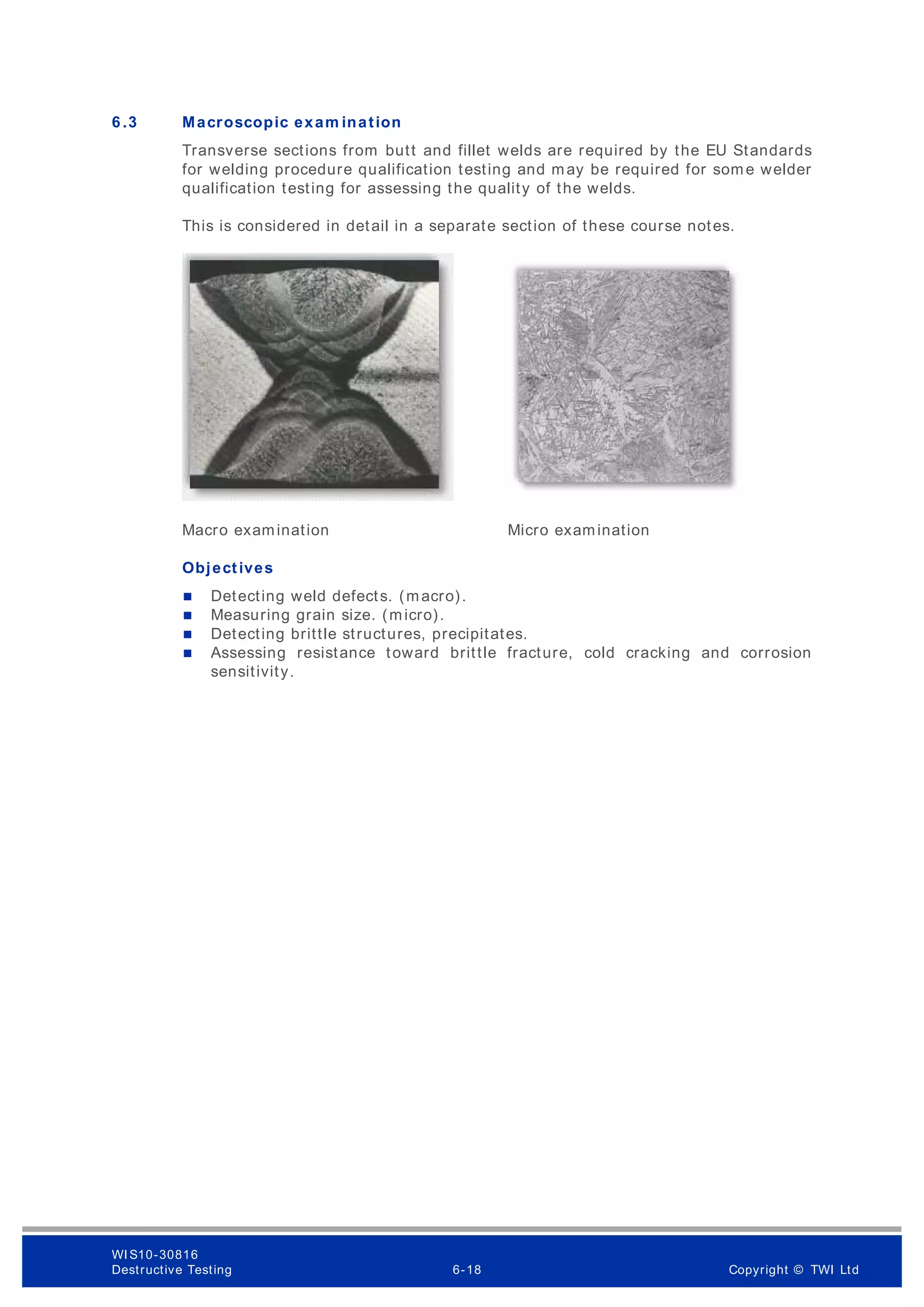
  • 19.
    Section 2 W eldedJoint Design
  • 21.
    2 W eldedJoint Design This section is principally concerned with structures fabricated by welding steel plates together, examples include bridges, ships, offshore platforms, pressure vessels and pipelines, although in some cases this may involve welding curved plates together. This section introduces typical joint geometries involved in joining plates together and describes the types of weld used in these joint configurations with typical features of butt and fillet welds described. For the structure to function loads must be transferred from one plate to another and the features of welds that enable them to transmit loads are described. Finally, some examples of good and bad design practice are given. 2 .1 W elds A weld is a permanent union between materials caused by the application of heat, pressure or both and if made between two faces approximately parallel is known as a butt weld. Figure 2 .1 Butt w eld. A weld made between two faces that are approximately at right angles to each other is known as a fillet weld. Figure 2 .2 Fillet w eld. For simplicity these diagrams show an arc welding process that deposits filler weld metal in a single weld pass. Typical features of a butt weld are shown in Figure 2.3 and those of a fillet weld in Figure 2.4. The weld or weld metal refers to all the material that has melted and re- solidified. The heat-affected zone (HAZ) is material that has not melted but whose microstructure has been changed as a result of the welding. The fusion line is the interface between the weld metal and the HAZ. WI S10-30816 Welded Joint Design 2-1 Copyright © TWI Ltd
  • 22.
    The root isthe bottom of the weld or narrowest part and the face is the top or widest part. At the corners of the weld cross section where the weld m etal joins the parent metal are the weld toes. These are at each corner of both the weld face and weld root in a butt weld but only on the weld face in a fillet weld. a b Figure 2 .3 Typical features of a: Butt w eld. a Double-sided butt w eld. b Fusion line Parent metal Weld metal Weld toe HAZ WI S10-30816 Welded Joint Design 2-2 Copyright © TWI Ltd
  • 23.
    Figure 2 .4Typical features of a fillet w eld. The application of heat naturally causes som e changes to the microstructure parent material, the HAZ shown in Figure 2.5 for a butt weld in steel with similar HAZs developed in the parent material of fillet welds. Close to the fusion line the temperature in the HAZ has been sufficient to cause microstructural phase changes, which will result in recrystallisation and grain growth. Further away from the fusion line the parent material has been heated to a lower maximum temperature and the parent microstructure is tempered. Figure 2 .5 HAZs in a butt w eld. The distance between weld toes is the weld width. When the distance is between the toes at the weld cap it is the weld cap width, the distance between the toes at the root is the weld root width. Solid-liquid boundary Maximum temperature Solid weld metal Grain growth zone Recrystallised zone Partially transformed zone Tempered zone Unaffected base material WI S10-30816 Welded Joint Design 2-3 Copyright © TWI Ltd
  • 24.
    The height ofthe additional weld metal in the weld cap is the excess weld metal which used to be called reinforcem ent which wrongly suggests that increasing this dimension will strengthen the weld. If the excess weld metal is too great it increases the stress concentration at the weld toe and this extra weld metal is called the excess root penetration. Figure 2 .6 Definitions on a butt w eld. 2 .2 Types of joint A joint can simply be described as a configuration of m embers and can be described independently of how it is welded. Figures 2.7 and 2.8 show the most comm on joint types - butt and T joint. Other typical joint types are shown in Figures 2.9-2.11; lap, cruciform and corner joint. When designing a lap joint the overlap between the two plates needs to be at least four times the plate thickness (D = 4t), but not less than 25mm. Figure 2 .7 Butt joint. Figure 2 .8 T joint. Excess weld metal Weld width Excess root penetration WI S10-30816 Welded Joint Design 2-4 Copyright © TWI Ltd
  • 25.
    Figure 2 .9Lap joints. Figure 2 .1 0 Cruciform Joint Figure 2 .1 1 Corner joint. An alternative to a conventional lap joint is to weld the joint using plug or slot welding, shown in Figure 2.12 showing the typical lap joint can be drastically altered. The hole for a slot weld should have a width at least three times the plate thickness and not less than 25mm. In plate less than 10mm thickness, a hole of equal width to the plate thickness can be welded as a plug weld. a b Figure 2 .1 2 : Slot w elded lap joint. a Plug w elded lap joint. b Corner joints can be fitted and welded in a number of ways. The unwelded pieces can be assembled either with an open corner or closed together. The weld can be on the external or internal corner or both in a double-sided weld. WI S10-30816 Welded Joint Design 2-5 Copyright © TWI Ltd
  • 26.
    Figure 2 .13 Different types of corner joints, unw elded and w elded. 2 .3 Fillet w elds The throat and leg length of a fillet weld are shown in Figure 2.14. Throat size a is generally used as the design parameter since this part of the weld bears the stresses and can be related to leg length z by the following relationship: a ≈ 0.7z and z ≈ 1.4a. Figure 2 .1 4 Leg length z and throat size a in a fillet w eld. This is only valid for mitre fillet welds having similar leg lengths (Figure 2.15), so is not valid for concave, convex or asymm etric welds. In concave fillet welds the throat thickness will be much less than 0.7 times the length. The leg length of a fillet weld is often approximately equal to the material thickness. The actual throat size is the width between the fused weld root and the segment linking the two weld toes, shown as the red line in Figure 2.16. Due to root penetration the actual throat size of a fillet weld is often larger than its design size but because of the unpredictability of the root penetration area, the design throat size must alw ays be taken as the stress param eters in design calculations. Open Closed Double-sided corner joint Internal corner joint External corner joint Throat a Leg Leg z WI S10-30816 Welded Joint Design 2-6 Copyright © TWI Ltd
  • 27.
    Figure 2 .15 Mitre fillet w eld. Figure 2 .1 6 Design throat of a fillet w eld. Figure 2 .1 7 Fillet w eld cross-sections. Figure 2 .1 8 Definition of design and actual throat in concave and convex fillet w elds. z z a Convex fillet weld Concave fillet weld Mitre fillet weld Actual throat Design throat Design throat = actual throat WI S10-30816 Welded Joint Design 2-7 Copyright © TWI Ltd
  • 28.
    The choice betweenmitre weld, concave and convex fillet weld needs to account for the weld toe blend. A concave fillet weld gives a smooth blend profile and a low stress concentration at the fillet weld toe. Convex fillet welds can have a higher stress concentration at the weld toe. If the fluidity of the weld pool is not controlled it is possible to obtain an asymmetrical fillet weld where the weld pool has sagged into the joint preparation and there is also a risk of undercut on the bottom weld toe (see Figure 2.19). Having a smooth toe blend is important to give better fatigue performance for fillet welds. Figure 2 .1 9 Fillet w eld toe blends. 2 .4 Butt w elds The design throat t 1 of a butt weld is the penetration depth below the parent plate surface and no account is made of the excess weld metal. The design throat is therefore less than the actual throat t 2 . Figure 2 .2 0 Design throat t 1 and the actual throat t 2 for butt w elds. WI S10-30816 Welded Joint Design 2-8 Copyright © TWI Ltd
  • 29.
    The weld toeblend is important for butt welds as well as fillet welds. Most codes state that weld toes shall blend smoothly, leaving it open to individual interpretation. The higher the toe blend angle the greater the am ount of stress concentration. The toe blend angle ideally should be between 20-30 degrees (Figure 2.21). Figure 2 .2 1 Toe blend in butt w elds. 2 .5 Dilution When filler and parent material do not have the sam e composition the resulting composition of the weld depends largely on the weld preparation before welding. The degree of dilution results from the edge preparation and process used; the percentage of dilution (D) is particularly important when welding dissimilar materials and is expressed as the ratio between the weight of parent material melted and the total weight of fused material (multiplied by 100 to be expressed as a percentage), as shown: 100 material fused of weight Total melted material parent of Weight D × = Low dilutions are obtained with fillet welds and with butt welds with multiple runs. For a single pass better dilution is obtained with grooved welds, see Figure 2.22. Poor weld toe blend angle Improved weld toe blend angle 6 m m 3 m m WI S10-30816 Welded Joint Design 2-9 Copyright © TWI Ltd
  • 30.
    Figure 2 .22 Effect of w eld preparation on dilution and w eld m etal com position ( for a single pass only) . 2 .6 W elding sym bols On engineering drawings a welded joint can be represented by different means. A detailed representation shows every detail and dimension of the joint preparation with carefully written, extensive notes. It provides all the details required to produce a particular weld in a very clear manner but requires a separate detailed sketch (time consuming and can overburden the drawing). For a special weld preparation not covered in the relevant standards (eg narrow groove welding); it is the only way to indicate the way components are to be prepared for welding or brazing. Figure 2 .2 3 Detailed representation of U bevel angle. Symbolic representation using weld symbols can specify joining and inspection information and the UK has traditionally used BS 499 Part 2 which has been superseded by BS EN ISO 2553. In many welding and fabrication organisations use old drawings that reference out of date standards such as BS 499 Pt 2. BS EN ISO 2553 is almost identical to the original BS EN ISO 2553 standard on which it was based. In America AWS A2.4 is followed, while symbols for brazing are given in EN 14324. 8-12° ≈R6 1-3 1-4 R6 8mm 8-12 Fillet w elds Single V groove w eld Square groove w eld WI S10-30816 Welded Joint Design 2-10 Copyright © TWI Ltd
  • 31.
    The advantages ofsym bolic representation are:  Simple and quick to visualise on the drawing.  Does not overburden the drawing.  No need for additional views as all welding symbols can be placed on the main assembly drawing.  Gives all necessary indications regarding the specific joint to be obtained. Symbolic representation can only be used for comm on joints and requires training to understand the symbols. Symbolic representation of a welded joint contains an arrow line, a reference line and an elementary symbol. The elementary symbol can be complemented by a supplementary symbol. The arrow line can be at any angle (except 180 degrees) and can point up or down. The arrow head must touch the surfaces of the components to be joined and the location of the weld. Any intended edge preparation or weldment is not shown as an actual cross-sectional representation but as a line. The arrow also points to the component to be prepared with single prepared components. Figure 2 .2 4 Sym bolic representation of U bevel angle. BS EN ISO 2553 and AWS A2.4 list all the main elementary symbols, some examples are shown in Table 2.1. The symbols for arc welding are often shown as cross-sectional representations of a joint design or completed weld. Simple, single edge preparations are shown in Figure 2.25. WI S10-30816 Welded Joint Design 2-11 Copyright © TWI Ltd
  • 32.
    Table 2 .1Elem entary w eld sym bols. WI S10-30816 Welded Joint Design 2-12 Copyright © TWI Ltd
  • 33.
    Figure 2 .25 W elding sym bols for the m ost com m on joint types show n on a reference line. These simple symbols can be interpreted as either the joint details alone or the completed weld. For a finished weld it is norm al for an appropriate weld shape to be specified. There are a number of options and methods to specify an appropriate weld shape or finish. Butt welded configurations would normally be shown as a convex profile (Figure 2.26 a, d and f) or as a dressed-off weld as shown in b and c. Fillet weld symbols are always shown as a mitre fillet weld and a convex or concave profile can be superimposed over the original symbol's mitre shape. Figure 2 .2 6 W elding sym bols show ing the w eld profile for the m ost com m on joint types. So the correct size of weld can be applied it is comm on to find numbers to the left or right of the symbol. For fillet welds numbers to the left indicate the design throat thickness, leg length or both (Figure 2.27). Key: = single V butt joint. a = double V butt joint. b = single bevel butt joint. c = double bevel butt joint. d = single sided fillet weld. e = double sided fillet weld. f Key: a = single V butt weld with convex profile. b = double V butt weld flushed off both sides on weld face. c = single bevel butt weld flushed off both sides on weld face. d = double bevel butt convex (as welded). e = concave fillet weld. f = double sided convex fillet weld. WI S10-30816 Welded Joint Design 2-13 Copyright © TWI Ltd
  • 34.
    Figure 2 .27 Throat and leg length dim ensions given on the w eld sym bol for a fillet w eld. For butt joints and welds an S with a number to the left of a symbol refers to the depth of penetration. When there are no specific dimensional requirements specified for butt welds on a drawing using weld symbols, it would normally be assumed that the requirem ent is for a full penetration butt weld. Numbers to the right of a symbol or symbols relate to the longitudinal dimension of welds, eg for fillets the number of welds, weld length and weld spacing for non- continuous welds. Figure 2 .2 8 W eld sym bols show ing the w eld length dim ensions to the right of the w eld joint sym bols for an interm ittent fillet w eld. Supplementary symbols can be used for special cases where additional information is required (Figure 2.29). The weld all round symbols may be used for a rectangular hollow section (RHS) welded to a plate, for example. The flag symbol for weld in the field or on site can be added to any standard symbol. A box attached to the tail of the arrow can contain or point to other information such as whether NDT is required. This information is sometimes the welding process type given as a three number reference from BS EN ISO 4063, for example 135 refers to MAG welding. a7 z 10 a7 z 10 WI S10-30816 Welded Joint Design 2-14 Copyright © TWI Ltd
  • 35.
    Figure 2 .29 Exam ples of supplem entary sym bols. 2 .7 W elding positions In weld procedure documents and engineering drawings the type and orientation of welds are often given a two letter abbreviation which defines them which can vary depending on the standard the welds are conforming to. The abbreviations here are consistent with BS EN ISO 6947 and are summarised in Table 2.2. WI S10-30816 Welded Joint Design 2-15 Copyright © TWI Ltd
  • 36.
    Table 2 .2W elding positions. Welding position Figure/ symbol Abbreviation Flat PA Horizontal PB Horizontal vertical PC WI S10-30816 Welded Joint Design 2-16 Copyright © TWI Ltd
  • 37.
    Welding position Figure/symbol Abbreviation Vertical up, vertical down PG/ PF Overhead PE Horizontal overhead PD 2 .8 W eld joint preparations The simplest weld joint preparation is a square edged butt joint, either closed or open. A closed butt joint is used in thick plate for keyhole welding processes such as laser or electron beam welding (EBW). A square edged open butt joint is used for thinner plate up to 3mm thickness for arc welding in a single pass or in thick plate for welding processes such as electroslag welding. Figure 2 .3 0 Square edge butt joints. Square edge closed butt Square edge open butt WI S10-30816 Welded Joint Design 2-17 Copyright © TWI Ltd
  • 38.
    It is normalto use a bevel on the edges of the parent metal to be welded to allow access to the root for the first welding pass which is filled using fill passes. Single-sided preparations are normally made on thinner materials or when access from both sides is restricted. Double-sided preparations are normally made on thicker materials or when access from both sides is unrestricted. Edge preparation design includes the bevel angle (or included angle if both sides are bevelled) and also the square edges root face and root gap. In a joint where both sides are bevelled the preparation is termed a V or vee preparation (Figure 2.31). V preparations are usually used for plate of 3-20mm thickness. An alternative is a U preparation (or J preparation if only one side has the edge preparation) where the edge is machined into the shape of a U. This is used in thicker plate, over 20mm thickness, where it uses less filler metal than a V preparation joint. J or U edge preparations also require a bevel angle and root face, the gap to be defined, a root radius and land to be specified (Figure 2.32). Single-sided edge preparations are often used for thinner materials or when there is no access to the root of the weld (pipelines). If there is access to both sides of the material then a double-sided edge preparation is used, especially for thicker materials. Single and double edge preparations are shown in Figure 2.33. Figure 2 .3 1 Single V bevel. Figure 2 .3 2 U bevel. Bevel angle Included angle Root face Gap Included angle Bevel angle Gap Root radius Land Root face WI S10-30816 Welded Joint Design 2-18 Copyright © TWI Ltd
  • 39.
    Figure 2 .33 Range of single and double-sided bevel, V, J and U preparations. 2 .9 Designing w elded joints Weld joint design selection will also be influenced by practical issues such as the welding process used and the access required to obtain root fusion. The bevel angle must allow good access to the root and sufficient manipulation of the electrode to ensure good sidewall fusion (Figure 2.34). If the included angle is too large then heavy distortions can result and more filler metal is required. If the included angle is too small there is a risk of lack of penetration or lack of sidewall fusion. Typical bevel angles are 30-35 degrees in a V preparation (60- 70 degrees included angle). In a single bevel joint the bevel angle might be increased to 45 degrees. Figure 2 .3 4 Bevel angle to allow electrode m anipulation for sidew all fusion. The root gap and face are selected to ensure good root fusion (Figure 2.35). This will depend on the welding process and heat input. If the root gap is too wide or root face too narrow there is a risk of burn through. If the root gap is too narrow or root face is too deep there is a risk of lack of root penetration. A balance must be found and designed for; this difference in weld root size is shown in Figure 2.36. High heat input processes require a larger root face but less weld metal which reduces distortions and increases productivity. Typical values for the root face are 1.5-2.5mm and the root gap 2-4mm. Single V Double V Double Bevel Single Bevel Single J Single U Double J Double U WI S10-30816 Welded Joint Design 2-19 Copyright © TWI Ltd
  • 40.
    Figure 2 .35 The im portance of selecting the correct root face and gap. a b Figure 2 .3 6 Root size for w elding processes w ith different heat inputs: Low heat input. a High heat input. b If the components are to be joined by an arc welding process the selected bevels need to be adequately machined to allow the welding tool to access the root of the weld. This consideration would not apply for a procedure such as EBW as shown in Figure 2.37. If using gas-shielded processes then the size of the gas nozzle may limit the ability to use a J preparation for thick section material as it would be difficult to ensure good root fusion if the welding head could not access the bottom of the weld groove and a single bevel may be needed instead (Figure 2.38). WI S10-30816 Welded Joint Design 2-20 Copyright © TWI Ltd
  • 41.
    a b Figure 2.3 7 Preparation differences betw een: Arc. a Electron beam w elding. b a b Figure 2 .3 8 Using gas- shielded arc w elding: Difficulties of root access in a J preparation. a I m proved design using a bevel preparation. b Choosing between a J or U preparation and a bevel or V preparation is also determined by the costs or producing the edge preparation. Machining a J or U preparation can be slow and expensive. Using this joint design also results in tighter tolerance which can be easier to set-up. A bevel or V preparation can be flame or plasma cut fast and cheaply resulting in larger tolerances, meaning that set-up can be m ore difficult. Backing bar or strip is used to ensure consistent root fusion and avoid burn through. Permanent backing bar (rather than one rem oved after welding), gives a built-in crevice which can make the joints susceptible to corrosion (Figure 2.39). When using backing for aluminium welds any chemical cleaning reagents must be rem oved before assembling the joint. A backing bar also gives a lower fatigue life. Figure 2 .3 9 Using a backing bar for a butt w eld. Separate from the design of the joint and weld access to weld locations and the order in which welds are made are important. Figure 2.40 shows examples of the limitations of access in designing welded joints and gives improved designs. It is important to ensure that it is indeed possible to make welds as required by the drawing. WI S10-30816 Welded Joint Design 2-21 Copyright © TWI Ltd
  • 42.
    Figure 2 .40 Exam ples of im proved w eld designs w here there is lim ited access. 2 .1 0 Sum m ary You should now:  Be able to label the parts of a butt and fillet weld and of a V and U edge preparations.  Recognise welding symbols and know what they mean. WI S10-30816 Welded Joint Design 2-22 Copyright © TWI Ltd
  • 43.
    2‐1 Copyright © TWILtd Section 2 Welded Joint Design Copyright © TWI Ltd  What determines joint Design?  Weld features.  Types of welded joints.  Welding symbols.  Weld positions.  Weld bevels.  Designing welded joints. Outline Copyright © TWI Ltd Weld A permanent union between materials caused by heat, and or pressure (BS499). Types of Welds Fillet weld Butt weld Copyright © TWI Ltd Fillet welds Fillet Welds Leg size Throat size Leg Leg Throat Copyright © TWI Ltd Butt Joint Preparations Square Edge Closed Butt Square Edge Open Butt Copyright © TWI Ltd Single sided preparations are normally made on thinner materials, or when access from both sides is restricted Single Sided Butt Preparations Single bevel Single V Single-J Single-U
  • 44.
    2‐2 Copyright © TWILtd Double Sided Butt Preparations Double sided preparations are normally made on thicker materials, or when access form both sides is unrestricted -Vee Double -Bevel Double - J Double - U Double Copyright © TWI Ltd Joint Preparation Terminology Root Gap Root Face Root Face Root Gap Root Radius Single bevel butt Single-J butt Angle of bevel Angle of bevel Land Copyright © TWI Ltd Joint Preparation Terminology Included angle Root gap Root face Angle of bevel Root face Root gap Included angle Root radius Single-V butt Single-U butt Copyright © TWI Ltd Design, fatigue life expectancy, loading types Full penetration butt weld gives better life expectancy compared to partial penetration and compound weld gives better performance than a fillet weld. What determines welded joint design? Copyright © TWI Ltd Welding process  Open root runs with SAW. (Difficult unless backing is used or closed)  Closed square edge butt joints key hole Plasma and Electron Beam. (Key hole technique used)  Thin wall S/S Dairy pipe closed square edge butt joint TIG.  Access for large welding heads U butts.  Positional welding with SAW. What determines welded joint design? Copyright © TWI Ltd Material thickness  Butt welds, generally, as material gets thicker single preparations become double preparations. (Dependent on access)  Butt welds, generally as material gets thinner, root gaps close.  T joints, generally as material gets thicker, the vertical plate is prepared. (Compound weld) What determines welded joint design?
  • 45.
    2‐3 Copyright © TWILtd Quality Root penetration is guaranteed if backing is used, ceramic or a material that won’t fuse, shaped to produce a particular profile. What determines welded joint design? Copyright © TWI Ltd Quality To ensure that root defects are minimised, back gouge and check via NDT, MPI/Dye pen. What determines welded joint design? Copyright © TWI Ltd Access impacts upon weld preparation Access and Weld preparations Copyright © TWI Ltd Welding position Preparation for horizontal welding using the submerged Arc welding process What determines welded joint design? Copyright © TWI Ltd Welding position What determines welded joint design? Copyright © TWI Ltd Weld volume  A U butt between 20-30% less weld volume than a V Butt.  The benefits could be reduced costs, reduced residual stress and reduced distortion.  The disadvantages of the U is the additional preparation costs of machining although fit up conditions improve. What determines welded joint design?
  • 46.
    2‐4 Copyright © TWILtd Weld volume  A double V has less weld volume than a single V.  A double V, therefore will reduce cost, reduce distortion and stress and should guarantee higher quality.  Disadvantage of the double V, access to both sides required. What determines welded joint design? Copyright © TWI Ltd Distortion control Double V butt Asymmetrical V butt  The asymmetrical V butt, ⅓, ଶ ଷ is often used to control distortion. The smaller v is completed first. What determines welded joint design? Copyright © TWI Ltd Distortion control The U butt has significantly less liquid metal and a more even distribution of weld metal in the upper most regions than the V butt. Therefore, greater shrinkage and distortion occurs with the V butt. What determines welded joint design? Shrinkage Shrinkage Copyright © TWI Ltd Level of penetration What determines welded joint design? Full penetration Partial penetration Copyright © TWI Ltd Level of penetration Full penetration Less penetration What determines welded joint design? Small root face Large root face Copyright © TWI Ltd Gas purging of pipes It is much easier to regulate the gas purge if the joint is closed. What determines welded joint design?
  • 47.
    2‐5 Copyright © TWILtd Nozzles connect a pressure vessel with other components Type of nozzle depends on  Diameter/thickness ratio of the shell.  Diameter/thickness ratio of the nozzle.  Access (one side only or both sides).  Type of joint required (partial/full pen).  Groove preparation methods available. Nozzles Copyright © TWI Ltd  Shorter nozzle is cheaper.  Easy to make groove for full or partial penetration.  Single side welding in 2G/PB position means high welder skill is required.  Through thickness stress means danger of lamellar tearing.  Can be difficult to UT especially on smaller diameters.  Mainly used for small (<2inch diameter) nozzles, or thick wall or large diameter vessels.  May require reinforcement.  Extra cost to shape nozzle to radius of shell. Set-On Nozzle Copyright © TWI Ltd Set-On Nozzle Copyright © TWI Ltd  1G/PA position much easier.  Groove prep can be flame cut.  No danger of lamellar tearing.  Easy access to the back side of root, so full penetration is easier to achieve.  For nozzles with small diameters no need for reinforcement.  Nozzle body needs to be longer.  Greater weld volume means higher distortions.  Can be hard to UT on smaller diameters, usually easy to inspect.  Used for larger diameter nozzles, and thinner walled small diameter vessels. Set-Through Nozzle Copyright © TWI Ltd To compensate for loss in strength, we can reinforce either the shell or nozzle Reinforcement or Compensation Reinforcing ring/ Compensating plate Long neck nozzle Copyright © TWI Ltd Welded insert, consumable socket ring (CSR) or EB insert, used on small bore pipework where consistent root penetration is required. Sweepolet, shaped to fit radius of shell, butt welded to shell with a butt joint on the vertical stem. Less known joint designs What determines welded joint design?
  • 48.
    2‐6 Copyright © TWILtd Narrow Gap Joint Copyright © TWI Ltd Narrow Gap Welding Head Copyright © TWI Ltd As a Senior Welding Inspector you are assigned to the fabrication of a C/Mn pressure vessel. The vessels main barrel thickness and dished ends are 25mm wall thickness, all nozzles (set in and set on), man ways 20mm thickness. During the fabrication and welding your main concerns are distortion control, joint design, and all other quality aspects. Joint Design Copyright © TWI Ltd You notice that the joint preparations are not shown on the Engineering drawing for a set in nozzle attachment. Which of the following preparations would be suitable when a full penetration weld was required? a. Single bevel butt joint b. Fillet joint c. Lap joint d. Corner weld Question 1 Copyright © TWI Ltd You notice that the joint preparations are not shown on the Engineering drawing or the WPS. In the case of a set on nozzle attachment which of the following joint preparations would be the most suited? a. Open corner joint b. Fillet joint c. Single bevel butt joint d. Single V butt joint Question 2 Copyright © TWI Ltd The fabricator suggests to you that it would be much more cost effective to weld up the pressure vessel from the out side only without any back gouging. The WPS shows all the main barrel sections and dished end to barrel joints are full penetration butt welds, welded by the SAW welding process, back gouged root from the inside, welded with the MMA process. Would you agree with his suggestions? a. Yes, SAW welding can be used from one side providing the root gap is greater than 3mm b. Yes, SAW welding can be used from one side and would provide a much stronger joint when compared to a back gouged joint c. No, SAW welding would never be considered on any material <50mm thickness d. No, the SAW welding process can’t be used on a open root joint welded from one side only Questions 3
  • 49.
    2‐7 Copyright © TWILtd When considering distortion, which of the following butt weld preparations would be the most suited for the longitudinal welded main barrel joints? a. Double U but weld b. Single V butt weld c. Single U butt weld d. All options would produce the same amount of distortion Question 4 Copyright © TWI Ltd The fabricator proposes to you that he wishes to reduce the bevel angle from 45° to 30° on the set on nozzle joints. Which of the following issues may occur if this was permitted? a. The reduction in bevel angle may result in an increase in distortion b. The reduction in bevel angle may result in a greater risk of lack of fusion and would not be compliant with the specification c. The reduction in bevel angle would result in requalification of all the welders d. All options may apply Question 5 Copyright © TWI Ltd Which distortion control technique is referenced in the TWI specification? a. Raised heat input technique b. Back welds c. Back skip welding d. Full penetration welds Question 6 Copyright © TWI Ltd In accordance with the TWI Specification would it be permissible to hard stamp the vessel’s material for the purpose of material identification? a. Yes, any hard stamping is permitted providing the information is on both ends of the material b. No, hard stamping isn’t allowed in any situation c. Yes, hard stamping is permitted providing a low stress concentration die is used. d. No options are correct Question 7 Copyright © TWI Ltd During fit-up you notice that the longitudinal seams have two different bevel angles on one joint, top bevel 50°, bottom bevel 15°. Is this permitted in accordance with TWI Specification? a. No, under no situation shall different bevel angles be permitted on a single V joint b. Yes, providing the joint is welded either in the overhead or vertical horizontal positions c. No, the bevel angles stated are out of specification d. Yes, As long as there is access this would be acceptable Question 8 Copyright © TWI Ltd While inspecting the completed vessel, you notice that some of the longitudinal seams on the main barrel section are in line with each other, ie not offset: a. This would be permitted providing the linear misalignment doesn’t exceed 1.5mm b. This is not permitted all longitudinal seams shall be off set to each other by 90° c. The TWI Specification makes no mention of this requirement d. This would be permitted providing the angular misalignment doesn’t exceed 3° Question 9
  • 50.
    2‐8 Copyright © TWILtd The fabricator wishes to reduce welding time and distortion on the longitudinal and circumferential welds, which of the following will best achieve this? a. Single V butt joints, welded by the MMA process b. Double V butt joints, welded by the SAW process c. Double U butt joints, welded by the SAW process d. Heterogeneous welds Question 10
  • 51.
    Section 3 Quality Assuranceand Quality Control
  • 53.
    WIS10-30816 Quality Assurance andQuality Control 3-1 Copyright © TWI Ltd 3 Quality Assurance and Quality Control 3.1 Definitions Before we consider what quality assurance and quality control are, let us first define quality. This is best described as the fitness-for-purpose of a product, service or activity. Quality assurance comprises all the planned and systematic actions necessary to provide adequate confidence that a product or service will satisfy given requirements for quality. Quality control is described as the operational techniques and activities that are used to fulfil requirements for quality. Quality assurance therefore encompasses the plans and systems by which confidence in a product is provided, ie all of the paperwork used to plan, control and record activities: the documentation. Quality control describes the activities which monitor the quality of the product. These operational techniques include materials and dimensional checks, inspection before, during and after welding, non-destructive testing, hydraulic or leak testing, ie activities which check after the event that a specified activity has been carried out correctly. Quality assurance has been introduced to ensure that the activity ‘gets it right the first time’, based on the principle that prevention is better than cure. This can be achieved by planning and anticipating problems. In order to satisfy this requirement, a documented quality system is needed which sets out in a formal framework the basis of control for the critical activities. This framework generally comprises four tiers of documentation, the highest tier being the company quality manual, followed by quality systems, quality plans and detailed manufacturing and inspection instructions. 3.1.1 Quality system A quality system can be defined as: The organisation structures, responsibilities, procedures, processes and resources for implementing quality management. The quality manual and support procedures document an organisation's quality system. 3.1.2 Quality manual A quality manual can be defined as: A document setting out the general quality policies, procedures and practices of an organisation. The word ‘general’ is important in this definition. The quality manual is usually the first indication a purchaser or prospective client has of a company's approach to quality. This document should contain a statement of the company's total commitment to quality by means of a quality policy statement signed by the Chairman, MD or Chief Executive of the company. This policy statement should be prominently displayed within the company.
  • 54.
    WIS10-30816 Quality Assurance andQuality Control 3-2 Copyright © TWI Ltd 3.1.3 Procedure A procedure can be defined as: A document that describes how an activity is to be performed and by whom. Note: A procedure is not a detailed work instruction such as a welding procedure, but rather a statement of who does what and how: it describes the corporate plan for achieving quality. However, there may be times when an organisation needs to operate in a different way from the corporate system, for example for a unique project or to satisfy a specific customer's requirements. In these circumstances, an appropriate quality system can be documented in the form of a project off-contract specific quality plan. 3.1.4 Quality plan A quality plan can be defined as: A document setting out the specific quality practices, resources and sequence of activities relevant to a particular product, service, contract or project. A quality plan is the corporate quality system suitably modified to reflect specific equipments. It may comprise a project quality manual incorporating appropriate sections from the corporate quality manual which apply. It is generally a detailed document. Project procedures may include:  Existing procedures appropriate to the contract.  Existing procedures amended for the contract.  New procedures to meet new specific requirements of the contract. Some contracts may well call for a combination of all three. 3.2 Quality system standards Quality system standards specify the minimum requirements of quality systems for application to specific products or services. Standards are normally used for the following purposes:  As guidance to an organisation introducing quality assurance.  As a basis for evaluating an organisation's quality system (assessment).  To specify the quality assurance requirements when invoked in a contract. The most common standard in the UK is ISO 9000. 3.2.1 Quality records A quality record is any document that specifies the inspection performed, quantities inspected, results obtained, positive identification of the material inspected to drawing or part number, the signature or stamp of the person carrying out the inspection and date of inspection. Quality records may also indicate the qualifications of personnel, calibration of equipment or other records not directly related to the product.
  • 55.
    WIS10-30816 Quality Assurance andQuality Control 3-3 Copyright © TWI Ltd Questions that need to be addressed include:  What quality records are to be maintained, eg received inspection reports, NDT results, test certificates, final inspection reports and non-conformance reports (including any feedback or corrective action generated)?  Where are the records filed and by whom?  How long are the quality records retained?  Are the quality records available to the customer for analysis and review?  Are records easily retrievable?  Is a suitable environment available to minimise deterioration or damage to stored records? 3.2.2 Typical quality record contents The Quality Record Package for a welded product is defined specifically for each contract, but should include the following types of information: a Records of stage inspections in the form of check sheets or quality plans. b Non-conformity reports and concession records. c Where appropriate, as-built drawings. d Welding procedures. e Welder approvals. f Welding consumable records. g Weld history records. h NDT reports. i Heat treatment records. j Hydraulic and/or other testing records. k Where appropriate, material test certificates. l Final acceptance certificates.
  • 56.
    WIS10-30816 Quality Assurance andQuality Control 3-4 Copyright © TWI Ltd 3.2.3 What areas of a business need to be covered by ISO 9001? ISO 9001 requires the following elements of a business to have set procedures:  Management responsibility - who is responsible for what?  Quality system - how does the system operate?  Contract review - allows personnel to see what the requirement is and who has been asked to do what.  Design review and control - ensures smooth passage from drawing board to end product.  Documentation controls - make sure the correct documents are available.  Purchasing - make sure the right products and services are available.  Purchaser supplied product - make sure that purchased items are in a satisfactory condition.  Product identification and traceability - what is it and where is it?  Process control - lets everyone know clearly how to make the product.  Inspection and test - describes how to inspect and test the product.  Inspection, measuring and test equipment - make sure the equipment used is correct.  Inspection and test status - where is the product in the inspection cycle?  Control of non-conforming product - ensures incorrect product is not used.  Corrective action - finds the root cause of the problem and solves it.  Handling, storage, packing and delivery - don't damage it now it's made.  Quality records – fulfils the need for documented evidence that the company meets specific requirements.  Internal quality audits - are quality activities performed as planned?  Training – the product cannot be manufactured effectively if people are not adequately trained and qualified.  Servicing - if carried out by the company, effective procedures are required.  Statistical techniques - used to build-in product quality. 3.3 Auditing and documentation Quality manuals, procedures, work instructions etc provide objective evidence that the systems of control have been adequately planned. The records and documentation generated by carrying out work in accordance with these systems provide the evidence that the systems are being followed by all. Systems of control, no matter how effective they are, will tend to deteriorate because of human errors being made or perpetuated or due to changes in the nature of the business. In order to ensure that the systems are effective and being followed, as well as to determine if changes are needed, it is necessary to monitor the systems. This is achieved by auditing them and reviewing the results of the audit in order to implement any changes. 3.3.1 What is an audit? Quality audits examine a quality system for adequacy and correct implementation. They are defined in BS 4778 Part 1 as: Systematic and independent examinations to determine whether quality activities and related results comply with planned arrangements and whether these arrangements are implemented effectively and are suitable to achieve objectives.
  • 57.
    WIS10-30816 Quality Assurance andQuality Control 3-5 Copyright © TWI Ltd Auditing is carried out to provide objective evidence that the system is working in accordance with the procedures. When an audit is complete the results are analysed by management who must ensure that the quality policy is satisfied and modify the quality system if necessary. 3.3.2 Which type of audit? There are two levels of audit:  A systems audit, which is quite superficial and simply examines the system to confirm that it follows the quality manual and that procedures are in place.  A compliance audit, which is an in-depth audit examining compliance with procedures. 3.3.3 Auditing of documentation A documentation audit is regarded as being a compliance audit, where documentation is examined in depth. Items to check in such an audit should include:  Is all the documentation available?  Is the documentation schedule in accordance with contract or specification requirements?  Does the documentation itself comply with contract or specification requirements? For example, are the weld procedure and welders correctly qualified?  Is the material composition correct?  Is the documentation legible?  Have all the interested parties, eg inspection department, independent third party inspectors and client inspectors, signed off where required?  Have provisions been made for storage (which includes the ability to retrieve documents and storage conditions preventing deterioration)? Documentation audits should be carried out by the manufacturer/supplier as a matter of course. Customers will also frequently require access to carry out their own audits. Remember that no job is finished until the paperwork is complete. Failure of a documentation audit carried out by a client will often result in a delay in payment, even though the component may have been delivered to the client. There can often be a consequential financial penalty. 3.4 Quality requirements for welding Within the international community, welding has been defined as a special process which means that it must be controlled by specialist management and utilise specialist personnel. The welding co-ordination BS EN ISO 14731 and welding quality systems standards BS EN ISO 3834 have been prepared in support of this ruling. It is perceived that these standards will serve as references for other application standards and be used as set criteria for the qualification of fabricators.
  • 58.
    WIS10-30816 Quality Assurance andQuality Control 3-6 Copyright © TWI Ltd Currently there are a number of European Standards or codes that refer to BS EN ISO 3834:  EN 13445:2002: Unfired pressure vessels.  prEN 15085: Railway applications – Welding of railway vehicles and components.  prEN 1090: Execution of steel structures.  EN 12732: 2000 Gas supply systems – Welding steel pipework – functional requirements.  EN 12592: 2001 Water tube boilers and auxiliary installations.  National Structural Steelwork Specification for Building Construction (5th Edition) (NSSSBC). It is an increasingly common requirement for the fabricator to have a quality system compliant with ISO 3834. This is to be specified as a condition of the customer contract. 3.4.1 Qualification of welding fabricators – BS EN ISO 3834 BS EN ISO 3834 comprises five parts: Part 1 - Guidance for use This describes how the standard works. Part 2 - Quality requirements for welding - Fusion welding of metallic materials - Comprehensive quality system This standard is suitable for use by a manufacturer or an assessment body, as a supplement to ISO 9001 or 9002 providing detailed guidance on the requirements that must be in place to adequately control welding. Part 3 - Quality requirements for welding, Fusion welding of metallic materials - Standard quality system This standard can be applied where a documented quality system for the control of welding is required but will not be used in conjunction with ISO 9001 or 9002. Part 4 - Quality requirements for welding - Fusion welding of metallic materials - Elementary system This standard provides criteria appropriate for the control of welding when either of the following applies:  A quality system according to ISO 9001 is not to be applied.  The combination of selected welding processes, procedures and the final welds are such that documented welding controls have minor importance in respect to the overall integrity of the product. Part 5 - Documents with which it is necessary to conform to claim conformity to the quality requirements of BS EN ISO 3834-2, BS EN ISO 3834-3 or BS EN ISO 3834-4 This lists all other documents or standards that are required for compliance with BS EN ISO 3834, such as specification and qualification of welding procedures, approval testing of welders, etc.
  • 59.
    WIS10-30816 Quality Assurance andQuality Control 3-7 Copyright © TWI Ltd The manufacturer should select one of the three parts (2-4) specifying the different levels of quality requirements, based on the following criteria:  The extent and significance of safety-critical products;  The complexity of manufacture;  The range of products manufactured;  The range of different materials used;  The extent to which metallurgical problems may occur;  The extent to which manufacturing imperfections, eg misalignment, distortion or weld imperfection, affect product performance. This approach offers a cascading qualification; for example, Part 2 (comprehensive) also gives compliance for lower levels. As previously stated, BS EN ISO 3834 is intended to complement, rather than conflict with, quality systems established to meet the requirements of ISO 9001 and, in the case of a comprehensive quality system for welding fabrication (Part 2), requires in addition to ISO 9001 that specific procedures are used to control the following: 1 Review of requirements. 2 Technical review. 3 Sub-contracting. 4 Welders and welding operators. 5 Welding co-ordination personnel. 6 Inspection and testing personnel. 7 Production and testing equipment. 8 Equipment maintenance. 9 Description of equipment. 10 Production planning. 11 Welding procedure specifications. 12 Qualification of welding procedures. 13 Batch testing of consumables (if required by contract). 14 Storage and handling of welding consumables. 15 Storage of parent material. 16 Post-weld heat treatment procedure. 17 Inspection and testing before, during and after welding. 18 Non-conformance and corrective actions. 19 Calibration or validation of measuring, inspection and testing equipment. 20 Identification during process (if required by contract). 21 Traceability (if required by contract). 22 Quality records (if required by contract).
  • 60.
    WIS10-30816 Quality Assurance andQuality Control 3-8 Copyright © TWI Ltd A company applying for certification to ISO 3834 will usually be required to complete the following stages:  Client returns preliminary enquiry.  Quotation.  Detailed forms sent to client.  Assessment team appointed by auditor.  Preliminary visit by auditor (not mandatory but common) to carry out a gap analysis.  Document review by auditor to review procedures against BS EN ISO 3834.  On-site assessment conducted by auditor to demonstrate that the client has accrued evidence that procedures are used and that these are overseen by the welding co-ordination team.  Assessment recommendations made.  Certificate issued (5 year validity).  Surveillance (yearly). This process, from application to issuing of the certificate, can take months to complete. 3.4.2 Welding co-ordination A key part of BS EN ISO 3834 is the definition of responsibilities of the welding co-ordination personnel. ISO 14731 defines these personnel and the technical knowledge that they require. The main role falls to the Responsible Welding Co- ordinator (RWC). One or more personnel in a company may perform the welding co-ordination function, but each of the requirements of BS EN ISO 3834 listed above will require input from the welding co-ordination team. Table 1 in BS EN ISO 14731 gives guidance for those tasks which may require a welding co-ordinator input. The technical knowledge required from the co- ordinator will obviously depend upon the complexity of the product. The standard defines three levels of knowledge and experience: 1 Comprehensive: Equivalent to the level of an International/European Welding Engineer. 2 Specific: Equivalent to the level of an International/European Welding Technologist. 3 Basic: Equivalent to the level of an International/European Welding Specialist. It can be seen that the three levels of technical knowledge are defined to match with the three levels of quality requirements given in Parts 2-4 of BS EN ISO 3834. The IIW route is not mandatory; there are in fact three possible routes to demonstrate technical knowledge: 1 IIW qualification and experience (via interview). 2 Interview to assess knowledge without IIW qualification (professional review in 3834 audit). 3 Sub-contract to an external resource with appropriate knowledge and experience; again, an interview is required (it would be expected that the external resource will be familiar with the company applying for certification and will be contracted to visit regularly).
  • 61.
    WIS10-30816 Quality Assurance andQuality Control 3-9 Copyright © TWI Ltd 3.5 Calibration/validation of welding equipment Faulty equipment compromises the quality of work. It follows that any equipment used in production, or for welder and procedure approval tests, should be in a sound condition in all respects in order to avoid breakdown during production or testing. One important point to note is the accuracy of meters and the repeatability of the machine's controls in relation to output performance. Welding current connections and return leads on all arc welding equipment should be checked for tightness prior to commencing welding; failure to do so may lead to voltage losses affecting arcing conditions. Where semi-automatic gas shielded processes are used, care should also be taken to ensure that the wire feeding systems are repeatable and accurate. Additionally, flowmeters controlling shielding and purging gases are expected to be calibrated. This activity is collectively known as validation. A requirement in many industries during the welding operation is the use of a calibrated meter(s) to check the welding current, arc voltages, travel speed and, on occasion, wire feed speed. In addition, it must be ensured that the welders are using the correct gas, the electrode wires are of the correct composition and the preheat temperature and location have been applied in accordance with the welding procedure requirements. In the case of manual metal arc (MMA) and submerged-arc welding (SAW), attention should be paid to any special drying requirements for fluxes or covered electrodes and also the conditions they are kept in prior to use. The use of a written procedure for storage and handling of consumables is recommended and records of humidity and temperature may be required to be kept.
  • 63.
  • 65.
    4 Codes andStandards The control of quality in a fabrication and welding situation is achieved by working to company procedures and codes of construction or standards. The latter may be international, national, company’s own or specific to the particular client or contract. Company procedures are usually covered in quality manuals the scope of which may vary widely depending upon the size of company, its range of work, its working practices and many other factors. 4 .1 Com pany m anuals 4 .1 .1 Quality assurance m anual Quality assurance is defined in IS0 9000 as; part of quality management focused on providing confidence that quality requirements will be fulfilled. Essentially what the QA manual sets out is how the company is organised, to lay down the responsibilities and authority of the various departments, how these departm ents interlink. The manual usually covers all aspects of the company structure, not just those aspects of m anufacture. 4 .1 .2 Quality control m anual Quality control is defined in ISO 9000 as; part of quality management focused on fulfilling quality requirem ents. The QC manual will be the manual most often referred to by the SWI as it will spell out in detail how different departm ents and operations are organised and controlled. Typical examples would be: production and control of drawings, how materials and consumables are purchased, how welding procedures are produced, etc. Essentially all operations to be carried out within the organisation will have control procedures laid down. In particular it will lay down how the I nspection function, whether visual, dimensional or NDT, will be perform ed, inspection being defined as the activity of measuring, examining and testing characteristics of a product or service and comparing these to a specified requirement. Such requirements are laid down in codes of practice and standards. 4 .2 Auditing Auditing is a term originating from accountancy practice which involves an independent accountant checking the accounts of a company to see if the accounts are fair and accurate. A similar checking process is now widely practised in manufacturing and construction industries and inspection personnel will be involved in the carrying out of this operation. WI S10-30816 Codes and Standards 4-1 Copyright © TWI Ltd
  • 66.
    Different types ofaudits may be performed:  Full audit of a company, usually carried out by a third party such as a Certifying Authority, checking the company for the award of a QA accreditation system such as ISO 9000 or ASME stamp.  Major audit by a potential customer prior to placem ent of a large contract. This is usually carried out to demonstrate the company has all the necessary facilities, plant, machinery, personnel and quality systems in place to enable them to successfully complete the contract.  Part audits carried out as ongoing demonstration that the quality system is working properly. An example of the latter case would be where a Senior Inspector is responsible for signing-off the data book or release certificate for a product. After checking that all the necessary documents are in the package and that they have been correctly completed and approved where necessary, the SWI would look at a part of the job – a beam, a piece of pipework etc and crosscheck against the drawings, mill certificates, inspection reports etc that all comply with the job requirem ents. 4 .3 Codes and standards It is not necessary for the Inspector to carry a wide range of codes and standards in the performance of his/ her duties. Normally the specification or more precisely the contract specification is the only document required. However the contract specification may reference supporting codes and standards and the inspector should know where to access these normative documents. The following is a list of definitions relating to codes and standards which the Inspector may com e across whilst carrying inspection duties 4 .3 .1 Definitions Norm ative docum ent: Provides rules, guidelines or characteristics for activities or their results. The term normative document is generic and covers docum ents such as standards, technical specifications, codes of practice and regulations.* Standard Docum ent established by consensus and approved by a recognised body. A standard provides, for common and repeated use, guidelines, rules, and characteristics for activities or their results, aimed at the achievem ent of the optimum degree of order in a given context.* Harm onised standards Standards on the sam e subject approved by different standardising bodies, that establish interchangeability of products, processes and services, or mutual understanding of test results or information provided according to these standards* WI S10-30816 Codes and Standards 4-2 Copyright © TWI Ltd
  • 67.
    Code of practice Document that recommends practices or procedures for the design, manufacture, installation, maintenance, utilisation of equipment, structures or products. A code of practice may be a standard, part of a standard or independent of a standard.* Regulation Docum ent providing binding legislative rules that is adopted by an authority.* Authority Body (responsible for standards and regulations legal or administrative entity that has specific tasks and composition) that has legal powers and rights.* Regulatory authority Authority responsible for preparing or adopting regulations.* Enforcem ent authority Authority responsible for enforcing regulations.* Specification A docum ent stating requirements, needs or expectations. A specification could cover both physical and technical requirements ie visual inspection, NDT, Mechanical testing etc. essentially full data and its supporting medium. Specifications are generally implied or obligatory. Procedure Specified way to carry out an activity or a process.* Usually it is a written description of all essential parameters and precautions to be observed when applying a technique to a specific application following an established standard, code or specification I nstruction Written description of the precise steps to be followed based on an established procedure, standard, code or specification. Quality plan A docum ent specifying which procedures and associated resources shall be applied by whom and when to a specific project, product, process or contract.* * ISO IEC Guide 2 – Standardisation and related activities – General vocabulary. * * EN ISO 9000 – 2000 – Quality management system s – Fundamentals and vocabulary. WI S10-30816 Codes and Standards 4-3 Copyright © TWI Ltd
  • 68.
    4 .4 Summ ary Application of the requirements of the quality manuals, the standards and codes of practice ensure that a structure or component will have an acceptable level of quality and be fit for the intended purpose. Applying the requirements of a standard, code of practice or specification can be a problem for the inexperienced Inspector. Confidence in applying the requirem ents of one or all of these documents to a specific application only com es with use over a period of time. If in doubt the Inspector must always refer to a higher authority in order to avoid confusion and potential problems. WI S10-30816 Codes and Standards 4-4 Copyright © TWI Ltd
  • 69.
  • 71.
    5 Fe-C Steels Pureiron is very soft and expensive to manufacture and thus has limited practical engineering applications. However, as we’ve already seen, as ferrous alloys can go through different phase changes depending on composition and temperature, the properties and particularly the strength, ductility and toughness can be tailored through alloying and thermal cycling (heat treatm ent or welding for example). Of all the alloying elements used in steels, by far the most important one is carbon (C) and steels are defined as iron alloys containing less than 2% C. Ferrous alloys of m ore than 2% carbon content on the other hand are called cast irons. Many other elements can also be present in steels, both intentionally added alloying elements and residual elements present from ore or scrap m etal used in the steelmaking process. 5 .1 Steel term inology The terminology used to describe and specify different steel products can be confusing as these can be based on a combination of:  Product form (sheet, plate, bar, sections, pipe or wire).  Deoxidation practice (killed, semi-killed).  Manufacturing route such as cast, forged, rolled, extruded.  Heat treatm ent such as annealed, normalised and quench and tempered, which are used to achieve properties.  Cleanliness level in terms of impurities such as sulphur and phosphorous.  Finishing methods such as cold rolled or hot rolled.  Presence or not of corrosion protection coatings.  And so on. To add to the confusion, different industry sectors use different nom enclatures and definitions to refer to the same alloys. A simplified terminology is used here which is widely used and is relevant to welding, but be aware that other terminologies also exist. In a broad sense, non-stainless steels can be divided into two major groups: Carbon steel (also called C-Mn steels, depending on Mn level) and low alloy steels. This nomenclature is used in American standards (Am erican Iron and Steel Institute and The Society of Autom otive Engineering) and in modified forms in European standards as well. 5 .1 .1 Carbon steels In many industry sectors, carbon steel is the usual description used to refer to any steel that is not stainless. Carbon is the single most important alloying element in steel and a wide range of properties is possible simply by changing its content. Strength can be increased very cost effectively by retaining more carbon in the composition (remember, carbon is already present from the primary steelmaking process and is in fact removed as part of steel refining). However, when welded it is well recognized that HAZ toughness decreases and risk of cracking during welding increases with carbon addition and welding becomes more challenging. Surprisingly though, in some particular applications such as in welded rail tracks this trade-off can be overcom e and steels which are often of eutectic composition with carbon content of 0.76% are used!! WI S10-30816 Fe-C Steels 5-1 Copyright © TWI Ltd
  • 72.
    As shown below,hardness and strength can be achieved simply by increasing the carbon content of the alloy. This however comes at a cost, not only in terms of welding but also in terms of m echanical properties as ductility and toughness also deteriorate with increasing carbon content. Carbon steels can be divided (broadly) into plain carbon and carbon-manganese steels: Plain carbon steels are the m ost widely used steel type. These are usually specified based on carbon content (example, AISI 1010 and 1018 carbon steels have target carbon contents of approximately 0.1 and 0.18, respectively) and are limited to a maximum of 1% manganese. The microstructures of plain carbon steels are based around the thermodynamic equilibrium microstructures of ferrite and pearlite. Carbon– m anganese ( C-Mn) steels are similar to plain carbon steels except that C-Mn steels have higher Mn contents of between 1 and 1.65 weight % . Manganese is used for deoxidation (to rem ove oxygen from the melt during steelmaking), as a solid solution strengthener and also can have the effect of lowering the ductile to brittle transition temperature. However, addition of manganese also increases the hardenability of steels which could be a drawback when welding as will be shown later in this section. 5 .1 .2 Low Alloy steels Some alloying elements increase the hardenability of steels, that is, they delay the transformation from austenite to the equilibrium microstructures of ferrite and pearlite to longer times, thus giving more opportunity for non-equilibrium microstructures such as martensite to form during cooling. Alloys specified based on element additions to increase hardenability to achieve designated strength, ductility and toughness requirements are called low alloy steels. In general, total alloy content does not exceed 5% . Martensite is achieved with a sufficient level of carbon or other elements and a sufficiently rapid cooling rate. It has high strength and hardness but can be very brittle, so a softening (tempering) heat treatm ent is normally applied to improve toughness during the manufacturing process. This is not always possible after welding and these steels require special precautions during welding to obtain good enough properties in the HAZ and to avoid hydrogen cracking. Note: In some industry sectors stainless steels are referred to as alloy steels (minimum of 10% alloying), which is probably why low-alloy-steel is used to describe steels with high hardenability (quenched and tempered for example) as these have much lower alloy content compared to stainless grades. Comparing with C-Mn steels however, these are relatively high alloyed steel grades with much higher hardenability. WI S10-30816 Fe-C Steels 5-2 Copyright © TWI Ltd
  • 73.
    5 .1 .3High strength low alloy steels For the parent material, an alternative approach to increase strength without increasing carbon content is grain refinement which not only increases strength but also increases toughness. This family of fine grained high strength steels (up to 560MPa yield) with low carbon and lean general composition are called high strength low alloy steels. Contrary to low-alloy-steels which can in fact be quite highly alloyed, HSLA steels are truly low alloyed steels and the strength is achieved through refinement of the microstructure rather than by significant alloying additions. For the sam e strength level, an HSLA alloy will have a much leaner composition to its C-Mn equivalent. The microstructure of HSLA steels is still generally ferrite and pearlite but will usually contain very small amounts of pearlite. The manufacturing routes to achieve the necessary microstructure refinement were covered in Section 6 (Heat treatm ent of steels). To refresh your m em ory HSLA steels rely on very small alloying additions of vanadium, niobium and/ or titanium and controlled rolling as well as defined and narrow temperature ranges. Because the additions of V, Nb and Ti are so sm all these are also called micro-alloyed steels. Particularly in the oil and gas industry, a slight variation of the controlled rolling process is used where micro-alloying is used to obtain a fine-grain structure during the hot rolling process followed by accelerated cooling at the end of the hot rolling process to promote a bainitic or acicular ferrite microstructure. These alloys are called Therm o-mechanically controlled process (TMCP) steels. WI S10-30816 Fe-C Steels 5-3 Copyright © TWI Ltd
  • 75.
  • 77.
    6 Destructive Testing EuropeanWelding Standards require test coupons that are made for welding procedure qualification testing to be subjected to non-destructive testing and then destructive testing. The tests are called destructive tests because the welded joint is destroyed when various types of test piece are taken from it. Destructive tests can be divided into 2 groups, those used to:  Measure a m echanical property – quantitative tests  Assess the joint quality – qualitative tests Mechanical tests are quantitative because a quantity is measured – a mechanical property such as tensile strength, hardness and impact toughness. Qualitative tests are used to verify that the joint is free from defects – they are of sound quality, exam ples of these are bend tests, macroscopic examination and fracture tests (fillet fracture and nick-break). 6 .1 Test types, test pieces and test objectives Various types of m echanical tests are used by material manufacturers and suppliers to verify that plates, pipes, forgings, etc. have the minimum property values specified for particular grades. Design engineers use the minimum property values listed for particular grades of material as the basis for design and the most cost-effective designs are based on an assumption that welded joints have properties that are no worse than those of the base metal. The quantitative (mechanical) tests that are carried out for welding procedure qualification are intended to demonstrate that the joint properties satisfy design requirem ents. The emphasis in the following sub-sections is on the destructive tests and test methods that are widely used for welded joints. 6 .1 .1 Transverse tensile tests Test objective Welding procedure qualification tests always require transverse tensile tests to show that the strength of the joint satisfies the design criterion. Test specim ens A transverse tensile test piece typical of the type specified by European Welding Standards is shown below. WI S10-30816 Destructive Testing 6-1 Copyright © TWI Ltd
  • 78.
    Standards, such asEN 895, that specify dimensions for transverse tensile test pieces require all excess weld metal to be rem oved and the surface to be free from scratches. Test pieces may be machined to represent the full thickness of the joint but for very thick joints it may be necessary to take several transverse tensile test specimens to be able to test the full thickness. Test m ethod Test specimens are accurately measured before testing. Specimens are then fitted into the jaws of a tensile testing machine and subjected to a continually increasing tensile force until the specimen fractures. The tensile strength (Rm) is calculated by dividing the maximum load by the cross-sectional area of the test specimen - m easured before testing. The test is intended to measure the tensile strength of the joint and thereby show that the basis for design, the base metal properties, rem ains the valid criterion. Acceptance criteria If the test piece breaks in the weld metal, it is acceptable provided the calculated strength is not less than the minimum tensile strength specified, which is usually the minimum specified for the base m etal material grade. In the ASME IX code, if the test specimen breaks outside the weld or fusion zone at a stress above 95% of the minimum base m etal strength the test result is acceptable. 6 .1 .2 All-w eld tensile tests Test objective There m ay be occasions when it is necessary to m easure the weld metal strength as part of welding procedure qualification – particularly for elevated temperature designs. The test is carried out in order to m easure not only tensile strength but also yield (or proof strength) and tensile ductility. Parallel length WI S10-30816 Destructive Testing 6-2 Copyright © TWI Ltd
  • 79.
    All weld tensiletests are also regularly carried out by welding consumable manufacturers to verify that electrodes and filler wires satisfy the tensile properties specified by the standard to which the consumables are certified. Test specim ens As the name indicates, test specimens are m achined from welds parallel with their longitudinal axis and the specimen gauge length must be 100% weld metal. Test m ethod Specimens are subjected to a continually increasing force in the sam e way that transverse tensile specimens are tested. Yield (Re) or proof stress (Rp) are m easured by means of an extensom eter that is attached to the parallel length of the specimen and is able to accurately measure the extension of the gauge length as the load is increased. Round tensile specimen from a welding procedure qualification test piece. Round tensile specimen from an electrode classification test piece. WI S10-30816 Destructive Testing 6-3 Copyright © TWI Ltd
  • 80.
    Typical load extensioncurves and their principal characteristics are shown below. Tensile ductility is measured in two ways: 1 % elongation of the gauge length (A% ). 2 % reduction of area at the point of fracture (Z% ). Load-extension curve for a steel that shows a distinct yield point at the elastic limit. Load-extension curve for a steel (or other metal) that does not show a distinct yield point; proof stress is a measure of the elastic limit. WI S10-30816 Destructive Testing 6-4 Copyright © TWI Ltd
  • 81.
    The figures belowillustrate these two ductility measurem ents. 6 .1 .3 I m pact toughness tests Test objective Charpy V notch test pieces have become the internationally accepted method for assessing resistance to brittle fracture by measuring the energy to initiate, and propagate, a crack from a sharp notch in a standard sized specimen subjected to an impact load. The value achieved is know n as the notch or im pact toughness. Design engineers need to ensure that the toughness of the steel that is used for a particular item will be high enough to avoid brittle fracture in service and so impact specimens are tested at a temperature that is related to the design temperature for the fabricated component. C-Mn and low alloy steels undergo a sharp change in their resistance to brittle fracture as their temperature is lowered so that a steel that may have very good toughness at ambient temperature may show extrem e brittleness at sub- zero temperatures, as illustrated in following figure. Necking! WI S10-30816 Destructive Testing 6-5 Copyright © TWI Ltd
  • 82.
    Test tem perature,°C The transition temperature is defined as the temperature mid-way between the upper shelf (maximum toughness) and lower shelf (completely brittle). In the above the transition temperature is –20°C. Test specim ens The dimensions for test specimens have been standardised internationally and are shown below for full sized specim ens. There are also standard dimensions for smaller sized specimens, for example 10mm x 7.5mm and 10mm x 5mm. Charpy V notch test piece dimensions for full sized specimens. I m pa ct e ne r gy ( Joules) Upper shelf energy Low er shelf energy Transition range Ductile fracture ( 0 % crystallinity) Brittle fracture ( 1 0 0 % crystallinity) WI S10-30816 Destructive Testing 6-6 Copyright © TWI Ltd
  • 83.
    Specimens are machinedfrom welded test plates with the notch position located in different locations according to the testing requirem ents but typically in the centre of the weld metal and at positions across the HAZ – as shown below. Typical notch positions for Charpy V notch test specimens from double V butt welds. Test m ethod Test specimens are cooled to the specified test temperature by immersion in an insulated bath containing a liquid that is held at the test temperature. After allowing the specimen temperature to stabilise for a few minutes it is quickly transferred to the anvil of the test machine and a pendulum hammer quickly released so that the specimen experiences an impact load behind the notch. WI S10-30816 Destructive Testing 6-7 Copyright © TWI Ltd
  • 84.
    The main featuresof an impact test machine are shown below. The energy absorbed by the hammer when it strikes each test specimen is shown by the position of the hammer pointer on the scale of the machine. Energy values are given in Joules (or ft-lbs in US specifications). Impact test specimens are taken in triplicate (3 specimens for each notch position) as there is always som e degree of scatter in the results, particularly for weldments. Impact specimen on the anvil showing the hammer position at point of impact Impact testing machine Charpy V notch test pieces – before and after testing WI S10-30816 Destructive Testing 6-8 Copyright © TWI Ltd
  • 85.
    Acceptance criteria Each testresult is recorded and an average value calculated for each set of three tests. These values are compared with the values specified by the application standard or client to establish whether specified requirem ents have been m et. After impact testing, examination of the test specimens provides additional information about their toughness characteristics and may be added to the test report:  % crystallinity – the % of the fracture face that has crystalline appearance which indicates brittle fracture; 100% indicates completely brittle fracture.  Lateral expansion – the increase in width of the back of the specimen behind the notch – as indicated below; the larger the value the tougher the specimen. A specimen that exhibits extrem e brittleness will show a clean break. Both halves of the specimen having a completely flat fracture face with little or no lateral expansion. A specimen that exhibits very good toughness will show only a small degree of crack extension, without fracture and a high value of lateral expansion. 6 .1 .4 Hardness testing Test objectives The hardness of a m etal is its’ resistance to plastic deformation determined by measuring the resistance to indentation by a particular type of indenter. A steel weldment with hardness above a certain maximum may be susceptible to cracking, either during fabrication or in service, and welding procedure qualification testing for certain steels and applications that require the test weld to be hardness surveyed to ensure that are no regions of the weldment that exceed the m aximum specified hardness. Specimens prepared for macroscopic examination can also be used for taking hardness measurements at various positions of the weldment – referred to as a hardness survey. WI S10-30816 Destructive Testing 6-9 Copyright © TWI Ltd
  • 86.
    Test m ethods Thereare 3 widely used methods for hardness testing: 1 Vickers hardness test uses a square-base diamond pyramid indenter. 2 Rockwell hardness test uses a diamond cone indenter or steel ball. 3 Brinell hardness test uses a ball indenter. The hardness value being given by the size of the indentation produced under a standard load, the smaller the indentation, the harder the m etal. The Vickers method of testing is illustrated below. WI S10-30816 Destructive Testing 6-10 Copyright © TWI Ltd
  • 87.
    Both Vickers andRockwell methods are suitable for carrying out hardness surveys on specimens prepared for macroscopic examination of weldments. A typical hardness survey requires the indenter to measure the hardness in the base metal (on both sides of the weld), in the weld metal and across the HAZ (on both sides of the weld). The Brinell method gives an indentation that is too large to accurately measure the hardness in specific regions of the HAZ and is mainly used to measure hardness of base m etals. A typical hardness survey (using Vickers hardness indenter) is shown below: Hardness values are shown on test reports as a number followed by letters indicating the test m ethod, for example: 240HV10 = hardness 240, Vickers method, 10kg indenter load. 22HRC = hardness 22, Rockwell method, diamond cone indenter (scale C). 238HBW = 238 hardness, Brinell method, tungsten ball indenter. 6 .1 .5 Crack tip opening displacem ent ( CTOD) testing Test objective Charpy V notch testing enables engineers to make judgem ents about risks of brittle fracture occurring in steels, but a CTOD test m easures a material property - fracture toughness. Fracture toughness data enables engineers to carry out fracture mechanics analyses such as:  Calculating the size of a crack that would initiate a brittle fracture under certain stress conditions at a particular temperature.  The stress that would cause a certain sized crack to give a brittle fracture at a particular temperature. This data is essential for making an appropriate decision when a crack is discovered during inspection of equipment that is in-service. WI S10-30816 Destructive Testing 6-11 Copyright © TWI Ltd
  • 88.
    Test specim ens ACTOD specimen is prepared as a rectangular (or square) shaped bar cut transverse to the axis of the butt weld. A V notch is machined at the centre of the bar, which will be coincident with the test position - weld metal or HAZ. A shallow saw cut is then put into the bottom of the notch and the specimen is then put into a machine that induces a cyclic bending load until a shallow fatigue crack initiates from the saw cut. The specimens are relatively large – typically having a cross section B x 2B and length ~ 10B (B = full thickness of the weld). The test piece details are shown below. Test m ethod CTOD specimens are usually tested at a tem perature below ambient and the temperature of the specimen is controlled by immersion in a bath of liquid that has been cooled to the required test temperature. A load is applied to the specimen to cause bending and induce a concentrated stress at the tip of the crack and a clip gauge, attached to the specimen across the mouth of the machined notch, gives a reading of the increase in width of the mouth of the crack as the load is gradually increased. For each test condition (position of notch and test temperature) it is usual practice to carry out three tests. WI S10-30816 Destructive Testing 6-12 Copyright © TWI Ltd
  • 89.
    Below illustrates themain features of the CTOD test. Fracture toughness is expressed as the distance that the crack tip opens without initiation of a brittle crack. The clip gauge enables a chart to be generated showing the increase in width of the crack mouth against applied load from which a CTOD value is calculated. Acceptance criteria An application standard or client may specify a minimum CTOD value that indicates ductile tearing. Alternatively, the test may be for information so that a value can be used for an engineering critical assessm ent. A very tough steel weldment will allow the mouth of the crack to open widely by ductile tearing at the tip of the crack whereas a very brittle weldment will tend to fracture when the applied load is quite low and without any extension at the tip of the crack. CTOD values are expressed in millimetres - typical values might be < < ~ 0.1mm = brittle behaviour; > ~ 1mm = very tough behaviour. WI S10-30816 Destructive Testing 6-13 Copyright © TWI Ltd
  • 90.
    6 .1 .6Bend testing Test objective Bend tests are routinely taken from welding procedure qualification test pieces and som etimes have to be taken from welder qualification test pieces. Subjecting specimens to bending is a simple method of verifying that there are no significant flaws in the joint. Som e degree of ductility is also demonstrated. Ductility is not actually measured but is demonstrated to be satisfactory if test specimens can withstand being bent without fracture or fissures above a certain length. Test specim ens There are 4 types of bend specimen: Face bend Specimen taken with axis transverse to butt welds up to ~ 12mm thickness and bent so that the face of the weld is on the outside of the bend (face in tension). Root bend Test specimen taken with axis transverse to butt welds up to ~ 12mm thickness and bent so that the root of the weld is on the outside of the bend (root in tension). Side bend Test specimen taken as a transverse slice (~ 10mm) from the full thickness of butt welds > ~ 12mm and bent so that the full joint thickness is tested (side in tension). Longitudinal bend Test specimen taken with axis parallel to the longitudinal axis of a butt weld; specimen thickness is ~ 12mm and the face or root of weld may be tested in tension. WI S10-30816 Destructive Testing 6-14 Copyright © TWI Ltd
  • 91.
    Test m ethod Bendtests for welding procedure qualification (and welder qualification) are usually guided bend tests. Guided means that the strain imposed on the specimen is uniformly controlled by being bent around a former with a certain diameter. The diameter of the former used for a particular test is specified in the code, having been determined by the type of material that is being tested and the ductility that can be expected from it after welding and any PWHT. The diameter of the former is usually expressed as a multiple of the specimen thickness and for C-Mn steel it is typically 4t (t is the specimen thickness) but for materials that have lower tensile ductility the radius of the form er may be greater than 10t. The standard that specifies the test method will specify the minimum bend angle that the specimen must experience and this is typically 120-180°. Acceptance criteria Bend test pieces should exhibit satisfactory soundness by not showing cracks or any signs of significant fissures or cavities on the outside of the bend. Small indications less than about 3mm in length may be allowed by some standards. WI S10-30816 Destructive Testing 6-15 Copyright © TWI Ltd
  • 92.
    6 .2 Fracturetests 6 .2 .1 Fillet w eld fractures Test objective The quality/ soundness of a fillet weld can be assessed by fracturing test pieces and examining the fracture surfaces. This method for assessing the quality of fillet welds may be specified by application standards as an alternative to macroscopic examination. It is a test m ethod that can be used for welder qualification testing according to European Standards but is not used for welding procedure qualification to European Standards. Test specim ens A test weld is cut into short lengths (typically 50mm) and a longitudinal notch is machined into the specimen as shown below. The notch profile may be square, V or U shaped. Test m ethod Specimens are made to fracture through their throat by dynamic strokes (hammering) or by pressing, as shown below. The welding standard or application standard will specify the number of tests (typically 4). Acceptance criteria The standard for welder qualification, or application standard, will specify the acceptance criteria for imperfections such as lack of penetration into the root of the joint and solid inclusions and porosity that are visible on the fracture surfaces. Test reports should also give a description of the appearance of the fracture and location of any imperfection WI S10-30816 Destructive Testing 6-16 Copyright © TWI Ltd
  • 93.
    Butt w eldfractures ( nick-break tests) Test objective The objective of these fracture tests is the same as for fillet fracture tests. These tests are specified for welder qualification testing to European Standards as an alternative to radiography. They are not used for welding procedure qualification testing to EU Standards. Test specim ens Test specimens are taken from a butt weld and notched so that the fracture path will be in the central region of the weld. Typical test piece types are shown below. Test m ethod Test pieces are made to fracture by hamm ering or three-point bending. Acceptance criteria The standard for welder qualification, or application standard, will specify the acceptance criteria for imperfections such as lack of fusion, solid inclusions and porosity that are visible on the fracture surfaces. Test reports should also give a description of the appearance of the fracture and location of any imperfection. WI S10-30816 Destructive Testing 6-17 Copyright © TWI Ltd
  • 94.
    6 .3 Macroscopicexam ination Transverse sections from butt and fillet welds are required by the EU Standards for welding procedure qualification testing and may be required for some welder qualification testing for assessing the quality of the welds. This is considered in detail in a separate section of these course notes. Macro examination Micro examination Objectives  Detecting weld defects. (macro).  Measuring grain size. (micro).  Detecting brittle structures, precipitates.  Assessing resistance toward brittle fracture, cold cracking and corrosion sensitivity. WI S10-30816 Destructive Testing 6-18 Copyright © TWI Ltd
  • 95.
    European Standards forDestructive Test Methods The following Standards are specified by the European Welding Standards for destructive testing of welding procedure qualification test welds and for som e welder qualification test welds. BS EN I SO 9 0 1 6 Destructive tests on welds in metallic materials – Impact tests – Test specimen location, notch orientation and examination. BS EN I SO 4 1 3 6 Destructive tests on welds in metallic materials – Transverse tensile test. BS EN I SO 5 1 7 3 + A1 Destructive tests on welds in metallic materials – Bend tests. BS EN I SO 1 7 6 3 9 Destructive tests on welds in metallic materials – Macroscopic and microscopic examination of weld. BS EN I SO 6 8 9 2 -1 Metallic materials - Tensile testing. Part 1: Method of test at ambient temperature. BS EN I SO 6 8 9 2 -2 Tensile testing of metallic materials. Part 2: Method of test at elevated temperatures. WI S10-30816 Destructive Testing 6-19 Copyright © TWI Ltd
  • 97.
    6‐1 Copyright © TWILtd Section 6 Destructive Testing Copyright © TWI Ltd When this presentation has been completed you should be able to:  Recognise a wide range of mechanical tests and their purpose.  Make calculations using formulae and tables to determine various values of strength, toughness, hardness and ductility. Destructive Testing Objective Copyright © TWI Ltd The destruction of a welded unit or by cutting out selected specimens from the weld is carried out to check the mechanical properties of the joint materials. They can be produced to: What is Destructive Testing? Destructive Testing Definitions  Approve welding procedures (BS EN 15614).  Approve welders (BS EN 287).  Production quality control. Copyright © TWI Ltd Destructive tests includes  Bend test.  Impact test.  Tensile test.  Hardness test.  Macro/micro examination. Destructive Tests 2 x Strength (transverse tensile) 2 x Ductile (Bend test) 3 x Toughness (Charpy V notch) Copyright © TWI Ltd The following mechanical tests have units and are termed quantitative tests to measure mechanical properties of the joint.  Tensile tests (transverse welded joint, all weld metal).  Toughness testing (Charpy, Izod, CTOD).  Hardness tests (Brinell, Rockwell, Vickers). The following mechanical tests have no units and are termed qualitative tests for assessing weld quality.  Macro testing.  Bend testing.  Fillet weld fracture testing.  Butt weld nick-break testing. Qualitative and Quantitative Tests Copyright © TWI Ltd Mechanical Properties of metals are related to the amount of deformation which metals can withstand under different circumstances of force application.  Malleability  Ductility  Toughness  Hardness  Tensile Strength Ability of a material to withstand deformation under static compressive loading without rupture Definitions
  • 98.
    6‐2 Copyright © TWILtd Definitions Mechanical Properties of metals are related to the amount of deformation which metals can withstand under different circumstances of force application.  Malleability  Ductility  Toughness  Hardness  Tensile Strength Ability of a material undergo plastic deformation under static tensile loading without rupture. Measurable elongation and reduction in cross section area Copyright © TWI Ltd Definitions Mechanical Properties of metals are related to the amount of deformation which metals can withstand under different circumstances of force application.  Malleability  Ductility  Toughness  Hardness  Tensile Strength Ability of a material to withstand bending or the application of shear stresses by impact loading without fracture. Copyright © TWI Ltd Definitions Mechanical Properties of metals are related to the amount of deformation which metals can withstand under different circumstances of force application.  Malleability  Ductility  Toughness  Hardness  Tensile Strength Measurement of a materials surface resistance to indentation from another material by static load Copyright © TWI Ltd Definitions Mechanical Properties of metals are related to the amount of deformation which metals can withstand under different circumstances of force application.  Malleability  Ductility  Toughness  Hardness  Tensile Strength Measurement of the maximum force required to fracture a materials bar of unit cross-sectional area in tension Copyright © TWI Ltd Mechanical Test Samples Tensile specimens Fracture fillet specimen CTOD specimen Charpy specimen Bend test specimen Copyright © TWI Ltd Welding Procedure Qualification Testing Destructive Testing Typical positions for test pieces Specimen type Position Macro + hardness 5 Transverse tensile 2, 4 Bend tests 2, 4 Charpy impact tests 3 Additional tests 3 2 3 4 5 Top of fixed pipe
  • 99.
    6‐3 Copyright © TWILtd Hardness Testing Mechanical Testing Copyright © TWI Ltd Definition  Measurement of resistance of a material against penetration of an indenter under a constant load.  There is a direct correlation between UTS and hardness. Hardness tests  Brinell.  Vickers.  Rockwell. Hardness Testing Copyright © TWI Ltd Objectives  Measuring hardness in different areas of a welded joint.  Assessing resistance toward brittle fracture, cold cracking and corrosion sensitivity. Information to be supplied on the test report  Material type.  Location of indentation.  Type of hardness test and load applied on the indenter.  Hardness value. Hardness Testing Copyright © TWI Ltd Hardness test methods Typical designations Vickers 240 HV10 Rockwell Rc 22 Brinell 200 BHN-W Hardness Testing Usually the hardest region 1.5 to 3mm HAZ Fusion line or fusion boundary Copyright © TWI Ltd Typical location of the indentations Vickers Hardness Test Butt weld from one side only Butt weld from both side Copyright © TWI Ltd Vickers hardness tests  Indentation body is a square based diamond pyramid (136° included angle).  The average diagonal (d) of the impression is converted to a hardness number from a table.  It is measured in HV5, HV10 or HV025. Vickers Hardness Test Diamond indentor Adjustable shutters Indentation
  • 100.
    6‐4 Copyright © TWILtd Vickers Hardness Test Machine Copyright © TWI Ltd  Hardened steel ball of given diameter is subjected for a given time to a given load.  Load divided by area of indentation gives Brinell hardness in kg/mm2.  More suitable for on site hardness testing. Brinell Hardness Test 30KN Ø=10mm steel ball Copyright © TWI Ltd Rockwell Hardness Test 1KN Ø=1.6mm steel ball Rockwell B Rockwell C 1.5KN 120° Diamond cone Copyright © TWI Ltd  Dynamic and very portable hardness test.  Accuracy depends on the condition of the test/support surfaces and the support of the test piece during the test.  For more details, see ASTM E448. Portable Hardness Test Copyright © TWI Ltd Impact Testing Mechanical Testing Copyright © TWI Ltd Objectives  Measuring impact strength in different weld joint areas.  Assessing resistance toward brittle fracture. Information to be supplied on the test report  Material type.  Notch type.  Specimen size.  Test temperature.  Notch location.  Impact Strength Value. Charpy V-Notch Impact Test Weld metal Fusion Line (FL) FL+2mm FL+5mm Parent material
  • 101.
    6‐5 Copyright © TWILtd Charpy V-Notch Impact Test Specimen Pendulum (striker) Anvil (support) Copyright © TWI Ltd Specimen dimensions according ASTM E23 ASTM: American Society of Testing Materials Charpy V-Notch Impact Test Specimen Copyright © TWI Ltd 100% Ductile Charpy Impact Test 10 mm 8 mm 2 mm 22.5° Machined notch Machined notch Large reduction in area, shear lips Fracture surface 100% bright crystalline brittle fracture Randomly torn, dull gray fracture surface 100% Brittle Copyright © TWI Ltd - 50 0 - 20 - 10 - 40 - 30 Ductile fracture Ductile/Brittle transition point 47 Joules 28 Joules Testing temperature - Degrees Centigrade Temperature range Transition range Brittle fracture Ductile/Brittle Transition Curve Three specimens are normally tested at each temperature Energy absorbed Mn < 1.6 % increases toughness in steels, and lower energy input used. Copyright © TWI Ltd Impact Energy Joules The test results show the specimens carried out at room temperature absorb more energy than the specimens carried out at -20oC. Comparison Charpy Impact Test Results Room Temperature -20oC Temperature 1. 197 Joules 2. 191 Joules 3. 186 Joules 1. 49 Joules 2. 53 Joules 3. 51 Joules Average = 191 Joules Average = 51 Joules Copyright © TWI Ltd Reporting results  Location and orientation of notch.  Testing temperature.  Energy absorbed in joules.  Description of fracture (brittle or ductile).  Location of any defects present.  Dimensions of specimen. Charpy Impact Test
  • 102.
    6‐6 Copyright © TWILtd Tensile Testing Mechanical Testing Copyright © TWI Ltd Tensile Testing Copyright © TWI Ltd UTS Tensile Test ReL ReH Rm Copyright © TWI Ltd Tensile Tests Copyright © TWI Ltd Rp 0.2% - Proof stress Refers to materials which do not have a defined yielding such as aluminium and some steels. Tensile Test Copyright © TWI Ltd Different tensile tests  Transverse tensile.  All-weld metal tensile test.  Cruciform tensile test.  Short tensile test (through thickness test). Tensile Tests
  • 103.
    6‐7 Copyright © TWILtd All-weld metal tensile specimen Transverse tensile specimen Tensile Test Copyright © TWI Ltd Objective Measuring the overall strength of the weld joint. Information to be supplied on the test report  Material type.  Specimen type.  Specimen size (see QW-462.1).  UTS.  Location of final rupture. Transverse Joint Tensile Test Copyright © TWI Ltd Transverse Joint Tensile Test Weld on plate Multiple cross joint specimens Weld on pipe Copyright © TWI Ltd Maximum load applied = 220 kN Cross sectional area = 25 mm X 12 mm UTS = UTS = UTS = 733.33 N/mm2 Transverse Tensile Test Maximum load applied csa 220 000 25mm X 12mm Copyright © TWI Ltd Reporting results:  Type of specimen eg reduced section.  Whether weld reinforcement is removed.  Dimensions of test specimen.  The ultimate tensile strength in N/mm2, psi or Mpa.  Location of fracture.  Location and type of any flaws present if any. Transverse Tensile Test Copyright © TWI Ltd Tensile test piece cut along weld specimen Direction of the test* BS EN ISO 6892-1 All Weld Metal Tensile Testing All-Weld Metal Tensile Test
  • 104.
    6‐8 Copyright © TWILtd Original gauge length = 50mm Increased gauge length = 64 Elongation % = Increase of gauge length Original gauge length All-Weld Metal Tensile Test Elongation % = 14 50 Elongation = 28% X 100 X 100 Copyright © TWI Ltd Gauge length Increased gauge length Object of test  Ultimate tensile strength.  Yield strength.  Elongation %(ductility). All-Weld Metal Tensile Test Copyright © TWI Ltd Two marks are made Gauge length 50mm Increased gauge length 75mm Force Applied During the test, yield and tensile strength are recorded The specimen is joined and the marks are re-measured A measurement of 75mm will give Elongation of 50% All-Weld Metal Tensile Test Copyright © TWI Ltd During the test, Yield & Tensile strength are recorded The specimen is joined and the marks are re-measured A measurement of 75mm will give Elongation of 50% Two marks are made All-Weld Metal Tensile Test Gauge length 50mm Increased gauge length 75mm Copyright © TWI Ltd Reporting results  Type of specimen eg reduced section.  Dimensions of test specimen.  The UTS, yield strength in N/mm2, psi or Mpa.  Elongation %.  Location and type of any flaws present if any. All-Weld Metal Tensile Test Copyright © TWI Ltd STRA (Short Transverse Reduction Area)
  • 105.
    6‐9 Copyright © TWILtd STRA Test Original CSA Reduced CSA Copyright © TWI Ltd STRA Test 20 15 10 STRA % Reduction of CSA Probable freedom from tearing in any joint type Some risk in highly restrained joints eg node joint, joints between sub-fabs Some risk in moderately restrained joints eg box columns Some risk in lightly restrained joints T-joints eg I-beams Copyright © TWI Ltd Macro/Micro Examination Mechanical Testing Copyright © TWI Ltd Purpose To examine the weld cross-section to give assurance that:  The weld has been made in accordance with the WPS.  The weld is free from defects. Specimen preparation  Full thickness slice taken from the weld (typically ~10mm thick).  Width of slice sufficient to show all the weld and HAZ on both sides plus some unaffected base material.  One face ground to a progressively fine finish (grit sizes 120 to ~ 400).  Prepared face heavily etched to show all weld runs & all HAZ.  Prepared face examined at up to x5 (& usually photographed for records).  Prepared face may also be used for a hardness survey. Macro Preparation Copyright © TWI Ltd Purpose To examine a particular region of the weld or HAZ in order to:  To examine the microstructure.  Identify the nature of a crack or other imperfection. Specimen preparation  A small piece is cut from the region of interest (typically up to ~ 20mm x 20mm).  The piece is mounted in plastic mould and the surface of interest prepared by progressive grinding (to grit size 600 or 800).  Surface polished on diamond impregnated cloths to a mirror finish  Prepared face may be examined in as-polished condition and then lightly etched.  Prepared face examined under the microscope at up to ~ 100 – 1000X. Micro Preparation Copyright © TWI Ltd Object  Macro/microscopic examinations are used to give a visual evaluation of a cross-section of a welded joint.  Carried out on full thickness specimens.  The width of the specimen should include HAZ, weld and parent plate.  They maybe cut from a stop/start area on a welders approval test. Macro/Micro Examination
  • 106.
    6‐10 Copyright © TWILtd Will reveal  Weld soundness.  Distribution of inclusions.  Number of weld passes.  Metallurgical structure of weld, fusion zone and HAZ.  Location and depth of penetration of weld.  Fillet weld leg and throat dimensions. Macro/Micro Examination Copyright © TWI Ltd Macro  Visual examination for defects.  Cut transverse from the weld.  Ground and polished P400 grit paper.  Acid etch using 5-10% nitric acid solution.  Wash and dry.  Visual evaluation under 5x magnification.  Report on results. Micro  Visual examination for defects and grain structure.  Cut transverse from a weld.  Ground and polished P1200 grit paper, 1µm paste.  Acid etch using 1-5% nitric acid solution.  Wash and dry.  Visual evaluation under 100-1000x magnification.  Report on results. Macro/Micro Examination Copyright © TWI Ltd Metallographic Examination Macro examination Micro examination Copyright © TWI Ltd Objectives  Detecting weld defects (macro).  Measuring grain size (micro).  Detecting brittle structures, precipitates, etc.  Assessing resistance toward brittle fracture, cold cracking and corrosion sensitivity. Information to be supplied on the test report  Material type.  Etching solution.  Magnification.  Grain size.  Location of examined area.  Weld imperfections (macro).  Phase, constituents, precipitates (micro). Metallographic Examination Copyright © TWI Ltd Bend Testing Mechanical Testing Copyright © TWI Ltd Object of test To determine the soundness of the weld zone. Bend testing can also be used to give an assessment of weld zone ductility. There are three ways to perform a bend test: Side bend tests are normally carried out on welds over 12mm in thickness. Face bend Root bend Side bend Bend Tests
  • 107.
    6‐11 Copyright © TWILtd Types of bend test for welds (acc BS EN ISO 5173): Bending Test Thickness of material - t t up to 12 mm t over 12 mm Root/face bend Side bend Copyright © TWI Ltd Guided bend test Wrap around bend test Bending Test Methods Copyright © TWI Ltd Defect indication generally this specimen would be unacceptable Face bend Side bend Root bend Acceptance for minor ruptures on tension surface depends upon code requirements. Bend Testing Copyright © TWI Ltd Reporting results  Thickness and dimensions of specimen.  Direction of bend (root, face or side).  Angle of bend (90°, 120°, 180°).  Diameter of former (typical 4T).  Appearance of joint after bending eg type and location of any flaws. Bend Tests Copyright © TWI Ltd Fillet Weld Fracture Testing Mechanical Testing Copyright © TWI Ltd Object of test  To break open the joint through the weld to permit examination of the fracture surfaces.  Specimens are cut to the required length.  A saw cut approximately 2mm in depth is applied along the fillet welds length.  Fracture is usually made by striking the specimen with a single hammer blow.  Visual inspection for defects. Fillet Weld Fracture Tests
  • 108.
    6‐12 Copyright © TWILtd 2mm Notch Hammer Fracture should break weld saw cut to root Fillet Weld Fracture Tests Copyright © TWI Ltd This fracture indicates lack of fusion This fracture has occurred saw cut to root Fillet Weld Fracture Tests Lack of penetration Copyright © TWI Ltd Reporting results  Thickness of parent material.  Throat thickness and leg lengths.  Location of fracture.  Appearance of joint after fracture.  Depth of penetration.  Defects present on fracture surfaces. Fillet Weld Fracture Tests Copyright © TWI Ltd Nick-Break Testing Mechanical Testing Copyright © TWI Ltd Object of test  To permit evaluation of any weld defects across the fracture surface of a butt weld.  Specimens are cut transverse to the weld.  A saw cut approximately 2mm in depth is applied along the welds root and cap.  Fracture is usually made by striking the specimen with a single hammer blow.  Visual inspection for defects. Nick-Break Test Copyright © TWI Ltd Approximately 230 mm 19 mm 3 mm 3 mm Notch cut by hacksaw Weld reinforcement may or may not be removed Nick-Break Test
  • 109.
    6‐13 Copyright © TWILtd Nick-Break Test Lack of root penetration or fusion Inclusions on fracture line Alternative nick-break test specimen, notch applied all way around the specimen Copyright © TWI Ltd Reporting results  Thickness of parent material.  Width of specimen.  Location of fracture.  Appearance of joint after fracture.  Depth of penetration.  Defects present on fracture surfaces. Nick-Break Test Copyright © TWI Ltd We test welds to establish minimum levels of mechanical properties and soundness of the welded joint We divide tests into qualitative and quantitative methods: Qualitative: (Have no units)  Macro tests  Bend tests  Fillet weld fracture tests  Butt nick-break tests Quantitative: (Have units)  Hardness (VPN & BHN)  Toughness (Joules & ft.lbs)  Strength (N/mm2 & PSI, MPa)  Ductility/Elongation (E%) Summary of Mechanical Testing Copyright © TWI Ltd Under pressure leakage proof test Vessel configuration  The test should be done after any stress relief.  Components that will not stand the pressure test (eg flexible pipes, diaphragms) must be removed.  The ambient temperature MUST be above 0°C (preferably 15-20°C). Hydrostatic Test Copyright © TWI Ltd Test procedure  Blank off all openings with solid flanges.  Use correct nuts and bolts, not G clamps.  Two pressure gauges on independent tapping points should be used.  For safety purposes bleed all the air out.  Pumping should be done slowly (no dynamic pressure stresses).  Test pressure - see relevant standards (PD 5500, ASME VIII). Usually 150% design pressure.  Hold the pressure for minimum 30 minutes. Hydrostatic Test Copyright © TWI Ltd What to look for  Leaks (check particularly around seams and nozzle welds)!  Dry off any condensation.  Watch the gauges for pressure drop.  Check for distortion of flange faces, etc. Hydrostatic Test
  • 110.
    6‐14 Copyright © TWILtd ? Any Questions Mechanical Testing Copyright © TWI Ltd As part of your remit as a Senior Welding Inspector, visits to the test house are common, witnessing mechanical testing of weld procedures and welder qualifications in C Mn steel. In addition, verifying the accompanying documentation is also a major part of your role. Therefore, your knowledge of the TWI specification and the use of it is essential to your role. Mechanical Testing Copyright © TWI Ltd You notice at the test house that root and face bends are being conducted with a 50% reduction in the former diameter than that stated in the specification. What difference would this make to the testing conditions? a. This should make no difference as long as the bend is to the correct angle b. This is common practice when reinforcement is left in place c. This would put excessive stress on the specimen d. No options are correct Question 1 Copyright © TWI Ltd Continuing with the witnessing of bend testing, you notice that the excess weld metal has not been removed. Are there any consequences attached to this practice? a. When bends are tested in this manner, the test is much more accurate as all the weld is under test b. The excess weld metal is only removed if it is excessive c. The excess weld metal could give rise to stresses d. Only the part in contact with the former requires the excess weld metal to be removed Question 2 Copyright © TWI Ltd Testing has just been completed on a single sided butt weld procedure, 10mm thick, PA position using the MMA process. Which mechanical tests would you expect to find within the documentation? a. 1 transverse tensile, two transverse side bends, impact tests 1 set of 3, Hardness test one specimen and macro examination b. 2 transverse tensile, two transverse bends-1root and 1 face bends, impact tests 1 set of 3, Hardness test one specimen and macro examination c. 2 transverse tensile, two transverse root and 1 face bends, hardness test one specimen and macro examination d. 2 transverse tensile, two transverse side bends, impact tests 1 set of 3, Hardness test one specimen and macro examination Question 3 Copyright © TWI Ltd You are checking the test report for a transverse tensile test on a 16mm butt weld with a UTS value of 460N/mm². Which of the following sets of tensile samples would fail the test? a. Test 1 failed in parent metal at 414 N/mm², test 2 failed in weld metal at 555N/mm² b. Test 1 failed in parent metal at 420 N/mm², test 2 failed in weld metal at 480N/mm² c. Test 1 failed in parent metal at 435 N/mm², test 2 failed in weld metal at 498N/mm² d. Test 2 failed in weld metal at 498N/mm², test 1 failed in parent metal at 435 N/mm² Question 4
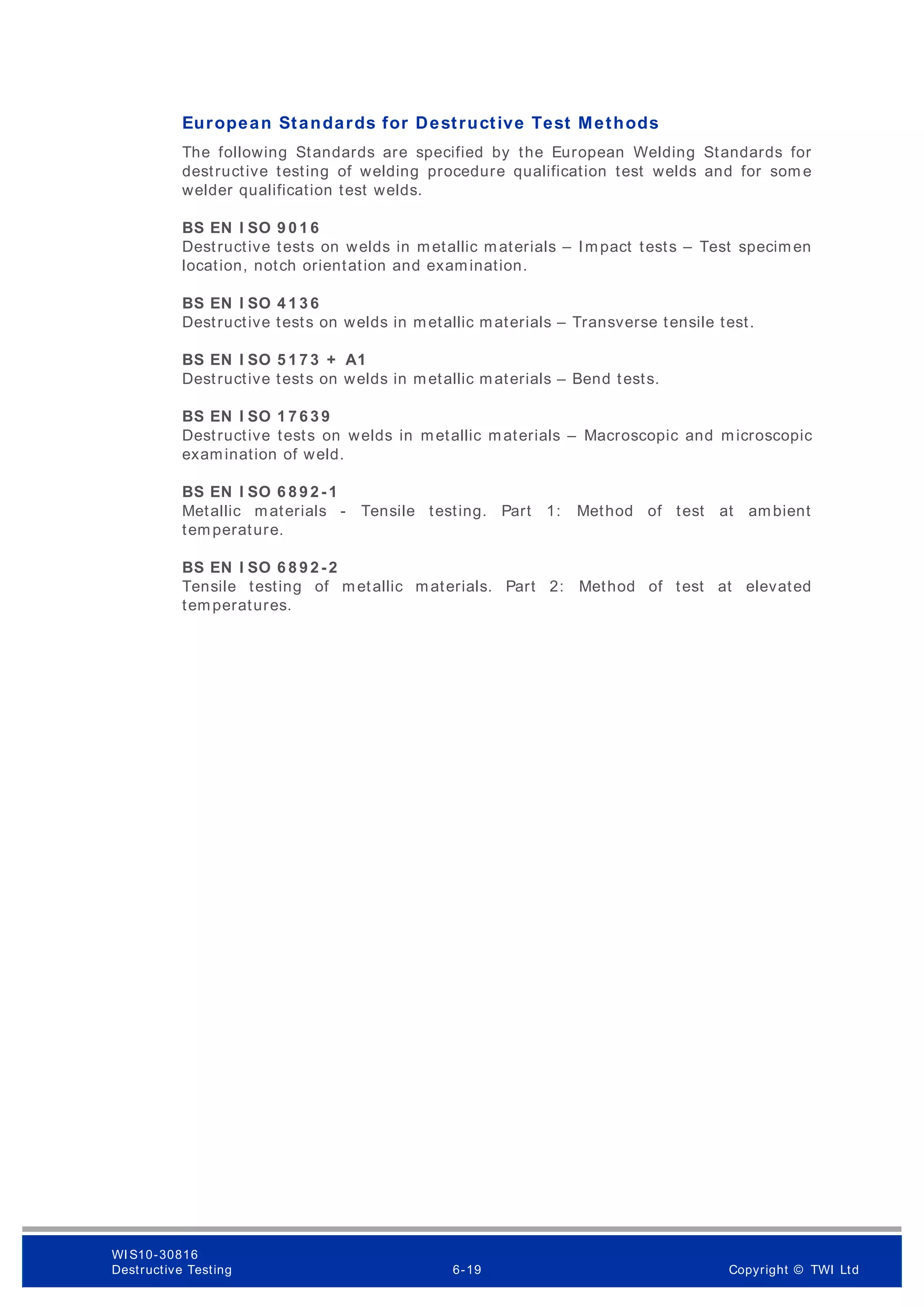

  • 111.
    6‐15 Copyright © TWILtd Charpy impact tests have been conducted on a 16mm single V butt joint. Which of the following set of results would meet the specification? a. Average of set 30 joules, lowest individual value 20 joules b. Average of set 40 joules, lowest individual value 32 joules c. Average of set 38 joules, lowest individual value 35 joules d. Average of set 42 joules, lowest individual value 28 joules Question 5 Copyright © TWI Ltd A welder qualifies in C Mn steel, 10mm thick, MMA process using low hydrogen electrodes, PC position using DC- polarity. Which one of the following is the welder not qualified for? a. C mn steel, 20mm thick, MMA process, rutile electrode, PB position, DC- b. C mn steel, 6mm thick, MMA process, rutile electrode, PA position, DC- c. C mn steel, 15mm thick, MMA process, low hydrogen electrode, PC position, DC- d. C mn steel, 15mm thick, MMA process, rutile electrode, PE position, DC- Question 6 Copyright © TWI Ltd A charpy impact test is devised to test samples at different temperatures. What does this hope to establish? a. A transition range from ductile to brittle b. The Rm of the material c. The Re of the material d. The relationship between hardness and tensile strength Question 7 Copyright © TWI Ltd The point at which the Rm is reached in a tensile test is also referred to as the: a. Yield point b. UTS c. A% d. Gauge length Question 8 Copyright © TWI Ltd If a tensile test specimen fails to meet the required value, what action can be taken? a. Two more test welds are required which will require complete testing b. One more test sample can be submitted c. If the specimen is large enough, two more tests can be done d. As many test welds as required can be submitted until the tests meet the specification Question 9 Copyright © TWI Ltd In a procedure qualification in 10m thick material welded in the PF position when impacts are not specified, which position(s) is the procedure qualified for? a. PA, PC b. PF, PG c. All positions d. PF only Question 10
  • 113.
  • 115.
    7 Heat Treatment The heat treatm ent given to a particular grade of steel by the steelmaker/ supplier should be shown on the material test certificate and may be referred to as the supply condition. Welding inspectors may need to refer to material test certificates and it is appropriate that they be familiar with the terminology that is used and have som e understanding of the principles of some of the m ost comm only applied heat treatments. Welded joints may need to be subjected to heat treatment after welding (PWHT) and the tasks of m onitoring the thermal cycle and checking the heat treatm ent records are often delegated to welding inspectors. 7 .1 Heat treatm ent of steel The main supply conditions for weldable steels are: As rolled, hot rolled, hot finished Plate is hot rolled to finished size and allowed to air cool; the temperature at which rolling finishes may vary from plate to plate and so strength and toughness properties vary and are not optimised: Applied to: Relatively thin, lower strength C-steel. Therm o- m echanical controlled processing ( TMCP) , control rolled, therm o-m echanically rolled Steel plate given precisely controlled thickness reductions during hot rolling within carefully controlled temperature ranges; final rolling temperature is also carefully controlled; Applied to Relatively thin, high strength low alloy steels (HSLA) and for som e steels with good toughness at low temperatures, eg cryogenic steels. Norm alised After working the steel (rolling or forging) to size, it is heated to ~ 900°C and then allowed to cool in air to ambient temperature; this optimises strength and toughness and gives uniform properties from item to item for a particular grade of steel; Applied to C-Mn steels and some low alloy steels. Quenched and tem pered after working the steel (rolling or forging) to size, it is heated to ~ 900°C and then cooled as quickly as possible by quenching in water or oil; after quenching, the steel must be tempered (softened) to improve the ductility of the as- quenched steel: Applied to Some low alloy steels to give higher strength, toughness or wear resistance. WI S10-30816 Heat Treatment 7-1 Copyright © TWI Ltd
  • 116.
    Solution annealed/ heattreated After hot or cold working to size, steel heated to ~ 1100°C and rapidly cooled by quenching into water to prevent any carbides or other phases from forming: Applied to Austenitic stainless steels such as 304 and 316 grades. Annealed After working the steel (pressing or forging etc) to size, it is heated to ~ 900°C and then allowed to cool in the furnace to ambient temperature; this reduces strength and toughness but improves ductility: Applied to C-Mn steels and some low alloy steels. Figure 7.1-7.6 show the thermal cycles for the main supply conditions and subsequent heat treatm ent that can be applied to steels. 7 .2 Post w eld heat treatm ent ( PW HT) Post weld heat treatment has to be applied to some welded steels to ensure that the properties of the weldment will be suitable for their intended applications. The temperature at which PWHT is carried out is usually well below the temperature where phase changes can occur (note 1), but high enough to allow residual stresses to be relieved quickly and to soften (temper) any hard regions in the HAZ. There are major benefits of reducing residual stress and ensuring that the HAZ hardness is not too high for particular steels with certain service applications. Examples of these benefits are:  Improved the resistance of the joint to brittle fracture.  Improved the resistance of the joint to stress corrosion cracking.  Enables welded joints to be machined to accurate dimensional tolerances. Because the main reason for (and benefit of) PWHT is to reduce residual stresses, PWHT is often called stress relief. Note: There are circumstances when a welded joint may need to be normalised to restore HAZ toughness. However, these are relatively rare circumstances and it is necessary to ensure that welding consumables are carefully selected because normalising will significantly reduce weld metal strength. WI S10-30816 Heat Treatment 7-2 Copyright © TWI Ltd
  • 117.
    7 .3 PWHT therm al cycle The application standard/ code will specify when PWHT is required to give benefits # 1 or # 2 above and also give guidance about the thermal cycle that must be used. In order to ensure that a PWHT cycle is carried it in accordance with a particular code, it is essential that a PWHT procedure is prepared and that the following parameters are specified:  Maximum heating rate.  Soak temperature range.  Minimum time at the soak temperature (soak time).  Maximum cooling rate. 7 .3 .1 Heating rate This must be controlled to avoid large temperature differences within the fabricated item. Large differences in temperature (large thermal gradients) will produce large stresses and these may be high enough to cause distortion (or even cracking). Application standards usually require control of the maximum heating rate when the temperature of the item is above ~ 300°C. This is because steels start to show significant loss of strength above this temperature and are more susceptible to distortion if there are large therm al gradients. The temperature of the fabricated item must be m onitored during the thermal cycle and this is done by means of thermocouples attached to the surface at a number of locations representing the thickness range of the item. By monitoring furnace and item temperatures the rate of heating can be controlled to ensure compliance with code requirem ents at all positions w ithin the item . Maximum heating rates specified for C-Mn steel depend on thickness of the item but tend to be in the range ~ 60 to ~ 200°C/ h. 7 .3 .2 Soak tem perature The soak temperature specified by the code depends on the type of steel and thus the temperature range required to reduce residual stresses to a low level. C and C-Mn steels require a soak temperature of ~ 600°C wher eas som e low alloy steels (such as Cr-Mo steels used for elevated temperature service) require higher temperatures – typically in the range ~ 700 to ~ 760°C. Note: Soak temperature is an essential variable for a WPQR. Thus, it is very important that the it is controlled within the specified limits otherwise it may be necessary to carry out a new WPQ test to validate the properties of the item and at worst it may not be fit-for-purpose. WI S10-30816 Heat Treatment 7-3 Copyright © TWI Ltd
  • 118.
    7 .3 .3Soak tim e It is necessary to allow time for all the welded joints to experience the specified temperature throughout the full joint thickness. The temperature is monitored by surface-contact thermocouples and it is the thickest joint of the fabrication that governs the minimum time for temperature equalisation. Typical specified soak times are 1h per 25m m thickness. 7 .3 .4 Cooling rate It is necessary to control the rate of cooling from the PWHT temperature for the same reason that heating rate needs to be controlled – to avoid distortion (or cracking) due to high stresses from thermal gradients. Codes usually specify controlled cooling to ~ 300°C. Below this temperature the item can be withdrawn from a furnace and allowed to cool in air because steel is relatively strong and is unlikely to suffer plastic strain by any temperature gradients that may develop. Figure 7.6 is a typical PWHT thermal cycle. 7 .4 Heat treatm ent furnaces It is important that oil and gas-fired furnaces used for PWHT do not allow flame contact with the fabrication as this may induce large thermal gradients. It is also important to ensure that the fuel (particularly for oil-fired furnaces) does not contain high levels of potentially harmful impurities – such as sulphur. 7 .5 Local PW HT For a pipeline or pipe spool it is often necessary to apply PWHT to individual welds by local application of heat. For this, a PWHT procedure must specify the previously described parameters for controlling the thermal cycle but it is also necessary to specify the following:  Width of the heated band (must be within the soak temperature range).  Width of the temperature decay band (soak tem perature to ~ 300°C). Other considerations are:  Position of the thermocouples within the heated band width and the decay band.  If the item needs to be supported in a particular way to allow movem ent/ avoid distortion. The comm onest m ethod of heating for local PWHT is by means of insulated electrical elements (electrical ‘mats’) that are attached to the weld. Gas-fired, radiant heating elements can also be used. Figure 7.7 shows typical control zones for localised PWHT of a pipe butt weld. WI S10-30816 Heat Treatment 7-4 Copyright © TWI Ltd
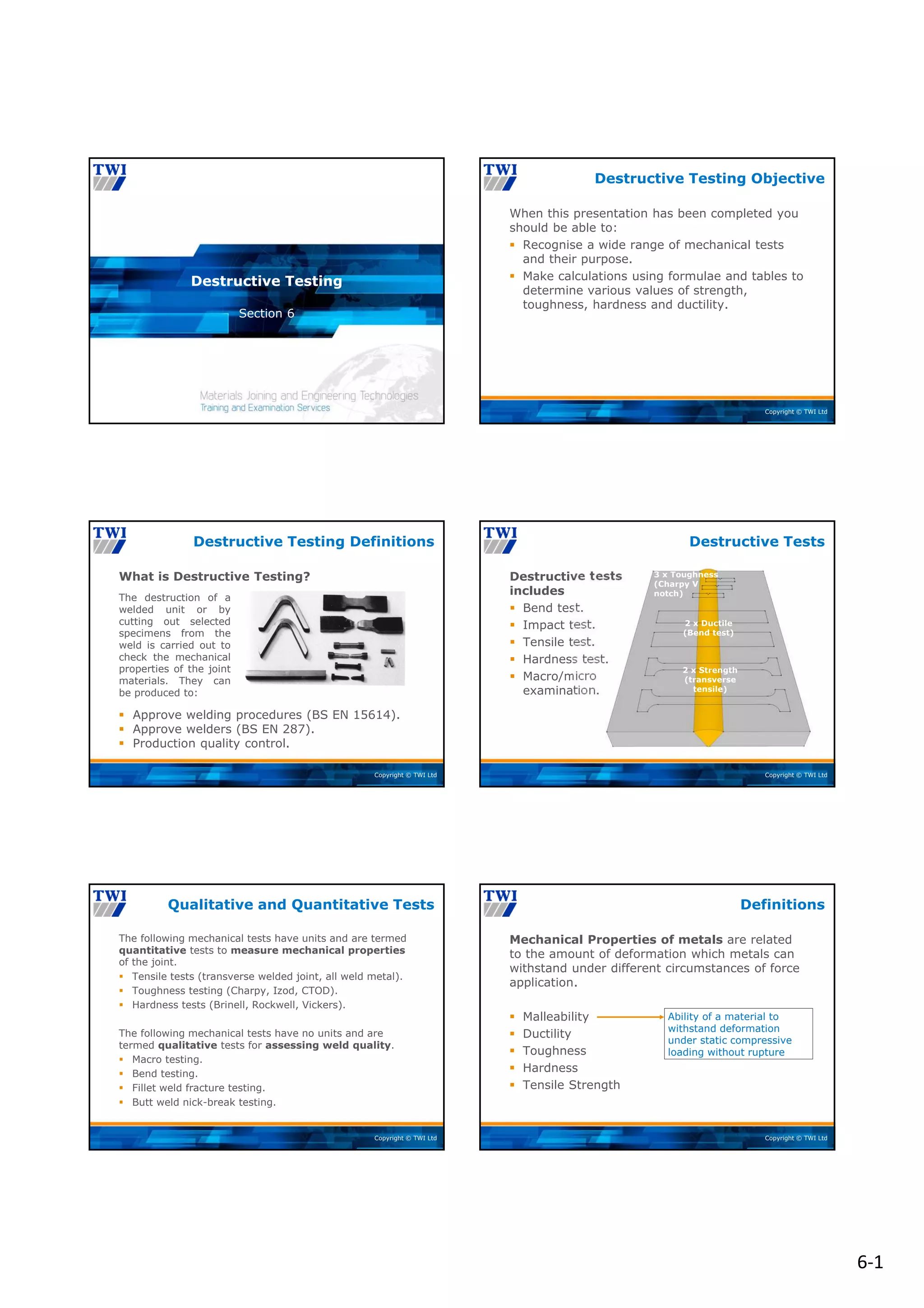
  • 119.
    Figure 7 .1Typical norm alising heat treatm ent applied to C-Mn and som e low alloy steels. Figure 7 .2 Typical quenching and tem pering heat treatm ent applied to som e low alloy steels. Norm alising  Rapid heating to soak temperature (100% austenite).  Short soak time at tem perature.  Cool in air to ambient temperature. Tem perat ure,°C Time ~ 900°C Tem perat ure°C Time ~ 900°C Quenching and tem pering  Rapid heating to soak temperature (100% austenite).  Short soak time at tem perature.  Rapid cooling by quenching in water or oil.  Reheat to tempering temperature, soak and air cool. Quenching cycle > ~ 650°C Tempering cycle WI S10-30816 Heat Treatment 7-5 Copyright © TWI Ltd
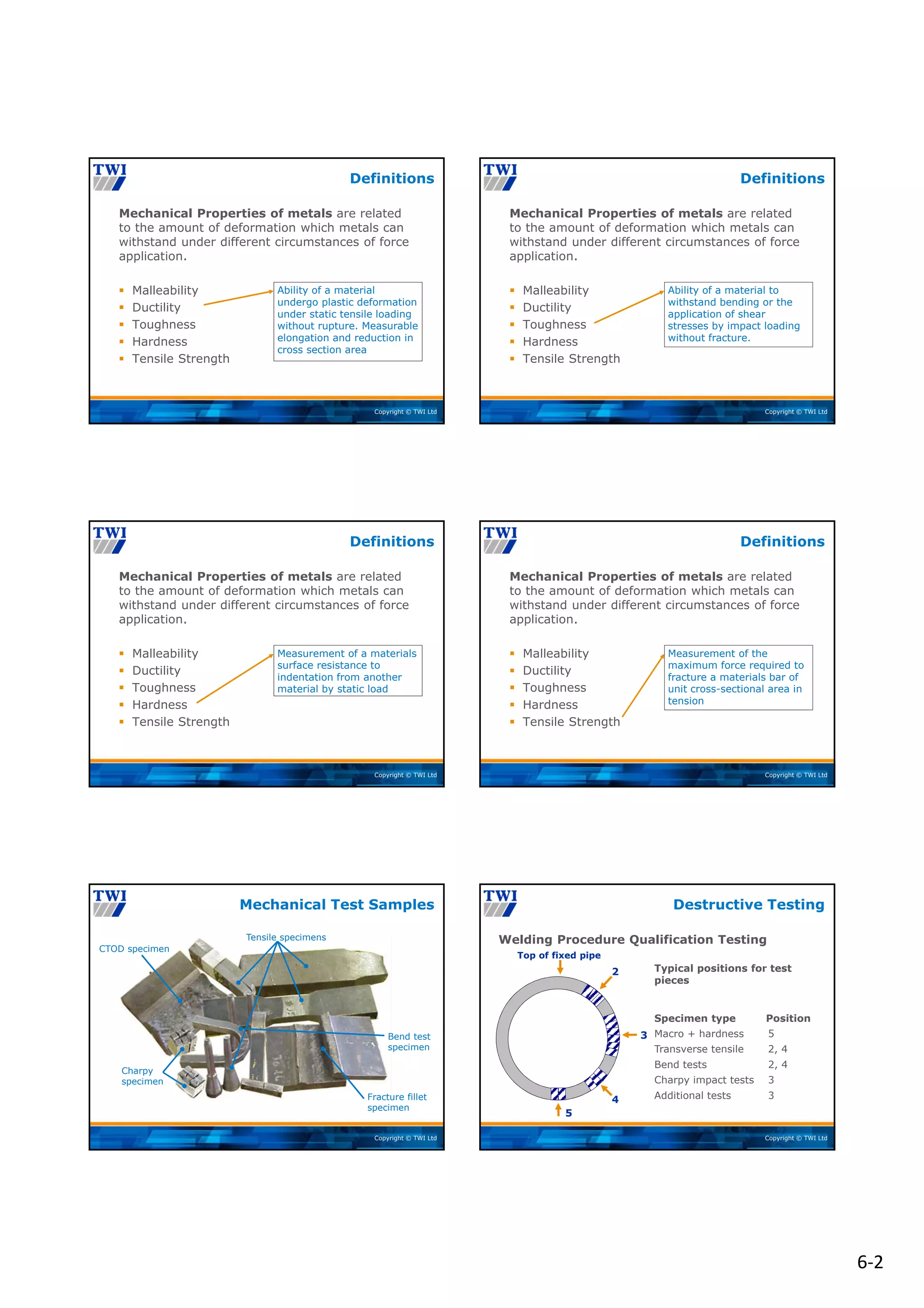
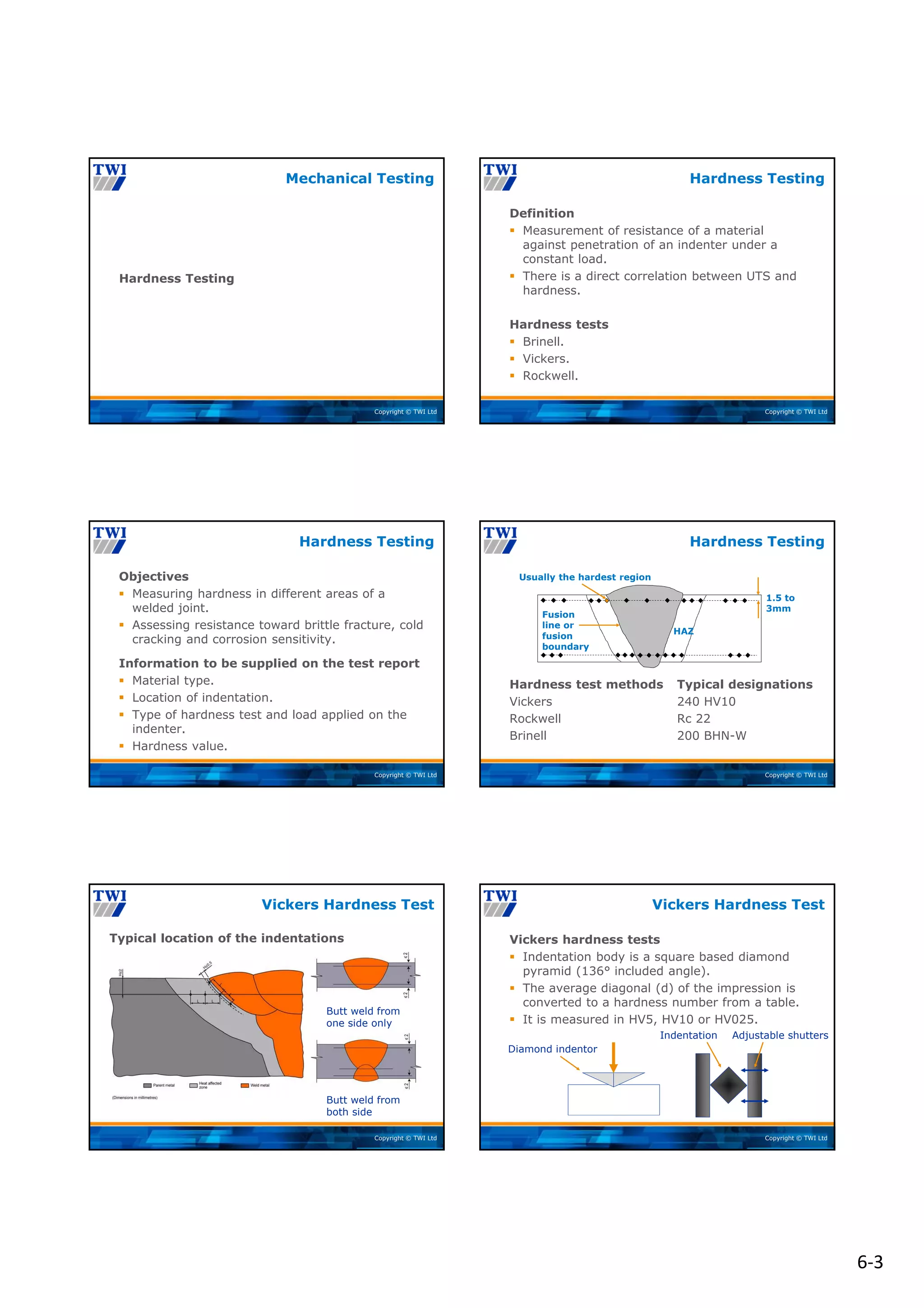
  • 120.
    Figure 7 .3Com parison of the ‘control-rolled’ ( TMCP) and ‘as-rolled’ conditions ( = hot rolling) . Figure 7 .4 Typical solution heat treatm ent ( solution annealing) applied to austenitic stainless steels. Time Tem perat ure,°C ~ 900°C Austenite + ferrite ( γ+α) Ferrite + pearlite (α)฀฀+ iron carbide) As-rolled or hot rolled Slab heating temperature > ~ 1050°C Austenite ( γ) ~ 700°C Control-rolled or TMCP Tem perat ure,°C Solution heat treatm ent  Rapid heating to soak temp. (100% austenite).  Short ‘soak’ time at tem perature.  Rapid cool cooling by quenching into water or oil. Time > ~ 1050°C Quenching WI S10-30816 Heat Treatment 7-6 Copyright © TWI Ltd
  • 121.
    Figure 7 .5Typical annealing heat treatm ent applied to C-Mn and som e low alloy steels. Figure 7 .6 Typical PW HT applied to C-Mn steels. Annealing  Rapid heating to soak temperature (100% austenite).  Short ‘soak’ time at tem perature.  Slow cool in furnace to ambient temperature. Tem perat ur e,°C Time ~ 900°C Tem perat ure °C PW HT ( C-Mn steels)  Controlled heating rate from 300°C to soak tem perat ure.  Minimum soak time at temperature.  Controlled cooling to ~ 300°C. Time ~ 600°C Soak time ~ 300°C Controlled heating and cooling rates Air cool WI S10-30816 Heat Treatment 7-7 Copyright © TWI Ltd
  • 122.
    Figure 7 .7Local PW HT of a pipe girth seam . Weld seam WI S10-30816 Heat Treatment 7-8 Copyright © TWI Ltd
  • 123.
    7‐1 Copyright © TWILtd Section 7 Heat Treatment Copyright © TWI Ltd Controlled heating and cooling to bring about desired changes in metals and alloys Objectives  Microstructural changes improve mechanical properties ie toughness, machinability, strength.  Reduce residual stress level. Heat Treatment Where? Local Global Copyright © TWI Ltd Carrying Out Heat Treatment Heat Treatment Heating & cooling bulk specimen Localised Heat treatment Furnaces and ovens Gas fired Localised heat sources Electric Flame heating Induction heating Laser heating Temperature control? Use thermocouples, optical pyrometers Electric heating mats Copyright © TWI Ltd Furnaces and ovens Gas fired:  Special attention to environment control.  Heat from oxygen + fuel gas (methane, propane).  High concentration of oxygen may result in scaling, a neutral environment is beneficial.  Avoid heat gradients.  Radiant tube furnaces to avoid contact with combustion product. Electric furnaces:  Cleaner environment.  Expensive. Heat Treatment Equipment Copyright © TWI Ltd  Heating and cooling a specific portion of a component, ie gear edge, case or surface hardening, weld PWHT.  Gas flames such as oxygen + methane or propane.  Induction.  Electric heating blankets. Localised Heat Treatment Copyright © TWI Ltd Heat Treatment Cycle Soaking temperature Heating Soaking Cooling Important parameters  Heating rate.  Soaking temperature.  Soaking time (1h/25mm).  Cooling rate. Temperature Time
  • 124.
    7‐2 Copyright © TWILtd  Annealing.  Normalising.  Recovery and re-crystallisation.  Stress relief.  Quenching and tempering.  Precipitation hardening. Types of Heat Treatment Welds & parent metals Parent metals Copyright © TWI Ltd Normalising Heat Treatment Temperatures Annealing Recovery & re- crystallisation Stress relief & PWHT Phase change to austenite No phase change Austenite Carbon content in weight % 0.022 0.77 2.0 A3 A1 Acm 727 910 oC 600 500 PWHT Homogenizing and hot working Normalizing Annealing Recovery and recrystallization Stress Relieve and PWHT Copyright © TWI Ltd  Heated to high temperature (Partially or fully austenitic): □ Hypereutectic steels are partially austenitized to avoid cementite formation on grain boundaries during slow cooling.  Hold for some time and then slow cool.  Coarse grain size.  Reduced strength.  Increased ductility.  Homogeneous. Full Annealing - Steel Pearlite Ferrite Copyright © TWI Ltd  Steel heated just to where austenite is stable.  Air cooling – fairly rapid.  Grain refinement.  Stress relief.  Higher strength.  Higher toughness. Normalising Pearlite Ferrite Copyright © TWI Ltd  Cold work increases strength and reduces ductility and toughness.  Reversed by recovery and re-crystallisation: □ But if temperature too high excessive grain growth leads to drop in strength and toughness.  Recovery reduces the stored energy in cold- worked or deformed (rolled) material.  Dislocations move and align at heat treatment temperature (recovery).  New defect-free grains nucleate from grain boundaries and grow (recrystallisation). Recovery and Re-crystallisation Copyright © TWI Ltd Recovery and Recrystallisation Heat treatment temperature (o C) Heat treatment temperature (o F)
  • 125.
    7‐3 Copyright © TWILtd Non Equilibrium Heat Treatment - Quenching Austenite Carbon content in weight % 0.008 0.05 0.83 2.0 A3 A1 Acm Annealing 727 910 oC Copyright © TWI Ltd  Heating to annealing heat treatment temperature range.  Fast cooling to increase hardness: □ Brine (Water and salt). □ Water. □ Oil.  Ductility and toughness are drastically reduced.  Usually followed by tempering. Non Equilibrium Heat Treatment - Quenching Increased quench severity Copyright © TWI Ltd  Subcritical (Below A1) Heat treatment to tailor hardness/strength of martensite.  Performed after quenching to reduce the brittleness.  Ductility and toughness are improved.  Removes stresses due to quenching. Tempering 100 200 300 400 500 600 700 o C As- quenched Hardness Copyright © TWI Ltd Low C steel (0.12C) Annealed at 900°C for 30 minutes and water quenched. 380Hv After tempering at 700°C for 30 minutes and air cooled. 245Hv Tempering Copyright © TWI Ltd Stress relief  Carried out at lower temperature, to reduce residual stresses. Tempering  Carried out at higher temperature (for constructional steels).  Not only relieves stresses but also softens the hard HAZ microstructure. Heat Treatments Following Welding Copyright © TWI Ltd  No phase transformation.  Slow heating and cooling (max: 50°C/h).  Soaking time 1hr/25mm of thickest section.  Usual temperature for PWHT (C-Mn steel) – 550 to 650°C.  Stress Relief carried out after cold work or welding, at lower temperatures. Stress Relief and PWHT Austenite Carbon content in weight % 0.022 0.77 2.0 A3 A1 Acm 727 910 oC 600 500 Tempering Stress Relief
  • 126.
    7‐4 Copyright © TWILtd PWHT Effect on Residual Stress Time PWHT temperature Actual YS YS at room temperature Soaking temperature Residual stress level YS at soaking temperature Copyright © TWI Ltd PWHT Effects Copyright © TWI Ltd  Provide adequate support (low YS at high temperature!).  Control heating rate to avoid uneven thermal expansions.  Control soak time to equalise temperatures.  Control temperature gradients - No direct flame impingement.  Control furnace atmosphere to reduce scaling.  Control cooling rate to avoid new residual stresses.  For specific PWHT applications see standards, eg ASME VIII, ASME B31.3, ASME B31.8. PWHT Recommendations Copyright © TWI Ltd You are assigned to a heat treatment company to witness heat treatments being conducted. The heat treatments are being conducted on various products for a major offshore oil and gas project that you have been involved with. Heat Treatments Copyright © TWI Ltd While inspecting some cast duplex valve bodies one of your inspectors asks if the castings require a heat treatment process. Which of the following would most likely be applied to these items? a. Solution annealing b. Quench hardening c. No heat treatment required d. Stress relieving would be required but only after welding if applicable Question 1 Copyright © TWI Ltd A set of fabricated brackets manufactured from 316L stainless steel is about to be heat-treated, which of the following applies? a. This material is always stressed relieved after welding b. A post weld heat treat isn’t generally conducted on this type of material c. Quench hardening would always be applied to this material to increase toughness after welding d. All options are incorrect Question 2
  • 127.
    7‐5 Copyright © TWILtd During the post weld heat treatment of a small welded fabrication, you observe the heat treatment personnel applying heat by a heating torch. In accordance with TWI Specification do you consider this an acceptable practice? a. Yes this is acceptable providing the temperature attained and the soaking times are correct in accordance with the approved PWHT procedure b. Yes this is acceptable providing the thermocouples are correctly placed and calibrated c. No, this application method isn’t acceptable d. 2 options are correct Question 3 Copyright © TWI Ltd Unfortunately the stress relieving of a welded fabricated steel structure hasn’t been witnessed by any of your inspectors. When you review the PWHT chart you notice only 2 thermocouples have been used. In accordance with the TWI Specification do you consider this to be acceptable? a. No, all PWHT shall be witnessed and a minimum of 3 thermocouples shall be used b. Yes, only the PWHT charts require reviewing by inspectors c. No, all PWHT shall be witnessed, an inspector has to be present 100% of the time throughout the PWHT process d. No, a minimum of 3 thermocouples shall be used, and calibration certificates require checking prior to the heat treatment process Question 4 Copyright © TWI Ltd It is a requirement for a quenched and tempered component to undergo post weld heat treatment, one of your inspectors asks you what is the maximum temperature required for this material. Which of the following is correct in accordance the TWI Specification? a. The same as for C/Mn steel b. You would never permit a PWHT to be carried out on this material c. The TWI Specification doesn’t reference this information, but would expect it to be around 680°C d. All options are incorrect Question 5 Copyright © TWI Ltd During Post Weld Heat Treatment, what sequence of events occurs to the properties of the material? a. Yield strength increases, stresses decrease then yield strength decreases b. Ductility decreases, stresses increase then ductility increases c. Yield strength decreases, stresses decrease then yield strength increases d. Stresses increase, stresses decrease then yield increases Question 6 Copyright © TWI Ltd After a PWHT process has been carried out on some thick to thin C/Mn pipe spools (12.5mm to 25mm WT) you notice that the heating rate is recorded at 200°C/Hr. In accordance with the TWI Specification is this correct? a. No, it should be a minimum of 220°C/hr b. No, it should be 40°C/hr c. Yes, Providing the cooling rate is the same d. Yes, providing the cooling rate is 220°C/hr Question 7 Copyright © TWI Ltd While reviewing the heat treatment chart for a PWHT process you notice that the temperature is not recorded below 150°C on the cooling cycle. Would you accept this chart? a. No, the temperature must be recorded down to room temperature b. It would depend on the thickness and grade of material as to whether this would be acceptable or not c. No, the temperature has to be recorded to at least 110°C d. The TWI Specification doesn’t reference this information. Question 8
  • 128.
    7‐6 Copyright © TWILtd In certain cases heat treatments are conducted on cold work components such as cold rolled, steel plate. Which of the following heat treatments would you expect to be conducted on these components? a. Stress relieving b. Densensitization c. Quench hardening d. Post hydrogen release Question 9 Copyright © TWI Ltd You notice from your records you don’t have an inspection report for a component that has undergone a PWHT. In this case what would your course of action be? a. It would be acceptable, If the component had a full inspection report before PWHT b. The TWI Specification makes no reference of this, so you would have to seek advice c. It is a requirement that all components undergo full inspection after a PWHT process has been conducted; in this case it would not be acceptable d. As long as no welding has be conducted after the PWHT process, this would be acceptable Question 10
  • 129.
    Section 8 W PSand W elder Qualifications
  • 131.
    8 W PSand W elder Qualifications When structures and pressurised items are fabricated by welding, it is essential that all the welded joints are sound and have suitable properties for their application. Control of welding is by means of welding procedure specifications (WPS) that give detailed written instructions about the welding conditions that must be used to ensure that welded joints have the required properties. Although WPS are shop floor documents to instruct welders, welding inspectors need to be familiar with them because they will need to refer to WPSs when they are checking that welders are working in accordance with the specified requirem ents. Welders need to understand WPSs and have the skill to make welds that are not defective and demonstrate these abilities before being allowed to make production welds. 8 .1 Qualified w elding procedure specifications It is industry practice to use qualified W PS for most applications. A welding procedure is usually qualified by m aking a test weld to demonstrate that the properties of the joint satisfy the requirements specified by the application standard (and the client/ end user). Dem onstrating the mechanical properties of the joint is the principal purpose of qualification tests but showing that a defect-free weld can be produced is also very important. Production welds that are made in accordance with welding conditions similar to those used for a test weld should have similar properties and therefore be fit for their intended purpose. Figure 8.1 is an exam ple of a typical WPS written in accordance with the European Welding Standard format giving details of all the welding conditions that need to be specified. 8 .1 .1 W elding standards for procedure qualification European and American Standards have been developed to give comprehensive details about:  How a welded test piece must be made to demonstrate joint properties.  How the test piece must be tested.  What welding details need to be included in a WPS?  The range of production welding allowed by a particular qualification test weld. WI S10-30816 WPS and Welder Qualifications 8-1 Copyright © TWI Ltd
  • 132.
    The principal EuropeanStandards that specify these requirem ents are: BS EN I SO 1 5 6 1 4 Specification and qualification of welding procedures for metallic materials – Welding procedure test. Part 1 : Arc & gas welding of steels & arc welding of nickel & nickel alloys. Part 2 : Arc welding of aluminium and its alloys. The principal Am erican Standards for procedure qualification are: ASME Section I X for pressurised system s (vessels & pipework). AW S D1 .1 Structural welding of steels. AW S D1 .2 Structural welding of aluminium. 8 .1 .2 The qualification process for w elding procedures Although qualified WPS are usually based on test welds that have been made to demonstrate weld joint properties; welding standards also allow qualified WPS to be written based on other data (for som e applications). Some alternative ways that can be used for writing qualified WPS for som e applications are:  Qualification by adoption of a standard w elding procedure - test welds previously qualified and documented by other manufacturers.  Qualification based on previous w elding experience - weld joints that have been repeatedly made and proved to have suitable properties by their service record. Procedure qualification to European Standards by means of a test weld (and similar in ASME Section IX and AWS) requires a sequence of actions that is typified by those shown by Table 8.1. A successful procedure qualification test is completed by the production of a welding procedure qualification record (WPQR), an example of which is shown by Figure 8.2. 8 .1 .3 Relationship betw een a W PQR and a W PS Once a WPQR has been produced, the welding engineer is able to write qualified W PSs for the various production weld joints that need to be made. The welding conditions that are allowed to be written on a qualified WPS are referred to as the qualification range and this range depends on the welding conditions that were used for the test piece (the as-run details) and form part of the WPQR. Welding conditions are referred to as w elding variables by European and American Welding Standards and are classified as either essential variables or non-essential variables. WI S10-30816 WPS and Welder Qualifications 8-2 Copyright © TWI Ltd
  • 133.
    These variables canbe defined as follows:  Essential variable a variable that has an effect on the m echanical properties of the weldment (and if changed beyond the limits specified by the standard will require the WPS to be re-qualified).  Non-essential variable a variable that must be specified on a WPS but does not have a significant effect on the m echanical properties of the weldment (and can be changed w ithout need for re-qualification but will require a new WPS to be written). It is because essential variables can have a significant effect on m echanical properties that they are the controlling variables that govern the qualification range and determine what can be written into a WPS. If a welder makes a production weld using conditions outside the qualification range given on a particular WPS, there is danger that the welded joint will not have the required properties and there are then two options:  Make another test weld using similar welding conditions to those used for the affected weld and subject this to the same tests used for the relevant WPQR to dem onstrate that the properties still satisfy specified requirem ents.  Remove the affected weld and re-weld the joint strictly in accordance with the designated WPS. Most of the welding variables that are classed as essential are the sam e in both the European and American Welding Standards but their qualification ranges may differ. Some Application Standards specify their own essential variables and it is necessary to ensure that these are taken into consideration when procedures are qualified and WPSs are written. Examples of essential variables (according to European Welding Standards) are given in Table 8.2. 8 .2 W elder qualification The use of qualified WPSs is the accepted m ethod for controlling production welding but this will only be successful if the welders have the ability to understand and work in accordance with them. Welders also need to have the skill to consistently produce sound welds (free from defects). Welding Standards have been developed to give guidance on what particular test welds are required in order to show that welders have the required skills to make particular types of production welds in particular materials. WI S10-30816 WPS and Welder Qualifications 8-3 Copyright © TWI Ltd
  • 134.
    WIS10-30816 WPS and WelderQualifications 8-4 Copyright © TWI Ltd 8.2.1 Welding standards for welder qualification The principal European Standards that specify requirements are: EN 287-1 / Qualification test of welders – Fusion welding BS EN ISO 9606 Part 1: Steels BS EN ISO 9606-2 Qualification test of welders – Fusion welding Part 2: Aluminium and aluminium alloys BS EN ISO 14732 Welding personnel. Qualification testing of welding operators and weld setters for mechanized and automatic welding of metallic materials The principal American Standards that specify requirements for welder qualification are: ASME Section IX Pressurised systems (vessels & pipework) AWS D1.1 Structural welding of steels AWS D1.2 Structural welding of aluminium 8.2.2 The qualification process for welders Qualification testing of welders to European Standards requires test welds to be made and subjected to specified tests to demonstrate that the welder understands the WPS and can produce a sound weld. For manual and semi-automatic welding the emphasis of the tests is to demonstrate ability to manipulate the electrode or welding torch. For mechanised and automatic welding the emphasis is on demonstrating that welding operators have ability to control particular types of welding equipment. American Standards allow welders to demonstrate that they can produce sound welds by subjecting their first production weld to non-destructive testing. Table 8.3 shows the steps required for qualifying welders in accordance with European Standards. Figure 8.5 shows a typical Welder Qualification Certificate in accordance with European Standards. 8.2.3 Welder qualification and production welding allowed The welder is allowed to make production welds within the range of qualification recorded on his welder qualification certificate. The range of qualification is based on the limits specified by the Welding Standard for welder qualification essential variable - defined as: a s variable that if changed beyond the limits specified by the Welding Standard may require greater skill than has been demonstrated by the test weld.
  • 135.
    Some welding variablesthat are classed as essential for welder qualification are the sam e types as those classified as essential for welding procedure qualification, but the range of qualification may be significantly wider. Some essential variables are specific to welder qualification. Examples of welder qualification essential variables are given in Table 8.4. 8 .2 .4 Period of validity for a w elder qualification certificate A welder’s qualification begins from the date of welding of the test piece. The European Standard allows a qualification certificate to remain valid for a period of two years – provided that:  The welding co-ordinator, or other responsible person, can confirm that the w elder has been w orking w ithin the initial range of qualification.  Working within the initial qualification range is confirmed every six months. 8 .2 .5 Prolongation of w elder qualification A welder’s qualification certificate can be prolonged every two years by an examiner/ examining body but before prolongation is allowed certain conditions need to be satisfied:  Records/ evidence are available that can be traced to the welder and the WPS that have been used for production welding.  The supporting evidence must relate to volumetric examination of the welder’s production welds (RT or UT) on two welds made during the 6 months prior to the prolongation date.  The supporting evidence welds must satisfy the acceptance levels for imperfections specified by the European welding standard and have been made under the sam e conditions as the original test weld. WI S10-30816 WPS and Welder Qualifications 8-5 Copyright © TWI Ltd
  • 136.
    Table 8 .1Typical sequence for w elding procedure qualification by m eans of a test w eld. The w elding engineer w rites a prelim inary W elding Procedure Specification ( pW PS) for each test coupon to be w elded  A welder m akes the test coupon in accordance with the pWPS  A welding inspector records all the welding conditions used to make the test coupon (called the as-run conditions) An Independent Examiner/ Examining Body/ Third Party Inspector m ay be requested to m onitor the procedure qualification The test coupon is subjected to NDT in accordance w ith the m ethods specified by the Standard – visual inspection, MT or PT and RT or UT  A Welding Procedure Qualification Record (WPQR) is prepared by the welding engineer giving details of: » The as- run w elding conditions » Results of the NDT » Results of the destructive tests » The w elding conditions allow ed for production w elding  If a Third Party Inspector is involved he will be requested to sign the WPQR as a true record of the test  The test coupon is destructively tested (tensile, bend, macro tests)  The code/ application standard/ client may require additional tests such as hardness tests, impact tests or corrosion tests – depending on material and application WI S10-30816 WPS and Welder Qualifications 8-6 Copyright © TWI Ltd
  • 137.
    Table 8 .2Typical exam ples of W PS essential variables according to European W elding Standards. VARI ABLE RANGE for PROCEDURE QUALI FI CATI ON W elding process No range – process qualified is process that must be used in production PW HT Joints tested after PWHT only qualify as PWHT production joints Joints tested ‘as-welded’ only qualify ‘as-welded’ production joints Parent m aterial type Parent materials of similar composition and mechanical properties are allocated the same Material Group No.; qualification only allows production welding of materials with the same Group No. W elding consum ables Consumables for production welding must have the same European designation – as a general rule Material thickness A thickness range is allowed – below and above the test coupon thickness Type of current AC only qualifies for AC; DC polarity (+ VE or -VE) cannot be changed; pulsed current only qualifies for pulsed current production welding Preheat tem perature The preheat temperature used for the test is the minimum that must be applied I nterpass tem perature The highest interpass temperature reached in the test is the maximum allowed Heat input ( HI ) When impact requirem ents apply maximum HI allowed is 25% above test HI when hardness requirements apply minimum HI allowed is 25% below test HI WI S10-30816 WPS and Welder Qualifications 8-7 Copyright © TWI Ltd
  • 138.
    Table 8 .3Stages for qualification of a w elder. The w elding engineer w rites a W PS for w elder qualification test piece  The w elder m akes the test w eld in accordance w ith the W PS A w elding inspector m onitors the w elding to ensure that the w elder is w orking in accordance the W PS An Independent Examiner/ Examining Body/ Third Party Inspector m ay be requested to m onitor the test  The test coupon is subjected to NDT in accordance w ith the m ethods specified by the Standard ( visual inspection, MT or PT and RT or UT)  For certain m aterials, and w elding processes, som e destructive testing m ay be required ( bends or m acros)  A W elder’s Qualification Certificate is prepared show ing the w elding conditions used for the test piece and the range of qualification allow ed by the Standard for production w elding  I f a Third Party is involved, the Qualification Certificate w ould be endorsed as a true record of the test WI S10-30816 WPS and Welder Qualifications 8-8 Copyright © TWI Ltd
  • 139.
    Table 8 .4Typical exam ples of w elder qualification essential variables according to European W elding Standards. VARI ABLE RANGE for W ELDER QUALI FI CATI ON W elding process No range – process qualified is process that a welder can use in production Type of w eld Butt welds cover any type of joint except branch welds fillet welds only qualify fillets Parent m aterial type Parent materials of similar composition and mechanical properties are allocated the same Material Group No.; qualification only allows production welding of materials with the same Group No. but the Groups allow much wider composition ranges than the procedure Groups Filler m aterial Electrodes and filler wires for production welding must be of the sam e form as the test (solid wire, flux cored, etc); for MMA coating type is essential. The filler wire must fall within the range of the qualification of the filler material. Material thickness A thickness range is allowed; for test pieces above 12mm allow  5mm Pipe diam eter Essential and very restricted for small diameters; test pieces above 25mm allow  0.5 x diameter used (min. 25mm) W elding positions Position of welding very important; H-L045 allows all positions (except PG) WI S10-30816 WPS and Welder Qualifications 8-9 Copyright © TWI Ltd
  • 140.
    Figure 8 .1Exam ple of a w elding procedure specification ( W PS) to EN 1 5 6 1 4 form at. WI S10-30816 WPS and Welder Qualifications 8-10 Copyright © TWI Ltd
  • 141.
    Figure 8 .2Exam ple of a W PQR docum ent ( qualification range) to EN 1 5 6 1 4 form at. WI S10-30816 WPS and Welder Qualifications 8-11 Copyright © TWI Ltd
  • 142.
    Figure 8 .3Exam ple of W PQR docum ent ( test w eld details) to EN 1 5 6 1 4 form at. WI S10-30816 WPS and Welder Qualifications 8-12 Copyright © TWI Ltd
  • 143.
    Figure 8 .4Exam ple of a W PQR docum ent ( details of w eld test) to EN 1 5 6 1 4 form at. WI S10-30816 WPS and Welder Qualifications 8-13 Copyright © TWI Ltd
  • 144.
    Figure 8 .5Exam ple of a w elder qualification test certificate ( W PQ) to EN 2 8 7 form at. WI S10-30816 WPS and Welder Qualifications 8-14 Copyright © TWI Ltd
  • 145.
    8‐1 Copyright © TWILtd Section 8 Welding Procedure and Welder Qualification Copyright © TWI Ltd Question: What is the main reason for carrying out a Welding Procedure Qualification Test? (What is the test trying to show?) Answer: To show that the welded joint has the properties* that satisfy the design requirements (fit for purpose). * Properties  Mechanical properties are the main interest - always strength but toughness & hardness may be important for some applications.  Test also demonstrates that the weld can be made without defects. Welding Procedure Qualification Copyright © TWI Ltd Purpose of a WPS  To achieve specific properties. □ Mechanical strength, corrosion resistance, composition.  To ensure freedom from defects.  To enforce QC procedures.  To standardise on methods and costs.  To control production schedules.  To form a record.  Application standard or contract requirement. Welding Procedures Copyright © TWI Ltd Object of a welding procedure test  To give maximum confidence that the welds mechanical and metallurgical properties meet the requirements of the applicable code/specification.  Each welding procedure will show a range to which the procedure is approved (extent of approval).  If a customer queries the approval evidence can be supplied to prove its validity. Welding Procedures Copyright © TWI Ltd (according to BS EN ISO 15614) Preliminary Welding Procedure Specification (pWPS) Welding Procedure Qualification Record (WPQR) Welding Procedure Specification (WPS) Welding Procedure Qualification Copyright © TWI Ltd Producing a welding procedure involves  Planning the tasks.  Collecting the data.  Writing a procedure for use of for trial.  Making a test welds.  Evaluating the results.  Approving the procedure.  Preparing the documentation. Welding Procedures
  • 146.
    8‐2 Copyright © TWILtd Preliminary Welding Procedure Specification (pWPS) Welding Engineer writes a preliminary Welding Procedure Specification (pWPS) for each test weld to be made. Welding Procedure Qualification Copyright © TWI Ltd Welding Procedure Qualification Record (WPQR)  A welder makes a test weld in accordance with the pWPS.  A welding inspector records all the welding conditions used for the test weld (referred to as the 'as-run' conditions). An Independent Examiner/ Examining Body/ Third Party inspector may be requested to monitor the qualification process. The finished test weld is subjected to NDT in accordance with the methods specified by the EN ISO Standard - Visual, MT or PT & RT or UT. Welding Procedure Qualification Copyright © TWI Ltd Welding Procedure Qualification Record (WPQR)  Test weld is subjected to destructive testing (tensile, bend, macro).  The Application Standard, or Client, may require additional tests such as impact tests, hardness tests (and for some materials - corrosion tests). Welding Procedure Qualification Record (WPQR)  The welding conditions used for the test weld  Results of the NDT.  Results of the destructive tests.  The welding conditions that the test weld allows for production welding.  The Third Party may be requested to sign the WPQR as a true record. Welding Procedure Qualification Copyright © TWI Ltd Welding Procedure Specification (WPS)  The welding engineer writes qualified Welding Procedure Specifications (WPS) for production welding.  Production welding conditions must remain within the range of qualification allowed by the WPQR. Welding Procedure Qualification Copyright © TWI Ltd (according to EN Standards) Welding conditions are called welding variables. Welding variables are classified by the EN ISO Standard as:  Essential variables.  Non-essential variables.  Additional variables. Note: Additional variables = ASME supplementary essential. The range of qualification for production welding is based on the limits that the EN ISO Standard specifies for essential variables* (* and when applicable - the additional variables) Welding Procedure Qualification Copyright © TWI Ltd (according to EN Standards) Welding essential variables Question: Why are some welding variables classified as essential? Answer: A variable, that if changed beyond certain limits (specified by the Welding Standard) may have a significant effect on the properties* of the joint. * particularly joint strength and ductility. Welding Procedure Qualification
  • 147.
    8‐3 Copyright © TWILtd (according to EN Standards) Welding additional variables Question: Why are some welding variables classified as additional? Answer: A variable, that if changed beyond certain limits (specified by the Welding Standard) may have a significant effect on the toughness and/or hardness of the joint. Note: ASME calls variables that affect toughness as supplementary essential variables (but does not refer to hardness). Welding Procedure Qualification Copyright © TWI Ltd (according to EN Standards) Some typical essential variables  Welding process.  Post weld heat treatment (PWHT).  Material type.  Electrode type, filler wire type (Classification).  Material thickness.  Polarity (AC, DC+ve/DC-ve).  Pre-heat temperature. Some typical additional variables  Heat input.  Welding position. Welding Procedure Qualification Copyright © TWI Ltd In most codes reference is made to how the procedure are to be devised and whether approval of these procedures is required. The approach used for procedure approval depends on the code. Example codes  AWS D.1.1: Structural Steel Welding Code.  BS 2633: Class 1 welding of Steel Pipe Work.  API 1104: Welding of Pipelines.  BS 4515: Welding of Pipelines over 7 Bar. Other codes may not specifically deal with the requirement of a procedure but may contain information that may be used in writing a weld procedure.  EN 1011: Process of Arc Welding Steels. Welding Procedures Copyright © TWI Ltd Components of a welding procedure Parent material  Type (Grouping).  Thickness.  Diameter (Pipes).  Surface condition. Welding process  Type of process (MMA, MAG, TIG, SAW etc).  Equipment parameters.  Amps, volts, travel speed. Welding consumables  Type of consumable/diameter of consumable.  Brand/classification.  Heat treatments/storage. Welding Procedures Copyright © TWI Ltd Components of a welding procedure Joint design  Edge preparation.  Root gap, root face.  Jigging and tacking.  Type of backing Welding position  Location, shop or site.  Welding position e.g. PA, PB, PC etc.  Any weather precaution. Thermal heat treatments  Preheat, temps.  Post weld heat treatments eg stress relieving. Welding Procedures Copyright © TWI Ltd Example Welding Procedure Specification (WPS) Welding Procedures
  • 148.
    8‐4 Copyright © TWILtd PA 1G / 1F Flat / Downhand PB 2F Horizontal-Vertical PC 2G Horizontal PD 4F Horizontal-Vertical (Overhead) PE 4G Overhead PF 3G / 5G Vertical-Up PG 3G / 5G Vertical-Down H-L045 6G Inclined Pipe (Upwards) J-L045 6G Inclined Pipe (Downwards) Welding Positions Copyright © TWI Ltd Welding Positions Copyright © TWI Ltd Monitoring heat input As Required by BS EN ISO 15614-1:2004 In accordance with BS EN 1011-1:1998  When impact requirements apply, the upper limit of heat input qualified is 25% greater than that used in welding the test piece.  When hardness requirements apply, the lower limit of heat input qualified is 25% lower than that used in welding the test piece.  Heat input is calculated in accordance with BS EN1011- 1.  If welding procedure tests have been preformed at both a high and low heat input level, then all intermediate heat inputs are also qualified. Welding Procedures Copyright © TWI Ltd 15614-1-2-3 Specifies contents of WPS "Shall give details of how a welding operation is to be performed and contain all relevant information". Definitions  Processes to be designated in accordance with BS EN ISO 4063.  Welding positions in accordance with BS EN ISO 6947.  Typical WPS form. Welding Procedures Copyright © TWI Ltd BS EN ISO 15614-1:2004 (Replaced BS EN 288-3) "does not invalidate previous … approvals made to former national standards… providing the intent of the technical requirements is satisfied… approvals are relevant" "where additional tests… make the approval technically equivalent… only necessary to do the additional tests…" "approval is valid… in workshops or sites under the same technical and quality control of that manufacturer…" "service, material or manufacturing conditions may require more comprehensive testing… " Application standard may require more testing Welding Procedures Copyright © TWI Ltd Table 5 BS EN ISO 15614-1:2004 Welding Procedures Single run Range of qualification Thickness of test piece t 0.7t to 2t Multi run 3 to 2ta 0.5t to 2t t<3 3<t<12 t>100 Not applicable 0.7t to 1.3ta 0.5t (3 min) to 1.3ta 12<t<100 50 to 2t 0.5t to 1.1t
  • 149.
    8‐5 Copyright © TWILtd Table 6 BS EN ISO 15614-1:2004 Welding Procedures Single run Throat Thickness Material Thickness Range of qualification Thickness of test piece t No restriction Multi run No restriction No restriction 0.75 a to 1.5 a a 0.75 a to 1.5 a t<3 3<t<30 t>30 >5 0.7 to 2 t 0.5t (3 min) to 1.2 t Copyright © TWI Ltd BS EN ISO 15614-1:2004 (Replaced BS EN 288-3) Covers Arc & Gas Welding of Steels & Arc Welding of Nickel & Nickel Alloys 111 - MMA 114 - FCAW - no gas shield 12 - SAW 131 - MIG 135 - MAG 136 - FCAW - active gas 137 - FCAW - inert gas 141 - TIG 15 - PLASMA ARC 311 – Oxy-Acetylene The principle of this European Standard may be applied to other fusion welding processes Welding Procedures Copyright © TWI Ltd Note 1: a is the throat as used for the test piece. Note 2: Where the fillet weld is qualified by means of a butt test, the throat thickness range qualified shall be based on the thickness of the deposited metal. For special applications only. Each fillet weld shall be proofed separately by a welding procedure test. Welding Procedures Copyright © TWI Ltd TABLE 7 BS EN ISO 15614-1:2004 Welding Procedures Diameter of the test piece Da, mm 0.5 D to 2 D Note: For structural hollow sections D is the dimension of the smaller side D<25 D>25 a D is the outside diameter of the pipe or outside diameter of the branch pipe Range of Qualification >0.5 D (25 mm min) Copyright © TWI Ltd Welder Approval CSWIP 3.2 Welding Inspection Copyright © TWI Ltd (according to BS EN Standards) Question: What is the main reason for qualifying a welder? Answer: To show that he has the skill to be able to make production welds that are free from defects. Note: When welding in accordance with a Qualified WPS. Welder Qualification
  • 150.
    8‐6 Copyright © TWILtd (according to BS EN ISO 9606) An approved WPS should be available covering the range of qualification required for the welder approval.  The welder qualifies in accordance with an approved WPS.  A welding inspector monitors the welding to make sure that the welder uses the conditions specified by the WPS. EN Welding Standard states that an Independent Examiner, Examining Body or Third Party Inspector may be required to monitor the qualification process. Welder Qualification Copyright © TWI Ltd (according to BS EN ISO 9606) The finished test weld is subjected to NDT by the methods specified by the EN Standard - Visual, MT or PT & RT or UT. The test weld may need to be destructively tested - for certain materials and/or welding processes specified by the EN Standard or the Client Specification.  A Welder’s Qualification Certificate is prepared showing the conditions used for the test weld and the range of qualification allowed by the EN Standard for production welding.  The Qualification Certificate is usually endorsed by a Third Party Inspector as a true record of the test. Welder Qualification Copyright © TWI Ltd (according to BS EN ISO 9606) The welder is allowed to make production welds within the range of qualification shown on the Certificate. The range of qualification allowed for production welding is based on the limits that the EN Standard specifies for the welder qualification essential variables. A Welder’s Qualification Certificate automatically expires if the welder has not used the welding process for 6 months or longer. A Certificate may be withdrawn by the Employer if there is reason to doubt the ability of the welder, for example  A high repair rate.  Not working in accordance with a qualified WPS. Welder Qualification Copyright © TWI Ltd (according to BS EN ISO 9606) Essential variables Question: What is a 'welder qualification essential variable'? (what makes the variable 'essential'?) Answer: A variable, that if changed beyond the limits specified by the EN Standard, may require more skill than has been demonstrated by the test weld. Welder Qualification Copyright © TWI Ltd (according to BS EN ISO 9606) Typical Welder Essential Variables  Welding process.  Material type.  Electrode type.  Material thickness.  Pipe diameter.  Welding position.  Weld backing (an unbacked weld requires more skill). Welder Qualification Copyright © TWI Ltd Numerous codes and standards deal with welder qualification, eg BS EN ISO 9606  Once the content of the procedure is approved the next stage is to approve the welders to the approved procedure.  A welders test know as a Welders Qualification Test (WQT). Object of a welding qualification test:  To give maximum confidence that the welder meets the quality requirements of the approved procedure (WPS).  The test weld should be carried out on the same material and same conditions as for the production welds. Welder Qualification
  • 151.
    8‐7 Copyright © TWILtd Information that should be included on a welders test certificate are:  Welders name and identification number.  Date of test and expiry date of certificate.  Standard/code eg BS EN ISO 9606.  Test piece details.  Welding process.  Welding parameters, amps, volts  Consumables, flux type and filler classification details.  Sketch of run sequence.  Welding positions.  Joint configuration details.  Material type qualified, pipe diameter etc.  Test results, remarks.  Test location and witnessed by.  Extent (range) of approval. Welder Qualification Copyright © TWI Ltd The inspection of a welders qualification test  It is normal for a qualified inspectors usually from an independent body to witness the welding.  Under normal circumstances only one test weld per welder is permitted.  If the welder fails the test weld and the failure is not the fault of the welder eg faulty welding equipment then a re-test would be permitted.  The testing of the test weld is done in accordance with the applicable code.  It is not normal to carry out tests that test for the mechanical properties of welds eg tensile, charpy and hardness tests. Welder Qualification Copyright © TWI Ltd Example: Welder Approval Qualification Certification Welder Qualification Copyright © TWI Ltd You are in the process of ensuring that welding procedures and qualified welders are available for a new project involving many materials and processes. You have to ensure that they all comply with the TWI specification. Welding Procedures and Welder Qualifications Copyright © TWI Ltd Within the range of variables in a welding procedure, DC+ has been stated for the root pass. a. This would allow the use of DC- also b. This would allow the use of AC also c. In accordance with the Specification, any polarity could now be used d. In accordance with the specification only DC+ can be used Question 1 Copyright © TWI Ltd Using the TWI specification, which of the following is true for welder qualifications? a. Plate and pipe require separate qualifications b. Plate qualifies pipe c. Pipe qualifies plate d. It depends on whether it is fillet weld or butt weld Question 2
  • 152.
    8‐8 Copyright © TWILtd Which of the following NDT test is specified for all types of Stainless steel welds? a. Visual b. Radiographic c. Dye penetrant d. All options are correct Question 3 Copyright © TWI Ltd If a welding current of 145A was used on the test plate during qualification, on the actual job while using this procedure, the maximum current permitted is? a. 175A b. 125A c. 166A d. 200A Question 4 Copyright © TWI Ltd With respect to the validity of using a procedure in different positions, which one of the following is acceptable? a. Procedure is always valid only for the position tested b. Procedure is always valid for all the positions when impacts are specified c. Procedure qualified in vertical up position qualifies for that position only when impacts are specified d. Procedure is valid for all positions only for butt welds when impacts are specified Question 5 Copyright © TWI Ltd If a welder tests on a plate thickness of 14 mm, he is qualified to weld which of the following thicknesses? a. 14 mm b. 5-14 mm c. 5-28 mm d. 14 mm and above Question 6 Copyright © TWI Ltd For qualifying a welder for butt welding austenitic stainless steels, 14 mm thick plate, using the TIG process, which of the following tests are not required? a. Fillet fracture b. Macro examination c. Hardness tests d. All of the above Question 7 Copyright © TWI Ltd Which one of the following changes does not require re-qualification of a welder? a. Change from PF to PG b. Change from fillet to butt c. Change from pipe to plate d. Change from rutile to low hydrogen consumable Question 8
  • 153.
    8‐9 Copyright © TWILtd Which one of the following is true? a. Cellulosic qualifies rutile types also b. PG qualifies PG only c. The addition of a backing strip requires requalification d. Change from argon to carbon dioxide Question 9 Copyright © TWI Ltd If a welder fails a qualification test due to lack of skill, how many are allowed? a. One b. Two c. No retests are allowed d. No limit for retests Question 10
  • 155.
    Section 9 Arc Energyand Heat I nput
  • 157.
    WIS10-30816 Arc Energy andHeat Input 9-1 Copyright © TWI Ltd 9 Arc Energy and Heat Input 9.1 Current and voltage The amount of electrons on the move defines the amount of electricity that flows termed current. i and measured in amps, A. Electron flow and therefore electricity, move at the speed of light as, rather than being the movement of small solid particles, it is a form of electromagnetic wave, but as this takes us into the realm of relativity we will not offer a proof of that here. Suffice to say that, for all practical purposes, electricity is instantaneously available throughout a circuit. The differential of the positive and negative used to attract the electrons from one to the other can be regarded as the driving force. This is called the potential difference or voltage. Because of this potential there is a tendency for the electrons to move, ie there is a force attempting to move them from the negative to the positive. This force is called the electromotive force, (emf), and is measured in volts, V. 9.2 Arc Energy or heat Input Amperage and voltage are the two main parameters used when measuring the welding arc but so is the travel speed. These three variables are used to calculate the arc energy or heat input, measured in kilo Joules per mm of weld length. In general, this measurement is from 0.2 to 3.5 Kj per mm but there are occasions when it can drop below or go above this range. This measurement is used as a point of reference and is quoted on documentation, such as a weld procedure. It can have a significant effect on a materials properties, distortion and residual stress, depending on how high or low the value is. Therefore, knowing the importance and how to calculate it is essential for anybody involved in the process. Arc energy, is generally the term used in conjunction with heat input although in reality they are different measurements. Arc energy, is the energy generated at the welding arc using a simple formula. Heat input is the energy generated in the workpiece from the welding arc using a slightly different formula. Essentially they are the same thing but once one type of measurement has been selected, you should not deviate between the two or errors will occur. American standards use the term heat input but the energy is measured at the arc wheras the end standards use the term heat input which is the actual energy transferred to the material. These measurements will be different in each case, EN generally has lower values as the EN standards take into account the thermal efficiency value of the welding process know as the “K” factor. Therefore, the standards dictating which type of measurement shall be recorded although a Senior Welding Inspector should have a knowledge of both. Arc energy is reasonably easy to calculate, the amperage and voltage used are multiplied together and divided by the travel speed in mm per second multiplied by 1000 to give the Kj per mm.
  • 158.
    Exam ple A MAGweld is made and the following conditions were recorded:  Arc volts = 24.  Welding amperage = 240.  Travel speed = 300m m/ minute. W hat is the arc energy? Arc energy (kJ/ mm) = Volts x amps Travel speed (mm/ sec) x 1000 = 24 x 240 (300/ 60) x 1000 = 5760 5000 Arc energy = 1 .1 5 2 or 1 .2 kJ/ m m To calculate heat input, the amount of energy produced in the work piece, we can use the sam e values as before but multiply the amperage and voltage values by what’s know as the efficiency value. This is based on the fact that a certain amount of energy is lost through the arc and depending on the welding process, more or less of this energy is lost. For example, SAW does not lose any energy mainly due to insulation of the granular flux whereas the TIG process loses 40% through conduction, convection and radiation. Efficiency values via process:  SAW = 1.0.  MIG/ MAG, FCAW and MMAW = 0.8.  TIG and PLASMA = 0.6. If we use the sam e worked example of the MAG process but this time calculate heat input it will be evident the value has dropped by 20% . Therefore, it is essential that the values recorded are either kept the sam e or labelled as heat input or arc energy. WI S10-30816 Arc Energy and Heat I nput 9-2 Copyright © TWI Ltd
  • 159.
    Exam ple A MAGweld is made and the following conditions were recorded:  Arc volts = 24.  Welding amperage = 240.  Travel speed = 300m m/ minute. W hat is the heat input? Heat input (kJ/ mm) = Volts x amps x 0.8 (efficiency value) Travel speed (mm/ sec) x 1000 = 24 x 240 x 0.8 (300/ 60) x 1000 = 4608 5000 Heat input = 0 .9 2 kJ/ m m WI S10-30816 Arc Energy and Heat I nput 9-3 Copyright © TWI Ltd
  • 161.
    9‐1 Copyright © TWILtd Section 9 Arc Energy and Heat Input Copyright © TWI Ltd Copyright © TWI Ltd What are the factors that influence arc energy/heat input?  Amperage.  Voltage.  Travel speed. Arc Energy/Heat Input Copyright © TWI Ltd What is the difference between arc energy and heat input?  Its the Thermal Efficiency Factor known as ”k”  ASME IX – Heat Input (but measured as Arc energy)  BS EN ISO 15614 – Heat Input (Arc energy x ”k”) Arc Energy/Heat Input Copyright © TWI Ltd  What we call Arc Energy the American standards reference as Heat Input?  The difference between EN standards and American standards is the use of a thermal efficiency factor in EN known as the ”k” factor  The ”k” factor denotes the thermal efficiency value of the process used What's the difference? Copyright © TWI Ltd The amount of heat generated in the welding arc per unit length of weld.  Expressed in kilo Joules per millimetre length of weld (kJ/mm). Arc energy (kJ/mm) = Volts x Amps welding speed(mm/s) x 1000 Arc Energy
  • 162.
    9‐2 Copyright © TWILtd The energy supplied by the welding arc to the work piece. Expressed in terms of arc energy x thermal efficiency factor Thermal efficiency factor is the ratio of heat energy introduced into the weld to the electrical energy consumed by the arc. Heat Input Copyright © TWI Ltd Heat input values for various welding processes can be calculated from the arc energy by multiplying by the following  Thermal efficiency factors; Heat Input Copyright © TWI Ltd Arc Energy/Heat Input Thermal efficiency factor k of welding processes Process No Process Factor k 121 Submerged arc welding with wire 1.0 111 Metal-arc welding with covered electrodes 0.8 131 MIG welding 0.8 135 MAG welding 0.8 114 Flux-cored wire metal-arc welding without gas shield 0.8 136 Flux-cored wire metal-arc welding with active gas shield 0.8 137 Flux-cored wire metal-arc welding with inert gas shield 0.8 138 Metal-cored wire metal-arc welding with active gas shield 0.8 139 Metal-cored wire metal-arc welding with inert gas shield 0.8 141 TIG welding 0.6 15 Plasma arc welding 0.6 Copyright © TWI Ltd Example A MAG weld is made and the following conditions were recorded:  Arc volts = 24.  Welding amperage = 240.  Travel speed = 300mm/minute. What is the arc energy and heat input? Arc Energy Calculation Copyright © TWI Ltd AE (kJ/mm) = Volts x amps TS (mm/ sec) x 1000 = 24 x 240 (300/60) x 1000 = 5760 5000 Arc Energy = 1.152 or 1.2kJ/mm Arc Energy Calculation Copyright © TWI Ltd AE (kJ/mm) = Volts x amps x 60 x 0.8 TS (mm/ min) x 1000 = 24 x 240 x 60 x 0.8 300 x 1000 = 276480 300000 Heat Input = 0.92kJ/mm Heat Input
  • 163.
    9‐3 Copyright © TWILtd Arc Energy/Heat Input Copyright © TWI Ltd In the near future your shop floor is likely to get fabrication jobs involving many critical materials in which controlling heat input will be required to achieve the desired properties. The customer has already provided you with the specification, the TWI specification, which talks about welding of many materials and specifies heat input control for some of them. It is generally felt by you and your team that a proper understanding of this vital area is required before initiating any fabrication activity. Some of the queries raised during the discussions you had with your team are as detailed below and trying to answer them will bring in more clarity and will help in following correct practices during welding. Heat Input and Arc Energy Copyright © TWI Ltd What is the arc energy using process 121 when the parameters are 24V-225A-250mm per minute ? a. 1.3 KJ/mm b. 1.04KJ/mm c. 0.57KJ/mm d. 3.2KJ/mm Question 1 Copyright © TWI Ltd The heat input for the TIG welding process using parameters 20V-125A-50mm per minute will be? a. 2.42KJ/mm b. 1.02KJ/mm c. 1.80 KJ/mm d. 0.8KJ/mm Question 2 Copyright © TWI Ltd Using the preheat tables in the TWI specification, when welding C-Mn steels having a carbon equivalent of 0.38 and section combined thickness of 25 mm using MMA process with hydrogen scale C and a preheat of 125C with 22V-150A, Which welding speed falls within the permitted range of HI? a. 68mm/min b. 72mm/min c. 74mm/min d. 80mm/min Question 3 Copyright © TWI Ltd When welding C-Mn steels, having a carbon equivalent of 0.40 and combined section thickness of 102 mm, using a preheat of 50C with MMA process with parameters 24V-100 mm per min. From those listed which is the maximum current permitted? a. 276A b. 372A c. 555A d. 434A Question 4
  • 164.
    9‐4 Copyright © TWILtd Which of the following is true? a. For a lower heat input, higher preheats are required b. For the same material, the heat input increases with decreasing hydrogen levels c. As preheat increases, the heat input increases d. A higher heat input cannot eliminate preheat Question 5 Copyright © TWI Ltd Which of the following materials have specific restrictions on heat input? a. Q&T steels b. Duplex stainless steels c. Aluminium d. All of the above options are correct Question 6 Copyright © TWI Ltd Using TIG process for welding 4043 aluminium alloy having a thickness of 4.2 mm, which of the following parameters will be acceptable? a. 20V, 25mm/min, 18A b. 20V, 25mm/min, 13A c. 21V, 25mm/min, 30A d. 20V, 25mm/min, 9A Question 7 Copyright © TWI Ltd When welding A514 grade material having a thickness of 15 mm, using a preheat of 100C, with the MMA process, which of the following parameters can be acceptable? a. 24V-210A-200mm/min b. 20V-210A-200mm/min c. 24V-210A-150mm/min d. 25V-250A-200mm/min Question 8 Copyright © TWI Ltd When welding duplex stainless steels, having 23.5% Chromium, using the TIG process, for a plate thickness of 12 mm, the heat input will be dependent on? a. The carbon content b. The preheat used c. Combined plate thickness d. None of the above Question 9 Copyright © TWI Ltd When welding 75mm Q&T steels with a maximum preheat of 100C, the minimum heat input is restricted to a. 2.5KJ/mm b. 3.2KJ/mm c. 4.8KJ/mm d. 5.0KJ/mm Question 10
  • 165.
    Section 1 0 ResidualStress and Distortion
  • 167.
    1 0 ResidualStress and Distortion 1 0 .1 W hat causes distortion? Because welding involves highly localised heating of joint edges to fuse the material, non-uniform stresses are set up in the component because of expansion and contraction of the heated material. Initially, compressive stresses are created in the surrounding cold parent metal when the weld pool is formed due to the thermal expansion of the hot metal (heat affected zone (HAZ)) adjacent to the weld pool. However, tensile stresses occur on cooling when the contraction of the weld metal and immediate HAZ is resisted by the bulk of the cold parent m etal. The magnitude of therm al stresses induced into the material can be seen by the volume change in the weld area on solidification and subsequent cooling to room temperature. For example, when welding C-Mn steel, the molten weld metal volume will be reduced by approximately 3% on solidification and the volume of the solidified weld metal/ HAZ will be reduced by a further 7% as its temperature falls from the melting point of steel to room temperature. If the stresses generated from thermal expansion/ contraction exceed the yield strength of the parent metal, localised plastic deformation of the metal occurs. Plastic deformation causes a permanent reduction in the component dimensions and distorts the structure. 1 0 .2 W hat are the m ain types of distortion? Distortion occurs in several ways:  Longitudinal shrinkage.  Transverse shrinkage.  Angular distortion.  Bowing and dishing.  Buckling. Contraction of the weld area on cooling results in both transverse and longitudinal shrinkage. Non-uniform contraction (through thickness) produces angular distortion as well as longitudinal and transverse shrinking. For example, in a single V butt weld, the first weld run produces longitudinal and transverse shrinkage and rotation. The second run causes the plates to rotate using the first weld deposit as a fulcrum. Therefore balanced welding in a double side V butt joint can be used to produce uniform contraction and prevent angular distortion. Similarly, in a single-sided fillet weld, non-uniform contraction will produce angular distortion of the upstanding leg. Double-sided fillet welds can therefore be used to control distortion in the upstanding fillet but because the weld is only deposited on one side of the base plate, angular distortion will now be produced in the plate. WI S10-30816 Residual stress and Distrortion 10-1 Copyright © TWI Ltd
  • 168.
    Longitudinal bow ingin welded plates happens when the weld centre is not coincident with the neutral axis of the section so that longitudinal shrinkage in the welds bends the section into a curved shape. Clad plate tends to bow in two directions due to longitudinal and transverse shrinkage of the cladding. This produces a dished shape. Dishing is also produced in stiffened plating. Plates usually dish inwards between the stiffeners, because of angular distortion at the stiffener attachment welds. In plating, long range compressive stresses can cause elastic buckling in thin plates, resulting in dishing, bowing or rippling, see below. Exam ples of distortion Figure 1 0 .1 Exam ples of distortion. Increasing the leg length of fillet welds, in particular, increases shrinkage. 1 0 .3 W hat are the factors affecting distortion? If a m etal is uniformly heated and cooled there would be almost no distortion. However, because the material is locally heated and restrained by the surrounding cold metal, stresses are generated higher than the material yield stress causing permanent distortion. The principal factors affecting the type and degree of distortion are:  Parent material properties.  Amount of restraint.  Joint design.  Part fit-up.  Welding procedure. WI S10-30816 Residual stress and Distrortion 10-2 Copyright © TWI Ltd
  • 169.
    1 0 .3.1 Parent m aterial properties Parent material properties, which influence distortion, are coefficient of thermal expansion, thermal conductivity, and to a lesser extent, yield stress and Young’s modulus. As distortion is determined by expansion and contraction of the material, the coefficient of thermal expansion of the material plays a significant role in determining the stresses generated during welding and, hence, the degree of distortion. For example, as stainless steel has a higher coefficient of expansion and lesser thermal conductivity than plain carbon steel, it generally has significantly more distortion. 1 0 .3 .2 Restraint If a component is welded without any external restraint, it distorts to relieve the welding stresses. So, methods of restraint, such as strongbacks in butt welds, can prevent movem ent and reduce distortion. As restraint produces higher levels of residual stress in the material, there is a greater risk of cracking in weld metal and HAZ especially in crack-sensitive materials. 1 0 .3 .3 Joint design Both butt and fillet joints are prone to distortion, but it can be minimised in butt joints by adopting a joint type, which balances the thermal stresses through the plate thickness. For example, double- in preference to a single-sided weld. Double-sided fillet welds should eliminate angular distortion of the upstanding member, especially if the two welds are deposited at the sam e time. 1 0 .3 .4 Part fit- up Fit-up should be uniform to produce predictable and consistent shrinkage. Excessive joint gap can also increase the degree of distortion by increasing the amount of weld metal needed to fill the joint. The joints should be adequately tacked to prevent relative m ovem ent between the parts during welding. 1 0 .3 .5 W elding procedure This influences the degree of distortion mainly through its effect on the heat input. As welding procedures are usually selected for reasons of quality and productivity, the welder has limited scope for reducing distortion. As a general rule, weld volume should be kept to a minimum. Also, the welding sequence and technique should aim to balance the thermally induced stresses around the neutral axis of the component. 1 0 .4 Distortion - prevention by pre-setting, pre- bending or use of restraint Distortion can often be prevented at the design stage, for example, by placing the welds about the neutral axis, reducing the am ount of welding and depositing the weld metal using a balanced welding technique. In designs where this is not possible, distortion may be prevented by one of the following methods:  Pre-setting of parts.  Pre-bending of parts.  Use of restraint. WI S10-30816 Residual stress and Distrortion 10-3 Copyright © TWI Ltd
  • 170.
    The technique chosenwill be influenced by the size and complexity of the component or assembly, the cost of any restraining equipment and the need to limit residual stresses. Figure 1 0 .2 Pre-setting of parts to produce correct alignm ent after w elding: a Pre-setting of fillet joint to prevent angular distortion; b Pre-setting of butt joint to prevent angular distortion. 1 0 .4 .1 Pre-setting of parts The parts are pre-set and left free to move during welding (see above). In practice, the parts are pre-set by a pre-determined amount so that distortion occurring during welding is used to achieve overall alignment and dimensional control. The main advantages compared with the use of restraint are that there is no expensive equipment needed and there will be lower residual stress in the structure. Unfortunately, as it is difficult to predict the amount of pre-setting needed to accommodate shrinkage, a number of trial welds will be required. For example, when MMA or MIG/ MAG welding butt joints, the joint gap will normally close ahead of welding; when submerged arc welding; the joint may open up during welding. When carrying out trial welds, it is also essential that the test structure is reasonably representative of the full size structure in order to generate the level of distortion likely to occur in practice. For these reasons, pre-setting is a technique more suitable for simple components or assemblies. Figure 1 0 .3 Pre-bending, using strongbacks and w edges, to accom m odate angular distortion in thin plates. 1 0 .4 .2 Pre-bending of parts Pre-bending, or pre-springing the parts before welding is used to pre-stress the assembly to counteract shrinkage during welding. As shown above, pre-bending by means of strongbacks and wedges can be used to pre-set a seam before welding to compensate for angular distortion. Releasing the wedges after welding will allow the parts to m ove back into alignment. WI S10-30816 Residual stress and Distrortion 10-4 Copyright © TWI Ltd
  • 171.
    The figure showsthe diagonal bracings and centre jack used to pre-bend the fixture, not the component. This counteracts the distortion introduced though out-of-balance welding. 1 0 .4 .3 Use of restraint Because of the difficulty in applying pre-setting and pre-bending, restraint is the more widely practised technique. The basic principle is that the parts are placed in position and held under restraint to minimise any movem ent during welding. When removing the component from the restraining equipment, a relatively small amount of m ovement will occur due to locked-in stresses. This can be cured by either applying a small amount of pre-set or stress-relieving before rem oving the restraint. When welding assemblies, all the component parts should be held in the correct position until completion of welding and a suitably balanced fabrication sequence used to minimise distortion. Welding with restraint will generate additional residual stresses in the weld, which may cause cracking. When welding susceptible materials, a suitable welding sequence and the use of preheating will reduce this risk. Restraint is relatively simple to apply using clamps, jigs and fixtures to hold the parts during welding. W elding jigs and fixtures Jigs and fixtures are used to locate the parts and ensure that dimensional accuracy is maintained whilst welding. They can be of a relatively simple construction, as shown in a) below but the welding engineer will need to ensure that the finished fabrication can be rem oved easily after welding. Flexible clam ps A flexible clamp (b) below) can be effective in applying restraint and also setting-up and maintaining the joint gap (it can also be used to close a gap that is too wide). A disadvantage is that as the restraining forces in the clamp will be transferred into the joint when the clamps are removed, the level of residual stress across the joint can be quite high. Figure 1 0 .4 Restraint techniques to prevent distortion. WI S10-30816 Residual stress and Distrortion 10-5 Copyright © TWI Ltd
  • 172.
    Strongbacks ( andw edges) Strongbacks are a popular means of applying restraint especially for site work. Wedged strongbacks (c)) above), will prevent angular distortion in plate and help prevent peaking in welding cylindrical shells. As these types of strongback will allow transverse shrinkage, the risk of cracking will be greatly reduced compared with fully welded strongbacks. Fully welded strongbacks (welded on both sides of the joint) (d) above) will minimise both angular distortion and transverse shrinkage. As significant stresses can be generated across the weld, which will increase any tendency for cracking, care should be taken in the use of this type of strongback. 1 0 .4 .4 Best practice Adopting the following assembly techniques will help to control distortion:  Pre-set parts so that welding distortion will achieve overall alignment and dimensional control with the minimum of residual stress.  Pre-bend joint edges to counteract distortion and achieve alignment and dimensional control with minimum residual stress.  Apply restraint during welding by using jigs and fixtures, flexible clamps, strongbacks and tack welding but consider the risk of cracking which can be quite significant, especially for fully welded strongbacks.  Use an approved procedure for welding and removal of welds for restraint techniques, which may need preheat to avoid forming imperfections in the component surface. 1 0 .5 Distortion - prevention by design Design principles At the design stage, welding distortion can often be prevented, or at least restricted, by considering:  Elimination of welding.  Weld placement.  Reducing the volume of weld metal.  Reducing the number of runs.  Use of balanced welding. 1 0 .6 Elim ination of w elding As distortion and shrinkage are an inevitable result of welding, good design requires that not only the amount of welding is kept to a minimum, but also the smallest amount of weld metal is deposited. Welding can often be eliminated at the design stage by forming the plate or using a standard rolled section, as shown below. WI S10-30816 Residual stress and Distrortion 10-6 Copyright © TWI Ltd
  • 173.
    Figure 1 0.5 Elim ination of w elds by: a Form ing the plate; b Use of rolled or extruded section. If possible, the design should use intermittent welds rather than a continuous run, to reduce the am ount of welding. For example, in attaching stiffening plates, a substantial reduction in the amount of welding can often be achieved whilst maintaining adequate strength. 1 0 .6 .1 W eld placem ent Placing and balancing of welds are important in designing for minimum distortion. The closer a weld is positioned to the neutral axis of a fabrication, the lower the leverage effect of the shrinkage forces and the final distortion. Examples of poor and good designs are shown below. Figure 1 0 .6 Distortion m ay be reduced by placing the w elds around the neutral axis. As most welds are deposited away from the neutral axis, distortion can be minimised by designing the fabrication so the shrinkage forces of an individual weld are balanced by placing another weld on the opposite side of the neutral axis. When possible, welding should be carried out alternately on opposite sides, instead of completing one side first. In large structures, if distortion is occurring preferentially on one side, it may be possible to take corrective actions, for example, by increasing welding on the other side to control the overall distortion. WI S10-30816 Residual stress and Distrortion 10-7 Copyright © TWI Ltd
  • 174.
    1 0 .6.2 Reducing the volum e of w eld m etal To minimise distortion, as well as for econom ic reasons, the volume of weld metal should be limited to the design requirements. For a single-sided joint, the cross-section of the weld should be kept as sm all as possible to reduce the level of angular distortion, as illustrated below. Figure 1 0 .7 Reducing the am ount of angular distortion and lateral shrinkage. Ways of reducing angular distortion and lateral shrinkage:  Reducing the volume of weld metal.  Using single pass weld.  Ensure fillet welds are not oversize. Joint preparation angle and root gap should be minimised providing the weld can be made satisfactorily. To facilitate access, it may be possible to specify a larger root gap and smaller preparation angle. By cutting down the difference in the amount of weld metal at the root and face of the weld, the degree of angular distortion will be correspondingly reduced. Butt joints made in a single pass using deep penetration have little angular distortion, especially if a closed butt joint can be welded (see above). For example, thin section material can be welded using plasma and laser welding processes and thick section can be welded, in the vertical position, using electrogas and electroslag processes. Although angular distortion can be eliminated, there will still be longitudinal and transverse shrinkage. In thick section material, as the cross-sectional area of a double V joint preparation is often only half that of a single V preparation, the volume of weld metal to be deposited can be substantially reduced. The double V joint preparation also permits balanced welding about the middle of the joint to eliminate angular distortion. As weld shrinkage is proportional to the amount of weld metal both poor joint fit-up and over-welding will increase the amount of distortion. Angular distortion in fillet welds is particularly affected by over-welding. As design strength is based on throat thickness, over-welding to produce a convex weld bead does not increase the allowable design strength but will increase the shrinkage and distortion. WI S10-30816 Residual stress and Distrortion 10-8 Copyright © TWI Ltd
  • 175.
    1 0 .6.3 Reducing the num ber of runs There are conflicting opinions on whether it is better to deposit a given volume of weld metal using a small number of large weld passes or a large number of small passes. Experience shows that for a single-sided butt joint, or fillet weld, a large single weld deposit gives less angular distortion than if the weld is made with a number of sm all runs. Generally, in an unrestrained joint, the degree of angular distortion is approximately proportional to the number of passes. Completing the joint with a small number of large weld deposits results in more longitudinal and transverse shrinkage than a weld completed in a larger number of small passes. In a m ulti-pass weld, previously deposited weld metal provides restraint, so the angular distortion per pass decreases as the weld is built up. Large deposits also increase the risk of elastic buckling particularly in thin section plate. 1 0 .6 .4 Use of balanced w elding Balanced welding is an effective means of controlling angular distortion in a multi-pass butt weld by arranging the welding sequence to ensure that angular distortion is continually being corrected and not allowed to accumulate during welding. Comparative amounts of angular distortion from balanced welding and welding one side of the joint first are shown below. The balanced welding technique can also be applied to fillet joints. Figure 1 0 .8 Balanced w elding to reduce the am ount of angular distortion. If welding alternately on either side of the joint is not possible, or if one side has to be completed first, an asymm etrical joint preparation may be used with more weld metal being deposited on the second side. The greater contraction resulting from depositing the weld metal on the second side will help counteract the distortion on the first side. WI S10-30816 Residual stress and Distrortion 10-9 Copyright © TWI Ltd
  • 176.
    1 0 .6.5 Best practice The following design principles can control distortion:  Eliminate welding by forming the plate and using rolled or extruded sections.  Minimise the amount of weld metal.  Do not over-weld.  Use intermittent welding in preference to a continuous weld pass.  Place welds about the neutral axis.  Balance the welding about the middle of the joint by using a double V joint in preference to a single. Adopting best practice principles can have surprising cost benefits. For example, for a design fillet leg length of 6mm, depositing an 8mm leg length will result in the deposition of 57% additional weld metal. Besides the extra cost of depositing weld metal and the increase risk of distortion, it is costly to rem ove this extra weld metal later. However, designing for distortion control may incur additional fabrication costs. For example, the use of a double V joint preparation is an excellent way to reduce weld volume and control distortion, but extra costs may be incurred in production through manipulation of the workpiece for the welder to access the reverse side. 1 0 .7 Distortion - prevention by fabrication techniques 1 0 .7 .1 Assem bly techniques In general, the welder has little influence on the choice of welding procedure but assembly techniques can often be crucial in minimising distortion. The principal assembly techniques are:  Tack welding.  Back-to-back assembly.  Stiffening. Tack w elding Tack welds are ideal for setting and maintaining the joint gap but can also be used to resist transverse shrinkage. To be effective, thought should be given to the number of tack welds, their length and the distance between them. With too few, there is the risk of the joint progressively closing up as welding proceeds. In a long seam, using MMA or MIG/ MAG, the joint edges may even overlap. It should be noted that when using the submerged arc process, the joint might open up if not adequately tacked. The tack welding sequence is important to maintain a uniform root gap along the length of the joint. Three alternative tack-welding sequences are shown below:  Tack weld straight through to the end of the joint a). It is necessary to clamp the plates or to use wedges to maintain the joint gap during tacking.  Tack weld one end and then use a back stepping technique for tacking the rest of the joint b).  Tack weld the centre and complete the tack welding by back stepping c). WI S10-30816 Residual stress and Distrortion 10-10 Copyright © TWI Ltd
  • 177.
    Figure 1 0.9 Alternative procedures used for tack w elding to prevent transverse shrinkage. Directional tacking is a useful technique for controlling the joint gap, for example closing a joint gap which is (or has become) too wide. When tack welding, it is important that tacks which are to be fused into the main weld, are produced to an approved procedure using appropriately qualified welders. The procedure may require preheat and an approved consumable as specified for the main weld. Rem oval of the tacks also needs careful control to avoid causing defects in the component surface. Back-to- back assem bly By tack welding or clamping two identical components back-to-back, welding of both components can be balanced around the neutral axis of the combined assembly (see a) on next page). It is recommended that the assembly is stress- relieved before separating the components. If stress-relieving is not done, it may be necessary to insert wedges between the components (b) on next page) so when the wedges are removed, the parts will move back to the correct shape or alignment. Figure 1 0 .1 0 Back-to-back assem bly to control distortion w hen w elding tw o identical com ponents: a Assem blies tacked together before w elding; b Use of w edges for com ponents that distort on separation after w elding. WI S10-30816 Residual stress and Distrortion 10-11 Copyright © TWI Ltd
  • 178.
    Stiffening Figure 1 0.1 1 Longitudinal stiffeners prevent bow ing in butt w elded thin plate joints. Longitudinal shrinkage in butt welded seams often results in bowing, especially when fabricating thin plate structures. Longitudinal stiffeners in the form of flats or angles, welded along each side of the seam (see above) are effective in preventing longitudinal bowing. Stiffener location is important: they must be at a sufficient distance from the joint so they do not interfere with welding, unless located on the reverse side of a joint welded from one side. 1 0 .7 .2 W elding procedure A suitable welding procedure is usually determ ined by productivity and quality requirem ents rather than the need to control distortion. Nevertheless, the welding process, technique and sequence do influence the distortion level. W elding process General rules for selecting a welding process to prevent angular distortion are:  Deposit the weld metal as quickly as possible.  Use the least number of runs to fill the joint. Unfortunately, selecting a suitable welding process based on these rules may increase longitudinal shrinkage resulting in bowing and buckling. In manual welding, MIG/ MAG, a high deposition rate process, is preferred to MMA. Weld metal should be deposited using the largest diameter electrode (MMA), or the highest current level (MIG/ MAG), without causing lack-of-fusion imperfections. As heating is much slower and more diffuse, gas welding normally produces m ore angular distortion than the arc processes. Mechanised techniques combining high deposition rates and welding speeds have the greatest potential for preventing distortion. As the distortion is more consistent, simple techniques such as pre-setting are more effective in controlling angular distortion. WI S10-30816 Residual stress and Distrortion 10-12 Copyright © TWI Ltd
  • 179.
    W elding technique Generalrules for preventing distortion are:  Keep the weld (fillet) to the minimum specified size.  Use balanced welding about the neutral axis.  Keep the time between runs to a minimum. Figure 1 0 .1 2 Angular distortion of the joint as determ ined by the num ber of runs in the fillet w eld. In the absence of restraint, angular distortion in both fillet and butt joints will be a function of the joint geom etry, weld size and the number of runs for a given cross-section. Angular distortion (measured in degrees) as a function of the number of runs for a 10mm leg length fillet weld is shown above. If possible, balanced welding around the neutral axis should be done, for example on double-sided fillet joints, by two people welding simultaneously. In butt joints, the run order may be crucial in that balanced welding can be used to correct angular distortion as it develops. Figure 1 0 .1 3 Use of w elding direction to control distortion: a Back-step w elding; b Skip w elding. WI S10-30816 Residual stress and Distrortion 10-13 Copyright © TWI Ltd
  • 180.
    W elding sequence Thewelding sequence, or direction, of welding is important and should be towards the free end of the joint. For long welds, the whole of the weld is not completed in one direction. Short runs, for example using the back-step or skip welding technique, are very effective in distortion control (see above).  Back-step welding involves depositing short adjacent weld lengths in the opposite direction to the general progression (see above).  Skip welding is laying short weld lengths in a pre-determined, evenly spaced, sequence along the seam (b) in above figure). Weld lengths and the spaces between them are generally equal to the natural run-out length of one electrode. The direction of deposit for each electrode is the same, but it is not necessary for the welding direction to be opposite to the direction of general progression. 1 0 .7 .3 Best practice The following fabrication techniques are used to control distortion:  Using tack welds to set-up and maintain the joint gap.  Identical components welded back-to-back so welding can be balanced about the neutral axis.  Attachment of longitudinal stiffeners to prevent longitudinal bowing in butt welds of thin plate structures.  Where there is choice of welding procedure, process and technique should aim to deposit the weld metal as quickly as possible; MIG/ MAG in preference to MMA or gas welding and mechanised rather than m anual welding.  In long runs, the whole weld should not be completed in one direction; back-step or skip welding techniques should be used. 1 0 .8 Distortion - corrective techniques Every effort should be made to avoid distortion at the design stage and by using suitable fabrication procedures. As it is not always possible to avoid distortion during fabrication, several well-established corrective techniques can be employed. Reworking to correct distortion should not be undertaken lightly as it is costly and needs considerable skill to avoid damaging the component. General guidelines are provided on best practice for correcting distortion using mechanical or therm al techniques. 1 0 .8 .1 Mechanical techniques The principal mechanical techniques are hammering and pressing. Hammering may cause surface dam age and work hardening. In cases of bowing or angular distortion, the complete component can often be straightened on a press without the disadvantages of hammering. Packing pieces are inserted between the component and the platens of the press. It is important to impose sufficient deformation to give over-correction so that the normal elastic spring-back will allow the component to assum e its correct shape. WI S10-30816 Residual stress and Distrortion 10-14 Copyright © TWI Ltd
  • 181.
    Figure 1 0.1 4 Use of press to correct bow ing in T butt joint. Pressing to correct bowing in a flanged plate is shown above. In long components, distortion is removed progressively in a series of incremental pressings; each one acting over a short length. In the case of the flanged plate, the load should act on the flange to prevent local damage to the web at the load points. As increm ental point loading will only produce an approximately straight component, it is better to use a form er to achieve a straight component or to produce a sm ooth curvature. Best practice for m echanical straightening The following should be adopted when using pressing techniques to rem ove distortion:  Use packing pieces which will over correct the distortion so that spring-back will return the component to the correct shape.  Check that the component is adequately supported during pressing to prevent buckling.  Use a former (or rolling) to achieve a straight component or produce a curvature.  As unsecured packing pieces may fly out from the press, the following safe practice must be adopted: ฀ Bolt the packing pieces to the platen. ฀ Place a m etal plate of adequate thickness to intercept the missile. ฀ Clear personnel from the hazard area. 1 0 .8 .2 Therm al techniques The basic principle behind thermal techniques is to create sufficiently high local stresses so that, on cooling, the component is pulled back into shape. Figure 1 0 .1 5 Localised heating to correct distortion. WI S10-30816 Residual stress and Distrortion 10-15 Copyright © TWI Ltd
  • 182.
    This is achievedby locally heating the material to a temperature where plastic deformation will occur as the hot, low yield strength material tries to expand against the surrounding cold, higher yield strength metal. On cooling to room temperature the heated area will attempt to shrink to a smaller size than before heating. The stresses generated thereby will pull the component into the required shape (see above). Local heating is, therefore, a relatively simple but effective means of correcting welding distortion. Shrinkage level is determined by size, number, location and temperature of the heated zones. Thickness and plate size determines the area of the heated zone. Number and placement of heating zones are largely a question of experience. For new jobs, tests will often be needed to quantify the level of shrinkage. Spot, line, or w edge- shaped heating techniques can all be used in thermal correction of distortion. Spot heating Figure 1 0 .1 6 Spot heating for correcting buckling. Spot heating is used to rem ove buckling, for example when a relatively thin sheet has been welded to a stiff frame. Distortion is corrected by spot heating on the convex side. If the buckling is regular, the spots can be arranged symm etrically, starting at the centre of the buckle and working outwards. Line heating Figure 1 0 .1 7 Line heating to correct angular distortion in a fillet w eld. WI S10-30816 Residual stress and Distrortion 10-16 Copyright © TWI Ltd
  • 183.
    Heating in straightlines is often used to correct angular distortion, for example, in fillet welds. The com ponent is heated along the line of the welded joint but on the opposite side to the weld so the induced stresses will pull the flange flat. W edge- shaped heating To correct distortion in larger complex fabrications it may be necessary to heat whole areas in addition to employing line heating. The pattern aims at shrinking one part of the fabrication to pull the material back into shape. Figure 1 0 .1 8 Use of w edge shaped heating to straighten plate. Apart from spot heating of thin panels, a wedge-shaped heating zone should be used from base to apex and the temperature profile should be uniform through the plate thickness. For thicker section material, it may be necessary to use two torches, one on each side of the plate. As a general guideline, to straighten a curved plate wedge dimensions should be:  Length of wedge - two-thirds of the plate width.  Width of wedge (base) - one sixth of its length (base to apex). The degree of straightening will typically be 5mm in a 3m length of plate. Wedge-shaped heating can be used to correct distortion in a variety of situations, (see below):  Standard rolled section, which needs correction in two planes a).  Buckle at edge of plate as an alternative to rolling b).  Box section fabrication, which is distorted out of plane c). WI S10-30816 Residual stress and Distrortion 10-17 Copyright © TWI Ltd
  • 184.
    Figure 1 0.1 9 W edge shaped heating to correct distortion. General precautions The dangers of using thermal straightening techniques are the risk of over- shrinking too large an area or causing metallurgical changes by heating to too high a temperature. As a general rule, when correcting distortion in steels the temperature of the area should be restricted to approximately to 600-650°C - dull red heat. If the heating is interrupted, or the heat lost, the operator must allow the metal to cool and then begin again. Best practice for distortion correction by therm al heating The following should be adopted when using thermal techniques to rem ove distortion:  Use spot heating to rem ove buckling in thin sheet structures.  Other than in spot heating of thin panels, use a wedge-shaped heating technique.  Use line heating to correct angular distortion in plate.  Restrict the area of heating to avoid over-shrinking the component.  Limit the temperature to 600-650°C (dull red heat) in steels to prevent metallurgical damage.  In wedge heating, heat from the base to the apex of the wedge, penetrate evenly through the plate thickness and maintain an even temperature. a) Standard rolled steel section b) Buckled edge of plate c) Box fabrication WI S10-30816 Residual stress and Distrortion 10-18 Copyright © TWI Ltd
  • 185.
    10‐1 Copyright © TWILtd Section 10 Residual Stress and Distortion Copyright © TWI Ltd Residual stresses are undesirable because  They lead to distortions.  They affect dimensional stability of the welded assembly.  They enhance the risk of brittle fracture.  They can facilitate certain types of corrosion. Factors affecting residual stresses  Parent material properties.  Amount of restrain.  Joint design.  Fit-up.  Welding sequence. Residual Stress Copyright © TWI Ltd Parent material properties  Thermal expansion coefficient - the greater the value, the greater the residual stress.  Yield strength - the greater the value, the greater the residual stress.  Young’s modulus - the greater the value (increase in stiffness), the greater the residual stress.  Thermal conductivity - the higher the value, the lower the residual stress. Factors Affecting Residual Stress Copyright © TWI Ltd Joint design  Weld metal volume.  Type of joint - butt vs. fillet, single vs. double side. Amount of restrain  Thickness - as thickness increase, so do the stresses.  High level of restrain lead to high stresses.  The lack of pre heat will increase stresses. Fit-up  Misalignment may reduce stresses in some cases.  Root gap - increase in root gap increases shrinkage. Factors Affecting Residual Stress Copyright © TWI Ltd Welding sequence  Number of passes - every pass adds to the total contraction.  Heat input - the higher the heat input, the greater the shrinkage.  Travel speed - the faster the welding speed, the less the stress.  Build-up sequence. Factors Affecting Residual Stress Copyright © TWI Ltd Residual stresses  Are a result of local plastic deformation.  Are a result of non uniform heating and cooling ie welding.  Are a result of non uniform heating, cooling, expansion and contraction.  This is because the expansion and contraction can be obstructed by colder surrounding materials and also the mechanical properties of the material being welded. Factors Affecting Residual Stress
  • 186.
    10‐2 Copyright © TWILtd Heating and cooling leads to expansions and contractions. The material as shown can expand and contract freely without hindrance. A welded joint does not react in this way! Nature of Residual Stress Copyright © TWI Ltd If expansion is hindered, compressive stresses occur. If on cooling shrinkage is obstructed, tensile stresses occur. The overall result, Residual Stresses. Residual Stress Copyright © TWI Ltd Origins of residual stress in welded joints Residual Stress Hot weld Cold weld unfused Cold weld fused Copyright © TWI Ltd Residual stresses  Temperatures higher than 600°C, depending on the restraint, plastic deformation occurs (distortion).  Temperatures lower than 600°C, depending on restraint, residual stresses occur because temperature not high enough to yield the material sufficiently. Factors Affecting Residual Stress Copyright © TWI Ltd Longitudinal residual stress after welding The longer the weld, the higher the tensile stress! Types of Residual Stress Tension Compression Maximum stress = YS at room temperature Copyright © TWI Ltd Residual stress after welding The higher the heat input the wider the tensile zone! Types of Residual Stress Tension Compression YS at room temperature
  • 187.
    10‐3 Copyright © TWILtd Reducing residual stresses  The most effective way to reduce residual stresses is to post weld heat treat uniformly.  The most effective method is to PWHT the whole member but this is not always possible.  A controlled local, uniform PWHT usually reduces stresses by 75%. Residual Stress Copyright © TWI Ltd Post weld heat treatment  Controlled ramp up to soak temperature so that complex items are heated uniformly and distortion does not take place.  Held at soak temperature for approximately one hour for every 25mm of thickness.  Controlled reduction of temperature. Residual Stress Copyright © TWI Ltd Local heat treatment using electric heating blankets Advantages  Ability to vary heat.  Ability to continuously maintain heat. Disadvantages  Elements may burn out or arcing during heating. Heat Treatment Methods Copyright © TWI Ltd HF local heat treatment Advantages:  High heating rates.  Ability to heat a narrow band. Disadvantages  High equipment cost.  Large equipment, less portable. Heat Treatment Methods Copyright © TWI Ltd TEMP TIME Randomly Stressed Structure Uniformed Structure STRESS YIELD Soak Time 650°C Copyright © TWI Ltd Factors affecting distortion  Parent material properties.  Amount of restrain.  Joint design.  Fit-up.  Welding sequence. Distortion
  • 188.
    10‐4 Copyright © TWILtd Parent material properties  Thermal expansion coefficient - the greater the value, the greater the residual stress.  Yield strength - the greater the value, the greater the residual stress.  Thermal conductivity - the higher the value, the lower the residual stress. Factors Affecting Distortion Copyright © TWI Ltd Welding sequence  Number of passes - every pass adds to the total contraction.  Travel speed - the faster the welding speed, the less the stress.  Build-up sequence. Factors Affecting Distortion Copyright © TWI Ltd Angular distortion Types of Distortion Copyright © TWI Ltd Distortion prevention by design Consider eliminating the welding!! a) By forming the plate. b) By use of rolled or extruded sections. Distortion Prevention Copyright © TWI Ltd Distortion prevention by design  Consider weld Placement.  Reduce weld metal volume and/or number of runs. Distortion Prevention Copyright © TWI Ltd Distortion prevention by design  Use of balanced welding. Distortion Prevention
  • 189.
    10‐5 Copyright © TWILtd Distortion prevention by fabrication techniques Control welding techniques by a) Back-step welding. b) Skip welding. Distortion Prevention Copyright © TWI Ltd You are currently employed as a Senior Welding Inspector on a fabricated steel structure. The structure has many different joint configurations with a thickness range from 12.5mm up to 50mm. All welding to be completed by either the SAW or MMA welding processes. One of your main tasks is to ensure both stress and distortion is kept to a minimum. Residual Stress and Distortion Copyright © TWI Ltd Residual stresses would play a major part in which of the following a. HICC and brittle fracture b. Lamellar tearing and solidification cracking c. Fatigue and ductile failure d. Chevron cracking and hot cracking Question 1 Copyright © TWI Ltd Which of the following conditions would cause the greatest amount of distortion on this type of fabricated structure? a. A highly restrained joint during welding b. A joint, which is free to move during welding c. A joint, which would be subjected to the lowest heat input d. 2 options are correct Question 2 Copyright © TWI Ltd Which combination of factors will increase the level of distortion? a. High Rm, high thermal conductivity and low coefficient of expansion b. Low Re, low thermal conductivity and high coefficient of expansion c. High yield, high UTS and low coefficient of expansion d. Low percentage Z, High percentage of Sulphur and Phosphorous Question 3 Copyright © TWI Ltd The fabrication contains materials of varying Re values, generally which of the following would you expect to distort the most without control methods in place? a. Welded joints made from the highest Re value materials b. Welded joints made from the lowest Re value materials c. Welded joints that contain the highest residual stress d. 2 options are correct Question 4
  • 190.
    10‐6 Copyright © TWILtd Part of the fabrication contains a joint made from C/Mn steel welded to a 316L steel. Which of the following best applies when considering distortion? a. The C/Mn steel side of the joint will distort the most due to high thermal expansion b. The C/Mn steel side of the joint will distort the most due to low thermal conductivity c. The 316L side of the joint will distort the most due to high thermal conductivity d. The 316L side of the joint will distort the most due to low thermal conductivity Question 5 Copyright © TWI Ltd Which of the following are factors affecting distortion? a. Parent material properties b. Joint design/amount of restraint c. Heat input/welding sequence d. All options are correct Question 6 Copyright © TWI Ltd The fabricator approaches you on the best way to reduce distortion. The joint configuration, welding process, material type can’t be changed. Which of the following could be applied to reduce distortion? a. Increase restraint and minimize the amount of weld beads deposited, heavier weld beads b. Reduce restraint and minimize the amount of weld beads deposited, heavier weld beads c. Increase restraint and maximize the amount of weld beads deposited, lighter weld beads d. Reduce restraint and increase the amount of weld beads deposited, heavier weld beads Question 7 Copyright © TWI Ltd Which of the following thickness and joint configurations would you expect to produce the highest amount of distortion? a. 25.5mm single V butt b. 50mm single U butt c. 50mm double U butt d. 25.5mm single J butt Question 8 Copyright © TWI Ltd After welding it is a requirement to conduct a PWHT on certain welded joints. On this welded structure what is the main purpose of this heat treatment? a. Normalising the material to increase the UTS value for the welded structure b. For hydrogen release, especially if a E8016 electrodes had been used for the welding of the joint. c. For stress relieving the welded joint d. To anneal and temper the weld metal Question 9 Copyright © TWI Ltd One of your inspectors asks you what would a typical PWHT temperature be, when applied to this fabrication. Which of the following would be the correct answer when taking into account the material thickness range stated on a C/Mn to C/Mn steel welded joint? a. Approximately 50°C above the upper critical limit of the material stated b. Between 600°C to 650°C c. Approximately 100°C lower than the lower critical limit of the material stated d. 2 options are correct Question 10
  • 191.
    Section 1 1 Weldability of Steels
  • 193.
    1 1 Weldability of Steels The term weldability simply means the ability to be welded and many types of steel that are weldable have been developed for a wide range of applications. However, it is the ease or difficulty of making a weld with suitable properties and free from defects which determines whether steels are considered as having ‘good weldability’ or said to have poor weldability. A steel is usually said to have poor weldability if it is necessary take special precautions to avoid a particular type of imperfection. Another reason may be the need to weld within a very narrow range of parameters to achieve properties required for the joint. 1 1 .1 Factors that affect w eldability A number of inter-related factors determine whether a steel is said to have good or poor weldability. These are:  Actual chemical composition.  Weld joint configuration.  Welding process to be used.  Properties required from the weldments. For steels with poor weldability it is particularly necessary to ensure that:  Welding procedure specifications give welding conditions that do not cause cracking but achieve the specified properties.  Welders work strictly in accordance with the specified welding conditions.  Welding inspectors regularly monitor welders to ensure they are working strictly in accordance the WPSs. Having a good understanding of the characteristics, causes, and ways of avoiding imperfections in steel weldments should enable welding inspectors to focus attention on the most influential welding parameters when steels with poor weldability are being used. 1 1 .2 Hydrogen cracking During fabrication by welding, cracks can occur in som e types of steel, due to the presence of hydrogen. The technical name for this type of cracking is hydrogen induced cold cracking (HICC) but it is often referred to by other names that describe various characteristics of hydrogen cracks:  Cold cracking - cracks occur when the weld has cooled down.  HAZ cracking - cracks tend to occur mainly in the HAZ.  Delayed cracking - cracks may occur som e time after welding has finished (possibly up to ~ 48h).  Underbead cracking - cracks occur in the HAZ beneath a weld bead. Although most hydrogen cracks occur in the HAZ, there are circumstances when they may form in weld metal. Figure 11.1 shows typical locations of HAZ hydrogen cracks. Figure 11.2 shows hydrogen crack in the HAZ of a fillet weld. WI S10-30816 Weldability of Steels 11-1 Copyright © TWI Ltd
  • 194.
    1 1 .2.1 Factors influencing susceptibility to hydrogen cracking Hydrogen cracking in the HAZ of a steel occurs when 4 conditions exist at the sam e tim e: Hydrogen level > 1 5 m l/ 1 0 0 g of w eld m etal deposited Stress > 0 .5 of the yield stress Tem perature < 3 0 0 0 C Susceptible m icrostructure > 4 0 0 HV hardness These four conditions (four factors) are mutually interdependent so that the influence of one condition (its’ active level) depends on how active the others three factors are. 1 1 .2 .2 Cracking m echanism Hydrogen (H) can enter the m olten weld metal when hydrogen containing molecules are broken down into H atoms in the welding arc. Because H atoms are very small they can move about (diffuse) in solid steel and while weld metal is hot they can diffuse to the weld surface and escape into the atmosphere. However, at lower temperatures H cannot diffuse as quickly and if the weldment cools down quickly to ambient temperature H will becom e trapped - usually the HAZ. If the HAZ has a susceptible microstructure – indicated by being relatively hard and brittle, there are also relatively high tensile stresses in the weldment then H cracking can occur. The precise m echanism that causes cracks to form is complex but H is believed to cause embrittlement of regions of the HAZ so that high-localised stresses cause cracking rather than plastic straining. 1 1 .2 .3 Avoiding HAZ hydrogen cracking Because the factors that cause cracking are interdependent, and each need to be at an active level at the sam e time, cracking can be avoided by ensuring that at least one of the four factors is not active during welding. Methods that can be used to minimise the influence of each of the four factors are considered in the following sub-sections. WI S10-30816 Weldability of Steels 11-2 Copyright © TWI Ltd
  • 195.
    Hydrogen The principal sourceof hydrogen is moisture (H2 O) and the principal source of moisture is welding flux. Som e fluxes contain cellulose and this can be a very active source of hydrogen. Welding processes that do not require flux can be regarded as low hydrogen processes. Other sources of hydrogen are m oisture present in rust or scale, and oils and greases (hydrocarbons). Reducing the influence of hydrogen is possible by:  Ensuring that fluxes (coated electrodes, flux-cored wires and SAW fluxes) are low in H when welding comm ences.  Low H electrodes must be either baked & then stored in a hot holding oven or supplied in vacuum-sealed packages.  Basic agglomerated SAW fluxes should be kept in a heated silo before issue to maintain their as-supplied, low moisture, condition.  Check the diffusible hydrogen content of the weld metal (sometimes it is specified on the test certificate).  Ensuring that a low H condition is maintained throughout welding by not allowing fluxes to pick-up moisture from the atmosphere.  Low hydrogen electrodes must be issued in small quantities and the exposure time limited; heated ‘quivers’ facilitate this control.  Flux-cored wire spools that are not seamless should be covered or returned to a suitable storage condition when not in use.  Basic agglomerated SAW fluxes should be returned to the heated silo when welding is not continuous.  Check the amount of m oisture present in the shielding gas by checking the dew point (must be bellow -60°C).  Ensuring that the weld zone is dry and free from rust/ scale and oil/ grease. Tensile stress There are always tensile stresses acting on a weld because there are always residual stresses from welding. The magnitude of the tensile stresses is mainly dependent on the thickness of the steel at the joint, heat input, joint type, and size and weight of the components being welded. Tensile stresses in highly restrained joints may be as high as the yield strength of the steel and this is usually the case in large components with thick joints and it is not a factor that can easily be controlled. The only practical ways of reducing the influence of residual stresses may be by:  Avoiding stress concentrations due to poor fit-up.  Avoiding poor weld profile (sharp weld toes).  Applying a stress-relief heat treatment after welding.  Increasing the travel speed as practicable in order to reduce the heat input.  Keeping weld metal volume to an as low level as possible. These measures are particularly important when welding some low alloy steels that have particularly sensitivity to hydrogen cracking. WI S10-30816 Weldability of Steels 11-3 Copyright © TWI Ltd
  • 196.
    Susceptible HAZ microstructure A susceptible HAZ microstructure is one that contains a relatively high proportion of hard brittle phases of steel - particularly martensite. The HAZ hardness is a good indicator of susceptibility and when it exceeds a certain value a particular steel is considered to be susceptible. For C and C-Mn steels this hardness value is ~ 350HV and susceptibility to H cracking increases as hardness increases above this value. The maximum hardness of an HAZ is influenced by:  Chemical composition of the steel.  Cooling rate of the HAZ after each weld run is made. For C and C-Mn steels a formula has been developed to assess how the chemical composition will influence the tendency for significant HAZ hardening - the carbon equivalent value (CEV) formula. The CEV formula most widely used (and adopted by IIW) is: CEViiw = % C + % Mn + % Cr + % Mo + % V + % Ni + % Cu 6 5 15 The CEV of a steel is calculated by inserting the material test certificate values shown for chemical composition into the form ula. The higher the CEV of a steel the greater its susceptibility to HAZ hardening and therefore the greater the susceptibility to H cracking. The element with most influence on HAZ hardness is carbon. The faster the rate of HAZ cooling after each weld run, the greater the tendency for hardening. Cooling rate tends to increase as:  Heat input decreases (lower energy input).  Joint thickness increases (bigger heat sink). Avoiding a susceptible HAZ microstructure (for C and C-Mn steels) requires:  Procuring steel with a CEV that is at the low-end of the range for the steel grade(limited scope of effectiveness).  Using moderate welding heat input so that the weld does not cool quickly (and give HAZ hardening).  Applying pre-heat so that the HAZ cools more slowly (and does not show significant HAZ hardening); in multi-run welds, maintain a specific interpass temperature. For low alloy steels, with additions of elements such as Cr, Mo and V, the CEV formula is not applicable and so must not be used to judge the susceptibility to hardening. The HAZ of these steels will always tend to be relatively hard regardless of heat input and pre-heat and so this is a ‘factor’ that cannot be effectively controlled to reduce the risk of H cracking. This is the reason why som e of the low alloy steels have greater tendency to show hydrogen cracking than in weldable C and C-Mn steels, which enable HAZ hardness to be controlled. WI S10-30816 Weldability of Steels 11-4 Copyright © TWI Ltd
  • 197.
    W eldm entat low tem perature Weldment temperature has a major influence on susceptibility to cracking mainly by influencing the rate at which H can move (diffuse) through the weld and HAZ. While a weld is relatively warm (> ~ 300°C) H will diffuse quite rapidly and escape into the atmosphere rather than be trapped and cause embrittlement. Reducing the influence of low weldment temperature (and the risk of trapping H in the weldment) can be effected by:  Applying a suitable pre-heat temperature (typically 50 to ~ 250°C).  Preventing the weld from cooling down quickly after each pass by maintaining the preheat and the specific interpass temperature during welding.  Maintaining the pre-heat temperature (or raising it to ~ 250°C) when welding has finished and holding the joint at this temperature for a number of hours (minimum 2) to facilitate the escape of H (called post-heat * ). * Post-heat must not be confused with PWHT which is perform ed at a temperature ~ 600°C. 1 1 .2 .4 Hydrogen cracking in w eld m etal Hydrogen cracks can form in steel weld metal under certain circumstances. The mechanism of cracking, and identification of all the influencing factors, is less clearly understood than for HAZ cracking but it can occur when welding conditions cause H to becom e trapped in weld metal rather than in HAZ. However it is recognised that welds in higher strength materials, thicker sections and using large beads are the most comm on areas where problems arise. Hydrogen cracks in weld metal usually lie at 45° to the direction of principal tensile stress in the weld metal and this is usually the longitudinal axis of the weld (Figure 11.3). In som e cases the cracks are of a V formation, hence an alternative name chevron cracking. There are not any well-defined rules for avoiding weld metal hydrogen cracks apart from:  Ensure a low hydrogen welding process is used.  Apply preheat and maintain a specific interpass temperature. BS EN 1011-2 entitled Welding – Recomm endations for welding of metallic materials – Part 2: Arc welding of ferritic steels gives in Annex C practical guidelines about how to avoid H cracking. Practical controls are based principally on the application of pre-heat and control of potential H associated with the welding process. 1 1 .3 Solidification cracking The technically correct name for cracks that form during weld metal solidification is solidification cracks but other names are sometimes used when referring to this type of cracking.  Hot cracking - they occur at high temperatures – while the weld is hot.  Centreline cracking - cracks may appear down the centreline of the weld bead.  Crater cracking - small cracks in weld craters are solidification cracks. WI S10-30816 Weldability of Steels 11-5 Copyright © TWI Ltd
  • 198.
    Because a weldmetal may be particularly susceptible to solidification cracking it may be said to show hot shortness because it is short of ductility when hot and so tends to crack. Figure 11.4 shows a transverse section of a weld with a typical centreline solidification crack. 1 1 .3 .1 Factors influencing susceptibility to solidification cracking Solidification cracking occurs when three conditions exist at the same time:  Weld metal has a susceptible chemical composition.  Welding conditions used give an unfavourable bead shape.  High level of restraint or tensile stresses present in the weld area. 1 1 .3 .2 Cracking m echanism All weld metals solidify over a temperature range and since solidification starts at the fusion line towards the centreline of the weld pool, during the last stages of weld bead solidification there may be enough liquid present to form a weak zone in the centre of the bead. This liquid film is the result of low melting point constituents being pushed ahead of the solidification front. During solidification, tensile stresses start to build-up due to contraction of the solid parts of the weld bead, and it is these stresses that can cause the weld bead to rupture. These circumstances result in a weld bead showing a centreline crack that is present as soon as the bead has been deposited. Centreline solidification cracks tend to be surface breaking at some point in their length and can be easily seen during visual inspection because they tend to be relatively wide cracks. 1 1 .3 .3 Avoiding solidification cracking Avoiding solidification cracking requires the influence of one of the factors responsible, to be reduced to an inactive level. W eld m etal com position Most C and C-Mn steel weld metals made by modern steelmaking methods do not have chemical com positions that are particularly sensitive to solidification cracking. However, these weld metals can becom e sensitive to this type of cracking if they are contaminated with elements, or compounds, that produce relatively low melting point films in weld metal. Sulphur and copper are elements that can make steel weld metal sensitive to solidification cracking if they are present in the weld at relatively high levels. Sulphur contamination may lead to the formation of iron sulphides that remain liquid when the bead has cooled down as low as ~ 980°C, whereas bead solidification starts at above 1400°C. The source of sulphur may be contamination by oil or grease or it could be picked up from the less refined parent steel being welded by dilution into the weld. Copper contamination in weld metal can be similarly harmful because it has low solubility in steel and can form films that are still molten at ~ 1100°C. WI S10-30816 Weldability of Steels 11-6 Copyright © TWI Ltd
  • 199.
    Avoiding solidification cracking(of an otherwise non-sensitive weld metal) requires the avoidance of contamination with potentially harmful materials by ensuring:  Weld joints are thoroughly cleaned immediately before welding.  Any copper containing welding accessories are suitable/ in suitable condition - such as backing-bars and contact tips used for GMAW, FCAW and SAW. Unfavourable w elding conditions Unfavourable welding conditions are those that encourage weld beads to solidify so that low melting point films become trapped at the centre of a solidifying weld bead and becom e the weak zones for easy crack formation. Figure 11.5 shows a weld bead that has solidified using unfavourable welding conditions associated with centreline solidification cracking. The weld bead has a cross-section that is quite deep and narrow – a width-to- depth ratio < ~ 2 and the solidifying dendrites have pushed the lower melting point liquid to the centre of the bead where it has becom e trapped. Since the surrounding material is shrinking as a result of cooling, this film would be subjected to tensile stress, which leads to cracking. In contrast, Figure 11.6 shows a bead that has a width-to-depth ratio that is > > 2. This bead shape shows lower melting point liquid pushed ahead of the solidifying dendrites but it does not becom e trapped at the bead centre. Thus, even under tensile stresses resulting from cooling, this film is self-healing and cracking is avoided. SAW and spray-transfer GMAW are m ore likely to give weld beads with an unfavourable width-to-depth ratio than the other arc welding processes. Also, electron beam and laser welding processes are extremely sensitive to this kind of cracking as a result of the deep, narrow beads produced. Avoiding unfavourable welding conditions that lead to centreline solidification cracking (of weld metals with sensitive compositions) may require significant changes to welding parameters, such as reducing the:  Welding current (to give a shallower bead).  Welding speed (to give a wider weld bead). Avoiding unfavourable welding conditions that lead to crater cracking of a sensitive weld metal requires changes to the technique used at the end of a weld when the arc is extinguished, such as:  For TIG welding, use a current slope-out device so that the current, and weld pool depth gradually reduce before the arc is extinguished (gives more favourable weld bead width-to-depth ratio). It is also a common practice to backtrack the bead slightly before breaking the arc or lengthen the arc gradually to avoid crater cracks.  For TIG welding, modify weld pool solidification mode by feeding the filler wire into the pool until solidification is almost complete and avoiding a concave crater.  For MMA, m odify the weld pool solidification mode by reversing the direction of travel at the end of the weld run so that crater is filled. WI S10-30816 Weldability of Steels 11-7 Copyright © TWI Ltd
  • 200.
    1 1 .4Lam ellar tearing Lamellar tearing is a type of cracking that only occurs in steel plate or other rolled products underneath a weld. Characteristics of lamellar tearing are:  Cracks only occur in the rolled products eg plate and sections.  Most com mon in C-Mn steels.  Cracks usually form close to, but just outside, the HAZ.  Cracks tend to lie parallel to surface of the material (and the fusion boundary of the weld), having a stepped aspect. The above characteristics can be seen in Figure 11.7a. 1 1 .4 .1 Factors influencing susceptibility to lam ellar tearing Lamellar tearing occurs when two conditions exist at the same time:  A susceptible rolled plate is used to make a weld joint.  High stresses act in the through-thickness direction of the susceptible material (known as the short-transverse direction). Susceptible rolled plate A material that is susceptible to lamellar tearing has very low ductility in the through-thickness direction (short-transverse direction) and is only able to accommodate the residual stresses from welding by tearing rather than by plastic straining. Low through-thickness ductility in rolled products is caused by the presence of numerous non-metallic inclusions in the form of elongated stringers. The inclusions form in the ingot but are flattened and elongated during hot rolling of the material. Non-metallic inclusions associated with lamellar tearing are principally manganese sulphides and manganese silicates. High through-thickness stress Weld joints that are T, K and Y configurations end up w ith a tensile residual stress com ponent in the through-thickness direction. The magnitude of the through-thickness stress increases as the restraint (rigidity) of the joint increases. Section thickness and size of weld are the main influencing factors and it is in thick section, full penetration T, K and Y joints that lamellar tearing is more likely to occur. 1 1 .4 .2 Cracking m echanism High stresses in the through-thickness direction, that are present as welding residual stresses, because the inclusion stringers to open-up (de-cohese) and the thin ligaments between individual de-cohesed inclusions then tear and produce a stepped crack. Figure 11.11b shows a typical step-like lamellar tear. WI S10-30816 Weldability of Steels 11-8 Copyright © TWI Ltd
  • 201.
    1 1 .4.3 Avoiding lam ellar tearing Lamellar tearing can be avoided by reducing the influence of one, or both, of the factors. Susceptible rolled plate BSEN 10164 (Steel products with improved deformation properties perpendicular to the surface of the product – Technical delivery conditions) gives guidance on the procurement of plate to resist lamellar tearing. Resistance to lamellar tearing can be evaluated by means of tensile test pieces taken with their axes perpendicular to the plate surface (the through-thickness direction). Through-thickness ductility is measured as the % reduction of area (% R of A) at the point of fracture of the tensile test piece (Figure 11.8). The greater the measured % R of A, the greater the resistance to lamellar tearing. Values in excess of ~ 20% indicate good resistance even in very highly constrained joints. Reducing the susceptibility of rolled plate to lamellar tearing can be achieved by ensuring that it has good through-thickness ductility by:  Using clean steel that has low sulphur content (< ~ 0.015% ) and consequently has relatively few inclusions.  Procuring steel plate that has been subjected to through-thickness tensile testing to dem onstrate good through-thickness ductility (as EN 10164). Through-thickness stress Through thickness stress in T, K and Y joints is principally the residual stress from welding, although the additional service stress may have som e influence. Reducing the magnitude of through-thickness stresses for a particular weld joint would require modification to the joint, in some way and so may not always be practical because of the need to satisfy design requirements. However, methods that could be considered are:  Reducing the size of the weld by:  Using a partial penetration butt weld instead of full-penetration.  Using fillet welds instead of a full, or a partial pen butt weld (Figure 11.8).  By applying a buttering layer of weld metal to the surface of a susceptible plate so that the highest through-thickness strain is located in the weld metal and not the susceptible plate (Figure 11.9).  Changing the joint design – such as using a forged or extruded intermediate piece so that the susceptible plate does not experience through-thickness stress (Figure 11.10). WI S10-30816 Weldability of Steels 11-9 Copyright © TWI Ltd
  • 202.
    Figure 1 1.1 Typical locations of hydrogen induced cold cracks. Figure 1 1 .2 Hydrogen induced cold crack that initiated the HAZ at the toe of a fillet w eld. WI S10-30816 Weldability of Steels 11-10 Copyright © TWI Ltd
  • 203.
    Figure 1 1.2 a and b a Plan view of a plate butt w eld show ing subsurface transverse cracks; b Longitudinal section X- Y of the above w eld show ing how the transverse cracks actually lie at 4 5 ° to the surface. They ten d to rem ain w ithin an individual w eld run and m ay be in w eld several layers. Their appearance in this orientation has given rise to the nam e ‘chevron’ cracks ( arrow shaped cracks) . Y X Transverse cracks a Weld layers with cracks lying at 45° to X -Y axis b WI S10-30816 Weldability of Steels 11-11 Copyright © TWI Ltd
  • 204.
    Figure 1 1.3 a Solidification crack at the w eld bean centre w here colum nar dendrites have trapped som e low er m elting point liquid b The w eld bead does not have an ideal shape but it has solidified w ithout the dendrites m eeting ‘end-on’ and trapping low er m elting point liquid thereby resisting solidification cracking. a b WI S10-30816 Weldability of Steels 11-12 Copyright © TWI Ltd
  • 205.
    Figure 1 1.4 A w eld bead w ith an unfavourable w idth-to-depth ratio. This is responsible for liquid metal being pushed into the centre of the bead by the advancing columnar dendrites and becoming the weak zone that is ruptured. Figure 1 1 .5 W eld bead w ith a favourable w idth-to-depth ratio. The dendrites push the lowest m elting point metal towards the surface at the centre of the bead centre and so it does not form a weak central zone. W D Direction of travel W/ D > ~ 2 W D Direction of travel W/ D < 2 WI S10-30816 Weldability of Steels 11-13 Copyright © TWI Ltd
  • 206.
    Figure 1 1.6 a Typical lam ellar tear located just outside the visible HAZ; b Step-like crack characteristic of a lam ellar tear. a Inclusion stringer b Through-thickness residual stresses from welding De-cohesion of inclusion stringers Crack propagation by tearing of ligaments between ‘de-cohesed’ inclusion stringers HAZ Fusion boundar WI S10-30816 Weldability of Steels 11-14 Copyright © TWI Ltd
  • 207.
    Figure 1 1.7 Round tensile test piece taken w ith its axis in the short- transverse direction ( through thickness of plate) to m easure the % R. of A. and assess the plate’s resistance to lam ellar tearing. Figure 1 1 .8 Reducing the effective size of a w eld w ill reduce the through- thickness stress on the susceptible plate and m ay be sufficient to reduce the risk of lam ellar tearing. Plate surface Plate surface Through-thickness tensile test piece Reduction of diameter at point of fracture Susceptible plate Susceptible plate WI S10-30816 Weldability of Steels 11-15 Copyright © TWI Ltd
  • 208.
    Figure 1 1.9 Lam ellar tearing can be avoided by changing the joint design. Figure 1 1 .1 0 Tw o layers of w eld m etal ( usually by MMA) applied to susceptible plate before the T-butt w eld is m ade. Extruded section Susceptible plate Weld metal ‘buttering’ Susceptible plate WI S10-30816 Weldability of Steels 11-16 Copyright © TWI Ltd
  • 209.
    11‐1 Copyright © TWILtd Section 11 Weldability of Steels Copyright © TWI Ltd Copyright © TWI Ltd "The ease with which a material, or materials can be welded to give an acceptable joint" BS 499 - 1 What is Weldability? Weldability = hardenability = susceptibility to cracking Copyright © TWI Ltd Weldability can pose problems for welders, inspectors & engineers. Weldability is a measure of how easy (or how difficulty) it is to: 1. Obtain crack free welds. 2. Achieve adequate mechanical properties. Weldability Problems Copyright © TWI Ltd Weldability problems can be overcome through understanding  In order to produce a sound weld it is necessary to know and understand the material properties of the steels to be welded. Weldability Problems Copyright © TWI Ltd Weldability is the key to successful welding Weldability Weldability Effect of carbon Grain structures Weld process crack mechanisms
  • 210.
    11‐2 Copyright © TWILtd The effect of carbon Copyright © TWI Ltd Steel is an alloy of iron and carbon (0.01 - 1.4%C). Plain Carbon Steels The Effect of Carbon Copyright © TWI Ltd It affects 1. Strength. 2. Hardness. 3. Ductility. Carbon - The Key Element in Steel Copyright © TWI Ltd The Effect of Carbon Increase in tensile strength Increase in hardness Decrease in elongation 0.1% 1.4% Increase in carbon Copyright © TWI Ltd Steel alloys can be divided into five main groups 1. Carbon steels. 2. Alloy steels. 3. Quenched & tempered steels. 4. Heat treatable low alloy steels. 5. Chromium molybdenum steels. The Effect of Carbon Copyright © TWI Ltd Plain carbon steels come in three types Low Carbon Steels 0.01 - 0.3%C Medium Carbon Steels 0.3 - 0.6%C High Carbon Steels 0.6 - 1.4%C The Effect of Carbon
  • 211.
    11‐3 Copyright © TWILtd Elements in steels Copyright © TWI Ltd Alloy steels contain iron and carbon plus other alloying elements to give the steel required mechanical & metallurgical properties. Low alloy steels Fe & C +Mn, Cr, Ni, Mo < 7% total High alloy steels Fe & C + Mn, Cr, Ni, Mo> 7% total Alloy Steels Copyright © TWI Ltd Manganese (Mn) - Primary desulphuriser & secondary deoxidizer.  Added to steels to reduce carbon.  Affects strength & hardenability. Silicon (Si) - Primary deoxidizer. Aluminium (Al) - Grain refiner & tertiary deoxidizer. Alloying Elements Copyright © TWI Ltd Molybdenum (Mo) - Improves creep resistance and temper embrittlement. Chromium (Cr) - Improves hardness & resistance to wear. A major element in stainless steels to give corrosion resistance. Nickel (Ni) - Improves ductility, strength & toughness. A key element in austenitic stainless steel to improve corrosion resistance from acids. Alloying Elements Copyright © TWI Ltd Sulphur (S) - An impurity in steels. Harm full because it can cause ‘hot shortness’ - cracking during hot working. Phosphorus (P) - An impurity in steels. Harmful in steels when over 0.05% because it can cause ‘cold shortness’ - cracking during cold working. Alloying Elements Copyright © TWI Ltd Carbon content The actual amount of carbon in the steel. Carbon Equivalent The carbon content in relation to other alloying elements. Ceq% = C + Mn + Cr + Mo + V + Cu + Ni 6 5 15 Carbon Content Vs Carbon Equivalent
  • 212.
    11‐4 Copyright © TWILtd Because Manganese has 1/6 of the effect on hardenability compared to one part Carbon.  The formula can be shortened to: Ceq% = C + Mn 6 Carbon Content Vs Carbon Equivalent Copyright © TWI Ltd A steel contains 0.12%C and 1.3%Mn. What is the carbon equivalent? Ceq% = C + Mn 6 = 0.12 + 1.3 6 = 0.12 + 0.216 Ceq = 0.336% Carbon Content Vs Carbon Equivalent Copyright © TWI Ltd Key grain structures Copyright © TWI Ltd Grain structures in materials are influenced by 1. Elements in the material. 2. Temperature. 3. Cooling rate. Grain Structures Copyright © TWI Ltd Critical cooling rate The rate of cooling from the austenite region which determines the final grain structure. Critical Cooling Rate Copyright © TWI Ltd Time Temperature Austenite Ferrite + Pearlite Bainite Martensite Simplified Continuous Cooling Diagram
  • 213.
    11‐5 Copyright © TWILtd 1. Hydrogen induced cold cracking (HICC). 2. Solidification cracking. 3. Lamellar tearing. 4. Re-heat cracking. Weld Process Crack Mechanisms Copyright © TWI Ltd Hydrogen Induced Cold Cracking (HICC) TWI – Welding Inspection Copyright © TWI Ltd Why can Hydrogen be a problem? It can cause embrittlement in steel. This is the process by which steels become brittle and fractures due to the introduction and subsequent diffusion of hydrogen into the metal. Hydrogen Copyright © TWI Ltd Factors for HICC Tensile stress Susceptible microstructure High hydrogen concentration Cracking (at room temperature) Copyright © TWI Ltd Factor Quantum Diffusible hydrogen content > 15ml/100gm. Of weld metal for C steels. Can reduce with higher strength levels Stress > 0.5 of yield strength Temperature < 300C Susceptible microstructure Hardness > 400 VPN Factors Affecting HICC Copyright © TWI Ltd H2 Access into Weld H H2 H2 H H Moisture on the electrode or grease on the wire Water vapour in the air or in the shielding gas Oxide or grease on the plate H2
  • 214.
    11‐6 Copyright © TWILtd Hydrogen enters the weld via the welding arc. Heat of the arc breaks down molecular hydrogen (H2) into atomic hydrogen (H). As weld cools hydrogen diffuses outwards into parent plate and atmosphere. The Process of HICC Copyright © TWI Ltd As the weld cools some hydrogen atoms can become trapped between grain boundaries as the lattice structure of the steel also contracts and changes. Below 300°C hydrogen prefers to be in its molecular form (H2) so individual atoms are attracted towards each other. The Process of HICC Copyright © TWI Ltd Steel in expanded condition Steel under contraction Atomic Hydrogen (H) Above 300oC Below 300oC Molecular Hydrogen (H2) The Process of HICC Copyright © TWI Ltd Steel in expanded condition Hydrogen diffusion Above 300oC The Process of HICC Copyright © TWI Ltd When hydrogen molecules exist in large numbers a lot of pressure is exerted, typically between 400 to 1400N/mm². This can lead to cracking in susceptible microstructures where ductility is poor. The Process of HICC Copyright © TWI Ltd 1. Clean joint preparations. 2. Pre heat. 3. Use a low hydrogen welding process. 4. Use a multi pass welding technique. 5. Delay cooling rate. Avoidance of HICC
  • 215.
    11‐7 Copyright © TWILtd Below is a list of welding process in order of lowest hydrogen content (H2/100 grams of deposited weld metal). TIG < 3ml MIG/MAG < 5ml MMA < 5ml  60ml SAW < 10ml FCAW < 15ml Avoidance of HICC Copyright © TWI Ltd Below is a list of hydrogen scales taken from BS EN 1011 with regards to 100 grams of weld metal deposited. Scale Hydrogen Content A > 15 ml B > 10 ml < 15 ml C > 5 ml < 10 ml D > 3 ml < 5 ml E < 3 ml Avoidance of HICC Copyright © TWI Ltd Avoiding HICC Factor Avoiding them Diffusible hydrogen Use LH consumable, process; cleaning; conditioning of consumables; weather conditions; use post heating; PWHT Susceptible microstructure Use preheat Temperature Maintain preheat, Use post heat Stress Reduce weld volume; balanced welding; skip, back step welding; pre- setting; automate; reduce number of runs; large weld beads; PWHT Copyright © TWI Ltd TWI - Welding Inspection Solidification (hot) cracking Solidification (Hot) Cracking Copyright © TWI Ltd Only occur in the weld metal. Appear as straight lines along the centre line of the weld. Can occur in the weld crater (star crack). Usually readily visible. Solidification (Hot) Cracking Copyright © TWI Ltd 1. High tensile stresses. 2. Sulphur. 3. Joint geometry. Factors for Solidification Cracking
  • 216.
    11‐8 Copyright © TWILtd Solidification Cracking  Sulphur in the parent material may dilute in the weld metal to form iron sulphides (low strength, low melting point compounds).  During weld metal solidification, columnar crystals push still liquid iron sulphides in front to the last place of solidification, weld centerline .  The bonding between the grains which are themselves under great stress. may now be very poor to maintain cohesion and a crack will result, weld centerline. Copyright © TWI Ltd Solidification Cracking Factors for solidification cracking  Columnar grain growth with impurities in weld metal (sulphur, phosphorus and carbon).  The amount of stress/restraint.  Joint design high depth to width ratios.  Liquid iron sulphides are formed around solidifying grains.  High contractional strains are present.  High dilution processes are being used.  There is a high carbon content in the weld metal.  Most commonly occurring in sub-arc welded joints. Copyright © TWI Ltd Liquid Iron Sulphide films Solidification crack Contractional strain * Solidification Cracking in Fe Steels Copyright © TWI Ltd Solidification Cracking Deep, narrower weld bead On solidification the bonding between the grains may now be very poor to maintain cohesion and a crack may result. Avoid > than 2:1 ratio Shallow, wider weld bead On solidification the bonding between the grains may be adequate to maintain cohesion and a crack is unlikely to occur HAZ HAZ Intergranular liquid film Columnar grains Columnar grains Copyright © TWI Ltd Solidification Cracking Precautions for controlling solidification cracking  The use of high manganese and low carbon content fillers.  Minimise the amount of stress/restraint acting on the joint during welding.  The use of high quality parent materials, low levels of impurities (phosphorus and sulphur).  Clean joint preparations contaminants (oil, grease, paints and any other sulphur containing product).  Joint design selection depth to width ratios, avoid >2:1 ratio  Avoid high welding speeds. Copyright © TWI Ltd Spherical Mn Sulphide balls form between solidified grains Cohesion and strength between grains remains Contractional strain Add Manganese to weld metal Solidification Cracking
  • 217.
    11‐9 Copyright © TWILtd Lamellar Tearing TWI – Welding Inspection Copyright © TWI Ltd Lamellar Tearing  Location: Parent metal just below the HAZ.  Steel Type: Any steel type possible.  Susceptible Microstructure: Poor through thickness ductility.  Lamellar tearing has a step like appearance due to the solid inclusions in the parent material (eg sulphides and silicates) linking up under the influence of welding stresses.  Low ductile materials (often related to thickness) in the short transverse direction containing high levels of impurities are very susceptible to lamellar tearing.  It forms when the welding stresses act in the short transverse direction of the material (through thickness direction). Copyright © TWI Ltd Step like appearance Cross section Lamellar Tearing Copyright © TWI Ltd Susceptible joint types Tee fillet weld Tee butt weld (double-bevel) Corner butt weld (single-bevel) Lamellar Tearing Copyright © TWI Ltd Lamellar Tearing Critical area Critical area Critical area Copyright © TWI Ltd Lamellar Tearing Factors for lamellar tearing to occur  Low quality parent materials, high levels of impurities there is a high sulfur content in the base metal.  Joint design, direction of stress 90 degrees to the rolling direction, the level of stress acting across the joint during welding.  Note! very susceptible joints may form lamellar tearing under very low levels of stress.  High contractional strains are through the short transverse direction.  There is low through thickness ductility in the base metal.  There is high restraint on the work.
  • 218.
    11‐10 Copyright © TWILtd Lamellar Tearing Assessment of susceptibility to lamellar tearing:  Carry out through thickness tensile test.  Carry out cruciform welded tensile test. Copyright © TWI Ltd Lamellar Tearing Precautions for controlling lamellar tearing  The use of high quality parent materials, low levels of impurities.  The use of buttering runs.  A gap can be left between the horizontal and vertical members enabling the contraction movement to take place.  Joint design selection.  Minimise the amount of stress/restraint acting on the joint during welding.  Hydrogen precautions. Copyright © TWI Ltd Short Tensile (Through Thickness) Test Plate Material Friction welded extension stubs 6.4mm DIA Final short transverse tensile specimen The short tensile test or through thickness test is a test to determine a materials susceptibility to lamellar tearing Short Tensile Specimen Sample of Parent Material The results are given as a STRA va Short Transverse Reduction in Are Copyright © TWI Ltd Methods of avoiding lamellar tearing:* 1 Avoid restraint*. 2 Use controlled low sulfur plate*. 3 Grind out surface and butter*. 4 Change joint design*. 5 Use a forged T piece (critical applications)*. Lamellar Tearing Copyright © TWI Ltd Modifying a Tee joint to avoid lamellar tearing Susceptible Susceptible Improved Non-susceptible Non-susceptible Use a forged Tee piece Susceptible Less susceptible Prior buttering of the joint with a ductile layer of weld metal may avoid lamellar tearing Lamellar Tearing Copyright © TWI Ltd Modifying a corner joint to avoid lamellar tearing Susceptible Non-Susceptible An open corner joint may be selected to avoid lamellar tearing Lamellar Tearing
  • 219.
    11‐11 Copyright © TWILtd STRA Test 20 15 10 STRA % Reduction of CSA Probable freedom from tearing in any joint type Some risk in highly restrained joints eg node joint, joints between sub-fabs Some risk in moderately restrained joints eg box columns Some risk in lightly restrained joints T-joints eg I-beams Copyright © TWI Ltd You are working as a Senior Welding Inspector during the fabrication and welding of a top side module, the module is fabricated from C/Mn steel maximum CE value of 0.46%. Certain sections are fabricated from universal beams with thicknesses ranging from 12.5 to 50mm thickness, other sections are fabricated from steel plate again ranging from 12.5 mm to 50mm thickness. Weldability Copyright © TWI Ltd One of your inspectors suggests to you that lamellar tearing may have occurred in a single bevel butt joint. Would you agree with this comment? a. No, this defect can only occur in single v butt welds b. No, this type of defect will only occur in C/Mn steels with a CE value >0.48% c. Yes, this defect is possible in a single bevel butt, but it would require RT for clarification d. All options are incorrect Question 1 Copyright © TWI Ltd You notice from the WPS on certain joints a pre heat of 150°C is required, on other joints the preheat is only 75°C. Why do you think some joints require more pre heat than others? a. This would be due to the different thickness of materials being used and the increased chances of solidification cracking b. This would be due to the different thickness of materials being used and the increased chances of hydrogen cracking c. This would be due to the fact that some welders require more preheat than others as it increases penetration d. All options are incorrect; it’s due to lamellar tearing in thicker materials Question 2 Copyright © TWI Ltd One of your inspectors suggests to you that the pre heat temperatures are too low to prevent hydrogen cracking occurring. Which of the following combinations are correct for determining a correct pre heat temperature to be applied prior to welding? a. Material thickness, joint design, the amount of hydrogen and welding process b. Material thickness, the amount of stress, hydrogen content and material type c. Material type and thickness, hydrogen scale and heat input d. The amount of stress, welding process, hydrogen content and material type Question 3 Copyright © TWI Ltd One of your inspectors asks you what are the main factors affecting hydrogen cracking. Which of the following would be your best reply? a. Temperature, the amount of stress, molecular hydrogen and material composition b. Material thickness, atomic hydrogen, material composition and the amount of stress c. Sulphur content >0.03%, hydrogen content > 15ml, the amount of stress and material composition d. All options have insufficient information given Question 4
  • 220.
    11‐12 Copyright © TWILtd During visual inspection one of your inspectors detects a longitudinal crack along the weld centerline approximately 100mm in length. Which of the following would be reasons for the occurrence of this type of crack? a. Sulphur contents and manganese contents too low b. Sulphur contents too high, manganese contents too low c. Sulphur contents too low, manganese contents too high d. All options would cause this type of cracking Question 5 Copyright © TWI Ltd One of your welding inspectors informs you that during welding one of the welders is using an excessive long arc length. Which of the following issues could be caused by this situation? a. An increase in hydrogen content in the weld b. An increased risk of carbide precipitation occurring c. An increased risk of solidification cracking occurring d. An increased risk of lamellar tearing occurring after welding. Question 6 Copyright © TWI Ltd When inspecting the material certificates you notice some of the materials are classified as Z steels. What does this relate to? a. All these materials when welded will be free from solidification issues/cracking b. All these materials will have a guaranteed minimum UTS value of 500N/mm2, this will help prevent the formation of hydrogen cracking c. All these materials will have a probable freedom from lamellar tearing when welded d. All these materials have properties of zero ductility Question 7 Copyright © TWI Ltd Which of the following could be used to prevent the formation of hydrogen cracking? a. The use of E8018 electrodes in standard packaging b. The use of E8010 electrodes, baked to 350°C prior to use to remove moisture c. The use of E6012 electrodes, used in a dried condition will give a lower UTS value which will give an increased elongation value d. All options are incorrect Question 8 Copyright © TWI Ltd One of your inspectors suggests increasing the restraint on all single V butt joints to reduce distortion. Which of the following may have detrimental affect of this? a. An increase risk of solidification cracking and lamellar tearing b. An increased risk of solidification and hydrogen cracking c. An increased risk of weld decay and hydrogen cracking d. All options are correct Question 9 Copyright © TWI Ltd During the inspection of the materials prior to fabrication one of the NDT inspection personnel reports back to you that he has detected lamellar type defects running in the center of the parent plate, sub-surface. Which of the following is correct? a. The defects detected would most likely be plate laminations and definitely not lamellar tearing b. Lamellar tearing does not happen sub surface, it is a surface breaking cracking mechanism c. If its been located in the center of the plate then it would most likely be solidification cracking d. NDT does not locate lamellar tearing it requires through thickness ductility testing to locate it when present Question 10
  • 221.
    Section 1 2 Weld Fractures
  • 223.
    1 2 Weld Fractures Welds may suffer three different fracture mechanisms:  Ductile.  Brittle.  Fatigue. Often a complete fracture of a weldment will be a combination of fracture types eg initially fatigue followed by final ductile fracture. 1 2 .1 Ductile fractures Occur in instances where the strength and the cross-sectional area of the material are insufficient to carry the applied load. Such fractures are com monly seen on material and welding procedure tensile test specimens where failure is accompanied by yielding, stretching and thinning as shown below. The fracture edges are at 45° to the applied load a nd are known as shear lips. 1 2 .2 Brittle fracture Is a fast, unstable type of fracture which can lead to catastrophic failure. The phenom enon was first identified during World War 2 when many Liberty Ships broke in two for no apparent reason. Since that time many brittle failures have occurred in bridges, boilers, pressure vessels etc sometimes with loss of life and always with expensive damage. The risk of brittle fracture increases;  As the temperature (am bient or operational) decreases.  With the type and increasing thickness of the material.  Where high levels of residual stresses are present.  In the presence of notches.  Increased strain rate ie speed of loading. WI S10-30816 Weld Fractures 12-1 Copyright © TWI Ltd
  • 224.
    Courtesy of DouglasE. Williams, P.E., Welding Handbook, Vol.1, Ninth Edition, reprinted by permission of the American Welding Society. Effect of notch on a tensile specimen. Distinguishing features of a brittle fracture are:  Surface is flat and at 90° to the applied load.  Will show little or no plastic deformation.  The surface will be rough and may be crystalline in appearance.  May show chevrons which will point back to the initiation source. Brittle fracture surface on a CTOD test piece. WI S10-30816 Weld Fractures 12-2 Copyright © TWI Ltd
  • 225.
    1 2 .3Fatigue fracture Fatigue fractures occur in situations where loading is of a cyclic nature and at stress levels well below the yield stress of the m aterial. Typically fatigue cracks will be found on bridges, cranes, aircraft and items affected by out of balance or vibrating forces. Initiation takes place from stress concentrations such as changes of section, arc- strikes, toes of welds. Even the best designed and made welds have som e degree of stress concentration. As fatigue cracks take time firstly to initiate then to grow, this slow progression allows such cracks to be found by regular inspection schedules on those items known to be fatigue sensitive. The growth rate of fatigue cracks is dependant on the loading and the number of cycles. It is not time dependant Fatigue failures are not restricted to any one type of material or tem perature range. Stress-relief has little effect upon fatigue life. Structures known to be at risk of fatigue failure are usually designed to codes that acknowledge the risk and lays down the rules and calculations to predict its design life. Typical fatigue fracture in a T joint. WI S10-30816 Weld Fractures 12-3 Copyright © TWI Ltd
  • 226.
    Identifying features offatigue fracture are:  Very smooth fracture surface, although may have steps due to m ultiple initiation points.  Bounded by curved crack front.  Bands may be visible indicating crack progression.  Initiation point opposite curve crack front.  Surface at 90° to applied loading. Fatigue cracks sometimes stop of their own accord if the crack runs into an area of low stress. On the other hand they may grow until the remaining cross- section is insufficient to support the applied loads. At this point final failure will take place by a secondary m echanism ie ductile or brittle. WI S10-30816 Weld Fractures 12-4 Copyright © TWI Ltd
  • 227.
    12‐1 Copyright © TWILtd Section 12 Weld Fractures Copyright © TWI Ltd  Ductile fracture.  Brittle fracture.  Fatigue fracture. Fracture Mechanisms Copyright © TWI Ltd Ductile Fracture Fracture Mechanisms Copyright © TWI Ltd Ductile (overload) fracture appears when yielding and deformation precedes failure Ductile Fracture Copyright © TWI Ltd Ductile fracture distinguish features  It is the result of overloading  Evidence of gross yielding or plastic deformation  The fracture surface is rough and torn  The surface shows 45° shear lips or have surfaces inclined at 45° to the load direction (because maximum shear plane is at 45° to the load!) Ductile Fracture Copyright © TWI Ltd Brittle Fracture Fracture Mechanisms
  • 228.
    12‐2 Copyright © TWILtd Brittle fracture It is a fast, unstable type of fracture. Brittle Fracture Copyright © TWI Ltd Brittle fracture It is a fast, unstable type of fracture. Brittle Fracture Copyright © TWI Ltd Brittle Fracture Copyright © TWI Ltd Brittle Fracture Copyright © TWI Ltd Brittle Fracture Copyright © TWI Ltd Brittle fracture distinguish features  There is little or no plastic deformation before failure  The crack surface may show chevron marks pointing back to the initiation point  In case of impact fracture, the surface is rough but not torn and will usually have a crystalline appearance  The surface is normally perpendicular to the load Brittle Fracture
  • 229.
    12‐3 Copyright © TWILtd Factors affecting brittle fracture  Temperature (transition curve, convergence of YS and UTS as the temperature is reduced)  Crystalline structure (b.c.c. vs. f.c.c.)  Material toughness  Residual stress  Strain rate (YS increase but UTS remain constant)  Material thickness (restrain due to surrounding material)  Stress concentrations/weld defects Brittle Fracture Copyright © TWI Ltd Causes for brittle fracture  Presence of weld defects (poor quality)  Poor toughness in parent material (wrong choice)  Poor toughness in HAZ (to high heat input)  High level of residual stress (no PWHT, wrong design) Brittle Fracture Copyright © TWI Ltd Fatigue Fracture Fracture Mechanisms Copyright © TWI Ltd Fatigue fracture distinguish features  Crack growth is slow.  It initiate from stress concentration points.  Load is considerably below the design or yield stress level.  The surface is smooth.  The surface is bounded by a curve.  Bands may sometimes be seen on the smooth surface - 'beach marks'. They show the progress of the crack front from the point of origin.  The surface is 90° to the load.  Final fracture will usually take the form of gross yielding (as the maximum stress in the remaining ligament increase!).  Fatigue crack need initiation + propagation periods. Fatigue Fracture Copyright © TWI Ltd If a material is subjected to a static load, final rupture is preceded by very large strains. If the same material is subjected to cyclic loads, failure may occur:  At stress well below elastic limit.  With little or no plastic deformation. Fatigue Fracture Copyright © TWI Ltd Location: Any stress concentration area. Steel Type: All steel types. Susceptible Microstructure: All grain structures. Fatigue Fracture
  • 230.
    12‐4 Copyright © TWILtd  Fatigue cracks occur under cyclic stress conditions.  Fracture normally occurs at a change in section, notch and weld defects ie stress concentration area.  All materials are susceptible to fatigue cracking.  Fatigue cracking starts at a specific point referred to as a initiation point.  The fracture surface is smooth in appearance sometimes displaying beach markings.  The final mode of failure may be brittle or ductile or a combination of both. Fatigue Fracture Copyright © TWI Ltd Precautions against Fatigue Cracks  Toe grinding, profile grinding.  The elimination of poor profiles.  The elimination of partial penetration welds and weld defects.  Operating conditions under the materials endurance limits.  The elimination of notch effects eg mechanical damage cap/root undercut.  The selection of the correct material for the service conditions of the component. Fatigue Fracture Copyright © TWI Ltd Fatigue cracking at the weld toe Fatigue Fracture Copyright © TWI Ltd Smooth fracture surface Points of initiation Fatigue Fracture Copyright © TWI Ltd Beach Marks Ductile fracture Fatigue Fracture Copyright © TWI Ltd Products Liable to Fatigue Failure Aerospace Pressure vessels Piping systems Oil/gas platforms
  • 231.
    12‐5 Copyright © TWILtd Products Liable to Fatigue Failure Lifting equipment Engineering plant Overhead Cranes Rotating equipment Copyright © TWI Ltd Fatigue fracture occurs in structures subject to repeated application of tensile stress. Crack growth is slow (in same cases, crack may grow into an area of low stress and stop without failure). Fatigue Fracture Copyright © TWI Ltd A large C-Mn structure is due for inspection after prolonged use. It has been used in a variety of environments including temperatures below zero and at times subjected to intense cyclic loading. There are a number of failed joints within the structure which you have to assess and report on. Fractures Copyright © TWI Ltd A failure has occurred at the termination of a fillet weld. Part of the surface condition of the fractured surface shows variations in colour contrast between different parts. This can be described as: a. Beach marks b. Shear lips c. Reduction in area d. Crystallization marks Question 1 Copyright © TWI Ltd You discover a thick section failure, with a flat surface, over one metre long. You need to establish the initiation point of this failure. What feature on the failed surface could help you to find this? a. Crystalline zone b. Chevron marks c. Crescent marks d. Crack direction line Question 2 Copyright © TWI Ltd Cyclic loading can cause failure over time. What best describes this? a. Repeated loading of varying magnitude b. Loads above the UTS of the material c. Stress above the Rm point d. Impact loading at low temperatures Question 3
  • 232.
    12‐6 Copyright © TWILtd Brittle failure is consistent with which combinations? a. High temperature and static loading b. Low temperature and residual stress c. Temperatures that vary considerably and a load below Re d. Temperatures above ambient and low loading Question 4 Copyright © TWI Ltd On the failed structure, some of the failures show distinct initiation points. Which of the following is more likely to be these points? a. Concave weld features b. Mitre like weld features c. Convex weld features d. Unequal leg length features Question 5 Copyright © TWI Ltd Brittle fracture occurs at: a. The speed of light b. Crack propagation is very slow c. The speed of sound d. Crack propagation is measured at 10mm per minute Question 6 Copyright © TWI Ltd Which failure combination is most common? a. Fatigue to brittle b. Ductile to Brittle c. Ductile to Fatigue d. Fatigue to Ductile Question 7 Copyright © TWI Ltd Which of the following materials does not suffer from fatigue failure? a. HSLA b. 316L stainless steel c. Q/T steels d. None of the options are correct Question 8 Copyright © TWI Ltd One of the failed joints on the structure, has a torn feature with shear lips at the point of failure. What is the most likely cause of this failure? a. Cyclic loading b. High residual stress c. Over loading d. Over loading in combination with low temperatures Question 9
  • 233.
    12‐7 Copyright © TWILtd Some of the failures show a smooth flat surface. This is consistent with? a. Sudden failure b. Slow, progressive crack propagation c. Loading above the UTS value d. Ductile failure Question 10
  • 235.
    Section 1 3 Welding Sym bols
  • 237.
    1 3 Welding Sym bols A weld joint can be represented on an engineering drawing by means of a detailed sketch showing every detail and dimension of the joint preparation - as shown below. Single U preparation. While this method of representation gives com prehensive information, it can be time-consuming and can also overburden the drawing. An alternative method is to use a symbolic representation to specify the required information - as shown below for the same joint detail. Sym bolic representation has follow ing advantages:  Simple and quick to put on the drawing.  Does not over-burden the drawing.  No need for an additional view - all welding symbols can be put on the main assembly drawing. Sym bolic representation has follow ing disadvantages:  Can only be used for standard joints (eg BS EN ISO 9692).  There is not a way of giving precise dimensions for joint details.  Some training is necessary in order to interpret the symbols correctly. 8-12° ≈R6 1-4mm 1-3mm WI S10-30816 Welding Symbols 13-1 Copyright © TWI Ltd
  • 238.
    1 3 .1Standards for sym bolic representation of w elded joints on draw ings There are two principal standards that are used for welding symbols: European Standard BS EN ISO 2553 – Welded, brazed and soldered joints – Sym bolic representation on drawings. Am erican Standard AWS A2.4 – Standard Symbols for Welding, Brazing, and Non-destructive Examination. These standards are very similar in many respects, but there are also som e major differences that need to be understood to avoid mis-interpretation. Details of the European Standard are given in the following sub-sections with only brief information about how the American Standard differs from the European Standard. Elem entary W elding Sym bols Various types of weld joint are represented by a symbol that is intended to help interpretation by being similar to the shape of the weld to be made. Examples of symbols used by BS EN ISO 2553 are shown on following pages. WI S10-30816 Welding Symbols 13-2 Copyright © TWI Ltd
  • 239.
    WIS10-30816 Welding Symbols 13-3Copyright © TWI Ltd 13.2 Elementary welding symbols Designation Illustration of joint preparation Symbol Square butt weld Single V butt weld Single bevel butt weld Single V butt weld with broad root face Single bevel butt weld with broad root face Single U butt weld Single J butt weld Fillet weld Surfacing (cladding) Backing run (back or backing weld) Backing bar
  • 240.
    1 3 .3Com bination of elem entary sym bols For symm etrical welds made from both sides, the applicable elementary symbols are combined – as shown below. Designation I llustration of joint preparation Sym bol Double V butt weld (X weld) Double bevel butt weld (K weld) Double U butt weld Double J butt weld WI S10-30816 Welding Symbols 13-4 Copyright © TWI Ltd
  • 241.
    1 3 .4Supplem entary sym bols Weld symbols may be complemented by a symbol to indicate the required shape of the weld. Exam ples of supplem entary sym bols and how they are applied are given below . Designation I llustration of joint preparation Sym bol Flat (flush) single V butt weld Convex double V butt weld Concave fillet weld Flat (flush) single V butt weld with flat (flush) backing run Single V butt weld with broad root face and backing run Fillet weld with both toes blended smoothly Note: If the weld symbol does not have a supplementary symbol then the shape of the weld surface does not need to be indicated precisely. WI S10-30816 Welding Symbols 13-5 Copyright © TWI Ltd
  • 242.
    1 3 .5Position of sym bols on draw ings In order to be able to provide comprehensive details for weld joints, it is necessary to distinguish the two sides of the weld joint. The way this is done, according to BS EN ISO 2553, is by means of:  An arrow line.  A dual reference line consisting of a continuous line and a dashed line. Below illustrates the method of representation. 1 3 .6 Relationship betw een the arrow line and the joint line One end of the joint line is called the arrow side and the opposite end is called other side. The arrow side is always the end of the joint line that the arrow line points to (and touches). It can be at either end of the joint line and it is the draughtsman who decides which end to make the arrow side. Below illustrates these principles. Joint line 1 2a 2b 3 1 = Arrow line 2a = Reference line (continuous line) 2b = Identification line (dashed line) 3 = Welding symbol (single V joint) ‘arrow side’ ‘arrow side’ arrow line ‘other side’ arrow line ‘other side’ arrow line ‘arrow side’ ‘other side’ arrow line ‘other side’ ‘arrow side’ WI S10-30816 Welding Symbols 13-6 Copyright © TWI Ltd
  • 243.
    There are some conventions about the arrow line:  It must touch one end of the joint line.  It joins one end of the continuous reference line.  In case of a non- sym m etrical joint, such as a single bevel joint, the arrow line must point towards the joint member that will have the weld preparation put on to it (as shown below). An example of how a single-bevel butt joint should be represented is shown below. 1 3 .7 Position of the reference line and position of the w eld sym bol The reference line should, wherever possible, be drawn parallel to the bottom edge of the drawing (or perpendicular to it). For a non-symmetrical weld it is essential that the arrow side and other side of the weld be distinguished. The convention for doing this is:  Symbols for the weld details required on the arrow side must be placed on the continuous line.  Symbols for the weld details on other side must be placed on the dashed line. WI S10-30816 Welding Symbols 13-7 Copyright © TWI Ltd
  • 244.
    1 3 .8Positions of the continuous line and the dashed line BS EN ISO 2553 allows the dashed line to be either above or below the continuous line – as shown below. If the weld is a symmetrical weld then it is not necessary to distinguish between the two sides and BS EN ISO 2553 states that the dashed line should be omitted. Thus, a single V butt weld with a backing run can be shown by either of the four symbolic representations shown below. Single V weld with a backing run Note: This flexibility with the position of the continuous and dashed lines is an interim measure that BS EN ISO 2553 allows so that old drawings (to the obsolete BS 499 Part 2, for example) can be conveniently converted to show the EN m ethod of representation. 1 3 .9 Dim ensioning of w elds General rules Dimensions may need to be specified for som e types of weld and BS EN ISO 2553 specifies a convention for this.  Dimensions for the cross-section of the weld are written on the left-hand side of the symbol.  Length dimensions for the weld are written on the right hand side of the symbol.  In the absence of any indication to the contrary, all butt welds are full penetration welds. or Arrow side Arrow side Other side Other side Arrow side Other side Arrow side Other side WI S10-30816 Welding Symbols 13-8 Copyright © TWI Ltd
  • 245.
    1 3 .9.1 Sym bols for cross- section dim ensions The following letters are used to indicate dimensions: a Fillet weld throat thickness. Z Fillet weld leg length. s Penetration depth. (Applicable to partial penetration butt welds and deep penetration fillets..) Some examples of how these symbols are used are shown below. 10mm Partial penetration single V butt weld s1 0 8mm Z8 Fillet weld with 8mm leg a6 Fillet weld with 6mm throat 6mm WI S10-30816 Welding Symbols 13-9 Copyright © TWI Ltd
  • 246.
    1 3 .9.2 Sym bols for length dim ensions To specify weld length dimensions and, for intermittent welds the number of individual weld lengths (weld elements), the following letters are used: l Length of weld. (e) Distance between adjacent weld elements. n Number of weld elements. The use of these letters is illustrated for the intermittent double-sided fillet weld shown below. Note: dashed line not required because it is a symmetrical weld. 8 n x l (e) z n x l (e) 150mm 100mm Plan view End view Z8 3 × 150 (100) Z8 3 × 150 (100) Z Z WI S10-30816 Welding Symbols 13-10 Copyright © TWI Ltd
  • 247.
    If an intermittentdouble-sided fillet weld is to be staggered, the convention for indicating this is shown below. Plan view End view 1 3 .9 .3 Com plem entary indications Complementary indications may be needed to specify other characteristics of welds. Examples are:  Field or site welds is indicated by a flag.  A peripheral weld, to be made all around a part, is indicated by a circle. l ( e) z WI S10-30816 Welding Symbols 13-11 Copyright © TWI Ltd
  • 248.
    1 3 .10 I ndication of the w elding process If required, the welding process is to be symbolised by a number written between the two branches of a fork at the end of the reference line – as shown below. 1 3 .1 1 Other I nform ation in the tail of the reference line In addition to specifying the welding process, other information can be added to an open tail (shown above) such as the NDT acceptance level the working position and the filler m etal type and BS EN ISO 2553 defines the sequence that must be used for this information. A closed tail can also be used into which reference to a specific instruction can be added – as shown below. 1 3 .1 2 W eld sym bols in accordance w ith AW S 2 .4 Many of the symbols and conventions that are specified by BS EN ISO 2553 are the sam e as those used by AWS. The major differences are:  Only one reference line is used (a continuous line).  Symbols for weld details on the arrow side go underneath the reference line.  Symbols for weld details on the other side go on top of the reference line. 1 1 1 Some welding process designations 111 = MMA 121 = SAW 131 = MIG 135 = MAG 141 = TIG WPS 014 WI S10-30816 Welding Symbols 13-12 Copyright © TWI Ltd
  • 249.
    Arrow side Other side Thesedifferences are illustrated by the following example. WI S10-30816 Welding Symbols 13-13 Copyright © TWI Ltd
  • 251.
    13‐1 Copyright © TWILtd Section 13 Welding Symbols Copyright © TWI Ltd Joints in drawings may be indicated  By detailed sketches, showing every dimension.  By symbolic representation. Weld Symbols on Drawings Copyright © TWI Ltd The above information does not tell us much about the wishes of the designer. We obviously need some sort of code which would be understood by everyone. Most countries have their own standards for symbols. Some of them are AWS A2.4 & BS EN ISO 2553 Please weld here A method of transferring information from the design office to the workshop is: Weld Symbols on Drawings Copyright © TWI Ltd Advantages of symbolic representation  Simple and quick plotting on the drawing.  Does not over-burden the drawing.  No need for additional view.  Gives all necessary indications regarding the specific joint to be obtained. Disadvantages of symbolic representation  Used only for usual joints.  Requires training for properly understanding of symbols. Weld Symbols on Drawings Copyright © TWI Ltd The symbolic representation includes  An arrow line.  A reference line.  An elementary symbol. The elementary symbol may be completed by  A supplementary symbol.  A means of showing dimensions.  Some complementary indications. Weld Symbols on Drawings Copyright © TWI Ltd (BS EN ISO 2553 & AWS A2.4) Convention of the arrow line  Shall touch the joint intersection.  Shall not be parallel to the drawing.  Shall point towards a single plate preparation (when only one plate has preparation). Arrow Line
  • 252.
    13‐2 Copyright © TWILtd (AWS A2.4) Convention of the reference line  Shall touch the arrow line.  Shall be parallel to the bottom of the drawing. Reference Line Copyright © TWI Ltd or (BS EN ISO 2553) Convention of the reference line  Shall touch the arrow line.  Shall be parallel to the bottom of the drawing.  There shall be a further broken identification line above or beneath the reference line (Not necessary where the weld is symmetrical and should be omitted). Reference Line Copyright © TWI Ltd (BS EN ISO 2553 & AWS A2.4) Convention of the elementary symbols  Various categories of joints are characterised by an elementary symbol.  The vertical line in the symbols for a fillet weld, single/double bevel butts and a J-butt welds must always be on the left side. Elementary Welding Symbols Square edge butt weld Weld type Sketch Symbol Single-v butt weld Copyright © TWI Ltd Elementary Welding Symbols Single-V butt weld with broad root face Weld type Sketch Symbol Single bevel butt weld Single bevel butt weld with broad root face Backing run Copyright © TWI Ltd Elementary Welding Symbols Single-U butt weld Weld type Sketch Symbol Single-J butt weld Fillet weld Surfacing Copyright © TWI Ltd Fillet weld Double V Double bevel Double U Double J (BS EN ISO 2553 & AWS A2.4) Convention of the double side weld symbols Representation of welds done from both sides of the joint intersection, touched by the arrow head. Double Side Weld Symbols
  • 253.
    13‐3 Copyright © TWILtd Convention of dimensions In most standards the cross sectional dimensions are given to the left side of the symbol, and all linear dimensions are give on the right side. BS EN ISO 2553 a = Design throat thickness. s = Depth of Penetration, Throat thickness. z = Leg length (min material thickness). AWS A2.4  In a fillet weld, the size of the weld is the leg length.  In a butt weld, the size of the weld is based on the depth of the joint preparation. Dimensions Copyright © TWI Ltd Further supplementary information, such as WPS number, or NDT may be placed in the fish tail Ground flush 111 Welding process numerical BS EN MR Removable backing strip Permanent backing strip M (BS EN ISO 2553 & AWS A2.4) Convention of supplementary symbols Supplementary information such as welding process, weld profile, NDT and any special instructions Supplementary Symbols Copyright © TWI Ltd (BS EN ISO 2553 & AWS A2.4) Convention of supplementary symbols Supplementary information such as welding process, weld profile, NDT and any special instructions Concave or Convex Toes to be ground smoothly (BS EN only) Site Weld Weld all round Supplementary Symbols Copyright © TWI Ltd BS EN ISO 2553 Welding Symbols Copyright © TWI Ltd Arrow line Reference lines Arrow side Other side Arrow side Other side BS EN ISO 2553 Copyright © TWI Ltd BS EN ISO 2553 Arrow side Arrow side
  • 254.
    13‐4 Copyright © TWILtd Other side BS EN ISO 2553 Other side Copyright © TWI Ltd BS EN ISO 2553 Both sides Both sides Copyright © TWI Ltd b a d c BS EN ISO 2553 Copyright © TWI Ltd Convex Mitre Toes shall be blended BS EN ISO 2553 Concave Copyright © TWI Ltd Field weld (site weld) The component requires NDT inspection WPS Additional information, the reference document is included in the box Welding to be carried out all round component (peripheral weld) BS EN ISO 2553 NDT Copyright © TWI Ltd z10 10 10 Peripheral welds BS EN ISO 2553
  • 255.
    13‐5 Copyright © TWILtd a = Design throat thickness s = Depth of penetration, throat thickness z = Leg length (min material thickness) a = (0.7 x z) z 6 6mm leg a z s a 4 4mm Design throat s 6 6mm Actual throat BS EN ISO 2553 Copyright © TWI Ltd n = number of weld elements l = length of each weld element (e) = distance between each weld element n x l (e) Welds to be staggered Process 2 x 40 (50) 3 x 40 (50) 111 BS EN ISO 2553 Copyright © TWI Ltd 80 80 80 90 90 90 6 6 5 5 z5 z6 3 x 80 (90) 3 x 80 (90) All dimensions in mm BS EN ISO 2553 Copyright © TWI Ltd All dimensions in mm BS EN ISO 2553 8 8 6 6 80 80 80 90 90 90 z8 z6 3 x 80 (90) 3 x 80 (90) Copyright © TWI Ltd Single V butt flush cap Single V butt with permanent backing strip M Single U butt with sealing run Single U butt with removable backing strip M R BS EN ISO 2553 Copyright © TWI Ltd Single bevel butt Double bevel butt Single bevel butt Single J butt BS EN ISO 2553
  • 256.
    13‐6 Copyright © TWILtd Partial penetration single V butt ‘S’ indicates the depth of penetration s10 10 15 BS EN ISO 2553 Copyright © TWI Ltd Plug weld Resistance spot weld Resistance seam weld Square butt weld Steep flanked single V butt Surfacing BS EN ISO 2553 Copyright © TWI Ltd Numerical values for welding processes 111: MMA welding with covered electrode 121: Sub-arc welding with wire electrode 131: MIG welding with inert gas shield 135: MAG welding with non-inert gas shield 136: Flux core arc welding 141: TIG welding 311: Oxy-acetylene welding 72: Electro-slag welding 15: Plasma arc welding BS EN ISO 2553 Copyright © TWI Ltd 20 30 35 15 10 7 All fillet weld leg lengths 10 mm Complete the symbol drawing for the welded cruciform joint provided below All welds are welded with the MAG process and fillet welds with the MMA process BS EN ISO 2553 Compound Weld Ex Copyright © TWI Ltd Complete the symbol drawing for the welded cruciform joint provided below. All welds are welded with the MAG process and fillet welds with the MMA process. All fillet weld leg lengths 10 mm 135/111 20 30 35 15 10 7 z10 S30 S20 z10 135/111 z10 a 7 z10 S15 S35 BS EN ISO 2553 Compound Weld Ex Copyright © TWI Ltd Welds this side of joint, go on the unbroken reference line while welds the other side of the joint, go on the broken reference line. Symbols with a vertical line component must be drawn with the vertical line to the left side of the symbol. All CSA dimensions are shown to the left of the symbol. All linear dimensions are shown on the right of the symbol ie number of welds, length of welds, length of any spaces. Included angle and root opening are shown on top of the symbol. BS EN ISO 2553 Rules
  • 257.
    13‐7 Copyright © TWILtd All leg lengths shall be preceded by z and throat by a or s (in case of deep penetration welds) BS EN ISO 2553 Rules - Example z 10 3 x 50 (50) 50 50 10 Copyright © TWI Ltd AWS A2.4 Welding Symbols Copyright © TWI Ltd 1 (1-1/8) 60° 1/8 Depth of bevel Effective throat Root opening Groove angle AWS Welding Symbols Copyright © TWI Ltd 1(1-1/8) 60° 1/8 GSFCAW Welding process GMAW GTAW SAW AWS Welding Symbols Copyright © TWI Ltd 3 – 10 3 – 10 Welds to be staggered SMAW Process 10 3 3 AWS Welding Symbols Copyright © TWI Ltd 1(1-1/8) 60° 1/8 FCAW Sequence of operations 1st Operation 2nd Operation 3rd Operation AWS Welding Symbols
  • 258.
    13‐8 Copyright © TWILtd 1(1-1/8) 60° 1/8 FCAW Sequence of operations RT MT MT AWS Welding Symbols Copyright © TWI Ltd Welds on arrow side of joint go underneath the reference line while welds the other side of the joint, go on top of the reference line. Symbols with a vertical line component must be drawn with the vertical line to the left side of the symbol. All CSA dimensions are shown to the left of the symbol. All linear dimensions are shown on the right of the symbol ie number of welds, length of welds, length of any spaces. Included angle and root opening are shown on top of the symbol. AWS A 2.4 Rules Copyright © TWI Ltd 10 3 x 50 (70) 10 50 70 AWS A 2.4 Rules - Example Copyright © TWI Ltd ? Any Questions Copyright © TWI Ltd 10 Questions relating to Welding Symbols – refer to Vessel Drawing 1 in Appendix 3 Copyright © TWI Ltd Based on the information given, what would be the appropriate weld symbol to BS EN ISO 2553 for the joint numbered 1, if the excess weld metal was removed to allow ultrasonic testing from the outside of the vessel? The joint has been welded using the FCAW process. Question 1 135 136 131 136 a c d b
  • 259.
    13‐9 Copyright © TWILtd Based on the information given, what would be the appropriate weld symbol to BS EN ISO 2553 for the joint numbered 2, if it was welded from the outside of the vessel by the SAW process with a sealing run on the inside of the vessel? Question 2 111 15 121 SUB ARC a b d c Copyright © TWI Ltd At position 3, what would be the appropriate weld symbol to BS EN ISO 2553 , if a set on nozzle type configuration, welded from the outside of the vessel using the MMA welding process? Question 3 131 111 111 111 a c d b Copyright © TWI Ltd At position 3, what would be the appropriate weld symbol to BS EN ISO 2553 , if a set through joint configuration was used and a 14mm design throat was required on the inside, and a 20mm leg length fillet on the outside of the vessel, using the MAG welding process? Question 4 135 a14 z20 131 a14 z20 135 z20 z20 135 z20 z20 b c d a Copyright © TWI Ltd At position 4 on the vessel, what would be the appropriate symbol to BS EN ISO 2553 , if a fillet weld was required with a 26mm leg length fillet on the outside of the flange and a 14mm design throat on the inside on the flange? Question 5 a14 z26 z26 a14 a14 z26 z26 a14 b c d a Copyright © TWI Ltd At position 3 on the vessel, what would be the appropriate weld symbol to BS EN ISO 2553 , if a compound weld was required on the outside of the vessel with a 30mm leg length and a 14mm design throat weld on the inside of the vessel using the MMA process? Question 6 141 z30 a14 111 a14 z30 111 a14 z30 111 a30 z14 a c d b Copyright © TWI Ltd At position 1, the material thickness has been changed to 5mm. What would be the appropriate welding symbol to BS EN ISO 2553 , if a single sided weld from the outside of the vessel was used with removable backing using the MAG process? Question 7 131 MR 2 135 MR 136 MR 137 M a c d b
  • 260.
    13‐10 Copyright © TWILtd When using BS EN ISO 2553 , the term symmetrical means? a. The same, arrow and other side b. Different arrow and other side c. Only refers to the arrow side d. Only refers to the other side Question 8 Copyright © TWI Ltd At position 2 on the vessel, if a single sided bevel joint was required on the dished end when welding from the outside, in accordance with BS EN ISO 2553 which would be the correct symbol? Question 9 ) b c d a Copyright © TWI Ltd The letter s preceding a symbol dimension to BS EN ISO 2553 means? a. Weld requires flushing b. Toes require blending c. Depth of penetration d. Standard shape Question 10
  • 261.
  • 263.
    1 4 NDT Radiographic,ultrasonic, dye-penetrant and magnetic particle methods are briefly described below. The relative advantages and limitations of the methods are discussed in terms of their applicability to the examination of welds. 1 4 .1 Radiographic m ethods In all cases radiographic methods as applied to welds involve passing a beam of penetrating radiation through the test object. The transmitted radiation is collected by som e form of sensor, which is capable of measuring the relative intensities of penetrating radiations impinging upon it. In most cases this sensor will be a radiographic film; however the use of various electronic devices is on the increase. These devices facilitate so-called real time radiography and examples may be seen in the security check area at most airports. Digital technology has enabled the storing of radiographs using computers. The present discussion is confined to film radiography since this is still by far the most comm on m ethod applied to welds. 1 4 .1 .1 Sources of penetrating radiation Penetrating radiations may be generated from high-energy electron beams, in which case they are term ed X rays, or from nuclear disintegrations (atomic fission), in which case they are termed γ-rays. Other form s of penetrating radiation exist but they are of limited interest in weld radiography. 1 4 .1 .2 X rays X rays used in the industrial radiography of welds generally have photon energies in the range 30keV up to 20MeV. Up to 400keV they are generated by conventional X ray tubes which dependant upon output may be suitable for portable or fixed installations. Portability falls off rapidly with increasing kilovoltage and radiation output. Above 400keV X rays are produced using devices such as betatrons and linear accelerators. These devices are not generally suitable for use outside of fixed installations. All sources of X rays produce a continuous spectrum of radiation, reflecting the spread of kinetic energies of electrons within the electron beam. Low energy radiations are more easily absorbed and the presence of low energy radiations, within the X ray beam, gives rise to better radiographic contrast and therefore better radiographic sensitivity than is in the case with γ-rays which are discussed below. Conventional X ray units are capable of performing high quality radiography on steel of up to 60mm thickness, betatrons and linear accelerators are capable of penetrating in excess of 300mm of steel. WI S10-30816 NDT 14-1 Copyright © TWI Ltd
  • 264.
    1 4 .1.3 γ-rays The early sources of γ-rays used in industrial radiography were in general composed of naturally occurring radium. The activity of these sources was not very high, therefore they were physically rather large by modern standards even for quite modest outputs of radiation and the radiographs produced by them were not of a particularly high standard. Radium sources were also extrem ely hazardous to the user due to the production of radioactive radon gas as a product of the fission reaction. Since the advent of the nuclear age it has been possible to artificially produce isotopes of much higher specific activity than those occurring naturally and which do not produce hazardous fission products. Unlike the X-ray sources γ- sources do not produce a continuous distribution of quantum energies. γ- sources produce a number of specific quantum energies which are unique for any particular isotope. Four isotopes are in common use for the radiography of welds; they are in ascending order of radiation energy: thulium 90, ytterbium 169, iridium 192 and cobalt 60. In term s of steel thulium 90 is useful up to a thickness of 7mm or so, it’s energy is similar to that of 90keV X rays and due to it’s high specific activity useful sources can be produced with physical dimensions of less than 0.5mm. Ytterbium 169 has only fairly recently become available as an isotope for industrial use, it’s energy is similar to that of 120keV X rays and it is useful for the radiography of steel up to approximately 12mm thickness. Iridium 192 is probably the m ost comm only encountered isotopic source of radiation used in the radiographic examination of welds, it has a relatively high specific activity and high output sources with physical dimensions of 2-3mm are in common usage, it’s energy is approximately equivalent to that of 500 keV X rays and it is useful for the radiography of steel in the thickness range 10- 75mm. Cobalt 60 has an energy approximating to that of 1.2MeV X rays, due to this relatively high energy suitable source containers are large and rather heavy. Cobalt 60 sources are for this reason not fully portable. They are useful for the radiography of steel in the thickness range 40-150mm. The major advantages of using isotopic sources over X rays are: a The increased portability. b The lack of the need for a power source. c Lower initial equipment costs. Against this the quality of radiographs produced by γ-ray techniques is inferior to that produced by X ray techniques, the hazards to personnel may be increased (if the equipment is not properly maintained, or if the operating personnel have insufficient training) and due to their limited useful lifespan new isotopes have to be purchased on a regular basis (so that the operating costs of a γ-ray source may exceed those of an X ray source). WI S10-30816 NDT 14-2 Copyright © TWI Ltd
  • 265.
    1 4 .1.4 Radiography of w elds Radiographic techniques depend upon detecting differences in absorption of the beam ie: changes in the effective thickness of the test object, in order to reveal defective areas. Volumetric weld defects such as slag inclusions (except in some special cases where the slag absorbs radiation to a greater extent than does the weld metal) and various forms of gas porosity are easily detected by radiographic techniques due to the large negative absorption difference between the parent metal and the slag or gas. Planar defects such as cracks or lack of side wall or inter-run fusion are much less likely to be detected by radiography since such defects may cause little or no change in the penetrated thickness. Where defects of this type are likely to occur other NDE techniques such as ultrasonic testing are preferable to radiography. This lack of sensitivity to planar defects makes radiography an unsuitable technique where a fitness-for-purpose approach is taken when assessing the acceptability of a weld. However, film radiography produces a permanent record of the weld condition, which can be archived for future reference; it also provides an excellent means of assessing the welder’s performance and for these reasons it is often still the preferred m ethod for new construction. Figure 1 4 .1 X ray equipm ent. Figure 1 4 .2 Gam m a-ray equipm ent. WI S10-30816 NDT 14-3 Copyright © TWI Ltd
  • 266.
    Figure 1 4.3 X ray of a w elded seam show ing porosity. 1 4 .1 .5 Radiographic testing Advantages Lim itations  Permanent record  Good for sizing non planar defects/ flaws  Can be used on all materials  Direct image of defects/ flaws  Real-time imaging  Can be position inside pipe (productivity)  Very good thickness penetration available  No power required with gamma Health hazard. Safety (important)   Classified workers, medicals required  Sensitive to defect orientation  Not good for planar defect detection  Limited ability to detect fine cracks  Access to both sides required  Skilled interpretation required  Relatively slow  High capital outlay and running costs  Isotopes have a half life (cost) 1 4 .1 .6 Ultrasonic m ethods The velocity of ultrasound in any given material is a constant for that material and ultrasonic beams travel in straight lines in homogeneous materials. When ultrasonic waves pass from a given material with a given sound velocity to a second material with different velocity refraction and reflection of the sound beam will occur at the boundary between the two materials. The same laws of physics apply equally to ultrasonic waves as they do to light waves. Because ultrasonic waves are refracted at a boundary between two materials having different acoustic properties, probes may be constructed which can beam sound into a material at (within certain limits) any given angle. Because sound is reflected at a boundary between two materials having different acoustic properties ultrasound is a useful tool for the detection of weld defects. Because the velocity is a constant for any given material and because sound travels in a straight line (with the right equipment) ultrasound can also be utilised to give accurate positional information about a given reflector. WI S10-30816 NDT 14-4 Copyright © TWI Ltd
  • 267.
    Careful observation ofthe echo pattern of a given reflector and its behaviour as the ultrasonic probe is moved together with the positional information obtained above and knowledge of the component history enables the experienced ultrasonic operator to classify the reflector as say slag lack of fusion or a crack. 1 4 .1 .7 Equipm ent for ultrasonic testing Equipment for manual ultrasonic testing consists of: a A flaw detector com prising:  Pulse generator.  Adjustable time base generator with an adjustable delay control.  Cathode ray tube with fully rectified display.  Calibrated amplifier with a graduated gain control or attenuator). b An ultrasonic probe com prising:  Piezo-electric crystal element capable of converting electrical vibrations to mechanical vibrations and vice-versa.  Probe shoe, normally a Perspex block to which the crystal is firmly attached using a suitable adhesive.  Electrical and/ or mechanical crystal damping facilities to prevent excessive ringing. Such equipment is lightweight and extrem ely portable. Automated or semi- automated systems for ultrasonic testing utilise the sam e basic equipment although in general this will be multi-channel equipment, it is bulkier and less portable. Probes for automated system s are set in arrays and som e form of manipulator is necessary in order to feed positional information about the probes to the computer. Automated system s generate very large amounts of data and make large demands upon the RAM of the computer. Recent advances in automated UT have led to a reduced am ount of data being recorded for a given length of weld. Simplified probe arrays have greatly reduced the complexity of setting up the automated system to carry out a particular task. Automated UT systems now provide a serious alternative to radiography on such constructions as pipelines where a large number of similar inspections allow the unit cost of system development to be reduced to a competitive level. Figure 1 4 .4 Ultrasonic equipm ent. WI S10-30816 NDT 14-5 Copyright © TWI Ltd
  • 268.
    Figure 1 4.5 Com pression and shear w ave probes. Figure 1 4 .6 Scanning technique w ith a shear w ave probe. Figure 1 4 .7 Typical screen display w hen using a shear w ave probe. 1 4 .1 .8 Ultrasonic testing Advantages Lim itations Portable (no mains power)  battery  Direct location of defect (3 dimensional)  Good for complex geom etry  Safe operation (can be carried out next to someone)  Instant results  High penetrating capability  Can be done from one side only  Good for finding planar defects  No permanent record  Only ferritic materials (mainly)  High level of operator skill required  Calibration of equipment required  Special calibration blocks required  No good for pin pointing porosity  Critical of surface conditions (clean smooth)  Will not detect surface defects  Material thickness > 8mm due to dead zone WI S10-30816 NDT 14-6 Copyright © TWI Ltd
  • 269.
    1 4 .2Magnetic particle testing Surface breaking or very near surface discontinuities in ferromagnetic materials give rise to leakage fields when high levels of magnetic flux are applied. These leakage fields will attract magnetic particles (finely divided magnetite) to themselves and this process leads to the formation of an indication. The magnetic particles may be visibly or fluorescently pigmented in order to provide contrast with the substrate or conversely the substrate may be lightly coated with a white background paintin order to contrast with the particles. Fluorescent magnetic particles provide the greatest sensitivity. The particles will normally be in a liquid suspension and this will normally be applied by spraying. In certain cases dry particles may be applied by a gentle jet of air. The technique is applicable only to ferromagnetic materials, which are at a temperature below the curie point (about 650°C). Th e leakage field will be greatest for linear discontinuities lying at right angles to the magnetic field. This means that for a com prehensive test the m agnetic field must normally be applied in two directions, which are mutually perpendicular. The test is economical to carry out both in terms of equipment costs and rapidity of inspection. The level of operator training required is relatively low. Figure 1 4 .8 Magnetic particle inspection using a yoke. Figure 1 4 .9 Crack found using m agnetic particle inspection. WI S10-30816 NDT 14-7 Copyright © TWI Ltd
  • 270.
    1 4 .2.1 Magnetic particle testing Advantages Lim itations  Inexpensive equipment  Direct location of defect  Not critical of surface conditions  Could be applied without power  Low skill level  Sub defects surface 1-2mm  Quick instant results  Hot testing (using dry powder)  Can be used in the dark (UV light  Only magnetic materials  May need to demagnetise components  Access may be a problem for the yoke  Need power if using a yoke  No permanent record  Calibration of equipment  Testing in two directions required  Need good lighting 500 Lux minimum 1 4 .3 Dye penetrant testing Any liquid that has good wetting properties will act as a penetrant. Penetrants are attracted into surface breaking discontinuities by capillary forces. Penetrant, which has entered a tight discontinuity, will remain even when the excess penetrant is rem oved. Application of a suitable developer will encourage the penetrant within such discontinuities to bleed out. If there is a suitable contrast between the penetrant and the developer an indication visible to the eye will be formed. This contrast may be provided by either visible or fluorescent dyes. Use of fluorescent dyes considerably increases the sensitivity of the technique. The technique is not applicable at extremes of temperature. At low temperatures (below 5°C) the penetrant vehicle, nor mally oil will become excessively viscous and this will cause an increase in the penetration time with a consequent decrease in sensitivity. At high temperatures (above 60°C) the penetrant will dry out and the technique will not work. Figure 1 4 .1 0 Methods of applying the red dye during dye-penetrant inspection. WI S10-30816 NDT 14-8 Copyright © TWI Ltd
  • 271.
    Figure 1 4.1 1 Crack found using dye-penetrant inspection. 1 4 .3 .1 Dye penetrant Advantages Lim itations  All materials (non-porous)  Portable  Applicable to small parts with complex geom etry  Simple  Inexpensive  Sensitivity  Relatively low skill level (easy to interpret)  Will only detect defects open to the surface  Requires careful surface preparation  Not applicable to porous surfaces  Temperature dependant  Cannot retest indefinitely  Potentially hazardous chemicals  No permanent record  Time lapse between application and results  Messy 1 4 .4 Surface crack detection ( m agnetic particle/ dye penetrant) : general When considering the relative value of NDE techniques, it should not be forgotten that m ost catastrophic failures initiate from the surface of a component, therefore the value of the magnetic particle and dye Penetrant techniques should not be underestimated. Ultrasonic inspection may not detect near surface defects easily since the indications may be masked by echoes arising from the component geom etry and should therefore be supplemented by an appropriate surface crack detection technique for maximum test confidence. Review of NDT docum entation In reviewing or carrying out an audit of NDT reports certain aspects apply to all reports whilst others are specific to a particular technique. General requirem ents:  Date/ time/ stage of inspection.  Place of inspection.  Procedure or Standard to which the test was perform ed.  Standard used for acceptance criteria.  Material type and thickness.  Joint configuration.  All defects identified, located and sized.  NDT technicians name and qualification.  Stamped signed and dated. WI S10-30816 NDT 14-9 Copyright © TWI Ltd
  • 272.
    Ultrasonic specific –note not suitable for all w eld m etal types  Surface finish ie as-welded or ground.  Type of equipment.  Probe types – compression and shear wave.  Probe sizes – usually 10mm.  Probe frequency – typically 2.5–5MHz.  Probe angles – typically 45, 60, 70, 90.  Type of couplant.  Calibration block type and hole size.  Calibration range setting.  Scanning pattern.  Sensitivity setting.  Recording level. Radiographic specific  Type of radiation – X or gamma  Source type, size and strength (curies)  Tube focal spot size and power (Kva)  Technique eg single wall single image  Source/ focal spot to film distance  Type and range of IQI.  Type and size of film.  Type and placement of intensifying screens.  Exposure time.  Development temps and times.  Recorded sensitivity – better than 2% .  Recorded density range – 2-3.5. Magnetic particle specific – note m ethod suitable for ferritic steels only  Method – wet/ dry, fluorescent, contrast, etc.  Method of magnetisation- DC or AC.  Equipment type – prod, yoke, perm. magnet, bench, coils.  Prod spacing (7.5A/ mm).  Lift test for magnets – 4.5kg for AC yoke, 18kg for perm. Magnet.  Contrast paint.  Ink type.  Prod/ yoke test scan sequence – 2 x at 450 to weld c/ l.  Lighting conditions – 500 Lux min for daylight, 20 Lux for UV.  UV light -1mW/ cm2 .  Flux measurem ent strips – Burm ah-Castrol, etc. Penetrant specific  Method – colour contrast or fluorescent.  Surface preparation.  Penetrant type.  Application method and time (5-60min).  Method of removal.  Type and application of developer.  Contrast light – 500 Lux min.  Black light – 20 Lux.  Operating temperature - 5–50° C. WI S10-30816 NDT 14-10 Copyright © TWI Ltd
  • 273.
    14‐1 Copyright © TWILtd Section 14 NDT Copyright © TWI Ltd A welding inspector should have a working knowledge of NDT methods and their applications, advantages and disadvantages. Four basic NDT methods  Magnetic particle inspection (MT).  Dye penetrant inspection (PT).  Radiographic inspection (RT).  Ultrasonic inspection (UT). Non-Destructive Testing Copyright © TWI Ltd The principles of radiography  X or Gamma radiation is imposed upon a test object.  Radiation is transmitted to varying degrees dependant upon the density of the material through which it is travelling.  Thinner areas and materials of a less density show as darker areas on the radiograph.  Thicker areas and materials of a greater density show as lighter areas on a radiograph.  Applicable to metal’s, non-metals and composites. Radiographic Testing Copyright © TWI Ltd X–rays Electrically generated Gamma rays Generated by the decay of unstable atoms Radiographic Testing Copyright © TWI Ltd Source Radiation beam Image quality indicator Test specimen Radiographic film Radiographic Testing Copyright © TWI Ltd Radiographic Testing Radiation beam Source Image quality indicator Radiographic film with latent image after exposure Test specimen
  • 274.
    14‐2 Copyright © TWILtd Density - relates to the degree of darkness. Contrast - relates to the degree of difference. Definition - relates to the degree of sharpness. Sensitivity - relates to the overall quality of the radiograph. Radiographic Testing Copyright © TWI Ltd Density strip  Density is measured by a densitometer.  A densitometer should be calibrated using a density strip. Radiographic Density 1.23 1.88 2.13 2.44 2.63 2.93 3.03 3.53 4.23 Copyright © TWI Ltd IQI’s/Penetrameters are used to measure radiographic sensitivity and the quality of the radiographic technique used. They are not used to measure the size of defects detected. Radiographic Sensitivity Copyright © TWI Ltd 7FE12 Step/hole type IQI Wire type IQI Radiographic Sensitivity Copyright © TWI Ltd Duplex type IQI Wire type IQI Step/Hole type IQI Radiographic Sensitivity Copyright © TWI Ltd Wire type IQI Step/hole type IQI Radiographic Sensitivity
  • 275.
    14‐3 Copyright © TWILtd Single Wall Single Image (SWSI)  Film inside, source outside. Single Wall Single Image (SWSI) panoramic  Film outside, source inside (internal exposure). Double Wall Single Image (DWSI)  Film outside, source outside (external exposure). Double Wall Double Image (DWDI)  Film outside, source outside (elliptical exposure). Radiographic Techniques Copyright © TWI Ltd IQI’s should be placed source side Film Film Single Wall Single Image (SWSI) Copyright © TWI Ltd Film  IQI’s are placed on the film side.  Source inside film outside (single exposure). Single Wall Single Image Panoramic Copyright © TWI Ltd Film  IQI’s are placed on the film side.  Source outside film outside (multiple exposure).  This technique is intended for pipe diameters over 100mm. Double Wall Single Image (DWSI) Copyright © TWI Ltd Film  IQI’s are placed on the source or film side.  Source outside film outside (multiple exposure).  A minimum of two exposures.  This technique is intended for pipe diameters less than 100mm. Double Wall Double Image (DWDI) Copyright © TWI Ltd Isotope Typical thickness range Iridium 192 10 to 70 mm Cobalt 60 > 50 mm Ytterbium 169 <10 mm Thulium 170 < 10 mm Selenium 75 10 to 40mm Gamma Isotopes
  • 276.
    14‐4 Copyright © TWILtd The half life of an isotope is the time taken for an isotope to reduce its initial activity by a half. After two half life's the activity is reduced to one quarter of its initial activity. Isotopes are normally replaced after 3 half life's.  Cobalt 60 5.3 years.  Iridium 192 74 days.  Ytterbium 169 32 days.  Selenium 75 120 days. Gamma Isotopes Half Life Copyright © TWI Ltd Lead intensification screens (Pb)  < 100 Kv’s None or up to 0.03mm thickness.  100 to 250 KV’s up to 0.15mm thickness.  > 250 KV’s / Ir192 up to 0.2mm thickness.  Co60 0.25 to 0.7mm thickness. Source Size  Ir192 1.5 X 1.5 17Ci, 2.0 X 2.0 60Ci, 3 X 2 120Ci 4 X 4 300Ci. Processing  Development typically 4minutes at 20°C.  Fixing typically around 2-4 minutes at 20°C. Density typically 2 to 3.5. Sensitivity typically 2% or less. Radiographic Testing Copyright © TWI Ltd Advantages  Permanent record.  Little surface preparation.  Defect identification.  No material type limitation.  Not so reliant upon operator skill.  Thin materials. Disadvantages  Expensive consumables.  Bulky equipment.  Harmful radiation.  Defect require significant depth in relation to the radiation beam (not good for planar defects).  Slow results.  Very little indication of depths.  Access to both sides required. Radiographic Testing Copyright © TWI Ltd Ultrasonic Testing Copyright © TWI Ltd Main features  Surface and sub-surface detection.  This detection method uses high frequency sound waves, typically above 2MHz to pass through a material.  A probe is used which contains a piezo electric crystal to transmit and receive ultrasonic pulses and display the signals on a cathode ray tube or digital display.  The actual display relates to the time taken for the ultrasonic pulses to travel the distance to the interface and back.  An interface could be the back of a plate material or a defect.  For ultrasound to enter a material a couplant must be introduced between the probe and specimen. Ultrasonic Testing Copyright © TWI Ltd Digital UT set Pulse echo signals A scan display Compression probe Checking the material thickness Ultrasonic Testing
  • 277.
    14‐5 Copyright © TWILtd Defect 0 10 20 30 40 50 Defect echo Back wall echo CRT display Compression probe Material Thk Initial pulse Ultrasonic Testing Copyright © TWI Ltd Angle probe UT set A scan display Ultrasonic Testing Copyright © TWI Ltd Initial pulse Defect echo defect defect defect 0 10 20 30 40 50 CRT Display 0 10 20 30 40 50 Initial pulse Defect echo CRT Display ½ Skip Full Skip Ultrasonic Testing Copyright © TWI Ltd Probes Frequency Crystal Application 0° 4 to 5 MHz Twin 10mm Lamination scanning, weld scanning if cap ground flush 45° 4 to 5 MHz Single 10mm Weld body scanning root pass and plate thickness above 15mm 60° 4 to 5 MHz Single 10mm Weld body scanning plate thickness above 10mm 70° 4 to 5 MHz Single 10mm Weld body scanning all plate thickness Ultrasonic Testing Probes Copyright © TWI Ltd V1/A2 Block Ultrasonic Testing Calibration Blocks Copyright © TWI Ltd Ultrasonic Testing Calibration Blocks V2 (A4) Block Thickness 12.5 or 20mm V1 (A2) Block Thickness 25mm 100 200 0 70o 25 100 0
  • 278.
    14‐6 Copyright © TWILtd Advantages  Rapid results.  Both surface and  Sub-surface detection.  Safe.  Capable of measuring the depth of defects.  May be battery powered.  Portable. Disadvantages  Trained and skilled operator required.  Requires high operator skill.  Good surface finish required.  Defect identification.  Couplant may contaminate.  No permanent record.  Calibration Required.  Ferritic material (mostly). Ultrasonic Testing Copyright © TWI Ltd Magnetic Particle Testing Copyright © TWI Ltd Main features  Surface and slight sub-surface detection.  Relies on magnetization of component being tested.  Only Ferro-magnetic materials can be tested.  A magnetic field is introduced into a specimen being tested.  Methods of applying a magnetic field, yoke, permanent magnet, prods and flexible cables.  Fine particles of iron powder are applied to the test area.  Any defect which interrupts the magnetic field, will create a leakage field, which attracts the particles.  Any defect will show up as either a dark indication or in the case of fluorescent particles under UV-A light a green/yellow indication. Magnetic Particle Testing Copyright © TWI Ltd Electro-magnet (yoke) DC or AC Prods DC or AC Collection of ink particles due to leakage field Magnetic Particle Testing Copyright © TWI Ltd A crack like indication Magnetic Particle Testing Copyright © TWI Ltd Alternatively to contrast inks, fluorescent inks may be used for greater sensitivity. These inks require a UV- A light source and a darkened viewing area to inspect the component. Magnetic Particle Testing Crack like indication
  • 279.
    14‐7 Copyright © TWILtd Typical sequence of operations to inspect a weld  Clean area to be tested.  Apply contrast paint.  Apply magnetisism to the component.  Apply ferro-magnetic ink to the component during magnatising.  Interpret the test area.  Post clean and de-magnatise if required. Magnetic Particle Testing Copyright © TWI Ltd Magnetic ink composition  Non-fluorescent ink between 1.25% to 3.5% by volume.  Fluorescent ink between 0.1% to 0.3% by volume. Light requirements  White light 500 Lux minimum.  Black light 20 Lux or 1.0mW/cm2. Permanent/electromagnets lifting capacity  AC current 4.5 kg pole spacing 300mm or less.  DC current 18 kg pole spacing above 75mm. Prods  6 amps/mm of spacing i.e. 200mm spacing = 1200 amps. Magnetic Particle Testing Copyright © TWI Ltd Advantages  Simple to use.  Inexpensive.  Rapid results.  Little surface preparation required.  Possible to inspect through thin coatings. Disadvantages  Surface or slight sub-surface detection only.  Magnetic materials only.  No indication of defects depths.  Only suitable for linear defects.  Detection is required in two directions. Magnetic Particle Testing Copyright © TWI Ltd Penetrant Testing Copyright © TWI Ltd Main features  Detection of surface breaking defects only.  This test method uses the forces of capillary action.  Applicable on any material type, as long they are non porous.  Penetrants are available in many different types:  Water washable contrast.  Solvent removable contrast.  Water washable fluorescent.  Solvent removable fluorescent.  Post-emulsifiable fluorescent. Penetrant Testing Copyright © TWI Ltd Step 1. Pre-cleaning Ensure surface is very clean normally with the use of a solvent. Penetrant Testing
  • 280.
    14‐8 Copyright © TWILtd Step 2. Apply penetrant After the application, the penetrant is normally left on the components surface for approximately 5-15 minutes (dwell time). The penetrant enters any defects that may be present by capillary action. Penetrant Testing Copyright © TWI Ltd Step 3. Clean off penetrant The penetrant is removed after sufficient penetration time (dwell time). Care must be taken not to wash any penetrant out/off any defects present. Penetrant Testing Copyright © TWI Ltd Step 4. Apply developer After the penetrant has be cleaned sufficiently, a thin layer of developer is applied. The developer acts as a contrast against the penetrant and allows for reverse capillary action to take place. Penetrant Testing Copyright © TWI Ltd Step 5. Inspection/development time Inspection should take place immediately after the developer has been applied. Any defects present will show as a bleed out during development time. After full inspection has been carried out post cleaning is generally required. Penetrant Testing Copyright © TWI Ltd Colour contrast penetrant crack indication Fluorescent penetrant crack indication Penetrant Testing Copyright © TWI Ltd Test procedure  Penetrant time 5-15 minutes.  Development/inspection time 0-30 minutes. Light requirements  White light 500 Lux minimum.  Black light 20 Lux or 1.0mW/cm2, below 20 Lux ambient light.  Inspectors should wait 5 minutes before conducting inspection using fluorescent methods to allow the eyes to become adapted to the conditions. Temperature  Between 10-50°C. Penetrant Testing
  • 281.
    14‐9 Copyright © TWILtd Advantages  Simple to use.  Inexpensive.  Quick results.  Can be used on any non- porous material.  Portability.  Low operator skill required. Disadvantages  Surface breaking defect only.  Little indication of depths.  Penetrant may contaminate component.  Surface preparation critical.  Post cleaning required.  Potentially hazardous chemicals.  Can not test unlimited times.  Temperature dependant. Penetrant Testing Copyright © TWI Ltd ? Any Questions Copyright © TWI Ltd Please turn to appendix 2 in your course notes (A2-1), here you will find four NDT reports accompanied by five questions for each report relating to the NDT method and referencing the TWI specification in most cases. There will be one correct answer for each question. Note! Answers will be shown on screen using PowerPoint section 14A after students have completed the exercise. NDT Specification Exercise
  • 283.
    Section 1 5 Welding Consum ables
  • 285.
    1 5 Welding Consum ables Welding consumables are defined as all those things that are used up in the production of a weld. This list could include many things including electrical energy; however we normally refer to welding consumables as those things used up by a particular welding process. 1 5 .1 MMA electrodes MMA electrodes can be categorised according to the type of covering they have and consequently the characteristics that it confers. For C-Mn and low alloy steels there are 3 generic types of electrodes:  Cellulosic.  Rutile.  Basic. These generic names indicate the type of mineral/ compound that is dominant in the covering. 1 5 .1 .1 Covered electrode m anufacture Electrode manufacturers produce electrodes by:  Straightening and cutting core wire to standard lengths (typically 300, 350 and 450mm depending on electrode classification and diameter).  Making a dry mix of powdered compounds/ minerals (precise levels of additions depend on individual manufacturer’s formulations).  Making a wet mix by adding the dry powders to a liquid binder.  Extruding the covering (concentrically) on to the core wire.  Hardening the covering by drying the electrodes.*  Carrying out batch tests - as required for electrode certification.  Packing the electrodes into suitable containers. * For low hydrogen electrodes this is a high temperature bake - ≥~450ºC.  Vacuum packed electrodes are packed in small quantities into packaging that is immediately vacuum sealed – to ensure no moisture pick-up.  Electrodes that need to be re-baked are packed into standard packets and as this may be som e time after baking, and the packaging may not be sealed, they do not reach the end-user in a guaranteed low hydrogen condition, they therefore require re-baking at a typical temperature of 350º C for approximately 2 hours, Note! You should always follow the manufacturer’s recommendations. For individual batch certification this will require the manufacture of a test pad for chemical analysis and may require manufacture of a test weld from which a tensile test and Charpy V notch test pieces are tested. WI S10-30816 Welding Consumables 15-1 Copyright © TWI Ltd
  • 286.
    1 5 .1.2 Electrode coverings Core wires used for m ost C-Mn electrodes, and som e low alloy steel electrodes, are a very low C steel* and it is the formulation of the covering that determines the composition of the deposited weld metal and the operating characteristics of the electrode. (* typically ~ 0.06% C, ~ 0.5% Mn) The flux covering on an electrode is formulated to aid the manufacturing process and to provide a number of functions during welding. The major welding functions are:  Facilitate arc ignition/ re-ignition and give arc stabilisation.  Generate gas for shielding the arc and molten metal from contamination by air.  Interact with the molten weld metal to give de-oxidation and flux impurities into the slag to cleanse/ refine the molten weld metal.  Form a slag for protection of the hot weld metal from air contamination.  Provide elements to give the weld metal the required mechanical properties.  Enable positional welding by means of slag form ers that freeze at temperatures above the solidification temperature range of the weld metal. 1 5 .1 .3 I nspection points for MMA consum ables 1. Size: Wire diameter and length. 2. Condition: Cracks, chips and concentricity. 3. Type (specification): Correct specification/ code. Checks should also be made to ensure that basic electrodes have been through the correct pre-use procedure. Having been baked to the correct temperature (typically 300-350°C) for 1 hour and then held in a holding oven at 1 5 0 °C before being issued to the welders in heated quivers. Most electrode flux coatings will deteriorate rapidly when damp and care should be taken to inspect storage facilities to ensure that they are adequately dry, and that all electrodes are stored in conditions of controlled temperature and humidity. E 46 3 B WI S10-30816 Welding Consumables 15-2 Copyright © TWI Ltd
  • 287.
    1 5 .2Cellulosic electrodes Cellulose is the principal substance in this type of electrode and comprising typically ~ 40% of the flux constituents. Cellulose is an organic material (naturally occurring) such as cotton and wood, but it is wood pulp that is the principal source of cellulose used in the manufacture of electrode coverings. The main characteristics of cellulosic electrodes are:  Cellulose breaks down during welding and produces carbon monoxide and dioxide and hydrogen.  Hydrogen provides part of the gas shielding function and gives a relatively high arc voltage.  The high arc voltage gives the electrode a hard and forceful arc with good penetration/ fusion ability.  The volume of slag form ed is relatively small.  Cellulosic electrodes cannot be baked during manufacture or before welding because this would destroy the cellulose; the m anufacturing procedure is to harden the coating by drying (typically at 70-100º C).  Because of the high hydrogen levels there is always som e risk of H cracking which requires control measures such as hot-pass welding to facilitate the rapid escape of hydrogen.  Because of the risk of H cracking there are limits on the strength/ composition and thickness of steels on which they can be used (electrode are manufactured in classes E60xx, E70xx, E80xx and E90xx but both lower strength grades tend to be the m ost commonly used).  High toughness at low temperatures cannot be consistently achieved from this type of electrode (typically only down to about -20º C). 1 5 .2 .1 Applications of cellulosic electrodes Cellulosic electrodes have characteristics that enable them to be used for vertical-down welding at fast travel speed but with low risk of lack-of-fusion because of their forceful arc. The niche application for this type of electrode is girth seam welding of large diameter steel pipes for overland pipelines (Transco (BGAS) P2, BS 4515 and API 1104 applications). No other type of electrode has the ability to allow root pass welding at high speed and still give good root penetration when the root gap is less than ideal. Because of their penetration ability these electrodes have also found application on oil storage tanks – for vertical and circumferential seam welding of the upper/ thinner courses for which preparations with large root faces or square edge preparations are used. WI S10-30816 Welding Consumables 15-3 Copyright © TWI Ltd
  • 288.
    1 5 .3Rutile electrodes Rutile is a mineral that consists of about 90% titanium dioxide (TiO2 ) and is present in C and C-Mn steel rutile electrodes at typically ~ 50% . Characteristics of rutile electrodes are:  They have a very sm ooth and stable arc and produce a relatively thin slag covering that is easy to rem ove.  They give a sm ooth weld profile.  They are regarded as the m ost user-friendly of the various electrode types.  They have relatively high combined moisture content and because they contain typically up to ~ 10% cellulose they cannot be baked and consequently they do not give a low H weld deposit.  Because of the risk of cracking they are not designed for welding of high strength or thick section steel.  (Although electrodes are manufactured in classes E60xx, E70xx, E80xx the E60xx grade is by far the m ost comm only used).  They do not give high toughness at low temperatures (typically only down to about -20º C). The above listed characteristics mean that this type of electrode is used for general-purpose fabrication of unalloyed, low strength steels in relatively thin sections (typically ≤ ~13mm). 1 5 .3 .1 Rutile electrode variants By adding iron powder to the covering a range of thick-coated electrodes have been produced in order to enhance productivity. Such electrodes give weld deposits that weigh between ~ 135 and 190% of their core wire weight and so referred to as high recovery electrodes, or m ore specifically for example a 170% recovery electrode. The weld deposit from such electrodes can be relatively large and fluid and this restricts welding to the flat position and for standing fillets for electrodes with the highest recovery rates. In all other respects these electrodes have the characteristics listed for standard rutile electrodes. 1 5 .4 Basic electrodes Basic electrodes are so named because the covering is made with a high proportion of basic minerals/ compounds (alkaline compounds), such as calcium carbonate (CaCO3 ), magnesium carbonate (MgCO3 ) and calcium fluoride (CaF2 ). A fully basic electrode covering will be made up with about 60% of these basic minerals/ compounds. WI S10-30816 Welding Consumables 15-4 Copyright © TWI Ltd
  • 289.
    Characteristics of basicelectrodes are:  The basic slag that forms when the covering melts reacts with impurities, such as sulphur and phosphorus, and also reduces the oxygen content of the weld metal by de-oxidation.  The relatively clean weld metal that is deposited gives a very significant improvem ent in weld metal toughness (C-Mn electrodes with Ni additions can give good toughness down to -90°C).  They can be baked at relatively high temperatures without any of the compounds present in the covering being destroyed, thereby giving low moisture content in the covering and low hydrogen levels in weld metal.  In order to maintain the electrodes in a low hydrogen condition they need to be protected from m oisture pick-up. ฀ By means of baking before use (typically at ~ 350°C), transferring to a holding oven (typically at ~ 120°C) and issued in sm all quantities and/ or using heated quivers (‘portable ovens’) at the work station (typically ~ 70°. ฀ By use of vacuum packed electrodes that do not need to be re-baked before use.  Basic slag is relatively viscous and thick which means that electrode manipulation requires more skill and should be used with a short arc to minimise the risk of porosity.  The surface profile of weld deposits from basic electrodes tends to be convex and slag rem oval requires more effort. Metal pow der electrodes contain an addition of metal powder to the flux coating to increase the maximum permissible welding current level. Thus, for a given electrode size, the m etal deposition rate and efficiency (percentage of the metal deposited) are increased compared with an electrode containing no iron powder in the coating. The slag is normally easily removed. Iron powder electrodes are mainly used in the flat and H/ V positions to take advantage of the higher deposition rates. Efficiencies as high as 130-140% can be achieved for rutile and basic electrodes without marked deterioration of the arcing characteristics but the arc tends to be less forceful which reduces bead penetration. 1 5 .4 .1 Applications of basic electrodes Basic electrodes have to be used for all applications that require good fracture toughness at temperatures below ~ -20°C. To avoid the risk of hydrogen cracking basic electrodes have to be used for welding hardenable steels (most C-Mn and all low alloy steels) and for most steels when the joint thickness is greater than about 15mm. WI S10-30816 Welding Consumables 15-5 Copyright © TWI Ltd
  • 290.
    1 5 .5Classification of electrodes National standards for electrodes that are used for welding are:  BS EN ISO 2560 - Covered electrodes for manual metal arc welding of non- alloy and fine grain steels.  AWS A5.1 - Specification for carbon steel electrodes for shielded metal arc welding.  AWS A5.5 - Specification for low-alloy steel electrodes for shielded metal arc welding. Electrode classification is based on tests specified by the standard on weld deposits made with each type of covered electrode. The standards require chemical analysis and mechanical tests and electrode manufacturers tend to dual certify electrodes, wherever possible, to both the European and American standards 1 5 .5 .1 BS EN I SO 2 5 6 0 BS EN ISO 2560 - Covered electrodes for manual metal arc welding of non-alloy and fine grain steels (see Figure 15.1). This is the designation that manufacturers print on to each electrode so that it can be easily identified. The classification is split into two sections: Com pulsory section - this includes the symbols for:  Type of product.  Strength.  Impact properties.  Chemical composition.  Type of electrode covering. Optional section - this includes the symbols for:  Weld metal recovery.  The type of current.  The welding positions.  The hydrogen content. The designation, com pulsory (strength, toughness and coating including any light alloying elements) must be identified on the electrode, however the optional (position, hydrogen levels etc are not m andatory and may not be shown on all electrodes. WI S10-30816 Welding Consumables 15-6 Copyright © TWI Ltd
  • 291.
    Figure 1 5.1 The electrode classification system of BS EN I SO 2 5 6 0 . 1 5 .5 .2 AW S A5 .1 / 5 .1 M: 2 0 0 3 AWS A5.1/ 5.1M: 2003 - Specification for carbon steel electrodes for shielded metal arc welding (see Figure 15.2). This specification establishes the requirements for classification of covered electrodes with carbon steel cores for MMA welding. Requirements include mechanical properties of weld metal; weld metal soundness; and usability of electrodes. Requirements for chemical composition of the weld metal, moisture content of low hydrogen electrodes, standard sizes and lengths, marking, manufacturing and packaging are also included. WI S10-30816 Welding Consumables 15-7 Copyright © TWI Ltd
  • 292.
    A guide tothe use of the standard is given in an appendix. Optional supplementary requirements include improved toughness and ductility, lower moisture contents and diffusible hydrogen limits. The AWS classification system has mandatory and optional designators and requires that both the mandatory classification designators and any optional designators be printed on each electrode. The last two digits of the m andatory part of the classification are used to designate the type of electrode coating/ covering and examples of som e of the more widely used electrodes are shown below. Table 1 5 .1 Exam ples of som e of the com m only used AW S A5 .1 electrodes. AW S A5 .1 classification Tensile strength, N/ m m 2 Type of coating E6010 414 Cellulosic E6011 Cellulosic E6012 Rutile E6013 Rutile E7014 482 Rutile, iron powder E7015 Basic E7016 Basic E7018 Basic, iron powder E7024 Rutile high recovery Figure 1 5 .2 Mandatory classification designators. Designates: An electrode Designates: The tensile strength (min.) in PSI of the weld metal Designates: The welding position the type of covering and the kind of current Typical electrode to AWS A5.1 WI S10-30816 Welding Consumables 15-8 Copyright © TWI Ltd
  • 293.
    Table 1 5.1 Com m on electrodes that are classified to BS EN I SO 2 5 6 0 & AW S A5 .1 / 5 .5 . General description BS EN I SO 2 5 6 0 AW S A5 .1 / 5 .5 Cellulosic electrodes (For vertical-down welding ‘Stovepipe welding’ of pipeline girth welds) E 38 3 C 21 E 42 3 Z C 21 E 46 3 Z C 21 E 42 3 C 25 E 46 4 1Ni C 25 E6010 E7010-G E8010-G E7 0 1 0 -P 1 * E8 0 1 0 -P 1 * * P = specially designated piping electrodes Rutile electrodes (For general purpose fabrication of low strength steels – can be used for all positions except vertical-down) E 38 2 R 12 E 42 0 R 12 E6013 E6013 Heavy coated rutile electrodes (Iron-powder electrodes) (For higher productivity welding for general fabrication of low strength steels – can generally only be used for downhand or standing fillet welding) E 42 0 RR 13 E 42 0 RR 74 E6013 E7024 Basic electrodes (For higher strength steels, thicker section steels where there is risk of H cracking; for all applications requiring good fracture toughness) E 42 2 B 12 H10 E 42 4 B 32 H5 E 46 6 Mn1Ni B 12 H5 E 55 6 Mn1Ni B 32 H5 E 46 5 1Ni B 45 H5* E7016 E7018 E 7016-G E8018-C1 E8018-G E9018-G E10018-G * Vertical-down low H electrodes WI S10-30816 Welding Consumables 15-9 Copyright © TWI Ltd
  • 294.
    1 5 .6TI G filler w ires Filler wires manufactured for TIG welding have compositions very similar to those of base materials. However, they may contain very small additions of elements that will combine with oxygen and nitrogen as a means of scavenging any contaminants from the surface of the base material or from the atmosphere. For manual TIG, the wires are manufactured to the BS EN ISO 14341 and are provided in 1m lengths (typically 1.2, 1.6, and 2.4mm diameter) and for identification have flattened ends on which is stamped the wire designation (in accordance with a particular standard) and, for som e grades, a batch number. TIG consumable identification is stamped at the end of the wire. For making precision root runs for pipe butt welds (particularly for automated TIG welding) consumable inserts can be used that are made from material the same as the base material, or are compatible with it. For small diameter pipe, the insert may be a ring but for larger diameter pipe an insert of the appropriate diameter is made from shaped strip/ wire, examples of which are shown below. 1 5 .6 .1 TI G shielding gases Pure argon is the shielding gas that is used for m ost applications and is the preferred gas for TIG welding of steel and gas flow rates are typically ~ 8-12 litres/ min for shielding. The shielding gas not only protects the arc and weld pool but also is the medium required to establish a stable arc by being easy to ionise. A stable arc cannot be established in air and hence the welder would not be able to weld if the shielding gas were not switched on. Argon with a helium addition – typically ~ 30% may be used when a hotter arc is needed such as when welding metals with high thermal conductivity, such as copper/ copper alloys or thicker section aluminium/ aluminium alloys. WI S10-30816 Welding Consumables 15-10 Copyright © TWI Ltd
  • 295.
    There are somecircum stances when special shielding gases are beneficial, for example: Ar + 3-5% H for austenitic stainless steels and Cu-Ni alloys. Ar + ~ 3% N for duplex stainless steels. 1 5 .6 .2 TI G back- purging For m ost materials, the underside of a weld root bead needs to be protected by an inert gas (a back-purge) – typically ~ 6-8 litres/ min during welding. For C steels and low alloy steels with total alloying additions ≤2.5% it may not always be necessary to use a back-purge but for higher alloyed steels and most other materials there m ay be excessive oxidation – and risk of lack of fusion if it is not used. 1 5 .7 MI G/ MAG filler w ires Solid filler wires manufactured for MIG/ MAG generally have chemical compositions that have been formulated for particular base materials and the wires have compositions similar to these base materials. Solid wires for welding steels with active shielding gases are deoxidised with manganese and silicon to avoid porosity. There m ay also be titanium and aluminium additions. Mild steel filler wires are available with different levels of deoxidants, known as double or triple de-oxidised wires. More highly deoxidised wires are more expensive but are m ore tolerant of the plate surface condition, eg mill scale, surface rust, oil, paint and dust. There may, therefore, be a reduction in the amount of cleaning of the steel before welding. These deoxidiser additions yield a small amount of glassy slag on the surface of the weld deposit, com monly referred to as silica deposits. These sm all pockets of slag are easily rem oved with light brushing; but when galvanising or painting after welding, it is necessary to use shot blasting. During welding, it is common practice to weld over these small islands since they do not represent a thick slag, and they usually spall off during the contraction of the weld bead. However, when multipass welding, the slag level may build up to an unacceptable level causing weld defects and unreliable arc starting. Steel wires usually have a flash coating of copper to improve current pick-up and to extend the shelf life of the wire. However, the copper coating can som etimes flake off and be drawn into the liner and wire feed mechanism, particularly if there is misalignment in the wire feed system . This may cause clogging and erratic wire feed. Uncoated wires are available as an alternative, although electrical contact may not be as good as with copper-coated wires, and contact tip operating temperatures may be higher. WI S10-30816 Welding Consumables 15-11 Copyright © TWI Ltd
  • 296.
    Some typical Standardsfor specification of steel wire consumables are: BS EN I SO 1 4 3 4 1 Welding consumables - Wire electrodes and deposits for gas shielded metal arc welding of non-alloy and fine grain steels - Classification. BS EN I SO 1 6 8 3 4 Welding consumables - Wire electrodes, wires, rods and deposits for gas shielded metal arc welding of high strength steels - Classification. Wire sizes are typically in the range 0.6-2.4mm diameter but the m ost comm only used sizes are 0.8, 1, 1.2 and 1.6mm and provided on layer wound spools for consistent feeding. Spools should be labelled to show the classification of the wire and its’ diameter. Flux-cored and m etal-cored wires are also used extensively although the process is then referred to as FCAW (flux-cored arc welding) and MCAW (metal cored arc welding) 1 5 .7 .1 MI G/ MAG gas shielding For non-ferrous metals and their alloys (such as Al, Ni and Cu) an inert shielding gas must be used. This is usually either pure argon or an argon rich gas with a helium addition. The use of a fully inert gas is the reason why the process is also called MI G welding (m etal inert gas) and for precise use of terminology this name should only be used when referring to the welding of non-ferrous m etals. The addition of som e helium to argon gives a more uniform heat concentration within the arc plasma and this affects the shape of the weld bead profile. Argon-helium mixtures effectively give a hotter arc and so they are beneficial for welding thicker base materials those with higher thermal conductivity eg copper or aluminium. For welding of steels – all grades, including stainless steels – there needs to be a controlled addition of oxygen or carbon dioxide in order to generate a stable arc and give good droplet wetting. Because these additions react with the molten metal they are referred to as active gases and hence the name MAG welding (m etal active gas) is the technical term that is use when referring to the welding of steels. WI S10-30816 Welding Consumables 15-12 Copyright © TWI Ltd
  • 297.
    The percentage ofcarbon dioxide (CO2 ) or oxygen depends on the type of steel being welded and the m ode of metal transfer being used – as indicated below:  100% CO2 For low carbon steel to give deeper penetration (Figure 15.3) and faster welding this gas promotes globular droplet transfer and gives high levels of spatter and welding fume.  Argon + 15 to 25% CO2 Widely used for carbon and some low alloy steels (and FCAW of stainless steels).  Argon + 1 to 5% O2 Widely used for stainless steels and som e low alloy steels. Figure 1 5 .3 Effects of shielding gas com position on w eld penetration and profile. Figure 1 5 .4 Active shielding gas m ixtures for MAG w elding of carbon, carbon- m anganese and low alloy steels. Blue is a cooler gas mixture; red is a hotter mixture. WI S10-30816 Welding Consumables 15-13 Copyright © TWI Ltd
  • 298.
    Gas mixtures -helium in place of argon gives a hotter arc, m ore fluid weld pool and better weld profile. These quaternary mixtures permit higher welding speeds, but may not be suitable for thin sections. Stainless steels Austenitic stainless steels are typically welded with argon-CO2 / O2 mixtures for spray transfer, or argon-helium-CO2 mixtures for all modes of transfer. The oxidising potential of the mixtures are kept to a minimum (2-2.5% maximum CO2 content) in order to stabilise the arc, but with the minimum effect on corrosion performance. Because austenitic steels have a high thermal conductivity, the addition of helium helps to avoid lack of fusion defects and overcom e the high heat dissipation into the material. Helium additions are up to 85% , compared with ~ 25% for mixtures used for carbon and low alloy steels. CO2 -containing mixtures are som etimes avoided to eliminate potential carbon pick-up. Figure 1 5 .5 Active shielding gas m ixtures for MAG w elding of stainless steels. Blue is a cooler gas mixture; red is a hotter mixture. For martensitic and duplex stainless steels, specialist advice should be sought. Some Ar-He mixtures containing up to 2.5% N2 are available for welding duplex stainless steels. Light alloys, eg aluminium and magnesium, and copper and nickel and their alloys Inert gases are used for light alloys and alloys that are sensitive to oxidation. Welding grade inert gases should be purchased rather than commercial purity to ensure good weld quality. Argon Argon can be used for aluminium because there is sufficient surface oxide available to stabilise the arc. For materials that are sensitive to oxygen, such as titanium and nickel alloys, arc stability may be difficult to achieve with inert gases in some applications. The density of argon is approximately 1.4 times that of air. Therefore, in the downhand position, the relatively heavy argon is very effective at displacing air. A disadvantage is that when working in confined spaces, there is a risk of argon building up to dangerous levels and asphyxiating the welder. WI S10-30816 Welding Consumables 15-14 Copyright © TWI Ltd
  • 299.
    Argon-helium m ixtures Argonis most comm only used for MIG welding of light alloys, but some advantage can be gained by the use of helium and argon/ helium mixtures. Helium possesses a higher thermal conductivity than argon. The hotter weld pool produces improved penetration and/ or an increase in welding speed. High helium contents give a deep broad penetration profile, but produce high spatter levels. With less than 80% argon, a true spray transfer is not possible. With globular-type transfer, the welder should use a 'buried' arc to minimise spatter. Arc stability can be problematic in helium and argon-helium mixtures, since helium raises the arc voltage, and therefore there is a larger change in arc voltage with respect to arc length. Helium mixtures require higher flow rates than argon shielding in order to provide the same gas protection. There is a reduced risk of lack of fusion defects when using argon-helium mixtures, particularly on thick section aluminium. Ar-He gas mixtures will offset the high heat dissipation in material over about 3mm thickness. Figure 1 5 .6 I nert shielding gas m ixtures for MI G w elding of alum inium , m agnesium , titanium , nickel and copper alloys. Blue is a cooler gas mixture; red is a hotter mixture. A summary table of shielding gases and mixtures used for different base materials is given in Table 15.2. WI S10-30816 Welding Consumables 15-15 Copyright © TWI Ltd
  • 300.
    Sum m ary Table1 5 .2 Shielding gas m ixtures for MI G/ MAG w elding – sum m ary Metal Shielding gas Reaction behaviour Characteristics Carbon steel Argon- CO2 Slightly oxidising Increasing CO2 content gives hotter arc, improved arc stability, deeper penetration, transition from finger- type to bowl-shaped penetration profile, more fluid weld pool giving flatter weld bead with good wetting, increased spatter levels, better toughness than CO2 . Min 80% argon for axial spray transfer. General- purpose mixture: argon-10-15% CO2 . Argon- O2 Slightly oxidising Stiffer arc than Ar- CO2 mixtures minimises undercutting, suited to spray transfer m ode, lower penetration than Ar-CO2 mixtures, 'finger'-type weld bead penetration at high current levels. General- purpose mixture: argon-3% CO2 . Argon- helium- CO2 Slightly oxidising Substitution of helium for argon gives hotter arc, higher arc voltage, more fluid weld pool, flatter bead profile, more bowl-shaped and deeper penetration profile and higher welding speeds, compared with Ar- CO2 mixtures. High cost. CO2 Oxidising Arc voltages 2-3V higher than Ar- CO2 mixtures, best penetration, higher welding speeds, dip transfer or buried arc technique only, narrow working range, high spatter levels, low cost. Stainless steels He-Ar- CO2 Slightly oxidising Good arc stability with minimum effect on corrosion resistance (carbon pickup), higher helium contents designed for dip transfer, lower helium contents designed for pulse and spray transfer. General- purpose gas: Ar-40-60% He-2% CO2 . Argon- O2 Slightly oxidising Spray transfer only, minimises undercutting on heavier sections, good bead profile. Aluminium, copper, nickel, titanium alloys Argon Inert Good arc stability, low spatter, and general-purpose gas. Titanium alloys require inert gas backing and trailing shields to prevent air contamination. Argon- helium Inert Higher heat input offsets high heat dissipation on thick sections, lower risk of lack of fusion defects, higher spatter and higher cost than argon. WI S10-30816 Welding Consumables 15-16 Copyright © TWI Ltd
  • 301.
    1 5 .8SAW filler w ires Filler wires for SAW are made to AWS and EN standards and the most comm only used sizes are 2.4, 3.2, 4 and 5m m diameter and are available for welding a wide range of steels and som e non-ferrous applications, they have compositions similar to the base material but for certification standards require flux/ wire weld metal deposits to be made for analysis and testing as required 1 5 .8 .1 SAW flux types Fluxes can be categorised into two types, namely fused and agglomerated (agglomerated fluxes are som etimes called bonded fluxes – particularly in the USA). Fused flux These types are m anufactured by mixing certain suitable minerals/ compounds, fusing them together, crushing the solid mass and then sieving the crushed mass to recover granules within a particular size range. Fused fluxes have the following characteristics/ properties:  Contain a high proportion of silica (up to ~ 60% ) and so the flux granules have similar in appearance to crushed glass – irregular shaped and hard - and have a smooth, and slightly shiny, surface.  During re-circulation they have good resistance to breaking down into fine particles – referred to as fines.  Have very low m oisture content as manufactured and does not absorb moisture during exposure and so they should always give low hydrogen weld metal.  Give welds beads with good surface finish and profile and de-slag easily. The main disadvantage of fused fluxes is that the compounds that give de- oxidation cannot be added so that welds have high oxygen content and so steel weld metal does not have good toughness at sub-zero temperatures. WI S10-30816 Welding Consumables 15-17 Copyright © TWI Ltd
  • 302.
    Agglom erated flux Thisis manufactured by mixing fine powdered minerals/ compounds, adding a wet binder and further mixing to form flux granules of the required size. These are dried/ baked to rem ove moisture, sieved and packaged in sealed containers to ensure they are in low hydrogen condition when supplied to the user. Some of the minerals/ compounds used in these fluxes cannot be subjected to the high temperatures required to make fused fluxes because they would break down and lose the properties that are needed during welding. Agglomerated fluxes have the following characteristics:  Granules tend to be m ore spherical and have a dull/ matt finish.  Granules are consist of fine powders, weakly held together, and so are quite soft and easily be broken down into fine powders during handling/ re-circulation.  Some of the compounds and the binder itself, will tend to absorb moisture from the atmosphere if left exposed and a controlled handling procedure* is essential.  The slag is less fluid than those generated by fused fluxes and the weld bead profile tends to be more convex and m ore effort is required to remove the slag. * Agglomerated fluxes are similar to fluxes used for basic covered electrodes and susceptible to moisture pick-up when they are cold and left exposed. A typical controlled handling practice is to transfer flux from the manufacturer’s drum/ bag to a heated silo (~ 120-150°C). This acts like the holding oven for basic electrodes. Warm flux is transferred to the flux hopper on the machine (usually unheated) and at the end of a shift or when there is to be an interruption in welding, the hopper flux should be transferred to the silo. The particular advantage of agglomerated fluxes is there ability to give weld metals with low oxygen content and this enables steel weld metal to be produced with good sub-zero toughness. WI S10-30816 Welding Consumables 15-18 Copyright © TWI Ltd
  • 303.
    1 5 .8.2 SAW flux basicity index Fluxes are often referred to as having a certain basicity or basicity index (BI). The BI indicates the flux formulation according to the ratio of basic compounds to acid compounds and is used to give an indication of flux/ weld reaction and can be interpreted as follows:  A flux with a BI = 1 has an equal ratio of basic and acid compounds and thus is neither basic nor acid but said to be neutral.*  A flux with BI > 1 has basic characteristics; fully basic fluxes have BI of ~ 3- ~ 3.5.  A flux with BI < 1 has acid characteristics.  Fused and agglomerated fluxes are mixed to produce fluxes referred to as semi-basic. * In the USA it is customary to use the terms neutral to indicate that the flux has no significant influence on the composition by transfer of elem ents from flux to weld pool and active to indicate that the flux does transfer some elements. Fused fluxes have acid characteristics and agglomerated fluxes have basic characteristics. Although there are EN and AWS standards for flux classification, it is common UK practice to order fluxes by manufacturer name and use this name on WPSs. WI S10-30816 Welding Consumables 15-19 Copyright © TWI Ltd
  • 305.
    15‐1 Copyright © TWILtd Section 15 Welding Consumables Copyright © TWI Ltd Welding consumables are any products that are used up in the production of a weld. Welding consumables may be  Covered electrodes, filler wires and electrode wires.  Shielding or oxy-fuel gases.  Separately supplied fluxes.  Fusible inserts. Welding Consumables Copyright © TWI Ltd MMA (SMAW)  BS EN ISO 2560: Steel electrodes.  AWS A5.1: Non-alloyed steel electrodes.  AWS A5.4: Chromium electrodes.  AWS A5.5: Alloyed steel electrodes. MIG/MAG (GMAW) TIG (GTAW)  BS EN ISO 14343: Filler wires.  BS EN ISO 14341: Wire electrodes.  AWS A5.9: Filler wires.  BS EN ISO 14175: Shielding gases. Welding Consumable Standards Copyright © TWI Ltd SAW  BS 4165: Wire and fluxes.  BS EN ISO 14171: Wire electrodes.  BS EN ISO 14174: Fluxes.  AWS A5.17: Wires and fluxes. Welding Consumable Standards Copyright © TWI Ltd Courtesy of ESAB AB Covered electrodes MIG/MAG solid wire Cored wire TIG/PAW rods SAW strips Welding fluxes (SAW) SAW solid wire Welding Consumables Copyright © TWI Ltd Welding gases  GMAW, FCAW, TIG, Oxy-fuel.  Supplied in cylinders or storage tanks for large quantities.  Colour coded cylinders to minimise wrong use.  Subject to regulations concerned handling, quantities and positioning of storage areas. Welding Consumable Gases
  • 306.
    15‐2 Copyright © TWILtd  Moisture content is limited to avoid cold cracking.  Dew point (the temperature at which the vapour begins to condense) must be checked. Welding Consumable Gases Copyright © TWI Ltd Each consumable is critical in respect to  Size.  Classification/supplier.  Condition.  Treatments eg baking/drying.  Handling and storage is critical for consumable control.  Handling and storage of gases is critical for safety. Welding Consumables Copyright © TWI Ltd Welding consumables  Filler material must be stored in an area with controlled temperature and humidity.  Poor handling and incorrect stacking may damage coatings, rendering the electrodes unusable.  There should be an issue and return policy for welding consumables (system procedure).  Control systems for electrode treatment must be checked and calibrated; those operations must be recorded.  Filler material suppliers must be approved before purchasing any material. Quality Assurance Copyright © TWI Ltd MMA Covered Electrodes Welding Consumables Copyright © TWI Ltd The three main electrode covering types used in MMA welding  Cellulosic - deep penetration/fusion.  Rutile - general purpose.  Basic - low hydrogen. MMA Welding Consumables Copyright © TWI Ltd Plastic foil sealed cardboard box  Rutile electrodes.  General purpose basic electrodes. Tin can  Cellulosic electrodes. Vacuum sealed pack  Extra low hydrogen electrodes. Courtesy of Lincoln Electric Courtesy of Lincoln Electric MMA Welding Consumables
  • 307.
    15‐3 Copyright © TWILtd Cellulosic electrodes  Covering contains cellulose (organic material).  Produce a gas shield high in hydrogen raising the arc voltage.  Deep penetration/fusion characteristics enables welding at high speed without risk of lack of fusion.  Generates high level of fumes and H2 cold cracking.  Forms a thin slag layer with coarse weld profile.  Not require baking or drying (excessive heat will damage electrode covering).  Mainly used for stove pipe welding.  Hydrogen content is 80-90ml/100g of weld metal. MMA Welding Consumables Copyright © TWI Ltd Rutile electrodes  Covering contains TiO2 slag former and arc stabiliser.  Easy to strike arc, less spatter, excellent for positional welding.  Stable, easy-to-use arc can operate in both DC and AC.  Slag easy to detach, smooth profile.  Reasonably good strength weld metal.  Used mainly on general purpose work.  Low pressure pipework, support brackets.  Electrodes can be dried to lower H2 content but cannot be baked as it will destroy the coating.  Hydrogen content is 25-30ml/100g of weld metal. MMA Welding Consumables Copyright © TWI Ltd High recovery rutile electrodes Characteristics:  Coating is bulked out with iron powder.  Iron powder gives the electrode high recovery.  Extra weld metal from the iron powder can mean that weld deposit from a single electrode can be as high as 180% of the core wire weight.  Give good productivity.  Large weld beads with smooth profile can look very similar to SAW welds. MMA Welding Consumables Copyright © TWI Ltd Basic covering  Produce convex weld profile and difficult to detach slag.  Very suitable for for high pressure work, thick section steel and for high strength steels.  Prior to use electrodes should be baked, typically 350°C for 2 hour plus to reduce moisture to very low levels and achieve low hydrogen potential status. MMA Welding Consumables Copyright © TWI Ltd  Contain calcium fluoride and calcium carbonate compounds.  Cannot be rebaked indefinitely!  Low hydrogen potential gives weld metal very good toughness and YS.  Have the lowest level of hydrogen (less than 5ml/100g of weld metal). MMA Welding Consumables Copyright © TWI Ltd BS EN ISO 2560 MMA Covered Electrodes Copyright © 2004 TWI Ltd Compulsory Optional
  • 308.
    15‐4 Copyright © TWILtd BE EN ISO 2560 AWS A5.1 Cellulosic E XX X C EXX10 EXX11 Rutile E XX X R EXX12 EXX13 Rutile heavy coated E XX X RR EXX24 Basic E XX X B EXX15 EXX16 EXX18 Types of electrodes (for C, C-Mn steels): MMA Welding Consumables Copyright © TWI Ltd Cellulosic electrodes Rutile electrodes Use straight from the box - No baking/drying! If necessary, dry up to 120°C - No baking! Vacuum packed basic electrodes Use straight from the pack within manufacturers recommendations Covered Electrode Treatment Copyright © TWI Ltd After baking, maintain in oven at 150°C Basic electrodes Baking in oven 2 hours at 350°C! Use from quivers at 75°C If not used within 4 hours, return to oven and rebake! Weld Limited number of rebakes! Note: This is to be done in accordance with manufacturers recommendations Covered Electrode Treatment Copyright © TWI Ltd 1: Electrode size (diameter and length). 2: Covering condition: adherence, cracks, chips and concentricity. 3: Electrode designation. EN 2560-E 50 3 B Arc ignition enhancing materials (optional!) See BS EN ISO 544 for further information Covered Electrode Treatment Copyright © TWI Ltd TIG Consumables Welding Consumables Copyright © TWI Ltd Welding consumables for TIG  Filler wires, shielding gases, tungsten electrodes (non-consumable).  Filler wires of different materials composition and variable diameters available in standard lengths, with applicable code stamped for identification.  Steel filler wires of very high quality, with copper coating to resist corrosion.  Shielding gases mainly argon and helium, usually of highest purity (99.9%). TIG Welding Consumables
  • 309.
    15‐5 Copyright © TWILtd  Must be kept clean and free from oil and dust.  Might require degreasing. Courtesy of Lincoln Electric Welding rods  Supplied in cardboard/plastic tubes. TIG Welding Consumables Copyright © TWI Ltd Before welding Pre-placed filler material After welding Other terms used include  EB inserts (electric boat company).  Consumable socket rings (CSR). Fusible Inserts Copyright © TWI Ltd Argon  Low cost and greater availability.  Heavier than air - lower flow rates than Helium.  Low thermal conductivity - wide top bead profile.  Low ionisation potential - easier arc starting, better arc stability with AC, cleaning effect.  For the same arc current produce less heat than helium - reduced penetration, wider HAZ.  To obtain the same arc power, argon requires a higher current - increased undercut. Shielding Gases for TIG Welding Copyright © TWI Ltd Helium  Costly and lower availability than Argon.  Lighter than air - requires a higher flow rate compared with argon (2-3 times).  Higher ionisation potential - poor arc stability with AC, less forgiving for manual welding.  For the same arc current produce more heat than argon - increased penetration, welding of metals with high melting point or thermal conductivity.  To obtain the same arc power, helium requires a lower current - no undercut. Shielding Gases for TIG Welding Copyright © TWI Ltd Hydrogen  Not an inert gas - not used as a primary shielding gas.  Increase the heat input - faster travel speed and increased penetration.  Better wetting action - improved bead profile.  Produce a cleaner weld bead surface.  Added to argon (up to 5%) - only for austenitic stainless steels and nickel alloys.  Flammable and explosive. Shielding Gases for TIG Welding Copyright © TWI Ltd Nitrogen  Not an inert gas.  High availability – cheap.  Added to argon (up to 5%) - only for back purge for duplex stainless, austenitic stainless steels and copper alloys.  Not used for mild steels (age embrittlement).  Strictly prohibited in case of Ni and Ni alloys (porosity). Shielding Gases for TIG Welding
  • 310.
    15‐6 Copyright © TWILtd MIG/MAG Consumables Welding Consumables Copyright © TWI Ltd Welding consumables for MIG/MAG  Spools of continuous electrode wires and shielding gases.  Variable spool size (1-15Kg) and wire diameter (0.6-1.6mm) supplied in random or orderly layers.  Basic selection of different materials and their alloys as electrode wires.  Some steel electrode wires copper coating purpose is corrosion resistance and electrical pick-up.  Gases can be pure CO2, CO2+argon mixes and argon+2%O2 mixes (stainless steels). MIG/MAG Welding Consumables Copyright © TWI Ltd Plastic spool Wire spool Coil Courtesy of Lincoln Electric Courtesy of Lincoln Electric Courtesy of Lincoln Electric Welding wires  Supplied on wire/plastic spools or coils.  Random or line winding. MIG/MAG Welding Consumables Copyright © TWI Ltd  Wires must be kept clean and free from oil and dust.  Flux cored wires does not require baking or drying. Courtesy of Lincoln Electric Courtesy of ESAB AB Welding wires  Carbon and low alloy wires may be copper coated.  Stainless steel wires are not coated. MIG/MAG Welding Consumables Copyright © TWI Ltd How to check the quality of welding wires MIG/MAG Welding Consumables Cast diameter Helix size - limited to 25mm to avoid problems with arc wandering! Cast diameter improves the contact force and defines the contact point; usually 400-1200mm. Contact point close to contact tip end - good! Contact point remote from contact tip end - poor! Copyright © TWI Ltd Argon (Ar)  Higher density than air; low thermal conductivity - the arc has a high energy inner cone; good wetting at the toes; low ionisation potential. Helium (He)  Lower density than air; high thermal conductivity - uniformly distributed arc energy; parabolic profile; high ionisation potential. Carbon dioxide (CO2)  Cheap; deep penetration profile; cannot support spray transfer; poor wetting; high spatter. MIG/MAG Shielding Gases Ar Ar-He He CO2
  • 311.
    15‐7 Copyright © TWILtd Gases for dip transfer  CO2: Carbon steels only; deep penetration; fast welding speed; high spatter levels.  Ar + up to 25% CO2: Carbon and low alloy steels; minimum spatter; good wetting and bead contour.  90% He + 7,5% Ar + 2,5% CO2: Stainless steels; minimises undercut; small HAZ.  Ar: Al, Mg, Cu, Ni and their alloys on thin sections.  Ar + He mixtures: Al, Mg, Cu, Ni and their alloys on thicker sections (over 3mm). MIG/MAG Shielding Gases Copyright © TWI Ltd Gases for spray transfer  Ar + (5-18)% CO2: Carbon steels; minimum spatter; good wetting and bead contour.  Ar + 2% O2: Low alloy steels; minimise undercut; provides good toughness.  Ar + 2% O2 or CO2: Stainless steels; improved arc stability; provides good fusion.  Ar: Al, Mg, Cu, Ni, Ti and their alloys.  Ar + He mixtures: Al, Cu, Ni and their alloys; hotter arc than pure Ar to offset heat dissipation.  Ar + (25-30)% N2: Cu alloys; greater heat input. MIG/MAG Shielding Gases Copyright © TWI Ltd Flux Core Wire Consumables Welding Consumables Copyright © TWI Ltd Functions of metallic sheath  Provide form stability to the wire.  Serves as current transfer during welding. Function of the filling powder  Stabilise the arc.  Add alloy elements.  Produce gaseous shield.  Produce slag.  Add iron powder. Flux Core Wire Consumables Copyright © TWI Ltd  Not sensitive to moisture pick-up.  Can be copper coated - better current transfer.  Thick sheath - good form stability - 2 roll drive feeding possible.  Difficult to manufacture. Types of Cored Wire Seamless cored wire Butt joint cored wire Overlapping cored wire Copyright © TWI Ltd  Good resistance to moisture pick-up.  Can be copper coated.  Thick sheath.  Difficult to seal the sheath. Types of Cored Wire Seamless cored wire Butt joint cored wire Overlapping cored wire
  • 312.
    15‐8 Copyright © TWILtd Seamless cored wire Butt joint cored wire Overlapping cored wire  Sensitive to moisture pick-up.  Cannot be copper coated.  Thin sheath.  Easy to manufacture. Types of Cored Wire Copyright © TWI Ltd SAW Consumables Welding Consumables Copyright © TWI Ltd Welding wires  Supplied on coils, reels or drums.  Random or line winding. SAW Filler Material Coil (approximately 25kg) Reel (approximately 300kg) Drum (approximately 450kg) Courtesy of ESAB AB Courtesy of Lincoln Electric Courtesy of Lincoln Electric Copyright © TWI Ltd Welding wires can be used to weld  Carbon steels.  Low alloy steels.  Creep resisting steels.  Stainless steels.  Nickel-base alloys.  Special alloys for surfacing applications. Welding wires can be  Solid wires.  Metal-cored wires. SAW Filler Material Copyright © TWI Ltd  Wires must be kept clean and free from oil and dust. Courtesy of Lincoln Electric Courtesy of Lincoln Electric Welding wires  Carbon and low alloy wires are copper coated.  Stainless steel wires are not coated. SAW Filler Material Copyright © TWI Ltd Copper coating functions  To assure a good electric contact between wire and contact tip.  To assure a smooth feed of the wire through the guide tube, feed rolls and contact tip (decrease contact tube wear).  To provide protection against corrosion. SAW Filler Material
  • 313.
    15‐9 Copyright © TWILtd Welding fluxes  Are granular mineral compounds mixed according to various formulations.  Shield the molten weld pool from the atmosphere.  Clean the molten weld pool.  Can modify the chemical composition of the weld metal.  Prevents rapid escape of heat from welding zone.  Influence the shape of the weld bead (wetting action).  Can be fused, agglomerated or mixed.  Must be kept warm and dry to avoid porosity. SAW Consumables Copyright © TWI Ltd Courtesy of Lincoln Electric Courtesy of Lincoln Electric Courtesy of Lincoln Electric Welding flux  Supplied in bags/pails (approximately 25kg) or bulk bags (approximately 1200kg).  Might be fused, agglomerated or mixed. SAW Consumables Copyright © TWI Ltd SA welding flux:  Must be kept warm and dry.  Handling and stacking requires care. Fused fluxes:  Are normally not hygroscopic but particles can hold surface moisture.  Only drying. Agglomerated fluxes:  Contain chemically bonded water.  Similar treatment as basic electrodes.  For high quality, agglomerated fluxes can be recycled with new flux added.  If flux is too fine it will pack and not feed properly.  Cannot be recycled indefinitely. SAW Consumables Copyright © TWI Ltd  Allow increased welding current without danger of burn-through - increased productivity, consistent quality.  Different profiles to suit different applications.  No backing/drying required. Ceramic backing  Used to support the weld pool on root runs.  Usually fitted on an aluminium self adhesive tape. Ceramic Backing Copyright © TWI Ltd Welding Consumables Inspection and Validation CSWIP 3.2 Senior Welding Inspector Copyright © TWI Ltd Why?  To assess whether the products are in compliance with the requirements of the order or not - see BS EN 10204. How?  Non-specific inspection:  Carried out by the manufacturer in accordance with its own procedures.  The products inspected are not necessarily the products supplied! Inspection of Consumables
  • 314.
    15‐10 Copyright © TWILtd Specific inspection  Carried out before delivery in accordance to product specification.  Inspection is performed on the products to be supplied or on test units of which the products supplied are part. Inspection of Consumables Copyright © TWI Ltd BS EN 10204-Type of Documents Non-specific inspection documents  Name: − Declaration of compliance with the order.  Content: − Statement of compliance with the order (doesn’t include test results!)  Who validate it: − The manufacturer. Type 2.1 Type 2.2  Name: ‒ Test report.  Content: ‒ Statement of compliance with the order (include test results!)  Who validate it: ‒ The manufacturer. Copyright © TWI Ltd BS EN 10204-Type of Documents Specific inspection documents  Name: − Inspection certificate 3.1.  Content: − Statement of compliance with the order (include specific test results!)  Who validate it ? − The manufacturer inspection (independent of manufacturing department!) Type 3.1 Type 3.2  Name: − Inspection certificate 3.2.  Content: − Statement of compliance with the order (include specific test results!)  Who validate it? − The manufacturer inspection (independent of manufacturing department!) + purchaser’s/ official designated authorised inspector. Copyright © TWI Ltd ? Any Questions Welding Consumables Copyright © TWI Ltd You are currently employed as a Senior Welding Inspector in a fabrication yard. The yard has numerous major oil and gas projects under construction. Part of your duties is to monitor the control, storage and handling of welding consumables used during the construction. Welding Consumables Copyright © TWI Ltd One of your inspectors informs you that a batch of E8018 electrodes has arrived on site and requires a heat treatment before use. Which of the following best applies to this type of electrode? a. Generally this type of electrode can be used directly from the container with no heat treatments required b. In accordance with the TWI Specification, these types of electrodes are not permitted for use on this type of fabrication c. This type of electrode can be used providing the electrodes flux has been recycled to a maximum of 50:50 ratios old to new d. All options are incorrect Question 1
  • 315.
    15‐11 Copyright © TWILtd During welding one of your inspectors informs you that the fabricators are recycling SAW welding flux 30% new to 70% old. Is this permitted in accordance with the TWI Specification? a. This would not be permitted as the TWI specification states a ratio of 50:50 shall be applied b. SAW fluxes can’t be recycled under any conditions c. This would be permitted as it’s in accordance with the TWI Specifications d. This decision would generally be up to the welding supervisor Question 2 Copyright © TWI Ltd You are informed that the approved supplier of electrodes cannot make a delivery for two weeks. He asks if another manufacturer can be used, the electrodes are the same specification and size. a. No, the electrodes must be from the original manufacturer (Table 7) b. Yes, the electrodes can be used as they are the same specification. c. It depends on whether the client will accept the change d. They can be accepted once an all weld tensile test is completed. Question 3 Copyright © TWI Ltd A large batch of MAG wires has arrived on site, one of your inspectors informs you that the copper coating on some of the wire spools has been damaged during transportation. What is the purpose of the copper coating? a. The copper is added to the wire to aid fusion and improve mechanical properties of the deposited weld metal. b. The copper aides electrical pick up and protects the wire from corrosion c. The copper coating promotes weld metal fluidity and improves positional welding d. All options are incorrect Question 4 Copyright © TWI Ltd A batch of E46 3 1Ni B electrodes has arrived on site. One of your inspectors asks the question "what is the minimum yield value of these electrodes". Which of the following is correct? a. In accordance with AWS A5.1 the minimum UTS value would be 460 N/mm2 b. In accordance with BS EN ISO 2560 the minimum UTS value would be 720 N/mm2 c. In accordance with BS EN ISO 2560 the minimum yield value would be 460 N/mm2 d. In accordance with BS EN ISO 2560 the minimum yield value would be 500 N/mm2 Question 5 Copyright © TWI Ltd You notice a batch of cellulosic electrodes in the welding consumable store, which of the following statements is correct for this type of electrode? a. These electrodes can be used to control hydrogen levels to below 15ml per 100 grams of weld metal b. These electrodes should be baked prior to use c. These type of electrodes are especially suited to the PG welding position d. 2 Options are correct Question 6 Copyright © TWI Ltd During your morning inspection of the welding stores, you notice that certain electrodes are being baked in their original container in correctly controlled baking ovens. In accordance with the TWI Specification is this a correct practice? a. Yes, providing the treatment is in accordance with the manufacturers instructions b. No, under no circumstances should electrodes be baked c. Yes providing after baking the electrodes are stored in such a way as to keep them free from moisture intake d. No, not permitted Question 7
  • 316.
    15‐12 Copyright © TWILtd A Q&T section is being welded with rutile electrodes. It has been proved that Hydrogen cracking does not occur in this type of parent material. Which of the following statements are true? a. If HICC is not a problem in the parent material, rutile electrodes can be used. b. Basic electrodes must be used as the cracking occurs in the weld metal c. If the rutile electrodes are baked before use, the hydrogen level should not be a problem d. Any process that produces less than 20ml of hydrogen per 100 grams of weld metal should stop any HICC occurring. Question 8 Copyright © TWI Ltd One of your inspectors is unsure of the toughness value of an electrode classified as E50 3 2Ni B, which of the following is the correct answer? a. Maximum toughness 47J at -30°C b. Minimum toughness 50J at -20°C c. Minimum toughness 47J at -30°C d. Maximum toughness 50J at -20°C Question 9 Copyright © TWI Ltd Tungsten electrodes are considered consumables. Therefore, it is crucial that they are used correctly. Which of the following statements is correct concerning Tungsten electrodes? a. Zirconiated electrodes are used on DC negative as they concentrate the arc b. Zirconiated electrodes are used on AC as they can withstand more heat on the positive cycle c. Zirconiated electrodes are multi purpose for use on DC and AC d. Zirconiated electrodes are designed to be used with a long taper preparation. Question 10
  • 317.
  • 319.
    1 6 MAGW elding 1 6 .1 The process Known in the USA as gas metal arc welding (GMAW). The MIG/ MAG welding process is a versatile technique suitable for both thin sheet and thick section components in most m etallic materials. In the process, an arc is struck between the end of a wire electrode and the workpiece, m elting both to form a weld pool. The wire serves as the source of heat (via the arc at the wire tip) and filler metal for the joint. The wire is fed through a copper contact tube (also called a contact tip) which conducts welding current into the wire. The weld pool is protected from the surrounding atmosphere by a shielding gas fed through a nozzle surrounding the wire. Shielding gas selection depends on the material being welded and the application. The wire is fed from a reel by a motor drive and the welder or machine moves the welding gun or torch along the joint line. The process offers high productivity and is economical because the consumable wire is continuously fed. A diagram of the process is shown in Figure 16.1. The MIG/ MAG process uses semiautomatic, mechanised, or automatic equipment. In semiautomatic welding, the wire feed rate and arc length are controlled automatically, but the travel speed and wire position are under manual control. In mechanised welding, all parameters are under automatic control, but they can be varied manually during welding, eg steering of the welding head and adjustment of wire feed speed and arc voltage. With automatic equipment, there is no manual intervention during welding. Figure 16.2 shows equipment required for the MIG/ MAG process. Figure 1 6 .1 MI G/ MAG w elding. WI S10-30816 MAG Welding 16-1 Copyright © TWI Ltd
  • 320.
    Figure 1 6.2 MI G/ MAG w elding equipm ent. Advantages of the MI G/ MAG process  Continuous wire feed.  Automatic self-regulation of the arc length.  High deposition rate and minimal number of stop/ start locations.  High consumable efficiency.  Heat inputs in the range 0.1-2.0kJ/ mm.  Low hydrogen potential process.  Welder has good visibility of weld pool and joint line.  Little or no post weld cleaning.  Can be used in all positions (dip transfer).  Good process control possibilities.  Wide range of application. Disadvantages  No independent control of filler addition.  Difficult to set up optimum parameters to minimise spatter levels.  Risk of lack of fusion when using dip transfer on thicker weldments.  High level of equipment maintenance.  Lower heat input can lead to high hardness values.  Higher equipment cost than MMA (manual metal arc) welding.  Site welding requires special precautions to exclude draughts which may disturb the gas shield.  Joint and part access is not as good as MMA or TIG welding.  Cleanliness of base m etal slag processes can tolerate greater contamination. WI S10-30816 MAG Welding 16-2 Copyright © TWI Ltd
  • 321.
    1 6 .2Process variables The primary variables in MIG/ MAG welding are:  Welding current/ wire feed speed.  Voltage.  Gases.  Travel speed and electrode orientation.  Inductance.  Contact tip to work distance.  Nozzle to work distance.  Shielding gas nozzle.  Type of metal transfer. 1 6 .2 .1 W elding current / w ire feed speed On MIG/ MAG welding sets there is no control to set the welding current. The electrical characteristics of the welding set (flat or constant voltage type) automatically alters the welding current with changes to the set wire feed speed to achieve a constant arc length. Increasing the wire feed, and therefore current, increases wire burn-off, deposition rate and penetration. Current type is almost always DC+ ve, although som e cored wires require DC-ve for best results. 1 6 .2 .2 Voltage This is set to achieve steady smooth welding conditions and is generally increased as the wire feed speed is increased. Increase in voltage increases the width of the weld and reduces penetration. 1 6 .2 .3 Travel speed and electrode orientation The faster the travel speed the less penetration, narrower bead width and the higher risk of undercut Figure 1 6 .3 The effect of travel speed.  Increasing travel speed  Reduced penetration and width, undercut WI S10-30816 MAG Welding 16-3 Copyright © TWI Ltd
  • 322.
    Figure 1 6.4 The effect of torch angle. 1 6 .2 .4 Effect of contact tip to w orkpiece distance ( CTW D) The CTWD has an influence over the welding current because of resistive heating in the electrode extension (see Figure 16.4). The welding current required to melt the electrode at the required rate (to match the wire feed speed) reduces as the CTWD is increased. Long electrode extensions can cause lack of penetration, for example, in narrow gap joints, or with poor manipulation of the welding gun. Conversely, the welding current increases when the CTWD is reduced. Figure 1 6 .5 Contact tip to w orkpiece distance; electrode extension and nozzle to w orkpiece distance. Penetration Deep Moderate Shallow Excess weld metal Maximum Moderate Minimum Undercut Severe Moderate Minimum Workpiece Gas nozzle Contact tip Electrode extension Contact tip- to-work distance Arc length Contact tip setback Nozzle-to-work (stand-off) distance WI S10-30816 MAG Welding 16-4 Copyright © TWI Ltd
  • 323.
    Figure 1 6.6 The effect of increasing electrode extension. The electrode extension should be checked when setting-up welding conditions or when fitting a new contact tube. Normally measured from the contact tube to the work piece (Figure 16.5) suggested CTWDs for the principal metal transfer modes are: Metal transfer m ode CTW D, m m Dip 10-15 Spray 20-25 Pulse 15-20 1 6 .2 .5 Effect of nozzle to w ork distance Nozzle to work distance (see Figure 16.4) has a considerable effect on gas shielding efficiency; a decrease having the effect of stiffening the column. The nozzle to work distance is typically 12-15mm. If the CTWD is simultaneously reduced, however, the deposition rate at a given current is decreased and visibility and accessibility are affected; so, in practice, a compromise is necessary. The following gives suggested settings for the mode of metal transfer being used Metal transfer m ode Contact tip position relative to nozzle Dip 2mm inside to 2mm protruding Spray 4-8mm inside Spray (aluminium) 6-10mm inside 1 6 .2 .6 Shielding gas nozzle The purpose of the shielding gas nozzle is to produce a laminar gas flow in order to protect the weld pool from atmospheric contamination. Nozzle sizes range from 13-22mm diameter. The nozzle diameter should be increased in relation to the size of the weld pool. Increased extension WI S10-30816 MAG Welding 16-5 Copyright © TWI Ltd
  • 324.
    1 6 .2.7 Types of m etal transfer Figure 1 6 .7 Arc characteristic curve. 1 Dip transfer: Key characteristics:  Metal transfer by wire dipping or short circuiting into the weld pool.  Relatively low heat input process.  Low weld pool fluidity.  Used for thin sheet metal above 0.8 and typically less than 3.2mm, positional welding of thicker section and root runs in open butt joints.  Process stability and spatter can be a problem if poorly tuned.  Lack of fusion risk if poorly set up and applied.  Not used for non-ferrous metals and alloys. In dip transfer the wire short-circuits the arc between 50–200 times/ sec. This type of transfer is norm ally achieved with CO2 or mixtures of CO2 and argon gas + low amps and welding volts < 24V. Figure 1 6 .8 Dip transfer. WI S10-30816 MAG Welding 16-6 Copyright © TWI Ltd
  • 325.
    2 Spray transfer: Keycharacteristics:  Free-flight metal transfer.  High heat input.  High deposition rate.  Smooth, stable arc.  Used on steels above 6mm thickness and aluminium alloys above 3mm thickness. Spray transfer occurs at high currents and high voltages. Above the transition current, m etal transfer is in the form of a fine spray of sm all droplets, which are projected across the arc with low spatter levels. The high welding current produces strong electromagnetic forces (known as the pinch effect' that cause the molten filament supporting the droplet to neck down. The droplets detach from the tip of the wire and accelerate across the arc gap. With steels it can be used only in down-hand butts and H/ V fillet welds, but gives significantly higher deposition rate, penetration and fusion than the dip transfer m ode. With aluminum alloys it can be used in all positions. 3 Pulsed transfer: Key characteristics:  Free-flight droplet transfer without short-circuiting over the entire working range.  Very low spatter.  Lower heat input than spray transfer.  Reduced risk of lack of fusion compared with dip transfer.  Control of weld bead profile for dynamically loaded parts.  Process control/ flexibility.  Enables use of larger diameter, less expensive wires with thinner plates – more.  Easily fed (a particular advantage for aluminium welding). WI S10-30816 MAG Welding 16-7 Copyright © TWI Ltd
  • 326.
    Pulsing the weldingcurrent extends the range of spray transfer operation well below the natural transition from dip to spray transfer. This allows smooth, spatter-free spray transfer to be obtained at mean currents below the transition level, eg 50-150A and at lower heat inputs. A typical pulse waveform and the main pulse welding variables are shown in Figure 16.10. Pulse transfer uses pulses of current to fire a single globule of metal across the arc gap at a frequency between 50–300 pulses/ sec. Pulse transfer is a development of spray transfer that gives positional welding capability for steels, combined with controlled heat input, good fusion, and high productivity. It may be used for all sheet steel thickness > 1mm , but is mainly used for positional welding of steels > 6mm. Figure 1 6 .1 0 Pulsed w elding w aveform and param eters. 4 Globular transfer: Key characteristics:  Irregular metal transfer.  Medium heat input.  Medium deposition rate.  Risk of spatter.  Not widely used in the UK; can be used for m echanised welding of medium.  Thickness steels (typically 3-6mm) in the flat (PA) position. The globular transfer range occupies the transitional range of arc voltage between free flight and fully short-circuiting transfer. Irregular droplet transfer and arc instability are inherent, particularly when operating near the transition threshold. In globular transfer, a molten droplet of several times the electrode diameter forms on the wire tip. Gravity eventually detaches the globule when its weight overcom es surface tension forces and transfer takes place often with excessive spatter To minimise spatter levels, it is comm on to operate with a very short arc length and in some cases a buried arc technique is adopted. Globular transfer can only be used in the flat position and is often associated with lack of penetration, fusion defects and uneven weld beads, because of the irregular transfer and tendency for arc wander. WI S10-30816 MAG Welding 16-8 Copyright © TWI Ltd
  • 327.
    1 6 .2.8 I nductance W hat does inductance do? When MIG welding in the dip transfer m ode, the welding electrode touches the weld pool, causing a short circuit. During the short circuit, the arc voltage is nearly zero. If the constant voltage power supply responded instantly, very high current would immediately begin to flow through the weldingcircuit. The rapid rise in current to a high value would melt the short-circuited electrode free with explosive force, dispelling the weld metal and causing considerable spatter. Inductance is the property in an electrical circuit that slows down the rate of current rise (Figure 16.11). The current travelling through an inductance coil creates a magnetic field. This magnetic field creates a current in the welding circuit that is in opposition to the welding current. Increasing the inductance will also increase the arc time and decrease the frequency of short-circuiting. For each electrode feed rate, there is an optimum value of inductance. Too little inductance results in excessive spatter. If too much inductance is used, the current will not rise fast enough and the molten tip of the electrode is not heated sufficiently causing the electrode to stub into the base m etal. Modern electronic power sources automatically set the inductance to give a smooth arc and metal transfer. Figure 1 6 .1 1 Relationship betw een inductance and current rise. 1 6 .3 W elding consum ables 1 6 .3 .1 Solid w ires Usually made in sizes from 0.6 to 1,6mm diameter they are produced with an analysis which essentially matches the materials being joined. Additional elements are often added especially extra de-oxidants in steel wires. C-Mn and low alloy steel wires are usually copper coated to reduce the risk of rusting and prom ote better electrical contact. WI S10-30816 MAG Welding 16-9 Copyright © TWI Ltd
  • 328.
    1 6 .3.2 Flux cored w ires A cored wire consists of a metal sheath containing a granular flux. This flux can contain elements that would normally be used in MMA electrodes and so the process has a very wide range of applications. In addition we can also add gas producing elements and compounds to the flux and so the process can becom e independent of a separate gas shield, which restricted the use of conventional MIG/ MAG welding in many field applications. Most wires are sealed mechanically and hermetically with various forms of joint. The effectiveness of the joint of the wire is an inspection point of cored wire welding as moisture can easily be absorbed into a damaged or poor seam. Wire types comm only used are:  Rutile – which give good positional capabilities..  Basic – also positional but good on “dirty” material.  Metal cored – higher productivity and some having excellent root run capabilities.  Self-shielded – no external gas needed. Baking of cored wires is ineffective and will do nothing to restore the condition of a contaminated flux within a wire. Note: Unlike MMA electrodes the potential hydrogen levels and mechanical properties of welds with rutile wires can equal those of the basic types. 1 6 .4 I m portant inspection points/ checks w hen MI G/ MAG w elding 1 The w elding equipm ent A visual check should be made to ensure the welding equipment is in good condition. 2 The electrode w ire The diameter, specification and the quality of the wire are the main inspection headings. The level of de-oxidation of the wire is an important factor with single, double and triple de-oxidised wires being available. The higher the level of de-oxidants in the wire, then the lower the chance of porosity in the weld. The quality of the wire winding, copper coating, and temper are also important factors in minimising wire feed problems. Quality of w ire w indings and increasing costs (a) Random w ound. (b) Layer w ound. (c) Precision layer w ound. 3 The drive rolls and liner. Check the drive rolls are of the correct size for the wire and that the pressure is only hand tight, or just sufficient to drive the wire. Any excess pressure will deform the wire to an ovular shape. This will make the wire very difficult to drive through the liner and result in arcing in the contact tip and excessive wear of the contact tip and liner. Check that the liner is the correct type and size for the wire. A size of liner will generally fit 2 sizes of wire ie (0.6 and 0.8) (1.0 and 1.2) (1.4 and 1.6) mm diameter. Steel liners are used for steel wires and Teflon liners for aluminium wires. WI S10-30816 MAG Welding 16-10 Copyright © TWI Ltd
  • 329.
    4 The contacttip Check that the contact tip is the correct size for the wire being driven, and check the amount of wear frequently. Any loss of contact between the wire and contact tip will reduce the efficiency of current pick. Most steel wires are copper-coated to m aximise the transfer of current by contact between 2 copper surfaces at the contact tip, this also inhibits corrosion. The contact tip should be replaced regularly. 5 The connections The length of the electric arc in MIG/ MAG welding is controlled by the voltage settings. This is achieved by using a constant voltage volt/ amp characteristic inside the equipment. Any poor connection in the welding circuit will affect the nature and stability of the electric arc, and is thus is a major inspection point. 6 Gas and gas flow rate The type of gas used is extrem ely important to MIG/ MAG welding, as is the flow rate from the cylinder, which must be adequate to give good coverage over the solidifying and molten metal to avoid oxidation and porosity. 7 Other variable w elding param eters Checks should be made for correct wire feed speed, voltage, speed of travel, and all other essential variables of the process given on the approved welding procedure. 8 Safety checks Checks should be made on the current carrying capacity, or duty cycle of equipment and electrical insulation. Correct extraction system s should be in use to avoid exposure to ozone and fumes. A check should always be made to ensure that the welder is qualified to weld the procedure being em ployed. Typical w elding im perfections: 1 Silica inclusions, (on ferritic steels only) caused by poor inter-run cleaning. 2 Lack of sidew all fusion during dip transfer welding thick section vertically down. 3 Porosity caused from loss of gas shield and low tolerance to contaminants. 4 Burn-through from using the incorrect m etal transfer m ode on sheet metal. WI S10-30816 MAG Welding 16-11 Copyright © TWI Ltd
  • 331.
  • 333.
    1 7 MMAW elding 1 7 .1 Manual m etal arc/ shielded m etal arc w elding ( MMA/ SMAW ) The most versatile of the welding processes, m anual metal arc (MMA) welding is suitable for welding most ferrous and non-ferrous m etals, over a wide range of thicknesses. The MMA welding process can be used in all positions, with reasonable ease of use and relatively econom ically. The final weld quality is primarily dependent on the skill of the welder. When an arc is struck between the coated electrode and the workpiece, both the electrode and workpiece surface m elt to form a weld pool. The average temperature of the arc is approximately 6000°C, whi ch is sufficient to simultaneously melt the parent metal, consumable core wire and the flux coating. The flux forms gas and slag, which protects the weld pool from oxygen and nitrogen in the surrounding atmosphere. The m olten slag solidifies and cools and must be chipped off the weld bead once the weld run is complete (or before the next weld pass is deposited). The process allows only short lengths of weld to be produced before a new electrode needs to be inserted in the holder. Figure 1 7 .1 The m anual m etal arc w elding process. WI S10-30816 MMA Welding 17-1 Copyright © TWI Ltd
  • 334.
    1 7 .2MMA w elding basic equipm ent requirem ents 1 Pow er source transform er/ rectifier (constant current type). 2 Holding oven (holds at temperatures up to 150°C). 3 I nverter pow er source (more compact and portable). 4 Electrode holder (of a suitable amperage rating). 5 Pow er cable (of a suitable amperage rating). 6 W elding visor (with correct rating for the amperage/ process). 7 Pow er return cable (of a suitable amperage rating). 8 Electrodes (of a suitable type and amperage rating). 9 Electrode oven (bakes electrodes at up to 350°C). 10 Control panel (on off/ amperage/ polarity/ OCV). Figure 1 7 .2 MMA w elding basic equipm ent. 1 7 .3 Pow er requirem ents Manual metal arc welding can be carried out using either direct (DC) or alternating (AC) current. With DC welding current either positive (+ ve) or negative (-ve) polarity can be used, so current is flowing in one direction. AC welding current flows from negative to positive and is two directional. Power sources for MMA welding are transform ers (which transform s mains AC to AC suitable for welding), transformer-rectifiers (which rectifies AC to DC), diesel or petrol driven generators (preferred for site work) or inverters (a more recent addition to welding power sources). For MMA welding a power source with a constant current (drooping) output characteristic must be used. 1 2 1 0 5 4 3 8 9 7 6 WI S10-30816 MMA Welding 17-2 Copyright © TWI Ltd
  • 335.
    The power sourcemust provide:  An open circuit voltage (OCV) to initiate the arc, between 50 and 90V.  Welding voltage to maintain the arc during welding, between 20 and 30V.  A suitable current range, typically 30-350A.  A stable arc. Rapid arc recovery or arc re-ignition without current surge.  A constant welding current. The arc length may change during welding, but consistent electrode burn-off rate and weld penetration characteristics must be maintained during welding. 1 7 .4 W elding variables Other factors, or welding variables, which affect the final quality of the MMA weld, are:  Current (amperage)  Voltage. affects heat Input  Travel speed.  Polarity.  Type of electrode. 1 7 .4 .1 Current ( am perage) Amperage controls burn-off rate and depth of penetration. Welding current level is determined by the size of electrode and the welding position - manufacturers recomm end the normal operating range and current. Incorrect amperage settings when using MMA can contribute to the following: Am perage too low Poor fusion or penetration, irregular weld bead shape, slag inclusion unstable arc, porosity, potential arc strikes, difficult starting. Am perage too high Excessive penetration, burn-through, undercut, spatter, porosity, deep craters, electrode damage due to overheating, high deposition making positional welding difficult. 1 7 .5 Voltage Open circuit voltage (OCV) is the voltage measured between the output terminals of the power source when no current is flowing through the welding circuit. For safety reasons this should not exceed 100V and is usually between 50-90V. Arc voltage is the voltage required to maintain the arc during welding and is usually between 20–30V. As arc voltage is a function of arc length the welder controls the arc length and therefore the arc voltage. Arc voltage controls weld pool fluidity. WI S10-30816 MMA Welding 17-3 Copyright © TWI Ltd
  • 336.
    The effects ofhaving the wrong arc voltage can be: Arc Voltage too low Poor penetration, electrode stubbing, lack of fusion defects, potential for arc strikes, slag inclusion, unstable arc condition, irregular weld bead shape. Arc voltage too high Excessive spatter, porosity, arc wander, irregular weld bead shape, slag inclusions, fluid weld pool making positional welding difficult. 1 7 .5 .1 Travel speed Travel speed is related to whether the welding is progressed by stringer beads or by weaving. Often the run out length (ROL) ie the length of deposit from one standard electrode is quoted on procedures rather than speed as it is easier for the welder to visualise. Travel speed too fast Narrow thin weld bead, fast cooling, slag inclusions, undercut, poor fusion/ penetration. Travel speed too slow Cold lap, excess weld deposition, irregular bead shape, undercut. 1 7 .6 Type of current and polarity Polarity will determine the distribution of heat energy at the welding arc. The preferred polarity of the MMA system depends primarily upon the electrode being used and the desired properties of the weld.  Direct current. electrode positive ( DCEP / DC+ ) . Usually produces the greatest penetration but with lesser deposition rate. Known in some standards as reverse polarity.  Direct current. electrode negative ( DCEN / DC-) Usually produces less penetration with greater deposition rate. Known in some standards as straight polarity. When using direct current the arc can be affected by arc blow. The deflection of the arc from its normal path due to magnetic forces.  Alternating current ( AC) The distribution of heat energy at the arc is equal.  Operating factor ( O/ F) The percentage (% ) of arc on time in a given time span. When compared with semi automatic welding processes the MMA welding process has a low O/ F of approximately 30% Manual semi-automatic MIG/ MAG O/ F is in the region 60% with fully automated MIG/ MAG in the region of 90% O/ F. A welding process O/ F can be directly linked to productivity. Operating Factor should not to be confused with the term duty cycle, which is a safety value given as the % of time a conductor can carry a current and is given as a specific current at 6 0 and 1 0 0 % of 10 minutes ie 350A 60% and 300A 100% . WI S10-30816 MMA Welding 17-4 Copyright © TWI Ltd
  • 337.
    1 7 .7Type of consum able electrode For MMA welding there are three generic types of flux covering: Rutile, basic, cellulosic The details of these types are covered elsewhere in these notes. 1 7 .8 Typical w elding defects 1 Slag inclusions caused by poor welding technique or insufficient inter-run cleaning. 2 Porosity from using damp or damaged electrodes or when welding contaminated or unclean material. 3 Lack of root fusion or penetration caused by in-correct settings of the amps, root gap or face width. 4 Undercut caused by too high amperage for the position or by a poor welding technique eg travel speed too fast or too slow, arc length (therefore voltage) variations particularly during excessive weaving. 5 Arc strikes caused by incorrect arc striking procedure, or lack of skill. These may be also caused by incorrectly fitted/ secured power return lead clamps. 6 Hydrogen cracks caused by the use of incorrect electrode type or incorrect baking procedure and/ or control of basic coated electrodes. WI S10-30816 MMA Welding 17-5 Copyright © TWI Ltd
  • 339.
    Section 1 8 Submerged Arc W elding
  • 341.
    1 8 Submerged Arc W elding 1 8 .1 The process Abbreviated as SAW, this is a welding process where an arc is struck between a continuous bare wire and the parent plate. The arc, electrode end and the molten pool are subm erged in an agglomerated or fused powdered flux, which turns, into gas and slag in its lower layers when subjected to the heat of the arc, thus protecting the weld from contamination. The wire electrode is fed continuously by a feed unit of motor-driven rollers, which usually are voltage-controlled to ensure an arc of constant length. The flux is fed from a hopper fixed to the welding head, and a tube from the hopper spreads the flux in a continuous elongated mound in front of the arc along the line of the intended weld and of sufficient depth to submerge the arc completely so that there is no spatter, the weld is shielded from the atmosphere and there are no ultraviolet or infra-red radiation effects (see below). Unm elted flux is reclaimed for use. The use of powdered flux restricts the process to the flat and horizontal-vertical welding positions. Submerged arc welding is noted for its ability to employ high weld currents owing to the properties and functions of the flux. Such currents give deep penetration and high deposition rates. Generally a DC electrode positive polarity is employed up to about 1000A because it produces a deep penetration. On som e applications (ie cladding operations) DC electrode negative is needed to reduce penetration and dilution. At higher currents or in case of multiple electrode systems, AC is often preferred to avoid the problem of arc blow (when used with multiple electrode systems, DC electrode positive is used for the lead arc and AC is used for the trail arc). WI S10-30816 Submerged Arc Welding 18-1 Copyright © TWI Ltd
  • 342.
    Power sources canbe of the constant current or constant voltage type either may have outputs exceeding 1000A. Difficulties som etimes arise in ensuring conformity of the weld with a predetermined line owing to the obscuring effect of the flux. Where possible, a guide wheel or stylus to run in the joint preparation is positioned in front of the welding head and flux hoppers or alternatively a laser tracking system is used. Submerged arc welding is widely used in the fabrication of ships, pressure vessels, linepipe, railway carriages and anywhere where long welds are required. It can be used to weld thicknesses from 1.5mm upwards. Materials joined  Welding of carbon steels.  Welding low alloy steels (eg fine grained and creep resisting).  Welding stainless steels.  Welding nickel alloys.  Cladding to base m etals to improve wear and corrosion resistance. 1 8 .2 Process variables There are several variables which when changed can have an effect on the weld appearance and m echanical properties:  Welding current.  Type of flux and particle distribution.  Arc voltage.  Travel speed.  Electrode size.  Electrode extension.  Type of electrode.  Width and depth of the layer of flux.  Electrode angle, (leading, trailing).  Polarity.  Single-, double- or multi-wire system. 1 8 .2 .1 W elding current Welding current effect on weld profile (2.4mm electrode diameter, 35V arc voltage and 610mm/ min travel speed)  Excessively high current produces a deep penetrating arc with a tendency to burn-through, undercut or a high, narrow bead prone to solidification cracking.  Excessively low current produces an unstable arc, lack of penetration and possibly lack of fusion. WI S10-30816 Submerged Arc Welding 18-2 Copyright © TWI Ltd
  • 343.
    1 8 .2.2 Arc voltage Arc voltage adjustment varies the length of the arc between the electrode and the molten weld metal. If the arc voltage increases, the arc length increases and vice versa. The voltage principally determines the shape of the weld bead cross section and its external appearance. 25V 35V 45V Arc voltage effect on weld profile (2.4mm electrode diameter, 500A welding current and 610mm/ min travel speed). Increasing the arc voltage will:  Produce a flatter and wider bead.  Increase flux consumption.  Tend to reduce porosity caused by rust or scale on steel.  Help to bridge excessive root opening when fit-up is poor.  Increase pick-up of alloying elements from the flux when they are present. Excessively high arc voltage will:  Produce a wide bead shape that is subject to solidification cracking.  Make slag rem oval difficult in groove welds.  Produce a concave shaped fillet weld that may be subject to cracking.  Increase undercut along the edge(s) of fillet welds.  Over-alloy the weld metal, via the flux. Reducing the arc voltage with constant current and travel speed will:  Produce a stiffer arc which improves penetration in a deep weld groove and resists arc blow. Excessively low arc voltage will:  Produce a high, narrow bead.  Causes difficult slag removal along the weld toes. 350A 500A 650A WI S10-30816 Submerged Arc Welding 18-3 Copyright © TWI Ltd
  • 344.
    1 8 .2.3 Travel speed If the travel speed is increased:  Heat input per unit length of weld is decreased.  Less filler metal is applied per unit length of weld, and consequently less excess weld metal.  Penetration decreases and thus the weld bead becomes smaller. 300mm/ min 610mm/ min 1220mm/ min Travel speed effect on weld profile (2.4mm electrode diameter, 500A welding current and 35V arc voltage). 1 8 .2 .4 Electrode size Electrode size affects:  The weld bead shape and the depth of penetration at a given current: a high current density results in a stiff arc that penetrates into the base metal. Conversely, a lower current density in the same size electrode results in a soft arc that is less penetrating.  The deposition rate: at any given amperage setting, a small diameter electrode will have a higher current density and a higher deposition rate of molten metal than a larger diameter electrode. However, a larger diameter electrode can carry m ore current than a smaller electrode, so the larger electrode can ultimately produce a higher deposition rate at higher amperage. Electrode size effect on weld profile (600A welding current, 30V arc voltage and 760mm/ min travel speed). 3.2 mm 4.0 mm 5.0 mm WI S10-30816 Submerged Arc Welding 18-4 Copyright © TWI Ltd
  • 345.
    1 8 .2.5 Electrode extension The electrode extension is the distance the continuous electrode protrudes beyond the contact tip. At high current densities, resistance heating of the electrode between the contact tip and the arc can be utilised to increase the electrode m elting rate (as much as 25-50% ). The longer the extension, the greater the am ount of heating and the higher the m elting rate (see below). 1 8 .2 .6 Type of electrode An electrode with a low electrical conductivity, such as stainless steel, can with a normal electrode extension experience greater resistance heating. Thus for the same size electrode and current, the melting rate of a stainless steel electrode will be higher than that of a carbon steel electrode. 1 8 .2 .7 W idth and depth of flux The width and depth of the layer of granular flux influence the appearance and soundness of the finished weld as well as the welding action. If the granular layer is too deep, the arc is too confined and a rough weld with a rope-like appearance is likely to result, it may also produce local flat areas on the surface often referred to as gas flats. The gases generated during welding cannot readily escape, and the surface of the molten weld metal is irregularly distorted. If the granular layer is too shallow, the arc will not be entirely submerged in flux. Flashing and spattering will occur. The weld will have a poor appearance, and it may show porosity. 1 8 .3 Storage and care of consum ables Care must be given to fluxes supplied for SAW which, although they may be dry when packaged, may be exposed to high humidity during storage. In such cases they should be stored in accordance with the manufacturer's recomm endations before use, or porosity or cracking may result. It rarely practical or economical to re-dry fluxes which may have picked up m oisture. Ferrous wire coils supplied as continuous feeding electrodes are usually copper- coated. This provides som e corrosion resistance, ensures good electrical contacts and helps in smooth feeding. Rust and mechanical damage should be avoided in such products, as they will both interrupt smooth feeding of the electrode. Rust will be detrimental to weld quality generally since rust is a hygroscopic material (may contain or absorb moisture) and thus it can lead to hydrogen induced cracking. Contamination by carbon containing materials such as oil, grease, paint and drawing lubricants is especially harmful with ferrous metals. Carbon pick-up in the weld metal can cause a marked and usually undesirable change in properties. Such contaminants may also result in hydrogen being absorbed in the weld pool. Welders should always follow the manufacturer's recommendations for consumables storage and handling. 30mm 45mm 60mm 80mm WI S10-30816 Submerged Arc Welding 18-5 Copyright © TWI Ltd
  • 347.
    Section 1 9 TIG W elding
  • 349.
    1 9 TIG W elding 1 9 .1 Process characteristics In the USA the TIG process is also called gas tungsten arc welding (GTAW). TIG welding is a process where m elting is produced by heating with an arc struck between a non-consum able tungsten electrode and the workpiece. An inert gas is used to shield the electrode and weld zone to prevent oxidation of the tungsten electrode and atmospheric contamination of the weld and hot filler wire (as shown below). Figure 1 9 .1 Manual TI G w elding. Tungsten is used because it has a melting point of 3370°C, which is well above any other comm on m etal. The power source is of the constant current type. 1 9 .2 Process variables The main variables in TIG welding are:  Welding current.  Current type and polarity.  Travel speed.  Shape of tungsten electrode tip and vertex angle.  Shielding gas flow rate. Each of these variables is considered in more detail in the following sub- sections. WI S10-30816 TI G Welding 19-1 Copyright © TWI Ltd
  • 350.
    1 9 .2.1 W elding current  Weld penetration is directly related to welding current.  If the welding current is too low, the electrode tip will not be properly heated and an unstable arc may result.  If the welding current is set too high, the electrode tip might overheat and melt, leading to tungsten inclusions. 1 9 .2 .2 Current type and polarity  With steels DC electrode negative is used.  Materials which have refractory oxides such as those of aluminium or magnesium are welded using AC or DC electrode positive which break up the oxide layer.  With a DC positively connected electrode, heat is concentrated at the electrode tip and therefore for DC positive welding the electrode needs to be of greater diameter than when using DC negative if overheating of the tungsten is to be avoided. A water-cooled torch is recomm ended if DC positive is used.  The current carrying capacity of a DC positive electrode is about one tenth that of a negative one and it is therefore limited to welding thin sections. 1 9 .2 .3 Travel speed  Travel speed affects both weld width and penetration but the effect on width is more pronounced than on penetration.  Increasing the travel speed reduces the penetration and width.  Reducing the travel speed increases the penetration and width. 1 9 .2 .4 Tungsten electrode types Different types of tungsten electrodes can be used to suit different applications:  Pure tungsten electrodes are rarely used.  Thoriated electrodes are alloyed with thorium oxide, typically 2% , to improve arc initiation. They have higher current carrying capacity than pure tungsten electrodes and maintain a sharp tip for longer. Unfortunately, thoria is slightly radioactive (emitting α radiation) and the dust generated during tip grinding should not be inhaled. Electrode grinding machines used for thoriated tungsten grinding should be fitted with a dust extraction system.  Ceriated and lanthanated electrodes are alloyed with cerium and lanthanum oxides, for the same reason as thoriated electrodes. They operate successfully with DC or AC but since cerium and lanthanum are not radioactive, these types have been used as replacem ents for thoriated electrodes  Zirconiated electrodes are alloyed with zirconium oxide. Operating characteristics of these electrodes fall between the thoriated types and pure tungsten. However, since they are able to retain a balled end during welding, they are recommended for AC welding. Also, they have a high resistance to contamination and so they are used for high integrity welds where tungsten inclusions must be avoided. WI S10-30816 TI G Welding 19-2 Copyright © TWI Ltd
  • 351.
    1 9 .2.5 Shape of tungsten electrode tip  With DC electrode negative, thoriated, ceriated or lanthanated tungsten electrodes are used with the end is ground to a specific angle (the electrode tip angle or vertex angle – shown below).  As a general rule, the length of the ground portion of the tip of the electrode should have a length equal to approximately 2-2.5 times the electrode diameter.  The tip of the electrode is ground flat to minimise the risk of the tip breaking off when the arc is initiated or during welding (shown below).  If the vertex angle is increased, the penetration increases.  If the vertex angle is decreased, bead width increases.  For AC welding, pure or zirconiated tungsten electrodes are used.  These are used with a hemispherical (‘balled’) end (as shown below).  In order to produce a balled end the electrode is grounded, an arc initiated and the current increased until it melts the tip of the electrode. Electrode tip angle Electrode tip with Electrode tip with a (or vertex angle) with flat end balled end Figure 1 9 .2 Exam ples of shapes of electrode tips. 1 9 .3 Filler w ires and shielding gases These are selected on the basis of the materials being welded. See the relevant chapter in these notes. 1 9 .4 Tungsten inclusions Small fragments of tungsten that enter a weld will always show up on radiographs (because of the relatively high density of this metal) and for m ost applications will not be acceptable. Thermal shock to the tungsten causing small fragments to enter the weld pool is a common cause of tungsten inclusions and is the reason why m odern power sources have a current slope-up device to minimise this risk. This device allows the current to rise to the set value over a short period and so the tungsten is heated more slowly and gently. WI S10-30816 TI G Welding 19-3 Copyright © TWI Ltd
  • 352.
    1 9 .5Crater cracking Crater cracking is one form of solidification cracking and some filler metals can be sensitive to it. Modern power sources have a current slope-out device so that at the end of a weld when the welder switches off the current it reduces gradually and the weld pool gets smaller and shallower. This means that the weld pool has a more favourable shape when it finally solidifies and crater cracking can be avoided. 1 9 .6 Com m on applications of the TI G process These include autogenous welding of longitudinal seams, in thin walled pipes and tubes, in stainless steel and other alloys, on continuous forming mills. Using filler wires, TIG is used for making high quality joints in heavier gauge pipe and tubing for the chemical, petroleum and power generating industries. It is also in the aerospace industry for such items as airframes and rocket motor cases. 1 9 .7 Advantages of the TI G process  It produces superior quality welds, with very low levels of diffusible hydrogen and so there is less danger of cold cracking.  It does not give weld spatter nor slag inclusions which makes it particularly suitable for applications that require a high degree of cleanliness (eg pipework for the food and drinks industry, sem i-conductors manufacturing, etc).  It can be used with filler m etal and on thin sections without filler; it can produce welds at relatively high speed.  It enables welding variables to be accurately controlled and is particularly good for controlling weld root penetration in all positions of welding.  It can be used to weld almost all weldable metals, including dissimilar joints, but is not generally used for those with low melting points such as lead and tin. The method is especially useful in welding the reactive metals with very stable oxides such as aluminium, magnesium, titanium and zirconium.  The heat source and filler m etal additions are controlled independently and thus it is very good for joining thin base m etals. 1 9 .8 Disadvantages of the TI G process  It gives low deposition rates compared with other arc welding processes.  There is a need for higher dexterity and welder co-ordination than with MIG/ MAG or MMA welding.  It is less economical than MMA or MIG/ MAG for sections thicker than ~ 10mm.  It is difficult to fully shield the weld zone in draughty conditions and so may not be suitable for site/ field welding.  Tungsten inclusions can occur if the electrode is allowed to contact the weld pool.  The process does not have any cleaning action and so has low tolerance for contaminants on filler or base m etals. WI S10-30816 TI G Welding 19-4 Copyright © TWI Ltd
  • 353.
    Section 2 0 Welding Repairs
  • 355.
    2 0 Weld Repairs Weld repairs can be divided into two specific areas: 1 Production repairs. 2 In service repairs. The reasons for making a repair are many and varied. Typically, they range from the removal of weld defects induced during manufacture to a quick and temporary running-repair to an item of production plant. In these terms, the subject of welding repairs is also wide and varied and often confused with maintenance and refurbishment where the work can be scheduled. With planned maintenance and refurbishment, sufficient time can be allowed to enable the tasks to be completed without production pressures being applied. In contrast, repairs are usually unplanned and may result in shortcuts being taken to allow the production programme to continue. It is, therefore, advisable for a fabricator to have an established policy on repairs and to have repair methods and procedures in place. The manually controlled welding processes are the easiest to use, particularly if it is a local repair or one to be carried out on-site. Probably the most frequently used of these processes is manual metal arc (MMA) as this is versatile, portable and readily applicable to many alloys because of the wide range of off-the-shelf consumables. Repairs almost always result in higher residual stresses and increased distortion compared with first time welds. With carbon-m anganese and low/ medium alloy steels, the application of preheat and post-weld heat treatm ents may be required. There are a number of key factors that need to be considered before undertaking any repair. The most important being a judgement as to whether it is financially worthwhile. Before this judgement can be made, the fabricator needs to answer the following questions: 1 Can structural integrity be achieved if the item is repaired? 2 Are there any alternatives to welding? 3 What caused the defect and is it likely to happen again? 4 How is the defect to be rem oved and what welding process is to be used? 5 Which non-destructive testing (NDT) is required to ensure complete rem oval of the defect? 6 Will the welding procedures require approval/ re-approval? 7 What will be the effect of welding distortion and residual stress? 8 Will heat treatm ent be required? 9 What NDT is required and how can acceptability of the repair be demonstrated? 10 Will approval of the repair be required - if yes, how and by whom? Although a weld repair may be a relatively straightforward activity, in many instances it can be quite complex and various engineering disciplines may need to be involved to ensure a successful outcome. It is recommended that there be an ongoing analysis of the types of defect carried out by the Q/ C departm ent to discover the likely reason for their occurrence, (Material/ process or skill related.) WI S10-30816 Weld Repairs 20-1 Copyright © TWI Ltd
  • 356.
    In general terms,a welding repair involves: 1 A detailed assessment to find out the extremity of the defect. This may involve the use of a surface or sub-surface NDT methods. 2 Cleaning the repair area, (removal of paint grease etc). 3 Once established the excavation site must be clearly identified and marked out. 4 An excavation procedure may be required (m ethod used ie grinding, arc-air gouging, preheat requirements etc). 5 NDT should be used to locate the defect and confirm its removal. 6 A welding repair procedure/ method statem ent with the appropriate* welding process, consumable, technique, controlled heat input and interpass temperatures etc will need to be approved. 7 Use of approved welders. 8 Dressing the weld and final visual. 9 NDT procedure/ technique prepared and carried out to ensure that the defect has been successfully removed and repaired. 10 Any post repair heat treatment requirements. 11 Final NDT procedure/ technique prepared and carried out after heat treatm ent requirements. 12 Applying protective treatments (painting etc as required). (* Appropriate’ means suitable for the alloys being repaired and may not apply in specific situations) 2 0 .1 Production repairs Repairs are usually identified during production inspection and evaluation of the reports is usually carried out by the Welding Inspector, or NDT operator. Discontinuities in the welds are only classed as defects when they are outside the permitted range permitted by the applied code or standard. Before the repair can commence, a number of elements need to be fulfilled. 2 0 .1 .1 Analysis As this defect is surface breaking and has occurred at the fusion face the problem could be cracking or lack of sidewall fusion. If the defect is found to be cracking the cause m ay be associated with the material or the welding procedure, however if the defect is lack of sidewall fusion this can be apportioned to the lack of skill of the welder. 2 0 .1 .2 Assessm ent In this particular case as the defect is open to the surface, magnetic particle inspection (MPI) or dye penetrant inspection (DPI) may be used to gauge the length of the defect and ultrasonic testing (U/ T) used to gauge the depth. WI S10-30816 Weld Repairs 20-2 Copyright © TWI Ltd
  • 357.
    A typical defectis shown below: Plan view of defect 2 0 .1 .3 Excavation If a thermal method of excavation is being used ie arc-air gouging it may be a requirem ent to qualify a procedure as the heat generated may have an affect on the m etallurgical structure, resulting in the risk of cracking in the weld or parent material To prevent cracking it may be necessary to apply a preheat. The depth to width ratio shall not be less than 1 (depth) to 1 (width) ideally 1 to 1.5 would be recom mended (ratio: depth 1 to the width 1.5). WI S10-30816 Weld Repairs 20-3 Copyright © TWI Ltd
  • 358.
    Side view ofexcavation for slight sub surface defect. Side view of excavation for deep defect. Side view of excavation for full root repair. D W D W D W WI S10-30816 Weld Repairs 20-4 Copyright © TWI Ltd
  • 359.
    2 0 .1.4 Cleaning of the excavation At this stage grinding of the repair area is important, due to the risk of carbon becoming impregnated into the weld metal/ parent material. It should be ground back typically 3-4mm to bright metal. Confirm ation of excavation At this stage NDT should be used to confirm that the defect has been completely excavated from the area. WI S10-30816 Weld Repairs 20-5 Copyright © TWI Ltd
  • 360.
    2 0 .1.5 Re-w elding of the excavation Prior to re-welding of the excavation a detailed repair welding procedure/ method statem ent shall be approved. 2 0 .1 .6 NDT confirm ation of successful repair After the excavation has been filled the weldment should then undergo a complete retest using the same NDT techniques as previously used to establish the original repair, this is carried out to ensure no further defects have been introduced by the repair welding process. NDT may also need to be further applied after any additional post-weld heat treatment has been carried out. 2 0 .2 I n-service repairs Most in-service repairs can be of a very complex nature, as the component is very likely to be in a different welding position and condition than it was during production. It may also have been in contact with toxic or combustible fluids hence a permit to work will need to be sought prior to any work being carried out. The repair welding procedure may look very different to the original production procedure due to changes in these elements. Other factors may also be taken into consideration, such as the effect of heat on any surrounding areas of the component ie electrical components, or materials that may become damaged by the repair procedure. This may also include difficulty in carrying out any required pre- or post-welding heat treatm ents and a possible restriction of access to the area to be repaired. For large fabrications it is likely that the repair m ust also take place on-site and without a shut down of operations, which may bring other elements that need to be considered. Repair of in service defects may require consideration of these and m any other factors, and as such are generally considered m ore complicated than production repairs. Joining technologies often play a vital role in the repair and maintenance of structures. Parts can be replaced, worn or corroded parts can be built up, and cracks can be repaired. Typical side view of weld repair WI S10-30816 Weld Repairs 20-6 Copyright © TWI Ltd
  • 361.
    When a repairis required it is important to determine two things: firstly, the reason for failure and, secondly, can the component actually be repaired? The latter point infers that the material type is known. For metals, particularly those to be welded, the chemical composition is vitally important. Failure modes often indicate the approach required to make a sound repair. When the cause-effect analysis, however simple, is not followed through it is often the case that the repair is unsafe - som etimes disastrously so. In many instances, the Standard or Code used to design the structure will define the type of repair that can be carried out and will also give guidance on the methods to be followed. Standards imply that when designing or manufacturing a new product it is important to consider a maintenance regime and repair procedures. Repairs may be required during manufacture and this situation should also be considered. Normally, there is more than one way of making a repair. For example, cracks in cast iron might be held together or repaired by: pinning, bolting, riveting, welding, or brazing. The method chosen will depend on factors such as the reason for the failure, the material composition and cleanliness, the environment and the size and shape of the com ponent. It is very im portant that repair and maintenance welding are not regarded as activities, which are simple or straightforward. In many instances a repair may seem undemanding but the consequences of getting it wrong can be catastrophic failure with disastrous consequences. I s w elding the best m ethod of repair? If repair is called for because a component has a local irregularity or a shallow defect, grinding out any defects and blending to a smooth contour might well be acceptable. It will certainly be preferable if the steel has poor weldability or if fatigue loading is severe. It is often better to reduce the so-called factor of safety slightly, than to risk putting defects, stress concentrations and residual stresses into a brittle material. In fact brittle materials - which can include some steels (particularly in thick sections) as well as cast irons - may not be able to withstand the residual stresses imposed by heavy weld repairs, particularly if defects are not all rem oved, leaving stress concentrations to initiate cracking. I s the repair really like earlier repairs? Repairs of one sort m ay have been routine for many years. It is important, however, to check that the next one is not subtly different. For example, the section thickness may be greater; the steel to be repaired may be different and less weldable, or the restraint higher. If there is any doubt, answer the remaining questions. W hat is the com position and w eldability of the base m etal? The original drawings will usually give some idea of the steel involved, although the specification limits may then have been less stringent, and the specification may not give enough compositional details to be helpful. If sulphur-bearing free-machining steel is involved, it could give hot cracking problems during welding. WI S10-30816 Weld Repairs 20-7 Copyright © TWI Ltd
  • 362.
    If there isany doubt about the composition, a chemical analysis should be carried out. It is important to analyse for all elements, which may affect weldability (Ni, Cr, Mo, Cu, V, Nb and B) as well as those usually, specified (C, S, P, Si and Mn). A small cost spent on analysis could prevent a valuable component being ruined by ill-prepared repairs or, save money by reducing or avoiding the need for preheat if the composition were leaner than expected. Once the composition is known, a welding procedure can be devised. W hat strength is required from the repair? The higher the yield strength of the repair weld metal, the greater will be the residual stress level on completion of welding, the greater the risk of cracking, the greater the clamping needed to avoid distortion and more difficulty in formulating the welding procedure. In any case, the practical limit for the yield strength of conventional steel weld metals is about 1000N/ mm2 . Can preheat be tolerated? Not only does a high level of preheat make conditions more difficult for the welder; the parent steel can be damaged if it has been tempered at a low temperature. In other cases the steel being repaired may contain items, which are damaged by excessive heating. Preheat levels can be reduced by using consumables of ultra-low hydrogen content or by non-ferritic weld metals. Of these, austenitic electrodes may need some preheat, but the m ore expensive nickel alloys usually do not. However, the latter may be sensitive to high sulphur and phosphorus contents in the parent steel if diluted into the weld metal. Can softening or hardening of the heat affected zone ( HAZ) be tolerated? Softening of the HAZ is likely in very high strength steels, particularly if they have been tempered at low temperatures. Such softening cannot be avoided, but its extent can be minimised. Hard HAZs are particularly vulnerable where service conditions can lead to stress corrosion. Solutions containing H2 S (hydrogen sulphide) may demand hardness’ below 248HV (22HRC) although fresh aerated seawater appears to tolerate up to about 450HV. Excessively hard HAZ’s may, therefore, require post-weld heat treatment (PWHT) to soften them but provided cracking has been avoided. I s PW HT practicable? Although it may be desirable, PWHT may not be possible for the same reasons that preheating is not possible. For large structures, local PWHT may be possible, but care should be taken to abide by the relevant codes, because it is all too easy to introduce new residual stresses by improperly executed PWHT. I s PW HT necessary? PWHT may be needed for one of several reasons, and the reason must be known before considering whether it can be avoided. W ill the fatigue resistance of the repair be adequate? If the repair is in an area, which is highly stressed by fatigue, and particularly if the attempted repair is of a fatigue crack, inferior fatigue life can be expected unless the weld surface is ground smooth and no surface defects are left. Fillet welds, in which the root cannot be ground smooth, are not tolerable in areas of high fatigue stress. WI S10-30816 Weld Repairs 20-8 Copyright © TWI Ltd
  • 363.
    W ill therepair resist its environm ent? Besides corrosion, it is important to consider the possibility of stress corrosion, corrosion fatigue, therm al fatigue and oxidation in service. Corrosion and oxidation resistance usually requires that the composition of the filler metal is at least as noble or oxidation resistant as the parent metal. For corrosion fatigue resistance, the repair weld profile may need to be sm oothed. To resist stress corrosion, PWHT may be necessary to restore the correct microstructure, reduce hardness and reduce the residual stress left by the repair. Can the repair be inspected and tested? For onerous service, radiography and/ or ultrasonic examination are often desirable, but problems are likely if stainless steel or nickel alloy filler is used; moreover, such repairs cannot be assessed by magnetic particle inspection. In such cases, it is particularly important to carry out the procedural tests for repairs very critically, to ensure that there are no risks of cracking and no likelihood of serious welder-induced defects. Indeed, for all repair welds, it is vital to ensure that the welders are properly motivated and carefully supervised. As- w elded repairs Repair without PWHT is, of course, normal where the original weld was not heat treated, but some alloy steels and many thick-sectioned components require PWHT to maintain a reasonable level of toughness, corrosion resistance etc. However, PWHT of com ponents in service is not always easy or even possible, and local PWHT may give rise to m ore problems than it solves except in simple structures. WI S10-30816 Weld Repairs 20-9 Copyright © TWI Ltd
  • 365.
    20‐1 Copyright © TWILtd Section 20 Weld Repairs Copyright © TWI Ltd  The first thing to consider, is it worth repairing?  Repair welding can cost up to ten times the original cost of making the weld, that’s if it all goes according to plan.  There could be access issues, contamination issues if it’s in service.  There could be metallurgical issues, changing properties etc.  It may be more cost efficient to replace the component or cut the weld out completely.  Try and establish the reason for defect occurrence as this may determine a change to the procedure or re training.  Was the defect due to poor fit up conditions, misalignment. Repair Considerations Copyright © TWI Ltd Cost of Weld Repairs Original weld Cost Repair weld Extra cost Cut, prep, tack £ Inspector Repair report (NCR etc) ££ Welder time £ Inspector Identify repair area ££ Consumable & gas £ Inspector Mark out repair area ££ Visual inspection £ Welder Remove defect ££ NDT ££ Inspector Visual inspection of excavation ££ Documentation £ Inspector NDT area of excavation ££ Inspector Monitor repair welding ££ Welder time £ Consumable & gas £ Inspector Visual inspection ££ NDT ££ Extra repair Documentation £ Penalty % NDT ££ Copyright © TWI Ltd  Can pre heat be tolerated.  Local pre heat and welding could lead to distortion and residual stress.  In service repairs more complex, electrical and combustible material issues, contamination.  Production repairs less complex.  Approved repair procedure and welder.  Mark accurately where material must be removed. Repair Considerations Copyright © TWI Ltd What is the nature of the defect?  If the defect can be attributed to workmanship, it may not require further investigation.  However, if it is some form of cracking, it will require further investigation as the problem may be repeated during the repair. Investigation Copyright © TWI Ltd How was the defect detected?  Visual.  Dye Penetrant.  Magnetic particle.  Radiography.  Ultrasonics.  These processes are not always 100% accurate.  Human error etc. Investigation
  • 366.
    20‐2 Copyright © TWILtd  Defects found on the surface by a NDT method that is surface only, may require further investigation using sub surface NDT.  Remove defect and investigate further.  Internal defects will be found with UT or X-Ray.  UT, will be able to size and locate defect far better than X-Ray. Where is the Defect? Copyright © TWI Ltd The process can help determine defect?  A sub surface NDT method can help establish defect type with good interpretation.  Porosity tends to be central in the weld and at restarts and finishes.  Slag inclusions and lack of fusion defects tend to be between runs and at the side walls of the original preparation. What is the Defect? Copyright © TWI Ltd What is the Defect? Copyright © TWI Ltd What is the Defect? Copyright © TWI Ltd  Depending on the material, gouging, machining, filing, grinding can be used, pencil type de burrs for more intricate work.  A greater area than just the defect area will have to be removed to allow for access and promote good fusion characteristics.  If the depth of defect is not known, progressively remove material and NDT. check. Removing Material Copyright © TWI Ltd Weld Repairs Plan View of defect
  • 367.
    20‐3 Copyright © TWILtd Production Weld Repairs Side view of defect excavation D Side view of repair welding Copyright © TWI Ltd Arc Air Gouging Copyright © TWI Ltd  The shape of the repaired area is very important.  A boat type shape with large radius is preferred to allow good access and prevent any lack of fusion defects which could occur with straight edges. Preparation of Weld Repairs Copyright © TWI Ltd Ideal repair shape Potential for lack of fusion defects Preparation of Weld Repairs Copyright © TWI Ltd  Pre heat, ref original procedure.  Distortion control measures, this could be quite dramatic as the heat concentration will generally be very localised.  Materials such as S/S may require back purging; pipes etc.  Process to use, TIG is probably the most versatile but there may be consumable match issues. Considerations Before Welding Copyright © TWI Ltd  PWHT to remove residual stress and/or hydrogen release.  The repair may need dressing to give it the same geometry as the rest of the weld.  Inspection of finished repair including NDT as original process used.  Pressure testing if required. Upon Completion
  • 368.
    20‐4 Copyright © TWILtd You are working as a Senior Welding Inspector on a high pressure gas supply pipe line. The pipe has a wall thickness of 12mm and in certain areas 25mm. The pipe is a 24” longitudinal seamed X60 grade, welded with the SAW process. All circumferential seams are welded with an E6010 electrode for the root and hot pass, fillers and capping E8010 electrode, all passes in the PF position. Repairs Copyright © TWI Ltd One of the circumferential seams has a linear slag inclusion 450mm in length and has been detected by radiography. Can this defect be repaired in accordance with the TWI Specification? a. This defect can be repaired providing the welding is conducted in the same direction as the original welding and under constant supervision b. Any defect exceeding 450mm in length cant be repaired in accordance with the TWI Specification c. This defect can be welded in accordance with the TWI specification, but must be welded using a basic type electrode and under constant supervision d. All options are incorrect Question 1 Copyright © TWI Ltd While witnessing a weld repair on a circumferential welded joint, the fabricator uses a preheat of 200°C. Would this pre heat temperature be correct in accordance with the TWI Specification? a. No, only 75°C preheats shall be used b. Yes providing the original preheat applied to the circumferential joint was 200°C c. Yes, providing the original preheat applied to the circumferential joint was 125°C d. No, preheats aren’t permitted for repair welds on the circumferential seams Question 2 Copyright © TWI Ltd One of your welding inspectors reports back to you that a weld repair has been removed using the arc air gouging process. Is this acceptable in accordance with the TWI Specification? a. No, defective areas shall be removed by thermal cutting, grinding back to clean metal and inspected by MPI before commencement of welding b. Yes, providing the gouged area is cleaned by grinding back to clean metal, inspected by PT before commencement of welding c. Yes, providing the gouged area is cleaned by grinding back to clean metal, then visual inspection before the commencement of welding d. All options are incorrect Question 3 Copyright © TWI Ltd You notice that no weld repair procedures have been approved for this pipeline. In this situation would you permit any repairs to be conducted? a. Yes, providing all weld repairs are conducted in accordance with the TWI Specification b. Yes, providing that all welders are qualified to conduct the repairs c. No, all repair welding shall have an approved welding repair procedure d. No, repairs aren’t generally conducted on pipelines; any defects detected would normally require the entire weld to be removed Question 4 Copyright © TWI Ltd One of your inspectors reports back to you that a crack has been repaired in Weld 42, section 34. Which of the following statements are correct? a. This would not be permitted, as cracks can’t be repaired in accordance with the TWI Specification b. This would be permitted providing the crack didn’t exceed the maximum repairable defect length c. This would be permitted providing the repair has be carried out in accordance with the approved repair WPS d. A crack like defect can’t occur using the electrodes stated Question 5
  • 369.
    20‐5 Copyright © TWILtd After conducting a repair a slag inclusion that exceeds the maximum permitted length has been detected by radiography. The fabricator requests approval from you to conduct a weld repair in this defective area. Would you permit this repair? a. Yes, a repair can be conducted on this type of defect in accordance with the TWI Specification b. No, weld repairs are not permitted in accordance with the TWI Specification c. The TWI Specification makes no reference to this situation; you would need to ask advice on this situation d. No, in this situation the entire weld would have to be removed, a cutout Question 6 Copyright © TWI Ltd One of your welding inspectors informs you that a weld repair has been conducted without a qualified welding inspector present. In this situation which of the following applies? a. This is not permitted by the TWI Specification b. Providing the welder is qualified this is acceptable in accordance with the TWI Specification c. Providing the welder informs you that the approved repair WPS has been strictly adhered to this is acceptable d. No options are correct Question 7 Copyright © TWI Ltd You suspect that lack of inter run fusion has occurred during the welding of one of the pipes to pipe circumferential seams. Which of the following NDT methods would best detect this defect a. MPI or DPI as this defect is usually surface breaking b. RT would be best suited to detect this defect if no slag was present c. UT would be best suited to detect this defect if no slag was present d. 2 options are correct Question 8 Copyright © TWI Ltd Some codes and standards only permit weld repairs to be conducted for a minimum amount of times before a full cut out is required. Why do you think this is the case? a. If a weld is repaired an unlimited amount of times it may affect the mechanical and metallurgical properties of the weld b. The amount of preheat will be too high for the welder to weld c. A critical post heat treat will always be required d. It would be difficult to find approved welders to conduct these type of repairs Question 9 Copyright © TWI Ltd One of your welding inspectors asks you what is the minimum depth a weld repair excavation needs to be. Which of the following would be your answer? a. The thickness of the base material. b. As deep as it is required to ensure the defect has been fully removed c. The depth would depend on the radiography interpretation report d. 2 options are correct Question 10
  • 371.
  • 373.
    WIS10-30816 Appendix 1–Paper 1A1-1 Copyright © TWI Ltd Senior Welding Inspection: Multiple Choice Questions Paper 1 Name: ……………………………….…………………………. Date: …………………… 1 Which is the best destructive test for showing lack of sidewall fusion in a 25mm thickness butt weld? a Nick break. b Side bend. c Charpy impact. d Face bend test. 2 Which of the following would be cause for rejection by most fabrication standards when inspecting fillet welds with undercut, a small amount of? a Depth. b Length. c Width. d Sharpness. 3 The European Standard for NDE of fusion welds by visual examination is: a BS EN ISO 15614. b BS EN ISO 2560. c BS EN 287. d BS EN ISO 17637. 4 When visually inspecting the face of a finished weld which of the following flaws would be considered the most serious: a Excess weld metal height. b Start porosity. c Spatter. d Arc strikes. 5 Which of the following is a planar imperfection? a Lack of sidewall fusion. b Slag inclusion. c Linear porosity. d Root concavity. 6 A fillet weld has an actual throat thickness of 8mm and a leg length of 7mm, what is the excess weld metal? a 2.1mm. b 1.8mm. c 3.1mm. d 1.4mm.
  • 374.
    WIS10-30816 Appendix 1–Paper 1A1-2 Copyright © TWI Ltd 7 BS EN ISO 17637 allows the use of a magnifying glass for visual inspection, but recommends that the magnification is: a x2. b x2 to x5. c x5 to x10. d Not greater than x20. 8 A WPS may specify a maximum width for individual weld beads (weave width) when welding C-Mn steels. If the width is exceeded it may cause: a Lack of inter-run fusion. b A reduction in HAZ toughness. c Lack of sidewall fusion. d Too low a deposition rate. 9 In TIG welding a current slope-out device reduces: a Tungsten spatter. b Risk of crater cracking. c Risk of arc strikes. d Interpass temperature. 10 Pipe bores of some materials must be purged with argon before and during TIG welding to: a Prevent linear porosity. b Prevent burn-through. c Prevent oxidation of the root bead. d Eliminate moisture pick-up in the root bead. 11 According to AWS A2.4 a weld symbol for the other side is placed: a Above the dashed line. b Below the dashed line. c Above the solid line. d Below the solid line. 12 Which of the following elements is added to steel to give resistance to creep at elevated service temperatures? a Nickel. b Manganese. c Molybdenum. d Aluminium. 13 Compound welds: a Always contain full penetration butt welds. b Joints which have combinations of welds made by different welding processes. c Combinations between two different weld types. d All of the above.
  • 375.
    WIS10-30816 Appendix 1–Paper 1A1-3 Copyright © TWI Ltd 14 Welding inspectors: a Normally supervise welders. b Are normally requested to write welding procedures. c Are sometimes requested to qualify welders. d All of the above. 15 In an arc welding process, which of the following is the correct term used for the amount of weld metal deposited per minute? a Filling rate. b Deposition rate. c Weld deposition. d Weld duty cycle. 16 The throat thickness of 19mm fillet weld is? a 27.5mm. b 24mm. c 13.3mm. d 12.5mm. 17 Pre-heat for steel will increase if: a The material thickness reduces. b Faster welding speeds. c The use of a larger welding electrode. d A reduction in carbon content in the parent material. 18 What is the maximum allowable linear misalignment for 8mm material if the code states the following, ‘Linear misalignment is permissible if the maximum dimension does not exceed 10% of t up to a maximum of 2mm’? a 0.8mm. b 2mm. c 8mm. d None of the above, insufficient information provided. 19 BS EN ISO 17637: a The minimum light illumination required for visual inspection is 350 Lux. b The minimum light illumination required for visual inspection is 500 Lux. c The minimum light illumination required for visual inspection is 600 Lux at not less than 30° . d Doesn’t specify any viewing conditions for visual inspection. 20 Which of the following electrodes and current types may be used for the TIG welding of nickel and its alloys? a Cerium electrode, DC –ve. b Zirconium electrode, AC. c Thorium electrode, DC +ve. d All of the above may be used.
  • 376.
    WIS10-30816 Appendix 1–Paper 1A1-4 Copyright © TWI Ltd 21 When considering the MIG/MAG welding process which of the following metal transfer modes would be the most suited to the welding of thick plates over 25mm in PA. a Dip transfer. b Pulse transfer. c Spray transfer. d Globular transfer. 22 When considering hydrogen, which of the following welding processes would produce the lowest levels in the completed weld? (under controlled conditions) a MMA. b SAW. c TIG. d FCAW. 23 In steel the element with the greatest effect on hardness is: a Chromium. b Manganese. c Carbon. d Nickel. 24 Brittle fractures: a The susceptibility in steels will increase with the formation of a fine grain structure. b The susceptibility in steels will increase with a reduction in the in-service temperature to sub-zero conditions. c The susceptibility in steels will increase with a slow cooling rate. d All of the above. 25 Which of the following steels is considered non-magnetic? a 18%Cr, 8%Ni. b 2.25Cr 1Mo. c 9%Cr,1Mo. d 9%Ni. 26 In a transverse tensile test brittleness would be indicated if: a There is a reduction in cross-section at the position of fracture. b The fracture surface is flat and featureless but has a rough surface. c Fracture occurred in the weld metal. d The fracture face shows beach marks. 27 A STRA test is used to measure the: a Tensile strength of the welded joint. b Level of residual stress in butt joints. c Fracture toughness of the HAZ. d Through-thickness ductility of a steel plate (the Z direction).
  • 377.
    WIS10-30816 Appendix 1–Paper 1A1-5 Copyright © TWI Ltd 28 A macrosection is particularly good for showing: a The weld metal HAZ microstructure. b Overlap. c Joint hardness. d Spatter. 29 A suitable gas/gas mixture for GMAW of aluminium is: a 100%CO2. b 100% Argon. c 80% argon + 20% CO2. d 98% argon + 2% O2. 30 A crack running along the centreline of a weld bead could be caused by: a Use of damp flux. b Lack of preheat. c Arc voltage too high. d Weld bead too deep and very narrow.
  • 379.
    WIS10-300816 Appendix 1–Paper 2A1-1 Copyright © TWI Ltd Senior Welding Inspector: Multiple Choice Questions Paper 2 Name: ……………………………….…………………………. Date: …………………… 1 The maximum hardness in the HAZ of a steel will increase if: a Heat input is increased. b CEV is increased. c Joint thickness is decreased. d Basic electrodes are used. 2 Initiation of a TIG arc using a high frequency spark may not be allowed because it: a Often causes tungsten inclusions. b Can damage electronic equipment. c Is an electrical safety hazard. d Often causes stop/start porosity. 3 In friction welding, the metal at the interface when the joining occurs is described as being in the: a Liquid state. b Intercritical state. c Plastic state. d Elastic state. 4 What four criteria are necessary to produce hydrogen induced cold cracking? a Hydrogen, moisture, martensitic grain structure and heat. b Hydrogen, poor weld profiles, temperatures above 200o C and a slow cooling rate. c Hydrogen, a grain structure susceptible to cracking, stress and a temperature below 300o C. d Hydrogen, existing weld defects, stress and a grain structure susceptible to cracking. 5 Austenitic stainless steels are more susceptible to distortion when compared to ferritic steels this is because: a High coefficient of thermal expansion, low thermal conductivity. b High coefficient of thermal expansion, high thermal conductivity. c Low coefficient of thermal expansion, high thermal conductivity. d Low coefficient thermal expansion, low thermal conductivity. 6 Transverse tensile test: a Is used to measure the ultimate tensile strength of the joint. b Is used to measure the elongation of a material. c Is used to measure the yield strength of a material. d All of the above.
  • 380.
    WIS10-300816 Appendix 1–Paper 2A1-2 Copyright © TWI Ltd 7 In the welding of austenitic stainless steels, the electrode and plate materials are often specified to be low carbon content. The reason for this: a To prevent the formation of cracks in the HAZ. b To prevent the formation of chromium carbides. c To prevent cracking in the weld. d Minimise distortion. 8 Essential variable: a In a WPS may change the properties of the weld. b In a WPS may influence the visual acceptance. c In a WPS may require re-approval of a weld procedure. d All of the above. 9 In an all weld metal tensile test, the original test specimens gauge length is 50mm. After testing the gauge length increased to 72mm, what is the elongation percentage? a 44%. b 144%. c 69.4%. d 2.27%. 10 Which of the following will vary the most when varying the arc length using the MMA welding process? a Voltage. b Amperage. c Polarity. d Both a and b. 11 An undesirable property of aluminium oxide residue is that it: a Creates problems when welding in position (vertical, horizontal, overhead). b Requires more heat to melt it when compared with aluminium. c Increases weld pool fluidity. d Decreases weld pool fluidity. 12 A welder qualified in the PG position would normally be qualified for welding: a All diameters of pipe. b Welding positions PA, PC, PG, and PF. c In position PG only. d All pipe wall thickness. 13 A fabrication calls for the toes to be blended in by grinding.The most likely reason for this is to… a Make the weld suitable for liquid (dye) penetrant inspection b Improve the fatigue life c reduce residual stresses d improvethe general appearance of the welds
  • 381.
    WIS10-300816 Appendix 1–Paper 2A1-3 Copyright © TWI Ltd 14 A carbon equivalent of 0.48%: a Is high for carbon steel and may require a preheat temperature over 100o C. b Is insignificant for carbon steel and preheat will not be required. c Is calculated from the heat-input formula. d Is not a consideration for determining preheating temperatures. 15 Which of the following statements is true? a The core wire of an MMA electrode always contains alloying elements. b Basic electrodes are preferred when welding is carried out in situations where porosity free welds are specified. c Rutile electrodes always contain a large proportion of iron powder. d Cellulose electrodes may deposit in excess of 90ml of hydrogen per 100g of weld metal. 16 Preheat: a Must always be carried out on steels. b Need not be carried out if post weld heat is to follow. c Is always carried out using gas flames. d None of the above. 17 Which element has the greatest effect on general corrosion resistance? a Manganese. b Chromium. c Carbon. d Nickel. 18 Which of the following is the correct arc energy if the amps are 350, volts 32 and travel speed 310 mm/minute. a 2.16 kJ/mm. b 0.036 kJ/mm. c 2.61 kJ/mm. d 0.36 kJ/mm. 19 Which of the following mechanical test(s) can give a quantitative measurement of ductility? a Tensile test. b Bend test c Nick break test. d Both a and b. 20 Which of the following are applicable to fatigue cracking? a A rough randomly torn fracture surface, an initiation point and beach marks. b A smooth fracture surface, an initiation point and beach marks. c Beach marks, step like appearance and a secondary mode of failure. d All of the above.
  • 382.
    WIS10-300816 Appendix 1–Paper 2A1-4 Copyright © TWI Ltd 21 Which of the following weld symbols in accordance with BS EN ISO 2553 represents a fillet weld made on the other side? a c 22 What is a lap in steel? a A fold occurring in the steel during forming or rolling. b A sub-surface lamination, which may affect the strength of the steel. c A type of crack occurring in the parent material. d A non-metallic inclusion. 23 In accordance with BS EN ISO 2553 which of the following symbol best represents a double J butt weld? 24 Which of the following welding symbols would indicate the depth of penetration in accordance with BS EN ISO 2553? b d a b d c s10 10s z10 a b d c
  • 383.
    WIS10-300816 Appendix 1–Paper 2A1-5 Copyright © TWI Ltd 25 How can you tell the difference between an EN/ISO weld symbol and an AWS weld symbol? a The EN/ISO weld symbol will always have the arrow side weld at the top of the reference line. b The EN/ISO symbol has the welds elementary symbol placed on the indication line lying above or below the solid reference line to indicate a weld on the other side. c The EN/ISO symbol has a fillet weld leg length identified by the letter ‘a’. d The EN/ISO symbol has a fillet weld throat thickness identified by the letter ‘z’. 26 What would the number 141 placed at the end of the reference line indicate on a welding symbol in accordance with BS EN ISO 2553? a NDT requirements. b SAW welding process. c MMA welding process. d TIG welding process. 27 What would the number 136 placed at the end of the reference line indicate on a welding symbol in accordance with BS EN ISO 2553? a MMA welding process. b MIG welding process. c FCAW welding process. d MAG welding process. 28 What is meant by the term normative document? a General term used to cover standards, specifications etc. b A legal document, the requirements of which must be carried out. c A document approved by a recognised body through consensus. d A written description of all essential parameters for a given process. 29 In the AWS standard for welding symbols which of the following is true. a The elementary welding symbol is always place below the reference line to indicate a site weld. b The elementary welding symbol is always placed above the reference line to indicate a weld made on the arrow side. c The elementary welding symbol can be placed above or below the reference line to indicate a weld made on the other side. d The elementary welding symbol is always placed below the reference line to indicate a weld made on the arrow side. 30 Impact test: a Is a destructive test used to measure weld zone hardness. b Is a mechanical test used to determine a welds resistance to creep. c Is a dynamic test, which is used to give a measure of notch toughness. d All of the above.
  • 385.
    WIS10-30816 Appendix 1–Paper 3A1-1 Copyright © TWI Ltd Senior Welding Inspector: Multiple Choice Questions Paper 3 Name: ……………………………….…………………………. Date: …………………… 1 If arc strikes are found on carbon steel (carbon equivalent of 0.5%), what undesirable grain structure may be present? a Perlite. b Martensite. c Ferrite. d All of the above are undesirable grain structures in constructional steels. 2 Which of the following units is used to express the energy absorbed by a charpy specimen? a Joules. b Newton’s. c Mega Pascal’s. d Both a and c. 3 What does the 70 represent on an E7010 AWS A5.1 classified electrode? a 70 N/mm2 minimum UTS. b 70N/mm2 minimum impact strength. c 70,000 p.s.i. minimum UTS. d 70,000 p.s.i. minimum yield strength. 4 A multi-run MMA butt weld made on low alloy steel consists of 5 passes using a 6mm diameter electrode, a 12 pass weld made on the same joint using a 4mm diameter electrode on the same material will: a Have a lower heat input and a higher degree of grain refinement. b Have a lower heat input and a coarse grain structure. c Have a lower amount of distortion and a higher degree of grain refinement. d Have a higher amount of distortion and a lower degree of grain refinement. 5 Which of the following would you expect of a martensitic grain structure? a An increase in toughness and a reduction in hardness. b An increase in hardness and a reduction in ductility. c An increase in ductility and a reduction in toughness. d An increase in malleability and an increase in hardness. 6 Which of the following would reduce the chances of arc blow? a A change from AC current to DC current. b A change from DC current to AC current. c A change from DC electrode +ve to DC electrode –ve. d A change from DC electrode –ve to DC electrode +ve.
  • 386.
    WIS10-30816 Appendix 1–Paper 3A1-2 Copyright © TWI Ltd 7 Which of the following mechanical properties of a weld made on C-Mn steel is most affected if the heat input per unit length is excessively high? a Tensile strength. b Ductility. c Toughness. d Elongation. 8 Which of the following tests would you not expect to be carried out on a welder qualification test? a Radiography. b Tensile test. c Macro. d Bend test. 9 Which two aspects of radiographic images are normally measured? a Density and contrast. b Sensitivity and definition. c Density and sensitivity. d Contrast and definition. 10 What are the units used when measuring light intensities for viewing test specimens using MPI or DPI testing? a Tesla. b Lux. c Hertz. d Gray. 11 If it was a requirement to radiograph a 10mm thick steel weldment, which of the following isotopes would be the most suited with regards to application and quality? a Se 75. b Tm 170. c Yb 169 d Co 60. 12 When carrying out inspection on a Double V butt weld (35° bevel angle), which of the following NDT methods would be the most suited for the detection of lack of sidewall fusion in the root region? a Ultrasonic Inspection. b Radiographic Inspection. c Magnetic Particle Inspection. d Dye Penetrant Inspection. 13 Which NDT method would you associate with prods? a Radiographic Inspection. b Magnetic Particle Inspection. c Ultrasonic Inspection. d Dye Penetrant Inspection..
  • 387.
    WIS10-30816 Appendix 1–Paper 3A1-3 Copyright © TWI Ltd 14 When conducting DPI, which of the following are critical considerations? a Thickness of component being tested. b Weld preparation details. c Components test temperature. d All of the above. 15 Which material would be the least effective for DPI? a Carbon Manganese steels. b 316L steel. c Cast Iron. d Both a and c. 16 Why might Iron powder be used when conducting MPI? a If the component being tested is too large for regular inks to be used. b During the inspection of components underwater. c During the inspection of hot components. d Iron powder is preferred over regular MPI inks due to the higher sensitivity achieved and ease of application. 17 During MPI inspection using contrast inks, what is the minimum light intensity requirements in accordance with the EN standards? a The same as that required for visual inspection. b 350 lux minimum, 500 lux recommended. c 500 lux. d Not specified, it’s left to the decision of the NDT technician. 18 A major disadvantage of MPI is: a It can only be used on material over 3mm thickness. b It can only detect surface defects. c It can only be used on ferrous materials. d Both b and c. 19 What is the main purpose of an IQI when used in Radiography? a To measure defect sensitivity. b To assess the smallest defect which can be detected. c To measure Radiographic sensitivity. d All of the above. 20 Back step welding is used to reduce: a Distortion. b Stress corrosion cracking. c Fatigue failure. d Solidification cracking.
  • 388.
    WIS10-30816 Appendix 1–Paper 3A1-4 Copyright © TWI Ltd 21 Which of the following materials will show the greatest amount of distortion, assuming heat inputs, material thickness etc. are the same? a High tensile strength C/Mn steel. b Mild steel. c 316L steel. d QT steel. 22 HICC may occur due to which of the following? a Damp electrodes. b Lack of preheat. c The presence of sulphur. d Both a and b. 23 The likelihood of hydrogen cracking in a carbon steel weld can be reduced by: a The use of E6010 or E6011 electrodes. b Keeping preheat to a minimum. c The maintenance of minimum heat inputs. d None of the above. 24 Distortion can be reduced by: a The use of a large bevel angle. b The use of basic coated electrodes. c The use of small diameter electrodes, maximise the number of weld passes. d The use of large diameter electrodes, minimise the number of weld passes. 25 A duty not normally undertaken by a Senior Welding Inspector: a Check incoming materials. b Check and monitor consumable handling and storage. c Check calibration certificates. d Measure and monitor residual stress. 26 The inclusion of the inductance in the welding circuit when using the MIG/MAG welding process is to: a Control the rate of spatter in the dip transfer mode. b Control the rate of spatter in the spray transfer mode. c It enables the welder to weld in position at higher current values. d Both a and b. 27 What is ‘weld decay’? a A localised reduction in chromium content caused by sulphur and chromium combining in SS. b A localised reduction in chromium content caused by iron and chromium combining in SS. c A localised reduction in chromium content caused by carbon and chromium combining in SS. d A reduction in tensile strength of a material operating at elevated temperatures under a constant load, which generally leads to a failure of the component in SS.
  • 389.
    WIS10-30816 Appendix 1–Paper 3A1-5 Copyright © TWI Ltd 28 What are the possible effects of having the heat input too low during welding? a Low toughness, entrapped hydrogen and low hardness. b High hardness, lack of fusion and entrapped hydrogen. c Entrapped hydrogen, low toughness and high ductility. d Lack of fusion, low toughness and a reduction in ductility. 29 Which of the following Isotopes may be used for a 25mm thick steel pipe to pipe weld DWSI (in accordance to BS EN ISO 17636-1)? a Ir 192. b Co 60. c Se 75. d Yb 169. 30 During a the welding of a test piece for the purpose of approving a WPS the following parameters have been recorded: Amps 300, Volts 32, ROL 210mm, time 1 minute. What is the arc energy value? a 4.1 KJ/mm. b 7.38 KJ/mm. c 6.4 KJ/mm. d 2.74 KJ/mm.
  • 391.
    WIS10-30816 Appendix 1–Paper 4A1-1 Copyright © TWI Ltd Senior Welding Inspector: Multiple Choice Questions Paper 4 Name: ……………………………….…………………………. Date: …………………… Magnetic Particle Testing (MT) 1 Which of the following materials cannot be tested using MT? a Cobalt. b Nickel. c Carbon steel. d Brass. 2 Suspending magnetic particles in a liquid has the advantage of: a Making the same amount of detection media go further. b Improving particle mobility. c Preventing corrosion. d Improving contrast. 3 Magnetic particles for use in magnetic ink are generally made from: a Iron oxide. b Ferrous sulphate. c Aluminium oxide. d A special high nickel alloy 4 Maximum sensitivity in MT is achieved when the: a Flaw is at right angles to the direction of the current. b Flaw is parallel to the magnetic flux. c Flaw is at right angles to the magnetic flux. d Current is at right angles to the magnetic flux. 5 When MPI is performed with fluorescent ink, the maximum level of white light illumination that must be present at the area under inspection is: a 50 lux. b 500 lux c 2000 microwatts per square millimetre. d 20 lux. 6 Which of the following statements about the use of permanent magnets for MT is true? a They require no power supply. b They are ideal for use with dry magnetic particles. c They provide excellent sensitivity for surface breaking defects. d They give the clearest indications of discontinuities lying parallel to a line joining the magnet poles.
  • 392.
    WIS10-30816 Appendix 1–Paper 4A1-2 Copyright © TWI Ltd 7 The region in the neighbourhood of a permanent magnet or current carrying device in which magnetic forces exist is called a: a Magnetic circuit. b Magnetic field. c Leakage field. d Magnetic pole. 8 The general name given to a simple device used in MPI to indicate field strength and direction is: a Flux indicator. b Gauss meter. c Magnetometer. d Dynamometer. 9 The flash point of a solvent is: a The temperature above which there is a danger of spontaneous combustion of the solvent vapour. b It's boiling point. c The temperature below which there is a danger of spontaneous combustion of the solvent vapour. d The temperature above which the solvent becomes soluble in water. 10 The temperature above which a ferromagnetic material becomes nonmagnetic is called the: a Breaking point. b Curie point. c Sharp point. d Turning point. Penetrant Testing (PT) 11 A disadvantage of penetrant flaw detection is that: a It can only detect surface breaking discontinuities. b It cannot be used on fine cracks such as fatigue cracks. c Parts cannot be re-tested. d It cannot be used on non-ferrous materials. 12 An advantage of penetrant flaw detection is that: a It can be used on non-ferromagnetic materials. b Fluorescent penetrant can be used for on-site testing of large parts. c The temperature of the part need not be considered. d Painted parts can be rapidly tested. 13 European national codes and standards do not normally permit the penetrant method to be used outside what temperature range? a 10-55 C. b 15-50 C. c 10-50 C. d 5-60 C.
  • 393.
    WIS10-30816 Appendix 1–Paper 4A1-3 Copyright © TWI Ltd 14 An advantage of colour contrast penetrants over fluorescent penetrants is that they: a Are more sensitive because the indications are easier to see. b Do not require special removers. c Are more suitable for smooth surfaces. d Do not require an electrical power supply. 15 Typically, when fluorescent penetrants are used: a The inspector should allow a few minutes before starting inspection to allow night vision to develop. b The quantity of white light in the inspection booth should be limited to around 20lux. c Removal of excess penetrant is monitored under UV-A light. d All of the above. 16 Which of the following discontinuities would be impossible to detect using the penetrant method? a Forging laps. b Grinding cracks. c Non-metallic internal inclusions. d Crater cracks. 17 When selecting which penetrant system to employ which of the following factors must be considered? a Component surface finish. b The sensitivity required. c The compatibility of the penetrant with the material under inspection. d All of the above must be considered. 18 Which of the following statements concerning liquid penetrant testing is correct? a Fluorescent penetrants will produce red against white discontinuity indications. b Non-fluorescent penetrants require the use of black lights. c Yellow-green fluorescent indications glow in the dark for easy viewing and interpretation. d Fluorescent penetrants produce yellow green visible light under UV-A illumination. 19 Development time is influenced by the: a Type of penetrant used. b Type of developer used. c Temperature of the material being tested. d All of the above. 20 Factors that affect the rate of penetration include: a Surface temperature. b Surface condition & cleanliness. c Viscosity. d All of the above.
  • 394.
    WIS10-30816 Appendix 1–Paper 4A1-4 Copyright © TWI Ltd Ultrasonic Testing (UT) 21 The process of comparing an instrument or device with a standard is called: a Angulation. b Calibration. c Attenuation. d Correlation. 22 The piezoelectric material in a probe, which vibrates to produce ultrasonic waves, is called a: a Backing material. b Lucite wedge. c Transducer element or crystal. d Couplant. 23 Moving a probe over a test surface either manually or automatically is referred to as: a Scanning. b Attenuation. c Angulating. d Resonating. 24 The purpose of a couplant is to: a Filter undesirable reflections from the specimen. b Tune transducer to the correct operating frequency. c Reduce attenuation within the specimen. d Transmit ultrasonic waves from the transducer to the specimen. 25 A couplant can be: a Water. b Oil. c Gylcerin d Any of the above. 26 The primary purpose of reference blocks is: a To aid the operator in obtaining maximum back reflection. b To obtain the greatest sensitivity possible from an instrument. c To obtain a common reproducible reference standard. d None of the above is correct. 27 The gradual loss of energy as ultrasonic vibrations travel through a material is referred to as: a Attention. b Attendance. c Attemperation. d Attenuation.
  • 395.
    WIS10-30816 Appendix 1–Paper 4A1-5 Copyright © TWI Ltd 28 Any condition that causes reflection of ultrasound in pulse echo testing can be referred to as: a A dispenser. b A discontinuity. c An attenuator. d A refractor. 29 If the cap of a single V (60° included angle) full penetration butt-weld is ground flush 0 degree compression probe is useful for: a Detecting lack of side wall fusion. b Detecting lack of root fusion. c Assessing excess penetration. d All of the above. 30 Welds in austenitic stainless steel: a Are easily tested by ultrasonic methods. b Are difficult to test by ultrasonic methods due to the coarse grain structure of the weld deposit. c Are difficult to test by ultrasonic methods due to the highly attenuating parent material. d Both b and c are correct. Radiographic Testing (RT) 31 The two factors that most affect the sensitivity of a radiograph are: a Density and unsharpness. b Latitude and grain size. c Density and latitude. d Contrast and definition. 32 The instrument used to measure film density is called: a A densitometer. b A photometer. c A radiometer. d A proportional counter. 33 Compared with conventional ultrasonic testing one advantage of film radiography is: a It's cheaper. b A permanent record is directly produced. c Lack of fusion is easily detected. d All of the above are significant advantages. 34 Which of the following weld defects is most reliably detected by radiography? a Porosity. b Lack of inter-run fusion. c Lack of root fusion. d Heat affected zone crack.
  • 396.
    WIS10-30816 Appendix 1–Paper 4A1-6 Copyright © TWI Ltd 35 Which of the following weld defects is least reliably detected by radiography? a Porosity. b Slag inclusion. c Lack of penetration. d Heat affected zone crack. 36 Radiography is a reliable method for the detection of: a Volumetric flaws. b Planar flaws. c Both volumetric and planar flaws. d Laminations in rolled steel products. 37 DWDI radiography is usually limited to girth welds in pipe with an outside diameter of (consider EN ISO standard): a 75mm or less. b 80mm or less. c 85mm or less. d 100mm or less. 38 Radiography is best suited for: a Cruciform joints. b Dissimilar welds. c T butt welds. d Set through joints 39 The correct terminology for the image that forms on a radiographic film during exposure to radiation is: a Ghost image. b Latent image. c Patent image. d Spitting image. 40 If detected by radiography undercut appears as: a A very thin, continuous or intermittent, straight dark line running parallel with the edge of the weld cap. b A broad straight edged image towards the centre of the weld image. c A dark line of variable width, continuous or intermittent, between the weld & parent material & following the contour of the edge of the weld cap or root. d A dark irregular image, within the weld image, continuous or intermittent, of variable width and film density running essentially parallel to the weld axis
  • 397.
  • 399.
    TECHNIQUE 132/T MANUFACTURER TYPEBATCH NUMBERS Magnaflux 7HF 120514 Magnaflux WCP‐2 150415 Magnaflux SKC‐S 140905 OPERATORS SIGNATURE: SJones OPERATORS QUALIFICATION: CSWIP Level 2 MPI TEST RESULTS: OPERATORS NAME: S Jones REPORT DATE: 4.8.15 ACTION: No further actions LOCATION: Prenton Park workshop PROCESS STAGE: After PWHT MATERIAL:ASTM 182 LIFT TEST COMPLETED: YES @ 5.4 KG CONSUMABLES SPECIFICATION: TWI NDT specification PROCEDURE NUMBER: 132 DATE OF EXAMINATION: 4.8.15 REPORT NUMBER: 01 PROJECT NUMBER: 1970 WELD NUMBER: 48 WELD DETAILS: Single V butt weld weld number INSPECTION COMPANY: TWI NDT CLIENT: Tramcar CSWIP 3.2 TRAINING REPORT MT 01 SURFACE CONDITION: As welded WELDING PROCESS: 111 SCOPE OF INSPECTION: 100% of weld and HAZ Solvent based ink Contrast Paint Solvent Remover TESTING TECHNIQUE: AC Yoke TEMPERATURE:Ambient LIGHT LEVELS: >350Lux at test surface TEST SENSITIVITY: 3 indications, Burmah castrol strip CURRENT TYPE: DC POLE SPACING: 50 mm No defects detected No reportable indications detected SJ Training MT01
  • 401.
    TECHNIQUE 132/PT CONSUMABLES MANUFACTURERTYPE BATCH NUMBERS Magnaflux 7HF 120514 Penetrant Magnaflux SKL‐SP2 150415 Developer Magnaflow SKC‐S 140905 NAME: Dye Pennar QUALIFICATION: CSWIP LT2 PT (ISO 9712) SIGNATURE: D Pennar REPORT DATE: 8.4.15 SCOPE OF INSPECTION: 100% PROCEDURE NUMBER: 132 DATE OF EXAMINATION: 8.4.15 TEST RESULTS DWELL TIME: 20 minutes DEVELOPMENT TIME: 10 minutes APPLICATION: Brush TEST TEMPERATURE: 5‐10 o C Solvent Remover LOCATION: Prenton Park workshop PROCESS STAGE: Completed MATERIAL:316 SS VIEWING CONDITIONS: >500Lux SURFACE CONDITION: As welded WELDING PROCESS: 141 REPORT NUMBER: 0011 PROJECT NUMBER: 1970 WELD NUMBER: 69 WELD DETAILS: Single V Butt joint weld SPECIFICATION: CSWIP INSPECTION COMPANY: TWI NDT CLIENT: Tramcar CSWIP 3.2 TRAINING REPORT PT 01 ACTIONS SJ Training PT1
  • 403.
    CLIENT: Tramcar SCOPE OFINSPECTION: 100% MATERIAL: C‐Mn FILM ID SEN % DENSITY 1‐2 2% 2‐3 2‐3 2% 2‐3 3‐4 2% 2‐3 4‐5 2% 2‐3 5‐6 2% 2‐3 SIGNATURE: S Jones OPERATORS QUALIFICATION: CSWIP L2 RT (EN ISO9712) CSWIP 3.2 TTRAINING REPORT RT 01 lack of root penetration Reject FFD/SFD: 150 mm RADIOGRAPHIC TECHNIQUE: SWSI ISOTOPE TYPE: Ir 192 TEST RESULTS COMMENTS ACTION FILM TYPE: AGFA D4 IQI TYPE: Fe DEVELOPMENT: 4 mins @ 20o C manual FIXING CONDITIONS 6 mins @ 20o C INSPECTION COMPANY: TWI NDT WELD REFERENCE: 47 WELDING PROCESS: MMA 111 DATE OF INSPECTION: 4.8.15 REPORT NUMBER: 1970 TEST PROCEDURE: 131 No defects observed No defects observed Accept Accept SURFACE CONDITION: As welded MMA 111 STAGE OF TEST: After PWHT Source Strength: 60 Ci KV's: N/A mA's: N/A Screen type: Pb Exposure: 4Ci mins Focal Spot: Source Size: 2x2 No defects observed No defects observed Accept Accept TEST OPERATOR: Sjones REPORT DATE: 4.8.15 2.5mm ‐ Bevel Angle 30o + 5o, ‐ 0o ‐ Root Gap 2.5mm. ‐ Plate thickness 30 mm ‐Weld Length 25mm TEST LIMITATIONS: JOINT GEOMETRY SJ Training RT01
  • 405.
    CALIBRATION BLOCKS: V1,V2 NAME:M Rogers LEVEL OF QUALIFICATION: CSWIP L2 UT EN ISO 9712 5 MHz 0O Compression SCANNING COUPLANT: Sonagel SCOPE OF INSPECTION: 100% MATERIAL: Aluminium 5083 DIMENSIONS: 700mm L FORM:Plate SURFACE CONDITION: As welded At test sensitivity At test sensitivity 80% F.S.H 1.5mm Hole WPS: 0069 GTAW TEMPERATURE :Ambient TEST PROCEDURE: 14 DETECTION UNIT: KSM SERIAL NUMBER:6754 SIGNATURE: REPORT DATE: 4.8.15 ACCEPTANCE:TWI NDT SPECIFICATION Not accptabe CLIENT: Tramcar DATE OF INSPECTION: 4.8.15 PROJECT LOCATION: Prenton Workshop INSPECTION COMPANY: TWI NDT PROJECT NUMBER: 267 CSWIP TRAINING REPORT UT01 REPORT NUMBER:256 WELD NUMBER:24 TEST RESULTS: BS EN ISO 17640:2010 SIZE 10mm Twin Crystal 10mm Single Crystal 10mm Single Crystal 10mm Single Crystal BWE 80% F.S.H At test depth PROBES At test sensitivity SENSITIVITY 4 MHz 45 O Shear 4 MHz 60 O Shear 4 MHz 70 O Shear 80% F.S.H 1.5mm Hole At test sensitivity 80% F.S.H 1.5mm Hole 2mm − Root Gap 2mm. − Root to be inspected by MT before commencment of next weld pass 1. Crack like indication detected with 60o shear wave scanning in root location. 2. Slag inclusions detected with 45o shear wave scanning 25mm JOINT GEOMETRY SJ training UT01
  • 407.
    WIS10-30816 Appendix 2 –Questions A2-1 Copyright © TWI Ltd Senior Welding Inspector: Training Reports Questions Name: ……………………………….…………………………. Date: …………………… MT01 Questions 1 The lift test stated in MT01 a Is not required if test sensitivity is recorded b Complies with specification and is common practice c Lift testing is for permanent magnets only d Does not comply with the specification 2 Do you consider the scanning pattern shown to be a Correct and fully compliant with the procedure b Missing the dimensions for each span of the yoke conducted c Incorrect and not compliant with the specification d This type of scanning is only applicable to AC 3 In relation to the light levels reported on MT01, is it stated correctly and which is the correct statement? a Yes, as so long as you have valid eye test and have completed competency checks b Yes, it states a minimum of 350 Lux but recommends 500 Lux c No, 350 Lux is for black light not white light d No, 500 Lux is the minimum permitted light intensity 4 Which of the following statements is correct? a Pole spacing is 300mm minimum b Pole spacing is 300mm maximum c Pole spacing is 150mm maximum d Pole spacing depends on the power of the Yoke 5 Which of the following statements is correct? a AC Yokes only shall be reported b DC yokes shall be used in all situations c According to the TWI specification DC shall be used on raw materials but not welds d Permanent magnets shall be used on live plant and AC on non-live plant
  • 408.
    WIS10-30816 Appendix 2 –Questions A2-2 Copyright © TWI Ltd PT01 Questions 6 In accordance with the TWI specification, at which of the following temperatures is penetrant inspection permissible a Between 1°C and10°C b Between 5°C and 10°C c Between 5°C and 50°C d d. Between 25°C and 40°C 7 Do you consider the development time stated in PT01 as a Acceptable to the TWI specification as no maximum is stated b Not acceptable to the TWI specification c A suitable period as to compliment the dwell time d All options are incorrect 8 In accordance with the TWI Specification is the material type stated on PT01 acceptable a Yes it is acceptable b No, only non-ferrous based materials can be inspected by DPI c It is not specified in the TWI Specification regarding this material so I would accept d No, Duplex and aluminum are acceptable but the material stated is unacceptable 9 In accordance with TWI Specification are the viewing conditions acceptable as stated in PT01 a Acceptable if used for the TAM calibration b Yes the conditions are acceptable c No the conditions are not acceptable d Acceptable when doing fluorescent 10 In accordance with the TWI Specification are the consumable manufacturers acceptable to the TWI specification a Yes, they are acceptable b No, they are not acceptable c The developer and penetrant only are acceptable to the specification d The developer and remover only are acceptable to the specification
  • 409.
    WIS10-30816 Appendix 2 –Questions A2-3 Copyright © TWI Ltd RT01 Questions 11 On Radiographic Inspection report RT 01, is the operator’s qualification acceptable to the TWI specification? a Yes b No c This acceptable if the qualification to ISO 17636 has been verified d This is not acceptable because the level 2 is only a minimum 12 Is the material stated on RT 01? a Not permissible in the TWI specification b Not possible to radiograph due to its permeability c Not possible to radiograph due to its high density d Well suited to radiography and is acceptable to the TWI specification 13 Is the scope of inspection reported on RT 01 acceptable to the TWI specification? a If that’s all that’s accessible then yes b No c The specification only calls for 10% radiography on project 7690 d All options are incorrect 14 In relation to the fixing conditions stated on RT 01 a The time and temperatures stated are correct b The time is ok but the temperature is too high c The temperature is ok but the time is too long d All options are incorrect 15 In relation to the Development stated on RT 01 a The time and temperatures stated are correct b The time is ok but the temperature is too low c The temperature is ok but the time is too long d All options are incorrect
  • 410.
    WIS10-30816 Appendix 2 –Questions A2-4 Copyright © TWI Ltd UT01 Questions 16 Do the calibration blocks shown on UT 01 comply with the requirements of the TWI specification? a The calibration blocks stated are specification compliant b The blocks do not matter providing a resolution check is completed c The calibration blocks stated are not specification compliant d ONLY if a cross checker is present at calibration shall the specification allow the use of the V1,V2 blocks stated 17 Is it possible to use the 60 o shear probe as reported in UT 01 to scan for the reported defect 1? a No b Yes c Only the crack like indication ,would be discovered d It is possible if you scan at 40 o to the probe angle itself 18 According to the TWI specification, Is the material stated on report UT 01 acceptable for ultrasonic examination a Yes it is acceptable to the specification with no special requirements. b There is no mention of Aluminum in the specification c Yes, ultrasonic testing is often used on Aluminum welds d If the attenuation check is done then this material can be inspected by UT with company approval 19 In relation to the joint geometry stated on report UT 01 a A 6 dB drop should be referenced here b The report should state the bevel angle/included angle c There would be sufficient information to conduct ultrasonic testing successfully d A trained operator would know his beam path 20 How many probes would be used on a 25mm single V butt weld in accordance with the TWI specification? a Only a zero degree would be required for this joint b 4 probes would be required c 3 probes would be required d All options are feasible if you have access to both sides of the joint
  • 411.
  • 413.
    Drawing one CSWIP3.2 weld symbols training 2000mm dia Nozzle 450 dia with 20mm flange. Nozzles 50mm dia with 10mm flanges Nozzle 600mm with 40mm flange. 10,000 1 2 3 4 5 6 7 8
  • 415.
  • 417.
    WIS10-30816 Appendix 4 –Questions A4-1 Copyright © TWI Ltd Senior Welding Inspector: Specification Questions Name: ……………………………….…………………………. Date: …………………… 1. The symbols s and ≤ refer to :- a) Plate thickness and arrow side b) Nominal throat thickness and less than c) Nominal butt weld thickness and less than and equal to d) Single sided and vee butt weld with reinforcement removed 2. In the case of a ferrous double sided butt weld, which inspection methods should be employed before the second side is welded. a) Dye penetrant and MPI b) Visual only under magnification of x5 c) Visual and dye penetrant d) Visual and MPI 3. What would be the largest leg length dimensions and the smallest throat dimension of a fillet weld deposited on 12mm thick plates. a) 12mm leg length, 8.4mm throat b) 15mm leg length, 10.5mm throat c) 14mm leg length, 9.8mm throat d) 15mm leg length, 8.4mm throat 4. An arc strike has been removed by grinding and the inspection has proven acceptable. The thickness of the joint is 25mm and the removal depth 1mm deep. Is this acceptable? a) There is no problem with 1mm as 2mm is acceptable b) This is not acceptable as no reduction in thickness is allowed c) Not acceptable as 0.5mm is the maximum reduction in thickness d) As long as the inspection proved acceptable this would be allowable 5. Continuous Sub arc welding is being conducted on the manufacture of large I beams 15m in length. After completion of each I beam, the re cycled flux approximately 5kg in weight has another 5kg of new flux added before the operation continues again. Is this allowable? a) No only new flux can be used b) This is not required as the system has a filtration system built in c) This combination of mixing new and used is adequate d) It depends if the operation is hydrogen controlled or not
  • 418.
    WIS10-30816 Appendix 4 –Questions A4-2 Copyright © TWI Ltd 6. Ultrasonic testing of a circumferential pipe butt weld 200mm diameter and 25mm thick, has detected lack of fusion 180mm in length. The contractor has a repair procedure and wants to carry out a repair. What would be your course of action? a) If it’s a first repair and the procedure is being followed, this would be allowable b) If a qualified inspector witnessed the repair this would be allowable c) You should not allow this to happen until you witness a repeat of the NDT d) You should insist on a complete cut out 7. The following parameters were used on a 10mm thick austinetic stainless steel butt weld using the TIG process, 12 volts, 180 amps and a travel speed of 40mm per minute. Witnessing this operation, what would be your course of action? a) The heat input is too high so stop the operation b) The heat input is too low so stop the operation c) As long as the welding procedure is adhered to, continue the operation d) No options are correct 8. A procedure was conducted in the PF position with MMA in 15mm thick C Mn steel. The following tests were conducted, hardness, macro, side bends, tensile, and impacts. Which of the following statements is correct? a) The procedure can be used in any position b) The procedure can only be used in the original test position c) The procedure can be used in the PA, PB, PC and PF positions d) The procedure can be used in the PC, PF and PD positions 9. A quenched and tempered steel has to undergo Post Weld Heat Treatment. Which of the following is correct? a) Heating rate controlled from 320°c, soak temperature 590°c, cooling rate controlled to 320°c and thermocouples removed at 110°c b) Heating rate controlled from 300°c, soak temperature 580°c, cooling rate controlled to 300°c and thermocouples removed below 110°c c) Heating rate controlled from 220°c, soak temperature 450°c, cooling rate controlled to 220°c and removal of thermocouples at this point d) Heating rate controlled to a soak temperature of 700°c, cooling rate controlled to ambient at which point thermocouples removed. 10. A quenched and tempered steel 40mm thick requires pre heating at a temperature of 100°c and a controlled interpass temperature of 100°c. the SAW process id being used. The heat input must be controlled. Which of the following conforms? a) 28 volts, 450 amps, travel speed 650mm per min b) 32 volts, 650 amps, travel speed 400mm per min c) 32 volts, 620 amps, travel speed 350 mm per min d) 32 volts, 750 amps, travel speed 800 mm per min