CSS
• CSS stands for Cascading Style Sheets
• CSS describes how HTML elements are to be displayed on screen,
paper, or in other media
• CSS saves a lot of work. It can control the layout of multiple web pages all
at once
• External stylesheets are stored in CSS files
CSS Syntax
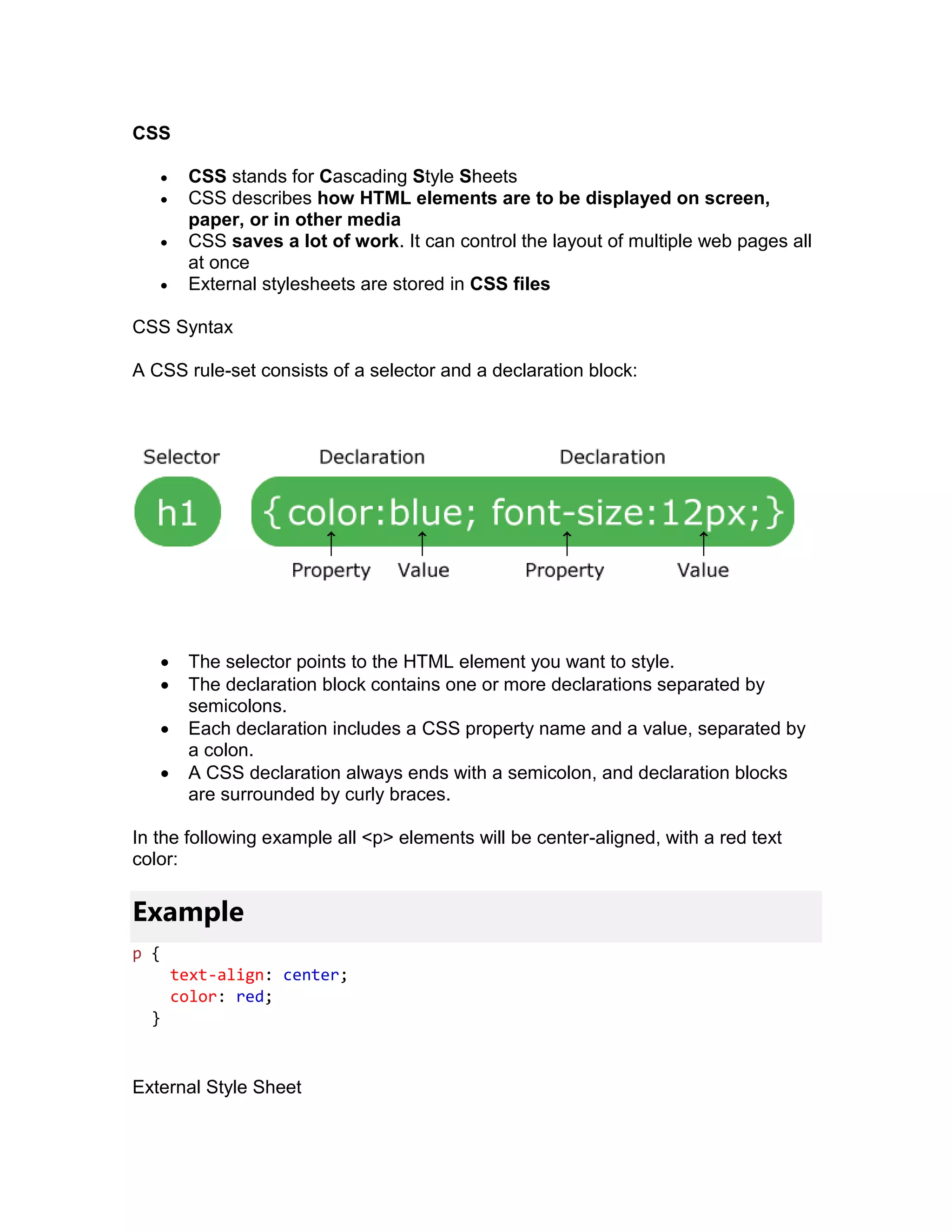
A CSS rule-set consists of a selector and a declaration block:
• The selector points to the HTML element you want to style.
• The declaration block contains one or more declarations separated by
semicolons.
• Each declaration includes a CSS property name and a value, separated by
a colon.
• A CSS declaration always ends with a semicolon, and declaration blocks
are surrounded by curly braces.
In the following example all <p> elements will be center-aligned, with a red text
color:
Example
p {
text-align: center;
color: red;
}
External Style Sheet
With an external style sheet, you can change the look of an entire website by
changing just one file!
Each page must include a reference to the external style sheet file inside the <link>
element. The <link> element goes inside the <head> section:
Example
<head>
<link rel="stylesheet" type="text/css" href="mystyle.css">
</head>
Color Names
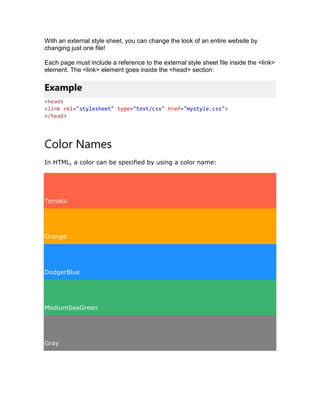
In HTML, a color can be specified by using a color name:
Tomato
Orange
DodgerBlue
MediumSeaGreen
Gray
SlateBlue
Violet
Background Color
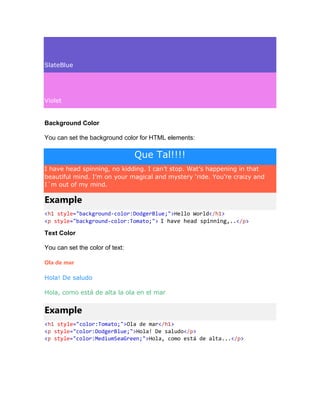
You can set the background color for HTML elements:
Que Tal!!!!
I have head spinning, no kidding. I can’t stop. Wat’s happening in that
beautiful mind. I’m on your magical and mystery ‘ride. You’re craizy and
I´m out of my mind.
Example
<h1 style="background-color:DodgerBlue;">Hello World</h1>
<p style="background-color:Tomato;"> I have head spinning,..</p>
Text Color
You can set the color of text:
Ola de mar
Hola! De saludo
Hola, como está de alta la ola en el mar
Example
<h1 style="color:Tomato;">Ola de mar</h1>
<p style="color:DodgerBlue;">Hola! De saludo</p>
<p style="color:MediumSeaGreen;">Hola, como está de alta...</p>
Border Color
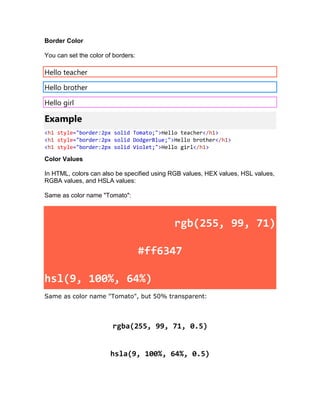
You can set the color of borders:
Hello teacher
Hello brother
Hello girl
Example
<h1 style="border:2px solid Tomato;">Hello teacher</h1>
<h1 style="border:2px solid DodgerBlue;">Hello brother</h1>
<h1 style="border:2px solid Violet;">Hello girl</h1>
Color Values
In HTML, colors can also be specified using RGB values, HEX values, HSL values,
RGBA values, and HSLA values:
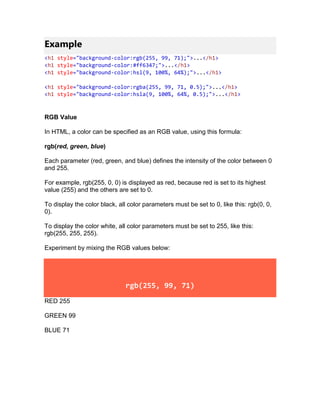
Same as color name "Tomato":
rgb(255, 99, 71)
#ff6347
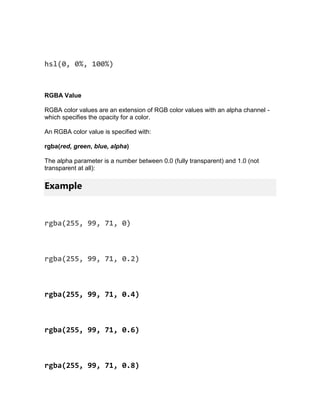
hsl(9, 100%, 64%)
Same as color name "Tomato", but 50% transparent:
rgba(255, 99, 71, 0.5)
hsla(9, 100%, 64%, 0.5)
Example
<h1 style="background-color:rgb(255, 99, 71);">...</h1>
<h1 style="background-color:#ff6347;">...</h1>
<h1 style="background-color:hsl(9, 100%, 64%);">...</h1>
<h1 style="background-color:rgba(255, 99, 71, 0.5);">...</h1>
<h1 style="background-color:hsla(9, 100%, 64%, 0.5);">...</h1>
RGB Value
In HTML, a color can be specified as an RGB value, using this formula:
rgb(red, green, blue)
Each parameter (red, green, and blue) defines the intensity of the color between 0
and 255.
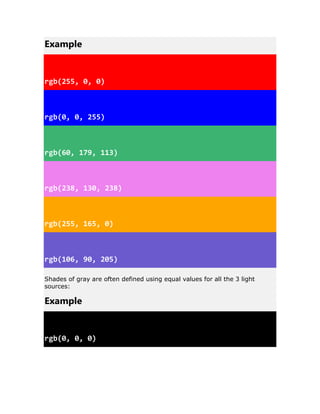
For example, rgb(255, 0, 0) is displayed as red, because red is set to its highest
value (255) and the others are set to 0.
To display the color black, all color parameters must be set to 0, like this: rgb(0, 0,
0).
To display the color white, all color parameters must be set to 255, like this:
rgb(255, 255, 255).
Experiment by mixing the RGB values below:
rgb(255, 99, 71)
RED 255
GREEN 99
BLUE 71
Example
rgb(255, 0, 0)
rgb(0, 0, 255)
rgb(60, 179, 113)
rgb(238, 130, 238)
rgb(255, 165, 0)
rgb(106, 90, 205)
Shades of gray are often defined using equal values for all the 3 light
sources:
Example
rgb(0, 0, 0)
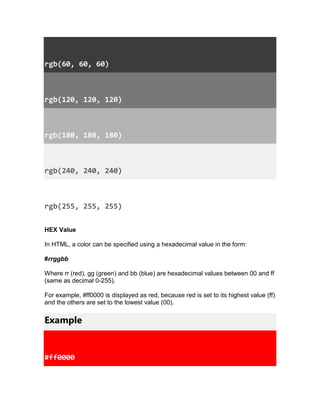
rgb(60, 60, 60)
rgb(120, 120, 120)
rgb(180, 180, 180)
rgb(240, 240, 240)
rgb(255, 255, 255)
HEX Value
In HTML, a color can be specified using a hexadecimal value in the form:
#rrggbb
Where rr (red), gg (green) and bb (blue) are hexadecimal values between 00 and ff
(same as decimal 0-255).
For example, #ff0000 is displayed as red, because red is set to its highest value (ff)
and the others are set to the lowest value (00).
Example
#ff0000
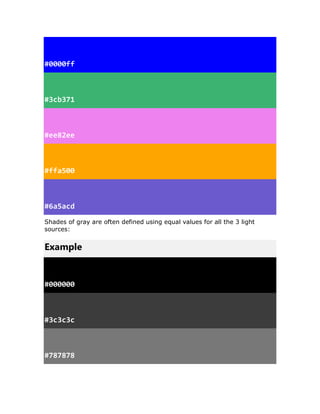
#0000ff
#3cb371
#ee82ee
#ffa500
#6a5acd
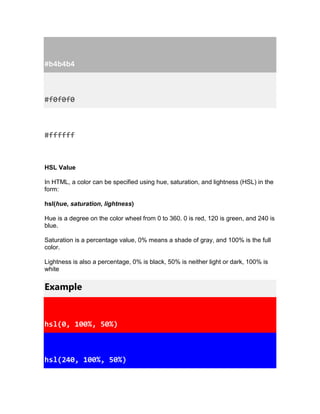
Shades of gray are often defined using equal values for all the 3 light
sources:
Example
#000000
#3c3c3c
#787878
#b4b4b4
#f0f0f0
#ffffff
HSL Value
In HTML, a color can be specified using hue, saturation, and lightness (HSL) in the
form:
hsl(hue, saturation, lightness)
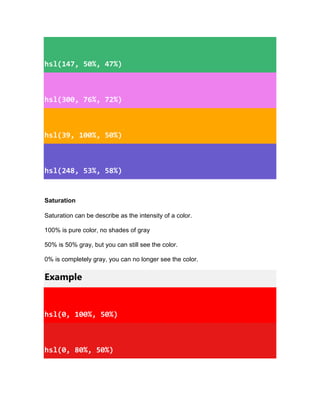
Hue is a degree on the color wheel from 0 to 360. 0 is red, 120 is green, and 240 is
blue.
Saturation is a percentage value, 0% means a shade of gray, and 100% is the full
color.
Lightness is also a percentage, 0% is black, 50% is neither light or dark, 100% is
white
Example
hsl(0, 100%, 50%)
hsl(240, 100%, 50%)
hsl(147, 50%, 47%)
hsl(300, 76%, 72%)
hsl(39, 100%, 50%)
hsl(248, 53%, 58%)
Saturation
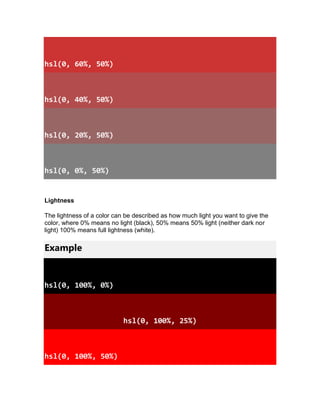
Saturation can be describe as the intensity of a color.
100% is pure color, no shades of gray
50% is 50% gray, but you can still see the color.
0% is completely gray, you can no longer see the color.
Example
hsl(0, 100%, 50%)
hsl(0, 80%, 50%)
hsl(0, 60%, 50%)
hsl(0, 40%, 50%)
hsl(0, 20%, 50%)
hsl(0, 0%, 50%)
Lightness
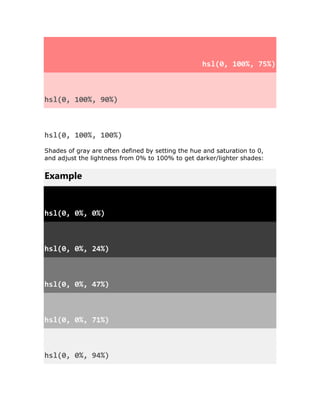
The lightness of a color can be described as how much light you want to give the
color, where 0% means no light (black), 50% means 50% light (neither dark nor
light) 100% means full lightness (white).
Example
hsl(0, 100%, 0%)
hsl(0, 100%, 25%)
hsl(0, 100%, 50%)
hsl(0, 100%, 75%)
hsl(0, 100%, 90%)
hsl(0, 100%, 100%)
Shades of gray are often defined by setting the hue and saturation to 0,
and adjust the lightness from 0% to 100% to get darker/lighter shades:
Example
hsl(0, 0%, 0%)
hsl(0, 0%, 24%)
hsl(0, 0%, 47%)
hsl(0, 0%, 71%)
hsl(0, 0%, 94%)
hsl(0, 0%, 100%)
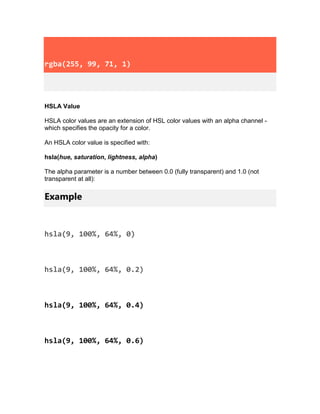
RGBA Value
RGBA color values are an extension of RGB color values with an alpha channel -
which specifies the opacity for a color.
An RGBA color value is specified with:
rgba(red, green, blue, alpha)
The alpha parameter is a number between 0.0 (fully transparent) and 1.0 (not
transparent at all):
Example
rgba(255, 99, 71, 0)
rgba(255, 99, 71, 0.2)
rgba(255, 99, 71, 0.4)
rgba(255, 99, 71, 0.6)
rgba(255, 99, 71, 0.8)
rgba(255, 99, 71, 1)
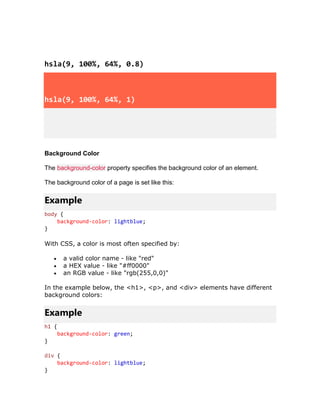
HSLA Value
HSLA color values are an extension of HSL color values with an alpha channel -
which specifies the opacity for a color.
An HSLA color value is specified with:
hsla(hue, saturation, lightness, alpha)
The alpha parameter is a number between 0.0 (fully transparent) and 1.0 (not
transparent at all):
Example
hsla(9, 100%, 64%, 0)
hsla(9, 100%, 64%, 0.2)
hsla(9, 100%, 64%, 0.4)
hsla(9, 100%, 64%, 0.6)
hsla(9, 100%, 64%, 0.8)
hsla(9, 100%, 64%, 1)
Background Color
The background-color property specifies the background color of an element.
The background color of a page is set like this:
Example
body {
background-color: lightblue;
}
With CSS, a color is most often specified by:
• a valid color name - like "red"
• a HEX value - like "#ff0000"
• an RGB value - like "rgb(255,0,0)"
In the example below, the <h1>, <p>, and <div> elements have different
background colors:
Example
h1 {
background-color: green;
}
div {
background-color: lightblue;
}
p {
background-color: yellow;
}
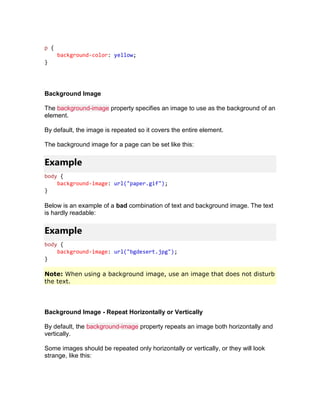
Background Image
The background-image property specifies an image to use as the background of an
element.
By default, the image is repeated so it covers the entire element.
The background image for a page can be set like this:
Example
body {
background-image: url("paper.gif");
}
Below is an example of a bad combination of text and background image. The text
is hardly readable:
Example
body {
background-image: url("bgdesert.jpg");
}
Note: When using a background image, use an image that does not disturb
the text.
Background Image - Repeat Horizontally or Vertically
By default, the background-image property repeats an image both horizontally and
vertically.
Some images should be repeated only horizontally or vertically, or they will look
strange, like this:
Example
body {
background-image: url("gradient_bg.png");
}
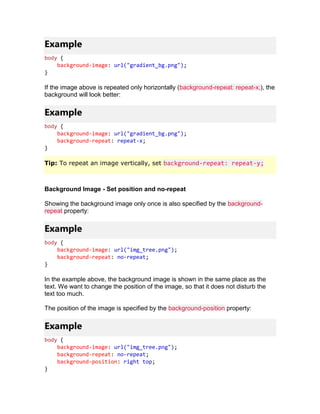
If the image above is repeated only horizontally (background-repeat: repeat-x;), the
background will look better:
Example
body {
background-image: url("gradient_bg.png");
background-repeat: repeat-x;
}
Tip: To repeat an image vertically, set background-repeat: repeat-y;
Background Image - Set position and no-repeat
Showing the background image only once is also specified by the background-
repeat property:
Example
body {
background-image: url("img_tree.png");
background-repeat: no-repeat;
}
In the example above, the background image is shown in the same place as the
text. We want to change the position of the image, so that it does not disturb the
text too much.
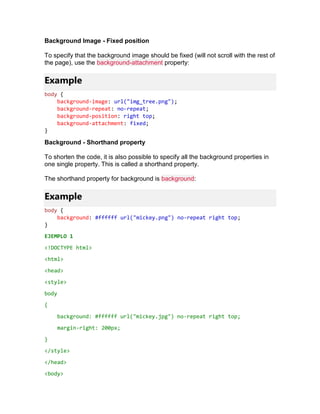
The position of the image is specified by the background-position property:
Example
body {
background-image: url("img_tree.png");
background-repeat: no-repeat;
background-position: right top;
}
Background Image - Fixed position
To specify that the background image should be fixed (will not scroll with the rest of
the page), use the background-attachment property:
Example
body {
background-image: url("img_tree.png");
background-repeat: no-repeat;
background-position: right top;
background-attachment: fixed;
}
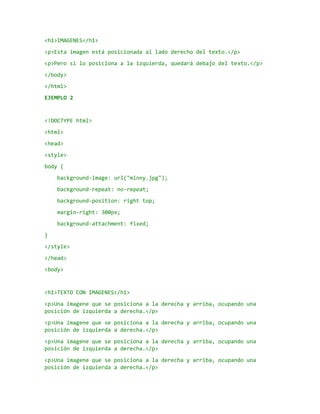
Background - Shorthand property
To shorten the code, it is also possible to specify all the background properties in
one single property. This is called a shorthand property.
The shorthand property for background is background:
Example
body {
background: #ffffff url("mickey.png") no-repeat right top;
}
EJEMPLO 1
<!DOCTYPE html>
<html>
<head>
<style>
body
{
background: #ffffff url("mickey.jpg") no-repeat right top;
margin-right: 200px;
}
</style>
</head>
<body>
<h1>IMAGENES</h1>
<p>Esta imagen está posicionada al lado derecho del texto.</p>
<p>Pero si lo posiciona a la izquierda, quedará debajo del texto.</p>
</body>
</html>
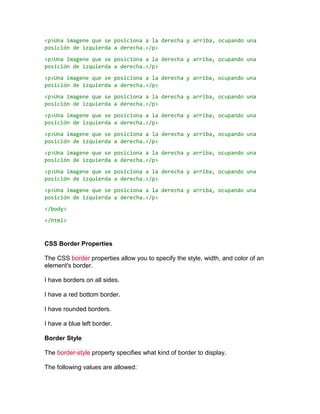
EJEMPLO 2
<!DOCTYPE html>
<html>
<head>
<style>
body {
background-image: url("minny.jpg");
background-repeat: no-repeat;
background-position: right top;
margin-right: 300px;
background-attachment: fixed;
}
</style>
</head>
<body>
<h1>TEXTO CON IMAGENES</h1>
<p>Una imagene que se posiciona a la derecha y arriba, ocupando una
posición de izquierda a derecha.</p>
<p>Una imagene que se posiciona a la derecha y arriba, ocupando una
posición de izquierda a derecha.</p>
<p>Una imagene que se posiciona a la derecha y arriba, ocupando una
posición de izquierda a derecha.</p>
<p>Una imagene que se posiciona a la derecha y arriba, ocupando una
posición de izquierda a derecha.</p>
<p>Una imagene que se posiciona a la derecha y arriba, ocupando una
posición de izquierda a derecha.</p>
<p>Una imagene que se posiciona a la derecha y arriba, ocupando una
posición de izquierda a derecha.</p>
<p>Una imagene que se posiciona a la derecha y arriba, ocupando una
posición de izquierda a derecha.</p>
<p>Una imagene que se posiciona a la derecha y arriba, ocupando una
posición de izquierda a derecha.</p>
<p>Una imagene que se posiciona a la derecha y arriba, ocupando una
posición de izquierda a derecha.</p>
<p>Una imagene que se posiciona a la derecha y arriba, ocupando una
posición de izquierda a derecha.</p>
<p>Una imagene que se posiciona a la derecha y arriba, ocupando una
posición de izquierda a derecha.</p>
<p>Una imagene que se posiciona a la derecha y arriba, ocupando una
posición de izquierda a derecha.</p>
<p>Una imagene que se posiciona a la derecha y arriba, ocupando una
posición de izquierda a derecha.</p>
</body>
</html>
CSS Border Properties
The CSS border properties allow you to specify the style, width, and color of an
element's border.
I have borders on all sides.
I have a red bottom border.
I have rounded borders.
I have a blue left border.
Border Style
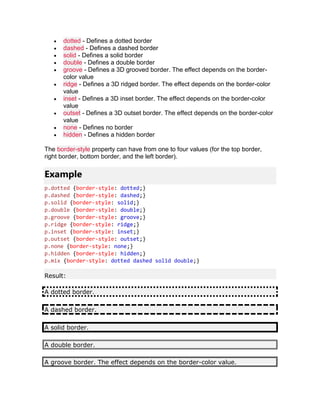
The border-style property specifies what kind of border to display.
The following values are allowed:
• dotted - Defines a dotted border
• dashed - Defines a dashed border
• solid - Defines a solid border
• double - Defines a double border
• groove - Defines a 3D grooved border. The effect depends on the border-
color value
• ridge - Defines a 3D ridged border. The effect depends on the border-color
value
• inset - Defines a 3D inset border. The effect depends on the border-color
value
• outset - Defines a 3D outset border. The effect depends on the border-color
value
• none - Defines no border
• hidden - Defines a hidden border
The border-style property can have from one to four values (for the top border,
right border, bottom border, and the left border).
Example
p.dotted {border-style: dotted;}
p.dashed {border-style: dashed;}
p.solid {border-style: solid;}
p.double {border-style: double;}
p.groove {border-style: groove;}
p.ridge {border-style: ridge;}
p.inset {border-style: inset;}
p.outset {border-style: outset;}
p.none {border-style: none;}
p.hidden {border-style: hidden;}
p.mix {border-style: dotted dashed solid double;}
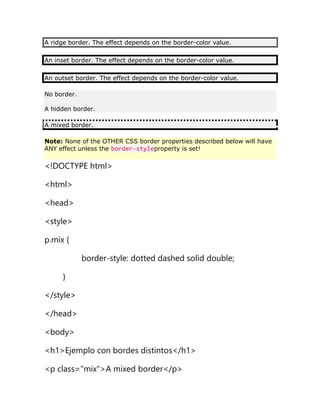
Result:
A dotted border.
A dashed border.
A solid border.
A double border.
A groove border. The effect depends on the border-color value.
A ridge border. The effect depends on the border-color value.
An inset border. The effect depends on the border-color value.
An outset border. The effect depends on the border-color value.
No border.
A hidden border.
A mixed border.
Note: None of the OTHER CSS border properties described below will have
ANY effect unless the border-styleproperty is set!
<!DOCTYPE html>
<html>
<head>
<style>
p.mix {
border-style: dotted dashed solid double;
}
</style>
</head>
<body>
<h1>Ejemplo con bordes distintos</h1>
<p class="mix">A mixed border</p>
</body>
</html>
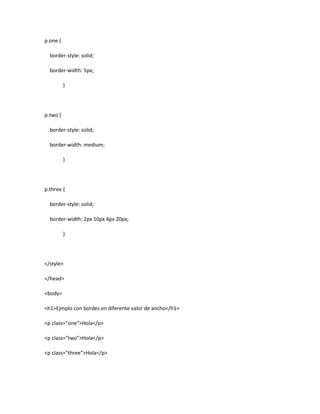
Border Width
The border-width property specifies the width of the four borders.
The width can be set as a specific size (in px, pt, cm, em, etc) or by using one of
the three pre-defined values: thin, medium, or thick.
The border-width property can have from one to four values (for the top border,
right border, bottom border, and the left border).
5px border-width
Example
p.one {
border-style: solid;
border-width: 5px;
}
p.two {
border-style: solid;
border-width: medium;
}
p.three {
border-style: solid;
border-width: 2px 10px 4px 20px;
}
<!DOCTYPE html>
<html>
<head>
<style>
p.one {
border-style: solid;
border-width: 5px;
}
p.two {
border-style: solid;
border-width: medium;
}
p.three {
border-style: solid;
border-width: 2px 10px 4px 20px;
}
</style>
</head>
<body>
<h1>Ejmplo con bordes en diferente valor de ancho</h1>
<p class="one">Hola</p>
<p class="two">Hola</p>
<p class="three">Hola</p>
</body>
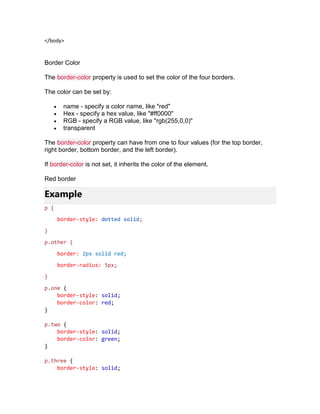
Border Color
The border-color property is used to set the color of the four borders.
The color can be set by:
• name - specify a color name, like "red"
• Hex - specify a hex value, like "#ff0000"
• RGB - specify a RGB value, like "rgb(255,0,0)"
• transparent
The border-color property can have from one to four values (for the top border,
right border, bottom border, and the left border).
If border-color is not set, it inherits the color of the element.
Red border
Example
p {
border-style: dotted solid;
}
p.other {
border: 2px solid red;
border-radius: 5px;
}
p.one {
border-style: solid;
border-color: red;
}
p.two {
border-style: solid;
border-color: green;
}
p.three {
border-style: solid;
border-color: red green blue yellow;
}
Border - Shorthand Property
As you can see from the examples above, there are many properties to consider
when dealing with borders.
To shorten the code, it is also possible to specify all the individual border properties
in one property.
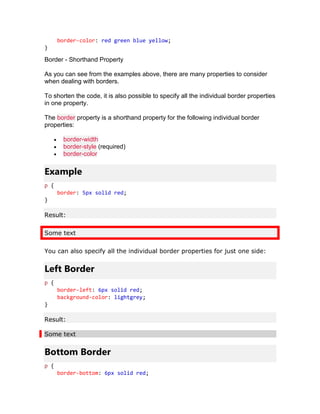
The border property is a shorthand property for the following individual border
properties:
• border-width
• border-style (required)
• border-color
Example
p {
border: 5px solid red;
}
Result:
Some text
You can also specify all the individual border properties for just one side:
Left Border
p {
border-left: 6px solid red;
background-color: lightgrey;
}
Result:
Some text
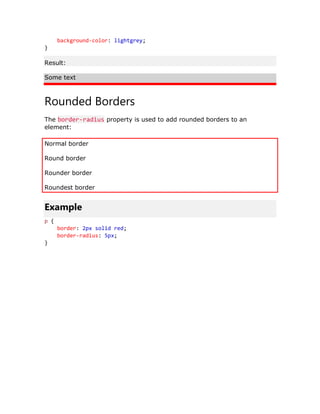
Bottom Border
p {
border-bottom: 6px solid red;
background-color: lightgrey;
}
Result:
Some text
Rounded Borders
The border-radius property is used to add rounded borders to an
element:
Normal border
Round border
Rounder border
Roundest border
Example
p {
border: 2px solid red;
border-radius: 5px;
}

Css ejemplos y codigo 1

  • 1.
    CSS • CSS standsfor Cascading Style Sheets • CSS describes how HTML elements are to be displayed on screen, paper, or in other media • CSS saves a lot of work. It can control the layout of multiple web pages all at once • External stylesheets are stored in CSS files CSS Syntax A CSS rule-set consists of a selector and a declaration block: • The selector points to the HTML element you want to style. • The declaration block contains one or more declarations separated by semicolons. • Each declaration includes a CSS property name and a value, separated by a colon. • A CSS declaration always ends with a semicolon, and declaration blocks are surrounded by curly braces. In the following example all <p> elements will be center-aligned, with a red text color: Example p { text-align: center; color: red; } External Style Sheet
  • 2.
    With an externalstyle sheet, you can change the look of an entire website by changing just one file! Each page must include a reference to the external style sheet file inside the <link> element. The <link> element goes inside the <head> section: Example <head> <link rel="stylesheet" type="text/css" href="mystyle.css"> </head> Color Names In HTML, a color can be specified by using a color name: Tomato Orange DodgerBlue MediumSeaGreen Gray
  • 3.
    SlateBlue Violet Background Color You canset the background color for HTML elements: Que Tal!!!! I have head spinning, no kidding. I can’t stop. Wat’s happening in that beautiful mind. I’m on your magical and mystery ‘ride. You’re craizy and I´m out of my mind. Example <h1 style="background-color:DodgerBlue;">Hello World</h1> <p style="background-color:Tomato;"> I have head spinning,..</p> Text Color You can set the color of text: Ola de mar Hola! De saludo Hola, como está de alta la ola en el mar Example <h1 style="color:Tomato;">Ola de mar</h1> <p style="color:DodgerBlue;">Hola! De saludo</p> <p style="color:MediumSeaGreen;">Hola, como está de alta...</p>
  • 4.
    Border Color You canset the color of borders: Hello teacher Hello brother Hello girl Example <h1 style="border:2px solid Tomato;">Hello teacher</h1> <h1 style="border:2px solid DodgerBlue;">Hello brother</h1> <h1 style="border:2px solid Violet;">Hello girl</h1> Color Values In HTML, colors can also be specified using RGB values, HEX values, HSL values, RGBA values, and HSLA values: Same as color name "Tomato": rgb(255, 99, 71) #ff6347 hsl(9, 100%, 64%) Same as color name "Tomato", but 50% transparent: rgba(255, 99, 71, 0.5) hsla(9, 100%, 64%, 0.5)
  • 5.
    Example <h1 style="background-color:rgb(255, 99,71);">...</h1> <h1 style="background-color:#ff6347;">...</h1> <h1 style="background-color:hsl(9, 100%, 64%);">...</h1> <h1 style="background-color:rgba(255, 99, 71, 0.5);">...</h1> <h1 style="background-color:hsla(9, 100%, 64%, 0.5);">...</h1> RGB Value In HTML, a color can be specified as an RGB value, using this formula: rgb(red, green, blue) Each parameter (red, green, and blue) defines the intensity of the color between 0 and 255. For example, rgb(255, 0, 0) is displayed as red, because red is set to its highest value (255) and the others are set to 0. To display the color black, all color parameters must be set to 0, like this: rgb(0, 0, 0). To display the color white, all color parameters must be set to 255, like this: rgb(255, 255, 255). Experiment by mixing the RGB values below: rgb(255, 99, 71) RED 255 GREEN 99 BLUE 71
  • 6.
    Example rgb(255, 0, 0) rgb(0,0, 255) rgb(60, 179, 113) rgb(238, 130, 238) rgb(255, 165, 0) rgb(106, 90, 205) Shades of gray are often defined using equal values for all the 3 light sources: Example rgb(0, 0, 0)
  • 7.
    rgb(60, 60, 60) rgb(120,120, 120) rgb(180, 180, 180) rgb(240, 240, 240) rgb(255, 255, 255) HEX Value In HTML, a color can be specified using a hexadecimal value in the form: #rrggbb Where rr (red), gg (green) and bb (blue) are hexadecimal values between 00 and ff (same as decimal 0-255). For example, #ff0000 is displayed as red, because red is set to its highest value (ff) and the others are set to the lowest value (00). Example #ff0000
  • 8.
    #0000ff #3cb371 #ee82ee #ffa500 #6a5acd Shades of grayare often defined using equal values for all the 3 light sources: Example #000000 #3c3c3c #787878
  • 9.
    #b4b4b4 #f0f0f0 #ffffff HSL Value In HTML,a color can be specified using hue, saturation, and lightness (HSL) in the form: hsl(hue, saturation, lightness) Hue is a degree on the color wheel from 0 to 360. 0 is red, 120 is green, and 240 is blue. Saturation is a percentage value, 0% means a shade of gray, and 100% is the full color. Lightness is also a percentage, 0% is black, 50% is neither light or dark, 100% is white Example hsl(0, 100%, 50%) hsl(240, 100%, 50%)
  • 10.
    hsl(147, 50%, 47%) hsl(300,76%, 72%) hsl(39, 100%, 50%) hsl(248, 53%, 58%) Saturation Saturation can be describe as the intensity of a color. 100% is pure color, no shades of gray 50% is 50% gray, but you can still see the color. 0% is completely gray, you can no longer see the color. Example hsl(0, 100%, 50%) hsl(0, 80%, 50%)
  • 11.
    hsl(0, 60%, 50%) hsl(0,40%, 50%) hsl(0, 20%, 50%) hsl(0, 0%, 50%) Lightness The lightness of a color can be described as how much light you want to give the color, where 0% means no light (black), 50% means 50% light (neither dark nor light) 100% means full lightness (white). Example hsl(0, 100%, 0%) hsl(0, 100%, 25%) hsl(0, 100%, 50%)
  • 12.
    hsl(0, 100%, 75%) hsl(0,100%, 90%) hsl(0, 100%, 100%) Shades of gray are often defined by setting the hue and saturation to 0, and adjust the lightness from 0% to 100% to get darker/lighter shades: Example hsl(0, 0%, 0%) hsl(0, 0%, 24%) hsl(0, 0%, 47%) hsl(0, 0%, 71%) hsl(0, 0%, 94%)
  • 13.
    hsl(0, 0%, 100%) RGBAValue RGBA color values are an extension of RGB color values with an alpha channel - which specifies the opacity for a color. An RGBA color value is specified with: rgba(red, green, blue, alpha) The alpha parameter is a number between 0.0 (fully transparent) and 1.0 (not transparent at all): Example rgba(255, 99, 71, 0) rgba(255, 99, 71, 0.2) rgba(255, 99, 71, 0.4) rgba(255, 99, 71, 0.6) rgba(255, 99, 71, 0.8)
  • 14.
    rgba(255, 99, 71,1) HSLA Value HSLA color values are an extension of HSL color values with an alpha channel - which specifies the opacity for a color. An HSLA color value is specified with: hsla(hue, saturation, lightness, alpha) The alpha parameter is a number between 0.0 (fully transparent) and 1.0 (not transparent at all): Example hsla(9, 100%, 64%, 0) hsla(9, 100%, 64%, 0.2) hsla(9, 100%, 64%, 0.4) hsla(9, 100%, 64%, 0.6)
  • 15.
    hsla(9, 100%, 64%,0.8) hsla(9, 100%, 64%, 1) Background Color The background-color property specifies the background color of an element. The background color of a page is set like this: Example body { background-color: lightblue; } With CSS, a color is most often specified by: • a valid color name - like "red" • a HEX value - like "#ff0000" • an RGB value - like "rgb(255,0,0)" In the example below, the <h1>, <p>, and <div> elements have different background colors: Example h1 { background-color: green; } div { background-color: lightblue; }
  • 16.
    p { background-color: yellow; } BackgroundImage The background-image property specifies an image to use as the background of an element. By default, the image is repeated so it covers the entire element. The background image for a page can be set like this: Example body { background-image: url("paper.gif"); } Below is an example of a bad combination of text and background image. The text is hardly readable: Example body { background-image: url("bgdesert.jpg"); } Note: When using a background image, use an image that does not disturb the text. Background Image - Repeat Horizontally or Vertically By default, the background-image property repeats an image both horizontally and vertically. Some images should be repeated only horizontally or vertically, or they will look strange, like this:
  • 17.
    Example body { background-image: url("gradient_bg.png"); } Ifthe image above is repeated only horizontally (background-repeat: repeat-x;), the background will look better: Example body { background-image: url("gradient_bg.png"); background-repeat: repeat-x; } Tip: To repeat an image vertically, set background-repeat: repeat-y; Background Image - Set position and no-repeat Showing the background image only once is also specified by the background- repeat property: Example body { background-image: url("img_tree.png"); background-repeat: no-repeat; } In the example above, the background image is shown in the same place as the text. We want to change the position of the image, so that it does not disturb the text too much. The position of the image is specified by the background-position property: Example body { background-image: url("img_tree.png"); background-repeat: no-repeat; background-position: right top; }
  • 18.
    Background Image -Fixed position To specify that the background image should be fixed (will not scroll with the rest of the page), use the background-attachment property: Example body { background-image: url("img_tree.png"); background-repeat: no-repeat; background-position: right top; background-attachment: fixed; } Background - Shorthand property To shorten the code, it is also possible to specify all the background properties in one single property. This is called a shorthand property. The shorthand property for background is background: Example body { background: #ffffff url("mickey.png") no-repeat right top; } EJEMPLO 1 <!DOCTYPE html> <html> <head> <style> body { background: #ffffff url("mickey.jpg") no-repeat right top; margin-right: 200px; } </style> </head> <body>
  • 19.
    <h1>IMAGENES</h1> <p>Esta imagen estáposicionada al lado derecho del texto.</p> <p>Pero si lo posiciona a la izquierda, quedará debajo del texto.</p> </body> </html> EJEMPLO 2 <!DOCTYPE html> <html> <head> <style> body { background-image: url("minny.jpg"); background-repeat: no-repeat; background-position: right top; margin-right: 300px; background-attachment: fixed; } </style> </head> <body> <h1>TEXTO CON IMAGENES</h1> <p>Una imagene que se posiciona a la derecha y arriba, ocupando una posición de izquierda a derecha.</p> <p>Una imagene que se posiciona a la derecha y arriba, ocupando una posición de izquierda a derecha.</p> <p>Una imagene que se posiciona a la derecha y arriba, ocupando una posición de izquierda a derecha.</p> <p>Una imagene que se posiciona a la derecha y arriba, ocupando una posición de izquierda a derecha.</p>
  • 20.
    <p>Una imagene quese posiciona a la derecha y arriba, ocupando una posición de izquierda a derecha.</p> <p>Una imagene que se posiciona a la derecha y arriba, ocupando una posición de izquierda a derecha.</p> <p>Una imagene que se posiciona a la derecha y arriba, ocupando una posición de izquierda a derecha.</p> <p>Una imagene que se posiciona a la derecha y arriba, ocupando una posición de izquierda a derecha.</p> <p>Una imagene que se posiciona a la derecha y arriba, ocupando una posición de izquierda a derecha.</p> <p>Una imagene que se posiciona a la derecha y arriba, ocupando una posición de izquierda a derecha.</p> <p>Una imagene que se posiciona a la derecha y arriba, ocupando una posición de izquierda a derecha.</p> <p>Una imagene que se posiciona a la derecha y arriba, ocupando una posición de izquierda a derecha.</p> <p>Una imagene que se posiciona a la derecha y arriba, ocupando una posición de izquierda a derecha.</p> </body> </html> CSS Border Properties The CSS border properties allow you to specify the style, width, and color of an element's border. I have borders on all sides. I have a red bottom border. I have rounded borders. I have a blue left border. Border Style The border-style property specifies what kind of border to display. The following values are allowed:
  • 21.
    • dotted -Defines a dotted border • dashed - Defines a dashed border • solid - Defines a solid border • double - Defines a double border • groove - Defines a 3D grooved border. The effect depends on the border- color value • ridge - Defines a 3D ridged border. The effect depends on the border-color value • inset - Defines a 3D inset border. The effect depends on the border-color value • outset - Defines a 3D outset border. The effect depends on the border-color value • none - Defines no border • hidden - Defines a hidden border The border-style property can have from one to four values (for the top border, right border, bottom border, and the left border). Example p.dotted {border-style: dotted;} p.dashed {border-style: dashed;} p.solid {border-style: solid;} p.double {border-style: double;} p.groove {border-style: groove;} p.ridge {border-style: ridge;} p.inset {border-style: inset;} p.outset {border-style: outset;} p.none {border-style: none;} p.hidden {border-style: hidden;} p.mix {border-style: dotted dashed solid double;} Result: A dotted border. A dashed border. A solid border. A double border. A groove border. The effect depends on the border-color value.
  • 22.
    A ridge border.The effect depends on the border-color value. An inset border. The effect depends on the border-color value. An outset border. The effect depends on the border-color value. No border. A hidden border. A mixed border. Note: None of the OTHER CSS border properties described below will have ANY effect unless the border-styleproperty is set! <!DOCTYPE html> <html> <head> <style> p.mix { border-style: dotted dashed solid double; } </style> </head> <body> <h1>Ejemplo con bordes distintos</h1> <p class="mix">A mixed border</p>
  • 23.
    </body> </html> Border Width The border-widthproperty specifies the width of the four borders. The width can be set as a specific size (in px, pt, cm, em, etc) or by using one of the three pre-defined values: thin, medium, or thick. The border-width property can have from one to four values (for the top border, right border, bottom border, and the left border). 5px border-width Example p.one { border-style: solid; border-width: 5px; } p.two { border-style: solid; border-width: medium; } p.three { border-style: solid; border-width: 2px 10px 4px 20px; } <!DOCTYPE html> <html> <head> <style>
  • 24.
    p.one { border-style: solid; border-width:5px; } p.two { border-style: solid; border-width: medium; } p.three { border-style: solid; border-width: 2px 10px 4px 20px; } </style> </head> <body> <h1>Ejmplo con bordes en diferente valor de ancho</h1> <p class="one">Hola</p> <p class="two">Hola</p> <p class="three">Hola</p>
  • 25.
    </body> Border Color The border-colorproperty is used to set the color of the four borders. The color can be set by: • name - specify a color name, like "red" • Hex - specify a hex value, like "#ff0000" • RGB - specify a RGB value, like "rgb(255,0,0)" • transparent The border-color property can have from one to four values (for the top border, right border, bottom border, and the left border). If border-color is not set, it inherits the color of the element. Red border Example p { border-style: dotted solid; } p.other { border: 2px solid red; border-radius: 5px; } p.one { border-style: solid; border-color: red; } p.two { border-style: solid; border-color: green; } p.three { border-style: solid;
  • 26.
    border-color: red greenblue yellow; } Border - Shorthand Property As you can see from the examples above, there are many properties to consider when dealing with borders. To shorten the code, it is also possible to specify all the individual border properties in one property. The border property is a shorthand property for the following individual border properties: • border-width • border-style (required) • border-color Example p { border: 5px solid red; } Result: Some text You can also specify all the individual border properties for just one side: Left Border p { border-left: 6px solid red; background-color: lightgrey; } Result: Some text Bottom Border p { border-bottom: 6px solid red;
  • 27.
    background-color: lightgrey; } Result: Some text RoundedBorders The border-radius property is used to add rounded borders to an element: Normal border Round border Rounder border Roundest border Example p { border: 2px solid red; border-radius: 5px; }