
Detecting Financial
Danger Zones
with Machine Learning
SYstemic Risk TOmography:
Signals, Measurements, Transmission Channels, and
Policy Interventions
Marika Vezzoli
Department of Economics and Management - University of Brescia
CSRA research meeting – December, 15 2014
Main Objective
What’s our main target → stratify the “Risk Temperature” of:
Country-risk
Bank(and other Financial)-risk
Corporate-risk
How do we do → Data Mining techniques:
Regression Trees (RT) & Heatmap in each RT risk cluster (final
node)
Random Forests (RF)
Tree on ensemble predictions (FRT – Final Regression Tree)
Where in SYRTO → EWS Implementation (WP 7)
Risk Thresholds
Warning Signals
Marika Vezzoli
University of Brescia
Regression Trees (RT)
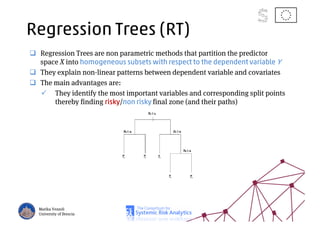
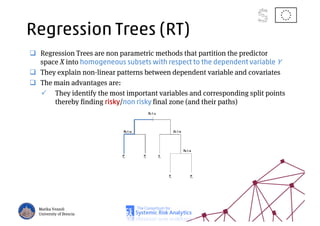
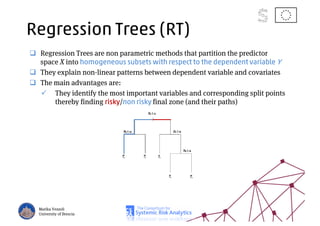
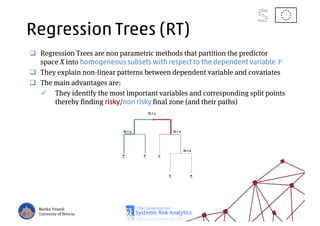
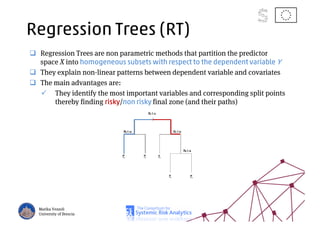
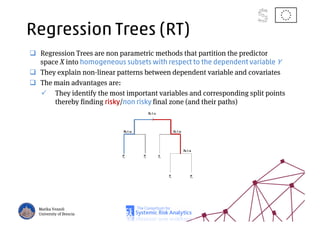
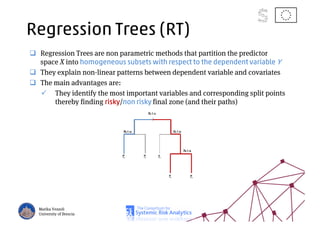
Regression Trees are non parametric methods that partition the predictor
space X into homogeneous subsets with respect to the dependent variable Y
They explain non-linear patterns between dependent variable and covariates
The main advantages are:
They identify the most important variables and corresponding split points
thereby finding risky/non risky final zone (and their paths)
Marika Vezzoli
University of Brescia
Regression Trees (RT)
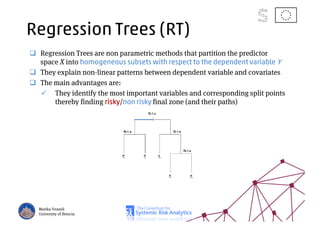
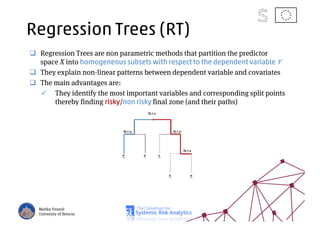
Regression Trees are non parametric methods that partition the predictor
space X into homogeneous subsets with respect to the dependent variable Y
They explain non-linear patterns between dependent variable and covariates
The main advantages are:
They identify the most important variables and corresponding split points
thereby finding risky/non risky final zone (and their paths)
Marika Vezzoli
University of Brescia
Regression Trees (RT)
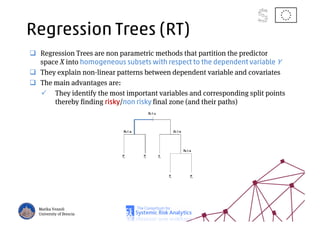
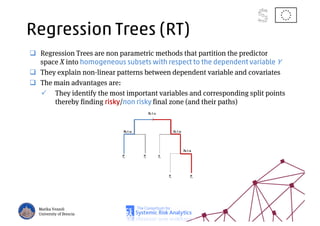
Regression Trees are non parametric methods that partition the predictor
space X into homogeneous subsets with respect to the dependent variable Y
They explain non-linear patterns between dependent variable and covariates
The main advantages are:
They identify the most important variables and corresponding split points
thereby finding risky/non risky final zone (and their paths)
Marika Vezzoli
University of Brescia
Regression Trees (RT)
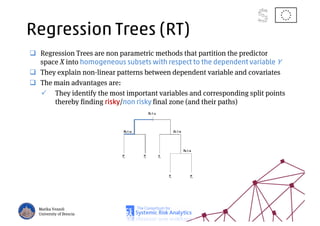
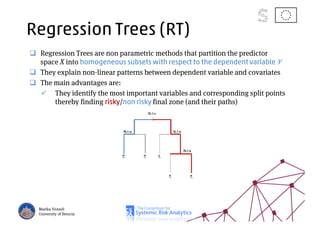
Regression Trees are non parametric methods that partition the predictor
space X into homogeneous subsets with respect to the dependent variable Y
They explain non-linear patterns between dependent variable and covariates
The main advantages are:
They identify the most important variables and corresponding split points
thereby finding risky/non risky final zone (and their paths)
Marika Vezzoli
University of Brescia
Regression Trees (RT)
Regression Trees are non parametric methods that partition the predictor
space X into homogeneous subsets with respect to the dependent variable Y
They explain non-linear patterns between dependent variable and covariates
The main advantages are:
They identify the most important variables and corresponding split points
thereby finding risky/non risky final zone (and their paths)
Marika Vezzoli
University of Brescia
Regression Trees (RT)
Regression Trees are non parametric methods that partition the predictor
space X into homogeneous subsets with respect to the dependent variable Y
They explain non-linear patterns between dependent variable and covariates
The main advantages are:
They identify the most important variables and corresponding split points
thereby finding risky/non risky final zone (and their paths)
Marika Vezzoli
University of Brescia
Regression Trees (RT)
Regression Trees are non parametric methods that partition the predictor
space X into homogeneous subsets with respect to the dependent variable Y
They explain non-linear patterns between dependent variable and covariates
The main advantages are:
They identify the most important variables and corresponding split points
thereby finding risky/non risky final zone (and their paths)
Marika Vezzoli
University of Brescia
Regression Trees (RT)
Regression Trees are non parametric methods that partition the predictor
space X into homogeneous subsets with respect to the dependent variable Y
They explain non-linear patterns between dependent variable and covariates
The main advantages are:
They identify the most important variables and corresponding split points
thereby finding risky/non risky final zone (and their paths)
Marika Vezzoli
University of Brescia
Regression Trees (RT)
Regression Trees are non parametric methods that partition the predictor
space X into homogeneous subsets with respect to the dependent variable Y
They explain non-linear patterns between dependent variable and covariates
The main advantages are:
They identify the most important variables and corresponding split points
thereby finding risky/non risky final zone (and their paths)
Marika Vezzoli
University of Brescia
Regression Trees (RT)
Regression Trees are non parametric methods that partition the predictor
space X into homogeneous subsets with respect to the dependent variable Y
They explain non-linear patterns between dependent variable and covariates
The main advantages are:
They identify the most important variables and corresponding split points
thereby finding risky/non risky final zone (and their paths)
Marika Vezzoli
University of Brescia
Regression Trees (RT)
Regression Trees are non parametric methods that partition the predictor
space X into homogeneous subsets with respect to the dependent variable Y
They explain non-linear patterns between dependent variable and covariates
The main advantages are:
They identify the most important variables and corresponding split points
thereby finding risky/non risky final zone (and their paths)
Marika Vezzoli
University of Brescia
Regression Trees (RT)
Regression Trees are non parametric methods that partition the predictor
space X into homogeneous subsets with respect to the dependent variable Y
They explain non-linear patterns between dependent variable and covariates
The main advantages are:
They identify the most important variables and corresponding split points
thereby finding risky/non risky final zone (and their paths)
Marika Vezzoli
University of Brescia
Regression Trees (RT)
Regression Trees are non parametric methods that partition the predictor
space X into homogeneous subsets with respect to the dependent variable Y
They explain non-linear patterns between dependent variable and covariates
The main advantages are:
They identify the most important variables and corresponding split points
thereby finding risky/non risky final zone (and their paths)
Marika Vezzoli
University of Brescia
Regression Trees (RT)
Regression Trees are non parametric methods that partition the predictor
space X into homogeneous subsets with respect to the dependent variable Y
They explain non-linear patterns between dependent variable and covariates
The main advantages are:
They identify the most important variables and corresponding split points
thereby finding risky/non risky final zone (and their paths)
Marika Vezzoli
University of Brescia
Heatmap
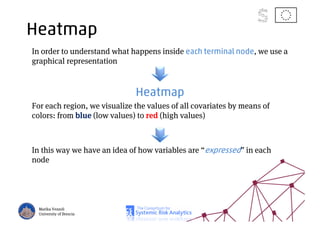
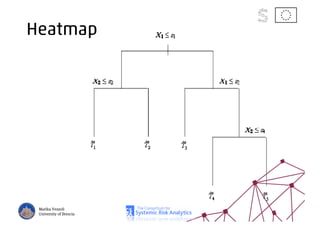
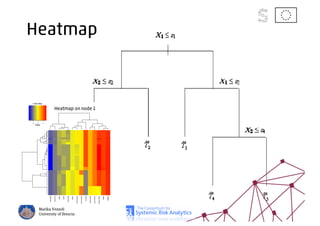
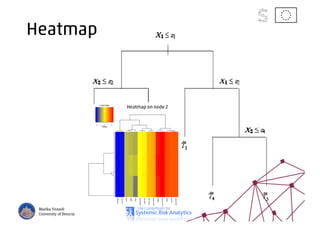
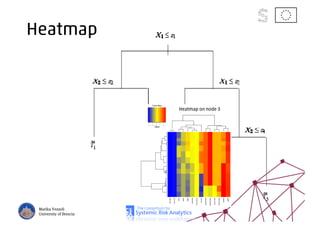
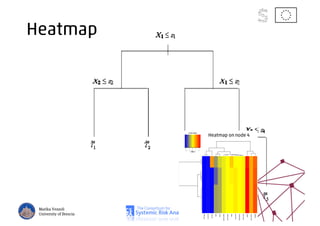
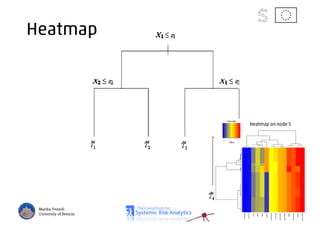
In order to understand what happens inside each terminal node, we use a
graphical representation
Heatmap
For each region, we visualize the values of all covariates by means of
colors: from blue (low values) to red (high values)
In this way we have an idea of how variables are “expressed” in each
node
Marika Vezzoli
University of Brescia
Heatmap
Marika Vezzoli
University of Brescia
Heatmap
Marika Vezzoli
University of Brescia
Heatmap on node 1
Heatmap
Marika Vezzoli
University of Brescia
Heatmap on node 2
Heatmap
Marika Vezzoli
University of Brescia
Heatmap on node 3
Heatmap
Marika Vezzoli
University of Brescia
Heatmap on node 4
Heatmap
Marika Vezzoli
University of Brescia
Heatmap on node 5
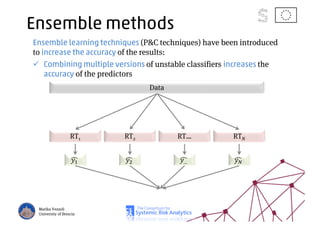
Ensemble methods
Ensemble learning techniques (P&C techniques) have been introduced
to increase the accuracy of the results:
Combining multiple versions of unstable classifiers increases the
accuracy of the predictors
Marika Vezzoli
University of Brescia
Data
Ensemble methods
Ensemble learning techniques (P&C techniques) have been introduced
to increase the accuracy of the results:
Combining multiple versions of unstable classifiers increases the
accuracy of the predictors
Marika Vezzoli
University of Brescia
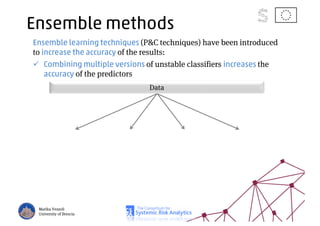
Data
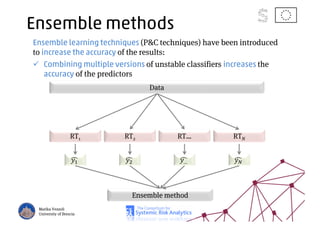
Ensemble methods
Ensemble learning techniques (P&C techniques) have been introduced
to increase the accuracy of the results:
Combining multiple versions of unstable classifiers increases the
accuracy of the predictors
Marika Vezzoli
University of Brescia
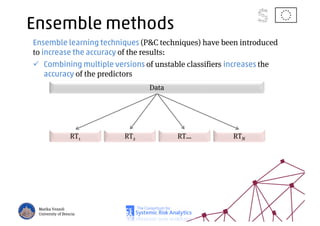
Data
RT1 RT2 RT… RTN
Ensemble methods
Ensemble learning techniques (P&C techniques) have been introduced
to increase the accuracy of the results:
Combining multiple versions of unstable classifiers increases the
accuracy of the predictors
Marika Vezzoli
University of Brescia
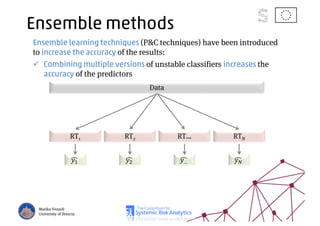
Data
RT1 RT2 RT… RTN
…
Ensemble methods
Ensemble learning techniques (P&C techniques) have been introduced
to increase the accuracy of the results:
Combining multiple versions of unstable classifiers increases the
accuracy of the predictors
Marika Vezzoli
University of Brescia
Data
RT1 RT2 RT… RTN
…
Ensemble methods
Ensemble learning techniques (P&C techniques) have been introduced
to increase the accuracy of the results:
Combining multiple versions of unstable classifiers increases the
accuracy of the predictors
Marika Vezzoli
University of Brescia
Data
RT1 RT2 RT… RTN
…
Ensemble method
Random Forests
RF grow a non pruned tree on a training set which is a different
bootstrap sample drawn from the data
An important issue of RF is about the use of Out-Of-Bag (OOB)
predictions, where for each observation zi=(xi; yi) the algorithm
computes the predictions by averaging only those trees grown using
a training set not containing zi
For improving the accuracy, the injected randomness has to
maximize the differences between the trees. For this reason, in
each tree node a subset of predictors is randomly chosen
RF provide an accuracy level that is in line with Boosting algorithm
with better performance in terms of computational burden
(Breiman, 2001)
Marika Vezzoli
University of Brescia
Final Regression Tree
RF increase the accuracy of the predictions but loose the
interpretability of a single tree
A possible simple solution is the FRT (Savona, Vezzoli 2013)
The results of the RF are combined with RT. More precisely,
we fit a RT using the RF predictions in place of the original
dependent variable Y
The substitution of y with mitigates the effects of the noisy
data on the estimation process that affect both the predictions
and the dependent variables itself
Marika Vezzoli
University of Brescia
Detecting Danger Zones in the
Euro Svgn CDS
Joint Project by: V. Arakelian, P. Dellaportas, R. Savona, M. Vezzoli
What we inspect: 5 yrs svgn CDS daily quotes of 7 Euro countries
GIIPS (Greece, Ireland, Italy, Portugal, Spain)
Core (France and Germany)
Period: January 2008 – October 2013
Covariates:
Contagion-based measures: non parametric daily correlations through
Kendall’s Tau & Copulas (Arakelian&Dellaportas, 2010 - Contagion tests via
copula threshold models, Quantitative Finance);
Country-specific fundamentals:
1. inflation;
2. export/GDP;
3. GDP growth;
4. industrial production;
5. unemployment rate;
6. debt/GDP.
Marika Vezzoli
University of Brescia
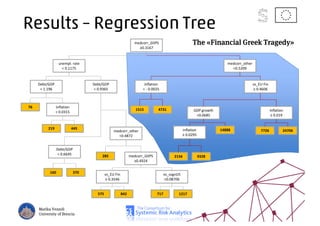
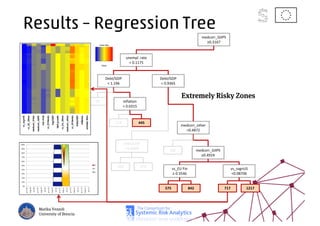
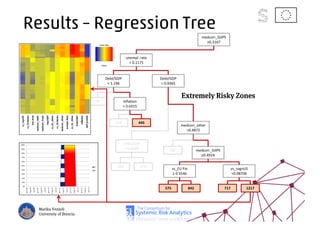
Results – Regression Tree
medcorr_GIIPS
≥0.3167
medcorr_other
<0.5209
vs_EU Fin
≥ 0.4606
inflation
≥ 0.019
GDP growth
<0.0685
inflation
≥ 0.0295
inflation
< - 0.0025
1515 4731
2156 9328
7726 2470614888
unempl. rate
< 0.1175
Debt/GDP
< 1.196
inflation
< 0.0315
Debt/GDP
< 0.9365
Debt/GDP
< 0.6645
medcorr_other
<0.4872
medcorr_GIIPS
≥0.4924
vs_svgnUS
<0.08706
vs_EU Fin
≥ 0.3546
717 1217575 842
285
160 370
219 445
76
The «Financial Greek Tragedy»
Marika Vezzoli
University of Brescia
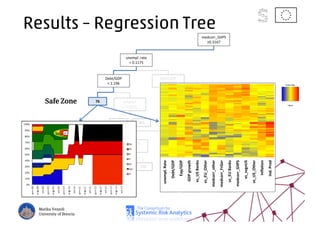
Results – Regression Tree
medcorr_GIIPS
≥0.3167
unempl. rate
< 0.1175
Debt/GDP
< 1.196
inflation
< 0.0315
Debt/GDP
< 0.9365
Debt/GDP
< 0.6645
medcorr_other
<0.4872
medcorr_GIIPS
≥0.4924
vs_svgnUS
<0.08706
vs_EU Fin
≥ 0.3546
717 1217575 842
285
160 370
219 445
76Safe Zone
unempl.Rate
Debt/GDP
Exp/GDP
GDPgrowth
vs_USBanks
vs_EU_Other
medcorr_other
medcorr_FrGer
vs_EUBanks
medcorr_GIIPS
vs_svgnUS
vs_US_Other
Inflation
Ind.Prod
Marika Vezzoli
University of Brescia
Results – Regression Tree
medcorr_GIIPS
≥0.3167
unempl. rate
< 0.1175
Debt/GDP
< 1.196
inflation
< 0.0315
Debt/GDP
< 0.9365
Debt/GDP
< 0.6645
medcorr_other
<0.4872
medcorr_GIIPS
≥0.4924
vs_svgnUS
<0.08706
vs_EU Fin
≥ 0.3546
717 1217575 842
285
160 370
219 445
76
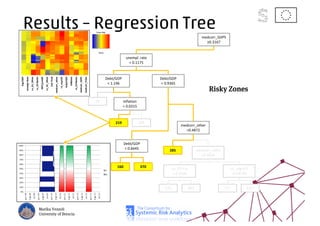
Risky Zones
Marika Vezzoli
University of Brescia
Results – Regression Tree
medcorr_GIIPS
≥0.3167
unempl. rate
< 0.1175
Debt/GDP
< 1.196
inflation
< 0.0315
Debt/GDP
< 0.9365
Debt/GDP
< 0.6645
medcorr_other
<0.4872
medcorr_GIIPS
≥0.4924
vs_svgnUS
<0.08706
vs_EU Fin
≥ 0.3546
717 1217575 842
285
160 370
219 445
76
Extremely Risky Zones
Marika Vezzoli
University of Brescia
Results – Regression Tree
medcorr_GIIPS
≥0.3167
unempl. rate
< 0.1175
Debt/GDP
< 1.196
inflation
< 0.0315
Debt/GDP
< 0.9365
Debt/GDP
< 0.6645
medcorr_other
<0.4872
medcorr_GIIPS
≥0.4924
vs_svgnUS
<0.08706
vs_EU Fin
≥ 0.3546
717 1217575 842
285
160 370
219 445
76
Extremely Risky Zones
Marika Vezzoli
University of Brescia
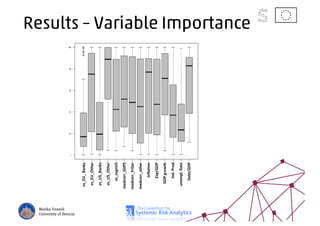
Results – Variable Importance
vs_EU_Banks
vs_EU_Other
vs_US_Banks
vs_US_Other
vs_svgnUS
medcorr_GIIPS
medcorr_FrGer
medcorr_other
Inflation
Exp/GDP
GDPgrowth
Ind.Prod
unempl.Rate
Debt/GDP
Marika Vezzoli
University of Brescia
This project has received funding from the European Union’s
Seventh Framework Programme for research, technological
development and demonstration under grant agreement n° 320270
www.syrtoproject.eu
This document reflects only the author’s views.
The European Union is not liable for any use that may be made of the information contained therein.

Detecting Financial Danger Zones with Machine Learning - Marika Vezzoli. December, 15 2014

  • 1.
    Detecting Financial Danger Zones withMachine Learning SYstemic Risk TOmography: Signals, Measurements, Transmission Channels, and Policy Interventions Marika Vezzoli Department of Economics and Management - University of Brescia CSRA research meeting – December, 15 2014
  • 2.
    Main Objective What’s ourmain target → stratify the “Risk Temperature” of: Country-risk Bank(and other Financial)-risk Corporate-risk How do we do → Data Mining techniques: Regression Trees (RT) & Heatmap in each RT risk cluster (final node) Random Forests (RF) Tree on ensemble predictions (FRT – Final Regression Tree) Where in SYRTO → EWS Implementation (WP 7) Risk Thresholds Warning Signals Marika Vezzoli University of Brescia
  • 3.
    Regression Trees (RT) RegressionTrees are non parametric methods that partition the predictor space X into homogeneous subsets with respect to the dependent variable Y They explain non-linear patterns between dependent variable and covariates The main advantages are: They identify the most important variables and corresponding split points thereby finding risky/non risky final zone (and their paths) Marika Vezzoli University of Brescia
  • 4.
    Regression Trees (RT) RegressionTrees are non parametric methods that partition the predictor space X into homogeneous subsets with respect to the dependent variable Y They explain non-linear patterns between dependent variable and covariates The main advantages are: They identify the most important variables and corresponding split points thereby finding risky/non risky final zone (and their paths) Marika Vezzoli University of Brescia
  • 5.
    Regression Trees (RT) RegressionTrees are non parametric methods that partition the predictor space X into homogeneous subsets with respect to the dependent variable Y They explain non-linear patterns between dependent variable and covariates The main advantages are: They identify the most important variables and corresponding split points thereby finding risky/non risky final zone (and their paths) Marika Vezzoli University of Brescia
  • 6.
    Regression Trees (RT) RegressionTrees are non parametric methods that partition the predictor space X into homogeneous subsets with respect to the dependent variable Y They explain non-linear patterns between dependent variable and covariates The main advantages are: They identify the most important variables and corresponding split points thereby finding risky/non risky final zone (and their paths) Marika Vezzoli University of Brescia
  • 7.
    Regression Trees (RT) RegressionTrees are non parametric methods that partition the predictor space X into homogeneous subsets with respect to the dependent variable Y They explain non-linear patterns between dependent variable and covariates The main advantages are: They identify the most important variables and corresponding split points thereby finding risky/non risky final zone (and their paths) Marika Vezzoli University of Brescia
  • 8.
    Regression Trees (RT) RegressionTrees are non parametric methods that partition the predictor space X into homogeneous subsets with respect to the dependent variable Y They explain non-linear patterns between dependent variable and covariates The main advantages are: They identify the most important variables and corresponding split points thereby finding risky/non risky final zone (and their paths) Marika Vezzoli University of Brescia
  • 9.
    Regression Trees (RT) RegressionTrees are non parametric methods that partition the predictor space X into homogeneous subsets with respect to the dependent variable Y They explain non-linear patterns between dependent variable and covariates The main advantages are: They identify the most important variables and corresponding split points thereby finding risky/non risky final zone (and their paths) Marika Vezzoli University of Brescia
  • 10.
    Regression Trees (RT) RegressionTrees are non parametric methods that partition the predictor space X into homogeneous subsets with respect to the dependent variable Y They explain non-linear patterns between dependent variable and covariates The main advantages are: They identify the most important variables and corresponding split points thereby finding risky/non risky final zone (and their paths) Marika Vezzoli University of Brescia
  • 11.
    Regression Trees (RT) RegressionTrees are non parametric methods that partition the predictor space X into homogeneous subsets with respect to the dependent variable Y They explain non-linear patterns between dependent variable and covariates The main advantages are: They identify the most important variables and corresponding split points thereby finding risky/non risky final zone (and their paths) Marika Vezzoli University of Brescia
  • 12.
    Regression Trees (RT) RegressionTrees are non parametric methods that partition the predictor space X into homogeneous subsets with respect to the dependent variable Y They explain non-linear patterns between dependent variable and covariates The main advantages are: They identify the most important variables and corresponding split points thereby finding risky/non risky final zone (and their paths) Marika Vezzoli University of Brescia
  • 13.
    Regression Trees (RT) RegressionTrees are non parametric methods that partition the predictor space X into homogeneous subsets with respect to the dependent variable Y They explain non-linear patterns between dependent variable and covariates The main advantages are: They identify the most important variables and corresponding split points thereby finding risky/non risky final zone (and their paths) Marika Vezzoli University of Brescia
  • 14.
    Regression Trees (RT) RegressionTrees are non parametric methods that partition the predictor space X into homogeneous subsets with respect to the dependent variable Y They explain non-linear patterns between dependent variable and covariates The main advantages are: They identify the most important variables and corresponding split points thereby finding risky/non risky final zone (and their paths) Marika Vezzoli University of Brescia
  • 15.
    Regression Trees (RT) RegressionTrees are non parametric methods that partition the predictor space X into homogeneous subsets with respect to the dependent variable Y They explain non-linear patterns between dependent variable and covariates The main advantages are: They identify the most important variables and corresponding split points thereby finding risky/non risky final zone (and their paths) Marika Vezzoli University of Brescia
  • 16.
    Regression Trees (RT) RegressionTrees are non parametric methods that partition the predictor space X into homogeneous subsets with respect to the dependent variable Y They explain non-linear patterns between dependent variable and covariates The main advantages are: They identify the most important variables and corresponding split points thereby finding risky/non risky final zone (and their paths) Marika Vezzoli University of Brescia
  • 17.
    Heatmap In order tounderstand what happens inside each terminal node, we use a graphical representation Heatmap For each region, we visualize the values of all covariates by means of colors: from blue (low values) to red (high values) In this way we have an idea of how variables are “expressed” in each node Marika Vezzoli University of Brescia
  • 18.
  • 19.
    Heatmap Marika Vezzoli University ofBrescia Heatmap on node 1
  • 20.
    Heatmap Marika Vezzoli University ofBrescia Heatmap on node 2
  • 21.
    Heatmap Marika Vezzoli University ofBrescia Heatmap on node 3
  • 22.
    Heatmap Marika Vezzoli University ofBrescia Heatmap on node 4
  • 23.
    Heatmap Marika Vezzoli University ofBrescia Heatmap on node 5
  • 24.
    Ensemble methods Ensemble learningtechniques (P&C techniques) have been introduced to increase the accuracy of the results: Combining multiple versions of unstable classifiers increases the accuracy of the predictors Marika Vezzoli University of Brescia Data
  • 25.
    Ensemble methods Ensemble learningtechniques (P&C techniques) have been introduced to increase the accuracy of the results: Combining multiple versions of unstable classifiers increases the accuracy of the predictors Marika Vezzoli University of Brescia Data
  • 26.
    Ensemble methods Ensemble learningtechniques (P&C techniques) have been introduced to increase the accuracy of the results: Combining multiple versions of unstable classifiers increases the accuracy of the predictors Marika Vezzoli University of Brescia Data RT1 RT2 RT… RTN
  • 27.
    Ensemble methods Ensemble learningtechniques (P&C techniques) have been introduced to increase the accuracy of the results: Combining multiple versions of unstable classifiers increases the accuracy of the predictors Marika Vezzoli University of Brescia Data RT1 RT2 RT… RTN …
  • 28.
    Ensemble methods Ensemble learningtechniques (P&C techniques) have been introduced to increase the accuracy of the results: Combining multiple versions of unstable classifiers increases the accuracy of the predictors Marika Vezzoli University of Brescia Data RT1 RT2 RT… RTN …
  • 29.
    Ensemble methods Ensemble learningtechniques (P&C techniques) have been introduced to increase the accuracy of the results: Combining multiple versions of unstable classifiers increases the accuracy of the predictors Marika Vezzoli University of Brescia Data RT1 RT2 RT… RTN … Ensemble method
  • 30.
    Random Forests RF growa non pruned tree on a training set which is a different bootstrap sample drawn from the data An important issue of RF is about the use of Out-Of-Bag (OOB) predictions, where for each observation zi=(xi; yi) the algorithm computes the predictions by averaging only those trees grown using a training set not containing zi For improving the accuracy, the injected randomness has to maximize the differences between the trees. For this reason, in each tree node a subset of predictors is randomly chosen RF provide an accuracy level that is in line with Boosting algorithm with better performance in terms of computational burden (Breiman, 2001) Marika Vezzoli University of Brescia
  • 31.
    Final Regression Tree RFincrease the accuracy of the predictions but loose the interpretability of a single tree A possible simple solution is the FRT (Savona, Vezzoli 2013) The results of the RF are combined with RT. More precisely, we fit a RT using the RF predictions in place of the original dependent variable Y The substitution of y with mitigates the effects of the noisy data on the estimation process that affect both the predictions and the dependent variables itself Marika Vezzoli University of Brescia
  • 32.
    Detecting Danger Zonesin the Euro Svgn CDS Joint Project by: V. Arakelian, P. Dellaportas, R. Savona, M. Vezzoli What we inspect: 5 yrs svgn CDS daily quotes of 7 Euro countries GIIPS (Greece, Ireland, Italy, Portugal, Spain) Core (France and Germany) Period: January 2008 – October 2013 Covariates: Contagion-based measures: non parametric daily correlations through Kendall’s Tau & Copulas (Arakelian&Dellaportas, 2010 - Contagion tests via copula threshold models, Quantitative Finance); Country-specific fundamentals: 1. inflation; 2. export/GDP; 3. GDP growth; 4. industrial production; 5. unemployment rate; 6. debt/GDP. Marika Vezzoli University of Brescia
  • 33.
    Results – RegressionTree medcorr_GIIPS ≥0.3167 medcorr_other <0.5209 vs_EU Fin ≥ 0.4606 inflation ≥ 0.019 GDP growth <0.0685 inflation ≥ 0.0295 inflation < - 0.0025 1515 4731 2156 9328 7726 2470614888 unempl. rate < 0.1175 Debt/GDP < 1.196 inflation < 0.0315 Debt/GDP < 0.9365 Debt/GDP < 0.6645 medcorr_other <0.4872 medcorr_GIIPS ≥0.4924 vs_svgnUS <0.08706 vs_EU Fin ≥ 0.3546 717 1217575 842 285 160 370 219 445 76 The «Financial Greek Tragedy» Marika Vezzoli University of Brescia
  • 34.
    Results – RegressionTree medcorr_GIIPS ≥0.3167 unempl. rate < 0.1175 Debt/GDP < 1.196 inflation < 0.0315 Debt/GDP < 0.9365 Debt/GDP < 0.6645 medcorr_other <0.4872 medcorr_GIIPS ≥0.4924 vs_svgnUS <0.08706 vs_EU Fin ≥ 0.3546 717 1217575 842 285 160 370 219 445 76Safe Zone unempl.Rate Debt/GDP Exp/GDP GDPgrowth vs_USBanks vs_EU_Other medcorr_other medcorr_FrGer vs_EUBanks medcorr_GIIPS vs_svgnUS vs_US_Other Inflation Ind.Prod Marika Vezzoli University of Brescia
  • 35.
    Results – RegressionTree medcorr_GIIPS ≥0.3167 unempl. rate < 0.1175 Debt/GDP < 1.196 inflation < 0.0315 Debt/GDP < 0.9365 Debt/GDP < 0.6645 medcorr_other <0.4872 medcorr_GIIPS ≥0.4924 vs_svgnUS <0.08706 vs_EU Fin ≥ 0.3546 717 1217575 842 285 160 370 219 445 76 Risky Zones Marika Vezzoli University of Brescia
  • 36.
    Results – RegressionTree medcorr_GIIPS ≥0.3167 unempl. rate < 0.1175 Debt/GDP < 1.196 inflation < 0.0315 Debt/GDP < 0.9365 Debt/GDP < 0.6645 medcorr_other <0.4872 medcorr_GIIPS ≥0.4924 vs_svgnUS <0.08706 vs_EU Fin ≥ 0.3546 717 1217575 842 285 160 370 219 445 76 Extremely Risky Zones Marika Vezzoli University of Brescia
  • 37.
    Results – RegressionTree medcorr_GIIPS ≥0.3167 unempl. rate < 0.1175 Debt/GDP < 1.196 inflation < 0.0315 Debt/GDP < 0.9365 Debt/GDP < 0.6645 medcorr_other <0.4872 medcorr_GIIPS ≥0.4924 vs_svgnUS <0.08706 vs_EU Fin ≥ 0.3546 717 1217575 842 285 160 370 219 445 76 Extremely Risky Zones Marika Vezzoli University of Brescia
  • 38.
    Results – VariableImportance vs_EU_Banks vs_EU_Other vs_US_Banks vs_US_Other vs_svgnUS medcorr_GIIPS medcorr_FrGer medcorr_other Inflation Exp/GDP GDPgrowth Ind.Prod unempl.Rate Debt/GDP Marika Vezzoli University of Brescia
  • 39.
    This project hasreceived funding from the European Union’s Seventh Framework Programme for research, technological development and demonstration under grant agreement n° 320270 www.syrtoproject.eu This document reflects only the author’s views. The European Union is not liable for any use that may be made of the information contained therein.