Case presentation on
Mgt of Tandem spine
stenosis
Outline
O Case summary
O Definition
O Epidemiology
O Mgt
O Outcome
Case summary
Definition
O Tandem spinal stenosis refers to spinal
canal diameter narrowing in at least 2
distinct regions of the spine, most
commonly the lumbar and cervical
regions.(why?)
Epidemiology
O highly variable: 7.6% to 60% of with spinal
stenosis
O Concurrent cervical and lumbar stenosis
in 4.3% asymptomatics.
O About 9% of patients with symptomatic
LSS have cervical spondylotic
myelopathy.
Clinical presentation
O Dagi triads
1. Intermittent lower extremity claudication,
2. Gait disturbance, and
3. Upper and lower motor neuron signs.
O Symptoms from one region may be
masked by more prominent symptoms
from another
Risks for TSS
O Ossification of the posterior longitudinal
ligament (OPLL) in any region
O A cervical torg pavlov ratio of < 0.787
(independent risk factor).
O Congenital stenosis
Dx
O clinical diagnosis centered on
maintaining a high index of suspicion
for cervical myelopathy in patients presenting
with predominantly lower extremity symptoms.
O Imaging: MRI of both cervical and lumbar
spine
1. UMN sx & sy
2. Presence of OPLL
3. provocative-maneuvers:(Lhermitte, Spurling)
RX
O No level 1 (RCT) Mgt recommendation.
O Universal precautions
1. avoidance of neck hyperflexion or
hyperextension with adequate padding,
2. minimization of long-acting paralytics
that impair the natural muscular, and
protective mechanisms
3. Neuromonitoring
Controversies
O Conservtive vs operative
O Staged vs simultaneous cervical and lumbar
procedures
O Lumbar vs cervical first?
O Anterior vs posterior
O A case-by case basis.
O Dual vs single surgeon strategy
O Age <60 vs >60 yrs
O Prophylactic decompression of asymptomatic LSS in patients
undergoing surgery for CSM
O Prophylactic decompression of asymptomatic CSM with/without T2
signal change in patients
undergoing surgery for LSS
O surgical sequence of decompression in TSS: cohort showed no
difference in
clinical outcomes
O Failure to diagnose asymptomatic cervical spine stenosis in patients
with LSS
Decisions
O Operative intervention, irrespective of the
sequence or approach, has been shown
to be efficacious; no preferred treatment
modality has been established,
although evidence suggests that primary
cervical decompression improves lumbar
symptomatology.
O cervical decompression should remain the primary
objective in cases of alternating approaches to
address each spinal
segment.
O lower-extremity symptoms resolved in most
patients who underwent primary cervical
decompression. In fact, a cohort of patients
averted planned secondary lumbar intervention
following an index cervical decompression.
O A minimum of 3 months of follow-up after cervical
decompression to allow for improvement of
residual lower-extremity symptoms before
proceeding to lumbar decompression.
Simultaneous decompression
O 2 separate operative teams
O Shorter operative time
O Less blood loss
O avoids the rare but devastating potential
complication of undue compression of
neural elements secondary to positioning
in the setting of severe stenosis
O No difference in clinical outcomes.
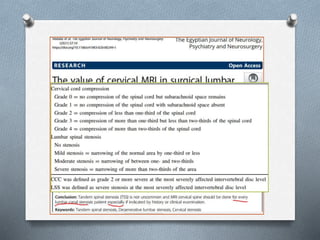
Tandem Spinal Stenosis:
A Systematic Review (2017)
Pathophysiology of CSM symptom
aggravation following lumbar
decompression
O Multifactorial and complicated.
O First, hyperextension positioning or accidental
hyperextension during anesthesia for lumbar spinal surgery
O Second, due to the natural course of the stenosis, 5–8% of
patients with symptomatic lumbar stenosis and
asymptomatic cervical stenosis will develop myelopathy per
year [19, 22, 23]. In contrast, 3–5% of patients with
asymptomatic lumbar stenosis and cervical myelopathy will
develop lower limb symptoms per year [18].
O Third, symptoms usually thought to be due to lower back
problems such as leg pain associated with weakness and
sensory deficits may be due to myelopathy.
Quality of Life Changes after Lumbar Decompression in Patients with Tandem
Spinal Stenosis, 2019
Our patient?
O Pre-op : sever
O Post op
THANK YOU.

Csm ok

  • 1.
    Case presentation on Mgtof Tandem spine stenosis
  • 2.
    Outline O Case summary ODefinition O Epidemiology O Mgt O Outcome
  • 3.
  • 4.
    Definition O Tandem spinalstenosis refers to spinal canal diameter narrowing in at least 2 distinct regions of the spine, most commonly the lumbar and cervical regions.(why?)
  • 5.
    Epidemiology O highly variable:7.6% to 60% of with spinal stenosis O Concurrent cervical and lumbar stenosis in 4.3% asymptomatics. O About 9% of patients with symptomatic LSS have cervical spondylotic myelopathy.
  • 6.
    Clinical presentation O Dagitriads 1. Intermittent lower extremity claudication, 2. Gait disturbance, and 3. Upper and lower motor neuron signs. O Symptoms from one region may be masked by more prominent symptoms from another
  • 8.
    Risks for TSS OOssification of the posterior longitudinal ligament (OPLL) in any region O A cervical torg pavlov ratio of < 0.787 (independent risk factor). O Congenital stenosis
  • 9.
    Dx O clinical diagnosiscentered on maintaining a high index of suspicion for cervical myelopathy in patients presenting with predominantly lower extremity symptoms. O Imaging: MRI of both cervical and lumbar spine 1. UMN sx & sy 2. Presence of OPLL 3. provocative-maneuvers:(Lhermitte, Spurling)
  • 10.
    RX O No level1 (RCT) Mgt recommendation. O Universal precautions 1. avoidance of neck hyperflexion or hyperextension with adequate padding, 2. minimization of long-acting paralytics that impair the natural muscular, and protective mechanisms 3. Neuromonitoring
  • 11.
    Controversies O Conservtive vsoperative O Staged vs simultaneous cervical and lumbar procedures O Lumbar vs cervical first? O Anterior vs posterior O A case-by case basis. O Dual vs single surgeon strategy O Age <60 vs >60 yrs O Prophylactic decompression of asymptomatic LSS in patients undergoing surgery for CSM O Prophylactic decompression of asymptomatic CSM with/without T2 signal change in patients undergoing surgery for LSS O surgical sequence of decompression in TSS: cohort showed no difference in clinical outcomes O Failure to diagnose asymptomatic cervical spine stenosis in patients with LSS
  • 12.
    Decisions O Operative intervention,irrespective of the sequence or approach, has been shown to be efficacious; no preferred treatment modality has been established, although evidence suggests that primary cervical decompression improves lumbar symptomatology.
  • 13.
    O cervical decompressionshould remain the primary objective in cases of alternating approaches to address each spinal segment. O lower-extremity symptoms resolved in most patients who underwent primary cervical decompression. In fact, a cohort of patients averted planned secondary lumbar intervention following an index cervical decompression. O A minimum of 3 months of follow-up after cervical decompression to allow for improvement of residual lower-extremity symptoms before proceeding to lumbar decompression.
  • 14.
    Simultaneous decompression O 2separate operative teams O Shorter operative time O Less blood loss O avoids the rare but devastating potential complication of undue compression of neural elements secondary to positioning in the setting of severe stenosis O No difference in clinical outcomes.
  • 15.
    Tandem Spinal Stenosis: ASystematic Review (2017)
  • 18.
    Pathophysiology of CSMsymptom aggravation following lumbar decompression O Multifactorial and complicated. O First, hyperextension positioning or accidental hyperextension during anesthesia for lumbar spinal surgery O Second, due to the natural course of the stenosis, 5–8% of patients with symptomatic lumbar stenosis and asymptomatic cervical stenosis will develop myelopathy per year [19, 22, 23]. In contrast, 3–5% of patients with asymptomatic lumbar stenosis and cervical myelopathy will develop lower limb symptoms per year [18]. O Third, symptoms usually thought to be due to lower back problems such as leg pain associated with weakness and sensory deficits may be due to myelopathy.
  • 19.
    Quality of LifeChanges after Lumbar Decompression in Patients with Tandem Spinal Stenosis, 2019
  • 20.
    Our patient? O Pre-op: sever O Post op
  • 21.

Editor's Notes

  • #5 Among all segments, the stenosis of the cervical and lumbar canal is most common due to more spinal activity [1].
  • #7 Thirty-meter walk test Patients start the test sitting on a chair and when they receive the order, “walk as quickly as you can, without running”, they stand up and walk on a flat and even surface over a previously measured distance (15 m, returning to the starting point after one ‘lap’), then sit down again. The time taken to do this is recorded, and the number of steps is counted. Patients should walk at a comfortable speed (with whatever assistance they have for walking). This method proved reliable and valid in a population of cervical myelopathy patients (Singh and Crockard, 1999). Symptoms from one region may be masked by more prominent symptoms from another, and the existence of tandem stenosis may be recognized only after surgical treatment of one region.
  • #10 If the surgeon detects clinical myelopathy but imaging does not support a diagnosis of cervical stenosis, the thoracic spine should be imaged.
  • #12 Failure to diagnose asymptomatic cervical spine stenosis in patients with LSS may subject these patients to cervical spinal cord injury during positioning for lumbar decompression. Moreover, symptoms of cervical spinal cord compression may emerge postoperatively as a result of prolonged neck extension during lumbar surgery. Careful neurological assessment and whole-spine MRI has therefore been suggested for older patients with LSS to rule out any concurrent stenotic findings at the cervical or thoracic level. Patients with symptomatic LSS and concurrent asymptomatic cervical stenosis need to be followed closely because the risk of clinical progression to cervical myelopathy is significant. Prophylactic decompression of asymptomatic cervical spinal cord compression with or without T2 signal hyperintensity, however, is not supported by evidence.