CSISA Objective 1:
Orientation and Planning Meeting

Kathmandu, Nepal
January 23, 24, and 25th, 2013
Meeting Objectives

1. Familiarize team with CSISA philosophy, thematic focus,
   and each other.
2. Bring forward new thinking and partnership opportunities
3. Refine key objectives and activities for Bihar / EUP +
   Odisha
4. Coordinate activities around integrated ‘impact
   pathways’ and set priorities accordingly (weighted now
   towards kharif)
5. Translate impact pathway logic to achievable work plans
   with clearly defined activities, milestones, and
   responsibilities
6. Review strategy for M&E, data mng., and
Cereal Systems Initiative for South Asia

Project Goal: To increase food, nutrition, and income security at
scale in South Asia through sustainable intensification of cereal-
based systems

Four countries: Bangladesh, India, Nepal, Pakistan

Duration: Phase I: 2009-12; Phase II: 2012-15

•Donor-driven shift in priorities in Phase II to Bihar / EUP,
Odisha, and Bangladesh

•Transition support for Phase I hubs in Punjab, Haryana, and TN.
The I PA c ha lle ng e : c a ta ly z ing d ura ble
        M CT
c ha ng e with m illio ns o f s m a ll a nd m e d ium -
s c a le fa rm e rs
CSISA’s 10-year vision of success aims to increase the incomes
of 6 million farm families by $350 pa by 2018 through widespread
adoption of efficient and productive agronomic practices, marked
increases in the cultivation of high-yielding and stress-tolerant
cereal cultivars, better access to information, and progressive
policies and strengthened markets that stimulate the same with
results-oriented public and private investments. In Phase II,
CSISA remains committed to its original 10-year target of
assisting millions of farmers to achieve a substantial increase in
yield and profitability. …the project endeavors to reach 2
million farm families by the end of Phase II.
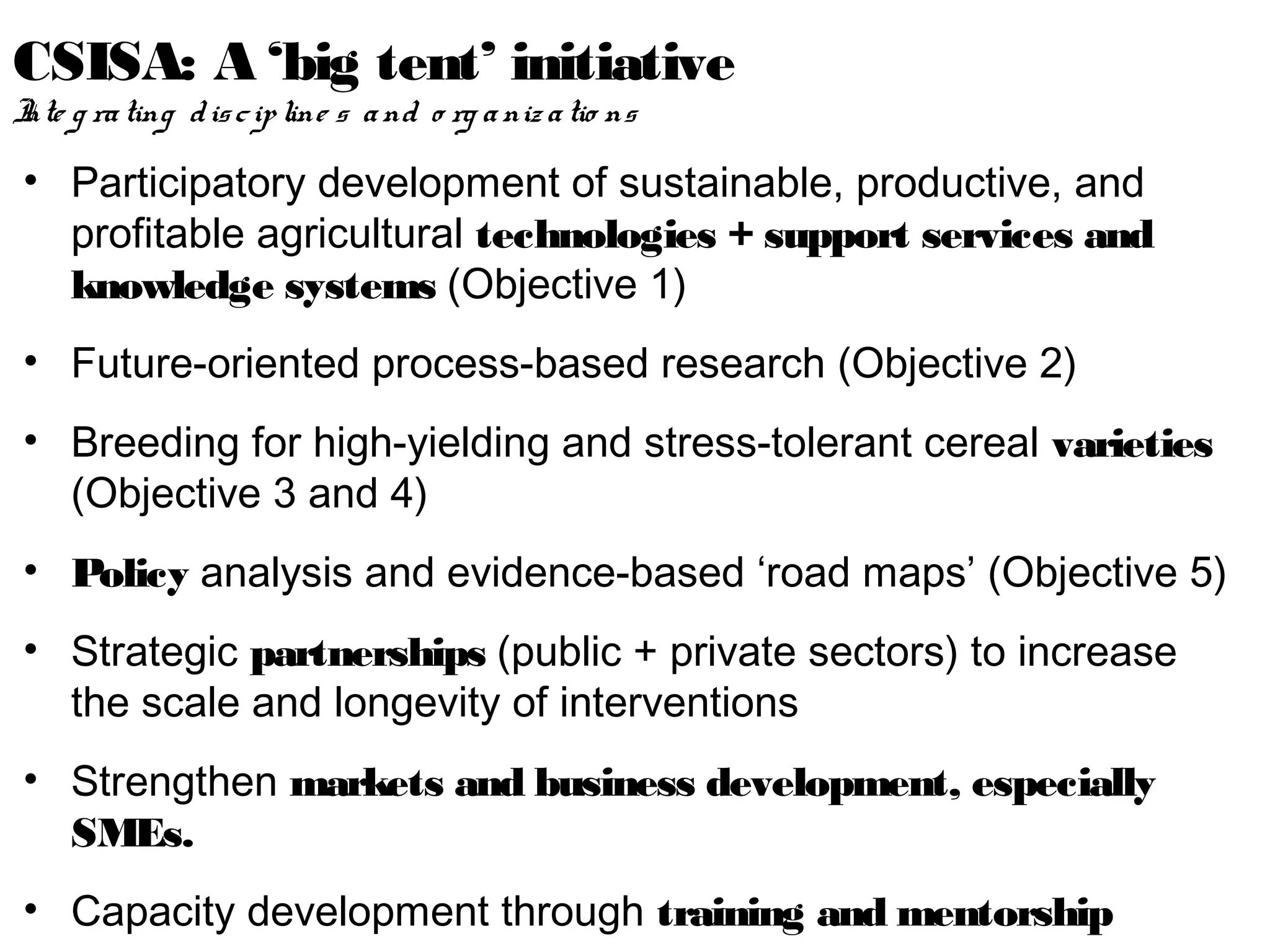
CSISA: A ‘big tent’ initiative
I g ra ting d is c ip line s a nd o rg a niz a tio ns
nte

• Participatory development of sustainable, productive, and
  profitable agricultural technologies + support services and
  knowledge systems (Objective 1)
• Future-oriented process-based research (Objective 2)
• Breeding for high-yielding and stress-tolerant cereal varieties
  (Objective 3 and 4)
• Policy analysis and evidence-based ‘road maps’ (Objective 5)
• Strategic partnerships (public + private sectors) to increase
  the scale and longevity of interventions
• Strengthen markets and business development, especially
  SMEs.
• Capacity development through training and mentorship
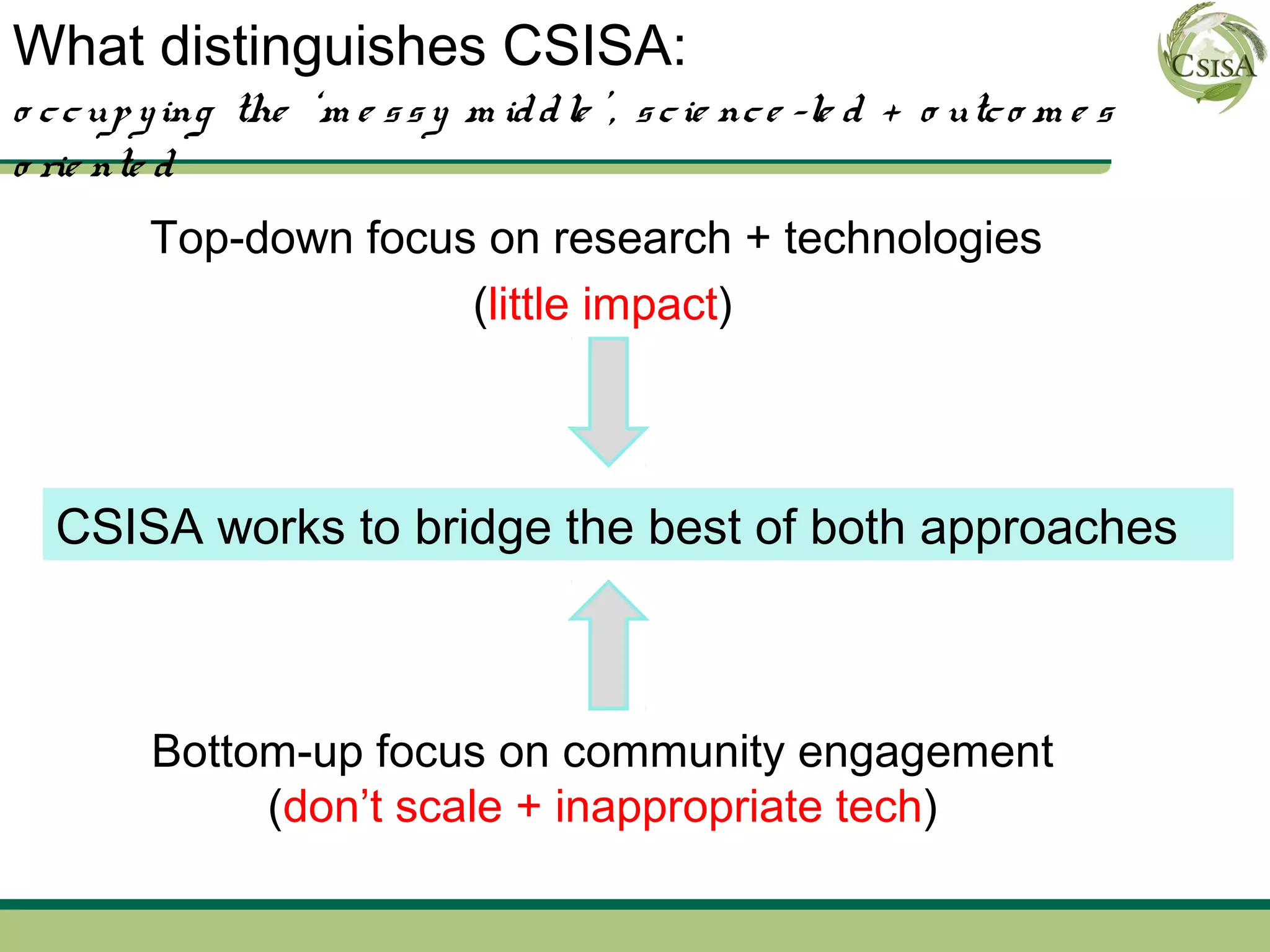
What distinguishes CSISA:
o c c up y ing the ‘m e s s y m id d le ’, s c ie nc e -le d + o utc o m e s
o rie nte d
         Top-down focus on research + technologies
                       (little impact)


  CSISA works to bridge the best of both approaches


         Bottom-up focus on community engagement
              (don’t scale + inappropriate tech)
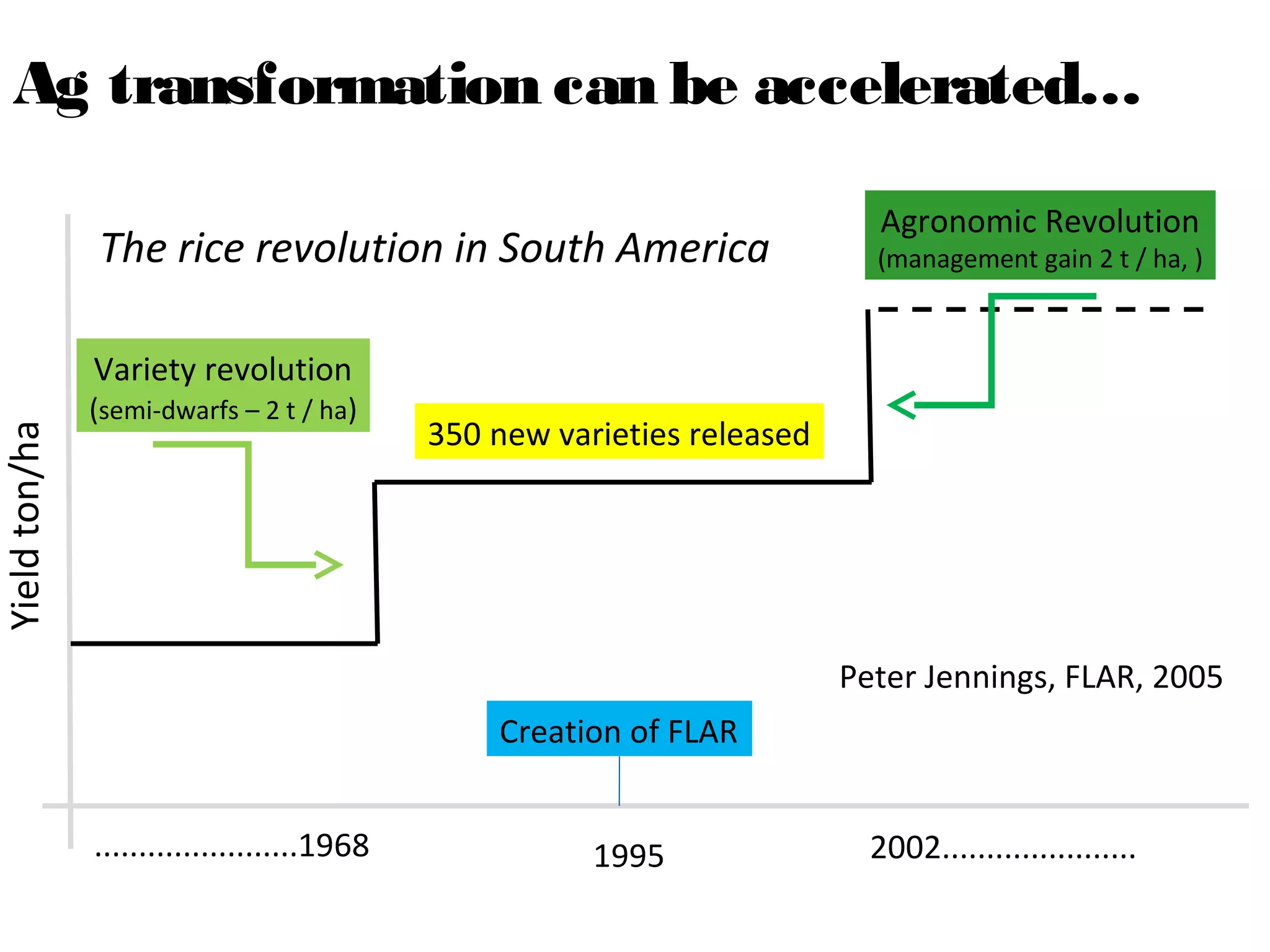
Ag transformation can be accelerated…

                                                                             Agronomic Revolution
               The rice revolution in South America                         (management gain 2 t / ha, )


               Variety revolution
               (semi-dwarfs – 2 t / ha)
                                             350 new varieties released
Yield ton/ha


                                                                          Peter Jennings, FLAR, 2005
                                                 Creation of FLAR


               .......................1968              1995                2002......................
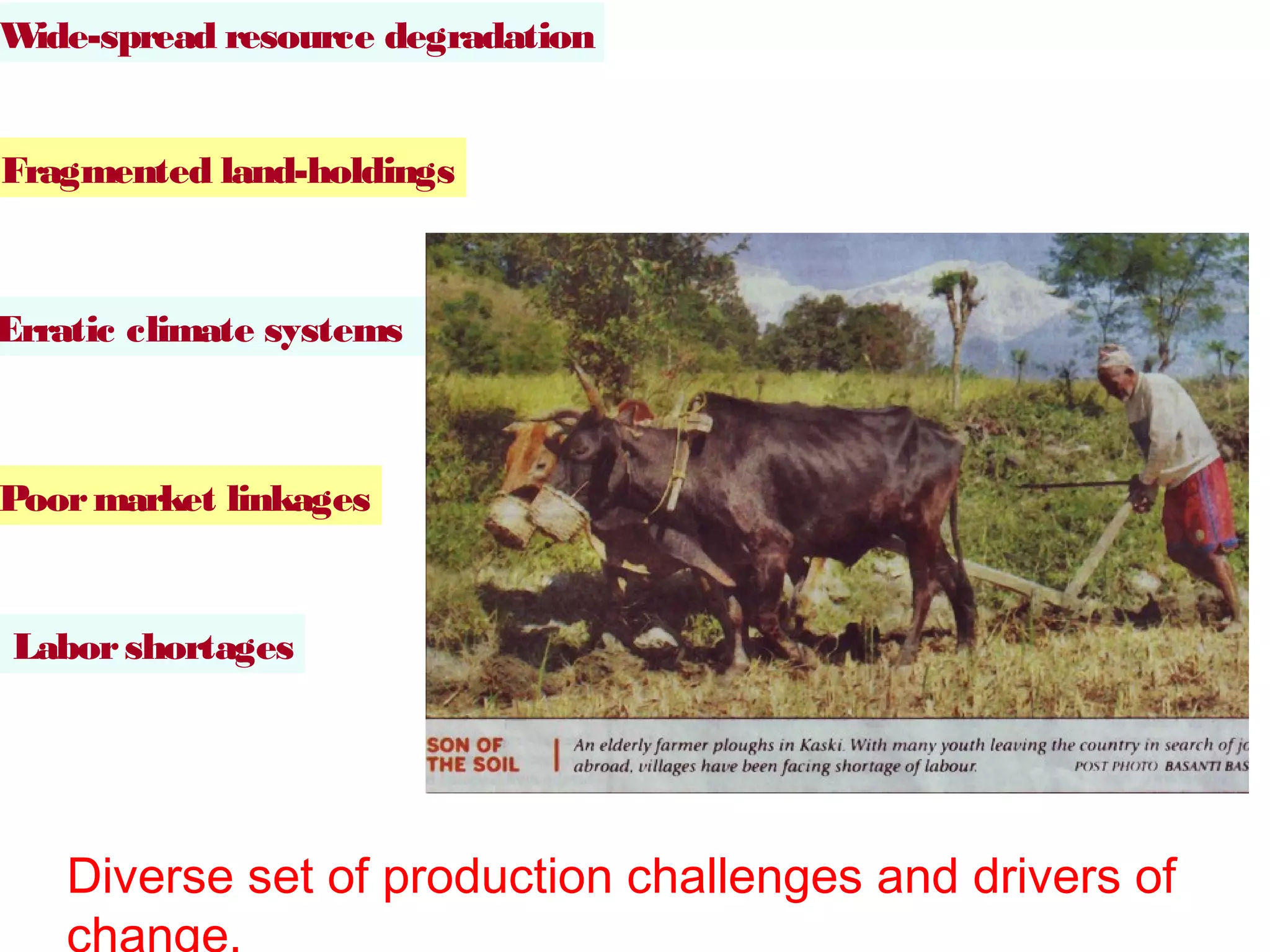
Wide-spread resource degradation


Fragmented land-holdings


Erratic climate systems


Poor market linkages


Labor shortages


    Diverse set of production challenges and drivers of
    change.
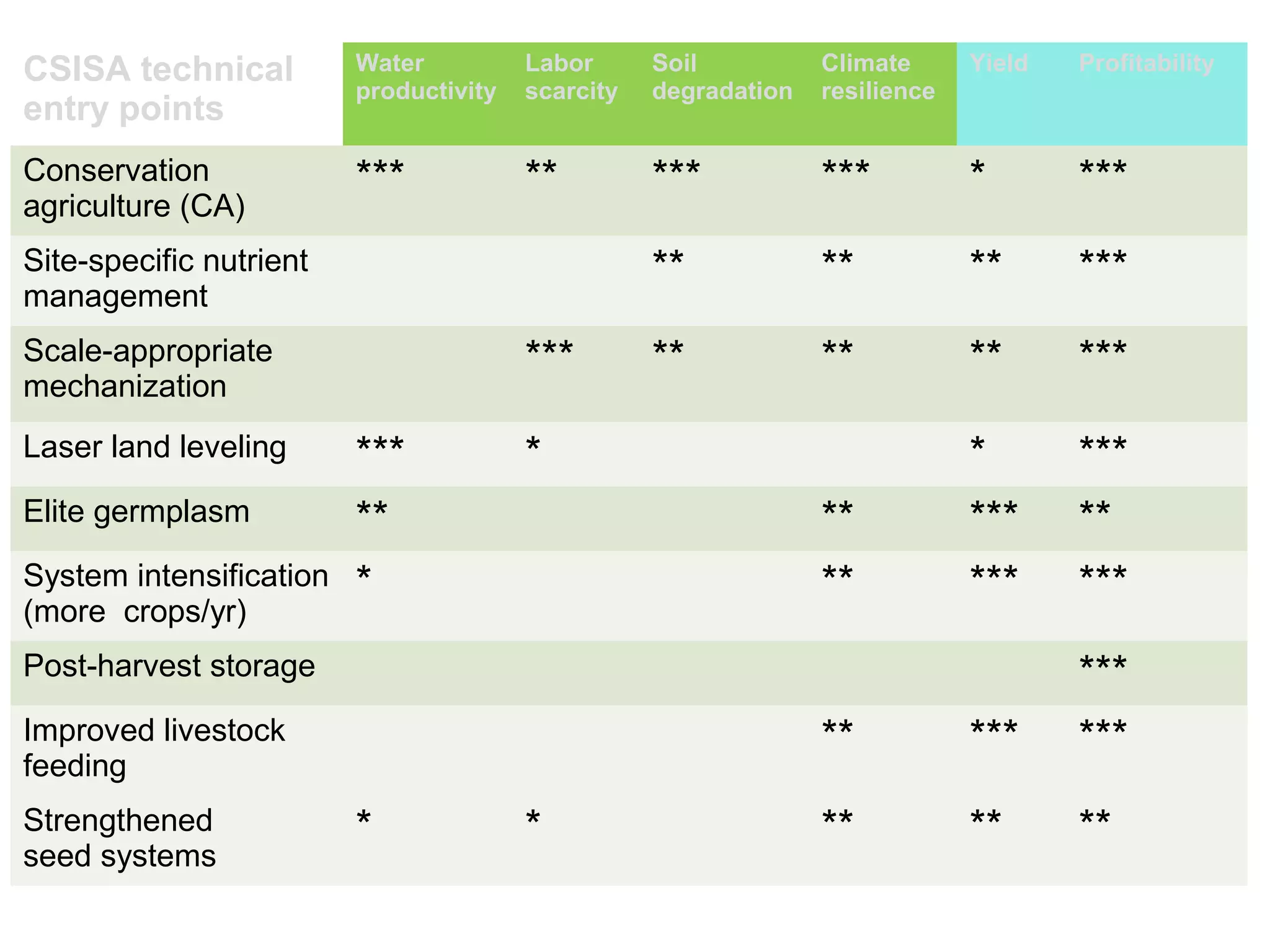
CSISA technical          Water          Labor      Soil          Climate      Yield   Profitability
                         productivity   scarcity   degradation   resilience
entry points
Conservation             ***            **         ***           ***          *       ***
agriculture (CA)
Site-specific nutrient                             **            **           **      ***
management
Scale-appropriate                       ***        **            **           **      ***
mechanization
Laser land leveling      ***            *                                     *       ***
Elite germplasm          **                                      **           ***     **
System intensification   *                                       **           ***     ***
(more crops/yr)
Post-harvest storage                                                                  ***
Improved livestock                                               **           ***     ***
feeding
Strengthened             *              *                        **           **      **
seed systems
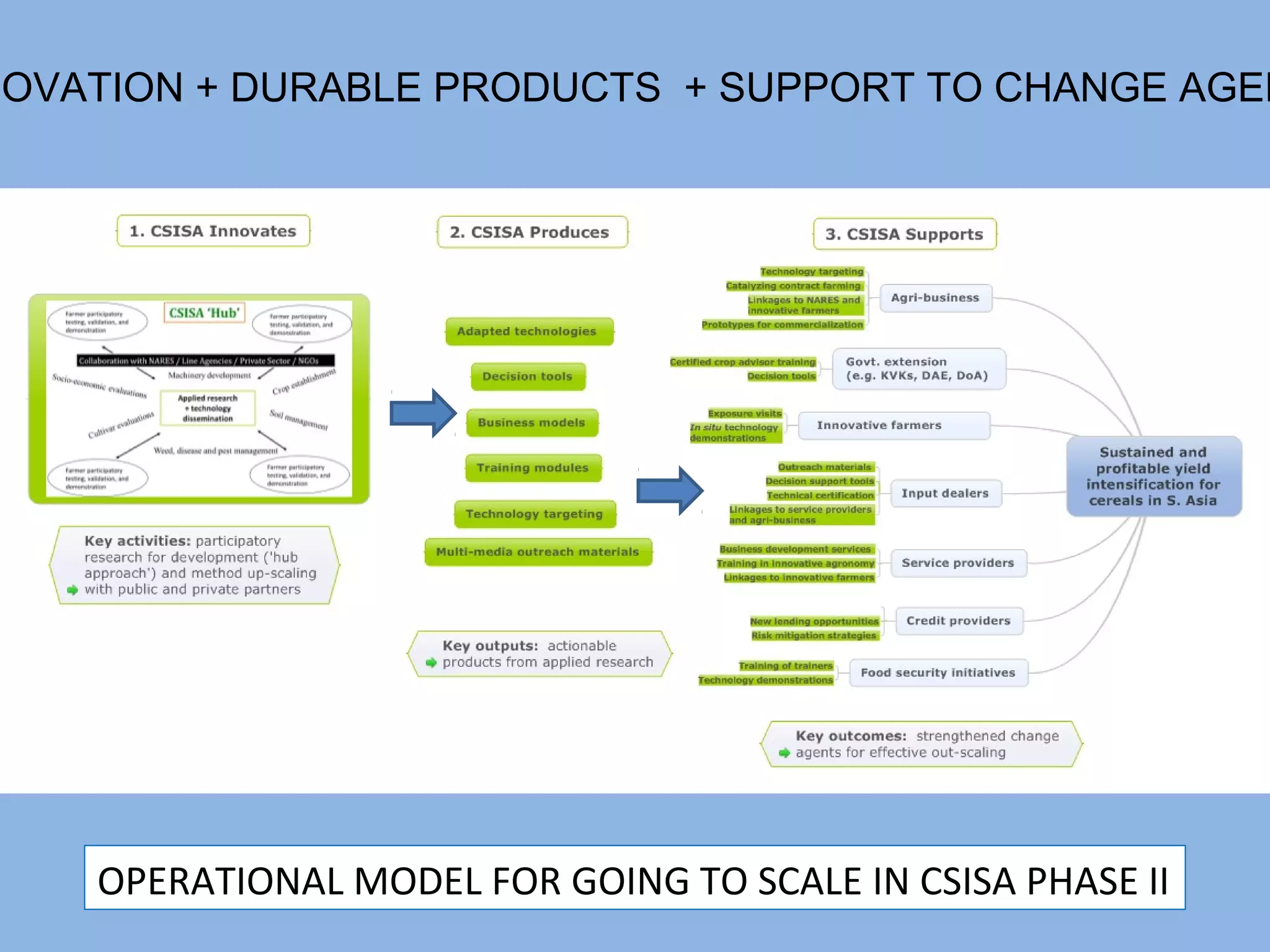
NOVATION + DURABLE PRODUCTS + SUPPORT TO CHANGE AGEN


    OPERATIONAL MODEL FOR GOING TO SCALE IN CSISA PHASE II
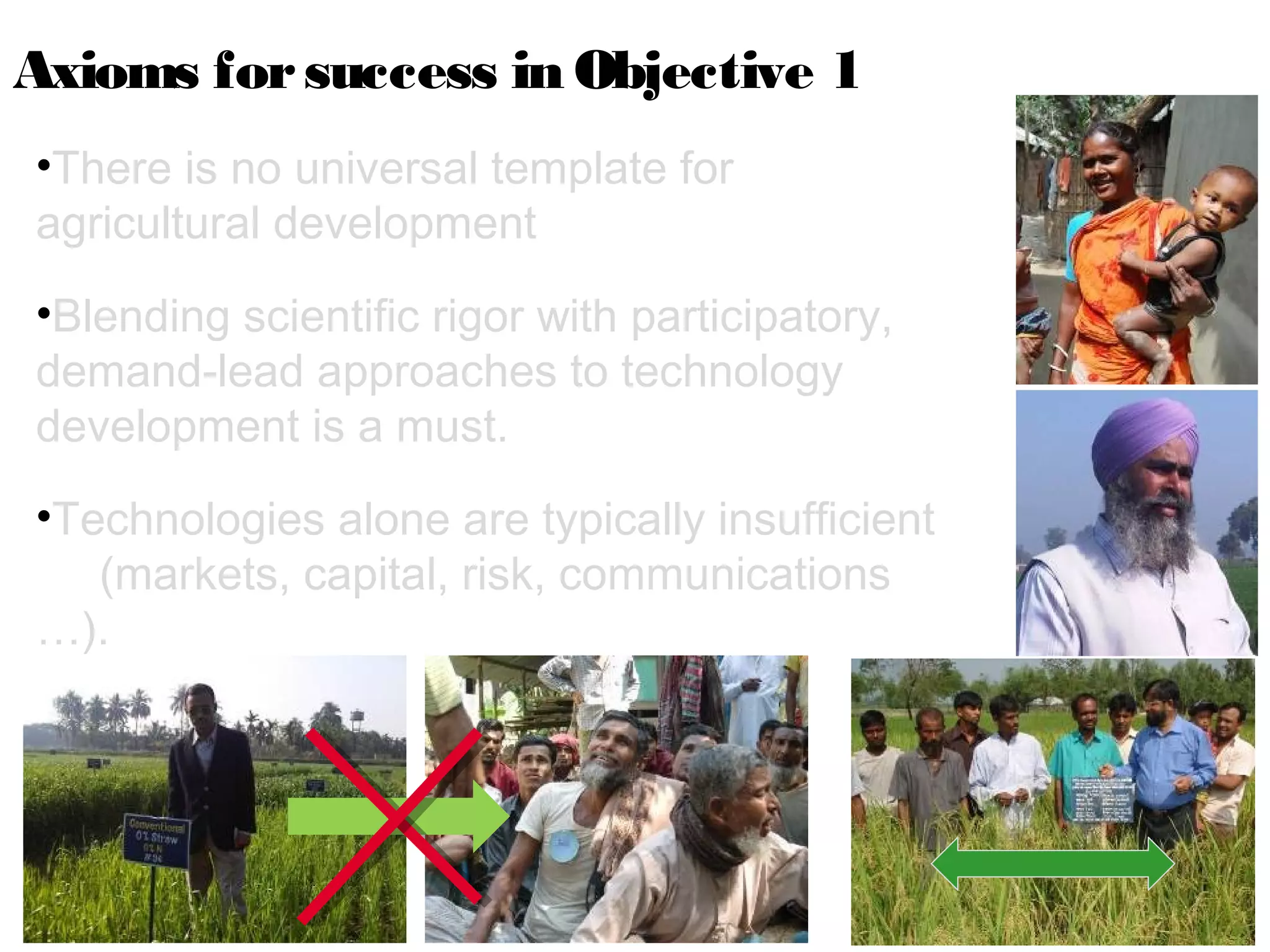
Axioms for success in Objective 1
•There is no universal template for
agricultural development
•Blending scientific rigor with participatory,
demand-lead approaches to technology
development is a must.
•Technologies alone are typically insufficient
   (markets, capital, risk, communications
…).
What’s CSISA isn’t

• An asset transfer scheme

• A competitor with the national research programs

• A substitute for the formal extension system


CSISA works to complement partners and to unite them
 towards common goals… a ‘catalyst’ for change.
Introductions and (brief) Q&A
Constituents of change
to catalzye the adoption of innovative
             technologies
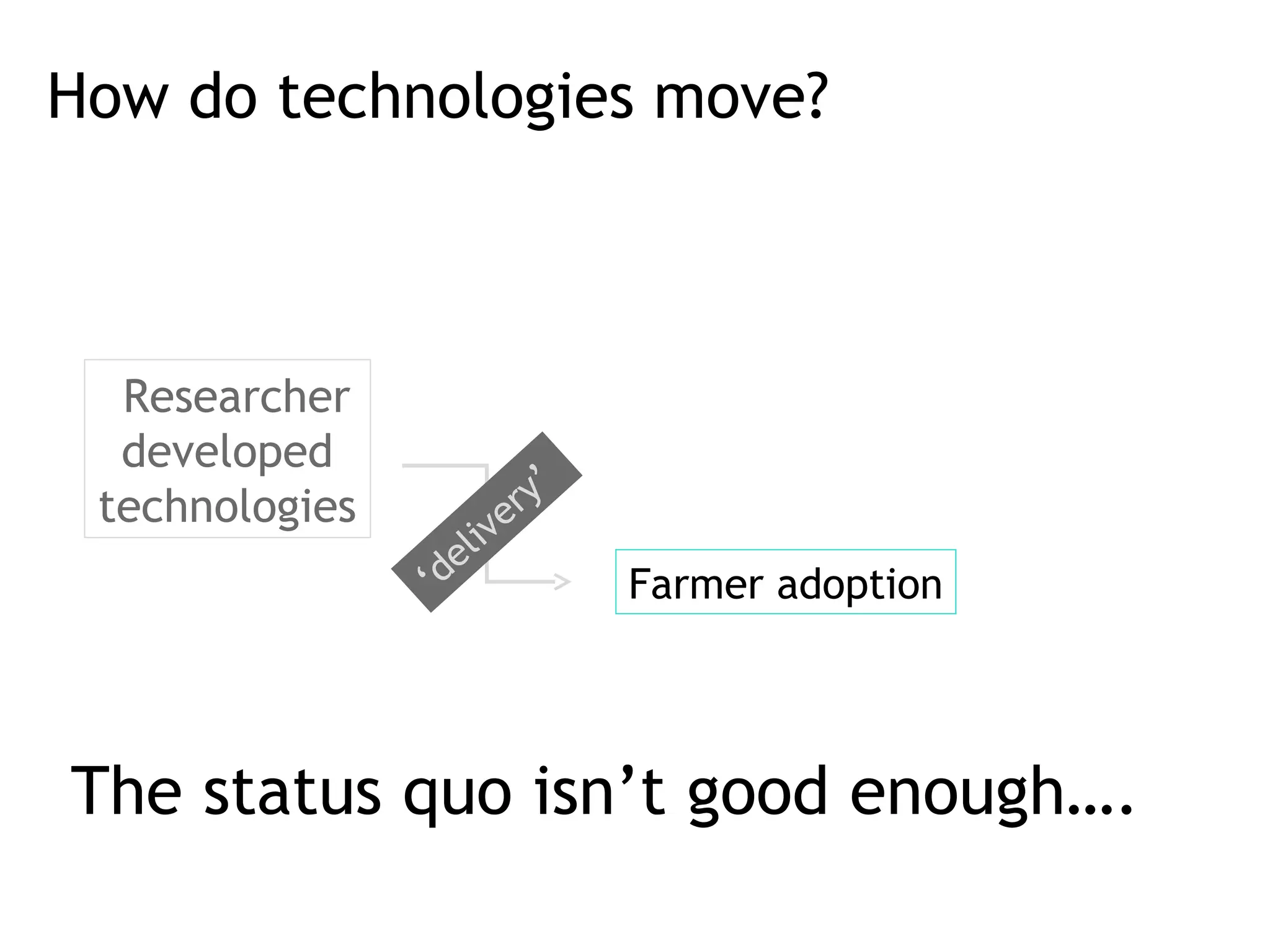
How do technologies move?


 sResearcher
  developed
                                 ’
 technologies                e ry
                     e liv
                ‘d                   Farmer adoption


The status quo isn’t good enough….
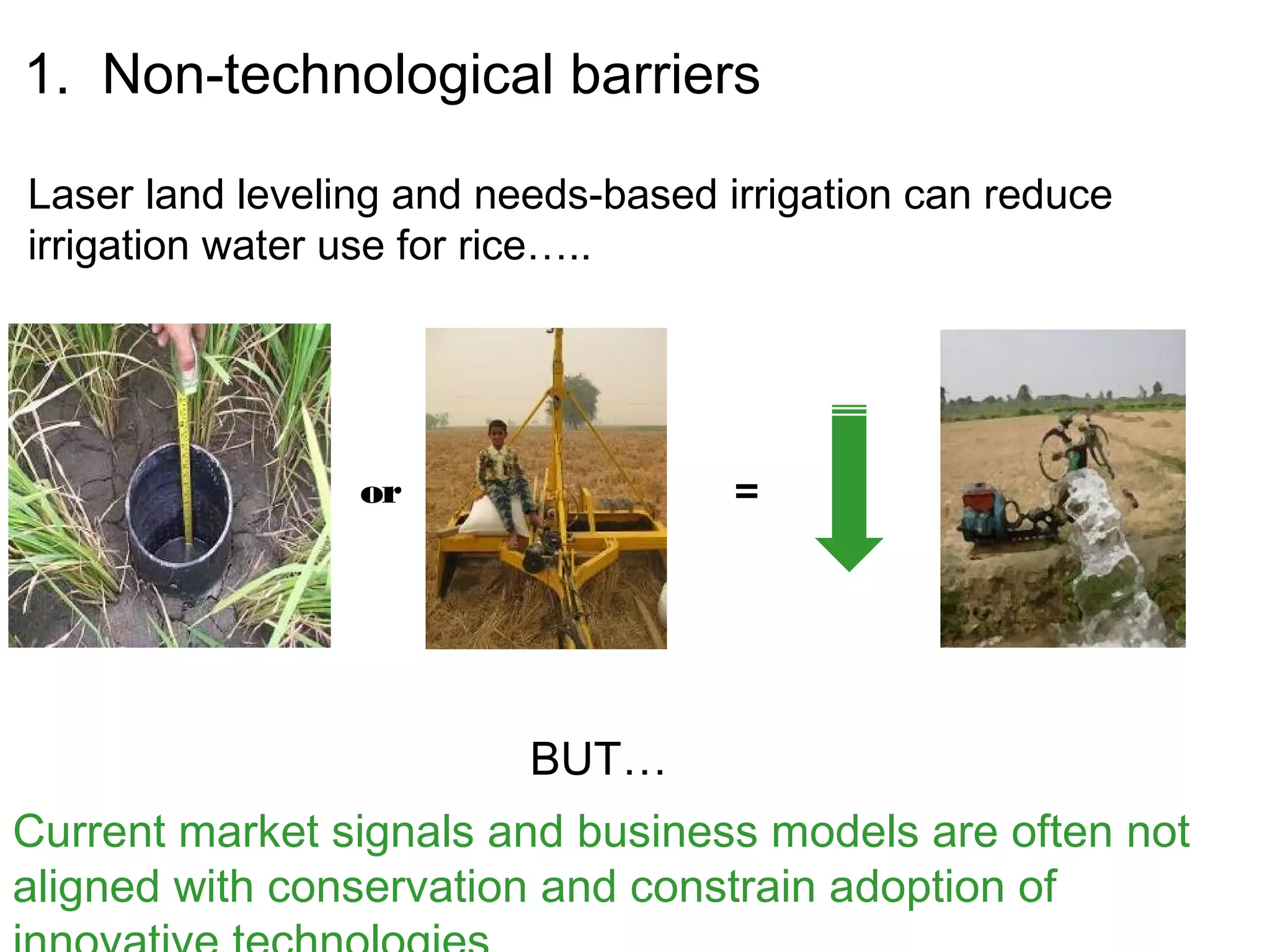
1. Non-technological barriers

Laser land leveling and needs-based irrigation can reduce
irrigation water use for rice…..


                 or                  =


                          BUT…
Current market signals and business models are often not
aligned with conservation and constrain adoption of
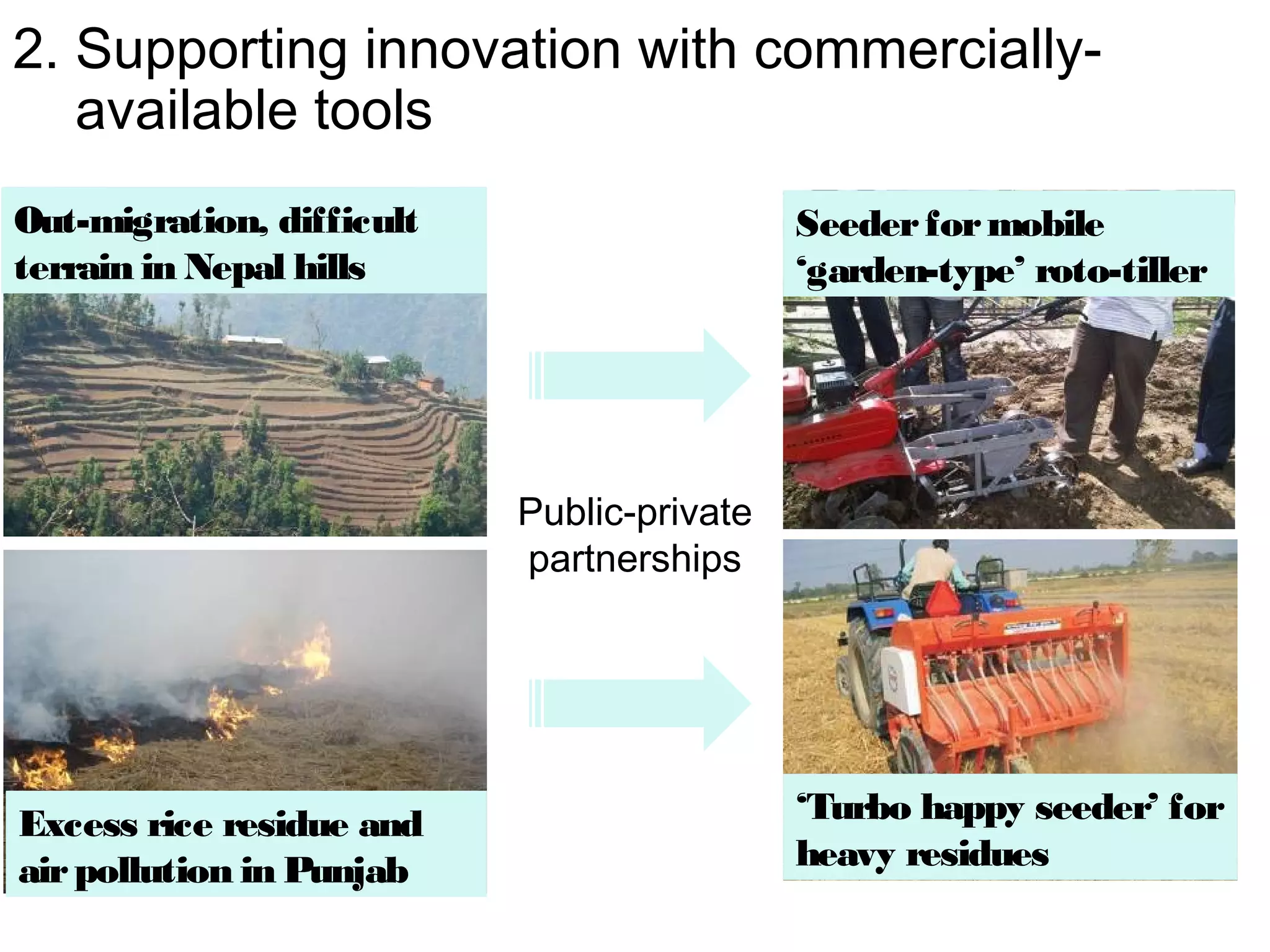
2. Supporting innovation with commercially-
   available tools
Out-migration, difficult                    Seeder for mobile
terrain in Nepal hills                      ‘garden-type’ roto-tiller


                           Public-private
                           partnerships


Excess rice residue and                     ‘Turbo happy seeder’ for
air pollution in Punjab                     heavy residues
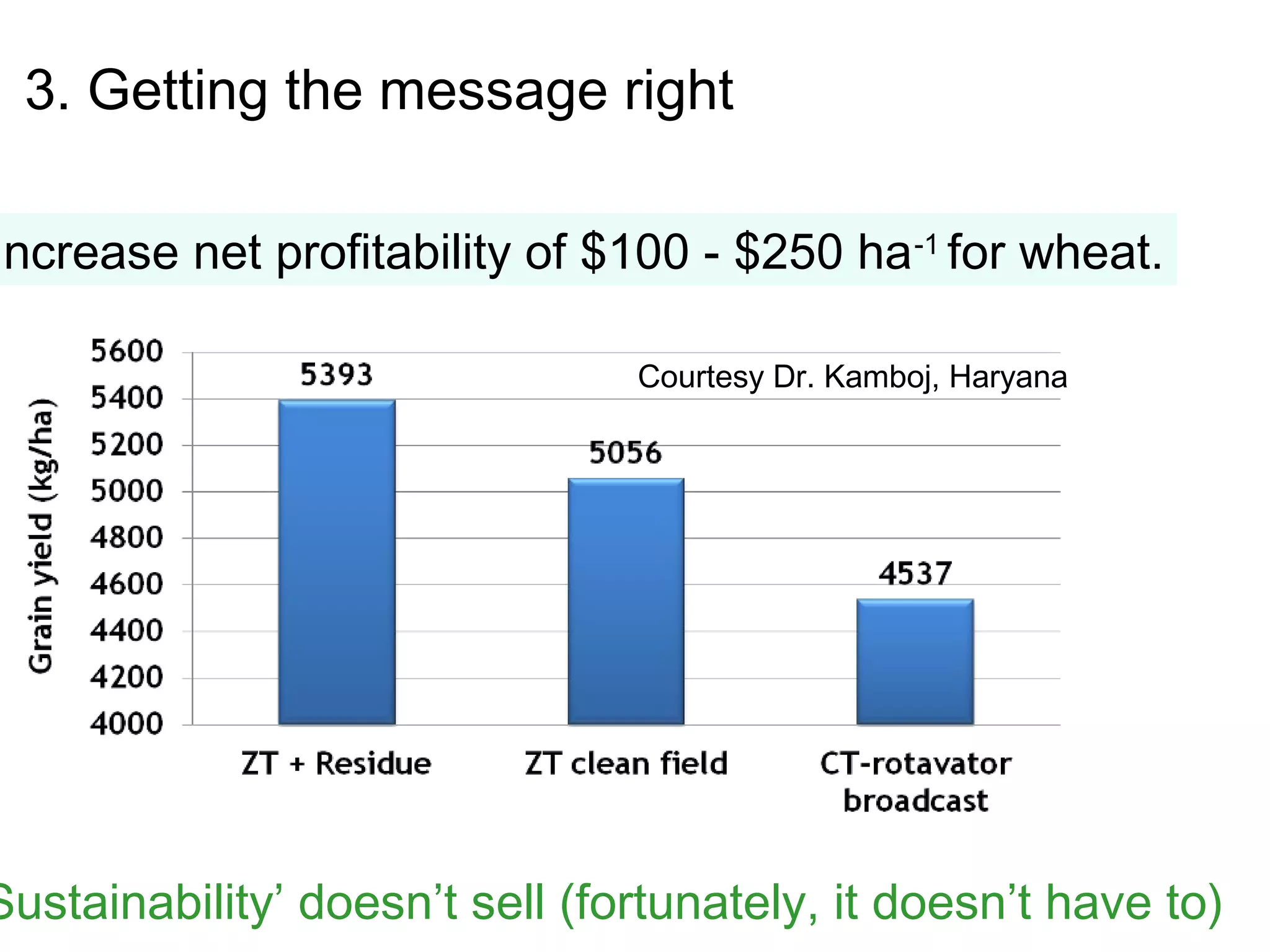
3. Getting the message right

Increase net profitability of $100 - $250 ha -1 for wheat.

                                Courtesy Dr. Kamboj, Haryana


Sustainability’ doesn’t sell (fortunately, it doesn’t have to)
4. Taking cues from the private sector: raising
awareness with social marketing and media
campaigns
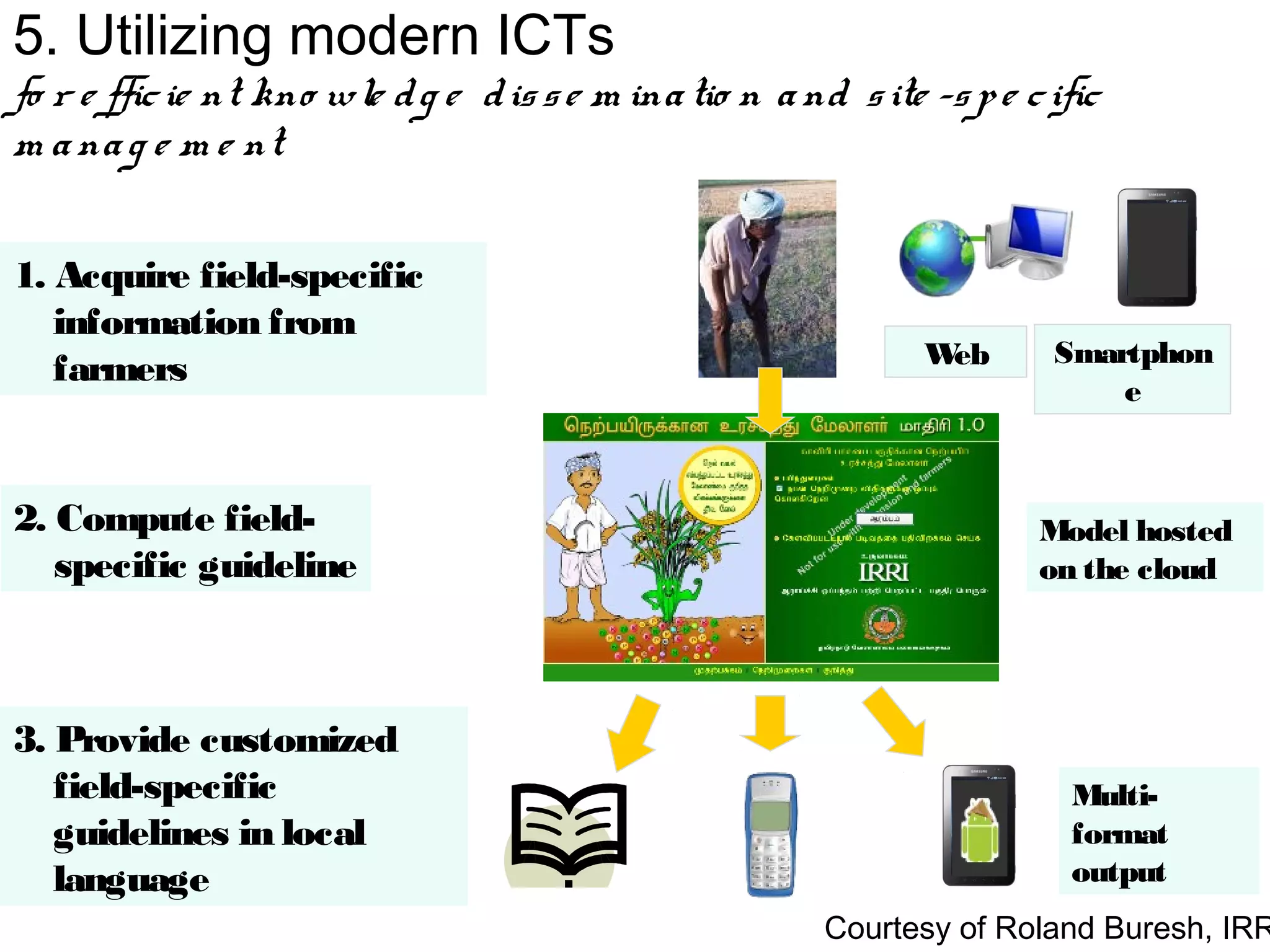
5. Utilizing modern ICTs
fo r e ffic ie nt kno wle d g e d is s e m ina tio n a nd s ite -s p e c ific
m a na g e m e nt

1. Acquire field-specific
   information from
                                                                Web      Smartphon
   farmers
                                                                             e


2. Compute field-                                                       Model hosted
   specific guideline                                                   on the cloud


3. Provide customized
   field-specific                                                          Multi-
   guidelines in local                                                     format
   language                                                                output
                                                         Courtesy of Roland Buresh, IRR
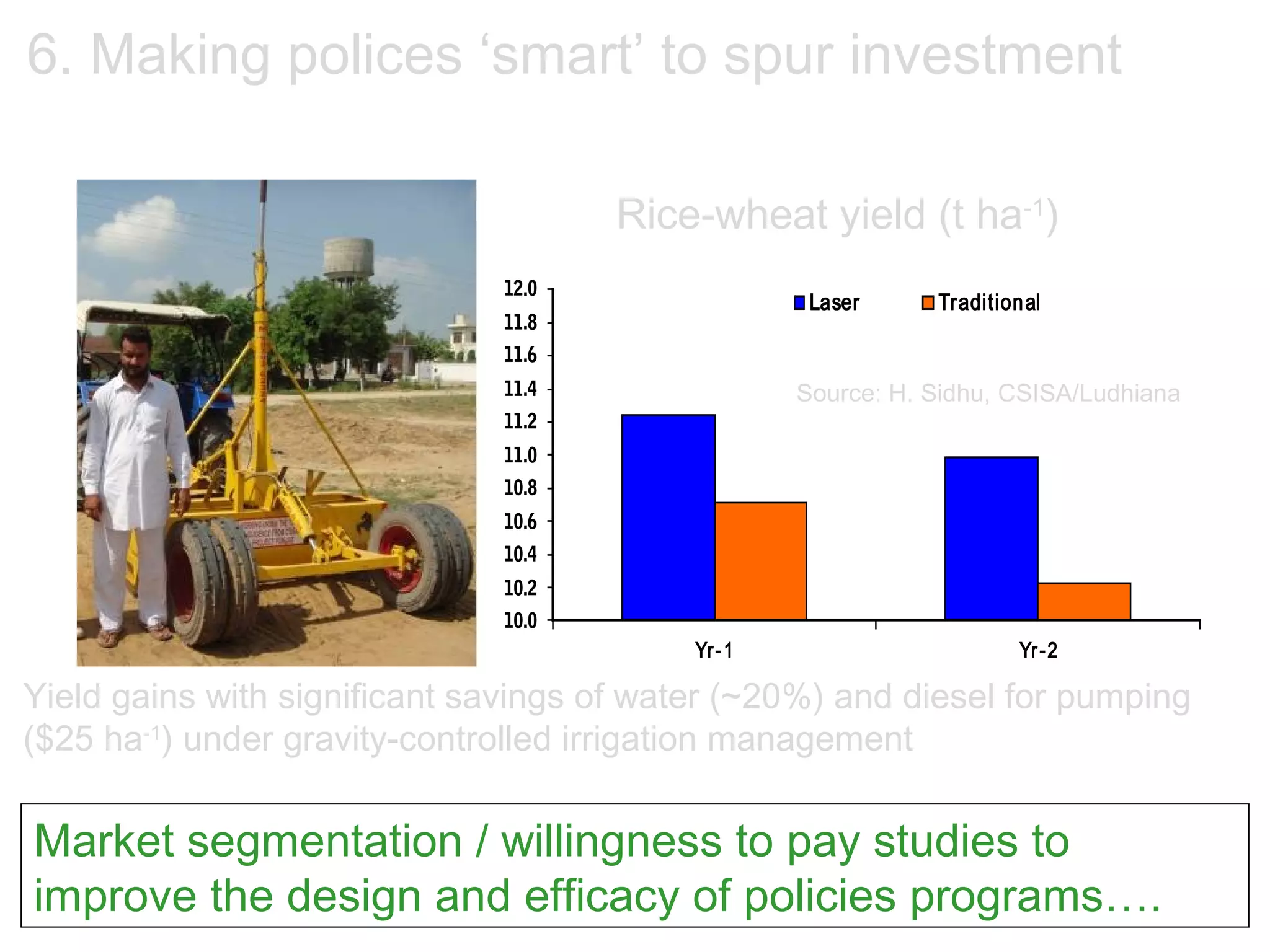
6. Making polices ‘smart’ to spur investment

                                      Rice-wheat yield (t ha-1)
                              12.0
                                                     Laser     Tradition al
                              11.8
                              11.6
                              11.4                  Source: H. Sidhu, CSISA/Ludhiana
                              11.2
                              11.0
                              10.8
                              10.6
                              10.4
                              10.2
                              10.0
                                           Yr - 1                       Yr - 2

Yield gains with significant savings of water (~20%) and diesel for pumping
($25 ha-1) under gravity-controlled irrigation management


Market segmentation / willingness to pay studies to
improve the design and efficacy of policies programs….
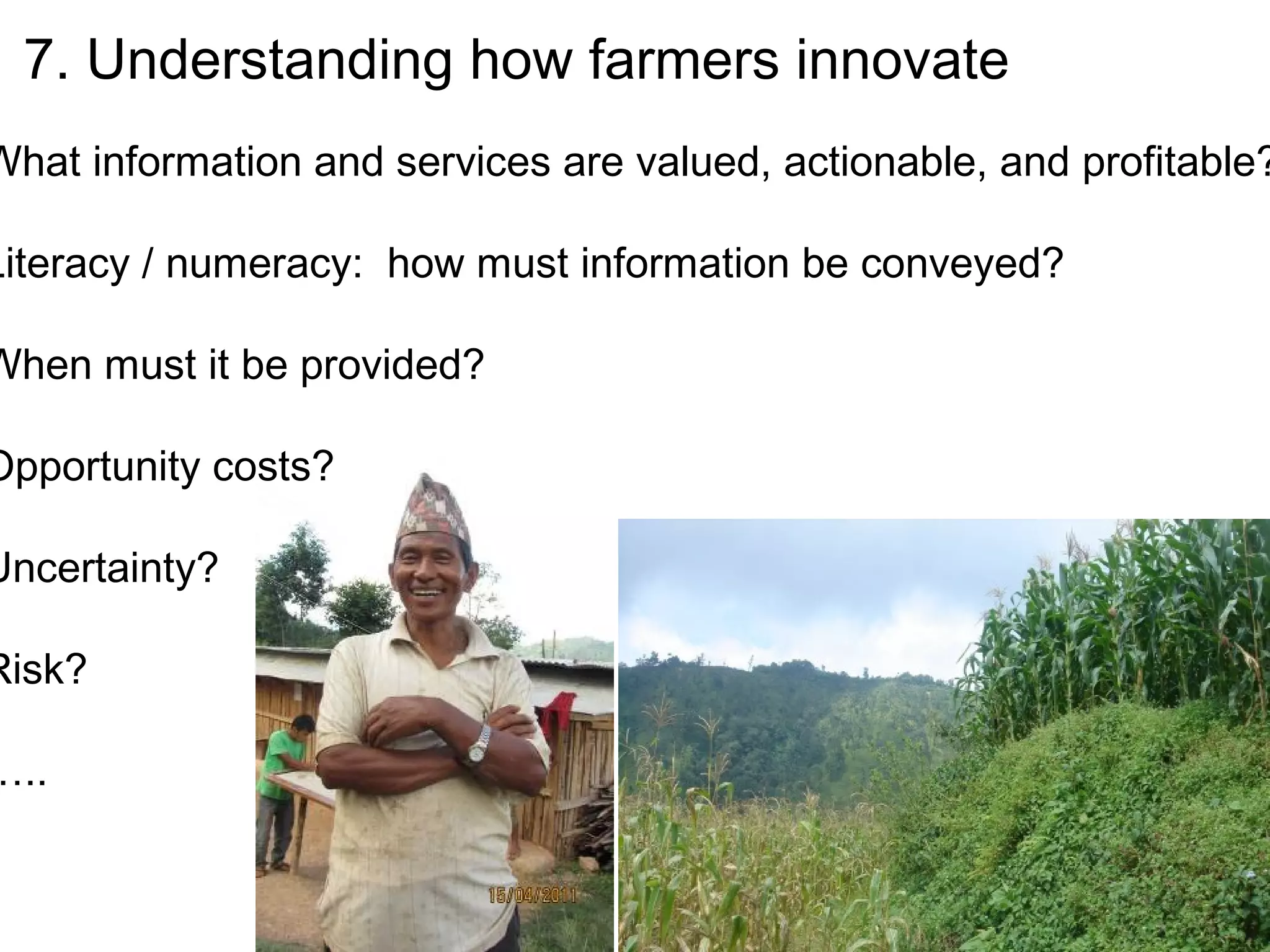
7. Understanding how farmers innovate
What information and services are valued, actionable, and profitable?

Literacy / numeracy: how must information be conveyed?

When must it be provided?

Opportunity costs?

Uncertainty?

Risk?

…..
8. Value chain interventions for strengthening
input and output markets (when needed)


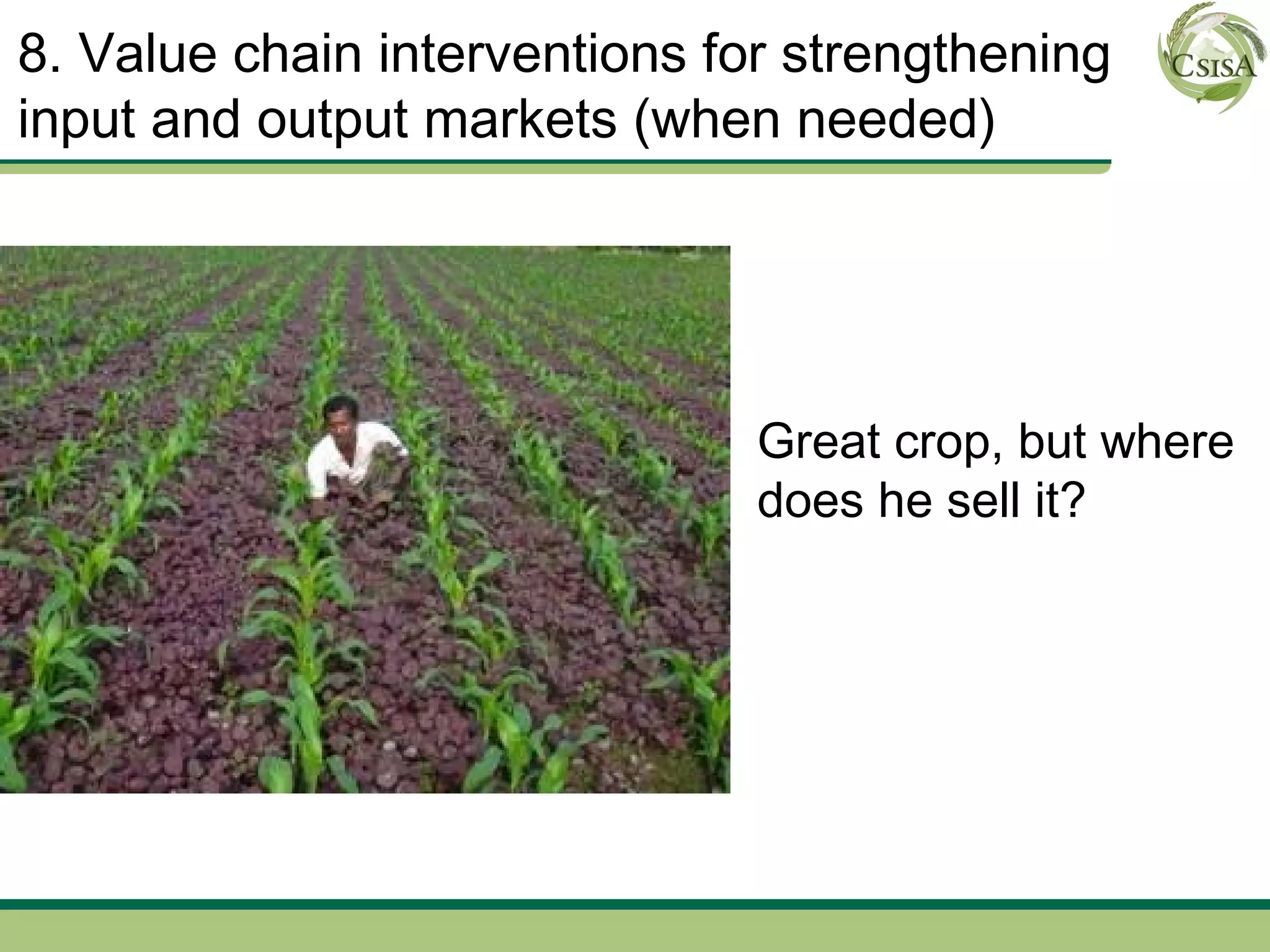
                               Great crop, but where
                               does he sell it?
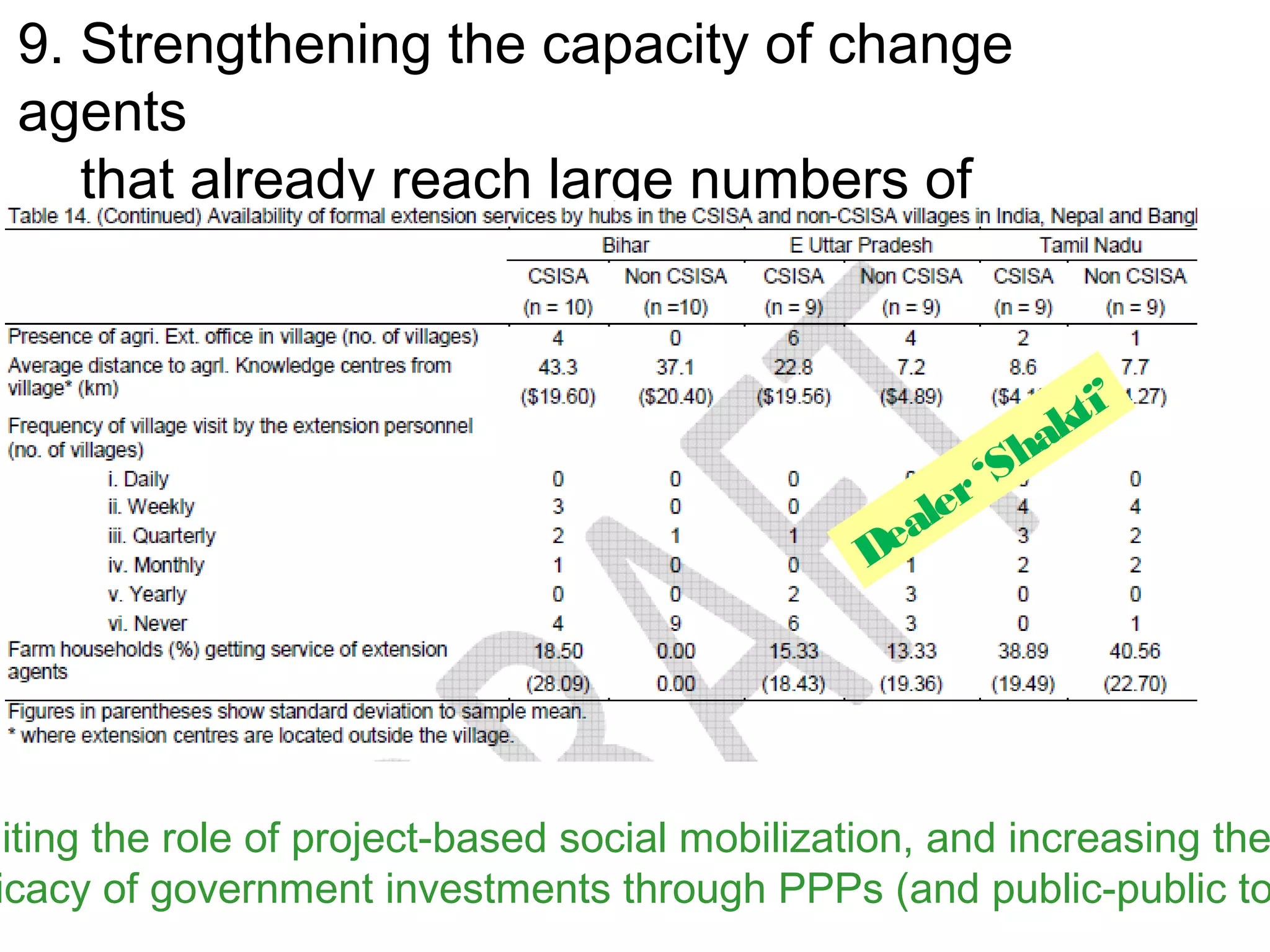
9. Strengthening the capacity of change
  agents
     that already reach large numbers of
  farmers

                                                             ti’
                                                           ak
                                                        ‘Sh
                                                    ler
                                                 Dea


miting the role of project-based social mobilization, and increasing the
 icacy of government investments through PPPs (and public-public to
10. Democratizing technology access
through custom services and new
entrepreneurs

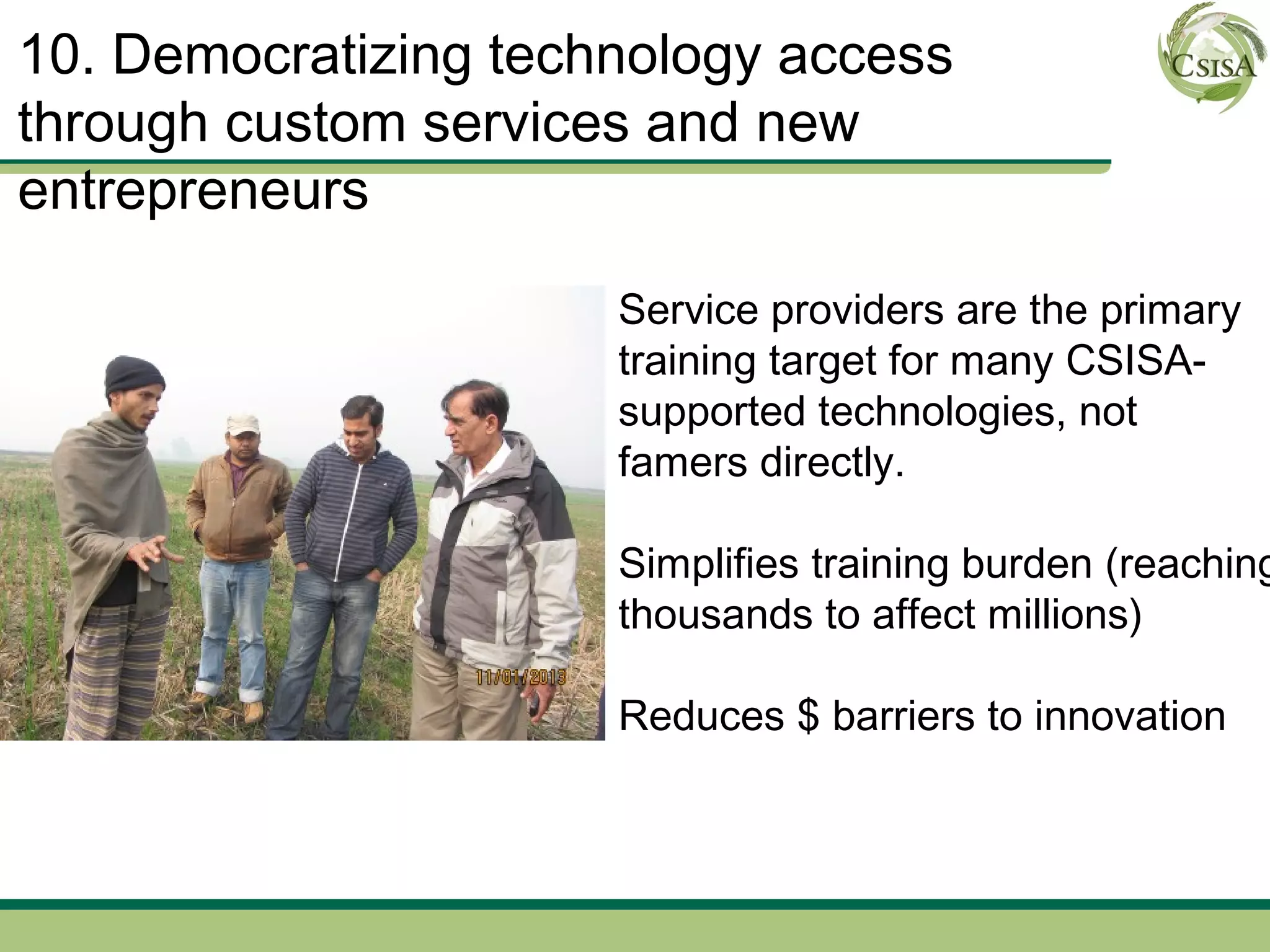
                      Service providers are the primary
                      training target for many CSISA-
                      supported technologies, not
                      famers directly.

                      Simplifies training burden (reaching
                      thousands to affect millions)

                      Reduces $ barriers to innovation
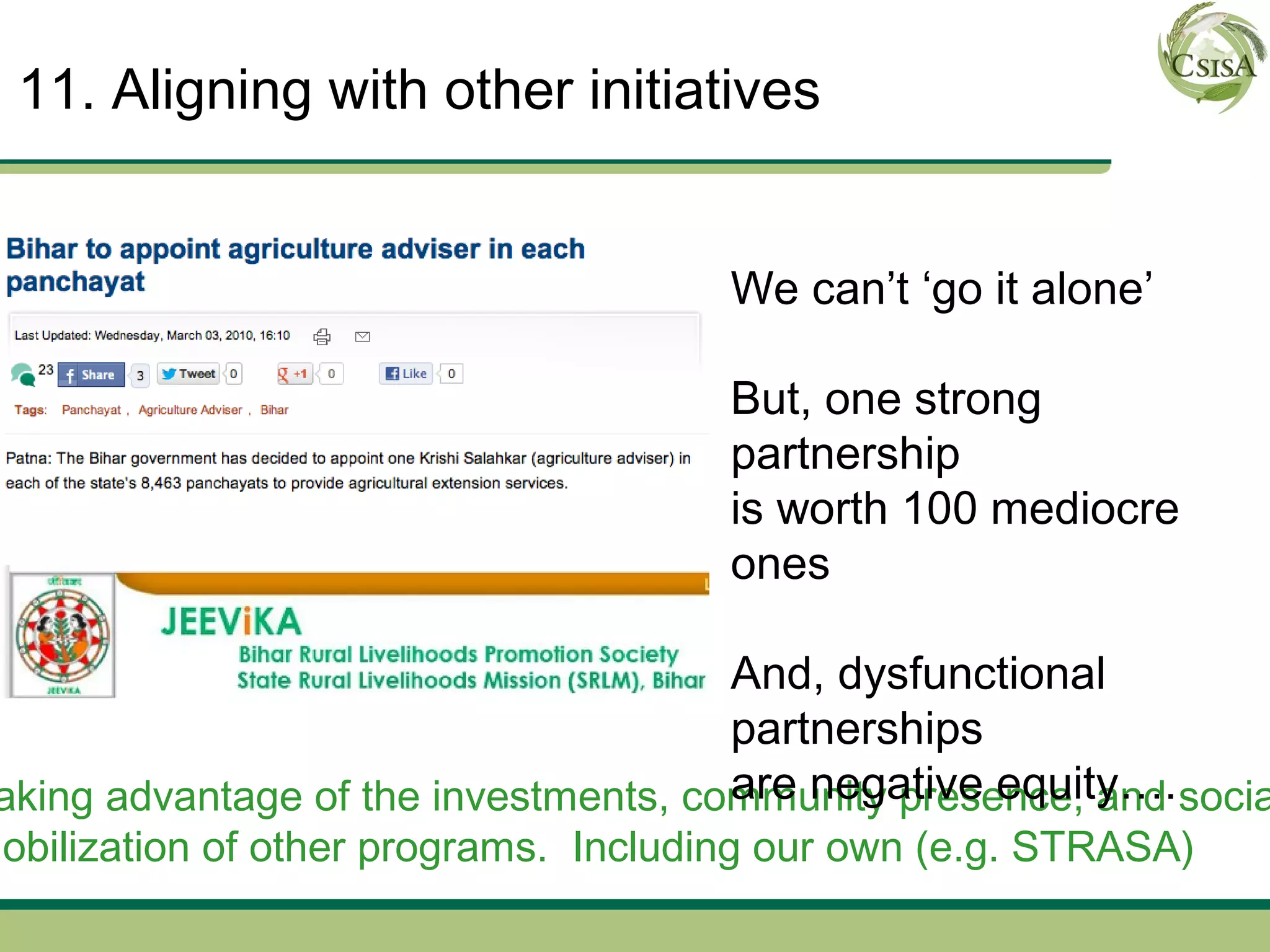
11. Aligning with other initiatives


                                       We can’t ‘go it alone’

                                       But, one strong
                                       partnership
                                       is worth 100 mediocre
                                       ones

                                       And, dysfunctional
                                       partnerships
                                       are negative equity….
 aking advantage of the investments, community presence, and socia
mobilization of other programs. Including our own (e.g. STRASA)
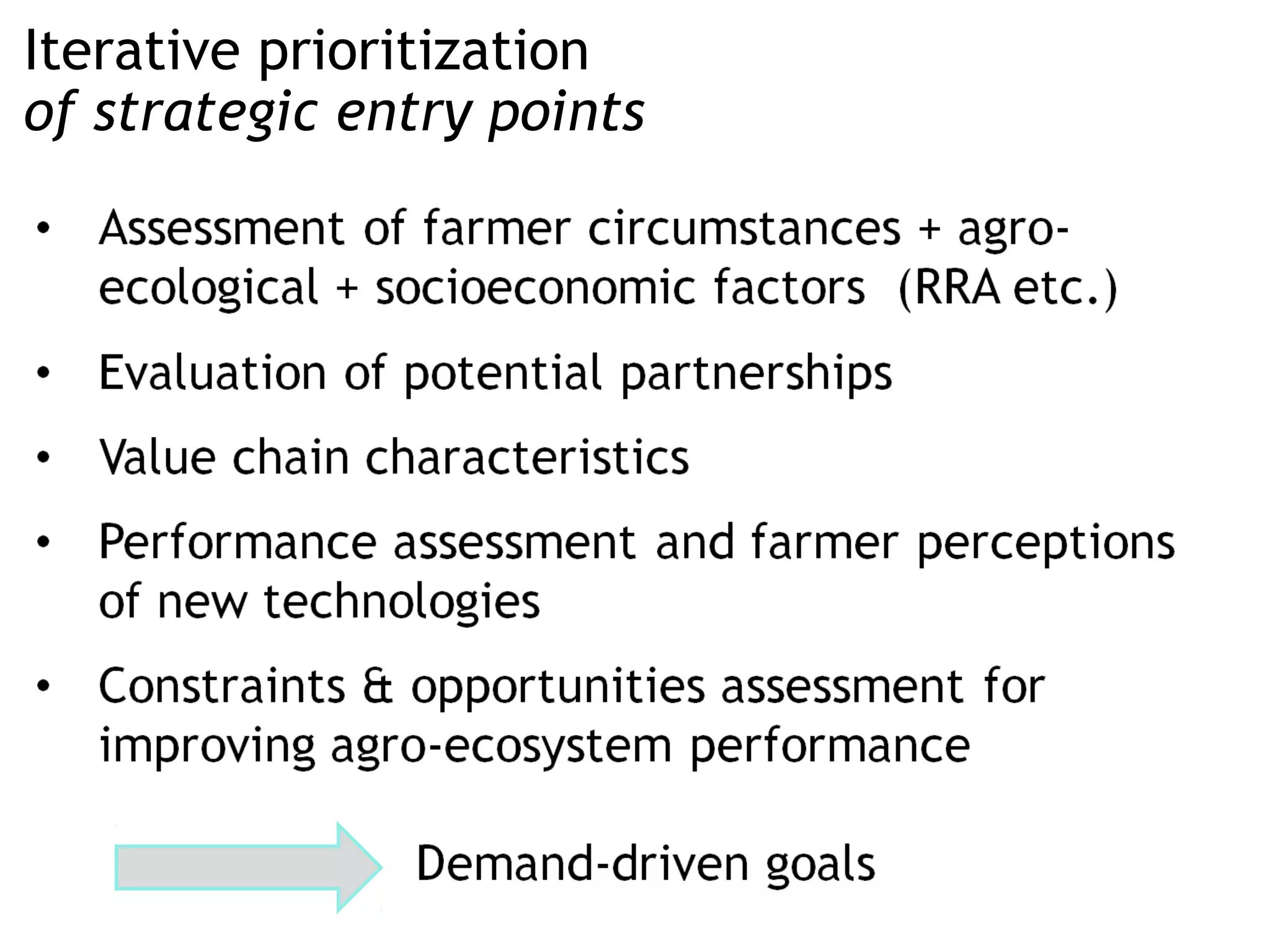
Iterative prioritization
of strategic entry points
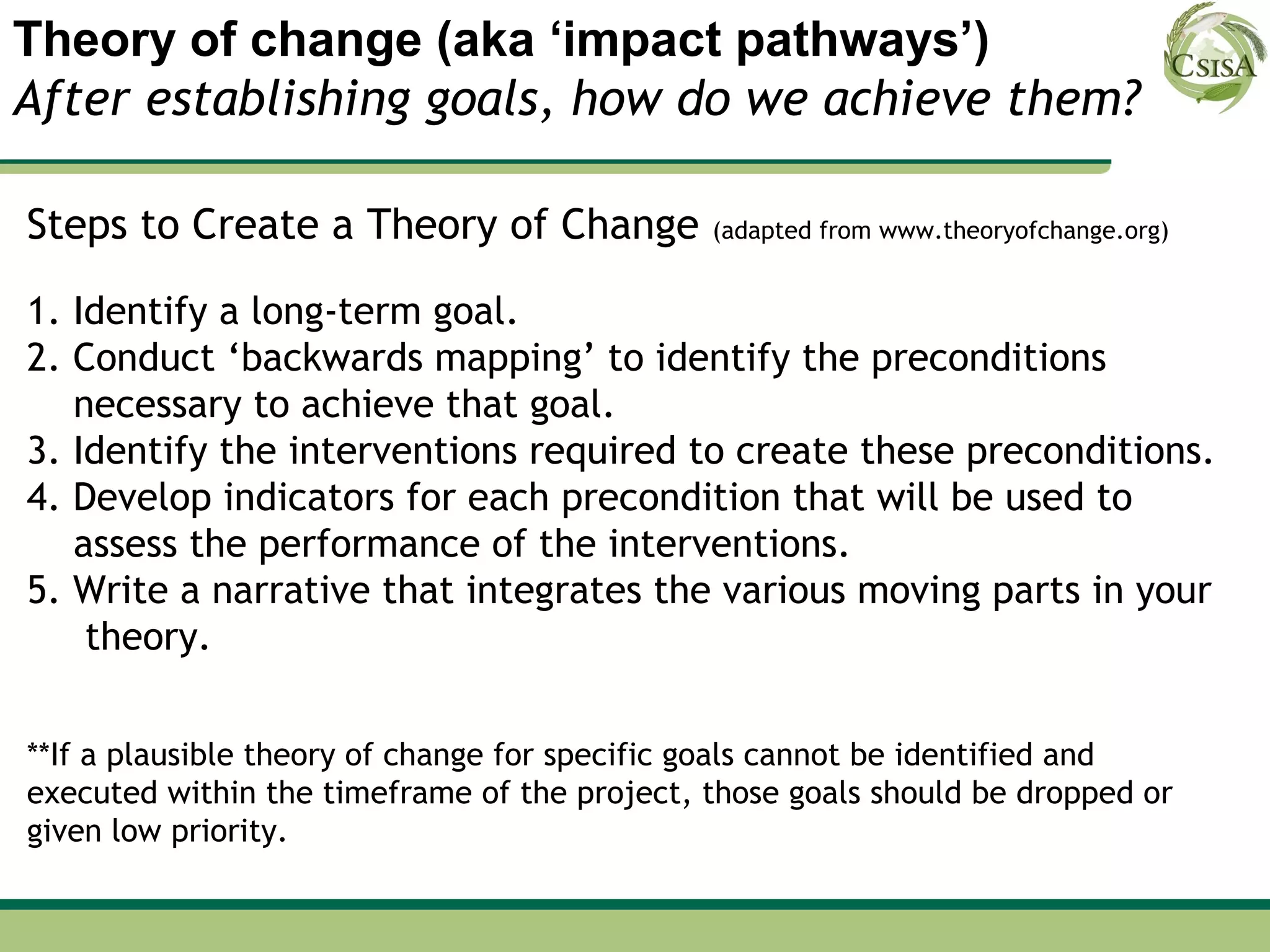
Theory of change (aka ‘impact pathways’)
After establishing goals, how do we achieve them?

Steps to Create a Theory of Change            (adapted from www.theoryofchange.org)


1. Identify a long-term goal.
2. Conduct ‘backwards mapping’ to identify the preconditions
   necessary to achieve that goal.
3. Identify the interventions required to create these preconditions.
4. Develop indicators for each precondition that will be used to
   assess the performance of the interventions.
5. Write a narrative that integrates the various moving parts in your
    theory.

**If a plausible theory of change for specific goals cannot be identified and
executed within the timeframe of the project, those goals should be dropped or
given low priority.
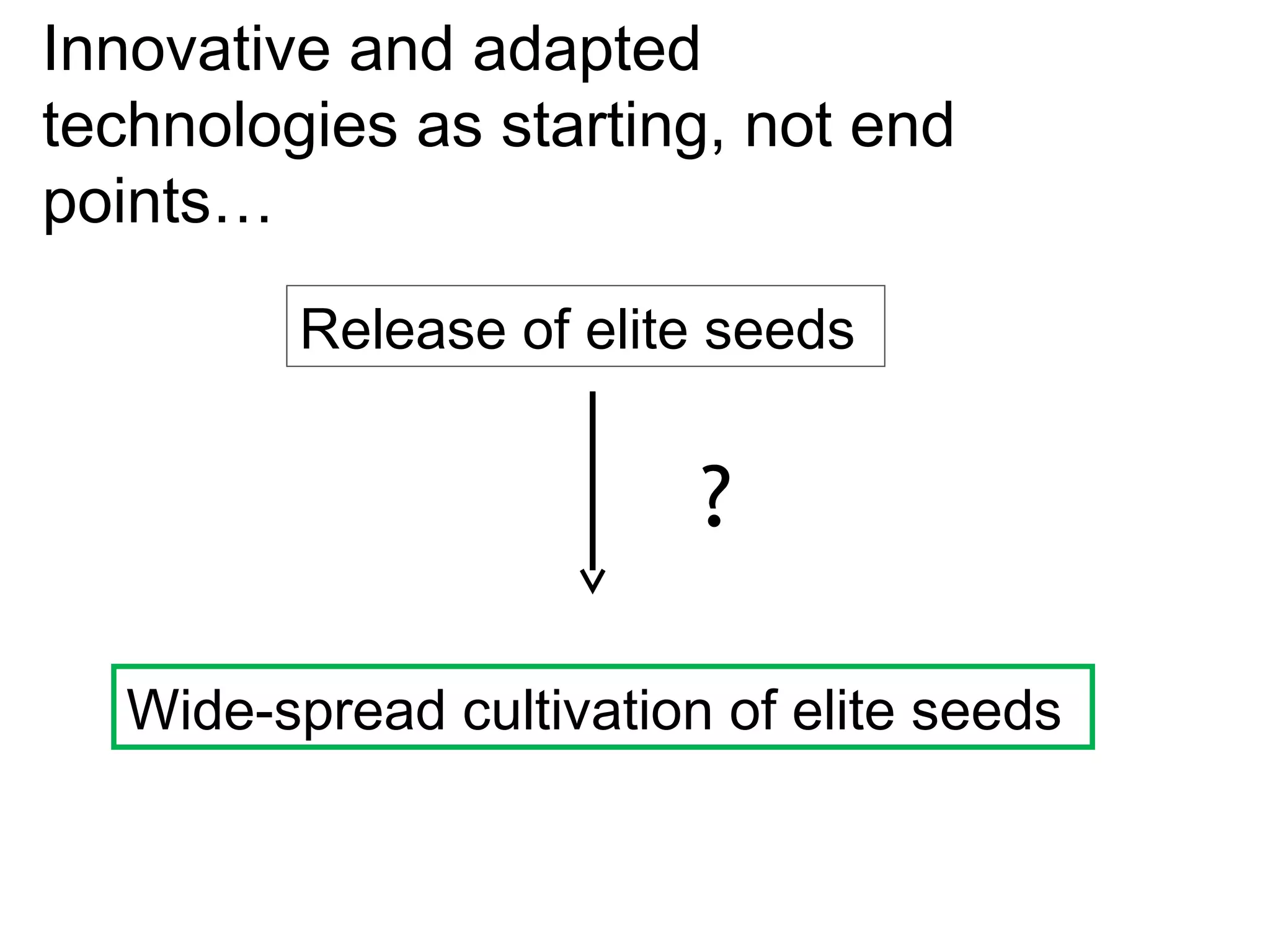
Innovative and adapted
technologies as starting, not end
points…
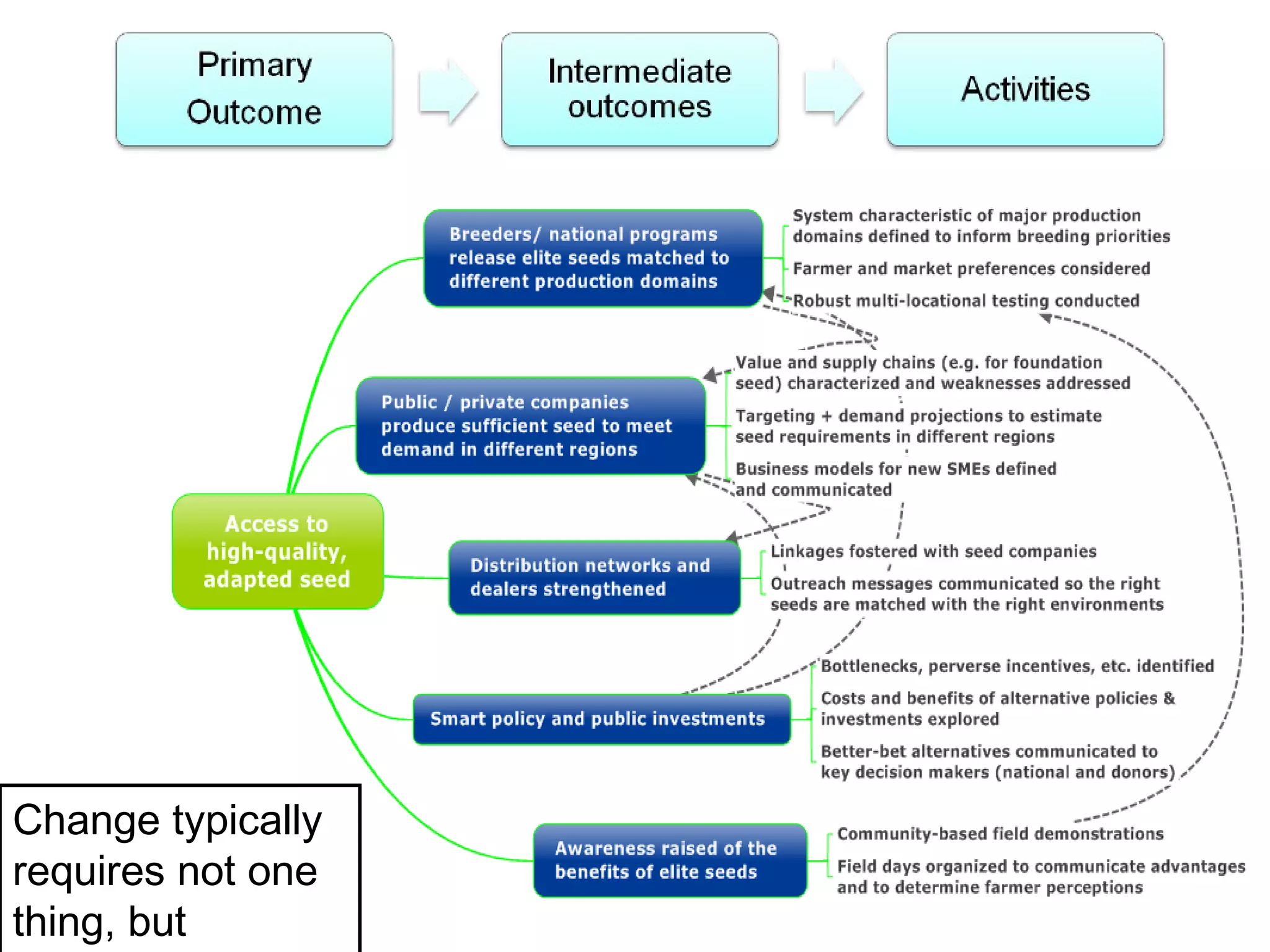
          Release of elite seeds


                          ?

   Wide-spread cultivation of elite seeds
Change typically
requires not one
thing, but
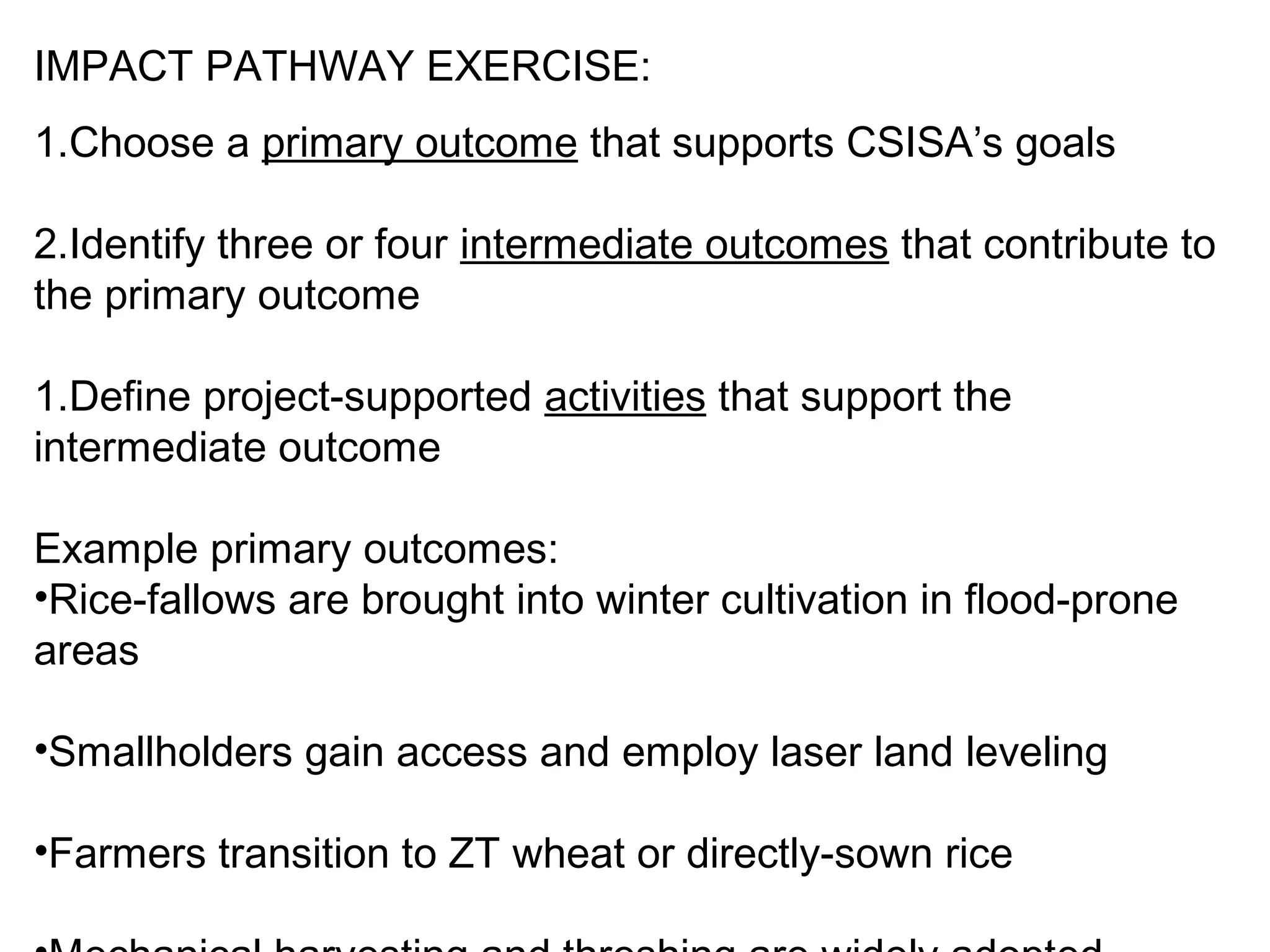
IMPACT PATHWAY EXERCISE:
1.Choose a primary outcome that supports CSISA’s goals

2.Identify three or four intermediate outcomes that contribute to
the primary outcome

1.Define project-supported activities that support the
intermediate outcome

Example primary outcomes:
•Rice-fallows are brought into winter cultivation in flood-prone
areas

•Smallholders gain access and employ laser land leveling

•Farmers transition to ZT wheat or directly-sown rice
Thank You

MANY ROADBLOCKS….           BUT PLENTY OF INGENUITY

Csisa obj 1 wp.ktm.jan.13

  • 1.
    CSISA Objective 1: Orientationand Planning Meeting Kathmandu, Nepal January 23, 24, and 25th, 2013
  • 2.
    Meeting Objectives 1. Familiarizeteam with CSISA philosophy, thematic focus, and each other. 2. Bring forward new thinking and partnership opportunities 3. Refine key objectives and activities for Bihar / EUP + Odisha 4. Coordinate activities around integrated ‘impact pathways’ and set priorities accordingly (weighted now towards kharif) 5. Translate impact pathway logic to achievable work plans with clearly defined activities, milestones, and responsibilities 6. Review strategy for M&E, data mng., and
  • 3.
    Cereal Systems Initiativefor South Asia Project Goal: To increase food, nutrition, and income security at scale in South Asia through sustainable intensification of cereal- based systems Four countries: Bangladesh, India, Nepal, Pakistan Duration: Phase I: 2009-12; Phase II: 2012-15 •Donor-driven shift in priorities in Phase II to Bihar / EUP, Odisha, and Bangladesh •Transition support for Phase I hubs in Punjab, Haryana, and TN.
  • 4.
    The I PAc ha lle ng e : c a ta ly z ing d ura ble M CT c ha ng e with m illio ns o f s m a ll a nd m e d ium - s c a le fa rm e rs CSISA’s 10-year vision of success aims to increase the incomes of 6 million farm families by $350 pa by 2018 through widespread adoption of efficient and productive agronomic practices, marked increases in the cultivation of high-yielding and stress-tolerant cereal cultivars, better access to information, and progressive policies and strengthened markets that stimulate the same with results-oriented public and private investments. In Phase II, CSISA remains committed to its original 10-year target of assisting millions of farmers to achieve a substantial increase in yield and profitability. …the project endeavors to reach 2 million farm families by the end of Phase II.
  • 5.
    CSISA: A ‘bigtent’ initiative I g ra ting d is c ip line s a nd o rg a niz a tio ns nte • Participatory development of sustainable, productive, and profitable agricultural technologies + support services and knowledge systems (Objective 1) • Future-oriented process-based research (Objective 2) • Breeding for high-yielding and stress-tolerant cereal varieties (Objective 3 and 4) • Policy analysis and evidence-based ‘road maps’ (Objective 5) • Strategic partnerships (public + private sectors) to increase the scale and longevity of interventions • Strengthen markets and business development, especially SMEs. • Capacity development through training and mentorship
  • 6.
    What distinguishes CSISA: oc c up y ing the ‘m e s s y m id d le ’, s c ie nc e -le d + o utc o m e s o rie nte d Top-down focus on research + technologies (little impact) CSISA works to bridge the best of both approaches Bottom-up focus on community engagement (don’t scale + inappropriate tech)
  • 7.
    Ag transformation canbe accelerated… Agronomic Revolution The rice revolution in South America (management gain 2 t / ha, ) Variety revolution (semi-dwarfs – 2 t / ha) 350 new varieties released Yield ton/ha Peter Jennings, FLAR, 2005 Creation of FLAR .......................1968 1995 2002......................
  • 8.
    Wide-spread resource degradation Fragmentedland-holdings Erratic climate systems Poor market linkages Labor shortages Diverse set of production challenges and drivers of change.
  • 9.
    CSISA technical Water Labor Soil Climate Yield Profitability productivity scarcity degradation resilience entry points Conservation *** ** *** *** * *** agriculture (CA) Site-specific nutrient ** ** ** *** management Scale-appropriate *** ** ** ** *** mechanization Laser land leveling *** * * *** Elite germplasm ** ** *** ** System intensification * ** *** *** (more crops/yr) Post-harvest storage *** Improved livestock ** *** *** feeding Strengthened * * ** ** ** seed systems
  • 10.
    NOVATION + DURABLEPRODUCTS + SUPPORT TO CHANGE AGEN OPERATIONAL MODEL FOR GOING TO SCALE IN CSISA PHASE II
  • 11.
    Axioms for successin Objective 1 •There is no universal template for agricultural development •Blending scientific rigor with participatory, demand-lead approaches to technology development is a must. •Technologies alone are typically insufficient (markets, capital, risk, communications …).
  • 12.
    What’s CSISA isn’t •An asset transfer scheme • A competitor with the national research programs • A substitute for the formal extension system CSISA works to complement partners and to unite them towards common goals… a ‘catalyst’ for change.
  • 13.
  • 14.
    Constituents of change tocatalzye the adoption of innovative technologies
  • 15.
    How do technologiesmove? sResearcher developed ’ technologies e ry e liv ‘d Farmer adoption The status quo isn’t good enough….
  • 16.
    1. Non-technological barriers Laserland leveling and needs-based irrigation can reduce irrigation water use for rice….. or = BUT… Current market signals and business models are often not aligned with conservation and constrain adoption of
  • 17.
    2. Supporting innovationwith commercially- available tools Out-migration, difficult Seeder for mobile terrain in Nepal hills ‘garden-type’ roto-tiller Public-private partnerships Excess rice residue and ‘Turbo happy seeder’ for air pollution in Punjab heavy residues
  • 18.
    3. Getting themessage right Increase net profitability of $100 - $250 ha -1 for wheat. Courtesy Dr. Kamboj, Haryana Sustainability’ doesn’t sell (fortunately, it doesn’t have to)
  • 19.
    4. Taking cuesfrom the private sector: raising awareness with social marketing and media campaigns
  • 20.
    5. Utilizing modernICTs fo r e ffic ie nt kno wle d g e d is s e m ina tio n a nd s ite -s p e c ific m a na g e m e nt 1. Acquire field-specific information from Web Smartphon farmers e 2. Compute field- Model hosted specific guideline on the cloud 3. Provide customized field-specific Multi- guidelines in local format language output Courtesy of Roland Buresh, IRR
  • 21.
    6. Making polices‘smart’ to spur investment Rice-wheat yield (t ha-1) 12.0 Laser Tradition al 11.8 11.6 11.4 Source: H. Sidhu, CSISA/Ludhiana 11.2 11.0 10.8 10.6 10.4 10.2 10.0 Yr - 1 Yr - 2 Yield gains with significant savings of water (~20%) and diesel for pumping ($25 ha-1) under gravity-controlled irrigation management Market segmentation / willingness to pay studies to improve the design and efficacy of policies programs….
  • 22.
    7. Understanding howfarmers innovate What information and services are valued, actionable, and profitable? Literacy / numeracy: how must information be conveyed? When must it be provided? Opportunity costs? Uncertainty? Risk? …..
  • 23.
    8. Value chaininterventions for strengthening input and output markets (when needed) Great crop, but where does he sell it?
  • 24.
    9. Strengthening thecapacity of change agents that already reach large numbers of farmers ti’ ak ‘Sh ler Dea miting the role of project-based social mobilization, and increasing the icacy of government investments through PPPs (and public-public to
  • 25.
    10. Democratizing technologyaccess through custom services and new entrepreneurs Service providers are the primary training target for many CSISA- supported technologies, not famers directly. Simplifies training burden (reaching thousands to affect millions) Reduces $ barriers to innovation
  • 26.
    11. Aligning withother initiatives We can’t ‘go it alone’ But, one strong partnership is worth 100 mediocre ones And, dysfunctional partnerships are negative equity…. aking advantage of the investments, community presence, and socia mobilization of other programs. Including our own (e.g. STRASA)
  • 27.
  • 28.
    Theory of change(aka ‘impact pathways’) After establishing goals, how do we achieve them? Steps to Create a Theory of Change (adapted from www.theoryofchange.org) 1. Identify a long-term goal. 2. Conduct ‘backwards mapping’ to identify the preconditions necessary to achieve that goal. 3. Identify the interventions required to create these preconditions. 4. Develop indicators for each precondition that will be used to assess the performance of the interventions. 5. Write a narrative that integrates the various moving parts in your theory. **If a plausible theory of change for specific goals cannot be identified and executed within the timeframe of the project, those goals should be dropped or given low priority.
  • 29.
    Innovative and adapted technologiesas starting, not end points… Release of elite seeds ? Wide-spread cultivation of elite seeds
  • 30.
  • 31.
    IMPACT PATHWAY EXERCISE: 1.Choosea primary outcome that supports CSISA’s goals 2.Identify three or four intermediate outcomes that contribute to the primary outcome 1.Define project-supported activities that support the intermediate outcome Example primary outcomes: •Rice-fallows are brought into winter cultivation in flood-prone areas •Smallholders gain access and employ laser land leveling •Farmers transition to ZT wheat or directly-sown rice
  • 32.
    Thank You MANY ROADBLOCKS…. BUT PLENTY OF INGENUITY

Editor's Notes

  • #8 Predicated on the proposition that step-changes are possible.
  • #16 If it was this easy, we wouldn’t face the types of Food security and livelihoods challenges that we have (and we wouldn’t need projects like CSISA)
  • #19 The importance of messaging…..
  • #20 Travelling road show and equipment demo in Bangladesh
  • #21 But recommendations need to be timely, actionable, and relevant. Emphasizing function as well as form….
  • #24 Jeevika, state department, dealers, etc.
  • #25 Jeevika, state department, dealers, etc.
  • #26 Jeevika, state department, dealers, etc.
  • #27 Jeevika, state department, dealers, etc. Looking for linkage points with other initiative (like STRASA), and not re-inventing the wheel.  Embracing innovation from many source…  CSISA-supported technologies, not CSISA technologies.
  • #28 End, don’t start, with a logical set of technological interventions. Prioritize areas with biggest scope for payoff…. Learn with time and experience. What is ‘participatory’ work anyway – beyond working in FF - listening and engaging with farmers – demand driven and opportunistic - no ‘one size’ solutions
  • #29 But is
  • #31 Contrast to Phase I
  • #32 Overarching objective, goals, primary outcomes, intermediate outcomes, activities
  • #33 And willingness to take risk…