New initiatives in the context
     of Agriculture Development
      Strategy for eleventh plan

                             UPPING THE ANTE


Department of Agriculture & Cooperation        Mukesh Khullar
Ministry of Agriculture                        Joint Secretary
Government of India
New Initiatives

 Strengthening Pulses Production Programs
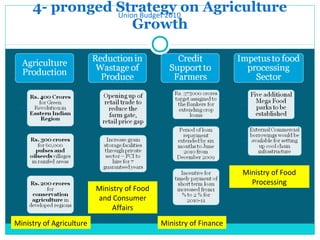
 Four pronged strategy on Agriculture Growth in the Budget
  2009-10
     Agriculture Production
     Food Processing
     Credit
     Reducing Wastage of produce
 Nutrient Based Subsidy effective from April 1, 2010 (Fertilizers
  and Chemicals)
 Rs. 100 crores for ‘Mahila Kisan Sashaktikaran Yojana’ as a sub
  component of National Rural Livelihood Mission (Rural
  Development)
 Additional Central Assistance of Rs. 1200 crores to
  Bundelkhand for drought mitigation (Rural Development)
Tax Concessions
 Modernizing Mandis or warehousing
     Concessional import duty of 5 % and service tax exemption for mechanised
      handling of food grains and sugar in Mandis
     Central excise and service tax exemption to specified equipment for storage and
      warehousing of agriculture products
 Promoting Cold chain infrastructure
     Concessional customs duty of 5 % with full exemption from service tax to setting up of
      Cold storage facilities and Processing units for such produce.
     Provide full exemption from customs duty to refrigeration units required for the
      manufacture of refrigerated vans or trucks
 Promoting Farm Mechanization
     Concessional customs duty of 5 per cent to specified agricultural machinery not
      manufactured in India;
     Full exemption from excise duty to trailers and semi-trailers used in
      agriculture.
 Transportation of produce
     The transportation by road of cereals, and pulses to be exempted from service tax.
      Transportation by rail to remain exempt.
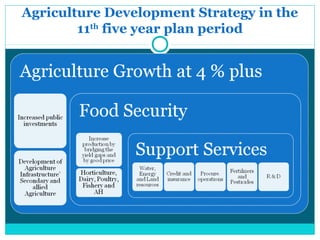
Agriculture Development Strategy in the
        11th five year plan period
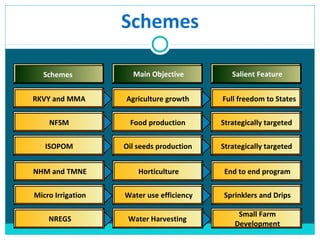
Schemes

  Schemes            Main Objective          Salient Feature


RKVY and MMA       Agriculture growth     Full freedom to States

    NFSM            Food production       Strategically targeted

   ISOPOM          Oil seeds production   Strategically targeted


NHM and TMNE           Horticulture        End to end program

Micro Irrigation   Water use efficiency   Sprinklers and Drips

                                               Small Farm
    NREGS           Water Harvesting
                                              Development
Key Challenges

 Sustained higher production levels of food grains
     More focused working especially for pulses
 Regional disparity
     Widening the food basket
     Broad basing the risks of crop failure due to climatic variability
 Rainfed area development
     Convergence – mechanism for horizontal working?
     Watershed management – Large scale replication of good models?
 Risk mitigation for Climatic variability
     Integrated farming system for diversifying farm portfolio – horticulture, fisheries, dairy
      etc. Wadi project of NABARD, Livelihood projects of World Bank?
     Seed Rolling Production Plans for quantity of needed varieties– Seeds Mission?
     Conservation Agriculture – National Mission on Sustainable Agriculture?
     Effective innovative weather based Insurance products – savings linked crop insurance?
     Increased buffer stocks for food grains – grain storage grid?
 Efficient marketing supply chain
     Scientific storage and management – fungible warehousing receipts?
     Processing – private investments, logistics management?
     Direct marketing – credible contract farming mechanism?
4- pronged Strategy on Agriculture
                Union Budget 2010
                    Growth


                                                                   Ministry of Food
                                                                     Processing
                          Ministry of Food
                          and Consumer
                              Affairs
Ministry of Agriculture                      Ministry of Finance
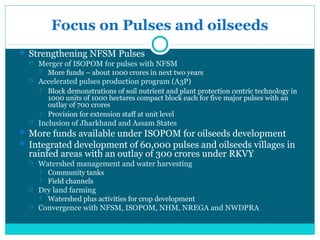
Focus on Pulses and oilseeds
 Strengthening NFSM Pulses
   Merger of ISOPOM for pulses with NFSM
         More funds – about 1000 crores in next two years
     Accelerated pulses production program (A3P)
         Block demonstrations of soil nutrient and plant protection centric technology in
          1000 units of 1000 hectares compact block each for five major pulses with an
          outlay of 700 crores
         Provision for extension staff at unit level
     Inclusion of Jharkhand and Assam States
 More funds available under ISOPOM for oilseeds development
 Integrated development of 60,000 pulses and oilseeds villages in
  rainfed areas with an outlay of 300 crores under RKVY
     Watershed management and water harvesting
         Community tanks
         Field channels
     Dry land farming
         Watershed plus activities for crop development
     Convergence with NFSM, ISOPOM, NHM, NREGA and NWDPRA
Next Steps for A3P
 Prepare an action plan as per the guidelines for
  implementing A3P from April 2010
     Identification of beneficiaries and units among villages
     Preparing unit wise district level plans
 Ensure supply of gypsum and plant protection chemicals to
  identified beneficiaries through the designated agencies
 Engage extension staff for unit level positioning and impart
  an orientation training
     KVKs could be actively associated
 Capacity building for pest monitoring and pest surveillance
  by NCIPM
 Modalities for implementing integrated development of
  60,000 pulses and oilseeds villages being worked out
Inter State Productivity Gaps

   Rice                                       Production in (‘000) tons       Yield in kg/ha
                                                                              2003-04 to
                            2003-04          2007-08         2008-09*          2007-08
     State       CAGR
                                                                           Normal Max
                        Production Yield Production Yield Production Yield
                                                                            Yield   Yield
West Bengal        0.69    14662.3 2504     14719.5 2573     15554.0 2646     2550     2593
Andhra Pradesh     2.67     8953.0 3009     13324.0 3344     14207.0 3247     3080     3344
Uttar Pradesh     -1.45    13018.8 2187     11780.0 2063     13074.0 2171     1986     2187
Punjab             2.13     9656.0 3694     10489.0 4019     11000.0 4022     3876     4019
Orissa             3.15     6733.7 1496      7540.7 1694      6762.0 1520     1540     1694
Bihar             -5.07     5447.8 1523      4418.1 1237      5668.7 1610     1233     1523
Tamil Nadu         5.11     3222.8 2308      5040.2 2817      5201.0 2510     2783     3423
Chattisgarh       -0.14     5567.6 1454      5426.6 1446      4391.8 1176     1353     1454
Assam             -1.77     3880.0 1534      3319.0 1428      3775.0 1720     1448     1534
Karnataka          2.54     2550.3 2375      3717.0 2625      3690.0 2434     2846     3868
Jharkhand          4.45     2310.0 1695      3336.4 2018      3304.9 1947     1628     2018
Haryana            5.16     2790.0 2749      3613.0 3361      3298.0 2726     3072     3361
Maharashtra        0.67     2835.0 1853      2996.0 1903      2311.0 1506     1729     1903
All India
                  1.45       88526.0 2078        96692.9 2202     99153.7 2186     2101       2202
CAGR**            1.05                                                                     
Eastern Region Development

 Additional Rs. 400 crores provided for the agriculture
  development in Eastern Region comprising of Eastern UP,
  Chhattisgarh, Jharkhand, Bihar, Orissa, West Bengal
 Funds would be released under RKVY. States are expected to
  prepare an action plan containing the following points
     Identification of key technologies, constraints in development and inter se
      priority for implementation for visible impact
     Situation report on current initiatives, preparation of multi year strategy
      for agriculture development in sync with the DAPs by pooling the resources
      from State plan, and convergence with other ongoing schemes
     Preparation of projects to implement the strategy in a budget proposal
      worked out by each State
     Allocation of budget for each State as per the proposal and approval of
      projects within an overall budget allocated for each State
     Mechanism for regular monitoring of the progress of implementation of the
      projects
 Detailed set of instructions would be prepared in consultation
  with the States for implementation from the Rabi season
Agri eco Zone wise Regional Strategy

 Lower Gangetic Plains Region            Middle Gangetic Plains Region
(WB other than Purulia and hill districts)     (Eastern U.P. and Bihar)
•   Basically a rice mono cropped area            •   Rice, wheat, sugarcane are the major
•   Increasing the cropping intensity by              crops. However, productivity is low.
    utilizing Rabi fallows after harvest of       •   Popularisation of Short duration high
    Kharif rice by promoting the cultivation of
                                                      yielding varieties/hybrids of rice.
    pulses and oilseeds
                                                  •   Promotion      of    maize      cultivation
•   Diversification of upland rice areas
                                                      especially in Rabi as it has high
    which are less productive to suitable
                                                      potential
    crops like pulses, oilseeds and millets.
                                                  •   Promotion of early maturing varieties
•   Development of on-farm irrigation
                                                      of sugarcane for higher sugar recovery
    resources through exploitation of
    ground water potential which is
                                                  •   Development of on-farm irrigation
    abundant.                                         resources thorough exploitation of
                                                      ground water potential
•   Improving subsurface soil drainage
                                                  •   Cattle rearing, poultry, goat rearing
                                                      and fish farming as an off farm activity.
Agri eco zone wise Regional Strategy

Eastern Plateau & Hills Region (Parts               East Coast Plains & Hills
of Orissa, Jharkhand, Chhattisgarh)                         (Part of Orissa)

 •   Management         of     rainwater     •   Rice is the lead crop in this zone.
     harvesting     and    storage     for       However, the productivity is low.
     increasing crop productivity                High yielding varieties for water
 •   Promotion      of   High    yielding        logged areas and upland areas
     varieties/hybrids especially that of        needs to be propagated
     rice                                    •   Discouraging the cultivation of rice
 •   Expansion of area under High                in marginal lands and diversifying
     value cash crops and vegetables             in favour of oilseeds and pulses
 •   Improvement in seed supply so as        •   Utilization of rice fallows for
     to increase the SRR                         increasing the cropping intensity.
 •   Improvement in productivity of          •   Rice-fish culture
     crops in acidic soils through lime      •   Improving soil drainage
     treatment
Sum up

Emphasis on Pulses through revamped
 programmatic interventions and prevailing good
 market price should help in achievement of
 production targets of pulses
Focus on Eastern Region that has huge potential
 would help macro level stability of agriculture
 production
Enabling policies on market development would
 bring in private investments for value addition to the
 harvests and efficiency gains in supply chain
New initiatives Better targeting
    and delivery of services

         IMPLEMENTATION IS THE KEY


              Thanks !!
              khullar.m@nic.in

Mukesh khullar

  • 1.
    New initiatives inthe context of Agriculture Development Strategy for eleventh plan UPPING THE ANTE Department of Agriculture & Cooperation Mukesh Khullar Ministry of Agriculture Joint Secretary Government of India
  • 2.
    New Initiatives  StrengtheningPulses Production Programs  Four pronged strategy on Agriculture Growth in the Budget 2009-10  Agriculture Production  Food Processing  Credit  Reducing Wastage of produce  Nutrient Based Subsidy effective from April 1, 2010 (Fertilizers and Chemicals)  Rs. 100 crores for ‘Mahila Kisan Sashaktikaran Yojana’ as a sub component of National Rural Livelihood Mission (Rural Development)  Additional Central Assistance of Rs. 1200 crores to Bundelkhand for drought mitigation (Rural Development)
  • 3.
    Tax Concessions  ModernizingMandis or warehousing  Concessional import duty of 5 % and service tax exemption for mechanised handling of food grains and sugar in Mandis  Central excise and service tax exemption to specified equipment for storage and warehousing of agriculture products  Promoting Cold chain infrastructure  Concessional customs duty of 5 % with full exemption from service tax to setting up of Cold storage facilities and Processing units for such produce.  Provide full exemption from customs duty to refrigeration units required for the manufacture of refrigerated vans or trucks  Promoting Farm Mechanization  Concessional customs duty of 5 per cent to specified agricultural machinery not manufactured in India;  Full exemption from excise duty to trailers and semi-trailers used in agriculture.  Transportation of produce  The transportation by road of cereals, and pulses to be exempted from service tax. Transportation by rail to remain exempt.
  • 4.
    Agriculture Development Strategyin the 11th five year plan period
  • 5.
    Schemes Schemes Main Objective Salient Feature RKVY and MMA Agriculture growth Full freedom to States NFSM Food production Strategically targeted ISOPOM Oil seeds production Strategically targeted NHM and TMNE Horticulture End to end program Micro Irrigation Water use efficiency Sprinklers and Drips Small Farm NREGS Water Harvesting Development
  • 6.
    Key Challenges  Sustainedhigher production levels of food grains  More focused working especially for pulses  Regional disparity  Widening the food basket  Broad basing the risks of crop failure due to climatic variability  Rainfed area development  Convergence – mechanism for horizontal working?  Watershed management – Large scale replication of good models?  Risk mitigation for Climatic variability  Integrated farming system for diversifying farm portfolio – horticulture, fisheries, dairy etc. Wadi project of NABARD, Livelihood projects of World Bank?  Seed Rolling Production Plans for quantity of needed varieties– Seeds Mission?  Conservation Agriculture – National Mission on Sustainable Agriculture?  Effective innovative weather based Insurance products – savings linked crop insurance?  Increased buffer stocks for food grains – grain storage grid?  Efficient marketing supply chain  Scientific storage and management – fungible warehousing receipts?  Processing – private investments, logistics management?  Direct marketing – credible contract farming mechanism?
  • 7.
    4- pronged Strategyon Agriculture Union Budget 2010 Growth Ministry of Food Processing Ministry of Food and Consumer Affairs Ministry of Agriculture Ministry of Finance
  • 8.
    Focus on Pulsesand oilseeds  Strengthening NFSM Pulses  Merger of ISOPOM for pulses with NFSM  More funds – about 1000 crores in next two years  Accelerated pulses production program (A3P)  Block demonstrations of soil nutrient and plant protection centric technology in 1000 units of 1000 hectares compact block each for five major pulses with an outlay of 700 crores  Provision for extension staff at unit level  Inclusion of Jharkhand and Assam States  More funds available under ISOPOM for oilseeds development  Integrated development of 60,000 pulses and oilseeds villages in rainfed areas with an outlay of 300 crores under RKVY  Watershed management and water harvesting  Community tanks  Field channels  Dry land farming  Watershed plus activities for crop development  Convergence with NFSM, ISOPOM, NHM, NREGA and NWDPRA
  • 9.
    Next Steps forA3P  Prepare an action plan as per the guidelines for implementing A3P from April 2010  Identification of beneficiaries and units among villages  Preparing unit wise district level plans  Ensure supply of gypsum and plant protection chemicals to identified beneficiaries through the designated agencies  Engage extension staff for unit level positioning and impart an orientation training  KVKs could be actively associated  Capacity building for pest monitoring and pest surveillance by NCIPM  Modalities for implementing integrated development of 60,000 pulses and oilseeds villages being worked out
  • 10.
    Inter State ProductivityGaps Rice Production in (‘000) tons Yield in kg/ha 2003-04 to 2003-04 2007-08 2008-09* 2007-08 State CAGR Normal Max Production Yield Production Yield Production Yield Yield Yield West Bengal 0.69 14662.3 2504 14719.5 2573 15554.0 2646 2550 2593 Andhra Pradesh 2.67 8953.0 3009 13324.0 3344 14207.0 3247 3080 3344 Uttar Pradesh -1.45 13018.8 2187 11780.0 2063 13074.0 2171 1986 2187 Punjab 2.13 9656.0 3694 10489.0 4019 11000.0 4022 3876 4019 Orissa 3.15 6733.7 1496 7540.7 1694 6762.0 1520 1540 1694 Bihar -5.07 5447.8 1523 4418.1 1237 5668.7 1610 1233 1523 Tamil Nadu 5.11 3222.8 2308 5040.2 2817 5201.0 2510 2783 3423 Chattisgarh -0.14 5567.6 1454 5426.6 1446 4391.8 1176 1353 1454 Assam -1.77 3880.0 1534 3319.0 1428 3775.0 1720 1448 1534 Karnataka 2.54 2550.3 2375 3717.0 2625 3690.0 2434 2846 3868 Jharkhand 4.45 2310.0 1695 3336.4 2018 3304.9 1947 1628 2018 Haryana 5.16 2790.0 2749 3613.0 3361 3298.0 2726 3072 3361 Maharashtra 0.67 2835.0 1853 2996.0 1903 2311.0 1506 1729 1903 All India 1.45 88526.0 2078 96692.9 2202 99153.7 2186 2101 2202 CAGR** 1.05                
  • 11.
    Eastern Region Development Additional Rs. 400 crores provided for the agriculture development in Eastern Region comprising of Eastern UP, Chhattisgarh, Jharkhand, Bihar, Orissa, West Bengal  Funds would be released under RKVY. States are expected to prepare an action plan containing the following points  Identification of key technologies, constraints in development and inter se priority for implementation for visible impact  Situation report on current initiatives, preparation of multi year strategy for agriculture development in sync with the DAPs by pooling the resources from State plan, and convergence with other ongoing schemes  Preparation of projects to implement the strategy in a budget proposal worked out by each State  Allocation of budget for each State as per the proposal and approval of projects within an overall budget allocated for each State  Mechanism for regular monitoring of the progress of implementation of the projects  Detailed set of instructions would be prepared in consultation with the States for implementation from the Rabi season
  • 12.
    Agri eco Zonewise Regional Strategy Lower Gangetic Plains Region Middle Gangetic Plains Region (WB other than Purulia and hill districts) (Eastern U.P. and Bihar) • Basically a rice mono cropped area • Rice, wheat, sugarcane are the major • Increasing the cropping intensity by crops. However, productivity is low. utilizing Rabi fallows after harvest of • Popularisation of Short duration high Kharif rice by promoting the cultivation of yielding varieties/hybrids of rice. pulses and oilseeds • Promotion of maize cultivation • Diversification of upland rice areas especially in Rabi as it has high which are less productive to suitable potential crops like pulses, oilseeds and millets. • Promotion of early maturing varieties • Development of on-farm irrigation of sugarcane for higher sugar recovery resources through exploitation of ground water potential which is • Development of on-farm irrigation abundant. resources thorough exploitation of ground water potential • Improving subsurface soil drainage • Cattle rearing, poultry, goat rearing and fish farming as an off farm activity.
  • 13.
    Agri eco zonewise Regional Strategy Eastern Plateau & Hills Region (Parts East Coast Plains & Hills of Orissa, Jharkhand, Chhattisgarh) (Part of Orissa) • Management of rainwater • Rice is the lead crop in this zone. harvesting and storage for However, the productivity is low. increasing crop productivity High yielding varieties for water • Promotion of High yielding logged areas and upland areas varieties/hybrids especially that of needs to be propagated rice • Discouraging the cultivation of rice • Expansion of area under High in marginal lands and diversifying value cash crops and vegetables in favour of oilseeds and pulses • Improvement in seed supply so as • Utilization of rice fallows for to increase the SRR increasing the cropping intensity. • Improvement in productivity of • Rice-fish culture crops in acidic soils through lime • Improving soil drainage treatment
  • 14.
    Sum up Emphasis onPulses through revamped programmatic interventions and prevailing good market price should help in achievement of production targets of pulses Focus on Eastern Region that has huge potential would help macro level stability of agriculture production Enabling policies on market development would bring in private investments for value addition to the harvests and efficiency gains in supply chain
  • 15.
    New initiatives Bettertargeting and delivery of services IMPLEMENTATION IS THE KEY Thanks !! khullar.m@nic.in

Editor's Notes

  • #6 Realizing the unique requirement of each district considering its agro climatic situation and disparate socio economic development, schematic interventions for technology promotion and agriculture infrastructure development has to be kept flexible so that the famers of any district can choose what is appropriate for them. We have also reduced the category of schemes broadly in three categories, Strategic like NFSM, ISOPOM looking at production of food commodities that have to be meet the National interest, Agriculture Infrastructure Schemes like Micro Irrigation, NHM and NREGS that build assets for supporting agriculture activities and Thirdly the Schemes like RKVY, MMA relating to general Agriculture Development that work to achieve the required growth rate. These schemes are decided by the States and are intended to take a holistic view of farm level integration of crops and allied sectors like animal husbandry etc.