Presenting One
Minute Manager


Supervisor, Do Thi Khanh Phuong
Agenda

 Overview of the One Minute
Manager (OMM) Book.
 Introduces the main contents of
OMM.
    One minute goals.
    One minute praisings.
    One minute reprimands.
 Summary
 Questions & Answers


                                    2
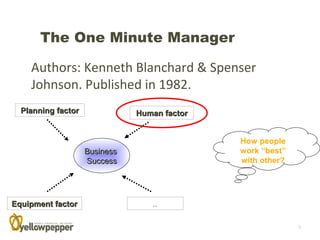
The One Minute Manager

    Authors: Kenneth Blanchard & Spenser
    Johnson. Published in 1982.
  Planning factor              Human factor


                                              How people
                    Business                  work “best”
                    Success                   with other?


Equipment factor                  ..

                                                            3
The One Minute Manager
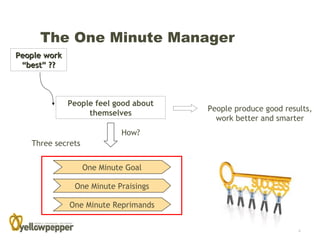
People work
 “best” ??


              People feel good about
                                       People produce good results,
                   themselves
                                         work better and smarter
                            How?
   Three secrets


                   One Minute Goal

               One Minute Praisings

              One Minute Reprimands


                                                               4
One Minute Goals

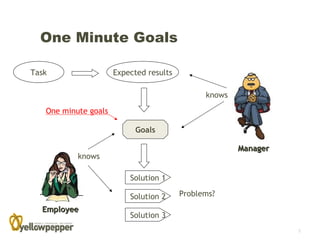
Task                  Expected results

                                               knows

   One minute goals

                            Goals

                                                       Manager
           knows

                          Solution 1

                          Solution 2     Problems?
  Employee
                          Solution 3
                                                                 5
One Minute Goals
• Purpose: employees know what their
  responsibilities (goals) for the manager’s expected
  results.
       Manager and employee have the same understanding on
      what goals they are working on => Review and check
  performance against the goals.
       Manager view: knows which goals should be done to
  accomplish the expected results.
       Employee view: knows his goals and try to resolve them
      according to the good performance of the manager.

  ** Good performance  What you would like it to be happening
  (conditions constraints)?


                                                           6
One Minute Goals
• How to make one minute goals?
  - Manager and employee agree on goals. They should be
  printed and kept by both for review.
  - Goals should not exceed one page – no more than 250
  words
  - Goals should be clear and concise
  - 80/20 Rule – 80% of your results will come from 20%
  your goals. So, the One minute goals focus on 20%.


                                                      7
One Minute Goals
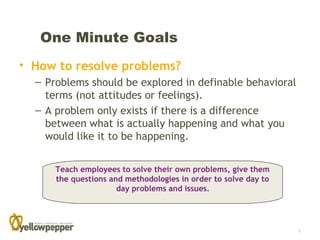
• How to resolve problems?
  – Problems should be explored in definable behavioral
    terms (not attitudes or feelings).
  – A problem only exists if there is a difference
    between what is actually happening and what you
    would like it to be happening.


      Teach employees to solve their own problems, give them
      the questions and methodologies in order to solve day to
                      day problems and issues.


                                                                 8
One Minute Goals

• Some questions / ideas for discussions:
  1/ How to identify goals? The goals will be based on
    the knowledge of both manager and employee.
  2/ 80-20% Rule is correct for IT field?
  3/ Good performance is not only from manager, is it
    also from employees’ recommendation?.


                                                         9
One Minute Praisings
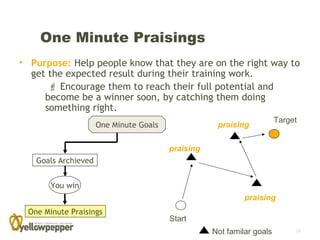
• Purpose: Help people know that they are on the right way to
  get the expected result during their training work.
       Encourage them to reach their full potential and
     become be a winner soon, by catching them doing
     something right.
                                                                       Target
                     One Minute Goals               praising

                                        praising
   Goals Archieved


       You win
                                                            praising
 One Minute Praisings
                                        Start
                                                   Not familar goals        10
One Minute Praisings
• How to make one minute praisings?
  - Tell people how good you feel about what they did right,
  and how it helps the organization and other people who work
  there:
       + As soon as possible.
       + Brief but sincere.
       + Be consistent.
  - Shake hands or touch people in a way to show your support
  and standing on the same side. Then, stop for a moment of
  silence to let them “self-feeling” how good you feel.
  - Apply 1 minute praisings:
       => When people first training work or begin new project
  or responsibility.
       => Periodically we zap them just to keep them moving.

                                                            11
One Minute Praisings
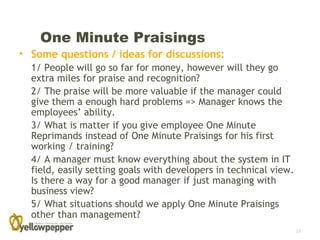
• Some questions / ideas for discussions:
  1/ People will go so far for money, however will they go
  extra miles for praise and recognition?
  2/ The praise will be more valuable if the manager could
  give them a enough hard problems => Manager knows the
  employees’ ability.
  3/ What is matter if you give employee One Minute
  Reprimands instead of One Minute Praisings for his first
  working / training?
  4/ A manager must know everything about the system in IT
  field, easily setting goals with developers in technical view.
  Is there a way for a good manager if just managing with
  business view?
  5/ What situations should we apply One Minute Praisings
  other than management?
                                                                   12
One Minute Reprimands
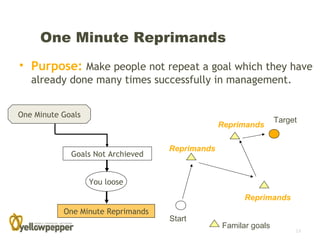
• Purpose: Make people not repeat a goal which they have
   already done many times successfully in management.


One Minute Goals
                                                                Target
                                                Reprimands

                                   Reprimands
             Goals Not Archieved


                   You loose
                                                      Reprimands
           One Minute Reprimands
                                   Start
                                                Familar goals
                                                                     13
One Minute Reprimands
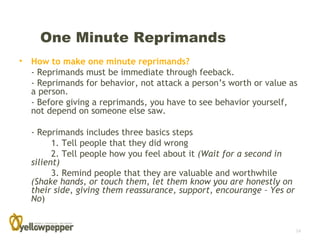
• How to make one minute reprimands?
  - Reprimands must be immediate through feeback.
  - Reprimands for behavior, not attack a person’s worth or value as
  a person.
  - Before giving a reprimands, you have to see behavior yourself,
  not depend on someone else saw.

  - Reprimands includes three basics steps
        1. Tell people that they did wrong
        2. Tell people how you feel about it (Wait for a second in
  silient)
        3. Remind people that they are valuable and worthwhile
  (Shake hands, or touch them, let them know you are honestly on
  their side, giving them reassurance, support, encourange – Yes or
  No)


                                                                      14
One Minute Reprimands
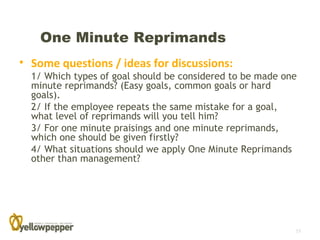
• Some questions / ideas for discussions:
  1/ Which types of goal should be considered to be made one
  minute reprimands? (Easy goals, common goals or hard
  goals).
  2/ If the employee repeats the same mistake for a goal,
  what level of reprimands will you tell him?
  3/ For one minute praisings and one minute reprimands,
  which one should be given firstly?
  4/ What situations should we apply One Minute Reprimands
  other than management?


                                                           15
Summary
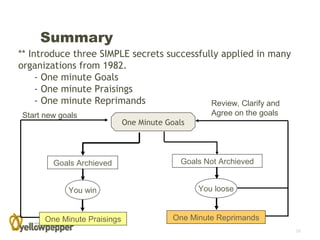
** Introduce three SIMPLE secrets successfully applied in many
organizations from 1982.
     - One minute Goals
     - One minute Praisings
     - One minute Reprimands                Review, Clarify and
Start new goals                                    Agree on the goals
                             One Minute Goals


        Goals Archieved                     Goals Not Archieved


            You win                             You loose


      One Minute Praisings                One Minute Reprimands
                                                                        16
Summary
** A new management way : give yourself and
others “The Gift” of getting greater results in
less time.
    - Set GOALs => PRAISE & REPRIMAND
Behaviors => Encourage people.
    - Speak the truth, laugh, work and enjoy.
    - Encourage the people you work with to do
    the same as you do.

 Most managers do not manage this way.

                                                  17
Summary
People are not wild animal.
People are more complicated.
They are aware, they think
for themselves and they
certainly don’t want to be
manipulated by another
person.

Remember that and respect
that.

                               18
References
1/ One Minute Manager ebook in VietNamese,
   http://www.infoworldschool.com/hostfile/Vi%20Giam%20Doc
   %20Mot%20Phut.pdf

2/ One Minute Manager ebook in English,
   http://www.kantakji.com/fiqh/files/manage/900.pdf

3/ One Minute Management Techniques,
   http://www.slideshare.net/sanjayrajthilak/one-minute-
   management-techniques

4/ Interview Ken Blanchard on The One Minute Manager,
   http://leadersin.com/programmes/ken-blanchard-on-the-
   one-minute-manager


                                                             19
Question & Answer


                    20

One minute manager

  • 1.
  • 2.
    Agenda  Overview ofthe One Minute Manager (OMM) Book.  Introduces the main contents of OMM.  One minute goals.  One minute praisings.  One minute reprimands.  Summary  Questions & Answers 2
  • 3.
    The One MinuteManager Authors: Kenneth Blanchard & Spenser Johnson. Published in 1982. Planning factor Human factor How people Business work “best” Success with other? Equipment factor .. 3
  • 4.
    The One MinuteManager People work “best” ?? People feel good about People produce good results, themselves work better and smarter How? Three secrets One Minute Goal One Minute Praisings One Minute Reprimands 4
  • 5.
    One Minute Goals Task Expected results knows One minute goals Goals Manager knows Solution 1 Solution 2 Problems? Employee Solution 3 5
  • 6.
    One Minute Goals •Purpose: employees know what their responsibilities (goals) for the manager’s expected results.  Manager and employee have the same understanding on what goals they are working on => Review and check performance against the goals.  Manager view: knows which goals should be done to accomplish the expected results.  Employee view: knows his goals and try to resolve them according to the good performance of the manager. ** Good performance  What you would like it to be happening (conditions constraints)? 6
  • 7.
    One Minute Goals •How to make one minute goals? - Manager and employee agree on goals. They should be printed and kept by both for review. - Goals should not exceed one page – no more than 250 words - Goals should be clear and concise - 80/20 Rule – 80% of your results will come from 20% your goals. So, the One minute goals focus on 20%. 7
  • 8.
    One Minute Goals •How to resolve problems? – Problems should be explored in definable behavioral terms (not attitudes or feelings). – A problem only exists if there is a difference between what is actually happening and what you would like it to be happening. Teach employees to solve their own problems, give them the questions and methodologies in order to solve day to day problems and issues. 8
  • 9.
    One Minute Goals •Some questions / ideas for discussions: 1/ How to identify goals? The goals will be based on the knowledge of both manager and employee. 2/ 80-20% Rule is correct for IT field? 3/ Good performance is not only from manager, is it also from employees’ recommendation?. 9
  • 10.
    One Minute Praisings •Purpose: Help people know that they are on the right way to get the expected result during their training work.  Encourage them to reach their full potential and become be a winner soon, by catching them doing something right. Target One Minute Goals praising praising Goals Archieved You win praising One Minute Praisings Start Not familar goals 10
  • 11.
    One Minute Praisings •How to make one minute praisings? - Tell people how good you feel about what they did right, and how it helps the organization and other people who work there: + As soon as possible. + Brief but sincere. + Be consistent. - Shake hands or touch people in a way to show your support and standing on the same side. Then, stop for a moment of silence to let them “self-feeling” how good you feel. - Apply 1 minute praisings: => When people first training work or begin new project or responsibility. => Periodically we zap them just to keep them moving. 11
  • 12.
    One Minute Praisings •Some questions / ideas for discussions: 1/ People will go so far for money, however will they go extra miles for praise and recognition? 2/ The praise will be more valuable if the manager could give them a enough hard problems => Manager knows the employees’ ability. 3/ What is matter if you give employee One Minute Reprimands instead of One Minute Praisings for his first working / training? 4/ A manager must know everything about the system in IT field, easily setting goals with developers in technical view. Is there a way for a good manager if just managing with business view? 5/ What situations should we apply One Minute Praisings other than management? 12
  • 13.
    One Minute Reprimands •Purpose: Make people not repeat a goal which they have already done many times successfully in management. One Minute Goals Target Reprimands Reprimands Goals Not Archieved You loose Reprimands One Minute Reprimands Start Familar goals 13
  • 14.
    One Minute Reprimands •How to make one minute reprimands? - Reprimands must be immediate through feeback. - Reprimands for behavior, not attack a person’s worth or value as a person. - Before giving a reprimands, you have to see behavior yourself, not depend on someone else saw. - Reprimands includes three basics steps 1. Tell people that they did wrong 2. Tell people how you feel about it (Wait for a second in silient) 3. Remind people that they are valuable and worthwhile (Shake hands, or touch them, let them know you are honestly on their side, giving them reassurance, support, encourange – Yes or No) 14
  • 15.
    One Minute Reprimands •Some questions / ideas for discussions: 1/ Which types of goal should be considered to be made one minute reprimands? (Easy goals, common goals or hard goals). 2/ If the employee repeats the same mistake for a goal, what level of reprimands will you tell him? 3/ For one minute praisings and one minute reprimands, which one should be given firstly? 4/ What situations should we apply One Minute Reprimands other than management? 15
  • 16.
    Summary ** Introduce threeSIMPLE secrets successfully applied in many organizations from 1982. - One minute Goals - One minute Praisings - One minute Reprimands Review, Clarify and Start new goals Agree on the goals One Minute Goals Goals Archieved Goals Not Archieved You win You loose One Minute Praisings One Minute Reprimands 16
  • 17.
    Summary ** A newmanagement way : give yourself and others “The Gift” of getting greater results in less time. - Set GOALs => PRAISE & REPRIMAND Behaviors => Encourage people. - Speak the truth, laugh, work and enjoy. - Encourage the people you work with to do the same as you do.  Most managers do not manage this way. 17
  • 18.
    Summary People are notwild animal. People are more complicated. They are aware, they think for themselves and they certainly don’t want to be manipulated by another person. Remember that and respect that. 18
  • 19.
    References 1/ One MinuteManager ebook in VietNamese, http://www.infoworldschool.com/hostfile/Vi%20Giam%20Doc %20Mot%20Phut.pdf 2/ One Minute Manager ebook in English, http://www.kantakji.com/fiqh/files/manage/900.pdf 3/ One Minute Management Techniques, http://www.slideshare.net/sanjayrajthilak/one-minute- management-techniques 4/ Interview Ken Blanchard on The One Minute Manager, http://leadersin.com/programmes/ken-blanchard-on-the- one-minute-manager 19
  • 20.

Editor's Notes

  • #4 The ebook focuses on the Human factor, resolving the question “ How people work “ best ” with other? ” .
  • #5 The main content of the ebook is One Minute Goal, One Minute Praisings and One Minute Reprimands.
  • #7 Example 1: The manager wants to go to HN on Saturday at 3 pm this week. => Expected results: the manager will be at HN prior to 3 pm on Saturday. => Goals: 1/ Place a return-ticket to HN by flight. 2/ Prepare hotel. 3/ Prepare vehicles. Example 2: The manager receives a requirement from the customer in IT field. => Goals: 1/ Function 1 1.1/ Change UI 1.2/ Change Code at class A, B or C 2/ Function 2 2.1/ Change code at Window Services 3/ Function 3 3.1/ Change class D 3.2/ Change UI Example 3: An employee considered as an athlete is playing bowling ** Case 1 : Employee knows what to do, their goals. Then, they make a shot => They are happy, yell, scream and jump because they could see the pins falling down. ** Case 2 : If the employees don ’t know exactly what the managers thinks about his goals, it means the managers assume that the employee know what’s expected of them. => Goals are not finalized by both manager and employees => There is a sheet across the pins and the athlete don’t know how many pins are falling down after their shot. ** Case 3 : If the managers give they feedback for the result => In this case, there is still a sheet across the pins. Then, they make a shot => They know how many pins down because the feedback is considered as a supervisor behind the sheet to notify the result. => Case 1 is the best one when employee and manager share the same goals clearly. Example 4: Playing golf at night => The players do not see the pins. Example 5 : Playing football => What is matter if there are no goals to shoot.
  • #11 Example 1: How to train a pigeon to get food from the pellet machines. Imagine that the pigeon need to go many ways left, up, right, … then press the button to get the food. Solution: We draw the may lines to the target. When the pigeon finishes moving a line, we feed it a pellet. Then, we keep training it for the other lines. => So, feeding a pellet means that “pigeon knows that it is on the right way and try to work liked that”. Example 2 : How to train a child to talk a long statement “Please pass me a glass of water”? Firstly, teach them say each word liked “water”. When it said “waller”, we kiss and hug it. Then, keeping teach him to say “water” correctly. If it said right, we kiss and hug it. => So, kissing and hugging is the way to let the child knows that it works good. Example 3 : How to train a child to walk? May be it walk one step and fall down => Encourage and kiss, hug until he could walk perfectly. Example 4 : How to train a new QC / developer to be familiar with YP system? => These examples illustrate that the most important thing in training somebody to become a winner is to catch them doing something right—in the beginning approximately right and gradually moving them towards the desired behavior.
  • #12 With a winner you don ’t have to catch them doing things right very often, because good performers catch themselves doing things right and are able to be self-reinforcing.
  • #13 Answer 3: Most managers wait until their people do something exactly right before they praise them. As a result, many people never get to become high performers because their managers concentrate on catching them doing things wrong. => In our pigeon example, it would be like putting the pigeon in the box and not only waiting until he hits the lever to give him any food but putting some electric grills around the box to punish him periodically just to keep him motivated. => After getting punished for a while and not knowing what acceptable behavior is (that is, hitting the lever), the pigeon would go into the corner of the box and not move. To the pigeon it is a hostile environment and not worth taking any risks in.
  • #14 Example 1 (In management field): For familar goals which they have already done many times successfully, apply reprimands to let them know they should not repeat it again in the furture. Example 2 (In life): How to make someone stop doing something by making them a reprimands? 2.1/ A girl is going to dying from cirrhosis of the liver. But she was still denying that she had a drinking problem. => How to make reprimands on her to let her know her wrong thinking? All member in her family gather at her bedside. Each member described her specific drinking incident they had observed. Then, they felt about it. They were angry, frustrated, embarrassed. And then they told her how much they loved her, and they instinctively touched her and gently said how they wanted her to live and enjoy life once again. 2.2/ How you make your child stop doing something wrong? Each parent is taught to physically touch their child by putting their hand on the child ’ s shoulder, touching his arm, or if he is young actually sitting the child in their lap. Then the parent tells the child exactly what he did wrong and how the parent feels about it—and in no uncertain terms. (You can see that this is very like what the family members did for the sick woman.) Finally, the parent takes a deep breath, and allows for a few seconds of silence—so the child can feel whatever the parent is feeling. Then the parent tells the youngster how valuable and important the child is to the parent.
  • #15 1/ Reprimands must immediate because: -> Manager will deal with one behavior at a time and the person receiving the discipline would not be overwhelmed. They could hear the feedback. -> In contrast, if apply ‘gunnysack’ or save up negative feelings about someone’s poor performance -> Performance review should not be done once a year. 2/ Reprimands for behavior because: -> Never attack a person ’ s worth or value as a person. Since their OK-ness as a person is not attacked, they don ’ t feel they have to defend themselves -> Manager ’ s feedback and employee ’ s reaction is about the specific behavior and not their feelings about themselves as human beings. 3/ Yes or No for shake hands or touch them Yes, if you know the person well and are clearly interested in helping the person to succeed in his or her work. And no, if you or the other person has any doubts about that.
  • #16 Question 3: Example: A story in ancient China. + At the first time: emperor said the prime minister : “I will give praisings and you give reprimands to people”. -> Not work for emperor but work for prime= minister. + At the second time: emperor want to give reprimands while prime minister give praisings -> Nor work for emperor but work for prime minister => If you first tough on the behavior, and then supportive of the person, it works, Tough ‘n’ Nice.
  • #17 Why is one minute manager important? -> Simple and is experienced from 1982 -> It shows that a manager is not as complicated as people would believe.
  • #18 “ Most companies spend 50% to 70% of their money on people’s salaries. And yet they spend less than 1% of their budget to train their people. Most companies, in fact, spend more time and money on maintaining their buildings and equipment than they do on maintaining and developing people. ” “ Well, in most of the organizations, employees didn’t know what they were supposed to be doing. No one bothered to tell them. If you asked them whether they were doing a good job, they would say either ‘I don’t know’ or ‘I think so.’ If you asked why they thought so, they would reply, ‘I haven’t been chewed out by my boss lately’ or ‘no news is good news.’” “ Such managers don’t tell their people what they expect of them; they just leave them alone and then ‘zap’ them when they don’t perform at the desired level.”
  • #19 1. Manipulation is getting people to do something they are either not aware of or don ’t agree to . That is why it is so important to let each person know up front what you are doing and why. -> There are things that work, and things that don ’t work. Being honest with people eventually works. On the other hand, as you have probably learned in your own life, being dishonest eventually leads to failing with people. It’s just that simple. 2. How you talk to them in the way that they admire and follow you without anoying or hating feeling?