Cryptographic Agility
in Corda
Konstantinos Chalkias
Blockchain-inspired: the best
attributes of Bitcoin / Ethereum,
but no cryptocurrency (that we
know of)
Enterprise grade: built
specifically for financial markets
Data privacy: transactions
shared on a need-to-know basis
Consensus: achieved at individual deal level,
rather than system level. Supports a variety
of consensus mechanisms
Regulator-focused: design directly
enables regulatory/supervisor observer
nodes
Smart contract: strong link between legal
prose and smart contract code
Easy integration: reuses existing java developer skills making
integration with bank systems easy and safe
Open-source, financial-grade blockchain that records, manages, and
executes institutions’ legal, business, and financial agreements in perfect
synchrony with their counterparties. Corda’s ecosystem consists of 200+
of the world’s leading institutions, technology companies and Fortune500
companies.
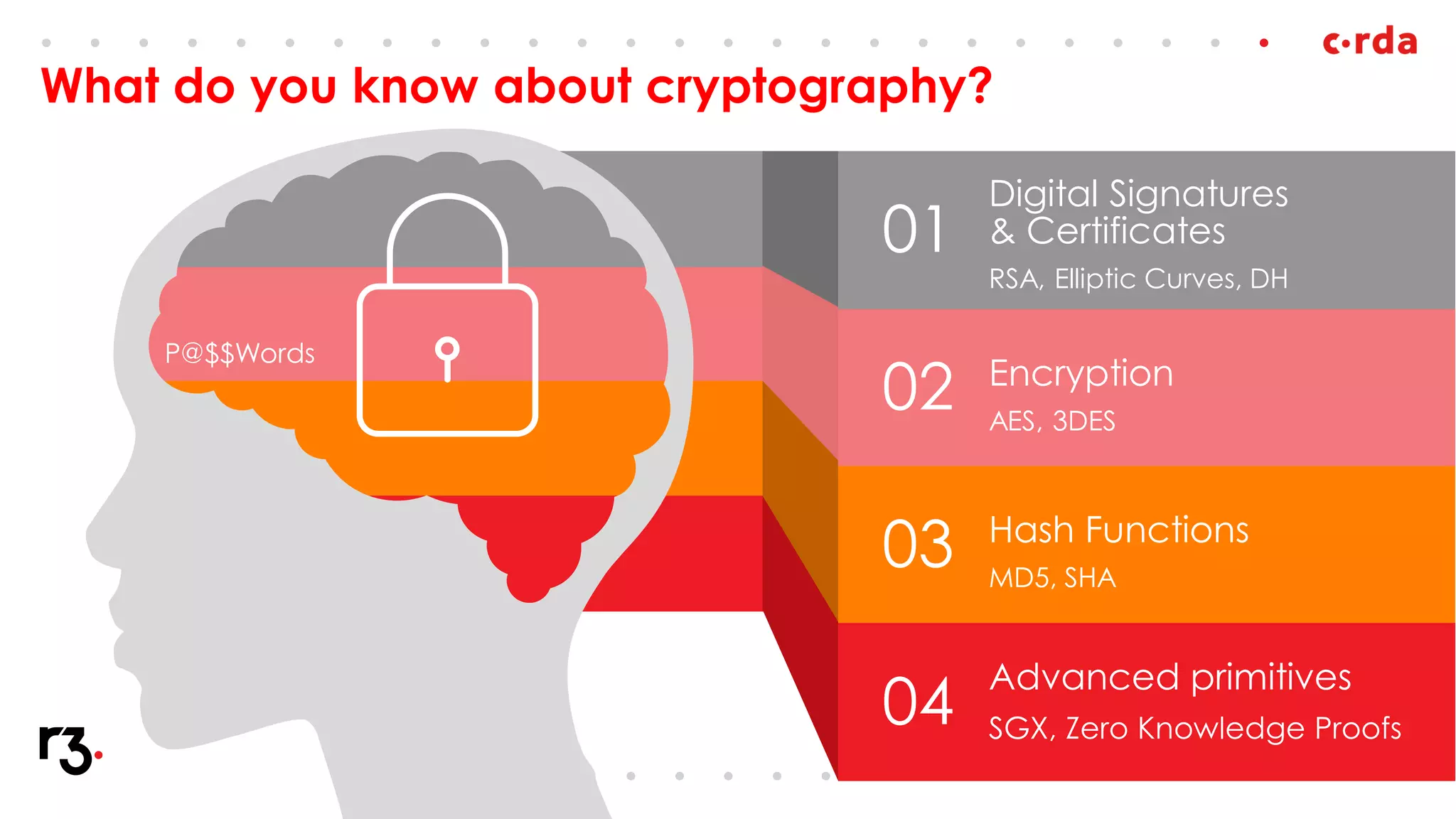
What do you know about cryptography?
02
01
03
04
Digital Signatures
& Certificates
RSA, Elliptic Curves, DH
Encryption
AES, 3DES
Hash Functions
MD5, SHA
Advanced primitives
SGX, Zero Knowledge Proofs
P@$$Words
A maze of options
DLT
Privacy
Zero Knowledge Proofs
Multi-Party Computation
Ring Signatures
Homomorphic
Secure Enclaves (SGX)
Key Randomisation
Merkle Trees (tear-offs)
Mixing Protocols
Graph Pruning
Features
Crypto Agility
Post-Quantum
Anonymity
Key Exchange (TLS)
Deterministic Key Gen.
Random Entropy
PKI
Cert. Revocation
Threshold Signatures
Attribute-based Sig.
ID-based / Timed-Release
Searchable Enc.
4 Privacy-preserving features
Anonymous Keys
One-time
random keys
Transaction tear-offs
transaction parts are
only visible to
designated parties
Graph Pruning
On request, prune
and re-issue a liquid
asset onto the ledger
with a new reference
field.
Transactions are not
globally broadcasted
TLS secure
communication
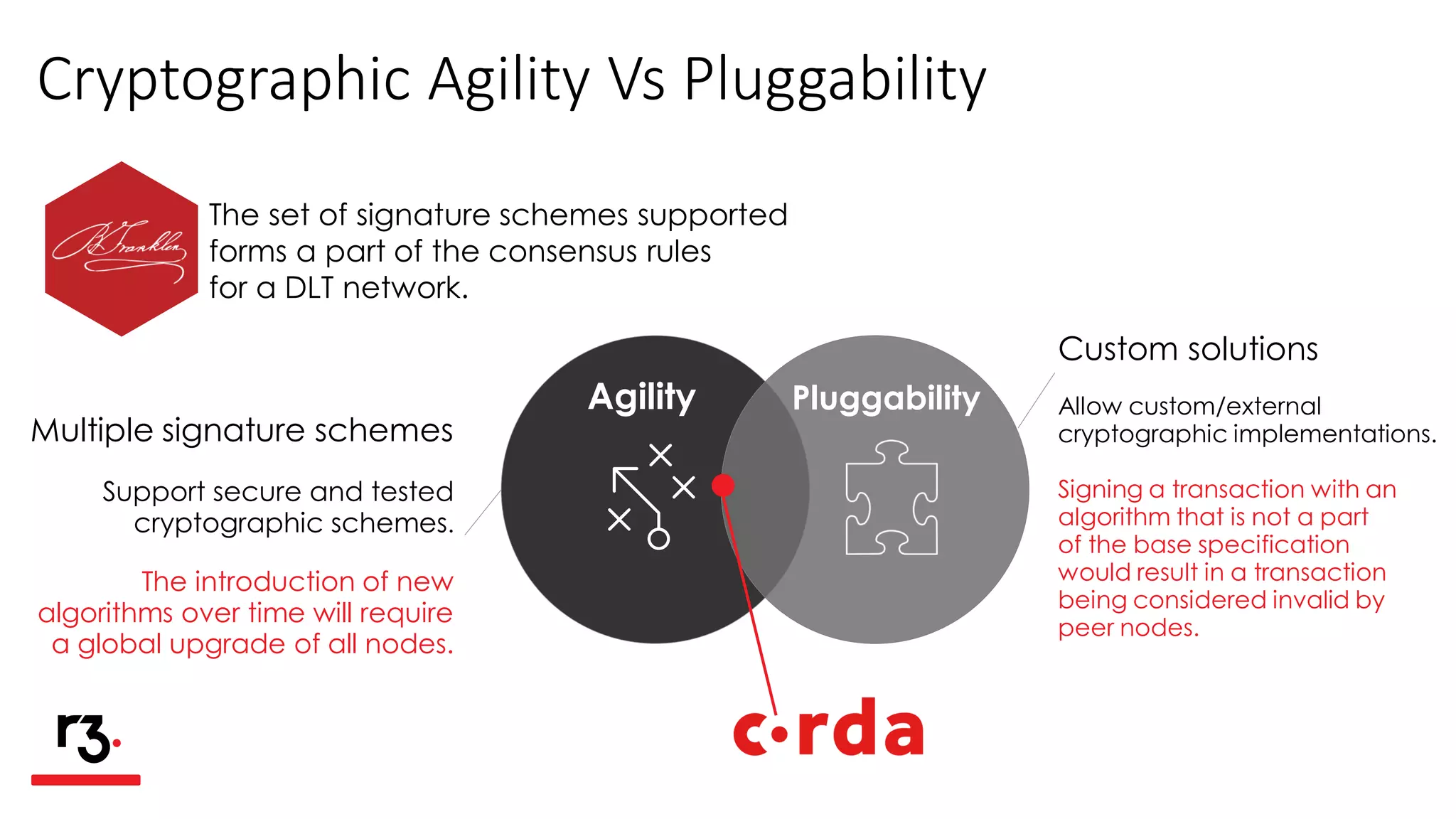
Cryptographic Agility Vs Pluggability
Agility Pluggability
Multiple signature schemes
Support secure and tested
cryptographic schemes.
The introduction of new
algorithms over time will require
a global upgrade of all nodes.
Custom solutions
Allow custom/external
cryptographic implementations.
Signing a transaction with an
algorithm that is not a part
of the base specification
would result in a transaction
being considered invalid by
peer nodes.
The set of signature schemes supported
forms a part of the consensus rules
for a DLT network.
Size
keys
signatures
Security
maturity
side-channel
+features
Code
Java/Kotlin
implement.
Compatible
legacy code
certification
Speed
key gen
sign
verify
HSM
storage
cloud avail.
06 01
02
0304
05
Desired Features
• There is NO single algorithm
to meet all the criteria!
• A serious DLT should be able
to survive a sophisticated
attack in the future.
• Combine corporate and
community requirements.
• Balance security Vs speed
Vs convenience
What is
the ideal
algorithm?
Speed Vs Risk
Riskaxis
Speed axis
Low speed High speed
HighriskLowrisk
Risk factors
1. recent attacks
2. unexplained/insecure params
3. quantum resistance
Speed factors
1. Key and param generation
2. signing
3. verification
ECDSA R1
RSA 3072
SPHINCS
EdDSA
ECDSA K1
ECDSA BRAINPOOL
zkSNARK BN_128
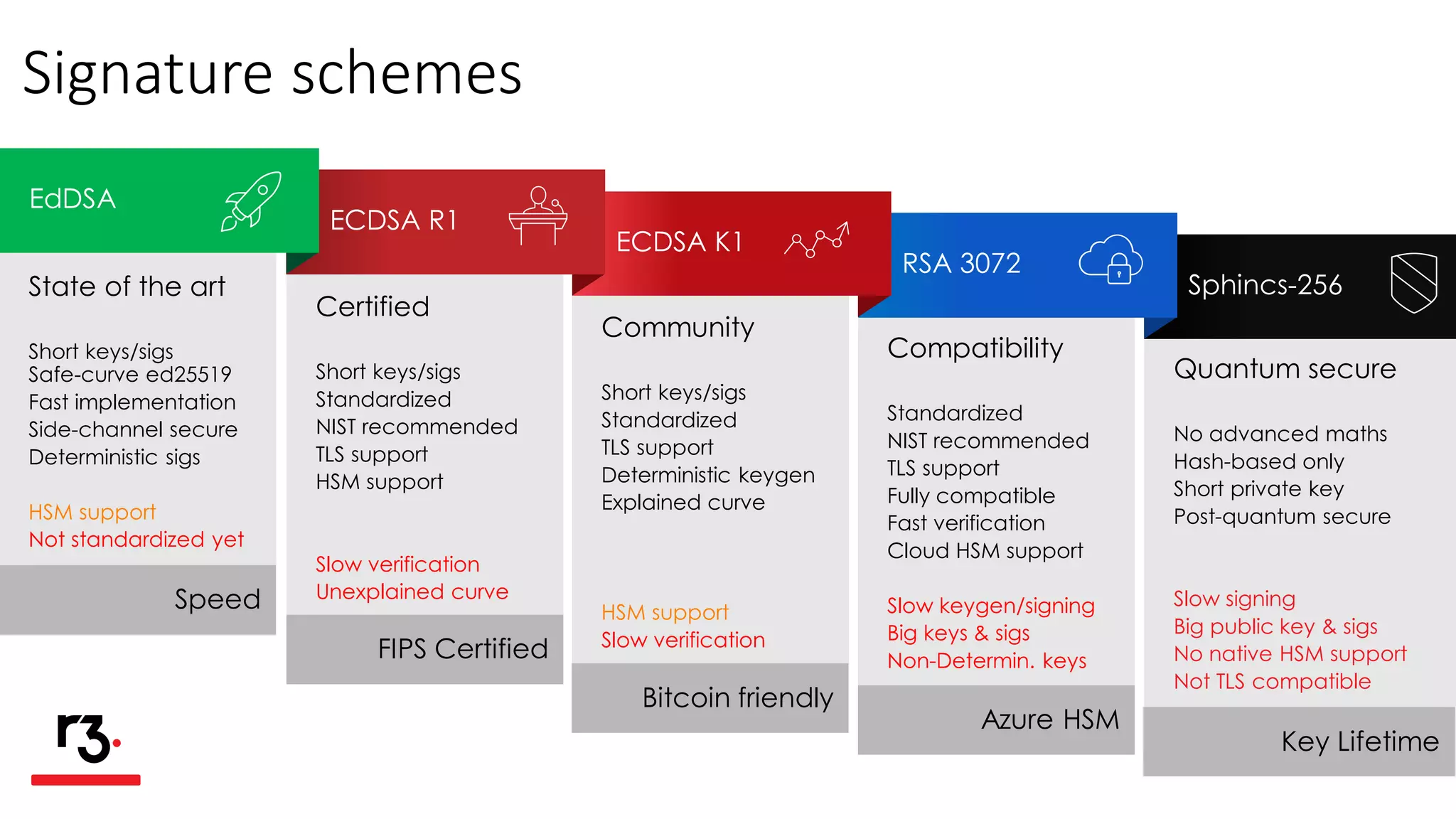
Quantum secure
No advanced maths
Hash-based only
Short private key
Post-quantum secure
Slow signing
Big public key & sigs
No native HSM support
Not TLS compatible
Sphincs-256
Key Lifetime
Compatibility
Standardized
NIST recommended
TLS support
Fully compatible
Fast verification
Cloud HSM support
Slow keygen/signing
Big keys & sigs
Non-Determin. keys
RSA 3072
Azure HSM
Community
Short keys/sigs
Standardized
TLS support
Deterministic keygen
Explained curve
HSM support
Slow verification
ECDSA K1
Bitcoin friendly
Certified
Short keys/sigs
Standardized
NIST recommended
TLS support
HSM support
Slow verification
Unexplained curve
ECDSA R1
FIPS Certified
Signature schemes
State of the art
Short keys/sigs
Safe-curve ed25519
Fast implementation
Side-channel secure
Deterministic sigs
HSM support
Not standardized yet
Speed
EdDSA
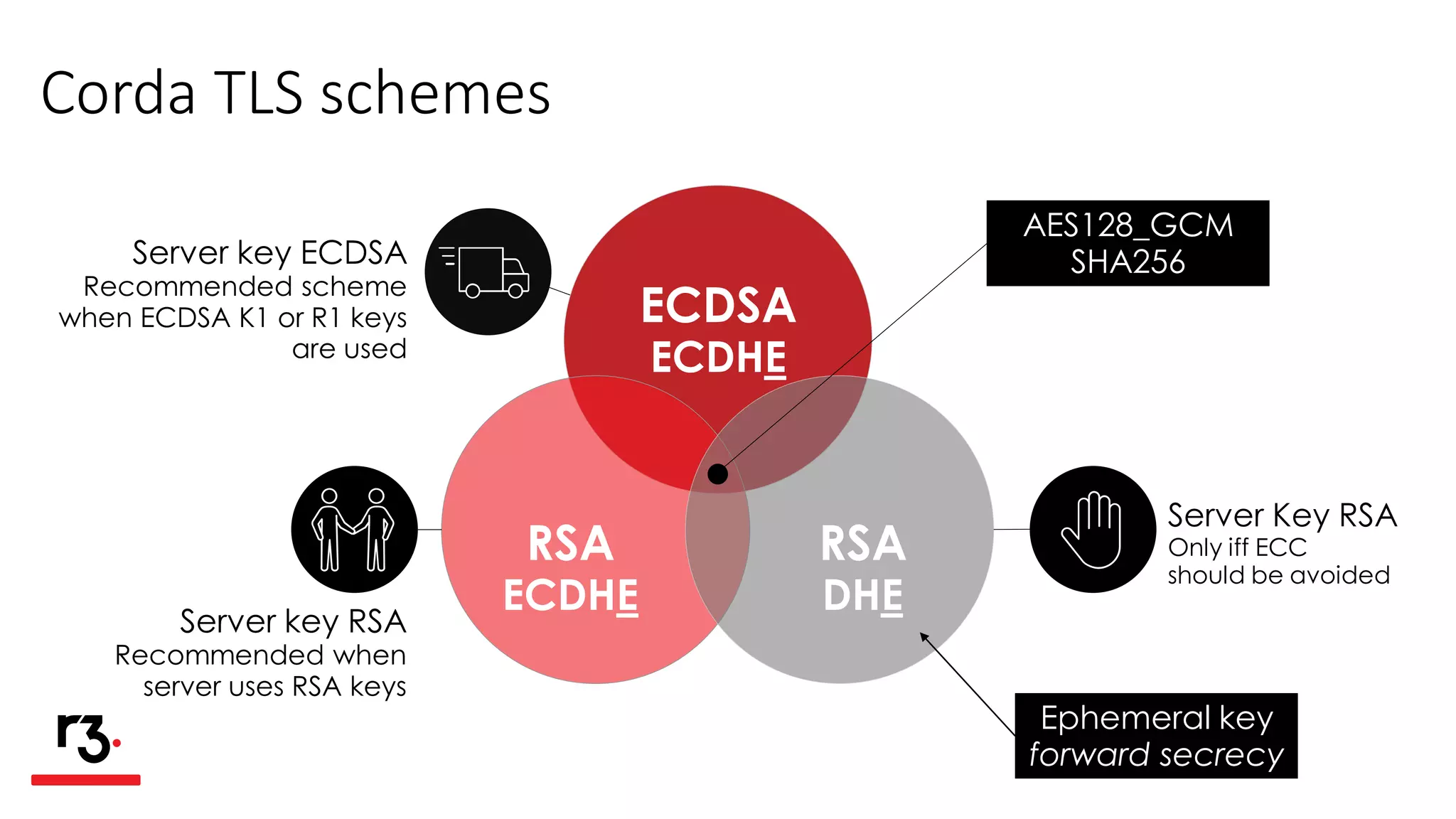
Corda TLS schemes
RSA
ECDHE
ECDSA
ECDHE
RSA
DHE
Server key RSA
Recommended when
server uses RSA keys
Server key ECDSA
Recommended scheme
when ECDSA K1 or R1 keys
are used
Server Key RSA
Only iff ECC
should be avoided
AES128_GCM
SHA256
Ephemeral key
forward secrecy
Node 1
EdDSA 25519
Node 2
ECDSA R1
Node 3
Sphincs-256
Notary Cluster
ECDSA R1
Node 4
ECDSA K1
Node 5
RSA 3072
Key Recommendations
I use Azure:
Pick RSA if you want
to benefit from
Azure’s secure Vault!
I need speed:
Use EdDSA, it’s also
considered one of
the most secure
schemes in our days!
I own an HSM:
Pick ECDSA as it is
more performant
than RSA. Prefer
EdDSA if your HSM
supports it.
FIPS certified?
Use ECDSA R1
or RSA.
Quantum
Threat?
Pick Sphincs-256, but
please note it is
slower & signatures
are bigger.
Crypto library
Define a supported
signature scheme,
here ECDSA R1
Signature scheme identification
• Scheme type is
attached to the
signature.
• Key type also helps on
identifying the
signature type if there
is no Metadata
attached.
• Works for Composite
keys as well.
Adding metadata
to signatures
I don’t
trust
algorithms
B, C and E
I don’t
trust
algorithms
A and E
A
B
I don’t
trust
algorithms
A, D and E
C
I don’t
trust
algorithms
B, C and E
D
Challenge – a globally agreed scheme
I don’t trust
algorithms
A, B
C and D
E
ZKP Vs SGX
Applications of ZKP
ZKP
Netting: offsetting the value of multiple
positions or payments due to be exchanged
between two or more parties
Membership: prove you are
part of a group, without revealing
your identity
Account Balance: prove that
your account has enough
available balance for this
transaction
Ownership: prove that
you own a private key
+ + +
Contract Execution:
an arbitrary
program/logic/contract has
been executed correctly
Sealed-Bid Auctions /
E-voting / KYC
Homomorphic Signature
Given sig(x) and sig(y)
can compute sig(x•y), without
knowing x and y
02
04
Ring Signature
Cannot determine
which of the
group members' keys
was used to sign
01
Witness Indistinguishability
Cannot tell which “witness”
the prover actually used
03
Zero Knowledge Proof
of Knowledge
The statement consists only of the fact that
the prover possesses the secret information
05
Zero Knowledge types
Multi-Party Computation
Parties jointly compute a
function over their inputs while
keeping those inputs private
[a][b][c]
ZKP
Create Circuit (logical gates)
Usually thousands of them
Convert each gate to R1CS
3 (sparse) vectors that satisfy a simple equation (dot products)
R1CS to Arithmetic Quadratic Program
dot product -> polynomials
Polynomials to EC points
+ using params from trusted setup
zkSNARK
01
02
03
05zkSNARK proof generation
04
zkSNARK
zero-knowledge Succinct Non-interactive ARgument of Knowledge
Non-interactive
Prover does not interact
with the verifier.
This enables signature
transfer and thus practical for
DLTs and Blockchains
Succinct
Signature (proof) size is
288 bytes and independent
on the problem size
Argument
Whenever a computation is
executed and reaches to a result,
you could think of it as a
statement/argument!
Zero Knowledge
Prover convinces a verifier that a
statement is true without revealing
any further information
SCIP
Succinct
Computational
Integrity &
Privacy
RSA sig: 3072 bits
zkSNARK (BN128) cons
Verify
Proof Gen
ZK Proof size: 2304 bits
ZK public params: 911MB
ECC sig: 512 bits
Trusted setup
“toxic-waste”: backdoor to
forge signatures.
Not PQ-secure
Should change to
zkSTARK/Ligero?
Slow Proof Generation
Not practical for some
applications, yet.
i.e., high-frequency trading
~100 bits of security
448-bit field (or larger) needed
(regulations? evolution plan?)
Special Elliptic Curves
pairing friendly (standardised?)
SLOW
due to multiple
fast Fourier transforms
&
elliptic curve operations
(exponentiations)
Size
keys
proofs
CRS
Security
maturity
side-channel
pq
Code
api, UI, UX
JVM, C, +++
Compatible
Legislation
mobile
friendly
Speed
prove
verify
optimise
HSM
witness
storage
cloud avail.
06 01
02
0304
05
Desired Features
• There is NO single algorithm
to meet all the criteria!
• A serious DLT should be able
to survive a sophisticated
attack in the future. We need
an evolution plan.
• Combine corporate and
community requirements.
• Balance security Vs speed
Vs convenience
What is
the ideal
algorithm?
A quick recap
• Skylake+ chips have SGX:
Encrypted memory, Sealed off software, Remote attestation
Pretty good for DLT
• NO need to train developers on how to properly write
ZKP-friendly contracts
• No arithmetization or special math theory
• Practically unlimited contract-code logic/size.
• Fast, easier evolution plans
SGX concern: Side-channels
“We are well aware side-channels are a problem for
SGX, but the work to remove them inside compilers
looks quite similar to the work needed to convert
imperative programs into circuits”
"and we think a lot of the work and experience can be
shared between the two efforts"
Two ways
How can DLT use ZKPs?
1. Fully automatic privacy for all transactions
The holy grail! What we will use SGX for until a generic and
easy to use ZKP framework is well-reviewed, user friendly
and tested.
2. Ad-hoc tactical integrations
What is realistically possible today
(if you accept all the caveats) p25.
Arithmetization
• Proofs demonstrate solutions to systems of algebraic
constraints
• But equations are not how programmers think of problems
• Sometimes, very hard to express even simple business logic
• We cannot expect non-specialists to write R1CS,
Modularization?
• We need a well-defined api (ZKProof Implementation track)
Fully automatic ZKP
• A high quality constraint compiler, so ordinary programmers can
write and maintain proof systems
• A trustworthy initialization mechanism/protocol (if required)
• Ideally, post-quantum ZKP
• Backwards compatible deployment strategy
• Extensive peer-review: side-channel, fake/unrealistic benchmarks,
wrong proofs, EC curve/params security, is it actually ZKP?
composition strategies and caveats
p27.
POST-QUANTUM
Quantum computers
Symmetric Encryption
Larger keys
Hash Functions
Larger output
ZKP
zkSNARK (the end)
use zkSTARK / Ligero
(practical?)
RSA, ECC, DSA, DH
game over
Shor’s algorithm – Factorization and
Dlog is easy!
Estimated risk that RSA & ECC will break:
15% by 2026
50% by 2031
even if this never happens, the underlying
“potential” threat affects decisions.
Grover’s algorithm – Symmetric ciphers in
danger as well.
Finds with high probability the unique input
to a black box function.
We should double the size of keys/output.
Quantum computers - current state
01
RSA (3072): ~ 6000 qubits
ECC (256): ~1500 qubits
Google
Bristlecone
72 qubits
largest
number
claimed to be
factored
200,099
One-time: hashed keys
ZKP: zkSTARK, Ligero
Sigs: Sphincs, Ring-LWE
KE: New Hope
pure quantum algorithms
02 04
qubits + gates
(billions of gates)
10,000 times
faster
D-Wave announced
2000 qubits
quantum computer.
But, targeted to AI
^ Controversial ^
03 05
Crypto-Research
02
03
04
01
60%
75%
..%
100%Extend Sphincs – Blockchained Signatures
Faster and Shorter signatures
Key management & HSMs
Cloud / Dedicated
Hash and Fact-locking
Smart Contracts
Advanced Privacy
Ring Sig / Dual Auth / ZKP Side-channel
security
research
e.g. EdDSA
RowHammer
One-Time
Anonymous
keys
SGX
efficient
(re)attestation
Cryptographic Agility in Corda

Cryptographic Agility in Corda

  • 1.
  • 2.
    Blockchain-inspired: the best attributesof Bitcoin / Ethereum, but no cryptocurrency (that we know of) Enterprise grade: built specifically for financial markets Data privacy: transactions shared on a need-to-know basis Consensus: achieved at individual deal level, rather than system level. Supports a variety of consensus mechanisms Regulator-focused: design directly enables regulatory/supervisor observer nodes Smart contract: strong link between legal prose and smart contract code Easy integration: reuses existing java developer skills making integration with bank systems easy and safe Open-source, financial-grade blockchain that records, manages, and executes institutions’ legal, business, and financial agreements in perfect synchrony with their counterparties. Corda’s ecosystem consists of 200+ of the world’s leading institutions, technology companies and Fortune500 companies.
  • 3.
    What do youknow about cryptography? 02 01 03 04 Digital Signatures & Certificates RSA, Elliptic Curves, DH Encryption AES, 3DES Hash Functions MD5, SHA Advanced primitives SGX, Zero Knowledge Proofs P@$$Words
  • 4.
    A maze ofoptions DLT Privacy Zero Knowledge Proofs Multi-Party Computation Ring Signatures Homomorphic Secure Enclaves (SGX) Key Randomisation Merkle Trees (tear-offs) Mixing Protocols Graph Pruning Features Crypto Agility Post-Quantum Anonymity Key Exchange (TLS) Deterministic Key Gen. Random Entropy PKI Cert. Revocation Threshold Signatures Attribute-based Sig. ID-based / Timed-Release Searchable Enc.
  • 5.
    4 Privacy-preserving features AnonymousKeys One-time random keys Transaction tear-offs transaction parts are only visible to designated parties Graph Pruning On request, prune and re-issue a liquid asset onto the ledger with a new reference field. Transactions are not globally broadcasted TLS secure communication
  • 6.
    Cryptographic Agility VsPluggability Agility Pluggability Multiple signature schemes Support secure and tested cryptographic schemes. The introduction of new algorithms over time will require a global upgrade of all nodes. Custom solutions Allow custom/external cryptographic implementations. Signing a transaction with an algorithm that is not a part of the base specification would result in a transaction being considered invalid by peer nodes. The set of signature schemes supported forms a part of the consensus rules for a DLT network.
  • 7.
    Size keys signatures Security maturity side-channel +features Code Java/Kotlin implement. Compatible legacy code certification Speed key gen sign verify HSM storage cloudavail. 06 01 02 0304 05 Desired Features • There is NO single algorithm to meet all the criteria! • A serious DLT should be able to survive a sophisticated attack in the future. • Combine corporate and community requirements. • Balance security Vs speed Vs convenience What is the ideal algorithm?
  • 8.
    Speed Vs Risk Riskaxis Speedaxis Low speed High speed HighriskLowrisk Risk factors 1. recent attacks 2. unexplained/insecure params 3. quantum resistance Speed factors 1. Key and param generation 2. signing 3. verification ECDSA R1 RSA 3072 SPHINCS EdDSA ECDSA K1 ECDSA BRAINPOOL zkSNARK BN_128
  • 9.
    Quantum secure No advancedmaths Hash-based only Short private key Post-quantum secure Slow signing Big public key & sigs No native HSM support Not TLS compatible Sphincs-256 Key Lifetime Compatibility Standardized NIST recommended TLS support Fully compatible Fast verification Cloud HSM support Slow keygen/signing Big keys & sigs Non-Determin. keys RSA 3072 Azure HSM Community Short keys/sigs Standardized TLS support Deterministic keygen Explained curve HSM support Slow verification ECDSA K1 Bitcoin friendly Certified Short keys/sigs Standardized NIST recommended TLS support HSM support Slow verification Unexplained curve ECDSA R1 FIPS Certified Signature schemes State of the art Short keys/sigs Safe-curve ed25519 Fast implementation Side-channel secure Deterministic sigs HSM support Not standardized yet Speed EdDSA
  • 10.
    Corda TLS schemes RSA ECDHE ECDSA ECDHE RSA DHE Serverkey RSA Recommended when server uses RSA keys Server key ECDSA Recommended scheme when ECDSA K1 or R1 keys are used Server Key RSA Only iff ECC should be avoided AES128_GCM SHA256 Ephemeral key forward secrecy
  • 11.
    Node 1 EdDSA 25519 Node2 ECDSA R1 Node 3 Sphincs-256 Notary Cluster ECDSA R1 Node 4 ECDSA K1 Node 5 RSA 3072
  • 12.
    Key Recommendations I useAzure: Pick RSA if you want to benefit from Azure’s secure Vault! I need speed: Use EdDSA, it’s also considered one of the most secure schemes in our days! I own an HSM: Pick ECDSA as it is more performant than RSA. Prefer EdDSA if your HSM supports it. FIPS certified? Use ECDSA R1 or RSA. Quantum Threat? Pick Sphincs-256, but please note it is slower & signatures are bigger.
  • 13.
    Crypto library Define asupported signature scheme, here ECDSA R1
  • 14.
    Signature scheme identification •Scheme type is attached to the signature. • Key type also helps on identifying the signature type if there is no Metadata attached. • Works for Composite keys as well. Adding metadata to signatures
  • 15.
    I don’t trust algorithms B, Cand E I don’t trust algorithms A and E A B I don’t trust algorithms A, D and E C I don’t trust algorithms B, C and E D Challenge – a globally agreed scheme I don’t trust algorithms A, B C and D E
  • 16.
  • 17.
    Applications of ZKP ZKP Netting:offsetting the value of multiple positions or payments due to be exchanged between two or more parties Membership: prove you are part of a group, without revealing your identity Account Balance: prove that your account has enough available balance for this transaction Ownership: prove that you own a private key + + + Contract Execution: an arbitrary program/logic/contract has been executed correctly Sealed-Bid Auctions / E-voting / KYC
  • 18.
    Homomorphic Signature Given sig(x)and sig(y) can compute sig(x•y), without knowing x and y 02 04 Ring Signature Cannot determine which of the group members' keys was used to sign 01 Witness Indistinguishability Cannot tell which “witness” the prover actually used 03 Zero Knowledge Proof of Knowledge The statement consists only of the fact that the prover possesses the secret information 05 Zero Knowledge types Multi-Party Computation Parties jointly compute a function over their inputs while keeping those inputs private
  • 19.
    [a][b][c] ZKP Create Circuit (logicalgates) Usually thousands of them Convert each gate to R1CS 3 (sparse) vectors that satisfy a simple equation (dot products) R1CS to Arithmetic Quadratic Program dot product -> polynomials Polynomials to EC points + using params from trusted setup zkSNARK 01 02 03 05zkSNARK proof generation 04
  • 20.
    zkSNARK zero-knowledge Succinct Non-interactiveARgument of Knowledge Non-interactive Prover does not interact with the verifier. This enables signature transfer and thus practical for DLTs and Blockchains Succinct Signature (proof) size is 288 bytes and independent on the problem size Argument Whenever a computation is executed and reaches to a result, you could think of it as a statement/argument! Zero Knowledge Prover convinces a verifier that a statement is true without revealing any further information SCIP Succinct Computational Integrity & Privacy
  • 21.
    RSA sig: 3072bits zkSNARK (BN128) cons Verify Proof Gen ZK Proof size: 2304 bits ZK public params: 911MB ECC sig: 512 bits Trusted setup “toxic-waste”: backdoor to forge signatures. Not PQ-secure Should change to zkSTARK/Ligero? Slow Proof Generation Not practical for some applications, yet. i.e., high-frequency trading ~100 bits of security 448-bit field (or larger) needed (regulations? evolution plan?) Special Elliptic Curves pairing friendly (standardised?) SLOW due to multiple fast Fourier transforms & elliptic curve operations (exponentiations)
  • 22.
    Size keys proofs CRS Security maturity side-channel pq Code api, UI, UX JVM,C, +++ Compatible Legislation mobile friendly Speed prove verify optimise HSM witness storage cloud avail. 06 01 02 0304 05 Desired Features • There is NO single algorithm to meet all the criteria! • A serious DLT should be able to survive a sophisticated attack in the future. We need an evolution plan. • Combine corporate and community requirements. • Balance security Vs speed Vs convenience What is the ideal algorithm?
  • 23.
    A quick recap •Skylake+ chips have SGX: Encrypted memory, Sealed off software, Remote attestation Pretty good for DLT • NO need to train developers on how to properly write ZKP-friendly contracts • No arithmetization or special math theory • Practically unlimited contract-code logic/size. • Fast, easier evolution plans
  • 24.
    SGX concern: Side-channels “Weare well aware side-channels are a problem for SGX, but the work to remove them inside compilers looks quite similar to the work needed to convert imperative programs into circuits” "and we think a lot of the work and experience can be shared between the two efforts"
  • 25.
    Two ways How canDLT use ZKPs? 1. Fully automatic privacy for all transactions The holy grail! What we will use SGX for until a generic and easy to use ZKP framework is well-reviewed, user friendly and tested. 2. Ad-hoc tactical integrations What is realistically possible today (if you accept all the caveats) p25.
  • 26.
    Arithmetization • Proofs demonstratesolutions to systems of algebraic constraints • But equations are not how programmers think of problems • Sometimes, very hard to express even simple business logic • We cannot expect non-specialists to write R1CS, Modularization? • We need a well-defined api (ZKProof Implementation track)
  • 27.
    Fully automatic ZKP •A high quality constraint compiler, so ordinary programmers can write and maintain proof systems • A trustworthy initialization mechanism/protocol (if required) • Ideally, post-quantum ZKP • Backwards compatible deployment strategy • Extensive peer-review: side-channel, fake/unrealistic benchmarks, wrong proofs, EC curve/params security, is it actually ZKP? composition strategies and caveats p27.
  • 28.
  • 29.
    Quantum computers Symmetric Encryption Largerkeys Hash Functions Larger output ZKP zkSNARK (the end) use zkSTARK / Ligero (practical?) RSA, ECC, DSA, DH game over Shor’s algorithm – Factorization and Dlog is easy! Estimated risk that RSA & ECC will break: 15% by 2026 50% by 2031 even if this never happens, the underlying “potential” threat affects decisions. Grover’s algorithm – Symmetric ciphers in danger as well. Finds with high probability the unique input to a black box function. We should double the size of keys/output.
  • 30.
    Quantum computers -current state 01 RSA (3072): ~ 6000 qubits ECC (256): ~1500 qubits Google Bristlecone 72 qubits largest number claimed to be factored 200,099 One-time: hashed keys ZKP: zkSTARK, Ligero Sigs: Sphincs, Ring-LWE KE: New Hope pure quantum algorithms 02 04 qubits + gates (billions of gates) 10,000 times faster D-Wave announced 2000 qubits quantum computer. But, targeted to AI ^ Controversial ^ 03 05
  • 31.
    Crypto-Research 02 03 04 01 60% 75% ..% 100%Extend Sphincs –Blockchained Signatures Faster and Shorter signatures Key management & HSMs Cloud / Dedicated Hash and Fact-locking Smart Contracts Advanced Privacy Ring Sig / Dual Auth / ZKP Side-channel security research e.g. EdDSA RowHammer One-Time Anonymous keys SGX efficient (re)attestation