1095 - 1272
 The Crusades were a series of wars between
European Christians and Muslims fighting for the
Holy Land (Especially the City of Jerusalem).
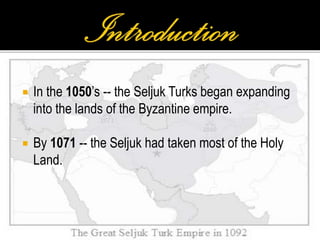
 In the 1050’s -- the Seljuk Turks began expanding
into the lands of the Byzantine empire.
 By 1071 -- the Seljuk had taken most of the Holy
Land.
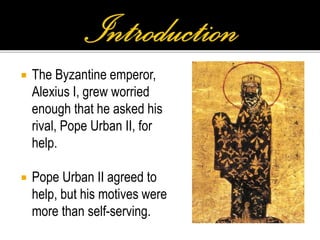
 The Byzantine emperor,
Alexius I, grew worried
enough that he asked his
rival, Pope Urban II, for
help.
 Pope Urban II agreed to
help, but his motives were
more than self-serving.
 Pope Urban II felt he could use the situation to:
 Regain the holy land
 Reunite Christendom (West & East)
 Increase the Pope’s power and image
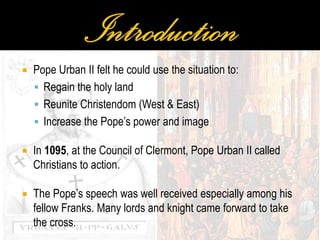
 In 1095, at the Council of Clermont, Pope Urban II called
Christians to action.
 The Pope’s speech was well received especially among his
fellow Franks. Many lords and knight came forward to take
the cross.
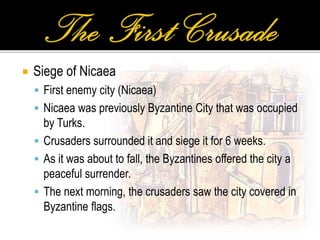
 Siege of Nicaea
 First enemy city (Nicaea)
 Nicaea was previously Byzantine City that was occupied
by Turks.
 Crusaders surrounded it and siege it for 6 weeks.
 As it was about to fall, the Byzantines offered the city a
peaceful surrender.
 The next morning, the crusaders saw the city covered in
Byzantine flags.
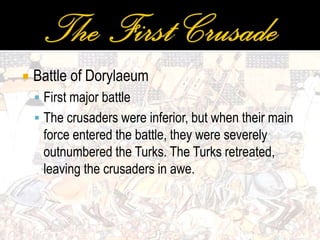
 Battle of Dorylaeum
 First major battle
 The crusaders were inferior, but when their main
force entered the battle, they were severely
outnumbered the Turks. The Turks retreated,
leaving the crusaders in awe.
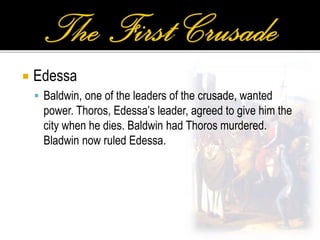
 Edessa
 Baldwin, one of the leaders of the crusade, wanted
power. Thoros, Edessa’s leader, agreed to give him the
city when he dies. Baldwin had Thoros murdered.
Bladwin now ruled Edessa.
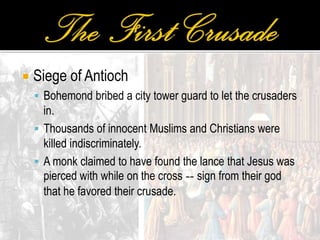
 Siege of Antioch
 Bohemond bribed a city tower guard to let the crusaders
in.
 Thousands of innocent Muslims and Christians were
killed indiscriminately.
 A monk claimed to have found the lance that Jesus was
pierced with while on the cross -- sign from their god
that he favored their crusade.
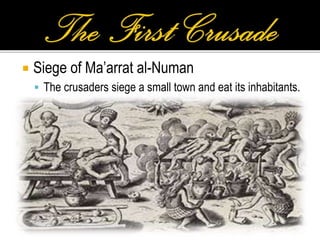
 Siege of Ma’arrat al-Numan
 The crusaders siege a small town and eat its inhabitants.
 Jerusalem
 The crusaders constructed siege towers and started
attacking the walls.
 The crusaders got into Jerusalem.
 The crusaders poured into the city. Thousands of
innocent citizens were killed. The crescent was taken
down and the cross raised in its place.
 50,000 Fatimid troops were ambush by the remaining
crusaders.
 The Children’s Crusade
 Stephen of Cloyes
 During the year 1212 A.D. about 30,000 French children
assembled in bands and marched through the towns and villages,
carrying banners, candles, and crosses and dinging “Lord God,
exalt Christianity. Lord God, restore to us the true cross.”
 In Germany, during the same year, a lad named Nicholas really
din succeed in launching a crusade.
 He led a mixed multitude of men in women, totaling 50,000 in
number, over the Alps into Italy, where they expected to take ship
for Palestine.
 The leader oft his crusade was Prince Edward
of England, afterward King Edward I.
 Edward succeeded in capturing Nazareth.
 The kingdom of Jerusalem was gradually lost
until the last Christian city, Acre, fell in 1291.
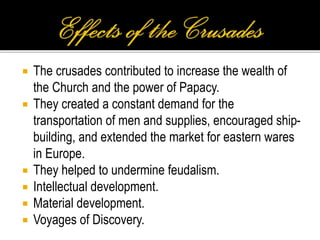
 The crusades contributed to increase the wealth of
the Church and the power of Papacy.
 They created a constant demand for the
transportation of men and supplies, encouraged ship-
building, and extended the market for eastern wares
in Europe.
 They helped to undermine feudalism.
 Intellectual development.
 Material development.
 Voyages of Discovery.
Crusades (1095 - 1272)

Crusades (1095 - 1272)

  • 1.
  • 2.
     The Crusadeswere a series of wars between European Christians and Muslims fighting for the Holy Land (Especially the City of Jerusalem).
  • 3.
     In the1050’s -- the Seljuk Turks began expanding into the lands of the Byzantine empire.  By 1071 -- the Seljuk had taken most of the Holy Land.
  • 4.
     The Byzantineemperor, Alexius I, grew worried enough that he asked his rival, Pope Urban II, for help.  Pope Urban II agreed to help, but his motives were more than self-serving.
  • 5.
     Pope UrbanII felt he could use the situation to:  Regain the holy land  Reunite Christendom (West & East)  Increase the Pope’s power and image  In 1095, at the Council of Clermont, Pope Urban II called Christians to action.  The Pope’s speech was well received especially among his fellow Franks. Many lords and knight came forward to take the cross.
  • 6.
     Siege ofNicaea  First enemy city (Nicaea)  Nicaea was previously Byzantine City that was occupied by Turks.  Crusaders surrounded it and siege it for 6 weeks.  As it was about to fall, the Byzantines offered the city a peaceful surrender.  The next morning, the crusaders saw the city covered in Byzantine flags.
  • 7.
     Battle ofDorylaeum  First major battle  The crusaders were inferior, but when their main force entered the battle, they were severely outnumbered the Turks. The Turks retreated, leaving the crusaders in awe.
  • 8.
     Edessa  Baldwin,one of the leaders of the crusade, wanted power. Thoros, Edessa’s leader, agreed to give him the city when he dies. Baldwin had Thoros murdered. Bladwin now ruled Edessa.
  • 9.
     Siege ofAntioch  Bohemond bribed a city tower guard to let the crusaders in.  Thousands of innocent Muslims and Christians were killed indiscriminately.  A monk claimed to have found the lance that Jesus was pierced with while on the cross -- sign from their god that he favored their crusade.
  • 10.
     Siege ofMa’arrat al-Numan  The crusaders siege a small town and eat its inhabitants.
  • 11.
     Jerusalem  Thecrusaders constructed siege towers and started attacking the walls.  The crusaders got into Jerusalem.  The crusaders poured into the city. Thousands of innocent citizens were killed. The crescent was taken down and the cross raised in its place.  50,000 Fatimid troops were ambush by the remaining crusaders.
  • 12.
     The Children’sCrusade  Stephen of Cloyes  During the year 1212 A.D. about 30,000 French children assembled in bands and marched through the towns and villages, carrying banners, candles, and crosses and dinging “Lord God, exalt Christianity. Lord God, restore to us the true cross.”  In Germany, during the same year, a lad named Nicholas really din succeed in launching a crusade.  He led a mixed multitude of men in women, totaling 50,000 in number, over the Alps into Italy, where they expected to take ship for Palestine.
  • 13.
     The leaderoft his crusade was Prince Edward of England, afterward King Edward I.  Edward succeeded in capturing Nazareth.  The kingdom of Jerusalem was gradually lost until the last Christian city, Acre, fell in 1291.
  • 14.
     The crusadescontributed to increase the wealth of the Church and the power of Papacy.  They created a constant demand for the transportation of men and supplies, encouraged ship- building, and extended the market for eastern wares in Europe.  They helped to undermine feudalism.  Intellectual development.  Material development.  Voyages of Discovery.