Brandon Mintz and Christian Creigh
   Since the time of Constantine, Christians had
    gone on pilgrimages to the Holy Land.
    Muslims had ruled Jerusalem since 638 but
    Christians were still allowed to visit the city.
    By the 11th century the Seljuk Turks took over
    control of Jerusalem and prevented
    pilgrimage
   The crusades began as a war between
    Christians and Moslems for the City of
    Jerusalem. The City held a holy significance to
    the Christian religion as it contained the
    Church of the Holy Sepulchre and the tomb of
    Christ's burial. In 1065, 3000 Christians were
    massacred in Jerusalem by the Turks, starting a
    chain of events which contributed to the cause
    of the crusades.
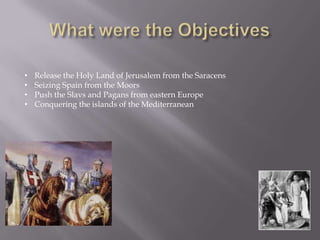
•   Release the Holy Land of Jerusalem from the Saracens
•   Seizing Spain from the Moors
•   Push the Slavs and Pagans from eastern Europe
•   Conquering the islands of the Mediterranean
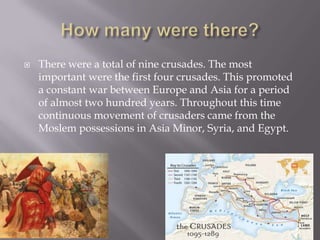
   There were a total of nine crusades. The most
    important were the first four crusades. This promoted
    a constant war between Europe and Asia for a period
    of almost two hundred years. Throughout this time
    continuous movement of crusaders came from the
    Moslem possessions in Asia Minor, Syria, and Egypt.
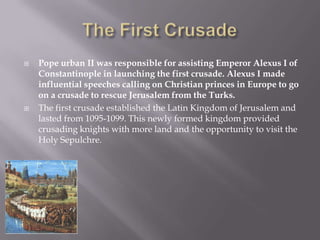
   Pope urban II was responsible for assisting Emperor Alexus I of
    Constantinople in launching the first crusade. Alexus I made
    influential speeches calling on Christian princes in Europe to go
    on a crusade to rescue Jerusalem from the Turks.
   The first crusade established the Latin Kingdom of Jerusalem and
    lasted from 1095-1099. This newly formed kingdom provided
    crusading knights with more land and the opportunity to visit the
    Holy Sepulchre.
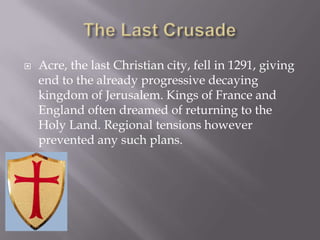
   Acre, the last Christian city, fell in 1291, giving
    end to the already progressive decaying
    kingdom of Jerusalem. Kings of France and
    England often dreamed of returning to the
    Holy Land. Regional tensions however
    prevented any such plans.
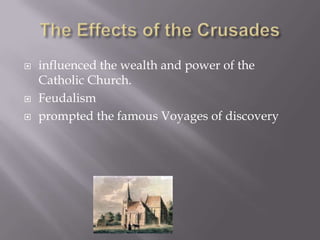
   influenced the wealth and power of the
    Catholic Church.
   Feudalism
   prompted the famous Voyages of discovery
   http://gbgm-
    umc.org/umw/bible/crusades.stm
    http://www.the-
    orb.net/encyclop/religion/crusades/crumadd
    en.html
   http://www.middle-ages.org.uk/the-
    crusades.htm

The crusades

  • 1.
    Brandon Mintz andChristian Creigh
  • 2.
    Since the time of Constantine, Christians had gone on pilgrimages to the Holy Land. Muslims had ruled Jerusalem since 638 but Christians were still allowed to visit the city. By the 11th century the Seljuk Turks took over control of Jerusalem and prevented pilgrimage
  • 3.
    The crusades began as a war between Christians and Moslems for the City of Jerusalem. The City held a holy significance to the Christian religion as it contained the Church of the Holy Sepulchre and the tomb of Christ's burial. In 1065, 3000 Christians were massacred in Jerusalem by the Turks, starting a chain of events which contributed to the cause of the crusades.
  • 4.
    Release the Holy Land of Jerusalem from the Saracens • Seizing Spain from the Moors • Push the Slavs and Pagans from eastern Europe • Conquering the islands of the Mediterranean
  • 5.
    There were a total of nine crusades. The most important were the first four crusades. This promoted a constant war between Europe and Asia for a period of almost two hundred years. Throughout this time continuous movement of crusaders came from the Moslem possessions in Asia Minor, Syria, and Egypt.
  • 6.
    Pope urban II was responsible for assisting Emperor Alexus I of Constantinople in launching the first crusade. Alexus I made influential speeches calling on Christian princes in Europe to go on a crusade to rescue Jerusalem from the Turks.  The first crusade established the Latin Kingdom of Jerusalem and lasted from 1095-1099. This newly formed kingdom provided crusading knights with more land and the opportunity to visit the Holy Sepulchre.
  • 7.
    Acre, the last Christian city, fell in 1291, giving end to the already progressive decaying kingdom of Jerusalem. Kings of France and England often dreamed of returning to the Holy Land. Regional tensions however prevented any such plans.
  • 8.
    influenced the wealth and power of the Catholic Church.  Feudalism  prompted the famous Voyages of discovery
  • 9.
    http://gbgm- umc.org/umw/bible/crusades.stm http://www.the- orb.net/encyclop/religion/crusades/crumadd en.html  http://www.middle-ages.org.uk/the- crusades.htm