World Bank ZambiaPPCR Mission – August 2010CROWDSOURCING AND CROWDFEEDINGTOOLS AND TIPS FOR PARTECIPATORY INFORMATION MANAGEMENT SYSTEMSAnahi Ayala Iacuccianahi@crisismappers.net
CROWDSOURCING AND CROWDFEEDINGCROWDSOURCING: use the crowd to collect information. The act of outsourcing tasks, traditionally performed by an employee to a large group of people or community (a crowd), through an open call for action. Jeff Howe coined the term in  June 2006 explaining that because technological advances have allowed for cheap consumer electronics, the gap between professionals and amateurs has been diminished. CROWDFEEDING: the need for the crowd to share information with the crowd, ie, not top-down, or bottom-up, but information from the crowd, for the crowd; horizontal communication. The act of sharing information out to a large group of people or community, through an open sharing system. In the same time for the international community it means to share all available information with all stakeholders to allow better decision to be taken and better actions to be implemented.
Advantages of using crowdsourcingInformation during a crisis or for early warning systems is as important as food and waterAffected communities know what is going on on the ground in real timeThe ability to collect information is limited by the availability of sources of information: more sources, more informationAffected population get engaged in the process because they have an interest in the outcomeCrowdsourcing is relatively cheaper than the use of selected monitoring teamsCrowdsourcing allow for triangulation of information permitting verification and accountability
Typologies of crowdsourcing methodsUnbounded crowd-sourcing: a large group of people is reporting. This system allows for an unlimited number of information to come in, but lack in reliability of information. Bounded crowd-sourcing: the reporting is done by a specific group. This system allows for verified information to come in but is subjected to the limitation of the limited source. Combined bounded and unbounded crowd-sourcing: information are collected by a specific group of people, but also by the crowd. Reliable sources and unreliable sources are combines. This system allows for: increase in overall reportingIncrease in the ability to validate reports from unknown sources
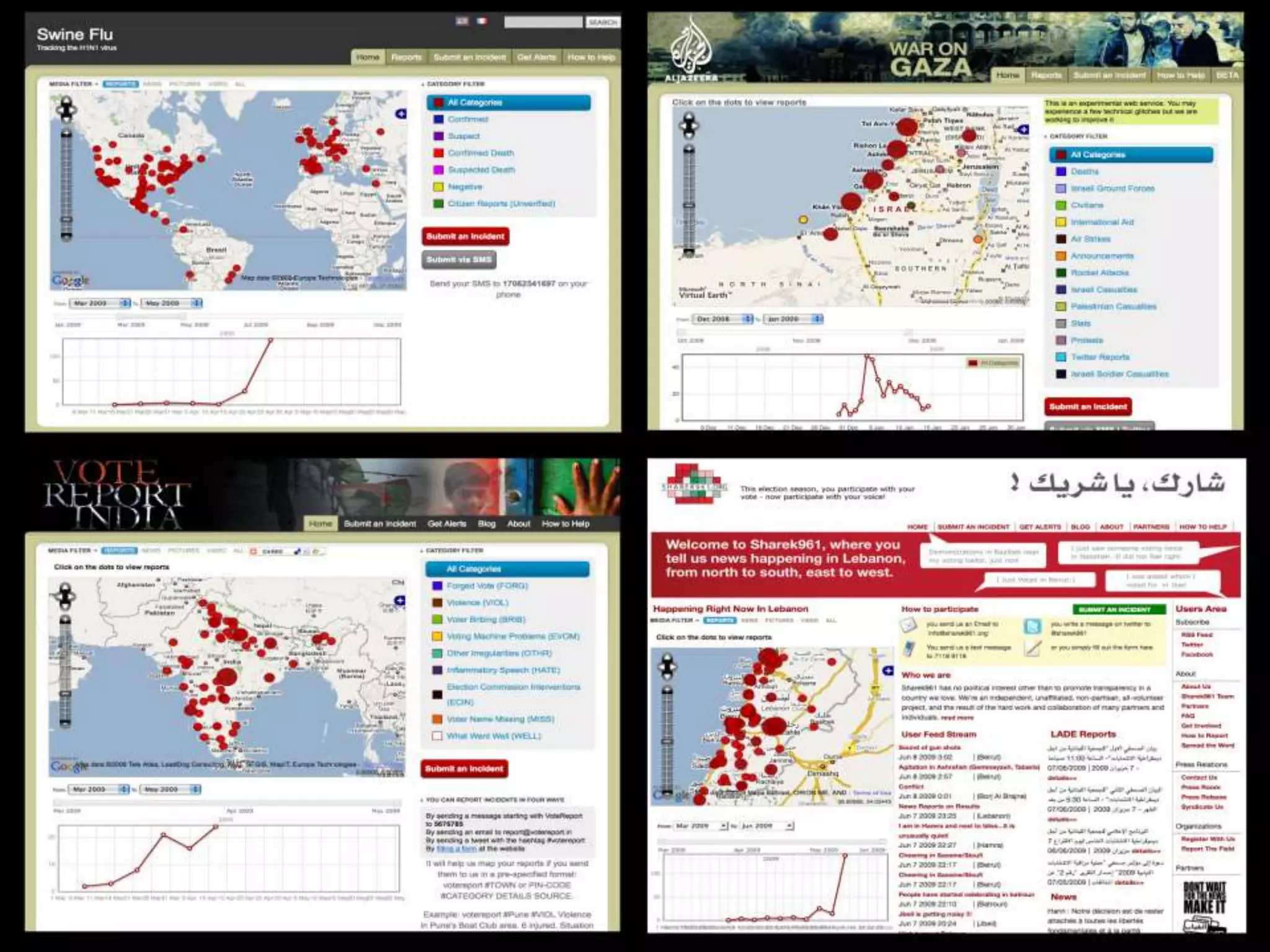
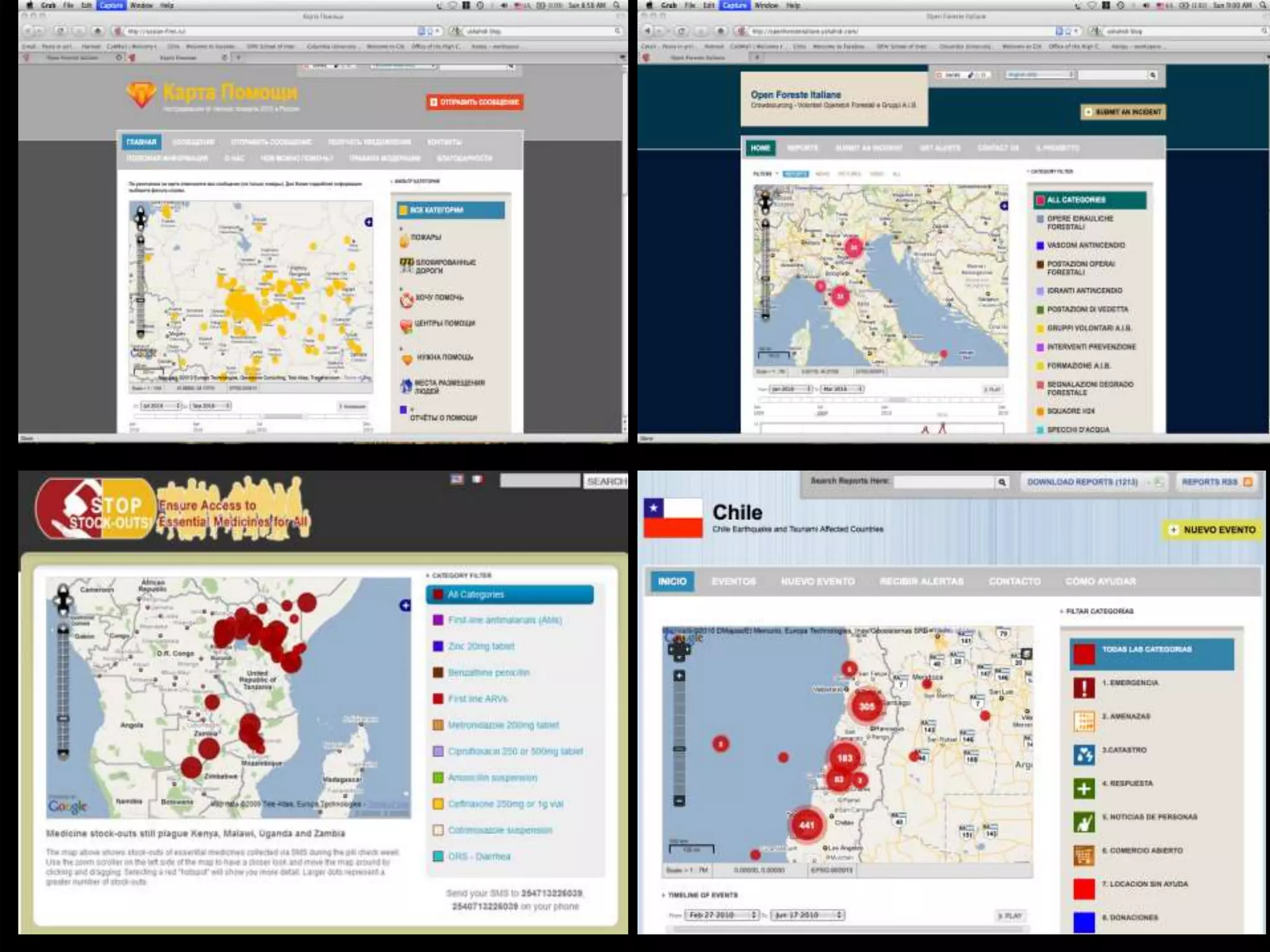
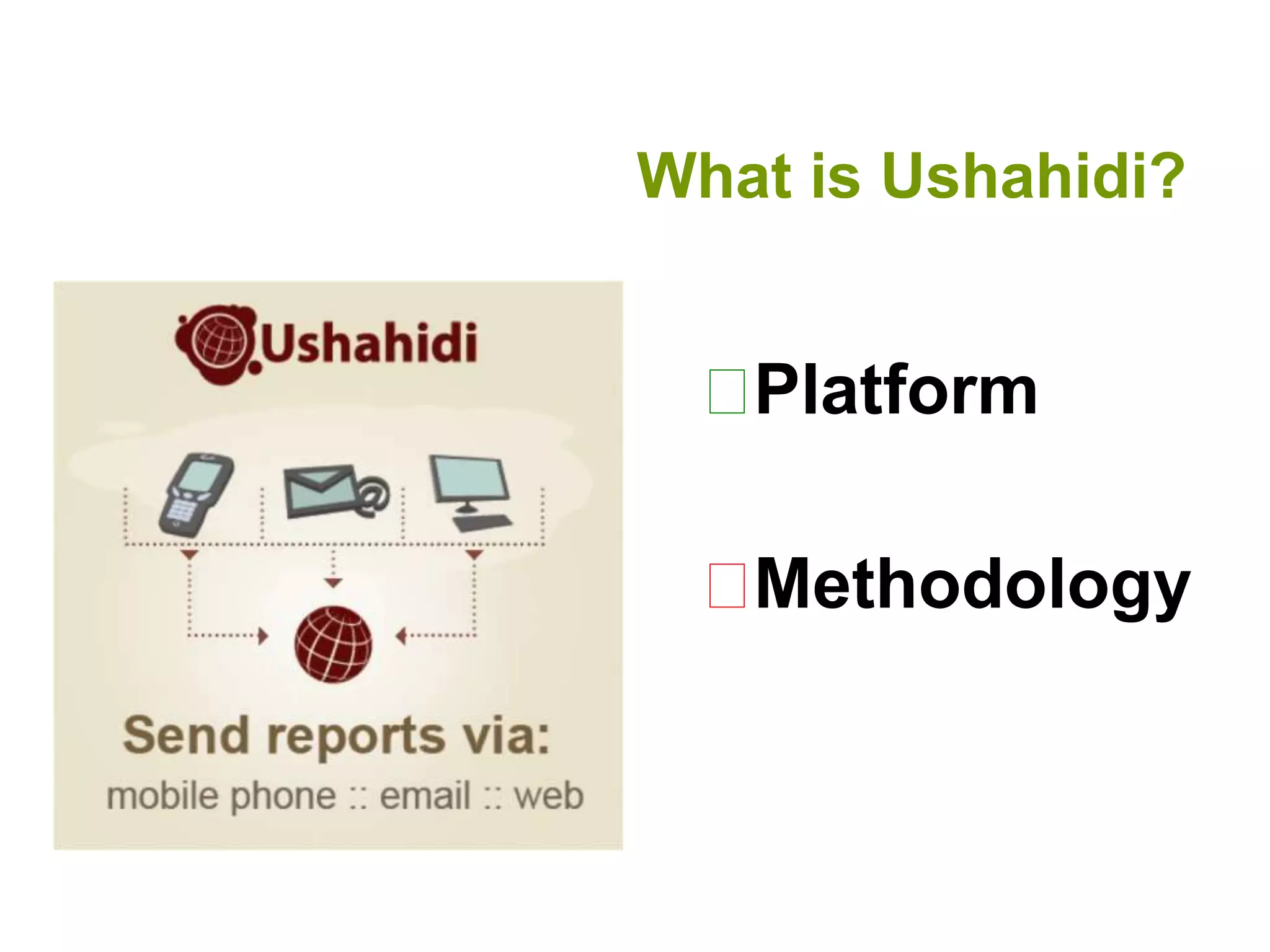
: CROWDSOURCING, MAPPINGAND CROWDFEEDING TOOLUshahidi, which means “testimony” in Swahili, began as a one-off deployment for mapping reports of election violence after the December 2007 Kenyan elections. Ushahidi is a crowdsourcing mapping system that people to report into the platform by web submission, SMS, Twitter or e-mail. The Ushahidi platform is right now being used in more than 30 countries and 60 projects, from electoral monitoring in Burundi to violence in Congo to Early Warning system in the Rift Valley.
What is Ushahidi?Platform Methodology
What is Ushahidi?PlatformMethodology
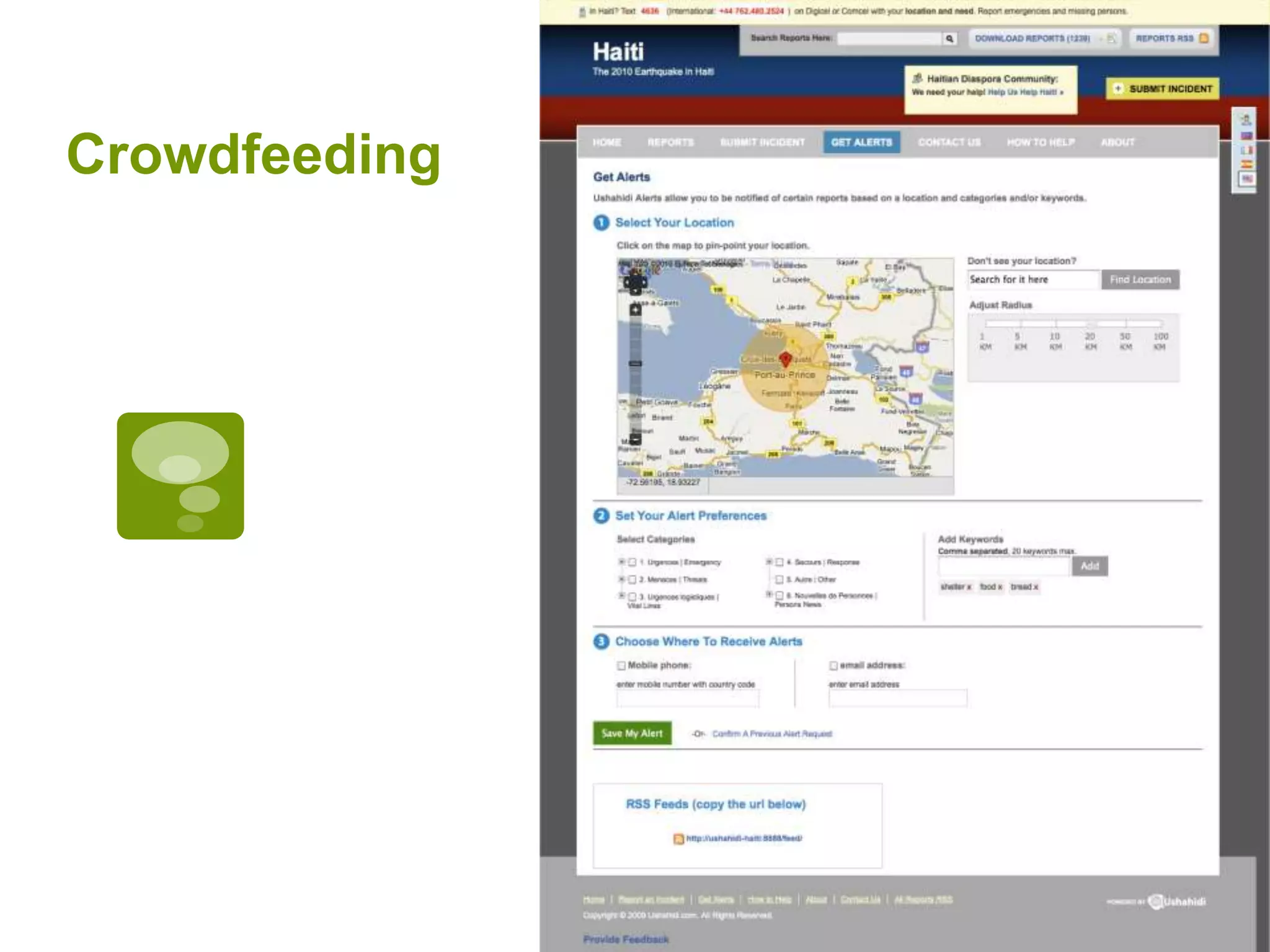
What you can do withVisualization of data on a mapMultiple layersCrowdfeeding
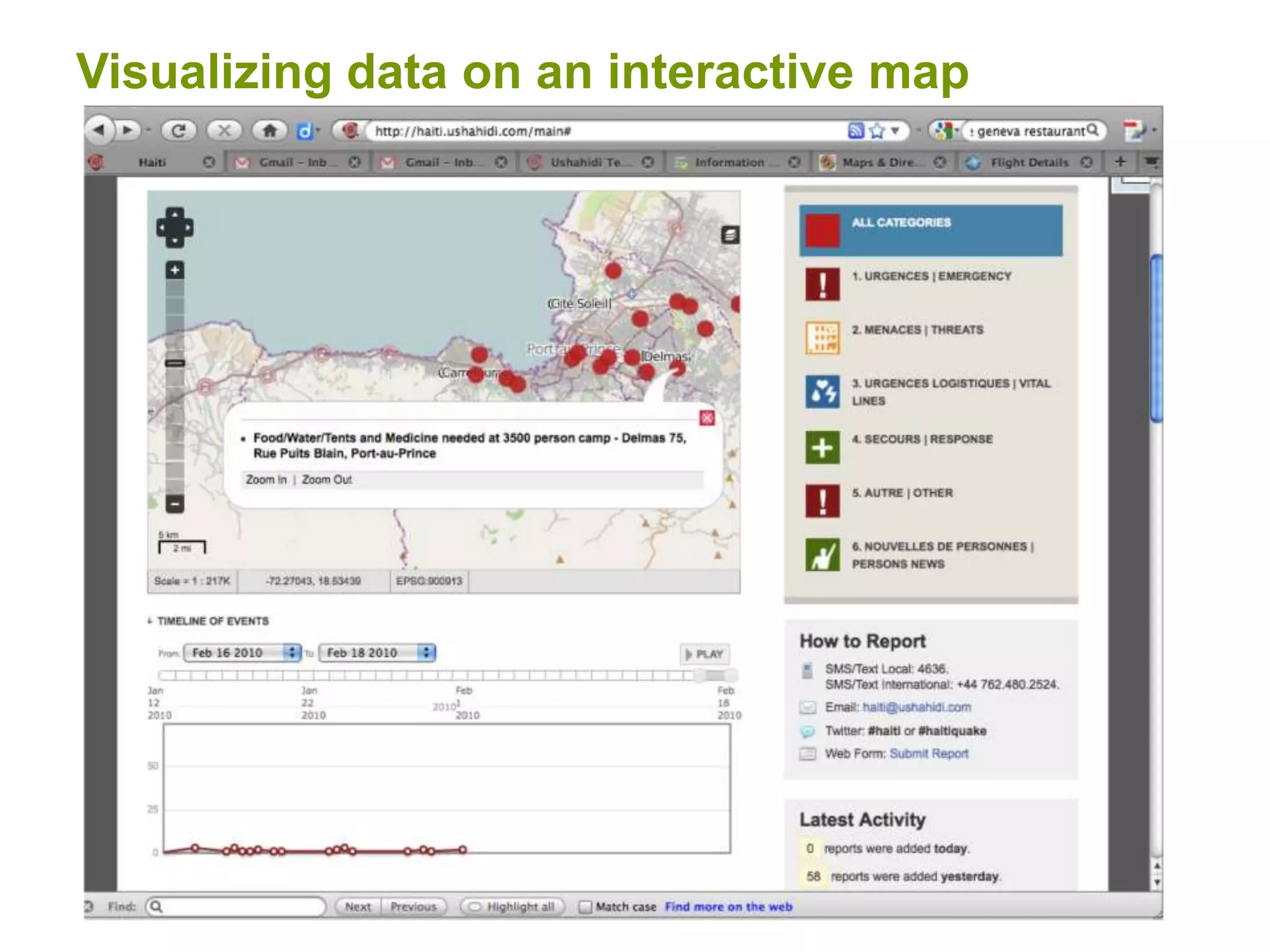
Visualizing data on an interactive map
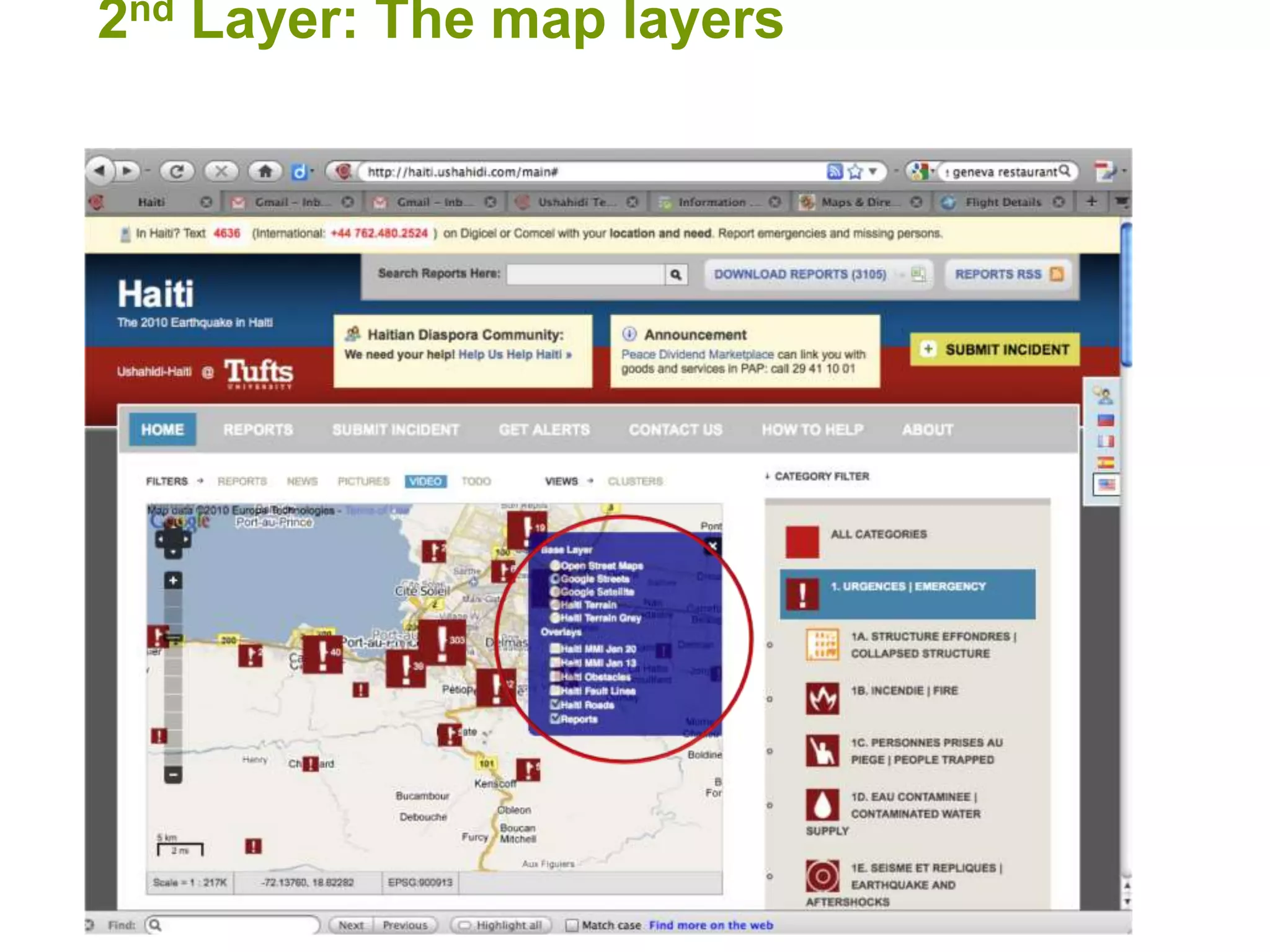
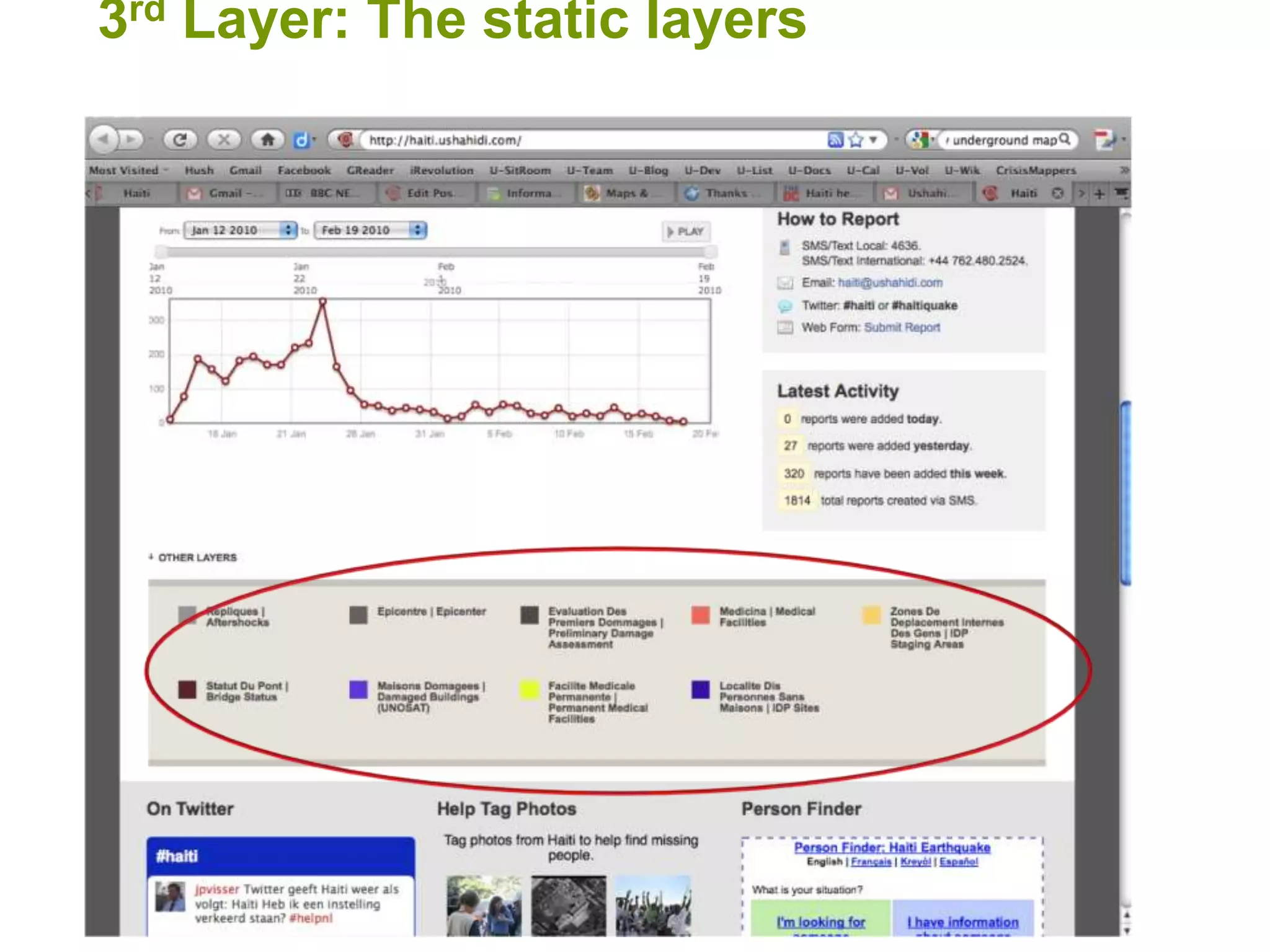
Multiple layersThe categoriesThe map layersThe static layers
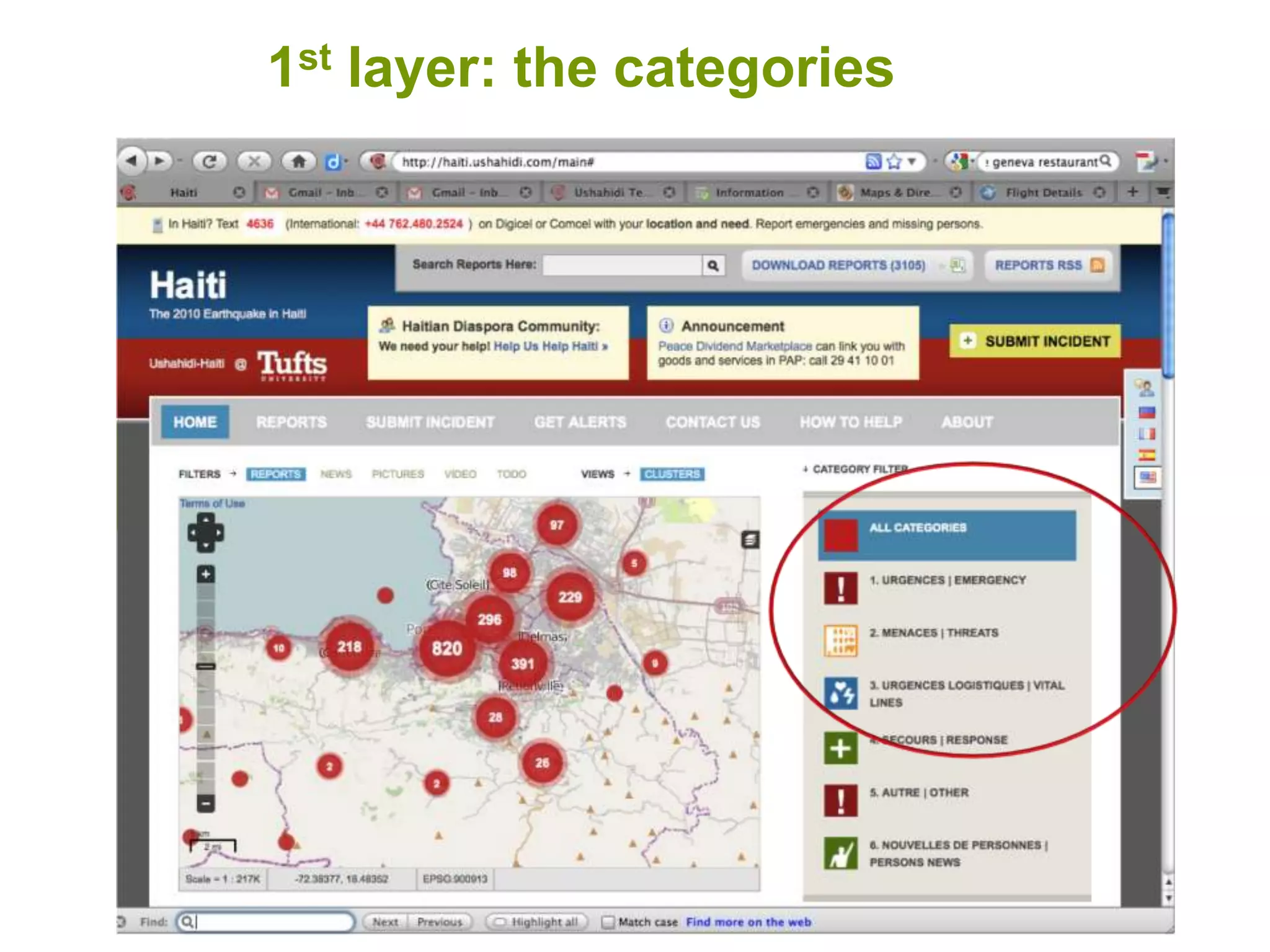
1st layer: the categories
2nd Layer: The map layers
3rd Layer: The static layers
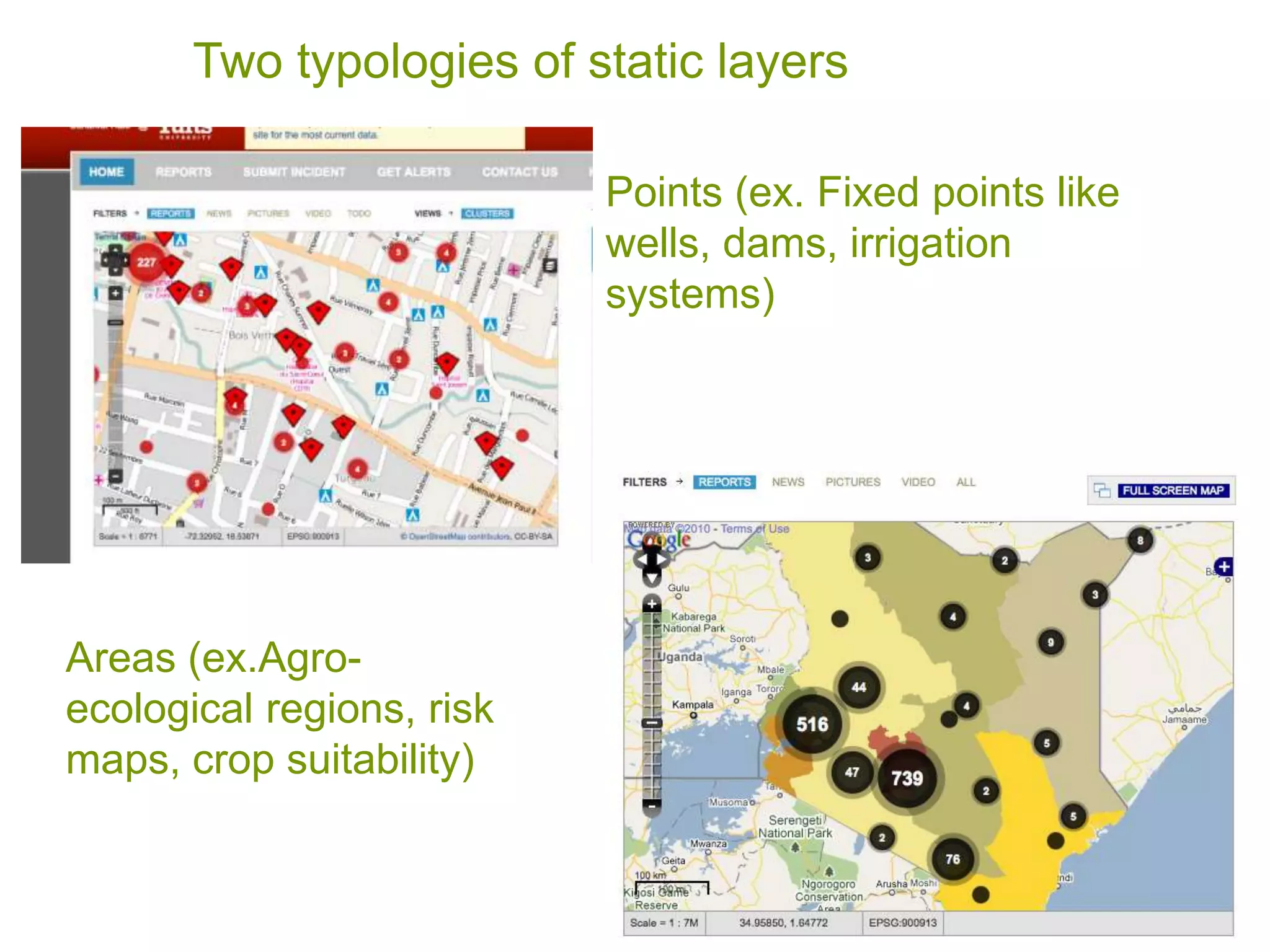
Two typologies of static layersPoints (ex. Fixed points like wells, dams, irrigation systems)Areas (ex.Agro-ecological regions, risk maps, crop suitability)
Crowdfeeding
OPENSTREET MAP: CROWDSOURCED MAPPINGOpenStreet Map (OSM) was founded in July 2004 by Steve Coast. OpenStreet Map data is published under an open content license, with the intention of promoting free use and re-distribution of the data (both commercial and non-commercial). The Map is entirely built by volunteers who can be expert mappers or not.  In April 2006, a foundation was established to encourage the growth, development and distribution of free geospatial data and provide geospatial data for anybody to use and share.
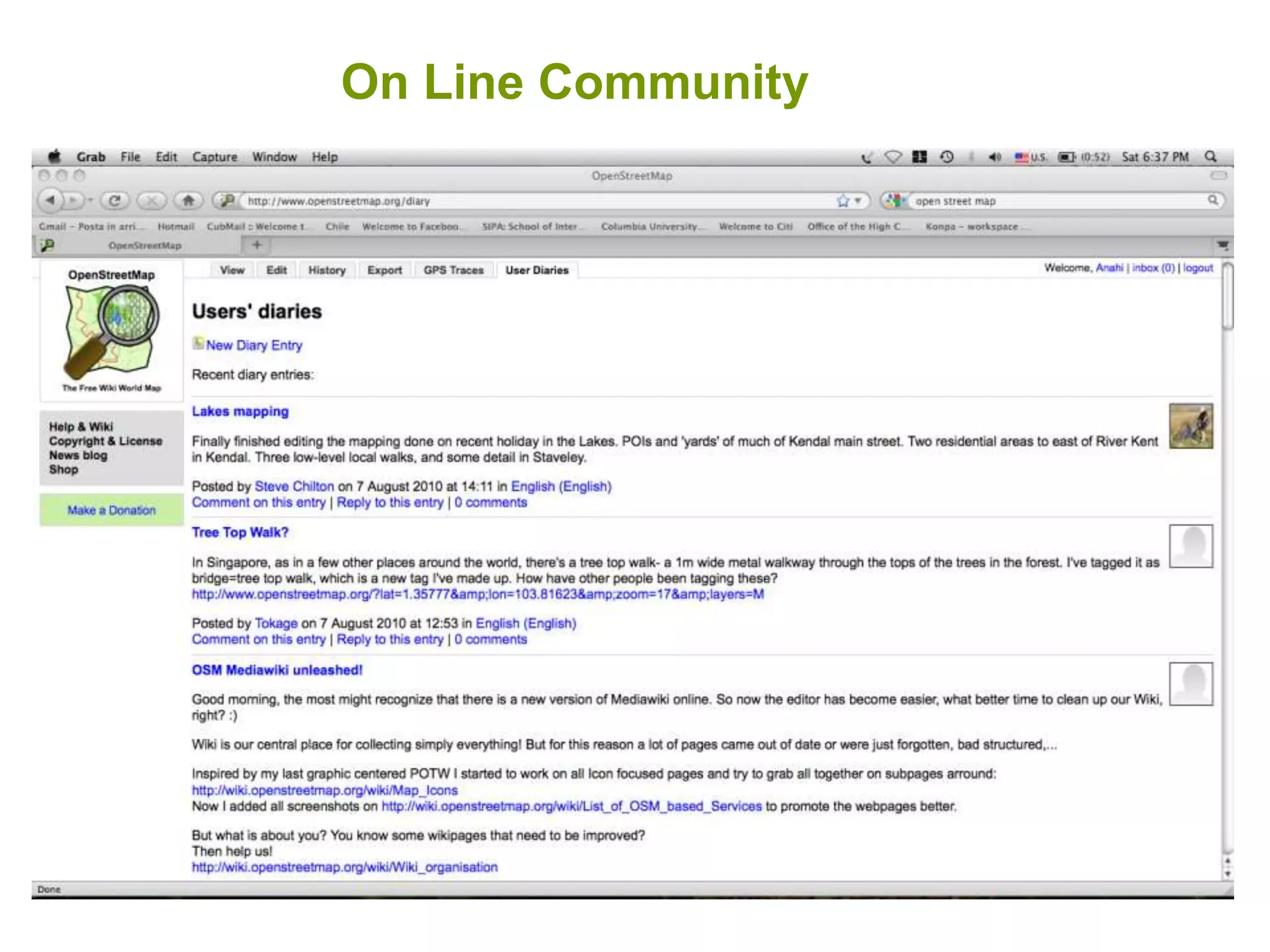
Advantages of using OSMOpen data available for everybodyEasy to edit and share even for people with no GPS skillsOn line active community
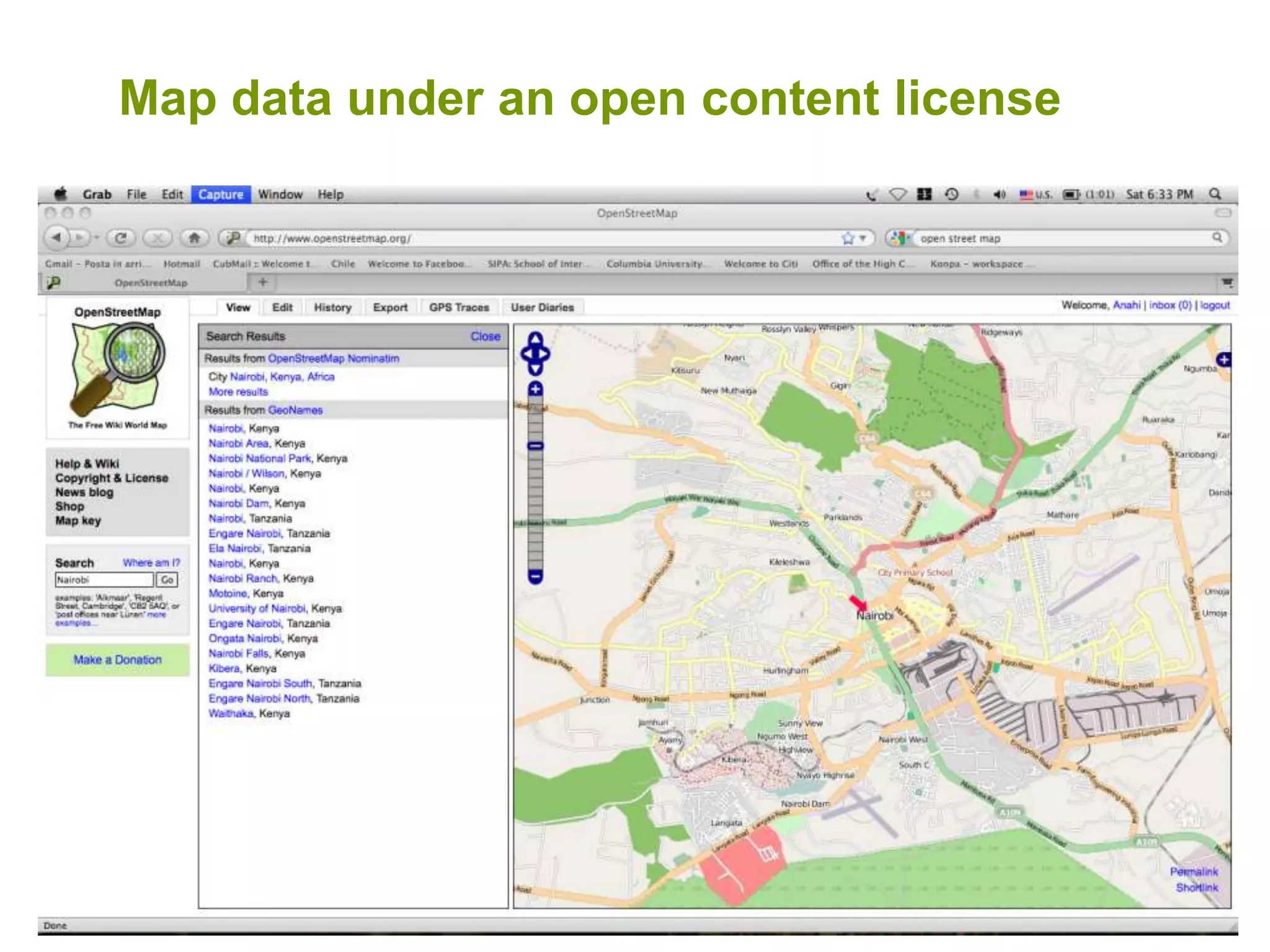
Map data under an open content license
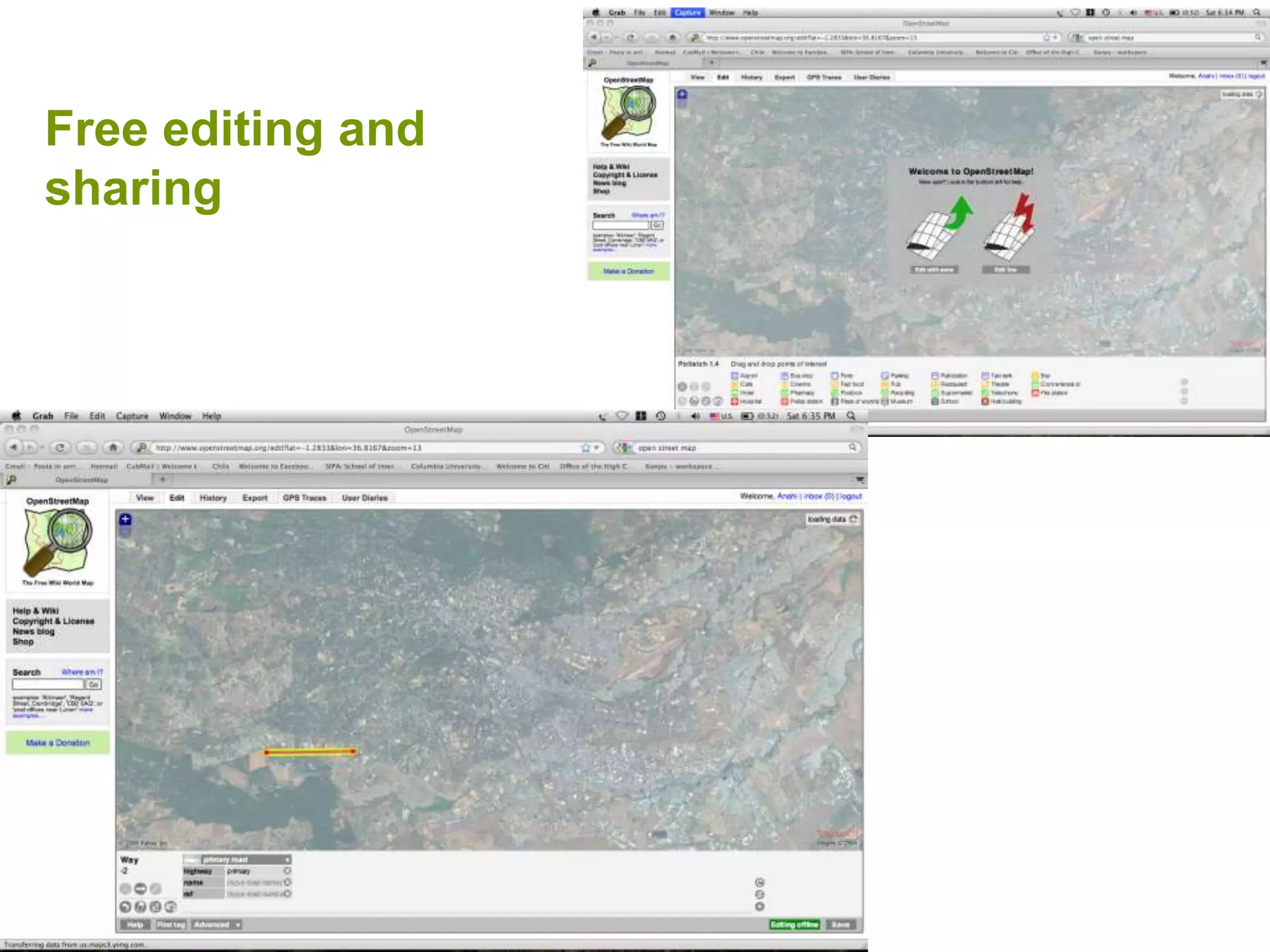
Free editing and sharing
On Line Community
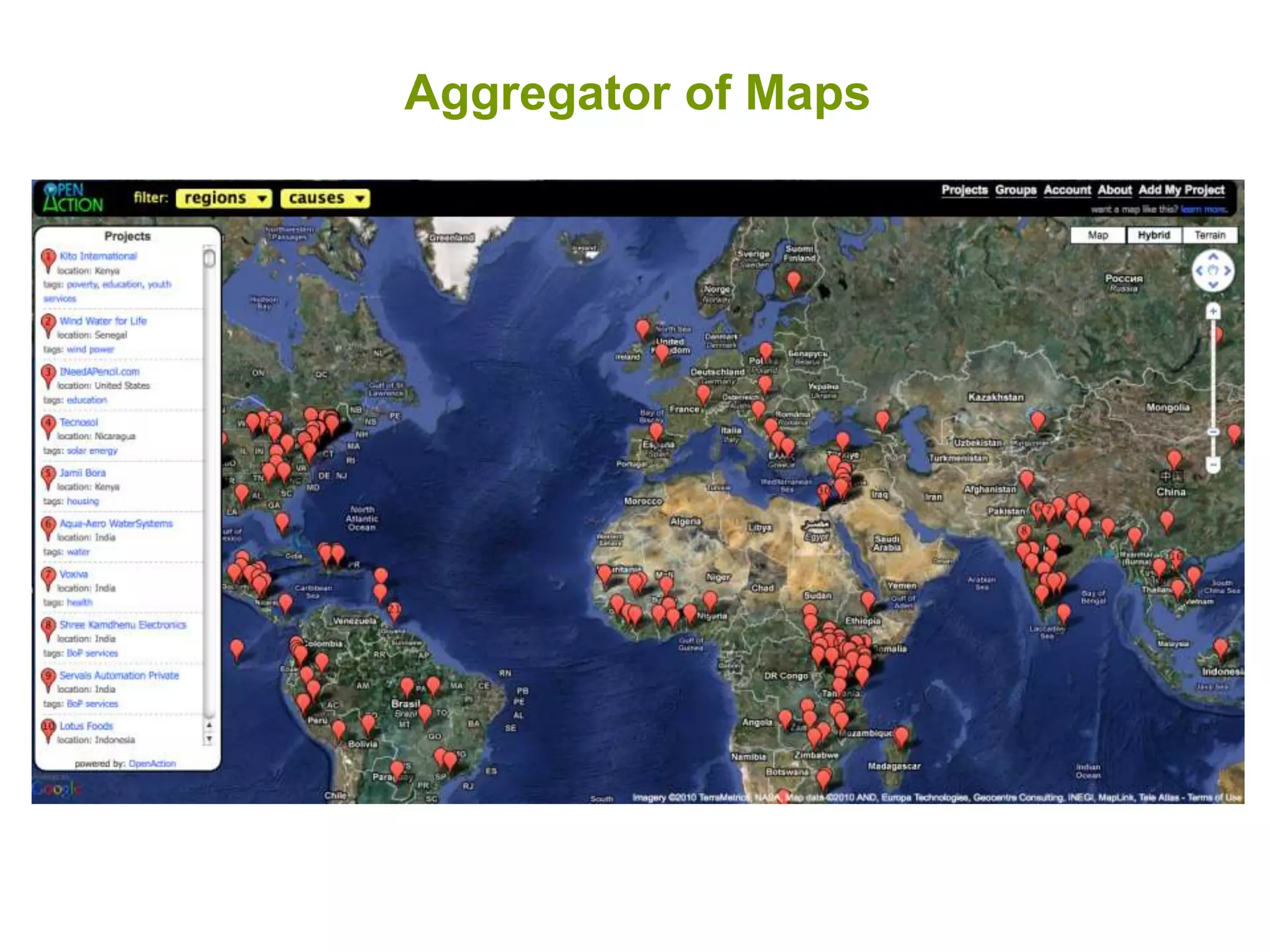
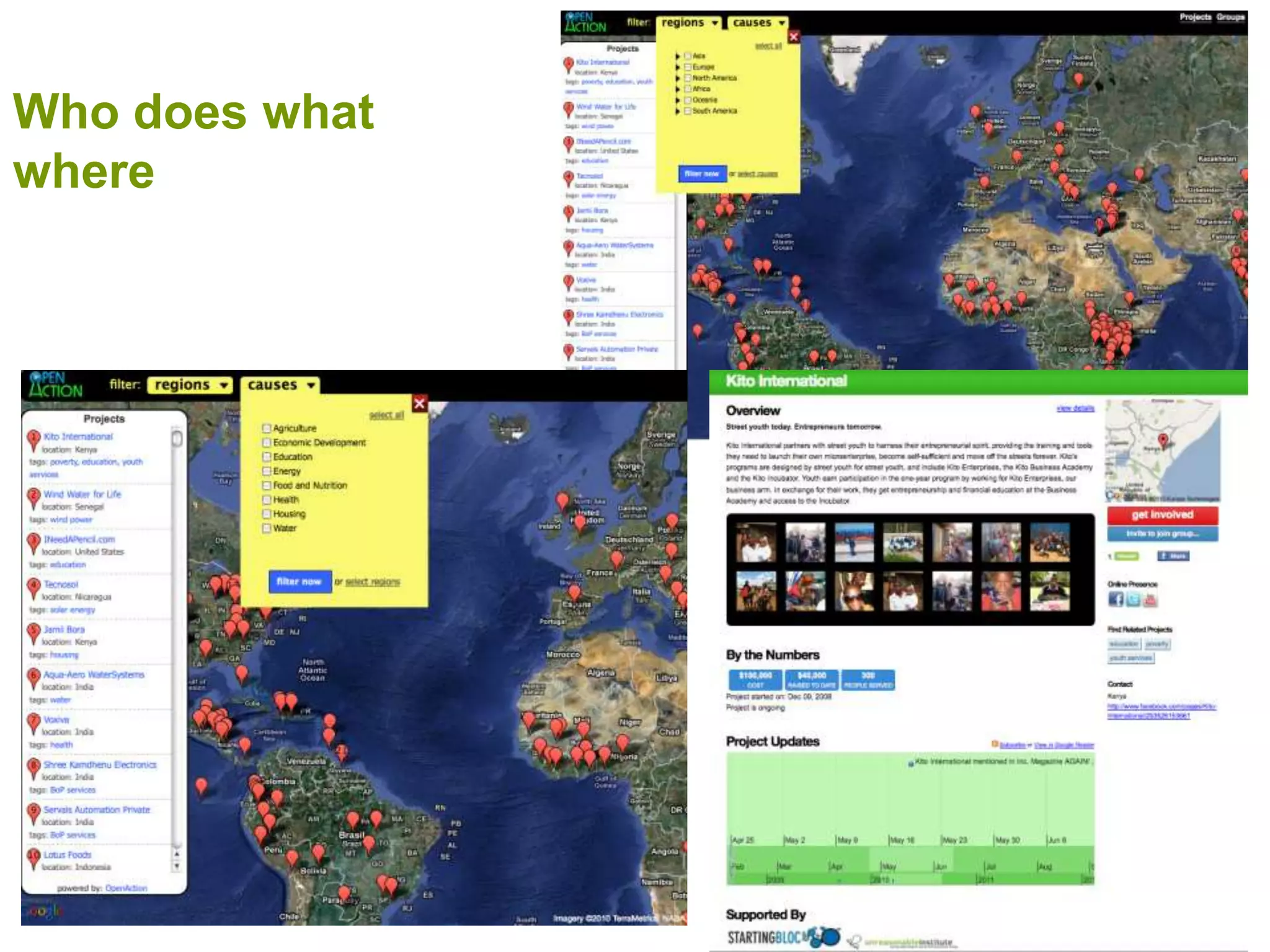
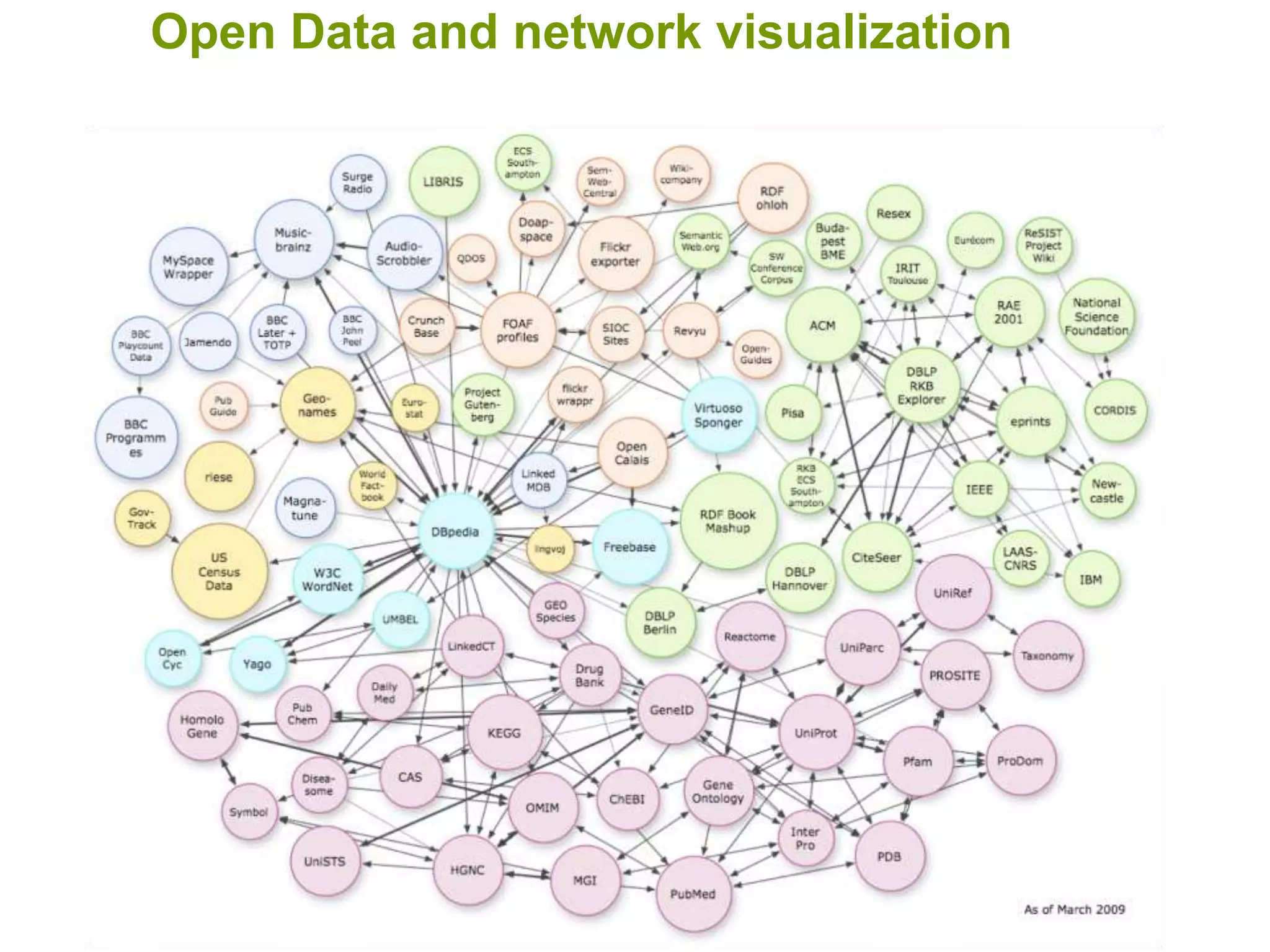
OpenAction develop tools to help change-makers tell a more engaging story of impact to a larger audience. Using smart technology and open data standards, the organization brings greater connectivity to the social impact space by creating something called aggregator of maps.
WhatAggregator of mapWho does what and whereOpen Data and network visualizationcan do
Aggregator of Maps
Who does what where
Open Data and network visualization
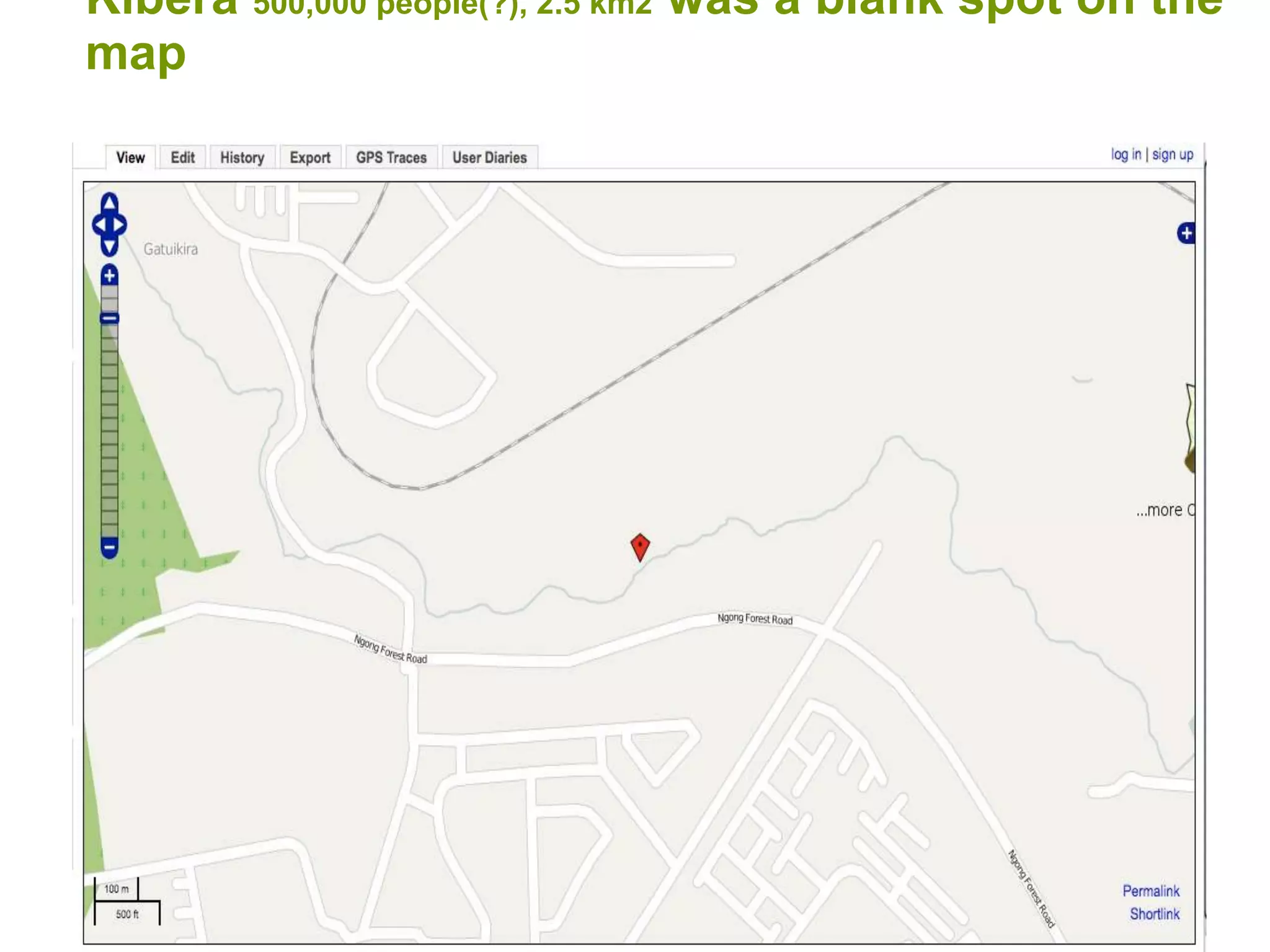
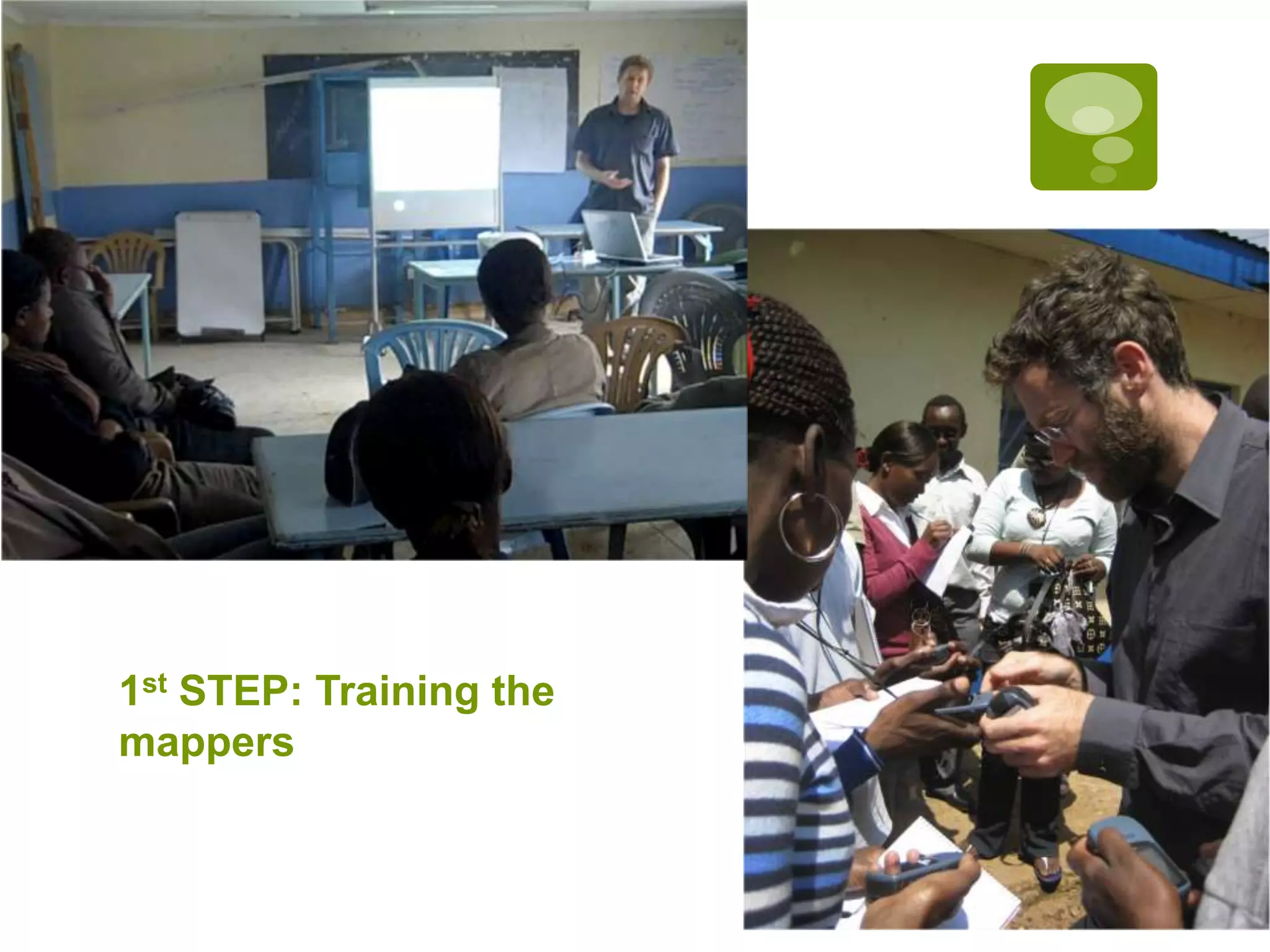
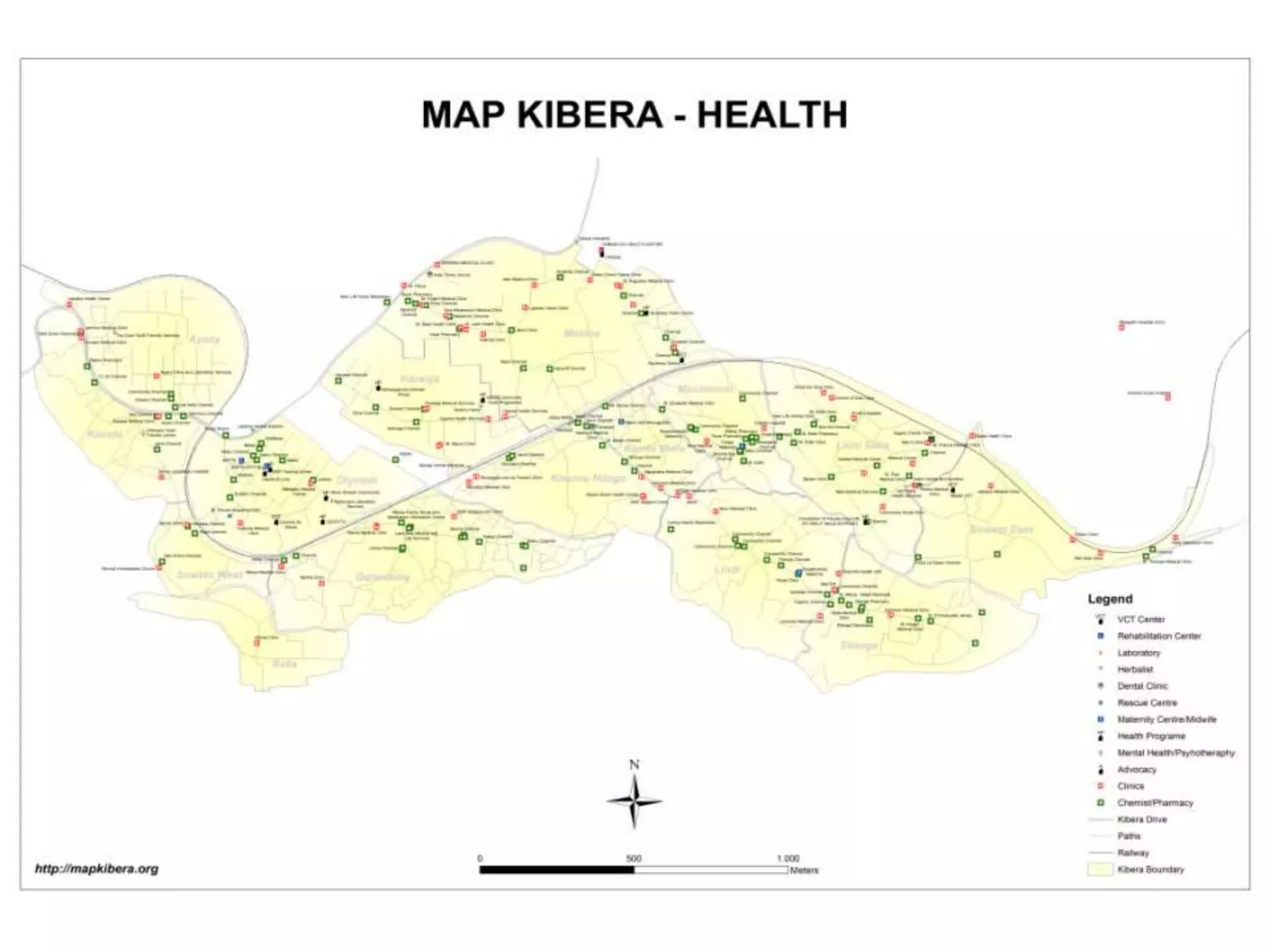
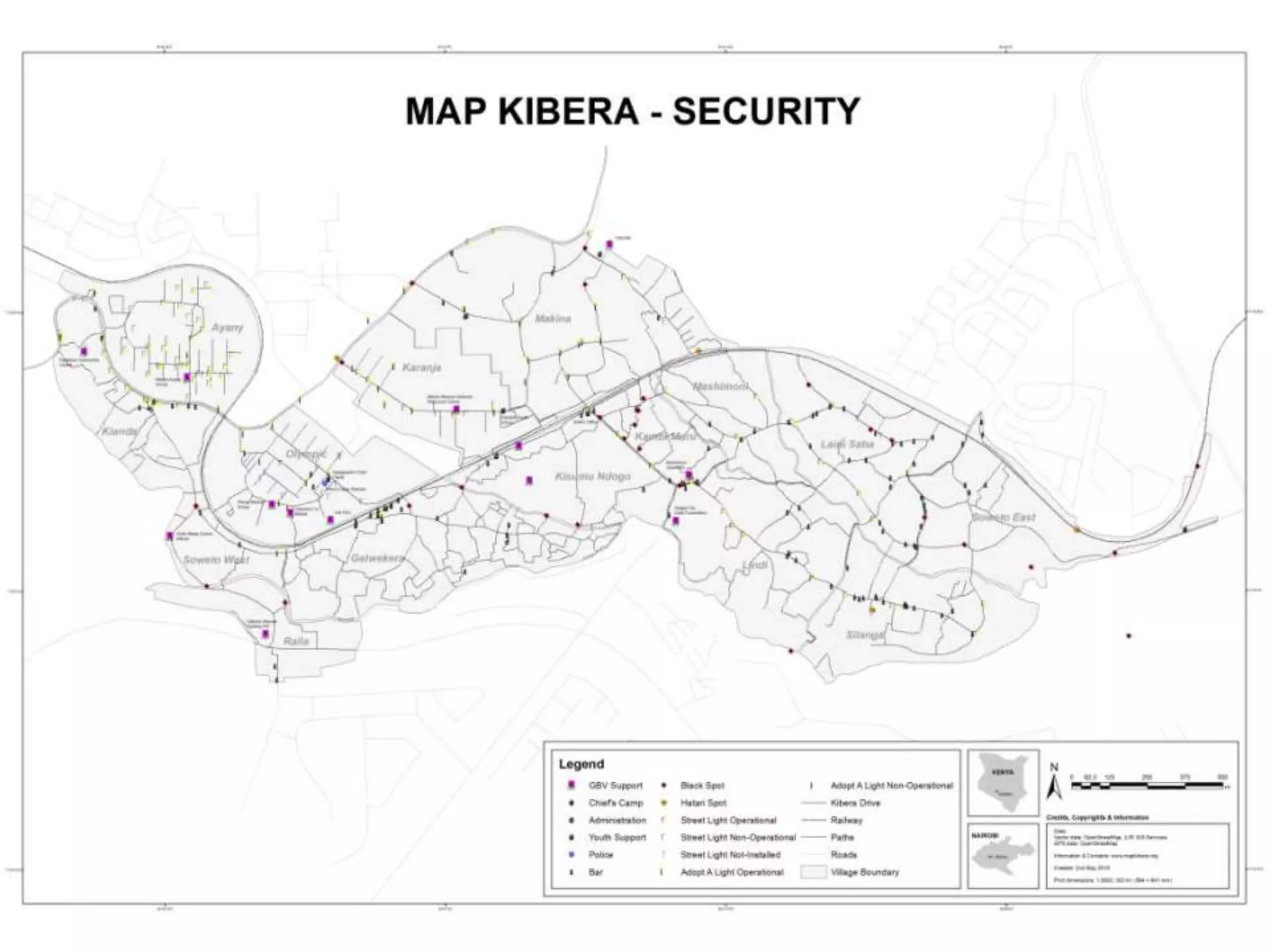
MAP KIBERAMap Kibera was developed in response to the lack of available map data and other public, open, and shared information about one of the world's largest slums: Kibera, in Nairobi, Kenya. The project started with the simple creation of a map using the open source free software OpenStreet Map and the Ushahidi platform, to become a project involving now media, health organizations, GBV working groups and grassroots organizations.
Kibera 500,000 people(?), 2.5 km2 was a blank spot on the map
1st STEP: Training the mappers
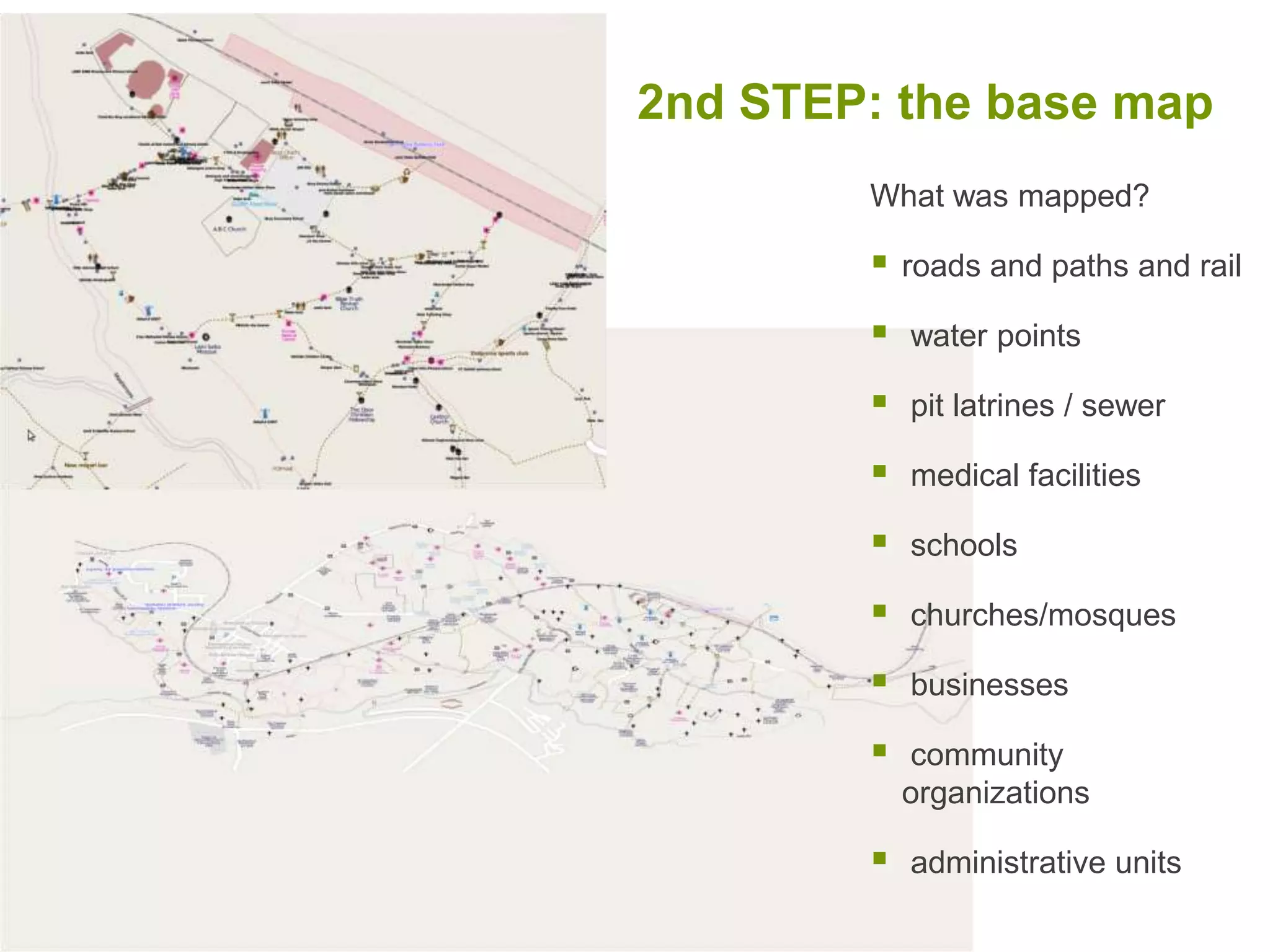
2nd STEP: the base mapWhat was mapped?roads and paths and rail water points pit latrines / sewer medical facilities schools churches/mosques businesses community organizations administrative units
3rd STEP: Voices of KiberaDevelop Entities and Skills: Kibera Mappers, Kibera News Network (video journalism), SMS ReportingDeeply Explore Themes: Health, Education, Water/Sanitation and Safety with detailed mapping and reportingSet up a short code 3002, “Kibera”www.voiceofkibera.org
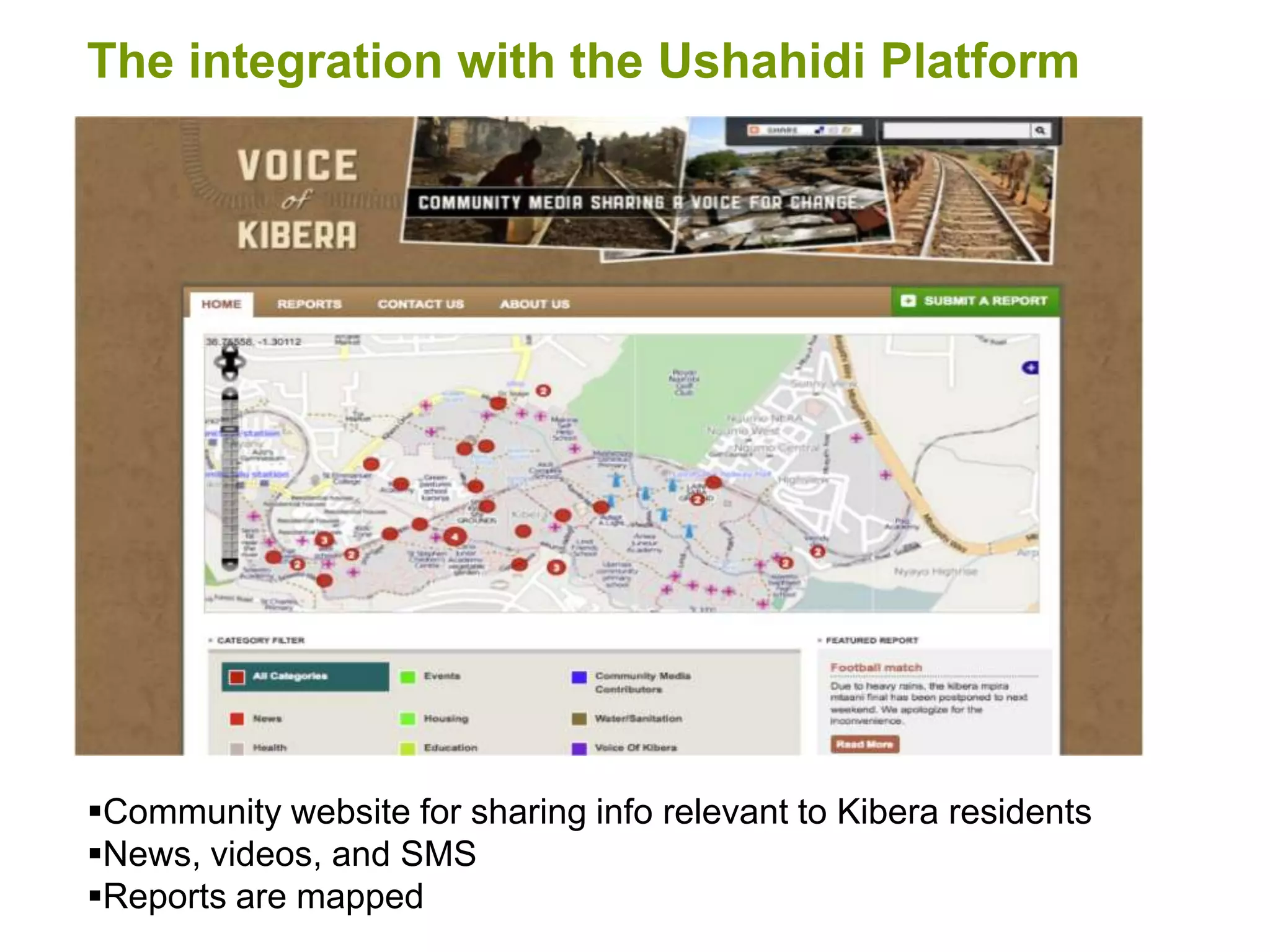
The integration with the Ushahidi PlatformCommunity website for sharing info relevant to Kibera residents
News, videos, and SMS
Reports are mapped
Map Kibera Results:A group of engaged and skilled citizens, mappers, and journalistsLinkages between Nairobi tech scene and slumdwellersPlatforms and mediums to share the information locally and globally (printed maps, SMS reporting, USHAHIDI and new media creation).Slowly building movement for shared and open information among NGOs and CBOs
Next StepsRegister mapping group locallyExpand to other communities in and around Kenya – including the other slums in Nairobi Taking the model to Haiti and elsewhere via GroundTruthMaterials and curriculum, thorough documentation and training othersMaps for Data: your surveys for our printout
Lessons Learned from MapKiberaCommunity Mapping can be a system to create community awareness and support social networksCommunication management in risk environment needs to incorporate vulnerable populationEarly warning systems are effective when they are based on shared information and open dataGatekeepers to information and data can often be bypassed or ignored completely, allowing for a new parallel information system to be created and used by marginalized citizens.
HOW TO USE CROWDSOURCING AND WHAT TO BE AWARE OF
CROWDSOURCING IS NOT PERFECT AND IT IS NOT ALWAYS NECESSARYCROWDSOURCING AND CROWDFEEDING NEED TO TAKE INTO CONSIDERATION THE IMPORTANCE OF INFORMATIONIT IS ALWAYS BETTER TO START ON A SMALL SCALE AND THEN SCALE UP THAN THE CONTRARYNEVER CHOOSE A TOOL AND THEN DECIDE WHAT TO USE IT FOR
RISK AND PROBLEMES OF CROWDSOURCING SYSTEMSVERIFICATIONSTRUCTUREIMPACT
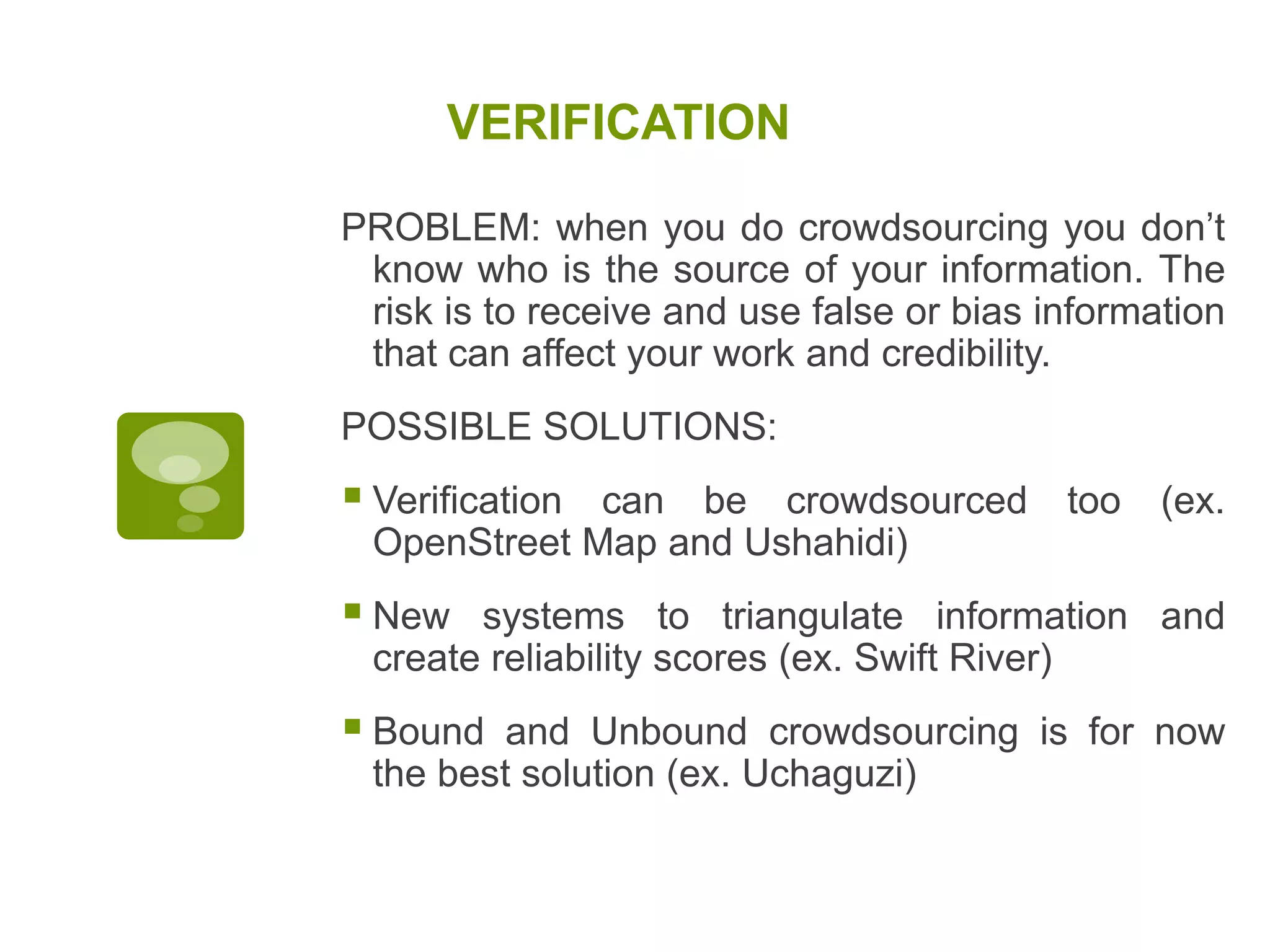
VERIFICATIONPROBLEM: when you do crowdsourcing you don’t know who is the source of your information. The risk is to receive and use false or bias information that can affect your work and credibility.POSSIBLE SOLUTIONS:Verification can be crowdsourced too (ex. OpenStreet Map and Ushahidi)New systems to triangulate information and create reliability scores (ex. Swift River)Bound and Unbound crowdsourcing is for now the best solution (ex. Uchaguzi)
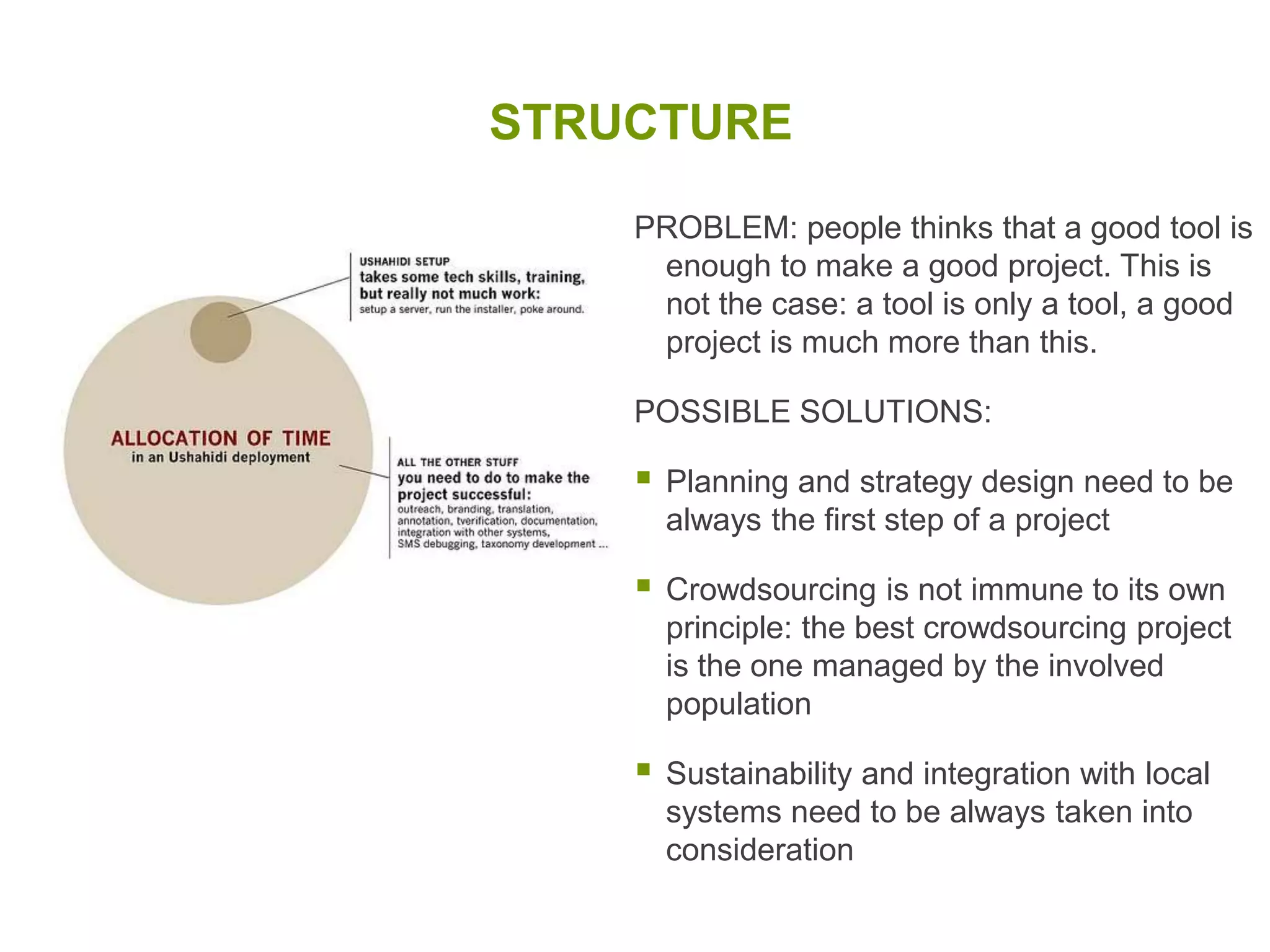
STRUCTUREPROBLEM: people thinks that a good tool is enough to make a good project. This is not the case: a tool is only a tool, a good project is much more than this.POSSIBLE SOLUTIONS:Planning and strategy design need to be always the first step of a projectCrowdsourcing is not immune to its own principle: the best crowdsourcing project is the one managed by the involved populationSustainability and integration with local systems need to be always taken into consideration
IMPACTInformation is power, so if you share information you are sharing power. Crowdsourcing projects cannot be detached by their political implications.Crowdsourcing projects are bi-directional projects: the crowd will always modify and affect the project as much as the project will modify and affect the crowd.Crowdsourcing projects to be effective need to be adapted to the existing flow of information and information management systems existing in the environment where they are implemented.

Crowdsourcing and Crowdfeeding

  • 1.
    World Bank ZambiaPPCRMission – August 2010CROWDSOURCING AND CROWDFEEDINGTOOLS AND TIPS FOR PARTECIPATORY INFORMATION MANAGEMENT SYSTEMSAnahi Ayala Iacuccianahi@crisismappers.net
  • 2.
    CROWDSOURCING AND CROWDFEEDINGCROWDSOURCING:use the crowd to collect information. The act of outsourcing tasks, traditionally performed by an employee to a large group of people or community (a crowd), through an open call for action. Jeff Howe coined the term in June 2006 explaining that because technological advances have allowed for cheap consumer electronics, the gap between professionals and amateurs has been diminished. CROWDFEEDING: the need for the crowd to share information with the crowd, ie, not top-down, or bottom-up, but information from the crowd, for the crowd; horizontal communication. The act of sharing information out to a large group of people or community, through an open sharing system. In the same time for the international community it means to share all available information with all stakeholders to allow better decision to be taken and better actions to be implemented.
  • 3.
    Advantages of usingcrowdsourcingInformation during a crisis or for early warning systems is as important as food and waterAffected communities know what is going on on the ground in real timeThe ability to collect information is limited by the availability of sources of information: more sources, more informationAffected population get engaged in the process because they have an interest in the outcomeCrowdsourcing is relatively cheaper than the use of selected monitoring teamsCrowdsourcing allow for triangulation of information permitting verification and accountability
  • 4.
    Typologies of crowdsourcingmethodsUnbounded crowd-sourcing: a large group of people is reporting. This system allows for an unlimited number of information to come in, but lack in reliability of information. Bounded crowd-sourcing: the reporting is done by a specific group. This system allows for verified information to come in but is subjected to the limitation of the limited source. Combined bounded and unbounded crowd-sourcing: information are collected by a specific group of people, but also by the crowd. Reliable sources and unreliable sources are combines. This system allows for: increase in overall reportingIncrease in the ability to validate reports from unknown sources
  • 5.
    : CROWDSOURCING, MAPPINGANDCROWDFEEDING TOOLUshahidi, which means “testimony” in Swahili, began as a one-off deployment for mapping reports of election violence after the December 2007 Kenyan elections. Ushahidi is a crowdsourcing mapping system that people to report into the platform by web submission, SMS, Twitter or e-mail. The Ushahidi platform is right now being used in more than 30 countries and 60 projects, from electoral monitoring in Burundi to violence in Congo to Early Warning system in the Rift Valley.
  • 6.
  • 8.
  • 9.
    What you cando withVisualization of data on a mapMultiple layersCrowdfeeding
  • 10.
    Visualizing data onan interactive map
  • 11.
    Multiple layersThe categoriesThemap layersThe static layers
  • 12.
    1st layer: thecategories
  • 13.
    2nd Layer: Themap layers
  • 14.
    3rd Layer: Thestatic layers
  • 15.
    Two typologies ofstatic layersPoints (ex. Fixed points like wells, dams, irrigation systems)Areas (ex.Agro-ecological regions, risk maps, crop suitability)
  • 16.
  • 17.
    OPENSTREET MAP: CROWDSOURCEDMAPPINGOpenStreet Map (OSM) was founded in July 2004 by Steve Coast. OpenStreet Map data is published under an open content license, with the intention of promoting free use and re-distribution of the data (both commercial and non-commercial). The Map is entirely built by volunteers who can be expert mappers or not. In April 2006, a foundation was established to encourage the growth, development and distribution of free geospatial data and provide geospatial data for anybody to use and share.
  • 18.
    Advantages of usingOSMOpen data available for everybodyEasy to edit and share even for people with no GPS skillsOn line active community
  • 19.
    Map data underan open content license
  • 20.
  • 21.
  • 22.
    OpenAction develop toolsto help change-makers tell a more engaging story of impact to a larger audience. Using smart technology and open data standards, the organization brings greater connectivity to the social impact space by creating something called aggregator of maps.
  • 23.
    WhatAggregator of mapWhodoes what and whereOpen Data and network visualizationcan do
  • 24.
  • 25.
  • 26.
    Open Data andnetwork visualization
  • 27.
    MAP KIBERAMap Kiberawas developed in response to the lack of available map data and other public, open, and shared information about one of the world's largest slums: Kibera, in Nairobi, Kenya. The project started with the simple creation of a map using the open source free software OpenStreet Map and the Ushahidi platform, to become a project involving now media, health organizations, GBV working groups and grassroots organizations.
  • 28.
    Kibera 500,000 people(?),2.5 km2 was a blank spot on the map
  • 29.
  • 30.
    2nd STEP: thebase mapWhat was mapped?roads and paths and rail water points pit latrines / sewer medical facilities schools churches/mosques businesses community organizations administrative units
  • 31.
    3rd STEP: Voicesof KiberaDevelop Entities and Skills: Kibera Mappers, Kibera News Network (video journalism), SMS ReportingDeeply Explore Themes: Health, Education, Water/Sanitation and Safety with detailed mapping and reportingSet up a short code 3002, “Kibera”www.voiceofkibera.org
  • 32.
    The integration withthe Ushahidi PlatformCommunity website for sharing info relevant to Kibera residents
  • 33.
  • 34.
  • 36.
    Map Kibera Results:Agroup of engaged and skilled citizens, mappers, and journalistsLinkages between Nairobi tech scene and slumdwellersPlatforms and mediums to share the information locally and globally (printed maps, SMS reporting, USHAHIDI and new media creation).Slowly building movement for shared and open information among NGOs and CBOs
  • 37.
    Next StepsRegister mappinggroup locallyExpand to other communities in and around Kenya – including the other slums in Nairobi Taking the model to Haiti and elsewhere via GroundTruthMaterials and curriculum, thorough documentation and training othersMaps for Data: your surveys for our printout
  • 38.
    Lessons Learned fromMapKiberaCommunity Mapping can be a system to create community awareness and support social networksCommunication management in risk environment needs to incorporate vulnerable populationEarly warning systems are effective when they are based on shared information and open dataGatekeepers to information and data can often be bypassed or ignored completely, allowing for a new parallel information system to be created and used by marginalized citizens.
  • 39.
    HOW TO USECROWDSOURCING AND WHAT TO BE AWARE OF
  • 40.
    CROWDSOURCING IS NOTPERFECT AND IT IS NOT ALWAYS NECESSARYCROWDSOURCING AND CROWDFEEDING NEED TO TAKE INTO CONSIDERATION THE IMPORTANCE OF INFORMATIONIT IS ALWAYS BETTER TO START ON A SMALL SCALE AND THEN SCALE UP THAN THE CONTRARYNEVER CHOOSE A TOOL AND THEN DECIDE WHAT TO USE IT FOR
  • 41.
    RISK AND PROBLEMESOF CROWDSOURCING SYSTEMSVERIFICATIONSTRUCTUREIMPACT
  • 42.
    VERIFICATIONPROBLEM: when youdo crowdsourcing you don’t know who is the source of your information. The risk is to receive and use false or bias information that can affect your work and credibility.POSSIBLE SOLUTIONS:Verification can be crowdsourced too (ex. OpenStreet Map and Ushahidi)New systems to triangulate information and create reliability scores (ex. Swift River)Bound and Unbound crowdsourcing is for now the best solution (ex. Uchaguzi)
  • 43.
    STRUCTUREPROBLEM: people thinksthat a good tool is enough to make a good project. This is not the case: a tool is only a tool, a good project is much more than this.POSSIBLE SOLUTIONS:Planning and strategy design need to be always the first step of a projectCrowdsourcing is not immune to its own principle: the best crowdsourcing project is the one managed by the involved populationSustainability and integration with local systems need to be always taken into consideration
  • 44.
    IMPACTInformation is power,so if you share information you are sharing power. Crowdsourcing projects cannot be detached by their political implications.Crowdsourcing projects are bi-directional projects: the crowd will always modify and affect the project as much as the project will modify and affect the crowd.Crowdsourcing projects to be effective need to be adapted to the existing flow of information and information management systems existing in the environment where they are implemented.
  • 45.
    THANK YOU!Anahi AyalaIacuccianahi@crisismappers.net