Management
Planfor Crowd
Control
Introduction
 The increasing population of India and the tendency of people to gather for a
common objective or interest makes events.
 These public gatherings may include street fairs, public rally, music festival, religious
gathering etc.
 A crowd is made up by the clustering of spectators and participants,but in
religious congregations the crowd is mostly made up of participants (the
devotees).
 Mass gatherings of persons can be defined by the World Health Organization as
‘more than a specified number of persons at a specific location for a specific purpose
for a defined period of time’.
 Large crowds create annoyances and difficulties to a section of the society, leading to
severe traffic delays, pollution,stampede,fights among people, riots, alteration in
landscape and ultimately become the source of medical emergencies and disasters.
 In last few years, India has witnessed many of such events which resulted in large no. of
casualties.
PREVENTIONOF
CROWDDISASTERS
BYCROWD
MANAGEMENT
Is a public security practice where large crowds are managed to
prevent the outbreak of crowd crushes, affray, fights involving
drunken people or riots .
Crowd crushes can cause in many hundreds of fatalities.
Crowd control can involve privately hired security guards as well
as police officers.
As crowd disasters are local events, disaster management is
primarily the responsibility of the organizers and local/district
administration with support and guidelines from state and
national authorities.
A study has been conducted by IIM Ahmedabad and
commissioned by NDMA on this.
Preventionof
CrowdDisasters
byCrowd
Management
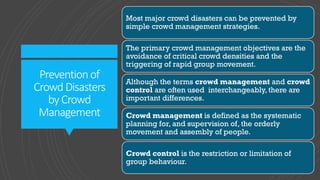
Most major crowd disasters can be prevented by
simple crowd management strategies.
The primary crowd management objectives are the
avoidance of critical crowd densities and the
triggering of rapid group movement.
Although the terms crowd management and crowd
control are often used interchangeably, there are
important differences.
Crowd management is defined as the systematic
planning for, and supervision of, the orderly
movement and assembly of people.
Crowd control is the restriction or limitation of
group behaviour.
Preventionof
CrowdDisasters
byCrowd
Management
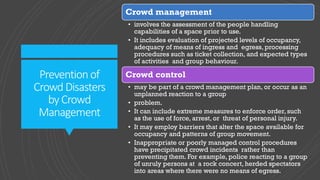
Crowd management
• involves the assessment of the people handling
capabilities of a space prior to use.
• It includes evaluation of projected levels of occupancy,
adequacy of means of ingress and egress, processing
procedures such as ticket collection, and expected types
of activities and group behaviour.
Crowd control
• may be part of a crowd management plan, or occur as an
unplanned reaction to a group
• problem.
• It can include extreme measures to enforce order, such
as the use of force, arrest, or threat of personal injury.
• It may employ barriers that alter the space available for
occupancy and patterns of group movement.
• Inappropriate or poorly managed control procedures
have precipitated crowd incidents rather than
preventing them. For example, police reacting to a group
of unruly persons at a rock concert, herded spectators
into areas where there were no means of egress.
Causesand
Triggersfor
CrowdDisasters
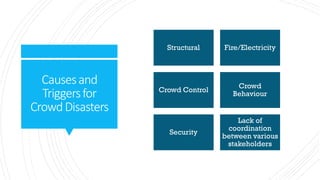
Structural Fire/Electricity
Crowd Control
Crowd
Behaviour
Security
Lack of
coordination
between various
stakeholders
Causesand
Triggersfor
CrowdDisasters
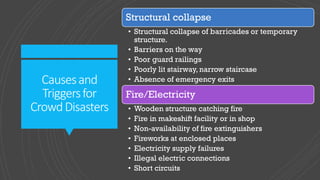
Structural collapse
• Structural collapse of barricades or temporary
structure.
• Barriers on the way
• Poor guard railings
• Poorly lit stairway, narrow staircase
• Absence of emergency exits
Fire/Electricity
• Wooden structure catching fire
• Fire in makeshift facility or in shop
• Non-availability of fire extinguishers
• Fireworks at enclosed places
• Electricity supply failures
• Illegal electric connections
• Short circuits
Causesand
Triggersfor
CrowdDisasters
Crowd control
• More than anticipated crowd at store/mall/political
rallies/examinations/religious gatherings, public
celebrations.
• Underestimation of audience, staffing, services.
• People allowed in excess of holding capacity due to
overselling of tickets for an event.
• Limited holding area before the entrance.
• Lack of access control.
• Closed/Locked exits.
• Sudden opening of entry doors.
• Reliance on one major exit route.
• Uncontrolled parking and movement of vehicles.
• Callous indifference in regulating traffic.
• Lack of adequate and strong railings to marshal the queue.
• Lack of sectoral partition to segregate assembled crowd.
• Lack of proper public address system to control crowd.
Causesand
Triggersfor
CrowdDisasters
Crowd behaviour
• A wild rush towards the entrance or exits
• A collision between large inward flow and outward
flow.
• Rush during distribution of something
• Angry crowd due to delay in start of an event
• Sudden mass evacuation
• Last minute change in platforms of trains
Security
• Under deployment of security personnel to regulate
crowd control
• Lack of CCTV surveillance of the crowd
• Absence of walky-talkies with the security staff
• Fights within groups of people and with security staff
• Lack of door frame metal detectors
• Crowd forced against sharp metal fences
Causesand
Triggersfor
CrowdDisasters
Lack of coordination
between stakeholders
• Coordination gap between
agencies (commissioner and
DM, PWD, Fire Service etc.)
• Poor infrastructure (plans on
paper but no
implementation due to lack
of funds, resources or will)
• Communication delays
Planning for Crowd
management
strategies and
arrangements
Various elements of
crowd management
strategy are:
• Capacity planning (long
term and short term)
• Understanding crowd
behaviour
• Crowd control
• Stakeholder approach
PlanningforCrowd
management
strategiesand
arrangements
Capacity Planning:
• In India,religious places have high probability of
crowd disasters.Their locations play a major role
in this.
• Development of shrine locality could be difficult in
many places, but it is necessary to develop
infrastructure for crowd management.
• There is need for LONG TERM PERSPECTIVES for
infrastructure development which should depend
upon popularity,periodicity of event,weather,
terrain, local population etc.
• Staging points should be planned for physical or
virtual locations through which each visitor must
pass.
• Each staging point must have sufficient facilities for
rest, food, water, hygiene etc.
• Multiple routes should be encouraged.This will
help in movement of vulnerable groups (children
and old people).
PlanningforCrowd
management
strategiesand
arrangements
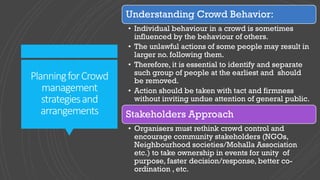
Understanding Crowd Behavior:
• Individual behaviour in a crowd is sometimes
influenced by the behaviour of others.
• The unlawful actions of some people may result in
larger no. following them.
• Therefore, it is essential to identify and separate
such group of people at the earliest and should
be removed.
• Action should be taken with tact and firmness
without inviting undue attention of general public.
Stakeholders Approach
• Organisers must rethink crowd control and
encourage community stakeholders (NGOs,
Neighbourhood societies/Mohalla Association
etc.) to take ownership in events for unity of
purpose, faster decision/response, better co-
ordination , etc.
CrowdControl
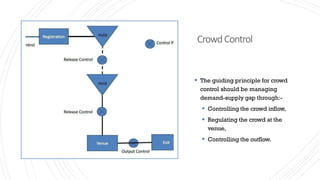
 The guiding principle for crowd
control should be managing
demand-supply gap through:-
 Controlling the crowd inflow,
 Regulating the crowd at the
venue,
 Controlling the outflow.
Crowd
Control
 In order to understand demand,we need to
understand the:-
 Historical no.,crowd arrival patterns, growing
popularity and types of visitors
 Identify the mass arrival time windows creating
peaks (season,days of the week, time of the day,
festivals, holidays etc.)
 Advance ticket booking/reservations
 Public transport timetables
 In order to understand supply,we need to calculate:-
 The capacity at the venue:seating capacity,
worships, offerings or prayers possible per hour
 Capacity of holding areas/queue complex
Crowd
Control
 At no.of places,demand outstrips supply,
leading to overcrowding. Because of this,there is
a need for restricting the no.entries.
 A mandatory registration process makes this possible.
 Influencing the arrival is another method, which can
be done through :-
 Informing off-peak times
 Having priority queues,visitors with advanced
internet bookings,VIP visit during off- peak times
 Promote use of certain mode of transport
 Adjusting the event time keeping in mind regular
peak traffic times around the venue
 Informing current crowd strength and the expected
wait time
Crowd
Control
 With demand outstripping supply,queues cannot be avoided.
 At no. of places,it is impossible to increase the supply capacity
because of religious beliefs or the topological reasons.
 In such cases since the wait is unavoidable the only possibility is to make
it comfortable.
 Softer aspects of managing queues:-
 Do not overlook the effects of perceptions of management
 Determine the acceptable waiting time for visitors
 Install directions that entertain and physically involve the visitors
 Get visitors out of line(e-service)
 Modify visitors' arrival behavior(inform nonpeak hours)
 Keep resources not serving visitors out of sight
 Segment visitors(by personality, age, special needs etc. to
provide differentiated attention and/or service
Crowd
Control
 While planning for crowd control following aspects should be kept in mind:
 Deployment of snake line approach
 Generators, distribution boxes, circuit-breakers should be kept in an isolated place
away from mischievous crowd elements.
 Crowd Control Staff should be uniformly dressed(highly visible)
 Crowd Control Staff should be in position to communicate with each other and to
the crowd
 Make sure there are ample entrances and exits(including
administrative/emergency routes) at the event and they remain unobstructed
 Monitor crowds
 There should be adequate fencing; security and electrical appliances should be
protected from weather.
 These measures would avoid electric short circuits and electricity-
induced fire accidents.
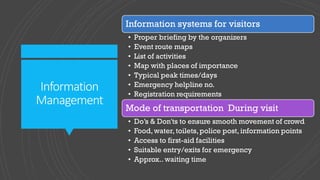
Information
Management
Information systems for visitors
• Proper briefing by the organizers
• Event route maps
• List of activities
• Map with places of importance
• Typical peak times/days
• Emergency helpline no.
• Registration requirements
Mode of transportation During visit
• Do’s & Don'ts to ensure smooth movement of crowd
• Food,water, toilets,police post, information points
• Access to first-aid facilities
• Suitable entry/exits for emergency
• Approx.. waiting time
Information
Management
Information organizers should
have
• Past data on no. of arrivals
• Likely arrival times, mean of arrival and
needs
Documentation for process
orientation
• Site panning, master planning
• Processes for identifying hazards
• Processes for managing hazards
• Key contacts
• Time and motion studies to determine
holding capacity
Information
Management
Information for security
personnel
• Detailed maps showing entry/ exit,
holding areas, location of
emergency services.
• Evacuation and response plans
Signage
• Type of sign information,Wording
and language specification
• Size and dimension and location
THANKYOU

Crowd-Control-Management-Plan.pdf

  • 1.
  • 2.
    Introduction  The increasingpopulation of India and the tendency of people to gather for a common objective or interest makes events.  These public gatherings may include street fairs, public rally, music festival, religious gathering etc.  A crowd is made up by the clustering of spectators and participants,but in religious congregations the crowd is mostly made up of participants (the devotees).  Mass gatherings of persons can be defined by the World Health Organization as ‘more than a specified number of persons at a specific location for a specific purpose for a defined period of time’.  Large crowds create annoyances and difficulties to a section of the society, leading to severe traffic delays, pollution,stampede,fights among people, riots, alteration in landscape and ultimately become the source of medical emergencies and disasters.  In last few years, India has witnessed many of such events which resulted in large no. of casualties.
  • 3.
    PREVENTIONOF CROWDDISASTERS BYCROWD MANAGEMENT Is a publicsecurity practice where large crowds are managed to prevent the outbreak of crowd crushes, affray, fights involving drunken people or riots . Crowd crushes can cause in many hundreds of fatalities. Crowd control can involve privately hired security guards as well as police officers. As crowd disasters are local events, disaster management is primarily the responsibility of the organizers and local/district administration with support and guidelines from state and national authorities. A study has been conducted by IIM Ahmedabad and commissioned by NDMA on this.
  • 4.
    Preventionof CrowdDisasters byCrowd Management Most major crowddisasters can be prevented by simple crowd management strategies. The primary crowd management objectives are the avoidance of critical crowd densities and the triggering of rapid group movement. Although the terms crowd management and crowd control are often used interchangeably, there are important differences. Crowd management is defined as the systematic planning for, and supervision of, the orderly movement and assembly of people. Crowd control is the restriction or limitation of group behaviour.
  • 5.
    Preventionof CrowdDisasters byCrowd Management Crowd management • involvesthe assessment of the people handling capabilities of a space prior to use. • It includes evaluation of projected levels of occupancy, adequacy of means of ingress and egress, processing procedures such as ticket collection, and expected types of activities and group behaviour. Crowd control • may be part of a crowd management plan, or occur as an unplanned reaction to a group • problem. • It can include extreme measures to enforce order, such as the use of force, arrest, or threat of personal injury. • It may employ barriers that alter the space available for occupancy and patterns of group movement. • Inappropriate or poorly managed control procedures have precipitated crowd incidents rather than preventing them. For example, police reacting to a group of unruly persons at a rock concert, herded spectators into areas where there were no means of egress.
  • 6.
  • 7.
    Causesand Triggersfor CrowdDisasters Structural collapse • Structuralcollapse of barricades or temporary structure. • Barriers on the way • Poor guard railings • Poorly lit stairway, narrow staircase • Absence of emergency exits Fire/Electricity • Wooden structure catching fire • Fire in makeshift facility or in shop • Non-availability of fire extinguishers • Fireworks at enclosed places • Electricity supply failures • Illegal electric connections • Short circuits
  • 8.
    Causesand Triggersfor CrowdDisasters Crowd control • Morethan anticipated crowd at store/mall/political rallies/examinations/religious gatherings, public celebrations. • Underestimation of audience, staffing, services. • People allowed in excess of holding capacity due to overselling of tickets for an event. • Limited holding area before the entrance. • Lack of access control. • Closed/Locked exits. • Sudden opening of entry doors. • Reliance on one major exit route. • Uncontrolled parking and movement of vehicles. • Callous indifference in regulating traffic. • Lack of adequate and strong railings to marshal the queue. • Lack of sectoral partition to segregate assembled crowd. • Lack of proper public address system to control crowd.
  • 9.
    Causesand Triggersfor CrowdDisasters Crowd behaviour • Awild rush towards the entrance or exits • A collision between large inward flow and outward flow. • Rush during distribution of something • Angry crowd due to delay in start of an event • Sudden mass evacuation • Last minute change in platforms of trains Security • Under deployment of security personnel to regulate crowd control • Lack of CCTV surveillance of the crowd • Absence of walky-talkies with the security staff • Fights within groups of people and with security staff • Lack of door frame metal detectors • Crowd forced against sharp metal fences
  • 10.
    Causesand Triggersfor CrowdDisasters Lack of coordination betweenstakeholders • Coordination gap between agencies (commissioner and DM, PWD, Fire Service etc.) • Poor infrastructure (plans on paper but no implementation due to lack of funds, resources or will) • Communication delays
  • 11.
    Planning for Crowd management strategiesand arrangements Various elements of crowd management strategy are: • Capacity planning (long term and short term) • Understanding crowd behaviour • Crowd control • Stakeholder approach
  • 12.
    PlanningforCrowd management strategiesand arrangements Capacity Planning: • InIndia,religious places have high probability of crowd disasters.Their locations play a major role in this. • Development of shrine locality could be difficult in many places, but it is necessary to develop infrastructure for crowd management. • There is need for LONG TERM PERSPECTIVES for infrastructure development which should depend upon popularity,periodicity of event,weather, terrain, local population etc. • Staging points should be planned for physical or virtual locations through which each visitor must pass. • Each staging point must have sufficient facilities for rest, food, water, hygiene etc. • Multiple routes should be encouraged.This will help in movement of vulnerable groups (children and old people).
  • 13.
    PlanningforCrowd management strategiesand arrangements Understanding Crowd Behavior: •Individual behaviour in a crowd is sometimes influenced by the behaviour of others. • The unlawful actions of some people may result in larger no. following them. • Therefore, it is essential to identify and separate such group of people at the earliest and should be removed. • Action should be taken with tact and firmness without inviting undue attention of general public. Stakeholders Approach • Organisers must rethink crowd control and encourage community stakeholders (NGOs, Neighbourhood societies/Mohalla Association etc.) to take ownership in events for unity of purpose, faster decision/response, better co- ordination , etc.
  • 14.
    CrowdControl  The guidingprinciple for crowd control should be managing demand-supply gap through:-  Controlling the crowd inflow,  Regulating the crowd at the venue,  Controlling the outflow.
  • 15.
    Crowd Control  In orderto understand demand,we need to understand the:-  Historical no.,crowd arrival patterns, growing popularity and types of visitors  Identify the mass arrival time windows creating peaks (season,days of the week, time of the day, festivals, holidays etc.)  Advance ticket booking/reservations  Public transport timetables  In order to understand supply,we need to calculate:-  The capacity at the venue:seating capacity, worships, offerings or prayers possible per hour  Capacity of holding areas/queue complex
  • 16.
    Crowd Control  At no.ofplaces,demand outstrips supply, leading to overcrowding. Because of this,there is a need for restricting the no.entries.  A mandatory registration process makes this possible.  Influencing the arrival is another method, which can be done through :-  Informing off-peak times  Having priority queues,visitors with advanced internet bookings,VIP visit during off- peak times  Promote use of certain mode of transport  Adjusting the event time keeping in mind regular peak traffic times around the venue  Informing current crowd strength and the expected wait time
  • 17.
    Crowd Control  With demandoutstripping supply,queues cannot be avoided.  At no. of places,it is impossible to increase the supply capacity because of religious beliefs or the topological reasons.  In such cases since the wait is unavoidable the only possibility is to make it comfortable.  Softer aspects of managing queues:-  Do not overlook the effects of perceptions of management  Determine the acceptable waiting time for visitors  Install directions that entertain and physically involve the visitors  Get visitors out of line(e-service)  Modify visitors' arrival behavior(inform nonpeak hours)  Keep resources not serving visitors out of sight  Segment visitors(by personality, age, special needs etc. to provide differentiated attention and/or service
  • 18.
    Crowd Control  While planningfor crowd control following aspects should be kept in mind:  Deployment of snake line approach  Generators, distribution boxes, circuit-breakers should be kept in an isolated place away from mischievous crowd elements.  Crowd Control Staff should be uniformly dressed(highly visible)  Crowd Control Staff should be in position to communicate with each other and to the crowd  Make sure there are ample entrances and exits(including administrative/emergency routes) at the event and they remain unobstructed  Monitor crowds  There should be adequate fencing; security and electrical appliances should be protected from weather.  These measures would avoid electric short circuits and electricity- induced fire accidents.
  • 19.
    Information Management Information systems forvisitors • Proper briefing by the organizers • Event route maps • List of activities • Map with places of importance • Typical peak times/days • Emergency helpline no. • Registration requirements Mode of transportation During visit • Do’s & Don'ts to ensure smooth movement of crowd • Food,water, toilets,police post, information points • Access to first-aid facilities • Suitable entry/exits for emergency • Approx.. waiting time
  • 20.
    Information Management Information organizers should have •Past data on no. of arrivals • Likely arrival times, mean of arrival and needs Documentation for process orientation • Site panning, master planning • Processes for identifying hazards • Processes for managing hazards • Key contacts • Time and motion studies to determine holding capacity
  • 21.
    Information Management Information for security personnel •Detailed maps showing entry/ exit, holding areas, location of emergency services. • Evacuation and response plans Signage • Type of sign information,Wording and language specification • Size and dimension and location
  • 22.