Cross-cultural study of the use of mobile phones  E.A. Draffan (Univ. of Southampton, UK),  Kenryu Nakamura, Mamoru Iwabuchi (Univ. of Tokyo, Japan), Takeo Kondo, Sheryl Burgstahler (Univ. of Washington, USA)
Statistics
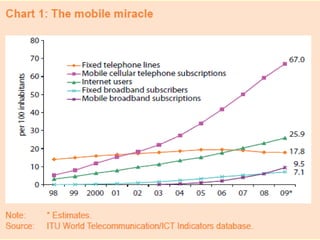
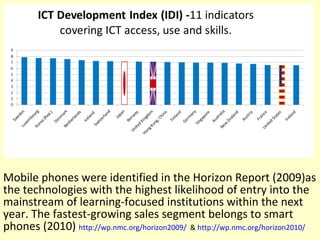
Mobile phones were identified in the Horizon Report (2009)as the technologies with the highest likelihood of entry into the mainstream of learning-focused institutions within the next year. The fastest-growing sales segment belongs to smart phones (2010)  http://wp.nmc.org/horizon2009/   &  http ://wp.nmc.org/horizon2010 /   More statistics
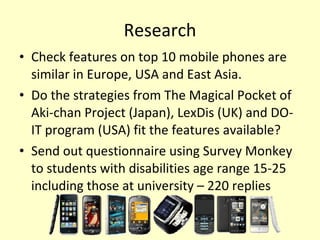
Research Check features on top 10 mobile phones are similar in Europe, USA and East Asia.  Do the strategies from The Magical Pocket of Aki-chan Project (Japan), LexDis (UK) and DO-IT program (USA) fit the features available? Send out questionnaire using Survey Monkey to students with disabilities age range 15-25 including those at university – 220 replies
Questions Age and Country  Which phone do you use? (make and number) What difficulties do you experience? Have your difficulties made it harder to have the mobile phone you wanted? If so why? What made you choose your present phone? How often do you use these features? Anything else you want to say about using a mobile phone.
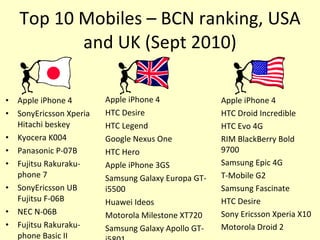
Top 10 Mobiles –  BCN ranking , USA and UK (Sept 2010) Apple iPhone 4 SonyEricsson Xperia Hitachi beskey Kyocera K004 Panasonic P-07B Fujitsu Rakuraku-phone 7 SonyEricsson UB Fujitsu F-06B NEC N-06B Fujitsu Rakuraku-phone Basic II Apple iPhone 4  HTC Desire HTC Legend Google Nexus One HTC Hero Apple iPhone 3GS Samsung Galaxy Europa GT-i5500 Huawei Ideos Motorola Milestone XT720 Samsung Galaxy Apollo GT-i5801 Apple iPhone 4  HTC Droid Incredible HTC Evo 4G RIM BlackBerry Bold 9700 Samsung Epic 4G T-Mobile G2 Samsung Fascinate HTC Desire Sony Ericsson Xperia X10 Motorola Droid 2
 
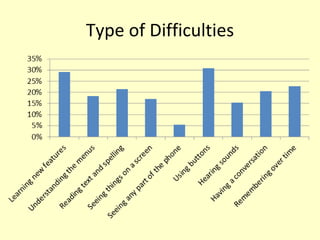
Type of Difficulties
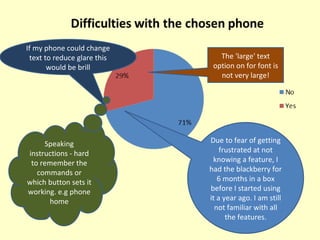
If my phone could change text to reduce glare this would be brill Speaking instructions - hard to remember the commands or which button sets it working. e.g phone home The 'large' text option on for font is not very large! Due to fear of getting frustrated at not knowing a feature, I had the blackberry for 6 months in a box before I started using it a year ago. I am still not familiar with all the features.
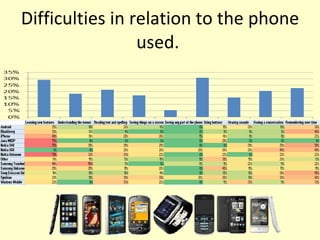
Difficulties in relation to the phone used.
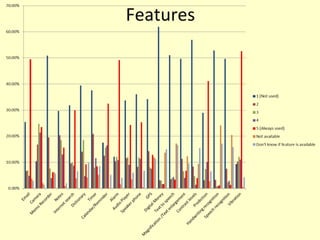
Features
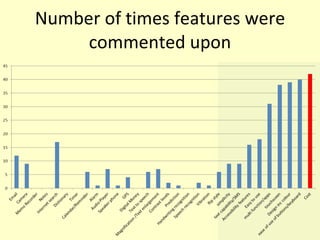
Number of times features were commented upon
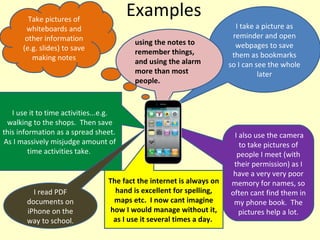
Examples I take a picture as reminder and open webpages to save them as bookmarks so I can see the whole later Take pictures of whiteboards and other information (e.g. slides) to save making notes I use it to time activities...e.g. walking to the shops.  Then save this information as a spread sheet.  As I massively misjudge amount of time activities take.  I also use the camera to take pictures of people I meet (with their permission) as I have a very very poor memory for names, so often cant find them in my phone book.  The pictures help a lot. The fact the internet is always on hand is excellent for spelling, maps etc.  I now cant imagine how I would manage without it, as I use it several times a day.  I read PDF documents on iPhone on the way to school. using the notes to remember things, and using the alarm more than most people.
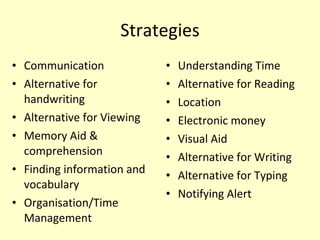
Strategies Communication Alternative for handwriting Alternative for Viewing  Memory Aid & comprehension Finding information and vocabulary  Organisation/Time Management Understanding Time Alternative for Reading Location Electronic money Visual Aid Alternative for Writing Alternative for Typing Notifying Alert
Thank you  The Magical Pocket of Aki-chan Project has been co-researched by the Research Centre of Advanced Science and Technology at the University of Tokyo and SoftBank Mobile Corp. (started June 2009)  http://at2ed.jp/sbm/mp.pdf Contact e-mail:  [email_address] LexDis Project – JISC Funded at University of Southampton  http://www.lexdis.org.uk   Contact e-mail:  [email_address]

Crosscultural study on mobile phones

  • 1.
    Cross-cultural study ofthe use of mobile phones E.A. Draffan (Univ. of Southampton, UK), Kenryu Nakamura, Mamoru Iwabuchi (Univ. of Tokyo, Japan), Takeo Kondo, Sheryl Burgstahler (Univ. of Washington, USA)
  • 2.
  • 3.
    Mobile phones wereidentified in the Horizon Report (2009)as the technologies with the highest likelihood of entry into the mainstream of learning-focused institutions within the next year. The fastest-growing sales segment belongs to smart phones (2010) http://wp.nmc.org/horizon2009/ & http ://wp.nmc.org/horizon2010 / More statistics
  • 4.
    Research Check featureson top 10 mobile phones are similar in Europe, USA and East Asia. Do the strategies from The Magical Pocket of Aki-chan Project (Japan), LexDis (UK) and DO-IT program (USA) fit the features available? Send out questionnaire using Survey Monkey to students with disabilities age range 15-25 including those at university – 220 replies
  • 5.
    Questions Age andCountry Which phone do you use? (make and number) What difficulties do you experience? Have your difficulties made it harder to have the mobile phone you wanted? If so why? What made you choose your present phone? How often do you use these features? Anything else you want to say about using a mobile phone.
  • 6.
    Top 10 Mobiles– BCN ranking , USA and UK (Sept 2010) Apple iPhone 4 SonyEricsson Xperia Hitachi beskey Kyocera K004 Panasonic P-07B Fujitsu Rakuraku-phone 7 SonyEricsson UB Fujitsu F-06B NEC N-06B Fujitsu Rakuraku-phone Basic II Apple iPhone 4 HTC Desire HTC Legend Google Nexus One HTC Hero Apple iPhone 3GS Samsung Galaxy Europa GT-i5500 Huawei Ideos Motorola Milestone XT720 Samsung Galaxy Apollo GT-i5801 Apple iPhone 4 HTC Droid Incredible HTC Evo 4G RIM BlackBerry Bold 9700 Samsung Epic 4G T-Mobile G2 Samsung Fascinate HTC Desire Sony Ericsson Xperia X10 Motorola Droid 2
  • 7.
  • 8.
  • 9.
    If my phonecould change text to reduce glare this would be brill Speaking instructions - hard to remember the commands or which button sets it working. e.g phone home The 'large' text option on for font is not very large! Due to fear of getting frustrated at not knowing a feature, I had the blackberry for 6 months in a box before I started using it a year ago. I am still not familiar with all the features.
  • 10.
    Difficulties in relationto the phone used.
  • 11.
  • 12.
    Number of timesfeatures were commented upon
  • 13.
    Examples I takea picture as reminder and open webpages to save them as bookmarks so I can see the whole later Take pictures of whiteboards and other information (e.g. slides) to save making notes I use it to time activities...e.g. walking to the shops. Then save this information as a spread sheet. As I massively misjudge amount of time activities take. I also use the camera to take pictures of people I meet (with their permission) as I have a very very poor memory for names, so often cant find them in my phone book. The pictures help a lot. The fact the internet is always on hand is excellent for spelling, maps etc. I now cant imagine how I would manage without it, as I use it several times a day. I read PDF documents on iPhone on the way to school. using the notes to remember things, and using the alarm more than most people.
  • 14.
    Strategies Communication Alternativefor handwriting Alternative for Viewing Memory Aid & comprehension Finding information and vocabulary Organisation/Time Management Understanding Time Alternative for Reading Location Electronic money Visual Aid Alternative for Writing Alternative for Typing Notifying Alert
  • 15.
    Thank you The Magical Pocket of Aki-chan Project has been co-researched by the Research Centre of Advanced Science and Technology at the University of Tokyo and SoftBank Mobile Corp. (started June 2009) http://at2ed.jp/sbm/mp.pdf Contact e-mail: [email_address] LexDis Project – JISC Funded at University of Southampton http://www.lexdis.org.uk Contact e-mail: [email_address]

Editor's Notes

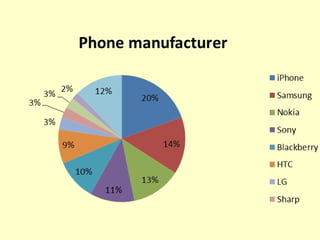
  • #8 iPhone 20% Samsung 14% Nokia 13% Sony 11% Blackberry 10% HTC 9% LG 3% Sharp 3% Motorola 3% Toshiba 2% Other 12%
  • #9 Learning new features 29.20% Understanding the menus 18.23% Reading text and spelling 21.33% Seeing things on a screen 17.00% Seeing any part of the phone 5.37% Using buttons 30.73% Hearing sounds 15.30% Having a conversation 20.47% Remembering over time 22.73%