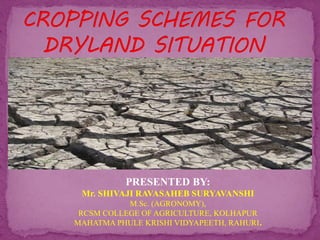
PRESENTED BY:
Mr. SHIVAJI RAVASAHEB SURYAVANSHI
M.Sc. (AGRONOMY),
RCSM COLLEGE OF AGRICULTURE, KOLHAPUR
MAHATMA PHULE KRISHI VIDYAPEETH, RAHURI.
 India has about 47 million hectares of dry lands out of
108 million hectares of total rain fed area.
 Dry lands contribute 42% of the total food grain
production of the country.
 These areas produce 75% of pulses and more than 90%
of sorghum, millet, groundnut and pulses from arid
and semi-arid regions.
 Thus, dry lands and rainfed farming will continue to
playa dominant role in agricultural production.
I. Uncertainty or limited rainfall.
II. Extensive climate hazard.
III. Undulating soil surface.
IV. Extensive holding and agriculture.
V. Relatively large plot size.
VI. Lower crop yield.
VII. Poor farmer and cattle health.
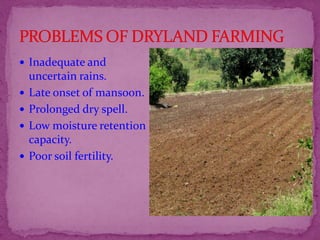
 Inadequate and
uncertain rains.
 Late onset of mansoon.
 Prolonged dry spell.
 Low moisture retention
capacity.
 Poor soil fertility.
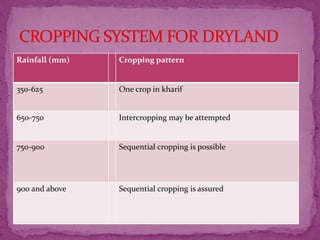
Rainfall (mm) Cropping pattern
350-625 One crop in kharif
650-750 Intercropping may be attempted
750-900 Sequential cropping is possible
900 and above Sequential cropping is assured
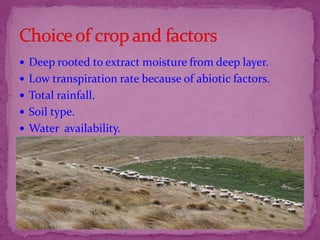
 Deep rooted to extract moisture from deep layer.
 Low transpiration rate because of abiotic factors.
 Total rainfall.
 Soil type.
 Water availability.
Region or soil type Kharif crop Rabi crop
A- Northern Region
Panjab Sorghum+Maize Wheat + Potato
Haryana Pearlmillet Cluster bean
B- Central Region
Deharadun Maize - Upland paddy Wheat - Bengal gram
Uttranchal Mustard
C- Eastern Region
Jharkhand Rice+Maize Chickpea+Linseed
M.P. (jhansi) Sorghum+Bajra Bangal gram
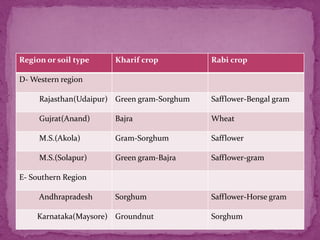
Region or soil type Kharif crop Rabi crop
D- Western region
Rajasthan(Udaipur) Green gram-Sorghum Safflower-Bengal gram
Gujrat(Anand) Bajra Wheat
M.S.(Akola) Gram-Sorghum Safflower
M.S.(Solapur) Green gram-Bajra Safflower-gram
E- Southern Region
Andhrapradesh Sorghum Safflower-Horse gram
Karnataka(Maysore) Groundnut Sorghum
Cropping schemes for dryland situation

Cropping schemes for dryland situation

  • 2.
    PRESENTED BY: Mr. SHIVAJIRAVASAHEB SURYAVANSHI M.Sc. (AGRONOMY), RCSM COLLEGE OF AGRICULTURE, KOLHAPUR MAHATMA PHULE KRISHI VIDYAPEETH, RAHURI.
  • 4.
     India hasabout 47 million hectares of dry lands out of 108 million hectares of total rain fed area.  Dry lands contribute 42% of the total food grain production of the country.  These areas produce 75% of pulses and more than 90% of sorghum, millet, groundnut and pulses from arid and semi-arid regions.  Thus, dry lands and rainfed farming will continue to playa dominant role in agricultural production.
  • 5.
    I. Uncertainty orlimited rainfall. II. Extensive climate hazard. III. Undulating soil surface. IV. Extensive holding and agriculture. V. Relatively large plot size. VI. Lower crop yield. VII. Poor farmer and cattle health.
  • 6.
     Inadequate and uncertainrains.  Late onset of mansoon.  Prolonged dry spell.  Low moisture retention capacity.  Poor soil fertility.
  • 7.
    Rainfall (mm) Croppingpattern 350-625 One crop in kharif 650-750 Intercropping may be attempted 750-900 Sequential cropping is possible 900 and above Sequential cropping is assured
  • 8.
     Deep rootedto extract moisture from deep layer.  Low transpiration rate because of abiotic factors.  Total rainfall.  Soil type.  Water availability.
  • 9.
    Region or soiltype Kharif crop Rabi crop A- Northern Region Panjab Sorghum+Maize Wheat + Potato Haryana Pearlmillet Cluster bean B- Central Region Deharadun Maize - Upland paddy Wheat - Bengal gram Uttranchal Mustard C- Eastern Region Jharkhand Rice+Maize Chickpea+Linseed M.P. (jhansi) Sorghum+Bajra Bangal gram
  • 10.
    Region or soiltype Kharif crop Rabi crop D- Western region Rajasthan(Udaipur) Green gram-Sorghum Safflower-Bengal gram Gujrat(Anand) Bajra Wheat M.S.(Akola) Gram-Sorghum Safflower M.S.(Solapur) Green gram-Bajra Safflower-gram E- Southern Region Andhrapradesh Sorghum Safflower-Horse gram Karnataka(Maysore) Groundnut Sorghum