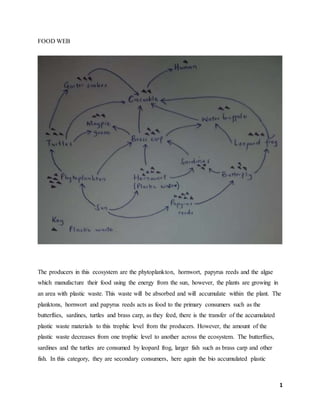
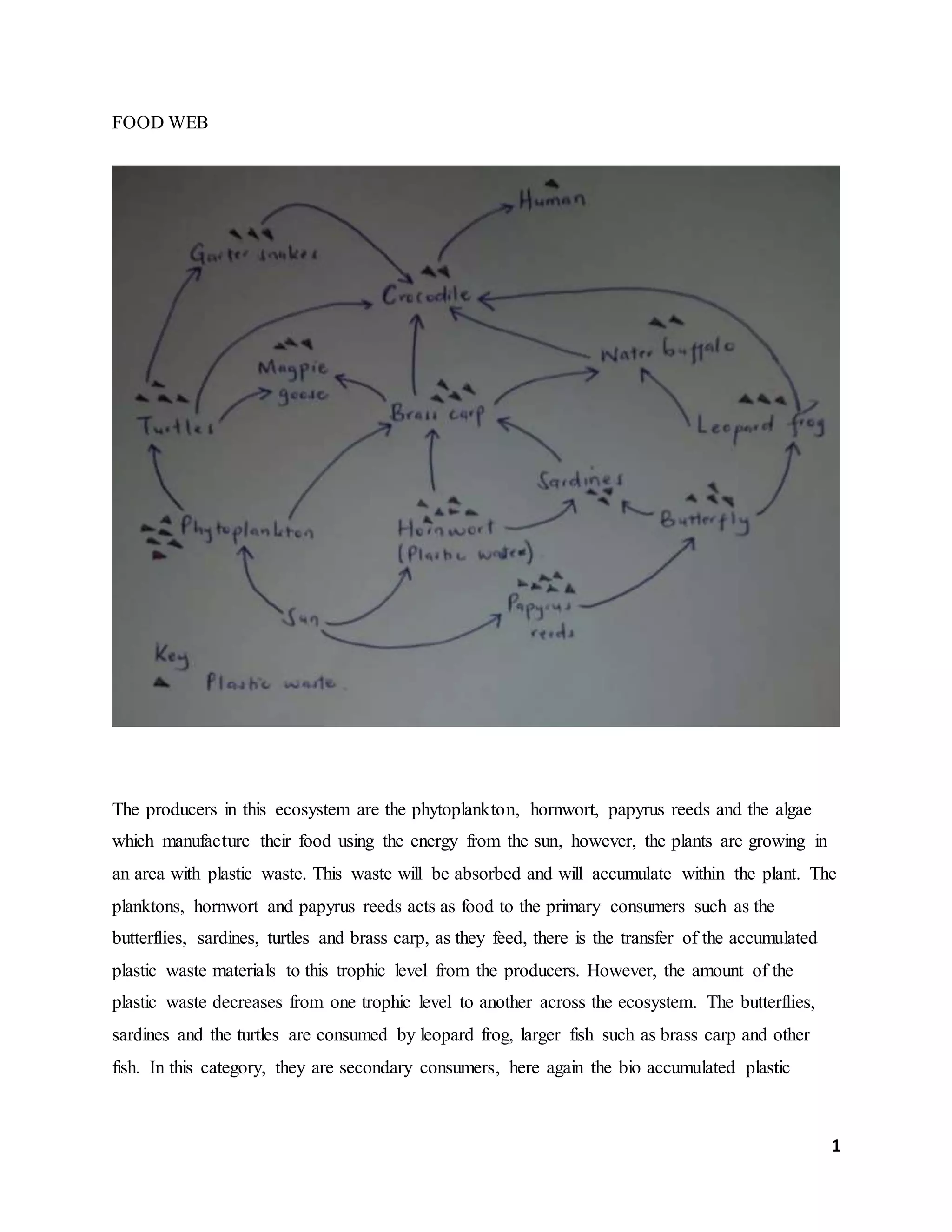
The document describes a food web where phytoplankton, hornwort, papyrus reeds, and algae are producers affected by plastic waste, which accumulates in them. This waste is transferred to primary consumers like butterflies and turtles, then to secondary consumers such as leopard frogs and larger fish, ultimately reaching the tertiary consumers like crocodiles. Scavengers, including large cats and humans, consume the crocodiles, allowing the plastic waste to ascend the trophic levels despite decreasing amounts at each level.


![Investigation 5 4 2009[1]](https://cdn.slidesharecdn.com/ss_thumbnails/investigation5420091-091012074200-phpapp01-thumbnail.jpg?width=640&height=640&fit=bounds)
![Investigation 5 4 2009[1]](https://cdn.slidesharecdn.com/ss_thumbnails/investigation5420091-091012075535-phpapp02-thumbnail.jpg?width=640&height=640&fit=bounds)


