KNOW YOUR COMMUNITY-KNOW YOUR WORLD
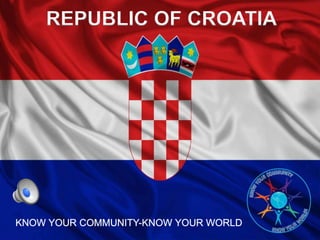
REPUBLIC OF CROATIA
Speaker:
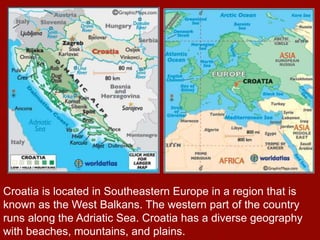
Croatia is located in Southeastern Europe in a region that is
known as the West Balkans. The western part of the country
runs along the Adriatic Sea. Croatia has a diverse geography
with beaches, mountains, and plains.
Country Quick Facts
Full name: Republic of Croatia
Population: about 4.5 million people (July 2014)
Capital: Zagreb
Largest city: Zagreb
Official language: Croatian
Major religion: Roman Catholic (86.3%)
Life expectancy: Male- 73, Female- 80
Monetary unit: Croatian Kuna
Main exports: transport equipment, machinery, textiles, chemicals,
foodstuffs, fuels
GNI per capita: $20,830
Croatian History in Brief
• Romans ruled the land today known as Croatia until the 5th
century and there are still ruins around the country today
• Around the middle of the 7th century, Croat tribes arrived in
the land
• Shortly after, they came under Frankish rule and much
conversion to Christianity resulted, which is still evident
today, with 90% of the population identifying as Catholic
• In 925, a king was crowned and Croatia the Kingdom was
created
• The Kingdom of Croatia eventually merged with Hungary in
the Middle Ages
History continued
• Croatia became part of the
Austro-Hungarian Empire in the
19th century until it fell in 1918
• Croatia then became part of
communist Tito’s Yugoslavia in
the 1950s
• Croatia declared independence
from Yugoslavia in June 1991
• A civil war resulted from the
breakup of Yugoslavia and
Croatia faced many casualties
• Croatia joined the European
Union in 2013
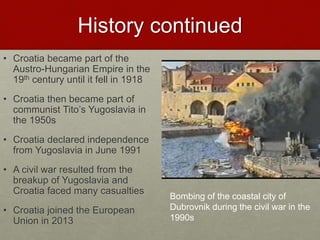
Bombing of the coastal city of
Dubrovnik during the civil war in the
1990s
Language
• HELLO: Dobar dan
• GOODBYE: Dovidenja
• YES: Da
• NO: Ne
• THANK YOU: Hvala
• YOU’RE WELCOME: nema na čemu
• PLEASE: Molim
• I LOVE YOU: Volim te
• HOW ARE YOU?: Kako si?
Government
• President- Kolinda Grabar-
Kitarovic
• Prime Minister- Zoran Milanovic
• Parliamentary democracy
• Voting age- 18 years old, 16 if
employed
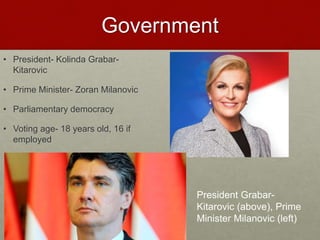
President Grabar-
Kitarovic (above), Prime
Minister Milanovic (left)
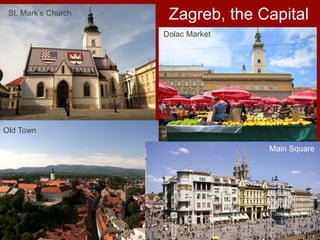
Zagreb, the CapitalSt. Mark’s Church
Old Town
Dolac Market
Main Square
Current issues
• Still some corruption in the government
• High unemployment rates
• Struggling to keep Foreign Direct
Investment
• Protection of minorities such as Serbs
and Roma
• Disagreements over territory claims with
Bosnia and Herzegovina and Slovenia
Economy
• Has been doing well economically
despite being part of the
communist Yugoslavia until 1991
and the damaging war that
followed independence
• Became a member of the
European Union in 2013 (newest
member)
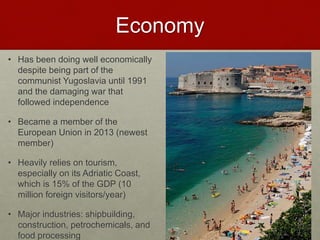
• Heavily relies on tourism,
especially on its Adriatic Coast,
which is 15% of the GDP (10
million foreign visitors/year)
• Major industries: shipbuilding,
construction, petrochemicals, and
food processing
Currency
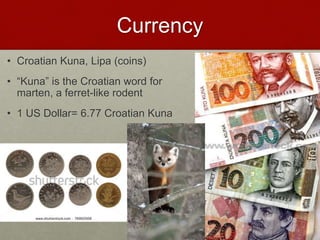
• Croatian Kuna, Lipa (coins)
• “Kuna” is the Croatian word for
marten, a ferret-like rodent
• 1 US Dollar= 6.77 Croatian Kuna
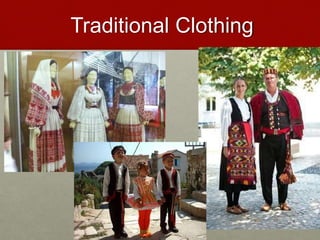
Traditional Clothing
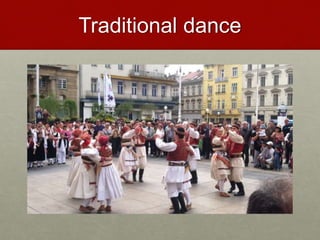
Traditional dance
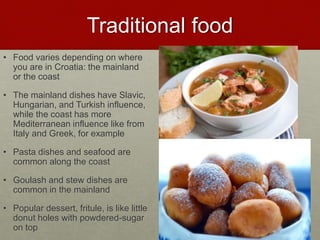
Traditional food
• Food varies depending on where
you are in Croatia: the mainland
or the coast
• The mainland dishes have Slavic,
Hungarian, and Turkish influence,
while the coast has more
Mediterranean influence like from
Italy and Greek, for example
• Pasta dishes and seafood are
common along the coast
• Goulash and stew dishes are
common in the mainland
• Popular dessert, fritule, is like little
donut holes with powdered-sugar
on top
Fun facts
• The necktie was created in Croatia in the 17th century
• The first ball-point pen was invented in Croatia
• There is hardly any security outside the government buildings,
such as the parliament building, in Zagreb, Croatia
• Croatia has over 1,000 islands!
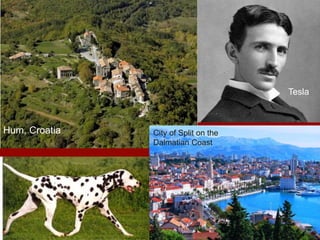
• Even though he was ethnically Serbian, Nikola Tesla, the
famous scientist and inventor, was born in a small village in
Croatia
• The dog breed Dalmatian, got its name from Dalmatia, a south
coastal region in Croatia
• The smallest town in the world, according to the Guiness World
Hum, Croatia
Tesla
City of Split on the
Dalmatian Coast
Links
• https://www.cia.gov/library/publications/the-world-
factbook/geos/hr.html
• http://www.worldatlas.com/webimage/countrys/europ
e/hr.htm
• http://zagreb.usembassy.gov/
• http://kids.nationalgeographic.com/explore/countries
/croatia/

Croatia

  • 1.
    KNOW YOUR COMMUNITY-KNOWYOUR WORLD REPUBLIC OF CROATIA
  • 2.
  • 3.
    Croatia is locatedin Southeastern Europe in a region that is known as the West Balkans. The western part of the country runs along the Adriatic Sea. Croatia has a diverse geography with beaches, mountains, and plains.
  • 4.
    Country Quick Facts Fullname: Republic of Croatia Population: about 4.5 million people (July 2014) Capital: Zagreb Largest city: Zagreb Official language: Croatian Major religion: Roman Catholic (86.3%) Life expectancy: Male- 73, Female- 80 Monetary unit: Croatian Kuna Main exports: transport equipment, machinery, textiles, chemicals, foodstuffs, fuels GNI per capita: $20,830
  • 5.
    Croatian History inBrief • Romans ruled the land today known as Croatia until the 5th century and there are still ruins around the country today • Around the middle of the 7th century, Croat tribes arrived in the land • Shortly after, they came under Frankish rule and much conversion to Christianity resulted, which is still evident today, with 90% of the population identifying as Catholic • In 925, a king was crowned and Croatia the Kingdom was created • The Kingdom of Croatia eventually merged with Hungary in the Middle Ages
  • 6.
    History continued • Croatiabecame part of the Austro-Hungarian Empire in the 19th century until it fell in 1918 • Croatia then became part of communist Tito’s Yugoslavia in the 1950s • Croatia declared independence from Yugoslavia in June 1991 • A civil war resulted from the breakup of Yugoslavia and Croatia faced many casualties • Croatia joined the European Union in 2013 Bombing of the coastal city of Dubrovnik during the civil war in the 1990s
  • 7.
    Language • HELLO: Dobardan • GOODBYE: Dovidenja • YES: Da • NO: Ne • THANK YOU: Hvala • YOU’RE WELCOME: nema na čemu • PLEASE: Molim • I LOVE YOU: Volim te • HOW ARE YOU?: Kako si?
  • 8.
    Government • President- KolindaGrabar- Kitarovic • Prime Minister- Zoran Milanovic • Parliamentary democracy • Voting age- 18 years old, 16 if employed President Grabar- Kitarovic (above), Prime Minister Milanovic (left)
  • 9.
    Zagreb, the CapitalSt.Mark’s Church Old Town Dolac Market Main Square
  • 10.
    Current issues • Stillsome corruption in the government • High unemployment rates • Struggling to keep Foreign Direct Investment • Protection of minorities such as Serbs and Roma • Disagreements over territory claims with Bosnia and Herzegovina and Slovenia
  • 11.
    Economy • Has beendoing well economically despite being part of the communist Yugoslavia until 1991 and the damaging war that followed independence • Became a member of the European Union in 2013 (newest member) • Heavily relies on tourism, especially on its Adriatic Coast, which is 15% of the GDP (10 million foreign visitors/year) • Major industries: shipbuilding, construction, petrochemicals, and food processing
  • 12.
    Currency • Croatian Kuna,Lipa (coins) • “Kuna” is the Croatian word for marten, a ferret-like rodent • 1 US Dollar= 6.77 Croatian Kuna
  • 13.
  • 14.
  • 15.
    Traditional food • Foodvaries depending on where you are in Croatia: the mainland or the coast • The mainland dishes have Slavic, Hungarian, and Turkish influence, while the coast has more Mediterranean influence like from Italy and Greek, for example • Pasta dishes and seafood are common along the coast • Goulash and stew dishes are common in the mainland • Popular dessert, fritule, is like little donut holes with powdered-sugar on top
  • 16.
    Fun facts • Thenecktie was created in Croatia in the 17th century • The first ball-point pen was invented in Croatia • There is hardly any security outside the government buildings, such as the parliament building, in Zagreb, Croatia • Croatia has over 1,000 islands! • Even though he was ethnically Serbian, Nikola Tesla, the famous scientist and inventor, was born in a small village in Croatia • The dog breed Dalmatian, got its name from Dalmatia, a south coastal region in Croatia • The smallest town in the world, according to the Guiness World
  • 17.
    Hum, Croatia Tesla City ofSplit on the Dalmatian Coast
  • 18.