Greece
KNOW YOUR COMMUNITY
Know your world
A PROGRAM OF GLOBAL TIES AKRON
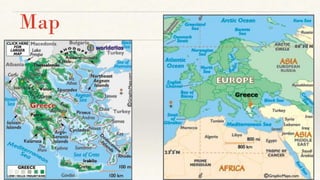
Map
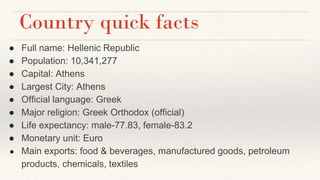
Country quick facts
● Full name: Hellenic Republic
● Population: 10,341,277
● Capital: Athens
● Largest City: Athens
● Official language: Greek
● Major religion: Greek Orthodox (official)
● Life expectancy: male-77.83, female-83.2
● Monetary unit: Euro
● Main exports: food & beverages, manufactured goods, petroleum
products, chemicals, textiles
History
● Greek civilization began around 3,000 BC with the Minoans, who
were followed by the Myceneans, who lasted until 1100 BC
● After this, Ancient Greece entered a “Dark Age” that lasted until
800 BC, when Greeks began to explore the sea
● Around 480 BC, a golden age began that became known as
Classic Greece, which is when it earned the name of “the birthplace
of western civilization”
● In 146 BC the Romans conquered the Greek Empire
● Around 300 AD Greece became part of the Byzantine Empire
● Early 16th century- came under Ottoman Turk rule
● Gained independence from the Turks in 1830
● In WWI, Greece fought on the side of the Allies, but communism
and fascism began to gain popularity in Greece
History continued
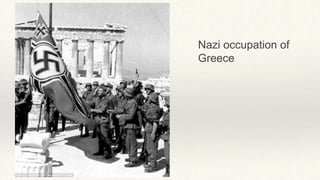
● Greece was occupied by the Nazis in WWII
● Communism was defeated in Greece in 1949 and in
1952 Greece joined NATO
● For a short time after, military dictatorship took over
but ended in 1974 with democratic elections creating
a parliamentary republic
● 1981- Greece joined the European Union
● 2001- Greece joins the euro
● 2009- Greek financial crisis begin
Nazi occupation of
Greece
Language
● GOODBYE: Γειά σας /Yiá sas
● YES: Ναι /Nai
● NO: Όχι /Ochi
● THANK YOU: Ευχαριστώ /Efharistó
● YOU’RE WELCOME: Παρακαλώ /Parakaló
● PLEASE: παρακαλώ /parakalo
● I LOVE YOU: Σ΄αγαπώ /S’agapó
● HOW ARE YOU: Πώς είστε /pos íste
Government
● Voting age: 18
● Parliamentary republic
● President: Katerina Sakellaropoulou
● Prime minister: Kyriakos Mitsotakis
Current Issues
● Unemployment
● Immigration
● Country debt
Economy
● Joined the European Union in 1981
● Joined the Eurozone in 2001
● Tourism provides 18% of GDP
● Economy went into recession in 2009 (see Greek
Debt Crisis slide)
● Industries: tourism, food and tobacco processing,
textiles, chemicals, metal products, mining, petroleum
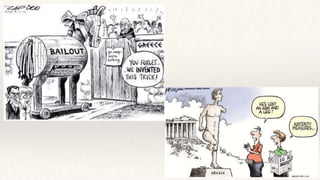
The Greek debt crisis
● Greece had been spending way more money than it had to
spend, wasn’t enforcing tax collection
● Government admitted it had been lying about national deficit for
years in 2009 after the Global Financial Crisis hit
● Financial lending in Greece was cut off and it was heading
toward bankruptcy
● 110 billion euro bailout in 2010 by the EU and International
Monetary Fund but with austerity measures like large
government spending cuts, tax increases, and wage lowering
● A second bailout brought the bailout total to 240 billion euros
● Bailout money mostly goes towards paying back loans instead
of into the economy so Greece continues to struggle
The Greek debt crisis cont.
● Many Greeks argue that the austerity measures are
harming the economy
● Recent referendum on whether austerity measures
should be done like Europe wants (cut social
spending significantly more) or Greece wants (raising
taxes) and the Greeks voted for their own way
● The future of Greece’s economy is still uncertain, but
Greece will probably continue to struggle to pay back
loans on time
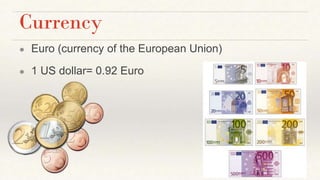
Currency
● Euro (currency of the European Union)
● 1 US dollar= 0.92 Euro
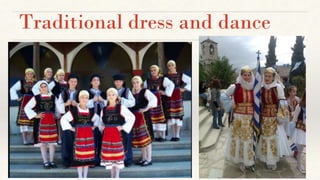
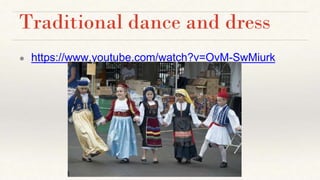
Traditional dress and dance
Traditional dance and dress
● https://www.youtube.com/watch?v=OvM-SwMiurk
Food
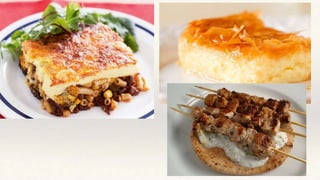
● Moussaka-layered casserole with eggplant, minced meat, potatoes
and veggies
● Pastitsio-pasta and meat filling layered and baked
● In Greece they eat lots of fresh fish because they are surround by
seas
● Tzatziki- creamy, cucumber yogurt dip
● Spanakopita- Spinach pie with feta cheese
● Souvlaki- meat skewer with lamb, pork, chicken, etc.
● Kebabs- minced meat wrapped in pita bread with various toppings
● Baklava- flaky pastry with cinnamon-spice nut filling covered in syrup
● Galaktoboureko- custard-filled pie
Fun facts
● Greece has 15 UNESCO World Heritage Sites in its borders
● Greece has about 2,000 islands of various sizes!
● The first modern Olympics were held in Athens, Greece in 1896, as
well as the first ever Olympics during ancient times (776 BC)
● Greece is the third largest producer of olives in the entire world and
Greeks consumer more olive oil per capita than any other group of
people
● Mount Olympus is the highest point in Greece and was thought to
be the home of the gods and goddesses in ancient times
● Greece is the only country in the world that receives double its
population in tourists
● Greeks celebrate name days more than birthdays- a name day is
the day of the saint that a person is named after
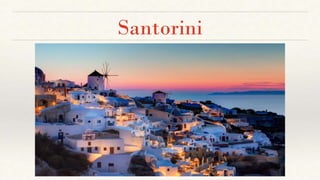
Santorini
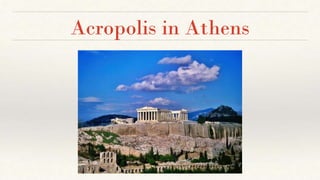
Acropolis in Athens
First olympic games (1896)
KnowYourCommunity-KnowYourWorld-Greece-2023

KnowYourCommunity-KnowYourWorld-Greece-2023

  • 1.
    Greece KNOW YOUR COMMUNITY Knowyour world A PROGRAM OF GLOBAL TIES AKRON
  • 2.
  • 3.
    Country quick facts ●Full name: Hellenic Republic ● Population: 10,341,277 ● Capital: Athens ● Largest City: Athens ● Official language: Greek ● Major religion: Greek Orthodox (official) ● Life expectancy: male-77.83, female-83.2 ● Monetary unit: Euro ● Main exports: food & beverages, manufactured goods, petroleum products, chemicals, textiles
  • 4.
    History ● Greek civilizationbegan around 3,000 BC with the Minoans, who were followed by the Myceneans, who lasted until 1100 BC ● After this, Ancient Greece entered a “Dark Age” that lasted until 800 BC, when Greeks began to explore the sea ● Around 480 BC, a golden age began that became known as Classic Greece, which is when it earned the name of “the birthplace of western civilization” ● In 146 BC the Romans conquered the Greek Empire ● Around 300 AD Greece became part of the Byzantine Empire ● Early 16th century- came under Ottoman Turk rule ● Gained independence from the Turks in 1830 ● In WWI, Greece fought on the side of the Allies, but communism and fascism began to gain popularity in Greece
  • 5.
    History continued ● Greecewas occupied by the Nazis in WWII ● Communism was defeated in Greece in 1949 and in 1952 Greece joined NATO ● For a short time after, military dictatorship took over but ended in 1974 with democratic elections creating a parliamentary republic ● 1981- Greece joined the European Union ● 2001- Greece joins the euro ● 2009- Greek financial crisis begin
  • 6.
  • 7.
    Language ● GOODBYE: Γειάσας /Yiá sas ● YES: Ναι /Nai ● NO: Όχι /Ochi ● THANK YOU: Ευχαριστώ /Efharistó ● YOU’RE WELCOME: Παρακαλώ /Parakaló ● PLEASE: παρακαλώ /parakalo ● I LOVE YOU: Σ΄αγαπώ /S’agapó ● HOW ARE YOU: Πώς είστε /pos íste
  • 8.
    Government ● Voting age:18 ● Parliamentary republic ● President: Katerina Sakellaropoulou ● Prime minister: Kyriakos Mitsotakis
  • 9.
    Current Issues ● Unemployment ●Immigration ● Country debt
  • 10.
    Economy ● Joined theEuropean Union in 1981 ● Joined the Eurozone in 2001 ● Tourism provides 18% of GDP ● Economy went into recession in 2009 (see Greek Debt Crisis slide) ● Industries: tourism, food and tobacco processing, textiles, chemicals, metal products, mining, petroleum
  • 11.
    The Greek debtcrisis ● Greece had been spending way more money than it had to spend, wasn’t enforcing tax collection ● Government admitted it had been lying about national deficit for years in 2009 after the Global Financial Crisis hit ● Financial lending in Greece was cut off and it was heading toward bankruptcy ● 110 billion euro bailout in 2010 by the EU and International Monetary Fund but with austerity measures like large government spending cuts, tax increases, and wage lowering ● A second bailout brought the bailout total to 240 billion euros ● Bailout money mostly goes towards paying back loans instead of into the economy so Greece continues to struggle
  • 12.
    The Greek debtcrisis cont. ● Many Greeks argue that the austerity measures are harming the economy ● Recent referendum on whether austerity measures should be done like Europe wants (cut social spending significantly more) or Greece wants (raising taxes) and the Greeks voted for their own way ● The future of Greece’s economy is still uncertain, but Greece will probably continue to struggle to pay back loans on time
  • 14.
    Currency ● Euro (currencyof the European Union) ● 1 US dollar= 0.92 Euro
  • 15.
  • 16.
    Traditional dance anddress ● https://www.youtube.com/watch?v=OvM-SwMiurk
  • 17.
    Food ● Moussaka-layered casserolewith eggplant, minced meat, potatoes and veggies ● Pastitsio-pasta and meat filling layered and baked ● In Greece they eat lots of fresh fish because they are surround by seas ● Tzatziki- creamy, cucumber yogurt dip ● Spanakopita- Spinach pie with feta cheese ● Souvlaki- meat skewer with lamb, pork, chicken, etc. ● Kebabs- minced meat wrapped in pita bread with various toppings ● Baklava- flaky pastry with cinnamon-spice nut filling covered in syrup ● Galaktoboureko- custard-filled pie
  • 19.
    Fun facts ● Greecehas 15 UNESCO World Heritage Sites in its borders ● Greece has about 2,000 islands of various sizes! ● The first modern Olympics were held in Athens, Greece in 1896, as well as the first ever Olympics during ancient times (776 BC) ● Greece is the third largest producer of olives in the entire world and Greeks consumer more olive oil per capita than any other group of people ● Mount Olympus is the highest point in Greece and was thought to be the home of the gods and goddesses in ancient times ● Greece is the only country in the world that receives double its population in tourists ● Greeks celebrate name days more than birthdays- a name day is the day of the saint that a person is named after
  • 20.
  • 21.
  • 22.

Editor's Notes